Teaching with Technology: Some
Pedagogical Implications
Dilip Barad
M K Bhavnagar University
Bhavnagar
www.dilipbarad.com
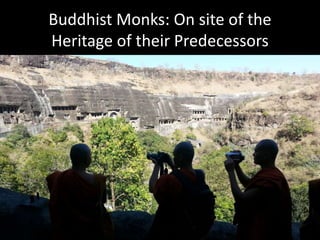
Buddhist Monks: On site of the
Heritage of their Predecessors
Let’s empty our minds
• Analysis of Responses
– Pedagogy:
• “Learning replaces Teaching”
• “Higher Goals of Education”
– Political Leadership matters:
• Leaders are like a drop of poison / nectar near the mouth
of fountain.
– Whom to follow to implement these ideas?
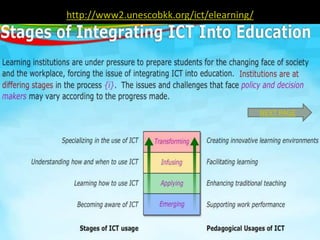
• UNESCO: Stages of Integrating ICT in Education
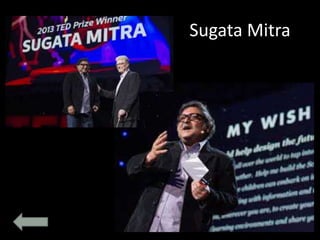
• Sugato Mitra: The Future of Learning
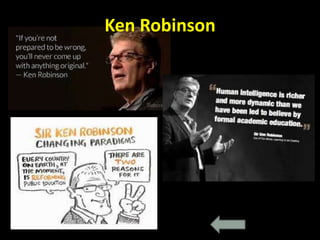
• Ken Robinson: Changing Paradigms
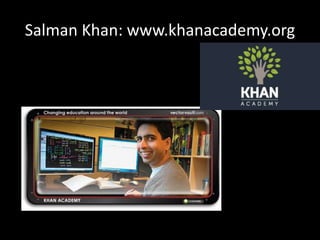
• Salman Khan: The Power of Videos
• Martin Dougiamas: Social Constructivism
Paradigm Shift: Learning replaced
Teaching
• From teaching to ‘engage’ in learning process . . .
• From isolated learning to collaborative
learning…
• From active learning to interactive learning…
• From downloaders to uploaders…
• From users to creators and contributors…
• From islands to bridges…
• From teacher to student… (decentering the centre)
Higher Goals of Education
• It’s a university’s job to
produce citizens who learn to
think for themselves, not just
engineers who can be
programmed to follow
someone else’s code.
Holly Clark
• It is imperative that in 2015, students be able to
curate, archive and expand on the work they are
producing in class.
• Today’s education must help students
authentically learn important digital citizenship
lessons.
• Education must help students to internalize the
core subject as well as vital digital literacy skills
such as creating their own digital web presence
and learning to effectively and purposefully
share their learning with the world.
Herbert Gerjuoy has rightly observed:
• "The new education must teach the individual
how to classify and reclassify information,
how to evaluate its veracity, how to change
categories when necessary, how to move from
the concrete to the abstract and back, how to
look at problems from a new direction —
how to teach himself."
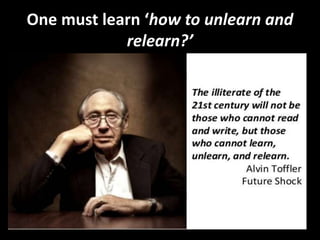
One must learn ‘how to unlearn and
relearn?’
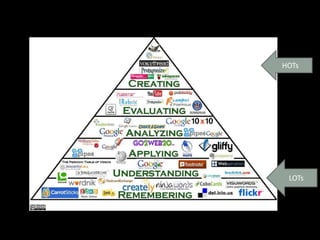
LOTs
HOTs
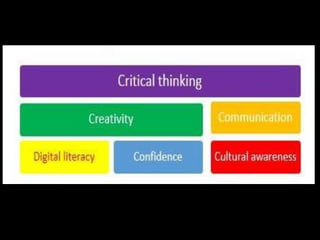
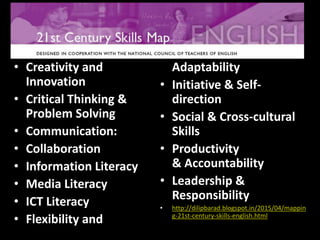
• Creativity and
Innovation
• Critical Thinking &
Problem Solving
• Communication:
• Collaboration
• Information Literacy
• Media Literacy
• ICT Literacy
• Flexibility and
Adaptability
• Initiative & Self-
direction
• Social & Cross-cultural
Skills
• Productivity
& Accountability
• Leadership &
Responsibility
• http://dilipbarad.blogspot.in/2015/04/mappin
g-21st-century-skills-english.html
Digital India / Skill India
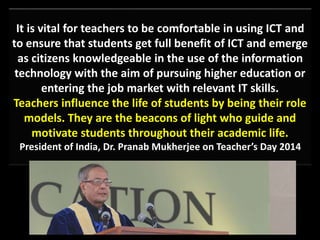
It is vital for teachers to be comfortable in using ICT and
to ensure that students get full benefit of ICT and emerge
as citizens knowledgeable in the use of the information
technology with the aim of pursuing higher education or
entering the job market with relevant IT skills.
Teachers influence the life of students by being their role
models. They are the beacons of light who guide and
motivate students throughout their academic life.
President of India, Dr. Pranab Mukherjee on Teacher’s Day 2014
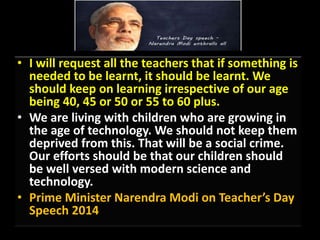
• I will request all the teachers that if something is
needed to be learnt, it should be learnt. We
should keep on learning irrespective of our age
being 40, 45 or 50 or 55 to 60 plus.
• We are living with children who are growing in
the age of technology. We should not keep them
deprived from this. That will be a social crime.
Our efforts should be that our children should
be well versed with modern science and
technology.
• Prime Minister Narendra Modi on Teacher’s Day
Speech 2014
http://www2.unescobkk.org/ict/elearning/
NEXT PAGE
Sugata Mitra
Ken Robinson
Salman Khan: www.khanacademy.org
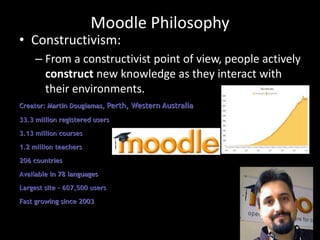
Moodle Philosophy
• Constructivism:
– From a constructivist point of view, people actively
construct new knowledge as they interact with
their environments.
Creator: Martin Dougiamas, Perth, Western Australia
33.3 million registered users
3.13 million courses
1.2 million teachers
206 countries
Available in 78 languages
Largest site – 607,500 users
Fast growing since 2003
What sort of social change can
happen?
• Click to play video: The Wired Man of Ratnauli
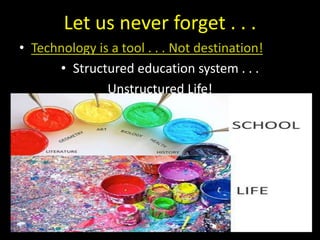
Let us never forget . . .
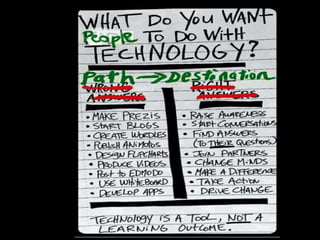
• Technology is a tool . . . Not destination!
• Structured education system . . .
Unstructured Life!
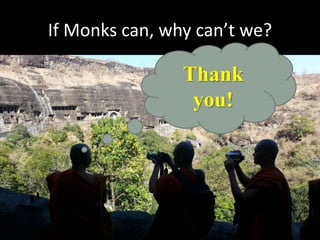
If Monks can, why can’t we?
Thank
you!

Teaching with Technology: Some Pedagogical Implications

  • 1.
    Teaching with Technology:Some Pedagogical Implications Dilip Barad M K Bhavnagar University Bhavnagar www.dilipbarad.com
  • 2.
    Buddhist Monks: Onsite of the Heritage of their Predecessors
  • 3.
    Let’s empty ourminds • Analysis of Responses – Pedagogy: • “Learning replaces Teaching” • “Higher Goals of Education” – Political Leadership matters: • Leaders are like a drop of poison / nectar near the mouth of fountain. – Whom to follow to implement these ideas? • UNESCO: Stages of Integrating ICT in Education • Sugato Mitra: The Future of Learning • Ken Robinson: Changing Paradigms • Salman Khan: The Power of Videos • Martin Dougiamas: Social Constructivism
  • 4.
    Paradigm Shift: Learningreplaced Teaching • From teaching to ‘engage’ in learning process . . . • From isolated learning to collaborative learning… • From active learning to interactive learning… • From downloaders to uploaders… • From users to creators and contributors… • From islands to bridges… • From teacher to student… (decentering the centre)
  • 5.
    Higher Goals ofEducation • It’s a university’s job to produce citizens who learn to think for themselves, not just engineers who can be programmed to follow someone else’s code.
  • 6.
    Holly Clark • Itis imperative that in 2015, students be able to curate, archive and expand on the work they are producing in class. • Today’s education must help students authentically learn important digital citizenship lessons. • Education must help students to internalize the core subject as well as vital digital literacy skills such as creating their own digital web presence and learning to effectively and purposefully share their learning with the world.
  • 7.
    Herbert Gerjuoy hasrightly observed: • "The new education must teach the individual how to classify and reclassify information, how to evaluate its veracity, how to change categories when necessary, how to move from the concrete to the abstract and back, how to look at problems from a new direction — how to teach himself."
  • 8.
    One must learn‘how to unlearn and relearn?’
  • 11.
  • 13.
    • Creativity and Innovation •Critical Thinking & Problem Solving • Communication: • Collaboration • Information Literacy • Media Literacy • ICT Literacy • Flexibility and Adaptability • Initiative & Self- direction • Social & Cross-cultural Skills • Productivity & Accountability • Leadership & Responsibility • http://dilipbarad.blogspot.in/2015/04/mappin g-21st-century-skills-english.html
  • 14.
    Digital India /Skill India
  • 15.
    It is vitalfor teachers to be comfortable in using ICT and to ensure that students get full benefit of ICT and emerge as citizens knowledgeable in the use of the information technology with the aim of pursuing higher education or entering the job market with relevant IT skills. Teachers influence the life of students by being their role models. They are the beacons of light who guide and motivate students throughout their academic life. President of India, Dr. Pranab Mukherjee on Teacher’s Day 2014
  • 16.
    • I willrequest all the teachers that if something is needed to be learnt, it should be learnt. We should keep on learning irrespective of our age being 40, 45 or 50 or 55 to 60 plus. • We are living with children who are growing in the age of technology. We should not keep them deprived from this. That will be a social crime. Our efforts should be that our children should be well versed with modern science and technology. • Prime Minister Narendra Modi on Teacher’s Day Speech 2014
  • 17.
  • 18.
  • 19.
  • 20.
  • 21.
    Moodle Philosophy • Constructivism: –From a constructivist point of view, people actively construct new knowledge as they interact with their environments. Creator: Martin Dougiamas, Perth, Western Australia 33.3 million registered users 3.13 million courses 1.2 million teachers 206 countries Available in 78 languages Largest site – 607,500 users Fast growing since 2003
  • 22.
    What sort ofsocial change can happen? • Click to play video: The Wired Man of Ratnauli
  • 23.
    Let us neverforget . . . • Technology is a tool . . . Not destination! • Structured education system . . . Unstructured Life!
  • 24.
    If Monks can,why can’t we? Thank you!