Financial Accounting II
2nd
Year Examination
May 2011
Paper, Solutions & Examiner’s Report
 
 
Financial Accounting II May 2011 2nd
Year Paper
2 
 
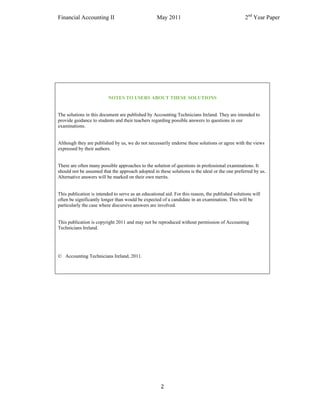
NOTES TO USERS ABOUT THESE SOLUTIONS
The solutions in this document are published by Accounting Technicians Ireland. They are intended to
provide guidance to students and their teachers regarding possible answers to questions in our
examinations.
Although they are published by us, we do not necessarily endorse these solutions or agree with the views
expressed by their authors.
There are often many possible approaches to the solution of questions in professional examinations. It
should not be assumed that the approach adopted in these solutions is the ideal or the one preferred by us.
Alternative answers will be marked on their own merits.
This publication is intended to serve as an educational aid. For this reason, the published solutions will
often be significantly longer than would be expected of a candidate in an examination. This will be
particularly the case where discursive answers are involved.
This publication is copyright 2011 and may not be reproduced without permission of Accounting
Technicians Ireland.
© Accounting Technicians Ireland, 2011.
 
 
Financial Accounting II May 2011 2nd
Year Paper
  3  Financial Accounting II (FA) 
 
 
Accounting Technicians Ireland 
 
2nd Year Examination: Summer 2011 
Paper : FINANCIAL ACCOUNTING II 
 
Monday 16th May 2010 ‐ 2.30 p.m. to 5.30 p.m. 
 
INSTRUCTIONS TO CANDIDATES 
 
PLEASE READ CAREFULLY 
 
Candidates must indicate clearly whether they are answering the paper in accordance 
with the law and practice of Northern Ireland or the Republic of Ireland. 
In this examination paper the €/£ symbol may be understood and used by candidates in 
Northern Ireland to indicate the UK pound sterling and by candidates in the Republic of 
Ireland to indicate the Euro.   
 
Answer ALL THREE questions in Section A and TWO of the THREE questions in Section B.  
If more than TWO questions are answered in Section B, then only the first TWO questions, 
in the   order filed, will be corrected. 
 
Candidates should allocate their time carefully. 
 
All workings should be shown. 
 
All figures should be labelled, as appropriate, e.g. €’s, £’s, units etc. 
 
Answers should be illustrated with examples, where appropriate. 
 
Candidates may ignore any VAT implications to transactions throughout this paper unless 
the question specifically instructs them to do otherwise. 
 
Question 1 begins on Page 2 overleaf. 
 
The following insert is enclosed with this paper: 
 
 Multiple choice question answer sheet [QUESTION 2] 


Note: 
This paper uses both the language of International Accounting Standards (I.A.S’s) and Financial 
Reporting Standards (F.R.S’s) where appropriate (e.g. Receivables/Debtors).  Examinees are 
permitted to use either terminology when preparing financial statements but the use of the 
language of the International Accounting Standards (e.g. Receivables rather than Debtors) is 
preferred. 


Financial Accounting II May 2011 2nd
Year Paper
  4  Financial Accounting II (FA) 
 
SECTION A 
 
 
Answer ALL THREE Questions in this Section 
 
QUESTION 1 (Compulsory) 
 
It is important that financial reporting be subject to rules and regulations.  The rules and 
regulations which apply are commonly referred to as the ‘regulatory framework’ or Generally 
Accepted Accounting Practices (‘GAAP’).   
 
(a)   Explain the need for regulation in the context of financial reporting and explain why it is 
important. 
8 Marks 
(b)  Describe briefly the four main sources of regulation that represents Irish GAAP. 
12 Marks 
Total 20 Marks 
       
QUESTION 2 (Compulsory) 
 
The following multiple choice question consists of TEN parts, each of which is followed by FOUR 
possible answers.  There is ONLY ONE right answer in each part. 
 
Each part carries 1 ½ marks. 
 
Requirement 
 
Indicate the right answer to each of the following ten parts. 
Total 15 Marks 
NB Candidates should answer this question by ticking the appropriate boxes on the specified 
green answer sheet which is supplied with the examination paper. 
 
[1]   Under the terms of IAS 8 where the effect of a change in estimate is material to the 
financial statements: 
 
[a]  the nature and monetary effect of the change on the financial statements must be 
disclosed. 
[b]  the change in estimate should be applied retrospectively. 
[c]   the change in estimate should only be applied retrospectively where it is deemed 
necessary to provide more reliable information. 
[d]   the nature and monetary effect of the change on the financial statements must be 
disclosed only where it is deemed necessary to provide more reliable information. 
 
 
Financial Accounting II May 2011 2nd
Year Paper
  5  Financial Accounting II (FA) 
 
 
QUESTION 2 (Cont’d) 
 
[2]    If a partner lends the partnership funds in the form of start‐up finance, how should the 
annual interest charge be treated? 
 
[a]   debited to partners current account. 
[b]   credited to partners current account. 
[c]  deducted from business profits before the profits are apportioned. 
[d]   credited to partners capital account. 
 
[3]  Drawings, by a partner in a partnership, made during the year should be: 
 
[a]  included as an expense in the partnership Statement of Comprehensive Income. 
[b]   included as a revenue in the partnership Statement of Comprehensive Income. 
[c]    credited in the partners current account. 
[d]   debited in the partner’s current account. 
 
[4]   The provision for discounts allowed on debtors balances outstanding should be 
calculated, at the appropriate rate on: 
 
[a]   the debtors outstanding, after deducting the provision for doubtful debts but before 
taking into account bad debts written off. 
[b]  the debtors outstanding, after taking into account bad debts written off and after 
deducting the provision for doubtful debts. 
[c]  the debtors outstanding after taking into account bad debts written off but before 
taking into account the provision for doubtful debts. 
[d]   the debtors outstanding. 
 
[5]  Coral Limited’s mark‐up on cost is 20%.  The closing inventory at 31 December 2010 has 
been counted and valued at cost which amounts to £/€102,000.  This amount includes 
damaged items which cost £/€8,800.  It is expected that once repaired, at a cost of 
£/€500, the goods will then be in a condition to be sold at a discount of 25% on full price.  
At what value should inventory be stated at 31 December 2010? 
 
[a]   £/€ 101,500. 
[b]   £/€ 99,300. 
[c]  £/€ 100,620. 
[d]  £/€ 101,120. 


Financial Accounting II May 2011 2nd
Year Paper
  6  Financial Accounting II (FA) 
 
QUESTION 2 (Cont’d) 
 
[6]  If a capital grant is recognised as deferred income in the balance sheet what are the 
entries to be made each year over the useful life of the associated asset: 
 
[a]   credit deferred income, debit income statement. 
[b]  debit deferred income, credit income statement. 
[c]   debit deferred income, credit bank. 
[d]  credit deferred income, debit bank. 
 
[7]  The following information relates to Considine Limited: 
 
                      £/€ 
 
  Trade payables @ 1 Jan 2010      96,000 
  Transactions for the year ended 31 Dec 2010 
  Payments to suppliers       468,000 
  Discount allowed              7,500 
  Discount received                  5,940 
  Payables @ 31 Dec 2010       97,500 
   
What is the credit purchase figure for the year ended 31 December 2010? 
   
[a]  £/€ 475,440. 
[b]   £/€ 467,940. 
[c]   £/€ 473,880.  
[d]  £/€ 472,440. 


Financial Accounting II May 2011 2nd
Year Paper
  7  Financial Accounting II (FA) 
 
QUESTION 2 (Cont’d) 
 
[8]  The following information relates to Georgia Limited: 
 
                    £/€ 
 
  Sales            32,800 
  Opening inventory           5,200 
  Closing inventory                      3,600 
  Returns in            4,200 
  Returns out            1,100 
  Purchases            25,600 
  Carriage in               900 
  Carriage out               800 
   
What is the cost of goods sold figure for the year ended 31 December 2010? 
   
[a]  £/€ 30,600. 
[b]   £/€ 26,900. 
[c]   £/€ 23,900.   
[d]  £/€ 27,000. 
 
[9]  What journal entries are required to record the receipt of a bad debt at year end which 
was written off during the year? 
 
[a]   debit bad debt expense, credit bank. 
[b]   debit bank, credit bad debt expense. 
[c]  debit bad debts, credit debtors. 
[d]   debit debtors, credit bad debts. 
 
[10]  In accordance with I.A.S. 16 ‘Property, Plant and Equipment’ assets may be recognised at 
cost less accumulated depreciation or at a revalued amount.  Where an asset is revalued 
upwards, there is a debit entry to the asset at cost account.  Where is the corresponding 
credit entry recorded?  
 
[a]   In the Bank account in the Statement of Financial Position. 
[b]   In ‘Other Income’ in the Statement of Comprehensive Income. 
[c]  In the Revaluation reserve account in the ‘Capital and Reserves’ section of the 
Statement of Financial Position. 
 
 
Financial Accounting II May 2011 2nd
Year Paper
  8  Financial Accounting II (FA) 
[d]   In the appropriate ‘Accumulated depreciation’ account in the Statement of Financial 
Position. 
 
QUESTION 3 (Compulsory) 
 
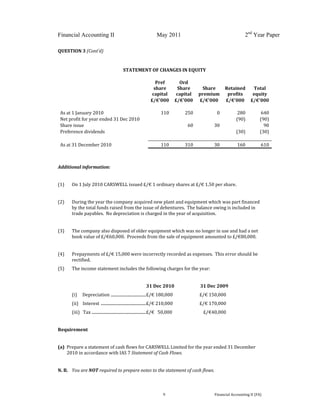
The Statement of Financial Position, Statement of Changes in Equity and other relevant 
information of CARSWELL Limited, for the year ended 31 December 2010, are as follows: 
 
Statement of Financial Position as at 31 December 2010 
              2009  2009 
           £/€'000    £/€'000    £/€'000    £/€'000  
                 
ASSETS                 
Non­current assets                1,520           1,220 
                 
Current assets               
  Inventory              1,440          1,530    
  Receivables            2,630          2,040    
  Prepayments    280   160   
  Cash & cash equivalents              20              30    
                  4,370           3,760 
                 
Total assets                5,890           4,980  
                 
EQUITY and LIABILITIES           
               
Capital and reserves             
  £/€1 ordinary shares              310            250    
  Preference shares              110            110    
  Share premium account              30               ‐     
  Retained earnings              160            280    
                  610             640 
Non­current liabilities           
  Bank loans            2,040          1,740    
  10% debentures            900            900    
                2,940           2,640 
Current liabilities             
  Trade payables     
  
1,210               970     
  Current instalments due on loans          540            540    
  10% debentures              300               ‐     
  Bank overdraft           50            ‐    
  Taxation                 210              160    
  Preference dividends                30              30    
                2,340           1,700 
               
Total equity and liabilities              5,890           4,980  


Financial Accounting II May 2011 2nd
Year Paper
  9  Financial Accounting II (FA) 
 
QUESTION 3 (Cont’d) 
 
STATEMENT OF CHANGES IN EQUITY 
               
     
Pref 
share 
capital 
Ord 
Share 
capital 
Share 
premium  
Retained 
profits 
Total 
equity 
      £/€'000  £/€'000  £/€'000  £/€'000  £/€'000 
               
As at 1 January 2010    110  250  0  280  640 
Net profit for year ended 31 Dec 2010        (90)  (90) 
Share issue        60  30    90 
Preference dividends          (30)  (30) 
               
As at 31 December 2010    110  310  30  160  610 
               
 
Additional information: 
 
(1)  On 1 July 2010 CARSWELL issued £/€ 1 ordinary shares at £/€ 1.50 per share.   
 
(2)  During the year the company acquired new plant and equipment which was part financed 
by the total funds raised from the issue of debentures.  The balance owing is included in 
trade payables.  No depreciation is charged in the year of acquisition. 
 
(3)  The company also disposed of older equipment which was no longer in use and had a net 
book value of £/€60,000.  Proceeds from the sale of equipment amounted to £/€80,000.   
 
(4)  Prepayments of £/€ 15,000 were incorrectly recorded as expenses.  This error should be 
rectified. 
(5)  The income statement includes the following charges for the year: 
 
   .................................................................. 31 Dec 2010                        31 Dec 2009 
  (i)     Depreciation  ................................... £/€ 180,000    £/€ 150,000 
  (ii)    Interest  ............................................. £/€ 210,000        £/€ 170,000 
  (iii)   Tax  ...................................................... £/€   50,000    £/€40,000 
 
Requirement 
 
(a)  Prepare a statement of cash flows for CARSWELL Limited for the year ended 31 December 
2010 in accordance with IAS 7 Statement of Cash Flows. 
                
N. B.  You are NOT required to prepare notes to the statement of cash flows.                                                                   
 
 
Financial Accounting II May 2011 2nd
Year Paper
  10  Financial Accounting II (FA) 
18 Marks 
QUESTION 3 (Cont’d) 
 
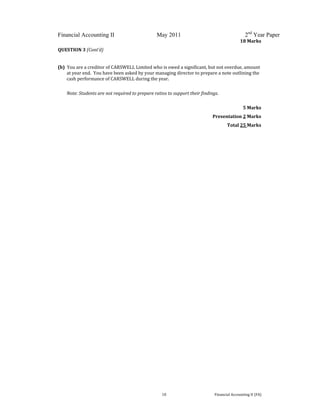
(b)  You are a creditor of CARSWELL Limited who is owed a significant, but not overdue, amount 
at year end.  You have been asked by your managing director to prepare a note outlining the 
cash performance of CARSWELL during the year. 
 
Note: Students are not required to prepare ratios to support their findings. 
 
 5 Marks 
 Presentation 2 Marks 
  Total 25 Marks 


Financial Accounting II May 2011 2nd
Year Paper
  11  Financial Accounting II (FA) 
SECTION B 
 
Answer TWO of the THREE questions in this Section  
 
QUESTION 4 
 
[a] 
 
Prior  to  the  introduction  of  IAS  37  ‘Provisions,  Contingent  Liabilities  and  Contingent  Assets’, 
there were no clear guidelines outlining when and why a provision could be set up.  This lack of 
clarity  resulted  in  a  situation  whereby  companies  engaged  in  ‘profit  smoothing’  to  disguise 
fluctuations in profitability. 
 
The Finance director has been asked by the Board of Directors to prepare a presentation for the 
next Board meeting to explain the concept of profit smoothing and how this has been dealt with 
by IAS 37. 
 
Requirement 
 
You are required to draft a report to the Finance Director and in this report you should: 
 
(a) Briefly explain the concept of ‘profit smoothing’.                    
 3 Marks 
 
(b) Define a ‘provision’ and explain under what circumstances it can be recognised in 
the financial statements.                             
3 Marks 
 
(c) Explain how a ‘contingent liability’ differs from a ‘provision’ and whether it should 
be recognised in the financial statements.                 
3 Marks 
(d) Explain the term ‘contingent asset’.                     
2 Marks 
 
[b] 
 
Subsequent to initial recognition IAS 16 ‘Property, Plant and Equipment’ allows for two methods 
of asset valuation, the cost model and the revaluation model.   
 
Requirement 
 
(a) Explain  the  ‘revaluation  model’  and  the  provisions  contained  within  IAS  16  with 
respect to revaluations.                     
 3 Marks 
 
(b) Company A owns a building which originally cost £/€650,000 and has a net book 
value  of  £/€475,000.    The  Finance  Director  has  had  the  building  valued  by 
professional valuers who have assigned a fair value of £/€ 725,000 to the building.   
 
Outline the journal entries required to record the upward revaluation. 
4 Marks 
Presentation:  2 Marks 
Total 20 Marks 
 
 
Financial Accounting II May 2011 2nd
Year Paper
  12  Financial Accounting II (FA) 
QUESTION 5 
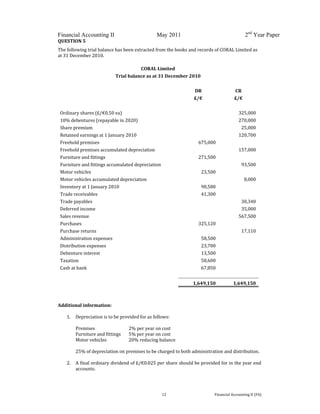
The following trial balance has been extracted from the books and records of CORAL Limited as 
at 31 December 2010.   
 
CORAL Limited 
Trial balance as at 31 December 2010 
         
      DR  CR 
      £/€  £/€ 
         
Ordinary shares (£/€0.50 ea)            325,000  
10% debentures (repayable in 2020)            270,000  
Share premium                 25,000  
Retained earnings at 1 January 2010            120,700  
Freehold premises            675,000   
Freehold premises accumulated depreciation          157,000  
Furniture and fittings            271,500   
Furniture and fittings accumulated depreciation             93,500  
Motor vehicles               23,500   
Motor vehicles accumulated depreciation               8,000  
Inventory at 1 January 2010               90,580   
Trade receivables               41,300   
Trade payables                 30,340  
Deferred income                 35,000  
Sales revenue              567,500  
Purchases            325,120   
Purchase returns                 17,110  
Administration expenses               58,500   
Distribution expenses               23,700   
Debenture interest               13,500   
Taxation               58,600   
Cash at bank               67,850   
         
         1,649,150      1,649,150  
         
         
Additional information: 
 
1. Depreciation is to be provided for as follows: 
 
Premises     2% per year on cost 
Furniture and fittings  5% per year on cost 
Motor vehicles    20% reducing balance 
 
25% of depreciation on premises to be charged to both administration and distribution. 
 
2. A final ordinary dividend of £/€0.025 per share should be provided for in the year end 
accounts. 


Financial Accounting II May 2011 2nd
Year Paper
  13  Financial Accounting II (FA) 
QUESTION 5 (Cont’d) 
 
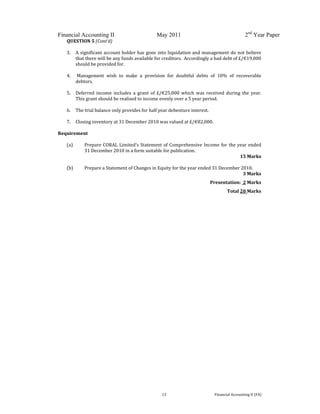
3. A significant account holder has gone into liquidation and management do not believe 
that there will be any funds available for creditors.  Accordingly a bad debt of £/€19,000 
should be provided for. 
 
4.  Management  wish  to  make  a  provision  for  doubtful  debts  of  10%  of  recoverable 
debtors. 
 
5. Deferred  income  includes  a  grant  of  £/€25,000  which  was  received  during  the  year.  
This grant should be realised to income evenly over a 5 year period. 
 
6. The trial balance only provides for half year debenture interest. 
 
7. Closing inventory at 31 December 2010 was valued at £/€82,000. 
 
Requirement 
 
(a) Prepare CORAL Limited’s Statement of Comprehensive Income for the year ended 
31 December 2010 in a form suitable for publication. 
15 Marks 
 
(b) Prepare a Statement of Changes in Equity for the year ended 31 December 2010.  
  3 Marks 
Presentation:  2 Marks 
Total 20 Marks 


Financial Accounting II May 2011 2nd
Year Paper
  14  Financial Accounting II (FA) 
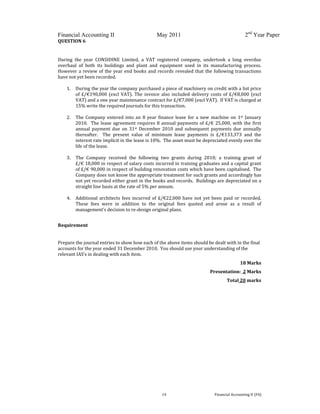
QUESTION 6 
 
During  the  year  CONSIDINE  Limited,  a  VAT  registered  company,  undertook  a  long  overdue 
overhaul  of  both  its  buildings  and  plant  and  equipment  used  in  its  manufacturing  process.  
However a review of the year end books and records revealed that the following transactions 
have not yet been recorded. 
 
1. During the year the company purchased a piece of machinery on credit with a list price 
of £/€190,000 (excl VAT).  The invoice also included delivery costs of £/€8,000 (excl 
VAT) and a one year maintenance contract for £/€7,000 (excl VAT).  If VAT is charged at 
15% write the required journals for this transaction.   
 
2. The Company  entered into  an  8 year finance  lease  for  a new  machine on  1st January 
2010.  The lease agreement requires 8 annual payments of £/€ 25,000, with the first 
annual  payment  due  on  31st  December  2010  and  subsequent  payments  due  annually 
thereafter.    The  present  value  of  minimum  lease  payments  is  £/€133,373  and  the 
interest rate implicit in the lease is 10%.  The asset must be depreciated evenly over the 
life of the lease. 
 
3. The  Company  received  the  following  two  grants  during  2010;  a  training  grant  of          
£/€ 18,000 in respect of salary costs incurred in training graduates and a capital grant 
of £/€ 90,000 in respect of building renovation costs which have been capitalised.  The 
Company does not know the appropriate treatment for such grants and accordingly has 
not yet recorded either grant in the books and records.  Buildings are depreciated on a 
straight line basis at the rate of 5% per annum. 
 
4.  Additional architects fees incurred of £/€22,000 have not yet been paid or recorded.  
These  fees  were  in  addition  to  the  original  fees  quoted  and  arose  as  a  result  of 
management’s decision to re‐design original plans. 
 
Requirement 
 
Prepare the journal entries to show how each of the above items should be dealt with in the final 
accounts for the year ended 31 December 2010.  You should use your understanding of the 
relevant IAS’s in dealing with each item. 
18 Marks 
Presentation:  2 Marks 
Total 20 marks 


Financial Accounting II May 2011 2nd
Year Paper
  15  Financial Accounting II (FA) 
2nd
Year Examination: May 2011
Financial Accounting II
Suggested Solutions
 
Students please note: These are suggested solutions only; alternative answers may also be deemed to
be correct and will be marked on their own merits.
 
Question 1 
 
[a]      Explain the need for regulation in the context of financial reporting and explain why 
it is important. 
 
Companies are owned by shareholders, the number of which vary depending on whether the 
company is private or public.  Whilst private companies may have very few shareholders public 
companies on the other hand may have thousands of shareholders.  Although some shareholders 
may also act as directors the majority of shareholders will have no direct involvement with the 
company’s  day  to  day  activities.    Such  shareholders  are  almost  entirely  reliant  on  the 
information  contained  in  the  annual  financial  statements  to  determine  the  company’s 
performance and financial position and to help them make informed decisions in relation to the 
company  and/or  their  share  ownership.    Financial  statements  also  act  as  the  sole  source  of 
information in relation to the company sought by other users of financial statements such as 
lending  institutions,  tax  authorities,  suppliers,  customers,  employees  etc.    Therefore  financial 
statements need to be reliable and consistent and it is for this reason that the need for regulation 
arose. 
 
Having  described  above  the  need  for  regulation  in  the  context  of  financial  reporting  I  have 
outlined below why such regulation is important: 
 
1. Reliability 
 
Users of financial statements are a wide and diverse audience who do not work in the business 
on a day to day basis.  Therefore the information contained in the financial statements is more 
than likely the only information they receive about the performance and financial position of the 
company.    Accounting  rules  and  regulations  allow  for  better  understanding  of  this  financial 
information as  it  gives  the users  knowledge  of  the accounting  policies  and  procedures which 
have been used when financial statements are being prepared. 
 
 
2.  Decision making 
 
The various user groups need to be able to rely upon and understand the information contained 
in financial statements.  In this regard regulation has been put in place and strengthened over 
time to ensure users of the reliability of financial statements. If the form and content of financial 
statements were not regulated it would be possible for incompetent or unscrupulous directors 
to provide users with false or misleading information which would result in users making poor 
economic decisions and undermine the whole purpose of preparing financial statements.  


Financial Accounting II May 2011 2nd
Year Paper
  16  Financial Accounting II (FA) 
3.  Comparability   
 
All  companies,  with  very  few  exceptions,  must  comply  with  financial  accounting  rules  and 
regulations.    Therefore  this  aids  comparability  between  financial  statements  produced  by 
different companies.  The users know that if these all comply with Irish GAAP for example then 
they have all been prepared using similar policies and procedures and are therefore comparable. 
 
Limited  companies  have  limited  liability  and  therefore  the  debts  of  the  entity  will  only  be 
discharged from the assets of the entity.  For this reason, when deciding whether to interact with 
a  limited  company,  a  supplier  will  often  assess  the  creditworthiness  of  the  company  by 
examining its financial statements.  Suppliers thus rely on financial statements to be true and fair 
and  users  in  general  rely  on  accounting  rules  and  regulation  to  enhance  the  reliability  of 
financial statements. 
 
[b]    Describe briefly the four main sources of Irish GAAP. 
 
The four main sources of Irish GAAP: 
 
1.  Professional regulation (domestic and international) 
 
Prior to and during the 1970s a significant amount of criticism was levied against the accounting 
profession for lack of regulation and the concerns which this gave rise to.  Therefore in the 1970s 
the  Accounting  Standards  Committee  (‘ASC’)  was  set  up  in  an  attempt  to  self  regulate  and 
address the criticisms the profession had attracted.  The ASC, which was later replaced by the 
ASB, issued accounting standards.  The function of accounting standards, both SSAPs and FRSs, is 
to  describe  and  provide  guidance  to  the  accounting  profession  and  users  of  accounting 
information about how difficult matters should be treated, 
 
The  need  for  international  regulation  arose  due  to  the  increasing  number  of  companies 
operating  in  more  than  one  jurisdiction.    The  aim  of  international  regulation  is  to  promote 
international  comparability  and  consistency  between  the  financial  statements  prepared  by 
companies worldwide. 
 
 
2.  Company law (Republic of Ireland and UK) 
 
Company law deals with  many aspects  of  companies  including  the  manner in which financial 
information must be presented and disclosed to users and filing requirements for companies.  
Company law also details what information must be presented in a set of financial statements 
and what a set of financial statements must include depending on the size of the company. 
 
 
3.  EU Directives 
 
Several  EU  Directives  were  issued  with  the  aim  of  achieving  harmonisation  in  financial 
accounting across member states.  At a later date the European Commission decided to support 
the  accounting  standards  issued  by  the  IASB  rather  than  to  issue  further  Directives  and  this 
made the goal of harmonisation a more achievable target.  To date all publicly quoted companies 
must comply with IFRSs when preparing consolidated accounts.   
 
4.  Stock exchange regulation 
 
These regulations only apply to public limited companies.  Although the stock exchange was one 
of  the  first  publishers  of  rules  and  regulations  governing  financial  statements  many  of  these 
rules  and  regulation  have  been  included,  and  in  some  instances  expanded  upon,  in  either 
statutory  or  professional  regulation.    However  this  does  not  reduce  the  importance  of  stock 
exchange regulation which still contains important regulation not contained in other areas. 


Financial Accounting II May 2011 2nd
Year Paper
  17  Financial Accounting II (FA) 
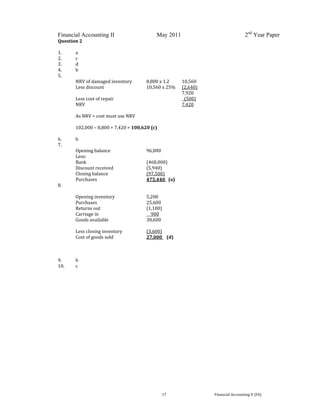
Question 2 
 
1.  a 
2.  c 
3.  d 
4.  b 
5. 
  NRV of damaged inventory  8,800 x 1.2  10,560 
  Less discount      10,560 x 25%  (2,640) 
              7,920 
  Less cost of repair          (500) 
  NRV            7,420  
 
  As NRV < cost must use NRV 
   
  102,000 – 8,800 + 7,420 = 100,620 (c) 
 
6.  b 
7.   
  Opening balance     96,000 
  Less: 
  Bank        (468,000) 
  Discount received    (5,940) 
  Closing balance      (97,500) 
  Purchases      475,440   (a) 
8. 
 
  Opening inventory    5,200 
  Purchases      25,600 
  Returns out      (1,100) 
  Carriage in          900 
  Goods available      30,600 
 
  Less closing inventory    (3,600) 
  Cost of goods sold    27,000    (d) 


9.  b 
10.  c 


Financial Accounting II May 2011 2nd
Year Paper
  18  Financial Accounting II (FA) 
Question 3 
 
[a] 
CARSWELL Limited 
 
Statement of Cash Flows for the year ended 31 December 2010 


£/€ 
'000 
£/€ 
'000 
           
Cash flows from operating activities     
           
Net profit before interest (W1)        185 
           
Adjustments for:         
  Depreciation      180   
  Profit on disposal (W3)    (20)   
           
Changes in working capital       
  Decrease in inventory (W2)    90   
  Increase in receivables (W2)    (590)   
 
Increase in prepayments
(W2)    (135)   
  Decrease in payables (W2)    0   
          (475) 
Cash generated from operations      (290) 
           
Interest paid (W3)      (210)   
Tax paid (W4)        0   
          (210) 
           
Net cash from operating activities      (500) 
           
Cash flows from investing activities     
Payment to acquire non‐current assets (W6)  (300)   
Receipt from sale of non‐current assets (W7)  80   
          (220) 
           
Cash flows from financing       
Proceeds from share issue (incl share prem)
(W9)  90   
New bank loans       300   
Issue of new debentures 
(W6)      300   
Dividends paid (W8)      (30)   
          660 
           
Decrease in cash and cash equivalents    (60) 
           
Cash and cash equivalents at start of year    30 
Cash and cash equivalents at end of year    (30) 
 
 
Financial Accounting II May 2011 2nd
Year Paper
  19  Financial Accounting II (FA) 
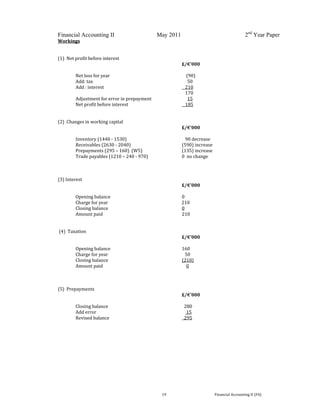
Workings 
                                                                                  
 
(1)  Net profit before interest 
  £/€’000 
   
  Net loss for year      (90) 
  Add: tax       50 
  Add : interest     210 
       170       
  Adjustment for error in prepayment        15 
  Net profit before interest          185 
 
 
(2)  Changes in working capital 
  £/€’000 
   
  Inventory (1440 ‐ 1530)     90 decrease 
  Receivables (2630 ‐ 2040)  (590) increase 
  Prepayments (295 – 160)  (W5)  (135) increase 
  Trade payables (1210 – 240 ‐ 970)  0  no change 


(3) Interest 
  £/€’000 
 
  Opening balance  0       
  Charge for year                                                                    210 
  Closing balance  0         
Amount paid          210   
 
 
 (4)  Taxation 
  £/€’000  
   
  Opening balance  160       
  Charge for year                                                                       50 
  Closing balance  (210)         
  Amount paid      0       


(5)  Prepayments 
  £/€’000  
   
  Closing balance    280       
  Add error                                                                                   15 
  Revised balance    295         


Financial Accounting II May 2011 2nd
Year Paper
  20  Financial Accounting II (FA) 
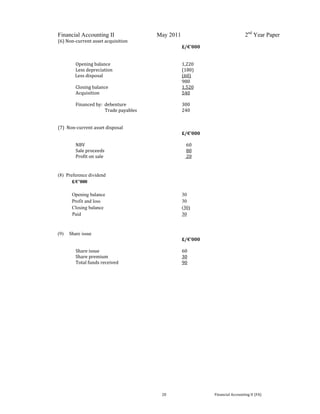
(6) Non‐current asset acquisition 
  £/€’000 
   
   
  Opening balance  1,220 
  Less depreciation  (180) 
                Less disposal  (60) 
    980 
  Closing balance  1,520   
  Acquisition  540 
 
  Financed by:  debenture  300 
                             Trade payables  240 
 
 
(7)  Non‐current asset disposal 
  £/€’000 
 
NBV      60          
Sale proceeds      80 
Profit on sale              20 
(8) Preference dividend
£/€’000
Opening balance 30
Profit and loss 30
Closing balance (30)
Paid 30
(9) Share issue
  £/€’000 
   
  Share issue  60 
  Share premium  30 
  Total funds received  90         


Financial Accounting II May 2011 2nd
Year Paper
  21  Financial Accounting II (FA) 
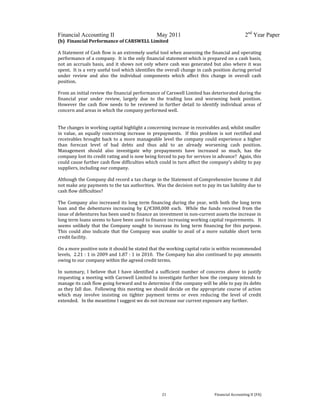
(b)  Financial Performance of CARSWELL Limited 
 
A Statement of Cash flow is an extremely useful tool when assessing the financial and operating 
performance of a company.  It is the only financial statement which is prepared on a cash basis, 
not an accruals basis, and it shows not only where cash was generated but also where it was 
spent.  It is a very useful tool which identifies the overall change in cash position during period 
under  review  and  also  the  individual  components  which  affect  this  change  in  overall  cash 
position. 
 
From an initial review the financial performance of Carswell Limited has deteriorated during the 
financial  year  under  review,  largely  due  to  the  trading  loss  and  worsening  bank  position.  
However  the  cash  flow  needs  to  be  reviewed  in  further  detail  to  identify  individual  areas  of 
concern and areas in which the company performed well. 
 
 
The changes in working capital highlight a concerning increase in receivables and, whilst smaller  
in value, an equally concerning increase in prepayments.   If this  problem is not  rectified and 
receivables brought back to a more manageable level the company could experience a higher 
than  forecast  level  of  bad  debts  and  thus  add  to  an  already  worsening  cash  position.  
Management  should  also  investigate  why  prepayments  have  increased  so  much,  has  the 
company lost its credit rating and is now being forced to pay for services in advance?  Again, this 
could cause further cash flow difficulties which could in turn affect the company’s ability to pay 
suppliers, including our company. 
  
Although the Company did record a tax charge in the Statement of Comprehensive Income it did 
not make any payments to the tax authorities.  Was the decision not to pay its tax liability due to 
cash flow difficulties? 
 
The Company also increased its long term financing during the year, with both the long term 
loan  and  the  debentures  increasing  by  £/€300,000  each.    While  the  funds  received  from  the 
issue of debentures has been used to finance an investment in non‐current assets the increase in 
long term loans seems to have been used to finance increasing working capital requirements.   It 
seems unlikely  that the  Company sought to increase its long  term financing for this  purpose.  
This  could  also  indicate  that  the  Company  was  unable  to  avail  of a  more  suitable  short  term 
credit facility. 
 
On a more positive note it should be stated that the working capital ratio is within recommended 
levels,  2.21 : 1 in 2009 and 1.87 : 1 in 2010.  The Company has also continued to pay amounts 
owing to our company within the agreed credit terms. 
 
In  summary,  I  believe  that  I  have  identified  a  sufficient  number  of  concerns  above  to  justify 
requesting a meeting with Carswell Limited to investigate further how the company intends to 
manage its cash flow going forward and to determine if the company will be able to pay its debts 
as they fall due.  Following this meeting we should decide on the appropriate course of action 
which  may  involve  insisting  on  tighter  payment  terms  or  even  reducing  the  level  of  credit 
extended.   In the meantime I suggest we do not increase our current exposure any further. 


Financial Accounting II May 2011 2nd
Year Paper
  22  Financial Accounting II (FA) 
Question 4 
 
[A]  IAS 37 
 
To    :  The Directors 
From    :  An. Accountant 
Date    :  XX/MM/YY 
Subject    :  IAS 37 and its main provisions 
 
 
As  requested  I  have  outlined  below  the  main  provisions  contained  within  IAS  37  Provisions, 
Contingent  Liabilities  and  Contingent  Assets  in  addition  to  briefly  explaining  the  concept  of 
‘profit smoothing’: 
 
A. Profit smoothing 
 
Profit  smoothing  was  introduced  to  present  steadily  increasing  profits  in  situations 
where profits were actually fluctuating.  This was believed to present a less risky form of 
results which shareholders would be more satisfied with.   
 
Profit smoothing was actually achieved by transferring profits out of the Statement of 
Comprehensive  Income  to  a  provision  account  in  years  where  the  business  was 
profitable.  This had the effect of reducing profits in those years.  Then in later years 
when profitability was poor profits were transferred out of the provision accounts back 
into  the  Statement  of  Comprehensive  Income  thereby  increasing  profits  in  those 
periods.   
 
IAS 37 was introduced to reduce abuses in this area.  
 
B. What is a ‘provision’? 
 
IAS 37 defines a provision as a liability of uncertain timing or amount.  A provision can 
only be recognised in the financial statements when all three of the following conditions 
have been met: 
 
(i) A  business  has  a  present  obligation  as  a  result  of  a  past  event  (the 
obligating event). 
(ii) It is probable that a transfer of economic benefits will be required to settle 
the obligation. 
(iii) A reliable estimate can be made of the amount of the obligation. 
 
 
C. What is a ‘contingent liability’? 
 
A ‘contingent liability’ is an item which has failed one of the recognition criteria of a 
provision.  IAS 37 defines a ‘contingent liability’ as: 
 
(i) A present obligation that arises from past events but it is not recognised 
because  it  is  not  probable  that  a  transfer  of  economic  benefits  will  be 
required to settle the obligation or the amount of the obligation cannot be 
measured with sufficient reliability. 
(ii) A possible obligation that arises from past events and whose existence will 
only be confirmed by the occurrence of one or more uncertain future events 
not wholly within the entity’s control. 
Contingent liabilities should not be recognised in financial statements but they should 
be disclosed by way of a note. 


Financial Accounting II May 2011 2nd
Year Paper
  23  Financial Accounting II (FA) 
D. What is a ‘contingent asset’? 
 
IAS 37 defines a ‘contingent asset’ as a possible asset that arises from past events, the 
existence of which will be confirmed only by the occurrence of one or more uncertain 
future events not wholly within the business’s control. 
 
A contingent asset should  not be recognised.   It  should only be recognised when the 
realisation of the related economic benefit is virtually certain.  At that point the asset is 
no longer a contingent asset. 
 
 
I hope the above is helpful.  Should you require any further information in this regard please feel 
free to contact me.   
 
An Accountant. 


[B]  IAS 16 
 
(a) The  revaluation  model  is  where  an  asset  is  recorded  in  the  books  and  records  at  a 
revalued amount and not the original cost amount.  The revalued amount is the asset’s fair value 
at the date of revaluation less subsequent depreciation, provided that fair value can be measured 
reliably.  An asset may be revalued upwards or downwards. 
 
The provisions contained within IAS 16 with respect to revaluations are as follows: 
 
(i) The fair value of the asset is usually the market value of the asset as determined by 
a professionally qualified valuer.  
(ii) If an asset is revalued the entire class of asset to which the item belongs must also 
be revalued.  This ensures that the company does not cherry pick assets to revalue 
and suit their needs. 
(iii) Revaluaions should be carried out regularly so that the carrying amount of an asset 
does not differ materially from its fair value at the date the Statement of Financial 
Position has been prepared.  This ensures that asset valuations do not become out 
of date. 
 
(b)   
 
                DR  CR 
                £/€  £/€ 
 
DR  Building at cost account      75,000 
CR  Revaluation reserve account (BS)     75,000 
 
[Being asset revalued upwards] 
 
DR  Accumulated Depreciation account  175,000 
CR  Revaluation reserve account (BS)     175.000 
 
[Being transfer of depreciation to revaluation account] 


Financial Accounting II May 2011 2nd
Year Paper
  24  Financial Accounting II (FA) 
Question 5 
 
 
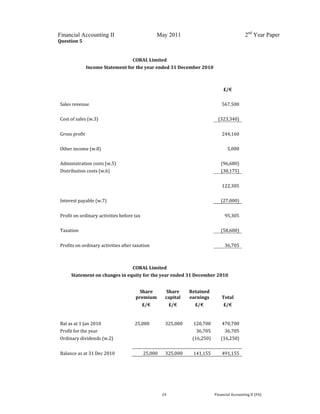
CORAL Limited 
Income Statement for the year ended 31 December 2010 
         
         
        £/€ 
         
Sales revenue        567,500 
         
Cost of sales (w.3)        (323,340) 
         
Gross profit        244,160 
         
Other income (w.8)        5,000 
         
Administration costs (w.5)        (96,680) 
Distribution costs (w.6)        (30,175) 
         
        122,305 
         
Interest payable (w.7)        (27,000) 
         
Profit on ordinary activities before tax      95,305 
         
Taxation        (58,600) 
         
Profits on ordinary activities after taxation    36,705 
         
         
CORAL Limited 
Statement on changes in equity for the year ended 31 December 2010 
         
 
Share 
premium 
Share 
capital 
Retained 
earnings  Total 
  £/€  £/€  £/€  £/€ 
         
Bal as at 1 Jan 2010 
        
25,000   325,000  120,700 470,700 
Profit for the year      36,705 36,705 
Ordinary dividends (w.2)      (16,250) (16,250) 
         
Balance as at 31 Dec 2010  25,000  325,000  141,155 491,155 


Financial Accounting II May 2011 2nd
Year Paper
  25  Financial Accounting II (FA) 
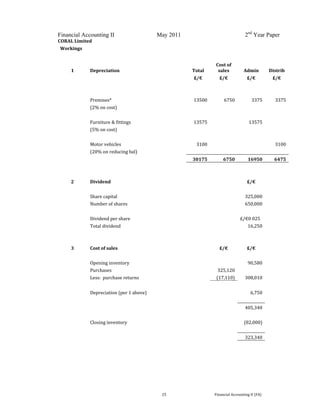
CORAL Limited 
Workings             
             
1  Depreciation    Total 
Cost of 
sales  Admin  Distrib 
      £/€  £/€  £/€  £/€ 
             
             
  Premises*    13500 6750  3375  3375 
  (2% on cost)           
             
  Furniture & fittings    13575   13575   
  (5% on cost)           
             
  Motor vehicles    3100     3100 
  (20% on reducing bal)           
      30175  6750  16950  6475 
             
             
2  Dividend        £/€   
             
  Share capital        325,000   
  Number of shares        650,000   
             
  Dividend per share        £/€0 025   
  Total dividend        16,250   
             
             
3  Cost of sales      £/€  £/€   
             
  Opening inventory        90,580   
  Purchases      325,120     
  Less:  purchase returns      (17,110)  308,010   
             
  Depreciation (per 1 above)        6,750   
              
          405,340   
             
  Closing inventory        (82,000)   
             
          323,340   


Financial Accounting II May 2011 2nd
Year Paper
  26  Financial Accounting II (FA) 
 
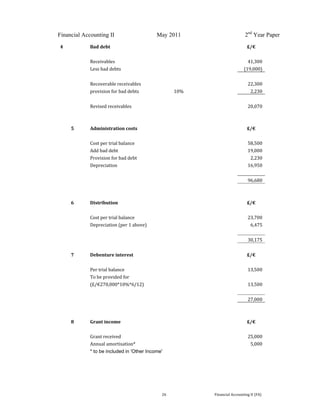
4 
 
Bad debt 
 
£/€ 
             
  Receivables        41,300   
  Less bad debts        (19,000)   
             
  Recoverable receivables        22,300   
  provision for bad debts  10%      2,230   
             
  Revised receivables        20,070   
             
             
5  Administration costs        £/€   
             
  Cost per trial balance        58,500   
  Add bad debt        19,000   
  Provision for bad debt        2,230   
  Depreciation        16,950   
             
          96,680   
             
             
6  Distribution        £/€   
             
  Cost per trial balance        23,700   
  Depreciation (per 1 above)        6,475   
             
          30,175   
             
7  Debenture interest        £/€   
             
  Per trial balance        13,500   
  To be provided for           
  (£/€270,000*10%*6/12)        13,500   
             
          27,000   
             
             
8  Grant income        £/€   
             
  Grant received        25,000   
  Annual amortisation*        5,000   
* to be included in 'Other Income'


Financial Accounting II May 2011 2nd
Year Paper
  27  Financial Accounting II (FA) 
Question 6 
CONSIDINE Limited 
                DR    CR 
£/€ £/€
(1)
DR Non-current assets 198,000
DR VAT recoverable 29,700
CR Payables 227,700
[Being purchase of plant and machinery including delivery costs]
DR Maintenance (Income statement) 7,000
DR VAT recoverable 1,050
Cr Payables 8,050
[Being purchase of annual maintenance contract for new plant]
(2)   
  DR   Lease machinery         133,373 
  CR  Finance lease              133,373 
   
[Being purchase of leased machinery] 
 
  DR  Income statement        16,672 
  CR  Accumulated depreciation account        16,672 
   
[Being annual depreciation charge on lease asset] 
 
  DR  Finance lease          25,000 
  CR  Bank                25,000 
   
[Being payment of first year lease payment] 
 
  DR  Income statement        13,337 
  CR  Finance lease              13,337 
   
[Being calculation of first year’s lease interest charge] 
 
 (3) 
  DR  Bank            18,000 
  CR  Training costs              18,000 
   
[Being grant received in respect of employee training costs incurred] 
 
  DR  Bank            90,000 
  CR  Deferred income             90,000 
   
[Being receipt of grant in respect of building renovation costs] 
   
  DR  Deferred income         4,500 
  CR  Income statement            4,500 
   
[Being transfer of deferred income to income] 


Financial Accounting II May 2011 2nd
Year Paper
  28  Financial Accounting II (FA) 
Question 6 (cont’d) 
 
(4) 
  DR  Administration        22,000 
  CR  Trade payables            22,000 
  [Being architect fees payable at year end] 


Financial Accounting II May 2011 2nd
Year Paper
  29  Financial Accounting II (FA) 
2nd
Year Examination: May 2011
Financial Accounting II
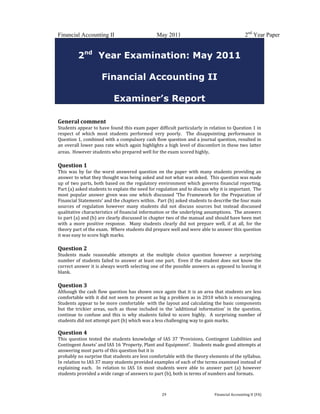
Examiner’s Report
 
 
General comment 
Students appear to have found this exam paper difficult particularly in relation to Question 1 in 
respect  of  which  most  students  performed  very  poorly.    The  disappointing  performance  in 
Question 1, combined with a compulsory cash flow question and a journal question, resulted in 
an overall lower pass rate which again highlights a high level of discomfort in these two latter 
areas.  However students who prepared well for the exam scored highly.   
 
Question 1 
This was by far the worst answered question  on the paper with many  students providing an 
answer to what they thought was being asked and not what was asked.  This question was made 
up of two parts, both based on the regulatory environment which governs financial reporting.  
Part (a) asked students to explain the need for regulation and to discuss why it is important.  The 
most  popular  answer given was  one  which  discussed  ‘The  Framework  for  the Preparation  of 
Financial Statements’ and the chapters within.  Part (b) asked students to describe the four main 
sources  of  regulation  however  many  students  did  not  discuss  sources  but  instead  discussed 
qualitative characteristics of financial information or the underlying assumptions.  The answers 
to part (a) and (b) are clearly discussed in chapter two of the manual and should have been met 
with  a  more  positive  response.    Many  students  clearly  did  not  prepare  well,  if  at  all,  for  the 
theory part of the exam.  Where students did prepare well and were able to answer this question 
it was easy to score high marks. 
 
Question 2 
Students  made  reasonable  attempts  at  the  multiple  choice  question  however  a  surprising 
number of students failed to answer at least one part.  Even if the student does not know the 
correct answer it is always worth selecting one of the possible answers as opposed to leaving it 
blank.  
 
Question 3 
Although the cash flow question has shown once again that it is an area that students are less 
comfortable with it did not seem to present as big a problem as in 2010 which is encouraging.  
Students appear to be more comfortable  with the layout and calculating the basic components 
but  the  trickier  areas,  such  as  those  included  in  the  ‘additional  information’  in  the  question, 
continue  to  confuse  and  this  is  why  students  failed  to  score  highly.    A  surprising  number  of 
students did not attempt part (b) which was a less challenging way to gain marks.   
 
Question 4 
This  question  tested  the  students  knowledge  of  IAS  37  ‘Provisions,  Contingent  Liabilities  and 
Contingent Assets’ and IAS 16 ‘Property, Plant and Equipment’.  Students made good attempts at 
answering most parts of this question but it is  
probably no surprise that students are less comfortable with the theory elements of the syllabus.  
In relation to IAS 37 many students provided examples of each of the terms examined instead of 
explaining  each.    In  relation  to  IAS  16  most  students  were  able  to  answer  part  (a)  however 
students provided a wide range of answers to part (b), both in terms of numbers and formats. 
 
 
Financial Accounting II May 2011 2nd
Year Paper
  30  Financial Accounting II (FA) 
 
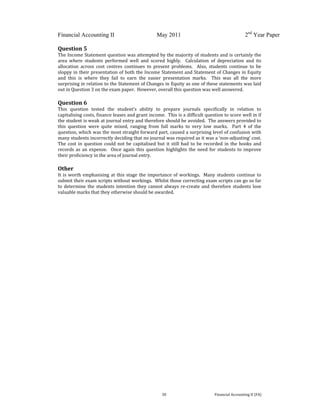
Question 5 
The Income Statement question was attempted by the majority of students and is certainly the 
area  where  students  performed  well  and  scored  highly.    Calculation  of  depreciation  and  its 
allocation  across  cost  centres  continues  to  present  problems.    Also,  students  continue  to  be 
sloppy in their presentation of both the Income Statement and Statement of Changes in Equity 
and  this  is  where  they  fail  to  earn  the  easier  presentation  marks.    This  was  all  the  more 
surprising in relation to the Statement of Changes in Equity as one of these statements was laid 
out in Question 3 on the exam paper.  However, overall this question was well answered. 
 
Question 6 
This  question  tested  the  student’s  ability  to  prepare  journals  specifically  in  relation  to 
capitalising costs, finance leases and grant income.  This is a difficult question to score well in if 
the student is weak at journal entry and therefore should be avoided.  The answers provided to 
this  question  were  quite  mixed,  ranging  from  full  marks  to  very  low  marks.    Part  4  of  the 
question, which was the most straight forward part, caused a surprising level of confusion with 
many students incorrectly deciding that no journal was required as it was a ‘non‐adjusting’ cost.  
The cost in question could not be capitalised but it still had to be recorded in the books and 
records as an expense.  Once again this question highlights the need for students to improve 
their proficiency in the area of journal entry. 
 
Other 
It is worth emphasising at this stage the importance of workings.  Many students continue to 
submit their exam scripts without workings.  Whilst those correcting exam scripts can go so far 
to determine the students intention they cannot always re‐create and therefore students lose 
valuable marks that they otherwise should be awarded.   


May 2011 exam and answers

  • 1.
      Financial Accounting II 2nd YearExamination May 2011 Paper, Solutions & Examiner’s Report
  • 2.
        Financial Accounting IIMay 2011 2nd Year Paper 2    NOTES TO USERS ABOUT THESE SOLUTIONS The solutions in this document are published by Accounting Technicians Ireland. They are intended to provide guidance to students and their teachers regarding possible answers to questions in our examinations. Although they are published by us, we do not necessarily endorse these solutions or agree with the views expressed by their authors. There are often many possible approaches to the solution of questions in professional examinations. It should not be assumed that the approach adopted in these solutions is the ideal or the one preferred by us. Alternative answers will be marked on their own merits. This publication is intended to serve as an educational aid. For this reason, the published solutions will often be significantly longer than would be expected of a candidate in an examination. This will be particularly the case where discursive answers are involved. This publication is copyright 2011 and may not be reproduced without permission of Accounting Technicians Ireland. © Accounting Technicians Ireland, 2011.
  • 3.
        Financial Accounting IIMay 2011 2nd Year Paper   3  Financial Accounting II (FA)      Accounting Technicians Ireland    2nd Year Examination: Summer 2011  Paper : FINANCIAL ACCOUNTING II    Monday 16th May 2010 ‐ 2.30 p.m. to 5.30 p.m.    INSTRUCTIONS TO CANDIDATES    PLEASE READ CAREFULLY    Candidates must indicate clearly whether they are answering the paper in accordance  with the law and practice of Northern Ireland or the Republic of Ireland.  In this examination paper the €/£ symbol may be understood and used by candidates in  Northern Ireland to indicate the UK pound sterling and by candidates in the Republic of  Ireland to indicate the Euro.      Answer ALL THREE questions in Section A and TWO of the THREE questions in Section B.   If more than TWO questions are answered in Section B, then only the first TWO questions,  in the   order filed, will be corrected.    Candidates should allocate their time carefully.    All workings should be shown.    All figures should be labelled, as appropriate, e.g. €’s, £’s, units etc.    Answers should be illustrated with examples, where appropriate.    Candidates may ignore any VAT implications to transactions throughout this paper unless  the question specifically instructs them to do otherwise.    Question 1 begins on Page 2 overleaf.    The following insert is enclosed with this paper:     Multiple choice question answer sheet [QUESTION 2]        Note:  This paper uses both the language of International Accounting Standards (I.A.S’s) and Financial  Reporting Standards (F.R.S’s) where appropriate (e.g. Receivables/Debtors).  Examinees are  permitted to use either terminology when preparing financial statements but the use of the  language of the International Accounting Standards (e.g. Receivables rather than Debtors) is  preferred.   
  • 4.
        Financial Accounting IIMay 2011 2nd Year Paper   4  Financial Accounting II (FA)    SECTION A      Answer ALL THREE Questions in this Section    QUESTION 1 (Compulsory)    It is important that financial reporting be subject to rules and regulations.  The rules and  regulations which apply are commonly referred to as the ‘regulatory framework’ or Generally  Accepted Accounting Practices (‘GAAP’).      (a)   Explain the need for regulation in the context of financial reporting and explain why it is  important.  8 Marks  (b)  Describe briefly the four main sources of regulation that represents Irish GAAP.  12 Marks  Total 20 Marks          QUESTION 2 (Compulsory)    The following multiple choice question consists of TEN parts, each of which is followed by FOUR  possible answers.  There is ONLY ONE right answer in each part.    Each part carries 1 ½ marks.    Requirement    Indicate the right answer to each of the following ten parts.  Total 15 Marks  NB Candidates should answer this question by ticking the appropriate boxes on the specified  green answer sheet which is supplied with the examination paper.    [1]   Under the terms of IAS 8 where the effect of a change in estimate is material to the  financial statements:    [a]  the nature and monetary effect of the change on the financial statements must be  disclosed.  [b]  the change in estimate should be applied retrospectively.  [c]   the change in estimate should only be applied retrospectively where it is deemed  necessary to provide more reliable information.  [d]   the nature and monetary effect of the change on the financial statements must be  disclosed only where it is deemed necessary to provide more reliable information. 
  • 5.
        Financial Accounting IIMay 2011 2nd Year Paper   5  Financial Accounting II (FA)      QUESTION 2 (Cont’d)    [2]    If a partner lends the partnership funds in the form of start‐up finance, how should the  annual interest charge be treated?    [a]   debited to partners current account.  [b]   credited to partners current account.  [c]  deducted from business profits before the profits are apportioned.  [d]   credited to partners capital account.    [3]  Drawings, by a partner in a partnership, made during the year should be:    [a]  included as an expense in the partnership Statement of Comprehensive Income.  [b]   included as a revenue in the partnership Statement of Comprehensive Income.  [c]    credited in the partners current account.  [d]   debited in the partner’s current account.    [4]   The provision for discounts allowed on debtors balances outstanding should be  calculated, at the appropriate rate on:    [a]   the debtors outstanding, after deducting the provision for doubtful debts but before  taking into account bad debts written off.  [b]  the debtors outstanding, after taking into account bad debts written off and after  deducting the provision for doubtful debts.  [c]  the debtors outstanding after taking into account bad debts written off but before  taking into account the provision for doubtful debts.  [d]   the debtors outstanding.    [5]  Coral Limited’s mark‐up on cost is 20%.  The closing inventory at 31 December 2010 has  been counted and valued at cost which amounts to £/€102,000.  This amount includes  damaged items which cost £/€8,800.  It is expected that once repaired, at a cost of  £/€500, the goods will then be in a condition to be sold at a discount of 25% on full price.   At what value should inventory be stated at 31 December 2010?    [a]   £/€ 101,500.  [b]   £/€ 99,300.  [c]  £/€ 100,620.  [d]  £/€ 101,120.     
  • 6.
        Financial Accounting IIMay 2011 2nd Year Paper   6  Financial Accounting II (FA)    QUESTION 2 (Cont’d)    [6]  If a capital grant is recognised as deferred income in the balance sheet what are the  entries to be made each year over the useful life of the associated asset:    [a]   credit deferred income, debit income statement.  [b]  debit deferred income, credit income statement.  [c]   debit deferred income, credit bank.  [d]  credit deferred income, debit bank.    [7]  The following information relates to Considine Limited:                          £/€      Trade payables @ 1 Jan 2010      96,000    Transactions for the year ended 31 Dec 2010    Payments to suppliers       468,000    Discount allowed              7,500    Discount received                  5,940    Payables @ 31 Dec 2010       97,500      What is the credit purchase figure for the year ended 31 December 2010?      [a]  £/€ 475,440.  [b]   £/€ 467,940.  [c]   £/€ 473,880.   [d]  £/€ 472,440.                       
  • 7.
        Financial Accounting IIMay 2011 2nd Year Paper   7  Financial Accounting II (FA)    QUESTION 2 (Cont’d)    [8]  The following information relates to Georgia Limited:                        £/€      Sales            32,800    Opening inventory           5,200    Closing inventory                      3,600    Returns in            4,200    Returns out            1,100    Purchases            25,600    Carriage in               900    Carriage out               800      What is the cost of goods sold figure for the year ended 31 December 2010?      [a]  £/€ 30,600.  [b]   £/€ 26,900.  [c]   £/€ 23,900.    [d]  £/€ 27,000.    [9]  What journal entries are required to record the receipt of a bad debt at year end which  was written off during the year?    [a]   debit bad debt expense, credit bank.  [b]   debit bank, credit bad debt expense.  [c]  debit bad debts, credit debtors.  [d]   debit debtors, credit bad debts.    [10]  In accordance with I.A.S. 16 ‘Property, Plant and Equipment’ assets may be recognised at  cost less accumulated depreciation or at a revalued amount.  Where an asset is revalued  upwards, there is a debit entry to the asset at cost account.  Where is the corresponding  credit entry recorded?     [a]   In the Bank account in the Statement of Financial Position.  [b]   In ‘Other Income’ in the Statement of Comprehensive Income.  [c]  In the Revaluation reserve account in the ‘Capital and Reserves’ section of the  Statement of Financial Position. 
  • 8.
        Financial Accounting IIMay 2011 2nd Year Paper   8  Financial Accounting II (FA)  [d]   In the appropriate ‘Accumulated depreciation’ account in the Statement of Financial  Position.    QUESTION 3 (Compulsory)    The Statement of Financial Position, Statement of Changes in Equity and other relevant  information of CARSWELL Limited, for the year ended 31 December 2010, are as follows:    Statement of Financial Position as at 31 December 2010                2009  2009             £/€'000    £/€'000    £/€'000    £/€'000                     ASSETS                  Non­current assets                1,520           1,220                    Current assets                  Inventory              1,440          1,530       Receivables            2,630          2,040       Prepayments    280   160      Cash & cash equivalents              20              30                       4,370           3,760                    Total assets                5,890           4,980                     EQUITY and LIABILITIES                            Capital and reserves                £/€1 ordinary shares              310            250       Preference shares              110            110       Share premium account              30               ‐        Retained earnings              160            280                       610             640  Non­current liabilities              Bank loans            2,040          1,740       10% debentures            900            900                     2,940           2,640  Current liabilities                Trade payables         1,210               970        Current instalments due on loans          540            540       10% debentures              300               ‐        Bank overdraft           50            ‐       Taxation                 210              160       Preference dividends                30              30                     2,340           1,700                  Total equity and liabilities              5,890           4,980        
  • 9.
        Financial Accounting IIMay 2011 2nd Year Paper   9  Financial Accounting II (FA)    QUESTION 3 (Cont’d)    STATEMENT OF CHANGES IN EQUITY                        Pref  share  capital  Ord  Share  capital  Share  premium   Retained  profits  Total  equity        £/€'000  £/€'000  £/€'000  £/€'000  £/€'000                  As at 1 January 2010    110  250  0  280  640  Net profit for year ended 31 Dec 2010        (90)  (90)  Share issue        60  30    90  Preference dividends          (30)  (30)                  As at 31 December 2010    110  310  30  160  610                    Additional information:    (1)  On 1 July 2010 CARSWELL issued £/€ 1 ordinary shares at £/€ 1.50 per share.      (2)  During the year the company acquired new plant and equipment which was part financed  by the total funds raised from the issue of debentures.  The balance owing is included in  trade payables.  No depreciation is charged in the year of acquisition.    (3)  The company also disposed of older equipment which was no longer in use and had a net  book value of £/€60,000.  Proceeds from the sale of equipment amounted to £/€80,000.      (4)  Prepayments of £/€ 15,000 were incorrectly recorded as expenses.  This error should be  rectified.  (5)  The income statement includes the following charges for the year:       .................................................................. 31 Dec 2010                        31 Dec 2009    (i)     Depreciation  ................................... £/€ 180,000    £/€ 150,000    (ii)    Interest  ............................................. £/€ 210,000        £/€ 170,000    (iii)   Tax  ...................................................... £/€   50,000    £/€40,000    Requirement    (a)  Prepare a statement of cash flows for CARSWELL Limited for the year ended 31 December  2010 in accordance with IAS 7 Statement of Cash Flows.                   N. B.  You are NOT required to prepare notes to the statement of cash flows.                                                                   
  • 10.
        Financial Accounting IIMay 2011 2nd Year Paper   10  Financial Accounting II (FA)  18 Marks  QUESTION 3 (Cont’d)    (b)  You are a creditor of CARSWELL Limited who is owed a significant, but not overdue, amount  at year end.  You have been asked by your managing director to prepare a note outlining the  cash performance of CARSWELL during the year.    Note: Students are not required to prepare ratios to support their findings.     5 Marks   Presentation 2 Marks    Total 25 Marks                                                           
  • 11.
        Financial Accounting IIMay 2011 2nd Year Paper   11  Financial Accounting II (FA)  SECTION B    Answer TWO of the THREE questions in this Section     QUESTION 4    [a]    Prior  to  the  introduction  of  IAS  37  ‘Provisions,  Contingent  Liabilities  and  Contingent  Assets’,  there were no clear guidelines outlining when and why a provision could be set up.  This lack of  clarity  resulted  in  a  situation  whereby  companies  engaged  in  ‘profit  smoothing’  to  disguise  fluctuations in profitability.    The Finance director has been asked by the Board of Directors to prepare a presentation for the  next Board meeting to explain the concept of profit smoothing and how this has been dealt with  by IAS 37.    Requirement    You are required to draft a report to the Finance Director and in this report you should:    (a) Briefly explain the concept of ‘profit smoothing’.                      3 Marks    (b) Define a ‘provision’ and explain under what circumstances it can be recognised in  the financial statements.                              3 Marks    (c) Explain how a ‘contingent liability’ differs from a ‘provision’ and whether it should  be recognised in the financial statements.                  3 Marks  (d) Explain the term ‘contingent asset’.                      2 Marks    [b]    Subsequent to initial recognition IAS 16 ‘Property, Plant and Equipment’ allows for two methods  of asset valuation, the cost model and the revaluation model.      Requirement    (a) Explain  the  ‘revaluation  model’  and  the  provisions  contained  within  IAS  16  with  respect to revaluations.                       3 Marks    (b) Company A owns a building which originally cost £/€650,000 and has a net book  value  of  £/€475,000.    The  Finance  Director  has  had  the  building  valued  by  professional valuers who have assigned a fair value of £/€ 725,000 to the building.      Outline the journal entries required to record the upward revaluation.  4 Marks  Presentation:  2 Marks  Total 20 Marks 
  • 12.
        Financial Accounting IIMay 2011 2nd Year Paper   12  Financial Accounting II (FA)  QUESTION 5  The following trial balance has been extracted from the books and records of CORAL Limited as  at 31 December 2010.      CORAL Limited  Trial balance as at 31 December 2010                  DR  CR        £/€  £/€            Ordinary shares (£/€0.50 ea)            325,000   10% debentures (repayable in 2020)            270,000   Share premium                 25,000   Retained earnings at 1 January 2010            120,700   Freehold premises            675,000    Freehold premises accumulated depreciation          157,000   Furniture and fittings            271,500    Furniture and fittings accumulated depreciation             93,500   Motor vehicles               23,500    Motor vehicles accumulated depreciation               8,000   Inventory at 1 January 2010               90,580    Trade receivables               41,300    Trade payables                 30,340   Deferred income                 35,000   Sales revenue              567,500   Purchases            325,120    Purchase returns                 17,110   Administration expenses               58,500    Distribution expenses               23,700    Debenture interest               13,500    Taxation               58,600    Cash at bank               67,850                       1,649,150      1,649,150                       Additional information:    1. Depreciation is to be provided for as follows:    Premises     2% per year on cost  Furniture and fittings  5% per year on cost  Motor vehicles    20% reducing balance    25% of depreciation on premises to be charged to both administration and distribution.    2. A final ordinary dividend of £/€0.025 per share should be provided for in the year end  accounts.   
  • 13.
        Financial Accounting IIMay 2011 2nd Year Paper   13  Financial Accounting II (FA)  QUESTION 5 (Cont’d)    3. A significant account holder has gone into liquidation and management do not believe  that there will be any funds available for creditors.  Accordingly a bad debt of £/€19,000  should be provided for.    4.  Management  wish  to  make  a  provision  for  doubtful  debts  of  10%  of  recoverable  debtors.    5. Deferred  income  includes  a  grant  of  £/€25,000  which  was  received  during  the  year.   This grant should be realised to income evenly over a 5 year period.    6. The trial balance only provides for half year debenture interest.    7. Closing inventory at 31 December 2010 was valued at £/€82,000.    Requirement    (a) Prepare CORAL Limited’s Statement of Comprehensive Income for the year ended  31 December 2010 in a form suitable for publication.  15 Marks    (b) Prepare a Statement of Changes in Equity for the year ended 31 December 2010.     3 Marks  Presentation:  2 Marks  Total 20 Marks         
  • 14.
        Financial Accounting IIMay 2011 2nd Year Paper   14  Financial Accounting II (FA)  QUESTION 6    During  the  year  CONSIDINE  Limited,  a  VAT  registered  company,  undertook  a  long  overdue  overhaul  of  both  its  buildings  and  plant  and  equipment  used  in  its  manufacturing  process.   However a review of the year end books and records revealed that the following transactions  have not yet been recorded.    1. During the year the company purchased a piece of machinery on credit with a list price  of £/€190,000 (excl VAT).  The invoice also included delivery costs of £/€8,000 (excl  VAT) and a one year maintenance contract for £/€7,000 (excl VAT).  If VAT is charged at  15% write the required journals for this transaction.      2. The Company  entered into  an  8 year finance  lease  for  a new  machine on  1st January  2010.  The lease agreement requires 8 annual payments of £/€ 25,000, with the first  annual  payment  due  on  31st  December  2010  and  subsequent  payments  due  annually  thereafter.    The  present  value  of  minimum  lease  payments  is  £/€133,373  and  the  interest rate implicit in the lease is 10%.  The asset must be depreciated evenly over the  life of the lease.    3. The  Company  received  the  following  two  grants  during  2010;  a  training  grant  of           £/€ 18,000 in respect of salary costs incurred in training graduates and a capital grant  of £/€ 90,000 in respect of building renovation costs which have been capitalised.  The  Company does not know the appropriate treatment for such grants and accordingly has  not yet recorded either grant in the books and records.  Buildings are depreciated on a  straight line basis at the rate of 5% per annum.    4.  Additional architects fees incurred of £/€22,000 have not yet been paid or recorded.   These  fees  were  in  addition  to  the  original  fees  quoted  and  arose  as  a  result  of  management’s decision to re‐design original plans.    Requirement    Prepare the journal entries to show how each of the above items should be dealt with in the final  accounts for the year ended 31 December 2010.  You should use your understanding of the  relevant IAS’s in dealing with each item.  18 Marks  Presentation:  2 Marks  Total 20 marks                         
  • 15.
        Financial Accounting IIMay 2011 2nd Year Paper   15  Financial Accounting II (FA)  2nd Year Examination: May 2011 Financial Accounting II Suggested Solutions   Students please note: These are suggested solutions only; alternative answers may also be deemed to be correct and will be marked on their own merits.   Question 1    [a]      Explain the need for regulation in the context of financial reporting and explain why  it is important.    Companies are owned by shareholders, the number of which vary depending on whether the  company is private or public.  Whilst private companies may have very few shareholders public  companies on the other hand may have thousands of shareholders.  Although some shareholders  may also act as directors the majority of shareholders will have no direct involvement with the  company’s  day  to  day  activities.    Such  shareholders  are  almost  entirely  reliant  on  the  information  contained  in  the  annual  financial  statements  to  determine  the  company’s  performance and financial position and to help them make informed decisions in relation to the  company  and/or  their  share  ownership.    Financial  statements  also  act  as  the  sole  source  of  information in relation to the company sought by other users of financial statements such as  lending  institutions,  tax  authorities,  suppliers,  customers,  employees  etc.    Therefore  financial  statements need to be reliable and consistent and it is for this reason that the need for regulation  arose.    Having  described  above  the  need  for  regulation  in  the  context  of  financial  reporting  I  have  outlined below why such regulation is important:    1. Reliability    Users of financial statements are a wide and diverse audience who do not work in the business  on a day to day basis.  Therefore the information contained in the financial statements is more  than likely the only information they receive about the performance and financial position of the  company.    Accounting  rules  and  regulations  allow  for  better  understanding  of  this  financial  information as  it  gives  the users  knowledge  of  the accounting  policies  and  procedures which  have been used when financial statements are being prepared.      2.  Decision making    The various user groups need to be able to rely upon and understand the information contained  in financial statements.  In this regard regulation has been put in place and strengthened over  time to ensure users of the reliability of financial statements. If the form and content of financial  statements were not regulated it would be possible for incompetent or unscrupulous directors  to provide users with false or misleading information which would result in users making poor  economic decisions and undermine the whole purpose of preparing financial statements.        
  • 16.
        Financial Accounting IIMay 2011 2nd Year Paper   16  Financial Accounting II (FA)  3.  Comparability      All  companies,  with  very  few  exceptions,  must  comply  with  financial  accounting  rules  and  regulations.    Therefore  this  aids  comparability  between  financial  statements  produced  by  different companies.  The users know that if these all comply with Irish GAAP for example then  they have all been prepared using similar policies and procedures and are therefore comparable.    Limited  companies  have  limited  liability  and  therefore  the  debts  of  the  entity  will  only  be  discharged from the assets of the entity.  For this reason, when deciding whether to interact with  a  limited  company,  a  supplier  will  often  assess  the  creditworthiness  of  the  company  by  examining its financial statements.  Suppliers thus rely on financial statements to be true and fair  and  users  in  general  rely  on  accounting  rules  and  regulation  to  enhance  the  reliability  of  financial statements.    [b]    Describe briefly the four main sources of Irish GAAP.    The four main sources of Irish GAAP:    1.  Professional regulation (domestic and international)    Prior to and during the 1970s a significant amount of criticism was levied against the accounting  profession for lack of regulation and the concerns which this gave rise to.  Therefore in the 1970s  the  Accounting  Standards  Committee  (‘ASC’)  was  set  up  in  an  attempt  to  self  regulate  and  address the criticisms the profession had attracted.  The ASC, which was later replaced by the  ASB, issued accounting standards.  The function of accounting standards, both SSAPs and FRSs, is  to  describe  and  provide  guidance  to  the  accounting  profession  and  users  of  accounting  information about how difficult matters should be treated,    The  need  for  international  regulation  arose  due  to  the  increasing  number  of  companies  operating  in  more  than  one  jurisdiction.    The  aim  of  international  regulation  is  to  promote  international  comparability  and  consistency  between  the  financial  statements  prepared  by  companies worldwide.      2.  Company law (Republic of Ireland and UK)    Company law deals with  many aspects  of  companies  including  the  manner in which financial  information must be presented and disclosed to users and filing requirements for companies.   Company law also details what information must be presented in a set of financial statements  and what a set of financial statements must include depending on the size of the company.      3.  EU Directives    Several  EU  Directives  were  issued  with  the  aim  of  achieving  harmonisation  in  financial  accounting across member states.  At a later date the European Commission decided to support  the  accounting  standards  issued  by  the  IASB  rather  than  to  issue  further  Directives  and  this  made the goal of harmonisation a more achievable target.  To date all publicly quoted companies  must comply with IFRSs when preparing consolidated accounts.      4.  Stock exchange regulation    These regulations only apply to public limited companies.  Although the stock exchange was one  of  the  first  publishers  of  rules  and  regulations  governing  financial  statements  many  of  these  rules  and  regulation  have  been  included,  and  in  some  instances  expanded  upon,  in  either  statutory  or  professional  regulation.    However  this  does  not  reduce  the  importance  of  stock  exchange regulation which still contains important regulation not contained in other areas.     
  • 17.
        Financial Accounting IIMay 2011 2nd Year Paper   17  Financial Accounting II (FA)  Question 2    1.  a  2.  c  3.  d  4.  b  5.    NRV of damaged inventory  8,800 x 1.2  10,560    Less discount      10,560 x 25%  (2,640)                7,920    Less cost of repair          (500)    NRV            7,420       As NRV < cost must use NRV        102,000 – 8,800 + 7,420 = 100,620 (c)    6.  b  7.      Opening balance     96,000    Less:    Bank        (468,000)    Discount received    (5,940)    Closing balance      (97,500)    Purchases      475,440   (a)  8.      Opening inventory    5,200    Purchases      25,600    Returns out      (1,100)    Carriage in          900    Goods available      30,600      Less closing inventory    (3,600)    Cost of goods sold    27,000    (d)        9.  b  10.  c       
  • 18.
        Financial Accounting IIMay 2011 2nd Year Paper   18  Financial Accounting II (FA)  Question 3    [a]  CARSWELL Limited    Statement of Cash Flows for the year ended 31 December 2010                    £/€  '000  £/€  '000              Cash flows from operating activities                  Net profit before interest (W1)        185              Adjustments for:            Depreciation      180      Profit on disposal (W3)    (20)                Changes in working capital          Decrease in inventory (W2)    90      Increase in receivables (W2)    (590)      Increase in prepayments (W2)    (135)      Decrease in payables (W2)    0              (475)  Cash generated from operations      (290)              Interest paid (W3)      (210)    Tax paid (W4)        0              (210)              Net cash from operating activities      (500)              Cash flows from investing activities      Payment to acquire non‐current assets (W6)  (300)    Receipt from sale of non‐current assets (W7)  80              (220)              Cash flows from financing        Proceeds from share issue (incl share prem) (W9)  90    New bank loans       300    Issue of new debentures  (W6)      300    Dividends paid (W8)      (30)              660              Decrease in cash and cash equivalents    (60)              Cash and cash equivalents at start of year    30  Cash and cash equivalents at end of year    (30) 
  • 19.
        Financial Accounting IIMay 2011 2nd Year Paper   19  Financial Accounting II (FA)  Workings                                                                                       (1)  Net profit before interest    £/€’000        Net loss for year      (90)    Add: tax       50    Add : interest     210         170          Adjustment for error in prepayment        15    Net profit before interest          185      (2)  Changes in working capital    £/€’000        Inventory (1440 ‐ 1530)     90 decrease    Receivables (2630 ‐ 2040)  (590) increase    Prepayments (295 – 160)  (W5)  (135) increase    Trade payables (1210 – 240 ‐ 970)  0  no change                  (3) Interest    £/€’000      Opening balance  0          Charge for year                                                                    210    Closing balance  0          Amount paid          210         (4)  Taxation    £/€’000         Opening balance  160          Charge for year                                                                       50    Closing balance  (210)            Amount paid      0                                (5)  Prepayments    £/€’000         Closing balance    280          Add error                                                                                   15    Revised balance    295                 
  • 20.
        Financial Accounting IIMay 2011 2nd Year Paper   20  Financial Accounting II (FA)  (6) Non‐current asset acquisition    £/€’000            Opening balance  1,220    Less depreciation  (180)                  Less disposal  (60)      980    Closing balance  1,520      Acquisition  540      Financed by:  debenture  300                               Trade payables  240      (7)  Non‐current asset disposal    £/€’000    NBV      60           Sale proceeds      80  Profit on sale              20  (8) Preference dividend £/€’000 Opening balance 30 Profit and loss 30 Closing balance (30) Paid 30 (9) Share issue   £/€’000        Share issue  60    Share premium  30    Total funds received  90                                                 
  • 21.
        Financial Accounting IIMay 2011 2nd Year Paper   21  Financial Accounting II (FA)  (b)  Financial Performance of CARSWELL Limited    A Statement of Cash flow is an extremely useful tool when assessing the financial and operating  performance of a company.  It is the only financial statement which is prepared on a cash basis,  not an accruals basis, and it shows not only where cash was generated but also where it was  spent.  It is a very useful tool which identifies the overall change in cash position during period  under  review  and  also  the  individual  components  which  affect  this  change  in  overall  cash  position.    From an initial review the financial performance of Carswell Limited has deteriorated during the  financial  year  under  review,  largely  due  to  the  trading  loss  and  worsening  bank  position.   However  the  cash  flow  needs  to  be  reviewed  in  further  detail  to  identify  individual  areas  of  concern and areas in which the company performed well.      The changes in working capital highlight a concerning increase in receivables and, whilst smaller   in value, an equally concerning increase in prepayments.   If this  problem is not  rectified and  receivables brought back to a more manageable level the company could experience a higher  than  forecast  level  of  bad  debts  and  thus  add  to  an  already  worsening  cash  position.   Management  should  also  investigate  why  prepayments  have  increased  so  much,  has  the  company lost its credit rating and is now being forced to pay for services in advance?  Again, this  could cause further cash flow difficulties which could in turn affect the company’s ability to pay  suppliers, including our company.     Although the Company did record a tax charge in the Statement of Comprehensive Income it did  not make any payments to the tax authorities.  Was the decision not to pay its tax liability due to  cash flow difficulties?    The Company also increased its long term financing during the year, with both the long term  loan  and  the  debentures  increasing  by  £/€300,000  each.    While  the  funds  received  from  the  issue of debentures has been used to finance an investment in non‐current assets the increase in  long term loans seems to have been used to finance increasing working capital requirements.   It  seems unlikely  that the  Company sought to increase its long  term financing for this  purpose.   This  could  also  indicate  that  the  Company  was  unable  to  avail  of a  more  suitable  short  term  credit facility.    On a more positive note it should be stated that the working capital ratio is within recommended  levels,  2.21 : 1 in 2009 and 1.87 : 1 in 2010.  The Company has also continued to pay amounts  owing to our company within the agreed credit terms.    In  summary,  I  believe  that  I  have  identified  a  sufficient  number  of  concerns  above  to  justify  requesting a meeting with Carswell Limited to investigate further how the company intends to  manage its cash flow going forward and to determine if the company will be able to pay its debts  as they fall due.  Following this meeting we should decide on the appropriate course of action  which  may  involve  insisting  on  tighter  payment  terms  or  even  reducing  the  level  of  credit  extended.   In the meantime I suggest we do not increase our current exposure any further.     
  • 22.
        Financial Accounting IIMay 2011 2nd Year Paper   22  Financial Accounting II (FA)  Question 4    [A]  IAS 37    To    :  The Directors  From    :  An. Accountant  Date    :  XX/MM/YY  Subject    :  IAS 37 and its main provisions      As  requested  I  have  outlined  below  the  main  provisions  contained  within  IAS  37  Provisions,  Contingent  Liabilities  and  Contingent  Assets  in  addition  to  briefly  explaining  the  concept  of  ‘profit smoothing’:    A. Profit smoothing    Profit  smoothing  was  introduced  to  present  steadily  increasing  profits  in  situations  where profits were actually fluctuating.  This was believed to present a less risky form of  results which shareholders would be more satisfied with.      Profit smoothing was actually achieved by transferring profits out of the Statement of  Comprehensive  Income  to  a  provision  account  in  years  where  the  business  was  profitable.  This had the effect of reducing profits in those years.  Then in later years  when profitability was poor profits were transferred out of the provision accounts back  into  the  Statement  of  Comprehensive  Income  thereby  increasing  profits  in  those  periods.      IAS 37 was introduced to reduce abuses in this area.     B. What is a ‘provision’?    IAS 37 defines a provision as a liability of uncertain timing or amount.  A provision can  only be recognised in the financial statements when all three of the following conditions  have been met:    (i) A  business  has  a  present  obligation  as  a  result  of  a  past  event  (the  obligating event).  (ii) It is probable that a transfer of economic benefits will be required to settle  the obligation.  (iii) A reliable estimate can be made of the amount of the obligation.      C. What is a ‘contingent liability’?    A ‘contingent liability’ is an item which has failed one of the recognition criteria of a  provision.  IAS 37 defines a ‘contingent liability’ as:    (i) A present obligation that arises from past events but it is not recognised  because  it  is  not  probable  that  a  transfer  of  economic  benefits  will  be  required to settle the obligation or the amount of the obligation cannot be  measured with sufficient reliability.  (ii) A possible obligation that arises from past events and whose existence will  only be confirmed by the occurrence of one or more uncertain future events  not wholly within the entity’s control.  Contingent liabilities should not be recognised in financial statements but they should  be disclosed by way of a note.   
  • 23.
        Financial Accounting IIMay 2011 2nd Year Paper   23  Financial Accounting II (FA)  D. What is a ‘contingent asset’?    IAS 37 defines a ‘contingent asset’ as a possible asset that arises from past events, the  existence of which will be confirmed only by the occurrence of one or more uncertain  future events not wholly within the business’s control.    A contingent asset should  not be recognised.   It  should only be recognised when the  realisation of the related economic benefit is virtually certain.  At that point the asset is  no longer a contingent asset.      I hope the above is helpful.  Should you require any further information in this regard please feel  free to contact me.      An Accountant.        [B]  IAS 16    (a) The  revaluation  model  is  where  an  asset  is  recorded  in  the  books  and  records  at  a  revalued amount and not the original cost amount.  The revalued amount is the asset’s fair value  at the date of revaluation less subsequent depreciation, provided that fair value can be measured  reliably.  An asset may be revalued upwards or downwards.    The provisions contained within IAS 16 with respect to revaluations are as follows:    (i) The fair value of the asset is usually the market value of the asset as determined by  a professionally qualified valuer.   (ii) If an asset is revalued the entire class of asset to which the item belongs must also  be revalued.  This ensures that the company does not cherry pick assets to revalue  and suit their needs.  (iii) Revaluaions should be carried out regularly so that the carrying amount of an asset  does not differ materially from its fair value at the date the Statement of Financial  Position has been prepared.  This ensures that asset valuations do not become out  of date.    (b)                      DR  CR                  £/€  £/€    DR  Building at cost account      75,000  CR  Revaluation reserve account (BS)     75,000    [Being asset revalued upwards]    DR  Accumulated Depreciation account  175,000  CR  Revaluation reserve account (BS)     175.000    [Being transfer of depreciation to revaluation account]         
  • 24.
        Financial Accounting IIMay 2011 2nd Year Paper   24  Financial Accounting II (FA)  Question 5      CORAL Limited  Income Statement for the year ended 31 December 2010                              £/€            Sales revenue        567,500            Cost of sales (w.3)        (323,340)            Gross profit        244,160            Other income (w.8)        5,000            Administration costs (w.5)        (96,680)  Distribution costs (w.6)        (30,175)                    122,305            Interest payable (w.7)        (27,000)            Profit on ordinary activities before tax      95,305            Taxation        (58,600)            Profits on ordinary activities after taxation    36,705                      CORAL Limited  Statement on changes in equity for the year ended 31 December 2010              Share  premium  Share  capital  Retained  earnings  Total    £/€  £/€  £/€  £/€            Bal as at 1 Jan 2010           25,000   325,000  120,700 470,700  Profit for the year      36,705 36,705  Ordinary dividends (w.2)      (16,250) (16,250)            Balance as at 31 Dec 2010  25,000  325,000  141,155 491,155       
  • 25.
        Financial Accounting IIMay 2011 2nd Year Paper   25  Financial Accounting II (FA)  CORAL Limited  Workings                            1  Depreciation    Total  Cost of  sales  Admin  Distrib        £/€  £/€  £/€  £/€                                Premises*    13500 6750  3375  3375    (2% on cost)                            Furniture & fittings    13575   13575      (5% on cost)                            Motor vehicles    3100     3100    (20% on reducing bal)                  30175  6750  16950  6475                              2  Dividend        £/€                    Share capital        325,000      Number of shares        650,000                    Dividend per share        £/€0 025      Total dividend        16,250                                3  Cost of sales      £/€  £/€                    Opening inventory        90,580      Purchases      325,120        Less:  purchase returns      (17,110)  308,010                    Depreciation (per 1 above)        6,750                             405,340                    Closing inventory        (82,000)                            323,340                                               
  • 26.
        Financial Accounting IIMay 2011 2nd Year Paper   26  Financial Accounting II (FA)    4    Bad debt    £/€                  Receivables        41,300      Less bad debts        (19,000)                    Recoverable receivables        22,300      provision for bad debts  10%      2,230                    Revised receivables        20,070                                5  Administration costs        £/€                    Cost per trial balance        58,500      Add bad debt        19,000      Provision for bad debt        2,230      Depreciation        16,950                            96,680                                6  Distribution        £/€                    Cost per trial balance        23,700      Depreciation (per 1 above)        6,475                            30,175                  7  Debenture interest        £/€                    Per trial balance        13,500      To be provided for              (£/€270,000*10%*6/12)        13,500                            27,000                                8  Grant income        £/€                    Grant received        25,000      Annual amortisation*        5,000    * to be included in 'Other Income'  
  • 27.
        Financial Accounting IIMay 2011 2nd Year Paper   27  Financial Accounting II (FA)  Question 6  CONSIDINE Limited                  DR    CR  £/€ £/€ (1) DR Non-current assets 198,000 DR VAT recoverable 29,700 CR Payables 227,700 [Being purchase of plant and machinery including delivery costs] DR Maintenance (Income statement) 7,000 DR VAT recoverable 1,050 Cr Payables 8,050 [Being purchase of annual maintenance contract for new plant] (2)      DR   Lease machinery         133,373    CR  Finance lease              133,373      [Being purchase of leased machinery]      DR  Income statement        16,672    CR  Accumulated depreciation account        16,672      [Being annual depreciation charge on lease asset]      DR  Finance lease          25,000    CR  Bank                25,000      [Being payment of first year lease payment]      DR  Income statement        13,337    CR  Finance lease              13,337      [Being calculation of first year’s lease interest charge]     (3)    DR  Bank            18,000    CR  Training costs              18,000      [Being grant received in respect of employee training costs incurred]      DR  Bank            90,000    CR  Deferred income             90,000      [Being receipt of grant in respect of building renovation costs]        DR  Deferred income         4,500    CR  Income statement            4,500      [Being transfer of deferred income to income]       
  • 28.
        Financial Accounting IIMay 2011 2nd Year Paper   28  Financial Accounting II (FA)  Question 6 (cont’d)    (4)    DR  Administration        22,000    CR  Trade payables            22,000    [Being architect fees payable at year end]     
  • 29.
        Financial Accounting IIMay 2011 2nd Year Paper   29  Financial Accounting II (FA)  2nd Year Examination: May 2011 Financial Accounting II Examiner’s Report     General comment  Students appear to have found this exam paper difficult particularly in relation to Question 1 in  respect  of  which  most  students  performed  very  poorly.    The  disappointing  performance  in  Question 1, combined with a compulsory cash flow question and a journal question, resulted in  an overall lower pass rate which again highlights a high level of discomfort in these two latter  areas.  However students who prepared well for the exam scored highly.      Question 1  This was by far the worst answered question  on the paper with many  students providing an  answer to what they thought was being asked and not what was asked.  This question was made  up of two parts, both based on the regulatory environment which governs financial reporting.   Part (a) asked students to explain the need for regulation and to discuss why it is important.  The  most  popular  answer given was  one  which  discussed  ‘The  Framework  for  the Preparation  of  Financial Statements’ and the chapters within.  Part (b) asked students to describe the four main  sources  of  regulation  however  many  students  did  not  discuss  sources  but  instead  discussed  qualitative characteristics of financial information or the underlying assumptions.  The answers  to part (a) and (b) are clearly discussed in chapter two of the manual and should have been met  with  a  more  positive  response.    Many  students  clearly  did  not  prepare  well,  if  at  all,  for  the  theory part of the exam.  Where students did prepare well and were able to answer this question  it was easy to score high marks.    Question 2  Students  made  reasonable  attempts  at  the  multiple  choice  question  however  a  surprising  number of students failed to answer at least one part.  Even if the student does not know the  correct answer it is always worth selecting one of the possible answers as opposed to leaving it  blank.     Question 3  Although the cash flow question has shown once again that it is an area that students are less  comfortable with it did not seem to present as big a problem as in 2010 which is encouraging.   Students appear to be more comfortable  with the layout and calculating the basic components  but  the  trickier  areas,  such  as  those  included  in  the  ‘additional  information’  in  the  question,  continue  to  confuse  and  this  is  why  students  failed  to  score  highly.    A  surprising  number  of  students did not attempt part (b) which was a less challenging way to gain marks.      Question 4  This  question  tested  the  students  knowledge  of  IAS  37  ‘Provisions,  Contingent  Liabilities  and  Contingent Assets’ and IAS 16 ‘Property, Plant and Equipment’.  Students made good attempts at  answering most parts of this question but it is   probably no surprise that students are less comfortable with the theory elements of the syllabus.   In relation to IAS 37 many students provided examples of each of the terms examined instead of  explaining  each.    In  relation  to  IAS  16  most  students  were  able  to  answer  part  (a)  however  students provided a wide range of answers to part (b), both in terms of numbers and formats. 
  • 30.
        Financial Accounting IIMay 2011 2nd Year Paper   30  Financial Accounting II (FA)    Question 5  The Income Statement question was attempted by the majority of students and is certainly the  area  where  students  performed  well  and  scored  highly.    Calculation  of  depreciation  and  its  allocation  across  cost  centres  continues  to  present  problems.    Also,  students  continue  to  be  sloppy in their presentation of both the Income Statement and Statement of Changes in Equity  and  this  is  where  they  fail  to  earn  the  easier  presentation  marks.    This  was  all  the  more  surprising in relation to the Statement of Changes in Equity as one of these statements was laid  out in Question 3 on the exam paper.  However, overall this question was well answered.    Question 6  This  question  tested  the  student’s  ability  to  prepare  journals  specifically  in  relation  to  capitalising costs, finance leases and grant income.  This is a difficult question to score well in if  the student is weak at journal entry and therefore should be avoided.  The answers provided to  this  question  were  quite  mixed,  ranging  from  full  marks  to  very  low  marks.    Part  4  of  the  question, which was the most straight forward part, caused a surprising level of confusion with  many students incorrectly deciding that no journal was required as it was a ‘non‐adjusting’ cost.   The cost in question could not be capitalised but it still had to be recorded in the books and  records as an expense.  Once again this question highlights the need for students to improve  their proficiency in the area of journal entry.    Other  It is worth emphasising at this stage the importance of workings.  Many students continue to  submit their exam scripts without workings.  Whilst those correcting exam scripts can go so far  to determine the students intention they cannot always re‐create and therefore students lose  valuable marks that they otherwise should be awarded.