MATHEMATICS 
Mathematics is the study of topics such 
as quantity (numbers), structure, 
space, and change. There is a range of views 
among mathematicians and philosophers as 
to the exact scope and definition of 
mathematics. Mathematics is used throughout 
the world as an essential tool in many fields, 
including natural science, engineering, 
medicine, finance and the social sciences.
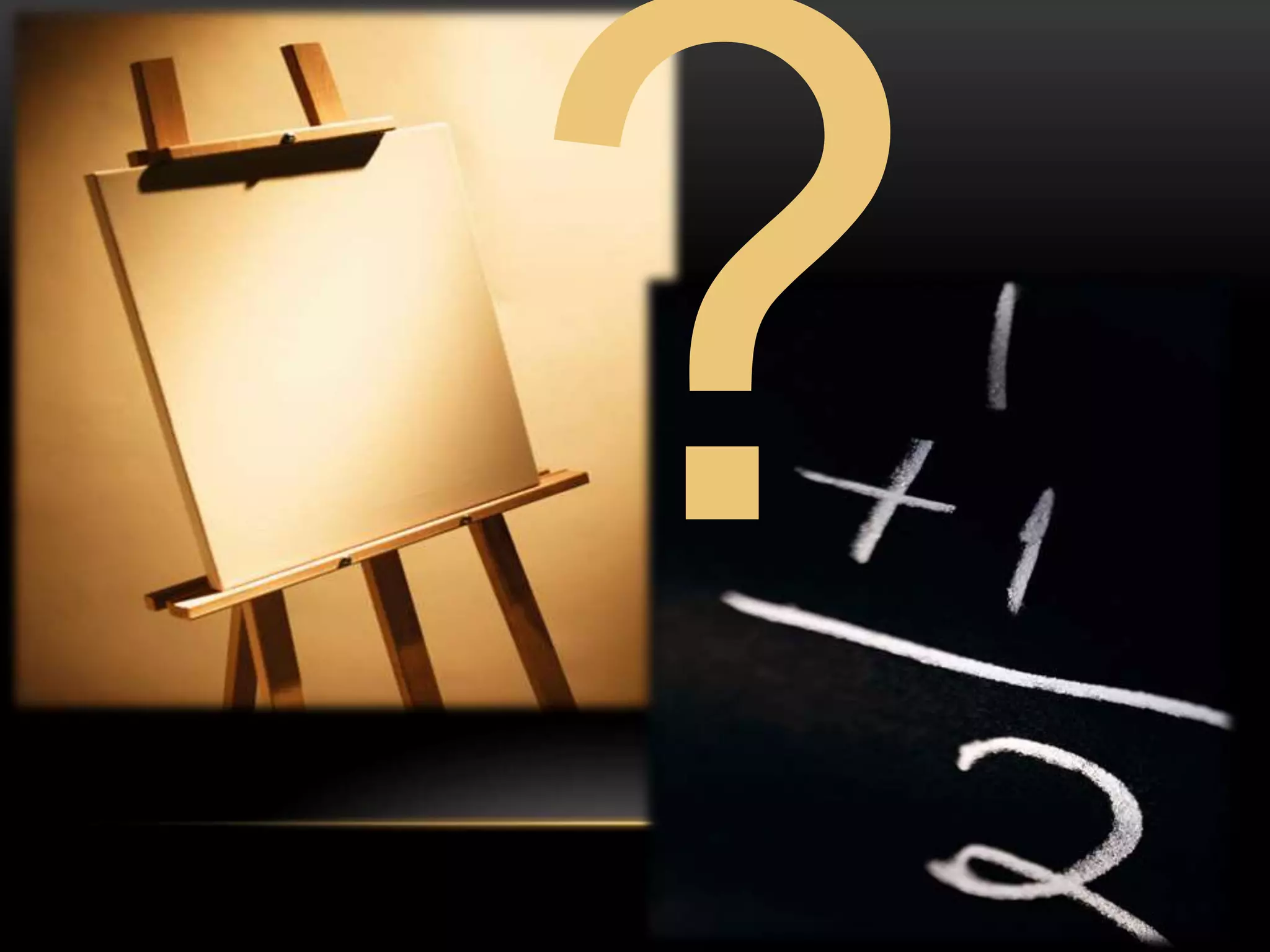
DO YOU REMEMBER………????
ART…. 
Art is a diverse range of human activities ; 
which includes the creation of images or 
objects in fields including painting, 
sculpture, printmaking, photography, and 
other visual media. Architecture is often 
included as one of the visual arts; for 
example. Music, theatre, film, dance, and 
other performing arts, as well as literature and 
other media such a sinter active media, are 
included in a broader definition of art
MATHEMATICS AND ART
Maths is all about 
patterns and rhythms, so 
it's no surprise that 
there's plenty of maths in 
art. Whether it's the 
visual arts or the 
performing arts, maths 
can be a tool, an 
inspiration, or simply 
something that's 
naturally contained 
within the structures and 
patterns.
• Fractals 
• Golden ratio 
• Symmetry 
• Patterns and series 
• Golden rectangle 
• In fashion designing 
• Illusion 
• Geometric abstractionism 
• Tessellations 
• Origami 
• Anamorphic Art
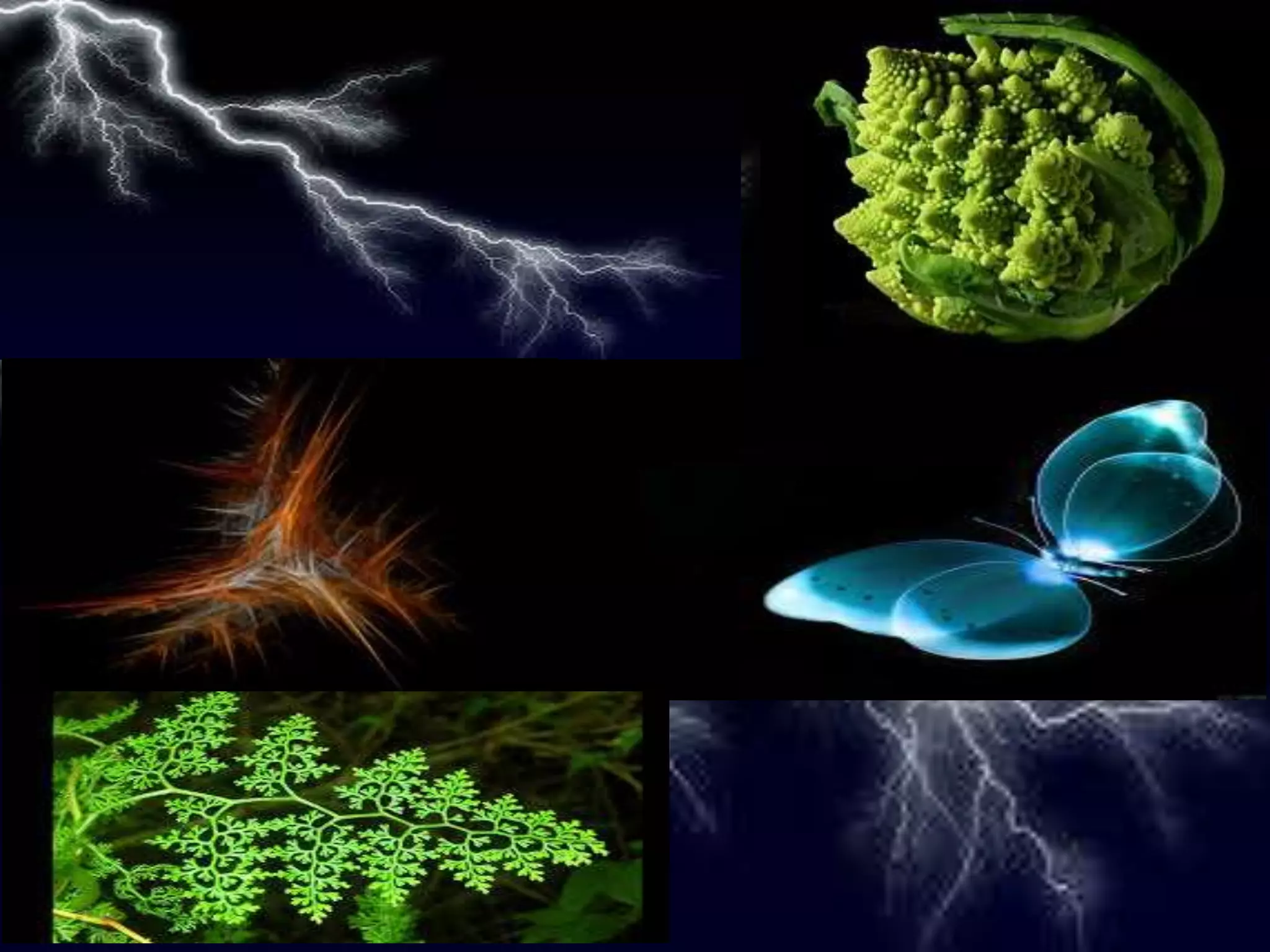
A fractal is a natural phenomenon or a mathematical set that exhibits a 
repeating pattern that displays at every scale. If the replication is exactly 
the same at every scale, it is called a self-similar pattern. Fractals can 
also be nearly the same at different levels. 
Applications: 
Such patterns are also found in; 
• Cauliflower and Broccoli is a natural fractal structure. 
• And the butterfly effect is also said to be natural fractal 
• It is also found in African art and architecture. 
• Found in Mountain ranges and river networks. 
• Found in Snow flakes , ocean waves , earth quakes etc… 
• Human lungs ( bronchi) also has fractal parts in it
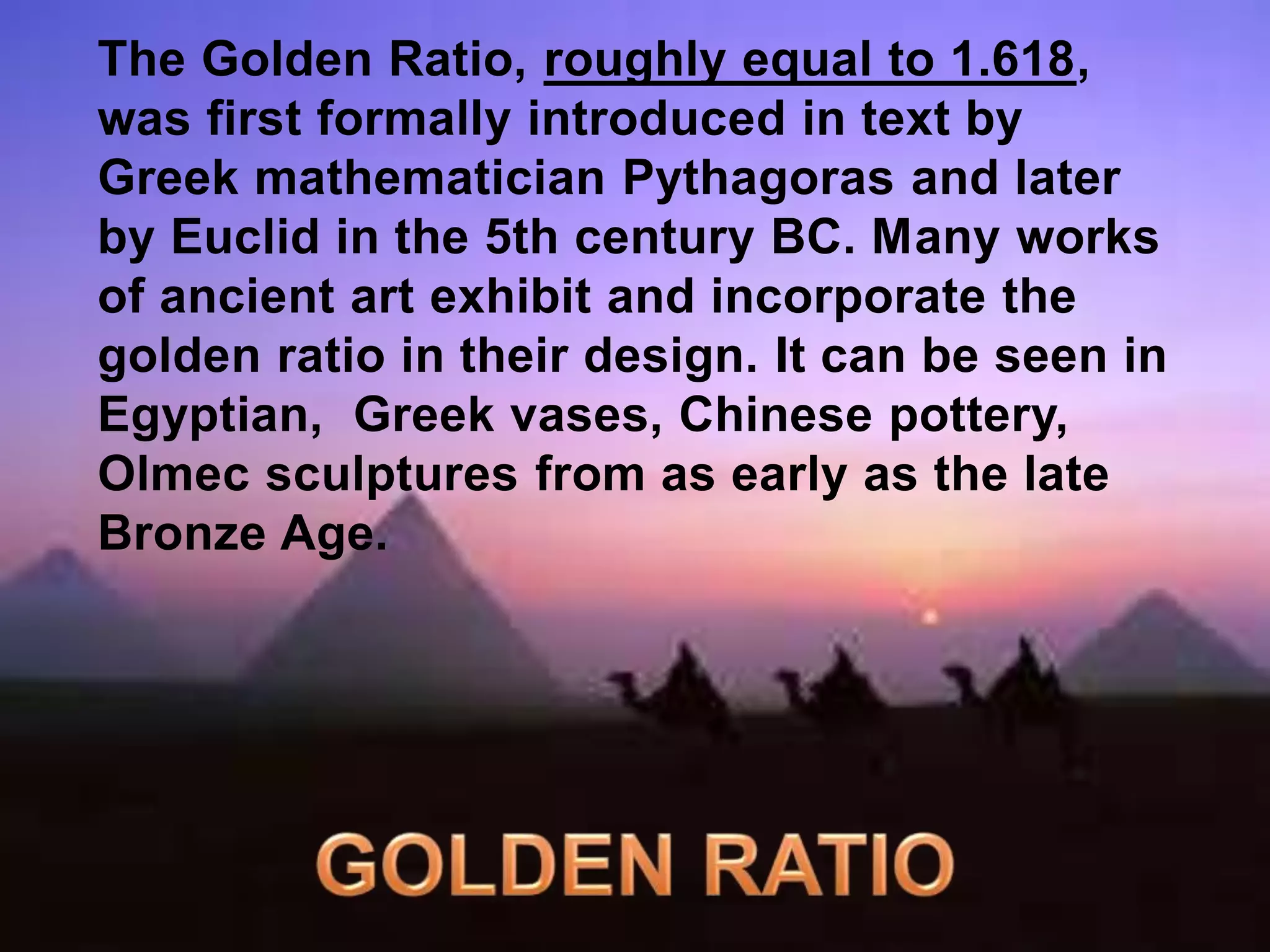
The Golden Ratio, roughly equal to 1.618, 
was first formally introduced in text by 
Greek mathematician Pythagoras and later 
by Euclid in the 5th century BC. Many works 
of ancient art exhibit and incorporate the 
golden ratio in their design. It can be seen in 
Egyptian, Greek vases, Chinese pottery, 
Olmec sculptures from as early as the late 
Bronze Age.
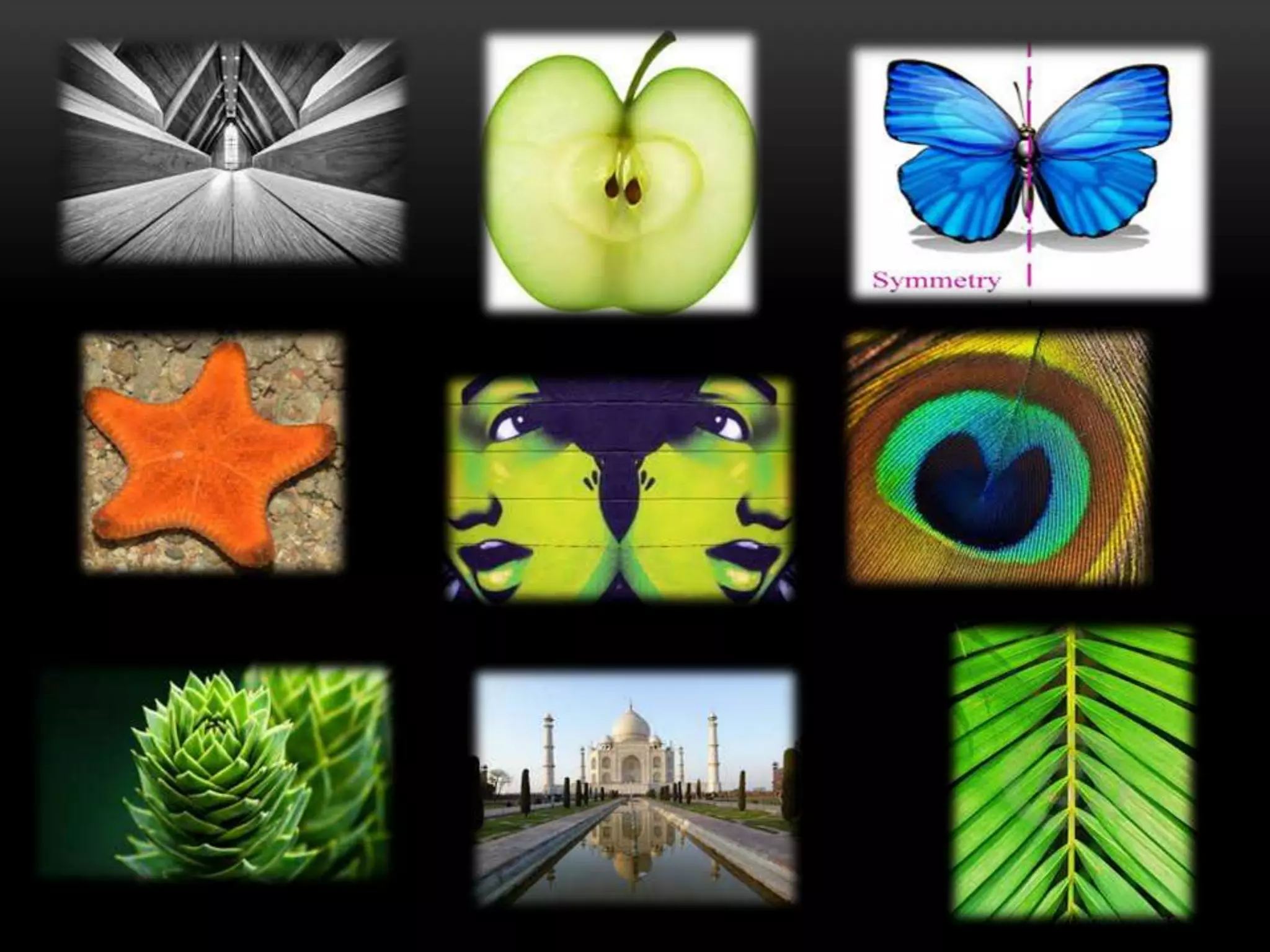
Symmetry in everyday language refers to a sense of 
harmonious and beautiful proportion and balance. 
Application : 
• In fruits,flowers and in other parts of the plants. 
• in feathers of birds 
• in art and architecture 
• in snowfalkes and in other natural phenomenon’s 
• in sea animals such as dolphins and star fishes
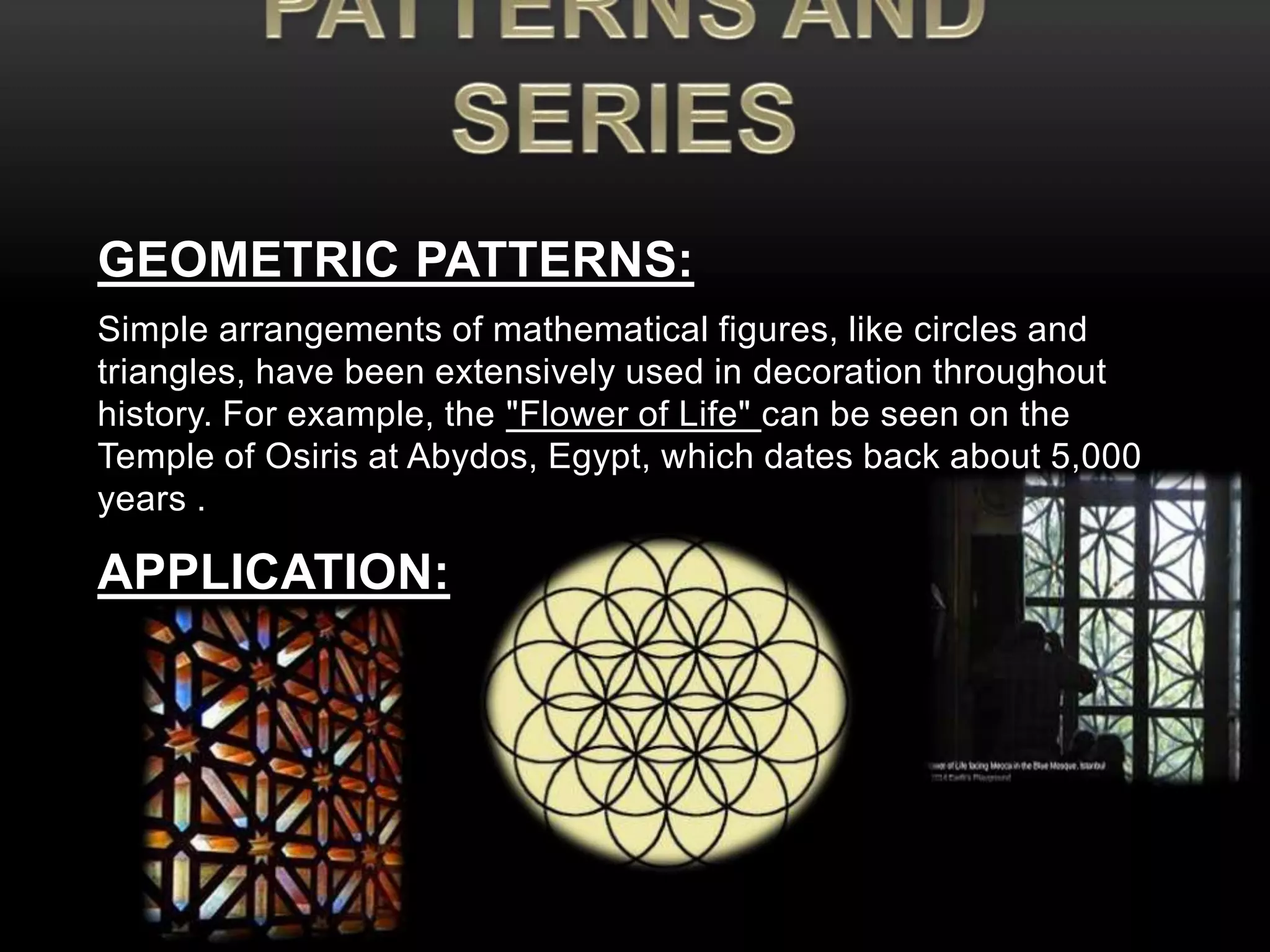
GEOMETRIC PATTERNS: 
Simple arrangements of mathematical figures, like circles and 
triangles, have been extensively used in decoration throughout 
history. For example, the "Flower of Life" can be seen on the 
Temple of Osiris at Abydos, Egypt, which dates back about 5,000 
years . 
APPLICATION:
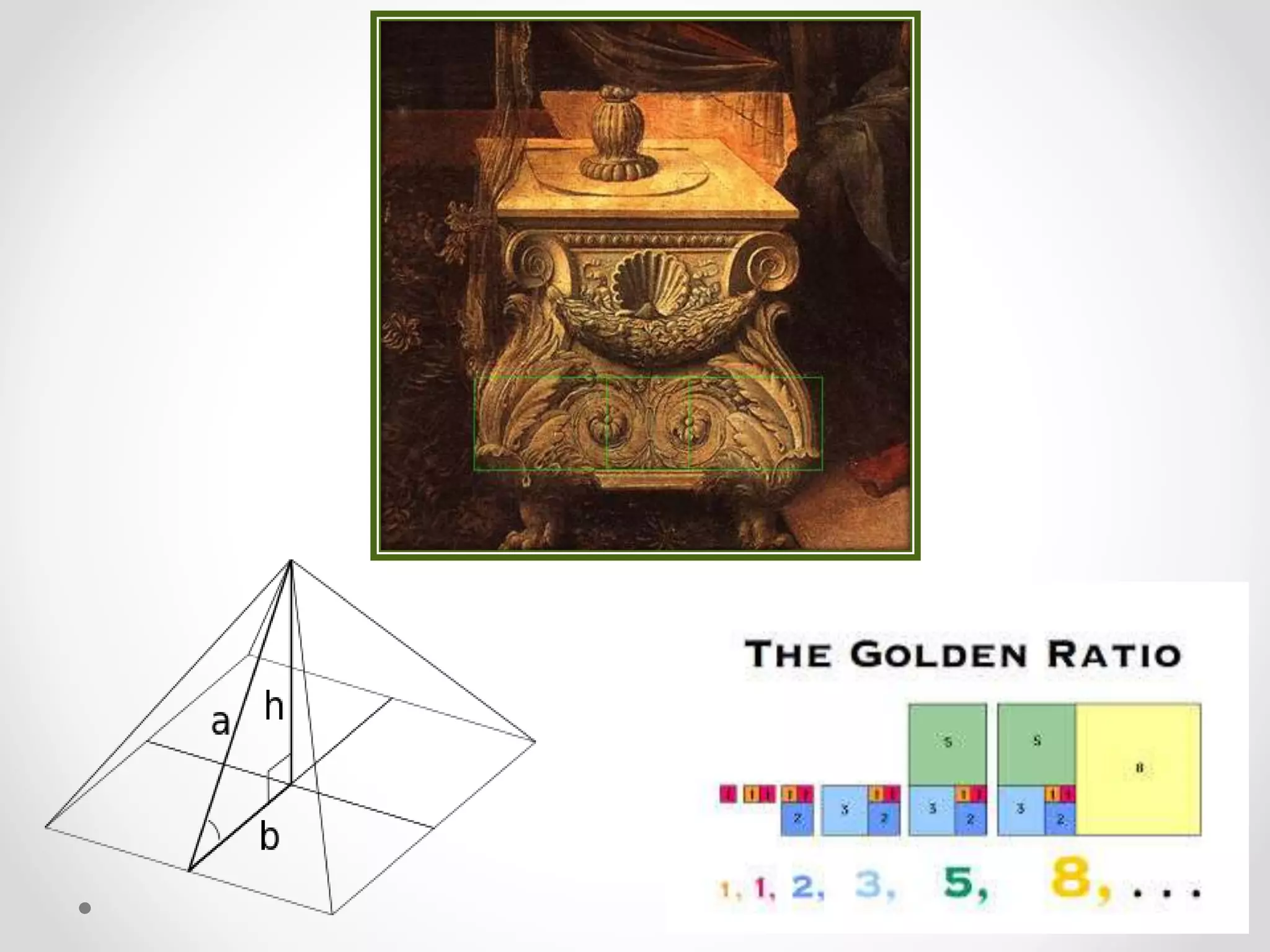
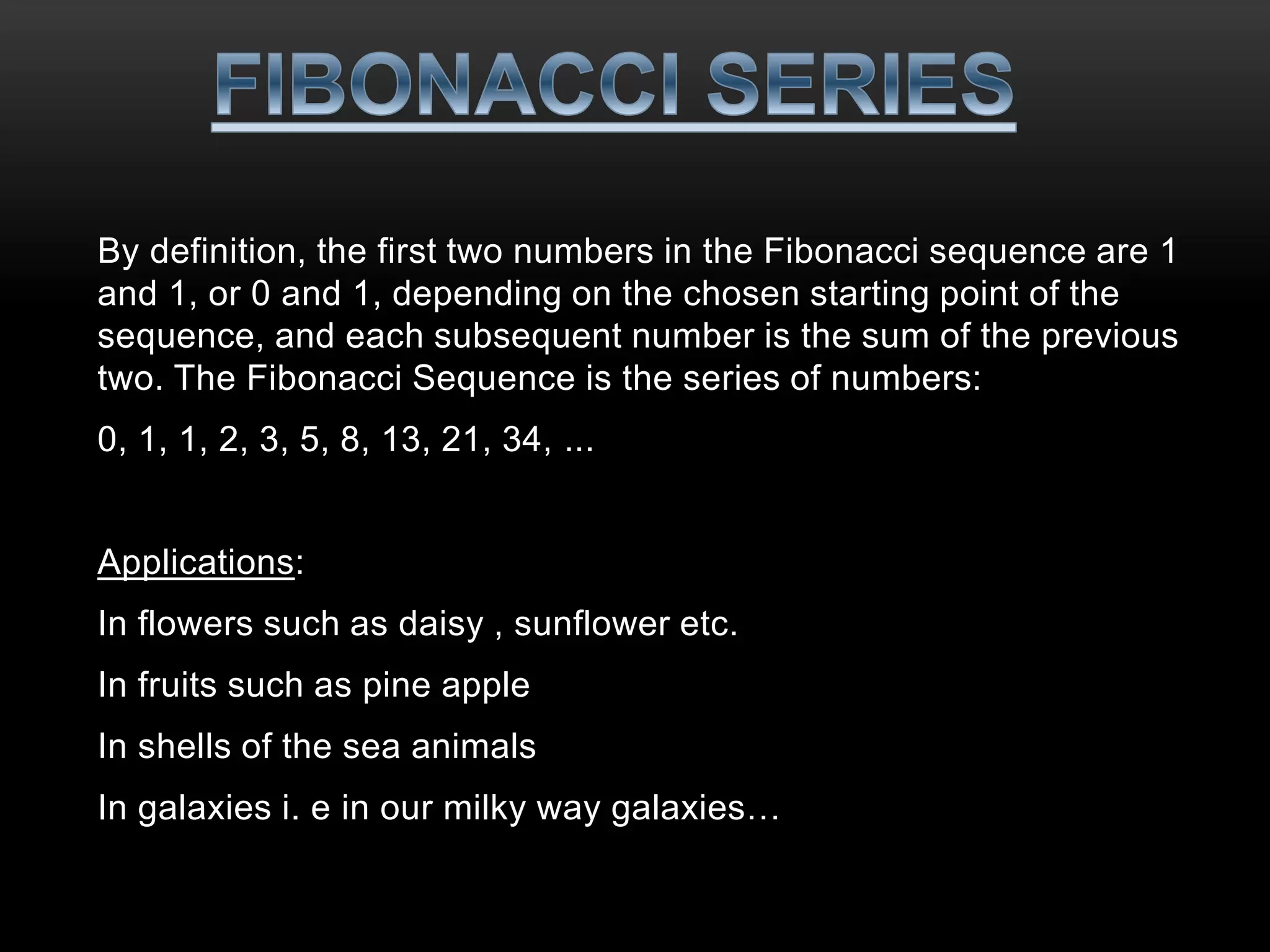
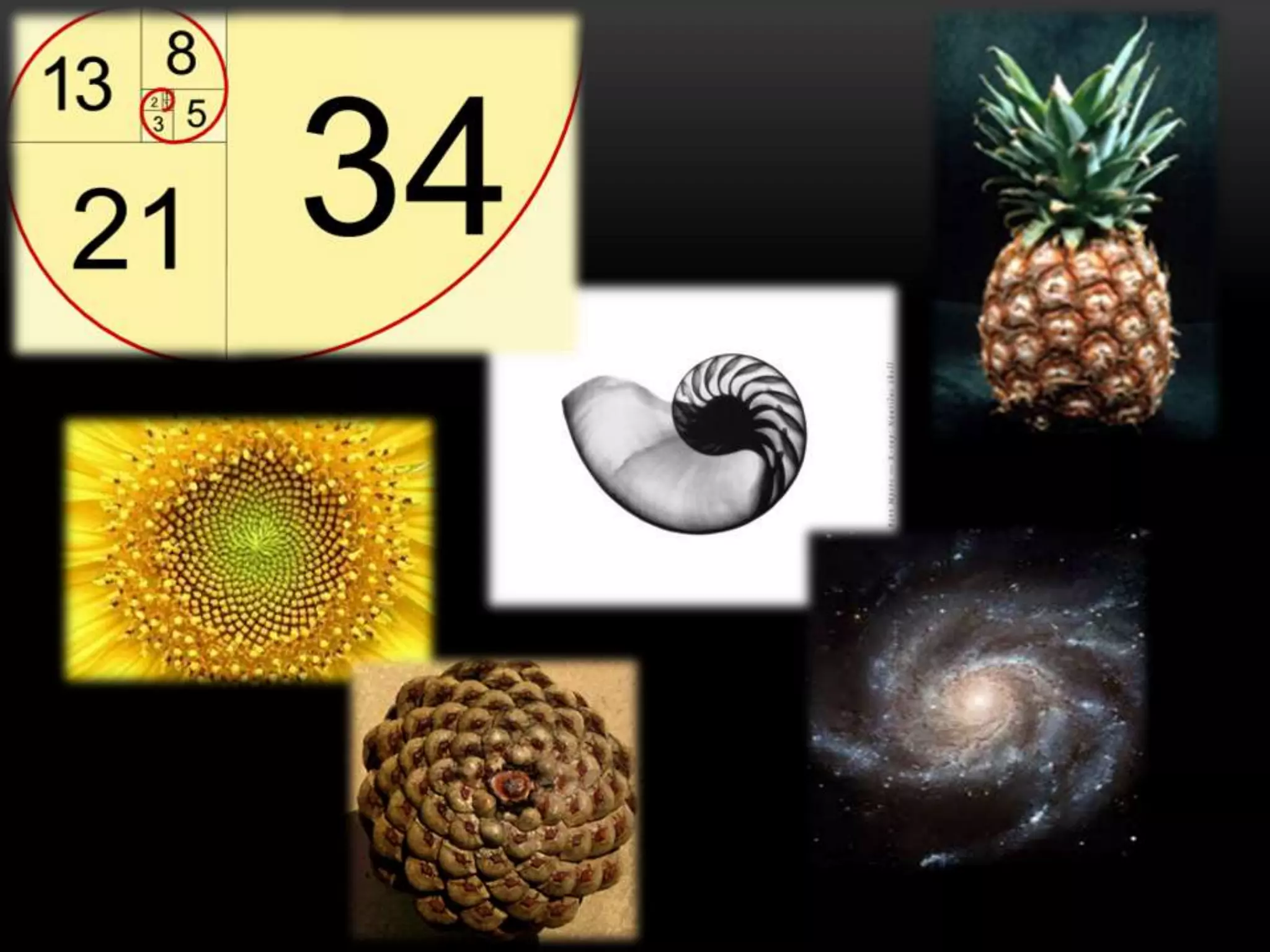
By definition, the first two numbers in the Fibonacci sequence are 1 
and 1, or 0 and 1, depending on the chosen starting point of the 
sequence, and each subsequent number is the sum of the previous 
two. The Fibonacci Sequence is the series of numbers: 
0, 1, 1, 2, 3, 5, 8, 13, 21, 34, ... 
Applications: 
In flowers such as daisy , sunflower etc. 
In fruits such as pine apple 
In shells of the sea animals 
In galaxies i. e in our milky way galaxies…
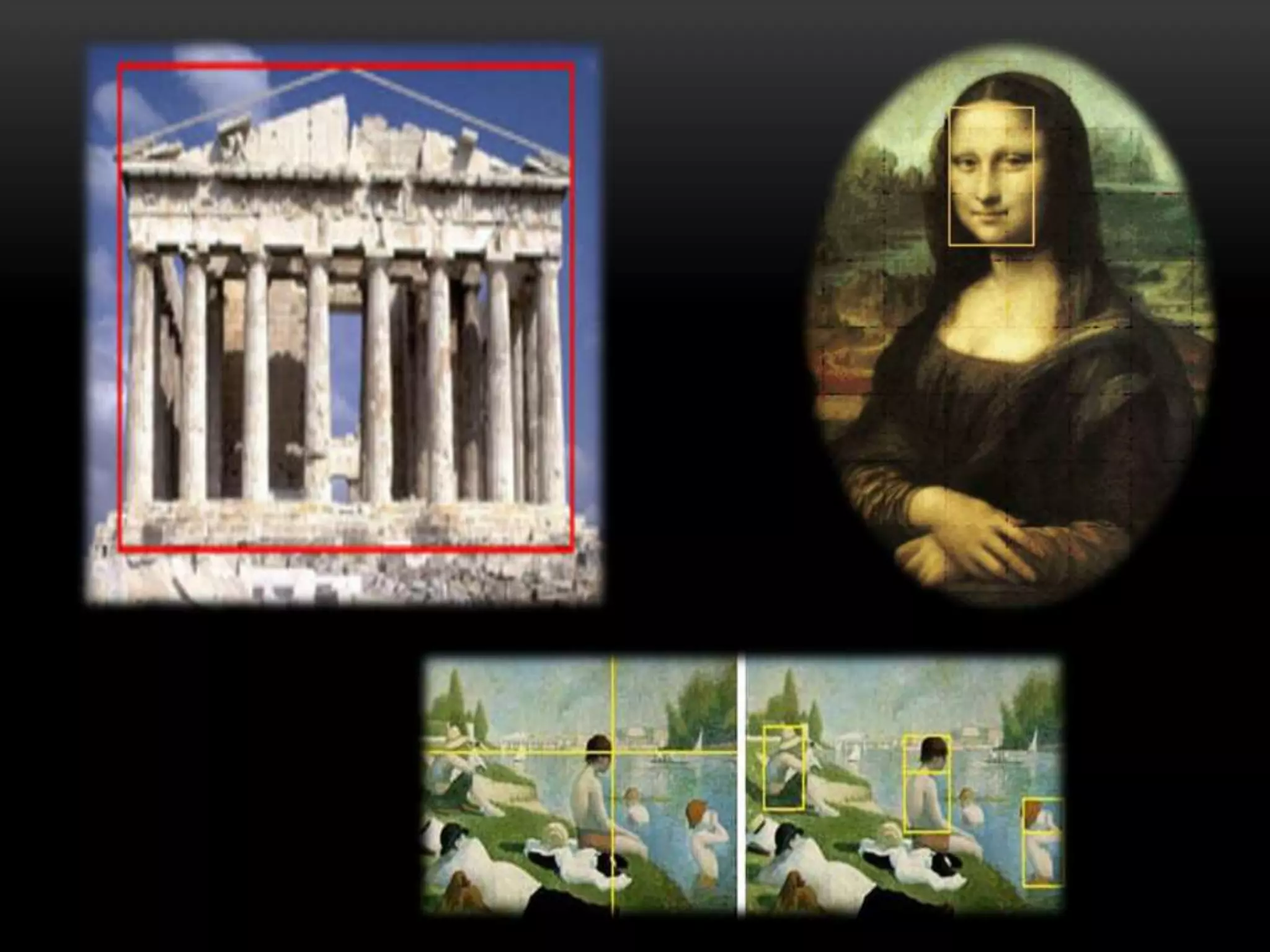
The Golden Rectangle is considered to be one of the 
most pleasing and beautiful shapes to look at, which is 
why many artists have used it in their work . The two 
artists, who are perhaps the most famous for their use 
of the golden rectangle, are Leonardo Da Vinci and Piet 
Mondrian. 
Mona Lisa, is one of the most famous paintings in the 
world, and is a very good example of Da Vinci's use of 
the golden rectangle in art. If you draw a rectangle 
around Mona Lisa's face, that rectangle will turn out to 
be golden. The dimensions of the painting itself also 
form a golden rectangle.
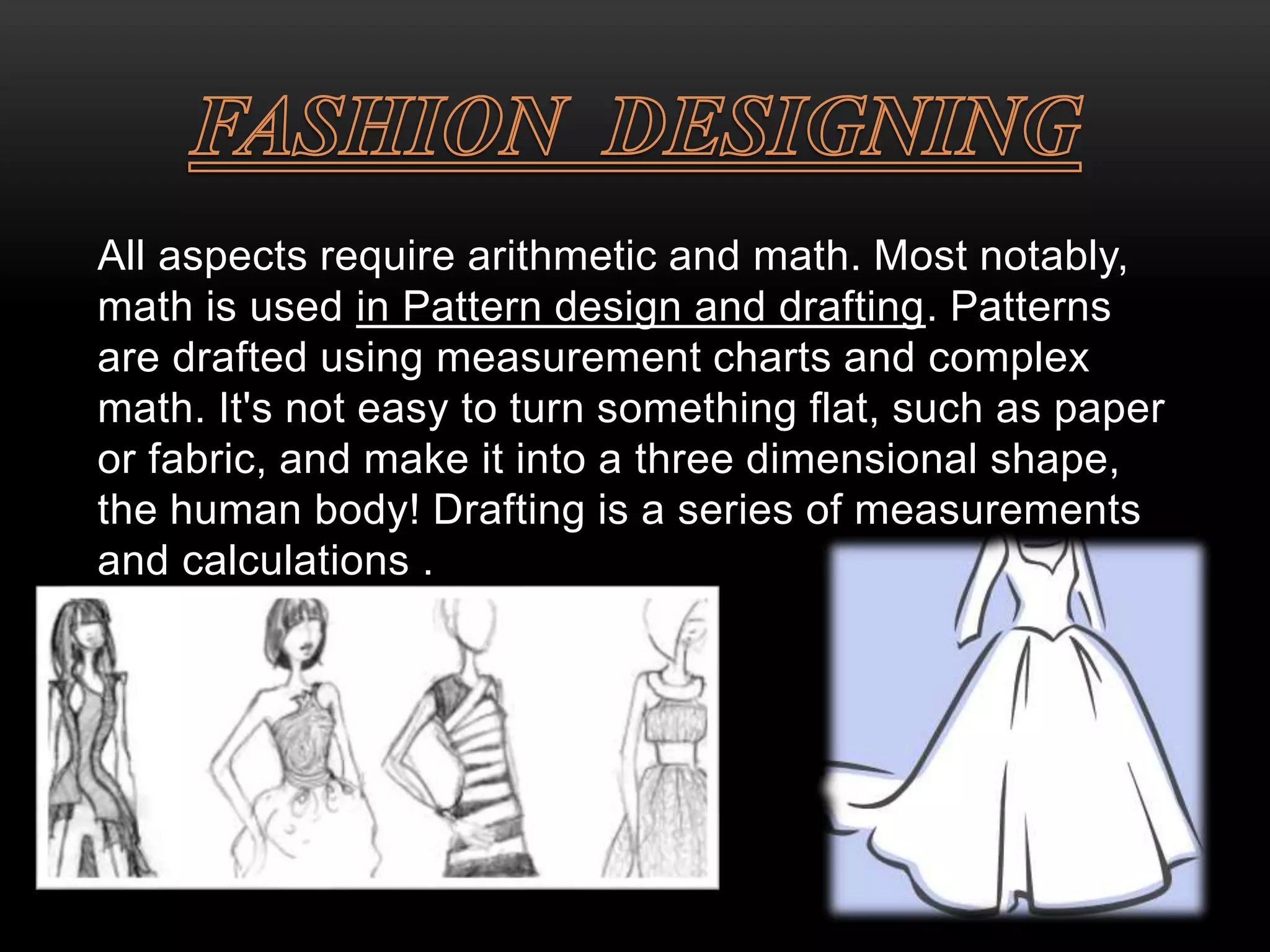
All aspects require arithmetic and math. Most notably, 
math is used in Pattern design and drafting. Patterns 
are drafted using measurement charts and complex 
math. It's not easy to turn something flat, such as paper 
or fabric, and make it into a three dimensional shape, 
the human body! Drafting is a series of measurements 
and calculations .
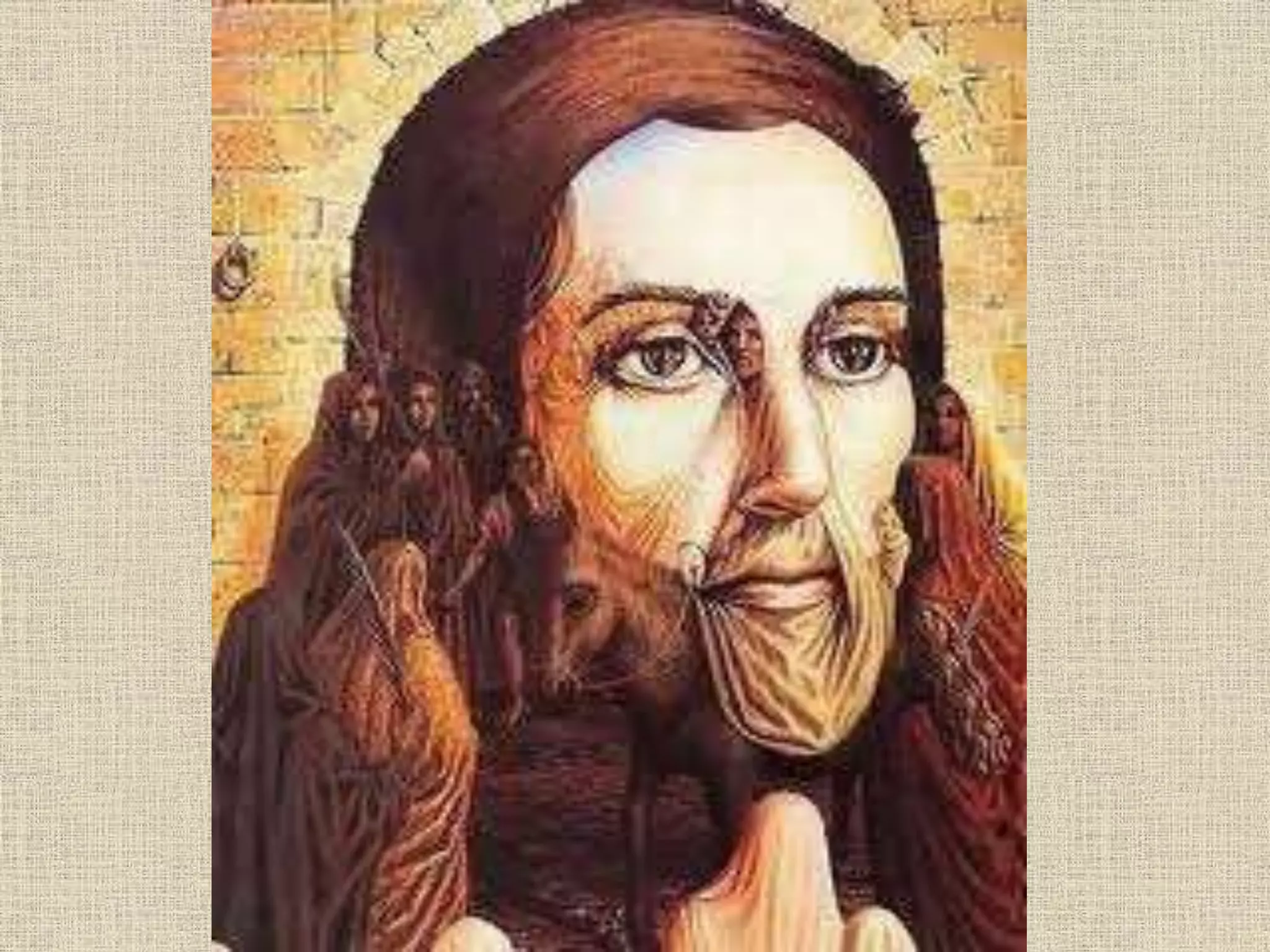
• An illusion is a distortion of the art, revealing how the brain 
normally organizes and interprets sensory stimulation. 
• The Seven Basic Kinds of Illusions ; 
1. Height-Width Illusion 
2. Illusion of Interrupted Extent 
3. Illusion of Contour 
4. Equivocal Illusion 
5. Illusion of Depth 
6. Illusion of Contrast 
7. Non-Classified Illusions
GEOMETRIC ABSTRACTIONISM 
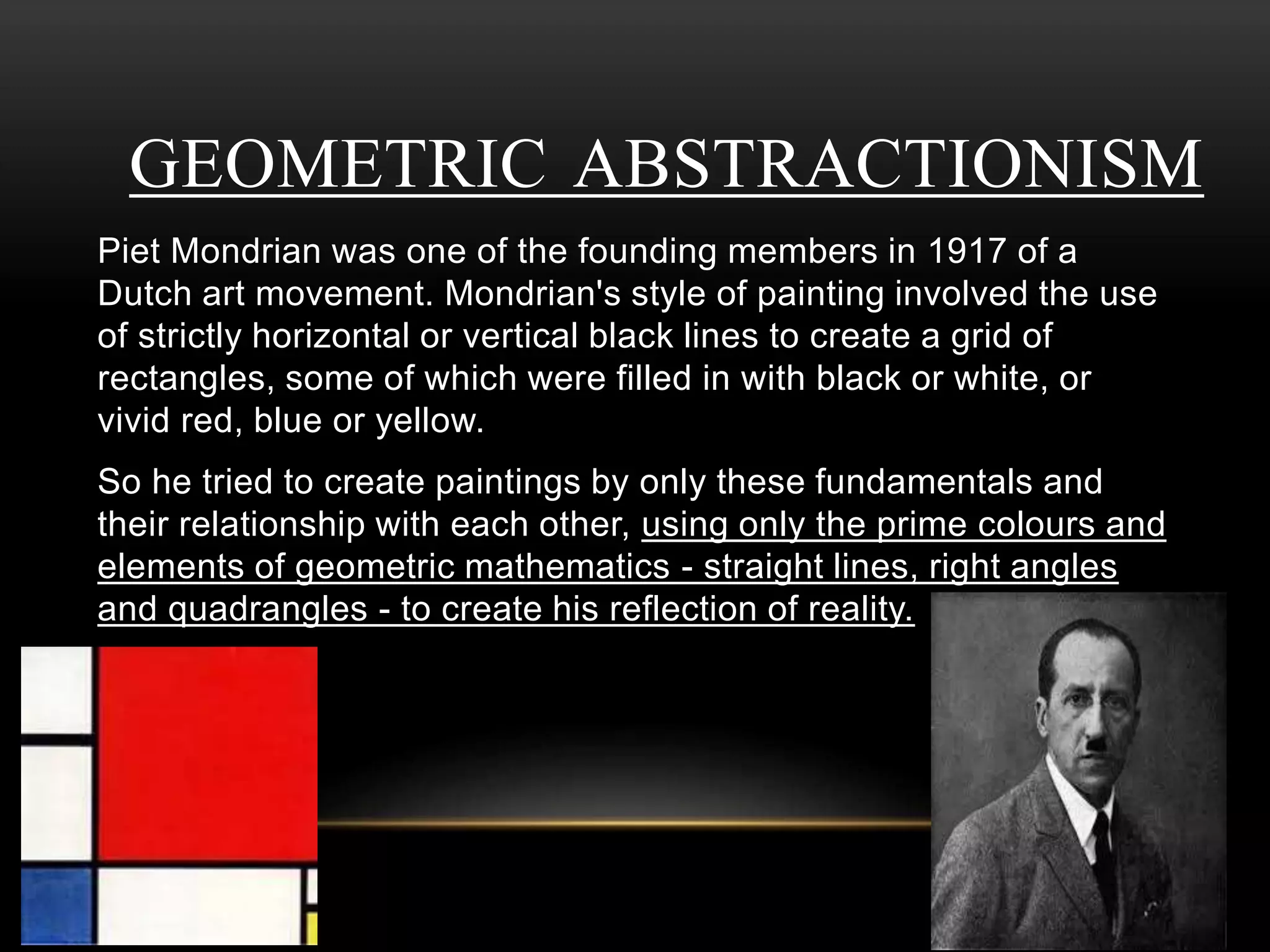
Piet Mondrian was one of the founding members in 1917 of a 
Dutch art movement. Mondrian's style of painting involved the use 
of strictly horizontal or vertical black lines to create a grid of 
rectangles, some of which were filled in with black or white, or 
vivid red, blue or yellow. 
So he tried to create paintings by only these fundamentals and 
their relationship with each other, using only the prime colours and 
elements of geometric mathematics - straight lines, right angles 
and quadrangles - to create his reflection of reality.
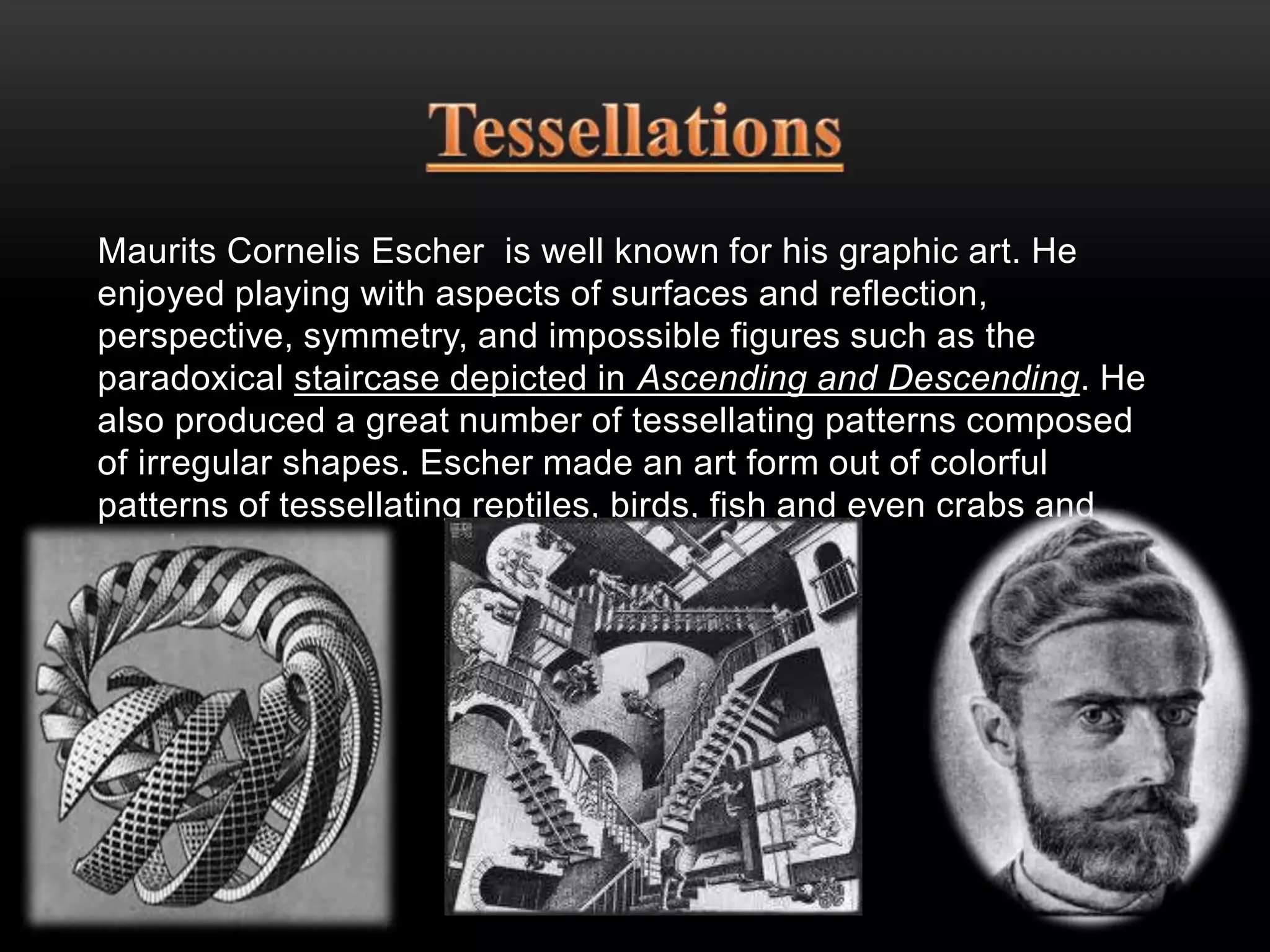
Maurits Cornelis Escher is well known for his graphic art. He 
enjoyed playing with aspects of surfaces and reflection, 
perspective, symmetry, and impossible figures such as the 
paradoxical staircase depicted in Ascending and Descending. He 
also produced a great number of tessellating patterns composed 
of irregular shapes. Escher made an art form out of colorful 
patterns of tessellating reptiles, birds, fish and even crabs and 
sea-horses.
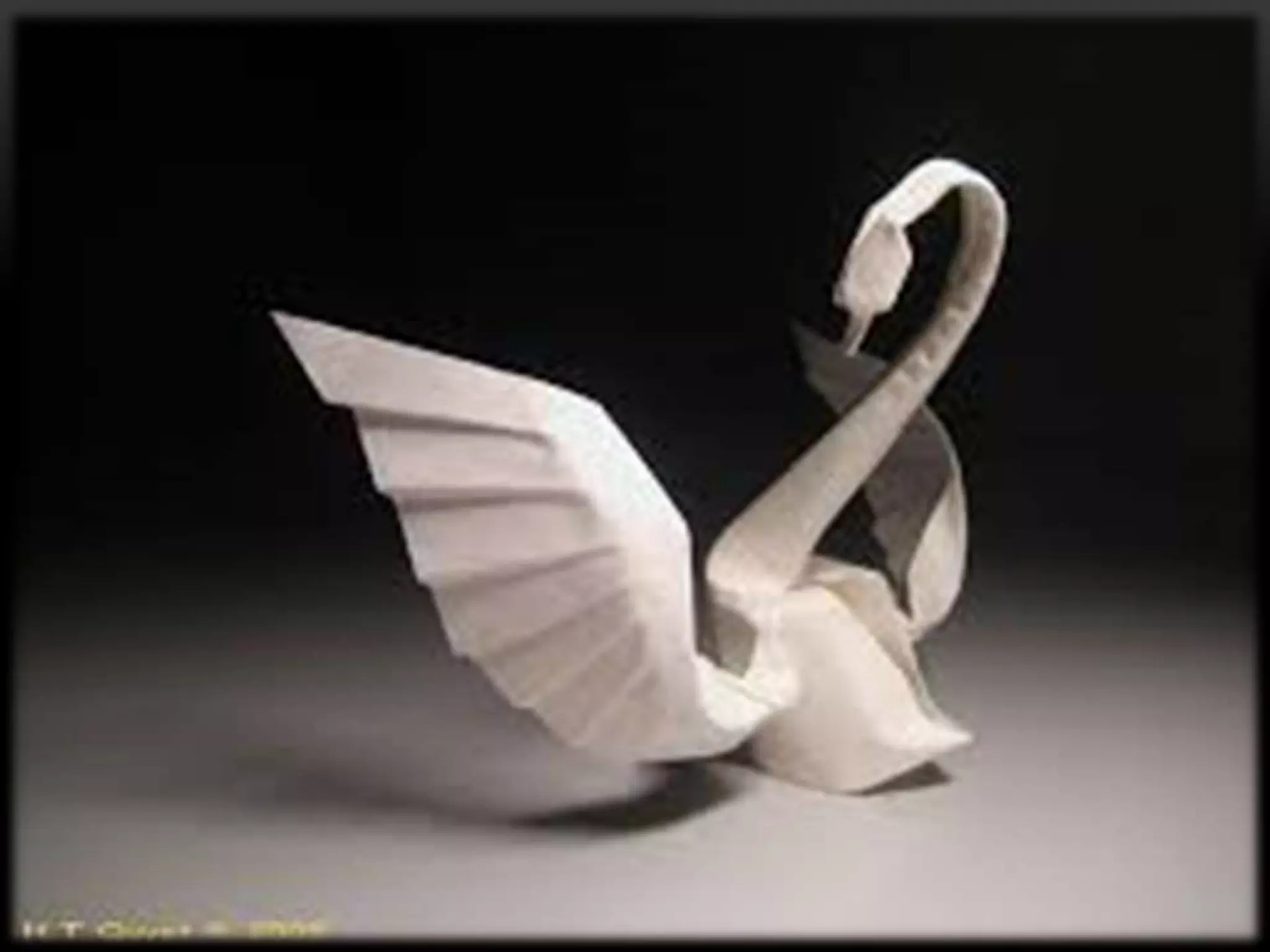
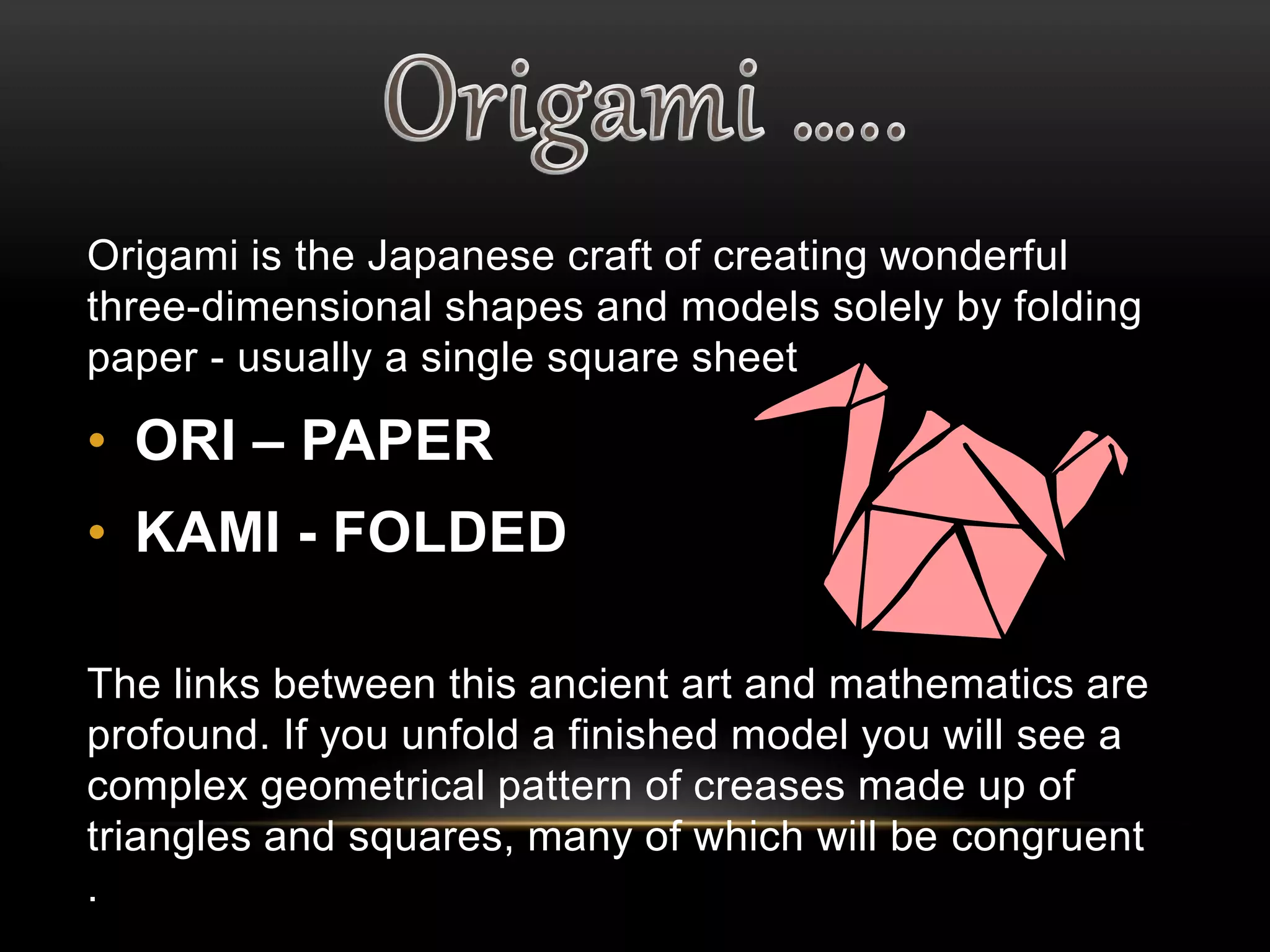
Origami is the Japanese craft of creating wonderful 
three-dimensional shapes and models solely by folding 
paper - usually a single square sheet 
• ORI – PAPER 
• KAMI - FOLDED 
The links between this ancient art and mathematics are 
profound. If you unfold a finished model you will see a 
complex geometrical pattern of creases made up of 
triangles and squares, many of which will be congruent 
.
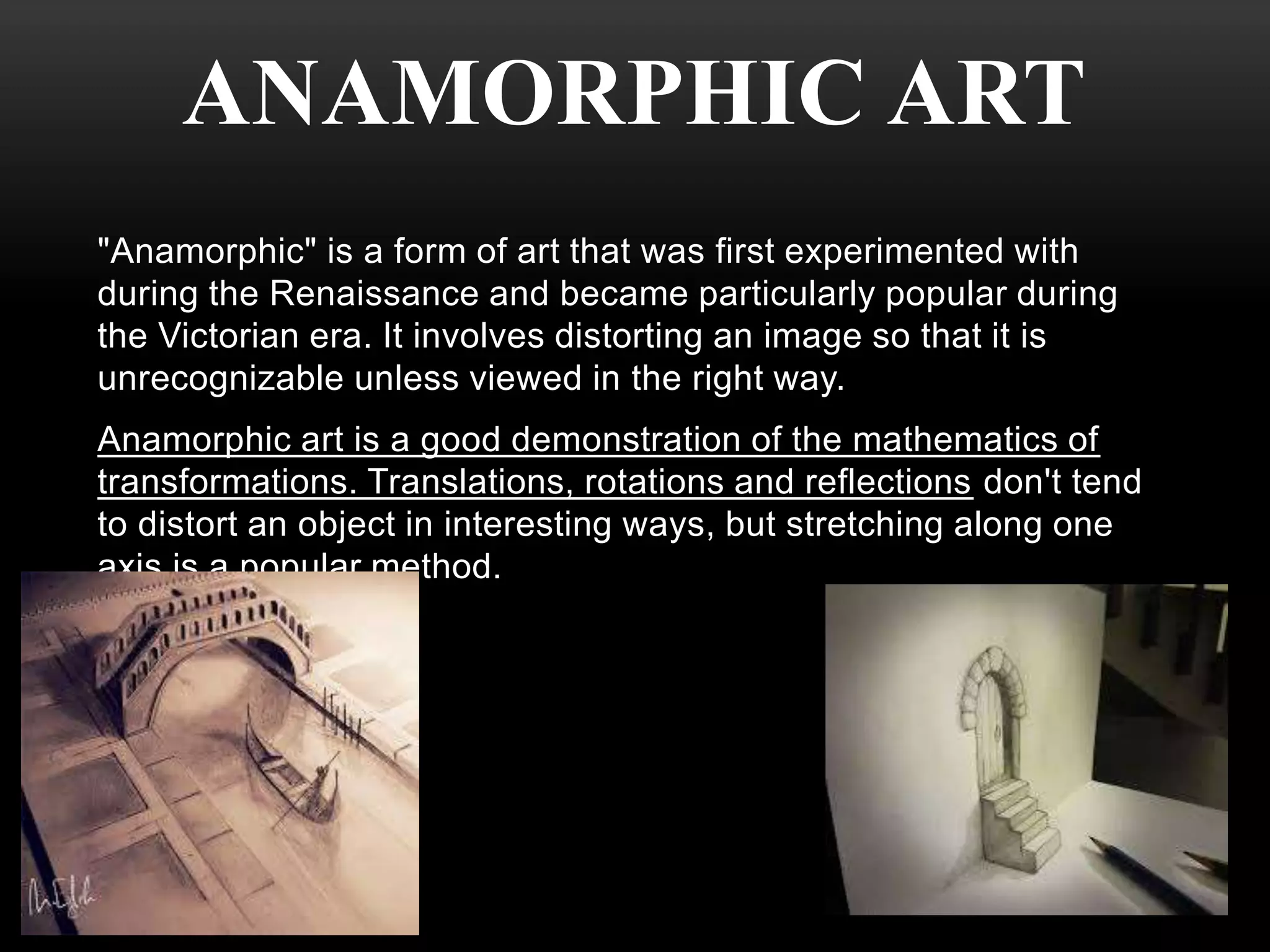
ANAMORPHIC ART 
"Anamorphic" is a form of art that was first experimented with 
during the Renaissance and became particularly popular during 
the Victorian era. It involves distorting an image so that it is 
unrecognizable unless viewed in the right way. 
Anamorphic art is a good demonstration of the mathematics of 
transformations. Translations, rotations and reflections don't tend 
to distort an object in interesting ways, but stretching along one 
axis is a popular method.
CONCLUSION 
The world around us is full of relationships, rhythms, 
correlations, patterns. And mathematics underlies all of 
these, and can be used to predict future outcomes. Our 
brains have evolved to survive in this world: to analyze 
the information it receives through our senses and spot 
patterns in the complexity around us. In fact, it's 
thought that the mathematical structure embedded in 
the rhythm and melody of music is what our brains latch 
on to, and that this is why we enjoy listening to it. It is 
perhaps not surprising then that there is a great deal of 
overlap between mathematics and the art that our brain 
finds so pleasing to look at.
IDHAYAPRIYA.I 
INDHIRA.B 
ALLWYN BERNET SAMUEL.D
Mathematics in art

Mathematics in art

  • 3.
    MATHEMATICS Mathematics isthe study of topics such as quantity (numbers), structure, space, and change. There is a range of views among mathematicians and philosophers as to the exact scope and definition of mathematics. Mathematics is used throughout the world as an essential tool in many fields, including natural science, engineering, medicine, finance and the social sciences.
  • 4.
  • 6.
    ART…. Art isa diverse range of human activities ; which includes the creation of images or objects in fields including painting, sculpture, printmaking, photography, and other visual media. Architecture is often included as one of the visual arts; for example. Music, theatre, film, dance, and other performing arts, as well as literature and other media such a sinter active media, are included in a broader definition of art
  • 8.
  • 9.
    Maths is allabout patterns and rhythms, so it's no surprise that there's plenty of maths in art. Whether it's the visual arts or the performing arts, maths can be a tool, an inspiration, or simply something that's naturally contained within the structures and patterns.
  • 10.
    • Fractals •Golden ratio • Symmetry • Patterns and series • Golden rectangle • In fashion designing • Illusion • Geometric abstractionism • Tessellations • Origami • Anamorphic Art
  • 11.
    A fractal isa natural phenomenon or a mathematical set that exhibits a repeating pattern that displays at every scale. If the replication is exactly the same at every scale, it is called a self-similar pattern. Fractals can also be nearly the same at different levels. Applications: Such patterns are also found in; • Cauliflower and Broccoli is a natural fractal structure. • And the butterfly effect is also said to be natural fractal • It is also found in African art and architecture. • Found in Mountain ranges and river networks. • Found in Snow flakes , ocean waves , earth quakes etc… • Human lungs ( bronchi) also has fractal parts in it
  • 13.
    The Golden Ratio,roughly equal to 1.618, was first formally introduced in text by Greek mathematician Pythagoras and later by Euclid in the 5th century BC. Many works of ancient art exhibit and incorporate the golden ratio in their design. It can be seen in Egyptian, Greek vases, Chinese pottery, Olmec sculptures from as early as the late Bronze Age.
  • 16.
    Symmetry in everydaylanguage refers to a sense of harmonious and beautiful proportion and balance. Application : • In fruits,flowers and in other parts of the plants. • in feathers of birds • in art and architecture • in snowfalkes and in other natural phenomenon’s • in sea animals such as dolphins and star fishes
  • 18.
    GEOMETRIC PATTERNS: Simplearrangements of mathematical figures, like circles and triangles, have been extensively used in decoration throughout history. For example, the "Flower of Life" can be seen on the Temple of Osiris at Abydos, Egypt, which dates back about 5,000 years . APPLICATION:
  • 19.
    By definition, thefirst two numbers in the Fibonacci sequence are 1 and 1, or 0 and 1, depending on the chosen starting point of the sequence, and each subsequent number is the sum of the previous two. The Fibonacci Sequence is the series of numbers: 0, 1, 1, 2, 3, 5, 8, 13, 21, 34, ... Applications: In flowers such as daisy , sunflower etc. In fruits such as pine apple In shells of the sea animals In galaxies i. e in our milky way galaxies…
  • 21.
    The Golden Rectangleis considered to be one of the most pleasing and beautiful shapes to look at, which is why many artists have used it in their work . The two artists, who are perhaps the most famous for their use of the golden rectangle, are Leonardo Da Vinci and Piet Mondrian. Mona Lisa, is one of the most famous paintings in the world, and is a very good example of Da Vinci's use of the golden rectangle in art. If you draw a rectangle around Mona Lisa's face, that rectangle will turn out to be golden. The dimensions of the painting itself also form a golden rectangle.
  • 23.
    All aspects requirearithmetic and math. Most notably, math is used in Pattern design and drafting. Patterns are drafted using measurement charts and complex math. It's not easy to turn something flat, such as paper or fabric, and make it into a three dimensional shape, the human body! Drafting is a series of measurements and calculations .
  • 25.
    • An illusionis a distortion of the art, revealing how the brain normally organizes and interprets sensory stimulation. • The Seven Basic Kinds of Illusions ; 1. Height-Width Illusion 2. Illusion of Interrupted Extent 3. Illusion of Contour 4. Equivocal Illusion 5. Illusion of Depth 6. Illusion of Contrast 7. Non-Classified Illusions
  • 26.
    GEOMETRIC ABSTRACTIONISM PietMondrian was one of the founding members in 1917 of a Dutch art movement. Mondrian's style of painting involved the use of strictly horizontal or vertical black lines to create a grid of rectangles, some of which were filled in with black or white, or vivid red, blue or yellow. So he tried to create paintings by only these fundamentals and their relationship with each other, using only the prime colours and elements of geometric mathematics - straight lines, right angles and quadrangles - to create his reflection of reality.
  • 27.
    Maurits Cornelis Escheris well known for his graphic art. He enjoyed playing with aspects of surfaces and reflection, perspective, symmetry, and impossible figures such as the paradoxical staircase depicted in Ascending and Descending. He also produced a great number of tessellating patterns composed of irregular shapes. Escher made an art form out of colorful patterns of tessellating reptiles, birds, fish and even crabs and sea-horses.
  • 29.
    Origami is theJapanese craft of creating wonderful three-dimensional shapes and models solely by folding paper - usually a single square sheet • ORI – PAPER • KAMI - FOLDED The links between this ancient art and mathematics are profound. If you unfold a finished model you will see a complex geometrical pattern of creases made up of triangles and squares, many of which will be congruent .
  • 30.
    ANAMORPHIC ART "Anamorphic"is a form of art that was first experimented with during the Renaissance and became particularly popular during the Victorian era. It involves distorting an image so that it is unrecognizable unless viewed in the right way. Anamorphic art is a good demonstration of the mathematics of transformations. Translations, rotations and reflections don't tend to distort an object in interesting ways, but stretching along one axis is a popular method.
  • 31.
    CONCLUSION The worldaround us is full of relationships, rhythms, correlations, patterns. And mathematics underlies all of these, and can be used to predict future outcomes. Our brains have evolved to survive in this world: to analyze the information it receives through our senses and spot patterns in the complexity around us. In fact, it's thought that the mathematical structure embedded in the rhythm and melody of music is what our brains latch on to, and that this is why we enjoy listening to it. It is perhaps not surprising then that there is a great deal of overlap between mathematics and the art that our brain finds so pleasing to look at.
  • 33.