The Fibonacci Sequence It's as easy as 1, 1, 2, 3...
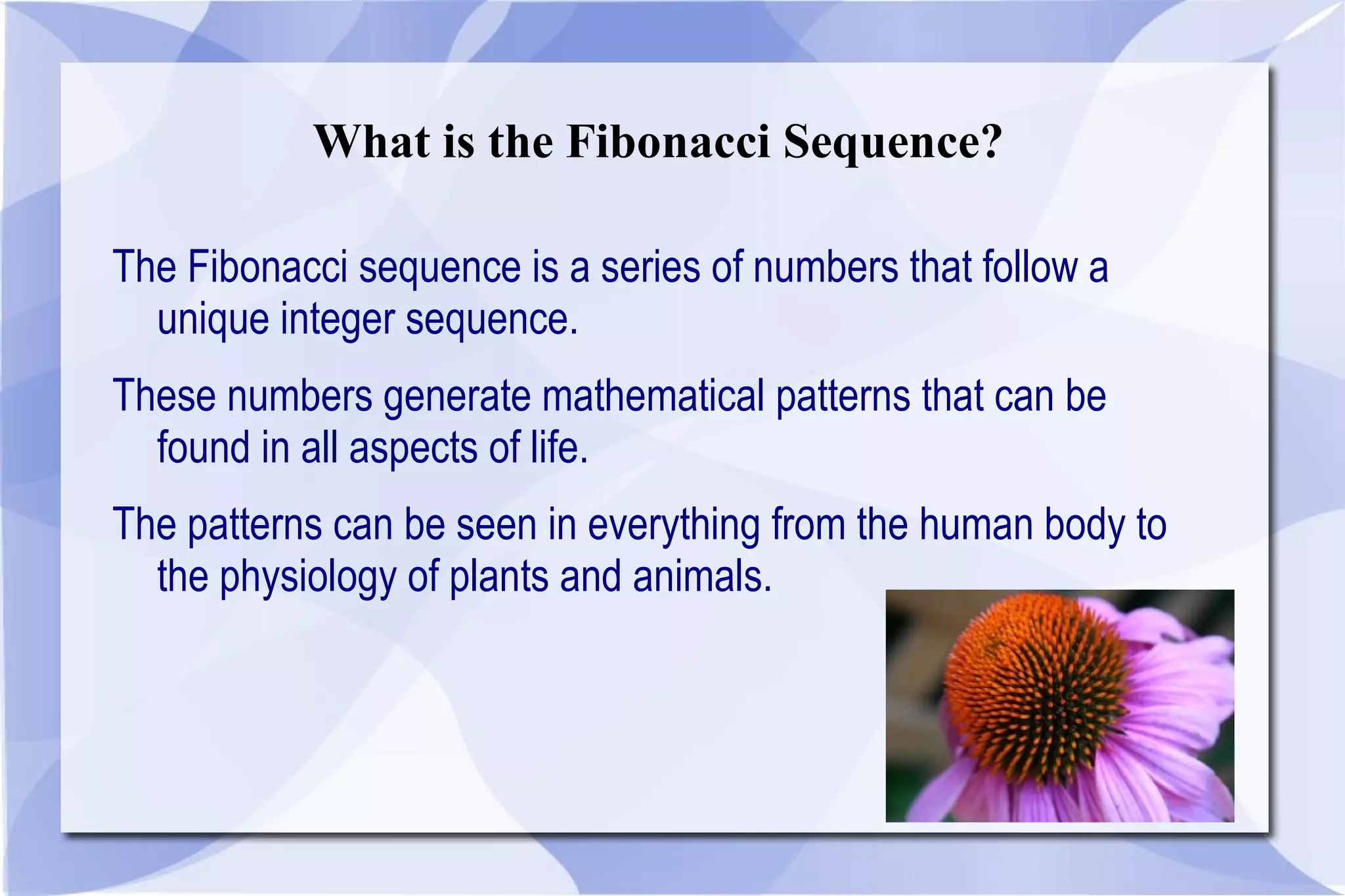
What is the Fibonacci Sequence? The Fibonacci sequence is a series of numbers that follow a unique integer sequence.
These numbers generate mathematical patterns that can be found in all aspects of life.
The patterns can be seen in everything from the human body to the physiology of plants and animals.
How does the Fibonacci Sequence Work? The Fibonacci sequence is derived from the Fibonacci numbers.  The Fibonacci numbers are as follows:
0, 1, 1, 2, 3, 5, 8, 13, 21, 34, 55, 89, 144...and so on.
These numbers are obtained by adding the two previous numbers in the sequence to obtain the next higher number.
Example: 1+1= 2,  2+3= 5,  5+8= 13...
The formula is: Fn = Fn-1 + Fn-2

Fibonacci sequence

  • 1.
    The Fibonacci SequenceIt's as easy as 1, 1, 2, 3...
  • 2.
    What is theFibonacci Sequence? The Fibonacci sequence is a series of numbers that follow a unique integer sequence.
  • 3.
    These numbers generatemathematical patterns that can be found in all aspects of life.
  • 4.
    The patterns canbe seen in everything from the human body to the physiology of plants and animals.
  • 5.
    How does theFibonacci Sequence Work? The Fibonacci sequence is derived from the Fibonacci numbers. The Fibonacci numbers are as follows:
  • 6.
    0, 1, 1,2, 3, 5, 8, 13, 21, 34, 55, 89, 144...and so on.
  • 7.
    These numbers areobtained by adding the two previous numbers in the sequence to obtain the next higher number.
  • 8.
    Example: 1+1= 2, 2+3= 5, 5+8= 13...
  • 9.
    The formula is:Fn = Fn-1 + Fn-2
  • 10.
    Every third numberis even and the difference between each number is .618 with the reciprocal of 1.618. These numbers are know as the “golden ratio” or “golden mean.”
  • 11.
    What is theHistory of the Fibonacci Sequence? The exact origination of the Fibonacci sequence is unknown.
  • 12.
    It is believedthat contributions to the theory began in 200 BC by Indian mathematicians whose studies were based on Sanskirt prosody.
  • 13.
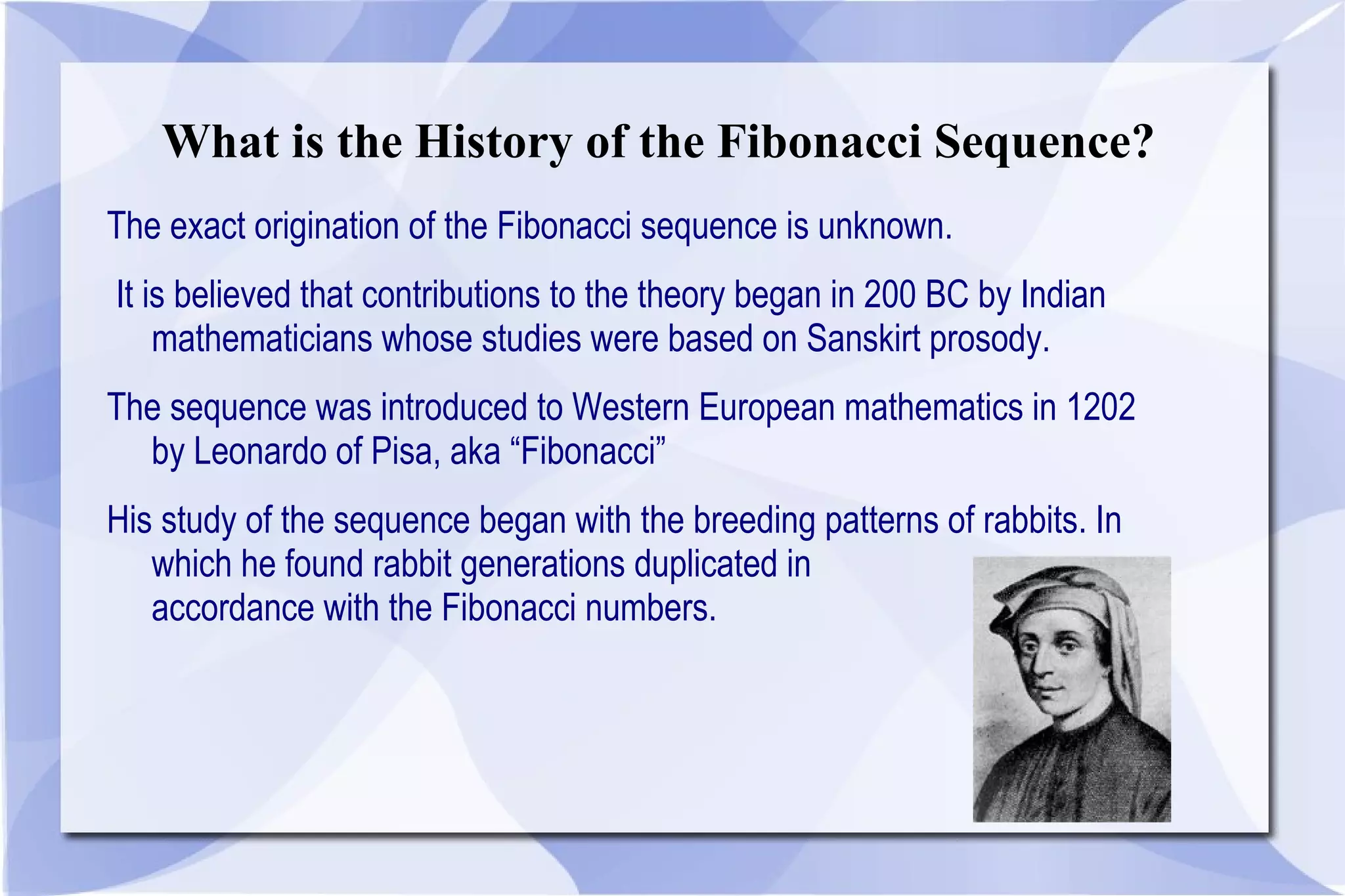
    The sequence wasintroduced to Western European mathematics in 1202 by Leonardo of Pisa, aka “Fibonacci”
  • 14.
    His study ofthe sequence began with the breeding patterns of rabbits. In which he found rabbit generations duplicated in accordance with the Fibonacci numbers.
  • 15.
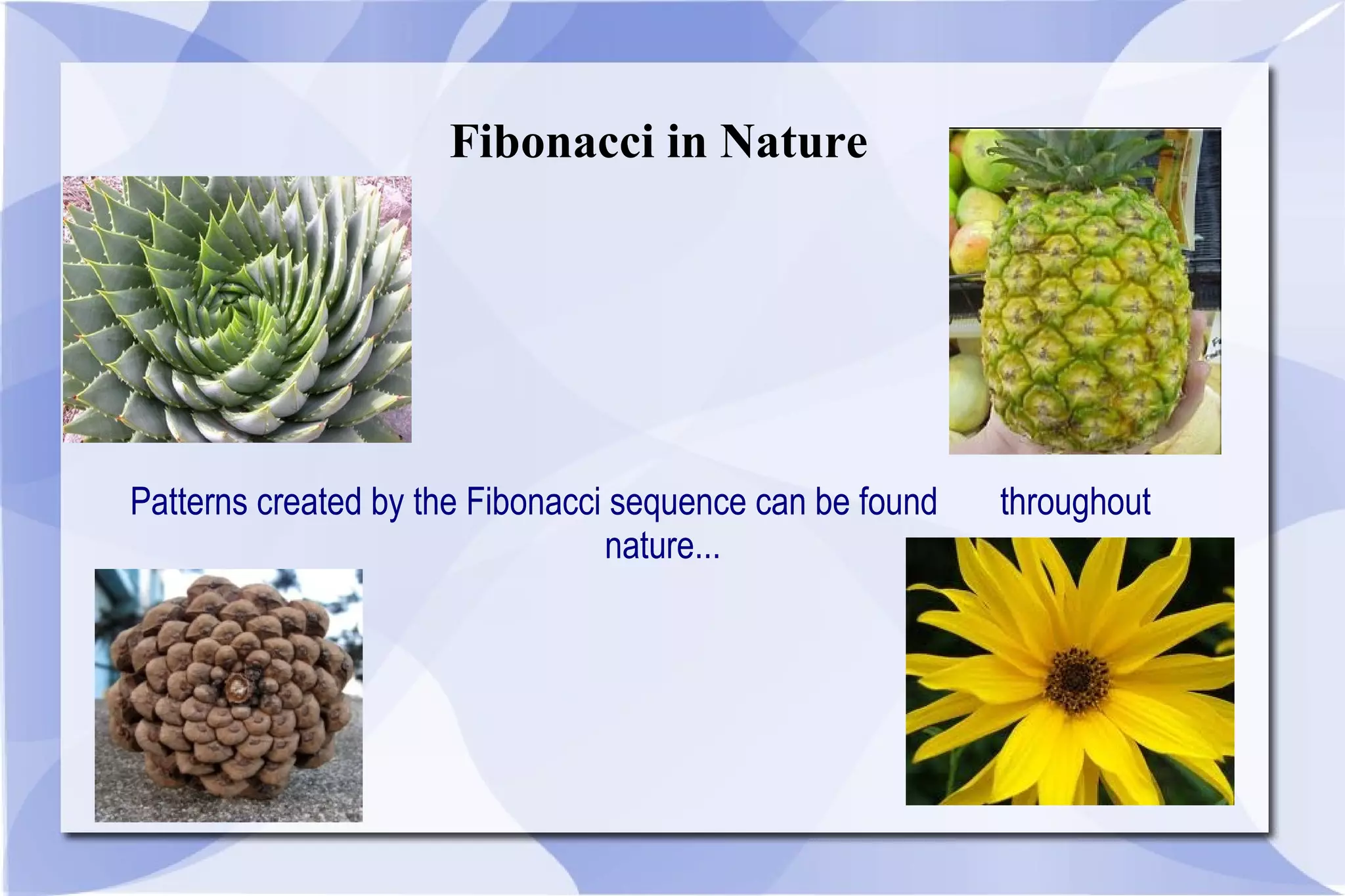
    Fibonacci in NaturePatterns created by the Fibonacci sequence can be found throughout nature...
  • 16.
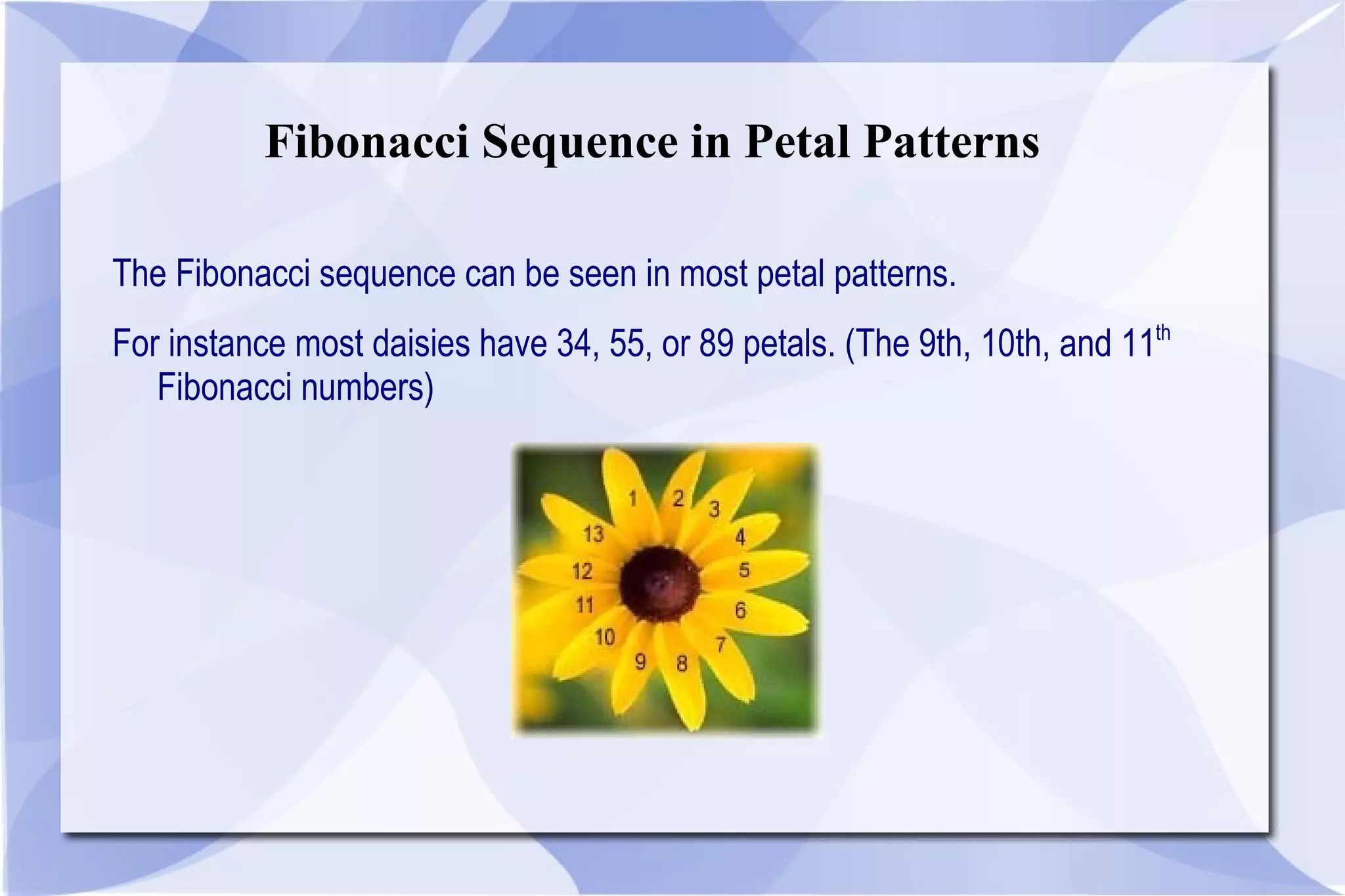
    Fibonacci Sequence inPetal Patterns The Fibonacci sequence can be seen in most petal patterns.
  • 17.
    For instance mostdaisies have 34, 55, or 89 petals. (The 9th, 10th, and 11 th Fibonacci numbers)
  • 18.
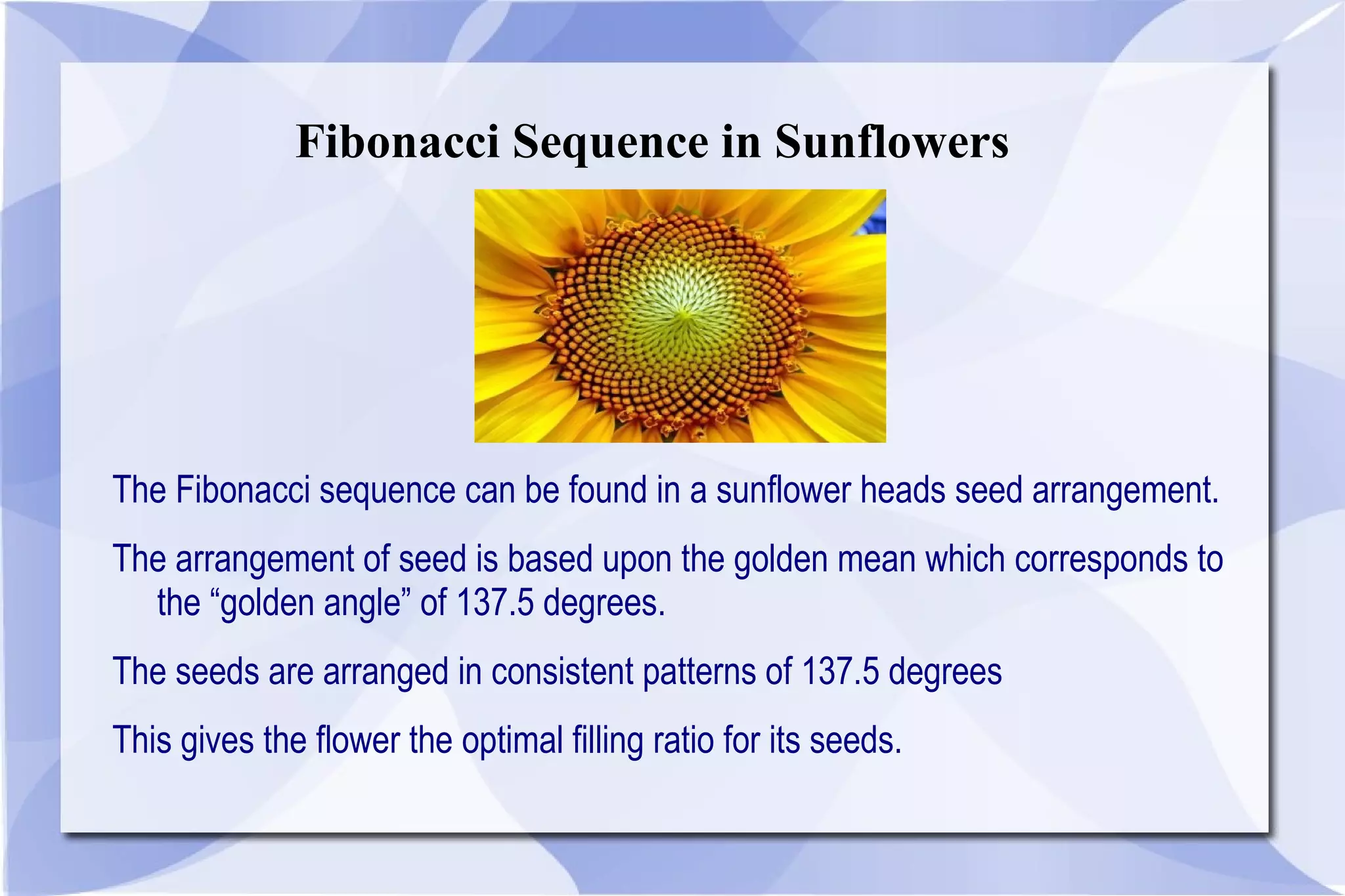
    Fibonacci Sequence inSunflowers The Fibonacci sequence can be found in a sunflower heads seed arrangement.
  • 19.
    The arrangement ofseed is based upon the golden mean which corresponds to the “golden angle” of 137.5 degrees.
  • 20.
    The seeds arearranged in consistent patterns of 137.5 degrees
  • 21.
    This gives theflower the optimal filling ratio for its seeds.
  • 22.
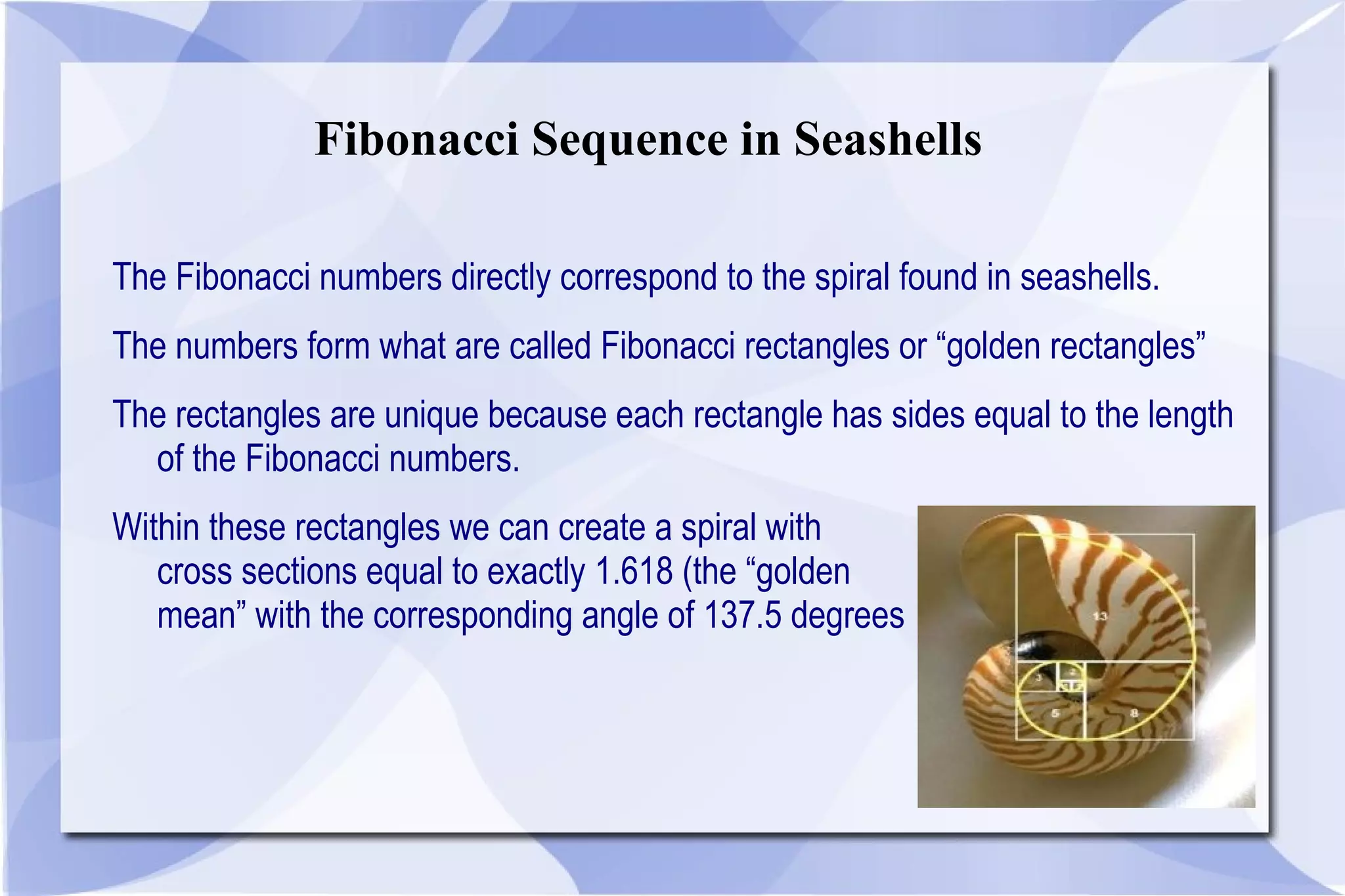
    Fibonacci Sequence inSeashells The Fibonacci numbers directly correspond to the spiral found in seashells.
  • 23.
    The numbers formwhat are called Fibonacci rectangles or “golden rectangles”
  • 24.
    The rectangles areunique because each rectangle has sides equal to the length of the Fibonacci numbers.
  • 25.
    Within these rectangleswe can create a spiral with cross sections equal to exactly 1.618 (the “golden mean” with the corresponding angle of 137.5 degrees
  • 26.
    Fibonacci Review What are the Fibonacci numbers and how are they obtained?
  • 27.
    Where did thestudy of the sequence begin?
  • 28.
    Who introduced thenumbers to Western European mathematics?
  • 29.
    What is thegolden ratio/golden mean and how is it related to the Fibonacci sequence?
  • 30.
    Where can theFibonacci sequence be found?
  • 31.
    What are somenatural phenomena created by using the Fibonacci sequence?