Materials Design
Dr.M.Suresh
Criteria in selecting materials
• Performance requirements.
• Reliability requirements.
• Size, shape, and mass requirements.
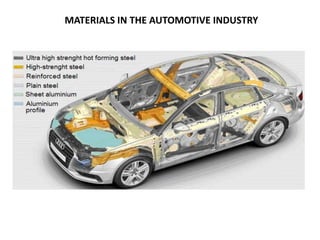
MATERIALS IN THE AUTOMOTIVE INDUSTRY
MATERIALS IN THE AUTOMOTIVE
INDUSTRY
• Making cars, parts and components, along
with future trends, are steel, aluminum,
magnesium, copper, plastics and carbon fiber.
Introduction
• In total, about 39 different types of basic
plastics and polymers are used to make an
automobile. More than 70% of the plastic
used in automobiles comes from four
polymers.
Basics On 7 Common Types of Plastic
1) Polyethylene Terephthalate (PET or PETE)
2) High-Density Polyethylene (HDPE)
3) Polyvinyl Chloride (PVC or Vinyl)
4) Low-Density Polyethylene (LDPE)
5) Polypropylene (PP)
6) Polystyrene (PS or Styrofoam)
7) Other.
• Identify the design requirements.
• Identify the materials selection criteria.
• Identify candidate materials.
• Evaluate candidate materials.
• Select materials.
• The most commonly used commercial
aerospace structural materials are aluminum
alloys, titanium alloys, high-strength steels,
and composites, generally accounting for
more than 90% of the weight of airframes.
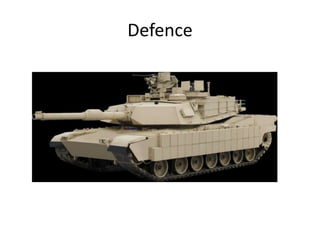
Defence
• In defense industry, the use of ceramics is
mainly as an armour material. As tank
armour, alloy steels are the most commonly
used materials.

Material Design.ppt

  • 1.
  • 2.
    Criteria in selectingmaterials • Performance requirements. • Reliability requirements. • Size, shape, and mass requirements.
  • 3.
    MATERIALS IN THEAUTOMOTIVE INDUSTRY
  • 4.
    MATERIALS IN THEAUTOMOTIVE INDUSTRY • Making cars, parts and components, along with future trends, are steel, aluminum, magnesium, copper, plastics and carbon fiber.
  • 5.
    Introduction • In total,about 39 different types of basic plastics and polymers are used to make an automobile. More than 70% of the plastic used in automobiles comes from four polymers.
  • 6.
    Basics On 7Common Types of Plastic 1) Polyethylene Terephthalate (PET or PETE) 2) High-Density Polyethylene (HDPE) 3) Polyvinyl Chloride (PVC or Vinyl) 4) Low-Density Polyethylene (LDPE) 5) Polypropylene (PP) 6) Polystyrene (PS or Styrofoam) 7) Other.
  • 7.
    • Identify thedesign requirements. • Identify the materials selection criteria. • Identify candidate materials. • Evaluate candidate materials. • Select materials.
  • 8.
    • The mostcommonly used commercial aerospace structural materials are aluminum alloys, titanium alloys, high-strength steels, and composites, generally accounting for more than 90% of the weight of airframes.
  • 9.
  • 10.
    • In defenseindustry, the use of ceramics is mainly as an armour material. As tank armour, alloy steels are the most commonly used materials.