PROUDLY SUPPORTED BY:
MATH 196
FINAL EXAM-AID
REVIEW PACKAGE
Tutors: Arman Ghaffari, arman.ghaffari@mail.utoronto.ca
Roya Rahnejat roya.r1994@gmail.com
utsg.soscampus.com
UToronto SOS: Students Offering Support
Raising Marks, Raising Money, Raising Roofs
Formulas
Surface
Circle: 𝜋𝑟!
Sphere: 4𝜋𝑟!
Cylinder: 2  𝜋𝑟ℎ
Volume:
Cylinder: 𝜋𝑟!
ℎ
Cone:
!!!!
!
Sphere:
!!!!
!
Trigonometry
𝑆𝑖𝑛!
𝑥 + 𝑐𝑜𝑠!
𝑥 = 1
sin 2𝑥 = 2sin  (𝑥)𝑐𝑜𝑠(𝑥)
cos  (2𝑥)=1-2𝑠𝑖𝑛!
𝑥 = 2𝑐𝑜𝑠!
𝑥 − 1 = 𝑐𝑜𝑠!
(𝑥)−𝑠𝑖𝑛!
(𝑥)
𝑡𝑎𝑛!
𝑥 + 1 = 𝑠𝑒𝑐!
𝑥 =
1
𝑐𝑜𝑠!(𝑥)
UBC SOS: Students Offering Support
Raising Marks, Raising Money, Raising Roofs
www.UBCSOS.org
Integration by Substitution
“U” substitution
When to use:
1. Usually for “ex
”, take the whole equation as “u”.
2. For trigonometric equations such as sinx and cosx. Usually take
the higher power as “u”.
Hints:
• Having cosx and sinx inside one integral.
• Having ex
+c and alone ex
in an equation.
• High degrees!
How:
Search for parameter which is a derivative of another one!
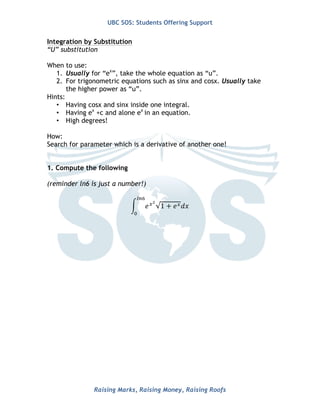
1. Compute the following
(reminder ln6 is just a number!)
𝑒!!
1 + 𝑒! 𝑑𝑥
!"!
!
UBC SOS: Students Offering Support
Raising Marks, Raising Money, Raising Roofs
www.UBCSOS.org
2. Compute the following
sin!
𝑥 𝑑𝑥
reminder
sin!
𝑥 + cos!
𝑥 = 1
𝑑(𝑠𝑖𝑛𝑥)
𝑑𝑥
= 𝑐𝑜𝑠𝑥
Fundamental Theory of Calculus
When do we use Fundamental Theory of Calculus?
1. Taking derivative of an integral
2. Having variables in the boundary of your integral
d
dx
𝑓 𝑡 𝑑𝑡
! !
! !
= 𝑓 ℎ 𝑥 ℎ!
𝑥 −   𝑓 𝑔 𝑥 𝑔′(𝑥)
UBC SOS: Students Offering Support
Raising Marks, Raising Money, Raising Roofs
www.UBCSOS.org
3. Compute
lim
!→!
5𝑥!
+ 3𝑥!
3𝑡 + cos 𝑡! 𝑑𝑡
!!
!
UBC SOS: Students Offering Support
Raising Marks, Raising Money, Raising Roofs
www.UBCSOS.org
Volume Integrals
When to use each:
4. a) Find the volume obtained by revolving the curve y=x1/2
around x
axis for [0,1]
UBC SOS: Students Offering Support
Raising Marks, Raising Money, Raising Roofs
www.UBCSOS.org
b) Find the volume obtained by revolving the curve y=x1/2
around y=-1 for
[0,1]
c) Find the volume obtained by revolving the region boundary of y=x1/2
and y=x for [0,1] about the y-axis
d) Find the volume obtained by revolving the region boundary of y=x1/2
and y=x for [0,1] about x=-1
UBC SOS: Students Offering Support
Raising Marks, Raising Money, Raising Roofs
www.UBCSOS.org
Rolle’s Theorem and the Mean Value Theorem
If f is continues on [a,b] and differentiable on (a,b) and f(a)=f(b) then
there is a number c so that f’(c)=0
f!
c =
𝑓 𝑏 −   𝑓 𝑎
𝑏 − 𝑎
Mean Value Theorem Consequences:
1. If f’(x)=0 for all x in the interval (a,b), then f is constant over the
interval.
2. If f’(x)>0 for all x in the interval (a,b) then f is increasing over the
interval.
3. If f’(x)<0 for all x in the interval (a,b) then f is decreasing over the
interval.
Problem 8 (2012 Final exam)
Let f be continuous on [0,1].
Suppose 𝑓 𝑥 𝑑𝑥 = 0
!
!
and f’(x)>0 on (0,1).
a) Show that f(x)=0 has a solution in [0,1]. That is, there exists
𝑥! ∈ 0,1 such that f(𝑥!) = 0.
b) Show that 𝑥! is the only solution of f(x)=0 in [0,1].
UBC SOS: Students Offering Support
Raising Marks, Raising Money, Raising Roofs
www.UBCSOS.org
Sketching functions
Steps:
• Find Domain
• Find Intercepts
• Horizontal Asymptote:
– Limit of f(x) as x -> ∞
• Critical Points: Where limit of f(x) is zero or does not exist
• Concavity: Inflection Points, use f”(x), the curve is concave up
where f’’(c) >0 and concave down where f’’(c) < 0
• Second derivative test: local min at c: f’(c) = o and f’’(c) >0, local
max where f’(c) = 0 and f”(c) <0
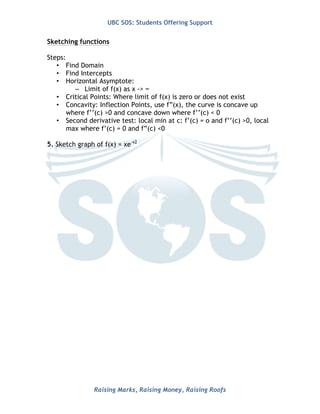
5. Sketch graph of f(x) = xe-x2
UBC SOS: Students Offering Support
Raising Marks, Raising Money, Raising Roofs
www.UBCSOS.org
6. Sketch a graph of
!!!
(!!!!)
Rate of Change Problems
• Draw a diagram if possible
• Express the given information and required rate in terms of
derivatives
• Write an equation that relates the quantities of the problem, use
geometry to eliminate one variable by substitution
• Use Chain rule dy/dx=dy/du .du/dx
7. If water enters a hemispherical bowl of radius 50 cm at a rate of 10
cm3
/s, how fast will the water level be rising when the depth of water in
the bowl is 20 cm?
UBC SOS: Students Offering Support
Raising Marks, Raising Money, Raising Roofs
www.UBCSOS.org
Surface Area
• Find the interval
• If integrating by x, find the function in terms of x
• If integrating by y, find the function in terms of y
8. Let A be the area of the region in xy plane bound by y = lnx , x = 1,
and y= 2. Find the area of A in two ways: one with respect to x, one with
respect to y.
UBC SOS: Students Offering Support
Raising Marks, Raising Money, Raising Roofs
www.UBCSOS.org
Optimization Problems
• Find Domain
• Find Intercepts
• Horizontal and vertical Asymptote:
– For horizontal asymptote find Limit of f(x) as x -> ∞
– The line x = a is called a vertical asymptote if lim f(x) -> ∞
As we approach a from left or right.
• Critical Points: Where limit of f(x) is zero or does not exist
• Concavity: Inflection Points, use f”(x), the curve is concave up
where f’’(c) >0 and concave down where f’’(c) < 0
• Second derivative test: local min at c: f’(c) = o and f’’(c) >0, local
max where f’(c) = 0 and f”(c) <0
Example
Find the area of the largest rectangle that can be inscribed in a
semicircle of radius r.

MAT196 Study Guide

  • 1.
    PROUDLY SUPPORTED BY: MATH196 FINAL EXAM-AID REVIEW PACKAGE Tutors: Arman Ghaffari, arman.ghaffari@mail.utoronto.ca Roya Rahnejat roya.r1994@gmail.com utsg.soscampus.com
  • 2.
    UToronto SOS: StudentsOffering Support Raising Marks, Raising Money, Raising Roofs Formulas Surface Circle: 𝜋𝑟! Sphere: 4𝜋𝑟! Cylinder: 2  𝜋𝑟ℎ Volume: Cylinder: 𝜋𝑟! ℎ Cone: !!!! ! Sphere: !!!! ! Trigonometry 𝑆𝑖𝑛! 𝑥 + 𝑐𝑜𝑠! 𝑥 = 1 sin 2𝑥 = 2sin  (𝑥)𝑐𝑜𝑠(𝑥) cos  (2𝑥)=1-2𝑠𝑖𝑛! 𝑥 = 2𝑐𝑜𝑠! 𝑥 − 1 = 𝑐𝑜𝑠! (𝑥)−𝑠𝑖𝑛! (𝑥) 𝑡𝑎𝑛! 𝑥 + 1 = 𝑠𝑒𝑐! 𝑥 = 1 𝑐𝑜𝑠!(𝑥)
  • 3.
    UBC SOS: StudentsOffering Support Raising Marks, Raising Money, Raising Roofs www.UBCSOS.org Integration by Substitution “U” substitution When to use: 1. Usually for “ex ”, take the whole equation as “u”. 2. For trigonometric equations such as sinx and cosx. Usually take the higher power as “u”. Hints: • Having cosx and sinx inside one integral. • Having ex +c and alone ex in an equation. • High degrees! How: Search for parameter which is a derivative of another one! 1. Compute the following (reminder ln6 is just a number!) 𝑒!! 1 + 𝑒! 𝑑𝑥 !"! !
  • 4.
    UBC SOS: StudentsOffering Support Raising Marks, Raising Money, Raising Roofs www.UBCSOS.org 2. Compute the following sin! 𝑥 𝑑𝑥 reminder sin! 𝑥 + cos! 𝑥 = 1 𝑑(𝑠𝑖𝑛𝑥) 𝑑𝑥 = 𝑐𝑜𝑠𝑥 Fundamental Theory of Calculus When do we use Fundamental Theory of Calculus? 1. Taking derivative of an integral 2. Having variables in the boundary of your integral d dx 𝑓 𝑡 𝑑𝑡 ! ! ! ! = 𝑓 ℎ 𝑥 ℎ! 𝑥 −  𝑓 𝑔 𝑥 𝑔′(𝑥)
  • 5.
    UBC SOS: StudentsOffering Support Raising Marks, Raising Money, Raising Roofs www.UBCSOS.org 3. Compute lim !→! 5𝑥! + 3𝑥! 3𝑡 + cos 𝑡! 𝑑𝑡 !! !
  • 6.
    UBC SOS: StudentsOffering Support Raising Marks, Raising Money, Raising Roofs www.UBCSOS.org Volume Integrals When to use each: 4. a) Find the volume obtained by revolving the curve y=x1/2 around x axis for [0,1]
  • 7.
    UBC SOS: StudentsOffering Support Raising Marks, Raising Money, Raising Roofs www.UBCSOS.org b) Find the volume obtained by revolving the curve y=x1/2 around y=-1 for [0,1] c) Find the volume obtained by revolving the region boundary of y=x1/2 and y=x for [0,1] about the y-axis d) Find the volume obtained by revolving the region boundary of y=x1/2 and y=x for [0,1] about x=-1
  • 8.
    UBC SOS: StudentsOffering Support Raising Marks, Raising Money, Raising Roofs www.UBCSOS.org Rolle’s Theorem and the Mean Value Theorem If f is continues on [a,b] and differentiable on (a,b) and f(a)=f(b) then there is a number c so that f’(c)=0 f! c = 𝑓 𝑏 −  𝑓 𝑎 𝑏 − 𝑎 Mean Value Theorem Consequences: 1. If f’(x)=0 for all x in the interval (a,b), then f is constant over the interval. 2. If f’(x)>0 for all x in the interval (a,b) then f is increasing over the interval. 3. If f’(x)<0 for all x in the interval (a,b) then f is decreasing over the interval. Problem 8 (2012 Final exam) Let f be continuous on [0,1]. Suppose 𝑓 𝑥 𝑑𝑥 = 0 ! ! and f’(x)>0 on (0,1). a) Show that f(x)=0 has a solution in [0,1]. That is, there exists 𝑥! ∈ 0,1 such that f(𝑥!) = 0. b) Show that 𝑥! is the only solution of f(x)=0 in [0,1].
  • 9.
    UBC SOS: StudentsOffering Support Raising Marks, Raising Money, Raising Roofs www.UBCSOS.org Sketching functions Steps: • Find Domain • Find Intercepts • Horizontal Asymptote: – Limit of f(x) as x -> ∞ • Critical Points: Where limit of f(x) is zero or does not exist • Concavity: Inflection Points, use f”(x), the curve is concave up where f’’(c) >0 and concave down where f’’(c) < 0 • Second derivative test: local min at c: f’(c) = o and f’’(c) >0, local max where f’(c) = 0 and f”(c) <0 5. Sketch graph of f(x) = xe-x2
  • 10.
    UBC SOS: StudentsOffering Support Raising Marks, Raising Money, Raising Roofs www.UBCSOS.org 6. Sketch a graph of !!! (!!!!) Rate of Change Problems • Draw a diagram if possible • Express the given information and required rate in terms of derivatives • Write an equation that relates the quantities of the problem, use geometry to eliminate one variable by substitution • Use Chain rule dy/dx=dy/du .du/dx 7. If water enters a hemispherical bowl of radius 50 cm at a rate of 10 cm3 /s, how fast will the water level be rising when the depth of water in the bowl is 20 cm?
  • 11.
    UBC SOS: StudentsOffering Support Raising Marks, Raising Money, Raising Roofs www.UBCSOS.org Surface Area • Find the interval • If integrating by x, find the function in terms of x • If integrating by y, find the function in terms of y 8. Let A be the area of the region in xy plane bound by y = lnx , x = 1, and y= 2. Find the area of A in two ways: one with respect to x, one with respect to y.
  • 12.
    UBC SOS: StudentsOffering Support Raising Marks, Raising Money, Raising Roofs www.UBCSOS.org Optimization Problems • Find Domain • Find Intercepts • Horizontal and vertical Asymptote: – For horizontal asymptote find Limit of f(x) as x -> ∞ – The line x = a is called a vertical asymptote if lim f(x) -> ∞ As we approach a from left or right. • Critical Points: Where limit of f(x) is zero or does not exist • Concavity: Inflection Points, use f”(x), the curve is concave up where f’’(c) >0 and concave down where f’’(c) < 0 • Second derivative test: local min at c: f’(c) = o and f’’(c) >0, local max where f’(c) = 0 and f”(c) <0 Example Find the area of the largest rectangle that can be inscribed in a semicircle of radius r.