MASTERING THE PIP: CLAIM SUPPORT Presented by: Lambros Kromidas, Ph.D. V.P., Product Integrity Coty Inc.
Disclaimer “ The viewpoints expressed in this presentation are those of the author and do not necessarily reflect those of EU Competent Authorities or Coty, Inc.”
Ask some simple questions about claims and give some simple answers My view on what an effective Claim Support section should look like Presentation:  Two Parts 1 2
What Are Claims? “… effect claimed for the cosmetic product…” (Dir. 76/768/EEC,Article 7a, 1(g).)
What Are Claims? As per COLIPA: “ a cosmetic claim is any public information – primarily provided for marketing purposes – on the content, nature, the effect, the properties, or the efficacy of the product.” (Guidelines for the evaluation of the efficacy of cosmetic products. Second edition, 2001)
What Are Claims? Claims are statements, not mandatory, made about a product on the package and advertising for the purpose of promoting the sale of that product.
These Are Not Claims. Stating the function of the product Cautionary/warning statements Use instructions Net content, expiration date, PAO, etc.
Why Are Claims Made? Inform the Consumer Stay Competitive
What are Some Types and Examples of Claims? Obvious claims “ Fire Red” Lipstick “ 2 in 1” Hair & Body Wash Puffery claims “ Perfectly moisturized” “ Deliciously perfumed” “ Luxury/Serious Colour Care” [Emotive claims] L’Oreal (hair product)    “Because I’m worth it.”
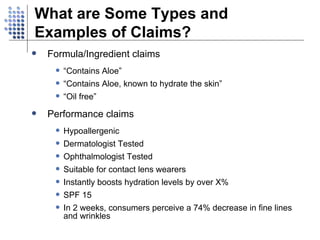
Formula/Ingredient claims “ Contains Aloe” “ Contains Aloe, known to hydrate the skin” “ Oil free” Performance claims Hypoallergenic Dermatologist Tested Ophthalmologist Tested Suitable for contact lens wearers Instantly boosts hydration levels by over X% SPF 15 In 2 weeks, consumers perceive a 74% decrease in fine lines and wrinkles What are Some Types and Examples of Claims?
Why Do Claims Need Substantiation? “…proof of the effect claimed for the cosmetic product, where justified by the nature of the effect or product…” (Dir. 76/768/EEC,Article 7a, 1(g).) All claims need to be truthful and you need to support that truth
What Types of Claims Need Substantiation and PIP Support? YES YES Performance Claims YES/NO NO Formula Claims NO NO [Emotive Claims] NO NO Puffery Claims NO NO Obvious Claims PIP Support Substantiation
What is the Role of Legal/Regulatory in Substantiating Claims? Determine if cosmetic claims fall within the parameters of the cosmetic definition Determine if cosmetic claims are truthful
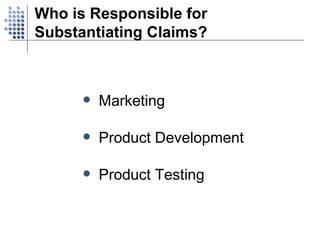
Who is Responsible for Substantiating Claims? Marketing Product Development Product Testing
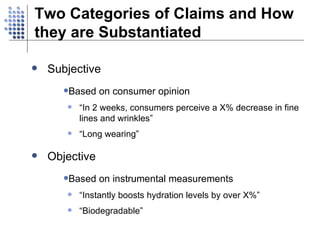
Two Categories of Claims and How they are Substantiated Subjective  Based on consumer opinion “ In 2 weeks, consumers perceive a X% decrease in fine lines and wrinkles” “ Long wearing” Objective Based on instrumental measurements “ Instantly boosts hydration levels by over X%” “ Biodegradable”
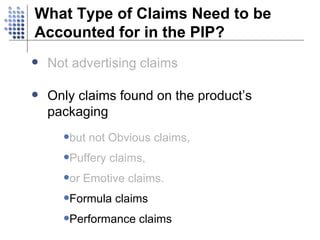
What Type of Claims Need to be Accounted for in the PIP? Not advertising claims Only claims found on the product’s packaging but not Obvious claims, Puffery claims, or Emotive claims. Formula claims Performance claims
Thank You!

Mastering The PIP (Product Information Package) Claim Support

  • 1.
    MASTERING THE PIP:CLAIM SUPPORT Presented by: Lambros Kromidas, Ph.D. V.P., Product Integrity Coty Inc.
  • 2.
    Disclaimer “ Theviewpoints expressed in this presentation are those of the author and do not necessarily reflect those of EU Competent Authorities or Coty, Inc.”
  • 3.
    Ask some simplequestions about claims and give some simple answers My view on what an effective Claim Support section should look like Presentation: Two Parts 1 2
  • 4.
    What Are Claims?“… effect claimed for the cosmetic product…” (Dir. 76/768/EEC,Article 7a, 1(g).)
  • 5.
    What Are Claims?As per COLIPA: “ a cosmetic claim is any public information – primarily provided for marketing purposes – on the content, nature, the effect, the properties, or the efficacy of the product.” (Guidelines for the evaluation of the efficacy of cosmetic products. Second edition, 2001)
  • 6.
    What Are Claims?Claims are statements, not mandatory, made about a product on the package and advertising for the purpose of promoting the sale of that product.
  • 7.
    These Are NotClaims. Stating the function of the product Cautionary/warning statements Use instructions Net content, expiration date, PAO, etc.
  • 8.
    Why Are ClaimsMade? Inform the Consumer Stay Competitive
  • 9.
    What are SomeTypes and Examples of Claims? Obvious claims “ Fire Red” Lipstick “ 2 in 1” Hair & Body Wash Puffery claims “ Perfectly moisturized” “ Deliciously perfumed” “ Luxury/Serious Colour Care” [Emotive claims] L’Oreal (hair product)  “Because I’m worth it.”
  • 10.
    Formula/Ingredient claims “Contains Aloe” “ Contains Aloe, known to hydrate the skin” “ Oil free” Performance claims Hypoallergenic Dermatologist Tested Ophthalmologist Tested Suitable for contact lens wearers Instantly boosts hydration levels by over X% SPF 15 In 2 weeks, consumers perceive a 74% decrease in fine lines and wrinkles What are Some Types and Examples of Claims?
  • 11.
    Why Do ClaimsNeed Substantiation? “…proof of the effect claimed for the cosmetic product, where justified by the nature of the effect or product…” (Dir. 76/768/EEC,Article 7a, 1(g).) All claims need to be truthful and you need to support that truth
  • 12.
    What Types ofClaims Need Substantiation and PIP Support? YES YES Performance Claims YES/NO NO Formula Claims NO NO [Emotive Claims] NO NO Puffery Claims NO NO Obvious Claims PIP Support Substantiation
  • 13.
    What is theRole of Legal/Regulatory in Substantiating Claims? Determine if cosmetic claims fall within the parameters of the cosmetic definition Determine if cosmetic claims are truthful
  • 14.
    Who is Responsiblefor Substantiating Claims? Marketing Product Development Product Testing
  • 15.
    Two Categories ofClaims and How they are Substantiated Subjective Based on consumer opinion “ In 2 weeks, consumers perceive a X% decrease in fine lines and wrinkles” “ Long wearing” Objective Based on instrumental measurements “ Instantly boosts hydration levels by over X%” “ Biodegradable”
  • 16.
    What Type ofClaims Need to be Accounted for in the PIP? Not advertising claims Only claims found on the product’s packaging but not Obvious claims, Puffery claims, or Emotive claims. Formula claims Performance claims
  • 17.

Editor's Notes

  • #4 I. One needs to know what a claim is, whether all claims need support, why claims need support, and whether that support needs to be included in the PIP before constructing the claims support section of the PIP.
  • #7 As I will discuss, claims may or may not need substantiation.
  • #8 Is every statement made on a product’s package a claim?  No. Manufacturers are required to indicate the function of the product, unless it is clear from the presentation of the product. Usually one does not consider the indication of the function of the product as a claim. These are all labeling requirements.
  • #9 Both of these promote the sale of the product.
  • #10 Obvious: “Fire Red” LS. It is obvious that if one uses this LS their lips will be colored red. As for the 2 nd ex it is obvious that it is two products in one package or this product performs two functions. Puffery claims are flowery and sometimes non-sense claims that may deliver a subtle message to the consumer. A message that is one’s opinion more than anything else. Emotive Claims say nothing about the product, but play to the consumer’s emotions. As per COLIPA’s definition of a claim, such statements are not really claims and do not require substantiation.
  • #11 Formula claims: “Contains Y, known to do Z.” Where Y is a cosmetic [active] ingredient and Z a cosmetic efficacy Such claims imply that the activity of Y is maintained in the cosmetic product Performance claims are the opposite of obvious claims. None of these claims would be obvious to the customer. Unless you say something the user may never know – may suspect – but never know. These are the best, the real claims that can make a blockbuster product.
  • #12 If you are going to praise your product – if you are going to say your product does x, y, and z – it needs to be true. You can’t just make up things. If common sense does not dictate that advertising regulations do. To prove you are not making things up you need to have evidence in your files to support your statements. That evidence may be in the form of scientific literature or tests you conducted.
  • #13 Obvious and puffery claims, do not need to be substantiated or supported in the PIP. Emotive claims. As per COLIPA’s definition of a claim, such statements are not really claims and do not require substantiation. Formula claims. If you are claiming that your product “contains X” and it does, and the INCI says so, you do not need to substantiate or support it in the PIP beyond showing it in the formula. One may also choose to put a short statement to that effect in the Claims Support section of the PIP. If you are claiming your product contains X known to do Y, then you need to show X in your INCI and support by: collecting evidence from the scientific literature scientific evidence gathered by the supplier Anecdotal/folklore evidence long use history for a certain purpose (e.g., Aloe has been used for ages to sooth, condition and moisturize the skin, so putting it in your product and claiming it is in there implies your product would also sooth, condition, and moisturize the skin.) any combination of the these This support should be in your master files but not necessarily in the Claims Support section of the PIP. [Whether you use enough to realistically expect anything out of the ingredient is another matter – a matter for Regulators and Legal to debate.] If you are going to claim that your product does Y because it contains X, then you crossed over to a performance claim. You need to show X on your INCI and conduct testing to substantiate that claim. Performance claims. Such claims are powerful marketing tools but are more difficult to substantiate technically but substantiate you must. These should definitely be supported in the PIP.
  • #14 Hopefully, this is done way ahead of putting the PIP together. In the attempt to save label real estate, one may phrase claim statements in such brevity that they may loose their original meaning or unintentionally say something else – something not true of the product.
  • #15 Sometimes in the development of a product concept, Marketing may run a large panel study. Out of such a study, certain claims may be realized. Likewise for Product Development. As they develop the product to meet Marketing’s concept, they may conduct tests to assess their success. Such studies may be used to substantiate the product’s claims. Also, out of such tests, new claims may be realized. However, the people most equipped to substantiate claims are the product testing people. The least equipped are the Legal/Regulatory people.
  • #17 All claims, including those made in advertising need to be truthful, but if something is claimed only in advertising that does not appear on the package itself, the claim substantiation section in the PIP does not need to say anything about it.