Master Data Management
An Oracle White Paper
June 2010
Master Data Management
Introduction .......................................................................................................1 
Overview.............................................................................................................2 
Enterprise data...................................................................................................4 
Transactional Data........................................................................................4 
Operational MDM ....................................................................................5 
Analytical Data ..............................................................................................5 
Analytical MDM........................................................................................5 
Master Data ...................................................................................................5 
Enterprise MDM.......................................................................................6 
Information Architecture.................................................................................6 
Operational Applications.............................................................................6 
Enterprise Application Integration (EAI) .............................................7 
Service Oriented Architecture (SOA) ....................................................7 
The Data Quality Problem.......................................................................7 
Analytical Systems.........................................................................................8 
Enterprise Data Warehousing (EDW) and Data Marts ......................8 
Extraction, Transformation, and Loading (ETL).................................9 
Business Intelligence (BI).........................................................................9 
The Data Quality Problem.......................................................................9 
Ideal Information Architecture.................................................................10 
Oracle Information Architecture..............................................................11 
Master Data Management Processes............................................................13 
Profile ...........................................................................................................14 
Consolidate ..................................................................................................15 
Govern .........................................................................................................15 
Share .............................................................................................................15 
Leverage .......................................................................................................16 
Oracle MDM High Level Architecture........................................................16 
MDM Platform Layer ................................................................................17 
Application Integration Services...........................................................17 
Enterprise Service Bus......................................................................17 
Business Process Orchestration Services.......................................17 
Business Rules....................................................................................18 
Event-Driven Services ......................................................................19 
Identity Management.........................................................................19 
Web Services Management...............................................................19 
Analytic Services......................................................................................20 
Enterprise Performance Management............................................20 
Data Warehousing .............................................................................20 
Business Intelligence .........................................................................21 
Master Data Management ii
Publishing Services............................................................................21 
Data Migration Services....................................................................21 
High Availability and Scalability............................................................22 
Real Application Clusters .................................................................22 
Mixed Workloads...............................................................................22 
Exadata................................................................................................22 
Application Integration Architecture ...................................................23 
AIA Layers..........................................................................................23 
Common Object Methodology .......................................................24 
MDM Foundation Packs..................................................................24 
MDM Process Integration Packs ....................................................24 
MDM Aware Applications.....................................................................25 
Composite Application Development .................................................25 
Oracle Data Quality Services.................................................................25 
Oracle Customer Data Quality Servers ..........................................27 
Product Data Quality ........................................................................29 
End-To-End Data Quality ...............................................................31 
Application Development Environment.............................................32 
MDM Applications Layer ..............................................................................32 
MDM Pillars ................................................................................................32 
Oracle Customer Hub................................................................................33 
Customer Data Model............................................................................34 
Consolidate...............................................................................................35 
Cleanse......................................................................................................36 
Govern......................................................................................................36 
Share..........................................................................................................38 
Business Benefits.....................................................................................39 
Product Hub................................................................................................39 
Import Workbench.................................................................................40 
Catalog Administration ..........................................................................41 
New Product Introduction ....................................................................41 
Product Data Synchronization..............................................................41 
Oracle Site Hub...........................................................................................42 
Golden Record for Site Data.................................................................43 
Application Integration ..........................................................................43 
Effective Site Analysis and Google Integration..................................43 
Oracle Supplier Hub...................................................................................45 
Consolidate...............................................................................................45 
Cleanse......................................................................................................46 
Govern......................................................................................................46 
Share..........................................................................................................46 
Supplier Lifecycle Management ............................................................46 
Business Benefits.....................................................................................46 
Oracle Hyperion Data Relationship Management.................................47 
Automated Attribute Management.......................................................48 
Best-of-Breed Hierarchy Management ................................................49 
Integration with Operational and Workflow Systems.......................49 
Import, Blend, and Export to Synchronize Master Data..................49 
Versioning and Modeling Capabilities to Improve Analysis.............50 
Master Data Management iii
Master Data Management iv
MDM Data Governance and Industries Layer...........................................50 
MDM Industry Verticalization..............................................................50 
Higher Education Constituent Hub................................................50 
Product Hub for Retail .....................................................................51 
Product Hub for Communications.................................................51 
Data Governance........................................................................................52 
Data Watch and Repair for MDM........................................................53 
MDM Implementation Best Practices.....................................................54 
Build vs Buy.................................................................................................55 
Conclusion........................................................................................................56 
Master Data Management
INTRODUCTION
Fragmented inconsistent Product data slows time-to-market, creates supply chain
inefficiencies, results in weaker than expected market penetration, and drives up the
cost of compliance. Fragmented inconsistent Customer data hides revenue
recognition, introduces risk, creates sales inefficiencies, and results in misguided
marketing campaigns and lost customer loyalty1. Fragmented and inconsistent
Supplier data reduces supply chain efficiencies, negatively impacts spend control
initiatives, and increases the risk of supplier exceptions. “Product”, “Customer”,
and “Supplier” are only three of a large number of key business entities we refer to
as Master Data.
Many organizations are not realizing the
anticipated ROI in their existing
applications.
Oracle MDM helps organizations realize
the return on existing and new application
investments.
“Through 2010, 70 percent of Fortune 1000
organizations will apply MDM programs to
ensure the accuracy and integrity of
commonly shared business information for
compliance, operational efficiency and
competitive differentiation purposes (0.7
probability).”
Gartner
Master Data is the critical business information supporting the transactional and
analytical operations of the enterprise. Master Data Management (MDM) is a
combination of applications and technologies that consolidates, cleans, and
augments this corporate master data, and synchronizes it with all applications,
business processes, and analytical tools. This results in significant improvements in
operational efficiency, reporting, and fact based decision-making.
Over the last several decades, IT landscapes have grown into complex arrays of
different systems, applications, and technologies. This fragmented environment has
created significant data problems. These data problems are breaking business
processes; impeding Customer Relationship Management (CRM), Enterprise
Resource Planning (ERP), and Supply Chain Management (SCM) initiatives;
corrupting analytics; and costing corporations billions of dollars a year. MDM
attacks the enterprise data quality problem at its source on the operational side of
the business. This is done in a coordinated fashion with the data warehousing /
analytical side of the business. The combined approach is proving itself to be very
successful in leading companies around the world.
This paper will discuss what it means to ‘manage’ master data and outlines Oracle’s
MDM solution2. Oracle’s technology components are ideal for building master data
management systems, and Oracle’s pre-built MDM solutions for key master data
objects such as Product, Customer, Supplier, Site, and Financial data can bring real
business value in a fraction of the time it takes to build from scratch. Oracle’s
MDM portfolio also includes tools that directly support data governance within the
master data stores. What’s more, Oracle MDM utilizes Oracle’s Application
Integration Architecture to create MDM Aware Applications3 and integrate the
high quality authoritative master data into the IT landscape. This fusion of
1 Customer Data Integration – Reaching a Single Version of the Truth, Jill Dyche, Evan Levy Wiley & Sons,
2006
2 Oracle Master Data Management, an Oracle Data Sheet, URL
3 MDM Aware Applications, an Oracle Whitepaper, URL
applications and technology creates a solution superior to other MDM offerings on
the market.
OVERVIEW
How do you get from a thousand points of data entry to a single view of the
business? This is the challenge that has faced companies for many years. Service
Oriented Architecture (SOA) is helping to automate business processes across
disparate applications, but the data fragmentation remains. Modern business
analytics on top of terabyte sized data warehouses are producing ever more relevant
and actionable information for decision makers, but the data sources remain
fragmented and inconsistent. These data quality problems continue to impact
operational efficiency and reporting accuracy. Master Data Management is the key.
It fixes the data quality problem on the operational side of the business and
augments and operationalizes the data warehouse on the analytical side of the
business. In this paper, we will explore the central role of MDM as part of a
complete information management solution.
High quality customer information was
critically important for Areva’s deployment
of major new application suites, including
SCM and CRM. Oracle Customer Hub
provided the unique customer database
that can be shared by all applications
managing customer data and the critical
data quality tools needed to increase our
customer knowledge. With Oracle
Customer Hub at the center of the Areva IT
landscape, customer data is collected from
all relevant applications, harmonized,
merged, enriched with D&B data, and
published to operational and analytical
systems. ROI has been measured at 38%
over 4 years with a 37 month payback.
Florence Legacy, Project Manager
Bruno Billy, Data Manager
Areva T&D
Master Data Management has two architectural components:
• The technology to profile, consolidate and synchronize the master data
across the enterprise
• The applications to manage, cleanse, and enrich the structured and
unstructured master data
MDM must seamlessly integrate with modern Service Oriented Architectures in
order to manage the master data across the many systems that are responsible for
data entry, and bring the clean corporate master data to the applications and
processes that run the business.
MDM becomes the central source for accurate fully cross-referenced real time
master data. It must seamlessly integrate with data warehouses, Enterprise
Performance Management (EPM) applications, and all Business Intelligence (BI)
systems, designed to bring the right information in the right form to the right
person at the right time.
“The master data management system
gave us a single, integrated view of our
customers, partners, and suppliers. The
information helps us run our business
more effectively and ensures we make
sound decisions.”
Kim Hyoung-soo, Section Chief
Process Innovation Team, MDM Section
Hanjin Shipping
In addition to supporting and augmenting SOA and BI systems, the MDM
applications must support data governance. Data Governance is a business process
for defining the data definitions, standards, access rights, quality rules. MDM
executes these rules. MDM enables strong data controls across the enterprise.
In order to successfully manage the master data, support corporate governance, and
augment SOA and BI systems, the MDM applications must have the following
characteristics:
• A flexible, extensible and open data model to hold the master data and all
needed attributes (both structured and unstructured). In addition, the data
model must be application neutral, yet support OLTP workloads and
directly connected applications.
• A metadata management capability for items such as business entity
matrixed relationships and hierarchies.
Master Data Management 2
• A source system management capability to fully cross-reference business
objects and to satisfy seemingly conflicting data ownership requirements.
• A data quality function that can find and eliminate duplicate data while
insuring correct data attribute survivorship.
• hA data quality interface to assist with preventing new errors from
entering the system even when data entry is outside the MDM application
itself.
• A continuing data cleansing function to keep the data up to date.
• An internal triggering mechanism to create and deploy change information
to all connected systems.
• A comprehensive data security system to control and monitor data access,
update rights, and maintain change history.
• A user interface to support casual users and data stewards.
• A data migration management capability to insure consistency as data
moves across the real time enterprise.
• A business intelligence structure to support profiling, compliance, and
business performance indicators.
• A single platform to manage all master data objects in order to prevent the
proliferation of new silos of information on top of the existing
fragmentation problem.
• An analytical foundation for directly analyzing master data.
• A highly available and scalable platform for mission critical data access
under heavy mixed workloads.
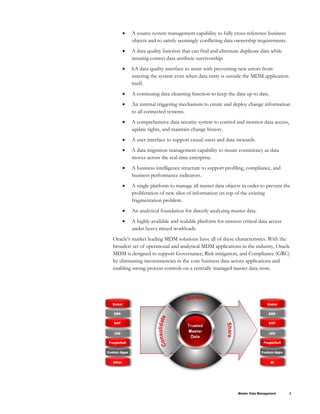
Oracle’s market leading MDM solutions have all of these characteristics. With the
broadest set of operational and analytical MDM applications in the industry, Oracle
MDM is designed to support Governance, Risk mitigation, and Compliance (GRC)
by eliminating inconsistencies in the core business data across applications and
enabling strong process controls on a centrally managed master data store.
Master Data Management 3
This paper examines: the nature of master data; MDM’s central role in SOA and BI
systems; the Oracle MDM Architecture; key MDM processes of profiling,
consolidating, managing, synchronizing, and leveraging master data and how the
Oracle MDM solution supports these processes; and Oracle’s portfolio of pre-built
master data management solutions. Finally, this paper discusses build vs. buy
tradeoffs given the power and flexibility in the Oracle MDM architecture and out-
of-the-box capabilities of the pre-built and pre-connected MDM Hubs.
ENTERPRISE DATA
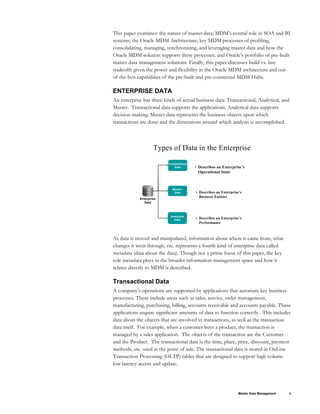
An enterprise has three kinds of actual business data: Transactional, Analytical, and
Master. Transactional data supports the applications. Analytical data supports
decision-making. Master data represents the business objects upon which
transactions are done and the dimensions around which analysis is accomplished.
Types of Data in the Enterprise
Enterprise
Data
• Describes an Enterprise’s
Performance
Analytical
Data
• Describes an Enterprise’s
Business Entities
Master
Data
Transactional
Data • Describes an Enterprise’s
Operational State
As data is moved and manipulated, information about where it came from, what
changes it went through, etc. represents a fourth kind of enterprise data called
metadata (data about the data). Though not a prime focus of this paper, the key
role metadata plays in the broader information management space and how it
relates directly to MDM is described.
Transactional Data
A company’s operations are supported by applications that automate key business
processes. These include areas such as sales, service, order management,
manufacturing, purchasing, billing, accounts receivable and accounts payable. These
applications require significant amounts of data to function correctly. This includes
data about the objects that are involved in transactions, as well as the transaction
data itself. For example, when a customer buys a product, the transaction is
managed by a sales application. The objects of the transaction are the Customer
and the Product. The transactional data is the time, place, price, discount, payment
methods, etc. used at the point of sale. The transactional data is stored in OnLine
Transaction Processing (OLTP) tables that are designed to support high volume
low latency access and update.
Master Data Management 4
Operational MDM
Solutions that focus on managing transactional data under operational applications
are called Operational MDM. They rely heavily on integration technologies. They
bring real value to the enterprise, but lack the ability to influence reporting and
analytics.
Analytical Data
Analytical data is used to support a company’s decision making. Customer buying
patterns are analyzed to identify churn, profitability, and marketing segmentation.
Suppliers are categorized, based on performance characteristics over time, for
better supply chain decisions. Product behavior is scrutinized over long periods to
identify failure patterns. This data is stored in large Data Warehouses and possibly
smaller data marts with table structures designed to support heavy aggregation, ad
hoc queries, and data mining. Typically the data is stored in large fact tables
surrounded by key dimensions such as customer, product, supplier, account, and
location.
Analytical MDM
Solutions that focus on managing analytical master data are called Analytical MDM.
They focus on providing high quality dimensions with their multiple simultaneous
hierarchies to data warehousing and BI technologies. They also bring real value to
the enterprise, but lack the ability to influence operational systems. Any data
cleansing done inside an Analytical MDM solution is invisible to the transactional
applications and transactional application knowledge is not available to the
cleansing process. Because Analytical MDM systems can do nothing to improve the
quality of the data under the heterogeneous application landscape, poor quality
inconsistent domain data finds its way into the BI systems and drives less than
optimum results for reporting and decision making.
Master Data
Master Data represents the business objects that are shared across more than one
transactional application. This data represents the business objects around which
the transactions are executed. This data also represents the key dimensions around
which analytics are done. Master data creates a single version of the truth about
these objects across the operational IT landscape.
An MDM solution should to be able to manage all master data objects. These
usually include Customer, Supplier, Site, Account, Asset, and Product. But other
objects such as Invoices, Campaigns, or Service Requests can also cross
applications and need consolidation, standardization, cleansing, and distribution.
Different industries will have additional objects that are critical to the smooth
functioning of the business.
It is also important to note that since MDM supports transactional applications, it
must support high volume transaction rates. Therefore, Master Data must reside in
data models designed for OLTP environments. Operational Data Stores (ODS) do
not fulfill this key architectural requirement.
Master Data Management 5
Enterprise MDM
Maximum business value comes from managing both transactional and analytical
master data. These solutions are called Enterprise MDM. Operational data
cleansing improves the operational efficiencies of the applications themselves and
the business process that use these applications. The resultant dimensions for
analytical analysis are true representations of how the business is actually running.
What’s more, the insights realized through analytical processes are made available
to the operational side of the business.
Oracle provides the most comprehensive Enterprise MDM solution on the market
today. The following sections will illustrate how this combination of operations and
analytics is achieved.
INFORMATION ARCHITECTURE
The best way to understand the role that MDM plays in an enterprise is to
understand the typical IT landscape. The best place to start is with the applications.
Almost all companies have a heterogeneous set of applications. Some are home
grown, others are bought from vendors, and still others are inherited during
corporate mergers and acquisitions.
Operational Applications
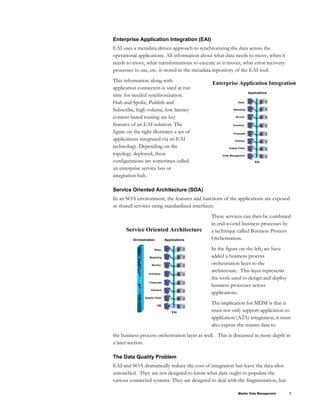
The figure on the right illustrates the
typical heterogeneous operational
application situation. Transactional
data exists in the applications local
data store. The data is designed
specifically to support the features
and transaction rates needed by the
application. This is as it should be.
But, in order to support business
processes that cross these application
boundaries, the data needs to be
synchronized.
Applications
Sales
Marketing
Inventory
Financials
Partners
Supply Chain
Order Management
Service
Heterogeneous Application Landscape
Applications
The n2 Integration Problem
Sales
Marketing
Inventory
Financials
Partners
Supply Chain
Order Management
Service
Integration is an n2 problem in that
complexity grows geometrically with
the number of applications. Some
companies have been known to call
their data center connection diagram
a “hair ball”. When synchronization
is accomplished with code, IT
projects can grind to a halt and the
costs quickly become prohibitive.
This problem literally drove the
creation of Enterprise Application
Integration (EAI) technology
Master Data Management 6
Enterprise Application Integration (EAI)
EAI uses a metadata driven approach to synchronizing the data across the
operational applications. All information about what data needs to move, when it
needs to move, what transformations to execute as it moves, what error recovery
processes to use, etc. is stored in the metadata repository of the EAI tool.
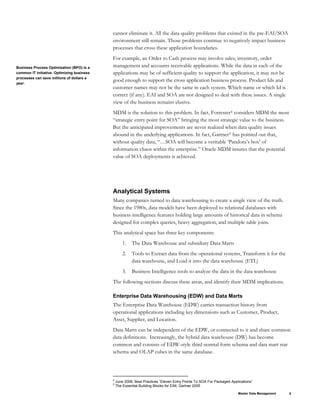
This information along with
application connecters is used at run
time for needed synchronization.
Hub and Spoke, Publish and
Subscribe, high volume, low latency
content based routing are key
features of an EAI solution. The
figure on the right illustrates a set of
applications integrated via an EAI
technology. Depending on the
topology deployed, these
configurations are sometimes called
an enterprise service bus or
integration hub.
Applications
EAI
Enterprise Application Integration
Sales
Marketing
Inventory
Financials
Partners
Supply Chain
Order Management
Service
Service Oriented Architecture (SOA)
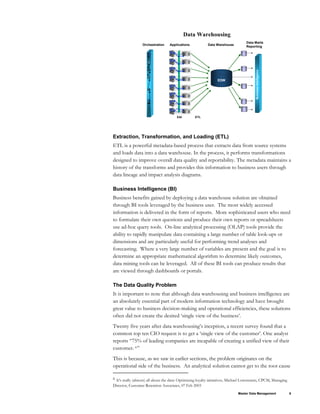
In an SOA environment, the features and functions of the applications are exposed
as shared services using standardized interfaces.
Service Oriented Architecture
Applications
EAI
Sales
Marketing
Inventory
Financials
Partners
Supply Chain
OM
Service
Orchestration
These services can then be combined
in end-to-end business processes by
a technique called Business Process
Orchestration.
In the figure on the left, we have
added a business process
orchestration layer to the
architecture. This layer represents
the tools used to design and deploy
business processes across
applications.
The implication for MDM is that it
must not only support application to
application (A2A) integration, it must
also expose the master data to
the business process orchestration layer as well. This is discussed in more depth in
a later section.
The Data Quality Problem
EAI and SOA dramatically reduce the cost of integration but leave the data silos
untouched. They are not designed to know what data ought to populate the
various connected systems. They are designed to deal with the fragmentation, but
Master Data Management 7
cannot eliminate it. All the data quality problems that existed in the pre-EAI/SOA
environment still remain. Those problems continue to negatively impact business
processes that cross these application boundaries.
For example, an Order to Cash process may involve sales, inventory, order
management and accounts receivable applications. While the data in each of the
applications may be of sufficient quality to support the application, it may not be
good enough to support the cross application business process. Product Ids and
customer names may not be the same in each system. Which name or which Id is
correct (if any). EAI and SOA are not designed to deal with these issues. A single
view of the business remains elusive.
Business Process Optimization (BPO) is a
common IT initiative. Optimizing business
processes can save millions of dollars a
year.
MDM is the solution to this problem. In fact, Forrester4 considers MDM the most
“strategic entry point for SOA” bringing the most strategic value to the business.
But the anticipated improvements are never realized when data quality issues
abound in the underlying applications. In fact, Gartner5 has pointed out that,
without quality data, “…SOA will become a veritable ‘Pandora’s box’ of
information chaos within the enterprise.” Oracle MDM insures that the potential
value of SOA deployments is achieved.
Analytical Systems
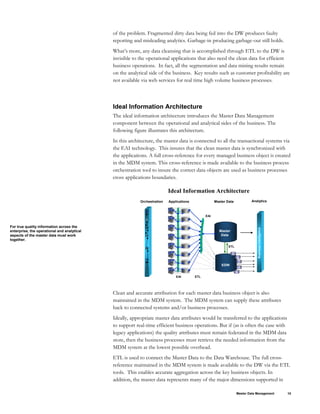
Many companies turned to data warehousing to create a single view of the truth.
Since the 1980s, data models have been deployed to relational databases with
business intelligence features holding large amounts of historical data in schema
designed for complex queries, heavy aggregation, and multiple table joins.
This analytical space has three key components:
1. The Data Warehouse and subsidiary Data Marts
2. Tools to Extract data from the operational systems, Transform it for the
data warehouse, and Load it into the data warehouse (ETL)
3. Business Intelligence tools to analyze the data in the data warehouse
The following sections discuss these areas, and identify their MDM implications.
Enterprise Data Warehousing (EDW) and Data Marts
The Enterprise Data Warehouse (EDW) carries transaction history from
operational applications including key dimensions such as Customer, Product,
Asset, Supplier, and Location.
Data Marts can be independent of the EDW, or connected to it and share common
data definitions. Increasingly, the hybrid data warehouse (DW) has become
common and consists of EDW-style third normal form schema and data mart star
schema and OLAP cubes in the same database.
Master Data Management 8
4
June 2006, Best Practices “Eleven Entry Points To SOA For Packaged Applications”
5
The Essential Building Blocks for EIM, Gartner 2005
Applications
EAI
Data Marts
Reporting
Data Warehouse
ETL
Business
Intelligence
EDW
Data Warehousing
Orchestration
Extraction, Transformation, and Loading (ETL)
ETL is a powerful metadata-based process that extracts data from source systems
and loads data into a data warehouse. In the process, it performs transformations
designed to improve overall data quality and reportability. The metadata maintains a
history of the transforms and provides this information to business users through
data lineage and impact analysis diagrams.
Business Intelligence (BI)
Business benefits gained by deploying a data warehouse solution are obtained
through BI tools leveraged by the business user. The most widely accessed
information is delivered in the form of reports. More sophisticated users who need
to formulate their own questions and produce their own reports or spreadsheets
use ad-hoc query tools. On-line analytical processing (OLAP) tools provide the
ability to rapidly manipulate data containing a large number of table look-ups or
dimensions and are particularly useful for performing trend analyses and
forecasting. Where a very large number of variables are present and the goal is to
determine an appropriate mathematical algorithm to determine likely outcomes,
data mining tools can be leveraged. All of these BI tools can produce results that
are viewed through dashboards or portals.
The Data Quality Problem
It is important to note that although data warehousing and business intelligence are
an absolutely essential part of modern information technology and have brought
great value to business decision-making and operational efficiencies, these solutions
often did not create the desired ‘single view of the business’.
Twenty five years after data warehousing’s inception, a recent survey found that a
common top ten CIO request is to get a ‘single view of the customer’. One analyst
reports “75% of leading companies are incapable of creating a unified view of their
customer. 6”
This is because, as we saw in earlier sections, the problem originates on the
operational side of the business. An analytical solution cannot get to the root cause
Master Data Management 9
6 It's really (almost) all about the data: Optimizing loyalty initiatives, Michael Lowenstein, CPCM, Managing
Director, Customer Retention Associates, 07 Feb 2003
of the problem. Fragmented dirty data being fed into the DW produces faulty
reporting and misleading analytics. Garbage-in producing garbage-out still holds.
What’s more, any data cleansing that is accomplished through ETL to the DW is
invisible to the operational applications that also need the clean data for efficient
business operations. In fact, all the segmentation and data mining results remain
on the analytical side of the business. Key results such as customer profitability are
not available via web services for real time high volume business processes.
Ideal Information Architecture
The ideal information architecture introduces the Master Data Management
component between the operational and analytical sides of the business. The
following figure illustrates this architecture.
For true quality information across the
enterprise, the operational and analytical
aspects of the master data must work
together.
In this architecture, the master data is connected to all the transactional systems via
the EAI technology. This insures that the clean master data is synchronized with
the applications. A full cross-reference for every managed business object is created
in the MDM system. This cross-reference is made available to the business process
orchestration tool to insure the correct data objects are used as business processes
cross applications boundaries.
Ideal Information Architecture
Data Marts
Reporting
Data Warehouse
Applications
ETL
DW
Business
Intelligence
EAI
DW
DW
EDW
Analytics
Master Data
Master
Data
ETL
EAI
Orchestration
Clean and accurate attribution for each master data business object is also
maintained in the MDM system. The MDM system can supply these attributes
back to connected systems and/or business processes.
Ideally, appropriate master data attributes would be transferred to the applications
to support real-time efficient business operations. But if (as is often the case with
legacy applications) the quality attributes must remain federated in the MDM data
store, then the business processes must retrieve the needed information from the
MDM system at the lowest possible overhead.
ETL is used to connect the Master Data to the Data Warehouse. The full cross-
reference maintained in the MDM system is made available to the DW via the ETL
tools. This enables accurate aggregation across the key business objects. In
addition, the master data represents many of the major dimensions supported in
Master Data Management 10
the data warehouse. Better quality dimension data improves the reporting out of
the data warehouse. What’s more, the ETL tool can keep the MDM dimension
tables in synch with the DW fact tables and support joins across these two
domains.
ETL is also used to populate master data attributes derived by the analytical
processing in the data warehouse and by the assorted analytical tools. This
information becomes immediately available to the connected applications and
business processes. This is sometimes referred to as ‘Operationalizing’ the DW.
This is the ideal information architecture. It unites the operational and analytical
sides of the business. A true single view is possible. The data driving the reporting
and decision making is actually the same data that is driving the operational
applications. Derived information on the analytical side of the business is made
available to the real time processes using the operational applications and business
process orchestration tools that run the business. This is true information
architecture.
Oracle Information Architecture
Oracle has state-of-the-art products and capabilities in each of the key information
architecture domains. Oracle’s Multi-entity MDM Suite includes the applications
that consolidate, cleans, govern and share the master operational data: the
Customer Hub, the Product Hub, the Supplier Hub, and the Site Hub. Each of
these MDM hubs comes with a Data Steward component that provides a UI and
Workbench for data professionals. The MDM Suite also includes state of the art
Data Quality capabilities with: Oracle Data Quality servers for all party based
structured data such as Name, Address, Customer, Supplier, Partner, Distributor,
Regulator, Client, Doctor, Contact, Organization, Family, Constituent, etc.; and
Product Data Quality for mastering unstructured item data such as Product,
Catalog, Medical Procedure, Calling Plan, Asset, Parts, SKU, Service, etc.
Multi-entity MDM gives organizations the
ability to start with one business entity,
such as Customer, and seamlessly grow
their solution to other business entities as
business requirements change.
The MDM suite also includes the Data Relationship Management (DRM)
application that consolidates, rationalizes, governs and shares master reference data
such as Chart of Accounts and Cost Centers. DRM also manages enterprise
hierarchies for Hyperion Enterprise Performance Management and other BI tools.
Oracle MDM combines Operational and
Analytical MDM capabilities into a full
Enterprise MDM solution.
All the Oracle MDM products offer Data Governance capabilities that provide
business uses with the controls they need to enforce corporate standards. Oracle
Data Watch and Repair is also included for overall data profiling and data
governance.
With the Oracle 11g Database, Oracle Data Warehousing is number one in the
industry. Oracle Data Integrator Enterprise Edition (ODI EE) offers the best in
class, high performance ETL architecture. These products understand MDM
dimension, hierarchy and cross-reference files and can use them to correctly
connect the detailed data elements flowing into the warehouse from transactional
systems.
Master Data Management 11
Oracle MDM is the glue between
operational and analytical systems. It
enables a single view of the business for
the first time since applications and BI
were separated in the 1970s.
Exadata w/ RAC
Oracle Information Architecture
Applications
EAI
ETL
Business
Intelligence
Master Data Analytics
Orchestration
Oracle
DW
MDM Data
Hubs
=
= FMW
BI
EE,
EPM,
Data
Mining,
..
= DRM
= BI P
B
P
E
L
P
M
MDM Applications
ODI EE
A tremendous amount of valuable information can accumulate in the master data
store. Directly leveraging this data can provide critical business insights. Oracle
provides the most complete portfolio of BI applications and technologies in the
industry. Oracle MDM customers can utilize Oracle Business Intelligence
Enterprise Edition Plus (OBI EE) with its ad-hoc query, highly interactive
dashboards, business activity monitoring, and BI Publisher (BI P) to query, monitor
and report on the master data. Oracle Data Mining is extremely valuable and
includes a feature called Anomaly Detection. The goal of anomaly detection is to
identify cases that are unusual within the data. This is an important tool for
detecting fraud and other rare events that may have great significance but are hard
to find. When used against central stores of master data in an Oracle MDM Data
Hub, unusual activity can be identified and remediated if necessary. All these BI
applications have direct access to the master data tables within the MDM Data
Hubs.
Metadata is managed by Oracle’s OWB Metadata Manager. Unstructured data is
included via Oracle Universal Content Manager and the Content DB. Secure
searching across MDM, DW, Metadata, and Universal Content Manager data
volumes is provided with Oracle Secure Enterprise Search.
With all the master data supporting business processes in one place, high
availability becomes a must. Single points of failure are not acceptable. High
performance from a transactional point of view is also essential. A system that is
too slow to provide the needed data in real time is as bad as a system that is down.
Real Application Clusters provide high availability, scalability, and mixed workload
support for the MDM OLTP and Decision Support workloads on one Single
Global Instance with all its associated cost savings. With the Sun Oracle Database
Machine with Exadata, Oracle provides the highest performance lowest Total Cost
of Ownership (TCO) hardware platform perfect for running both the entire MDM
platform and the Data Warehouse – two databases on one clustered instance.
Oracle’s Fusion Middleware Suite (FMW) provides the EAI and SOA capabilities.
FMW includes Oracle Service Bus a full function high performance enterprise
service bus. FMW also includes the Oracle Business Process Execution Language
Master Data Management 12
Process Manager (BPEL PM). This is the best business process orchestration
product on the market. Both Enterprise Service Bus and BPEL PM understand the
Oracle MDM data structures and access methods.
Additional components include: Oracle Business Rules engine that can be
coordinated with the data quality rules engines inside the MDM applications; an
Event Driven Architecture for real time complex event processes so essential for
triggering appropriate MDM related business processes when key data items are
changed; Web Services Manager to manage and secure the SOA web services,
including the web services exposed by the MDM applications; Web Center and
Oracle B2B for individual and partner participation; XSLT & Xquery Translation
for open standards based data transformations as master data flows between
applications and the MDM data store; and Oracle Identity Management (OIM) for
full user identification, authorization, and provisioning. OIM helps insure full Role
Based Access Controls (RBAC) for the MDM applications7 and their primary data
governance functions.
The following figure illustrates how all these components are connected at the
Enterprise Service Bus level.
Each and every one of these plays a role in Oracle’s MDM architecture. Once we
outline the key MDM processes that any master data solution must support, we will
overview this architecture and discuss its key components. We will then focus on
the supporting capabilities in the Oracle MDM Hub applications themselves.
MASTER DATA MANAGEMENT PROCESSES
Now that we have identified the nature of master data and its place in an
information architecture, we need to identify the key processes that MDM
solutions must support.
Master Data Management 13
7 Leveraging Oracle Identity Management and Customer Data Hub, April 2006, URL
These are the key processes for any MDM system.
• Profile the master data. Understand all possible sources and the current
state of data quality in each source.
• Consolidate the master data into a central repository and link it to all
participating applications.
• Govern the master data. Clean it up, deduplicate it, and enrich it with
information from 3rd party systems. Manage it according to business rules.
• Share it. Synchronize the central master data with enterprise business
processes and the connected applications. Insure that data stays in sync
across the IT landscape.
• Leverage the fact that a single version of the truth exists for all master data
objects by supporting business intelligence systems and reporting.
Profile
The first step in any MDM implementation is to profile the data. This means that
for each master data business entity to be managed centrally in a master data
repository, all existing systems that create or update the master data
must be assessed as to their data quality. Deviations from a desired data quality goal
must be analyzed. Examples include: the completeness of the data; the distribution
of occurrence of values; the acceptable rang of values; etc. Once implemented, the
MDM solution will provide the ongoing data quality assurance, however, a
thorough understanding of overall data quality in each contributing source system
before deploying MDM will focus resources and efforts on the highest value data
quality issues in the subsequent steps of the MDM implementation.
The Data Profiling and Correction option in Oracle Data Integration Suite (ODI)
provides a systematic analysis of data sources chosen by the user for the purpose of
gaining an understanding of and confidence in the data. It is a critical first step
in the data integration process to ensure that the best possible set of baseline data
quality rules are included in the initial MDM Hub.
Master Data Management 14
Consolidate
Consolidation is the key to managing master data. Without consolidating all the
master data attributes, key management capabilities such as the creation of blended
records from multiple trusted sources is not possible. This is the #1 fundamental
prerequisite to true master data consolidation8.
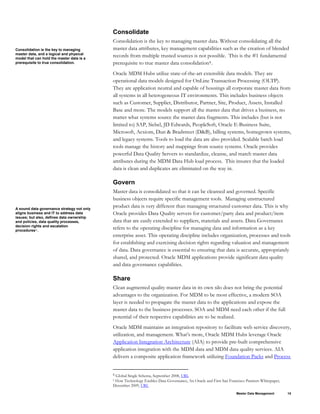
Consolidation is the key to managing
master data, and a logical and physical
model that can hold the master data is a
prerequisite to true consolidation.
Oracle MDM Hubs utilize state-of-the-art extensible data models. They are
operational data models designed for OnLine Transaction Processing (OLTP).
They are application neutral and capable of housings all corporate master data from
all systems in all heterogeneous IT environments. This includes business objects
such as Customer, Supplier, Distributor, Partner, Site, Product, Assets, Installed
Base and more. The models support all the master data that drives a business, no
matter what systems source the master data fragments. This includes (but is not
limited to) SAP, Siebel, JD Edwards, PeopleSoft, Oracle E-Business Suite,
Microsoft, Acxiom, Dun & Bradstreet (D&B), billing systems, homegrown systems,
and legacy systems. Tools to load the data are also provided. Scalable batch load
tools manage the history and mappings from source systems. Oracle provides
powerful Data Quality Servers to standardize, cleanse, and match master data
attributes during the MDM Data Hub load process. This insures that the loaded
data is clean and duplicates are eliminated on the way in.
Govern
Master data is consolidated so that it can be cleansed and governed. Specific
business objects require specific management tools. Managing unstructured
product data is very different than managing structured customer data. This is why
Oracle provides Data Quality servers for customer/party data and product/item
data that are easily extended to suppliers, materials and assets. Data Governance
refers to the operating discipline for managing data and information as a key
enterprise asset. This operating discipline includes organization, processes and tools
for establishing and exercising decision rights regarding valuation and management
of data. Data governance is essential to ensuring that data is accurate, appropriately
shared, and protected. Oracle MDM applications provide significant data quality
and data governance capabilities.
A sound data governance strategy not only
aligns business and IT to address data
issues; but also, defines data ownership
and policies, data quality processes,
decision rights and escalation
procedures9.
Share
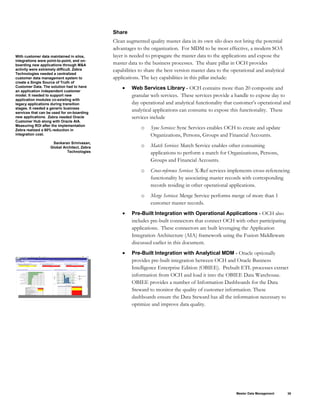
Clean augmented quality master data in its own silo does not bring the potential
advantages to the organization. For MDM to be most effective, a modern SOA
layer is needed to propagate the master data to the applications and expose the
master data to the business processes. SOA and MDM need each other if the full
potential of their respective capabilities are to be realized.
Oracle MDM maintains an integration repository to facilitate web service discovery,
utilization, and management. What’s more, Oracle MDM Hubs leverage Oracle
Application Integration Architecture (AIA) to provide pre-built comprehensive
application integration with the MDM data and MDM data quality services. AIA
delivers a composite application framework utilizing Foundation Packs and Process
8 Global Single Schema, September 2008, URL
Master Data Management 15
9 How Technology Enables Data Governance, An Oracle and First San Francisco Partners Whitepaper,
December 2009, URL
Integration Packs (PIPs) to support real time synchronous and asynchronous
events that are leveraged to maintain quality master data across the enterprise. We
will cover this significant differentiating capability for Oracle’s MDM in more
depth in later sections.
Leverage
MDM creates a single version of the truth about every master data entity. This data
feeds all operational and analytical systems across the enterprise. But more than
this, key insights can be gleamed from the master data store itself. 360o
views can
be made available for the first time since operational and analytical systems split in
the 1980s. Alternate hierarchies and what-if analysis can be performed directly on
the master data.
Oracle MDM Hubs leverage Oracle BI tools such as OBI EE and BI Publisher to
produce 360o
views and cross-reference data to the Data Warehouse and maintain
master dimensions in the master data store. Data quality and segmentation can be
viewed directly from the master data repository. Out-of-the-box reports are
provided and BI Publisher has full access to all master data attributes within
constrains set up by the data security rules. Oracle’s Analytical MDM can create an
enterprise view of analytical dimensions, reporting structures, performance
measures and their related attributes and hierarchies using Hyperion DRM's10 data
model-agnostic foundation.
ORACLE MDM HIGH LEVEL ARCHITECTURE
The following figure identifies the major layers in the Oracle MDM architecture.
Master Chart of Accounts, Customer,
Supplier, Partner, Distributor, Regulator,
Contact, Organization, Family, Constituent,
Product, Item, Catalog, Medical Procedure,
Calling Plan, Asset, Parts, SKU, Service,
etc. with all their hierarchies and cross
references all on one platform.
• Oracle Fusion Middleware provides supporting infrastructure.
• The MDM Applications layer contains all the base pre-built MDM Hubs
and shared services.
• The top layer includes MDM based solutions for Data Governance
Master Data Management 16
10 Achieving Agility through Alignment, An Oracle Whitepaper, December 2008, URL
MDM Platform Layer
There are a number of Fusion Middleware (FMW) technologies used to support
MDM Applications. These include application integration services, business
process orchestration services, data quality & standardization services, data
integration and metadata management services, business rules engine, event-driven
architecture, web services management, user identity management, and analytic
services. The following sections identify the FMW components that support these
services and how they are leveraged by MDM Hubs.
Application Integration Services
Application integration services are provided by Oracle’s award winning Fusion
Middleware. The following sections cover the key components used by the Oracle
MDM suite of applications.
Enterprise Service Bus
Oracle Service Bus is a proven, lightweight and scalable SOA integration platform
that delivers low-cost, standards-based integration for high-volume, mission critical
SOA environments. It is designed to connect, mediate, and manage interactions
between heterogeneous services, legacy applications, packaged applications and
multiple enterprise service bus (ESB) instances across an enterprise-wide service
network. It is designed for high volume low latency application-to-application
integration (A2A) including MDM application integration to operational
applications12. It supports Hub & Spoke, Publish & Subscribe, point to point, and
content based routing. It has an easy to use full function design time tool for
building the metadata needed at execution time. It comes with a large number of
technology and application adaptors to speed implementation. Oracle MDM Hubs
come with Oracle supported adaptors.
Oracle is in the Forrester Leaders circle for
Enterprise Service Buses saying “Oracle
does it all and does it all well”11
.
General Dynamics Land Systems (GDLS)
needed a better contract management
system to replace their old Validation
database. GDLS has a complex IT
landscape and wanted to insure the new
system would support their plans for
implementing a Service Oriented
Architecture (SOA) across the enterprise.
Oracle’s MDM solution for reference data
mastering, Data Relationship Management
(DRM) was selected and positioned as a
foundation for their SOA implementation
based on Oracle Fusion Middleware’s
Enterprise Service Bus and BLEP Process
Manager. Once completed, Contract
Management, Order Fulfillment, Financial
Invoicing, and Financial Collections will all
work the Order to Cash process through
one enterprise business process fed by
applications using synchronized master
contract data from the DRM MDM Hub.
Master Data Management – The Missing
Link in Your SOA Strategy Doug Field,
GDLS, Susan Schoenherr, CSC
Oracle MDM applications seamlessly work with the OSB and its A2A and
Enterprise Information Integration (EII) capabilities. The OSB is familiar with the
data structures and access methods of the MDM Hubs. Its routing algorithms have
access to the FMW Business Rules Engine and can coordinate message traffic with
data quality rules established by corporate governance teams in conjunction with
the MDM Hubs.
What’s more, MDM Hubs, configured as a ‘System of Record’, dramatically reduce
the complexity associated with A2A integration. When all applications are in sync
with the MDM Hub, they are in sync with each other. This effectively turns the n2
harmonization of fragmented data problem into a linier management of
consolidated data problem. Architecturally speaking, this is a very significant
improvement and leads to many cost of ownership advantages.
Business Process Orchestration Services
The Business Process Execution Language Process Manager (BPEL PM)
provides business process orchestration services. BPEL is the standard for
assembling sets of discrete services into an end-to-end process flow, radically
reducing the cost and complexity of process integration initiatives.
11 The Forrester Wave™: Enterprise Service Buses, Q1 2009, URL
12 Oracle Service Bus Data Sheet, URL
Master Data Management 17
Built-in integration services enable developers to easily leverage advanced
workflow, connectivity, and transformation capabilities from standard BPEL
processes. These capabilities include support for XSLT and Xquery transformation
as well as bindings to hundreds of legacy systems through JCA adapters and native
protocols. The extensible WSDL binding framework enables connectivity to
protocols and message formats other than SOAP. Bindings are available for JMS,
email, JCA, HTTP GET, POST, and many other protocols enabling simple
connectivity to hundreds of back-end systems13.
BPEL PM has deep knowledge of Oracle MDM Data Hub structures and access
methods. It comes with hot pluggable components for bringing the quality
information in the MDM Hubs to all business processes and applications across the
enterprise and beyond with business-to-business (B2B) integration support for
EDI, HL7, Rosetta Net, UCCNet, GDSN, 1Sync and more.
Business Rules
The Oracle Business Rules is a business rules engine for making decisions about
aggregating federated information in real time; resolving sourcing system conflicts;
and coordinating data visibility with the data quality rules incorporated into MDM
Applications. Privacy policies, regulatory policies, corporate policies, and data
policies can be enforced. Policies can be as simple as: Every patient can read their
own records, or as complex as: A “gold” customer has total assets under
management > $100k and average monthly transaction volume > $10k and is in
good standing.
Oracle Business Rules allow business analysts to manage rules by defining and
maintaining those rules in a separate repository, with an intuitive web-based
interface. It can be executed from within an application via Java code, the Oracle
Business Rules API, or a web services interface. This integration is especially
attractive for MDM Hubs.
Flexible System of Entry
Master
Data Hub
Master
Data Hub Master
Data Hub
Master
Data Hub
Entry into the System of Record Entry into a Connected System
Coordinating the data quality rules configured in the data quality engine inside
MDM Hubs with the rules configured in the integration layer allows the Oracle
solution to manage master data updates from spoke systems and the MDM
application.
This is a key feature. Many master data management systems require that the
MDM application be the only System of Entry. While having one System of Entry
may simplify maters, most companies cannot shut down data entry in major
13 Oracle BEPL Process Manager Data Sheet, URL
Master Data Management 18
Master Data Management 19
systems. The Oracle MDM solution, when deployed with OSB and BPEL PM with
its Business Rules based policy engine can support multiple Systems of Entry.
What’s more, the integration layer in conjunction with the MDM Hubs can enforce
central data quality rules.
Event-Driven Services
Oracle Event-Driven Architecture (EDA) is comprised of best-in-class
technologies for event-enabling a business. It allows applications to register events,
associate payload packages and trigger designated business processes and
workflows.
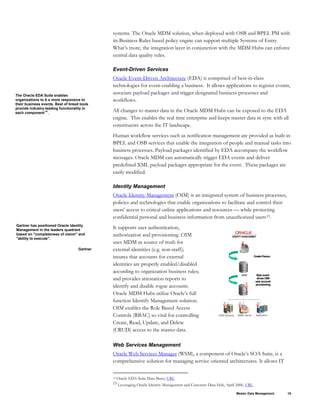
The Oracle EDA Suite enables
organizations to b e more responsive to
their business events. Best of breed tools
provide industry-leading functionality in
each component14
.
All changes to master data in the Oracle MDM Hubs can be exposed to the EDA
engine. This enables the real time enterprise and keeps master data in sync with all
constituents across the IT landscape.
Human workflow services such as notification management are provided as built-in
BPEL and OSB services that enable the integration of people and manual tasks into
business processes. Payload packages identified by EDA accompany the workflow
messages. Oracle MDM can automatically trigger EDA events and deliver
predefined XML payload packages appropriate for the event. These packages are
easily modified.
Identity Management
Oracle Identity Management (OIM) is an integrated system of business processes,
policies and technologies that enable organizations to facilitate and control their
users' access to critical online applications and resources — while protecting
confidential personal and business information from unauthorized users15.
Gartner has positioned Oracle Identity
Management in the leaders quadrant
based on "completeness of vision" and
"ability to execute".
It supports user authentication,
authorization and provisioning. OIM
uses MDM as source of truth for
external identities (e.g. non-staff);
insures that accounts for external
identities are properly enabled/disabled
according to organization business rules;
and provides attestation reports to
identify and disable rogue accounts.
Oracle MDM Hubs utilize Oracle’s full
function Identify Management solution.
OIM enables the Role Based Access
Controls (RBAC) so vital for controlling
Create, Read, Update, and Delete
(CRUD) access to the master data.
Application
LDAPDirectory EMAILServer
Start event-
drivenOIM
user account
provisioning
CreatePerson
MDM
Gartner
Web Services Management
Oracle Web Services Manager (WSM), a component of Oracle’s SOA Suite, is a
comprehensive solution for managing service oriented architectures. It allows IT
14 Oracle EDA Suite Data Sheet, URL
15 Leveraging Oracle Identity Management and Customer Data Hub, April 2006, URL
managers to centrally define policies that govern web services operations such as
access policy, logging policy, and content validation, and then wrap these policies
around services with no modification to existing web services required. MDM Hub
services are exposed as web services that are controlled and secured via WSM.
Analytic Services
The Analytics Server is key to leveraging the master data to gain insights into the
business. This includes improved real time decision making and quality reporting.
Corporate governance is enhanced and financial risk is reduced. Key components
of the Analytics Server include Enterprise Performance Management, Data
Warehousing, ETL, and Business Intelligence tools. The following sections
identify the Oracle Analytic Server products used by and/or with MDM
Applications.
Enterprise Performance Management
Oracle Hyperion Enterprise Performance Management (EPM) system brings
management processes under a single umbrella, connecting financial and
operational decisions and activities with transactional systems to form a
comprehensive management picture. The MDM Data Hubs provide data to
Oracle’s EPM applications. Oracle’s Enterprise Planning and Budgeting
application, can leverage the reliable, accurate master data residing in an MDM
Hub-fed data warehouse to perform its complex aggregations and produce
actionable ‘what if’ plans around customers, products, accounts, etc. insuring
reporting accuracy. What’s more, Oracle’s MDM solution for reference data and
enterprise hierarchy management, Data Relationship Management (DRM), is fully
integrated into Oracle Hyperion EPM. More detailed information on this Analytical
MDM component of the Oracle MDM suite is included in the MDM Applications
Layer chapter later in this document.
“MDM is critical to Enterprise Performance
Management – no one believes the reports
and dashboards if the data is a mess.”
Bill Swanton
VP Research AMR Research
Data Warehousing
MDM supplies critically important dimensions, hierarchies and cross reference
information to the Oracle Data Warehouse. With all the master data in the MDM
Hubs, only one pipe is needed into the data warehouse for key dimensions such as
Customer, Supplier, Account, Site, and Product. The “Star Schema” illustrated on
the left from the Oracle whitepaper on Data Warehousing Best Practices16 shows
all dimensions except Time are managed by Oracle MDM. Not only that, Oracle
MDM maintains master cross-references for every master business object and every
attached system. This cross-reference is available regardless of data warehousing
deployment style. For example, an enterprise data warehouses or data mart can
seamlessly combine historic data retrieved from those operational systems and
placed into a Fact table, with real-time dimensions form the MDM Hub. This way
the business intelligence derived from the warehouse is based on the same data that
is used to run the business on the operational side.
16 Best practices for a Data Warehouse on Oracle Database 11g, URL
Master Data Management 20
Business Intelligence
Using an MDM approach means that
differences of opinion on data validity can
be eliminated through a data governance
process that enforces agreed to rules on
data quality. Results of reports, ad-hoc
queries, and analyses using data in the
data warehouse can be correlated with the
same quality data observed in the
operational systems.
Oracle Business Intelligence Enterprise Edition (OBI EE) provides ad-hoc query
and real time dashboard capabilities. Oracle BI EE is designed to support
heterogeneous data sources. With this capability and the data consistency an MDM
solution provides, it is possible to view the master data, the data residing in
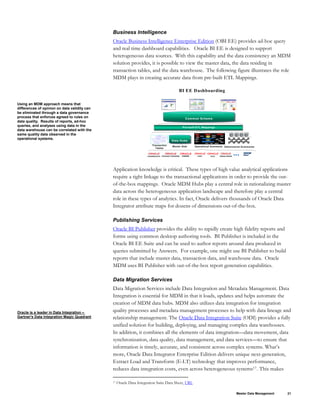
transaction tables, and the data warehouse. The following figure illustrates the role
MDM plays in creating accurate data from pre-built ETL Mappings.
BI EE Dashboarding
Pre-built ETL Mappings
Operational Summaries
Transaction
Tables
Dimensional Summaries
Common Schema
Common Schema
Data Hubs
Data Hubs
Master Data
Application knowledge is critical. These types of high value analytical applications
require a tight linkage to the transactional applications in order to provide the out-
of-the-box mappings. Oracle MDM Hubs play a central role in rationalizing master
data across the heterogeneous application landscape and therefore play a central
role in these types of analytics. In fact, Oracle delivers thousands of Oracle Data
Integrator attribute maps for dozens of dimensions out-of-the-box.
Publishing Services
Oracle BI Publisher provides the ability to rapidly create high fidelity reports and
forms using common desktop authoring tools. BI Publisher is included in the
Oracle BI EE Suite and can be used to author reports around data produced in
queries submitted by Answers. For example, one might use BI Publisher to build
reports that include master data, transaction data, and warehouse data. Oracle
MDM uses BI Publisher with out-of-the-box report generation capabilities.
Data Migration Services
Oracle is a leader in Data Integration –
Gartner's Data Integration Magic Quadrant
Data Migration Services include Data Integration and Metadata Management. Data
Integration is essential for MDM in that it loads, updates and helps automate the
creation of MDM data hubs. MDM also utilizes data integration for integration
quality processes and metadata management processes to help with data lineage and
relationship management. The Oracle Data Integration Suite (ODI) provides a fully
unified solution for building, deploying, and managing complex data warehouses.
In addition, it combines all the elements of data integration—data movement, data
synchronization, data quality, data management, and data services—to ensure that
information is timely, accurate, and consistent across complex systems. What’s
more, Oracle Data Integrator Enterprise Edition delivers unique next-generation,
Extract Load and Transform (E-LT) technology that improves performance,
reduces data integration costs, even across heterogeneous systems17. This makes
17 Oracle Data Integration Suite Data Sheet, URL
Master Data Management 21
ODI the perfect choice for 1) loading MDM Data Hubs, 2) populating data
warehouses with MDM generated dimensions, cross-reference tables, and hierarchy
information, and 3) moving key analytical results from the data warehouse to the
MDM Data Hubs to ‘operationalize’ the information.
High Availability and Scalability
With all the master data in one place, High Availability becomes a requirement. Just
as importantly, an organization cannot deploy an MDM solution that won’t keep up
with growing data volumes, users, application suites and business processes.
Key benefits of RAC include availability,
horizontal scalability on lower-cost hardware
and sharing capacity across database
management system (DBMS) instances in a
grid18
.
Real Application Clusters
Real Application Clusters (RAC) provides the needed high availability and
scalability. RAC is an option to Oracle Database 11g Enterprise Edition. It supports
the deployment of a single database across a cluster of servers—providing
unbeatable fault tolerance, performance and scalability with no application changes
necessary. As your system grows, nodes can be added without downtime. Oracle
MDM applications run seamlessly on RAC clusters.
Mixed Workloads
Oracle’s ability to run mixed workloads across RAC nodes is unique in the industry
and adds another significant dimension to Oracle’s MDM solution. OLTP
workloads are routed to a subset of clustered servers accessing the MDM tables
while Data Warehousing workloads are routed to other nodes in the same cluster.
With world class transaction processing and record data warehousing performance,
on a single instance becomes possible. The data warehousing tables and MDM
tables reside in an environment all managed through a single Oracle Enterprise
Manager console. This lower cost, more easily managed environment provides
dramatic savings and puts a company on the path to a more rational IT
infrastructure.
Exadata
With the acquisition of Sun Microsystems, Oracle has become a Software-
Hardware-Complete vendor. No software-hardware application illustrates the
benefits of this combination better than Master Data Management running on the
Exadata database computer20. The OLTP MDM tables can coexist with the Data
Warehouse star schemas moving data around a disk array, creating summarized
tables and utilizing materialized views without offloading terabytes of data through
costly networks to multiple hardware platforms. Availability and scalability are
maximized even as the total cost of ownership is reduced. Only Oracle offers a full
suite of business applications, state of the art middleware, a world class clustered
database, and a low cost high performance hardware platform. MDM takes full
advantage of this combination to the significant benefit of our customers.
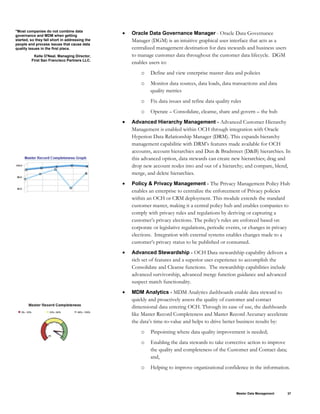
In Oracle Exadata V2, Oracle has delivered a
purpose-built machine for a wide variety of
enterprise needs: data warehousing, OLTP
and mixed workloads19
.
Merv Adrian, Principal
IT Market Strategy
18 Oracle RAC Moved to Mainstream Use, Gartner, Feb 2009, URL
19 Oracle Exadata: a Data Management Tipping Point, Merv Adrian, Principal, IT Market Strategy, URL
20 Sun Oracle Database Machine Data Sheet, URL
Master Data Management 22
Master Data Management 23
Application Integration Architecture
Zebra Technologies ensured rapid
integration of numerous systems using
Oracle Application Integration
Architecture, including linking the
company’s new and legacy enterprise
resource planning solutions running in
parallel during the transition and linking E-
Business Suite to Oracle’s Customer
Hub21
.
Application Integration Architecture (AIA) utilizes Oracle’s premier SOA suite to
build out-of-the-box Oracle Application integrations in the context of enterprise
business processes. These integrations directly support MDM. There are multiple
levels of integration between MDM and SOA.
• Connectors and transformations
• Mutually understood data structures and access methods
• Pre-Built Application and Master Data synchronization
• Pre-Built SOA/MDM Enterprise Business Processes
The business value goes up the more levels a vendor provides. All MDM vendors
provide some level of connectors and templates for transformations. Only vendors
that provide both MDM and SOA can integrate the two. Most of these vendors
provide their SOA with knowledge of their MDM data structures and access
methods. But only vendors who actually have applications can provide pre-built
master data synchronizations and pre-built enterprise business processes.
Oracle has integrated its market leading MDM suite of applications with its
powerful Fusion Middleware driven SOA suite. The following section describes
how Oracle brings these two together at all three integration levels listed above22.
AIA Layers
AIA delivers the following components deployed at the various levels of the SOA
stack.
1) Industry reference models cover the
best practice business processes for key
industries.
2) This layer is supported by Enterprise
Business Objects (EBOs).
3) These objects are orchestrated into
process & task flows with data
transformations.
4) Flows utilize Enterprise Web Services.
5) These services are provided by the
underlying Oracle Applications and
MDM Hubs.
Oracle is utilizing its MDM and SOA capabilities, along with the AIA EBOs and
associated structures, to pre-build application integrations in the context of key
industry specific business processes. The EBOs are deployed as part of a common
object methodology that uses the EBOs to define all transformation from target
and source applications included in the business process.
21 Zebra Technologies Oracle Customer Snapshot, URL
22 MDM as a Foundation for SOA, an Oracle Whitepaper, November 2007, URL
Common Object Methodology
“One of the most complicated aspects of
any cross application IT project is
determining the underlying canonical
model. You can’t communicate effectively
if every application is using a different set
of terms and definitions.”
Erin Kinikin, Independent Analyst
The following figure illustrates how the common object methodology is used to
integrate the Oracle Applications.
As data flows from source systems, it is transformed via provided maps into a
common object model. Once the appropriate business logic is executed for a
particular business process, the data is again transformed via provided maps from
the common object model to the format needed by target systems.
Oracle has leveraged its ability to fuse applications and technology to incorporate
MDM applications as a foundation component for its SOA Suite. Delivering more
than just connectors and templates, Oracle’s MDM-SOA combination delivers out-
of-the-box, fully tested and extensible, pre-built SOA enterprise business processes
that synchronize MDM data stores with applications. Deploying the MDM Hubs
and connecting them to the common object model in the AIA integrations,
provides the consolidated, cleansed, deduplicated, augmented authoritative ‘Golden
Record’ to every application and business process in the delivered pre-built SOA
integration.
MDM Foundation Packs
“Oracle Application Integration
Architecture Foundation Pack enabled us
to realize a 60% cost savings when
integrating multiple enterprise systems by
eliminating the need to develop and
manually map the individual components.”
Don O’Shea, Chief Information Officer,
Zebra Technologies Corporation
AIA delivers its base integration capabilities in Foundation Packs. Master Data
Management processes such as ‘Publishing’ master data to multiple subscribers is
designed in. For example, customer information can be created, updated, and
deleted in multiple participating applications and sent to the Oracle Customer Hub
for updating, cleaning, and validation. Subsequently, the Customer Hub, as the
single source of truth, publishes the customer information for multiple subscribing
participating applications to consume23. Foundation Packs are available for all
application integration scenarios.
MDM Process Integration Packs
AIA delivers pre-built integrations as Process Integrations Packs (PIPs).
These packs are pre-built composite business processes across enterprise
applications. They allow organizations to get up and running with core processes
quickly. When delivered with MDM, these complete, out-of-the-box, integrations
23 Oracle Application Integration Architecture – Foundation Pack 2.3: Release Notes, April, 2009
Master Data Management 24
include everything needed to gain immediate business value and increase business
and IT efficiencies. Key MDM PIPs include:
• Process Integration Pack for Oracle Customer Hub is a collection of core
processes to support out-of-the-box Customer MDM integration
processes across Oracle Customer Hub, Siebel CRM and Oracle E-
Business Suite, as well as a framework to enable MDM integrations with
other Oracle and non-Oracle applications24.
• Process Integration Pack for Oracle Product Hub is a collection of core
processes to support out-of-the-box Product MDM integration processes
across Oracle Product Hub, Siebel CRM and Oracle E-Business Suite25.
MDM Aware Applications
Master data attributes within any particular
transactional application have relevance
beyond the application itself.
When an application understands that the key data elements within its domain have
business value beyond its borders, we say it is “MDM Aware”. An MDM Aware
application is prepared to:
• Use outside data quality processes for data entry verification
• Pull key data elements and attributes from an outside master data source
• Push its own data to external master data management systems
In short, MDM Aware applications are pre-disposed to participating in the MDM
data quality process. This dramatically speeds the deployment of MDM solutions,
reduces risk and insures quality data is distributed as needed across the IT
landscape. Oracle Applications are MDM Aware. Recent combined MDM and
AIA releases enable non-Oracle applications to become MDM Aware. A
composite application user interface is available that enables non-Oracle
applications such as legacy and web applications to also become MDM Aware26.
Composite Application Development
With AIA Foundation Packs, MDM PIPs and MDM Aware applications,
organizations can more readily create new business processes by combining
relevant elements of existing applications. This is called Composite Application
Development. This was the SOA vision. That vision has been slow to realize due to
the large number of complex integration components, lack of built in governance,
and continuing data quality problems in the underlying applications. The power of
the AIA out-of-the-box pre-built SOA with open, extensible and governable
components together with the power of the pre-cabled Oracle MDM solution to
ensure quality data across the applications and composite applications eliminates
these SOA roadblocks. The SOA promise of IT flexibility is finely realized.
Oracle Data Quality Services
Data cleansing is at the heart of Oracle MDM’s ability to turn data into an
enterprise asset. Only standardized, de-duplicated, accurate, timely, and complete
data can effectively serve an organization’s applications, business processes, and
analytical systems. From point-of-entry anywhere across a heterogeneous IT
24 Process Integration Pack for Oracle Customer Hub, an Oracle Data Sheet, URL
25 Process Integration Pack for Oracle Product Hub, and Oracle Data Sheet, URL
26 MDM Aware Applications, an Oracle Whitepaper, July 2009, URL
Master Data Management 25
landscape to end usage in a transactional application or a key business report,
Oracle MDM’s Data Quality tools provide the fixes and controls that ensure
maximum data quality.
If bad data impacts an operation only 5%
of the time, it adds a staggering 45% to the
cost of operations. Poor data quality cost
business’ 10% to 20% of revenue!
Customer, Client, Student, Patient,
Employee, Doctor, Counterparty, Supplier,
Partner, Distributor, Regulator, Contact,
Organization, Family, Constituent,
Address, Site, Location, etc.
Product, Item, Catalog, Medical Procedure,
Drug, Calling Plan, Synthetic CBO, Asset,
Parts, SKU, Service, Material, Meter,
Contract, etc.
Thomas C. Redman,
DM Review
Oracle recognizes that there are two primary data categories: relatively structured
party data and relatively unstructured item data. Party data includes people and
company names such as customers, suppliers, partners, organizations, contacts, etc.,
as well as address, hierarchies and other attributes that describe who a party is. The
following figure illustrates this kind of data and the problems most frequently
encountered.
This is relatively structured error-prone data that is subject to country specific rules.
It must be cleansed in order to find matches. Pattern matching tools are best for
cleansing this kind of data.
Item data includes Products, Services, Materials, Assets, and the full range of
attributes that describe what an item is.
This is relatively unstructured data that is subject to category specific rules. It is
common for widely different descriptions to actually be identifying the same item.
Semantic matching tools are required for cleansing this kind of data. Any vendor
that does not have this kind of semantic technology cannot satisfactorily master
product data.
Master Data Management 26
These differences between party and item data are fundamental to the data itself.
This is why Oracle provides data quality tools specifically designed to handle these
two kinds of data. One is our suite of Customer Data Quality servers and the other
is our state-of-the-art Product Data Quality. The following sections discuss these
two product areas in more depth.
Oracle Customer Data Quality Servers
Oracle Data Quality puts control of data
quality processes in the hands of business
information owners, such as data analysts
and data stewards.
Oracle Customer Data Quality offers an end-to-end solution enabling customers to
execute data quality processes on their customer, supplier and site data. The
product family combines powerful data analysis, cleansing, matching, and reporting
and monitoring capabilities with unparalleled ease of use. Combined, they provide a
complete solution covering all data quality functionalities needed in an enterprise,
delivering in terms of both performance and scalability on a truly global scale. In
particular, Oracle Customer Data Quality delivers:
• Complete solutions for all customer data quality needs that covers full
spectrum of data quality functionalities
• Best-in-class matching engine with superb accuracy on all types of name,
address and identification data, flexible and adaptive to suit any customer
situations
• Unprecedented global coverage with matching libraries for 52 languages
and address validation across 240 countries, 40 character sets and 100+
address formats
• Tight integration with Oracle MDM and CRM applications to help
customers understand the data quality status, address the data quality
problems and achieve single view of the customer data
Oracle has four Data Quality offerings27:
• Oracle Data Quality Profiling Server
• Oracle Data Quality Parsing and Standardization Server
• Oracle Data Quality Matching Server
• Oracle Data Quality Address Validation Server
Oracle Data Quality Profiling Server allows users to use business rules and
reference data to analyze and rank data; identify, categorize, and quantify low-
quality data; and create reports and dashboards to confirm data quality
improvement. Oracle Data Quality Parsing and Standardization Server allows users
to use business rules to parse or merge data elements into the expected attributes
for the master records; and use reference data dictionaries to standardize freeform
text data elements. Oracle Data Quality Address Validation Server offers quick
validation and correction of worldwide postal addresses; address coverage in more
than 240 countries; and integrated single vendor– single API supports all countries.
Oracle Data Quality Matching Server allows users to add real-time search for
people, companies, contacts, addresses, households, titles and products; discover
27 Oracle Customer Data Quality Data Sheet, URL
Master Data Management 27
duplicates and establish relationships in real time; and build relationship link tables
and match external files and databases.
Oracle Data Quality Profiling Server
When data quality is measured, it can be effectively managed. Data profiling is the
first step for data quality. Oracle Data Quality Profiling Server gives users with the
ability to measure the level and nature of data quality problems across multiple data
sources—to identify, quantify, and categorize current and potential data quality
issues and adherence to business rules. The product also provides the metrics and
reports that business information owners need to continuously measure, monitor,
track, and improve data quality at multiple points across the organization.
Oracle Data Quality Parsing and Standardization Server
Some examples of tasks carried out by
this module include noise removal; data
parsing; standardization of terms;
derivation of missing data values; and
generation of data quality flags for use in
matching rules.
The goal of the standardization phase of a data quality management process is to
remove or flag problems prior to moving on to the matching phase. Oracle Data
Quality can also generate metadata that enables easy parsing and standardization of
data.
In the standardization phase each of the key data fields is passed through a series of
user defined rules to remove inconsistencies and unconformities identified during
the data profiling stage. The output is a range of new data fields containing
standardized and enhanced data. The new data fields created during the
standardization phase may be used solely for the matching process, or they may
also be written back to the original source file to replace the original data.
Oracle Data Quality Matching Server
Oracle Data Quality Matching Server performs high-quality search, match,
duplicate identification, and relationship linking on all types of name, address and
identification data. The solution includes highly-flexible search strategies, which can
be selected based on the data being searched for, the level of risk and the need that
the search must satisfy, allowing users to balance performance and
comprehensiveness of search/match.
Multi Mode Support: Oracle Data Quality
Matching Server allows for the use of
different sets of match rules depending on
the mode of operation. For example, it
allows one set of match rules for data
entering the hub through real time mode
and a different set of match rules for data
entering the hub through the batch mode.
Oracle Data Quality Matching Server delivers industry leading global coverage with
language/locale specific matching libraries for 52 languages/locales. Also included
is an easy to use admin console which enables enterprise to adapt matching rules
and algorithms for their specific scenarios, or to extend matching to additional
languages and/or locales.
Oracle Data Quality Matching Server is preintegrated into Oracle CRM/MDM
solution to enable quick deployment of data quality and data management
capabilities within an enterprise environment. Additionally, it is a highly-scalable
solution with proven performance on systems with billions index entries on one
database and millions real-time transactions in an hour.
Oracle Data Quality Address Validation Server
Oracle Data Quality Address Validation Server provides capabilities to parse,
standardize, transliterate, deduplicate and validate all address data, resulting in
improved address data quality, which in turn would help enterprise in integrating
Master Data Management 28
international customer information, preventing against identity loss, and assisting in
fraud detection and prevention, as well as directly reducing mail based marketing
costs.
The server performs validation of address data against published standards and
directories by utilizing reference data. As postal codes change in different countries
due to settlements, system changes or name changes, reference tables for each
country can also be updated on a monthly, quarterly or biannual basis. Oracle
leverages arrangements with leading postal reference data provider to enable
customers to receive the updates on a periodical basis. These reference tables are
provided in a separate, platform-independent database making it easily updateable
at any time.
Oracle DQ, customers can choose 3rd
party
data quality management solutions. These
are available via pre-integrated adapters to
the Customer Hub. In addition, Oracle
provides out-of-the-box integration with
enriched content from external providers
such as Acxiom for Knowledge Based
MDM, and Dun & Bradstreet for Business
Hierarchies. Connectors to third party DQ
vendors such as Trillium are also
available.
Oracle Customer Data Quality servers enable business information owners and IT
to work together to deploy lasting customer data quality programs. Business
information owners use Oracle Data Quality to build data quality business rules and
define data quality targets together with the IT team, which then manages
deployment enterprise-wide.
Product Data Quality
Typical product data is unstructured, non-standard and often missing important
information. These product data errors slow procurement, development,
distribution and negatively impact service. Oracle Product Data Quality (PDQ)
with patented Data Lens™ semantic-based technology is designed to solve this
problem. PDQ is built from the ground up to tackle the unique challenges of
assessing, and improving the ongoing management of product data. Oracle Product
Data Quality has been proven in a wide range of customer scenarios involving
Product, Item, Catalog, Medical Procedure, Calling Plan, Asset, Parts, SKU,
Service, and other forms of product or product-like data across a range of
industries. Oracle Product Data Quality is designed to handle data that is:
It is sometimes claimed that traditional
data quality tools designed for customer
(name & address) data can also handle
product data, but this is true only in the
most simplistic of cases. In reality,
product data has a number of
characteristics that put it beyond the
scope of traditional toolsets.
Poorly structured—requires sophisticated semantic parsing capabilities
Non-standard—required standards to be applied and data transformed
to meet enterprise standards
Highly variable—practically infinite combinations of acronyms, spelling
and vocabulary variations and other cryptic information requires flexible
recognition and transformation capabilities
Category-specific—requires the ability to both categorize an item and
apply different rules based on content and context
Variable quality—requires integrated exception management and
remediation capabilities
Duplicated—requires sophisticated semantic matching capabilities
Oracle Product Data Quality delivers:
• Semantic-based recognition—based on context to enable accurate
parsing, standardization and matching along with auto-learning to handle
the extreme variability and unpredictability of product data
Master Data Management 29
Master Data Management 30
• Scalability—to manage millions of items across thousands of categories
• Integrated Governance—to allow data stewards to monitor overall
process effectiveness as well as drive direct data remediation
• Business User Interface—designed using a code-free interface for use
by the business user who best understand the rules and nuances of the
data
• Enterprise-wide Applicability—a standard process that can 'plug-in'
to existing systems and processes to enforce product data quality standards
in any process or system
Emerson Corporation is a $20B diversified
global manufacturer. Poor quality product
data was increasing new product lag times
and driving up costs. Data standardization
initiatives were launched. Emerson tried a
number of approaches to solve the
problem. Manual efforts did not scale.
Custom code was too expensive.
Traditional data quality tools were
ineffective on unpredictable unstructured
data. Then Emerson tried the semantic
based Data Lens technology found in
Oracle Product Data Quality. “It actually
worked!”
Phil Love, Manager, Data Quality
Like an optical lens, a ‘data lens’ does not
store the data is ‘sees, but simply provides
a real-time mechanism to view your data in
a different way – transformed or ‘re-
focused’ in whatever way you specify.
PDQ represents a breakthrough in product data solutions with next generation
semantic technology that automates what has traditionally been a costly, labor-
intensive and largely unreliable process28. Product Data Quality provides an
integrated capability to recognize, cleanse, match, govern, validate, correct and
repurpose product data from any source. It can standardize product classifications,
attributes, and descriptions and translate languages as data flows into the Product
Hub tables.
All input items are compared against
the semantic model for contextual
recognition & validation. Semantic
recognition uses whole context to
determine meaning and category.
Semantic recognition identifies item
category and key attributes even with
highly variable data. The system
infers meaning from unrecognized
items and asks for confirmation from
the user. Category-specific semantic
models flag missing information for
potential remediation. If the user
confirms, new rules can be created to
extend semantic model. Data is
converted, transformed and re-
assembled into the Product Hub.
Product Data Quality can standardization any attributes in any form. It can make
imperial/metric conversions and handle multiple classifications. Its auto-translation
capabilities can translate millions of rows in seconds with full double-byte support.
Exception management for validation and remediation is a key component of the
solution and quality is governed via a supplied Data Steward dashboard. The
dashboard provides quality metrics by process, source, and product category and
management metrics such as task management overviews that measure productivity
and identify bottlenecks.
A Data Governance Studio dashboard provides visibility to enterprise data and
metrics to drive process improvements. The key to accomplishing these data quality
28 Oracle Product Data Quality Data Sheet, URL
goals is the solution’s ability to learn through semantic recognition that gains
contextual knowledge over time.
End-To-End Data Quality
Error correction at the source is how you
turn a thousand points of data entry into a
single version of the truth.
Data quality tools are applied against data as it is held in databases, as it is moved,
and as it is entered. The value of the data quality goes up as the number of places it
can be brought to bear increases. The left hand side of the following picture
illustrates data quality improvements being applied as the data as it flows from
applications into the MDM Data Hub. The data integration technology is ETL.
Most data quality tools can clean up the data in the applications and in databases
such as a data warehouse or an MDM Hub. Oracle’s MDM DQ tools can do the
same.
But DQ technology that stops there is still letting poor quality data enter the IT
landscape. Potentially thousands of people are entering customer data into a wide
variety of operational applications. In fact, data errors are entering the system at a
significant rate. Data quality tools that clean things up after the fact and try undo
any damage caused by poor quality data are certainly performing a beneficial
service. But a DQ technology that can prevent the data entry errors in the first
place would be far superior. This is exactly what Oracle has been able to do
because of its fusion of MDM and SOA.
The right hand side of the above picture illustrates how Oracle, using AIA PIPs,
can trap data entry in real time and perform key DQ functions such as Fetch,
match, Enhance, and Synchronize for MDM Aware Applications. This is the final
Data Quality answer. It fixes the DQ problem at its source.
Master Data Management 31
Master Data Management 32
Application Development Environment
JDeveloper serves as the development environment for new application creation,
existing application extensions and composite application development. Web
Service Invocation Framework (WSIF), and Java Business Integration (JBI) are fully
supported. Application functions are designed and built to be deployed as web
services. This is the ideal tool for creating new and composite applications around
the Oracle MDM Hubs.
JDeveloper has full access to the
MDM Hub APIs and Web Services.
Oracle MDM Hubs can actually
support applications directly. This
gives Oracle’s master data solution a
key differentiation over all other
approaches. When new applications
are written to replace older apps, or
Oracle applications are deployed in
place of existing apps, physical silos
are removed from the IT landscape.
Application Development
Directly on the Oracle MDM Data Hubs
Integrate
Orchestrate
Develop
Manage
Secure
Master
Data Hub
Master
Data Hub
Change
Monitor
This is key to IT infrastructure simplification and is why we call Oracle MDM a
first step on the ‘path to a suite’.
MDM APPLICATIONS LAYER
Oracle MDM includes a large portfolio of purpose built master data management
applications. The MDM Applications include all MDM Hubs and their
corresponding data quality servers. Data Governance is also included. The
following sections will cover:
• Oracle Customer Hub
o Oracle Higher Education Constituent Hub
• Oracle Product Hub
o Oracle Product Hub for Retail
o Oracle Product Hub for Comms
• Oracle Supplier Hub
• Oracle Site Hub
• Oracle Data Relationship Management
No other vendor on the market has this breath of master data element coverage.
MDM Pillars
The MDM Applications are organized around five key pillars. The following figure
illustrates these pillars of every MDM Application.
• Trusted Master Data is held
in a central MDM schema.
• Consolidation services
manage the movement of
master data into the central
store.
• Cleansing services de-
duplicate, standardize and
augment the master data.
• Governance services control
access, retrieval, privacy,
auditing, and change
management rules.
• Sharing services include
integration, web services,
ETL maps, event
propagation, and global
standards based
synchronization.
These pillars utilize generic services from the MDM Foundation layer and extend
them with business entity specific services and vertical extensions as described in
the MDM High Level Architecture covered in an earlier section of this paper.
The following sections describe Oracle’s MDM Applications for customer,
product, supplier, site, and financial master data as well as a section on the very
important role played by data governance.
Oracle Customer Hub
“We selected Siebel UCM because of its
out-of-the-box, rich customer master
functionality, its industry-specific best
practices, and its ability to integrate many
different applications”
Shaun Coyne, VP & CIO
Toyota Financial Services
Oracle Customer Hub29 (OCH) is Oracle’s lead Customer Data Integration (CDI)
solution. OCH’s comprehensive functionality enables an enterprise to manage
customer data over the full customer lifecycle: capturing customer data,
standardization and correction of names and addresses; identification and merging
of duplicate records; enrichment of the customer profile; enforcement of
compliance and risk policies; and the distribution of the “single source of truth”
best version customer profile to operational systems.
Oracle Customer Hub is a source of clean customer data for the enterprise. The
primary roles are:
• Consolidate & govern unique, complete and accurate master Customer
information across the enterprise.
• Distributes this information as a single point of truth to all operational &
analytical applications just in time.
29 Oracle Customer Hub includes both Oracle EBS Customer Data Hub (CDH) and Siebel CDI Universal
Customer Master (UCM).
Master Data Management 33
To accomplish this, OCH is organized around the five MDM Pillars:
Allianz is moving from a product-centric
business model to a customer-centric
business model. Allianz Polska Group is
using MDM to increase competitiveness in
these tough times for the Financial
Services industry by: 1) improving the
quality of service from the Customer
Service Center; 2) improving the accuracy
of customer data for Marketing initiatives;
and 3) providing complete customer
information for Agents.
• Trusted Customer Data is held in a central MDM schema.
• Consolidation services manage the movement of master data into the
central store.
• Cleansing services de-duplication, standardize and augment the master
data.
Tomasz Konstantynowicz, Michal
Kotnowski, Pawel Psuty
Teneto Consulting
• Governance services control access, retrieval, privacy, audit and change
management rules.
• Sharing services include integration, web services, event propagation, and
global standards based synchronization.
These pillars utilize generic services from the MDM Foundation layer, and extend
them with business entity specific services and vertical extensions.
Customer Data Model
“We chose the CDH to help us improve
efficiency, quality and decision making on
localized basis by sharing and reusing
knowledge on a global basis. We expect
to increase levels of regulatory compliance
and financial transparency via traceability
and disclosure controls on a global basis”
Thomas V. Carlock, Vice President
CIT Group
The OCH data model is an extensible proven transaction processing schema that
has evolved and developed over many years to the point where it is able to master
not only the customer profile attributes required in the front office but also those
required by all applications and systems in the enterprise. A few of its key
characteristics include:
• Roles and Relationships – The customer model provides support for
managing the roles and hierarchical relationships not only within a master
entity but also across master entities.
• Related and Child Data Entities and their Configuration – The
customer model is designed to store all the related and child level
customer data entities such as Addresses, Related Organizations, Related
Persons, Assets, Financial Accounts, Notes, Campaigns, Partners,
Affiliations, Privacy and so on.
• Industry Variants - The prebuilt customer data model is designed to
model and store the customer profile attributes for many major vertical
markets and industries, including (but not limited to); Financial Services,
Master Data Management 34
Consolidate
Qwest Communications needed to
improve is customer information.
Customer data was fragmented across a
wide variety of applications making it
difficult to answer event the simplest of
questions like: Are we billing for all
services provided? Consolidation of
customer data was the answer. The
selected solution would have to integrate
into a complex IT landscape including all
wireless and wireline applications and the
data warehouse. Qwest chose Oracle
Customer Hub because of: its deep
functionality; ability to integrate with
Ordering, Portal and Billing systems; and
its straight forward mapping into the data
warehouse.
Bob Speer, Principal Architect, Qwest IT
Enterprise Architecture
Customer data is distributed across the enterprise. It is typically fragmented and
duplicated across operational silos, resulting in an inability to provide a single,
trusted customer profile to business consumers. It is often impossible to determine
which version of the customer profile (in which system) is the most accurate and
complete. The “Consolidate” pillar resolves this issue by delivering a rich set of
interfaces, standards compliant services and processes necessary to consolidate
customer information from across the enterprise. This allows the deploying
organization to implement a single consolidation point that spans multiple
languages, data formats, integration modes, technologies and standards. Some of
the key features in the “Consolidate” pillar include:
List Import Workbench- The List import workbench empowers business users
to load data into the hub through metadata and template driven approaches
including support for flat files, XML files and excel files. The import workbench
also includes user interfaces to resolve error conditions. In addition to providing a
high performance, high volume batch import, the list import functionality is also
available as a web service for real time integration.
Agrokor Group, a food distribution
company and the largest private company
in Croatia, had a serious data duplication
problem that was dramatically impacting
the time it took to create accurate reports.
Oracle Customer Hub was deployed to
leverage its ability to eliminate duplicates.
Agrokor was able to reduce reporting time
from two weeks to two minutes! “This is
the first successful deployment of this
Oracle solution in Croatia. Since we went
live, more companies have followed suit,
which indicates how successful it has
been for us.”
Ante Lausic, Director of IT Projects
Identification and Cross-reference - To capture the best version customer
profile, OCH provides a prebuilt and extensible customer lifecycle management
process. This process manages the steps necessary to build the trusted “best
version” customer profile: identification; registration; cleansing; matching;
enrichment; and linking. The best version customer record also leverages Universal
Unique ID (UUID) to uniquely identify the record across the entire enterprise.
The customer record is also tracked across the enterprise by using one-to-many
cross referencing mechanism between the OCH customer Id and other
applications’ customer records.
Source Data History - OCH also maintains a history of the changes that have
been made to the customer profile over time. This history allows the Data Steward
to not only see the lineage associated with a customer record, but also provides the
ability to optimize the source and attribute survivorship rules which contribute to
building the “best version” record. The history also enables the Data Steward to
roll back the system to a prior point in time to undo events such as a customer
merge.
Survivorship - The data stewardship and survivorship capability consists of a set
of features and processes to analyze the quality of incoming customer data to
determine the best version master record. OCH include rules based survivorship
that not only includes pre-seeded rules through its integration with a powerful
Business Rules Engine (Haley) but also allows users to define any new rule in
addition to allowing users to integrate OCH with any other rules engine. OCH also
includes support for new rule types like Master and Slave that would determine
survivor and victim records. Finally OCH also supports configuring household
survivorship rules.
Master Data Management 35
Cleanse
Centralizing the management of customer data quality has always been a goal of
Customer Hub solutions. The “Cleanse” pillar in OCH provides an end-to-end
integrated data quality management functionality to analyze/profile the data,
standardize and cleanse the data, match and de-duplicate the data and finally enrich
the data to create the best version master record. The powerful end-to-end data
quality capabilities around profiling, matching, standardization, and address
validation are available for all Oracle MDM Hubs, and are discussed later in this
document. Additional Cleanse pillar capabilities include:
Data decay monitors can be configured on
column and records level. And can trigger
actions based on some pre set criteria for
example we can make a rule that when
data is decay indicator for consumer
address field reaches 80 then we
automatically trigger enrichment call to
Acxiom to get the latest information about
the consumer address.
Data Decay - Data decay refers to the way in which managed
information becomes degraded or obsolete or stale over time. OCH
provides data decay dashboards to monitor and fix the data decay of
Account and Contact records. These dashboards are accessed through the
OCH administration screens. OCH Data Decay management consists of
the following key components:
o Decay Detection: Captures updates on the monitored attributes /
relationships of a record and sets the decay metrics at the
attribute level granularity or relationship level granularity.
o Decay Metrics Re-Calculation - Process to retrieve Decay Metrics for
the monitored attributes/relationships of a record, use a set of
predefined rules to calculate the new metrics value and update the
metrics.
o Decay Correctness - Identifies stale data based on certain criteria and
triggers a pre-defined action.
o Decay Report - generates Decay Metrics charts on a periodic basis
• Guided Merge & Un-Merge - Guided Merge allows end-user to review
duplicate records and propose merge by presenting three versions (Victim,
Survivor and Suggested) of the duplicate records and allows end users to
decide how the record in the OCH should look like after the merge task is
approved and committed. Similarly the Un-Merge feature rolls back a
previously committed merge request.
“We are very happy with results of the
project. Oracle Customer Data Hub,
undoubtedly, has confirmed the wide
integration capabilities and powerful
productivity (…).”
Askar Kusainov, VP of the Board
Halyk Bank
• Enrichment - OCH provides an out of the box integration with enriched
content from external providers such as Acxiom and Dun & Bradstreet.
• High Performance - Oracle data quality solution has a proven track
record in terms of scalability and performance, handling large volume,
highly-scalable, critical applications. It is a highly-scalable solution with
proven performance on systems with billions index entries on one
database and millions real-time transactions in an hour.
Govern
Data governance is a framework that specifies decision rights and accountability on
the data and all data-related processes. In other words, this framework determines
who can do what with which data fields, at what stage and under what
circumstances. The “Govern” pillar in OCH enables users to “govern” master data
across the enterprise using key capabilities including:
Master Data Management 36
"Most companies do not combine data
governance and MDM when getting
started, so they fall short in addressing the
people and process issues that cause data
quality issues in the first place.
Kelle O'Neal, Managing Director,
First San Francisco Partners LLC.
• Oracle Data Governance Manager - Oracle Data Governance
Manager (DGM) is an intuitive graphical user interface that acts as a
centralized management destination for data stewards and business users
to manage customer data throughout the customer data lifecycle. DGM
enables users to:
o Define and view enterprise master data and policies
o Monitor data sources, data loads, data transactions and data
quality metrics
o Fix data issues and refine data quality rules
o Operate – Consolidate, cleanse, share and govern – the hub
• Advanced Hierarchy Management - Advanced Customer Hierarchy
Management is enabled within OCH through integration with Oracle
Hyperion Data Relationship Manager (DRM). This expands hierarchy
management capabilitie with DRM’s features made available for OCH
accounts, account hierarchies and Dun & Bradstreet (D&B) hierarchies. In
this advanced option, data stewards can create new hierarchies; drag and
drop new account nodes into and out of a hierarchy; and compare, blend,
merge, and delete hierarchies.
• Policy & Privacy Management - The Privacy Management Policy Hub
enables an enterprise to centralize the enforcement of Privacy policies
within an OCH or CRM deployment. This module extends the standard
customer master, making it a central policy hub and enables companies to
comply with privacy rules and regulations by deriving or capturing a
customer’s privacy elections. The policy’s rules are enforced based on
corporate or legislative regulations, periodic events, or changes in privacy
elections. Integration with external systems enables changes made to a
customer’s privacy status to be published or consumed.
• Advanced Stewardship - OCH Data stewardship capability delivers a
rich set of features and a superior user experience to accomplish the
Consolidate and Cleanse functions. The stewardship capabilities include
advanced survivorship, advanced merge function guidance and advanced
suspect match functionality.
• MDM Analytics - MDM Analytics dashboards enable data steward to
quickly and proactively assess the quality of customer and contact
dimensional data entering OCH. Through its ease of use, the dashboards
like Master Record Completeness and Master Record Accuracy accelerate
the data’s time-to-value and helps to drive better business results by:
o Pinpointing where data quality improvement is needed;
o Enabling the data stewards to take corrective action to improve
the quality and completeness of the Customer and Contact data;
and,
o Helping to improve organizational confidence in the information.
Master Data Management 37
Share
With customer data maintained in silos,
integrations were point-to-point, and on-
boarding new applications through M&A
activity were extremely difficult. Zebra
Technologies needed a centralized
customer data management system to
create a Single Source of Truth of
Customer Data. The solution had to have
an application independent customer
model. It needed to support new
application modules co-existing with
legacy applications during transition
stages. It needed a generic business
services that can be used for on-boarding
new applications. Zebra needed Oracle
Customer Hub along with Oracle AIA.
Measuring ROI after the implementation
Zebra realized a 60% reduction in
integration cost.
Sankaran Srinivasan,
Global Architect, Zebra
Technologies
Clean augmented quality master data in its own silo does not bring the potential
advantages to the organization. For MDM to be most effective, a modern SOA
layer is needed to propagate the master data to the applications and expose the
master data to the business processes. The share pillar in OCH provides
capabilities to share the best version master data to the operational and analytical
applications. The key capabilities in this pillar include:
• Web Services Library - OCH contains more than 20 composite and
granular web services. These services provide a handle to expose day to
day operational and analytical functionality that customer’s operational and
analytical applications can consume to expose this functionality. These
services include
o Sync Services: Sync Services enables OCH to create and update
Organizations, Persons, Groups and Financial Accounts.
o Match Services: Match Service enables other consuming
applications to perform a match for Organizations, Persons,
Groups and Financial Accounts.
o Cross-reference Services: X-Ref services implements cross-referencing
functionality by associating master records with corresponding
records residing in other operational applications.
o Merge Services: Merge Service performs merge of more than 1
customer master records.
• Pre-Built Integration with Operational Applications - OCH also
includes pre-built connectors that connect OCH with other participating
applications. These connectors are built leveraging the Application
Integration Architecture (AIA) framework using the Fusion Middleware
discussed earlier in this document.
• Pre-Built Integration with Analytical MDM - Oracle optionally
provides pre-built integration between OCH and Oracle Business
Intelligence Enterprise Edition (OBIEE). Prebuilt ETL processes extract
information from OCH and load it into the OBIEE Data Warehouse.
OBIEE provides a number of Information Dashboards for the Data
Steward to monitor the quality of customer information. These
dashboards ensure the Data Steward has all the information necessary to
optimize and improve data quality.
Master Data Management 38
Business Benefits
Office Depot needed a customer master to
support planned application upgrade
initiatives for Financials and Sales/Service.
They needed a customer master that could
support both Business-to-Business and
Business-to-Consumer operations. The
challenge was non-trivial. Some of their
business customers have over 10,000
addresses. Office Depot selected Oracle
Customer Hub. Its base capabilities
supported most of what they needed. Its
flexibility enabled Office Depot to extend it
to cover the rest.
Narayan Bhimasen IT Sr. Manager, CRM
Applications and Alan Adams IT Director,
CRM Applications
Oracle Customer Hub delivers high return on investment to its customers resulting
in realizing significant revenue improvement and sizable expense savings. While
Customer hub makes the IT organization more agile, the major benefit is realized in
the business side enabling business growth, enhancing operational efficiency and
improving the organizational compliance. The business growth comes through
revenue improvement via the ability to do better cross-sell/up-sell with more
accurate customer view, improve customer retention through enhanced customer
service and effective marketing campaigns supported by enhanced customer
information. Improvements in operational efficiency are specifically in areas of
reducing order error rate, B2B sales cycle time or corporate-wide data management
costs, and improved campaign response rates. Risk and Compliance is a major
concern for organizations and a customer hub solution enables organizations to
reduce its compliance risks and credit risk costs. Finally the IT agility of the
organization increases by reducing integration costs and time to take new
applications to market.
Product Hub
McGraw Hill Education, a division of
McGraw Hill Companies had a problem
with its intellectual property products. The
data was in silos, the metadata was
missing, data flows were custom point-to-
point, and in many cases, the ownership of
the data was unknown. This made aligning
Business and IT very difficult. To fix the
problem, McGraw Hill established a Data
Quality Framework and deployed Oracle
Product Hub as the execution engine for
change. The Product Hub created a
cleansed high quality up to date
harmonized version of the key product
data elements, and made them available as
a service to Publishing, Business
Operations, Web Catalogs, External
Bookstores, etc. in a completely secure
manor. The business benefits have
included increased automation, improved
customer service, better cross-selling,
reduced risk, streamlined mergers,
improved forecasting, better management
of customer privacy, and improved
regulatory reporting.
Mark Fletcher, Vice President - Client
Delivery and Services, McGraw Hill
Oracle Product Hub (aka Product Information Management (PIM)) is an enterprise
data management solution that enables companies to centralize all product
information from heterogeneous systems, creating a single view of product
information that can be leveraged across all functional departments. The Oracle
Product Hub helps customers eliminate product data fragmentation, a problem that
often results when companies rely on nonintegrated legacy and best-of-breed
applications, participate in a merger or acquisition, or extend their business
globally30.
30 Oracle Product Hub, an Oracle Data Sheet, URL
Master Data Management 39
“Businesses that use a formal, enterprise-
wide strategy for Global Data
Synchronization will realize 30% lower IT
costs in integration and data reconciliation
at the departmental level through the
rationalization of traditionally separate and
distinct IT projects.”
Gartner
The Product Hub along with Oracle Product Data Synchronization for GDSN and
1SYNC (formally UCCnet) services are part of Oracle’s Product MDM solution.
Together, they provide companies with a comprehensive enterprise PIM solution
to consolidate product data from heterogeneous systems; securely access and
retrieve information; manage product data quality; and synchronize and publish
product information to data pools such as 1SYNC or to other formats for their
print catalogs, data sheets, etc. Oracle’s PIM solution helps companies manage
business processes around activities such as centralizing their product master,
managing sell-side or buy-side PIM catalogs, or integrating their structure
management. It can be used across all industries, regardless of existing enterprise
application environments, including best of breed, in-house, or legacy.
This comprehensive enterprise product information management solution offers
virtually unlimited extensible attributes, workflow-driven change management, and
granular role-based security. The data stored within the hub can be both
unstructured data, like sales and marketing collateral, or structured data, such as
item attribute specifications and structures / bills of materials (BOMs) for
engineering and manufacturing, and item (Cross/Up-Sell), trading partner and
location relationships.
Import Workbench
The Oracle Product Hub provides capabilities to consolidate product data from
heterogeneous systems, securely access and retrieve information, manage product
data quality, and synchronize and publish product information to other formats for
print catalogs, data sheets, etc.
The Import Workbench for Item import management uses configurable match
rules to identify equivalent products that take the different versions of a particular
product record and blends them into a single enterprise version. Data quality tools
ensure that equivalent / duplicate parts are identified, quality is verified, and source
system cross-references are maintained as data enters the PIM hub environment.
“Oracle MDM has helped GGB to reduce
the Business Execution Gap and create a
single source of truth for Customer and
Product related information. “
Matthias Kenngott
IT Director
GGB
Where a match is identified, and the source system item attribute and structure
details are denoted as the source of truth (SST) for the record, this information is
used to update the SST record to maintain a best-of-breed, blended product record.
If the change policy of the SST item demands a change order, one is automatically
created on import. This change order may then be routed for approval before the
changes are applied to the SST item. Similarly, if a record is identified as a new item
and the catalog category requires a new item request, one is automatically created
on import. The new item request may then be routed for further definition and
approval before the new item is created.
Master Data Management 40
Catalog Administration
Companies can securely store all finished goods product information (product
characteristics, sales and marketing information, collateral, datasheets, images), and
organize products into user-defined catalogs for quick retrieval via keyword-based
or parametric search.
Companies can consolidate their products and components into Oracle PIM Data
Hub to serve as an item master for all their systems. It also allows companies to
manage product specifications, product documents, and product configurations in a
central system.
Companies may consolidate and manage BOMs / structures from multiple
engineering systems, sales configurations, global manufacturing plants and service
organizations, which provides a single view of BOMs / structures for each product
or item.
New Product Introduction
“In an increasingly competitive market, we
need to be agile in order to bring forth new
products and services to meet our client's
needs, We believe EDS Agility Alliance
partner Oracle will give us a competitive
edge by helping us more effectively target,
reach, sell to, and support our customers.
This is key to delivering an exceptional
customer experience while driving down
costs”
Keith Halbert, CIO
The Product Hub provides key workflows for introducing new products. These
automate and control the process and prevent duplicates.
• New item requests are captured via web-based UIs and submitted.
• A check for redundancy is executed. This step includes a parametric search
to find duplicate items in the system. Specifications are analyzed and
approved or rejected.
• The item is defined and automatically routed via concurrent requests for
definition and approval.
• Accuracy and completeness are verified. This includes a check for
compliance against internal and external data quality rules.
• And finally, the item is approved for use. All product information is
captured and placed in the single repository where is can be shared with
the entire value chain.
This process helps organizations enforce repeatable best practices, create an audit
trail, and improve data quality.
Product Data Synchronization
“We will be adopting UCCnet standards
using Oracle's product catalog as
repository. Organizing these disparate
data elements will pay huge dividends,
beyond compliance with customer needs.
It will streamline our product development
process and offer huge process
improvements throughout sales,
marketing, and product engineering.”
Jim Johnson,
Director, Information Services
Master Lock
Companies Product Data Synchronization for GDSN and UCCnet Services (PDS)
enables companies to securely deliver product information to UCCnet and via the
Global Data Synchronization Network (GDSN), and then to syndicate that data to
trading partners. PDS extends Oracle’s Product Information Management (PIM)
solution to provide companies with a complete solution for managing their product
information and then for delivering their relevant product data to their trading
partners via UCCnet or the GDSN31.
Out of the box, PDS is delivered with four types of functionality that work
together to help assure that companies share only accurate data with their trading
partners. First, PDS comes with pre-built item attributes that map to the attribution
defined for product data synchronization by GDSN and UCCnet. Second, PDS
provides extensive validation checks against the approved formats for these
attribute definitions to help assure that only clean data is sent. Third, PDS uses a
31 Oracle Product Data Synchronization for GDSN and UCCnet Services, an Oracle Data Sheet, URL
Master Data Management 41
specialized structure (available with license of Product Information Management
Data Librarian [PIMDL]) that allows companies to model their exact packaging
contents and hierarchy. Fourth, PDS provides a complete messaging solution that
is architected to the format mandated by GDSN and UCCnet.
PDS is designed to help make sure that companies avoid both the direct and
indirect costs of sending incorrect product data to UCCnet and their trading
partners. Direct costs include the fines imposed by UCCnet for sending ‘dirty data’,
and indirect costs include delayed or lost sales, etc. For example, PDS’ out-of-the-
box item attributes come with extensive data validation checks to make sure that
inputted data is clean. Similarly, PIM DH’s specialized packaging structure comes
with functions that automatically calculate and propagate certain parameters
throughout the hierarchy to eliminate errors caused by multiple re-entries of data.
And, the messaging system provides a complete transaction history of all messages
to provide a full audit trail of all communications with data pools and trading
partners.
Oracle Site Hub
Oracle Site Hub is a location mastering solution that enables organizations to
centralize site and location specific information from heterogeneous systems,
creating a single view of site information that can be leveraged across all functional
departments and analytical systems. Oracle Site Hub helps organizations eliminate
the problem of distributed, fragmented, incomplete and inconsistent site data
resulting from isolated silos of data, lack of centralized data repository, rapid
business expansion or mergers and acquisitions.
The Oracle Site Hub key capabilities include:
• Trusted Site Data Creates and maintains a unique, complete, clean and
accurate master data information across the enterprise Maintain cross-
references to source data Track historical changes
• Consolidate Mass Import Site information into a trusted global, "single
source of truth” master repository
Master Data Management 42
• Cleanse Normalize, Cleanse, Validate and Enrich Master Data leveraging
trusted sources for master information (Sites, Addresses, etc.)
• Govern Manages the Overall Site Lifecycle and fully automates the
Organization Data Governance process Define & execute security
• Share Deploys a 360-degree view of sites and related information
Distributes master data information to all operational and analytical
applications just in time
Oracle Site Hub delivers a competitive advantage in site-driven business decisions.
Site Hub provides a complete repository for all site-specific data throughout the
entire lifecycle of a site. Site Hub leverages web services and integration with
Oracle E-Business Suite applications to provide a holistic data hub for site data32.
Golden Record for Site Data
Posten Norge is the national mail delivery
service organization in Norway. They need
a solution for managing key Mail Delivery
Entities like Stops, Routes, Mailboxes,
Racks and Rooms for Mail Distribution,
liking them with Mail Recipients
(Businesses, Organizations and Persons).
The Key objective is to optimize the Mail
Logistics and Distribution business
processes, managing automatically all the
exceptions on a daily base. Posten Norge
chose Oracle Site Hub because ot the
product’s completeness, flexibility and fit
to Posten Requirements.
Site-related data is distributed and fragmented across the enterprise. Oracle Site
Hub provides a single source of truth for all site data rather than disparate data
sources across an enterprise. Oracle Site Hub provides a data hub for all site data
whether the sites are internal sites or external sites. Internal sites include corporate
locations, offices, and franchises, etc. External sites include competitors, customers,
partners, and suppliers, etc.
Leveraging Trading Community Architecture (TCA) from Oracle E-Business Suite
and the extensible user-defined attributes architecture from the Oracle Product
Hub, Site Hub stores all site-specific attributes, including: site address, local
demographics, number of floors, escalators and parking lot capacity, and financial
metrics. An unlimited number of file attachments can be stored, accommodating a
variety of uses including lease, competitive analysis report, local tax codes and
engineering drawings. All of these are easily managed from a single, standard web
interface.
Application Integration
Feed downstream applications with
consistent data for market planning,
competitive analysis, site selection,
project management, location
management, facilities management etc.
Out of the box, Oracle Site Hub comes integrated with Oracle Property Manager,
Oracle Inventory, Oracle Install Base, and hence Oracle Enterprise Asset
Management. This gives the ability to create and manage site-specific properties in
Property Manager, site-specific inventory in Oracle Inventory and site-specific
assets in Enterprise Asset Management. Use of TCA provides further integration
points into the 14 other E-Business Suite applications that directly leverage TCA.
Effective Site Analysis and Google Integration
Oracle Site Hub drives enterprises to make better site business decisions. It stores
site data for analysis throughout the entire lifecycle of a site, beginning with the site
selection process and ending with site closure. Importantly, Site Hub stores data
not only for sites not selected during the site selection process but also for those
that were selected, thereby improving the site selection process in the future. Users
can also store site data for both internal and external sites including competitor,
supplier, and partner sites.
32 Oracle Site Hub, an Oracle Data Sheet, URL
Master Data Management 43
This information can be leveraged for analysis of past business decisions, return on
investment analysis, competitive analysis, demographic trends, market analysis and
many other industry specific analyses. It provides better transparency to past
business decisions by storing relevant site data and reports from other external
applications. Comparison on different attributes can be made on prospective sites
for efficient location planning for new sites. Enhanced site data, including
demographics and competitor data, can provide more inputs for site comparisons
as well as targeted marketing and product placement.
Site Visualization with Google Maps embedded within Site Hub
Whether periodic maintenance activities, repairs or significant overhauls, new
construction or remodeling, Site Hub provides the relevant data during the
assessment and execution phases of maintaining a site. For better maintainability,
sites can be organized into multiple hierarchies as relevant to the business process
of the organization. Sites with similar attributes can be aggregated into clusters.
Using the best of breed mapping software, all sites can be mapped to their
corresponding location on the map, with custom icons for internal, franchise,
customer, competitor, partner, and supplier sites.
Further, Trade Area Groups can be defined and user defined attributes associated
to each trade area group. This drives comparison of multiple sites within a trade
area group based on the user-defined attributes. These superior analytical
capabilities drive better site related business decisions.
Site Hub eliminates the need to maintain heterogeneous systems across the
enterprise to store site data and replaces them with one Site Hub application. It
leverages web services and integration to E-Business Suite to reduce integration
and maintenance costs, hence reducing the total cost of ownership for site
management application. Consolidated and clean site data enables faster
introduction of new IT applications and higher productivity of employees.
Enhanced site data management, site comparison capabilities, site specific asset and
inventory management ability, and site mapping enables better decision making and
targeted product placement and marketing, thus resulting in increased revenue.
Master Data Management 44
Oracle Supplier Hub
Supplier information is an asset whose
business value is best realized when the
buyer attains a complete understanding of
his suppliers. This understanding ought to
be replete with inter-relationships between
suppliers and an accurate repository that
is devoid of duplication and ambiguity33
.
Oracle Supplier Hub34 Oracle Supplier Hub is the application that unifies and
shares critical information about an organization's supply base. It does this by
enabling customers to centralize all supplier information from heterogeneous
systems and to create a single view of supplier information that can be leveraged
across all functional departments.
Supplier Hub capabilities
Oracle Supplier Hub delivers:
• A pre-built extensible data model for mastering supplier information at the
organizational and site levels - both for buyers and suppliers
• A single enterprise wide 360-degree view of supplier information
• Plug-ins to allow third parties to enrich supplier data
• An unlimited number of predefined and user-defined attributes for
consolidating supplier-specific information
• Web services to consolidate and share supplier data across disparate
systems and processes
Consolidate
Oracle Supplier Hub leverages the Customer Data Hub data model called the
Trading Community Architecture (TCA). It adds advanced procurement
capabilities to provide a rich data model that includes attribute categories like
organizational details, products and services, business classifications, purchasing &
invoicing terms and controls, tax details, and more. Furthermore, the offering
captures hierarchy information that exposes relationships between suppliers that
would have otherwise remained undiscovered.
Oracle Supplier Hub source system management captures all supplier attributes and
relationships into TCA. It creates a universal ID for each supplier and builds a
cross reference to each connected system. It can import data through multiple
33 A Business-Driven, Holistic Approach to Supplier Management, An Oracle and Patni White Paper,
May 2010, Basier Aziz, Oracle Product Strategy Manager, Vinod Badami, Patni AVP BI
34 Oracle Supplier Management Data Sheet, URL
Master Data Management 45
means, including xml & spreadsheet uploads, web services, bulk loads, etc. In the
consolidation process, Supplier Hub creates a blended ‘Golden’ supplier record
from multiple sources.
Cleanse
In addition to the data quality capabilities outlined earlier in the End-to-End Data
Quality section of this document, Oracle Supplier hub can enrich the supplier
profile using pre-built integration with external content providers such as D&B.
Govern
Data governance ensures the validity of
the data, assigns roles and responsibilities
to individuals involved in the process, and
enables cross-organizational collaboration
and structured policy-making.
Governance is supported by managing privacy for all attributes within the supplier
profile; an Approval Management Engine to process supplier registration and
qualification; Scorecarding of suppliers; and tracking business classifications like
child-labor, minority-owned, HUBZone, and more.
Share
Supplier Hub synchronizes the creation and updates of supplier records to all
applications and analytical systems. Supplier data is made available through web
services to fully support service-oriented architectures (SOA). In addition, fast and
flexible supplier searches that can be templatized with results that provide quick
report generation.
Supplier Lifecycle Management
Supplier-related processes, like on-boarding, evaluations, and supplier self-
management are often scattered and require the coordination of multiple
applications. Supplier Lifecycle Management consolidates these processes into one
application that can act as the single point of supplier creation. Oracle Supplier
Hub is integration at the data level with Oracle Supplier Lifecycle Management
application and supports all the supplier data needs for that application. Supplier
Lifecycle Management governs the processes around the supplier master data.
Business Benefits
The complexities of global supply chains, extended supplier networks, and geo-
political risks are forcing organizations to gain more control and to better manage
their supplier data. Moreover, companies today are hard-pressed to govern and to
maintain their supplier data in a way that helps them sufficiently understand it.
From process-related issues like on-boarding, assessment and maintenance, to data-
related issues like completeness and de-duplication of information, there has been
no trusted solution in the market to address these two sides of the supplier
information management problem35
until the arrival of the Oracle Supplier Hub
and Oracle Supplier Lifecycle Management combination.
35 A Business-Driven, Holistic Approach to Supplier Management, An Oracle and Patni White Paper,
May 2010, Basier Aziz, Oracle Product Strategy Manager, Vinod Badami, Patni AVP BI
Master Data Management 46
Additional benefits:
• Mitigate supplier risks
• Improve purchasing
productivity
• Reduce purchase order errors
• Reduce new product
introduction cost
Together, these applications provide tremendous business advantages – chiefly,
they enable spend tracking and supplier risk management. Without the Supplier
Hub, supplier information sits in different procurement systems across different
geographies, divisions, and marketplaces. Senior-level management has a better
window into enterprise-wide spend when all that information is consolidated into
one repository. Simply put, centralized, clean data creates visibility into spend.
Visibility into spend creates opportunities for cost reduction. Once data becomes
centralized, decision-makers are better equipped to see which suppliers cost more
and which have been performing better. Furthermore, they can create opportunities
by running reports on particular attributes. For example, if a user consolidates their
data and then sees they have been procuring computer monitors in different
regions from 3 different suppliers, they may opt for a sole-source contract with just
one of them in order to drive their costs down.
Beyond that, Supplier Management enables supplier risk management. According
to AMR research36, it costs companies between $500 and $1000 to manage each
supplier annually. Employing a technology solution can reduce that cost by
upwards of 80%. By enabling suppliers to register their own selves and to edit their
own information, not only does the streamlined process cut costs, but by reducing
their barrier to entry into the user’s business, Supplier Management creates
opportunities to do business with an expanded set of suppliers. Furthermore,
buyer administrators mitigate their risk of engaging in business with suppliers who
fail to comply with corporate- or government-set standards when users can track
that information with a rich data model.
Oracle Hyperion Data Relationship Management
Oracle’s Hyperion Data Relationship Management (DRM) helps organizations to
proactively manage changes in master data across operational, analytical and
enterprise performance management silos. Business users may make changes in
their departmental perspectives while ensuring conformance to enterprise
standards. Whether processing financial master data such as cost center, accounts,
and legal entities, or analytical master data such as business dimensions, reporting
structures, or related hierarchies, Hyperion DRM delivers accurate and timely
master data to drive ongoing operational execution, enterprise performance
management (EPM) and business agility37.
DRM manages the enterprise’s operational and analytical master data. Specifically, it
manages master data and metadata, as well as data quality and integrity. Business
users can manage their own information, while IT departments are able to enforce
36
An Economic Dream: Supplier Information Technology’s Massive Cost-Saving Opportunity. May 2009,
Mickey North Rizza , AMR Research
37 Oracle Hyperion Data Relationship Management, an Oracle Data Sheet, URL
Master Data Management 47
business processes and policies. Hyperion DRM supports information management
strategies by
• Reconciling IT governance with business requirements
• Ensuring accuracy and consistency of information
• Enabling open and certified integration with enterprise systems
Halliburton needed to provide their new
world-wide Hyperion Planning
implementation with a single version of
the truth about key business objects and
their hierarchies in order to gain the
expected benefits from the EPM
application. Halliburton turned to Oracle
Data Relationship Management (DRM).
DRM mastered: Legal entities/Companies,
Profit center (Geo & BU), Cost Center (Geo
& BU), Accounts (Income Statement set,
Balance Sheet, Cost Elements, Gross net,
Manufacturing), Plant, and Functional
Area. 18 alternate hierarchies were
maintained. The total number of
hierarchies is approaching 700,000 with
the largest holding 170,000 members. All
this is managed centrally and reporting
errors have been reduced dramatically.
Anand Raaj, Halliburton
Hyperion Data Relationship Management is a platform for managing the many
changes to enterprise data that often require manual processing, data entry and re-
entry, spreadsheet manipulation, and e-mail exchanges. This platform saves
organizations the time and resources now dedicated to reconciling discrepancies by
streamlining manual, error-prone, and uncoordinated change events. It unifies
cross-functional perspectives to a master record while giving users the freedom to
make changes and construct alternate departmental views of the data that are
consistent and accurate. In this way, business users can contribute to the process of
managing complex, rapidly changing master data such as current, historical, or
forecast data within reporting dimensions and hierarchies. Although it empowers
business users, the platform also enables IT departments to maintain data integrity
and security by keeping data management processes consistent with company
policies. IT can manage attributes, hierarchies, integration, synchronization, and
more to ensure seamless alignment across divisions, business functions, and
systems.
Automated Attribute Management
NetApp learned from experience that
enterprise hierarchy management is an
absolute requirement for effective
business intelligence. They needed
authoritative versions of hierarchies and
the ability to manage alternate hierarchies
and execute what-if scenarios without IT
intervention. Oracle Data Relationship
Management was designed for just his
kind of problem. NetApp business people
most familiar with the nature of the
reference data actually manage the
hierarchies without asking IT for support.
Data integrity and security is assured by
business controlled access and
comprehensive audit tracking.
Dongyan Wang, Sr. Director, Enterprise BI
& Data Management, NetApp
Hyperion DRM simplifies the management of master data attributes, making it
possible to define business rules that automate the way in which these attributes are
determined. While a small number of the attributes are populated manually, the
majority is configured to automatically populate with values based upon other
attributes or relationships to master data elements. In addition, attributes may be
populated based on inheritance across multiple hierarchies. This approach to
attribute automation greatly reduces the burden on data stewards to maintain data
integrity. To handle exceptions, Hyperion DRM allows business users to selectively
override derived or inherited properties as well. However, these capabilities are
couched within a granular data security model that allows only authorized
personnel to set attributes or make exceptions. Business rules and validations are
applied in real-time to ensure that users do not compromise the integrity of
enterprise master data as they reconcile their departmental perspectives into a
system of record within the Hyperion MDM Hubs.
Master Data Management 48
Best-of-Breed Hierarchy Management
"Hyperion MDM has eliminated redundant
data entry to WaMu's GL and planning
systems. The time savings have been re-
invested in improving the quality of our GL
and Cost Center reference data across the
enterprise."
- Heidi Roybal, VP, Financial
Systems, Washington Mutual
Bank
In addition to sophisticated attribute management capabilities, Hyperion Data
Relationship Management also provides best-in-class functionality for managing
hierarchies and complex aggregation schemes. Specifically, it includes drag-and-
drop hierarchy maintenance to streamline the process of modifying data within
hierarchies. This feature makes it easy to modify financial master data; for example,
when a new cost center is added or modified within an expense hierarchy. Further,
it enables side-by-side comparison and one-click navigation across functional
perspectives to allow users to view data and identify inconsistencies among these
views. Referential integrity is built into the product by enforcing business rules that
ensure, for example, that a parent record is always related to the same child records
across alternate hierarchies. So, whenever records are shared across hierarchies, all
changes for their descendent records are automatically synchronized.
Integration with Operational and Workflow Systems
“We had over 2 million data points in our
chart of accounts. We created one
instance of the truth…everyone comes to
our MDM product to get the financial
hierarchy.”
Bret Furtwengler, VP Financial Systems
Fifth Third Bank
Hyperion Data Relationship Management incorporates an API for integrating
changes to enterprise master data into any automated maintenance process. The
API supports Simple Object Access Protocol/Extensible Markup Language
(SOAP/XML) through Web services. The comprehensive API allows Hyperion
Data Relationship Management to interface in real-time with the overall IT
ecosystem. Workflow tools can use DRM as their rules engine to drive validation
and approval requirements. With Hyperion DRM, workflow rules and logic reside
in a single, centralized repository, eliminating redundant hard-coded Web forms
and reducing the workflow development effort. Transactional applications and
EPM systems can also leverage Hyperion DRM’s API for up-to-date master data
consumption.
Import, Blend, and Export to Synchronize Master Data
Bank of the West faced significant
challenges managing corporate
hierarchies. They needed to synchronize
hierarchies across applications; provide
updates to downstream applications; drive
lookups for ETL processes; create audit
trails; and maintain an archive of historical
hierarchies. The solution was Oracle Data
Relationship Management. DRM was fed
by business users controlled through
templates. Bank of the West was also able
to produce consistent chart of accounts
and create a Windows interface into the
General ledger. The business benefits
included consistent performance
measurements; automated reporting for
Governance committees; improved change
management; and an enhanced ability to
support growth.
Derek Andrucko, VP IT, Bank of the West
DRM has comprehensive import, blend, and export capabilities that make it
possible to make changes either in the system of record or in peripheral systems.
The Bulk Load feature makes it possible to import entire hierarchical structures and
their attributes from source systems, creating an import profile that can be
configured based on the specifications and format of the source system. The
import utility allows for a complete load of dimensional data from an external file.
Once imported, different versions of hierarchies can be blended using the Blender
feature. With the Blender, users can selectively merge data from an imported
hierarchy into an existing hierarchy or blend the appropriate data across a set of
existing hierarchies—for example, blending the appropriate data and versions into
the production, planning, and forecasting hierarchies. Changes in external systems
can be detected and blended into production hierarchies using the incremental
batch refresh process. Users can then run what-if scenarios—without disrupting
production—to evaluate the effects of changes before committing them to the
master data repository.
Master Data Management 49
Versioning and Modeling Capabilities to Improve Analysis
At Merrill Lynch, DRM holds all the
reporting hierarchies. “Information is fed
continuously throughout the day into an
Oracle-based reference data repository,
which is a single point of distribution for
all the general ledger-based financial
reference data within Merrill Lynch.”
Dynamic business requirements demand
dynamic information management and
business intelligence, and that’s why DRM
is such an important component of Merrill
Lynch’s finance technology solution.
Manoj Bohra, Director BI and Development
Group, Merrill Lynch
Hyperion Data Relationship Management is often instrumental when migrating to
or rolling out new systems due to big organizational changes such as acquiring a
new division, reorganizing a regional sales force, reconciling planning and
production systems, or rolling out a new general ledger system. Hyperion Data
Relationship Management’s versioning and modeling capabilities differentiate it
from other solutions, allowing organizations to run what-if scenarios and impact
analyses to determine the effect of such major business changes before they are
applied. Hierarchies can be versioned periodically to track lineage.
MDM DATA GOVERNANCE AND INDUSTRIES LAYER
Oracle MDM is expanding in multiple dimensions. 1) The depth of functionality in
each existing MDM Data Hub is increasing with every release. 2) New MDM Hubs
are being developed. The Supplier Hub is Oracle’s newest hub. Asset and
Employee Hubs are in development. 3) Industry versions of base MDM hubs are
being developed. 4) Significant Data Governance tools are being developed and
integrated into the MDM stack. 5) Best Practices continue to evolve with Oracle
Consulting Services leading the way. Previous sections reviewed the first two. The
following sections cover the verticalization, data governance and best practices.
MDM Industry Verticalization
Oracle MDM is applicable to all industries with a data fragmentation problem. That
means that it is applicable to all industries. Yet some industries suffer more than
others. Oracle focuses on High Tech Manufacturing (our base), Financial Services,
Retail, Communications, Healthcare, and Public Sector. Verticalised versions of our
base products have been released for Higher Education, Retail, and
Communications have been released. More are in development. The following
sections briefly identify the released products: Higher Education Constituent Hub,
Product Hub for Retail, and Product Hub for Comms.
Higher Education Constituent Hub
The University of Colorado
MetamorphoSIS Project put the HECH at
the center of its complex array of campus
solutions to de-dup, synchronize and
publish constituent data for Campus
Solutions implementation. MDM also
enabled the retirement of expensive
custom solutions.
Kari Branjord, Project Director,
MetamorphoSIS, University of Colorado
The Oracle Higher Education Constituent Hub (HECH) is an extension to the
Customer Hub to support Higher Education institutions38. It enables higher
education institutions to create a complete, authoritative, single view of their
constituents including applicants, students, alumni, faculty, donors, and staff. It
then feeds the numerous systems on campus with trusted constituent data.
HECH delivers:
• A prebuilt extensible data model for mastering constituent information
across an educational institution.
• A single authoritative source of all constituent information across all
systems in the institution
• Ability to perform "fuzzy" search / match, resulting in far fewer duplicates
and associated errors in campus systems
38 Oracle Higher Education Constituent Hub Data Sheet, URL
Master Data Management 50
• Unlimited number of predefined and school-defined attributes for
consolidating school-specific information
• Full support for upcoming Affiliations feature in Oracle Campus Solutions
• Prebuilt integration across Oracle's Higher Education solutions using the
new Constituent Web Service
Product Hub for Retail
Data quality in the retail industry is formidable due to the complexity and sheer
volume of information across numerous divisions, departments and products. The
pressure in retail to bring new products to market faster requires flexible solutions
that can handle the scale effectively. The Oracle Product Hub for Retail is built on
the base Product Hub with significant enhancements specifically to deal with this
retail industry challenge. These include:
• Industry data model supporting key retail concepts out-of-the-box - such
as item – supplier – location information and relationships, homogeneous
and heterogeneous packs and style-SKU item relationships
• Multiple hierarchies to support different business processes and industry
standards, e.g. supplier or web store catalog definition or UNSPSC
classification
• Advanced workflow and web-based based collaboration framework, with
integrated data quality tools, to efficiently manage new item introduction
processes
• Certified integration to the GDSN – allowing retailers to receive and
respond to product information automatically synchronized from their
suppliers
Product Hub for Communications
British Telecom used the Oracle Product
Hub to re-engineer how new products
were developed. The new system enabled
BT to move way from one-offs and code
changes to configurations and reuse. The
improvements were dramatic. Before: 3
products take 40 days. After: 100 products
take 20 days.
Tommy Loughlin, BT
The Communications industry with its usage based model, multiple billing systems,
multiple fulfillment engines, and pressure to accelerate new product offerings poses
a real challenge for managing product data. To help Telecoms create a single view
of their service based products, and introduce new products faster, Oracle created
the Product Hub for Communications built on the base Product Hub with direct
support for the “Rapid Offer Design & Order Delivery” solution (RODOD). The
significant enhancements specifically added to deal with telecom industry issues.
These include:
• Communications Library (Approximately 300 attributes) giving customers
the capabilities to define: Compatibility Rules; Price List Lines;
Promotions; Component level pricing / pricing overrides etc.
• Transaction Attributes to support 'order time' or 'transaction' attributes.
For example - 'Upload Speed, Download Speed, V-Mail Ring, Ring Tone
etc.'
• Class Versioning so customers may change the definition of class (such as
'add a new attribute' called QoS
Master Data Management 51
• Context Specific Data: This functionality gives users the ability to override
'component' level attribution; to constrain options; and constrain the
'values' of an option
• Class Structure Configuration: a template for 'structure' that is inherited by
products in that class.
• Publishing: Ability to 'select a set of products' and publishing to registered
destination systems.
Data Governance
“Data quality software without data
governance wastes valuable time and
resources, and is destined to deliver
results below expectations.”
Information Managers: Deliver Trusted
Data With a Focus On Data Quality,
Rob Karel, Forrester Research39.
Data Governance (DG) refers to the operating discipline for managing data as a
key enterprise asset. This operating discipline includes organization, processes and
tools for establishing and exercising decision rights regarding valuation and
management of data. Data governance is essential to ensuring that data is accurate,
appropriately shared, and protected40. Good corporate governance requires strong
data controls. DG identifies what the controls ought to be in order to satisfy
business objectives.
Data Governance and Master Data Management are joined at the hip. They need
each other for the full potential if either to be realized. Data Governance
methodologies have been with us for a long time. Over the years, significant
progress has been made on the organizational front, but tools to actually implement
the information policies developed by data governance committees were not
available. MDM on the other hand, incorporates the tools to enforce data
standards, but lacks the ability to know what those standards should be. Together,
they complete the link between corporate policy and strong data controls.
An example helps illustrate this point. Consider the following business policy
statement.
“This company will not sell its products to anyone 13 years old or younger
without parental permission.”
The data stewards in IT execute the rules,
but it is the data governors from the
business units who define the rules.
A Data Governance committee would take this business policy and create the
following information policies:
• All customer information will include family relationships whenever
children are included.
• All customer profiles will include a full “data of birth” in the form
dd/mm/yyyy.
The MDM Data Steward would then execute the following data rules:
• Define all family relationships in the customer data model.
• Insure that the DOB field was in the format dd/mm/yyyy.
39 How Technology Enables Data Governance, An Oracle and First San Francisco Partners Whitepaper,
December 2009, URL
40 Data Governance – Managing Information As An Enterprise Asset Part I – An Introduction, Eric Sweden,
Enterprise Architect, NASCIO, April, 2008
Master Data Management 52
• At customer creation time, relationships would be populated and the data
of birth checked for accuracy. Any deviation from the rule would create an
error message to the user to correct the problem.
We see from this example that MDM executes the strong data controls established
by the Data Governance program.
Oracle MDM provides a variety of Data Governance capabilities. They all have one
thing in common: they assist the business user on the Data Governance team with
establishing the rules for the MDM data steward to follow. These programs
automate the link between business and IT. They include:
• The Data Relationship Manager business user interface for managing
corporate hierarchies, multiple dimensions, cross-domain mappings, etc.
DRM acts as a master data change management platform that helps
reconcile master data artifacts in a collaborative environment fronted by
change management and governance workflows that allow business users
to become direct contributors in the process of managing master data.
• The Data Quality business user interfaces where Data Governance
managers can access graphical dashboards with quality metrics to provide
insight on where and how to drive process improvement. The dashboards
are fully configurable to monitor transactional data within the system.
• A Data Governance Manager (DGM) as part of the Customer Hub. DGM
provides DG professionals with the ability to monitor and control the
operations of the Customer Hub as it executes its Master Data
Management processes.
• Data Watch and Repair for MDM provides advanced data investigation
and quality monitoring capabilities for all data in Oracle MDM Hubs. Data
Watch and Repair is discussed in more detail in the following section.
Data Watch and Repair for MDM
Metrics and monitoring tools provided by
MDM allow DG teams to track their
progress, identify issues and continually
improve performance. Where data auditing
capabilities provide insight into how the
data is created and corrupted, MDM
propagates data fixes throughout the
enterprise.41
.
Data Watch and Repair for MDM (DWR) provides advanced governance
capabilities. DWR is a data investigation and quality monitoring tool. It allows
business users to assess the quality of their data through metrics, to discover or
infer rules based on this data, and to monitor historical metrics about data quality.
DWR is integrated with the Oracle MDM Hubs and provides any organization with
a quick and powerful data profiling and correction solution that helps ensure
Master Data Management success. Used by the data steward to perform ongoing
data governance and data stewardship, DWR complements the deduplication,
cleansing and matching processes performed by Oracle’s Data Quality with a day-
to-day data monitoring tool42.
In short, DWR supports Data Visibility to monitor historic information about their
data to ensure that it remains accurate, consistent, and reliable and Data Control –
41 How Technology Enables Data Governance, An Oracle and First San Francisco Partners Whitepaper,
December 2009, URL
42 Oracle Data Watch and Repair for Master Data Management, an Oracle Data Sheet, URL
Master Data Management 53
to Cleanse, standardize, enrich, and de-duplicate name and addresses as well as
other business data and use comprehensive built-in data quality rules or customize
your own rules for creating automated and repeatable quality processes.
MDM creates a single view of the master data, but data changes every day. Data is
not static. In just one hour, 5769 individuals in the US will change jobs, and 2748
individuals will change address. For businesses, 240 will change addresses and 150
business telephone numbers will change or be disconnected. For product data, 720
new Patents are filed, and 1440 new products are introduced each day. In fact,
studies show that 2% of all master data changes every month43. Therefore, in order
to maintain the achieved single view, it is crucial to implement a data governance
plan. Being able to look at the data constantly, thoroughly and easily ensures that
any data decay can quickly be noticed and the necessary correction or cleansing
steps can be taken. Consequently, it will be easier to keep up reliable and useful
data to make asserted and timely business decisions. Data Watch and Repair is a
tool created for these specific tasks. The product, therefore, includes the following:
• Profiling function: discover the structure of the data and understand it
• Application of data rules: evaluate compliance and quality of the data
• Correction maps: specify the necessary cleansing strategy to be used
with data not compliant to a given data rule
In addition to these capabilities, the product also comes with a set of pre-written
data rules that are common and relevant in an MDM context. Sample data rules for
both customer and product hubs are created for out-of-the-box usage to perform
basic data governance tasks. Moreover, they serve as example rules that illustrate
how to define data rules, facilitating the learning of how to implement new data
rules44. It also includes anomaly detection and data auditing.
MDM Implementation Best Practices
Oracle MDM Consulting Services (OCS) has the full range of Operational and
Analytical MDM implementation methodologies and experience. OCS delivers
capabilities in all areas of MDM deployments:
In order to get an Enterprise view of their
customs across all lines of business,
Autodesk purchased the Oracle Customer
Hub. Understanding that customer data
must be owned and governed by the
business with IT as a custodian, Autodesk
leveraged Oracle Consulting Services’
Implementation Best Practices for the
implementation. Realizing that MDM
implementations involve both art
(experience) and science (technology), the
Oracle process was a natural fit for
Autodesk’s rigorous requirements.
Paul Bertucci, Autodesk
• Governance and project control – Includes a governance model,
MDM mission and vision, MDM resources and availability, system and
data owners alignment, enterprise data model ownership, data governance
& stewardship plan, and change management processes.
• Scope and business requirements – Includes data sources,
integrated feeding applications, integrated consuming applications,
languages and countries, reporting and BI.
• Data quality and data migration – Includes data quality in sourcing
applications, data quality targets, cleansing rules, survivorship rules,
correction processes, cross-reference Ids, 3rd party cleansing tools.
43 Source: D&B, US Census Bureau, US Department of Health and Human Services, Administrative Office of
the US Courts, Bureau of Labor Statistics, Gartner, A.T Kearney, GMA Invoice Accuracy Study
44 Oracle Data Watch and Repair for Master Data Management User Guide, April 2008, URL
Master Data Management 54
• Integration process and workflow – Includes connectivity standards,
data structure mappings, process flow coordination, error handling,
security, performance & scalability.
• Technology and architecture – Includes migration technology,
integration technology, analytics technology, federation, and process
orchestration.
• Data center and operational considerations – Includes SLAs, high
availability, capacity planning, and monitoring.
Oracle Consulting Services know how to bring home MDM projects of any size.
Build vs Buy
Oracle has the full set of components for building an MDM solution: Oracle 11g
with RAC for the Database; ODI-EE for E-LT, bulk data movement, real-time
updates, and data services; Master entity data models; SOA Suite for integration;
BPEL PM for orchestration; Portal for the user interface; IDM for managing users;
WS Manager for managing services; BI EE for analytics; and JDeveloper for
creating or extending the MDM management application. Oracle utilizes these
technologies to build its MDM Hubs. Customers who want to build their own
MDM solution should use these components as well.
“In less than 60 days, Home Depot was
convinced that Siebel's CDI solution was
the only solution that could give them a
single view of their customers. We showed
them that we could implement in one year
a solution that they could possibly build in
five, at five times the cost we proposed.”
Home Depot
But, even with a full stack of open flexible MDM technologies, creating a robust
MDM application at the heart of this integrated infrastructure can be a daunting
task. For example, to successfully manage customer data, the following
functionality is minimally required: data import management; a source system
management subsystem with full controls over attributes sourced by multiple
applications; a relationship management subsystem that can handle unlimited
numbers of all possible combinations of matrixed and hierarchical relationships;
interaction history subsystem; location management with address correction
capabilities; a robust configurable data quality engine for smart searching and
duplicate elimination and prevention; workbench assistance for data quality
engineers; data augmentation interfaces to third party vendors such as D&B; data
security mechanisms down to the attribute; and triggering methodology for
propagating data change.
Svilluppo implemented Oracle Customer
Data Hub along with 10g Application
Server Integration. The implementation
only took four months including the
integration of 8 different systems.
Svilluppo, Italy
Oracle’s pre-built MDM Hub solutions are full-featured 3-tier Internet applications
designed to participate in the full Oracle technology stack (as outlined in this paper)
or to run independently in other open IT SOA environments. Building MDM
solutions from scratch can take years. Oracle’s pre-built MDM solutions can bring
quality data to the enterprise in a matter of months.
Master Data Management 55
Master Data Management 56
CONCLUSION
Over the years, Cisco has moved from
using Oracle Customer MDM that fed the
Data Warehouse for improved reporting to
enterprise wide multi-entity Customer and
Product MDM for centrally managing 500
thousand items and 17 million companies
with 25 million contacts. MDM services
include partners, relationships, and
hierarchies. These services support
operational applications as well as
reporting. The MDM platform is used to
proactively increase reporting accuracy,
drive revenue growth, increase operational
efficiencies, reduce integration costs,
enhance customer service, and in general
crease business agility.
in
How Cisco Turned Data into a Corporate
Asset, K.C. Wu, VP IT BI & Data Services,
Cisco
Oracle MDM is at the heart of the new LG
Telecom Next Gen Billing System.
Leveraging Single Global Schema, SOA,
Enterprise Service Bus, and RAC, Oracle
MDM enabled the elimination of duplicate
Customer and Product data and
synchronizes these two central elements
stems.
across 15 major channel sy
Sung Soo Park, General Manager
Billing Information Team
LG Telecom, Ltd.
At Symantec, Data Governance is taken
very seriously. The Commerce Lifecycle
Transformation Office governance
structure integrates executive leadership
and decision-making bodies across
business and IT. The longevity of Data
Governance & MDM programs ensures
protection and enablement for the lifetime
of the customer and product data asset.
Angie Couron, Sr. Manager
Data Management and Governance
It has been said that data outlasts applications. This means that an organization’s
business data survives the changing application landscape. Technology
advancements drive periodic application re-engineering, but the business products,
suppliers, assets and customers remain. Oracle’s Master Data Management (MDM)
solution is a set of applications (MDM Hubs) designed to consolidate, cleanse,
govern, and share these key business data objects across the enterprise and across
time. It includes pre-defined extensible data models and access methods with
powerful applications to centrally manage the quality and lifecycle of master
business data.
Clean consolidated accurate master data seamlessly propagated throughout the
enterprise can save companies millions of dollars a year; dramatically increase
supply chain and selling efficiencies; improve customer loyalty; and support sound
corporate governance. In this MDM space, Oracle is the market leader. Oracle has
the largest installed base with the most live references. Oracle has the
implementation know how to develop and utilize best data management practices
with proven industry knowledge. Oracle’s heritage in CRM, SCM, PLM, and ERP
development insures a leadership position for integrating master data with
operational applications. In addition, Oracle MDM leverages AIA and the best in
class SOA infrastructure with the award winning Fusion Middleware suite and the
best EPM and BI infrastructure with Oracle EPM and the OBI EE suite. These
strengths have lead to a large Ecosystem with a large number of partners. These are
the reasons why Oracle MDM provides more business value than any other
solution available on the market.
Utilizing Oracle MDM Applications, companies around the world are governing
their data assets, operationalizing their data warehouses; consolidating systems;
modernizing applications; re-engineering business processes; improving their
reporting; increasing target marketing effectiveness; improving customer loyalty
scores; managing risk more efficiently; mitigating supplier risk; accelerating new
product introductions; and creating solid data foundations for CRM, ERP, PLM
and SCM implementations. Each MDM Hub solves a variety of costly data
problems. MDM Hubs in combination change the way business is done.
Oracle MDM Hubs deliver a single, well defined, accurate, relevant, complete, and
consistent view of master data across channels, departments, and geographies. The
results for companies who implement Oracle MDM solutions are dramatic. Over
1000 companies and organizations are managing billions of master data records
with Oracle MDM. Companies such as Cisco, GE, Fidelity, Motorola, Dell,
Symantec, Zebra, LG Telecom, Home Depot, Supermarchés Match, Toyota, and
Scottrade are realizing the promise of consolidated, clean, consistent master data
feeding their operational and analytical systems. Companies are achieving that
elusive goal: a single version of the truth about their business across the enterprise.
Master Data Management
Authors: David Butler, Bob Stackowiak
Oracle Corporation
World Headquarters
500 Oracle Parkway
Redwood Shores, CA 94065
U.S.A.
Worldwide Inquiries:
Phone: +1.650.506.7000
Fax: +1.650.506.7200
Oracle.com
Copyright © 2010, Oracle. All rights reserved.
This document is provided for information purposes only and the
contents hereof are subject to change without notice.
This document is not warranted to be error-free, nor subject to any
other warranties or conditions, whether expressed orally or implied
in law, including implied warranties and conditions of merchantability
or fitness for a particular purpose. We specifically disclaim any
liability with respect to this document and no contractual obligations
are formed either directly or indirectly by this document. This document
may not be reproduced or transmitted in any form or by any means,
electronic or mechanical, for any purpose, without our prior written permission.
Oracle, JD Edwards, PeopleSoft, and Siebel are registered trademarks of Oracle
Corporation and/or its affiliates. Other names may be trademarks
of their respective owners.

Master Data Management

  • 1.
    Master Data Management AnOracle White Paper June 2010
  • 2.
    Master Data Management Introduction.......................................................................................................1  Overview.............................................................................................................2  Enterprise data...................................................................................................4  Transactional Data........................................................................................4  Operational MDM ....................................................................................5  Analytical Data ..............................................................................................5  Analytical MDM........................................................................................5  Master Data ...................................................................................................5  Enterprise MDM.......................................................................................6  Information Architecture.................................................................................6  Operational Applications.............................................................................6  Enterprise Application Integration (EAI) .............................................7  Service Oriented Architecture (SOA) ....................................................7  The Data Quality Problem.......................................................................7  Analytical Systems.........................................................................................8  Enterprise Data Warehousing (EDW) and Data Marts ......................8  Extraction, Transformation, and Loading (ETL).................................9  Business Intelligence (BI).........................................................................9  The Data Quality Problem.......................................................................9  Ideal Information Architecture.................................................................10  Oracle Information Architecture..............................................................11  Master Data Management Processes............................................................13  Profile ...........................................................................................................14  Consolidate ..................................................................................................15  Govern .........................................................................................................15  Share .............................................................................................................15  Leverage .......................................................................................................16  Oracle MDM High Level Architecture........................................................16  MDM Platform Layer ................................................................................17  Application Integration Services...........................................................17  Enterprise Service Bus......................................................................17  Business Process Orchestration Services.......................................17  Business Rules....................................................................................18  Event-Driven Services ......................................................................19  Identity Management.........................................................................19  Web Services Management...............................................................19  Analytic Services......................................................................................20  Enterprise Performance Management............................................20  Data Warehousing .............................................................................20  Business Intelligence .........................................................................21  Master Data Management ii
  • 3.
    Publishing Services............................................................................21  Data MigrationServices....................................................................21  High Availability and Scalability............................................................22  Real Application Clusters .................................................................22  Mixed Workloads...............................................................................22  Exadata................................................................................................22  Application Integration Architecture ...................................................23  AIA Layers..........................................................................................23  Common Object Methodology .......................................................24  MDM Foundation Packs..................................................................24  MDM Process Integration Packs ....................................................24  MDM Aware Applications.....................................................................25  Composite Application Development .................................................25  Oracle Data Quality Services.................................................................25  Oracle Customer Data Quality Servers ..........................................27  Product Data Quality ........................................................................29  End-To-End Data Quality ...............................................................31  Application Development Environment.............................................32  MDM Applications Layer ..............................................................................32  MDM Pillars ................................................................................................32  Oracle Customer Hub................................................................................33  Customer Data Model............................................................................34  Consolidate...............................................................................................35  Cleanse......................................................................................................36  Govern......................................................................................................36  Share..........................................................................................................38  Business Benefits.....................................................................................39  Product Hub................................................................................................39  Import Workbench.................................................................................40  Catalog Administration ..........................................................................41  New Product Introduction ....................................................................41  Product Data Synchronization..............................................................41  Oracle Site Hub...........................................................................................42  Golden Record for Site Data.................................................................43  Application Integration ..........................................................................43  Effective Site Analysis and Google Integration..................................43  Oracle Supplier Hub...................................................................................45  Consolidate...............................................................................................45  Cleanse......................................................................................................46  Govern......................................................................................................46  Share..........................................................................................................46  Supplier Lifecycle Management ............................................................46  Business Benefits.....................................................................................46  Oracle Hyperion Data Relationship Management.................................47  Automated Attribute Management.......................................................48  Best-of-Breed Hierarchy Management ................................................49  Integration with Operational and Workflow Systems.......................49  Import, Blend, and Export to Synchronize Master Data..................49  Versioning and Modeling Capabilities to Improve Analysis.............50  Master Data Management iii
  • 4.
    Master Data Managementiv MDM Data Governance and Industries Layer...........................................50  MDM Industry Verticalization..............................................................50  Higher Education Constituent Hub................................................50  Product Hub for Retail .....................................................................51  Product Hub for Communications.................................................51  Data Governance........................................................................................52  Data Watch and Repair for MDM........................................................53  MDM Implementation Best Practices.....................................................54  Build vs Buy.................................................................................................55  Conclusion........................................................................................................56 
  • 5.
    Master Data Management INTRODUCTION Fragmentedinconsistent Product data slows time-to-market, creates supply chain inefficiencies, results in weaker than expected market penetration, and drives up the cost of compliance. Fragmented inconsistent Customer data hides revenue recognition, introduces risk, creates sales inefficiencies, and results in misguided marketing campaigns and lost customer loyalty1. Fragmented and inconsistent Supplier data reduces supply chain efficiencies, negatively impacts spend control initiatives, and increases the risk of supplier exceptions. “Product”, “Customer”, and “Supplier” are only three of a large number of key business entities we refer to as Master Data. Many organizations are not realizing the anticipated ROI in their existing applications. Oracle MDM helps organizations realize the return on existing and new application investments. “Through 2010, 70 percent of Fortune 1000 organizations will apply MDM programs to ensure the accuracy and integrity of commonly shared business information for compliance, operational efficiency and competitive differentiation purposes (0.7 probability).” Gartner Master Data is the critical business information supporting the transactional and analytical operations of the enterprise. Master Data Management (MDM) is a combination of applications and technologies that consolidates, cleans, and augments this corporate master data, and synchronizes it with all applications, business processes, and analytical tools. This results in significant improvements in operational efficiency, reporting, and fact based decision-making. Over the last several decades, IT landscapes have grown into complex arrays of different systems, applications, and technologies. This fragmented environment has created significant data problems. These data problems are breaking business processes; impeding Customer Relationship Management (CRM), Enterprise Resource Planning (ERP), and Supply Chain Management (SCM) initiatives; corrupting analytics; and costing corporations billions of dollars a year. MDM attacks the enterprise data quality problem at its source on the operational side of the business. This is done in a coordinated fashion with the data warehousing / analytical side of the business. The combined approach is proving itself to be very successful in leading companies around the world. This paper will discuss what it means to ‘manage’ master data and outlines Oracle’s MDM solution2. Oracle’s technology components are ideal for building master data management systems, and Oracle’s pre-built MDM solutions for key master data objects such as Product, Customer, Supplier, Site, and Financial data can bring real business value in a fraction of the time it takes to build from scratch. Oracle’s MDM portfolio also includes tools that directly support data governance within the master data stores. What’s more, Oracle MDM utilizes Oracle’s Application Integration Architecture to create MDM Aware Applications3 and integrate the high quality authoritative master data into the IT landscape. This fusion of 1 Customer Data Integration – Reaching a Single Version of the Truth, Jill Dyche, Evan Levy Wiley & Sons, 2006 2 Oracle Master Data Management, an Oracle Data Sheet, URL 3 MDM Aware Applications, an Oracle Whitepaper, URL
  • 6.
    applications and technologycreates a solution superior to other MDM offerings on the market. OVERVIEW How do you get from a thousand points of data entry to a single view of the business? This is the challenge that has faced companies for many years. Service Oriented Architecture (SOA) is helping to automate business processes across disparate applications, but the data fragmentation remains. Modern business analytics on top of terabyte sized data warehouses are producing ever more relevant and actionable information for decision makers, but the data sources remain fragmented and inconsistent. These data quality problems continue to impact operational efficiency and reporting accuracy. Master Data Management is the key. It fixes the data quality problem on the operational side of the business and augments and operationalizes the data warehouse on the analytical side of the business. In this paper, we will explore the central role of MDM as part of a complete information management solution. High quality customer information was critically important for Areva’s deployment of major new application suites, including SCM and CRM. Oracle Customer Hub provided the unique customer database that can be shared by all applications managing customer data and the critical data quality tools needed to increase our customer knowledge. With Oracle Customer Hub at the center of the Areva IT landscape, customer data is collected from all relevant applications, harmonized, merged, enriched with D&B data, and published to operational and analytical systems. ROI has been measured at 38% over 4 years with a 37 month payback. Florence Legacy, Project Manager Bruno Billy, Data Manager Areva T&D Master Data Management has two architectural components: • The technology to profile, consolidate and synchronize the master data across the enterprise • The applications to manage, cleanse, and enrich the structured and unstructured master data MDM must seamlessly integrate with modern Service Oriented Architectures in order to manage the master data across the many systems that are responsible for data entry, and bring the clean corporate master data to the applications and processes that run the business. MDM becomes the central source for accurate fully cross-referenced real time master data. It must seamlessly integrate with data warehouses, Enterprise Performance Management (EPM) applications, and all Business Intelligence (BI) systems, designed to bring the right information in the right form to the right person at the right time. “The master data management system gave us a single, integrated view of our customers, partners, and suppliers. The information helps us run our business more effectively and ensures we make sound decisions.” Kim Hyoung-soo, Section Chief Process Innovation Team, MDM Section Hanjin Shipping In addition to supporting and augmenting SOA and BI systems, the MDM applications must support data governance. Data Governance is a business process for defining the data definitions, standards, access rights, quality rules. MDM executes these rules. MDM enables strong data controls across the enterprise. In order to successfully manage the master data, support corporate governance, and augment SOA and BI systems, the MDM applications must have the following characteristics: • A flexible, extensible and open data model to hold the master data and all needed attributes (both structured and unstructured). In addition, the data model must be application neutral, yet support OLTP workloads and directly connected applications. • A metadata management capability for items such as business entity matrixed relationships and hierarchies. Master Data Management 2
  • 7.
    • A sourcesystem management capability to fully cross-reference business objects and to satisfy seemingly conflicting data ownership requirements. • A data quality function that can find and eliminate duplicate data while insuring correct data attribute survivorship. • hA data quality interface to assist with preventing new errors from entering the system even when data entry is outside the MDM application itself. • A continuing data cleansing function to keep the data up to date. • An internal triggering mechanism to create and deploy change information to all connected systems. • A comprehensive data security system to control and monitor data access, update rights, and maintain change history. • A user interface to support casual users and data stewards. • A data migration management capability to insure consistency as data moves across the real time enterprise. • A business intelligence structure to support profiling, compliance, and business performance indicators. • A single platform to manage all master data objects in order to prevent the proliferation of new silos of information on top of the existing fragmentation problem. • An analytical foundation for directly analyzing master data. • A highly available and scalable platform for mission critical data access under heavy mixed workloads. Oracle’s market leading MDM solutions have all of these characteristics. With the broadest set of operational and analytical MDM applications in the industry, Oracle MDM is designed to support Governance, Risk mitigation, and Compliance (GRC) by eliminating inconsistencies in the core business data across applications and enabling strong process controls on a centrally managed master data store. Master Data Management 3
  • 8.
    This paper examines:the nature of master data; MDM’s central role in SOA and BI systems; the Oracle MDM Architecture; key MDM processes of profiling, consolidating, managing, synchronizing, and leveraging master data and how the Oracle MDM solution supports these processes; and Oracle’s portfolio of pre-built master data management solutions. Finally, this paper discusses build vs. buy tradeoffs given the power and flexibility in the Oracle MDM architecture and out- of-the-box capabilities of the pre-built and pre-connected MDM Hubs. ENTERPRISE DATA An enterprise has three kinds of actual business data: Transactional, Analytical, and Master. Transactional data supports the applications. Analytical data supports decision-making. Master data represents the business objects upon which transactions are done and the dimensions around which analysis is accomplished. Types of Data in the Enterprise Enterprise Data • Describes an Enterprise’s Performance Analytical Data • Describes an Enterprise’s Business Entities Master Data Transactional Data • Describes an Enterprise’s Operational State As data is moved and manipulated, information about where it came from, what changes it went through, etc. represents a fourth kind of enterprise data called metadata (data about the data). Though not a prime focus of this paper, the key role metadata plays in the broader information management space and how it relates directly to MDM is described. Transactional Data A company’s operations are supported by applications that automate key business processes. These include areas such as sales, service, order management, manufacturing, purchasing, billing, accounts receivable and accounts payable. These applications require significant amounts of data to function correctly. This includes data about the objects that are involved in transactions, as well as the transaction data itself. For example, when a customer buys a product, the transaction is managed by a sales application. The objects of the transaction are the Customer and the Product. The transactional data is the time, place, price, discount, payment methods, etc. used at the point of sale. The transactional data is stored in OnLine Transaction Processing (OLTP) tables that are designed to support high volume low latency access and update. Master Data Management 4
  • 9.
    Operational MDM Solutions thatfocus on managing transactional data under operational applications are called Operational MDM. They rely heavily on integration technologies. They bring real value to the enterprise, but lack the ability to influence reporting and analytics. Analytical Data Analytical data is used to support a company’s decision making. Customer buying patterns are analyzed to identify churn, profitability, and marketing segmentation. Suppliers are categorized, based on performance characteristics over time, for better supply chain decisions. Product behavior is scrutinized over long periods to identify failure patterns. This data is stored in large Data Warehouses and possibly smaller data marts with table structures designed to support heavy aggregation, ad hoc queries, and data mining. Typically the data is stored in large fact tables surrounded by key dimensions such as customer, product, supplier, account, and location. Analytical MDM Solutions that focus on managing analytical master data are called Analytical MDM. They focus on providing high quality dimensions with their multiple simultaneous hierarchies to data warehousing and BI technologies. They also bring real value to the enterprise, but lack the ability to influence operational systems. Any data cleansing done inside an Analytical MDM solution is invisible to the transactional applications and transactional application knowledge is not available to the cleansing process. Because Analytical MDM systems can do nothing to improve the quality of the data under the heterogeneous application landscape, poor quality inconsistent domain data finds its way into the BI systems and drives less than optimum results for reporting and decision making. Master Data Master Data represents the business objects that are shared across more than one transactional application. This data represents the business objects around which the transactions are executed. This data also represents the key dimensions around which analytics are done. Master data creates a single version of the truth about these objects across the operational IT landscape. An MDM solution should to be able to manage all master data objects. These usually include Customer, Supplier, Site, Account, Asset, and Product. But other objects such as Invoices, Campaigns, or Service Requests can also cross applications and need consolidation, standardization, cleansing, and distribution. Different industries will have additional objects that are critical to the smooth functioning of the business. It is also important to note that since MDM supports transactional applications, it must support high volume transaction rates. Therefore, Master Data must reside in data models designed for OLTP environments. Operational Data Stores (ODS) do not fulfill this key architectural requirement. Master Data Management 5
  • 10.
    Enterprise MDM Maximum businessvalue comes from managing both transactional and analytical master data. These solutions are called Enterprise MDM. Operational data cleansing improves the operational efficiencies of the applications themselves and the business process that use these applications. The resultant dimensions for analytical analysis are true representations of how the business is actually running. What’s more, the insights realized through analytical processes are made available to the operational side of the business. Oracle provides the most comprehensive Enterprise MDM solution on the market today. The following sections will illustrate how this combination of operations and analytics is achieved. INFORMATION ARCHITECTURE The best way to understand the role that MDM plays in an enterprise is to understand the typical IT landscape. The best place to start is with the applications. Almost all companies have a heterogeneous set of applications. Some are home grown, others are bought from vendors, and still others are inherited during corporate mergers and acquisitions. Operational Applications The figure on the right illustrates the typical heterogeneous operational application situation. Transactional data exists in the applications local data store. The data is designed specifically to support the features and transaction rates needed by the application. This is as it should be. But, in order to support business processes that cross these application boundaries, the data needs to be synchronized. Applications Sales Marketing Inventory Financials Partners Supply Chain Order Management Service Heterogeneous Application Landscape Applications The n2 Integration Problem Sales Marketing Inventory Financials Partners Supply Chain Order Management Service Integration is an n2 problem in that complexity grows geometrically with the number of applications. Some companies have been known to call their data center connection diagram a “hair ball”. When synchronization is accomplished with code, IT projects can grind to a halt and the costs quickly become prohibitive. This problem literally drove the creation of Enterprise Application Integration (EAI) technology Master Data Management 6
  • 11.
    Enterprise Application Integration(EAI) EAI uses a metadata driven approach to synchronizing the data across the operational applications. All information about what data needs to move, when it needs to move, what transformations to execute as it moves, what error recovery processes to use, etc. is stored in the metadata repository of the EAI tool. This information along with application connecters is used at run time for needed synchronization. Hub and Spoke, Publish and Subscribe, high volume, low latency content based routing are key features of an EAI solution. The figure on the right illustrates a set of applications integrated via an EAI technology. Depending on the topology deployed, these configurations are sometimes called an enterprise service bus or integration hub. Applications EAI Enterprise Application Integration Sales Marketing Inventory Financials Partners Supply Chain Order Management Service Service Oriented Architecture (SOA) In an SOA environment, the features and functions of the applications are exposed as shared services using standardized interfaces. Service Oriented Architecture Applications EAI Sales Marketing Inventory Financials Partners Supply Chain OM Service Orchestration These services can then be combined in end-to-end business processes by a technique called Business Process Orchestration. In the figure on the left, we have added a business process orchestration layer to the architecture. This layer represents the tools used to design and deploy business processes across applications. The implication for MDM is that it must not only support application to application (A2A) integration, it must also expose the master data to the business process orchestration layer as well. This is discussed in more depth in a later section. The Data Quality Problem EAI and SOA dramatically reduce the cost of integration but leave the data silos untouched. They are not designed to know what data ought to populate the various connected systems. They are designed to deal with the fragmentation, but Master Data Management 7
  • 12.
    cannot eliminate it.All the data quality problems that existed in the pre-EAI/SOA environment still remain. Those problems continue to negatively impact business processes that cross these application boundaries. For example, an Order to Cash process may involve sales, inventory, order management and accounts receivable applications. While the data in each of the applications may be of sufficient quality to support the application, it may not be good enough to support the cross application business process. Product Ids and customer names may not be the same in each system. Which name or which Id is correct (if any). EAI and SOA are not designed to deal with these issues. A single view of the business remains elusive. Business Process Optimization (BPO) is a common IT initiative. Optimizing business processes can save millions of dollars a year. MDM is the solution to this problem. In fact, Forrester4 considers MDM the most “strategic entry point for SOA” bringing the most strategic value to the business. But the anticipated improvements are never realized when data quality issues abound in the underlying applications. In fact, Gartner5 has pointed out that, without quality data, “…SOA will become a veritable ‘Pandora’s box’ of information chaos within the enterprise.” Oracle MDM insures that the potential value of SOA deployments is achieved. Analytical Systems Many companies turned to data warehousing to create a single view of the truth. Since the 1980s, data models have been deployed to relational databases with business intelligence features holding large amounts of historical data in schema designed for complex queries, heavy aggregation, and multiple table joins. This analytical space has three key components: 1. The Data Warehouse and subsidiary Data Marts 2. Tools to Extract data from the operational systems, Transform it for the data warehouse, and Load it into the data warehouse (ETL) 3. Business Intelligence tools to analyze the data in the data warehouse The following sections discuss these areas, and identify their MDM implications. Enterprise Data Warehousing (EDW) and Data Marts The Enterprise Data Warehouse (EDW) carries transaction history from operational applications including key dimensions such as Customer, Product, Asset, Supplier, and Location. Data Marts can be independent of the EDW, or connected to it and share common data definitions. Increasingly, the hybrid data warehouse (DW) has become common and consists of EDW-style third normal form schema and data mart star schema and OLAP cubes in the same database. Master Data Management 8 4 June 2006, Best Practices “Eleven Entry Points To SOA For Packaged Applications” 5 The Essential Building Blocks for EIM, Gartner 2005
  • 13.
    Applications EAI Data Marts Reporting Data Warehouse ETL Business Intelligence EDW DataWarehousing Orchestration Extraction, Transformation, and Loading (ETL) ETL is a powerful metadata-based process that extracts data from source systems and loads data into a data warehouse. In the process, it performs transformations designed to improve overall data quality and reportability. The metadata maintains a history of the transforms and provides this information to business users through data lineage and impact analysis diagrams. Business Intelligence (BI) Business benefits gained by deploying a data warehouse solution are obtained through BI tools leveraged by the business user. The most widely accessed information is delivered in the form of reports. More sophisticated users who need to formulate their own questions and produce their own reports or spreadsheets use ad-hoc query tools. On-line analytical processing (OLAP) tools provide the ability to rapidly manipulate data containing a large number of table look-ups or dimensions and are particularly useful for performing trend analyses and forecasting. Where a very large number of variables are present and the goal is to determine an appropriate mathematical algorithm to determine likely outcomes, data mining tools can be leveraged. All of these BI tools can produce results that are viewed through dashboards or portals. The Data Quality Problem It is important to note that although data warehousing and business intelligence are an absolutely essential part of modern information technology and have brought great value to business decision-making and operational efficiencies, these solutions often did not create the desired ‘single view of the business’. Twenty five years after data warehousing’s inception, a recent survey found that a common top ten CIO request is to get a ‘single view of the customer’. One analyst reports “75% of leading companies are incapable of creating a unified view of their customer. 6” This is because, as we saw in earlier sections, the problem originates on the operational side of the business. An analytical solution cannot get to the root cause Master Data Management 9 6 It's really (almost) all about the data: Optimizing loyalty initiatives, Michael Lowenstein, CPCM, Managing Director, Customer Retention Associates, 07 Feb 2003
  • 14.
    of the problem.Fragmented dirty data being fed into the DW produces faulty reporting and misleading analytics. Garbage-in producing garbage-out still holds. What’s more, any data cleansing that is accomplished through ETL to the DW is invisible to the operational applications that also need the clean data for efficient business operations. In fact, all the segmentation and data mining results remain on the analytical side of the business. Key results such as customer profitability are not available via web services for real time high volume business processes. Ideal Information Architecture The ideal information architecture introduces the Master Data Management component between the operational and analytical sides of the business. The following figure illustrates this architecture. For true quality information across the enterprise, the operational and analytical aspects of the master data must work together. In this architecture, the master data is connected to all the transactional systems via the EAI technology. This insures that the clean master data is synchronized with the applications. A full cross-reference for every managed business object is created in the MDM system. This cross-reference is made available to the business process orchestration tool to insure the correct data objects are used as business processes cross applications boundaries. Ideal Information Architecture Data Marts Reporting Data Warehouse Applications ETL DW Business Intelligence EAI DW DW EDW Analytics Master Data Master Data ETL EAI Orchestration Clean and accurate attribution for each master data business object is also maintained in the MDM system. The MDM system can supply these attributes back to connected systems and/or business processes. Ideally, appropriate master data attributes would be transferred to the applications to support real-time efficient business operations. But if (as is often the case with legacy applications) the quality attributes must remain federated in the MDM data store, then the business processes must retrieve the needed information from the MDM system at the lowest possible overhead. ETL is used to connect the Master Data to the Data Warehouse. The full cross- reference maintained in the MDM system is made available to the DW via the ETL tools. This enables accurate aggregation across the key business objects. In addition, the master data represents many of the major dimensions supported in Master Data Management 10
  • 15.
    the data warehouse.Better quality dimension data improves the reporting out of the data warehouse. What’s more, the ETL tool can keep the MDM dimension tables in synch with the DW fact tables and support joins across these two domains. ETL is also used to populate master data attributes derived by the analytical processing in the data warehouse and by the assorted analytical tools. This information becomes immediately available to the connected applications and business processes. This is sometimes referred to as ‘Operationalizing’ the DW. This is the ideal information architecture. It unites the operational and analytical sides of the business. A true single view is possible. The data driving the reporting and decision making is actually the same data that is driving the operational applications. Derived information on the analytical side of the business is made available to the real time processes using the operational applications and business process orchestration tools that run the business. This is true information architecture. Oracle Information Architecture Oracle has state-of-the-art products and capabilities in each of the key information architecture domains. Oracle’s Multi-entity MDM Suite includes the applications that consolidate, cleans, govern and share the master operational data: the Customer Hub, the Product Hub, the Supplier Hub, and the Site Hub. Each of these MDM hubs comes with a Data Steward component that provides a UI and Workbench for data professionals. The MDM Suite also includes state of the art Data Quality capabilities with: Oracle Data Quality servers for all party based structured data such as Name, Address, Customer, Supplier, Partner, Distributor, Regulator, Client, Doctor, Contact, Organization, Family, Constituent, etc.; and Product Data Quality for mastering unstructured item data such as Product, Catalog, Medical Procedure, Calling Plan, Asset, Parts, SKU, Service, etc. Multi-entity MDM gives organizations the ability to start with one business entity, such as Customer, and seamlessly grow their solution to other business entities as business requirements change. The MDM suite also includes the Data Relationship Management (DRM) application that consolidates, rationalizes, governs and shares master reference data such as Chart of Accounts and Cost Centers. DRM also manages enterprise hierarchies for Hyperion Enterprise Performance Management and other BI tools. Oracle MDM combines Operational and Analytical MDM capabilities into a full Enterprise MDM solution. All the Oracle MDM products offer Data Governance capabilities that provide business uses with the controls they need to enforce corporate standards. Oracle Data Watch and Repair is also included for overall data profiling and data governance. With the Oracle 11g Database, Oracle Data Warehousing is number one in the industry. Oracle Data Integrator Enterprise Edition (ODI EE) offers the best in class, high performance ETL architecture. These products understand MDM dimension, hierarchy and cross-reference files and can use them to correctly connect the detailed data elements flowing into the warehouse from transactional systems. Master Data Management 11
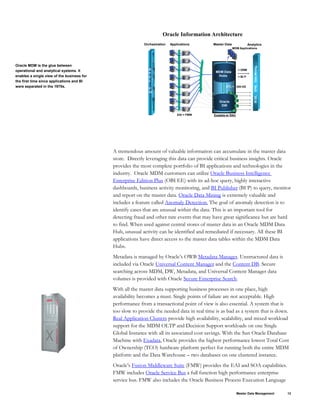
  • 16.
    Oracle MDM isthe glue between operational and analytical systems. It enables a single view of the business for the first time since applications and BI were separated in the 1970s. Exadata w/ RAC Oracle Information Architecture Applications EAI ETL Business Intelligence Master Data Analytics Orchestration Oracle DW MDM Data Hubs = = FMW BI EE, EPM, Data Mining, .. = DRM = BI P B P E L P M MDM Applications ODI EE A tremendous amount of valuable information can accumulate in the master data store. Directly leveraging this data can provide critical business insights. Oracle provides the most complete portfolio of BI applications and technologies in the industry. Oracle MDM customers can utilize Oracle Business Intelligence Enterprise Edition Plus (OBI EE) with its ad-hoc query, highly interactive dashboards, business activity monitoring, and BI Publisher (BI P) to query, monitor and report on the master data. Oracle Data Mining is extremely valuable and includes a feature called Anomaly Detection. The goal of anomaly detection is to identify cases that are unusual within the data. This is an important tool for detecting fraud and other rare events that may have great significance but are hard to find. When used against central stores of master data in an Oracle MDM Data Hub, unusual activity can be identified and remediated if necessary. All these BI applications have direct access to the master data tables within the MDM Data Hubs. Metadata is managed by Oracle’s OWB Metadata Manager. Unstructured data is included via Oracle Universal Content Manager and the Content DB. Secure searching across MDM, DW, Metadata, and Universal Content Manager data volumes is provided with Oracle Secure Enterprise Search. With all the master data supporting business processes in one place, high availability becomes a must. Single points of failure are not acceptable. High performance from a transactional point of view is also essential. A system that is too slow to provide the needed data in real time is as bad as a system that is down. Real Application Clusters provide high availability, scalability, and mixed workload support for the MDM OLTP and Decision Support workloads on one Single Global Instance with all its associated cost savings. With the Sun Oracle Database Machine with Exadata, Oracle provides the highest performance lowest Total Cost of Ownership (TCO) hardware platform perfect for running both the entire MDM platform and the Data Warehouse – two databases on one clustered instance. Oracle’s Fusion Middleware Suite (FMW) provides the EAI and SOA capabilities. FMW includes Oracle Service Bus a full function high performance enterprise service bus. FMW also includes the Oracle Business Process Execution Language Master Data Management 12
  • 17.
    Process Manager (BPELPM). This is the best business process orchestration product on the market. Both Enterprise Service Bus and BPEL PM understand the Oracle MDM data structures and access methods. Additional components include: Oracle Business Rules engine that can be coordinated with the data quality rules engines inside the MDM applications; an Event Driven Architecture for real time complex event processes so essential for triggering appropriate MDM related business processes when key data items are changed; Web Services Manager to manage and secure the SOA web services, including the web services exposed by the MDM applications; Web Center and Oracle B2B for individual and partner participation; XSLT & Xquery Translation for open standards based data transformations as master data flows between applications and the MDM data store; and Oracle Identity Management (OIM) for full user identification, authorization, and provisioning. OIM helps insure full Role Based Access Controls (RBAC) for the MDM applications7 and their primary data governance functions. The following figure illustrates how all these components are connected at the Enterprise Service Bus level. Each and every one of these plays a role in Oracle’s MDM architecture. Once we outline the key MDM processes that any master data solution must support, we will overview this architecture and discuss its key components. We will then focus on the supporting capabilities in the Oracle MDM Hub applications themselves. MASTER DATA MANAGEMENT PROCESSES Now that we have identified the nature of master data and its place in an information architecture, we need to identify the key processes that MDM solutions must support. Master Data Management 13 7 Leveraging Oracle Identity Management and Customer Data Hub, April 2006, URL
  • 18.
    These are thekey processes for any MDM system. • Profile the master data. Understand all possible sources and the current state of data quality in each source. • Consolidate the master data into a central repository and link it to all participating applications. • Govern the master data. Clean it up, deduplicate it, and enrich it with information from 3rd party systems. Manage it according to business rules. • Share it. Synchronize the central master data with enterprise business processes and the connected applications. Insure that data stays in sync across the IT landscape. • Leverage the fact that a single version of the truth exists for all master data objects by supporting business intelligence systems and reporting. Profile The first step in any MDM implementation is to profile the data. This means that for each master data business entity to be managed centrally in a master data repository, all existing systems that create or update the master data must be assessed as to their data quality. Deviations from a desired data quality goal must be analyzed. Examples include: the completeness of the data; the distribution of occurrence of values; the acceptable rang of values; etc. Once implemented, the MDM solution will provide the ongoing data quality assurance, however, a thorough understanding of overall data quality in each contributing source system before deploying MDM will focus resources and efforts on the highest value data quality issues in the subsequent steps of the MDM implementation. The Data Profiling and Correction option in Oracle Data Integration Suite (ODI) provides a systematic analysis of data sources chosen by the user for the purpose of gaining an understanding of and confidence in the data. It is a critical first step in the data integration process to ensure that the best possible set of baseline data quality rules are included in the initial MDM Hub. Master Data Management 14
  • 19.
    Consolidate Consolidation is thekey to managing master data. Without consolidating all the master data attributes, key management capabilities such as the creation of blended records from multiple trusted sources is not possible. This is the #1 fundamental prerequisite to true master data consolidation8. Consolidation is the key to managing master data, and a logical and physical model that can hold the master data is a prerequisite to true consolidation. Oracle MDM Hubs utilize state-of-the-art extensible data models. They are operational data models designed for OnLine Transaction Processing (OLTP). They are application neutral and capable of housings all corporate master data from all systems in all heterogeneous IT environments. This includes business objects such as Customer, Supplier, Distributor, Partner, Site, Product, Assets, Installed Base and more. The models support all the master data that drives a business, no matter what systems source the master data fragments. This includes (but is not limited to) SAP, Siebel, JD Edwards, PeopleSoft, Oracle E-Business Suite, Microsoft, Acxiom, Dun & Bradstreet (D&B), billing systems, homegrown systems, and legacy systems. Tools to load the data are also provided. Scalable batch load tools manage the history and mappings from source systems. Oracle provides powerful Data Quality Servers to standardize, cleanse, and match master data attributes during the MDM Data Hub load process. This insures that the loaded data is clean and duplicates are eliminated on the way in. Govern Master data is consolidated so that it can be cleansed and governed. Specific business objects require specific management tools. Managing unstructured product data is very different than managing structured customer data. This is why Oracle provides Data Quality servers for customer/party data and product/item data that are easily extended to suppliers, materials and assets. Data Governance refers to the operating discipline for managing data and information as a key enterprise asset. This operating discipline includes organization, processes and tools for establishing and exercising decision rights regarding valuation and management of data. Data governance is essential to ensuring that data is accurate, appropriately shared, and protected. Oracle MDM applications provide significant data quality and data governance capabilities. A sound data governance strategy not only aligns business and IT to address data issues; but also, defines data ownership and policies, data quality processes, decision rights and escalation procedures9. Share Clean augmented quality master data in its own silo does not bring the potential advantages to the organization. For MDM to be most effective, a modern SOA layer is needed to propagate the master data to the applications and expose the master data to the business processes. SOA and MDM need each other if the full potential of their respective capabilities are to be realized. Oracle MDM maintains an integration repository to facilitate web service discovery, utilization, and management. What’s more, Oracle MDM Hubs leverage Oracle Application Integration Architecture (AIA) to provide pre-built comprehensive application integration with the MDM data and MDM data quality services. AIA delivers a composite application framework utilizing Foundation Packs and Process 8 Global Single Schema, September 2008, URL Master Data Management 15 9 How Technology Enables Data Governance, An Oracle and First San Francisco Partners Whitepaper, December 2009, URL
  • 20.
    Integration Packs (PIPs)to support real time synchronous and asynchronous events that are leveraged to maintain quality master data across the enterprise. We will cover this significant differentiating capability for Oracle’s MDM in more depth in later sections. Leverage MDM creates a single version of the truth about every master data entity. This data feeds all operational and analytical systems across the enterprise. But more than this, key insights can be gleamed from the master data store itself. 360o views can be made available for the first time since operational and analytical systems split in the 1980s. Alternate hierarchies and what-if analysis can be performed directly on the master data. Oracle MDM Hubs leverage Oracle BI tools such as OBI EE and BI Publisher to produce 360o views and cross-reference data to the Data Warehouse and maintain master dimensions in the master data store. Data quality and segmentation can be viewed directly from the master data repository. Out-of-the-box reports are provided and BI Publisher has full access to all master data attributes within constrains set up by the data security rules. Oracle’s Analytical MDM can create an enterprise view of analytical dimensions, reporting structures, performance measures and their related attributes and hierarchies using Hyperion DRM's10 data model-agnostic foundation. ORACLE MDM HIGH LEVEL ARCHITECTURE The following figure identifies the major layers in the Oracle MDM architecture. Master Chart of Accounts, Customer, Supplier, Partner, Distributor, Regulator, Contact, Organization, Family, Constituent, Product, Item, Catalog, Medical Procedure, Calling Plan, Asset, Parts, SKU, Service, etc. with all their hierarchies and cross references all on one platform. • Oracle Fusion Middleware provides supporting infrastructure. • The MDM Applications layer contains all the base pre-built MDM Hubs and shared services. • The top layer includes MDM based solutions for Data Governance Master Data Management 16 10 Achieving Agility through Alignment, An Oracle Whitepaper, December 2008, URL
  • 21.
    MDM Platform Layer Thereare a number of Fusion Middleware (FMW) technologies used to support MDM Applications. These include application integration services, business process orchestration services, data quality & standardization services, data integration and metadata management services, business rules engine, event-driven architecture, web services management, user identity management, and analytic services. The following sections identify the FMW components that support these services and how they are leveraged by MDM Hubs. Application Integration Services Application integration services are provided by Oracle’s award winning Fusion Middleware. The following sections cover the key components used by the Oracle MDM suite of applications. Enterprise Service Bus Oracle Service Bus is a proven, lightweight and scalable SOA integration platform that delivers low-cost, standards-based integration for high-volume, mission critical SOA environments. It is designed to connect, mediate, and manage interactions between heterogeneous services, legacy applications, packaged applications and multiple enterprise service bus (ESB) instances across an enterprise-wide service network. It is designed for high volume low latency application-to-application integration (A2A) including MDM application integration to operational applications12. It supports Hub & Spoke, Publish & Subscribe, point to point, and content based routing. It has an easy to use full function design time tool for building the metadata needed at execution time. It comes with a large number of technology and application adaptors to speed implementation. Oracle MDM Hubs come with Oracle supported adaptors. Oracle is in the Forrester Leaders circle for Enterprise Service Buses saying “Oracle does it all and does it all well”11 . General Dynamics Land Systems (GDLS) needed a better contract management system to replace their old Validation database. GDLS has a complex IT landscape and wanted to insure the new system would support their plans for implementing a Service Oriented Architecture (SOA) across the enterprise. Oracle’s MDM solution for reference data mastering, Data Relationship Management (DRM) was selected and positioned as a foundation for their SOA implementation based on Oracle Fusion Middleware’s Enterprise Service Bus and BLEP Process Manager. Once completed, Contract Management, Order Fulfillment, Financial Invoicing, and Financial Collections will all work the Order to Cash process through one enterprise business process fed by applications using synchronized master contract data from the DRM MDM Hub. Master Data Management – The Missing Link in Your SOA Strategy Doug Field, GDLS, Susan Schoenherr, CSC Oracle MDM applications seamlessly work with the OSB and its A2A and Enterprise Information Integration (EII) capabilities. The OSB is familiar with the data structures and access methods of the MDM Hubs. Its routing algorithms have access to the FMW Business Rules Engine and can coordinate message traffic with data quality rules established by corporate governance teams in conjunction with the MDM Hubs. What’s more, MDM Hubs, configured as a ‘System of Record’, dramatically reduce the complexity associated with A2A integration. When all applications are in sync with the MDM Hub, they are in sync with each other. This effectively turns the n2 harmonization of fragmented data problem into a linier management of consolidated data problem. Architecturally speaking, this is a very significant improvement and leads to many cost of ownership advantages. Business Process Orchestration Services The Business Process Execution Language Process Manager (BPEL PM) provides business process orchestration services. BPEL is the standard for assembling sets of discrete services into an end-to-end process flow, radically reducing the cost and complexity of process integration initiatives. 11 The Forrester Wave™: Enterprise Service Buses, Q1 2009, URL 12 Oracle Service Bus Data Sheet, URL Master Data Management 17
  • 22.
    Built-in integration servicesenable developers to easily leverage advanced workflow, connectivity, and transformation capabilities from standard BPEL processes. These capabilities include support for XSLT and Xquery transformation as well as bindings to hundreds of legacy systems through JCA adapters and native protocols. The extensible WSDL binding framework enables connectivity to protocols and message formats other than SOAP. Bindings are available for JMS, email, JCA, HTTP GET, POST, and many other protocols enabling simple connectivity to hundreds of back-end systems13. BPEL PM has deep knowledge of Oracle MDM Data Hub structures and access methods. It comes with hot pluggable components for bringing the quality information in the MDM Hubs to all business processes and applications across the enterprise and beyond with business-to-business (B2B) integration support for EDI, HL7, Rosetta Net, UCCNet, GDSN, 1Sync and more. Business Rules The Oracle Business Rules is a business rules engine for making decisions about aggregating federated information in real time; resolving sourcing system conflicts; and coordinating data visibility with the data quality rules incorporated into MDM Applications. Privacy policies, regulatory policies, corporate policies, and data policies can be enforced. Policies can be as simple as: Every patient can read their own records, or as complex as: A “gold” customer has total assets under management > $100k and average monthly transaction volume > $10k and is in good standing. Oracle Business Rules allow business analysts to manage rules by defining and maintaining those rules in a separate repository, with an intuitive web-based interface. It can be executed from within an application via Java code, the Oracle Business Rules API, or a web services interface. This integration is especially attractive for MDM Hubs. Flexible System of Entry Master Data Hub Master Data Hub Master Data Hub Master Data Hub Entry into the System of Record Entry into a Connected System Coordinating the data quality rules configured in the data quality engine inside MDM Hubs with the rules configured in the integration layer allows the Oracle solution to manage master data updates from spoke systems and the MDM application. This is a key feature. Many master data management systems require that the MDM application be the only System of Entry. While having one System of Entry may simplify maters, most companies cannot shut down data entry in major 13 Oracle BEPL Process Manager Data Sheet, URL Master Data Management 18
  • 23.
    Master Data Management19 systems. The Oracle MDM solution, when deployed with OSB and BPEL PM with its Business Rules based policy engine can support multiple Systems of Entry. What’s more, the integration layer in conjunction with the MDM Hubs can enforce central data quality rules. Event-Driven Services Oracle Event-Driven Architecture (EDA) is comprised of best-in-class technologies for event-enabling a business. It allows applications to register events, associate payload packages and trigger designated business processes and workflows. The Oracle EDA Suite enables organizations to b e more responsive to their business events. Best of breed tools provide industry-leading functionality in each component14 . All changes to master data in the Oracle MDM Hubs can be exposed to the EDA engine. This enables the real time enterprise and keeps master data in sync with all constituents across the IT landscape. Human workflow services such as notification management are provided as built-in BPEL and OSB services that enable the integration of people and manual tasks into business processes. Payload packages identified by EDA accompany the workflow messages. Oracle MDM can automatically trigger EDA events and deliver predefined XML payload packages appropriate for the event. These packages are easily modified. Identity Management Oracle Identity Management (OIM) is an integrated system of business processes, policies and technologies that enable organizations to facilitate and control their users' access to critical online applications and resources — while protecting confidential personal and business information from unauthorized users15. Gartner has positioned Oracle Identity Management in the leaders quadrant based on "completeness of vision" and "ability to execute". It supports user authentication, authorization and provisioning. OIM uses MDM as source of truth for external identities (e.g. non-staff); insures that accounts for external identities are properly enabled/disabled according to organization business rules; and provides attestation reports to identify and disable rogue accounts. Oracle MDM Hubs utilize Oracle’s full function Identify Management solution. OIM enables the Role Based Access Controls (RBAC) so vital for controlling Create, Read, Update, and Delete (CRUD) access to the master data. Application LDAPDirectory EMAILServer Start event- drivenOIM user account provisioning CreatePerson MDM Gartner Web Services Management Oracle Web Services Manager (WSM), a component of Oracle’s SOA Suite, is a comprehensive solution for managing service oriented architectures. It allows IT 14 Oracle EDA Suite Data Sheet, URL 15 Leveraging Oracle Identity Management and Customer Data Hub, April 2006, URL
  • 24.
    managers to centrallydefine policies that govern web services operations such as access policy, logging policy, and content validation, and then wrap these policies around services with no modification to existing web services required. MDM Hub services are exposed as web services that are controlled and secured via WSM. Analytic Services The Analytics Server is key to leveraging the master data to gain insights into the business. This includes improved real time decision making and quality reporting. Corporate governance is enhanced and financial risk is reduced. Key components of the Analytics Server include Enterprise Performance Management, Data Warehousing, ETL, and Business Intelligence tools. The following sections identify the Oracle Analytic Server products used by and/or with MDM Applications. Enterprise Performance Management Oracle Hyperion Enterprise Performance Management (EPM) system brings management processes under a single umbrella, connecting financial and operational decisions and activities with transactional systems to form a comprehensive management picture. The MDM Data Hubs provide data to Oracle’s EPM applications. Oracle’s Enterprise Planning and Budgeting application, can leverage the reliable, accurate master data residing in an MDM Hub-fed data warehouse to perform its complex aggregations and produce actionable ‘what if’ plans around customers, products, accounts, etc. insuring reporting accuracy. What’s more, Oracle’s MDM solution for reference data and enterprise hierarchy management, Data Relationship Management (DRM), is fully integrated into Oracle Hyperion EPM. More detailed information on this Analytical MDM component of the Oracle MDM suite is included in the MDM Applications Layer chapter later in this document. “MDM is critical to Enterprise Performance Management – no one believes the reports and dashboards if the data is a mess.” Bill Swanton VP Research AMR Research Data Warehousing MDM supplies critically important dimensions, hierarchies and cross reference information to the Oracle Data Warehouse. With all the master data in the MDM Hubs, only one pipe is needed into the data warehouse for key dimensions such as Customer, Supplier, Account, Site, and Product. The “Star Schema” illustrated on the left from the Oracle whitepaper on Data Warehousing Best Practices16 shows all dimensions except Time are managed by Oracle MDM. Not only that, Oracle MDM maintains master cross-references for every master business object and every attached system. This cross-reference is available regardless of data warehousing deployment style. For example, an enterprise data warehouses or data mart can seamlessly combine historic data retrieved from those operational systems and placed into a Fact table, with real-time dimensions form the MDM Hub. This way the business intelligence derived from the warehouse is based on the same data that is used to run the business on the operational side. 16 Best practices for a Data Warehouse on Oracle Database 11g, URL Master Data Management 20
  • 25.
    Business Intelligence Using anMDM approach means that differences of opinion on data validity can be eliminated through a data governance process that enforces agreed to rules on data quality. Results of reports, ad-hoc queries, and analyses using data in the data warehouse can be correlated with the same quality data observed in the operational systems. Oracle Business Intelligence Enterprise Edition (OBI EE) provides ad-hoc query and real time dashboard capabilities. Oracle BI EE is designed to support heterogeneous data sources. With this capability and the data consistency an MDM solution provides, it is possible to view the master data, the data residing in transaction tables, and the data warehouse. The following figure illustrates the role MDM plays in creating accurate data from pre-built ETL Mappings. BI EE Dashboarding Pre-built ETL Mappings Operational Summaries Transaction Tables Dimensional Summaries Common Schema Common Schema Data Hubs Data Hubs Master Data Application knowledge is critical. These types of high value analytical applications require a tight linkage to the transactional applications in order to provide the out- of-the-box mappings. Oracle MDM Hubs play a central role in rationalizing master data across the heterogeneous application landscape and therefore play a central role in these types of analytics. In fact, Oracle delivers thousands of Oracle Data Integrator attribute maps for dozens of dimensions out-of-the-box. Publishing Services Oracle BI Publisher provides the ability to rapidly create high fidelity reports and forms using common desktop authoring tools. BI Publisher is included in the Oracle BI EE Suite and can be used to author reports around data produced in queries submitted by Answers. For example, one might use BI Publisher to build reports that include master data, transaction data, and warehouse data. Oracle MDM uses BI Publisher with out-of-the-box report generation capabilities. Data Migration Services Oracle is a leader in Data Integration – Gartner's Data Integration Magic Quadrant Data Migration Services include Data Integration and Metadata Management. Data Integration is essential for MDM in that it loads, updates and helps automate the creation of MDM data hubs. MDM also utilizes data integration for integration quality processes and metadata management processes to help with data lineage and relationship management. The Oracle Data Integration Suite (ODI) provides a fully unified solution for building, deploying, and managing complex data warehouses. In addition, it combines all the elements of data integration—data movement, data synchronization, data quality, data management, and data services—to ensure that information is timely, accurate, and consistent across complex systems. What’s more, Oracle Data Integrator Enterprise Edition delivers unique next-generation, Extract Load and Transform (E-LT) technology that improves performance, reduces data integration costs, even across heterogeneous systems17. This makes 17 Oracle Data Integration Suite Data Sheet, URL Master Data Management 21
  • 26.
    ODI the perfectchoice for 1) loading MDM Data Hubs, 2) populating data warehouses with MDM generated dimensions, cross-reference tables, and hierarchy information, and 3) moving key analytical results from the data warehouse to the MDM Data Hubs to ‘operationalize’ the information. High Availability and Scalability With all the master data in one place, High Availability becomes a requirement. Just as importantly, an organization cannot deploy an MDM solution that won’t keep up with growing data volumes, users, application suites and business processes. Key benefits of RAC include availability, horizontal scalability on lower-cost hardware and sharing capacity across database management system (DBMS) instances in a grid18 . Real Application Clusters Real Application Clusters (RAC) provides the needed high availability and scalability. RAC is an option to Oracle Database 11g Enterprise Edition. It supports the deployment of a single database across a cluster of servers—providing unbeatable fault tolerance, performance and scalability with no application changes necessary. As your system grows, nodes can be added without downtime. Oracle MDM applications run seamlessly on RAC clusters. Mixed Workloads Oracle’s ability to run mixed workloads across RAC nodes is unique in the industry and adds another significant dimension to Oracle’s MDM solution. OLTP workloads are routed to a subset of clustered servers accessing the MDM tables while Data Warehousing workloads are routed to other nodes in the same cluster. With world class transaction processing and record data warehousing performance, on a single instance becomes possible. The data warehousing tables and MDM tables reside in an environment all managed through a single Oracle Enterprise Manager console. This lower cost, more easily managed environment provides dramatic savings and puts a company on the path to a more rational IT infrastructure. Exadata With the acquisition of Sun Microsystems, Oracle has become a Software- Hardware-Complete vendor. No software-hardware application illustrates the benefits of this combination better than Master Data Management running on the Exadata database computer20. The OLTP MDM tables can coexist with the Data Warehouse star schemas moving data around a disk array, creating summarized tables and utilizing materialized views without offloading terabytes of data through costly networks to multiple hardware platforms. Availability and scalability are maximized even as the total cost of ownership is reduced. Only Oracle offers a full suite of business applications, state of the art middleware, a world class clustered database, and a low cost high performance hardware platform. MDM takes full advantage of this combination to the significant benefit of our customers. In Oracle Exadata V2, Oracle has delivered a purpose-built machine for a wide variety of enterprise needs: data warehousing, OLTP and mixed workloads19 . Merv Adrian, Principal IT Market Strategy 18 Oracle RAC Moved to Mainstream Use, Gartner, Feb 2009, URL 19 Oracle Exadata: a Data Management Tipping Point, Merv Adrian, Principal, IT Market Strategy, URL 20 Sun Oracle Database Machine Data Sheet, URL Master Data Management 22
  • 27.
    Master Data Management23 Application Integration Architecture Zebra Technologies ensured rapid integration of numerous systems using Oracle Application Integration Architecture, including linking the company’s new and legacy enterprise resource planning solutions running in parallel during the transition and linking E- Business Suite to Oracle’s Customer Hub21 . Application Integration Architecture (AIA) utilizes Oracle’s premier SOA suite to build out-of-the-box Oracle Application integrations in the context of enterprise business processes. These integrations directly support MDM. There are multiple levels of integration between MDM and SOA. • Connectors and transformations • Mutually understood data structures and access methods • Pre-Built Application and Master Data synchronization • Pre-Built SOA/MDM Enterprise Business Processes The business value goes up the more levels a vendor provides. All MDM vendors provide some level of connectors and templates for transformations. Only vendors that provide both MDM and SOA can integrate the two. Most of these vendors provide their SOA with knowledge of their MDM data structures and access methods. But only vendors who actually have applications can provide pre-built master data synchronizations and pre-built enterprise business processes. Oracle has integrated its market leading MDM suite of applications with its powerful Fusion Middleware driven SOA suite. The following section describes how Oracle brings these two together at all three integration levels listed above22. AIA Layers AIA delivers the following components deployed at the various levels of the SOA stack. 1) Industry reference models cover the best practice business processes for key industries. 2) This layer is supported by Enterprise Business Objects (EBOs). 3) These objects are orchestrated into process & task flows with data transformations. 4) Flows utilize Enterprise Web Services. 5) These services are provided by the underlying Oracle Applications and MDM Hubs. Oracle is utilizing its MDM and SOA capabilities, along with the AIA EBOs and associated structures, to pre-build application integrations in the context of key industry specific business processes. The EBOs are deployed as part of a common object methodology that uses the EBOs to define all transformation from target and source applications included in the business process. 21 Zebra Technologies Oracle Customer Snapshot, URL 22 MDM as a Foundation for SOA, an Oracle Whitepaper, November 2007, URL
  • 28.
    Common Object Methodology “Oneof the most complicated aspects of any cross application IT project is determining the underlying canonical model. You can’t communicate effectively if every application is using a different set of terms and definitions.” Erin Kinikin, Independent Analyst The following figure illustrates how the common object methodology is used to integrate the Oracle Applications. As data flows from source systems, it is transformed via provided maps into a common object model. Once the appropriate business logic is executed for a particular business process, the data is again transformed via provided maps from the common object model to the format needed by target systems. Oracle has leveraged its ability to fuse applications and technology to incorporate MDM applications as a foundation component for its SOA Suite. Delivering more than just connectors and templates, Oracle’s MDM-SOA combination delivers out- of-the-box, fully tested and extensible, pre-built SOA enterprise business processes that synchronize MDM data stores with applications. Deploying the MDM Hubs and connecting them to the common object model in the AIA integrations, provides the consolidated, cleansed, deduplicated, augmented authoritative ‘Golden Record’ to every application and business process in the delivered pre-built SOA integration. MDM Foundation Packs “Oracle Application Integration Architecture Foundation Pack enabled us to realize a 60% cost savings when integrating multiple enterprise systems by eliminating the need to develop and manually map the individual components.” Don O’Shea, Chief Information Officer, Zebra Technologies Corporation AIA delivers its base integration capabilities in Foundation Packs. Master Data Management processes such as ‘Publishing’ master data to multiple subscribers is designed in. For example, customer information can be created, updated, and deleted in multiple participating applications and sent to the Oracle Customer Hub for updating, cleaning, and validation. Subsequently, the Customer Hub, as the single source of truth, publishes the customer information for multiple subscribing participating applications to consume23. Foundation Packs are available for all application integration scenarios. MDM Process Integration Packs AIA delivers pre-built integrations as Process Integrations Packs (PIPs). These packs are pre-built composite business processes across enterprise applications. They allow organizations to get up and running with core processes quickly. When delivered with MDM, these complete, out-of-the-box, integrations 23 Oracle Application Integration Architecture – Foundation Pack 2.3: Release Notes, April, 2009 Master Data Management 24
  • 29.
    include everything neededto gain immediate business value and increase business and IT efficiencies. Key MDM PIPs include: • Process Integration Pack for Oracle Customer Hub is a collection of core processes to support out-of-the-box Customer MDM integration processes across Oracle Customer Hub, Siebel CRM and Oracle E- Business Suite, as well as a framework to enable MDM integrations with other Oracle and non-Oracle applications24. • Process Integration Pack for Oracle Product Hub is a collection of core processes to support out-of-the-box Product MDM integration processes across Oracle Product Hub, Siebel CRM and Oracle E-Business Suite25. MDM Aware Applications Master data attributes within any particular transactional application have relevance beyond the application itself. When an application understands that the key data elements within its domain have business value beyond its borders, we say it is “MDM Aware”. An MDM Aware application is prepared to: • Use outside data quality processes for data entry verification • Pull key data elements and attributes from an outside master data source • Push its own data to external master data management systems In short, MDM Aware applications are pre-disposed to participating in the MDM data quality process. This dramatically speeds the deployment of MDM solutions, reduces risk and insures quality data is distributed as needed across the IT landscape. Oracle Applications are MDM Aware. Recent combined MDM and AIA releases enable non-Oracle applications to become MDM Aware. A composite application user interface is available that enables non-Oracle applications such as legacy and web applications to also become MDM Aware26. Composite Application Development With AIA Foundation Packs, MDM PIPs and MDM Aware applications, organizations can more readily create new business processes by combining relevant elements of existing applications. This is called Composite Application Development. This was the SOA vision. That vision has been slow to realize due to the large number of complex integration components, lack of built in governance, and continuing data quality problems in the underlying applications. The power of the AIA out-of-the-box pre-built SOA with open, extensible and governable components together with the power of the pre-cabled Oracle MDM solution to ensure quality data across the applications and composite applications eliminates these SOA roadblocks. The SOA promise of IT flexibility is finely realized. Oracle Data Quality Services Data cleansing is at the heart of Oracle MDM’s ability to turn data into an enterprise asset. Only standardized, de-duplicated, accurate, timely, and complete data can effectively serve an organization’s applications, business processes, and analytical systems. From point-of-entry anywhere across a heterogeneous IT 24 Process Integration Pack for Oracle Customer Hub, an Oracle Data Sheet, URL 25 Process Integration Pack for Oracle Product Hub, and Oracle Data Sheet, URL 26 MDM Aware Applications, an Oracle Whitepaper, July 2009, URL Master Data Management 25
  • 30.
    landscape to endusage in a transactional application or a key business report, Oracle MDM’s Data Quality tools provide the fixes and controls that ensure maximum data quality. If bad data impacts an operation only 5% of the time, it adds a staggering 45% to the cost of operations. Poor data quality cost business’ 10% to 20% of revenue! Customer, Client, Student, Patient, Employee, Doctor, Counterparty, Supplier, Partner, Distributor, Regulator, Contact, Organization, Family, Constituent, Address, Site, Location, etc. Product, Item, Catalog, Medical Procedure, Drug, Calling Plan, Synthetic CBO, Asset, Parts, SKU, Service, Material, Meter, Contract, etc. Thomas C. Redman, DM Review Oracle recognizes that there are two primary data categories: relatively structured party data and relatively unstructured item data. Party data includes people and company names such as customers, suppliers, partners, organizations, contacts, etc., as well as address, hierarchies and other attributes that describe who a party is. The following figure illustrates this kind of data and the problems most frequently encountered. This is relatively structured error-prone data that is subject to country specific rules. It must be cleansed in order to find matches. Pattern matching tools are best for cleansing this kind of data. Item data includes Products, Services, Materials, Assets, and the full range of attributes that describe what an item is. This is relatively unstructured data that is subject to category specific rules. It is common for widely different descriptions to actually be identifying the same item. Semantic matching tools are required for cleansing this kind of data. Any vendor that does not have this kind of semantic technology cannot satisfactorily master product data. Master Data Management 26
  • 31.
    These differences betweenparty and item data are fundamental to the data itself. This is why Oracle provides data quality tools specifically designed to handle these two kinds of data. One is our suite of Customer Data Quality servers and the other is our state-of-the-art Product Data Quality. The following sections discuss these two product areas in more depth. Oracle Customer Data Quality Servers Oracle Data Quality puts control of data quality processes in the hands of business information owners, such as data analysts and data stewards. Oracle Customer Data Quality offers an end-to-end solution enabling customers to execute data quality processes on their customer, supplier and site data. The product family combines powerful data analysis, cleansing, matching, and reporting and monitoring capabilities with unparalleled ease of use. Combined, they provide a complete solution covering all data quality functionalities needed in an enterprise, delivering in terms of both performance and scalability on a truly global scale. In particular, Oracle Customer Data Quality delivers: • Complete solutions for all customer data quality needs that covers full spectrum of data quality functionalities • Best-in-class matching engine with superb accuracy on all types of name, address and identification data, flexible and adaptive to suit any customer situations • Unprecedented global coverage with matching libraries for 52 languages and address validation across 240 countries, 40 character sets and 100+ address formats • Tight integration with Oracle MDM and CRM applications to help customers understand the data quality status, address the data quality problems and achieve single view of the customer data Oracle has four Data Quality offerings27: • Oracle Data Quality Profiling Server • Oracle Data Quality Parsing and Standardization Server • Oracle Data Quality Matching Server • Oracle Data Quality Address Validation Server Oracle Data Quality Profiling Server allows users to use business rules and reference data to analyze and rank data; identify, categorize, and quantify low- quality data; and create reports and dashboards to confirm data quality improvement. Oracle Data Quality Parsing and Standardization Server allows users to use business rules to parse or merge data elements into the expected attributes for the master records; and use reference data dictionaries to standardize freeform text data elements. Oracle Data Quality Address Validation Server offers quick validation and correction of worldwide postal addresses; address coverage in more than 240 countries; and integrated single vendor– single API supports all countries. Oracle Data Quality Matching Server allows users to add real-time search for people, companies, contacts, addresses, households, titles and products; discover 27 Oracle Customer Data Quality Data Sheet, URL Master Data Management 27
  • 32.
    duplicates and establishrelationships in real time; and build relationship link tables and match external files and databases. Oracle Data Quality Profiling Server When data quality is measured, it can be effectively managed. Data profiling is the first step for data quality. Oracle Data Quality Profiling Server gives users with the ability to measure the level and nature of data quality problems across multiple data sources—to identify, quantify, and categorize current and potential data quality issues and adherence to business rules. The product also provides the metrics and reports that business information owners need to continuously measure, monitor, track, and improve data quality at multiple points across the organization. Oracle Data Quality Parsing and Standardization Server Some examples of tasks carried out by this module include noise removal; data parsing; standardization of terms; derivation of missing data values; and generation of data quality flags for use in matching rules. The goal of the standardization phase of a data quality management process is to remove or flag problems prior to moving on to the matching phase. Oracle Data Quality can also generate metadata that enables easy parsing and standardization of data. In the standardization phase each of the key data fields is passed through a series of user defined rules to remove inconsistencies and unconformities identified during the data profiling stage. The output is a range of new data fields containing standardized and enhanced data. The new data fields created during the standardization phase may be used solely for the matching process, or they may also be written back to the original source file to replace the original data. Oracle Data Quality Matching Server Oracle Data Quality Matching Server performs high-quality search, match, duplicate identification, and relationship linking on all types of name, address and identification data. The solution includes highly-flexible search strategies, which can be selected based on the data being searched for, the level of risk and the need that the search must satisfy, allowing users to balance performance and comprehensiveness of search/match. Multi Mode Support: Oracle Data Quality Matching Server allows for the use of different sets of match rules depending on the mode of operation. For example, it allows one set of match rules for data entering the hub through real time mode and a different set of match rules for data entering the hub through the batch mode. Oracle Data Quality Matching Server delivers industry leading global coverage with language/locale specific matching libraries for 52 languages/locales. Also included is an easy to use admin console which enables enterprise to adapt matching rules and algorithms for their specific scenarios, or to extend matching to additional languages and/or locales. Oracle Data Quality Matching Server is preintegrated into Oracle CRM/MDM solution to enable quick deployment of data quality and data management capabilities within an enterprise environment. Additionally, it is a highly-scalable solution with proven performance on systems with billions index entries on one database and millions real-time transactions in an hour. Oracle Data Quality Address Validation Server Oracle Data Quality Address Validation Server provides capabilities to parse, standardize, transliterate, deduplicate and validate all address data, resulting in improved address data quality, which in turn would help enterprise in integrating Master Data Management 28
  • 33.
    international customer information,preventing against identity loss, and assisting in fraud detection and prevention, as well as directly reducing mail based marketing costs. The server performs validation of address data against published standards and directories by utilizing reference data. As postal codes change in different countries due to settlements, system changes or name changes, reference tables for each country can also be updated on a monthly, quarterly or biannual basis. Oracle leverages arrangements with leading postal reference data provider to enable customers to receive the updates on a periodical basis. These reference tables are provided in a separate, platform-independent database making it easily updateable at any time. Oracle DQ, customers can choose 3rd party data quality management solutions. These are available via pre-integrated adapters to the Customer Hub. In addition, Oracle provides out-of-the-box integration with enriched content from external providers such as Acxiom for Knowledge Based MDM, and Dun & Bradstreet for Business Hierarchies. Connectors to third party DQ vendors such as Trillium are also available. Oracle Customer Data Quality servers enable business information owners and IT to work together to deploy lasting customer data quality programs. Business information owners use Oracle Data Quality to build data quality business rules and define data quality targets together with the IT team, which then manages deployment enterprise-wide. Product Data Quality Typical product data is unstructured, non-standard and often missing important information. These product data errors slow procurement, development, distribution and negatively impact service. Oracle Product Data Quality (PDQ) with patented Data Lens™ semantic-based technology is designed to solve this problem. PDQ is built from the ground up to tackle the unique challenges of assessing, and improving the ongoing management of product data. Oracle Product Data Quality has been proven in a wide range of customer scenarios involving Product, Item, Catalog, Medical Procedure, Calling Plan, Asset, Parts, SKU, Service, and other forms of product or product-like data across a range of industries. Oracle Product Data Quality is designed to handle data that is: It is sometimes claimed that traditional data quality tools designed for customer (name & address) data can also handle product data, but this is true only in the most simplistic of cases. In reality, product data has a number of characteristics that put it beyond the scope of traditional toolsets. Poorly structured—requires sophisticated semantic parsing capabilities Non-standard—required standards to be applied and data transformed to meet enterprise standards Highly variable—practically infinite combinations of acronyms, spelling and vocabulary variations and other cryptic information requires flexible recognition and transformation capabilities Category-specific—requires the ability to both categorize an item and apply different rules based on content and context Variable quality—requires integrated exception management and remediation capabilities Duplicated—requires sophisticated semantic matching capabilities Oracle Product Data Quality delivers: • Semantic-based recognition—based on context to enable accurate parsing, standardization and matching along with auto-learning to handle the extreme variability and unpredictability of product data Master Data Management 29
  • 34.
    Master Data Management30 • Scalability—to manage millions of items across thousands of categories • Integrated Governance—to allow data stewards to monitor overall process effectiveness as well as drive direct data remediation • Business User Interface—designed using a code-free interface for use by the business user who best understand the rules and nuances of the data • Enterprise-wide Applicability—a standard process that can 'plug-in' to existing systems and processes to enforce product data quality standards in any process or system Emerson Corporation is a $20B diversified global manufacturer. Poor quality product data was increasing new product lag times and driving up costs. Data standardization initiatives were launched. Emerson tried a number of approaches to solve the problem. Manual efforts did not scale. Custom code was too expensive. Traditional data quality tools were ineffective on unpredictable unstructured data. Then Emerson tried the semantic based Data Lens technology found in Oracle Product Data Quality. “It actually worked!” Phil Love, Manager, Data Quality Like an optical lens, a ‘data lens’ does not store the data is ‘sees, but simply provides a real-time mechanism to view your data in a different way – transformed or ‘re- focused’ in whatever way you specify. PDQ represents a breakthrough in product data solutions with next generation semantic technology that automates what has traditionally been a costly, labor- intensive and largely unreliable process28. Product Data Quality provides an integrated capability to recognize, cleanse, match, govern, validate, correct and repurpose product data from any source. It can standardize product classifications, attributes, and descriptions and translate languages as data flows into the Product Hub tables. All input items are compared against the semantic model for contextual recognition & validation. Semantic recognition uses whole context to determine meaning and category. Semantic recognition identifies item category and key attributes even with highly variable data. The system infers meaning from unrecognized items and asks for confirmation from the user. Category-specific semantic models flag missing information for potential remediation. If the user confirms, new rules can be created to extend semantic model. Data is converted, transformed and re- assembled into the Product Hub. Product Data Quality can standardization any attributes in any form. It can make imperial/metric conversions and handle multiple classifications. Its auto-translation capabilities can translate millions of rows in seconds with full double-byte support. Exception management for validation and remediation is a key component of the solution and quality is governed via a supplied Data Steward dashboard. The dashboard provides quality metrics by process, source, and product category and management metrics such as task management overviews that measure productivity and identify bottlenecks. A Data Governance Studio dashboard provides visibility to enterprise data and metrics to drive process improvements. The key to accomplishing these data quality 28 Oracle Product Data Quality Data Sheet, URL
  • 35.
    goals is thesolution’s ability to learn through semantic recognition that gains contextual knowledge over time. End-To-End Data Quality Error correction at the source is how you turn a thousand points of data entry into a single version of the truth. Data quality tools are applied against data as it is held in databases, as it is moved, and as it is entered. The value of the data quality goes up as the number of places it can be brought to bear increases. The left hand side of the following picture illustrates data quality improvements being applied as the data as it flows from applications into the MDM Data Hub. The data integration technology is ETL. Most data quality tools can clean up the data in the applications and in databases such as a data warehouse or an MDM Hub. Oracle’s MDM DQ tools can do the same. But DQ technology that stops there is still letting poor quality data enter the IT landscape. Potentially thousands of people are entering customer data into a wide variety of operational applications. In fact, data errors are entering the system at a significant rate. Data quality tools that clean things up after the fact and try undo any damage caused by poor quality data are certainly performing a beneficial service. But a DQ technology that can prevent the data entry errors in the first place would be far superior. This is exactly what Oracle has been able to do because of its fusion of MDM and SOA. The right hand side of the above picture illustrates how Oracle, using AIA PIPs, can trap data entry in real time and perform key DQ functions such as Fetch, match, Enhance, and Synchronize for MDM Aware Applications. This is the final Data Quality answer. It fixes the DQ problem at its source. Master Data Management 31
  • 36.
    Master Data Management32 Application Development Environment JDeveloper serves as the development environment for new application creation, existing application extensions and composite application development. Web Service Invocation Framework (WSIF), and Java Business Integration (JBI) are fully supported. Application functions are designed and built to be deployed as web services. This is the ideal tool for creating new and composite applications around the Oracle MDM Hubs. JDeveloper has full access to the MDM Hub APIs and Web Services. Oracle MDM Hubs can actually support applications directly. This gives Oracle’s master data solution a key differentiation over all other approaches. When new applications are written to replace older apps, or Oracle applications are deployed in place of existing apps, physical silos are removed from the IT landscape. Application Development Directly on the Oracle MDM Data Hubs Integrate Orchestrate Develop Manage Secure Master Data Hub Master Data Hub Change Monitor This is key to IT infrastructure simplification and is why we call Oracle MDM a first step on the ‘path to a suite’. MDM APPLICATIONS LAYER Oracle MDM includes a large portfolio of purpose built master data management applications. The MDM Applications include all MDM Hubs and their corresponding data quality servers. Data Governance is also included. The following sections will cover: • Oracle Customer Hub o Oracle Higher Education Constituent Hub • Oracle Product Hub o Oracle Product Hub for Retail o Oracle Product Hub for Comms • Oracle Supplier Hub • Oracle Site Hub • Oracle Data Relationship Management No other vendor on the market has this breath of master data element coverage. MDM Pillars The MDM Applications are organized around five key pillars. The following figure illustrates these pillars of every MDM Application.
  • 37.
    • Trusted MasterData is held in a central MDM schema. • Consolidation services manage the movement of master data into the central store. • Cleansing services de- duplicate, standardize and augment the master data. • Governance services control access, retrieval, privacy, auditing, and change management rules. • Sharing services include integration, web services, ETL maps, event propagation, and global standards based synchronization. These pillars utilize generic services from the MDM Foundation layer and extend them with business entity specific services and vertical extensions as described in the MDM High Level Architecture covered in an earlier section of this paper. The following sections describe Oracle’s MDM Applications for customer, product, supplier, site, and financial master data as well as a section on the very important role played by data governance. Oracle Customer Hub “We selected Siebel UCM because of its out-of-the-box, rich customer master functionality, its industry-specific best practices, and its ability to integrate many different applications” Shaun Coyne, VP & CIO Toyota Financial Services Oracle Customer Hub29 (OCH) is Oracle’s lead Customer Data Integration (CDI) solution. OCH’s comprehensive functionality enables an enterprise to manage customer data over the full customer lifecycle: capturing customer data, standardization and correction of names and addresses; identification and merging of duplicate records; enrichment of the customer profile; enforcement of compliance and risk policies; and the distribution of the “single source of truth” best version customer profile to operational systems. Oracle Customer Hub is a source of clean customer data for the enterprise. The primary roles are: • Consolidate & govern unique, complete and accurate master Customer information across the enterprise. • Distributes this information as a single point of truth to all operational & analytical applications just in time. 29 Oracle Customer Hub includes both Oracle EBS Customer Data Hub (CDH) and Siebel CDI Universal Customer Master (UCM). Master Data Management 33
  • 38.
    To accomplish this,OCH is organized around the five MDM Pillars: Allianz is moving from a product-centric business model to a customer-centric business model. Allianz Polska Group is using MDM to increase competitiveness in these tough times for the Financial Services industry by: 1) improving the quality of service from the Customer Service Center; 2) improving the accuracy of customer data for Marketing initiatives; and 3) providing complete customer information for Agents. • Trusted Customer Data is held in a central MDM schema. • Consolidation services manage the movement of master data into the central store. • Cleansing services de-duplication, standardize and augment the master data. Tomasz Konstantynowicz, Michal Kotnowski, Pawel Psuty Teneto Consulting • Governance services control access, retrieval, privacy, audit and change management rules. • Sharing services include integration, web services, event propagation, and global standards based synchronization. These pillars utilize generic services from the MDM Foundation layer, and extend them with business entity specific services and vertical extensions. Customer Data Model “We chose the CDH to help us improve efficiency, quality and decision making on localized basis by sharing and reusing knowledge on a global basis. We expect to increase levels of regulatory compliance and financial transparency via traceability and disclosure controls on a global basis” Thomas V. Carlock, Vice President CIT Group The OCH data model is an extensible proven transaction processing schema that has evolved and developed over many years to the point where it is able to master not only the customer profile attributes required in the front office but also those required by all applications and systems in the enterprise. A few of its key characteristics include: • Roles and Relationships – The customer model provides support for managing the roles and hierarchical relationships not only within a master entity but also across master entities. • Related and Child Data Entities and their Configuration – The customer model is designed to store all the related and child level customer data entities such as Addresses, Related Organizations, Related Persons, Assets, Financial Accounts, Notes, Campaigns, Partners, Affiliations, Privacy and so on. • Industry Variants - The prebuilt customer data model is designed to model and store the customer profile attributes for many major vertical markets and industries, including (but not limited to); Financial Services, Master Data Management 34
  • 39.
    Consolidate Qwest Communications neededto improve is customer information. Customer data was fragmented across a wide variety of applications making it difficult to answer event the simplest of questions like: Are we billing for all services provided? Consolidation of customer data was the answer. The selected solution would have to integrate into a complex IT landscape including all wireless and wireline applications and the data warehouse. Qwest chose Oracle Customer Hub because of: its deep functionality; ability to integrate with Ordering, Portal and Billing systems; and its straight forward mapping into the data warehouse. Bob Speer, Principal Architect, Qwest IT Enterprise Architecture Customer data is distributed across the enterprise. It is typically fragmented and duplicated across operational silos, resulting in an inability to provide a single, trusted customer profile to business consumers. It is often impossible to determine which version of the customer profile (in which system) is the most accurate and complete. The “Consolidate” pillar resolves this issue by delivering a rich set of interfaces, standards compliant services and processes necessary to consolidate customer information from across the enterprise. This allows the deploying organization to implement a single consolidation point that spans multiple languages, data formats, integration modes, technologies and standards. Some of the key features in the “Consolidate” pillar include: List Import Workbench- The List import workbench empowers business users to load data into the hub through metadata and template driven approaches including support for flat files, XML files and excel files. The import workbench also includes user interfaces to resolve error conditions. In addition to providing a high performance, high volume batch import, the list import functionality is also available as a web service for real time integration. Agrokor Group, a food distribution company and the largest private company in Croatia, had a serious data duplication problem that was dramatically impacting the time it took to create accurate reports. Oracle Customer Hub was deployed to leverage its ability to eliminate duplicates. Agrokor was able to reduce reporting time from two weeks to two minutes! “This is the first successful deployment of this Oracle solution in Croatia. Since we went live, more companies have followed suit, which indicates how successful it has been for us.” Ante Lausic, Director of IT Projects Identification and Cross-reference - To capture the best version customer profile, OCH provides a prebuilt and extensible customer lifecycle management process. This process manages the steps necessary to build the trusted “best version” customer profile: identification; registration; cleansing; matching; enrichment; and linking. The best version customer record also leverages Universal Unique ID (UUID) to uniquely identify the record across the entire enterprise. The customer record is also tracked across the enterprise by using one-to-many cross referencing mechanism between the OCH customer Id and other applications’ customer records. Source Data History - OCH also maintains a history of the changes that have been made to the customer profile over time. This history allows the Data Steward to not only see the lineage associated with a customer record, but also provides the ability to optimize the source and attribute survivorship rules which contribute to building the “best version” record. The history also enables the Data Steward to roll back the system to a prior point in time to undo events such as a customer merge. Survivorship - The data stewardship and survivorship capability consists of a set of features and processes to analyze the quality of incoming customer data to determine the best version master record. OCH include rules based survivorship that not only includes pre-seeded rules through its integration with a powerful Business Rules Engine (Haley) but also allows users to define any new rule in addition to allowing users to integrate OCH with any other rules engine. OCH also includes support for new rule types like Master and Slave that would determine survivor and victim records. Finally OCH also supports configuring household survivorship rules. Master Data Management 35
  • 40.
    Cleanse Centralizing the managementof customer data quality has always been a goal of Customer Hub solutions. The “Cleanse” pillar in OCH provides an end-to-end integrated data quality management functionality to analyze/profile the data, standardize and cleanse the data, match and de-duplicate the data and finally enrich the data to create the best version master record. The powerful end-to-end data quality capabilities around profiling, matching, standardization, and address validation are available for all Oracle MDM Hubs, and are discussed later in this document. Additional Cleanse pillar capabilities include: Data decay monitors can be configured on column and records level. And can trigger actions based on some pre set criteria for example we can make a rule that when data is decay indicator for consumer address field reaches 80 then we automatically trigger enrichment call to Acxiom to get the latest information about the consumer address. Data Decay - Data decay refers to the way in which managed information becomes degraded or obsolete or stale over time. OCH provides data decay dashboards to monitor and fix the data decay of Account and Contact records. These dashboards are accessed through the OCH administration screens. OCH Data Decay management consists of the following key components: o Decay Detection: Captures updates on the monitored attributes / relationships of a record and sets the decay metrics at the attribute level granularity or relationship level granularity. o Decay Metrics Re-Calculation - Process to retrieve Decay Metrics for the monitored attributes/relationships of a record, use a set of predefined rules to calculate the new metrics value and update the metrics. o Decay Correctness - Identifies stale data based on certain criteria and triggers a pre-defined action. o Decay Report - generates Decay Metrics charts on a periodic basis • Guided Merge & Un-Merge - Guided Merge allows end-user to review duplicate records and propose merge by presenting three versions (Victim, Survivor and Suggested) of the duplicate records and allows end users to decide how the record in the OCH should look like after the merge task is approved and committed. Similarly the Un-Merge feature rolls back a previously committed merge request. “We are very happy with results of the project. Oracle Customer Data Hub, undoubtedly, has confirmed the wide integration capabilities and powerful productivity (…).” Askar Kusainov, VP of the Board Halyk Bank • Enrichment - OCH provides an out of the box integration with enriched content from external providers such as Acxiom and Dun & Bradstreet. • High Performance - Oracle data quality solution has a proven track record in terms of scalability and performance, handling large volume, highly-scalable, critical applications. It is a highly-scalable solution with proven performance on systems with billions index entries on one database and millions real-time transactions in an hour. Govern Data governance is a framework that specifies decision rights and accountability on the data and all data-related processes. In other words, this framework determines who can do what with which data fields, at what stage and under what circumstances. The “Govern” pillar in OCH enables users to “govern” master data across the enterprise using key capabilities including: Master Data Management 36
  • 41.
    "Most companies donot combine data governance and MDM when getting started, so they fall short in addressing the people and process issues that cause data quality issues in the first place. Kelle O'Neal, Managing Director, First San Francisco Partners LLC. • Oracle Data Governance Manager - Oracle Data Governance Manager (DGM) is an intuitive graphical user interface that acts as a centralized management destination for data stewards and business users to manage customer data throughout the customer data lifecycle. DGM enables users to: o Define and view enterprise master data and policies o Monitor data sources, data loads, data transactions and data quality metrics o Fix data issues and refine data quality rules o Operate – Consolidate, cleanse, share and govern – the hub • Advanced Hierarchy Management - Advanced Customer Hierarchy Management is enabled within OCH through integration with Oracle Hyperion Data Relationship Manager (DRM). This expands hierarchy management capabilitie with DRM’s features made available for OCH accounts, account hierarchies and Dun & Bradstreet (D&B) hierarchies. In this advanced option, data stewards can create new hierarchies; drag and drop new account nodes into and out of a hierarchy; and compare, blend, merge, and delete hierarchies. • Policy & Privacy Management - The Privacy Management Policy Hub enables an enterprise to centralize the enforcement of Privacy policies within an OCH or CRM deployment. This module extends the standard customer master, making it a central policy hub and enables companies to comply with privacy rules and regulations by deriving or capturing a customer’s privacy elections. The policy’s rules are enforced based on corporate or legislative regulations, periodic events, or changes in privacy elections. Integration with external systems enables changes made to a customer’s privacy status to be published or consumed. • Advanced Stewardship - OCH Data stewardship capability delivers a rich set of features and a superior user experience to accomplish the Consolidate and Cleanse functions. The stewardship capabilities include advanced survivorship, advanced merge function guidance and advanced suspect match functionality. • MDM Analytics - MDM Analytics dashboards enable data steward to quickly and proactively assess the quality of customer and contact dimensional data entering OCH. Through its ease of use, the dashboards like Master Record Completeness and Master Record Accuracy accelerate the data’s time-to-value and helps to drive better business results by: o Pinpointing where data quality improvement is needed; o Enabling the data stewards to take corrective action to improve the quality and completeness of the Customer and Contact data; and, o Helping to improve organizational confidence in the information. Master Data Management 37
  • 42.
    Share With customer datamaintained in silos, integrations were point-to-point, and on- boarding new applications through M&A activity were extremely difficult. Zebra Technologies needed a centralized customer data management system to create a Single Source of Truth of Customer Data. The solution had to have an application independent customer model. It needed to support new application modules co-existing with legacy applications during transition stages. It needed a generic business services that can be used for on-boarding new applications. Zebra needed Oracle Customer Hub along with Oracle AIA. Measuring ROI after the implementation Zebra realized a 60% reduction in integration cost. Sankaran Srinivasan, Global Architect, Zebra Technologies Clean augmented quality master data in its own silo does not bring the potential advantages to the organization. For MDM to be most effective, a modern SOA layer is needed to propagate the master data to the applications and expose the master data to the business processes. The share pillar in OCH provides capabilities to share the best version master data to the operational and analytical applications. The key capabilities in this pillar include: • Web Services Library - OCH contains more than 20 composite and granular web services. These services provide a handle to expose day to day operational and analytical functionality that customer’s operational and analytical applications can consume to expose this functionality. These services include o Sync Services: Sync Services enables OCH to create and update Organizations, Persons, Groups and Financial Accounts. o Match Services: Match Service enables other consuming applications to perform a match for Organizations, Persons, Groups and Financial Accounts. o Cross-reference Services: X-Ref services implements cross-referencing functionality by associating master records with corresponding records residing in other operational applications. o Merge Services: Merge Service performs merge of more than 1 customer master records. • Pre-Built Integration with Operational Applications - OCH also includes pre-built connectors that connect OCH with other participating applications. These connectors are built leveraging the Application Integration Architecture (AIA) framework using the Fusion Middleware discussed earlier in this document. • Pre-Built Integration with Analytical MDM - Oracle optionally provides pre-built integration between OCH and Oracle Business Intelligence Enterprise Edition (OBIEE). Prebuilt ETL processes extract information from OCH and load it into the OBIEE Data Warehouse. OBIEE provides a number of Information Dashboards for the Data Steward to monitor the quality of customer information. These dashboards ensure the Data Steward has all the information necessary to optimize and improve data quality. Master Data Management 38
  • 43.
    Business Benefits Office Depotneeded a customer master to support planned application upgrade initiatives for Financials and Sales/Service. They needed a customer master that could support both Business-to-Business and Business-to-Consumer operations. The challenge was non-trivial. Some of their business customers have over 10,000 addresses. Office Depot selected Oracle Customer Hub. Its base capabilities supported most of what they needed. Its flexibility enabled Office Depot to extend it to cover the rest. Narayan Bhimasen IT Sr. Manager, CRM Applications and Alan Adams IT Director, CRM Applications Oracle Customer Hub delivers high return on investment to its customers resulting in realizing significant revenue improvement and sizable expense savings. While Customer hub makes the IT organization more agile, the major benefit is realized in the business side enabling business growth, enhancing operational efficiency and improving the organizational compliance. The business growth comes through revenue improvement via the ability to do better cross-sell/up-sell with more accurate customer view, improve customer retention through enhanced customer service and effective marketing campaigns supported by enhanced customer information. Improvements in operational efficiency are specifically in areas of reducing order error rate, B2B sales cycle time or corporate-wide data management costs, and improved campaign response rates. Risk and Compliance is a major concern for organizations and a customer hub solution enables organizations to reduce its compliance risks and credit risk costs. Finally the IT agility of the organization increases by reducing integration costs and time to take new applications to market. Product Hub McGraw Hill Education, a division of McGraw Hill Companies had a problem with its intellectual property products. The data was in silos, the metadata was missing, data flows were custom point-to- point, and in many cases, the ownership of the data was unknown. This made aligning Business and IT very difficult. To fix the problem, McGraw Hill established a Data Quality Framework and deployed Oracle Product Hub as the execution engine for change. The Product Hub created a cleansed high quality up to date harmonized version of the key product data elements, and made them available as a service to Publishing, Business Operations, Web Catalogs, External Bookstores, etc. in a completely secure manor. The business benefits have included increased automation, improved customer service, better cross-selling, reduced risk, streamlined mergers, improved forecasting, better management of customer privacy, and improved regulatory reporting. Mark Fletcher, Vice President - Client Delivery and Services, McGraw Hill Oracle Product Hub (aka Product Information Management (PIM)) is an enterprise data management solution that enables companies to centralize all product information from heterogeneous systems, creating a single view of product information that can be leveraged across all functional departments. The Oracle Product Hub helps customers eliminate product data fragmentation, a problem that often results when companies rely on nonintegrated legacy and best-of-breed applications, participate in a merger or acquisition, or extend their business globally30. 30 Oracle Product Hub, an Oracle Data Sheet, URL Master Data Management 39
  • 44.
    “Businesses that usea formal, enterprise- wide strategy for Global Data Synchronization will realize 30% lower IT costs in integration and data reconciliation at the departmental level through the rationalization of traditionally separate and distinct IT projects.” Gartner The Product Hub along with Oracle Product Data Synchronization for GDSN and 1SYNC (formally UCCnet) services are part of Oracle’s Product MDM solution. Together, they provide companies with a comprehensive enterprise PIM solution to consolidate product data from heterogeneous systems; securely access and retrieve information; manage product data quality; and synchronize and publish product information to data pools such as 1SYNC or to other formats for their print catalogs, data sheets, etc. Oracle’s PIM solution helps companies manage business processes around activities such as centralizing their product master, managing sell-side or buy-side PIM catalogs, or integrating their structure management. It can be used across all industries, regardless of existing enterprise application environments, including best of breed, in-house, or legacy. This comprehensive enterprise product information management solution offers virtually unlimited extensible attributes, workflow-driven change management, and granular role-based security. The data stored within the hub can be both unstructured data, like sales and marketing collateral, or structured data, such as item attribute specifications and structures / bills of materials (BOMs) for engineering and manufacturing, and item (Cross/Up-Sell), trading partner and location relationships. Import Workbench The Oracle Product Hub provides capabilities to consolidate product data from heterogeneous systems, securely access and retrieve information, manage product data quality, and synchronize and publish product information to other formats for print catalogs, data sheets, etc. The Import Workbench for Item import management uses configurable match rules to identify equivalent products that take the different versions of a particular product record and blends them into a single enterprise version. Data quality tools ensure that equivalent / duplicate parts are identified, quality is verified, and source system cross-references are maintained as data enters the PIM hub environment. “Oracle MDM has helped GGB to reduce the Business Execution Gap and create a single source of truth for Customer and Product related information. “ Matthias Kenngott IT Director GGB Where a match is identified, and the source system item attribute and structure details are denoted as the source of truth (SST) for the record, this information is used to update the SST record to maintain a best-of-breed, blended product record. If the change policy of the SST item demands a change order, one is automatically created on import. This change order may then be routed for approval before the changes are applied to the SST item. Similarly, if a record is identified as a new item and the catalog category requires a new item request, one is automatically created on import. The new item request may then be routed for further definition and approval before the new item is created. Master Data Management 40
  • 45.
    Catalog Administration Companies cansecurely store all finished goods product information (product characteristics, sales and marketing information, collateral, datasheets, images), and organize products into user-defined catalogs for quick retrieval via keyword-based or parametric search. Companies can consolidate their products and components into Oracle PIM Data Hub to serve as an item master for all their systems. It also allows companies to manage product specifications, product documents, and product configurations in a central system. Companies may consolidate and manage BOMs / structures from multiple engineering systems, sales configurations, global manufacturing plants and service organizations, which provides a single view of BOMs / structures for each product or item. New Product Introduction “In an increasingly competitive market, we need to be agile in order to bring forth new products and services to meet our client's needs, We believe EDS Agility Alliance partner Oracle will give us a competitive edge by helping us more effectively target, reach, sell to, and support our customers. This is key to delivering an exceptional customer experience while driving down costs” Keith Halbert, CIO The Product Hub provides key workflows for introducing new products. These automate and control the process and prevent duplicates. • New item requests are captured via web-based UIs and submitted. • A check for redundancy is executed. This step includes a parametric search to find duplicate items in the system. Specifications are analyzed and approved or rejected. • The item is defined and automatically routed via concurrent requests for definition and approval. • Accuracy and completeness are verified. This includes a check for compliance against internal and external data quality rules. • And finally, the item is approved for use. All product information is captured and placed in the single repository where is can be shared with the entire value chain. This process helps organizations enforce repeatable best practices, create an audit trail, and improve data quality. Product Data Synchronization “We will be adopting UCCnet standards using Oracle's product catalog as repository. Organizing these disparate data elements will pay huge dividends, beyond compliance with customer needs. It will streamline our product development process and offer huge process improvements throughout sales, marketing, and product engineering.” Jim Johnson, Director, Information Services Master Lock Companies Product Data Synchronization for GDSN and UCCnet Services (PDS) enables companies to securely deliver product information to UCCnet and via the Global Data Synchronization Network (GDSN), and then to syndicate that data to trading partners. PDS extends Oracle’s Product Information Management (PIM) solution to provide companies with a complete solution for managing their product information and then for delivering their relevant product data to their trading partners via UCCnet or the GDSN31. Out of the box, PDS is delivered with four types of functionality that work together to help assure that companies share only accurate data with their trading partners. First, PDS comes with pre-built item attributes that map to the attribution defined for product data synchronization by GDSN and UCCnet. Second, PDS provides extensive validation checks against the approved formats for these attribute definitions to help assure that only clean data is sent. Third, PDS uses a 31 Oracle Product Data Synchronization for GDSN and UCCnet Services, an Oracle Data Sheet, URL Master Data Management 41
  • 46.
    specialized structure (availablewith license of Product Information Management Data Librarian [PIMDL]) that allows companies to model their exact packaging contents and hierarchy. Fourth, PDS provides a complete messaging solution that is architected to the format mandated by GDSN and UCCnet. PDS is designed to help make sure that companies avoid both the direct and indirect costs of sending incorrect product data to UCCnet and their trading partners. Direct costs include the fines imposed by UCCnet for sending ‘dirty data’, and indirect costs include delayed or lost sales, etc. For example, PDS’ out-of-the- box item attributes come with extensive data validation checks to make sure that inputted data is clean. Similarly, PIM DH’s specialized packaging structure comes with functions that automatically calculate and propagate certain parameters throughout the hierarchy to eliminate errors caused by multiple re-entries of data. And, the messaging system provides a complete transaction history of all messages to provide a full audit trail of all communications with data pools and trading partners. Oracle Site Hub Oracle Site Hub is a location mastering solution that enables organizations to centralize site and location specific information from heterogeneous systems, creating a single view of site information that can be leveraged across all functional departments and analytical systems. Oracle Site Hub helps organizations eliminate the problem of distributed, fragmented, incomplete and inconsistent site data resulting from isolated silos of data, lack of centralized data repository, rapid business expansion or mergers and acquisitions. The Oracle Site Hub key capabilities include: • Trusted Site Data Creates and maintains a unique, complete, clean and accurate master data information across the enterprise Maintain cross- references to source data Track historical changes • Consolidate Mass Import Site information into a trusted global, "single source of truth” master repository Master Data Management 42
  • 47.
    • Cleanse Normalize,Cleanse, Validate and Enrich Master Data leveraging trusted sources for master information (Sites, Addresses, etc.) • Govern Manages the Overall Site Lifecycle and fully automates the Organization Data Governance process Define & execute security • Share Deploys a 360-degree view of sites and related information Distributes master data information to all operational and analytical applications just in time Oracle Site Hub delivers a competitive advantage in site-driven business decisions. Site Hub provides a complete repository for all site-specific data throughout the entire lifecycle of a site. Site Hub leverages web services and integration with Oracle E-Business Suite applications to provide a holistic data hub for site data32. Golden Record for Site Data Posten Norge is the national mail delivery service organization in Norway. They need a solution for managing key Mail Delivery Entities like Stops, Routes, Mailboxes, Racks and Rooms for Mail Distribution, liking them with Mail Recipients (Businesses, Organizations and Persons). The Key objective is to optimize the Mail Logistics and Distribution business processes, managing automatically all the exceptions on a daily base. Posten Norge chose Oracle Site Hub because ot the product’s completeness, flexibility and fit to Posten Requirements. Site-related data is distributed and fragmented across the enterprise. Oracle Site Hub provides a single source of truth for all site data rather than disparate data sources across an enterprise. Oracle Site Hub provides a data hub for all site data whether the sites are internal sites or external sites. Internal sites include corporate locations, offices, and franchises, etc. External sites include competitors, customers, partners, and suppliers, etc. Leveraging Trading Community Architecture (TCA) from Oracle E-Business Suite and the extensible user-defined attributes architecture from the Oracle Product Hub, Site Hub stores all site-specific attributes, including: site address, local demographics, number of floors, escalators and parking lot capacity, and financial metrics. An unlimited number of file attachments can be stored, accommodating a variety of uses including lease, competitive analysis report, local tax codes and engineering drawings. All of these are easily managed from a single, standard web interface. Application Integration Feed downstream applications with consistent data for market planning, competitive analysis, site selection, project management, location management, facilities management etc. Out of the box, Oracle Site Hub comes integrated with Oracle Property Manager, Oracle Inventory, Oracle Install Base, and hence Oracle Enterprise Asset Management. This gives the ability to create and manage site-specific properties in Property Manager, site-specific inventory in Oracle Inventory and site-specific assets in Enterprise Asset Management. Use of TCA provides further integration points into the 14 other E-Business Suite applications that directly leverage TCA. Effective Site Analysis and Google Integration Oracle Site Hub drives enterprises to make better site business decisions. It stores site data for analysis throughout the entire lifecycle of a site, beginning with the site selection process and ending with site closure. Importantly, Site Hub stores data not only for sites not selected during the site selection process but also for those that were selected, thereby improving the site selection process in the future. Users can also store site data for both internal and external sites including competitor, supplier, and partner sites. 32 Oracle Site Hub, an Oracle Data Sheet, URL Master Data Management 43
  • 48.
    This information canbe leveraged for analysis of past business decisions, return on investment analysis, competitive analysis, demographic trends, market analysis and many other industry specific analyses. It provides better transparency to past business decisions by storing relevant site data and reports from other external applications. Comparison on different attributes can be made on prospective sites for efficient location planning for new sites. Enhanced site data, including demographics and competitor data, can provide more inputs for site comparisons as well as targeted marketing and product placement. Site Visualization with Google Maps embedded within Site Hub Whether periodic maintenance activities, repairs or significant overhauls, new construction or remodeling, Site Hub provides the relevant data during the assessment and execution phases of maintaining a site. For better maintainability, sites can be organized into multiple hierarchies as relevant to the business process of the organization. Sites with similar attributes can be aggregated into clusters. Using the best of breed mapping software, all sites can be mapped to their corresponding location on the map, with custom icons for internal, franchise, customer, competitor, partner, and supplier sites. Further, Trade Area Groups can be defined and user defined attributes associated to each trade area group. This drives comparison of multiple sites within a trade area group based on the user-defined attributes. These superior analytical capabilities drive better site related business decisions. Site Hub eliminates the need to maintain heterogeneous systems across the enterprise to store site data and replaces them with one Site Hub application. It leverages web services and integration to E-Business Suite to reduce integration and maintenance costs, hence reducing the total cost of ownership for site management application. Consolidated and clean site data enables faster introduction of new IT applications and higher productivity of employees. Enhanced site data management, site comparison capabilities, site specific asset and inventory management ability, and site mapping enables better decision making and targeted product placement and marketing, thus resulting in increased revenue. Master Data Management 44
  • 49.
    Oracle Supplier Hub Supplierinformation is an asset whose business value is best realized when the buyer attains a complete understanding of his suppliers. This understanding ought to be replete with inter-relationships between suppliers and an accurate repository that is devoid of duplication and ambiguity33 . Oracle Supplier Hub34 Oracle Supplier Hub is the application that unifies and shares critical information about an organization's supply base. It does this by enabling customers to centralize all supplier information from heterogeneous systems and to create a single view of supplier information that can be leveraged across all functional departments. Supplier Hub capabilities Oracle Supplier Hub delivers: • A pre-built extensible data model for mastering supplier information at the organizational and site levels - both for buyers and suppliers • A single enterprise wide 360-degree view of supplier information • Plug-ins to allow third parties to enrich supplier data • An unlimited number of predefined and user-defined attributes for consolidating supplier-specific information • Web services to consolidate and share supplier data across disparate systems and processes Consolidate Oracle Supplier Hub leverages the Customer Data Hub data model called the Trading Community Architecture (TCA). It adds advanced procurement capabilities to provide a rich data model that includes attribute categories like organizational details, products and services, business classifications, purchasing & invoicing terms and controls, tax details, and more. Furthermore, the offering captures hierarchy information that exposes relationships between suppliers that would have otherwise remained undiscovered. Oracle Supplier Hub source system management captures all supplier attributes and relationships into TCA. It creates a universal ID for each supplier and builds a cross reference to each connected system. It can import data through multiple 33 A Business-Driven, Holistic Approach to Supplier Management, An Oracle and Patni White Paper, May 2010, Basier Aziz, Oracle Product Strategy Manager, Vinod Badami, Patni AVP BI 34 Oracle Supplier Management Data Sheet, URL Master Data Management 45
  • 50.
    means, including xml& spreadsheet uploads, web services, bulk loads, etc. In the consolidation process, Supplier Hub creates a blended ‘Golden’ supplier record from multiple sources. Cleanse In addition to the data quality capabilities outlined earlier in the End-to-End Data Quality section of this document, Oracle Supplier hub can enrich the supplier profile using pre-built integration with external content providers such as D&B. Govern Data governance ensures the validity of the data, assigns roles and responsibilities to individuals involved in the process, and enables cross-organizational collaboration and structured policy-making. Governance is supported by managing privacy for all attributes within the supplier profile; an Approval Management Engine to process supplier registration and qualification; Scorecarding of suppliers; and tracking business classifications like child-labor, minority-owned, HUBZone, and more. Share Supplier Hub synchronizes the creation and updates of supplier records to all applications and analytical systems. Supplier data is made available through web services to fully support service-oriented architectures (SOA). In addition, fast and flexible supplier searches that can be templatized with results that provide quick report generation. Supplier Lifecycle Management Supplier-related processes, like on-boarding, evaluations, and supplier self- management are often scattered and require the coordination of multiple applications. Supplier Lifecycle Management consolidates these processes into one application that can act as the single point of supplier creation. Oracle Supplier Hub is integration at the data level with Oracle Supplier Lifecycle Management application and supports all the supplier data needs for that application. Supplier Lifecycle Management governs the processes around the supplier master data. Business Benefits The complexities of global supply chains, extended supplier networks, and geo- political risks are forcing organizations to gain more control and to better manage their supplier data. Moreover, companies today are hard-pressed to govern and to maintain their supplier data in a way that helps them sufficiently understand it. From process-related issues like on-boarding, assessment and maintenance, to data- related issues like completeness and de-duplication of information, there has been no trusted solution in the market to address these two sides of the supplier information management problem35 until the arrival of the Oracle Supplier Hub and Oracle Supplier Lifecycle Management combination. 35 A Business-Driven, Holistic Approach to Supplier Management, An Oracle and Patni White Paper, May 2010, Basier Aziz, Oracle Product Strategy Manager, Vinod Badami, Patni AVP BI Master Data Management 46
  • 51.
    Additional benefits: • Mitigatesupplier risks • Improve purchasing productivity • Reduce purchase order errors • Reduce new product introduction cost Together, these applications provide tremendous business advantages – chiefly, they enable spend tracking and supplier risk management. Without the Supplier Hub, supplier information sits in different procurement systems across different geographies, divisions, and marketplaces. Senior-level management has a better window into enterprise-wide spend when all that information is consolidated into one repository. Simply put, centralized, clean data creates visibility into spend. Visibility into spend creates opportunities for cost reduction. Once data becomes centralized, decision-makers are better equipped to see which suppliers cost more and which have been performing better. Furthermore, they can create opportunities by running reports on particular attributes. For example, if a user consolidates their data and then sees they have been procuring computer monitors in different regions from 3 different suppliers, they may opt for a sole-source contract with just one of them in order to drive their costs down. Beyond that, Supplier Management enables supplier risk management. According to AMR research36, it costs companies between $500 and $1000 to manage each supplier annually. Employing a technology solution can reduce that cost by upwards of 80%. By enabling suppliers to register their own selves and to edit their own information, not only does the streamlined process cut costs, but by reducing their barrier to entry into the user’s business, Supplier Management creates opportunities to do business with an expanded set of suppliers. Furthermore, buyer administrators mitigate their risk of engaging in business with suppliers who fail to comply with corporate- or government-set standards when users can track that information with a rich data model. Oracle Hyperion Data Relationship Management Oracle’s Hyperion Data Relationship Management (DRM) helps organizations to proactively manage changes in master data across operational, analytical and enterprise performance management silos. Business users may make changes in their departmental perspectives while ensuring conformance to enterprise standards. Whether processing financial master data such as cost center, accounts, and legal entities, or analytical master data such as business dimensions, reporting structures, or related hierarchies, Hyperion DRM delivers accurate and timely master data to drive ongoing operational execution, enterprise performance management (EPM) and business agility37. DRM manages the enterprise’s operational and analytical master data. Specifically, it manages master data and metadata, as well as data quality and integrity. Business users can manage their own information, while IT departments are able to enforce 36 An Economic Dream: Supplier Information Technology’s Massive Cost-Saving Opportunity. May 2009, Mickey North Rizza , AMR Research 37 Oracle Hyperion Data Relationship Management, an Oracle Data Sheet, URL Master Data Management 47
  • 52.
    business processes andpolicies. Hyperion DRM supports information management strategies by • Reconciling IT governance with business requirements • Ensuring accuracy and consistency of information • Enabling open and certified integration with enterprise systems Halliburton needed to provide their new world-wide Hyperion Planning implementation with a single version of the truth about key business objects and their hierarchies in order to gain the expected benefits from the EPM application. Halliburton turned to Oracle Data Relationship Management (DRM). DRM mastered: Legal entities/Companies, Profit center (Geo & BU), Cost Center (Geo & BU), Accounts (Income Statement set, Balance Sheet, Cost Elements, Gross net, Manufacturing), Plant, and Functional Area. 18 alternate hierarchies were maintained. The total number of hierarchies is approaching 700,000 with the largest holding 170,000 members. All this is managed centrally and reporting errors have been reduced dramatically. Anand Raaj, Halliburton Hyperion Data Relationship Management is a platform for managing the many changes to enterprise data that often require manual processing, data entry and re- entry, spreadsheet manipulation, and e-mail exchanges. This platform saves organizations the time and resources now dedicated to reconciling discrepancies by streamlining manual, error-prone, and uncoordinated change events. It unifies cross-functional perspectives to a master record while giving users the freedom to make changes and construct alternate departmental views of the data that are consistent and accurate. In this way, business users can contribute to the process of managing complex, rapidly changing master data such as current, historical, or forecast data within reporting dimensions and hierarchies. Although it empowers business users, the platform also enables IT departments to maintain data integrity and security by keeping data management processes consistent with company policies. IT can manage attributes, hierarchies, integration, synchronization, and more to ensure seamless alignment across divisions, business functions, and systems. Automated Attribute Management NetApp learned from experience that enterprise hierarchy management is an absolute requirement for effective business intelligence. They needed authoritative versions of hierarchies and the ability to manage alternate hierarchies and execute what-if scenarios without IT intervention. Oracle Data Relationship Management was designed for just his kind of problem. NetApp business people most familiar with the nature of the reference data actually manage the hierarchies without asking IT for support. Data integrity and security is assured by business controlled access and comprehensive audit tracking. Dongyan Wang, Sr. Director, Enterprise BI & Data Management, NetApp Hyperion DRM simplifies the management of master data attributes, making it possible to define business rules that automate the way in which these attributes are determined. While a small number of the attributes are populated manually, the majority is configured to automatically populate with values based upon other attributes or relationships to master data elements. In addition, attributes may be populated based on inheritance across multiple hierarchies. This approach to attribute automation greatly reduces the burden on data stewards to maintain data integrity. To handle exceptions, Hyperion DRM allows business users to selectively override derived or inherited properties as well. However, these capabilities are couched within a granular data security model that allows only authorized personnel to set attributes or make exceptions. Business rules and validations are applied in real-time to ensure that users do not compromise the integrity of enterprise master data as they reconcile their departmental perspectives into a system of record within the Hyperion MDM Hubs. Master Data Management 48
  • 53.
    Best-of-Breed Hierarchy Management "HyperionMDM has eliminated redundant data entry to WaMu's GL and planning systems. The time savings have been re- invested in improving the quality of our GL and Cost Center reference data across the enterprise." - Heidi Roybal, VP, Financial Systems, Washington Mutual Bank In addition to sophisticated attribute management capabilities, Hyperion Data Relationship Management also provides best-in-class functionality for managing hierarchies and complex aggregation schemes. Specifically, it includes drag-and- drop hierarchy maintenance to streamline the process of modifying data within hierarchies. This feature makes it easy to modify financial master data; for example, when a new cost center is added or modified within an expense hierarchy. Further, it enables side-by-side comparison and one-click navigation across functional perspectives to allow users to view data and identify inconsistencies among these views. Referential integrity is built into the product by enforcing business rules that ensure, for example, that a parent record is always related to the same child records across alternate hierarchies. So, whenever records are shared across hierarchies, all changes for their descendent records are automatically synchronized. Integration with Operational and Workflow Systems “We had over 2 million data points in our chart of accounts. We created one instance of the truth…everyone comes to our MDM product to get the financial hierarchy.” Bret Furtwengler, VP Financial Systems Fifth Third Bank Hyperion Data Relationship Management incorporates an API for integrating changes to enterprise master data into any automated maintenance process. The API supports Simple Object Access Protocol/Extensible Markup Language (SOAP/XML) through Web services. The comprehensive API allows Hyperion Data Relationship Management to interface in real-time with the overall IT ecosystem. Workflow tools can use DRM as their rules engine to drive validation and approval requirements. With Hyperion DRM, workflow rules and logic reside in a single, centralized repository, eliminating redundant hard-coded Web forms and reducing the workflow development effort. Transactional applications and EPM systems can also leverage Hyperion DRM’s API for up-to-date master data consumption. Import, Blend, and Export to Synchronize Master Data Bank of the West faced significant challenges managing corporate hierarchies. They needed to synchronize hierarchies across applications; provide updates to downstream applications; drive lookups for ETL processes; create audit trails; and maintain an archive of historical hierarchies. The solution was Oracle Data Relationship Management. DRM was fed by business users controlled through templates. Bank of the West was also able to produce consistent chart of accounts and create a Windows interface into the General ledger. The business benefits included consistent performance measurements; automated reporting for Governance committees; improved change management; and an enhanced ability to support growth. Derek Andrucko, VP IT, Bank of the West DRM has comprehensive import, blend, and export capabilities that make it possible to make changes either in the system of record or in peripheral systems. The Bulk Load feature makes it possible to import entire hierarchical structures and their attributes from source systems, creating an import profile that can be configured based on the specifications and format of the source system. The import utility allows for a complete load of dimensional data from an external file. Once imported, different versions of hierarchies can be blended using the Blender feature. With the Blender, users can selectively merge data from an imported hierarchy into an existing hierarchy or blend the appropriate data across a set of existing hierarchies—for example, blending the appropriate data and versions into the production, planning, and forecasting hierarchies. Changes in external systems can be detected and blended into production hierarchies using the incremental batch refresh process. Users can then run what-if scenarios—without disrupting production—to evaluate the effects of changes before committing them to the master data repository. Master Data Management 49
  • 54.
    Versioning and ModelingCapabilities to Improve Analysis At Merrill Lynch, DRM holds all the reporting hierarchies. “Information is fed continuously throughout the day into an Oracle-based reference data repository, which is a single point of distribution for all the general ledger-based financial reference data within Merrill Lynch.” Dynamic business requirements demand dynamic information management and business intelligence, and that’s why DRM is such an important component of Merrill Lynch’s finance technology solution. Manoj Bohra, Director BI and Development Group, Merrill Lynch Hyperion Data Relationship Management is often instrumental when migrating to or rolling out new systems due to big organizational changes such as acquiring a new division, reorganizing a regional sales force, reconciling planning and production systems, or rolling out a new general ledger system. Hyperion Data Relationship Management’s versioning and modeling capabilities differentiate it from other solutions, allowing organizations to run what-if scenarios and impact analyses to determine the effect of such major business changes before they are applied. Hierarchies can be versioned periodically to track lineage. MDM DATA GOVERNANCE AND INDUSTRIES LAYER Oracle MDM is expanding in multiple dimensions. 1) The depth of functionality in each existing MDM Data Hub is increasing with every release. 2) New MDM Hubs are being developed. The Supplier Hub is Oracle’s newest hub. Asset and Employee Hubs are in development. 3) Industry versions of base MDM hubs are being developed. 4) Significant Data Governance tools are being developed and integrated into the MDM stack. 5) Best Practices continue to evolve with Oracle Consulting Services leading the way. Previous sections reviewed the first two. The following sections cover the verticalization, data governance and best practices. MDM Industry Verticalization Oracle MDM is applicable to all industries with a data fragmentation problem. That means that it is applicable to all industries. Yet some industries suffer more than others. Oracle focuses on High Tech Manufacturing (our base), Financial Services, Retail, Communications, Healthcare, and Public Sector. Verticalised versions of our base products have been released for Higher Education, Retail, and Communications have been released. More are in development. The following sections briefly identify the released products: Higher Education Constituent Hub, Product Hub for Retail, and Product Hub for Comms. Higher Education Constituent Hub The University of Colorado MetamorphoSIS Project put the HECH at the center of its complex array of campus solutions to de-dup, synchronize and publish constituent data for Campus Solutions implementation. MDM also enabled the retirement of expensive custom solutions. Kari Branjord, Project Director, MetamorphoSIS, University of Colorado The Oracle Higher Education Constituent Hub (HECH) is an extension to the Customer Hub to support Higher Education institutions38. It enables higher education institutions to create a complete, authoritative, single view of their constituents including applicants, students, alumni, faculty, donors, and staff. It then feeds the numerous systems on campus with trusted constituent data. HECH delivers: • A prebuilt extensible data model for mastering constituent information across an educational institution. • A single authoritative source of all constituent information across all systems in the institution • Ability to perform "fuzzy" search / match, resulting in far fewer duplicates and associated errors in campus systems 38 Oracle Higher Education Constituent Hub Data Sheet, URL Master Data Management 50
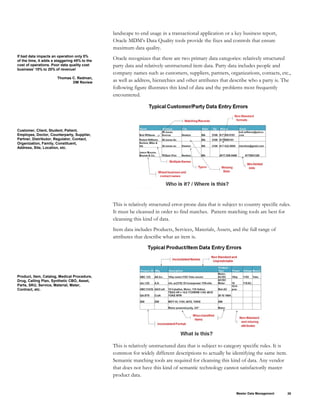
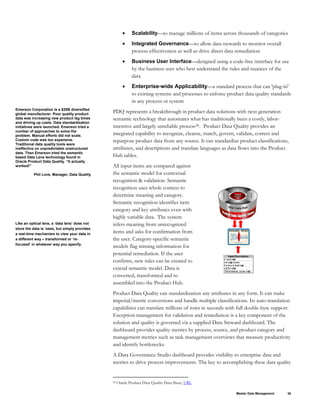
  • 55.
    • Unlimited numberof predefined and school-defined attributes for consolidating school-specific information • Full support for upcoming Affiliations feature in Oracle Campus Solutions • Prebuilt integration across Oracle's Higher Education solutions using the new Constituent Web Service Product Hub for Retail Data quality in the retail industry is formidable due to the complexity and sheer volume of information across numerous divisions, departments and products. The pressure in retail to bring new products to market faster requires flexible solutions that can handle the scale effectively. The Oracle Product Hub for Retail is built on the base Product Hub with significant enhancements specifically to deal with this retail industry challenge. These include: • Industry data model supporting key retail concepts out-of-the-box - such as item – supplier – location information and relationships, homogeneous and heterogeneous packs and style-SKU item relationships • Multiple hierarchies to support different business processes and industry standards, e.g. supplier or web store catalog definition or UNSPSC classification • Advanced workflow and web-based based collaboration framework, with integrated data quality tools, to efficiently manage new item introduction processes • Certified integration to the GDSN – allowing retailers to receive and respond to product information automatically synchronized from their suppliers Product Hub for Communications British Telecom used the Oracle Product Hub to re-engineer how new products were developed. The new system enabled BT to move way from one-offs and code changes to configurations and reuse. The improvements were dramatic. Before: 3 products take 40 days. After: 100 products take 20 days. Tommy Loughlin, BT The Communications industry with its usage based model, multiple billing systems, multiple fulfillment engines, and pressure to accelerate new product offerings poses a real challenge for managing product data. To help Telecoms create a single view of their service based products, and introduce new products faster, Oracle created the Product Hub for Communications built on the base Product Hub with direct support for the “Rapid Offer Design & Order Delivery” solution (RODOD). The significant enhancements specifically added to deal with telecom industry issues. These include: • Communications Library (Approximately 300 attributes) giving customers the capabilities to define: Compatibility Rules; Price List Lines; Promotions; Component level pricing / pricing overrides etc. • Transaction Attributes to support 'order time' or 'transaction' attributes. For example - 'Upload Speed, Download Speed, V-Mail Ring, Ring Tone etc.' • Class Versioning so customers may change the definition of class (such as 'add a new attribute' called QoS Master Data Management 51
  • 56.
    • Context SpecificData: This functionality gives users the ability to override 'component' level attribution; to constrain options; and constrain the 'values' of an option • Class Structure Configuration: a template for 'structure' that is inherited by products in that class. • Publishing: Ability to 'select a set of products' and publishing to registered destination systems. Data Governance “Data quality software without data governance wastes valuable time and resources, and is destined to deliver results below expectations.” Information Managers: Deliver Trusted Data With a Focus On Data Quality, Rob Karel, Forrester Research39. Data Governance (DG) refers to the operating discipline for managing data as a key enterprise asset. This operating discipline includes organization, processes and tools for establishing and exercising decision rights regarding valuation and management of data. Data governance is essential to ensuring that data is accurate, appropriately shared, and protected40. Good corporate governance requires strong data controls. DG identifies what the controls ought to be in order to satisfy business objectives. Data Governance and Master Data Management are joined at the hip. They need each other for the full potential if either to be realized. Data Governance methodologies have been with us for a long time. Over the years, significant progress has been made on the organizational front, but tools to actually implement the information policies developed by data governance committees were not available. MDM on the other hand, incorporates the tools to enforce data standards, but lacks the ability to know what those standards should be. Together, they complete the link between corporate policy and strong data controls. An example helps illustrate this point. Consider the following business policy statement. “This company will not sell its products to anyone 13 years old or younger without parental permission.” The data stewards in IT execute the rules, but it is the data governors from the business units who define the rules. A Data Governance committee would take this business policy and create the following information policies: • All customer information will include family relationships whenever children are included. • All customer profiles will include a full “data of birth” in the form dd/mm/yyyy. The MDM Data Steward would then execute the following data rules: • Define all family relationships in the customer data model. • Insure that the DOB field was in the format dd/mm/yyyy. 39 How Technology Enables Data Governance, An Oracle and First San Francisco Partners Whitepaper, December 2009, URL 40 Data Governance – Managing Information As An Enterprise Asset Part I – An Introduction, Eric Sweden, Enterprise Architect, NASCIO, April, 2008 Master Data Management 52
  • 57.
    • At customercreation time, relationships would be populated and the data of birth checked for accuracy. Any deviation from the rule would create an error message to the user to correct the problem. We see from this example that MDM executes the strong data controls established by the Data Governance program. Oracle MDM provides a variety of Data Governance capabilities. They all have one thing in common: they assist the business user on the Data Governance team with establishing the rules for the MDM data steward to follow. These programs automate the link between business and IT. They include: • The Data Relationship Manager business user interface for managing corporate hierarchies, multiple dimensions, cross-domain mappings, etc. DRM acts as a master data change management platform that helps reconcile master data artifacts in a collaborative environment fronted by change management and governance workflows that allow business users to become direct contributors in the process of managing master data. • The Data Quality business user interfaces where Data Governance managers can access graphical dashboards with quality metrics to provide insight on where and how to drive process improvement. The dashboards are fully configurable to monitor transactional data within the system. • A Data Governance Manager (DGM) as part of the Customer Hub. DGM provides DG professionals with the ability to monitor and control the operations of the Customer Hub as it executes its Master Data Management processes. • Data Watch and Repair for MDM provides advanced data investigation and quality monitoring capabilities for all data in Oracle MDM Hubs. Data Watch and Repair is discussed in more detail in the following section. Data Watch and Repair for MDM Metrics and monitoring tools provided by MDM allow DG teams to track their progress, identify issues and continually improve performance. Where data auditing capabilities provide insight into how the data is created and corrupted, MDM propagates data fixes throughout the enterprise.41 . Data Watch and Repair for MDM (DWR) provides advanced governance capabilities. DWR is a data investigation and quality monitoring tool. It allows business users to assess the quality of their data through metrics, to discover or infer rules based on this data, and to monitor historical metrics about data quality. DWR is integrated with the Oracle MDM Hubs and provides any organization with a quick and powerful data profiling and correction solution that helps ensure Master Data Management success. Used by the data steward to perform ongoing data governance and data stewardship, DWR complements the deduplication, cleansing and matching processes performed by Oracle’s Data Quality with a day- to-day data monitoring tool42. In short, DWR supports Data Visibility to monitor historic information about their data to ensure that it remains accurate, consistent, and reliable and Data Control – 41 How Technology Enables Data Governance, An Oracle and First San Francisco Partners Whitepaper, December 2009, URL 42 Oracle Data Watch and Repair for Master Data Management, an Oracle Data Sheet, URL Master Data Management 53
  • 58.
    to Cleanse, standardize,enrich, and de-duplicate name and addresses as well as other business data and use comprehensive built-in data quality rules or customize your own rules for creating automated and repeatable quality processes. MDM creates a single view of the master data, but data changes every day. Data is not static. In just one hour, 5769 individuals in the US will change jobs, and 2748 individuals will change address. For businesses, 240 will change addresses and 150 business telephone numbers will change or be disconnected. For product data, 720 new Patents are filed, and 1440 new products are introduced each day. In fact, studies show that 2% of all master data changes every month43. Therefore, in order to maintain the achieved single view, it is crucial to implement a data governance plan. Being able to look at the data constantly, thoroughly and easily ensures that any data decay can quickly be noticed and the necessary correction or cleansing steps can be taken. Consequently, it will be easier to keep up reliable and useful data to make asserted and timely business decisions. Data Watch and Repair is a tool created for these specific tasks. The product, therefore, includes the following: • Profiling function: discover the structure of the data and understand it • Application of data rules: evaluate compliance and quality of the data • Correction maps: specify the necessary cleansing strategy to be used with data not compliant to a given data rule In addition to these capabilities, the product also comes with a set of pre-written data rules that are common and relevant in an MDM context. Sample data rules for both customer and product hubs are created for out-of-the-box usage to perform basic data governance tasks. Moreover, they serve as example rules that illustrate how to define data rules, facilitating the learning of how to implement new data rules44. It also includes anomaly detection and data auditing. MDM Implementation Best Practices Oracle MDM Consulting Services (OCS) has the full range of Operational and Analytical MDM implementation methodologies and experience. OCS delivers capabilities in all areas of MDM deployments: In order to get an Enterprise view of their customs across all lines of business, Autodesk purchased the Oracle Customer Hub. Understanding that customer data must be owned and governed by the business with IT as a custodian, Autodesk leveraged Oracle Consulting Services’ Implementation Best Practices for the implementation. Realizing that MDM implementations involve both art (experience) and science (technology), the Oracle process was a natural fit for Autodesk’s rigorous requirements. Paul Bertucci, Autodesk • Governance and project control – Includes a governance model, MDM mission and vision, MDM resources and availability, system and data owners alignment, enterprise data model ownership, data governance & stewardship plan, and change management processes. • Scope and business requirements – Includes data sources, integrated feeding applications, integrated consuming applications, languages and countries, reporting and BI. • Data quality and data migration – Includes data quality in sourcing applications, data quality targets, cleansing rules, survivorship rules, correction processes, cross-reference Ids, 3rd party cleansing tools. 43 Source: D&B, US Census Bureau, US Department of Health and Human Services, Administrative Office of the US Courts, Bureau of Labor Statistics, Gartner, A.T Kearney, GMA Invoice Accuracy Study 44 Oracle Data Watch and Repair for Master Data Management User Guide, April 2008, URL Master Data Management 54
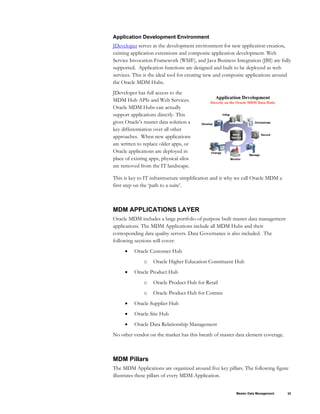
  • 59.
    • Integration processand workflow – Includes connectivity standards, data structure mappings, process flow coordination, error handling, security, performance & scalability. • Technology and architecture – Includes migration technology, integration technology, analytics technology, federation, and process orchestration. • Data center and operational considerations – Includes SLAs, high availability, capacity planning, and monitoring. Oracle Consulting Services know how to bring home MDM projects of any size. Build vs Buy Oracle has the full set of components for building an MDM solution: Oracle 11g with RAC for the Database; ODI-EE for E-LT, bulk data movement, real-time updates, and data services; Master entity data models; SOA Suite for integration; BPEL PM for orchestration; Portal for the user interface; IDM for managing users; WS Manager for managing services; BI EE for analytics; and JDeveloper for creating or extending the MDM management application. Oracle utilizes these technologies to build its MDM Hubs. Customers who want to build their own MDM solution should use these components as well. “In less than 60 days, Home Depot was convinced that Siebel's CDI solution was the only solution that could give them a single view of their customers. We showed them that we could implement in one year a solution that they could possibly build in five, at five times the cost we proposed.” Home Depot But, even with a full stack of open flexible MDM technologies, creating a robust MDM application at the heart of this integrated infrastructure can be a daunting task. For example, to successfully manage customer data, the following functionality is minimally required: data import management; a source system management subsystem with full controls over attributes sourced by multiple applications; a relationship management subsystem that can handle unlimited numbers of all possible combinations of matrixed and hierarchical relationships; interaction history subsystem; location management with address correction capabilities; a robust configurable data quality engine for smart searching and duplicate elimination and prevention; workbench assistance for data quality engineers; data augmentation interfaces to third party vendors such as D&B; data security mechanisms down to the attribute; and triggering methodology for propagating data change. Svilluppo implemented Oracle Customer Data Hub along with 10g Application Server Integration. The implementation only took four months including the integration of 8 different systems. Svilluppo, Italy Oracle’s pre-built MDM Hub solutions are full-featured 3-tier Internet applications designed to participate in the full Oracle technology stack (as outlined in this paper) or to run independently in other open IT SOA environments. Building MDM solutions from scratch can take years. Oracle’s pre-built MDM solutions can bring quality data to the enterprise in a matter of months. Master Data Management 55
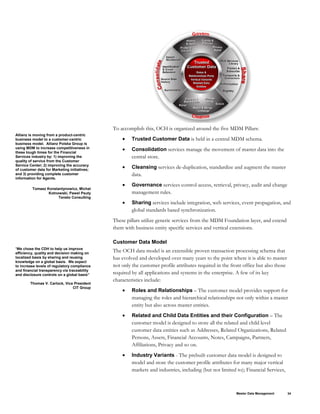
  • 60.
    Master Data Management56 CONCLUSION Over the years, Cisco has moved from using Oracle Customer MDM that fed the Data Warehouse for improved reporting to enterprise wide multi-entity Customer and Product MDM for centrally managing 500 thousand items and 17 million companies with 25 million contacts. MDM services include partners, relationships, and hierarchies. These services support operational applications as well as reporting. The MDM platform is used to proactively increase reporting accuracy, drive revenue growth, increase operational efficiencies, reduce integration costs, enhance customer service, and in general crease business agility. in How Cisco Turned Data into a Corporate Asset, K.C. Wu, VP IT BI & Data Services, Cisco Oracle MDM is at the heart of the new LG Telecom Next Gen Billing System. Leveraging Single Global Schema, SOA, Enterprise Service Bus, and RAC, Oracle MDM enabled the elimination of duplicate Customer and Product data and synchronizes these two central elements stems. across 15 major channel sy Sung Soo Park, General Manager Billing Information Team LG Telecom, Ltd. At Symantec, Data Governance is taken very seriously. The Commerce Lifecycle Transformation Office governance structure integrates executive leadership and decision-making bodies across business and IT. The longevity of Data Governance & MDM programs ensures protection and enablement for the lifetime of the customer and product data asset. Angie Couron, Sr. Manager Data Management and Governance It has been said that data outlasts applications. This means that an organization’s business data survives the changing application landscape. Technology advancements drive periodic application re-engineering, but the business products, suppliers, assets and customers remain. Oracle’s Master Data Management (MDM) solution is a set of applications (MDM Hubs) designed to consolidate, cleanse, govern, and share these key business data objects across the enterprise and across time. It includes pre-defined extensible data models and access methods with powerful applications to centrally manage the quality and lifecycle of master business data. Clean consolidated accurate master data seamlessly propagated throughout the enterprise can save companies millions of dollars a year; dramatically increase supply chain and selling efficiencies; improve customer loyalty; and support sound corporate governance. In this MDM space, Oracle is the market leader. Oracle has the largest installed base with the most live references. Oracle has the implementation know how to develop and utilize best data management practices with proven industry knowledge. Oracle’s heritage in CRM, SCM, PLM, and ERP development insures a leadership position for integrating master data with operational applications. In addition, Oracle MDM leverages AIA and the best in class SOA infrastructure with the award winning Fusion Middleware suite and the best EPM and BI infrastructure with Oracle EPM and the OBI EE suite. These strengths have lead to a large Ecosystem with a large number of partners. These are the reasons why Oracle MDM provides more business value than any other solution available on the market. Utilizing Oracle MDM Applications, companies around the world are governing their data assets, operationalizing their data warehouses; consolidating systems; modernizing applications; re-engineering business processes; improving their reporting; increasing target marketing effectiveness; improving customer loyalty scores; managing risk more efficiently; mitigating supplier risk; accelerating new product introductions; and creating solid data foundations for CRM, ERP, PLM and SCM implementations. Each MDM Hub solves a variety of costly data problems. MDM Hubs in combination change the way business is done. Oracle MDM Hubs deliver a single, well defined, accurate, relevant, complete, and consistent view of master data across channels, departments, and geographies. The results for companies who implement Oracle MDM solutions are dramatic. Over 1000 companies and organizations are managing billions of master data records with Oracle MDM. Companies such as Cisco, GE, Fidelity, Motorola, Dell, Symantec, Zebra, LG Telecom, Home Depot, Supermarchés Match, Toyota, and Scottrade are realizing the promise of consolidated, clean, consistent master data feeding their operational and analytical systems. Companies are achieving that elusive goal: a single version of the truth about their business across the enterprise.
  • 61.
    Master Data Management Authors:David Butler, Bob Stackowiak Oracle Corporation World Headquarters 500 Oracle Parkway Redwood Shores, CA 94065 U.S.A. Worldwide Inquiries: Phone: +1.650.506.7000 Fax: +1.650.506.7200 Oracle.com Copyright © 2010, Oracle. All rights reserved. This document is provided for information purposes only and the contents hereof are subject to change without notice. This document is not warranted to be error-free, nor subject to any other warranties or conditions, whether expressed orally or implied in law, including implied warranties and conditions of merchantability or fitness for a particular purpose. We specifically disclaim any liability with respect to this document and no contractual obligations are formed either directly or indirectly by this document. This document may not be reproduced or transmitted in any form or by any means, electronic or mechanical, for any purpose, without our prior written permission. Oracle, JD Edwards, PeopleSoft, and Siebel are registered trademarks of Oracle Corporation and/or its affiliates. Other names may be trademarks of their respective owners.