MAST CELLS
IMMUNOLOGY
EIMMY DENNISSE CONTRERAS
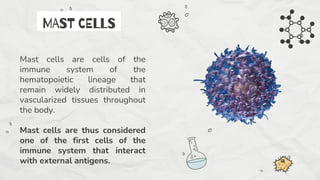
Mast cells are cells of the
immune system of the
hematopoietic lineage that
remain widely distributed in
vascularized tissues throughout
the body.
Mast cells are thus considered
one of the first cells of the
immune system that interact
with external antigens.
• Mast cells, unlike other immune cells, do not remain
in the blood but remain localized in mucosal and
epithelial tissues throughout the body.
• Primarily involved in the IgE-dependent responses.
• These are produced from the bone marrow and are
released into the blood as undifferentiated cells.
These cells then mature after they leave the blood
and reach the specialized tissues.
• In the bone marrow, mast cells originate from
CD34+/CD117+ pluripotent progenitor cells, and the
maturation of these cells depends on KIT activation.
• Mast cells secrete different pro-angiogenic factors like
VEGF, bFGF, TGF-beta, and IL-8.
• The cells also release proteases and heparin, which
induce permeability of the microvasculature, inducing
angiogenesis. Mast cells are among the first line of
defense against antigens entering the body. These cells
are thus important for maintaining the homeostasis of the
body, especially the gastrointestinal tract.
• In innate immunity, receptors on mast cells bind to
antigens, causing a release of inflammatory mediators like
IL-4, TNFα, and IL-6.
FUNCTIONS
• These cells also help in providing immunity against viral
antigens by the release of IFN-α and IFN-β.
• In adaptive immunity, mast cells process and present
antigen via MHCI and MHCII, and these also activate
dendritic cells, which are professional antigen-presenting
cells.
• The most important and prominent function of mast cells
is the release of newly synthesized mediators necessary
for the immune response.
• Mast cells are also involved in an allergic reaction where
the over-activation of mast cells can result in hyper-
allergic reactions.
FUNCTIONS
MAST CELLS.pptx
MAST CELLS.pptx

MAST CELLS.pptx

  • 1.
  • 2.
    Mast cells arecells of the immune system of the hematopoietic lineage that remain widely distributed in vascularized tissues throughout the body. Mast cells are thus considered one of the first cells of the immune system that interact with external antigens.
  • 3.
    • Mast cells,unlike other immune cells, do not remain in the blood but remain localized in mucosal and epithelial tissues throughout the body. • Primarily involved in the IgE-dependent responses. • These are produced from the bone marrow and are released into the blood as undifferentiated cells. These cells then mature after they leave the blood and reach the specialized tissues. • In the bone marrow, mast cells originate from CD34+/CD117+ pluripotent progenitor cells, and the maturation of these cells depends on KIT activation.
  • 4.
    • Mast cellssecrete different pro-angiogenic factors like VEGF, bFGF, TGF-beta, and IL-8. • The cells also release proteases and heparin, which induce permeability of the microvasculature, inducing angiogenesis. Mast cells are among the first line of defense against antigens entering the body. These cells are thus important for maintaining the homeostasis of the body, especially the gastrointestinal tract. • In innate immunity, receptors on mast cells bind to antigens, causing a release of inflammatory mediators like IL-4, TNFα, and IL-6. FUNCTIONS
  • 5.
    • These cellsalso help in providing immunity against viral antigens by the release of IFN-α and IFN-β. • In adaptive immunity, mast cells process and present antigen via MHCI and MHCII, and these also activate dendritic cells, which are professional antigen-presenting cells. • The most important and prominent function of mast cells is the release of newly synthesized mediators necessary for the immune response. • Mast cells are also involved in an allergic reaction where the over-activation of mast cells can result in hyper- allergic reactions. FUNCTIONS