A presentation by
Carlos Osiris Martinez
to the
University of Southern California
Geographic Information Science and Technology Department
THESIS DEFENSE
RELOCATION BAY:
IDENTIFYING A SUITABLE SITE FOR THE TAMPA BAY RAYS
CONTENT
• Introduction
• Background
• Research Gap
• Methods
• Results
• Significance of Findings
• Questions
INTRODUCTION
• The Tampa Bay Rays arrived to the Tampa Bay area with
great fanfare
• Soon thereafter, average game attendance dwindled
• Team has revitalized itself and created a winning product
since 2008
• Unfortunately, winning on the field has not boosted revenue
• Current stadium location has been declared root of the
problem
BACKGROUND
• Stadium placement hasn’t always been a scientific process
• Early vs. Late 20th Century
• CBDs and Suburbs
• Golden Age of Capitalism
• Stadium design and functionality changes
• Single use vs. Multi-use
• Current Trends
• Downtown Revitalization
• Cost over location
BACKGROUND
• The Tampa Bay Rays are struggling
• Winners (on the field) and Losers (off the field)
• Solutions?
• Create a winning product
• Incentivize the fans
• Relocate stadium
• Relocate franchise
RESEARCH GAP
• Gap exists in stadium location research
• Most research focuses on the economics of stadiums rather than
location
• Public financing
• Financial impact after construction
• Economic factors cannot be unmarried from location
research
• Sports tourism
• Tax breaks/impact
METHODS:
TARGETED VS. NON-TARGETED SITES
• Targeted Sites
• Potential sties derived from Tampa Bay Times online database of
debated possible stadium sites
• Sites have been discussed anecdotally but have not been officially
identified as plausible relocation sites
• Non-Targeted Sites
• These sites have not been identified previously in any capacity.
• The sites are identified through the analysis of the Targeted sites
METHODS:
SITE SUITABILITY SCORING SYSTEM
• To determine site suitability, a Scoring System was
developed for this project
• Scoring System developed score through analysis of
possible sites referred against established variables and
subsequent parameters
• Time/Distance Variable
• Population Variable
• Critical Infrastructure Variable
• Parcel Variable
METHODS:
SITE SUITABILITY SCORING SYSTEM
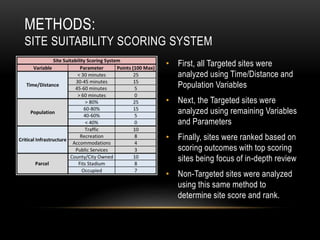
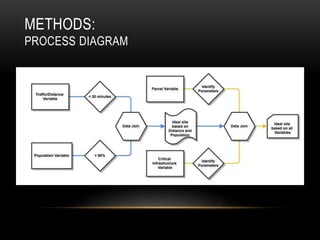
• First, all Targeted sites were
analyzed using Time/Distance and
Population Variables
• Next, the Targeted sites were
analyzed using remaining Variables
and Parameters
• Finally, sites were ranked based on
scoring outcomes with top scoring
sites being focus of in-depth review
• Non-Targeted sites were analyzed
using this same method to
determine site score and rank.
METHODS:
VARIABLE AND PARAMETER ANALYSIS
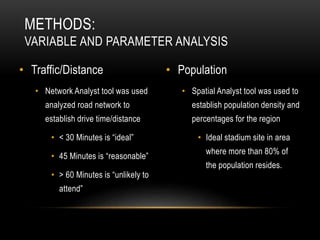
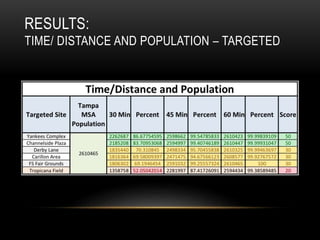
• Traffic/Distance
• Network Analyst tool was used
analyzed road network to
establish drive time/distance
• < 30 Minutes is “ideal”
• 45 Minutes is “reasonable”
• > 60 Minutes is “unlikely to
attend”
• Population
• Spatial Analyst tool was used to
establish population density and
percentages for the region
• Ideal stadium site in area
where more than 80% of
the population resides.
METHODS:
VARIABLE AND PARAMETER ANALYSIS
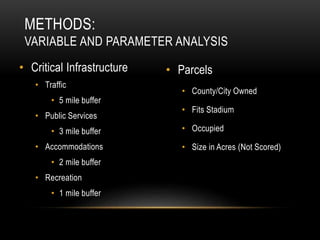
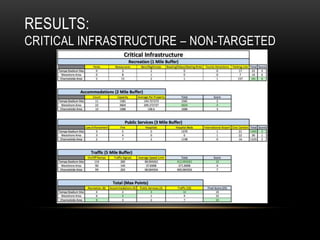
• Critical Infrastructure
• Traffic
• 5 mile buffer
• Public Services
• 3 mile buffer
• Accommodations
• 2 mile buffer
• Recreation
• 1 mile buffer
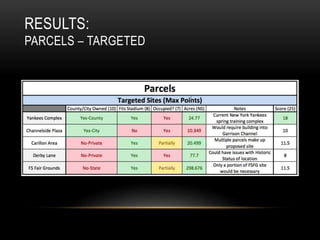
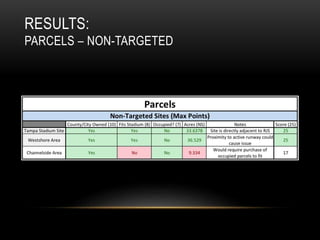
• Parcels
• County/City Owned
• Fits Stadium
• Occupied
• Size in Acres (Not Scored)
METHODS:
PROCESS DIAGRAM
RESULTS
• Analysis began with study of Tropicana Field using established
methods for Targeted and Non-Targeted sites
• Acts as a ‘Control’ for analyzed site comparison
• The selected Targeted sites were analyzed and scored
according to the Scoring System
• Yankees Complex, Channelside Plaza, Carillon Area, Derby Lane, and
Florida State Fair Grounds
• Non-Targeted Sites Identified
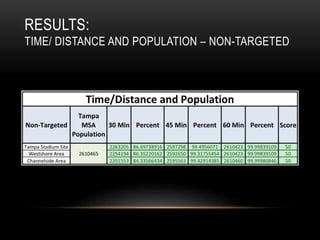
• Tampa Stadium Site, Westshore Area, Channelside Area
RESULTS:
TIME/ DISTANCE AND POPULATION – TARGETED
RESULTS:
CRITICAL INFRASTRUCTURE – TARGETED
RESULTS:
PARCELS – TARGETED
RESULTS:
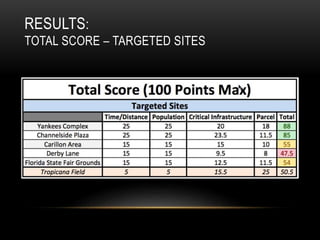
TOTAL SCORE – TARGETED SITES
RESULTS:
TIME/ DISTANCE AND POPULATION – NON-TARGETED
RESULTS:
CRITICAL INFRASTRUCTURE – NON-TARGETED
RESULTS:
PARCELS – NON-TARGETED
RESULTS:
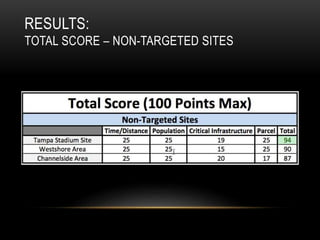
TOTAL SCORE – NON-TARGETED SITES
RESULTS:
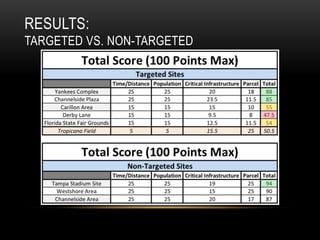
TARGETED VS. NON-TARGETED
RESULTS
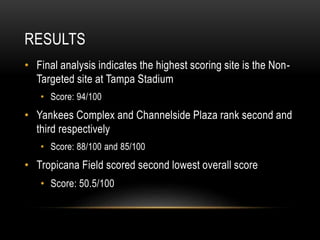
• Final analysis indicates the highest scoring site is the Non-
Targeted site at Tampa Stadium
• Score: 94/100
• Yankees Complex and Channelside Plaza rank second and
third respectively
• Score: 88/100 and 85/100
• Tropicana Field scored second lowest overall score
• Score: 50.5/100
SIGNIFICANCE OF FINDINGS
• Results from Scoring System reinforce theory that
Tropicana Field is too far from population center
• Moving the stadium’s location to Hillsborough county
and within the city of Tampa will increase population
servicing by more than 31% for those traveling less
than 30 minutes and 12% for those within 45 minutes.
SIGNIFICANCE OF FINDINGS
• Results fill the void in existing stadium location
research by indicating that stadium placement within a
community is just as important as its financial impact
• Stadium location and stadium financing should be
treated as two independent subjects and researched
independently
SIGNIFICANCE OF FINDINGS
• Research identifies a repeatable method for
scientifically quantifying a possible stadium site
• Scoring System Parameters can be adjusted to
accommodate almost any location
• Possible connection between Scoring System results
and average attendance percentages
QUESTIONS?

Martinez_Defense_Presentation

  • 1.
    A presentation by CarlosOsiris Martinez to the University of Southern California Geographic Information Science and Technology Department THESIS DEFENSE RELOCATION BAY: IDENTIFYING A SUITABLE SITE FOR THE TAMPA BAY RAYS
  • 2.
    CONTENT • Introduction • Background •Research Gap • Methods • Results • Significance of Findings • Questions
  • 3.
    INTRODUCTION • The TampaBay Rays arrived to the Tampa Bay area with great fanfare • Soon thereafter, average game attendance dwindled • Team has revitalized itself and created a winning product since 2008 • Unfortunately, winning on the field has not boosted revenue • Current stadium location has been declared root of the problem
  • 4.
    BACKGROUND • Stadium placementhasn’t always been a scientific process • Early vs. Late 20th Century • CBDs and Suburbs • Golden Age of Capitalism • Stadium design and functionality changes • Single use vs. Multi-use • Current Trends • Downtown Revitalization • Cost over location
  • 5.
    BACKGROUND • The TampaBay Rays are struggling • Winners (on the field) and Losers (off the field) • Solutions? • Create a winning product • Incentivize the fans • Relocate stadium • Relocate franchise
  • 6.
    RESEARCH GAP • Gapexists in stadium location research • Most research focuses on the economics of stadiums rather than location • Public financing • Financial impact after construction • Economic factors cannot be unmarried from location research • Sports tourism • Tax breaks/impact
  • 7.
    METHODS: TARGETED VS. NON-TARGETEDSITES • Targeted Sites • Potential sties derived from Tampa Bay Times online database of debated possible stadium sites • Sites have been discussed anecdotally but have not been officially identified as plausible relocation sites • Non-Targeted Sites • These sites have not been identified previously in any capacity. • The sites are identified through the analysis of the Targeted sites
  • 8.
    METHODS: SITE SUITABILITY SCORINGSYSTEM • To determine site suitability, a Scoring System was developed for this project • Scoring System developed score through analysis of possible sites referred against established variables and subsequent parameters • Time/Distance Variable • Population Variable • Critical Infrastructure Variable • Parcel Variable
  • 9.
    METHODS: SITE SUITABILITY SCORINGSYSTEM • First, all Targeted sites were analyzed using Time/Distance and Population Variables • Next, the Targeted sites were analyzed using remaining Variables and Parameters • Finally, sites were ranked based on scoring outcomes with top scoring sites being focus of in-depth review • Non-Targeted sites were analyzed using this same method to determine site score and rank.
  • 10.
    METHODS: VARIABLE AND PARAMETERANALYSIS • Traffic/Distance • Network Analyst tool was used analyzed road network to establish drive time/distance • < 30 Minutes is “ideal” • 45 Minutes is “reasonable” • > 60 Minutes is “unlikely to attend” • Population • Spatial Analyst tool was used to establish population density and percentages for the region • Ideal stadium site in area where more than 80% of the population resides.
  • 11.
    METHODS: VARIABLE AND PARAMETERANALYSIS • Critical Infrastructure • Traffic • 5 mile buffer • Public Services • 3 mile buffer • Accommodations • 2 mile buffer • Recreation • 1 mile buffer • Parcels • County/City Owned • Fits Stadium • Occupied • Size in Acres (Not Scored)
  • 12.
  • 13.
    RESULTS • Analysis beganwith study of Tropicana Field using established methods for Targeted and Non-Targeted sites • Acts as a ‘Control’ for analyzed site comparison • The selected Targeted sites were analyzed and scored according to the Scoring System • Yankees Complex, Channelside Plaza, Carillon Area, Derby Lane, and Florida State Fair Grounds • Non-Targeted Sites Identified • Tampa Stadium Site, Westshore Area, Channelside Area
  • 14.
    RESULTS: TIME/ DISTANCE ANDPOPULATION – TARGETED
  • 15.
  • 16.
  • 17.
  • 18.
    RESULTS: TIME/ DISTANCE ANDPOPULATION – NON-TARGETED
  • 19.
  • 20.
  • 21.
    RESULTS: TOTAL SCORE –NON-TARGETED SITES
  • 22.
  • 23.
    RESULTS • Final analysisindicates the highest scoring site is the Non- Targeted site at Tampa Stadium • Score: 94/100 • Yankees Complex and Channelside Plaza rank second and third respectively • Score: 88/100 and 85/100 • Tropicana Field scored second lowest overall score • Score: 50.5/100
  • 24.
    SIGNIFICANCE OF FINDINGS •Results from Scoring System reinforce theory that Tropicana Field is too far from population center • Moving the stadium’s location to Hillsborough county and within the city of Tampa will increase population servicing by more than 31% for those traveling less than 30 minutes and 12% for those within 45 minutes.
  • 25.
    SIGNIFICANCE OF FINDINGS •Results fill the void in existing stadium location research by indicating that stadium placement within a community is just as important as its financial impact • Stadium location and stadium financing should be treated as two independent subjects and researched independently
  • 26.
    SIGNIFICANCE OF FINDINGS •Research identifies a repeatable method for scientifically quantifying a possible stadium site • Scoring System Parameters can be adjusted to accommodate almost any location • Possible connection between Scoring System results and average attendance percentages
  • 27.