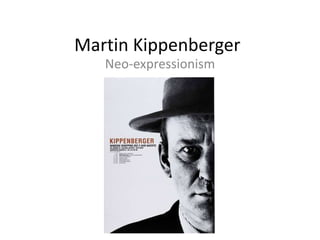
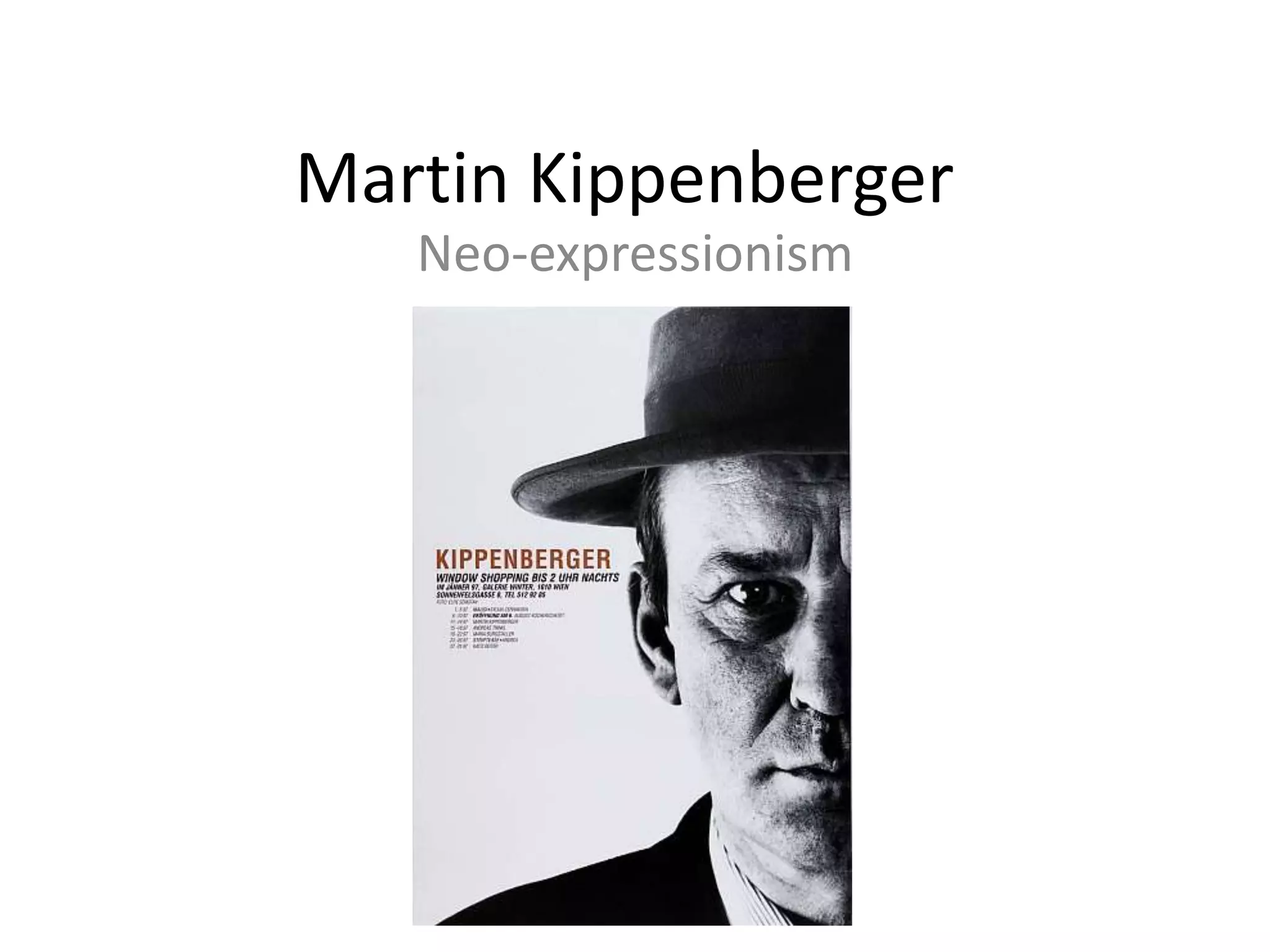
Martin KippenbergerNeo-expressionism
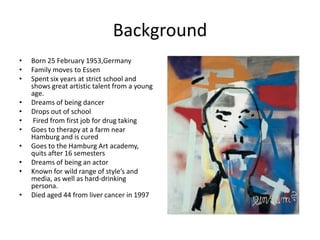
BackgroundBorn 25 February 1953,GermanyFamily moves to EssenSpent six years at strict school and shows great artistic talent from a young age.Dreams of being dancerDrops out of school Fired from first job for drug takingGoes to therapy at a farm near Hamburg and is curedGoes to the Hamburg Art academy, quits after 16 semestersDreams of being an actorKnown for wild range of style’s and media, as well as hard-drinking persona.Died aged 44 from liver cancer in 1997
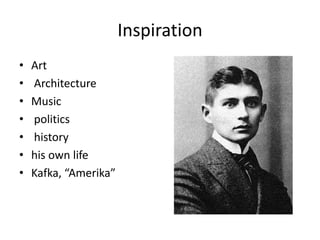
InspirationArt ArchitectureMusic politics history his own lifeKafka, “Amerika”
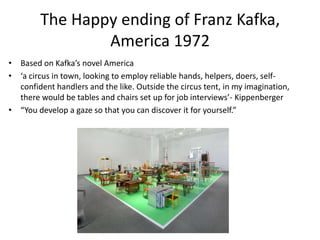
The Happy ending of Franz Kafka, America 1972Based on Kafka’s novel America ‘a circus in town, looking to employ reliable hands, helpers, doers, self-confident handlers and the like. Outside the circus tent, in my imagination, there would be tables and chairs set up for job interviews’- Kippenberger“You develop a gaze so that you can discover it for yourself.”
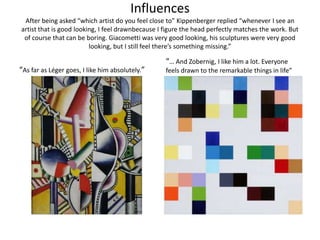
InfluencesAfter being asked “which artist do you feel close to” Kippenberger replied “whenever I see an artist that is good looking, I feel drawnbecause I figure the head perfectly matches the work. But of course that can be boring. Giacometti was very good looking, his sculptures were very good looking, but I still feel there’s something missing.” “As far as Léger goes, I like him absolutely.”“… And Zobernig, I like him a lot. Everyone feels drawn to the remarkable things in life”
Neo-Expressionism
What is it?Modern style of painting and sculpture that began in the late 1970’sA reaction against conceptual and minimalistic art of 1970’s
Where did it come from?German expressionist painters such as..
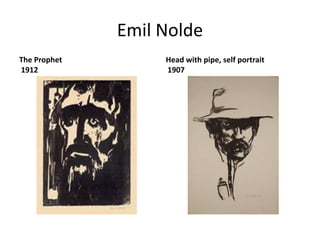
Emil NoldeThe Prophet 1912Head with pipe, self portrait 1907
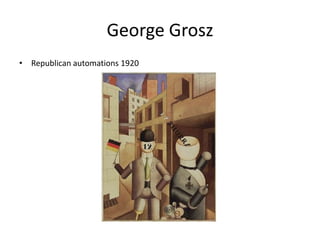
George GroszRepublican automations 1920
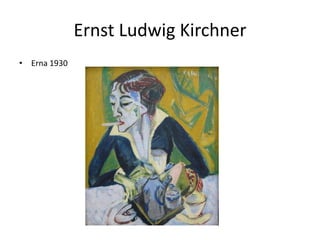
Ernst Ludwig KirchnerErna 1930
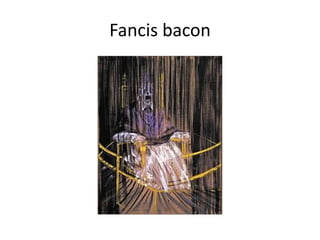
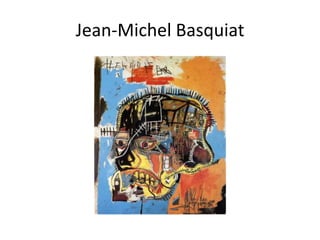
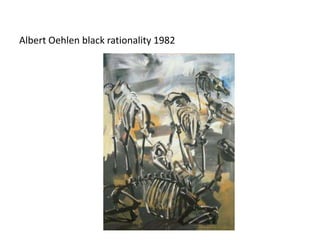
What did it look like?
Fancis bacon
Jean-Michel Basquiat
Albert Oehlen black rationality 1982
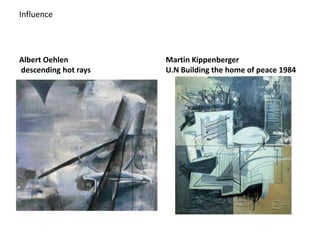
InfluenceAlbert Oehlen descending hot raysMartin KippenbergerU.N Building the home of peace 1984
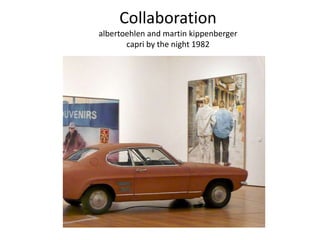
Collaborationalbertoehlen and martin kippenbergercapri by the night 1982
Kippenberger’s key works
Leiber Maler, male mir [dear painter, paint for me] 1981Kippenberger hired a sign painter from Berlin to make paintings based on images he supplied. This being one of his favourite topicsSeries introduces other favourite topics; equal treatment of commodities ,brashness, culture       and himselfKippenberger is in two of the painting’s however partly disguised, you can only see the back of him in this piece and seen from a distance in the other.
LeiberMaler, male mir [dear painter, paint for me]
Heavy Bruschi [Heavy guy]Kippenberger asked assistant to make images from all his cataloguesWas unhappy with unfinished canvas’  so had them photographed, printed to original size and then framedHe destroyed originals and presented them in skipCreating an idea of relationship between employer and employeeCreates a violent seen of destruction that mocks cultural, political and spiritual rebirth, by creating a loop.Making the pictures ‘into a  kind of double kitsch’
IinstallationderWeissenBilder[ installation of the white painter] 1993A series of white paintings on canvasCanvases embedded in wall to look like part of  the gallery wallsBased on a question and answer between kippenberger and a young boy who described kippenberger’s work with positive answers ‘sehr gut’ or very good These descriptions were transferred onto canvas in white paintInstallation is made up of 10 paintings in 5 different sizesCritises the plain white gallery spaces that exhibit conceptual art
Why Kippenberger is a significant artist in 20th/21st centuryHe produced a wide range of work from the mid 1970’s using a remarkable range of media and never sticking to one particular style.Irony he created in his work by questioning his subjects. His bold concept's behind his work and re-occurring themes such asPlaying with the idea that the artist is an individual who’s work is independent Criticizing society, politics, work relationshipsHis performative personality

Martin kippenberger

  • 1.
  • 2.
    BackgroundBorn 25 February1953,GermanyFamily moves to EssenSpent six years at strict school and shows great artistic talent from a young age.Dreams of being dancerDrops out of school Fired from first job for drug takingGoes to therapy at a farm near Hamburg and is curedGoes to the Hamburg Art academy, quits after 16 semestersDreams of being an actorKnown for wild range of style’s and media, as well as hard-drinking persona.Died aged 44 from liver cancer in 1997
  • 3.
    InspirationArt ArchitectureMusic politicshistory his own lifeKafka, “Amerika”
  • 4.
    The Happy endingof Franz Kafka, America 1972Based on Kafka’s novel America ‘a circus in town, looking to employ reliable hands, helpers, doers, self-confident handlers and the like. Outside the circus tent, in my imagination, there would be tables and chairs set up for job interviews’- Kippenberger“You develop a gaze so that you can discover it for yourself.”
  • 5.
    InfluencesAfter being asked“which artist do you feel close to” Kippenberger replied “whenever I see an artist that is good looking, I feel drawnbecause I figure the head perfectly matches the work. But of course that can be boring. Giacometti was very good looking, his sculptures were very good looking, but I still feel there’s something missing.” “As far as Léger goes, I like him absolutely.”“… And Zobernig, I like him a lot. Everyone feels drawn to the remarkable things in life”
  • 6.
  • 7.
    What is it?Modernstyle of painting and sculpture that began in the late 1970’sA reaction against conceptual and minimalistic art of 1970’s
  • 8.
    Where did itcome from?German expressionist painters such as..
  • 9.
    Emil NoldeThe Prophet1912Head with pipe, self portrait 1907
  • 10.
  • 11.
  • 12.
    What did itlook like?
  • 13.
  • 14.
  • 15.
    Albert Oehlen blackrationality 1982
  • 16.
    InfluenceAlbert Oehlen descendinghot raysMartin KippenbergerU.N Building the home of peace 1984
  • 17.
    Collaborationalbertoehlen and martinkippenbergercapri by the night 1982
  • 18.
  • 19.
    Leiber Maler, malemir [dear painter, paint for me] 1981Kippenberger hired a sign painter from Berlin to make paintings based on images he supplied. This being one of his favourite topicsSeries introduces other favourite topics; equal treatment of commodities ,brashness, culture and himselfKippenberger is in two of the painting’s however partly disguised, you can only see the back of him in this piece and seen from a distance in the other.
  • 20.
    LeiberMaler, male mir[dear painter, paint for me]
  • 21.
    Heavy Bruschi [Heavyguy]Kippenberger asked assistant to make images from all his cataloguesWas unhappy with unfinished canvas’ so had them photographed, printed to original size and then framedHe destroyed originals and presented them in skipCreating an idea of relationship between employer and employeeCreates a violent seen of destruction that mocks cultural, political and spiritual rebirth, by creating a loop.Making the pictures ‘into a kind of double kitsch’
  • 22.
    IinstallationderWeissenBilder[ installation ofthe white painter] 1993A series of white paintings on canvasCanvases embedded in wall to look like part of the gallery wallsBased on a question and answer between kippenberger and a young boy who described kippenberger’s work with positive answers ‘sehr gut’ or very good These descriptions were transferred onto canvas in white paintInstallation is made up of 10 paintings in 5 different sizesCritises the plain white gallery spaces that exhibit conceptual art
  • 23.
    Why Kippenberger isa significant artist in 20th/21st centuryHe produced a wide range of work from the mid 1970’s using a remarkable range of media and never sticking to one particular style.Irony he created in his work by questioning his subjects. His bold concept's behind his work and re-occurring themes such asPlaying with the idea that the artist is an individual who’s work is independent Criticizing society, politics, work relationshipsHis performative personality