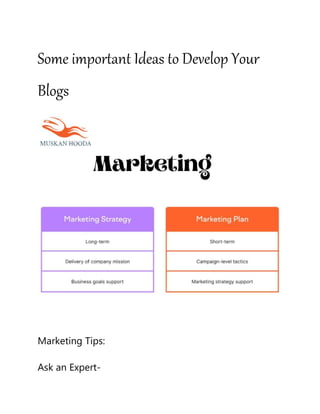
Some important Ideas to Develop Your
Blogs
Marketing Tips:
Ask an Expert-
 Ask top marketing industry influencers to chime in on
a recent marketing event or topic, then feature a
roundup of influencer opinions.
Use Help a reporter out to source expert opinions on a
topic that’s important to your customers.
Become a News Source-
Create a roundup of must read marketing books for
year.
Take a current event topic and relate marketing to it
such as,” X ways to market your business during an
election session.
Share the findings of a recent report and provide your
own analysis and predictions.
Be Trendy-
Talk about how a business can capitalize on the
popularity of emojis in their marketing.
Talk about the latest social media trends.
Collect Tweets around a popular topic, event or
conference and feature these tweets in a blog post.
Leverage Events-
Write a recap of a recent marketing webinar that you
gave or attended.
Attend a well known marketing conference, and do a
roundup of the best conference tips you heard and
best sessions that you attended
Follow a hashtag for a conference or event and pull
the best tweets into a blog post.
Keep a Pulse on Important Brands-
Do a roundup of the best marketing campaigns of the
year.
Write a numerical post for the Top YouTube channels
or stars to follow.
Highlight a popular marketing campaigns of a big
brand, and give your agency’s opinion on what worked,
what didn’t and how your agency might have executed
it differently
Curate Awesome Content-
Compile a list of the best marketing blogs to subscribe
to.
Write a post that features the top blogs in your clients
niche.
Recommend Tools and Products-
Give your readers a roundup of inexpensive tools they
can use to outsource marketing tasks that take a ton of
time.
Feature an entire blog post around one tool with a
very detailed explanation of its features.
Review two different competing tools and why one is
better than other.
What is social media marketing?
Social media marketing involves using platforms like Facebook, Instagram, Twitter,
LinkedIn, and TikTok to effectively reach a wider audience and communicate with
customers. Social media marketing is necessary for any small business marketing
strategy and requires a robust plan. Your customers expect engaging content and the
ability to communicate with you through direct messaging and comments.
Effective social media marketing for small businesses gives you the unique opportunity
to humanize your brand and drive traffic back to your website. With social media
advertising, you can also generate leads and sales while increasing brand awareness.
Many small businesses even use social media for customer service, allowing customers
to message them directly to have issues resolved and questions answered.
How to market your business on social media
Social media is integral to any marketing strategy, but it may seem daunting for small
business owners who don’t know how to use different platforms. Luckily, social media
marketing is fairly easy to learn and doesn’t require too much time or money. Any
budget can support a robust social media marketing strategy as long as you get to know
your customers and can create engaging content regularly. Here’s how to promote your
business on social media.
1. Identify your audience
Many businesses make the mistake of trying to reach everyone. But understanding and
organizing your audience can help you send the right message to the right people and
more effectively meet your marketing goals.
This begins with identifying your target audience. The details about who these people
are should be based on the audience data you already have, as well as your market
research.
To find your target audience:
 Compile data. In order to reach your target market, you need to know what they’re like.
It’s important to know things like your audience members’ ages, locations, and
engagement patterns to market effectively to them. While it may seem daunting to
gather this information, customer relationship management software stores and sorts
this data and makes it easy to put into action.
 Use social media analytics. Many platforms, like Facebook and Twitter, have built-in
analytics that can tell you about your followers, including when they post, where they
post, and other interests. Plus, these tools are free to use with business accounts.
 Check the competition. Understanding your competition will give you insights about how
to talk to your audience. You can look at what your competitors are doing wrong to fill
any gaps in your current strategy.
Once you’ve identified your target audience, it’s important to keep up to date with their
interests and to implement a social listening strategy to understand their wants and
needs.
2. Define your goals and KPIs
To excel in social media marketing, it’s important to create goals that guide your
efforts. The SMART goal strategy provides a helpful framework to create foundational
goals and meet your overall objectives.
SMART stands for:
 Specific: In order to measure and meet goals, it’s important to be clear about precisely
what you hope to achieve. This is especially important for getting your team onboard as
you work collectively towards the goal. A specific social media goal, for example, might
be to increase your Twitter followers by 20% this quarter.
 Measurable: You need to know definitively whether you’ve reached your goal or not.
Measurement makes that possible. By using metrics to track your progress, you can also
pivot your goals if need be. For instance, if you find that likes and follows don’t lead to
website traffic, you can change the metric to something that will help you achieve your
goal.
 Achievable: All goals should be within reach of your business. If you set goals that are
unreasonable, you risk discouraging your employees and creating friction in
your business plan. As you set specific, measurable goals, make sure to adjust if it
seems like you aren’t reaching them.
 Relevant: Your social media marketing goals should ladder up to your larger business
objectives. For example, if it’s your objective to build brand awareness, you could set a
goal to get 100 social media followers to click through a post to a landing page that
describes your offerings.
 Timely: To keep yourself accountable, goals should have a time limit. Instead of creating
a goal for some undefined time in the near future, make sure to set a specific cadence to
check in and ensure you’re staying on track.
Though social media marketing has many moving parts, SMART goals give you a
starting point, as well as a means to check in and make changes as needed.
3. Allocate your resources wisely
For small businesses strapped for money and time, sometimes social media tasks get
arbitrarily offloaded onto whoever is available. But social media management requires
unique skills, like:
 Strategic thinking
 Organizational skills
 Branding expertise
If you have the means, hiring an expert to handle social media can pay off. But if you
don’t have the budget for an on-staff social media manager, you can still invest
in advertisements on social platforms, which can boost brand awareness and expand
reach.
4. Use multiple platforms
Consider the multiple social media platforms your customers use daily. Ultimately, your
strategy should allow you to reach as many people through social media as possible,
and you can’t do that by focusing on only one platform.
Depending on your audience, many of them may use Facebook, Instagram, and TikTok
throughout the day, giving you three opportunities to get your content in front of
them. Social media apps to know include Instagram, Facebook, TikTok, LinkedIn, and
Twitter. However, investing in a strategy for all of these platforms isn’t necessary.
Instead, consider the apps your customers are most likely to use.
5. Post relevant content regularly
Success on social media is a matter of posting compelling, engaging content
consistently. Not only will this help make your business look dependable, but it also
shows that you have timely knowledge to share and that you care to be in conversation
with your audience.
Social media platforms change their algorithms over time, but the rule of posting
regularly holds true: This practice helps your content show up in newsfeeds. By
focusing on consistent, relevant content, you show the algorithms that your posts are
worthy of showing up in various newsfeeds and ultimately, will attract followers to your
page.
6. Interact with followers
Social media users enjoy interacting with brands, and as a result brands experience
benefits like:
 Social proof of your business
 Expanded market reach
 Boosted brand awareness
 Cost-efficiency
The opportunity for a high return on investment (ROI) is huge—83% of customers value
customer experience, and that includes social media interactions in which businesses
make their audience feel seen, heard, and understood. Social media allows you to
monitor conversations in real-time and answer questions or concerns from your
audience promptly.
This can take many forms, like:
 Asking questions relevant to your offerings
 Creating a Facebook Group for your audience
 Using GIFs, videos, and emojis to spice up messages
 Utilizing platform tools, like Instagram Live to start discussions
A good strategy is to allow 1 hour a day to communicate with your audience on social
media. However, if there are pressing concerns, you should always take the time to
respond promptly.
7. Always maintain professionalism
It’s important to remember that as you post on social media, you are always
representing your business. Posts are taken out of context all too often, which can lead
to conflict and upset followers. If your social media responsibilities are allocated to other
staff members, consider creating a social media policy to guide their posts and
conversations.
Typically, a standard social media policy will include:
 Clear expectations about what to post
 Instructions on how to respond to negative posts
 Platform laws and rules to follow
 Brand considerations
 Security protocols
By investing in a social media policy, your business can be ready for any scenario. It’s
important to remember that at the core of social media, you are implementing your
customer service philosophy.
8. Reflect your brand identity
Brand identity is what helps people connect to your business and sets you apart from
your competitors. This means that all marketing, including print, digital, and social
media, should be consistent.
Brand consistency can be challenging for businesses, especially when you’re just
getting started. But it’s important across channels, and that certainly includes social
media. As you are posting, you’ll want to think about:
 How you talk to your customers, otherwise known as a brand voice
 Posting similar visuals across the various platforms
 Focusing on your unique selling point.
Not only will a consistent brand identity make it easier to know what to post, but it can
also help increase brand loyalty.
9. Prioritize quality over quantity
Instead of posting multiple times a day on as many platforms as possible, you should
focus on delivering consistent, quality posts. In fact, some social media sites may
penalize your account and mark you as spam for too many low-quality posts.
Additionally, posting could become overwhelming and problematic whoever handles
your social media, whether that’s you or a teammate, and that could wind up hurting
your strategy rather than helping.
To mitigate these risks, consider implementing a social media calendar. These
calendars can help you plan posts in advance while ensuring you stay organized.
Categories including when to post, post caption, post visual, and which platforms to post
on can help marketers keep track of the various moving parts of social media.
Another way to prioritize quality posts is to ask yourself the following questions:
 Does this content help my followers?
 Is this original?
 Is this actionable, inspiring, or entertaining?
 Does the content have cited sources, if needed?
All of these questions can help you create quality content that will engage and attract
followers. Learning about the top social media content to create for each platform is key
to helping you reach more people online.
10. Measure your results
There are many factors that affect social media marketing, and that’s why it’s important
to analyze and measure results. Analytics come in handy because they can help:
 Optimize campaigns
 Create new goals
 Assess tracking metrics
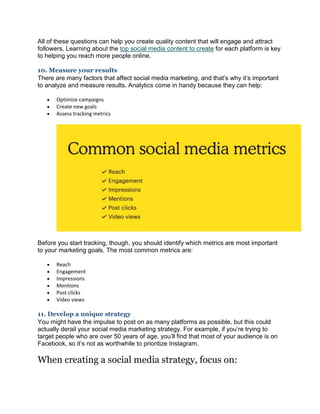
Before you start tracking, though, you should identify which metrics are most important
to your marketing goals. The most common metrics are:
 Reach
 Engagement
 Impressions
 Mentions
 Post clicks
 Video views
11. Develop a unique strategy
You might have the impulse to post on as many platforms as possible, but this could
actually derail your social media marketing strategy. For example, if you’re trying to
target people who are over 50 years of age, you’ll find that most of your audience is on
Facebook, so it’s not as worthwhile to prioritize Instagram.
When creating a social media strategy, focus on:
 Where your audience is
 Where your competitors post
 What your metrics tell you
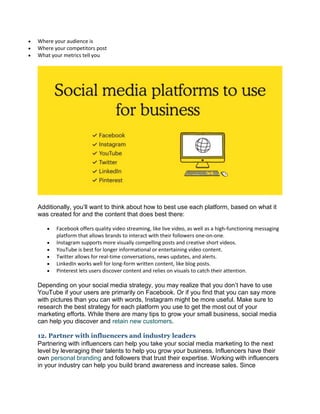
Additionally, you’ll want to think about how to best use each platform, based on what it
was created for and the content that does best there:
 Facebook offers quality video streaming, like live video, as well as a high-functioning messaging
platform that allows brands to interact with their followers one-on-one.
 Instagram supports more visually compelling posts and creative short videos.
 YouTube is best for longer informational or entertaining video content.
 Twitter allows for real-time conversations, news updates, and alerts.
 LinkedIn works well for long-form written content, like blog posts.
 Pinterest lets users discover content and relies on visuals to catch their attention.
Depending on your social media strategy, you may realize that you don’t have to use
YouTube if your users are primarily on Facebook. Or if you find that you can say more
with pictures than you can with words, Instagram might be more useful. Make sure to
research the best strategy for each platform you use to get the most out of your
marketing efforts. While there are many tips to grow your small business, social media
can help you discover and retain new customers.
12. Partner with influencers and industry leaders
Partnering with influencers can help you take your social media marketing to the next
level by leveraging their talents to help you grow your business. Influencers have their
own personal branding and followers that trust their expertise. Working with influencers
in your industry can help you build brand awareness and increase sales. Since
influencers are real people, they’re more easily trusted by customers, allowing you to
use that to your advantage.
13. Livestream occasionally
Live streaming can help boost your organic reach on social media. Because live
streaming taps into your followers’ fear of missing out (FOMO), you can reach more
people at a time. Live streaming also allows you to be more personal with your
audience and give them insight into your business and its products to build trust.
14. Post at the best times
Creating quality content can ensure you reach more people and engage your audience.
However, if your customers aren’t active on social media when you post, they likely
won’t ever see your content. You can find the times when your audience is online by
looking at your social media analytics. Many social media management tools also give
you insight into the best times to post based on when your followers are typically online.
You can also experiment by posting at different times of day to determine how it affects
engagement and reach.
Benefits of marketing on social media
Every small business should invest in social media marketing to promote their business
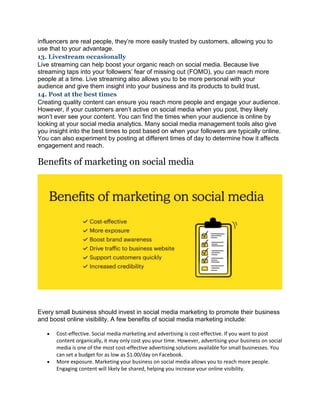
and boost online visibility. A few benefits of social media marketing include:
 Cost-effective. Social media marketing and advertising is cost-effective. If you want to post
content organically, it may only cost you your time. However, advertising your business on social
media is one of the most cost-effective advertising solutions available for small businesses. You
can set a budget for as low as $1.00/day on Facebook.
 More exposure. Marketing your business on social media allows you to reach more people.
Engaging content will likely be shared, helping you increase your online visibility.
 Boost brand awareness. Social media is a great tool for increasing brand awareness by boosting
online visibility. However, if you want to take advantage of social media to raise brand
awareness, consider creating advertisements that expand your reach.
 Drive traffic to business websites. Your social media marketing should drive traffic back to your
website, where customers can complete actions like filling out forms or making purchases.
 Support customers quickly. Social media allows you to handle online customer service requests
quickly and easily. When someone messages you directly on social media, you can answer their
questions in real-time, giving them a fast response that improves their experience with your
business.
 Increased credibility. Posting engaging and educational content can increase your credibility,
helping new customers learn that you’re a thought leader they can trust.
Effectively market your business on social media with
Mailchimp
Social media marketing is necessary for any business that wants to stand out. Your
competition is using social media to reach new customers, so it’s time for you to
enhance your efforts. Mailchimp makes it easy to market on social media by offering
content creation tools to help you build targeted ads. You can also use our social media
management tools to schedule posts and publish at the right time.

Marketing Tips@.docx

  • 1.
    Some important Ideasto Develop Your Blogs Marketing Tips: Ask an Expert-
  • 2.
     Ask topmarketing industry influencers to chime in on a recent marketing event or topic, then feature a roundup of influencer opinions. Use Help a reporter out to source expert opinions on a topic that’s important to your customers. Become a News Source- Create a roundup of must read marketing books for year. Take a current event topic and relate marketing to it such as,” X ways to market your business during an election session. Share the findings of a recent report and provide your own analysis and predictions. Be Trendy- Talk about how a business can capitalize on the popularity of emojis in their marketing. Talk about the latest social media trends. Collect Tweets around a popular topic, event or
  • 3.
    conference and featurethese tweets in a blog post. Leverage Events- Write a recap of a recent marketing webinar that you gave or attended. Attend a well known marketing conference, and do a roundup of the best conference tips you heard and best sessions that you attended Follow a hashtag for a conference or event and pull the best tweets into a blog post. Keep a Pulse on Important Brands- Do a roundup of the best marketing campaigns of the year. Write a numerical post for the Top YouTube channels or stars to follow. Highlight a popular marketing campaigns of a big brand, and give your agency’s opinion on what worked, what didn’t and how your agency might have executed it differently
  • 4.
    Curate Awesome Content- Compilea list of the best marketing blogs to subscribe to. Write a post that features the top blogs in your clients niche. Recommend Tools and Products- Give your readers a roundup of inexpensive tools they can use to outsource marketing tasks that take a ton of time. Feature an entire blog post around one tool with a very detailed explanation of its features. Review two different competing tools and why one is better than other. What is social media marketing? Social media marketing involves using platforms like Facebook, Instagram, Twitter, LinkedIn, and TikTok to effectively reach a wider audience and communicate with customers. Social media marketing is necessary for any small business marketing strategy and requires a robust plan. Your customers expect engaging content and the ability to communicate with you through direct messaging and comments. Effective social media marketing for small businesses gives you the unique opportunity to humanize your brand and drive traffic back to your website. With social media advertising, you can also generate leads and sales while increasing brand awareness.
  • 5.
    Many small businesseseven use social media for customer service, allowing customers to message them directly to have issues resolved and questions answered. How to market your business on social media Social media is integral to any marketing strategy, but it may seem daunting for small business owners who don’t know how to use different platforms. Luckily, social media marketing is fairly easy to learn and doesn’t require too much time or money. Any budget can support a robust social media marketing strategy as long as you get to know your customers and can create engaging content regularly. Here’s how to promote your business on social media. 1. Identify your audience Many businesses make the mistake of trying to reach everyone. But understanding and organizing your audience can help you send the right message to the right people and more effectively meet your marketing goals. This begins with identifying your target audience. The details about who these people are should be based on the audience data you already have, as well as your market research. To find your target audience:  Compile data. In order to reach your target market, you need to know what they’re like. It’s important to know things like your audience members’ ages, locations, and engagement patterns to market effectively to them. While it may seem daunting to gather this information, customer relationship management software stores and sorts this data and makes it easy to put into action.  Use social media analytics. Many platforms, like Facebook and Twitter, have built-in analytics that can tell you about your followers, including when they post, where they post, and other interests. Plus, these tools are free to use with business accounts.  Check the competition. Understanding your competition will give you insights about how to talk to your audience. You can look at what your competitors are doing wrong to fill any gaps in your current strategy. Once you’ve identified your target audience, it’s important to keep up to date with their interests and to implement a social listening strategy to understand their wants and needs. 2. Define your goals and KPIs To excel in social media marketing, it’s important to create goals that guide your efforts. The SMART goal strategy provides a helpful framework to create foundational goals and meet your overall objectives. SMART stands for:  Specific: In order to measure and meet goals, it’s important to be clear about precisely what you hope to achieve. This is especially important for getting your team onboard as
  • 6.
    you work collectivelytowards the goal. A specific social media goal, for example, might be to increase your Twitter followers by 20% this quarter.  Measurable: You need to know definitively whether you’ve reached your goal or not. Measurement makes that possible. By using metrics to track your progress, you can also pivot your goals if need be. For instance, if you find that likes and follows don’t lead to website traffic, you can change the metric to something that will help you achieve your goal.  Achievable: All goals should be within reach of your business. If you set goals that are unreasonable, you risk discouraging your employees and creating friction in your business plan. As you set specific, measurable goals, make sure to adjust if it seems like you aren’t reaching them.  Relevant: Your social media marketing goals should ladder up to your larger business objectives. For example, if it’s your objective to build brand awareness, you could set a goal to get 100 social media followers to click through a post to a landing page that describes your offerings.  Timely: To keep yourself accountable, goals should have a time limit. Instead of creating a goal for some undefined time in the near future, make sure to set a specific cadence to check in and ensure you’re staying on track. Though social media marketing has many moving parts, SMART goals give you a starting point, as well as a means to check in and make changes as needed. 3. Allocate your resources wisely For small businesses strapped for money and time, sometimes social media tasks get arbitrarily offloaded onto whoever is available. But social media management requires unique skills, like:  Strategic thinking  Organizational skills  Branding expertise If you have the means, hiring an expert to handle social media can pay off. But if you don’t have the budget for an on-staff social media manager, you can still invest in advertisements on social platforms, which can boost brand awareness and expand reach. 4. Use multiple platforms Consider the multiple social media platforms your customers use daily. Ultimately, your strategy should allow you to reach as many people through social media as possible, and you can’t do that by focusing on only one platform. Depending on your audience, many of them may use Facebook, Instagram, and TikTok throughout the day, giving you three opportunities to get your content in front of them. Social media apps to know include Instagram, Facebook, TikTok, LinkedIn, and Twitter. However, investing in a strategy for all of these platforms isn’t necessary. Instead, consider the apps your customers are most likely to use.
  • 7.
    5. Post relevantcontent regularly Success on social media is a matter of posting compelling, engaging content consistently. Not only will this help make your business look dependable, but it also shows that you have timely knowledge to share and that you care to be in conversation with your audience. Social media platforms change their algorithms over time, but the rule of posting regularly holds true: This practice helps your content show up in newsfeeds. By focusing on consistent, relevant content, you show the algorithms that your posts are worthy of showing up in various newsfeeds and ultimately, will attract followers to your page. 6. Interact with followers Social media users enjoy interacting with brands, and as a result brands experience benefits like:  Social proof of your business  Expanded market reach  Boosted brand awareness  Cost-efficiency The opportunity for a high return on investment (ROI) is huge—83% of customers value customer experience, and that includes social media interactions in which businesses make their audience feel seen, heard, and understood. Social media allows you to monitor conversations in real-time and answer questions or concerns from your audience promptly. This can take many forms, like:  Asking questions relevant to your offerings  Creating a Facebook Group for your audience  Using GIFs, videos, and emojis to spice up messages  Utilizing platform tools, like Instagram Live to start discussions A good strategy is to allow 1 hour a day to communicate with your audience on social media. However, if there are pressing concerns, you should always take the time to respond promptly. 7. Always maintain professionalism It’s important to remember that as you post on social media, you are always representing your business. Posts are taken out of context all too often, which can lead to conflict and upset followers. If your social media responsibilities are allocated to other staff members, consider creating a social media policy to guide their posts and conversations. Typically, a standard social media policy will include:
  • 8.
     Clear expectationsabout what to post  Instructions on how to respond to negative posts  Platform laws and rules to follow  Brand considerations  Security protocols By investing in a social media policy, your business can be ready for any scenario. It’s important to remember that at the core of social media, you are implementing your customer service philosophy. 8. Reflect your brand identity Brand identity is what helps people connect to your business and sets you apart from your competitors. This means that all marketing, including print, digital, and social media, should be consistent. Brand consistency can be challenging for businesses, especially when you’re just getting started. But it’s important across channels, and that certainly includes social media. As you are posting, you’ll want to think about:  How you talk to your customers, otherwise known as a brand voice  Posting similar visuals across the various platforms  Focusing on your unique selling point. Not only will a consistent brand identity make it easier to know what to post, but it can also help increase brand loyalty. 9. Prioritize quality over quantity Instead of posting multiple times a day on as many platforms as possible, you should focus on delivering consistent, quality posts. In fact, some social media sites may penalize your account and mark you as spam for too many low-quality posts. Additionally, posting could become overwhelming and problematic whoever handles your social media, whether that’s you or a teammate, and that could wind up hurting your strategy rather than helping. To mitigate these risks, consider implementing a social media calendar. These calendars can help you plan posts in advance while ensuring you stay organized. Categories including when to post, post caption, post visual, and which platforms to post on can help marketers keep track of the various moving parts of social media. Another way to prioritize quality posts is to ask yourself the following questions:  Does this content help my followers?  Is this original?  Is this actionable, inspiring, or entertaining?  Does the content have cited sources, if needed?
  • 9.
    All of thesequestions can help you create quality content that will engage and attract followers. Learning about the top social media content to create for each platform is key to helping you reach more people online. 10. Measure your results There are many factors that affect social media marketing, and that’s why it’s important to analyze and measure results. Analytics come in handy because they can help:  Optimize campaigns  Create new goals  Assess tracking metrics Before you start tracking, though, you should identify which metrics are most important to your marketing goals. The most common metrics are:  Reach  Engagement  Impressions  Mentions  Post clicks  Video views 11. Develop a unique strategy You might have the impulse to post on as many platforms as possible, but this could actually derail your social media marketing strategy. For example, if you’re trying to target people who are over 50 years of age, you’ll find that most of your audience is on Facebook, so it’s not as worthwhile to prioritize Instagram. When creating a social media strategy, focus on:
  • 10.
     Where youraudience is  Where your competitors post  What your metrics tell you Additionally, you’ll want to think about how to best use each platform, based on what it was created for and the content that does best there:  Facebook offers quality video streaming, like live video, as well as a high-functioning messaging platform that allows brands to interact with their followers one-on-one.  Instagram supports more visually compelling posts and creative short videos.  YouTube is best for longer informational or entertaining video content.  Twitter allows for real-time conversations, news updates, and alerts.  LinkedIn works well for long-form written content, like blog posts.  Pinterest lets users discover content and relies on visuals to catch their attention. Depending on your social media strategy, you may realize that you don’t have to use YouTube if your users are primarily on Facebook. Or if you find that you can say more with pictures than you can with words, Instagram might be more useful. Make sure to research the best strategy for each platform you use to get the most out of your marketing efforts. While there are many tips to grow your small business, social media can help you discover and retain new customers. 12. Partner with influencers and industry leaders Partnering with influencers can help you take your social media marketing to the next level by leveraging their talents to help you grow your business. Influencers have their own personal branding and followers that trust their expertise. Working with influencers in your industry can help you build brand awareness and increase sales. Since
  • 11.
    influencers are realpeople, they’re more easily trusted by customers, allowing you to use that to your advantage. 13. Livestream occasionally Live streaming can help boost your organic reach on social media. Because live streaming taps into your followers’ fear of missing out (FOMO), you can reach more people at a time. Live streaming also allows you to be more personal with your audience and give them insight into your business and its products to build trust. 14. Post at the best times Creating quality content can ensure you reach more people and engage your audience. However, if your customers aren’t active on social media when you post, they likely won’t ever see your content. You can find the times when your audience is online by looking at your social media analytics. Many social media management tools also give you insight into the best times to post based on when your followers are typically online. You can also experiment by posting at different times of day to determine how it affects engagement and reach. Benefits of marketing on social media Every small business should invest in social media marketing to promote their business and boost online visibility. A few benefits of social media marketing include:  Cost-effective. Social media marketing and advertising is cost-effective. If you want to post content organically, it may only cost you your time. However, advertising your business on social media is one of the most cost-effective advertising solutions available for small businesses. You can set a budget for as low as $1.00/day on Facebook.  More exposure. Marketing your business on social media allows you to reach more people. Engaging content will likely be shared, helping you increase your online visibility.
  • 12.
     Boost brandawareness. Social media is a great tool for increasing brand awareness by boosting online visibility. However, if you want to take advantage of social media to raise brand awareness, consider creating advertisements that expand your reach.  Drive traffic to business websites. Your social media marketing should drive traffic back to your website, where customers can complete actions like filling out forms or making purchases.  Support customers quickly. Social media allows you to handle online customer service requests quickly and easily. When someone messages you directly on social media, you can answer their questions in real-time, giving them a fast response that improves their experience with your business.  Increased credibility. Posting engaging and educational content can increase your credibility, helping new customers learn that you’re a thought leader they can trust. Effectively market your business on social media with Mailchimp Social media marketing is necessary for any business that wants to stand out. Your competition is using social media to reach new customers, so it’s time for you to enhance your efforts. Mailchimp makes it easy to market on social media by offering content creation tools to help you build targeted ads. You can also use our social media management tools to schedule posts and publish at the right time.