SKYLIGHT
SWAIMS Webinar on Engagement of Private Sector
1. Introduction
a. Where Skylight is currently active in West Africa
b. Partnership with UNODC & other organizations
2. Specific Analytics & Case Studies
a. Dark Rendezvous & Cabo Verde
b. Dark Vessel Detections & Ghana
c. Upcoming functionality: Potential Dark Activity
AGENDA
2
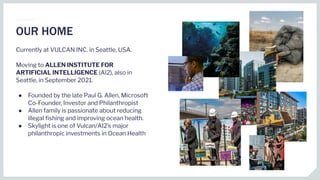
Currently at VULCAN INC. in Seattle, USA.
Moving to ALLEN INSTITUTE FOR
ARTIFICIAL INTELLIGENCE (AI2), also in
Seattle, in September 2021.
● Founded by the late Paul G. Allen, Microsoft
Co-Founder, Investor and Philanthropist
● Allen family is passionate about reducing
illegal fishing and improving ocean health.
● Skylight is one of Vulcan/AI2’s major
philanthropic investments in Ocean Health
OUR HOME
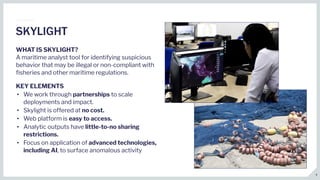
WHAT IS SKYLIGHT?
A maritime analyst tool for identifying suspicious
behavior that may be illegal or non-compliant with
fisheries and other maritime regulations.
KEY ELEMENTS
• We work through partnerships to scale
deployments and impact.
• Skylight is offered at no cost.
• Web platform is easy to access.
• Analytic outputs have little-to-no sharing
restrictions.
• Focus on application of advanced technologies,
including AI, to surface anomalous activity
SKYLIGHT
4
2018: Skylight presented at IR Consilium (IRC)-facilitated public-private conference on
Technology for Maritime Security in Freetown, Sierra Leone.
2019: Six month trial agreement signed with ECOWAS via IRC. Piloted Skylight tool from October
to April 2020 with a few national and regional centers. MMCC Zone F, Ghanaian Navy and
Ivorian Navy identify several suspicious transshipment activities with Skylight.
Pilot ends, but access to Skylight continues for all piloting centers.
2020: Cooperation framework with UNODC Global Maritime Crime Programme signed.
TODAY: Skylight continues to be accessible to these centers:
• Regional: CRESMAO; Zonal: MMCC Zone E, MMCC Zone F
• National: Cabo Verde Coast Guard and JRCC, São Tomé and Príncipe Coast Guard and
Fisheries, Ghana Navy, Côte d’Ivoire Navy
We are open to working with new agencies and countries in West Africa as well.
ENGAGEMENT HISTORY IN WEST AFRICA
5
6
PARTNERS
Capacity Building Organizations
• UNODC – Global Maritime Crime Programme
• Wildlife Conservation Society
• WildAid
• International MCS Network
• US Agencies: US Navy Africa Command (NAVAF), NOAA
Funding Partners
• Oceans5
• Blue Nature Alliance
• National Geographic Society
Technology Partners
• Global Fishing Watch
• Trygg Mat Tracking
• SeaVision
DETECT SUSPICIOUS ACTIVITIES IN REAL-TIME (AIS)
1. Monitor vessels encroaching into various areas of interest.
2. Monitor potential transshipment activities and other anomalous vessel movements in real-time.
INFORM INTELLIGENCE GATHERING AND REPORTING (AIS + SAR)
3. Build spatial risk assessments for at-sea transfers.
4. Collect satellite radar to understand dark vessel pattern-of-life and inform operations.
CORROBORATE INFORMATION ABOUT “KNOWN” VESSELS (AIS, IHS, & Other Sources)
5. Leverage our multi-source database to check vessel-specific information.
SUGGESTIONS FOR USING SKYLIGHT
7
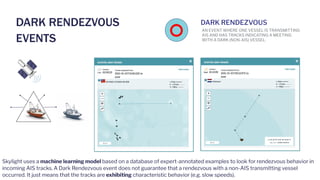
DARK RENDEZVOUS
AN EVENT WHERE ONE VESSEL IS TRANSMITTING
AIS AND HAS TRACKS INDICATING A MEETING
WITH A DARK (NON-AIS) VESSEL.
Skylight uses a machine learning model based on a database of expert-annotated examples to look for rendezvous behavior in
incoming AIS tracks. A Dark Rendezvous event does not guarantee that a rendezvous with a non-AIS transmitting vessel
occurred. It just means that the tracks are exhibiting characteristic behavior (e.g. slow speeds).
DARK RENDEZVOUS
EVENTS
9
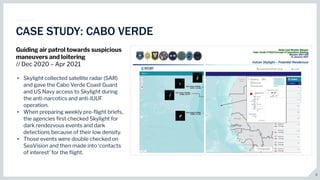
CASE STUDY: CABO VERDE
Guiding air patrol towards suspicious
maneuvers and loitering
// Dec 2020 – Apr 2021
• Skylight collected satellite radar (SAR)
and gave the Cabo Verde Coast Guard
and US Navy access to Skylight during
the anti-narcotics and anti-IUUF
operation.
• When preparing weekly pre-flight briefs,
the agencies first checked Skylight for
dark rendezvous events and dark
detections because of their low density.
• Those events were double checked on
SeaVision and then made into ‘contacts
of interest’ for the flight.
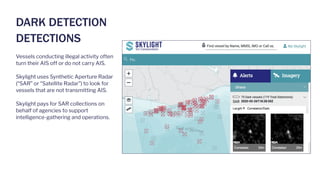
Vessels conducting illegal activity often
turn their AIS off or do not carry AIS.
Skylight uses Synthetic Aperture Radar
(“SAR” or “Satellite Radar”) to look for
vessels that are not transmitting AIS.
Skylight pays for SAR collections on
behalf of agencies to support
intelligence-gathering and operations.
DARK DETECTION
DETECTIONS
11
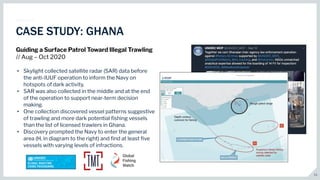
CASE STUDY: GHANA
Guiding a Surface Patrol Toward Illegal Trawling
// Aug – Oct 2020
• Skylight collected satellite radar (SAR) data before
the anti-IUUF operation to inform the Navy on
hotspots of dark activity.
• SAR was also collected in the middle and at the end
of the operation to support near-term decision
making.
• One collection discovered vessel patterns suggestive
of trawling and more dark potential fishing vessels
than the list of licensed trawlers in Ghana.
• Discovery prompted the Navy to enter the general
area (H, in diagram to the right) and find at least five
vessels with varying levels of infractions.
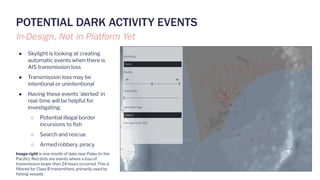
● Skylight is looking at creating
automatic events when there is
AIS transmission loss
● Transmission loss may be
intentional or unintentional
● Having these events ‘alerted’ in
real-time will be helpful for
investigating:
○ Potential illegal border
incursions to fish
○ Search and rescue
○ Armed robbery, piracy
Image right is one month of data near Palau (in the
Pacific). Red dots are events where a loss of
transmission larger than 24 hours occurred. This is
filtered for Class B transmitters, primarily used by
fishing vessels.
POTENTIAL DARK ACTIVITY EVENTS
In-Design, Not in Platform Yet
13
OPPORTUNITIES FOR PARTNERSHIP WITH SKYLIGHT
1. Identify operations and exercises that could benefit from Skylight’s capabilities.
2. Identify new agencies and countries who might benefit from Skylight.
○ Please contact us through our partners, such as UNODC (next slide)
3. Brainstorm new use cases for advanced analytics (e.g. machine learning)
together.
4. For watchfloors and analysts: provide feedback to the platform on existing and
upcoming features
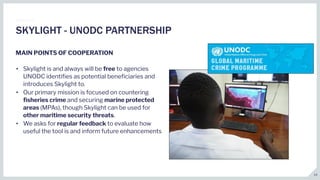
MAIN POINTS OF COOPERATION
• Skylight is and always will be free to agencies
UNODC identifies as potential beneficiaries and
introduces Skylight to.
• Our primary mission is focused on countering
fisheries crime and securing marine protected
areas (MPAs), though Skylight can be used for
other maritime security threats.
• We asks for regular feedback to evaluate how
useful the tool is and inform future enhancements
SKYLIGHT - UNODC PARTNERSHIP
14
15
THANK YOU
Skylight Website: https://vulcan.com/skylight
Team email address: support@skylight.global
Ted Schmitt, Skylight Director, teds@vulcan.com
Namrata Kolla, Product Engagement Manager, namratak@vulcan.com
UNODC Atlantic Team
Giuseppe Sernia, giuseppe.sernia@un.org
Dominique Maxwelle Ada Eteme, dominique.adaeteme@un.org
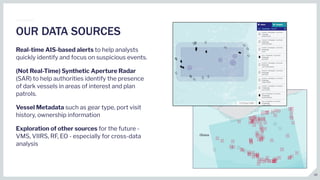
Real-time AIS-based alerts to help analysts
quickly identify and focus on suspicious events.
(Not Real-Time) Synthetic Aperture Radar
(SAR) to help authorities identify the presence
of dark vessels in areas of interest and plan
patrols.
Vessel Metadata such as gear type, port visit
history, ownership information
Exploration of other sources for the future -
VMS, VIIRS, RF, EO - especially for cross-data
analysis
OUR DATA SOURCES
16

Maritime security solutions: Case study from Skylight

  • 1.
    SKYLIGHT SWAIMS Webinar onEngagement of Private Sector
  • 2.
    1. Introduction a. WhereSkylight is currently active in West Africa b. Partnership with UNODC & other organizations 2. Specific Analytics & Case Studies a. Dark Rendezvous & Cabo Verde b. Dark Vessel Detections & Ghana c. Upcoming functionality: Potential Dark Activity AGENDA 2
  • 3.
    Currently at VULCANINC. in Seattle, USA. Moving to ALLEN INSTITUTE FOR ARTIFICIAL INTELLIGENCE (AI2), also in Seattle, in September 2021. ● Founded by the late Paul G. Allen, Microsoft Co-Founder, Investor and Philanthropist ● Allen family is passionate about reducing illegal fishing and improving ocean health. ● Skylight is one of Vulcan/AI2’s major philanthropic investments in Ocean Health OUR HOME
  • 4.
    WHAT IS SKYLIGHT? Amaritime analyst tool for identifying suspicious behavior that may be illegal or non-compliant with fisheries and other maritime regulations. KEY ELEMENTS • We work through partnerships to scale deployments and impact. • Skylight is offered at no cost. • Web platform is easy to access. • Analytic outputs have little-to-no sharing restrictions. • Focus on application of advanced technologies, including AI, to surface anomalous activity SKYLIGHT 4
  • 5.
    2018: Skylight presentedat IR Consilium (IRC)-facilitated public-private conference on Technology for Maritime Security in Freetown, Sierra Leone. 2019: Six month trial agreement signed with ECOWAS via IRC. Piloted Skylight tool from October to April 2020 with a few national and regional centers. MMCC Zone F, Ghanaian Navy and Ivorian Navy identify several suspicious transshipment activities with Skylight. Pilot ends, but access to Skylight continues for all piloting centers. 2020: Cooperation framework with UNODC Global Maritime Crime Programme signed. TODAY: Skylight continues to be accessible to these centers: • Regional: CRESMAO; Zonal: MMCC Zone E, MMCC Zone F • National: Cabo Verde Coast Guard and JRCC, São Tomé and Príncipe Coast Guard and Fisheries, Ghana Navy, Côte d’Ivoire Navy We are open to working with new agencies and countries in West Africa as well. ENGAGEMENT HISTORY IN WEST AFRICA 5
  • 6.
    6 PARTNERS Capacity Building Organizations •UNODC – Global Maritime Crime Programme • Wildlife Conservation Society • WildAid • International MCS Network • US Agencies: US Navy Africa Command (NAVAF), NOAA Funding Partners • Oceans5 • Blue Nature Alliance • National Geographic Society Technology Partners • Global Fishing Watch • Trygg Mat Tracking • SeaVision
  • 7.
    DETECT SUSPICIOUS ACTIVITIESIN REAL-TIME (AIS) 1. Monitor vessels encroaching into various areas of interest. 2. Monitor potential transshipment activities and other anomalous vessel movements in real-time. INFORM INTELLIGENCE GATHERING AND REPORTING (AIS + SAR) 3. Build spatial risk assessments for at-sea transfers. 4. Collect satellite radar to understand dark vessel pattern-of-life and inform operations. CORROBORATE INFORMATION ABOUT “KNOWN” VESSELS (AIS, IHS, & Other Sources) 5. Leverage our multi-source database to check vessel-specific information. SUGGESTIONS FOR USING SKYLIGHT 7
  • 8.
    DARK RENDEZVOUS AN EVENTWHERE ONE VESSEL IS TRANSMITTING AIS AND HAS TRACKS INDICATING A MEETING WITH A DARK (NON-AIS) VESSEL. Skylight uses a machine learning model based on a database of expert-annotated examples to look for rendezvous behavior in incoming AIS tracks. A Dark Rendezvous event does not guarantee that a rendezvous with a non-AIS transmitting vessel occurred. It just means that the tracks are exhibiting characteristic behavior (e.g. slow speeds). DARK RENDEZVOUS EVENTS
  • 9.
    9 CASE STUDY: CABOVERDE Guiding air patrol towards suspicious maneuvers and loitering // Dec 2020 – Apr 2021 • Skylight collected satellite radar (SAR) and gave the Cabo Verde Coast Guard and US Navy access to Skylight during the anti-narcotics and anti-IUUF operation. • When preparing weekly pre-flight briefs, the agencies first checked Skylight for dark rendezvous events and dark detections because of their low density. • Those events were double checked on SeaVision and then made into ‘contacts of interest’ for the flight.
  • 10.
    Vessels conducting illegalactivity often turn their AIS off or do not carry AIS. Skylight uses Synthetic Aperture Radar (“SAR” or “Satellite Radar”) to look for vessels that are not transmitting AIS. Skylight pays for SAR collections on behalf of agencies to support intelligence-gathering and operations. DARK DETECTION DETECTIONS
  • 11.
    11 CASE STUDY: GHANA Guidinga Surface Patrol Toward Illegal Trawling // Aug – Oct 2020 • Skylight collected satellite radar (SAR) data before the anti-IUUF operation to inform the Navy on hotspots of dark activity. • SAR was also collected in the middle and at the end of the operation to support near-term decision making. • One collection discovered vessel patterns suggestive of trawling and more dark potential fishing vessels than the list of licensed trawlers in Ghana. • Discovery prompted the Navy to enter the general area (H, in diagram to the right) and find at least five vessels with varying levels of infractions.
  • 12.
    ● Skylight islooking at creating automatic events when there is AIS transmission loss ● Transmission loss may be intentional or unintentional ● Having these events ‘alerted’ in real-time will be helpful for investigating: ○ Potential illegal border incursions to fish ○ Search and rescue ○ Armed robbery, piracy Image right is one month of data near Palau (in the Pacific). Red dots are events where a loss of transmission larger than 24 hours occurred. This is filtered for Class B transmitters, primarily used by fishing vessels. POTENTIAL DARK ACTIVITY EVENTS In-Design, Not in Platform Yet
  • 13.
    13 OPPORTUNITIES FOR PARTNERSHIPWITH SKYLIGHT 1. Identify operations and exercises that could benefit from Skylight’s capabilities. 2. Identify new agencies and countries who might benefit from Skylight. ○ Please contact us through our partners, such as UNODC (next slide) 3. Brainstorm new use cases for advanced analytics (e.g. machine learning) together. 4. For watchfloors and analysts: provide feedback to the platform on existing and upcoming features
  • 14.
    MAIN POINTS OFCOOPERATION • Skylight is and always will be free to agencies UNODC identifies as potential beneficiaries and introduces Skylight to. • Our primary mission is focused on countering fisheries crime and securing marine protected areas (MPAs), though Skylight can be used for other maritime security threats. • We asks for regular feedback to evaluate how useful the tool is and inform future enhancements SKYLIGHT - UNODC PARTNERSHIP 14
  • 15.
    15 THANK YOU Skylight Website:https://vulcan.com/skylight Team email address: support@skylight.global Ted Schmitt, Skylight Director, teds@vulcan.com Namrata Kolla, Product Engagement Manager, namratak@vulcan.com UNODC Atlantic Team Giuseppe Sernia, giuseppe.sernia@un.org Dominique Maxwelle Ada Eteme, dominique.adaeteme@un.org
  • 16.
    Real-time AIS-based alerts tohelp analysts quickly identify and focus on suspicious events. (Not Real-Time) Synthetic Aperture Radar (SAR) to help authorities identify the presence of dark vessels in areas of interest and plan patrols. Vessel Metadata such as gear type, port visit history, ownership information Exploration of other sources for the future - VMS, VIIRS, RF, EO - especially for cross-data analysis OUR DATA SOURCES 16