Overview of
the African Medicines Regulatory Harmonization and
African Medicines Agency
Margareth Ndomondo-Sigonda
NEPAD Planning and Coordinating Agency
Midrand, Johannesburg
South Africa
OUTLINE
1. Introduction to NEPAD
2. Background and Overview of the African Medicines
Regulatory Harmonization (AMRH) Programme
3. African Medicines Agency
 Operating Model
 Vision, Mission & Objectives
 Key actors, Milestones & Opportunities for Patients Engagement
NEPAD Agency Mandate
 2001: The New Partnership for Africa's Development (NEPAD) is a socio-economic development
programme of the African Union (AU) whose express objective is to stimulate Africa’s development
by bridging the existing gaps with a view to address the socio-economic, political and
environmental factors undermining public health.
 2010: Transformed into a technical body of the African Union, the core mandate of the
NEPAD Agency is:
• To facilitate and coordinate the implementation of continental and regional priority programmes and
projects;
• To mobilise resources and partners in support of their implementation;
• To conduct and coordinate research and knowledge management;
• To monitor and evaluate the implementation of programmes; and
• To advocate on the AU and NEPAD vision, mission and core values.
NEPAD Agency Mandate…
• In its efforts to address Africa’s disease burden, NEPAD Agency contributed to the development of
the 1st
Africa Health Strategy (2007-2016) and its subsequent review in 2016.
• Provide technical assistance to the AU Member States, Regional Economic Communities (RECs), the
African Union Commission (AUC) and Pan African Parliament (PAP) in facilitating implementation of
priority health projects and programmes at national, regional and continental levels.
• Consolidating efforts in the area of health and pharmaceuticals in line with AU and Global policy frameworks
and strategies such as:
– The Abuja Declaration on HIV/AIDS, Tuberculosis (TB), Malaria and other related infectious diseases (2001);
– Africa Health Strategy (2016-2030);
– Pharmaceutical Manufacturing Plan for Africa (PMPA) Business plan (2012);
– Catalytic Framework to End AIDS, TB and Eliminate Malaria in Africa By 2030;
– Agenda 2063; and Sustainable Development Goals (SDGs).
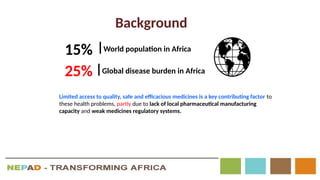
Limited access to quality, safe and efficacious medicines is a key contributing factor to
these health problems, partly due to lack of local pharmaceutical manufacturing
capacity and weak medicines regulatory systems.
Background
15% |World population in Africa
25% |Global disease burden in Africa
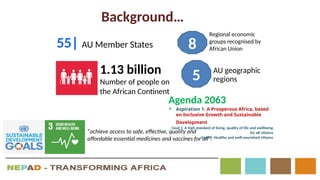
Background…
Regional economic
groups recognised by
African Union
“achieve access to safe, effective, quality and
affordable essential medicines and vaccines for all”.
55| AU Member States
1.13 billion
Number of people on
the African Continent
8
5 AU geographic
regions
Agenda 2063
 Aspiration 1: A Prosperous Africa, based
on Inclusive Growth and Sustainable
Development
Goal 1: A high standard of living, quality of life and wellbeing
for all citizens
Goal 3: Healthy and well-nourished citizens
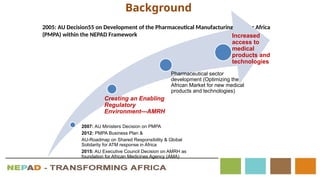
2005: AU Decision55 on Development of the Pharmaceutical Manufacturing Plan for Africa
(PMPA) within the NEPAD Framework
2007: AU Ministers Decision on PMPA
2012: PMPA Business Plan &
AU-Roadmap on Shared Responsibility & Global
Solidarity for ATM response in Africa
2015: AU Executive Council Decision on AMRH as
foundation for African Medicines Agency (AMA)
Creating an Enabling
Regulatory
Environment---AMRH
Pharmaceutical sector
development (Optimizing the
African Market for new medical
products and technologies)
Increased
access to
medical
products and
technologies
Background
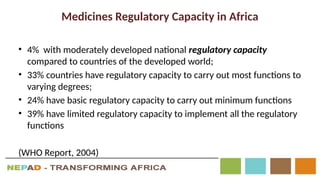
Medicines Regulatory Capacity in Africa
• 4% with moderately developed national regulatory capacity
compared to countries of the developed world;
• 33% countries have regulatory capacity to carry out most functions to
varying degrees;
• 24% have basic regulatory capacity to carry out minimum functions
• 39% have limited regulatory capacity to implement all the regulatory
functions
(WHO Report, 2004)
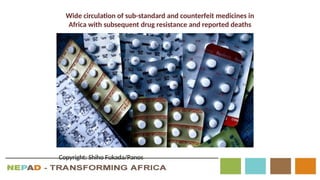
Wide circulation of sub-standard and counterfeit medicines in
Africa with subsequent drug resistance and reported deaths
Copyright: Shiho Fukada/Panos
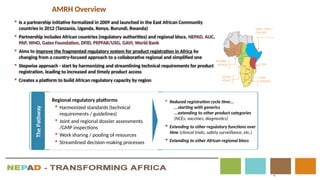
AMRH Overview
10
The
Pathway
Regional regulatory platforms
 Harmonized standards (technical
requirements / guidelines)
 Joint and regional dossier assessments
/GMP inspections
 Work sharing / pooling of resources
 Streamlined decision-making processes
 Reduced registration cycle time...
...starting with generics
...extending to other product categories
(NCEs, vaccines, diagnostics)
 Extending to other regulatory functions over
time (clinical trials, safety surveillance, etc.)
 Extending to other African regional blocs
 Is a partnership initiative formalized in 2009 and launched in the East African Community
countries in 2012 (Tanzania, Uganda, Kenya, Burundi, Rwanda)
 Partnership includes African countries (regulatory authorities) and regional blocs, NEPAD, AUC,
PAP, WHO, Gates Foundation, DFID, PEPFAR/USG, GAVI, World Bank
 Aims to improve the fragmented regulatory system for product registration in Africa by
changing from a country-focused approach to a collaborative regional and simplified one
 Stepwise approach - start by harmonizing and streamlining technical requirements for product
registration, leading to increased and timely product access
 Creates a platform to build African regulatory capacity by region
IGAD / AMU /
CEN-SAD
ECCAS
OCEAC
ECOWAS
UEMOA EAC
SADC
COMESA
10/29/2024 11
> 85% of Sub-Saharan Africa covered with medicines registration
harmonization (MRH) Projects at different levels
Completed or in-process RECs
Countries
covered
Total
members*
% pop
covered
EAC & OCEAC
EAC, OCEAC, ECOWAS
EAC, OCEAC, ECOWAS, SADC
12 (20%)
26 (46%)
41 (74%)
11
26
41
17%
45%
72%
REC progress
SADC
EAC Pharmacovigilance Project,
AVAREF alignment with AMRH on clinical trials ethics and regulatory
oversight
• REC
• EAC
• CEMAC-OCEAC
• WAHO/UEMOA
• SADC
• IGAD
•Status •Comments
•Implementation
•In progress
•Implementation
•Implementation
•Project Preparatory
Phase
•Launched March 2012
•Launch Nov. 2016
•Launched Feb 2015
•Launched July 2015
•2016
11
WAHO/UEMOA
EAC
ECCAS/OCEAC
CEN-SAD/UMA/COMESA
IGAD
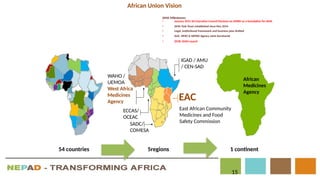
15
African Union Vision
54 countries 1 continent
African
Medicines
Agency
5regions
IGAD / AMU
/ CEN-SAD
EAC
SADC/
COMESA
ECCAS/
OCEAC
WAHO /
UEMOA
West Africa
Medicines
Agency
East African Community
Medicines and Food
Safety Commission
AMA Milestones:
• January 2015 AU Executive Council Decision on AMRH as a foundation for AMA
• AMA Task Team established since Nov 2014
• Legal, institutional framework and business plan drafted
• AUC, WHO & NEPAD Agency Joint Secretariat
• 2018: AMA Launch
2. AMA’s Business Model & Conceptual Framework
It is increasingly becoming evident
that no single country (rich or poor)
has enough resources & capability to
efficiently & effectively regulate the
whole supply chain system alone in
this globalised world.
AMA’S
Competitive
advantage
1st
AMA Stakeholders Consultation Meeting, 20-22 February 2017, Birchwood Hotel, Johannesburg, South Africa
National vs.
Regional
/Continenta
l
Pan-African
Medicines Agency
Who’s going
to do what?
African Medicines Agency
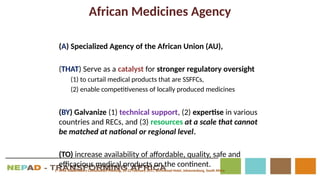
(A) Specialized Agency of the African Union (AU),
(THAT) Serve as a catalyst for stronger regulatory oversight
(1) to curtail medical products that are SSFFCs,
(2) enable competitiveness of locally produced medicines
(BY) Galvanize (1) technical support, (2) expertise in various
countries and RECs, and (3) resources at a scale that cannot
be matched at national or regional level.
(TO) increase availability of affordable, quality, safe and
efficacious medical products on the continent.
1st
AMA Stakeholders Consultation Meeting, 20-22 February 2017, Birchwood Hotel, Johannesburg, South Africa
AMA Vision, Mission & Objectives
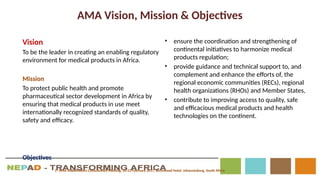
Vision
To be the leader in creating an enabling regulatory
environment for medical products in Africa.
Mission
To protect public health and promote
pharmaceutical sector development in Africa by
ensuring that medical products in use meet
internationally recognized standards of quality,
safety and efficacy.
Objectives
• ensure the coordination and strengthening of
continental initiatives to harmonize medical
products regulation;
• provide guidance and technical support to, and
complement and enhance the efforts of, the
regional economic communities (RECs), regional
health organizations (RHOs) and Member States,
• contribute to improving access to quality, safe
and efficacious medical products and health
technologies on the continent.
1st
AMA Stakeholders Consultation Meeting, 20-22 February 2017, Birchwood Hotel, Johannesburg, South Africa
Key Functions of AMA
1. Promote the adoption and harmonization of medical products regulatory policies and standards, and scientific guidelines, and coordinate existing
regulatory harmonization efforts in the RECs and RHOs;
2. Provide regulatory guidance, scientific opinions and a common framework for regulatory actions on medical products, as well as priority and emerging
issues and pandemics;
3. Examine, discuss and/or express regulatory guidance on any regulatory matter within its mandate, either on its own initiative or at the request of the
African Union, Regional Economic Communities, or Member States;
4. Provide technical assistance, where possible, on regulatory matters to countries that lack the capacity and resources to do so themselves;
5. Provide guidance on regulation of traditional medical products;
6. Provide guidance on regulation of clinical trials on medical products and health technologies;
7. Designate, promote, strengthen, coordinate and monitor RCOREs with a view to developing the capacity of medical products regulatory professionals;
8. Promote international cooperation and seek partnerships that will lead to effective mobilization of financial and technical resources to ensure sustainability
of the AMA;
9. Promote and advocate for the use of the AU Model Law on medical products regulation in member states and RECs to facilitate regulatory and legal
reforms at continental, regional and national levels;
10. Convene in collaboration with the WHO, the AMRC and other bodies, meetings related to medical products regulation in Africa;
11. Collect, manage and disseminate relevant information and knowledge;
12. Develop systems to monitor, evaluate and assess the comprehensiveness of national medical products regulatory systems with the view to recommending
interventions that will improve efficiency and effectiveness;
13. Mobilize regulatory expertise across the continent and beyond to provide scientific opinions in consultation with affected Member State NMRAs, in the
event of a public health emergency on the continent with cross border or regional implications where new medical products are to be deployed for
investigation and clinical trials.
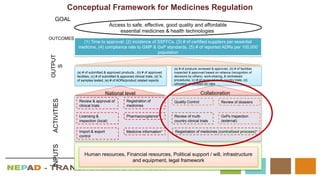
INPUTS
ACTIVITIES
OUTPUT
S
OUTCOMES
GOAL
(1) Time to approval; (2) incidence of SSFFCs, (3) # of certified suppliers per essential
medicine, (4) compliance rate to GMP & GxP standards, (5) # of reported ADRs per 100,000
population
Human resources, Financial resources, Political support / will, infrastructure
and equipment, legal framework
Quality Control
GxPs inspection
(external)
Review of multi-
country clinical trials
Review of dossiers
Registration of medicines (centralized process)*
Collaboration
Review & approval of
clinical trials
Registration of
medicines
Licensing &
inspection (local)
Import & export
control
Pharmacovigilance*
Medicine information*
National level
(a) # of submitted & approved products , (b) # of approved
facilities, (c) # of submitted & approved clinical trials, (d) %
of samples tested, (e) # of ADRs/product related reports
(a) # of products reviewed & approved, (b) # of facilities
inspected & approved based on reliance (recognition of
decisions by others), work-sharing, & centralised
procedures, (c) # of reviewed multi-country trials, (d)
utilisation of certified QC labs
Access to safe, effective, good quality and affordable
essential medicines & health technologies
Conceptual Framework for Medicines Regulation
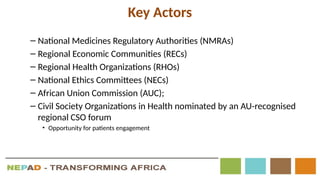
Key Actors
– National Medicines Regulatory Authorities (NMRAs)
– Regional Economic Communities (RECs)
– Regional Health Organizations (RHOs)
– National Ethics Committees (NECs)
– African Union Commission (AUC);
– Civil Society Organizations in Health nominated by an AU-recognised
regional CSO forum
• Opportunity for patients engagement
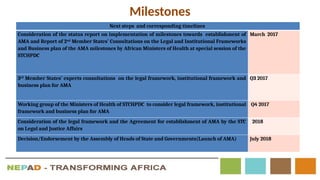
Milestones
Next steps and corresponding timelines
Consideration of the status report on implementation of milestones towards establishment of
AMA and Report of 2nd
Member States’ Consultations on the Legal and Institutional Frameworks
and Business plan of the AMA milestones by African Ministers of Health at special session of the
STCHPDC
March 2017
3rd
Member States’ experts consultations on the legal framework, institutional framework and
business plan for AMA
Q3 2017
Working group of the Ministers of Health of STCHPDC to consider legal framework, institutional
framework and business plan for AMA
Q4 2017
Consideration of the legal framework and the Agreement for establishment of AMA by the STC
on Legal and Justice Affairs
2018
Decision/Endorsement by the Assembly of Heads of State and Governments(Launch of AMA) July 2018
Thank you!

Margareth Ndomondo -NEPAD_Presentation(1).pptx

  • 1.
    Overview of the AfricanMedicines Regulatory Harmonization and African Medicines Agency Margareth Ndomondo-Sigonda NEPAD Planning and Coordinating Agency Midrand, Johannesburg South Africa
  • 2.
    OUTLINE 1. Introduction toNEPAD 2. Background and Overview of the African Medicines Regulatory Harmonization (AMRH) Programme 3. African Medicines Agency  Operating Model  Vision, Mission & Objectives  Key actors, Milestones & Opportunities for Patients Engagement
  • 3.
    NEPAD Agency Mandate 2001: The New Partnership for Africa's Development (NEPAD) is a socio-economic development programme of the African Union (AU) whose express objective is to stimulate Africa’s development by bridging the existing gaps with a view to address the socio-economic, political and environmental factors undermining public health.  2010: Transformed into a technical body of the African Union, the core mandate of the NEPAD Agency is: • To facilitate and coordinate the implementation of continental and regional priority programmes and projects; • To mobilise resources and partners in support of their implementation; • To conduct and coordinate research and knowledge management; • To monitor and evaluate the implementation of programmes; and • To advocate on the AU and NEPAD vision, mission and core values.
  • 4.
    NEPAD Agency Mandate… •In its efforts to address Africa’s disease burden, NEPAD Agency contributed to the development of the 1st Africa Health Strategy (2007-2016) and its subsequent review in 2016. • Provide technical assistance to the AU Member States, Regional Economic Communities (RECs), the African Union Commission (AUC) and Pan African Parliament (PAP) in facilitating implementation of priority health projects and programmes at national, regional and continental levels. • Consolidating efforts in the area of health and pharmaceuticals in line with AU and Global policy frameworks and strategies such as: – The Abuja Declaration on HIV/AIDS, Tuberculosis (TB), Malaria and other related infectious diseases (2001); – Africa Health Strategy (2016-2030); – Pharmaceutical Manufacturing Plan for Africa (PMPA) Business plan (2012); – Catalytic Framework to End AIDS, TB and Eliminate Malaria in Africa By 2030; – Agenda 2063; and Sustainable Development Goals (SDGs).
  • 5.
    Limited access toquality, safe and efficacious medicines is a key contributing factor to these health problems, partly due to lack of local pharmaceutical manufacturing capacity and weak medicines regulatory systems. Background 15% |World population in Africa 25% |Global disease burden in Africa
  • 6.
    Background… Regional economic groups recognisedby African Union “achieve access to safe, effective, quality and affordable essential medicines and vaccines for all”. 55| AU Member States 1.13 billion Number of people on the African Continent 8 5 AU geographic regions Agenda 2063  Aspiration 1: A Prosperous Africa, based on Inclusive Growth and Sustainable Development Goal 1: A high standard of living, quality of life and wellbeing for all citizens Goal 3: Healthy and well-nourished citizens
  • 7.
    2005: AU Decision55on Development of the Pharmaceutical Manufacturing Plan for Africa (PMPA) within the NEPAD Framework 2007: AU Ministers Decision on PMPA 2012: PMPA Business Plan & AU-Roadmap on Shared Responsibility & Global Solidarity for ATM response in Africa 2015: AU Executive Council Decision on AMRH as foundation for African Medicines Agency (AMA) Creating an Enabling Regulatory Environment---AMRH Pharmaceutical sector development (Optimizing the African Market for new medical products and technologies) Increased access to medical products and technologies Background
  • 8.
    Medicines Regulatory Capacityin Africa • 4% with moderately developed national regulatory capacity compared to countries of the developed world; • 33% countries have regulatory capacity to carry out most functions to varying degrees; • 24% have basic regulatory capacity to carry out minimum functions • 39% have limited regulatory capacity to implement all the regulatory functions (WHO Report, 2004)
  • 9.
    Wide circulation ofsub-standard and counterfeit medicines in Africa with subsequent drug resistance and reported deaths Copyright: Shiho Fukada/Panos
  • 10.
    AMRH Overview 10 The Pathway Regional regulatoryplatforms  Harmonized standards (technical requirements / guidelines)  Joint and regional dossier assessments /GMP inspections  Work sharing / pooling of resources  Streamlined decision-making processes  Reduced registration cycle time... ...starting with generics ...extending to other product categories (NCEs, vaccines, diagnostics)  Extending to other regulatory functions over time (clinical trials, safety surveillance, etc.)  Extending to other African regional blocs  Is a partnership initiative formalized in 2009 and launched in the East African Community countries in 2012 (Tanzania, Uganda, Kenya, Burundi, Rwanda)  Partnership includes African countries (regulatory authorities) and regional blocs, NEPAD, AUC, PAP, WHO, Gates Foundation, DFID, PEPFAR/USG, GAVI, World Bank  Aims to improve the fragmented regulatory system for product registration in Africa by changing from a country-focused approach to a collaborative regional and simplified one  Stepwise approach - start by harmonizing and streamlining technical requirements for product registration, leading to increased and timely product access  Creates a platform to build African regulatory capacity by region IGAD / AMU / CEN-SAD ECCAS OCEAC ECOWAS UEMOA EAC SADC COMESA
  • 11.
    10/29/2024 11 > 85%of Sub-Saharan Africa covered with medicines registration harmonization (MRH) Projects at different levels Completed or in-process RECs Countries covered Total members* % pop covered EAC & OCEAC EAC, OCEAC, ECOWAS EAC, OCEAC, ECOWAS, SADC 12 (20%) 26 (46%) 41 (74%) 11 26 41 17% 45% 72% REC progress SADC EAC Pharmacovigilance Project, AVAREF alignment with AMRH on clinical trials ethics and regulatory oversight • REC • EAC • CEMAC-OCEAC • WAHO/UEMOA • SADC • IGAD •Status •Comments •Implementation •In progress •Implementation •Implementation •Project Preparatory Phase •Launched March 2012 •Launch Nov. 2016 •Launched Feb 2015 •Launched July 2015 •2016 11 WAHO/UEMOA EAC ECCAS/OCEAC CEN-SAD/UMA/COMESA IGAD
  • 15.
    15 African Union Vision 54countries 1 continent African Medicines Agency 5regions IGAD / AMU / CEN-SAD EAC SADC/ COMESA ECCAS/ OCEAC WAHO / UEMOA West Africa Medicines Agency East African Community Medicines and Food Safety Commission AMA Milestones: • January 2015 AU Executive Council Decision on AMRH as a foundation for AMA • AMA Task Team established since Nov 2014 • Legal, institutional framework and business plan drafted • AUC, WHO & NEPAD Agency Joint Secretariat • 2018: AMA Launch
  • 16.
    2. AMA’s BusinessModel & Conceptual Framework
  • 17.
    It is increasinglybecoming evident that no single country (rich or poor) has enough resources & capability to efficiently & effectively regulate the whole supply chain system alone in this globalised world. AMA’S Competitive advantage 1st AMA Stakeholders Consultation Meeting, 20-22 February 2017, Birchwood Hotel, Johannesburg, South Africa
  • 18.
  • 19.
    African Medicines Agency (A)Specialized Agency of the African Union (AU), (THAT) Serve as a catalyst for stronger regulatory oversight (1) to curtail medical products that are SSFFCs, (2) enable competitiveness of locally produced medicines (BY) Galvanize (1) technical support, (2) expertise in various countries and RECs, and (3) resources at a scale that cannot be matched at national or regional level. (TO) increase availability of affordable, quality, safe and efficacious medical products on the continent. 1st AMA Stakeholders Consultation Meeting, 20-22 February 2017, Birchwood Hotel, Johannesburg, South Africa
  • 20.
    AMA Vision, Mission& Objectives Vision To be the leader in creating an enabling regulatory environment for medical products in Africa. Mission To protect public health and promote pharmaceutical sector development in Africa by ensuring that medical products in use meet internationally recognized standards of quality, safety and efficacy. Objectives • ensure the coordination and strengthening of continental initiatives to harmonize medical products regulation; • provide guidance and technical support to, and complement and enhance the efforts of, the regional economic communities (RECs), regional health organizations (RHOs) and Member States, • contribute to improving access to quality, safe and efficacious medical products and health technologies on the continent. 1st AMA Stakeholders Consultation Meeting, 20-22 February 2017, Birchwood Hotel, Johannesburg, South Africa
  • 21.
    Key Functions ofAMA 1. Promote the adoption and harmonization of medical products regulatory policies and standards, and scientific guidelines, and coordinate existing regulatory harmonization efforts in the RECs and RHOs; 2. Provide regulatory guidance, scientific opinions and a common framework for regulatory actions on medical products, as well as priority and emerging issues and pandemics; 3. Examine, discuss and/or express regulatory guidance on any regulatory matter within its mandate, either on its own initiative or at the request of the African Union, Regional Economic Communities, or Member States; 4. Provide technical assistance, where possible, on regulatory matters to countries that lack the capacity and resources to do so themselves; 5. Provide guidance on regulation of traditional medical products; 6. Provide guidance on regulation of clinical trials on medical products and health technologies; 7. Designate, promote, strengthen, coordinate and monitor RCOREs with a view to developing the capacity of medical products regulatory professionals; 8. Promote international cooperation and seek partnerships that will lead to effective mobilization of financial and technical resources to ensure sustainability of the AMA; 9. Promote and advocate for the use of the AU Model Law on medical products regulation in member states and RECs to facilitate regulatory and legal reforms at continental, regional and national levels; 10. Convene in collaboration with the WHO, the AMRC and other bodies, meetings related to medical products regulation in Africa; 11. Collect, manage and disseminate relevant information and knowledge; 12. Develop systems to monitor, evaluate and assess the comprehensiveness of national medical products regulatory systems with the view to recommending interventions that will improve efficiency and effectiveness; 13. Mobilize regulatory expertise across the continent and beyond to provide scientific opinions in consultation with affected Member State NMRAs, in the event of a public health emergency on the continent with cross border or regional implications where new medical products are to be deployed for investigation and clinical trials.
  • 22.
    INPUTS ACTIVITIES OUTPUT S OUTCOMES GOAL (1) Time toapproval; (2) incidence of SSFFCs, (3) # of certified suppliers per essential medicine, (4) compliance rate to GMP & GxP standards, (5) # of reported ADRs per 100,000 population Human resources, Financial resources, Political support / will, infrastructure and equipment, legal framework Quality Control GxPs inspection (external) Review of multi- country clinical trials Review of dossiers Registration of medicines (centralized process)* Collaboration Review & approval of clinical trials Registration of medicines Licensing & inspection (local) Import & export control Pharmacovigilance* Medicine information* National level (a) # of submitted & approved products , (b) # of approved facilities, (c) # of submitted & approved clinical trials, (d) % of samples tested, (e) # of ADRs/product related reports (a) # of products reviewed & approved, (b) # of facilities inspected & approved based on reliance (recognition of decisions by others), work-sharing, & centralised procedures, (c) # of reviewed multi-country trials, (d) utilisation of certified QC labs Access to safe, effective, good quality and affordable essential medicines & health technologies Conceptual Framework for Medicines Regulation
  • 23.
    Key Actors – NationalMedicines Regulatory Authorities (NMRAs) – Regional Economic Communities (RECs) – Regional Health Organizations (RHOs) – National Ethics Committees (NECs) – African Union Commission (AUC); – Civil Society Organizations in Health nominated by an AU-recognised regional CSO forum • Opportunity for patients engagement
  • 24.
    Milestones Next steps andcorresponding timelines Consideration of the status report on implementation of milestones towards establishment of AMA and Report of 2nd Member States’ Consultations on the Legal and Institutional Frameworks and Business plan of the AMA milestones by African Ministers of Health at special session of the STCHPDC March 2017 3rd Member States’ experts consultations on the legal framework, institutional framework and business plan for AMA Q3 2017 Working group of the Ministers of Health of STCHPDC to consider legal framework, institutional framework and business plan for AMA Q4 2017 Consideration of the legal framework and the Agreement for establishment of AMA by the STC on Legal and Justice Affairs 2018 Decision/Endorsement by the Assembly of Heads of State and Governments(Launch of AMA) July 2018
  • 25.

Editor's Notes

  • #5 Africa has a high disease burden and high mortality from preventable and curable diseases, partly due to inadequate health systems, scarce financial and human resources and unavailable and unaffordable medicines that are good quality, safe and efficacious. inadequate capacity and resources on medical product regulation at national levels No single country including well-resourced countries can efficiently and effectively regulate its own market alone in this globalized market. Decision for the establishment of the African medicines regulatory agency (AMA) made by Heads of State & Govt
  • #11 While EAC has made progress in the development of harmonized guidelines for registration, GMP inspection, quality management system and information management system, West African (ECOWAS/UEMOA) and Southern African (SADC) regions are to launch their MRH Project Steering Committees before end of 2014
  • #15 The African Medicines Regulatory Harmonization (AMRH) Programme provides a foundation for establishment of regional medicines agencies such as the East African Community Medicines and Food Safety Commission (as an offshoot of the MRH project) and in the long run the African Medicines Agency (AMA)