While the finer details of the Labour party’s Mansion Tax
remain unreported, the basic lower threshold of £2m and
an annual charge of £3,000 for properties valued between
£2-3m appear to be set in stone. With over 80% of £2m+
properties sold in England & Wales during 2014 being
located in London, we took a look at what constitutes a
London mansion and what the possible implications for
owners of qualifying property could be.
What is a London ‘Mansion’?
carterjonas.co.uk
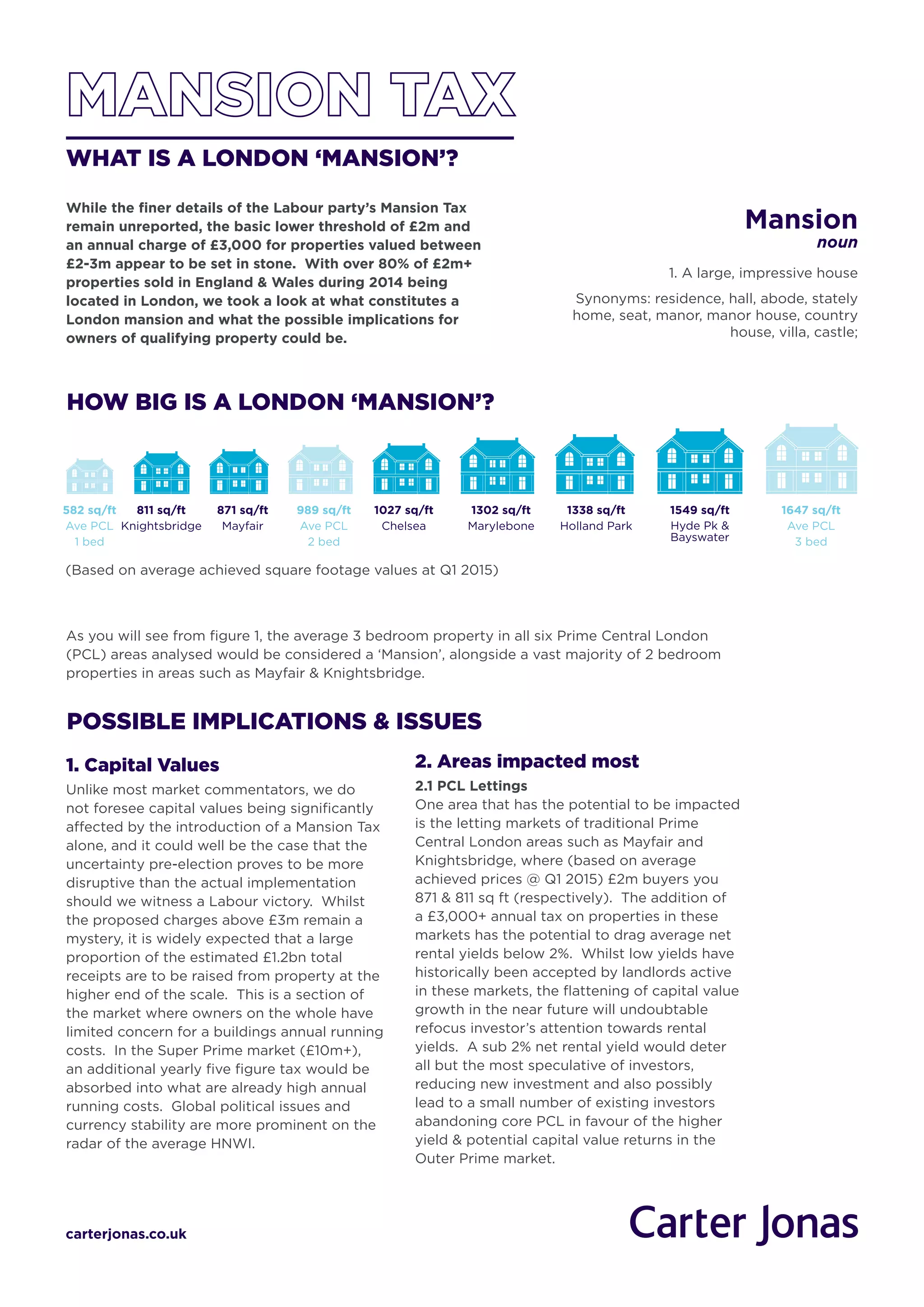
How big is a London ‘Mansion’?
582 sq/ft
Ave PCL
1 bed
811 sq/ft
Knightsbridge
871 sq/ft
Mayfair
989 sq/ft
Ave PCL
2 bed
1027 sq/ft
Chelsea
1302 sq/ft
Marylebone
1338 sq/ft
Holland Park
1549 sq/ft
Hyde Pk &
Bayswater
1647 sq/ft
Ave PCL
3 bed
(Based on average achieved square footage values at Q1 2015)
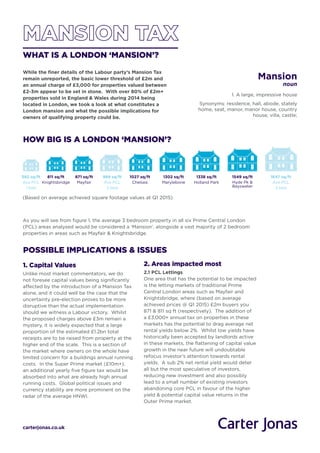
As you will see from figure 1, the average 3 bedroom property in all six Prime Central London
(PCL) areas analysed would be considered a ‘Mansion’, alongside a vast majority of 2 bedroom
properties in areas such as Mayfair & Knightsbridge.
1. Capital Values
Unlike most market commentators, we do
not foresee capital values being significantly
affected by the introduction of a Mansion Tax
alone, and it could well be the case that the
uncertainty pre-election proves to be more
disruptive than the actual implementation
should we witness a Labour victory. Whilst
the proposed charges above £3m remain a
mystery, it is widely expected that a large
proportion of the estimated £1.2bn total
receipts are to be raised from property at the
higher end of the scale. This is a section of
the market where owners on the whole have
limited concern for a buildings annual running
costs. In the Super Prime market (£10m+),
an additional yearly five figure tax would be
absorbed into what are already high annual
running costs. Global political issues and
currency stability are more prominent on the
radar of the average HNWI.
2. Areas impacted most
2.1 PCL Lettings
One area that has the potential to be impacted
is the letting markets of traditional Prime
Central London areas such as Mayfair and
Knightsbridge, where (based on average
achieved prices @ Q1 2015) £2m buyers you
871 & 811 sq ft (respectively). The addition of
a £3,000+ annual tax on properties in these
markets has the potential to drag average net
rental yields below 2%. Whilst low yields have
historically been accepted by landlords active
in these markets, the flattening of capital value
growth in the near future will undoubtable
refocus investor’s attention towards rental
yields. A sub 2% net rental yield would deter
all but the most speculative of investors,
reducing new investment and also possibly
lead to a small number of existing investors
abandoning core PCL in favour of the higher
yield & potential capital value returns in the
Outer Prime market.
1. A large, impressive house
Synonyms: residence, hall, abode, stately
home, seat, manor, manor house, country
house, villa, castle;
Mansion
noun
Possible implications & issues
2.2 The equity rich, cash poor
One of the unintended consequences of the
tax would be the capture of equity rich, cash
poor households. To combat this the Labour
party have proposed a £42,000 threshold at
which households with a lower annual income
would be able to defer payment of the tax
until the point at which the property is sold. It
is unclear how many households would qualify
for this deferral, but what is certain is there will
undoubtedly be losers in the income bracket
slightly above £42,000. Although in national
terms, a household income of £42,000 would
be considered reasonable, the higher cost of
London life, coupled with expensive block
service charges make the stated threshold
look a little on the low side. It is for this reason
that we would expect this deferral threshold to
be re-assessed and increased should Labour
come to power.
4. Administrative burden
One area we foresee a major problem is the
administration of such a scheme. Firstly the
job of accurate valuation would surely prove
immensely complex and expensive. When you
add to this the undoubted deluge of appeals
of those in and around different thresholds,
you are left with the potential for a rather
weighty administrative workload. Generally
speaking, owners of property in the £2m+
bracket are often more than comfortable
engaging in lengthy litigation processes and it
is for this reason that we see the administrative
element as a major hurdle in the delivery of a
mansion tax.
3. Over reliance on a very small
and volatile market
As mentioned above, it is expected that a
vast majority of the projected £1.2bn receipts
would be collected from the higher end of the
property value scale, specifically the Super
Prime market. It is our view that this top
loading of expected receipts is risky due to the
volatile nature and limited size of this market.
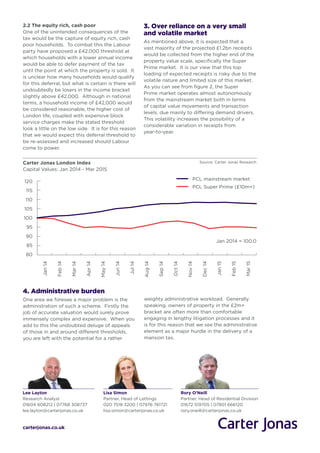
As you can see from figure 2, the Super
Prime market operates almost autonomously
from the mainstream market both in terms
of capital value movements and transaction
levels, due mainly to differing demand drivers.
This volatility increases the possibility of a
considerable variation in receipts from
year-to-year.
Carter Jonas London Index
Capital Values: Jan 2014 - Mar 2015
120
115
110
105
100
95
90
85
80
Jan14
Feb14
Mar14
Apr14
May14
Jun14
Jul14
Aug14
Sep14
Oct14
Nov14
Dec14
Jan15
Feb15
Mar15
Jan 2014 = 100.0
PCL mainstream market
PCL Super Prime (£10m+)
Source: Carter Jonas Research
carterjonas.co.uk
Lisa Simon
Partner, Head of Lettings
020 7518 3200 | 07976 761721
lisa.simon@carterjonas.co.uk
Rory O’Neill
Partner, Head of Residential Division
01672 519705 | 07801 666120
rory.oneill@carterjonas.co.uk
Lee Layton
Research Analyst
01604 608212 | 07768 308737
lee.layton@carterjonas.co.uk

Mansion Tax

  • 1.
    While the finerdetails of the Labour party’s Mansion Tax remain unreported, the basic lower threshold of £2m and an annual charge of £3,000 for properties valued between £2-3m appear to be set in stone. With over 80% of £2m+ properties sold in England & Wales during 2014 being located in London, we took a look at what constitutes a London mansion and what the possible implications for owners of qualifying property could be. What is a London ‘Mansion’? carterjonas.co.uk How big is a London ‘Mansion’? 582 sq/ft Ave PCL 1 bed 811 sq/ft Knightsbridge 871 sq/ft Mayfair 989 sq/ft Ave PCL 2 bed 1027 sq/ft Chelsea 1302 sq/ft Marylebone 1338 sq/ft Holland Park 1549 sq/ft Hyde Pk & Bayswater 1647 sq/ft Ave PCL 3 bed (Based on average achieved square footage values at Q1 2015) As you will see from figure 1, the average 3 bedroom property in all six Prime Central London (PCL) areas analysed would be considered a ‘Mansion’, alongside a vast majority of 2 bedroom properties in areas such as Mayfair & Knightsbridge. 1. Capital Values Unlike most market commentators, we do not foresee capital values being significantly affected by the introduction of a Mansion Tax alone, and it could well be the case that the uncertainty pre-election proves to be more disruptive than the actual implementation should we witness a Labour victory. Whilst the proposed charges above £3m remain a mystery, it is widely expected that a large proportion of the estimated £1.2bn total receipts are to be raised from property at the higher end of the scale. This is a section of the market where owners on the whole have limited concern for a buildings annual running costs. In the Super Prime market (£10m+), an additional yearly five figure tax would be absorbed into what are already high annual running costs. Global political issues and currency stability are more prominent on the radar of the average HNWI. 2. Areas impacted most 2.1 PCL Lettings One area that has the potential to be impacted is the letting markets of traditional Prime Central London areas such as Mayfair and Knightsbridge, where (based on average achieved prices @ Q1 2015) £2m buyers you 871 & 811 sq ft (respectively). The addition of a £3,000+ annual tax on properties in these markets has the potential to drag average net rental yields below 2%. Whilst low yields have historically been accepted by landlords active in these markets, the flattening of capital value growth in the near future will undoubtable refocus investor’s attention towards rental yields. A sub 2% net rental yield would deter all but the most speculative of investors, reducing new investment and also possibly lead to a small number of existing investors abandoning core PCL in favour of the higher yield & potential capital value returns in the Outer Prime market. 1. A large, impressive house Synonyms: residence, hall, abode, stately home, seat, manor, manor house, country house, villa, castle; Mansion noun Possible implications & issues
  • 2.
    2.2 The equityrich, cash poor One of the unintended consequences of the tax would be the capture of equity rich, cash poor households. To combat this the Labour party have proposed a £42,000 threshold at which households with a lower annual income would be able to defer payment of the tax until the point at which the property is sold. It is unclear how many households would qualify for this deferral, but what is certain is there will undoubtedly be losers in the income bracket slightly above £42,000. Although in national terms, a household income of £42,000 would be considered reasonable, the higher cost of London life, coupled with expensive block service charges make the stated threshold look a little on the low side. It is for this reason that we would expect this deferral threshold to be re-assessed and increased should Labour come to power. 4. Administrative burden One area we foresee a major problem is the administration of such a scheme. Firstly the job of accurate valuation would surely prove immensely complex and expensive. When you add to this the undoubted deluge of appeals of those in and around different thresholds, you are left with the potential for a rather weighty administrative workload. Generally speaking, owners of property in the £2m+ bracket are often more than comfortable engaging in lengthy litigation processes and it is for this reason that we see the administrative element as a major hurdle in the delivery of a mansion tax. 3. Over reliance on a very small and volatile market As mentioned above, it is expected that a vast majority of the projected £1.2bn receipts would be collected from the higher end of the property value scale, specifically the Super Prime market. It is our view that this top loading of expected receipts is risky due to the volatile nature and limited size of this market. As you can see from figure 2, the Super Prime market operates almost autonomously from the mainstream market both in terms of capital value movements and transaction levels, due mainly to differing demand drivers. This volatility increases the possibility of a considerable variation in receipts from year-to-year. Carter Jonas London Index Capital Values: Jan 2014 - Mar 2015 120 115 110 105 100 95 90 85 80 Jan14 Feb14 Mar14 Apr14 May14 Jun14 Jul14 Aug14 Sep14 Oct14 Nov14 Dec14 Jan15 Feb15 Mar15 Jan 2014 = 100.0 PCL mainstream market PCL Super Prime (£10m+) Source: Carter Jonas Research carterjonas.co.uk Lisa Simon Partner, Head of Lettings 020 7518 3200 | 07976 761721 lisa.simon@carterjonas.co.uk Rory O’Neill Partner, Head of Residential Division 01672 519705 | 07801 666120 rory.oneill@carterjonas.co.uk Lee Layton Research Analyst 01604 608212 | 07768 308737 lee.layton@carterjonas.co.uk