Managing Pollution Across
Administrative Boundaries
—Bohai Sea Environmental
Management Project (BSEMP)
Chen Yue
Department of International Cooperation
State Oceanic Administration
People’s Republic of China
Contents
• I. Introduction to the Bohai Sea
• II. Signature of the Memorandum
of Agreement
• III. Implementation of the Bohai
Sea Environmental Management
Project
• IV. Outcomes of BSEMP
I. Introduction to the Bohai Sea
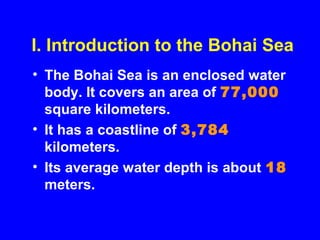
• The Bohai Sea is an enclosed water
body. It covers an area of 77,000
square kilometers.
• It has a coastline of 3,784
kilometers.
• Its average water depth is about 18
meters.
Introduction to the Bohai Sea
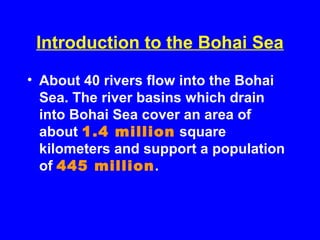
• About 40 rivers flow into the Bohai
Sea. The river basins which drain
into Bohai Sea cover an area of
about 1.4 million square
kilometers and support a population
of 445 million.
Introduction to the Bohai Sea
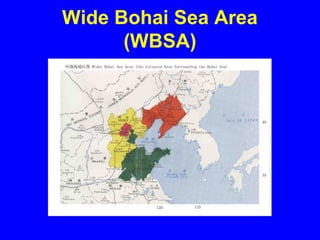
• Major environmental impact area in
this region is the Wide Bohai Sea
Area (WBSA) , which covers Bohai
Sea itself and the adjacent provinces
and municipalities, namely Liaoning,
Hebei, Shandong, Beijing and
Tianjin.
Wide Bohai Sea Area
(WBSA)
Wider Bohai Sea Area (WBSA)
• The WBSA is as one of the major centers
of economic development in China. In
1999, the WBSA accounts for 22% of
China’s GDP.
• It produced some 40% of China’s
seafood, 70% of China’s sea salt and
19% of China’s offshore oil and gas.
• It functions as an important maritime
outlet for China’s landlocked Great West
and Northeast provinces, as well as a
Euro-Asian transportation link. As such, it
handles about 23% of China’s maritime
transportation.
Wider Bohai Sea Area (WBSA)
• Apart from its strategic importance
in the regional trade and
transportation, the WBSA also
functions as a key link within the
larger marine ecosystem of the
Yellow Sea.
II. Signature of the
Memorandum of Agreement
• In July 2000, a Memorandum of
Agreement pertaining to the Bohai
Sea Environmental Management
Project was singed between SOA
and IMO in Dalian.
The Objectives of BSEMP
• Develop a working model to manage
pollution hot spots across legal and
administrative boundaries
• Foster collaboration to jointly reduce
waste discharges and control of
marine pollution
The Objectives of BSEMP
• Enable the local governments to
adopt the integrated management
approaches and mechanisms,
pollution risk assessment, waste
reduction programs, ecosystem
based zoning scheme, and cross
sector pollution monitoring.
The Objectives of BSEMP
• The BSEMP emphasizes that
stakeholder consultation and
participation and training should be
the essential elements throughout
the project process.
Bohai Declaration on
Environmental Protection
• In order to show the determination of
managing, protecting and improving
the environment of Bohai Sea,
leaders from SOA and governments
of provinces and municipanlities
surrounding Bohai Sea signed
“Bohai Declaration on Environmental
Protection”.
III. Implementation of
the Bohai Sea
Environmental
Management Project
A. Project Management
Mechanism
•
P P M O
L ia o n in g O F D
P P M O
H e b e i O D
P P M O
S h a n d o n g O F D
P P M O
T ia n jin O D
P P M O
D a lia n O F D
S O A N P M O
B. The Establishment of
Five Demonstration Sites in
Bohai Sea Area
• The West Coast in Dalian
• Panjin in Liaoning
• Qinhuangdao in Hebei
• Tanggu in Tianjin
• Laizhou Bay in Shandong
C. The National Legal
Framework for Implementing
BSEMP
• Marine Environmental Protection
Law of the People’s Republic of
China
• Law of the People’s Republic of
China on the Management of Sea
Area Use
D. Other National Plans
Related to BSEMP
• Integrated Bohai Sea
Environmental Improvement and
Management Plan (SOA)
• Cleaning Sea Action Plan (SEPA)
E. Project Activities
Conducted
• Development of the Strategic
Environmental Management Plan for
the Bohai Sea
• Establishment of the Web Site for
Bohai Sea Environmental
Management Project
• Publication and Distribution of
Brochures related to Protecting
Bohai Environment
IV. Outcomes of BSEMP
• The implementation of the Bohai
Sea Environmental Management
Porject will go on till September
2004.
Outcomes of BSEMP
• The final success of the Bohai Sea
Environmental Management Project
will be marked by:
• --Development of a special law for
Bohai Sea environment
management;
• --Establishment of a management
mechanism for decision-making,
coordination and management of
affairs related to Bohai Sea.

Managing Pollution Across Administrative Boundaries.ppt

  • 1.
    Managing Pollution Across AdministrativeBoundaries —Bohai Sea Environmental Management Project (BSEMP) Chen Yue Department of International Cooperation State Oceanic Administration People’s Republic of China
  • 2.
    Contents • I. Introductionto the Bohai Sea • II. Signature of the Memorandum of Agreement • III. Implementation of the Bohai Sea Environmental Management Project • IV. Outcomes of BSEMP
  • 3.
    I. Introduction tothe Bohai Sea • The Bohai Sea is an enclosed water body. It covers an area of 77,000 square kilometers. • It has a coastline of 3,784 kilometers. • Its average water depth is about 18 meters.
  • 4.
    Introduction to theBohai Sea • About 40 rivers flow into the Bohai Sea. The river basins which drain into Bohai Sea cover an area of about 1.4 million square kilometers and support a population of 445 million.
  • 5.
    Introduction to theBohai Sea • Major environmental impact area in this region is the Wide Bohai Sea Area (WBSA) , which covers Bohai Sea itself and the adjacent provinces and municipalities, namely Liaoning, Hebei, Shandong, Beijing and Tianjin.
  • 6.
    Wide Bohai SeaArea (WBSA)
  • 7.
    Wider Bohai SeaArea (WBSA) • The WBSA is as one of the major centers of economic development in China. In 1999, the WBSA accounts for 22% of China’s GDP. • It produced some 40% of China’s seafood, 70% of China’s sea salt and 19% of China’s offshore oil and gas. • It functions as an important maritime outlet for China’s landlocked Great West and Northeast provinces, as well as a Euro-Asian transportation link. As such, it handles about 23% of China’s maritime transportation.
  • 8.
    Wider Bohai SeaArea (WBSA) • Apart from its strategic importance in the regional trade and transportation, the WBSA also functions as a key link within the larger marine ecosystem of the Yellow Sea.
  • 9.
    II. Signature ofthe Memorandum of Agreement • In July 2000, a Memorandum of Agreement pertaining to the Bohai Sea Environmental Management Project was singed between SOA and IMO in Dalian.
  • 10.
    The Objectives ofBSEMP • Develop a working model to manage pollution hot spots across legal and administrative boundaries • Foster collaboration to jointly reduce waste discharges and control of marine pollution
  • 11.
    The Objectives ofBSEMP • Enable the local governments to adopt the integrated management approaches and mechanisms, pollution risk assessment, waste reduction programs, ecosystem based zoning scheme, and cross sector pollution monitoring.
  • 12.
    The Objectives ofBSEMP • The BSEMP emphasizes that stakeholder consultation and participation and training should be the essential elements throughout the project process.
  • 13.
    Bohai Declaration on EnvironmentalProtection • In order to show the determination of managing, protecting and improving the environment of Bohai Sea, leaders from SOA and governments of provinces and municipanlities surrounding Bohai Sea signed “Bohai Declaration on Environmental Protection”.
  • 14.
    III. Implementation of theBohai Sea Environmental Management Project
  • 15.
    A. Project Management Mechanism • PP M O L ia o n in g O F D P P M O H e b e i O D P P M O S h a n d o n g O F D P P M O T ia n jin O D P P M O D a lia n O F D S O A N P M O
  • 16.
    B. The Establishmentof Five Demonstration Sites in Bohai Sea Area • The West Coast in Dalian • Panjin in Liaoning • Qinhuangdao in Hebei • Tanggu in Tianjin • Laizhou Bay in Shandong
  • 17.
    C. The NationalLegal Framework for Implementing BSEMP • Marine Environmental Protection Law of the People’s Republic of China • Law of the People’s Republic of China on the Management of Sea Area Use
  • 18.
    D. Other NationalPlans Related to BSEMP • Integrated Bohai Sea Environmental Improvement and Management Plan (SOA) • Cleaning Sea Action Plan (SEPA)
  • 19.
    E. Project Activities Conducted •Development of the Strategic Environmental Management Plan for the Bohai Sea • Establishment of the Web Site for Bohai Sea Environmental Management Project • Publication and Distribution of Brochures related to Protecting Bohai Environment
  • 20.
    IV. Outcomes ofBSEMP • The implementation of the Bohai Sea Environmental Management Porject will go on till September 2004.
  • 21.
    Outcomes of BSEMP •The final success of the Bohai Sea Environmental Management Project will be marked by: • --Development of a special law for Bohai Sea environment management; • --Establishment of a management mechanism for decision-making, coordination and management of affairs related to Bohai Sea.