Managing Global Supply Chains 2nd Edition Ron
Basu J Nevan Wright download
https://ebookbell.com/product/managing-global-supply-chains-2nd-
edition-ron-basu-j-nevan-wright-48035886
Explore and download more ebooks at ebookbell.com
Here are some recommended products that we believe you will be
interested in. You can click the link to download.
Managing Global Supply Chains Contemporary Global Challenges In Supply
Chain Management 3rd Edition 3rd Edition Ron Basu
https://ebookbell.com/product/managing-global-supply-chains-
contemporary-global-challenges-in-supply-chain-management-3rd-
edition-3rd-edition-ron-basu-48035910
Managing Global Supply Chains Compliance Security And Dealing With
Terrorism Thomas A Cook
https://ebookbell.com/product/managing-global-supply-chains-
compliance-security-and-dealing-with-terrorism-thomas-a-cook-1992704
Social Compliance Accounting Managing Legitimacy In Global Supply
Chains 1st Edition Muhammad Azizul Islam Auth
https://ebookbell.com/product/social-compliance-accounting-managing-
legitimacy-in-global-supply-chains-1st-edition-muhammad-azizul-islam-
auth-4932396
Managing The Global Supply Chain 4th Edition Aseem Kinra Herbert
Kotzab Juliana Hsuan Tage Skjttlarsen
https://ebookbell.com/product/managing-the-global-supply-chain-4th-
edition-aseem-kinra-herbert-kotzab-juliana-hsuan-tage-
skjttlarsen-51434608
Food Safety For The 21st Century Managing Haccp And Food Safety
Throughout The Global Supply Chain Carol A Wallace
https://ebookbell.com/product/food-safety-for-the-21st-century-
managing-haccp-and-food-safety-throughout-the-global-supply-chain-
carol-a-wallace-4304550
Food Safety For The 21st Century Managing Haccp And Food Safety
Throughout The Global Supply Chain Carol Wallace
https://ebookbell.com/product/food-safety-for-the-21st-century-
managing-haccp-and-food-safety-throughout-the-global-supply-chain-
carol-wallace-7159592
Managing Global Customers An Integrated Approach George S Yip
https://ebookbell.com/product/managing-global-customers-an-integrated-
approach-george-s-yip-2135164
Managing Global Innovation Uncovering The Secrets Of Future
Competitiveness 3rd Edition Prof Dr Roman Boutellier
https://ebookbell.com/product/managing-global-innovation-uncovering-
the-secrets-of-future-competitiveness-3rd-edition-prof-dr-roman-
boutellier-4268540
Managing Global Business Strategies A Twentyfirstcentury Perspective
1st Edition John T Mcmanus
https://ebookbell.com/product/managing-global-business-strategies-a-
twentyfirstcentury-perspective-1st-edition-john-t-mcmanus-4675494
Starting from the concept that “there is no point driving a Ferrari in a traffic jam”, Basu
and Wright demonstrate the importance of good supply chain management in Managing
Global Supply Chains. Building on the successful Total Supply Chain Management and
incorporating the new challenges of globalisation, this book demonstrates the practi-
cal tools and techniques that add value, deliver cost reduction and improve customer
satisfaction.
This new edition has been substantially revised and extended to include a holistic
approach incorporating the upstream suppliers and the downstream customers. Further
updates to this edition include:
• New chapters on e-business, emerging markets, sustainability and green issues, global
supply chains for services and event management, retail management and major
project management
• A section of brand new case studies
• A new companion website to support lecturers with their teaching
This book also provides comprehensive insight into lean and agile supply chains sup-
ported by tools, techniques and case examples.
Managing Global Supply Chains is a practical text with excellent coverage and is ideal for
post-experience business students or learning professionals in supply chain management.
Ron Basu is Director of Performance Excellence Limited and aVisiting Executive Fel-
low at Henley Business School, University of Reading, UK. He is also aVisiting Professor
at SKEMA Graduate School of Management, France.
J. Nevan Wright is a Lecturer in Supply Chain Management and Operations Manage-
ment and was formally MBA Director for theAuckland Institute of Studies and anAssoci-
ate Professor at Auckland University of Technology, New Zealand.
Managing Global Supply Chains
‘Global supply chains are complex and difficult to manage. Supply chain practitioners
have to utilize a number of tools and techniques to effectively manage the chains.This
book provides a comprehensive treatment of topics influencing the management of sup-
ply chains and highlights the challenges faced by global supply chains.An abundance of
case examples and learning resources within this book will be extremely beneficial to
students and academics.’
Prof. Samir Dani, Professor of Logistics and Supply Chain Management,
University of Huddersfield, UK
‘Supply Chain Management (SCM) is critical to organisational success. In the modern
economy increasing competition is between ecosystems compromising SCMs.This book
offers an excellent insight into critical SCMs success factors and management challenges.
It combines academic rigour with practical insights. It is well organised and written
making it equally suitable for practicing managers and students.’
Dr. Abby Ghobadian, Professor of Management, Co-Editor Journal of Strategy
and Management, Past President of British Academy of Management, UK
‘This is an excellent book. It offers a broad scope of ideas and tools as well as a unique
depth to the challenges facing global supply chain in the 21st Century. It is an easy read
and yet offers conceptual profundity. The hands-on approach makes it a valuable source
of learning for any practitioner in the fields of supply chain management.’
Dr. Kent Springdal, MBA Course Director, Kingston Business School, UK
Managing Global Supply
Chains
Second edition
Ron Basu and J. Nevan Wright
First published 2008 as Total Supply Chain Management
by Butterworth-Heinemann, an imprint of Elsevier
Second edition 2017
by Routledge
2 Park Square, Milton Park,Abingdon, Oxon OX14 4RN
And by Routledge
711 Third Avenue, NewYork, NY 10017
Routledge is an imprint of theTaylor & Francis Group, an informa business
© 2017 Ron Basu and J. Nevan Wright
The right of Ron Basu and J. Nevan Wright to be identified as authors of this work has
been asserted by them in accordance with sections 77 and 78 of the Copyright, Designs
and Patents Act 1988.
All rights reserved. No part of this book may be reprinted or reproduced or utilised in
any form or by any electronic, mechanical, or other means, now known or hereafter
invented, including photocopying and recording, or in any information storage or
retrieval system, without permission in writing from the publishers.
Trademark notice: Product or corporate names may be trademarks or registered trademarks,
and are used only for identification and explanation without intent to infringe.
British Library Cataloguing in Publication Data
A catalogue record for this book is available from the British Library
Library of Congress Cataloging-in-Publication Data
A catalog record for this book has been requested
ISBN: 978-1-138-64666-7 (hbk)
ISBN: 978-1-138-64668-1 (pbk)
ISBN: 978-1-315-62741-0 (ebk)
Typeset in Bembo
by Apex CoVantage, LLC
To Moira, Bonnie, Robi and Didi
R.B.
To my soul mate, Joy, and my grandchildren,
Austin, Sam, Georgia, Brad and Daniel
N.W.
Downloaded
by
[University
of
California,
San
Diego]
at
21:39
14
January
2017
List of figuresix
List of tablesxii
Acknowledgementsxiii
About the authorsxiv
Prefacexvi
About this bookxvii
PART I
Introduction1
1 The role of supply chain as a key value driver in the global market 3
2 Why global supply chain management is also total supply chain management 18
3 Understanding total supply chain management and its building blocks 30
PART II
Building blocks of global supply chain45
4 Customer focus and demand management 47
5 Resource and capacity management 64
6 Procurement, purchasing and supplier focus 80
7 Inventory management 100
8 Operations management 113
9 Distribution management 130
PART III
New demands and trends153
10 Supply chain management in service sectors 155
11 Supply chain in emerging markets 170
Contents
viii Contents
12 Digital revolution and e-supply chain 191
13 Lean and agile supply chain 213
14 Supply chain management in the retail sector 242
15 Sustainable green supply chain 261
16 Supply chain management in major projects 278
17 Quantitative analysis and optimisation in global supply chains 295
18 Global supply chain strategies 322
19 Managing supply chain risks 346
PART IV
Integrating supply chain management357
20 Systems and procedures 359
21 Sales and operations planning 389
22 Global supply chain performance management 411
23 Case study examples 435
References450
Appendix 1 Bullwhip effect supply chain game455
Appendix 2 ASK 2.0 (Advanced Self-assessment Kit)457
Appendix 3 Glossary459
Index465
Figures
1.1 Supply chain management 6
1.2 Inbound logistics 10
1.3 Outbound logistics 10
1.4 e-supply chain or e-Web 11
1.5 The balance of objectives: mail order company 12
1.6 RU/CS conflicts in a mail order company 13
1.7 Porter’s value chain 14
2.1 The bullwhip effect 23
2.2 Collaborative forecasting model 24
2.3 Value chain for a typical product 26
2.4 Value stream map for cola cans 27
3.1 Simplified process cycles in supply chain 31
3.2 Push process in supply chain 32
3.3 Pull process in supply chain 32
3.4 Total supply chain building blocks 35
3.5 Total supply chain building blocks composition 35
3.6 Lean and agile supply chain 43
4.1 The product life cycle 59
5.1 Equipment Time Analysis 68
5.2 Soap production line 69
5.3 Manufacturing resource planning (MRP II) 71
5.4 Order flow in MRP II 73
5.5 Operations resource planning 75
6.1 Basu’s outsourcing matrix 94
6.2 A master procurement schedule bar chart 98
7.1 A basic ROL/ROQ model 102
7.2 A basic fixed-interval model 103
7.3 Inventory measurements 108
7.4 Stock profile as percentage of total stock 109
7.5 Pipeline map of an FMCG product 110
7.6 Order cycle times 111
8.1 The IPO model 113
8.2 Customer does not wait 116
8.3 Customer queue 116
8.4 Idle key resource and customer queue 117
8.5 From stock to stock 117
x Figures
8.6 Input stock, nil output stock 118
8.7 Nil input stock; stock of finished goods 118
8.8 Just-in-time model 118
8.9 Overall operation freight forwarder 119
8.10 Backroom activity 120
8.11 Combined structure; freight forwarder 120
8.12 Combined structure; small builder 120
8.13 Preparation in advance of demand 121
8.14 FiveV’s diagram 122
8.15 SIPOC process diagram 123
8.16 Operations performance objectives 124
8.17 Process mapping 125
9.1 Channels of distribution 133
9.2 Warehouse operations 136
9.3 Distribution routes 143
9.4 ABC analysis of customers 149
9.5 Customer profitability 149
10.1 Percentage of gross domestic product (GDP) by sector 156
10.2 Cash supply chain in banking 161
10.3	
Comparison of banking supply chain with consumer business
supply chain 161
10.4 Potential savings in banking supply chain 162
10.5 Event supply chain 162
11.1 Rural supply chain model at Hindustan Lever Ltd 177
11.2 The four-tiered structure of emerging markets 187
12.1 A digital hierarchy of e-supply chain 194
12.2 A framework of e-supply chain processes 197
12.3 SAP R3 modules 198
12.4 e-supply chain network of a pharmaceutical company 199
12.5 Customer centricity in the supply chain 201
12.6 Hermes abrasives e-supply chain 209
13.1 Set-up time reduction 219
13.2 Kanban system 224
13.3 TPM organisation 226
13.4 Equipment time analysis 230
13.5 Lean and agile characteristics 240
14.1 Integrated point of sale (POS) system 244
14.2 Non-value-added activities in three separate systems 245
14.3 Cross-docking system 246
14.4 Economic theory of pricing 255
14.5 Cost plus pricing 255
15.1 Green supply chain concept 263
15.2 Green participants in brewery 273
15.3 Sustainable green thinking concept 275
16.1 Project supply chain building blocks 280
16.2 Lean and agile supply chain 289
16.3 Project life cycle 292
16.4 PRINCE2 and project life cycle 293
16.5 Project supply chain building blocks and project life cycle 293
Figures xi
17.1 Graphs illustrating simple moving average 297
17.2 Graphs illustrating simple exponential smoothing 299
17.3 Linear regression analysis 301
17.4 A causal forecast model 305
17.5 Inventory situation with shortages 306
17.6 An illustration of quantity discounts 307
17.7 Stock profile with safety stock 308
17.8	
A transport network based on the relative distance between
the supply and demand points 310
17.9 Items available from factories and required at warehouses 311
17.10 Assigned quantities in the ‘first feasible solution’ 311
18.1 Operations strategies of business units 322
18.2 Key areas of supply chain strategies 323
18.3 A ‘decision tree’ for capacity strategy 326
18.4 Global demand of outsourcing 328
18.5 Outsourcing and offshoring 329
18.6 Manufacturing outsourcing strategy 330
18.7 Business process outsourcing strategy 330
18.8	
The relationship of product life cycle, BCG matrix
and manufacturing strategy 331
18.9 Types of suppliers 336
18.10 Fixed and variable costs and volume considerations for a factory site 338
18.11 Channels of distribution 341
19.1 A risk management process 349
19.2 Output from a Monte Carlo simulation 352
20.1 Three dimensions of quality 361
20.2 Cost of quality 367
20.3 The wedge 367
20.4 Company profitability: tree of improvement 373
20.5 Capital assets productivity 373
20.6 An example of cost structure 375
20.7 Information technology strategy 377
20.8 Application software modules 379
20.9 Software development strategy 380
20.10 e-Business building blocks 382
21.1 Manufacturing resource planning (MRP II) 392
21.2 Five steps of the SOP process 394
21.3 Span of sales and operations planning 398
21.4 SOP processes and meetings 398
21.5 SOP planning cycles and meetings 399
21.6 Operations resource planning 402
21.7 Global SOP model 405
22.1 Simplified supply chain 415
22.2 Shift of criteria 417
22.3 Balanced Scorecard 422
22.4 EFQM excellence model 426
22.5 In search of excellence 433
23.1 Company organisation chart 436
23.2 Project organisation 441
Tables
1.1 Operations objective chart 12
2.1 Quantitative data of cola cans 28
4.1 Forecasting with seasonal trends 55
4.2 Past average 55
4.3 Three-period average forecast 55
4.4 Seasonal adjustment 56
4.5 Absolute deviation spread 59
4.6 Seasonal variation 60
5.1 Sample self-assessment questions 76
6.1 An example of a master procurement schedule 98
7.1 ABC analysis of inventory 107
8.1 Categories of services 128
9.1 Distribution strategy combinations 131
9.2 Stages in distribution channels 134
11.1 Car makers in India 2002 173
12.1 Transaction costs in banking 200
12.2 Multi-level value chain 208
17.1 Simple moving average 298
17.2 Simple exponential smoothing 299
17.3 Examples of forecast error measures 303
17.4 Safety factors for given lead times and service level 309
17.5 ‘Game Boy’ total demand 316
17.6 ‘Game Boy’ forecast demand 317
19.1 A typical example of a risk register (based on hypothetical objectives
of an NHS hospital trust in the UK) 351
20.1 Garvin’s product quality dimensions 360
20.2 Parasuraman et al.’s service quality dimensions 360
20.3 Wild’s definition of quality 361
20.4 Basu’s organisation quality dimensions 362
20.5 Discounted cash flow yields 374
21.1 Agenda for SOP meeting 395
21.2 SOP forecast of Aquatic 5 396
22.1 Financial measures 412
22.2 Utilisation measures and performance measures 413
22.3 Sample self-assessment questions 424
Acknowledgements
I acknowledge the knowledge and experience that I gained during my working life at Unilever
and GlaxoSmithKline and also my teaching and research experience at Henley Business School,
SKEMA Business School, Essex Business School and Kingston Business School.
Every effort has been made to credit the authors, publishers and websites of material used in
this book.I apologise if,inadvertently,any sources remain unacknowledged,and if known,I shall
be pleased to credit them in the next edition.
My sincere thanks go to the staff of my publishers, especially to Amy Laurens and Nicola
Cupit for getting this project off the ground.
Finally, the project could not have been completed without the encouragement and help of
my family, especially my wife, Moira, daughter, Bonnie and son, Robi.
This book is a product of teamwork with my co-author,NevanWright,and that is why I have
used the word ‘we’ in the text.
Ron Basu
I have drawn on my long career, first from the disciplined approach of the Air Force (I
was for a few years the work study team leader in the Ministry of Defence), followed by
18 years in the management of manufacturing concerns of multi-national companies in
New Zealand, and finally from the research gained from my academic career.As an aca-
demic, I lectured on MBA programmes in 21 countries, and there were always visits to
students’work places,which ranged from a leading British Bank in Indonesia,Volkswagen
in Wolfsburg, a rubber glove manufacturer in Malaysia, and many others. From all these
visits, together with my students, I have gained rich experiences and insights. Currently
I have 90 students in New Zealand studying supply chain management in a post-graduate
course; these are international students, 50 of whom are from India, 20 from the Philip-
pines and the balance from Russia, South America, China, and even some local New
Zealanders and Pacific Islanders.
It is said that behind every good man there is a good woman. In my case, my good
woman is way out in front, and on the golf course I am the follower! Working with
Ron is always interesting; he is a bundle of energy and enthusiasm.We were introduced
by Professor Ray Wild, at the time Principal of Henley Management College, in 1994,
and subsequently our first book, Total Manufacturing Solutions, was published in 1996 . . .
like 20 years ago! My thanks go to Ron for persuading me to join in writing this book.
I acknowledge that he has been very much the lead writer in this book.
Nevan Wright
About the authors
Dr Ron Basu is Director of Performance Excellence Limited
and aVisiting Fellow at Henley Business School, England. He is
also aVisiting Professor at SKEMA Business School, France. He
specialises in Operational Excellence and Supply Chain Man-
agement, and has research interests in Performance Management
and Project Management.
Previously he held senior management roles in blue-chip
companies like GSK, GlaxoWellcome and Unilever, and led
global initiatives and projects in Six Sigma, ERP/MRP II, Sup-
ply Chain Re-engineering and Total Productive Maintenance.
Prior to this, he worked as a Management Consultant with A.T.
Kearney.
He is the co-author of Total Manufacturing Solutions, Quality Beyond Six Sigma, Total
Operations Solutions and Total Supply Chain Management, and the author of Measuring
e-Business Performance,Implementing Quality,Implementing Six Sigma and Lean,FIT SIGMA,
Managing Project Supply Chains and Managing Quality in Projects. He has authored a number
of papers in the operational excellence and project management fields. He is a regular
presenter of papers in global seminars on Project Management, Six Sigma, and Manufac-
turing and Supply Chain topics.
After graduating in Manufacturing Engineering from the University of Manchester
Institute of Science and Technology (UMIST), Ron obtained an MSc in Operational
Research from Strathclyde University, Glasgow. He also completed a PhD at Reading
University. He is a Fellow of the Institution of Mechanical Engineers, the Institute of
Business Consultancy,the Association for Project Management and the Chartered Quality
Institute. He is also the winner of the APM Project Management Award.
Ron lives with his wife,Moira,in Gerrards Cross,England,and
has two children, Bonnie and Robi.
Dr Nevan Wright is semi-retired after three careers; first,
nine years of commissioned service with the Royal New Zealand
Air Force in the administration and supply branch, followed by
18 years as a manager and director of several large, multinational
companies operating in New Zealand, and finally 25 years as an
academic.
His academic career began in 1990 with the Open Polytechnic
of New Zealand. In 1996, he joined the Auckland University of
About the authors xv
Technology (AUT) as a principal lecturer in Management. He gained his PhD from
Brunel University (UK) in 2001 and was appointed Associate Professor at AUT in 2002.
He developed and launched the AUT MBA degree in 2004. Prior to and during his
17 years with AUT, he was concurrently an Academic Fellow of Henley Management
College from 1994 to 2010, and for seven years he was a Visiting Professor at Kassel
University, Germany. For Henley Management College, he lectured in 21 countries in
Europe and Asia for their MBA degree. Nevan is the author/co-author of 12 manage-
ment textbooks, is on the Editorial Board of several leading academic journals, and has
many academic papers and conference presentations to his name. In 2014, he retired from
AUT and became the MBA Director for the Auckland Institute of Studies (AIS), New
Zealand’s largest privateTertiary Education Provider.He retired from AIS in 2015,but has
continued his association as a member of their advisory board and as their lead lecturer in
Supply Chain Management and Operations Management.
Nevan has been a Justice of the Peace for 23 years, and is a Fellow of the New Zealand
Institute of Management. He has been married to Joy for 36 years; they have, between
them, five children and five grandchildren. Now that Nevan is semi-retired, he and Joy
are improving their golf game and spending more time in their large,semi-tropical garden.
Preface
Background
Since my research on my first book with Nevan in 1996 (Total Manufacturing Solutions),
I have been exalting the theme that a strong manufacturing-based economy – rather than
a fragile service-based economy – can ensure economic growth, and the sustainability of
that growth can only be guaranteed by a continuous supply of innovative products sup-
ported by a robust supply chain management process. With the importance of holistic
processes of supply chains in mind, our book Total Supply Chain Management was pub-
lished in 2008.
Since the publication of the first edition, the new challenges of global outsourcing, the
growing impact of the service sector, emerging markets, the digital revolution (especially
mobile technology) and green supply chains have matured and added more complexities.
Supply chain management has become more global, and in particular, the service sector
and major infrastructure projects are embedding both the challenges and opportunities
of global supply chains.The focus of supply chain management has also shifted from cost
reduction to improved customer satisfaction.
This new edition, Managing Global Supply Chains, aims to retain or update the fun-
damentals of the holistic approach and tools and processes of supply chain management
presented in Total Supply Chain Management. Furthermore, the enhanced edition will add
new chapters with more emphasis on managing globalisation, managing new technology
and managing project supply chains.
About this book
This book is aimed at a broad cross section of readership, including:
• Logistics managers, procurement managers, and production managers and planners
who deal with the day-to-day, practical aspects of global supply chains.
• Project managers and leaders who aspire to make a difference in global infrastructure
projects dealing with multinational and multi-tier suppliers.
• The members of professional bodies, who will find this book to be a total approach
to global supply chain management and managing major projects topics,which could
be underpinned by this work.
• Senior executives, both in government and infrastructure projects, who will find that
this book will give them a better understanding of basic concepts of global supply
chain management strategy and sustaining a strong competitive position.
• Professional management and training consultants, who will find that this book
presents a comprehensive approach of global supply chain management for related
assignments and seminars.
• Management schools and academies and research associations, who will find this
book valuable in filling the visible gap in the fundamentals of global supply chain
management.
Application
The book allows for maximum flexibility for readers and users to apply it depending on
their requirements and interests.The application areas of the book include the following:
Implementing global supply chain management
The organisations, whether services or manufacturing, private or public sectors, large,
medium or small,should particularly benefit from the practical approaches to implement-
ing the holistic processes of supply chain building blocks.The strategic planners and sup-
ply chain management task groups should acquire a copy of the book and gain a common
understanding of tools and techniques described in this book.
University and college courses
The book can be used as a textbook or a reference book for advanced programmes in
Operations Management and Supply Chain Management in universities and business
schools.The descriptive questions in each chapter and exercises in Chapter 17, and also
xviii About this book
the case studies with questions in Chapter 23, should give students the chance to practice
and assess their level of understanding achieved from the relevant chapters. The tutors
will have the opportunity to apply these case studies as part of their lecture materials and
course contents.
Enhancing knowledge
The book contains both the strategic approach of managing Global Supply Chains and
the detailed coverage of tools and techniques which underpin the planning and opera-
tions of supply chain management. The reader, whether a CEO, employee or student,
should find the book as a self-help tool in enhancing the knowledge and understanding
of the challenges of managing global supply chains.
I hope you find this book as stimulating and exciting as I have found it to be research-
ing and writing it.
Ron Basu
Gerrards Cross, England
I totally agree with and endorse Ron’s summary and application of our book.
Nevan Wright
Waimanu Bay, Auckland, New Zealand
Part I
Introduction
Downloaded
by
[University
of
California,
San
Diego]
at
21:39
14
January
2017
1	
The role of supply chain as a key
value driver in the global market
In this chapter, the basic concepts of supply chain management are explained. It is shown
that supply chains in some shape or form are required to deliver products and services.
Since the earliest recorded times, there has been trading of goods and materials between
regions and states resulting from the combined activities of many individuals, govern-
ments and the global community.The development of societies, culture and history, and
mere chance, led to specific characteristics of countries and regions.The differences in
characteristics have become less distinct for a variety of reasons. Since 1945, there have
been revolutionary changes in the modes of transport and logistics (containerisation,
100,000-ton bulk carriers now the norm, pipelines between and through nations, long-
range air freight, freight consolidation), the means of production (robotics, automation,
new materials which are lighter and stronger), communication (the World Wide Web,
email, e-Business, social media), integration and the means to foster integration such as
Enterprise Resource Planning (ERP) and variants such as System Application Product
(SAP) bar coding, Radio Frequency Identification (RFID), free trade and the easing of
economic blocs (European Union, free trade agreements between groups of nations such
as the proposed Trans Pacific Partnership Arrangement, the emergence of the People’s
Republic of China as the second single biggest economy after the United States, the dis-
solution of the Soviet Union and the fall of the BerlinWall), social conscience (the green
movement, awareness of climate change, human rights and fair trade) – all leading to a
truly global marketplace.
Within every market there are exchanges of goods and service;and for each transaction,
there is a supplier and a customer; and there are activities, facilities and processes linking
the supplier to the customer. Supply chain management is the process of balancing these
links to deliver the best value to the customer at the minimum cost and effort for the sup-
plier. Simplistically, each of us experiences and benefits from supply chains several times
a day – for example, in running your home; in managing a manufacturing business; in
health services, hotels, banks, government, utilities, non-profit organisations, sports clubs,
universities, entertainment, retail, professional services, and on and on.
Supply chains vary significantly in complexity and size, but the fundamental principles
apply to all operations, whether they be large or small, manufacturing or service, private
or public. Supply chain management is not limited to big-name businesses such as Apple
Inc.,Walmart,Toyota, or Royal Dutch Shell. It is for all businesses and for all operations,
and the basic functions of forecasting, capacity management, staffing, inventory manage-
ment, scheduling quality management and service are present, no matter how small the
operation.
4 Introduction
Consider at the low end of the scale a hotdog stand at a school fete.You might have
asked for mustard and ketchup, and without needing to say that you expect to receive a
cooked sausage in a bun at a reasonable price and with good humour from the person
serving. If all this is achieved, you will be a satisfied customer. However, if the person
serving smiled and told you to have a nice day, and added the mustard and ketchup, but
the bun was stale and the sausage undercooked, you would be disappointed. Even in the
seemingly simplest transaction, elements of the supply chain are present. The number
of elements involved in satisfying a customer at a hotdog stand include the ingredients,
the cooker, gas, utensils, cleaning materials; and good-humoured, willing volunteers.The
judgement of what is a good hotdog or not such a good hotdog will vary from customer
to customer: overcooked, undercooked, soggy bun, stale bun, too spicy, bland taste, not
enough mustard, queue too long, ran out of change, etc. Satisfaction is subjective, and
often there are no precise measurements.
What is supply chain management?
In a typical supply chain, raw materials are procured (some local and some imported) and
items are produced at one or more factories, transported to warehouses for intermediate
storage, and then transported locally and internationally to retailers or customers. Pro-
duction will require energy – gas, petrol, electricity – which will often be provided from
global companies. Gone are the days of a country being self-sufficient by mining its own
coal for steam-driven factories. In the United Kingdom, a new nuclear power station is
to be built with the People’s Republic of China taking a one-third stake in a French-led
project.This is more than just providing the finances;China will be involved in the design
and in providing technological know-how.
If you asked people involved in business to define the term ‘supply chain’, you would
get many different answers. Each definition would reflect the nature of the business and
the inputs and outputs produced. For some, supply chain is related to purchasing and pro-
curement; to others, it is warehousing, distribution and transportation.Yet for others, it is
the sources of capital and labour.
Melnyk and Swink (2002) see the supply chain ‘as a product cradle-to-grave concept,
including all value-added activities required to plan,source,make and deliver products and
services that meet customer needs’.This definition in a few short years appears to be very
dated . . . very much last century!
Supply chain management (SCM) as defined in the APICS Dictionary (2013) is the
‘design, planning, execution, control and monitoring of supply chain activities with
the objective of creating net value, building a competitive infrastructure, leveraging
worldwide logistics, synchronizing supply with demand and measuring performance
globally’.
The global nature of a supply chain and the integration provided by information tech-
nology cannot be ignored. For example, in New Zealand I had problems connecting my
email to a new laptop. I phoned a help desk and realised that the very pleasant and patient
person I was talking to did not have a typical New Zealand accent.When asked, she hap-
pily informed me she was in the Philippines. After about 20 minutes, my new Filipino
friend said she could not solve our problem and connected me to a specialist.The special-
ist was a man with a very different accent. He took over and talked me through the steps
to be taken to solve the problem, which took less than five minutes. I asked where he was
and he said California, and he proved it by telling me to have a nice day.
The role of supply chain 5
Being cost effective across the whole global supply chain requires a system-wide
approach to optimisation.In short,supply chain management must consider every organi-
sation and facility, and every step involved in making the product and the costs involved
in doing so.
The objective is to make the entire chain efficient and not just one element, with the
final objective being to deliver, at the end of the supply chain, a product or service to the
satisfaction of the end user.
To be cost effective across the whole global supply chain, a system-wide approach to optimisation
is required.
Supply chain in manufacturing
Supply chain management in a manufacturing and supply organisation considers the
demand, supply and inventory needs for each item of production, and in particular looks
at how inventory flows through the system to achieve the output to the customer’s speci-
fication on time and at the least cost.With supply chain management, customer service is
increased through the reduction of lead times, the product is always exactly as specified,
and it is always delivered on time. In Chapter 19, we describe this as the delivery of a
‘perfect order’. Costs are reduced through the elimination of any activity that doesn’t add
value, and through the reduction of inventories of material and associated holding and
handling costs.
Activities and measures based on customer requirements, as explained in Chapter 4, are
very important in improving business performance.But externally driven customer-based
measures have to be matched by measures of what the company can do (feasibility, capac-
ity,know-how and resources) to consistently meet customer expectations.A high standard
of customer performance derives from planning, processes and actions integrated across
the whole organisation.
Supply chain management focuses on the critical measures of all elements of the sup-
ply chain. Externally, the measures include the suppliers at one end and the customer at
the other end of the supply process.These externals, the supplier and the customer, are
matched with the internal requirements of the manufacturing process.The focus is two-
fold: to satisfy customer needs and to keep costs to a minimum.
In reality, the elements of supply chain management are not new – we have all been
managing parts of the supply chain for years (e.g., buying, planning, scheduling, stock
control, warehousing, logistics, distribution, etc.) without realising the significance of
the whole chain concept. Likewise, the cost of the various elements of supply and
distribution has been long recognised. ‘In 50 years between 1870 and 1920 the cost
of distributing necessities and luxuries has nearly trebled, while production costs have
gone down by one fifth – what we are saving in production we are losing in distribu-
tion’’ (Barsodi, 1929).
It is relatively new to view the supply chain as a process that is a single, integrated flow
across all the functions of the business.Traditionally, activities within a supply chain were
seen as separate and specialist functions, such as purchasing, planning, scheduling, manu-
facturing and distribution.With supply chain management, the flow of materials and the
flow of information across traditional functional boundaries is seen as a single process.
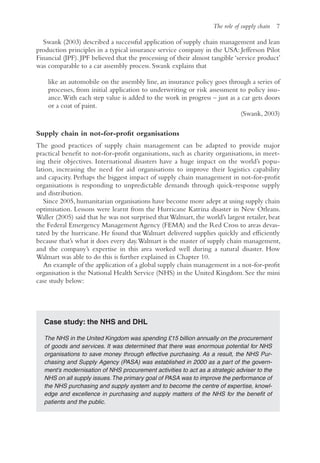
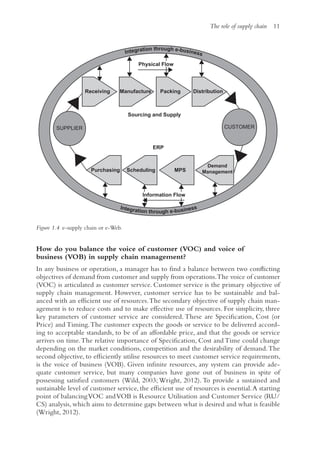
These flows are depicted in a simplified model in Figure 1.1.
In the past,information flow was the domain of the commercial division while the con-
version process of materials flow was a manufacturing or technical division responsibility.
6 Introduction
With an integrated supply-chain approach, the responsibility for all elements of supply is
now with operations management or supply chain management. In many businesses, the
integrated approach is being extended to include all suppliers (including ‘upstream’ first-,
second- and third-tier suppliers) through the manufacturing process and ‘downstream’ to
each level of customer (including distributors,wholesalers and retailers out to the end user
or consumer).This is known as the extended supply chain.
Supply chain in services
Thanks to ease of travel, the media and the World Wide Web, customers have never been
more informed than they are today. Customers know what they want and know what can
be done,and they understand the concept of world-class and continuous improvement.This
is especially true in service industries.As a result of the heightened expectations of custom-
ers,operations managers in service sectors have been forced to focus their attention on man-
aging the complete value-adding system using the principles of supply chain management.
But how can service industries apply supply chain management? The supply chain
of a service organisation contains suppliers, products or services, customers and their
demand for products, and service-level agreements. Service inventory can be in the form
of information databases, stocks of consumables (as with the hotdog stand), stationery
items (including brochures and promotional material), energy and other infrastructure
suppliers, and subcontractors (including facility managers, travel agents, caterers, account-
ants, lawyers and advertising agencies).
SUPPLIER CUSTOMER
Receiving Manufacture Packing Distribution
Purchasing Scheduling MPS
Demand
Management
Sourcing and Supply
ERP
Physical Flow
Information Flow
Figure 1.1 Supply chain management (Note: MPS means master production schedule).
The role of supply chain 7
Swank (2003) described a successful application of supply chain management and lean
production principles in a typical insurance service company in the USA: Jefferson Pilot
Financial (JPF). JPF believed that the processing of their almost tangible ‘service product’
was comparable to a car assembly process. Swank explains that
like an automobile on the assembly line, an insurance policy goes through a series of
processes, from initial application to underwriting or risk assessment to policy issu-
ance.With each step value is added to the work in progress – just as a car gets doors
or a coat of paint.
(Swank, 2003)
Supply chain in not-for-profit organisations
The good practices of supply chain management can be adapted to provide major
practical benefit to not-for-profit organisations, such as charity organisations, in meet-
ing their objectives. International disasters have a huge impact on the world’s popu-
lation, increasing the need for aid organisations to improve their logistics capability
and capacity. Perhaps the biggest impact of supply chain management in not-for-profit
organisations is responding to unpredictable demands through quick-response supply
and distribution.
Since 2005, humanitarian organisations have become more adept at using supply chain
optimisation. Lessons were learnt from the Hurricane Katrina disaster in New Orleans.
Waller (2005) said that he was not surprised thatWalmart, the world’s largest retailer, beat
the Federal Emergency Management Agency (FEMA) and the Red Cross to areas devas-
tated by the hurricane. He found that Walmart delivered supplies quickly and efficiently
because that’s what it does every day.Walmart is the master of supply chain management,
and the company’s expertise in this area worked well during a natural disaster. How
Walmart was able to do this is further explained in Chapter 10.
An example of the application of a global supply chain management in a not-for-profit
organisation is the National Health Service (NHS) in the United Kingdom. See the mini
case study below:
Case study: the NHS and DHL
The NHS in the United Kingdom was spending £15 billion annually on the procurement
of goods and services. It was determined that there was enormous potential for NHS
organisations to save money through effective purchasing. As a result, the NHS Pur-
chasing and Supply Agency (PASA) was established in 2000 as a part of the govern-
ment’s modernisation of NHS procurement activities to act as a strategic adviser to the
NHS on all supply issues.The primary goal of PASA was to improve the performance of
the NHS purchasing and supply system and to become the centre of expertise, knowl-
edge and excellence in purchasing and supply matters of the NHS for the benefit of
patients and the public.
8 Introduction
Some of the achievements of PASA included:
• Savings for the NHS totalling £580 million over the three-year period of
April 2000–03.
• Implemented pilot supply ‘confederations’ as recommended in the May 2002 pol-
icy document ‘Modernising Supply in the NHS’ to develop a middle tier between
national (PASA)- and local (individual NHS trust)-level purchasing.
• Produced an eCommerce strategy for the NHS through the development of an
eProcurement toolkit, which provides a framework to help NHS trusts and confed-
erations understand the benefits of eProcurement and plan its implementation in a
structured way.
• Developed a national set of purchasing and supply performance management
measures to better assess the performance of NHS trusts with respect to supply
chain activities through benchmarking analysis and strategic assessment of trust
and confederation spending.
Laudable though these achievements were, there is always room for improvement.
In 2006, the NHS entered into a joint venture with DHL, and the PASA was phased out.
DHL is a German-owned logistics company that was initially charged with handling an
annual NHS expenditure of £5 billion with a target of £1 billion over ten years. In 2015,
the contract was extended for two years to 2018 with a further targeted savings of
$300 million. DHL provides end-to-end purchasing and logistics working with the NHS
Supply Chain service.
Source: National Health Service, UK (2004).
What about logistics management?
Is there a difference between ‘logistics’ and ‘supply chain’ management? In 2004, the
Council of Logistics Management, recognising that logistics management is part of the
supply chain process, changed its name to the Council of Supply Chain Management
Professionals. Prior to the change of name, they defined logistics management as:
The process of planning, implementing and controlling the efficient, cost effective
flow and storage of raw materials, in-process inventory, finished goods, and related
information from point of origin to point of consumption for the purpose of con-
forming to customer requirements.
Their new definition is:
Supply chain management encompasses the planning and management of all activi-
ties involved in sourcing and procurement, conversion, and all logistics management
activities. Importantly, it also includes coordination and collaboration with channel
partners, which can be suppliers, intermediaries, third party service providers, and
The role of supply chain 9
customers. In essence, supply chain management integrates supply and demand man-
agement within and across companies.
(Council of Supply Chain Management Professionals, 2015)
If we consider these definitions,we see they are very similar to the APICS Dictionary defini-
tion we gave previously and can conclude that,for our purposes in a manufacturing and sup-
ply organisation, logistics and supply chain management are synonymous. If one is inclined
to separate the physical movement of logistics in a service organisation,we can see that there
is but a fine border between logistics and supply chain management in the service sector.
Taylor (1997) divided supply chain management into the following:
• Logistics and Supply Chain Strategy
• Purchasing and Supplies Management
• Manufacturing Logistics
• Distribution Planning and Strategy
• Warehouse Planning and Operations Management
• Inventory Management
• Transport Management
• International Logistics and International Market Entry Strategies
Taylor’s definition infers that ‘Logistics’ is a subset of ‘SCM’. Each subtopic contributes to
the performance of the overall supply chain process and, as a consequence, to improved
stakeholder satisfaction.
What are inbound and outbound logistics?
The flow of information and physical goods from both customers and suppliers to the
business or the conversion centre (e.g., a factory or a warehouse or an office) is termed as
inbound logistics.Likewise,the flow of information or goods or service from the conversion
centre to the customer constitutes outbound logistics.To put it more simply,inbound logis-
tics relate to demand and procurement while outbound logistics relate to supply and service.
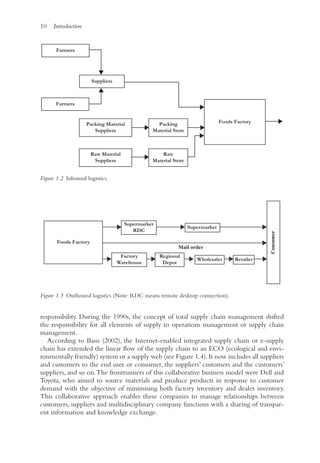
Figure 1.2 and Figure 1.3 show examples of inbound and outbound logistics in a food
factory.
Demand and supply planning capabilities enable companies to balance inbound and
outbound logistics and thus to maximise the return on assets, and to ensure a profit-
able match of supply and demand. Inbound and outbound logistics are also described as
upstream and downstream processes.For example,Christopher (1992) defines supply chain
management as the management of upstream and downstream relationships with suppliers
and customers to deliver superior customer value at less cost to the supply chain as a whole.
What is the e-supply chain?
As shown in Figure 1.1, the traditional supply chain was concerned with a linear flow
of information and products/services from customers to suppliers through various stages
of processes, while the information flow was the domain of the commercial division
and the conversion process of materials flow was a manufacturing or technical division
10 Introduction
responsibility. During the 1990s, the concept of total supply chain management shifted
the responsibility for all elements of supply to operations management or supply chain
management.
According to Basu (2002), the Internet-enabled integrated supply chain or e-supply
chain has extended the linear flow of the supply chain to an ECO (ecological and envi-
ronmentally friendly) system or a supply web (see Figure 1.4).It now includes all suppliers
and customers to the end user or consumer, the suppliers’ customers and the customers’
suppliers, and so on.The frontrunners of this collaborative business model were Dell and
Toyota, who aimed to source materials and produce products in response to customer
demand with the objective of minimising both factory inventory and dealer inventory.
This collaborative approach enables these companies to manage relationships between
customers, suppliers and multidisciplinary company functions with a sharing of transpar-
ent information and knowledge exchange.
Foods Factory
Regional
Depot
Factory
Warehouse
Supermarket
RDC
Supermarket
Wholesaler Retailer
Consumer
Mail order
Figure 1.3 Outbound logistics (Note: RDC means remote desktop connection).
Farmers
Packing Material
Suppliers
Suppliers
Foods Factory
Packing
Material Store
Farmers
Raw
Material Store
Raw Material
Suppliers
Figure 1.2 Inbound logistics.
The role of supply chain 11
How do you balance the voice of customer (VOC) and voice of
business (VOB) in supply chain management?
In any business or operation, a manager has to find a balance between two conflicting
objectives of demand from customer and supply from operations.The voice of customer
(VOC) is articulated as customer service. Customer service is the primary objective of
supply chain management. However, customer service has to be sustainable and bal-
anced with an efficient use of resources.The secondary objective of supply chain man-
agement is to reduce costs and to make effective use of resources. For simplicity, three
key parameters of customer service are considered. These are Specification, Cost (or
Price) and Timing.The customer expects the goods or service to be delivered accord-
ing to acceptable standards, to be of an affordable price, and that the goods or service
arrives on time.The relative importance of Specification, Cost and Time could change
depending on the market conditions, competition and the desirability of demand.The
second objective, to efficiently utilise resources to meet customer service requirements,
is the voice of business (VOB). Given infinite resources, any system can provide ade-
quate customer service, but many companies have gone out of business in spite of
possessing satisfied customers (Wild, 2003; Wright, 2012). To provide a sustained and
sustainable level of customer service, the efficient use of resources is essential.A starting
point of balancingVOC andVOB is Resource Utilisation and Customer Service (RU/
CS) analysis, which aims to determine gaps between what is desired and what is feasible
(Wright, 2012).
SUPPLIER CUSTOMER
Receiving Manufacture Packing Distribution
Purchasing Scheduling MPS
Demand
Management
Sourcing and Supply
ERP
Integration through e-business
Physical Flow
Information Flow
Figure 1.4 e-supply chain or e-Web.
12 Introduction
Table 1.1 Operations objective chart
Resource utilisation Customer service
Machines Materials Labour Specification Cost Time
Operation
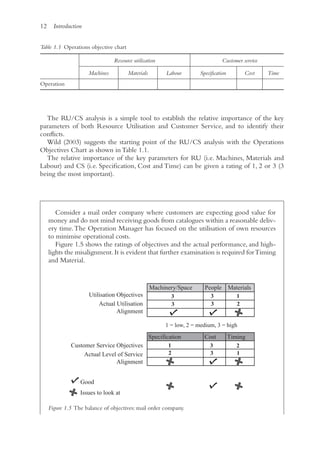
Consider a mail order company where customers are expecting good value for
money and do not mind receiving goods from catalogues within a reasonable deliv-
ery time.The Operation Manager has focused on the utilisation of own resources
to minimise operational costs.
Figure 1.5 shows the ratings of objectives and the actual performance, and high-
lights the misalignment.It is evident that further examination is required forTiming
and Material.
Utilisation Objectives
Actual Utilisation
Machinery/Space People Materials
Specification Cost Timing
3 3 1
3
1 2
Alignment
3 3 2
Customer Service Objectives
Actual Level of Service
Alignment
3
2 1
Good
Issues to look at
1 = low, 2 = medium, 3 = high
Figure 1.5 The balance of objectives: mail order company.
The RU/CS analysis is a simple tool to establish the relative importance of the key
parameters of both Resource Utilisation and Customer Service, and to identify their
conflicts.
Wild (2003) suggests the starting point of the RU/CS analysis with the Operations
Objectives Chart as shown in Table 1.1.
The relative importance of the key parameters for RU (i.e. Machines, Materials and
Labour) and CS (i.e. Specification, Cost and Time) can be given a rating of 1, 2 or 3 (3
being the most important).
The role of supply chain 13
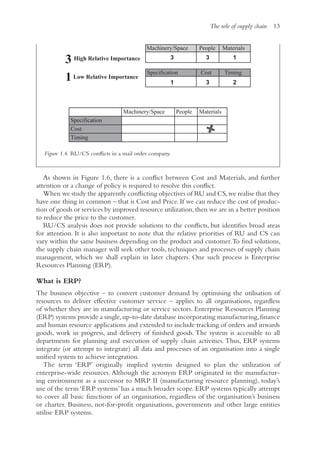
As shown in Figure 1.6, there is a conflict between Cost and Materials, and further
attention or a change of policy is required to resolve this conflict.
When we study the apparently conflicting objectives of RU and CS,we realise that they
have one thing in common – that is Cost and Price. If we can reduce the cost of produc-
tion of goods or services by improved resource utilization,then we are in a better position
to reduce the price to the customer.
RU/CS analysis does not provide solutions to the conflicts, but identifies broad areas
for attention. It is also important to note that the relative priorities of RU and CS can
vary within the same business depending on the product and customer.To find solutions,
the supply chain manager will seek other tools, techniques and processes of supply chain
management, which we shall explain in later chapters. One such process is Enterprise
Resources Planning (ERP).
What is ERP?
The business objective – to convert customer demand by optimising the utilisation of
resources to deliver effective customer service – applies to all organisations, regardless
of whether they are in manufacturing or service sectors. Enterprise Resources Planning
(ERP) systems provide a single,up-to-date database incorporating manufacturing,finance
and human resource applications and extended to include tracking of orders and inwards
goods, work in progress, and delivery of finished goods. The system is accessible to all
departments for planning and execution of supply chain activities. Thus, ERP systems
integrate (or attempt to integrate) all data and processes of an organisation into a single
unified system to achieve integration.
The term ‘ERP’ originally implied systems designed to plan the utilization of
­
enterprise-wide resources. Although the acronym ERP originated in the manufactur-
ing environment as a successor to MRP II (manufacturing resource planning), today’s
use of the term ‘ERP systems’ has a much broader scope. ERP systems typically attempt
to cover all basic functions of an organisation, regardless of the organisation’s business
or charter. Business, not-for-profit organisations, governments and other large entities
utilise ERP systems.
Machinery/Space People Materials
Specification
Cost
Timing
Machinery/Space People Materials
Specification Cost Timing
3
1 2
1Low Relative Importance
3 High Relative Importance 1
3
3
Figure 1.6 RU/CS conflicts in a mail order company.
14 Introduction
How do you deliver value in supply chain management?
The delivery of goods and services of expected standards on time at the ‘best in class’ cost
is creating value for money for customers and thus adding value to the business.An effec-
tive supply chain management team can deliver value by a value stream approach or total
supply chain management approach.
The value stream approach transcends the traditional manner of departmentalising
stages of the business process.The value stream highlights the importance of the opera-
tions manager being involved in all aspects of the process, from suppliers right through to
the customer, and if possible, to the customer’s customer.The ‘old’ approach was that one
department or function would be responsible for purchasing goods and services, another
for planning. Scheduling of activities was often a separate function, as was warehousing
and distribution, and operations was just one step in the whole process of providing ser-
vices.With the value stream approach, functional boundaries are ignored, and in many
organisations it is now accepted that the operations manager has to control the total pro-
cess from purchasing input goods and services to the final stage of satisfying the customer.
Marketing, accounting, human resources and other support functions do not show up on
the value stream as such, but operations managers must be vitally interested and involved
in these internal functions of the organisation.
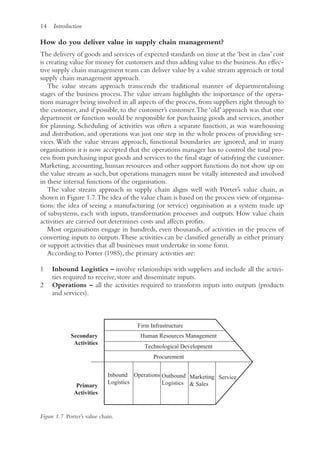
The value stream approach in supply chain aligns well with Porter’s value chain, as
shown in Figure 1.7.The idea of the value chain is based on the process view of organisa-
tions: the idea of seeing a manufacturing (or service) organisation as a system made up
of subsystems, each with inputs, transformation processes and outputs. How value chain
activities are carried out determines costs and affects profits.
Most organisations engage in hundreds, even thousands, of activities in the process of
converting inputs to outputs.These activities can be classified generally as either primary
or support activities that all businesses must undertake in some form.
According to Porter (1985), the primary activities are:
1 Inbound Logistics – involve relationships with suppliers and include all the activi-
ties required to receive, store and disseminate inputs.
2 Operations – all the activities required to transform inputs into outputs (products
and services).
Operations
Firm Infrastructure
Human Resources Management
Technological Development
Procurement
Inbound
Logistics
Outbound
Logistics
Secondary
Activities
Marketing
 Sales
Service
Primary
Activities
Figure 1.7 Porter’s value chain.
The role of supply chain 15
3 Outbound Logistics – all the activities required to collect, store and distribute the
output.
4 Marketing and Sales – activities that inform buyers about products and services,
induce buyers to purchase them, and facilitate their purchase.
5 Service – all the activities required to keep the product or service working effec-
tively for the buyer after it is sold and delivered.
Secondary activities are:
1 Procurement – the acquisition of inputs, or resources, for the firm.
2 Human Resource management – all activities involved in recruiting, hir-
ing, training, developing, compensating and (if necessary) dismissing or laying off
personnel.
3 Technological Development – the equipment, hardware, software, procedures
and technical knowledge brought to bear in the firm’s transformation of inputs into
outputs.
4 Infrastructure – serves the company’s needs and ties its various parts together; con-
sists of functions or departments such as accounting, legal, finance, planning, public
affairs, government relations, quality assurance and general management.
The success of a supply chain could be synonymous with the success of the value stream
approach or the total supply chain approach underpinned by the interaction between
three key groups of players, namely, customers, external suppliers and the departments
involved with the primary and secondary activities of the organisation.
The customer is the central focus for any organisation. Churchill once said that war
was too important to be left to the generals, and something similar can be said of mar-
keting: marketing is too important to be left to the marketing department. Everyone in
an organisation should be vitally interested in marketing the organisation. None the less,
it is the function of the marketing department to know what the customer wants and
what the competition is doing or is likely to do. Marketing specifies the product and
its attributes.Attributes may range from the essential down to the desirable and perhaps
include extras that the customers do not even know they want.As well as defining the
product or service to be offered, marketing has to establish the price, forecast demand,
have a say in how the product or service will be distributed or delivered, and finally,
marketing is responsible for promotion with the aim of stimulating demand. Marketing
also has to sell the product/service internally within the organisation to the operations
and other functions of the organisation. Marketing is the link with the market and cus-
tomers and operations.
In some organisations, suppliers are treated with distrust, and the business strategy
adopted is to shop around to get the best deal on each occasion. In these types of organi-
sations, information is not shared with suppliers.When orders are placed, the supplier is
not told what the purpose of the order is, and thus the supplier is not in a position to
advise, even if they were so inclined, of alternative products or new technology.With this
approach, little loyalty is shown to any supplier, and the supplier is almost treated as an
adversary.The value stream approach is to treat key suppliers of goods and services as part
of the team, and to share information and to seek advice. Key suppliers are those that are
important to the smooth operation of the system. In some cases, the supplier can become
involved in the day-to-day operations of the organisation and might also be expected
16 Introduction
to advise and to assist in product development. Cost no longer becomes the key issue.
Instead of price alone,suppliers will be judged on their loyalty and ability to deliver goods
and services to the required standard and on time. Suppliers can also become part of the
information-gathering arm of the organisation;often suppliers have a different perspective
as to what the competition is up to (changes in buying patterns, timetables, new packag-
ing,use of new materials and so on).Suppliers are also in a good position to offer technical
advice regarding new technology and alternative materials.
Communication between departments (especially marketing, operations and logistics)
within an organisation has to be two-way and has to be aimed to help rather than used as
a means of apportioning blame or criticizing.With traditional hierarchical organisations, a
bunker or silo mentality can develop whereby each function is walled off from the other,
and any suggestion, no matter how helpful, is taken as a threat or a challenge.World-class
organisations are noted by the manner in which the figurative brick walls that separate
functions have been broken down, and teamwork exists between all functions to achieve
the common goal.This requires that everyone in the organisation knows what the goals
and objectives are and that the culture is conducive to the enthusiastic pursuit of the goals
for the common good of the whole, rather than for the specific interests of one depart-
ment. Information is open to all, and there are no secrets.
Summary
The primary purpose of this introductory chapter was to provide an overview of supply
chain management principles and to indicate how an effective supply chain management
process adds value to all types of businesses, whether in manufacturing or service sectors,
public or not-for profit organisations.This chapter stresses our belief that it is people, not
processes or technology, that make things happen. It is also shown that data sharing and
interaction between all stakeholders in the total supply chain using a value stream ‘total
global supply chain’ approach are critical.
Discussion questions
1 Simchi and Levi use the word ‘integration’ in their definition of the supply chain.
What do you understand this to mean?
2 How would you define ‘supply chain management’? Is it a concept, process or com-
bination of processes? What are the key objectives of supply chain management?
3 Explain how the role and importance of supply chain management have changed
with the additional challenges and opportunities of globalisation. Is global supply
chain management different from traditional supply chain management?
4 It is often considered that integrated logistics management is synonymous to supply
chain management. Discuss.
5 What are the similarities and differences between the supply chain management pro-
cesses in manufacturing and services? Is supply chain management appropriate for a
non-profit organisation?
6 Explain the key components of Porter’s value chain.Discuss how a value chain differs
from a supply chain.
7 If each component of a supply chain, from the farmer sowing seeds to the retailer
selling bread, is efficient, will the whole supply chain be efficient?
The role of supply chain 17
Exercise
1 Consider yourself as a customer of a fast food restaurant such as McDonald’s. Follow-
ing the example of RU/CS analysis in this chapter, address the following exercise.
Briefly describe the ‘operation’.
Develop an IPO (Input, Process, Output) diagram.
What are the present objectives (RU/CS) for the chosen operation? Highlight the
relative importance on a scale of 1–3 (3 as most important). Identify the conflict
between the components of RU and CS.
2	
Why global supply chain
management is also total supply
chain management
Introduction
In Chapter 1, we established the key role of supply chain management in the global
market and how it is critical to have interaction between stakeholders in the total sup-
ply chain. In this chapter, we intend to expand further about why the total supply chain
approach is vital in managing global supply chains. Globalisation has created not only
great opportunities for global supply chains, but it has also introduced a high level of
complexity and risks.If we cannot work in harmony at the same flow rate,only achieving
a high performance level in a manufacturing site is akin to driving a high-performance
Ferrari in a traffic jam.
In the 1960s and 1970s, the manufacturing and supply strategy of multinational com-
panies focused on vertical integration.One of the earliest,largest and most famous exam-
ples of vertical integration was the Carnegie Steel Company. In the 1890s, the company
expanded to have a controlling interest beyond the mills where the steel was manufac-
tured to include the mines from where the iron ore was extracted, the coal mines that
supplied the coal, the barges and ships that transported the iron ore, the railroads that
transported the coal to the factory, the coke ovens where the coal was coked, etc. One
hundred years on, vertical integration was still in vogue; for example, in the 1980s, Uni-
lever, originally a soap manufacturer, had grown to own businesses and investments in
forests, timber milling and refining, paper manufacture, board and plastics manufacture,
chemicals, fast-moving consumer products manufacture and packaging, marketing and
advertising, computer services, distribution warehouses, and shipping and retail outlets.
But vertical integration of a supply chain was not always successful.The New Zealand
company Feltex, in the 1980s, expanded from making carpet and furniture into own-
ing a national retail chain.The next step in vertical integration was to buy a timber mill
and a forest.At the time, the carpet Feltex produced was world famous and exported all
round the world. Expansion downstream in the supply chain to owning the retail stores,
due to lack of retail experience and management, did not improve profits but resulted in
a financial drain on the company. Expansion upstream to own the supply of timber (mill
and forest) for the furniture factory proved to be a disaster.The forest was in remote rug-
ged country and road access was poor.The cost of logging and transporting lumber to the
mill proved to be prohibitive.As a result of falling profits and share prices, the company,
once the largest manufacturer and exporter of manufactured goods in New Zealand and
the darling of the share market, went through a series of ownership changes and down-
sizing back to the stage where it was only manufacturing carpet. Feltex finally went into
receivership in September 2006.
Why global supply chain management 19
In the 1980s (and subsequently), large organisations started to concentrate on their
‘core business’, and rather than to vertically integrate, they began to divest non-core arms
of their business.The gradual privatisation of the public sector also helped to create many
supporting service industries. In the beginning of the 21st century, we are witnessing the
explosion of outsourcing and the emergence of competent but lower-cost manufacture
in Eastern Europe, China and other states in South East Asia, India, and South America
(in particular Brazil). It is now recognised that in the global marketplace, a whole-systems
supply/value chain approach has to be taken, embracing service and manufacturing as a
whole.This chapter describes a total supply chain management concept and the analysis
of the supply chain process. Management of the activities making up a supply chain are
described in later chapters.
Trend towards service
In the United Kingdom, statistics show that 78% of the workforce is engaged in service
industries (www.statistics.gov.uk),and in the USA,80% are employed in service industries
(www.census/gov/). Although a shift back to manufacturing has been identified (Basu
andWright,1997),it is obvious that the greater percentage of the workforce of developed
nations will continue to be employed in service activities.There are two reasons for this:
1 Continual advances in technology mean that manufacturing is considerably less
labour intensive than previously. Automation, robotics, advanced information tech-
nology, new materials and improved work methods all have led to the reduction of
manual labour.
2 For larger organisations, manufacturing has become internationalised. For example, a
company (such as Nike) might outsource its manufacturing to overseas contractors or
allied companies and itself concentrate on design, marketing and distribution.
Additionally, organisations can no longer regard themselves as being purely in manufac-
turing and hope to survive.The market, first and foremost, now takes for granted the reli-
ability of products and expects good service.
Market expectations of the level of quality are driven by perceptions of what technol-
ogy is promising and by perceptions of what the competition is offering. Organisations
now operate in a global market where national barriers, tariffs and customs duties no
longer provide protection for a home market.Any manufacturer,even if its focus has been
on supplying a local market, is in reality competing on the world stage. Competition is
no longer limited to other local organisations, and the fiercest competition in the home
market will be from goods and even services produced overseas or provided by overseas
organisations. For example, a bus service in New Zealand is owned and operated by the
Scottish company‘Stagecoach’based 20,000 kms away.And McDonald’s,for over 30 years,
has competed, and indeed set the benchmark, for fast food providers all around the world.
This overseas involvement in a home market means that manufacturers (and service
providers) can no longer make products just to suit their engineering strengths, but must
now be aware of what the market wants and what the global competition is offering. In
manufacturing, what the competition is offering, apart from well-engineered products,
is service in the form of delivery on time, marketing advice, training, installation, project
management, or whatever else is required to provide a total service as well as a reliable
product.
20 Introduction
Never before has the customer been better travelled, more informed and had higher
expectations. Many of these expectations began with the quality movement of the eight-
ies where it was trumpeted that the customer was king, and these expectations have been
kept alive by continuously improved product and services, global advertising, and for the
last decade, the World Wide Web.
If they are honest with themselves,most organisations realise that their products actually
differ very little from those of their competitors, and any technological improvement is
soon copied; thus, the difference – the ‘competitive edge’ – comes from service.
There are many examples of successful application of supply chain management prin-
ciples in the service sector, which accounts for over 80% of the economy in advanced
countries.The success of American Express is one such example.
Case example: American Express success in global
supply chain management
As a global organisation, American Express is arguably a leader in the service sec-
tor, benefiting from the successful implementation of total supply chain principles. For
example, American Express has introduced two new corporate purchasing services
as part of its S2S (Source-to-Settle) product suite. Both S2S Catalog Pro and S2S
Contract Audit Recovery are intended to help companies optimise performance, realise
savings and minimise non-compliance within their supply chains. Contract Audit and
Recovery, in particular, is an analytic service which provides best practices to help
companies achieve negotiated contract savings and recover money lost through non-
compliance. Following an analysis of contracts, billing data and business processes, it
allows for the development of an action plan by the audit and recovery team, who can
also advise on best practices for addressing future contract situations. Catalog Pro is
an online service which integrates with a company’s existing procurement software
to enhance business-to-consumer (B2C) features. The product improves the ability of
employees to order from preferred suppliers and secure negotiated rates. Catalog Pro
was originally a B2C application that was acquired by American Express, which added
business-to-business (B2B) functionality.
As a recognition of their supply chain success, American Express has been success-
fully recertified for the Corporate Certification Standard. Maggie Willis, Vice President
of International Global Supply Management at American Express, said the process pro-
vided the company with an opportunity to reassess its policies to ensure that American
Express remains at the forefront of best business practices.
Service separated from production operations
If no serious operation can ignore market demands for service and world-class quality,
why bother to try and separate manufacturing from service in the study of operations
management? Indeed, for a manufacturing organisation aspiring to world-class status, we
would most emphatically agree that management of such organisations must concern
themselves with service and quality if they are to compete on the world stage.
Why global supply chain management 21
But managers in service industries such as health, retail, distribution, education, travel,
real estate,consultation,brokering,law,accounting,administration of central and local gov-
ernment, transportation of goods or people – where no direct manufacturing is involved,
or where the manufacturing is light and simple (such as in a restaurant) – do not have to
know much about manufacturing. Naturally, all the above industries are reliant on manu-
facturers to varying degrees for the equipment they use, or in the case of a retailer, for the
goods they sell,but the physical heavy work of making the goods is not their concern.The
analogy is that of a driver of a car: one can be a very good driver without knowing much
about what happens under the bonnet. For some cars, a knowledge of when to change
gears and an understanding of the danger of overheating due to lack of oil or water will be
of advantage,but for other models,the car will even‘tell’the driver when tyre pressures are
low and turn the headlights on and off depending on light conditions,and the driver need
not worry about gear changing. Likewise, a retail sales person of washing machines does
not need a detailed knowledge of high-tech mass production line balancing. For the sales
person,some knowledge of lead times for deliveries,operating instructions and the capac-
ity of the washing machine will be sufficient as a basis for good service to the customer.
Thus, there can be a separation of operations management into two broad streams:
the management of production including service, and the management of operations in
service industries where only some rudimentary knowledge (if any) of manufacturing
is required. But irrespective of whether a manager is involved primarily in produc-
tion or service, a total system approach is needed based on the supply or value chain
philosophy.
For organisations involved directly in production and manufacturing, management
needs to be well versed in strategies, tactics and methodologies of production operations
management, and also has to be very aware of what constitutes service and quality from
the customer’s point of view.A total operations approach to providing a quality product
coupled with the service required is essential.
Managers of service industries will benefit from some basic knowledge of production
systems and methodologies.
Shift from enterprise to network
A little more than a decade ago, companies were urged to attain ‘world-class’ perfor-
mance within the enterprise.The departments within a company were striving for islands
of excellence, and then with a succession of operational excellence initiatives e.g.,Total
Quality Management, (TQM), Business Process Re-Engineering (BPR), Manufactur-
ing Resource Planning (MRP II), and Six Sigma, the fences between departmental turfs
were gradually demolished.The organisations started to become customer-focused and
established performance metrics in all areas of the business (e.g., ‘Balanced Scorecard’).
However, it is fair to say that both the business model and the performance metrics were
site-centric, or at most, were confined within the company or enterprise. Today, with
web-based technologies now accelerating the collaborative supply chain, it is becoming
imperative to rethink the selection and implementation of the external metrics.This shift
is not only in the measurement criteria, but also in the mindset of business practices.This
shift has made organisations think globally. Collaboration requires a capacity to work in
association, sometimes with the ‘enemy’, and does not achieve its business success at the
competitor’s expense.To maximise the advantages of collaboration, the buy-in and com-
mitment of employees to the new mindset is essential.The following are a few reasons for
22 Introduction
this fundamental shift from a site-centric linear supply chain to a collaborative network
or web of supply:
1 Demands for flexibility of partnerships. In today’s marketplace, consumers have a
degree of choice and greater ability to make a comparison.As a result, their expecta-
tions are rising and their needs are constantly changing.Value in this environment is a
moving target. Organisations must be flexible to be able to adapt to these changes. It
is very difficult for a single organisation to possess all the capabilities required to keep
up. Organisations now look for suppliers who can provide the skills and capabilities
needed as and when they require them. A firm can easily form partnerships with
appropriate skilled suppliers to last as long as the need exists.As demand changes, so
too can partnership arrangements.
2 Advances in technology.The merging of information and communications technologies
has supported the growth in supply chain partnerships.These technologies have ena-
bled extensive connectivity.Today’s computer networks, open systems standards and the
Internet enable people working in different areas of the supply chain to maintain con-
stant contact. Since information transactions have become so easy,there is less of a need
to restrict operations to within traditional organizational boundaries.The new capabili-
ties of the e-supply chain offer the ability for supply chain partners to share information
in real time.This enables the partnering firms to hold lower inventories and incur fewer
transaction costs.These lower costs can, in turn, be passed on to the customer in the
form of lower prices and better value, or alternatively retained as increased profit!
3 Collaborative networks. Companies have now recognised that great improvements in
value can be attained by coordinating the efforts of partners along the supply chain.
When firms focus only on their internal operations, they are making decisions in
isolation; and as a result, this can lead to the overall performance of the supply chain
deteriorating.As we will see later, firms who work together and share their plans and
other information are actually able to improve the overall supply chain performance
to their mutual benefit.
4 Recognition of core competencies. Recently there has been a shift away from focus-
ing on markets and products towards considering what an organisation’s capabilities
are. A focus on core competencies allows a firm to concentrate on those few skills
and areas of knowledge that make the organisation distinct and competitive.These
competencies are what provide the firm with its competitive advantage. Recognising
what processes they are best at allows the firm to concentrate on these processes.This
has led to firms rationalising what they do and to the emergence of supply chains,
where each of the partnering organisations focuses on what individually they do best.
5 Growth in outsourcing.The dynamic growth in the large emerging economies,espe-
cially China and India,especially of manufacturing,supply and service capabilities,has
provided opportunities for new outsourcing partners.When a specific process moves
from a competitive advantage to a commodity and/or when a supplier’s operation
performance is superior to an organisation’s own performance, outsourcing must
be considered.A well-documented example of business process outsourcing (MCA,
2002) is the Coca-Cola Corporation. For over 100 years, Coca-Cola has been pro-
ducing syrup,but the actual production of Coca-Cola is the responsibility of its global
network of business partners. A recent study by IBM (IBM Global Services, 2006)
demonstrates that companies engaged in information technology (IT) outsourcing
realise improved financial health and performance in comparison to their sector peers.
Why global supply chain management 23
Increased complexity of processes
The processes in the supply chain are becoming more and more complex, both in terms
of variety of products and variability of operations. In a preferred condition, high volume
and low variety of products and low variation in manufacturing processes will deliver
products at a lower cost in comparison to a situation with low volume, high variety and
high variation. Increases in customer contacts and choice has led to the need for complex
supply chains with many variables.
The impact of this increased complexity is challenging the stability of supply chains.
This challenge is compounded by the multiple stages and stakeholders in the sup-
ply chain from the demand point to the source of supply. The variability in demand
increases as it moves along the supply chain away from the retail consumer. Small
changes in consumer demand can result in large variations in orders placed upstream.
This variation can oscillate further in larger swings as each stakeholder in the supply
chain attempts to solve the problem from its own point of view.This phenomenon is
often cited as ‘the bullwhip effect’ (see Figure 2.1) and has been experienced in most
industries following linear supply chain principles, resulting in an increased cost to the
organisations and poorer service to the customers.The bullwhip effect is discussed in
greater detail in Chapter 14.
Customer
Consumption Retailer Wholesaler Manufacturer Supplier
Figure 2.1 The bullwhip effect.
Case example: collaborative forecasting
This case example involves three individual companies representing a brand owner
(manufacturer), a first-tier supplier and a second-tier supplier. The target is to build a
lean and transparent business model in a three-entity demand chain.
24 Introduction
Supplier partnership
Reviewing the impact of new technologies on the supply chain provides an interesting
development of partnering with suppliers. In the past, many manufacturers regarded their
In the traditional process, the purchase order is the key impulse for the supplier,
whereas in this model the key input is the rolling forecast. The challenges of the imple-
mentation come from forecasting capabilities, openness and trust. The utilisation of
modern information and communication technology (ICT) also creates both challenges
and advantages.
A selected starting point for this example is that the collaborative forecasting model
exists already between two parties, and this model is extended one step further. In
a two-entity chain, the forecast of the customer affects the supplier. In this example
where the second-tier supplier is included, the initial forecast of the brand owner affects
another step higher in the upstream. Furthermore, the planning process of the first-tier
supplier, where the manufacturer’s forecast is processed into raw material forecast to
the second-tier supplier, plays a key role. A general description of the model is shown
in Figure 2.2.
The production processes in all three parties involved are different – it varies from
process industry to manufacturing. The process industry is capital-intensive, and the
profitability depends more on capacity utilisation. In manufacturing, the production
cycles are shorter and the working capital tied to the process has a higher impact on
the profitability. Hence, the key drivers for effective planning in each party are not the
same.
As the collaborative forecasting between the manufacturer and the first-tier supplier is
already in place, the key metrics between them are treated as the best practices when
defining the targets for the second-tier supplier with the first-tier supplier.
The new business model reduces the inventory levels and increases the inventory
turnover in the second-tier supplier/ first-tier supplier part of the demand chain. Other
expected benefits are fewer out-of-stock situations, fewer non-optimal transports, better
planning and production efficiency at the second-tier supplier, and increased customer
satisfaction.
In order to sustain these results, a thorough commitment based on trust is expected
from each partner. In practice, it also means implementing new ICT tools to share data
and monitor the supply chain.
Adapted from: Lukka and Viskari (2004).
Second-tier
supplier
Brand
owner
First-tier
supplier
Rolling forecast
Rolling forecast
Goods delivery Goods delivery
Figure 2.2 Collaborative forecasting model.
Why global supply chain management 25
suppliers with some suspicion, almost as adversaries. Little loyalty was shown to the sup-
pliers, and consequently the suppliers were never certain as to their future relationship
with an organisation. Often the purchasing or procurement department would see their
role securing the best deal possible from a supplier.The huge growth in outsourcing, and
more importantly, the online access to information by the Internet, have changed that.
Companies have realised that achieving world-class excellence within their own sites is
not enough. It is important to raise the standards of suppliers as well as learn from them
by working in partnership with them.The tightly controlled service-level agreements are
being replaced by joint service agreements with a free exchange of data and knowledge.
However, the success of the benefits will depend on mutual trust, a highly developed
commercial relationship and an efficient system of data exchange.In order to improve the
effectiveness of data exchange, companies are sharing with their suppliers (and custom-
ers) common systems such as European Article Numbering (EAN) standards, electronic
data interchange (EDI) and web-based extranets. For example, EDI enables companies to
communicate with each other in real time. Purchase orders to suppliers can be eliminated
by using customers’ order schedules. And by EDI and Extranets, the supplier could be
authorised to link directly into the manufacturer’s MRP II or ERP system.The emer-
gence of the Internet protocol has helped the interaction between powerful supply chain
systems such as i2, Manugistics,Ariba, Oracle and SAP/R3.
Why total supply chain management
Our above analysis of the key factors and new developments in global supply chain man-
agement clearly indicates that focusing on the conventional practices of supply chain
management within the organisation, such as forecasting, capacity planning, inventory
management, scheduling and distribution management, may achieve operational excel-
lence within the confines of an individual business organisation but will offer only a
partial solution to optimising customer service.As indicated earlier, it can be compared to
sitting in a high-performance motor car in a traffic jam; the sound system and air condi-
tioning might be state of the art, but the overall travel experience is not great. Likewise,
what is the point of having a perfect stainless steel link in a rusty chain? Unless the whole
process is efficient, the individual unit cannot achieve its potential.
It is therefore vital for any organisation, being more and more dependent on both local
and global outside resources and information, to work in harmony with all stakeholders
of the supply chain, including customers and suppliers.We need a holistic value stream
approach to the supply chain or a total supply chain management approach.
In Total Manufacturing Solutions (Basu andWright,1997),we defined‘total ­manufacturing’
to include all the interactions between the conversion process inside a ‘factory’ with all
other business processes, including marketing, research and development, supply chain
management,financial and information management,and human resource management –
also with external factors such as environmental concerns,customer care and competition.
The method of analysis, which in effect determined the strengths, weaknesses and gaps
in performance, was developed around 200 questions designed for self-benchmarking
against world-class standards.The structure of the benchmarking was to measure the per-
formance of the business against 20 defined areas of the business which were described
as foundation stones.There were ten questions for each foundation stone.The aim was
to get the right balance of foundation stones to support the pillars of the business. Over
26 Introduction
a period of eight years, we refined the six pillars and the 20 foundation stones of the
Total Manufacturing Solutions model to give a greater emphasis on service and relation-
ships with suppliers and customers. Partnering and alliances were also included in a new
model which we named ‘Total Operations Solutions’. In Total Operations Solutions (Basu
and Wright, 2005), we continued to provide a process of self-assessment to systematically
measure all aspects of an organisation, be it manufacturing or service.This includes both
internal functions and external relationships.We show how the concepts of Six Sigma,
as further developed in Quality Beyond Six Sigma (Basu and Wright, 2004), can be used
without too much fuss to determine strengths and weaknesses. Quality Beyond Six Sigma
is written around ‘FIT SIGMA’. FIT SIGMA was developed by Ron Basu to build on
strengths and to understand where weaknesses are so that corrective action can be taken
to gain a competitive advantage.
Building upon the experience of the holistic models forTotal Manufacturing Solutions
and Total Operations Solutions, we have now developed a model for Total Supply Chain
Management comprising these six building blocks, namely:
• Customer focus and demand
• Resources and capacity management
• Procurement and supplier focus
• Inventory management
• Operations management
• Distribution management
These building blocks are integrated by three cross-functional processes, namely:
• Sales and operations planning
• Systems and procedures
• Performance management
Value chain and value stream mapping
In Chapter 1,we discussed Porter’s value chain (see Figure 1.7).The value chain of a prod-
uct from Research  Development (RD) to Service is shown in Figure 2.3.
The value chain starts with RD, the outcome of which is the new product develop-
ment creating the specifications for the product.The next stage is the commercialisation
of the product, when Marketing creates demand by advertising the attractive features
of the product. Operations  Supply transforms the product specifications to market-
able products. Sales  Distribution then delivers the product to customers. After sales,
Customer Service then follows to respond to subsequent customer requests. Secondary
New
Product
RD
Commerc-
ialisation
Operations
 Supply
Sales 
Distribu-
tion
Services
Figure 2.3 Value chain for a typical product.
Why global supply chain management 27
activities such as Finance, Information Technology and Human Resources support and
complement the auxiliary activities of the value chain.
The terms ‘value stream’ and ‘value chain’ are often used interchangeably, but there is
a difference between them.As discussed earlier, value chain is a high-level model of how
businesses receive raw materials as input, add value to the raw materials through various
processes, and sell finished products to customers.The value chain categorises the generic
value-adding activities of an organisation. A value stream is an end-to-end collection of
activities that creates a result for a ‘customer’, who may be the ultimate customer or an
internal ‘end user’ of the value stream.The value stream has a clear goal, i.e. to satisfy the
customer.The term ‘value stream’ refers to an end-to-end set of activities.
The importance of the total supply chain approach can be evaluated by value stream
mapping (Basu, 2004, p. 118).Value stream mapping (VSM) is a visual illustration of all
activities required to bring a product through the main flow,from raw material to the stage
of reaching the customer.According to Womack and Jones (1998), the initial objective of
creating a value stream map is to identify every action required to make a specific product.
Case example: the value stream of a cola can
The following example is adapted from Womack and Jones (1998, pp. 38–43).
Consider a cardboard case containing eight cans of cola chosen at random in the
beverages aisle at a Tesco store.
Figure 2.4 shows a value stream map of cola, from the mining of bauxite (the source
of aluminium of the cans) to the user’s home. Bauxite ore is mined in Australia and then
transferred in trucks to a nearby chemical reduction mill to produce powdery alumina.
Can Maker
Mine
Reduction
Mill
Smelter
Hot Roller
Cold roller
Can
Warehouse
Bottler Tesco RDC
Bottler
Warehouse
Tesco
Store
Homer
Recycle Centre
Remelter
Figure 2.4 Value stream map for cola cans.
28 Introduction
Bulk alumina is then shipped by boat to Norway with cheap hydroelectric power for
smelting. The molten aluminium is cast into ingots which are then shipped by boat
and truck to Germany. The ingot is heated to 500 degree centigrades and then passed
through successive rollers to reduce the thickness from 1 metre to 3 millimetres and
stored as coils. The coils are then transferred by trucks to a cold rolling mill where the
aluminium sheets are reduced from 3 millimetres to a thickness of 0.3 millimetre suit-
able for can making.The thin coils are then shipped to a can maker’s warehouse in Eng-
land. Cans are manufactured and then stored. From the can maker’s warehouse, cans
are then transferred to the bottler’s warehouse on pallets. They are then de-palletised
and loaded into the can filling line, where they are washed and filled with cola. At the
end of the filling line, cans are then unitised in stretch wrapper and stored in the ware-
house on pallets. They are then transported on trucks to Tesco’s Regional Distribution
Centres around the UK and then distributed to Tesco’s supermarkets. When cola is
taken home, it is typically stored again and chilled and finally consumed. Empty cans
are then recycled to reintroduce them into the production process at the smelting stage.
The quantitative data related to the activities in the value stream are summarised in
Table 2.1.
It is evident from the details in Table 2.1 that value-added activities take only
three hours compared to the total time (319 days) from the mine to the recycling bin.
This proportion is surprisingly small when one considers the alarmingly lengthy overall
duration of the process.
Table 2.1 Quantitative data of cola cans
Incoming
Storage
ProcessTime Finished Storage Process Rate Cumulative Days
Mine 0 20 mins 2 weeks 1,000 t/hour 319
Reduction Mill 2 weeks 30 mins 2 weeks - 305
Smelter 3 months 2 hours 2 weeks - 277
Hot Rolling
Mill
2 weeks 1 min 4 weeks 10 ft/min 173
Cold Rolling
Mill
2 weeks  1 min 4 weeks 2,100 ft/min 131
Can Maker 2 weeks 1 min 4 weeks 2,000/min 89
Bottler 4 days 1 min 5 weeks 1,500/min 47
Tesco RDC 0 0 3 days - 8
Tesco Store 0 0 2 days - 5
Home Storage 3 days 5 min - - 3
Total 5 months 3 hours 6 months - 319
We believe that the above example of the value stream for a carton of cola firmly
establishes the need for a total supply chain management approach. It is important to
note that most of the 40,000 other items in a typical supermarket would produce similar
results.The impact of the value stream or total supply chain approach in the service sec-
tor is not so dramatic as in fast-moving consumer goods (FMCG), but highly significant
all the same.
Why global supply chain management 29
Summary
The key issues of supply chain, as discussed in this chapter, emphasise a need for a total
supply chain management approach.With the expansion of outsourcing and the Internet-
driven e-supply chain, it is essential that key players and stakeholders understand the
importance of the accuracy and transparency of data for collaborative management for
mutual benefits. Improved forecasting accuracy and the real-time exchange of data not
only reduces the ‘bullwhip effect’ but also reduces processing cost, inventory level and
improves customer service. We have also discussed the trend towards the service-based
economy and the importance of total supply chain management in the service sector.The
building blocks of the supply chain underpinned by the total supply chain management
approach, as explained further in this book, will assist in the improved understanding and
management of a collaborative supply chain.
Discussion questions
1 It has been said that in the global market,the competitive edge comes from service.What
do you understand by the term ‘service’? How is service determined and measured in
your organisation in terms of your immediate customers and your immediate suppliers?
2 Explain why,in the global economy,the greater percentage of the workforce of devel-
oped nations will continue to be employed in service activities.
3 ‘Island of Excellence’ was a term widely used some ten years ago.Why is this an out-
dated concept?
4 Regarding the case example for American Express, discuss how the introduction of
the S2S (Source-to-Settle) product suite helped to improve the service organisation’s
global supply chain performance.
5 What are the major reasons for the fundamental shift from a site-centric linear sup-
ply chain to a collaborative network of global supply chain? Discuss the collaborative
forecasting model and its advantages.Why do we need a total supply chain manage-
ment approach in managing global supply chains?
6 Explain, with illustrative examples, the value chain and value stream mapping.
3	
Understanding total supply chain
management and its building
blocks
Introduction
In Chapter 2 we discussed, in the context of global supply chains, the need for a total
supply chain management approach, and we introduced the concept of building blocks.
The importance of each building block is explained in this chapter. No block stands
alone; each is a component of the whole. In combination, the blocks show activities,
stages and processes of the extended supply chain.The sequence of processes creates a
flow between different stages to fulfil a customer’s need for a product or service. The
processes of making things happen within a supply chain can be viewed as a sequence of
progressive cycles (e.g., planning cycle) or the nature of the response to a customer order
(e.g., push or pull).There are debates between supporters of make-to-order policy and
make-to-forecast policy, as if one policy is better than the other, regardless of customers,
demand patterns, products or organisations.Therefore, we aim to answer the following
questions in this chapter:
• What are the process views of a supply chain?
• What are the building blocks of a supply chain?
• Are all the building blocks suited to all organisations?
What are the process views of a supply chain?
Chopra and Meindl (2016) describe the two views, namely, cycle view and push/pull
view, as follows:
1 Cycle view.The processes in a supply chain consist of a series of cycles, each per-
formed at the interface between two successive stages.
2 Push/pull view. Pull processes are initiated by a customer order, and push processes
are initiated and performed on the forecast of customer orders.
Cycle view
The cycle view of a supply chain consists of several stages of process cycles and form
the components of MRP II (manufacturing resource planning) or ERP (enterprise
resource planning) systems.They are shown in a simplified form as three process cycles in
Figure 3.1.These cycles are discussed in more detail in Part II (Chapters 4 to 9).
Understanding total supply chain management 31
The demand cycle is the cycle of time covering from when a customer buys or orders
from a retailer or wholesaler. The demand cycle can also be based on the forecast of
demand. If the retailer holds the product in stock, then the demand cycle will comprise
the order request, order fulfilment and order receiving. However, if the product is not
readily available, then the customer order request will form a part of the demand forecast,
which also includes predicted demand,market intelligence and promotion of the product.
The planning and procurement cycle covers short-term and longer-term requirements.
The demand of the product and its components (bill of materials) are compared with the
inventory and capacity, and the replenishment requirements are planned. Planners will
decide what to buy and what to make.This make-or-buy decision process also applies to
a service organisation, leading to either in-house or outsourced services.
The supply cycle typically occurs with a production schedule if the product is to be
manufactured, or a purchase schedule if the product is to be procured from an external
supplier. Once finished goods are manufactured or received, the next stage of the supply
cycle is direct delivery to customers or storage in the warehouse and subsequent distribu-
tion to customers.
Push/pull view
A push process conforms to a conventional supply chain management system going
through typical stages in sequence. As shown in Figure 3.2, orders arrive at or after the
demand cycle but always before the planning and procurement cycle, and the process is
activated by a forecast or demand plan.Both raw and packaging materials are stored before
production,and products are manufactured to stock.The order fulfilment is achieved from
the inventory of finished products.
A pull process is activated in response to a confirmed order from a customer. This
includes a make-to-order or a just-in-time (JIT) manufacturing process. As shown in
Figure 3.3, in a pull process the supplier does not stock finished products but holds a
higher quantity of semi-finished materials and often a higher supply capacity so that order
fulfilment can be achieved rapidly.The orders arrive at or after the planning cycle as if
bypassing a few steps of the traditional ERP process.
A pull process is also associated with Kanban and lean thinking or lean manufacturing,
which are covered in more detail in Chapter 13. In essence, lean manufacturing requires
materials to arrive into each stage of production just when required, and no buffer stocks
of inwards or outwards stocks of materials are held. The lean approach is also referred
to as just-in-time or JIT. Pull processes control the flow of resources in the production
process by replacing only what has been consumed. Production schedules are based on
actual demand and consumption rather than forecasts.With lean manufacturing, there is
no room for errors in specification, production or late delivery.
Demand cycle
Planning and
procurement
cycle
Supply cycle
Figure 3.1 Simplified process cycles in supply chain.
Random documents with unrelated
content Scribd suggests to you:
Bulbostylis.
13
Fuirena.
Lipocarpha.
Scirpus.
15
17
16
Pleurostachys.
in groepen bijeen, soms tot schermen vereenigd, soms 1 hoofdje aan het
eind van den stengel vormend. Bladeren zeer smal, soms naaldvormig
12a. Zoowel de plant als de aartjes kaal of bijna kaal
12b. Plant min of meer, doch vooral de aartjes duidelijk behaard.
Onder het vruchtbeginsel 3 eironde schubjes. Kafjes behaard, aan den top
gestekeld; aartjes vrij groot, tot 1 c.M. lang, langs het bovenste deel van den
halm een lange samengestelde bloeiwijze vormend. Halm bebladerd
13a. Onder het vruchtbeginsel 2 hyaline schubjes, de een
naar de as toegekeerd, de andere ervan af gekeerd, grooter dan de noot. Stijl
vrij klein met 2 of 3 takken. Halmen alleen aan de basis en onder de
bloeiwijzen bladeren dragend. Aartjes tot één hoofdje samenkomend aan
het eind van den stengel
13b. Onder het vruchtbeginsel nooit 2 schubben, (in één enkel geval één
zijdelingsche schub), doch 0-vele haren. Aartjes met vele vruchtjes. De
onderste 0–2 kafjes leeg, kaal behalve aan de randen. Stijl met 2–3 takken.
Halmen naakt
14a. Stijl met twee takken
14b. Stijl met drie takken
15a. Haren onder het vruchtbeginsel afwezig, of indien ze aanwezig zijn,
onvertakt, draadvormig
15b. Haren onder het vruchtbeginsel 6–3 in getal; over de geheele lengte
met kortere zijtakken bezet. Kafjes dakpansgewijs over elkaar liggend, de
3–4 onderste leeg; daarboven vele vruchtdragende, de bovenste òf alleen
met ♂ of met steriele bloemen. Stijl lang, met 2 lange takken; stijlbasis
kegelvormig, blijvend. Halm bebladerd, bloeiwijze klein, trosvormig, in den
oksel van de bladeren staand
16a. Haren onder het vruchtbeginsel afwezig; vele van de onderste kafjes
leeg; slechts 1–3 daarboven vruchtdragend, de bovenste of met ♂ of met
Dichromena.
Rhynchospora.
Cladium.
Remiria.
24
19
20
21
steriele bloemen; 3–2 meeldraden. Stijl lang met 2 dunne takken die langer
zijn dan de stijl zelf. Kleine planten met smalle bladeren en maar één meest
wit of bruinachtig hoofdje van weinig aartjes aan het eind van den naakten
halm, die alleen direct onder de bloeiwijze eenige bladeren draagt
16b. Haren onder het vruchtbeginsel soms afwezig,
soms aanwezig. Drie tot vele van de onderste kafjes leeg, de volgende 1 tot
vele vruchtdragend, de bovenste met ♂ bloemen of leeg. Meeldraden 3–2;
stijl soms als Dichromena, soms met veel kortere takken. Bloeiwijzen òf
meerdere aan den halm, òf slechts één, maar dan bolvormig en
samengesteld uit zeer veel aartjes
17a. Groote planten. Aartjes met 2–4 leege kafjes van onderen, daarboven
1–4 vruchtdragende kafjes. Stijl aan de basis verdikt met 3 lange takken.
Bloeiwijze sterk vertakt, verlengd
17b. Kleine strandplanten. Aartjes zeer kort, met 3 leege kafjes en alleen
het 4de
bovenste een tweeslachtige bloem, later een vrucht dragend. Stijl
geleidelijk in het vruchtbeginsel overgaand. Aartjes in korte trosjes staand;
eenige van die trosjes zittend aan het eind van den halm
18a. Alle bloemen eenslachtig; de ♀ bloem in het aartje eindstandig, naakt;
daaromheen 2–10 ♂ bloemen, ieder met één meeldraad, zoodat men het
aartje aanziet voor een tweeslachtige bloem met 2–10 meeldraden
18b. Alle bloemen éénslachtig, de ♀ bloem meest niet naakt, maar van een
kafje voorzien; de ♂ duidelijke aartjes vormend
19a. Bloeiwijze een lange pluim vormend; van onderen alleen ♂, van
boven alleen ♀ aartjes dragend
19b. Bloeiwijze geen losse pluim maar de aartjes verbonden tot dichte
hoofdjes, of indien er een losse pluim is, dan de ♀ en de ♂ bloemen
onregelmatig verdeeld in hetzelfde aartje
20a. Groote planten, bladeren tot 1 M. lang, halm 1–2 M. lang, driehoekig,
glad. ♀ bloem eindstandig, alleenstaand in het aartje zonder ♂ bloemen
Lagenocarpus.
Cryptangium.
Scleria. B a b o e n - n e f i .
22
Bisboeckeleria (Hoppia).
23
Diplacrum.
erbij; naakt, doch met 6 leege kafjes eronder. Vele ♂ bloemen bijeen in
aparte aartjes. Vruchtje niet 3-kantig, niet voorzien van 3–5 groeven
20b. Planten in uiterlijk veel gelijkend op de vorige,
maar vruchten 3-hoekig en voorzien van 3 duidelijke ribben
21a. Aartjes met weinig bloemen, soms ♂ en ♀
bloemen in één aartje, en dan de ♀ bloem het onderst en de hoogere ♂ òf
sommige aartjes ♂, andere ♀ en dan de ♀ bloem alleenstaand met eenige
rudimentaire bloemen erboven, en de ♂ bloemen in veelbloemige aartjes.
Kafje van de ♀ bloem open, niet om het vruchtbeginsel tot een urntje
vergroeid. Nootje hard, beenachtig, meest wit, soms grijs of purper, met een
donkerder top. Bloeiwijzen meest in sterk vertakte pluimen, soms in een
meer gedrongen bloeiwijze maar dan de halm met vele knoppen en
bebladerd. Halm vaak scherp driehoekig
21b. In het vruchtdragende aartje staat de eenige vrouwelijke bloem
eindelings. Bloemen in bolvormige hoofdjes
22a. Kafje rondom de ♀ bloem met de randen tot een urntje met een lange
hals vergroeid, de stijl met zijn 3 takken steekt buiten de hals uit. Aartjes
steeds in groepen van 3 geplaatst; de middelste draagt alleen de ♀ bloem,
de beide zijdelingsche dragen 2–3 ♂ bloemen met ieder 1 meeldraad.
Planten met lange smalle bladeren met enkele krachtige evenwijdige
nerven; bladeren met breede scheeden, die elkaar van onderen
dakpansgewijs overdekken. Halm aan de basis met enkele schubben, verder
naakt, van boven de bloeiwijzen dragend in een groep van weinige
gestekelde bolvormige hoofdjes
22b. Kafje rondom de vrouwelijke bloem niet urnvormig vergroeid
23a. ♀ aartje met 3 kafjes en één eindstandig vruchtbeginsel met een lange
stijl met 3 takken. Daarnaast ♂ aartjes met 2 ♂ bloemen ieder met 3
meeldraden. Aartjes vereenigd tot groote gesteelde, bolvormige hoofdjes,
die hetzij alleen, hetzij in paren of 3–4, in den oksel van de stengelbladeren
staan. Bladeren lang, smal
Calyptrocarya.
Mapania.
25
Hypolytrum.
Diplasia.
23b. Aartjes met 1 eindelingsche ♀ bloem met 2 kafjes en daaronder 2–4
mannelijke bloemen. Vruchtbeginsel met een korte stijl met 2 takken; ♂
bloemen ieder met 1 meeldraad. Aartjes in zeer kleine gesteelde of
ongesteelde hoofdjes, waarvan er talrijke een samengestelde bloeiwijze in
den oksel van de bladeren vormen.
24a. Eén of meerdere dichtgedrongen zittende hoofdjes aan het eind van
den stengel, direct daaronder 3 groote breede bladeren. ♀ bloem met een
lange stijl met 3 takken, ♂ bloemen 3, ieder met 1 meeldraad, schijnbaar
een tweeslachtige bloem vormend met het vruchtbeginsel
24b. Meerdere hoofdjes aan het eind van den stengel en niet met breede
bladeren daaronder, of een vertakte bloeiwijze. Stijltakken 2
25a. Aartjes bestaande uit 3 bloemen, waarvan de middelste alleen uit een
vruchtbeginsel bestaat, daaromheen 2–4 ♂ bloemen ieder met 1 meeldraad.
De aartjes vormen samen aren, die niet meer dan 5 m.M. lang zijn, deze
komen in eenige zittende hoofdjes aan het eind van den stengel samen, of
vormen een sterker vertakte bloeiwijze
25b. Aartjes bestaande uit 6–9 éénslachtige bloemen, waarvan de middelste
(eigenlijk bovenste) uit een vruchtbeginsel bestaat, de andere 5–8 mannelijk
zijn en ieder één meeldraad hebben. De aartjes vereenigen zich tot 3 c.M.
lange cylindrische aren, die langgesteeld zijn en te samen een min of meer
schermvormige bloeiwijze vormen. Groote krachtige plant met vrij breede
scherpe bladeren
Orde: Principes.
21. Palmae.
Bloemen meest door reductie van meeldraden of stamper éénslachtig; bloemdek
ongekleurd, of weinig gekleurd, zelden ontbrekend; de buitenste
bloemdekbladeren vaak kleiner dan de binnenste; meeldraden 6, zelden 3, vaker
9 tot vele, vrij of vergroeid met elkaar. Vruchtbeginsels 3 of 1, in het laatste geval
Mauritia. M a u r i s i e .
2
Desmoncus. B a m b a m a k a ; B a m b o e s i m a k a .
3
Ireartea. I n j i e - p i n a .
4
5
3- of 1-hokkig, soms met maar 1 zaadknop; vrucht een bes of een steenvrucht;
meest boomvormige, onvertakte planten, soms klimmend met zeer gestrekte
internodiën; bloeiwijzen okselstandig, door scheeden omhuld, bladeren
handvormig of vinvormig gedeeld of ingesneden.
N. B. Het determineeren der palmen levert verschillende moeielijkheden op, die ten
deele hun oorzaak hierin vinden, dat maar zelden volledige exemplaren (d. i. met
mannelijke en vrouwelijke bloemen, spatha en vruchten) gevonden worden, ten
deele ook hierin, dat men de soorten, en vooral die van Suriname nog slechts ten
deele kent. Zelfs is het waarschijnlijk dat er in Suriname nog geslachten van
Palmen gevonden zullen worden, wier voorkomen er tot nu toe niet aangetoond
was. Dit alles maakt, dat men onderstaande tabel met eenige voorzichtigheid
moet gebruiken.
1a. Bladeren waaiervormig ingesneden en handnervig; bloeikolf eenmaal
vertakt; bloemen tweehuizig; ♂ bloemen in lange dichte aren; ♀ bloemen
aan veel kortere zijtakken van den kolf; bes aan den top ingedrukt
1b. Bladeren vinnervig en vindeelig of
gevind
2a. Stammen dun, klimmend; middenrib van het blad eindigend in een
lange, dunne, met teruggebogen paarsgewijs staande stekels bedekte draad
2b. Stammen
niet klimmend; middenrib van het blad niet verlengd
3a. Stam lang, niet gestekeld, aan den voet met gestekelde luchtwortels,
bladeren gevind; segmenten naar den voet versmald, naar den top verbreed
en afgeknot
3b. Geen gestekelde luchtwortels aan den voet van de stam
4a. Bladeren enkelvoudig, alleen aan den top ingesneden of met zeer
weinig segmenten, die met een breede voet aan de middenrib vastzitten (Zie
ook Bactris)
6
Manicaria. T r o e l i e .
Geonoma. Ta s t i k i e .
7
8
Acrocomia.
4b. Bladeren gevind met talrijke smalle segmenten
5a. Stam laag, ongestekeld of ontbrekend, bladeren zeer groot,
enkelvoudig, aan den top ingesneden, vaak ingescheurd; bloeikolf éénmaal
vertakt; ♂ bloemen met 20–30 meeldraden; vruchten meest 3-lobbig met
stompe, scherpkantige korte stekels bedekt
5b. Stam slank en dun, glad, bladeren kleiner dan de vorige, vaak gevind,
doch dan met weinig segmenten; bloeikolf enkelvoudig of één tot
meermalen vertakt; ♂ bloemen met 6 meeldraden; vrucht een gladde
eenzadige bes
6a. Stammen en bladeren met meest zwarte stekels bezet
6b. Stammen en bladeren zonder zwarte stekels (Zie ook Bactris)
7a. Stam hoog, bezet met de resten van de bladsteelen en met zwarte
stekels; bladeren met vele segmenten, die in groepen aan 2 of 3 bij elkaar
staan; bladsteel en middenrib van boven met zwarte stekels bezet;
segmenten van onderen behaard; bloeikolf tusschen de bladeren staand,
éénmaal vertakt; hoofdsteel van de kolf in een lange bloemdragende staart
uitloopend; aan de basis met weinige alleenstaande ♀ bloemen, aan den top
dicht bezet met talrijke dichtopeengedrongen ♂ bloemen met 6 meeldraden;
bloeischeede groot, sterk gestekeld; vrucht ongeveer 4 c.M. in doorsnede
bolvormig, kaal, aan den basis met stervormige kelk; steenkern met 2 zaden
7b. Stammen vrij hoog of ontbrekend; bladeren met vele
segmenten; deze, maar ook de bladsteel en de middenrib van onderen met
vele zwarte stekels; segmenten aan de onderzijde met witte was bedekt;
hoofdsteel van de éénmaal vertakte bloeikolf meest gestekeld; ♂ bloemen
talrijk met 6 meeldraden, alleenstaand aan het einde der takken; ♀ bloemen
met gestekelde kelk; weinige aan de basis der takken van de kolf staand;
bloeischeede één, van buiten meest gestekeld of sterk behaard; vrucht
eirond met een puntje op den top, aan de basis omgeven door de
zwartgestekelde kelk; steen zwart, van onderen spits, van boven afgerond
met 3 kiemgaten onder den top, die symmetrisch geplaatst en alle even
groot zijn, aan den rand omgeven door stervormige strepen
Astrocaryum.
Bactris.
Cocos.
9
Elaeis.
10
Oreodoxa. P a l m i e t . K o n i n g s p a l m .
11
12
13
7c. Stammen meest dun, klein, soms liggend, zelden
rechtopstaand en groot; gestekeld of ongestekeld; bladeren zelden alleen
aan den top ingesneden, meest gevind en dan de segmenten regelmatig
langs de middenrib of in groepen; segmenten meest aan den top met
penseelvormige haren en aan de randen gestekeld of behaard; bloeikolf
onvertakt of eenmaal vertakt, de takken van onderen met groepen van 3
bloemen bezet, naar boven overgaand in groepen van 2 ♂ bloemen; ♂
bloemen met spitse bloembladeren; meeldraden op een vleezige schijf
ingeplant; ♀ bloemen aan de basis met een ring- of bekervormige kelk, die
half zoo lang is als de kroon; vrucht van buiten glad of ruw of gestekeld met
een steen met 3 kiemgaten, waarvan er een open is, en anders gevormd dan
de beide andere, die gesloten zijn; steen rond, ovaal of onregelmatig
8a. Vrucht zeer groot, meer dan 15 cM. in doorsnede met
vezelige buitenlaag
8b. Vrucht hoogstens zoo groot als een kippenei
9a. Stammen bijna geheel bezet met de resten van de bladsteelen der
afgevallen bladeren; deze resten aan den rand korte doornige segmenten
dragend; bloeikolf alleen ♂ of alleen ♀ bloemen dragend
9b. Stammen (het deel vlak onder den kroon uitgezonderd) niet met
bladresten bezet
10a. Takken van de bloeikolf wollig behaard; stam lang, glad, betrekkelijk
dik
10b. Takken van de bloeikolf niet behaard
11a. Vrucht een 1-zadige, blauwe bes, zoo groot als of weinig grooter dan
een erwt
11b. Vrucht een steenvrucht; steen met 3 kiemgaten in de onderste helft,
onder vezels verborgen
Areca.
Euterpe. P i n a . P a l i s a d e .
Oenocarpus. K o m b o e . P a t a w a .
Maximiliana. M a r i p a .
Cocos.
11c. Vrucht een vrij groote oranje-roode bes met sterk-vezelige buitenlaag
en 1 zaad, dat op doorsnede vele groeven heeft; stammen lang en dun,
bladeren gelijkmatig gevind; kolf tweemaal vertakt; de ♀ bloemen naar één
zijde gericht aan de basis der takken, die aan den top talrijke ♂ bloemen
dragen; meeldraden 3–6; stempels 3, gescheiden
12a. Stam lang, slank; bladsegmenten van de middenrib af naar beneden
hangend; bloeikolf vrij ver van de bladerkroon verwijderd; kelkbladeren der
♂ bloemen breed, elkaar met de randen bedekkend; rest van den stempel
zijdelings, ongeveer ter halver hoogte van de bes gezeten
12b. Stam vrij dik ten opzichte van de
lengte; bladsegmenten niet naar beneden hangend; bloeikolf dicht onder de
bladerkroon gezeten; bloemen in groepen van 3, met 2 ♂ en 1 ♀ bloem per
groep, kelk aan de ♂ bloem 3-deelig of 3-spletig, randen der kelkbladeren
tegen elkaar liggend; stempelrest aan den top van de bes of nauwelijks
zijdelings
13a. Sommige bloeikolven dragen alleen ♂ bloemen; andere hebben
takken, die aan den top alleen ♂, naar de basis van den tak ♂ en ♀ bloemen
gemengd en geheel van onderen alleen ♀ bloemen dragen; meeldraden
langer dan de smalle bloemdekbladeren; vrucht langgerekt, aan den top
sterk toegespitst, met een duidelijk kegelvormige punt; bloemdek na den
bloei sterk vergroot en de vrucht bijna tot de halve hoogte omhullend
13b. Alle takken van de bloeikolf dragen
groote ♀ bloemen aan de basis en kleinere ♂ bloemen aan den top;
bloemdek uit zeer breede, harde bladeren bestaande, waardoor de
bloemknop scherp 3-hoekig is; vrucht eirond tot bolvormig, meest aan den
top afgerond; bloemdek klein, blijvend, na den bloei alleen aan de basis van
de vrucht zichtbaar en deze niet inhullend
Orde: Synanthae.
22. Cyclanthaceae.
Carludovica.
Ludovia.
Pistia.
2
Mannelijke en vrouwelijke bloemen regelmatig verdeeld over de oppervlakte van
een sappige onvertakte kolf, die door 2–6 later afvallende scheeden omhuld is;
mannelijke bloemen naakt of met een dik, kort-getand bloemdek en 6 tot vele
meeldraden; vrouwelijke bloemen naakt of met 4 schubvormige blaadjes; voor
elk ervan staat een draadvormig staminodium; vruchtbeginsel 1, met 2 of 4
zaadlijsten en vele zaadknoppen, in de kolf verborgen; vrucht een bes met vele
zaden; planten met korte stammen of geheel kruidachtig, soms epiphyten;
bladeren op palmbladeren gelijkend.
1a. Bladeren aan den top ingesneden, tweespletig tot twee-deelig.
Bloemdek van de ♂ bloemen met 4 korte bladachtige slippen; bloemdek
van de ♀ bloemen weinig buiten de oppervlakte van de kolf uitstekend
1b. Bladeren niet ingesneden, lancetvormig. Bloemdek
der ♂ bloemen rudimentair, uit een korte ring bestaande; dat der ♀ bloemen
met lange bloemdekslippen, die buiten de oppervlakte van de kolf uitsteken
Orde: Spathiflorae.
23. Araceae.
Bloemen tweeslachtig of éénslachtig, 2–3-tallig of soms gereduceerd tot één
meeldraad of één vruchtbeginsel; vruchten meest een bes, zelden niet sappig;
kruiden, vaak met knolvormigen wortelstok, ook heesterachtig of epiphyten;
bloemen meest eenhuizig, zelden tweehuizig, meest vele, zelden slechts 2–3 in
een aar of een kolf, deze omhuld door één scheede; bladeren zeer verschillend
van vorm.
1a. Losdrijvende waterplanten; bladeren in een wortelroset, omgekeerd-
eirond, naar de basis sterk versmald; bloeiwijzen zeer klein, met geelgroene
spatha; één ♀ bloem en 2–8 ♂ bloemen
1b. Landplanten of waterplanten; die met hun wortels in den bodem
vastzitten
Dracontium. S n e k i - t a j e r.
3
Montrichardia. M o k k o - m o k k o .
4
5
6
Caladium. J a b b a - f o e t o e .
Colocasia. Ta j e r.
2a. De geheele plant bestaat uit een onderaardsche knol, waarop òf slechts
1 blad, òf slechts 1 bloeikolf staat (doch nooit beide tegelijk ontwikkeld.)
Blad zeer groot op een lange rechtopstaande steel, bladschijf meerdere
malen gedeeld tot gelobd; bloeiwijze veel kleiner dan het blad, met een
donker gekleurde bloeischeede en tweeslachtige bloemen
2b. Plant meerdere bladeren en
bloemen tegelijk dragend
3a. Forsche, vaak gestekelde, rechtopstaande stengels met meerdere
bladeren. Plant steeds in het water groeiend, in den bodem wortelend;
bloeischeede groenachtig wit, groot; bloeikolf van boven ♂, in het onderste
¼ deel ♀ bloemen dragend; bladeren pijlvormig.
3b. Planten niet in het water
groeiend, of als zij in het water voorkomen, dan geen rechtopstaande
stengel aanwezig
4a. Bladeren schildvormig en pijlvormig, dus bladsteel niet aan den
bladrand ingehecht
4b. Bladeren met een aan de bladrand ingehechte bladsteel
5a. Stengel alleen beneden den grond ontwikkeld, zeer kort, min of meer
knolvormig; bladeren vaak roodgevlekt, in een roset staande uit welks
midden slechts de gesteelde bloeikolf te voorschijn komt, die boven de ♂,
onder de ♀ bloemen draagt; kolf aan den top zonder aanhangsel
5b. Stengel onder den grond
knolvormig, boven den grond soms als een stam ontwikkeld; bladeren
groot; kolf met een lang-kegelvormig of spits aanhangsel aan den top
6a. Bloeiwijze op een lange steel; bloeischeede
ongeveer 5 × langer dan de bloeikolf, aan den top als een kurketrekker
gewonden; bloeikolf binnen de scheede kort gesteeld, dicht bezet met 2-
slachtige bloemen, die een 4-bladig bloemdek, 4 meeldraden en een
Cyrtosperma.
7
8
9
Urospatha.
Xanthosoma.
10
13
11
12
eenhokkig vruchtbeginsel hebben met 1–2 zaadknoppen. Bladeren
pijlvormig, diep vinspletig
6b. Bloeischeede niet zooveel langer dan de kolf en in ieder geval niet
kurketrekkervormig gedraaid
7a. Planten op den bodem groeiend. Stengel onderaardsch of bijna
ontbrekend
7b. Planten klimmend of epiphytisch of als ze op den grond groeien met
goed ontwikkelde bovenaardsche stengel
8a. Onderaardsche wortelstok. Bladeren langgesteeld, pijlvormig, 3-lobbig,
met smalle 3-hoekige eindlob en evenlange doch smallere zijlobben.
Bloeischeede veel langer dan de spadix, smal, lancetvormig. Spadix binnen
de scheede gesteeld, deze steel voor het grootste deel met de spatha
vergroeid, boven tweeslachtige bloemen dragende met 4–6
bloemdekbladen, 4–6 meeldraden en een 2-hokkig vruchtbeginsel
8b. Bebladerde stengel zeer kort, daardoor bladeren in een
wortelrozet, pijlvormig tot 3-lobbig, soms de lobben nog meer (doch steeds
handvormig) ingesneden. Spatha van onderen buisvormig opgerold;
blijvend. Spadix van onderen ♀ bloemen dragend met een schijfvormige
stijl, welke stijlen alle met de randen aan elkaar gegroeid zijn; boven het ♀
stuk een verdund deel met steriele ♂ bloemen, tenslotte van boven een
knotsvormig deel met ♂ bloemen, die 4–6 met elkaar tot één geheel
vergroeide meeldraden dragen
9a. Bloeikolf met tweeslachtige, hoogstens aan den voet met steriele
bloemen bezet
9b. Bloeikolf boven ♂, onder ♀ bloemen dragend
10a. Bloemen met een bloemdek
10b. Bloemen alleen met meeldraden en vruchtbeginsel
Anthurium.
Spathiphyllum.
Rhodospatha.
Monstera.
Dieffenbachia. D o n k è .
11a. Internodiën meest zeer kort, en dan epiphytische planten, zelden
verlengd; bladeren enkelvoudig, lancetvormig, aan de basis versmald of
zelden met hartvormige voet; in een enkel geval handvormig samengesteld,
5-tallig; zijnerven van de 1ste
orde parallel, van de 2de
en 3de
orde netvormig
verbonden; spatha tijdens de bloei den kolf niet omhullend, vrij klein.
Bloemen met 4 bloemdekbladeren, 4 afgeplatte meeldraden en een 2-
hokkig vruchtbeginsel zonder stijl en een 2-lobbige stempel
11b. Stengel met vrij korte internodiën, niet klimmend.
Bladeren enkelvoudig, langwerpig, toegespitst, bladsteel rijdend, met lange
bladscheede, aan de basis van de bladschijf een weinig verdikt. Zijnerven
van de 1ste
en 2de
orde evenwijdig loopend. Bloeischeede een weinig langs
de bloeistengel afloopend, blijvend. Bloemen met 3 + 3 perigoonbladeren, 3
+ 3 meeldraden en een 3-hokkig vruchtbeginsel
12a. Klimmende stengels met korte internodiën. Bladeren enkelvoudig,
langwerpig-eirond, zonder gaten, zijnerven van de 2de
en 3de
orde onderling
evenwijdig loopend. Meeldraden 4 met platte helmdraden; vruchtbeginsel
vierhoekig, tweehokkig, vele zaadknoppen in elk hokje. Vrucht een
veelzadige bes
12b. Klimmende stengels met lange internodiën. Bladeren enkelvoudig,
langwerpig tot eirond, vaak (niet altijd) met gaten; zijnerven van de 2de
en
3de
orde niet parallel maar netvormig verbonden. Meeldraden 4 met platte
helmdraden; vruchtbeginsel omgekeerd kegelvormig, 2-hokkig met 2
zaadknoppen in ieder hokje; vrucht een 1- tot 3-zadige bes
13a. Stengel rechtopstaand, zonder luchtwortels en niet klimmend.
Bladeren vrij groot, eirond, toegespitst aan den top met afgeronde of
eenigszins hartvormige voet. Spatha groengeel, zeer lang, even lang als de
spadix en deze van onderen blijvend omsluitend; ♂ bloemen met 4–5
meeldraden, die geheel met elkaar vergroeid zijn, ♀ bloemen aan de basis
van de spadix vrij ver van elkaar verwijderd met 4–5 afstaande staminodiën
en een eirond 2–3-lobbig en 2–3-hokkig vruchtbeginsel met 1 zaadknop in
elk hokje.
14
Philodendron.
Syngonium.
Lemna.
Spirodela.
13b. Planten met liggende of klimmende stengel meest met luchtwortels
14a. Planten epiphytisch levend, vaker in den grond wortelend met
klimmende of liggende stengel en korte of lange internodiën. Bladeren
enkelvoudig of op verschillende wijze ingesneden. Spadix van boven ♂
bloemen dragend met 2, 3, 5 of 6 meeldraden, die los tegen een afgeknotte
meerzijdige zuil zitten; vruchtbeginsel 2–5-hokkig met vele zaadknoppen in
elk hokje
14b. Stammen klimmend met luchtwortels en lange internodiën. Bladeren
handvormig samengesteld. ♂ bloemen aan het bovenstuk van de spadix, uit
4 geheel met elkaar vergroeide meeldraden bestaande; ♀ bloemen aan het
onderste deel, alle met elkaar vergroeid, en daardoor ook de vruchten
geheel met elkaar verbonden. Vruchtbeginsel 2- of 1-hokkig met 1
zaadknop
24. Lemnaceae.
Bloemen éénslachtig, naakt, éénhuizig; mannelijke bloemen met één meeldraad,
vrouwelijke bloemen met één vruchtbeginsel en 1–6 zaadknoppen; losdrijvende
waterplanten.
1a. Aan elke spruit slechts één wortel; onderzijde van de plant groen
1b. Aan elke spruit meerdere wortels, onderzijde van de plant
bijna steeds rood
Orde: Farinosae.
28. Mayacaceae.
Bloemen met kelk en bloemkroon, 3-tallig, tweeslachtig, regelmatig; meeldraden
voor de kelkbladeren staand; vruchtbeginsel bovenstandig, met 1 stijl en 3 korte
Mayaca.
Xyris.
Abolboda.
stempels; zaadlijsten 3, wandstandig; doosvrucht met 3 kleppen openspringend;
kruiden.
Kleine moerasplanten met dicht bebladerde lage stengels, bladeren zeer
smal lancetvormig. Kelk, en kroon 3-bladig, 3 meeldraden, één 1-hokkig
vruchtbeginsel. Niet bloeiende planten zeer veel op sommige mossen
gelijkend
29. Xyridaceae.
Bloemen met kelk en bloemkroon, 3-tallig, tweeslachtig; kelk zygomorf met 2
kleinere blaadjes; bloemkroon regelmatig met een buis; de 3 buitenste
meeldraden staminodiaal of ontbrekend; de 3 binnenste fertiel, van onderen met
de kroon vergroeid. Vruchtbeginsel bovenstandig, eenhokkig met 3 zaadlijsten.
Vrucht een doosvrucht; meest overblijvende kruiden.
1a. Bladeren grasachtig, wortelstandig. Bloemen in en hoofdje aan het
einde van de hoogstens aan den voet beschubde bloeistengel, elke bloem in
den oksel van een schutblad zittend. Voorste (naar het schutblad
toegekeerde) kelkblad veel grooter dan de beide andere kelkbladeren. 3
penseelvormige staminodiën in elke bloem
1b. Voorste kelkblad ontbrekend. Staminodiën draadvormig of ontbrekend.
Bloeistengel ook boven de basis met schubben bezet
30. Eriocaulaceae.
Bloemen zeer klein, met kelk en bloemkroon, 2–3-tallig, één- of tweeslachtig,
regelmatig of zygomorf; bloemdek droogvliezig, soms de bloemkroon
ontbrekend; meest de buitenste van de meeldraden ontbrekend; vruchtbeginsel
bovenstandig, 2–3-hokkig, met 2–3 stijlen; in elk hokje één zaadknop; meest
overblijvende kruiden; de bloemen in hoofdjes met gemeenschappelijk
omwindsel.
Tonina.
2
Paepalanthus.
Syngonanthus.
Spathanthus.
2
Rapatea.
Saxo-fridericia.
1a. Waterplanten met lange drijvende vertakte en bebladerde stengels.
Bloemhoofdjes gesteeld langs den stengel verspreid. Kroonbladeren van de
♀ bloemen zeer klein; helmknoppen met slechts één helmhokje
1b. Land- of moerasplanten met rechtopstaande stengels; ♀
bloemen met kelk en kroon; meeldraden met 2 helmhokjes
2a. Kroonbladeren van de ♀ bloemen vrij van elkaar, bladachtig.
2b. Kroonbladeren van de ♀ bloemen aan top en basis
vrij, in het midden met de randen vergroeid
31. Rapateaceae.
Bloemen met kelk en bloemkroon, 3-tallig, tweeslachtig, regelmatig; kelk met
een vliezige buis; kroonbladeren meest vergroeid; meeldraden 6, meest met de
bloemkroon vergroeid; vruchtbeginsel bovenstandig, 3-hokkig, met 1 stijl en met
2 tot vele zaadknoppen in elk hokje; vrucht een doosvrucht; overblijvende
kruiden met dik rhizoom en met de smalle bladeren in 2 rijen; bloemsteel aan het
eind met 1 of 2 scheeden, die een hoofdje insluiten.
1a. Bloeiwijze met één scheedevormig blad aan één kant van de aar.
Vruchtbeginsel 3-hokkig, 3-lobbig met 2 zaadknoppen in elk hokje. Vrucht
éénzadig
1b. Bloeiwijze ± bolvormig door twee tegenoverstaande scheedebladeren
ingesloten
2a. De twee scheedebladeren niet of nauwelijks met elkaar vergroeid.
Vruchtbeginsel onvolkomen 3-hokkig met 1 zaadknop per hokje. Vrucht
een 3-zadige, openspringende doosvrucht
2b. De twee scheedebladeren met de randen tot een gesloten, na den bloei
opengescheurde zak vergroeid. Vruchtbeginsel met meerdere zaadknoppen
per hokje; vrucht een 3-kleppige, 1-zadige doosvrucht
Tillandsia.
2
Pitcairnia.
3
4
10
5
32. Bromeliaceae.
Bloemen met kelk en bloemkroon, 3-tallig, meest tweeslachtig, regelmatig,
zelden iets zygomorf; kelk kruid- of leerachtig, blijvend; kroonbladeren vrij of
vergroeid; meeldraden 6, in 2 kransen; vruchtbeginsel boven- tot onderstandig,
met één stijl, 3-hokkig met vele zaadknoppen per hokje; bes of doosvrucht met
kleine zaden, die vaak een haarkroon dragen; epiphytische kruiden of
rotsplanten, zelden grondstandig met smalle, vaak doorniggezaagde bladeren in
een roset, bladeren vaak met schubben.
1a. Planten klein, geheel zonder wortels, in dooreengevlochten massa’s in
boomen hangend. Stengels en bladeren draadvormig, met grijze schubben
bezet
1b. Stengels en bladeren niet draadvormig
2a. Bloeiwijze een ijle, rechtopstaande tros vormend, uit de bladroset te
voorschijn komend. Bloemen vrij lang gesteeld; schutbladeren klein, korter
dan de bloemsteel. Bladeren aan den rand gestekeld of ongestekeld.
Kelkbladen niet vergroeid, kroonbladeren rechtopstaand, de 6 meeldraden
insluitend. Vruchtbeginsel tot aan het midden ongeveer met de kelk
vergroeid, verder naar boven vrij, bovenstandig; vrucht een met 3 kleppen
openspringende doosvrucht, met talrijke gevleugelde zaden
2b. Bloeiwijze vertakt, of onvertakt, in het laatste geval de bloemen dicht
op elkaar gedrongen zittend en ± een hoofdje vormend, of indien ze in een
ijle tros zitten, dan zijn de bloemen ongesteeld
3a. Vruchtbeginsel geheel onderstandig; bladeren meest met stekels aan
den rand, vrucht een min of meer sappige bes; zaden steeds zonder haarkuif
3b. Vruchtbeginsel geheel bovenstandig; bladeren nooit met stekels
aan den rand, vrucht een met 3 kleppen openspringende doosvrucht; zaden
met haarkuif
4a. Bloembladeren van binnen aan de basis zonder schubben
7
Bromelia.
6
Araeococcus.
Wittmackia.
Billbergia.
8
9
Ananas.
Aechmea.
4b. Bloembladeren van binnen met 2 verlengde schubben aan den voet
5a. Bloeiwijze langgesteeld, met korte dicht op elkaar zittende
takken en groote schutbladeren, zeer lange bladeren. Bloemen groot (tot 5
cM.), kelkbladeren vrij; bloembladeren aan de basis vergroeid en met de
meeldraden vergroeid
5b. Bloeiwijze sterk vertakt, een wijde pluim vormend
6a. Bladeren smal, met de scheeden dicht tegen de bloeistengel aanliggend,
gestekeld (of soms ongestekeld) aan den rand. Bloeiwijze langgesteeld, een
sterk en onregelmatig vertakte pluim vormend. Bloemen klein, geelachtig
groen in den oksel van kleine schutbladeren
6b. Bladeren met afstaande scheeden, een breede rozet vormend; bladrand
met vrij kleine stekels bezet. Bloeiwijze groot, 1 maal vertakt; takken van
de pluim aarvormig, in den oksel van groote bracteeën staande, bloemen
grooter dan de vorige, tot 1 cM. lang
7a. Bloeiwijze onvertakt, een losse soms ± hangende aar vormend van
verspreide zittende bloemen; bloeistengel met groote gekleurde
ongestekelde bladeren bezet; bloembladeren lang en zeer smal, vooral aan
de basis; vruchtbeginsel evenals de bloeistengel met een fijn meel bedekt
7b. Bloeiwijze onvertakt, bloemen dicht gedrongen, aan
het eind van den bloeistengel een ± kegelvormig hoofdje vormend
7c. Bloeiwijze vertakt
8a. Bloeistengel met gestekelde bladeren bezet; bloemen in een dichte
kegel aan het eind van den stengel met de bloeistengel vergroeid; aan den
top voorzien van een pluim van niet bloemdragende bladeren. Bloemen
rood of violet. Besvruchten met de sappig geworden bloeistengel tot één
geheel vergroeid
8b. Bloeistengel met ongetande schubben bezet; geen bladpluim boven de
bloeiwijze; bessen niet samen vergroeid
Aechmea.
Gravisia.
Guzmania.
11
Vriesea.
12
Catopsis.
Tillandsia.
9a. Bloeistengel van onderen met gekleurde schubben, meermalen vertakt,
een dichte ± kegelvormige pluim vormend; schutbladeren tusschen de
bloemtakken in kransen of spiralen. Kelkbladeren en bloembladeren aan
den top met een klein stekeltje
9b. Bloeistengel met gekleurde schubben bezet; zijtakken tamelijk
verspreid, kort, krachtig, in den oksel van lange, lancetvormige
schutbladeren; aan het eind van die zijtakken de bloemen dicht op elkaar
zittend
10a. Kroonbladeren vergroeid tot een lange buis. Bloeiwijze een kort
gesteelde aar, nauwelijks boven de bladeren uitstekend. Stijl lang. Zaden
met een haarkuif, overigens kaal
10b. Kroonbladeren niet tot een lange buis vergroeid
11a. Bloembladeren van binnen met schubben aan den voet. Bloeistengel
vertakt, de takken bezet met 2 rijen van bloemen, die door groote
dekbladeren ingesloten zijn
11b. Bloembladeren van binnen zonder schubben aan de voet
12a. Bladeren in rosetten, de scheeden tamelijk wijd van elkaar, met
verspreide schubben bezet; bloeistengel met weinige lange takken, aan
welker top de bloemen spiraalsgewijs zitten. Kelk korter of (soms) langer
dan de bloembladeren; deze laatste aan den top met een klein stekelpuntje.
Stijl zeer kort. Zaden aangedrukt behaard, met een haarkuif
12b. Bladeren in een dichte bundel of in een roset, en dan vaak een
bovenaardsche bol vormend; soms ook een lange stengel dicht bedekkend;
meest met grijze schubben dicht bezet. Bloeistengel onvertakt met de
bloemen in twee rijen, of vertakt, en dan de bloemen tweerijig van de
takken zittend. Vruchtbeginsel kaal; stijl lang; zaden kaal met een haarkuif
33. Commelinaceae.
2
3
Phaeospherion. G a d o - d è d è .
Commelina. G a d o - d è d è .
Aneilema.
4
Dichorisandra.
Tradescantia.
Bloemen met kelk en bloemkroon, 3-tallig, tweeslachtig, regelmatig of
zygomorf; vruchtbeginsel bovenstandig, met 1 stijl; 3–2-hokkig, met 1 zaadknop
in ieder hokje; meeldraden 6, een deel ervan vaak staminodiaal of ontbrekend;
vrucht een doosvrucht; kruiden met knoopen aan den stengel en afwisselende
bladeren; bloemen meest met blauwe of violette kroon.
1a. Bloemen of bloeiwijzen in den oksel staande van een scheedevormig,
zijdelings samengedrukt schutblad; bloemen ± zygomorf
1b. Bloemen in pluimen of aren of in kleine groepen aan het eind van den
stengel of in den oksel van gewone bladeren
2a. Meeldraden 5 of 6, daarvan 3 stuifmeeldragend, de 3 of 2 andere
steriel; helmhokjes der steriele meeldraden evenwijdig met elkaar loopend,
spiesvormig. Vrucht een niet openspringende doosvrucht met een dunne
witte wand en 5 zaden
2b. Bloemen als de vorige, bloembladeren blauw of paars. Helmknoppen
der steriele meeldraden uit elkaar wijkend, een kruis vormend. Vrucht een
doosvrucht, die met 3 kleppen openspringt
3a. Bloemen met 3 vruchtbare en 2 of 3
onvruchtbare meeldraden; vrucht een openspringende doosvrucht
3b. 5 of 6 vruchtbare meeldraden
4a. Bloemen vrij groot in trossen aan het einde van den stengel.
Bloembladen blauw met witte nagel
4b. Bloemen in vertakte pluimen of meerdere bloeistengels samen in de
oksels van de bovenste bladeren staand, aan het einde de bloemen in een
dicht gedrongen hoofdje dragend
34. Pontederiaceae.
Eichhornia crassipes.
2
Eichhornia natans.
3
Eichhornia.
Pontederia.
Bloemen met een 6-tallig, vergroeidbladig bloemdek, tweeslachtig, bijna
regelmatig of zygomorf; meeldraden 6, 3 of 1, in de buis van het bloemdek
ingehecht; vruchtbeginsel bovenstandig, met 1 stijl, 3-hokkig met vele
zaadknoppen of éénhokkig met slechts één zaadknop; vrucht een doosvrucht of
niet-openspringend; waterplanten met een aarvormige bloeiwijze.
1a. Bladsteelen aan de basis sterk opgezwollen, met lucht gevuld; bladeren
in rosetten; bloemen in een staande tros zygomorf, groot, violet, het
bovenste kroonblad met een gele vlek
1b. Bladsteelen niet of nauwelijks opgezwollen
2a. Lange, dunne stengel, in het water drijvend, met ronde bladeren bezet,
die ongeveer 2 cM. in doorsnee zijn; bloemen alleenstaand, bijna
actinomorf
2b. Bladeren veel grooter dan 2 cM.; bloemen in trossen
3a. Bladeren spatelvormig, naar den basis toegespitst. Vruchtbeginsel 3-
hokkig, met vele zaadknoppen, vrucht veelzadig
3b. Bladeren aan de basis afgerond of eenigszins hartvormig;
vruchtbeginsel 1-hokkig met 1 zaadknop, vrucht eenzadig
Orde: Liliiflorae.
38. Liliaceae.
Bloemen meest met een bloemdek, zelden met kelk en kroon; meest tweeslachtig
en regelmatig, zelden éénslachtig of zygomorf; bloemdek gekleurd of groen of
vliezig, vergroeid- of losbladig; meest 6 meeldraden voorhanden; stijlen
gescheiden of vereenigd; vruchtbeginsel bovenstandig, meest 3-hokkig; vrucht
zeer verschillend van vorm.
1a. Klimplanten met ranken en handnervige bladeren. Bloemen tweehuizig;
bloemdek 6-bladig; ♀ bloemen met 6–3 steriele meeldraden, ♂ bloemen
Smilax.
2
Yucca.
Cordyline.
Xiphidium.
2
3
Agave.
met 6 fertiele meeldraden alleen; vrucht een bes
1b. Planten met een rechtopstaande stam
2a. Bloemdekbladeren bijna geheel vrij van elkaar, klokvormig tegen
elkaar staand; bloemen hangend, met korte meeldraden
2b. Bloemdekbladeren van onderen tot een buis vergroeid; slippen van het
bloemdek gekromd; meeldraden bijna geheel met het bloemdek vergroeid
39. Haemodoraceae.
Bloemen met een min of meer vergroeidbladig bloemdek, met 3 meeldraden vóór
de binnenste kroonslippen; bloemen regelmatig of een weinig zygomorf;
vruchtbeginsel onderstandig of bovenstandig, 3-hokkig met weinige
zaadknoppen in elk hokje; stempel verdikt; kruiden.
Planten met onderaardsch rhizoom, met talrijke lijnvormige bladeren en een
groote, pluimvormig en regelmatig vertakte bloeiwijze met kleine
kortgesteelde bloemen
40. Amaryllidaceae.
Kenmerken als de Liliaceae, doch vruchtbeginsel steeds onderstandig en aan de
basis der meeldraden vaak verbreedingen, die een bijkroon vormen; vrucht een
doosvrucht of een bes.
1a. Planten met groote vleezige bladeren in een roset, bloeistengel zeer
lang en veelbloemig
1b. Bladeren niet vleezig, doch kruidachtig
2a. Bloemdek bijna trechtervormig, met vrij lange buis; slippen van het
bloemdek smal. Meeldraden langer dan het bloemdek, niet verdikt
Fourcroya. I n j i e - s o p o .
4
Hypoxis.
Hymenocallis.
5
Hippeastrum.
Crinum.
2b. Bloemdek met zeer korte buis. Meeldraden korter dan het bloemdek,
aan de basis sterk verdikt. In de bloeiwijze komen vaak bebladerde knoppen
voor
3a. Bloemen groot, meerdere schermvormig bijeenstaand aan den top van
den stengel; scherm vaak aan de basis met eenige bladeren. Planten met een
bol
3b. Bloemen klein, niet in een scherm staand. Bladeren smal, grasachtig.
Planten met een wortelstok
4a. Bloemen met een lange dunne buis, wit. Binnen het bloemdek een
trechtervormige bijkroon, waarop de meeldraden ingehecht zijn
4b. Bijkroon afwezig of slechts in den vorm van
schubben aanwezig
5a. Bloemen rood, door een kromming van het vruchtbeginsel naar
beneden gebogen; een weinig zijdelings symmetrisch; buis naar beneden
trechtervormig toeloopend
5b. Bloemen wit, rechtopstaand. Bloemdekbladeren smal, plotseling in de
dunne buis vereenigd
43. Dioscoreaceae.
Bloemen met een bloemdek, 3-tallig, tweeslachtig, vaak éénslachtig, regelmatig;
bloemdek meest niet gekleurd, tot een korte buis vergroeid; soms 3 van de 6
meeldraden staminodiaal; vruchtbeginsel onderstandig; 3- of 1-hokkig, meest
met 2 zaadknoppen in ieder hokje; stijlen 3, soms tweedeelig; vrucht een bes;
planten klimmend of windend, met meest knolvormige wortelstok en
tegenoverstaande of verspreide bladeren.
Planten met windende stengel; hart-pijlvormige of handvormig gelobde
handnervige bladeren; knolvormig rhizoom, éénslachtige, één of
tweehuizige bloemen; ♂ bloemen met 3 of 6 meeldraden; ♀ bloemen met
Dioscorea. N a p i .
Musa. B a k o v e . B a n a .
2
Heliconia. P o p o k a i - To n g o .
Ravenala. P a l a l o e .
een 3-hoekig vruchtbeginsel en rudimentaire meeldraden; vrucht een 3-
hoekige doosvrucht
Orde: Scitamineae.
45. Musaceae.
Bloemen met bloemdek of met kelk en bloemkroon, tweeslachtig of mannelijk,
regelmatig of zygomorf; bloemkroon gekleurd, meest vergroeidbladig; van 6
meeldraden meest maar 5 met stuifmeel, vruchtbeginsel onderstandig, 3-hokkig
met 1 tot vele zaadknoppen per hokje; stijl 3–6-lobbig; vrucht een bes of een
doosvrucht; groote kruiden met groote ovale of langwerpige, vinnervige
bladeren.
1a. Bladeren spiraalsgewijs staande met vele bladscheeden, een schijnstam
vormend. Bloemen meest éénslachtig, de drie kelkbladeren en 2
kroonbladeren zijn met elkaar tot een aan één zijde gespleten buis
vergroeid; het 3de
kroonblad vrij. Meeldraden 5; vrucht een lange bes
1b. Bladeren in twee rijen (1 vlak)
staande, bloemen 2-slachtig
2a. Het kelkblad, dat in één vlak met de as staat naar voren, dus van de as
afgekeerd. 5 fertiele meeldraden, het zesde een staminodium, tegen het
achterste kroonblad staande. Vruchtbeginsel 3-hokkig, met 1 zaadknop in
ieder hokje. Vrucht een doosvrucht, die in 3 stukken uiteenvalt, waarvan er
soms 1 of 2 geen zaden dragen; zaden zonder arillus
2b. Het kelkblad, dat in één vlak
staat met de as staat naar achteren, dus naar de as gekeerd. Bloemen wit,
een van de kroonbladeren kleiner dan de beide anderen. Meeldraden 5, met
lange smalle helmknoppen. Vruchtbeginsels 3-hokkig met meerdere
zaadknoppen in ieder hokje. Vrucht een met 3 kleppen openspringende
doosvrucht met vele zaden met een arillus
2
6
3
5
Costus. S a n g r a f o e , F i c o f i c o .
4
Hedychium.
46. Zingiberaceae.
Bloemen meest met kelk en bloemkroon; tweeslachtig, zelden éénslachtig,
zygomorf; kelk en kroon 3-tallig, vergroeidbladig, van onderen met een buis;
slechts 1 meeldraad van de binnenste krans fertiel, daartegenover een lip die
gevormd wordt door 2 vergroeide staminodiën, soms ook nog 2 andere
staminodiën aanwezig; stijl zeer dun, in een gleuf van de helmknop gelegen;
vruchtbeginsel 3-hokkig met vele zaadknoppen; vrucht meest een doosvrucht
met 3 kleppen; overblijvende kruiden vaak met een knolvormige wortelstok.
1a. Bloeiwijze bestaande uit elkaar dakpansgewijs bedekkende schubben
uit welker oksel de bloemen te voorschijn komen
1b. Bloemen in enkelvoudige of samengestelde verlengde trossen
2a. De bloeiwijzen staan aan den gewonen bebladerden stengel
2b. De bloeiwijzen staan aan het eind van aparte uit den wortelstok te
voorschijn komende stengels, die in uiterlijk verschillen van den
bladdragenden stengel
3a. Bladeren zittend, langwerpig-eirond, bladscheede kokervormig,
bladeren beneden de opening van dien koker ingehecht, in een spiraal
rondom de stengel staand. Bracteeën der bloeiwijze meest zeer talrijk;
bloemen kortgesteeld, met een korte buis, wit, geel of oranje, niet ver buiten
de bracteeën uitstekend. Behalve de buisvormige kelk en de 3 kroonslippen
is er alleen nog een lip in de bloem aanwezig
3b. Bladeren in twee rijen langs
den stengel staand. Behalve kelk, kroonslippen en lip zijn er ook nog 2
bladachtige staminodiën in den bloem te vinden
4a. Bladeren kortgesteeld, smal. Kroonbuis der bloemen ver buiten de
bracteeën uitstekend. Staminodiën wit, lip geel. Meeldraad aan den basis
zonder aanhangsels
Curcuma longa.
Zingiber.
Curcuma Zedoaria.
Alpinia.
7
Aframomum. N i n g r e - K o n d r e - p e p r e .
Renealmia. M a s s o e s a .
Canna. S a k k a - s i r i e , K r e k r e r e .
4b. Bladeren langgesteeld, breed. Meeldraad aan de basis met 2
aanhangsels. Wortelstok intens geel
5a. Bloem met een duidelijke 3-lobbige lip, waarvan de middenlob het
grootst is, en purper van kleur met gele vlekken. Helmknop aan den top met
een buisvormig aanhangsel dat den stijl omsluit, aan de basis zonder
spoorvormige aanhangsels
5b. Lip geel, onduidelijk 3-lobbig, middenlob ingesneden. Helmknop aan
den top zonder, aan de basis met 2 spoorvormige aanhangsels
6a. Bloeiwijze aan het eind van een met gewone
groene bladeren bezette stengel staand, een groote tros vormend.
Bloemkroon wit en rood gekleurd, lip geel
6b. Bloeistengels en bebladerde stengels naast elkaar uit de wortelstok te
voorschijn komend, duidelijk van elkaar verschillend
7a. Bloemen alleenstaand aan het eind van den korten bloeistengel. Lip
groot; aanhangsel aan den top van de helmknop breed, ingesneden
7b. Bloemen in lange
trossen of pluimen. Geen aanhangsel aan den top van den helmknop
47. Cannaceae.
Bloemen met kelk en bloemkroon, tweeslachtig, onregelmatig; kelkbladeren 3,
bloembladeren 3, van onderen vergroeid; meeldraden 1–5, van onderen met de
kroonbuis vergroeid; maar slechts één van de binnenste voor de helft fertiel, voor
de andere helft staminodiaal en bloembladachtig, de overige meeldraden alle
bloembladachtig; stijl dik bladachtig, met een scheeve stempel; vruchtbeginsel
onderstandig, 3-hokkig; met 2 rijen van zaadknoppen in ieder hokje; vruchten
gestekeld; overblijvende kruiden met groote vinnervige bladeren; bloeiwijze
aarvormig met groote bloemen.
Eenige geslacht
Calathea.
2
Maranta. A r r o w - r o o t .
3
Thalia.
4
48. Marantaceae.
Bloemen met kelk en bloemkroon, tweeslachtig, onregelmatig; meeldraden 4–5,
maar alleen één van de binnenste voor de helft fertiel, voor de andere helft
bloembladachtig verbreed; de beide andere binnenste en 1 of 2 van de buitenste
meeldraden staminodiaal en bloembladachtig; een er van kapvormig;
vruchtbeginsel onderstandig, 3-hokkig, of doordat 2 van de hokjes niet
ontwikkeld zijn, éénhokkig; ieder hokje met 1 zaadknop; stijl sterk gekromd met
scheeve, vaak gelobde top; overblijvende kruiden met 2-rijige, vinnervige, meest
ongelijkzijdige bladeren, met een aanzwelling aan den top van de bladsteel.
1a. Bloemen in meest dichtgedrongen hoofdjes, soms een weinig verder
van elkaar, aan het eind van den steeds geheel onvertakten bloeistengel
staande; zeer zelden is de bloeistengel zoo kort dat de bloemen tusschen de
bladscheeden staan. Vruchtbeginsel 3-hokkig, vrucht met 3 kleppen
openspringend met 3 zaden
1b. Vruchtbeginsel 1-hokkig, met maar 1 zaadknop; vrucht 1-zadig;
bloeiwijzen bijna steeds meermalen vertakt
2a. Bracteeën in 2 rijen langs den wijdvertakten, doch slechts weinig
bloemen dragende bloeistengel, meest spoedig afvallend. Twee groote
bladachtige staminodiën in den bloem. Bladeren homotroop.
2b. Bracteeën niet in twee rijen, doch
dorsiventraal geplaatst
3a. Bracteeën spoedig na den bloei afvallend, daardoor aan den as een
lidteeken achterlatend; op deze plaats is de as knievormig gebogen. Slechts
1 buitenstaminodium met 2 aanhangsels. Bladeren homotroop; vrucht niet
openspringend
3b. Bracteeën blijvend na den bloei
4a. Bracteeën breed, meest elkaar dakpansgewijs bedekkend, bloeiwijze
kort, hoofdas onvertakt, 2 of meer paar bloemen in den oksel van een
Myrosma.
5
Ischnosiphon. Wa r i m b o .
Monotagma.
Burmannia.
2
Dictyostegia.
bractee. Buitenstaminodiën 2. Bladeren homotroop.
4b. Bracteeën zeer lang en smal, buisvormig in elkaar gerold, een lange,
dunne cylindrische vertakte of onvertakte bloeiwijze vormend. Steeds
slechts 1 buitenstaminodium in de bloem
5a. Bloeiwijze onvertakt, slechts één dunne cylindrische aar vormend. In
den oksel van elke bractee zitten de bloemen in paren
5b. Bloeiwijze sterk vertakt, min of meer
pluimvormig. Bloemen alleenstaand in den oksel der bracteeën
Orde: Microspermae.
49. Burmanniaceae.
Bloemdek meest vergroeidbladig, zelden boven het vruchtbeginsel met vrije
bladeren; de 3 binnenste bloemdekslippen meest kleiner dan de buitenste of
geheel verdwenen; meeldraden 6, of alleen de 3 van de binnenste krans
aanwezig; vaak met sterk verbreed helmbindsel; vruchtbeginsel onderstandig met
3 wandstandige of hoekstandige zaadlijsten; doosvrucht met vele kleine zaden;
kruiden of bladgroenlooze saprophyten; bloemen alleenstaand of in aarvormige
bloeiwijzen.
1a. Bloemen in een hoofdje aan het eind van den stengel; buis van het
bloemdek 3-kantig of 3-vleugelig, vruchtbeginsel 3-hokkig; stengel van
onderen met een roset van kleine smalle blaadjes
1b. Bloemen in ijle trossen of in een vertakte bloeiwijze. Vruchtbeginsel
éénhokkig
2a. Bloeistengel naar boven in twee takken gespleten; elke tak de bloemen
in een ijle tros dragend. Bloemdek aan de basis buikig opgezwollen, de
mond nauwer
Apteria.
Selenipedilum.
2
Habenaria.
3
2b. Bloeistengel naar boven niet vertakt. Buis van de bloemkroon van
binnen met 3 zakvormige instulpingen. Kroon naar den mond verwijd
50. Orchidaceae.
Bloemen met een bloemdek of met kelk en bloemkroon; typisch 3-tallig; bijna
steeds tweeslachtig, zygomorf; van de meeldraden is alleen één van de 3 van de
buitenste krans ontwikkeld òf minder vaak, de 2 zijdelingsche aan de binnenste
krans; soms nog eenige als staminodiën aanwezig; één van de bloembladeren
(lip) anders gevormd dan de beide andere; vruchtbeginsel onderstandig, aan den
top met een verlenging (zuil) die de meeldraad en de stempel draagt;
stuifmeelkorrels in groepen van 4 meest tot polliniën verbonden. Vrucht een
doosvrucht met vele kleine zaden; overblijvende kruiden van zeer verschillende
habitus, meest epiphyten.
N. B. Men raadplege ook de gegevens op blz. 88.
1a. Bloemen met 2 meeldraden. Kelkbladeren afstaand, het achterste vrij,
de zijdelingsche onder den lip vereenigd; bloembladeren vrij, smaller dan
de kelkbladeren, hangend. Lip zittend, schuitvormig. Landplanten met
bebladerde stengel, met breede bladeren en een eindelingsche tros van
lichtgele bloemen, lip met purperen vlekken
1b. Bloemen steeds met 1 meeldraad
2a. Helmknop vast vergroeid met de bovenzijde van de zuil; niet afvallend
na verwijdering van het stuifmeel; niet door een dunner steeltje met de zuil
verbonden, rechtopstaand en van voren open. Landplanten met
onderaardsche knollen, of vleezige wortels, met bebladerde stengels en
eindelingsche trossen. Lip 3-deelig, met een lange spoor
2b. Helmknopje niet vastgegroeid met de bovenkant van de zuil, doch er
met een steeltje mee verbonden; helmknop liggend, bij het verwijderen van
het stuifmeel gemakkelijk loslatend
Welcome to our website – the perfect destination for book lovers and
knowledge seekers. We believe that every book holds a new world,
offering opportunities for learning, discovery, and personal growth.
That’s why we are dedicated to bringing you a diverse collection of
books, ranging from classic literature and specialized publications to
self-development guides and children's books.
More than just a book-buying platform, we strive to be a bridge
connecting you with timeless cultural and intellectual values. With an
elegant, user-friendly interface and a smart search system, you can
quickly find the books that best suit your interests. Additionally,
our special promotions and home delivery services help you save time
and fully enjoy the joy of reading.
Join us on a journey of knowledge exploration, passion nurturing, and
personal growth every day!
ebookbell.com

Managing Global Supply Chains 2nd Edition Ron Basu J Nevan Wright

  • 1.
    Managing Global SupplyChains 2nd Edition Ron Basu J Nevan Wright download https://ebookbell.com/product/managing-global-supply-chains-2nd- edition-ron-basu-j-nevan-wright-48035886 Explore and download more ebooks at ebookbell.com
  • 2.
    Here are somerecommended products that we believe you will be interested in. You can click the link to download. Managing Global Supply Chains Contemporary Global Challenges In Supply Chain Management 3rd Edition 3rd Edition Ron Basu https://ebookbell.com/product/managing-global-supply-chains- contemporary-global-challenges-in-supply-chain-management-3rd- edition-3rd-edition-ron-basu-48035910 Managing Global Supply Chains Compliance Security And Dealing With Terrorism Thomas A Cook https://ebookbell.com/product/managing-global-supply-chains- compliance-security-and-dealing-with-terrorism-thomas-a-cook-1992704 Social Compliance Accounting Managing Legitimacy In Global Supply Chains 1st Edition Muhammad Azizul Islam Auth https://ebookbell.com/product/social-compliance-accounting-managing- legitimacy-in-global-supply-chains-1st-edition-muhammad-azizul-islam- auth-4932396 Managing The Global Supply Chain 4th Edition Aseem Kinra Herbert Kotzab Juliana Hsuan Tage Skjttlarsen https://ebookbell.com/product/managing-the-global-supply-chain-4th- edition-aseem-kinra-herbert-kotzab-juliana-hsuan-tage- skjttlarsen-51434608
  • 3.
    Food Safety ForThe 21st Century Managing Haccp And Food Safety Throughout The Global Supply Chain Carol A Wallace https://ebookbell.com/product/food-safety-for-the-21st-century- managing-haccp-and-food-safety-throughout-the-global-supply-chain- carol-a-wallace-4304550 Food Safety For The 21st Century Managing Haccp And Food Safety Throughout The Global Supply Chain Carol Wallace https://ebookbell.com/product/food-safety-for-the-21st-century- managing-haccp-and-food-safety-throughout-the-global-supply-chain- carol-wallace-7159592 Managing Global Customers An Integrated Approach George S Yip https://ebookbell.com/product/managing-global-customers-an-integrated- approach-george-s-yip-2135164 Managing Global Innovation Uncovering The Secrets Of Future Competitiveness 3rd Edition Prof Dr Roman Boutellier https://ebookbell.com/product/managing-global-innovation-uncovering- the-secrets-of-future-competitiveness-3rd-edition-prof-dr-roman- boutellier-4268540 Managing Global Business Strategies A Twentyfirstcentury Perspective 1st Edition John T Mcmanus https://ebookbell.com/product/managing-global-business-strategies-a- twentyfirstcentury-perspective-1st-edition-john-t-mcmanus-4675494
  • 6.
    Starting from theconcept that “there is no point driving a Ferrari in a traffic jam”, Basu and Wright demonstrate the importance of good supply chain management in Managing Global Supply Chains. Building on the successful Total Supply Chain Management and incorporating the new challenges of globalisation, this book demonstrates the practi- cal tools and techniques that add value, deliver cost reduction and improve customer satisfaction. This new edition has been substantially revised and extended to include a holistic approach incorporating the upstream suppliers and the downstream customers. Further updates to this edition include: • New chapters on e-business, emerging markets, sustainability and green issues, global supply chains for services and event management, retail management and major project management • A section of brand new case studies • A new companion website to support lecturers with their teaching This book also provides comprehensive insight into lean and agile supply chains sup- ported by tools, techniques and case examples. Managing Global Supply Chains is a practical text with excellent coverage and is ideal for post-experience business students or learning professionals in supply chain management. Ron Basu is Director of Performance Excellence Limited and aVisiting Executive Fel- low at Henley Business School, University of Reading, UK. He is also aVisiting Professor at SKEMA Graduate School of Management, France. J. Nevan Wright is a Lecturer in Supply Chain Management and Operations Manage- ment and was formally MBA Director for theAuckland Institute of Studies and anAssoci- ate Professor at Auckland University of Technology, New Zealand. Managing Global Supply Chains
  • 7.
    ‘Global supply chainsare complex and difficult to manage. Supply chain practitioners have to utilize a number of tools and techniques to effectively manage the chains.This book provides a comprehensive treatment of topics influencing the management of sup- ply chains and highlights the challenges faced by global supply chains.An abundance of case examples and learning resources within this book will be extremely beneficial to students and academics.’ Prof. Samir Dani, Professor of Logistics and Supply Chain Management, University of Huddersfield, UK ‘Supply Chain Management (SCM) is critical to organisational success. In the modern economy increasing competition is between ecosystems compromising SCMs.This book offers an excellent insight into critical SCMs success factors and management challenges. It combines academic rigour with practical insights. It is well organised and written making it equally suitable for practicing managers and students.’ Dr. Abby Ghobadian, Professor of Management, Co-Editor Journal of Strategy and Management, Past President of British Academy of Management, UK ‘This is an excellent book. It offers a broad scope of ideas and tools as well as a unique depth to the challenges facing global supply chain in the 21st Century. It is an easy read and yet offers conceptual profundity. The hands-on approach makes it a valuable source of learning for any practitioner in the fields of supply chain management.’ Dr. Kent Springdal, MBA Course Director, Kingston Business School, UK
  • 8.
    Managing Global Supply Chains Secondedition Ron Basu and J. Nevan Wright
  • 9.
    First published 2008as Total Supply Chain Management by Butterworth-Heinemann, an imprint of Elsevier Second edition 2017 by Routledge 2 Park Square, Milton Park,Abingdon, Oxon OX14 4RN And by Routledge 711 Third Avenue, NewYork, NY 10017 Routledge is an imprint of theTaylor & Francis Group, an informa business © 2017 Ron Basu and J. Nevan Wright The right of Ron Basu and J. Nevan Wright to be identified as authors of this work has been asserted by them in accordance with sections 77 and 78 of the Copyright, Designs and Patents Act 1988. All rights reserved. No part of this book may be reprinted or reproduced or utilised in any form or by any electronic, mechanical, or other means, now known or hereafter invented, including photocopying and recording, or in any information storage or retrieval system, without permission in writing from the publishers. Trademark notice: Product or corporate names may be trademarks or registered trademarks, and are used only for identification and explanation without intent to infringe. British Library Cataloguing in Publication Data A catalogue record for this book is available from the British Library Library of Congress Cataloging-in-Publication Data A catalog record for this book has been requested ISBN: 978-1-138-64666-7 (hbk) ISBN: 978-1-138-64668-1 (pbk) ISBN: 978-1-315-62741-0 (ebk) Typeset in Bembo by Apex CoVantage, LLC
  • 10.
    To Moira, Bonnie,Robi and Didi R.B. To my soul mate, Joy, and my grandchildren, Austin, Sam, Georgia, Brad and Daniel N.W.
  • 11.
  • 12.
    List of figuresix Listof tablesxii Acknowledgementsxiii About the authorsxiv Prefacexvi About this bookxvii PART I Introduction1 1 The role of supply chain as a key value driver in the global market 3 2 Why global supply chain management is also total supply chain management 18 3 Understanding total supply chain management and its building blocks 30 PART II Building blocks of global supply chain45 4 Customer focus and demand management 47 5 Resource and capacity management 64 6 Procurement, purchasing and supplier focus 80 7 Inventory management 100 8 Operations management 113 9 Distribution management 130 PART III New demands and trends153 10 Supply chain management in service sectors 155 11 Supply chain in emerging markets 170 Contents
  • 13.
    viii Contents 12 Digitalrevolution and e-supply chain 191 13 Lean and agile supply chain 213 14 Supply chain management in the retail sector 242 15 Sustainable green supply chain 261 16 Supply chain management in major projects 278 17 Quantitative analysis and optimisation in global supply chains 295 18 Global supply chain strategies 322 19 Managing supply chain risks 346 PART IV Integrating supply chain management357 20 Systems and procedures 359 21 Sales and operations planning 389 22 Global supply chain performance management 411 23 Case study examples 435 References450 Appendix 1 Bullwhip effect supply chain game455 Appendix 2 ASK 2.0 (Advanced Self-assessment Kit)457 Appendix 3 Glossary459 Index465
  • 14.
    Figures 1.1 Supply chainmanagement 6 1.2 Inbound logistics 10 1.3 Outbound logistics 10 1.4 e-supply chain or e-Web 11 1.5 The balance of objectives: mail order company 12 1.6 RU/CS conflicts in a mail order company 13 1.7 Porter’s value chain 14 2.1 The bullwhip effect 23 2.2 Collaborative forecasting model 24 2.3 Value chain for a typical product 26 2.4 Value stream map for cola cans 27 3.1 Simplified process cycles in supply chain 31 3.2 Push process in supply chain 32 3.3 Pull process in supply chain 32 3.4 Total supply chain building blocks 35 3.5 Total supply chain building blocks composition 35 3.6 Lean and agile supply chain 43 4.1 The product life cycle 59 5.1 Equipment Time Analysis 68 5.2 Soap production line 69 5.3 Manufacturing resource planning (MRP II) 71 5.4 Order flow in MRP II 73 5.5 Operations resource planning 75 6.1 Basu’s outsourcing matrix 94 6.2 A master procurement schedule bar chart 98 7.1 A basic ROL/ROQ model 102 7.2 A basic fixed-interval model 103 7.3 Inventory measurements 108 7.4 Stock profile as percentage of total stock 109 7.5 Pipeline map of an FMCG product 110 7.6 Order cycle times 111 8.1 The IPO model 113 8.2 Customer does not wait 116 8.3 Customer queue 116 8.4 Idle key resource and customer queue 117 8.5 From stock to stock 117
  • 15.
    x Figures 8.6 Inputstock, nil output stock 118 8.7 Nil input stock; stock of finished goods 118 8.8 Just-in-time model 118 8.9 Overall operation freight forwarder 119 8.10 Backroom activity 120 8.11 Combined structure; freight forwarder 120 8.12 Combined structure; small builder 120 8.13 Preparation in advance of demand 121 8.14 FiveV’s diagram 122 8.15 SIPOC process diagram 123 8.16 Operations performance objectives 124 8.17 Process mapping 125 9.1 Channels of distribution 133 9.2 Warehouse operations 136 9.3 Distribution routes 143 9.4 ABC analysis of customers 149 9.5 Customer profitability 149 10.1 Percentage of gross domestic product (GDP) by sector 156 10.2 Cash supply chain in banking 161 10.3 Comparison of banking supply chain with consumer business supply chain 161 10.4 Potential savings in banking supply chain 162 10.5 Event supply chain 162 11.1 Rural supply chain model at Hindustan Lever Ltd 177 11.2 The four-tiered structure of emerging markets 187 12.1 A digital hierarchy of e-supply chain 194 12.2 A framework of e-supply chain processes 197 12.3 SAP R3 modules 198 12.4 e-supply chain network of a pharmaceutical company 199 12.5 Customer centricity in the supply chain 201 12.6 Hermes abrasives e-supply chain 209 13.1 Set-up time reduction 219 13.2 Kanban system 224 13.3 TPM organisation 226 13.4 Equipment time analysis 230 13.5 Lean and agile characteristics 240 14.1 Integrated point of sale (POS) system 244 14.2 Non-value-added activities in three separate systems 245 14.3 Cross-docking system 246 14.4 Economic theory of pricing 255 14.5 Cost plus pricing 255 15.1 Green supply chain concept 263 15.2 Green participants in brewery 273 15.3 Sustainable green thinking concept 275 16.1 Project supply chain building blocks 280 16.2 Lean and agile supply chain 289 16.3 Project life cycle 292 16.4 PRINCE2 and project life cycle 293 16.5 Project supply chain building blocks and project life cycle 293
  • 16.
    Figures xi 17.1 Graphsillustrating simple moving average 297 17.2 Graphs illustrating simple exponential smoothing 299 17.3 Linear regression analysis 301 17.4 A causal forecast model 305 17.5 Inventory situation with shortages 306 17.6 An illustration of quantity discounts 307 17.7 Stock profile with safety stock 308 17.8 A transport network based on the relative distance between the supply and demand points 310 17.9 Items available from factories and required at warehouses 311 17.10 Assigned quantities in the ‘first feasible solution’ 311 18.1 Operations strategies of business units 322 18.2 Key areas of supply chain strategies 323 18.3 A ‘decision tree’ for capacity strategy 326 18.4 Global demand of outsourcing 328 18.5 Outsourcing and offshoring 329 18.6 Manufacturing outsourcing strategy 330 18.7 Business process outsourcing strategy 330 18.8 The relationship of product life cycle, BCG matrix and manufacturing strategy 331 18.9 Types of suppliers 336 18.10 Fixed and variable costs and volume considerations for a factory site 338 18.11 Channels of distribution 341 19.1 A risk management process 349 19.2 Output from a Monte Carlo simulation 352 20.1 Three dimensions of quality 361 20.2 Cost of quality 367 20.3 The wedge 367 20.4 Company profitability: tree of improvement 373 20.5 Capital assets productivity 373 20.6 An example of cost structure 375 20.7 Information technology strategy 377 20.8 Application software modules 379 20.9 Software development strategy 380 20.10 e-Business building blocks 382 21.1 Manufacturing resource planning (MRP II) 392 21.2 Five steps of the SOP process 394 21.3 Span of sales and operations planning 398 21.4 SOP processes and meetings 398 21.5 SOP planning cycles and meetings 399 21.6 Operations resource planning 402 21.7 Global SOP model 405 22.1 Simplified supply chain 415 22.2 Shift of criteria 417 22.3 Balanced Scorecard 422 22.4 EFQM excellence model 426 22.5 In search of excellence 433 23.1 Company organisation chart 436 23.2 Project organisation 441
  • 17.
    Tables 1.1 Operations objectivechart 12 2.1 Quantitative data of cola cans 28 4.1 Forecasting with seasonal trends 55 4.2 Past average 55 4.3 Three-period average forecast 55 4.4 Seasonal adjustment 56 4.5 Absolute deviation spread 59 4.6 Seasonal variation 60 5.1 Sample self-assessment questions 76 6.1 An example of a master procurement schedule 98 7.1 ABC analysis of inventory 107 8.1 Categories of services 128 9.1 Distribution strategy combinations 131 9.2 Stages in distribution channels 134 11.1 Car makers in India 2002 173 12.1 Transaction costs in banking 200 12.2 Multi-level value chain 208 17.1 Simple moving average 298 17.2 Simple exponential smoothing 299 17.3 Examples of forecast error measures 303 17.4 Safety factors for given lead times and service level 309 17.5 ‘Game Boy’ total demand 316 17.6 ‘Game Boy’ forecast demand 317 19.1 A typical example of a risk register (based on hypothetical objectives of an NHS hospital trust in the UK) 351 20.1 Garvin’s product quality dimensions 360 20.2 Parasuraman et al.’s service quality dimensions 360 20.3 Wild’s definition of quality 361 20.4 Basu’s organisation quality dimensions 362 20.5 Discounted cash flow yields 374 21.1 Agenda for SOP meeting 395 21.2 SOP forecast of Aquatic 5 396 22.1 Financial measures 412 22.2 Utilisation measures and performance measures 413 22.3 Sample self-assessment questions 424
  • 18.
    Acknowledgements I acknowledge theknowledge and experience that I gained during my working life at Unilever and GlaxoSmithKline and also my teaching and research experience at Henley Business School, SKEMA Business School, Essex Business School and Kingston Business School. Every effort has been made to credit the authors, publishers and websites of material used in this book.I apologise if,inadvertently,any sources remain unacknowledged,and if known,I shall be pleased to credit them in the next edition. My sincere thanks go to the staff of my publishers, especially to Amy Laurens and Nicola Cupit for getting this project off the ground. Finally, the project could not have been completed without the encouragement and help of my family, especially my wife, Moira, daughter, Bonnie and son, Robi. This book is a product of teamwork with my co-author,NevanWright,and that is why I have used the word ‘we’ in the text. Ron Basu I have drawn on my long career, first from the disciplined approach of the Air Force (I was for a few years the work study team leader in the Ministry of Defence), followed by 18 years in the management of manufacturing concerns of multi-national companies in New Zealand, and finally from the research gained from my academic career.As an aca- demic, I lectured on MBA programmes in 21 countries, and there were always visits to students’work places,which ranged from a leading British Bank in Indonesia,Volkswagen in Wolfsburg, a rubber glove manufacturer in Malaysia, and many others. From all these visits, together with my students, I have gained rich experiences and insights. Currently I have 90 students in New Zealand studying supply chain management in a post-graduate course; these are international students, 50 of whom are from India, 20 from the Philip- pines and the balance from Russia, South America, China, and even some local New Zealanders and Pacific Islanders. It is said that behind every good man there is a good woman. In my case, my good woman is way out in front, and on the golf course I am the follower! Working with Ron is always interesting; he is a bundle of energy and enthusiasm.We were introduced by Professor Ray Wild, at the time Principal of Henley Management College, in 1994, and subsequently our first book, Total Manufacturing Solutions, was published in 1996 . . . like 20 years ago! My thanks go to Ron for persuading me to join in writing this book. I acknowledge that he has been very much the lead writer in this book. Nevan Wright
  • 19.
    About the authors DrRon Basu is Director of Performance Excellence Limited and aVisiting Fellow at Henley Business School, England. He is also aVisiting Professor at SKEMA Business School, France. He specialises in Operational Excellence and Supply Chain Man- agement, and has research interests in Performance Management and Project Management. Previously he held senior management roles in blue-chip companies like GSK, GlaxoWellcome and Unilever, and led global initiatives and projects in Six Sigma, ERP/MRP II, Sup- ply Chain Re-engineering and Total Productive Maintenance. Prior to this, he worked as a Management Consultant with A.T. Kearney. He is the co-author of Total Manufacturing Solutions, Quality Beyond Six Sigma, Total Operations Solutions and Total Supply Chain Management, and the author of Measuring e-Business Performance,Implementing Quality,Implementing Six Sigma and Lean,FIT SIGMA, Managing Project Supply Chains and Managing Quality in Projects. He has authored a number of papers in the operational excellence and project management fields. He is a regular presenter of papers in global seminars on Project Management, Six Sigma, and Manufac- turing and Supply Chain topics. After graduating in Manufacturing Engineering from the University of Manchester Institute of Science and Technology (UMIST), Ron obtained an MSc in Operational Research from Strathclyde University, Glasgow. He also completed a PhD at Reading University. He is a Fellow of the Institution of Mechanical Engineers, the Institute of Business Consultancy,the Association for Project Management and the Chartered Quality Institute. He is also the winner of the APM Project Management Award. Ron lives with his wife,Moira,in Gerrards Cross,England,and has two children, Bonnie and Robi. Dr Nevan Wright is semi-retired after three careers; first, nine years of commissioned service with the Royal New Zealand Air Force in the administration and supply branch, followed by 18 years as a manager and director of several large, multinational companies operating in New Zealand, and finally 25 years as an academic. His academic career began in 1990 with the Open Polytechnic of New Zealand. In 1996, he joined the Auckland University of
  • 20.
    About the authorsxv Technology (AUT) as a principal lecturer in Management. He gained his PhD from Brunel University (UK) in 2001 and was appointed Associate Professor at AUT in 2002. He developed and launched the AUT MBA degree in 2004. Prior to and during his 17 years with AUT, he was concurrently an Academic Fellow of Henley Management College from 1994 to 2010, and for seven years he was a Visiting Professor at Kassel University, Germany. For Henley Management College, he lectured in 21 countries in Europe and Asia for their MBA degree. Nevan is the author/co-author of 12 manage- ment textbooks, is on the Editorial Board of several leading academic journals, and has many academic papers and conference presentations to his name. In 2014, he retired from AUT and became the MBA Director for the Auckland Institute of Studies (AIS), New Zealand’s largest privateTertiary Education Provider.He retired from AIS in 2015,but has continued his association as a member of their advisory board and as their lead lecturer in Supply Chain Management and Operations Management. Nevan has been a Justice of the Peace for 23 years, and is a Fellow of the New Zealand Institute of Management. He has been married to Joy for 36 years; they have, between them, five children and five grandchildren. Now that Nevan is semi-retired, he and Joy are improving their golf game and spending more time in their large,semi-tropical garden.
  • 21.
    Preface Background Since my researchon my first book with Nevan in 1996 (Total Manufacturing Solutions), I have been exalting the theme that a strong manufacturing-based economy – rather than a fragile service-based economy – can ensure economic growth, and the sustainability of that growth can only be guaranteed by a continuous supply of innovative products sup- ported by a robust supply chain management process. With the importance of holistic processes of supply chains in mind, our book Total Supply Chain Management was pub- lished in 2008. Since the publication of the first edition, the new challenges of global outsourcing, the growing impact of the service sector, emerging markets, the digital revolution (especially mobile technology) and green supply chains have matured and added more complexities. Supply chain management has become more global, and in particular, the service sector and major infrastructure projects are embedding both the challenges and opportunities of global supply chains.The focus of supply chain management has also shifted from cost reduction to improved customer satisfaction. This new edition, Managing Global Supply Chains, aims to retain or update the fun- damentals of the holistic approach and tools and processes of supply chain management presented in Total Supply Chain Management. Furthermore, the enhanced edition will add new chapters with more emphasis on managing globalisation, managing new technology and managing project supply chains.
  • 22.
    About this book Thisbook is aimed at a broad cross section of readership, including: • Logistics managers, procurement managers, and production managers and planners who deal with the day-to-day, practical aspects of global supply chains. • Project managers and leaders who aspire to make a difference in global infrastructure projects dealing with multinational and multi-tier suppliers. • The members of professional bodies, who will find this book to be a total approach to global supply chain management and managing major projects topics,which could be underpinned by this work. • Senior executives, both in government and infrastructure projects, who will find that this book will give them a better understanding of basic concepts of global supply chain management strategy and sustaining a strong competitive position. • Professional management and training consultants, who will find that this book presents a comprehensive approach of global supply chain management for related assignments and seminars. • Management schools and academies and research associations, who will find this book valuable in filling the visible gap in the fundamentals of global supply chain management. Application The book allows for maximum flexibility for readers and users to apply it depending on their requirements and interests.The application areas of the book include the following: Implementing global supply chain management The organisations, whether services or manufacturing, private or public sectors, large, medium or small,should particularly benefit from the practical approaches to implement- ing the holistic processes of supply chain building blocks.The strategic planners and sup- ply chain management task groups should acquire a copy of the book and gain a common understanding of tools and techniques described in this book. University and college courses The book can be used as a textbook or a reference book for advanced programmes in Operations Management and Supply Chain Management in universities and business schools.The descriptive questions in each chapter and exercises in Chapter 17, and also
  • 23.
    xviii About thisbook the case studies with questions in Chapter 23, should give students the chance to practice and assess their level of understanding achieved from the relevant chapters. The tutors will have the opportunity to apply these case studies as part of their lecture materials and course contents. Enhancing knowledge The book contains both the strategic approach of managing Global Supply Chains and the detailed coverage of tools and techniques which underpin the planning and opera- tions of supply chain management. The reader, whether a CEO, employee or student, should find the book as a self-help tool in enhancing the knowledge and understanding of the challenges of managing global supply chains. I hope you find this book as stimulating and exciting as I have found it to be research- ing and writing it. Ron Basu Gerrards Cross, England I totally agree with and endorse Ron’s summary and application of our book. Nevan Wright Waimanu Bay, Auckland, New Zealand
  • 24.
  • 25.
  • 26.
    1 The role ofsupply chain as a key value driver in the global market In this chapter, the basic concepts of supply chain management are explained. It is shown that supply chains in some shape or form are required to deliver products and services. Since the earliest recorded times, there has been trading of goods and materials between regions and states resulting from the combined activities of many individuals, govern- ments and the global community.The development of societies, culture and history, and mere chance, led to specific characteristics of countries and regions.The differences in characteristics have become less distinct for a variety of reasons. Since 1945, there have been revolutionary changes in the modes of transport and logistics (containerisation, 100,000-ton bulk carriers now the norm, pipelines between and through nations, long- range air freight, freight consolidation), the means of production (robotics, automation, new materials which are lighter and stronger), communication (the World Wide Web, email, e-Business, social media), integration and the means to foster integration such as Enterprise Resource Planning (ERP) and variants such as System Application Product (SAP) bar coding, Radio Frequency Identification (RFID), free trade and the easing of economic blocs (European Union, free trade agreements between groups of nations such as the proposed Trans Pacific Partnership Arrangement, the emergence of the People’s Republic of China as the second single biggest economy after the United States, the dis- solution of the Soviet Union and the fall of the BerlinWall), social conscience (the green movement, awareness of climate change, human rights and fair trade) – all leading to a truly global marketplace. Within every market there are exchanges of goods and service;and for each transaction, there is a supplier and a customer; and there are activities, facilities and processes linking the supplier to the customer. Supply chain management is the process of balancing these links to deliver the best value to the customer at the minimum cost and effort for the sup- plier. Simplistically, each of us experiences and benefits from supply chains several times a day – for example, in running your home; in managing a manufacturing business; in health services, hotels, banks, government, utilities, non-profit organisations, sports clubs, universities, entertainment, retail, professional services, and on and on. Supply chains vary significantly in complexity and size, but the fundamental principles apply to all operations, whether they be large or small, manufacturing or service, private or public. Supply chain management is not limited to big-name businesses such as Apple Inc.,Walmart,Toyota, or Royal Dutch Shell. It is for all businesses and for all operations, and the basic functions of forecasting, capacity management, staffing, inventory manage- ment, scheduling quality management and service are present, no matter how small the operation.
  • 27.
    4 Introduction Consider atthe low end of the scale a hotdog stand at a school fete.You might have asked for mustard and ketchup, and without needing to say that you expect to receive a cooked sausage in a bun at a reasonable price and with good humour from the person serving. If all this is achieved, you will be a satisfied customer. However, if the person serving smiled and told you to have a nice day, and added the mustard and ketchup, but the bun was stale and the sausage undercooked, you would be disappointed. Even in the seemingly simplest transaction, elements of the supply chain are present. The number of elements involved in satisfying a customer at a hotdog stand include the ingredients, the cooker, gas, utensils, cleaning materials; and good-humoured, willing volunteers.The judgement of what is a good hotdog or not such a good hotdog will vary from customer to customer: overcooked, undercooked, soggy bun, stale bun, too spicy, bland taste, not enough mustard, queue too long, ran out of change, etc. Satisfaction is subjective, and often there are no precise measurements. What is supply chain management? In a typical supply chain, raw materials are procured (some local and some imported) and items are produced at one or more factories, transported to warehouses for intermediate storage, and then transported locally and internationally to retailers or customers. Pro- duction will require energy – gas, petrol, electricity – which will often be provided from global companies. Gone are the days of a country being self-sufficient by mining its own coal for steam-driven factories. In the United Kingdom, a new nuclear power station is to be built with the People’s Republic of China taking a one-third stake in a French-led project.This is more than just providing the finances;China will be involved in the design and in providing technological know-how. If you asked people involved in business to define the term ‘supply chain’, you would get many different answers. Each definition would reflect the nature of the business and the inputs and outputs produced. For some, supply chain is related to purchasing and pro- curement; to others, it is warehousing, distribution and transportation.Yet for others, it is the sources of capital and labour. Melnyk and Swink (2002) see the supply chain ‘as a product cradle-to-grave concept, including all value-added activities required to plan,source,make and deliver products and services that meet customer needs’.This definition in a few short years appears to be very dated . . . very much last century! Supply chain management (SCM) as defined in the APICS Dictionary (2013) is the ‘design, planning, execution, control and monitoring of supply chain activities with the objective of creating net value, building a competitive infrastructure, leveraging worldwide logistics, synchronizing supply with demand and measuring performance globally’. The global nature of a supply chain and the integration provided by information tech- nology cannot be ignored. For example, in New Zealand I had problems connecting my email to a new laptop. I phoned a help desk and realised that the very pleasant and patient person I was talking to did not have a typical New Zealand accent.When asked, she hap- pily informed me she was in the Philippines. After about 20 minutes, my new Filipino friend said she could not solve our problem and connected me to a specialist.The special- ist was a man with a very different accent. He took over and talked me through the steps to be taken to solve the problem, which took less than five minutes. I asked where he was and he said California, and he proved it by telling me to have a nice day.
  • 28.
    The role ofsupply chain 5 Being cost effective across the whole global supply chain requires a system-wide approach to optimisation.In short,supply chain management must consider every organi- sation and facility, and every step involved in making the product and the costs involved in doing so. The objective is to make the entire chain efficient and not just one element, with the final objective being to deliver, at the end of the supply chain, a product or service to the satisfaction of the end user. To be cost effective across the whole global supply chain, a system-wide approach to optimisation is required. Supply chain in manufacturing Supply chain management in a manufacturing and supply organisation considers the demand, supply and inventory needs for each item of production, and in particular looks at how inventory flows through the system to achieve the output to the customer’s speci- fication on time and at the least cost.With supply chain management, customer service is increased through the reduction of lead times, the product is always exactly as specified, and it is always delivered on time. In Chapter 19, we describe this as the delivery of a ‘perfect order’. Costs are reduced through the elimination of any activity that doesn’t add value, and through the reduction of inventories of material and associated holding and handling costs. Activities and measures based on customer requirements, as explained in Chapter 4, are very important in improving business performance.But externally driven customer-based measures have to be matched by measures of what the company can do (feasibility, capac- ity,know-how and resources) to consistently meet customer expectations.A high standard of customer performance derives from planning, processes and actions integrated across the whole organisation. Supply chain management focuses on the critical measures of all elements of the sup- ply chain. Externally, the measures include the suppliers at one end and the customer at the other end of the supply process.These externals, the supplier and the customer, are matched with the internal requirements of the manufacturing process.The focus is two- fold: to satisfy customer needs and to keep costs to a minimum. In reality, the elements of supply chain management are not new – we have all been managing parts of the supply chain for years (e.g., buying, planning, scheduling, stock control, warehousing, logistics, distribution, etc.) without realising the significance of the whole chain concept. Likewise, the cost of the various elements of supply and distribution has been long recognised. ‘In 50 years between 1870 and 1920 the cost of distributing necessities and luxuries has nearly trebled, while production costs have gone down by one fifth – what we are saving in production we are losing in distribu- tion’’ (Barsodi, 1929). It is relatively new to view the supply chain as a process that is a single, integrated flow across all the functions of the business.Traditionally, activities within a supply chain were seen as separate and specialist functions, such as purchasing, planning, scheduling, manu- facturing and distribution.With supply chain management, the flow of materials and the flow of information across traditional functional boundaries is seen as a single process. These flows are depicted in a simplified model in Figure 1.1. In the past,information flow was the domain of the commercial division while the con- version process of materials flow was a manufacturing or technical division responsibility.
  • 29.
    6 Introduction With anintegrated supply-chain approach, the responsibility for all elements of supply is now with operations management or supply chain management. In many businesses, the integrated approach is being extended to include all suppliers (including ‘upstream’ first-, second- and third-tier suppliers) through the manufacturing process and ‘downstream’ to each level of customer (including distributors,wholesalers and retailers out to the end user or consumer).This is known as the extended supply chain. Supply chain in services Thanks to ease of travel, the media and the World Wide Web, customers have never been more informed than they are today. Customers know what they want and know what can be done,and they understand the concept of world-class and continuous improvement.This is especially true in service industries.As a result of the heightened expectations of custom- ers,operations managers in service sectors have been forced to focus their attention on man- aging the complete value-adding system using the principles of supply chain management. But how can service industries apply supply chain management? The supply chain of a service organisation contains suppliers, products or services, customers and their demand for products, and service-level agreements. Service inventory can be in the form of information databases, stocks of consumables (as with the hotdog stand), stationery items (including brochures and promotional material), energy and other infrastructure suppliers, and subcontractors (including facility managers, travel agents, caterers, account- ants, lawyers and advertising agencies). SUPPLIER CUSTOMER Receiving Manufacture Packing Distribution Purchasing Scheduling MPS Demand Management Sourcing and Supply ERP Physical Flow Information Flow Figure 1.1 Supply chain management (Note: MPS means master production schedule).
  • 30.
    The role ofsupply chain 7 Swank (2003) described a successful application of supply chain management and lean production principles in a typical insurance service company in the USA: Jefferson Pilot Financial (JPF). JPF believed that the processing of their almost tangible ‘service product’ was comparable to a car assembly process. Swank explains that like an automobile on the assembly line, an insurance policy goes through a series of processes, from initial application to underwriting or risk assessment to policy issu- ance.With each step value is added to the work in progress – just as a car gets doors or a coat of paint. (Swank, 2003) Supply chain in not-for-profit organisations The good practices of supply chain management can be adapted to provide major practical benefit to not-for-profit organisations, such as charity organisations, in meet- ing their objectives. International disasters have a huge impact on the world’s popu- lation, increasing the need for aid organisations to improve their logistics capability and capacity. Perhaps the biggest impact of supply chain management in not-for-profit organisations is responding to unpredictable demands through quick-response supply and distribution. Since 2005, humanitarian organisations have become more adept at using supply chain optimisation. Lessons were learnt from the Hurricane Katrina disaster in New Orleans. Waller (2005) said that he was not surprised thatWalmart, the world’s largest retailer, beat the Federal Emergency Management Agency (FEMA) and the Red Cross to areas devas- tated by the hurricane. He found that Walmart delivered supplies quickly and efficiently because that’s what it does every day.Walmart is the master of supply chain management, and the company’s expertise in this area worked well during a natural disaster. How Walmart was able to do this is further explained in Chapter 10. An example of the application of a global supply chain management in a not-for-profit organisation is the National Health Service (NHS) in the United Kingdom. See the mini case study below: Case study: the NHS and DHL The NHS in the United Kingdom was spending £15 billion annually on the procurement of goods and services. It was determined that there was enormous potential for NHS organisations to save money through effective purchasing. As a result, the NHS Pur- chasing and Supply Agency (PASA) was established in 2000 as a part of the govern- ment’s modernisation of NHS procurement activities to act as a strategic adviser to the NHS on all supply issues.The primary goal of PASA was to improve the performance of the NHS purchasing and supply system and to become the centre of expertise, knowl- edge and excellence in purchasing and supply matters of the NHS for the benefit of patients and the public.
  • 31.
    8 Introduction Some ofthe achievements of PASA included: • Savings for the NHS totalling £580 million over the three-year period of April 2000–03. • Implemented pilot supply ‘confederations’ as recommended in the May 2002 pol- icy document ‘Modernising Supply in the NHS’ to develop a middle tier between national (PASA)- and local (individual NHS trust)-level purchasing. • Produced an eCommerce strategy for the NHS through the development of an eProcurement toolkit, which provides a framework to help NHS trusts and confed- erations understand the benefits of eProcurement and plan its implementation in a structured way. • Developed a national set of purchasing and supply performance management measures to better assess the performance of NHS trusts with respect to supply chain activities through benchmarking analysis and strategic assessment of trust and confederation spending. Laudable though these achievements were, there is always room for improvement. In 2006, the NHS entered into a joint venture with DHL, and the PASA was phased out. DHL is a German-owned logistics company that was initially charged with handling an annual NHS expenditure of £5 billion with a target of £1 billion over ten years. In 2015, the contract was extended for two years to 2018 with a further targeted savings of $300 million. DHL provides end-to-end purchasing and logistics working with the NHS Supply Chain service. Source: National Health Service, UK (2004). What about logistics management? Is there a difference between ‘logistics’ and ‘supply chain’ management? In 2004, the Council of Logistics Management, recognising that logistics management is part of the supply chain process, changed its name to the Council of Supply Chain Management Professionals. Prior to the change of name, they defined logistics management as: The process of planning, implementing and controlling the efficient, cost effective flow and storage of raw materials, in-process inventory, finished goods, and related information from point of origin to point of consumption for the purpose of con- forming to customer requirements. Their new definition is: Supply chain management encompasses the planning and management of all activi- ties involved in sourcing and procurement, conversion, and all logistics management activities. Importantly, it also includes coordination and collaboration with channel partners, which can be suppliers, intermediaries, third party service providers, and
  • 32.
    The role ofsupply chain 9 customers. In essence, supply chain management integrates supply and demand man- agement within and across companies. (Council of Supply Chain Management Professionals, 2015) If we consider these definitions,we see they are very similar to the APICS Dictionary defini- tion we gave previously and can conclude that,for our purposes in a manufacturing and sup- ply organisation, logistics and supply chain management are synonymous. If one is inclined to separate the physical movement of logistics in a service organisation,we can see that there is but a fine border between logistics and supply chain management in the service sector. Taylor (1997) divided supply chain management into the following: • Logistics and Supply Chain Strategy • Purchasing and Supplies Management • Manufacturing Logistics • Distribution Planning and Strategy • Warehouse Planning and Operations Management • Inventory Management • Transport Management • International Logistics and International Market Entry Strategies Taylor’s definition infers that ‘Logistics’ is a subset of ‘SCM’. Each subtopic contributes to the performance of the overall supply chain process and, as a consequence, to improved stakeholder satisfaction. What are inbound and outbound logistics? The flow of information and physical goods from both customers and suppliers to the business or the conversion centre (e.g., a factory or a warehouse or an office) is termed as inbound logistics.Likewise,the flow of information or goods or service from the conversion centre to the customer constitutes outbound logistics.To put it more simply,inbound logis- tics relate to demand and procurement while outbound logistics relate to supply and service. Figure 1.2 and Figure 1.3 show examples of inbound and outbound logistics in a food factory. Demand and supply planning capabilities enable companies to balance inbound and outbound logistics and thus to maximise the return on assets, and to ensure a profit- able match of supply and demand. Inbound and outbound logistics are also described as upstream and downstream processes.For example,Christopher (1992) defines supply chain management as the management of upstream and downstream relationships with suppliers and customers to deliver superior customer value at less cost to the supply chain as a whole. What is the e-supply chain? As shown in Figure 1.1, the traditional supply chain was concerned with a linear flow of information and products/services from customers to suppliers through various stages of processes, while the information flow was the domain of the commercial division and the conversion process of materials flow was a manufacturing or technical division
  • 33.
    10 Introduction responsibility. Duringthe 1990s, the concept of total supply chain management shifted the responsibility for all elements of supply to operations management or supply chain management. According to Basu (2002), the Internet-enabled integrated supply chain or e-supply chain has extended the linear flow of the supply chain to an ECO (ecological and envi- ronmentally friendly) system or a supply web (see Figure 1.4).It now includes all suppliers and customers to the end user or consumer, the suppliers’ customers and the customers’ suppliers, and so on.The frontrunners of this collaborative business model were Dell and Toyota, who aimed to source materials and produce products in response to customer demand with the objective of minimising both factory inventory and dealer inventory. This collaborative approach enables these companies to manage relationships between customers, suppliers and multidisciplinary company functions with a sharing of transpar- ent information and knowledge exchange. Foods Factory Regional Depot Factory Warehouse Supermarket RDC Supermarket Wholesaler Retailer Consumer Mail order Figure 1.3 Outbound logistics (Note: RDC means remote desktop connection). Farmers Packing Material Suppliers Suppliers Foods Factory Packing Material Store Farmers Raw Material Store Raw Material Suppliers Figure 1.2 Inbound logistics.
  • 34.
    The role ofsupply chain 11 How do you balance the voice of customer (VOC) and voice of business (VOB) in supply chain management? In any business or operation, a manager has to find a balance between two conflicting objectives of demand from customer and supply from operations.The voice of customer (VOC) is articulated as customer service. Customer service is the primary objective of supply chain management. However, customer service has to be sustainable and bal- anced with an efficient use of resources.The secondary objective of supply chain man- agement is to reduce costs and to make effective use of resources. For simplicity, three key parameters of customer service are considered. These are Specification, Cost (or Price) and Timing.The customer expects the goods or service to be delivered accord- ing to acceptable standards, to be of an affordable price, and that the goods or service arrives on time.The relative importance of Specification, Cost and Time could change depending on the market conditions, competition and the desirability of demand.The second objective, to efficiently utilise resources to meet customer service requirements, is the voice of business (VOB). Given infinite resources, any system can provide ade- quate customer service, but many companies have gone out of business in spite of possessing satisfied customers (Wild, 2003; Wright, 2012). To provide a sustained and sustainable level of customer service, the efficient use of resources is essential.A starting point of balancingVOC andVOB is Resource Utilisation and Customer Service (RU/ CS) analysis, which aims to determine gaps between what is desired and what is feasible (Wright, 2012). SUPPLIER CUSTOMER Receiving Manufacture Packing Distribution Purchasing Scheduling MPS Demand Management Sourcing and Supply ERP Integration through e-business Integration through e-business Physical Flow Information Flow Figure 1.4 e-supply chain or e-Web.
  • 35.
    12 Introduction Table 1.1Operations objective chart Resource utilisation Customer service Machines Materials Labour Specification Cost Time Operation Consider a mail order company where customers are expecting good value for money and do not mind receiving goods from catalogues within a reasonable deliv- ery time.The Operation Manager has focused on the utilisation of own resources to minimise operational costs. Figure 1.5 shows the ratings of objectives and the actual performance, and high- lights the misalignment.It is evident that further examination is required forTiming and Material. Utilisation Objectives Actual Utilisation Machinery/Space People Materials Specification Cost Timing 3 3 1 3 1 2 Alignment 3 3 2 Customer Service Objectives Actual Level of Service Alignment 3 2 1 Good Issues to look at 1 = low, 2 = medium, 3 = high Figure 1.5 The balance of objectives: mail order company. The RU/CS analysis is a simple tool to establish the relative importance of the key parameters of both Resource Utilisation and Customer Service, and to identify their conflicts. Wild (2003) suggests the starting point of the RU/CS analysis with the Operations Objectives Chart as shown in Table 1.1. The relative importance of the key parameters for RU (i.e. Machines, Materials and Labour) and CS (i.e. Specification, Cost and Time) can be given a rating of 1, 2 or 3 (3 being the most important).
  • 36.
    The role ofsupply chain 13 As shown in Figure 1.6, there is a conflict between Cost and Materials, and further attention or a change of policy is required to resolve this conflict. When we study the apparently conflicting objectives of RU and CS,we realise that they have one thing in common – that is Cost and Price. If we can reduce the cost of produc- tion of goods or services by improved resource utilization,then we are in a better position to reduce the price to the customer. RU/CS analysis does not provide solutions to the conflicts, but identifies broad areas for attention. It is also important to note that the relative priorities of RU and CS can vary within the same business depending on the product and customer.To find solutions, the supply chain manager will seek other tools, techniques and processes of supply chain management, which we shall explain in later chapters. One such process is Enterprise Resources Planning (ERP). What is ERP? The business objective – to convert customer demand by optimising the utilisation of resources to deliver effective customer service – applies to all organisations, regardless of whether they are in manufacturing or service sectors. Enterprise Resources Planning (ERP) systems provide a single,up-to-date database incorporating manufacturing,finance and human resource applications and extended to include tracking of orders and inwards goods, work in progress, and delivery of finished goods. The system is accessible to all departments for planning and execution of supply chain activities. Thus, ERP systems integrate (or attempt to integrate) all data and processes of an organisation into a single unified system to achieve integration. The term ‘ERP’ originally implied systems designed to plan the utilization of ­ enterprise-wide resources. Although the acronym ERP originated in the manufactur- ing environment as a successor to MRP II (manufacturing resource planning), today’s use of the term ‘ERP systems’ has a much broader scope. ERP systems typically attempt to cover all basic functions of an organisation, regardless of the organisation’s business or charter. Business, not-for-profit organisations, governments and other large entities utilise ERP systems. Machinery/Space People Materials Specification Cost Timing Machinery/Space People Materials Specification Cost Timing 3 1 2 1Low Relative Importance 3 High Relative Importance 1 3 3 Figure 1.6 RU/CS conflicts in a mail order company.
  • 37.
    14 Introduction How doyou deliver value in supply chain management? The delivery of goods and services of expected standards on time at the ‘best in class’ cost is creating value for money for customers and thus adding value to the business.An effec- tive supply chain management team can deliver value by a value stream approach or total supply chain management approach. The value stream approach transcends the traditional manner of departmentalising stages of the business process.The value stream highlights the importance of the opera- tions manager being involved in all aspects of the process, from suppliers right through to the customer, and if possible, to the customer’s customer.The ‘old’ approach was that one department or function would be responsible for purchasing goods and services, another for planning. Scheduling of activities was often a separate function, as was warehousing and distribution, and operations was just one step in the whole process of providing ser- vices.With the value stream approach, functional boundaries are ignored, and in many organisations it is now accepted that the operations manager has to control the total pro- cess from purchasing input goods and services to the final stage of satisfying the customer. Marketing, accounting, human resources and other support functions do not show up on the value stream as such, but operations managers must be vitally interested and involved in these internal functions of the organisation. The value stream approach in supply chain aligns well with Porter’s value chain, as shown in Figure 1.7.The idea of the value chain is based on the process view of organisa- tions: the idea of seeing a manufacturing (or service) organisation as a system made up of subsystems, each with inputs, transformation processes and outputs. How value chain activities are carried out determines costs and affects profits. Most organisations engage in hundreds, even thousands, of activities in the process of converting inputs to outputs.These activities can be classified generally as either primary or support activities that all businesses must undertake in some form. According to Porter (1985), the primary activities are: 1 Inbound Logistics – involve relationships with suppliers and include all the activi- ties required to receive, store and disseminate inputs. 2 Operations – all the activities required to transform inputs into outputs (products and services). Operations Firm Infrastructure Human Resources Management Technological Development Procurement Inbound Logistics Outbound Logistics Secondary Activities Marketing Sales Service Primary Activities Figure 1.7 Porter’s value chain.
  • 38.
    The role ofsupply chain 15 3 Outbound Logistics – all the activities required to collect, store and distribute the output. 4 Marketing and Sales – activities that inform buyers about products and services, induce buyers to purchase them, and facilitate their purchase. 5 Service – all the activities required to keep the product or service working effec- tively for the buyer after it is sold and delivered. Secondary activities are: 1 Procurement – the acquisition of inputs, or resources, for the firm. 2 Human Resource management – all activities involved in recruiting, hir- ing, training, developing, compensating and (if necessary) dismissing or laying off personnel. 3 Technological Development – the equipment, hardware, software, procedures and technical knowledge brought to bear in the firm’s transformation of inputs into outputs. 4 Infrastructure – serves the company’s needs and ties its various parts together; con- sists of functions or departments such as accounting, legal, finance, planning, public affairs, government relations, quality assurance and general management. The success of a supply chain could be synonymous with the success of the value stream approach or the total supply chain approach underpinned by the interaction between three key groups of players, namely, customers, external suppliers and the departments involved with the primary and secondary activities of the organisation. The customer is the central focus for any organisation. Churchill once said that war was too important to be left to the generals, and something similar can be said of mar- keting: marketing is too important to be left to the marketing department. Everyone in an organisation should be vitally interested in marketing the organisation. None the less, it is the function of the marketing department to know what the customer wants and what the competition is doing or is likely to do. Marketing specifies the product and its attributes.Attributes may range from the essential down to the desirable and perhaps include extras that the customers do not even know they want.As well as defining the product or service to be offered, marketing has to establish the price, forecast demand, have a say in how the product or service will be distributed or delivered, and finally, marketing is responsible for promotion with the aim of stimulating demand. Marketing also has to sell the product/service internally within the organisation to the operations and other functions of the organisation. Marketing is the link with the market and cus- tomers and operations. In some organisations, suppliers are treated with distrust, and the business strategy adopted is to shop around to get the best deal on each occasion. In these types of organi- sations, information is not shared with suppliers.When orders are placed, the supplier is not told what the purpose of the order is, and thus the supplier is not in a position to advise, even if they were so inclined, of alternative products or new technology.With this approach, little loyalty is shown to any supplier, and the supplier is almost treated as an adversary.The value stream approach is to treat key suppliers of goods and services as part of the team, and to share information and to seek advice. Key suppliers are those that are important to the smooth operation of the system. In some cases, the supplier can become involved in the day-to-day operations of the organisation and might also be expected
  • 39.
    16 Introduction to adviseand to assist in product development. Cost no longer becomes the key issue. Instead of price alone,suppliers will be judged on their loyalty and ability to deliver goods and services to the required standard and on time. Suppliers can also become part of the information-gathering arm of the organisation;often suppliers have a different perspective as to what the competition is up to (changes in buying patterns, timetables, new packag- ing,use of new materials and so on).Suppliers are also in a good position to offer technical advice regarding new technology and alternative materials. Communication between departments (especially marketing, operations and logistics) within an organisation has to be two-way and has to be aimed to help rather than used as a means of apportioning blame or criticizing.With traditional hierarchical organisations, a bunker or silo mentality can develop whereby each function is walled off from the other, and any suggestion, no matter how helpful, is taken as a threat or a challenge.World-class organisations are noted by the manner in which the figurative brick walls that separate functions have been broken down, and teamwork exists between all functions to achieve the common goal.This requires that everyone in the organisation knows what the goals and objectives are and that the culture is conducive to the enthusiastic pursuit of the goals for the common good of the whole, rather than for the specific interests of one depart- ment. Information is open to all, and there are no secrets. Summary The primary purpose of this introductory chapter was to provide an overview of supply chain management principles and to indicate how an effective supply chain management process adds value to all types of businesses, whether in manufacturing or service sectors, public or not-for profit organisations.This chapter stresses our belief that it is people, not processes or technology, that make things happen. It is also shown that data sharing and interaction between all stakeholders in the total supply chain using a value stream ‘total global supply chain’ approach are critical. Discussion questions 1 Simchi and Levi use the word ‘integration’ in their definition of the supply chain. What do you understand this to mean? 2 How would you define ‘supply chain management’? Is it a concept, process or com- bination of processes? What are the key objectives of supply chain management? 3 Explain how the role and importance of supply chain management have changed with the additional challenges and opportunities of globalisation. Is global supply chain management different from traditional supply chain management? 4 It is often considered that integrated logistics management is synonymous to supply chain management. Discuss. 5 What are the similarities and differences between the supply chain management pro- cesses in manufacturing and services? Is supply chain management appropriate for a non-profit organisation? 6 Explain the key components of Porter’s value chain.Discuss how a value chain differs from a supply chain. 7 If each component of a supply chain, from the farmer sowing seeds to the retailer selling bread, is efficient, will the whole supply chain be efficient?
  • 40.
    The role ofsupply chain 17 Exercise 1 Consider yourself as a customer of a fast food restaurant such as McDonald’s. Follow- ing the example of RU/CS analysis in this chapter, address the following exercise. Briefly describe the ‘operation’. Develop an IPO (Input, Process, Output) diagram. What are the present objectives (RU/CS) for the chosen operation? Highlight the relative importance on a scale of 1–3 (3 as most important). Identify the conflict between the components of RU and CS.
  • 41.
    2 Why global supplychain management is also total supply chain management Introduction In Chapter 1, we established the key role of supply chain management in the global market and how it is critical to have interaction between stakeholders in the total sup- ply chain. In this chapter, we intend to expand further about why the total supply chain approach is vital in managing global supply chains. Globalisation has created not only great opportunities for global supply chains, but it has also introduced a high level of complexity and risks.If we cannot work in harmony at the same flow rate,only achieving a high performance level in a manufacturing site is akin to driving a high-performance Ferrari in a traffic jam. In the 1960s and 1970s, the manufacturing and supply strategy of multinational com- panies focused on vertical integration.One of the earliest,largest and most famous exam- ples of vertical integration was the Carnegie Steel Company. In the 1890s, the company expanded to have a controlling interest beyond the mills where the steel was manufac- tured to include the mines from where the iron ore was extracted, the coal mines that supplied the coal, the barges and ships that transported the iron ore, the railroads that transported the coal to the factory, the coke ovens where the coal was coked, etc. One hundred years on, vertical integration was still in vogue; for example, in the 1980s, Uni- lever, originally a soap manufacturer, had grown to own businesses and investments in forests, timber milling and refining, paper manufacture, board and plastics manufacture, chemicals, fast-moving consumer products manufacture and packaging, marketing and advertising, computer services, distribution warehouses, and shipping and retail outlets. But vertical integration of a supply chain was not always successful.The New Zealand company Feltex, in the 1980s, expanded from making carpet and furniture into own- ing a national retail chain.The next step in vertical integration was to buy a timber mill and a forest.At the time, the carpet Feltex produced was world famous and exported all round the world. Expansion downstream in the supply chain to owning the retail stores, due to lack of retail experience and management, did not improve profits but resulted in a financial drain on the company. Expansion upstream to own the supply of timber (mill and forest) for the furniture factory proved to be a disaster.The forest was in remote rug- ged country and road access was poor.The cost of logging and transporting lumber to the mill proved to be prohibitive.As a result of falling profits and share prices, the company, once the largest manufacturer and exporter of manufactured goods in New Zealand and the darling of the share market, went through a series of ownership changes and down- sizing back to the stage where it was only manufacturing carpet. Feltex finally went into receivership in September 2006.
  • 42.
    Why global supplychain management 19 In the 1980s (and subsequently), large organisations started to concentrate on their ‘core business’, and rather than to vertically integrate, they began to divest non-core arms of their business.The gradual privatisation of the public sector also helped to create many supporting service industries. In the beginning of the 21st century, we are witnessing the explosion of outsourcing and the emergence of competent but lower-cost manufacture in Eastern Europe, China and other states in South East Asia, India, and South America (in particular Brazil). It is now recognised that in the global marketplace, a whole-systems supply/value chain approach has to be taken, embracing service and manufacturing as a whole.This chapter describes a total supply chain management concept and the analysis of the supply chain process. Management of the activities making up a supply chain are described in later chapters. Trend towards service In the United Kingdom, statistics show that 78% of the workforce is engaged in service industries (www.statistics.gov.uk),and in the USA,80% are employed in service industries (www.census/gov/). Although a shift back to manufacturing has been identified (Basu andWright,1997),it is obvious that the greater percentage of the workforce of developed nations will continue to be employed in service activities.There are two reasons for this: 1 Continual advances in technology mean that manufacturing is considerably less labour intensive than previously. Automation, robotics, advanced information tech- nology, new materials and improved work methods all have led to the reduction of manual labour. 2 For larger organisations, manufacturing has become internationalised. For example, a company (such as Nike) might outsource its manufacturing to overseas contractors or allied companies and itself concentrate on design, marketing and distribution. Additionally, organisations can no longer regard themselves as being purely in manufac- turing and hope to survive.The market, first and foremost, now takes for granted the reli- ability of products and expects good service. Market expectations of the level of quality are driven by perceptions of what technol- ogy is promising and by perceptions of what the competition is offering. Organisations now operate in a global market where national barriers, tariffs and customs duties no longer provide protection for a home market.Any manufacturer,even if its focus has been on supplying a local market, is in reality competing on the world stage. Competition is no longer limited to other local organisations, and the fiercest competition in the home market will be from goods and even services produced overseas or provided by overseas organisations. For example, a bus service in New Zealand is owned and operated by the Scottish company‘Stagecoach’based 20,000 kms away.And McDonald’s,for over 30 years, has competed, and indeed set the benchmark, for fast food providers all around the world. This overseas involvement in a home market means that manufacturers (and service providers) can no longer make products just to suit their engineering strengths, but must now be aware of what the market wants and what the global competition is offering. In manufacturing, what the competition is offering, apart from well-engineered products, is service in the form of delivery on time, marketing advice, training, installation, project management, or whatever else is required to provide a total service as well as a reliable product.
  • 43.
    20 Introduction Never beforehas the customer been better travelled, more informed and had higher expectations. Many of these expectations began with the quality movement of the eight- ies where it was trumpeted that the customer was king, and these expectations have been kept alive by continuously improved product and services, global advertising, and for the last decade, the World Wide Web. If they are honest with themselves,most organisations realise that their products actually differ very little from those of their competitors, and any technological improvement is soon copied; thus, the difference – the ‘competitive edge’ – comes from service. There are many examples of successful application of supply chain management prin- ciples in the service sector, which accounts for over 80% of the economy in advanced countries.The success of American Express is one such example. Case example: American Express success in global supply chain management As a global organisation, American Express is arguably a leader in the service sec- tor, benefiting from the successful implementation of total supply chain principles. For example, American Express has introduced two new corporate purchasing services as part of its S2S (Source-to-Settle) product suite. Both S2S Catalog Pro and S2S Contract Audit Recovery are intended to help companies optimise performance, realise savings and minimise non-compliance within their supply chains. Contract Audit and Recovery, in particular, is an analytic service which provides best practices to help companies achieve negotiated contract savings and recover money lost through non- compliance. Following an analysis of contracts, billing data and business processes, it allows for the development of an action plan by the audit and recovery team, who can also advise on best practices for addressing future contract situations. Catalog Pro is an online service which integrates with a company’s existing procurement software to enhance business-to-consumer (B2C) features. The product improves the ability of employees to order from preferred suppliers and secure negotiated rates. Catalog Pro was originally a B2C application that was acquired by American Express, which added business-to-business (B2B) functionality. As a recognition of their supply chain success, American Express has been success- fully recertified for the Corporate Certification Standard. Maggie Willis, Vice President of International Global Supply Management at American Express, said the process pro- vided the company with an opportunity to reassess its policies to ensure that American Express remains at the forefront of best business practices. Service separated from production operations If no serious operation can ignore market demands for service and world-class quality, why bother to try and separate manufacturing from service in the study of operations management? Indeed, for a manufacturing organisation aspiring to world-class status, we would most emphatically agree that management of such organisations must concern themselves with service and quality if they are to compete on the world stage.
  • 44.
    Why global supplychain management 21 But managers in service industries such as health, retail, distribution, education, travel, real estate,consultation,brokering,law,accounting,administration of central and local gov- ernment, transportation of goods or people – where no direct manufacturing is involved, or where the manufacturing is light and simple (such as in a restaurant) – do not have to know much about manufacturing. Naturally, all the above industries are reliant on manu- facturers to varying degrees for the equipment they use, or in the case of a retailer, for the goods they sell,but the physical heavy work of making the goods is not their concern.The analogy is that of a driver of a car: one can be a very good driver without knowing much about what happens under the bonnet. For some cars, a knowledge of when to change gears and an understanding of the danger of overheating due to lack of oil or water will be of advantage,but for other models,the car will even‘tell’the driver when tyre pressures are low and turn the headlights on and off depending on light conditions,and the driver need not worry about gear changing. Likewise, a retail sales person of washing machines does not need a detailed knowledge of high-tech mass production line balancing. For the sales person,some knowledge of lead times for deliveries,operating instructions and the capac- ity of the washing machine will be sufficient as a basis for good service to the customer. Thus, there can be a separation of operations management into two broad streams: the management of production including service, and the management of operations in service industries where only some rudimentary knowledge (if any) of manufacturing is required. But irrespective of whether a manager is involved primarily in produc- tion or service, a total system approach is needed based on the supply or value chain philosophy. For organisations involved directly in production and manufacturing, management needs to be well versed in strategies, tactics and methodologies of production operations management, and also has to be very aware of what constitutes service and quality from the customer’s point of view.A total operations approach to providing a quality product coupled with the service required is essential. Managers of service industries will benefit from some basic knowledge of production systems and methodologies. Shift from enterprise to network A little more than a decade ago, companies were urged to attain ‘world-class’ perfor- mance within the enterprise.The departments within a company were striving for islands of excellence, and then with a succession of operational excellence initiatives e.g.,Total Quality Management, (TQM), Business Process Re-Engineering (BPR), Manufactur- ing Resource Planning (MRP II), and Six Sigma, the fences between departmental turfs were gradually demolished.The organisations started to become customer-focused and established performance metrics in all areas of the business (e.g., ‘Balanced Scorecard’). However, it is fair to say that both the business model and the performance metrics were site-centric, or at most, were confined within the company or enterprise. Today, with web-based technologies now accelerating the collaborative supply chain, it is becoming imperative to rethink the selection and implementation of the external metrics.This shift is not only in the measurement criteria, but also in the mindset of business practices.This shift has made organisations think globally. Collaboration requires a capacity to work in association, sometimes with the ‘enemy’, and does not achieve its business success at the competitor’s expense.To maximise the advantages of collaboration, the buy-in and com- mitment of employees to the new mindset is essential.The following are a few reasons for
  • 45.
    22 Introduction this fundamentalshift from a site-centric linear supply chain to a collaborative network or web of supply: 1 Demands for flexibility of partnerships. In today’s marketplace, consumers have a degree of choice and greater ability to make a comparison.As a result, their expecta- tions are rising and their needs are constantly changing.Value in this environment is a moving target. Organisations must be flexible to be able to adapt to these changes. It is very difficult for a single organisation to possess all the capabilities required to keep up. Organisations now look for suppliers who can provide the skills and capabilities needed as and when they require them. A firm can easily form partnerships with appropriate skilled suppliers to last as long as the need exists.As demand changes, so too can partnership arrangements. 2 Advances in technology.The merging of information and communications technologies has supported the growth in supply chain partnerships.These technologies have ena- bled extensive connectivity.Today’s computer networks, open systems standards and the Internet enable people working in different areas of the supply chain to maintain con- stant contact. Since information transactions have become so easy,there is less of a need to restrict operations to within traditional organizational boundaries.The new capabili- ties of the e-supply chain offer the ability for supply chain partners to share information in real time.This enables the partnering firms to hold lower inventories and incur fewer transaction costs.These lower costs can, in turn, be passed on to the customer in the form of lower prices and better value, or alternatively retained as increased profit! 3 Collaborative networks. Companies have now recognised that great improvements in value can be attained by coordinating the efforts of partners along the supply chain. When firms focus only on their internal operations, they are making decisions in isolation; and as a result, this can lead to the overall performance of the supply chain deteriorating.As we will see later, firms who work together and share their plans and other information are actually able to improve the overall supply chain performance to their mutual benefit. 4 Recognition of core competencies. Recently there has been a shift away from focus- ing on markets and products towards considering what an organisation’s capabilities are. A focus on core competencies allows a firm to concentrate on those few skills and areas of knowledge that make the organisation distinct and competitive.These competencies are what provide the firm with its competitive advantage. Recognising what processes they are best at allows the firm to concentrate on these processes.This has led to firms rationalising what they do and to the emergence of supply chains, where each of the partnering organisations focuses on what individually they do best. 5 Growth in outsourcing.The dynamic growth in the large emerging economies,espe- cially China and India,especially of manufacturing,supply and service capabilities,has provided opportunities for new outsourcing partners.When a specific process moves from a competitive advantage to a commodity and/or when a supplier’s operation performance is superior to an organisation’s own performance, outsourcing must be considered.A well-documented example of business process outsourcing (MCA, 2002) is the Coca-Cola Corporation. For over 100 years, Coca-Cola has been pro- ducing syrup,but the actual production of Coca-Cola is the responsibility of its global network of business partners. A recent study by IBM (IBM Global Services, 2006) demonstrates that companies engaged in information technology (IT) outsourcing realise improved financial health and performance in comparison to their sector peers.
  • 46.
    Why global supplychain management 23 Increased complexity of processes The processes in the supply chain are becoming more and more complex, both in terms of variety of products and variability of operations. In a preferred condition, high volume and low variety of products and low variation in manufacturing processes will deliver products at a lower cost in comparison to a situation with low volume, high variety and high variation. Increases in customer contacts and choice has led to the need for complex supply chains with many variables. The impact of this increased complexity is challenging the stability of supply chains. This challenge is compounded by the multiple stages and stakeholders in the sup- ply chain from the demand point to the source of supply. The variability in demand increases as it moves along the supply chain away from the retail consumer. Small changes in consumer demand can result in large variations in orders placed upstream. This variation can oscillate further in larger swings as each stakeholder in the supply chain attempts to solve the problem from its own point of view.This phenomenon is often cited as ‘the bullwhip effect’ (see Figure 2.1) and has been experienced in most industries following linear supply chain principles, resulting in an increased cost to the organisations and poorer service to the customers.The bullwhip effect is discussed in greater detail in Chapter 14. Customer Consumption Retailer Wholesaler Manufacturer Supplier Figure 2.1 The bullwhip effect. Case example: collaborative forecasting This case example involves three individual companies representing a brand owner (manufacturer), a first-tier supplier and a second-tier supplier. The target is to build a lean and transparent business model in a three-entity demand chain.
  • 47.
    24 Introduction Supplier partnership Reviewingthe impact of new technologies on the supply chain provides an interesting development of partnering with suppliers. In the past, many manufacturers regarded their In the traditional process, the purchase order is the key impulse for the supplier, whereas in this model the key input is the rolling forecast. The challenges of the imple- mentation come from forecasting capabilities, openness and trust. The utilisation of modern information and communication technology (ICT) also creates both challenges and advantages. A selected starting point for this example is that the collaborative forecasting model exists already between two parties, and this model is extended one step further. In a two-entity chain, the forecast of the customer affects the supplier. In this example where the second-tier supplier is included, the initial forecast of the brand owner affects another step higher in the upstream. Furthermore, the planning process of the first-tier supplier, where the manufacturer’s forecast is processed into raw material forecast to the second-tier supplier, plays a key role. A general description of the model is shown in Figure 2.2. The production processes in all three parties involved are different – it varies from process industry to manufacturing. The process industry is capital-intensive, and the profitability depends more on capacity utilisation. In manufacturing, the production cycles are shorter and the working capital tied to the process has a higher impact on the profitability. Hence, the key drivers for effective planning in each party are not the same. As the collaborative forecasting between the manufacturer and the first-tier supplier is already in place, the key metrics between them are treated as the best practices when defining the targets for the second-tier supplier with the first-tier supplier. The new business model reduces the inventory levels and increases the inventory turnover in the second-tier supplier/ first-tier supplier part of the demand chain. Other expected benefits are fewer out-of-stock situations, fewer non-optimal transports, better planning and production efficiency at the second-tier supplier, and increased customer satisfaction. In order to sustain these results, a thorough commitment based on trust is expected from each partner. In practice, it also means implementing new ICT tools to share data and monitor the supply chain. Adapted from: Lukka and Viskari (2004). Second-tier supplier Brand owner First-tier supplier Rolling forecast Rolling forecast Goods delivery Goods delivery Figure 2.2 Collaborative forecasting model.
  • 48.
    Why global supplychain management 25 suppliers with some suspicion, almost as adversaries. Little loyalty was shown to the sup- pliers, and consequently the suppliers were never certain as to their future relationship with an organisation. Often the purchasing or procurement department would see their role securing the best deal possible from a supplier.The huge growth in outsourcing, and more importantly, the online access to information by the Internet, have changed that. Companies have realised that achieving world-class excellence within their own sites is not enough. It is important to raise the standards of suppliers as well as learn from them by working in partnership with them.The tightly controlled service-level agreements are being replaced by joint service agreements with a free exchange of data and knowledge. However, the success of the benefits will depend on mutual trust, a highly developed commercial relationship and an efficient system of data exchange.In order to improve the effectiveness of data exchange, companies are sharing with their suppliers (and custom- ers) common systems such as European Article Numbering (EAN) standards, electronic data interchange (EDI) and web-based extranets. For example, EDI enables companies to communicate with each other in real time. Purchase orders to suppliers can be eliminated by using customers’ order schedules. And by EDI and Extranets, the supplier could be authorised to link directly into the manufacturer’s MRP II or ERP system.The emer- gence of the Internet protocol has helped the interaction between powerful supply chain systems such as i2, Manugistics,Ariba, Oracle and SAP/R3. Why total supply chain management Our above analysis of the key factors and new developments in global supply chain man- agement clearly indicates that focusing on the conventional practices of supply chain management within the organisation, such as forecasting, capacity planning, inventory management, scheduling and distribution management, may achieve operational excel- lence within the confines of an individual business organisation but will offer only a partial solution to optimising customer service.As indicated earlier, it can be compared to sitting in a high-performance motor car in a traffic jam; the sound system and air condi- tioning might be state of the art, but the overall travel experience is not great. Likewise, what is the point of having a perfect stainless steel link in a rusty chain? Unless the whole process is efficient, the individual unit cannot achieve its potential. It is therefore vital for any organisation, being more and more dependent on both local and global outside resources and information, to work in harmony with all stakeholders of the supply chain, including customers and suppliers.We need a holistic value stream approach to the supply chain or a total supply chain management approach. In Total Manufacturing Solutions (Basu andWright,1997),we defined‘total ­manufacturing’ to include all the interactions between the conversion process inside a ‘factory’ with all other business processes, including marketing, research and development, supply chain management,financial and information management,and human resource management – also with external factors such as environmental concerns,customer care and competition. The method of analysis, which in effect determined the strengths, weaknesses and gaps in performance, was developed around 200 questions designed for self-benchmarking against world-class standards.The structure of the benchmarking was to measure the per- formance of the business against 20 defined areas of the business which were described as foundation stones.There were ten questions for each foundation stone.The aim was to get the right balance of foundation stones to support the pillars of the business. Over
  • 49.
    26 Introduction a periodof eight years, we refined the six pillars and the 20 foundation stones of the Total Manufacturing Solutions model to give a greater emphasis on service and relation- ships with suppliers and customers. Partnering and alliances were also included in a new model which we named ‘Total Operations Solutions’. In Total Operations Solutions (Basu and Wright, 2005), we continued to provide a process of self-assessment to systematically measure all aspects of an organisation, be it manufacturing or service.This includes both internal functions and external relationships.We show how the concepts of Six Sigma, as further developed in Quality Beyond Six Sigma (Basu and Wright, 2004), can be used without too much fuss to determine strengths and weaknesses. Quality Beyond Six Sigma is written around ‘FIT SIGMA’. FIT SIGMA was developed by Ron Basu to build on strengths and to understand where weaknesses are so that corrective action can be taken to gain a competitive advantage. Building upon the experience of the holistic models forTotal Manufacturing Solutions and Total Operations Solutions, we have now developed a model for Total Supply Chain Management comprising these six building blocks, namely: • Customer focus and demand • Resources and capacity management • Procurement and supplier focus • Inventory management • Operations management • Distribution management These building blocks are integrated by three cross-functional processes, namely: • Sales and operations planning • Systems and procedures • Performance management Value chain and value stream mapping In Chapter 1,we discussed Porter’s value chain (see Figure 1.7).The value chain of a prod- uct from Research Development (RD) to Service is shown in Figure 2.3. The value chain starts with RD, the outcome of which is the new product develop- ment creating the specifications for the product.The next stage is the commercialisation of the product, when Marketing creates demand by advertising the attractive features of the product. Operations Supply transforms the product specifications to market- able products. Sales Distribution then delivers the product to customers. After sales, Customer Service then follows to respond to subsequent customer requests. Secondary New Product RD Commerc- ialisation Operations Supply Sales Distribu- tion Services Figure 2.3 Value chain for a typical product.
  • 50.
    Why global supplychain management 27 activities such as Finance, Information Technology and Human Resources support and complement the auxiliary activities of the value chain. The terms ‘value stream’ and ‘value chain’ are often used interchangeably, but there is a difference between them.As discussed earlier, value chain is a high-level model of how businesses receive raw materials as input, add value to the raw materials through various processes, and sell finished products to customers.The value chain categorises the generic value-adding activities of an organisation. A value stream is an end-to-end collection of activities that creates a result for a ‘customer’, who may be the ultimate customer or an internal ‘end user’ of the value stream.The value stream has a clear goal, i.e. to satisfy the customer.The term ‘value stream’ refers to an end-to-end set of activities. The importance of the total supply chain approach can be evaluated by value stream mapping (Basu, 2004, p. 118).Value stream mapping (VSM) is a visual illustration of all activities required to bring a product through the main flow,from raw material to the stage of reaching the customer.According to Womack and Jones (1998), the initial objective of creating a value stream map is to identify every action required to make a specific product. Case example: the value stream of a cola can The following example is adapted from Womack and Jones (1998, pp. 38–43). Consider a cardboard case containing eight cans of cola chosen at random in the beverages aisle at a Tesco store. Figure 2.4 shows a value stream map of cola, from the mining of bauxite (the source of aluminium of the cans) to the user’s home. Bauxite ore is mined in Australia and then transferred in trucks to a nearby chemical reduction mill to produce powdery alumina. Can Maker Mine Reduction Mill Smelter Hot Roller Cold roller Can Warehouse Bottler Tesco RDC Bottler Warehouse Tesco Store Homer Recycle Centre Remelter Figure 2.4 Value stream map for cola cans.
  • 51.
    28 Introduction Bulk aluminais then shipped by boat to Norway with cheap hydroelectric power for smelting. The molten aluminium is cast into ingots which are then shipped by boat and truck to Germany. The ingot is heated to 500 degree centigrades and then passed through successive rollers to reduce the thickness from 1 metre to 3 millimetres and stored as coils. The coils are then transferred by trucks to a cold rolling mill where the aluminium sheets are reduced from 3 millimetres to a thickness of 0.3 millimetre suit- able for can making.The thin coils are then shipped to a can maker’s warehouse in Eng- land. Cans are manufactured and then stored. From the can maker’s warehouse, cans are then transferred to the bottler’s warehouse on pallets. They are then de-palletised and loaded into the can filling line, where they are washed and filled with cola. At the end of the filling line, cans are then unitised in stretch wrapper and stored in the ware- house on pallets. They are then transported on trucks to Tesco’s Regional Distribution Centres around the UK and then distributed to Tesco’s supermarkets. When cola is taken home, it is typically stored again and chilled and finally consumed. Empty cans are then recycled to reintroduce them into the production process at the smelting stage. The quantitative data related to the activities in the value stream are summarised in Table 2.1. It is evident from the details in Table 2.1 that value-added activities take only three hours compared to the total time (319 days) from the mine to the recycling bin. This proportion is surprisingly small when one considers the alarmingly lengthy overall duration of the process. Table 2.1 Quantitative data of cola cans Incoming Storage ProcessTime Finished Storage Process Rate Cumulative Days Mine 0 20 mins 2 weeks 1,000 t/hour 319 Reduction Mill 2 weeks 30 mins 2 weeks - 305 Smelter 3 months 2 hours 2 weeks - 277 Hot Rolling Mill 2 weeks 1 min 4 weeks 10 ft/min 173 Cold Rolling Mill 2 weeks 1 min 4 weeks 2,100 ft/min 131 Can Maker 2 weeks 1 min 4 weeks 2,000/min 89 Bottler 4 days 1 min 5 weeks 1,500/min 47 Tesco RDC 0 0 3 days - 8 Tesco Store 0 0 2 days - 5 Home Storage 3 days 5 min - - 3 Total 5 months 3 hours 6 months - 319 We believe that the above example of the value stream for a carton of cola firmly establishes the need for a total supply chain management approach. It is important to note that most of the 40,000 other items in a typical supermarket would produce similar results.The impact of the value stream or total supply chain approach in the service sec- tor is not so dramatic as in fast-moving consumer goods (FMCG), but highly significant all the same.
  • 52.
    Why global supplychain management 29 Summary The key issues of supply chain, as discussed in this chapter, emphasise a need for a total supply chain management approach.With the expansion of outsourcing and the Internet- driven e-supply chain, it is essential that key players and stakeholders understand the importance of the accuracy and transparency of data for collaborative management for mutual benefits. Improved forecasting accuracy and the real-time exchange of data not only reduces the ‘bullwhip effect’ but also reduces processing cost, inventory level and improves customer service. We have also discussed the trend towards the service-based economy and the importance of total supply chain management in the service sector.The building blocks of the supply chain underpinned by the total supply chain management approach, as explained further in this book, will assist in the improved understanding and management of a collaborative supply chain. Discussion questions 1 It has been said that in the global market,the competitive edge comes from service.What do you understand by the term ‘service’? How is service determined and measured in your organisation in terms of your immediate customers and your immediate suppliers? 2 Explain why,in the global economy,the greater percentage of the workforce of devel- oped nations will continue to be employed in service activities. 3 ‘Island of Excellence’ was a term widely used some ten years ago.Why is this an out- dated concept? 4 Regarding the case example for American Express, discuss how the introduction of the S2S (Source-to-Settle) product suite helped to improve the service organisation’s global supply chain performance. 5 What are the major reasons for the fundamental shift from a site-centric linear sup- ply chain to a collaborative network of global supply chain? Discuss the collaborative forecasting model and its advantages.Why do we need a total supply chain manage- ment approach in managing global supply chains? 6 Explain, with illustrative examples, the value chain and value stream mapping.
  • 53.
    3 Understanding total supplychain management and its building blocks Introduction In Chapter 2 we discussed, in the context of global supply chains, the need for a total supply chain management approach, and we introduced the concept of building blocks. The importance of each building block is explained in this chapter. No block stands alone; each is a component of the whole. In combination, the blocks show activities, stages and processes of the extended supply chain.The sequence of processes creates a flow between different stages to fulfil a customer’s need for a product or service. The processes of making things happen within a supply chain can be viewed as a sequence of progressive cycles (e.g., planning cycle) or the nature of the response to a customer order (e.g., push or pull).There are debates between supporters of make-to-order policy and make-to-forecast policy, as if one policy is better than the other, regardless of customers, demand patterns, products or organisations.Therefore, we aim to answer the following questions in this chapter: • What are the process views of a supply chain? • What are the building blocks of a supply chain? • Are all the building blocks suited to all organisations? What are the process views of a supply chain? Chopra and Meindl (2016) describe the two views, namely, cycle view and push/pull view, as follows: 1 Cycle view.The processes in a supply chain consist of a series of cycles, each per- formed at the interface between two successive stages. 2 Push/pull view. Pull processes are initiated by a customer order, and push processes are initiated and performed on the forecast of customer orders. Cycle view The cycle view of a supply chain consists of several stages of process cycles and form the components of MRP II (manufacturing resource planning) or ERP (enterprise resource planning) systems.They are shown in a simplified form as three process cycles in Figure 3.1.These cycles are discussed in more detail in Part II (Chapters 4 to 9).
  • 54.
    Understanding total supplychain management 31 The demand cycle is the cycle of time covering from when a customer buys or orders from a retailer or wholesaler. The demand cycle can also be based on the forecast of demand. If the retailer holds the product in stock, then the demand cycle will comprise the order request, order fulfilment and order receiving. However, if the product is not readily available, then the customer order request will form a part of the demand forecast, which also includes predicted demand,market intelligence and promotion of the product. The planning and procurement cycle covers short-term and longer-term requirements. The demand of the product and its components (bill of materials) are compared with the inventory and capacity, and the replenishment requirements are planned. Planners will decide what to buy and what to make.This make-or-buy decision process also applies to a service organisation, leading to either in-house or outsourced services. The supply cycle typically occurs with a production schedule if the product is to be manufactured, or a purchase schedule if the product is to be procured from an external supplier. Once finished goods are manufactured or received, the next stage of the supply cycle is direct delivery to customers or storage in the warehouse and subsequent distribu- tion to customers. Push/pull view A push process conforms to a conventional supply chain management system going through typical stages in sequence. As shown in Figure 3.2, orders arrive at or after the demand cycle but always before the planning and procurement cycle, and the process is activated by a forecast or demand plan.Both raw and packaging materials are stored before production,and products are manufactured to stock.The order fulfilment is achieved from the inventory of finished products. A pull process is activated in response to a confirmed order from a customer. This includes a make-to-order or a just-in-time (JIT) manufacturing process. As shown in Figure 3.3, in a pull process the supplier does not stock finished products but holds a higher quantity of semi-finished materials and often a higher supply capacity so that order fulfilment can be achieved rapidly.The orders arrive at or after the planning cycle as if bypassing a few steps of the traditional ERP process. A pull process is also associated with Kanban and lean thinking or lean manufacturing, which are covered in more detail in Chapter 13. In essence, lean manufacturing requires materials to arrive into each stage of production just when required, and no buffer stocks of inwards or outwards stocks of materials are held. The lean approach is also referred to as just-in-time or JIT. Pull processes control the flow of resources in the production process by replacing only what has been consumed. Production schedules are based on actual demand and consumption rather than forecasts.With lean manufacturing, there is no room for errors in specification, production or late delivery. Demand cycle Planning and procurement cycle Supply cycle Figure 3.1 Simplified process cycles in supply chain.
  • 55.
    Random documents withunrelated content Scribd suggests to you:
  • 56.
    Bulbostylis. 13 Fuirena. Lipocarpha. Scirpus. 15 17 16 Pleurostachys. in groepen bijeen,soms tot schermen vereenigd, soms 1 hoofdje aan het eind van den stengel vormend. Bladeren zeer smal, soms naaldvormig 12a. Zoowel de plant als de aartjes kaal of bijna kaal 12b. Plant min of meer, doch vooral de aartjes duidelijk behaard. Onder het vruchtbeginsel 3 eironde schubjes. Kafjes behaard, aan den top gestekeld; aartjes vrij groot, tot 1 c.M. lang, langs het bovenste deel van den halm een lange samengestelde bloeiwijze vormend. Halm bebladerd 13a. Onder het vruchtbeginsel 2 hyaline schubjes, de een naar de as toegekeerd, de andere ervan af gekeerd, grooter dan de noot. Stijl vrij klein met 2 of 3 takken. Halmen alleen aan de basis en onder de bloeiwijzen bladeren dragend. Aartjes tot één hoofdje samenkomend aan het eind van den stengel 13b. Onder het vruchtbeginsel nooit 2 schubben, (in één enkel geval één zijdelingsche schub), doch 0-vele haren. Aartjes met vele vruchtjes. De onderste 0–2 kafjes leeg, kaal behalve aan de randen. Stijl met 2–3 takken. Halmen naakt 14a. Stijl met twee takken 14b. Stijl met drie takken 15a. Haren onder het vruchtbeginsel afwezig, of indien ze aanwezig zijn, onvertakt, draadvormig 15b. Haren onder het vruchtbeginsel 6–3 in getal; over de geheele lengte met kortere zijtakken bezet. Kafjes dakpansgewijs over elkaar liggend, de 3–4 onderste leeg; daarboven vele vruchtdragende, de bovenste òf alleen met ♂ of met steriele bloemen. Stijl lang, met 2 lange takken; stijlbasis kegelvormig, blijvend. Halm bebladerd, bloeiwijze klein, trosvormig, in den oksel van de bladeren staand 16a. Haren onder het vruchtbeginsel afwezig; vele van de onderste kafjes leeg; slechts 1–3 daarboven vruchtdragend, de bovenste of met ♂ of met
  • 57.
    Dichromena. Rhynchospora. Cladium. Remiria. 24 19 20 21 steriele bloemen; 3–2meeldraden. Stijl lang met 2 dunne takken die langer zijn dan de stijl zelf. Kleine planten met smalle bladeren en maar één meest wit of bruinachtig hoofdje van weinig aartjes aan het eind van den naakten halm, die alleen direct onder de bloeiwijze eenige bladeren draagt 16b. Haren onder het vruchtbeginsel soms afwezig, soms aanwezig. Drie tot vele van de onderste kafjes leeg, de volgende 1 tot vele vruchtdragend, de bovenste met ♂ bloemen of leeg. Meeldraden 3–2; stijl soms als Dichromena, soms met veel kortere takken. Bloeiwijzen òf meerdere aan den halm, òf slechts één, maar dan bolvormig en samengesteld uit zeer veel aartjes 17a. Groote planten. Aartjes met 2–4 leege kafjes van onderen, daarboven 1–4 vruchtdragende kafjes. Stijl aan de basis verdikt met 3 lange takken. Bloeiwijze sterk vertakt, verlengd 17b. Kleine strandplanten. Aartjes zeer kort, met 3 leege kafjes en alleen het 4de bovenste een tweeslachtige bloem, later een vrucht dragend. Stijl geleidelijk in het vruchtbeginsel overgaand. Aartjes in korte trosjes staand; eenige van die trosjes zittend aan het eind van den halm 18a. Alle bloemen eenslachtig; de ♀ bloem in het aartje eindstandig, naakt; daaromheen 2–10 ♂ bloemen, ieder met één meeldraad, zoodat men het aartje aanziet voor een tweeslachtige bloem met 2–10 meeldraden 18b. Alle bloemen éénslachtig, de ♀ bloem meest niet naakt, maar van een kafje voorzien; de ♂ duidelijke aartjes vormend 19a. Bloeiwijze een lange pluim vormend; van onderen alleen ♂, van boven alleen ♀ aartjes dragend 19b. Bloeiwijze geen losse pluim maar de aartjes verbonden tot dichte hoofdjes, of indien er een losse pluim is, dan de ♀ en de ♂ bloemen onregelmatig verdeeld in hetzelfde aartje 20a. Groote planten, bladeren tot 1 M. lang, halm 1–2 M. lang, driehoekig, glad. ♀ bloem eindstandig, alleenstaand in het aartje zonder ♂ bloemen
  • 58.
    Lagenocarpus. Cryptangium. Scleria. B ab o e n - n e f i . 22 Bisboeckeleria (Hoppia). 23 Diplacrum. erbij; naakt, doch met 6 leege kafjes eronder. Vele ♂ bloemen bijeen in aparte aartjes. Vruchtje niet 3-kantig, niet voorzien van 3–5 groeven 20b. Planten in uiterlijk veel gelijkend op de vorige, maar vruchten 3-hoekig en voorzien van 3 duidelijke ribben 21a. Aartjes met weinig bloemen, soms ♂ en ♀ bloemen in één aartje, en dan de ♀ bloem het onderst en de hoogere ♂ òf sommige aartjes ♂, andere ♀ en dan de ♀ bloem alleenstaand met eenige rudimentaire bloemen erboven, en de ♂ bloemen in veelbloemige aartjes. Kafje van de ♀ bloem open, niet om het vruchtbeginsel tot een urntje vergroeid. Nootje hard, beenachtig, meest wit, soms grijs of purper, met een donkerder top. Bloeiwijzen meest in sterk vertakte pluimen, soms in een meer gedrongen bloeiwijze maar dan de halm met vele knoppen en bebladerd. Halm vaak scherp driehoekig 21b. In het vruchtdragende aartje staat de eenige vrouwelijke bloem eindelings. Bloemen in bolvormige hoofdjes 22a. Kafje rondom de ♀ bloem met de randen tot een urntje met een lange hals vergroeid, de stijl met zijn 3 takken steekt buiten de hals uit. Aartjes steeds in groepen van 3 geplaatst; de middelste draagt alleen de ♀ bloem, de beide zijdelingsche dragen 2–3 ♂ bloemen met ieder 1 meeldraad. Planten met lange smalle bladeren met enkele krachtige evenwijdige nerven; bladeren met breede scheeden, die elkaar van onderen dakpansgewijs overdekken. Halm aan de basis met enkele schubben, verder naakt, van boven de bloeiwijzen dragend in een groep van weinige gestekelde bolvormige hoofdjes 22b. Kafje rondom de vrouwelijke bloem niet urnvormig vergroeid 23a. ♀ aartje met 3 kafjes en één eindstandig vruchtbeginsel met een lange stijl met 3 takken. Daarnaast ♂ aartjes met 2 ♂ bloemen ieder met 3 meeldraden. Aartjes vereenigd tot groote gesteelde, bolvormige hoofdjes, die hetzij alleen, hetzij in paren of 3–4, in den oksel van de stengelbladeren staan. Bladeren lang, smal
  • 59.
    Calyptrocarya. Mapania. 25 Hypolytrum. Diplasia. 23b. Aartjes met1 eindelingsche ♀ bloem met 2 kafjes en daaronder 2–4 mannelijke bloemen. Vruchtbeginsel met een korte stijl met 2 takken; ♂ bloemen ieder met 1 meeldraad. Aartjes in zeer kleine gesteelde of ongesteelde hoofdjes, waarvan er talrijke een samengestelde bloeiwijze in den oksel van de bladeren vormen. 24a. Eén of meerdere dichtgedrongen zittende hoofdjes aan het eind van den stengel, direct daaronder 3 groote breede bladeren. ♀ bloem met een lange stijl met 3 takken, ♂ bloemen 3, ieder met 1 meeldraad, schijnbaar een tweeslachtige bloem vormend met het vruchtbeginsel 24b. Meerdere hoofdjes aan het eind van den stengel en niet met breede bladeren daaronder, of een vertakte bloeiwijze. Stijltakken 2 25a. Aartjes bestaande uit 3 bloemen, waarvan de middelste alleen uit een vruchtbeginsel bestaat, daaromheen 2–4 ♂ bloemen ieder met 1 meeldraad. De aartjes vormen samen aren, die niet meer dan 5 m.M. lang zijn, deze komen in eenige zittende hoofdjes aan het eind van den stengel samen, of vormen een sterker vertakte bloeiwijze 25b. Aartjes bestaande uit 6–9 éénslachtige bloemen, waarvan de middelste (eigenlijk bovenste) uit een vruchtbeginsel bestaat, de andere 5–8 mannelijk zijn en ieder één meeldraad hebben. De aartjes vereenigen zich tot 3 c.M. lange cylindrische aren, die langgesteeld zijn en te samen een min of meer schermvormige bloeiwijze vormen. Groote krachtige plant met vrij breede scherpe bladeren Orde: Principes. 21. Palmae. Bloemen meest door reductie van meeldraden of stamper éénslachtig; bloemdek ongekleurd, of weinig gekleurd, zelden ontbrekend; de buitenste bloemdekbladeren vaak kleiner dan de binnenste; meeldraden 6, zelden 3, vaker 9 tot vele, vrij of vergroeid met elkaar. Vruchtbeginsels 3 of 1, in het laatste geval
  • 60.
    Mauritia. M au r i s i e . 2 Desmoncus. B a m b a m a k a ; B a m b o e s i m a k a . 3 Ireartea. I n j i e - p i n a . 4 5 3- of 1-hokkig, soms met maar 1 zaadknop; vrucht een bes of een steenvrucht; meest boomvormige, onvertakte planten, soms klimmend met zeer gestrekte internodiën; bloeiwijzen okselstandig, door scheeden omhuld, bladeren handvormig of vinvormig gedeeld of ingesneden. N. B. Het determineeren der palmen levert verschillende moeielijkheden op, die ten deele hun oorzaak hierin vinden, dat maar zelden volledige exemplaren (d. i. met mannelijke en vrouwelijke bloemen, spatha en vruchten) gevonden worden, ten deele ook hierin, dat men de soorten, en vooral die van Suriname nog slechts ten deele kent. Zelfs is het waarschijnlijk dat er in Suriname nog geslachten van Palmen gevonden zullen worden, wier voorkomen er tot nu toe niet aangetoond was. Dit alles maakt, dat men onderstaande tabel met eenige voorzichtigheid moet gebruiken. 1a. Bladeren waaiervormig ingesneden en handnervig; bloeikolf eenmaal vertakt; bloemen tweehuizig; ♂ bloemen in lange dichte aren; ♀ bloemen aan veel kortere zijtakken van den kolf; bes aan den top ingedrukt 1b. Bladeren vinnervig en vindeelig of gevind 2a. Stammen dun, klimmend; middenrib van het blad eindigend in een lange, dunne, met teruggebogen paarsgewijs staande stekels bedekte draad 2b. Stammen niet klimmend; middenrib van het blad niet verlengd 3a. Stam lang, niet gestekeld, aan den voet met gestekelde luchtwortels, bladeren gevind; segmenten naar den voet versmald, naar den top verbreed en afgeknot 3b. Geen gestekelde luchtwortels aan den voet van de stam 4a. Bladeren enkelvoudig, alleen aan den top ingesneden of met zeer weinig segmenten, die met een breede voet aan de middenrib vastzitten (Zie ook Bactris)
  • 61.
    6 Manicaria. T ro e l i e . Geonoma. Ta s t i k i e . 7 8 Acrocomia. 4b. Bladeren gevind met talrijke smalle segmenten 5a. Stam laag, ongestekeld of ontbrekend, bladeren zeer groot, enkelvoudig, aan den top ingesneden, vaak ingescheurd; bloeikolf éénmaal vertakt; ♂ bloemen met 20–30 meeldraden; vruchten meest 3-lobbig met stompe, scherpkantige korte stekels bedekt 5b. Stam slank en dun, glad, bladeren kleiner dan de vorige, vaak gevind, doch dan met weinig segmenten; bloeikolf enkelvoudig of één tot meermalen vertakt; ♂ bloemen met 6 meeldraden; vrucht een gladde eenzadige bes 6a. Stammen en bladeren met meest zwarte stekels bezet 6b. Stammen en bladeren zonder zwarte stekels (Zie ook Bactris) 7a. Stam hoog, bezet met de resten van de bladsteelen en met zwarte stekels; bladeren met vele segmenten, die in groepen aan 2 of 3 bij elkaar staan; bladsteel en middenrib van boven met zwarte stekels bezet; segmenten van onderen behaard; bloeikolf tusschen de bladeren staand, éénmaal vertakt; hoofdsteel van de kolf in een lange bloemdragende staart uitloopend; aan de basis met weinige alleenstaande ♀ bloemen, aan den top dicht bezet met talrijke dichtopeengedrongen ♂ bloemen met 6 meeldraden; bloeischeede groot, sterk gestekeld; vrucht ongeveer 4 c.M. in doorsnede bolvormig, kaal, aan den basis met stervormige kelk; steenkern met 2 zaden 7b. Stammen vrij hoog of ontbrekend; bladeren met vele segmenten; deze, maar ook de bladsteel en de middenrib van onderen met vele zwarte stekels; segmenten aan de onderzijde met witte was bedekt; hoofdsteel van de éénmaal vertakte bloeikolf meest gestekeld; ♂ bloemen talrijk met 6 meeldraden, alleenstaand aan het einde der takken; ♀ bloemen met gestekelde kelk; weinige aan de basis der takken van de kolf staand; bloeischeede één, van buiten meest gestekeld of sterk behaard; vrucht eirond met een puntje op den top, aan de basis omgeven door de zwartgestekelde kelk; steen zwart, van onderen spits, van boven afgerond met 3 kiemgaten onder den top, die symmetrisch geplaatst en alle even groot zijn, aan den rand omgeven door stervormige strepen
  • 62.
    Astrocaryum. Bactris. Cocos. 9 Elaeis. 10 Oreodoxa. P al m i e t . K o n i n g s p a l m . 11 12 13 7c. Stammen meest dun, klein, soms liggend, zelden rechtopstaand en groot; gestekeld of ongestekeld; bladeren zelden alleen aan den top ingesneden, meest gevind en dan de segmenten regelmatig langs de middenrib of in groepen; segmenten meest aan den top met penseelvormige haren en aan de randen gestekeld of behaard; bloeikolf onvertakt of eenmaal vertakt, de takken van onderen met groepen van 3 bloemen bezet, naar boven overgaand in groepen van 2 ♂ bloemen; ♂ bloemen met spitse bloembladeren; meeldraden op een vleezige schijf ingeplant; ♀ bloemen aan de basis met een ring- of bekervormige kelk, die half zoo lang is als de kroon; vrucht van buiten glad of ruw of gestekeld met een steen met 3 kiemgaten, waarvan er een open is, en anders gevormd dan de beide andere, die gesloten zijn; steen rond, ovaal of onregelmatig 8a. Vrucht zeer groot, meer dan 15 cM. in doorsnede met vezelige buitenlaag 8b. Vrucht hoogstens zoo groot als een kippenei 9a. Stammen bijna geheel bezet met de resten van de bladsteelen der afgevallen bladeren; deze resten aan den rand korte doornige segmenten dragend; bloeikolf alleen ♂ of alleen ♀ bloemen dragend 9b. Stammen (het deel vlak onder den kroon uitgezonderd) niet met bladresten bezet 10a. Takken van de bloeikolf wollig behaard; stam lang, glad, betrekkelijk dik 10b. Takken van de bloeikolf niet behaard 11a. Vrucht een 1-zadige, blauwe bes, zoo groot als of weinig grooter dan een erwt 11b. Vrucht een steenvrucht; steen met 3 kiemgaten in de onderste helft, onder vezels verborgen
  • 63.
    Areca. Euterpe. P in a . P a l i s a d e . Oenocarpus. K o m b o e . P a t a w a . Maximiliana. M a r i p a . Cocos. 11c. Vrucht een vrij groote oranje-roode bes met sterk-vezelige buitenlaag en 1 zaad, dat op doorsnede vele groeven heeft; stammen lang en dun, bladeren gelijkmatig gevind; kolf tweemaal vertakt; de ♀ bloemen naar één zijde gericht aan de basis der takken, die aan den top talrijke ♂ bloemen dragen; meeldraden 3–6; stempels 3, gescheiden 12a. Stam lang, slank; bladsegmenten van de middenrib af naar beneden hangend; bloeikolf vrij ver van de bladerkroon verwijderd; kelkbladeren der ♂ bloemen breed, elkaar met de randen bedekkend; rest van den stempel zijdelings, ongeveer ter halver hoogte van de bes gezeten 12b. Stam vrij dik ten opzichte van de lengte; bladsegmenten niet naar beneden hangend; bloeikolf dicht onder de bladerkroon gezeten; bloemen in groepen van 3, met 2 ♂ en 1 ♀ bloem per groep, kelk aan de ♂ bloem 3-deelig of 3-spletig, randen der kelkbladeren tegen elkaar liggend; stempelrest aan den top van de bes of nauwelijks zijdelings 13a. Sommige bloeikolven dragen alleen ♂ bloemen; andere hebben takken, die aan den top alleen ♂, naar de basis van den tak ♂ en ♀ bloemen gemengd en geheel van onderen alleen ♀ bloemen dragen; meeldraden langer dan de smalle bloemdekbladeren; vrucht langgerekt, aan den top sterk toegespitst, met een duidelijk kegelvormige punt; bloemdek na den bloei sterk vergroot en de vrucht bijna tot de halve hoogte omhullend 13b. Alle takken van de bloeikolf dragen groote ♀ bloemen aan de basis en kleinere ♂ bloemen aan den top; bloemdek uit zeer breede, harde bladeren bestaande, waardoor de bloemknop scherp 3-hoekig is; vrucht eirond tot bolvormig, meest aan den top afgerond; bloemdek klein, blijvend, na den bloei alleen aan de basis van de vrucht zichtbaar en deze niet inhullend Orde: Synanthae. 22. Cyclanthaceae.
  • 64.
    Carludovica. Ludovia. Pistia. 2 Mannelijke en vrouwelijkebloemen regelmatig verdeeld over de oppervlakte van een sappige onvertakte kolf, die door 2–6 later afvallende scheeden omhuld is; mannelijke bloemen naakt of met een dik, kort-getand bloemdek en 6 tot vele meeldraden; vrouwelijke bloemen naakt of met 4 schubvormige blaadjes; voor elk ervan staat een draadvormig staminodium; vruchtbeginsel 1, met 2 of 4 zaadlijsten en vele zaadknoppen, in de kolf verborgen; vrucht een bes met vele zaden; planten met korte stammen of geheel kruidachtig, soms epiphyten; bladeren op palmbladeren gelijkend. 1a. Bladeren aan den top ingesneden, tweespletig tot twee-deelig. Bloemdek van de ♂ bloemen met 4 korte bladachtige slippen; bloemdek van de ♀ bloemen weinig buiten de oppervlakte van de kolf uitstekend 1b. Bladeren niet ingesneden, lancetvormig. Bloemdek der ♂ bloemen rudimentair, uit een korte ring bestaande; dat der ♀ bloemen met lange bloemdekslippen, die buiten de oppervlakte van de kolf uitsteken Orde: Spathiflorae. 23. Araceae. Bloemen tweeslachtig of éénslachtig, 2–3-tallig of soms gereduceerd tot één meeldraad of één vruchtbeginsel; vruchten meest een bes, zelden niet sappig; kruiden, vaak met knolvormigen wortelstok, ook heesterachtig of epiphyten; bloemen meest eenhuizig, zelden tweehuizig, meest vele, zelden slechts 2–3 in een aar of een kolf, deze omhuld door één scheede; bladeren zeer verschillend van vorm. 1a. Losdrijvende waterplanten; bladeren in een wortelroset, omgekeerd- eirond, naar de basis sterk versmald; bloeiwijzen zeer klein, met geelgroene spatha; één ♀ bloem en 2–8 ♂ bloemen 1b. Landplanten of waterplanten; die met hun wortels in den bodem vastzitten
  • 65.
    Dracontium. S ne k i - t a j e r. 3 Montrichardia. M o k k o - m o k k o . 4 5 6 Caladium. J a b b a - f o e t o e . Colocasia. Ta j e r. 2a. De geheele plant bestaat uit een onderaardsche knol, waarop òf slechts 1 blad, òf slechts 1 bloeikolf staat (doch nooit beide tegelijk ontwikkeld.) Blad zeer groot op een lange rechtopstaande steel, bladschijf meerdere malen gedeeld tot gelobd; bloeiwijze veel kleiner dan het blad, met een donker gekleurde bloeischeede en tweeslachtige bloemen 2b. Plant meerdere bladeren en bloemen tegelijk dragend 3a. Forsche, vaak gestekelde, rechtopstaande stengels met meerdere bladeren. Plant steeds in het water groeiend, in den bodem wortelend; bloeischeede groenachtig wit, groot; bloeikolf van boven ♂, in het onderste ¼ deel ♀ bloemen dragend; bladeren pijlvormig. 3b. Planten niet in het water groeiend, of als zij in het water voorkomen, dan geen rechtopstaande stengel aanwezig 4a. Bladeren schildvormig en pijlvormig, dus bladsteel niet aan den bladrand ingehecht 4b. Bladeren met een aan de bladrand ingehechte bladsteel 5a. Stengel alleen beneden den grond ontwikkeld, zeer kort, min of meer knolvormig; bladeren vaak roodgevlekt, in een roset staande uit welks midden slechts de gesteelde bloeikolf te voorschijn komt, die boven de ♂, onder de ♀ bloemen draagt; kolf aan den top zonder aanhangsel 5b. Stengel onder den grond knolvormig, boven den grond soms als een stam ontwikkeld; bladeren groot; kolf met een lang-kegelvormig of spits aanhangsel aan den top 6a. Bloeiwijze op een lange steel; bloeischeede ongeveer 5 × langer dan de bloeikolf, aan den top als een kurketrekker gewonden; bloeikolf binnen de scheede kort gesteeld, dicht bezet met 2- slachtige bloemen, die een 4-bladig bloemdek, 4 meeldraden en een
  • 66.
    Cyrtosperma. 7 8 9 Urospatha. Xanthosoma. 10 13 11 12 eenhokkig vruchtbeginsel hebbenmet 1–2 zaadknoppen. Bladeren pijlvormig, diep vinspletig 6b. Bloeischeede niet zooveel langer dan de kolf en in ieder geval niet kurketrekkervormig gedraaid 7a. Planten op den bodem groeiend. Stengel onderaardsch of bijna ontbrekend 7b. Planten klimmend of epiphytisch of als ze op den grond groeien met goed ontwikkelde bovenaardsche stengel 8a. Onderaardsche wortelstok. Bladeren langgesteeld, pijlvormig, 3-lobbig, met smalle 3-hoekige eindlob en evenlange doch smallere zijlobben. Bloeischeede veel langer dan de spadix, smal, lancetvormig. Spadix binnen de scheede gesteeld, deze steel voor het grootste deel met de spatha vergroeid, boven tweeslachtige bloemen dragende met 4–6 bloemdekbladen, 4–6 meeldraden en een 2-hokkig vruchtbeginsel 8b. Bebladerde stengel zeer kort, daardoor bladeren in een wortelrozet, pijlvormig tot 3-lobbig, soms de lobben nog meer (doch steeds handvormig) ingesneden. Spatha van onderen buisvormig opgerold; blijvend. Spadix van onderen ♀ bloemen dragend met een schijfvormige stijl, welke stijlen alle met de randen aan elkaar gegroeid zijn; boven het ♀ stuk een verdund deel met steriele ♂ bloemen, tenslotte van boven een knotsvormig deel met ♂ bloemen, die 4–6 met elkaar tot één geheel vergroeide meeldraden dragen 9a. Bloeikolf met tweeslachtige, hoogstens aan den voet met steriele bloemen bezet 9b. Bloeikolf boven ♂, onder ♀ bloemen dragend 10a. Bloemen met een bloemdek 10b. Bloemen alleen met meeldraden en vruchtbeginsel
  • 67.
    Anthurium. Spathiphyllum. Rhodospatha. Monstera. Dieffenbachia. D on k è . 11a. Internodiën meest zeer kort, en dan epiphytische planten, zelden verlengd; bladeren enkelvoudig, lancetvormig, aan de basis versmald of zelden met hartvormige voet; in een enkel geval handvormig samengesteld, 5-tallig; zijnerven van de 1ste orde parallel, van de 2de en 3de orde netvormig verbonden; spatha tijdens de bloei den kolf niet omhullend, vrij klein. Bloemen met 4 bloemdekbladeren, 4 afgeplatte meeldraden en een 2- hokkig vruchtbeginsel zonder stijl en een 2-lobbige stempel 11b. Stengel met vrij korte internodiën, niet klimmend. Bladeren enkelvoudig, langwerpig, toegespitst, bladsteel rijdend, met lange bladscheede, aan de basis van de bladschijf een weinig verdikt. Zijnerven van de 1ste en 2de orde evenwijdig loopend. Bloeischeede een weinig langs de bloeistengel afloopend, blijvend. Bloemen met 3 + 3 perigoonbladeren, 3 + 3 meeldraden en een 3-hokkig vruchtbeginsel 12a. Klimmende stengels met korte internodiën. Bladeren enkelvoudig, langwerpig-eirond, zonder gaten, zijnerven van de 2de en 3de orde onderling evenwijdig loopend. Meeldraden 4 met platte helmdraden; vruchtbeginsel vierhoekig, tweehokkig, vele zaadknoppen in elk hokje. Vrucht een veelzadige bes 12b. Klimmende stengels met lange internodiën. Bladeren enkelvoudig, langwerpig tot eirond, vaak (niet altijd) met gaten; zijnerven van de 2de en 3de orde niet parallel maar netvormig verbonden. Meeldraden 4 met platte helmdraden; vruchtbeginsel omgekeerd kegelvormig, 2-hokkig met 2 zaadknoppen in ieder hokje; vrucht een 1- tot 3-zadige bes 13a. Stengel rechtopstaand, zonder luchtwortels en niet klimmend. Bladeren vrij groot, eirond, toegespitst aan den top met afgeronde of eenigszins hartvormige voet. Spatha groengeel, zeer lang, even lang als de spadix en deze van onderen blijvend omsluitend; ♂ bloemen met 4–5 meeldraden, die geheel met elkaar vergroeid zijn, ♀ bloemen aan de basis van de spadix vrij ver van elkaar verwijderd met 4–5 afstaande staminodiën en een eirond 2–3-lobbig en 2–3-hokkig vruchtbeginsel met 1 zaadknop in elk hokje.
  • 68.
    14 Philodendron. Syngonium. Lemna. Spirodela. 13b. Planten metliggende of klimmende stengel meest met luchtwortels 14a. Planten epiphytisch levend, vaker in den grond wortelend met klimmende of liggende stengel en korte of lange internodiën. Bladeren enkelvoudig of op verschillende wijze ingesneden. Spadix van boven ♂ bloemen dragend met 2, 3, 5 of 6 meeldraden, die los tegen een afgeknotte meerzijdige zuil zitten; vruchtbeginsel 2–5-hokkig met vele zaadknoppen in elk hokje 14b. Stammen klimmend met luchtwortels en lange internodiën. Bladeren handvormig samengesteld. ♂ bloemen aan het bovenstuk van de spadix, uit 4 geheel met elkaar vergroeide meeldraden bestaande; ♀ bloemen aan het onderste deel, alle met elkaar vergroeid, en daardoor ook de vruchten geheel met elkaar verbonden. Vruchtbeginsel 2- of 1-hokkig met 1 zaadknop 24. Lemnaceae. Bloemen éénslachtig, naakt, éénhuizig; mannelijke bloemen met één meeldraad, vrouwelijke bloemen met één vruchtbeginsel en 1–6 zaadknoppen; losdrijvende waterplanten. 1a. Aan elke spruit slechts één wortel; onderzijde van de plant groen 1b. Aan elke spruit meerdere wortels, onderzijde van de plant bijna steeds rood Orde: Farinosae. 28. Mayacaceae. Bloemen met kelk en bloemkroon, 3-tallig, tweeslachtig, regelmatig; meeldraden voor de kelkbladeren staand; vruchtbeginsel bovenstandig, met 1 stijl en 3 korte
  • 69.
    Mayaca. Xyris. Abolboda. stempels; zaadlijsten 3,wandstandig; doosvrucht met 3 kleppen openspringend; kruiden. Kleine moerasplanten met dicht bebladerde lage stengels, bladeren zeer smal lancetvormig. Kelk, en kroon 3-bladig, 3 meeldraden, één 1-hokkig vruchtbeginsel. Niet bloeiende planten zeer veel op sommige mossen gelijkend 29. Xyridaceae. Bloemen met kelk en bloemkroon, 3-tallig, tweeslachtig; kelk zygomorf met 2 kleinere blaadjes; bloemkroon regelmatig met een buis; de 3 buitenste meeldraden staminodiaal of ontbrekend; de 3 binnenste fertiel, van onderen met de kroon vergroeid. Vruchtbeginsel bovenstandig, eenhokkig met 3 zaadlijsten. Vrucht een doosvrucht; meest overblijvende kruiden. 1a. Bladeren grasachtig, wortelstandig. Bloemen in en hoofdje aan het einde van de hoogstens aan den voet beschubde bloeistengel, elke bloem in den oksel van een schutblad zittend. Voorste (naar het schutblad toegekeerde) kelkblad veel grooter dan de beide andere kelkbladeren. 3 penseelvormige staminodiën in elke bloem 1b. Voorste kelkblad ontbrekend. Staminodiën draadvormig of ontbrekend. Bloeistengel ook boven de basis met schubben bezet 30. Eriocaulaceae. Bloemen zeer klein, met kelk en bloemkroon, 2–3-tallig, één- of tweeslachtig, regelmatig of zygomorf; bloemdek droogvliezig, soms de bloemkroon ontbrekend; meest de buitenste van de meeldraden ontbrekend; vruchtbeginsel bovenstandig, 2–3-hokkig, met 2–3 stijlen; in elk hokje één zaadknop; meest overblijvende kruiden; de bloemen in hoofdjes met gemeenschappelijk omwindsel.
  • 70.
    Tonina. 2 Paepalanthus. Syngonanthus. Spathanthus. 2 Rapatea. Saxo-fridericia. 1a. Waterplanten metlange drijvende vertakte en bebladerde stengels. Bloemhoofdjes gesteeld langs den stengel verspreid. Kroonbladeren van de ♀ bloemen zeer klein; helmknoppen met slechts één helmhokje 1b. Land- of moerasplanten met rechtopstaande stengels; ♀ bloemen met kelk en kroon; meeldraden met 2 helmhokjes 2a. Kroonbladeren van de ♀ bloemen vrij van elkaar, bladachtig. 2b. Kroonbladeren van de ♀ bloemen aan top en basis vrij, in het midden met de randen vergroeid 31. Rapateaceae. Bloemen met kelk en bloemkroon, 3-tallig, tweeslachtig, regelmatig; kelk met een vliezige buis; kroonbladeren meest vergroeid; meeldraden 6, meest met de bloemkroon vergroeid; vruchtbeginsel bovenstandig, 3-hokkig, met 1 stijl en met 2 tot vele zaadknoppen in elk hokje; vrucht een doosvrucht; overblijvende kruiden met dik rhizoom en met de smalle bladeren in 2 rijen; bloemsteel aan het eind met 1 of 2 scheeden, die een hoofdje insluiten. 1a. Bloeiwijze met één scheedevormig blad aan één kant van de aar. Vruchtbeginsel 3-hokkig, 3-lobbig met 2 zaadknoppen in elk hokje. Vrucht éénzadig 1b. Bloeiwijze ± bolvormig door twee tegenoverstaande scheedebladeren ingesloten 2a. De twee scheedebladeren niet of nauwelijks met elkaar vergroeid. Vruchtbeginsel onvolkomen 3-hokkig met 1 zaadknop per hokje. Vrucht een 3-zadige, openspringende doosvrucht 2b. De twee scheedebladeren met de randen tot een gesloten, na den bloei opengescheurde zak vergroeid. Vruchtbeginsel met meerdere zaadknoppen per hokje; vrucht een 3-kleppige, 1-zadige doosvrucht
  • 71.
    Tillandsia. 2 Pitcairnia. 3 4 10 5 32. Bromeliaceae. Bloemen metkelk en bloemkroon, 3-tallig, meest tweeslachtig, regelmatig, zelden iets zygomorf; kelk kruid- of leerachtig, blijvend; kroonbladeren vrij of vergroeid; meeldraden 6, in 2 kransen; vruchtbeginsel boven- tot onderstandig, met één stijl, 3-hokkig met vele zaadknoppen per hokje; bes of doosvrucht met kleine zaden, die vaak een haarkroon dragen; epiphytische kruiden of rotsplanten, zelden grondstandig met smalle, vaak doorniggezaagde bladeren in een roset, bladeren vaak met schubben. 1a. Planten klein, geheel zonder wortels, in dooreengevlochten massa’s in boomen hangend. Stengels en bladeren draadvormig, met grijze schubben bezet 1b. Stengels en bladeren niet draadvormig 2a. Bloeiwijze een ijle, rechtopstaande tros vormend, uit de bladroset te voorschijn komend. Bloemen vrij lang gesteeld; schutbladeren klein, korter dan de bloemsteel. Bladeren aan den rand gestekeld of ongestekeld. Kelkbladen niet vergroeid, kroonbladeren rechtopstaand, de 6 meeldraden insluitend. Vruchtbeginsel tot aan het midden ongeveer met de kelk vergroeid, verder naar boven vrij, bovenstandig; vrucht een met 3 kleppen openspringende doosvrucht, met talrijke gevleugelde zaden 2b. Bloeiwijze vertakt, of onvertakt, in het laatste geval de bloemen dicht op elkaar gedrongen zittend en ± een hoofdje vormend, of indien ze in een ijle tros zitten, dan zijn de bloemen ongesteeld 3a. Vruchtbeginsel geheel onderstandig; bladeren meest met stekels aan den rand, vrucht een min of meer sappige bes; zaden steeds zonder haarkuif 3b. Vruchtbeginsel geheel bovenstandig; bladeren nooit met stekels aan den rand, vrucht een met 3 kleppen openspringende doosvrucht; zaden met haarkuif 4a. Bloembladeren van binnen aan de basis zonder schubben
  • 72.
    7 Bromelia. 6 Araeococcus. Wittmackia. Billbergia. 8 9 Ananas. Aechmea. 4b. Bloembladeren vanbinnen met 2 verlengde schubben aan den voet 5a. Bloeiwijze langgesteeld, met korte dicht op elkaar zittende takken en groote schutbladeren, zeer lange bladeren. Bloemen groot (tot 5 cM.), kelkbladeren vrij; bloembladeren aan de basis vergroeid en met de meeldraden vergroeid 5b. Bloeiwijze sterk vertakt, een wijde pluim vormend 6a. Bladeren smal, met de scheeden dicht tegen de bloeistengel aanliggend, gestekeld (of soms ongestekeld) aan den rand. Bloeiwijze langgesteeld, een sterk en onregelmatig vertakte pluim vormend. Bloemen klein, geelachtig groen in den oksel van kleine schutbladeren 6b. Bladeren met afstaande scheeden, een breede rozet vormend; bladrand met vrij kleine stekels bezet. Bloeiwijze groot, 1 maal vertakt; takken van de pluim aarvormig, in den oksel van groote bracteeën staande, bloemen grooter dan de vorige, tot 1 cM. lang 7a. Bloeiwijze onvertakt, een losse soms ± hangende aar vormend van verspreide zittende bloemen; bloeistengel met groote gekleurde ongestekelde bladeren bezet; bloembladeren lang en zeer smal, vooral aan de basis; vruchtbeginsel evenals de bloeistengel met een fijn meel bedekt 7b. Bloeiwijze onvertakt, bloemen dicht gedrongen, aan het eind van den bloeistengel een ± kegelvormig hoofdje vormend 7c. Bloeiwijze vertakt 8a. Bloeistengel met gestekelde bladeren bezet; bloemen in een dichte kegel aan het eind van den stengel met de bloeistengel vergroeid; aan den top voorzien van een pluim van niet bloemdragende bladeren. Bloemen rood of violet. Besvruchten met de sappig geworden bloeistengel tot één geheel vergroeid 8b. Bloeistengel met ongetande schubben bezet; geen bladpluim boven de bloeiwijze; bessen niet samen vergroeid
  • 73.
    Aechmea. Gravisia. Guzmania. 11 Vriesea. 12 Catopsis. Tillandsia. 9a. Bloeistengel vanonderen met gekleurde schubben, meermalen vertakt, een dichte ± kegelvormige pluim vormend; schutbladeren tusschen de bloemtakken in kransen of spiralen. Kelkbladeren en bloembladeren aan den top met een klein stekeltje 9b. Bloeistengel met gekleurde schubben bezet; zijtakken tamelijk verspreid, kort, krachtig, in den oksel van lange, lancetvormige schutbladeren; aan het eind van die zijtakken de bloemen dicht op elkaar zittend 10a. Kroonbladeren vergroeid tot een lange buis. Bloeiwijze een kort gesteelde aar, nauwelijks boven de bladeren uitstekend. Stijl lang. Zaden met een haarkuif, overigens kaal 10b. Kroonbladeren niet tot een lange buis vergroeid 11a. Bloembladeren van binnen met schubben aan den voet. Bloeistengel vertakt, de takken bezet met 2 rijen van bloemen, die door groote dekbladeren ingesloten zijn 11b. Bloembladeren van binnen zonder schubben aan de voet 12a. Bladeren in rosetten, de scheeden tamelijk wijd van elkaar, met verspreide schubben bezet; bloeistengel met weinige lange takken, aan welker top de bloemen spiraalsgewijs zitten. Kelk korter of (soms) langer dan de bloembladeren; deze laatste aan den top met een klein stekelpuntje. Stijl zeer kort. Zaden aangedrukt behaard, met een haarkuif 12b. Bladeren in een dichte bundel of in een roset, en dan vaak een bovenaardsche bol vormend; soms ook een lange stengel dicht bedekkend; meest met grijze schubben dicht bezet. Bloeistengel onvertakt met de bloemen in twee rijen, of vertakt, en dan de bloemen tweerijig van de takken zittend. Vruchtbeginsel kaal; stijl lang; zaden kaal met een haarkuif 33. Commelinaceae.
  • 74.
    2 3 Phaeospherion. G ad o - d è d è . Commelina. G a d o - d è d è . Aneilema. 4 Dichorisandra. Tradescantia. Bloemen met kelk en bloemkroon, 3-tallig, tweeslachtig, regelmatig of zygomorf; vruchtbeginsel bovenstandig, met 1 stijl; 3–2-hokkig, met 1 zaadknop in ieder hokje; meeldraden 6, een deel ervan vaak staminodiaal of ontbrekend; vrucht een doosvrucht; kruiden met knoopen aan den stengel en afwisselende bladeren; bloemen meest met blauwe of violette kroon. 1a. Bloemen of bloeiwijzen in den oksel staande van een scheedevormig, zijdelings samengedrukt schutblad; bloemen ± zygomorf 1b. Bloemen in pluimen of aren of in kleine groepen aan het eind van den stengel of in den oksel van gewone bladeren 2a. Meeldraden 5 of 6, daarvan 3 stuifmeeldragend, de 3 of 2 andere steriel; helmhokjes der steriele meeldraden evenwijdig met elkaar loopend, spiesvormig. Vrucht een niet openspringende doosvrucht met een dunne witte wand en 5 zaden 2b. Bloemen als de vorige, bloembladeren blauw of paars. Helmknoppen der steriele meeldraden uit elkaar wijkend, een kruis vormend. Vrucht een doosvrucht, die met 3 kleppen openspringt 3a. Bloemen met 3 vruchtbare en 2 of 3 onvruchtbare meeldraden; vrucht een openspringende doosvrucht 3b. 5 of 6 vruchtbare meeldraden 4a. Bloemen vrij groot in trossen aan het einde van den stengel. Bloembladen blauw met witte nagel 4b. Bloemen in vertakte pluimen of meerdere bloeistengels samen in de oksels van de bovenste bladeren staand, aan het einde de bloemen in een dicht gedrongen hoofdje dragend 34. Pontederiaceae.
  • 75.
    Eichhornia crassipes. 2 Eichhornia natans. 3 Eichhornia. Pontederia. Bloemenmet een 6-tallig, vergroeidbladig bloemdek, tweeslachtig, bijna regelmatig of zygomorf; meeldraden 6, 3 of 1, in de buis van het bloemdek ingehecht; vruchtbeginsel bovenstandig, met 1 stijl, 3-hokkig met vele zaadknoppen of éénhokkig met slechts één zaadknop; vrucht een doosvrucht of niet-openspringend; waterplanten met een aarvormige bloeiwijze. 1a. Bladsteelen aan de basis sterk opgezwollen, met lucht gevuld; bladeren in rosetten; bloemen in een staande tros zygomorf, groot, violet, het bovenste kroonblad met een gele vlek 1b. Bladsteelen niet of nauwelijks opgezwollen 2a. Lange, dunne stengel, in het water drijvend, met ronde bladeren bezet, die ongeveer 2 cM. in doorsnee zijn; bloemen alleenstaand, bijna actinomorf 2b. Bladeren veel grooter dan 2 cM.; bloemen in trossen 3a. Bladeren spatelvormig, naar den basis toegespitst. Vruchtbeginsel 3- hokkig, met vele zaadknoppen, vrucht veelzadig 3b. Bladeren aan de basis afgerond of eenigszins hartvormig; vruchtbeginsel 1-hokkig met 1 zaadknop, vrucht eenzadig Orde: Liliiflorae. 38. Liliaceae. Bloemen meest met een bloemdek, zelden met kelk en kroon; meest tweeslachtig en regelmatig, zelden éénslachtig of zygomorf; bloemdek gekleurd of groen of vliezig, vergroeid- of losbladig; meest 6 meeldraden voorhanden; stijlen gescheiden of vereenigd; vruchtbeginsel bovenstandig, meest 3-hokkig; vrucht zeer verschillend van vorm. 1a. Klimplanten met ranken en handnervige bladeren. Bloemen tweehuizig; bloemdek 6-bladig; ♀ bloemen met 6–3 steriele meeldraden, ♂ bloemen
  • 76.
    Smilax. 2 Yucca. Cordyline. Xiphidium. 2 3 Agave. met 6 fertielemeeldraden alleen; vrucht een bes 1b. Planten met een rechtopstaande stam 2a. Bloemdekbladeren bijna geheel vrij van elkaar, klokvormig tegen elkaar staand; bloemen hangend, met korte meeldraden 2b. Bloemdekbladeren van onderen tot een buis vergroeid; slippen van het bloemdek gekromd; meeldraden bijna geheel met het bloemdek vergroeid 39. Haemodoraceae. Bloemen met een min of meer vergroeidbladig bloemdek, met 3 meeldraden vóór de binnenste kroonslippen; bloemen regelmatig of een weinig zygomorf; vruchtbeginsel onderstandig of bovenstandig, 3-hokkig met weinige zaadknoppen in elk hokje; stempel verdikt; kruiden. Planten met onderaardsch rhizoom, met talrijke lijnvormige bladeren en een groote, pluimvormig en regelmatig vertakte bloeiwijze met kleine kortgesteelde bloemen 40. Amaryllidaceae. Kenmerken als de Liliaceae, doch vruchtbeginsel steeds onderstandig en aan de basis der meeldraden vaak verbreedingen, die een bijkroon vormen; vrucht een doosvrucht of een bes. 1a. Planten met groote vleezige bladeren in een roset, bloeistengel zeer lang en veelbloemig 1b. Bladeren niet vleezig, doch kruidachtig 2a. Bloemdek bijna trechtervormig, met vrij lange buis; slippen van het bloemdek smal. Meeldraden langer dan het bloemdek, niet verdikt
  • 77.
    Fourcroya. I nj i e - s o p o . 4 Hypoxis. Hymenocallis. 5 Hippeastrum. Crinum. 2b. Bloemdek met zeer korte buis. Meeldraden korter dan het bloemdek, aan de basis sterk verdikt. In de bloeiwijze komen vaak bebladerde knoppen voor 3a. Bloemen groot, meerdere schermvormig bijeenstaand aan den top van den stengel; scherm vaak aan de basis met eenige bladeren. Planten met een bol 3b. Bloemen klein, niet in een scherm staand. Bladeren smal, grasachtig. Planten met een wortelstok 4a. Bloemen met een lange dunne buis, wit. Binnen het bloemdek een trechtervormige bijkroon, waarop de meeldraden ingehecht zijn 4b. Bijkroon afwezig of slechts in den vorm van schubben aanwezig 5a. Bloemen rood, door een kromming van het vruchtbeginsel naar beneden gebogen; een weinig zijdelings symmetrisch; buis naar beneden trechtervormig toeloopend 5b. Bloemen wit, rechtopstaand. Bloemdekbladeren smal, plotseling in de dunne buis vereenigd 43. Dioscoreaceae. Bloemen met een bloemdek, 3-tallig, tweeslachtig, vaak éénslachtig, regelmatig; bloemdek meest niet gekleurd, tot een korte buis vergroeid; soms 3 van de 6 meeldraden staminodiaal; vruchtbeginsel onderstandig; 3- of 1-hokkig, meest met 2 zaadknoppen in ieder hokje; stijlen 3, soms tweedeelig; vrucht een bes; planten klimmend of windend, met meest knolvormige wortelstok en tegenoverstaande of verspreide bladeren. Planten met windende stengel; hart-pijlvormige of handvormig gelobde handnervige bladeren; knolvormig rhizoom, éénslachtige, één of tweehuizige bloemen; ♂ bloemen met 3 of 6 meeldraden; ♀ bloemen met
  • 78.
    Dioscorea. N ap i . Musa. B a k o v e . B a n a . 2 Heliconia. P o p o k a i - To n g o . Ravenala. P a l a l o e . een 3-hoekig vruchtbeginsel en rudimentaire meeldraden; vrucht een 3- hoekige doosvrucht Orde: Scitamineae. 45. Musaceae. Bloemen met bloemdek of met kelk en bloemkroon, tweeslachtig of mannelijk, regelmatig of zygomorf; bloemkroon gekleurd, meest vergroeidbladig; van 6 meeldraden meest maar 5 met stuifmeel, vruchtbeginsel onderstandig, 3-hokkig met 1 tot vele zaadknoppen per hokje; stijl 3–6-lobbig; vrucht een bes of een doosvrucht; groote kruiden met groote ovale of langwerpige, vinnervige bladeren. 1a. Bladeren spiraalsgewijs staande met vele bladscheeden, een schijnstam vormend. Bloemen meest éénslachtig, de drie kelkbladeren en 2 kroonbladeren zijn met elkaar tot een aan één zijde gespleten buis vergroeid; het 3de kroonblad vrij. Meeldraden 5; vrucht een lange bes 1b. Bladeren in twee rijen (1 vlak) staande, bloemen 2-slachtig 2a. Het kelkblad, dat in één vlak met de as staat naar voren, dus van de as afgekeerd. 5 fertiele meeldraden, het zesde een staminodium, tegen het achterste kroonblad staande. Vruchtbeginsel 3-hokkig, met 1 zaadknop in ieder hokje. Vrucht een doosvrucht, die in 3 stukken uiteenvalt, waarvan er soms 1 of 2 geen zaden dragen; zaden zonder arillus 2b. Het kelkblad, dat in één vlak staat met de as staat naar achteren, dus naar de as gekeerd. Bloemen wit, een van de kroonbladeren kleiner dan de beide anderen. Meeldraden 5, met lange smalle helmknoppen. Vruchtbeginsels 3-hokkig met meerdere zaadknoppen in ieder hokje. Vrucht een met 3 kleppen openspringende doosvrucht met vele zaden met een arillus
  • 79.
    2 6 3 5 Costus. S an g r a f o e , F i c o f i c o . 4 Hedychium. 46. Zingiberaceae. Bloemen meest met kelk en bloemkroon; tweeslachtig, zelden éénslachtig, zygomorf; kelk en kroon 3-tallig, vergroeidbladig, van onderen met een buis; slechts 1 meeldraad van de binnenste krans fertiel, daartegenover een lip die gevormd wordt door 2 vergroeide staminodiën, soms ook nog 2 andere staminodiën aanwezig; stijl zeer dun, in een gleuf van de helmknop gelegen; vruchtbeginsel 3-hokkig met vele zaadknoppen; vrucht meest een doosvrucht met 3 kleppen; overblijvende kruiden vaak met een knolvormige wortelstok. 1a. Bloeiwijze bestaande uit elkaar dakpansgewijs bedekkende schubben uit welker oksel de bloemen te voorschijn komen 1b. Bloemen in enkelvoudige of samengestelde verlengde trossen 2a. De bloeiwijzen staan aan den gewonen bebladerden stengel 2b. De bloeiwijzen staan aan het eind van aparte uit den wortelstok te voorschijn komende stengels, die in uiterlijk verschillen van den bladdragenden stengel 3a. Bladeren zittend, langwerpig-eirond, bladscheede kokervormig, bladeren beneden de opening van dien koker ingehecht, in een spiraal rondom de stengel staand. Bracteeën der bloeiwijze meest zeer talrijk; bloemen kortgesteeld, met een korte buis, wit, geel of oranje, niet ver buiten de bracteeën uitstekend. Behalve de buisvormige kelk en de 3 kroonslippen is er alleen nog een lip in de bloem aanwezig 3b. Bladeren in twee rijen langs den stengel staand. Behalve kelk, kroonslippen en lip zijn er ook nog 2 bladachtige staminodiën in den bloem te vinden 4a. Bladeren kortgesteeld, smal. Kroonbuis der bloemen ver buiten de bracteeën uitstekend. Staminodiën wit, lip geel. Meeldraad aan den basis zonder aanhangsels
  • 80.
    Curcuma longa. Zingiber. Curcuma Zedoaria. Alpinia. 7 Aframomum.N i n g r e - K o n d r e - p e p r e . Renealmia. M a s s o e s a . Canna. S a k k a - s i r i e , K r e k r e r e . 4b. Bladeren langgesteeld, breed. Meeldraad aan de basis met 2 aanhangsels. Wortelstok intens geel 5a. Bloem met een duidelijke 3-lobbige lip, waarvan de middenlob het grootst is, en purper van kleur met gele vlekken. Helmknop aan den top met een buisvormig aanhangsel dat den stijl omsluit, aan de basis zonder spoorvormige aanhangsels 5b. Lip geel, onduidelijk 3-lobbig, middenlob ingesneden. Helmknop aan den top zonder, aan de basis met 2 spoorvormige aanhangsels 6a. Bloeiwijze aan het eind van een met gewone groene bladeren bezette stengel staand, een groote tros vormend. Bloemkroon wit en rood gekleurd, lip geel 6b. Bloeistengels en bebladerde stengels naast elkaar uit de wortelstok te voorschijn komend, duidelijk van elkaar verschillend 7a. Bloemen alleenstaand aan het eind van den korten bloeistengel. Lip groot; aanhangsel aan den top van de helmknop breed, ingesneden 7b. Bloemen in lange trossen of pluimen. Geen aanhangsel aan den top van den helmknop 47. Cannaceae. Bloemen met kelk en bloemkroon, tweeslachtig, onregelmatig; kelkbladeren 3, bloembladeren 3, van onderen vergroeid; meeldraden 1–5, van onderen met de kroonbuis vergroeid; maar slechts één van de binnenste voor de helft fertiel, voor de andere helft staminodiaal en bloembladachtig, de overige meeldraden alle bloembladachtig; stijl dik bladachtig, met een scheeve stempel; vruchtbeginsel onderstandig, 3-hokkig; met 2 rijen van zaadknoppen in ieder hokje; vruchten gestekeld; overblijvende kruiden met groote vinnervige bladeren; bloeiwijze aarvormig met groote bloemen. Eenige geslacht
  • 81.
    Calathea. 2 Maranta. A rr o w - r o o t . 3 Thalia. 4 48. Marantaceae. Bloemen met kelk en bloemkroon, tweeslachtig, onregelmatig; meeldraden 4–5, maar alleen één van de binnenste voor de helft fertiel, voor de andere helft bloembladachtig verbreed; de beide andere binnenste en 1 of 2 van de buitenste meeldraden staminodiaal en bloembladachtig; een er van kapvormig; vruchtbeginsel onderstandig, 3-hokkig, of doordat 2 van de hokjes niet ontwikkeld zijn, éénhokkig; ieder hokje met 1 zaadknop; stijl sterk gekromd met scheeve, vaak gelobde top; overblijvende kruiden met 2-rijige, vinnervige, meest ongelijkzijdige bladeren, met een aanzwelling aan den top van de bladsteel. 1a. Bloemen in meest dichtgedrongen hoofdjes, soms een weinig verder van elkaar, aan het eind van den steeds geheel onvertakten bloeistengel staande; zeer zelden is de bloeistengel zoo kort dat de bloemen tusschen de bladscheeden staan. Vruchtbeginsel 3-hokkig, vrucht met 3 kleppen openspringend met 3 zaden 1b. Vruchtbeginsel 1-hokkig, met maar 1 zaadknop; vrucht 1-zadig; bloeiwijzen bijna steeds meermalen vertakt 2a. Bracteeën in 2 rijen langs den wijdvertakten, doch slechts weinig bloemen dragende bloeistengel, meest spoedig afvallend. Twee groote bladachtige staminodiën in den bloem. Bladeren homotroop. 2b. Bracteeën niet in twee rijen, doch dorsiventraal geplaatst 3a. Bracteeën spoedig na den bloei afvallend, daardoor aan den as een lidteeken achterlatend; op deze plaats is de as knievormig gebogen. Slechts 1 buitenstaminodium met 2 aanhangsels. Bladeren homotroop; vrucht niet openspringend 3b. Bracteeën blijvend na den bloei 4a. Bracteeën breed, meest elkaar dakpansgewijs bedekkend, bloeiwijze kort, hoofdas onvertakt, 2 of meer paar bloemen in den oksel van een
  • 82.
    Myrosma. 5 Ischnosiphon. Wa ri m b o . Monotagma. Burmannia. 2 Dictyostegia. bractee. Buitenstaminodiën 2. Bladeren homotroop. 4b. Bracteeën zeer lang en smal, buisvormig in elkaar gerold, een lange, dunne cylindrische vertakte of onvertakte bloeiwijze vormend. Steeds slechts 1 buitenstaminodium in de bloem 5a. Bloeiwijze onvertakt, slechts één dunne cylindrische aar vormend. In den oksel van elke bractee zitten de bloemen in paren 5b. Bloeiwijze sterk vertakt, min of meer pluimvormig. Bloemen alleenstaand in den oksel der bracteeën Orde: Microspermae. 49. Burmanniaceae. Bloemdek meest vergroeidbladig, zelden boven het vruchtbeginsel met vrije bladeren; de 3 binnenste bloemdekslippen meest kleiner dan de buitenste of geheel verdwenen; meeldraden 6, of alleen de 3 van de binnenste krans aanwezig; vaak met sterk verbreed helmbindsel; vruchtbeginsel onderstandig met 3 wandstandige of hoekstandige zaadlijsten; doosvrucht met vele kleine zaden; kruiden of bladgroenlooze saprophyten; bloemen alleenstaand of in aarvormige bloeiwijzen. 1a. Bloemen in een hoofdje aan het eind van den stengel; buis van het bloemdek 3-kantig of 3-vleugelig, vruchtbeginsel 3-hokkig; stengel van onderen met een roset van kleine smalle blaadjes 1b. Bloemen in ijle trossen of in een vertakte bloeiwijze. Vruchtbeginsel éénhokkig 2a. Bloeistengel naar boven in twee takken gespleten; elke tak de bloemen in een ijle tros dragend. Bloemdek aan de basis buikig opgezwollen, de mond nauwer
  • 83.
    Apteria. Selenipedilum. 2 Habenaria. 3 2b. Bloeistengel naarboven niet vertakt. Buis van de bloemkroon van binnen met 3 zakvormige instulpingen. Kroon naar den mond verwijd 50. Orchidaceae. Bloemen met een bloemdek of met kelk en bloemkroon; typisch 3-tallig; bijna steeds tweeslachtig, zygomorf; van de meeldraden is alleen één van de 3 van de buitenste krans ontwikkeld òf minder vaak, de 2 zijdelingsche aan de binnenste krans; soms nog eenige als staminodiën aanwezig; één van de bloembladeren (lip) anders gevormd dan de beide andere; vruchtbeginsel onderstandig, aan den top met een verlenging (zuil) die de meeldraad en de stempel draagt; stuifmeelkorrels in groepen van 4 meest tot polliniën verbonden. Vrucht een doosvrucht met vele kleine zaden; overblijvende kruiden van zeer verschillende habitus, meest epiphyten. N. B. Men raadplege ook de gegevens op blz. 88. 1a. Bloemen met 2 meeldraden. Kelkbladeren afstaand, het achterste vrij, de zijdelingsche onder den lip vereenigd; bloembladeren vrij, smaller dan de kelkbladeren, hangend. Lip zittend, schuitvormig. Landplanten met bebladerde stengel, met breede bladeren en een eindelingsche tros van lichtgele bloemen, lip met purperen vlekken 1b. Bloemen steeds met 1 meeldraad 2a. Helmknop vast vergroeid met de bovenzijde van de zuil; niet afvallend na verwijdering van het stuifmeel; niet door een dunner steeltje met de zuil verbonden, rechtopstaand en van voren open. Landplanten met onderaardsche knollen, of vleezige wortels, met bebladerde stengels en eindelingsche trossen. Lip 3-deelig, met een lange spoor 2b. Helmknopje niet vastgegroeid met de bovenkant van de zuil, doch er met een steeltje mee verbonden; helmknop liggend, bij het verwijderen van het stuifmeel gemakkelijk loslatend
  • 84.
    Welcome to ourwebsite – the perfect destination for book lovers and knowledge seekers. We believe that every book holds a new world, offering opportunities for learning, discovery, and personal growth. That’s why we are dedicated to bringing you a diverse collection of books, ranging from classic literature and specialized publications to self-development guides and children's books. More than just a book-buying platform, we strive to be a bridge connecting you with timeless cultural and intellectual values. With an elegant, user-friendly interface and a smart search system, you can quickly find the books that best suit your interests. Additionally, our special promotions and home delivery services help you save time and fully enjoy the joy of reading. Join us on a journey of knowledge exploration, passion nurturing, and personal growth every day! ebookbell.com