MANAGING CUSTOMER
AGITATIONS ON TOWERS/MASTS
[CASE FROM GHANA]
By. Derek Barnabas Laryea
derek.laryea@gmail.com
Outline
 Background
 Country Profile
 Concerns with Towers
 Solution (Guidelines)
 Status Quo (Moratorium)
 Outcome of Guidelines
 Summary
 Policy Recommendation
Background
 In 2010, Ghana developed Guidelines to
streamline the deployment of Towers/Masts
 Mobile phones and other ICT facilities are vital
communication tools for both business and
societal development. The growing demand for
mobile services requires more towers
deployment, to ensure that there is adequate
network coverage and access that guarantee
minimum quality of service (QoS).
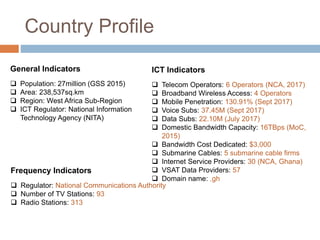
Country Profile
General Indicators
 Population: 27million (GSS 2015)
 Area: 238,537sq.km
 Region: West Africa Sub-Region
 ICT Regulator: National Information
Technology Agency (NITA)
Frequency Indicators
 Regulator: National Communications Authority
 Number of TV Stations: 93
 Radio Stations: 313
ICT Indicators
 Telecom Operators: 6 Operators (NCA, 2017)
 Broadband Wireless Access: 4 Operators
 Mobile Penetration: 130.91% (Sept 2017)
 Voice Subs: 37.45M (Sept 2017)
 Data Subs: 22.10M (July 2017)
 Domestic Bandwidth Capacity: 16TBps (MoC,
2015)
 Bandwidth Cost Dedicated: $3,000
 Submarine Cables: 5 submarine cable firms
 Internet Service Providers: 30 (NCA, Ghana)
 VSAT Data Providers: 57
 Domain name: .gh
Urbanization & Geography
Urban Geography is about 46%
Rural Geography is about 54%
Ghana has a lot of Mountains,
Rivers and Forests with extremely
large vegetation cover.
Concerns with Towers (1)
• Following the liberalization and entry of
numerous (4) MNOs and ISPs in 2007, there
was a huge increase in tower deployments
which led to a public uproar in Ghana;
• Public Concerns with Aesthetics
• Public Concerns with Radiations/EMFs
• Public Concerns with general safety due to
numerous towers springing up in more urban/peri-
urban areas
Concerns with Towers (2)
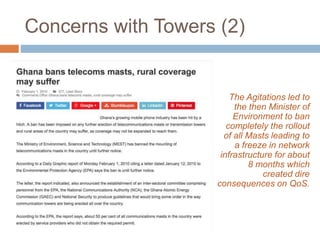
The Agitations led to
the then Minister of
Environment to ban
completely the rollout
of all Masts leading to
a freeze in network
infrastructure for about
8 months which
created dire
consequences on QoS.
Solutions
A. After months of lobby and engagements from MNOs
with Govt, an inter-ministerial committee (IMC) was
formed by the Environment Minister to;
• Provide clear standards and procedures for the installation of
towers and address issues of environmental sanity.
• Formulate a cost-effective and efficient mechanism to address
administrative and bureaucratic bottlenecks faced by
operators.
• Design a fair and open cost-based fee policy/structure which
would ensure that all operators are charged fairly by the
relevant permitting authorities.
• Facilitate the development of infrastructure to enhance the
delivery of quality service and also promote the provision of
Status Quo (Moratorium)
PROs
• Ensured
Compliance in the
Industry
• Worked towards
reducing public
agitations against
the Towers
A five year moratorium effective from the
date of the implementation of these
Guidelines, was given to all existing
towers which do not meet laid down
requirements; and in the event that such
communication towers are not removed
on or before the 5year deadline, it shall
attract a penalty of ¢10,000 per day; and
the MMDAs and the EPA in consultation
with NCA shall remove such facility and
place a lien upon the property for the
costs of removal
CONs
This moratorium was steep but MNOs
could not debate it due to the existing
tensions at the time
Impact of Moratorium
 Current dialogue ongoing in Ghana to have the
moratorium expunged from the Guidelines as its
implementation will mean the following;
 Service Access Reduction (Min 5mill subs to be affected)
 QoS degradation
 Compromise National Security
 Huge financial costs to Tower Owners to
decommission/replace
 Potential public outcry/backlash
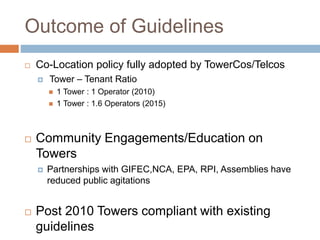
Outcome of Guidelines
 Co-Location policy fully adopted by TowerCos/Telcos
 Tower – Tenant Ratio
 1 Tower : 1 Operator (2010)
 1 Tower : 1.6 Operators (2015)
 Community Engagements/Education on
Towers
 Partnerships with GIFEC,NCA, EPA, RPI, Assemblies have
reduced public agitations
 Post 2010 Towers compliant with existing
guidelines
Summary
 The Tower Deployment Guidelines introduced
in Ghana has achieved the following;
 Provided Clarity for the ecosystem
 Reduced public agitation
 Enhanced confidence in the regulatory environment
 Incentivized Investments
 Ultimately good for mobile subscribers
Policy Recommendation
 Without a doubt the moratorium placed in the
guidelines has created a lot of uncertainty for
the Ghana market too, leading to doubt by
some players.
 Government needs to take urgent steps to conduct a
study to tell the impact of implementing the moratorium
and align with the industry proposal to expunge the
moratorium clause to enhance confidence in the
mobile industry
Conclusion
Materials Sourced
 www.nca.org.gh
 http://www.cra.gov.qa/sites/default/files/documents/Construction%20Proced
ures%20and%20Standards%20of%20the%20Cellular%20Mobile%20Base
%20Station%20and%20Tower.pdf
 Mobile Operator Data
THANK YOU!!!

Managing Customer Agitations on Telecom Masts - Ghana Case

  • 1.
    MANAGING CUSTOMER AGITATIONS ONTOWERS/MASTS [CASE FROM GHANA] By. Derek Barnabas Laryea derek.laryea@gmail.com
  • 2.
    Outline  Background  CountryProfile  Concerns with Towers  Solution (Guidelines)  Status Quo (Moratorium)  Outcome of Guidelines  Summary  Policy Recommendation
  • 3.
    Background  In 2010,Ghana developed Guidelines to streamline the deployment of Towers/Masts  Mobile phones and other ICT facilities are vital communication tools for both business and societal development. The growing demand for mobile services requires more towers deployment, to ensure that there is adequate network coverage and access that guarantee minimum quality of service (QoS).
  • 4.
    Country Profile General Indicators Population: 27million (GSS 2015)  Area: 238,537sq.km  Region: West Africa Sub-Region  ICT Regulator: National Information Technology Agency (NITA) Frequency Indicators  Regulator: National Communications Authority  Number of TV Stations: 93  Radio Stations: 313 ICT Indicators  Telecom Operators: 6 Operators (NCA, 2017)  Broadband Wireless Access: 4 Operators  Mobile Penetration: 130.91% (Sept 2017)  Voice Subs: 37.45M (Sept 2017)  Data Subs: 22.10M (July 2017)  Domestic Bandwidth Capacity: 16TBps (MoC, 2015)  Bandwidth Cost Dedicated: $3,000  Submarine Cables: 5 submarine cable firms  Internet Service Providers: 30 (NCA, Ghana)  VSAT Data Providers: 57  Domain name: .gh
  • 5.
    Urbanization & Geography UrbanGeography is about 46% Rural Geography is about 54% Ghana has a lot of Mountains, Rivers and Forests with extremely large vegetation cover.
  • 6.
    Concerns with Towers(1) • Following the liberalization and entry of numerous (4) MNOs and ISPs in 2007, there was a huge increase in tower deployments which led to a public uproar in Ghana; • Public Concerns with Aesthetics • Public Concerns with Radiations/EMFs • Public Concerns with general safety due to numerous towers springing up in more urban/peri- urban areas
  • 7.
    Concerns with Towers(2) The Agitations led to the then Minister of Environment to ban completely the rollout of all Masts leading to a freeze in network infrastructure for about 8 months which created dire consequences on QoS.
  • 8.
    Solutions A. After monthsof lobby and engagements from MNOs with Govt, an inter-ministerial committee (IMC) was formed by the Environment Minister to; • Provide clear standards and procedures for the installation of towers and address issues of environmental sanity. • Formulate a cost-effective and efficient mechanism to address administrative and bureaucratic bottlenecks faced by operators. • Design a fair and open cost-based fee policy/structure which would ensure that all operators are charged fairly by the relevant permitting authorities. • Facilitate the development of infrastructure to enhance the delivery of quality service and also promote the provision of
  • 9.
    Status Quo (Moratorium) PROs •Ensured Compliance in the Industry • Worked towards reducing public agitations against the Towers A five year moratorium effective from the date of the implementation of these Guidelines, was given to all existing towers which do not meet laid down requirements; and in the event that such communication towers are not removed on or before the 5year deadline, it shall attract a penalty of ¢10,000 per day; and the MMDAs and the EPA in consultation with NCA shall remove such facility and place a lien upon the property for the costs of removal CONs This moratorium was steep but MNOs could not debate it due to the existing tensions at the time
  • 10.
    Impact of Moratorium Current dialogue ongoing in Ghana to have the moratorium expunged from the Guidelines as its implementation will mean the following;  Service Access Reduction (Min 5mill subs to be affected)  QoS degradation  Compromise National Security  Huge financial costs to Tower Owners to decommission/replace  Potential public outcry/backlash
  • 11.
    Outcome of Guidelines Co-Location policy fully adopted by TowerCos/Telcos  Tower – Tenant Ratio  1 Tower : 1 Operator (2010)  1 Tower : 1.6 Operators (2015)  Community Engagements/Education on Towers  Partnerships with GIFEC,NCA, EPA, RPI, Assemblies have reduced public agitations  Post 2010 Towers compliant with existing guidelines
  • 12.
    Summary  The TowerDeployment Guidelines introduced in Ghana has achieved the following;  Provided Clarity for the ecosystem  Reduced public agitation  Enhanced confidence in the regulatory environment  Incentivized Investments  Ultimately good for mobile subscribers
  • 13.
    Policy Recommendation  Withouta doubt the moratorium placed in the guidelines has created a lot of uncertainty for the Ghana market too, leading to doubt by some players.  Government needs to take urgent steps to conduct a study to tell the impact of implementing the moratorium and align with the industry proposal to expunge the moratorium clause to enhance confidence in the mobile industry
  • 14.
    Conclusion Materials Sourced  www.nca.org.gh http://www.cra.gov.qa/sites/default/files/documents/Construction%20Proced ures%20and%20Standards%20of%20the%20Cellular%20Mobile%20Base %20Station%20and%20Tower.pdf  Mobile Operator Data THANK YOU!!!