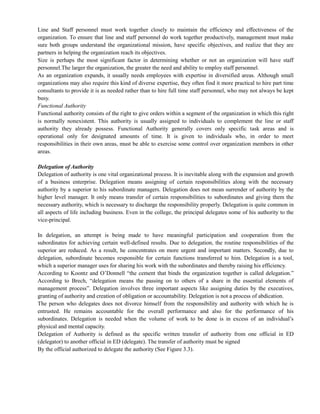
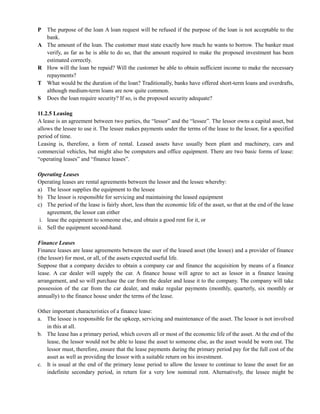
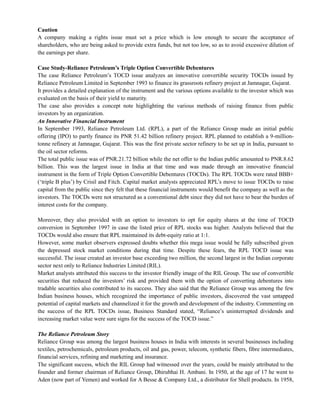
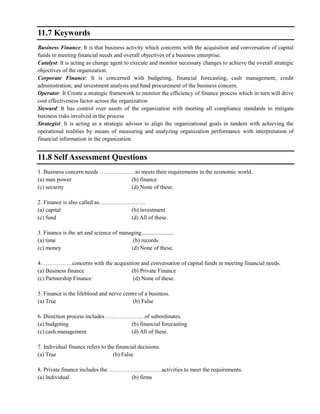
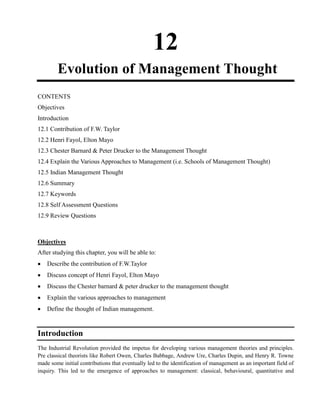
PRINCIPLES OF
MANAGEMENT
(BBA 103)
Jaipur National University
Directorate of Distance Education
_________________________________________________________________________________
Established by Government of Rajasthan
Approved by UGC under Sec 2(f) of UGC ACT 1956
(Recognised by Joint Committee of UGC-AICTE-DEC, Govt. of India)
PRINCIPLES OF MANAGEMENT
Management: Concept, Nature, Objective, Principles, Importance, process and Functions. MBO. Planning:
Nature, type, importance, principles and techniques of decision making.
Nature of Management: Meaning, Definition, it's nature purpose, importance & Functions, Management as
Art, Science & Profession- Management as social System, Concepts of management-Administration-
Organization
Organization: Structure, importance, process and principles. Types of organization. Organization design,
Types of authority, Delegation of authority.
Communication: Significance, Channels of communication, types and process of communication, barriers
and remedies.
Leadership: Functions, qualities.
Co-ordination and co-operation, co-ordination as essence of management, principles and techniques,
obstacles in co-ordination, essential of effective co-ordination.
Direction: Concept, nature, importance and principles, Importance, type process and techniques, Nature,
process, techniques and essentials of effective control.
Decision-Making: Meaning and Importance, Forms of Decision-Making, Techniques of Decision-Making,
Decision-Making Process.
Authority: Delegation , Decentralization, Difference between authority and power, Uses of authority,
Distinction between Centralization and Decentralization, Responsibility
Business Organization: Significance and establishment of business organization, Different types of business
organization.
Finance: Need and importance of Finance. Sources of Finance. SIDBI, RFC and RIICO.
Evolution of Management Thought: Contribution of F.W.Taylor, Henri Fayol ,Elton Mayo , Chester Barhard
& Peter Drucker to the management thought. Various approaches to management (i.e. Schools of management
thought) Indian Management Thought
Strategic Management: Definition, Classes of Decisions, Levels of Decision, Strategy, Role of different
Strategist, Relevance of Strategic Management and its Benefits, Strategic.
Recent Trends in Management: Social Responsibility of Management –environment friendly Management,
Management of Change.
Management of Crisis: Total Quality Management, Stress Management, International Management
CONTENTS
Unit 1: Management 1-13
1.1 Concepts of Management
1.2 Nature of Management
1.3 Objectives of Management
1.4 Principles of Management
1.5 Importance of Management
1.6 Process and Function of Management
1.7 Management by Objectives (MBO)
1.8 Summary
1.9 Keywords
1.10 Self Assessment Questions
1.11 Review Questions
Unit 2: Nature of Management 14-27
2.1 Meaning and Definition of Nature of Management
2.2 Purpose and Importance of Management
2.3 Functions of Nature Management
2.4 Management as Art, Science and Profession
2.5 Management as Social System
2.6 Management-Administration and Management Organization
2.7 Summary
2.8 Keywords
2.9 Self Assessment Questions
2.10 Review Questions
Unit 3: Organisation 28-41
3.1 Structure of Organization
3.2 Importance of Organization
3.3 Process and Principles of Organization
3.4 Types of Organization and Organization Design
3.5 Types of Authority, Delegation of Authority
3.6 Summary
3.7 Keywords
3.8 Self Assessment Questions
3.9 Review Questions
Unit 4: Communication 42-55
4.1 Significance of Communication
4.2 Channels of Communication
4.3 Process of Communication and Types
4.4 Barriers and Remedies
4.5 Summary
4.6 Keywords
4.7 Self Assessment Questions
4.8 Review Questions
Unit 5: Leadership 56-69
5.1 Definitions of Leadership
5.2 Nature, Characteristic, and Issues of Leadership
5.3 Leadership Styles and Patterns
5.4 Leadership Skill
5.5 Importance of Leadership
5.6 Functions of a Leader
5.7 Types of Leaders
5.8 Transactional and Transformational Theories
5.9 Qualities of Leadership
5.10 Summary
5.11 Keywords
5.12 Self Assessment Questions
5.13 Review Questions
Unit 6: Co-ordination and Co-operation 70-81
6.1 Definition of Co‐Ordination
6.2 Co-Ordination As Essence Of Management
6.3 Principles of Co‐ordination
6.4 Techniques Objectives of Co‐ordination
6.5 Obstacles in Co-ordination
6.6 Essential of Effective Co-ordination
6.7 Summary
6.8 Keywords
6.9 Self Assessment Questions
6.10 Review Questions
Unit 7: Direction 82-96
7.1 Concept of Directing
7.2 Nature of Direction
7.3 Importance of Directing
7.4 Principles of Directing
7.5 Process of Direction
7.6 Techniques and Essentials of Effective Control
7.7 Summary
7.8 Keywords
7.9 Self Assessment Questions
7.10 Review Questions
Unit 8: Decision-Making 97-105
8.1. Meaning and Importance
8.2 Forms of Decision-Making
8.3 Techniques of Decision-Making
8.4. Decision-making Process
8.5 Summary
8.6 Keywords
8.7 Self Assessment Questions
8.8 Review Questions
Unit 9: Authority 106-119
9.1 Delegation
9.2 Decentralization
9.3 Difference between authority and power
9.4 Uses of authority
9.5 Distinction between Centralization and Decentralization
9.6 Responsibility
9.7 Summary
9.8 Keywords
9.9 Self Assessment Questions
9.10 Review Questions
Unit 10: Business Organization 120-134
10.1 Meaning of Business
10.2 Importance of Business Organization
10.3 Basic Principle of Business Organization
10.4 Significance and Establishment of Business Organization
10.5 Types of Business Organization
10.6 Summary
10.7 Keywords
10.8 Self Assessment Questions
10.9 Review Questions
Unit 11: Finance 135-149
11.1 Importance of Finance
11.2 Sources of Finance
11.3 Small Industries Development Bank of India (SIDBI)
11.4 Resident Foreign Currency (RFC)
11.5 Rajasthan State Industrial Development and Investment Corporation (RIICO)
11.6 Summary
11.7 Keywords
11.8 Self Assessment Questions
11.9 Review Questions
Unit 12: Evolution of Management Thought 150-163
12.1 Contribution of F.W. Taylor
12.2 Henri Fayol, Elton Mayo
12.3 Chester Barnard & Peter Drucker to the Management Thought
12.4 Explain the Various Approaches to Management (i.e. Schools of Management Thought)
12.5 Indian Management Thought
12.6 Summary
12.7 Keywords
12.8 Self Assessment Questions
12.9 Review Questions
Unit 13: Strategic Management 164-176
13.1 Definition of Strategic management
13.2 Classes of Decisions
13.3 Levels of decision
13.4 Strategy
13.5 Role of Different Strategies
13.6 Relevance of Strategic Management and its Benefits
13.7 Summary
13.8 Keywords
13.9 Self Assessment Questions
13.10 Review Questions
Unit 14: Recent Trends in Management 177-186
14.1 Social Responsibility of Management
14.2 Environment Friendly Management
14.3 Management of Change
14.4 Summary
14.5 Keywords
14.6 Self Assessment Questions
14.7 Review Questions
Unit 15: Management of Crisis 187-195
15.1 Total Quality Management
15.2 Stress Management
15.3 International Management
15.4 Summary
15.5 Keywords
15.6 Self Assessment Questions
15.7 Review Questions
1
Management
CONTENTS
Objectives
Introduction
1.1 Concepts of Management
1.2 Nature of Management
1.3 Objectives of Management
1.4 Principles of Management
1.5 Importance of Management
1.6 Process and Function of Management
1.7 Management by Objectives (MBO)
1.8 Summary
1.9 Keywords
1.10 Self Assessment Questions
1.11 Review Questions
Objectives
After studying this chapter, you will be able to:
Explain the concept of management
Define nature of management
Understand the objective of management
Describe the principles of management
Discuss about the importance of management
Explain the process and functions of management
Define management by objectives (MBO)
Introduction
Management means managing an activity. When we talk of managing an activity, we really mean to make the
activity a success. In other words, we have in mind some goal and we decide about the ways of carrying out
the activity so as to achieve the goal. Consider a situation. When a person goes for shopping, his primary aim
is to buy what he requires at a reasonable price. He has a number of questions in his mind what should he buy?
How will he reach there? Will he be able to come back at the right time? And so on. To make his shopping a
success, he should think of these questions in advance.
Take another example of a housewife. When she gets up in the morning, she has in her mind a number of
activities to be performed, e.g., house is to be cleaned, clothes are to be washed, young children are to be
helped in getting ready for the school, breakfast is to be prepared, food is to be cooked and packed and handed
over to the children while they leave for school and so on. In the family, she may have three persons to help
her servant, her eldest daughter and her mother-in-law. Her aim is to divide the work in such a way that all the
work gets completed in the right way at the appropriate time. What the housewife does in this example, taken
together, to achieve her aim, means management.
1.1 Concepts of Management
One of the enduring questions in the field of management is whether it is an art or a science. It is an art as
―skill in conducting any human activity‖ and science as ―any skill or technique that reflects a precise
application of facts or a principle.‖ Reflected in the differences in these definitions is the use of precision in
science, in that there is a particular, prescribed way in which a manager should act.
Thus, management as a science would indicate that in practice, managers use a specific body of information
and facts to guide their behaviours, but that management as an art requires no specific body of knowledge,
only skill. Conversely, those who believe management are an art are likely to believe that there is no specific
way to teach or understand management, and that it is a skill borne of personality and ability. Those who
believe in management as an art are likely to believe that certain people are more predisposed to be effective
managers than are others, and that some people cannot be taught to be effective managers. That is, even with
an understanding of management research and an education in management, some people will not be capable
of being effective practicing managers.The term management has been interpreted in several ways; some of
which are given below:
Management as an Activity
Management is an activity just like playing, studying, teaching etc. As an activity management has been
defined as the art of getting things done through the efforts of other people. Management is a group activity
wherein managers do to achieve the objectives of the group.
The activities of management are:
Interpersonal activities
Decisional activities
Informative activities
Management as a Process
Management is considered a process because it involves a series of interrelated functions. It consists of getting
the objectives of an organization and taking steps to achieve objectives. The management process includes
planning, organizing, staffing, directing and controlling functions.
Management as a process has the following implications:
Social Process: Management involves interactions among people. Goals can be achieved only when
relations between people are productive. Human factor is the most important part of the management.
Integrated Process: Management brings human, physical and financial resources together to put into
effort. Management also integrates human efforts so as to maintain harmony among them.
Continuous Process: Management involves continuous identifying and solving problems. It is repeated
every now and then till the goal is achieved.
Interactive Process: Managerial functions are contained within each other.
For example, when a manager prepares plans, he is also laying down standards for control.
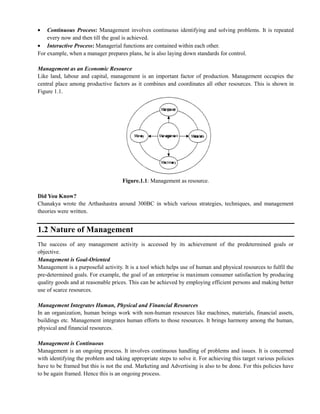
Management as an Economic Resource
Like land, labour and capital, management is an important factor of production. Management occupies the
central place among productive factors as it combines and coordinates all other resources. This is shown in
Figure 1.1.
Figure.1.1: Management as resource.
Did You Know?
Chanakya wrote the Arthashastra around 300BC in which various strategies, techniques, and management
theories were written.
1.2 Nature of Management
The success of any management activity is accessed by its achievement of the predetermined goals or
objective.
Management is Goal-Oriented
Management is a purposeful activity. It is a tool which helps use of human and physical resources to fulfil the
pre-determined goals. For example, the goal of an enterprise is maximum consumer satisfaction by producing
quality goods and at reasonable prices. This can be achieved by employing efficient persons and making better
use of scarce resources.
Management Integrates Human, Physical and Financial Resources
In an organization, human beings work with non-human resources like machines, materials, financial assets,
buildings etc. Management integrates human efforts to those resources. It brings harmony among the human,
physical and financial resources.
Management is Continuous
Management is an ongoing process. It involves continuous handling of problems and issues. It is concerned
with identifying the problem and taking appropriate steps to solve it. For achieving this target various policies
have to be framed but this is not the end. Marketing and Advertising is also to be done. For this policies have
to be again framed. Hence this is an ongoing process.
Management is all Pervasive
Management is required in all types of organizations whether it is political, social, cultural or business because
it helps and directs various efforts towards a definite purpose. Thus clubs, hospitals, political parties, colleges,
hospitals, business firms all require management. Whenever more than one person is engaged in working for a
common goal, management is necessary. Whether it is a small business firm which may be engaged in trading
or a large firm like Tata Iron and Steel, management is required everywhere irrespective of size or type of
activity.
Management is a Group Activity
Management is very much less concerned with individual‘s efforts. It is more concerned with groups. It
involves the use of group effort to achieve predetermined goal. Management refers to a group of persons
managing the enterprise.
Organized Activities
Management is a process of organized activities. Groups of people cannot be involved in the performance of
activities without organized activities. Management comes into existence where a group of people are involved
in achieving a common objective. The organized activities may take a variety of forms ranging from a tightly
structured organization to a loosely-knit organization.
Management is Dynamic
Management has framed certain principles, which are flexible in nature and change with the changes in the
environment in which an organization exits.
Relative, Not Absolute Principles
Management principles are relative, not absolute, and they should be applied according to the need of the
organization. A particular management principle has different strengths in different conditions. Therefore,
principles should be applied according to the prevailing conditions
1.3 Objectives of Management
The management is the core of an organization it plays a basic role in organization‘s development. There are
many objectives of the management some of them are discussed as:
Getting Maximum Results with Minimum Efforts
The main objective of management is to secure maximum outputs with minimum efforts and resources.
Management is basically concerned with thinking and utilizing human, material and financial resources in
such a manner that would result in best combination. This combination results in reduction of various costs.
Increasing the Efficiency of Factors of Production
Through proper utilization of various factors of production, their efficiency can be increased to a great extent
which can be obtained by reducing spoilage, wastages and breakage of all kinds; this in turn leads to saving of
time, effort and money which is essential for the growth and prosperity of the enterprise.
Maximum Prosperity for Employer and Employees
Management ensures smooth and coordinated functioning of the enterprise. This in turn helps in providing
maximum benefits to the employee in the shape of good working condition, suitable wage system, incentive
plans on the one hand and higher profits to the employer on the other hand.
Establishes Equilibrium
It enables the Organization to survive in changing environment. It keeps in touch with the changing
environment. With the change is external environment, the initial co-ordination of organization must be
changed. So it adapts organization to changing demand of market/changing needs of societies. It is responsible
for growth and survival of organization.
Essentials for Prosperity of Society
Efficient management leads to better economical production which helps in turn to increase the welfare of
people. Good management makes a difficult task easier by avoiding wastage of scarce resource. It improves
standard of living. It increases the profit which is beneficial to business and society will get maximum output
at minimum cost by creating employment opportunities which generate income in hands. Organization comes
with new products and researches beneficial for society.
1.4 Principles of Management
A principle refers to a fundamental truth. It establishes cause and effect relationship between two or more
variables under given situation. They serve as a guide to thought and actions. Therefore, management
principles are the statements of fundamental truth based on logic which provides guidelines for managerial
decision making and actions.
These principles are derived:
a. On the basis of observation and analysis i.e. practical experience of managers.
b. By conducting experimental studies.
There are 14 Principles of Management described by Henri Fayol:
1. Division of Labour
a. Henry Fayol has stressed on the specialization of jobs.
b. He recommended that work of all kinds must be divided and subdivided and allotted to various persons
according to their expertise in a particular area.
c. Subdivision of work makes it simpler and results in efficiency.
2. Party of Authority and Responsibility
a. Authority and responsibility are co-existing.
b. If authority is given to a person, he should also be made responsible.
c. In a same way, if anyone is made responsible for any job, he should also have concerned authority.
3. Principle of One Boss
a. A sub-ordinate should receive orders and be accountable to one and only one boss at a time.
b. Therefore, dual sub-ordination should be avoided unless and until it is absolutely essential.
c. Unity of command provides the enterprise a disciplined, stable and orderly existence.
4. Unity of Direction
a. Fayol advocates one head one plan which means that there should be one plan for a group of activities
having similar objectives.
b. Related activities should be grouped together. There should be one plan of action for them and they should
be under the charge of a particular manager.
c. According to this principle, efforts of all the members of the organization should be directed towards
common goal.
5. Equity
a. Equity means combination of fairness, kindness and justice.
b. The employees should be treated with kindness and equity if devotion is expected of them.
c. It implies that managers should be fair and impartial while dealing with the subordinates.
d. They should give similar treatment to people of similar position.
6. Order
a. This principle is concerned with proper and systematic arrangement of things and people.
b. Arrangement of things is called material order and placement of people is called social order.
c. Material order- There should be safe, appropriate and specific place for every and every place to be
effectively used for specific activity and commodity.
7. Discipline
a. According to Fayol, ―Discipline means sincerity, obedience, respect of authority and observance of rules
and regulations of the enterprise‖.
b. This principle applies that subordinate should respect their superiors and obey their order.
c. It is an important requisite for smooth running of the enterprise.
8. Initiative
a. Workers should be encouraged to take initiative in the work assigned to them.
b. It means eagerness to initiate actions without being asked to do so.
c. Fayol advised that management should provide opportunity to its employees to suggest ideas, experiences
and new method of work.
9. Fair Remuneration
a. The quantum and method of remuneration to be paid to the workers should be fair, reasonable, satisfactory
and rewarding of the efforts.
b. As far as possible it should accord satisfaction to both employer and the employees.
c. Wages should be determined on the basis of cost of living, work assigned, financial position of the
business, wage rate prevailing etc.
10. Stability of Tenure
a. Fayol emphasized that employees should not be moved frequently from one job position to another i.e. the
period of service in a job should be fixed.
b. Therefore employees should be appointed after keeping in view principles of recruitment and selection but
once they are appointed their services should be served.
c. According to Fayol. ―Time is required for an employee to get used to a new work and succeed to doing it
well but if he is removed before that he will not be able to render worthwhile services‖.
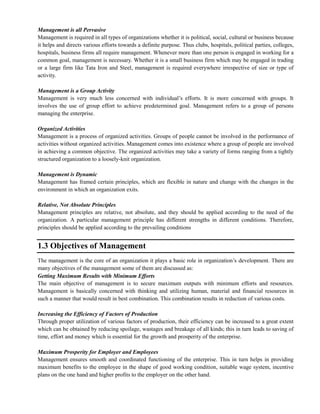
11. Scalar Chain
a. Fayol defines scalar chain as ‘The chain of superiors ranging from the ultimate authority to the lowest‖.
b. Every orders, instructions, messages, requests, explanation etc. has to pass through Scalar chain.
c. The sake of convenience and urgency, this path can be cut shirt and this short cut is known as Gang Plank.
Figure 1.2: Gang plank.
12 Sub-ordination of Individual Interest to General Interest
a. An organization is much bigger than the individual it constitutes therefore interest of the undertaking
should prevail in all circumstances.
b. As far as possible, reconciliation should be achieved between individual and group interests.
c. But in case of conflict, individual must sacrifice for bigger interests.
13 Espirit De’
a. It refers to team spirit i.e. harmony in the work groups and mutual understanding among the members.
b. Spirit De‘ Corps inspires workers to work harder.
c. Fayol cautioned the managers against dividing the employees into competing groups because it might
damage the moral of the workers and interest of the undertaking in the long run.
14 Centralization and De-Centralization
a. Centralization means concentration of authority at the top level. In other words, centralization is a situation
in which top management retains most of the decision making authority.
b. Decentralization means disposal of decision making authority to all the levels of the organization. In other
words, sharing authority downwards is decentralization.
c. According to Fayol, ―Degree of centralization or decentralization depends on no. of factors like size of
business, experience of superiors, dependability and ability of subordinates etc.
Caution
Be Aware about the external resources while developing the management for an organization.
1.5 Importance of Management
Management is a necessary evil of any business. They provide the leadership and administration that will
ensure that the business runs the way. There are some management personnel that are more effective than
others.
Some are very involved in the day to day operations while others choose a ―hands-off‖ approach. Typically
though, managers will ensure that the staffs are doing what they should be doing so that customers are being
treated the way they should in a timely manner.
Encourages Initiative
Management encourages initiative. Initiative means to do the right thing at the right time without being told or
influenced by the superior. The employees should be encouraged to make their own plans and also to
implement these plans. Initiative gives satisfaction to employees and success to organization.
Encourages Innovation
Management also encourages innovation in the organization. Innovation brings new ideas, new technology,
new methods, new products, new services, etc. This makes the organization more competitive and efficient.
Facilitates Growth and Expansion
Management makes optimum utilization of available resources. It reduces wastage and increase efficiency. It
encourages team work and motivates employees. It also reduces absenteeism and labour turnover.
Improves Life of Workers
Management shares some of its profits with the workers. It provides the workers with good working
environment and conditions. It also gives the workers many financial and non-financial incentives. All this
improves the quality of life of the workers.
Reduces Absenteeism and Labour Turnover
Absenteeism means the employee is absent without permission.
Labour Turnover means the employee leaves the organization.
Labour absenteeism and turnover increases the cost and causes many problems in the smooth functioning of
the organization. Management uses different techniques to reduce absenteeism and labour turnover in the
organization.
Encourages Team Work
Management encourages employees to work as a team. It develops a team spirit in the organization. This unity
brings success to the organization.
Did You Know?
The definition of management ―management is getting things done through other people‖ was pronounced by
the President of the American Management Association (AMA) in 1980.
1.6 Process and Function of Management
Management as a process refers to a series of inter-related functions, such as planning, organizing, staffing,
leading and controlling.
1.6.1 Process of Management
Actually, managers are known by the work they do. According to James Lundy, ‗Management is what
management does. The management process suggests that all managers perform certain functions to realize
certain goals. (See Figure 1.3)
Figure 1.3: The process of management.
Management, it should be noted, is a social process because it is concerned with relations among people at
work. A manager sets the objectives of an organization. He provides an environment that is helpful for group
action. He offers incentives to those who perform well and thus helps the organization realize its goals.
The term ‗management‘ is used to denote individuals who manage the affairs of an organization. Expressions
such as management has declared a lockout, management takes a tough stand against workers, often hit
newspaper headlines. When such statements are made, the reference is actually made to the people who
manage the affairs of an organization. Thus, as a group of people, management includes all those who are
accountable for making decisions and supervising the work of others
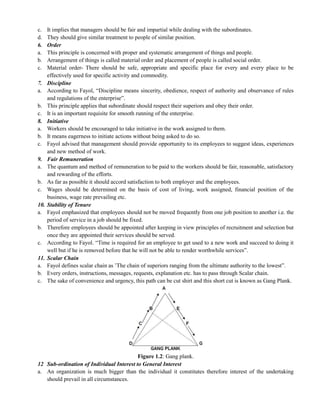
1.6.2 Function of Management
Management has been described as a social process involving responsibility for economical and effective
planning and regulation of operation of an enterprise in the fulfilment of given purposes. It is a dynamic
process consisting of various elements and activities.
These activities are different from operative functions like marketing, finance, purchase etc. Rather these
activities are common to each and every manger irrespective of his level or status.
Figure 1.4: Functions of management.
Planning
Planning involves mapping out the process of achieving a given goal. It looks ahead and prepares for the
future. It is a process of settling on the business objectives and charting out the methods of attaining those
objectives.
Organizing
To organize a business is to equip it completely. This includes its functioning, employees, raw materials, tools,
capital etc. All this may be divided into two main sections, the human organization and the material
organization.
Staffing
Staffing is a continual process since people may leave, be terminated, retire or die. Often, changes in the
organization generate new positions, which must be filled.
Directing
After planning, establishing and staffing the organization, the next step is to define its objectives. This function
can be termed as leading,
Controlling
The manager must ensure that everything happens in consistency with the plans, the instructions provided and
the principles established.
Innovation
Innovation means developing new thoughts that may also bring about the creation and innovation of new
products or identifying new uses for the old ones
1.7 Management by Objectives (MBO)
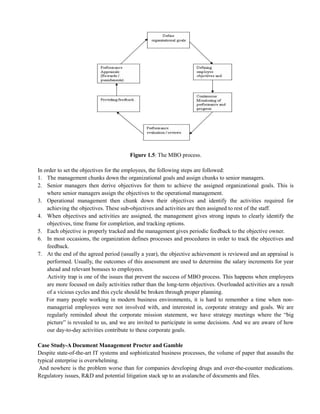
The process of setting objectives in the organization to give a sense of direction to the employees is called as
Management by Objectives. It refers to the process of setting goals for the employees Management by
objectives guides the employees to deliver their level best and achieve the targets within the stipulated time
frame. Figure 1.5 shows MBO process.
Figure 1.5: The MBO process.
In order to set the objectives for the employees, the following steps are followed:
1. The management chunks down the organizational goals and assign chunks to senior managers.
2. Senior managers then derive objectives for them to achieve the assigned organizational goals. This is
where senior managers assign the objectives to the operational management.
3. Operational management then chunk down their objectives and identify the activities required for
achieving the objectives. These sub-objectives and activities are then assigned to rest of the staff.
4. When objectives and activities are assigned, the management gives strong inputs to clearly identify the
objectives, time frame for completion, and tracking options.
5. Each objective is properly tracked and the management gives periodic feedback to the objective owner.
6. In most occasions, the organization defines processes and procedures in order to track the objectives and
feedback.
7. At the end of the agreed period (usually a year), the objective achievement is reviewed and an appraisal is
performed. Usually, the outcomes of this assessment are used to determine the salary increments for year
ahead and relevant bonuses to employees.
Activity trap is one of the issues that prevent the success of MBO process. This happens when employees
are more focused on daily activities rather than the long-term objectives. Overloaded activities are a result
of a vicious cycles and this cycle should be broken through proper planning.
For many people working in modern business environments, it is hard to remember a time when non-
managerial employees were not involved with, and interested in, corporate strategy and goals. We are
regularly reminded about the corporate mission statement, we have strategy meetings where the ―big
picture‖ is revealed to us, and we are invited to participate in some decisions. And we are aware of how
our day-to-day activities contribute to these corporate goals.
Case Study-A Document Management Procter and Gamble
Despite state-of-the-art IT systems and sophisticated business processes, the volume of paper that assaults the
typical enterprise is overwhelming.
And nowhere is the problem worse than for companies developing drugs and over-the-counter medications.
Regulatory issues, R&D and potential litigation stack up to an avalanche of documents and files.
―As a result, Cincinnati-based P&G is attempting to eliminate and migrate to a system that allows it to store
R&D information electronically, while managing secure digital signatures. The consumer goods giant—with
Rs 3825 billion in 2007 sales and a portfolio that includes Crest, Tide, Gillette, Pampers and Charmin—aims
to gain greater control of documents, reduce administrative oversight, trim costs, accelerate R&D initiatives,
and improve tracking and signature compliance.
About 320 employees are now using P&G‘s system, which runs on Adobe Live Cycle software and employs
two-factor authentication. The company hopes to roll out the application to more than 4,500 workers by the
end of 2009. ―The idea is to create a searchable archive of PDF files and a common set of tools for the
enterprise,‖ Bross explains. ―People must be able to use the system globally and have access to key documents
on an instantaneous basis. Seamless interaction is essential.‖
Signing On
The migration from paper to pixels has flummoxed more than a few companies. The task can involve major
changes to workflow and create enormous challenges related to approvals and compliance.
At P&G, any possibility of slowing an already complex R&D process and interfering with the approval and
introduction of a product could wreak havoc on the bottom line. For example, a successful over-the-counter
medication can generate sales of upward of Rs50 million per day.
Typically, researchers, clinicians, quality-control staff, marketing specialists, and dozens of other internal P&G
staff and external partners must exchange and share documents. In the past, storing all those documents meant
stuffing filing cabinets internally, producing microfiche, managing indexes and renting warehouses to store
reams of documents off-site.
―Digging through all the records is a long, laborious process,‖ Bross notes. ―If a court case comes up, the
process of pinpointing a document and pulling it out is extremely time-consuming and painful.‖
Not surprisingly, the perils of paper have exacted a toll. In the past, some indexes were not entirely accurate
and manually searching for a particular section of a document—or associated documents—devoured even
more time. And outsourcing records management had its own problems. In one instance, a London warehouse
operated by an outside service provider burned to the ground, and P&G permanently lost hundreds of boxes of
records. Although P&G has considered migrating to an electronic record-keeping system for the last several
years, Bross and other executives felt that key pieces were not in place at that time. After all, the company had
to ensure that it could authenticate digital signatures and build signing and storage processes into its everyday
workflow. In addition, P&G‘s legal department wanted to be sure it had a legally enforceable signature on file.
Designing an electronic system with backups was too expensive and did not offer an adequate return on
investment. Then, in 2005, all the pieces began to fall into place. That is when P&G embraced the
pharmaceutical industry‘s SAFE (Signatures and Authentication for Everyone) BioPharma Association
standard. It was established to help companies go less and still interact with regulatory authorities on a global
scale. The initiative not only focused on ways to manage digital signatures, it also created a method to confirm
the identity of the signer. The SAFE ―was the only digital signature approach that offered an identity-proofing
scenario,‖ Bross says. ―It provided a legally enforceable component within the overall liability framework.‖
P&G‘s IT and legal departments examined the initiative and agreed that it met the company‘s business needs
and risk requirements.Today, once a digital signature is added to a file, an auditor can examine it in a tracking
bin or view a validation report. It is immediately possible to view all the activity related to the document.
―You simply right-click on the signature and view the entire audit trail‖ Bross explains. ―The signature can
also be exposed and appended as a last page of the file so that it can be shared appropriately on an external
basis, such as in a court of law or if there were a sale of the product.‖
Questions
1. Write the sort not of Adobe Live Cycle software.
2. Discuss about the R&D process.
1.8 Summary
Management reduces the wastage of human, material and financial resources. Wastage is reduced by
proper production planning and control. If wastage is reduced then productivity will increase.
Management encourages employees to work as a team. It develops a team spirit in the organization.
The core aim of management by objectives is the alignment of company goals and subordinate objectives
properly, so everyone in the organization works towards achieving the same organizational goal.
The main objective of management is to secure maximum outputs with minimum efforts and resources.
Management is required in all types of organizations whether it is political, social, cultural or business
because it helps and directs various efforts towards a definite purpose.
1.9 Keywords
Controlling: Controlling is an important function because it helps to check the errors and to take the corrective
action so that deviation from standards are minimized and stated goals of the organization are achieved in a
desired manner.
Leading: Leading refers to motivating, directing and guiding people in the organization it involves ensuring
that the people in the organization are willing and capable of performing the required tasks.
Management: Management is the act of getting people together to accomplish desired goals and objectives
using available resources efficiently and effectively.
Organizing: An organizing is the managerial function of arranging people and resources to work toward a
goal.
Planning: Planning in organizations and public policy is both the organizational process of creating and
maintaining plan
1.10 Self Assessment Questions
1. ................................. is not an activity of management.
(a) Interpersonal activities (b) Divisional activity
(c) Decisional activities (d) Informative activities.
2. Management involves a series of……………….
(a) correlated function (b) interrelated functions
(c) iterative function (d) None of these.
3. Management process does not include………….
(a) planning, (b) organizing
(c) serializing (d) staffing.
4. Management involves interactions among people is defined as the process of..............
(a) Social Process (b) Interactive process
(c) Integrated Process (d) Integrated Process.
5. Management process involves decision making at all levels.
(a) True (b) False
6. Management is more concerned with……………
(a) individual‘s efforts (b) groups
(c) manager (d) None of these.
7. Management is a science or art.
(a) True (b) False
8. Management is very much less concerned with………….
(a) group efforts (b) manager‘s efforts
(c) individual‘s efforts (d) None of these.
9. Management ensures ………….. and coordinated functioning of the enterprise.
(a) hard (b) smooth
(c) sophisticated (d) None of these.
10. Management cannot integrate human, physical and financial resources.
(a) True (b) False
1.11 Review Questions
1. Explain the concept of management.
2. What are the objectives of management?
3. What do you understand by the principle of management?
4. What are the functions of management?
5. Explain the nature of management.
6. Define the management by objective process.
7. Briefly explain the management as an economic resource.
8. How can you say that management is continuous?
9. Explain an importance of management.
10. What is the process of management?
Answers for Self Assessment Questions
1. (b) 2. (b) 3. (c) 4. (a) 5. (a)
6. (b) 7.( a) 8.( c) 9.( b) 10. (b)
2
Nature of Management
CONTENTS
Objectives
Introduction
2.1 Meaning and Definition of Nature of Management
2.2 Purpose and Importance of Management
2.3 Functions of Nature Management
2.4 Management as Art, Science and Profession
2.5 Management as Social System
2.6 Management-Administration and Management Organization
2.7 Summary
2.8 Keywords
2.9 Self Assessment Questions
2.10 Review Questions
Objectives
After studying this chapter, you will be able to:
Understand the meaning and definition of nature of management
Define the purpose of management
Describe importance and functions of nature of management
Discuss management as art, science and profession
Explain management as social system
Describe the concepts of management-administration and management organization
Introduction
People working in organizations need to have their activities co-ordinate, controlled and directed toward the
objectives of the organization. Effective management is essential if the organization is to succeed in the
achievement of its objectives. It is therefore prudent for students to have a knowledge and understanding of the
principles, functions and roles of managers so that they can identify appropriate strategies for the management
of their own particular organization.
Various contributions to the field of management have changed its nature. The nature of management can be
described as follows:
Multidisciplinary: Management is multidisciplinary because it includes knowledge/information from
various disciplines- economics, statistics, maths, psychology, sociology, ecology, operations research,
history, etc. Management integrates the ideas and concepts taken from these disciplines and presents newer
concepts which can be put into practice for managing the organizations.
Management is Dynamic: Management has framed certain principles, which are flexible in nature and
change with the changes in the environment in which an organization exits.
Relative, Not Absolute Principles: Management principles are relative, not absolute, and they should be
applied according to the need of the organization. A particular management principle has different
strengths in different conditions. Therefore, principles should be applied according to the prevailing
conditions.
Management: Science or Art: Management likes other practices- whether medicine, music composition, or
even accountancy- is an art. It is know-how. Yet managers can work better by using the organized
knowledge about management. It is this knowledge that constitutes science. Thus, managing as practice is
an art; the organized knowledge underlying the practice may be referred to as science.
Management as Profession: Management has been regarded as a profession by many while many have
suggested that it has not achieved the status of a profession. Schein concluded that by some criteria
management is indeed a profession, but by other criteria it is not. Today we can see many signs that
management is working towards increased professionalism.
Management is Universal: Management is a universal phenomenon. However, management principles are
not universally applicable but are to be modified according to the needs of the situation.
2.1 Meaning and Definition of Nature of Management
Management is a continuous, lively and fast developing science. Management is needed to convert the
disorganized resources of men, machines, materials and methods into a useful and effective enterprise.
Management is a pipeline, the inputs are fed at the end and they are preceded through management functions
and ultimately we get the end results or inputs in the form of goods, services, productivity, information and
satisfaction.
Management is a comprehensive word which is used in different sciences in the modern business and
industrial world. In the narrow sense, it signifies the technique of taking work from others. In this way a
person who can take work from others is called manager. In the wide sense, the management is an art, as well
as science, which is concerned with the different human efforts so as achieve the desired objective.
Management has been defined by different authors in a number of ways. Some call it a process of managing.
Some call it a coordination of resources, some call it body of personnel challenged in the task of managing
while others call it as an organized distinct discipline. The following are some of the main definitions of
management:
2.1.1 Management as process
Kimball, Koontz and O'Donnell, Newmann and Summer, Stanley Vance, Theo Haimann, F.C. Hooper and
E.F.T Breach they all call it a process. It is evident from the following definitions also:
According the Kimball-management may be broadly defined as the art of applying the economic principles
that underlie the control of men and materials in the enterprise under consideration.
According to Koontz"-Management is the art of getting things done through and with people in formally
organized groups."
According to Theo Haimann,-"Management is the function of getting things done through people and
directing the efforts of individuals towards a common objective."
According to Sisks,-"Management is the process of working off with and other to effectively achieve
organizational objectives by efficiently using limited resources in changing environment."
2.1.2 Management as an Activity
According to this approach management consists of those activities, which are performed by managers in
attaining the predetermined objectives of the business. This approach may be referred to Henry Fayol, who
classified management activities into the following categories:
Technical: referred to production department.
Commercial: relates to buying, selling and exchange.
Financial concerned with maximum utilization of capital.
Security concurred with protection of property and person.
According concerned with maintenance of accounts, presentation and statistics and
Management concerned to planning, organizing, commanding, coordinating and controlling.
2.1.3 Management as a group of personnel
According to this approach human factor plays an important role in accomplishing business objectives.
Management is concerned with those who have been managing the affairs of the business. Managers are
assigned duties and are also granted requisite authority to perform their duties efficiently and thus,
management is effective direction, coordination and control of individual and group efforts to accomplish
business objective.
This approach is advocated by management authorities like Taylor, Wilson and others. They have defined
management as following. As per F.W. Taylor's approach, "Management is the art of knowing exactly what
you want your men to do and then seeing that they do it in the best and cheapest way."
2.1.4 Management as a discipline
Sometimes the term ―Management‖ is used to connote neither the activity nor the personnel who exercise it,
but as a substantive describes the subject, the body of knowledge and practices of management as a subject of
study. Management is being taught in different college and universities as a district subject.
Thus, management, as such is a process, an activity, a discipline and as effort to coordination, control and
direct individual and group efforts towards desired goal of the business.
The main characteristics of management are as follows:
Management is an activity: Management is an activity which is concerned with the efficient utilization of
human and non-human resources of production.
Invisible Force: Management is an invisible force. Its existence can be felt through the enterprise or
institution it is managing.
Goal Oriented: Management is goal oriented as it aims to achieve some definite goals and objectives.
According to the Haimann, "Effective management is always management by objectives". Managers and
other personnel officers apply their knowledge, experience and skills to achieve the desired objectives.
Accomplishment through the Efforts of Others: Managers cannot do everything themselves. They must
have the necessary ability and skills to get work accomplished through the efforts of others.
Universal Activity: Management is universal. Management is required in all types or organizations.
Wherever there are some activities, there is management. The basic principles of management are
universal and can be applied anywhere and in every field, such as business, social, religious, cultural,
sports, administration, educational, politics or military.
Art as well as Science: Management is both an art and a science. It is a science as it has an organized body
of knowledge which contains certain universal truths and an art as managing requires certain skills which
apply more or less in every situation.
Multidisciplinary Knowledge: Though management is a distinct discipline, it contains principles drawn
from many social sciences like psychology, sociology etc.
Management is distinct from ownership: In modern times, there is a divorce of management from
ownership. Today, big corporations are owned by a vast number of shareholders while their management is
in the hands of paid qualified, competent and experienced managerial personnel.
Need at all Levels: According to the nature of task and scope of authority, management is needed at all
levels of the organization, i.e., top level, middle and lower level.
Integrated Process: Management is an integrated process. It integrates the men, machine and material to
carry out the operations of the enterprise efficiently and successfully. This integrating process is result
oriented.
2.2 Purpose and Importance of Management
It helps Achieving Group Goals: Management converts disorganized resources of men, machines, money
etc. into useful enterprise. It arranges, assembles, organizes and integrates the factors of production. These
resources are coordinated, directed and controlled in such a manner that enterprise work towards
attainment of goals.
Optimum Utilization of Resources: Management utilizes all the physical and human resources
productively. Management provides maximum utilization of scarce resources by selecting its best possible
alternate use in industry from out of various uses. This leads to optimum utilization of resources and avoid
wastage.
Reduces Costs: It gets maximum results through minimum input by proper planning and by using
minimum input and getting maximum output. Management uses physical, human and financial resources
in such a manner which results in best combination. This helps in cost reduction.
Establishes Sound Organization: To establish sound organizational structure is one of the objective of
management which is in tune with objective of organization and for fulfillment of this, it establishes
effective authority and responsibility relationship i.e. who is accountable to whom, who can give
instructions to whom, who are superiors and who are subordinates.
Establishes Equilibrium: It enables the organization to survive in changing environment. It adapts
organization to changing demand of market / changing needs of societies. It is responsible for growth and
survival of organization.
Essentials for Prosperity of Society: Efficient management leads to better economical production which
helps in turn to increase the welfare of people.. It improves standard of living, increases the profit which is
beneficial to business and society will get maximum output at minimum cost by creating employment
opportunities which generate income
2.3 Functions of Nature Management
Management is a process which refers to various functions which a manager performs in an organization.
Various management scholars studies different organizations at different times and identified separate
functions of management.
For instance, Henry Fayol, the father of functional management remarked, "To manage is to forecast and plan,
to organize, to command, to coordinate and to control." Thus, Henry Fayol classified management functions
into five categories they are as given under:
Planning
Organizing
Staffing
Direction and Leadership
Coordinating
Controlling
Motivation
Planning
Planning function determines the objectives to be achieved and the course of action to be followed to achieve
them. It is a mental process requiring the use of intellectual facilities, for sight and sound judgment. It is
selecting and relating of facts and making and using of assumptions regarding the future in the visualization
and formation of proposed activities believed necessary to achieve the desired results. It involves deciding in
advance what to do, when to do it, where to do it, how to do it and who is to do it and how the results are to be
evaluated. Thus, planning is the systematic thinking about the ways and the man‘s for the accomplishment of
predetermined objectives.
Organizing and Organization
Organization or organizing is an important managerial activity by which managers bring together the
manpower and material resources for the achievement of objectives of the enterprises. Organization has also
been defined as the process of establishing relationships among the members of the enterprise. The
relationships are created in terms of authority and responsibility. Each member in the organization is assigned
a specific responsibility or duty to perform and is granted the corresponding authority to perform his duty.
Thus, organization involves identification and grouping the activities to be performed and dividing them
among the individuals and creating authority and responsibility relationships among them.
Staffing
Staffing is an executive who involves the recruitment, selection, training, placement, compensating promotion
and demotion and finally the retirement of an employee. Thus, staffing is a process of managing the
organization and keeping it manned. The sole aim of staffing is to take right man for the right job. It needs
manpower planning, job analysis and such other staff functions. It is the capacity of hired personnel which
governs the future of the business enterprise.
Direction and Leadership
Direction and leadership is an important function of management. As the process of management is concerned
with getting work done through and with people, they require continuous encouragement to work effectively.
According to Terry, "Directing means moving to action and supplying simulative power to group of
persons.‖So management guides and leads tem continuously. It imparts instructions to them, communicates
those orders, rules and decisions, motivates, provides leadership and guidance, supervises their work and
behavior, and inspires them towards improved performance.
Co-ordination
Some others consider co-ordination as a separate function of management while many others call it as "essence
of manager-ship". The process of co-ordination involves synchronizing individual actions with the goals of the
enterprise. Today, organizations have grown in size and in character. A large number of people work there in.
So co-ordination has become very necessary. In the words of Koonty and O Donnell "The best co-ordination
occurs when individuals see how their jobs contribute to the dominant goals of the enterprise. This implies
knowledge and understanding of enterprise objectives."
Controlling
The next function of management is controlling. In the words of Henry Fayol, "In an undertaking control
consists in verifying whether everything occurs in conformity with the plan adapted, the instructions issued
and principles issued." Thus, the control is a measuring and corrective device. It measures performance against
goals and plans. Whereas planning guides the management in the timely use of resources to accomplish
specific goals, the control ensures the effective planning.
Motivation
The term, motivation, is derived from the word ―motive‖ which means a need or an idea emotion that prompts
an individual into action. It is a psychological process of creating urge among the subordinate to do certain
things or behave in a desired manner.
Motivation is an activity for behave in a desired manner. Motivation is an act of providing personnel an
inspiration to get to their hobs with zeal and enthusiasm and perform efficiently the work assigned to the
management. Management has responsibility to utilize the capacity of its task force to the maximum. This
could only be possible with the help of motivated personally who, if satisfactorily and effectively motivated,
would pull their respective weigh in right direction and gave their loyalty to the enterprise wholeheartedly.
They would then carry out the activities allocated to them with purposeful sincerity.
Did you know?
Henri Fayol was a French mining engineer and director of mines who developed a general theory of business
administration
2.4 Management as Art, Science and Profession
Management as an Art
Art involves the systematic application of theoretical knowledge and personal skills to achieve desired results.
The function of art is to effect change and to bring about desired results through deliberate efforts. Art
represents 'how' of human behaviour because it is the know-how to accomplish concrete practical results.
Art is a personalized pro-cess as every artist has his own style. Art is essentially creative and the success of an
artist is measured by the results he achieves. A carpenter making furniture out of wood and a goldsmith
shaping gold into orna-ments are examples of art. Art prescribes how to do things and it can be improved
through continuous practice. Art is result-oriented involving practical way of doing specific things. It consists
of bringing about desired results through the use of skills. Art involves practical applica-tion of theoretical
knowledge.
Management is essentially an art because of the following reasons:
The process of management involves the use of knowledge and skills. Every manager has to apply certain
knowhow and skills while dealing with people
Management seeks to achieve concrete practical results, e.g., profits, service, etc. According to Prof. John
F. Mee, "management is the art of securing maximum results with a minimum of effort so as to secure
maximum prosperity and happiness for both employer and employee and give the public best possible
service."
Like any other art, management is creative. It brings out new situations and makes resources productive. In
fact, management is one" of the most creative arts because it requires moulding and welding the attitudes
and behaviour of people at work for the accomplishment of specific goals in a changing environment.
It is the art of securing desired response from people. Management makes things happen.
Like any other art, management is a personalized process. Every manager has his own approach and
technique depending upon his perception and the environmental conditions.
As an art, management requires judgment and skills. The art of management can be refined with
continuous practice of management theories and principles.
The art of management is as old as human civilization. The impor-tance of management art has increased
with rapid growth in the number size and complexity of organizations.
Management as a Science
Science is an organized or systematized body of knowledge pertain-ing to a particular field of enquiry. Science
is systematized in the sense that it establishes cause and effect relationship between different vari-ables.
Such systematized body of knowledge contains concepts, prin-ciples and theories which help to explain past
events and to predict the outcome of specific actions. These principles are capable of universal application, i.e.,
they can be applied under different situations. They rep-resent fundamental truths derived through empirical
results. These principles or basic truths are developed through scientific methods of continuous observation,
experiment and testing.
When generalizations or hypotheses are empirically verified for accuracy through continuous observation and
experimentation they become principles. Science explains 'why' of human behavior. Management is a science
because it contains all the characteristics of science. Firstly, there is a systematized body of knowledge in
manage-ment. Principles are now available in every function of management and these principles help to
improve managerial effectiveness. For instance, there are a number of principles which serve as guidelines for
delegating authority and thereby designing an effective organization structure. Similarly, there are several
techniques (ways of doing things) in the field of management. Budgeting, cost accounting, ratio analysis, rate
of return on investment, critical path method (CPM), programmer evalua-tion and review technique (PERT)
are some of these techniques which facilitate better management.
Secondly, principles of management have been developed through continuous observations and empirical
veri-fication. Thirdly, management principles are capable of universal application.
Management as a profession
Management developed as since the days of F.W. Taylor the advancement of science of manage-ment has been
very fast. Management as a science should be differen-tiated from the term 'management science which is used
to refer to the application of quantitative techniques in solving managerial pro-blems. Management is a social
science as it involves the study of human behavior. It is a comparatively young and growing behavioral
science. Being an in-exact social science, management cannot be as perfect as natural sciences like Physics,
Chemistry and Biology.
It is not possible to study and predict human beings under controlled laboratory con-ditions. Human behavior
is ever changing and unpredictable. There-fore, we cannot have the same kind of experimentation in
management as is possible in natural sciences.
The concepts, principles and techni-ques of management are still in a developing stage. Therefore, the
prin-ciples of management are flexible guidelines rather than hard and fast rules or absolute truths. That is why
management has been described as a 'soft science'. Management is also an inter-disciplinary science be-cause
it draws freely on Economics, Mathematics, Sociology, Psycho-logy and Anthropology. There are no full proof
rules in management that do away with judgment and common sense. Management is an applied science.
Thus, management is both an art as well as a science. "Essentially, managing is the art of doing and
management is the body of knowledge which underlies the art". It is said that management is the oldest of arts
and the youngest of sciences.
It must, however, be noted that science and art are not mutually exclusive but complementary to each other.
They are two faces of the same coin. Science without art is sterile and art without science is blind. According
to Barnard, "it is the function of the arts to accomplish concrete ends, effect results, produce situations that
could not come about without the deliberate efforts to ensure them. These arts must be mastered and applied
by those who deal in the concrete and for the future. The function of the sciences, on the other hand, is to
explain the phenomena, the events, the situations of the past. Their aim is not to produce specific events,
effects or situations but to provide explanations which one can call knowledge". Every art is based on an
underlying body of knowledge and with every advancement in science; art is improved by reducing
dependence on intention and judgment. For example, a physician without the knowledge of medical science
becomes a 'witch doctor or 'quack' with science an artful surgeon. Similarly, an executive without principles of
manage-ment has to depend on luck or intuition. But with formal knowledge and training in management, he
has a better guide to design workable solution to managerial problems of his firm.
There is a systematic body of knowledge that underlines the competent practice of management. Managers are
not always born. They can be made through education and training. However, mere knowledge of theory
cannot lead to success unless one knows how to apply the theory. A person with a degree in management
cannot necessarily be an effective manager just as a person with a merely cookery book cannot be a good
cook.
No amount of reading books on medical science will make a man a good physician or surgeon. Theoretical
knowledge must be supplemented and perfected by practical skills. Theory and practice supplement each other.
Use of judgment and experience is essential for efficient application of science. The art and science of
management go hand in hand. As an artist, a manager has to depend on his intuition, judgment and experience
while as a scientist he relies on the theory of management. A successful manager must not only acquire the
knowledge of the science of management but learn to apply this knowledge. Competence in management
requires mastery of scientific knowledge as well as practice in the use of knowledge.
Caution
The principal object of management should be to secure the maximum prosperity for the employer, coupled
with the maximum prosperity for each employee.
2.5 Management as Social System
This is an age of management for the developed nations, in which to be some kind of manager is the
commonest form of skilled employment, and managerialism is the representative political mode. Clearly, the
management function is in some sense definitive of modern societies. Yet, perhaps because of this very
dominance, the function of management remains opaque. What is management, and what does it do? The
nature of management may be conceptualized from a perspective of Systems Theory as the process by which
an organization generates a global representation of its own processes. In other words, management depends
upon modeling an organization.
Modeling allows management to perform its distinctive information-processing activities such as monitoring,
evaluation, prediction and control. The purposes to which these activities are directed define the function of
management. The function of management is a product of the interaction between a management system and
its environment. This is a consequence of the way that management systems will tend to adapt to survive and
grow in whatever specific context in which they are operating - this can lead to very different management
functions in different environments. There is, of course, a vast and diverse literature in the discipline of
Management Science which refers to the nature and function of management. It is not our intention here to
engage with this literature.
Systems Theory is based upon the analytic division of the natural world into environment and systems. This
division constitutes the major foundational, axiomatic philosophical assumption of Systems Theory. On the
one hand there is an infinitely complex ‗environment‘, and on the other hand there are self-replicating systems.
Systems are engaged in processing information. Systems also model the environment, and can respond
adaptively to environmental changes. The planet earth presumably began as pure ‗environment‘ with only
simple, self-organising physical and chemical systems which arose by the chance contiguity of components
and energy. For instance, the water cycle is a system by which water molecules associate and dissociate in
processes such as evaporation and condensation.
More complex systems can only be built incrementally, so that over time, simple physical and chemical
systems must have evolved into complex biological systems such as those observable and biological systems
eventually led to the social systems generated by human culture. A system might therefore include entities
such as a single cell, a multicellular organism such as human or social organisations of varying sizes from a
corporation, to the UK National Health Service, to a whole nation. For any given analysis, the 'environment' is
everything that is external to such a system under consideration. Systems are actually defined in terms of
processes, but sometimes processes coincide closely with physical structures so that a cell's environment might
(approximately) consist of everything outside the cell, including other systems such as other cells, the whole
organism and other organisms. For a human organisation such as an autonomous hospital, the environment
external to the system might include physical aspects such as climate and geography, but also other
organisational systems such as politics, the law and the media. Management systems (where they occur) are a
form of social organisational system which is engaged in modelling the organisation it manages. For a system
of management, everything other than itself is ‗environment‘, but the organisation that is being managed
constitutes the most immediate environment.
Caution
One should be careful that technological effects on members of the society in turn affect business practices.
Did You Know?
―Management is getting things done through other people‖ was pronounced by the President of the American
Management Association (AMA) in 1980.
2.6 Management-Administration and Management Organization
The most common element of our organizations is that there is a goal or purpose. Without a goal, there is no
reason for an organization to exist. They acquire and allocate the necessary resources to achieving their goals.
Our organizations are not self dependent, but always exist in an environment with other organizations on
which they are dependent for the resources they need. Finally there is some leader or manager who is
responsible for helping the organizations to achieve their goals. Without some manager, a coach, a conductor, a
sales executive, the organization cannot flourish.
The leadership and control within an organization. It is made up of people interacting with other people and
machines that, together, set the goals and objectives, outline the strategies and tactics, and develop the plans,
schedules and necessary controls to run an organization.
A management system is a proven framework for managing and continually improving your organization's
policies, procedures and processes. The best businesses work as complete units with a shared vision. This may
encompass information sharing, benchmarking, team working and working to the highest quality and
environmental principles. A management system helps your organization to achieve these goals through a
number of strategies, including process optimization, management focus and disciplined management
thinking.
Management organization is the foundation upon which the whole structure of management is built.
Organization is related with developing a frame work where the total work is divided into manageable
components in order to facilitate the achievement of objectives or goals. Thus, organization is the structure or
mechanism (machinery) that enables living things to work together. In a static sense, an organization is a
structure or machinery manned by group of individuals who are working together towards a common goal.
Alike 'management', the term 'organization' has also been used in a number of ways. Broadly speaking, the
term 'organization' is used in four different senses: as a process, as a structure of relationship, as a group of
persons and as a system, as given below:
Organization as a Process: In this first sense, organization is treated as a dynamic process and a
managerial activity which is essential for planning the utilization of company's resources, plant and
equipment materials, money and people to accomplish the various objectives.
Organization as a Framework of Relationship: In the second sense organization refers to the structure of
relationships and among position jobs which is created to release certain objectives. The definitions of
Henry, Urwick, Farland, Northcourt, Lansburgh and Spriegel Breach, Davis, Mooney and Reily etc., come
under this group. For example: According to Mooney and Reily, "Organization is the form of every human
association for the attainment of a common purpose."
Organization as a Group of persons: In the third sense, organization is very often viewed as a group of
persons contributing their efforts towards certain goals. Organization begins when people combine their
efforts for some common purpose. It is a universal truth that an individual is unable ability and resources.
Barnard has defined 'Organization' as an identifiable group of people contributing their efforts towards the
attainment of goals.
Organization as a System: In the fourth sense, the organization is viewed as system. System concepts
recognize that organizations are made up of components each of which has unique properties, capabilities
and mutual relationship. The constituent element of a system is linked together in such complex ways that
actions taken by one producer have far reaching effect on others.
Organizing is the determining, grouping and arranging of the various activities deemed necessary for the
attainment of the objectives, the assigning of people to those activities, the providing of suitable physical
factors of environment and the indicating of the relative authority delegated to each individual charged with
the execution of each respective activity. Administrative management is about managing information through
people. Information is central to all management processes and people are the resources who make best use of
that information to add value.
Most working professionals and all managers have some element of administrative management in their jobs.
Evidence of good administration is when you don‘t know it is happening!‖ Officiating at an Institute of
Administrative Management Graduation Ceremony in London he was addressing an audience of over two
hundred graduates and their guests. He was impressed by the organization of the event combining the
formality and gravitas of the ceremony with informal social mingling to ensure everyone enjoyed the occasion.
Management of information, whether based or computerized, is central to the effective running for any
organization in a competitive global marketplace. Many administrative processes are repetitive and require to
be regularly reviewed. A good administrative manager can add value to the company by challenging the
efficiency and reliability of procedures that have been running for a period of time whilst striving to look for
continuing improvements and identifying and cutting out any outdate practices. With the speed of change in
business today the manager has to value the people who are expected to operate often complex systems.
Software aids all aspects of administration, it has to be remembered it is just a tool for collection and
dissemination of data. The information produced needs to be clear and concise to be of value to a manager.
Many quality controls have been put in place by companies over recent years and should not just be viewed as
just another ― pushing exercise‖. If controls are not working then it is up to the company to review why the
procedure was implemented in the first place. In the drive for efficiency if the implementation of a new
procedure prevents the staff member from actually getting on with the job, impedes production or hampers
service output, then obviously rethinking the whole strategy is part of the administrative process.
Recent controversial thinking in some quarters suggests that highly trained freelancers and software may
replace administrative managers within organizations. With the increasing use of tale-workers and outsourcing
by companies the role of the administrative manager becomes even more necessary than ever before. We
therefore have to ensure that all administrative managers are given the essential training required to be able to
make the best use of their own technical skills and those of their staff to full potential. The 1990‘s saw most
office functions being revolutionized by the improvements in information technology. To keep pace with
business changes each individual needs to keep their management skills up to date to ensure their continued
employability.
Whilst it is very feasible to accept that as more people have access to computers and the need to employ
clerical and secretarial support lessens, the role of an administrative manager becomes even more important.
They are crucial to the smooth running of any office. Computers will never take the place of a committed well-
trained individual who has the empathy for staff of all abilities who make up the lifeblood of an organization.
All companies and organizations are only as good as the people they employ. If an organization has to run
―lean and mean‖ then the selection and recruitment of the right administrative manager, who can make the best
use of the tools at his or her disposal, is truly a valuable asset. There will always be a necessity for good
administration in any organization; the American government is run by ―The Administration‖. In the UK there
is not a great deal of importance placed on the use of the word ―administration‖, but which company can be
successful without its existence?
Case Study-Management as a Science
The transition from motion picture film to a completely digital infrastructure has one unintended but hugely
important – consequence: no guaranteed long-term access to digital data. Motion picture film is relatively
simple and inexpensive to preserve, since it only requires suitable environmental conditions (temperature and
humidity) to remain stable and accessible for 100 years or longer.
By contrast, digital motion picture materials require continual and active management, which in turn requires
substantial and ongoing capital and operational expenditures. In 2005, the Science and Technology Council
began researching the issues and challenges facing the motion picture industry and other large entities in their
efforts to manage and store massive amounts of digital data. The results are covered in two of the Council's
Questions. However, the Council felt it was important to gain some firsthand experience managing digital
motion picture materials to better understand the digital dilemma.
In 2006, as part of its partnership with the Library of Congress's National Digital Information Infrastructure
and Preservation Program (NDIIPP), the Council launched a digital archiving case study project to examine
the practical realities of various digital archiving strategies and technologies. Using the Standard Test and
Evaluation Material co-produced in 2003 by the American Society of Cinematographers and the major
Hollywood studios and deposited in the Academy Film Archive in 2004, the Council developed requirements
and design specifications for a digital preservation system based on motion picture film archiving best
practices and current digital data management theory. The Academy Case Study System was built to these
specifications, and the Council is now using the system to test the design assumptions.
Long-Term Management and Storage of Digital Motion Picture Materials: A Digital Motion Picture Archive
Framework Project Case Study documents the Council's experiences in researching, specifying and building
For audiovisual archives, the report provides practical information arising from real-world experience with a
digital motion picture collection. For equipment manufacturers and service providers, the report provides
detailed end-user requirements that may guide future product development.
Question
1. What is the concept of science and technology council?
2. What is the long-term management?
2.7 Summary
People working in organizations need to have their activities co-ordinate, controlled and directed toward
the objectives of the organization
Management is a continuous, lively and fast developing science. Management is needed to convert the
disorganized resources of men, machines, materials and methods into a useful and effective enterprise.
Art involves the systematic application of theoretical knowledge and personal skills to achieve desired
results
Science is an organized or systematized body of knowledge pertain-ing to a particular field of enquiry.
Science is systematized in the sense that it establishes cause and effect relationship between different
vari-ables
Management organization is the foundation upon which the whole structure of management is built.
Organization is related with developing a frame work where the total work is divided into manageable
components
Administrative management is about managing information through people. Information is central to all
management processes and people are the resources who make best use of that information to add value.
2.8 Keywords
Controlling: Controlling is an important function because it helps to check the errors and to take the corrective
action so that deviation from standards are minimized and stated goals of the organization are achieved in a
desired manner.
Leading: Leading refers to motivating, directing and guiding people in the organization it involves ensuring
that the people in the organization are willing and capable of performing the required tasks.
Management: Management is the act of getting people together to accomplish desired goals and objectives
using available resources efficiently and effectively.
Planning: Planning in organizations and public policy is both the organizational process of creating and
maintaining a plan and the psychological process of thinking about the activities required to create a desired
goal on some scale
Organization: Organization (or organisation) is a social group which distributes tasks for a collective goal.
2.9 Self Assessment Questions
1.........is essential if the organization is to succeed in the achievement of its objectives
(a) Coordination (b) Proper management
(c) Effective manage (d) All of these
2. Management is a continuous, lively and fast developing science
(a)True (b) False
3. Management is a process which refers to various functions which a manager performs in an organization
(a)True (b) False
4. ….is an executive who involves the recruitment, selection, training, placement, compensating promotion
and demotion
(a)Controlling (b) Staffing
(c)Direction (d) Organizing
5……. function determines the objectives to be achieved and the course of action to be followed to achiev
them
(a)Controlling (b) Staffing
(c)Planning (d) Organizing
6. The process of ……..involves synchronizing individual actions with the goals of the enterprise
(a) controlling (b) staffing
(c) direction (d) co-ordination
7. Management is a .......as it involves the study of human behavior
(a) Mathematics (b) social science
(c) Science (d) art
8. ..........is the form of every human association for the attainment of a common purpose
(a) Planning (b) Controlling
(c) Managing (d) Organization
9. All companies and organizations are only as good as the people they employ
(a) True (b) False
10. A good administrative manager can add value to the company by challenging the efficiency
(a) False (b) True
2.10 Review Questions
1. Explain the meaning of management
2. What is the concept of management?
3. What is the nature of management?
4. Explain the purpose of management in detail.
5. Describe importance and functions of nature of management
6. Write the short note on management as art
7. Define management is a science and profession
8. Explain the role of management in social system
9. Describe the concepts of management-administration or administrative management
10. What do you mean by management organization?
Answers for Self Assessment Questions
1. (d) 2.(a) 3.(a) 4.(b) 5.(c)
6. (d) 7.(b) 8.(d) 9.(b) 10.(b)
3
Organization
CONTENTS
Objectives
Introduction
3.1 Structure of Organization
3.2 Importance of Organization
3.3 Process and Principles of Organization
3.4 Types of Organization and Organization Design
3.5 Types of Authority, Delegation of Authority
3.6 Summary
3.7 Keywords
3.8 Self Assessment Questions
3.9 Review Questions
Objectives
After studying this chapter, you will be able to:
Understand structure of organization
Discuss importance of organization
Explain process and principles of organization
Define types of organization. organization design
Explain the types of authority and delegation of authority
Introduction
The environment in which organizations operates is constantly changing. Occasionally, organizations process
rational reorganizations to meet new demands. A new organizational design is then rationally developed;
establishing the formal organization. Simultaneously, the informal organization develops in accordance with
individuals‘ interpretations and behaviour. The organization studied had a large focus on organizational
objectives and requirements but neglected the importance of enabling individuals to construct their own
realities, in the new organizational design, resulted in organizational stress. When individuals‘ attitudes and
behaviour have common characteristics with organizational expectations of roles, performance, processes and
overall structure, a win-win situation is created where employees are satisfied and the organization is efficient.
Consider an organization with an explicitly coordinated structure. Individuals are merely functional parts of
this overall structure and their roles are strictly defined to fulfil business purposes. Moreover, procedures are
formally and rationally planned by top management according to organizational directives. In this web of roles
and procedures, there is no question about who is doing what, when or how. The organizational set-up is
maintained through supervision and control. The organization functions as clockwork.
Now consider an organization formed by the employees. It is designed in accordance with individuals‘
preferences, values and beliefs. Every member of the organization gets listened to, appreciated and stimulated
to do what they are best suited for. When questions and challenges arise, employees discuss and participate in
the search for answers and solutions. The organizational set-up is dynamic and continuously changing
according to its members and the environment in which it operates. The people are the organization.
The two types of organizations just described, characterize two extremes of organizational design.
1. The first has its origin in old-school organizational theory, where organizations generally are seen as
machines and the people as components in this machine.
2. The second approach reflects the human relations view, where the organization is seen as an organism
where individuals signify the essential parts.
3.1 Structure of Organization
Organizing refers to the way in which the work of a group is arranged and distributed among members to
efficiently achieve the objectives of an organization.
The process of organizing consists of the following steps:
(a) Determining the activities to be performed.
(b) Identification of the major functions to which these activities relate.
(c) Grouping and sub-dividing activities within each department on the basis of similarity or relatedness.
(d) Establishing relationships among different individuals and departments.
Responsibility is the obligation of a subordinate to perform the assigned duties.
Authority includes the right to decide, issue orders and take action in case orders are not carried out.
Accountability means answerability. Each person has to report to his superior how the work has been done
and how authority has been used.
Organization Structure
Structure refers to the arrangement of parts and interrelationships among activities and people.
The structure of an organization mainly involves the following
(a) The number of departments, sections and positions in which an organisation has been divided.
(b) The levels of management.
(c) The relationships among different parts and levels.
In most organizations, structure is created on the basis of functions. A small manufacturing organization may
have only two departments to perform the functions of production and sale.
These two functions are known as line functions. In large organizations, there are staff officers and staff
departments to help the line departments. Staff departments may be created at any level in the organization.
The principle of span of control states that there is a limit to the number of subordinates who can be
effectively supervised by a manager. The span of control gives rise to management levels.
There are three types of authority relationships viz. line, staff and functional.
(a) Line authority is the authority to issue orders and to see that these orders are carried out.
(b) Staff officers are appointed to help line managers. Their main job is to give advice.
(c) Functional authority is the authority of a manager over a person who is not his immediate subordinate. The
main reason of using functional authority is to take advantage of the special knowledge and skill of functional
specialists
3.2 Importance of Organization
It is much easier to deal with, but that is just not the case. While the concession trailer business is a difficult
undertaking no matter what we do, there are many things that we can do to make our life easier. One of the
most important traits to make sure that we perfect when opening and running any business is organization.
Developing our organizational skills can help we have a much easier time with paperwork, routine for
business, and can make our life easier in general.
The first thing that getting organized can do for us is to give we help with our paperwork. Keeping track of
income, expenditures and taxes is all a part of running a successful business. Coming up with an organizational
system can help obliterate confusion. Plus, when we need to find something, we can go right to the items we
are looking for because they are well organized. There are several systems out there that we can put into place
for our concession business. There are electronic tracking systems available or we can come up with a system
that is all our own that can work for us. Taxes are something we must keep very close track of or it becomes
difficult to prepare them when the time comes. Payroll is something else that organization can aid with if we
have employees.
Organization does not just come in handy with regard to paperwork. It can also help when we are dealing with
inventory and daily and weekly business routines. Listing the things we expect from our business operations
and from our employees is a great way to make sure everything gets done when it is supposed to. Also, having
a system for the stocking and restocking of inventory can make the business run a lot more smoothly? If we do
not have a system in place, do some research? The internet is a fantastic source of information.
Organization is not simply for the business world. It can make our overall life better in general. Organizing our
life will make things easier to find, save we time, and could even save us money. Wasting time looking for
things we have misplaced and forgetting to take that defective product back to the store can cost us two of the
most valuable commodities that exist. Time and money do not grow on trees and if we take the time to
organize and then we keep it that way, they are two commodities we do not have to worry about losing.
Organizing our business can bring us the same benefit, in a much bigger way. The value of our time is more
and the money we stand to lose is a much higher amount.
3.3 Process and Principles of Organization
The organizing process can be done efficiently if the managers have certain guidelines so that they can take
decisions and can act. To organize in an effective manner, the following principles of organization can be used
by a manager.
Principle of Specialization
According to the principle, the whole work of a concern should be divided amongst the subordinates on the
basis of qualifications, abilities and skills. It is through division of work specialization can be achieved which
results in effective organization.
Principle of Functional Definition
According to this principle, all the functions in a concern should be completely and clearly defined to the
managers and subordinates. This can be done by clearly defining the duties, responsibilities, authority and
relationships of people towards each other. Clarifications in authority- responsibility relationships help in
achieving co- ordination and thereby organization can take place effectively. For example, the primary
functions of production, marketing and finance and the authority responsibility relationships in these
departments should be clearly defined to every person attached to that department. Clarification in the
authority-responsibility relationship helps in efficient organization.
Principles of Span of Control/Supervision
According to this principle, span of control is a span of supervision which depicts the number of employees
that can be handled and controlled effectively by a single manager. According to this principle, a manager
should be able to handle what number of employees under him should be decided. This decision can be taken
by choosing either from wide or narrow span. There are two types of span of control:
Wide span of control- It is one in which a manager can supervise and control effectively a large group of
persons at one time.
The features of this span are:
Less overhead cost of supervision
Prompt response from the employees
Better communication
Better supervision
Better co-ordination
Suitable for repetitive jobs
According to this span, one manager can effectively and efficiently handle a large number of subordinates at
one time.
Modern organizational structures have evolved from several organizational theories, which have identified
certain principles as basic to any organization structure.
Line and Staff Relationships
Line authority refers to the scalar chain, or to the superior-subordinate linkages, that extend throughout the
hierarchy. Line employees are responsible for achieving the basic or strategic objectives of the organization,
while staff plays a supporting role to line employees and provides services. The relationship between line and
staff is crucial in organizational structure, design and efficiency. It is also an important aid to information
processing and coordination.
Departmentalization
Departmentalization is a process of horizontal clustering of different types of functions and activities on any
one level of the hierarchy. Departmentalization is conventionally based on purpose, product, process, function,
personal things and place.
3.4 Types of Organization and Organization Design
Organizations can be divided into four types. Each type will be briefly discussed here, with attention for the
culture and structure being used. One way to ‗measure‘ organizational types is by using OCAI, the
Organizational Culture Assessment Instrument. This system is quite popular due to its effective and simple
nature. Two primary characteristics are measured by this system:
The ratio of stability versus flexibility, and
The ratio of internal versus external mindedness.
Based on these two dimensions, four types of organizations can be discerned, which are briefly discussed.
3.4.1 Line Organization
Line organization is the oldest and simplest method of administrative organization. According to this type of
organization, the authority flows from top to bottom in a concern. The line of command is carried out from top
to bottom. This is the reason for calling this organization as scalar organization which means scalar chain of
command is a part and parcel of this type of administrative organization. In this type of organization, the line
of command flows on an even basis without any gaps in communication and co-ordination taking place.
Features of Line Organization
It is the simplest form of organization.
Line of authority flows from top to bottom.
Specialized and supportive services do not take place in this organization.
Unified control by the line officers can be maintained since they can independently take decisions in their
areas and spheres.
This kind of organization always helps in bringing efficiency in communication and bringing stability to a
concern.
Merits of Line Organization
Simplest: It is the most simple and oldest method of administration.
Unity of Command: In these organizations, superior-subordinate relationship is maintained and scalar
chain of command flows from top to bottom.
Better discipline: The control is unified and concentrates on one person and therefore, he can
independently make decisions of his own. Unified control ensures better discipline.
Fixed responsibility: In this type of organization, every line executive has got fixed authority, power and
fixed responsibility attached to every authority.
Flexibility: There is a co-ordination between the top most authority and bottom line authority. Since the
authority relationships are clear, line officials are independent and can flexibly take the decision. This
flexibility gives satisfaction of line executives.
Prompt decision: Due to the factors of fixed responsibility and unity of command, the officials can take
prompt decision.
Demerits of Line Organization
Over reliance: The line executive‘s decisions are implemented to the bottom. This results in over-relying
on the line officials.
Lack of specialization: A line organization flows in a scalar chain from top to bottom and there is no scope
for specialized functions. For example, expert advices whatever decisions are taken by line managers are
implemented in the same way.
Inadequate communication: The policies and strategies which are framed by the top authority are carried
out in the same way. This leaves no scope for communication from the other end. The complaints and
suggestions of lower authority are not communicated back to the top authority. So there is one way
communication.
Lack of Co-ordination: Whatever decisions are taken by the line officials, in certain situations wrong
decisions, are carried down and implemented in the same way. Therefore, the degree of effective co-
ordination is less.
Authority leadership: The line officials have tendency to misuse their authority positions. This leads to
autocratic leadership and monopoly in the concern.
3.4.2 Line and Staff Organization
Line and staff organization is a modification of line organization and it is more complex than line organization.
According to this administrative organization, specialized and supportive activities are attached to the line of
command by appointing staff supervisors and staff specialists who are attached to the line authority. The power
of command always remains with the line executives and staff supervisors guide, advice and counsel the line
executives. Personal Secretary to the Managing Director is a staff official. (See Figure 3.1)
Figure 3.1: Line and staff organization.
Features of Line and Staff Organization
1. There are two types of staff :
a) Staff Assistants-P.A. to Managing Director, Secretary to Marketing Manager.
b) Staff Supervisor-Operation Control Manager, Quality Controller, PRO
2. Line and Staff Organization is a compromise of line organization. It is more complex than line concern.
3. Division of work and specialization takes place in line and staff organization.
4. The whole organization is divided into different functional areas to which staff specialists are attached.
5. Efficiency can be achieved through the features of specialization.
6. There are two lines of authority which flow at one time in a concern:
a) Line Authority
b) Staff Authority
7. Power of command remains with the line executive and staff serves only as counsellors.
3.4.3 Merits of Line and Staff Organization
1. Relief to Line of Executives: In a line and staff organization, the advice and counselling which is provided
to the line executives divides the work between the two. The line executive can concentrate on the
execution of plans and they get relieved of dividing their attention to many areas.
2. Expert Advice: The line and staff organization facilitates expert advice to the line executive at the time of
need. The planning and investigation which is related to different matters can be done by the staff
specialist and line officers can concentrate on execution of plans.
3. Benefit of Specialization: Line and staff through division of whole concern into two types of authority
divides the enterprise into parts and functional areas. This way every officer or official can concentrate in
its own area.
4. Better Co-ordination: Line and staff organization through specialization is able to provide better decision
making and concentration remains in few hands. This feature helps in bringing co-ordination in work as
every official is concentrating in their own area.
5. Benefits of Research and Development: Through the advice of specialized staff, the line executives, the
line executives get time to execute plans by taking productive decisions which are helpful for a concern.
This gives a wide scope to the line executive to bring innovations and go for research work in those areas.
This is possible due to the presence of staff specialists.
6. Training: Due to the presence of staff specialists and their expert advice serves as ground for training to
line officials. Line executives can give due concentration to their decision making. This in itself is a
training ground for them.
7. Balanced Decisions: The factor of specialization which is achieved by line staff helps in bringing co-
ordination. This relationship automatically ends up the line official to take better and balanced decision.
8. Unity of Action: Unity of action is a result of unified control. Control and its affectivity take place when
co-ordination is present in the concern. In the line and staff authority all the officials have got
independence to make decisions. This serves as effective control in the whole enterprise.
3.4.4 Demerits of Line and Staff Organization
1. Lack of Understanding: In a line and staff organization, there are two authorities flowing at one time. This
results in the confusion between the two. As a result, the workers are not able to understand as to who is
their commanding authority. Hence the problem of understanding can be a hurdle in effective running.
2. Lack of Sound Advice: The line official get used to the expertise advice of the staff. At times the staff
specialist can also provide wrong decisions which the line executive has to consider. This can affect the
efficient running of the enterprise.
3. Line and Staff Conflicts: Line and staff are two authorities which are flowing at the same time. The
factors of designations, status influence sentiments which are related to their relation, can pose a distress
on the minds of the employees. This leads to minimizing of co- ordination which hampers a concern‘s
working.
4. Costly: In line and staff concern, the concerns have to maintain the high remuneration of staff specialist.
This proves to be costly for a concern with limited finance.
5. Assumption of Authority: The power of concern is with the line official but the staffs dislike it as they are
the one more in mental work.
6. Staff Steals The Show: In a line and staff concern, the higher returns are considered to be a product of
staff advice and counselling. The line officials feel dissatisfied and a feeling of distress enters a concern.
The satisfaction of line officials is very important for effective results.
3.4.5 Organizational Design
An organizational design is a shows the structure of an organization as well as the relationships and relative
ranks of its positions. The term ―design‖ refers to a map that helps managers navigate through patterns in their
employees. Designs help organize the workplace while outlining the direction of management control of
subordinates.
Increasingly a necessary management tool, organizational designs are particularly useful when companies
reorganize, embark on a merger or acquisition, or need an easy way to visualize a large number of employees.
An organizational design is a design which represents the structure of an organization in terms of rank. The
design usually shows the managers and sub-workers who make up an organization.
The design also shows relationships between staff in the organization which can be:
Line: Direct relationship between superior and subordinate.
Lateral: Relationship between different departments on the same hierarchical level.
Staff: Relationship between a managerial assistant and other areas. The assistant will be able to offer
advice to a line manager. However, they have no authority over the line manager actions.
Functional: Relationships between specialist positions and other areas. The specialist will normally have
authority to insist that a line manager implements any of their instructions.
In many large companies the organization design can be large and incredibly complicated and is therefore
sometimes dissected into smaller designs for each individual department within the organization.
There are three different types of organization design (See Figure 3.2):
1. Hierarchical
2. Matrix
3. Flat
Figure 3.2: Organization design.
3.5 Types of Authority, Delegation of Authority
Types of Authority
Authority is the power to manage the sub-ordinates to control them and to instruct them according to the rules
norms and standards of the organization. Authority of managers helps to keep the sub-ordinates in obedience.
Three main types of authority can exist within an organization:
1. Line Authority
2. Staff Authority
3. Functional Authority
Each type exists only to enable individuals to carry out the different types of responsibilities with which they
have been charged.
Line Authority
The most fundamental authority within an organization reflects existing superior-subordinate relationships. It
consists of the right to make decisions and to give order concerning the production, sales or finance related
behaviour of subordinates.
In general, line authority pertains to matters directly involving management system production, sales, finance
etc., and as a result with the attainment of objectives. People directly responsible for these areas within the
organization are delegated line authority to assist them in performing their obligatory activities.
Staff Authority
Staff authority consists of the right to advise or assist those who possess line authority as well as other staff
personnel. Staff authority enables those responsible for improving the effectiveness of line personnel to
perform their required tasks.
Line and Staff personnel must work together closely to maintain the efficiency and effectiveness of the
organization. To ensure that line and staff personnel do work together productively, management must make
sure both groups understand the organizational mission, have specific objectives, and realize that they are
partners in helping the organization reach its objectives.
Size is perhaps the most significant factor in determining whether or not an organization will have staff
personnel.The larger the organization, the greater the need and ability to employ staff personnel.
As an organization expands, it usually needs employees with expertise in diversified areas. Although small
organizations may also require this kind of diverse expertise, they often find it more practical to hire part time
consultants to provide it is as needed rather than to hire full time staff personnel, who may not always be kept
busy.
Functional Authority
Functional authority consists of the right to give orders within a segment of the organization in which this right
is normally nonexistent. This authority is usually assigned to individuals to complement the line or staff
authority they already possess. Functional Authority generally covers only specific task areas and is
operational only for designated amounts of time. It is given to individuals who, in order to meet
responsibilities in their own areas, must be able to exercise some control over organization members in other
areas.
Delegation of Authority
Delegation of authority is one vital organizational process. It is inevitable along with the expansion and growth
of a business enterprise. Delegation means assigning of certain responsibilities along with the necessary
authority by a superior to his subordinate managers. Delegation does not mean surrender of authority by the
higher level manager. It only means transfer of certain responsibilities to subordinates and giving them the
necessary authority, which is necessary to discharge the responsibility properly. Delegation is quite common in
all aspects of life including business. Even in the college, the principal delegates some of his authority to the
vice-principal.
In delegation, an attempt is being made to have meaningful participation and cooperation from the
subordinates for achieving certain well-defined results. Due to delegation, the routine responsibilities of the
superior are reduced. As a result, he concentrates on more urgent and important matters. Secondly, due to
delegation, subordinate becomes responsible for certain functions transferred to him. Delegation is a tool,
which a superior manager uses for sharing his work with the subordinates and thereby raising his efficiency.
According to Koontz and O‘Donnell ―the cement that binds the organization together is called delegation.‖
According to Brech, ―delegation means the passing on to others of a share in the essential elements of
management process‖. Delegation involves three important aspects like assigning duties by the executives,
granting of authority and creation of obligation or accountability. Delegation is not a process of abdication.
The person who delegates does not divorce himself from the responsibility and authority with which he is
entrusted. He remains accountable for the overall performance and also for the performance of his
subordinates. Delegation is needed when the volume of work to be done is in excess of an individual‘s
physical and mental capacity.
Delegation of Authority is defined as the specific written transfer of authority from one official in ED
(delegator) to another official in ED (delegate). The transfer of authority must be signed
By the official authorized to delegate the authority (See Figure 3.3).
Figure 3.3: Delegations in organization.
Caution
Lack of understanding in the staff may be the cause of failure of the proper organization.
Case Study-Tax Authority
This customer, who wishes to remain anonymous, is the tax authority for one of the regional governments in
Europe. For historical reasons the regional government has its own set of tax regulations that are coordinated
with the central government. Information in this case study is based on customer interviews conducted by
James Taylor. Decision Management Solutions
Challenge
The tax authority‘s primary responsibility is to calculate the tax obligation for all individuals and businesses in
the local region. In the past this was a centralized business function. As the tax code has become more
complex, the function has become more decentralized. The organization now has a structure similar to that of
the tax code with groups focused on direct taxes, indirect taxes etc. Business people within each group are
responsible for ensuring the tax regulations are applied correctly and that obligations are calculated accurately.
But these business people do not know exactly how the legacy systems calculate tax obligations. As a result
they have a number of challenges.
The system‘s calculation of tax obligation does not always match the regulations as written and the business
people cannot explain why. This results in the inability to accurately assess taxes. When citizens prove they are
right their tax obligation is put on an exclusion list. When the tax authority discovers individuals or businesses
have more obligations this is put on an inclusion list. But the incorrect rules that caused the problem cannot
readily be identified and corrected ensuring similar inconsistencies in the future. And the authority cannot
adopt more sophisticated tax policies, something that has become a critical issue. In particular the ability to
adapt the systems to detect potential fraud has been identified as crucial to future tax revenue stability.
To address these issues the authority determined that it must improve the communication between business
people and IT staff. Given the need for business experts to interpret the legislation and for IT to develop
systems to collect taxes, such communication has a direct impact on revenue collected and the fairness of the
tax code. As citizens naturally focus on attempts to collect too much tax, any problems tend to reduce the
amount of tax collected.
To succeed, the authority had to create a conscious and accurate linkage between the regulations and the
current implementation. And it had to create an effective process for the ongoing improvement of the tax
regulations. A precise language that could describe the implementation of the tax code without technical jargon
was essential. Only then would the business people be able to take on their legal responsibility to manage the
implementation of the tax code.
Attempts to use documents to document the rules were unsatisfactory because they did not allow the rules to
be managed. Similarly the use of a business rules management system alone did not offer enough in terms of
business user understanding. In particular the business users wanted to be able to write their rules in perfect
natural language. Those who work with the legislation take language seriously and do not like to work with
artificial words or phrasing. Business users would see pseudo code as a sign that this was IT work and that
would undermine the kind of collaboration that was required.
Solution
The authority adopted Rule press and the Rule Speak approach to writing rules. Using RuleXpress, business
users document the terms, facts and rules of the tax code. Each case or element of the tax code is considered.
First a business user documents the rules and terms for the case working directly from the current legislation.
RuleXpress allows these rules and terms to be defined in the local language exactly as the business user
understands them. The rules and terms created are linked back to the original in the legislation so that it is clear
which rules come from which in which pieces of legislation. A group of business experts then reviews these
rules, seeking a consensus. Management criteria can be added to the original legislation to document exactly
how it should be applied. The code in the legacy system is now reverse engineered and compared with the
rules in RuleXpress. Sometimes the code reflects additional guidelines or criteria that need to be added to the
specification. At this point RuleXpress contains an exact specification of the rules required and final decisions
can be made about the logic required to implement the particular in the tax code.
Documenting all the business logic for the regional tax code in this way has taken just twelve months
including a significant amount of training, adoption and change management effort. Both the external
knowledge management consultant and business users in the group tasked with coordinating with IT use Rule
press. Rule press allows non-technical users to access and update the rules and generate the reports that the IT
and business departments need.
Rule press Offers
Easy and effective management of Terms
Rule press provides complete term management, supporting term definition, information links and navigation
facilities. Business users can see term definitions from rules, navigate, conduct impact analysis and determine
traceability. Integrated look-up for Terms and automatic identification of defined Terms make it easy to use
terms in rules.
Rule and Term Quality
RuleXpress provides built-in quality checks for business rules and terms. These quality checks keep everyone
focused and improve the clarity and usability of rules and terms. RuleXpress makes it easy to apply best
practices and organizational guidelines.
Searching for rules
RuleXpress allows sophisticated searches of the rules and their relationships allowing business users to find
rules with particular kinds of relationships and then print the results of these searches to improve collaboration
and understanding.
Derived terms
The tool allows for effective connections between derived terms and the rules that derive them. This ensures
that users can easily find out exactly how a term is derived.
Ease of use for business people
Intuitive and easy to use, RuleXpress has a non-technical interface that allows non-technical users to create
and manage business rules and terms. Users get up to speed quickly and find it easy to use day to day.
RuleXpress avoids any use of pseudo code or technical jargon, and supports writing in local languages.
Results
As the business users have developed their rules model in RuleXpress their understanding of both the tax code
and its current implementation has grown. They have also been able to improve and correct some problems in
the current systems, improving the accuracy of tax obligation calculations. In several cases the systems had
errors in the code that had never been found before. These became clear once there was a definition of the
rules that both the business users and their IT counterparts could understand. The authority has also been able
to improve compliance with current regulations and have begun to provide feedback to improve the next cycle
of legislation.
Besides these improvements in accuracy they also see a dramatic reduction in implementation complexity. For
example, one piece of transformed legislation showed a 95% reduction in descriptive complexity. Where the
traditional approach had required 4,700 words to describe the design and nearly 60,000 words to implement it,
the complete rules based approach required just 2,800 words to describe and implement the rules.
Plans for the Future
Our customer continues to use RuleXpress to understand, manage and improve their current tax system. Future
plans could be the replacement of this legacy system with one built on a business rules management system.
RuleXpress will ensure the right rules get built into this system from the start and will play a key role in
ensuring that any automated case for an individual taxpayer can be linked back to the original regulation.
Questions
1. Describes the tax authority.
2. Explain the challenge of tax authorities.
3.6 Summary
Organizing refers to the way in which the work of a group is arranged and distributed among members to
efficiently achieve the objectives of an organization.
Properly designed organization can help improve teamwork and productivity by providing a framework
within which the people can work together most effectively.
Departmentalization is a process of horizontal clustering of different types of functions and activities on
any one level of the hierarchy.
Organizing refers to the way in which the work of a group is arranged and distributed among members to
efficiently achieve the objectives of an organization.
Authority is defining as the right to give orders and provides to exact obedience.
Delegation means the passing on to others of a share in the essential elements of management process.
The key to effective delegation of tasks is the transference of decision-making authority and responsibility
from one level of the organization to the level to which the tasks have been delegated.
3.7 Keywords
Accountability: It means giving explanations for any variance in the actual performance from the expectations
set.
Authority: It is a force that is essential to the functioning of any organization.
Delegation: It means assigning a certain task to other person providing proper authorization keeping in mind it
should be effective and result oriented.
Productivity: Productivity is a ratio of production output to what is required to produce.
Organizing: It refers to the way in which the work of a group is arranged and distributed among members to
efficiently achieve the objectives of an organization
3.8 Self Assessment Questions
1. ………… is a process of horizontal clustering of different types of functions and activities on any one
level of the hierarchy.
(a) Organizing (b) Staffing
(c) Departmentalization (d) None of these.
2. Which one is not a type of authority?
(a) Line authority (b) Staff authority
(c) Functional authority (d) All of these
3. Organizing refers to the way in which the work of a group is arranged and distributed among members to
efficiently achieve the objectives of an organization.
(a) True (b) False
4. ……… is the authority to issue orders and to see that these orders are carried out
(a) Staff authority (b) Line authority
(c) Functional authority (d) both a and b
5. Delegation means the passing on to others of a share in the essential elements of management process.
(a) True (b) False
6. The first leadership style is the authoritarian or.
(a) Five right of delegation (b) Laissez-faire leadership
(c) Autocratic leadership style (d) Democratic leadership
7. Being answerable for the consequences of one‘s actions or inactions
(a) Delegation (b) Management
(c) Accountability (d) Multicratic
8. ....................results from knowledge, expertise, or experience in a particular area.
(a) Supervision (b) Delegation
(c) Expert power (d) Collaboration
9. Exists when a person has information that others need to accomplish certain goals
(a) Informational power (b) Democratic leadership
(c) Laissez-faire leadership (d) Democratic leadership
10. Promoting the cause of another person or organization
(a) Management (b) Advocacy
(c) Multicratic (d) Autocratic
3.9 Review Questions
1. What is organizational structure?
2. Write down the importance of organization.
3. Describe process and principle of organization.
4. What are the types of organization? Explain.
5. Define authority and its types.
6. Define sources and delegation of authority.
7. What are the elements of delegation?
8. Explain the principles of delegation.
9. Define formal and informal delegation.
10. What are the characteristics and limitation of effective delegation?
Answers for Self Assessment Questions
1 (c) 2 (d) 3 (a) 4 (b) 5 (a)
6 (a) 7 (a) 8 (b) 9 (b) 10 (a)
4
Communication
CONTENTS
Objectives
Introduction
4.1 Significance of Communication
4.2 Channels of Communication
4.3 Process of Communication and Types
4.4 Barriers and Remedies
4.5 Summary
4.6 Keywords
4.7 Self Assessment Questions
4.8 Review Questions
Objectives
After studying this chapter, you will be able to:
Understand significance of communication
Explain channels of communication
Describe types and process of communication
Define barriers and remedies
Introduction
The word ―communication‖ derived from the Latin word ―communicare‖ that means to impart, to participate,
to share or to make common. It is a process of exchange of facts, ideas, and opinions and as a means that
individual or organization share meaning and understanding with one another. In other words, it is a
transmission and interacting the facts, ideas, opinion, feeling and attitudes.
It is the ability of mankind to communicate across barriers and beyond boundaries that has ushered the
progress of mankind. It is the ability of fostering speedy and effective communication around the world that
has shrunk the world and made ―globalization‖ a reality. Communication had a vital role to play in ensuring
that people belonging to a particular country or a culture or linguistic group interact with and relate to people
belonging to other countries or culture or linguistic group. Communication adds meaning to human life. It
helps to build relationship and fosters love and understanding. It enriches our knowledge of the universe and
makes living worthwhile.
4.1 Significance of Communication
Communication is a process of interaction with people and environment. Two or more individuals interact and
influence the ideas, beliefs and attitudes of each other. They can exchange information through words,
gestures, signs and symbols, expressions etc. Today language in its developed form is the most competent
means of communication but it is not the only one. We make use of other means, too, for effective
transmission of information
Example: Look at the situation given here. You come to National Institute of open schooling for taking
admission to class X. You need information regarding conditions and procedures for admission. So you
approach to the officer at the inquiry counter. The officer looks at you. His look seems to be asking ―How can
we help you?‖ You greet him and tell him that you have come for admission (words). The officer explains the
procedures and gives you a printed form to fill in information about yourself. You fill in the form and give it
back to him and say ―Is it O.K.?‖ he may say ―Yes‖ (words) or he may nod his head (gesture).
Thus you see that communication is a continuous process of giving and receiving information, of building up
social relationships. We make use of speech, writing, printed and pictorial matter, gestures and expressions and
also of technical media like telegraphy, radio, television, computer etc. for communication. Let us define
communication. It can be defined as ―a process by which two or more people exchange ideas, facts, feelings or
impressions in ways that each gains a common understanding of the message‖.
4.1.1 Elements of Communication
The following are the key elements of communication:
(i) Communication is a two way process: It involves a sender and receiver. The sender or receiver can be an
individual or a group.
(ii) There Has To Be a Message: The message can be information, a directive, an enquiry, a feeling, an opinion,
an idea or any other.
(iii) Commonness of Understanding: Communication can occur only when there is commonness of
understanding between the sender and the receiver. The commonness includes factors like common culture,
common language and common environment. Words, phrases, idioms, proverbs, gestures and expressions are
deeply colorized and possess high communicative potential for people from similar background.
(iv) Modifying the behaviour of other individuals: The information transmitted to the receiver evokes a
response in the form of some change in his behaviour. For example, the information received at the
information centre of NIOS satisfied your curiosity and encouraged you to take admission.
(v) Method of giving information: Information can be given through words or through other means like signs
gestures, expressions etc.
The five elements of the process of communication can be presented graphically
There is more to communication than just talk and gesture. Listening, understanding and interpreting are as
much integral to communication as words verbal, written or gestured.
4.1.2 Communication Process
The communication process involves a sender or communication source, the subject matter of communication,
expressions used for communicating (encoding), the medium of communication, receiver(s) of the
communication and the interpretation thereof (decoding) and feedback.
This can be diagrammatically represented as follows:
SENDER >> MESSAGE >> ENCODING >>
DECODING << RECEIVER << MEDIUM <<
>> FEEDBACK
I.e. feedback is crucial in determining whether the communication has been understood by the receiver in the
same light as intended by the sender. Let us try and understand the Significance of communication in different
walks of our daily lives.
4.1.3 Significance of Communication in Business
The success of any business lies as much in networking and building sound professional relationships as it
does in individual tact and business acumen. Communication is a crucial decisive factor in business relations.
It is very important to say the right things at the right time and at the right place when dealing with partners,
customers, stakeholders, media and, sometimes, even competitors. Any miscommunication or ambiguity can
pour pails of cold water on your hard work and ruin your chances of survival in today‘s competitive business
environment.
4.1.4 Significance of Communication in the Workplace
The most difficult part of running an organization is managing the human resources. This is one resource
which does not work on any principle of management, economics, psychology or any other social science!
This is the most random and volatile resource which must be managed with great dexterity to reach desired
organizational goals. Communication is that lubricant which keeps this resource moving throughout the
organizational machinery.
4.1.5 Significance of Communication in Leadership
What is the role of a leader? A leader is expected to represent his/her followers and motivate them to reach
heights of success through individual and collective effort. Communication is the best equipment a leader can
employ to achieve this goal. Even ideals resting upon strong principles can fall flat and fail to motivate due to
lack of effective communication skills. History is galore with examples of many national leaders who have
moved the masses by their life-changing speeches and powerful writings!
4.2 Channels of Communication
In an organization, information flows forward, backwards and sideways. This information flow is referred to as
communication. Communication channels refer to the way this information flows within the organization and
with other organizations.
In this web known as communication, a manager becomes a link. Decisions and directions flow upwards or
downwards or sideways depending on the position of the manager in the communication web.
For example, reports from lower level manager will flow upwards. A good manager has to inspire, steer and
organize his employees efficiently, and for all this, the tools in his possession are spoken and written words.
For the flow of information and for a manager to handle his employees, it is important for an effectual
communication channel to be in place.
4.2.1 Working of a Communication Channel
Through a modem of communication be it face to face conversations or an inter-department memo,
information is transmitted from a manager to a subordinate or vice versa. An important element of the
communication process is the feedback mechanism between the management and employees.
In this mechanism, employees inform managers that they have understood the task at hand while managers
provide employees with comments and directions on employee‘s work.
4.2.2 Significance of a Communication Channel
A breakdown in the communication channel leads to an inefficient flow in information. Employees are
unaware of what the company expects of them. They are uninformed of what is going on in the company.
This will cause them to become suspicious of motives and any changes in the company. Also without effective
communication, employees become department minded rather than company minded, and this affects their
decision making and productivity in the workplace.
4.2.3 Types of Communication Channels
The number of communication channels available to a manager has increased over the last 20 odd years. Video
conferencing, mobile technology, electronic bulletin boards and fax machines are some of the new
possibilities. As organizations grow in size, managers cannot rely on face to face communication alone to get
their message across.
A challenge the manager‘s face today is to determine what type of communication channel should they opt for
in order to carryout effective communication.
In order to make a manager‘s task easier, the types of communication channels are grouped into three main
groups: formal, informal and unofficial. (See Figure 4.1)
Figure 4.1: Communication channel.
Formal Communication Channels
Formal communication is organized and managed information that is shared with relevant individuals in order
to secure coordinated action throughout the organization. Formal communication channels are based on an
individual‘s role in the organization and distributed in an organized way according to the established chain in
organizational charts.
Formal communication flows ―downward‖ from executives to directors to managers to staff regarding
company direction and instruction and ―upward‖ from staff to managers to directors to executives in the form
of data and reports. The communication flowing through these channels is specific to the jobs and
departments.
The better the communication the better employees and staff will understand what is expected and required of
them.
1. A formal communication channel transmits information such as the goals, policies, and procedures of an
organization. Messages in this type of communication channel follow a chain of command. This means
information flows from a manager to his subordinates and they in turn pass on the information to the next
level of staff.
2. An example of a formal communication channel is a company‘s newsletter which gives employees as well
as the clients a clear idea of a company‘s goals and vision. It also includes the transfer of information with
regard to memoranda, reports, directions, and scheduled meetings in the chain of command.
3. A business plan, customer satisfaction survey, annual reports, employer‘s manual, review meetings are all
formal communication channels.
Informal Communication Channels
Informal communication in the workplace satisfies a variety of needs, particularly social and emotional, and is
not based on the positions individuals occupy within the organizations. As a result, the communication is not
managed or planned in any organized fashion. It is more relaxed, casual and tends to be spread by word-of-
mouth quickly throughout a department or organization because it is not restricted to approvals and an
established path of distribution.
When used with thought and planning, however, there are several advantages of grapevine communication. It
can
spread information quickly throughout an organization
serve a social purpose
reduce stress and anxiety
can be used to identify problems or lack of satisfaction in the workplace
While the organizational grapevine can never be eliminated, even if there are several advantages of grapevine
communication, it can be reduced by removing the need for information.
Managing the grapevine can be partly achieved by providing information through good, effective
communication such as:
Supplying sufficient information through the formal communication channel about the concerns that are of
Significance to employees and staff
Present as much factual information as possible as soon as it is obtained
Keeps information coming on a regular basis especially during times of change when the employees are
stressed and wondering what is going on? Daily communication with them will reduce the pressure of
uncertainty.
Open the lines of the formal communication channels to receive feedback and concerns. Respond to these
as quickly as possible. If concerns are submitted from staff and no response is given by management,
rumours through grapevine communication will begin to fill in the communication gap which was created
by management.
Unofficial Communication Channels
1. Good managers will recognize the fact that sometimes, communication that takes place within an
organization is interpersonal. While minutes of a meeting may be a topic of discussion among employees,
sports, politics and TV shows also share the floor.
2. The unofficial communication channel in an organization is the organization‘s ―grapevine‖. It is through
the grapevine that rumours circulate. Also those engaging in ―grapevine‖ discussions, often form groups
which translate into friendships outside of the organization. While the grapevine may have positive
implications, more often than not information circulating in the grapevine is exaggerated and may cause
unnecessary alarm to employees. A good manager should be privy to information circulating in this
unofficial communication channel and should take positive measures to prevent the flow of false
information.
3. An example of an unofficial communication channel is social gatherings among employees.
Did you know?
A medium through which a message is transmitted to its intended audience, such as print media or broadcast
(electronic) media.
Caution:
Always remember what you say in public could end up in the press, or on a blog or social media site.
4.3 Process of Communication and Types
The transmission of sender‘s ideas to the receiver and the receiver‘s feedback or reaction to the sender
constitute the communication cycle.
4.3.1 Communication Process
The process of communication begins when one person (the sender) wants to transmit a fact, idea, opinion or
other information to someone else (the receiver). This facts, idea or opinion has meaning to the sender. The
next step is translating or converting the message into a language which reflects the idea. That is the message
must be encoded. The encoding process is influenced by content of the message, the familiarity of sender and
receiver and other situation of factors.
The process of communication involves the following elements:
1. Sender or transmitter: The person who desires to convey the message is known as sender. Sender initiates
the message and changes the behaviour of the receiver.
2. Message: It is a subject matter of any communication. It may involve any fact, idea, opinion or information.
It must exist in the mind of the sender if communication is to take place.
3. Encoding: The communicator of the information organizes his idea into series of symbols (words, signs,
etc.) which, he feels will communicate to the intended receiver or receivers.
4. Communication Channel: The sender has to select the channel for sending the information. Communication
channel is the media through which the message passes. It is the link that connects the sender and the receiver.
5. Receiver: The person who receives the message is called receiver or receiver is the person to whom the
particular message is sent by the transmitter. The communication process is incomplete without the existence
of receiver of the message. It is a receiver who receives and tries to understand the message. (See Figure 4.2)
Figure 4.2: The communication process.
6. Decoding: Decoding is the process of interpretation of an encoded message into the understandable
meaning. Decoding helps the receiver to drive meaning from the message.
7. Feedback: Communication is an exchange process.
8. Brain Drain: On whole process there is a possibility of misunderstandings at any level and is called brain
drain. It may arise on sender side if they do not choose the adequate medium for delivery of message, by using
default channel and it may also arise when receiver does not properly decode the message. In other words, we
can say that it is breakdown of cycle at any level.
4.3.2 Types of Communication
Verbal Communication
The basis of communication is the interaction between people. Verbal communication is one way for people to
communicate face-to-face. Some of the key components of verbal communication are sound, words, speaking,
and language. At birth, most people have vocal cords, which produce sounds. As a child grows it learns how to
form these sounds into words. Some words may be imitative of natural sounds, but others may come from
expressions of emotion, such as laughter or crying. Words alone have no meaning. Only people can put
meaning into words. As meaning is assigned to words, language develops, which leads to the development of
speaking.
Interpersonal Speaking
Verbal communication is an essential part of business and when it is executed correctly, good things happen.
Here are a few different ideas and styles to remember when speaking to anyone in a business setting. Because
speaking is such an indelible activity, we tend to do it without much thought. But, that casual approach can be
a problem in business.
Here are some things which will make you an effective communicator:
Remember to become aware of what you are saying.
Apply the same process you use in written communication when you are communicating orally.
Before you speak, think about your purpose, your main idea, and your audience.
Organize your thoughts in a logical way.
Decide on a style that that suits the occasion and then edit your remarks mentally.
As you speak, watch the other person to see whether your message is making the desired impression. If
not, revise it and try again.
Hierarchical Communication
People communicate in businesses with each other most often by oral communication. This talking takes place
between mangers, co-workers and subordinates alike. In organizations, communication skill is used to send
messages 34% of the time. That is why it is important to understand all the concept of communication.
Communication from a manager to a subordinate is also different. One reason for this may be because of the
arising concern by managers not to offend their workers or say the wrong thing. In today‘s society, lawsuits
run rapid over conversations that some employees may take offensive from their bosses. Managers have a
responsibility to know and follow guidelines of good business communication etiquette.
Etiquette
Competitive business environment, social skills and proper etiquette can mean the difference between finding
and winning the job of your career and standing still in your career.
The confidence of knowing you can hold your own in any social setting, from the white-knuckled nervousness
of a first interview to a casual business lunch, can change the way people perceive and judge you. The key to
proper business etiquette is: ―Do unto others as they would want you to do unto them.‖
Learning the basics - and they are not very difficult - is the first step.
Basic points to remember when making introductions:
The most important point about introductions is to always make them, even if you cannot remember
names. Failing to do so causes embarrassment and discomfort. If given a choice, most people would prefer
you to make the introduction incorrectly, even if you forgot their name, rather than stand there
unacknowledged and disregarded.
A second important point in any introduction is the order of names. The name of the person being
introduced is mentioned last, and the person to whom the introduction is made is mentioned first. In a
business setting, introductions are based on power and hierarchy. Simply, persons of lesser authority are
introduced to persons of greater authority. Gender plays no role in business etiquette; nor does it affect the
order of introductions.
Public Speaking
Seven Steps to Creating an Effective Speech
The first step in making a speech is choosing a topic. We will assume you already have a topic since your
qualifications, the audience, or the occasion usually determines it. If you do not have a topic, your most
effective speeches will come from a topic you are familiar with or that you want to learn more about.
The second step is to define the purpose of your speech. Are you speaking to persuade your audience, inform
your audience, or a combination of the two? And, what are you persuading your audience to do, or what are
you informing them about? The answers to these questions will define the purpose of your speech.
The third step is to get to know your audience. Get to know the demographic features of your audience. You
want to know how large the audience will be, what sort of setting or conditions you will be speaking in, how
the audience feels about the topic, and how the audience feels about you as the speaker. Gauge how important
these factors will be on the speaking situation and adjust your speech accordingly. Keep in mind the audience
is the focus of your speech, and you are looking for a positive response from them.
The fourth step is to gather information for your speech. There are countless sources of information, but here
are a few: interviews, the Internet, scholarly journals, government documents, newspapers, and magazines.
This information can be used in your speech in a variety of ways. It may be used to supply examples for
supporting your ideas, or as statistics to quantify your ideas.
The fifth step is to organize your speech. Start by identifying the main points you want to make, and then put
them in an order that makes sense to your topic. You can order them chronologically if your topic covers a
sequence of events; spatially if you are describing something from top to bottom, east to west, or according to
some other avenue; or, problem-solution order if you are presenting a problem followed by a solution.
The sixth step is adding an introduction to your speech. The introduction is aimed at getting the attention of
your audience. There are several ways to accomplish this, the most common are: relating the topic to the
audience, shocking the audience with an intriguing or astonishing statement, questioning the audience, or
telling a suspenseful or provocative story.
The next phases of the introduction are to state the topic of your speech so the audience will know what you
are going to talk about, and to preview the main points of your speech so the audience will know what to listen
for.
The seventh step is adding a conclusion to your speech. First, signal to the audience that your speech is coming
to a close by using phrases such as ―In conclusion,‖ In closing, and ―Let me end by saying.‖ Second, reinforce
the main point of your speech. You can do this by simply restating your main points, ending with a quotation
that summarizes your main points, or by making a dramatic statement that emphasizes your main points.
Non-verbal Communication
It has been written on the Significance of non-verbal messages. Some studies suggest that from 30% to 90% of
a message‘s effect comes from nonverbal cues.
This chapter presents a brief overview of nonverbal communication:
Body language
Sign language
Paralanguage
Circumstantial language – space, surroundings and time
Body Language
Body language is the way the body communicates by its physical movements. When we study body language,
we specifically look for inner states of emotion as expressed through different parts of the body and their
physical movements. Body language mainly includes following subparts:
Facial Expressions
The facial expressions can divulge hidden emotions – anger, annoyance, confusions, enthusiasm, fear, hatred,
joy, love, interest, sorrow, surprise, uncertainty and others. They can also contradict verbal statements.
Eye Contact
Within the facial area, the eyes tell us much than other facial features. The eyes, along with the eyebrows,
upper and lower eyelids, and size of pupils, convey some inner body state. In fact, eye contact may be the best
indicator of how involved a person is in the situation.
Posture
Posture is the way we carry ourselves. Like we may choose to stand or sit erect, or lean forward or backward,
or slouch haphazardly. Postures non-verbally convey impressions of self-confidence, status and interest.
Gestures
Gestures are the physical movements of the arms, legs, hands, torso and head. When you are speaking some
gestures have standard meanings – for example, touching and tapping your forefinger to the top of your head
means you are thinking, a slight variation with a single rapid tap means you have an idea.
Body Shape
The physical shapes of our body also communicate to others. Like tallness usually equates with dominance.
We cannot do much about the shape of our body, but by adopting right kind of postures and dressing style, we
can improve the impact of our physical appearance.
Smell and Touch
Various doors and artificial fragrances on human beings can sometimes convey emotions and feelings better
than words. Similarly, touching people in different ways can silently communicate friendship, love, approval,
hatred, anger or other motives and feelings.
Silence
Silence can be a positive or negative influence in the communication process. It can provide a link between
messages or sever relationships. It can create tension and uneasiness or create a peaceful situation.
Sign Language
The most basic element of communication is the sign. A sign is a symbol. A symbol is something that stands
for something else. Everything in our world that we can visualize or sense has symbolic meaning and can be
used in communication. For example, a map is a symbol that represents an actual physical geographic territory,
and the 21 gun salute is a symbol of respect.
Paralanguage
Another type of non-verbal communication is known as paralanguage or paralinguistic. Of all non-verbal
types, it is the closest to the actual communication. ―Para‖ means ―like‖; thus paralanguage literally means
―like language‖. This ―like language‖ is the where we use our voice in uttering words.
It is everything other than words-intonation, pitch, regional accent, sarcasm, hesitations, truthfulness, emotion,
etc.
(a) Pitch variation – how high or low your vocal tones are.
(b) Volume – refers to the loudness of the voice.
(c) Speed and pause – speaking in a very high speed may make the matter incomprehensible and at too low
speed may make the matter boring. Thus a speaker should use normal pace.
(d) Stress on words – by emphasizing different key words in a sentence you can purposely indicate your
feelings about what is important.
4.4 Barriers and Remedies
Communication is a process beginning with a sender who encodes the message and passes it through some
channel to the receiver who decodes the message.
4.4.1 Barriers
Communication is fruitful if and only if the messages sent by the sender are interpreted with same meaning by
the receiver. If any kind of disturbance blocks any step of communication, the message will be destroyed. Due
to such disturbances, managers in an organization face severe problems. Thus the managers must locate such
barriers and take steps to get rid of them. There are several barriers that affect the flow of communication in an
organization. These barriers interrupt the flow of communication from the sender to the receiver, thus making
communication ineffective. It is essential for managers to overcome these barriers. The main barriers of
communication are summarized below.
Following are the main communication barriers:
1. Perceptual and Language Differences: Perception is generally how each individual interprets the world
around him. All generally want to receive messages which are significant to them. But any message which
is against their values is not accepted. A same event may be taken differently by different individuals.
Example: A person is on leave for a month due to personal reasons (family member being critical). The HR
Manager might be in confusion whether to retain that employee or not, the immediate manager might think of
replacement because his team‘s productivity is being hampered, the family members might take him as
emotional support. The linguistic differences also lead to communication breakdown. Same word may mean
different to different individuals. For example: consider a word ―value‖.
a. What is the value of this Laptop?
b. I value our relation?
c. What is the value of learning technical skills?
―Value‖ means different in different sentences. Communication breakdown occurs if there Is wrong perception
by the receiver.
2. Information Overload: Managers are surrounded with a pool of information. It is essential to control this
information flow else the information is likely to be misinterpreted or forgotten or overlooked. As a result
communication is less effective.
3. Inattention: At times we just not listen, but only hear. For example a traveler may pay attention to one ―NO
PARKING‖ sign, but if such sign is put all over the city, he no longer listens to it. Thus, repetitive
messages should be ignored for effective communication. Similarly if a superior is engrossed in his paper
work and his subordinate explains him his problem, the superior may not get what he is saying and it leads
to disappointment of subordinate.
4. Time Pressures: Often in organization the targets have to be achieved within a specified time period, the
failure of which has adverse consequences. In a haste to meet deadlines, the formal channels of
communication are shortened, or messages are partially given, i.e., not completely transferred. Thus
sufficient time should be given for effective communication.
5. Distraction/Noise: Communication is also affected a lot by noise to distractions. Physical distractions are
also there such as, poor lightning, uncomfortable sitting, unhygienic room also affects communication in a
meeting. Similarly use of loud speakers interferes with communication.
6. Emotions: Emotional state at a particular point of time also affects communication. If the receiver feels
that communicator is angry he interprets that the information being sent is very bad. While he takes it
differently if the communicator is happy and jovial (in that case the message is interpreted to be good and
interesting).
7. Complexity in Organizational Structure: Greater the hierarchy in an organization (i.e. more the number of
managerial levels), more is the chances of communication getting destroyed. Only the people at the top
level can see the overall picture while the people at low level just have knowledge about their own area
and a little knowledge about other areas.
8. Poor retention: Human memory cannot function beyond a limit. One cannot always retain what is being
told specially if he is not interested or not attentive. This leads to communication breakdown.
4.4.2 Remedies or the Way to Get Rid of these Barriers
1. Begin paying attention to the type of facial expressions you use and when you use them. You may not be
aware of when you frown, roll your eyes, or scowl.
2. Make sure your facial expressions are appropriate based on your topic, listeners and objective. When you
are smiling while communicating a serious or negative message, you create a discrepancy between your
facial expression and your message. The same discrepancy applies when you are communicating a positive
message without facial expressions.
3. Once you have increased your awareness of facial expressions, practice the skill of incorporating them into
your message, matching the appropriate expression to each situation. You would not want to have a stone-
cold look on your face when you are expressing your passion for your company‘s products.
4. Time Management: Time is money. We do not know who quoted the magic line. Many entrepreneurs,
leaders, business magnets and all other successful people strongly believe in this motto. There is not a
single person who has succeeded without making proper time management. Unfortunately, it is also a
barrier in cross cultural communication. Without proper time management, anything would turn into a
void conclusion. But in cross cultural communication, time management differs from country to country.
Did You Know?
A sender was a circuit in a 20th century electromechanical telephone exchange which sent telephone numbers
and other information to another exchange.
Caution
Every person has a unique body language so be careful not to make decisions based solely on body language.
Case Study-The Logistic Company
Most of the courier and cargo companies, when they send their total consignments (load in their language) to a
particular station, they do it with advance intimation by way of sending E-mail (pre-alert message in their
language). ABC Logistics was no exception to this procedure. Whenever they sent their load by evening flight
to Mumbai, they sent pre-alert to Mumbai giving details of the load like flight number, total number of bags,
total weight of the bags etc. Night-duty Airport Executive at Mumbai Airport use to retrieve the load and use to
confirm the receipt of the load to the Bangalore office.The arrangement worked fine for months and even
years. Airport Executive continued to get the pre-alert message and after retrieval of the load, he continued to
confirm the receipt of the load.
On one fine night, Satish who was on night-duty at Mumbai airport observed that neither any pre-alert has
been received from Bangalore. Nor Bangalore office had sent any load to them. He tried calling Bangalore
office. But it was well past midnight and there was no response from Bangalore office. Security guard on duty
told to the Airport Executive that nobody is available in the Bangalore office and staff on duty had left already.
Satish knew that generally Ravi works in the night time. He tried calling on Ravi‘s mobile number but it was
switched off. Satish had no other option except calling Asst Manager Operations of Bangalore. Charles tried
calling other operations staffs to find out whether anybody knew home of Ravi. But none of them knew where
Ravi‘s house was. Charles was disappointed. Though he had disturbed couple of staffs in the dead of the night,
there was no much headway. Charles was on the horns of dilemma. As a last resort, Charles called Hari, HR
Executive. Documents of Ravi. By the time it was 01:30 hours and Hari was aghast to find out that he was told
to go to office at dead of the night. Willy-nilly, Hari went to his office, pulled out personal documents of Ravi
and noted his address. Later he confirmed the address to Charles.Charles had no option but to commute 15 km
in order to go to house of Ravi. He reached Ravi‘s home at 02:15 hours. For Ravi, it was a strange experience
to find out that his manager was knocking his door at well past midnight.
Questions
1. What are the problems of communication?
2. Does communication plays a vital role in an organization?
4.5 Summary
Communication is a process of interaction with people and environment.
A leader is expected to represent his/her followers and motivate them to reach heights of success through
individual and collective effort.
Communication is necessary to issue directions by the top management or manager to the lower level.
Decoding is the process of interpretation of an encoded message into the understandable meaning.
The communication theory is the necessary key in order to make all transactions and business connections
successful.
4.6 Keywords
Body Language: Body language is a form of mental and physical ability of human non-verbal communication,
which consists of body posture, gestures, facial expressions, and eye movements.
Communication: It is exchange of thoughts, messages, or information, as by speech, visuals, signals, writing,
or behaviour.
Feedback: Feedback is a process in which information about the past or the present influences the same
phenomenon in the present or future.
Message: It is a subject matter of any communication. It may involve any fact, idea, opinion or information.
Non-verbal Communication: Non-verbal communication is usually understood as the process of
communication through sending and receiving wordless messages between people.
4.7 Self Assessment Questions
1. What is "context"?
(a) An interference with message reception
(b) Effective communication
(c) A physical and psychological environment for conversation
(d) Verbal and nonverbal responses to messages
2. Interpersonal communication occurs only when
(a) Intimate conversation takes place.
(b) An individual interacts with another person as a unique individual.
(c) An individual converses with people they have no interest in knowing.
(d) Three or more people are communicating with each other at the same time
3. Time management is a barrier in communication.
(a) True (b) False
4. How many types of communication are?
(a) One (b) Three
(c) Two (d) None of these.
5. Does body language make communication effective?
(a) True (b) False
6. Verbal communication is effective in business communication
(a) True (b) False
7. The language of dumb people is:
(a) Verbal (b) Non verbal
(c) Both (a) and (b) (d) None of these.
8. Schramm had given his model in
(a) 1952 (b) 1954
(c) 1955 (d) 1956
9. A leader should have effective communication skill.
(a) True (b) False
10. The person who desires to convey the message is known as:
(a) Receiver (b) Sender
(c) Both a and b (d) None of these.
4.8 Review Questions
1. How do you define communication?
2. Discuss the elements of communication process.
3. What do we mean by ―effective communication‖? How does the knowledge of the communication process
help us in communicating effectively?
4. Discuss the role of communication in our life.
5. What are the models of communication?
6. What is the verbal and non-verbal communication in?
7. Explain the non-verbal communication types?
8. What are the barriers in proper communication?
9. Discuss the importance of effective gestures in communication?
10. What are the ways of getting rid of communication barriers?
Answer of Self Assessment Questions
1. (a) 2. (d) 3. (a) 4. (c) 5. (a)
6. (a) 7. (b) 8. (b) 9. (a) 10. (b)
5
Leadership
CONTENTS
Objectives
Introduction
5.1 Definitions of Leadership
5.2 Nature, Characteristic, and Issues of Leadership
5.3 Leadership Styles and Patterns
5.4 Leadership Skill
5.5 Importance of Leadership
5.6 Functions of a Leader
5.7 Types of Leaders
5.8 Transactional and Transformational Theories
5.9 Qualities of Leadership
5.10 Summary
5.11 Keywords
5.12 Self Assessment Questions
5.13 Review Questions
Objectives
After studying this chapter, you will be able to:
Define meaning of leadership
Discuss about characteristic and features of leadership
Explain leadership styles and skills
Understand the importance of leadership
Explain the functions and types of leaders
Introduction
Our introduction to management and leadership is a comprehensive two day management and leadership
training course that will give delegates an insight into the management and leadership of people. This is one of
the key areas that effects motivation and productivity in business today and will make delegates aware of
different management and leadership styles and the affect they can have on others.
Successful managers are able to develop and use a range of management and leadership styles and to apply the
most appropriate one for the task facing them. The management style chosen may also need to be adapted to fit
with different teams and individuals and this course will provide delegates with a range of management and
leadership styles to employ in the workplace plus the ability to judge which the best one to use
5.1 Definitions of Leadership
Leadership is a great quality and it can create and convert anything. There are many definitions of leadership.
Some of the definitions of leadership are reproduced below:
Leadership according to Alford and Beatty is the ability to secure desirable actions from a group of followers
voluntarily without the use of coercion
According to Chester I Barnard, It refers to the quality of the behaviour of the individual whereby they guide
people on their activities in organized efforts‖.
According to Terry, a leader shows the way by his own example. He is not a pusher, he pulls rather than
pushes‖.
According to Koontz and O‘Donnell––Managerial leadership is ―the ability to exert interpersonal influence by
means of communication, towards the achievement of a goal. Since managers get things done through people,
their success depends, to a considerable extent upon their ability to provide leadership‖. In the words of R.T.
Livingston Leadership is ―the ability to awaken in others the desire to follow a common objective‖.
According to the Encyclopaedia of the Social Sciences––―Leadership is the relation between an individual and
a group around some common interest and behaving in a manner directed or determined by him‖.
According to Peter Drucker––Leadership ―is not making friends and influencing people i.e., salesmanship.
Leadership is the lifting of man‘s vision to higher sights, the raising of man‘s performance to higher standards,
the building of man‘s personality beyond its normal limitations‖.
According to Louis A Allen––A leader is one who guides and directs other people. He gives the efforts to his
followers a direction and purpose by influencing their behaviour‖.
In the words of Theo Haimann––: Leadership is the process by which an executive imaginatively directs
guides and influences the work of others in choosing and attaining specified goals by mediating between the
individuals and the organization in such a manner that both will obtain maximum satisfaction‖.
In the words of James Gibbon––Leadership is a process of influencing on a group in a particular situation at a
given point of time and in a specific set of circumstances that stimulates people to strive willingly to attain
organizational objectives, giving them the experience of helping attain the common objectives and satisfaction
with the type of leadership provided‖.
5.2 Nature, Characteristic, and Issues of Leadership
There are two main approaches of leadership- traitist and situationist. In the early times leadership was
considered to originate from the personal qualities of the leader and insufficient attention was given to the
contribution of the group structure and situation. The early studies focused their attention on certain traits to
compare leaders with non leaders.
Gibb remarked that the leader traits are relative to a specific social situation and are not exhibited in isolation.
He pointed out that attempts to find a consistent pattern of traits that characterize leaders had failed and said
that the attributes of leadership are any or all of those personality characteristics that in any particular situation
make it possible for a person either to contribute to achievement of a group goal or to be seen as doing so by
other group members. The person who becomes a leader surpasses others in some qualities required by the
goal in the particular situation. He writes leadership is both a function of these two interactions.
The situations approach to leadership provides a corrective to the traitist approach which regarded leaders as
uniquely superior individuals who would lead in whatever situation or time they might find themselves. This
approach emphasizes that leadership is specific to a specific situation. It is a way of behaving exhibited by
individuals in differing degrees in different situations. A leader in one group is not necessarily a leader in
another. A leader in the class may not be a leader in the playground. Though leadership may be considered as
behaviour specific to a given situation yet it does not mean that there is no generality of traits on the basis of
which certain persons may be rated leaders.
Leadership is absolutely specific to a given situation then it cannot be a subject of scientific analysis and
generalization. Leader is necessarily a part of a group and leadership is status and role in that group. It is
obvious that leadership can occur only in relation to other people. No one can be a leader all by himself. The
relationships which the leader bears to other individuals are status and role relationships. He is part of the
group structure and as such he carries on reciprocal relationship with other members of the group. These
relationships define his role in the group. When leadership is viewed as a status in a group structure and a role
defined by reciprocal relations with others in the particular structure it is easy to understand why there cannot
be a generalization of traits characteristic of leaders.
There many characteristics of the leadership are as follows:
Leadership Implies The Existence Of Followers: We appraise the qualities of leadership by studying his
followers. In an organization leaders are also followers for e.g. Supervisor works under a branch head. Thus, in
a formal organization a leader has to be able to be both a leader as well as a follower, and be able to relate him
both upward and downward.
Leadership Involves A Community Of Interest Between The Leader And His Followers: In other words, the
objectives of both the leader and his men are one and the same. If the leader strives for one purpose and his
team work for some other purpose, then it is not a leadership.
Leadership Involves An Unequal Distribution Of Authority Among Leaders And Group Members: Leaders
can direct some of the activities of group members, i.e., the group members are compelled or are willing to
obey most of the leader‘s directions. The group members cannot similarly direct the leader‘s activities, though
they will obviously affect those activities in a number of ways.
Leadership Is A Process Of Influence: Leadership implies that leaders can influence their followers or
subordinates in addition to being able to give their followers or subordinates legitimate directions.
Leadership Is The Function Of Stimulation: Leadership is the function of motivating people to strive
willingly to attain organizational objectives. A successful leader allows his subordinates (followers) to have
their individual goals set up by themselves in such a way that they do not conflict with the organizational
objectives.
A Leader Must Be Exemplary: In the words of George Terry ―A Leader shows the way by his own example.
He is not a pusher, he pulls rather than pushes‖.
According to L.G. Urwick ―it does not what a leader says, still less what he writes, that influences
subordinates. It is what he is. And they judge what he is by what he does and how he behaves‖.
A Leader Ensures Absolute Justice: A leader must be objective and impartial. He should not follow unfair
practices like favouritism and nepotism. He must show fair play and absolute justice in all his decisions and
actions.
Issue of Power
The concepts of power and leadership have much in common. Certain people are leaders because they exercise
power. It is unthinkable that a leader should not have power. Consequently the exercise of influence is a central
part of most definitions of leadership. According to La-Pierre, leadership is a behaviour that affects the
behaviour of other people more than their behaviour affects that of the leader. Pigor also says leadership is a
concept applied to the personality to describe the situation when a personality is so placed in the environment
that it directs the feeling and insight and controls others in pursuit of a common cause. According to Allen
leadership is the activity of persuading people to cooperate in the achievement of a common objective. Terry
defines it as the activity of influencing people to strive willingly for mutual objectives.
Leadership always involves attempts on the part of a leader to affect the behaviour of a follower or followers
in a situation. Power is not equivalent with influence or with initiating change in another person‘s behaviour
without regard to the situation in which it occurs. A new born infant can influence and change the behaviour of
his parents but this influence is not equivalent with power in the family.
Issue of Headship
Leadership is not necessarily headship. Gibb has noted that there is almost general agreement in the literature
of the last few years that leadership is to be distinguished by definition from domination or headship. Headship
means a position in the official hierarchy.
A person who is the head of an organization may not have any influence over the members. He may be a head
without an influence. But as he gains influence he becomes a leader because leadership basically involves the
capacity to influence.
5.3 Leadership Styles and Patterns
Tannenbaum and Schmidt have described the range of possible leadership behaviour available to a manager.
Each type of action is related to the degree of authority used by the boss and to the degree of freedom available
to his subordinates in reaching decisions.
The Manager Makes Decision And Announces: It is an extreme form of autocratic leadership where by
decisions are made by the boss who identifies the problem, considers alternative solutions, selects one of them
and then reports his decision to his subordinates for implementation.
The Manager Sells His Decisions: It is a slightly improved form of leadership wherein the manager takes the
additional step of persuading the subordinates to accept his decision.
The Manager Presents His Ideas and Invites Questions: There is greater involvement of the employees in
this pattern. The boss arrives at the decision, but provides a full opportunity to his subordinates to get fuller
explanation of his thinking and intentions.
The Manager Presents A Tentative Decision Subject To Change: Herein the decision is tentatively taken by
the manager but he is amenable to change and influence from the employees.
The Manager May Present The Problem, Get The Suggestions And Then Take His Own Decision: Herein
sufficient opportunity is given to the employees to make suggestions that are coolly considered by the
Manager.
The Manager May Define The Limits And Request The Group to Make a Decision: A manager of this style
of management lets the group have the right to make the decision. The subordinates are able to take the
decision to the limits defined by the manager.
The Manager May Permit Full Involvement of the Subordinates in the Decision Making Process: It is often
designated as ‗Democratic‘ leadership.
Leadership style refers to the behaviour pattern adopted by a leader to influence the behaviour of his
subordinates for attaining the organizational goals. As different leadership styles have their own merits and
demerits, it is difficult to prefer one leadership styles to another. The selection of a leadership style will depend
on the consideration of a number of factors. Tannenbaum and Schmidt have pointed out the important factors
that affect the choices of a style of leadership are:
Forces in the manager i.e., the manager‘s personality, experience, and value system.
Forces in the subordinates i.e., the subordinates readiness for making decisions, knowledge, interest, need
for independence etc.
Forces in the situation i.e., complexity of the problem, pressure of time etc.
Did You Know?
Kurt Lewin, Ronald Lipitt, and Ralph White developed in 1939 the seminal work on the influence of
leadership styles and performance.
5.4 Leadership Skill
The leader is expected to play many roles and therefore, must be qualified to guide others to organizational
achievement.
Although no set of absolute traits or skills may be identified, the individuals who possess abilities to lead
others must have certain attributes to help them in performing their leadership roles. In a broad
way the skills which are necessary for an industrial leader may be summarized under four heads:
1. Human skill
2. Conceptual skill
3. Technical skill and
4. Personal skill.
5.4.1 Human Skill
A good leader is considerate towards his followers because his success largely depends on the co-operation of
his followers. He approaches various problems in terms of people involved more than in terms of technical
aspects involved. He should know people; know their needs, sentiments, emotions, and also their actions and
reactions to particular decisions, their motivations etc. Thus, a successful leader possesses the human relations
attitude. He always tries to develop social understanding with other people.
The human skill involves the following:
Empathy: A leader should be able to look at things objectively. He should respect the rights, belief and
sentiments of others. He should equip himself to meet the challenges emanating from the actions and reactions
of other people. The leader should be empathetic towards his followers so that he can carefully judge their
strengths, weakness, and ambitions and give them the attention they deserve.
Objectivity: A good leader is fair and objective in dealing with subordinates. He must be free from bias and
prejudice while becoming emotionally involved with the followers. His approach to any issue or problem
should be objective and not based on any pressure, prejudice or preconceived notions. Objectivity is a vital
aspect of analytical decision making. Honesty, fair play, justice and integrity of character are expected of any
good leader.
Communication Skill: A leader should have the ability to persuade, to inform, stimulate, direct and convince
his subordinates. To achieve this, a leader should have good communication skill. Good communications seem
to find all responsibilities easier to perform because they relate to others more easily and can better utilize the
available resources.
Teaching Skill: A leader should have the ability to demonstrate how to accomplish a particular task.
Social Skill: A leader should understand his followers. He should be helpful, sympathetic and friendly. He
should have the ability to win his followers confidence and loyalty.
5.4.2 Conceptual Skill
In the words of Chester Barnard, ―the essential aspect of the executive process is the sensing of the
organization as a whole and the total situation relevant to it‖. Conceptual skills include:
• The understanding of the organization behaviour,
• Understanding the competitors of the firm, and
• Knowing the financial status of the firm.
A leader should have the ability to look at the enterprise as a whole to recognize that the various functions of
an organization depend upon one another and are interrelated, that changes in one affect all others. The leader
should have skill to run the firm in such a way that overall performance of the firm in the long run will be
sound.
5.4.3 Technical Skill
A leader should have a thorough knowledge of, and competence in, the principles, procedures and operations
of a job. Technical skill involves specialized knowledge, analytical skill and a facility in the use of the tools
and techniques of a specific discipline. Technical competence is an essential quality of leadership.
5.4.4 Personal Skill
The most important task of the leader is to get the best from others. This is possible only if he possesses certain
qualities. These personal skills include:
Intelligence: Intellectual capacity is an essential quality of leadership. Leaders generally have somewhat
higher level of intelligence than the average of their followers.
Emotional Maturity: A leader should act with self-coincidence, avoid anger, take decisions on a rational basis
and think clearly and maturely. A leader should also have high frustration tolerance.
According to Koontz and O‘Donnell ―Leaders cannot afford to become panicky, unsure of themselves in the
face of conflicting forces, doubtful of their principles when challenged, or amenable to influence‖.
Personal Motivation: This involves the creation of enthusiasm within the leader himself to get a job done. It is
only through enthusiasm that one can achieve what one wants. Leaders have relatively intense achievement
type motivational drive. He should work hard more for the satisfaction of inner drives than for extrinsic
material rewards.
Integrity: In the words of F.W Taylor ―integrity is the straight forward honesty of purpose which makes a man
truthful, not only to others but to himself; which makes a man high-minded, and gives him high aspirations
and high ideals‖.
Flexibility of Mind: A leader must be prepared to accommodate other‘s viewpoints and modify his decisions,
if need be. A leader should have a flexible mind, so that he may change in obedience to the change in
circumstances. Thomas Carle has said ―A foolish consistency is the hobgoblin of a little mind‖.
5.5 Importance of Leadership
The importance of leadership in an organization cannot be denied. The leader guides the action of others in
accomplishing these tasks. A good leader motivates his subordinates, creates confidence and increases the
morale of the workers.
In the other words ―Good leadership is a must for the success of a business but the business leaders are the
scarcest resources of any enterprise‖.
The following points highlight the importance of leadership:
Leadership is the process of influencing the activities of an individual or a group towards the achievement
of a goal.
An effective leader motivates the subordinates for higher level of performance.
Leadership promotes team spirit and team work which is quite essential for the success of any
organization.
Leadership is an aid to authority. A leadership helps in the effective use of formal authority.
Leadership creates confidence in the subordinates by giving them proper guidance and advice.
The history of business is full of instances where good leaders led their business concerns to unprecedented
peaks of success .To quote George R. Terry ― The will to do is triggered by leadership and lukewarm desires
for achievement are transformed into burning passé for successful accomplishments by the skilful use of
leadership.‖
Leadership is an important function of management which helps to maximize efficiency and to achieve
organizational goals. The following points justify the importance of leadership in a concern.
Initiates Action: Leader is a person who starts the work by communicating the policies and plans to the
subordinates from where the work actually starts.
Motivation: A leader proves to be playing an incentive role in the concern‘s working. He motivates the
employees with economic and non-economic rewards and thereby gets the work from the subordinates.
Providing Guidance: A leader has to not only supervise but also play a guiding role for the subordinates.
Guidance here means instructing the subordinates the way they have to perform their work effectively and
efficiently.
Creating Confidence: Confidence is an important factor which can be achieved through expressing the work
efforts to the subordinates, explaining them clearly their role and giving them guidelines to achieve the goals
effectively. It is also important to hear the employees with regards to their complaints and problems.
Building Morale: Morale denotes willing co-operation of the employees towards their work and getting them
into confidence and winning their trust. A leader can be a morale booster by achieving full co-operation so that
they perform with best of their abilities as they work to achieve goals.
Builds Work Environment: Management an efficient work environment helps in sound and stable growth.
Therefore, human relations should be kept into mind by a leader. He should have personal contacts with
employees and should listen to their problems and solve them. He should treat employees on humanitarian
terms.
Co-ordination: Co-ordination can be achieved through reconciling personal interests with organizational
goals. This synchronization can be achieved through proper and effective co-ordination which should be
primary motive of a leader.
5.6 Functions of a Leader
―An effective leader is one who can make ordinary men do extraordinary things, make common people do
uncommon things. Leadership is a lifting of a man‘s sights to a higher vision, the raising of man‘s standard to a
higher performance, the building of a man‘s personality beyond its normal limitations.‖
This view point of Peter stresses the leaders‘ obligation to attain organizational goals and gives attention to the
needs of the individuals who are his subordinates. The important functions of a business leader may be briefly
summarized as follows:
To Take the Initiative: A leader initiates all the measures that are necessary for the purpose of ensuring the
health and progress of the undertaking in a competitive economy. He should not expect others to guide or
direct him. He should lay down the aims and objectives, commence their implementation and see that the goals
are achieved according the predetermined targets.
He Identifies Group Goals: A leader must always help the group identify and attain their goals. Thus, a leader
is a goal setter.
He Represents The Organization: A leader represents the organization and its purpose, ideals, philosophy and
problems to those working for it and to the outside world .In other words, leaders is true representative of the
entire organization.
He Acts As Arbitrator: When groups experience internal difference, whether based on emotional or intellectual
clashes, a leader can often resolve the differences. He acts as an arbitrator to prevent serious group difference.
To Assign Reasons for His Action: It is a delicate task of leaders to assigns reason to his every command. He
has to instruct things in such a way that they are intelligible to all concerned and their co-operation is readily
forthcoming.
To Interpret: He interprets the objectives of the organization and the means to be followed to achieve them; he
appraises his followers, convinces them, and creates confidence among them.
To Guide and Direct: It is the primary function of the leader to guide and direct the organization. He should
issue the necessary instructions and see that they are properly communicated.
To Encourage Team Work: A leader must try to win the confidence of his subordinates. He must act like the
capital of a team.
He Manages the Organization: Last, but not the least, he administers the undertaking by arranging for the
forecast, planning, organization, direction, coordination and control of its activities.
Did You Know
B.F. Skinner is the father of behavior modification and developed the concept of positive reinforcement.
5.7 Types of Leaders
The different types of leadership are:
1. Autocratic or task Management Leadership,
2. Participative or Democratic Leadership,
3. Laissez faire or Free-rein Leadership, and
4. Paternalistic Leadership.
5.7.1 Autocratic or Task Management Leadership
The autocratic leader gives order which he insists shall be obeyed. He determines policies for the group
without consulting them, and does not give detailed information about future plans, but simply tells the group
what steps they must take.
In other words, an autocratic leader is one who centralizes the authority in himself and does not delegate
authority to his subordinates. He is dictatorial by nature, and has no regard for the subordinates. He drives
himself and his subordinates with one thought uppermost in his mind action must produce results.
An Autocratic leader operates on the following assumptions:
An average human being has inherent dislikes of work and will avoid it if he can.
His assumption is that if his subordinate was intelligent enough, he would not be in that subordinate
position.
He assumes that unintelligent subordinates are immature, unreliable and irresponsible persons. Therefore,
they should be constantly watched in the course of their work.
As he has no regard for his subordinates, he gets the work done by his subordinates through negative
motivation i.e. through threats of penalty and punishment.
Types of autocratic leadership are:
Strict Autocratic Leaders: A strict autocratic relies on negative influence and gives orders which the
subordinates must accept. He may also use his power to disperse rewards to his group.
Benevolent Autocrat: The benevolent is effected in getting high productivity in many situations and he can
develop effective human relationship. His motivational style is usually positive.
Manipulative Autocrat: A manipulative autocratic leader is one who makes the subordinates feel that they are
participating in decision making process even though he has already taken the decision.
5.7.2 Participative or Democratic Leadership
A democratic leader is one who consults and invites his subordinates to participate in the decision making
process. He gives orders only after consulting the group; sees to it that the policies are worked out in group
decisions and with the acceptance of group.
The manager largely avoids the use of power to get a job done. He behaves that a desired organizational
behaviour can be obtained if employees‘ needs and wants are satisfied. Therefore, he not only issues orders but
interprets them and sees to it that the employees have the necessary skill and tool to carry out their
assignments. He assigns a fair work lead to his personal and recognizes the job that is well done; there is a
team approach to the attainment of organizational goals. He recognizes human value for greater concern for his
subordinates.
A participative leader operates on the following assumptions:
Subordinates are capable of doing work and assuming the responsibility if they are given opportunities and
incentives.
Subordinates are supervised, guided and aided rather then threatened and commanded to work.
Mistakes are not viewed seriously. The assumption is that disciplinary action breeds discontent and
frustration among employees and creates an unhealthy work environment.
5.7.3 Laissez Faire or Free-rein Leadership
A free-rein leader does not lead, but leaves the group entirely to itself. The leader avoids using power and
interest the decision making authority to his subordinates. He does not direct his subordinates and there is
complete freedom for the subordinates. Group of members work them and provide their own motivation. The
manager exits as a contact man with outsiders to bring for his group the information and resources it needs to
accomplish its job.
A free-rain leadership operates on the following assumption:
He follows the rule of minimum exposure to accountability.
He relieves himself of responsibilities and is ready to blame his subordinates if something goes wrong.
He has no clear idea of the goals to be attained.
He is more security conscious than status conscious.
This mode of direction can produce good and quick results if the subordinates are highly educated and brilliant
people who have a will to go ahead and perform their responsibility.
5.7.4 Paternalistic Leadership
Under this type of leadership, the leader assumes that his function is fatherly. His attitude is that of treating the
relationship between the leader and his groups that of family with the leader as the head of the family.
The leader works to help to work, guide, protect and keep his followers happily working together as members
of a family. He provides them with good working condition, fringe benefits and employee services. It is said
that employees under such leadership well work harder out of gratitude.
Caution
A strict autocratic leader relies on negative influence and gives orders which the subordinates must accept.
Did You Know?
The managerial grid model was developed by Robert Blake and Jane Mouton in 1964 and suggests five
different leadership styles, based on the leaders.
5.8 Transactional and Transformational Theories
―Transformational leadership is closer to the prototype of leadership that people have in mind when they
describe their ideal leader, and it is more likely to provide a role model with which subordinates want to
identify‖.
Transactional leadership has been the traditional model of leadership with its roots from an organizational or
business perspective in the ‗bottom line‘. Stephen Covey writing in ‗Principle-Cantered Leadership‘ suggests
that transformational leadership ― focuses on the ‗top line‖ and offers contrast between the two (a selection
being):
Table 5.1: Difference between transactional leadership and transformational leadership
Transactional Leadership Transformational Leadership
• Builds on man‘s need to get a job done and make a
living
• Is preoccupied with power and position, politics
and perks
• Is mired in daily affairs
• Is short-term and hard data orientated
• Focuses on tactical issues
• Relies on human relations to lubricate human
interactions
• Follows and fulfils role expectations by striving to
work effectively within current systems
• Supports structures and systems that reinforce the
bottom line, maximize efficiency, and guarantee
short-term profits.
• Builds on a man‘s need for meaning
• Is preoccupied with purposes and values,
morals, and ethics
• Transcends daily affairs
• Is orientated toward long-term goals without
compromising human values and principles
• Focuses more on missions and strategies
• Releases human potential identifying and
developing new talent
• Designs and redesigns jobs to make them
meaningful and challenging
• Aligns internal structures and systems to
reinforce overarching values and goals.
―The goal of transformational leadership is to ‗transform‘ people and organizations in a literal sense to change
them in mind and heart; enlarge vision, insight, and understanding; clarify purposes; make behaviour
congruent with beliefs, principles, or values; and bring about changes that are permanent, self-perpetuating,
and momentum building‖
Caution
Leadership technique should good working condition, fringe benefits and employee services to organisation.
5.9 Qualities of Leadership
A leader is one who knows that though the risk of failure may be great, they do not give up on themselves or
others. Leaders are people of exceptional character who are capable of bringing others through a crisis. All
leaders share certain qualities or characteristics, including:
1. Self-respect and Respect for Others. If you do not have a healthy self-respect, you would not respect others.
If you do not respect others, they will not respect you. You cannot lead people who do not respect you.
2. The Ability to Communicate Effectively. Leaders say what they mean and mean exactly what they say.
Effective communicators are far more persuasive than those who do not communicate well.
3. Integrity and Character. Leaders are not swayed by unsubstantiated opinions or unfounded rumours. Fame,
power, or material gains do not motivate them. Leaders have integrity, that strength of character that resists
assault.
4. Having a Vision: A mission (or a purpose), a sense of direction, and a clear set of goals. Moreover, they
know that their job is not done when one set of goals is reached. Leaders know that life is a journey.
5. Being Grounded. Leaders have a vision of what the world around them ought to be, but they are also
pragmatic. Things will not always go smoothly, but leaders understand that and have the presence of mind to
deal with that.
6. Courage. Fear is a powerful motivator; it causes many of us to turn away from our goals when our belief in
ourselves and our cause is not strong. Leaders are not fearless — leaders make a conscious choice to act in
spite of their fear.
7. Persistence, Commitment, and Dedication. It is like they always say: ―Winners do not quit, and quitters do
not win.‖ Nothing worth having comes easily. When setbacks crop up, leaders do not flag because they always
have their eyes on the prize.
8. Humility. Leaders are not self-promoting or self-aggrandizing. They do not take all the credit. They give
credit to others and refuse it for themselves.
9. A Sense of Responsibility. Leaders are willing to bear the ultimate responsibility for their undertakings.
They do not point the finger of blame when things go awry.
10. Decisiveness. When action is called for, real leaders do not waffle. Knowing that a window of opportunity
exists (―the time to act is now‖), they act quickly and effectively, based on the best available information.
Case Study-Coco Raynes Associates
Coco Raynes is a pioneer in the field of Universal Design. Her work includes an Accessible Information and
Way finding system for Charles de Gaulle Airport in Paris, and inclusive exhibits that have opened National
Museums in Colombia and France to blind visitors. She designed the award winning, multisensory identity for
the United States Access Board, as well as manufacturing techniques to permit tactile maps and information on
glass. The Raynes Rail, a Braille and Audio Handrail System with multilingual capabilities have been
recognized as an invention and are covered by U.S. and international patents.
Coco Raynes Associates, Inc. is a leader in the field of Environmental Graphics and Coco has lectured
worldwide on the subject. Her philosophy to work beyond minimum requirements with regard to quality,
aesthetics, ADA-Americans with Disabilities Act, and client expectations has resulted in innovative designs
and solutions. The firm‘s design excellence has been acknowledged with many prestigious awards, including
the Gold Awards from the industrial Designers Society of America (IDSA) in 1994, Honor Awards from the
society of Environmental Graphic Design (SEGD) in 1994 and 2002, and the CLIO Award in 2003.
For her career achievements, Coco Raynes was honored with the 2006 Women in Design Award of Excellence
from the Boston Society of Architects.
Question
1. Explain about the Coco Raynes.
2.What is the problem create in Coco Rayne association?
5.10 Summary
Leadership is a process of influencing on a group in a particular situation at a given point of time and in a
specific set of circumstances that stimulates people to strive willingly to attain organizational objectives,
Leadership style refers to the behaviour pattern adopted by a leader to influence the behaviour of his
subordinates for attaining the organizational goals.
The importance of leadership in an organization cannot be denied. People working in an organization
needs individuals (leaders) who could be instrumental in guiding the efforts of groups of workers to
achieve goals and objectives of both the individuals and the organization.
The subject of leadership is so vast and perceived to be so critical; there are four distinct approaches to
leadership, viz. Traits theory, Behaviouristic theory, Contingency theory and Charismatic theories of
leadership.
The dynamics of the relationship change when two people go from uncommitted companionship to
making a lifelong promise in front of God and a few of their closest friends.
5.11 Keywords
Communication Skill: A leader should have the ability to persuade, to inform, stimulate, direct and convince
his subordinates. To achieve this, a leader should have good communication skill. Good communications seem
to find all responsibilities easier to perform because they relate to others more easily and can better utilize the
available resources.
Conceptual Skill: Conceptual skills are skills that utilize the ability of a human to form concepts. Such skills
include thinking creatively, formulating abstractions, analyzing complex situations, and solving problems.
Leadership: Leadership has been described as the ―process of social influence in which one person can enlist
the aid and support of others in the accomplishment of a common task‖.
Social Skill: A social skill is any skill facilitating interaction and communication with others. Social rules and
relations are created, communicated, and changed in verbal and nonverbal ways. The process of learning such
skills is called socialization.
Teaching Skill: A leader should have the ability to demonstrate how to accomplish a particular task.
5.12 Self Assessment Questions
1. The importance of leadership in an....................... cannot be denied.
(a) Organization (b) leadership
(c) Leader (d) None of these.
2. Leadership is the........................of influencing the activities of an individual or a group towards the
achievement of a goal.
(a) Organization (b) process
(c) Leader (d) None of these.
3. There are five possible bases of power which are: reward power, coercive power, legitimate power,
referent power, and expert power.
(a). True (b). False
4. Referent power is based on the subordinate‘s identification with the leader. The leader is able to influence
the followers because of the interpersonal attraction and his personal charisma.
(a). True (b). False
5. A social skill is any skill facilitating interaction and........................ with others.
(a) Organization (b) process
(c) Communication (d) None of these
6. A democratic leader is one who consults and invites his subordinates to participate in the ........................
process
(a) Influence (b) decision making
(c) Communication (d) All of these.
7. A leader should act with........................ avoid anger, take decisions on a rational basis and think clearly
and maturely.
(a) Self-coincidence (b) decision making
(c) self- act (d) All of these.
8. It is closer to the prototype of leadership that people have in mind when they describe their ideal leader,
and it is more likely to provide a role model with which subordinates want to identify‖.
(a) Transactional Leadership (b) Transformational leadership
(c) Both (d) None of these
9. Types of leadership are.
(a) 2 (b) 3
(c) 4 (d) 5.
10. Leaders are people of exceptional character who are capable of bringing others through a crisis.
(a) True (b) False
5.13 Review Questions
1. What are the skills of leadership possess?
2 What are the differences between leadership and management?
3. What is the importance of leaders in an organization?
4. Explain the functions of a leader.
5. What do you mean by group decision-making?
6. Define leadership. Discuss about issues.
7. Explain the characteristics of leadership.
8. What are the differences between transactional leadership and transformational leadership?
9 Explain the various theories of leadership.
10 Explain the qualities of a good leader.
Answers for Self Assessment Questions
1. (a) 2.(b) 3.(a) 4.(a) 5.(c)
6. (b) 7(a) 8.(b) 9.(c) 10.(a)
6
Co-ordination and Co-operation
CONTENTS
Objectives
Introduction
6.1 Definition of Co‐Ordination
6.2 Co-Ordination As Essence Of Management
6.3 Principles of Co‐ordination
6.4 Techniques Objectives of Co‐ordination
6.5 Obstacles in Co-ordination
6.6 Essential of Effective Co-ordination
6.7 Summary
6.8 Keywords
6.9 Self Assessment Questions
6.10 Review Questions
Objectives
After studying this chapter, you will be able to:
Define definition of co‐ordination.
Explain co-ordination as essence of management,
Explain the principles of co‐ordination
Describe techniques objectives of co‐ordination
Explain obstacles in co-ordination
Discuss essential of effective co-ordination.
Introduction
An element in construction with a coordinate constituent must be syntactically construable with each conjunct,
the term co-ordination refers to syntactic constructions in which two or more units of the same type are
combined into a larger unit and still have the same semantic relations with other surrounding elements. Co-
ordination is a construction consisting of two or more members which are equivalent as to grammatical
function and bound together at the same level of structural hierarchy by means of a linking device.
Co ordination is the unification, integration, synchronization of the efforts of group members so as to provide
unity of action in the pursuit of common goals. It is a hidden force which binds all the other functions of
management. Co ordination is orderly arrangement of group efforts to provide unity of action in the pursuit of
common goals. According to Charles Worth, ―Co-ordination is the integration of several parts into an orderly
hole to achieve the purpose of understanding ―. Management seeks to achieve co ordination through its basic
functions of planning, organizing, staffing, directing and controlling. That is why; co ordination is not a
separate function of management because achieving of harmony between individuals efforts towards
achievement of group goals is a key to success of management. Co-ordination is the essence of management
and is implicit and inherent in all functions of management. A manager can be compared to an orchestra
conductor since both of them have to create rhythm and unity in the activities of group members.
6.1 Definition of Co‐Ordination
Co ordination is the unification, integration, synchronization of the efforts of group members so as to provide
unity of action in the pursuit of common goals. It is a hidden force which binds all the other functions of
management. Co ordination is orderly arrangement of group efforts to provide unity of action in the pursuit of
common goals. According to Charles Worth, ―Co-ordination is the integration of several parts into an orderly
hole to achieve the purpose of understanding ―. Management seeks to achieve co ordination through its basic
functions of planning, organizing, staffing, directing and controlling. That is why; co ordination is not a
separate function of management because achieving of harmony between individuals efforts towards
achievement of group goals is a key to success of management. Co-ordination is the essence of management
and is implicit and inherent in all functions of management. A manager can be compared to an orchestra
conductor since both of them have to create rhythm and unity in the activities of group members.
Co ordination is an integral element or ingredient of all the managerial functions as discussed below:
Co-ordination through Planning: facilitates co ordination by integrating the various plans through mutual
discussion, exchange of ideas (co ordination between finance budget and purchases budget).
Co-ordination through Organizing: Mooney considers co ordination as the very essence of organizing. In fact
when a manager groups and assigns various activities to subordinates, and when he creates department‘s co
ordination uppermost in his mind.
Co-ordination through staffing: A manager should bear in mind that the right no. of personnel in various
positions with right type of education and skills are taken which will ensure right men on the right job.
Co-ordination through directing: the purpose of giving orders, instructions and guidance to the subordinates
is served only when there is a harmony between superiors and subordinates.
Co-ordination through Controlling: Manager ensures that there should be co ordination between actual
performance and standard performance to achieve organizational goals.
Caution
In leadership technique manager should bear in mind that the right no. of personnel in various positions with
right type of education and skills are taken.
6.2 Co-Ordination As Essence Of Management
The need for co-ordination arises because of the following factors:
Division of Labour
When managers divide work into specialized functions or departments, they, at the same time create a need for
the co-ordination of these activities If all the work of an organization is done by two people in one unit, it is
clear that there is little need for co-ordination. But if the work has been divided into 10 units with 100
employees, the need for co-ordination is much greater. Co-ordination ensures proper synchronization between
activities of different units, avoids interruptions in operations due to reasons such as delay in the supply of
materials, tools, or vague directions or omissions, or wrong allocation of duties, and eliminates overlapping or
duplication of work.
Interdependence of Units
The need of co-ordination in an organization also arises because of the interdependence of various units. The
greater the interdependence of the units, the greater the need for co-ordination, this is illustrated by James
Thompson‘s typology of interdependence. Thompson points out that unit can be linked in any of three ways.
Pooled interdependence
Units linked by pooled interdependence make contributions to the total organization but are not directly
related. Hindustan Zilic smelter plants in Udaipur and Visakhapatnam both contribute to the company‘s profits,
but they are not directly interrelated. The need for co-ordination between them is minimal. All product based
departmentalization‘s, where there are separate self contained units for the manufacturing and marketing of
each product, are examples of pooled interdependence.
Sequential Interdependence
In this kind of linkage, one organizational unit must act before the next can. For example, in a beer company
its distribution unit will have nothing to distribute until the beer has been brewed and bottled. Similarly in a
textile company having ginning, spinning, weaving and printing units later units depend on earlier ones.
Greater co-ordination is necessary in sequential than in pooled interdependence, though here also the
dependence of units can be reduced by creating buffer inventories.
Reciprocal Interdependence
In this relationship, the input of one unit becomes the output of the other and vice versa. The maintenance and
operations departments of an airline company provide an example of this kind of relationship. When the
maintenance department finishes servicing an aero plane, the aero plane is an output of maintenance. The
serviced aero plane then becomes an input to operations. When the operations department sees that an aero
plane needs maintenance, the aero plane is an output of operations and becomes an input to maintenance.
Obviously, this close interrelationship leads to the strongest need for co-ordination between maintenance and
operations.
Individual Interests versus Organizational Interests
The need for co-ordination is also felt to integrate the activities and objectives of the separate units of an
organization in order to efficiently achieve organizational goals.
Without co-ordination, individuals and departments would begin to pursue their own specialized interests,
often at the expense of the larger organizational goals. Co-ordination reconciles differences in approach, effort
or interest of various departments by avoiding inconsistencies in their priorities, objectives and policies. It
harmonizes corporate and individual goals by making individuals see how their jobs contribute to the
dominant goals of the enterprise. This implies knowledge and understanding of enterprise objectives, not just
on the part of a few at the top but by everyone, throughout the enterprise. In short, if the efforts of employees
are closely coordinated, their total accomplishment is far greater than the sum total of the individual
achievements. Within any group, co-ordination makes possible a total accomplishment in excess of the sum of
the individual parts making up that total. The total accomplishment of department consisting of ten employees,
whose efforts are closely coordinated, is far greater than that of the same ten employees working as
individuals. This is the synergic effect of co-ordination.
6.3 Principles of Co‐ordination
Co-ordination is a person entered assessment based, interdisciplinary approach to integrating Principal of
Management, support services in which an individual‘s needs and goals are assessed and a care plan developed
to address those needs and goals. Services are managed and monitored by a trained care coordinator or
interdisciplinary team according to established standards.
Efficiency and Effectiveness
Co-ordination helps to improve the efficiency of operations by avoiding overlapping efforts and duplication of
work. Quality of co-ordination determines the effectiveness of organized efforts.
Unity of Direction
Co-ordination helps to ensure unity of action in the face of disruptive forces. It helps unity of action and helps
to avoid conflicts between line and staff elements.
Human Relation
Co-ordination helps to improve team spirit and morale of employees. In a well coordinated organization,
organizational goals and personal goals of people are reconciled.
Quintessence of Management
Co-ordination is all inclusive concepts and the end result of management process. Co-ordination helps in the
accomplishment of organizational goals.
Did You Know?
Establishment and development has been at the core of UN mine action ever since the first such centre was
established for Afghanistan in 1989.
6.4 Techniques Objectives of Co‐ordination
Coordinating completion of complex tasks in an organization typically requires planning and organization.
With technology advancements, business owners have a variety of freely available software application
options to manage their company‘s projects and operations. Techniques such as effective decision making,
process improvement and time management, allow your company to get more done in less time to achieve
your strategic goals and objectives.
The main techniques of effective co-ordination are as follows:
Sound Planning
Unity of purpose is the first essential condition of co-ordination. Therefore, the goals of the organization and
goals of its units must be clearly defined. Every member of the organization must understand fully how his job
contributes to the overall objectives. Plan-ning is the ideal stage for co-ordination. Clear cut objectives,
harmonized policies and integrated procedures ensure uniformity of action. Various plans should be integrated
properly. Precise policies and comprehen-sive programmers facilitate co-ordination of activities and
individuals. Standard procedures and rules create uniformity in repetitive operations.
Simplified Organization
A simple and sound organization is an important means of co-ordination. The line of authority and
respon-sibility from top to the bottom of the organization structure should be clearly defined. Clear cut
definition of authority and responsibility of ach department and individual helps to avoid conflicts. Clear cut
authority relationships help to reduce conflicts and to hold people res-ponsible. Related activities should be
grouped together and jobs should properly inter relate. Well drawn organization charts, organizational manuals
and proper allocation of work make for uniform action. Some cases, rearrangement of departments may be
necessary to chief co-ordination of thought and action.
Effective Communication
Open and regular communication is they to co-ordination. Effective inter change of opinions and information
helps in resolving differences and in creating mutual understanding. Personal or face to face contacts are the
most effective means of communication and co-ordination. Committees help to promote unity of purpose and
uniformity of action. They provide an opportunity for free and frank exchange of views. Co-ordination
becomes easier when different functional groups are represented in the decision making process. Committees
are helpful in integrating the activities of different departments. Committee decisions are collective decisions
and such group decisions themselves provide co-ordination among different departments or func-tions in the
enterprise. Personal or face to face communication may be supplemented by written communication. Informal
communication can also be utilized for the purpose of co-ordination.
Effective Leadership and Supervision
Effective leadership ensures co-ordination of efforts both at the planning and the execution stage. A good
leader can continuously guide the activities of his subordinates in the right direction and can inspire them to
pull together for the accom-plishment of common objectives. Sound leadership can persuade subor-dinates to
have identity of interests arid to adopt a common outlook. Effective leadership reduces the dependence on such
formal means of co-ordination as authority, rules and procedures. In fact, no technique of co-ordination can
replace effective leadership. Personal supervision is an important method of resolving differences of opinion. It
helps to ensure that work proceeds as planned. Co-ordination is a human task and a manager can accomplish it
through interpersonal relations. Informal contacts with subordinates help to create climate of mutual trust and
cooperation which is the foundation of co-ordination, Luther Gallic has called coordinating by ideas to
describe the use of leadership in co-ordination.
Chain Of Command
Authority is the supreme coordinating power in an organization. Exercise of authority through the chain of
command or hierarchy is the traditional means of co-ordination. Chain of command brings together the
different parts of an organization and relates them to a central authority. Co-ordination between interdependent
units can be secured by putting them under one boss. Because of his organizational position, a superior has the
authority to issue orders and instructions to subordinates.
He can resolve inter positional and intergroup conflicts. However, behavioral scientists have warned against
over dependence on chain of command. According to Chris Argyrols, the hierarchy techni-que of co-ordination
makes individuals dependent upon and passive towards the leader. It is inconsistent with the needs of mature
per-sonality. The hierarchical structure may impair communication and decision making.
Indoctrination and Incentives
Indoctrinating organizational members with the goals and mission of the organization can transform a neutral
body into a committed body. Similarly, incentives may be used to rebate mutuality of interest and to reduce
conflicts. For instance, profit sharing is helpful in promoting team spirit and cooperation between employers
and workers. Such mutuality of interest reduces strife and insures better co-ordination.
Liaison Departments
Where frequent contact between different organizational units is necessary, liaison officers may be employed.
For instance, a liaison department may ensure that the production depart-ment is meeting the delivery dates
and specifications promised by the ales department. Special coordinators may be appointed in certain assets.
For instance, a project coordinator is appointed to coordinate the activities of various functionaries in a project
which is to be completed it in a specified period of time. Liaison officers act as ‗linking pins‘ in organization
and compensate for lack of face to face contacts.‘
General Staff
In large organizations, a centralized pool of staff experts is used for co-ordination. A common staff group
serves as the clearing house of information and specialized advice to all the depart-ments of the enterprise.
Such general staff is very helpful in achieving inter departmental or horizontal co-ordination.
Voluntary Co-ordination
When every organizational unit appreciates the working of related units and modifies its own functioning to
suit them, there is self co-ordination. Self co-ordination or voluntary co-ordination is possible in a climate of
dedication and mutual cooperation. It results from mutual consultation and team spirit among the members of
the organization. It arises when every member of the group takes cognizance of the effects of his actions on
others. Under self co-ordination, members of an organization voluntarily adjust their behaviour according to
the needs of the situation. Self co-ordination is the voluntary efforts of independent units or subunits of an
organization to achieve the harmonious performance of their respective responsibilities. But self co-ordination
requires that individuals have sufficient knowledge of organizational goals, adequate information concerning
the specific problem of co-ordination, and the motivation to do something on their own. Managers cannot rely
on self co-ordination as these con-ditions are not always fulfilled. Self co-ordination cannot be a substitute for
co-ordination from above. Managers have to make deliberate efforts to bring unity of purpose in the activities
of subordinates. In the words of Harman, ―neither the principle of self co-ordination nor the concept of self
adjustment is a substitute for co-ordination.
Did You Know?
In September 2000 by the largest gathering of world leaders in history, committing their nations to a new
global partnership to reduce extreme poverty.
6.5 Obstacles in Co-ordination
Coordination problems reflect a child‘s experience of his or her body in space. Movement is a child‘s first
language. Through movement, he explores the world, gains a sense of his own position in space, develops an
awareness of his own body map and learns to co-ordinate eyes and body together.
His body is also his first vehicle of expression; posture and gesture tell a story of their own, long before fluent
speech develops. Body language stays with us for the remainder of our lives. The most advanced level of
movement is the ability to stay totally still. To remain still requires whole muscle groups to operate together in
perfect synchrony with the balance mechanism. The child in reception class or year 1 who is unable to sit still
may be demonstrating that he does not yet have sufficient control over his body to sublimate movement, and
focus attention on other tasks.
Movement and language are linked in the early stages of language development. Ask a two-and-a-half-year-old
to say ―hand‖ and he will usually wave his hand as he says it. Only as a child starts to develop automatic
control of movement, can language emerge as an independent skill. Why are these things so important for
learning at school?
It used to be thought that primitive reflexes could not persist in their crude form amongst normal children. A
growing body of research now suggests that vestiges of early reflex patterns can and do persist amongst some
normal schoolchildren, and continue to hamper these children in the development of basic skills. An
inadequate vocabulary of voluntary movement patterns will limit a child‘s expressive abilities. Children who
are motor-impaired find it difficult to integrate their personalities into the environment because they do not
have a complete repertoire of appropriate reactions. Lack of atomization in motor skills will impede cognitive
processing, so that a child may know what he wants to say, but be unable to combine the motor actions of
writing with fluent expression of ideas.
Movement helps to develop spatial awareness, directionality and control of balance. The balance mechanism is
linked to the muscles that control eye movements via a circuit called the vestibular-ocular-reflex arc. Children
with poor balance frequently also show impaired eye movements which in turn can affect reading ability and
simple tasks such as aligning columns for calculation in maths.
Less and less is movement a part of our children‘s daily lives. From birth they often go into molded baby seats
for their waking hours. Whilst these are invaluable for the modern mother, they should never replace the floor
as the first exercise ground. Crawling represents a crucial stage in the integration of motor patterns, for in the
process of crawling the infant learns to synchronies this balance, motor, kinetic and visual systems for the first
time. Then hand-eye co-ordination involved in crawling is carried out at exactly the same visual distance that a
child will use to read and write.
The two-to-three-year-old needs plenty of time to run, to hop, skip and jump; to roll and tumble. These
activities help to prime the motor system in preparation for fine muscle skills. Hours spent in front of the
television are hours of passive learning – they do not integrate new material into existing systems. The child
under the age of 7 learns best when he relates physically and emotionally to material.
The old-fashioned system of ―sounding out‖ as a class was an example of an active method of learning. It
helped to build auditory memory,. Before we learn to sub vocalize, something many of us do when trying to
commit something to memory, and we first need to vocalize. The school-age child needs time to move as well
as time to sit still – not all difficulties with reading, writing and attention reside in the head; some are linked to
the body.
Did You Know?
Abridged extract from Natural Parent magazine January/February 1999 by Sally Goddard Blythe.
6.6 Essential of Effective Co-ordination
The main-techniques of effective coordination are as follows:
Sound planning
Unity of purpose is the first essential condition of coordination. Therefore, the goals of the organization and
goals of its units must be clearly defined. Every member of the organization must understand fully how his job
contributes to the overall objectives. Planning is the ideal stage for coordination.
Clear-cut objectives, harmonized policies and integrated procedures ensure uniformity of action. Various plans
should be integrated properly. Precise policies and comprehensive programmers facilitate coordination of
activities and individuals. Standard procedures and rules create uniformity in repetitive operations.
Simplified organization
A simple and sound organization is an important means of coordination. The line of authority and respon-
sibility from top to the bottom of the organisation structure should be clearly defined. Clear-cut definition of
authority and responsibility of ach department and individual helps to avoid conflicts.
Clear-cut authority relationships help to reduce conflicts and to hold people responsible. Related activities
should be grouped together and jobs should properly inter-related. Well-drawn organization charts,
organizational manuals and proper allocation of work make for uniform action.
Effective communication
Open and regular communication is they to coordination. Effective inter-change of opinions and information
helps in resolving differences and in creating mutual understanding. Personal or face-to-face contacts are the
most effective means of communication and coordination.
Committees help to promote unity of purpose and uniformity of action. They provide an opportunity for free
and frank exchange of views.
Coordination becomes easier when different functional groups are represented in the decision-making process.
Committees are helpful in integrating the activities of different departments.
Committee decisions are collective decisions and such group decisions themselves provide coordination
among different departments or functions in the enterprise.
Personal or face-to-face communication may be supplemented by written communication. Informal
communication can also be utilized for the purpose of coordination.
Effective leadership and supervision
Effective leadership ensures coordination of efforts both at the planning and the execution stage. A good leader
can continuously guide the activities of his subordinates in the right direction and can inspire them to pull
together for the accomplishment of common objectives.
Sound leadership can persuade subordinates to have identity of interests arid to adopt a common outlook.
Effective leadership reduces the dependence on such formal means of coordination as authority, rules and
procedures. In fact, no technique of coordination can replace effective leadership.
Personal supervision is an important method of resolving differences of opinion. It helps to ensure that work
proceeds as planned.
Coordination is a human task and a manager can accomplish it through interpersonal relations. Informal
contacts with subordinates help to create climate of mutual trust and cooperation which is the foundation of
coordination, Luther Gallic has called coordinating by ideas to describe the use of leadership in coordination.
Chain of Command
Authority is the supreme coordinating power in an organization. Exercise of authority through the chain of
command or hierarchy is the traditional means of coordination. Chain of command brings together the
different parts of an organization and relates them to a central authority.
Coordination between interdependent units can be secured by putting them under one boss. Because of his
organizational position, a superior has the authority to issue orders and instructions to subordinates. He can
resolve inter-positional and intergroup conflicts.
However, behavioral scientists have warned against over-dependence on chain of command. According to
Chris Argyrols, the hierarchy technique of coordination makes individuals dependent upon and passive
towards the leader. It is inconsistent with the needs of mature personality. The hierarchical structure may
impair communication and decision-making.
Indoctrination and incentives
Indoctrinating organizational members with the goals and mission of the organization can transform a neutral
body into a committed body. Similarly, incentives may be used to rebate mutuality of interest and to reduce
conflicts.
For instance, profit sharing is helpful in promoting team-spirit and cooperation between employers and
workers. Such mutuality of interest reduces strife and insures better coordination.
Liaison departments
Where frequent contact between different organizational units is necessary, liaison officers may be employed.
For instance, a liaison department may ensure that the production department is meeting the delivery dates and
specifications promised by the ales department.
Special coordinators may be appointed in certain assets. For instance, a project coordinator is appointed to
coordinate the activities of various functionaries in a project which is to be completed it in a specified period
of time. Liaison officers act as 'linking pins' in organization and compensate for lack of face-to-face contacts.'
General staff
In large organizations, a centralized pool of staff experts is used for coordination. A common staff group serves
as the clearing house of information and specialized advice to all the departments of the enterprise.
Such general staff is very helpful in achieving inter-departmental or horizontal coordination.
Voluntary coordination
When every organizational unit appreciates the working of related units and modifies its own functioning to
suit them, there is self-coordination. Self-coordination or voluntary coordination is possible in a climate of
dedication and mutual cooperation. It results from mutual consultation and team-spirit among the members of
the organization. It arises when every member of the group takes cognizance of the effects of his actions on
others. Under self-coordination, members of an organization voluntarily adjust their behavior according to the
needs of the situation. Self-coordination is the voluntary efforts of independent units or subunits of an
organization to achieve the harmonious performance of their respective responsibilities.
But self-coordination requires that individuals have sufficient knowledge of organizational goals, adequate
information concerning the specific problem of coordination, and the motivation to do something on their own.
Managers cannot rely on self-coordination as these conditions are not always fulfilled. Self-coordination
cannot be a substitute for coordination from above. Managers have to make deliberate efforts to bring unity of
purpose in the activities of subordinates.
In the words of Harman, "neither the principle of self-coordination nor the concept of self-adjustment is a
substitute for coordination. It takes the efforts of the leader or the manager to bring about coordination, and the
goal of the enterprise cannot be successfully obtained without it."
Caution
Every member of the organization must understand fully how his job contributes to the overall objectives.
Planning is the ideal stage for coordination.
Case Study-Theory and Practice of Co-ordination and Ownership
The case shows that main actors in the Bangladesh health SWAP interpret ownership and co-ordination,
fundamental aspects of SWAP, differently. As long as work ran smoothly, the different definitions did not
create any problems, but when disagreements arose they became an obstacle. It is concluded that partners in
development should devote more effort to their working relationships and that responsibilities within a SWAP
need to be more clearly delineated. During the study period the Government of Bangladesh decided to reverse
a decision to unify the two wings of the Ministry of Health and Family Welfare. The decision led to
disagreements with development partners, which had serious implications for cooperation between key actors
in the Bangladesh health sector leading to deteriorated relationships and suspension of donor funds. The donor
community in itself was also in disagreement which led to inconsistencies in the dialogue between the
development partners and the Government of Bangladesh.
The population in Bangladesh was at very high growth levels in the 1970s and 1980s. In spite of increasing
efforts, it stubbornly refused to come down. The urgent need for population control led to donor demand on the
Government of Bangladesh to create a separate directorate within the Ministry of Health and Family Welfare
(Ministry of Health) responsible for all family planning activities. During the four health and population
programs that were undertaken following independence in 1969, Bangladesh experienced a rapid growth in
both number of donors as well as the amount of money available. The large aid presence resulted in a
fragmented sector with little co-ordination and a large number of projects. The Fourth Health and Population
Program alone accounted for around 75 different projects.
This was partly due to the fact that there was no mechanism established for co-ordination of donors. During
the 1990s, it was recognized that increased co-ordination and comprehensive reform of civil service was
needed, which led to emphasis being placed on developing a sector wide development program that would
initiate reforms and increase efficiency. After reviewing and evaluating the Fourth Population and Health
Project in Bangladesh, it was concluded that the focus on carrying out activities in the form of projects was
inefficient. The Health and Population Sector Program (HPSP), which commenced in 1998, therefore marked a
change in the way health sector development was designed in Bangladesh. In the HPSP, a model of sector wide
management was adopted to plan the health and population sectors jointly. With the HPSP major structural
changes were introduced to strengthen the health system. Up until the inception of the HPSP, there had been
different structures for management and delivery of family planning services and regular health services. There
had also, at every level, been very little collaboration between the two. In the design of the HPSP it was agreed
that stronger integration in service delivery was needed in order to increase efficiency.
Situation
The study object was a process of decision making in the Government of Bangladesh in 2003. In the past
decade the sector wide approach (SWAP) model has been promoted by donors and adopted by governments in
several countries. The purpose of this study is to look at how partners involved in the health SWAP in
Bangladesh define ownership and co-ordination, in their daily work and to analyse the possible implications of
these definitions.
Questions
1. Discuss the health and population sector program.
2. What is SWAP model?
6.7 Summary
Mooney considers co ordination as the very essence of organizing. In fact when a manager groups and
assigns various activities to subordinates, and when he creates department‘s co ordination uppermost in his
mind.
Manager ensures that there should be co ordination between actual performance and standard performance
to achieve organizational goals.
Co ordination is the basic responsibility of management and it can be achieved through managerial
functions. No manager can evade or avoid this responsibility.
Co-ordination may be variously classified as internal or external, vertical or horizontal and procedural or
substantive.
Procedural co-ordination implies the specification of the organization in itself. Substantive co-ordination is
concerned with the content of the organizations activities.
Co-ordination is defined with respect to all parties who are in any way affected by a venture, and not just
those who join in voluntarily.
6.8 Keywords
Co–operative Venture: The term cooperative venture is often used merely to signify some alternative to 100%
equity ownership of a foreign affiliate.
Co–ordination through Planning: It is co ordination by integrating the various plans through mutual
discussion, exchange of ideas,
Directing: Directing means giving necessary information, proper instructions and guidance to sub-ordinates.
This results in co-ordination.
Division of Labor: When managers divide work into specialized functions or departments, they, at the same
time create a need for the co-ordination of these activities.
Internal and External Co-ordination: Co-ordination between the different units of an organization is known
as internal co-ordination. External co-ordination refers to co-ordination between an organization and its
external environment customers, investors.
6.9 Self Assessment Questions
1. Co–ordination may be variously classified as:
(a) Internal or external (b) Vertical or horizontal
(c) Procedural or substantive (d) All of these.
2. The function of co-operation is performed by:
(a) Top level management only. (b) Mid level management.
(c) Low level management. (d) Any level.
3. Which of the following statements is incorrect?
i. Co-ordination is not an ongoing and dynamic process.
ii. Co-ordination is the basic responsibility of management and it can be achieved through managerial
functions.
iii. Co-ordination can arise spontaneously or by force.
iv. The heart of co-ordination is the unity of purpose which involves fixing the time and manner of performing
various activities.
(a) i (b) ii, and iv
(c) i and iii (d) None of these.
4. When information is exchanged between superiors and subordinates of an organization then it is known as:
(a) Vertical communication (b) Horizontal communication
(c) Both a and b (d) None of these.
5. Giving necessary information, proper instructions and guidance to sub-ordinates is termed as:
(a) Directing. (b) Division of Labour.
(c) Internal Co-ordination. (d) External Co-ordination.
6. Vertical communication is more formal than horizontal communication.
(a) True (b) False
7. Co-operation is termed as a part of co ordination
(a) True (b) False
8. Co-operation is broader than co-ordination which includes as well because it harmonizes the group efforts
(a) True (b) False
9. In case of horizontal communication maintaining the secrecy is difficult
(a) True (b) False
10. Staffing involves recruitment and selection.
(a) True (b) False
6.10 Review Questions
1. What do you mean by co‐ordination?
2. Defined Characteristics of a Good Co‐ordination
3. Explain types of co-ordination.
4. Describe chain of command?
5. Define voluntary co-ordination.
6. What is vertical and horizontal co‐ordination?
7. Distinguish between vertical and horizontal communication.
8. What do you understand by effective leadership and supervision?
9. Explain the factors of production increasing the efficiency.
10. Explain human betterment and social justice.
Answers for Self Assessment Questions
1. d 2. d 3. b 4. a 5. a
6. a 7. a 8. b 9. a 10.a
7
Direction
CONTENTS
Objectives
Introduction
7.1 Concept of Directing
7.2 Nature of Direction
7.3 Importance of Directing
7.4 Principles of Directing
7.5 Process of Direction
7.6 Techniques and Essentials of Effective Control
7.7 Summary
7.8 Keywords
7.9 Self Assessment Questions
7.10 Review Questions
Objectives
After studying this chapter, you will be able to:
Understand concept of directing
Describes nature of direction
Explain importance of direction
Discuss about principle of direction
Describes the process of direction
Define techniques and essentials of effective control
Introduction
The managerial function of directing is like the activities of a teacher in a classroom. In order to teach, a
teacher has to guide his students, maintain discipline, inspire them and lead them to the desired goal. It is a
very important function in the management of any enterprise. It helps the managers in ensuring quality
performance of jobs by the employees and achievement of organizational goals. It involves supervision,
communication and providing leadership to the subordinates and motivating them to contribute to their best of
capability.
Directing means giving instructions, guiding, and counselling, motivating and leading the staff in an
organization in doing work to achieve Organizational goals. Directing is a key managerial function to be
performed by the manager along with planning, organizing, staffing and controlling. From top executive to
supervisor performs the function of directing and it takes place accordingly wherever superior – subordinate
relations exist. Directing is a continuous process initiated at top level and flows to the bottom through
organizational hierarchy.
Someone who directs is one who delegates work and responsibility, but they keep ultimate responsibility for
the final result. They often give work to others and keep all of those involved on track - making sure they meet
their goals and that they meet them on time. While they expect individuals to do their part, they often allow
those individuals to do things their way - basically allowing them the freedom to decide how they will achieve
their goals. The director only gets involved in the smaller details if something goes wrong.
―Management is the art and process of getting things done through and with the people.‖ The managers have,
therefore, the responsibility not only of planning and organizing the operations but also of guiding and
directing the subordinates. Thus, direction, in simple words, is guiding the subordinates in doing work. In this
way, direction is an important managerial function performed by all the managers at all levels of organization.
Direction is concerned with directing human efforts towards the achievement of organizational goals and
objectives. A superior or boss in an organization gives direction to his subordinates and the subordinates
receive directions from their superiors or bosses.
7.1 Concept of Directing
Directing means giving instructions, guiding, counselling, motivating and leading the staff in an organisation
in doing work to achieve Organisational goals. Directing is a key managerial function to be performed by the
manager along with planning, organising, staffing and controlling. From top executive to supervisor performs
the function of directing and it takes place accordingly wherever superior – subordinate relations exist.
Directing is a continuous process initiated at top level and flows to the bottom through organisational
hierarchy.
Directing is said to be a process in which the managers instruct, guide and oversee the performance of the
workers to achieve predetermined goals. Directing is said to be the heart of management process. Planning,
organizing, staffing has got no importance if direction function does not take place.
Directing initiates action and it is from here actual work starts. Direction is said to be consisting of human
factors. In simple words, it can be described as providing guidance to workers is doing work. In field of
management, direction is said to be all those activities which are designed to encourage the subordinates to
work effectively and efficiently. ―Directing consists of process or technique by which instruction can be issued
and operations can be carried out as originally planned‖ Therefore, Directing is the function of guiding,
inspiring, overseeing and instructing people towards accomplishment of organizational goals.
While managing an enterprise, managers have to get things done through people. In order to be able to do so,
they have to undertake many activities, like guide the people who work under them, inspire and lead them to
achieve common objectives. An office manager, for instance, has to supervise the activities of his subordinates,
i.e., typists, office assistants, dispatchers, accounts clerks, etc. He has to issue instructions to them and describe
and illustrate the work and related activities. He has to tell them what to do, and how to do it.
The office manager can plan, organize and appoint people, but he cannot get things done, unless he assigns
specific duties to his subordinates and motivates them to perform well. All these activities of a manager
constitute the directing function. Thus, directing is concerned with instructing, guiding, supervising and
inspiring people in the organization to achieve its objectives. It is the process of telling people what to do and
seeing that they do it in the best possible manner.
The directing function thus, involves:
Telling people what is to be done and explaining to them how to do it
Issuing instructions and orders to subordinates to carry out their assignments as scheduled
Supervising their activities
Inspiring them to meet the mangers expectation and contribute towards the achievement of organizational
objectives
Providing leadership
Managers plan and take decisions. They organize to define the work and create suitable positions in the
enterprise. People are employed to perform the jobs, but the actual work of getting the job done comes
under the directing function. Thus, directing is ‗management in action‘. It is through the exercise of this
function that managers get things done through people.
7.1.1 Definitions of Direction
Direction has been defined by certain important managerial authorities in the following words:
In the other words, ―Direction is a complex function that includes all those activities which are designed to
encourage subordinates to work effectively and efficiently in both short and long term.‖
In the other words ―Direction is telling people what to do and seeing that they do it to the best of their ability.
It mistakes are corrected, providing on-the-job instructions and, of course, issuing orders.‖
In the other words ―Directing consists of the process and techniques utilized in issuing instructions and making
certain that operations are carried on as originally planned.
It is that part of managerial function which actuates the organizational methods to work efficiently for
achievement of organizational purposes. It is considered life-spark of the enterprise which sets it in motion the
action of people because planning, organizing and staffing are the mere preparations for doing the work.
Direction is that inert-personnel aspect of management which deals directly with influencing, guiding,
supervising, motivating sub-ordinate for the achievement of organizational goals.
Direction has following elements:
Supervision
Motivation
Leadership
Communication
Supervision- implies overseeing the work of subordinates by their superiors. It is the act of watching and
directing work and workers.
Motivation- means inspiring, stimulating or encouraging the sub-ordinates with zeal to work. Positive,
negative, monetary, non-monetary incentives may be used for this purpose.
Leadership- may be defined as a process by which manager guides and influences the work of subordinates in
desired direction.
Communications- is the process of passing information, experience, opinion etc from one person to another. It
is a bridge of understanding.
7.1.2 Essential Components
Direction has three essential components:
Issuing of Instructions and Orders
Fayol has identified ‗direction‘ as the function of command. While a manager issues orders, he should have it
in his mind that he is dealing with people.
Guiding the People
Management is the process of getting things done, or to get the work done, a manager will have to guide and
teach the subordinate in the proper method of work.
Supervising the People
Lastly, management will have to supervise the subordinates to ensure that their performance conforms to the
plans..
7.1.3 Sub-functions of Directing
Communication, supervision, motivation and leadership are the four sub-functions of directing discussed
below:
Communication
Communication is a basic organizational function. Communication is the process by which a person transmits
information or messages to other persons. In an organization, supervisors transmit information to subordinates.
Proper communication results in securing the cooperation of subordinates. Faulty communication may create
problems due to misunderstanding between the superior and subordinates. The purpose of communication is to
convey orders, instructions, or information so as to bring desired changes either in the performance or attitude
of employees. When a message is conveyed to subordinates and it is correctly understood, supervisors are said
to have communicated it effectively to the subordinates.
Hence effective communication may be said to take place when:
There are two parties, that is the sender and the receiver
There is a message
The communication is made orally or in writing or through non-verbal means
The process of communication is complete, i.e., the message is understood properly
Sometimes due to the use of faulty language by the sender, or wrong perception of either the sender or
receiver, the communication is not understood properly. For instance, the office manager may issue
instructions to the typist to type certain documents by lunch time. The typist may understand it to mean typing
after 2 o‘clock in the afternoon. Here, communication is not effective and the manager may not get the typed
material in time. This may result in delaying related actions or postponing the action. It may also create
misunderstanding between the superior and subordinates. The message in the communication must, therefore,
be clear. The method adopted to communicate the message should be simple and effective. It is only through
effective communication that managers could direct the subordinates, and get things done.
In oral communication, the receiver should pay attention to what is being said, avoid not to get influenced by
one‘s personal feelings and listen to the main points. While communicating a message the sender should take
into account people‘s feelings, convey the message clearly and in steps and control his voice and tone.
Communication is not merely interchange of words. It may also be nonverbal. It includes use of facial
expressions, gestures, emphasis etc. that suggest real meaning to the receiver. The sender should use all these
elements effectively in order to add meaning to his words. Such qualities enhance the effectiveness of
communication.
Importance of Communication
In their daily routine managers spend a lot of time communicating with their subordinates in the form of
listening, speaking, reading and writing. They are to establish an understanding with the employees to get
things done through and with their help. In the absence of orders and instructions work cannot be performed.
Managers must also be informed about the progress of work, for which subordinates must communicate with
their superiors. If the employees are not properly informed about the work to be performed during a specified
period and how every job is related with other jobs, they may not realize the importance of their jobs in
achieving the goals of the business. Thus, communication not only helps in developing mutual understanding
among the employees but also unifies their activities into a team work.
Facts and figures are the basis of decision making. Communication of information is necessary for all types of
decisions. After any decision is made the same must be communicated to those who are to implement it.
Communication also plays an important role in motivating employees. Supervision depends upon effective
communication. When instructions are passed on, the same must be understood by the subordinates in the
same sense in which the supervisors want to convey it.
Effective communication builds up mutual trust and confidence between management and employees. It
establishes a chain of understanding that binds an enterprise vertically and horizontally.
Leadership
While motivation is the process through which employees are made to contribute voluntarily to work,
leadership is the ability to persuade and motivate others to work in a desired way for achieving the goal. Thus,
a person who is able to influence others and make them follow his instructions is called a leader. For example,
in an organization the management decides to install some new machines to which the workers are resisting.
However, one of the workers takes the initiative, explains the fellow workers the benefits of working with the
new machines and moulds them to accept the management‘s decision. Now he is said to be leader as he is able
to influence a group of workers who followed him. In practice, the managers have to guide and lead their
subordinates towards the achievement of goals, and so, to be an effective, a manager has to be a good leader.
Leadership is the process, which influences the people and inspires them to willingly accomplish the
organizational objectives. The main purpose of managerial leadership is to get willing cooperation of the
workgroup in pursuit of the goals.
Importance of Leadership
The objectives of any organization can only be fulfilled if its employees are working towards accomplishment
of such objectives. To make people work in the desired manner, proper instructions and guidance are
necessary. And this direction process becomes effective when the persons who give such direction have
leadership qualities. Leadership is essential in functioning of any organization and its importance and benefits
are varied.
Some of these importance‘s are:
Leadership improves the performance of the employees. Leaders can motivate the followers to work and
thereby increase their performance level.
With continuous support and guidance, leaders are able to build confidence among the followers, thereby
increasing speed and accuracy and decreasing wastage.
With friendly and cooperative efforts the leader is able to build employees‘ morale which in turn
contributes to higher productivity.
Motivation
Inspiring people to work as efficiently as possible is an important task of managers. If managers fail to inspire
employees, they will not contribute their maximum effort. Motivation, thus, is necessary so that jobs may be
performed satisfactorily. Motivation requires the use of means to fulfil the needs and desires that may induce
individuals to apply their best abilities in work. People want to satisfy their needs for food, clothing and
shelter. They work and receive wages and salaries to satisfy their needs.
When they are rewarded with additional pay or increments, they are all the more willing to contribute their
maximum efforts. Thus, motivation is the internal feeling of individuals, which is activated through external
factors like increase in pay or appreciation of work they have performed. The internal feeling generally relates
to the felt needs and desires of individuals which influence their behaviour. Individuals then adopt an
appropriate behaviour so as to satisfy the desires and needs.
They may decide to work seriously on the job or may adopt an indifferent attitude towards it depending on
their expectations about the fulfilment of needs and desires through job performance. For instance, a worker
who earns wages for his work and satisfies his basic needs may work more efficiently if he gets higher wages
for his performance. But for the same worker, other needs may become more important once his basic needs
are satisfied. He may seek recognition and appreciation for the good work done and if these needs are not
satisfied, he may not devote himself full to the work. His earlier needs and desires may no longer be effective
as motivating factors at that stage. In order to motivate the employees, it is, therefore, necessary that managers
should ascertain the needs and desires of those working under them.
But merely knowing about the needs and desires of people is not enough. It is also necessary to find out
whether people are work minded. It is also possible that in spite of the manager‘s initiative to satisfy their
needs the work situation may not be favourable for motivating employees.
Employees may be given monetary rewards in the form of higher wages or salaries; or promoted to higher
position or awarded certificates of merit in recognition of good work they have done. These are known as
incentives. Although needs differ from individual to individual, there are certain common needs which are
known to exist in most cases.
For instance, people have basic needs like the needs for food, clothing and shelter. These are known as
Physiological needs. People generally work so as to be able to earn money to satisfy such needs. Once the
basic needs are satisfied, people wish to satisfy higher category of needs. They want safety and security and
desire to be protected against loss of employment, sickness, accident etc. These are known as Safety and
Security needs. Thereafter, people want to have a sense of belonging to the organization and to be accepted by
fellow workers. These are known as social needs. Similarly, there are people who wish to be considered
important and expect that their opinions should be recognized by others. These needs are known as ego needs.
Further, a person may wish to achieve what he thinks is due to him, i.e., he wants to realize his ambition fully.
These needs are known as self-actualization needs.
Importance of Motivation
Motivation helps managers in getting things done more efficiently by the employees. If employees are not
motivated, they may not fully utilize the production facilities and put their best efforts in performing the job.
Motivation is thus one of the important factors which determine organizational efficiency.
Motivated employees are likely to stay with the organization and try to achieve their own goals along with the
goals of the organization. They accept change in the work routine more easily than no motivated employees.
Hence, motivation is regarded as an important function of managers. The importance of studying it is related
with observing, understanding and influencing human behaviour in the organization for improving the
performance of employees.
Did You Know?
Rensis Likert was an American educator and organizational psychologist best known for his research on
management styles.
Caution
If the employees are not properly informed about the work to be performed during a specified period and how
every job is related with other jobs, it may be cause of delay in the project.
7.2 Nature of Direction
Directing is one of the important functions of management. It consists of elements such as issuing orders,
continuous training activities, and motivation of subordinates, maintaining discipline and rewarding those who
perform properly.
The following are some of the important characteristics of directing:
Directing is one of the important functions of management.
It is concerned with the direction of human efforts towards the enterprise objectives.
It helps in achieving co-ordination among the various operations of the enterprise; coordination is a
necessary by-product of good directing.
It is a pervasive function. It must be performed by every manager at different levels of the organisation.
It is a continuing function. A manager continuously directs and supervises the execution of his order and
instruction by the subordinates.
It motivates commands, communicates, supervises the staff and controls the organisation.
It also provides the necessary leadership in the business.
It facilitates in securing co-operation of the employees for attaining the objectives of the organisation.
Direction has the following characteristics as its inherent nature:
Management Function
Direction is a managerial function performed by all the managers or supervisors at all the levels of an
enterprise.
Guiding Process
Direction is not limited to the issuing of orders as well as instructions but it also includes the process of
guiding and inspiring subordinates.
Continuous Activity
Direction is the continuous activity. It starts from planning function throughout and there is no end to it and
directing function continues at all the levels of the management process till the end.
Flow of Direction
The flow of direction in an organisation initiates from the top level to the bottom level.
Direction has Wide Dimensions
Direction has wide dimensions. It is not concerned with only issue of orders and instructions to the
subordinates. It also includes communication, motivation and supervision of subordinates.
Readily Acceptable
Direction should be such which is readily acceptable to the subordinates. It should be both oral and written
keeping in view the time factor and the capability of subordinates.
Caution
Direction should be such which is readily acceptable to the subordinates.
7.3 Importance of Directing
In the absence of direction, subordinates will have no idea as to what to do. They will probably not be inspired
to complete the job satisfactorily. Implementation of plans is, thus, largely the concern of directing function.
As a function of management, directing is useful in many ways.
It guides and helps the subordinates to complete the given task properly and as per schedule.
It provides the necessary motivation to subordinates to complete the work satisfactorily and strive to do
those best.
It helps in maintaining discipline and rewarding those who do well.
Directing involves supervision, which is essential to make sure that work is performed according to the
orders and instructions.
Different people perform different activities in the organization. All the activities are interrelated. In order
to co-ordinate the activities carried out in different parts and to ensure that they are performed well,
directing is important. It thus, helps to integrate the various activities and so also the individual goals with
organizational goals.
Directing involves leadership that essentially helps in creating appropriate work environment and build up
team spirit.
7.4 Principles of Directing
Direction is a complex function as it deals with people whose behaviour is unpredictable. Effective direction is
an art which a manager can learn and perfect through practice. However, managers can follow the following
principles while directing their subordinates:
Harmony Objectives
Individuals join the organisation to satisfy their physiological and psychological needs. They are expected to
work for the achievement of organisational objectives. They will perform their tasks better if they feel that it
will satisfy their personal goals. Therefore, management should reconcile the personal goals of employees with
the organisational goals.
Maximum Individual Contribution
Organisational objectives are achieved at the optimum level when every individual in the organisation makes
maximum contribution towards them. Managers should, therefore, try to elicit maximum possible contribution
from each subordinate.
Unity of Command
A subordinate should get orders and instructions from one superior only. If he is made accountable to two
bosses simultaneously, there will be confusion, conflict, disorder and indiscipline in the organisation.
Therefore, every subordinate should be asked to report to only one manager.
Appropriate Techniques
The managers should use correct direction techniques to ensure efficiency of direction. The techniques used
should be suitable to the superior, the subordinates and the situation.
Direct Supervision
Direction becomes more effective when there is a direct personal contact between a superior and his
subordinates. Such direct contact improves the morale and commitment of employees. Therefore, wherever
possible direct supervision should be used.
Strategic Use of Informal Organization
Management should try to understand and make use of informal groups to strengthen formal or official
relationships. This will improve the effectiveness of direction.
Managerial Communication
A good system of communication between the superior and his subordinates helps to improve mutual
understanding. Upward communication enables a manager to understand the subordinates and gives an
opportunity to the subordinates to express their feelings.
Comprehension
Communication of orders and instructions is not sufficient. Managers should ensure that subordinates correctly
understand what they are to do and how and when they are to do. This will avoid unnecessary queries and
explanations.
Effective Leadership
Managers should act as leaders so that they can influence the activities of their subordinates without
dissatisfying them. As leaders, they should guide and counsel subordinates in their personal problems too. In
this way, they can win the confidence and trust of their subordinates.
Principle of Follow Through
Directing is a continuous process. Therefore, after issuing orders and instructions, a manager should find out
whether the subordinates are working properly and what problems they are facing. He should modify, if
necessary, his orders in the light of these findings.
Did you know?
Koontz and O‘Donnell explained five functions of management. They are; Planning, Organizing, Staffing,
Directing and Controlling.
7.5 Process of Direction
Process of Direction
1. Defining the objectives.
2. Organizing the efforts.
3. Measuring the work.
4. Developing the people.
Ever manager in the organization gives direction to his subordinates as superior and receives direction
subordinate from his superior. Direction may be defined as the function of management which is related with
instructing, guiding and inspiring human factor in the organization to achieve organization objective. The
direction is not merely issuing orders and instructions by a superior to his subordinates, but is includes the
process of guiding and inspiring them.
The analysis of definition reveals that direction function consists of three elements
Motivation
Leadership
Communication
Direction has the following characteristics
Direction is an important managerial function. Through direction management can initiates actions in the
organization.
Direction function is performed at every level of management.
Direction is a continuous process and it continuous throughout the life of the organization.
Direction initiates at the top level in the organization follows and bottom through there hierarchy. It
emphasizes that a subordinates is to be directed by his own superior only
7.6 Techniques and Essentials of Effective Control
Control is necessary in every organization to ensure that everything is going properly. Every manager,
therefore, should have an effective and adequate control system to assist him in making sure that events
conform to plans. In this tailoring of control system, there are certain requirements which should be kept in
mind.
1. Reflecting Organizational Needs; all control systems and techniques should reflect the jobs they are to
perform.
2. Forward Looking: Control should be forward looking. Though many of the controls are instance, they must
focus attention as to how future actions can be conformed with plans.
3. Promptness in Reporting Deviations The success of a thermostat lies in the fact that it points the deviation
promptly and takes corrective actions immediately.
4. Pointing out Exceptions at Critical points: Control should point exception at critical points and suggest
whether action is to be taken for deviations or not.
5. Objectives: The control should be objective, definite and determinable in a clear and positive way.
6. Flexible Control system should be flexible so that it remains workable in the case of changed plans,
unforeseen circumstances or failures.
7. Economical Control should be economical and must be worth its costs. Economy is relative since the
benefits vary with the importance of the activity, the size of the operation the expense that might be incurred in
the absence of control and the contribution the control system can make.
8. Simple Control system must be simple and understandable so that all managers can use it effectively.
9. Motivating: Control system should motivate both controller and controlled10.Reflecting Organizational
Pattern: The control should reflect organizational pattern by focusing attention on positions in organization
structure through which deviations are corrected
Figure 7.1: Feedback loop of management control
7.6.1 Techniques of Control
To control the activities in the organization, managers can use variety tools and techniques. They are broadly
grouped under two heads.
1. Traditional techniques.
2. Modern technique
Traditional Techniques
Traditional techniques are those which have long been used by the managers. Some of the important
techniques under this heads are budgetary control, financial statement and ratio analysis, auditing, break-even
analysis and report writing etc.
―Budgetary control is a process of comparing the actual results with the corresponding budgeting detains order
to approve accomplishments or to remedy differences by either adjusting the budget estimates or correcting the
cause of the difference.‖ The different budgets such as production budget, sales budget, overhead budget,
labour budget etc.clearly indicate the limits for expenses and also the results to be achieved in a given period.
It ensures effective co-ordination of the work of the entire organization.
It promotes co-operation and team spirit among the employees Standard Costing is one of the techniques of
cost control and it is being increasingly used by modern business concerns for the purpose of cost reduction
and cost control. It involves a comparison of actual with the standards and the discrepancy is called
variance.Break-even analysis is useful in planning and control because it emphasizes the marginal cost and
benefit concept. It helps to make profit estimation at the different levels of activity, ascertaining turnover for
desire profit and estimating the impact of the variations of fixed and variable costs. It magnifies a set of
relationships of fixed costs, variable cost, price, level of output and sales mix to the profitability of the
organization.
Financial statement analysis such as Found Flow analysis, Cash Flow analysis and Ratio analysis help to know
the financial performance and financial position of the business unit. The liquidity, profitability and solvency
position of the business unit can be ascertained and efforts can be taken to maintain these factors in an
optimum proportion, Auditing is the process of investigating financial and other operation of a business
establishment.
It may be carried out by internal and external members. It helps to scrutinize the applicability and relevance of
policy, procedure and method which have a tendency to become obsolete. This it helps in choosing a suitable
working procedures and methods. Adoption of reporting system helps to analyses a particular problem and to
take necessary corrective action over it.
Reports may be prepared regarding taxation, legislation and its effect on profit, make or buy decisions,
replacement f capital equipment, social pricing analysis etc. A manager can also exercise effective control over
his subordinates by observing them while they are engaging in work. Personal observation helps the managers
not only in knowing the workers attitude towards work but also n correcting their work and method, if
necessary.
Modern Techniques
These are of recent origin, which provide information not readily available with traditional methods. These
techniques help to give sharper focus and promise increasingly to improve the quality of control. Program
Evaluation Review Technique (PERT) and Critical Path Method (CPM) are two major techniques coming
under this head.
System and is credited with reduction the completion time of the program by two years.CPM has been jointly
developed by DuPont and Remington Rand USA in order to facilitate the control of large, complex industrial
projects. These techniques are used to minimize total time, minimize to cost, minimize idle resources etc. It is
helpful in solving problems of scheduling the activities of on-time projects. These tools are widely being used
in construction industry, planning and launching new projects, scheduling ship construction etc. It ensures
improved management of resources by facilitating better decision-making. It aims to have future oriented
control mechanism for the organization.
Management Information System provides needed information to each manager at the right time, in right form
which aids his understanding and stimulates his action. MIS is a refined form of traditional information
collection and supply to the organization points.
Management Audit is an evaluation of management as a whole. It examines the total managerial process of
planning, staffing, directing and controlling. To evaluate the management achievement, the organization plans,
policies, procedures, organization structure, system of control personnel relation should be measure with its
end results.
1. Budgetary control -Financial performance
2. Cost control -Cost performance
3. Production control -PERT CPM Production, performance, quality
4. Inventory control -Stores function performance
5. Profit & Loss Control ROL control -Overall organizational objective performance.
6. External audit control -Statutory performance
7. Management self audit
Did You Know
PERT has been, developed by an U.S. Office in 1958 in connection with the Polaris Weapon
Case Study-Leadership Development using Personality Assessments
This case study shows how Harrison Assessments combined with coaching can create dramatic shifts in
behaviour through increasing the subject‘s self-awareness and designing behaviour and attitude changes that
work with their personality and preferences.
The Problem
The coaching client, June (not her real name), was experiencing frustration in leading her team of 6
subordinates. She saw that they were not taking initiative. She felt all the responsibility for the quality of their
work fell to her. Consequently she was taking on more organizational duties than she desired and she did not
have time to focus on the bigger picture issues that her leadership role demanded.
June knew that she had to let her subordinates take initiative for the tasks within their roles, but she was not
able to effectively make this change. Every time she let go of her usual responsibility, the subordinates still did
not step forward and the team‘s results suffered.
The Root Cause
One of the causes of June‘s frustration was that she was trying to stop doing something rather than doing
something. When she stopped herself from solving her subordinate‘s problems, she had nothing else do to and
felt she was merely holding back and not contributing. With her experience, she could see many problems
arising and found it very difficult to hold back and leave it to the team. The solution was to find some way to
be active but without taking responsibility for other‘s roles.
The Insight
June‘s coach suggested a new strategy of focusing her attention on positive actions that would contribute to the
solution without taking responsibility away from the subordinates. Using the Harrison Traits and Definitions
Report and the Paradox Report, June realized that she could use her strengths in ‗enlisting cooperation‘ and
‗forthright diplomacy‘ to move the team forward without taking over their roles.
The Solution
With this insight, June experienced an immediate shift in her attitude towards the team and her leadership role.
Since the actions she chose to focus on were her preferred traits, the change was easy for her and enjoyable.
Her team responded immediately to her requests for cooperation and her clear communication about their
behaviours and results. By continuing to focus on her strengths, June was confident she could move her team
to learn how to do their jobs, while still retaining control of the results.
Conclusions
It is more effective to focus on taking positive actions, rather than on stopping behaviours.
People can more easily begin actions that rely on their preferred traits.
Different preferred traits can be used in different situations to get the desired results.
Therefore it is possible to customize behavioural solutions for different personalities, based on their personal
preferences, as identified by Harrison Assessments.
Question
1. Explain the leadership development using personality assessments.
2. What are the problems of leadership development using personality assessments?
7.7 Summary
Directing is a continuous process initiated at top level and flows to the bottom through organizational
hierarchy.
Directing involves supervision, which is essential to make sure that work is performed according to the
orders and instructions.
Verbal communication is supported by non verbal communication such as facial expressions and body
gestures
Leadership is essential in functioning of any organization and its importance and benefits are varied. in
organisation.
Motivation requires the use of means to fulfil the needs and desires that may induce individuals to apply
their best abilities in work. People want to satisfy their needs for food, clothing and shelter.
7.8 Keywords
Communication: Communication is the process by which a person transmits information or messages to other
persons.
Directing: It is a key managerial function to be performed by the manager along with planning, organizing,
staffing and controlling.
Job Enlargement: It workers being given a greater variety of tasks to perform which should make the work
more interesting.
Leadership: It is the process, which influences the people and inspires them to willingly accomplish the
organizational objectives.
Motivation: It is the process through which employees are made to contribute voluntarily to work, leadership
is the ability to persuade and motivate others to work in a desired way for achieving the goal.
7.9 Self Assessment Questions
1. Directing is said to be the heart of………………...
(a) management process (b) selection process
(c) Business process (d) None of these
2. Directing is concerned with ………………….. people in the organization.
(a) guiding (b) supervising
(c) inspiring (d) All of these
3. ………………. is the act of watching and directing work and workers.
(a) motivation (b) leadership
(c) supervision (d) None of these
4. Inspiring people to work as efficiently as possible is called.....................
(a) leadership (b) motivation
(c) communication (d) None of these
5. Leaders can motivate the followers to work and increase their performance level.
(a) True (b) False
6. Direction process includes ……………….. of subordinates.
(a) communication (b) motivation
(c) supervision (d) All of these
7. Direction is not performed by all the managers or supervisors.
(a) True (b) False
8. Organizational objectives are achieved at the optimum level when individual makes ……………… towards
them.
(a) optimum contribution (b) maximum contribution
(c) minimum contribution (d) none of these
9. Direction is a complex function as it deals with people whose behaviour is…………...
(a) unpredictable (b) predictable
(c) Sophisticated (d) None of these.
10. Implementation of plans is, thus, largely the concern of directing function.
(a) True (b) False
7.10 Review Questions
1. What is the meaning of directing?
2. What is the importance of directing?
3. What do you mean by sub-functions of directing?
4. What do you mean by the leadership?
5. What is the importance of leadership?
6. How can you explain about motivation in terms of management?
7. What is the importance of motivation?
8. What are the principles of direction?
9. Briefly explain the nature of direction.
10. Define the component of the directing process.
Answers for Self Assessment Questions
1. (a) 2. (d) 3. (c) 4. (a) 5. (b)
6. (d) 7. (b) 8. (b) 9. (a) 10. (a)
8
Decision-Making
CONTENTS
Objectives
Introduction
Objectives
Introduction
8.1. Meaning and Importance
8.2 Forms of Decision-Making
8.3 Techniques of Decision-Making
8.4. Decision-making Process
8.5 Summary
8.6 Keywords
8.7 Self Assessment Questions
8.8 Review Questions
Objectives
After studying this chapter, you will be able to:
Describe Importance of Decision making
Define Forms of Decision-Making
Explain Techniques of Decision-Making
Discuss Decision-Making Process
Introduction
Decision-making increasingly happens at all levels of a business. The Board of Directors may make the grand
strategic decisions about investment and direction of future growth, and managers may make the more tactical
decisions about how their own department may contribute most effectively to the overall business objectives.
But quite ordinary employees are increasingly expected to make decisions about the conduct of their own
tasks, responses to customers and improvements to business practice. This needs careful recruitment and
selection, good training, and enlightened management. For better or worse, our decisions and those of the other
members of our organization define today‘s realities and tomorrow‘s outcomes. In a world that is becoming
increasingly knowledge based, more and more members of an organization are making impactful decisions
every day; thereby extending decision-making‘s importance from the executive suites to the desks of the vast
majority of professionals. Every day people are posed with options and choices to make. In the many actions
and situations that individuals face each day, decisions have to be made.
One part of the answer is good information, and experience in interpreting information. Consultation i.e.
seeking the views and expertise of other people also helps, as does the ability to admit one was wrong and
change one‘s mind. There are also aids to decision-making, various techniques which help to make information
clearer and better analyzed, and to add numerical and objective precision to decision-making (where
appropriate) to reduce the amount of subjectivity. Managers can be trained to make better decisions. They also
need a supportive environment where they would not be unfairly criticized for making wrong decisions (as we
all do sometimes) and will receive proper support from their colleague and superiors. A climate of criticism
and fear stifles risk-taking and creativity; managers will respond by playing it safe to minimize the risk of
criticism which diminishes the business effectiveness in responding to market changes. It may also mean
managers spend too much time trying to pass the blame around rather than getting on with running the
business.
According to studies, a lot of people are poorer in coming up with decisions than they think. That is why
leaders exist to take the role of decision makers for the group or team. Yet, a good knowledge of the concept of
decision making, the skills needed, and some tools or techniques to be used will help in developing sound
decisions.
People often find it hard to make decisions. We cannot decide if this is an introduction or outline! Some people
put off making decisions by endlessly searching for or getting other people to offer their recommendations.
Others resort to decision making by taking a vote, sticking a pin in a list or tossing a coin.
Regardless of the effort that is put into making a decision, it has to be accepted that some decisions will not be
the best possible choice. This is the technique that can be used in decision making that should help we to make
effective decisions in the future. Although the following technique is designed for an organizational or group
structure, it can be adapted to an individual level.
8.1. Meaning and Importance
Decision making means to select a course of action from two or more alternatives. It is done to achieve a
specific objective or to solve a specific problem.
Decision making involves the selection of a course of action from among two or more possible alternatives in
order to arrive at a solution for a given problem."
A decision is a choice between two or more alternatives. If you only have one alternative, you do not have a
decision. Webster‘s 9th Dictionary adds some richness to the idea of choice by introducing the idea of
uncertainty. It has this to say about the word ―decide‖, the root of ―decision ―Decide: to arrive at a solution that
ends uncertainty or dispute.
A typical thesaurus might use words like accommodation, agreement, arrangement, choice, compromise,
declaration, determination, outcome, preference, resolution, result, and verdict to try and give the concept of
―decision‖ some dimension. In our minds Webster‘s definition and these potentially illuminating synonyms
seem to miss the driving idea behind a decision. a decision as an irrevocable allocation of resource.
This is where the concept of attention comes in. Attention implies the use of resource. It means you actually
allocate some time, money, effort—something—to turning your intentions into action.
The concept of irrevocability means commitment: putting time, money, and/or resource on the line to put your
decision into action. Having decided, you‘re not going to re-litigate your decision every time someone has a
new thought. Getting to that point with confidence is what separates low quality decisions from high quality
decisions, and mediocre decision makers from good and great ones.
Decision-making is a process of selection from a set of alternative courses of action, which is thought to fulfill
the objectives of the decision problem more satisfactorily than others. It is a course of action, which is
consciously chosen for achieving a desired result. A decision is a process that takes place prior to the actual
performance of a course of action that has been chosen. In terms of managerial decision-making, it is an act of
choice, wherein a manager selects a particular course of action from the available alternatives in a given
situation. Managerial decision making process involves establishing of goals, defining tasks, searching for
alternatives and developing plans in order to find the best answer fo the decision problem.
The essential elements in a decision making process include the following:
1. The decision problem,
2. The environment in which the decision is to be made,
3. The objectives of the decision maker,
4. The alternative courses of action,
5. The outcomes expected from various alternatives, and
6. The final choice of the alternative.
8.1.1. Characteristics of decision-making:
1. It is a process of choosing a course of action from among the alternative courses of action.
2. It is a human process involving to a great extent the application of intellectual abilities.
3. It is the end process preceded by deliberation and reasoning.
4. It is always related to the environment. A manager may take one decision in a particular set of
circumstances and another in a different set of circumstances.
5. It involves a time dimension and a time lag.
6. It always has a purpose. Keeping this in view, there may just be a decision not to decide.
7. It involves all actions like defining the problem and probing and analyzing the various alternatives, which
take place before a final choice is made.
Did You Know?
In 1972.Technique is a convert elimination process that involves comparing all available alternatives by
aspects.
8.2 Forms of Decision-Making
It is an important to consider that full participation is not required in every occasion. We cannot expect in a
group all decisions to be made by the entire group. It would be an incredible waste of time according to the
type of decision; a group might prefer different systems with more or less people involved.
Traditionally, organizations count on different types of decisions:
Irreversible: These decisions are permanent. Once taken, they can't be undone. The effects of these decisions
can be felt for a long time to come. Such decisions are taken when there is no other option.
Reversible: Reversible decisions are not final and binding. In fact, they can be changed entirely at any point of
time. It allows one to acknowledge mistakes and fresh decisions can be taken depending upon the new
circumstances.
Delayed: Such decisions are put on hold until the decision maker thinks that the right time has come. The wait
might make one miss the right opportunity that can cause some loss, specially in the case of businesses.
However, such decisions give one, enough time to collect all information required and to organize all the
factors in the correct way.
Quick Decisions: These decisions enable one to make maximum of the opportunity available at hand.
However, only a good decision maker can take decisions that are instantaneous as well as correct. In order to
be able to take the right decision within a short span of time, one should also take the long-term results into
consideration.
Experimental: One of the ways of decision making is the experimental type in which the final decision cannot
be taken until the preliminary results appear and are positive. This approach is used when one is sure of the
final destination but is not convinced of the course to be taken.
Trial and Error: This approach involves trying out a certain course of action. If the result is positive it is
followed further, if not, then a fresh course is adopted. Such a trial and error method is continued until the
decision maker finally arrives at a course of action that convinces him of success.
Conditional: Conditional decisions allow an individual to keep all his options open. He sticks to one decision
as long as the circumstances remain the same. Once the competitor makes a new move, conditional decisions
allow a person to take up a different course of action.
Styles of Making Decisions for Leaders
A leader gives direction to people to follow. He is responsible for ensuring that his decision provides the right
direction to the organization. Be it in a business or in other organizations, decision making is an important
component of leadership skills. The different ways of decision making that a leader typically encounters are:
Authoritative: In authoritative type the leader is the sole decision maker which subordinates follow. The leader
has all the information and expertise required to make a quick decision. It is important that the leader is a good
decision maker as it is he who has to own up to the consequences of his decision. Though effective, in case the
leader is an experienced individual, it can harm the organization if the leader insists on an authoritative type of
decision making even when there is expertise available within the team.
Facilitative: In facilitative type of decision making, both the leader and his subordinates work together to
arrive at a decision. The subordinates should have the expertise as well as access to the information required to
make decisions. Such an approach could be useful when the risk of wrong decision is very low. It is also a
great way of involving and encouraging subordinates in the working of the organization.
Consultative: consultative decisions are made in consultation with the subordinates. However, the fact remains
that unlike in the facilitative decision-making style, in consultative decision making it is the leader who holds
the decision-making power. A wise leader tends to consult his subordinates when he thinks that they have
valuable expertise on the situation at hand.
Delegative: As per the term, the leader passes on the responsibility of making decisions to one or more of his
subordinates. This type is usually adopted by the leader when he is confident of the capabilities of his
subordinates.
It would have been so good had there been a universal model for decision making. However, due to the
dynamic nature of conditions, be it our workplace or our personal lives, we have to resort to different types of
making decisions.
Did You Know?
Carlyle identified the talents, skills, and physical characteristics of men who rose to power. In Galton's
Hereditary Genius (1869), he examined leadership qualities in the families of powerful men.
Caution
The relative must be over 18 years of age, be available and willing to make the decision and have been in
contact with the adult within the past 12 months.
8.3 Techniques of Decision-Making
Quantitative techniques help a manager improve the overall quality of decision making. These techniques are
most commonly used in the rational/logical decision model, but they can apply in any of the other models as
well. Among the most common techniques are decision trees, payback analysis, and simulations.
8.3.1 Decision Trees
A decision tree shows a complete picture of a potential decision and allows a manager to graph alternative
decision paths. Decision trees are a useful way to analyze hiring, marketing, investments, equipment
purchases, pricing, and similar decisions that involve a progression of smaller decisions. Generally, decision
trees are used to evaluate decisions under conditions of risk.
The term decision tree comes from the graphic appearance of the technique that starts with the initial decision
shown as the base. The various alternatives, based upon possible future environmental conditions, and the
payoffs associated with each of the decisions branch from the trunk.
Decision trees force a manager to be explicit in analyzing conditions associated with future decisions and in
determining the outcome of different alternatives. The decision tree is a flexible method. It can be used for
many situations in which emphasis can be placed on sequential decisions, the probability of various
conditions, or the highlighting of alternatives.
8.3.2 Payback Analysis
Payback analysis comes in handy if a manager needs to decide whether to purchase a piece of equipment. Say,
for example, that a manager is purchasing cars for a rental car company. Although a less-expensive car may
take less time to pay off, some clients may want more luxurious models.
To decide which cars to purchase, a manager should consider some factors, such as the expected useful life of
the car, its warranty and repair record, its cost of insurance, and, of course, the rental demand for the car. Based
on the information gathered, a manager can then rank alternatives based on the cost of each car. A higher-
priced car may be more appropriate because of its longer life and customer rental demand. The strategy, of
course, is for the manager to choose the alternative that has the quickest payback of the initial cost. Many
individuals use payback analysis when they decide whether they should continue their education.
They determine how much courses will cost, how much salary they will earn as a result of each course
completed and perhaps, degree earned, and how long it will take to recoup the investment. If the benefits
outweigh the costs, the payback is worthwhile.
8.3.3 Simulations
Simulation is a broad term indicating any type of activity that attempts to imitate an existing system or
situation in a simplified manner. Simulation is basically model building, in which the simulator is trying to
gain understanding by replicating something and then manipulating it by adjusting the variables used to build
the model.
Simulations have great potential in decision making. In the basic decision-making steps, Step 4 is the
evaluation of alternatives. If a manager could simulate alternatives and predict their outcomes at this point in
the decision process, he or she would eliminate much of the guesswork from decision making.
Did You Know?
Decision-Making Stages are developed by B. Aubrey Fisher, there are four stages that should be involved in all
group decision making.
8.4. Decision-making Process
Decision-making is one of the defining characteristics of leadership. It is core to the job description. Making
decisions is what managers and leaders are paid to do. Yet, there is not a day that goes by that you don‘t read
something in the news or the business press that makes you wonder, ―What were they thinking?‖ or ―Who
actually made that decision?‖ That is probably always been the case, but it seems exponentially more so in the
opening decade of the new millennium where everything seems marked with, ―too big, too fast, too much, and
too soon.‖
The reality seems to be that most organizations aren‘t overrun by good decision makers, yet alone great ones.
When asked, people don‘t easily point to what they regard as great decisions. Stories of bad decisions and bad
decision-making come much more readily to mind.
Some of that is due to our tendency to notice and recall exceptions vs. all the times things go as planned. For
example, you‘ve walked along side buildings more times than you could possibly count. Yet you remember
vividly the one time you got nailed by a pigeon overhead.
That‘s how we are about bad decisions. We‘re also that way because the really bad ones tend to really hurt.
It is not that people don‘t have the capacity to make high-quality decisions in them. Decision-making is a
distinctly human activity. It is what that great, big frontal lobe is for. We all make decisions all the time.
But the fact that we‘re hard-wired to make decisions doesn‘t by itself make us good decision-makers. That
takes discipline:
discipline to do at least four things all the time and well.
1. Realize when and why you need to make a decision.
2. Declare the decision: decide what the decision is, how you‘ll work it, and who should be involved.
3. Work the decision: generate a complete set of alternatives, gather the information you need to understand
the possibilities and probabilities, and ultimately make a choice that best fits your values.
4. Commit resources and act.
Everyone does those four things consistently or consistently well. We‘ve worked with a lot of leaders and
managers in some of the most widely regarded companies in the world and our observation is that most people
don‘t. In fact, the distribution generally looks something like this:
There are some really wretched decision makers. For them, a good outcome is usually a matter of luck.
There are a lot of people who are reasonably competent decision makers. Their decision processes aren‘t
great, but they‘re not bad, and the outcomes they experience track accordingly.
There is a small group of people who could be described as ―good decision makers‖ These people are
proactive and decision oriented. They‘re able to focus attention on what‘s important and critical. They
know how to break a decision down into logical parts. They know how to work each of those parts in a
high quality way. They know how to deal with possibilities and probabilities. They‘re able to see
opportunities where others see problems. They‘re able to make quality choices in the face of uncertainty.
They‘re able to turn thought into action.
There is a sprinkling of people we‘d describe as great decision makers. Like other good decision makers,
these people consistently make high quality decisions. Their ―greatness‖, a word that is probably way
overused, comes from their ability to create the dynamics needed to ensure that the people in their
organizations can do the same.
Good and great decision makers expect high quality outcomes and they‘re generally not disappointed. When
they are, it is usually because of some random thunderbolt or some unforeseen dynamic, not because they
didn‘t do a good job of working the problem. There are exceptions to this syllogism. But over the long-term,
we think the good decision/good outcome connection holds up, and the outliers have either not been in the job
long enough for their bad decisions to catch up, or have been extraordinarily lucky.
Caution
The decision tree is a flexible method. It can be used for many situations, in which emphasis can be placed on
sequential decisions.
Case Study-Mandatory or Voluntary Evacuation?
The town of Fort Rice, North Dakota is located on the western bank of the Missouri River. Affirming and
ranching community, Fort Rice‘s residents are known for their tenacity in fighting the weather—and the
river—to earn a living.
It has been raining for 12 hours, and the National Weather Service has forecast severe flooding conditions
through most of the upper Midwest. The Missouri River and the rivers and streams that feed it are on the rise
and are expected to continue to rise over the next several days as the storm is held in place by a large high-
pressure area that is currently stationary over the Ohio Valley. Despite the fact that sandbagging crews have
been supporting all local levees, severe flooding is a near certainty.
The mayor and all emergency management professionals from Fort Rice have been keeping abreast of the
situation since before the rain began. They have been communicating with the local Weather Forecast Office,
as well as county and State emergency management personnel.
The question on the table at this point is not whether to issue an evacuation order but whether to make the
evacuation mandatory. Historically, farmers and ranchers have been unwilling to evacuate, even when flooding
is severe. Most have grown up in the area and are aware of the damage that flooding can cause, but they are
also aware of their investment in their land and livestock and will fight to save what they can.
After considerable discussion, the mayor, with the emergency management group‘s concurrence, makes the
decision to activate the Emergency Alert System and issue the evacuation order. But although they decide to
word the message strongly, they do not make the evacuation mandatory
Questions
1. What is the potential impact of the decision not to make the evacuation mandatory?
2. What is the importance of forecasting?
8.5 Summary
Decision making is the process of identifying and selecting a course of action to solve a specific problem.
A number of characteristics have been exhibited by decision makers, and those decisions can be timed
right or off centered.
The entire decision-making process is dependent upon the right information being available to the right
people at the right times.
When deciding on the most suitable decision-making method, it is important to consider that full
participation is not required in every occasion.
Making decisions in our daily lives and in the workplace can be one of the most overlooked processes.
A rational decision making model provides a structured and sequenced approach to decision making.
8.6 Keywords
Decision Making: The process of deciding about something important, especially in a group of people or in an
organization.
Quantitative Techniques: Quantitative techniques help a manager improve the overall quality of decision
making.
Decision Tree: A decision tree shows a complete picture of a potential decision and allows a manager to graph
alternative decision paths.
Payback Analysis: Payback analysis is simply a calculation of how long it will take to recover our investment.
Simulation: Simulation is a broad term indicating any type of activity that attempts to imitate an existing
system or situation in a simplified manner.
8.7 Self Assessment Questions
1. .................means to select a course of action from two or more alternatives?
(a) Planning (b) staffing
(c) Decision making (d) controlling
2. Decision-making is one of the defining characteristics of...
(a) Decision making (b) planning
(c) Controlling (d) leadership
3. Decision-making is a process of selection from a set of …………..courses
(a) Simulation (b) techniques
(c) Alternative (d) All of these
4. A decision tree shows a complete picture of a..................?:
(a) Potential decision (b) Simulation
(c) Techniques (d) All of these.
5. Which of the following is not the Form of Decision-Making?
(a) Irreversible (b) Reversible
(c) Simulation (d) Quick Decisions
6. A decision tree shows a complete picture of a potential decision and allows a manager to graph alternative
decision paths.
(a) True (b False
7. Simulation is a broad term indicating any type of activity that attempts to imitate an existing system or
situation in a simplified manner?
(a) False (b) True
8. Decision making means to select a course of action from two or more alternatives. It is done to achieve a
specific objective or to solve a specific problem.
(a)True (b) False
9. A decision tree shows a complete picture of a...................?
(a) Decision making (b) Quick Decisions
(c) Potential decision (d) Controlling
10. Realize when and why you need to make a decision...
(a) True (b) False
8.8 Review Questions
1. What is decision‐making?
2. What are the characteristics of decision‐making?
3. What are the elements of decision‐making?
4. Describe the steps in decision‐making.
5. What are the principles of decision‐making?
6. Explain the types of decisions.
7. What are the importances of decision‐making?
8. Explain rational decision‐making.
9. Describe the quantitative techniques of decision making.
10. What are the decision making approaches and its component?
Answers for Self Assessment Questions
1. (c) 2.(d) 3.(c) 4.(a) 5.(c)
6. (a) 7.(b) 8.(a) 9.(c) 10.(a)
9
Authority
CONTENTS
Objectives
Introduction
9.1 Delegation
9.2 Decentralization
9.3 Difference between authority and power
9.4 Uses of authority
9.5 Distinction between Centralization and Decentralization
9.6 Responsibility
9.7 Summary
9.8 Keywords
9.9 Self Assessment Questions
9.10 Review Questions
Objectives
After studying this chapter, you will be able to:
Understand the delegation
Explain the concept of decentralization
Discuss difference between authority and power,
Define t uses of authority
Discuss the distinction between centralization and decentralization,
Explain the responsibility
Introduction
Authority is the power to manage the sub-ordinates to control them and to instruct them according to the rules
norms and standards of the organization. Authority of managers helps to keep the sub-ordinates in obedience.
According to Henry Fayol, ―Authority can be defining as the right to give orders and provides to exact
obedience.‖ According to Theo Haimann, ―Authority is the rightful legal power to request subordinates to do a
certain thing for refrain from doing so, If he does not follow this instructions, the manager is in opposition, if
need be, to take displinery action.‖
Authority signifies hold over knowledge, skill or position. First two are expert. The role of authority is like
soul to the body. Administrators do not actually perform duty directly but they get things done. The right to get
things done is called authority. Authority is legal or rightful power, a right to command or to act. In formal
organization it is vested with job position and not to the person. Hence it is a bureaucratic concept.
Organizations where authority and responsibility are clearly defined are good and less corrupt and hence
termed as: Two Pillars on which organization is sustained. Authority is the formal and legitimate right of a
manager to make decisions, issue orders, and allocate resources to achieve organizationally desired outcomes.
A manager's authority is defined in his or her job description.
Authority is a conceptual framework and, at the same time, an enigma in the study of organizations. The
authority patterns in an organization, most commentators agree, serve as both a motivating and a tempering
influence. This agreement, how-ever, does not extend to the emphasis that the different commentators place on
a given authority concept. Early theories of management regarded authority more or less as a gravitational
force that flowed from the top down. Recent theories view authority more as a force which is to be accepted
voluntarily and which acts both vertically and horizontally. Although authority is one of the keys to the
management process, the term is not always used in the same way. Authority is usually defined as a legal or
rightful power to command or act. As applied to the manager, authority is the power to command others to act
or not to act. The manager‘s authority provides the cohesive force for any group. In the traditional theory of
management, authority is a right granted from a superior to a subordinate
Organizational authority has three important underlying principles:
Authority is based on the organizational position, and anyone in the same position has the same authority.
Authority is accepted by subordinates. Subordinates comply because they believe that managers have a
legitimate right to issue orders.
Authority flows down the vertical hierarchy. Positions at the top of the hierarchy are vested with more
formal authority than are positions at the bottom.
we can say that authority is a legal power to instruct, order and control the subordinates as desire by the
manager under the regulations of organizations and the manager also holds the power to punish the
subordinates in case of this obedience.
9.1 Delegation
Delegation of authority is one vital organizational process. It is inevitable along with the expansion and growth
of a business enterprise. Delegation means assigning of certain responsibilities along with the necessary
authority by a superior to his subordinate managers. Delegation does not mean surrender of authority by the
higher level manager. It only means transfer of certain responsibilities to subordinates and giving them the
necessary authority, which is necessary to discharge the responsibility properly. Delegation is quite common in
all aspects of life including business. Even in the college, the principal delegates some of his authority to the
vice-principal.
Delegation, an attempt is being made to have meaningful participation and cooperation from the subordinates
for achieving certain well-defined results. Due to delegation, the routine responsibilities of the superior are
reduced. As a result, he concentrates on more urgent and important matters. Secondly, due to delegation,
subordinate becomes responsible for certain functions transferred to him. Delegation is a tool, which a superior
manager uses for sharing his work with the subordinates and thereby raising his efficiency.
According to Koontz and O‘Donnell ―the cement that binds the organization together is called delegation.‖
According to Brech, ―delegation means the passing on to others of a share in the essential elements of
management process‖. Delegation involves three important aspects like assigning duties by the executives,
granting of authority and creation of obligation or accountability.
Delegation is not a process of abdication. The person who delegates does not divorce himself from the
responsibility and authority with which he is entrusted. He remains accountable for the overall performance
and also for the performance of his subordinates. Delegation is needed when the volume of work to be done is
in excess of an individual‘s physical and mental capacity.
9.1.1 Characteristics of Effective Delegation
Effective delegation requires not only a structured process, but also the proper attitude on the part of the
manager. Some characteristics of an effective delegator are described below:
Developers trusting relationships with employees.
Is able to let go of detail work.
Can let others make decisions.
Focuses on desired results, not methods.
Is open to new ideas and approaches.
Helps people learn from their mistakes.
Feels rewarded by the success of others.
An effective system of delegation is one in which
The managers as well as the employees of an organization understand the value and advantages of
delegation.
The abilities and talents of employees at all levels are used in the right degree
Achievement standards for jobs to be performed for delegated authority are clearly laid down.
There is close cooperation between the manager and subordinate
An adequate system of employee education and training exists.
The worker is permitted maximum freedom to reach his goals without interference.
9.1.2 Steps to Effective Delegation
1 Define the Task: Confirm in our own mind that the task is suitable to be delegated. Does it meet the criteria
for delegating?
2 Select the Individual or Team: What are our reasons for delegating to this person or team? What are they
going to get out of it?
3 Assess Ability and Training Needs: Is the other person or team of people capable of doing the task? Do they
understand what needs to be done, if not, we cannot delegate.
4 Explain the Reasons: We must explain why the job or responsibility is being delegated, and why to that
person or people? What is its importance and relevance? Where does it fit in the overall scheme of things?
5 State Required Results: What must be achieved? Clarify understanding by getting feedback from the other
person. How will the task be measured? Make sure they know how we intend to decide that the job is being
successfully done.
6 Consider Resources Required: Discuss and agree what is required to get the job done. Consider people,
location, premises, equipment, money, materials, other related activities and services
7 Agree Deadlines: When must the job is finished? Or if an ongoing duty, when are the review dates? When
are the reports due? And if the task is complex and has parts or stages, what are the priorities? At this point we
may need to confirm understanding with the other person, getting ideas and interpretation. As well as showing
we that the job can be done, this helps to reinforce commitment. Methods of checking and controlling must be
agreed with the other person. Failing to agree this in advance will cause this monitoring to seem like
interference or lack of trust
8 Support and Communicate: Think about whom else needs to know what‘s going on, and inform them.
Involve the other person in considering this so they can see beyond the issue at hand. Do not leave the person
to inform our own peers of their new responsibility. Warn the person about any awkward matters of politics or
protocol. Inform our own boss if the task is important, and of sufficient profile.
9 Feedback on Results: It is essential to let the person knowhow they are doing, and whether they have
achieved their aims. If not, we must review with them why things did not go to plan, and deal with the
problems. We must absorb the consequences of failure, and pass on the credit for success.
Did You Know?
One of the most important areas where delegation theories have been applied has been in the debate over the
merits of Independent Central Banks (ICBs)
Caution:
Proper authority should be provided at each level of management for proper coordination.
9.2 Decentralization
Decentralization is a systematic delegation of authority at all levels of management and in all of the
organization. In a decentralization concern, authority in retained by the top management for taking major
decisions and framing policies concerning the whole concern. Rest of the authority may be delegated to the
middle level and lower level of management. The degree of centralization and decentralization will depend
upon the amount of authority delegated to the lowest level. According to Allen, ―Decentralization refers to the
systematic effort to delegate to the lowest level of authority except that which can be controlled and exercised
at central points.
Decentralization is not the same as delegation. In fact, decentralization is all extension of delegation.
Decentralization pattern is wider is scope and the authorities are diffused to the lowest most level of
management. Delegation of authority is a complete process and takes place from one person to another. While
decentralization is complete only when fullest possible delegation has taken place.
For example, the general manager of a company is responsible for receiving the leave application for the
whole of the concern. The general manager delegates this work to the personnel manager who is now
responsible for receiving the leave applicants. In this situation delegation of authority has taken place. On the
other hand, on the request of the personnel manager, if the general manager delegates this power to all the
departmental heads at all level, in this situation decentralization has taken place.
There is a saying that ―Everything that increasing the role of subordinates is decentralization and that
decreases the role is centralization‖. Decentralization is wider in scope and the subordinate‘s responsibility
increase in this case. On the other hand, in delegation the managers remain answerable even for the acts of
subordinates to their superiors.
9.2.1 Implications of Decentralization
There are fewer burdens on the Chief Executive as in the case of centralization:
1. In decentralization, the subordinates get a chance to decide and act independently which develops skills
and capabilities. This way the organization is able to process reserve of talents in it.
2. In decentralization, diversification and horizontal can be easily implanted.
3. In decentralization, concern diversification of activities can place effectively since there is more scope for
creating new departments. Therefore, diversification growth is of a degree.
4. In decentralization structure, operations can be coordinated at divisional level which is not possible in the
centralization set up.
5. In the case of decentralization structure, there is greater motivation and morale of the employees since they
get more independence to act and decide.
6. In a decentralization structure, co-ordination to some extent is difficult to maintain as there are lot many
department divisions and authority is delegated to maximum possible extent, i.e., to the bottom most level
delegation reaches. Centralization and decentralization are the categories by which the pattern of authority
relationships became clear. The degree of centralization and de-centralization can be affected by many
factors like nature of operation, volume of profits, number of departments, size of a concern, etc. The
larger the size of a concern, a decentralization set up is suitable in it.
9.2.2 Importance of Decentralization
1. Quick Decisions: Decentralization makes the quick decisions and also improves the quality of decisions by
pushing decision-making closest to the situation. It facilitates prompt and more accurate decisions because
decisions are made by those who are fully aware about the realities of the situation.
2. Development of Managers and Executives: Decentralization helps in increasing the efficiency of managers.
Development of self reliant managers is encouraged. Every manager knows what he is expected to do. Good
managers are tested and can be encouraged whereas weak managers can be counselled and guided to overcome
their weaknesses.
3. Reduction in the Burden of Top Executives: With the expansion and increasing complexities in the business,
the top managers remain always pre-occupied with the disposal of lot of problems. But with the help of
decentralization, the burden on these managers can be reduced and they can utilize their precious time on
planning, controlling and direction of important functions.
4. Growth and Diversification: Use of decentralization becomes imperative when an institution carrying the
manufacture of one product wants to diversify in the other different ranges of the product. So decentralization
facilitates growth and diversification of products and markets.
5. Improvement in Motivation: It has been proved through various experiments that the managers will feel
satisfaction proportionate to the rights delegated to them. Opportunities to make decisions provide sense of
belonging and satisfies the needs for power and prestige. Decentralization thus improves the job satisfaction,
motivation, and morale of subordinates.
6. Fixation of Responsibility: As the managers are not delegated with sufficient rights in the centralized
institution, so they cannot be made responsible for the decisions executed by them. However, the managers are
delegated with all the rights for each product and definite area of market under decentralization.
7. Importance in Individual Product: The producer several times remains unknown to the choice of customers
for each product manufactured by him due to manufacturing of a number of products. Decentralization is
helpful as the responsibility of each good or product is delegated to a separate and managers can able to know
the demand of the customers regarding their specific product.
9.2.3 Features of Decentralization of Authority
1. Decentralization is concerned with the attitude and philosophy of organization and management.
2. Decentralization is the result of effective delegation of authority.
3. Decentralization transfers authorities to the subordinates.
4. Decentralization is wider from the delegation of authority.
5. It is an integral part of organizing.
9.2.4 Demerits of Decentralization
These are the decentralization:
In decentralized organization communication among various levels becomes difficult. At times the
message communicated from top becomes blurred and changes its contents and meaning when it reaches
the concerned individual in the organization. Moreover, geographical distanced also create problems in the
way of effective communication and control systems.
It is very difficult to introduce effective system of coordination both at policy making and policy
implementation levels. Centralization and Decentralization
It leads to overlapping and duplication of efforts in most of the organizations as they fail to clearly identify
and define the activities and responsibilities in precise terms.
Duplication in the performance of staff functions is a rule rather than an exception in a decentralized
organization.
It may become difficult to maintain desired uniformity in the standards in decision making due to
comparatively less control of the higher levels of the organization.
The decentralized system necessarily results in higher costs of its operational activities. For such a
situation there can be many factors but one easily identifiable factor is the underutilization of the
availab1.e talent in the organization.
9.2.5 Centralization versus Decentralization
The general pattern of authority throughout an organization determines the extent to which that organization is
centralized or decentralized.
A centralized organization systematically works to concentrate authority at the upper levels. In a decentralized
organization, management consciously attempts to spread authority to the lower organization levels.
A variety of factors can influence the extent to which a firm is centralized or decentralized.
The following is a list of possible determinants:
1. The external environment in which the firm operates: The more complex and unpredictable this
environment, the more likely it is that top management will let low-level managers make important
decisions. After all, low-level managers are closer to the problems because they are more likely to have
direct contact with customers and workers. Therefore, they are in a better position to determine problems
and concerns.
2. The nature of the decision itself: The riskier or the more important the decision, the greater the tendency to
centralize decision making.
3. The abilities of low-level managers: If these managers do not have strong decision-making skills, top
managers will be reluctant to decentralize. Strong low-level decision-making skills encourage
decentralization.
4. The organization's tradition of management: An organization that has traditionally practiced centralization
or decentralization is likely to maintain that posture in the future.
Did You Know?
Dennis Fox, a retired professor of legal studies and psychology, proposed an ideal village size of
approximately 150 people in his 1985 paper about the relationship of anarchism to the tragedy.
Caution:
Management should be decentralized to the lowest appropriate level.
9.3 Difference between authority and power
Authority
Authority is seen as the legitimate right of a person to exercise influence or the legitimate right to make
decisions, to carry out actions, and to direct others. For example, managers expect to have the authority to
assign work, hire employees, or order merchandise and supplies. As part of their structure, organizations have
a formal authority system that depicts the authority relationships between people and their work. Different
types of authority are found in this structure: line, staff, and functional authority. Line authority is represented
by the chain of command; an individual positioned above another in the hierarchy has the right to make
decisions, issue directives, and expect compliance from lower-level employees.
Staff authority is advisory authority; it takes the form of counsel, advice, and recommendation. People with
staff authority derive their power from their expert knowledge and the legitimacy established in their
relationships with line managers. Functional authority allows managers to direct specific processes, practices,
or policies affecting people in other departments; functional authority cuts across the hierarchical structure. For
example, the human resources department may create policies and procedures related to promoting and hiring
employees throughout the entire organization. Authority can also be viewed as arising from interpersonal
relationships rather than a formal hierarchy. Authority is sometimes equated with legitimate power. Authority
and power and how these elements are interrelated can explain the elements of managing and their
effectiveness. What is critical is how subordinates perceive a manager's legitimacy. Legitimate authority
occurs when people use power for good and have acquired power by proper and honest means. When people
perceive an attempt at influence as legitimate, they recognize it and willingly comply. Power acquired through
improper means, such as lying, withholding information, gossip, or manipulation, is seen as illegitimate. When
people perceive the authority of others as illegitimate, they are less likely to willingly comply.
Power
Power stems from a variety of sources: reward power, coercive power, information power, resource power,
expert power, referent power, and legitimate power. Reward power exists if managers provide or withhold
rewards, such as money or recognition, from those they wish to influence. Coercive power depends on the
manager's ability to punish others who do not engage in the desired behavior. A few examples of coercion
include reprimands, criticisms, and negative performance appraisals.
Power can also result from controlling access to important information about daily operations and future plans.
Also, having access to and deciding to limit or share the resources and materials that are critical to
accomplishing objectives can provide a manager with a source of power. Managers usually have access to such
information and resources and must use discretion over how much or how little is disseminated to employees.
Expert power is based on the amount of expertise a person possesses that is valued by others. For example,
some people may be considered experts with computers if they are able to use several software programs
proficiently and can navigate the Internet with ease. Those who do not have the expert knowledge or
experience need the expert's help and, therefore, are willing to be influenced by the expert's power. When
people are admired or liked by others, referent power may result because others feel friendly toward them and
are more likely to follow their directions and demonstrate loyalty toward them. People are drawn to others for
a variety of reasons, including physical or social attractiveness, charisma, or prestige. Such politicians as John
F. Kennedy were able to use their referent power to effectively influence others.
Legitimate power stems from the belief that a person has the right to influence others by virtue of holding a
position of authority, such as the authority of a manager over a subordinate or of a teacher over a student.
In some respects, everyone has power he power to either push forward or obstruct the goals of the organization
by making decisions, delegating decisions, delaying decisions, rejecting decisions, or supporting decisions.
However, the effective use of power does not mean control. Power can be detrimental to the goals of the
organization if held by those who use it to enhance their own positions and thereby prevent the advancement
of the goals of the organization.
Truly successful managers are able to use power ethically, efficiently, and effectively by sharing it. Power can
be used to influence people to do things they might not otherwise do. When that influence encourages people
to do things that have no or little relationship to the organization's goals, that power is abused. Abuses of
power raise ethical questions. For example, asking a subordinate to submit supposed business-trip expenses for
reimbursement for what was actually a family vacation or asking a subordinate to run personal errands is an
abuse of power. People who acquire power are ethically obligated to consider the impact their actions will
have on others and on the organization.
Employees may desire a greater balance of power or a redistribution of authority within the existing formal
authority structure. People can share power in a variety of ways: by providing information, by sharing
responsibility, by giving authority, by providing resources, by granting access, by giving reasons, and by
extending emotional support. The act of sharing information is powerful. When people don't share information,
the need to know still exists; therefore, the blanks are filled in with gossip and innuendo. When people are
asked to take on more responsibility, they should be provided with tasks that provide a challenge, not just with
more things to increase their workload that don't really matter. People need the legitimate power to make
decisions without having to clear everything first with someone higher up in the organization. People who
have power must also have the necessary range of resources and tools to succeed. Access to people outside as
well as inside the organization should be provided and encouraged. People should be told why an assignment
is important and why they were chosen to do it. Emotional support can come in the form of mentoring,
appreciation, listening, and possibly helping out.
Did You Know?
Thomas Hobbes defined power as a man's ―present means, to obtain some future apparent good‖.
9.4 Uses of authority
The purpose of the General retention and disposal authority: local government records is to identify records
created and maintained by NSW councils and county councils which are required as State archives, and to
provide approval for the destruction of certain other records after minimum retention periods have been met.
The authority applies to all records of council business and administration. Someone only has authority if we
choose to recognize it. Building a high performance team is all about developing levels of trust and
understanding and having the team establish the types and levels and distribution of authority within its ranks.
It is about the distribution of authority.
There are three sources and uses of authority:
1. Charismatic Authority means that deference and obedience will be given because of the extraordinary
attractiveness and power of the person. The person is owed homage because of their capacity to project
personal magnetism, grace and bearing. For instance, management gurus such as Jack Welch, politicians
such as Nelson Mandela, or popular characters such as Princess Diana are charismatic authorities: people
follow them because of their personalities and the success they have achieved.
2. Traditional Authority occurs where deference and obedience are owed because of the bloodline. The title
held is owed homage because the person who holds it does so by birthright – they are in that position by
right of birth. Prince Charles, for instance, is not so much an authority because of his charisma, but
because of tradition: as the Queen's eldest son, he is the future King of England.
3. Rational-legal Authority signifies that deference and obedience are owed not to the person or the title they
hold but to the role they fill. It is not the officer but the office that is owed homage because it is a part of a
rational and recognized disposition of relationships in a structure of offices. Examples are easy to find –
one just has to think of passport control or the police. These are authorities, although one does not know
the people acting in the roles: they are ‗secondary‘ – what is important is the office they represent.
The third source of authority, based on rational-legal precepts, is exactly what Weber identified as the heart of
bureaucratic organizations. People obey orders rationally because they believe that the person giving the order
is acting in accordance with a code of legal rules and regulations. Members of the organization obey its rules
as general principles that can be applied to particular cases, and which apply to those exercising authority as
much as to those who must obey the rules. People do not obey the rules because of traditional deference or
submission to charismatic authority; they do not obey the person but the office holder. Whether one likes the
office holder or not is supposed to be unimportant; police officers might sometimes be disagreeable, but they
hold an office that legitimizes their actions.
Weber's view of bureaucracy was as an instrument or tool of unrivalled technical superiority. ‗Precision, speed
and un-ambiguity, knowledge of the files, continuity, discretion, unity, strict subordination, reduction of
friction, and of material and personal cost, these are raised to the optimum point in the strictly bureaucratic
administration‘. Weber saw modern bureaucratic organizations as resting on a set of ‗rational‘ foundations.
These include the existence of a ‗formally free‘ labor force; the appropriation and concentration of the physical
means of production as disposable private property; the representation of share rights in organizations and
property ownership; and the ‗rationalization‘ of various institutional areas such as the market, technology and
the law.
The outcome of this process of rationalization, Weber suggests, is the production of a new type of person: the
specialist or technical expert. Such experts gained control of reality by means of increasingly precise and
abstract concepts. Statistics, for example, began in the nineteenth century as a form of expertly compiled
information about everyday life and death, which could inform public policy. The statistician emerged as a
paradigm of the new kind of expert, dealing with everyday things, but in a way that was far removed from
everyday understandings. Weber sometimes referred to the results of this process as disenchantment, meaning
the process whereby all forms of magical, mystical, traditional explanation is stripped away from the world.
The world is laid bare, open and amenable to the calculations of technical reason. While Weber believed that
the technical superiority of bureaucracy was irresistible, this irresistibility alarmed him. It seemed that
achieving the benefits of modernity involved reducing everything to rational calculation irrespective of other
values and pleasures. Yet bureaucracy seemed to be a necessary and unavoidable feature of organizing in the
modern world: if you wanted modernity.
In another way, the sources of authority are:
1. Position or Post: The position or post or leave of the managers or employees may have shortened
authorities. The personal capacity can defer actual practice of such authorities.
2. Formal Sources of Authorities: According to this sources or theory authorities is created or originated
from the real owners and it is transfer to the top level management. For e.g. CEO can receive authority from
BOD, and delegates such authorities to be lower levels.
3. Acceptance Theory of Authority: Another source of authority is acceptance from the sub-ordinates. If the
ideas, activities, opinions and procedures followed by the superiors are accepted by the sub-ordinates than only
the authorities than only the authorities can be practice such sources or authorities is known as acceptance
theory.
4. Competence Theory: According to this theory, Authorities also dirges from the personal skills, knowledge
experience, extra-ordinary academic excellence such factors shown the competency of the managers.
5. Environmental Factors: The authorities is also creates or formed the external environmental forces in
another words degree of authority can be increased or decreased based on favor and unflavored situation of
environment. It the environment is favorable then the manager can use maximum degree of authorities.
9.5 Distinction between Centralization and Decentralization
Decentralization can be called as extension of delegation. When delegation of authority is done to the fullest
possible extent, it gives use to decentralization.Delegation is the act of assigning tasks that are regarding work
and/or power to subordinate workers. It is basically the turning over of some kind of authoritative power and
responsibility to another individual to perform certain predefined tasks. Delegation gives the power to a person
to make all major decision pertaining to the given task. In essence, delegation is simply the shift of power to
make decisions from one hierarchal level to another, usually a lower one. Delegation if not done effectively, is
called as micromanagement, when the subordinate is overloaded with too much data to handle.
On the other hand, decentralization refers to the transfer of decision making authority to the different unit of an
organization. It is basically the procedure of spreading out the decision making, getting it closer to the point of
action. Basically, it is delegation on a larger level so as to disperse the work and give each unit its own
freedom and authority, instead of there being one centralized entity to which everyone reports.
Some differences Delegation and Decentralizations are:
1. Delegation is a compulsory act because no individual can perform all tasks on his own while
decentralization is an optional policy decision as it is done at the discretion of the top level mgmt.
2. In delegation there is more control by superiors hence less freedom to take own decisions while in
decentralization less control over executives hence greater freedom of action.
3. Delegation is a process followed to share tasks while Decentralization is the result of the policy decision of
the top mgmt.
4. Delegation has a narrow scope as it is limited to superior and his immediate subordinate while
decentralization has a wide scope as it implies extension of delegation of the top mgmt.
5. Delegation is to lessen the burden of the managers while delegation is to increase the role of the
subordinates in the organization by giving them more autonomy. (See Table 9.1)
Table 9.1: Delegation and Decentralization
Basis Delegation Decentralization
Meaning Managers delegate some of their
function and authority to their
subordinates.
Right to take decisions is shared by top
management and other level of management.
Scope Scope of delegation is limited as
superior delegates the powers to the
subordinates on individual bases.
Scope is wide as the decision making is shared
by the subordinates also.
Responsibility Responsibility remains of the
managers and cannot be delegated
Responsibility is also delegated to subordinates.
Freedom of
Work
Freedom is not given to the
subordinates as they have to work as
per the instructions of their superiors.
Freedom to work can be maintained by
subordinates as they are free to take decision and
to implement it.
Nature It is a routine function It is an important decision of an enterprise.
Need on
purpose
Delegation is important in all
concerns whether big or small. No
enterprises can work without
delegation.
Decentralization becomes more important in
large concerns and it depends upon the decision
made by the enterprise, it is not compulsory.
Grant of
Authority
The authority is granted by one
individual to another.
It is a systematic act which takes place at all
levels and at all functions in a concern.
Grant of
Responsibility
Responsibility cannot be delegated Authority with responsibility is delegated to
subordinates.
Degree Degree of delegation varies from
concern to concern and department to
department.
Decentralization is total by nature. It spreads
throughout the organization i.e. at all levels and
all functions
Process Delegation is a process which
explains superior subordinates
relationship
It is an outcome which explains relationship
between top management and all other
departments.
Essentiality Delegation is essential of all kinds of
concerns
Decentralization is a decisions function by
nature.
Significance Delegation is essential for creating the
organization
Decentralization is an optional policy at the
discretion of top management.
Withdrawal Delegated authority can be taken
back.
It is considered as a general policy of top
management and is applicable to all departments.
Freedom of
Action
Very little freedom to the subordinates Considerable freedom
9.6 Responsibility
Responsibility is the obligation to accomplish the goals related to the position and the organization. Managers,
at no matter what level of the organization, typically have the same basic responsibilities when it comes to
managing the work force: Direct employees toward objectives, oversee the work effort of employees, deal with
immediate problems, and report on the progress of work to their superiors. Managers' primary responsibilities
are to examine tasks, problems, or opportunities in relationship to the company's short-and long-range goals.
They must be quick to identify areas of potential problems, continually search for solutions, and be alert to
new opportunities and ways to take advantage of the best ones. How effectively goals and objectives are
accomplished depends on how well the company goals are broken down into jobs and assignments and how
well these are identified and communicated throughout the organization.
Table 9.2: Differences between authority and responsibility
Basis Delegation Decentralization
Meaning Managers delegate some of their
function and authority to their
subordinates.
Right to take decisions is shared by top
management and other level of management.
Scope Scope of delegation is limited as
superior delegates the powers to the
subordinates on individual bases.
Scope is wide as the decision making is shared
by the subordinates also.
Responsibility Responsibility remains of the
managers and cannot be delegated
Responsibility is also delegated to subordinates.
Freedom of Freedom is not given to the Freedom to work can be maintained by
Work subordinates as they have to work as
per the instructions of their superiors.
subordinates as they are free to take decision and
to implement it.
Nature It is a routine function It is an important decision of an enterprise.
Need on
purpose
Delegation is important in all
concerns whether big or small. No
enterprises can work without
delegation.
Decentralization becomes more important in
large concerns and it depends upon the decision
made by the enterprise, it is not compulsory.
Grant of
Authority
The authority is granted by one
individual to another.
It is a systematic act which takes place at all
levels and at all functions in a concern.
Grant of
Responsibility
Responsibility cannot be delegated Authority with responsibility is delegated to
subordinates.
Degree Degree of delegation varies from
concern to concern and department to
department.
Decentralization is total by nature. It spreads
throughout the organization i.e. at all levels and
all functions
Process Delegation is a process which
explains superior subordinates
relationship
It is an outcome which explains relationship
between top management and all other
departments.
Essentiality Delegation is essential of all kinds of
concerns
Decentralization is a decisions function by
nature.
Significance Delegation is essential for creating the
organization
Decentralization is an optional policy at the
discretion of top management.
Withdrawal Delegated authority can be taken
back.
It is considered as a general policy of top
management and is applicable to all departments.
Freedom of
Action
Very little freedom to the subordinates Considerable freedom
Case Study-Jennifer’s Challenge
The case study on the following pages gives us the opportunity to review the process of choosing the right
tasks to delegate. Try to develop an appropriate delegation strategy – what would we do if we were in
Jennifer‘s position? With the Christmas break only two weeks away, Jennifer looked at her To Do list and
shook her head. If she ignored the minor items, she had ten major priorities to complete before the end of the
year. Even with no interruptions or other pressing matters, she would be lucky to get half of them done.
Jennifer supervises a team of six people but knows that they too have a heavy workload. She also has four peer
supervisors. Unfortunately, one is off sick and two have complained that they will never get all their work
finished before the holiday. Jennifer also knows that a temporary secretary is working on the same floor for the
next week. Jennifer‘s admin skills are average but she is quicker than most with the computer and is an
excellent team communicator.
This is ironic, since almost half her team‘s workload is in putting together a script for an information video to
be released in the New Year to customers – but she is too busy to contribute to this. Jennifer has never been
able to delegate easily. She tends to think that she is faster than most people, even if she does make a few
mistakes. However, she may have no option but to delegate if she wants to achieve her goals this year! Jennifer
faces quite a challenge but delegation and plenty of collaboration are the keys here. Her first task should be
some careful analysis and subsequent planning of her workload. Of the ten items on her list, at least two
should not be delegated: Phil‘s appraisal and talking to the team about next year‘s reorganization. The other
items all have potential to be delegated.
A good approach is for her to estimate the time that each would take her. Given her average admin skills, the
best tasks to delegate would be: proof reading and correcting the 80-page report (which the temporary
secretary could do); planning the office relocation and the customer complaint exercise. Even designing the
training course could be delegated, with a little extra help from her peers. Although already very busy, her
team would probably enjoy planning the office relocation and visiting the furniture supplier. They might even
volunteer to work with her on the budget and to visit the new distributor. To eliminate some tasks altogether
for now, the office supplier could send in catalogues and defer a visit, and the customer complaint 48 analysis
could wait until January
Questions
1. How should Jennifer plan her delegation approach?
2. Who could be handling their support and approach?
9.7 Summary
Authority is the power to manage the sub-ordinates to control them and to instruct them according to the
rules norms and standards of the organization. Authority of managers helps to keep the sub-ordinates in
obedience.
Delegation of authority is one vital organizational process. It is inevitable along with the expansion and
growth of a business enterprise.
Authority is seen as the legitimate right of a person to exercise influence or the legitimate right to make
decisions, to carry out actions, and to direct others.
Power stems from a variety of sources: reward power, coercive power, information power, resource power,
expert power, referent power, and legitimate power.
Decentralization can be called as extension of delegation. When delegation of authority is done to the
fullest possible extent, it gives use to decentralization.
Responsibility is the obligation to accomplish the goals related to the position and the organization.
9.8 Keywords
Authority: It is a force that is essential to the functioning of any organization.
Delegation: It means assigning a certain task to other person providing proper authorization keeping in mind it
should be effective and result oriented.
Full delegation: It means complete conferment of the principal‘s powers on the agent.
Responsibility: It is the duty of the person to complete the task assigned to him.
Power: It is the ability to exert influence in the organization beyond authority, which is derived from position.
Decentralization: It is the process of dispersing decision-making governance closer to the people and/or
citizens.
9.9 Self Assessment Questions
1.....is based on the organizational position, and anyone in the same position has the same authority
(a) Responsibility (b) Delegation
(c) Authority (d) None of these
2........ mean assigning of certain responsibilities along with the necessary authority by a superior to his
subordinate managers
(a)Authority (b) Decentralization
(c)Power (d) Delegation
3. Delegation involves important aspects like assigning …………duties by the executives, granting of
authority and creation of obligation or accountability
(a) one (b)three
(c) four (d)two
4. Effective delegation requires not only a structured process, but also the proper attitude on the part of the
manager
(a)True (b) False
5. A centralized organization systematically works to concentrate authority at the ....... levels.
(a) upper (b) lower
(c) middle (d)None of these
6......... is the obligation to accomplish the goals related to the position and the organization
(a)Power (b) Responsibility
(c)Delegation (d) Organization
7. Delegation if not done effectively, is called as...........
(a) micro management (b)macro management
(c) active management (d)Inactive management
8. Decentralization can be called as extension of delegation
(a)True (b) False
9. In delegation there is more control by superiors hence less freedom to take own decisions
(a)True (b) False
10. In decentralization less control over executives hence greater freedom of action
(a)True (b) False
9.10 Review Questions
1. What do you mean by delegation? Explain
2. Explain the concept of authority
3. What is the concept of decentralization in detail
4. What is the difference between authority and power?
5. Write the uses and sources of authority
6. What are the implications of decentralization?
7. Write the importance of decentralization?
8. What is the distinction between centralization and decentralization?
9. Write the short note on responsibility
10. Write the difference between authority and responsibility
Answers for Self Assessment Questions
1. (c) 2.(d) 3.(b) 4.(d) 5.(a)
6. (a) 7.(a) 8.(a) 9.(a) 10.(a)
10
Business Organization
CONTENTS
Objectives
Introduction
10.1 Meaning of Business
10.2 Importance of Business Organization
10.3 Basic Principle of Business Organization
10.4 Significance and Establishment of Business Organization
10.5 Types of Business Organization
10.6 Summary
10.7 Keywords
10.8 Self Assessment Questions
10.9 Review Questions
Objectives
After studying this chapter, you will be able to:
Explain the meaning of business
Define the importance of business organization
Understand the basic principle of business management
Discuss the types of business organization
Introduction
The study of Business Organization and Management has acquired an important status in the field of business
studies at the under-graduate level. It embraces the study of the methods, techniques and practices of efficient
organizations and management of business. The knowledge of this subject is essential not only for the
commerce students, but also for all those who want to enter into any line of business.
The original word ‗organization‘ comes from the Greek word Oregano which itself is derived from the word
Ergon which literally translates to ‗organ‘ which is a compartment for a particular job. There are a wide range
of different organizations within our social structure that allow our society to function and fulfil their public
duties; co-operatives, charities, non profit corporations, governments, corporations, Universities, companies,
non government organizations, international organizations, armed forces and any other types that are similar
that cover the public sector and the private sector.
There are also what is known as hybrid organizations which are a combination of two of the above such as a
combination of a corporate organization and the government. If we look at organizations from a social sciences
perspective then we need to understand that it is a subject for analysis using a number of disciplines which
include; sociology, political sciences, psychology, economics, management and organizational
communications. When people say they are studying organizations they may say that they are studying;
organizational studies, organizational structure, organizational analysis and organizational behaviour. All of
these names mean the exact same thing but are the names that are given by different institutes to their courses.
10.1 Meaning of Business
A business may be defined as an institution organized and operated to provide goods and services to the
society with the objective of earning profit. L.R. Dickson has defined business as a form of activity pursued
primarily with the object of earning profit for the benefit of those on whose behalf the activity is conducted.
―Business involves production and/or exchange of goods and services to earn profits or in a broader sense, to
earn a living. Profit is not the sole objective of the business. It may have other objectives like promotion of
welfare of the workers and the general public. Business activities include production and distribution of goods
and services which can satisfy human wants.
The term business should be used to convey the same meaning as the term trade simply denotes purchase and
sale of goods whereas ‗business‘ includes all activities form production to distribution of goods and services. It
embraces industry, trade and other activities like banking, transport, Insurance and warehousing which
facilitates production and distribution of goods and services. According to F.C. Hopper ―The whole complex
field of commerce and industry which includes the basic industries, processing and manufacturing industries,
and the network of ancillary services: distribution, banking, insurance transport and so on, which serve and
inter penetrate the world of business as a whole‖ are called business activities.
10.1.1 What is Business Law?
Businesses interact in many and varied ways. To name just a few types of business transactions, there are
contracts, mergers and acquisitions, leasing, etc. How these transactions are carried out is overseen by
Business Law. Additionally, how businesses are formed is a large part of Business law. This area of law is very
wide-ranging, although it deals primarily with defining the rights and responsibilities of businesses, rather than
enforcing these laws.
Because of its extensive scope, Business law has spawned a large number of legal practice area subcategories,
which include Sales and Secured Transactions, Banking, Landlord-Tenant, Mortgages, Real Estate
Transactions, Debtor and Creditor, Bankruptcy, Consumer Credit, Negotiable Instruments, and Contracts.
Business law and Commercial law are very closely related, so much so that the terms are often used
interchangeably and the legal issues they address frequently overlap. The Uniform Commercial Code (UCC) is
the principal presiding authority over commercial.
Business Law
Section of Business Law: The Mission of the Section is to serve the public, the profession and the Section by
furthering the development and improvement of business law, educating Section members in business law and
related professional responsibilities, and helping Section members to serve their clients competently,
efficiently and professionally.
Commercial Law: Commercial law (sometimes known as business law) is the body of law that governs
business and commercial transactions. It is often considered to be a branch of civil law and deals with issues of
both private law and public law. Commercial law includes within its compass such titles as principal and
agent; carriage by land and sea; merchant shipping; guarantee; marine, fire, life, and accident insurance; bills
of exchange and partnership. It can also be understood to regulate corporate contracts, hiring practices, and the
manufacture and sales of consumer goods.
Compliance with Business Laws: Most aspects of running a business have some legal consequences. Whether
your business is just starting up, expanding, or winding down, you must comply with the federal, state, and
local laws that govern your business activities.
Employment Law for Businesses: The laws Advisors are interactive e-tools that provide easy-to-understand
information about a number of federal employment laws. Each Advisor simulates the interaction you might
have with an employment law expert. It asks questions and provides answers based on responses given.
Self-Employment Assistance: Self-Employment Assistance offers dislocated workers the opportunity for early
re-employment. The program is designed to encourage and enable unemployed workers to create their own
jobs by starting their own small businesses. Under these programs, States can pay a self-employed allowance,
instead of regular unemployment insurance benefits, to help unemployed workers while they are establishing
businesses and becoming self-employed. Participants receive weekly allowances while they are getting their
businesses off the ground.
Essential Government Forms: Here you will find info on how to obtain important business forms at each stage
of your business. For info on obtaining forms from Federal government agencies, visit the Federal Forms
Catalog, a database of over 5,000 forms for businesses and citizens.
Legal Information for Small and Large Businesses: Broad ranging material on business laws, regulations,
structuring, capital, taxes, securities, employment, contracts, labour and more.
Model Business Corporation Act: A corporation is a legal entity created through the laws of its state of
incorporation. Individual states have the power to promulgate laws relating to the creation, organization and
dissolution of corporations. Many states follow the Model Business Corporation Act.
Partnership Law: A partnership is a for-profit business association of two or more persons. Because the
business component is defined broadly by state laws and because ―persons‖ can include individuals, groups of
individuals, companies, and corporations, partnerships are highly adaptable in form and vary in complexity.
Each partner shares directly in the organization‘s profits and shares control of the business operation. The
consequence of this profit sharing is that partners are jointly and independently liable for the partnership‘s
debts.
Organizations Related to Business Law
All Business: AllBusiness.com is an online media and e-commerce company that operates one of the premier
business sites on the Web. The site has received critical acclaim and notoriety from The Wall Street Journal,
Forbes, Business 2.0, Fortune, The New York Times, US News and World Report, USA Today, and other
publications. AllBusiness.com helps business professionals save time and money by addressing real-world
business questions and presenting practical solutions. The site offers resources including how-to are, business
forms, contracts and agreements, expert advice, blogs, business news, business directory listings, product
comparisons, business guides, a business association and more.
Association for Corporate Growth: The Association for Corporate Growth, Inc. is a global association for
professionals involved in corporate growth, corporate development, and mergers and acquisitions.
Association of Business Trial Lawyers: The ABTL was founded in Los Angeles in 1972 to provide a collegial
forum for the discussion of business litigation issues. From the very start, the ABTL has been committed to
promoting and enhancing communications between the bar and the federal and state benches.
Association of Corporate Counsel: The Association of Corporate Counsel (ACC), the in-house bar
associations, serves the professional needs of attorneys who practice in the legal departments of corporations
and other private sector organizations worldwide. ACC promotes the common interests of its members,
improves the understanding of the role of in-house attorneys, provides useful and practical resources and
programs, and ensures that members have a voice on issues of most concern.
Better Business Bureau (BBB): BBB‘s mission is to be the leader in advancing marketplace trust. BBB
accomplishes this mission by: Creating a community of trustworthy businesses, Setting standards for
marketplace trust, Encouraging and supporting best practices, Celebrating marketplace role models, and;
Denouncing substandard marketplace behaviour.
Centres for Corporate Policy: The Centres for Corporate Policy is a non-profit, non-partisan public interest
organization working to curb corporate abuses and make corporations publicly accountable.
Corporate and Business Law Association: The Corporate and Business Law Association (CBLA) was
established to focus on current corporate trends and business laws and to evaluate how they impact the legal
community today and in the future. The mission of the CBLA is to create a gateway for students to integrate
with the Columbus legal community by fostering a professional atmosphere for networking, learning, and
mentoring.
Legal Information for US Business Organizations - Free Management Library: The Library provides easy-to-
access, clutter-free, comprehensive resources regarding the leadership and management of you, other
individuals, groups and organizations. Content is relevant to the vast majority of people, whether they are in
large or small for-profit or non-profit organizations. Over the past 15 years, the Library has grown to be one of
the world‘s largest well-organized collections of these types of resources.
Minority Business Development Agency (MBDA): The Minority Business Development Agency (MBDA) is
part of the U.S. Department of Commerce. MBDA is the only federal agency created specifically to foster the
establishment and growth of minority-owned businesses in America. MBDA is an entrepreneurially focused
organization committed to wealth creation in minority communities. The Agency‘s mission is to actively
promote the growth and competitiveness of large, medium and small minority business enterprises (MBEs).
Publications Related to Business Law
Business Law - Business Exchange News and opinion about the latest developments in all aspects of business
law, ranging from law firm practices to regulatory decisions to business-related rulings from state and federal
courts.
Foster Business Library: We are a collaborative learning community of faculty, staff, students, alumni and
business partners dedicated to the creation, application, and sharing of management knowledge. We are
recognized thought leaders whose research contributes to the understanding of important management issues.
Our programs place special emphasis on leadership and strategic thinking. Our students are capable of leading
teams, and ultimately organizations, and can roll up their sleeves to solve complex, unstructured real-world
problems.
Franchises and Business Opportunities: Want to be your own boss? A franchise or business opportunity may
sound appealing, especially if you have limited resources or business experience. However, you could lose a
significant amount of money if you do not investigate a business carefully before you buy. By law, franchise
sellers must disclose certain information about their business to you, the buyer. This guide provides helpful
advice on buying and evaluating a franchise and information on how to avoid common scams.
Mondaq-Business News: Mondaq, launched in August 1994, is one of the most comprehensive electronic
resources of professionals‘ knowledge and expertise. We provide legal, regulatory and financial commentary
and information supplied directly by hundreds of the world‘s leading professional advisors, covering over 70
countries.
Examples Product Organization Structure
Product organization structures lend well to organizations such as department stores and supermarkets.
Organizations operate in multiple regions, a hybrid between geographical and product organization structures
are suitable.
Figure 10.1: Product business organization structure.
10.2 Importance of Business Organization
Business organization is an act of grouping activities into effective co-operation for specific objective. It is
primarily concerned with the creation and distribution of utilities for earning profit. Its study reveals that it
covers all spheres, of economic functions and it provides a common link between. It guides us to the improved
method of organization and operation concerning production, marketing, financing, transporting, and trading.
It restricts wastage of time, material and factory overheads which lower‘ the cost per unit. It is to be noted that
business organization teaches us all methods and principles of office organization and the best way of
performing the secretarial functions. It provides the adequate solution of many business problems. So it has
enabled the businessman to conduct the business affairs efficiently. Business organization thus consists of the
skilful activities of the businessman with a view to promoting trades, commerce and industry.
10.3 Basic Principle of Business Organization
Following are the basic principles of a business organization defined as:
The Ups and Downs of running a Business
Running a business means taking some calculated risks which is called ―Entrepreneurship‖. A business is not
100% safe activity like a job where you sell your skill and time for a fixed pay check. The basic qualification
for running a business is having enough guts to face the ups and downs that you may experience while
managing your business activities. Why, then, people start new ventures? The answer is for reaping the
rewards that follow successful implementation of ‗Basic‘ principles of business management. Let us discuss
some of these principles which keep encouraging many new entrepreneurs all over world to start new business,
run it efficiently and achieve their career goals.
1. Have A Well Designed Business Plan: Before starting journey you must know your destination. Are you
working to grow your family business? Have you planned your small venture to grow fast and become a
corporate house one day? Are you going to start a business with an aim to sell it after few years? Make a
clearly defined business plan to focus on your ultimate goals. Know your strengths and weaknesses. Focus on
your strengths. Make adequate financial backing that is required to keep you in business. These plans need
constant review and updating.
2. Keep Motivated: You are not the first to start a new business; many more have done it in the past. Some of
them might have failed but you can find many successful business owners around you. Get inspiration from
successful people. Read their experiences – what hurdles did they face and how did they handle them to reach
where they have reached. Plenty of information is available online to keep you guided. It is always better to
learn from others‘ experiences.
3. Be Positive And Be Flexible: Seeing brighter side of the picture is positive thinking. What do you call a
bottle half full of water–half full or half empty? This will keep you always open to any new technology that
may be beneficial for your business growth. Be flexible to consider new products or services and add it to your
product range if your judgment so requires. Be open to adding something unique to your product or service
that can give you an edge over your competitors.
4. Be Focused: Your prime goal of making a successful and profitable business should never be out of sight.
Distraction might pull you back. Earning customers‘ faith is utmost important which can be achieved by
extending friendly and personalized service to your clients. Happy customers are your best business promoters.
10.4 Significance and Establishment of Business Organization
The concept of permanent establishment (―PE‖) has gained considerable importance with the growing trend of
globalization. The concept of a PE is important for several of the Convention and the concept or its cognate,
also appears in the domestic laws of some countries. For example, in India we have the concept of ‗business
connection‘ (―BC‖). The PE concept marks the dividing line for businesses between merely trading with a
country and trading in that country; if an enterprise has a PE, its presence in a country is sufficiently
substantial than when it is trading in a country.
10.4.1 Significance
One of the paramount objectives of a tax treaty is to resolve the claims of competing jurisdictions where an
enterprise is resident in one country and carries out business activities in another. Most often, domestic laws of
countries prescribe the threshold for taxing business profits of a foreign enterprise carrying on business within
their taxable territory. For instance in India, we have the concept of a ‗business connection‘, which is discussed
below, and is analogous to the concept of a PE. In the UK, the threshold is described as the point when a
foreign enterprise trades within the UK, as opposed to merely trading with the UK. The PE concept is
therefore a major contribution to international tax law and is a significant feature of bilateral tax treaties in
force throughout the world. Where a tax treaty is in operation, the crucial question is whether a foreign
enterprise is carrying on business through a PE in the country where the profits are earned. If the enterprise
does not have a PE then it can be taxed only in the country where it is a resident.
10.4.2 Analysis
Figure 10.2: Structure of PE clause.
Article 5(1): The general rule: the PE must be a fixed place of business at the disposal of the enterprise through
which the business of the enterprise is carried on.
Article 5(2): contains a list of places of business, which prima facie constitute PE, provided they satisfy the
requirements of Article 5(1).
Article 5(3): Special rule for construction and installation sites a limitation on Article 5(1).
Article 5(4): lists activities, which may be carried on at a fixed place of business without giving rise to a PE.
Article 5(5): provides that dependent agents constitute a PE.
Article 5(6): identifies certain forms of independent agents who do not constitute a PE.
Article 5(7): states that an associated company will not necessarily give rise to a PE.
Article 5(1)
The official commentary on the OECD Model explains the basic criteria for the existence of a PE as follows:
the existence of a ‗place of business‘, i.e., a facility such as premises or, in certain instances, machinery or
equipment;
this place of business must be ‗fixed‘, i.e., it must be established at a distinct place with a certain degree of
permanence;
The ‗carrying on of the business‘ of the enterprise through this fixed place of business. This means usually
those persons who, one way or another, are dependent on the enterprise (personnel) conduct the business
of the enterprise in the State in which the fixed place is situated.
Article 5(2) to Article 5(7)
From the above definition it can be observed that the basic structure of the PE concept has been characterised
as involving three acid tests; assets test, agency/relationship test and an activities test. The acid tests can be
diagrammatically represented as below:
Figure 10.3: Acid tests.
We now analyze each of these acid tests.
10.4.3 Asset Test
In no way can this list be said to be exhaustive as it is mainly indicative. An important point to be borne in
mind here is that the OECD observes that it is assumed the list of examples will be interpreted by treaty states
in accordance with the principles of paragraph 1.
Place of Management: Management means the possession of actual decision making power. The place where
the person actually makes these decisions is crucial, irrespective of the title that he or she bears. Further, it
must be noted that management does not mean ownership.
Branch: ‗Branch‘ is one of the most common terms appearing in treaty specifications of PE. Surprisingly the
term has not been defined! Generally, we understand a branch to mean an office or other establishment of a
corporation incorporated under the laws of a country other than the one on which the branch is located.
Office: the term ‗office‘ is used in almost all tax conventions entered into between countries. A single desk or
even an office at home can be treated as an office leading to the constitution of a PE.
Factory: The term factory has been defined as a building in which goods are manufactured. In a case the
factory in question was owned and operated by an Australian company, an entity separate and distinct from the
taxpayer- an English company, which held shares in it but was not its parent. The Australian company
produced and sold a portion of the production to the taxpayer company and was duly paid for the articles
supplied.
Workshop: This is a clause which hardly has ever led to the establishment of a PE. Its inclusion in 1928
probably carried some special weight in the US.
A dictionary definition of that era explains that in Britain, the term had, by various acts of Parliament; been
declared to be any place in which collective manual labour, under an employer having right of access to or
control over the place, is done by way of trade or in making, repairing, or the like, to be sold, and in which no
machinery moved or worked by any mechanical power is used.
Figure 10.4: The EPC contracts.
In a situation where each of the contracts are performed for separate contractors/each project is an independent
project, the period for which the EPC contract is present in India, will be considered independently for each
such project. In the above situation, though the total period spent in India is more than 12 months, since such
period is spent for different projects, the EPC contractor would not be regarded to have a PE in India. The
administrative court of appeal of Nancy in Paris in France held that the mere supervision of building works in
Algeria did not give rise to a PE. Similarly the Income Tax Appellate Tribunal held that a French company did
not have a PE in India when it merely supervised an Indian company installing telephone switching
equipment.
In 1989 the revenue authorities of Belgium, the Netherlands and Germany issued an interpretation of tax treaty
provisions.
This interpretation had the following rules:
1. the length of time separate construction sites last does not have to be added up for computing whether a PE
is formed;
2. work performed for separate principals may normally be treated as a separate project, unless it forms one
unit with another project or series of projects, from an economic point of view;
3. different projects performed for one principal by virtue of one contract are treated as ‗one‘ unless the
different projects are not performed in any relationship to each other;
4. Projects performed for one principal by virtue of several contracts are also to be treated as ‗one‘ if the
construction, although performed at different sites, is only part of a more global project and there is no
appreciable interruption of the activity between the sites.‖
10.4.4 Agency Test
The states that a non-independent agent who has an authority to conclude contracts on behalf of an enterprise,
and who habitually exercises that authority will constitute a PE of the enterprise. The official commentary on
the OECD Model furthers states that a person will only have independent status if it is independent both
legally and economically, and it acts in its ordinary course of business when acting on behalf of the enterprise.
If an agent acts almost exclusively for one enterprise it may be difficult for him to show that he is independent,
and in some Indian treaties (for example the one with UK) it is expressly provided that in such a case the agent
will be deemed not to have an independent status. Paragraph 7 recognizes that an overseas subsidiary company
is a separate legal entity from its parent and as such cannot automatically be regarded as a PE. However, if the
subsidiary functions as a no independent agent/entity on behalf of its parent, it will constitute a PE.
10.4.5 Activities Test
The OECD Model is of great significance as it sets out those activities, which even if carried on through a
fixed place of business will not constitute a PE. Thus, if the operations are structured properly to fall within
these exclusions, it could very well fall within the exceptions and avail of the benefits thereto.
Perhaps the logic behind providing these exceptions was so as to exclude services that are really very remote
from the actual realisation of profits. A mere sales solicitation office is sufficient, whether intended for one‘s
own goods or services or those of an unrelated supplier for the constitution of a PE.
Mailing Address: The question arises as to whether the existence of a mailing address of the enterprise in a
foreign country would lead to the existence of a PE. In a case decided by the US court it was held that a
Canadian company which only had a mailing address in the US, but had no office, telephone listing or bank
account there, could not said as to having a PE in the US.
Trade Fairs: Merely selling merchandise at the end of a trade fair or convention would not result in a PE in the
state in which the trade fair is held. The trade fair or convention clause would indicate that sales and delivery
to customers from stock on any regular basis should produce the PE characterisation for the place of business,
even if operated for relatively short periods of time.
The above ruling involving the solicitation by one entity of orders for the goods and services of another,
suggest that PE status may be avoided by careful legal structuring. Consider for example, the creation by a
foreign enterprise of a representative office in the source country.
That office has as its purpose the creation of customer goodwill and product awareness through representative
office brochures, advertising, participation in trade fairs, and customer visits (in which direct solicitation is
avoided). Suppose further that the representative personnel share office space in the source country with
personnel of an unrelated source –country corporation who attend to (and to whom are referred) all source
country customer orders, bookings and the transmission to and acceptance by the foreign enterprise at a
foreign location. If such separation of functions is required by agreement and adhered to in practice, the
foreign enterprise has no PE in the source country
10.5 Types of Business Organization
The various forms of organization are established by state law. There are a wide variety of business
organizations recognized by the states.
For example, a popular form of organization is the Limited Liability Company (LLC). The LLC is a state
designation. At the federal level, an LLC is taxed as a partnership. If the LLC so chooses, it can be taxed as a
corporation at the federal level. While there are a variety of designations at the state level:
Federal tax purposes there are only 6 forms of business organizations:
Sole Proprietor (1040 Schedule C),
Corporation (1120),
Partnership (1065),
S-Corporation (1120S),
Trust (1041), and
Non-profit organization (990)
Sole Proprietors: are unincorporated businesses. They are also called independent contractors, consultants, or
freelancers. There are no forms you need to fill out to start this type of business. The only thing you need to do
is report your business income and expenses on your Form 1040 Schedule C. This is the easiest form of
business to set up, and the easiest to dissolve. (An LLC with only a single shareholder, a so-called single-
member LLC, is taxed as a sole proprietor on a Schedule C.)
Corporations: are incorporated businesses. Every form of business besides the sole proprietor is considered a
separate entity, and this often provides a measure of legal and financial protection for the shareholders. The
shareholders of corporations have limited liability protection, and corporations have full discretion over the
amount of profits they can distribute or retain. Corporations are presumed to be for-profit entities, and as such
they can have an unlimited number of years with losses. Corporations must have at least one shareholder.
Partnerships: are unincorporated businesses. Like corporations, partnerships are separate entities from the
shareholders. Unlike corporations, partnerships must have at least one General Partner who assumes unlimited
liability for the business. Partnerships must have at least two shareholders. Partnerships distribute all profits
and losses to their shareholders without regard for any profits retained by the business for cash flow purposes.
(LLCs are taxed as partnerships, unless they choose to be taxed as corporations.)
S-Corporations: have features similar to a partnership. An S-corporation must have at least one shareholder,
and cannot have more than 100 shareholders. If any shareholder provides services to the business, the S-Corp
must pay that shareholder a reasonable salary. This salary is a separate payment from distributions of profits or
losses.
Trusts: are usually formed upon the death of an individual and are designed to provide continuity of the
investments and business activities of the deceased individual. We will not discuss trusts further.
Nonprofits: are corporations formed for a charitable, civic, or artistic purpose. Nonprofits are generally
exempt from federal and state taxation on their income, and so they are often called ―exempt organizations.‖
Nonprofits have substantial responsibilities for reporting their activities, income, and assets to ensure that they
are in compliance with federal and state laws governing charities.
Did you know?
Business history was founded by Professor N. S. B. Gras, at the Harvard University Graduate School of
Business Administration, starting in 1927.
Caution:
It is not uncommon for non-profit organizations, large and small, to have money making opportunities during
their existence.
Case Study-Autopoiesis in the Business Organisation
The business operation of a well-known Malaysian fast food chain, KFC Holding (M) (KFCH), as a case for
an ‗autopoietic brand management‘. It may be that brand management (or branding) is a crucial aspect to the
survival of business enterprise and would be the most appropriate discipline to adopt autopoietic systems.
Indeed, Kapferer noted that branding could be identified as the ‗corporate DNA‘ of most business entities.
Existing discussions on autopoietic theory strongly suggest that the application of an autopoietic system to a
business enterprise could enhance its competitiveness and innovativeness, allowing it to sustain its position in
the fast changing global market. The issue of how this occurs and justification of the application of autopoietic
systems to business enterprise is an ongoing debate, though the theory has received unprecedented attention by
researchers in various disciplines; for example, in law, chemistry, governance, organization science, psychiatry,
psychology, public administration and second-order cybernetics. This case shows the application of autopoietic
theory to business enterprise activities and in particular to brand management. Thus, the discussion will be
focused on ‗autopoietic brand management.
Theoretical Background
The seminal work on autopoiesis was undertaken by two Chilean biologists, Maturana and Varela, in 1974.
They originally introduced it as a biological theory, in which living beings are seen as systems that produce
themselves in a perpetual way, and thus an autopoietic system can be construed as being the producer and the
product at the same time. In this respect, an autopoietic system was defined as a network of productions of
components, which: participate recursively in the same network which produced them and (ii) realize the
network productions as a unity. Also, in an attempt to define the term ‗autopoiesis‘, Fitzgerald and van
Eijnatten noted, ―The term connotes the dynamic by which a complex system, via intrinsic processes of
production, is able to maintain its own organizational pattern.
Such a system is constitutively emergent from the interactivity of its members rather that an a priori abstract
unit‖. They further offered that primary autopoietic capacities consist of self-organisation, self-reference and
self iteration. It was pointed out that, ―autopoietic systems are systems which produce and reproduce the
elements they consist of with the help of the elements they consist of. And everything these systems use as a
unity – their elements, processes, structures, and the system themselves – is produced precisely by all those
unities within the system‖. Indeed, the concept of autopoietic systems offered by Maturana and Varela aims to
address two questions, namely (i) ―what is common to all living systems that we qualify them as living?‖ and
(ii) ―what is cognition?‖.
Method of Review of Past Research
The search for literature has been conducted through searching the electronic journals available online. Using
the Business Source Primer database, all refereed academic journals published were searched under the terms
‗autopoietic‘ and ‗business‘ or ‗brand management‘ appearing as titles or in the abstract. However, only a small
number of refereed journals were found.
As a result, it was decided that the literature search should be expanded by looking at the terms ‗autopoietic‘
and/or ‗business‘. In addition, in order to fully appreciate the term ‗autopoietic brand management‘, the
literature on brand management was also searched. A time limit was not set, as the results of search were very
limited, generating less than 50 for autopoietic-related areas. Thus, studies published as early as the 1980s
were considered.
Review of Past Research
With an analysis of the literature on brand management being provided in the first part, followed by an
analysis of the literature on autopoiesis and its application to brand management in the second part.
Brand Management
People purchase a product to suit their specific needs, and this means that people are purchasing a particular
benefits package offered by a brand to fulfil their requirements.
Indeed, customers look to brands to reassure themselves that the product will give them the expected quality,
price and many other factors. In this context, brands of a product have to satisfy the self-expressed needs and
intangible needs of the purchaser. First, a brand should have ‗value expression‘ that indicates the consumer‘s
self-concept in using the brand.
Second, brand ‗utilitarianism‘ attracts the consumer‘s attention to the product‘s performance. Similarly,
Solomon argued that the use of a particular brand is a result of two factors, namely functional utility and social
implication. Represent is related to the consumption of a product by consumers with the aim to convey
something about themselves pointed out that ‗representational brands‘ give their purchasers a consistent belief
and meaning with regard to the product or service that exists, over and above its obvious physical functioning.
‗Brand functionality‘ is related to the fact that consumers assign certain attributes to different brands, such that
the use of a brand would requires the consumer‘s assessment on issues relating to quality, reliability, speed,
taste etc. Indeed, the whole process is related to the brands‘ functional capabilities and physical attributes and
not the buyer‘s personality.
Autopoiesis and its Application to Business Enterprise/Brand Management
The pioneering work on the application of autopoiesis theory to the social sciences was undertaken by
Luhman, who explored the issue of self-preferentiality of social systems and concluded that the maintenance
of social systems necessitates self-referential production. Kickert extended this concept to management and
pointed that autopoiesis could overturn the current stance of the association between organisations and
environments. Indeed, business organisations could be considered as complex, adaptive and nonlinear. Nonaka
and Takeuchi studied Japanese creative firms and noted that self-regulating principles are important to
knowledge creation. An effort to apply the autopoiesis theory to business enterprise was undertaken by
Zeleny, who applied the autopoiesis concept to small and medium enterprise networks (SME) and argued that
an autopoietic system would exist in an organisation that was circular or ‗closed upon itself‘.
A circularly ‗closed‘ set of rules assures the self-perpetuation of a system and recursively recreates its own
network or process and rules for the coordination that produced it. Zeleny noted that there are networks that
are ‗covering‘ the value chain and are flexible and adaptive enough to maintain and expand their ‗coverage‘
through dynamic reshaping of their own linkages. Such dynamic networks survive and prosper and are capable
of directly competing with superlarge companies in the arena of global competition. Zeleny argued that an
autopoietic SME would be able to compete globally with innovative, flexible and knowledge production that is
self-sustainable in an ever-changing global environment. Consistent with this argument, Liang (2004) believed
that the ability to compete was originated from two important factors namely, self-organising and autopoietic
dynamics.
Summary of Past Findings
The body of literature on autopoiesis and its application to business enterprise/ management/marketing is
relatively small. Indeed, most of the research work has been undertaken in the form of theoretical approaches;
therefore, it is difficult to compare and contrast the results. This phenomenon may have arisen due to the
weaknesses of the autopoietic theory itself, as suggested by Scheper and Scheper, who point out that the
theory, is unobservable and thus not accessible to empirical testing. We know branding is an important process
in business, which incorporates certain values and images to the product, thus encouraging consumers to attach
to characteristics when they decide to purchase the brand.
Questions
1. What was the main reason to become KFC as a brand?
2. What is the meaning of autopoiesis?
10.6 Summary
The study of Business Organization and Management has acquired an important status in the field of
business studies at the under-graduate level.
A business may be defined as an institution organized and operated to provide goods and services to the
society with the objective of earning profit.
The term business should be used to convey the same meaning as the term trade simply denotes purchase
and sale of goods whereas ‗business‘ includes all activities form production to distribution of goods and
services.
Business organization is an act of grouping activities into effective co-operation for specific objective.
The concept of a PE is important for several of the Convention and the concept or its cognate, also appears
in the domestic laws of some countries.
The administrative court of appeal of Nancy in Paris in France held that the mere supervision of building
works in Algeria did not give rise to a PE.
10.7 Keywords
Efficiently: Efficiency in general describes the extent to which time or effort is well used for the intended task
or purpose. It is often used with the specific purpose of relaying the capability of a specific application of
effort to produce a specific outcome effectively with a minimum amount or quantity of waste, expense, or
unnecessary effort.
Management: Management in all business and organizational activities is the act of getting people together to
accomplish desired goals and objectives using available resources efficiently and effectively.
Production: The product manager is often responsible for analyzing market conditions and defining features or
functions of a product.
Promotion: Generally, promotion is communicating with the public in an attempt to influence them toward
buying your products and/or services.
Psychology: Psychology is an academic and applied discipline that involves the scientific study of human or
animal mental functions and behaviours. In this field, a professional practitioner or researcher is called a
psychologist, and can be classified as a social, behavioural, or cognitive scientist.
Sociology: Sociology is the study of society. It is a social science (a term with which it is sometimes
synonymous) which uses various methods of empirical investigation and critical analysis to develop a body of
knowledge about human social activity.
10.8 Self Assessment Questions
1. Business activities include production and distribution of goods and services which can satisfy......................
(a) organization wants (b) industrial wants
(c) human wants (d) none of these.
2 Psychology is an academic and applied discipline that involves the scientific study of human or animal
mental functions and behaviours.
(a) True (b) False
3..........................Most aspects of running a business have some legal consequences.
(a) Compliance with Business Laws (b) Compliance with Business Laws
(c) Both (a) and (b) (d) None of these
4. The understand CBLA is...............
(a) Compliance and Business Laws Association
(b) Compliance and Business Laws Association
(c) Corporate and Business Law Association
(d) None of these.
5. The understand MBDA is.............
(a) Minority Business Development Agency
(b) Motion Business Development Agency
(c) Minority Business Development Association
(d) None of these.
6. The study of Business Organization and Management has acquired an important status in the field of
business studies at the under-graduate level.
(a) True (b) False
7. Business involves production and/or exchange of goods and services to earn profits or in a broader sense, to
earn a living.
(a) True (b) False
8. Business organization is not an act of grouping activities into effective co-operation for specific objective.
(a) True (b) False
9. Commercial law also known as business law.
(a) True (b) False
10. Compliance with Business Laws is not most aspects of running a business have some legal consequences.
(a) True (b) False
10.9 Review Questions
1. What is business organization?
2. What is the importance‘s of business organization?
3. Explain the basic principle of business organization.
4. Explain the types of business organization.
5. Explain the example of product organization structure.
6. What are the ups and downs of running a business?
7. What is the significance of business?
8. Explain the activities test.
9. What is the asset test?
10. What are the organizations related to business law?
Answers for Self Assessment Questions
1. (a) 2. (b) 3. (a) 4. (c) 5. (a)
6. (a) 7. (a) 8. (b) 9. (a) 10. (b)
11
Finance
CONTENTS
Objectives
Introduction
11.1 Importance of Finance
11.2 Sources of Finance
11.3 Small Industries Development Bank of India (SIDBI)
11.4 Resident Foreign Currency (RFC)
11.5 Rajasthan State Industrial Development and Investment Corporation (RIICO)
11.6 Summary
11.7 Keywords
11.8 Self Assessment Questions
11.9 Review Questions
Objectives
After studying this chapter, you will be able to:
Discuss important of finance
Explain about source of finance
Discuss about SIDBI
Explain about RFC
Understand the term RIICO
Introduction
Business concern needs finance to meet their requirements in the economic world. Any kind of business
activity depends on the finance. Hence, it is called as lifeblood of business organization. Whether the business
concerns are big or small, they need finance to fulfil their business activities.
In the modern world, all the activities are concerned with the economic activities and very particular to earning
profit through any venture or activities. The entire business activities are directly related with making profit.
(According to the economics concept of factors of production, rent given to landlord, wage given to labour,
interest given to capital and profit given to shareholders or proprietors), a business concern needs finance to
meet all the requirements. Hence finance may be called as capital, investment, fund etc., but each term is
having different meanings and unique characters. Increasing the profit is the main aim of any kind of economic
activity.
Meaning of Finance
Finance may be defined as the art and science of managing money. It includes financial service and financial
instruments. Finance also is referred as the provision of money at the time when it is needed. Finance function
is the procurement of funds and their effective utilization in business concerns.
The concept of finance includes capital, funds, money, and amount. But each word is having unique meaning.
Studying and understanding the concept of finance become an important part of the business concern.
Definition of Finance
According to the researcher, ―Finance is the art and science of managing money‖. Or the word ‗finance‘
connotes ‗management of money‘.
Another defines finance as ―the Science on study of the management of funds‘ and the management of fund as
the system that includes the circulation of money, the granting of credit, the making of investments, and the
provision of banking facilities.
Definition of Business Finance
Business finance is that business activity which concerns with the acquisition and conversation of capital funds
in meeting financial needs and overall objectives of a business enterprise‖. Or Business finance can broadly be
defined as the activity concerned with planning, raising, controlling, administering of the funds used in the
business‖.
Business finance deals primarily with raising, administering and disbursing funds by privately owned business
units operating in nonfinancial fields of industry‖.
11.1 Importance of Finance
Finance is very important for business organisation. Finance includes planning of financial resources, making
of optimum capital structure and effective utilization of financial resources by deep analysis of cost of capital
and capital budgeting tool.
It is very advance technology. Like other technology, it can also increase the efficiency of business, so
effective utilization with reasonable care is very necessary in Finance. Without this Finance can become
dangerous for company. Suppose, if company obtains large amount through his network resource but company
has not made good financial planning regarding its effective utilisation, then company can reach at the stage of
Bankruptcy, because If company has not good plan for investment, it will unable to provide good return to its
creditor and shareholder, after this creditors of company can aback company after demanding their fund. So,
study of finance and its tool is very important.
11.1.1 Types of Finance
Finance is one of the important and integral part of business concerns, hence, it plays a major role in every part
of the business activities. It is used in all the area of the activities under the different names. (See Figure 11.1)
Finance can be classified into two major parts:
Figure 11.1: Types of finance.
Private Finance
Private finance includes the individual, firms, business or corporate financial activities to meet the
requirements.
Individual Finance
Individual finance refers to the financial decisions which a person or a family unit is required to make to
obtain, budget, save, and spend monetary resources over time, taking into account various financial risks and
future life events. When planning individual finances the person would consider the suitability to their needs of
a range of banking products (checking, savings accounts, credit cards and consumer loans) or investment and
insurance products (stock market, bonds, mutual funds) (life insurance, health insurance, disability insurance)
or participation and monitoring of individual or employer sponsored retirement plans, social security benefits,
and income tax management.
Partnership Finance
In partnership finance, two or more person shares in the ownership and profit and loss of the business. There
are three main types of partnerships. In general partnerships, two or more partners, jointly and severally, share
all profits and losses, management authority, and risk for the business. In a limited liability partnership,
partners share profits and losses and divide management authority according to the company‘s specific
structure. In case of liquidation, every partner is only liable for the amount he/she has invested in the company,
much like a stockholder in a corporation. Limited partnerships have elements of both the structures, having
both general partners and limited partners.
Business Finance
Business finance is that business activity which is concerned with the acquisition and conservation of capital
funds in meeting financial needs and overall objectives of business enterprises.
Public Finance
Public finance which concerns with revenue and disbursement of government such as Central Government,
State Government and Semi-Government Financial matters.
The finance from the central government and state government is provided for the small business and also for
those who are not capable to invest the money in business.
11.1.2 Finance Functions
The functions of finance that includes tax, treasury, risk management which will contribute to the achievement
of the strategic objectives and goals of the company.
Importance of Finance Functions
The importance of finance has arisen because of the fact that present day business activities are predominantly
carried on company or corporate form of organization. The advent of corporate enterprises resulted into:
The increase in size and influence of the business enterprises
Wide distribution of corporate ownership and
Separation of ownership and management.
The above factors have further increased the importance of corporate finance. As the owners in a corporate
enterprise are widely scattered and the management is separated from the ownership, the management has to
ensure the maximization of owner‘s economic welfare. The success and growth of a firm only by
maximization of principles and procedures as lay down by corporation finance.
11.1.3 Role of Finance
The role of finance has been emerging from a conventional viewpoint to an innovation viewpoint in current
competitive business world.
Conventional View – It is operational and risk focused.
Reactive
Efficient
Number crunching quantitative
Risk averse
Innovation View – It is lateral and forward thinking skills
Vision – oriented
Opportunity and growth focus
Intuitive
Risk-taker
11.1.4 Impact of Finance Function
In ever changing competitive business environment, it is vital to re-examine the role of finance function due to
the following change drivers:
Gaining importance of finance in strategic role
Higher volatility
Financial evaluation of Mergers & Acquisitions
Information economy
Mitigation of evolving business risks
New organizational hierarchy roles and requirement
11.1.5 Issues in Finance Role
In today‘s competitive world, the roles and responsibilities of finance and accounting functions are facing key
knowledge and skills related issues such as:
Lack of consistency in the current process which in turn will impact the transparency of financial reporting
abilities
Ever growing demand for knowledge workers in finance and accounting field in the market place
Lack of focus on internal compliances and control issues like Sarbanes-Oxley and Basel II law framework
Focus on aligning the finance and accounting role as a strategic advisors and also business partners in
order to understand clearly operational realities to identify future growth and opportunity in the business.
11.1.6 Modern Finance Function
There are four key roles in any organization in present day scenario:
Steward: Has control over assets of the organization with meeting all compliance standards to mitigate
business risks involved in the process
Operator: Create a strategic framework to monitor the efficiency of finance process which in turn will drive
cost effectiveness factor across the organization
Strategist: Acting as a strategic advisor to align the organizational goals in tandem with achieving the
operational realities by means of measuring and analyzing organization performance with interpretation of
financial information in the organization.
Catalyst: Acting as change agent to execute and monitor necessary changes to achieve the overall strategic
objectives of the organization.
11.2 Sources of Finance
Sourcing money may be done for a variety of reasons. Traditional areas of need may be for capital asset
acquirement - new machinery or the construction of a new building or depot. The development of new
products can be enormously costly and here again capital may be required. Normally, such developments are
financed internally, whereas capital for the acquisition of machinery may come from external sources. In this
day and age of tight liquidity, many organisations have to look for short term capital in the way of overdraft or
loans in order to provide a cash flow cushion. Interest rates can vary from organisation to organisation and also
according to purpose. A company might raise new funds from the following sources:
The capital markets:
New share issues, for example, by companies acquiring a stock market listing for the first time
Rights issues
Loan stock
Retained earnings
Bank borrowing
Government sources
Business expansion scheme funds
Venture capital
Franchising.
11.2.1 Ordinary (equity) Shares
Ordinary shares are issued to the owners of a company. They have a nominal or ‗face‘ value, typically of 1 or
50 cents.
The market value of a quoted company‘s shares bears no relationship to their nominal value, except that when
ordinary shares are issued for cash, the issue price must be equal to or be more than the nominal value of the
shares.
Deferred Ordinary Shares
These are a form of ordinary shares, which are entitled to a dividend only after a certain date or if profits rise
above a certain amount. Voting rights might also differ from those attached to other ordinary shares.
Ordinary shareholders put funds into their company:
a) By paying for a new issue of shares
b) Through retained profits.
Rights Issues
A rights issue provides a way of raising new share capital by means of an offer to existing shareholders,
inviting them to subscribe cash for new shares in proportion to their existing holdings.
For example, a rights issue on a one-for-four basis at 280c per share would mean that a company is inviting its
existing shareholders to subscribe for one new share for every four shares they hold, at a price of 280c per new
share.
11.2.2 Loan Stock
Loan stock is long-term debt capital raised by a company for which interest is paid, usually half yearly and at a
fixed rate. Holders of loan stock are therefore long-term creditors of the company.
Loan stock has a nominal value, which is the debt owed by the company, and interest is paid at a stated
―coupon yield‖ on this amount. For example, if a company issues 10% loan stocky the coupon yield will be
10% of the nominal value of the stock, so that INR 100 of stock will receive INR 10 interest each year. The
rate quoted is the gross rate, before tax.
Debentures are a form of loan stock, legally defined as the written acknowledgement of a debt incurred by a
company, normally containing provisions about the payment of interest and the eventual repayment of capital.
Security
Loan stock and debentures will often be secured. Security may take the form of either a fixed charge or a
floating charge.
a) Fixed charge; Security would be related to a specific asset or group of assets, typically land and buildings.
The company would be unable to dispose of the asset without providing a substitute asset for security, or
without the lender‘s consent.
b) Floating charge; With a floating charge on certain assets of the company (for example, stocks and debtors),
the lender‘s security in the event of a default payment is whatever assets of the appropriate class the company
then owns (provided that another lender does not have a prior charge on the assets). The company would be
able, however, to dispose of its assets as it chose until a default took place. In the event of a default, the lender
would probably appoint a receiver to run the company rather than lay claim to a particular asset.
The Redemption of Loan Stock
Loan stock and debentures are usually redeemable. They are issued for a term of ten years or more, and
perhaps 25 to 30 years. At the end of this period, they will ―mature‖ and become redeemable (at par or
possibly at a value above par).
Most redeemable stocks have an earliest and latest redemption date. For example, 18% Debenture Stock
2007/09 is redeemable, at any time between the earliest specified date and the latest date The issuing company
can choose the date. The decision by a company when to redeem a debt will depend on:
a. How much cash is available to the company to repay the debt?
b. The nominal rate of interest on the debt. If the debentures pay 18% nominal interest and the current rate of
interest is lower, say 10%, the company may try to raise a new loan at 10% to redeem the debt which costs
18%. On the other hand, if current interest rates are 20%, the company is unlikely to redeem the debt until the
latest date possible, because the debentures would be a cheap source of funds.
There is no guarantee that a company will be able to raise a new loan to pay off a maturing debt, and one item
to look for in a company‘s balance sheet is the redemption date of current loans, to establish how much new
finance is likely to be needed by the company, and when.
Mortgages are a specific type of secured loan.
11.2.3 Retained Earnings
For any company, the amount of earnings retained within the business has a direct impact on the amount of
dividends. Profit reinvested as retained earnings is profit that could have been paid as a dividend. The major
reasons for using retained earnings to finance new investments, rather than to pay higher dividends and then
raise new equity for the new investments, are as follows:
a) The management of many companies believes that retained earnings are funds which do not cost anything,
although this is not true. However, it is true that the use of retained earnings as a source of funds does not
lead to a payment of cash.
b) The dividend policy of the company is in practice determined by the directors. From their standpoint,
retained earnings are an attractive source of finance because investment projects can be undertaken
without involving either the shareholders or any outsiders.
c) The use of retained earnings as opposed to new shares or debentures avoids issue costs.
d) The use of retained earnings avoids the possibility of a change in control resulting from an issue of new
shares.
Another factor that may be of importance is the financial and taxation position of the company‘s shareholders.
If, for example, because of taxation considerations, they would rather make a capital profit (which will only be
taxed when shares are sold) than receive current income, and then finance through retained earnings would be
preferred to other methods.
11.2.4 Bank Lending
Borrowings from banks are an important source of finance to companies. Bank lending is still mainly short
term, although medium-term lending is quite common these days.
Short term lending may be in the form of:
a) An overdraft which a company should keep within a limit set by the bank. Interest is charged (at a variable
rate) on the amount by which the company is overdrawn from day to day;
b) A short-term loan, for up to three years.
Medium-term loans are loans for a period of from three to ten years. The rate of interest charged on
medium-term bank lending to large companies will be a set margin, with the size of the margin depending
on the credit standing and riskiness of the borrower. A loan may have a fixed rate of interest or a variable
interest rate, so that the rate of interest charged will be adjusted every three, six, nine or twelve months in
line with recent movements in the Base Lending Rate.
Lending to smaller companies will be at a margin above the bank‘s base rate and at either a variable or fixed
rate of interest. Lending on overdraft is always at a variable rate. A loan at a variable rate of interest is
sometimes referred to as a floating rate loan. Longer-term bank loans will sometimes be available, usually for
the purchase of property, where the loan takes the form of a mortgage. When a banker is asked by a business
customer for a loan or overdraft facility, he will consider several factors, known commonly by the mnemonic
PARTS.
Purpose
Amount
Repayment
Term
Security
P The purpose of the loan A loan request will be refused if the purpose of the loan is not acceptable to the
bank.
A The amount of the loan. The customer must state exactly how much he wants to borrow. The banker must
verify, as far as he is able to do so, that the amount required to make the proposed investment has been
estimated correctly.
R How will the loan be repaid? Will the customer be able to obtain sufficient income to make the necessary
repayments?
T What would be the duration of the loan? Traditionally, banks have offered short-term loans and overdrafts,
although medium-term loans are now quite common.
S Does the loan require security? If so, is the proposed security adequate?
11.2.5 Leasing
A lease is an agreement between two parties, the ―lessor‖ and the ―lessee‖. The lessor owns a capital asset, but
allows the lessee to use it. The lessee makes payments under the terms of the lease to the lessor, for a specified
period of time.
Leasing is, therefore, a form of rental. Leased assets have usually been plant and machinery, cars and
commercial vehicles, but might also be computers and office equipment. There are two basic forms of lease:
―operating leases‖ and ―finance leases‖.
Operating Leases
Operating leases are rental agreements between the lessor and the lessee whereby:
a) The lessor supplies the equipment to the lessee
b) The lessor is responsible for servicing and maintaining the leased equipment
c) The period of the lease is fairly short, less than the economic life of the asset, so that at the end of the lease
agreement, the lessor can either
i. lease the equipment to someone else, and obtain a good rent for it, or
ii. Sell the equipment second-hand.
Finance Leases
Finance leases are lease agreements between the user of the leased asset (the lessee) and a provider of finance
(the lessor) for most, or all, of the assets expected useful life.
Suppose that a company decides to obtain a company car and finance the acquisition by means of a finance
lease. A car dealer will supply the car. A finance house will agree to act as lessor in a finance leasing
arrangement, and so will purchase the car from the dealer and lease it to the company. The company will take
possession of the car from the car dealer, and make regular payments (monthly, quarterly, six monthly or
annually) to the finance house under the terms of the lease.
Other important characteristics of a finance lease:
a. The lessee is responsible for the upkeep, servicing and maintenance of the asset. The lessor is not involved
in this at all.
b. The lease has a primary period, which covers all or most of the economic life of the asset. At the end of the
lease, the lessor would not be able to lease the asset to someone else, as the asset would be worn out. The
lessor must, therefore, ensure that the lease payments during the primary period pay for the full cost of the
asset as well as providing the lessor with a suitable return on his investment.
c. It is usual at the end of the primary lease period to allow the lessee to continue to lease the asset for an
indefinite secondary period, in return for a very low nominal rent. Alternatively, the lessee might be
allowed to sell the asset on the lessor‘s behalf (since the lessor is the owner) and to keep most of the sale
proceeds, paying only a small percentage (perhaps 10%) to the lessor.
11.2.6 Hire Purchase
Hire purchase is a form of instalment credit. Hire purchase is similar to leasing, with the exception that
ownership of the goods passes to the hire purchase customer on payment of the final credit instalment, whereas
a lessee never becomes the owner of the goods.
Hire purchase agreements usually involve a finance house.
i. The supplier sells the goods to the finance house.
ii. The supplier delivers the goods to the customer who will eventually purchase them.
iii. The hire purchase arrangement exists between the finance house and the customer.
The finance house will always insist that the hirer should pay a deposit towards the purchase price. The size of
the deposit will depend on the finance company‘s policy and its assessment of the hirer. This is in contrast to a
finance lease, where the lessee might not be required to make any large initial payment.
11.2.7 Government Assistance
The government provides finance to companies in cash grants and other forms of direct assistance, as part of
its policy of helping to develop the national economy, especially in high technology industries and in areas of
high unemployment.
11.2.8 Venture Capital
Venture capital is money put into an enterprise which may all be lost if the enterprise fails. A businessman
starting up a new business will invest venture capital of his own, but he will probably need extra funding from
a source other than his own pocket. However, the term ‗venture capital‘ is more specifically associated with
putting money, usually in return for an equity stake, into a new business, a management buy-out or a major
expansion scheme.
The institution that puts in the money recognises the gamble inherent in the funding. There is a serious risk of
losing the entire investment, and it might take a long time before any profits and returns materialise.
When a company‘s directors look for help from a venture capital institution, they must recognise that:
The institution will want an equity stake in the company.
It will need convincing that the company can be successful.
It may want to have a representative appointed to the company‘s board, to look after its interests.
11.2.9 Franchising
Franchising is a method of expanding business on less capital than would otherwise be needed. For suitable
businesses, it is an alternative to raising extra capital for growth. Franchisors include Budget Rent-a-Car,
Wimpy, Nando‘s Chicken and Chicken Inn.
The advantages of franchises to the franchisor are as follows:
The capital outlay needed to expand the business is reduced substantially.
The image of the business is improved because the franchisees will be motivated to achieve good results
and will have the authority to take whatever action they think fit to improve the results.
The advantage of a franchise to a franchisee is that he obtains ownership of a business for an agreed number of
years (including stock and premises, although premises might be leased from the franchisor) together with the
backing of a large organisation‘s marketing effort and experience. The franchisee is able to avoid some of the
mistakes of many small businesses, because the franchisor has already learned from its own past mistakes and
developed a scheme that works.
11.3 Small Industries Development Bank of India (SIDBI)
Small Industries Development Bank of India (SIDBI) is an independent financial institution aimed to aid the
growth and development of micro, small and medium-scale enterprises in India. Set up on April 2, 1990
through an act of parliament, it was incorporated initially as a wholly owned subsidiary of Industrial
Development Bank of India. Current shareholding is widely spread among various state-owned banks,
insurance companies and financial institutions.
Beginning as a refinancing agency to banks and state level financial institutions for their credit to small
industries, it has expanded its activities, including direct credit to the SME through 100 branches in all major
industrial clusters in India. Besides, it has been playing the development role in several ways such as support
to micro-finance institutions for capacity building and on lending. Recently it has opened seven branches
christened as Micro Finance branches, aimed especially at dispensing loans up to INR. 5.00 lakh. It is the
Principal Financial Institution for the Promotion, Financing and Development of the Micro, Small and
Medium Enterprise (MSME) sector and for Co-ordination of the functions of the institutions engaged in
similar activities.
Did You Know?
Small Industries Development Bank of India (SIDBI) is set up on April 2, 1990 through an act of parliament.
11.4 Resident Foreign Currency (RFC)
The term RFC stands for Resident Foreign Currency (RFC), this name itself implies that this account is meant
for maintaining the foreign currencies while you are resident Indian. This account can be opened by the
persons who are returning to India to settle permanently.
After you are coming back to India, you are allowed to open RFC account and transfer all the foreign
currencies from other NRI bank accounts like NRE, NRO or FCNR. As per the regulations, the NRI bank
accounts NRE or NRO must be converted as the normal resident accounts. You are not allowed to continue
using the NRE and NRO accounts. To solve that problem, you can create new RFC account to maintain the
foreign currency.
You can place RFC deposits in any of these four currencies: US Dollars, Pound Sterling, Japanese Yen, and
Euros.
Key Features of RFC Deposit Account
RFC Deposits In Four Global Currencies
Continue holding your savings in US Dollar / Pound Sterling / Yen / Euro deposit even after you return to
India.
Shift monies to RFC deposits
Transfer funds currently held in NRE Accounts, FCNR Deposits and overseas remittances accounts into
RFC Deposits when you return.
Earn Indian Fixed Deposit Rates
Maintain your funds as a Fixed Deposit in India. The Deposit comes with an auto renewal facility.
Send funds overseas from your RFC Deposit
The deposits can be used to make bona fide remittances overseas without any prior approval.
Who can apply for RFC?
If you are an individual of Indian nationality / origin returning to India permanently after being resident
outside India for at least one year, you can place an RFC Deposit.
11.4.1 Requirements for RFC
If the applicant meets any of the following conditions then it can open RFC account.
You are an NRI who has returned to India on or after 18th April, 1992
You stayed abroad (maintaining as NRI status) for minimum of one year prior to coming back to India
If you are a person returning from abroad less than one year and want to open RFC account, need to apply
Reserve Bank of India (RBI) to get the approval.
You have been permanently settled in India since your return
To open RFC account, you must submit the following documents:
a) Passport details
b) Copy of valid visa and immigration stamps showing evidence of foreign stay for at least 1 year
c) RFC declaration form
11.4.2 Features and Benefits of RFC
While on visit to any place outside India by way of payment for services not arising from any business in
or anything done in India; or
From any person not resident in India and who is on a visit to India, as honorarium or gift payment for
services rendered or in settlement of any lawful obligations; or
By way of honorarium or gift while on a visit to any place outside India; or
From an authorized person for travel abroad and represents unspent amount: or
Gift received from close relative; or
Foreign exchange earned through export of goods and/ or services; or royalty, honorarium etc
NO Charges on non-maintenance of minimum Average Quarterly Balance
11.5 Rajasthan State Industrial Development and Investment
Corporation (RIICO)
Rajasthan State Industrial Development and Investment Corporation popularly known as RIICO is a premier
agency of Government of Rajasthan that has played an important role in the industrial development of
Rajasthan.
The RIICO is mainly engaged in site selection and acquisition of land, financial assistance to smalls medium
and large scale projects, equity participation in large projects on merit, technical consultancy for project
identification and technical tie up, escort services, facilitation of government clearances, merchant banking and
financial tie -ups and extending incentives and concessions as per the policy of the State Government.
The corporation was incorporated on 28 March 1969 as RIMDC and got its present name on 1 January 1980. It
has 26 offices in Rajasthan and one on Delhi and has staff strength of 1054. RIICO has so far developed 321
industrial areas by acquiring about 59,084 acres (239.10 km2
) of land. More than 26633 industries are in
production within the industrial areas developed by RIICO in Rajasthan.
Did You Know?
RIICO Corporation was incorporated on 28 March 1969 as RIMDC and got its present name on 1 January
1980.
Caution
A company making a rights issue must set a price which is low enough to secure the acceptance of
shareholders, who are being asked to provide extra funds, but not too low, so as to avoid excessive dilution of
the earnings per share.
Case Study-Reliance Petroleum’s Triple Option Convertible Debentures
The case Reliance Petroleum‘s TOCD issue analyzes an innovative convertible security TOCDs issued by
Reliance Petroleum Limited in September 1993 to finance its grassroots refinery project at Jamnagar, Gujarat.
It provides a detailed explanation of the instrument and the various options available to the investor which was
evaluated on the basis of their yield to maturity.
The case also provides a concept note highlighting the various methods of raising finance from public
investors by an organization.
An Innovative Financial Instrument
In September 1993, Reliance Petroleum Ltd. (RPL), a part of the Reliance Group made an initial public
offering (IPO) to partly finance its PNR 51.42 billion refinery project. RPL planned to establish a 9-million-
tonne refinery at Jamnagar, Gujarat. This was the first private sector refinery to be set up in India, pursuant to
the oil sector reforms.
The total public issue was of PNR.21.72 billion while the net offer to the Indian public amounted to PNR.8.62
billion. This was the largest issue in India at that time and was made through an innovative financial
instrument in the form of Triple Option Convertible Debentures (TOCDs). The RPL TOCDs were rated BBB+
(‗triple B plus‘) by Crisil and Fitch. Capital market analysts appreciated RPL‘s move to issue TOCDs to raise
capital from the public since they felt that these financial instruments would benefit the company as well as the
investors. The TOCDs were not structured as a conventional debt since they did not have to bear the burden of
interest costs for the company.
Moreover, they also provided with an option to investors to opt for equity shares at the time of TOCD
conversion in September 1997 in case the listed price of RPL stocks was higher. Analysts believed that the
TOCDs would also ensure that RPL maintained its debt-equity ratio at 1:1.
However, some market observers expressed doubts whether this mega issue would be fully subscribed given
the depressed stock market conditions during that time. Despite these fears, the RPL TOCD issue was
successful. The issue created an investor base exceeding two million, the second largest in the Indian corporate
sector next only to Reliance Industries Limited (RIL).
Market analysts attributed this success to the investor friendly image of the RIL Group. The use of convertible
securities that reduced the investors‘ risk and provided them with the option of converting debentures into
tradable securities also contributed to its success. They also said that the Reliance Group was among the few
Indian business houses, which recognized the importance of public investors, discovered the vast untapped
potential of capital markets and channelized it for the growth and development of the industry. Commenting on
the success of the RPL TOCDs issue, Business Standard stated, ―Reliance‘s uninterrupted dividends and
increasing market value were sure signs for the success of the TOCD issue.‖
The Reliance Petroleum Story
Reliance Group was among the largest business houses in India with interests in several businesses including
textiles, petrochemicals, petroleum products, oil and gas, power, telecom, synthetic fibers, fibre intermediates,
financial services, refining and marketing and insurance.
The significant success, which the RIL Group had witnessed over the years, could be mainly attributed to the
founder and former chairman of Reliance Group, Dhirubhai H. Ambani. In 1950, at the age of 17 he went to
Aden (now part of Yemen) and worked for A Besse & Company Ltd., a distributor for Shell products. In 1958,
he returned to Mumbai and started his first company, the Reliance Commercial Corporation (RCC), a
commodity trading enterprise and an export house.
In 1966, as a first step towards its highly successful strategy of backward integration, he set up a textile mill
called Reliance Industries Limited (RIL) in Naroda, Ahmedabad. In 1975, a technical team from the World
Bank certified that the Reliance textile plant was ―excellent according to developed country standards.‖
In 1977, RIL went public. For much of the 1980s, Reliance Group‘s fund-raising was centred on its flagship
company RIL, which came out with the public issue of equities as well as convertible debentures.
The use of convertible financial instruments to raise finances from public was actively practiced by Reliance to
ensure that its debt equity ratio did not exceed 1:1.
Since the first public issue, the RIL Group had made efforts to build an investor friendly image. RIL had a
history of paying uninterrupted dividends with the dividend growing from 15% in 1976-77 to 55% in 1994-95.
Sources of Finance
An organization can raise money through public investors by issuing various financial instruments. These can
be in the form of equity shares, preference shares, debentures and bonds and can be classified into two broad
categories of equity and debt.
Equity
Equity refers to the raising of funds from the public by issuing shares from the equity share capital of the
company at face value or at a premium. Companies that have a proven track record or new companies
promoted by well-known existing companies can issue shares at a premium. In India, the price of the issue is
determined in consultation with the Lead Manager for the issue. However, the price has to be justified as per
the Malegam Committee recommendations. Though equity is the most common source of raising funds, it
involves larger issue expenses including underwriting costs, registration costs, listing fees, lead manager
expenses etc.
Questions
1 What are the factors which should be kept in mind while investing in convertible securities?
2 Explain the term Equity.
11.6 Summary
Finance may be defined as the art and science of managing money. It includes financial service and
financial instruments.
Business finance is that business activity which concerns with the acquisition and conversation of capital
funds in meeting financial needs and overall objectives of a business enterprise.
Finance includes planning of financial resources, making of optimum capital structure and effective
utilization of financial resources by deep analysis of cost of capital and capital budgeting tool.
Private finance includes the individual, firms, business or corporate financial activities to meet the
requirements.
In partnership finance, two or more person shares in the ownership and profit and loss of the business.
Franchising is a method of expanding business on less capital than would otherwise be needed.
11.7 Keywords
Business Finance: It is that business activity which concerns with the acquisition and conversation of capital
funds in meeting financial needs and overall objectives of a business enterprise.
Catalyst: It is acting as change agent to execute and monitor necessary changes to achieve the overall strategic
objectives of the organization.
Corporate Finance: It is concerned with budgeting, financial forecasting, cash management, credit
administration, and investment analysis and fund procurement of the business concern.
Operator: It Create a strategic framework to monitor the efficiency of finance process which in turn will drive
cost effectiveness factor across the organization
Steward: It has control over assets of the organization with meeting all compliance standards to mitigate
business risks involved in the process
Strategist: It is acting as a strategic advisor to align the organizational goals in tandem with achieving the
operational realities by means of measuring and analyzing organization performance with interpretation of
financial information in the organization.
11.8 Self Assessment Questions
1. Business concern needs ……………….to meets their requirements in the economic world.
(a) man power (b) finance
(c) security (d) None of these.
2. Finance is also called as……………………
(a) capital (b) investment
(c) fund (d) All of these.
3. Finance is the art and science of managing.......................
(a) time (b) records
(c) money (d) None of these.
4. ……………concerns with the acquisition and conversation of capital funds in meeting financial needs.
(a) Business finance (b) Private Finance
(c) Partnership Finance (d) None of these.
5. Finance is the lifeblood and nerve centre of a business.
(a) True (b) False
6. Direction process includes ……………….. of subordinates.
(a) budgeting (b) financial forecasting
(c) cash management (d) All of these.
7. Individual finance refers to the financial decisions.
(a) True (b) False
8. Private finance includes the ……………………….activities to meet the requirements.
(a) Individual (b) firms
(c) Corporate financial (d) All of these.
9. ……………has control over assets of the organization with meeting all compliance standards.
(a) Operator (b) Steward
(c) Catalyst (d) None of these.
10. Medium-term loans are loans for a period from three to ten years.
(a) True (b) False
11.9 Review Questions
1. What do mean by finance? Explain in terms of management.
2. What is the importance of finance?
3. How many types of finance involve? Discuss in detail.
4. What is the finance function? Write down its importance also.
5. Write down the impact of finance function in business environment.
6. What do you understand by term PARTS?
7. What do understand by SIDBI?
8. What is the resident foreign currency?
9. Discuss about the term RIICO?
10. What is the role of finance?
Answers for Self Assessment Questions
1. b 2. d 3. c 4. a 5. a
6. d 7. a 8. d 9. b 10. a
12
Evolution of Management Thought
CONTENTS
Objectives
Introduction
12.1 Contribution of F.W. Taylor
12.2 Henri Fayol, Elton Mayo
12.3 Chester Barnard & Peter Drucker to the Management Thought
12.4 Explain the Various Approaches to Management (i.e. Schools of Management Thought)
12.5 Indian Management Thought
12.6 Summary
12.7 Keywords
12.8 Self Assessment Questions
12.9 Review Questions
Objectives
After studying this chapter, you will be able to:
Describe the contribution of F.W.Taylor
Discuss concept of Henri Fayol, Elton Mayo
Discuss the Chester barnard & peter drucker to the management thought
Explain the various approaches to management
Define the thought of Indian management.
Introduction
The Industrial Revolution provided the impetus for developing various management theories and principles.
Pre classical theorists like Robert Owen, Charles Babbage, Andrew Ure, Charles Dupin, and Henry R. Towne
made some initial contributions that eventually led to the identification of management as an important field of
inquiry. This led to the emergence of approaches to management: classical, behavioural, quantitative and
modern. The classical management approach had three major branches: scientific management, administrative
theory and bureaucratic management.
Scientific management emphasized the scientific study of work methods to improve worker efficiency.
Bureaucratic management dealt with the characteristics of an ideal organization, which operates on a rational
basis. Administrative theory explored principles that could be used by managers to coordinate the internal
activities of organizations. The behavioural approach emerged primarily as an outcome of the Hawthorne
studies. Mary Parker Follet, Elton Mayo and his associates, Abraham Maslow, Douglas McGregor and Chris
Argyris were the major contributors to this school. Modern managers use many of the practices, principal, and
techniques developed from earlier concepts and experience.
Theories of Management:
Implications for organizational behaviour and development of evaluated management include classical, human
relations, and human resources management.
The development of management thought has been evaluated in nature under the following four parts:
Pre-Scientific Management.
Classical management.
Neo-classical Management.
Modern Management.
Classical Management includes
Scientific Management School
Administration Management School
Bureaucracy Management.
Neo- classical Management: includes
Human relation school
Behavioural Management School
Modern Management: includes
Social system school
Decision theory school
Quantitative Management school
System Management school
Contingency Management school
12.1 Contribution of F.W. Taylor
Under Taylor's management system, factories are managed through scientific methods rather than by use of the
empirical "rule of thumb" so widely prevalent in the days of the late nineteenth century when F. W. Taylor
devised his system and published "Scientific Management" in 1911.
The main elements of the Scientific Management are "Time studies Functional or specialized supervision
Standardization of tools and implements Standardization of work methods Separate Planning function
Management by exception principle The use of "slide-rules and similar time-saving devices" Instruction cards
for workmen Task allocation and large bonus for successful performance The use of the 'differential rate'
Mnemonic systems for classifying products and implements A routing system A modern costing system etc.
etc. " Taylor called these elements "merely the elements or details of the mechanisms of management" He saw
them as extensions of the four principles of management.
The development of a true science
2. The scientific selection of the workman
3. The scientific education and development of the workman
4. Intimate and friendly cooperation between the management and the men.
Taylor warned of the risks managers make in attempting to make change in what would presently be called, the
culture, of the organization. He stated the importance of management commitment and the need for gradual
implementation and education. He described "the really great problem" involved in the change "consists of the
complete revolution in the mental attitude and the habits of all those engaged in the management, as well of
the workmen." Taylor taught that there was one and only one method of work that maximized efficiency. "And
this one best method and best implementation can only be discovered or developed through scientific study
and analysis.
This involves the gradual substitution of science for 'rule of thumb' throughout the mechanical arts."
"Scientific management requires first, a careful investigation of each of the many modifications of the same
implement, developed under rule of thumb; and second, after time and motion study has been made of the
speed attainable with each of these implements, that the good points of several of them shall be unified in a
single standard implementation, which will enable the workman to work faster and with greater easy than he
could before. This one implement, then is the adopted as standard in place of the many different kinds before
in use and it remains standard for all workmen to use until superseded by an implement which has been shown,
through motion and time study, to be still better.‖
An important barrier to use of scientific management was the limited education of the lower level of
supervision and of the work force. A large part of the factory population was composed of recent immigrants
who lacked literacy in English. In Taylor's view, supervisors and workers with such low levels of education
were not qualified to plan how work should be done. Taylor's solution was to separate planning from
execution. "In almost all the mechanic arts the science which underlies each act of each workman is so great
and amounts to so much that the workman who is best suited to actually doing the work is incapable of fully
understanding this science." To apply his solution, Taylor created planning departments, staffed them with
engineers, and gave them the responsibility to:
1. Develop scientific methods for doing work.
2. Establish goals for productivity.
3. Establish systems of rewards for meeting the goals.
4. Train the personnel in how to use the methods and thereby meet the goals.
"Scientific Management has for its foundation the firm conviction that the true interests of the two are one and
the same; that prosperity for the employer cannot exist a long term of years unless it is accompanied by
prosperity for the employee [sic], and vice versa .."
However, this emphasis on monetary rewards was only part of the story. Rivalry between the Bethlehem and
Pittsburgh Steel plants led to the offer from Pittsburgh of 4.9 cents per ton against Bethlehem's rate of 3.2 cents
per day to the ore loaders. The ore loaders were spoken to individually and their value to the company
reinforced and offers to re-hire them at any time were made. The majority of the ore loaders took up the
Pittsburgh offers. Most had returned after less than six weeks. The rates at Pittsburgh were determined by gang
rates. Peer pressure from the Pittsburgh employees to not work hard meant that the Bethlehem workers
actually received less pay than at Bethlehem. Two of the Bethlehem workers requested to be placed in a
separate gang; this was rejected by management for the extra work required by management to keep separate
record for each worker. Taylor places the blame squarely on management and their inability "to do their share
of the work in cooperating with the workmen."
12.2 Henri Fayol, Elton Mayo
Henri Fayol
Elton Mayo is known as the founder of the Human Relations Movement, and is known for his research
including the Hawthorne Studies, and his book The Social Problems of an Industrialized The research he
conducted under the Hawthorne Studies of the 1930s showed the importance of groups in affecting the
behaviour of individuals at work. However it was not Mayo who conducted the practical experiments but his
employees Roethlisberger and Dickinson.
This enabled him to make certain deductions about how managers should behave. He carried out a number of
investigations to look at ways of improving productivity, for example changing lighting conditions in the
workplace. What he found however was that work satisfaction depended to a large extent on the informal
social pattern of the workgroup. Where norms of cooperation and higher output were established because of a
feeling of importance.Physical conditions or financial incentives had little motivational value. People will
form workgroups and this can be used by management to benefit the organization. He concluded that people's
work performance is dependent on both social issues and job content. He suggested a tension between workers'
'logic of sentiment' and managers' 'logic of cost and efficiency' which could lead to conflict within
organizations.
Criticism regarding his employees' procedure while conducting the studies
The members of the groups whose behaviour has been studied were allowed to choose themselves.
Two women have been replaced since they were chatting during their work. They were later identified as
members of a leftist movement.
One Italian member was working above average since she had to care for her family alone. Thus she affected
the group's performance in an above average way.
Elton Mayo's Beliefs
Individual workers cannot be treated in isolation, but must be seen as members of a group. Monetary
incentives and good working condition are less important to the individual than the need to belong to a group.
Informal or unofficial groups formed at work have a strong influence on the behaviour of those workers in a
group.
Managers must be aware of these 'social needs' and cater for them to ensure that employees collaborate with
the official organization rather than work against it.
Criticisms about Elton Mayo
Mayo's contributions to management thought have come increasingly under fire. "Mayo wrote up his idea of
substituting therapy for democracy, 'A New Way of Statecraft."
12.2 1 Elton Mayo
Henri Fayol was one of the most influential contributors to modern concepts of management, having proposed
that there are five primary functions of management:
(1) Planning,
(2) Organizing,
(3) Commanding,
(4) Coordinating, and
(5) Controlling
Controlling is described in the sense that a manager must receive feedback on a process in order to make
necessary adjustments. Fayol‘s work has stood the test of time and has been shown to be relevant and
appropriate to contemporary management. Many of today management texts including Daft (2005) have
reduced the five functions to four: (1) planning, (2) organizing, (3) leading, and (4) controlling. Daft's text is
organized around Fayol's four functions.
Fayol believed management theories could be developed, then taught. His theories were published in a
monograph titled General and Industrial Management (1916). This is an extraordinary little book that offers
the first theory of general management and statement of management principles.
Fayol suggested that it is important to have unity of command: a concept that suggests there should be only
one supervisor for each person in an organization. Like Socrates, Fayol suggested that management is a
universal human activity that applies equally well to the family as it does to the corporation.
Fayol has been described as the father of modern operational management theory although his ideas have
become a universal part of the modern management concepts; some writers continue to associate him with
Frederick Winslow Taylor. Taylor's scientific management deals with the efficient organization of production
in the context of a competitive enterprise that has to control its production costs. That was only one of the
many areas that Fayol addressed. Perhaps the connection with Taylor is more one of time, than of perspective.
According to Claude a primary difference between Fayol and Taylor was that Taylor viewed management
processes from the bottom up, while Fayol viewed it from the top down.
George's comment may have originated from Fayol himself. In the classic General and Industrial Management
Fayol wrote that "Taylor's approach differs from the one we have outlined in that he examines the firm from
the "bottom up." He starts with the most elemental units of activity -- the workers' actions -- then studies the
effects of their actions on productivity, devises new methods for making them more efficient, and applies what
he learns at lower levels to the hierarchy He suggests that Taylor has staff analysts and advisors working with
individuals at lower levels of the organization to identify the ways to improve efficiency. According to Fayol,
the approach results in a "negation of the principle of unity of command. ―management lies in the fact that
each workman, instead of coming in direct contact with the management at one point only, receives his daily
orders and help from eight different bosses Those eight, It was first published in English as General and
Industrial Management in 1949 and is widely considered a foundational work in classical management theory.
In 1987 Irwin Gray edited and published a revised version of Fayol�s classic that was intended to free the
reader from the difficulties of sifting through language and thought that are limited to the time and place of
composition Gray retained the 14 points shown below.
Fayol 14 Principles of Management
1. Specialization of labour. Specializing encourages continuous improvement in skills and the development of
improvements in methods.
2. Authority. The right to give orders and the power to exact obedience.
3. Discipline. No slacking, bending of rules. The workers should be obedient and respectful of the
organization.
4. Unity of command. Each employee has one and only one boss.
5. Unity of direction. A single mind generates a single plan and all play their part in that plan.
6. Subordination of Individual Interests. When at work, only work things should be pursued or thought about.
7. Remuneration. Employees receive fair payment for services, not what the company can get away with.
8. Centralization. Consolidation of management functions. Decisions are made from the top.
9. Chain of Superiors (line of authority). Formal chain of command running from top to bottom of the
organization, like military
10. Order. All materials and personnel have a prescribed place, and they must remain there.
11. Equity. Equality of treatment (but not necessarily identical treatment)
12. Personnel Tenure. Limited turnover of personnel. Lifetime employment for good workers.
13. Initiative. Thinking out a plan and do what it takes to make it happen.
14. Esprit de corps. Harmony, cohesion among personnel. It is a great source of strength in the organization.
Fayol stated that for promoting esprit de corps, the principle of unity of command should be observed and
the dangers of divide and rule and the abuse of written communication should be avoided.
12.3 Chester Barnard & Peter Drucker to the Management Thought
Chester Barnard
By far the most important contribution to this school has been made by Chester I. Barnard. His classic treatise
entitled ―The Functions of the Executive‖, published in 1938, is considered by some management scholars as
―one of the most influential books published in the entire field of management. Like Fayol, Barnard
established a new approach to management on the basis of his life long experience as a top-level executive.
But the approach of the former president of New Jersey Bell! Telephone Company was different from-‘
Fayol‘s. Barnad devised a more abstract systems approach. In his ―The Functions of‘ the Executive,‖ Barnard
characterised all Organizations as a co-operative, system. Such a co-operative Organization is a system of
consciously co-ordinate activities needed by individuals, to overcome his biological, physical and social
limitations. According to him, ―a Co-operative system is a complex of physical, biological, personal and social
components which are in a specific systematic relationship by reason of the co-operation of two or more
persons for at least one definite end.‖ He emphasized the role of the individual and the importance of his co-
operation as a strategic factor.
Barnard viewed willingness to serve, common purpose and communication as three important elements in an
Organization. He considered that an Organization did not exist if these three elements were not present and
working interdependently. His analysis of the manager‘s job is really a social systems approach as Barnard
looks for their major tasks in the system in order to understand and analyse the functions of executives where
they operate. In determining their tasks (for all kinds of managers) which are to maintain a system of co-
operative effort in a formal Organization, Barnard addresses himself first to the reasons for, and the nature of.
Co-operative systems.
Barnard was an early pioneer of the Systems perspective. His work encouraged subsequent management and
Organization theorists to study Organizations as complex and dynamic wholes rather than piecemeal. Barnard
led to the opening up of a promising horizon in the development of management thought. ‗The Systems
approach, too, has its critics. According to some management-diolars. ―Systems approach is long on
intellectual appeal and catchy.crmmology and short on verifiable facts and practical advice.‖
It is also criticised on grounds of complexity, particularly when it comes to the study of arge and complex
Organizations. However, it may be said in conclusion that the Systems approach is an instructive way of
thinking rather than a collection of final answers to managing modern Organizations.‖
12.3.1 Peter Drucker to the Management Thought
A giant has died. Peter Drucker, the world's #1 financial guru, passed away last Friday at his home in
California at the glorious age of 95 Drucker was a genius whose ideas can help you be a better money
manager, businessman and citizen. I met and interviewed Peter Drucker for Forbes in the early 1990s. For
years, he refused me an interview. He was known to be feisty and stubborn. Then one day, he suddenly
changed his mind.
When we arrived at his home in Claremont, CA, we were surprised by his modesty. For a man who made
millions consulting with CEOs of multinational corporations, he was shocked to see him living in a modest
and unpretentious home. He had no secretary, and never did.
Peter Drucker could be unpredictable and cantankerous. When he asked him a question, he said, "Who cares?
Ask me a better question!" Finally, he said, "Well, what do you want to talk about?" He then started talking
about Japan, and warned that the Japanese were headed for trouble and a long slump because they had become
too bureaucratic and arrogant. He was right, as he was on many of his predictions.
Investors who followed Drucker's wise advice avoided Japan as an investment (now, Japan is making a
comeback after a 15-year slump).
Below, you'll find three more bits of Peter Drucker's wisdom you can apply to your own investing strategies
today…
1. Invest Like Peter Drucker by Investing in Entrepreneurial Companies
Invest in companies that are entrepreneurial, and avoid companies that are too bureaucratic.
Drucker, an Austrian economist, was a big believer in entrepreneurship, innovation and capital formation. He
favoured companies that took big risks and spent lots of capital on R&D. He hated companies that had nothing
better to do than repurchase their stock, or pay out big dividends.
Drucker would probably love our top three candidates for the new "Benny" award - Steve Jobs at Apple
Computers; Pierre Omidyar, founder of eBay; and John Mackey, CEO of Whole Foods Markets.
2. Spend Less, Save, and Invest More
You can never save and invest too much. Drucker disliked big spenders, heavy borrowers and governments
that couldn't balance budgets. The smart investor always lives within his means, and uses his savings
productively - either in expanding his business, or investing in other people's successful businesses (i.e.,
buying quality stocks).
He blamed Keynesian economics for an unhealthy anti-saving mythology, causing "under-saving on a massive
scale" in the West, both by individuals and government.
Government, Drucker said, is only good at three things: Inflation, taxation and making war! He once bluntly
told a U.S. president, "Government is obese, muscle-bound and senile." Yet he wasn't against government, per
se. He wanted a strong, healthy, vigorous government. To accomplish this goal, he recommended privatization
of many state services.
In fact, Peter Drucker and Robert Poole invented the term "privatization." Drucker was a long-time supporter
of privatizing pension plans, both by government and corporations (he preferred defined-contribution plans
like 401k's and IRA's, rather than defined-benefit plans such as Social Security and corporate pensions).
3. We an Optimist - Look for Bull Markets around the World Be an optimist. Drucker was encouraged by the
collapse of the Soviet Marxist model in the early 1990s, which helped developing countries privatize,
denationalize and open up their domestic economies to foreign capital.
He recommended investing in emerging market economies. Not surprisingly, stock markets have boomed in
Russia, Eastern Europe, Asia and Latin America.
In the U.S., he was a big supporter of tax cuts, especially tax breaks for capital investment and
entrepreneurship. The corporate income tax, said Drucker, is the "most asinine of taxes" and should be
abolished.
Business According to Peter Drucker: the Ideal "Social Institution"
Finally, he felt that the private sector - major corporations and nonprofits institutions - was the only "free, non-
revolutionary way" to a stable, prosperous society. Business and private charities provided a superior
alternative to socialism and big government. According to Drucker, only business could assume the social
responsibilities such as job security, training and educational opportunities, and social benefits such as health
care, retirement, paid vacation, etc.
12.4 Explain the Various Approaches to Management (i.e. Schools of
Management Thought)
Classical School of Management
The oldest and perhaps most widely accepted school among practitioners has been called the classical school
of management thought. This is the approach to management thought that arose mainly from efforts between
1900 and 1940 to provide a rational and scientific basis for the management of organizations. This is
sometimes referred to as the traditional school of management.
As a result of the Industrial Revolution, people were brought together to work in factories. This system was in
marked contrast to the handicraft system whereby people worked separately in small shops or in their own
homes. Thus industrialization created a need for the effective management of people and other resources in the
emerging organizations. In other words, there was a need for efficient planning, organizing, influencing, and
controlling of work activities.
In response to the growth of large organizations in the late nineteenth century and during the early twentieth
century, there was an intensified interest in management as a process and as a science. It was apparent to many
that management could be made more effective and efficient. The primary contributions of the classical school
of management include the following:
1 Application of science to the practice of management.
2 Development of the basic management functions: planning, organizing, influencing, and controlling.
3 Articulation and application of specific principles of management
Classical management concepts have significantly improved the practice of management.
12.4.2 Scientific Management
Frederick Taylor, who made major contributions to management thinking around the turn of this century, is
often called the Father of Scientific Management. Taylor was supported in his efforts by Henry Gantt, Frank
and Lillian Gilbert, and Harrington Emerson. All of these Taylor disciples became famous in their own rights.
Together with Taylor they revolutionized management thinking. Scientific management is the name given to
the principles and practices that grew out of the work of Frederick Taylor and his followers and that are
characterised by concern for efficiency and systematization in management.
Instead of abdicating responsibility for establishing standards, for example, management would scientifically
study all facets of an operation and carefully set a logical and rational standard. Instead of guessing or relying
solely on trial and error, management would go through the time-consuming process of logical study and
scientific research to develop answers to business problems. Taylor's philosophy can be summarized in the
following four principles:
1 Develop and use the scientific method in the practice of management (find the "one best way" to perform
work).
2 Use scientific approaches to select employees who are best suited to perform a given job.
3 Provide employees with scientific education, training, and development.
4 Encourage friendly interaction and cooperation between management and employees but with a separation
of duties between managers and workers.
Taylor stated many times that scientific management would require a revolution in thinking by both the
manager and the subordinate. His purpose was not solely to advance the interests of the manager and the
enterprise. He believed sincerely that scientific management practices would benefit both the employee and
the employer through the creation of a larger surplus. The organization would achieve higher output, and the
worker would receive more income.
The greater part of Taylor's work was oriented toward improving management of production operations.
Frank and Lillian Gilbert concentrated on motion study to develop more efficient ways to pour concrete, lay
bricks, and perform many other repetitive tasks. After Frank's death, Lillian became a professor of
management at Purdue University. Until her death in 1972, she was considered the First Lady of Management.
12.4.3 General Management Theory
Taylor, Emerson, Gantt, and the Gilberts, Henri Fayol and C.I. Bamard attempted to develop a broader theory
concerned with general management. (Although Frederick Taylor and Henri Fayol were contemporaries, the
two apparently never knew of one another's work. Fayol's major contribution to management literature,
Industrial and General Management, was not translated into English until long after Taylor died and, in fact,
after Fayol himself had died.) Fayol's thesis was that the fundamental functions of any manager consist of
planning, organizing, commanding, coordinating, and controlling. He attempted to develop a number of
general principles designed to improve the practice of general management.
Chester Barnard's ideas, expressed in his classic book, The Functions of the Executive, have significantly
influenced the theory and practice of management for nearly half a century. For years, Barnard was president
of New Jersey Bell Telephone and also held a number of important public service posts. Barnard believed that
the most important function of a manager is to promote cooperative effort toward goals of the organization. He
believed that cooperation depends on effective communications and a balance between rewards to, and
contributions by each employee.
12.4.4 Behavioural School of Management
In the 1920s and 1930s, some observers of organizations became convinced that scientific management was
short-sighted and incomplete. In particular Eiton Mayo and F.J. Roethlisberger began to point out that the
approaches advanced by scientific management were not necessarily the most efficient, nor did they always
work as intended. These researchers believed the human aspects of business organizations had been largely
ignored. The behavioral school of management is the approach to management thought that is primarily
concerned with human psychology, motivation, and leadership as distinct from simple mechanical efficiency.
The behavioural school of management thought includes what has come to be called the human relations
movement, as well as modern behaviourism.
12.4.5 Human Relations
The field of human relations emerged from the work of Eiton Mayo, who has become recognized as the Father
of the Human Relations Movement.
The human relations movement is the name given the trend that began in the 1920s and that reached its
apogee in the 1940s and 1950s toward treating satisfaction of psychological needs as the primary management
concern. The project that had the most to do with the beginning of the concern for human relations in business
was the Hawthorne experiments, conducted in the Chicago Western Electric Company plant (the Hawthorne
works) between 1927 and 1932. In these experiments, researchers attempted to prove the validity of certain
accepted management ideas. Several of the experiments attempted to determine the relationship between
working conditions and productivity.
Mayo and the other researchers concluded that their presence had influenced the behaviour of the workers
being studied. The influence of behavioral researchers on the people they study has come to be called the
Hawthorne effect. A management corollary is that when employees are given special attention, output is likely
to increase regardless of the actual changes in the working conditions. Mayo and Roethlisberger followed up
the early experiments at the Hawthorne plant with (1) an investigation of cliques, work groups, and other
information relationships in organizations, and (2) an intensive interviewing program. The basic conclusions
reached as a result of the interviewing program were that the psychological needs of individuals have a
significant impact on group performance and that employees often misstate their concerns.
Much behavioural research supports the thesis that reasonable satisfaction of the needs and desires of
employees will lead to greater output. This suggests that any management approach that ignores or
deemphasizes the human element may result in only partly accomplished objectives.
12.4.6 Modern Behaviourism
Since the early experiments at the Hawthorne plant, there has been an increased interest in and application of
behavioural science in management. The human relations approach has evolved into modern behaviourism.
The term "modern behaviourism" refers to the current stage of evolution of the behavioural school of
management, which gives primacy to psychological considerations but treats fulfilment of emotional needs
mainly as a means of achieving other, primarily economic goals.
In recent years, there has been renewed interest in developing techniques to utilize people more effectively in
organizations. The contributions of such well-known behavioural scientists as Abraham Maslow, Douglas
McGregor, Chris Argyris, Frederick Herzberg, and Rensis Liker have provided considerable insight into ways
to achieve managerial effectiveness.
Behavioural scientists have often criticized classical management theory and scientific management as not
being responsive enough to the human needs.
The behaviourists‘ specific criticisms include the following:
Jobs have been overly specialized.
People are underutilized.
Managers have exercised too much control and have prevented employees from making decisions they are
competent to make.
Managers have shown too little concern about subordinates' needs for recognition and self-fulfilment.
Behavioural scientists argue that the design of work has not changed to keep pace with changes in the
needs of today's employees.
In today's complex, affluent, and rapidly changing society, they say, employees cannot be treated like
interchangeable parts. Today's worker has a higher level of education and tends to possess higher expectations
for the working environment than workers of the past did. Modern behaviourists say employees of today desire
diverse and challenging work. This desire has placed increased pressure
12.5 Indian Management Thought
Whatever a great man performs, common men follow. And whatever standards he sets by exemplary acts all
the world pursues. Indian theory of leadership is base on the ―Raj Rishi‖ model of leadership where the
administrator of the state, the king (Raja) discharges all his worldly duties as a trustee and custodian of the
community and for the welfare of the society. Though he has all the wealth he uses it for the good of the
people. At heart he is SEER (Rishi) and has renounced everything. Example is given of Raja Wanaka who was
a great administrator and was a spiritually evolved soul. According to Sherman Bagdad Gita, people look up to
a leader to teach the public by practical behaviour. A leader must follow the principles of Shasta (Scriptures) to
teach the common man. The king, the Executive Head of the State or Prime Minister, the father, the school
teacher, all are considered natural leaders. These natural leaders have a great responsibility to their dependants.
They must follow the moral and spiritual code.
12.5.1 Autocratic Leader
The leader plans, orders, gives direction, and wants that followers should obey his order. He never involves
followers in the decision-making process; He can behave like a dictator. He is power hungry person. Hitler, for
instance, was an autocratic leader. Autocratic style can be suitable when the subordinates do not have job
maturity (i.e. they do not have the ability to do the jobs on their own) and psychological maturity (i.e. they are
not interested or willing to do the job).
12.5.2 Democratic Leader:
A democratic leader involves the followers in the decision-making process. The leader is liberal, Subordinates
have faith on him. They respect and support him. Being believers in ‗we‘, ‗us‘ and ‗our‘, the democratic
leaders multiply their output with the contributions from the followers. Democratic style should be followed
when: Employees have to be involved purposefully in the decision making process. Followers are able to do
the job or to take decision and they are interested to do the job. To build up team spirit a number of alternative
solutions are required. Organization is large one where many professionals are working.
Did You Know?
Management in all business and organizational activities is the act of getting people together to accomplish
desired goals and objectives using available resources efficiently and effectively.
Caution:
Individual workers cannot be treated in isolation.
Case Study-Management Thought
The history of management thought suffers from a constricted definition of its subject. Constituent fields
(marketing) and cognate fields (economics and law) are often neglected in studies of the subject. The term
"thought‖ tends to be equated to knowledge, and thus given a positivist cast, or described in instrumental terms
and thereby reduced to a generalized form of practice. The history of management thought, in short, invites
more expansive treatment than it has hitherto received.
focuses on two economists, Edwin Gay of Harvard and Richard Ely of the University of Wisconsin, who
influenced the development of management thought, and whose careers illuminate aspects of it that have been
neglected in histories. Both are associated with institutions that promoted scholarship, education, and public
discourse about business and its social function-- institutions whose role in shaping management thought has
received little attention.
Both showed a keen interest in the role of the state in economic life. Their advocacy of regulatory and fiscal
policies suggests that ideas about techniques of managing grew up alongside ideas about political and social
life, and that in any satisfactory account of management thought these two strands must be interwoven. Both
played a role in the professionalization of economics in the early twentieth century: their contribution to
management thought highlights interconnections between the two fields that have yet to be explored.
Gay and Ely are not the most prominent figures of their era, either in management education or in any of the
other fields with which they are associated.
Their intellectual commitments, however, are representative of those of many of their colleagues, and the
themes of their work point toward an enlarged history of management thought and a more nuanced account of
how ideas about the administration of business have influenced politics and social life.
Gay, Ely, and the Influence of the German Historical School
The backgrounds of both Gay and Ely point to an influence on the development of management thought that
has not been studied in depth. Economists by profession, both Gay and Ely did graduate work in Germany and
were attracted to Historical Economics, which offered a method and philosophy very different from the
neoclassical approach then gaining ground in the United States. Members of the Historical School--Scholar,
Somber, and Weber among others--criticized the classical system for overdependence on deductive reasoning
and urged an inductive approach in the study of economic forces. Historical economists
Questions
1. What is the similarity of constricted definition?
2. What is development of management thought?
12.6 Summary
Identify two key assumptions supporting the universal process approach, and briefly describe Henri
Fayal‘s contribution.
The Evolution of Management Thought has been thoroughly reviewed and updated to convey an
appreciation of the people and ideas underlying the development of management theory and practice.
Theories of management in their historical context, showing how they‘ve changed over time. The text does
this in a chronological framework, yet each part is designed as a separate and self-contained unit of study;
substantial cross-referencing provides the opportunity for connecting earlier to later developments as a
central unifying theme.
Scientific management emphasized the scientific study of work methods to improve worker efficiency.
The use of "slide-rules and similar time-saving devices" Instruction cards for workmen Task allocation and
large bonus for successful performance.
Fayol suggested that it is important to have unity of command: a concept that suggests there should be
only one supervisor for each person in an organization.
12.7 Keywords
Bureaucratic Management: Bureaucratic management may be described as "a formal system of organisation
based on clearly defined hierarchical levels and roles in order to maintain efficiency and effectiveness."
Contingency Management: Any of a group of techniques used in behaviour therapy that attempts to modifies
a behavioural response by controlling the consequences of that response.
Empirical: A chemical formula showing the simplest ratio of elements in a compound rather than the total
number of atoms in the molecule <CH2O is the empirical formula for glucose.
Human Relations Movement: Human relations movement refers to the researchers of organizational
development who study the behaviour of people in groups, in particular workplace groups.
Consolidation of management: Consolidation is the process of combining all your unsecured debts into a
single monthly payment. Debt consolidation might be done with a debt consolidation loan.
12.8 Self Assessment Questions
1. The authoritarian leadership style goes with:
(a) Theory X (b) Theory Y
(c) Theory Z (d) None of these
2. Scientific management requires first, a careful investigation of each of the many modifications of the same
implement.
(a) True (b) False
3. Taylor‘s differential piece work plan provides that:
(a) All labourers should be assigned different amount of work
(b) All labourers should be put in different time-period
(c) Those who produce above standard should receive higher wages than those producing below standard
(d) Payment should be the same on a fixed standard
4. Taylor viewed management processes from the bottom up, while Fayol viewed it from the top down.
(a) (a) True (b) False
5. Taylor whose thoughts go under the name of scientific management made two assumptions:
1. The application of the methods of science to organizational problems leads to higher industrial
efficiency.
2. The incentive of high wage will promote the mutuality of interest between workers and managers
which, in its turn, will lead to higher, productivity.
3. The staff members are personally free, observing only the impersonal duties of their offices.
4. There is a clear hierarchy of offices. Select the correct answer from the codes given below:
(a) 1 and 2 (b) 1 and 3
(b) 2 and 3 (d) 1, 2, 3 and 4
6. Effective leadership behaviour is a result of following variable:
(a) Structure
(b) Consideration
(c) Environment
(d) All of these
7. Consideration is synonymous with:
(a) Task (b) Relations
(c) Style (d) Attitude
8. Henri Fayol supports the:
(a) Humanistic approach
(b) Mechanistic approach
(c) Organic approach
(d) Scientific approach
9. Who is regarded as the Father of Scientific Social Surveys?
(a) Darwin (b) Best
(c) Marx (d) Angels
10. Generalized conclusion on the basis of a sample is technically known as
(a) Statistical inference of external validity of the research
(b) Data analysis and interpretation
(c) Parameter inference
(d) All of the above
12.9 Review Questions
1. What is the Evolution of Management Thought?
2. Write down the contribution of F.W.Taylor.
3. Describe the Henri Fayol, Elton Mayo.
4. What is the Chester Barnard? Explain it
5. Define the peter drucker to the management thought.
6. What are the Scientific Management and General Management?
7. What are the Human Relations and Modern Behaviourism?
8. Explain the various approaches to management.
9. What is the difference between Autocratic Leader and Democratic Leader?
10. What is the importance of the Indian management thought?
Answers for Self Assessment Questions
1 (a) 2 (a) 3 (a) 4 (a) 5 (a)
6 (d) 7 (b) 8 (b) 9 (b) 10 (a)
13
Strategic Management
CONTENTS
Objectives
Introduction
13.1 Definition of Strategic management
13.2 Classes of Decisions
13.3 Levels of decision
13.4 Strategy
13.5 Role of Different Strategies
13.6 Relevance of Strategic Management and its Benefits
13.7 Summary
13.8 Keywords
13.9 Self Assessment Questions
13.10 Review Questions
Objectives
After studying this chapter, you will be able to:
Define definition of strategic management
Explain classes of decisions
Discuss levels of decision
Define strategy
Understand role of different strategies
Define strategist
Define the Relevance of Strategic Management and its Benefits.
Introduction
Strategic management was first introduced as a body of knowledge in the early 1980s. This course was
originally introduced by Harvard University in USA in the 1920s and it was then known as business policy.
The focus of the course was then to integrate the functional areas of business management like accounting,
human resource management, finance, production, accounting and marketing so that learners could understand
the interrelationship and linkages of each of the functional areas with the operations and management of the
entire organization. However, changes in the business environment had forced organizations to make necessary
incremental and structural changes to cope with the rapid dynamics of the business environment.
Consequently, the field of strategy management evolved as it stands today. Managers and Chief Executive
Officers (CEO) of large corporations adopted some or part of the body of knowledge in strategic management
and found potential benefits to their organization. Therefore, it is the purpose of this chapter to provide
learners an understanding of the field of strategic management, the historical perspective, changing business
dynamics and the potential advantages and benefits of strategic management to organizations.
Why strategic management?
Strategic planning and management are more than a set of managerial tools. They constitute a mind-set, an
approach to looking at the changes in the internal and external environment that confront the manager. Using
planning and management tools strategically, then, involves essentially a way of thinking, a mental framework
or approach, as well as a set of analytic tools. For strategic management to be effectively used the manager
must develop a strategic mentality or outlook. The problem for the consultant is how to help the manager
acquire that mentality
Strategic Approach
First, the strategic approach is oriented toward the future. It recognizes that the environment will change. It is a
long range orientation, one that tries to anticipate events rather than simply react as they occur. The approach
leads the manager to ask where his/her organization wants to be after a certain period, what it will need to get
to where it wants, and how to develop strategies and the means to get there, and finally, how to manage those
strategies to achieve the organization‘s goals and objectives. It is recognized that the future cannot be
13.1 Definition of Strategic management
The term ‗strategy‘ proliferates in discussions of business. Scholars and consultants have provided myriad
models and frameworks for analyzing strategic choice. For us, the key issue that should unite all discussion of
strategy is a clear sense of an organization‘s objectives and a sense of how it will achieve these objectives. It is
also important that the organization has a clear sense of its distinctiveness.
13.1.1 Components and elements of strategic management
There are three major components in strategic management, namely strategy formulation, strategy
implementation, and strategy evaluation and control as shown in Figure 13.1 In each component, there are
several elements that make up the component. In the strategy formulation component, the key elements are
vision, mission, goals, and objectives of the organization. The other elements are the external analysis, internal
analysis, industry analysis and competitive analysis. Identifying strategic alternatives and selection of the
strategic choices also form part of the strategy formulation component.
Figure 13.1: Components in strategic management.
In the strategy implementation component, there are at least three key elements that affect strategy
implementation. These are organizational structure, people and leadership, and organizational systems and
processes. It is in this component where action begins for the organization and presents a major challenge to
many organizations. In the strategy evaluation and control component, the key elements are the evaluation
model and processes, evaluation criteria, and control methods and mechanisms for better organizational
performance and meeting the organizational objectives
Features of Strategy
Strategy is Significant because it is not possible to foresee the future. Without a perfect foresight, the firms
must be ready to deal with the uncertain events which constitute the business environment.
Strategy deals with long term developments rather than routine operations, i.e. it deals with probability of
innovations or new products, new methods of productions, or new markets to be developed in future.
Strategy is created to take into account the probable behavior of customers and competitors. Strategies
dealing with employees will predict the employee behavior.
Strategy is a well defined roadmap of an organization
It defines the overall mission, vision and direction of an organization. The objective of a strategy is to
maximize an organization‘s strengths and to minimize the strengths of the competitors.
Strategy, in short, bridges the gap between ―where we are‖ and ―where we want to be‖.
Did you know?
Lamb, 1984 Strategic Management can also be defined as "the identification of the purpose of the organization
and the plans and actions to achieve the purpose.
13.2 Classes of Decisions
Strategic deals with the long-run future of the entire organization and have three characteristic
Rare-Strategic decisions are unusual and typically have no precedent to follow.
Consequential-Strategic decisions commit substantial resources and demand a great deal of commitment
Directive- strategic decisions set precedents for lesser decisions and future actions throughout the
organization.
Mintzberg’s mode s of strategic decision making
According to Henry Mintzberg, the most typical approaches or modes of strategic decision making are
entrepreneurial, adaptive and planning.
Making better strategic decisions
The book proposes that in most situations the planning mode, which includes the basic elements of strategic
management process, is a more rational and thus better way of making strategic decisions.
Following eight-step strategic decision-making process is proposed
Evaluate current performance results
Review corporate governance
Scan the external environment
Analyze strategic factors (SWOT)
Generate, evaluate and select the best alternative strategy
Implement selected strategies
Evaluate implemented strategies
13.2.1 Characteristics/Features of Strategic Decisions
Strategic decisions have major resource propositions for an organization. These decisions may be
concerned with possessing new resources, organizing others or reallocating others.
Strategic decisions deal with harmonizing organizational resource capabilities with the threats and
opportunities.
Strategic decisions deal with the range of organizational activities. It is all about what they want the
organization to be like and to be about.
Strategic decisions involve a change of major kind since an organization operates in ever-changing
environment.
Strategic decisions are complex in nature.
Strategic decisions are at the top most level, are uncertain as they deal with the future, and involve a lot of
risk.
Strategic decisions are different from administrative and operational decisions. Administrative decisions
are routine decisions which help or rather facilitate strategic decisions or operational decisions.
Operational decisions are technical decisions which help execution of strategic decisions. To reduce cost is
a strategic decision which is achieved through operational decision of reducing the number of employees
and how we carry out these reductions will be administrative decision.
Table 13.1: The differences between strategic, administrative and operational decisions
Strategic Decisions Administrative Decisions Operational Decisions
Strategic decisions are long-term
decisions.
Administrative decisions are taken
daily.
Operational decisions are not
frequently taken.
These are considered where The
future planning is concerned.
These are short-term based
Decisions.
These are medium-period based
decisions.
Strategic decisions are taken in These are taken according to These are taken in accordance
Accordance with organizational
mission and vision.
strategic and operational
Decisions.
with strategic and administrative
decision.
These are related to overall
Counter planning of all
Organization.
These are related to working of
employees in an Organization.
These are related to production.
These deal with organizational
Growth.
These are in welfare of employees
working in an organization.
These are related to production
and factory growth.
Did you know?
Yiftachel (1995) talked about "dark side of modernism" and describe how to planning is used for control and
oppression of minorities.
Caution
In organization behavior concept reverse law is not applied.
13.3 Levels of decision
Decisions are made at different levels in an organization's hierarchy:
Strategic decisions are long-term in their impact. They affect and shape the direction of the whole
business. They are generally made by senior managers. The managers of the bakery need to take a strategic
decision about whether to remain in the cafe business. Long-term forecasts of business turnover set against
likely market conditions will help to determine if it should close the cafe business.
Tactical decisions help to implement the strategy. They are usually made by middle management. For the
cafe, a tactical decision would be whether to open earlier in the morning or on Saturday to attract new
customers. Managers would want research data on likely customer numbers to help them decide if opening
hours should be extended.
Operational decisions relate to the day-to-day running of the business. They are mainly routine and may be
taken by middle or junior managers. For example, a simple operational decision for the cafe would be
whether to order more coffee for next week. Stock and sales data will show when it needs to order more
supplies.
Decisions at all levels need data. A business creates a trail of data. This includes data on sales, employee
costs and payments. In a large company, such as Tesco, millions of data items are created every day
against thousands of cost and sales headings. This data can provide a picture of trends, which the business
can use in its forward planning.
13.4 Strategy
The first three components, in combination, give direction to the enterprise, establish the directional map for
strategic action, and, in effect, define what is called an organization's strategic plan. is fourth component is
easily the most complicated and challenging one because it involves not only deciding on but also undertaking
the administrative actions needed to convert the strategic plan into results; indeed, or chest rating the execution
of strategy is probably 5 to 10 times more time consuming than is formulating the strategic plan.
Figure 13.2: Process of strategy.
13.4.1 Approaches of Strategy
The idea of strategy has received increasing attention in the management literature. The literature on strategy is
now voluminous and strategic management text grows ever larger to include all the relevant material. In this
book our aim is motto cover the whole area of strategy – that would require yet another mammoth tome– but
to present a clear, logical and succinct approach to the subject that will be of use to the practicing manager.
We do not attempt a summary of the field; rather we present what we see as a useful framework for analyzing
strategic problems based on our own experience of teaching the subject on a variety of courses and to a variety
of audiences over the years. Our premise is that a firm needs a well defined sense of its mission, its unique
place in its environment and scope and direction of growth. Such a sense of mission defines the firm‘s strategy.
A firm also needs an approach to management itself that will harness the internal energies of the organization
to the realization of its mission. Historically, views of strategy fall into two camps.
There are those who equate strategy with planning. According to this perspective, information is gathered,
sifted and analyzed, forecasts are made, and senior managers reflect upon the work of the planning department
and decide what the best course for the organization is. This is a top-down approach to strategy. Others have a
less structured view of strategy as being more about the process of management.
According to this second perspective, the key strategic issue is to put in place a system of management that
will facilitate the capability of the organization to respond to an environment that is essentially unknowable,
unpredictable and, therefore, not amenable to a planning approach. We will consider both these views in this
text. Our own view is that good strategic management actually encompasses elements of each perspective.
13.4.2 Types of strategy in strategic management
Formulation:
It is useful to consider strategy formulation as part of a strategic management process that comprises three
phases: diagnosis, formulation, and implementation. Strategic management is an ongoing process to develop
and revise future-oriented strategies that allow an organization to achieve its objectives, considering its
capabilities, constraints, and the environment in which it operates.
Implementation
Strategy implementation is the translation of chosen strategy into organizational action so as to achieve
strategic goals and objectives.
Strategy implementation is also defined as the manner in which an organization should develop, utilize, and
amalgamate organizational structure, control systems, and culture to follow strategies that lead to competitive
advantage and a better performance. Organizational structure allocates special value developing tasks and roles
to the employees and states how these tasks and roles can be correlated so as maximize efficiency, quality, and
customer satisfaction-the pillars of competitive advantage. But, organizational structure is not sufficient in
itself to motivate the employees.
An organizational control system is also required. This control system equips managers with motivational
incentives for employees as well as feedback on employees and organizational performance. Organizational
culture refers to the specialized collection of values, attitudes, norms and beliefs shared by organizational
members and groups.
Following are steps in implementing a strategy:
Developing an organization having potential of carrying out strategy successfully.
Disbursement of abundant resources to strategy-essential activities.
Creating strategy-encouraging policies.
Employing best policies and programs for constant improvement.
Linking reward structure to accomplishment of results.
Making use of strategic leadership.
Evaluation
Strategy Evaluation is as significant as strategy formulation because it throws light on the efficiency and
effectiveness of the comprehensive plans in achieving the desired results. The managers can also assess the
appropriateness of the current strategy in today‘s dynamic world with socio-economic, political and
technological innovations. Strategic Evaluation is the final phase of strategic management.
The significance of strategy evaluation lies in its capacity to co-ordinate the task performed by managers,
groups, departments etc, through control of performance. Strategic Evaluation is significant because of various
factors such as - developing inputs for new strategic planning, the urge for feedback, appraisal and reward,
development of the strategic management process, judging the validity of strategic choice etc.
Following are the main differences between Strategy Formulation and Strategy Implementation-
Table 13.2:Difference between formulation and implementation
Strategy Formulation Strategy Implementation
Strategy Formulation includes planning and
decision-making involved in developing
organization‘s strategic goals and plans.
Strategy Implementation involves all those means
related to executing the strategic plans.
In short, Strategy Formulation is placing the
Forces before the action.
In short, Strategy Implementation is managing
forces during the action.
Strategy Formulation is an Entrepreneurial Activity
based on strategic decision-making.
Strategic Implementation is mainly an
Administrative Task based on strategic and
operational decisions.
Strategy Formulation emphasizes on effectiveness. Strategy Implementation emphasizes on efficiency.
Strategy Formulation is a rational process. Strategy Implementation is basically an operational
process.
Strategy Formulation requires co-ordination
among few individuals.
Strategy Implementation requires co-ordination
among many individuals.
Strategy Formulation requires a great deal of
initiative and logical skills.
Strategy Implementation requires specific
motivational and leadership traits.
Strategic Formulation precedes Strategy
Implementation.
Strategy Implementation follows Strategy
Formulation.
The process of Strategy Evaluation consists of following steps
Fixing benchmark of performance - While fixing the benchmark, strategists encounter questions such as -
what benchmarks to set, how to set them and how to express them. In order to determine the benchmark
performance to be set, it is essential to discover the special requirements for performing the main task. The
performance indicator that best identify and express the special requirements might then be determined to be
used for evaluation. The organization can use both quantitative and qualitative criteria for comprehensive
assessment of performance. Quantitative criteria include determination of net profit, ROI, earning per share,
cost of production, rate of employee turnover etc. Among the Qualitative factors are subjective evaluation of
factors such as - skills and competencies, risk taking potential, flexibility etc.
Measurement of performance - The standard performance is a bench mark with which the actual
performance is to be compared. The reporting and communication system help in measuring the performance.
If appropriate means are available for measuring the performance and if the standards are set in the right
manner, strategy evaluation becomes easier. But various factors such as manager‘s contribution are difficult to
measure. Similarly divisional performance is sometimes difficult to measure as compared to individual
performance. Thus, variable objectives must be created against which measurement of performance can be
done. The measurement must be done at right time else evaluation will not meet its purpose. For measuring the
performance, financial statements like - balance sheet, profit and loss account must be prepared on an annual
basis.
Analyzing Variance - While measuring the actual performance and comparing it with standard
performance there may be variances which must be analyzed. The strategists must mention the degree of
tolerance limits between which the variance between actual and standard performance may be accepted. The
positive deviation indicates a better performance but it is quite unusual exceeding the target always. The
negative deviation is an issue of concern because it indicates a shortfall in performance. Thus in this case the
strategists must discover the causes of deviation and must take corrective action to overcome it.
Taking Corrective Action - Once the deviation in performance is identified, it is essential to plan for a
corrective action. If the performance is consistently less than the desired performance, the strategists must
carry a detailed analysis of the factors responsible for such performance. If the strategists discover that the
organizational potential does not match with the performance requirements, then the standards must be
lowered. Another rare and drastic corrective action is reformulating the strategy which requires going back to
the process of strategic management, reframing of plans according to new resource allocation trend and
consequent means going to the beginning point of strategic management process
Did you know?
The fifth component, evaluating strategic performance and making corrective adjustments, is both the end and
the beginning of the strategic management cycle.
13.5 Role of Different Strategies
Every organization has both a strategy and an internal action agenda for executing it, however conscious or
well considered or imperfect they may be. Sometimes strategic plans are openly stated by management, and
sometimes they remain implicit in management decisions and the organization's patterns of operation.
Sometimes courses of action are chosen after exhaustive analysis, and sometimes strategic decisions emerge
haphazardly from chance occurrences and historical accidents occasioned by the experiences and personalities
of leaders, the position of the company in the industry, and the economic circumstances surrounding its
development. Or, in perhaps the most frequent case, an enterprise's menu of strategic actions and approaches is
the product of many internal analyses and reviews, years of market feedback regarding what worked and what
didn't, prior strategic moves and decisions, assessments about what the future will bring, and a solid dose of
experience and judgment, in other words all the knowledge gained in time by an organization.
The advantages of first-rate strategic thinking and a deep commitment to the strategic management process
include the guidance it provides to the entire management hierarchy in making clear just what it is the
company is trying to do and to achieve; the contribution it makes to recognizing and responding to market
changes, new opportunities, and threatening developments; the rationale it provides for management in
evaluating competing requests for investment capital and new staff; the coordination it adds to all the strategy-
related decision making done by managers across the organization; and the proactive instead of reactive
posture that it gives to the organization.
As already stated, high-performing companies use their knowledge and global expertise to deliberately try to
impact their target markets with a powerful strategy; they try to initiate and lead, not just react and defend. In
their view, the real purpose and value of strategy is to come up with an action plan that will successfully attract
buyers, produce a sustainable competitive advantage, boost the firm‘s market stature, put added competitive
pressure on rivals, and push performance to superior levels.
13.6 Relevance of Strategic Management and its Benefits
Benefits of Strategic Planning
Strategic planning serves a variety of purposes in organization, including to:
Clearly define the purpose of the organization and to establish realistic goals and
objectives consistent with that mission in a defined time frame within the organization‘s
Capacity for implementation.
Communicate those goals and objectives to the organization‘s constituents.
Develop a sense of ownership of the plan.
Ensure the most effective use is made of the organization‘s resources by focusing the
Resources on the key priorities.
Provide a base from which progress can be measured and establish a mechanism for
Informed change when needed.
Bring together of everyone‘s best and most reasoned efforts have important value in
Building a consensus about where an organization is going.
Other reasons include that strategic planning:
Provides clearer focus of organization, producing more efficiency and effectiveness
Bridges staff and board of directors (in the case of corporations)
Builds strong teams in the board and the staff (in the case of corporations)
Provides the glue that keeps the board together (in the case of corporations)
Produces great satisfaction among planners around a common vision
Increases productivity from increased efficiency and effectiveness
Solves major problems
When Should Strategic Planning Be Done?
The scheduling for the strategic planning process depends on the nature and needs of the organization and the
its immediate external environment. For example, planning should be carried out frequently in an organization
whose products and services are in an industry that is changing rapidly. In this situation, planning might be
carried out once or even twice a year and done in a very comprehensive and detailed fashion (that is, with
attention to mission, vision, values, environmental scan, issues, goals, strategies, objectives, responsibilities,
time lines, budgets, etc). On the other hand, if the organization has been around for many years and is in a
fairly stable marketplace, then planning might be carried out once a year and only certain parts of the planning
process, for example, action planning (objectives, responsibilities, time lines, budgets, etc) are updated each
year .
Assume the following guidelines:
Strategic planning should be done when an organization is just getting started. (The strategic plan is
usually part of an overall business plan, along with a marketing plan, financial plan and
operational/management plan.)
Strategic planning should also be done in preparation for a new major venture, for example, developing a
new department, division, major new product or line of products, etc.
Strategic planning should also be conducted at least once a year in order to be ready for the coming fiscal
year (the financial management of an organization is usually based on a year-to-year, or fiscal year, basis).
In this case, strategic planning should be conducted in time to identify the organizational goals to be
achieved at least over the coming fiscal year.
Did You Know?
Strategic planning process depends on the nature and needs of the organization and the its immediate external
environment
Case Study-Strategic planning of Durdarshan (DD)
DD is the India‘s premier public service broadcaster with more than 1,000 transmitters covering 90% of the
country‘s population across on estimated 70 million homes. It has more than 20,000 employees managing its
metro and regional channels. Recent years have seen growing competition from many private channels
numbering more than 65, and the cable and satellite operators (C and S). The C & S network reaches nearly 30
million homes and is growing at a very fast rate.DD‘s business model is based on selling half – hour slots of
commercial time to the programmed producers and charging them a minimum guarantee .For instance, the
present tariff for the first 20 episodes of a programmed INR.30 lakes plus the cost of production of the
programmed. In exchange the procedures get 780 seconds of commercial time that he can sell to advertisers
and can generate revenue. Break-even point for procedures, at the present rates, thus is INR.75,000 for a 10
second advertising spot. Beyond 20 episodes, the minimum guarantee is Rs.65 lakes for which the procedures
has to charge INR.1,15,000 for a 10 second spot in order to break-even.
It is at this point the advertisers face a problem – the competitive rates for a 10 second spot is INR.50,000.
Procedures are possessive about buying commercial time on DD. As a result the DD‘s projected growth of
revenue is only commercial time on DD. As a result the DD‘s projected growth of revenue is only 6-10% as
against 50-60% for the private sector channels. Software suppliers, advertisers and audiences are deserting DD
owing to its unrealistic pricing policy. DD has options before it. First, it should privates, second it should
remain purely public service broadcaster and third, a middle path. For several years Doordarshan was the only
broadcaster of television programmers in India. After the opening of the sector to the private entrepreneur
(cable and satellite channels), the market has witnessed major changes.
The numbers of channels have increased and also the quality of programmers, backed by technology, has
improved. In terms of quality of programmers, opportunity to advertise, outreach activities, the broadcasting
has become a popular business. Broadcasters too have realized the great business potential in the market. But
for this, policies need to be rationalized and be opened to the scope of innovativeness not only in term of
quality of programmed. This would not come by simply going to more areas or by allowing bureaucratic set up
to continue in the organization. Strategically the DD needs to undergo a policy overhaul. DD, out of three
options, namely privatization, public service broadcaster or a middle path, can choose the third one, i.e. a
combination of both. The whole privatization is not possible under the diversified political scenario. Nor it
would be desirable to hand over the broadcasting emotively in the private hand as it proves to be a great means
of communication of many socially oriented public programmers. The government could also think in term of
creating a corporation and provide reasonable autonomy to DD. So far as its advertisement tariff is concerned
that can be made fairly competitive. However, at the same time cost of advertising is to be compared with the
reach enjoyed by the doordarshan. The number of viewers may be far more to justify higher tariffs
Questions
1. What is the best option, in your view, for DD?
2. Why do you think that the proposed alternative is the best?
13.7 Summary
Strategic management was first introduced as a body of knowledge in the early 1980s.
There are three major components in strategic management, namely strategy
formulation, strategy implementation, and strategy
Rare-Strategic decisions are unusual and typically have no precedent to follow.
Consequential-Strategic decisions commit substantial resources and demand a great deal of commitment
Directive- strategic decisions set precedents for lesser decisions and future actions throughout the
organization.
Strategic decisions are long-term in their impact. They affect and shape the direction of the whole
business.
The first three components, in combination, give direction to the enterprise, establish the directional map
for strategic action.
13.8 Keywords
Strategic planning:-It is a management tool, period. As with any management tool, it is used for one purpose
only: to help an organization do a better job
Strategy:-It implies power relationships based on the acceptance of managerial power by subordinates and
society.
Implementation:- Implementation is the translation of chosen strategy into organizational action so as to
achieve strategic goals and objectives.
Planning:-It is the process of how to define your view.
Formulation:-It includes planning and decision-making involved in developing organization‘s strategic goals
and plans.
13.9 Self Assessment Questions
1. Strategic management was first introduced as a body of knowledge in the early ……..
(a) 1980s (b) 1970s
(c) 1990 (d) None of these.
2. Management involves a series of……………….
(a) correlated function (b) interrelated functions
(c) iterative function (d) None of these.
3. Management process does not include………….
(a) planning, (b) organizing
(c) serializing (d) staffing.
4. Three major components in strategic management, namely strategy formulation, strategy implementation,
and strategy
(a) True (b) False
5. Formulation is the component of decision making.
(a) True (b) False
6. The key elements are vision, mission, goals, and objectives of the………………...
(a) organization (b) groups
(c) manager (d) None of these.
7. Decisions at all levels need data.
(a) True (b) False
8. What is called an organization's ………………..
(a) group efforts (b) manager‘s efforts
(c) strategic plan (d) None of these.
9. Strategic decisions affect and shape the direction of the whole................
(a) hard (b) business
(c) sophisticated (d) None of these.
10. The scheduling for the strategic planning process depends on the ……..of the organization.
(a) nature and needs (b) business
(c) sophisticated (d) None of these.
13.10 Review Questions
1. What do you mean by strategic management?
2. What is the Component of strategic management system?
3. What is the process of formulation?
4. What is process of Implementation?
5. Evaluate process of Evaluation.
6. What do you mean by role of strategic
7. Discuss the process of strategy.
8. Define benefits of strategic management.
9. What is the Purpose of strategic management?
10. What is the role of strategic management in your life?
Answer for Self Assessment Questions
1. (a) 2.(b) 3.(c) 4.(a) 5.(b)
6. (a) 7.(a) 8.(c) 9.(b) 10. b
14
Recent Trends in Management
CONTENTS
Objectives
Introduction
14.1 Social Responsibility of Management
14.2 Environment Friendly Management
14.3 Management of Change
14.4 Summary
14.5 Keywords
14.6 Self Assessment Questions
14.7 Review Questions
Objectives
After studying this chapter, you will be able to:
Describe social responsibility of management
Explain environment friendly management,
Define management of change.
Introduction
Current trends include taking many factors in consideration to include the following:
What employees if any should work from home, utilizing the technology? What technology should we
implement and how long should we allow for it to be implemented. We know if we don't change with the times
and the new innovative technologies, we will struggle for continued success. Current trends include hiring
contractors directly rather through employment placements. Contractors have more motivation to do a good
job. Current trends include hiring individuals that used to work as computer analyst in some form or fashion
and now want to change careers to a new job field. These individuals can apply their innovative computer
skills to these job roles to enhance the quality of work flow.
Current trends include managers that manage the work and not the people. Work is more predictable than
people. Rather than trying to manage people so strictly, managers are living in the light and kindness with
employees as they are real people; their own neighbors.These developments in the business environment have
implications for business strategy at three levels. At the most general level, volatility and unpredictability of
the technological, economic, and political environments have increased the importance of companies being
edible and responsive. Second, these developments have called for specific strategy responses from companies.
For example, rapid industrialization in China and IT development in India has encouraged widespread
outsourcing of manufacture o China and business services to India. The convergence of the markets for
telecom, entertainment, computers, and consumer electronics requires that the firms in these sectors develop
strategies for competing within a far broader market space. Finally, the new realities of the 21st century have
triggered new thinking about the nature of strategy, the responsibilities of the corporation, and the role of
management.
We shall review the issues and ideas that are redirecting firm strategies and reshaping strategic analysis. We
will begin by considering some of the major current trends in the external environment of business and
consider their implications for strategic management. We will then go on to explore the ideas and theories
influencing strategic thinking. Finally, we will consider how the structures, systems, and leadership of
companies are adapting to these emerging imperatives.Unlike the other chapters of this book, this chapter will
not equip you with tools and frameworks that you can deploy directly in your own companies or in case
analysis. My approach is exploratory. My goal is to introduce you to some of the ideas that are reshaping our
thinking about business strategy and to stimulate your thinking about the kinds of strategies that are likely to
be effective during this era of uncertainty and rapid change and the types of organization suited to
implementing such strategies.
14.1 Social Responsibility of Management
The term social responsibilities can be defined as the obligation of management towards the society and others
concerned. Reason for Social Responsibilities: Business enterprises are creatures of society and should
respond to the demands of society. If the management does not react to changes in social demands, the society
will either force them to do so through laws or will not permit the enterprise to survive.
Therefore the long-term interests of business are best served when management assume social responsibilities.
The image of business organization liked with the quality of its products and customer service and the extent
to which it fulfills the expectations of owners, employees, consumers, government and the community at large.
For long-term success it matters a great deal if the firm has a favorable image in the public mind. Every
business enterprise is a organ of society and its activities have impact on the social scene. Therefore, it is
important for management to consider whether their policies and actions are likely to promote the public good,
advances the basic values of society, and constitute to its stability, strength and harmony.
Increasing concern for the social responsibility of management, it is now recognized that besides taking care of
the financial interest of owners, managers of business firms must also take into account the interest of various
other groups such as employees, consumers, the government and the community as a whole. These interested
groups are directly or indirectly affected by the pursuit of business activities and they are the stake-holders of
the business enterprise.
Responsibility towards owners: The primary responsibilities of management is to assure a fair and reasonable
rate of return on capital and fair return on investment can be determined on the basis of difference in the risks
of business in different fields of activity. With the growth of business the shareholders can also expect
appreciation in the value of their capital.
Responsibility towards employees: Management responsibility towards employees relate to the fair wages and
salaries, satisfactory work environment, labor management relations and employee welfare. Fair wages should
be fixed in the light of labor productivity, the prevailing wage rates in the same or neighboring areas and
relative importance of jobs. Managers‘ salaries and allowances are expected to be linked with their
responsibility, initiative and skill. But the spread between minimum wages and highest salaries should be
reasonable. Employees are expected to build up and maintain harmonious relationships between superior and
subordinates. Another aspect of responsibility towards employees is the provision of welfare amenities like
safety and security of working conditions, medical facilities, and housing, canteen, leave and retirement
benefits.
Responsibility towards Consumers: In a competitive market, serving consumers is supposed to be a prime
concern of management. But in reality perfect competition does not prevail in all product markets. In the event
of shortage of supply there is no automatic correction. Besides consumers are often victims of unfair trade
practices and unethical conduct of business. Consumer interests are thus protected to some extent with laws
and pressure of organized consumer groups. Management should anticipate these developments, satisfy
consumer needs and protect consumer interests. Goods must be of appropriate standard and quality and be
available in adequate quantities at reasonable prices. Management should avoid resorting to hoarding or
creating artificial scarcity as well as false and misleading advertisements.
Responsibility towards the Governments: It is a part of their social responsibility, management must conduct
business affair in lawful manner, honestly pay all the taxes and dues, and should not corrupt public officials for
selfish ends. Business activities must also confirm to the economic and social policies of the government.
Responsibility towards the community and society: The socially responsible role of management in relation to
the community are expected to be revealed by its policies with respect to the employment of handicapped
persons, and weaker sections of the community, environmental protection, pollution control, setting up
industries in backward areas, and providing relief to the victims of natural calamities etc.
Caution
If the management does not react to changes in social demands, the society will either force them to do so
through laws or will not permit the enterprise to survive.
14.2 Environment Friendly Management
Environmental Friendly Management can be understood as those administrative functions that are associated
with development, implementation, and monitoring of the environmental policy of an organization. It is a
systematic approach to minimize the ill-effects to the environment by an organization.
This has become an important issue in organizations because now consumers increasingly expect businesses to
be at least environmentally aware, if not environmentally friendly. This has put the onus on senior managers to
adopt a corporate strategy that balances economic growth with environmental protection.
Figure 14.1: Environment management.
Some of the activities involved are:
Reducing pollution
Reducing waste
Reducing the consumption of natural resources
Did You Know
The Energy Rating Label is a Type III label that provides information on "energy service per unit of energy
consumption ―It was first created in 1986, but negotiations led to a redesign in 2000‖
14.3 Management of Change
We can look at change in two ways. We can consider it, first of all, in terms of the change itself – the new
syllabus, the new technique, the new textbook etc. However, this kind of view will not explain many of the
difficulties and apparent irrationalities that are experienced in the change process. An alternative is to view
change in terms of the change in behaviour (and the attitudes and values that underlie that behaviour) required
of the people involved in order to accommodate themselves to the actual innovation.
Change as a human problem
When we view change as a human problem in this way, a number of fundamental features emerge:
1. Change is not just a professional concept. Change is a natural part of the human condition. It is likely that
people react to professional change in the same way as they react to change in other aspects of their lives,
such as marriage, accidents, growing up etc.
2. Change in one aspect of a person‘s life will have an effect on, and be affected by, other aspects. Reactions
to professional change, therefore can often have little or nothing to do with the actual change itself, but
may be conditioned by apparently unrelated factors.
3. Change poses a potential threat to what psychologists call the ‗key meanings‘ of our lives. Key meanings
provide stability and security, and make our behaviour meaningful.
Examples of key meanings are our relationships with other people, our perception of our status, our moral or
religious values, our group allegiances, our habits and routines. Any change poses a threat to one or more of
these key meanings. We aim to maintain a balance in the complex ecology of our key meanings. Change
threatens this balance. As a result, the commonest reaction to change is resistance.
Individual reactions to change
Marris argued that if we study how people react to what must be the most disruptive of all changes the death of
a loved one -, this can give us an indication of how people react to change in general. The behavior of the
bereaved follows predictable patterns and is characterised by apparent contradictions. For example, they say
that they have nothing to live for and yet rush back to work; they say that they want to forget, but obsessively
cultivate reminders of the dead loved one.
The shock of bereavement, Marris argues, throws the key meanings of a person‘s life out of balance. In the
process of grieving the bereaved person tries to restore the balance by resolving the contradictions and
conflicts that the disturbance has created. Methodological change, of course, cannot compare in severity to the
shock of bereavement. But any significant change will disturb the key meanings of an individual‘s life and
create the need to restore the balance. The important feature of this process, however, is its highly personal
nature.
‗To protect key meanings we will defend the contexts within which they developed. Reason, persuasion and
argument by others are not enough to help people adjust to significant losses, for no-one can solve for someone
else the crisis of re-integration that disruptive changes impose‘ The individual reaction to change, therefore, is
slow, fraught with contradictions and highly personal.
Group reactions to change
Each individual is a member of a network of different groups – national, regional, ethnic, gender, family,
language and age groups, as well as work groups, political and leisure groups, etc. Groups provide a number of
benefits. List the following ‗psychological rewards‘ of group membership:
1. Groups provide identity and esteem
2. Groups enable us to test reality
3. Groups satisfy our need to belong and to be wanted
4. Groups make individuals more powerful and thus better able to achieve their aims Groups develop norms of
behavior which provide an identity for the group and which mark it off from other groups. The price we pay
for the benefits of group support is loyalty to these group norms. Group norms change very slowly and any
threat to them will provoke defensive action.
Individuals act both as themselves and as representatives of their groups. Since individuals greatly fear
isolation from their groups, when in doubt it is best to trust the group loyalty to dominate.
The power of groups to affect individual behavior is generally ignored in ELT teacher training, where teachers
are by and large trained or retrained as individuals. The logic of the ideas on group norms argues in favor of
educating teachers in their normal work groups i.e. their school, faculty or department.
Varying perceptions of a change
When considering human behaviour, there is no objective reality. People behave in accordance with how they
perceive the situation to be. And perceptions vary, because individuals approach the same situation with
different key meanings. ‗Changes which appear reasonable and straightforward to some may, in altogether
unforeseen ways, undermine certain key attachments that are felt by others.‘ ).
If changes are to be effective, the differing perceptions of all concerned parties must be taken into account. If
they are not, there is a risk that reaction to the change will be non-committal or downright obstructive.
Educational innovation is particularly prone to this kind of problem, as educational systems comprise a large
number of groups with differing needs and interests – as well as teachers and students, there are head teachers,
ministry officials, inspectors and advisers, examination bodies, textbook writers, academics and publishers.
As far as teacher development is concerned, the concept of differing perceptions throws up the question of
who should decide the content and nature of INSET courses. What may be perceived as a problem by the
trainers may not be seen as problematic by the teachers themselves and vice versa.
How do people resist change?
Resistance to change follows general patterns
1. The simplest strategy is inertia.
2. If personal inertia does not work, the next stage is to exploit the inertia of other interested parties such as
the ministry, the inspectorate, the trade unions, the parents, etc.
3. A more active form of resistance is to accentuate all the negative aspects of the change. ―It‘s too time-
consuming. It‘s too noisy, etc.‖
4. If this fails, resistance has to take the more personal form of questioning the abilities of change agents or
their right to introduce the change.
5. Finally resisters can exploit the lack of insider knowledge of the change agents. The expatriate ELT ‗expert‘
is particularly vulnerable to this strategy.
These general strategies have one underlying characteristic – they all put the responsibility elsewhere. The
motivation for resistance is basically fear of the disturbance of key meanings or fear of isolation from a group.
People, however, are reluctant to admit to fears and inadequacies. They, thus, look for a socially acceptable
mask (Berne 1967). When people say ―That won‘t work in my classroom‖, they are really saying: ―I‘m scared
of trying that in my classroom.‖
Dealing with resistance
How can we make use of these ideas in the management of change? Fundamentally we need to be more
concerned with getting the process of change right and worrying less about the product. In this approach we
can identify a number of important guidelines:
1. All concerned parties must be involved in order to gain the commitment of everyone to the change. This is
generally known as ‗getting a contract for change.‘
2. People should be encouraged to express their resistance. So long as resistance remains hidden, it remains a
problem and a potential threat to the success of the change.
3. The commitment of all parties to a change is vital, if the necessary time and effort are to be invested. This
commitment will be most readily given, if the people involved feel that it is their own change. This is
known as sharing the ownership of change.
None of the above strategies will guarantee the effectiveness of any change, but as a general approach they are
at least consistent with the studies of how people react to change, described above.
Furthermore, there is empirical evidence from the world of industry for the validity of this kind of approach.
The most coherent model is the Total Quality Approach, variations of which are used by the world‘s most
successful companies. A key feature of the Total Quality Approach is the high level of worker involvement in
quality control and improvement through such mechanisms as Quality Circles. While such a model cannot be
taken over wholesale into ELT, we can learn a lot from the approach in general and exploit a number of the
techniques.
Did you know?
Linda Ackerman Anderson, co-author of Beyond Change Management, described how in the late 1980s and
early 1990s top leaders were growing dissatisfied with the failures of creating and implementing changes in a
top-down fashion
Caution
All concerned parties must be involved in order to gain the commitment of everyone to the change.
Did you Know
Marris (1974) approached the question of individual reactions to change by studying reactions to bereavement
Case Study-Asian Airlines
Environmentally friendly management
The business case Asian Airlines recognizes the importance of preventing global warming as a part of its
corporate social responsibility and makes companywide efforts to do so by saving energy and reducing aircraft
emissions. Carbon offsets are applicable to all employees who go on business trip on Asian operated flights
and a carbon offset program for customers is set to be introduced in 2009. The company also has energy
savings activities for its operations, ranging from procedural and flight plan improvements to reduced flight
distance & altitude and weight management. Asian Airlines also creates energy savings through maintenance.
By combining all of its efforts, Asian Airlines reduced emissions by 220,000 tons in 2007. The company will
continue to reduce CO2 emissions by introducing high-efficiency aircraft and through other measures.
Situation
Asian Airlines has rapidly expanded since its establishment in 1988 to become a midsized, global carrier with
a fleet of 69 aircraft providing international services to 66 cities in 21 countries on 82 routes, and domestic
services to 12 cities on 15 routes. In 2007, the airline had net sales of some US 3 billion. Headquartered in
Seoul, Korea, the company has more than 8,400 employees. In line with its aim to be an environmentally
friendly airline that harmonizes the needs of nature, humans and businesses, Asian Airlines is committed to
ensuring a clean environment. Asian Airlines aims to be respected by society, live up to its promises, be sound
and trustworthy, fulfill its social responsibilities, and make a contribution to society. Environmental
management is part of these objectives. Although CO2 emissions from aircraft are not included among
greenhouse gas reduction targets under the Kyoto Protocol, Asian Airlines has made systematic efforts to
improve energy efficiency and reduce emissions by creating a road map to actively participate in global
endeavors to prevent global warming. Additionally, since the European Union currently plans on extending an
emissions trading scheme to the airline industry, Asian Airlines is also making efforts in order to control
potential management risk.
Targets
Despite the harsh business environment in which it is currently operating, the airline continually pursues a
management style that goes hand in hand with nature, people and fellow corporations even under the most
severe conditions. As part of its efforts, Asians Airlines has set environmental goals as a major practice
towards implementing its environmental policy.
Asian’s Environment Goals
1. Minimize energy and resource consumption Introduce up-to-date and fuel efficient fleet and engines
WBCSD Continually develop and apply energy-efficient operation techniques
2. Establish strict internal environmental standards Set internal standards that are stricter than general
environmental laws applied worldwide, and minimize pollutants through systematic management and
observance of standards
3. Systematically analyze the company‘s environmental impact and make use of the outcome to carry out
reductions Evaluate the environmental impact of its aviation operations, maintenance and service and improve
environmentally friendly processes continually improve environmental systems through feedback
4. Systematically practice transparent and sustainable management Carry out sustainable management
educational activities and participate in environmentally sustainable activities Continually publicize
transparent environmental information as requested by interested parties Thoroughly understand and comply
with international climate change agreements
Activities
Asians airlines started focusing on its environmental efforts in 1994 when it developed and adopted a special
emblem and the catchphrase ―The one and only Earth, as precious as our customers‖. In 1995, the airline was
the first airline in the industry to ban smoking and the In 1996, Asians Airlines achieved certification for ISO
14001 environmental management, another industry first, and through its various initiatives is playing a
leading role with respect to the environment.
Asians Airlines maintains its drive to protect the environment and conserve natural resources through
initiatives such as the introduction of environmentally friendly products and in-flight services. In addition, the
concentration of pollutants released by Asian‘s various facilities is 20% percent lower than mandated by law
and the company has increased the recycling of waste to reduce consumption of resources. Through these
various efforts, in 2001, Asians Airlines was designated as the first environmentally friendly company within
the service industry by the Korean Ministry of Environment. In 2006, Asians was recognized as an
environmentally friendly company for its maintenance facilities at Inchon International Airport and is still the
only company to have such a distinction within the entire airport and its vicinity. Asians Airlines has long
recognized the critical nature of global warming. As a major global issue, it has brought further attention to the
importance of corporate social responsibility.
In response to the United Nations Framework Convention on Climate Change‘s (UNFCCC) call for business
to become more involved in finding solutions to the climate change challenge, Asians Airlines has made
systematic efforts to reduce emissions by creating a roadmap and actively participating in global endeavors to
prevent global warming. Asians Airlines also makes companywide efforts to do so by saving energy and
reducing aircraft emissions. The company has developed a fuel management information system (MIS) that
includes aircraft emissions information. Atmospheric pollutants that enter the engine during flight hinder air
flow inside the engine and lower engine efficiency. By washing the engines of 83 airplanes with water during
2006, Asians Airlines improved fuel efficiency by 0.5% to 0.6%, resulting in the reduction of some 5,000 tons
of CO2 emissions. In 2008, 48 engines were washed with water, reducing CO2 emissions by 2,860 tons. By
using the Ground Power Unit (GPU) at aircraft ramps instead of the Auxiliary Power Unit (APU) inside
aircraft for power supply during ground maintenance, jet fuel consumption and gas emissions have been
reduced.
Results
As a result of these efforts, Asians Airlines has won numerous awards and accolades, including the 2001
designation by the Korean Ministry of Environment as the first environmentally friendly company within the
service industry; the 2006 environmental distinction for its maintenance facilities at Inchon International
Airport; and the 2008 Presidential Award of the National Environmental Management Grand Prix for the
company‘s energy savings and CO2 reduction activities, most notably the introduction of Korea‘s first carbon
offset program, improvements in route operations procedures and aircraft engine washing, and providing on-
board Rainforest Alliance coffee.
The Rainforest Alliance is an international nonprofit conservation organization that certifies coffee farms,
ensuring that they meet rigorous standards for the conservation of natural resources and the rights and welfare
of farm workers and local communities.
Just one cup of coffee with the Rainforest Alliance Certified™ seal of approval can help protect the
environment and subsequently improve worker‘s rights and welfare in the developing world. Coordinated by
the Ministry of Knowledge Economy and the Ministry of Environment, this award has strengthened corporate
environmental competitiveness and plays a key role in setting standards for sustainable industrial development.
Questions
1. What is the situation of Asians Airlines?
2. What are the environment goals of Asians Airlines?
14.4 Summary
Social responsibilities can be defined as the obligation of management towards the society and others
concerned
social responsibility, management must conduct business affair in lawful manner which consist all the
organization.
Management responsibility towards employees relate to the fair wages and salaries, satisfactory work
environment, labor management relations and employee welfare. Fair wages should be fixed in the light of
labor productivity, the prevailing wage rates in the same or neighboring areas and relative importance of
jobs
Change is a natural part of the human condition it is not just a professional concept.
Environmental management can be understood as those administrative functions that are associated with
development, implementation, and monitoring of the environmental policy of an organization
14.5 Keywords
Social Responsibilities: It can be defined as the obligation of management towards the society and others
concerned.
Society: it is a community, nation, or broad grouping of people having common traditions, institutions, and
collective activities and interests
Responsibility: A duty or obligation to satisfactorily perform or complete a task (assigned by someone, or
created by one's own promise or circumstances) that one must fulfill, and which has a consequent penalty
for failure
Enterprise: The term enterprise seemed to do the job. In practice, the term is applied much more often to
larger organizations than smaller ones.
Consumers: A purchaser of a good or service in retail.
14.6 Self Assessment Questions
1……can be defined as the obligation of management towards the society and others concerned.
(a) Social Responsibility (b) Society Responsibility
(c) Both a and b (d) None of these.
2. Business enterprises are creatures of society and should respond to the demands of society.
(a) True (b) False
3. Managers salaries and ............. are expected to be linked with their responsibility, initiative and skill
(a) Allowances (b) salary
(c) Account (d) None of these.
4. .....is not just a professional concept. ...... is a natural part of the human condition.
(a) Flow (b) change
(c) Both a and b (d) None of these.
5. As a part of their social responsibility, management must conduct business affair in lawful manner
(a) True (b) False
6. When considering.........., there is no objective reality.
(a) animal behaviour (b) Bird behaviour
(c) Human behaviour (d) None of these.
7. The behaviour of the bereaved follows predictable patterns and is characterised by apparent contradictions
(a) True (b) False
8. If personal inertia does not work, the next stage is to exploit the inertia of other interested.
(a)True (b) False
9 The ...............for resistance is basically fear of the disturbance of key meanings or fear of isolation from a
group.
(a) Leadership (b) motivation
(c) Both a and b (d) None of these.
10. All concerned parties must be involved in order to gain the commitment of everyone to the change.
(a)True (b) false
.
14.7 Review Questions
1. Describe Recent Trends in Management?
2. Explain social responsibility of management?
3. What are the reasons for social responsibility?
4. What is the responsibility towards the governments?
5. Describe responsibility towards consumers?
6. What is environment friendly management?
7. What do you mean by management of change?
8. What‘s type of change of human problem?
9. How can we deal with resistance?
10. Explain Group reactions in your own words?
Answers for Self Assessment Questions
1. (a) 2. (a) 3.(a) 4.(b) 5.(a)
6. (c) 7. (a) 8.(a) 9.(b) 10.(a)
15
Management of Crisis
CONTENTS
Objectives
Introduction
15.1 Total Quality Management
15.2 Stress Management
15.3 International Management
15.4 Summary
15.5 Keywords
15.6 Self Assessment Questions
15.7 Review Questions
Objectives
After studying this chapter, you will be able to:
Describe total quality management,
Define stress management,
Define international management
Introduction
Crises can strike any company at any time. Microsoft, value jet, Chrysler, Pepsi and the tobacco industry are
some of the most recent companies that can attest to this fact, but they are not the only ones. Crises do not
discriminate based on a company's size or notoriety, and they can hit when a company least expects them.
They come in many forms - strikes, layoffs, product recalls or allegations of misconduct, but while some of
these may seem small, every crisis has the potential to damage the reputation of a company.Regardless of the
severity of the situation, crises pose a serious threat to companies - not only to their reputation but their fiscal
health as well. When oddball‘s apple juice was thought to be the cause of an outbreak of E. coli bacteria, the
company lost a third of its market value. The same allegation against Jack in the Box restaurant in 1993 caused
the hamburger chain's stock price to fall from INR 14 a share to nearly INR 3 a share. On the other hand, some
companies emerge from crises unscathed in the eyes of consumers and investors. Johnson and Johnson is one
such company.
The factor that determines how a company will withstand a crisis is its ability to respond to the crisis. ―The
public forgives accidents, but it doesn't forgive a corporation if its response to the public is inadequate.‖ Once
a crisis occurs, the company is suddenly a target for the media, who are acting on behalf of the public to find
out the answers to the important questions about their own safety. One substantial barrier the company must
overcome is the public's perception, because it is a well-known fact in the public relations field that perception
is, indeed, reality.
One survey discovered some unsettling facts:
Three-fourths of the people surveyed said companies do not take responsibility for crises
Three-fourths said companies do not usually tell the truth
This high level of cynicism is important to overcome, for it is how the company is perceived by the public that
ultimately will determine the future of the organization.
Time is at a premium during a crisis, so it is essential for companies to plan ahead. "In a world where the
wrong split-second decision can cost a company millions in negative publicity, not being prepared is not worth
the risk - to executives or the companies they work for." Many companies today recognize this and have in
place a crisis communication plan that outlines the steps to be taken during the first few hours of a crisis. They
spell out the who, what, when, where and how the company should deal with the crises. The best plans
produce many of the materials necessary ahead of time, including initial official statements, press releases, fact
sheets and backgrounders so that the missing information simply must be inserted and the materials are ready
to go. A good crisis plan is "everything you need in one place so you don't have to search - because you may
not have time to search."
15.1 Total Quality Management
Total Quality Management (TQM) is management approaches to long–term success through customer
satisfaction. In a TQM effort, all members of an organization participate in improving processes, products,
services and the culture in which they work.A core concept in implementing TQM is Deming‘s 14 points, a set
of management practices to help companies increase their quality and productivity.
1. Create constancy of purpose for improving products and services.
2. Adopt the new philosophy.
3. Cease dependence on inspection to achieve quality.
4. End the practice of awarding business on price alone; instead, minimize total cost by working with a single
supplier.
5. Improve constantly and forever every process for planning, production and service.
6. Institute training on the job.
7. Adopt and institute leadership.
8. Drive out fear.
9. Break down barriers between staff areas.
10. Eliminate slogans, exhortations and targets for the workforce.
11. Eliminate numerical quotas for the workforce and numerical goals for management.
12. Remove barriers that rob people of pride of workmanship, and eliminate the annual rating or merit system.
13. Institute a vigorous program of education and self-improvement for everyone.
14. Put everybody in the company to work accomplishing the transformation.
Total Quality Management (TQM) is an approach that seeks to improve quality and performance which will
meet or exceed customer expectations. This can be achieved by integrating all quality-related functions and
processes throughout the company. TQM looks at the overall quality measures used by a company including
managing quality design and development, quality control and maintenance, quality improvement, and quality
assurance. TQM takes into account all quality measures taken at all levels and involving all company
employees.
15.1.1 Origins of TQM
Quality management has evolved from the quality assurance methods that were first developed around the
time of the First World War. The war effort led to large scale manufacturing efforts that often produced poor
quality. To help correct this, quality inspectors were introduced on the production line to ensure that the level
of failures due to quality was minimized
After the First World War, quality inspection became more commonplace in manufacturing environments and
this led to the introduction of Statistical Quality Control (SQC), a theory developed by Dr. W. Edwards
Deming. This quality method provided a statistical method of quality based on sampling. Where it was not
possible to inspect every item, a sample was tested for quality. The theory of SQC was based on the notion that
a variation in the production process leads to variation in the end product. If the variation in the process could
be removed this would lead to a higher level of quality in the end product.
After World War Two, the industrial manufacturers in Japan produced poor quality items. In a response to this,
the Japanese Union of Scientists and Engineers invited Dr. Deming to train engineers in quality processes. By
the 1950‘s quality control was an integral part of Japanese manufacturing and was adopted by all levels of
workers within an organization.
By the 1970‘s the notion of total quality was being discussed. This was seen as company-wide quality control
that involves all employees from top management to the workers, in quality control. In the next decade more
non-Japanese companies were introducing quality management procedures that based on the results seen in
Japan. The new wave of quality control became known as Total Quality Management, which was used to
describe the many quality-focused strategies and techniques that became the center of focus for the quality
movement.
15.1.2 Principles of TQM
TQM can be defined as the management of initiatives and procedures that are aimed at achieving the delivery
of quality products and services. A number of key principles can be identified in defining TQM, including:
Executive Management – Top management should act as the main driver for TQM and create an
environment that ensures its success.
Training – Employees should receive regular training on the methods and concepts of quality.
Customer Focus – Improvements in quality should improve customer satisfaction.
Decision Making – Quality decisions should be made based on measurements.
Methodology and Tools – Use of appropriate methodology and tools ensures that non-conformances are
identified, measured and responded to consistently.
Continuous Improvement – Companies should continuously work towards improving manufacturing and
quality procedures.
Company Culture – The culture of the company should aim at developing employees ability to work
together to improve quality.
Employee Involvement – Employees should be encouraged to be pro-active in identifying and addressing
quality related problems.
15.1.3 The Cost of TQM
Many companies believe that the costs of the introduction of TQM are far greater than the benefits it will
produce. However research across a number of industries has costs involved in doing nothing, i.e. the direct
and indirect costs of quality problems, are far greater than the costs of implementing TQM. The American
quality expert, Phil Crosby, wrote that many companies chose to pay for the poor quality in what he referred to
as the ―Price of Nonconformance‖The costs are identified in the Prevention, Appraisal, failure (PAF) Model.
Prevention costs are associated with the design, implementation and maintenance of the TQM system. They
are planned and incurred before actual operation, and can include:
Product Requirements – The setting specifications for incoming materials, processes, finished
products/services.
Quality Planning – Creation of plans for quality, reliability, operational, production and inspections.
Quality Assurance – The creation and maintenance of the quality system.
Training – The development, preparation and maintenance of processes.
Appraisal costs are associated with the vendors and customers evaluation of purchased materials and
services to ensure they are within specification. They can include:
Verification – Inspection of incoming material against agreed upon specifications.
Quality Audits – Check that the quality system is functioning correctly.
Vendor Evaluation – Assessment and approval of vendors.
Failure costs can be split into those resulting from internal and external failure. Internal failure costs occur
when results fail to reach quality standards and are detected before they are shipped to the customer. These
can include:
Waste – Unnecessary work or holding stocks as a result of errors, poor organization or communication.
Scrap – Defective product or material that cannot be repaired, used or sold.
Rework – Correction of defective material or errors.
Failure Analysis – This is required to establish the causes of internal product failure.
Repairs – Servicing of returned products or at the customer site.
Warranty Claims – Items are replaced or services re-performed under warranty.
Complaints – All work and costs associated with dealing with customer‘s complaints.
Returns – Transportation, investigation and handling of returned items.
Did You Know?
The term ―Total Quality Management‖ has lost favor in the United States in recent years: ―Quality
management‖ is commonly substituted. ―Total Quality Management,‖ however, is still used extensively in
Europe.
Caution
The best plans produce many of the materials necessary ahead of time, including initial official statements,
press releases, fact sheets and backgrounders
15.2 Stress Management
Employers should provide a stress-free work environment, recognize where stress is becoming a problem for
staff, and take action to reduce stress. Stress in the workplace reduces productivity, increases management
pressures, and makes people ill in many ways, evidence of which is still increasing. Workplace stress affects
the performance of the brain, including functions of work performance; memory, concentration, and learning.
In the UK over 13 million working days are lost every year because of stress.
Stress is believed to trigger 70% of visits to doctors, and 85% of serious illnesses Stress at work also provides
a serious risk of litigation for all employers and organizations, carrying significant liabilities for damages, bad
publicity and loss of reputation. Dealing with stress-related claims also consumes vast amounts of
management time. So, there are clearly strong economic and financial reasons for organizations to manage and
reduce stress at work, aside from the obvious humanitarian and ethical considerations. If you are suffering
from stress yourself the stress management guidelines here are just as relevant. Stress and stress management
are directly related to personal well-being and specifically to workplace well-being. See the separate on
workplace wellbeing for a detailed explanation of wellbeing and its relevance to modern work and
management.
15.2.1 People Most at Risk from Stress
Workers described their jobs as very stressful. While not a scientific gauge and not measuring serious stress
health problems, this gives some indication as to how prevalent work-related stress is. As regards official
health records, in the UK, the nursing and teaching occupations are most affected by work-related stress, with
2% of workers at any one time suffering from work-related stress depression and anxiety. UK HSE work-
related stress statistics suggest that work-related stress affects men and women in equal numbers, and that
people in the 45-retirement age suffer more than younger people. More socially-based USA research suggests
that the following American social groups are more prone to stress young adults, women, working mothers,
less educated people, divorced or widowed people, the unemployed, isolated people, people without health
insurance, city dwellers. Combined with the factors affecting stress susceptibility, it's not difficult to see that
virtually no-one is immune from stress. An American poll found that 89% of respondents had experienced
serious stress at some point in their lives. The threat from stress is perceived so strongly in Japan that the
Japanese even have a word for sudden death due to overwork.
15.2.2 Work-Related Stress Trends
Data is sparse and confused, but the statistics do indicate certain growth. In the UK HSE statistics indicate a
doubling of reported clinical cases Working days lost per annum appear to have been to over Greater
awareness of the stress ailment in reporting no doubt accounts for some of this variance, but one thing's for
sure: the number of people suffering from work-related stress isn't reducing.
15.2.3 Costs of Stress
UK HSE statistics suggest stress-related costs to UK employers in the region of £700m every year. The cost of
stress to society is estimated.
15.2.4 Stress Causes
Stress is caused by various factors not all of which are work-related of course, Causes of stress known as
stressors - are in two categories external stressors and internal stressors.
External stressors -Physical conditions such as heat or cold, stressful psychological environments such as
working conditions and abusive relationships.
Internal stressors -Physical ailments such as infection or inflammation, or psychological problems such as
worrying about something.
From the above, it is easy to see that work can be a source of both external and internal stressors.
15.2.5 Causes of Stress at Work
These are typical causes of stress at work:
bullying or harassment, by anyone, not necessarily a person's manager
feeling powerless and uninvolved in determining one's own responsibilities
continuous unreasonable performance demands
lack of effective communication and conflict resolution
lack of job security
long working hours
excessive time away from home and family
office politics and conflict among staff
a feeling that one's reward is not commensurate with one's responsibility
working hours, responsibilities and pressures disrupting life-balance (diet, exercise, sleep and rest, play,
family-time, etc)
Did You Know?
Care workers, managers and professionals are the next highest affected occupations, with over 1% suffering
from serious work-related stress at any one time
15.3 International Management
The international dimension of management and business – due mainly to globalization – has become a major
challenge to governments, institutions and organizations. This helps explain why the area of international
management (IM) is becoming more important within the academic setting. In spite of the increasing
importance of this area researchers have been overlooking important issues at a higher level of reality.
The Enron scandal, among others, is a good example of the sort of ‗governance crises brought by
globalization. The IM literature fails to address in a more realistic fashion the dynamics and local implications
brought by the growing investments of transnational corporations (TNCs) and their political power in
developing countries .IM researchers should address not just issues at the ‗management‘ level but also at the
level of governance. Accordingly, they should challenge the United States (US) hegemony in the field.
Moreover, they should foster interdisciplinary developments with two fields: international relations (IR) and
international business (IB).Why IR? One of the reasons is that IR has historically focused its attention on
international issues led by states or governments. Another important reason is that, more recently, researchers
related to the area of international political economy (IPE) recognized the growing importance of TNCs and
their interactions and relations with governments from a governance standpoint Why IB? One of the reasons is
the growing debate within IM on its diverse meanings on what differentiates IM from IB and on the use of IB
paradigms to define the domain of IM
15.3.1. International Management and Governance Issues
Globalization has demanded a great deal of efforts, skills and resources from the field of management – in both
private and public contexts and developed and developing countries – to make managers, executives, public
officers and researchers capable of dealing with this new reality.
As a result, the development of the IM field, under the leadership of US scholars resulted in excessive
emphasis on the private sector and in the marginalization of fields historically related to the public context,
such as IR and, to some extent, IB as well.
15.3.2 A Historical Understanding of the National-International Issues in IM
A more comprehensive understanding of those issues demands a critical and interdisciplinary analysis of the
national-international dichotomy that lay behind the constitution and legitimization of the IM field. Who
should define what international management is? Should exist a universal definition of international
management, applicable to any country? These critical questions are grounded on the argument that academic
knowledge is not neutral. One may argue that the IM field has a particular meaning and relevance by opposing
the notion of ‗national management‘. In other words, the IM field exists because it could address those issues
that could not be addressed by such ‗national‘ field. Nevertheless it is worth noticing that the formal label of
‗national management‘ does not exist. In practice, however, ‗national management‘ means ‗universal
management‘ in the US and this explains the subordinate/marginal status of the IM field and their difficulties
to develop the field from a realistic approach
15.3.3 An Understanding of the National-International Issue in IM
Recent research on globalization, in the IR field, challenged the historical understanding of the national-
international interplay regarding the role played by business organizations and national governments.
Researchers demonstrated that a key feature of the globalization is that TNCs gained the status of states in
economic and political terms. The IM field ignored the political implications of this turn because its
recognition could bring to the forefront the understanding that TNCs became a threat to national sovereignty.
This was a central issue for critical IR researchers because it brought a serious asymmetry between the
political and economic power of those corporations and local governments, not only abroad (especially in
developing countries) but also domestically
Did You Know?
The most influential authors in IM have argued, since the beginning of the 90s, that is globalization challenges.
Caution
The Use of appropriate methodology and tools must ensure that non-conformances are identified, and
measured responded to consistently.
Case Study-Centers for Disease Control and Prevention
In April 2009, a new strain of the H1N1 influenza virus was detected in Veracruz, Mexico. The ―Swine Flu‖
pandemic quickly became top of everyone's mind as buzz built and concern spread in the media, social
networks, and blogosphere. Unlike a specific brand scenario, say that of a soft drink or brand of aspirin, this
crisis involved everyone. The CDC responded with a full arsenal of social media communications strategies
and tactics. It was critical that the CDC moved quickly and led the conversation.
While its response was quick, the public had been quicker. In time zones across the globe, concerned
communities had already started to talk. The CDC began by giving the public the information they needed to
make sense of all the noise. By equipping the public with clear and consistent information, it started an
approach that remained consistent throughout engage, empower, and equip every concerned individual with
the tools necessary to share the right message, speak on behalf of the CDC, and help calm the masses.By
giving the public the tools and information to get their facts straight, everyone could be on the same page, and
useful education and prevention measures could be communicated. The next step was truly masterful. The
CDC wielded social media tools like a maestro waves his baton, and instead of musicians being conducted, it
was Face book, Twitter, MySpace, blogs, YouTube, mobile, email updates, e-cards, e-games, podcasts,
widgets, and even a dedicated online channel called CDC TV all playing together to harmoniously convey the
CDC‘s message to the public.
The CDC raised the bar for how to incorporate social media tools into corporate crisis management plans. But
there was one thing it did particularly well: It quickly recognized the target was global and that it literally had
to target everyone. Recognizing the difficulty in reaching everyone individually, the CDC focused on taking
the right message to the masses and then giving them the tools they would need to easily take the right
message to their individual communities. It correctly leveraged the very nature of social media for the good of
all people
Questions
1. What is the social media communications?
2. What do you mean by corporate crisis management plans?
15.4 Summary
The term ―total quality management‖ has lost favor in the United States in recent years: ―quality
management‖ is commonly substituted. ―, total quality management,‖ however, is still used extensively in
Europe.
This quality method provided a statistical method of quality based on sampling. Where it was not possible
to inspect every item, a sample was tested for quality. The theory of sqc was based on the notion that a
variation in the production process leads to variation in the end product
More socially-based USA research suggests that the following American social groups are more prone to
stress (this therefore not limited to work-related stress): young adults, women, working mothers, less
educated people
The area of international management (I m) is becoming more important within the academic setting.
The private sector and in the marginalization of fields historically related to the public context which
increase the reliability.
15.5 Keywords
External Stressors: Managing stress can involve making changes in the external factors which confront you,
or in internal factors which strengthen your ability to deal with what comes your way.
Internal Stressors: Internal stresses come from inside of us and determine our body's ability to respond to, and
deal with, the external stress-inducing factors or stressors:
Quality Assurance: refers to the planned and systematic activities implemented in a quality system so that
quality requirements for a product or service will be fulfilled.[
It is the systematic measurement, comparison
with a standard, monitoring of processes and an associated feedback loop that confers error prevention
Related Stress: tress is a conscious or unconscious psychological feeling or physical situation which comes
after as a result of physical or/and mental 'positive or negative pressure' to overwhelm adaptive capacities.
Statistical Quality Control: It is a method of quality control which uses statistical methods. SPC is applied in
order to monitor and control a process. Monitoring and controlling the process ensures that it operates at its
full potential.
15.6 Self Assessment Questions
1 The case is now well-documented as an example of successful.................?
(a) Crisis Management (b) Production
(c) Total Quality Management (d) External Stressors
2. Time is at a premium during a crisis, so it is essential for...................?
(a) Companies (b) Crisis Management
(c) Total Quality Management (d) Production
3.…………… however, is still used extensively in Europe.
(a)Total Quality Management (b) Production
(c) Companies (d) All of these
4. The threat from stress is perceived so strongly in..................
(a) India (b) Japan
(c) China (d) All of these.
5. The area of international management is becoming more important within the……………..
(a) total quality management (b) crisis management
(c) external Stressors (d) academic Setting
6. Physical ailments such as infection or inflammation, or psychological problems such as worrying about
something?
(a) True (b False
7. Physical conditions such as heat or cold, stressful psychological environments such as working conditions
and abusive relationships?
(a) False (b) True
8. Globalization has demanded a great deal of efforts, skills and resources from the field of management.
(a)True (b) False
9. US study as many as 40% of workers described their jobs as very stressful?
(a) False (b) True
10. The term ―Total Quality Management‖ has lost favor in the United?
(a) True (b) False
15.7 Review Questions
1. What is concept total quality management?
2. What is stress management?
3. Define the international management.
4. What is the Cost of TQM?
5. Explain national-international issue in IM.
6. Distinguish between International Management and Governance Issues.
7. Distinguish between external stressors and internal stressors.
8. Describe the Principles of TQM?
9. Explain a historical understanding of the national-international issues in IM.
10. What are the causes of stress at work?
Answers for Self Assessment Questions
1. (a) 2.(a) 3.(a) 4.(a) 5.(d)
6. (a) 7.(b) 8.(a) 9.(b) 10.(a)
LEGAL FRAMEWORK
(BBA 104)
Jaipur National University
Directorate of Distance Education
_________________________________________________________________________________
Established by Government of Rajasthan
Approved by UGC under Sec 2(f) of UGC ACT 1956
(Recognised by Joint Committee of UGC-AICTE-DEC, Govt. of India)
LEGAL FRAMEWORK
Legal and regulatory Framework of business: Relationship between Business and its Environment; Legal
Aspects of Business; Sources and Scope of Mercantile Law; Objectives and Scope of Business & Commercial
Law; Regulatory Framework and Legal Systems in Business.
The Constitution of India and Directive Principles of State Policy: Peculiar features of Indian
Federalism/Constitution, Constitutional Environment of Business; Directive Principles of State Policy;
Regulatory Environment and Government‘s Policy; Rationale of State‘s influence in a Planned Economy.
Law of Contract: Nature of Contract, Classification, Capacity to Contract, Free Consent, Consideration,
Legality of object, Performance of Contract, Discharge of Contract, Remedies for breach contract.
Offer and Acceptance: Offer and Acceptance; Law Relating to Offer and Acceptance; Circumstances of
Revoking an Offer and Acceptance; Law relating to Contract by Post, Telephone, E-mail, etc., Differences
between an Offer and Invitation to Offer.
Consideration and Capacity: Meaning and Legal Rules of Consideration; Meaning of Contractual Capacity;
Legal Disability of a Minor/Infant; Legal Position of a Person of Unsound Mind; Legal Disability of a Person
on the ground of Status.
Free Consent: Meaning of Free and Genuine Consent; Circumstances of Flaw in Consent; Characteristics of
Coercion, Fraud, Mistake, etc. Legal Remedies to a person in case of Flaw in Consent; Legal Consequences of
Flaw in Consent.
Object and Public Policy: Legality of Object and Consideration; Legal Rules for Lawful Objects and
Consideration; Heads of the Doctrine of Public Policy; Rules as to restrained of Trade; Differences between
Void Agreement and Illegal Agreement.
Contingent and Quasi Contracts: Meaning & Essentials of Contingent & Quasi Contracts; Legal Rules of
Contingent and Quasi Contracts; Circumstances of Quasi Contractual Obligations; Clarify the Legal Position
of Finder of Lost Goods; Cases in which the Claim of Quantum Meruit arising.
Discharge of Contract: Different Modes of Discharging a Contract; Rules as to Performance of a Contract;
Contracts which need not be performed; Rules as to Appropriation of Payments; Meaning of Discharge by
New Agreement, Operation of law, Frustration and Superveining Impossibility.
Sale of Goods Act: Formation of Contract of sale, Goods and their classification, Price, conditions &
warranties, Passing of property in goods, performance of contract of sale, unpaid seller, sale by auction.
Pledge: Meaning, Essentials, Rights and duties of Pawnor and Pawnee.
Agency: Formation & termination methods of Agency. Rights & duties of agent.
Bailment: Meaning, Essentials, Rights & duties of Bailer & Bailee.
Indian Partnership Act: Introduction to partnership, Types of partnership and partners, Registration of
partnership firm, Rights and duties of Partners, Dissolution of firm.
Consumer Protection Act : Introduction, Rights of Consumers, Consumer protection councils, Dispute
Redressal agencies- The district forum, the state and national commission.
CONTENTS
Unit 1: Legal and Regulatory Framework of Business 1-15
1.1 Relationship between Business and its Environment
1.2 Legal Aspects of a Business
1.3 Sources and Scope of Mercantile Law
1.4 Objectives and Scope of Business and Commercial Law
1.5 Regulation and Legal Systems Affect Companies
1.6 Summary
1.7 Keywords
1.8 Self Assessment Questions
1.9 Review Questions
Unit 2: The Constitution of India and Directive Principles 16-27
of State Policy
2.1 Peculiar features of Indian Federalism/Constitution
2.2 Constitutional Environment of Business
2.3 Directive Principles of State Policy
2.4 Regulatory Environment and Government‘s Policy
2.5 Rationale of State‘s Influence in a Planned Economy
2.6 Summary
2.7 Keywords
2.8 Self Assessment Questions
2.9 Review Questions
Unit 3: Nature of Contract 28-44
3.1 Meaning of Contract
3.2 Nature of Contract
3.3 Classification of Contracts
3.4 Offer and Acceptance
3.5 Capacity of Contract
3.6 Free Consent
3.7 Legality of Object
3.8 Agreements Declared Void
3.9 Contingent Contracts
3.10 Quasi Contracts
3.11 Performance of Contracts
3.12 Performance of Joint Promises
3.13 Appropriation of Payment
3.14 Discharge of Contracts
3.15 Remedies for Breach of Contract
3.16 Discharge of Contract
3.17 Discharge of Contract by Impossibility of Performance
3.18 Summary
3.19 Keywords
3.20 Self Assessment Questions
3.21 Review Questions
Unit 4: Offer and Acceptance 45-59
4.1 Concept of Offer and Acceptance
4.2 Law Relating to Offer and Acceptance
4.3 Circumstances of Revoking an Offer and Acceptance
4.4 Law relating to Contract by Post
4.5 Contracts Over Telephone
4.6 E-mail
4.7 Distinguish between Invitation to Offer and Offer
4.8 Summary
4.9 Keywords
4.10 Self Assessment Questions
4.11 Review Questions
Unit 5: Consideration and Capacity 60-73
5.1 Meaning and Legal Rules of Consideration
5.2 Contractual Capacity
5.3 Legal Disability of a Minor/Infant
5.4 Legal Position of a Persons of Unsound Mind
5.5 Legal Disability of a Person on the Ground of Status
5.6 Summary
5.7 Keywords
5.8 Self Assessment Questions
5.9 Review Questions
Unit 6: Free Consent 74-83
6.1 Meaning of Free and Genuine Consent
6.2 Circumstances of Flaw in Consent
6.3 Characteristics of Coercion, Fraud, and Mistake
6.4 Legal Remedies To A Person In Case Of Flaw In Consent
6.5 Summary
6.6 Keywords
6.7 Self Assessment Questions
6.8 Review Questions
Unit 7: Object and Public Policy 84-95
7.1 Legality of Object and Consideration
7.2 Legal Rules for Lawful Objects and Consideration
7.3 Heads of the Doctrine of Public Policy
7.4 Rules as to Restrained of Trade
7.5 Differences between Void Agreement and Illegal Agreement
7.6 Summary
7.8 Keywords
7.9 Self Assessment Questions
7.10 Review Questions
Unit 8: Contingent and Quasi Contracts 96-109
8.1 Contingent and Quasi Contracts
8.2 Legal Position of Finder of Lost Goods
8.3 Cases in which the Claim of Quantum Meruit arising
8.4 Summary
8.5 Keywords
8.6 Self Assessment Questions
8.7 Review Questions
Unit 9: Discharge of Contract 110-121
9.1 Different Modes of Discharging a Contract
9.2 Rules as to Performance of a Contract
9.3 Contracts which Need not be Performed
9.4 Rules as to Appropriation of Payments
9.5 Meaning of Discharge by New Agreement
9.6 Operation of Law
9.7 Frustration and Supervening Impossibility
9.8 Summary
9.9 Keywords
9.10 Self Assessment Questions
9.11 Review Questions
Unit 10: Sale of Goods Act 122-135
10.1 Formation of Contract of Sale
10.2 Goods and their Classification
10.3 Price, Conditions and Warranties
10.4 Passing of Property in Goods
10.5 Unpaid Seller
10.6 Sale by Auction
10.7 Summary
10.8 Keywords
10.9 Self Assessment Questions
10.10 Review Questions
Unit 11: Pledge 136-149
11.1 Pledge
11.2 Essentials of Pledge
11.3 Rights and Duties of Pawnor and Pawnee
11.4 Summary
11.5 Keywords
11.6 Self Assessment Questions
11.7 Review Questions
Unit 12: Agency 150-163
12.1 Formation of Agency
12.2 Termination Methods of Agency
12.3 About of Agent
12.4 Rights and Duties of an Agent
12.5 Summary
12.6 Keywords
12.7 Self Assessment Questions
12.8 Review Questions
Unit 13: Bailment 151-173
13.1 Meaning of Bailment
13.2 Essentials of a Valid Bailment
13.3 Rights and duties of Bailer and Bailee
13.4 Duties of a Bailee
13.5 Duties of a Bailor
13.6 Summary
13.7 Keywords
13.8 Self Assessment Questions
13.9 Review Questions
Unit 14: Indian Partnership Act 174-189
14.1 Partnership
14.2 Types of Partners
14.3 Registration of Partnership Firm
14.4 Reconstitution of Firm
14.5 Rights and Duties of Partners
14.6 Dissolution of Firm
14.7 Summary
14.8 Keywords
14.9 Self Assessment Questions
14.10 Review Questions
Unit 15: Consumer Protection Act 190-203
15.1 Rights of Consumers
15.2 Consumer Protection Councils
15.3 Dispute Redressal Agencies
15.4 Summary
15.5 Keywords
15.6 Self Assessment Questions
15.7 Review Questions
1
Legal and Regulatory Framework of
Business
CONTENTS
Objectives
Introduction
1.1 Relationship between Business and its Environment
1.2 Legal Aspects of a Business
1.3 Sources and Scope of Mercantile Law
1.4 Objectives and Scope of Business and Commercial Law
1.5 Regulation and Legal Systems Affect Companies
1.6 Summary
1.7 Keywords
1.8 Self Assessment Questions
1.9 Review Questions
Objectives
After studying this chapter, you will be able to:
Describe relationship between business and its environment
Explain legal aspects of business
Define sources and scope of mercantile law
Discuss objectives and scope of business and commercial law
Explain regulatory framework and legal systems in business
Introduction
One of the core objectives of Legal and regulatory Framework of business is to make the law and regulations
conducive to business. The Corporate Law Reform Committee (CLRC), through its Working Group A,
reviewed the existing law and regulations to find out how it could be simplified and how to lessen the
administrative and compliance burden on companies. Particular attention was paid to the needs of small
businesses, who least can afford to comply.
The CLRC examined whether there should be separate legislation for small companies, whether the distinction
between private and public companies should be removed, and the ability of private companies to raise capital
from the public. The question of whether an audit of a company‘s accounts should remain mandatory was also
looked into. In arriving at its recommendations, the CLRC considered representations made by representatives
of the accounting community and commissioned a survey of the company directors of small and medium sized
enterprises (SMEs) to find out their views. The results of this survey are set out to this Consultative Document.
At present, companies must appoint professional secretaries. The CLRC looked at whether this should remain
mandatory. The enforceability of contracts is of importance to business and so the capacity of a company to
contract and the doctrine of constructive notice were reviewed. Company formation and the filings that
currently have to be made with the Registrar were also reviewed. The CLRC looked at the types of companies
that can be incorporated, single member companies, the incorporation process from name search and
reservation to certificate of incorporation, electronic filing and the liability of the Registrar.
1.1 Relationship between Business and its Environment
A company as legal entity which has separate legal identity from its members and is ordinarily incorporated to
undertake commercial business. A company is defined in different forms such as:
Sole trader
Partnership
Public companies
Private companies
Limited companies
And unlimited companies
The companies act 1985-2006 is an act which sets out the responsibilities of the companies there directors and
there secretary the act only applies to companies that are incorporated under it .In the companies act 1985-
2006 defines a company that has been registered under law and this act.
1.1.1 The benefits and disadvantages of legal and Regulatory Frame Work are as follows:
The members such as the shareholders are not liable for the debt so if a company falls into debt he or she
would not be liable for the debt which is a benefit
The company is distinct from its members which is another benefit as the members would not be liable for
its debt
Partnerships and sole traders are liable for debts which is a disadvantage for them
A shareholder has no right of ownership over the property or assets which is a disadvantage
Although the owner may be in charge and give task‘s and jobs to others he is not regarded as the company
so he isn‘t liable for debt which is another benefit
The cooperate law concept of piercing the cooperate veil describes a legal decision where a shareholder of a
cooperation or a company is personally responsible for the debts that the company has even though he has
limited liability in which case would only happen if the courts took into consideration for the following factors
1.1.2 Factors for Courts to Consider
Significant undercapitalization of the business entity (capitalization requirements vary based on industry,
location, and specific company circumstances)
Failure to observe corporate formalities in terms of behaviour and documentation
Intermingling of assets of the corporation and of the shareholder
Treatment by an individual of the assets of corporation as his/her own
Failure to pay dividends
Siphoning of corporate funds by the dominant shareholder(s)
Non-functioning corporate officers and/or directors
Concealment or misrepresentation of members
Absence or inaccuracy of corporate records
Was the corporation being used as a ―façade‖ for dominant shareholder(s) personal dealings; Alter Ego
Theory
Failure to maintain arm‘s length relationships with related entities
Manipulation of assets or liabilities to concentrate the assets or liabilities
Other factors the court finds relevant
The main way the veil can be pierced is if a court finds the five factors that creditors have been defrauded or
the company has committed fraud or injustice against creditors that‘s the only way the veil would be lifted and
the company would be liable for the counts that the court decide such as outstanding debts etc.
1.1.3 Insolvency
Was the corporation insolvent when a debt or contractual obligation was Incurred, A corporation is
insolvent if it is unable to pay debts as they come due in this can also be the case if they have got more
liabilities then assets
Diversion of Funds:
o Have shareholders taken corporate funds and used them for
o Personal purposes in terms of buying flash cars spending money on them self‘s etc
o Disregard of corporate Formalities
1.1.4 Creating a Conducive Legal and Regulatory Framework for Businesses
This Consultative Document explains the views of the CLRC in relation to the proposed changes to the
Companies Act 1965 with the objectives of simplifying the laws and procedures for companies generally and
small companies in particular. This Consultative Document focuses on
separate legislation for small companies;
The distinction between private and public companies;
The ability of private companies to raise capital;
Audits, financial reporting and disclosure;
Company secretaries;
The capacity of a company to contract and constructive notice; and
Company formation and related matters.
1.1.5 Business and Environment
Business and environment interaction takes place in the following ways:
Business is affected by economic conditions of the environment. During recessionary conditions, for
example, firms reduce the production or pile their inventories to sell during normal or boom conditions.
Business, on the other hand, cab create artificial scarcity of goods by piling inventories and force the
economic conditions to show signs of adversity while it is not actually so. Both business and environment,
thus, affect and are affected by each other.
When financial institutions increase their lending rates, firms may resort to other sources of finance, like
bank loans or internal savings (reserves). This may force the financial institutions to lower their interest
rates. The financial environment and the business system, thus, act and interact with each other.
The firm‘s micro environment consisting of its workers, suppliers, shareholders etc. affects the business
activities and is, affected by them, Workers demand high wages, suppliers demand high prices and
shareholders demand high dividends. Business firms reconcile the interests of diverse groups and satisfy
their demand high wages, suppliers demand high prices and shareholders demand high dividends. Business
firms reconcile the interests of diverse groups and satisfy their demands. If management resolves these
demands, it will be positively affected by the environmental forces but if it fails to satisfy these demands,
it becomes a victim of the environment. Growing firms pay high wages and dividends to their worker and
shareholders to maintain harmonious industrial relation and a positives business.
Business receive useful information from the environment regarding consumer‘ tastes and preferences,
technological development, Government policies, competitors ‗policies etc. and provides useful
information to the environment regarding its goals, policies and financial returns. This information is
transmitted to environment in the form of annual reports as a requirement of disclosure practices.
The basic function of a business enterprise, input-output conversion, is carried through active interaction
with the environment. It receives inputs from the environment, converts them into outputs through
productive facilities which are also receive from the environment and sends them back to the environment.
A constant feedback is received from the environment to improve its performance.
The environment offers threats and opportunities to business systems which they overcome and exploit
through their strengths and weaknesses. SWOT analyses helps in integrating the organization‘s external
environment with its internal environment.
The relationship between an organization and its environment may be discussed in terms of interactions
between them in several areas, which are as follows:
Exchange of Information
Organisations scan environmental information and use it for planning, decision making and control.
Organisations transmit information to several internal and external agencies like govt., investors, trade unions
and professional bodies.
Exchange of Resources
Inputs to a business, like materials, men, money and machines, are drawn from environment.
Output in the form of goods and services is supplied to the environment.
Exchange of Influence and Power
o Environment transmits opportunities and threats.
o Environment has a considerable stronghold over an organization by virtue of its command over inputs.
o Government controls the organization through legitimate power; markets, suppliers, etc., influence the
planning and decision making of the organization.
o An organization also influences the environment through its command over internal resources and capacity
to provide output.
1.1.6 Environment Business Relations
Business is the product of the technological, political-legal, economic, social cultural, global and natural
factors amidst which it functions. Three features are common to this web of relationship between business and
its environment.
There is symbolic relationship between business and its environment and among the environmental
factors. In other words, business is influenced by its environment and in turn, to certain degree, it will
influence the external forces. Similarly, political-legal environment influences economic environment and
vice versa. The same relationship between other environment factors too.
These environmental forces are dynamic. They keep on changing as years roll by, so does business.
The third feature is that a particular business firm, by itself, may not be in a position to change its
environment. But along with other firms, business will be in a position to mould the environment in its
favour.
Abstract
The debate on the relationship between environmental and business performance is in flux: while a number of
firms view environmental expenditures as disconnected from their core value-creating activities, others report
contributions of environmental care to their business performance. Based on the theory review, the relationship
between environmental and business performance may depend on
(1) Alignment of environmental management function to other business functions, and
(2) Alignment of the firm‘s environmental management functions to external stakeholders. Empirical research
investigating this dependency is lacking.
Issue 1
The existence and the sign of the relationship
Prior research did not give a clear answer on the sign of the relationship between environmental and business
performance. Nevertheless, three ―schools‖ have appeared: they support an idea about a negative link, an
absence of any link and positive link between the concepts.
The main argument of the negative link‘s proponents is that costs of environmental commitment are too high
compared to potential benefits. It causes a decrease in profitability and hence in the shareholders‘ wealth. An
underpinning for the group of studies proposing that there is no link between environmental and business
performance is that the relationship between sustainability and profitability is not clear. There can be a lot of
variables linking these two concepts which are firm, industry, size, etc. specific.
Issue 2
Variables mediating the relationship between environmental and business performance: when does
environmental care pay? Most studies reporting a negative link or no link between environmental and business
performance were conducted till mid. 1990s. The fact that earlier studies reported primarily negative or neutral
associations between environmental and business performance, while the later studies more often found a
positive association, might lead us to the conclusion that the time aspect explains differences in the outcome of
environmental performance-business performance studies.
1.2 Legal Aspects of a Business
When starting up a new business it is very important to look at the legal aspects which will influence the
company in the future. In this part of the information file there will be the most important legal aspects for
running a student company.
First there is the selection of business form, in which there will be a comparison between the different
possible forms. Afterwards a description of how the student company will work with contracts and partners.
And finally there is an explanation of the typical ditch legal aspects such as profit tax and dividend. There are
three basic legal business forms which can be chosen when starting up a new company: sole proprietorship,
partnership and corporation. Each will be described shortly and afterwards the form of the student company
will be given.
1.2.1 Business Form
Most important before starting the actual business is to compare the different possible legal business forms to
make sure that it suits the intentions of the entrepreneurs. First the explanation per legal form will be given and
afterwards a choice will be made for the student company itself.
1.2.2 Sole Proprietorship
The sole proprietorship is the oldest, most common, and simplest form of business organization. A sole
proprietorship is a business owned and managed by one person.
The prevalent characteristic of a sole proprietorship is that the owner is inseparable from the business. Because
they are the same entity, the owner of a sole proprietorship has complete control over the business, its
operations, and is financially and legally responsible for all debts and legal actions against the business.
Another aspect of the ―same entity‖ aspect is that taxes on a sole proprietorship are determined at the personal
income tax rate of the owner. In other words, a sole proprietorship does not pay taxes separately from the
owner. A sole proprietorship is a good business organization for an individual starting a business that will
remain small, does not have great exposure to liability, and does not justify the expenses of incorporating and
ongoing corporate formalities.
1.2.3 Partnership
Partnership is a business association of two or more persons. These ―persons‖ can include individuals, groups
of individuals, companies, and corporations; therefore partnerships are highly adaptable in form and can vary
in complexity. Each partner shares directly in the organization‘s profits and shares control of the business
operation, making it very profitable for the owners when times are good. But in bad times the consequence of
this profit sharing is that partners are jointly and independently liable for the partnership‘s debts.
1.2.4 Corporation:
A corporation is a business entity which is owned by an individual or group of individuals and they run a
business that legally exists. A corporate body is formed to regulate and manage business.
People work as a unit in a corporation and produce the value that will generate income. A lot of employment is
generated by corporations and they have now a big impact on economic growth and the social development of
any country that operates in the free market system. A corporation has rights and responsibilities just like
people have, and can also be liable to the processes of law just as an individual can.
1.2.5 Relevance to Student Company
Because of the fact that the student company will sell shares and therefore will be owned by the shareholders,
the student company will be a corporation. Big advantage of this legal form is the spreading of the potential
business risks because of the large amounts of shareholders. Disadvantages for the entrepreneurs are the
limited power within the company because of the ―voice‖ of the shareholders and sharing the possible profit
with the shareholders. Within shareholder meetings important decisions or problems will subject and together
with the entrepreneurs the business strategies are set.
1.2.6 Contracts with Other Parties
Because the student company will be a trading company it is very important to make clear arrangements with
the suppliers, customers and the entrepreneurs itself. This will split the risks of the entrepreneurs as well as the
business partners in the buying cycles. Because it is still not clear what kind of product or service the student
company will sell, this will be researched later on in the market research.
1.2.7 Laws and Taxes
When somebody wants to start up a company within the Netherlands this person should notify the Inland
Revenue as soon as they know when their company plans to start business. If this person starts as sole trader, a
partnership, a limited partnership or a partnership under common firm, he or she can register the company for
the Inland Revenue and the trade register at the same time. This can be done at the Chamber of Commerce.
It is to your advantage to provide this information at an early stage: new companies which have made
investments in their business often receive money back following their first VAT return (Value Added Tax).
This is because a new business often pays more VAT in the beginning than it has actually charged.
Businesses may have to deal with three kinds of taxes:
Value added tax (VAT)
It is almost always compulsory for businesses to charge clients VAT (BTW).
Businesses are nearly always liable to charge value added tax to their clients. The rate is 6% or 19% depending
on the type of product or service.
The VAT which a company receive from the client must be paid to the Inland Revenue. The VAT which the
company has paid out itself to the suppliers can be offset against this.
Value added tax is paid either monthly or quarterly, depending on the type of business and the level of
turnover.
Relevance to Student Company
As a student company let it flow will also have to deal with the VAT. This VAT will be added to the products
before they are getting sold, downsides of these measures are that the products will become more expensive
for the buyers making it possibly harder to sell.
Income tax/wages and salaries tax
If the Inland Revenue considers a person as an entrepreneur, he or she can benefit from a number of tax
allowances. They will then pay less income tax. Entrepreneurs who pay turnover tax are not always liable to
pay income tax. When deciding if an entrepreneur has to pay income tax, the Inland Revenue will look at the
following:
Extent of the work performed
Level of turnover and profit
Time spent in the business
Presentation to the market
Number of clients
Presence of debtor‘s risk.
If the entrepreneur is liable to pay income tax, he can take advantage of a number of tax allowances.
Employers have to make wage deductions and pay these to the Inland Revenue. Declaration and payment is
usually done on a quarterly basis.
Relevance to Student Company
Because the entrepreneurs of the student company will not pay the turnover tax, they will be forced to pay
income tax. The reason for not paying the turnover tax is because the possible profit of the company will be
spread over the shareholders, in other words the shareholders get the profit minus the turnover tax. The
entrepreneurs will pay tax over their income.
Corporation Tax
If the company is a private company with limited liability, the owners will be liable to pay corporation tax.
Corporation or corporate income tax is levied on companies established in the Netherlands (resident taxpayers)
and on certain companies not established in the Netherlands, which receive income from the Netherlands (non-
resident taxpayer). In this context, the term ―company‖ includes companies with a capital consisting of share,
co-operatives, mutual insurance and credit companies, foundations and other legal persons incorporated under
civil law, when they administer an enterprise, funds for common account, and most publicly-controlled
industrial and commercial undertakings.
1.2.8 Basis of Assessment
Profits in the widest sense, with a number of additions or deductions. The determination of the taxable profits
corresponds largely with the determination of profits taxable under personal income tax, including the
deductibility of losses from other years.
1.2.9 Exemptions
Legal persons whose activities are of a social or charitable nature or otherwise in the public interest are
exempted from corporation tax. Exempted categories of profit are those corresponding to the relevant
exemptions under personal income tax. Furthermore the participation exemption applies to all dividends, gains
and losses related to the holding of at least 5% of the shares in a subsidiary. This rule, preventing economic
double taxation, is in general equally applicable to dividend deriving from domestic and foreign subsidiaries.
The loss related to the winding-up of a subsidiary is, under certain conditions, deductible by the parent
company. The deductibility of interest paid on non-functional loans and loans related to a reshuffle of
participations within the group is restricted to certain circumstances. Another amendment permits companies
to depreciate loss-making participations of 25% or more during the first five years after acquisition.
1.3 Sources and Scope of Mercantile Law
The law of contract, which is very important part of commercial law, is applicable not only to merchants and
bankers but also to other persons. When a merchant files a suit in a court of law the procedure is not materially
different from that of other suits. When a trader commits an offence he is punishable under the criminal law
exactly in the same way as any other person.
The subjects‘ studies under the heading of commercial law do not from a comprehensive code dealing with all
aspects of mercantile activity. Commercial law deals with only those parts of law which are of special
importance to the mercantile community. The same laws are applicable to other citizens under appropriate
circumstances.
1.3.1 Mercantile Law
The laws of a country relate to many subjects e.g., inheritance and transfer of property, relationship between
persons, crimes and their punishment, as well as matters relating to industry, trade and commerce. The term
Commercial Law or Mercantile Law is used to include only the last of the aforesaid subjects, viz. rules relating
to industry, trade, and commerce.
Commercial Suit
A suit between merchants, bankers, and traders, relating to mercantile transactions is a commercial suit. It
follows that all laws while must be referred to in order to decide such suits come within the scope of
commercial law. Commercial law or mercantile law may therefore be defined as that part of law which
regulates the transactions of the mercantile community.
Scope
The scope of commercial law is large. It includes the laws relating to contract, partnership, negotiable
instruments, sale of goods, companies etc.
It must be noted that there is no fixed line of division between commercial law and other branches of law, nor
is there any conflict or contradiction between them.
1.3.2 Sources of Indian Commercial Law
The commercial law of India is based upon statues of the Indian legislature, English mercantile law and Indian
mercantile usages, modified and adapted by judicial decision.
The sources from which the rules of Commercial Law of India have been derived are given below.
Statutes of Indian Legislatures
The legislature is the main source of law in modern times. In India, the Central and the State legislatures
posses law making powers and have exercised their powers extensively. The greater part of Indian commercial
law is statutory.
English Mercantile Law
Many rules of English mercantile Law have been incorporated into Indian Law through statues and judicial
decision. English Mercantile Law is a mixture of diverse elements. It contains rules originating from the
following sources:
o Maritime usages which developed during the 14th
and the 15th
centuries among merchants trading in the
European ports. These usages are known as Lex Moratoria.
o Rules which developed by custom in England and which constitute what is called the English Common
Law
o Rules of Roman law.
o Rules of Equity, i.e. rules which were applied by English Courts of Equity in cases where the common law
rules were considered harsh and oppressive.
o Statues of the British Parliament.
Judicial Decision or Precedents
Judges interpret and explain statues. Rules of equity and good conscience are incorporated into law through
judicial decisions. Whenever the law is silent on a point, the judge has to decide the case according to his idea
of what is equitable. Prior to 1947, the Judicial Committee of the Privy Council of Great Britain was the final
court of appeal for Indian cases and its decisions were binding on Indian courts. After, independence, the
Supreme Court of India is the final court of appeal. But decision of the superior English courts like the Courts
of Appeal, Privy Council, and the House of Lords, are frequently referred to as precedents which might b
followed interpreting Indian statues and as rules of equity and good conscience.
Custom and Usage
A customary rule is binding where it is ancient, reasonable, and not opposed to any statutory rule. A custom
becomes legally recognized when it is accepted by a court and is incorporated in a judicial decision.
1.4 Objectives and Scope of Business and Commercial Law
The source of directors‘ duties is found in three places:
Common Law
Company‘s constitution
Corporations Act 2001
This article only deals with directors‘ duties in the context of a proprietary limited company.
At the very least if a person is a director or secretary of a proprietary limited company they must follow the
requirements set out in the Corporations Act in all circumstances. Sometimes it is prudent for directors or
secretaries of these companies to seek independent, professional legal advice to ensure that they are kept
properly advised of their obligations and responsibilities under Common Law, the Company‘s constitution and
the Act.
1.4.1 Common Law Duties
The Common Law duties imposed on these company officers are listed as follows:
to act bona fide in the interests of the company as a whole
not to act for an improper purpose
exercise care and diligence
to retain discretion
to avoid conflicts of interest
not to disclose confidential information
not to abuse corporate opportunities
1.4.2 Company Constitution
A company‘s constitution is made up of a Memorandum and Articles of Association of the company. In
essence they set out the corporation‘s internal management rules by specifically stating various obligations
under the company‘s constitution including guidance on directors‘ duties. This is an extremely important
business document which needs to be understood in detail as several of the Acts can be replaced under the
replaceable rules provisions. Irrespective it sets out a code which must be abided by in all circumstances
otherwise consequences will flow from any breach.
1.4.3 Statutory Duties
Although there are a number of statutory duties we have reduced them to the following list:
Care and diligence in the operation of the business judgment rule
Good faith
Not to make improper use of position
Not to make improper use of information
Not to trade while insolvent
Disclose material of personal interest
Importance of arm‘s length transactions
Financial reporting
Criminal offences
1.4.4 Breach of Duty
Depending upon the character of the breach of duty there may be civil and/or criminal consequences with the
worst breaches constituting criminal offences leading to prosecution and in some cases gaol.
In cases of civil liability the courts can order a pecuniary penalty up to INR 2,00,000 and or disqualification
from management and or payment of compensation. Those involving a breach of the criminal law where a
director or officer is found guilty of failing to exercise powers and discharge their duties in good faith and in
the best interests of the corporation or for a proper purpose they may be fined and imprisoned for up to five
years. The courts have the power to grant directors and officers of corporation‘s relief from civil liability in
certain circumstances. Shareholders can ratify breaches of fiduciary duty although there is some doubt whether
they can do so where there are breaches of statutory duty.
1.5 Regulation and Legal Systems Affect Companies
The development of a vibrant private sector is central to promoting growth and expanding opportunities for
poor people. It is well recognized that encouraging firms to invest, improve productivity and create jobs
requires the right legal and regulatory environment including protection of property rights, access to credit,
and efficient judicial, taxation and customs systems. In short, the least amount of business regulation fosters
the strongest economies, according to a new report by the World Bank.
Measuring the cost of five basic business-development functions in 130 nations, the report analyzes how
regulation and legal systems affect companies‘ ability to register with the government, obtain credit, hire and
fire workers, enforce contracts and work through bankruptcy courts.
According to the report:
The least regulated and most efficient economies are concentrated among countries with well-established
common-law traditions, including Australia, Canada, New Zealand, the United Kingdom and the United
States. On par with the best performers are Singapore and Hong Kong.
Joining the leaders are Denmark, Norway and Sweden, social democracies that recently streamlined
business regulation.
The countries with the most inefficient across-the-board regulations and laws are Bolivia, Burkina Faso,
Chad, Costa Rica, Guatemala, Mali, Mozambique, Paraguay, the Philippines and Venezuela, according to
the survey.
In much of Africa, Latin America and the former Soviet Union, excess regulation stifles productive activity,
say the authors. The report concludes that heavier regulation is usually associated with more inefficiency in
public institutions, causing longer delays and higher cost. The consequence often is more unemployment and
corruption, and less productivity and investment. The most onerous systems cause businesses to avoid
registering altogether, creating underground economies.
1.5.1 Legal and regulatory framework
The Swiss legal system is extremely transparent and simple due to a limited number of laws intended to
regulate an entire area with clarity. Consequently, the resulting administrative procedures are small in scale
and extremely expeditious. One need only consider the fact that a company can be organized by means of a
simple legal instrument witnessed by a notary and registration with the trade registry (a corporation is the most
common form of company in the financial sector), with legal validity and enforceability vis-à-vis third parties
acquired within a period of two to four weeks.
1.5.2 A Mother and Six Daughters for the Financial Sector
The principal Swiss provisions for the financial sector are contained in the framework Financial Market
Supervision Act (FINMASA). Within that framework seven specific acts were developed which regulate in
detail the various types of financial institutions present in the market. For managers, an essential role is
performed by CISA, the Collective Investment Schemes Act, and the Anti-Money Laundering Act (AMLA).
1.5.3 Supervisory authority
FINMA is the federal body that is responsible for supervising financial markets and operators in those
markets, in addition to issuing, when requested, the authorizations necessary in order for an operator to
participate in the Swiss market. FINMA is also responsible for maintaining relationships with the supervisory
and regulatory bodies of various nations and ensuring the international integration of the Swiss regulatory
framework. For that purpose, it is an active member of various international bodies which are concerned with
both regulation and anti-money laundering.
Did You Know?
The companies act 1985-2006 is an act which sets out the responsibilities of the companies there directors and
there secretary the act only applies to companies that are incorporated under it.
Caution
The secretary of a proprietary limited company must follow the requirements set out in the Corporations Act in
all circumstances.
Case Study-SEPA Legal and Regulatory Framework
The history of the Single Euro Payments Area (SEPA) project reaches back to 1990 with the publication of the
European Commission report: ‗Making Payments in the Internal Market‘, which outlined a community vision
of a single payments area. This document stated that: ―the full benefits of the single market will only be
achieved if it is possible for business and individuals to transfer money as rapidly, reliably and cheaply from
one part of the community to another as is now the case within most member states‖. To achieve this goal, the
European authorities adopted several legislative acts designed to drive forward the integration of the euro
payments market.
Regulation (EC) No 2560/2001 on cross-border payments in euro
The European legislator laid the foundations of the SEPA policy through Regulation (EC) No 2560/2001 of
the European Parliament and of the Council of 19 December 2001 on cross-border payments in euro. The
Regulation states that banks are not permitted to impose different charges for domestic and cross-border
payments or automated teller machine (ATM) withdrawals within the European Union (EU).
This Regulation has also generally been understood as a turning point in the financial integration policy of the
European legislator beyond its formal stipulations, as the Regulation was clearly intended to shock the banking
sector into stepping up its efforts to achieve SEPA. Regulation (EC) No 2560/2001 was superseded by
Regulation (EC) No 924/2001
Regulation (EC) No 924/2009 on cross-border payments in the Community
Regulation (EC) No 924/2009 of the European Parliament and of the Council of 16 September 2009 on cross-
border payments in the community and repealing Regulation (EC) No 2560/2001, introduces additional
provisions which - in the eyes of the regulator - further promote EU financial integration in general and SEPA
implementation in particular. It has significant impact due to the introduction of the following provisions:
The price parity requirements are extended to direct debits.
The setting of clear rules for transaction-based multilateral interchange fees until November 2012.
Since November 2010, banks in the euro area offering direct debits in euro to debtors are mandated to
become reachable for cross-border direct debit collections.
Regulation (EC) No 924/2009 became applicable across all EU Member States on 1 November 2009. The
provisions regarding interchange fees set out in Regulation (EC) No 924/2009 will be amended in accordance
with the ‗Regulation (EU) No 260/2012 establishing technical and business requirements for credit transfers
and direct debits in euro and amending Regulation (EC) No 924/2009‘.
Directive 2007/64/EC on payment services in the internal market
The European Commission recognised that integration of the euro payments market would only be possible
within a common legal environment that would remove the local anomalies and differences. The first version
of a ‗New Legal Framework for Payments‘, designed to harmonise the fragmented national legal provisions,
was issued in 2001. This working document ultimately resulted in the Directive 2007/64/EC of the European
Parliament and of the Council of 13 November 2007 on payment services in the internal market. This
Directive is generally referred to as the Payment Services Directive (PSD). The PSD was implemented by
most EU Member States by 1 November, 2009. The PSD aims at establishing a modern and comprehensive set
of rules applicable to all electronic payment services not just SEPA services in the EU. The PSD is not a
‗SEPA Directive‘, but rather, the very broad and ambitious scope of the PSD makes it the most significant and
comprehensive piece of EU financial services legislation in relation to the payments market ever seen. The
PSD is of particular relevance with respect to the roll-out of SEPA Direct Debit services due to the fact that the
PSD introduces common rules for the authorisation and the revocation of debits.
EU Regulation defines mandatory deadlines for migration to SEPA
In February 2012, the European legislator adopted the ‗Regulation (EU) No 260/2012 establishing technical
and business requirements for credit transfers and direct debits in euro and amending Regulation (EC) No
924/2009‘ (the SEPA Regulation), which defines 1 February 2014 as the deadline in the euro area for
compliance with the core provisions of this Regulation. In non euro countries, the deadline will be 31 October
2016. Effectively, this means that as of these dates, existing national euro credit transfer and direct debit
schemes will be replaced by SEPA Credit Transfer (SCT) and SEPA Direct Debit (SDD). The SCT and SDD
Schemes will have to comply with the technical requirements detailed in Article 5 and in the Annex to the
SEPA Regulation. The SEPA Regulation empowers the European Commission to amend the technical
requirements set out in the Annex to the Regulation through delegated acts.
Questions
1. What do you mean by SEPA framework?
2. What are the payment services?
1.6 Summary
The companies act 1985-2006 is an act which sets out the responsibilities of the companies there directors
and there secretary the act only applies to companies that are incorporated under it.
Organisations scan environmental information and use it for planning, decision making and control.
Business is the product of the technological, political legal, economic, social cultural, global and natural
factors amidst which it functions.
Most important before starting the actual business is to compare the different possible legal business forms
to make sure that it suits the intentions of the entrepreneurs.
Partnership is a business association of two or more persons. These ―persons‖ can include individuals,
groups of individuals, companies, and corporations.
When somebody wants to start up a company within the Netherlands this person should notify the Inland
Revenue as soon as they know when their company plans to start business.
1.7 Keywords
Exchange of Information: Organisations scan environmental information and use it for planning, decision
making and control
Environment Business Relations: Business is the product of the technological, political legal, economic,
social cultural, global and natural factors amidst which it functions.
Sole proprietorship: The sole proprietorship is the oldest, most common, and simplest form of business
organization. A sole proprietorship is a business owned and managed by one person
Corporation: A corporation is a business entity which is owned by an individual or group of individuals and
they run a business that legally exists. A corporate body is formed to regulate and manage business.
Mercantile Law: The laws of a country relate to many subjects e.g., inheritance and transfer of property,
relationship between persons
Legal and regulatory framework: The Swiss legal system is extremely transparent and simple due to a limited
number of laws intended to regulate an entire area with clarity
1.8 Self Assessment Questions
1. Which of the following are mandatory requirements?
(a)Cash flow statement. (b)Financial review statement
(c)Income statement (d)Balance sheet
2. The Directors' Report of a company is required to include information on which of the following?
(a)Principal activities during the year and any significant changes
(b)A fair review of the business
(c)Shares in the company in which the directors have an interest
(d)A list of their major suppliers and customers
3. An Operating and Financial Review is required to include information not only on company's past
performance but also on its future policies and prospects.
(a)True (b)False
4. An important characteristic of a large (public) company is the separation of its ownership from its control;
as a result, interests of its shareholders may not always coincide with interests of its directors.
(a)True (b)False
5. Expenses may be classified by function (type of operation) or by their nature (type of expenditure). In which
manner does IAS 1 (and also the Companies Act 1985) require the income statement of a company to be
shown?
(a)By nature only (b)By function only
(c)By either (d)By both
6. Which one of the following does not appear in a 'Format 1' income statement of a company?
(a)Raw material costs (b)Revenue
(c)Distribution costs (d)Administrative Expenses
7. Which of the following inventory valuation methods are companies permitted to use?
(a)FIFO. (b)LIFO.
(c)Weighted average cost. (d)Base stock.
8. Which one of the following need not be present for an operation to be classified as a discontinued operation
for the purpose of a company's financial statements?
(a)It is intended to be sold within a year
(b)It has been making losses
(c)It can be separately identifiable in terms of its operations and financial aspects
(d)It has been offered for sale at a fair price
9. Which of the following does not need to be disclosed separately on the income statement of a company in
relation to a discontinued operation?
(a)Profit or loss (after tax) in three years (b)Profit or loss (after tax) in the current year
(c)Gain or loss (after tax) on its sale (d)Cash flow in current year
10. Which of the following reasons might cause the depreciation charge for the same non-current asset to
vary?
(a)Use of a different method of depreciation
(b)Use of a different valuation basis
(c)Different assumptions as to economic life
(d)Different assumptions as to residual value
1.9 Review Questions
1. What do you mean by legal systems in business?
2. Explain the benefits of business and environment?
3. Why do we use the scope of business and commercial law?
4. How we can explain aspects of business?
5. What do you mean by scope of mercantile law?
6. Describe the relationship between business and its environment?
7. Explain environment business relations?
8. Which are the main issue of business law?
9. What are the sources and scope of mercantile law?
10. What do you mean by legal systems in business?
Answers for Self Assessment Questions
1. (a) 2. (a) 3. (a) 4. (b) 5. (c)
6. (c) 7. (a) 8. (a) 9. (a) 10. (c)
2
The Constitution of India and Directive
Principles of State Policy
CONTENTS
Objectives
Introduction
2.1 Peculiar features of Indian Federalism/Constitution
2.2 Constitutional Environment of Business
2.3 Directive Principles of State Policy
2.4 Regulatory Environment and Government‘s Policy
2.5 Rationale of State‘s Influence in a Planned Economy
2.6 Summary
2.7 Keywords
2.8 Self Assessment Questions
2.9 Review Questions
Objectives
After studying this chapter, you will be able to:
Describe peculiar features of Indian federalism/constitution
Define constitutional environment of business
Explain directive principles of state policy
Identify planned economy and government‘s policy
Discuss rationale of state‘s influence in a planned economy
Introduction
India, also known as bharat, is a union of states.it is a sovereign socialist secular democratic republic with a
parliamentary system of government. The republic is governed in terms of the constitution of India which was
adopted by the constituent assembly on 26th
November 1949 and came into force on 26th
January 1950.
The constitution provides for a parliamentary form of government which is federal in structure with certain
unitary features. The constitutional head of the executive of the union is the president. As per article 79 of the
constitution of India, the council of the parliament of the union consists of the president and two houses known
as the council of states (Rajya Sabha) and the house of the people (Lok sabha). Article 74(1) of the
constitution provides that there shall be a council of ministers with the prime minister as its head to aid and
advise the president, who shall exercise his/her functions in accordance to the advice. The real executive
power is thus vested in the council of ministers with the prime minister as its head.
The council of ministers is collectively responsible to the house of the people (Lok Sabha). Every state has a
legislative assembly. Certain states have an upper house also called state legislative council. There is a
governor for each state who is appointed by the president. Governor is the head of the state and the executive
power of the state is vested in him. The council of ministers with the chief minister as its head advises the
governor in the discharge of the executive functions. The council of the ministers of a state is collectively
responsible to the legislative assembly of the state.
2.1 Peculiar features of Indian Federalism/Constitution
The Constitution of India has some distinct and unique features as compared to other constitutions to the
world. The following are the features of the Constitution of India.
2.1.1 Longest Written Constitution
Indian constitution can be called the largest written constitution in the world because of its contents. In its
original form, it consisted of 395 articles and 8 schedules to which additions have been made through
subsequent amendments. At present it contains 395 articles and 12 schedules, and more than 80 amendments.
There are various factors responsible for the long size of the constitution. One major factors was that the
framers of the constitution borrowed provisions from several sources and several other constitutions of the
world. They have followed and reproduced the government of India act 1935 in providing matters of
administrative detail. Secondly, it was necessary to make provisions for peculiar problems of India like
scheduled castes, scheduled tribes and backward regions. Thirdly, provisions were made for elaborate centre-
state relations in all aspects of their administrative and other activities. Fourthly, the size of the constitution
became bulky, as provisions regarding the state administration were also included. Further, a detail list of
individual rights, directive principles of state policy and the details of administration procedure were laid down
to make the constitution clear and unambiguous for the ordinary citizen. Thus, the constitution of India became
an exhaustive and lengthy one.
2.1.2 Partly Rigid and Partly Flexible
The constitution of India is neither purely rigid nor purely flexible. There is a harmonious blend of rigidity and
flexibility. Some parts of the constitution can be amended by the ordinary law-making process by parliament.
Certain provisions can be amended, only when a bill for that purpose is passed in each house of parliament by
a majority of the total membership of that house and Then there are certain other provisions which can be
amended by the second method described above and are ratified by the legislatures of not less than one-half of
the states before being presented to the president for his assent. It must also be noted that the power to initiate
bills for amendment lies in parliament alone, and not in the state legislatures.
Pundit Nehru expressed in the constituent assembly, "while we want the constitution to be as solid and
permanent as we can make it, there is no permanence in constitution. There should be certain flexibility. If you
make anything rigid and permanent, you stop the nation‘s growth, the growth of a living, vital organic people."
2.1.3 A Democratic Republic
India is a democratic republic. It means that sovereignty rests with the people of India. They govern
themselves through their representatives elected on the basis of universal adult franchise. The president of
India, the highest official of the state is elected for a fixed term. Although, India is a sovereign republic, yet it
continues to be a member of the Commonwealth of Nations with the British monarch as its head.
2.1.4 Parliamentary System of Government
India has adopted the parliamentary system as found in Britain. In this system, the executive is responsible to
the legislature, and remains in power only as long and it enjoys the confidence of the legislature. The president
of India, who remains in office for five years is the nominal, titular or constitutional head. The union council
of ministers with the prime minister as its head is drawn from the legislature. It is collectively responsible to
the house of people (Lok Sabha), and has to resign as soon as it loses the confidence of that house. The
president, the nominal executive shall exercise his powers according to the advice of the union council of
ministers, the real executive. In the states also, the government is parliamentary in nature.
2.1.5 Federation
Article 1 of the constitution of India says: - "India that is Bharat shall be a union of states." though the word
'federation' is not used, the government is federal. A state is federal when (a) there are two sets of governments
and there is distribution of powers between the two, (b) there is a written constitution, which is the supreme
law of the land and (c) there is an independent judiciary to interpret the constitution and settle disputes
between the centre and the states. All these features are present in India. There are two sets of government, one
at the centre, the other at state level and the distribution of powers between them is quite detailed in our
constitution. The constitution of India is written and the supreme law of the land. At the apex of single
integrated judicial system, stands the Supreme Court which is independent from the control of the executive
and the legislature.
But in spite of all these essential features of a federation, Indian constitution has an unmistakable unitary
tendency. While other federations like U.S.A. Provide for dual citizenship, the India constitution provides for
single citizenship. There is also a single integrated judiciary for the whole country. The provision of all India
services, like the Indian administrative service, the India police service, and Indian forest service prove another
unitary feature. Members of these services are recruited by the union public service commission on an all-
India basis. Because these services are controlled by union government, to some extent this constitutes a
constraint on the autonomy of states.
A significant unitary feature is the emergency provisions in the Indian constitution. During the time of
emergency, the union government becomes most powerful and the union parliament acquires the power of
making laws for the states. The governor placed as the constitutional head of the state, acts as the agent of the
centre and is intended to safeguard the interests of the centre. These provisions reveal the centralizing
tendency of our federation.
2.1.6 Fundamental Rights
A state is known by the rights it maintains", the constitution of India affirms the basic principle that every
individual is entitled to enjoy certain basic rights and part iii of the constitution deals with those rights which
are known as fundamental rights.
Originally there were seven categories of rights, but now they are six in number.
They are:
Right to equality
Right to freedom
Right against exploitation
Right to freedom of religion
Cultural and educational rights and
Right to constitutional remedies
Right to property originally a fundamental right has been omitted by the 44th amendment act. 1978. It is now a
legal right.
These fundamental rights are justifiable and the individual can move the higher judiciary that is the Supreme
Court or the high courts, if there is an encroachment on any of these rights. The right to move to the supreme
court straight for the enforcement of fundamental. However, fundamental rights in India are not absolute.
Reasonable restrictions can be imposed keeping in view the security-requirements of the state.
2.1.7 Directive Principles of State Policy
A novel feature of the constitution is that the directive principles of state policy. These principles are in the
nature of directives to the government to implement them for establishing social and economic democracy in
the country.
It embodies important principles like adequate means to livelihood, equal pay for both men and women,
distribution of wealth so as to sub serve the common good, free and compulsory primary education, right to
work, public assistance in case of old age, unemployment, sickness and disablement, the organization of
village Panchayats, special care to the economically back ward people etc. Most of these principles could help
in making India welfare state. Though not justifiable. These principles have been stated a; "fundamental in the
governance of the country".
2.1.8 Fundamental Duties
The Directive Principles of State Policy was incorporated in the constitution by the 42nd Amendment, 1976
for fundaments duties.
These duties are:
To abide by the Constitution and respect its ideals and institutions, the National Flag and the National
Anthem;
To cherish and follow the noble ideals, which inspired our national struggle for freedom;
To uphold and protect the sovereignty, unity and integrity of India;
To defend the country and render national service when called upon to do so;
To promote harmony and the spirit of common brotherhood amongst all the people of India transcending
religious, linguistic, regional or diversities, to renounce practices derogatory to the dignity of woman;
To value and preserve the rich heritage of our composite culture;
To protect and improve the natural environments including forests, lakes, rivers and wild life and to have
compassion for living creatures;
To develop scientific temper, humanism and the spirit of inquiry and reform;
To safeguard public property and to abjure violence;
To strive towards excellence in all spheres of individual and collective activity so that the nation
constantly rises to higher levels of Endeavour and achievement.
The purpose of incorporating these duties in the Constitution is just to remind the people that while enjoying
their right as citizens, should also perform their duties for rights and duties are correlative.
2.1.9 Secular State
A secular state is neither religious nor irreligious, or anti-religious. Rather it is quite neutral in matters of
religion. India being a land of many religions, the founding fathers of the constitution thought it proper to
make it a secular state. India is a secular state, because it makes no discrimination between individuals on the
basis of religion. Neither it neither encourages nor discourages any religion. On the contrary, right to freedom
of religion is ensured in the constitution and people belonging to any religious group have the right to profess,
practice or propagate any religion they like.
2.1.10 Independent Judiciary
The judiciary occupies an important place in our constitution and it is also made independent of the legislature
and the executive. The supreme court of India stands at the apex of single integrated judicial system. It acts as
protector of fundamental rights of Indian citizens and guardian of the constitution. If any law passed by the
legislature or action taken by the executive contravenes the provisions of the constitution, they can be declared
as null and void by the Supreme Court. Thus, it has the power of judicial review. But judicial review in India
constitutes a middle path between the American judicial supremacy in one hand and British parliamentary
supremacy in the other.
2.1.11 Single Citizenship
The constitution of India recognizes only single citizenship. In the United States, there is provision of dual
citizenship. In India, we are citizens of India only, not of the respective states to which we belong. This
provision would help in promoting unity and integrity of the nation.
Did You Know?
Dr. B.R. Ambedkar, the Chairman of the Drafting Committee puts it, the framers had tried to accumulate and
accommodate the best features of other constitutions, keeping in view the peculiar problems and needs of our
country.
2.2 Constitutional Environment of Business
Constitutional environment is an important part of political and legal environment. Constitution affects the
political and legal system of the nation, division of powers between centre and states, legislative, executive
and judiciary powers of the government. It acts as a guiding force for law makers. All legislations are framed
keeping in views the basic set up provided in the constitution, i.e. the laws cannot impinge fundamental rights,
laws are supposed to follow directive principles of state policy, these must not go against the fundamentals of
preamble. i.e. justice, liberty, equality, fraternity. The political working of the government is also affected by
the provisions of constitution. The relationship between business and government, i.e. participative, regulatory
and planning role of government is also affected by the provisions of constitution. Constitution also affects the
nature and form of economic system of the nation, i.e. whether the nation will follow capitalism, socialism or
mixed economic set up, is guided by the constitution. Indian constitution defines fundamental rights for the
citizens and directive principles of state policy.
The Constitution is most often discussed in terms of what is has to say about specific, narrow, questions. We
hear about the First Amendment and free speech, the Second Amendment and gun control, the Fifth
Amendment and takings. Often the messages and debate are orchestrated by special interests that may have an
incentive to focus the discussion and the public‘s attention on a few words. The Constitutional Law
Foundation seeks to encourage a broader discussion of the general purpose and intent of the entire document.
―Start at the beginning‖ is often good advice. We encourage those who wish to understand the Constitution to
do just that: start at the beginning.
The Constitution itself starts with a Preamble, which ―indicates the general purpose for which the people
ordained and established the Constitution There is another beginning the social, cultural, and spiritual attitudes
of those who wrote and adopted the document. Only by trying to understand these beginnings can we
understand the Constitution. This site is dedicated to helping you ―start at the beginning‖ as you explore the
Constitution. We hope that the debate about the details will continue. We should all try to understand the first,
second and fifth amendments and the other narrow slices of the Constitution that current debates center on.
The Preamble of the United States Constitution states: "We the people of the United States, in order to form a
more perfect Union, establish Justice, insure domestic Tranquility, provide for the common defense, promote
the general Welfare, and secure the Blessings of Liberty to ourselves and our Posterity, do ordain and establish
this Constitution for the United States of America." In this statement of the purpose of the United Stated
Constitution, and thus of our Government the beneficiaries of our action: "ourselves and our Posterity." There
can be no doubt that each word of this statement was carefully chosen, and that each has a purpose. The fact
that the Constitution explicitly names "our Posterity" as a beneficiary of government action can neither be
dismissed nor ignored. The framers and ratifies of the Constitution clearly intended to create a sustainable
society, and instructed their government to respect that fact. Unfortunately, "We the People" soon forgot this
remarkable obligation to create a sustainable society, and the Constitution's "Posterity clause" slipped into
oblivion. The Constitutional Law Foundation intends to end the neglect that the "posterity clause" has suffered,
and to start a fight for recognition of the Government's obligations to consider the impacts of its actions.
2.3 Directive Principles of State Policy
An important feature of the constitution is the directive principles of state policy. Although the directive
principles are asserted to be "fundamental in the governance of the country," they are not legally enforceable.
Instead, they are guidelines for creating a social order characterized by social, economic, and political justice,
liberty, equality, and fraternity as enunciated in the constitution's preamble.
The forty-second amendment, which came into force in January 1977, attempted to raise the status of the
directive principles by stating that no law implementing any of the directive principles could be declared
unconstitutional on the grounds that it violated any of the fundamental rights. The amendment simultaneously
stated that laws prohibiting "antinational activities" or the formation of "antinational associations" could not be
invalidated because they infringed on any of the fundamental rights. It added constitution on "fundamental
duties" that enjoined citizens "to promote harmony and the spirit of common brotherhood among all the people
of India, transcending religious, linguistic and regional or diversities." however, the amendment reflected a
new emphasis in governing circles on order and discipline to counteract what some leaders had come to
perceive as the excessively freewheeling style of Indian democracy. After the March 1977 general election
ended the control of the congress over the executive and legislature for the first time since independence in
1947, the new junta-dominated parliament passed the forty-third amendment (1977) and forty-fourth
amendments (1978). These amendments revoked the forty-second amendment's provision that directive
principles take precedence over fundamental rights and also curbed parliament's power to legislate against
"antinational activities.‖
The directive principles of state DPSP are policy of the Indian constitution. Many of the provisions correspond
to the provisions of the ICESCR. For instance, article 43 provides that the state shall endeavor to secure, by
suitable legislation or economic organization or in any other way, to all workers, agricultural, industrial or
otherwise, work, a living wage, conditions of work ensuring a decent standard of life and full enjoyment of
leisure and social and cultural opportunities, and in particular the state shall endeavor to promote cottage
industries on an individual or cooperative basis in rural areas.
This corresponds more or less to articles 11 and 15 of the ICESCR. However, some of the ICESCR rights, for
instance, the right to health have been interpreted by the Indian Supreme Court to form part of the right to life
under article 21 of the constitution, thus making it directly enforceable and justifiable. As a party to the
ICESCR, the Indian legislature has enacted laws giving effect to some of its treaty obligations and these laws
are in turn enforceable in and by the courts. the constitution declares that the DPSP ―shall not be enforceable
by any court, but the principles therein laid down are nevertheless fundamental in the governance of the
country and it shall be the duty of the state to apply these principles in making laws.‖ It is not a mere
coincidence that the apparent distinction that is drawn by scholars between the ICCPR rights and esc rights
holds good for the distinction that is drawn in the Indian context between fundamental rights and DPSP. Thus
the bar to justifiability of the DPSP is spelled out in some sense in the constitution itself. It was said by
several members in the constituent assembly that the directive principles are superfluous or mere guidelines or
pious principles or instructions. They have no binding force on the state.
Directive principles are like instruments of instructions which were issued to the governor in general and
governors of colonies and to those of India by the British government under the 1935 act under the draft
constitution. It is proposed to issue such instructions to the president and governors. The text of these
instruments of the instructions shall be found in scheduled iv to the constitution of India. What are called
directive principles is that they are instructions to the legislature and the executive. Such a thing is, to my
mind, to be welcomed. Wherever there is grant or power in general terms for peace, order and good
government that it is necessary that it should be accompanied by the instructions regulating its exercise.‖ It
was never intended by Dr. Ambedkar that the directive principles had no legal force but had moral effect while
educating members of the government and the legislature, nor can it be said that the answer referred to
necessarily imply with the directive principles had no legal force.
2.4 Regulatory Environment and Government’s Policy
The private sector in the economic development of the country, after the first economic recession in 1985/86,
also led to a more utilitarian stand on educational policy, whereby the private sector has been harnessed to
meet the increasing demand for more qualified human capital due to Malaysia‘s industrialization. Moreover,
there are also political reasons for widening access, as the new economic policy instituted in 1969 led to
affirmative action for Bumiputera enrolment in public universities. This deprived non-bumiputeras of places in
such institutions, resulting in their great discontentment with the government. Widening access for non-
bumiputeras through private provision was therefore used as a means to address their grievances.
Subsequently Mahathir Mohamad, a former prime minister of Malaysia, introduced his vision 2020 plan,
which envisaged Malaysia achieving a developed economy and society by 2020. This required increasing
access to higher education and consequently an increased role for private providers, leading to the envisioning
of Malaysia as a regional hub for higher education. This vision would also help to reduce loss of funds
associated with student outflows and concurrently increase export revenue through inflows of international
students. In line with this vision, the private higher education institutional act entered into force in 1996,
allowing private providers to award degrees instead of conducting twinning and franchise programs alone.
This act was subsequently amended in 2003, to provide for the establishment and upgrade of private
universities, university colleges and branch campuses in Malaysia.
The vision of a higher education hub has been sustained over in the years since, as witnessed by its reiteration
in the seventh, eighth and ninth Malaysia plans More importantly, a separate ministry of higher education was
established in 2004 to raise standards in higher education by producing graduates that meet the human capital
needs of the country, and making Malaysia a regional and international hub of educational excellence.
Furthermore, the 9th mp set a target for the enrolment of international students in local higher education
institutions at 100,000 by 2010 similarly, in 2006, when the third industrial master plan was launched;
education and training services were targeted as one of the eight new sources of growth for the economy.
Obviously, this was tied to the hub vision, as the targeted number of international students in the 9th mp
implies an additional source of export revenue. The hub vision was further reiterated in the national higher
education action plan 2007–2010 launched in 2008 as a short-term blueprint that would lay the foundations of
the national education strategic plan. Higher education as a generator of export revenues is also set out in the
new economic model and the tenth Malaysia plan both launched in 2010.
In 2007, the launch of the NESP listed seven strategic thrusts, namely widening access and increasing equity,
improving the quality of teaching and learning, enhancing research and innovation, strengthening higher
education institutions, intensifying internationalization, inculcating life-long learning, and reinforcing the
delivery systems of the ministry of higher education. In terms of access, the plan acknowledged the significant
role played by private higher education in providing opportunities for post-secondary tertiary education. The
plan projected enrolment at tertiary level for the 17–23 age cohorts would increase from 29% in 2003 to 40%
in 2010, and further to 50% by 2020. This is to enable the percentage of workforce with tertiary qualifications
in the country to increase from 20% in 2005 to 27% in 2010, and further to 33% by 2020, thereby increasing
the skill level of the workforce.
The objectives of the thrust on widening access and equity include ensuring access for students from diverse
backgrounds through the provision of various programs and financial assistance as well as through
improvement in infrastructure and expansion of information and communication technology use. These goals
clearly call for private providers to be partners in the process, as these institutions provide alternative pathways
and admission approaches that complement the pathways of public universities in the country. Likewise, the
goal of being an educational hub also requires the private sector to play an active role, especially in the
recruitment of international students, since the majority of international students at the undergraduate level are
studying at prheis rather than public universities due to the 5% quota that is imposed on admission to the latter.
Thus at the policy level, prheis are called to play an important complementary role for widening access and
equity as well as in the development of the education hub that is desired by the government.
Caution
A system where the government, rather than the free market, determines what goods should be produced, how
much should be produced and the price at which the goods will be offered for sale
2.5 Rationale of State’s Influence in a Planned Economy
A planned economy is an economic system in which economic decisions related to the allocation of resources,
production, investment, and pricing are under the control of the government or some other authoritative body.
In the 20th century, it was popularly believed that a centrally planned economy would do a better job than an
unplanned economy of addressing the needs of the people without suborning those needs to the uncertainties
and business cycles of a free market economy. A planned economy is characterized by government control of
the means of production, even if actual ownership is private. By contrast, in a command economy, a more
coercive type of a planned economy, the means of production are almost exclusively owned by the state.
The decisions necessary in economic planning are difficult to reach in a democratic state due to the many
competing interests. Most planned economies, therefore, have generally existed only where the form of
government is an oligarchy or a dictatorship, such as the former Soviet Union, and in India prior to 1991.
China, another large dictatorship, had a command economy until 1978, when it began to permit private
ownership of small businesses with some level of autonomy in decision-making. There are several advantages
to planned economies, chief among them the ability of the state to impose stability on sometimes volatile free
markets. In such an economy, manufacturing concerns are relieved of the pressure to earn revenues and profits
to continue their operations. They can, therefore, keep their workforces employed and provide a market for the
raw materials they consume in their production.
Another advantage of a centrally planned economy is the ability to ensure production of "social goods" goods
and services that are deemed necessary, even if not very profitable. These could include low-income housing
and "orphan" drugs. Advocates of central planning argue that in a free market economy, such goods would not
receive priority until they could be made to produce a greater profit, usually at the expense of the consumer.
Planned economies are impervious to market forces and business cycles, making major objectives easier to
accomplish. Underdeveloped nations, for example, can require levels of investment in modernization and
industrialization that would not be sustained in a free market economy.
There are many disadvantages of planned national economies. It is almost impossible to plan for everything, so
when something goes wrong that has not been taken into account, the entire system begins to malfunction.
Historically, planned economies do not efficiently consider breakdowns of machines or equipment, and are
thus generally characterized by chronic shortages of spare parts. Planned economies do not handle details well.
Another major drawback of a planned economy is the inability of planners to predict consumer behavior.
Economic planning is conducted with the goal of accomplishing some macroeconomic or social goals, but it
cannot guarantee that consumers will respond as expected. In essence, not all consumers have committed fully
to the goals and objectives of the government.
While planned economies are impervious, at least in theory, to business cycles and the pressures of the free
market, they have not been very successful in terms of promoting long-term economic growth and consumer
satisfaction. The large nations that employed economic planning in the 20th century have evolved to
economies that permit a significantly greater level of involvement in economic decision-making by
components of the economy other than the government. Those nations that still employ economic planning are
generally small and struggling.
Although planned economies have not been very successful, no major nation has a completely free market.
Instead, they employ a system of government influence of the economy, sometimes called a indicative
planning or a mixed economy system. These systems are characterized by the use of government influence, tax
policy, grants, and subsidies to affect economic decisions, but generally not coercion. In addition, all
governments employ a more or less comprehensive system of regulations to govern the behavior of the
different components of the market, even if they do not control the allocation of resources. That is, a
government might not dictate auto production or prices, but it will dictate safety standards.
While all governments routinely try to influence their economies for a wide variety of reasons, those attempts
have been most successful when they leave the ultimate choices to individual economic actors. The more
extensively planned economies imposed by authoritarian governments have sometimes been successful in the
short term in accomplishing economic stability, but have not prevailed in the long term.
Caution
The laws cannot impinge fundamental rights, laws are supposed to follow directive principles of state policy,
these must not go against the fundamentals of preamble
Case Study-Planned Economy
In the context of the case of China, the term ‗reform‘ refers to the transition from the centrally planned system
towards a market-oriented one, usually in the context of freer, more decentralized and more open institutions.
This paper explores the elements underpinning the design and implementation of the Chinese economic reform
from 1978 to 2003. It provides an explanation for the causes and timing of the major reform programs, as well
as for how the success and failure of the reform efforts were associated with the initial conditions and the
reform strategies.
Using an analytic narrative approach, the paper starts by giving a general picture for the Chinese economic
reform during 1978 and 2003 and focuses on the driving forces for the institutional evolution and their
outcomes for the whole reform process. Based on a simplified centrally planned economy that is to some
extent similar to the Chinese economy, the authors then develop an analytical framework for the examination
of a whole reform process with the objective of simulating how the design and implementation of a reform is
influenced by the initial conditions and external environment. Based on the simulated results, they provide an
analytical framework by which to judge which reform strategies (big bang and gradualism) will be optimal in
different stages of the reform process.
The paper also presents a political economy picture for the Chinese-style reform. The analysis focuses on the
evolution of collective actions between major stakeholders as well as how they have influenced the reform
process and outcomes.
The analytic narrative of the political economic events shows that the efficiency of China‘s reform depended
on the initial institutional conditions, the external environment and the reform strategy. It concludes that
a radical reform tends to be more efficient than a gradual/partial one at the early stage
a gradual/partial reform tends to be more efficient than a radical one at the late stage
China‘s economic growth was obtained at the cost of a retardation of political and social reform.
Questions
1. What is the initial conditions and external environment?
2. Which types of approach used by China for planned economy? Discuss.
2.6 Summary
The constitution of state is that body of rules or laws; written or unwritten which determines the
organization of government, the distribution of powers to the various organs of the government, and the
general principles on which these powers are to be exercised.
Constitutional environment is an important part of political and legal environment. Constitution affects the
political and legal system of the nation, division of powers between centre and states, legislative, executive
and judiciary powers of the government.
Indian constitution can be called the largest written constitution in the world because of its contents. In its
original form, it consisted of 395 articles and 8 schedules to which additions have been made through
subsequent amendments.
Economic growth is the increase in the amount of the goods and services produced by an economy over
time.
Indian constitution can be called the largest written constitution in the world because of its contents. In its
original form, it consisted of 395 articles and 8 schedules to which additions have been made through
subsequent amendments.
2.7 Keywords
Command Economy: The command economy is a key feature of any communist society. China, Cuba, North
Korea and the former Soviet Union are examples of countries that have command economies.
Constitution: Constitution is a code of rules which aspires to regulate the allocation of functions.
Economic Growth: Economic growth is the increase in the amount of the goods and services produced by an
economy over time.
Economic Stability: Economic stability refers to an absence of excessive fluctuations in the macro-economy.
Regulation :The term ‗regulation‘ generally refers to a set of binding rules issued by a private or public body
with the necessary authority to supervise compliance with them and apply sanctions in response to violation of
them.
2.8 Self Assessment Questions
1. The Constitution of ...... has some distinct and unique features as compared to other constitutions to the
world.
(a) America (b India
(c) China (d) all of these.
2. Indian constitution can be called the largest written constitution in the world because of its contents
(a)True (b)False
3. ...........expressed in the constituent assembly, "while we want the constitution to be as solid and permanent
as we can make it
(a) Rajendra Prasad (b) Dr. B.R. Ambedkar
(c) Pandit Nehru (d) all of these.
4. .............. the Chairman of the Drafting Committee puts it, the framers had tried to accumulate and
accommodate the best features of other constitutions, keeping in view the peculiar problems and needs of
our country.
(a) Pandit Nehru (b) Dr. B.R. Ambedkar
(c)Rajendra Prasad (d) All of these
5. The constitution is the directive principles of…………...
(a) State policy (b) National policy
(a)International policy (d) All of these
6. The constitution of state is that body of rules.
(a) False (b) True
7. Constitution is a code of rules
(a)True (b) False
8 Planned economies are not impervious to market forces and business cycles.
(a)False (b) True
9. Constitution is a code of rules which aspires to regulate the allocation of functions.
(a) False (b) True
10. The constitution of India is neither purely rigid nor purely flexible
(a) True (b) False
2.9 Review Questions
1. Write the object of directive principles.
2. Directive principles for international peace.
3. What are directive principles of state policy?
4. What is regulatory environment?
5. What is a planned economy?
6. What better place could there be to start looking for the essence of the Constitution?
7. What is regulatory environment and government‘s policy?
8. Describe peculiar features of Indian federalism/constitution
9. Explain the parliamentary system of government.
10. Define constitutional environment of business.
Answers for Self Assessment Questions
1. (b) 2.(a) 3.(c) 4.(b) 5.(a)
6. (b) 7.(a) 8.(a) 9.(b) 10.(a)
3
Nature of Contract
CONTENTS
Objectives
Introduction
3.1 Meaning of Contract
3.2 Nature of Contract
3.3 Classification of Contracts
3.4 Offer and Acceptance
3.5 Capacity of Contract
3.6 Free Consent
3.7 Legality of Object
3.8 Agreements Declared Void
3.9 Contingent Contracts
3.10 Quasi Contracts
3.11 Performance of Contracts
3.12 Performance of Joint Promises
3.13 Appropriation of Payment
3.14 Discharge of Contracts
3.15 Remedies for Breach of Contract
3.16 Discharge of Contract
3.17 Discharge of Contract by Impossibility of Performance
3.18 Summary
3.19 Keywords
3.20 Self Assessment Questions
3.21 Review Questions
Objectives
After studying this chapter, you will be able to:
Define contract
Explain the nature of contract
Describe the classification of contracts
Define offer and acceptance
Understand capacity of contract
Explain the free consent
Describe the legality of object
Understand agreements declared void
Define contingent contracts
Explain the quasi contracts
Describe the performance of contracts
Define performance of joint promises
Understand appropriation of payment
Explain the discharge of contracts
Describe the remedies for breach of contract
Introduction
A contract is generally defined as a promise, or a set of promises, actionable upon breach of the contract. It is a
legal relationship which contemplates an agreement enforceable between two or more parties for the doing or
not doing of some specific thing.
The Contract Act only provides rules and regulations for the purpose of contract. It does not list any rights and
liabilities between parties to the contract. Rights and liabilities and their manner of performance are decided by
the parties themselves under the contract but it is within the purview of the act.
For Examples
1. Sells his car to B for INR 1 lakh. A has a right to recover the price of the car from B. The right of A is a
right in personam, i.e., against a particular person B. This is just in personam.
2. Buys a car and becomes the owner of the car. He has a right to have a quiet possession of the car and enjoy
it against the whole world. Nobody in the world can disturb him in his right. The right of B is just in
remember, i.e., the right against the whole world.
When performing an analysis of basic contract law, five questions must be asked:
1. Was a contract formed?
2. If a contract was formed, what type of contract was formed?
3. Was there a breach of contract?
4. If the contract was breached, what remedies are available to the non-breaching party?; and,
5. Does the statute of limitations bar an action for breach of contract?
For an enforceable contract to exist there must be an offer, an acceptance, consideration, and sufficient
specification of terms so that the obligations involved can be ascertained. This is referred to as the ―meeting of
the minds.‖ A promise, no matter how slight, can constitute sufficient consideration so long as a party agrees
to do something that they are not obligated to do or agrees to avoid doing something that they are entitled to
do.
Generally, courts recognize two types of contracts: express contracts and implied contracts. When an
agreement is arrived at by words, oral or written, the contract is ―express.‖ Implied contracts are divided into
two groups: implied in fact and implied in law. In an implied in fact contract the ―meeting of the minds‖ is
shown by the surrounding circumstances that demonstrate that a contract exists as a matter of tacit
understanding. The enforceability of a contract implied in fact is based on an implied agreement and not on
whether a party has received something of value.
3.1 Meaning of Contract
A contract intends to formalize an agreement between two or more parties, in relation to a particular subject.
Contracts can cover an extremely broad range of matters, including the sale of goods or real property, the
terms of employment or of an independent contractor relationship, the settlement of a dispute, and ownership
of intellectual property developed as part of a work for hire.
Contract
In the words of Pollock, ‗every agreement and promises enforceable by law is contract‘. The Indian Contract
Act, 1872, states that ‗an agreement enforceable by law is contract‘. This definition gives us two ingredients—
an agreement, and ‗enforceable by law‘. We can summarize it as under.
Contract An Agreement Enforcablebylaw
Agreement
An agreement means a promise and a reciprocal set of promises forming consideration for each other. This
definition gives us two ingredients a promise and a consideration. We can summarize it as under.
Agreement Promise Reciprocal Promise Consideration
The Contract Act, a proposal when accepted becomes a promise.
Promise Proposal byone person Its Acceptanceby another person
Proposal
‗When one person signifies another person his willingness to do or abstain from doing anything with a view to
obtaining the assent of that other to such an act or abstinence, he is said to make a proposal‘. A Proposal is also
known as an offer.
Did You Know?
Contract law is based on the principle expressed in the Latin phrase pacta sunt servanda, which is usually
translated ―agreements must be kept‖ but more literally means ―pacts must be kept‖.
3.2 Nature of Contract
We enter into contracts day after day. Taking a seat in a bus amounts to entering into a contract. When we put
a coin in the slot of a weighing machine, we have entered into a contract. We go to a restaurant and take
snacks; we have entered into a contract. In such cases, we do not even realize that we are making a contract. In
the case of people engaged in trade, commerce and industry, they carry on business by entering into contracts.
The law relating to contracts is to be found in the Indian Contract Act, 1872.
The law of contracts differs from other branches of law in a very important respect. It does not lay down so
many precise rights and duties which the law will protect and enforce; it contains rather a number of limiting
principles, subject to which the parties may create rights and duties for themselves and the law will uphold
those rights and duties. Thus, we can say that the parties to a contract, in a sense make the law for themselves.
So long as they do not transgress some legal prohibition, they can frame any rules they like in regard to the
subject matter of their contract and the law will give effect to their contract.
What is a contract?
The Indian Contract Act, 1872 defines a contract as an agreement enforceable by law. Agreement as ―Every
promise and every set of promises forming consideration for each other.‖ promise in these words: ―When the
person to whom the proposal is made signifies his assent there to, the proposal is said to be accepted. A
proposal when accepted becomes a promise.‖ From the above definition of promise, it is obvious that an
agreement is an accepted proposal. The two elements of an agreement are:
Essential Elements of a Valid Contract
We have seen above that the two elements of a contract are: (1) An agreement; (2) Legal obligation. of the Act
provides for some more elements which are essential in order to constitute a valid contract. It reads as follows:
―All agreements are contracts if they are made by free consent of parties, competent to contract, for a lawful
consideration and with a lawful object and are not hereby expressly declared to be void.‖
Thus, the essential elements of a valid contract can be summed up as follows
1. Agreement.
2. Intention to create legal relationship.
3. Free and genuine consent.
4. Parties competent to contract.
5. Lawful consideration.
6. Lawful object.
7. Agreements not declared void or illegal.
8. Certainty of meaning.
9. Possibility of performance.
10. Necessary Legal Formalities.
These essential elements are explained briefly.
1. Agreement
As already mentioned, to constitute a contract there must be an agreement. An agreement is composed of two
elements—offer and acceptance. The party making the offer is known as the offer or, the party to whom the
offer is made is known as the offered. Thus, there are essentially to be two parties to an agreement. They both
must be thinking of the same thing in the same sense. In other words, there must be consensus-ad-idem.
Thus, where ‗A‘ who owns 2 cars x and y wishes to sell car ‗x‘ for INR 30,000. ‗B‘, an acquaintance of ‗A‘
does not know that ‗A‘ owns car ‗x‘ also. He thinks that ‗A‘ owns only car
2. Intention to create legal relationship
As already mentioned there should be an intention on the part of the parties to the agreement to create a legal
relationship. An agreement of a purely social or domestic nature is not a contract.
3. Free and Genuine Consent
The consent of the parties to the agreement must be free and genuine. The consent of the parties should not be
obtained by misrepresentation, fraud, undue influence, coercion or mistake. If the consent is obtained by any
of these flaws, then the contract is not valid.
4. Parties Competent to Contract
The parties to a contract should be competent to enter into a contract. According to every person is competent
to contract if he (i) is of the age of majority, (ii) is of sound mind, and (iii) is not disqualified from contracting
by any law to which he is subject. Thus, there may be a flaw in capacity of parties to the contract. The flaw in
capacity may be due to minority, lunacy, idiocy, drunkenness or status. If a party to a contract suffers from any
of these flaws, the contract is unenforceable except in certain exceptional circumstances.
3.3 Classification of Contracts
Contracts may be classified in terms of their (1) Validity or enforceability, (2) Mode of formation, or (3)
Performance.
1. Classification according to validity or enforceability
Contracts may be classified according to their validity as (i) valid, (ii) voidable, (iii) void contracts or
agreements, (iv) illegal, or (v) unenforceable.
A contract to constitute a valid contract must have all the essential elements discussed earlier. If one or more
of these elements is/are missing, the contract is voidable, void, illegal or unenforceable.
Avoidable contract is one which may be repudiated at the will of one of the parties, but until it is so repudiated
it remains valid and binding. It is affected by a flaw (e.g., simple misrepresentation, fraud, coercion, undue
influence), and the presence of anyone of these defects enables the party aggrieved to take steps to repudiate
the contract. It shows that the consent of the party who has the discretion to repudiate it was not free.
2. Classification according to mode of formation
There are different modes of formation of a contract. The terms of a contract may be stated in words (written
or spoken). This is an express contract. Also the terms of a contract may be inferred from the conduct of the
parties or from the circumstances of the case. This is an implied contract
3. Classification According to Performance
Another method of classifying contracts is in terms of the extent to which they have been performed.
Accordingly, contracts are: (1) executed, and (2) executor or (1) unilateral, and (2) bilateral.
An executed contract is one wholly performed. Nothing remains to be done in terms of the contract.
3.3.1 Classification of Contracts in the English Law
In English Law, contracts are classified into (a) Formal Contracts and (b) Simple Contracts. Formal contracts
are those whose validity or legal force is based upon form alone.
Formal Contracts can be either (a) contracts of record or (b) contracts under seal or by (deed or speciality
contracts. No consideration is necessary in the case of Formal Contracts. Such contracts do not find any place
under Indian Law as consideration is necessary under
3.4 Offer and Acceptance
A proposal is defined as ―when one person signifies to another his willingness to do or to abstain from doing
anything, with a view to obtaining the assent of that other to such act or abstinence, he is said to make a
proposal.‖ An offer is synonymous with proposal. The offer or proposer expresses his willingness ―to do‖ or
―not to do‖ (i.e., abstain from doing) something with a view to obtain acceptance of the other party to such act
or abstinence. Thus, there may be ―positive‖ or ―negative‖ acts which the proposer is willing to do.
3.5 Capacity of Contract
We have mentioned earlier that one of the essentials of a valid agreement is that the parties to the contract
must be competent to contract
3.5.1 Who are competent to contract?
―Every person is competent to contract who is of the age of majority according to the law to which he is
subject, and who is of sound mind, and is not disqualified from contracting by any law to which he is subject.‖
Thus, incapacity to contract may arise from:
(i) Minority,
(ii) Mental incompetence, and
(iii)Status.
3.5.2 Minority
The Indian Majority Act, 1875, a minor is a person who has not completed 18 years of age. However, in the
following two cases, a minor attains majority after
21 years of age:
1. Where a guardian of minor‘s person or property has been appointed under the
Guardians and Wards Act, 1890, or
2. Where the superintendence of minor‗s property is assumed by a Court of Wards.
3.5.3 Minors’ Contracts
The position of minors‘ contracts is summed up as follows:
1. A contract with or by a minor is void and a minor, therefore, cannot, bind himself by a contract. A minor is
not competent to contract. In English Law, a minor‘s contract, subject to certain exceptions, is only voidable at
the option of the minor.
Did You Know?
Before the enactment of the Indian Contract Act, 1872, there was no codified law for contract in India. In the
Presidency Towns of Madras, Bombay and Calcutta law relating to contract was dealt with the Charter granted
in 1726 by King George to the East India Company.
3.6 Free Consent
Consent is essential to the creation of a contract that both parties agree to the same thing in the same sense.
When two or more persons agree upon the same thing in the same sense, they are said to consent.
3.6.1 Free Consent Defined
Consent is said to be free when it is not caused by:
(a) Coercion.
(b) Undue influence.
(c) Fraud.
(d) Misrepresentation.
(e) Mistake.
For a contract to be valid it is not only necessary that parties consent but also that they consent freely. Where
there is consent, but no free consent, there is generally a contract voidable at the option of the party whose
consent was not free.
3.7 Legality of Object
An agreement will not be enforceable if its object or the consideration is unlawful. The Act, the consideration
and the object of an agreement are unlawful in the following cases:
1. If it is forbidden by law
If the object or the consideration of an agreement is the doing of an act forbidden by law, the agreement is
void. An act or an undertaking is forbidden by law when it is punishable by the criminal law of the country or
when it is prohibited by special legislation derived from the legislature.
2. If it is of such a nature that if permitted, it would defeat the provisions of any law
If the object or the consideration of an agreement is of such a nature that, though not directly forbidden by law,
it would defeat the provisions of the law, the agreement is void.
3.8 Agreements Declared Void
The Indian Contract Act, 1872 declares certain agreements to be void. These are explained below.
3.8.1 Agreements against Public Policy
The term ‗public policy‘ is not capable of being defined with any degree of precision because ‗public policy‘,
in its nature, is highly uncertain and fluctuating.
It keeps on varying with the habits and fashions of the day, with the growth of commerce and usage of trade.
In simple words, it may be said that an agreement which conflicts with morals of the time and contravenes any
established interest of society, it is void as being against public policy. Thus, an agreement which tends to be
injurious to the public or against the public good is void as being opposed to public. According to F. Pollock,
―Agreements may offend against the public policy, or tend to the prejudice of the state in time of war (trading
with the enemies, etc.), by tending to the perversion or abuse of municipal justice, (stifling prosecution,
champers, maintenance) or in private life by attempting to impose inconvenient and unreasonable restrictions
on the free choice of individuals in marriage or their liberty to exercise any lawful trading or calling Some of
the commonly accepted grounds of public policy including those contained in dealt with in the following
paragraphs.
1. Trading with enemy
All contracts made with an alien (foreigner) enemy are illegal unless made with the permission of the
Government. An alien enemy is a person who owes allegiance to a Government at war with India. Such
agreements are illegal on the ground of public policy because either the further performance of the contract
would involve intercourse with the enemy or its continued existence would confer upon the enemy an
immediate or future benefit.
2. Agreements for Stifling Prosecution
Contract for compounding or suppression of criminal charges, for offences of a public nature are illegal and
void. The law is ‗‗we cannot make a trade of your felony (crime). We cannot convert crime into a source of
profit.‖ The underlying principle is ‗if the accused is innocent, the law is abused for the purpose of extortion; if
guilty; the law is eluded by a corrupt compromise screening the criminal for a bribe.‘
3. Contracts in the nature champerty and maintenance
‗Maintenance‘ means the promotion of litigation in which a person has no interest of his own. In other words,
where a person agrees to maintain a suit, in which he has no interest, the proceeding is known as
‗Maintenance.‘ Thus, ‗maintenance‘ tends to encourage speculative litigation. ‗Champerty‘ is a bargain
whereby one party is to assist another in recovering property and, in turn, is to share in the proceeds of the
action. Under English Law, both of these agreements are declared illegal and void being opposed to public
policy. Indian Law is different.
Caution
All illegal agreements are void agreements but all void agreements are not illegal.
3.9 Contingent Contracts
Contingent Contract Defined
A contingent contract is a contract to do or not to do something, if some event, collateral to such contract does
or does not happen.
Example
Contracts to pay B INR 10,000 if B‘s house is burnt. This is a contingent contract.
Essentials of a Contingent Contract
1. The performance of a contingent contract is made dependent upon the happening or non-happening of some
event.
2. The event on which the performance is made to depend, is an event collateral to the contract, i.e., it does not
form part of the reciprocal promises which constitute the contract.
Examples
(1) A agrees to deliver 100 bags of wheat and B agrees to pay the price only afterwards, the contract is a
conditional contract and not contingent, because the event on which B‘s obligation is made to depend is a
part of the promise itself and not a collateral event.
(2) A promises to pay B INR 10,000 if he marries C, it is not a contingent contract.
(3) The contingent event should not be the mere will of the promisor.
Rules Regarding Enforcement of Contingent Contracts
The rules regarding contingent contracts are summarised hereunder:
1. Contracts contingent upon the happening of a future uncertain event cannot be enforced by law unless and
until that event has happened. And if, the event becomes impossible such contract become void
Examples
(1) A makes a contract with B to buy B‘s horse if A survives C. This contract cannot be enforced by law
unless and until C dies in A‘s life-time.
(2) A makes a contract with B to sell a horse to B at a specified price if C, to whom the horse has been offered,
refuses to buy him. The contract cannot he enforced by law unless and until C refuses to buy the horse.
(3) A contracts to pay B a sum of money when B marries C. C dies without being married to B. The contract
becomes void.
2. Contracts contingent upon the non-happening of an uncertain future event can be enforced when the
happening of that event becomes impossible, and not before.
3.10 Quasi Contracts
‗Quasi Contracts‘ are so called because the obligations associated with such transactions could neither be
referred as tortuous nor contractual, but are still recognised as enforceable, like contracts, in Courts. According
to Dr. Jenks, Quasi-contract is ―a situation in which law imposes upon one person, on grounds of natural
justice, an obligation similar to that which arises from a true contract, although no contract, express or implied,
has in fact been entered into by them.‖
Example
X Supplies goods to his customer Y who receives and consumes them. Y is bound to pay the price. Y‘s
acceptance of the goods constitutes an implied promise to pay. This kind of contract is called a tacit contract.
In this very illustration, if the goods are delivered by a servant of X to Z, mistaking Z for Y, then Z will be
bound to pay compensation to X for their value. This is ‗Quasi-Contract.‘
The principle underlying a quasi-contract is that no one shall be allowed unjustly to enrich himself at the
expense of another, and the claim based on a quasi-contract is generally for money.
(1) Claim for necessaries supplied to a person incapable of contracting or on his account
If a person, incapable of entering into a contract, or any one whom he is legally bound to support is supplied
by another person with necessaries suited to his condition in life, the person who furnished such supplies is
entitled to be reimbursed from the property of such incapable person (Sec. 68).
Examples
(1) A supplies B, a lunatic, with necessaries suitable to his condition in life. A is entitled to be reimbursed
from B‘s property.
(2) A, who supplies the wife and children of B, a lunatic, with necessaries suitable to their conditions in life, is
entitled to be reimbursed from B‘s property.
The case of necessaries supplied to a person incapable of contracting (say, a minor, lunatic, etc.) and to
persons whom the incapable person is bound to support (e.g., his wife and minor children).
However, following points should be carefully noted:
(a) The goods supplied must be necessaries. What will constitute necessaries shall vary from person to person
depending upon the social status he enjoys.
(b) It is only the property of the incapable person that shall be liable. He cannot be held liable personally.
Thus, where he does not own any property, nothing shall be payable.
3.11 Performance of Contracts
A contract creates obligations. ‗Performance of a Contract‘ means the carrying out of these obligations.
requires that the parties to a contract must either perform or offer to perform their respective promises, unless
such performance is dispensed with or excused under the provisions of the Contract Act, or of any other law.
3.11.1 Offer to Perform or Tender of Performance
It may happen that the promisor offers performance of his obligation under the contract at the proper time and
place but the promisee refuses to accept the performance. This is called as ‗Tender‘ or ‗attempted
performance‘, if a valid tender is made and is not accepted by the promisee, the promisor shall not be
responsible for non- performance nor shall he lose his rights under the contract. A tender or offer of
performance to be valid must satisfy the following conditions:
1. It must be unconditional
A conditional offer of performance is not valid and the promisor shall not be relieved thereby. A ‗tender‘ is
conditional where it is not in accordance with the terms of the contract.
Examples
(1) X offers to Y the principal amount of the loan. This is not a valid tender since the whole amount of
principal and interest is not offered.
(2) X a debtor, offers to pay Y the debt due by instalments and tenders the first instalment. This is not a valid
tender.
2. It must be made at proper time and place, and under such circumstances that the person to whom it is made
may have a reasonable opportunity of ascertaining that the person offering to perform is able and willing there
and then to do the whole of what he is bound by his promise to do.
Examples
(1) X offers by post to pay Y the amount he owes. This is not a valid tender, as X is not able ‗there and then‘ to
pay.
(2) X offers the goods contracted to Y at 1 A.M. This is not a valid tender unless it was so agreed.
As to what is proper time and place, depends upon the intention of the parties and the provisions 3. Since the
tender is an offer to deliver anything to the promisee, the promisee must have a reasonable opportunity to see
that the thing offered is the thing contracted for.
Example
Contracts to deliver B at his warehouse, on 1st March 1989, 100 bales of cotton of a particular quality. A must
bring the cotton to B‘s warehouse on the appointed day, under such circumstances that B may have a
reasonable opportunity of satisfying himself that the thing offered is cotton of the quality contracted for, and
that there are 100 bales.
Notice that an offer to one of several joint promisees has the same Legal effect as an offer to all of them.
3.12 Performance of Joint Promises
When two or more persons make a joint promise, the promisee may, in the absence of an express agreement to
the contrary, compel any (one or more) of such joint promisors to perform whole of the promise
Example
A, B and C jointly promise to pay D INR 3,000. D may, compel either A or B or C or any two of them to pay
him INR 3,000.
Thus, in India the liability of joint promisors is joint as well as several. In England, however, the liability of
the joint promisors is only joint and not several and accordingly all the joint promisors must be sued jointly.
In England, therefore, release or discharge of any of the joint promisor shall discharge all the joint promisors.
Right of Contribution
Where a joint promisor has been compelled to perform the whole promise, he may compel every other joint
promisor to contribute equally with himself to the performance of the promise (unless a contrary intention
appears from the contract). If any one of the joint promisors makes default in such contribution, the remaining
joint promisors must bear the loss arising from such default in equal shares.
3.13 Appropriation of Payment
When a debtor owes several debts in respect of which the payment must be made (to the same creditor), the
question may arise as to which of the debts, the payment is to be appropriated. In England, the law on the
subject was laid down in Clayton‘s case. In India, the rules regarding appropriation of payments are contained
in which in fact have adopted with certain modifications the rules laid down in Clayton‘s case. The provisions
of these sections are summarized as:
Rule No. 1. Appropriation by Debtor. Where a debtor owing several distinct debts to one person, makes a
payment to him, with express intimation that the payment is to be applied to the discharge of some particular
debt, the payment, if accepted, must be applied to that debt. Where, however, no express intimation is given
but the payment is made under circumstances implying that it should be appropriated to a particular debt, the
payment, if accepted, must be applied to that debt (Section 59).
Examples
(1) A owes B, among other debts, INR 1,000 upon a promissory note which falls due on the 1st June. He owes
B no other debt of that amount. On the 1st June A pays B INR 1,000, the payment is to be applied to the
discharge of the promissory note.
(2) A owes B, among other debts, the sum of INR 567. B writes to A and demands payment of this sum. A
sends to B INR 567. This payment is to be applied to the discharge of the debt of which B had demanded
payment.
Rule No. 2. Appropriation by Creditor. Where the debtor does not intimate and there are no circumstances
indicating to which debt the payment is to be applied, the creditor may apply it at his discretion to any lawful
debt actually due and payable to him from the debtor. The amount, in such a case can be applied even to a debt
which has become ‗time barred‘. However, it cannot be applied to a disputed debt
3.14 Discharge of Contracts
The cases in which a contract is discharged may be classified as follows:
A. By performance or tender.
B. By mutual consent.
C. By subsequent impossibility. D. By operation of law.
E. By breach.
3.14.1 By Performance
The obvious mode of discharge of a contract is by performance, that is, where the parties have done whatever
was contemplated under the contract; the contract comes to an end. Thus where ‗A‘ contracts to sell his car to
‗B‘ for INR 85,000 as soon as the car is delivered to ‗B‘ and ‗B‘ pays the agreed price for it, the contract
comes to an end by performance.*
Tender
The offer of performance or tender has the same effect as performance. If a promisor tenders performance of
his promise but the other party refuses to accept, the promisor stands discharged of his obligations.
3.14.2 By mutual consent (Section 62)
If the parties to a contract agree to substitute a new contract for it, or to rescind it or alter it, the original
contract is discharged.
A contract may terminate by mutual consent in any of the followings ways:
3.14.3 By subsequent impossibility (Section 56)
Impossibility in a contract may either be inherent in the transaction or it may be introduced later by the change
of certain circumstances material to the contract.
Examples of Inherent Impossibility
(1) A promises to pay B INR 50,000 if B rides on horse to the moon. The agreement is void.
(2) A agrees with B to discover treasure by magic. The agreement is void.
The impossibility in these cases is inherent in the transaction. Such a contract is void ab-initio.
3.15 Remedies for Breach of Contract
A contract being a correlative set of rights and obligations for the parties would be of no value, if there were
no remedies to enforce the rights arising there under. The Latin maxim ‗Ubi jus, ibi remedium‘ denotes where
there is a right, there is a remedy.
The remedies for breach of contract are:
1. Suit for damages or compensation
2. Suit for specific performance
3. Suit for injunction
4. Suit for rescission
5. Punitive damages
The law on this issue is dealt with in two statues viz., The Specific Relief Act, 1963 and The Indian Contract
Act, 1872.
1.15.1 Suit for Damages
The word ‗damages‘ means monetary compensation for the loss suffered. Whenever a breach of contract takes
place, the remedy of ‗damages‘ is the one that comes to mind immediately as the consequence of breach. The
aggrieved party may seek compensation from the party who breaches the contract.
When the aggrieved party claims damages as a consequence of breach, the court takes into account the
provisions of law in this regard and the circumstances attached to the contract. The amount of damages would
depend upon the type of loss caused to the aggrieved party by the breach. The court would first identify the
losses caused and then assess their monetary value. Section 73 of the Indian Contract Act, 1872 lays down the
basic guidelines for identifying the losses.
3.16 Discharge of Contract
Discharge of a contract means termination of the contractual relations between the parties to the contract. The
contract may be discharged in the following six modes as shown in the Figure 3.1.
Figure 3.1: Discharge of contracts.
3.16.1 Discharge of Contract on Performance
A contract can be discharged by performance in any of following ways:
By Actual Performance
It means the parties to contract, have performed their respective promises under the contract.
By Attempted Performance or Tender
It means the promisor has made an offer of the performance of promise, but it has not been accepted by the
promisee.
3.16.2 Discharge of Contract by Mutual Agreement or by Implied Consent
A contract can be discharged by mutual agreement in any of the following ways:
Novation
The novation means a new contract is entered into in consideration of the old contract. The new contract is
entered into between the same parties or the new parties. The novation is valid when all the parties must
consent it. The new contract must be valid and enforceable otherwise the old contract will continue valid.
3.17 Discharge of Contract by Impossibility of Performance
Sometimes, the performance of a contract is impossible. In such a case, the contract is discharged. This is
based on the principle that law does not recognize what is impossible. The impossibility of performance may
be of two types, namely (a) the initial impossibility and (b) the subsequent impossibility.
3.17.1 Initial Impossibility or Pre-contractual Impossibility
It means impossibility exists at the time of making a contract. The initial impossibility may be (i) known, or
(ii) unknown to the parties, at the time of making the agreement.
3.17.2 Known Impossibility
It means one or both the parties have a knowledge that a promise is impossible to perform, even though they
enter into an agreement.
For example
A agrees with B to bring a dead man to life. It is known to the parties at the time of making the agreement, that
the performance is impossible. The agreement is void ab initio.
Case Study-Contract Management
A Software Development company was awarded a Government Grant to complete the research and
development and proof of concept for a new product over a 15 month period. The company signed a contract
that detailed strict governance and reporting requirements for the R&D and Proof of Concept deliverables.
The contract required the company to clearly demonstrate that progress was in accordance with the endorsed
schedule and that Government funds were being spent in the agreed manner.
The development team included some team members who were splitting their time between the project and on-
going tasks. In addition, some contractors were completing work remotely from the remainder of the team.
Key Challenges
Meeting milestones in terms of time, cost and quality
Proactively managing the work so variances from the agreed schedules were identified early enough for
remedial action to be taken.
Identifying, managing and solving the many issues that need to be addressed
Communicating and demonstrating contract compliance without a lot of extra work.
Keeping everyone in the team informed in close to real-time, so everyone was focused and no time or
effort was wasted.
Documenting work in terms of effort and progress plus key issues solved.
Creating a credible audit trail.
Tools to Manage Contracts
A review of contract management methods and tools revealed a wide range of tools (such as project
management, time sheeting, time management, contract management software). The major problem was tools
were poorly integrated with no clear coordinating method. In addition, the training required in the range of
tools directly reduces the time available to complete the main tasks (detailed as milestones in the Contract).
The company used TASKey TEAM real-time task and team management software to manage the R&D and
Proof of Concept work and to concurrently manage the Contract.
Training for each user was minimal (1/2 a day) and critical data was entered by each user at the location and in
the context where they were completing their work. Coordination and feedback were automatic, so users were
able to focus on the job (without spending a lot of time in coordination meetings and telling people what they
were doing).
Experience
TASKey TEAM proved to be relatively simple to administer. Initially there was some resistance to entering
data about what a user was doing, however this hassle was offset by:
The clearer direction available,
Simple ToDo lists that make it easy to see what needs to be done,
Fast feedback when an event occurs that affects the user,
Automatic progress reporting and reduced need to tell others what we are doing, and
Little preparation time required for audits.
The key to TASKey TEAM is that it captures and coordinates the work being done. This is a significant point,
because tools (such as project management) manage at the more summarized task level. Actions/To-dos are
left to each individual to manage as they see fit. Leaving action/To-do management to individuals makes
coordination extremely difficult, whereas TASKey TEAM automatically coordinates work at this ―doing‖
level.
Task and action/To-do data was entered progressively and TASKey TEAM automatically kept this data
synchronised (an almost impossible task to achieve manually). Consequently no effort was required for audits,
because the required data was readily available. In fact, a compliance audit was completed by the Government
department with all data being provided out of TASKey TEAM (including time sheets).
Return on Investment
The Return on Investment was that a potentially complex contract was managed relatively simply with clearly
demonstrable compliance and a minimum of stress. Little time was spent on coordination, so effort was
focused on completing deliverables.
Savings were achieved from:
The number of coordination meetings was at least halved and actions agreed in the meeting were
immediately electronically distributed to relevant people‘s ToDo List. As action/To-dos were completed
this was automatically recorded against the meeting for a 7×24 review of progress.
Documentation was done in context as the work was being done. Data quality and quantity was
significantly better than recollections some time after the event.
Training time and frustration was significantly reduced because complex coordination was done by the
software. Event based feedback kept all team members informed of changes that affected them.
Progress was based on actions completed (not estimates of % complete), so accountability was enhanced.
The contract management processes employed was automatically documented, so they can be easily
template in the future. These templates store actual corporate experience and provide a sound basis for
continuous improvement.
Team members who were remote from the core team were kept informed and received feedback in close to
real-time.
The project manager received real-time updates (via Blackberry) even when overseas. This significantly
reduced questioning about what was happening and what has been done.
There are many intangibles like transparency, a disciplined process, and better decisions based on timely
relevant information. The key was that the Contract was managed in some detail by a diverse team and the
contract management process was credible and effective for all stakeholders.
Question
1. What are the key challenges in contract management?
2. Explain the return on investment?
3.18 Summary
The Indian Contract Act was passed and implemented to control various kinds of commercial and business
contracts.
An implied contract is a contract which is made otherwise than by the words spoken or written. It came
into existence on account of an act or conduct of the parties.
A unilateral contract is also known as a one-sided contract. It is a contract where only one party has to
perform his promise. In such a contract, the promise on one side is exchanged for an act on the other side.
The acceptance must be absolute and unqualified. Unqualified means unconditional.
The acceptance must be for the whole offer, including all its terms and conditions if any. It may be noted
that conditional acceptance will result into a counter offer.
3.19 Keywords
Agreement: It means a promise and a reciprocal set of promises forming consideration for each other.
Communication of the Offer: It is complete when it comes to the knowledge of the offered.
Contract Act: It provides rules and regulations for the purpose of contract. It does not list any rights and
liabilities between parties to the contract.
Damages: It means monetary compensation for the loss suffered. Whenever a breach of contract takes place,
the remedy of ‗damages‘ is the one that comes to mind immediately as the consequence of breach.
Express Contract: It is a contract made by the use of words spoken or written.
Promisor: A person making the proposal (offer) is known as a promisor.
3.20 Self Assessment Questions
1. Every agreement of which the object or consideration is unlawful, is ………………...
(a) void (b) voidable
(c) valid (d) wager.
2. An agreements is consideration is unlawful ……………..
(a) void (b) voidable
(c) valid (d) wager.
3. The law treats the illegal agreements as if it had not been made at all and thus, no right of action is available
to either party.
(a) True (b) False
4. In .................... both the parties are yet to perform their promises.
(a) executor contract (b) implied contract
(c) partly Executed (d) None of these.
5. A ......................is also known as a one-sided contract.
(a) partly executed (b) implied contract
(c) unilateral contract (d) executor contract
6.……………….. of the Contract Act determines when a person is said to be of sound mind.
(a) Section 10 (b) Section 11
(c) Section 12 (d) Section 13
7. The tender must be made at ………………, as specified in the contract.
(a) whole obligation (b) legal tender money
(c) unconditional (d) proper place
8. The ……………..means a new contract is entered into in consideration of the old contract.
(a) alteration (b) novation
(c) rescission (d) remission
9. Remission means the abandonment (i.e. giving up) of right by the party under the contract.
(a) True (b) False
10. The conversion of the inferior right into superior right is called as merger.
(a) True (b) False
3.21 Review Questions
1. What is the law of contract?
2. All contracts are agreements but all agreements are not contract. Comment on the statement.
3. What do you understand by essential elements of a valid offer?
4. Explain the performance of contract.
5. What are the discharges of contract?
6. What do you mean by remedies for breach contract?
7. Write a short note on free consent.
8. What are the capacities to contract?
9. What are the tenders? Discuss its types?
10. Write the short notes on:
(a) Suit for rescission (b) Punitive damages
(c) Suit for injunction.
Answers for Self Assessment Questions
1 (a) 2 (a) 3 (a) 4 (a) 5 (c)
6 (c) 7 (d) 8 (b) 9 (b) 10 (a)
4
Offer and Acceptance
CONTENTS
Objectives
Introduction
4.1 Concept of Offer and Acceptance
4.2 Law Relating to Offer and Acceptance
4.3 Circumstances of Revoking an Offer and Acceptance
4.4 Law relating to Contract by Post
4.5 Contracts Over Telephone
4.6 E-mail
4.7 Distinguish between Invitation to Offer and Offer
4.8 Summary
4.9 Keywords
4.10 Self Assessment Questions
4.11 Review Questions
Objectives
After studying this chapter, you will be able to:
Define offer and acceptance
Discuss about specific and general offer
Explain the law relating to offer and acceptance
Legal rules for the acceptance
Explain the circumstances of revoking an offer and acceptance
Describe the law relating to contract by post
Differentiate between an Offer and Invitation to Offer
Introduction
Offer and acceptance analysis is a traditional approach in contract law used to determine whether an agreement
exists between two parties. Agreement consists of an offer by an indication of one person (the "offer or") to
another (the "offered") of the offer or‘s willingness to enter into a contract on certain terms without further
negotiations. A contract is said to come into existence when acceptance of an offer (agreement to the terms in
it) has been communicated to the offer or by the offered and there has been consideration bargained-for
induced by promises or a promise and performance.
The offer and acceptance formula, developed in the 19th century, identifies a moment of formation when the
parties are of one mind. This classical approach to contract formation has been weakened by developments in
the law of estoppels, misleading conduct, misrepresentation and unjust enrichment.
4.1 Concept of Offer and Acceptance
Here we are explain the basic concept of Offer and Acceptance, these are:
4.1.1 Offer
An offer can be made by (a) any act or (b) omission of the party proposing by which he intends to
communicate such proposal or which has the effect of communicating it to the other (Section 3). An offer can
be made by an act in the following ways:
(a) By words (whether written or oral). The written offer can be made by letters, telegrams, telex messages,
advertisements, etc. The oral offer can be made either in person or over telephone.
(b) By conduct. The offer may be made by positive acts or signs so that the person acting or making signs
mean to say or convey. However silence of a party can in no case amount to offer by conduct.
An offer can also be made by a party by omission (to do something). This includes such conduct or
forbearance on one‘s part that the other person takes it as his willingness or assent.
An offer implied from the conduct of the parties or from the circumstances of the case is known as implied
offer.
Examples
(1) A proposes, by letter, to sell a house to B at a certain price. This is an offer by an act by written words
(i.e., letter). This is also an express offer.
(2) A proposes, over telephone, to sell a house to B at a certain price. This is an offer by act (by oral words).
This is an express offer.
(3) A owns a motor boat for taking people from Bombay to Goa. The boat is in the waters at the Gateway of
India. This is an offer by conduct to take passengers from Bombay to Goa. He need not speak or call the
passengers. The very fact that his motor boat is in the waters near Gateway of India signifies his
willingness to do an act with a view to obtaining the assent of the other. This is an example of an implied
offer.
(4) A offers not to file a suit against B, if the latter pays A the amount of INR 200 outstanding. This is an offer
by abstinence or omission to do something.
Specific and General Offer
An offer can be made either:
1. To a definite person or a group of persons, or
2. To the public at large.
The first mode of making offer is known as specific offer and the second is known as a general offer. In case
of the specific offer, it may be accepted by that person or group of persons to whom the same has been made.
The general offer may be accepted by any one by complying with the terms of the offer.
The celebrated case of Carlill v. Carbolic Smoke Ball Co., (1813) 1 Q.B. 256 is an excellent example of a
general offer and is explained below.
Examples
(1) A offers to sell his house to B at a certain price. The offer has been made to a definite person, i.e., B. It is
only B who can accept it.
(2) In Carbolic Smoke Ball Co.‘s case (supra), the patent-medicine company advertised that it would give a
reward of INR100 to anyone who contracted influenza after using the smoke balls of the company for a certain
period according to the printed directions. Mrs.Carlill purchased the advertised smoke ball and contracted
influenza in spite of using the smoke ball according to the printed instructions. She claimed the reward of INR
100. The claim was resisted by the company on the ground that offer was not made to her and that in any case
she had not communicated her acceptance of the offer. She filed a suit for the recovery of the reward.
Held: She could recover the reward as she had accepted the offer by complying with the terms of the offer.
The general offer creates for the offer or liability in favour of any person who happens to fulfil the conditions
of the offer. It is not at all necessary for the offeree to be known to the offer or at the time when the offer is
made. He may be a stranger, but by complying with the conditions of the offer, he is deemed to have accepted
the offer.
Essential requirements of a valid offer
An offer must have certain essentials in order to constitute it a valid offer. These are:
1. The offer must be made with a view to obtain acceptance.
2. The offer must be made with the intention of creating legal relations.
3. The terms of offer must be definite, unambiguous and certain or capable of being made certain. The terms of
the offer must not be loose, vague or ambiguous.
Examples
(1) A offers to sell to B ―a hundred quintals of oil‖. There is nothing whatever to show what kind of oil was
intended. The offer is not capable of being accepted for want of certainty.
(2) A who is a dealer in coconut oil only, offers to sell to B ―one hundred quintals of oil‖. The nature of A‘s
trade affords an indication of the meaning of the words, and there is a valid offer.
4. An offer must be distinguished from (a) A mere declaration of intention or (b) An invitation to offer or to
treat.
Offer vis-a-vis declaration of intention to offer
A person may make a statement without any intention of creating a binding obligation. It may amount to a
mere declaration of intention and not to a proposal.
Examples
(1) An auctioneer, N advertised that a sale of office furniture would take place at a particular place. H travelled
down about 100 Km to attend the sale but found the furniture was withdrawn from the sale. H sued the
auctioneer for his loss of time and expenses.
Held: N was not liable.
(2) A father wrote to his would-be son-in-law that his daughter would have a share of what he would leave at
the time of his death. At the time of death, the son-in-law staked his claim in the property left by the deceased.
Held: The son-in-law‘s claim must fail as there was no offer from his father-in-law creating a binding
obligation. It was just a declaration of intention and nothing more.
Offer vis-a-vis invitation to offer
An offer must be distinguished from invitation to offer. A prospectus issued by a college for admission to
various courses is not an offer. It is only an invitation to offer. A prospective student by filling up an
application form attached to the prospectus is making the offer.
An auctioneer, at the time of auction, invites offers from the would-be-bidders. He is not making a proposal.
A display of goods with a price on them in a shop window is construed an invitation to offer and not an offer
to sell.
Cross Offers
Where two parties make identical offers to each other, in ignorance of each other‘s offer, the offers are known
as cross-offers and neither of the two can be called an acceptance of the other and, therefore, there is no
contract.
Example
H wrote to T offering to sell him 800 tons of iron at 69s. Per ton. On the same day T wrote to H offering to buy
800 tons at 69s. Their letters crossed in the post. T contended that there was a good contract.
Held: that there was no contract..
4.1.2 Acceptance
The Indian Contract Act, 1872 defines an acceptance as follows:
‗‗When the person to whom the proposal is made signifies his assent thereto, the proposal is said to be
accepted‖ [Section 2 (b)].
Thus, acceptance is the act of giving consent to the proposal. A proposal when accepted becomes a contract.
Acceptance How Made?
The offeree is deemed to have given his acceptance when he gives his assent to the proposal. The assent may
be express or implied. It is express when the acceptance has been signified either in writing, or by word of
mouth, or by performance of some required act. The first two kinds of acceptance are self-explanatory.
Acceptance by performing the required act is exemplified in the case of Carlill v. Carbolic Smoke Ball Co.*
Examples
(1) A trader receives an order from a customer and executes the order by sending the goods. The customer‘s
order for goods constitutes the offer which was accepted by the trader by sending the goods. It is a case of
acceptance by conduct. Here the trader is accepting the offer by the performance of the act.
(2) A loses his dog and announces a reward of INR 50 to anyone who brings his dog to him. B need not
convey his acceptance of the general offer. If he finds the dog and gives it to A, he is entitled to the reward as
he accepted the offer by doing the required act.
Acceptance is implied when it is to be gathered from the surrounding circumstances or the conduct of the
parties.
Who can accept?
In the case of a specific offer, it can be accepted only by that person to whom it is made. The rule of law is that
if A wants to enter into a contract with B, then C cannot substitute himself for B without A‘s consent.
Example
Boulton v. Jones. The facts of this case were as follows: B, who was a manager with X, purchased his
business. J, to whom, X owed a debt, placed an order with X for the supply of certain goods. B supplied the
goods even though the order was not addressed to him. J refused to pay B for the goods because he, by
entering into contract with X, intended to set-off his debt against X.
Held: The offer was made to X and it was not in the power of B to have accepted the same. In the case of a
general offer, it can be accepted by anyone by complying with the terms
of the offer.
Acceptance must be communicated to the offeror
The communication of acceptance may be express or implied. A mere mental acceptance is no acceptance. A
mere mental acceptance means that the offeree is assenting to an offer in his mind only and has not
communicated it to the offeror.
Acceptance must be according to the mode prescribed. (Section 7)
Where the offerer prescribes a particular mode of acceptance, then the acceptor should follow that mode. In
case no mode of acceptance is prescribed by the proposer, then the acceptance must be according to some
usual and reasonable mode. If the proposer prescribed a manner in which it is to be accepted, and the
acceptance is not made in such manner, the proposer may, within a reasonable time after the acceptance is
communicated to him, insist that his proposal shall be accepted in the prescribed manner, and not otherwise;
but if he fails to do so, he accepts the acceptance.
4.2 Law Relating to Offer and Acceptance
The offer is the first step in a valid contract. If the offer itself is not valid, the contract can never be valid.
Following are the legal rules of an offer:
4.2.1 Law Rules as to Offer
Offer should not bind the Other Party to Reply
The offer should not bind the other party to reply. In the same way, if the offer should not contain terms, non-
compliance of which may be assumed as acceptance.
For Example
A writes a letter to B. You offer to sell my house for Rs 10,00,000. If you do not receive your reply by next
week, we will assume that you have accepted offer. If B doesn‘t reply, it means non acceptance of the offer.
Offer must be Definite, Unambiguous and Certain
The terms of an offer must be definite, clear and certain. If the terms are vague and uncertain, contract cannot
come into existence.
For Example
A made a contract with B and promised that if he was satisfied as a customer, he would favourably consider
his case for the renewal of the contract. The promise is too vague to create a legal relationship.
Offer Must Be Made To Create Legal Relationship
A social invitation is not regarded as an offer, because if it is accepted it does not give rise to any legal
relationship.
For Example
Amar invites Bansi for dinner. It is social invitation.
Invitation to Offer is not Offer
An invitation to an offer or an intention to put a proposal does not amount to an offer. A catalogue or price list
of goods or services for sale is not a proposal, but the invitation of proposal. Hence, no business house is
bound to sell its goods for the price stated in it. Price-tags attached with the goods displayed in any showroom
or supermarket is also an invitation to proposal. If the salesman or the cashier does not accept the price, the
interested buyer cannot compel him to sell. If he wants to buy it, he must make a proposal. The menu card of a
restaurant is an invitation to put an offer. A job or tender advertisement, inviting applications for a job or
inviting tenders is an invitation to the offer. A prospectus inviting public to apply for shares in a company is an
invitation to put the offer to buy shares. However, the offer for, the right shares or for shares from a reserve
quota to its existing members is the offer.
For Example
A, father, wrote to his intended son-in-law that his daughter would have a share of what he left after his death.
Held, statement was merely an intention to put a proposal.
Terms and Conditions Communicated Along With Offer
The terms and conditions of the offer must be communicated with the offer. If the terms and conditions are
communicated or informed before or at the time of making an offer, it gives an opportunity to the offered to
decide about the acceptance of the offer. But if the terms and conditions are informed after the offer is made or
after the contract is made, it is not binding to the offered.
For Example
A and his wife booked a room in a hotel, and paid rent in advance. When they entered into the room, they
found a notice exempting the proprietor of hotel from the liability for loss or theft of articles of clients, staying
therein. Due to negligence of hotel staff, their articles were stolen. A filed a suit on the proprietor for
compensation of damages. Held, the proprietor was liable to pay compensation, since the terms of proposal
were communicated after the acceptance. Hence, the terms were not a part of the contract and A was not bound
by them.
4.2.2 Legal Rules for the Acceptance
The acceptance is the assent given by the offered to an offer made to him. It is a communication of his
intention to be bound by the terms of the offer. As per Sec 2(b) ‗when the person to whom the proposal is
made signifies his assent thereto, the proposal is said to be accepted. The proposal when accepted becomes a
promise‘. Sir William Anson has explained the effect of acceptance while saying that ‗Acceptance is to an
offer what a lighted match is to a train of gunpowder‘.
When a lighted match stick comes in contact with gunpowder, it creates a blast. Thereafter it will not be
possible to bring things in normal. In the same way on acceptance to the offer, it gives rise to an agreement.
Once the acceptance is given, immediately the contract comes into effect, and then there is no possibility to go
back. The parties to contract are bound by the terms and conditions of the contract.
Acceptance must be Absolute and Unqualified
To form a valid contract, the acceptance must be absolute and unqualified. Unqualified means unconditional.
The acceptance must be for the whole offer, including all its terms and conditions if any. It may be noted that
conditional acceptance will result into a counter offer.
For Example
A offers to sell his house to B for Rs 2 lakhs. B accepts the offer and promises to pay the price in four
installments. This is not a valid acceptance, as the acceptance is with variation in the terms of the offer.
Acceptance must be Communicated
Mere mental acceptance is no acceptance. But there is no requirement of communication of acceptance of the
general offer. The general offer can be accepted by the performance of a condition.
For Example
The Manager of Railway Company received a draft agreement relating to the supply of coal. The manager
marked the draft with the words ‗Approved‘, and put the same in the drawer of his table and forgot all about it.
Held, there was no contract between the parties as the acceptance was not communicated. It may however, be
pointed out that the Court construed a conduct of parties, as railway company was accepting the supplies of
coal from time to time.
Manner of Acceptance
The general rule says that it must be as per manner, prescribed by the offer or. If no mode is prescribed, it can
be accepted by some usual and reasonable manner.
If there is a deviation in communication of the acceptance of offer, the offer or may reject such acceptance by
sending a notice within a reasonable period of time. If the offer or doesn‘t send a notice of rejection, he has
accepted the acceptance of offer.
For Example
A offers B and indicates that the acceptance be given by telegram. B sends his acceptance by ordinary post. It
is a valid acceptance unless A insists for acceptance in the prescribed manner.
Acceptance of offer must be from Competent Person
For a valid contract, the acceptance must be given by the competent person or an authorized person. The
acceptance given by any person, who is not authorized, will not create any contact.
For Example
A applied for the headmastership of a school. He was selected by the appointing authority, but the decision
was not communicated to him. However, one of the members in his individual capacity informed him about
the selection. Subsequently, the appointing authority cancelled its decision.
A sued the authority for breach of contract. The Court rejected A‘s action and held that there was no notice of
acceptance. ‗Information by unauthorized person‘ is as insufficient as overhearing from behind the door.‘The
acceptance of the specific offer must be made by the person to whom it is made. The general offer can be
accepted by anyone who fulfills the terms and conditions of the offer and has knowledge of it. Communication
to the offer or is not required.
Time limit for Acceptance
If the offer prescribes the time limit, it must be accepted within a specified time.
If the offer does not prescribe the time limit, it must be accepted within a reasonable time.
For Example
A applied (offered) for shares in a company in early June. The allotment (Acceptance) was made in late
November. A refused to take the shares. Held, A was entitled to do so as the reasonable time for acceptance
had elapsed.
Acceptance may be Express or Implied
The acceptance of offer may be expressly (by words spoken or written); or impliedly (by the acceptance of
consideration); or by performance of conditions (e.g. in case of the general offer). Implied acceptance is
inferred from the conduct or activities of the party. Implied acceptance does not require any formal acceptance.
Mere Silence is not Acceptance of Offer
Generally, silence is not amounted as the acceptance of offer.
For Example
A offers to B to buy his house for INR 5 lakhs and writes ‗If he hear no more about it within a week, we shall
presume the house is mine for INR 5 lakhs‘ B does not respond. Here, no contract is concluded between A and
B.
However, following are two exceptions to the above rule. It means silence amounts as acceptance of offer.
Where the offered agrees that non-refusal by him within a specified time, shall amount to the acceptance of
offer.
When there is a custom or usage of trade which specifies that silence shall amount for the acceptance.
Acceptance subject to Contract is no Acceptance
If the acceptance has been given ‗subject to contract‘ or subject to approval by certain persons, it has no effect
at all. Such an acceptance will not create a binding contract until a formal contract is prepared and signed by
all the parties.
Did You Know?
The term "common law" originally derives from the reign of Henry II of England, in the 1150s and 1160s. The
"common law" was the law that emerged as "common" throughout the realm as the king's judges followed
each other's decisions to create a unified common law throughout England.
4.3 Circumstances of Revoking an Offer and Acceptance
The rule of revocation is that the communication of the revocation of the offer should reach to the offeree
before his initiation of the communication of acceptance. Once the offeree has communicated his offer or
initiated his communication to the offer, the offerer is bound by his proposal.
Example: If B makes a proposal to A on 2.1.2011. A sends his acceptance on 4.1.2011 by post. The letter may
not reach B on 4.1.2011 itself. But if B wants to revoke his proposal on or after 4.1.2011, it is voidable upon
A's discretion. A can make B bound by his proposal.
Revocation on the part of the acceptor is possible if he can communicate the revocation of his acceptance
before the acceptance is communicated to the offerer. Once the communication of the acceptance is complete,
then the acceptor is bound by his acceptance.
Example: If B makes a proposal to A on 2.1.2011 and A sends his acceptance on 4.1.2011 via post. If B
communicates to A, through speedier means (eg telephone), then his acceptance would be considered to be
revoked. The answer is according to the Indian Contracts Act, 1972.
4.4 Law relating to Contract by Post
A contract intends to formalize an agreement between two or more parties, in relation to a particular subject
4.4.1 Contract
Contracts can cover an extremely broad range of matters, including the sale of goods or real property, the
terms of employment or of an independent contractor relationship, the settlement of a dispute, and ownership
of intellectual property developed as part of a work for hire.
Contract An Agreement Enforcablebylaw
Agreement
An agreement means a promise and a reciprocal set of promises forming consideration for each other—Section
2(e). This definition gives us two ingredients—a promise and a consideration. We can summarize it as under.
Agreement Promise Reciprocal Promise Consideration
Proposal
Section 2(a) states that ‗when one person signifies another person his willingness to do or abstain from doing
anything with a view to obtaining the assent of that other to such an act or abstinence, he is said to make a
proposal‘. A Proposal is also known as an offer.
Parties to an Agreement/Contract
Promisor: A person making the proposal (offer) is known as a promisor. He is also known as an offer or. We
can also recognize him as a proposer.
Promise: A person accepting the proposal (offer) is known as a promise. He is also known as an offered. We
can also recognize him as an acceptor.
Enforceability of an Agreement
It means an agreement which creates some legal obligation; if this agreement is not followed by any party to
contract, he can be sued.
Did You Know?
Contract law is based on the principle expressed in the Latin phrase pacta sunt servanda, which is usually
translated ―agreements must be kept‖ but more literally means ―pacts must be kept‖.
4.4.2 Nature of Contract
We enter into contracts day after day. Taking a seat in a bus amounts to entering into a contract. When we put
a coin in the slot of a weighing machine, we have entered into a contract. We go to a restaurant and take
snacks; we have entered into a contract. In such cases, we do not even realize that we are making a contract. In
the case of people engaged in trade, commerce and industry, they carry on business by entering into contracts.
The law relating to contracts is to be found in the Indian Contract Act, 1872.
What is a contract?
The Indian Contract Act, 1872 defines a contract as an agreement enforceable by law. Agreement as ―Every
promise and every set of promises forming consideration for each other.‖ Section 2(b) defines promise in these
words: ―When the person to whom the proposal is made signifies his assent there to, the proposal is said to be
accepted. A proposal when accepted becomes a promise.‖
From the above definition of promise, it is obvious that an agreement is an accepted proposal. The two
elements of an agreement are:
(i) Offer or a proposal; and
(ii) An acceptance of that offer or proposal.
What agreements are contracts? All agreements are not studied under the Indian Contract Act, as some of them
are not contracts. Only those agreements which are enforceable at law are contracts. The Contract Act is the
law of those agreements which create obligations, and in case of a breach of a promise by one party to the
agreement, the other has a legal remedy. Thus, a contract consists of two elements:
(i) An agreement; and
(ii) Legal obligation, i.e., it should be enforceable at law.
However, there are some agreements which are not enforceable in a law court. Such agreements do not give
rise to contractual obligations and are not contracts.
Examples
(1) A invites B for dinner in a restaurant. B accepts the invitation. On the appointed day, B goes to the
restaurant. To his utter surprise A is not there. Or A is there but refuses to entertain B. B has no remedy against
A. In case A is present in the restaurant but B fails to turn-up, then A has no remedy against B.
(2) A gives a promise to his son to give him a pocket allowance of Rupees one hundred every month. In case
A fails or refuses to give his son the promised amount, his son has no remedy against A.
4.5 Contracts Over Telephone
Persons may enter into contracts either:
(1) When they are face to face, or
(2) Over telephone or telex, or
(3) Through post office.
When persons are face to face, one person making the offer and the other accepting it, the contract comes into
existence immediately. Similarly, in the case of conversation over telephone, the contract is formed as soon as
the offer is accepted but the offeree must make it sure that his acceptance is received by the offeror, otherwise
there will be no contract, as communication of acceptance is not complete.If communication of the acceptance
is made by telephone, teleprinter, telex, fax machines, etc. it completes when the acceptance is received by the
offer or. The contract is concluded, as soon as the offer or receives or hears the acceptance.
4.6 E-mail
Get ready for a flashback to first-year Contracts, with a modern twist.
The Tenth Circuit Court of Appeals ruled recently that a bank and a hospital had formed an enforceable
contract regarding the sale of medical equipment in an offer-and-acceptance-based breach of contract dispute.
Republic, a bank in Utah, acquired, several pieces of medical equipment — a CT scanner, a CT workstation,
an ultrasound machine, and an ultrasound table — through a lease default. Republic hired Tetra Financial
Services to market the equipment to potential buyers. In 2007, West Penn Allegheny Health System expressed
an interest in buying the equipment.
On February 13, 2008, Mark Loosli, a Tetra employee acting on behalf of Republic, offered via email to sell
the CT scanner to West Penn for INR 750,000, and the ultrasound equipment for an additional INR 30,000.
Loosli was directed to talk to West Penn‘s negotiator, Michele Hutchison, so he left Hutchison a voicemail
asking her to return his call to discuss Republic‘s offer further. Rather than returning Loosli‘s call, Hutchison
sent Loosli an email on February 26, stating:
We are interested in the 64 slice scanner, CT work station, ultrasound and ultrasound table.
Our offer is as follows: Scanner - INR 600,000CT Workstation - INR 50,000 Ultrasound and ultrasound table -
INR 26,500 If there is a good time for us to talk live, let me know. Upon receiving Hutchison‘s email, Loosli
called Hutchison to discuss the specific terms of the deal. On March 4, 2008, Loosli emailed Hutchison stating
that he had conveyed her offer to Republic‘s President, Boyd Lindquist, and that he hoped to have ―something
concrete in the next day or so.‖ Loosli later emailed Hutchison to let her know the deal had been approved.
On May 1, 2008, the deal for the CT scanner fell apart. West Penn claimed it was not contractually bound to
purchase any of the items because West Penn had not yet signed a purchase order or sales agreement. Republic
maintained that there was offer and acceptance via email. Republic decided to auction the equipment in order
to obtain fair market value. The auction yielded INR 350,303.76; a difference of INR 299,694.24 from the
agreed upon price between West Penn and Republic. Republic sued West Penn for the difference.
Here, the Tenth Circuit Court of Appeals found that the email communications between West Penn and
Tetra/Republic satisfied the Uniform Commercial Code requirements. While West Penn claimed that it wasn‘t
obvious that Republic had accepted the terms of its counter-offer, the appellate court concluded that the
evidence, taken as a whole, indicated that Republic‘s response was indeed intended as an acceptance, and that
West Penn understood it as such. Thus West Penn could be held liable for breach of contract.
Did You Know?
A rule of convenience, if the offer is accepted by post, the contract comes into existence at the moment that the
acceptance was posted in 1818.
4.7 Distinguish between Invitation to Offer and Offer
Table 4.1 distinguishes between invitation to offer and offer.
Table 4.1: Invitation to offer and offer
Basis Invitation to Offer Offer
Meaning A person proposes certain terms on
which he is willing to negotiate, and
invites the other party to make an offer
on those terms.
A person, expresses his willingness to be
bound by the terms of his offer if the
other party to whom he is making it,
accepts it.
Willingness It expresses initial intention. It expresses final willingness.
Lead
towards
Invitation to offer leads towards offer.
There is a possibility to get many
offers.
Offer lead towards acceptance and
contract.
Binding Intends to do some other/further act,
before becoming bound by his act.
Shows or intends to be bound by the
acceptance of invitation by the other.
Caution
An offer is a communication that gives the listener the power to conclude a contract. The question of whether a
party in fact made an offer is a common question in a contract case.
Case Study-Contract Management
A Software Development company was awarded a Government Grant to complete the research and
development and proof of concept for a new product over a 15 month period.
The company signed a contract that detailed strict governance and reporting requirements for the R&D and
Proof of Concept deliverables. The contract required the company to clearly demonstrate that progress was in
accordance with the endorsed schedule and that Government funds were being spent in the agreed manner.
The development team included some team members who were splitting their time between the project and on-
going tasks. In addition, some contractors were completing work remotely from the remainder of the team.
Key Challenges
Meeting milestones in terms of time, cost and quality
Proactively managing the work so variances from the agreed schedules were identified early enough for
remedial action to be taken.
Identifying, managing and solving the many issues that need to be addressed
Communicating and demonstrating contract compliance without a lot of extra work.
Keeping everyone in the team informed in close to real-time, so everyone was focused and no time or
effort was wasted.
Documenting work in terms of effort and progress plus key issues solved.
Creating an credible audit trail
Tools to Manage Contracts
A review of contract management methods and tools revealed a wide range of tools (such as project
management, time sheeting, time management, contract management software). The major problem was tools
were poorly integrated with no clear coordinating method. In addition, the training required in the range of
tools directly reduces the time available to complete the main tasks (detailed as milestones in the Contract).
The company used TASKey TEAM real-time task and team management software to manage the R&D and
Proof of Concept work and to concurrently manage the Contract. Training for each user was minimal (1/2 a
day) and critical data was entered by each user at the location and in the context where they were completing
their work. Coordination and feedback were automatic, so users were able to focus on the job (without
spending a lot of time in coordination meetings and telling people what they were doing).
Experience
TASKey TEAM proved to be relatively simple to administer. Initially there was some resistance to entering
data about what a user was doing, however this hassle was offset by:
The clearer direction available,
Simple to do lists that make it easy to see what needs to be done,
Fast feedback when an event occurs that affects the user,
Automatic progress reporting and reduced need to tell others what we are doing, and
Little preparation time required for audits.
The key to TASKey TEAM is that it captures and coordinates the work being done. This is a significant point,
because tools (such as project management) manage at the more summarized task level. Actions/To-dos are
left to each individual to manage as they see fit. Leaving action/To-do management to individuals makes
coordination extremely difficult, whereas TASKey TEAM automatically coordinates work at this ―doing‖
level.
Task and action/To-do data was entered progressively and TASKey TEAM automatically kept this data
synchronised (an almost impossible task to achieve manually). Consequently no effort was required for audits,
because the required data was readily available. In fact, a compliance audit was completed by the Government
department with all data being provided out of TAS Key TEAM (including time sheets).
Return on Investment
The Return on Investment was that a potentially complex contract was managed relatively simply with clearly
demonstrable compliance and a minimum of stress. Little time was spent on coordination, so effort was
focused on completing deliverables.
Savings were achieved from:
The number of coordination meetings was at least halved and actions agreed in the meeting were
immediately electronically distributed to relevant people‘s ToDo List. As action/To-dos were completed
this was automatically recorded against the meeting for a 7×24 review of progress.
Documentation was done in context as the work was being done. Data quality and quantity was
significantly better than recollections some time after the event.
Training time and frustration was significantly reduced because complex coordination was done by the
software. Event based feedback kept all team members informed of changes that affected them.
Progress was based on actions completed (not estimates of % complete), so accountability was enhanced.
The contract management processes employed was automatically documented, so they can be easily
template in the future. These templates store actual corporate experience and provide a sound basis for
continuous improvement.
Team members who were remote from the core team were kept informed and received feedback in close to
real-time.
The project manager received real-time updates (via Blackberry) even when overseas. This significantly
reduced questioning about what was happening and what has been done.
There are many intangibles like transparency, a disciplined process, and better decisions based on timely
relevant information.
The key was that the Contract was managed in some detail by a diverse team and the contract management
process was credible and effective for all stakeholders.
Question
3. What are the key challenges in contract management?|
4. Explain the return on investment?
4.8 Summary
The Indian Contract Act was passed and implemented to control various kinds of commercial and business
contracts.
An offer implied from the conduct of the parties or from the circumstances of the case is known as implied
offer.
Liability in favour of any person who happens to fulfil the conditions of the offer. It is not at all necessary
for the offeree.
When the person to whom the proposal is made signifies his assent thereto, the proposal is said to be
accepted
Silence is not amounted as the acceptance of offer
Contracts can cover an extremely broad range of matters, including the sale of goods or real property, the
terms of employment
4.9 Keywords
Contract Act: It provides rules and regulations for the purpose of contract. It does not list any rights and
liabilities between parties to the contract.
Cross Offers: Where two parties make identical offers to each other, in ignorance of each other‘s offer, the
offers are known as cross-offers.
Invitation: to an offer or an intention to put a proposal does not amount to an offer
Offer: Can also be made by a party by omission (to do something). This includes such conduct or forbearance
on one‘s part that the other person takes it as his willingness or assent.
4.10 Self Assessment Questions
1. An ................ can also be made by a party by omission.
(a)Acceptance (b) Offer
(c)Act (d) None of these
2. A person may make a statement without any intention of creating a binding obligation
(a) True (b) False
3. An ...............to an offer or an intention to put a proposal does not amount to an offer.
(a) Proposal (b) Invitation
(c) Both (a) and (b) (d) None of these
4. We do not even realize that we are making a contract
(a) True (b) False
5. The offer should not bind the other party to reply. In the same way, if the offer should not contain terms,
non-compliance of which may be assumed as acceptance
(a) True (b) False
6. The terms and conditions are informed after the offer is made or after the contract is made, it is not binding
to the............................
(a) Offered (b) Acceptances
(c) Both (a) and (b) (d) None of these.
7. Sir William Anson has explained the effect of acceptance while saying that ‗Acceptance is to an offer what
a lighted match is to a train of gunpowder‘
(a) True (b) False
8. Documentation was done in context as the work was being done. Data quality and quantity was significantly
better than recollections some time after the event.
(a)Recollection (b) Collection
(c) Both (a) and (b) (d) None of these.
9. Some agreements which are not enforceable in a law court. Such agreements do not give rise to contractual
obligations and are not contracts.
(a) True (b) False
10. The communication of .....................may be express or implied. A mere mental acceptance is no
acceptance
(a) Acceptance (b) Offer
(c) Contracts (d) None of these.
4.11 Review Questions
1. Explain the offer and acceptance.
2. Define agreement.
3. What is contract? Distinguish between agreement and contract
4. Describe the legal rules for the acceptance.
5. Differences between an offer and invitation to offer.
6. All contracts are agreements but all agreements are not contract. Comment on the statement.
7. What are the law relating to contract by post?
8. What are the circumstances of revoking an offer and acceptance?
9. Acceptance must be communicated, Comment on statement.
10. Acceptance may be express or implied, explain the statement.
Answers for Self Assessment Questions
1. (b) 2.(a) 3.(b) 4.(a) 5.(a)
6. (a) 7.(a) 8.(a) 9.(a) 10.(a)
5
Consideration and Capacity
CONTENTS
Objectives
Introduction
5.1 Meaning and Legal Rules of Consideration
5.2 Contractual Capacity
5.3 Legal Disability of a Minor/Infant
5.4 Legal Position of a Persons of Unsound Mind
5.5 Legal Disability of a Person on the Ground of Status
5.6 Summary
5.7 Keywords
5.8 Self Assessment Questions
5.9 Review Questions
Objectives
After studying this chapter, you will be able to:
Discuss meaning and legal rules of consideration
Explain the contractual capacity
Understand about legal disability of a minor/infant
Describe legal position of a person of unsound mind
Describe the legal disability of a person on the ground of status
Introduction
Decisions about medical treatment that have consequences for the timing and nature of a person‘s death
engender strong emotions in both health professionals and the public and raise difficult ethical issues for all
concerned. They can often be a source of conflict between health professionals and patients' families, or
between health professionals within a health care team. Ethical dilemmas arise when there is a perceived
conflicting duty to the patient, such as a conflict between a duty to preserve life and a duty to act in a patient‘s
best interests, or when an ethical principle such as respect for autonomy conflicts with a duty not to harm.
Decisions at the end of life are among the most frequently discussed issues in a clinical ethics committee, in
the context of both individual cases and in determining Trust policy.
Ethical Considerations
A number of ethical theories and principles are relevant when considering treatment decisions at the end of
life.
Sanctity of Life Doctrine
The argument underpinning this doctrine is that all human life has worth and therefore it is wrong to take steps
to end a person‘s life, directly or indirectly, no matter what the quality of that life. This is in keeping with both
traditional codes of medical ethics and a general perception of what doctors and other health professionals
should do, that is save and preserve life. One challenge to this principle in the context of health care is to ask
should life be preserved at all costs. Is there no place for consideration of quality of life? One of the problems
with considering quality of life is the question of how this is defined and by whom. An objective view of
someone‘s life may be very different to the view of the person who is living that life. However, this problem
does not remove the challenge to the sanctity of life doctrine. There may be some circumstances where a
person‘s quality of life, however defined, is so poor that it should not be maintained even if it is possible to do
so. Some ethical arguments have been developed to address this challenge.
5.1 Meaning and Legal Rules of Consideration
Consideration must have a value that can be objectively determined. A promise, for example, to make a gift or
a promise of love or affection is not enforceable because of the subjective nature of the promise.
5.1.1 Meaning of Consideration
Consideration is one of the most important essentials of a valid contract. Subject to a certain exceptions, an
agreement made without consideration is a nudum pactum (a nude or a bare agreement) and is void. When a
party to an agreement promises to do something. He must get ―something‖ in return for it. This ―something‖ in
return for something is known as ―consideration‖. In other words, consideration is the price for which the
promise of the other is bought and the promise thus given for value is enforceable. Consideration is the
evidence of mutual obligations which the law can enforce. It is the sign and symbol of every bargain.
Example: Ahmed agrees to sell his house to Omar for INR 20,000. Here, Omer‘s promise to pay the sum of
INR 20,000 is the consideration for Ahmed‘s promise to sell the house, and Ahmed‘s promise to sell the house
is the consideration for Omer‘s promise to pay INR 20,000.
Definition of Consideration:
The term ―consideration has been defined in various ways. The most popular and influential definition of
consideration is the given by Justice lush,
―A valuable consideration, in the sense of the law, may consist either in some right, interest, and profit or
benefit accruing to one party, or some forbearance, detriment, loss or responsibility given, suffered or
undertaken by the other‖. The British contract Act defines consideration as follows ―when at the desire of the
promisor, the promise or any other person has done or abstained from doing or does or abstains form doing, or
promises to do or to abstain from doing, something, such act or abstinence or promise are called a
consideration for the promise.‖
Consideration need not necessarily be in cash or kind. It may be an act or abstinence or promise to do or not to
do something. It need not always be doing some act. It cannot be doing an act also.
5.1.2 Legal rules as to consideration
These are following rule of consideration.
Consideration must move at the desire of the promisor:
The act done or loss suffered by the promise must have been done or suffered at the desire or request of the
promisor. The act done at the desire of a third party or without the desire of the promisor cannot be a good
consideration. It is not necessary that the promisor himself should be benefited by the acts of the promise. The
benefit may be intended for a third party. But the desire or request of the promisor is essential.
Example
A sees B‘s house on fire and helps in extinguishing it. B did not ask for A‘s help. A cannot demand payment
for his service.
Consideration may more from the promisee or any other person
Consideration can be given or supplied by the promise or any other person who is not a party to the contract.
As long as there is a consideration it is not important who has given it. Therefore, a stranger to consideration
can sue on a contract provided he is not a stranger to contract. This is known as the ―doctrine of constructive
consideration‖.
Consideration may be past, present or future:
Consideration may be past, present or future. But according to English law, consideration may be present or
future but never past.
Consideration need not be adequate:
Consideration need not be adequate to the promise, but it must be of some value in the eye of law. So long as
consideration exists, the courts are not concerned as to its adequacy. Provided it is of some value. The
adequacy of the consideration is of the parties to consider at the time of making the agreement. However, the
inadequacy of the consideration may be taken into account by the court in determining the question whether
the consent of the promisor was freely given. This is because inadequacy may suggest fraud, mistake or
coercion etc.
Example: Ali agrees to sell a car worth INR 2,000 for INR 200. Ali‘s consent to the agreement was freely
given. The agreement is a contract notwithstanding the inadequacy of consideration.
Consideration must be real and not illusory:
Although consideration need not be adequate, it must be real, competent and of some value in the eyes of the
law. Real consideration is one which is not physically or legally impossible. If the consideration is physically
impossible, vague or legally impossible, the contract cannot be enforced.
Consideration must be lawful:
The consideration for an agreement must be lawful. An agreement is valid if it is based on unlawful
consideration. Consideration is unlawful:
if it s forbidden by law
if of such a natural that if permitted it would defeat the provisions of nay law,
is fraudulent
involves injury to the person or property of another,
court regards it as immoral or opposed to public policy
Example:
1. A promises to maintain B‘s child and B promises to A INR 2000 yearly for the purpose. Here, the promise
of each party is the consideration for the promise of the other party. These are lawful considerations.
2. A promises to obtain for B, an employment in the public services, and B promises to pay INR 800 to A.
the agreement is void as the consideration for it is unlawful.
Consideration may be an act or abstinence or promise:
Consideration may be a promise to do something or not to do something. So it may be either positive or
negative. Consideration need not always be doing some act. It can be not doing an act also.
Consideration must be something which the promisor is not already bound to do:
A promise to do what one is already bound to do, either by general law or under an existing contract, is not a
good consideration for a new promise. There will be no detriment to the promise or benefit to the promisor
over and above their existing rights or obligations. Similarly, a promise to perform a public duty by a public
servant is not a good consideration.
Example: A promises to pay INR 200 to police officer for investigation into a crime. This promise is without
consideration because the police officer is already bound to do so by law.
5.1.3 Kinds of Consideration
Past Consideration:
Where the promisor had received the consideration before the date of the promise, the consideration is termed
as ―past consideration‖. It means a past act or forbearance.
Examples:
a) A renders some services to B in the month of June. In July, B promises to pay A INR 100. the
consideration of A is past consideration.
b) a teaches the son of B‘s request in the month of January and in February B promises to pay A INR 200 for
his services. The services of A will be past consideration.
Present consideration
Where the promisor receives consideration along with his promise, the consideration is termed as ―present
consideration‖. in other words, when the consideration and the promise are simultaneous, it is called present
consideration. Present consideration is also called ―executed consideration‖.
Example:
a) A agrees to sell his car to B from a sum of INR 5000. B pays money to A at the time of making of the
contract consideration will be taken as ―present‖ for A.
b) A receives INR 200 in return for which he promises to deliver goods to B. the money A receives is the
present consideration for the promise he makes to deliver the goods.
Future consideration
This is also called ―executor consideration‖ where the promisor has to receive consideration in future for his
promise, the consideration is said to be ―Future consideration‖ it is a promise for the promise. Mutual promises
to marry, or promise to work return of promise of payment are examples of future consideration.
Example:
a) A promises to deliver car to B after a week. B promises to pay the price after a month. The promise of A is
supported by the promise of B. the consideration in this case is future.
5.2 Contractual Capacity
The minimum mental capacity required by law for a party who enters into a contractual agreement to be bound
by it. Common law recognizes three classes of persons who are generally not considered to have sufficient
capacity to be bound by their contracts:
Minors: In virtually all states, unmarried persons under the age of eighteen (18) are permitted to enter into
any contract an adult can, provided that the contract is not one prohibited by law for minors (e.g., agreement to
purchase cigarettes or alcohol). However, unlike those entered into by adults, contracts entered into by minors
are generally voidable by the minor.
Mentally Impaired or Incompetent Persons: Likewise, contracts entered into by persons who are, at the
time of contracting, intoxicated (voluntarily or not) or mentally incompetent are generally voidable.
Recall that, unlike a void contract, which is unenforceable on its face, a voidable contract is presumed to
be enforceable but for the presence of some factor here, the contractual capacity which permits the
incapacitated party to avoid his or her otherwise valid contractual obligations.
5.2.1 Essential Elements of a Valid Contract
We have seen above that the two elements of a contract are:
(1) An agreement
(2) Legal obligation.
Section 10 of the Act provides for some more elements, which are essential in order to constitute a valid
contract. It reads as follows:
―All agreements are contracts if they are made by free consent of parties, competent to contract, for a lawful
consideration and with a lawful object and are not hereby expressly declared to be void.‖ Thus, the essential
elements of a valid contract can be summed up as follows
1. Agreement.
2. Intention to create legal relationship.
3. Free and genuine consent.
4. Parties competent to contract.
5. Lawful consideration.
6. Lawful object.
7. Agreements not declared void or illegal.
8. Certainty of meaning.
9. Possibility of performance.
10. Necessary Legal Formalities.
These essential elements are explained briefly.
Agreement
To constitute a contract there must be an agreement. An agreement is composed of two elements—offer and
acceptance. The party making the offer is known as the offer or, the party to whom the offer is made is known
as the offered. Thus, there are essentially to be two parties to an agreement. They both must be thinking of the
same thing in the same sense. In other words, there must be consensus-ad-idem.
Thus, where ‗A‘ who owns 2 cars x and y wishes to sell car ‗x‘ for INR 30,000. ‗B‘, an acquaintance of ‗A‘
does not know that ‗A‘ owns car ‗x‘ also.
He thinks that ‗A‘ owns only car ‗y‘ and is offering to sell the same for the stated price. He gives his
acceptance to buy the same. There is no contract because the contracting parties have not agreed on the same
thing at the same time, ‗A‘ offering to sell his car ‗x‘ and ‗B‘ agreeing to buy car ‗y‘. There is no consensus-
ad-idem.
Intention to create legal relationship
As already mentioned there should be an intention on the part of the parties to the agreement to create a legal
relationship. An agreement of a purely social or domestic nature is not a contract.
Example:
A husband agreed to pay INR 30 to his wife every month while he was abroad. As he failed to pay the
promised amount, his wife sued him for the recovery of the amount. Held: She could not recover as it was a
social agreement and the parties did not intend to create any legal relations.
However, even in the case of agreements of purely social or domestic nature, there may be intention of the
parties to create legal obligations. In that case, the social agreement is intended to have legal consequences
and, therefore, becomes a contract. Whether or not such an agreement is intended to have, legal consequences
will be determined with reference to the facts of the case.
In commercial and business agreements, the law will presume that the parties entering into agreement intend
those agreements to have legal consequences. However, this presumption may be negative by express terms to
the contrary. Similarly, in the case of agreements of purely domestic and social nature, the presumption is that
they do not give rise to legal consequences. However, this presumption is rebuttable by giving evidence to the
contrary, i.e., by showing that the intention of the parties was to create legal obligations.
Examples
(1) There was an agreement between Rose Company and Crompton Company, where of the former were
appointed selling agents in North America for the latter. One of the clauses included in the agreement was:
―This arrangement is not. a formal or legal agreement and shall not be subject to legal jurisdiction in the law
courts‖. Held that: This agreement was not a legally binding contract as the parties intended not to have legal
consequences.
(2) An agreement contained a clause that it ―shall not give rise to any legal relationships, or be legally
enforceable, but binding in honour only‖. Held: The agreement did not give rise to legal relations and,
therefore, was not a contract.
(3) An aged couple (C and his wife) held out a promise by correspondence to their niece and her husband
(Mrs. and Mr. P.) that C would leave them a portion of his estate in his will, if Mrs. and Mr. P would sell their
cottage and come to live with the aged couple and to share the household and other expenses. The young
couple sold their cottage and started living with the aged couple. But the two couples subsequently quarrelled
and the aged couple repudiated the agreement by requiring the young couple to stay somewhere else. The
young couple filed a suit against the aged couple for the breach of promise.
Held: That there was intention to create legal relations and the young couple could recover damages.
Free and genuine consent
The consent of the parties to the agreement must be free and genuine.
Parties competent to contract
The parties to a contract should be competent to enter into a contract. Every person is competent to contract if
he
(i) is of the age of majority
(ii) is of sound mind
(iii)is not disqualified from contracting by any law to which he is subject.
Thus, there may be a flaw in capacity of parties to the contract. The flaw in capacity may be due to minority,
lunacy, idiocy, drunkenness or status. If a party to a contract suffers from any of these flaws, the contract is
unenforceable except in certain exceptional circumstances.
Lawful consideration
The agreement must be supported by consideration on both sides. Each party to the agreement must give or
promise something and receive something or a promise in return. Consideration is the price for which the
promise of the other is sought. However, this price need not be in terms of money. In case the promise is not
supported by consideration, the promise will be nudum pactum (a bare promise) and is not enforceable at law.
Moreover, the consideration must be real and lawful.
Lawful object
The object of the agreement must be lawful and not one which the law disapproves.
Agreements not declared illegal or void
There are certain agreements which have been expressly declared illegal or void by the law. In such cases,
even if the agreement possesses all the elements of a valid agreement, the agreement will not be enforceable at
law.
Certainty of meaning
The meaning of the agreement must be certain or capable of being made certain otherwise the agreement will
not be enforceable at law. For instance, A agrees to sell 10 metres of cloth. There is nothing whatever to show
what type of cloth was intended. The agreement is not enforceable for want of certainty of meaning. If, on the
other hand, the special description of the cloth is expressly stated, the agreement would be enforceable as there
is no uncertainly as to its meaning.
Possibility of performance
The terms of the agreement should be capable of performance. An agreement to do an act impossible in itself
cannot be enforced. For instance, A agrees with B to discover treasure by magic. The agreement cannot be
enforced.
Necessary legal formalities
A contract may be oral or in writing. If, however, a particular type of contract is required by law to be in
writing, it must comply with the necessary formalities as to writing, registration and attestation, if necessary. If
these legal formalities are not carried out, then the contract is not enforceable at law.
5.3 Legal Disability of a Minor/Infant
Age of Majority Act Cap. 33 laws of Kenya provide that a person shall be of full age when he attains eighteen
years. As a general rule, minors can sue and be sued in tort. The general rule of law is that minority is no
defence in tort. Therefore minors and infants may sue and be sued in the same manner as any other person.
But the age of an infant may be relevant in some specific tort e.g. where intention, malice or negligence are
involved because he may not have reached the age of mental development where he may be responsible for his
negligent acts- they are doli- inscape. An infant may not also be liable in tort in a case arising out of breach of
contract. Generally, a parent or a guardian is not liable for the torts committed by his children unless he
authorized the tort. But he is liable for torts committed by the children in negligence. Infants or minors
incapacity is more relevant in terms of procedure of enforcing the law for or against them. They can sue by
their next of friend (a parent or guardian ad- item).
Legal capacity is defined as the power provided under law to a natural person or juridical person to enter into
binding contracts, and to sue and be sued in its own name. In order to be bound by a contract, a person must
have the legal ability to form a contract in the first place. This legal ability is called capacity to contract. Both
parties in a contract must have the necessary mental capacity to understand what they are doing. Under
common law anyone has the right to enter into a contract, except for minors, people with mental disability and
also people who are under the influence of drugs or alcohol. For a person to avoid a contract on the ground of
their incapacity, they must also show that they lacked capacity to enter into a contract and that the other party
knew or ought to have known their incapacity. Infants can own personal property. Section 113 (1) of the
Registered Land Act (Cap 300) recognizes that an infant can be registered as the owner of land, otherwise, it is
apparent that an infant cannot own immovable property. The law refers to a child born out of wedlock as
illegitimate even though such a child is also recognized by the law of Succession in Kenya as a „Child‟ and
thus entitled to claim on his father‘s estate. An illegitimate child also has a claim under the Fatal Accidents Act
(Cap 32) just like a legitimate child. There also exist various provisions of the law relating to adoption of a
child and also guardianship as contained in the Adoptions Act and the Guardianship of infants Act
respectively.
5.3.1 Minors
A minor generally cannot form an enforceable contract. A contract entered into by a minor may be cancelled
by the minor or by his or her guardian. After reaching the age of majority (18 in most states), a person still has
a reasonable period of time to cancel a contract entered into as a minor. If, however, he or she does not cancel
the contract within a reasonable period of time, the contract will be considered ratified, making it binding and
enforceable. If you intend to enter into a contract with a person who is under the age of 18 years it is essential
that you give that person the opportunity to consult with a suitable adult about their rights and responsibilities
before concluding the deal. This will make it less likely for a dispute to arise about their capacity. A young
person is generally bound to a contract for necessaries which includes food, medicine and clothing. Contracts
for necessaries can also include contracts for education or employment. However, some other contracts will
not be binding on a young person, including contracts for goods or services which are not necessaries and
credit contracts. Based on the case study, John has the age capacity to enter into a contract as he is an adult. He
was walking alone around SOGO Shopping Complex to do some window shopping. His age has got to be
above 18 years old. This is because he is working, and this is illustrated in the sentence "as he was very busy
with my work, only managed to go to the shop a week later".
5.3.2 Legal capacity
Not all people are completely free to enter into a valid contract. The contracts of the groups of people listed
below involve problematic consent, and are dealt with separately, as follows:
People who have a mental impairment;
Young people (minors)
Bankrupts
Corporations (people acting on behalf of a company)
Prisoners
People who have a mental Impairment
People are free to enter into contracts even though they may have a mental impairment, or are temporarily
disabled by drugs or alcohol. They are, however, sometimes vulnerable to being bound by contracts they do
not fully understand. The question of capacity to make the contract often arises only after the contract is in
place. People with disabilities and their advocates will find some protection in the rule that a contract is not
valid and enforceable unless there was genuine consent to its making.
Young people
The term young person is used here to refer to anyone under the age of 18 years (s.3 Age of Majority Act 1977
(Vic)). Sometimes legal writing refers to minors or infants. The exact capacity of young people to bind
themselves and be bound by contract is limited but also unclear, because no Act of Parliament completely
covers this area of law. The Supreme Court Act 1986 (Vic) in sections 49 to 51, "Contracts of Minors", is the
most useful reference on this question.
Binding contracts and young people
Contracts for the supply of "necessaries" will generally be binding. There are no hard and fast rules to identify
what is "a necessary", but it does include the sorts of things the young person needs to live a reasonable
lifestyle. It includes basics such as:
Food
Clothing
A place to live
Medicine
It will also include any contracts relating to the young person's education, apprenticeship or something very
similar, if it can be shown to be of benefit to the young person. While a court has not yet considered the issue
specifically, mobile phones are probably not necessaries. The young person contracting in this situation will be
held bound to pay a reasonable price (although that may not be the contract price) for necessaries actually sold
and delivered. ("Delivery" is a technical term. Generally, delivery takes place when the seller has given the
buyer the power to take the goods away.) Where necessaries have been sold but there has been no delivery, the
young person does not have to take delivery or pay for the goods.
Non-binding contracts and young people
Two classes of contracts are not binding on a young person, namely:
Contracts which are not for necessaries.
Contracts for the repayment of money lent or to be lent.
Where a young person has already paid money under a non-binding contract, that money will not be
recoverable unless no benefit has been received by the young person. The young person can, however, refuse
to make any further payments under the contract. It is not certain who then owns goods that are not
necessaries. It appears that they become the property of the young person unless the young person has
fraudulently misrepresented their age. Even after turning 18, a person cannot confirm a prior contract and then
become bound by it. Any money paid by a young person under such circumstances may be recovered.
Bankrupts
Bankrupt people are not deprived of their general capacity to contract. However, there are provisions of the
Bankruptcy Act 1966 (Cth) ("Bankruptcy Act") that relate to dealings and contracts by bankrupts. For
example, obtaining credit of INR 4,965 (as at 28 April 2011) or more without disclosing your bankruptcy is an
offence and liable to penalty under section 269 of the Bankruptcy Act
Corporations
A corporation is an artificial body created by law. The corporation has a legal existence separate from the
individual people who comprise it. However, a company has the legal capacity of a natural person and
therefore has the capacity to enter contractual relations. This is so even if there is an express prohibition
contained in the company's constitution. Such transactions are not deemed void and beyond the company's
powers simply because the exercise of such powers is in breach of the restrictions placed in the company's
constitution.
A company has the capacity to enter contractual relations, but such relations are only binding on the company
if those acting on behalf of the company do so with the company's express or implied authority. The courts
have been quite liberal in their interpretation of implied authority. It has been found that in cases where
directors with express authority have acquiesced and allowed a director with no authority to frequently enter
contractual relations on behalf of the company, that such directors have implied authority and therefore can
contractually bind the company.
Prisoners
During their imprisonment, prisoners may enter contracts, including contracts to buy and sell property. The
usual restrictions about supervision and censorship of anything coming into the prison still apply, so that the
permission of Corrections Victoria is required before a prisoner may sign for, deliver or receive any document.
Consent
Entering into a contract must involve the elements of free will and proper understanding of what each of the
parties is doing. In other words, the consent of each of the parties to a contract must be genuine. Only where
the essential element of proper consent has been given is there a contract which is binding upon the parties.
The ultimate consequences of establishing that no proper consent was given to enter the contract are matters
dealt with when considering remedies for breach of contract.
Proper consent may be affected by any of the following matters:
Mistake
False statements
5.4 Legal Position of a Persons of Unsound Mind
A mentally disordered person is a person who is suffering from such disease of the mind as is likely to impair
his judgment. The law recognizes that such persons may be exploited or taken advantage of and that some
measure of protection is required. Some measure of protection given in the equity jurisdiction of the court so
far as property transactions are concerned, but statutory provisions for the care of such persons their custody
and the management of their estates is provided for in the Mental Treatment Act Cap. 248.
A mentally disordered person can sue and be sued although in civil actions he must be represented by a
Guardian ad-item. A mentally disordered person does not have the right to vote. Persons of unsound mind are
generally liable in tort. But where intention is a necessary element of tort and it is proved that they could not
have formed that intent then, they are not liable. The Mental Treatment Act provides that any person who has
attained the age of sixteen years may be received as a voluntary patient in a mental institution. A person under
that age may be received as such with the direction of a guardian. A magistrate may also make an order for a
person to be received in such an institution if the magistrate is satisfied that the person is of unsound mind.
The court may also order the property and person of a mentally ill individual to be put under care of either a
relative or a public trustee as the situation may deem fit.
5.5 Legal Disability of a Person on the Ground of Status
Persons with disabilities often are excluded from the mainstream of the society and denied their human rights.
Discrimination against persons with disabilities takes various forms, ranging from invidious discrimination,
such as the denial of educational opportunities, to more subtle forms of discrimination, such as segregation and
isolation because of the imposition of physical and social barriers. Effects of disability-based discrimination
have been particularly severe in fields such as education, employment, housing, transport, cultural life and
access to public places and services. This may result from distinction, exclusion, restriction or preference, or
denial of reasonable accommodation on the basis of disablement, which effectively nullifies or impairs the
recognition, enjoyment or exercise of the rights of persons with disabilities.
Despite some progress in terms of legislation over the past decade, such violations of the human rights of
persons with disabilities have not been systematically addressed in society. Most disability legislation and
policies are based on the assumption that persons with disabilities simply are not able to exercise the same
rights as non-disabled persons. Consequently the situation of persons with disabilities often will be addressed
in terms of rehabilitation and social services. A need exists for more comprehensive legislation to ensure the
rights of disabled persons in all aspects political, civil, economic, social and cultural rights on an equal basis
with persons without disabilities. Appropriate measures are required to address existing discrimination and to
promote thereby opportunities for persons with disabilities to participate on the basis of equality in social life
and development.
There also are certain cultural and social barriers that have served to deter full participation of persons with
disabilities. Discriminatory practices against persons with disabilities thus may be the result of social and
cultural norms that have been institutionalized by law. Changes in the perception and concepts of disability
will involve both changes in values and increased understanding at all levels of society, and a focus on those
social and cultural norms, that can perpetuate erroneous and inappropriate myths about disability. One of the
dominant features of legal thinking in twentieth century has been the recognition of law as a tool of social
change. Though legislation is not the only means of social progress, it represents one of the most powerful
vehicles of change, progress and development in society.
Legislation at country level is fundamental in promoting the rights of persons with disabilities. While the
importance and increasing role of international law in promoting the rights of persons with disabilities is
recognized by the international community, domestic legislation remains one of the most effective means of
facilitating social change and improving the status of disabled persons. International norms concerning
disability are useful for setting common standards for disability legislation. Those standards also need to be
appropriately reflected in policies and programmers that reach persons with disabilities and can effect positive
changes in their lives.
Did You Know?
The age of criminal responsibility begins at the age of eight years.
Caution
The consent of the parties should not be obtained by misrepresentation, fraud, undue influence, coercion or
mistake. If the consent is obtained by any of these flaws, then the contract is not valid.
Case Study-Capacity and Contract Case Law
A valid contract may be made by any person recognized by law as having legal personality that is natural
persons, corporations and the Crown. It is now generally possible to sue the Crown as of right for breach of
contract.
However, the following classes of persons are in law incompetent to contract, or are only capable of
contracting to a limited extent or in a particular manner:
(1) Bankrupts: A bankrupt's property vests on adjudication in the trustee in bankruptcy: see the Insolvency Act
1986.
(2) Minors: The age of majority is 18 years and the contractual incapacity of minors was much reduced by the
Minors' Contracts Act 1987.
(3) Persons of unsound mind: the original rule of law was that a contract with a person of unsound mind was
void, because there could be no consensus ad idem. This was later qualified by a rule that a person could
not plead his own unsoundness of mind to avoid a contract he had made. This in turn gave way to a further
rule that such a plea was permissible if it could be shown that the other contracting party knew of the
insanity
(4) Alien enemies: The rights and liabilities of an alien to sue and be sued in respect of a contract generally
depend on whether he is an alien friend or an alien enemy. An alien friend can sue and be sued in the same
manner as a British citizen.
Secure your law degree, order your contract law essay right now
(5) Drunkards: the fact that a party was drunk when he purported to enter into a contract may be a defence to
an action on the contract; and it has been said that drunkenness is in this respect on the same footing as
unsoundness of mind.
(6) Corporations: there are specific rules which govern contracts made by registered companies with:
(1) members;
(2) third parties (including pre-incorporation contracts)
(7) Companies
(8) Partnerships
(9) Receivers of companies:
Provision is also made to exclude from the courts of the United Kingdom proceedings with regard to the pay
or service of members of certain visiting forces.Such incapacity might be seen in some cases in terms of a lack
of good faith on the part of the other party.
Questions
1. Describe the capacity and contract.
2. What are the rule of when persons of unsound mind?
5.6 Summary
Consideration is one of the most important essentials of a valid contract. Subject to a certain exceptions, an
agreement made without consideration is a nudum pactum and is void.
Consideration is the price for which the promise of the other is bought and the promise thus given for
value is enforceable.
A valuable consideration, in the sense of the law, may consist either in some right, interest, profit or
benefit accruing to one party, or some forbearance, detriment, loss or responsibility given, suffered or
undertaken by the other.
consideration need not be adequate to the promise, but it must be of some value in the eye of law.
The agreement must be supported by consideration on both sides.
A minor generally cannot form an enforceable contract.
5.7 Keywords
Agreement: It is also known as concord. concord is a form of cross-reference between different constituents of
a sentence or phrase.
Consideration: It is the concept of legal value in connection with contracts.
Minor: it is a person under a certain age usually the age of majority which legally demarcates childhood from
adulthood; the age depends upon jurisdiction and application, but is typically 18.
Obligation: it is a course of action that someone is required to take, whether legal or moral.
Prisoner: It also known as an inmate, is anyone who is deprived of liberty against their will.
5.8 Self Assessment Questions
1. ................is one of the most important essentials of a valid contract.
(a) Void (b) Agreement
(c) Consideration (d) None of these.
2. The .................is a contract notwithstanding the inadequacy of consideration.
(a) consideration (b) agreement
(c) valid (d) All of these.
3. The consideration for an agreement must not be lawful.
(a) True (b) False
4. An agreement is composed of two elements................
(a) offer (b) acceptance
(c) Both (a) and (b) (d) None of these.
5. The agreement must be supported by consideration on ..............sides.
(a) both (b) one
(c) contract (d) None of these.
6 The terms of the ..................should be capable of performance.
(a) agreement (b) acceptance
(c) consideration (d) None of these.
7. Legal capacity is defined as the power provided under law to a .............to enter into binding contracts.
(a) identical person (b) natural person
(c) Both (a) and (b) (d) None of these.
8. The term young person is used here to refer to anyone under the age of ............... years.
(a) 18 (b) 21
(c) 20 (d) 22
9. A mentally disordered person does not have the right to vote.
(a) True (b) False
10. Persons with disabilities often are excluded from the mainstream of the society and denied their human
rights.
(a) True (b) False
5.9 Review Questions
1. What do you mean by ethical considerations?
2. Explain the legal rules as to consideration.
3. How many type of consideration?
4. What do you mean by contractual capacity?
5. Explain the elements of a valid contract?
6. What is the legal disability?
7. Write short note on Minors.
8. What is the legal capacity? Explain in brief.
9. Define the term ―Legal position of a Persons of Unsound Mind‖.
10. Write short note on:
(a)Bankrupts (b) Corporations
Answers for Self Assessment Questions
1 (c) 2 (b) 3 (b) 4 (c) 5 (a)
6 (a) 7 (b) 8 (a) 9 (a) 10 (a)
6
Free Consent
CONTENTS
Objectives
Introduction
6.1 Meaning of Free and Genuine Consent
6.2 Circumstances of Flaw in Consent
6.3 Characteristics of Coercion, Fraud, and Mistake
6.4 Legal Remedies To A Person In Case Of Flaw In Consent
6.5 Summary
6.6 Keywords
6.7 Self Assessment Questions
6.8 Review Questions
Objectives
After studying this chapter, you will be able to:
Understand meaning of free and genuine consent
Discuss circumstances of flaw in consent
Explain characteristics of coercion, fraud and mistake
Understand legal remedies to a person in case of flaw in consent
Introduction
We enter into contracts day after day. Taking a seat in a bus amounts to entering into contract. When you put a
coin in the slot of a weighing machine, you have entered into contract. You go to a restaurant and take snacks;
you have entered into a contract. In such cases, we do not even realise that we are making a contract. In the
case of people engaged in trade, commerce and industry, they carry on business by entering into contracts. The
law relating to contracts is to be found in the Indian Contract Act, 1872.The law of contracts differs from other
branches of law in a very important respect. It does not lay down so many precise rights and duties which the
law will protect and enforce; it contains rather a number of limiting principles, subject to which the parties
may create rights and duties for themselves and the law will uphold those rights and duties. Thus, we can say
that the parties to a contract, in a sense make the law for themselves. So long as they do not transgress some
legal prohibition, they can frame any rules they like in regard to the subject matter of their contract and the law
will give effect to their contract. The contract, to be valid must contain some ingredients. One of the most
important elements is the free consent of parties. The contract is the agreement between two or more persons.
So there must be meeting of minds in similar manner. So the meeting must be voluntary. It must be free from
any compulsion or pressure. A contract without free consent is not proper.
According to Section 13, ―two or more persons are said to be consented when they agree upon the same thing
in the same sense.
Section 2(h) of the Indian Contract Act, 1872 defines a contract as an agreement enforceable by law. Section
2(e) defines agreement as ―every promise and every set of promises forming consideration for each other.‖
Section 2(b) defines promise in these words: ―When the person to whom the proposal is made signifies his
assent thereto, the proposal is said to be accepted. A proposal when accepted becomes a promise.
From the above definition of promise, it is obvious that an agreement is an accepted proposal. The two
elements of an agreement are:
(i) offer or a proposal
(ii) An acceptance of that offer or proposal.
All agreements are not studied under the Indian Contract Act, as some of them are not contracts. Only those
agreements which are enforceable at law are contract.
6.1 Meaning of Free and Genuine Consent
Genuine consent implies that the person consenting has a real choice that is they can consent or not. If they are
compelled to consent, or are ―consenting‖ under duress or undue pressure, that may not be considered actual
consent. If this is really a legal matter, and not just a homework problem, consult a practicing lawyer in your
local area.
The consent of parties should not be obtained by misrepresentation, fraud, undue influence, coercion or
mistake. If the consent is obtained by any of these flaws, then the contract is not valid.
An agreement can only result in a binding contract if the parties consent freely and genuinely to its terms. The
parties‘ negotiations must result in a genuine consensus ad idem (a meeting of the minds), or no binding
contract can arise.
Vitiating Factors
These are factors which operate to nullify or negate the consent which parties appear to have bestowed on a
contract. The four factors which vitiate a contract are as follows:
1. Duress
2. Undue influence
3. Misrepresentation and
4. Mistake
Each of these vitiating factors affects a contract differently. Some may render an agreement totally void, while
others only make it voidable, unenforceable, or just illegal.
Duress
Duress arises when a party is induced to enter into a contract by force or the threat of force. In this event,
consent is not freely given and hence such contracts are voidable at the option of the party under coercion.
Legal Effect of Duress
It is generally agreed that the effect of duress is to make the agreement voidable. The party concerned can have
it set aside if he wishes. If he does not do that but acts on it voluntarily, he will be bound by the agreement.
Undue Influence
Undue influence arises if excessive authority or pressure brought to bear on a party to such extent that his free
will is completely overcome by the other party‘s. Undue influence vitiates consent because it renders a party
incapable of acting as a free agent. Almost all cases of undue influence arise because a party, who has
authority or power over another, uses this power wrongfully to exert his consent to agreement.
Misrepresentation
The term ―misrepresentation‖ means a false representation of fact made innocently or non-disclosure of a
material fact without any intention to deceive the other party. Section 18 defines the term ―misrepresentation‖
as follows
The positive assertion, in a manner not warranted by the information of the person making it, of that which is
not true, though he believes it to be true; Any breach of duly which, without an intent to deceive, gains an
advantage to the person committing it, or anyone claiming under him, by misleading another to his prejudice
or to the prejudice of anyone claiming under him; Causing, however innocently, a party to an agreement, to
make a mistake as to the substance of the thing which is the subject of the agreement.
Mistake
Meaning of mistake [section 20] A mistake is said to have occurred where the parties intending to do one thing
by error do something else. Mistake is ―erroneous belief‖ concerning something.
Classification of Mistake of Law:
(a) Mistake of Indian Law: The contract is not voidable because everyone is supposed to know the law of his
country. E.g. disobeying traffic rules‖
(b) Mistake of Foreign Law: A mistake of foreign law is treated as mistake of fact, i.e. the contract is void if
both the parties are under a mistake as to a foreign law because one cannot be expected to know the law of
other country.
Did You Know?
Psychological coercion – along with the other varieties - was extensively and systematically used by the
government of the People‘s Republic of China during the ―Thought Reform‖ campaign of 1951-1952.
6.2 Circumstances of Flaw in Consent
Any professional providing a service must disclose the recommended treatment plan, risks involved,
confidentiality terms and clients right to not participate or rescind consent after acceptance. The disclosure is
called an informed consent. The patient or client agrees or declines services after reading the forms. Yet, too
often, the patients or clients are not able to comprehend the consent form due to immaturity, psychological
fragility, complex language, or a disability, and their decision is compromised.
The procedure for informed consent is, at times, too short. Gail van Norman, assistant professor,
anaesthesiology, University of Washington School of Medicine, in an article entitled ―Informed Consent in the
Operating Room,‖ discusses the flaws of informed consent for anaesthesia. The patient undergoing surgery
meets with the anaesthesiologist for a few minutes just before the surgery for the first time. The following
possible scenarios further compromise the patient's right to accept or decline anaesthesia: the patient is
premeditated, mentally ill, under severe stress, a minor, mentally incapacitated due to a developmental
disorder or other disability. All of these scenarios interfere with the patient's ability to provide a valid consent
to anaesthesia.
The Individualized Education Program is a legal contract between the school district and parent or guardian.
The IEP includes social, emotional and academic objectives tailored to meet the special needs of the disabled
student. The parent must give informed consent initially. But subsequent IEPs, in most states, do not require a
parent's informed consent. Despite parental disagreement over programming or objectives, the special
education team is allowed to use the most current IEP. The parent can object, but must enter into a due process
procedure, which can be timely. On the other hand, a parent may always rescind consent to all special
education services at any time.
6.3 Characteristics of Coercion, Fraud, and Mistake
Now we are going to discuss about the characteristics of coercion , fraud, and mistake can be discuss as
follow:
Coercion
According to Section 15, ―coercion‖ is the committing, or threatening to commit, any act forbidden by the
Indian Penal Code, or the unlawful detaining, or threatening to detain, any property, to the prejudice of any
person whatever with the intention of causing any person to enter into an agreement.
Coercion is said to be there when the consent of a person has been caused either by
(i) Committing, or threatening to commit any act forbidden by the Indian Penal Code, or by
(ii) Unlawful detaining, or threatening to detain any property, to the prejudice of any person whatever.
Act forbidden by the Indian Penal Code
It has been noted that if a person commits or threatens to commit an act forbidden by the Indian Penal Code
with a view to obtain the consent of the other person to some agreement, the consent in such case is deemed to
have been obtained by coercion. For instance, A threatens to shoot b if b does not agree to sell his property to
A ata stated price, b consent in this case has been obtained by coercion.
For coercion to be there it is not necessary that the Indian Penal Code should be applicable at the place where
the consent has been so caused. Explanation to section 15 makes it clear that to constitute coercion, ―it is
immaterial whether the Indian Penal Code is or is not in force in the place where the coercion is employed.‖
The following illustration would explain the point.
A, on board an English ship on the high seas, causes B to enter into an agreement by act amounting to criminal
intimidation under the Indian Penal Code. A afterwards sues B for breach of Contract at Calcutta. A has
employed coercion, although his act is not an offence by the law of England, and although section 506 of the
Indian Penal Code was not in force at the time when, or at the place where, the act was done.
In Ranganayakamma Vs. Altar Sati: The question before the Madras High Court was regarding the validity
of the adoption of a boy by a widow, aged 13 years. On the death of her husband, the husband‘s dead body
was not allowed to be removed from her house by the relatives of the adopted boy until she adopted the boy. It
was held that the adoption was not binding on the widow.
In Chikkam Ammiraju Vs. Chikkam Seshama: The question before the Madras High Court was that whether
coercion could be caused by a threat to commit suicide. In this case a Hindu by a threat of suicide induced his
wife and son to execute a release deed in favour of his brother in respect of certain properties claimed as their
own by the wife and the son. The question before the court was whether a threat to commit suicide could be
considered to be an act forbidden by the Indian Penal Code. It was held by Wallis, C.J.and Seshagiri Ayer J.
that a threat to commit suicide amounted to coercion within the meaning of Section 15 of the Indian Contract
Act and therefore the release deed was voidable.
Fraud
When the consent of a party to the contract has been obtained by fraud, the consent is not free consent, which
is necessary for the formation of a valid contract. In such a case the contract is voidable at the option of the
party whose consent has been so obtained. Fraud or deceit is also tort, for which an action for damages can
also lie. Section 17 defines fraud as follows:
―Fraud‖ means and includes any of the following acts committed by a party to a contract, or with his
connivance, or by his agent, with intent to deceive another party thereto or his agent, or to induce him, to enter
into the contract.
1. the suggestion, as a fact, of that which is not true by one who does not believe it to be true
2. The active concealment of a fact by one having knowledge or belief of the fact :
3. A promise made without any intention of performing it
4. Any other act fitted to deceive
5. Any such act or omission as the law specially declares to be fraudulent.
Explanation :Mere silence as to facts likely to affect the willingness of a person to enter into a contract is not
fraud, unless the circumstances of the case are such that, regard being had to them, it is the duty of the person
keeping silence to speak, or unless his silence is, in itself, equivalent to speech.
The essentials of fraud are:
1. There should be a false statement of fact by a person who himself does not believe the statement to be true.
2. The statement should be made with a wrongful intention of deceiving another party thereto and inducing
him to enter into the contract on that basis.
In order to constitute fraud it is necessary that there should be a statement of fact which is not true. Mere
expression of opinion is not enough to constitute fraud. Thus, if while taking a policy of marine insurance, the
insured communicates to the insurers a letter from the master of his vessel mentioning that in the master‘s
opinion the anchorage of a place of destination of the vessel is safe and good, there is only an expression of
opinion and not a statement of fact, which could constitute fraud.
If A intending to deceive B, falsely represents that five hundred mounds‘ of indigo are made annually at A‘s
factory, and thereby induces B to buy the factory, the contract is voidable at the option of B.
If A intending to deceive B, falsely represents that five hundred mounds of indigo are made annually at A‘s
factory, and thereby induces B to buy the factory, the contract is voidable at the option of B.
Representation as to untrue facts may be made either by positively stating certain fats or by conduct. A
company was in great financial difficulties and needed funds to pay some pressing liabilities. The company
raised the amount by issue of debentures. While raising the loans the directors stated that the amount was
needed by the company for its development, purchasing assets and completing buildings. It was held that the
directors have committed fraud.
Mistake
When the consent of the parties is caused by mistake, it is not the free consent which is needed for the validity
of a contract. One, or both, of the parties may be working under some misunderstanding or misapprehension of
some fact relating to the agreement. If such a misunderstanding or misapprehension had not been there,
probably they would not have entered into the agreement. Such contracts are said to be have been caused by
mistake.
Mistake may work in two ways:
1. Mistake in the mind of the parties is such that there is no genuine agreement at all. They may be no
consensus ad idem. i.e. the meeting of the two minds. The offer and acceptance do not coincide and thus
no genuine agreement is constituted between the parties.
2. There may be a genuine agreement, but there may be mistake as to a matter of fact relating to that
agreement.
Sometimes even such a consent, where two or more persons agree to the same thing in the same sense, may
not be there. In other words, there may be absence of meeting of the minds of the parties, or there may be no
consensus ad idem. In such case there is no contract which can be enforced.
For a valid contract both the parties should have given their consent and the consent should be free also.
According to section 13.
―Two or more persons are said to consent when they agree upon the same thing in the same sense.‖
Mistake as to a matter of fact essential to the agreement
Section 20 deals with such mistake. It provides Agreement void where both parties are under mistake as to
matter of fact.-- Where both the parties to an agreement are under a mistake as to a matter of fact essential to
the agreement is not to be deemed a mistake as to a matter of fact.
Illustration
A agrees to sell to B a specific cargo of goods supposed to be on its way from England to Bombay. It turns out
that, before the day of the bargain, the ship conveying the cargo had been cast away, and the goods lost.
Neither party was aware of these facts. The agreement is void. A agrees to buy from B a certain horse. It turns
out that the horse was dead at the time of the bargain, though neither party was aware of the fact. The
agreement is void.
A being entitled to an estate for the life of B , agrees to sell it to C B was dead at the time of the agreement, but
both the parties were ignorant of the fact. The agreement is void.
When the type of mistake contemplated is section 20 is present in an agreement, the agreement is void. Section
20 requires that Both the parties to the contract should be under a mistake and Mistake should as regards a
matter of fact.
The fact regarding which the mistake is made should be essential to the agreement.
Mistake of both the parties
Section 20 makes the agreement void if there is mistake on the part of both the parties. For example, A and B
make an agreement for the sale and purchase of a particular horse. Unknown to both the parties the horse was
dead at the time of the agreement. Since both the parties are under a mistake the agreement is void. If the
mistake is a unilateral one, i.e., only one of the parties is having some misimpression, the validity of the
agreement is not affected there by.
6.4 Legal Remedies to a person in case of flaw in consent
Consent means you must say yes to something. It cannot happen without you saying yes. For example if your
state does not have an implied consent law, you cannot be required to take a breath test without your consent.
Express consent is the opposite of implied consent where you agree to something by doing something else. For
example, if your state has a law saying ―If you apply for a Posted in Exams, Education & References by
Anonymous at 5:42 PM on May 12, 2012.
The established presumption is that every adult of sound mind has a right to determine what will be done to
their body. Before anything is done to that person's body by any medical professional, their consent must be
obtained.
Consent to treatment can be implied, verbal and written. However, it must also meet the legal requirements to
make it 'valid'. It is well established by case law and practice that valid consent must meet the following
requirements:
Competence capacity of the patient.
The consent is given voluntarily.
The consent covers the procedure in question.
That the patient was informed in making that decision.
For a doctor or other medical practitioner, the significant issue must be what constitutes valid consent.
Outlined below are the legal principles established around the requirements and what they mean: An in-depth
review of consent forms provided to volunteers for HIV/AIDS research in the United States and abroad about
study procedures, risks and benefits has found that the forms were extremely long and used wording that may
have been complex enough to hinder full understanding, according to bioethicists at The Johns Hopkins
University.
While we were familiar with many fairly long consent forms for several different types of studies,‖ Kass says,
―we were honestly surprised to see that the median length was and the median length for adult forms was a full
Their study, described in the August issue of the Journal of General Internal Medicine, and funded by the
National Institute of Allergy and Infectious Diseases, also found that commonly misunderstood research
concepts — namely, randomization and placebos seemed to be explained with far less attention. For instance,
whereas confidentiality sections had a median length of about two pages, randomization was treated to just 53
words.
Randomization is one of science‘s most trusted tools for minimizing biases INS studies. But when studies
spend so much time explaining why they are testing a new medicine or approach, and so little on
randomization itself, participants may be left not realizing that half of them will get a different medicine or
perhaps no medicine at all, Kass points out.
Did You Know?
Consent refers to the provision of approval or agreement, particularly and especially after thoughtful
consideration.
Caution
The consent of the parties to the agreement must be free and genuine.
Case Study-Conflicting Obligations
Doctors who treat HIV-infected patients and who also serve as investigators for clinical trials of HIV therapies
may find that these two roles sometimes conflict, posing ethical problems.
In Australia, a small group of doctors – six general practitioners and four hospital doctors – were interviewed
during the course of a clinical trial of an HIV vaccine about the tensions of being both clinicians and research
investigators in the context of HIV medicine. The patients' interests and the research goals were sometimes at
odds.
As a clinician, the doctor's priority is to care for the immediate welfare of his or her patients. As a research
investigator, the doctor's priority is to identify the potential benefits of experimental medication and weigh
them against potentially harmful effects. The usual way of doing the latter is through a double-blind
randomized placebo-controlled clinical trial where neither doctors nor patients know whether the patients are
receiving an experimental treatment or a placebo.
Such trials offer hope, especially to those people whose health is deteriorating. As one doctor remarked, there
is a belief among patients ―that trials are not trials but are access to new and innovative therapies.‖ But a
physician's ethical duty is to explain clearly that trial participation is an experiment: that new treatment may be
effective, but this is by no means guaranteed. In fact, the experimental product may prove to be ineffective or
more toxic than anticipated.
Also, some patients attempted to move from one trial to a newer trial to obtain the latest therapy. Doctors did
not encourage this. But, as clinicians, they felt that their first responsibility was to their patients. Working ―in
the patient's best interest,‖ some admitted to withdrawing patients from an ongoing trial and sometimes
enrolling them in another.
In general, it appeared that the doctors wanted to be good scientists. But they were sometimes overwhelmed by
the immediate needs and desires of their patients, and all the doctors interviewed ultimately placed the
immediate interest of their patient before the outcome of the trial.
Question
1. What is the morale of the above case?
2. Who is the victim of unsuccessful treatment patients or doctor?
6.5 Summary
Genuine consent implies that the person consenting has a real choice that is they can consent or not. If they
are compelled to consent, or are ―consenting‖ under duress or undue pressure, that may not be considered
actual consent.
The consent of the parties to the agreement must be free and genuine.
Undue influence arises if excessive authority or pressure brought to bear on a party to such extent that his
free will is completely overcome by the other party.
Meaning of mistake [section 20] A mistake is said to have occurred where the parties intending to do one
thing by error do something else. Mistake is ―erroneous belief‖ concerning something.
Consent to treatment can be implied, verbal and written. However, it must also meet the legal requirements
to make it 'valid'. It is well established by case law and practice that valid consent must meet the following
requirements.
6.6 Keywords
Consequences: it is may refer to In logic, consequence relation, also known as logical consequence, or
entailment.
Contracts: it is an agreement entered into voluntarily by two parties or more with the intention of creating a
legal obligation, which may have elements in writing, though contracts can be made orally.
Elements: it is a substance consisting of one type of atom distinguished by its atomic number, which is the
number of protons in its nucleus.
Legal: All legal systems deal with the same basic issues, but jurisdictions categorise and identify its legal
subjects in different ways
Mistake: In contract law, a mistake is an erroneous belief, at contracting, that certain facts are true.
6.7 Self Assessment Questions
1. The consent of the parties to the agreement must be free and genuine.
(a) True (b) False.
2. It is ......................that the effect of duress is to make the agreement voidable.
(a) generally agreed (b) mistake
(c) agreed (d) All of these.
3. The law of contracts differs from other branches of law in a very important respect.
(a) False (b) True
4. The term ................................................means a false representation of fact made innocently or non-
disclosure of a material fact without any intention to deceive the other party.
(a) mistake (b) legally misrepresentation
(c) misrepresentation (d) All of these.
5. The ............................Program is a legal contract between the school district and parent or guardian..
(a) education (b) individualized education
(c) both a and b (d)legal
6. For coercion to be there it is necessary that the Indian Penal Code should be applicable at the place where
the consent has been so caused.
(a) False (b) True
7. According to........................,coercion‖ is the committing, or threatening to commit, any act forbidden by
the Indian Penal Code.
(a) Section 15 (b) Section 18
(c) act,1932 (d) Section 13.
8. The .....................................of a party to the contract has been obtained by fraud, the consent is not free
consent, which is necessary for the formation of a valid contract.
(a) free consent (b) formation consent
(c) consent (d) All of these.
9. The ...........................differs from other branches of law in a very important respect.
(a) law of contracts (b) contracts
(c) both a and b (d) consent.
10. When the consent of a party to the contract has been obtained by fraud, the consent is not free consent,
which is necessary for the ......................of a valid contract.
(a) formation contract (b) non formation
(c) formation (d) All of these.
6.8 Review Questions
1. What is the meaning of free consent?
2. Write a short note legal effect of duress in business legal law framework.
3. What is the flaw in consent in business law framework?
4. Explain the Coercion in business legal law framework
5. Write a short on contracts.
6. What is the misrepresentation in business legal law framework?
7. What is the circumstance of flaw in consent in business frame work?
8. What are legal remedies in business legal law framework?
9. Write a note on genuine consent.
10. What is the difference between free and genuine consent?
Answers for Self Assessment Questions
1. (a) 2. (c) 3. (c). 4. (c) 5. (b)
6.(a) 7. (a) 8. (c) 9. (a) 10. (c)
7
Object and Public Policy
CONTENTS
Objectives
Introduction
7.1 Legality of Object and Consideration
7.2 Legal Rules for Lawful Objects and Consideration
7.3 Heads of the Doctrine of Public Policy
7.4 Rules as to Restrained of Trade
7.5 Differences between Void Agreement and Illegal Agreement
7.6 Summary
7.8 Keywords
7.9 Self Assessment Questions
7.10 Review Questions
Objectives
After studying this chapter, you will be able to:
Describe legality of object and consideration
Understand the legal rules for lawful objects and consideration
Explain the heads of the doctrine of public policy
Define rules as to restrained of trade
Explain the differences between void agreement and illegal agreement
Introduction
The making of public policy for a country as large, populous and diverse as India is intrinsically a more
complex task than in a smaller political unit. This makes a study of the institutions which make policy all the
more important. Measured by economic growth or attainment of human development objectives, India remains
not only an underdeveloped country but one which is usually regarded as an under-performer, which could do
better. If it is taken as given that India is an under-performer, the question then arises as to why be this case. A
priori, under-performance potential could be due to:
Adopting the wrong public policies
Poorly implementing the right public policies.
There can, of course, be valid disagreements as to what is the ―right‖ policy in a given sector, in a given
situation. It can be argued that merely because there are errors, changes or postponements in policies, one
cannot conclude that policy-making suffers from weakness. Success is often the result of trial and error.
Disagreements, often strong ones, are common and, in a democratic society, both inevitable and healthy.
Vigorous debate prior to policy-making and adaptation in response to debate is good, not bad. Flexibility in
policy-making to respond to evolving exogenous factors is good, not bad. And the phenomenon of political
considerations intervening in decisions otherwise well taken is inevitable in a fractious but genuinely
democratic polity like India.
7.1 Legality of Object and Consideration
One of the essentials of a valid contract is that the consideration and the object should be lawful. Every
agreement of which the object or consideration is unlawful is void Section 23 mentions the circumstances
when the consideration or object of an agreement is not lawful.
What consideration and objects are lawful, and what not:
The consideration or object of an agreement is unlawful unless.
1. It is forbidden by law.
2. Is of such nature that, if permitted, it would defeat the provisions of law.
3. is fraudulent.
4. Involves or implies injury to the person or property of another.
5. The Court regards it as immoral or opposed to public policy.
Forbidden by Law
When something is forbidden by law, an agreement to do that is unlawful. An agreement to do what has been
prohibited by the Indian Penal Code or by some other law cannot be enforced. A Contract to pay some money
if a crime or a tort is committed is not enforceable.
If the law prohibits bigamy, a promise by a married man to marry another lady is unlawful. Even if the
promise says that a man would marry a woman after his wife‘s death, such a promise is not enforceable
because such a promise tends to break up marriage, encourages immorality and often leads to commission of
crimes. If the agreement does not satisfy the clear and unequivocal requirements of statute.
During the war the sale of linseed oil without a license from the Food Controller had been forbidden. The
Plaintiff agreed to sell linseed oil to the defendant, on a false assurance from the defendant, that he had such a
license. Subsequently, when the oil was supplied the defendant refused to accept the same on the ground that
he had such a license. In an action against the defendant for damages for breach of contract it was held that he
was not liable as there was no valid contract between the parties.
Merely because a party does not observe certain statutory requirements does not mean that the agreement is
void. The Court has to see the real purpose of the Act. In Smith V. Manhood, a statute required that a dealer in
tobacco must hold license to sell the same and he should also have his name painted outside the place of his
business and the failure to observe this rule attracted a penalty. The plaintiff, who had sold tobacco without
observing the above stated statutory requirements, was held entitled to recover the price of the goods. In this
case the real purpose of this Act was to impose a fine on the offending party for the purpose of the revenue,
rather than to vitiate the contract itself.
Defeat the Provisions of Any Law
If the object or consideration of an agreement is of such a nature that, if it is permitted, it would defeat the
provisions of any law, such an agreement is void. Certain acts may not be expressly forbidden by law, but if
they result in circumventing any law, they cannot be encouraged. The natural father paid a sum of INR 8,000/-
to widow to induce her to adopt his son. It was held that this payment was in the nature of a bribe and as such
was illegal according to Hindu Law. The Plaintiff and the defendant, who married under the Mahomedan law,
agreed before marriage that the defendant (wife) would be allowed to live with her parents after the marriage.
The wife went to her parents and refused to come back to her husband (plaintiff). He filed a suit for restitution
of conjugal rights. Her defense was that she was permitted by the agreement made before the marriage, to live
apart, and also that the husband had not paid her dower amounting to INR 1,000/-. It was held that the
agreement before marriage permitting the wife to live separately was void in law. The Plaintiff was granted the
decree for restitution of conjugal rights conditional upon payment by him of the stipulated dower of INR
1,000/ An agreement for future separation between a Mahomedan husband and wife is also void because the
same is opposed to public policy.
7.1.1 Agreement Injurious To the Person or Property of Another
If the consideration or the object of an agreement is to cause an injury to the person or property of another, the
agreement is unlawful, and therefore void. Injury here means harm which is unlawful, for example, an
agreement to commit fraud or a tort. If the borrower of money is made to execute a bound requiring him to do
manual labour until repayment, and imposes a heavy penalty on default in the form of exorbitant rate of
interest, agreement contained in the bond virtually amounts to slavery, and therefore, such an agreement is
slavery, and therefore, such an agreement is opposed to public policy and thus void.
7.2 Legal Rules for Lawful Objects and Consideration
We are doing to discuss following sections of the Indian Contract Act. 1872. Table 7.1 shows sections of
Indian Contract Act. 1872.
Table 7.1: Indian Contract Act. 1872
Object: Means purpose or design.
Unlawful object: An agreement the object or consideration of which is unlawful is void Consideration is until
When it is forbidden by law. If permitted then will defeat the provisions of any law, Fraudulent - Involves
injury to the person or property of another, Immoral: - Opposed to public policy. It will not be unlawful if it is
by criminal or would give any cause of action to a third person injured by its operation: nevertheless it may be
unlawful in the sense that the law will not enforce it.
Object: Means purpose or design.
Unlawful Object: An agreement the object or consideration of which is unlawful, is void consideration is
unlawful
When it is forbidden by law
If permitted then will defeat the provisions of any law
Fraudulent
Involves injury to the person or property of another
Immoral
It will not be unlawful if it is by criminal or would give any cause of action to a third person injured by its
operation: nevertheless it may be unlawful in the sense that the law will not enforce it.
7.2.1 Unlawful Consideration
i. Forbidden by law
ii. Defeat of any rule for the time being enforce in India:
iii. Fraudulent:
iv. Injury to the person or property of another
v. Immoral
vi. Agreement opposed to public policy
Some of the agreements which are or which have been held to be, opposed to public policy and are unlawful
are as follows:
1. Agreements of trading with enemy: An agreement made with an alien enemy in time of war is illegal on the
ground of public policy. This is based upon one of the two reasons: either that the further performance of the
agreement could involve commercial intercourse with the enemy or that the continued existence of agreement
would confer upon the enemy an immediate or future benefit. Conn-acts which are entered into the intention of
the parties can or cannot be carried out by postponing performance till the end of hostilities.
2. Agreement to commit a crime: Where the consideration in an agreement is to commit a crime. The
agreement is opposed to public policy. The Court will not enforce such an agreement. Likewise an agreement
to indemnify a person against consequence of his criminal act is opposed to public policy and hence
unenforceable.
(a) Stifling prosecution. It is in public interest that if a person has committed a crime, he must be prosecuted
and punished. You shall not make a trade of felony (a grave crime)." (b) Maintenance and champers.
Maintenance is an agreement to give assistance. financial or otherwise, to another to enable him to bring or
defend legal proceeding when the person giving assistance has got no legal interest of his own in the subject-
matter. ‗Champers‘ is an agreement whereby one party is to assist another to bring an action for recovering
money or property and is to share in the proceeds of the action. Under the English Law both these agreements
are void. If the object of a contract is just to assist the other party in making a reasonable claim arising out of a
contract and them to have a fair share in the profit the contract is valid.
3. Agreements in restraint of legal proceedings. Section 28 (as amended in 1996) which deals with these
agreements renders void two kinds of agreements, viz.
(a) Agreement restricting enforcement for rights. An agreement which wholly or partially prohibits any party
from enforcing his rights under or in respect of any contract is void to that extent.
(b) Agreements curtailing period of limitation. Agreements which curtail the period of limitation prescribed by
the Law of Limitation are void because their object is to defeat the provisions of law.
4. Trafficking in public offices and titles. Agreements for the sale or transfer of public officers and tides or for
the procurement of a public recognition like Padma Vibhushan or Palm Veer for monetary consideration are
unlawful being opposed to public policy.
5. Agreements tending to create interest opposed to duty. If a person enters into an agreement whereby he is
bound to do something which is against his public or professional duty the agreement is void on the ground of
public policy.
6. Agreements in restricting personal liberty. Agreements which unduly restrict the personal freedom of the
parties to it are void as being against public policy.
7. Agreements in restraint of marriage. Every agreement in restraint of the marriage of any person other than a
minor. This is because the law regards marriage and married status as the right of every individual.
8. Marriage brokerage or brocade agreements. An agreement by which a person for a monetary consideration
promises in return to procure die marriage of another is void, being opposed to public policy. Similarly, an
agreement to pay money to the parent or guardian or a minor in consideration of his/ her consenting to give the
minor in marriage is void, being opposed to public policy.
9. Agreements interfering with martial duties. Any agreement which interferes with the performance of martial
duties is void, being opposed to public policy.
10. Agreements to defraud creditors or revenue authorities. An agreement the object of which is to defraud the
creditors or the revenue authorities is not enforceable being opposed to public policy.
11. Agreements in restraint of trade. An agreement which interferes with the liberty of a person to engage
himself in any lawful trade profession or vacation is called an agreement in restrain: of trade:
Exceptions: The following are the exceptions to the rule that "an agreement in restrain: of trade is void:
(i) Sale of goodwill. A seller of goodwill of a business may be restrained from Ming on (i) a similar business.
(ii) With in specified local limits.
(iii) so long as the buyer or any person deriving title to the goodwill from him carries on a like business:
provided
(iv) That such limits appear to the Court reasonable regard being had to the nature of the business.
(vi) Partners agreements.
A partner shall not carry on any business other than that of the firm while he is a partner (Section 11 (21 of
the Indian Partnership Act. 1932).
(b) An outgoing partner may agree with his partners not to candy on a business similar to that of the firm
within a specified period or within specified local limits (Section 54 of the Indian Partnership Act. 1932).
Partners may upon or in anticipation of the dissolution, of the firm. make an agreement that some or all of
them will not carry on a business similar to that of the firm within a specified period or within specified
local limits (Section 54 of the Indian Partnership Act. 19321
Where the goodwill of a firm is sold after dissolution. a partner may carry on a business competing with
that of the buyer and he may advertise such business. But subject to agreement between him and the buyer,
he may not (a) use the firm name. (b) Represent him as carrying on the business of the firm. (c) Solicit
custom of persons who were dealing with the firm before its dissolution Section 55(21 of the Indian
Partnership Act. 1932)
Any partner may upon the sale of goodwill of a firm. make an agreement with the buyer that such partner
will not carry on any business similar to that of the firm within a specified period or within specified local
limits (Section 55(31 of the Indian Partnership Act. 1932). Agreement the meaning of which is uncertain
(Section 29): An agreement the meaning of which is not certain is void, but where the meaning thereof is
capable of being made certain the agreement is valid.
12. Wagering Agreement: A promise to give money or money's worth upon the determination or ascertainment
of an uncertain event in which the parties have no interest.
7.2.2 Essential of a Wagering Agreement
(a) Promise to pay money or money‘s worth. The wagering agreement must contain a promise to pay money or
money‘s worth.
(b) Uncertain event. The promise must be conditional on an event happening or not happening. A wager
generally contemplates a future event, but it may also relate to a past event provided the parties are not aware
of its result or the time of its happening.
(c) Each parry must stand to win or lose. Upon the determination of the contemplated event each party should
stand to win or lose. An agreement is not a wager if either of the parties may win but cannot lose or may lose
but cannot win.
(d) No control over the event. Neither party should have control over the happening of the event one way or
the other. If one of the parties has the event in his own hands the transaction lacks an essential ingredient of a
wager.
(e) No other interest in the event.
7.3 Heads of the Doctrine of Public Policy
A ―public charge‖ is someone who cannot provide for himself and thus relies on public assistance for a
substantial part of his livelihood; it is someone who is a charge, or responsibility, of the public. Individuals
who are deemed as likely to become charges of the public are excluded from entering the United States. If an
immigrant becomes a public charge, he may be deported. With the rise of the welfare state in the United States
since the Progressive Era, public assistance has increasingly come through the civil government; however,
public aid historically had a heavy private sector, voluntary, charitable aspect.
The policy of excluding potential public charges seeks to ensure that individuals unable or unwilling to sustain
themselves not burden society. It embodies the idea that an immigrant should be self-sufficient and contribute
to the society granting him the privilege of becoming a new member. It is one of the conditions of the social
contract. Immigration policy relates to the choosing among foreigners those whom a country will accept.
Designating public charges as excludable rests within the rights of a sovereign nation to decide on those to
whom to grant admission or the right to remain. The chief goal of American immigration policy has always
been to admit productive, self-reliant individuals who positively contribute to society. For instance, early goals
of this country included settling frontiers and building commercial enterprises. Policymakers employed
immigration to help reach these goals, largely limiting admission to able-bodied, responsible individuals.
―Desirable‖ immigrants have been expected to pay taxes, exhibit republican virtues, and possess good moral
character. Public charges fall under the category of ―undesirables‖ They put a drain on society, rather than
contribute productively and positively to it
The public policy doctrine or order public concerns the body of principles that underpin the operation of legal
systems in each state. This addresses the social, moral and economic values that tie a society together: values
that vary in different cultures and change over time. Law regulates behaviour either to reinforce existing social
expectations or to encourage constructive change, and laws are most likely to be effective when they are
consistent with the most generally accepted societal norms and reflect the collective morality of the society.
In performing this function, Cappalli has suggested that the critical values of any legal system include
impartiality, neutrality, certainty, equality, openness, flexibility, and growth. This assumes that a state‘s courts
function as dispute resolution systems, which avoid the violence that often otherwise, accompanies private
resolution of disputes. That is, citizens have to be encouraged to use the court system to resolve their disputes.
The more certain and predictable the outcome of a court action, the less incentive there is to go to court where
a loss is probable. But certainty must be subject to the needs of individual justice, hence the development of
equity.
A judge should always consider the underlying policies to determine whether a rule should be applied to a
specific factual dispute. If there is an entirely new situation, a return to the policies forming the basic
assumptions underpinning potentially relevant rules of law, identifies the best guidelines for resolving the
immediate dispute. Over time, these policies evolve, becoming more clearly defined and more deeply
embedded in the legal system.
The policies adopted by states have come into being for several reasons. Some are aspects of the concept of
sovereignty and reflect the essence of territoriality. Thus, public laws which either define the constitution of
the state or regulate its powers can only apply within the boundaries agreed as a part of the process of de jure
recognition of statehood by the international community. Other policies are aspects of the social contract, and
they define and regulate the relationship between a state and those citizens who owe it allegiance. To that
extent, these policies interact with (and sometimes overlap) civil rights and human rights.
7.3.1 Public Charge Doctrine Today
Public charge doctrine has raised in prominence since the 104th Congress enacted immigration and welfare
reforms. This renewal demonstrates that the American public maintains its support for this principle. However,
the empowered public charge doctrine has resulted in uncertainty, in part for a simple reason: Public charge is
not defined in the law.
In 1996, the Illegal Immigration Reform and Immigrant Responsibility Act (Public Law 104-208) strengthened
public charge doctrine. This broad reform legislation raised the qualifications and obligations of individuals
who ―sponsor‖ an immigrant. Immigrant sponsors, who petition on behalf of a prospective immigrant, must
pledge that they will assume financial responsibility for that immigrant, signing a legally binding affidavit of
support. The immigration reform law also expressly authorized consular agents to deny immigrant visas on the
grounds that applicants were likely to become a public charge and clarified those illegal aliens were ineligible
for Social Security benefits.
Sponsors are required to file an affidavit of support and demonstrate that they earn an income at least 125% of
i.e., one-fourth more than the federal poverty line. In 2000, the poverty level was INR 85, 2500 for a family of
four, and the 125% income threshold was INR 10, 65,650 for a family of four. Sponsors, who can maintain at
least 125% income above the poverty level, not counting any means-tested public benefit, may file a
sponsorship affidavit of support. Those without household income at this level must secure a joint sponsor
who does meet the 125% income threshold. Joint sponsors must also submit an affidavit of support, which
makes the co-sponsor jointly and separately liable for the immigrant.
The sweeping 1996 welfare reform, the Personal Responsibility and Work Opportunity Reconciliation Act
(Public Law 104-193), contained provisions affecting immigrants, as well. States became empowered to deny
welfare benefits to most illegal and legal immigrants. The law said illegal aliens do not qualify for federal
welfare or programs that receive federal funds. However, illegal aliens and legal non-immigrants may receive
emergency medical care under Medicaid (referenced earlier) and a few other exceptions. Legal immigrants
present when the law was passed became ineligible for Supplemental Security Income and food stamps until
they had naturalized.
Future immigrants were ineligible for means-tested federal benefits for five years after arrival, with certain
exceptions. These reforms did not apply to refugees and asylums. The welfare reform law enforced
sponsorship requirements. Sponsor income and resources are ―deemed‖ as available to the sponsored
immigrant who applies for federal means-tested programs.
In assessing an immigrant‘s welfare eligibility, the sponsor‘s financial responsibility applies until the
sponsored alien has worked 10 years in the United States or has naturalized. Affidavits of support are now
legally enforceable, meaning the sponsored immigrant or the administering government agency may hold the
sponsor liable under the contract. Sponsors may be sued to reimburse any government agency that supplies the
sponsored alien with a means-tested benefit. Sponsors may be sued for up to 10 years after the benefit was
received.
The 1996 immigration and welfare reforms limited immigrant eligibility for public assistance and
reinvigorated the public charge doctrine. However, Congress also attempted to define public charge in law.
The immigration reform bill‘s conference report contained language to define ―public charge‖ as any alien
who receives public benefits for an aggregate of 12 months during the first seven years after becoming a
lawful permanent resident this pertained specifically to deportation (now called removal) on public charge
grounds. However, the Clinton administration had that provision removed from the bill during final
negotiations at the end of the 1996 congressional session.
Caution
If Public laws are applied too strictly and mechanically, the law cannot keep pace with social innovation.
7.4 Rules as to Restrained of Trade
A restraint of trade clause seeks to restrict the freedom of a person to trade or deal in specified ways with
assets, information or third parties. It can apply during a contractual relationship and also for a period after its
termination or expiry. The law is that a restraint of trade is contrary to public policy and unenforceable unless
the restraint is reasonable in the party‘s interests and also in the public interest: Attwood v Lamont.
The typical situation we see is when a company, employer or employee calls us in a panic for advice on a
restraint. It is best to check restraints earlier than this.
If a verbal or written restraint is unreasonable then it is unenforceable. Its validity should be assessed at the
time it is imposed. For written agreements that is usually when it is signed. This is the honeymoon period,
usually the panic attack arises years later when the relationship has ended or is breaking down.
The legal onus of proof is on the party seeking to enforce the restraint to prove that the restraint is reasonable:
Lindner v Murdock‘s Garage. The bonus is on the party challenging the restraint to prove that it is against the
public interest.
The law of restraint of trade can be used effectively for only protectable interests.
In an employment agreement situation a broad contractual restraint of trade restriction against all types of
future competition by the former employee is unenforceable. A court would have little hesitation in striking
the restriction out and freeing the employee to compete. The restriction would not be a protectable interest.
Courts tend to be more critical of restraints on employees than in many other situations. This is especially if a
company adds a new or additional restraint to an existing employee.
The law which applies to restraints of trade in sale of business transactions permits the prohibition of
behaviour by the seller which derogates from the goodwill the seller sold to the buyer. This is an example of a
protectable interest.
7.4.1 Drafting Tips
Given the law‘s strict attitude to restraints, apply great care to ensure clarity.
It is common for courts to treat poorly drafted restraint clauses to be void because they are uncertain.
Alternatively in some cases a court can read down affected clauses (i.e. to reduce their breadth to something
that is reasonable. Where appropriate use cascading clauses (as regards activity, geographic and duration
restraints), but recognise that the interpretation of cascading clauses is often problematic.
While additional considerations are relevant in particular types of contracts (e.g. sale of business, employment
or sale of goods), as a broad and useful overview, drafting a good restraint of trade clause involves considering
four basic elements:
Entity restrained;
Activity restrained;
Geographic extent of the restraint; and
Duration of the restraint.
7.5 Differences between Void Agreement and Illegal Agreement
The void and illegal agreement can be differentiating as follows:
Illegal Agreement
1. Prohibited:
An illegal agreement is prohibited by law.
2. Punishable:
An illegal agreement is punishable.
3. Nature:
An illegal agreement is also void agreement.
4. Object:
The object of illegal agreement is illegal.
5. Collateral Agreement:
A collateral agreement to an illegal agreement is not enforceable.
6. Restoration of Benefit:
In illegal agreement the money paid cannot be claimed back.
Void Agreement
1. A void agreement is not prohibited by law.
2. A void agreement is not punishable.
3. A void agreement is not illegal agreement.
4. The object of void agreement is not illegal.
5. A collateral agreement to a void agreement is enforceable.
6. In void agreement the money received must be returned to the other party.
Did You Know?
The Indian Contract Act 1932 received the assent of the Governor-General on 8 April 1932 and came into
force on 1 October 1932.
Case Study-Development Initiatives for Social and Human Action
The state of Gujarat hosts almost a tenth of India‘s 80 million tribal people. Despite official rhetoric of
significant investment in tribal development projects, results on the ground were questionable. This prompted
DISHA (Development Initiatives for Social and Human Action) to get into the business of budget analysis in
1992 to ascertain what actually was happening to funds allotted in the name of the tribal‘s under the Tribal
Area Sub-plan. DISHA thus began by first taking up the issue of the state‘s 7.3 million forest labourers, not
recognized as a formal professional group, but have since broadened the scope of their work to cover most
aspects of budget analysis of general topics.
Described as an attempt at ―democratizing the budget process‖2, DISHA obtains budget documents, reviews
and disaggregates departmental allocations for different beneficiaries, researches the discrepancy between
proposed and actual spending, and prepares briefs on synthesized findings for informed public debates.
DISHA is one of the five largest membership–based NGOs in India with most of its 80,000 members drawn
from tribal and forest workers. Although linked with its general analytical work on budgets, DISHA runs a
separate lobbying and advocacy movement in favor of its huge tribal constituency.
Process
Long considered irrelevant for the public, access to and acquisition of the annual budget documents itself is a
real barrier to timely analytical work. Because of bureaucratic traditions and citizen indifference, this sort of
demand had seldom been made before, which meant that documents in the early years – 1993 to 1995 - had to
be borrowed from MLAs (Member of Legislative Assembly) who happened to be friends. These are now made
available by the government after a lag. To overcome the overt technical categorization of budget items,
DISHA followed the Auditor General‘s standard guidelines on budget coding which made it a lot easier to
compute alternative figures, and dispute and contest official statistics
Results
These analytical briefs have substantially enhanced the quality of debate on the budget both inside the
assembly and outside, serving as an effective channel for feedback to the government. The briefs have mainly
been put to use to call for follow-up action, draw attention of the government to particular issues, and in
speeches and op-eds. The press has obviously optimized the use of information mentioning DISHA‘s work in
the context of such issues as government decision to grant land titles to tribal people, the Forest Bill, problems
of unorganized labour, and resettlement policies. Major opens have appeared on a diverse range of topics from
development in tribal areas to the status of leaf picking women. Drawing on the contents of the briefs, the
media has also reported heavily on excessive administrative overheads in development projects, unfair
resource allocation to poor areas, and the numeric discrepancies in the budgets. These computational and other
errors (around 600 in the first year) have in particular been picked up by MLAs in the state assembly with
some fury and excitement, much to the embarrassment of government officials. As a consequence perhaps, the
budgets now have fewer arithmetic and accounting mistakes. Following a gradual familiarization with the
terminology, definitions and data classification in the budget manuals, DISHA compared spending levels in
tribal areas with those in non-tribal areas, revealing some disconcerting findings, later documented in its
sequel on ―injustice in tribal areas‖. But it is in the decision making quarters that DISHA‘s work has been
received most encouragingly. Politicians have written in individually to thank DISHA for its innovative work
citing how the briefs have been crucial for informed debates in the House. Over 50% of the recipients of these
briefs were found to have used the contents the following day, about 25% the next month and the rest over a
year.
Questions
1. In above case study, explain the process of DISHA.
2. What are the benefits of DISHA?
7.6 Summary
Legality of Object Section 23 of the Indian Contract Act has specified certain considerations and objects
as unlawful. The consideration or objects of an agreement is lawful, unless-it is forbidden by law.
The public policy doctrine or order public concerns the body of principles that underpin the operation of
legal systems in each state. This addresses the social, moral and economic values that tie a society
together: values that vary in different cultures and change over time.
A restraint of trade clause seeks to restrict the freedom of a person to trade or deal in specified ways with
assets, information or third parties. It can apply during a contractual relationship and also for a period after
its termination or expiry.
Today public charge doctrine has raised in prominence since the 104th Congress enacted immigration and
welfare reforms. This renewal demonstrates that the American public maintains its support for this
principle.
The Public Law 104-193 said illegal aliens do not qualify for federal welfare or programs that receive
federal funds. However, illegal aliens and legal non-immigrants may receive emergency medical care
under Medicaid (referenced earlier) and a few other exceptions.
7.8 Keywords
Agreement: It means a promise and a reciprocal set of promises forming consideration for each other.
Legality: It is state or quality of being in conformity with the law; lawfulness.
Public Policy: It is government action is generally the principled guide to action taken by the administrative or
executive branches of the state.
Void Agreement: has no legal effect. An agreement which does not satisfy the essential elements of contract is
void. Void contract confers no rights on any person and creates no obligation.
Wagering Agreements: It literally the word ‗wager‘ means ‗a bet‘ something stated to be lost or won on the
result of a doubtful issue, and, therefore, wagering agreements are nothing but ordinary betting agreements.
7.9 Self Assessment Questions
1. The consideration or………… of an agreement is unlawful
(a) object (b) contract
(c) policy (d) agreement
2. ……………..to pay some money if a crime or a tort is committed is not enforceable.
(a) National defense (b) Agreement
(c) Policy (d) Contract
2. Which of the following is not an example of public policy?
(a) Unifying religious organizations (b) Regulating industry
(c) Achieving societal goals (d) Environmental regulation
3 Social welfare policies are characterized by which of the following?
No incentives.
(a) Work-to welfare incentives. (b) Positive incentives.
(c) Negative incentives. (d) Disincentives.
4 Policy elites include:
(a) Members of Congress.
(b) The president.
(c) Influential columnists and commentators in the media.
(d) All of these.
5 Which of the following does not have responsibility for the formulation of public policy?
(a) The public (b) Congress
(c) The courts (d) The president
6 Regulatory policies have:
(a) Increased in recent years. (b) Become much more simplistic.
(c) Been declared unconstitutional. (d) Remained the same in recent years.
7 The actions taken by the Federal Reserve are best characterized as
(a) Monetary policy. (b) Regulatory policy.
(c) Local economic policy. (d) Fiscal policy.
8. Public policy typically aims to do which of the following?
(a)Remove incentives for collective action
(b)Exacerbate conflicting claims made on scarce resources
(c)Prohibit morally acceptable behaviour
(d)Protect the rights and activities of individuals
9. Who typically implements a public policy once it has been adopted?
(a) The bureaucracy (b) The House of Representatives
(c) The courts (d) the president
10. Who evaluates public policies?
(a) The media (b) Government officials
(c) Interest groups (d) All of the political actors may evaluate public policies.
7.10 Review Questions
1. What legality of object and consideration.
2. What are the legal rules for lawful objects?
3. Describe the wagering agreement.
4. What do you mean by doctrine of public policy?
5. Explain the public charge doctrine today.
6. Describe the rules as to restrain of trade.
7. How explain drafting tips?
8. What do you understand about void agreement?
9. Explain the illegal agreement.
10. Describe the differences between void agreement and illegal agreement.
Answer for Self Assessment Questions
1. (a) 2. (a) 3. (b) 4. (d) 5. (a)
6. (a) 7. (a) 8. (d) 9. (a) 10. (d)
8
Contingent and Quasi Contracts
CONTENTS
Objectives
Introduction
8.1 Contingent and Quasi Contracts
8.2 Legal Position of Finder of Lost Goods
8.3 Cases in which the Claim of Quantum Meruit arising
8.4 Summary
8.5 Keywords
8.6 Self Assessment Questions
8.7 Review Questions
Objectives
After studying this chapter, you will be able to:
Define contingent and quasi contracts
Discuss legal position of finder of lost goods
Explain cases in which the claim of quantum meruit arising
Introduction
When the performance of an obligation by a party depends on whether a certain event happens or not, it is
called a contingent contract. This means that the agreement becomes enforceable only on the happening or not
happening of an event. For example, in a contract of insurance, the insurance company pays the sum of money
if and when an accident happens and the claim is made on it. When it is impossible for the event to occur the
agreement becomes void.
Under the general heading of the Quasi contract there has been grouped a number of cases which have little or
no affinity with contract. A simple illustration is afforded by the action to recover money paid by mistake. If
the plaintiff on an erroneous interpretation of the facts, pays to the defendant a sum of money which he does
not really owe, law, no less than justice, will require he defendant to restore it. But his obligation is manifestly
not based upon the consent, even in the extended meaning borne by the word in the English law, and its
description as a quasi contractual liability serves only to emphasize its remoteness from any genuine
conception of contract.
This shows that there are many situations in which Law as well as justice require that a certain person be
required to conform an obligation, although he has not broken any contract nor committed any tort. an another
example for Quasi Contract would be worthy of Quoting for the better understanding of Quasi Contract, that is
if a person in whose home certain goods have been left by mistake is bound to restore them. This shows that a
person cannot entertain unjust benefits at the cost of some other person. such kind of obligations are generally
described, for the want of better or more appropriate name, as Quasi Contractual Obligations.
This would be better to explain it up that Quasi contract consists of the Contractual Obligation which is
entered upon not because the parties has consented to it but because law does not allow a person to have
unjustified benefit at the cost of other party.
8.1 Contingent and Quasi Contracts
We can define the contingent and quasi contract in following way:
8.1.1 Contingent Contracts
A contingent contract is a contract to do or not to do something, if some event, collateral to such contract does
or does not happen.
Example
Contracts to pay B INR 10,000 if B‘s house is burnt. This is a contingent contract.
Essentials of a Contingent Contract
1. The performance of a contingent contract is made dependent upon the happening or non-happening of some
event.
2. The event on which the performance is made to depend, is an event collateral to the contract, i.e., it does not
form part of the reciprocal promises which constitute the contract.
Examples
(1) A agrees to deliver 100 bags of wheat and B agrees to pay the price only afterwards, the contract is a
conditional contract and not contingent, because the event on which B‘s obligation is made to depend is a
part of the promise itself and not a collateral event.
(2) A promises to pay B INR 10,000 if he marries C it is not a contingent contract.
3. The contingent event should not be the mere will of the promisor.
Example
A promises to pay B INR 1,000, if he so chooses, it is not a contingent contract. However, where the event is
within the promise‘s will but not merely his will, it may be a contingent contract.
Example
A promises to pay B INR 1,000, if A left Delhi for Bombay, it is a contingent contract, because going to
Bombay is an event no doubt within A‘s will, but is not merely his will.
Rules Regarding Enforcement of Contingent Contracts
The rules regarding contingent contracts are summarised hereunder:
1. Contracts contingent upon the happening of a future uncertain event cannot be enforced by law unless and
until that event has happened. And if, the event becomes impossible such contract become void
Examples
(1) A makes a contract with B to buy B‘s horse if A survives C. This contract cannot be enforced by law
unless and until C dies in A‘s life-time.
(2) A makes a contract with B to sell a horse to B at a specified price if C, to whom the horse has been offered,
refuses to buy him. The contract cannot he enforced by law unless and until C refuses to buy the horse.
(3) A contracts to pay B a sum of money when B marries C. C dies without being married to B. The contract
becomes void.
2. Contracts contingent upon the non-happening of an uncertain future event can be enforced when the
happening of that event becomes impossible, and not before.
Example
A agrees to pay B a sum of money if a certain ship does not return. The ship is sunk. The contract can be
enforced when the ship sinks.
3. If a contract is contingent upon as to how a person will act at an unspecified time, the event shall be
considered to become impossible when such person does anything, which renders it impossible that he should
so act within any definite time, or otherwise than under further contingencies.
Example
A agrees to pay B a sum of money if B marries C. C marries D. The marriage of B to C must now be
considered impossible, although it is possible that D may die and C may afterwards marry B.
4. Contracts contingent upon the happening of a specified uncertain event within a fixed time become void if,
at the expiration of the time fixed, such event has not happened or if, before the time fixed, such event
becomes impossible.
Example
A promise to pay B a sum of money if a certain ship returns within a year. The contract may be enforced if the
ship returns within the year, and becomes void if the ship is burnt within the year.
5. Contracts contingent upon the non-happening of a specified event within a fixed time may be enforced by
law when the time fixed has expired and such event has not happened, or, before the time fixed expired, if it
becomes certain that such event will not happen (Section 35 Para II).
Example
A promise to pay B a sum of money if a certain ship does not return within a year. The contract may be
enforced if the ship does not return within the year, or is burnt within the year.
6. Contingent agreements to do or not to do anything, if an impossible event happens, are void, whether the
impossibility of the event is known or not to the parties to the agreement at the time when it is made.
Examples
(1) A agrees to pay B INR 1,000 if two parallel straight lines should enclose a space.
The agreement is void.
(2) A agrees to pay B INR 1,000 if B will marry A‘s daughter C. C was dead at the time of the agreement. The
agreement is void.
8.1.2 Quasi Contracts
‗Quasi Contracts‘ are so called because the obligations associated with such transactions could neither be
referred as tortuous nor contractual, but are still recognised as enforceable, like contracts, in Courts. ―A
situation in which law imposes upon one person, on grounds of natural justice, an obligation similar to that
which arises from a true contract, although no contract, express or implied, has in fact been entered into by
them.‖
Example
X Supplies goods to his customer Y who receives and consumes them. Y is bound to pay the price. Y‘s
acceptance of the goods constitutes an implied promise to pay. This kind of contract is called a tacit contract.
In this very illustration, if the goods are delivered by a servant of X to Z, mistaking Z for Y, then Z will be
bound to pay compensation to X for their value. This is ‗Quasi-Contract.‘
The principle underlying a quasi-contract is that no one shall be allowed unjustly to enrich himself at the
expense of another, and the claim based on a quasi-contract is generally for money.
(1) Claim for necessaries supplied to a person incapable of contracting or on his account
If a person, incapable of entering into a contract or any one whom he is legally bound to support is supplied by
another person with necessaries suited to his condition in life, the person who furnished such supplies is
entitled to be reimbursed from the property of such incapable person
Examples
(1) A supplies B, a lunatic, with necessaries suitable to his condition in life. A is entitled to be reimbursed
from B‘s property.
(2) A, who supplies the wife and children of B, a lunatic, with necessaries suitable to their conditions in life, is
entitled to be reimbursed from B‘s property.
The above section covers the case of necessaries supplied to a person incapable of contracting (say, a
minor, lunatic, etc.) and to persons whom the incapable person is bound to support (e.g., his wife and
minor children).
However, following points should be carefully noted:
(a) The goods supplied must be necessaries. What will constitute necessaries shall vary from person to person
depending upon the social status he enjoys.
(b) It is only the property of the incapable person that shall be liable. He cannot be held liable personally.
Thus, where he does not own any property, nothing shall be payable.
(2) Reimbursement of person paying money due by another in payment of which he is interested
A person who is interested in the payment of money which another is bound by law to pay, and who, therefore,
pays it, is entitled to be reimbursed by the other. (Section 69).
Example
B holds land in Bengal, on a lease granted by A, the Zamindar. The revenue payable by A to the Government
being in arrear, his land is advertised for sale by the Government. Under the Revenue Law, the consequence
of such sale will be the annulment of B‘s lease. B, to prevent the sale and the consequent annulment of his own
lease, pays the Government, the sum due from A. A is bound to make good to B the amount so paid.
In order that the Section may apply, it is necessary to prove that:
(a) The person making the payment is interested in the payment of money, i.e., the payment was made
bonafide, for the protection of his own interest.
(b) The payment should not be a voluntary payment. It should be such that there is some legal or other
coercive process compelling the payment.
(c) The payment must be to another person.
(d) The payment must be one which the other party was bound by law to pay.
(3) Obligation of a person enjoying benefits of non-gratuitous act
Where a person lawfully does anything for another person, or delivers anything to him, not intending to do so
gratuitously, and such other person enjoys the benefit thereof, the latter is bound to make compensation to the
former in respect of, or to restore the thing so done or delivered [Section 70].
Examples
(1) A, a tradesman, leaves goods at B‘s house by mistake. B treats the goods his own.
He is bound to pay for them.
(2) A saves B‘s property from fire. A is not entitled to compensation from B, if the circumstances show that he
intended to act gratuitously.
In order that Section 70 may apply, the following conditions must be satisfied:
(a) The thing must be done lawfully;
(b) The intention must be to do it non-gratuitously; and
(c) The person for whom the act is done must enjoy the benefit of it.
(4) Responsibility of finder of goods
Ordinarily speaking, a person is not bound to take care of goods belonging to another, left on a road or other
public place by accident or inadvertence, but if he takes them into his custody, an agreement is implied by law.
Although, there is in fact no agreement between the owner and the finder of the goods, the finder is for certain
purposes, deemed in law to be a bailee and must take as much care of the goods as a man of ordinary prudence
would take of similar goods of his own. This obligation is imposed on the basis of a quasi-contract. Section 71,
which deals with this subject, says:
―A person, who finds goods belonging to another and takes them into his custody, is subject to the same
responsibility as a bailee.‖
(5) Liability of person to whom money is paid, or thing delivered by mistake or under coercion
A person to whom money has been paid, or anything delivered by mistake or under coercion, must repay or
return it.
Examples
(1) A and B jointly owe INR 1,000 to C. A alone pays the amount to C and B not knowing this fact, pays INR
1,000 over again to C. C is bound to repay the amount to B.
(2) A railway company refuses to deliver certain goods to the consignee except upon the payment of an illegal
charge for carriage. The consignee pays the sum charged in order to obtain the goods. He is entitled to recover
so much of the charge as was illegally excessive.
Notice that the term mistake as used in Section 72 includes not only a mistake of fact but also a mistake of
law. There is no conflict between the provisions of Section 72 on the one hand, and Sections 21 and 22 on the
other, and the true principle is that if one party under mistake, whether of fact or law, pays to party money
which is not due by contract or otherwise, that money must be repaid.
Quantum Meruit
The phrase ―quantum meruit‖ means ‗as much as merited‘ or ‗as much as earned‘. The general rule of law is
that unless a person has performed his obligations in full, he cannot claim performance from the other. But in
certain cases, when a person has done some work under a contract, and the other party repudiated the contract,
or some event happens which makes the further performance of the contract impossible, then the party who
has performed the work can claim remuneration for the work he has already done. The right to claim quantum
meruit does not arise out of the contract as the right to damages does; it is a claim on the quasi-contractual
obligation which the law implies in the circumstances.
The claim on ‗quantum meruit‘ arises in the following cases:
1. When a contract is discovered to be unenforceable
When an agreement is discovered to be void or becomes void, any person who has received any advantage
under such agreement or contract is bound to restore it, or to make compensation for it to the person from
whom he received it.
Examples
(1) A pays B INR 1,000 in consideration of B‘s promising to marry C, A‘s daughter. C is dead at the time of
the promise. The agreement is void, but B must repay A the 1,000 rupees.
(2) A contracts with B to deliver to him 250 kilos of rice before the first of May.
A delivers 130 kilos only before that day and none after. B retains the 130 kilos after the first of May. He is
bound to pay A for them.
(3) A, a singer, contracts with B, the manager of a theatre, to sing at his theatre for two nights every week
during the next two months, and B engages to pay her INR 100 for each night‘s performance. On the sixth
night, A wilfully absents herself from the theatre, and B, in consequence, rescinds the contract. B must pay
A for the five nights on which she had sung.
2. When one party abandons or refuses to perform the contract
Where there is a breach of contract, the aggrieved party is entitled to claim reasonable compensation for what
he has done under the contract.
Example
C, an owner of a magazine, engaged P to write a book to be published by instalments in his magazine. After a
few instalments were published, the magazine was abandoned.
Held: P could claim payment on quantum meruit for the part already published.
C, an owner of a magazine, engaged P to write a book to be published by instalments in his magazine. After a
few instalments were published, the magazine was abandoned. Held: P could claim payment on quantum
meruit for the part already published.
3. When a Contract is divisible
When a Contract is divisible, and the party not in default, has enjoyed the benefit of the part performance, the
party in default may sue on quantum meruit.
4. When an indivisible contract is completely performed but badly
When an indivisible contract for a lump sum is completely performed, but badly, the person who has
performed can claim the lump sum less deduction for bad work.
Example
A agreed to decorate B‘s flat for a lump sum of INR 750. A did the work but B complained for faulty
workmanship. It cost B INR 204 to remedy the defect.
Held: A could recover from B INR 750 less INR 204.
Caution
The consideration must be lawful and should have a commercial value.
Did You Know?
Sections 68 to 72 of the Contract Act describe the cases which are to be deemed Quasi- contracts.
8.2 Legal Position of Finder of Lost Goods
Section 71 lays down another circumstance in which also a quasi-contractual obligation is to be presumed. It
says: ―A person who finds goods belonging to another and takes them into his custody, is subject to the same
responsibility as a bailee.‖ Thus an agreement is also implied by law between the owner and finder of the
goods and the latter is deemed to be a bailee.
8.2.1 Duties of Finder of Goods
Bailee must try to find out the real owner of the goods and must not appropriate the property to his own use. If
the real owner is traced, he must restore the goods to him on demand. If he does not take these measures, he
will be guilty of criminal mis-appropriation of the property under Section 403 of Indian Penal Code.
Further, till the goods are in possession of the finder, he must take as much care of the goods as a man of
ordinary pru-dence would, under similar circumstances, take of his own goods of the same bulk, quality and
value (Sec. 151).
8.2.2 Rights of Finder of Goods
Till the true owner is found out, he can retain possession of the goods against everybody in the world. He is
entitled to re-ceive from the true owner, all expenses incurred by him for preserving the goods or finding the
true owner. He has a lien on the goods for the money so spent, i.e., he can refuse to return the goods to the true
owner until these mon-eys are paid.
He is not entitled to file a suit for the recovery of such sums. But he can file a suit against the owner to recover
any reward, which was offered by the owner for the return of the goods, provided he came to know of the offer
of reward before actually finding out the goods.
The finder of goods is entitled to sell the goods if the owner cannot be found out or if he refuses to pay the
lawful charges of the finder, in the follow-ing two situations only:
(a) When the thing is in danger of perishing or of losing the greater part of its value, or
(b) When the lawful charges of the finder amount to at least two-thirds of the value of goods found.
The true owner is entitled to get the balance of sale proceeds, if there is surplus after meeting the lawful
charges. It is to be noted that no one except the real owner can claim possession of goods from the finder. If
anybody deprives him of the possession of the goods, he can file a suit for damages for trespass.
Illustration:
Picked up a diamond on the floor of Fs shop and handed it over to F to keep it till the owner appeared. In spite
of best efforts the true owner could not be searched.
After the lapse of some weeks, H tendered to F the lawful expenses incurred by him for finding the true owner
and an indemnity bond and requested him to return the diamond to him (i.e., H). F refused to do so. Held, F
must return the diamond to H as he was entitled to retain the goods as against everybody except the true
owner.
8.3 Cases in which the Claim of Quantum Meruit arising
The expression quantum meruit means ―the amount he deserves‖ or ―what the job is worth‖. Essentially,
quantum meruit is an action for payment of the reasonable value of services performed. It is used in various
circumstances where the court awards a money payment that is not determined, subject to what is said below,
by reference to a contract. Put in the converse, a claim on a quantum meruit cannot arise if there is an existing
contract on foot between the parties to pay an agreed sum. By and large, contractors incline to the view that a
quantum meruit claim is the ―holy grail‖ of claims because they can recover all their costs, overheads and
profits; it is sometimes thought of as ―cost-plus‖. Before that though, some of you may be wondering about the
legal basis on which a contractor has an entitlement to some form of payment in circumstances where there are
no contractual provisions dealing with payment. In essence, quantum meruit claims are based on the law of
restitution; specifically, quantum meruit claims flow from the principle of unjust enrichment.
For there to have been unjust enrichment, three things must be established. Firstly, the principal must have
been enriched by the receipt of a ―benefit‖. Secondly, that benefit must have been gained ―at the contractor‘s
expense‖. And, thirdly, it would be ―unjust‖ in the circumstances to allow the principal to retain the benefit.
Needless to say, there is a good deal of law involved in questions of ―benefit‖, ―contractor‘s expense‖, and
―unjust‖.
How it arises?
In a quantum meruit claim the court awards a money payment that is not determined by reference to a contract.
Most often this arises where there has been a contract but it has been frustrated, made void, terminated, or is
otherwise unenforceable. That is not to say, however, that a quantum meruit claim cannot be made where there
is a contract on foot. In this regard, quantum meruit claims can be made where:
(a) There is a contract but no price is fixed by that contract. Where a contractor does work under an express
or implied contract, and the contract fixes no price or pricing mechanism for that work, the contractor is
entitled to be paid a reasonable sum for his labour and for the materials he has supplied.
(b) Quasi-contract. This may arise where, for example, a contractor agrees to start work on site while still
negotiating with the principal as to, at least, the essential terms of the contract. Those negotiations
subsequently fail. Generally, the cases support the proposition that, in such circumstances, the principal has an
obligation to pay a reasonable sum for the work done.
Predictably, however, it does not apply to all cases of failed contracts. In an English case from 1995 for
instance, the following circumstances led the court to conclude that there was no such obligation to pay a
reasonable sum:
i. The negotiations were entered into on express terms that each party was free to withdraw from
negotiations at any time;
ii. The negotiations were explicitly said to be ―subject to contract‖;
iii. the quantum meruit that was being sought had been incurred by the contractor for the purpose of putting
the contractor in a good position to win the ultimate contract; it had not been incurred by way of
performance under the terms of the anticipated contract; and
iv. The principal had received no ―benefit‖.
In practice, this type of quantum meruit is frequently constrained by letters of intent that often limit the
amount a contractor can recover in the event the contract negotiations fail.
(c) Work outside a contract. Where there is a contract for specific work but the contractor does work outside
the contract at the principal‘s request, the contractor is entitled to be paid a reasonable sum for that work.
Implied contract forms the basis of this entitlement.
(d) Work under a void, unenforceable or terminated contract. Where there is a contract but it is void, either
for uncertainty or for any other reason, or where the contract is rendered unenforceable by operation of statute,
or where the contract has been repudiated by the principal, the contractor may be entitled to claim on a
quantum meruit for the work or services. In practical terms, this category is the most common, and it is also
this category that causes some grief because contractors sometime wrongly assume that a quantum meruit
claim automatically follows when a principal has repudiated the contract.
Repudiation of the contract by the principal – that is, the principal renounces liability under the contract, or
shows an intention no longer to be bound by the contract, or shows an intention only to perform the contract in
a particular way that is at odds with the contractual terms – does not, in and of itself, bring a contract to an end.
If, in fact, the principal indicates that he is no longer ready, willing and able to perform the contract in
accordance with its terms, the contractor must elect to terminate the contract. The contractor has to elect
between continuing the performance of his contractual obligations or accepting the principal‘s repudiation and
bringing the contract to an end. Only if the contractor chooses the latter may he then sues and – if the suit is
successful – he must also elect between damages assessed on a quantum meruit or contractual damages.
8.3.1 The Elements of a Quantum Meruit Claim
(a) It is one thing to establish that a contractor may be entitled to make a quantum meruit claim; it is quite
another to determine the extent of the entitlement. As you mentioned earlier, contractors might like to think
that quantum meruit is a kind of ―holy grail‖ or ―panacea‖ entitling them to all their costs plus an allowance
for profit.
However, the reality is somewhat different.
(b) The basic reason for this is that courts have not provided clear guidelines to assist in determining what is a
―reasonable sum‖, although it is clear that the contractor ought to be paid a fair commercial rate for the work
done in all the relevant circumstances. However, the essential problem remains the lack of precision in
deciding what is reasonable in the circumstances. What might be reasonable for the principal is unlikely to be
so for the contractor, and vice versa. For instance, a principal will want to limit his liability – if he is liable at
all – to the contractor‘s actual or tender costs. The contractor, on the other hand, may want the reasonable sum
to reflect the value of the work to the principal. At other times, the contractor might take the view that actual
cost, plus an allowance for profit and overheads should form the basis of a reasonable sum while the principal
might adopt the view that what is reasonable should be determined by reference to the failed contract. Some
difficult questions arise and, unfortunately, there are few straightforward answers:
(i) Who should have the benefit if the contractor has managed to secure his resources (subcontractors, labour,
materials and so on) at an especially low price? That is, should the principal have to pay less than a fair
commercial rate in such circumstances?
(ii) What if the fair commercial rate for the work is entirely out of proportion to the value of the work to the
principal? That is, what if INR 10,000 worth of work (valued on a fair commercial rate) adds INR 100, 000 to
the value of a property? And what if it adds nothing to the value of a property? This kind of issue was
considered in a 1989 case in the NSW Supreme Court. The judge focused on the restitutionary nature of a
quantum meruit claim; that is, he took the view that the focus should be on the benefit to the principal.
Since the object of a quantum meruit claim is to prevent a principal from becoming unjustly enriched, it should
be the value of the work to the principal that ought to be measured, and not the cost of doing it.
Nevertheless, in the same judgment, the judge noted that it might be appropriate – depending on the facts of
any particular case – to assess the value of the quantum meruit by reference to contract rates.
(iii) If there has been a contract which, for whatever reason, is now void, unenforceable or terminated, should
the contractor be limited to the amount of the contract price? The importance of this is most evident in the
context of a losing contract; that is, where the value of the work (assessed at a fair commercial rate) far
exceeds what the contractual amount the principal was obliged to pay. For instance, in a 1933 Californian case,
a contractor had been engaged in the construction of a dam and, near completion, the principal breached the
contract in such a way that the contractor was justified in terminating the contract, and did terminate the
contract. The court eventually awarded the contractor on the quantum meruit claim more than 10 times his
outstanding contractual entitlement. It is cases like this that give rise to the ―holy grail‖ aura surrounding
quantum meruit.
A 1992 case in the NSW Court of Appeal saw the judges adopt a similar position in relation to a contract that
had been repudiated by the principal. Here, they specifically allowed for the prospect that the figure arrived at
on a quantum meruit might exceed, or even far exceed, the profit that would have been made had the contract
been fully performed. By contrast, in the context of an unenforceable contract, the High Court took the view in
a 1987 case that the contract price set the ceiling for what was recoverable. In that case, a contractor had
carried out work for a principal in circumstances where there was a verbal but no written contract. This fell
afoul of the provisions of the then Builders Licensing Act 1971 (NSW), the precursor to the Home Building
Act 1989 (NSW), which required such contracts to be in writing. The court found that the contract was
unenforceable by the contractor as against the principal. Nevertheless, the contractor was able to claim on a
quantum meruit but could claim no more than the contract price. These two cases are not necessarily
inconsistent; the former involves a contract that has been terminated while the later involves a contract that is
merely unenforceable by one party against the other.
(iv) The generally accepted industry position appears to be that a contractor should, in the normal course of a
quantum meruit claim, be entitled to some measure of profit. However, a recent decision in the Victorian
Supreme Court casts considerable doubt on even this. Though the contractor had claimed a 10% margin for
profit and overhead as part of his quantum meruit claim, the judge declined to award that part of it; she took
the view that a margin should form no part of a quantum meruit claim. Firstly, in the judge‘s view, it is the
value of the actual work done that is intended to be the subject of a quantum meruit claim and, secondly, talk
of margins lie more properly within an assessment of contractual damages rather than on a quantum meruit
claim.
Caution
The contingent event should not be the mere will of the promisor.
Case Study-Contingent Contract -- Errors and Omissions
Facts
Client, a non-engineer retains Engineer A, a consulting engineer, to perform certain design services in
connection with a waste-water treatment facility. Engineer A performs the design services and client reviews
the documents prepared by Engineer A.
Following review, client makes the judgment that the documents prepared by Engineer A contain errors and
omissions. Client terminates his relationship with Engineer A. Client then contacts Engineer B and proposes
an arrangement whereby Engineer B will review the work prepared by Engineer A and identify
errors/omissions contained in the documents in contemplation of a suit for breach of contract. Engineer B‘s fee
will be dependent upon the ultimate court judgment or settlement made with Engineer A. Engineer B accepts
the assignment under the terms proposed by client.
Reference
Section III.7.a. - Engineers shall not request, propose, or accept a professional commission on a contingent
basis under circumstances in which their professional judgment may be compromised.
Discussion
Over the many years the Board of Ethical Review has functioned, it has had several opportunities to review
circumstances that involve relationships with clients and others which could potentially call into question the
independent judgment of an engineer. Sometimes the facts and circumstances examined by this Board have
related to contractual arrangements and other relationships between an engineer and his client.
Such was the case in BER Case 73-4. There, an engineer, a specialist in utility systems, offered to industrial
clients a service consisting of a technical evaluation of the client‘s use of utility services, including where
appropriate, recommendations for changes in utility facilities and systems, methods of payment for such
utilities, study of pertinent rating schedules, discussions with utility suppliers on rate charges, and
renegotiation of rate schedules forming the basis of the charges to the client. The engineer was compensated
by his client for these services solely on the basis of a percentage of money saved for utility costs. In finding it
was ethical for the engineer to be compensated solely on the basis of a percentage of savings to his client, the
Board first noted that the Code does not rule out contingent contracts, pointing out that contingent contracts
are improper only under circumstances in which the arrangement may compromise the professional judgment
of an engineer.
One example then cited by the Board as this type of restriction is found in BER Case 65-4 in which it was
determined that it would be unethical for an engineer to enter into a contingent contract under which his
payment depends upon a favourable feasibility study for a public works project. The Board commented in
BER Case 65-4 that ―the import of the restriction...is that the engineer must render completely impartial and
independent judgment on engineering matters without regard to the consequences of his future retention or
interest in the project.‖Another case with facts similar to those in the case presently before us is BER Case 66-
11. There, an engineer expert was retained by an attorney to provide expert analysis and advice on the
technical reasons for a failure which led to certain damage. Although in the past the engineer had provided
these services on a per diem basis, it was proposed by the attorney that the engineer be compensated on the
basis of being paid a percentage of the amount recovered by his client. If the judgment was in favour of the
defendant, neither the engineer nor the attorney would be paid for their services.
In concluding that it was not ethical for the engineer to provide technical advisory services or serve as an
expert witness in a lawsuit on a contingent basis, the Board, agreeing with BER Case 65-4, noted that the
―duty of the engineer as a technical advisor is to provide his client with all of the pertinent technical facts
related to the case, favourable and unfavourable alike.‖
The Board also stated that under the facts, the engineer ―could not ethically serve on a contingent fee basis
because his conclusions might be influenced by the fact that he stood to gain financially by having his
conclusions coincide with his personal interest in his remuneration, which is dependent upon his client being
successful in the litigation.‖ Comparing the facts to those in BER Case 65-4, the Board noted that the engineer
must not be in a position whereby his form of compensation might tend to prevent him from being completely
impartial, or from rendering a full and complete report containing both favourable and unfavourable facts and
conclusions.In reviewing the facts and circumstances in the present case, we are compelled to follow the
reasoning in BER Cases 65-4 and 66-11.
It is apparent that Engineer B is being placed in a position of identifying errors/omissions in Engineer A‘s
work in order to pressure Engineer A into a settlement which will result in a fee for Engineer B. By finding no
errors/omissions in Engineer A‘s work there would be no fee. These circumstances appear to be just the very
factors for which Section III.7.a. was intended to guard against. We suggest the circumstances in this case are
similar to those in BER Case 65-4 where the Board determined that a contingent arrangement based upon the
results of a feasibility study was improper. It would be difficult to imagine a clearer set of circumstances
involving a contingent fee arrangement in which an engineer‘s professional judgment could risk becoming
compromised. The circumstances in BER Case 73-4 involved the engineer‘s compensation being based on the
money saved by clients for utility costs under circumstances which do not appear to involve a significant
possibility of a compromise in judgment.
In this case, the nature of the services and the related contingency arrangement suggest a strong possibility
that the engineer‘s judgment could be compromised or at the very least create the appearance of being
compromised.As the Board noted in earlier cases, the engineer must be free to provide objective, unbiased
professional judgments to serve the best interests of his client and not be placed into a position in which the
engineer will be perceived as compromising his integrity and judgment in pursuit of a professional fee or
continuing relationship. We would also note that in our judgment, the contingency relationship may also
disserve the interests of the client. The credibility and reliability of Engineer B‘s work could easily be called
into question which could undermine the interests of the client.
We would also note in passing that under the facts, client was not an engineer and therefore it is at least a
possibility that client‘s opinion as to the existence of errors/omissions may not be based upon a reasonable
foundation. This factor in addition to the others cited should raise a question in the mind of Engineer B as to
the facts and circumstances involved in the proposed work to be performed.
Conclusion
It was unethical for Engineer B to accept the assignment under the circumstances described.
Questions:
1. Was it unethical for Engineer B to accept the assignment under the circumstances described?
2. Which law is used in this case study? Describe.
8.4 Summary
A contingent contract is a contract to do or not to do something, if some event, collateral to such contract
does or does not happen.
The event on which the performance is made to depend, is an event collateral to the contract, i.e., it does
not form part of the reciprocal promises which constitute the contract.
Contracts contingent upon the happening of a future uncertain event, cannot be enforced by law unless and
until that event has happened. And if, the event becomes impossible such contract become void.
Quasi Contracts‘ are so called because the obligations associated with such transactions could neither be
referred as tortious nor contractual, but are still recognised as enforceable, like contracts, in Courts.
The phrase ―quantum meruit‖ means ‗as much as merited‘ or ‗as much as earned‘.
8.5 Keywords
Contract: A contract is formed in any transaction in which one or both parties make a legally enforceable
promise.
Goods: Products or more specifically, products that economists feel satisfies a market need.
Justice: the maintenance or administration of what is just especially by the impartial adjustment of conflicting
claims or the assignment of merited rewards or punishments
Obligation: an act or course of action to which a person is morally or legally bound; a duty or commitment:
Reimbursement: Paying back for out-of-pocket expenses, such as by an employer or an insurance company.
8.6 Self Assessment Questions
1. A .............., is a contract to do or not to do something, if some event, collateral to such contract does or does
not happen
(a) Quasi contract (b) contingent contract
(c) Both (a) and (b) (d) None of these.
2. The ............. of a contingent contract is made dependent upon the happening or non-happening of some
event
(a) Measurement (b) Effectiveness
(c) Performance (d) All of these.
3. Contracts contingent upon the happening of a future uncertain event cannot be enforced by law.
(a) True (b) False
4. ............ are so called because the obligations associated with such transactions could neither be referred as
tortuous nor contractual, but are still recognised as enforceable.
(a) Quasi Contracts‘ (b) contingent contract
(c) Both (a) and (b) (d) None of these.
5. A person ......... does anything for another person, or delivers anything to him.
(a) Contractually (b) Freely
(c) Lawfully (d) All of these.
6 A person who is interested in the payment of money which another is bound by law to ........., and who,
therefore, it, is entitled to be reimbursed by the other.
(a) Pay (b) Sale
(c) Buy (d) All of these.
7. There is in fact no agreement between the owner and the finder of the.............
(a) Person (b) Care taker
(c) Goods (d) None of these.
8. ............... incline to the view that a quantum meruit claim is the ―holy grail‖ of claims.
(a) Contractors (b) Owners
(c) Both (a) and (b) (d) None of these.
9. The negotiations were entered into on express terms that each party was free to withdraw from negotiations
at any time.
(a) True (b) False
10. It is one thing to establish that a contractor may not be entitled to make a quantum meruit claim;.
(a) True (b) False
8.7 Review Questions
1. What is contract?
2. What do you mean by contingent contracts?
3. What do you understand by quasi contracts?
4. Explain the essentials of contingent and quasi contracts.
5. What are the rules of contingent contracts? Describe with example.
6. What do you mean by quasi contractual obligations?
7. Define the legal position of finder of lost goods.
8. What is quantum meruit?
9. In which cases the claim of quantum meruit arising?
10. Explain the elements of a quantum meruit claim.
Answers for Self Assessment Questions
1. (b) 2.(c) 3.(a) 4.(a) 5.(c)
6. (a) 7.(c) 8.(a) 9.(a) 10.(b)
9
Discharge of Contract
CONTENTS
Objectives
Introduction
9.1 Different Modes of Discharging a Contract
9.2 Rules as to Performance of a Contract
9.3 Contracts which Need not be Performed
9.4 Rules as to Appropriation of Payments
9.5 Meaning of Discharge by New Agreement
9.6 Operation of Law
9.7 Frustration and Supervening Impossibility
9.8 Summary
9.9 Keywords
9.10 Self Assessment Questions
9.11 Review Questions
Objectives
After studying this chapter, you will be able to:
Discuss different modes of discharging a contract
Define rules as to performance of a contract
Understand contracts which need not be performed
Identify rules as to appropriation of payments
Understand meaning of discharge by new agreement
Discuss operation of law
Define frustration and supervening impossibility
Introduction
In the law of contracts there is a great deal of misunderstanding or lack of understanding in regard to certain
topics connected with the subject of discharge. Some of this is due to the fact that few men use such terms as
condition and warranty in the same sense. The rest is due to faulty reasoning concerning matters‘ that are
admittedly difficult. This will not attempt to discuss t lie subject of discharge in all of its details, but will try to
delimit the field and will discuss at some length a few of the problems arising therein. In particular, the
relations existing between the subject of fulfilment of conditions and the subject of discharge, and between
breach of contract and discharge. It is believed that great assistance will be obtained from a c1ear
understanding and a complete separation of primary and secondary obligations. Like aid will be gained from
the idea that the action of special assumpsit was an action for damages, always the method of enforcing a
secondary obligation, while the actions of debt and indebitatus assumpsit were chiefly for the enforcement of
primary obligations.
The formation of a contract creates an original primary obligation. Upon the breach of this primary obligation,
there arises a secondary or remedial obligation to pay damages. Under some circumstances the secondary
obligation wholly replaces the primary one, which is regarded as extinguished.
9.1 Different Modes of Discharging a Contract
Following are different modes in which a contract may be discharged:
Performance
Performance is a common mode of discharge of a contract. It is a common of discharge when the parties to a
contract perform their share of promises the contract is discharged.
By Agreement
A contract can also be discharged by the fresh agreement between the parties.
Following are different ways to discharge a contract by agreement:
i. Novation
ii. Rescission
iii. Alteration
iv. Release of waiver
v. Remission
vi. Merger
By Impossibility
Impossibility discharges the parties. If the act becomes impossible after the formation of contract, the contract
is rendered void.
Categories of Impossibility
Following are categories of impossibility:
i. Initial impossibility:
ii. Subsequent impossibility:
Factors Causing Impossibility of Performance of Contract
The following are the factors causing impossible of the performance of the contract:
i. Destruction of subject matter
ii. Failure of ultimate purpose
iii. Death
iv. Personal incapacity
v. Change of law
vi. Declaration of war
Discharge by Laps of Time
A contract may be discharge by laps of time.
By Operation of Law
A contract may be discharged by operation of law.
Following are different ways of discharge under operation of law:
Insolvency
Where the court declares a person as insolvent, the rights and liabilities are transferred to officer known as
receiver so contract is discharged.
By Unauthorized
If the terms of the contract, written on a document are materially altered by one party, without the consent of
the other party the contract is discharged and cannot be enforced.
By Breach of Contract
A contract may be discharged by breach if one of the parties to a contract break the promise, the injured party
has not only a right damages but it is also discharge from performing his part of the contract.
Actual Breach
It occurs when a party fails to perform a contract, where performance is due.
Anticipatory Breach
An anticipatory breach contract occurs before the time fixed for performance has arrived. It may happen in two
ways.
Express Breach
In express breach a party to contract communicates to the other party, his intention not is perform the contract
on his part.
Implied Breach
In implied breach party to the contract does not act which makes the performance of the contract impossible.
Caution
The contract should be performed within a reasonable time. If it is not perform within a specified time, the
contract is discharged.
9.2 Rules as to Performance of a Contract
The rules regarding the time and place of performance are given in Section 46 to 50 of the Contract Act are as
follows:
Performance of the Promise within a Reasonable Time
As per the Section 46 of Contract Act, where the time for performance is not specified in the contract and the
promissory himself has to perform the promise without being asked for by the promise, the contract must be
performed within a reasonable time. The question of reasonable time, in each particular case, is a question of
fact.
Performance of Promise where Time is Specified
Section 47 says that when a promise is to be performed on a certain day and the promissory has undertaken to
perform it without any demand by the promisee, the promisor may perform it at any time during the usual
hours of business on such day and at the place at which the promise ought to be performed.
Performance of Promisee on an Application by the Promisor
It may also happen that the day for the performance of the promisee is specified in the contract but the
promisor has not undertaken to perform it without application or demand by the promisee.
Performance of Promise where no Place is Specified and also no Application is to be Made by Promise
Section 49 of the contract act says that when promise is to be performed without application by the promisee
and no place is fixed for the performance of it, it is the duty of the promisor to apply to the promisee to appoint
a reasonable place for the performance of the promise and to perform it at such place.
Performance of Promise in the Manner and Time or Sanctioned by Promise
Some-times the promisee himself prescribes the manner and the time of performance. In such cases, the
promise must be performed in the manner and at the time prescribed by the promisee. The promisor shall be
discharged from his liability if he performed the promise in the manner and time prescribed by the promisee.
Caution
The promisor must apply for performance at a proper place and within the usual hours of business in case of
without application or demand by the promisee.
9.3 Contracts which Need not be Performed
Following are the circumstances when any original contract duly entered into need not be performed:
Termination by Agreement
If parties to contract agree to Novation, Rescission or alteration, the original contract need not be performed.
In such cases original contract disappears and is substituted by a new contract.
Novation
In contract law and business law, novation is the act of either: (1) replacing an obligation to perform with a
new obligation, or (2) replacing a party to an agreement with a new party.
Rescission
When all or some of the terms of contract are cancelled that contract is said to be rescinded.
Modes of Rescission: Rescission may occur by mutual consent of the parties. Where one party fails to perform
his contractual obligation, the other party may rescind the contract.
Alteration
When one or more of the terms of the contract is altered by actual consent of the parties the contract is said to
be altered.
Remission by Promisee
Sec. 63 provides that a person who has right to demand the performance of the contract may:
(a) Remit or dispense with wholly or impart
(b) Extend the time of performance
(c) Accept any other satisfaction instead of performance of the whole debt.
Voidable Contract
When a person at whose option a contract is void-able rescinds it, the other party there to need not perform any
promise there in contained. In which he is promisor.
Refusal to Accept Performance
If any promise neglects or refuses to afford the promisor reasonable facilities for the performance of his
promise, the promisor is excused by such neglects or refusal as to any loss due to non performance caused
there by.
9.4 Rules as to Appropriation of Payments
Appropriation means ‗application‘ of payments. In case of a creditor and a debtor, Section 59 to 61 lay down
certain rules regarding the appropriation of payments. When a debtor pays an amount to the creditor, the
creditor is to take note of these sections before applying the payment to a particular debt, because the creditor
would be inclined to appropriate the payments to the debt which is not likely to be realized easily.
Sections 59 to 61, of the Contract Act, embody the general rules as to appropriation of payments in cases
where debtor owes several distinct debts to one person and voluntarily makes payments to him.
It was observed that ―When money is paid, it is applied according to the express will of the payer and not the
receiver. If the party to whom the money is offered does not agree to apply it according to the express will of
the party offering it, he must refuse it and stand upon the rights which the law gives him.
Appropriation is therefore, a primary right of a debtor. Appropriation rules apply only in case of several and
distinct debts and do not apply where there is only one debt, though payable by instalments.
Sections 59 to 61 lay down three rules regarding appropriation of payments based on English law laid down
that when a debtor makes a payment he may appropriate it to any debt he pleases and the creditor must apply it
accordingly.When a debtor, who owes several debts to the same creditor, makes a payment which is
insufficient to satisfy the whole indebtedness, the question arises, "as to which of the debts the payment is to
be applied?" Sections 59 to 61 of the Contract Act answer this question and lay down the following rules:
Debtor's Express Instruction
If there are no express instructions, then debtor's implied intention should be gathered from the circumstances
attending the payment and appropriation must be done accordingly.
Debtor's Implied Intention
If there are no express instructions, then debtor's implied intention should be gathered from the circumstances
attending the payment and appropriation must be done accordingly.
Appropriation by Creditor
If there is no express or implied direction by the debtor regarding appropriation, then the creditor has got the
option to apply the payment to any debt lawfully due from the debtor, including a debt which is barred by the
Limitation Act.
Appropriation by Law
Where neither the debtor nor the creditor has made any appropriation, then according to law, the payment is to
be applied in discharge of the debts in order of time, whether or not they are time barred. If the debts are of
equal standing, the payment shall be applied in discharge of each proportionately.
When Principal and Interest both are Due?
If a payment has been made without expressly stating whether it is towards interest or principal, payment is to
be applied towards interest first, and then the balance to principal.
It may be emphasized that if the creditor accepts the payment, he must follow the above rules of appropriation;
otherwise he must refuse to accept the payment.
9.5 Meaning of Discharge by New Agreement
Since a contract is created by means of an agreement, it may also be discharged by another agreement between
the same parties. Sections 62 and 63 deal with this subject and provide for the following methods of
discharging a contract by mutual agreement:
Novation
Section 62 of the Act provides that "if the parties to a contract agree to substitute a new contract for it, or to
rescind or alter it, the original contract need not be performed." Novation creates a new contract. It discharges
and extinguishes the original contract. The new contract may be between the same parties, or between them
and a stranger. For example, X borrows Rs. 5,000 and writes a promissory note in favour of Y for 3 months.
After 3 months, X goes to Y and expresses his inability to pay the amount. X writes a new promissory note for
Rs. 5,000, the old promissory note is discharged by the new one. This novation is between the old parties i.e. X
and Y.
The following are the essential characteristics of novation:
i. Novation occurs with the consent of both the parties.
ii. The new contract must be capable of enforcement at law. If it is not enforceable, the parties shall be bound
by the old contract.
iii. The agreement to substitute the new contract for the old must be made before the expiry of the time of the
performance of the original contract and must not be made after the breach of the old contract.
Whenever novation takes place, the old contracts become completely extinguished and are not to be
performed. No action may be taken on the old contract. But if the new contract is unenforceable, the old
contract is revived.
Rescission
When all or some of the terms of the contract are cancelled, it is called the rescission of the contract.
Rescission may take place by mutual consent of the parties. Similarly where one party has committed a breach
of contract, the aggrieved party can rescind the contract. In case of a voidable contract, the party whose
consent was not free can, if he so decides, rescinds the contract.
Where one party fails to perform its obligations, the other party can treat the contract as rescinded without
prejudice to its right of compensation. Rescission may be total or partial. Total rescission occurs when all the
terms are rescinded. For example, X agrees to supply 100 tons of rice to Y. X and Y agree that no rice need be
supplied. The contract is rescinded. But if before the date of delivery, they agree that only 40 tons of rice may
be delivered, the contract is rescinded partially.
Alteration
When one or more of the terms of contract are altered by mutual consent of all of the parties to the contract, it
is said that a contract has been altered. In alteration, only the terms of the contract are charged without
affecting any change in the parties to the contract. When any alteration is made to the contract with the consent
of the parties the original contract is discharged and need not be performed.
If a material alteration in a written contract is done by mutual consent, the original contract is discharged by
alteration and the new contract in its altered form takes its place. A material alteration is one which alters the
legal effect of the contract, e.g., a change in the amount of money to be paid or a change in the rate of interest.
A material alteration is one which alters the legal effect of the contract, e.g., a change in the amount of money
to be paid or a change in the rate of interest. In material alteration, e.g., correcting a clerical error in figures or
the spelling of a name has no effect on the validity of the contract and does not amount to alteration in the
technical sense.
Alteration may be mutual i.e., bilateral and unilateral.
i. Bilateral alteration may take place when both the parties to a contract agree to alter the terms of the
contract.
ii. Unilateral alteration takes place when alteration is done by one of the parties without the consent of the
other. It is also called unauthorized alteration. A unilateral alteration of material nature will discharge the
other party from his liability. Generally, this rule applies to negotiable instruments.
Remission
Remission means acceptance of a lesser performance that what was actually due under the contract. According
to section 63, a party may dispense with or remit, wholly or in part, the performance of the promise made to
him. He can also extend the time of such performance or accept, instead of it, any satisfaction which he deems
fit. A promise to do so will be binding even though there is no consideration for it.
Satisfaction
These two terms are used in English Law but find no place in Indian Law. According to English Law, a
promise to accept less than what is due under an existing contract is unenforceable because it is not supported
by consideration. But where the lesser sum is actually paid or lesser obligation actually performed and
accepted by the promise, it discharges the original contract.
In other words, where a lesser sum is actually paid, than what is due under the existing contract, the new
contract is called 'accord' and actual payment is called 'satisfaction'.
Discharge by Waiver
Waiver means giving up or foregoing certain rights. When a party agrees to give up its rights or forego its
rights, the contract is discharged and the other party is thereupon released from his obligations. For example, Y
employs Z to paint a picture for him. Later on, Y forbids him from doing so. Z is no longer bound to perform
the promise.
Discharge by Merger
When inferior rights of a person under a contract merge with superior rights under a new contract, the contract
with the inferior rights will come to an end.
For example, X was a tenant of Y's house. X purchased this house. X's tenancy right is merged with his
ownership rights i.e. tenancy agreement will come to end when X becomes the owner of the house. Tenancy
right is an inferior right as compared to the ownership right which is a superior right.
Discharge by Operation of Law
A contract may be discharged independently of the wishes of the parties i.e. by operation of law. This includes
discharge:
a) By death.
b) By merger.
c) By rights and liabilities becoming vested in the same person where the rights and liabilities under a
contract vest in the same person, for example, when a bill of exchange gets into the hands of the acceptor,
the other parties are discharged.
d) By Insolvency: Upon insolvency, the rights and liabilities of the insolvent are transferred to the Official
Assignment or Official Receiver, as the case may be. When a person is adjudged insolvent, he is released
from performing his part of the contract by law. The order of discharge gives a new lease of life to the
insolvent and he is discharged from all obligations arising from all his earlier contracts.
e) By unauthorised material alteration of the contract: In a written contract, if the promisee or his agent
makes any material alteration intentionally and without the consent of the promisor, the contract is
discharged. Such alteration entitles the promisor to rescind the contract. Material alteration changes the
character of the contract or alters the rights and liabilities of the parties to the contract. 'Any alteration is
material which affects the substance of the contract'. It varies the legal effect of the instrument.
Examples of material alteration include an alteration in (i) the amount of money to be paid, (ii) the time of
payment, (iii) the place of payment (iv) the names of the parties etc. In case of a material alteration, the
party making the alteration cannot enforce the agreement either in its original form or in its altered form.
Alterations which are not material and which do not affect the rights and liabilities of the parties or which are
made to carry out the common intention of the parties or which are made with the consent of the parties to a
contract and do not affect the validity of the contract. For instance, a correction of electrical errors in words
and figures or correction of the spelling of a name of a party to the contract etc. has no effect on the validity of
the contract.
9.6 Operation of Law
Operation of law is a term used to describe situations where rights or liabilities are conferred automatically,
instead of as the result of a specific legal action. A classic example of assignment of rights by operation of law
can be seen when someone dies without leaving a will. Operation of law determines the heirs and transfers the
property to them.
This allows the estate to be handled and limits legal wrangling. The law has a number of provisions in place
designed to address situations when changes or transfers need to occur and there is no directive in place to
determine what to do. Otherwise, issues could remain pending indefinitely. Some examples of situations where
operation of law can come into play include cases in which people fail to file legal objections, judges do not
rule on motions in a timely fashion, or people do not act to secure a right or avoid a liability.
People do not have to take any actions for assignment by operation of law to occur. In the example of a person
who dies intestate, the property is transferred to the presumed heirs by default. The laws of inheritance spell
out the hierarchy of heirs, allowing an appointed executor to determine who is first in line for the proceeds of
the estate. If there is a dispute, such as a question about someone's relationship to the deceased, it can be
brought up while the estate is processed.
Sometimes, it is possible to dispute a transfer or change of status that happens as a result of operation of law.
In these cases, people must be able to demonstrate that they were genuinely not aware of the situation which
necessitated the change. Not being aware, the person had no opportunity to take an appropriate action to
address the situation. Legal remedies are sometimes available to reverse the change, as seen in cases where
people forfeit the contents of an inactive bank account to the state and can later restore the funds under
unclaimed property laws.
It is important for people to be aware of the role that operation of law can play in their own lives. Failure to act
in a timely fashion on a matter of a legal nature may result in extinguishment of rights, as seen in cases of
adverse possession. People can also be shouldered with liabilities if they do not pay close attention. People
who can be vulnerable to assignments of liabilities or extinguishments of rights include property owners and
certain professionals such as doctors.
9.7 Frustration and Supervening Impossibility
Impossibility may exist at the time of the contract or may arise subsequently. It may be physical or legal
impossibility. The object being that the law cannot compel the impossible. When the subject matter is
destroyed, the contract is frustrated by virtue of physical impossibility. Even where the object contemplated by
the parties fails to materialize the contract is frustrated.
Where a flat was hired for purposes of witnessing coronation ceremony on fixed announced days and
subsequently the coronation ceremony was cancelled, it was held that as the object of the contract was
frustrated by the non-happening of the coronation, the defendant was not liable to pay balance of rent.
A contract to do an act which after the contract is made becomes impossible or unlawful by some event which
the promisor could not prevent, becomes void when the act becomes impossible or unlawful. When the
impossibility of performance cannot reasonably be supposed to have been in contemplation of the contracting
parties when the contract was made, performance or further performance of the promise is excused.
The contract may be impossible of performance due to supervening impossibility or illegality or due to
frustration of a contract by occurrence of an unexpected event or a change of circumstances beyond the
contemplation of parties or over which the parties have no control. A contract may be frustrated by emergency,
regulations and restrictions. Impossibility may also be created by change of law or destruction of subject
matter. Where an act becomes unlawful, the performance of the contract can be excused on the ground of
impossibility. However, if impossibility is brought about by an act of a party to the contract, the performance
of the contract is not excused. The impossibility of performance must be in respect of a term of the contract.
However, if contract can be performed in any other manner, the contract is not frustrated. There is a general
principle that a party prevented from doing an act by some circumstances beyond his control, can do so at the
first subsequent opportunity.
Impossibility does not include commercial impossibility; for example, where the performance of the contract
becomes onerous. Where A wants to avoid the construction of a building as the building cost has become
costlier, it has been held that this is a case of commercial impossibility and the performance is, therefore, not
excused. Similarly, restrictions imposed by Government on trade or export are cases of commercial
impossibility.
When there is frustration, the dissolution of the contract occurs automatically. It does not depend on the choice
or election of either party. The doctrine of frustration cannot be availed of by the person when the non-
performance of the contract was attributable to his own default.
To summarize, the contract becomes impossible of performance or is frustrated in any of the following cases:
a. Where the subject matter of the contract ceases to exist.
b. ...Where circumstances arise which make the performance of the contract impossible.
c. Where object contemplated by the parties or the event contemplated does not occur, the contract is
frustrated.
d. Where the party who is to only perform the contract dies, or is incapacitated from performing the contract.
e. Where enactment of legislation or Government interference prevents the performance of the contract.
f. Where act becomes unlawful.
Effects when the contract becomes impossible:
When the contract becomes impossible, the party who has received any advantage under it must restore it to
the other party or make compensation for it. Where one person has promised to do something, which he knew,
or with diligence, might have known, and which the promise did not know to be impossible or unlawful, such
promisor must make compensation to such promise for any loss which such promise sustains through the non-
performance of the promise.
Did You Know?
Under the SA Frustrated Contracts Act 1988 the losses are apportioned equally and equitably according to the
formula set out in the Act.
Case Study-Breach of Contract
Situation
We were retained to prepare a damage analysis for a woman whose paramour refused to honour two separate
agreements the pair had executed. The two had lived together for nearly 20 years, during which the woman
was promised lifetime financial support to sustain her lifestyle in exchange for business services performed for
the defendant and his many companies. The plaintiff sued based on breach of an express contract.
Investigative Process
Our professionals developed a detailed lifestyle analysis on the client‘s behalf, delving into documents and
digital files for significant financial documentation. Eventually the dispute turned into a two-week trial that
garnered significant media attention, including national coverage from ABC‘s television news program
―20/20.‖
Resolution
The plaintiff claimed that the defendant had breached oral agreements made in 1986 and 2000 by failing to pay
her in accordance with the agreements in place. It was determined by the jury that the plaintiff should be
awarded a secure financial future, based largely on the evidence we collected. As a result, our client was
awarded monetary damages based in part on the financial information we compiled and presented in trial.
Questions
1. What are the situation occur during breach of contract process?
2. Discuss about investigative process.
9.8 Summary
Performance is a common mode of discharge of a contract when the parties to a contract perform their
share of promises the contract is discharged.
Appropriation rules apply only in case of several and distinct debts and do not apply where there is only
one debt, though payable by instalments.
A contract is created by means of an agreement; it may also be discharged by another agreement between
the same parties.
Rescission may take place by mutual consent of the parties. Similarly where one party has committed a
breach of contract, the aggrieved party can rescind the contract.
Operation of law is a term used to describe situations where rights or liabilities are conferred
automatically, instead of as the result of a specific legal action.
9.9 Keywords
Anticipatory Breach: This term is referring to the repudiation of a contract before the time for performance.
The other party may immediately treat the contract as though it were discharged and sue for damages.
Collateral Contracts: It exist where there is one contract, the consideration for which is the making of some
other contract.
Discharge by Breach: Where a party fails to perform their side of the contract they will be in breach of
contract, subject to mitigating factors.
Discharge by Performance: Where the parties fully perform their part of the contract the contract will become
discharged by virtue of the contract having been fully performed.
Rescission: It is remedy for inducing a contract by innocent or fraudulent misrepresentation whereby the
contract is abrogated. A party intending to rescind must notify the other party.
9.10 Self Assessment Questions
1. Which of the following is a way to discharge a contract by agreement?
(a) By performance (b) Unilateral agreement by deed
(c) By frustration (d) By breach
2. Which of the following best describes issue of ‗accord and satisfaction‘?
(a) The renegotiation of a release from a contract using the existing consideration.
(b) The release from all contractual obligations supporting past consideration.
(c) The purchase of a release from a contractual obligation using new consideration.
(d) All of these.
3. Which of the following best describes the meaning for ‗satisfaction‘ in the phrase ‗accord and satisfaction‘?
(a) The new agreement formed by the parties that will discharge any existing obligation.
(b) The consideration in the new agreement used to discharge an existing agreement.
(c) The contract for discharging the new agreement.
(d) None of these.
4. People do not have to take any actions for assignment by ..........................to occur.
(a) operation of law (b) frustration
(c) collateral contract (d) rescission
5. The dissolution of the contract occurs automatically.
(a) True (b) False
6. ........................contract occurs before the time fixed for performance has arrived.
(a) Implied breach (b) Anticipatory breach
(c) Actual breach (d) Express breach
7. ............................contract makes the performance of the contract impossible.
(a) Anticipatory breach (b) Actual breach
(c) Express breach (d) Implied breach
8. Novation creates an existing contract again when it is needed
(a) True (b) False
9. .............................occurs when all the terms are rescinded.
(a) Partial rescission (b) Mutual rescission
(c) Total rescission (d) None of these.
10. The formation of a contract does not create an original primary obligation.
(a) True (b) False
9.11 Review Questions
1. What are the different modes of discharging a contract?
2. What are the categories identify for impossibility of contract?
3. Define the performance of promise where time is specified.
4. Discuss about the contracts which need not be performed.
5. What do you mean by implied intention of debtor?
6. What is the method use for discharging a contract by mutual agreement?
7. What do you mean by operation of law? Discuss in detail.
8. What is the frustration and supervening impossibility of contract?
9. How can a contract discharge by operation of law?
10. How can you say ―Novation is responsible for discharging a contract‖?
Answers for Self Assessment Questions
1. (b) 2. (c) 3. (b) 4. (a) 5. (a)
6. (b) 7. (d) 8. (b) 9. (c) 10. (b)
10
Sale of Goods Act
CONTENTS
Objectives
Introduction
10.1 Formation of Contract of Sale
10.2 Goods and their Classification
10.3 Price, Conditions and Warranties
10.4 Passing of Property in Goods
10.5 Unpaid Seller
10.6 Sale by Auction
10.7 Summary
10.8 Keywords
10.9 Self Assessment Questions
10.10 Review Questions
Objectives
After studying this chapter, you will be able to:
Explain, formation of contract of sale
Discuss goods and their classification
Explain the price, conditions and warranties
Define passing of property in goods
Discuss performance of contract of sale
Explain the unpaid seller, sale by auction
Introduction
In trade and commerce, sales and purchase of goods are very common transactions. These transactions may
appear to be very simple, but the possibilities of complications are always there. Therefore knowledge of basic
principles of sale and purchase is very much essential for all the concerned parties, as well as for the entire
community. The Sale of Goods Act contains the basic principles, as well as the legal framework of

management.pdf

  • 1.
    PRINCIPLES OF MANAGEMENT (BBA 103) JaipurNational University Directorate of Distance Education _________________________________________________________________________________ Established by Government of Rajasthan Approved by UGC under Sec 2(f) of UGC ACT 1956 (Recognised by Joint Committee of UGC-AICTE-DEC, Govt. of India)
  • 2.
    PRINCIPLES OF MANAGEMENT Management:Concept, Nature, Objective, Principles, Importance, process and Functions. MBO. Planning: Nature, type, importance, principles and techniques of decision making. Nature of Management: Meaning, Definition, it's nature purpose, importance & Functions, Management as Art, Science & Profession- Management as social System, Concepts of management-Administration- Organization Organization: Structure, importance, process and principles. Types of organization. Organization design, Types of authority, Delegation of authority. Communication: Significance, Channels of communication, types and process of communication, barriers and remedies. Leadership: Functions, qualities. Co-ordination and co-operation, co-ordination as essence of management, principles and techniques, obstacles in co-ordination, essential of effective co-ordination. Direction: Concept, nature, importance and principles, Importance, type process and techniques, Nature, process, techniques and essentials of effective control. Decision-Making: Meaning and Importance, Forms of Decision-Making, Techniques of Decision-Making, Decision-Making Process. Authority: Delegation , Decentralization, Difference between authority and power, Uses of authority, Distinction between Centralization and Decentralization, Responsibility Business Organization: Significance and establishment of business organization, Different types of business organization. Finance: Need and importance of Finance. Sources of Finance. SIDBI, RFC and RIICO. Evolution of Management Thought: Contribution of F.W.Taylor, Henri Fayol ,Elton Mayo , Chester Barhard & Peter Drucker to the management thought. Various approaches to management (i.e. Schools of management thought) Indian Management Thought Strategic Management: Definition, Classes of Decisions, Levels of Decision, Strategy, Role of different Strategist, Relevance of Strategic Management and its Benefits, Strategic. Recent Trends in Management: Social Responsibility of Management –environment friendly Management, Management of Change. Management of Crisis: Total Quality Management, Stress Management, International Management
  • 3.
    CONTENTS Unit 1: Management1-13 1.1 Concepts of Management 1.2 Nature of Management 1.3 Objectives of Management 1.4 Principles of Management 1.5 Importance of Management 1.6 Process and Function of Management 1.7 Management by Objectives (MBO) 1.8 Summary 1.9 Keywords 1.10 Self Assessment Questions 1.11 Review Questions Unit 2: Nature of Management 14-27 2.1 Meaning and Definition of Nature of Management 2.2 Purpose and Importance of Management 2.3 Functions of Nature Management 2.4 Management as Art, Science and Profession 2.5 Management as Social System 2.6 Management-Administration and Management Organization 2.7 Summary 2.8 Keywords 2.9 Self Assessment Questions 2.10 Review Questions Unit 3: Organisation 28-41 3.1 Structure of Organization 3.2 Importance of Organization 3.3 Process and Principles of Organization 3.4 Types of Organization and Organization Design 3.5 Types of Authority, Delegation of Authority 3.6 Summary
  • 4.
    3.7 Keywords 3.8 SelfAssessment Questions 3.9 Review Questions Unit 4: Communication 42-55 4.1 Significance of Communication 4.2 Channels of Communication 4.3 Process of Communication and Types 4.4 Barriers and Remedies 4.5 Summary 4.6 Keywords 4.7 Self Assessment Questions 4.8 Review Questions Unit 5: Leadership 56-69 5.1 Definitions of Leadership 5.2 Nature, Characteristic, and Issues of Leadership 5.3 Leadership Styles and Patterns 5.4 Leadership Skill 5.5 Importance of Leadership 5.6 Functions of a Leader 5.7 Types of Leaders 5.8 Transactional and Transformational Theories 5.9 Qualities of Leadership 5.10 Summary 5.11 Keywords 5.12 Self Assessment Questions 5.13 Review Questions Unit 6: Co-ordination and Co-operation 70-81 6.1 Definition of Co‐Ordination 6.2 Co-Ordination As Essence Of Management 6.3 Principles of Co‐ordination 6.4 Techniques Objectives of Co‐ordination
  • 5.
    6.5 Obstacles inCo-ordination 6.6 Essential of Effective Co-ordination 6.7 Summary 6.8 Keywords 6.9 Self Assessment Questions 6.10 Review Questions Unit 7: Direction 82-96 7.1 Concept of Directing 7.2 Nature of Direction 7.3 Importance of Directing 7.4 Principles of Directing 7.5 Process of Direction 7.6 Techniques and Essentials of Effective Control 7.7 Summary 7.8 Keywords 7.9 Self Assessment Questions 7.10 Review Questions Unit 8: Decision-Making 97-105 8.1. Meaning and Importance 8.2 Forms of Decision-Making 8.3 Techniques of Decision-Making 8.4. Decision-making Process 8.5 Summary 8.6 Keywords 8.7 Self Assessment Questions 8.8 Review Questions Unit 9: Authority 106-119 9.1 Delegation 9.2 Decentralization 9.3 Difference between authority and power 9.4 Uses of authority
  • 6.
    9.5 Distinction betweenCentralization and Decentralization 9.6 Responsibility 9.7 Summary 9.8 Keywords 9.9 Self Assessment Questions 9.10 Review Questions Unit 10: Business Organization 120-134 10.1 Meaning of Business 10.2 Importance of Business Organization 10.3 Basic Principle of Business Organization 10.4 Significance and Establishment of Business Organization 10.5 Types of Business Organization 10.6 Summary 10.7 Keywords 10.8 Self Assessment Questions 10.9 Review Questions Unit 11: Finance 135-149 11.1 Importance of Finance 11.2 Sources of Finance 11.3 Small Industries Development Bank of India (SIDBI) 11.4 Resident Foreign Currency (RFC) 11.5 Rajasthan State Industrial Development and Investment Corporation (RIICO) 11.6 Summary 11.7 Keywords 11.8 Self Assessment Questions 11.9 Review Questions Unit 12: Evolution of Management Thought 150-163 12.1 Contribution of F.W. Taylor 12.2 Henri Fayol, Elton Mayo 12.3 Chester Barnard & Peter Drucker to the Management Thought 12.4 Explain the Various Approaches to Management (i.e. Schools of Management Thought) 12.5 Indian Management Thought
  • 7.
    12.6 Summary 12.7 Keywords 12.8Self Assessment Questions 12.9 Review Questions Unit 13: Strategic Management 164-176 13.1 Definition of Strategic management 13.2 Classes of Decisions 13.3 Levels of decision 13.4 Strategy 13.5 Role of Different Strategies 13.6 Relevance of Strategic Management and its Benefits 13.7 Summary 13.8 Keywords 13.9 Self Assessment Questions 13.10 Review Questions Unit 14: Recent Trends in Management 177-186 14.1 Social Responsibility of Management 14.2 Environment Friendly Management 14.3 Management of Change 14.4 Summary 14.5 Keywords 14.6 Self Assessment Questions 14.7 Review Questions Unit 15: Management of Crisis 187-195 15.1 Total Quality Management 15.2 Stress Management 15.3 International Management 15.4 Summary 15.5 Keywords 15.6 Self Assessment Questions 15.7 Review Questions
  • 8.
    1 Management CONTENTS Objectives Introduction 1.1 Concepts ofManagement 1.2 Nature of Management 1.3 Objectives of Management 1.4 Principles of Management 1.5 Importance of Management 1.6 Process and Function of Management 1.7 Management by Objectives (MBO) 1.8 Summary 1.9 Keywords 1.10 Self Assessment Questions 1.11 Review Questions Objectives After studying this chapter, you will be able to: Explain the concept of management Define nature of management Understand the objective of management Describe the principles of management Discuss about the importance of management Explain the process and functions of management Define management by objectives (MBO) Introduction Management means managing an activity. When we talk of managing an activity, we really mean to make the activity a success. In other words, we have in mind some goal and we decide about the ways of carrying out
  • 9.
    the activity soas to achieve the goal. Consider a situation. When a person goes for shopping, his primary aim is to buy what he requires at a reasonable price. He has a number of questions in his mind what should he buy? How will he reach there? Will he be able to come back at the right time? And so on. To make his shopping a success, he should think of these questions in advance. Take another example of a housewife. When she gets up in the morning, she has in her mind a number of activities to be performed, e.g., house is to be cleaned, clothes are to be washed, young children are to be helped in getting ready for the school, breakfast is to be prepared, food is to be cooked and packed and handed over to the children while they leave for school and so on. In the family, she may have three persons to help her servant, her eldest daughter and her mother-in-law. Her aim is to divide the work in such a way that all the work gets completed in the right way at the appropriate time. What the housewife does in this example, taken together, to achieve her aim, means management. 1.1 Concepts of Management One of the enduring questions in the field of management is whether it is an art or a science. It is an art as ―skill in conducting any human activity‖ and science as ―any skill or technique that reflects a precise application of facts or a principle.‖ Reflected in the differences in these definitions is the use of precision in science, in that there is a particular, prescribed way in which a manager should act. Thus, management as a science would indicate that in practice, managers use a specific body of information and facts to guide their behaviours, but that management as an art requires no specific body of knowledge, only skill. Conversely, those who believe management are an art are likely to believe that there is no specific way to teach or understand management, and that it is a skill borne of personality and ability. Those who believe in management as an art are likely to believe that certain people are more predisposed to be effective managers than are others, and that some people cannot be taught to be effective managers. That is, even with an understanding of management research and an education in management, some people will not be capable of being effective practicing managers.The term management has been interpreted in several ways; some of which are given below: Management as an Activity Management is an activity just like playing, studying, teaching etc. As an activity management has been defined as the art of getting things done through the efforts of other people. Management is a group activity wherein managers do to achieve the objectives of the group. The activities of management are: Interpersonal activities Decisional activities Informative activities Management as a Process Management is considered a process because it involves a series of interrelated functions. It consists of getting the objectives of an organization and taking steps to achieve objectives. The management process includes planning, organizing, staffing, directing and controlling functions. Management as a process has the following implications: Social Process: Management involves interactions among people. Goals can be achieved only when relations between people are productive. Human factor is the most important part of the management. Integrated Process: Management brings human, physical and financial resources together to put into effort. Management also integrates human efforts so as to maintain harmony among them.
  • 10.
    Continuous Process: Managementinvolves continuous identifying and solving problems. It is repeated every now and then till the goal is achieved. Interactive Process: Managerial functions are contained within each other. For example, when a manager prepares plans, he is also laying down standards for control. Management as an Economic Resource Like land, labour and capital, management is an important factor of production. Management occupies the central place among productive factors as it combines and coordinates all other resources. This is shown in Figure 1.1. Figure.1.1: Management as resource. Did You Know? Chanakya wrote the Arthashastra around 300BC in which various strategies, techniques, and management theories were written. 1.2 Nature of Management The success of any management activity is accessed by its achievement of the predetermined goals or objective. Management is Goal-Oriented Management is a purposeful activity. It is a tool which helps use of human and physical resources to fulfil the pre-determined goals. For example, the goal of an enterprise is maximum consumer satisfaction by producing quality goods and at reasonable prices. This can be achieved by employing efficient persons and making better use of scarce resources. Management Integrates Human, Physical and Financial Resources In an organization, human beings work with non-human resources like machines, materials, financial assets, buildings etc. Management integrates human efforts to those resources. It brings harmony among the human, physical and financial resources. Management is Continuous Management is an ongoing process. It involves continuous handling of problems and issues. It is concerned with identifying the problem and taking appropriate steps to solve it. For achieving this target various policies have to be framed but this is not the end. Marketing and Advertising is also to be done. For this policies have to be again framed. Hence this is an ongoing process.
  • 11.
    Management is allPervasive Management is required in all types of organizations whether it is political, social, cultural or business because it helps and directs various efforts towards a definite purpose. Thus clubs, hospitals, political parties, colleges, hospitals, business firms all require management. Whenever more than one person is engaged in working for a common goal, management is necessary. Whether it is a small business firm which may be engaged in trading or a large firm like Tata Iron and Steel, management is required everywhere irrespective of size or type of activity. Management is a Group Activity Management is very much less concerned with individual‘s efforts. It is more concerned with groups. It involves the use of group effort to achieve predetermined goal. Management refers to a group of persons managing the enterprise. Organized Activities Management is a process of organized activities. Groups of people cannot be involved in the performance of activities without organized activities. Management comes into existence where a group of people are involved in achieving a common objective. The organized activities may take a variety of forms ranging from a tightly structured organization to a loosely-knit organization. Management is Dynamic Management has framed certain principles, which are flexible in nature and change with the changes in the environment in which an organization exits. Relative, Not Absolute Principles Management principles are relative, not absolute, and they should be applied according to the need of the organization. A particular management principle has different strengths in different conditions. Therefore, principles should be applied according to the prevailing conditions 1.3 Objectives of Management The management is the core of an organization it plays a basic role in organization‘s development. There are many objectives of the management some of them are discussed as: Getting Maximum Results with Minimum Efforts The main objective of management is to secure maximum outputs with minimum efforts and resources. Management is basically concerned with thinking and utilizing human, material and financial resources in such a manner that would result in best combination. This combination results in reduction of various costs. Increasing the Efficiency of Factors of Production Through proper utilization of various factors of production, their efficiency can be increased to a great extent which can be obtained by reducing spoilage, wastages and breakage of all kinds; this in turn leads to saving of time, effort and money which is essential for the growth and prosperity of the enterprise. Maximum Prosperity for Employer and Employees Management ensures smooth and coordinated functioning of the enterprise. This in turn helps in providing maximum benefits to the employee in the shape of good working condition, suitable wage system, incentive plans on the one hand and higher profits to the employer on the other hand.
  • 12.
    Establishes Equilibrium It enablesthe Organization to survive in changing environment. It keeps in touch with the changing environment. With the change is external environment, the initial co-ordination of organization must be changed. So it adapts organization to changing demand of market/changing needs of societies. It is responsible for growth and survival of organization. Essentials for Prosperity of Society Efficient management leads to better economical production which helps in turn to increase the welfare of people. Good management makes a difficult task easier by avoiding wastage of scarce resource. It improves standard of living. It increases the profit which is beneficial to business and society will get maximum output at minimum cost by creating employment opportunities which generate income in hands. Organization comes with new products and researches beneficial for society. 1.4 Principles of Management A principle refers to a fundamental truth. It establishes cause and effect relationship between two or more variables under given situation. They serve as a guide to thought and actions. Therefore, management principles are the statements of fundamental truth based on logic which provides guidelines for managerial decision making and actions. These principles are derived: a. On the basis of observation and analysis i.e. practical experience of managers. b. By conducting experimental studies. There are 14 Principles of Management described by Henri Fayol: 1. Division of Labour a. Henry Fayol has stressed on the specialization of jobs. b. He recommended that work of all kinds must be divided and subdivided and allotted to various persons according to their expertise in a particular area. c. Subdivision of work makes it simpler and results in efficiency. 2. Party of Authority and Responsibility a. Authority and responsibility are co-existing. b. If authority is given to a person, he should also be made responsible. c. In a same way, if anyone is made responsible for any job, he should also have concerned authority. 3. Principle of One Boss a. A sub-ordinate should receive orders and be accountable to one and only one boss at a time. b. Therefore, dual sub-ordination should be avoided unless and until it is absolutely essential. c. Unity of command provides the enterprise a disciplined, stable and orderly existence. 4. Unity of Direction a. Fayol advocates one head one plan which means that there should be one plan for a group of activities having similar objectives. b. Related activities should be grouped together. There should be one plan of action for them and they should be under the charge of a particular manager. c. According to this principle, efforts of all the members of the organization should be directed towards common goal. 5. Equity a. Equity means combination of fairness, kindness and justice. b. The employees should be treated with kindness and equity if devotion is expected of them.
  • 13.
    c. It impliesthat managers should be fair and impartial while dealing with the subordinates. d. They should give similar treatment to people of similar position. 6. Order a. This principle is concerned with proper and systematic arrangement of things and people. b. Arrangement of things is called material order and placement of people is called social order. c. Material order- There should be safe, appropriate and specific place for every and every place to be effectively used for specific activity and commodity. 7. Discipline a. According to Fayol, ―Discipline means sincerity, obedience, respect of authority and observance of rules and regulations of the enterprise‖. b. This principle applies that subordinate should respect their superiors and obey their order. c. It is an important requisite for smooth running of the enterprise. 8. Initiative a. Workers should be encouraged to take initiative in the work assigned to them. b. It means eagerness to initiate actions without being asked to do so. c. Fayol advised that management should provide opportunity to its employees to suggest ideas, experiences and new method of work. 9. Fair Remuneration a. The quantum and method of remuneration to be paid to the workers should be fair, reasonable, satisfactory and rewarding of the efforts. b. As far as possible it should accord satisfaction to both employer and the employees. c. Wages should be determined on the basis of cost of living, work assigned, financial position of the business, wage rate prevailing etc. 10. Stability of Tenure a. Fayol emphasized that employees should not be moved frequently from one job position to another i.e. the period of service in a job should be fixed. b. Therefore employees should be appointed after keeping in view principles of recruitment and selection but once they are appointed their services should be served. c. According to Fayol. ―Time is required for an employee to get used to a new work and succeed to doing it well but if he is removed before that he will not be able to render worthwhile services‖. 11. Scalar Chain a. Fayol defines scalar chain as ‘The chain of superiors ranging from the ultimate authority to the lowest‖. b. Every orders, instructions, messages, requests, explanation etc. has to pass through Scalar chain. c. The sake of convenience and urgency, this path can be cut shirt and this short cut is known as Gang Plank. Figure 1.2: Gang plank. 12 Sub-ordination of Individual Interest to General Interest a. An organization is much bigger than the individual it constitutes therefore interest of the undertaking should prevail in all circumstances.
  • 14.
    b. As faras possible, reconciliation should be achieved between individual and group interests. c. But in case of conflict, individual must sacrifice for bigger interests. 13 Espirit De’ a. It refers to team spirit i.e. harmony in the work groups and mutual understanding among the members. b. Spirit De‘ Corps inspires workers to work harder. c. Fayol cautioned the managers against dividing the employees into competing groups because it might damage the moral of the workers and interest of the undertaking in the long run. 14 Centralization and De-Centralization a. Centralization means concentration of authority at the top level. In other words, centralization is a situation in which top management retains most of the decision making authority. b. Decentralization means disposal of decision making authority to all the levels of the organization. In other words, sharing authority downwards is decentralization. c. According to Fayol, ―Degree of centralization or decentralization depends on no. of factors like size of business, experience of superiors, dependability and ability of subordinates etc. Caution Be Aware about the external resources while developing the management for an organization. 1.5 Importance of Management Management is a necessary evil of any business. They provide the leadership and administration that will ensure that the business runs the way. There are some management personnel that are more effective than others. Some are very involved in the day to day operations while others choose a ―hands-off‖ approach. Typically though, managers will ensure that the staffs are doing what they should be doing so that customers are being treated the way they should in a timely manner. Encourages Initiative Management encourages initiative. Initiative means to do the right thing at the right time without being told or influenced by the superior. The employees should be encouraged to make their own plans and also to implement these plans. Initiative gives satisfaction to employees and success to organization. Encourages Innovation Management also encourages innovation in the organization. Innovation brings new ideas, new technology, new methods, new products, new services, etc. This makes the organization more competitive and efficient. Facilitates Growth and Expansion Management makes optimum utilization of available resources. It reduces wastage and increase efficiency. It encourages team work and motivates employees. It also reduces absenteeism and labour turnover. Improves Life of Workers Management shares some of its profits with the workers. It provides the workers with good working environment and conditions. It also gives the workers many financial and non-financial incentives. All this improves the quality of life of the workers. Reduces Absenteeism and Labour Turnover Absenteeism means the employee is absent without permission. Labour Turnover means the employee leaves the organization.
  • 15.
    Labour absenteeism andturnover increases the cost and causes many problems in the smooth functioning of the organization. Management uses different techniques to reduce absenteeism and labour turnover in the organization. Encourages Team Work Management encourages employees to work as a team. It develops a team spirit in the organization. This unity brings success to the organization. Did You Know? The definition of management ―management is getting things done through other people‖ was pronounced by the President of the American Management Association (AMA) in 1980. 1.6 Process and Function of Management Management as a process refers to a series of inter-related functions, such as planning, organizing, staffing, leading and controlling. 1.6.1 Process of Management Actually, managers are known by the work they do. According to James Lundy, ‗Management is what management does. The management process suggests that all managers perform certain functions to realize certain goals. (See Figure 1.3) Figure 1.3: The process of management. Management, it should be noted, is a social process because it is concerned with relations among people at work. A manager sets the objectives of an organization. He provides an environment that is helpful for group action. He offers incentives to those who perform well and thus helps the organization realize its goals. The term ‗management‘ is used to denote individuals who manage the affairs of an organization. Expressions such as management has declared a lockout, management takes a tough stand against workers, often hit newspaper headlines. When such statements are made, the reference is actually made to the people who manage the affairs of an organization. Thus, as a group of people, management includes all those who are accountable for making decisions and supervising the work of others 1.6.2 Function of Management Management has been described as a social process involving responsibility for economical and effective planning and regulation of operation of an enterprise in the fulfilment of given purposes. It is a dynamic process consisting of various elements and activities. These activities are different from operative functions like marketing, finance, purchase etc. Rather these activities are common to each and every manger irrespective of his level or status.
  • 16.
    Figure 1.4: Functionsof management. Planning Planning involves mapping out the process of achieving a given goal. It looks ahead and prepares for the future. It is a process of settling on the business objectives and charting out the methods of attaining those objectives. Organizing To organize a business is to equip it completely. This includes its functioning, employees, raw materials, tools, capital etc. All this may be divided into two main sections, the human organization and the material organization. Staffing Staffing is a continual process since people may leave, be terminated, retire or die. Often, changes in the organization generate new positions, which must be filled. Directing After planning, establishing and staffing the organization, the next step is to define its objectives. This function can be termed as leading, Controlling The manager must ensure that everything happens in consistency with the plans, the instructions provided and the principles established. Innovation Innovation means developing new thoughts that may also bring about the creation and innovation of new products or identifying new uses for the old ones 1.7 Management by Objectives (MBO) The process of setting objectives in the organization to give a sense of direction to the employees is called as Management by Objectives. It refers to the process of setting goals for the employees Management by objectives guides the employees to deliver their level best and achieve the targets within the stipulated time frame. Figure 1.5 shows MBO process.
  • 17.
    Figure 1.5: TheMBO process. In order to set the objectives for the employees, the following steps are followed: 1. The management chunks down the organizational goals and assign chunks to senior managers. 2. Senior managers then derive objectives for them to achieve the assigned organizational goals. This is where senior managers assign the objectives to the operational management. 3. Operational management then chunk down their objectives and identify the activities required for achieving the objectives. These sub-objectives and activities are then assigned to rest of the staff. 4. When objectives and activities are assigned, the management gives strong inputs to clearly identify the objectives, time frame for completion, and tracking options. 5. Each objective is properly tracked and the management gives periodic feedback to the objective owner. 6. In most occasions, the organization defines processes and procedures in order to track the objectives and feedback. 7. At the end of the agreed period (usually a year), the objective achievement is reviewed and an appraisal is performed. Usually, the outcomes of this assessment are used to determine the salary increments for year ahead and relevant bonuses to employees. Activity trap is one of the issues that prevent the success of MBO process. This happens when employees are more focused on daily activities rather than the long-term objectives. Overloaded activities are a result of a vicious cycles and this cycle should be broken through proper planning. For many people working in modern business environments, it is hard to remember a time when non- managerial employees were not involved with, and interested in, corporate strategy and goals. We are regularly reminded about the corporate mission statement, we have strategy meetings where the ―big picture‖ is revealed to us, and we are invited to participate in some decisions. And we are aware of how our day-to-day activities contribute to these corporate goals. Case Study-A Document Management Procter and Gamble Despite state-of-the-art IT systems and sophisticated business processes, the volume of paper that assaults the typical enterprise is overwhelming. And nowhere is the problem worse than for companies developing drugs and over-the-counter medications. Regulatory issues, R&D and potential litigation stack up to an avalanche of documents and files.
  • 18.
    ―As a result,Cincinnati-based P&G is attempting to eliminate and migrate to a system that allows it to store R&D information electronically, while managing secure digital signatures. The consumer goods giant—with Rs 3825 billion in 2007 sales and a portfolio that includes Crest, Tide, Gillette, Pampers and Charmin—aims to gain greater control of documents, reduce administrative oversight, trim costs, accelerate R&D initiatives, and improve tracking and signature compliance. About 320 employees are now using P&G‘s system, which runs on Adobe Live Cycle software and employs two-factor authentication. The company hopes to roll out the application to more than 4,500 workers by the end of 2009. ―The idea is to create a searchable archive of PDF files and a common set of tools for the enterprise,‖ Bross explains. ―People must be able to use the system globally and have access to key documents on an instantaneous basis. Seamless interaction is essential.‖ Signing On The migration from paper to pixels has flummoxed more than a few companies. The task can involve major changes to workflow and create enormous challenges related to approvals and compliance. At P&G, any possibility of slowing an already complex R&D process and interfering with the approval and introduction of a product could wreak havoc on the bottom line. For example, a successful over-the-counter medication can generate sales of upward of Rs50 million per day. Typically, researchers, clinicians, quality-control staff, marketing specialists, and dozens of other internal P&G staff and external partners must exchange and share documents. In the past, storing all those documents meant stuffing filing cabinets internally, producing microfiche, managing indexes and renting warehouses to store reams of documents off-site. ―Digging through all the records is a long, laborious process,‖ Bross notes. ―If a court case comes up, the process of pinpointing a document and pulling it out is extremely time-consuming and painful.‖ Not surprisingly, the perils of paper have exacted a toll. In the past, some indexes were not entirely accurate and manually searching for a particular section of a document—or associated documents—devoured even more time. And outsourcing records management had its own problems. In one instance, a London warehouse operated by an outside service provider burned to the ground, and P&G permanently lost hundreds of boxes of records. Although P&G has considered migrating to an electronic record-keeping system for the last several years, Bross and other executives felt that key pieces were not in place at that time. After all, the company had to ensure that it could authenticate digital signatures and build signing and storage processes into its everyday workflow. In addition, P&G‘s legal department wanted to be sure it had a legally enforceable signature on file. Designing an electronic system with backups was too expensive and did not offer an adequate return on investment. Then, in 2005, all the pieces began to fall into place. That is when P&G embraced the pharmaceutical industry‘s SAFE (Signatures and Authentication for Everyone) BioPharma Association standard. It was established to help companies go less and still interact with regulatory authorities on a global scale. The initiative not only focused on ways to manage digital signatures, it also created a method to confirm the identity of the signer. The SAFE ―was the only digital signature approach that offered an identity-proofing scenario,‖ Bross says. ―It provided a legally enforceable component within the overall liability framework.‖ P&G‘s IT and legal departments examined the initiative and agreed that it met the company‘s business needs and risk requirements.Today, once a digital signature is added to a file, an auditor can examine it in a tracking bin or view a validation report. It is immediately possible to view all the activity related to the document. ―You simply right-click on the signature and view the entire audit trail‖ Bross explains. ―The signature can also be exposed and appended as a last page of the file so that it can be shared appropriately on an external basis, such as in a court of law or if there were a sale of the product.‖ Questions 1. Write the sort not of Adobe Live Cycle software. 2. Discuss about the R&D process.
  • 19.
    1.8 Summary Management reducesthe wastage of human, material and financial resources. Wastage is reduced by proper production planning and control. If wastage is reduced then productivity will increase. Management encourages employees to work as a team. It develops a team spirit in the organization. The core aim of management by objectives is the alignment of company goals and subordinate objectives properly, so everyone in the organization works towards achieving the same organizational goal. The main objective of management is to secure maximum outputs with minimum efforts and resources. Management is required in all types of organizations whether it is political, social, cultural or business because it helps and directs various efforts towards a definite purpose. 1.9 Keywords Controlling: Controlling is an important function because it helps to check the errors and to take the corrective action so that deviation from standards are minimized and stated goals of the organization are achieved in a desired manner. Leading: Leading refers to motivating, directing and guiding people in the organization it involves ensuring that the people in the organization are willing and capable of performing the required tasks. Management: Management is the act of getting people together to accomplish desired goals and objectives using available resources efficiently and effectively. Organizing: An organizing is the managerial function of arranging people and resources to work toward a goal. Planning: Planning in organizations and public policy is both the organizational process of creating and maintaining plan 1.10 Self Assessment Questions 1. ................................. is not an activity of management. (a) Interpersonal activities (b) Divisional activity (c) Decisional activities (d) Informative activities. 2. Management involves a series of………………. (a) correlated function (b) interrelated functions (c) iterative function (d) None of these. 3. Management process does not include…………. (a) planning, (b) organizing (c) serializing (d) staffing. 4. Management involves interactions among people is defined as the process of.............. (a) Social Process (b) Interactive process (c) Integrated Process (d) Integrated Process. 5. Management process involves decision making at all levels. (a) True (b) False
  • 20.
    6. Management ismore concerned with…………… (a) individual‘s efforts (b) groups (c) manager (d) None of these. 7. Management is a science or art. (a) True (b) False 8. Management is very much less concerned with…………. (a) group efforts (b) manager‘s efforts (c) individual‘s efforts (d) None of these. 9. Management ensures ………….. and coordinated functioning of the enterprise. (a) hard (b) smooth (c) sophisticated (d) None of these. 10. Management cannot integrate human, physical and financial resources. (a) True (b) False 1.11 Review Questions 1. Explain the concept of management. 2. What are the objectives of management? 3. What do you understand by the principle of management? 4. What are the functions of management? 5. Explain the nature of management. 6. Define the management by objective process. 7. Briefly explain the management as an economic resource. 8. How can you say that management is continuous? 9. Explain an importance of management. 10. What is the process of management? Answers for Self Assessment Questions 1. (b) 2. (b) 3. (c) 4. (a) 5. (a) 6. (b) 7.( a) 8.( c) 9.( b) 10. (b)
  • 21.
    2 Nature of Management CONTENTS Objectives Introduction 2.1Meaning and Definition of Nature of Management 2.2 Purpose and Importance of Management 2.3 Functions of Nature Management 2.4 Management as Art, Science and Profession 2.5 Management as Social System 2.6 Management-Administration and Management Organization 2.7 Summary 2.8 Keywords 2.9 Self Assessment Questions 2.10 Review Questions Objectives After studying this chapter, you will be able to: Understand the meaning and definition of nature of management Define the purpose of management Describe importance and functions of nature of management Discuss management as art, science and profession Explain management as social system Describe the concepts of management-administration and management organization Introduction People working in organizations need to have their activities co-ordinate, controlled and directed toward the objectives of the organization. Effective management is essential if the organization is to succeed in the achievement of its objectives. It is therefore prudent for students to have a knowledge and understanding of the
  • 22.
    principles, functions androles of managers so that they can identify appropriate strategies for the management of their own particular organization. Various contributions to the field of management have changed its nature. The nature of management can be described as follows: Multidisciplinary: Management is multidisciplinary because it includes knowledge/information from various disciplines- economics, statistics, maths, psychology, sociology, ecology, operations research, history, etc. Management integrates the ideas and concepts taken from these disciplines and presents newer concepts which can be put into practice for managing the organizations. Management is Dynamic: Management has framed certain principles, which are flexible in nature and change with the changes in the environment in which an organization exits. Relative, Not Absolute Principles: Management principles are relative, not absolute, and they should be applied according to the need of the organization. A particular management principle has different strengths in different conditions. Therefore, principles should be applied according to the prevailing conditions. Management: Science or Art: Management likes other practices- whether medicine, music composition, or even accountancy- is an art. It is know-how. Yet managers can work better by using the organized knowledge about management. It is this knowledge that constitutes science. Thus, managing as practice is an art; the organized knowledge underlying the practice may be referred to as science. Management as Profession: Management has been regarded as a profession by many while many have suggested that it has not achieved the status of a profession. Schein concluded that by some criteria management is indeed a profession, but by other criteria it is not. Today we can see many signs that management is working towards increased professionalism. Management is Universal: Management is a universal phenomenon. However, management principles are not universally applicable but are to be modified according to the needs of the situation. 2.1 Meaning and Definition of Nature of Management Management is a continuous, lively and fast developing science. Management is needed to convert the disorganized resources of men, machines, materials and methods into a useful and effective enterprise. Management is a pipeline, the inputs are fed at the end and they are preceded through management functions and ultimately we get the end results or inputs in the form of goods, services, productivity, information and satisfaction. Management is a comprehensive word which is used in different sciences in the modern business and industrial world. In the narrow sense, it signifies the technique of taking work from others. In this way a person who can take work from others is called manager. In the wide sense, the management is an art, as well as science, which is concerned with the different human efforts so as achieve the desired objective. Management has been defined by different authors in a number of ways. Some call it a process of managing. Some call it a coordination of resources, some call it body of personnel challenged in the task of managing while others call it as an organized distinct discipline. The following are some of the main definitions of management: 2.1.1 Management as process Kimball, Koontz and O'Donnell, Newmann and Summer, Stanley Vance, Theo Haimann, F.C. Hooper and E.F.T Breach they all call it a process. It is evident from the following definitions also:
  • 23.
    According the Kimball-managementmay be broadly defined as the art of applying the economic principles that underlie the control of men and materials in the enterprise under consideration. According to Koontz"-Management is the art of getting things done through and with people in formally organized groups." According to Theo Haimann,-"Management is the function of getting things done through people and directing the efforts of individuals towards a common objective." According to Sisks,-"Management is the process of working off with and other to effectively achieve organizational objectives by efficiently using limited resources in changing environment." 2.1.2 Management as an Activity According to this approach management consists of those activities, which are performed by managers in attaining the predetermined objectives of the business. This approach may be referred to Henry Fayol, who classified management activities into the following categories: Technical: referred to production department. Commercial: relates to buying, selling and exchange. Financial concerned with maximum utilization of capital. Security concurred with protection of property and person. According concerned with maintenance of accounts, presentation and statistics and Management concerned to planning, organizing, commanding, coordinating and controlling. 2.1.3 Management as a group of personnel According to this approach human factor plays an important role in accomplishing business objectives. Management is concerned with those who have been managing the affairs of the business. Managers are assigned duties and are also granted requisite authority to perform their duties efficiently and thus, management is effective direction, coordination and control of individual and group efforts to accomplish business objective. This approach is advocated by management authorities like Taylor, Wilson and others. They have defined management as following. As per F.W. Taylor's approach, "Management is the art of knowing exactly what you want your men to do and then seeing that they do it in the best and cheapest way." 2.1.4 Management as a discipline Sometimes the term ―Management‖ is used to connote neither the activity nor the personnel who exercise it, but as a substantive describes the subject, the body of knowledge and practices of management as a subject of study. Management is being taught in different college and universities as a district subject. Thus, management, as such is a process, an activity, a discipline and as effort to coordination, control and direct individual and group efforts towards desired goal of the business. The main characteristics of management are as follows: Management is an activity: Management is an activity which is concerned with the efficient utilization of human and non-human resources of production. Invisible Force: Management is an invisible force. Its existence can be felt through the enterprise or institution it is managing. Goal Oriented: Management is goal oriented as it aims to achieve some definite goals and objectives. According to the Haimann, "Effective management is always management by objectives". Managers and other personnel officers apply their knowledge, experience and skills to achieve the desired objectives.
  • 24.
    Accomplishment through theEfforts of Others: Managers cannot do everything themselves. They must have the necessary ability and skills to get work accomplished through the efforts of others. Universal Activity: Management is universal. Management is required in all types or organizations. Wherever there are some activities, there is management. The basic principles of management are universal and can be applied anywhere and in every field, such as business, social, religious, cultural, sports, administration, educational, politics or military. Art as well as Science: Management is both an art and a science. It is a science as it has an organized body of knowledge which contains certain universal truths and an art as managing requires certain skills which apply more or less in every situation. Multidisciplinary Knowledge: Though management is a distinct discipline, it contains principles drawn from many social sciences like psychology, sociology etc. Management is distinct from ownership: In modern times, there is a divorce of management from ownership. Today, big corporations are owned by a vast number of shareholders while their management is in the hands of paid qualified, competent and experienced managerial personnel. Need at all Levels: According to the nature of task and scope of authority, management is needed at all levels of the organization, i.e., top level, middle and lower level. Integrated Process: Management is an integrated process. It integrates the men, machine and material to carry out the operations of the enterprise efficiently and successfully. This integrating process is result oriented. 2.2 Purpose and Importance of Management It helps Achieving Group Goals: Management converts disorganized resources of men, machines, money etc. into useful enterprise. It arranges, assembles, organizes and integrates the factors of production. These resources are coordinated, directed and controlled in such a manner that enterprise work towards attainment of goals. Optimum Utilization of Resources: Management utilizes all the physical and human resources productively. Management provides maximum utilization of scarce resources by selecting its best possible alternate use in industry from out of various uses. This leads to optimum utilization of resources and avoid wastage. Reduces Costs: It gets maximum results through minimum input by proper planning and by using minimum input and getting maximum output. Management uses physical, human and financial resources in such a manner which results in best combination. This helps in cost reduction. Establishes Sound Organization: To establish sound organizational structure is one of the objective of management which is in tune with objective of organization and for fulfillment of this, it establishes effective authority and responsibility relationship i.e. who is accountable to whom, who can give instructions to whom, who are superiors and who are subordinates. Establishes Equilibrium: It enables the organization to survive in changing environment. It adapts organization to changing demand of market / changing needs of societies. It is responsible for growth and survival of organization. Essentials for Prosperity of Society: Efficient management leads to better economical production which helps in turn to increase the welfare of people.. It improves standard of living, increases the profit which is beneficial to business and society will get maximum output at minimum cost by creating employment opportunities which generate income
  • 25.
    2.3 Functions ofNature Management Management is a process which refers to various functions which a manager performs in an organization. Various management scholars studies different organizations at different times and identified separate functions of management. For instance, Henry Fayol, the father of functional management remarked, "To manage is to forecast and plan, to organize, to command, to coordinate and to control." Thus, Henry Fayol classified management functions into five categories they are as given under: Planning Organizing Staffing Direction and Leadership Coordinating Controlling Motivation Planning Planning function determines the objectives to be achieved and the course of action to be followed to achieve them. It is a mental process requiring the use of intellectual facilities, for sight and sound judgment. It is selecting and relating of facts and making and using of assumptions regarding the future in the visualization and formation of proposed activities believed necessary to achieve the desired results. It involves deciding in advance what to do, when to do it, where to do it, how to do it and who is to do it and how the results are to be evaluated. Thus, planning is the systematic thinking about the ways and the man‘s for the accomplishment of predetermined objectives. Organizing and Organization Organization or organizing is an important managerial activity by which managers bring together the manpower and material resources for the achievement of objectives of the enterprises. Organization has also been defined as the process of establishing relationships among the members of the enterprise. The relationships are created in terms of authority and responsibility. Each member in the organization is assigned a specific responsibility or duty to perform and is granted the corresponding authority to perform his duty. Thus, organization involves identification and grouping the activities to be performed and dividing them among the individuals and creating authority and responsibility relationships among them. Staffing Staffing is an executive who involves the recruitment, selection, training, placement, compensating promotion and demotion and finally the retirement of an employee. Thus, staffing is a process of managing the organization and keeping it manned. The sole aim of staffing is to take right man for the right job. It needs manpower planning, job analysis and such other staff functions. It is the capacity of hired personnel which governs the future of the business enterprise. Direction and Leadership Direction and leadership is an important function of management. As the process of management is concerned with getting work done through and with people, they require continuous encouragement to work effectively. According to Terry, "Directing means moving to action and supplying simulative power to group of persons.‖So management guides and leads tem continuously. It imparts instructions to them, communicates
  • 26.
    those orders, rulesand decisions, motivates, provides leadership and guidance, supervises their work and behavior, and inspires them towards improved performance. Co-ordination Some others consider co-ordination as a separate function of management while many others call it as "essence of manager-ship". The process of co-ordination involves synchronizing individual actions with the goals of the enterprise. Today, organizations have grown in size and in character. A large number of people work there in. So co-ordination has become very necessary. In the words of Koonty and O Donnell "The best co-ordination occurs when individuals see how their jobs contribute to the dominant goals of the enterprise. This implies knowledge and understanding of enterprise objectives." Controlling The next function of management is controlling. In the words of Henry Fayol, "In an undertaking control consists in verifying whether everything occurs in conformity with the plan adapted, the instructions issued and principles issued." Thus, the control is a measuring and corrective device. It measures performance against goals and plans. Whereas planning guides the management in the timely use of resources to accomplish specific goals, the control ensures the effective planning. Motivation The term, motivation, is derived from the word ―motive‖ which means a need or an idea emotion that prompts an individual into action. It is a psychological process of creating urge among the subordinate to do certain things or behave in a desired manner. Motivation is an activity for behave in a desired manner. Motivation is an act of providing personnel an inspiration to get to their hobs with zeal and enthusiasm and perform efficiently the work assigned to the management. Management has responsibility to utilize the capacity of its task force to the maximum. This could only be possible with the help of motivated personally who, if satisfactorily and effectively motivated, would pull their respective weigh in right direction and gave their loyalty to the enterprise wholeheartedly. They would then carry out the activities allocated to them with purposeful sincerity. Did you know? Henri Fayol was a French mining engineer and director of mines who developed a general theory of business administration 2.4 Management as Art, Science and Profession Management as an Art Art involves the systematic application of theoretical knowledge and personal skills to achieve desired results. The function of art is to effect change and to bring about desired results through deliberate efforts. Art represents 'how' of human behaviour because it is the know-how to accomplish concrete practical results. Art is a personalized pro-cess as every artist has his own style. Art is essentially creative and the success of an artist is measured by the results he achieves. A carpenter making furniture out of wood and a goldsmith shaping gold into orna-ments are examples of art. Art prescribes how to do things and it can be improved through continuous practice. Art is result-oriented involving practical way of doing specific things. It consists of bringing about desired results through the use of skills. Art involves practical applica-tion of theoretical knowledge. Management is essentially an art because of the following reasons: The process of management involves the use of knowledge and skills. Every manager has to apply certain
  • 27.
    knowhow and skillswhile dealing with people Management seeks to achieve concrete practical results, e.g., profits, service, etc. According to Prof. John F. Mee, "management is the art of securing maximum results with a minimum of effort so as to secure maximum prosperity and happiness for both employer and employee and give the public best possible service." Like any other art, management is creative. It brings out new situations and makes resources productive. In fact, management is one" of the most creative arts because it requires moulding and welding the attitudes and behaviour of people at work for the accomplishment of specific goals in a changing environment. It is the art of securing desired response from people. Management makes things happen. Like any other art, management is a personalized process. Every manager has his own approach and technique depending upon his perception and the environmental conditions. As an art, management requires judgment and skills. The art of management can be refined with continuous practice of management theories and principles. The art of management is as old as human civilization. The impor-tance of management art has increased with rapid growth in the number size and complexity of organizations. Management as a Science Science is an organized or systematized body of knowledge pertain-ing to a particular field of enquiry. Science is systematized in the sense that it establishes cause and effect relationship between different vari-ables. Such systematized body of knowledge contains concepts, prin-ciples and theories which help to explain past events and to predict the outcome of specific actions. These principles are capable of universal application, i.e., they can be applied under different situations. They rep-resent fundamental truths derived through empirical results. These principles or basic truths are developed through scientific methods of continuous observation, experiment and testing. When generalizations or hypotheses are empirically verified for accuracy through continuous observation and experimentation they become principles. Science explains 'why' of human behavior. Management is a science because it contains all the characteristics of science. Firstly, there is a systematized body of knowledge in manage-ment. Principles are now available in every function of management and these principles help to improve managerial effectiveness. For instance, there are a number of principles which serve as guidelines for delegating authority and thereby designing an effective organization structure. Similarly, there are several techniques (ways of doing things) in the field of management. Budgeting, cost accounting, ratio analysis, rate of return on investment, critical path method (CPM), programmer evalua-tion and review technique (PERT) are some of these techniques which facilitate better management. Secondly, principles of management have been developed through continuous observations and empirical veri-fication. Thirdly, management principles are capable of universal application. Management as a profession Management developed as since the days of F.W. Taylor the advancement of science of manage-ment has been very fast. Management as a science should be differen-tiated from the term 'management science which is used to refer to the application of quantitative techniques in solving managerial pro-blems. Management is a social science as it involves the study of human behavior. It is a comparatively young and growing behavioral science. Being an in-exact social science, management cannot be as perfect as natural sciences like Physics, Chemistry and Biology. It is not possible to study and predict human beings under controlled laboratory con-ditions. Human behavior is ever changing and unpredictable. There-fore, we cannot have the same kind of experimentation in management as is possible in natural sciences.
  • 28.
    The concepts, principlesand techni-ques of management are still in a developing stage. Therefore, the prin-ciples of management are flexible guidelines rather than hard and fast rules or absolute truths. That is why management has been described as a 'soft science'. Management is also an inter-disciplinary science be-cause it draws freely on Economics, Mathematics, Sociology, Psycho-logy and Anthropology. There are no full proof rules in management that do away with judgment and common sense. Management is an applied science. Thus, management is both an art as well as a science. "Essentially, managing is the art of doing and management is the body of knowledge which underlies the art". It is said that management is the oldest of arts and the youngest of sciences. It must, however, be noted that science and art are not mutually exclusive but complementary to each other. They are two faces of the same coin. Science without art is sterile and art without science is blind. According to Barnard, "it is the function of the arts to accomplish concrete ends, effect results, produce situations that could not come about without the deliberate efforts to ensure them. These arts must be mastered and applied by those who deal in the concrete and for the future. The function of the sciences, on the other hand, is to explain the phenomena, the events, the situations of the past. Their aim is not to produce specific events, effects or situations but to provide explanations which one can call knowledge". Every art is based on an underlying body of knowledge and with every advancement in science; art is improved by reducing dependence on intention and judgment. For example, a physician without the knowledge of medical science becomes a 'witch doctor or 'quack' with science an artful surgeon. Similarly, an executive without principles of manage-ment has to depend on luck or intuition. But with formal knowledge and training in management, he has a better guide to design workable solution to managerial problems of his firm. There is a systematic body of knowledge that underlines the competent practice of management. Managers are not always born. They can be made through education and training. However, mere knowledge of theory cannot lead to success unless one knows how to apply the theory. A person with a degree in management cannot necessarily be an effective manager just as a person with a merely cookery book cannot be a good cook. No amount of reading books on medical science will make a man a good physician or surgeon. Theoretical knowledge must be supplemented and perfected by practical skills. Theory and practice supplement each other. Use of judgment and experience is essential for efficient application of science. The art and science of management go hand in hand. As an artist, a manager has to depend on his intuition, judgment and experience while as a scientist he relies on the theory of management. A successful manager must not only acquire the knowledge of the science of management but learn to apply this knowledge. Competence in management requires mastery of scientific knowledge as well as practice in the use of knowledge. Caution The principal object of management should be to secure the maximum prosperity for the employer, coupled with the maximum prosperity for each employee. 2.5 Management as Social System This is an age of management for the developed nations, in which to be some kind of manager is the commonest form of skilled employment, and managerialism is the representative political mode. Clearly, the management function is in some sense definitive of modern societies. Yet, perhaps because of this very dominance, the function of management remains opaque. What is management, and what does it do? The nature of management may be conceptualized from a perspective of Systems Theory as the process by which
  • 29.
    an organization generatesa global representation of its own processes. In other words, management depends upon modeling an organization. Modeling allows management to perform its distinctive information-processing activities such as monitoring, evaluation, prediction and control. The purposes to which these activities are directed define the function of management. The function of management is a product of the interaction between a management system and its environment. This is a consequence of the way that management systems will tend to adapt to survive and grow in whatever specific context in which they are operating - this can lead to very different management functions in different environments. There is, of course, a vast and diverse literature in the discipline of Management Science which refers to the nature and function of management. It is not our intention here to engage with this literature. Systems Theory is based upon the analytic division of the natural world into environment and systems. This division constitutes the major foundational, axiomatic philosophical assumption of Systems Theory. On the one hand there is an infinitely complex ‗environment‘, and on the other hand there are self-replicating systems. Systems are engaged in processing information. Systems also model the environment, and can respond adaptively to environmental changes. The planet earth presumably began as pure ‗environment‘ with only simple, self-organising physical and chemical systems which arose by the chance contiguity of components and energy. For instance, the water cycle is a system by which water molecules associate and dissociate in processes such as evaporation and condensation. More complex systems can only be built incrementally, so that over time, simple physical and chemical systems must have evolved into complex biological systems such as those observable and biological systems eventually led to the social systems generated by human culture. A system might therefore include entities such as a single cell, a multicellular organism such as human or social organisations of varying sizes from a corporation, to the UK National Health Service, to a whole nation. For any given analysis, the 'environment' is everything that is external to such a system under consideration. Systems are actually defined in terms of processes, but sometimes processes coincide closely with physical structures so that a cell's environment might (approximately) consist of everything outside the cell, including other systems such as other cells, the whole organism and other organisms. For a human organisation such as an autonomous hospital, the environment external to the system might include physical aspects such as climate and geography, but also other organisational systems such as politics, the law and the media. Management systems (where they occur) are a form of social organisational system which is engaged in modelling the organisation it manages. For a system of management, everything other than itself is ‗environment‘, but the organisation that is being managed constitutes the most immediate environment. Caution One should be careful that technological effects on members of the society in turn affect business practices. Did You Know? ―Management is getting things done through other people‖ was pronounced by the President of the American Management Association (AMA) in 1980. 2.6 Management-Administration and Management Organization The most common element of our organizations is that there is a goal or purpose. Without a goal, there is no reason for an organization to exist. They acquire and allocate the necessary resources to achieving their goals. Our organizations are not self dependent, but always exist in an environment with other organizations on
  • 30.
    which they aredependent for the resources they need. Finally there is some leader or manager who is responsible for helping the organizations to achieve their goals. Without some manager, a coach, a conductor, a sales executive, the organization cannot flourish. The leadership and control within an organization. It is made up of people interacting with other people and machines that, together, set the goals and objectives, outline the strategies and tactics, and develop the plans, schedules and necessary controls to run an organization. A management system is a proven framework for managing and continually improving your organization's policies, procedures and processes. The best businesses work as complete units with a shared vision. This may encompass information sharing, benchmarking, team working and working to the highest quality and environmental principles. A management system helps your organization to achieve these goals through a number of strategies, including process optimization, management focus and disciplined management thinking. Management organization is the foundation upon which the whole structure of management is built. Organization is related with developing a frame work where the total work is divided into manageable components in order to facilitate the achievement of objectives or goals. Thus, organization is the structure or mechanism (machinery) that enables living things to work together. In a static sense, an organization is a structure or machinery manned by group of individuals who are working together towards a common goal. Alike 'management', the term 'organization' has also been used in a number of ways. Broadly speaking, the term 'organization' is used in four different senses: as a process, as a structure of relationship, as a group of persons and as a system, as given below: Organization as a Process: In this first sense, organization is treated as a dynamic process and a managerial activity which is essential for planning the utilization of company's resources, plant and equipment materials, money and people to accomplish the various objectives. Organization as a Framework of Relationship: In the second sense organization refers to the structure of relationships and among position jobs which is created to release certain objectives. The definitions of Henry, Urwick, Farland, Northcourt, Lansburgh and Spriegel Breach, Davis, Mooney and Reily etc., come under this group. For example: According to Mooney and Reily, "Organization is the form of every human association for the attainment of a common purpose." Organization as a Group of persons: In the third sense, organization is very often viewed as a group of persons contributing their efforts towards certain goals. Organization begins when people combine their efforts for some common purpose. It is a universal truth that an individual is unable ability and resources. Barnard has defined 'Organization' as an identifiable group of people contributing their efforts towards the attainment of goals. Organization as a System: In the fourth sense, the organization is viewed as system. System concepts recognize that organizations are made up of components each of which has unique properties, capabilities and mutual relationship. The constituent element of a system is linked together in such complex ways that actions taken by one producer have far reaching effect on others. Organizing is the determining, grouping and arranging of the various activities deemed necessary for the attainment of the objectives, the assigning of people to those activities, the providing of suitable physical factors of environment and the indicating of the relative authority delegated to each individual charged with the execution of each respective activity. Administrative management is about managing information through people. Information is central to all management processes and people are the resources who make best use of that information to add value.
  • 31.
    Most working professionalsand all managers have some element of administrative management in their jobs. Evidence of good administration is when you don‘t know it is happening!‖ Officiating at an Institute of Administrative Management Graduation Ceremony in London he was addressing an audience of over two hundred graduates and their guests. He was impressed by the organization of the event combining the formality and gravitas of the ceremony with informal social mingling to ensure everyone enjoyed the occasion. Management of information, whether based or computerized, is central to the effective running for any organization in a competitive global marketplace. Many administrative processes are repetitive and require to be regularly reviewed. A good administrative manager can add value to the company by challenging the efficiency and reliability of procedures that have been running for a period of time whilst striving to look for continuing improvements and identifying and cutting out any outdate practices. With the speed of change in business today the manager has to value the people who are expected to operate often complex systems. Software aids all aspects of administration, it has to be remembered it is just a tool for collection and dissemination of data. The information produced needs to be clear and concise to be of value to a manager. Many quality controls have been put in place by companies over recent years and should not just be viewed as just another ― pushing exercise‖. If controls are not working then it is up to the company to review why the procedure was implemented in the first place. In the drive for efficiency if the implementation of a new procedure prevents the staff member from actually getting on with the job, impedes production or hampers service output, then obviously rethinking the whole strategy is part of the administrative process. Recent controversial thinking in some quarters suggests that highly trained freelancers and software may replace administrative managers within organizations. With the increasing use of tale-workers and outsourcing by companies the role of the administrative manager becomes even more necessary than ever before. We therefore have to ensure that all administrative managers are given the essential training required to be able to make the best use of their own technical skills and those of their staff to full potential. The 1990‘s saw most office functions being revolutionized by the improvements in information technology. To keep pace with business changes each individual needs to keep their management skills up to date to ensure their continued employability. Whilst it is very feasible to accept that as more people have access to computers and the need to employ clerical and secretarial support lessens, the role of an administrative manager becomes even more important. They are crucial to the smooth running of any office. Computers will never take the place of a committed well- trained individual who has the empathy for staff of all abilities who make up the lifeblood of an organization. All companies and organizations are only as good as the people they employ. If an organization has to run ―lean and mean‖ then the selection and recruitment of the right administrative manager, who can make the best use of the tools at his or her disposal, is truly a valuable asset. There will always be a necessity for good administration in any organization; the American government is run by ―The Administration‖. In the UK there is not a great deal of importance placed on the use of the word ―administration‖, but which company can be successful without its existence? Case Study-Management as a Science The transition from motion picture film to a completely digital infrastructure has one unintended but hugely important – consequence: no guaranteed long-term access to digital data. Motion picture film is relatively simple and inexpensive to preserve, since it only requires suitable environmental conditions (temperature and humidity) to remain stable and accessible for 100 years or longer. By contrast, digital motion picture materials require continual and active management, which in turn requires substantial and ongoing capital and operational expenditures. In 2005, the Science and Technology Council
  • 32.
    began researching theissues and challenges facing the motion picture industry and other large entities in their efforts to manage and store massive amounts of digital data. The results are covered in two of the Council's Questions. However, the Council felt it was important to gain some firsthand experience managing digital motion picture materials to better understand the digital dilemma. In 2006, as part of its partnership with the Library of Congress's National Digital Information Infrastructure and Preservation Program (NDIIPP), the Council launched a digital archiving case study project to examine the practical realities of various digital archiving strategies and technologies. Using the Standard Test and Evaluation Material co-produced in 2003 by the American Society of Cinematographers and the major Hollywood studios and deposited in the Academy Film Archive in 2004, the Council developed requirements and design specifications for a digital preservation system based on motion picture film archiving best practices and current digital data management theory. The Academy Case Study System was built to these specifications, and the Council is now using the system to test the design assumptions. Long-Term Management and Storage of Digital Motion Picture Materials: A Digital Motion Picture Archive Framework Project Case Study documents the Council's experiences in researching, specifying and building For audiovisual archives, the report provides practical information arising from real-world experience with a digital motion picture collection. For equipment manufacturers and service providers, the report provides detailed end-user requirements that may guide future product development. Question 1. What is the concept of science and technology council? 2. What is the long-term management? 2.7 Summary People working in organizations need to have their activities co-ordinate, controlled and directed toward the objectives of the organization Management is a continuous, lively and fast developing science. Management is needed to convert the disorganized resources of men, machines, materials and methods into a useful and effective enterprise. Art involves the systematic application of theoretical knowledge and personal skills to achieve desired results Science is an organized or systematized body of knowledge pertain-ing to a particular field of enquiry. Science is systematized in the sense that it establishes cause and effect relationship between different vari-ables Management organization is the foundation upon which the whole structure of management is built. Organization is related with developing a frame work where the total work is divided into manageable components Administrative management is about managing information through people. Information is central to all management processes and people are the resources who make best use of that information to add value. 2.8 Keywords Controlling: Controlling is an important function because it helps to check the errors and to take the corrective action so that deviation from standards are minimized and stated goals of the organization are achieved in a desired manner.
  • 33.
    Leading: Leading refersto motivating, directing and guiding people in the organization it involves ensuring that the people in the organization are willing and capable of performing the required tasks. Management: Management is the act of getting people together to accomplish desired goals and objectives using available resources efficiently and effectively. Planning: Planning in organizations and public policy is both the organizational process of creating and maintaining a plan and the psychological process of thinking about the activities required to create a desired goal on some scale Organization: Organization (or organisation) is a social group which distributes tasks for a collective goal. 2.9 Self Assessment Questions 1.........is essential if the organization is to succeed in the achievement of its objectives (a) Coordination (b) Proper management (c) Effective manage (d) All of these 2. Management is a continuous, lively and fast developing science (a)True (b) False 3. Management is a process which refers to various functions which a manager performs in an organization (a)True (b) False 4. ….is an executive who involves the recruitment, selection, training, placement, compensating promotion and demotion (a)Controlling (b) Staffing (c)Direction (d) Organizing 5……. function determines the objectives to be achieved and the course of action to be followed to achiev them (a)Controlling (b) Staffing (c)Planning (d) Organizing 6. The process of ……..involves synchronizing individual actions with the goals of the enterprise (a) controlling (b) staffing (c) direction (d) co-ordination 7. Management is a .......as it involves the study of human behavior (a) Mathematics (b) social science (c) Science (d) art 8. ..........is the form of every human association for the attainment of a common purpose (a) Planning (b) Controlling (c) Managing (d) Organization 9. All companies and organizations are only as good as the people they employ (a) True (b) False 10. A good administrative manager can add value to the company by challenging the efficiency
  • 34.
    (a) False (b)True 2.10 Review Questions 1. Explain the meaning of management 2. What is the concept of management? 3. What is the nature of management? 4. Explain the purpose of management in detail. 5. Describe importance and functions of nature of management 6. Write the short note on management as art 7. Define management is a science and profession 8. Explain the role of management in social system 9. Describe the concepts of management-administration or administrative management 10. What do you mean by management organization? Answers for Self Assessment Questions 1. (d) 2.(a) 3.(a) 4.(b) 5.(c) 6. (d) 7.(b) 8.(d) 9.(b) 10.(b)
  • 35.
    3 Organization CONTENTS Objectives Introduction 3.1 Structure ofOrganization 3.2 Importance of Organization 3.3 Process and Principles of Organization 3.4 Types of Organization and Organization Design 3.5 Types of Authority, Delegation of Authority 3.6 Summary 3.7 Keywords 3.8 Self Assessment Questions 3.9 Review Questions Objectives After studying this chapter, you will be able to: Understand structure of organization Discuss importance of organization Explain process and principles of organization Define types of organization. organization design Explain the types of authority and delegation of authority Introduction The environment in which organizations operates is constantly changing. Occasionally, organizations process rational reorganizations to meet new demands. A new organizational design is then rationally developed; establishing the formal organization. Simultaneously, the informal organization develops in accordance with individuals‘ interpretations and behaviour. The organization studied had a large focus on organizational objectives and requirements but neglected the importance of enabling individuals to construct their own realities, in the new organizational design, resulted in organizational stress. When individuals‘ attitudes and
  • 36.
    behaviour have commoncharacteristics with organizational expectations of roles, performance, processes and overall structure, a win-win situation is created where employees are satisfied and the organization is efficient. Consider an organization with an explicitly coordinated structure. Individuals are merely functional parts of this overall structure and their roles are strictly defined to fulfil business purposes. Moreover, procedures are formally and rationally planned by top management according to organizational directives. In this web of roles and procedures, there is no question about who is doing what, when or how. The organizational set-up is maintained through supervision and control. The organization functions as clockwork. Now consider an organization formed by the employees. It is designed in accordance with individuals‘ preferences, values and beliefs. Every member of the organization gets listened to, appreciated and stimulated to do what they are best suited for. When questions and challenges arise, employees discuss and participate in the search for answers and solutions. The organizational set-up is dynamic and continuously changing according to its members and the environment in which it operates. The people are the organization. The two types of organizations just described, characterize two extremes of organizational design. 1. The first has its origin in old-school organizational theory, where organizations generally are seen as machines and the people as components in this machine. 2. The second approach reflects the human relations view, where the organization is seen as an organism where individuals signify the essential parts. 3.1 Structure of Organization Organizing refers to the way in which the work of a group is arranged and distributed among members to efficiently achieve the objectives of an organization. The process of organizing consists of the following steps: (a) Determining the activities to be performed. (b) Identification of the major functions to which these activities relate. (c) Grouping and sub-dividing activities within each department on the basis of similarity or relatedness. (d) Establishing relationships among different individuals and departments. Responsibility is the obligation of a subordinate to perform the assigned duties. Authority includes the right to decide, issue orders and take action in case orders are not carried out. Accountability means answerability. Each person has to report to his superior how the work has been done and how authority has been used. Organization Structure Structure refers to the arrangement of parts and interrelationships among activities and people. The structure of an organization mainly involves the following (a) The number of departments, sections and positions in which an organisation has been divided. (b) The levels of management. (c) The relationships among different parts and levels. In most organizations, structure is created on the basis of functions. A small manufacturing organization may have only two departments to perform the functions of production and sale. These two functions are known as line functions. In large organizations, there are staff officers and staff departments to help the line departments. Staff departments may be created at any level in the organization. The principle of span of control states that there is a limit to the number of subordinates who can be effectively supervised by a manager. The span of control gives rise to management levels.
  • 37.
    There are threetypes of authority relationships viz. line, staff and functional. (a) Line authority is the authority to issue orders and to see that these orders are carried out. (b) Staff officers are appointed to help line managers. Their main job is to give advice. (c) Functional authority is the authority of a manager over a person who is not his immediate subordinate. The main reason of using functional authority is to take advantage of the special knowledge and skill of functional specialists 3.2 Importance of Organization It is much easier to deal with, but that is just not the case. While the concession trailer business is a difficult undertaking no matter what we do, there are many things that we can do to make our life easier. One of the most important traits to make sure that we perfect when opening and running any business is organization. Developing our organizational skills can help we have a much easier time with paperwork, routine for business, and can make our life easier in general. The first thing that getting organized can do for us is to give we help with our paperwork. Keeping track of income, expenditures and taxes is all a part of running a successful business. Coming up with an organizational system can help obliterate confusion. Plus, when we need to find something, we can go right to the items we are looking for because they are well organized. There are several systems out there that we can put into place for our concession business. There are electronic tracking systems available or we can come up with a system that is all our own that can work for us. Taxes are something we must keep very close track of or it becomes difficult to prepare them when the time comes. Payroll is something else that organization can aid with if we have employees. Organization does not just come in handy with regard to paperwork. It can also help when we are dealing with inventory and daily and weekly business routines. Listing the things we expect from our business operations and from our employees is a great way to make sure everything gets done when it is supposed to. Also, having a system for the stocking and restocking of inventory can make the business run a lot more smoothly? If we do not have a system in place, do some research? The internet is a fantastic source of information. Organization is not simply for the business world. It can make our overall life better in general. Organizing our life will make things easier to find, save we time, and could even save us money. Wasting time looking for things we have misplaced and forgetting to take that defective product back to the store can cost us two of the most valuable commodities that exist. Time and money do not grow on trees and if we take the time to organize and then we keep it that way, they are two commodities we do not have to worry about losing. Organizing our business can bring us the same benefit, in a much bigger way. The value of our time is more and the money we stand to lose is a much higher amount. 3.3 Process and Principles of Organization The organizing process can be done efficiently if the managers have certain guidelines so that they can take decisions and can act. To organize in an effective manner, the following principles of organization can be used by a manager. Principle of Specialization According to the principle, the whole work of a concern should be divided amongst the subordinates on the basis of qualifications, abilities and skills. It is through division of work specialization can be achieved which results in effective organization.
  • 38.
    Principle of FunctionalDefinition According to this principle, all the functions in a concern should be completely and clearly defined to the managers and subordinates. This can be done by clearly defining the duties, responsibilities, authority and relationships of people towards each other. Clarifications in authority- responsibility relationships help in achieving co- ordination and thereby organization can take place effectively. For example, the primary functions of production, marketing and finance and the authority responsibility relationships in these departments should be clearly defined to every person attached to that department. Clarification in the authority-responsibility relationship helps in efficient organization. Principles of Span of Control/Supervision According to this principle, span of control is a span of supervision which depicts the number of employees that can be handled and controlled effectively by a single manager. According to this principle, a manager should be able to handle what number of employees under him should be decided. This decision can be taken by choosing either from wide or narrow span. There are two types of span of control: Wide span of control- It is one in which a manager can supervise and control effectively a large group of persons at one time. The features of this span are: Less overhead cost of supervision Prompt response from the employees Better communication Better supervision Better co-ordination Suitable for repetitive jobs According to this span, one manager can effectively and efficiently handle a large number of subordinates at one time. Modern organizational structures have evolved from several organizational theories, which have identified certain principles as basic to any organization structure. Line and Staff Relationships Line authority refers to the scalar chain, or to the superior-subordinate linkages, that extend throughout the hierarchy. Line employees are responsible for achieving the basic or strategic objectives of the organization, while staff plays a supporting role to line employees and provides services. The relationship between line and staff is crucial in organizational structure, design and efficiency. It is also an important aid to information processing and coordination. Departmentalization Departmentalization is a process of horizontal clustering of different types of functions and activities on any one level of the hierarchy. Departmentalization is conventionally based on purpose, product, process, function, personal things and place. 3.4 Types of Organization and Organization Design Organizations can be divided into four types. Each type will be briefly discussed here, with attention for the culture and structure being used. One way to ‗measure‘ organizational types is by using OCAI, the
  • 39.
    Organizational Culture AssessmentInstrument. This system is quite popular due to its effective and simple nature. Two primary characteristics are measured by this system: The ratio of stability versus flexibility, and The ratio of internal versus external mindedness. Based on these two dimensions, four types of organizations can be discerned, which are briefly discussed. 3.4.1 Line Organization Line organization is the oldest and simplest method of administrative organization. According to this type of organization, the authority flows from top to bottom in a concern. The line of command is carried out from top to bottom. This is the reason for calling this organization as scalar organization which means scalar chain of command is a part and parcel of this type of administrative organization. In this type of organization, the line of command flows on an even basis without any gaps in communication and co-ordination taking place. Features of Line Organization It is the simplest form of organization. Line of authority flows from top to bottom. Specialized and supportive services do not take place in this organization. Unified control by the line officers can be maintained since they can independently take decisions in their areas and spheres. This kind of organization always helps in bringing efficiency in communication and bringing stability to a concern. Merits of Line Organization Simplest: It is the most simple and oldest method of administration. Unity of Command: In these organizations, superior-subordinate relationship is maintained and scalar chain of command flows from top to bottom. Better discipline: The control is unified and concentrates on one person and therefore, he can independently make decisions of his own. Unified control ensures better discipline. Fixed responsibility: In this type of organization, every line executive has got fixed authority, power and fixed responsibility attached to every authority. Flexibility: There is a co-ordination between the top most authority and bottom line authority. Since the authority relationships are clear, line officials are independent and can flexibly take the decision. This flexibility gives satisfaction of line executives. Prompt decision: Due to the factors of fixed responsibility and unity of command, the officials can take prompt decision. Demerits of Line Organization Over reliance: The line executive‘s decisions are implemented to the bottom. This results in over-relying on the line officials. Lack of specialization: A line organization flows in a scalar chain from top to bottom and there is no scope for specialized functions. For example, expert advices whatever decisions are taken by line managers are implemented in the same way. Inadequate communication: The policies and strategies which are framed by the top authority are carried out in the same way. This leaves no scope for communication from the other end. The complaints and suggestions of lower authority are not communicated back to the top authority. So there is one way communication.
  • 40.
    Lack of Co-ordination:Whatever decisions are taken by the line officials, in certain situations wrong decisions, are carried down and implemented in the same way. Therefore, the degree of effective co- ordination is less. Authority leadership: The line officials have tendency to misuse their authority positions. This leads to autocratic leadership and monopoly in the concern. 3.4.2 Line and Staff Organization Line and staff organization is a modification of line organization and it is more complex than line organization. According to this administrative organization, specialized and supportive activities are attached to the line of command by appointing staff supervisors and staff specialists who are attached to the line authority. The power of command always remains with the line executives and staff supervisors guide, advice and counsel the line executives. Personal Secretary to the Managing Director is a staff official. (See Figure 3.1) Figure 3.1: Line and staff organization. Features of Line and Staff Organization 1. There are two types of staff : a) Staff Assistants-P.A. to Managing Director, Secretary to Marketing Manager. b) Staff Supervisor-Operation Control Manager, Quality Controller, PRO 2. Line and Staff Organization is a compromise of line organization. It is more complex than line concern. 3. Division of work and specialization takes place in line and staff organization. 4. The whole organization is divided into different functional areas to which staff specialists are attached. 5. Efficiency can be achieved through the features of specialization. 6. There are two lines of authority which flow at one time in a concern: a) Line Authority b) Staff Authority 7. Power of command remains with the line executive and staff serves only as counsellors. 3.4.3 Merits of Line and Staff Organization 1. Relief to Line of Executives: In a line and staff organization, the advice and counselling which is provided to the line executives divides the work between the two. The line executive can concentrate on the execution of plans and they get relieved of dividing their attention to many areas. 2. Expert Advice: The line and staff organization facilitates expert advice to the line executive at the time of need. The planning and investigation which is related to different matters can be done by the staff specialist and line officers can concentrate on execution of plans.
  • 41.
    3. Benefit ofSpecialization: Line and staff through division of whole concern into two types of authority divides the enterprise into parts and functional areas. This way every officer or official can concentrate in its own area. 4. Better Co-ordination: Line and staff organization through specialization is able to provide better decision making and concentration remains in few hands. This feature helps in bringing co-ordination in work as every official is concentrating in their own area. 5. Benefits of Research and Development: Through the advice of specialized staff, the line executives, the line executives get time to execute plans by taking productive decisions which are helpful for a concern. This gives a wide scope to the line executive to bring innovations and go for research work in those areas. This is possible due to the presence of staff specialists. 6. Training: Due to the presence of staff specialists and their expert advice serves as ground for training to line officials. Line executives can give due concentration to their decision making. This in itself is a training ground for them. 7. Balanced Decisions: The factor of specialization which is achieved by line staff helps in bringing co- ordination. This relationship automatically ends up the line official to take better and balanced decision. 8. Unity of Action: Unity of action is a result of unified control. Control and its affectivity take place when co-ordination is present in the concern. In the line and staff authority all the officials have got independence to make decisions. This serves as effective control in the whole enterprise. 3.4.4 Demerits of Line and Staff Organization 1. Lack of Understanding: In a line and staff organization, there are two authorities flowing at one time. This results in the confusion between the two. As a result, the workers are not able to understand as to who is their commanding authority. Hence the problem of understanding can be a hurdle in effective running. 2. Lack of Sound Advice: The line official get used to the expertise advice of the staff. At times the staff specialist can also provide wrong decisions which the line executive has to consider. This can affect the efficient running of the enterprise. 3. Line and Staff Conflicts: Line and staff are two authorities which are flowing at the same time. The factors of designations, status influence sentiments which are related to their relation, can pose a distress on the minds of the employees. This leads to minimizing of co- ordination which hampers a concern‘s working. 4. Costly: In line and staff concern, the concerns have to maintain the high remuneration of staff specialist. This proves to be costly for a concern with limited finance. 5. Assumption of Authority: The power of concern is with the line official but the staffs dislike it as they are the one more in mental work. 6. Staff Steals The Show: In a line and staff concern, the higher returns are considered to be a product of staff advice and counselling. The line officials feel dissatisfied and a feeling of distress enters a concern. The satisfaction of line officials is very important for effective results. 3.4.5 Organizational Design An organizational design is a shows the structure of an organization as well as the relationships and relative ranks of its positions. The term ―design‖ refers to a map that helps managers navigate through patterns in their employees. Designs help organize the workplace while outlining the direction of management control of subordinates. Increasingly a necessary management tool, organizational designs are particularly useful when companies reorganize, embark on a merger or acquisition, or need an easy way to visualize a large number of employees. An organizational design is a design which represents the structure of an organization in terms of rank. The design usually shows the managers and sub-workers who make up an organization.
  • 42.
    The design alsoshows relationships between staff in the organization which can be: Line: Direct relationship between superior and subordinate. Lateral: Relationship between different departments on the same hierarchical level. Staff: Relationship between a managerial assistant and other areas. The assistant will be able to offer advice to a line manager. However, they have no authority over the line manager actions. Functional: Relationships between specialist positions and other areas. The specialist will normally have authority to insist that a line manager implements any of their instructions. In many large companies the organization design can be large and incredibly complicated and is therefore sometimes dissected into smaller designs for each individual department within the organization. There are three different types of organization design (See Figure 3.2): 1. Hierarchical 2. Matrix 3. Flat Figure 3.2: Organization design. 3.5 Types of Authority, Delegation of Authority Types of Authority Authority is the power to manage the sub-ordinates to control them and to instruct them according to the rules norms and standards of the organization. Authority of managers helps to keep the sub-ordinates in obedience. Three main types of authority can exist within an organization: 1. Line Authority 2. Staff Authority 3. Functional Authority Each type exists only to enable individuals to carry out the different types of responsibilities with which they have been charged. Line Authority The most fundamental authority within an organization reflects existing superior-subordinate relationships. It consists of the right to make decisions and to give order concerning the production, sales or finance related behaviour of subordinates. In general, line authority pertains to matters directly involving management system production, sales, finance etc., and as a result with the attainment of objectives. People directly responsible for these areas within the organization are delegated line authority to assist them in performing their obligatory activities. Staff Authority Staff authority consists of the right to advise or assist those who possess line authority as well as other staff personnel. Staff authority enables those responsible for improving the effectiveness of line personnel to perform their required tasks.
  • 43.
    Line and Staffpersonnel must work together closely to maintain the efficiency and effectiveness of the organization. To ensure that line and staff personnel do work together productively, management must make sure both groups understand the organizational mission, have specific objectives, and realize that they are partners in helping the organization reach its objectives. Size is perhaps the most significant factor in determining whether or not an organization will have staff personnel.The larger the organization, the greater the need and ability to employ staff personnel. As an organization expands, it usually needs employees with expertise in diversified areas. Although small organizations may also require this kind of diverse expertise, they often find it more practical to hire part time consultants to provide it is as needed rather than to hire full time staff personnel, who may not always be kept busy. Functional Authority Functional authority consists of the right to give orders within a segment of the organization in which this right is normally nonexistent. This authority is usually assigned to individuals to complement the line or staff authority they already possess. Functional Authority generally covers only specific task areas and is operational only for designated amounts of time. It is given to individuals who, in order to meet responsibilities in their own areas, must be able to exercise some control over organization members in other areas. Delegation of Authority Delegation of authority is one vital organizational process. It is inevitable along with the expansion and growth of a business enterprise. Delegation means assigning of certain responsibilities along with the necessary authority by a superior to his subordinate managers. Delegation does not mean surrender of authority by the higher level manager. It only means transfer of certain responsibilities to subordinates and giving them the necessary authority, which is necessary to discharge the responsibility properly. Delegation is quite common in all aspects of life including business. Even in the college, the principal delegates some of his authority to the vice-principal. In delegation, an attempt is being made to have meaningful participation and cooperation from the subordinates for achieving certain well-defined results. Due to delegation, the routine responsibilities of the superior are reduced. As a result, he concentrates on more urgent and important matters. Secondly, due to delegation, subordinate becomes responsible for certain functions transferred to him. Delegation is a tool, which a superior manager uses for sharing his work with the subordinates and thereby raising his efficiency. According to Koontz and O‘Donnell ―the cement that binds the organization together is called delegation.‖ According to Brech, ―delegation means the passing on to others of a share in the essential elements of management process‖. Delegation involves three important aspects like assigning duties by the executives, granting of authority and creation of obligation or accountability. Delegation is not a process of abdication. The person who delegates does not divorce himself from the responsibility and authority with which he is entrusted. He remains accountable for the overall performance and also for the performance of his subordinates. Delegation is needed when the volume of work to be done is in excess of an individual‘s physical and mental capacity. Delegation of Authority is defined as the specific written transfer of authority from one official in ED (delegator) to another official in ED (delegate). The transfer of authority must be signed By the official authorized to delegate the authority (See Figure 3.3).
  • 44.
    Figure 3.3: Delegationsin organization. Caution Lack of understanding in the staff may be the cause of failure of the proper organization. Case Study-Tax Authority This customer, who wishes to remain anonymous, is the tax authority for one of the regional governments in Europe. For historical reasons the regional government has its own set of tax regulations that are coordinated with the central government. Information in this case study is based on customer interviews conducted by James Taylor. Decision Management Solutions Challenge The tax authority‘s primary responsibility is to calculate the tax obligation for all individuals and businesses in the local region. In the past this was a centralized business function. As the tax code has become more complex, the function has become more decentralized. The organization now has a structure similar to that of the tax code with groups focused on direct taxes, indirect taxes etc. Business people within each group are responsible for ensuring the tax regulations are applied correctly and that obligations are calculated accurately. But these business people do not know exactly how the legacy systems calculate tax obligations. As a result they have a number of challenges. The system‘s calculation of tax obligation does not always match the regulations as written and the business people cannot explain why. This results in the inability to accurately assess taxes. When citizens prove they are right their tax obligation is put on an exclusion list. When the tax authority discovers individuals or businesses have more obligations this is put on an inclusion list. But the incorrect rules that caused the problem cannot readily be identified and corrected ensuring similar inconsistencies in the future. And the authority cannot adopt more sophisticated tax policies, something that has become a critical issue. In particular the ability to adapt the systems to detect potential fraud has been identified as crucial to future tax revenue stability. To address these issues the authority determined that it must improve the communication between business people and IT staff. Given the need for business experts to interpret the legislation and for IT to develop systems to collect taxes, such communication has a direct impact on revenue collected and the fairness of the tax code. As citizens naturally focus on attempts to collect too much tax, any problems tend to reduce the amount of tax collected. To succeed, the authority had to create a conscious and accurate linkage between the regulations and the current implementation. And it had to create an effective process for the ongoing improvement of the tax regulations. A precise language that could describe the implementation of the tax code without technical jargon was essential. Only then would the business people be able to take on their legal responsibility to manage the implementation of the tax code. Attempts to use documents to document the rules were unsatisfactory because they did not allow the rules to be managed. Similarly the use of a business rules management system alone did not offer enough in terms of business user understanding. In particular the business users wanted to be able to write their rules in perfect natural language. Those who work with the legislation take language seriously and do not like to work with
  • 45.
    artificial words orphrasing. Business users would see pseudo code as a sign that this was IT work and that would undermine the kind of collaboration that was required. Solution The authority adopted Rule press and the Rule Speak approach to writing rules. Using RuleXpress, business users document the terms, facts and rules of the tax code. Each case or element of the tax code is considered. First a business user documents the rules and terms for the case working directly from the current legislation. RuleXpress allows these rules and terms to be defined in the local language exactly as the business user understands them. The rules and terms created are linked back to the original in the legislation so that it is clear which rules come from which in which pieces of legislation. A group of business experts then reviews these rules, seeking a consensus. Management criteria can be added to the original legislation to document exactly how it should be applied. The code in the legacy system is now reverse engineered and compared with the rules in RuleXpress. Sometimes the code reflects additional guidelines or criteria that need to be added to the specification. At this point RuleXpress contains an exact specification of the rules required and final decisions can be made about the logic required to implement the particular in the tax code. Documenting all the business logic for the regional tax code in this way has taken just twelve months including a significant amount of training, adoption and change management effort. Both the external knowledge management consultant and business users in the group tasked with coordinating with IT use Rule press. Rule press allows non-technical users to access and update the rules and generate the reports that the IT and business departments need. Rule press Offers Easy and effective management of Terms Rule press provides complete term management, supporting term definition, information links and navigation facilities. Business users can see term definitions from rules, navigate, conduct impact analysis and determine traceability. Integrated look-up for Terms and automatic identification of defined Terms make it easy to use terms in rules. Rule and Term Quality RuleXpress provides built-in quality checks for business rules and terms. These quality checks keep everyone focused and improve the clarity and usability of rules and terms. RuleXpress makes it easy to apply best practices and organizational guidelines. Searching for rules RuleXpress allows sophisticated searches of the rules and their relationships allowing business users to find rules with particular kinds of relationships and then print the results of these searches to improve collaboration and understanding. Derived terms The tool allows for effective connections between derived terms and the rules that derive them. This ensures that users can easily find out exactly how a term is derived. Ease of use for business people Intuitive and easy to use, RuleXpress has a non-technical interface that allows non-technical users to create and manage business rules and terms. Users get up to speed quickly and find it easy to use day to day. RuleXpress avoids any use of pseudo code or technical jargon, and supports writing in local languages.
  • 46.
    Results As the businessusers have developed their rules model in RuleXpress their understanding of both the tax code and its current implementation has grown. They have also been able to improve and correct some problems in the current systems, improving the accuracy of tax obligation calculations. In several cases the systems had errors in the code that had never been found before. These became clear once there was a definition of the rules that both the business users and their IT counterparts could understand. The authority has also been able to improve compliance with current regulations and have begun to provide feedback to improve the next cycle of legislation. Besides these improvements in accuracy they also see a dramatic reduction in implementation complexity. For example, one piece of transformed legislation showed a 95% reduction in descriptive complexity. Where the traditional approach had required 4,700 words to describe the design and nearly 60,000 words to implement it, the complete rules based approach required just 2,800 words to describe and implement the rules. Plans for the Future Our customer continues to use RuleXpress to understand, manage and improve their current tax system. Future plans could be the replacement of this legacy system with one built on a business rules management system. RuleXpress will ensure the right rules get built into this system from the start and will play a key role in ensuring that any automated case for an individual taxpayer can be linked back to the original regulation. Questions 1. Describes the tax authority. 2. Explain the challenge of tax authorities. 3.6 Summary Organizing refers to the way in which the work of a group is arranged and distributed among members to efficiently achieve the objectives of an organization. Properly designed organization can help improve teamwork and productivity by providing a framework within which the people can work together most effectively. Departmentalization is a process of horizontal clustering of different types of functions and activities on any one level of the hierarchy. Organizing refers to the way in which the work of a group is arranged and distributed among members to efficiently achieve the objectives of an organization. Authority is defining as the right to give orders and provides to exact obedience. Delegation means the passing on to others of a share in the essential elements of management process. The key to effective delegation of tasks is the transference of decision-making authority and responsibility from one level of the organization to the level to which the tasks have been delegated. 3.7 Keywords Accountability: It means giving explanations for any variance in the actual performance from the expectations set. Authority: It is a force that is essential to the functioning of any organization. Delegation: It means assigning a certain task to other person providing proper authorization keeping in mind it should be effective and result oriented.
  • 47.
    Productivity: Productivity isa ratio of production output to what is required to produce. Organizing: It refers to the way in which the work of a group is arranged and distributed among members to efficiently achieve the objectives of an organization 3.8 Self Assessment Questions 1. ………… is a process of horizontal clustering of different types of functions and activities on any one level of the hierarchy. (a) Organizing (b) Staffing (c) Departmentalization (d) None of these. 2. Which one is not a type of authority? (a) Line authority (b) Staff authority (c) Functional authority (d) All of these 3. Organizing refers to the way in which the work of a group is arranged and distributed among members to efficiently achieve the objectives of an organization. (a) True (b) False 4. ……… is the authority to issue orders and to see that these orders are carried out (a) Staff authority (b) Line authority (c) Functional authority (d) both a and b 5. Delegation means the passing on to others of a share in the essential elements of management process. (a) True (b) False 6. The first leadership style is the authoritarian or. (a) Five right of delegation (b) Laissez-faire leadership (c) Autocratic leadership style (d) Democratic leadership 7. Being answerable for the consequences of one‘s actions or inactions (a) Delegation (b) Management (c) Accountability (d) Multicratic 8. ....................results from knowledge, expertise, or experience in a particular area. (a) Supervision (b) Delegation (c) Expert power (d) Collaboration 9. Exists when a person has information that others need to accomplish certain goals (a) Informational power (b) Democratic leadership (c) Laissez-faire leadership (d) Democratic leadership 10. Promoting the cause of another person or organization (a) Management (b) Advocacy (c) Multicratic (d) Autocratic
  • 48.
    3.9 Review Questions 1.What is organizational structure? 2. Write down the importance of organization. 3. Describe process and principle of organization. 4. What are the types of organization? Explain. 5. Define authority and its types. 6. Define sources and delegation of authority. 7. What are the elements of delegation? 8. Explain the principles of delegation. 9. Define formal and informal delegation. 10. What are the characteristics and limitation of effective delegation? Answers for Self Assessment Questions 1 (c) 2 (d) 3 (a) 4 (b) 5 (a) 6 (a) 7 (a) 8 (b) 9 (b) 10 (a)
  • 49.
    4 Communication CONTENTS Objectives Introduction 4.1 Significance ofCommunication 4.2 Channels of Communication 4.3 Process of Communication and Types 4.4 Barriers and Remedies 4.5 Summary 4.6 Keywords 4.7 Self Assessment Questions 4.8 Review Questions Objectives After studying this chapter, you will be able to: Understand significance of communication Explain channels of communication Describe types and process of communication Define barriers and remedies Introduction The word ―communication‖ derived from the Latin word ―communicare‖ that means to impart, to participate, to share or to make common. It is a process of exchange of facts, ideas, and opinions and as a means that individual or organization share meaning and understanding with one another. In other words, it is a transmission and interacting the facts, ideas, opinion, feeling and attitudes. It is the ability of mankind to communicate across barriers and beyond boundaries that has ushered the progress of mankind. It is the ability of fostering speedy and effective communication around the world that has shrunk the world and made ―globalization‖ a reality. Communication had a vital role to play in ensuring that people belonging to a particular country or a culture or linguistic group interact with and relate to people
  • 50.
    belonging to othercountries or culture or linguistic group. Communication adds meaning to human life. It helps to build relationship and fosters love and understanding. It enriches our knowledge of the universe and makes living worthwhile. 4.1 Significance of Communication Communication is a process of interaction with people and environment. Two or more individuals interact and influence the ideas, beliefs and attitudes of each other. They can exchange information through words, gestures, signs and symbols, expressions etc. Today language in its developed form is the most competent means of communication but it is not the only one. We make use of other means, too, for effective transmission of information Example: Look at the situation given here. You come to National Institute of open schooling for taking admission to class X. You need information regarding conditions and procedures for admission. So you approach to the officer at the inquiry counter. The officer looks at you. His look seems to be asking ―How can we help you?‖ You greet him and tell him that you have come for admission (words). The officer explains the procedures and gives you a printed form to fill in information about yourself. You fill in the form and give it back to him and say ―Is it O.K.?‖ he may say ―Yes‖ (words) or he may nod his head (gesture). Thus you see that communication is a continuous process of giving and receiving information, of building up social relationships. We make use of speech, writing, printed and pictorial matter, gestures and expressions and also of technical media like telegraphy, radio, television, computer etc. for communication. Let us define communication. It can be defined as ―a process by which two or more people exchange ideas, facts, feelings or impressions in ways that each gains a common understanding of the message‖. 4.1.1 Elements of Communication The following are the key elements of communication: (i) Communication is a two way process: It involves a sender and receiver. The sender or receiver can be an individual or a group. (ii) There Has To Be a Message: The message can be information, a directive, an enquiry, a feeling, an opinion, an idea or any other. (iii) Commonness of Understanding: Communication can occur only when there is commonness of understanding between the sender and the receiver. The commonness includes factors like common culture, common language and common environment. Words, phrases, idioms, proverbs, gestures and expressions are deeply colorized and possess high communicative potential for people from similar background. (iv) Modifying the behaviour of other individuals: The information transmitted to the receiver evokes a response in the form of some change in his behaviour. For example, the information received at the information centre of NIOS satisfied your curiosity and encouraged you to take admission. (v) Method of giving information: Information can be given through words or through other means like signs gestures, expressions etc. The five elements of the process of communication can be presented graphically There is more to communication than just talk and gesture. Listening, understanding and interpreting are as much integral to communication as words verbal, written or gestured.
  • 51.
    4.1.2 Communication Process Thecommunication process involves a sender or communication source, the subject matter of communication, expressions used for communicating (encoding), the medium of communication, receiver(s) of the communication and the interpretation thereof (decoding) and feedback. This can be diagrammatically represented as follows: SENDER >> MESSAGE >> ENCODING >> DECODING << RECEIVER << MEDIUM << >> FEEDBACK I.e. feedback is crucial in determining whether the communication has been understood by the receiver in the same light as intended by the sender. Let us try and understand the Significance of communication in different walks of our daily lives. 4.1.3 Significance of Communication in Business The success of any business lies as much in networking and building sound professional relationships as it does in individual tact and business acumen. Communication is a crucial decisive factor in business relations. It is very important to say the right things at the right time and at the right place when dealing with partners, customers, stakeholders, media and, sometimes, even competitors. Any miscommunication or ambiguity can pour pails of cold water on your hard work and ruin your chances of survival in today‘s competitive business environment. 4.1.4 Significance of Communication in the Workplace The most difficult part of running an organization is managing the human resources. This is one resource which does not work on any principle of management, economics, psychology or any other social science! This is the most random and volatile resource which must be managed with great dexterity to reach desired organizational goals. Communication is that lubricant which keeps this resource moving throughout the organizational machinery. 4.1.5 Significance of Communication in Leadership What is the role of a leader? A leader is expected to represent his/her followers and motivate them to reach heights of success through individual and collective effort. Communication is the best equipment a leader can employ to achieve this goal. Even ideals resting upon strong principles can fall flat and fail to motivate due to lack of effective communication skills. History is galore with examples of many national leaders who have moved the masses by their life-changing speeches and powerful writings! 4.2 Channels of Communication In an organization, information flows forward, backwards and sideways. This information flow is referred to as communication. Communication channels refer to the way this information flows within the organization and with other organizations. In this web known as communication, a manager becomes a link. Decisions and directions flow upwards or downwards or sideways depending on the position of the manager in the communication web. For example, reports from lower level manager will flow upwards. A good manager has to inspire, steer and organize his employees efficiently, and for all this, the tools in his possession are spoken and written words.
  • 52.
    For the flowof information and for a manager to handle his employees, it is important for an effectual communication channel to be in place. 4.2.1 Working of a Communication Channel Through a modem of communication be it face to face conversations or an inter-department memo, information is transmitted from a manager to a subordinate or vice versa. An important element of the communication process is the feedback mechanism between the management and employees. In this mechanism, employees inform managers that they have understood the task at hand while managers provide employees with comments and directions on employee‘s work. 4.2.2 Significance of a Communication Channel A breakdown in the communication channel leads to an inefficient flow in information. Employees are unaware of what the company expects of them. They are uninformed of what is going on in the company. This will cause them to become suspicious of motives and any changes in the company. Also without effective communication, employees become department minded rather than company minded, and this affects their decision making and productivity in the workplace. 4.2.3 Types of Communication Channels The number of communication channels available to a manager has increased over the last 20 odd years. Video conferencing, mobile technology, electronic bulletin boards and fax machines are some of the new possibilities. As organizations grow in size, managers cannot rely on face to face communication alone to get their message across. A challenge the manager‘s face today is to determine what type of communication channel should they opt for in order to carryout effective communication. In order to make a manager‘s task easier, the types of communication channels are grouped into three main groups: formal, informal and unofficial. (See Figure 4.1) Figure 4.1: Communication channel. Formal Communication Channels Formal communication is organized and managed information that is shared with relevant individuals in order to secure coordinated action throughout the organization. Formal communication channels are based on an individual‘s role in the organization and distributed in an organized way according to the established chain in organizational charts. Formal communication flows ―downward‖ from executives to directors to managers to staff regarding company direction and instruction and ―upward‖ from staff to managers to directors to executives in the form of data and reports. The communication flowing through these channels is specific to the jobs and departments. The better the communication the better employees and staff will understand what is expected and required of them.
  • 53.
    1. A formalcommunication channel transmits information such as the goals, policies, and procedures of an organization. Messages in this type of communication channel follow a chain of command. This means information flows from a manager to his subordinates and they in turn pass on the information to the next level of staff. 2. An example of a formal communication channel is a company‘s newsletter which gives employees as well as the clients a clear idea of a company‘s goals and vision. It also includes the transfer of information with regard to memoranda, reports, directions, and scheduled meetings in the chain of command. 3. A business plan, customer satisfaction survey, annual reports, employer‘s manual, review meetings are all formal communication channels. Informal Communication Channels Informal communication in the workplace satisfies a variety of needs, particularly social and emotional, and is not based on the positions individuals occupy within the organizations. As a result, the communication is not managed or planned in any organized fashion. It is more relaxed, casual and tends to be spread by word-of- mouth quickly throughout a department or organization because it is not restricted to approvals and an established path of distribution. When used with thought and planning, however, there are several advantages of grapevine communication. It can spread information quickly throughout an organization serve a social purpose reduce stress and anxiety can be used to identify problems or lack of satisfaction in the workplace While the organizational grapevine can never be eliminated, even if there are several advantages of grapevine communication, it can be reduced by removing the need for information. Managing the grapevine can be partly achieved by providing information through good, effective communication such as: Supplying sufficient information through the formal communication channel about the concerns that are of Significance to employees and staff Present as much factual information as possible as soon as it is obtained Keeps information coming on a regular basis especially during times of change when the employees are stressed and wondering what is going on? Daily communication with them will reduce the pressure of uncertainty. Open the lines of the formal communication channels to receive feedback and concerns. Respond to these as quickly as possible. If concerns are submitted from staff and no response is given by management, rumours through grapevine communication will begin to fill in the communication gap which was created by management. Unofficial Communication Channels 1. Good managers will recognize the fact that sometimes, communication that takes place within an organization is interpersonal. While minutes of a meeting may be a topic of discussion among employees, sports, politics and TV shows also share the floor. 2. The unofficial communication channel in an organization is the organization‘s ―grapevine‖. It is through the grapevine that rumours circulate. Also those engaging in ―grapevine‖ discussions, often form groups which translate into friendships outside of the organization. While the grapevine may have positive implications, more often than not information circulating in the grapevine is exaggerated and may cause unnecessary alarm to employees. A good manager should be privy to information circulating in this
  • 54.
    unofficial communication channeland should take positive measures to prevent the flow of false information. 3. An example of an unofficial communication channel is social gatherings among employees. Did you know? A medium through which a message is transmitted to its intended audience, such as print media or broadcast (electronic) media. Caution: Always remember what you say in public could end up in the press, or on a blog or social media site. 4.3 Process of Communication and Types The transmission of sender‘s ideas to the receiver and the receiver‘s feedback or reaction to the sender constitute the communication cycle. 4.3.1 Communication Process The process of communication begins when one person (the sender) wants to transmit a fact, idea, opinion or other information to someone else (the receiver). This facts, idea or opinion has meaning to the sender. The next step is translating or converting the message into a language which reflects the idea. That is the message must be encoded. The encoding process is influenced by content of the message, the familiarity of sender and receiver and other situation of factors. The process of communication involves the following elements: 1. Sender or transmitter: The person who desires to convey the message is known as sender. Sender initiates the message and changes the behaviour of the receiver. 2. Message: It is a subject matter of any communication. It may involve any fact, idea, opinion or information. It must exist in the mind of the sender if communication is to take place. 3. Encoding: The communicator of the information organizes his idea into series of symbols (words, signs, etc.) which, he feels will communicate to the intended receiver or receivers. 4. Communication Channel: The sender has to select the channel for sending the information. Communication channel is the media through which the message passes. It is the link that connects the sender and the receiver. 5. Receiver: The person who receives the message is called receiver or receiver is the person to whom the particular message is sent by the transmitter. The communication process is incomplete without the existence of receiver of the message. It is a receiver who receives and tries to understand the message. (See Figure 4.2) Figure 4.2: The communication process.
  • 55.
    6. Decoding: Decodingis the process of interpretation of an encoded message into the understandable meaning. Decoding helps the receiver to drive meaning from the message. 7. Feedback: Communication is an exchange process. 8. Brain Drain: On whole process there is a possibility of misunderstandings at any level and is called brain drain. It may arise on sender side if they do not choose the adequate medium for delivery of message, by using default channel and it may also arise when receiver does not properly decode the message. In other words, we can say that it is breakdown of cycle at any level. 4.3.2 Types of Communication Verbal Communication The basis of communication is the interaction between people. Verbal communication is one way for people to communicate face-to-face. Some of the key components of verbal communication are sound, words, speaking, and language. At birth, most people have vocal cords, which produce sounds. As a child grows it learns how to form these sounds into words. Some words may be imitative of natural sounds, but others may come from expressions of emotion, such as laughter or crying. Words alone have no meaning. Only people can put meaning into words. As meaning is assigned to words, language develops, which leads to the development of speaking. Interpersonal Speaking Verbal communication is an essential part of business and when it is executed correctly, good things happen. Here are a few different ideas and styles to remember when speaking to anyone in a business setting. Because speaking is such an indelible activity, we tend to do it without much thought. But, that casual approach can be a problem in business. Here are some things which will make you an effective communicator: Remember to become aware of what you are saying. Apply the same process you use in written communication when you are communicating orally. Before you speak, think about your purpose, your main idea, and your audience. Organize your thoughts in a logical way. Decide on a style that that suits the occasion and then edit your remarks mentally. As you speak, watch the other person to see whether your message is making the desired impression. If not, revise it and try again. Hierarchical Communication People communicate in businesses with each other most often by oral communication. This talking takes place between mangers, co-workers and subordinates alike. In organizations, communication skill is used to send messages 34% of the time. That is why it is important to understand all the concept of communication. Communication from a manager to a subordinate is also different. One reason for this may be because of the arising concern by managers not to offend their workers or say the wrong thing. In today‘s society, lawsuits run rapid over conversations that some employees may take offensive from their bosses. Managers have a responsibility to know and follow guidelines of good business communication etiquette. Etiquette Competitive business environment, social skills and proper etiquette can mean the difference between finding and winning the job of your career and standing still in your career.
  • 56.
    The confidence ofknowing you can hold your own in any social setting, from the white-knuckled nervousness of a first interview to a casual business lunch, can change the way people perceive and judge you. The key to proper business etiquette is: ―Do unto others as they would want you to do unto them.‖ Learning the basics - and they are not very difficult - is the first step. Basic points to remember when making introductions: The most important point about introductions is to always make them, even if you cannot remember names. Failing to do so causes embarrassment and discomfort. If given a choice, most people would prefer you to make the introduction incorrectly, even if you forgot their name, rather than stand there unacknowledged and disregarded. A second important point in any introduction is the order of names. The name of the person being introduced is mentioned last, and the person to whom the introduction is made is mentioned first. In a business setting, introductions are based on power and hierarchy. Simply, persons of lesser authority are introduced to persons of greater authority. Gender plays no role in business etiquette; nor does it affect the order of introductions. Public Speaking Seven Steps to Creating an Effective Speech The first step in making a speech is choosing a topic. We will assume you already have a topic since your qualifications, the audience, or the occasion usually determines it. If you do not have a topic, your most effective speeches will come from a topic you are familiar with or that you want to learn more about. The second step is to define the purpose of your speech. Are you speaking to persuade your audience, inform your audience, or a combination of the two? And, what are you persuading your audience to do, or what are you informing them about? The answers to these questions will define the purpose of your speech. The third step is to get to know your audience. Get to know the demographic features of your audience. You want to know how large the audience will be, what sort of setting or conditions you will be speaking in, how the audience feels about the topic, and how the audience feels about you as the speaker. Gauge how important these factors will be on the speaking situation and adjust your speech accordingly. Keep in mind the audience is the focus of your speech, and you are looking for a positive response from them. The fourth step is to gather information for your speech. There are countless sources of information, but here are a few: interviews, the Internet, scholarly journals, government documents, newspapers, and magazines. This information can be used in your speech in a variety of ways. It may be used to supply examples for supporting your ideas, or as statistics to quantify your ideas. The fifth step is to organize your speech. Start by identifying the main points you want to make, and then put them in an order that makes sense to your topic. You can order them chronologically if your topic covers a sequence of events; spatially if you are describing something from top to bottom, east to west, or according to some other avenue; or, problem-solution order if you are presenting a problem followed by a solution. The sixth step is adding an introduction to your speech. The introduction is aimed at getting the attention of your audience. There are several ways to accomplish this, the most common are: relating the topic to the audience, shocking the audience with an intriguing or astonishing statement, questioning the audience, or telling a suspenseful or provocative story. The next phases of the introduction are to state the topic of your speech so the audience will know what you are going to talk about, and to preview the main points of your speech so the audience will know what to listen for.
  • 57.
    The seventh stepis adding a conclusion to your speech. First, signal to the audience that your speech is coming to a close by using phrases such as ―In conclusion,‖ In closing, and ―Let me end by saying.‖ Second, reinforce the main point of your speech. You can do this by simply restating your main points, ending with a quotation that summarizes your main points, or by making a dramatic statement that emphasizes your main points. Non-verbal Communication It has been written on the Significance of non-verbal messages. Some studies suggest that from 30% to 90% of a message‘s effect comes from nonverbal cues. This chapter presents a brief overview of nonverbal communication: Body language Sign language Paralanguage Circumstantial language – space, surroundings and time Body Language Body language is the way the body communicates by its physical movements. When we study body language, we specifically look for inner states of emotion as expressed through different parts of the body and their physical movements. Body language mainly includes following subparts: Facial Expressions The facial expressions can divulge hidden emotions – anger, annoyance, confusions, enthusiasm, fear, hatred, joy, love, interest, sorrow, surprise, uncertainty and others. They can also contradict verbal statements. Eye Contact Within the facial area, the eyes tell us much than other facial features. The eyes, along with the eyebrows, upper and lower eyelids, and size of pupils, convey some inner body state. In fact, eye contact may be the best indicator of how involved a person is in the situation. Posture Posture is the way we carry ourselves. Like we may choose to stand or sit erect, or lean forward or backward, or slouch haphazardly. Postures non-verbally convey impressions of self-confidence, status and interest. Gestures Gestures are the physical movements of the arms, legs, hands, torso and head. When you are speaking some gestures have standard meanings – for example, touching and tapping your forefinger to the top of your head means you are thinking, a slight variation with a single rapid tap means you have an idea. Body Shape The physical shapes of our body also communicate to others. Like tallness usually equates with dominance. We cannot do much about the shape of our body, but by adopting right kind of postures and dressing style, we can improve the impact of our physical appearance. Smell and Touch Various doors and artificial fragrances on human beings can sometimes convey emotions and feelings better than words. Similarly, touching people in different ways can silently communicate friendship, love, approval, hatred, anger or other motives and feelings.
  • 58.
    Silence Silence can bea positive or negative influence in the communication process. It can provide a link between messages or sever relationships. It can create tension and uneasiness or create a peaceful situation. Sign Language The most basic element of communication is the sign. A sign is a symbol. A symbol is something that stands for something else. Everything in our world that we can visualize or sense has symbolic meaning and can be used in communication. For example, a map is a symbol that represents an actual physical geographic territory, and the 21 gun salute is a symbol of respect. Paralanguage Another type of non-verbal communication is known as paralanguage or paralinguistic. Of all non-verbal types, it is the closest to the actual communication. ―Para‖ means ―like‖; thus paralanguage literally means ―like language‖. This ―like language‖ is the where we use our voice in uttering words. It is everything other than words-intonation, pitch, regional accent, sarcasm, hesitations, truthfulness, emotion, etc. (a) Pitch variation – how high or low your vocal tones are. (b) Volume – refers to the loudness of the voice. (c) Speed and pause – speaking in a very high speed may make the matter incomprehensible and at too low speed may make the matter boring. Thus a speaker should use normal pace. (d) Stress on words – by emphasizing different key words in a sentence you can purposely indicate your feelings about what is important. 4.4 Barriers and Remedies Communication is a process beginning with a sender who encodes the message and passes it through some channel to the receiver who decodes the message. 4.4.1 Barriers Communication is fruitful if and only if the messages sent by the sender are interpreted with same meaning by the receiver. If any kind of disturbance blocks any step of communication, the message will be destroyed. Due to such disturbances, managers in an organization face severe problems. Thus the managers must locate such barriers and take steps to get rid of them. There are several barriers that affect the flow of communication in an organization. These barriers interrupt the flow of communication from the sender to the receiver, thus making communication ineffective. It is essential for managers to overcome these barriers. The main barriers of communication are summarized below. Following are the main communication barriers: 1. Perceptual and Language Differences: Perception is generally how each individual interprets the world around him. All generally want to receive messages which are significant to them. But any message which is against their values is not accepted. A same event may be taken differently by different individuals. Example: A person is on leave for a month due to personal reasons (family member being critical). The HR Manager might be in confusion whether to retain that employee or not, the immediate manager might think of replacement because his team‘s productivity is being hampered, the family members might take him as emotional support. The linguistic differences also lead to communication breakdown. Same word may mean different to different individuals. For example: consider a word ―value‖.
  • 59.
    a. What isthe value of this Laptop? b. I value our relation? c. What is the value of learning technical skills? ―Value‖ means different in different sentences. Communication breakdown occurs if there Is wrong perception by the receiver. 2. Information Overload: Managers are surrounded with a pool of information. It is essential to control this information flow else the information is likely to be misinterpreted or forgotten or overlooked. As a result communication is less effective. 3. Inattention: At times we just not listen, but only hear. For example a traveler may pay attention to one ―NO PARKING‖ sign, but if such sign is put all over the city, he no longer listens to it. Thus, repetitive messages should be ignored for effective communication. Similarly if a superior is engrossed in his paper work and his subordinate explains him his problem, the superior may not get what he is saying and it leads to disappointment of subordinate. 4. Time Pressures: Often in organization the targets have to be achieved within a specified time period, the failure of which has adverse consequences. In a haste to meet deadlines, the formal channels of communication are shortened, or messages are partially given, i.e., not completely transferred. Thus sufficient time should be given for effective communication. 5. Distraction/Noise: Communication is also affected a lot by noise to distractions. Physical distractions are also there such as, poor lightning, uncomfortable sitting, unhygienic room also affects communication in a meeting. Similarly use of loud speakers interferes with communication. 6. Emotions: Emotional state at a particular point of time also affects communication. If the receiver feels that communicator is angry he interprets that the information being sent is very bad. While he takes it differently if the communicator is happy and jovial (in that case the message is interpreted to be good and interesting). 7. Complexity in Organizational Structure: Greater the hierarchy in an organization (i.e. more the number of managerial levels), more is the chances of communication getting destroyed. Only the people at the top level can see the overall picture while the people at low level just have knowledge about their own area and a little knowledge about other areas. 8. Poor retention: Human memory cannot function beyond a limit. One cannot always retain what is being told specially if he is not interested or not attentive. This leads to communication breakdown. 4.4.2 Remedies or the Way to Get Rid of these Barriers 1. Begin paying attention to the type of facial expressions you use and when you use them. You may not be aware of when you frown, roll your eyes, or scowl. 2. Make sure your facial expressions are appropriate based on your topic, listeners and objective. When you are smiling while communicating a serious or negative message, you create a discrepancy between your facial expression and your message. The same discrepancy applies when you are communicating a positive message without facial expressions. 3. Once you have increased your awareness of facial expressions, practice the skill of incorporating them into your message, matching the appropriate expression to each situation. You would not want to have a stone- cold look on your face when you are expressing your passion for your company‘s products. 4. Time Management: Time is money. We do not know who quoted the magic line. Many entrepreneurs, leaders, business magnets and all other successful people strongly believe in this motto. There is not a single person who has succeeded without making proper time management. Unfortunately, it is also a barrier in cross cultural communication. Without proper time management, anything would turn into a void conclusion. But in cross cultural communication, time management differs from country to country.
  • 60.
    Did You Know? Asender was a circuit in a 20th century electromechanical telephone exchange which sent telephone numbers and other information to another exchange. Caution Every person has a unique body language so be careful not to make decisions based solely on body language. Case Study-The Logistic Company Most of the courier and cargo companies, when they send their total consignments (load in their language) to a particular station, they do it with advance intimation by way of sending E-mail (pre-alert message in their language). ABC Logistics was no exception to this procedure. Whenever they sent their load by evening flight to Mumbai, they sent pre-alert to Mumbai giving details of the load like flight number, total number of bags, total weight of the bags etc. Night-duty Airport Executive at Mumbai Airport use to retrieve the load and use to confirm the receipt of the load to the Bangalore office.The arrangement worked fine for months and even years. Airport Executive continued to get the pre-alert message and after retrieval of the load, he continued to confirm the receipt of the load. On one fine night, Satish who was on night-duty at Mumbai airport observed that neither any pre-alert has been received from Bangalore. Nor Bangalore office had sent any load to them. He tried calling Bangalore office. But it was well past midnight and there was no response from Bangalore office. Security guard on duty told to the Airport Executive that nobody is available in the Bangalore office and staff on duty had left already. Satish knew that generally Ravi works in the night time. He tried calling on Ravi‘s mobile number but it was switched off. Satish had no other option except calling Asst Manager Operations of Bangalore. Charles tried calling other operations staffs to find out whether anybody knew home of Ravi. But none of them knew where Ravi‘s house was. Charles was disappointed. Though he had disturbed couple of staffs in the dead of the night, there was no much headway. Charles was on the horns of dilemma. As a last resort, Charles called Hari, HR Executive. Documents of Ravi. By the time it was 01:30 hours and Hari was aghast to find out that he was told to go to office at dead of the night. Willy-nilly, Hari went to his office, pulled out personal documents of Ravi and noted his address. Later he confirmed the address to Charles.Charles had no option but to commute 15 km in order to go to house of Ravi. He reached Ravi‘s home at 02:15 hours. For Ravi, it was a strange experience to find out that his manager was knocking his door at well past midnight. Questions 1. What are the problems of communication? 2. Does communication plays a vital role in an organization? 4.5 Summary Communication is a process of interaction with people and environment. A leader is expected to represent his/her followers and motivate them to reach heights of success through individual and collective effort. Communication is necessary to issue directions by the top management or manager to the lower level. Decoding is the process of interpretation of an encoded message into the understandable meaning. The communication theory is the necessary key in order to make all transactions and business connections successful.
  • 61.
    4.6 Keywords Body Language:Body language is a form of mental and physical ability of human non-verbal communication, which consists of body posture, gestures, facial expressions, and eye movements. Communication: It is exchange of thoughts, messages, or information, as by speech, visuals, signals, writing, or behaviour. Feedback: Feedback is a process in which information about the past or the present influences the same phenomenon in the present or future. Message: It is a subject matter of any communication. It may involve any fact, idea, opinion or information. Non-verbal Communication: Non-verbal communication is usually understood as the process of communication through sending and receiving wordless messages between people. 4.7 Self Assessment Questions 1. What is "context"? (a) An interference with message reception (b) Effective communication (c) A physical and psychological environment for conversation (d) Verbal and nonverbal responses to messages 2. Interpersonal communication occurs only when (a) Intimate conversation takes place. (b) An individual interacts with another person as a unique individual. (c) An individual converses with people they have no interest in knowing. (d) Three or more people are communicating with each other at the same time 3. Time management is a barrier in communication. (a) True (b) False 4. How many types of communication are? (a) One (b) Three (c) Two (d) None of these. 5. Does body language make communication effective? (a) True (b) False 6. Verbal communication is effective in business communication (a) True (b) False 7. The language of dumb people is: (a) Verbal (b) Non verbal (c) Both (a) and (b) (d) None of these. 8. Schramm had given his model in (a) 1952 (b) 1954 (c) 1955 (d) 1956
  • 62.
    9. A leadershould have effective communication skill. (a) True (b) False 10. The person who desires to convey the message is known as: (a) Receiver (b) Sender (c) Both a and b (d) None of these. 4.8 Review Questions 1. How do you define communication? 2. Discuss the elements of communication process. 3. What do we mean by ―effective communication‖? How does the knowledge of the communication process help us in communicating effectively? 4. Discuss the role of communication in our life. 5. What are the models of communication? 6. What is the verbal and non-verbal communication in? 7. Explain the non-verbal communication types? 8. What are the barriers in proper communication? 9. Discuss the importance of effective gestures in communication? 10. What are the ways of getting rid of communication barriers? Answer of Self Assessment Questions 1. (a) 2. (d) 3. (a) 4. (c) 5. (a) 6. (a) 7. (b) 8. (b) 9. (a) 10. (b)
  • 63.
    5 Leadership CONTENTS Objectives Introduction 5.1 Definitions ofLeadership 5.2 Nature, Characteristic, and Issues of Leadership 5.3 Leadership Styles and Patterns 5.4 Leadership Skill 5.5 Importance of Leadership 5.6 Functions of a Leader 5.7 Types of Leaders 5.8 Transactional and Transformational Theories 5.9 Qualities of Leadership 5.10 Summary 5.11 Keywords 5.12 Self Assessment Questions 5.13 Review Questions Objectives After studying this chapter, you will be able to: Define meaning of leadership Discuss about characteristic and features of leadership Explain leadership styles and skills Understand the importance of leadership Explain the functions and types of leaders
  • 64.
    Introduction Our introduction tomanagement and leadership is a comprehensive two day management and leadership training course that will give delegates an insight into the management and leadership of people. This is one of the key areas that effects motivation and productivity in business today and will make delegates aware of different management and leadership styles and the affect they can have on others. Successful managers are able to develop and use a range of management and leadership styles and to apply the most appropriate one for the task facing them. The management style chosen may also need to be adapted to fit with different teams and individuals and this course will provide delegates with a range of management and leadership styles to employ in the workplace plus the ability to judge which the best one to use 5.1 Definitions of Leadership Leadership is a great quality and it can create and convert anything. There are many definitions of leadership. Some of the definitions of leadership are reproduced below: Leadership according to Alford and Beatty is the ability to secure desirable actions from a group of followers voluntarily without the use of coercion According to Chester I Barnard, It refers to the quality of the behaviour of the individual whereby they guide people on their activities in organized efforts‖. According to Terry, a leader shows the way by his own example. He is not a pusher, he pulls rather than pushes‖. According to Koontz and O‘Donnell––Managerial leadership is ―the ability to exert interpersonal influence by means of communication, towards the achievement of a goal. Since managers get things done through people, their success depends, to a considerable extent upon their ability to provide leadership‖. In the words of R.T. Livingston Leadership is ―the ability to awaken in others the desire to follow a common objective‖. According to the Encyclopaedia of the Social Sciences––―Leadership is the relation between an individual and a group around some common interest and behaving in a manner directed or determined by him‖. According to Peter Drucker––Leadership ―is not making friends and influencing people i.e., salesmanship. Leadership is the lifting of man‘s vision to higher sights, the raising of man‘s performance to higher standards, the building of man‘s personality beyond its normal limitations‖. According to Louis A Allen––A leader is one who guides and directs other people. He gives the efforts to his followers a direction and purpose by influencing their behaviour‖. In the words of Theo Haimann––: Leadership is the process by which an executive imaginatively directs guides and influences the work of others in choosing and attaining specified goals by mediating between the individuals and the organization in such a manner that both will obtain maximum satisfaction‖. In the words of James Gibbon––Leadership is a process of influencing on a group in a particular situation at a given point of time and in a specific set of circumstances that stimulates people to strive willingly to attain organizational objectives, giving them the experience of helping attain the common objectives and satisfaction with the type of leadership provided‖. 5.2 Nature, Characteristic, and Issues of Leadership There are two main approaches of leadership- traitist and situationist. In the early times leadership was considered to originate from the personal qualities of the leader and insufficient attention was given to the
  • 65.
    contribution of thegroup structure and situation. The early studies focused their attention on certain traits to compare leaders with non leaders. Gibb remarked that the leader traits are relative to a specific social situation and are not exhibited in isolation. He pointed out that attempts to find a consistent pattern of traits that characterize leaders had failed and said that the attributes of leadership are any or all of those personality characteristics that in any particular situation make it possible for a person either to contribute to achievement of a group goal or to be seen as doing so by other group members. The person who becomes a leader surpasses others in some qualities required by the goal in the particular situation. He writes leadership is both a function of these two interactions. The situations approach to leadership provides a corrective to the traitist approach which regarded leaders as uniquely superior individuals who would lead in whatever situation or time they might find themselves. This approach emphasizes that leadership is specific to a specific situation. It is a way of behaving exhibited by individuals in differing degrees in different situations. A leader in one group is not necessarily a leader in another. A leader in the class may not be a leader in the playground. Though leadership may be considered as behaviour specific to a given situation yet it does not mean that there is no generality of traits on the basis of which certain persons may be rated leaders. Leadership is absolutely specific to a given situation then it cannot be a subject of scientific analysis and generalization. Leader is necessarily a part of a group and leadership is status and role in that group. It is obvious that leadership can occur only in relation to other people. No one can be a leader all by himself. The relationships which the leader bears to other individuals are status and role relationships. He is part of the group structure and as such he carries on reciprocal relationship with other members of the group. These relationships define his role in the group. When leadership is viewed as a status in a group structure and a role defined by reciprocal relations with others in the particular structure it is easy to understand why there cannot be a generalization of traits characteristic of leaders. There many characteristics of the leadership are as follows: Leadership Implies The Existence Of Followers: We appraise the qualities of leadership by studying his followers. In an organization leaders are also followers for e.g. Supervisor works under a branch head. Thus, in a formal organization a leader has to be able to be both a leader as well as a follower, and be able to relate him both upward and downward. Leadership Involves A Community Of Interest Between The Leader And His Followers: In other words, the objectives of both the leader and his men are one and the same. If the leader strives for one purpose and his team work for some other purpose, then it is not a leadership. Leadership Involves An Unequal Distribution Of Authority Among Leaders And Group Members: Leaders can direct some of the activities of group members, i.e., the group members are compelled or are willing to obey most of the leader‘s directions. The group members cannot similarly direct the leader‘s activities, though they will obviously affect those activities in a number of ways. Leadership Is A Process Of Influence: Leadership implies that leaders can influence their followers or subordinates in addition to being able to give their followers or subordinates legitimate directions. Leadership Is The Function Of Stimulation: Leadership is the function of motivating people to strive willingly to attain organizational objectives. A successful leader allows his subordinates (followers) to have
  • 66.
    their individual goalsset up by themselves in such a way that they do not conflict with the organizational objectives. A Leader Must Be Exemplary: In the words of George Terry ―A Leader shows the way by his own example. He is not a pusher, he pulls rather than pushes‖. According to L.G. Urwick ―it does not what a leader says, still less what he writes, that influences subordinates. It is what he is. And they judge what he is by what he does and how he behaves‖. A Leader Ensures Absolute Justice: A leader must be objective and impartial. He should not follow unfair practices like favouritism and nepotism. He must show fair play and absolute justice in all his decisions and actions. Issue of Power The concepts of power and leadership have much in common. Certain people are leaders because they exercise power. It is unthinkable that a leader should not have power. Consequently the exercise of influence is a central part of most definitions of leadership. According to La-Pierre, leadership is a behaviour that affects the behaviour of other people more than their behaviour affects that of the leader. Pigor also says leadership is a concept applied to the personality to describe the situation when a personality is so placed in the environment that it directs the feeling and insight and controls others in pursuit of a common cause. According to Allen leadership is the activity of persuading people to cooperate in the achievement of a common objective. Terry defines it as the activity of influencing people to strive willingly for mutual objectives. Leadership always involves attempts on the part of a leader to affect the behaviour of a follower or followers in a situation. Power is not equivalent with influence or with initiating change in another person‘s behaviour without regard to the situation in which it occurs. A new born infant can influence and change the behaviour of his parents but this influence is not equivalent with power in the family. Issue of Headship Leadership is not necessarily headship. Gibb has noted that there is almost general agreement in the literature of the last few years that leadership is to be distinguished by definition from domination or headship. Headship means a position in the official hierarchy. A person who is the head of an organization may not have any influence over the members. He may be a head without an influence. But as he gains influence he becomes a leader because leadership basically involves the capacity to influence. 5.3 Leadership Styles and Patterns Tannenbaum and Schmidt have described the range of possible leadership behaviour available to a manager. Each type of action is related to the degree of authority used by the boss and to the degree of freedom available to his subordinates in reaching decisions. The Manager Makes Decision And Announces: It is an extreme form of autocratic leadership where by decisions are made by the boss who identifies the problem, considers alternative solutions, selects one of them and then reports his decision to his subordinates for implementation. The Manager Sells His Decisions: It is a slightly improved form of leadership wherein the manager takes the additional step of persuading the subordinates to accept his decision.
  • 67.
    The Manager PresentsHis Ideas and Invites Questions: There is greater involvement of the employees in this pattern. The boss arrives at the decision, but provides a full opportunity to his subordinates to get fuller explanation of his thinking and intentions. The Manager Presents A Tentative Decision Subject To Change: Herein the decision is tentatively taken by the manager but he is amenable to change and influence from the employees. The Manager May Present The Problem, Get The Suggestions And Then Take His Own Decision: Herein sufficient opportunity is given to the employees to make suggestions that are coolly considered by the Manager. The Manager May Define The Limits And Request The Group to Make a Decision: A manager of this style of management lets the group have the right to make the decision. The subordinates are able to take the decision to the limits defined by the manager. The Manager May Permit Full Involvement of the Subordinates in the Decision Making Process: It is often designated as ‗Democratic‘ leadership. Leadership style refers to the behaviour pattern adopted by a leader to influence the behaviour of his subordinates for attaining the organizational goals. As different leadership styles have their own merits and demerits, it is difficult to prefer one leadership styles to another. The selection of a leadership style will depend on the consideration of a number of factors. Tannenbaum and Schmidt have pointed out the important factors that affect the choices of a style of leadership are: Forces in the manager i.e., the manager‘s personality, experience, and value system. Forces in the subordinates i.e., the subordinates readiness for making decisions, knowledge, interest, need for independence etc. Forces in the situation i.e., complexity of the problem, pressure of time etc. Did You Know? Kurt Lewin, Ronald Lipitt, and Ralph White developed in 1939 the seminal work on the influence of leadership styles and performance. 5.4 Leadership Skill The leader is expected to play many roles and therefore, must be qualified to guide others to organizational achievement. Although no set of absolute traits or skills may be identified, the individuals who possess abilities to lead others must have certain attributes to help them in performing their leadership roles. In a broad way the skills which are necessary for an industrial leader may be summarized under four heads: 1. Human skill 2. Conceptual skill 3. Technical skill and 4. Personal skill. 5.4.1 Human Skill A good leader is considerate towards his followers because his success largely depends on the co-operation of his followers. He approaches various problems in terms of people involved more than in terms of technical aspects involved. He should know people; know their needs, sentiments, emotions, and also their actions and
  • 68.
    reactions to particulardecisions, their motivations etc. Thus, a successful leader possesses the human relations attitude. He always tries to develop social understanding with other people. The human skill involves the following: Empathy: A leader should be able to look at things objectively. He should respect the rights, belief and sentiments of others. He should equip himself to meet the challenges emanating from the actions and reactions of other people. The leader should be empathetic towards his followers so that he can carefully judge their strengths, weakness, and ambitions and give them the attention they deserve. Objectivity: A good leader is fair and objective in dealing with subordinates. He must be free from bias and prejudice while becoming emotionally involved with the followers. His approach to any issue or problem should be objective and not based on any pressure, prejudice or preconceived notions. Objectivity is a vital aspect of analytical decision making. Honesty, fair play, justice and integrity of character are expected of any good leader. Communication Skill: A leader should have the ability to persuade, to inform, stimulate, direct and convince his subordinates. To achieve this, a leader should have good communication skill. Good communications seem to find all responsibilities easier to perform because they relate to others more easily and can better utilize the available resources. Teaching Skill: A leader should have the ability to demonstrate how to accomplish a particular task. Social Skill: A leader should understand his followers. He should be helpful, sympathetic and friendly. He should have the ability to win his followers confidence and loyalty. 5.4.2 Conceptual Skill In the words of Chester Barnard, ―the essential aspect of the executive process is the sensing of the organization as a whole and the total situation relevant to it‖. Conceptual skills include: • The understanding of the organization behaviour, • Understanding the competitors of the firm, and • Knowing the financial status of the firm. A leader should have the ability to look at the enterprise as a whole to recognize that the various functions of an organization depend upon one another and are interrelated, that changes in one affect all others. The leader should have skill to run the firm in such a way that overall performance of the firm in the long run will be sound. 5.4.3 Technical Skill A leader should have a thorough knowledge of, and competence in, the principles, procedures and operations of a job. Technical skill involves specialized knowledge, analytical skill and a facility in the use of the tools and techniques of a specific discipline. Technical competence is an essential quality of leadership. 5.4.4 Personal Skill The most important task of the leader is to get the best from others. This is possible only if he possesses certain qualities. These personal skills include: Intelligence: Intellectual capacity is an essential quality of leadership. Leaders generally have somewhat higher level of intelligence than the average of their followers.
  • 69.
    Emotional Maturity: Aleader should act with self-coincidence, avoid anger, take decisions on a rational basis and think clearly and maturely. A leader should also have high frustration tolerance. According to Koontz and O‘Donnell ―Leaders cannot afford to become panicky, unsure of themselves in the face of conflicting forces, doubtful of their principles when challenged, or amenable to influence‖. Personal Motivation: This involves the creation of enthusiasm within the leader himself to get a job done. It is only through enthusiasm that one can achieve what one wants. Leaders have relatively intense achievement type motivational drive. He should work hard more for the satisfaction of inner drives than for extrinsic material rewards. Integrity: In the words of F.W Taylor ―integrity is the straight forward honesty of purpose which makes a man truthful, not only to others but to himself; which makes a man high-minded, and gives him high aspirations and high ideals‖. Flexibility of Mind: A leader must be prepared to accommodate other‘s viewpoints and modify his decisions, if need be. A leader should have a flexible mind, so that he may change in obedience to the change in circumstances. Thomas Carle has said ―A foolish consistency is the hobgoblin of a little mind‖. 5.5 Importance of Leadership The importance of leadership in an organization cannot be denied. The leader guides the action of others in accomplishing these tasks. A good leader motivates his subordinates, creates confidence and increases the morale of the workers. In the other words ―Good leadership is a must for the success of a business but the business leaders are the scarcest resources of any enterprise‖. The following points highlight the importance of leadership: Leadership is the process of influencing the activities of an individual or a group towards the achievement of a goal. An effective leader motivates the subordinates for higher level of performance. Leadership promotes team spirit and team work which is quite essential for the success of any organization. Leadership is an aid to authority. A leadership helps in the effective use of formal authority. Leadership creates confidence in the subordinates by giving them proper guidance and advice. The history of business is full of instances where good leaders led their business concerns to unprecedented peaks of success .To quote George R. Terry ― The will to do is triggered by leadership and lukewarm desires for achievement are transformed into burning passé for successful accomplishments by the skilful use of leadership.‖ Leadership is an important function of management which helps to maximize efficiency and to achieve organizational goals. The following points justify the importance of leadership in a concern. Initiates Action: Leader is a person who starts the work by communicating the policies and plans to the subordinates from where the work actually starts. Motivation: A leader proves to be playing an incentive role in the concern‘s working. He motivates the employees with economic and non-economic rewards and thereby gets the work from the subordinates.
  • 70.
    Providing Guidance: Aleader has to not only supervise but also play a guiding role for the subordinates. Guidance here means instructing the subordinates the way they have to perform their work effectively and efficiently. Creating Confidence: Confidence is an important factor which can be achieved through expressing the work efforts to the subordinates, explaining them clearly their role and giving them guidelines to achieve the goals effectively. It is also important to hear the employees with regards to their complaints and problems. Building Morale: Morale denotes willing co-operation of the employees towards their work and getting them into confidence and winning their trust. A leader can be a morale booster by achieving full co-operation so that they perform with best of their abilities as they work to achieve goals. Builds Work Environment: Management an efficient work environment helps in sound and stable growth. Therefore, human relations should be kept into mind by a leader. He should have personal contacts with employees and should listen to their problems and solve them. He should treat employees on humanitarian terms. Co-ordination: Co-ordination can be achieved through reconciling personal interests with organizational goals. This synchronization can be achieved through proper and effective co-ordination which should be primary motive of a leader. 5.6 Functions of a Leader ―An effective leader is one who can make ordinary men do extraordinary things, make common people do uncommon things. Leadership is a lifting of a man‘s sights to a higher vision, the raising of man‘s standard to a higher performance, the building of a man‘s personality beyond its normal limitations.‖ This view point of Peter stresses the leaders‘ obligation to attain organizational goals and gives attention to the needs of the individuals who are his subordinates. The important functions of a business leader may be briefly summarized as follows: To Take the Initiative: A leader initiates all the measures that are necessary for the purpose of ensuring the health and progress of the undertaking in a competitive economy. He should not expect others to guide or direct him. He should lay down the aims and objectives, commence their implementation and see that the goals are achieved according the predetermined targets. He Identifies Group Goals: A leader must always help the group identify and attain their goals. Thus, a leader is a goal setter. He Represents The Organization: A leader represents the organization and its purpose, ideals, philosophy and problems to those working for it and to the outside world .In other words, leaders is true representative of the entire organization. He Acts As Arbitrator: When groups experience internal difference, whether based on emotional or intellectual clashes, a leader can often resolve the differences. He acts as an arbitrator to prevent serious group difference. To Assign Reasons for His Action: It is a delicate task of leaders to assigns reason to his every command. He has to instruct things in such a way that they are intelligible to all concerned and their co-operation is readily forthcoming.
  • 71.
    To Interpret: Heinterprets the objectives of the organization and the means to be followed to achieve them; he appraises his followers, convinces them, and creates confidence among them. To Guide and Direct: It is the primary function of the leader to guide and direct the organization. He should issue the necessary instructions and see that they are properly communicated. To Encourage Team Work: A leader must try to win the confidence of his subordinates. He must act like the capital of a team. He Manages the Organization: Last, but not the least, he administers the undertaking by arranging for the forecast, planning, organization, direction, coordination and control of its activities. Did You Know B.F. Skinner is the father of behavior modification and developed the concept of positive reinforcement. 5.7 Types of Leaders The different types of leadership are: 1. Autocratic or task Management Leadership, 2. Participative or Democratic Leadership, 3. Laissez faire or Free-rein Leadership, and 4. Paternalistic Leadership. 5.7.1 Autocratic or Task Management Leadership The autocratic leader gives order which he insists shall be obeyed. He determines policies for the group without consulting them, and does not give detailed information about future plans, but simply tells the group what steps they must take. In other words, an autocratic leader is one who centralizes the authority in himself and does not delegate authority to his subordinates. He is dictatorial by nature, and has no regard for the subordinates. He drives himself and his subordinates with one thought uppermost in his mind action must produce results. An Autocratic leader operates on the following assumptions: An average human being has inherent dislikes of work and will avoid it if he can. His assumption is that if his subordinate was intelligent enough, he would not be in that subordinate position. He assumes that unintelligent subordinates are immature, unreliable and irresponsible persons. Therefore, they should be constantly watched in the course of their work. As he has no regard for his subordinates, he gets the work done by his subordinates through negative motivation i.e. through threats of penalty and punishment. Types of autocratic leadership are: Strict Autocratic Leaders: A strict autocratic relies on negative influence and gives orders which the subordinates must accept. He may also use his power to disperse rewards to his group. Benevolent Autocrat: The benevolent is effected in getting high productivity in many situations and he can develop effective human relationship. His motivational style is usually positive.
  • 72.
    Manipulative Autocrat: Amanipulative autocratic leader is one who makes the subordinates feel that they are participating in decision making process even though he has already taken the decision. 5.7.2 Participative or Democratic Leadership A democratic leader is one who consults and invites his subordinates to participate in the decision making process. He gives orders only after consulting the group; sees to it that the policies are worked out in group decisions and with the acceptance of group. The manager largely avoids the use of power to get a job done. He behaves that a desired organizational behaviour can be obtained if employees‘ needs and wants are satisfied. Therefore, he not only issues orders but interprets them and sees to it that the employees have the necessary skill and tool to carry out their assignments. He assigns a fair work lead to his personal and recognizes the job that is well done; there is a team approach to the attainment of organizational goals. He recognizes human value for greater concern for his subordinates. A participative leader operates on the following assumptions: Subordinates are capable of doing work and assuming the responsibility if they are given opportunities and incentives. Subordinates are supervised, guided and aided rather then threatened and commanded to work. Mistakes are not viewed seriously. The assumption is that disciplinary action breeds discontent and frustration among employees and creates an unhealthy work environment. 5.7.3 Laissez Faire or Free-rein Leadership A free-rein leader does not lead, but leaves the group entirely to itself. The leader avoids using power and interest the decision making authority to his subordinates. He does not direct his subordinates and there is complete freedom for the subordinates. Group of members work them and provide their own motivation. The manager exits as a contact man with outsiders to bring for his group the information and resources it needs to accomplish its job. A free-rain leadership operates on the following assumption: He follows the rule of minimum exposure to accountability. He relieves himself of responsibilities and is ready to blame his subordinates if something goes wrong. He has no clear idea of the goals to be attained. He is more security conscious than status conscious. This mode of direction can produce good and quick results if the subordinates are highly educated and brilliant people who have a will to go ahead and perform their responsibility. 5.7.4 Paternalistic Leadership Under this type of leadership, the leader assumes that his function is fatherly. His attitude is that of treating the relationship between the leader and his groups that of family with the leader as the head of the family. The leader works to help to work, guide, protect and keep his followers happily working together as members of a family. He provides them with good working condition, fringe benefits and employee services. It is said that employees under such leadership well work harder out of gratitude. Caution A strict autocratic leader relies on negative influence and gives orders which the subordinates must accept.
  • 73.
    Did You Know? Themanagerial grid model was developed by Robert Blake and Jane Mouton in 1964 and suggests five different leadership styles, based on the leaders. 5.8 Transactional and Transformational Theories ―Transformational leadership is closer to the prototype of leadership that people have in mind when they describe their ideal leader, and it is more likely to provide a role model with which subordinates want to identify‖. Transactional leadership has been the traditional model of leadership with its roots from an organizational or business perspective in the ‗bottom line‘. Stephen Covey writing in ‗Principle-Cantered Leadership‘ suggests that transformational leadership ― focuses on the ‗top line‖ and offers contrast between the two (a selection being): Table 5.1: Difference between transactional leadership and transformational leadership Transactional Leadership Transformational Leadership • Builds on man‘s need to get a job done and make a living • Is preoccupied with power and position, politics and perks • Is mired in daily affairs • Is short-term and hard data orientated • Focuses on tactical issues • Relies on human relations to lubricate human interactions • Follows and fulfils role expectations by striving to work effectively within current systems • Supports structures and systems that reinforce the bottom line, maximize efficiency, and guarantee short-term profits. • Builds on a man‘s need for meaning • Is preoccupied with purposes and values, morals, and ethics • Transcends daily affairs • Is orientated toward long-term goals without compromising human values and principles • Focuses more on missions and strategies • Releases human potential identifying and developing new talent • Designs and redesigns jobs to make them meaningful and challenging • Aligns internal structures and systems to reinforce overarching values and goals. ―The goal of transformational leadership is to ‗transform‘ people and organizations in a literal sense to change them in mind and heart; enlarge vision, insight, and understanding; clarify purposes; make behaviour congruent with beliefs, principles, or values; and bring about changes that are permanent, self-perpetuating, and momentum building‖ Caution Leadership technique should good working condition, fringe benefits and employee services to organisation. 5.9 Qualities of Leadership A leader is one who knows that though the risk of failure may be great, they do not give up on themselves or others. Leaders are people of exceptional character who are capable of bringing others through a crisis. All leaders share certain qualities or characteristics, including:
  • 74.
    1. Self-respect andRespect for Others. If you do not have a healthy self-respect, you would not respect others. If you do not respect others, they will not respect you. You cannot lead people who do not respect you. 2. The Ability to Communicate Effectively. Leaders say what they mean and mean exactly what they say. Effective communicators are far more persuasive than those who do not communicate well. 3. Integrity and Character. Leaders are not swayed by unsubstantiated opinions or unfounded rumours. Fame, power, or material gains do not motivate them. Leaders have integrity, that strength of character that resists assault. 4. Having a Vision: A mission (or a purpose), a sense of direction, and a clear set of goals. Moreover, they know that their job is not done when one set of goals is reached. Leaders know that life is a journey. 5. Being Grounded. Leaders have a vision of what the world around them ought to be, but they are also pragmatic. Things will not always go smoothly, but leaders understand that and have the presence of mind to deal with that. 6. Courage. Fear is a powerful motivator; it causes many of us to turn away from our goals when our belief in ourselves and our cause is not strong. Leaders are not fearless — leaders make a conscious choice to act in spite of their fear. 7. Persistence, Commitment, and Dedication. It is like they always say: ―Winners do not quit, and quitters do not win.‖ Nothing worth having comes easily. When setbacks crop up, leaders do not flag because they always have their eyes on the prize. 8. Humility. Leaders are not self-promoting or self-aggrandizing. They do not take all the credit. They give credit to others and refuse it for themselves. 9. A Sense of Responsibility. Leaders are willing to bear the ultimate responsibility for their undertakings. They do not point the finger of blame when things go awry. 10. Decisiveness. When action is called for, real leaders do not waffle. Knowing that a window of opportunity exists (―the time to act is now‖), they act quickly and effectively, based on the best available information. Case Study-Coco Raynes Associates Coco Raynes is a pioneer in the field of Universal Design. Her work includes an Accessible Information and Way finding system for Charles de Gaulle Airport in Paris, and inclusive exhibits that have opened National Museums in Colombia and France to blind visitors. She designed the award winning, multisensory identity for the United States Access Board, as well as manufacturing techniques to permit tactile maps and information on glass. The Raynes Rail, a Braille and Audio Handrail System with multilingual capabilities have been recognized as an invention and are covered by U.S. and international patents. Coco Raynes Associates, Inc. is a leader in the field of Environmental Graphics and Coco has lectured worldwide on the subject. Her philosophy to work beyond minimum requirements with regard to quality, aesthetics, ADA-Americans with Disabilities Act, and client expectations has resulted in innovative designs and solutions. The firm‘s design excellence has been acknowledged with many prestigious awards, including the Gold Awards from the industrial Designers Society of America (IDSA) in 1994, Honor Awards from the society of Environmental Graphic Design (SEGD) in 1994 and 2002, and the CLIO Award in 2003. For her career achievements, Coco Raynes was honored with the 2006 Women in Design Award of Excellence from the Boston Society of Architects. Question 1. Explain about the Coco Raynes. 2.What is the problem create in Coco Rayne association?
  • 75.
    5.10 Summary Leadership isa process of influencing on a group in a particular situation at a given point of time and in a specific set of circumstances that stimulates people to strive willingly to attain organizational objectives, Leadership style refers to the behaviour pattern adopted by a leader to influence the behaviour of his subordinates for attaining the organizational goals. The importance of leadership in an organization cannot be denied. People working in an organization needs individuals (leaders) who could be instrumental in guiding the efforts of groups of workers to achieve goals and objectives of both the individuals and the organization. The subject of leadership is so vast and perceived to be so critical; there are four distinct approaches to leadership, viz. Traits theory, Behaviouristic theory, Contingency theory and Charismatic theories of leadership. The dynamics of the relationship change when two people go from uncommitted companionship to making a lifelong promise in front of God and a few of their closest friends. 5.11 Keywords Communication Skill: A leader should have the ability to persuade, to inform, stimulate, direct and convince his subordinates. To achieve this, a leader should have good communication skill. Good communications seem to find all responsibilities easier to perform because they relate to others more easily and can better utilize the available resources. Conceptual Skill: Conceptual skills are skills that utilize the ability of a human to form concepts. Such skills include thinking creatively, formulating abstractions, analyzing complex situations, and solving problems. Leadership: Leadership has been described as the ―process of social influence in which one person can enlist the aid and support of others in the accomplishment of a common task‖. Social Skill: A social skill is any skill facilitating interaction and communication with others. Social rules and relations are created, communicated, and changed in verbal and nonverbal ways. The process of learning such skills is called socialization. Teaching Skill: A leader should have the ability to demonstrate how to accomplish a particular task. 5.12 Self Assessment Questions 1. The importance of leadership in an....................... cannot be denied. (a) Organization (b) leadership (c) Leader (d) None of these. 2. Leadership is the........................of influencing the activities of an individual or a group towards the achievement of a goal. (a) Organization (b) process (c) Leader (d) None of these. 3. There are five possible bases of power which are: reward power, coercive power, legitimate power, referent power, and expert power. (a). True (b). False
  • 76.
    4. Referent poweris based on the subordinate‘s identification with the leader. The leader is able to influence the followers because of the interpersonal attraction and his personal charisma. (a). True (b). False 5. A social skill is any skill facilitating interaction and........................ with others. (a) Organization (b) process (c) Communication (d) None of these 6. A democratic leader is one who consults and invites his subordinates to participate in the ........................ process (a) Influence (b) decision making (c) Communication (d) All of these. 7. A leader should act with........................ avoid anger, take decisions on a rational basis and think clearly and maturely. (a) Self-coincidence (b) decision making (c) self- act (d) All of these. 8. It is closer to the prototype of leadership that people have in mind when they describe their ideal leader, and it is more likely to provide a role model with which subordinates want to identify‖. (a) Transactional Leadership (b) Transformational leadership (c) Both (d) None of these 9. Types of leadership are. (a) 2 (b) 3 (c) 4 (d) 5. 10. Leaders are people of exceptional character who are capable of bringing others through a crisis. (a) True (b) False 5.13 Review Questions 1. What are the skills of leadership possess? 2 What are the differences between leadership and management? 3. What is the importance of leaders in an organization? 4. Explain the functions of a leader. 5. What do you mean by group decision-making? 6. Define leadership. Discuss about issues. 7. Explain the characteristics of leadership. 8. What are the differences between transactional leadership and transformational leadership? 9 Explain the various theories of leadership. 10 Explain the qualities of a good leader. Answers for Self Assessment Questions 1. (a) 2.(b) 3.(a) 4.(a) 5.(c) 6. (b) 7(a) 8.(b) 9.(c) 10.(a)
  • 77.
    6 Co-ordination and Co-operation CONTENTS Objectives Introduction 6.1Definition of Co‐Ordination 6.2 Co-Ordination As Essence Of Management 6.3 Principles of Co‐ordination 6.4 Techniques Objectives of Co‐ordination 6.5 Obstacles in Co-ordination 6.6 Essential of Effective Co-ordination 6.7 Summary 6.8 Keywords 6.9 Self Assessment Questions 6.10 Review Questions Objectives After studying this chapter, you will be able to: Define definition of co‐ordination. Explain co-ordination as essence of management, Explain the principles of co‐ordination Describe techniques objectives of co‐ordination Explain obstacles in co-ordination Discuss essential of effective co-ordination. Introduction An element in construction with a coordinate constituent must be syntactically construable with each conjunct, the term co-ordination refers to syntactic constructions in which two or more units of the same type are
  • 78.
    combined into alarger unit and still have the same semantic relations with other surrounding elements. Co- ordination is a construction consisting of two or more members which are equivalent as to grammatical function and bound together at the same level of structural hierarchy by means of a linking device. Co ordination is the unification, integration, synchronization of the efforts of group members so as to provide unity of action in the pursuit of common goals. It is a hidden force which binds all the other functions of management. Co ordination is orderly arrangement of group efforts to provide unity of action in the pursuit of common goals. According to Charles Worth, ―Co-ordination is the integration of several parts into an orderly hole to achieve the purpose of understanding ―. Management seeks to achieve co ordination through its basic functions of planning, organizing, staffing, directing and controlling. That is why; co ordination is not a separate function of management because achieving of harmony between individuals efforts towards achievement of group goals is a key to success of management. Co-ordination is the essence of management and is implicit and inherent in all functions of management. A manager can be compared to an orchestra conductor since both of them have to create rhythm and unity in the activities of group members. 6.1 Definition of Co‐Ordination Co ordination is the unification, integration, synchronization of the efforts of group members so as to provide unity of action in the pursuit of common goals. It is a hidden force which binds all the other functions of management. Co ordination is orderly arrangement of group efforts to provide unity of action in the pursuit of common goals. According to Charles Worth, ―Co-ordination is the integration of several parts into an orderly hole to achieve the purpose of understanding ―. Management seeks to achieve co ordination through its basic functions of planning, organizing, staffing, directing and controlling. That is why; co ordination is not a separate function of management because achieving of harmony between individuals efforts towards achievement of group goals is a key to success of management. Co-ordination is the essence of management and is implicit and inherent in all functions of management. A manager can be compared to an orchestra conductor since both of them have to create rhythm and unity in the activities of group members. Co ordination is an integral element or ingredient of all the managerial functions as discussed below: Co-ordination through Planning: facilitates co ordination by integrating the various plans through mutual discussion, exchange of ideas (co ordination between finance budget and purchases budget). Co-ordination through Organizing: Mooney considers co ordination as the very essence of organizing. In fact when a manager groups and assigns various activities to subordinates, and when he creates department‘s co ordination uppermost in his mind. Co-ordination through staffing: A manager should bear in mind that the right no. of personnel in various positions with right type of education and skills are taken which will ensure right men on the right job. Co-ordination through directing: the purpose of giving orders, instructions and guidance to the subordinates is served only when there is a harmony between superiors and subordinates. Co-ordination through Controlling: Manager ensures that there should be co ordination between actual performance and standard performance to achieve organizational goals. Caution In leadership technique manager should bear in mind that the right no. of personnel in various positions with right type of education and skills are taken.
  • 79.
    6.2 Co-Ordination AsEssence Of Management The need for co-ordination arises because of the following factors: Division of Labour When managers divide work into specialized functions or departments, they, at the same time create a need for the co-ordination of these activities If all the work of an organization is done by two people in one unit, it is clear that there is little need for co-ordination. But if the work has been divided into 10 units with 100 employees, the need for co-ordination is much greater. Co-ordination ensures proper synchronization between activities of different units, avoids interruptions in operations due to reasons such as delay in the supply of materials, tools, or vague directions or omissions, or wrong allocation of duties, and eliminates overlapping or duplication of work. Interdependence of Units The need of co-ordination in an organization also arises because of the interdependence of various units. The greater the interdependence of the units, the greater the need for co-ordination, this is illustrated by James Thompson‘s typology of interdependence. Thompson points out that unit can be linked in any of three ways. Pooled interdependence Units linked by pooled interdependence make contributions to the total organization but are not directly related. Hindustan Zilic smelter plants in Udaipur and Visakhapatnam both contribute to the company‘s profits, but they are not directly interrelated. The need for co-ordination between them is minimal. All product based departmentalization‘s, where there are separate self contained units for the manufacturing and marketing of each product, are examples of pooled interdependence. Sequential Interdependence In this kind of linkage, one organizational unit must act before the next can. For example, in a beer company its distribution unit will have nothing to distribute until the beer has been brewed and bottled. Similarly in a textile company having ginning, spinning, weaving and printing units later units depend on earlier ones. Greater co-ordination is necessary in sequential than in pooled interdependence, though here also the dependence of units can be reduced by creating buffer inventories. Reciprocal Interdependence In this relationship, the input of one unit becomes the output of the other and vice versa. The maintenance and operations departments of an airline company provide an example of this kind of relationship. When the maintenance department finishes servicing an aero plane, the aero plane is an output of maintenance. The serviced aero plane then becomes an input to operations. When the operations department sees that an aero plane needs maintenance, the aero plane is an output of operations and becomes an input to maintenance. Obviously, this close interrelationship leads to the strongest need for co-ordination between maintenance and operations. Individual Interests versus Organizational Interests The need for co-ordination is also felt to integrate the activities and objectives of the separate units of an organization in order to efficiently achieve organizational goals. Without co-ordination, individuals and departments would begin to pursue their own specialized interests, often at the expense of the larger organizational goals. Co-ordination reconciles differences in approach, effort or interest of various departments by avoiding inconsistencies in their priorities, objectives and policies. It harmonizes corporate and individual goals by making individuals see how their jobs contribute to the
  • 80.
    dominant goals ofthe enterprise. This implies knowledge and understanding of enterprise objectives, not just on the part of a few at the top but by everyone, throughout the enterprise. In short, if the efforts of employees are closely coordinated, their total accomplishment is far greater than the sum total of the individual achievements. Within any group, co-ordination makes possible a total accomplishment in excess of the sum of the individual parts making up that total. The total accomplishment of department consisting of ten employees, whose efforts are closely coordinated, is far greater than that of the same ten employees working as individuals. This is the synergic effect of co-ordination. 6.3 Principles of Co‐ordination Co-ordination is a person entered assessment based, interdisciplinary approach to integrating Principal of Management, support services in which an individual‘s needs and goals are assessed and a care plan developed to address those needs and goals. Services are managed and monitored by a trained care coordinator or interdisciplinary team according to established standards. Efficiency and Effectiveness Co-ordination helps to improve the efficiency of operations by avoiding overlapping efforts and duplication of work. Quality of co-ordination determines the effectiveness of organized efforts. Unity of Direction Co-ordination helps to ensure unity of action in the face of disruptive forces. It helps unity of action and helps to avoid conflicts between line and staff elements. Human Relation Co-ordination helps to improve team spirit and morale of employees. In a well coordinated organization, organizational goals and personal goals of people are reconciled. Quintessence of Management Co-ordination is all inclusive concepts and the end result of management process. Co-ordination helps in the accomplishment of organizational goals. Did You Know? Establishment and development has been at the core of UN mine action ever since the first such centre was established for Afghanistan in 1989. 6.4 Techniques Objectives of Co‐ordination Coordinating completion of complex tasks in an organization typically requires planning and organization. With technology advancements, business owners have a variety of freely available software application options to manage their company‘s projects and operations. Techniques such as effective decision making, process improvement and time management, allow your company to get more done in less time to achieve your strategic goals and objectives. The main techniques of effective co-ordination are as follows: Sound Planning Unity of purpose is the first essential condition of co-ordination. Therefore, the goals of the organization and goals of its units must be clearly defined. Every member of the organization must understand fully how his job contributes to the overall objectives. Plan-ning is the ideal stage for co-ordination. Clear cut objectives,
  • 81.
    harmonized policies andintegrated procedures ensure uniformity of action. Various plans should be integrated properly. Precise policies and comprehen-sive programmers facilitate co-ordination of activities and individuals. Standard procedures and rules create uniformity in repetitive operations. Simplified Organization A simple and sound organization is an important means of co-ordination. The line of authority and respon-sibility from top to the bottom of the organization structure should be clearly defined. Clear cut definition of authority and responsibility of ach department and individual helps to avoid conflicts. Clear cut authority relationships help to reduce conflicts and to hold people res-ponsible. Related activities should be grouped together and jobs should properly inter relate. Well drawn organization charts, organizational manuals and proper allocation of work make for uniform action. Some cases, rearrangement of departments may be necessary to chief co-ordination of thought and action. Effective Communication Open and regular communication is they to co-ordination. Effective inter change of opinions and information helps in resolving differences and in creating mutual understanding. Personal or face to face contacts are the most effective means of communication and co-ordination. Committees help to promote unity of purpose and uniformity of action. They provide an opportunity for free and frank exchange of views. Co-ordination becomes easier when different functional groups are represented in the decision making process. Committees are helpful in integrating the activities of different departments. Committee decisions are collective decisions and such group decisions themselves provide co-ordination among different departments or func-tions in the enterprise. Personal or face to face communication may be supplemented by written communication. Informal communication can also be utilized for the purpose of co-ordination. Effective Leadership and Supervision Effective leadership ensures co-ordination of efforts both at the planning and the execution stage. A good leader can continuously guide the activities of his subordinates in the right direction and can inspire them to pull together for the accom-plishment of common objectives. Sound leadership can persuade subor-dinates to have identity of interests arid to adopt a common outlook. Effective leadership reduces the dependence on such formal means of co-ordination as authority, rules and procedures. In fact, no technique of co-ordination can replace effective leadership. Personal supervision is an important method of resolving differences of opinion. It helps to ensure that work proceeds as planned. Co-ordination is a human task and a manager can accomplish it through interpersonal relations. Informal contacts with subordinates help to create climate of mutual trust and cooperation which is the foundation of co-ordination, Luther Gallic has called coordinating by ideas to describe the use of leadership in co-ordination. Chain Of Command Authority is the supreme coordinating power in an organization. Exercise of authority through the chain of command or hierarchy is the traditional means of co-ordination. Chain of command brings together the different parts of an organization and relates them to a central authority. Co-ordination between interdependent units can be secured by putting them under one boss. Because of his organizational position, a superior has the authority to issue orders and instructions to subordinates. He can resolve inter positional and intergroup conflicts. However, behavioral scientists have warned against over dependence on chain of command. According to Chris Argyrols, the hierarchy techni-que of co-ordination makes individuals dependent upon and passive towards the leader. It is inconsistent with the needs of mature per-sonality. The hierarchical structure may impair communication and decision making.
  • 82.
    Indoctrination and Incentives Indoctrinatingorganizational members with the goals and mission of the organization can transform a neutral body into a committed body. Similarly, incentives may be used to rebate mutuality of interest and to reduce conflicts. For instance, profit sharing is helpful in promoting team spirit and cooperation between employers and workers. Such mutuality of interest reduces strife and insures better co-ordination. Liaison Departments Where frequent contact between different organizational units is necessary, liaison officers may be employed. For instance, a liaison department may ensure that the production depart-ment is meeting the delivery dates and specifications promised by the ales department. Special coordinators may be appointed in certain assets. For instance, a project coordinator is appointed to coordinate the activities of various functionaries in a project which is to be completed it in a specified period of time. Liaison officers act as ‗linking pins‘ in organization and compensate for lack of face to face contacts.‘ General Staff In large organizations, a centralized pool of staff experts is used for co-ordination. A common staff group serves as the clearing house of information and specialized advice to all the depart-ments of the enterprise. Such general staff is very helpful in achieving inter departmental or horizontal co-ordination. Voluntary Co-ordination When every organizational unit appreciates the working of related units and modifies its own functioning to suit them, there is self co-ordination. Self co-ordination or voluntary co-ordination is possible in a climate of dedication and mutual cooperation. It results from mutual consultation and team spirit among the members of the organization. It arises when every member of the group takes cognizance of the effects of his actions on others. Under self co-ordination, members of an organization voluntarily adjust their behaviour according to the needs of the situation. Self co-ordination is the voluntary efforts of independent units or subunits of an organization to achieve the harmonious performance of their respective responsibilities. But self co-ordination requires that individuals have sufficient knowledge of organizational goals, adequate information concerning the specific problem of co-ordination, and the motivation to do something on their own. Managers cannot rely on self co-ordination as these con-ditions are not always fulfilled. Self co-ordination cannot be a substitute for co-ordination from above. Managers have to make deliberate efforts to bring unity of purpose in the activities of subordinates. In the words of Harman, ―neither the principle of self co-ordination nor the concept of self adjustment is a substitute for co-ordination. Did You Know? In September 2000 by the largest gathering of world leaders in history, committing their nations to a new global partnership to reduce extreme poverty. 6.5 Obstacles in Co-ordination Coordination problems reflect a child‘s experience of his or her body in space. Movement is a child‘s first language. Through movement, he explores the world, gains a sense of his own position in space, develops an awareness of his own body map and learns to co-ordinate eyes and body together. His body is also his first vehicle of expression; posture and gesture tell a story of their own, long before fluent speech develops. Body language stays with us for the remainder of our lives. The most advanced level of movement is the ability to stay totally still. To remain still requires whole muscle groups to operate together in perfect synchrony with the balance mechanism. The child in reception class or year 1 who is unable to sit still
  • 83.
    may be demonstratingthat he does not yet have sufficient control over his body to sublimate movement, and focus attention on other tasks. Movement and language are linked in the early stages of language development. Ask a two-and-a-half-year-old to say ―hand‖ and he will usually wave his hand as he says it. Only as a child starts to develop automatic control of movement, can language emerge as an independent skill. Why are these things so important for learning at school? It used to be thought that primitive reflexes could not persist in their crude form amongst normal children. A growing body of research now suggests that vestiges of early reflex patterns can and do persist amongst some normal schoolchildren, and continue to hamper these children in the development of basic skills. An inadequate vocabulary of voluntary movement patterns will limit a child‘s expressive abilities. Children who are motor-impaired find it difficult to integrate their personalities into the environment because they do not have a complete repertoire of appropriate reactions. Lack of atomization in motor skills will impede cognitive processing, so that a child may know what he wants to say, but be unable to combine the motor actions of writing with fluent expression of ideas. Movement helps to develop spatial awareness, directionality and control of balance. The balance mechanism is linked to the muscles that control eye movements via a circuit called the vestibular-ocular-reflex arc. Children with poor balance frequently also show impaired eye movements which in turn can affect reading ability and simple tasks such as aligning columns for calculation in maths. Less and less is movement a part of our children‘s daily lives. From birth they often go into molded baby seats for their waking hours. Whilst these are invaluable for the modern mother, they should never replace the floor as the first exercise ground. Crawling represents a crucial stage in the integration of motor patterns, for in the process of crawling the infant learns to synchronies this balance, motor, kinetic and visual systems for the first time. Then hand-eye co-ordination involved in crawling is carried out at exactly the same visual distance that a child will use to read and write. The two-to-three-year-old needs plenty of time to run, to hop, skip and jump; to roll and tumble. These activities help to prime the motor system in preparation for fine muscle skills. Hours spent in front of the television are hours of passive learning – they do not integrate new material into existing systems. The child under the age of 7 learns best when he relates physically and emotionally to material. The old-fashioned system of ―sounding out‖ as a class was an example of an active method of learning. It helped to build auditory memory,. Before we learn to sub vocalize, something many of us do when trying to commit something to memory, and we first need to vocalize. The school-age child needs time to move as well as time to sit still – not all difficulties with reading, writing and attention reside in the head; some are linked to the body. Did You Know? Abridged extract from Natural Parent magazine January/February 1999 by Sally Goddard Blythe. 6.6 Essential of Effective Co-ordination The main-techniques of effective coordination are as follows: Sound planning Unity of purpose is the first essential condition of coordination. Therefore, the goals of the organization and goals of its units must be clearly defined. Every member of the organization must understand fully how his job contributes to the overall objectives. Planning is the ideal stage for coordination.
  • 84.
    Clear-cut objectives, harmonizedpolicies and integrated procedures ensure uniformity of action. Various plans should be integrated properly. Precise policies and comprehensive programmers facilitate coordination of activities and individuals. Standard procedures and rules create uniformity in repetitive operations. Simplified organization A simple and sound organization is an important means of coordination. The line of authority and respon- sibility from top to the bottom of the organisation structure should be clearly defined. Clear-cut definition of authority and responsibility of ach department and individual helps to avoid conflicts. Clear-cut authority relationships help to reduce conflicts and to hold people responsible. Related activities should be grouped together and jobs should properly inter-related. Well-drawn organization charts, organizational manuals and proper allocation of work make for uniform action. Effective communication Open and regular communication is they to coordination. Effective inter-change of opinions and information helps in resolving differences and in creating mutual understanding. Personal or face-to-face contacts are the most effective means of communication and coordination. Committees help to promote unity of purpose and uniformity of action. They provide an opportunity for free and frank exchange of views. Coordination becomes easier when different functional groups are represented in the decision-making process. Committees are helpful in integrating the activities of different departments. Committee decisions are collective decisions and such group decisions themselves provide coordination among different departments or functions in the enterprise. Personal or face-to-face communication may be supplemented by written communication. Informal communication can also be utilized for the purpose of coordination. Effective leadership and supervision Effective leadership ensures coordination of efforts both at the planning and the execution stage. A good leader can continuously guide the activities of his subordinates in the right direction and can inspire them to pull together for the accomplishment of common objectives. Sound leadership can persuade subordinates to have identity of interests arid to adopt a common outlook. Effective leadership reduces the dependence on such formal means of coordination as authority, rules and procedures. In fact, no technique of coordination can replace effective leadership. Personal supervision is an important method of resolving differences of opinion. It helps to ensure that work proceeds as planned. Coordination is a human task and a manager can accomplish it through interpersonal relations. Informal contacts with subordinates help to create climate of mutual trust and cooperation which is the foundation of coordination, Luther Gallic has called coordinating by ideas to describe the use of leadership in coordination. Chain of Command Authority is the supreme coordinating power in an organization. Exercise of authority through the chain of command or hierarchy is the traditional means of coordination. Chain of command brings together the different parts of an organization and relates them to a central authority. Coordination between interdependent units can be secured by putting them under one boss. Because of his organizational position, a superior has the authority to issue orders and instructions to subordinates. He can resolve inter-positional and intergroup conflicts.
  • 85.
    However, behavioral scientistshave warned against over-dependence on chain of command. According to Chris Argyrols, the hierarchy technique of coordination makes individuals dependent upon and passive towards the leader. It is inconsistent with the needs of mature personality. The hierarchical structure may impair communication and decision-making. Indoctrination and incentives Indoctrinating organizational members with the goals and mission of the organization can transform a neutral body into a committed body. Similarly, incentives may be used to rebate mutuality of interest and to reduce conflicts. For instance, profit sharing is helpful in promoting team-spirit and cooperation between employers and workers. Such mutuality of interest reduces strife and insures better coordination. Liaison departments Where frequent contact between different organizational units is necessary, liaison officers may be employed. For instance, a liaison department may ensure that the production department is meeting the delivery dates and specifications promised by the ales department. Special coordinators may be appointed in certain assets. For instance, a project coordinator is appointed to coordinate the activities of various functionaries in a project which is to be completed it in a specified period of time. Liaison officers act as 'linking pins' in organization and compensate for lack of face-to-face contacts.' General staff In large organizations, a centralized pool of staff experts is used for coordination. A common staff group serves as the clearing house of information and specialized advice to all the departments of the enterprise. Such general staff is very helpful in achieving inter-departmental or horizontal coordination. Voluntary coordination When every organizational unit appreciates the working of related units and modifies its own functioning to suit them, there is self-coordination. Self-coordination or voluntary coordination is possible in a climate of dedication and mutual cooperation. It results from mutual consultation and team-spirit among the members of the organization. It arises when every member of the group takes cognizance of the effects of his actions on others. Under self-coordination, members of an organization voluntarily adjust their behavior according to the needs of the situation. Self-coordination is the voluntary efforts of independent units or subunits of an organization to achieve the harmonious performance of their respective responsibilities. But self-coordination requires that individuals have sufficient knowledge of organizational goals, adequate information concerning the specific problem of coordination, and the motivation to do something on their own. Managers cannot rely on self-coordination as these conditions are not always fulfilled. Self-coordination cannot be a substitute for coordination from above. Managers have to make deliberate efforts to bring unity of purpose in the activities of subordinates. In the words of Harman, "neither the principle of self-coordination nor the concept of self-adjustment is a substitute for coordination. It takes the efforts of the leader or the manager to bring about coordination, and the goal of the enterprise cannot be successfully obtained without it." Caution Every member of the organization must understand fully how his job contributes to the overall objectives. Planning is the ideal stage for coordination.
  • 86.
    Case Study-Theory andPractice of Co-ordination and Ownership The case shows that main actors in the Bangladesh health SWAP interpret ownership and co-ordination, fundamental aspects of SWAP, differently. As long as work ran smoothly, the different definitions did not create any problems, but when disagreements arose they became an obstacle. It is concluded that partners in development should devote more effort to their working relationships and that responsibilities within a SWAP need to be more clearly delineated. During the study period the Government of Bangladesh decided to reverse a decision to unify the two wings of the Ministry of Health and Family Welfare. The decision led to disagreements with development partners, which had serious implications for cooperation between key actors in the Bangladesh health sector leading to deteriorated relationships and suspension of donor funds. The donor community in itself was also in disagreement which led to inconsistencies in the dialogue between the development partners and the Government of Bangladesh. The population in Bangladesh was at very high growth levels in the 1970s and 1980s. In spite of increasing efforts, it stubbornly refused to come down. The urgent need for population control led to donor demand on the Government of Bangladesh to create a separate directorate within the Ministry of Health and Family Welfare (Ministry of Health) responsible for all family planning activities. During the four health and population programs that were undertaken following independence in 1969, Bangladesh experienced a rapid growth in both number of donors as well as the amount of money available. The large aid presence resulted in a fragmented sector with little co-ordination and a large number of projects. The Fourth Health and Population Program alone accounted for around 75 different projects. This was partly due to the fact that there was no mechanism established for co-ordination of donors. During the 1990s, it was recognized that increased co-ordination and comprehensive reform of civil service was needed, which led to emphasis being placed on developing a sector wide development program that would initiate reforms and increase efficiency. After reviewing and evaluating the Fourth Population and Health Project in Bangladesh, it was concluded that the focus on carrying out activities in the form of projects was inefficient. The Health and Population Sector Program (HPSP), which commenced in 1998, therefore marked a change in the way health sector development was designed in Bangladesh. In the HPSP, a model of sector wide management was adopted to plan the health and population sectors jointly. With the HPSP major structural changes were introduced to strengthen the health system. Up until the inception of the HPSP, there had been different structures for management and delivery of family planning services and regular health services. There had also, at every level, been very little collaboration between the two. In the design of the HPSP it was agreed that stronger integration in service delivery was needed in order to increase efficiency. Situation The study object was a process of decision making in the Government of Bangladesh in 2003. In the past decade the sector wide approach (SWAP) model has been promoted by donors and adopted by governments in several countries. The purpose of this study is to look at how partners involved in the health SWAP in Bangladesh define ownership and co-ordination, in their daily work and to analyse the possible implications of these definitions. Questions 1. Discuss the health and population sector program. 2. What is SWAP model? 6.7 Summary Mooney considers co ordination as the very essence of organizing. In fact when a manager groups and assigns various activities to subordinates, and when he creates department‘s co ordination uppermost in his mind.
  • 87.
    Manager ensures thatthere should be co ordination between actual performance and standard performance to achieve organizational goals. Co ordination is the basic responsibility of management and it can be achieved through managerial functions. No manager can evade or avoid this responsibility. Co-ordination may be variously classified as internal or external, vertical or horizontal and procedural or substantive. Procedural co-ordination implies the specification of the organization in itself. Substantive co-ordination is concerned with the content of the organizations activities. Co-ordination is defined with respect to all parties who are in any way affected by a venture, and not just those who join in voluntarily. 6.8 Keywords Co–operative Venture: The term cooperative venture is often used merely to signify some alternative to 100% equity ownership of a foreign affiliate. Co–ordination through Planning: It is co ordination by integrating the various plans through mutual discussion, exchange of ideas, Directing: Directing means giving necessary information, proper instructions and guidance to sub-ordinates. This results in co-ordination. Division of Labor: When managers divide work into specialized functions or departments, they, at the same time create a need for the co-ordination of these activities. Internal and External Co-ordination: Co-ordination between the different units of an organization is known as internal co-ordination. External co-ordination refers to co-ordination between an organization and its external environment customers, investors. 6.9 Self Assessment Questions 1. Co–ordination may be variously classified as: (a) Internal or external (b) Vertical or horizontal (c) Procedural or substantive (d) All of these. 2. The function of co-operation is performed by: (a) Top level management only. (b) Mid level management. (c) Low level management. (d) Any level. 3. Which of the following statements is incorrect? i. Co-ordination is not an ongoing and dynamic process. ii. Co-ordination is the basic responsibility of management and it can be achieved through managerial functions. iii. Co-ordination can arise spontaneously or by force. iv. The heart of co-ordination is the unity of purpose which involves fixing the time and manner of performing various activities. (a) i (b) ii, and iv (c) i and iii (d) None of these. 4. When information is exchanged between superiors and subordinates of an organization then it is known as:
  • 88.
    (a) Vertical communication(b) Horizontal communication (c) Both a and b (d) None of these. 5. Giving necessary information, proper instructions and guidance to sub-ordinates is termed as: (a) Directing. (b) Division of Labour. (c) Internal Co-ordination. (d) External Co-ordination. 6. Vertical communication is more formal than horizontal communication. (a) True (b) False 7. Co-operation is termed as a part of co ordination (a) True (b) False 8. Co-operation is broader than co-ordination which includes as well because it harmonizes the group efforts (a) True (b) False 9. In case of horizontal communication maintaining the secrecy is difficult (a) True (b) False 10. Staffing involves recruitment and selection. (a) True (b) False 6.10 Review Questions 1. What do you mean by co‐ordination? 2. Defined Characteristics of a Good Co‐ordination 3. Explain types of co-ordination. 4. Describe chain of command? 5. Define voluntary co-ordination. 6. What is vertical and horizontal co‐ordination? 7. Distinguish between vertical and horizontal communication. 8. What do you understand by effective leadership and supervision? 9. Explain the factors of production increasing the efficiency. 10. Explain human betterment and social justice. Answers for Self Assessment Questions 1. d 2. d 3. b 4. a 5. a 6. a 7. a 8. b 9. a 10.a
  • 89.
    7 Direction CONTENTS Objectives Introduction 7.1 Concept ofDirecting 7.2 Nature of Direction 7.3 Importance of Directing 7.4 Principles of Directing 7.5 Process of Direction 7.6 Techniques and Essentials of Effective Control 7.7 Summary 7.8 Keywords 7.9 Self Assessment Questions 7.10 Review Questions Objectives After studying this chapter, you will be able to: Understand concept of directing Describes nature of direction Explain importance of direction Discuss about principle of direction Describes the process of direction Define techniques and essentials of effective control Introduction The managerial function of directing is like the activities of a teacher in a classroom. In order to teach, a teacher has to guide his students, maintain discipline, inspire them and lead them to the desired goal. It is a very important function in the management of any enterprise. It helps the managers in ensuring quality
  • 90.
    performance of jobsby the employees and achievement of organizational goals. It involves supervision, communication and providing leadership to the subordinates and motivating them to contribute to their best of capability. Directing means giving instructions, guiding, and counselling, motivating and leading the staff in an organization in doing work to achieve Organizational goals. Directing is a key managerial function to be performed by the manager along with planning, organizing, staffing and controlling. From top executive to supervisor performs the function of directing and it takes place accordingly wherever superior – subordinate relations exist. Directing is a continuous process initiated at top level and flows to the bottom through organizational hierarchy. Someone who directs is one who delegates work and responsibility, but they keep ultimate responsibility for the final result. They often give work to others and keep all of those involved on track - making sure they meet their goals and that they meet them on time. While they expect individuals to do their part, they often allow those individuals to do things their way - basically allowing them the freedom to decide how they will achieve their goals. The director only gets involved in the smaller details if something goes wrong. ―Management is the art and process of getting things done through and with the people.‖ The managers have, therefore, the responsibility not only of planning and organizing the operations but also of guiding and directing the subordinates. Thus, direction, in simple words, is guiding the subordinates in doing work. In this way, direction is an important managerial function performed by all the managers at all levels of organization. Direction is concerned with directing human efforts towards the achievement of organizational goals and objectives. A superior or boss in an organization gives direction to his subordinates and the subordinates receive directions from their superiors or bosses. 7.1 Concept of Directing Directing means giving instructions, guiding, counselling, motivating and leading the staff in an organisation in doing work to achieve Organisational goals. Directing is a key managerial function to be performed by the manager along with planning, organising, staffing and controlling. From top executive to supervisor performs the function of directing and it takes place accordingly wherever superior – subordinate relations exist. Directing is a continuous process initiated at top level and flows to the bottom through organisational hierarchy. Directing is said to be a process in which the managers instruct, guide and oversee the performance of the workers to achieve predetermined goals. Directing is said to be the heart of management process. Planning, organizing, staffing has got no importance if direction function does not take place. Directing initiates action and it is from here actual work starts. Direction is said to be consisting of human factors. In simple words, it can be described as providing guidance to workers is doing work. In field of management, direction is said to be all those activities which are designed to encourage the subordinates to work effectively and efficiently. ―Directing consists of process or technique by which instruction can be issued and operations can be carried out as originally planned‖ Therefore, Directing is the function of guiding, inspiring, overseeing and instructing people towards accomplishment of organizational goals. While managing an enterprise, managers have to get things done through people. In order to be able to do so, they have to undertake many activities, like guide the people who work under them, inspire and lead them to achieve common objectives. An office manager, for instance, has to supervise the activities of his subordinates, i.e., typists, office assistants, dispatchers, accounts clerks, etc. He has to issue instructions to them and describe and illustrate the work and related activities. He has to tell them what to do, and how to do it.
  • 91.
    The office managercan plan, organize and appoint people, but he cannot get things done, unless he assigns specific duties to his subordinates and motivates them to perform well. All these activities of a manager constitute the directing function. Thus, directing is concerned with instructing, guiding, supervising and inspiring people in the organization to achieve its objectives. It is the process of telling people what to do and seeing that they do it in the best possible manner. The directing function thus, involves: Telling people what is to be done and explaining to them how to do it Issuing instructions and orders to subordinates to carry out their assignments as scheduled Supervising their activities Inspiring them to meet the mangers expectation and contribute towards the achievement of organizational objectives Providing leadership Managers plan and take decisions. They organize to define the work and create suitable positions in the enterprise. People are employed to perform the jobs, but the actual work of getting the job done comes under the directing function. Thus, directing is ‗management in action‘. It is through the exercise of this function that managers get things done through people. 7.1.1 Definitions of Direction Direction has been defined by certain important managerial authorities in the following words: In the other words, ―Direction is a complex function that includes all those activities which are designed to encourage subordinates to work effectively and efficiently in both short and long term.‖ In the other words ―Direction is telling people what to do and seeing that they do it to the best of their ability. It mistakes are corrected, providing on-the-job instructions and, of course, issuing orders.‖ In the other words ―Directing consists of the process and techniques utilized in issuing instructions and making certain that operations are carried on as originally planned. It is that part of managerial function which actuates the organizational methods to work efficiently for achievement of organizational purposes. It is considered life-spark of the enterprise which sets it in motion the action of people because planning, organizing and staffing are the mere preparations for doing the work. Direction is that inert-personnel aspect of management which deals directly with influencing, guiding, supervising, motivating sub-ordinate for the achievement of organizational goals. Direction has following elements: Supervision Motivation Leadership Communication Supervision- implies overseeing the work of subordinates by their superiors. It is the act of watching and directing work and workers. Motivation- means inspiring, stimulating or encouraging the sub-ordinates with zeal to work. Positive, negative, monetary, non-monetary incentives may be used for this purpose. Leadership- may be defined as a process by which manager guides and influences the work of subordinates in desired direction. Communications- is the process of passing information, experience, opinion etc from one person to another. It is a bridge of understanding. 7.1.2 Essential Components Direction has three essential components:
  • 92.
    Issuing of Instructionsand Orders Fayol has identified ‗direction‘ as the function of command. While a manager issues orders, he should have it in his mind that he is dealing with people. Guiding the People Management is the process of getting things done, or to get the work done, a manager will have to guide and teach the subordinate in the proper method of work. Supervising the People Lastly, management will have to supervise the subordinates to ensure that their performance conforms to the plans.. 7.1.3 Sub-functions of Directing Communication, supervision, motivation and leadership are the four sub-functions of directing discussed below: Communication Communication is a basic organizational function. Communication is the process by which a person transmits information or messages to other persons. In an organization, supervisors transmit information to subordinates. Proper communication results in securing the cooperation of subordinates. Faulty communication may create problems due to misunderstanding between the superior and subordinates. The purpose of communication is to convey orders, instructions, or information so as to bring desired changes either in the performance or attitude of employees. When a message is conveyed to subordinates and it is correctly understood, supervisors are said to have communicated it effectively to the subordinates. Hence effective communication may be said to take place when: There are two parties, that is the sender and the receiver There is a message The communication is made orally or in writing or through non-verbal means The process of communication is complete, i.e., the message is understood properly Sometimes due to the use of faulty language by the sender, or wrong perception of either the sender or receiver, the communication is not understood properly. For instance, the office manager may issue instructions to the typist to type certain documents by lunch time. The typist may understand it to mean typing after 2 o‘clock in the afternoon. Here, communication is not effective and the manager may not get the typed material in time. This may result in delaying related actions or postponing the action. It may also create misunderstanding between the superior and subordinates. The message in the communication must, therefore, be clear. The method adopted to communicate the message should be simple and effective. It is only through effective communication that managers could direct the subordinates, and get things done. In oral communication, the receiver should pay attention to what is being said, avoid not to get influenced by one‘s personal feelings and listen to the main points. While communicating a message the sender should take into account people‘s feelings, convey the message clearly and in steps and control his voice and tone. Communication is not merely interchange of words. It may also be nonverbal. It includes use of facial expressions, gestures, emphasis etc. that suggest real meaning to the receiver. The sender should use all these elements effectively in order to add meaning to his words. Such qualities enhance the effectiveness of communication.
  • 93.
    Importance of Communication Intheir daily routine managers spend a lot of time communicating with their subordinates in the form of listening, speaking, reading and writing. They are to establish an understanding with the employees to get things done through and with their help. In the absence of orders and instructions work cannot be performed. Managers must also be informed about the progress of work, for which subordinates must communicate with their superiors. If the employees are not properly informed about the work to be performed during a specified period and how every job is related with other jobs, they may not realize the importance of their jobs in achieving the goals of the business. Thus, communication not only helps in developing mutual understanding among the employees but also unifies their activities into a team work. Facts and figures are the basis of decision making. Communication of information is necessary for all types of decisions. After any decision is made the same must be communicated to those who are to implement it. Communication also plays an important role in motivating employees. Supervision depends upon effective communication. When instructions are passed on, the same must be understood by the subordinates in the same sense in which the supervisors want to convey it. Effective communication builds up mutual trust and confidence between management and employees. It establishes a chain of understanding that binds an enterprise vertically and horizontally. Leadership While motivation is the process through which employees are made to contribute voluntarily to work, leadership is the ability to persuade and motivate others to work in a desired way for achieving the goal. Thus, a person who is able to influence others and make them follow his instructions is called a leader. For example, in an organization the management decides to install some new machines to which the workers are resisting. However, one of the workers takes the initiative, explains the fellow workers the benefits of working with the new machines and moulds them to accept the management‘s decision. Now he is said to be leader as he is able to influence a group of workers who followed him. In practice, the managers have to guide and lead their subordinates towards the achievement of goals, and so, to be an effective, a manager has to be a good leader. Leadership is the process, which influences the people and inspires them to willingly accomplish the organizational objectives. The main purpose of managerial leadership is to get willing cooperation of the workgroup in pursuit of the goals. Importance of Leadership The objectives of any organization can only be fulfilled if its employees are working towards accomplishment of such objectives. To make people work in the desired manner, proper instructions and guidance are necessary. And this direction process becomes effective when the persons who give such direction have leadership qualities. Leadership is essential in functioning of any organization and its importance and benefits are varied. Some of these importance‘s are: Leadership improves the performance of the employees. Leaders can motivate the followers to work and thereby increase their performance level. With continuous support and guidance, leaders are able to build confidence among the followers, thereby increasing speed and accuracy and decreasing wastage. With friendly and cooperative efforts the leader is able to build employees‘ morale which in turn contributes to higher productivity.
  • 94.
    Motivation Inspiring people towork as efficiently as possible is an important task of managers. If managers fail to inspire employees, they will not contribute their maximum effort. Motivation, thus, is necessary so that jobs may be performed satisfactorily. Motivation requires the use of means to fulfil the needs and desires that may induce individuals to apply their best abilities in work. People want to satisfy their needs for food, clothing and shelter. They work and receive wages and salaries to satisfy their needs. When they are rewarded with additional pay or increments, they are all the more willing to contribute their maximum efforts. Thus, motivation is the internal feeling of individuals, which is activated through external factors like increase in pay or appreciation of work they have performed. The internal feeling generally relates to the felt needs and desires of individuals which influence their behaviour. Individuals then adopt an appropriate behaviour so as to satisfy the desires and needs. They may decide to work seriously on the job or may adopt an indifferent attitude towards it depending on their expectations about the fulfilment of needs and desires through job performance. For instance, a worker who earns wages for his work and satisfies his basic needs may work more efficiently if he gets higher wages for his performance. But for the same worker, other needs may become more important once his basic needs are satisfied. He may seek recognition and appreciation for the good work done and if these needs are not satisfied, he may not devote himself full to the work. His earlier needs and desires may no longer be effective as motivating factors at that stage. In order to motivate the employees, it is, therefore, necessary that managers should ascertain the needs and desires of those working under them. But merely knowing about the needs and desires of people is not enough. It is also necessary to find out whether people are work minded. It is also possible that in spite of the manager‘s initiative to satisfy their needs the work situation may not be favourable for motivating employees. Employees may be given monetary rewards in the form of higher wages or salaries; or promoted to higher position or awarded certificates of merit in recognition of good work they have done. These are known as incentives. Although needs differ from individual to individual, there are certain common needs which are known to exist in most cases. For instance, people have basic needs like the needs for food, clothing and shelter. These are known as Physiological needs. People generally work so as to be able to earn money to satisfy such needs. Once the basic needs are satisfied, people wish to satisfy higher category of needs. They want safety and security and desire to be protected against loss of employment, sickness, accident etc. These are known as Safety and Security needs. Thereafter, people want to have a sense of belonging to the organization and to be accepted by fellow workers. These are known as social needs. Similarly, there are people who wish to be considered important and expect that their opinions should be recognized by others. These needs are known as ego needs. Further, a person may wish to achieve what he thinks is due to him, i.e., he wants to realize his ambition fully. These needs are known as self-actualization needs. Importance of Motivation Motivation helps managers in getting things done more efficiently by the employees. If employees are not motivated, they may not fully utilize the production facilities and put their best efforts in performing the job. Motivation is thus one of the important factors which determine organizational efficiency. Motivated employees are likely to stay with the organization and try to achieve their own goals along with the goals of the organization. They accept change in the work routine more easily than no motivated employees. Hence, motivation is regarded as an important function of managers. The importance of studying it is related
  • 95.
    with observing, understandingand influencing human behaviour in the organization for improving the performance of employees. Did You Know? Rensis Likert was an American educator and organizational psychologist best known for his research on management styles. Caution If the employees are not properly informed about the work to be performed during a specified period and how every job is related with other jobs, it may be cause of delay in the project. 7.2 Nature of Direction Directing is one of the important functions of management. It consists of elements such as issuing orders, continuous training activities, and motivation of subordinates, maintaining discipline and rewarding those who perform properly. The following are some of the important characteristics of directing: Directing is one of the important functions of management. It is concerned with the direction of human efforts towards the enterprise objectives. It helps in achieving co-ordination among the various operations of the enterprise; coordination is a necessary by-product of good directing. It is a pervasive function. It must be performed by every manager at different levels of the organisation. It is a continuing function. A manager continuously directs and supervises the execution of his order and instruction by the subordinates. It motivates commands, communicates, supervises the staff and controls the organisation. It also provides the necessary leadership in the business. It facilitates in securing co-operation of the employees for attaining the objectives of the organisation. Direction has the following characteristics as its inherent nature: Management Function Direction is a managerial function performed by all the managers or supervisors at all the levels of an enterprise. Guiding Process Direction is not limited to the issuing of orders as well as instructions but it also includes the process of guiding and inspiring subordinates. Continuous Activity Direction is the continuous activity. It starts from planning function throughout and there is no end to it and directing function continues at all the levels of the management process till the end. Flow of Direction The flow of direction in an organisation initiates from the top level to the bottom level. Direction has Wide Dimensions Direction has wide dimensions. It is not concerned with only issue of orders and instructions to the subordinates. It also includes communication, motivation and supervision of subordinates.
  • 96.
    Readily Acceptable Direction shouldbe such which is readily acceptable to the subordinates. It should be both oral and written keeping in view the time factor and the capability of subordinates. Caution Direction should be such which is readily acceptable to the subordinates. 7.3 Importance of Directing In the absence of direction, subordinates will have no idea as to what to do. They will probably not be inspired to complete the job satisfactorily. Implementation of plans is, thus, largely the concern of directing function. As a function of management, directing is useful in many ways. It guides and helps the subordinates to complete the given task properly and as per schedule. It provides the necessary motivation to subordinates to complete the work satisfactorily and strive to do those best. It helps in maintaining discipline and rewarding those who do well. Directing involves supervision, which is essential to make sure that work is performed according to the orders and instructions. Different people perform different activities in the organization. All the activities are interrelated. In order to co-ordinate the activities carried out in different parts and to ensure that they are performed well, directing is important. It thus, helps to integrate the various activities and so also the individual goals with organizational goals. Directing involves leadership that essentially helps in creating appropriate work environment and build up team spirit. 7.4 Principles of Directing Direction is a complex function as it deals with people whose behaviour is unpredictable. Effective direction is an art which a manager can learn and perfect through practice. However, managers can follow the following principles while directing their subordinates: Harmony Objectives Individuals join the organisation to satisfy their physiological and psychological needs. They are expected to work for the achievement of organisational objectives. They will perform their tasks better if they feel that it will satisfy their personal goals. Therefore, management should reconcile the personal goals of employees with the organisational goals. Maximum Individual Contribution Organisational objectives are achieved at the optimum level when every individual in the organisation makes maximum contribution towards them. Managers should, therefore, try to elicit maximum possible contribution from each subordinate. Unity of Command A subordinate should get orders and instructions from one superior only. If he is made accountable to two bosses simultaneously, there will be confusion, conflict, disorder and indiscipline in the organisation. Therefore, every subordinate should be asked to report to only one manager.
  • 97.
    Appropriate Techniques The managersshould use correct direction techniques to ensure efficiency of direction. The techniques used should be suitable to the superior, the subordinates and the situation. Direct Supervision Direction becomes more effective when there is a direct personal contact between a superior and his subordinates. Such direct contact improves the morale and commitment of employees. Therefore, wherever possible direct supervision should be used. Strategic Use of Informal Organization Management should try to understand and make use of informal groups to strengthen formal or official relationships. This will improve the effectiveness of direction. Managerial Communication A good system of communication between the superior and his subordinates helps to improve mutual understanding. Upward communication enables a manager to understand the subordinates and gives an opportunity to the subordinates to express their feelings. Comprehension Communication of orders and instructions is not sufficient. Managers should ensure that subordinates correctly understand what they are to do and how and when they are to do. This will avoid unnecessary queries and explanations. Effective Leadership Managers should act as leaders so that they can influence the activities of their subordinates without dissatisfying them. As leaders, they should guide and counsel subordinates in their personal problems too. In this way, they can win the confidence and trust of their subordinates. Principle of Follow Through Directing is a continuous process. Therefore, after issuing orders and instructions, a manager should find out whether the subordinates are working properly and what problems they are facing. He should modify, if necessary, his orders in the light of these findings. Did you know? Koontz and O‘Donnell explained five functions of management. They are; Planning, Organizing, Staffing, Directing and Controlling. 7.5 Process of Direction Process of Direction 1. Defining the objectives. 2. Organizing the efforts. 3. Measuring the work. 4. Developing the people. Ever manager in the organization gives direction to his subordinates as superior and receives direction subordinate from his superior. Direction may be defined as the function of management which is related with
  • 98.
    instructing, guiding andinspiring human factor in the organization to achieve organization objective. The direction is not merely issuing orders and instructions by a superior to his subordinates, but is includes the process of guiding and inspiring them. The analysis of definition reveals that direction function consists of three elements Motivation Leadership Communication Direction has the following characteristics Direction is an important managerial function. Through direction management can initiates actions in the organization. Direction function is performed at every level of management. Direction is a continuous process and it continuous throughout the life of the organization. Direction initiates at the top level in the organization follows and bottom through there hierarchy. It emphasizes that a subordinates is to be directed by his own superior only 7.6 Techniques and Essentials of Effective Control Control is necessary in every organization to ensure that everything is going properly. Every manager, therefore, should have an effective and adequate control system to assist him in making sure that events conform to plans. In this tailoring of control system, there are certain requirements which should be kept in mind. 1. Reflecting Organizational Needs; all control systems and techniques should reflect the jobs they are to perform. 2. Forward Looking: Control should be forward looking. Though many of the controls are instance, they must focus attention as to how future actions can be conformed with plans. 3. Promptness in Reporting Deviations The success of a thermostat lies in the fact that it points the deviation promptly and takes corrective actions immediately. 4. Pointing out Exceptions at Critical points: Control should point exception at critical points and suggest whether action is to be taken for deviations or not. 5. Objectives: The control should be objective, definite and determinable in a clear and positive way. 6. Flexible Control system should be flexible so that it remains workable in the case of changed plans, unforeseen circumstances or failures. 7. Economical Control should be economical and must be worth its costs. Economy is relative since the benefits vary with the importance of the activity, the size of the operation the expense that might be incurred in the absence of control and the contribution the control system can make. 8. Simple Control system must be simple and understandable so that all managers can use it effectively. 9. Motivating: Control system should motivate both controller and controlled10.Reflecting Organizational Pattern: The control should reflect organizational pattern by focusing attention on positions in organization structure through which deviations are corrected
  • 99.
    Figure 7.1: Feedbackloop of management control 7.6.1 Techniques of Control To control the activities in the organization, managers can use variety tools and techniques. They are broadly grouped under two heads. 1. Traditional techniques. 2. Modern technique Traditional Techniques Traditional techniques are those which have long been used by the managers. Some of the important techniques under this heads are budgetary control, financial statement and ratio analysis, auditing, break-even analysis and report writing etc. ―Budgetary control is a process of comparing the actual results with the corresponding budgeting detains order to approve accomplishments or to remedy differences by either adjusting the budget estimates or correcting the cause of the difference.‖ The different budgets such as production budget, sales budget, overhead budget, labour budget etc.clearly indicate the limits for expenses and also the results to be achieved in a given period. It ensures effective co-ordination of the work of the entire organization. It promotes co-operation and team spirit among the employees Standard Costing is one of the techniques of cost control and it is being increasingly used by modern business concerns for the purpose of cost reduction and cost control. It involves a comparison of actual with the standards and the discrepancy is called variance.Break-even analysis is useful in planning and control because it emphasizes the marginal cost and benefit concept. It helps to make profit estimation at the different levels of activity, ascertaining turnover for desire profit and estimating the impact of the variations of fixed and variable costs. It magnifies a set of relationships of fixed costs, variable cost, price, level of output and sales mix to the profitability of the organization. Financial statement analysis such as Found Flow analysis, Cash Flow analysis and Ratio analysis help to know the financial performance and financial position of the business unit. The liquidity, profitability and solvency position of the business unit can be ascertained and efforts can be taken to maintain these factors in an
  • 100.
    optimum proportion, Auditingis the process of investigating financial and other operation of a business establishment. It may be carried out by internal and external members. It helps to scrutinize the applicability and relevance of policy, procedure and method which have a tendency to become obsolete. This it helps in choosing a suitable working procedures and methods. Adoption of reporting system helps to analyses a particular problem and to take necessary corrective action over it. Reports may be prepared regarding taxation, legislation and its effect on profit, make or buy decisions, replacement f capital equipment, social pricing analysis etc. A manager can also exercise effective control over his subordinates by observing them while they are engaging in work. Personal observation helps the managers not only in knowing the workers attitude towards work but also n correcting their work and method, if necessary. Modern Techniques These are of recent origin, which provide information not readily available with traditional methods. These techniques help to give sharper focus and promise increasingly to improve the quality of control. Program Evaluation Review Technique (PERT) and Critical Path Method (CPM) are two major techniques coming under this head. System and is credited with reduction the completion time of the program by two years.CPM has been jointly developed by DuPont and Remington Rand USA in order to facilitate the control of large, complex industrial projects. These techniques are used to minimize total time, minimize to cost, minimize idle resources etc. It is helpful in solving problems of scheduling the activities of on-time projects. These tools are widely being used in construction industry, planning and launching new projects, scheduling ship construction etc. It ensures improved management of resources by facilitating better decision-making. It aims to have future oriented control mechanism for the organization. Management Information System provides needed information to each manager at the right time, in right form which aids his understanding and stimulates his action. MIS is a refined form of traditional information collection and supply to the organization points. Management Audit is an evaluation of management as a whole. It examines the total managerial process of planning, staffing, directing and controlling. To evaluate the management achievement, the organization plans, policies, procedures, organization structure, system of control personnel relation should be measure with its end results. 1. Budgetary control -Financial performance 2. Cost control -Cost performance 3. Production control -PERT CPM Production, performance, quality 4. Inventory control -Stores function performance 5. Profit & Loss Control ROL control -Overall organizational objective performance. 6. External audit control -Statutory performance 7. Management self audit Did You Know PERT has been, developed by an U.S. Office in 1958 in connection with the Polaris Weapon
  • 101.
    Case Study-Leadership Developmentusing Personality Assessments This case study shows how Harrison Assessments combined with coaching can create dramatic shifts in behaviour through increasing the subject‘s self-awareness and designing behaviour and attitude changes that work with their personality and preferences. The Problem The coaching client, June (not her real name), was experiencing frustration in leading her team of 6 subordinates. She saw that they were not taking initiative. She felt all the responsibility for the quality of their work fell to her. Consequently she was taking on more organizational duties than she desired and she did not have time to focus on the bigger picture issues that her leadership role demanded. June knew that she had to let her subordinates take initiative for the tasks within their roles, but she was not able to effectively make this change. Every time she let go of her usual responsibility, the subordinates still did not step forward and the team‘s results suffered. The Root Cause One of the causes of June‘s frustration was that she was trying to stop doing something rather than doing something. When she stopped herself from solving her subordinate‘s problems, she had nothing else do to and felt she was merely holding back and not contributing. With her experience, she could see many problems arising and found it very difficult to hold back and leave it to the team. The solution was to find some way to be active but without taking responsibility for other‘s roles. The Insight June‘s coach suggested a new strategy of focusing her attention on positive actions that would contribute to the solution without taking responsibility away from the subordinates. Using the Harrison Traits and Definitions Report and the Paradox Report, June realized that she could use her strengths in ‗enlisting cooperation‘ and ‗forthright diplomacy‘ to move the team forward without taking over their roles. The Solution With this insight, June experienced an immediate shift in her attitude towards the team and her leadership role. Since the actions she chose to focus on were her preferred traits, the change was easy for her and enjoyable. Her team responded immediately to her requests for cooperation and her clear communication about their behaviours and results. By continuing to focus on her strengths, June was confident she could move her team to learn how to do their jobs, while still retaining control of the results. Conclusions It is more effective to focus on taking positive actions, rather than on stopping behaviours. People can more easily begin actions that rely on their preferred traits. Different preferred traits can be used in different situations to get the desired results. Therefore it is possible to customize behavioural solutions for different personalities, based on their personal preferences, as identified by Harrison Assessments. Question 1. Explain the leadership development using personality assessments. 2. What are the problems of leadership development using personality assessments?
  • 102.
    7.7 Summary Directing isa continuous process initiated at top level and flows to the bottom through organizational hierarchy. Directing involves supervision, which is essential to make sure that work is performed according to the orders and instructions. Verbal communication is supported by non verbal communication such as facial expressions and body gestures Leadership is essential in functioning of any organization and its importance and benefits are varied. in organisation. Motivation requires the use of means to fulfil the needs and desires that may induce individuals to apply their best abilities in work. People want to satisfy their needs for food, clothing and shelter. 7.8 Keywords Communication: Communication is the process by which a person transmits information or messages to other persons. Directing: It is a key managerial function to be performed by the manager along with planning, organizing, staffing and controlling. Job Enlargement: It workers being given a greater variety of tasks to perform which should make the work more interesting. Leadership: It is the process, which influences the people and inspires them to willingly accomplish the organizational objectives. Motivation: It is the process through which employees are made to contribute voluntarily to work, leadership is the ability to persuade and motivate others to work in a desired way for achieving the goal. 7.9 Self Assessment Questions 1. Directing is said to be the heart of………………... (a) management process (b) selection process (c) Business process (d) None of these 2. Directing is concerned with ………………….. people in the organization. (a) guiding (b) supervising (c) inspiring (d) All of these 3. ………………. is the act of watching and directing work and workers. (a) motivation (b) leadership (c) supervision (d) None of these 4. Inspiring people to work as efficiently as possible is called..................... (a) leadership (b) motivation (c) communication (d) None of these 5. Leaders can motivate the followers to work and increase their performance level. (a) True (b) False
  • 103.
    6. Direction processincludes ……………….. of subordinates. (a) communication (b) motivation (c) supervision (d) All of these 7. Direction is not performed by all the managers or supervisors. (a) True (b) False 8. Organizational objectives are achieved at the optimum level when individual makes ……………… towards them. (a) optimum contribution (b) maximum contribution (c) minimum contribution (d) none of these 9. Direction is a complex function as it deals with people whose behaviour is…………... (a) unpredictable (b) predictable (c) Sophisticated (d) None of these. 10. Implementation of plans is, thus, largely the concern of directing function. (a) True (b) False 7.10 Review Questions 1. What is the meaning of directing? 2. What is the importance of directing? 3. What do you mean by sub-functions of directing? 4. What do you mean by the leadership? 5. What is the importance of leadership? 6. How can you explain about motivation in terms of management? 7. What is the importance of motivation? 8. What are the principles of direction? 9. Briefly explain the nature of direction. 10. Define the component of the directing process. Answers for Self Assessment Questions 1. (a) 2. (d) 3. (c) 4. (a) 5. (b) 6. (d) 7. (b) 8. (b) 9. (a) 10. (a)
  • 104.
    8 Decision-Making CONTENTS Objectives Introduction Objectives Introduction 8.1. Meaning andImportance 8.2 Forms of Decision-Making 8.3 Techniques of Decision-Making 8.4. Decision-making Process 8.5 Summary 8.6 Keywords 8.7 Self Assessment Questions 8.8 Review Questions Objectives After studying this chapter, you will be able to: Describe Importance of Decision making Define Forms of Decision-Making Explain Techniques of Decision-Making Discuss Decision-Making Process Introduction Decision-making increasingly happens at all levels of a business. The Board of Directors may make the grand strategic decisions about investment and direction of future growth, and managers may make the more tactical decisions about how their own department may contribute most effectively to the overall business objectives. But quite ordinary employees are increasingly expected to make decisions about the conduct of their own
  • 105.
    tasks, responses tocustomers and improvements to business practice. This needs careful recruitment and selection, good training, and enlightened management. For better or worse, our decisions and those of the other members of our organization define today‘s realities and tomorrow‘s outcomes. In a world that is becoming increasingly knowledge based, more and more members of an organization are making impactful decisions every day; thereby extending decision-making‘s importance from the executive suites to the desks of the vast majority of professionals. Every day people are posed with options and choices to make. In the many actions and situations that individuals face each day, decisions have to be made. One part of the answer is good information, and experience in interpreting information. Consultation i.e. seeking the views and expertise of other people also helps, as does the ability to admit one was wrong and change one‘s mind. There are also aids to decision-making, various techniques which help to make information clearer and better analyzed, and to add numerical and objective precision to decision-making (where appropriate) to reduce the amount of subjectivity. Managers can be trained to make better decisions. They also need a supportive environment where they would not be unfairly criticized for making wrong decisions (as we all do sometimes) and will receive proper support from their colleague and superiors. A climate of criticism and fear stifles risk-taking and creativity; managers will respond by playing it safe to minimize the risk of criticism which diminishes the business effectiveness in responding to market changes. It may also mean managers spend too much time trying to pass the blame around rather than getting on with running the business. According to studies, a lot of people are poorer in coming up with decisions than they think. That is why leaders exist to take the role of decision makers for the group or team. Yet, a good knowledge of the concept of decision making, the skills needed, and some tools or techniques to be used will help in developing sound decisions. People often find it hard to make decisions. We cannot decide if this is an introduction or outline! Some people put off making decisions by endlessly searching for or getting other people to offer their recommendations. Others resort to decision making by taking a vote, sticking a pin in a list or tossing a coin. Regardless of the effort that is put into making a decision, it has to be accepted that some decisions will not be the best possible choice. This is the technique that can be used in decision making that should help we to make effective decisions in the future. Although the following technique is designed for an organizational or group structure, it can be adapted to an individual level. 8.1. Meaning and Importance Decision making means to select a course of action from two or more alternatives. It is done to achieve a specific objective or to solve a specific problem. Decision making involves the selection of a course of action from among two or more possible alternatives in order to arrive at a solution for a given problem." A decision is a choice between two or more alternatives. If you only have one alternative, you do not have a decision. Webster‘s 9th Dictionary adds some richness to the idea of choice by introducing the idea of uncertainty. It has this to say about the word ―decide‖, the root of ―decision ―Decide: to arrive at a solution that ends uncertainty or dispute. A typical thesaurus might use words like accommodation, agreement, arrangement, choice, compromise, declaration, determination, outcome, preference, resolution, result, and verdict to try and give the concept of ―decision‖ some dimension. In our minds Webster‘s definition and these potentially illuminating synonyms seem to miss the driving idea behind a decision. a decision as an irrevocable allocation of resource.
  • 106.
    This is wherethe concept of attention comes in. Attention implies the use of resource. It means you actually allocate some time, money, effort—something—to turning your intentions into action. The concept of irrevocability means commitment: putting time, money, and/or resource on the line to put your decision into action. Having decided, you‘re not going to re-litigate your decision every time someone has a new thought. Getting to that point with confidence is what separates low quality decisions from high quality decisions, and mediocre decision makers from good and great ones. Decision-making is a process of selection from a set of alternative courses of action, which is thought to fulfill the objectives of the decision problem more satisfactorily than others. It is a course of action, which is consciously chosen for achieving a desired result. A decision is a process that takes place prior to the actual performance of a course of action that has been chosen. In terms of managerial decision-making, it is an act of choice, wherein a manager selects a particular course of action from the available alternatives in a given situation. Managerial decision making process involves establishing of goals, defining tasks, searching for alternatives and developing plans in order to find the best answer fo the decision problem. The essential elements in a decision making process include the following: 1. The decision problem, 2. The environment in which the decision is to be made, 3. The objectives of the decision maker, 4. The alternative courses of action, 5. The outcomes expected from various alternatives, and 6. The final choice of the alternative. 8.1.1. Characteristics of decision-making: 1. It is a process of choosing a course of action from among the alternative courses of action. 2. It is a human process involving to a great extent the application of intellectual abilities. 3. It is the end process preceded by deliberation and reasoning. 4. It is always related to the environment. A manager may take one decision in a particular set of circumstances and another in a different set of circumstances. 5. It involves a time dimension and a time lag. 6. It always has a purpose. Keeping this in view, there may just be a decision not to decide. 7. It involves all actions like defining the problem and probing and analyzing the various alternatives, which take place before a final choice is made. Did You Know? In 1972.Technique is a convert elimination process that involves comparing all available alternatives by aspects. 8.2 Forms of Decision-Making It is an important to consider that full participation is not required in every occasion. We cannot expect in a group all decisions to be made by the entire group. It would be an incredible waste of time according to the type of decision; a group might prefer different systems with more or less people involved. Traditionally, organizations count on different types of decisions: Irreversible: These decisions are permanent. Once taken, they can't be undone. The effects of these decisions can be felt for a long time to come. Such decisions are taken when there is no other option.
  • 107.
    Reversible: Reversible decisionsare not final and binding. In fact, they can be changed entirely at any point of time. It allows one to acknowledge mistakes and fresh decisions can be taken depending upon the new circumstances. Delayed: Such decisions are put on hold until the decision maker thinks that the right time has come. The wait might make one miss the right opportunity that can cause some loss, specially in the case of businesses. However, such decisions give one, enough time to collect all information required and to organize all the factors in the correct way. Quick Decisions: These decisions enable one to make maximum of the opportunity available at hand. However, only a good decision maker can take decisions that are instantaneous as well as correct. In order to be able to take the right decision within a short span of time, one should also take the long-term results into consideration. Experimental: One of the ways of decision making is the experimental type in which the final decision cannot be taken until the preliminary results appear and are positive. This approach is used when one is sure of the final destination but is not convinced of the course to be taken. Trial and Error: This approach involves trying out a certain course of action. If the result is positive it is followed further, if not, then a fresh course is adopted. Such a trial and error method is continued until the decision maker finally arrives at a course of action that convinces him of success. Conditional: Conditional decisions allow an individual to keep all his options open. He sticks to one decision as long as the circumstances remain the same. Once the competitor makes a new move, conditional decisions allow a person to take up a different course of action. Styles of Making Decisions for Leaders A leader gives direction to people to follow. He is responsible for ensuring that his decision provides the right direction to the organization. Be it in a business or in other organizations, decision making is an important component of leadership skills. The different ways of decision making that a leader typically encounters are: Authoritative: In authoritative type the leader is the sole decision maker which subordinates follow. The leader has all the information and expertise required to make a quick decision. It is important that the leader is a good decision maker as it is he who has to own up to the consequences of his decision. Though effective, in case the leader is an experienced individual, it can harm the organization if the leader insists on an authoritative type of decision making even when there is expertise available within the team. Facilitative: In facilitative type of decision making, both the leader and his subordinates work together to arrive at a decision. The subordinates should have the expertise as well as access to the information required to make decisions. Such an approach could be useful when the risk of wrong decision is very low. It is also a great way of involving and encouraging subordinates in the working of the organization. Consultative: consultative decisions are made in consultation with the subordinates. However, the fact remains that unlike in the facilitative decision-making style, in consultative decision making it is the leader who holds the decision-making power. A wise leader tends to consult his subordinates when he thinks that they have valuable expertise on the situation at hand.
  • 108.
    Delegative: As perthe term, the leader passes on the responsibility of making decisions to one or more of his subordinates. This type is usually adopted by the leader when he is confident of the capabilities of his subordinates. It would have been so good had there been a universal model for decision making. However, due to the dynamic nature of conditions, be it our workplace or our personal lives, we have to resort to different types of making decisions. Did You Know? Carlyle identified the talents, skills, and physical characteristics of men who rose to power. In Galton's Hereditary Genius (1869), he examined leadership qualities in the families of powerful men. Caution The relative must be over 18 years of age, be available and willing to make the decision and have been in contact with the adult within the past 12 months. 8.3 Techniques of Decision-Making Quantitative techniques help a manager improve the overall quality of decision making. These techniques are most commonly used in the rational/logical decision model, but they can apply in any of the other models as well. Among the most common techniques are decision trees, payback analysis, and simulations. 8.3.1 Decision Trees A decision tree shows a complete picture of a potential decision and allows a manager to graph alternative decision paths. Decision trees are a useful way to analyze hiring, marketing, investments, equipment purchases, pricing, and similar decisions that involve a progression of smaller decisions. Generally, decision trees are used to evaluate decisions under conditions of risk. The term decision tree comes from the graphic appearance of the technique that starts with the initial decision shown as the base. The various alternatives, based upon possible future environmental conditions, and the payoffs associated with each of the decisions branch from the trunk. Decision trees force a manager to be explicit in analyzing conditions associated with future decisions and in determining the outcome of different alternatives. The decision tree is a flexible method. It can be used for many situations in which emphasis can be placed on sequential decisions, the probability of various conditions, or the highlighting of alternatives. 8.3.2 Payback Analysis Payback analysis comes in handy if a manager needs to decide whether to purchase a piece of equipment. Say, for example, that a manager is purchasing cars for a rental car company. Although a less-expensive car may take less time to pay off, some clients may want more luxurious models. To decide which cars to purchase, a manager should consider some factors, such as the expected useful life of the car, its warranty and repair record, its cost of insurance, and, of course, the rental demand for the car. Based on the information gathered, a manager can then rank alternatives based on the cost of each car. A higher- priced car may be more appropriate because of its longer life and customer rental demand. The strategy, of course, is for the manager to choose the alternative that has the quickest payback of the initial cost. Many individuals use payback analysis when they decide whether they should continue their education.
  • 109.
    They determine howmuch courses will cost, how much salary they will earn as a result of each course completed and perhaps, degree earned, and how long it will take to recoup the investment. If the benefits outweigh the costs, the payback is worthwhile. 8.3.3 Simulations Simulation is a broad term indicating any type of activity that attempts to imitate an existing system or situation in a simplified manner. Simulation is basically model building, in which the simulator is trying to gain understanding by replicating something and then manipulating it by adjusting the variables used to build the model. Simulations have great potential in decision making. In the basic decision-making steps, Step 4 is the evaluation of alternatives. If a manager could simulate alternatives and predict their outcomes at this point in the decision process, he or she would eliminate much of the guesswork from decision making. Did You Know? Decision-Making Stages are developed by B. Aubrey Fisher, there are four stages that should be involved in all group decision making. 8.4. Decision-making Process Decision-making is one of the defining characteristics of leadership. It is core to the job description. Making decisions is what managers and leaders are paid to do. Yet, there is not a day that goes by that you don‘t read something in the news or the business press that makes you wonder, ―What were they thinking?‖ or ―Who actually made that decision?‖ That is probably always been the case, but it seems exponentially more so in the opening decade of the new millennium where everything seems marked with, ―too big, too fast, too much, and too soon.‖ The reality seems to be that most organizations aren‘t overrun by good decision makers, yet alone great ones. When asked, people don‘t easily point to what they regard as great decisions. Stories of bad decisions and bad decision-making come much more readily to mind. Some of that is due to our tendency to notice and recall exceptions vs. all the times things go as planned. For example, you‘ve walked along side buildings more times than you could possibly count. Yet you remember vividly the one time you got nailed by a pigeon overhead. That‘s how we are about bad decisions. We‘re also that way because the really bad ones tend to really hurt. It is not that people don‘t have the capacity to make high-quality decisions in them. Decision-making is a distinctly human activity. It is what that great, big frontal lobe is for. We all make decisions all the time. But the fact that we‘re hard-wired to make decisions doesn‘t by itself make us good decision-makers. That takes discipline: discipline to do at least four things all the time and well. 1. Realize when and why you need to make a decision. 2. Declare the decision: decide what the decision is, how you‘ll work it, and who should be involved. 3. Work the decision: generate a complete set of alternatives, gather the information you need to understand the possibilities and probabilities, and ultimately make a choice that best fits your values. 4. Commit resources and act. Everyone does those four things consistently or consistently well. We‘ve worked with a lot of leaders and managers in some of the most widely regarded companies in the world and our observation is that most people don‘t. In fact, the distribution generally looks something like this:
  • 110.
    There are somereally wretched decision makers. For them, a good outcome is usually a matter of luck. There are a lot of people who are reasonably competent decision makers. Their decision processes aren‘t great, but they‘re not bad, and the outcomes they experience track accordingly. There is a small group of people who could be described as ―good decision makers‖ These people are proactive and decision oriented. They‘re able to focus attention on what‘s important and critical. They know how to break a decision down into logical parts. They know how to work each of those parts in a high quality way. They know how to deal with possibilities and probabilities. They‘re able to see opportunities where others see problems. They‘re able to make quality choices in the face of uncertainty. They‘re able to turn thought into action. There is a sprinkling of people we‘d describe as great decision makers. Like other good decision makers, these people consistently make high quality decisions. Their ―greatness‖, a word that is probably way overused, comes from their ability to create the dynamics needed to ensure that the people in their organizations can do the same. Good and great decision makers expect high quality outcomes and they‘re generally not disappointed. When they are, it is usually because of some random thunderbolt or some unforeseen dynamic, not because they didn‘t do a good job of working the problem. There are exceptions to this syllogism. But over the long-term, we think the good decision/good outcome connection holds up, and the outliers have either not been in the job long enough for their bad decisions to catch up, or have been extraordinarily lucky. Caution The decision tree is a flexible method. It can be used for many situations, in which emphasis can be placed on sequential decisions. Case Study-Mandatory or Voluntary Evacuation? The town of Fort Rice, North Dakota is located on the western bank of the Missouri River. Affirming and ranching community, Fort Rice‘s residents are known for their tenacity in fighting the weather—and the river—to earn a living. It has been raining for 12 hours, and the National Weather Service has forecast severe flooding conditions through most of the upper Midwest. The Missouri River and the rivers and streams that feed it are on the rise and are expected to continue to rise over the next several days as the storm is held in place by a large high- pressure area that is currently stationary over the Ohio Valley. Despite the fact that sandbagging crews have been supporting all local levees, severe flooding is a near certainty. The mayor and all emergency management professionals from Fort Rice have been keeping abreast of the situation since before the rain began. They have been communicating with the local Weather Forecast Office, as well as county and State emergency management personnel. The question on the table at this point is not whether to issue an evacuation order but whether to make the evacuation mandatory. Historically, farmers and ranchers have been unwilling to evacuate, even when flooding is severe. Most have grown up in the area and are aware of the damage that flooding can cause, but they are also aware of their investment in their land and livestock and will fight to save what they can. After considerable discussion, the mayor, with the emergency management group‘s concurrence, makes the decision to activate the Emergency Alert System and issue the evacuation order. But although they decide to word the message strongly, they do not make the evacuation mandatory Questions 1. What is the potential impact of the decision not to make the evacuation mandatory? 2. What is the importance of forecasting?
  • 111.
    8.5 Summary Decision makingis the process of identifying and selecting a course of action to solve a specific problem. A number of characteristics have been exhibited by decision makers, and those decisions can be timed right or off centered. The entire decision-making process is dependent upon the right information being available to the right people at the right times. When deciding on the most suitable decision-making method, it is important to consider that full participation is not required in every occasion. Making decisions in our daily lives and in the workplace can be one of the most overlooked processes. A rational decision making model provides a structured and sequenced approach to decision making. 8.6 Keywords Decision Making: The process of deciding about something important, especially in a group of people or in an organization. Quantitative Techniques: Quantitative techniques help a manager improve the overall quality of decision making. Decision Tree: A decision tree shows a complete picture of a potential decision and allows a manager to graph alternative decision paths. Payback Analysis: Payback analysis is simply a calculation of how long it will take to recover our investment. Simulation: Simulation is a broad term indicating any type of activity that attempts to imitate an existing system or situation in a simplified manner. 8.7 Self Assessment Questions 1. .................means to select a course of action from two or more alternatives? (a) Planning (b) staffing (c) Decision making (d) controlling 2. Decision-making is one of the defining characteristics of... (a) Decision making (b) planning (c) Controlling (d) leadership 3. Decision-making is a process of selection from a set of …………..courses (a) Simulation (b) techniques (c) Alternative (d) All of these 4. A decision tree shows a complete picture of a..................?: (a) Potential decision (b) Simulation (c) Techniques (d) All of these. 5. Which of the following is not the Form of Decision-Making? (a) Irreversible (b) Reversible (c) Simulation (d) Quick Decisions
  • 112.
    6. A decisiontree shows a complete picture of a potential decision and allows a manager to graph alternative decision paths. (a) True (b False 7. Simulation is a broad term indicating any type of activity that attempts to imitate an existing system or situation in a simplified manner? (a) False (b) True 8. Decision making means to select a course of action from two or more alternatives. It is done to achieve a specific objective or to solve a specific problem. (a)True (b) False 9. A decision tree shows a complete picture of a...................? (a) Decision making (b) Quick Decisions (c) Potential decision (d) Controlling 10. Realize when and why you need to make a decision... (a) True (b) False 8.8 Review Questions 1. What is decision‐making? 2. What are the characteristics of decision‐making? 3. What are the elements of decision‐making? 4. Describe the steps in decision‐making. 5. What are the principles of decision‐making? 6. Explain the types of decisions. 7. What are the importances of decision‐making? 8. Explain rational decision‐making. 9. Describe the quantitative techniques of decision making. 10. What are the decision making approaches and its component? Answers for Self Assessment Questions 1. (c) 2.(d) 3.(c) 4.(a) 5.(c) 6. (a) 7.(b) 8.(a) 9.(c) 10.(a)
  • 113.
    9 Authority CONTENTS Objectives Introduction 9.1 Delegation 9.2 Decentralization 9.3Difference between authority and power 9.4 Uses of authority 9.5 Distinction between Centralization and Decentralization 9.6 Responsibility 9.7 Summary 9.8 Keywords 9.9 Self Assessment Questions 9.10 Review Questions Objectives After studying this chapter, you will be able to: Understand the delegation Explain the concept of decentralization Discuss difference between authority and power, Define t uses of authority Discuss the distinction between centralization and decentralization, Explain the responsibility Introduction Authority is the power to manage the sub-ordinates to control them and to instruct them according to the rules norms and standards of the organization. Authority of managers helps to keep the sub-ordinates in obedience. According to Henry Fayol, ―Authority can be defining as the right to give orders and provides to exact obedience.‖ According to Theo Haimann, ―Authority is the rightful legal power to request subordinates to do a
  • 114.
    certain thing forrefrain from doing so, If he does not follow this instructions, the manager is in opposition, if need be, to take displinery action.‖ Authority signifies hold over knowledge, skill or position. First two are expert. The role of authority is like soul to the body. Administrators do not actually perform duty directly but they get things done. The right to get things done is called authority. Authority is legal or rightful power, a right to command or to act. In formal organization it is vested with job position and not to the person. Hence it is a bureaucratic concept. Organizations where authority and responsibility are clearly defined are good and less corrupt and hence termed as: Two Pillars on which organization is sustained. Authority is the formal and legitimate right of a manager to make decisions, issue orders, and allocate resources to achieve organizationally desired outcomes. A manager's authority is defined in his or her job description. Authority is a conceptual framework and, at the same time, an enigma in the study of organizations. The authority patterns in an organization, most commentators agree, serve as both a motivating and a tempering influence. This agreement, how-ever, does not extend to the emphasis that the different commentators place on a given authority concept. Early theories of management regarded authority more or less as a gravitational force that flowed from the top down. Recent theories view authority more as a force which is to be accepted voluntarily and which acts both vertically and horizontally. Although authority is one of the keys to the management process, the term is not always used in the same way. Authority is usually defined as a legal or rightful power to command or act. As applied to the manager, authority is the power to command others to act or not to act. The manager‘s authority provides the cohesive force for any group. In the traditional theory of management, authority is a right granted from a superior to a subordinate Organizational authority has three important underlying principles: Authority is based on the organizational position, and anyone in the same position has the same authority. Authority is accepted by subordinates. Subordinates comply because they believe that managers have a legitimate right to issue orders. Authority flows down the vertical hierarchy. Positions at the top of the hierarchy are vested with more formal authority than are positions at the bottom. we can say that authority is a legal power to instruct, order and control the subordinates as desire by the manager under the regulations of organizations and the manager also holds the power to punish the subordinates in case of this obedience. 9.1 Delegation Delegation of authority is one vital organizational process. It is inevitable along with the expansion and growth of a business enterprise. Delegation means assigning of certain responsibilities along with the necessary authority by a superior to his subordinate managers. Delegation does not mean surrender of authority by the higher level manager. It only means transfer of certain responsibilities to subordinates and giving them the necessary authority, which is necessary to discharge the responsibility properly. Delegation is quite common in all aspects of life including business. Even in the college, the principal delegates some of his authority to the vice-principal. Delegation, an attempt is being made to have meaningful participation and cooperation from the subordinates for achieving certain well-defined results. Due to delegation, the routine responsibilities of the superior are reduced. As a result, he concentrates on more urgent and important matters. Secondly, due to delegation, subordinate becomes responsible for certain functions transferred to him. Delegation is a tool, which a superior manager uses for sharing his work with the subordinates and thereby raising his efficiency.
  • 115.
    According to Koontzand O‘Donnell ―the cement that binds the organization together is called delegation.‖ According to Brech, ―delegation means the passing on to others of a share in the essential elements of management process‖. Delegation involves three important aspects like assigning duties by the executives, granting of authority and creation of obligation or accountability. Delegation is not a process of abdication. The person who delegates does not divorce himself from the responsibility and authority with which he is entrusted. He remains accountable for the overall performance and also for the performance of his subordinates. Delegation is needed when the volume of work to be done is in excess of an individual‘s physical and mental capacity. 9.1.1 Characteristics of Effective Delegation Effective delegation requires not only a structured process, but also the proper attitude on the part of the manager. Some characteristics of an effective delegator are described below: Developers trusting relationships with employees. Is able to let go of detail work. Can let others make decisions. Focuses on desired results, not methods. Is open to new ideas and approaches. Helps people learn from their mistakes. Feels rewarded by the success of others. An effective system of delegation is one in which The managers as well as the employees of an organization understand the value and advantages of delegation. The abilities and talents of employees at all levels are used in the right degree Achievement standards for jobs to be performed for delegated authority are clearly laid down. There is close cooperation between the manager and subordinate An adequate system of employee education and training exists. The worker is permitted maximum freedom to reach his goals without interference. 9.1.2 Steps to Effective Delegation 1 Define the Task: Confirm in our own mind that the task is suitable to be delegated. Does it meet the criteria for delegating? 2 Select the Individual or Team: What are our reasons for delegating to this person or team? What are they going to get out of it? 3 Assess Ability and Training Needs: Is the other person or team of people capable of doing the task? Do they understand what needs to be done, if not, we cannot delegate. 4 Explain the Reasons: We must explain why the job or responsibility is being delegated, and why to that person or people? What is its importance and relevance? Where does it fit in the overall scheme of things? 5 State Required Results: What must be achieved? Clarify understanding by getting feedback from the other person. How will the task be measured? Make sure they know how we intend to decide that the job is being successfully done. 6 Consider Resources Required: Discuss and agree what is required to get the job done. Consider people, location, premises, equipment, money, materials, other related activities and services 7 Agree Deadlines: When must the job is finished? Or if an ongoing duty, when are the review dates? When are the reports due? And if the task is complex and has parts or stages, what are the priorities? At this point we may need to confirm understanding with the other person, getting ideas and interpretation. As well as showing
  • 116.
    we that thejob can be done, this helps to reinforce commitment. Methods of checking and controlling must be agreed with the other person. Failing to agree this in advance will cause this monitoring to seem like interference or lack of trust 8 Support and Communicate: Think about whom else needs to know what‘s going on, and inform them. Involve the other person in considering this so they can see beyond the issue at hand. Do not leave the person to inform our own peers of their new responsibility. Warn the person about any awkward matters of politics or protocol. Inform our own boss if the task is important, and of sufficient profile. 9 Feedback on Results: It is essential to let the person knowhow they are doing, and whether they have achieved their aims. If not, we must review with them why things did not go to plan, and deal with the problems. We must absorb the consequences of failure, and pass on the credit for success. Did You Know? One of the most important areas where delegation theories have been applied has been in the debate over the merits of Independent Central Banks (ICBs) Caution: Proper authority should be provided at each level of management for proper coordination. 9.2 Decentralization Decentralization is a systematic delegation of authority at all levels of management and in all of the organization. In a decentralization concern, authority in retained by the top management for taking major decisions and framing policies concerning the whole concern. Rest of the authority may be delegated to the middle level and lower level of management. The degree of centralization and decentralization will depend upon the amount of authority delegated to the lowest level. According to Allen, ―Decentralization refers to the systematic effort to delegate to the lowest level of authority except that which can be controlled and exercised at central points. Decentralization is not the same as delegation. In fact, decentralization is all extension of delegation. Decentralization pattern is wider is scope and the authorities are diffused to the lowest most level of management. Delegation of authority is a complete process and takes place from one person to another. While decentralization is complete only when fullest possible delegation has taken place. For example, the general manager of a company is responsible for receiving the leave application for the whole of the concern. The general manager delegates this work to the personnel manager who is now responsible for receiving the leave applicants. In this situation delegation of authority has taken place. On the other hand, on the request of the personnel manager, if the general manager delegates this power to all the departmental heads at all level, in this situation decentralization has taken place. There is a saying that ―Everything that increasing the role of subordinates is decentralization and that decreases the role is centralization‖. Decentralization is wider in scope and the subordinate‘s responsibility increase in this case. On the other hand, in delegation the managers remain answerable even for the acts of subordinates to their superiors. 9.2.1 Implications of Decentralization There are fewer burdens on the Chief Executive as in the case of centralization: 1. In decentralization, the subordinates get a chance to decide and act independently which develops skills and capabilities. This way the organization is able to process reserve of talents in it.
  • 117.
    2. In decentralization,diversification and horizontal can be easily implanted. 3. In decentralization, concern diversification of activities can place effectively since there is more scope for creating new departments. Therefore, diversification growth is of a degree. 4. In decentralization structure, operations can be coordinated at divisional level which is not possible in the centralization set up. 5. In the case of decentralization structure, there is greater motivation and morale of the employees since they get more independence to act and decide. 6. In a decentralization structure, co-ordination to some extent is difficult to maintain as there are lot many department divisions and authority is delegated to maximum possible extent, i.e., to the bottom most level delegation reaches. Centralization and decentralization are the categories by which the pattern of authority relationships became clear. The degree of centralization and de-centralization can be affected by many factors like nature of operation, volume of profits, number of departments, size of a concern, etc. The larger the size of a concern, a decentralization set up is suitable in it. 9.2.2 Importance of Decentralization 1. Quick Decisions: Decentralization makes the quick decisions and also improves the quality of decisions by pushing decision-making closest to the situation. It facilitates prompt and more accurate decisions because decisions are made by those who are fully aware about the realities of the situation. 2. Development of Managers and Executives: Decentralization helps in increasing the efficiency of managers. Development of self reliant managers is encouraged. Every manager knows what he is expected to do. Good managers are tested and can be encouraged whereas weak managers can be counselled and guided to overcome their weaknesses. 3. Reduction in the Burden of Top Executives: With the expansion and increasing complexities in the business, the top managers remain always pre-occupied with the disposal of lot of problems. But with the help of decentralization, the burden on these managers can be reduced and they can utilize their precious time on planning, controlling and direction of important functions. 4. Growth and Diversification: Use of decentralization becomes imperative when an institution carrying the manufacture of one product wants to diversify in the other different ranges of the product. So decentralization facilitates growth and diversification of products and markets. 5. Improvement in Motivation: It has been proved through various experiments that the managers will feel satisfaction proportionate to the rights delegated to them. Opportunities to make decisions provide sense of belonging and satisfies the needs for power and prestige. Decentralization thus improves the job satisfaction, motivation, and morale of subordinates. 6. Fixation of Responsibility: As the managers are not delegated with sufficient rights in the centralized institution, so they cannot be made responsible for the decisions executed by them. However, the managers are delegated with all the rights for each product and definite area of market under decentralization. 7. Importance in Individual Product: The producer several times remains unknown to the choice of customers for each product manufactured by him due to manufacturing of a number of products. Decentralization is helpful as the responsibility of each good or product is delegated to a separate and managers can able to know the demand of the customers regarding their specific product. 9.2.3 Features of Decentralization of Authority 1. Decentralization is concerned with the attitude and philosophy of organization and management. 2. Decentralization is the result of effective delegation of authority. 3. Decentralization transfers authorities to the subordinates. 4. Decentralization is wider from the delegation of authority. 5. It is an integral part of organizing.
  • 118.
    9.2.4 Demerits ofDecentralization These are the decentralization: In decentralized organization communication among various levels becomes difficult. At times the message communicated from top becomes blurred and changes its contents and meaning when it reaches the concerned individual in the organization. Moreover, geographical distanced also create problems in the way of effective communication and control systems. It is very difficult to introduce effective system of coordination both at policy making and policy implementation levels. Centralization and Decentralization It leads to overlapping and duplication of efforts in most of the organizations as they fail to clearly identify and define the activities and responsibilities in precise terms. Duplication in the performance of staff functions is a rule rather than an exception in a decentralized organization. It may become difficult to maintain desired uniformity in the standards in decision making due to comparatively less control of the higher levels of the organization. The decentralized system necessarily results in higher costs of its operational activities. For such a situation there can be many factors but one easily identifiable factor is the underutilization of the availab1.e talent in the organization. 9.2.5 Centralization versus Decentralization The general pattern of authority throughout an organization determines the extent to which that organization is centralized or decentralized. A centralized organization systematically works to concentrate authority at the upper levels. In a decentralized organization, management consciously attempts to spread authority to the lower organization levels. A variety of factors can influence the extent to which a firm is centralized or decentralized. The following is a list of possible determinants: 1. The external environment in which the firm operates: The more complex and unpredictable this environment, the more likely it is that top management will let low-level managers make important decisions. After all, low-level managers are closer to the problems because they are more likely to have direct contact with customers and workers. Therefore, they are in a better position to determine problems and concerns. 2. The nature of the decision itself: The riskier or the more important the decision, the greater the tendency to centralize decision making. 3. The abilities of low-level managers: If these managers do not have strong decision-making skills, top managers will be reluctant to decentralize. Strong low-level decision-making skills encourage decentralization. 4. The organization's tradition of management: An organization that has traditionally practiced centralization or decentralization is likely to maintain that posture in the future. Did You Know? Dennis Fox, a retired professor of legal studies and psychology, proposed an ideal village size of approximately 150 people in his 1985 paper about the relationship of anarchism to the tragedy. Caution: Management should be decentralized to the lowest appropriate level.
  • 119.
    9.3 Difference betweenauthority and power Authority Authority is seen as the legitimate right of a person to exercise influence or the legitimate right to make decisions, to carry out actions, and to direct others. For example, managers expect to have the authority to assign work, hire employees, or order merchandise and supplies. As part of their structure, organizations have a formal authority system that depicts the authority relationships between people and their work. Different types of authority are found in this structure: line, staff, and functional authority. Line authority is represented by the chain of command; an individual positioned above another in the hierarchy has the right to make decisions, issue directives, and expect compliance from lower-level employees. Staff authority is advisory authority; it takes the form of counsel, advice, and recommendation. People with staff authority derive their power from their expert knowledge and the legitimacy established in their relationships with line managers. Functional authority allows managers to direct specific processes, practices, or policies affecting people in other departments; functional authority cuts across the hierarchical structure. For example, the human resources department may create policies and procedures related to promoting and hiring employees throughout the entire organization. Authority can also be viewed as arising from interpersonal relationships rather than a formal hierarchy. Authority is sometimes equated with legitimate power. Authority and power and how these elements are interrelated can explain the elements of managing and their effectiveness. What is critical is how subordinates perceive a manager's legitimacy. Legitimate authority occurs when people use power for good and have acquired power by proper and honest means. When people perceive an attempt at influence as legitimate, they recognize it and willingly comply. Power acquired through improper means, such as lying, withholding information, gossip, or manipulation, is seen as illegitimate. When people perceive the authority of others as illegitimate, they are less likely to willingly comply. Power Power stems from a variety of sources: reward power, coercive power, information power, resource power, expert power, referent power, and legitimate power. Reward power exists if managers provide or withhold rewards, such as money or recognition, from those they wish to influence. Coercive power depends on the manager's ability to punish others who do not engage in the desired behavior. A few examples of coercion include reprimands, criticisms, and negative performance appraisals. Power can also result from controlling access to important information about daily operations and future plans. Also, having access to and deciding to limit or share the resources and materials that are critical to accomplishing objectives can provide a manager with a source of power. Managers usually have access to such information and resources and must use discretion over how much or how little is disseminated to employees. Expert power is based on the amount of expertise a person possesses that is valued by others. For example, some people may be considered experts with computers if they are able to use several software programs proficiently and can navigate the Internet with ease. Those who do not have the expert knowledge or experience need the expert's help and, therefore, are willing to be influenced by the expert's power. When people are admired or liked by others, referent power may result because others feel friendly toward them and are more likely to follow their directions and demonstrate loyalty toward them. People are drawn to others for a variety of reasons, including physical or social attractiveness, charisma, or prestige. Such politicians as John F. Kennedy were able to use their referent power to effectively influence others. Legitimate power stems from the belief that a person has the right to influence others by virtue of holding a position of authority, such as the authority of a manager over a subordinate or of a teacher over a student. In some respects, everyone has power he power to either push forward or obstruct the goals of the organization by making decisions, delegating decisions, delaying decisions, rejecting decisions, or supporting decisions.
  • 120.
    However, the effectiveuse of power does not mean control. Power can be detrimental to the goals of the organization if held by those who use it to enhance their own positions and thereby prevent the advancement of the goals of the organization. Truly successful managers are able to use power ethically, efficiently, and effectively by sharing it. Power can be used to influence people to do things they might not otherwise do. When that influence encourages people to do things that have no or little relationship to the organization's goals, that power is abused. Abuses of power raise ethical questions. For example, asking a subordinate to submit supposed business-trip expenses for reimbursement for what was actually a family vacation or asking a subordinate to run personal errands is an abuse of power. People who acquire power are ethically obligated to consider the impact their actions will have on others and on the organization. Employees may desire a greater balance of power or a redistribution of authority within the existing formal authority structure. People can share power in a variety of ways: by providing information, by sharing responsibility, by giving authority, by providing resources, by granting access, by giving reasons, and by extending emotional support. The act of sharing information is powerful. When people don't share information, the need to know still exists; therefore, the blanks are filled in with gossip and innuendo. When people are asked to take on more responsibility, they should be provided with tasks that provide a challenge, not just with more things to increase their workload that don't really matter. People need the legitimate power to make decisions without having to clear everything first with someone higher up in the organization. People who have power must also have the necessary range of resources and tools to succeed. Access to people outside as well as inside the organization should be provided and encouraged. People should be told why an assignment is important and why they were chosen to do it. Emotional support can come in the form of mentoring, appreciation, listening, and possibly helping out. Did You Know? Thomas Hobbes defined power as a man's ―present means, to obtain some future apparent good‖. 9.4 Uses of authority The purpose of the General retention and disposal authority: local government records is to identify records created and maintained by NSW councils and county councils which are required as State archives, and to provide approval for the destruction of certain other records after minimum retention periods have been met. The authority applies to all records of council business and administration. Someone only has authority if we choose to recognize it. Building a high performance team is all about developing levels of trust and understanding and having the team establish the types and levels and distribution of authority within its ranks. It is about the distribution of authority. There are three sources and uses of authority: 1. Charismatic Authority means that deference and obedience will be given because of the extraordinary attractiveness and power of the person. The person is owed homage because of their capacity to project personal magnetism, grace and bearing. For instance, management gurus such as Jack Welch, politicians such as Nelson Mandela, or popular characters such as Princess Diana are charismatic authorities: people follow them because of their personalities and the success they have achieved. 2. Traditional Authority occurs where deference and obedience are owed because of the bloodline. The title held is owed homage because the person who holds it does so by birthright – they are in that position by right of birth. Prince Charles, for instance, is not so much an authority because of his charisma, but because of tradition: as the Queen's eldest son, he is the future King of England.
  • 121.
    3. Rational-legal Authoritysignifies that deference and obedience are owed not to the person or the title they hold but to the role they fill. It is not the officer but the office that is owed homage because it is a part of a rational and recognized disposition of relationships in a structure of offices. Examples are easy to find – one just has to think of passport control or the police. These are authorities, although one does not know the people acting in the roles: they are ‗secondary‘ – what is important is the office they represent. The third source of authority, based on rational-legal precepts, is exactly what Weber identified as the heart of bureaucratic organizations. People obey orders rationally because they believe that the person giving the order is acting in accordance with a code of legal rules and regulations. Members of the organization obey its rules as general principles that can be applied to particular cases, and which apply to those exercising authority as much as to those who must obey the rules. People do not obey the rules because of traditional deference or submission to charismatic authority; they do not obey the person but the office holder. Whether one likes the office holder or not is supposed to be unimportant; police officers might sometimes be disagreeable, but they hold an office that legitimizes their actions. Weber's view of bureaucracy was as an instrument or tool of unrivalled technical superiority. ‗Precision, speed and un-ambiguity, knowledge of the files, continuity, discretion, unity, strict subordination, reduction of friction, and of material and personal cost, these are raised to the optimum point in the strictly bureaucratic administration‘. Weber saw modern bureaucratic organizations as resting on a set of ‗rational‘ foundations. These include the existence of a ‗formally free‘ labor force; the appropriation and concentration of the physical means of production as disposable private property; the representation of share rights in organizations and property ownership; and the ‗rationalization‘ of various institutional areas such as the market, technology and the law. The outcome of this process of rationalization, Weber suggests, is the production of a new type of person: the specialist or technical expert. Such experts gained control of reality by means of increasingly precise and abstract concepts. Statistics, for example, began in the nineteenth century as a form of expertly compiled information about everyday life and death, which could inform public policy. The statistician emerged as a paradigm of the new kind of expert, dealing with everyday things, but in a way that was far removed from everyday understandings. Weber sometimes referred to the results of this process as disenchantment, meaning the process whereby all forms of magical, mystical, traditional explanation is stripped away from the world. The world is laid bare, open and amenable to the calculations of technical reason. While Weber believed that the technical superiority of bureaucracy was irresistible, this irresistibility alarmed him. It seemed that achieving the benefits of modernity involved reducing everything to rational calculation irrespective of other values and pleasures. Yet bureaucracy seemed to be a necessary and unavoidable feature of organizing in the modern world: if you wanted modernity. In another way, the sources of authority are: 1. Position or Post: The position or post or leave of the managers or employees may have shortened authorities. The personal capacity can defer actual practice of such authorities. 2. Formal Sources of Authorities: According to this sources or theory authorities is created or originated from the real owners and it is transfer to the top level management. For e.g. CEO can receive authority from BOD, and delegates such authorities to be lower levels. 3. Acceptance Theory of Authority: Another source of authority is acceptance from the sub-ordinates. If the ideas, activities, opinions and procedures followed by the superiors are accepted by the sub-ordinates than only the authorities than only the authorities can be practice such sources or authorities is known as acceptance theory.
  • 122.
    4. Competence Theory:According to this theory, Authorities also dirges from the personal skills, knowledge experience, extra-ordinary academic excellence such factors shown the competency of the managers. 5. Environmental Factors: The authorities is also creates or formed the external environmental forces in another words degree of authority can be increased or decreased based on favor and unflavored situation of environment. It the environment is favorable then the manager can use maximum degree of authorities. 9.5 Distinction between Centralization and Decentralization Decentralization can be called as extension of delegation. When delegation of authority is done to the fullest possible extent, it gives use to decentralization.Delegation is the act of assigning tasks that are regarding work and/or power to subordinate workers. It is basically the turning over of some kind of authoritative power and responsibility to another individual to perform certain predefined tasks. Delegation gives the power to a person to make all major decision pertaining to the given task. In essence, delegation is simply the shift of power to make decisions from one hierarchal level to another, usually a lower one. Delegation if not done effectively, is called as micromanagement, when the subordinate is overloaded with too much data to handle. On the other hand, decentralization refers to the transfer of decision making authority to the different unit of an organization. It is basically the procedure of spreading out the decision making, getting it closer to the point of action. Basically, it is delegation on a larger level so as to disperse the work and give each unit its own freedom and authority, instead of there being one centralized entity to which everyone reports. Some differences Delegation and Decentralizations are: 1. Delegation is a compulsory act because no individual can perform all tasks on his own while decentralization is an optional policy decision as it is done at the discretion of the top level mgmt. 2. In delegation there is more control by superiors hence less freedom to take own decisions while in decentralization less control over executives hence greater freedom of action. 3. Delegation is a process followed to share tasks while Decentralization is the result of the policy decision of the top mgmt. 4. Delegation has a narrow scope as it is limited to superior and his immediate subordinate while decentralization has a wide scope as it implies extension of delegation of the top mgmt. 5. Delegation is to lessen the burden of the managers while delegation is to increase the role of the subordinates in the organization by giving them more autonomy. (See Table 9.1) Table 9.1: Delegation and Decentralization Basis Delegation Decentralization Meaning Managers delegate some of their function and authority to their subordinates. Right to take decisions is shared by top management and other level of management. Scope Scope of delegation is limited as superior delegates the powers to the subordinates on individual bases. Scope is wide as the decision making is shared by the subordinates also. Responsibility Responsibility remains of the managers and cannot be delegated Responsibility is also delegated to subordinates. Freedom of Work Freedom is not given to the subordinates as they have to work as per the instructions of their superiors. Freedom to work can be maintained by subordinates as they are free to take decision and to implement it. Nature It is a routine function It is an important decision of an enterprise.
  • 123.
    Need on purpose Delegation isimportant in all concerns whether big or small. No enterprises can work without delegation. Decentralization becomes more important in large concerns and it depends upon the decision made by the enterprise, it is not compulsory. Grant of Authority The authority is granted by one individual to another. It is a systematic act which takes place at all levels and at all functions in a concern. Grant of Responsibility Responsibility cannot be delegated Authority with responsibility is delegated to subordinates. Degree Degree of delegation varies from concern to concern and department to department. Decentralization is total by nature. It spreads throughout the organization i.e. at all levels and all functions Process Delegation is a process which explains superior subordinates relationship It is an outcome which explains relationship between top management and all other departments. Essentiality Delegation is essential of all kinds of concerns Decentralization is a decisions function by nature. Significance Delegation is essential for creating the organization Decentralization is an optional policy at the discretion of top management. Withdrawal Delegated authority can be taken back. It is considered as a general policy of top management and is applicable to all departments. Freedom of Action Very little freedom to the subordinates Considerable freedom 9.6 Responsibility Responsibility is the obligation to accomplish the goals related to the position and the organization. Managers, at no matter what level of the organization, typically have the same basic responsibilities when it comes to managing the work force: Direct employees toward objectives, oversee the work effort of employees, deal with immediate problems, and report on the progress of work to their superiors. Managers' primary responsibilities are to examine tasks, problems, or opportunities in relationship to the company's short-and long-range goals. They must be quick to identify areas of potential problems, continually search for solutions, and be alert to new opportunities and ways to take advantage of the best ones. How effectively goals and objectives are accomplished depends on how well the company goals are broken down into jobs and assignments and how well these are identified and communicated throughout the organization. Table 9.2: Differences between authority and responsibility Basis Delegation Decentralization Meaning Managers delegate some of their function and authority to their subordinates. Right to take decisions is shared by top management and other level of management. Scope Scope of delegation is limited as superior delegates the powers to the subordinates on individual bases. Scope is wide as the decision making is shared by the subordinates also. Responsibility Responsibility remains of the managers and cannot be delegated Responsibility is also delegated to subordinates. Freedom of Freedom is not given to the Freedom to work can be maintained by
  • 124.
    Work subordinates asthey have to work as per the instructions of their superiors. subordinates as they are free to take decision and to implement it. Nature It is a routine function It is an important decision of an enterprise. Need on purpose Delegation is important in all concerns whether big or small. No enterprises can work without delegation. Decentralization becomes more important in large concerns and it depends upon the decision made by the enterprise, it is not compulsory. Grant of Authority The authority is granted by one individual to another. It is a systematic act which takes place at all levels and at all functions in a concern. Grant of Responsibility Responsibility cannot be delegated Authority with responsibility is delegated to subordinates. Degree Degree of delegation varies from concern to concern and department to department. Decentralization is total by nature. It spreads throughout the organization i.e. at all levels and all functions Process Delegation is a process which explains superior subordinates relationship It is an outcome which explains relationship between top management and all other departments. Essentiality Delegation is essential of all kinds of concerns Decentralization is a decisions function by nature. Significance Delegation is essential for creating the organization Decentralization is an optional policy at the discretion of top management. Withdrawal Delegated authority can be taken back. It is considered as a general policy of top management and is applicable to all departments. Freedom of Action Very little freedom to the subordinates Considerable freedom Case Study-Jennifer’s Challenge The case study on the following pages gives us the opportunity to review the process of choosing the right tasks to delegate. Try to develop an appropriate delegation strategy – what would we do if we were in Jennifer‘s position? With the Christmas break only two weeks away, Jennifer looked at her To Do list and shook her head. If she ignored the minor items, she had ten major priorities to complete before the end of the year. Even with no interruptions or other pressing matters, she would be lucky to get half of them done. Jennifer supervises a team of six people but knows that they too have a heavy workload. She also has four peer supervisors. Unfortunately, one is off sick and two have complained that they will never get all their work finished before the holiday. Jennifer also knows that a temporary secretary is working on the same floor for the next week. Jennifer‘s admin skills are average but she is quicker than most with the computer and is an excellent team communicator. This is ironic, since almost half her team‘s workload is in putting together a script for an information video to be released in the New Year to customers – but she is too busy to contribute to this. Jennifer has never been able to delegate easily. She tends to think that she is faster than most people, even if she does make a few mistakes. However, she may have no option but to delegate if she wants to achieve her goals this year! Jennifer faces quite a challenge but delegation and plenty of collaboration are the keys here. Her first task should be some careful analysis and subsequent planning of her workload. Of the ten items on her list, at least two should not be delegated: Phil‘s appraisal and talking to the team about next year‘s reorganization. The other items all have potential to be delegated. A good approach is for her to estimate the time that each would take her. Given her average admin skills, the best tasks to delegate would be: proof reading and correcting the 80-page report (which the temporary
  • 125.
    secretary could do);planning the office relocation and the customer complaint exercise. Even designing the training course could be delegated, with a little extra help from her peers. Although already very busy, her team would probably enjoy planning the office relocation and visiting the furniture supplier. They might even volunteer to work with her on the budget and to visit the new distributor. To eliminate some tasks altogether for now, the office supplier could send in catalogues and defer a visit, and the customer complaint 48 analysis could wait until January Questions 1. How should Jennifer plan her delegation approach? 2. Who could be handling their support and approach? 9.7 Summary Authority is the power to manage the sub-ordinates to control them and to instruct them according to the rules norms and standards of the organization. Authority of managers helps to keep the sub-ordinates in obedience. Delegation of authority is one vital organizational process. It is inevitable along with the expansion and growth of a business enterprise. Authority is seen as the legitimate right of a person to exercise influence or the legitimate right to make decisions, to carry out actions, and to direct others. Power stems from a variety of sources: reward power, coercive power, information power, resource power, expert power, referent power, and legitimate power. Decentralization can be called as extension of delegation. When delegation of authority is done to the fullest possible extent, it gives use to decentralization. Responsibility is the obligation to accomplish the goals related to the position and the organization. 9.8 Keywords Authority: It is a force that is essential to the functioning of any organization. Delegation: It means assigning a certain task to other person providing proper authorization keeping in mind it should be effective and result oriented. Full delegation: It means complete conferment of the principal‘s powers on the agent. Responsibility: It is the duty of the person to complete the task assigned to him. Power: It is the ability to exert influence in the organization beyond authority, which is derived from position. Decentralization: It is the process of dispersing decision-making governance closer to the people and/or citizens. 9.9 Self Assessment Questions 1.....is based on the organizational position, and anyone in the same position has the same authority (a) Responsibility (b) Delegation (c) Authority (d) None of these 2........ mean assigning of certain responsibilities along with the necessary authority by a superior to his subordinate managers (a)Authority (b) Decentralization
  • 126.
    (c)Power (d) Delegation 3.Delegation involves important aspects like assigning …………duties by the executives, granting of authority and creation of obligation or accountability (a) one (b)three (c) four (d)two 4. Effective delegation requires not only a structured process, but also the proper attitude on the part of the manager (a)True (b) False 5. A centralized organization systematically works to concentrate authority at the ....... levels. (a) upper (b) lower (c) middle (d)None of these 6......... is the obligation to accomplish the goals related to the position and the organization (a)Power (b) Responsibility (c)Delegation (d) Organization 7. Delegation if not done effectively, is called as........... (a) micro management (b)macro management (c) active management (d)Inactive management 8. Decentralization can be called as extension of delegation (a)True (b) False 9. In delegation there is more control by superiors hence less freedom to take own decisions (a)True (b) False 10. In decentralization less control over executives hence greater freedom of action (a)True (b) False 9.10 Review Questions 1. What do you mean by delegation? Explain 2. Explain the concept of authority 3. What is the concept of decentralization in detail 4. What is the difference between authority and power? 5. Write the uses and sources of authority 6. What are the implications of decentralization? 7. Write the importance of decentralization? 8. What is the distinction between centralization and decentralization? 9. Write the short note on responsibility 10. Write the difference between authority and responsibility Answers for Self Assessment Questions 1. (c) 2.(d) 3.(b) 4.(d) 5.(a) 6. (a) 7.(a) 8.(a) 9.(a) 10.(a)
  • 127.
    10 Business Organization CONTENTS Objectives Introduction 10.1 Meaningof Business 10.2 Importance of Business Organization 10.3 Basic Principle of Business Organization 10.4 Significance and Establishment of Business Organization 10.5 Types of Business Organization 10.6 Summary 10.7 Keywords 10.8 Self Assessment Questions 10.9 Review Questions Objectives After studying this chapter, you will be able to: Explain the meaning of business Define the importance of business organization Understand the basic principle of business management Discuss the types of business organization Introduction The study of Business Organization and Management has acquired an important status in the field of business studies at the under-graduate level. It embraces the study of the methods, techniques and practices of efficient organizations and management of business. The knowledge of this subject is essential not only for the commerce students, but also for all those who want to enter into any line of business. The original word ‗organization‘ comes from the Greek word Oregano which itself is derived from the word Ergon which literally translates to ‗organ‘ which is a compartment for a particular job. There are a wide range of different organizations within our social structure that allow our society to function and fulfil their public
  • 128.
    duties; co-operatives, charities,non profit corporations, governments, corporations, Universities, companies, non government organizations, international organizations, armed forces and any other types that are similar that cover the public sector and the private sector. There are also what is known as hybrid organizations which are a combination of two of the above such as a combination of a corporate organization and the government. If we look at organizations from a social sciences perspective then we need to understand that it is a subject for analysis using a number of disciplines which include; sociology, political sciences, psychology, economics, management and organizational communications. When people say they are studying organizations they may say that they are studying; organizational studies, organizational structure, organizational analysis and organizational behaviour. All of these names mean the exact same thing but are the names that are given by different institutes to their courses. 10.1 Meaning of Business A business may be defined as an institution organized and operated to provide goods and services to the society with the objective of earning profit. L.R. Dickson has defined business as a form of activity pursued primarily with the object of earning profit for the benefit of those on whose behalf the activity is conducted. ―Business involves production and/or exchange of goods and services to earn profits or in a broader sense, to earn a living. Profit is not the sole objective of the business. It may have other objectives like promotion of welfare of the workers and the general public. Business activities include production and distribution of goods and services which can satisfy human wants. The term business should be used to convey the same meaning as the term trade simply denotes purchase and sale of goods whereas ‗business‘ includes all activities form production to distribution of goods and services. It embraces industry, trade and other activities like banking, transport, Insurance and warehousing which facilitates production and distribution of goods and services. According to F.C. Hopper ―The whole complex field of commerce and industry which includes the basic industries, processing and manufacturing industries, and the network of ancillary services: distribution, banking, insurance transport and so on, which serve and inter penetrate the world of business as a whole‖ are called business activities. 10.1.1 What is Business Law? Businesses interact in many and varied ways. To name just a few types of business transactions, there are contracts, mergers and acquisitions, leasing, etc. How these transactions are carried out is overseen by Business Law. Additionally, how businesses are formed is a large part of Business law. This area of law is very wide-ranging, although it deals primarily with defining the rights and responsibilities of businesses, rather than enforcing these laws. Because of its extensive scope, Business law has spawned a large number of legal practice area subcategories, which include Sales and Secured Transactions, Banking, Landlord-Tenant, Mortgages, Real Estate Transactions, Debtor and Creditor, Bankruptcy, Consumer Credit, Negotiable Instruments, and Contracts. Business law and Commercial law are very closely related, so much so that the terms are often used interchangeably and the legal issues they address frequently overlap. The Uniform Commercial Code (UCC) is the principal presiding authority over commercial. Business Law Section of Business Law: The Mission of the Section is to serve the public, the profession and the Section by furthering the development and improvement of business law, educating Section members in business law and related professional responsibilities, and helping Section members to serve their clients competently, efficiently and professionally.
  • 129.
    Commercial Law: Commerciallaw (sometimes known as business law) is the body of law that governs business and commercial transactions. It is often considered to be a branch of civil law and deals with issues of both private law and public law. Commercial law includes within its compass such titles as principal and agent; carriage by land and sea; merchant shipping; guarantee; marine, fire, life, and accident insurance; bills of exchange and partnership. It can also be understood to regulate corporate contracts, hiring practices, and the manufacture and sales of consumer goods. Compliance with Business Laws: Most aspects of running a business have some legal consequences. Whether your business is just starting up, expanding, or winding down, you must comply with the federal, state, and local laws that govern your business activities. Employment Law for Businesses: The laws Advisors are interactive e-tools that provide easy-to-understand information about a number of federal employment laws. Each Advisor simulates the interaction you might have with an employment law expert. It asks questions and provides answers based on responses given. Self-Employment Assistance: Self-Employment Assistance offers dislocated workers the opportunity for early re-employment. The program is designed to encourage and enable unemployed workers to create their own jobs by starting their own small businesses. Under these programs, States can pay a self-employed allowance, instead of regular unemployment insurance benefits, to help unemployed workers while they are establishing businesses and becoming self-employed. Participants receive weekly allowances while they are getting their businesses off the ground. Essential Government Forms: Here you will find info on how to obtain important business forms at each stage of your business. For info on obtaining forms from Federal government agencies, visit the Federal Forms Catalog, a database of over 5,000 forms for businesses and citizens. Legal Information for Small and Large Businesses: Broad ranging material on business laws, regulations, structuring, capital, taxes, securities, employment, contracts, labour and more. Model Business Corporation Act: A corporation is a legal entity created through the laws of its state of incorporation. Individual states have the power to promulgate laws relating to the creation, organization and dissolution of corporations. Many states follow the Model Business Corporation Act. Partnership Law: A partnership is a for-profit business association of two or more persons. Because the business component is defined broadly by state laws and because ―persons‖ can include individuals, groups of individuals, companies, and corporations, partnerships are highly adaptable in form and vary in complexity. Each partner shares directly in the organization‘s profits and shares control of the business operation. The consequence of this profit sharing is that partners are jointly and independently liable for the partnership‘s debts. Organizations Related to Business Law All Business: AllBusiness.com is an online media and e-commerce company that operates one of the premier business sites on the Web. The site has received critical acclaim and notoriety from The Wall Street Journal, Forbes, Business 2.0, Fortune, The New York Times, US News and World Report, USA Today, and other publications. AllBusiness.com helps business professionals save time and money by addressing real-world business questions and presenting practical solutions. The site offers resources including how-to are, business
  • 130.
    forms, contracts andagreements, expert advice, blogs, business news, business directory listings, product comparisons, business guides, a business association and more. Association for Corporate Growth: The Association for Corporate Growth, Inc. is a global association for professionals involved in corporate growth, corporate development, and mergers and acquisitions. Association of Business Trial Lawyers: The ABTL was founded in Los Angeles in 1972 to provide a collegial forum for the discussion of business litigation issues. From the very start, the ABTL has been committed to promoting and enhancing communications between the bar and the federal and state benches. Association of Corporate Counsel: The Association of Corporate Counsel (ACC), the in-house bar associations, serves the professional needs of attorneys who practice in the legal departments of corporations and other private sector organizations worldwide. ACC promotes the common interests of its members, improves the understanding of the role of in-house attorneys, provides useful and practical resources and programs, and ensures that members have a voice on issues of most concern. Better Business Bureau (BBB): BBB‘s mission is to be the leader in advancing marketplace trust. BBB accomplishes this mission by: Creating a community of trustworthy businesses, Setting standards for marketplace trust, Encouraging and supporting best practices, Celebrating marketplace role models, and; Denouncing substandard marketplace behaviour. Centres for Corporate Policy: The Centres for Corporate Policy is a non-profit, non-partisan public interest organization working to curb corporate abuses and make corporations publicly accountable. Corporate and Business Law Association: The Corporate and Business Law Association (CBLA) was established to focus on current corporate trends and business laws and to evaluate how they impact the legal community today and in the future. The mission of the CBLA is to create a gateway for students to integrate with the Columbus legal community by fostering a professional atmosphere for networking, learning, and mentoring. Legal Information for US Business Organizations - Free Management Library: The Library provides easy-to- access, clutter-free, comprehensive resources regarding the leadership and management of you, other individuals, groups and organizations. Content is relevant to the vast majority of people, whether they are in large or small for-profit or non-profit organizations. Over the past 15 years, the Library has grown to be one of the world‘s largest well-organized collections of these types of resources. Minority Business Development Agency (MBDA): The Minority Business Development Agency (MBDA) is part of the U.S. Department of Commerce. MBDA is the only federal agency created specifically to foster the establishment and growth of minority-owned businesses in America. MBDA is an entrepreneurially focused organization committed to wealth creation in minority communities. The Agency‘s mission is to actively promote the growth and competitiveness of large, medium and small minority business enterprises (MBEs). Publications Related to Business Law Business Law - Business Exchange News and opinion about the latest developments in all aspects of business law, ranging from law firm practices to regulatory decisions to business-related rulings from state and federal courts.
  • 131.
    Foster Business Library:We are a collaborative learning community of faculty, staff, students, alumni and business partners dedicated to the creation, application, and sharing of management knowledge. We are recognized thought leaders whose research contributes to the understanding of important management issues. Our programs place special emphasis on leadership and strategic thinking. Our students are capable of leading teams, and ultimately organizations, and can roll up their sleeves to solve complex, unstructured real-world problems. Franchises and Business Opportunities: Want to be your own boss? A franchise or business opportunity may sound appealing, especially if you have limited resources or business experience. However, you could lose a significant amount of money if you do not investigate a business carefully before you buy. By law, franchise sellers must disclose certain information about their business to you, the buyer. This guide provides helpful advice on buying and evaluating a franchise and information on how to avoid common scams. Mondaq-Business News: Mondaq, launched in August 1994, is one of the most comprehensive electronic resources of professionals‘ knowledge and expertise. We provide legal, regulatory and financial commentary and information supplied directly by hundreds of the world‘s leading professional advisors, covering over 70 countries. Examples Product Organization Structure Product organization structures lend well to organizations such as department stores and supermarkets. Organizations operate in multiple regions, a hybrid between geographical and product organization structures are suitable. Figure 10.1: Product business organization structure. 10.2 Importance of Business Organization Business organization is an act of grouping activities into effective co-operation for specific objective. It is primarily concerned with the creation and distribution of utilities for earning profit. Its study reveals that it covers all spheres, of economic functions and it provides a common link between. It guides us to the improved method of organization and operation concerning production, marketing, financing, transporting, and trading. It restricts wastage of time, material and factory overheads which lower‘ the cost per unit. It is to be noted that business organization teaches us all methods and principles of office organization and the best way of performing the secretarial functions. It provides the adequate solution of many business problems. So it has
  • 132.
    enabled the businessmanto conduct the business affairs efficiently. Business organization thus consists of the skilful activities of the businessman with a view to promoting trades, commerce and industry. 10.3 Basic Principle of Business Organization Following are the basic principles of a business organization defined as: The Ups and Downs of running a Business Running a business means taking some calculated risks which is called ―Entrepreneurship‖. A business is not 100% safe activity like a job where you sell your skill and time for a fixed pay check. The basic qualification for running a business is having enough guts to face the ups and downs that you may experience while managing your business activities. Why, then, people start new ventures? The answer is for reaping the rewards that follow successful implementation of ‗Basic‘ principles of business management. Let us discuss some of these principles which keep encouraging many new entrepreneurs all over world to start new business, run it efficiently and achieve their career goals. 1. Have A Well Designed Business Plan: Before starting journey you must know your destination. Are you working to grow your family business? Have you planned your small venture to grow fast and become a corporate house one day? Are you going to start a business with an aim to sell it after few years? Make a clearly defined business plan to focus on your ultimate goals. Know your strengths and weaknesses. Focus on your strengths. Make adequate financial backing that is required to keep you in business. These plans need constant review and updating. 2. Keep Motivated: You are not the first to start a new business; many more have done it in the past. Some of them might have failed but you can find many successful business owners around you. Get inspiration from successful people. Read their experiences – what hurdles did they face and how did they handle them to reach where they have reached. Plenty of information is available online to keep you guided. It is always better to learn from others‘ experiences. 3. Be Positive And Be Flexible: Seeing brighter side of the picture is positive thinking. What do you call a bottle half full of water–half full or half empty? This will keep you always open to any new technology that may be beneficial for your business growth. Be flexible to consider new products or services and add it to your product range if your judgment so requires. Be open to adding something unique to your product or service that can give you an edge over your competitors. 4. Be Focused: Your prime goal of making a successful and profitable business should never be out of sight. Distraction might pull you back. Earning customers‘ faith is utmost important which can be achieved by extending friendly and personalized service to your clients. Happy customers are your best business promoters. 10.4 Significance and Establishment of Business Organization The concept of permanent establishment (―PE‖) has gained considerable importance with the growing trend of globalization. The concept of a PE is important for several of the Convention and the concept or its cognate, also appears in the domestic laws of some countries. For example, in India we have the concept of ‗business connection‘ (―BC‖). The PE concept marks the dividing line for businesses between merely trading with a country and trading in that country; if an enterprise has a PE, its presence in a country is sufficiently substantial than when it is trading in a country.
  • 133.
    10.4.1 Significance One ofthe paramount objectives of a tax treaty is to resolve the claims of competing jurisdictions where an enterprise is resident in one country and carries out business activities in another. Most often, domestic laws of countries prescribe the threshold for taxing business profits of a foreign enterprise carrying on business within their taxable territory. For instance in India, we have the concept of a ‗business connection‘, which is discussed below, and is analogous to the concept of a PE. In the UK, the threshold is described as the point when a foreign enterprise trades within the UK, as opposed to merely trading with the UK. The PE concept is therefore a major contribution to international tax law and is a significant feature of bilateral tax treaties in force throughout the world. Where a tax treaty is in operation, the crucial question is whether a foreign enterprise is carrying on business through a PE in the country where the profits are earned. If the enterprise does not have a PE then it can be taxed only in the country where it is a resident. 10.4.2 Analysis Figure 10.2: Structure of PE clause. Article 5(1): The general rule: the PE must be a fixed place of business at the disposal of the enterprise through which the business of the enterprise is carried on. Article 5(2): contains a list of places of business, which prima facie constitute PE, provided they satisfy the requirements of Article 5(1). Article 5(3): Special rule for construction and installation sites a limitation on Article 5(1). Article 5(4): lists activities, which may be carried on at a fixed place of business without giving rise to a PE. Article 5(5): provides that dependent agents constitute a PE. Article 5(6): identifies certain forms of independent agents who do not constitute a PE. Article 5(7): states that an associated company will not necessarily give rise to a PE. Article 5(1) The official commentary on the OECD Model explains the basic criteria for the existence of a PE as follows: the existence of a ‗place of business‘, i.e., a facility such as premises or, in certain instances, machinery or equipment; this place of business must be ‗fixed‘, i.e., it must be established at a distinct place with a certain degree of permanence;
  • 134.
    The ‗carrying onof the business‘ of the enterprise through this fixed place of business. This means usually those persons who, one way or another, are dependent on the enterprise (personnel) conduct the business of the enterprise in the State in which the fixed place is situated. Article 5(2) to Article 5(7) From the above definition it can be observed that the basic structure of the PE concept has been characterised as involving three acid tests; assets test, agency/relationship test and an activities test. The acid tests can be diagrammatically represented as below: Figure 10.3: Acid tests. We now analyze each of these acid tests. 10.4.3 Asset Test In no way can this list be said to be exhaustive as it is mainly indicative. An important point to be borne in mind here is that the OECD observes that it is assumed the list of examples will be interpreted by treaty states in accordance with the principles of paragraph 1. Place of Management: Management means the possession of actual decision making power. The place where the person actually makes these decisions is crucial, irrespective of the title that he or she bears. Further, it must be noted that management does not mean ownership. Branch: ‗Branch‘ is one of the most common terms appearing in treaty specifications of PE. Surprisingly the term has not been defined! Generally, we understand a branch to mean an office or other establishment of a corporation incorporated under the laws of a country other than the one on which the branch is located. Office: the term ‗office‘ is used in almost all tax conventions entered into between countries. A single desk or even an office at home can be treated as an office leading to the constitution of a PE. Factory: The term factory has been defined as a building in which goods are manufactured. In a case the factory in question was owned and operated by an Australian company, an entity separate and distinct from the taxpayer- an English company, which held shares in it but was not its parent. The Australian company produced and sold a portion of the production to the taxpayer company and was duly paid for the articles supplied. Workshop: This is a clause which hardly has ever led to the establishment of a PE. Its inclusion in 1928 probably carried some special weight in the US.
  • 135.
    A dictionary definitionof that era explains that in Britain, the term had, by various acts of Parliament; been declared to be any place in which collective manual labour, under an employer having right of access to or control over the place, is done by way of trade or in making, repairing, or the like, to be sold, and in which no machinery moved or worked by any mechanical power is used. Figure 10.4: The EPC contracts. In a situation where each of the contracts are performed for separate contractors/each project is an independent project, the period for which the EPC contract is present in India, will be considered independently for each such project. In the above situation, though the total period spent in India is more than 12 months, since such period is spent for different projects, the EPC contractor would not be regarded to have a PE in India. The administrative court of appeal of Nancy in Paris in France held that the mere supervision of building works in Algeria did not give rise to a PE. Similarly the Income Tax Appellate Tribunal held that a French company did not have a PE in India when it merely supervised an Indian company installing telephone switching equipment. In 1989 the revenue authorities of Belgium, the Netherlands and Germany issued an interpretation of tax treaty provisions. This interpretation had the following rules: 1. the length of time separate construction sites last does not have to be added up for computing whether a PE is formed; 2. work performed for separate principals may normally be treated as a separate project, unless it forms one unit with another project or series of projects, from an economic point of view; 3. different projects performed for one principal by virtue of one contract are treated as ‗one‘ unless the different projects are not performed in any relationship to each other; 4. Projects performed for one principal by virtue of several contracts are also to be treated as ‗one‘ if the construction, although performed at different sites, is only part of a more global project and there is no appreciable interruption of the activity between the sites.‖ 10.4.4 Agency Test The states that a non-independent agent who has an authority to conclude contracts on behalf of an enterprise, and who habitually exercises that authority will constitute a PE of the enterprise. The official commentary on the OECD Model furthers states that a person will only have independent status if it is independent both legally and economically, and it acts in its ordinary course of business when acting on behalf of the enterprise. If an agent acts almost exclusively for one enterprise it may be difficult for him to show that he is independent, and in some Indian treaties (for example the one with UK) it is expressly provided that in such a case the agent will be deemed not to have an independent status. Paragraph 7 recognizes that an overseas subsidiary company
  • 136.
    is a separatelegal entity from its parent and as such cannot automatically be regarded as a PE. However, if the subsidiary functions as a no independent agent/entity on behalf of its parent, it will constitute a PE. 10.4.5 Activities Test The OECD Model is of great significance as it sets out those activities, which even if carried on through a fixed place of business will not constitute a PE. Thus, if the operations are structured properly to fall within these exclusions, it could very well fall within the exceptions and avail of the benefits thereto. Perhaps the logic behind providing these exceptions was so as to exclude services that are really very remote from the actual realisation of profits. A mere sales solicitation office is sufficient, whether intended for one‘s own goods or services or those of an unrelated supplier for the constitution of a PE. Mailing Address: The question arises as to whether the existence of a mailing address of the enterprise in a foreign country would lead to the existence of a PE. In a case decided by the US court it was held that a Canadian company which only had a mailing address in the US, but had no office, telephone listing or bank account there, could not said as to having a PE in the US. Trade Fairs: Merely selling merchandise at the end of a trade fair or convention would not result in a PE in the state in which the trade fair is held. The trade fair or convention clause would indicate that sales and delivery to customers from stock on any regular basis should produce the PE characterisation for the place of business, even if operated for relatively short periods of time. The above ruling involving the solicitation by one entity of orders for the goods and services of another, suggest that PE status may be avoided by careful legal structuring. Consider for example, the creation by a foreign enterprise of a representative office in the source country. That office has as its purpose the creation of customer goodwill and product awareness through representative office brochures, advertising, participation in trade fairs, and customer visits (in which direct solicitation is avoided). Suppose further that the representative personnel share office space in the source country with personnel of an unrelated source –country corporation who attend to (and to whom are referred) all source country customer orders, bookings and the transmission to and acceptance by the foreign enterprise at a foreign location. If such separation of functions is required by agreement and adhered to in practice, the foreign enterprise has no PE in the source country 10.5 Types of Business Organization The various forms of organization are established by state law. There are a wide variety of business organizations recognized by the states. For example, a popular form of organization is the Limited Liability Company (LLC). The LLC is a state designation. At the federal level, an LLC is taxed as a partnership. If the LLC so chooses, it can be taxed as a corporation at the federal level. While there are a variety of designations at the state level: Federal tax purposes there are only 6 forms of business organizations: Sole Proprietor (1040 Schedule C), Corporation (1120), Partnership (1065), S-Corporation (1120S), Trust (1041), and Non-profit organization (990)
  • 137.
    Sole Proprietors: areunincorporated businesses. They are also called independent contractors, consultants, or freelancers. There are no forms you need to fill out to start this type of business. The only thing you need to do is report your business income and expenses on your Form 1040 Schedule C. This is the easiest form of business to set up, and the easiest to dissolve. (An LLC with only a single shareholder, a so-called single- member LLC, is taxed as a sole proprietor on a Schedule C.) Corporations: are incorporated businesses. Every form of business besides the sole proprietor is considered a separate entity, and this often provides a measure of legal and financial protection for the shareholders. The shareholders of corporations have limited liability protection, and corporations have full discretion over the amount of profits they can distribute or retain. Corporations are presumed to be for-profit entities, and as such they can have an unlimited number of years with losses. Corporations must have at least one shareholder. Partnerships: are unincorporated businesses. Like corporations, partnerships are separate entities from the shareholders. Unlike corporations, partnerships must have at least one General Partner who assumes unlimited liability for the business. Partnerships must have at least two shareholders. Partnerships distribute all profits and losses to their shareholders without regard for any profits retained by the business for cash flow purposes. (LLCs are taxed as partnerships, unless they choose to be taxed as corporations.) S-Corporations: have features similar to a partnership. An S-corporation must have at least one shareholder, and cannot have more than 100 shareholders. If any shareholder provides services to the business, the S-Corp must pay that shareholder a reasonable salary. This salary is a separate payment from distributions of profits or losses. Trusts: are usually formed upon the death of an individual and are designed to provide continuity of the investments and business activities of the deceased individual. We will not discuss trusts further. Nonprofits: are corporations formed for a charitable, civic, or artistic purpose. Nonprofits are generally exempt from federal and state taxation on their income, and so they are often called ―exempt organizations.‖ Nonprofits have substantial responsibilities for reporting their activities, income, and assets to ensure that they are in compliance with federal and state laws governing charities. Did you know? Business history was founded by Professor N. S. B. Gras, at the Harvard University Graduate School of Business Administration, starting in 1927. Caution: It is not uncommon for non-profit organizations, large and small, to have money making opportunities during their existence. Case Study-Autopoiesis in the Business Organisation The business operation of a well-known Malaysian fast food chain, KFC Holding (M) (KFCH), as a case for an ‗autopoietic brand management‘. It may be that brand management (or branding) is a crucial aspect to the survival of business enterprise and would be the most appropriate discipline to adopt autopoietic systems. Indeed, Kapferer noted that branding could be identified as the ‗corporate DNA‘ of most business entities. Existing discussions on autopoietic theory strongly suggest that the application of an autopoietic system to a business enterprise could enhance its competitiveness and innovativeness, allowing it to sustain its position in the fast changing global market. The issue of how this occurs and justification of the application of autopoietic
  • 138.
    systems to businessenterprise is an ongoing debate, though the theory has received unprecedented attention by researchers in various disciplines; for example, in law, chemistry, governance, organization science, psychiatry, psychology, public administration and second-order cybernetics. This case shows the application of autopoietic theory to business enterprise activities and in particular to brand management. Thus, the discussion will be focused on ‗autopoietic brand management. Theoretical Background The seminal work on autopoiesis was undertaken by two Chilean biologists, Maturana and Varela, in 1974. They originally introduced it as a biological theory, in which living beings are seen as systems that produce themselves in a perpetual way, and thus an autopoietic system can be construed as being the producer and the product at the same time. In this respect, an autopoietic system was defined as a network of productions of components, which: participate recursively in the same network which produced them and (ii) realize the network productions as a unity. Also, in an attempt to define the term ‗autopoiesis‘, Fitzgerald and van Eijnatten noted, ―The term connotes the dynamic by which a complex system, via intrinsic processes of production, is able to maintain its own organizational pattern. Such a system is constitutively emergent from the interactivity of its members rather that an a priori abstract unit‖. They further offered that primary autopoietic capacities consist of self-organisation, self-reference and self iteration. It was pointed out that, ―autopoietic systems are systems which produce and reproduce the elements they consist of with the help of the elements they consist of. And everything these systems use as a unity – their elements, processes, structures, and the system themselves – is produced precisely by all those unities within the system‖. Indeed, the concept of autopoietic systems offered by Maturana and Varela aims to address two questions, namely (i) ―what is common to all living systems that we qualify them as living?‖ and (ii) ―what is cognition?‖. Method of Review of Past Research The search for literature has been conducted through searching the electronic journals available online. Using the Business Source Primer database, all refereed academic journals published were searched under the terms ‗autopoietic‘ and ‗business‘ or ‗brand management‘ appearing as titles or in the abstract. However, only a small number of refereed journals were found. As a result, it was decided that the literature search should be expanded by looking at the terms ‗autopoietic‘ and/or ‗business‘. In addition, in order to fully appreciate the term ‗autopoietic brand management‘, the literature on brand management was also searched. A time limit was not set, as the results of search were very limited, generating less than 50 for autopoietic-related areas. Thus, studies published as early as the 1980s were considered. Review of Past Research With an analysis of the literature on brand management being provided in the first part, followed by an analysis of the literature on autopoiesis and its application to brand management in the second part. Brand Management People purchase a product to suit their specific needs, and this means that people are purchasing a particular benefits package offered by a brand to fulfil their requirements. Indeed, customers look to brands to reassure themselves that the product will give them the expected quality, price and many other factors. In this context, brands of a product have to satisfy the self-expressed needs and intangible needs of the purchaser. First, a brand should have ‗value expression‘ that indicates the consumer‘s self-concept in using the brand.
  • 139.
    Second, brand ‗utilitarianism‘attracts the consumer‘s attention to the product‘s performance. Similarly, Solomon argued that the use of a particular brand is a result of two factors, namely functional utility and social implication. Represent is related to the consumption of a product by consumers with the aim to convey something about themselves pointed out that ‗representational brands‘ give their purchasers a consistent belief and meaning with regard to the product or service that exists, over and above its obvious physical functioning. ‗Brand functionality‘ is related to the fact that consumers assign certain attributes to different brands, such that the use of a brand would requires the consumer‘s assessment on issues relating to quality, reliability, speed, taste etc. Indeed, the whole process is related to the brands‘ functional capabilities and physical attributes and not the buyer‘s personality. Autopoiesis and its Application to Business Enterprise/Brand Management The pioneering work on the application of autopoiesis theory to the social sciences was undertaken by Luhman, who explored the issue of self-preferentiality of social systems and concluded that the maintenance of social systems necessitates self-referential production. Kickert extended this concept to management and pointed that autopoiesis could overturn the current stance of the association between organisations and environments. Indeed, business organisations could be considered as complex, adaptive and nonlinear. Nonaka and Takeuchi studied Japanese creative firms and noted that self-regulating principles are important to knowledge creation. An effort to apply the autopoiesis theory to business enterprise was undertaken by Zeleny, who applied the autopoiesis concept to small and medium enterprise networks (SME) and argued that an autopoietic system would exist in an organisation that was circular or ‗closed upon itself‘. A circularly ‗closed‘ set of rules assures the self-perpetuation of a system and recursively recreates its own network or process and rules for the coordination that produced it. Zeleny noted that there are networks that are ‗covering‘ the value chain and are flexible and adaptive enough to maintain and expand their ‗coverage‘ through dynamic reshaping of their own linkages. Such dynamic networks survive and prosper and are capable of directly competing with superlarge companies in the arena of global competition. Zeleny argued that an autopoietic SME would be able to compete globally with innovative, flexible and knowledge production that is self-sustainable in an ever-changing global environment. Consistent with this argument, Liang (2004) believed that the ability to compete was originated from two important factors namely, self-organising and autopoietic dynamics. Summary of Past Findings The body of literature on autopoiesis and its application to business enterprise/ management/marketing is relatively small. Indeed, most of the research work has been undertaken in the form of theoretical approaches; therefore, it is difficult to compare and contrast the results. This phenomenon may have arisen due to the weaknesses of the autopoietic theory itself, as suggested by Scheper and Scheper, who point out that the theory, is unobservable and thus not accessible to empirical testing. We know branding is an important process in business, which incorporates certain values and images to the product, thus encouraging consumers to attach to characteristics when they decide to purchase the brand. Questions 1. What was the main reason to become KFC as a brand? 2. What is the meaning of autopoiesis? 10.6 Summary The study of Business Organization and Management has acquired an important status in the field of business studies at the under-graduate level.
  • 140.
    A business maybe defined as an institution organized and operated to provide goods and services to the society with the objective of earning profit. The term business should be used to convey the same meaning as the term trade simply denotes purchase and sale of goods whereas ‗business‘ includes all activities form production to distribution of goods and services. Business organization is an act of grouping activities into effective co-operation for specific objective. The concept of a PE is important for several of the Convention and the concept or its cognate, also appears in the domestic laws of some countries. The administrative court of appeal of Nancy in Paris in France held that the mere supervision of building works in Algeria did not give rise to a PE. 10.7 Keywords Efficiently: Efficiency in general describes the extent to which time or effort is well used for the intended task or purpose. It is often used with the specific purpose of relaying the capability of a specific application of effort to produce a specific outcome effectively with a minimum amount or quantity of waste, expense, or unnecessary effort. Management: Management in all business and organizational activities is the act of getting people together to accomplish desired goals and objectives using available resources efficiently and effectively. Production: The product manager is often responsible for analyzing market conditions and defining features or functions of a product. Promotion: Generally, promotion is communicating with the public in an attempt to influence them toward buying your products and/or services. Psychology: Psychology is an academic and applied discipline that involves the scientific study of human or animal mental functions and behaviours. In this field, a professional practitioner or researcher is called a psychologist, and can be classified as a social, behavioural, or cognitive scientist. Sociology: Sociology is the study of society. It is a social science (a term with which it is sometimes synonymous) which uses various methods of empirical investigation and critical analysis to develop a body of knowledge about human social activity. 10.8 Self Assessment Questions 1. Business activities include production and distribution of goods and services which can satisfy...................... (a) organization wants (b) industrial wants (c) human wants (d) none of these. 2 Psychology is an academic and applied discipline that involves the scientific study of human or animal mental functions and behaviours. (a) True (b) False 3..........................Most aspects of running a business have some legal consequences. (a) Compliance with Business Laws (b) Compliance with Business Laws (c) Both (a) and (b) (d) None of these 4. The understand CBLA is............... (a) Compliance and Business Laws Association
  • 141.
    (b) Compliance andBusiness Laws Association (c) Corporate and Business Law Association (d) None of these. 5. The understand MBDA is............. (a) Minority Business Development Agency (b) Motion Business Development Agency (c) Minority Business Development Association (d) None of these. 6. The study of Business Organization and Management has acquired an important status in the field of business studies at the under-graduate level. (a) True (b) False 7. Business involves production and/or exchange of goods and services to earn profits or in a broader sense, to earn a living. (a) True (b) False 8. Business organization is not an act of grouping activities into effective co-operation for specific objective. (a) True (b) False 9. Commercial law also known as business law. (a) True (b) False 10. Compliance with Business Laws is not most aspects of running a business have some legal consequences. (a) True (b) False 10.9 Review Questions 1. What is business organization? 2. What is the importance‘s of business organization? 3. Explain the basic principle of business organization. 4. Explain the types of business organization. 5. Explain the example of product organization structure. 6. What are the ups and downs of running a business? 7. What is the significance of business? 8. Explain the activities test. 9. What is the asset test? 10. What are the organizations related to business law? Answers for Self Assessment Questions 1. (a) 2. (b) 3. (a) 4. (c) 5. (a) 6. (a) 7. (a) 8. (b) 9. (a) 10. (b)
  • 142.
    11 Finance CONTENTS Objectives Introduction 11.1 Importance ofFinance 11.2 Sources of Finance 11.3 Small Industries Development Bank of India (SIDBI) 11.4 Resident Foreign Currency (RFC) 11.5 Rajasthan State Industrial Development and Investment Corporation (RIICO) 11.6 Summary 11.7 Keywords 11.8 Self Assessment Questions 11.9 Review Questions Objectives After studying this chapter, you will be able to: Discuss important of finance Explain about source of finance Discuss about SIDBI Explain about RFC Understand the term RIICO Introduction Business concern needs finance to meet their requirements in the economic world. Any kind of business activity depends on the finance. Hence, it is called as lifeblood of business organization. Whether the business concerns are big or small, they need finance to fulfil their business activities.
  • 143.
    In the modernworld, all the activities are concerned with the economic activities and very particular to earning profit through any venture or activities. The entire business activities are directly related with making profit. (According to the economics concept of factors of production, rent given to landlord, wage given to labour, interest given to capital and profit given to shareholders or proprietors), a business concern needs finance to meet all the requirements. Hence finance may be called as capital, investment, fund etc., but each term is having different meanings and unique characters. Increasing the profit is the main aim of any kind of economic activity. Meaning of Finance Finance may be defined as the art and science of managing money. It includes financial service and financial instruments. Finance also is referred as the provision of money at the time when it is needed. Finance function is the procurement of funds and their effective utilization in business concerns. The concept of finance includes capital, funds, money, and amount. But each word is having unique meaning. Studying and understanding the concept of finance become an important part of the business concern. Definition of Finance According to the researcher, ―Finance is the art and science of managing money‖. Or the word ‗finance‘ connotes ‗management of money‘. Another defines finance as ―the Science on study of the management of funds‘ and the management of fund as the system that includes the circulation of money, the granting of credit, the making of investments, and the provision of banking facilities. Definition of Business Finance Business finance is that business activity which concerns with the acquisition and conversation of capital funds in meeting financial needs and overall objectives of a business enterprise‖. Or Business finance can broadly be defined as the activity concerned with planning, raising, controlling, administering of the funds used in the business‖. Business finance deals primarily with raising, administering and disbursing funds by privately owned business units operating in nonfinancial fields of industry‖. 11.1 Importance of Finance Finance is very important for business organisation. Finance includes planning of financial resources, making of optimum capital structure and effective utilization of financial resources by deep analysis of cost of capital and capital budgeting tool. It is very advance technology. Like other technology, it can also increase the efficiency of business, so effective utilization with reasonable care is very necessary in Finance. Without this Finance can become dangerous for company. Suppose, if company obtains large amount through his network resource but company has not made good financial planning regarding its effective utilisation, then company can reach at the stage of Bankruptcy, because If company has not good plan for investment, it will unable to provide good return to its creditor and shareholder, after this creditors of company can aback company after demanding their fund. So, study of finance and its tool is very important. 11.1.1 Types of Finance Finance is one of the important and integral part of business concerns, hence, it plays a major role in every part of the business activities. It is used in all the area of the activities under the different names. (See Figure 11.1)
  • 144.
    Finance can beclassified into two major parts: Figure 11.1: Types of finance. Private Finance Private finance includes the individual, firms, business or corporate financial activities to meet the requirements. Individual Finance Individual finance refers to the financial decisions which a person or a family unit is required to make to obtain, budget, save, and spend monetary resources over time, taking into account various financial risks and future life events. When planning individual finances the person would consider the suitability to their needs of a range of banking products (checking, savings accounts, credit cards and consumer loans) or investment and insurance products (stock market, bonds, mutual funds) (life insurance, health insurance, disability insurance) or participation and monitoring of individual or employer sponsored retirement plans, social security benefits, and income tax management. Partnership Finance In partnership finance, two or more person shares in the ownership and profit and loss of the business. There are three main types of partnerships. In general partnerships, two or more partners, jointly and severally, share all profits and losses, management authority, and risk for the business. In a limited liability partnership, partners share profits and losses and divide management authority according to the company‘s specific structure. In case of liquidation, every partner is only liable for the amount he/she has invested in the company, much like a stockholder in a corporation. Limited partnerships have elements of both the structures, having both general partners and limited partners. Business Finance Business finance is that business activity which is concerned with the acquisition and conservation of capital funds in meeting financial needs and overall objectives of business enterprises. Public Finance Public finance which concerns with revenue and disbursement of government such as Central Government, State Government and Semi-Government Financial matters. The finance from the central government and state government is provided for the small business and also for those who are not capable to invest the money in business.
  • 145.
    11.1.2 Finance Functions Thefunctions of finance that includes tax, treasury, risk management which will contribute to the achievement of the strategic objectives and goals of the company. Importance of Finance Functions The importance of finance has arisen because of the fact that present day business activities are predominantly carried on company or corporate form of organization. The advent of corporate enterprises resulted into: The increase in size and influence of the business enterprises Wide distribution of corporate ownership and Separation of ownership and management. The above factors have further increased the importance of corporate finance. As the owners in a corporate enterprise are widely scattered and the management is separated from the ownership, the management has to ensure the maximization of owner‘s economic welfare. The success and growth of a firm only by maximization of principles and procedures as lay down by corporation finance. 11.1.3 Role of Finance The role of finance has been emerging from a conventional viewpoint to an innovation viewpoint in current competitive business world. Conventional View – It is operational and risk focused. Reactive Efficient Number crunching quantitative Risk averse Innovation View – It is lateral and forward thinking skills Vision – oriented Opportunity and growth focus Intuitive Risk-taker 11.1.4 Impact of Finance Function In ever changing competitive business environment, it is vital to re-examine the role of finance function due to the following change drivers: Gaining importance of finance in strategic role Higher volatility Financial evaluation of Mergers & Acquisitions Information economy Mitigation of evolving business risks New organizational hierarchy roles and requirement 11.1.5 Issues in Finance Role In today‘s competitive world, the roles and responsibilities of finance and accounting functions are facing key knowledge and skills related issues such as: Lack of consistency in the current process which in turn will impact the transparency of financial reporting abilities
  • 146.
    Ever growing demandfor knowledge workers in finance and accounting field in the market place Lack of focus on internal compliances and control issues like Sarbanes-Oxley and Basel II law framework Focus on aligning the finance and accounting role as a strategic advisors and also business partners in order to understand clearly operational realities to identify future growth and opportunity in the business. 11.1.6 Modern Finance Function There are four key roles in any organization in present day scenario: Steward: Has control over assets of the organization with meeting all compliance standards to mitigate business risks involved in the process Operator: Create a strategic framework to monitor the efficiency of finance process which in turn will drive cost effectiveness factor across the organization Strategist: Acting as a strategic advisor to align the organizational goals in tandem with achieving the operational realities by means of measuring and analyzing organization performance with interpretation of financial information in the organization. Catalyst: Acting as change agent to execute and monitor necessary changes to achieve the overall strategic objectives of the organization. 11.2 Sources of Finance Sourcing money may be done for a variety of reasons. Traditional areas of need may be for capital asset acquirement - new machinery or the construction of a new building or depot. The development of new products can be enormously costly and here again capital may be required. Normally, such developments are financed internally, whereas capital for the acquisition of machinery may come from external sources. In this day and age of tight liquidity, many organisations have to look for short term capital in the way of overdraft or loans in order to provide a cash flow cushion. Interest rates can vary from organisation to organisation and also according to purpose. A company might raise new funds from the following sources: The capital markets: New share issues, for example, by companies acquiring a stock market listing for the first time Rights issues Loan stock Retained earnings Bank borrowing Government sources Business expansion scheme funds Venture capital Franchising. 11.2.1 Ordinary (equity) Shares Ordinary shares are issued to the owners of a company. They have a nominal or ‗face‘ value, typically of 1 or 50 cents. The market value of a quoted company‘s shares bears no relationship to their nominal value, except that when ordinary shares are issued for cash, the issue price must be equal to or be more than the nominal value of the shares. Deferred Ordinary Shares These are a form of ordinary shares, which are entitled to a dividend only after a certain date or if profits rise above a certain amount. Voting rights might also differ from those attached to other ordinary shares.
  • 147.
    Ordinary shareholders putfunds into their company: a) By paying for a new issue of shares b) Through retained profits. Rights Issues A rights issue provides a way of raising new share capital by means of an offer to existing shareholders, inviting them to subscribe cash for new shares in proportion to their existing holdings. For example, a rights issue on a one-for-four basis at 280c per share would mean that a company is inviting its existing shareholders to subscribe for one new share for every four shares they hold, at a price of 280c per new share. 11.2.2 Loan Stock Loan stock is long-term debt capital raised by a company for which interest is paid, usually half yearly and at a fixed rate. Holders of loan stock are therefore long-term creditors of the company. Loan stock has a nominal value, which is the debt owed by the company, and interest is paid at a stated ―coupon yield‖ on this amount. For example, if a company issues 10% loan stocky the coupon yield will be 10% of the nominal value of the stock, so that INR 100 of stock will receive INR 10 interest each year. The rate quoted is the gross rate, before tax. Debentures are a form of loan stock, legally defined as the written acknowledgement of a debt incurred by a company, normally containing provisions about the payment of interest and the eventual repayment of capital. Security Loan stock and debentures will often be secured. Security may take the form of either a fixed charge or a floating charge. a) Fixed charge; Security would be related to a specific asset or group of assets, typically land and buildings. The company would be unable to dispose of the asset without providing a substitute asset for security, or without the lender‘s consent. b) Floating charge; With a floating charge on certain assets of the company (for example, stocks and debtors), the lender‘s security in the event of a default payment is whatever assets of the appropriate class the company then owns (provided that another lender does not have a prior charge on the assets). The company would be able, however, to dispose of its assets as it chose until a default took place. In the event of a default, the lender would probably appoint a receiver to run the company rather than lay claim to a particular asset. The Redemption of Loan Stock Loan stock and debentures are usually redeemable. They are issued for a term of ten years or more, and perhaps 25 to 30 years. At the end of this period, they will ―mature‖ and become redeemable (at par or possibly at a value above par). Most redeemable stocks have an earliest and latest redemption date. For example, 18% Debenture Stock 2007/09 is redeemable, at any time between the earliest specified date and the latest date The issuing company can choose the date. The decision by a company when to redeem a debt will depend on: a. How much cash is available to the company to repay the debt? b. The nominal rate of interest on the debt. If the debentures pay 18% nominal interest and the current rate of interest is lower, say 10%, the company may try to raise a new loan at 10% to redeem the debt which costs 18%. On the other hand, if current interest rates are 20%, the company is unlikely to redeem the debt until the latest date possible, because the debentures would be a cheap source of funds.
  • 148.
    There is noguarantee that a company will be able to raise a new loan to pay off a maturing debt, and one item to look for in a company‘s balance sheet is the redemption date of current loans, to establish how much new finance is likely to be needed by the company, and when. Mortgages are a specific type of secured loan. 11.2.3 Retained Earnings For any company, the amount of earnings retained within the business has a direct impact on the amount of dividends. Profit reinvested as retained earnings is profit that could have been paid as a dividend. The major reasons for using retained earnings to finance new investments, rather than to pay higher dividends and then raise new equity for the new investments, are as follows: a) The management of many companies believes that retained earnings are funds which do not cost anything, although this is not true. However, it is true that the use of retained earnings as a source of funds does not lead to a payment of cash. b) The dividend policy of the company is in practice determined by the directors. From their standpoint, retained earnings are an attractive source of finance because investment projects can be undertaken without involving either the shareholders or any outsiders. c) The use of retained earnings as opposed to new shares or debentures avoids issue costs. d) The use of retained earnings avoids the possibility of a change in control resulting from an issue of new shares. Another factor that may be of importance is the financial and taxation position of the company‘s shareholders. If, for example, because of taxation considerations, they would rather make a capital profit (which will only be taxed when shares are sold) than receive current income, and then finance through retained earnings would be preferred to other methods. 11.2.4 Bank Lending Borrowings from banks are an important source of finance to companies. Bank lending is still mainly short term, although medium-term lending is quite common these days. Short term lending may be in the form of: a) An overdraft which a company should keep within a limit set by the bank. Interest is charged (at a variable rate) on the amount by which the company is overdrawn from day to day; b) A short-term loan, for up to three years. Medium-term loans are loans for a period of from three to ten years. The rate of interest charged on medium-term bank lending to large companies will be a set margin, with the size of the margin depending on the credit standing and riskiness of the borrower. A loan may have a fixed rate of interest or a variable interest rate, so that the rate of interest charged will be adjusted every three, six, nine or twelve months in line with recent movements in the Base Lending Rate. Lending to smaller companies will be at a margin above the bank‘s base rate and at either a variable or fixed rate of interest. Lending on overdraft is always at a variable rate. A loan at a variable rate of interest is sometimes referred to as a floating rate loan. Longer-term bank loans will sometimes be available, usually for the purchase of property, where the loan takes the form of a mortgage. When a banker is asked by a business customer for a loan or overdraft facility, he will consider several factors, known commonly by the mnemonic PARTS. Purpose Amount Repayment Term Security
  • 149.
    P The purposeof the loan A loan request will be refused if the purpose of the loan is not acceptable to the bank. A The amount of the loan. The customer must state exactly how much he wants to borrow. The banker must verify, as far as he is able to do so, that the amount required to make the proposed investment has been estimated correctly. R How will the loan be repaid? Will the customer be able to obtain sufficient income to make the necessary repayments? T What would be the duration of the loan? Traditionally, banks have offered short-term loans and overdrafts, although medium-term loans are now quite common. S Does the loan require security? If so, is the proposed security adequate? 11.2.5 Leasing A lease is an agreement between two parties, the ―lessor‖ and the ―lessee‖. The lessor owns a capital asset, but allows the lessee to use it. The lessee makes payments under the terms of the lease to the lessor, for a specified period of time. Leasing is, therefore, a form of rental. Leased assets have usually been plant and machinery, cars and commercial vehicles, but might also be computers and office equipment. There are two basic forms of lease: ―operating leases‖ and ―finance leases‖. Operating Leases Operating leases are rental agreements between the lessor and the lessee whereby: a) The lessor supplies the equipment to the lessee b) The lessor is responsible for servicing and maintaining the leased equipment c) The period of the lease is fairly short, less than the economic life of the asset, so that at the end of the lease agreement, the lessor can either i. lease the equipment to someone else, and obtain a good rent for it, or ii. Sell the equipment second-hand. Finance Leases Finance leases are lease agreements between the user of the leased asset (the lessee) and a provider of finance (the lessor) for most, or all, of the assets expected useful life. Suppose that a company decides to obtain a company car and finance the acquisition by means of a finance lease. A car dealer will supply the car. A finance house will agree to act as lessor in a finance leasing arrangement, and so will purchase the car from the dealer and lease it to the company. The company will take possession of the car from the car dealer, and make regular payments (monthly, quarterly, six monthly or annually) to the finance house under the terms of the lease. Other important characteristics of a finance lease: a. The lessee is responsible for the upkeep, servicing and maintenance of the asset. The lessor is not involved in this at all. b. The lease has a primary period, which covers all or most of the economic life of the asset. At the end of the lease, the lessor would not be able to lease the asset to someone else, as the asset would be worn out. The lessor must, therefore, ensure that the lease payments during the primary period pay for the full cost of the asset as well as providing the lessor with a suitable return on his investment. c. It is usual at the end of the primary lease period to allow the lessee to continue to lease the asset for an indefinite secondary period, in return for a very low nominal rent. Alternatively, the lessee might be
  • 150.
    allowed to sellthe asset on the lessor‘s behalf (since the lessor is the owner) and to keep most of the sale proceeds, paying only a small percentage (perhaps 10%) to the lessor. 11.2.6 Hire Purchase Hire purchase is a form of instalment credit. Hire purchase is similar to leasing, with the exception that ownership of the goods passes to the hire purchase customer on payment of the final credit instalment, whereas a lessee never becomes the owner of the goods. Hire purchase agreements usually involve a finance house. i. The supplier sells the goods to the finance house. ii. The supplier delivers the goods to the customer who will eventually purchase them. iii. The hire purchase arrangement exists between the finance house and the customer. The finance house will always insist that the hirer should pay a deposit towards the purchase price. The size of the deposit will depend on the finance company‘s policy and its assessment of the hirer. This is in contrast to a finance lease, where the lessee might not be required to make any large initial payment. 11.2.7 Government Assistance The government provides finance to companies in cash grants and other forms of direct assistance, as part of its policy of helping to develop the national economy, especially in high technology industries and in areas of high unemployment. 11.2.8 Venture Capital Venture capital is money put into an enterprise which may all be lost if the enterprise fails. A businessman starting up a new business will invest venture capital of his own, but he will probably need extra funding from a source other than his own pocket. However, the term ‗venture capital‘ is more specifically associated with putting money, usually in return for an equity stake, into a new business, a management buy-out or a major expansion scheme. The institution that puts in the money recognises the gamble inherent in the funding. There is a serious risk of losing the entire investment, and it might take a long time before any profits and returns materialise. When a company‘s directors look for help from a venture capital institution, they must recognise that: The institution will want an equity stake in the company. It will need convincing that the company can be successful. It may want to have a representative appointed to the company‘s board, to look after its interests. 11.2.9 Franchising Franchising is a method of expanding business on less capital than would otherwise be needed. For suitable businesses, it is an alternative to raising extra capital for growth. Franchisors include Budget Rent-a-Car, Wimpy, Nando‘s Chicken and Chicken Inn. The advantages of franchises to the franchisor are as follows: The capital outlay needed to expand the business is reduced substantially. The image of the business is improved because the franchisees will be motivated to achieve good results and will have the authority to take whatever action they think fit to improve the results. The advantage of a franchise to a franchisee is that he obtains ownership of a business for an agreed number of years (including stock and premises, although premises might be leased from the franchisor) together with the backing of a large organisation‘s marketing effort and experience. The franchisee is able to avoid some of the mistakes of many small businesses, because the franchisor has already learned from its own past mistakes and developed a scheme that works.
  • 151.
    11.3 Small IndustriesDevelopment Bank of India (SIDBI) Small Industries Development Bank of India (SIDBI) is an independent financial institution aimed to aid the growth and development of micro, small and medium-scale enterprises in India. Set up on April 2, 1990 through an act of parliament, it was incorporated initially as a wholly owned subsidiary of Industrial Development Bank of India. Current shareholding is widely spread among various state-owned banks, insurance companies and financial institutions. Beginning as a refinancing agency to banks and state level financial institutions for their credit to small industries, it has expanded its activities, including direct credit to the SME through 100 branches in all major industrial clusters in India. Besides, it has been playing the development role in several ways such as support to micro-finance institutions for capacity building and on lending. Recently it has opened seven branches christened as Micro Finance branches, aimed especially at dispensing loans up to INR. 5.00 lakh. It is the Principal Financial Institution for the Promotion, Financing and Development of the Micro, Small and Medium Enterprise (MSME) sector and for Co-ordination of the functions of the institutions engaged in similar activities. Did You Know? Small Industries Development Bank of India (SIDBI) is set up on April 2, 1990 through an act of parliament. 11.4 Resident Foreign Currency (RFC) The term RFC stands for Resident Foreign Currency (RFC), this name itself implies that this account is meant for maintaining the foreign currencies while you are resident Indian. This account can be opened by the persons who are returning to India to settle permanently. After you are coming back to India, you are allowed to open RFC account and transfer all the foreign currencies from other NRI bank accounts like NRE, NRO or FCNR. As per the regulations, the NRI bank accounts NRE or NRO must be converted as the normal resident accounts. You are not allowed to continue using the NRE and NRO accounts. To solve that problem, you can create new RFC account to maintain the foreign currency. You can place RFC deposits in any of these four currencies: US Dollars, Pound Sterling, Japanese Yen, and Euros. Key Features of RFC Deposit Account RFC Deposits In Four Global Currencies Continue holding your savings in US Dollar / Pound Sterling / Yen / Euro deposit even after you return to India. Shift monies to RFC deposits Transfer funds currently held in NRE Accounts, FCNR Deposits and overseas remittances accounts into RFC Deposits when you return. Earn Indian Fixed Deposit Rates Maintain your funds as a Fixed Deposit in India. The Deposit comes with an auto renewal facility. Send funds overseas from your RFC Deposit The deposits can be used to make bona fide remittances overseas without any prior approval. Who can apply for RFC?
  • 152.
    If you arean individual of Indian nationality / origin returning to India permanently after being resident outside India for at least one year, you can place an RFC Deposit. 11.4.1 Requirements for RFC If the applicant meets any of the following conditions then it can open RFC account. You are an NRI who has returned to India on or after 18th April, 1992 You stayed abroad (maintaining as NRI status) for minimum of one year prior to coming back to India If you are a person returning from abroad less than one year and want to open RFC account, need to apply Reserve Bank of India (RBI) to get the approval. You have been permanently settled in India since your return To open RFC account, you must submit the following documents: a) Passport details b) Copy of valid visa and immigration stamps showing evidence of foreign stay for at least 1 year c) RFC declaration form 11.4.2 Features and Benefits of RFC While on visit to any place outside India by way of payment for services not arising from any business in or anything done in India; or From any person not resident in India and who is on a visit to India, as honorarium or gift payment for services rendered or in settlement of any lawful obligations; or By way of honorarium or gift while on a visit to any place outside India; or From an authorized person for travel abroad and represents unspent amount: or Gift received from close relative; or Foreign exchange earned through export of goods and/ or services; or royalty, honorarium etc NO Charges on non-maintenance of minimum Average Quarterly Balance 11.5 Rajasthan State Industrial Development and Investment Corporation (RIICO) Rajasthan State Industrial Development and Investment Corporation popularly known as RIICO is a premier agency of Government of Rajasthan that has played an important role in the industrial development of Rajasthan. The RIICO is mainly engaged in site selection and acquisition of land, financial assistance to smalls medium and large scale projects, equity participation in large projects on merit, technical consultancy for project identification and technical tie up, escort services, facilitation of government clearances, merchant banking and financial tie -ups and extending incentives and concessions as per the policy of the State Government. The corporation was incorporated on 28 March 1969 as RIMDC and got its present name on 1 January 1980. It has 26 offices in Rajasthan and one on Delhi and has staff strength of 1054. RIICO has so far developed 321 industrial areas by acquiring about 59,084 acres (239.10 km2 ) of land. More than 26633 industries are in production within the industrial areas developed by RIICO in Rajasthan. Did You Know? RIICO Corporation was incorporated on 28 March 1969 as RIMDC and got its present name on 1 January 1980.
  • 153.
    Caution A company makinga rights issue must set a price which is low enough to secure the acceptance of shareholders, who are being asked to provide extra funds, but not too low, so as to avoid excessive dilution of the earnings per share. Case Study-Reliance Petroleum’s Triple Option Convertible Debentures The case Reliance Petroleum‘s TOCD issue analyzes an innovative convertible security TOCDs issued by Reliance Petroleum Limited in September 1993 to finance its grassroots refinery project at Jamnagar, Gujarat. It provides a detailed explanation of the instrument and the various options available to the investor which was evaluated on the basis of their yield to maturity. The case also provides a concept note highlighting the various methods of raising finance from public investors by an organization. An Innovative Financial Instrument In September 1993, Reliance Petroleum Ltd. (RPL), a part of the Reliance Group made an initial public offering (IPO) to partly finance its PNR 51.42 billion refinery project. RPL planned to establish a 9-million- tonne refinery at Jamnagar, Gujarat. This was the first private sector refinery to be set up in India, pursuant to the oil sector reforms. The total public issue was of PNR.21.72 billion while the net offer to the Indian public amounted to PNR.8.62 billion. This was the largest issue in India at that time and was made through an innovative financial instrument in the form of Triple Option Convertible Debentures (TOCDs). The RPL TOCDs were rated BBB+ (‗triple B plus‘) by Crisil and Fitch. Capital market analysts appreciated RPL‘s move to issue TOCDs to raise capital from the public since they felt that these financial instruments would benefit the company as well as the investors. The TOCDs were not structured as a conventional debt since they did not have to bear the burden of interest costs for the company. Moreover, they also provided with an option to investors to opt for equity shares at the time of TOCD conversion in September 1997 in case the listed price of RPL stocks was higher. Analysts believed that the TOCDs would also ensure that RPL maintained its debt-equity ratio at 1:1. However, some market observers expressed doubts whether this mega issue would be fully subscribed given the depressed stock market conditions during that time. Despite these fears, the RPL TOCD issue was successful. The issue created an investor base exceeding two million, the second largest in the Indian corporate sector next only to Reliance Industries Limited (RIL). Market analysts attributed this success to the investor friendly image of the RIL Group. The use of convertible securities that reduced the investors‘ risk and provided them with the option of converting debentures into tradable securities also contributed to its success. They also said that the Reliance Group was among the few Indian business houses, which recognized the importance of public investors, discovered the vast untapped potential of capital markets and channelized it for the growth and development of the industry. Commenting on the success of the RPL TOCDs issue, Business Standard stated, ―Reliance‘s uninterrupted dividends and increasing market value were sure signs for the success of the TOCD issue.‖ The Reliance Petroleum Story Reliance Group was among the largest business houses in India with interests in several businesses including textiles, petrochemicals, petroleum products, oil and gas, power, telecom, synthetic fibers, fibre intermediates, financial services, refining and marketing and insurance. The significant success, which the RIL Group had witnessed over the years, could be mainly attributed to the founder and former chairman of Reliance Group, Dhirubhai H. Ambani. In 1950, at the age of 17 he went to Aden (now part of Yemen) and worked for A Besse & Company Ltd., a distributor for Shell products. In 1958,
  • 154.
    he returned toMumbai and started his first company, the Reliance Commercial Corporation (RCC), a commodity trading enterprise and an export house. In 1966, as a first step towards its highly successful strategy of backward integration, he set up a textile mill called Reliance Industries Limited (RIL) in Naroda, Ahmedabad. In 1975, a technical team from the World Bank certified that the Reliance textile plant was ―excellent according to developed country standards.‖ In 1977, RIL went public. For much of the 1980s, Reliance Group‘s fund-raising was centred on its flagship company RIL, which came out with the public issue of equities as well as convertible debentures. The use of convertible financial instruments to raise finances from public was actively practiced by Reliance to ensure that its debt equity ratio did not exceed 1:1. Since the first public issue, the RIL Group had made efforts to build an investor friendly image. RIL had a history of paying uninterrupted dividends with the dividend growing from 15% in 1976-77 to 55% in 1994-95. Sources of Finance An organization can raise money through public investors by issuing various financial instruments. These can be in the form of equity shares, preference shares, debentures and bonds and can be classified into two broad categories of equity and debt. Equity Equity refers to the raising of funds from the public by issuing shares from the equity share capital of the company at face value or at a premium. Companies that have a proven track record or new companies promoted by well-known existing companies can issue shares at a premium. In India, the price of the issue is determined in consultation with the Lead Manager for the issue. However, the price has to be justified as per the Malegam Committee recommendations. Though equity is the most common source of raising funds, it involves larger issue expenses including underwriting costs, registration costs, listing fees, lead manager expenses etc. Questions 1 What are the factors which should be kept in mind while investing in convertible securities? 2 Explain the term Equity. 11.6 Summary Finance may be defined as the art and science of managing money. It includes financial service and financial instruments. Business finance is that business activity which concerns with the acquisition and conversation of capital funds in meeting financial needs and overall objectives of a business enterprise. Finance includes planning of financial resources, making of optimum capital structure and effective utilization of financial resources by deep analysis of cost of capital and capital budgeting tool. Private finance includes the individual, firms, business or corporate financial activities to meet the requirements. In partnership finance, two or more person shares in the ownership and profit and loss of the business. Franchising is a method of expanding business on less capital than would otherwise be needed.
  • 155.
    11.7 Keywords Business Finance:It is that business activity which concerns with the acquisition and conversation of capital funds in meeting financial needs and overall objectives of a business enterprise. Catalyst: It is acting as change agent to execute and monitor necessary changes to achieve the overall strategic objectives of the organization. Corporate Finance: It is concerned with budgeting, financial forecasting, cash management, credit administration, and investment analysis and fund procurement of the business concern. Operator: It Create a strategic framework to monitor the efficiency of finance process which in turn will drive cost effectiveness factor across the organization Steward: It has control over assets of the organization with meeting all compliance standards to mitigate business risks involved in the process Strategist: It is acting as a strategic advisor to align the organizational goals in tandem with achieving the operational realities by means of measuring and analyzing organization performance with interpretation of financial information in the organization. 11.8 Self Assessment Questions 1. Business concern needs ……………….to meets their requirements in the economic world. (a) man power (b) finance (c) security (d) None of these. 2. Finance is also called as…………………… (a) capital (b) investment (c) fund (d) All of these. 3. Finance is the art and science of managing....................... (a) time (b) records (c) money (d) None of these. 4. ……………concerns with the acquisition and conversation of capital funds in meeting financial needs. (a) Business finance (b) Private Finance (c) Partnership Finance (d) None of these. 5. Finance is the lifeblood and nerve centre of a business. (a) True (b) False 6. Direction process includes ……………….. of subordinates. (a) budgeting (b) financial forecasting (c) cash management (d) All of these. 7. Individual finance refers to the financial decisions. (a) True (b) False 8. Private finance includes the ……………………….activities to meet the requirements. (a) Individual (b) firms
  • 156.
    (c) Corporate financial(d) All of these. 9. ……………has control over assets of the organization with meeting all compliance standards. (a) Operator (b) Steward (c) Catalyst (d) None of these. 10. Medium-term loans are loans for a period from three to ten years. (a) True (b) False 11.9 Review Questions 1. What do mean by finance? Explain in terms of management. 2. What is the importance of finance? 3. How many types of finance involve? Discuss in detail. 4. What is the finance function? Write down its importance also. 5. Write down the impact of finance function in business environment. 6. What do you understand by term PARTS? 7. What do understand by SIDBI? 8. What is the resident foreign currency? 9. Discuss about the term RIICO? 10. What is the role of finance? Answers for Self Assessment Questions 1. b 2. d 3. c 4. a 5. a 6. d 7. a 8. d 9. b 10. a
  • 157.
    12 Evolution of ManagementThought CONTENTS Objectives Introduction 12.1 Contribution of F.W. Taylor 12.2 Henri Fayol, Elton Mayo 12.3 Chester Barnard & Peter Drucker to the Management Thought 12.4 Explain the Various Approaches to Management (i.e. Schools of Management Thought) 12.5 Indian Management Thought 12.6 Summary 12.7 Keywords 12.8 Self Assessment Questions 12.9 Review Questions Objectives After studying this chapter, you will be able to: Describe the contribution of F.W.Taylor Discuss concept of Henri Fayol, Elton Mayo Discuss the Chester barnard & peter drucker to the management thought Explain the various approaches to management Define the thought of Indian management. Introduction The Industrial Revolution provided the impetus for developing various management theories and principles. Pre classical theorists like Robert Owen, Charles Babbage, Andrew Ure, Charles Dupin, and Henry R. Towne made some initial contributions that eventually led to the identification of management as an important field of inquiry. This led to the emergence of approaches to management: classical, behavioural, quantitative and
  • 158.
    modern. The classicalmanagement approach had three major branches: scientific management, administrative theory and bureaucratic management. Scientific management emphasized the scientific study of work methods to improve worker efficiency. Bureaucratic management dealt with the characteristics of an ideal organization, which operates on a rational basis. Administrative theory explored principles that could be used by managers to coordinate the internal activities of organizations. The behavioural approach emerged primarily as an outcome of the Hawthorne studies. Mary Parker Follet, Elton Mayo and his associates, Abraham Maslow, Douglas McGregor and Chris Argyris were the major contributors to this school. Modern managers use many of the practices, principal, and techniques developed from earlier concepts and experience. Theories of Management: Implications for organizational behaviour and development of evaluated management include classical, human relations, and human resources management. The development of management thought has been evaluated in nature under the following four parts: Pre-Scientific Management. Classical management. Neo-classical Management. Modern Management. Classical Management includes Scientific Management School Administration Management School Bureaucracy Management. Neo- classical Management: includes Human relation school Behavioural Management School Modern Management: includes Social system school Decision theory school Quantitative Management school System Management school Contingency Management school 12.1 Contribution of F.W. Taylor Under Taylor's management system, factories are managed through scientific methods rather than by use of the empirical "rule of thumb" so widely prevalent in the days of the late nineteenth century when F. W. Taylor devised his system and published "Scientific Management" in 1911. The main elements of the Scientific Management are "Time studies Functional or specialized supervision Standardization of tools and implements Standardization of work methods Separate Planning function Management by exception principle The use of "slide-rules and similar time-saving devices" Instruction cards for workmen Task allocation and large bonus for successful performance The use of the 'differential rate'
  • 159.
    Mnemonic systems forclassifying products and implements A routing system A modern costing system etc. etc. " Taylor called these elements "merely the elements or details of the mechanisms of management" He saw them as extensions of the four principles of management. The development of a true science 2. The scientific selection of the workman 3. The scientific education and development of the workman 4. Intimate and friendly cooperation between the management and the men. Taylor warned of the risks managers make in attempting to make change in what would presently be called, the culture, of the organization. He stated the importance of management commitment and the need for gradual implementation and education. He described "the really great problem" involved in the change "consists of the complete revolution in the mental attitude and the habits of all those engaged in the management, as well of the workmen." Taylor taught that there was one and only one method of work that maximized efficiency. "And this one best method and best implementation can only be discovered or developed through scientific study and analysis. This involves the gradual substitution of science for 'rule of thumb' throughout the mechanical arts." "Scientific management requires first, a careful investigation of each of the many modifications of the same implement, developed under rule of thumb; and second, after time and motion study has been made of the speed attainable with each of these implements, that the good points of several of them shall be unified in a single standard implementation, which will enable the workman to work faster and with greater easy than he could before. This one implement, then is the adopted as standard in place of the many different kinds before in use and it remains standard for all workmen to use until superseded by an implement which has been shown, through motion and time study, to be still better.‖ An important barrier to use of scientific management was the limited education of the lower level of supervision and of the work force. A large part of the factory population was composed of recent immigrants who lacked literacy in English. In Taylor's view, supervisors and workers with such low levels of education were not qualified to plan how work should be done. Taylor's solution was to separate planning from execution. "In almost all the mechanic arts the science which underlies each act of each workman is so great and amounts to so much that the workman who is best suited to actually doing the work is incapable of fully understanding this science." To apply his solution, Taylor created planning departments, staffed them with engineers, and gave them the responsibility to: 1. Develop scientific methods for doing work. 2. Establish goals for productivity. 3. Establish systems of rewards for meeting the goals. 4. Train the personnel in how to use the methods and thereby meet the goals. "Scientific Management has for its foundation the firm conviction that the true interests of the two are one and the same; that prosperity for the employer cannot exist a long term of years unless it is accompanied by prosperity for the employee [sic], and vice versa .." However, this emphasis on monetary rewards was only part of the story. Rivalry between the Bethlehem and Pittsburgh Steel plants led to the offer from Pittsburgh of 4.9 cents per ton against Bethlehem's rate of 3.2 cents per day to the ore loaders. The ore loaders were spoken to individually and their value to the company reinforced and offers to re-hire them at any time were made. The majority of the ore loaders took up the Pittsburgh offers. Most had returned after less than six weeks. The rates at Pittsburgh were determined by gang
  • 160.
    rates. Peer pressurefrom the Pittsburgh employees to not work hard meant that the Bethlehem workers actually received less pay than at Bethlehem. Two of the Bethlehem workers requested to be placed in a separate gang; this was rejected by management for the extra work required by management to keep separate record for each worker. Taylor places the blame squarely on management and their inability "to do their share of the work in cooperating with the workmen." 12.2 Henri Fayol, Elton Mayo Henri Fayol Elton Mayo is known as the founder of the Human Relations Movement, and is known for his research including the Hawthorne Studies, and his book The Social Problems of an Industrialized The research he conducted under the Hawthorne Studies of the 1930s showed the importance of groups in affecting the behaviour of individuals at work. However it was not Mayo who conducted the practical experiments but his employees Roethlisberger and Dickinson. This enabled him to make certain deductions about how managers should behave. He carried out a number of investigations to look at ways of improving productivity, for example changing lighting conditions in the workplace. What he found however was that work satisfaction depended to a large extent on the informal social pattern of the workgroup. Where norms of cooperation and higher output were established because of a feeling of importance.Physical conditions or financial incentives had little motivational value. People will form workgroups and this can be used by management to benefit the organization. He concluded that people's work performance is dependent on both social issues and job content. He suggested a tension between workers' 'logic of sentiment' and managers' 'logic of cost and efficiency' which could lead to conflict within organizations. Criticism regarding his employees' procedure while conducting the studies The members of the groups whose behaviour has been studied were allowed to choose themselves. Two women have been replaced since they were chatting during their work. They were later identified as members of a leftist movement. One Italian member was working above average since she had to care for her family alone. Thus she affected the group's performance in an above average way. Elton Mayo's Beliefs Individual workers cannot be treated in isolation, but must be seen as members of a group. Monetary incentives and good working condition are less important to the individual than the need to belong to a group. Informal or unofficial groups formed at work have a strong influence on the behaviour of those workers in a group. Managers must be aware of these 'social needs' and cater for them to ensure that employees collaborate with the official organization rather than work against it. Criticisms about Elton Mayo Mayo's contributions to management thought have come increasingly under fire. "Mayo wrote up his idea of substituting therapy for democracy, 'A New Way of Statecraft." 12.2 1 Elton Mayo Henri Fayol was one of the most influential contributors to modern concepts of management, having proposed that there are five primary functions of management:
  • 161.
    (1) Planning, (2) Organizing, (3)Commanding, (4) Coordinating, and (5) Controlling Controlling is described in the sense that a manager must receive feedback on a process in order to make necessary adjustments. Fayol‘s work has stood the test of time and has been shown to be relevant and appropriate to contemporary management. Many of today management texts including Daft (2005) have reduced the five functions to four: (1) planning, (2) organizing, (3) leading, and (4) controlling. Daft's text is organized around Fayol's four functions. Fayol believed management theories could be developed, then taught. His theories were published in a monograph titled General and Industrial Management (1916). This is an extraordinary little book that offers the first theory of general management and statement of management principles. Fayol suggested that it is important to have unity of command: a concept that suggests there should be only one supervisor for each person in an organization. Like Socrates, Fayol suggested that management is a universal human activity that applies equally well to the family as it does to the corporation. Fayol has been described as the father of modern operational management theory although his ideas have become a universal part of the modern management concepts; some writers continue to associate him with Frederick Winslow Taylor. Taylor's scientific management deals with the efficient organization of production in the context of a competitive enterprise that has to control its production costs. That was only one of the many areas that Fayol addressed. Perhaps the connection with Taylor is more one of time, than of perspective. According to Claude a primary difference between Fayol and Taylor was that Taylor viewed management processes from the bottom up, while Fayol viewed it from the top down. George's comment may have originated from Fayol himself. In the classic General and Industrial Management Fayol wrote that "Taylor's approach differs from the one we have outlined in that he examines the firm from the "bottom up." He starts with the most elemental units of activity -- the workers' actions -- then studies the effects of their actions on productivity, devises new methods for making them more efficient, and applies what he learns at lower levels to the hierarchy He suggests that Taylor has staff analysts and advisors working with individuals at lower levels of the organization to identify the ways to improve efficiency. According to Fayol, the approach results in a "negation of the principle of unity of command. ―management lies in the fact that each workman, instead of coming in direct contact with the management at one point only, receives his daily orders and help from eight different bosses Those eight, It was first published in English as General and Industrial Management in 1949 and is widely considered a foundational work in classical management theory. In 1987 Irwin Gray edited and published a revised version of Fayol�s classic that was intended to free the reader from the difficulties of sifting through language and thought that are limited to the time and place of composition Gray retained the 14 points shown below. Fayol 14 Principles of Management 1. Specialization of labour. Specializing encourages continuous improvement in skills and the development of improvements in methods. 2. Authority. The right to give orders and the power to exact obedience. 3. Discipline. No slacking, bending of rules. The workers should be obedient and respectful of the organization.
  • 162.
    4. Unity ofcommand. Each employee has one and only one boss. 5. Unity of direction. A single mind generates a single plan and all play their part in that plan. 6. Subordination of Individual Interests. When at work, only work things should be pursued or thought about. 7. Remuneration. Employees receive fair payment for services, not what the company can get away with. 8. Centralization. Consolidation of management functions. Decisions are made from the top. 9. Chain of Superiors (line of authority). Formal chain of command running from top to bottom of the organization, like military 10. Order. All materials and personnel have a prescribed place, and they must remain there. 11. Equity. Equality of treatment (but not necessarily identical treatment) 12. Personnel Tenure. Limited turnover of personnel. Lifetime employment for good workers. 13. Initiative. Thinking out a plan and do what it takes to make it happen. 14. Esprit de corps. Harmony, cohesion among personnel. It is a great source of strength in the organization. Fayol stated that for promoting esprit de corps, the principle of unity of command should be observed and the dangers of divide and rule and the abuse of written communication should be avoided. 12.3 Chester Barnard & Peter Drucker to the Management Thought Chester Barnard By far the most important contribution to this school has been made by Chester I. Barnard. His classic treatise entitled ―The Functions of the Executive‖, published in 1938, is considered by some management scholars as ―one of the most influential books published in the entire field of management. Like Fayol, Barnard established a new approach to management on the basis of his life long experience as a top-level executive. But the approach of the former president of New Jersey Bell! Telephone Company was different from-‘ Fayol‘s. Barnad devised a more abstract systems approach. In his ―The Functions of‘ the Executive,‖ Barnard characterised all Organizations as a co-operative, system. Such a co-operative Organization is a system of consciously co-ordinate activities needed by individuals, to overcome his biological, physical and social limitations. According to him, ―a Co-operative system is a complex of physical, biological, personal and social components which are in a specific systematic relationship by reason of the co-operation of two or more persons for at least one definite end.‖ He emphasized the role of the individual and the importance of his co- operation as a strategic factor. Barnard viewed willingness to serve, common purpose and communication as three important elements in an Organization. He considered that an Organization did not exist if these three elements were not present and working interdependently. His analysis of the manager‘s job is really a social systems approach as Barnard looks for their major tasks in the system in order to understand and analyse the functions of executives where they operate. In determining their tasks (for all kinds of managers) which are to maintain a system of co- operative effort in a formal Organization, Barnard addresses himself first to the reasons for, and the nature of. Co-operative systems. Barnard was an early pioneer of the Systems perspective. His work encouraged subsequent management and Organization theorists to study Organizations as complex and dynamic wholes rather than piecemeal. Barnard led to the opening up of a promising horizon in the development of management thought. ‗The Systems approach, too, has its critics. According to some management-diolars. ―Systems approach is long on intellectual appeal and catchy.crmmology and short on verifiable facts and practical advice.‖ It is also criticised on grounds of complexity, particularly when it comes to the study of arge and complex Organizations. However, it may be said in conclusion that the Systems approach is an instructive way of thinking rather than a collection of final answers to managing modern Organizations.‖
  • 163.
    12.3.1 Peter Druckerto the Management Thought A giant has died. Peter Drucker, the world's #1 financial guru, passed away last Friday at his home in California at the glorious age of 95 Drucker was a genius whose ideas can help you be a better money manager, businessman and citizen. I met and interviewed Peter Drucker for Forbes in the early 1990s. For years, he refused me an interview. He was known to be feisty and stubborn. Then one day, he suddenly changed his mind. When we arrived at his home in Claremont, CA, we were surprised by his modesty. For a man who made millions consulting with CEOs of multinational corporations, he was shocked to see him living in a modest and unpretentious home. He had no secretary, and never did. Peter Drucker could be unpredictable and cantankerous. When he asked him a question, he said, "Who cares? Ask me a better question!" Finally, he said, "Well, what do you want to talk about?" He then started talking about Japan, and warned that the Japanese were headed for trouble and a long slump because they had become too bureaucratic and arrogant. He was right, as he was on many of his predictions. Investors who followed Drucker's wise advice avoided Japan as an investment (now, Japan is making a comeback after a 15-year slump). Below, you'll find three more bits of Peter Drucker's wisdom you can apply to your own investing strategies today… 1. Invest Like Peter Drucker by Investing in Entrepreneurial Companies Invest in companies that are entrepreneurial, and avoid companies that are too bureaucratic. Drucker, an Austrian economist, was a big believer in entrepreneurship, innovation and capital formation. He favoured companies that took big risks and spent lots of capital on R&D. He hated companies that had nothing better to do than repurchase their stock, or pay out big dividends. Drucker would probably love our top three candidates for the new "Benny" award - Steve Jobs at Apple Computers; Pierre Omidyar, founder of eBay; and John Mackey, CEO of Whole Foods Markets. 2. Spend Less, Save, and Invest More You can never save and invest too much. Drucker disliked big spenders, heavy borrowers and governments that couldn't balance budgets. The smart investor always lives within his means, and uses his savings productively - either in expanding his business, or investing in other people's successful businesses (i.e., buying quality stocks). He blamed Keynesian economics for an unhealthy anti-saving mythology, causing "under-saving on a massive scale" in the West, both by individuals and government. Government, Drucker said, is only good at three things: Inflation, taxation and making war! He once bluntly told a U.S. president, "Government is obese, muscle-bound and senile." Yet he wasn't against government, per se. He wanted a strong, healthy, vigorous government. To accomplish this goal, he recommended privatization of many state services. In fact, Peter Drucker and Robert Poole invented the term "privatization." Drucker was a long-time supporter of privatizing pension plans, both by government and corporations (he preferred defined-contribution plans like 401k's and IRA's, rather than defined-benefit plans such as Social Security and corporate pensions). 3. We an Optimist - Look for Bull Markets around the World Be an optimist. Drucker was encouraged by the collapse of the Soviet Marxist model in the early 1990s, which helped developing countries privatize, denationalize and open up their domestic economies to foreign capital. He recommended investing in emerging market economies. Not surprisingly, stock markets have boomed in Russia, Eastern Europe, Asia and Latin America. In the U.S., he was a big supporter of tax cuts, especially tax breaks for capital investment and entrepreneurship. The corporate income tax, said Drucker, is the "most asinine of taxes" and should be abolished.
  • 164.
    Business According toPeter Drucker: the Ideal "Social Institution" Finally, he felt that the private sector - major corporations and nonprofits institutions - was the only "free, non- revolutionary way" to a stable, prosperous society. Business and private charities provided a superior alternative to socialism and big government. According to Drucker, only business could assume the social responsibilities such as job security, training and educational opportunities, and social benefits such as health care, retirement, paid vacation, etc. 12.4 Explain the Various Approaches to Management (i.e. Schools of Management Thought) Classical School of Management The oldest and perhaps most widely accepted school among practitioners has been called the classical school of management thought. This is the approach to management thought that arose mainly from efforts between 1900 and 1940 to provide a rational and scientific basis for the management of organizations. This is sometimes referred to as the traditional school of management. As a result of the Industrial Revolution, people were brought together to work in factories. This system was in marked contrast to the handicraft system whereby people worked separately in small shops or in their own homes. Thus industrialization created a need for the effective management of people and other resources in the emerging organizations. In other words, there was a need for efficient planning, organizing, influencing, and controlling of work activities. In response to the growth of large organizations in the late nineteenth century and during the early twentieth century, there was an intensified interest in management as a process and as a science. It was apparent to many that management could be made more effective and efficient. The primary contributions of the classical school of management include the following: 1 Application of science to the practice of management. 2 Development of the basic management functions: planning, organizing, influencing, and controlling. 3 Articulation and application of specific principles of management Classical management concepts have significantly improved the practice of management. 12.4.2 Scientific Management Frederick Taylor, who made major contributions to management thinking around the turn of this century, is often called the Father of Scientific Management. Taylor was supported in his efforts by Henry Gantt, Frank and Lillian Gilbert, and Harrington Emerson. All of these Taylor disciples became famous in their own rights. Together with Taylor they revolutionized management thinking. Scientific management is the name given to the principles and practices that grew out of the work of Frederick Taylor and his followers and that are characterised by concern for efficiency and systematization in management. Instead of abdicating responsibility for establishing standards, for example, management would scientifically study all facets of an operation and carefully set a logical and rational standard. Instead of guessing or relying solely on trial and error, management would go through the time-consuming process of logical study and scientific research to develop answers to business problems. Taylor's philosophy can be summarized in the following four principles: 1 Develop and use the scientific method in the practice of management (find the "one best way" to perform work). 2 Use scientific approaches to select employees who are best suited to perform a given job. 3 Provide employees with scientific education, training, and development. 4 Encourage friendly interaction and cooperation between management and employees but with a separation
  • 165.
    of duties betweenmanagers and workers. Taylor stated many times that scientific management would require a revolution in thinking by both the manager and the subordinate. His purpose was not solely to advance the interests of the manager and the enterprise. He believed sincerely that scientific management practices would benefit both the employee and the employer through the creation of a larger surplus. The organization would achieve higher output, and the worker would receive more income. The greater part of Taylor's work was oriented toward improving management of production operations. Frank and Lillian Gilbert concentrated on motion study to develop more efficient ways to pour concrete, lay bricks, and perform many other repetitive tasks. After Frank's death, Lillian became a professor of management at Purdue University. Until her death in 1972, she was considered the First Lady of Management. 12.4.3 General Management Theory Taylor, Emerson, Gantt, and the Gilberts, Henri Fayol and C.I. Bamard attempted to develop a broader theory concerned with general management. (Although Frederick Taylor and Henri Fayol were contemporaries, the two apparently never knew of one another's work. Fayol's major contribution to management literature, Industrial and General Management, was not translated into English until long after Taylor died and, in fact, after Fayol himself had died.) Fayol's thesis was that the fundamental functions of any manager consist of planning, organizing, commanding, coordinating, and controlling. He attempted to develop a number of general principles designed to improve the practice of general management. Chester Barnard's ideas, expressed in his classic book, The Functions of the Executive, have significantly influenced the theory and practice of management for nearly half a century. For years, Barnard was president of New Jersey Bell Telephone and also held a number of important public service posts. Barnard believed that the most important function of a manager is to promote cooperative effort toward goals of the organization. He believed that cooperation depends on effective communications and a balance between rewards to, and contributions by each employee. 12.4.4 Behavioural School of Management In the 1920s and 1930s, some observers of organizations became convinced that scientific management was short-sighted and incomplete. In particular Eiton Mayo and F.J. Roethlisberger began to point out that the approaches advanced by scientific management were not necessarily the most efficient, nor did they always work as intended. These researchers believed the human aspects of business organizations had been largely ignored. The behavioral school of management is the approach to management thought that is primarily concerned with human psychology, motivation, and leadership as distinct from simple mechanical efficiency. The behavioural school of management thought includes what has come to be called the human relations movement, as well as modern behaviourism. 12.4.5 Human Relations The field of human relations emerged from the work of Eiton Mayo, who has become recognized as the Father of the Human Relations Movement. The human relations movement is the name given the trend that began in the 1920s and that reached its apogee in the 1940s and 1950s toward treating satisfaction of psychological needs as the primary management concern. The project that had the most to do with the beginning of the concern for human relations in business was the Hawthorne experiments, conducted in the Chicago Western Electric Company plant (the Hawthorne works) between 1927 and 1932. In these experiments, researchers attempted to prove the validity of certain
  • 166.
    accepted management ideas.Several of the experiments attempted to determine the relationship between working conditions and productivity. Mayo and the other researchers concluded that their presence had influenced the behaviour of the workers being studied. The influence of behavioral researchers on the people they study has come to be called the Hawthorne effect. A management corollary is that when employees are given special attention, output is likely to increase regardless of the actual changes in the working conditions. Mayo and Roethlisberger followed up the early experiments at the Hawthorne plant with (1) an investigation of cliques, work groups, and other information relationships in organizations, and (2) an intensive interviewing program. The basic conclusions reached as a result of the interviewing program were that the psychological needs of individuals have a significant impact on group performance and that employees often misstate their concerns. Much behavioural research supports the thesis that reasonable satisfaction of the needs and desires of employees will lead to greater output. This suggests that any management approach that ignores or deemphasizes the human element may result in only partly accomplished objectives. 12.4.6 Modern Behaviourism Since the early experiments at the Hawthorne plant, there has been an increased interest in and application of behavioural science in management. The human relations approach has evolved into modern behaviourism. The term "modern behaviourism" refers to the current stage of evolution of the behavioural school of management, which gives primacy to psychological considerations but treats fulfilment of emotional needs mainly as a means of achieving other, primarily economic goals. In recent years, there has been renewed interest in developing techniques to utilize people more effectively in organizations. The contributions of such well-known behavioural scientists as Abraham Maslow, Douglas McGregor, Chris Argyris, Frederick Herzberg, and Rensis Liker have provided considerable insight into ways to achieve managerial effectiveness. Behavioural scientists have often criticized classical management theory and scientific management as not being responsive enough to the human needs. The behaviourists‘ specific criticisms include the following: Jobs have been overly specialized. People are underutilized. Managers have exercised too much control and have prevented employees from making decisions they are competent to make. Managers have shown too little concern about subordinates' needs for recognition and self-fulfilment. Behavioural scientists argue that the design of work has not changed to keep pace with changes in the needs of today's employees. In today's complex, affluent, and rapidly changing society, they say, employees cannot be treated like interchangeable parts. Today's worker has a higher level of education and tends to possess higher expectations for the working environment than workers of the past did. Modern behaviourists say employees of today desire diverse and challenging work. This desire has placed increased pressure 12.5 Indian Management Thought Whatever a great man performs, common men follow. And whatever standards he sets by exemplary acts all the world pursues. Indian theory of leadership is base on the ―Raj Rishi‖ model of leadership where the administrator of the state, the king (Raja) discharges all his worldly duties as a trustee and custodian of the
  • 167.
    community and forthe welfare of the society. Though he has all the wealth he uses it for the good of the people. At heart he is SEER (Rishi) and has renounced everything. Example is given of Raja Wanaka who was a great administrator and was a spiritually evolved soul. According to Sherman Bagdad Gita, people look up to a leader to teach the public by practical behaviour. A leader must follow the principles of Shasta (Scriptures) to teach the common man. The king, the Executive Head of the State or Prime Minister, the father, the school teacher, all are considered natural leaders. These natural leaders have a great responsibility to their dependants. They must follow the moral and spiritual code. 12.5.1 Autocratic Leader The leader plans, orders, gives direction, and wants that followers should obey his order. He never involves followers in the decision-making process; He can behave like a dictator. He is power hungry person. Hitler, for instance, was an autocratic leader. Autocratic style can be suitable when the subordinates do not have job maturity (i.e. they do not have the ability to do the jobs on their own) and psychological maturity (i.e. they are not interested or willing to do the job). 12.5.2 Democratic Leader: A democratic leader involves the followers in the decision-making process. The leader is liberal, Subordinates have faith on him. They respect and support him. Being believers in ‗we‘, ‗us‘ and ‗our‘, the democratic leaders multiply their output with the contributions from the followers. Democratic style should be followed when: Employees have to be involved purposefully in the decision making process. Followers are able to do the job or to take decision and they are interested to do the job. To build up team spirit a number of alternative solutions are required. Organization is large one where many professionals are working. Did You Know? Management in all business and organizational activities is the act of getting people together to accomplish desired goals and objectives using available resources efficiently and effectively. Caution: Individual workers cannot be treated in isolation. Case Study-Management Thought The history of management thought suffers from a constricted definition of its subject. Constituent fields (marketing) and cognate fields (economics and law) are often neglected in studies of the subject. The term "thought‖ tends to be equated to knowledge, and thus given a positivist cast, or described in instrumental terms and thereby reduced to a generalized form of practice. The history of management thought, in short, invites more expansive treatment than it has hitherto received. focuses on two economists, Edwin Gay of Harvard and Richard Ely of the University of Wisconsin, who influenced the development of management thought, and whose careers illuminate aspects of it that have been neglected in histories. Both are associated with institutions that promoted scholarship, education, and public discourse about business and its social function-- institutions whose role in shaping management thought has received little attention. Both showed a keen interest in the role of the state in economic life. Their advocacy of regulatory and fiscal policies suggests that ideas about techniques of managing grew up alongside ideas about political and social life, and that in any satisfactory account of management thought these two strands must be interwoven. Both played a role in the professionalization of economics in the early twentieth century: their contribution to management thought highlights interconnections between the two fields that have yet to be explored.
  • 168.
    Gay and Elyare not the most prominent figures of their era, either in management education or in any of the other fields with which they are associated. Their intellectual commitments, however, are representative of those of many of their colleagues, and the themes of their work point toward an enlarged history of management thought and a more nuanced account of how ideas about the administration of business have influenced politics and social life. Gay, Ely, and the Influence of the German Historical School The backgrounds of both Gay and Ely point to an influence on the development of management thought that has not been studied in depth. Economists by profession, both Gay and Ely did graduate work in Germany and were attracted to Historical Economics, which offered a method and philosophy very different from the neoclassical approach then gaining ground in the United States. Members of the Historical School--Scholar, Somber, and Weber among others--criticized the classical system for overdependence on deductive reasoning and urged an inductive approach in the study of economic forces. Historical economists Questions 1. What is the similarity of constricted definition? 2. What is development of management thought? 12.6 Summary Identify two key assumptions supporting the universal process approach, and briefly describe Henri Fayal‘s contribution. The Evolution of Management Thought has been thoroughly reviewed and updated to convey an appreciation of the people and ideas underlying the development of management theory and practice. Theories of management in their historical context, showing how they‘ve changed over time. The text does this in a chronological framework, yet each part is designed as a separate and self-contained unit of study; substantial cross-referencing provides the opportunity for connecting earlier to later developments as a central unifying theme. Scientific management emphasized the scientific study of work methods to improve worker efficiency. The use of "slide-rules and similar time-saving devices" Instruction cards for workmen Task allocation and large bonus for successful performance. Fayol suggested that it is important to have unity of command: a concept that suggests there should be only one supervisor for each person in an organization. 12.7 Keywords Bureaucratic Management: Bureaucratic management may be described as "a formal system of organisation based on clearly defined hierarchical levels and roles in order to maintain efficiency and effectiveness." Contingency Management: Any of a group of techniques used in behaviour therapy that attempts to modifies a behavioural response by controlling the consequences of that response. Empirical: A chemical formula showing the simplest ratio of elements in a compound rather than the total number of atoms in the molecule <CH2O is the empirical formula for glucose. Human Relations Movement: Human relations movement refers to the researchers of organizational development who study the behaviour of people in groups, in particular workplace groups.
  • 169.
    Consolidation of management:Consolidation is the process of combining all your unsecured debts into a single monthly payment. Debt consolidation might be done with a debt consolidation loan. 12.8 Self Assessment Questions 1. The authoritarian leadership style goes with: (a) Theory X (b) Theory Y (c) Theory Z (d) None of these 2. Scientific management requires first, a careful investigation of each of the many modifications of the same implement. (a) True (b) False 3. Taylor‘s differential piece work plan provides that: (a) All labourers should be assigned different amount of work (b) All labourers should be put in different time-period (c) Those who produce above standard should receive higher wages than those producing below standard (d) Payment should be the same on a fixed standard 4. Taylor viewed management processes from the bottom up, while Fayol viewed it from the top down. (a) (a) True (b) False 5. Taylor whose thoughts go under the name of scientific management made two assumptions: 1. The application of the methods of science to organizational problems leads to higher industrial efficiency. 2. The incentive of high wage will promote the mutuality of interest between workers and managers which, in its turn, will lead to higher, productivity. 3. The staff members are personally free, observing only the impersonal duties of their offices. 4. There is a clear hierarchy of offices. Select the correct answer from the codes given below: (a) 1 and 2 (b) 1 and 3 (b) 2 and 3 (d) 1, 2, 3 and 4 6. Effective leadership behaviour is a result of following variable: (a) Structure (b) Consideration (c) Environment (d) All of these 7. Consideration is synonymous with: (a) Task (b) Relations (c) Style (d) Attitude 8. Henri Fayol supports the: (a) Humanistic approach (b) Mechanistic approach (c) Organic approach (d) Scientific approach
  • 170.
    9. Who isregarded as the Father of Scientific Social Surveys? (a) Darwin (b) Best (c) Marx (d) Angels 10. Generalized conclusion on the basis of a sample is technically known as (a) Statistical inference of external validity of the research (b) Data analysis and interpretation (c) Parameter inference (d) All of the above 12.9 Review Questions 1. What is the Evolution of Management Thought? 2. Write down the contribution of F.W.Taylor. 3. Describe the Henri Fayol, Elton Mayo. 4. What is the Chester Barnard? Explain it 5. Define the peter drucker to the management thought. 6. What are the Scientific Management and General Management? 7. What are the Human Relations and Modern Behaviourism? 8. Explain the various approaches to management. 9. What is the difference between Autocratic Leader and Democratic Leader? 10. What is the importance of the Indian management thought? Answers for Self Assessment Questions 1 (a) 2 (a) 3 (a) 4 (a) 5 (a) 6 (d) 7 (b) 8 (b) 9 (b) 10 (a)
  • 171.
    13 Strategic Management CONTENTS Objectives Introduction 13.1 Definitionof Strategic management 13.2 Classes of Decisions 13.3 Levels of decision 13.4 Strategy 13.5 Role of Different Strategies 13.6 Relevance of Strategic Management and its Benefits 13.7 Summary 13.8 Keywords 13.9 Self Assessment Questions 13.10 Review Questions Objectives After studying this chapter, you will be able to: Define definition of strategic management Explain classes of decisions Discuss levels of decision Define strategy Understand role of different strategies Define strategist Define the Relevance of Strategic Management and its Benefits. Introduction Strategic management was first introduced as a body of knowledge in the early 1980s. This course was originally introduced by Harvard University in USA in the 1920s and it was then known as business policy.
  • 172.
    The focus ofthe course was then to integrate the functional areas of business management like accounting, human resource management, finance, production, accounting and marketing so that learners could understand the interrelationship and linkages of each of the functional areas with the operations and management of the entire organization. However, changes in the business environment had forced organizations to make necessary incremental and structural changes to cope with the rapid dynamics of the business environment. Consequently, the field of strategy management evolved as it stands today. Managers and Chief Executive Officers (CEO) of large corporations adopted some or part of the body of knowledge in strategic management and found potential benefits to their organization. Therefore, it is the purpose of this chapter to provide learners an understanding of the field of strategic management, the historical perspective, changing business dynamics and the potential advantages and benefits of strategic management to organizations. Why strategic management? Strategic planning and management are more than a set of managerial tools. They constitute a mind-set, an approach to looking at the changes in the internal and external environment that confront the manager. Using planning and management tools strategically, then, involves essentially a way of thinking, a mental framework or approach, as well as a set of analytic tools. For strategic management to be effectively used the manager must develop a strategic mentality or outlook. The problem for the consultant is how to help the manager acquire that mentality Strategic Approach First, the strategic approach is oriented toward the future. It recognizes that the environment will change. It is a long range orientation, one that tries to anticipate events rather than simply react as they occur. The approach leads the manager to ask where his/her organization wants to be after a certain period, what it will need to get to where it wants, and how to develop strategies and the means to get there, and finally, how to manage those strategies to achieve the organization‘s goals and objectives. It is recognized that the future cannot be 13.1 Definition of Strategic management The term ‗strategy‘ proliferates in discussions of business. Scholars and consultants have provided myriad models and frameworks for analyzing strategic choice. For us, the key issue that should unite all discussion of strategy is a clear sense of an organization‘s objectives and a sense of how it will achieve these objectives. It is also important that the organization has a clear sense of its distinctiveness. 13.1.1 Components and elements of strategic management There are three major components in strategic management, namely strategy formulation, strategy implementation, and strategy evaluation and control as shown in Figure 13.1 In each component, there are several elements that make up the component. In the strategy formulation component, the key elements are vision, mission, goals, and objectives of the organization. The other elements are the external analysis, internal analysis, industry analysis and competitive analysis. Identifying strategic alternatives and selection of the strategic choices also form part of the strategy formulation component.
  • 173.
    Figure 13.1: Componentsin strategic management. In the strategy implementation component, there are at least three key elements that affect strategy implementation. These are organizational structure, people and leadership, and organizational systems and processes. It is in this component where action begins for the organization and presents a major challenge to many organizations. In the strategy evaluation and control component, the key elements are the evaluation model and processes, evaluation criteria, and control methods and mechanisms for better organizational performance and meeting the organizational objectives Features of Strategy Strategy is Significant because it is not possible to foresee the future. Without a perfect foresight, the firms must be ready to deal with the uncertain events which constitute the business environment. Strategy deals with long term developments rather than routine operations, i.e. it deals with probability of innovations or new products, new methods of productions, or new markets to be developed in future. Strategy is created to take into account the probable behavior of customers and competitors. Strategies dealing with employees will predict the employee behavior. Strategy is a well defined roadmap of an organization It defines the overall mission, vision and direction of an organization. The objective of a strategy is to maximize an organization‘s strengths and to minimize the strengths of the competitors. Strategy, in short, bridges the gap between ―where we are‖ and ―where we want to be‖. Did you know? Lamb, 1984 Strategic Management can also be defined as "the identification of the purpose of the organization and the plans and actions to achieve the purpose. 13.2 Classes of Decisions Strategic deals with the long-run future of the entire organization and have three characteristic Rare-Strategic decisions are unusual and typically have no precedent to follow. Consequential-Strategic decisions commit substantial resources and demand a great deal of commitment Directive- strategic decisions set precedents for lesser decisions and future actions throughout the organization.
  • 174.
    Mintzberg’s mode sof strategic decision making According to Henry Mintzberg, the most typical approaches or modes of strategic decision making are entrepreneurial, adaptive and planning. Making better strategic decisions The book proposes that in most situations the planning mode, which includes the basic elements of strategic management process, is a more rational and thus better way of making strategic decisions. Following eight-step strategic decision-making process is proposed Evaluate current performance results Review corporate governance Scan the external environment Analyze strategic factors (SWOT) Generate, evaluate and select the best alternative strategy Implement selected strategies Evaluate implemented strategies 13.2.1 Characteristics/Features of Strategic Decisions Strategic decisions have major resource propositions for an organization. These decisions may be concerned with possessing new resources, organizing others or reallocating others. Strategic decisions deal with harmonizing organizational resource capabilities with the threats and opportunities. Strategic decisions deal with the range of organizational activities. It is all about what they want the organization to be like and to be about. Strategic decisions involve a change of major kind since an organization operates in ever-changing environment. Strategic decisions are complex in nature. Strategic decisions are at the top most level, are uncertain as they deal with the future, and involve a lot of risk. Strategic decisions are different from administrative and operational decisions. Administrative decisions are routine decisions which help or rather facilitate strategic decisions or operational decisions. Operational decisions are technical decisions which help execution of strategic decisions. To reduce cost is a strategic decision which is achieved through operational decision of reducing the number of employees and how we carry out these reductions will be administrative decision. Table 13.1: The differences between strategic, administrative and operational decisions Strategic Decisions Administrative Decisions Operational Decisions Strategic decisions are long-term decisions. Administrative decisions are taken daily. Operational decisions are not frequently taken. These are considered where The future planning is concerned. These are short-term based Decisions. These are medium-period based decisions. Strategic decisions are taken in These are taken according to These are taken in accordance
  • 175.
    Accordance with organizational missionand vision. strategic and operational Decisions. with strategic and administrative decision. These are related to overall Counter planning of all Organization. These are related to working of employees in an Organization. These are related to production. These deal with organizational Growth. These are in welfare of employees working in an organization. These are related to production and factory growth. Did you know? Yiftachel (1995) talked about "dark side of modernism" and describe how to planning is used for control and oppression of minorities. Caution In organization behavior concept reverse law is not applied. 13.3 Levels of decision Decisions are made at different levels in an organization's hierarchy: Strategic decisions are long-term in their impact. They affect and shape the direction of the whole business. They are generally made by senior managers. The managers of the bakery need to take a strategic decision about whether to remain in the cafe business. Long-term forecasts of business turnover set against likely market conditions will help to determine if it should close the cafe business. Tactical decisions help to implement the strategy. They are usually made by middle management. For the cafe, a tactical decision would be whether to open earlier in the morning or on Saturday to attract new customers. Managers would want research data on likely customer numbers to help them decide if opening hours should be extended. Operational decisions relate to the day-to-day running of the business. They are mainly routine and may be taken by middle or junior managers. For example, a simple operational decision for the cafe would be whether to order more coffee for next week. Stock and sales data will show when it needs to order more supplies. Decisions at all levels need data. A business creates a trail of data. This includes data on sales, employee costs and payments. In a large company, such as Tesco, millions of data items are created every day against thousands of cost and sales headings. This data can provide a picture of trends, which the business can use in its forward planning. 13.4 Strategy The first three components, in combination, give direction to the enterprise, establish the directional map for strategic action, and, in effect, define what is called an organization's strategic plan. is fourth component is easily the most complicated and challenging one because it involves not only deciding on but also undertaking the administrative actions needed to convert the strategic plan into results; indeed, or chest rating the execution of strategy is probably 5 to 10 times more time consuming than is formulating the strategic plan.
  • 176.
    Figure 13.2: Processof strategy. 13.4.1 Approaches of Strategy The idea of strategy has received increasing attention in the management literature. The literature on strategy is now voluminous and strategic management text grows ever larger to include all the relevant material. In this book our aim is motto cover the whole area of strategy – that would require yet another mammoth tome– but to present a clear, logical and succinct approach to the subject that will be of use to the practicing manager. We do not attempt a summary of the field; rather we present what we see as a useful framework for analyzing strategic problems based on our own experience of teaching the subject on a variety of courses and to a variety of audiences over the years. Our premise is that a firm needs a well defined sense of its mission, its unique place in its environment and scope and direction of growth. Such a sense of mission defines the firm‘s strategy. A firm also needs an approach to management itself that will harness the internal energies of the organization to the realization of its mission. Historically, views of strategy fall into two camps. There are those who equate strategy with planning. According to this perspective, information is gathered, sifted and analyzed, forecasts are made, and senior managers reflect upon the work of the planning department and decide what the best course for the organization is. This is a top-down approach to strategy. Others have a less structured view of strategy as being more about the process of management. According to this second perspective, the key strategic issue is to put in place a system of management that will facilitate the capability of the organization to respond to an environment that is essentially unknowable, unpredictable and, therefore, not amenable to a planning approach. We will consider both these views in this text. Our own view is that good strategic management actually encompasses elements of each perspective. 13.4.2 Types of strategy in strategic management Formulation: It is useful to consider strategy formulation as part of a strategic management process that comprises three phases: diagnosis, formulation, and implementation. Strategic management is an ongoing process to develop
  • 177.
    and revise future-orientedstrategies that allow an organization to achieve its objectives, considering its capabilities, constraints, and the environment in which it operates. Implementation Strategy implementation is the translation of chosen strategy into organizational action so as to achieve strategic goals and objectives. Strategy implementation is also defined as the manner in which an organization should develop, utilize, and amalgamate organizational structure, control systems, and culture to follow strategies that lead to competitive advantage and a better performance. Organizational structure allocates special value developing tasks and roles to the employees and states how these tasks and roles can be correlated so as maximize efficiency, quality, and customer satisfaction-the pillars of competitive advantage. But, organizational structure is not sufficient in itself to motivate the employees. An organizational control system is also required. This control system equips managers with motivational incentives for employees as well as feedback on employees and organizational performance. Organizational culture refers to the specialized collection of values, attitudes, norms and beliefs shared by organizational members and groups. Following are steps in implementing a strategy: Developing an organization having potential of carrying out strategy successfully. Disbursement of abundant resources to strategy-essential activities. Creating strategy-encouraging policies. Employing best policies and programs for constant improvement. Linking reward structure to accomplishment of results. Making use of strategic leadership. Evaluation Strategy Evaluation is as significant as strategy formulation because it throws light on the efficiency and effectiveness of the comprehensive plans in achieving the desired results. The managers can also assess the appropriateness of the current strategy in today‘s dynamic world with socio-economic, political and technological innovations. Strategic Evaluation is the final phase of strategic management. The significance of strategy evaluation lies in its capacity to co-ordinate the task performed by managers, groups, departments etc, through control of performance. Strategic Evaluation is significant because of various factors such as - developing inputs for new strategic planning, the urge for feedback, appraisal and reward, development of the strategic management process, judging the validity of strategic choice etc. Following are the main differences between Strategy Formulation and Strategy Implementation- Table 13.2:Difference between formulation and implementation Strategy Formulation Strategy Implementation Strategy Formulation includes planning and decision-making involved in developing organization‘s strategic goals and plans. Strategy Implementation involves all those means related to executing the strategic plans. In short, Strategy Formulation is placing the Forces before the action. In short, Strategy Implementation is managing forces during the action.
  • 178.
    Strategy Formulation isan Entrepreneurial Activity based on strategic decision-making. Strategic Implementation is mainly an Administrative Task based on strategic and operational decisions. Strategy Formulation emphasizes on effectiveness. Strategy Implementation emphasizes on efficiency. Strategy Formulation is a rational process. Strategy Implementation is basically an operational process. Strategy Formulation requires co-ordination among few individuals. Strategy Implementation requires co-ordination among many individuals. Strategy Formulation requires a great deal of initiative and logical skills. Strategy Implementation requires specific motivational and leadership traits. Strategic Formulation precedes Strategy Implementation. Strategy Implementation follows Strategy Formulation. The process of Strategy Evaluation consists of following steps Fixing benchmark of performance - While fixing the benchmark, strategists encounter questions such as - what benchmarks to set, how to set them and how to express them. In order to determine the benchmark performance to be set, it is essential to discover the special requirements for performing the main task. The performance indicator that best identify and express the special requirements might then be determined to be used for evaluation. The organization can use both quantitative and qualitative criteria for comprehensive assessment of performance. Quantitative criteria include determination of net profit, ROI, earning per share, cost of production, rate of employee turnover etc. Among the Qualitative factors are subjective evaluation of factors such as - skills and competencies, risk taking potential, flexibility etc. Measurement of performance - The standard performance is a bench mark with which the actual performance is to be compared. The reporting and communication system help in measuring the performance. If appropriate means are available for measuring the performance and if the standards are set in the right manner, strategy evaluation becomes easier. But various factors such as manager‘s contribution are difficult to measure. Similarly divisional performance is sometimes difficult to measure as compared to individual performance. Thus, variable objectives must be created against which measurement of performance can be done. The measurement must be done at right time else evaluation will not meet its purpose. For measuring the performance, financial statements like - balance sheet, profit and loss account must be prepared on an annual basis. Analyzing Variance - While measuring the actual performance and comparing it with standard performance there may be variances which must be analyzed. The strategists must mention the degree of tolerance limits between which the variance between actual and standard performance may be accepted. The positive deviation indicates a better performance but it is quite unusual exceeding the target always. The negative deviation is an issue of concern because it indicates a shortfall in performance. Thus in this case the strategists must discover the causes of deviation and must take corrective action to overcome it. Taking Corrective Action - Once the deviation in performance is identified, it is essential to plan for a corrective action. If the performance is consistently less than the desired performance, the strategists must carry a detailed analysis of the factors responsible for such performance. If the strategists discover that the organizational potential does not match with the performance requirements, then the standards must be
  • 179.
    lowered. Another rareand drastic corrective action is reformulating the strategy which requires going back to the process of strategic management, reframing of plans according to new resource allocation trend and consequent means going to the beginning point of strategic management process Did you know? The fifth component, evaluating strategic performance and making corrective adjustments, is both the end and the beginning of the strategic management cycle. 13.5 Role of Different Strategies Every organization has both a strategy and an internal action agenda for executing it, however conscious or well considered or imperfect they may be. Sometimes strategic plans are openly stated by management, and sometimes they remain implicit in management decisions and the organization's patterns of operation. Sometimes courses of action are chosen after exhaustive analysis, and sometimes strategic decisions emerge haphazardly from chance occurrences and historical accidents occasioned by the experiences and personalities of leaders, the position of the company in the industry, and the economic circumstances surrounding its development. Or, in perhaps the most frequent case, an enterprise's menu of strategic actions and approaches is the product of many internal analyses and reviews, years of market feedback regarding what worked and what didn't, prior strategic moves and decisions, assessments about what the future will bring, and a solid dose of experience and judgment, in other words all the knowledge gained in time by an organization. The advantages of first-rate strategic thinking and a deep commitment to the strategic management process include the guidance it provides to the entire management hierarchy in making clear just what it is the company is trying to do and to achieve; the contribution it makes to recognizing and responding to market changes, new opportunities, and threatening developments; the rationale it provides for management in evaluating competing requests for investment capital and new staff; the coordination it adds to all the strategy- related decision making done by managers across the organization; and the proactive instead of reactive posture that it gives to the organization. As already stated, high-performing companies use their knowledge and global expertise to deliberately try to impact their target markets with a powerful strategy; they try to initiate and lead, not just react and defend. In their view, the real purpose and value of strategy is to come up with an action plan that will successfully attract buyers, produce a sustainable competitive advantage, boost the firm‘s market stature, put added competitive pressure on rivals, and push performance to superior levels. 13.6 Relevance of Strategic Management and its Benefits Benefits of Strategic Planning Strategic planning serves a variety of purposes in organization, including to: Clearly define the purpose of the organization and to establish realistic goals and objectives consistent with that mission in a defined time frame within the organization‘s Capacity for implementation. Communicate those goals and objectives to the organization‘s constituents. Develop a sense of ownership of the plan. Ensure the most effective use is made of the organization‘s resources by focusing the Resources on the key priorities.
  • 180.
    Provide a basefrom which progress can be measured and establish a mechanism for Informed change when needed. Bring together of everyone‘s best and most reasoned efforts have important value in Building a consensus about where an organization is going. Other reasons include that strategic planning: Provides clearer focus of organization, producing more efficiency and effectiveness Bridges staff and board of directors (in the case of corporations) Builds strong teams in the board and the staff (in the case of corporations) Provides the glue that keeps the board together (in the case of corporations) Produces great satisfaction among planners around a common vision Increases productivity from increased efficiency and effectiveness Solves major problems When Should Strategic Planning Be Done? The scheduling for the strategic planning process depends on the nature and needs of the organization and the its immediate external environment. For example, planning should be carried out frequently in an organization whose products and services are in an industry that is changing rapidly. In this situation, planning might be carried out once or even twice a year and done in a very comprehensive and detailed fashion (that is, with attention to mission, vision, values, environmental scan, issues, goals, strategies, objectives, responsibilities, time lines, budgets, etc). On the other hand, if the organization has been around for many years and is in a fairly stable marketplace, then planning might be carried out once a year and only certain parts of the planning process, for example, action planning (objectives, responsibilities, time lines, budgets, etc) are updated each year . Assume the following guidelines: Strategic planning should be done when an organization is just getting started. (The strategic plan is usually part of an overall business plan, along with a marketing plan, financial plan and operational/management plan.) Strategic planning should also be done in preparation for a new major venture, for example, developing a new department, division, major new product or line of products, etc. Strategic planning should also be conducted at least once a year in order to be ready for the coming fiscal year (the financial management of an organization is usually based on a year-to-year, or fiscal year, basis). In this case, strategic planning should be conducted in time to identify the organizational goals to be achieved at least over the coming fiscal year. Did You Know? Strategic planning process depends on the nature and needs of the organization and the its immediate external environment Case Study-Strategic planning of Durdarshan (DD) DD is the India‘s premier public service broadcaster with more than 1,000 transmitters covering 90% of the country‘s population across on estimated 70 million homes. It has more than 20,000 employees managing its metro and regional channels. Recent years have seen growing competition from many private channels numbering more than 65, and the cable and satellite operators (C and S). The C & S network reaches nearly 30 million homes and is growing at a very fast rate.DD‘s business model is based on selling half – hour slots of commercial time to the programmed producers and charging them a minimum guarantee .For instance, the present tariff for the first 20 episodes of a programmed INR.30 lakes plus the cost of production of the
  • 181.
    programmed. In exchangethe procedures get 780 seconds of commercial time that he can sell to advertisers and can generate revenue. Break-even point for procedures, at the present rates, thus is INR.75,000 for a 10 second advertising spot. Beyond 20 episodes, the minimum guarantee is Rs.65 lakes for which the procedures has to charge INR.1,15,000 for a 10 second spot in order to break-even. It is at this point the advertisers face a problem – the competitive rates for a 10 second spot is INR.50,000. Procedures are possessive about buying commercial time on DD. As a result the DD‘s projected growth of revenue is only commercial time on DD. As a result the DD‘s projected growth of revenue is only 6-10% as against 50-60% for the private sector channels. Software suppliers, advertisers and audiences are deserting DD owing to its unrealistic pricing policy. DD has options before it. First, it should privates, second it should remain purely public service broadcaster and third, a middle path. For several years Doordarshan was the only broadcaster of television programmers in India. After the opening of the sector to the private entrepreneur (cable and satellite channels), the market has witnessed major changes. The numbers of channels have increased and also the quality of programmers, backed by technology, has improved. In terms of quality of programmers, opportunity to advertise, outreach activities, the broadcasting has become a popular business. Broadcasters too have realized the great business potential in the market. But for this, policies need to be rationalized and be opened to the scope of innovativeness not only in term of quality of programmed. This would not come by simply going to more areas or by allowing bureaucratic set up to continue in the organization. Strategically the DD needs to undergo a policy overhaul. DD, out of three options, namely privatization, public service broadcaster or a middle path, can choose the third one, i.e. a combination of both. The whole privatization is not possible under the diversified political scenario. Nor it would be desirable to hand over the broadcasting emotively in the private hand as it proves to be a great means of communication of many socially oriented public programmers. The government could also think in term of creating a corporation and provide reasonable autonomy to DD. So far as its advertisement tariff is concerned that can be made fairly competitive. However, at the same time cost of advertising is to be compared with the reach enjoyed by the doordarshan. The number of viewers may be far more to justify higher tariffs Questions 1. What is the best option, in your view, for DD? 2. Why do you think that the proposed alternative is the best? 13.7 Summary Strategic management was first introduced as a body of knowledge in the early 1980s. There are three major components in strategic management, namely strategy formulation, strategy implementation, and strategy Rare-Strategic decisions are unusual and typically have no precedent to follow. Consequential-Strategic decisions commit substantial resources and demand a great deal of commitment Directive- strategic decisions set precedents for lesser decisions and future actions throughout the organization. Strategic decisions are long-term in their impact. They affect and shape the direction of the whole business. The first three components, in combination, give direction to the enterprise, establish the directional map for strategic action.
  • 182.
    13.8 Keywords Strategic planning:-Itis a management tool, period. As with any management tool, it is used for one purpose only: to help an organization do a better job Strategy:-It implies power relationships based on the acceptance of managerial power by subordinates and society. Implementation:- Implementation is the translation of chosen strategy into organizational action so as to achieve strategic goals and objectives. Planning:-It is the process of how to define your view. Formulation:-It includes planning and decision-making involved in developing organization‘s strategic goals and plans. 13.9 Self Assessment Questions 1. Strategic management was first introduced as a body of knowledge in the early …….. (a) 1980s (b) 1970s (c) 1990 (d) None of these. 2. Management involves a series of………………. (a) correlated function (b) interrelated functions (c) iterative function (d) None of these. 3. Management process does not include…………. (a) planning, (b) organizing (c) serializing (d) staffing. 4. Three major components in strategic management, namely strategy formulation, strategy implementation, and strategy (a) True (b) False 5. Formulation is the component of decision making. (a) True (b) False 6. The key elements are vision, mission, goals, and objectives of the………………... (a) organization (b) groups (c) manager (d) None of these. 7. Decisions at all levels need data. (a) True (b) False 8. What is called an organization's ……………….. (a) group efforts (b) manager‘s efforts (c) strategic plan (d) None of these. 9. Strategic decisions affect and shape the direction of the whole................ (a) hard (b) business
  • 183.
    (c) sophisticated (d)None of these. 10. The scheduling for the strategic planning process depends on the ……..of the organization. (a) nature and needs (b) business (c) sophisticated (d) None of these. 13.10 Review Questions 1. What do you mean by strategic management? 2. What is the Component of strategic management system? 3. What is the process of formulation? 4. What is process of Implementation? 5. Evaluate process of Evaluation. 6. What do you mean by role of strategic 7. Discuss the process of strategy. 8. Define benefits of strategic management. 9. What is the Purpose of strategic management? 10. What is the role of strategic management in your life? Answer for Self Assessment Questions 1. (a) 2.(b) 3.(c) 4.(a) 5.(b) 6. (a) 7.(a) 8.(c) 9.(b) 10. b
  • 184.
    14 Recent Trends inManagement CONTENTS Objectives Introduction 14.1 Social Responsibility of Management 14.2 Environment Friendly Management 14.3 Management of Change 14.4 Summary 14.5 Keywords 14.6 Self Assessment Questions 14.7 Review Questions Objectives After studying this chapter, you will be able to: Describe social responsibility of management Explain environment friendly management, Define management of change. Introduction Current trends include taking many factors in consideration to include the following: What employees if any should work from home, utilizing the technology? What technology should we implement and how long should we allow for it to be implemented. We know if we don't change with the times and the new innovative technologies, we will struggle for continued success. Current trends include hiring contractors directly rather through employment placements. Contractors have more motivation to do a good job. Current trends include hiring individuals that used to work as computer analyst in some form or fashion and now want to change careers to a new job field. These individuals can apply their innovative computer skills to these job roles to enhance the quality of work flow. Current trends include managers that manage the work and not the people. Work is more predictable than people. Rather than trying to manage people so strictly, managers are living in the light and kindness with employees as they are real people; their own neighbors.These developments in the business environment have
  • 185.
    implications for businessstrategy at three levels. At the most general level, volatility and unpredictability of the technological, economic, and political environments have increased the importance of companies being edible and responsive. Second, these developments have called for specific strategy responses from companies. For example, rapid industrialization in China and IT development in India has encouraged widespread outsourcing of manufacture o China and business services to India. The convergence of the markets for telecom, entertainment, computers, and consumer electronics requires that the firms in these sectors develop strategies for competing within a far broader market space. Finally, the new realities of the 21st century have triggered new thinking about the nature of strategy, the responsibilities of the corporation, and the role of management. We shall review the issues and ideas that are redirecting firm strategies and reshaping strategic analysis. We will begin by considering some of the major current trends in the external environment of business and consider their implications for strategic management. We will then go on to explore the ideas and theories influencing strategic thinking. Finally, we will consider how the structures, systems, and leadership of companies are adapting to these emerging imperatives.Unlike the other chapters of this book, this chapter will not equip you with tools and frameworks that you can deploy directly in your own companies or in case analysis. My approach is exploratory. My goal is to introduce you to some of the ideas that are reshaping our thinking about business strategy and to stimulate your thinking about the kinds of strategies that are likely to be effective during this era of uncertainty and rapid change and the types of organization suited to implementing such strategies. 14.1 Social Responsibility of Management The term social responsibilities can be defined as the obligation of management towards the society and others concerned. Reason for Social Responsibilities: Business enterprises are creatures of society and should respond to the demands of society. If the management does not react to changes in social demands, the society will either force them to do so through laws or will not permit the enterprise to survive. Therefore the long-term interests of business are best served when management assume social responsibilities. The image of business organization liked with the quality of its products and customer service and the extent to which it fulfills the expectations of owners, employees, consumers, government and the community at large. For long-term success it matters a great deal if the firm has a favorable image in the public mind. Every business enterprise is a organ of society and its activities have impact on the social scene. Therefore, it is important for management to consider whether their policies and actions are likely to promote the public good, advances the basic values of society, and constitute to its stability, strength and harmony. Increasing concern for the social responsibility of management, it is now recognized that besides taking care of the financial interest of owners, managers of business firms must also take into account the interest of various other groups such as employees, consumers, the government and the community as a whole. These interested groups are directly or indirectly affected by the pursuit of business activities and they are the stake-holders of the business enterprise. Responsibility towards owners: The primary responsibilities of management is to assure a fair and reasonable rate of return on capital and fair return on investment can be determined on the basis of difference in the risks of business in different fields of activity. With the growth of business the shareholders can also expect appreciation in the value of their capital.
  • 186.
    Responsibility towards employees:Management responsibility towards employees relate to the fair wages and salaries, satisfactory work environment, labor management relations and employee welfare. Fair wages should be fixed in the light of labor productivity, the prevailing wage rates in the same or neighboring areas and relative importance of jobs. Managers‘ salaries and allowances are expected to be linked with their responsibility, initiative and skill. But the spread between minimum wages and highest salaries should be reasonable. Employees are expected to build up and maintain harmonious relationships between superior and subordinates. Another aspect of responsibility towards employees is the provision of welfare amenities like safety and security of working conditions, medical facilities, and housing, canteen, leave and retirement benefits. Responsibility towards Consumers: In a competitive market, serving consumers is supposed to be a prime concern of management. But in reality perfect competition does not prevail in all product markets. In the event of shortage of supply there is no automatic correction. Besides consumers are often victims of unfair trade practices and unethical conduct of business. Consumer interests are thus protected to some extent with laws and pressure of organized consumer groups. Management should anticipate these developments, satisfy consumer needs and protect consumer interests. Goods must be of appropriate standard and quality and be available in adequate quantities at reasonable prices. Management should avoid resorting to hoarding or creating artificial scarcity as well as false and misleading advertisements. Responsibility towards the Governments: It is a part of their social responsibility, management must conduct business affair in lawful manner, honestly pay all the taxes and dues, and should not corrupt public officials for selfish ends. Business activities must also confirm to the economic and social policies of the government. Responsibility towards the community and society: The socially responsible role of management in relation to the community are expected to be revealed by its policies with respect to the employment of handicapped persons, and weaker sections of the community, environmental protection, pollution control, setting up industries in backward areas, and providing relief to the victims of natural calamities etc. Caution If the management does not react to changes in social demands, the society will either force them to do so through laws or will not permit the enterprise to survive. 14.2 Environment Friendly Management Environmental Friendly Management can be understood as those administrative functions that are associated with development, implementation, and monitoring of the environmental policy of an organization. It is a systematic approach to minimize the ill-effects to the environment by an organization. This has become an important issue in organizations because now consumers increasingly expect businesses to be at least environmentally aware, if not environmentally friendly. This has put the onus on senior managers to adopt a corporate strategy that balances economic growth with environmental protection.
  • 187.
    Figure 14.1: Environmentmanagement. Some of the activities involved are: Reducing pollution Reducing waste Reducing the consumption of natural resources Did You Know The Energy Rating Label is a Type III label that provides information on "energy service per unit of energy consumption ―It was first created in 1986, but negotiations led to a redesign in 2000‖ 14.3 Management of Change We can look at change in two ways. We can consider it, first of all, in terms of the change itself – the new syllabus, the new technique, the new textbook etc. However, this kind of view will not explain many of the difficulties and apparent irrationalities that are experienced in the change process. An alternative is to view change in terms of the change in behaviour (and the attitudes and values that underlie that behaviour) required of the people involved in order to accommodate themselves to the actual innovation. Change as a human problem When we view change as a human problem in this way, a number of fundamental features emerge: 1. Change is not just a professional concept. Change is a natural part of the human condition. It is likely that people react to professional change in the same way as they react to change in other aspects of their lives, such as marriage, accidents, growing up etc. 2. Change in one aspect of a person‘s life will have an effect on, and be affected by, other aspects. Reactions to professional change, therefore can often have little or nothing to do with the actual change itself, but may be conditioned by apparently unrelated factors. 3. Change poses a potential threat to what psychologists call the ‗key meanings‘ of our lives. Key meanings provide stability and security, and make our behaviour meaningful. Examples of key meanings are our relationships with other people, our perception of our status, our moral or religious values, our group allegiances, our habits and routines. Any change poses a threat to one or more of
  • 188.
    these key meanings.We aim to maintain a balance in the complex ecology of our key meanings. Change threatens this balance. As a result, the commonest reaction to change is resistance. Individual reactions to change Marris argued that if we study how people react to what must be the most disruptive of all changes the death of a loved one -, this can give us an indication of how people react to change in general. The behavior of the bereaved follows predictable patterns and is characterised by apparent contradictions. For example, they say that they have nothing to live for and yet rush back to work; they say that they want to forget, but obsessively cultivate reminders of the dead loved one. The shock of bereavement, Marris argues, throws the key meanings of a person‘s life out of balance. In the process of grieving the bereaved person tries to restore the balance by resolving the contradictions and conflicts that the disturbance has created. Methodological change, of course, cannot compare in severity to the shock of bereavement. But any significant change will disturb the key meanings of an individual‘s life and create the need to restore the balance. The important feature of this process, however, is its highly personal nature. ‗To protect key meanings we will defend the contexts within which they developed. Reason, persuasion and argument by others are not enough to help people adjust to significant losses, for no-one can solve for someone else the crisis of re-integration that disruptive changes impose‘ The individual reaction to change, therefore, is slow, fraught with contradictions and highly personal. Group reactions to change Each individual is a member of a network of different groups – national, regional, ethnic, gender, family, language and age groups, as well as work groups, political and leisure groups, etc. Groups provide a number of benefits. List the following ‗psychological rewards‘ of group membership: 1. Groups provide identity and esteem 2. Groups enable us to test reality 3. Groups satisfy our need to belong and to be wanted 4. Groups make individuals more powerful and thus better able to achieve their aims Groups develop norms of behavior which provide an identity for the group and which mark it off from other groups. The price we pay for the benefits of group support is loyalty to these group norms. Group norms change very slowly and any threat to them will provoke defensive action. Individuals act both as themselves and as representatives of their groups. Since individuals greatly fear isolation from their groups, when in doubt it is best to trust the group loyalty to dominate. The power of groups to affect individual behavior is generally ignored in ELT teacher training, where teachers are by and large trained or retrained as individuals. The logic of the ideas on group norms argues in favor of educating teachers in their normal work groups i.e. their school, faculty or department. Varying perceptions of a change When considering human behaviour, there is no objective reality. People behave in accordance with how they perceive the situation to be. And perceptions vary, because individuals approach the same situation with different key meanings. ‗Changes which appear reasonable and straightforward to some may, in altogether unforeseen ways, undermine certain key attachments that are felt by others.‘ ). If changes are to be effective, the differing perceptions of all concerned parties must be taken into account. If they are not, there is a risk that reaction to the change will be non-committal or downright obstructive.
  • 189.
    Educational innovation isparticularly prone to this kind of problem, as educational systems comprise a large number of groups with differing needs and interests – as well as teachers and students, there are head teachers, ministry officials, inspectors and advisers, examination bodies, textbook writers, academics and publishers. As far as teacher development is concerned, the concept of differing perceptions throws up the question of who should decide the content and nature of INSET courses. What may be perceived as a problem by the trainers may not be seen as problematic by the teachers themselves and vice versa. How do people resist change? Resistance to change follows general patterns 1. The simplest strategy is inertia. 2. If personal inertia does not work, the next stage is to exploit the inertia of other interested parties such as the ministry, the inspectorate, the trade unions, the parents, etc. 3. A more active form of resistance is to accentuate all the negative aspects of the change. ―It‘s too time- consuming. It‘s too noisy, etc.‖ 4. If this fails, resistance has to take the more personal form of questioning the abilities of change agents or their right to introduce the change. 5. Finally resisters can exploit the lack of insider knowledge of the change agents. The expatriate ELT ‗expert‘ is particularly vulnerable to this strategy. These general strategies have one underlying characteristic – they all put the responsibility elsewhere. The motivation for resistance is basically fear of the disturbance of key meanings or fear of isolation from a group. People, however, are reluctant to admit to fears and inadequacies. They, thus, look for a socially acceptable mask (Berne 1967). When people say ―That won‘t work in my classroom‖, they are really saying: ―I‘m scared of trying that in my classroom.‖ Dealing with resistance How can we make use of these ideas in the management of change? Fundamentally we need to be more concerned with getting the process of change right and worrying less about the product. In this approach we can identify a number of important guidelines: 1. All concerned parties must be involved in order to gain the commitment of everyone to the change. This is generally known as ‗getting a contract for change.‘ 2. People should be encouraged to express their resistance. So long as resistance remains hidden, it remains a problem and a potential threat to the success of the change. 3. The commitment of all parties to a change is vital, if the necessary time and effort are to be invested. This commitment will be most readily given, if the people involved feel that it is their own change. This is known as sharing the ownership of change. None of the above strategies will guarantee the effectiveness of any change, but as a general approach they are at least consistent with the studies of how people react to change, described above. Furthermore, there is empirical evidence from the world of industry for the validity of this kind of approach. The most coherent model is the Total Quality Approach, variations of which are used by the world‘s most successful companies. A key feature of the Total Quality Approach is the high level of worker involvement in quality control and improvement through such mechanisms as Quality Circles. While such a model cannot be taken over wholesale into ELT, we can learn a lot from the approach in general and exploit a number of the techniques.
  • 190.
    Did you know? LindaAckerman Anderson, co-author of Beyond Change Management, described how in the late 1980s and early 1990s top leaders were growing dissatisfied with the failures of creating and implementing changes in a top-down fashion Caution All concerned parties must be involved in order to gain the commitment of everyone to the change. Did you Know Marris (1974) approached the question of individual reactions to change by studying reactions to bereavement Case Study-Asian Airlines Environmentally friendly management The business case Asian Airlines recognizes the importance of preventing global warming as a part of its corporate social responsibility and makes companywide efforts to do so by saving energy and reducing aircraft emissions. Carbon offsets are applicable to all employees who go on business trip on Asian operated flights and a carbon offset program for customers is set to be introduced in 2009. The company also has energy savings activities for its operations, ranging from procedural and flight plan improvements to reduced flight distance & altitude and weight management. Asian Airlines also creates energy savings through maintenance. By combining all of its efforts, Asian Airlines reduced emissions by 220,000 tons in 2007. The company will continue to reduce CO2 emissions by introducing high-efficiency aircraft and through other measures. Situation Asian Airlines has rapidly expanded since its establishment in 1988 to become a midsized, global carrier with a fleet of 69 aircraft providing international services to 66 cities in 21 countries on 82 routes, and domestic services to 12 cities on 15 routes. In 2007, the airline had net sales of some US 3 billion. Headquartered in Seoul, Korea, the company has more than 8,400 employees. In line with its aim to be an environmentally friendly airline that harmonizes the needs of nature, humans and businesses, Asian Airlines is committed to ensuring a clean environment. Asian Airlines aims to be respected by society, live up to its promises, be sound and trustworthy, fulfill its social responsibilities, and make a contribution to society. Environmental management is part of these objectives. Although CO2 emissions from aircraft are not included among greenhouse gas reduction targets under the Kyoto Protocol, Asian Airlines has made systematic efforts to improve energy efficiency and reduce emissions by creating a road map to actively participate in global endeavors to prevent global warming. Additionally, since the European Union currently plans on extending an emissions trading scheme to the airline industry, Asian Airlines is also making efforts in order to control potential management risk. Targets Despite the harsh business environment in which it is currently operating, the airline continually pursues a management style that goes hand in hand with nature, people and fellow corporations even under the most severe conditions. As part of its efforts, Asians Airlines has set environmental goals as a major practice towards implementing its environmental policy. Asian’s Environment Goals 1. Minimize energy and resource consumption Introduce up-to-date and fuel efficient fleet and engines WBCSD Continually develop and apply energy-efficient operation techniques
  • 191.
    2. Establish strictinternal environmental standards Set internal standards that are stricter than general environmental laws applied worldwide, and minimize pollutants through systematic management and observance of standards 3. Systematically analyze the company‘s environmental impact and make use of the outcome to carry out reductions Evaluate the environmental impact of its aviation operations, maintenance and service and improve environmentally friendly processes continually improve environmental systems through feedback 4. Systematically practice transparent and sustainable management Carry out sustainable management educational activities and participate in environmentally sustainable activities Continually publicize transparent environmental information as requested by interested parties Thoroughly understand and comply with international climate change agreements Activities Asians airlines started focusing on its environmental efforts in 1994 when it developed and adopted a special emblem and the catchphrase ―The one and only Earth, as precious as our customers‖. In 1995, the airline was the first airline in the industry to ban smoking and the In 1996, Asians Airlines achieved certification for ISO 14001 environmental management, another industry first, and through its various initiatives is playing a leading role with respect to the environment. Asians Airlines maintains its drive to protect the environment and conserve natural resources through initiatives such as the introduction of environmentally friendly products and in-flight services. In addition, the concentration of pollutants released by Asian‘s various facilities is 20% percent lower than mandated by law and the company has increased the recycling of waste to reduce consumption of resources. Through these various efforts, in 2001, Asians Airlines was designated as the first environmentally friendly company within the service industry by the Korean Ministry of Environment. In 2006, Asians was recognized as an environmentally friendly company for its maintenance facilities at Inchon International Airport and is still the only company to have such a distinction within the entire airport and its vicinity. Asians Airlines has long recognized the critical nature of global warming. As a major global issue, it has brought further attention to the importance of corporate social responsibility. In response to the United Nations Framework Convention on Climate Change‘s (UNFCCC) call for business to become more involved in finding solutions to the climate change challenge, Asians Airlines has made systematic efforts to reduce emissions by creating a roadmap and actively participating in global endeavors to prevent global warming. Asians Airlines also makes companywide efforts to do so by saving energy and reducing aircraft emissions. The company has developed a fuel management information system (MIS) that includes aircraft emissions information. Atmospheric pollutants that enter the engine during flight hinder air flow inside the engine and lower engine efficiency. By washing the engines of 83 airplanes with water during 2006, Asians Airlines improved fuel efficiency by 0.5% to 0.6%, resulting in the reduction of some 5,000 tons of CO2 emissions. In 2008, 48 engines were washed with water, reducing CO2 emissions by 2,860 tons. By using the Ground Power Unit (GPU) at aircraft ramps instead of the Auxiliary Power Unit (APU) inside aircraft for power supply during ground maintenance, jet fuel consumption and gas emissions have been reduced. Results As a result of these efforts, Asians Airlines has won numerous awards and accolades, including the 2001 designation by the Korean Ministry of Environment as the first environmentally friendly company within the service industry; the 2006 environmental distinction for its maintenance facilities at Inchon International Airport; and the 2008 Presidential Award of the National Environmental Management Grand Prix for the company‘s energy savings and CO2 reduction activities, most notably the introduction of Korea‘s first carbon offset program, improvements in route operations procedures and aircraft engine washing, and providing on- board Rainforest Alliance coffee.
  • 192.
    The Rainforest Allianceis an international nonprofit conservation organization that certifies coffee farms, ensuring that they meet rigorous standards for the conservation of natural resources and the rights and welfare of farm workers and local communities. Just one cup of coffee with the Rainforest Alliance Certified™ seal of approval can help protect the environment and subsequently improve worker‘s rights and welfare in the developing world. Coordinated by the Ministry of Knowledge Economy and the Ministry of Environment, this award has strengthened corporate environmental competitiveness and plays a key role in setting standards for sustainable industrial development. Questions 1. What is the situation of Asians Airlines? 2. What are the environment goals of Asians Airlines? 14.4 Summary Social responsibilities can be defined as the obligation of management towards the society and others concerned social responsibility, management must conduct business affair in lawful manner which consist all the organization. Management responsibility towards employees relate to the fair wages and salaries, satisfactory work environment, labor management relations and employee welfare. Fair wages should be fixed in the light of labor productivity, the prevailing wage rates in the same or neighboring areas and relative importance of jobs Change is a natural part of the human condition it is not just a professional concept. Environmental management can be understood as those administrative functions that are associated with development, implementation, and monitoring of the environmental policy of an organization 14.5 Keywords Social Responsibilities: It can be defined as the obligation of management towards the society and others concerned. Society: it is a community, nation, or broad grouping of people having common traditions, institutions, and collective activities and interests Responsibility: A duty or obligation to satisfactorily perform or complete a task (assigned by someone, or created by one's own promise or circumstances) that one must fulfill, and which has a consequent penalty for failure Enterprise: The term enterprise seemed to do the job. In practice, the term is applied much more often to larger organizations than smaller ones. Consumers: A purchaser of a good or service in retail. 14.6 Self Assessment Questions 1……can be defined as the obligation of management towards the society and others concerned. (a) Social Responsibility (b) Society Responsibility (c) Both a and b (d) None of these. 2. Business enterprises are creatures of society and should respond to the demands of society.
  • 193.
    (a) True (b)False 3. Managers salaries and ............. are expected to be linked with their responsibility, initiative and skill (a) Allowances (b) salary (c) Account (d) None of these. 4. .....is not just a professional concept. ...... is a natural part of the human condition. (a) Flow (b) change (c) Both a and b (d) None of these. 5. As a part of their social responsibility, management must conduct business affair in lawful manner (a) True (b) False 6. When considering.........., there is no objective reality. (a) animal behaviour (b) Bird behaviour (c) Human behaviour (d) None of these. 7. The behaviour of the bereaved follows predictable patterns and is characterised by apparent contradictions (a) True (b) False 8. If personal inertia does not work, the next stage is to exploit the inertia of other interested. (a)True (b) False 9 The ...............for resistance is basically fear of the disturbance of key meanings or fear of isolation from a group. (a) Leadership (b) motivation (c) Both a and b (d) None of these. 10. All concerned parties must be involved in order to gain the commitment of everyone to the change. (a)True (b) false . 14.7 Review Questions 1. Describe Recent Trends in Management? 2. Explain social responsibility of management? 3. What are the reasons for social responsibility? 4. What is the responsibility towards the governments? 5. Describe responsibility towards consumers? 6. What is environment friendly management? 7. What do you mean by management of change? 8. What‘s type of change of human problem? 9. How can we deal with resistance? 10. Explain Group reactions in your own words? Answers for Self Assessment Questions 1. (a) 2. (a) 3.(a) 4.(b) 5.(a) 6. (c) 7. (a) 8.(a) 9.(b) 10.(a)
  • 194.
    15 Management of Crisis CONTENTS Objectives Introduction 15.1Total Quality Management 15.2 Stress Management 15.3 International Management 15.4 Summary 15.5 Keywords 15.6 Self Assessment Questions 15.7 Review Questions Objectives After studying this chapter, you will be able to: Describe total quality management, Define stress management, Define international management Introduction Crises can strike any company at any time. Microsoft, value jet, Chrysler, Pepsi and the tobacco industry are some of the most recent companies that can attest to this fact, but they are not the only ones. Crises do not discriminate based on a company's size or notoriety, and they can hit when a company least expects them. They come in many forms - strikes, layoffs, product recalls or allegations of misconduct, but while some of these may seem small, every crisis has the potential to damage the reputation of a company.Regardless of the severity of the situation, crises pose a serious threat to companies - not only to their reputation but their fiscal health as well. When oddball‘s apple juice was thought to be the cause of an outbreak of E. coli bacteria, the company lost a third of its market value. The same allegation against Jack in the Box restaurant in 1993 caused the hamburger chain's stock price to fall from INR 14 a share to nearly INR 3 a share. On the other hand, some companies emerge from crises unscathed in the eyes of consumers and investors. Johnson and Johnson is one such company. The factor that determines how a company will withstand a crisis is its ability to respond to the crisis. ―The
  • 195.
    public forgives accidents,but it doesn't forgive a corporation if its response to the public is inadequate.‖ Once a crisis occurs, the company is suddenly a target for the media, who are acting on behalf of the public to find out the answers to the important questions about their own safety. One substantial barrier the company must overcome is the public's perception, because it is a well-known fact in the public relations field that perception is, indeed, reality. One survey discovered some unsettling facts: Three-fourths of the people surveyed said companies do not take responsibility for crises Three-fourths said companies do not usually tell the truth This high level of cynicism is important to overcome, for it is how the company is perceived by the public that ultimately will determine the future of the organization. Time is at a premium during a crisis, so it is essential for companies to plan ahead. "In a world where the wrong split-second decision can cost a company millions in negative publicity, not being prepared is not worth the risk - to executives or the companies they work for." Many companies today recognize this and have in place a crisis communication plan that outlines the steps to be taken during the first few hours of a crisis. They spell out the who, what, when, where and how the company should deal with the crises. The best plans produce many of the materials necessary ahead of time, including initial official statements, press releases, fact sheets and backgrounders so that the missing information simply must be inserted and the materials are ready to go. A good crisis plan is "everything you need in one place so you don't have to search - because you may not have time to search." 15.1 Total Quality Management Total Quality Management (TQM) is management approaches to long–term success through customer satisfaction. In a TQM effort, all members of an organization participate in improving processes, products, services and the culture in which they work.A core concept in implementing TQM is Deming‘s 14 points, a set of management practices to help companies increase their quality and productivity. 1. Create constancy of purpose for improving products and services. 2. Adopt the new philosophy. 3. Cease dependence on inspection to achieve quality. 4. End the practice of awarding business on price alone; instead, minimize total cost by working with a single supplier. 5. Improve constantly and forever every process for planning, production and service. 6. Institute training on the job. 7. Adopt and institute leadership. 8. Drive out fear. 9. Break down barriers between staff areas. 10. Eliminate slogans, exhortations and targets for the workforce. 11. Eliminate numerical quotas for the workforce and numerical goals for management. 12. Remove barriers that rob people of pride of workmanship, and eliminate the annual rating or merit system. 13. Institute a vigorous program of education and self-improvement for everyone. 14. Put everybody in the company to work accomplishing the transformation. Total Quality Management (TQM) is an approach that seeks to improve quality and performance which will meet or exceed customer expectations. This can be achieved by integrating all quality-related functions and processes throughout the company. TQM looks at the overall quality measures used by a company including
  • 196.
    managing quality designand development, quality control and maintenance, quality improvement, and quality assurance. TQM takes into account all quality measures taken at all levels and involving all company employees. 15.1.1 Origins of TQM Quality management has evolved from the quality assurance methods that were first developed around the time of the First World War. The war effort led to large scale manufacturing efforts that often produced poor quality. To help correct this, quality inspectors were introduced on the production line to ensure that the level of failures due to quality was minimized After the First World War, quality inspection became more commonplace in manufacturing environments and this led to the introduction of Statistical Quality Control (SQC), a theory developed by Dr. W. Edwards Deming. This quality method provided a statistical method of quality based on sampling. Where it was not possible to inspect every item, a sample was tested for quality. The theory of SQC was based on the notion that a variation in the production process leads to variation in the end product. If the variation in the process could be removed this would lead to a higher level of quality in the end product. After World War Two, the industrial manufacturers in Japan produced poor quality items. In a response to this, the Japanese Union of Scientists and Engineers invited Dr. Deming to train engineers in quality processes. By the 1950‘s quality control was an integral part of Japanese manufacturing and was adopted by all levels of workers within an organization. By the 1970‘s the notion of total quality was being discussed. This was seen as company-wide quality control that involves all employees from top management to the workers, in quality control. In the next decade more non-Japanese companies were introducing quality management procedures that based on the results seen in Japan. The new wave of quality control became known as Total Quality Management, which was used to describe the many quality-focused strategies and techniques that became the center of focus for the quality movement. 15.1.2 Principles of TQM TQM can be defined as the management of initiatives and procedures that are aimed at achieving the delivery of quality products and services. A number of key principles can be identified in defining TQM, including: Executive Management – Top management should act as the main driver for TQM and create an environment that ensures its success. Training – Employees should receive regular training on the methods and concepts of quality. Customer Focus – Improvements in quality should improve customer satisfaction. Decision Making – Quality decisions should be made based on measurements. Methodology and Tools – Use of appropriate methodology and tools ensures that non-conformances are identified, measured and responded to consistently. Continuous Improvement – Companies should continuously work towards improving manufacturing and quality procedures. Company Culture – The culture of the company should aim at developing employees ability to work together to improve quality. Employee Involvement – Employees should be encouraged to be pro-active in identifying and addressing quality related problems. 15.1.3 The Cost of TQM Many companies believe that the costs of the introduction of TQM are far greater than the benefits it will produce. However research across a number of industries has costs involved in doing nothing, i.e. the direct
  • 197.
    and indirect costsof quality problems, are far greater than the costs of implementing TQM. The American quality expert, Phil Crosby, wrote that many companies chose to pay for the poor quality in what he referred to as the ―Price of Nonconformance‖The costs are identified in the Prevention, Appraisal, failure (PAF) Model. Prevention costs are associated with the design, implementation and maintenance of the TQM system. They are planned and incurred before actual operation, and can include: Product Requirements – The setting specifications for incoming materials, processes, finished products/services. Quality Planning – Creation of plans for quality, reliability, operational, production and inspections. Quality Assurance – The creation and maintenance of the quality system. Training – The development, preparation and maintenance of processes. Appraisal costs are associated with the vendors and customers evaluation of purchased materials and services to ensure they are within specification. They can include: Verification – Inspection of incoming material against agreed upon specifications. Quality Audits – Check that the quality system is functioning correctly. Vendor Evaluation – Assessment and approval of vendors. Failure costs can be split into those resulting from internal and external failure. Internal failure costs occur when results fail to reach quality standards and are detected before they are shipped to the customer. These can include: Waste – Unnecessary work or holding stocks as a result of errors, poor organization or communication. Scrap – Defective product or material that cannot be repaired, used or sold. Rework – Correction of defective material or errors. Failure Analysis – This is required to establish the causes of internal product failure. Repairs – Servicing of returned products or at the customer site. Warranty Claims – Items are replaced or services re-performed under warranty. Complaints – All work and costs associated with dealing with customer‘s complaints. Returns – Transportation, investigation and handling of returned items. Did You Know? The term ―Total Quality Management‖ has lost favor in the United States in recent years: ―Quality management‖ is commonly substituted. ―Total Quality Management,‖ however, is still used extensively in Europe. Caution The best plans produce many of the materials necessary ahead of time, including initial official statements, press releases, fact sheets and backgrounders 15.2 Stress Management Employers should provide a stress-free work environment, recognize where stress is becoming a problem for staff, and take action to reduce stress. Stress in the workplace reduces productivity, increases management pressures, and makes people ill in many ways, evidence of which is still increasing. Workplace stress affects the performance of the brain, including functions of work performance; memory, concentration, and learning. In the UK over 13 million working days are lost every year because of stress. Stress is believed to trigger 70% of visits to doctors, and 85% of serious illnesses Stress at work also provides a serious risk of litigation for all employers and organizations, carrying significant liabilities for damages, bad publicity and loss of reputation. Dealing with stress-related claims also consumes vast amounts of management time. So, there are clearly strong economic and financial reasons for organizations to manage and
  • 198.
    reduce stress atwork, aside from the obvious humanitarian and ethical considerations. If you are suffering from stress yourself the stress management guidelines here are just as relevant. Stress and stress management are directly related to personal well-being and specifically to workplace well-being. See the separate on workplace wellbeing for a detailed explanation of wellbeing and its relevance to modern work and management. 15.2.1 People Most at Risk from Stress Workers described their jobs as very stressful. While not a scientific gauge and not measuring serious stress health problems, this gives some indication as to how prevalent work-related stress is. As regards official health records, in the UK, the nursing and teaching occupations are most affected by work-related stress, with 2% of workers at any one time suffering from work-related stress depression and anxiety. UK HSE work- related stress statistics suggest that work-related stress affects men and women in equal numbers, and that people in the 45-retirement age suffer more than younger people. More socially-based USA research suggests that the following American social groups are more prone to stress young adults, women, working mothers, less educated people, divorced or widowed people, the unemployed, isolated people, people without health insurance, city dwellers. Combined with the factors affecting stress susceptibility, it's not difficult to see that virtually no-one is immune from stress. An American poll found that 89% of respondents had experienced serious stress at some point in their lives. The threat from stress is perceived so strongly in Japan that the Japanese even have a word for sudden death due to overwork. 15.2.2 Work-Related Stress Trends Data is sparse and confused, but the statistics do indicate certain growth. In the UK HSE statistics indicate a doubling of reported clinical cases Working days lost per annum appear to have been to over Greater awareness of the stress ailment in reporting no doubt accounts for some of this variance, but one thing's for sure: the number of people suffering from work-related stress isn't reducing. 15.2.3 Costs of Stress UK HSE statistics suggest stress-related costs to UK employers in the region of £700m every year. The cost of stress to society is estimated. 15.2.4 Stress Causes Stress is caused by various factors not all of which are work-related of course, Causes of stress known as stressors - are in two categories external stressors and internal stressors. External stressors -Physical conditions such as heat or cold, stressful psychological environments such as working conditions and abusive relationships. Internal stressors -Physical ailments such as infection or inflammation, or psychological problems such as worrying about something. From the above, it is easy to see that work can be a source of both external and internal stressors. 15.2.5 Causes of Stress at Work These are typical causes of stress at work: bullying or harassment, by anyone, not necessarily a person's manager feeling powerless and uninvolved in determining one's own responsibilities continuous unreasonable performance demands lack of effective communication and conflict resolution lack of job security long working hours
  • 199.
    excessive time awayfrom home and family office politics and conflict among staff a feeling that one's reward is not commensurate with one's responsibility working hours, responsibilities and pressures disrupting life-balance (diet, exercise, sleep and rest, play, family-time, etc) Did You Know? Care workers, managers and professionals are the next highest affected occupations, with over 1% suffering from serious work-related stress at any one time 15.3 International Management The international dimension of management and business – due mainly to globalization – has become a major challenge to governments, institutions and organizations. This helps explain why the area of international management (IM) is becoming more important within the academic setting. In spite of the increasing importance of this area researchers have been overlooking important issues at a higher level of reality. The Enron scandal, among others, is a good example of the sort of ‗governance crises brought by globalization. The IM literature fails to address in a more realistic fashion the dynamics and local implications brought by the growing investments of transnational corporations (TNCs) and their political power in developing countries .IM researchers should address not just issues at the ‗management‘ level but also at the level of governance. Accordingly, they should challenge the United States (US) hegemony in the field. Moreover, they should foster interdisciplinary developments with two fields: international relations (IR) and international business (IB).Why IR? One of the reasons is that IR has historically focused its attention on international issues led by states or governments. Another important reason is that, more recently, researchers related to the area of international political economy (IPE) recognized the growing importance of TNCs and their interactions and relations with governments from a governance standpoint Why IB? One of the reasons is the growing debate within IM on its diverse meanings on what differentiates IM from IB and on the use of IB paradigms to define the domain of IM 15.3.1. International Management and Governance Issues Globalization has demanded a great deal of efforts, skills and resources from the field of management – in both private and public contexts and developed and developing countries – to make managers, executives, public officers and researchers capable of dealing with this new reality. As a result, the development of the IM field, under the leadership of US scholars resulted in excessive emphasis on the private sector and in the marginalization of fields historically related to the public context, such as IR and, to some extent, IB as well. 15.3.2 A Historical Understanding of the National-International Issues in IM A more comprehensive understanding of those issues demands a critical and interdisciplinary analysis of the national-international dichotomy that lay behind the constitution and legitimization of the IM field. Who should define what international management is? Should exist a universal definition of international management, applicable to any country? These critical questions are grounded on the argument that academic knowledge is not neutral. One may argue that the IM field has a particular meaning and relevance by opposing the notion of ‗national management‘. In other words, the IM field exists because it could address those issues that could not be addressed by such ‗national‘ field. Nevertheless it is worth noticing that the formal label of ‗national management‘ does not exist. In practice, however, ‗national management‘ means ‗universal
  • 200.
    management‘ in theUS and this explains the subordinate/marginal status of the IM field and their difficulties to develop the field from a realistic approach 15.3.3 An Understanding of the National-International Issue in IM Recent research on globalization, in the IR field, challenged the historical understanding of the national- international interplay regarding the role played by business organizations and national governments. Researchers demonstrated that a key feature of the globalization is that TNCs gained the status of states in economic and political terms. The IM field ignored the political implications of this turn because its recognition could bring to the forefront the understanding that TNCs became a threat to national sovereignty. This was a central issue for critical IR researchers because it brought a serious asymmetry between the political and economic power of those corporations and local governments, not only abroad (especially in developing countries) but also domestically Did You Know? The most influential authors in IM have argued, since the beginning of the 90s, that is globalization challenges. Caution The Use of appropriate methodology and tools must ensure that non-conformances are identified, and measured responded to consistently. Case Study-Centers for Disease Control and Prevention In April 2009, a new strain of the H1N1 influenza virus was detected in Veracruz, Mexico. The ―Swine Flu‖ pandemic quickly became top of everyone's mind as buzz built and concern spread in the media, social networks, and blogosphere. Unlike a specific brand scenario, say that of a soft drink or brand of aspirin, this crisis involved everyone. The CDC responded with a full arsenal of social media communications strategies and tactics. It was critical that the CDC moved quickly and led the conversation. While its response was quick, the public had been quicker. In time zones across the globe, concerned communities had already started to talk. The CDC began by giving the public the information they needed to make sense of all the noise. By equipping the public with clear and consistent information, it started an approach that remained consistent throughout engage, empower, and equip every concerned individual with the tools necessary to share the right message, speak on behalf of the CDC, and help calm the masses.By giving the public the tools and information to get their facts straight, everyone could be on the same page, and useful education and prevention measures could be communicated. The next step was truly masterful. The CDC wielded social media tools like a maestro waves his baton, and instead of musicians being conducted, it was Face book, Twitter, MySpace, blogs, YouTube, mobile, email updates, e-cards, e-games, podcasts, widgets, and even a dedicated online channel called CDC TV all playing together to harmoniously convey the CDC‘s message to the public. The CDC raised the bar for how to incorporate social media tools into corporate crisis management plans. But there was one thing it did particularly well: It quickly recognized the target was global and that it literally had to target everyone. Recognizing the difficulty in reaching everyone individually, the CDC focused on taking the right message to the masses and then giving them the tools they would need to easily take the right message to their individual communities. It correctly leveraged the very nature of social media for the good of all people Questions 1. What is the social media communications? 2. What do you mean by corporate crisis management plans?
  • 201.
    15.4 Summary The term―total quality management‖ has lost favor in the United States in recent years: ―quality management‖ is commonly substituted. ―, total quality management,‖ however, is still used extensively in Europe. This quality method provided a statistical method of quality based on sampling. Where it was not possible to inspect every item, a sample was tested for quality. The theory of sqc was based on the notion that a variation in the production process leads to variation in the end product More socially-based USA research suggests that the following American social groups are more prone to stress (this therefore not limited to work-related stress): young adults, women, working mothers, less educated people The area of international management (I m) is becoming more important within the academic setting. The private sector and in the marginalization of fields historically related to the public context which increase the reliability. 15.5 Keywords External Stressors: Managing stress can involve making changes in the external factors which confront you, or in internal factors which strengthen your ability to deal with what comes your way. Internal Stressors: Internal stresses come from inside of us and determine our body's ability to respond to, and deal with, the external stress-inducing factors or stressors: Quality Assurance: refers to the planned and systematic activities implemented in a quality system so that quality requirements for a product or service will be fulfilled.[ It is the systematic measurement, comparison with a standard, monitoring of processes and an associated feedback loop that confers error prevention Related Stress: tress is a conscious or unconscious psychological feeling or physical situation which comes after as a result of physical or/and mental 'positive or negative pressure' to overwhelm adaptive capacities. Statistical Quality Control: It is a method of quality control which uses statistical methods. SPC is applied in order to monitor and control a process. Monitoring and controlling the process ensures that it operates at its full potential. 15.6 Self Assessment Questions 1 The case is now well-documented as an example of successful.................? (a) Crisis Management (b) Production (c) Total Quality Management (d) External Stressors 2. Time is at a premium during a crisis, so it is essential for...................? (a) Companies (b) Crisis Management (c) Total Quality Management (d) Production 3.…………… however, is still used extensively in Europe. (a)Total Quality Management (b) Production (c) Companies (d) All of these 4. The threat from stress is perceived so strongly in..................
  • 202.
    (a) India (b)Japan (c) China (d) All of these. 5. The area of international management is becoming more important within the…………….. (a) total quality management (b) crisis management (c) external Stressors (d) academic Setting 6. Physical ailments such as infection or inflammation, or psychological problems such as worrying about something? (a) True (b False 7. Physical conditions such as heat or cold, stressful psychological environments such as working conditions and abusive relationships? (a) False (b) True 8. Globalization has demanded a great deal of efforts, skills and resources from the field of management. (a)True (b) False 9. US study as many as 40% of workers described their jobs as very stressful? (a) False (b) True 10. The term ―Total Quality Management‖ has lost favor in the United? (a) True (b) False 15.7 Review Questions 1. What is concept total quality management? 2. What is stress management? 3. Define the international management. 4. What is the Cost of TQM? 5. Explain national-international issue in IM. 6. Distinguish between International Management and Governance Issues. 7. Distinguish between external stressors and internal stressors. 8. Describe the Principles of TQM? 9. Explain a historical understanding of the national-international issues in IM. 10. What are the causes of stress at work? Answers for Self Assessment Questions 1. (a) 2.(a) 3.(a) 4.(a) 5.(d) 6. (a) 7.(b) 8.(a) 9.(b) 10.(a)
  • 203.
    LEGAL FRAMEWORK (BBA 104) JaipurNational University Directorate of Distance Education _________________________________________________________________________________ Established by Government of Rajasthan Approved by UGC under Sec 2(f) of UGC ACT 1956 (Recognised by Joint Committee of UGC-AICTE-DEC, Govt. of India)
  • 204.
    LEGAL FRAMEWORK Legal andregulatory Framework of business: Relationship between Business and its Environment; Legal Aspects of Business; Sources and Scope of Mercantile Law; Objectives and Scope of Business & Commercial Law; Regulatory Framework and Legal Systems in Business. The Constitution of India and Directive Principles of State Policy: Peculiar features of Indian Federalism/Constitution, Constitutional Environment of Business; Directive Principles of State Policy; Regulatory Environment and Government‘s Policy; Rationale of State‘s influence in a Planned Economy. Law of Contract: Nature of Contract, Classification, Capacity to Contract, Free Consent, Consideration, Legality of object, Performance of Contract, Discharge of Contract, Remedies for breach contract. Offer and Acceptance: Offer and Acceptance; Law Relating to Offer and Acceptance; Circumstances of Revoking an Offer and Acceptance; Law relating to Contract by Post, Telephone, E-mail, etc., Differences between an Offer and Invitation to Offer. Consideration and Capacity: Meaning and Legal Rules of Consideration; Meaning of Contractual Capacity; Legal Disability of a Minor/Infant; Legal Position of a Person of Unsound Mind; Legal Disability of a Person on the ground of Status. Free Consent: Meaning of Free and Genuine Consent; Circumstances of Flaw in Consent; Characteristics of Coercion, Fraud, Mistake, etc. Legal Remedies to a person in case of Flaw in Consent; Legal Consequences of Flaw in Consent. Object and Public Policy: Legality of Object and Consideration; Legal Rules for Lawful Objects and Consideration; Heads of the Doctrine of Public Policy; Rules as to restrained of Trade; Differences between Void Agreement and Illegal Agreement. Contingent and Quasi Contracts: Meaning & Essentials of Contingent & Quasi Contracts; Legal Rules of Contingent and Quasi Contracts; Circumstances of Quasi Contractual Obligations; Clarify the Legal Position of Finder of Lost Goods; Cases in which the Claim of Quantum Meruit arising. Discharge of Contract: Different Modes of Discharging a Contract; Rules as to Performance of a Contract; Contracts which need not be performed; Rules as to Appropriation of Payments; Meaning of Discharge by New Agreement, Operation of law, Frustration and Superveining Impossibility. Sale of Goods Act: Formation of Contract of sale, Goods and their classification, Price, conditions & warranties, Passing of property in goods, performance of contract of sale, unpaid seller, sale by auction. Pledge: Meaning, Essentials, Rights and duties of Pawnor and Pawnee. Agency: Formation & termination methods of Agency. Rights & duties of agent. Bailment: Meaning, Essentials, Rights & duties of Bailer & Bailee. Indian Partnership Act: Introduction to partnership, Types of partnership and partners, Registration of partnership firm, Rights and duties of Partners, Dissolution of firm. Consumer Protection Act : Introduction, Rights of Consumers, Consumer protection councils, Dispute Redressal agencies- The district forum, the state and national commission.
  • 205.
    CONTENTS Unit 1: Legaland Regulatory Framework of Business 1-15 1.1 Relationship between Business and its Environment 1.2 Legal Aspects of a Business 1.3 Sources and Scope of Mercantile Law 1.4 Objectives and Scope of Business and Commercial Law 1.5 Regulation and Legal Systems Affect Companies 1.6 Summary 1.7 Keywords 1.8 Self Assessment Questions 1.9 Review Questions Unit 2: The Constitution of India and Directive Principles 16-27 of State Policy 2.1 Peculiar features of Indian Federalism/Constitution 2.2 Constitutional Environment of Business 2.3 Directive Principles of State Policy 2.4 Regulatory Environment and Government‘s Policy 2.5 Rationale of State‘s Influence in a Planned Economy 2.6 Summary 2.7 Keywords 2.8 Self Assessment Questions 2.9 Review Questions Unit 3: Nature of Contract 28-44 3.1 Meaning of Contract 3.2 Nature of Contract 3.3 Classification of Contracts 3.4 Offer and Acceptance 3.5 Capacity of Contract 3.6 Free Consent 3.7 Legality of Object
  • 206.
    3.8 Agreements DeclaredVoid 3.9 Contingent Contracts 3.10 Quasi Contracts 3.11 Performance of Contracts 3.12 Performance of Joint Promises 3.13 Appropriation of Payment 3.14 Discharge of Contracts 3.15 Remedies for Breach of Contract 3.16 Discharge of Contract 3.17 Discharge of Contract by Impossibility of Performance 3.18 Summary 3.19 Keywords 3.20 Self Assessment Questions 3.21 Review Questions Unit 4: Offer and Acceptance 45-59 4.1 Concept of Offer and Acceptance 4.2 Law Relating to Offer and Acceptance 4.3 Circumstances of Revoking an Offer and Acceptance 4.4 Law relating to Contract by Post 4.5 Contracts Over Telephone 4.6 E-mail 4.7 Distinguish between Invitation to Offer and Offer 4.8 Summary 4.9 Keywords 4.10 Self Assessment Questions 4.11 Review Questions Unit 5: Consideration and Capacity 60-73 5.1 Meaning and Legal Rules of Consideration 5.2 Contractual Capacity 5.3 Legal Disability of a Minor/Infant 5.4 Legal Position of a Persons of Unsound Mind 5.5 Legal Disability of a Person on the Ground of Status
  • 207.
    5.6 Summary 5.7 Keywords 5.8Self Assessment Questions 5.9 Review Questions Unit 6: Free Consent 74-83 6.1 Meaning of Free and Genuine Consent 6.2 Circumstances of Flaw in Consent 6.3 Characteristics of Coercion, Fraud, and Mistake 6.4 Legal Remedies To A Person In Case Of Flaw In Consent 6.5 Summary 6.6 Keywords 6.7 Self Assessment Questions 6.8 Review Questions Unit 7: Object and Public Policy 84-95 7.1 Legality of Object and Consideration 7.2 Legal Rules for Lawful Objects and Consideration 7.3 Heads of the Doctrine of Public Policy 7.4 Rules as to Restrained of Trade 7.5 Differences between Void Agreement and Illegal Agreement 7.6 Summary 7.8 Keywords 7.9 Self Assessment Questions 7.10 Review Questions Unit 8: Contingent and Quasi Contracts 96-109 8.1 Contingent and Quasi Contracts 8.2 Legal Position of Finder of Lost Goods 8.3 Cases in which the Claim of Quantum Meruit arising 8.4 Summary 8.5 Keywords 8.6 Self Assessment Questions 8.7 Review Questions
  • 208.
    Unit 9: Dischargeof Contract 110-121 9.1 Different Modes of Discharging a Contract 9.2 Rules as to Performance of a Contract 9.3 Contracts which Need not be Performed 9.4 Rules as to Appropriation of Payments 9.5 Meaning of Discharge by New Agreement 9.6 Operation of Law 9.7 Frustration and Supervening Impossibility 9.8 Summary 9.9 Keywords 9.10 Self Assessment Questions 9.11 Review Questions Unit 10: Sale of Goods Act 122-135 10.1 Formation of Contract of Sale 10.2 Goods and their Classification 10.3 Price, Conditions and Warranties 10.4 Passing of Property in Goods 10.5 Unpaid Seller 10.6 Sale by Auction 10.7 Summary 10.8 Keywords 10.9 Self Assessment Questions 10.10 Review Questions Unit 11: Pledge 136-149 11.1 Pledge 11.2 Essentials of Pledge 11.3 Rights and Duties of Pawnor and Pawnee 11.4 Summary 11.5 Keywords 11.6 Self Assessment Questions 11.7 Review Questions
  • 209.
    Unit 12: Agency150-163 12.1 Formation of Agency 12.2 Termination Methods of Agency 12.3 About of Agent 12.4 Rights and Duties of an Agent 12.5 Summary 12.6 Keywords 12.7 Self Assessment Questions 12.8 Review Questions Unit 13: Bailment 151-173 13.1 Meaning of Bailment 13.2 Essentials of a Valid Bailment 13.3 Rights and duties of Bailer and Bailee 13.4 Duties of a Bailee 13.5 Duties of a Bailor 13.6 Summary 13.7 Keywords 13.8 Self Assessment Questions 13.9 Review Questions Unit 14: Indian Partnership Act 174-189 14.1 Partnership 14.2 Types of Partners 14.3 Registration of Partnership Firm 14.4 Reconstitution of Firm 14.5 Rights and Duties of Partners 14.6 Dissolution of Firm 14.7 Summary 14.8 Keywords 14.9 Self Assessment Questions 14.10 Review Questions
  • 210.
    Unit 15: ConsumerProtection Act 190-203 15.1 Rights of Consumers 15.2 Consumer Protection Councils 15.3 Dispute Redressal Agencies 15.4 Summary 15.5 Keywords 15.6 Self Assessment Questions 15.7 Review Questions
  • 211.
    1 Legal and RegulatoryFramework of Business CONTENTS Objectives Introduction 1.1 Relationship between Business and its Environment 1.2 Legal Aspects of a Business 1.3 Sources and Scope of Mercantile Law 1.4 Objectives and Scope of Business and Commercial Law 1.5 Regulation and Legal Systems Affect Companies 1.6 Summary 1.7 Keywords 1.8 Self Assessment Questions 1.9 Review Questions Objectives After studying this chapter, you will be able to: Describe relationship between business and its environment Explain legal aspects of business Define sources and scope of mercantile law Discuss objectives and scope of business and commercial law Explain regulatory framework and legal systems in business Introduction One of the core objectives of Legal and regulatory Framework of business is to make the law and regulations conducive to business. The Corporate Law Reform Committee (CLRC), through its Working Group A, reviewed the existing law and regulations to find out how it could be simplified and how to lessen the
  • 212.
    administrative and complianceburden on companies. Particular attention was paid to the needs of small businesses, who least can afford to comply. The CLRC examined whether there should be separate legislation for small companies, whether the distinction between private and public companies should be removed, and the ability of private companies to raise capital from the public. The question of whether an audit of a company‘s accounts should remain mandatory was also looked into. In arriving at its recommendations, the CLRC considered representations made by representatives of the accounting community and commissioned a survey of the company directors of small and medium sized enterprises (SMEs) to find out their views. The results of this survey are set out to this Consultative Document. At present, companies must appoint professional secretaries. The CLRC looked at whether this should remain mandatory. The enforceability of contracts is of importance to business and so the capacity of a company to contract and the doctrine of constructive notice were reviewed. Company formation and the filings that currently have to be made with the Registrar were also reviewed. The CLRC looked at the types of companies that can be incorporated, single member companies, the incorporation process from name search and reservation to certificate of incorporation, electronic filing and the liability of the Registrar. 1.1 Relationship between Business and its Environment A company as legal entity which has separate legal identity from its members and is ordinarily incorporated to undertake commercial business. A company is defined in different forms such as: Sole trader Partnership Public companies Private companies Limited companies And unlimited companies The companies act 1985-2006 is an act which sets out the responsibilities of the companies there directors and there secretary the act only applies to companies that are incorporated under it .In the companies act 1985- 2006 defines a company that has been registered under law and this act. 1.1.1 The benefits and disadvantages of legal and Regulatory Frame Work are as follows: The members such as the shareholders are not liable for the debt so if a company falls into debt he or she would not be liable for the debt which is a benefit The company is distinct from its members which is another benefit as the members would not be liable for its debt Partnerships and sole traders are liable for debts which is a disadvantage for them A shareholder has no right of ownership over the property or assets which is a disadvantage Although the owner may be in charge and give task‘s and jobs to others he is not regarded as the company so he isn‘t liable for debt which is another benefit The cooperate law concept of piercing the cooperate veil describes a legal decision where a shareholder of a cooperation or a company is personally responsible for the debts that the company has even though he has limited liability in which case would only happen if the courts took into consideration for the following factors 1.1.2 Factors for Courts to Consider Significant undercapitalization of the business entity (capitalization requirements vary based on industry, location, and specific company circumstances)
  • 213.
    Failure to observecorporate formalities in terms of behaviour and documentation Intermingling of assets of the corporation and of the shareholder Treatment by an individual of the assets of corporation as his/her own Failure to pay dividends Siphoning of corporate funds by the dominant shareholder(s) Non-functioning corporate officers and/or directors Concealment or misrepresentation of members Absence or inaccuracy of corporate records Was the corporation being used as a ―façade‖ for dominant shareholder(s) personal dealings; Alter Ego Theory Failure to maintain arm‘s length relationships with related entities Manipulation of assets or liabilities to concentrate the assets or liabilities Other factors the court finds relevant The main way the veil can be pierced is if a court finds the five factors that creditors have been defrauded or the company has committed fraud or injustice against creditors that‘s the only way the veil would be lifted and the company would be liable for the counts that the court decide such as outstanding debts etc. 1.1.3 Insolvency Was the corporation insolvent when a debt or contractual obligation was Incurred, A corporation is insolvent if it is unable to pay debts as they come due in this can also be the case if they have got more liabilities then assets Diversion of Funds: o Have shareholders taken corporate funds and used them for o Personal purposes in terms of buying flash cars spending money on them self‘s etc o Disregard of corporate Formalities 1.1.4 Creating a Conducive Legal and Regulatory Framework for Businesses This Consultative Document explains the views of the CLRC in relation to the proposed changes to the Companies Act 1965 with the objectives of simplifying the laws and procedures for companies generally and small companies in particular. This Consultative Document focuses on separate legislation for small companies; The distinction between private and public companies; The ability of private companies to raise capital; Audits, financial reporting and disclosure; Company secretaries; The capacity of a company to contract and constructive notice; and Company formation and related matters. 1.1.5 Business and Environment Business and environment interaction takes place in the following ways: Business is affected by economic conditions of the environment. During recessionary conditions, for example, firms reduce the production or pile their inventories to sell during normal or boom conditions. Business, on the other hand, cab create artificial scarcity of goods by piling inventories and force the economic conditions to show signs of adversity while it is not actually so. Both business and environment, thus, affect and are affected by each other.
  • 214.
    When financial institutionsincrease their lending rates, firms may resort to other sources of finance, like bank loans or internal savings (reserves). This may force the financial institutions to lower their interest rates. The financial environment and the business system, thus, act and interact with each other. The firm‘s micro environment consisting of its workers, suppliers, shareholders etc. affects the business activities and is, affected by them, Workers demand high wages, suppliers demand high prices and shareholders demand high dividends. Business firms reconcile the interests of diverse groups and satisfy their demand high wages, suppliers demand high prices and shareholders demand high dividends. Business firms reconcile the interests of diverse groups and satisfy their demands. If management resolves these demands, it will be positively affected by the environmental forces but if it fails to satisfy these demands, it becomes a victim of the environment. Growing firms pay high wages and dividends to their worker and shareholders to maintain harmonious industrial relation and a positives business. Business receive useful information from the environment regarding consumer‘ tastes and preferences, technological development, Government policies, competitors ‗policies etc. and provides useful information to the environment regarding its goals, policies and financial returns. This information is transmitted to environment in the form of annual reports as a requirement of disclosure practices. The basic function of a business enterprise, input-output conversion, is carried through active interaction with the environment. It receives inputs from the environment, converts them into outputs through productive facilities which are also receive from the environment and sends them back to the environment. A constant feedback is received from the environment to improve its performance. The environment offers threats and opportunities to business systems which they overcome and exploit through their strengths and weaknesses. SWOT analyses helps in integrating the organization‘s external environment with its internal environment. The relationship between an organization and its environment may be discussed in terms of interactions between them in several areas, which are as follows: Exchange of Information Organisations scan environmental information and use it for planning, decision making and control. Organisations transmit information to several internal and external agencies like govt., investors, trade unions and professional bodies. Exchange of Resources Inputs to a business, like materials, men, money and machines, are drawn from environment. Output in the form of goods and services is supplied to the environment. Exchange of Influence and Power o Environment transmits opportunities and threats. o Environment has a considerable stronghold over an organization by virtue of its command over inputs. o Government controls the organization through legitimate power; markets, suppliers, etc., influence the planning and decision making of the organization. o An organization also influences the environment through its command over internal resources and capacity to provide output. 1.1.6 Environment Business Relations Business is the product of the technological, political-legal, economic, social cultural, global and natural factors amidst which it functions. Three features are common to this web of relationship between business and its environment.
  • 215.
    There is symbolicrelationship between business and its environment and among the environmental factors. In other words, business is influenced by its environment and in turn, to certain degree, it will influence the external forces. Similarly, political-legal environment influences economic environment and vice versa. The same relationship between other environment factors too. These environmental forces are dynamic. They keep on changing as years roll by, so does business. The third feature is that a particular business firm, by itself, may not be in a position to change its environment. But along with other firms, business will be in a position to mould the environment in its favour. Abstract The debate on the relationship between environmental and business performance is in flux: while a number of firms view environmental expenditures as disconnected from their core value-creating activities, others report contributions of environmental care to their business performance. Based on the theory review, the relationship between environmental and business performance may depend on (1) Alignment of environmental management function to other business functions, and (2) Alignment of the firm‘s environmental management functions to external stakeholders. Empirical research investigating this dependency is lacking. Issue 1 The existence and the sign of the relationship Prior research did not give a clear answer on the sign of the relationship between environmental and business performance. Nevertheless, three ―schools‖ have appeared: they support an idea about a negative link, an absence of any link and positive link between the concepts. The main argument of the negative link‘s proponents is that costs of environmental commitment are too high compared to potential benefits. It causes a decrease in profitability and hence in the shareholders‘ wealth. An underpinning for the group of studies proposing that there is no link between environmental and business performance is that the relationship between sustainability and profitability is not clear. There can be a lot of variables linking these two concepts which are firm, industry, size, etc. specific. Issue 2 Variables mediating the relationship between environmental and business performance: when does environmental care pay? Most studies reporting a negative link or no link between environmental and business performance were conducted till mid. 1990s. The fact that earlier studies reported primarily negative or neutral associations between environmental and business performance, while the later studies more often found a positive association, might lead us to the conclusion that the time aspect explains differences in the outcome of environmental performance-business performance studies. 1.2 Legal Aspects of a Business When starting up a new business it is very important to look at the legal aspects which will influence the company in the future. In this part of the information file there will be the most important legal aspects for running a student company. First there is the selection of business form, in which there will be a comparison between the different possible forms. Afterwards a description of how the student company will work with contracts and partners. And finally there is an explanation of the typical ditch legal aspects such as profit tax and dividend. There are three basic legal business forms which can be chosen when starting up a new company: sole proprietorship,
  • 216.
    partnership and corporation.Each will be described shortly and afterwards the form of the student company will be given. 1.2.1 Business Form Most important before starting the actual business is to compare the different possible legal business forms to make sure that it suits the intentions of the entrepreneurs. First the explanation per legal form will be given and afterwards a choice will be made for the student company itself. 1.2.2 Sole Proprietorship The sole proprietorship is the oldest, most common, and simplest form of business organization. A sole proprietorship is a business owned and managed by one person. The prevalent characteristic of a sole proprietorship is that the owner is inseparable from the business. Because they are the same entity, the owner of a sole proprietorship has complete control over the business, its operations, and is financially and legally responsible for all debts and legal actions against the business. Another aspect of the ―same entity‖ aspect is that taxes on a sole proprietorship are determined at the personal income tax rate of the owner. In other words, a sole proprietorship does not pay taxes separately from the owner. A sole proprietorship is a good business organization for an individual starting a business that will remain small, does not have great exposure to liability, and does not justify the expenses of incorporating and ongoing corporate formalities. 1.2.3 Partnership Partnership is a business association of two or more persons. These ―persons‖ can include individuals, groups of individuals, companies, and corporations; therefore partnerships are highly adaptable in form and can vary in complexity. Each partner shares directly in the organization‘s profits and shares control of the business operation, making it very profitable for the owners when times are good. But in bad times the consequence of this profit sharing is that partners are jointly and independently liable for the partnership‘s debts. 1.2.4 Corporation: A corporation is a business entity which is owned by an individual or group of individuals and they run a business that legally exists. A corporate body is formed to regulate and manage business. People work as a unit in a corporation and produce the value that will generate income. A lot of employment is generated by corporations and they have now a big impact on economic growth and the social development of any country that operates in the free market system. A corporation has rights and responsibilities just like people have, and can also be liable to the processes of law just as an individual can. 1.2.5 Relevance to Student Company Because of the fact that the student company will sell shares and therefore will be owned by the shareholders, the student company will be a corporation. Big advantage of this legal form is the spreading of the potential business risks because of the large amounts of shareholders. Disadvantages for the entrepreneurs are the limited power within the company because of the ―voice‖ of the shareholders and sharing the possible profit with the shareholders. Within shareholder meetings important decisions or problems will subject and together with the entrepreneurs the business strategies are set. 1.2.6 Contracts with Other Parties Because the student company will be a trading company it is very important to make clear arrangements with the suppliers, customers and the entrepreneurs itself. This will split the risks of the entrepreneurs as well as the
  • 217.
    business partners inthe buying cycles. Because it is still not clear what kind of product or service the student company will sell, this will be researched later on in the market research. 1.2.7 Laws and Taxes When somebody wants to start up a company within the Netherlands this person should notify the Inland Revenue as soon as they know when their company plans to start business. If this person starts as sole trader, a partnership, a limited partnership or a partnership under common firm, he or she can register the company for the Inland Revenue and the trade register at the same time. This can be done at the Chamber of Commerce. It is to your advantage to provide this information at an early stage: new companies which have made investments in their business often receive money back following their first VAT return (Value Added Tax). This is because a new business often pays more VAT in the beginning than it has actually charged. Businesses may have to deal with three kinds of taxes: Value added tax (VAT) It is almost always compulsory for businesses to charge clients VAT (BTW). Businesses are nearly always liable to charge value added tax to their clients. The rate is 6% or 19% depending on the type of product or service. The VAT which a company receive from the client must be paid to the Inland Revenue. The VAT which the company has paid out itself to the suppliers can be offset against this. Value added tax is paid either monthly or quarterly, depending on the type of business and the level of turnover. Relevance to Student Company As a student company let it flow will also have to deal with the VAT. This VAT will be added to the products before they are getting sold, downsides of these measures are that the products will become more expensive for the buyers making it possibly harder to sell. Income tax/wages and salaries tax If the Inland Revenue considers a person as an entrepreneur, he or she can benefit from a number of tax allowances. They will then pay less income tax. Entrepreneurs who pay turnover tax are not always liable to pay income tax. When deciding if an entrepreneur has to pay income tax, the Inland Revenue will look at the following: Extent of the work performed Level of turnover and profit Time spent in the business Presentation to the market Number of clients Presence of debtor‘s risk. If the entrepreneur is liable to pay income tax, he can take advantage of a number of tax allowances. Employers have to make wage deductions and pay these to the Inland Revenue. Declaration and payment is usually done on a quarterly basis. Relevance to Student Company Because the entrepreneurs of the student company will not pay the turnover tax, they will be forced to pay income tax. The reason for not paying the turnover tax is because the possible profit of the company will be
  • 218.
    spread over theshareholders, in other words the shareholders get the profit minus the turnover tax. The entrepreneurs will pay tax over their income. Corporation Tax If the company is a private company with limited liability, the owners will be liable to pay corporation tax. Corporation or corporate income tax is levied on companies established in the Netherlands (resident taxpayers) and on certain companies not established in the Netherlands, which receive income from the Netherlands (non- resident taxpayer). In this context, the term ―company‖ includes companies with a capital consisting of share, co-operatives, mutual insurance and credit companies, foundations and other legal persons incorporated under civil law, when they administer an enterprise, funds for common account, and most publicly-controlled industrial and commercial undertakings. 1.2.8 Basis of Assessment Profits in the widest sense, with a number of additions or deductions. The determination of the taxable profits corresponds largely with the determination of profits taxable under personal income tax, including the deductibility of losses from other years. 1.2.9 Exemptions Legal persons whose activities are of a social or charitable nature or otherwise in the public interest are exempted from corporation tax. Exempted categories of profit are those corresponding to the relevant exemptions under personal income tax. Furthermore the participation exemption applies to all dividends, gains and losses related to the holding of at least 5% of the shares in a subsidiary. This rule, preventing economic double taxation, is in general equally applicable to dividend deriving from domestic and foreign subsidiaries. The loss related to the winding-up of a subsidiary is, under certain conditions, deductible by the parent company. The deductibility of interest paid on non-functional loans and loans related to a reshuffle of participations within the group is restricted to certain circumstances. Another amendment permits companies to depreciate loss-making participations of 25% or more during the first five years after acquisition. 1.3 Sources and Scope of Mercantile Law The law of contract, which is very important part of commercial law, is applicable not only to merchants and bankers but also to other persons. When a merchant files a suit in a court of law the procedure is not materially different from that of other suits. When a trader commits an offence he is punishable under the criminal law exactly in the same way as any other person. The subjects‘ studies under the heading of commercial law do not from a comprehensive code dealing with all aspects of mercantile activity. Commercial law deals with only those parts of law which are of special importance to the mercantile community. The same laws are applicable to other citizens under appropriate circumstances. 1.3.1 Mercantile Law The laws of a country relate to many subjects e.g., inheritance and transfer of property, relationship between persons, crimes and their punishment, as well as matters relating to industry, trade and commerce. The term Commercial Law or Mercantile Law is used to include only the last of the aforesaid subjects, viz. rules relating to industry, trade, and commerce.
  • 219.
    Commercial Suit A suitbetween merchants, bankers, and traders, relating to mercantile transactions is a commercial suit. It follows that all laws while must be referred to in order to decide such suits come within the scope of commercial law. Commercial law or mercantile law may therefore be defined as that part of law which regulates the transactions of the mercantile community. Scope The scope of commercial law is large. It includes the laws relating to contract, partnership, negotiable instruments, sale of goods, companies etc. It must be noted that there is no fixed line of division between commercial law and other branches of law, nor is there any conflict or contradiction between them. 1.3.2 Sources of Indian Commercial Law The commercial law of India is based upon statues of the Indian legislature, English mercantile law and Indian mercantile usages, modified and adapted by judicial decision. The sources from which the rules of Commercial Law of India have been derived are given below. Statutes of Indian Legislatures The legislature is the main source of law in modern times. In India, the Central and the State legislatures posses law making powers and have exercised their powers extensively. The greater part of Indian commercial law is statutory. English Mercantile Law Many rules of English mercantile Law have been incorporated into Indian Law through statues and judicial decision. English Mercantile Law is a mixture of diverse elements. It contains rules originating from the following sources: o Maritime usages which developed during the 14th and the 15th centuries among merchants trading in the European ports. These usages are known as Lex Moratoria. o Rules which developed by custom in England and which constitute what is called the English Common Law o Rules of Roman law. o Rules of Equity, i.e. rules which were applied by English Courts of Equity in cases where the common law rules were considered harsh and oppressive. o Statues of the British Parliament. Judicial Decision or Precedents Judges interpret and explain statues. Rules of equity and good conscience are incorporated into law through judicial decisions. Whenever the law is silent on a point, the judge has to decide the case according to his idea of what is equitable. Prior to 1947, the Judicial Committee of the Privy Council of Great Britain was the final court of appeal for Indian cases and its decisions were binding on Indian courts. After, independence, the Supreme Court of India is the final court of appeal. But decision of the superior English courts like the Courts of Appeal, Privy Council, and the House of Lords, are frequently referred to as precedents which might b followed interpreting Indian statues and as rules of equity and good conscience. Custom and Usage A customary rule is binding where it is ancient, reasonable, and not opposed to any statutory rule. A custom becomes legally recognized when it is accepted by a court and is incorporated in a judicial decision.
  • 220.
    1.4 Objectives andScope of Business and Commercial Law The source of directors‘ duties is found in three places: Common Law Company‘s constitution Corporations Act 2001 This article only deals with directors‘ duties in the context of a proprietary limited company. At the very least if a person is a director or secretary of a proprietary limited company they must follow the requirements set out in the Corporations Act in all circumstances. Sometimes it is prudent for directors or secretaries of these companies to seek independent, professional legal advice to ensure that they are kept properly advised of their obligations and responsibilities under Common Law, the Company‘s constitution and the Act. 1.4.1 Common Law Duties The Common Law duties imposed on these company officers are listed as follows: to act bona fide in the interests of the company as a whole not to act for an improper purpose exercise care and diligence to retain discretion to avoid conflicts of interest not to disclose confidential information not to abuse corporate opportunities 1.4.2 Company Constitution A company‘s constitution is made up of a Memorandum and Articles of Association of the company. In essence they set out the corporation‘s internal management rules by specifically stating various obligations under the company‘s constitution including guidance on directors‘ duties. This is an extremely important business document which needs to be understood in detail as several of the Acts can be replaced under the replaceable rules provisions. Irrespective it sets out a code which must be abided by in all circumstances otherwise consequences will flow from any breach. 1.4.3 Statutory Duties Although there are a number of statutory duties we have reduced them to the following list: Care and diligence in the operation of the business judgment rule Good faith Not to make improper use of position Not to make improper use of information Not to trade while insolvent Disclose material of personal interest Importance of arm‘s length transactions Financial reporting Criminal offences 1.4.4 Breach of Duty Depending upon the character of the breach of duty there may be civil and/or criminal consequences with the worst breaches constituting criminal offences leading to prosecution and in some cases gaol.
  • 221.
    In cases ofcivil liability the courts can order a pecuniary penalty up to INR 2,00,000 and or disqualification from management and or payment of compensation. Those involving a breach of the criminal law where a director or officer is found guilty of failing to exercise powers and discharge their duties in good faith and in the best interests of the corporation or for a proper purpose they may be fined and imprisoned for up to five years. The courts have the power to grant directors and officers of corporation‘s relief from civil liability in certain circumstances. Shareholders can ratify breaches of fiduciary duty although there is some doubt whether they can do so where there are breaches of statutory duty. 1.5 Regulation and Legal Systems Affect Companies The development of a vibrant private sector is central to promoting growth and expanding opportunities for poor people. It is well recognized that encouraging firms to invest, improve productivity and create jobs requires the right legal and regulatory environment including protection of property rights, access to credit, and efficient judicial, taxation and customs systems. In short, the least amount of business regulation fosters the strongest economies, according to a new report by the World Bank. Measuring the cost of five basic business-development functions in 130 nations, the report analyzes how regulation and legal systems affect companies‘ ability to register with the government, obtain credit, hire and fire workers, enforce contracts and work through bankruptcy courts. According to the report: The least regulated and most efficient economies are concentrated among countries with well-established common-law traditions, including Australia, Canada, New Zealand, the United Kingdom and the United States. On par with the best performers are Singapore and Hong Kong. Joining the leaders are Denmark, Norway and Sweden, social democracies that recently streamlined business regulation. The countries with the most inefficient across-the-board regulations and laws are Bolivia, Burkina Faso, Chad, Costa Rica, Guatemala, Mali, Mozambique, Paraguay, the Philippines and Venezuela, according to the survey. In much of Africa, Latin America and the former Soviet Union, excess regulation stifles productive activity, say the authors. The report concludes that heavier regulation is usually associated with more inefficiency in public institutions, causing longer delays and higher cost. The consequence often is more unemployment and corruption, and less productivity and investment. The most onerous systems cause businesses to avoid registering altogether, creating underground economies. 1.5.1 Legal and regulatory framework The Swiss legal system is extremely transparent and simple due to a limited number of laws intended to regulate an entire area with clarity. Consequently, the resulting administrative procedures are small in scale and extremely expeditious. One need only consider the fact that a company can be organized by means of a simple legal instrument witnessed by a notary and registration with the trade registry (a corporation is the most common form of company in the financial sector), with legal validity and enforceability vis-à-vis third parties acquired within a period of two to four weeks. 1.5.2 A Mother and Six Daughters for the Financial Sector The principal Swiss provisions for the financial sector are contained in the framework Financial Market Supervision Act (FINMASA). Within that framework seven specific acts were developed which regulate in
  • 222.
    detail the varioustypes of financial institutions present in the market. For managers, an essential role is performed by CISA, the Collective Investment Schemes Act, and the Anti-Money Laundering Act (AMLA). 1.5.3 Supervisory authority FINMA is the federal body that is responsible for supervising financial markets and operators in those markets, in addition to issuing, when requested, the authorizations necessary in order for an operator to participate in the Swiss market. FINMA is also responsible for maintaining relationships with the supervisory and regulatory bodies of various nations and ensuring the international integration of the Swiss regulatory framework. For that purpose, it is an active member of various international bodies which are concerned with both regulation and anti-money laundering. Did You Know? The companies act 1985-2006 is an act which sets out the responsibilities of the companies there directors and there secretary the act only applies to companies that are incorporated under it. Caution The secretary of a proprietary limited company must follow the requirements set out in the Corporations Act in all circumstances. Case Study-SEPA Legal and Regulatory Framework The history of the Single Euro Payments Area (SEPA) project reaches back to 1990 with the publication of the European Commission report: ‗Making Payments in the Internal Market‘, which outlined a community vision of a single payments area. This document stated that: ―the full benefits of the single market will only be achieved if it is possible for business and individuals to transfer money as rapidly, reliably and cheaply from one part of the community to another as is now the case within most member states‖. To achieve this goal, the European authorities adopted several legislative acts designed to drive forward the integration of the euro payments market. Regulation (EC) No 2560/2001 on cross-border payments in euro The European legislator laid the foundations of the SEPA policy through Regulation (EC) No 2560/2001 of the European Parliament and of the Council of 19 December 2001 on cross-border payments in euro. The Regulation states that banks are not permitted to impose different charges for domestic and cross-border payments or automated teller machine (ATM) withdrawals within the European Union (EU). This Regulation has also generally been understood as a turning point in the financial integration policy of the European legislator beyond its formal stipulations, as the Regulation was clearly intended to shock the banking sector into stepping up its efforts to achieve SEPA. Regulation (EC) No 2560/2001 was superseded by Regulation (EC) No 924/2001 Regulation (EC) No 924/2009 on cross-border payments in the Community Regulation (EC) No 924/2009 of the European Parliament and of the Council of 16 September 2009 on cross- border payments in the community and repealing Regulation (EC) No 2560/2001, introduces additional provisions which - in the eyes of the regulator - further promote EU financial integration in general and SEPA implementation in particular. It has significant impact due to the introduction of the following provisions: The price parity requirements are extended to direct debits. The setting of clear rules for transaction-based multilateral interchange fees until November 2012.
  • 223.
    Since November 2010,banks in the euro area offering direct debits in euro to debtors are mandated to become reachable for cross-border direct debit collections. Regulation (EC) No 924/2009 became applicable across all EU Member States on 1 November 2009. The provisions regarding interchange fees set out in Regulation (EC) No 924/2009 will be amended in accordance with the ‗Regulation (EU) No 260/2012 establishing technical and business requirements for credit transfers and direct debits in euro and amending Regulation (EC) No 924/2009‘. Directive 2007/64/EC on payment services in the internal market The European Commission recognised that integration of the euro payments market would only be possible within a common legal environment that would remove the local anomalies and differences. The first version of a ‗New Legal Framework for Payments‘, designed to harmonise the fragmented national legal provisions, was issued in 2001. This working document ultimately resulted in the Directive 2007/64/EC of the European Parliament and of the Council of 13 November 2007 on payment services in the internal market. This Directive is generally referred to as the Payment Services Directive (PSD). The PSD was implemented by most EU Member States by 1 November, 2009. The PSD aims at establishing a modern and comprehensive set of rules applicable to all electronic payment services not just SEPA services in the EU. The PSD is not a ‗SEPA Directive‘, but rather, the very broad and ambitious scope of the PSD makes it the most significant and comprehensive piece of EU financial services legislation in relation to the payments market ever seen. The PSD is of particular relevance with respect to the roll-out of SEPA Direct Debit services due to the fact that the PSD introduces common rules for the authorisation and the revocation of debits. EU Regulation defines mandatory deadlines for migration to SEPA In February 2012, the European legislator adopted the ‗Regulation (EU) No 260/2012 establishing technical and business requirements for credit transfers and direct debits in euro and amending Regulation (EC) No 924/2009‘ (the SEPA Regulation), which defines 1 February 2014 as the deadline in the euro area for compliance with the core provisions of this Regulation. In non euro countries, the deadline will be 31 October 2016. Effectively, this means that as of these dates, existing national euro credit transfer and direct debit schemes will be replaced by SEPA Credit Transfer (SCT) and SEPA Direct Debit (SDD). The SCT and SDD Schemes will have to comply with the technical requirements detailed in Article 5 and in the Annex to the SEPA Regulation. The SEPA Regulation empowers the European Commission to amend the technical requirements set out in the Annex to the Regulation through delegated acts. Questions 1. What do you mean by SEPA framework? 2. What are the payment services? 1.6 Summary The companies act 1985-2006 is an act which sets out the responsibilities of the companies there directors and there secretary the act only applies to companies that are incorporated under it. Organisations scan environmental information and use it for planning, decision making and control. Business is the product of the technological, political legal, economic, social cultural, global and natural factors amidst which it functions. Most important before starting the actual business is to compare the different possible legal business forms to make sure that it suits the intentions of the entrepreneurs. Partnership is a business association of two or more persons. These ―persons‖ can include individuals, groups of individuals, companies, and corporations.
  • 224.
    When somebody wantsto start up a company within the Netherlands this person should notify the Inland Revenue as soon as they know when their company plans to start business. 1.7 Keywords Exchange of Information: Organisations scan environmental information and use it for planning, decision making and control Environment Business Relations: Business is the product of the technological, political legal, economic, social cultural, global and natural factors amidst which it functions. Sole proprietorship: The sole proprietorship is the oldest, most common, and simplest form of business organization. A sole proprietorship is a business owned and managed by one person Corporation: A corporation is a business entity which is owned by an individual or group of individuals and they run a business that legally exists. A corporate body is formed to regulate and manage business. Mercantile Law: The laws of a country relate to many subjects e.g., inheritance and transfer of property, relationship between persons Legal and regulatory framework: The Swiss legal system is extremely transparent and simple due to a limited number of laws intended to regulate an entire area with clarity 1.8 Self Assessment Questions 1. Which of the following are mandatory requirements? (a)Cash flow statement. (b)Financial review statement (c)Income statement (d)Balance sheet 2. The Directors' Report of a company is required to include information on which of the following? (a)Principal activities during the year and any significant changes (b)A fair review of the business (c)Shares in the company in which the directors have an interest (d)A list of their major suppliers and customers 3. An Operating and Financial Review is required to include information not only on company's past performance but also on its future policies and prospects. (a)True (b)False 4. An important characteristic of a large (public) company is the separation of its ownership from its control; as a result, interests of its shareholders may not always coincide with interests of its directors. (a)True (b)False 5. Expenses may be classified by function (type of operation) or by their nature (type of expenditure). In which manner does IAS 1 (and also the Companies Act 1985) require the income statement of a company to be shown? (a)By nature only (b)By function only (c)By either (d)By both 6. Which one of the following does not appear in a 'Format 1' income statement of a company? (a)Raw material costs (b)Revenue
  • 225.
    (c)Distribution costs (d)AdministrativeExpenses 7. Which of the following inventory valuation methods are companies permitted to use? (a)FIFO. (b)LIFO. (c)Weighted average cost. (d)Base stock. 8. Which one of the following need not be present for an operation to be classified as a discontinued operation for the purpose of a company's financial statements? (a)It is intended to be sold within a year (b)It has been making losses (c)It can be separately identifiable in terms of its operations and financial aspects (d)It has been offered for sale at a fair price 9. Which of the following does not need to be disclosed separately on the income statement of a company in relation to a discontinued operation? (a)Profit or loss (after tax) in three years (b)Profit or loss (after tax) in the current year (c)Gain or loss (after tax) on its sale (d)Cash flow in current year 10. Which of the following reasons might cause the depreciation charge for the same non-current asset to vary? (a)Use of a different method of depreciation (b)Use of a different valuation basis (c)Different assumptions as to economic life (d)Different assumptions as to residual value 1.9 Review Questions 1. What do you mean by legal systems in business? 2. Explain the benefits of business and environment? 3. Why do we use the scope of business and commercial law? 4. How we can explain aspects of business? 5. What do you mean by scope of mercantile law? 6. Describe the relationship between business and its environment? 7. Explain environment business relations? 8. Which are the main issue of business law? 9. What are the sources and scope of mercantile law? 10. What do you mean by legal systems in business? Answers for Self Assessment Questions 1. (a) 2. (a) 3. (a) 4. (b) 5. (c) 6. (c) 7. (a) 8. (a) 9. (a) 10. (c)
  • 226.
    2 The Constitution ofIndia and Directive Principles of State Policy CONTENTS Objectives Introduction 2.1 Peculiar features of Indian Federalism/Constitution 2.2 Constitutional Environment of Business 2.3 Directive Principles of State Policy 2.4 Regulatory Environment and Government‘s Policy 2.5 Rationale of State‘s Influence in a Planned Economy 2.6 Summary 2.7 Keywords 2.8 Self Assessment Questions 2.9 Review Questions Objectives After studying this chapter, you will be able to: Describe peculiar features of Indian federalism/constitution Define constitutional environment of business Explain directive principles of state policy Identify planned economy and government‘s policy Discuss rationale of state‘s influence in a planned economy Introduction India, also known as bharat, is a union of states.it is a sovereign socialist secular democratic republic with a parliamentary system of government. The republic is governed in terms of the constitution of India which was adopted by the constituent assembly on 26th November 1949 and came into force on 26th January 1950. The constitution provides for a parliamentary form of government which is federal in structure with certain unitary features. The constitutional head of the executive of the union is the president. As per article 79 of the
  • 227.
    constitution of India,the council of the parliament of the union consists of the president and two houses known as the council of states (Rajya Sabha) and the house of the people (Lok sabha). Article 74(1) of the constitution provides that there shall be a council of ministers with the prime minister as its head to aid and advise the president, who shall exercise his/her functions in accordance to the advice. The real executive power is thus vested in the council of ministers with the prime minister as its head. The council of ministers is collectively responsible to the house of the people (Lok Sabha). Every state has a legislative assembly. Certain states have an upper house also called state legislative council. There is a governor for each state who is appointed by the president. Governor is the head of the state and the executive power of the state is vested in him. The council of ministers with the chief minister as its head advises the governor in the discharge of the executive functions. The council of the ministers of a state is collectively responsible to the legislative assembly of the state. 2.1 Peculiar features of Indian Federalism/Constitution The Constitution of India has some distinct and unique features as compared to other constitutions to the world. The following are the features of the Constitution of India. 2.1.1 Longest Written Constitution Indian constitution can be called the largest written constitution in the world because of its contents. In its original form, it consisted of 395 articles and 8 schedules to which additions have been made through subsequent amendments. At present it contains 395 articles and 12 schedules, and more than 80 amendments. There are various factors responsible for the long size of the constitution. One major factors was that the framers of the constitution borrowed provisions from several sources and several other constitutions of the world. They have followed and reproduced the government of India act 1935 in providing matters of administrative detail. Secondly, it was necessary to make provisions for peculiar problems of India like scheduled castes, scheduled tribes and backward regions. Thirdly, provisions were made for elaborate centre- state relations in all aspects of their administrative and other activities. Fourthly, the size of the constitution became bulky, as provisions regarding the state administration were also included. Further, a detail list of individual rights, directive principles of state policy and the details of administration procedure were laid down to make the constitution clear and unambiguous for the ordinary citizen. Thus, the constitution of India became an exhaustive and lengthy one. 2.1.2 Partly Rigid and Partly Flexible The constitution of India is neither purely rigid nor purely flexible. There is a harmonious blend of rigidity and flexibility. Some parts of the constitution can be amended by the ordinary law-making process by parliament. Certain provisions can be amended, only when a bill for that purpose is passed in each house of parliament by a majority of the total membership of that house and Then there are certain other provisions which can be amended by the second method described above and are ratified by the legislatures of not less than one-half of the states before being presented to the president for his assent. It must also be noted that the power to initiate bills for amendment lies in parliament alone, and not in the state legislatures. Pundit Nehru expressed in the constituent assembly, "while we want the constitution to be as solid and permanent as we can make it, there is no permanence in constitution. There should be certain flexibility. If you make anything rigid and permanent, you stop the nation‘s growth, the growth of a living, vital organic people." 2.1.3 A Democratic Republic
  • 228.
    India is ademocratic republic. It means that sovereignty rests with the people of India. They govern themselves through their representatives elected on the basis of universal adult franchise. The president of India, the highest official of the state is elected for a fixed term. Although, India is a sovereign republic, yet it continues to be a member of the Commonwealth of Nations with the British monarch as its head. 2.1.4 Parliamentary System of Government India has adopted the parliamentary system as found in Britain. In this system, the executive is responsible to the legislature, and remains in power only as long and it enjoys the confidence of the legislature. The president of India, who remains in office for five years is the nominal, titular or constitutional head. The union council of ministers with the prime minister as its head is drawn from the legislature. It is collectively responsible to the house of people (Lok Sabha), and has to resign as soon as it loses the confidence of that house. The president, the nominal executive shall exercise his powers according to the advice of the union council of ministers, the real executive. In the states also, the government is parliamentary in nature. 2.1.5 Federation Article 1 of the constitution of India says: - "India that is Bharat shall be a union of states." though the word 'federation' is not used, the government is federal. A state is federal when (a) there are two sets of governments and there is distribution of powers between the two, (b) there is a written constitution, which is the supreme law of the land and (c) there is an independent judiciary to interpret the constitution and settle disputes between the centre and the states. All these features are present in India. There are two sets of government, one at the centre, the other at state level and the distribution of powers between them is quite detailed in our constitution. The constitution of India is written and the supreme law of the land. At the apex of single integrated judicial system, stands the Supreme Court which is independent from the control of the executive and the legislature. But in spite of all these essential features of a federation, Indian constitution has an unmistakable unitary tendency. While other federations like U.S.A. Provide for dual citizenship, the India constitution provides for single citizenship. There is also a single integrated judiciary for the whole country. The provision of all India services, like the Indian administrative service, the India police service, and Indian forest service prove another unitary feature. Members of these services are recruited by the union public service commission on an all- India basis. Because these services are controlled by union government, to some extent this constitutes a constraint on the autonomy of states. A significant unitary feature is the emergency provisions in the Indian constitution. During the time of emergency, the union government becomes most powerful and the union parliament acquires the power of making laws for the states. The governor placed as the constitutional head of the state, acts as the agent of the centre and is intended to safeguard the interests of the centre. These provisions reveal the centralizing tendency of our federation. 2.1.6 Fundamental Rights A state is known by the rights it maintains", the constitution of India affirms the basic principle that every individual is entitled to enjoy certain basic rights and part iii of the constitution deals with those rights which are known as fundamental rights. Originally there were seven categories of rights, but now they are six in number. They are: Right to equality Right to freedom Right against exploitation Right to freedom of religion
  • 229.
    Cultural and educationalrights and Right to constitutional remedies Right to property originally a fundamental right has been omitted by the 44th amendment act. 1978. It is now a legal right. These fundamental rights are justifiable and the individual can move the higher judiciary that is the Supreme Court or the high courts, if there is an encroachment on any of these rights. The right to move to the supreme court straight for the enforcement of fundamental. However, fundamental rights in India are not absolute. Reasonable restrictions can be imposed keeping in view the security-requirements of the state. 2.1.7 Directive Principles of State Policy A novel feature of the constitution is that the directive principles of state policy. These principles are in the nature of directives to the government to implement them for establishing social and economic democracy in the country. It embodies important principles like adequate means to livelihood, equal pay for both men and women, distribution of wealth so as to sub serve the common good, free and compulsory primary education, right to work, public assistance in case of old age, unemployment, sickness and disablement, the organization of village Panchayats, special care to the economically back ward people etc. Most of these principles could help in making India welfare state. Though not justifiable. These principles have been stated a; "fundamental in the governance of the country". 2.1.8 Fundamental Duties The Directive Principles of State Policy was incorporated in the constitution by the 42nd Amendment, 1976 for fundaments duties. These duties are: To abide by the Constitution and respect its ideals and institutions, the National Flag and the National Anthem; To cherish and follow the noble ideals, which inspired our national struggle for freedom; To uphold and protect the sovereignty, unity and integrity of India; To defend the country and render national service when called upon to do so; To promote harmony and the spirit of common brotherhood amongst all the people of India transcending religious, linguistic, regional or diversities, to renounce practices derogatory to the dignity of woman; To value and preserve the rich heritage of our composite culture; To protect and improve the natural environments including forests, lakes, rivers and wild life and to have compassion for living creatures; To develop scientific temper, humanism and the spirit of inquiry and reform; To safeguard public property and to abjure violence; To strive towards excellence in all spheres of individual and collective activity so that the nation constantly rises to higher levels of Endeavour and achievement. The purpose of incorporating these duties in the Constitution is just to remind the people that while enjoying their right as citizens, should also perform their duties for rights and duties are correlative. 2.1.9 Secular State A secular state is neither religious nor irreligious, or anti-religious. Rather it is quite neutral in matters of religion. India being a land of many religions, the founding fathers of the constitution thought it proper to make it a secular state. India is a secular state, because it makes no discrimination between individuals on the
  • 230.
    basis of religion.Neither it neither encourages nor discourages any religion. On the contrary, right to freedom of religion is ensured in the constitution and people belonging to any religious group have the right to profess, practice or propagate any religion they like. 2.1.10 Independent Judiciary The judiciary occupies an important place in our constitution and it is also made independent of the legislature and the executive. The supreme court of India stands at the apex of single integrated judicial system. It acts as protector of fundamental rights of Indian citizens and guardian of the constitution. If any law passed by the legislature or action taken by the executive contravenes the provisions of the constitution, they can be declared as null and void by the Supreme Court. Thus, it has the power of judicial review. But judicial review in India constitutes a middle path between the American judicial supremacy in one hand and British parliamentary supremacy in the other. 2.1.11 Single Citizenship The constitution of India recognizes only single citizenship. In the United States, there is provision of dual citizenship. In India, we are citizens of India only, not of the respective states to which we belong. This provision would help in promoting unity and integrity of the nation. Did You Know? Dr. B.R. Ambedkar, the Chairman of the Drafting Committee puts it, the framers had tried to accumulate and accommodate the best features of other constitutions, keeping in view the peculiar problems and needs of our country. 2.2 Constitutional Environment of Business Constitutional environment is an important part of political and legal environment. Constitution affects the political and legal system of the nation, division of powers between centre and states, legislative, executive and judiciary powers of the government. It acts as a guiding force for law makers. All legislations are framed keeping in views the basic set up provided in the constitution, i.e. the laws cannot impinge fundamental rights, laws are supposed to follow directive principles of state policy, these must not go against the fundamentals of preamble. i.e. justice, liberty, equality, fraternity. The political working of the government is also affected by the provisions of constitution. The relationship between business and government, i.e. participative, regulatory and planning role of government is also affected by the provisions of constitution. Constitution also affects the nature and form of economic system of the nation, i.e. whether the nation will follow capitalism, socialism or mixed economic set up, is guided by the constitution. Indian constitution defines fundamental rights for the citizens and directive principles of state policy. The Constitution is most often discussed in terms of what is has to say about specific, narrow, questions. We hear about the First Amendment and free speech, the Second Amendment and gun control, the Fifth Amendment and takings. Often the messages and debate are orchestrated by special interests that may have an incentive to focus the discussion and the public‘s attention on a few words. The Constitutional Law Foundation seeks to encourage a broader discussion of the general purpose and intent of the entire document. ―Start at the beginning‖ is often good advice. We encourage those who wish to understand the Constitution to do just that: start at the beginning. The Constitution itself starts with a Preamble, which ―indicates the general purpose for which the people ordained and established the Constitution There is another beginning the social, cultural, and spiritual attitudes of those who wrote and adopted the document. Only by trying to understand these beginnings can we
  • 231.
    understand the Constitution.This site is dedicated to helping you ―start at the beginning‖ as you explore the Constitution. We hope that the debate about the details will continue. We should all try to understand the first, second and fifth amendments and the other narrow slices of the Constitution that current debates center on. The Preamble of the United States Constitution states: "We the people of the United States, in order to form a more perfect Union, establish Justice, insure domestic Tranquility, provide for the common defense, promote the general Welfare, and secure the Blessings of Liberty to ourselves and our Posterity, do ordain and establish this Constitution for the United States of America." In this statement of the purpose of the United Stated Constitution, and thus of our Government the beneficiaries of our action: "ourselves and our Posterity." There can be no doubt that each word of this statement was carefully chosen, and that each has a purpose. The fact that the Constitution explicitly names "our Posterity" as a beneficiary of government action can neither be dismissed nor ignored. The framers and ratifies of the Constitution clearly intended to create a sustainable society, and instructed their government to respect that fact. Unfortunately, "We the People" soon forgot this remarkable obligation to create a sustainable society, and the Constitution's "Posterity clause" slipped into oblivion. The Constitutional Law Foundation intends to end the neglect that the "posterity clause" has suffered, and to start a fight for recognition of the Government's obligations to consider the impacts of its actions. 2.3 Directive Principles of State Policy An important feature of the constitution is the directive principles of state policy. Although the directive principles are asserted to be "fundamental in the governance of the country," they are not legally enforceable. Instead, they are guidelines for creating a social order characterized by social, economic, and political justice, liberty, equality, and fraternity as enunciated in the constitution's preamble. The forty-second amendment, which came into force in January 1977, attempted to raise the status of the directive principles by stating that no law implementing any of the directive principles could be declared unconstitutional on the grounds that it violated any of the fundamental rights. The amendment simultaneously stated that laws prohibiting "antinational activities" or the formation of "antinational associations" could not be invalidated because they infringed on any of the fundamental rights. It added constitution on "fundamental duties" that enjoined citizens "to promote harmony and the spirit of common brotherhood among all the people of India, transcending religious, linguistic and regional or diversities." however, the amendment reflected a new emphasis in governing circles on order and discipline to counteract what some leaders had come to perceive as the excessively freewheeling style of Indian democracy. After the March 1977 general election ended the control of the congress over the executive and legislature for the first time since independence in 1947, the new junta-dominated parliament passed the forty-third amendment (1977) and forty-fourth amendments (1978). These amendments revoked the forty-second amendment's provision that directive principles take precedence over fundamental rights and also curbed parliament's power to legislate against "antinational activities.‖ The directive principles of state DPSP are policy of the Indian constitution. Many of the provisions correspond to the provisions of the ICESCR. For instance, article 43 provides that the state shall endeavor to secure, by suitable legislation or economic organization or in any other way, to all workers, agricultural, industrial or otherwise, work, a living wage, conditions of work ensuring a decent standard of life and full enjoyment of leisure and social and cultural opportunities, and in particular the state shall endeavor to promote cottage industries on an individual or cooperative basis in rural areas. This corresponds more or less to articles 11 and 15 of the ICESCR. However, some of the ICESCR rights, for instance, the right to health have been interpreted by the Indian Supreme Court to form part of the right to life
  • 232.
    under article 21of the constitution, thus making it directly enforceable and justifiable. As a party to the ICESCR, the Indian legislature has enacted laws giving effect to some of its treaty obligations and these laws are in turn enforceable in and by the courts. the constitution declares that the DPSP ―shall not be enforceable by any court, but the principles therein laid down are nevertheless fundamental in the governance of the country and it shall be the duty of the state to apply these principles in making laws.‖ It is not a mere coincidence that the apparent distinction that is drawn by scholars between the ICCPR rights and esc rights holds good for the distinction that is drawn in the Indian context between fundamental rights and DPSP. Thus the bar to justifiability of the DPSP is spelled out in some sense in the constitution itself. It was said by several members in the constituent assembly that the directive principles are superfluous or mere guidelines or pious principles or instructions. They have no binding force on the state. Directive principles are like instruments of instructions which were issued to the governor in general and governors of colonies and to those of India by the British government under the 1935 act under the draft constitution. It is proposed to issue such instructions to the president and governors. The text of these instruments of the instructions shall be found in scheduled iv to the constitution of India. What are called directive principles is that they are instructions to the legislature and the executive. Such a thing is, to my mind, to be welcomed. Wherever there is grant or power in general terms for peace, order and good government that it is necessary that it should be accompanied by the instructions regulating its exercise.‖ It was never intended by Dr. Ambedkar that the directive principles had no legal force but had moral effect while educating members of the government and the legislature, nor can it be said that the answer referred to necessarily imply with the directive principles had no legal force. 2.4 Regulatory Environment and Government’s Policy The private sector in the economic development of the country, after the first economic recession in 1985/86, also led to a more utilitarian stand on educational policy, whereby the private sector has been harnessed to meet the increasing demand for more qualified human capital due to Malaysia‘s industrialization. Moreover, there are also political reasons for widening access, as the new economic policy instituted in 1969 led to affirmative action for Bumiputera enrolment in public universities. This deprived non-bumiputeras of places in such institutions, resulting in their great discontentment with the government. Widening access for non- bumiputeras through private provision was therefore used as a means to address their grievances. Subsequently Mahathir Mohamad, a former prime minister of Malaysia, introduced his vision 2020 plan, which envisaged Malaysia achieving a developed economy and society by 2020. This required increasing access to higher education and consequently an increased role for private providers, leading to the envisioning of Malaysia as a regional hub for higher education. This vision would also help to reduce loss of funds associated with student outflows and concurrently increase export revenue through inflows of international students. In line with this vision, the private higher education institutional act entered into force in 1996, allowing private providers to award degrees instead of conducting twinning and franchise programs alone. This act was subsequently amended in 2003, to provide for the establishment and upgrade of private universities, university colleges and branch campuses in Malaysia. The vision of a higher education hub has been sustained over in the years since, as witnessed by its reiteration in the seventh, eighth and ninth Malaysia plans More importantly, a separate ministry of higher education was established in 2004 to raise standards in higher education by producing graduates that meet the human capital needs of the country, and making Malaysia a regional and international hub of educational excellence. Furthermore, the 9th mp set a target for the enrolment of international students in local higher education institutions at 100,000 by 2010 similarly, in 2006, when the third industrial master plan was launched;
  • 233.
    education and trainingservices were targeted as one of the eight new sources of growth for the economy. Obviously, this was tied to the hub vision, as the targeted number of international students in the 9th mp implies an additional source of export revenue. The hub vision was further reiterated in the national higher education action plan 2007–2010 launched in 2008 as a short-term blueprint that would lay the foundations of the national education strategic plan. Higher education as a generator of export revenues is also set out in the new economic model and the tenth Malaysia plan both launched in 2010. In 2007, the launch of the NESP listed seven strategic thrusts, namely widening access and increasing equity, improving the quality of teaching and learning, enhancing research and innovation, strengthening higher education institutions, intensifying internationalization, inculcating life-long learning, and reinforcing the delivery systems of the ministry of higher education. In terms of access, the plan acknowledged the significant role played by private higher education in providing opportunities for post-secondary tertiary education. The plan projected enrolment at tertiary level for the 17–23 age cohorts would increase from 29% in 2003 to 40% in 2010, and further to 50% by 2020. This is to enable the percentage of workforce with tertiary qualifications in the country to increase from 20% in 2005 to 27% in 2010, and further to 33% by 2020, thereby increasing the skill level of the workforce. The objectives of the thrust on widening access and equity include ensuring access for students from diverse backgrounds through the provision of various programs and financial assistance as well as through improvement in infrastructure and expansion of information and communication technology use. These goals clearly call for private providers to be partners in the process, as these institutions provide alternative pathways and admission approaches that complement the pathways of public universities in the country. Likewise, the goal of being an educational hub also requires the private sector to play an active role, especially in the recruitment of international students, since the majority of international students at the undergraduate level are studying at prheis rather than public universities due to the 5% quota that is imposed on admission to the latter. Thus at the policy level, prheis are called to play an important complementary role for widening access and equity as well as in the development of the education hub that is desired by the government. Caution A system where the government, rather than the free market, determines what goods should be produced, how much should be produced and the price at which the goods will be offered for sale 2.5 Rationale of State’s Influence in a Planned Economy A planned economy is an economic system in which economic decisions related to the allocation of resources, production, investment, and pricing are under the control of the government or some other authoritative body. In the 20th century, it was popularly believed that a centrally planned economy would do a better job than an unplanned economy of addressing the needs of the people without suborning those needs to the uncertainties and business cycles of a free market economy. A planned economy is characterized by government control of the means of production, even if actual ownership is private. By contrast, in a command economy, a more coercive type of a planned economy, the means of production are almost exclusively owned by the state. The decisions necessary in economic planning are difficult to reach in a democratic state due to the many competing interests. Most planned economies, therefore, have generally existed only where the form of government is an oligarchy or a dictatorship, such as the former Soviet Union, and in India prior to 1991. China, another large dictatorship, had a command economy until 1978, when it began to permit private ownership of small businesses with some level of autonomy in decision-making. There are several advantages
  • 234.
    to planned economies,chief among them the ability of the state to impose stability on sometimes volatile free markets. In such an economy, manufacturing concerns are relieved of the pressure to earn revenues and profits to continue their operations. They can, therefore, keep their workforces employed and provide a market for the raw materials they consume in their production. Another advantage of a centrally planned economy is the ability to ensure production of "social goods" goods and services that are deemed necessary, even if not very profitable. These could include low-income housing and "orphan" drugs. Advocates of central planning argue that in a free market economy, such goods would not receive priority until they could be made to produce a greater profit, usually at the expense of the consumer. Planned economies are impervious to market forces and business cycles, making major objectives easier to accomplish. Underdeveloped nations, for example, can require levels of investment in modernization and industrialization that would not be sustained in a free market economy. There are many disadvantages of planned national economies. It is almost impossible to plan for everything, so when something goes wrong that has not been taken into account, the entire system begins to malfunction. Historically, planned economies do not efficiently consider breakdowns of machines or equipment, and are thus generally characterized by chronic shortages of spare parts. Planned economies do not handle details well. Another major drawback of a planned economy is the inability of planners to predict consumer behavior. Economic planning is conducted with the goal of accomplishing some macroeconomic or social goals, but it cannot guarantee that consumers will respond as expected. In essence, not all consumers have committed fully to the goals and objectives of the government. While planned economies are impervious, at least in theory, to business cycles and the pressures of the free market, they have not been very successful in terms of promoting long-term economic growth and consumer satisfaction. The large nations that employed economic planning in the 20th century have evolved to economies that permit a significantly greater level of involvement in economic decision-making by components of the economy other than the government. Those nations that still employ economic planning are generally small and struggling. Although planned economies have not been very successful, no major nation has a completely free market. Instead, they employ a system of government influence of the economy, sometimes called a indicative planning or a mixed economy system. These systems are characterized by the use of government influence, tax policy, grants, and subsidies to affect economic decisions, but generally not coercion. In addition, all governments employ a more or less comprehensive system of regulations to govern the behavior of the different components of the market, even if they do not control the allocation of resources. That is, a government might not dictate auto production or prices, but it will dictate safety standards. While all governments routinely try to influence their economies for a wide variety of reasons, those attempts have been most successful when they leave the ultimate choices to individual economic actors. The more extensively planned economies imposed by authoritarian governments have sometimes been successful in the short term in accomplishing economic stability, but have not prevailed in the long term. Caution The laws cannot impinge fundamental rights, laws are supposed to follow directive principles of state policy, these must not go against the fundamentals of preamble Case Study-Planned Economy
  • 235.
    In the contextof the case of China, the term ‗reform‘ refers to the transition from the centrally planned system towards a market-oriented one, usually in the context of freer, more decentralized and more open institutions. This paper explores the elements underpinning the design and implementation of the Chinese economic reform from 1978 to 2003. It provides an explanation for the causes and timing of the major reform programs, as well as for how the success and failure of the reform efforts were associated with the initial conditions and the reform strategies. Using an analytic narrative approach, the paper starts by giving a general picture for the Chinese economic reform during 1978 and 2003 and focuses on the driving forces for the institutional evolution and their outcomes for the whole reform process. Based on a simplified centrally planned economy that is to some extent similar to the Chinese economy, the authors then develop an analytical framework for the examination of a whole reform process with the objective of simulating how the design and implementation of a reform is influenced by the initial conditions and external environment. Based on the simulated results, they provide an analytical framework by which to judge which reform strategies (big bang and gradualism) will be optimal in different stages of the reform process. The paper also presents a political economy picture for the Chinese-style reform. The analysis focuses on the evolution of collective actions between major stakeholders as well as how they have influenced the reform process and outcomes. The analytic narrative of the political economic events shows that the efficiency of China‘s reform depended on the initial institutional conditions, the external environment and the reform strategy. It concludes that a radical reform tends to be more efficient than a gradual/partial one at the early stage a gradual/partial reform tends to be more efficient than a radical one at the late stage China‘s economic growth was obtained at the cost of a retardation of political and social reform. Questions 1. What is the initial conditions and external environment? 2. Which types of approach used by China for planned economy? Discuss. 2.6 Summary The constitution of state is that body of rules or laws; written or unwritten which determines the organization of government, the distribution of powers to the various organs of the government, and the general principles on which these powers are to be exercised. Constitutional environment is an important part of political and legal environment. Constitution affects the political and legal system of the nation, division of powers between centre and states, legislative, executive and judiciary powers of the government. Indian constitution can be called the largest written constitution in the world because of its contents. In its original form, it consisted of 395 articles and 8 schedules to which additions have been made through subsequent amendments. Economic growth is the increase in the amount of the goods and services produced by an economy over time. Indian constitution can be called the largest written constitution in the world because of its contents. In its original form, it consisted of 395 articles and 8 schedules to which additions have been made through subsequent amendments. 2.7 Keywords
  • 236.
    Command Economy: Thecommand economy is a key feature of any communist society. China, Cuba, North Korea and the former Soviet Union are examples of countries that have command economies. Constitution: Constitution is a code of rules which aspires to regulate the allocation of functions. Economic Growth: Economic growth is the increase in the amount of the goods and services produced by an economy over time. Economic Stability: Economic stability refers to an absence of excessive fluctuations in the macro-economy. Regulation :The term ‗regulation‘ generally refers to a set of binding rules issued by a private or public body with the necessary authority to supervise compliance with them and apply sanctions in response to violation of them. 2.8 Self Assessment Questions 1. The Constitution of ...... has some distinct and unique features as compared to other constitutions to the world. (a) America (b India (c) China (d) all of these. 2. Indian constitution can be called the largest written constitution in the world because of its contents (a)True (b)False 3. ...........expressed in the constituent assembly, "while we want the constitution to be as solid and permanent as we can make it (a) Rajendra Prasad (b) Dr. B.R. Ambedkar (c) Pandit Nehru (d) all of these. 4. .............. the Chairman of the Drafting Committee puts it, the framers had tried to accumulate and accommodate the best features of other constitutions, keeping in view the peculiar problems and needs of our country. (a) Pandit Nehru (b) Dr. B.R. Ambedkar (c)Rajendra Prasad (d) All of these 5. The constitution is the directive principles of…………... (a) State policy (b) National policy (a)International policy (d) All of these 6. The constitution of state is that body of rules. (a) False (b) True 7. Constitution is a code of rules (a)True (b) False 8 Planned economies are not impervious to market forces and business cycles. (a)False (b) True 9. Constitution is a code of rules which aspires to regulate the allocation of functions. (a) False (b) True
  • 237.
    10. The constitutionof India is neither purely rigid nor purely flexible (a) True (b) False 2.9 Review Questions 1. Write the object of directive principles. 2. Directive principles for international peace. 3. What are directive principles of state policy? 4. What is regulatory environment? 5. What is a planned economy? 6. What better place could there be to start looking for the essence of the Constitution? 7. What is regulatory environment and government‘s policy? 8. Describe peculiar features of Indian federalism/constitution 9. Explain the parliamentary system of government. 10. Define constitutional environment of business. Answers for Self Assessment Questions 1. (b) 2.(a) 3.(c) 4.(b) 5.(a) 6. (b) 7.(a) 8.(a) 9.(b) 10.(a)
  • 238.
    3 Nature of Contract CONTENTS Objectives Introduction 3.1Meaning of Contract 3.2 Nature of Contract 3.3 Classification of Contracts 3.4 Offer and Acceptance 3.5 Capacity of Contract 3.6 Free Consent 3.7 Legality of Object 3.8 Agreements Declared Void 3.9 Contingent Contracts 3.10 Quasi Contracts 3.11 Performance of Contracts 3.12 Performance of Joint Promises 3.13 Appropriation of Payment 3.14 Discharge of Contracts 3.15 Remedies for Breach of Contract 3.16 Discharge of Contract 3.17 Discharge of Contract by Impossibility of Performance 3.18 Summary 3.19 Keywords 3.20 Self Assessment Questions 3.21 Review Questions Objectives After studying this chapter, you will be able to: Define contract
  • 239.
    Explain the natureof contract Describe the classification of contracts Define offer and acceptance Understand capacity of contract Explain the free consent Describe the legality of object Understand agreements declared void Define contingent contracts Explain the quasi contracts Describe the performance of contracts Define performance of joint promises Understand appropriation of payment Explain the discharge of contracts Describe the remedies for breach of contract Introduction A contract is generally defined as a promise, or a set of promises, actionable upon breach of the contract. It is a legal relationship which contemplates an agreement enforceable between two or more parties for the doing or not doing of some specific thing. The Contract Act only provides rules and regulations for the purpose of contract. It does not list any rights and liabilities between parties to the contract. Rights and liabilities and their manner of performance are decided by the parties themselves under the contract but it is within the purview of the act. For Examples 1. Sells his car to B for INR 1 lakh. A has a right to recover the price of the car from B. The right of A is a right in personam, i.e., against a particular person B. This is just in personam. 2. Buys a car and becomes the owner of the car. He has a right to have a quiet possession of the car and enjoy it against the whole world. Nobody in the world can disturb him in his right. The right of B is just in remember, i.e., the right against the whole world. When performing an analysis of basic contract law, five questions must be asked: 1. Was a contract formed? 2. If a contract was formed, what type of contract was formed? 3. Was there a breach of contract? 4. If the contract was breached, what remedies are available to the non-breaching party?; and, 5. Does the statute of limitations bar an action for breach of contract? For an enforceable contract to exist there must be an offer, an acceptance, consideration, and sufficient specification of terms so that the obligations involved can be ascertained. This is referred to as the ―meeting of
  • 240.
    the minds.‖ Apromise, no matter how slight, can constitute sufficient consideration so long as a party agrees to do something that they are not obligated to do or agrees to avoid doing something that they are entitled to do. Generally, courts recognize two types of contracts: express contracts and implied contracts. When an agreement is arrived at by words, oral or written, the contract is ―express.‖ Implied contracts are divided into two groups: implied in fact and implied in law. In an implied in fact contract the ―meeting of the minds‖ is shown by the surrounding circumstances that demonstrate that a contract exists as a matter of tacit understanding. The enforceability of a contract implied in fact is based on an implied agreement and not on whether a party has received something of value. 3.1 Meaning of Contract A contract intends to formalize an agreement between two or more parties, in relation to a particular subject. Contracts can cover an extremely broad range of matters, including the sale of goods or real property, the terms of employment or of an independent contractor relationship, the settlement of a dispute, and ownership of intellectual property developed as part of a work for hire. Contract In the words of Pollock, ‗every agreement and promises enforceable by law is contract‘. The Indian Contract Act, 1872, states that ‗an agreement enforceable by law is contract‘. This definition gives us two ingredients— an agreement, and ‗enforceable by law‘. We can summarize it as under. Contract An Agreement Enforcablebylaw Agreement An agreement means a promise and a reciprocal set of promises forming consideration for each other. This definition gives us two ingredients a promise and a consideration. We can summarize it as under. Agreement Promise Reciprocal Promise Consideration The Contract Act, a proposal when accepted becomes a promise. Promise Proposal byone person Its Acceptanceby another person Proposal ‗When one person signifies another person his willingness to do or abstain from doing anything with a view to obtaining the assent of that other to such an act or abstinence, he is said to make a proposal‘. A Proposal is also known as an offer. Did You Know? Contract law is based on the principle expressed in the Latin phrase pacta sunt servanda, which is usually translated ―agreements must be kept‖ but more literally means ―pacts must be kept‖. 3.2 Nature of Contract We enter into contracts day after day. Taking a seat in a bus amounts to entering into a contract. When we put a coin in the slot of a weighing machine, we have entered into a contract. We go to a restaurant and take snacks; we have entered into a contract. In such cases, we do not even realize that we are making a contract. In
  • 241.
    the case ofpeople engaged in trade, commerce and industry, they carry on business by entering into contracts. The law relating to contracts is to be found in the Indian Contract Act, 1872. The law of contracts differs from other branches of law in a very important respect. It does not lay down so many precise rights and duties which the law will protect and enforce; it contains rather a number of limiting principles, subject to which the parties may create rights and duties for themselves and the law will uphold those rights and duties. Thus, we can say that the parties to a contract, in a sense make the law for themselves. So long as they do not transgress some legal prohibition, they can frame any rules they like in regard to the subject matter of their contract and the law will give effect to their contract. What is a contract? The Indian Contract Act, 1872 defines a contract as an agreement enforceable by law. Agreement as ―Every promise and every set of promises forming consideration for each other.‖ promise in these words: ―When the person to whom the proposal is made signifies his assent there to, the proposal is said to be accepted. A proposal when accepted becomes a promise.‖ From the above definition of promise, it is obvious that an agreement is an accepted proposal. The two elements of an agreement are: Essential Elements of a Valid Contract We have seen above that the two elements of a contract are: (1) An agreement; (2) Legal obligation. of the Act provides for some more elements which are essential in order to constitute a valid contract. It reads as follows: ―All agreements are contracts if they are made by free consent of parties, competent to contract, for a lawful consideration and with a lawful object and are not hereby expressly declared to be void.‖ Thus, the essential elements of a valid contract can be summed up as follows 1. Agreement. 2. Intention to create legal relationship. 3. Free and genuine consent. 4. Parties competent to contract. 5. Lawful consideration. 6. Lawful object. 7. Agreements not declared void or illegal. 8. Certainty of meaning. 9. Possibility of performance. 10. Necessary Legal Formalities. These essential elements are explained briefly. 1. Agreement As already mentioned, to constitute a contract there must be an agreement. An agreement is composed of two elements—offer and acceptance. The party making the offer is known as the offer or, the party to whom the offer is made is known as the offered. Thus, there are essentially to be two parties to an agreement. They both must be thinking of the same thing in the same sense. In other words, there must be consensus-ad-idem. Thus, where ‗A‘ who owns 2 cars x and y wishes to sell car ‗x‘ for INR 30,000. ‗B‘, an acquaintance of ‗A‘ does not know that ‗A‘ owns car ‗x‘ also. He thinks that ‗A‘ owns only car 2. Intention to create legal relationship As already mentioned there should be an intention on the part of the parties to the agreement to create a legal relationship. An agreement of a purely social or domestic nature is not a contract. 3. Free and Genuine Consent
  • 242.
    The consent ofthe parties to the agreement must be free and genuine. The consent of the parties should not be obtained by misrepresentation, fraud, undue influence, coercion or mistake. If the consent is obtained by any of these flaws, then the contract is not valid. 4. Parties Competent to Contract The parties to a contract should be competent to enter into a contract. According to every person is competent to contract if he (i) is of the age of majority, (ii) is of sound mind, and (iii) is not disqualified from contracting by any law to which he is subject. Thus, there may be a flaw in capacity of parties to the contract. The flaw in capacity may be due to minority, lunacy, idiocy, drunkenness or status. If a party to a contract suffers from any of these flaws, the contract is unenforceable except in certain exceptional circumstances. 3.3 Classification of Contracts Contracts may be classified in terms of their (1) Validity or enforceability, (2) Mode of formation, or (3) Performance. 1. Classification according to validity or enforceability Contracts may be classified according to their validity as (i) valid, (ii) voidable, (iii) void contracts or agreements, (iv) illegal, or (v) unenforceable. A contract to constitute a valid contract must have all the essential elements discussed earlier. If one or more of these elements is/are missing, the contract is voidable, void, illegal or unenforceable. Avoidable contract is one which may be repudiated at the will of one of the parties, but until it is so repudiated it remains valid and binding. It is affected by a flaw (e.g., simple misrepresentation, fraud, coercion, undue influence), and the presence of anyone of these defects enables the party aggrieved to take steps to repudiate the contract. It shows that the consent of the party who has the discretion to repudiate it was not free. 2. Classification according to mode of formation There are different modes of formation of a contract. The terms of a contract may be stated in words (written or spoken). This is an express contract. Also the terms of a contract may be inferred from the conduct of the parties or from the circumstances of the case. This is an implied contract 3. Classification According to Performance Another method of classifying contracts is in terms of the extent to which they have been performed. Accordingly, contracts are: (1) executed, and (2) executor or (1) unilateral, and (2) bilateral. An executed contract is one wholly performed. Nothing remains to be done in terms of the contract. 3.3.1 Classification of Contracts in the English Law In English Law, contracts are classified into (a) Formal Contracts and (b) Simple Contracts. Formal contracts are those whose validity or legal force is based upon form alone. Formal Contracts can be either (a) contracts of record or (b) contracts under seal or by (deed or speciality contracts. No consideration is necessary in the case of Formal Contracts. Such contracts do not find any place under Indian Law as consideration is necessary under 3.4 Offer and Acceptance
  • 243.
    A proposal isdefined as ―when one person signifies to another his willingness to do or to abstain from doing anything, with a view to obtaining the assent of that other to such act or abstinence, he is said to make a proposal.‖ An offer is synonymous with proposal. The offer or proposer expresses his willingness ―to do‖ or ―not to do‖ (i.e., abstain from doing) something with a view to obtain acceptance of the other party to such act or abstinence. Thus, there may be ―positive‖ or ―negative‖ acts which the proposer is willing to do. 3.5 Capacity of Contract We have mentioned earlier that one of the essentials of a valid agreement is that the parties to the contract must be competent to contract 3.5.1 Who are competent to contract? ―Every person is competent to contract who is of the age of majority according to the law to which he is subject, and who is of sound mind, and is not disqualified from contracting by any law to which he is subject.‖ Thus, incapacity to contract may arise from: (i) Minority, (ii) Mental incompetence, and (iii)Status. 3.5.2 Minority The Indian Majority Act, 1875, a minor is a person who has not completed 18 years of age. However, in the following two cases, a minor attains majority after 21 years of age: 1. Where a guardian of minor‘s person or property has been appointed under the Guardians and Wards Act, 1890, or 2. Where the superintendence of minor‗s property is assumed by a Court of Wards. 3.5.3 Minors’ Contracts The position of minors‘ contracts is summed up as follows: 1. A contract with or by a minor is void and a minor, therefore, cannot, bind himself by a contract. A minor is not competent to contract. In English Law, a minor‘s contract, subject to certain exceptions, is only voidable at the option of the minor. Did You Know? Before the enactment of the Indian Contract Act, 1872, there was no codified law for contract in India. In the Presidency Towns of Madras, Bombay and Calcutta law relating to contract was dealt with the Charter granted in 1726 by King George to the East India Company. 3.6 Free Consent Consent is essential to the creation of a contract that both parties agree to the same thing in the same sense. When two or more persons agree upon the same thing in the same sense, they are said to consent. 3.6.1 Free Consent Defined Consent is said to be free when it is not caused by:
  • 244.
    (a) Coercion. (b) Undueinfluence. (c) Fraud. (d) Misrepresentation. (e) Mistake. For a contract to be valid it is not only necessary that parties consent but also that they consent freely. Where there is consent, but no free consent, there is generally a contract voidable at the option of the party whose consent was not free. 3.7 Legality of Object An agreement will not be enforceable if its object or the consideration is unlawful. The Act, the consideration and the object of an agreement are unlawful in the following cases: 1. If it is forbidden by law If the object or the consideration of an agreement is the doing of an act forbidden by law, the agreement is void. An act or an undertaking is forbidden by law when it is punishable by the criminal law of the country or when it is prohibited by special legislation derived from the legislature. 2. If it is of such a nature that if permitted, it would defeat the provisions of any law If the object or the consideration of an agreement is of such a nature that, though not directly forbidden by law, it would defeat the provisions of the law, the agreement is void. 3.8 Agreements Declared Void The Indian Contract Act, 1872 declares certain agreements to be void. These are explained below. 3.8.1 Agreements against Public Policy The term ‗public policy‘ is not capable of being defined with any degree of precision because ‗public policy‘, in its nature, is highly uncertain and fluctuating. It keeps on varying with the habits and fashions of the day, with the growth of commerce and usage of trade. In simple words, it may be said that an agreement which conflicts with morals of the time and contravenes any established interest of society, it is void as being against public policy. Thus, an agreement which tends to be injurious to the public or against the public good is void as being opposed to public. According to F. Pollock, ―Agreements may offend against the public policy, or tend to the prejudice of the state in time of war (trading with the enemies, etc.), by tending to the perversion or abuse of municipal justice, (stifling prosecution, champers, maintenance) or in private life by attempting to impose inconvenient and unreasonable restrictions on the free choice of individuals in marriage or their liberty to exercise any lawful trading or calling Some of the commonly accepted grounds of public policy including those contained in dealt with in the following paragraphs. 1. Trading with enemy All contracts made with an alien (foreigner) enemy are illegal unless made with the permission of the Government. An alien enemy is a person who owes allegiance to a Government at war with India. Such agreements are illegal on the ground of public policy because either the further performance of the contract
  • 245.
    would involve intercoursewith the enemy or its continued existence would confer upon the enemy an immediate or future benefit. 2. Agreements for Stifling Prosecution Contract for compounding or suppression of criminal charges, for offences of a public nature are illegal and void. The law is ‗‗we cannot make a trade of your felony (crime). We cannot convert crime into a source of profit.‖ The underlying principle is ‗if the accused is innocent, the law is abused for the purpose of extortion; if guilty; the law is eluded by a corrupt compromise screening the criminal for a bribe.‘ 3. Contracts in the nature champerty and maintenance ‗Maintenance‘ means the promotion of litigation in which a person has no interest of his own. In other words, where a person agrees to maintain a suit, in which he has no interest, the proceeding is known as ‗Maintenance.‘ Thus, ‗maintenance‘ tends to encourage speculative litigation. ‗Champerty‘ is a bargain whereby one party is to assist another in recovering property and, in turn, is to share in the proceeds of the action. Under English Law, both of these agreements are declared illegal and void being opposed to public policy. Indian Law is different. Caution All illegal agreements are void agreements but all void agreements are not illegal. 3.9 Contingent Contracts Contingent Contract Defined A contingent contract is a contract to do or not to do something, if some event, collateral to such contract does or does not happen. Example Contracts to pay B INR 10,000 if B‘s house is burnt. This is a contingent contract. Essentials of a Contingent Contract 1. The performance of a contingent contract is made dependent upon the happening or non-happening of some event. 2. The event on which the performance is made to depend, is an event collateral to the contract, i.e., it does not form part of the reciprocal promises which constitute the contract. Examples (1) A agrees to deliver 100 bags of wheat and B agrees to pay the price only afterwards, the contract is a conditional contract and not contingent, because the event on which B‘s obligation is made to depend is a part of the promise itself and not a collateral event. (2) A promises to pay B INR 10,000 if he marries C, it is not a contingent contract. (3) The contingent event should not be the mere will of the promisor. Rules Regarding Enforcement of Contingent Contracts The rules regarding contingent contracts are summarised hereunder: 1. Contracts contingent upon the happening of a future uncertain event cannot be enforced by law unless and until that event has happened. And if, the event becomes impossible such contract become void Examples
  • 246.
    (1) A makesa contract with B to buy B‘s horse if A survives C. This contract cannot be enforced by law unless and until C dies in A‘s life-time. (2) A makes a contract with B to sell a horse to B at a specified price if C, to whom the horse has been offered, refuses to buy him. The contract cannot he enforced by law unless and until C refuses to buy the horse. (3) A contracts to pay B a sum of money when B marries C. C dies without being married to B. The contract becomes void. 2. Contracts contingent upon the non-happening of an uncertain future event can be enforced when the happening of that event becomes impossible, and not before. 3.10 Quasi Contracts ‗Quasi Contracts‘ are so called because the obligations associated with such transactions could neither be referred as tortuous nor contractual, but are still recognised as enforceable, like contracts, in Courts. According to Dr. Jenks, Quasi-contract is ―a situation in which law imposes upon one person, on grounds of natural justice, an obligation similar to that which arises from a true contract, although no contract, express or implied, has in fact been entered into by them.‖ Example X Supplies goods to his customer Y who receives and consumes them. Y is bound to pay the price. Y‘s acceptance of the goods constitutes an implied promise to pay. This kind of contract is called a tacit contract. In this very illustration, if the goods are delivered by a servant of X to Z, mistaking Z for Y, then Z will be bound to pay compensation to X for their value. This is ‗Quasi-Contract.‘ The principle underlying a quasi-contract is that no one shall be allowed unjustly to enrich himself at the expense of another, and the claim based on a quasi-contract is generally for money. (1) Claim for necessaries supplied to a person incapable of contracting or on his account If a person, incapable of entering into a contract, or any one whom he is legally bound to support is supplied by another person with necessaries suited to his condition in life, the person who furnished such supplies is entitled to be reimbursed from the property of such incapable person (Sec. 68). Examples (1) A supplies B, a lunatic, with necessaries suitable to his condition in life. A is entitled to be reimbursed from B‘s property. (2) A, who supplies the wife and children of B, a lunatic, with necessaries suitable to their conditions in life, is entitled to be reimbursed from B‘s property. The case of necessaries supplied to a person incapable of contracting (say, a minor, lunatic, etc.) and to persons whom the incapable person is bound to support (e.g., his wife and minor children). However, following points should be carefully noted: (a) The goods supplied must be necessaries. What will constitute necessaries shall vary from person to person depending upon the social status he enjoys. (b) It is only the property of the incapable person that shall be liable. He cannot be held liable personally. Thus, where he does not own any property, nothing shall be payable.
  • 247.
    3.11 Performance ofContracts A contract creates obligations. ‗Performance of a Contract‘ means the carrying out of these obligations. requires that the parties to a contract must either perform or offer to perform their respective promises, unless such performance is dispensed with or excused under the provisions of the Contract Act, or of any other law. 3.11.1 Offer to Perform or Tender of Performance It may happen that the promisor offers performance of his obligation under the contract at the proper time and place but the promisee refuses to accept the performance. This is called as ‗Tender‘ or ‗attempted performance‘, if a valid tender is made and is not accepted by the promisee, the promisor shall not be responsible for non- performance nor shall he lose his rights under the contract. A tender or offer of performance to be valid must satisfy the following conditions: 1. It must be unconditional A conditional offer of performance is not valid and the promisor shall not be relieved thereby. A ‗tender‘ is conditional where it is not in accordance with the terms of the contract. Examples (1) X offers to Y the principal amount of the loan. This is not a valid tender since the whole amount of principal and interest is not offered. (2) X a debtor, offers to pay Y the debt due by instalments and tenders the first instalment. This is not a valid tender. 2. It must be made at proper time and place, and under such circumstances that the person to whom it is made may have a reasonable opportunity of ascertaining that the person offering to perform is able and willing there and then to do the whole of what he is bound by his promise to do. Examples (1) X offers by post to pay Y the amount he owes. This is not a valid tender, as X is not able ‗there and then‘ to pay. (2) X offers the goods contracted to Y at 1 A.M. This is not a valid tender unless it was so agreed. As to what is proper time and place, depends upon the intention of the parties and the provisions 3. Since the tender is an offer to deliver anything to the promisee, the promisee must have a reasonable opportunity to see that the thing offered is the thing contracted for. Example Contracts to deliver B at his warehouse, on 1st March 1989, 100 bales of cotton of a particular quality. A must bring the cotton to B‘s warehouse on the appointed day, under such circumstances that B may have a reasonable opportunity of satisfying himself that the thing offered is cotton of the quality contracted for, and that there are 100 bales. Notice that an offer to one of several joint promisees has the same Legal effect as an offer to all of them. 3.12 Performance of Joint Promises When two or more persons make a joint promise, the promisee may, in the absence of an express agreement to the contrary, compel any (one or more) of such joint promisors to perform whole of the promise Example
  • 248.
    A, B andC jointly promise to pay D INR 3,000. D may, compel either A or B or C or any two of them to pay him INR 3,000. Thus, in India the liability of joint promisors is joint as well as several. In England, however, the liability of the joint promisors is only joint and not several and accordingly all the joint promisors must be sued jointly. In England, therefore, release or discharge of any of the joint promisor shall discharge all the joint promisors. Right of Contribution Where a joint promisor has been compelled to perform the whole promise, he may compel every other joint promisor to contribute equally with himself to the performance of the promise (unless a contrary intention appears from the contract). If any one of the joint promisors makes default in such contribution, the remaining joint promisors must bear the loss arising from such default in equal shares. 3.13 Appropriation of Payment When a debtor owes several debts in respect of which the payment must be made (to the same creditor), the question may arise as to which of the debts, the payment is to be appropriated. In England, the law on the subject was laid down in Clayton‘s case. In India, the rules regarding appropriation of payments are contained in which in fact have adopted with certain modifications the rules laid down in Clayton‘s case. The provisions of these sections are summarized as: Rule No. 1. Appropriation by Debtor. Where a debtor owing several distinct debts to one person, makes a payment to him, with express intimation that the payment is to be applied to the discharge of some particular debt, the payment, if accepted, must be applied to that debt. Where, however, no express intimation is given but the payment is made under circumstances implying that it should be appropriated to a particular debt, the payment, if accepted, must be applied to that debt (Section 59). Examples (1) A owes B, among other debts, INR 1,000 upon a promissory note which falls due on the 1st June. He owes B no other debt of that amount. On the 1st June A pays B INR 1,000, the payment is to be applied to the discharge of the promissory note. (2) A owes B, among other debts, the sum of INR 567. B writes to A and demands payment of this sum. A sends to B INR 567. This payment is to be applied to the discharge of the debt of which B had demanded payment. Rule No. 2. Appropriation by Creditor. Where the debtor does not intimate and there are no circumstances indicating to which debt the payment is to be applied, the creditor may apply it at his discretion to any lawful debt actually due and payable to him from the debtor. The amount, in such a case can be applied even to a debt which has become ‗time barred‘. However, it cannot be applied to a disputed debt 3.14 Discharge of Contracts The cases in which a contract is discharged may be classified as follows: A. By performance or tender. B. By mutual consent. C. By subsequent impossibility. D. By operation of law. E. By breach.
  • 249.
    3.14.1 By Performance Theobvious mode of discharge of a contract is by performance, that is, where the parties have done whatever was contemplated under the contract; the contract comes to an end. Thus where ‗A‘ contracts to sell his car to ‗B‘ for INR 85,000 as soon as the car is delivered to ‗B‘ and ‗B‘ pays the agreed price for it, the contract comes to an end by performance.* Tender The offer of performance or tender has the same effect as performance. If a promisor tenders performance of his promise but the other party refuses to accept, the promisor stands discharged of his obligations. 3.14.2 By mutual consent (Section 62) If the parties to a contract agree to substitute a new contract for it, or to rescind it or alter it, the original contract is discharged. A contract may terminate by mutual consent in any of the followings ways: 3.14.3 By subsequent impossibility (Section 56) Impossibility in a contract may either be inherent in the transaction or it may be introduced later by the change of certain circumstances material to the contract. Examples of Inherent Impossibility (1) A promises to pay B INR 50,000 if B rides on horse to the moon. The agreement is void. (2) A agrees with B to discover treasure by magic. The agreement is void. The impossibility in these cases is inherent in the transaction. Such a contract is void ab-initio. 3.15 Remedies for Breach of Contract A contract being a correlative set of rights and obligations for the parties would be of no value, if there were no remedies to enforce the rights arising there under. The Latin maxim ‗Ubi jus, ibi remedium‘ denotes where there is a right, there is a remedy. The remedies for breach of contract are: 1. Suit for damages or compensation 2. Suit for specific performance 3. Suit for injunction 4. Suit for rescission 5. Punitive damages The law on this issue is dealt with in two statues viz., The Specific Relief Act, 1963 and The Indian Contract Act, 1872. 1.15.1 Suit for Damages The word ‗damages‘ means monetary compensation for the loss suffered. Whenever a breach of contract takes place, the remedy of ‗damages‘ is the one that comes to mind immediately as the consequence of breach. The aggrieved party may seek compensation from the party who breaches the contract. When the aggrieved party claims damages as a consequence of breach, the court takes into account the provisions of law in this regard and the circumstances attached to the contract. The amount of damages would depend upon the type of loss caused to the aggrieved party by the breach. The court would first identify the
  • 250.
    losses caused andthen assess their monetary value. Section 73 of the Indian Contract Act, 1872 lays down the basic guidelines for identifying the losses. 3.16 Discharge of Contract Discharge of a contract means termination of the contractual relations between the parties to the contract. The contract may be discharged in the following six modes as shown in the Figure 3.1. Figure 3.1: Discharge of contracts. 3.16.1 Discharge of Contract on Performance A contract can be discharged by performance in any of following ways: By Actual Performance It means the parties to contract, have performed their respective promises under the contract. By Attempted Performance or Tender It means the promisor has made an offer of the performance of promise, but it has not been accepted by the promisee. 3.16.2 Discharge of Contract by Mutual Agreement or by Implied Consent A contract can be discharged by mutual agreement in any of the following ways: Novation The novation means a new contract is entered into in consideration of the old contract. The new contract is entered into between the same parties or the new parties. The novation is valid when all the parties must consent it. The new contract must be valid and enforceable otherwise the old contract will continue valid. 3.17 Discharge of Contract by Impossibility of Performance Sometimes, the performance of a contract is impossible. In such a case, the contract is discharged. This is based on the principle that law does not recognize what is impossible. The impossibility of performance may be of two types, namely (a) the initial impossibility and (b) the subsequent impossibility.
  • 251.
    3.17.1 Initial Impossibilityor Pre-contractual Impossibility It means impossibility exists at the time of making a contract. The initial impossibility may be (i) known, or (ii) unknown to the parties, at the time of making the agreement. 3.17.2 Known Impossibility It means one or both the parties have a knowledge that a promise is impossible to perform, even though they enter into an agreement. For example A agrees with B to bring a dead man to life. It is known to the parties at the time of making the agreement, that the performance is impossible. The agreement is void ab initio. Case Study-Contract Management A Software Development company was awarded a Government Grant to complete the research and development and proof of concept for a new product over a 15 month period. The company signed a contract that detailed strict governance and reporting requirements for the R&D and Proof of Concept deliverables. The contract required the company to clearly demonstrate that progress was in accordance with the endorsed schedule and that Government funds were being spent in the agreed manner. The development team included some team members who were splitting their time between the project and on- going tasks. In addition, some contractors were completing work remotely from the remainder of the team. Key Challenges Meeting milestones in terms of time, cost and quality Proactively managing the work so variances from the agreed schedules were identified early enough for remedial action to be taken. Identifying, managing and solving the many issues that need to be addressed Communicating and demonstrating contract compliance without a lot of extra work. Keeping everyone in the team informed in close to real-time, so everyone was focused and no time or effort was wasted. Documenting work in terms of effort and progress plus key issues solved. Creating a credible audit trail. Tools to Manage Contracts A review of contract management methods and tools revealed a wide range of tools (such as project management, time sheeting, time management, contract management software). The major problem was tools were poorly integrated with no clear coordinating method. In addition, the training required in the range of tools directly reduces the time available to complete the main tasks (detailed as milestones in the Contract). The company used TASKey TEAM real-time task and team management software to manage the R&D and Proof of Concept work and to concurrently manage the Contract. Training for each user was minimal (1/2 a day) and critical data was entered by each user at the location and in the context where they were completing their work. Coordination and feedback were automatic, so users were able to focus on the job (without spending a lot of time in coordination meetings and telling people what they were doing). Experience TASKey TEAM proved to be relatively simple to administer. Initially there was some resistance to entering data about what a user was doing, however this hassle was offset by:
  • 252.
    The clearer directionavailable, Simple ToDo lists that make it easy to see what needs to be done, Fast feedback when an event occurs that affects the user, Automatic progress reporting and reduced need to tell others what we are doing, and Little preparation time required for audits. The key to TASKey TEAM is that it captures and coordinates the work being done. This is a significant point, because tools (such as project management) manage at the more summarized task level. Actions/To-dos are left to each individual to manage as they see fit. Leaving action/To-do management to individuals makes coordination extremely difficult, whereas TASKey TEAM automatically coordinates work at this ―doing‖ level. Task and action/To-do data was entered progressively and TASKey TEAM automatically kept this data synchronised (an almost impossible task to achieve manually). Consequently no effort was required for audits, because the required data was readily available. In fact, a compliance audit was completed by the Government department with all data being provided out of TASKey TEAM (including time sheets). Return on Investment The Return on Investment was that a potentially complex contract was managed relatively simply with clearly demonstrable compliance and a minimum of stress. Little time was spent on coordination, so effort was focused on completing deliverables. Savings were achieved from: The number of coordination meetings was at least halved and actions agreed in the meeting were immediately electronically distributed to relevant people‘s ToDo List. As action/To-dos were completed this was automatically recorded against the meeting for a 7×24 review of progress. Documentation was done in context as the work was being done. Data quality and quantity was significantly better than recollections some time after the event. Training time and frustration was significantly reduced because complex coordination was done by the software. Event based feedback kept all team members informed of changes that affected them. Progress was based on actions completed (not estimates of % complete), so accountability was enhanced. The contract management processes employed was automatically documented, so they can be easily template in the future. These templates store actual corporate experience and provide a sound basis for continuous improvement. Team members who were remote from the core team were kept informed and received feedback in close to real-time. The project manager received real-time updates (via Blackberry) even when overseas. This significantly reduced questioning about what was happening and what has been done. There are many intangibles like transparency, a disciplined process, and better decisions based on timely relevant information. The key was that the Contract was managed in some detail by a diverse team and the contract management process was credible and effective for all stakeholders. Question 1. What are the key challenges in contract management? 2. Explain the return on investment? 3.18 Summary The Indian Contract Act was passed and implemented to control various kinds of commercial and business contracts.
  • 253.
    An implied contractis a contract which is made otherwise than by the words spoken or written. It came into existence on account of an act or conduct of the parties. A unilateral contract is also known as a one-sided contract. It is a contract where only one party has to perform his promise. In such a contract, the promise on one side is exchanged for an act on the other side. The acceptance must be absolute and unqualified. Unqualified means unconditional. The acceptance must be for the whole offer, including all its terms and conditions if any. It may be noted that conditional acceptance will result into a counter offer. 3.19 Keywords Agreement: It means a promise and a reciprocal set of promises forming consideration for each other. Communication of the Offer: It is complete when it comes to the knowledge of the offered. Contract Act: It provides rules and regulations for the purpose of contract. It does not list any rights and liabilities between parties to the contract. Damages: It means monetary compensation for the loss suffered. Whenever a breach of contract takes place, the remedy of ‗damages‘ is the one that comes to mind immediately as the consequence of breach. Express Contract: It is a contract made by the use of words spoken or written. Promisor: A person making the proposal (offer) is known as a promisor. 3.20 Self Assessment Questions 1. Every agreement of which the object or consideration is unlawful, is ………………... (a) void (b) voidable (c) valid (d) wager. 2. An agreements is consideration is unlawful …………….. (a) void (b) voidable (c) valid (d) wager. 3. The law treats the illegal agreements as if it had not been made at all and thus, no right of action is available to either party. (a) True (b) False 4. In .................... both the parties are yet to perform their promises. (a) executor contract (b) implied contract (c) partly Executed (d) None of these. 5. A ......................is also known as a one-sided contract. (a) partly executed (b) implied contract (c) unilateral contract (d) executor contract 6.……………….. of the Contract Act determines when a person is said to be of sound mind. (a) Section 10 (b) Section 11 (c) Section 12 (d) Section 13 7. The tender must be made at ………………, as specified in the contract.
  • 254.
    (a) whole obligation(b) legal tender money (c) unconditional (d) proper place 8. The ……………..means a new contract is entered into in consideration of the old contract. (a) alteration (b) novation (c) rescission (d) remission 9. Remission means the abandonment (i.e. giving up) of right by the party under the contract. (a) True (b) False 10. The conversion of the inferior right into superior right is called as merger. (a) True (b) False 3.21 Review Questions 1. What is the law of contract? 2. All contracts are agreements but all agreements are not contract. Comment on the statement. 3. What do you understand by essential elements of a valid offer? 4. Explain the performance of contract. 5. What are the discharges of contract? 6. What do you mean by remedies for breach contract? 7. Write a short note on free consent. 8. What are the capacities to contract? 9. What are the tenders? Discuss its types? 10. Write the short notes on: (a) Suit for rescission (b) Punitive damages (c) Suit for injunction. Answers for Self Assessment Questions 1 (a) 2 (a) 3 (a) 4 (a) 5 (c) 6 (c) 7 (d) 8 (b) 9 (b) 10 (a)
  • 255.
    4 Offer and Acceptance CONTENTS Objectives Introduction 4.1Concept of Offer and Acceptance 4.2 Law Relating to Offer and Acceptance 4.3 Circumstances of Revoking an Offer and Acceptance 4.4 Law relating to Contract by Post 4.5 Contracts Over Telephone 4.6 E-mail 4.7 Distinguish between Invitation to Offer and Offer 4.8 Summary 4.9 Keywords 4.10 Self Assessment Questions 4.11 Review Questions Objectives After studying this chapter, you will be able to: Define offer and acceptance Discuss about specific and general offer Explain the law relating to offer and acceptance Legal rules for the acceptance Explain the circumstances of revoking an offer and acceptance Describe the law relating to contract by post Differentiate between an Offer and Invitation to Offer
  • 256.
    Introduction Offer and acceptanceanalysis is a traditional approach in contract law used to determine whether an agreement exists between two parties. Agreement consists of an offer by an indication of one person (the "offer or") to another (the "offered") of the offer or‘s willingness to enter into a contract on certain terms without further negotiations. A contract is said to come into existence when acceptance of an offer (agreement to the terms in it) has been communicated to the offer or by the offered and there has been consideration bargained-for induced by promises or a promise and performance. The offer and acceptance formula, developed in the 19th century, identifies a moment of formation when the parties are of one mind. This classical approach to contract formation has been weakened by developments in the law of estoppels, misleading conduct, misrepresentation and unjust enrichment. 4.1 Concept of Offer and Acceptance Here we are explain the basic concept of Offer and Acceptance, these are: 4.1.1 Offer An offer can be made by (a) any act or (b) omission of the party proposing by which he intends to communicate such proposal or which has the effect of communicating it to the other (Section 3). An offer can be made by an act in the following ways: (a) By words (whether written or oral). The written offer can be made by letters, telegrams, telex messages, advertisements, etc. The oral offer can be made either in person or over telephone. (b) By conduct. The offer may be made by positive acts or signs so that the person acting or making signs mean to say or convey. However silence of a party can in no case amount to offer by conduct. An offer can also be made by a party by omission (to do something). This includes such conduct or forbearance on one‘s part that the other person takes it as his willingness or assent. An offer implied from the conduct of the parties or from the circumstances of the case is known as implied offer. Examples (1) A proposes, by letter, to sell a house to B at a certain price. This is an offer by an act by written words (i.e., letter). This is also an express offer. (2) A proposes, over telephone, to sell a house to B at a certain price. This is an offer by act (by oral words). This is an express offer. (3) A owns a motor boat for taking people from Bombay to Goa. The boat is in the waters at the Gateway of India. This is an offer by conduct to take passengers from Bombay to Goa. He need not speak or call the passengers. The very fact that his motor boat is in the waters near Gateway of India signifies his willingness to do an act with a view to obtaining the assent of the other. This is an example of an implied offer. (4) A offers not to file a suit against B, if the latter pays A the amount of INR 200 outstanding. This is an offer by abstinence or omission to do something. Specific and General Offer An offer can be made either: 1. To a definite person or a group of persons, or 2. To the public at large.
  • 257.
    The first modeof making offer is known as specific offer and the second is known as a general offer. In case of the specific offer, it may be accepted by that person or group of persons to whom the same has been made. The general offer may be accepted by any one by complying with the terms of the offer. The celebrated case of Carlill v. Carbolic Smoke Ball Co., (1813) 1 Q.B. 256 is an excellent example of a general offer and is explained below. Examples (1) A offers to sell his house to B at a certain price. The offer has been made to a definite person, i.e., B. It is only B who can accept it. (2) In Carbolic Smoke Ball Co.‘s case (supra), the patent-medicine company advertised that it would give a reward of INR100 to anyone who contracted influenza after using the smoke balls of the company for a certain period according to the printed directions. Mrs.Carlill purchased the advertised smoke ball and contracted influenza in spite of using the smoke ball according to the printed instructions. She claimed the reward of INR 100. The claim was resisted by the company on the ground that offer was not made to her and that in any case she had not communicated her acceptance of the offer. She filed a suit for the recovery of the reward. Held: She could recover the reward as she had accepted the offer by complying with the terms of the offer. The general offer creates for the offer or liability in favour of any person who happens to fulfil the conditions of the offer. It is not at all necessary for the offeree to be known to the offer or at the time when the offer is made. He may be a stranger, but by complying with the conditions of the offer, he is deemed to have accepted the offer. Essential requirements of a valid offer An offer must have certain essentials in order to constitute it a valid offer. These are: 1. The offer must be made with a view to obtain acceptance. 2. The offer must be made with the intention of creating legal relations. 3. The terms of offer must be definite, unambiguous and certain or capable of being made certain. The terms of the offer must not be loose, vague or ambiguous. Examples (1) A offers to sell to B ―a hundred quintals of oil‖. There is nothing whatever to show what kind of oil was intended. The offer is not capable of being accepted for want of certainty. (2) A who is a dealer in coconut oil only, offers to sell to B ―one hundred quintals of oil‖. The nature of A‘s trade affords an indication of the meaning of the words, and there is a valid offer. 4. An offer must be distinguished from (a) A mere declaration of intention or (b) An invitation to offer or to treat. Offer vis-a-vis declaration of intention to offer A person may make a statement without any intention of creating a binding obligation. It may amount to a mere declaration of intention and not to a proposal. Examples (1) An auctioneer, N advertised that a sale of office furniture would take place at a particular place. H travelled down about 100 Km to attend the sale but found the furniture was withdrawn from the sale. H sued the auctioneer for his loss of time and expenses. Held: N was not liable. (2) A father wrote to his would-be son-in-law that his daughter would have a share of what he would leave at the time of his death. At the time of death, the son-in-law staked his claim in the property left by the deceased.
  • 258.
    Held: The son-in-law‘sclaim must fail as there was no offer from his father-in-law creating a binding obligation. It was just a declaration of intention and nothing more. Offer vis-a-vis invitation to offer An offer must be distinguished from invitation to offer. A prospectus issued by a college for admission to various courses is not an offer. It is only an invitation to offer. A prospective student by filling up an application form attached to the prospectus is making the offer. An auctioneer, at the time of auction, invites offers from the would-be-bidders. He is not making a proposal. A display of goods with a price on them in a shop window is construed an invitation to offer and not an offer to sell. Cross Offers Where two parties make identical offers to each other, in ignorance of each other‘s offer, the offers are known as cross-offers and neither of the two can be called an acceptance of the other and, therefore, there is no contract. Example H wrote to T offering to sell him 800 tons of iron at 69s. Per ton. On the same day T wrote to H offering to buy 800 tons at 69s. Their letters crossed in the post. T contended that there was a good contract. Held: that there was no contract.. 4.1.2 Acceptance The Indian Contract Act, 1872 defines an acceptance as follows: ‗‗When the person to whom the proposal is made signifies his assent thereto, the proposal is said to be accepted‖ [Section 2 (b)]. Thus, acceptance is the act of giving consent to the proposal. A proposal when accepted becomes a contract. Acceptance How Made? The offeree is deemed to have given his acceptance when he gives his assent to the proposal. The assent may be express or implied. It is express when the acceptance has been signified either in writing, or by word of mouth, or by performance of some required act. The first two kinds of acceptance are self-explanatory. Acceptance by performing the required act is exemplified in the case of Carlill v. Carbolic Smoke Ball Co.* Examples (1) A trader receives an order from a customer and executes the order by sending the goods. The customer‘s order for goods constitutes the offer which was accepted by the trader by sending the goods. It is a case of acceptance by conduct. Here the trader is accepting the offer by the performance of the act. (2) A loses his dog and announces a reward of INR 50 to anyone who brings his dog to him. B need not convey his acceptance of the general offer. If he finds the dog and gives it to A, he is entitled to the reward as he accepted the offer by doing the required act. Acceptance is implied when it is to be gathered from the surrounding circumstances or the conduct of the parties. Who can accept? In the case of a specific offer, it can be accepted only by that person to whom it is made. The rule of law is that if A wants to enter into a contract with B, then C cannot substitute himself for B without A‘s consent. Example Boulton v. Jones. The facts of this case were as follows: B, who was a manager with X, purchased his business. J, to whom, X owed a debt, placed an order with X for the supply of certain goods. B supplied the
  • 259.
    goods even thoughthe order was not addressed to him. J refused to pay B for the goods because he, by entering into contract with X, intended to set-off his debt against X. Held: The offer was made to X and it was not in the power of B to have accepted the same. In the case of a general offer, it can be accepted by anyone by complying with the terms of the offer. Acceptance must be communicated to the offeror The communication of acceptance may be express or implied. A mere mental acceptance is no acceptance. A mere mental acceptance means that the offeree is assenting to an offer in his mind only and has not communicated it to the offeror. Acceptance must be according to the mode prescribed. (Section 7) Where the offerer prescribes a particular mode of acceptance, then the acceptor should follow that mode. In case no mode of acceptance is prescribed by the proposer, then the acceptance must be according to some usual and reasonable mode. If the proposer prescribed a manner in which it is to be accepted, and the acceptance is not made in such manner, the proposer may, within a reasonable time after the acceptance is communicated to him, insist that his proposal shall be accepted in the prescribed manner, and not otherwise; but if he fails to do so, he accepts the acceptance. 4.2 Law Relating to Offer and Acceptance The offer is the first step in a valid contract. If the offer itself is not valid, the contract can never be valid. Following are the legal rules of an offer: 4.2.1 Law Rules as to Offer Offer should not bind the Other Party to Reply The offer should not bind the other party to reply. In the same way, if the offer should not contain terms, non- compliance of which may be assumed as acceptance. For Example A writes a letter to B. You offer to sell my house for Rs 10,00,000. If you do not receive your reply by next week, we will assume that you have accepted offer. If B doesn‘t reply, it means non acceptance of the offer. Offer must be Definite, Unambiguous and Certain The terms of an offer must be definite, clear and certain. If the terms are vague and uncertain, contract cannot come into existence. For Example A made a contract with B and promised that if he was satisfied as a customer, he would favourably consider his case for the renewal of the contract. The promise is too vague to create a legal relationship. Offer Must Be Made To Create Legal Relationship A social invitation is not regarded as an offer, because if it is accepted it does not give rise to any legal relationship. For Example Amar invites Bansi for dinner. It is social invitation. Invitation to Offer is not Offer An invitation to an offer or an intention to put a proposal does not amount to an offer. A catalogue or price list of goods or services for sale is not a proposal, but the invitation of proposal. Hence, no business house is
  • 260.
    bound to sellits goods for the price stated in it. Price-tags attached with the goods displayed in any showroom or supermarket is also an invitation to proposal. If the salesman or the cashier does not accept the price, the interested buyer cannot compel him to sell. If he wants to buy it, he must make a proposal. The menu card of a restaurant is an invitation to put an offer. A job or tender advertisement, inviting applications for a job or inviting tenders is an invitation to the offer. A prospectus inviting public to apply for shares in a company is an invitation to put the offer to buy shares. However, the offer for, the right shares or for shares from a reserve quota to its existing members is the offer. For Example A, father, wrote to his intended son-in-law that his daughter would have a share of what he left after his death. Held, statement was merely an intention to put a proposal. Terms and Conditions Communicated Along With Offer The terms and conditions of the offer must be communicated with the offer. If the terms and conditions are communicated or informed before or at the time of making an offer, it gives an opportunity to the offered to decide about the acceptance of the offer. But if the terms and conditions are informed after the offer is made or after the contract is made, it is not binding to the offered. For Example A and his wife booked a room in a hotel, and paid rent in advance. When they entered into the room, they found a notice exempting the proprietor of hotel from the liability for loss or theft of articles of clients, staying therein. Due to negligence of hotel staff, their articles were stolen. A filed a suit on the proprietor for compensation of damages. Held, the proprietor was liable to pay compensation, since the terms of proposal were communicated after the acceptance. Hence, the terms were not a part of the contract and A was not bound by them. 4.2.2 Legal Rules for the Acceptance The acceptance is the assent given by the offered to an offer made to him. It is a communication of his intention to be bound by the terms of the offer. As per Sec 2(b) ‗when the person to whom the proposal is made signifies his assent thereto, the proposal is said to be accepted. The proposal when accepted becomes a promise‘. Sir William Anson has explained the effect of acceptance while saying that ‗Acceptance is to an offer what a lighted match is to a train of gunpowder‘. When a lighted match stick comes in contact with gunpowder, it creates a blast. Thereafter it will not be possible to bring things in normal. In the same way on acceptance to the offer, it gives rise to an agreement. Once the acceptance is given, immediately the contract comes into effect, and then there is no possibility to go back. The parties to contract are bound by the terms and conditions of the contract. Acceptance must be Absolute and Unqualified To form a valid contract, the acceptance must be absolute and unqualified. Unqualified means unconditional. The acceptance must be for the whole offer, including all its terms and conditions if any. It may be noted that conditional acceptance will result into a counter offer. For Example A offers to sell his house to B for Rs 2 lakhs. B accepts the offer and promises to pay the price in four installments. This is not a valid acceptance, as the acceptance is with variation in the terms of the offer. Acceptance must be Communicated Mere mental acceptance is no acceptance. But there is no requirement of communication of acceptance of the general offer. The general offer can be accepted by the performance of a condition.
  • 261.
    For Example The Managerof Railway Company received a draft agreement relating to the supply of coal. The manager marked the draft with the words ‗Approved‘, and put the same in the drawer of his table and forgot all about it. Held, there was no contract between the parties as the acceptance was not communicated. It may however, be pointed out that the Court construed a conduct of parties, as railway company was accepting the supplies of coal from time to time. Manner of Acceptance The general rule says that it must be as per manner, prescribed by the offer or. If no mode is prescribed, it can be accepted by some usual and reasonable manner. If there is a deviation in communication of the acceptance of offer, the offer or may reject such acceptance by sending a notice within a reasonable period of time. If the offer or doesn‘t send a notice of rejection, he has accepted the acceptance of offer. For Example A offers B and indicates that the acceptance be given by telegram. B sends his acceptance by ordinary post. It is a valid acceptance unless A insists for acceptance in the prescribed manner. Acceptance of offer must be from Competent Person For a valid contract, the acceptance must be given by the competent person or an authorized person. The acceptance given by any person, who is not authorized, will not create any contact. For Example A applied for the headmastership of a school. He was selected by the appointing authority, but the decision was not communicated to him. However, one of the members in his individual capacity informed him about the selection. Subsequently, the appointing authority cancelled its decision. A sued the authority for breach of contract. The Court rejected A‘s action and held that there was no notice of acceptance. ‗Information by unauthorized person‘ is as insufficient as overhearing from behind the door.‘The acceptance of the specific offer must be made by the person to whom it is made. The general offer can be accepted by anyone who fulfills the terms and conditions of the offer and has knowledge of it. Communication to the offer or is not required. Time limit for Acceptance If the offer prescribes the time limit, it must be accepted within a specified time. If the offer does not prescribe the time limit, it must be accepted within a reasonable time. For Example A applied (offered) for shares in a company in early June. The allotment (Acceptance) was made in late November. A refused to take the shares. Held, A was entitled to do so as the reasonable time for acceptance had elapsed. Acceptance may be Express or Implied The acceptance of offer may be expressly (by words spoken or written); or impliedly (by the acceptance of consideration); or by performance of conditions (e.g. in case of the general offer). Implied acceptance is inferred from the conduct or activities of the party. Implied acceptance does not require any formal acceptance. Mere Silence is not Acceptance of Offer Generally, silence is not amounted as the acceptance of offer. For Example
  • 262.
    A offers toB to buy his house for INR 5 lakhs and writes ‗If he hear no more about it within a week, we shall presume the house is mine for INR 5 lakhs‘ B does not respond. Here, no contract is concluded between A and B. However, following are two exceptions to the above rule. It means silence amounts as acceptance of offer. Where the offered agrees that non-refusal by him within a specified time, shall amount to the acceptance of offer. When there is a custom or usage of trade which specifies that silence shall amount for the acceptance. Acceptance subject to Contract is no Acceptance If the acceptance has been given ‗subject to contract‘ or subject to approval by certain persons, it has no effect at all. Such an acceptance will not create a binding contract until a formal contract is prepared and signed by all the parties. Did You Know? The term "common law" originally derives from the reign of Henry II of England, in the 1150s and 1160s. The "common law" was the law that emerged as "common" throughout the realm as the king's judges followed each other's decisions to create a unified common law throughout England. 4.3 Circumstances of Revoking an Offer and Acceptance The rule of revocation is that the communication of the revocation of the offer should reach to the offeree before his initiation of the communication of acceptance. Once the offeree has communicated his offer or initiated his communication to the offer, the offerer is bound by his proposal. Example: If B makes a proposal to A on 2.1.2011. A sends his acceptance on 4.1.2011 by post. The letter may not reach B on 4.1.2011 itself. But if B wants to revoke his proposal on or after 4.1.2011, it is voidable upon A's discretion. A can make B bound by his proposal. Revocation on the part of the acceptor is possible if he can communicate the revocation of his acceptance before the acceptance is communicated to the offerer. Once the communication of the acceptance is complete, then the acceptor is bound by his acceptance. Example: If B makes a proposal to A on 2.1.2011 and A sends his acceptance on 4.1.2011 via post. If B communicates to A, through speedier means (eg telephone), then his acceptance would be considered to be revoked. The answer is according to the Indian Contracts Act, 1972. 4.4 Law relating to Contract by Post A contract intends to formalize an agreement between two or more parties, in relation to a particular subject 4.4.1 Contract Contracts can cover an extremely broad range of matters, including the sale of goods or real property, the terms of employment or of an independent contractor relationship, the settlement of a dispute, and ownership of intellectual property developed as part of a work for hire. Contract An Agreement Enforcablebylaw
  • 263.
    Agreement An agreement meansa promise and a reciprocal set of promises forming consideration for each other—Section 2(e). This definition gives us two ingredients—a promise and a consideration. We can summarize it as under. Agreement Promise Reciprocal Promise Consideration Proposal Section 2(a) states that ‗when one person signifies another person his willingness to do or abstain from doing anything with a view to obtaining the assent of that other to such an act or abstinence, he is said to make a proposal‘. A Proposal is also known as an offer. Parties to an Agreement/Contract Promisor: A person making the proposal (offer) is known as a promisor. He is also known as an offer or. We can also recognize him as a proposer. Promise: A person accepting the proposal (offer) is known as a promise. He is also known as an offered. We can also recognize him as an acceptor. Enforceability of an Agreement It means an agreement which creates some legal obligation; if this agreement is not followed by any party to contract, he can be sued. Did You Know? Contract law is based on the principle expressed in the Latin phrase pacta sunt servanda, which is usually translated ―agreements must be kept‖ but more literally means ―pacts must be kept‖. 4.4.2 Nature of Contract We enter into contracts day after day. Taking a seat in a bus amounts to entering into a contract. When we put a coin in the slot of a weighing machine, we have entered into a contract. We go to a restaurant and take snacks; we have entered into a contract. In such cases, we do not even realize that we are making a contract. In the case of people engaged in trade, commerce and industry, they carry on business by entering into contracts. The law relating to contracts is to be found in the Indian Contract Act, 1872. What is a contract? The Indian Contract Act, 1872 defines a contract as an agreement enforceable by law. Agreement as ―Every promise and every set of promises forming consideration for each other.‖ Section 2(b) defines promise in these words: ―When the person to whom the proposal is made signifies his assent there to, the proposal is said to be accepted. A proposal when accepted becomes a promise.‖ From the above definition of promise, it is obvious that an agreement is an accepted proposal. The two elements of an agreement are: (i) Offer or a proposal; and (ii) An acceptance of that offer or proposal. What agreements are contracts? All agreements are not studied under the Indian Contract Act, as some of them are not contracts. Only those agreements which are enforceable at law are contracts. The Contract Act is the law of those agreements which create obligations, and in case of a breach of a promise by one party to the agreement, the other has a legal remedy. Thus, a contract consists of two elements: (i) An agreement; and (ii) Legal obligation, i.e., it should be enforceable at law.
  • 264.
    However, there aresome agreements which are not enforceable in a law court. Such agreements do not give rise to contractual obligations and are not contracts. Examples (1) A invites B for dinner in a restaurant. B accepts the invitation. On the appointed day, B goes to the restaurant. To his utter surprise A is not there. Or A is there but refuses to entertain B. B has no remedy against A. In case A is present in the restaurant but B fails to turn-up, then A has no remedy against B. (2) A gives a promise to his son to give him a pocket allowance of Rupees one hundred every month. In case A fails or refuses to give his son the promised amount, his son has no remedy against A. 4.5 Contracts Over Telephone Persons may enter into contracts either: (1) When they are face to face, or (2) Over telephone or telex, or (3) Through post office. When persons are face to face, one person making the offer and the other accepting it, the contract comes into existence immediately. Similarly, in the case of conversation over telephone, the contract is formed as soon as the offer is accepted but the offeree must make it sure that his acceptance is received by the offeror, otherwise there will be no contract, as communication of acceptance is not complete.If communication of the acceptance is made by telephone, teleprinter, telex, fax machines, etc. it completes when the acceptance is received by the offer or. The contract is concluded, as soon as the offer or receives or hears the acceptance. 4.6 E-mail Get ready for a flashback to first-year Contracts, with a modern twist. The Tenth Circuit Court of Appeals ruled recently that a bank and a hospital had formed an enforceable contract regarding the sale of medical equipment in an offer-and-acceptance-based breach of contract dispute. Republic, a bank in Utah, acquired, several pieces of medical equipment — a CT scanner, a CT workstation, an ultrasound machine, and an ultrasound table — through a lease default. Republic hired Tetra Financial Services to market the equipment to potential buyers. In 2007, West Penn Allegheny Health System expressed an interest in buying the equipment. On February 13, 2008, Mark Loosli, a Tetra employee acting on behalf of Republic, offered via email to sell the CT scanner to West Penn for INR 750,000, and the ultrasound equipment for an additional INR 30,000. Loosli was directed to talk to West Penn‘s negotiator, Michele Hutchison, so he left Hutchison a voicemail asking her to return his call to discuss Republic‘s offer further. Rather than returning Loosli‘s call, Hutchison sent Loosli an email on February 26, stating: We are interested in the 64 slice scanner, CT work station, ultrasound and ultrasound table. Our offer is as follows: Scanner - INR 600,000CT Workstation - INR 50,000 Ultrasound and ultrasound table - INR 26,500 If there is a good time for us to talk live, let me know. Upon receiving Hutchison‘s email, Loosli called Hutchison to discuss the specific terms of the deal. On March 4, 2008, Loosli emailed Hutchison stating that he had conveyed her offer to Republic‘s President, Boyd Lindquist, and that he hoped to have ―something concrete in the next day or so.‖ Loosli later emailed Hutchison to let her know the deal had been approved.
  • 265.
    On May 1,2008, the deal for the CT scanner fell apart. West Penn claimed it was not contractually bound to purchase any of the items because West Penn had not yet signed a purchase order or sales agreement. Republic maintained that there was offer and acceptance via email. Republic decided to auction the equipment in order to obtain fair market value. The auction yielded INR 350,303.76; a difference of INR 299,694.24 from the agreed upon price between West Penn and Republic. Republic sued West Penn for the difference. Here, the Tenth Circuit Court of Appeals found that the email communications between West Penn and Tetra/Republic satisfied the Uniform Commercial Code requirements. While West Penn claimed that it wasn‘t obvious that Republic had accepted the terms of its counter-offer, the appellate court concluded that the evidence, taken as a whole, indicated that Republic‘s response was indeed intended as an acceptance, and that West Penn understood it as such. Thus West Penn could be held liable for breach of contract. Did You Know? A rule of convenience, if the offer is accepted by post, the contract comes into existence at the moment that the acceptance was posted in 1818. 4.7 Distinguish between Invitation to Offer and Offer Table 4.1 distinguishes between invitation to offer and offer. Table 4.1: Invitation to offer and offer Basis Invitation to Offer Offer Meaning A person proposes certain terms on which he is willing to negotiate, and invites the other party to make an offer on those terms. A person, expresses his willingness to be bound by the terms of his offer if the other party to whom he is making it, accepts it. Willingness It expresses initial intention. It expresses final willingness. Lead towards Invitation to offer leads towards offer. There is a possibility to get many offers. Offer lead towards acceptance and contract. Binding Intends to do some other/further act, before becoming bound by his act. Shows or intends to be bound by the acceptance of invitation by the other. Caution An offer is a communication that gives the listener the power to conclude a contract. The question of whether a party in fact made an offer is a common question in a contract case. Case Study-Contract Management A Software Development company was awarded a Government Grant to complete the research and development and proof of concept for a new product over a 15 month period. The company signed a contract that detailed strict governance and reporting requirements for the R&D and Proof of Concept deliverables. The contract required the company to clearly demonstrate that progress was in accordance with the endorsed schedule and that Government funds were being spent in the agreed manner. The development team included some team members who were splitting their time between the project and on- going tasks. In addition, some contractors were completing work remotely from the remainder of the team. Key Challenges Meeting milestones in terms of time, cost and quality
  • 266.
    Proactively managing thework so variances from the agreed schedules were identified early enough for remedial action to be taken. Identifying, managing and solving the many issues that need to be addressed Communicating and demonstrating contract compliance without a lot of extra work. Keeping everyone in the team informed in close to real-time, so everyone was focused and no time or effort was wasted. Documenting work in terms of effort and progress plus key issues solved. Creating an credible audit trail Tools to Manage Contracts A review of contract management methods and tools revealed a wide range of tools (such as project management, time sheeting, time management, contract management software). The major problem was tools were poorly integrated with no clear coordinating method. In addition, the training required in the range of tools directly reduces the time available to complete the main tasks (detailed as milestones in the Contract). The company used TASKey TEAM real-time task and team management software to manage the R&D and Proof of Concept work and to concurrently manage the Contract. Training for each user was minimal (1/2 a day) and critical data was entered by each user at the location and in the context where they were completing their work. Coordination and feedback were automatic, so users were able to focus on the job (without spending a lot of time in coordination meetings and telling people what they were doing). Experience TASKey TEAM proved to be relatively simple to administer. Initially there was some resistance to entering data about what a user was doing, however this hassle was offset by: The clearer direction available, Simple to do lists that make it easy to see what needs to be done, Fast feedback when an event occurs that affects the user, Automatic progress reporting and reduced need to tell others what we are doing, and Little preparation time required for audits. The key to TASKey TEAM is that it captures and coordinates the work being done. This is a significant point, because tools (such as project management) manage at the more summarized task level. Actions/To-dos are left to each individual to manage as they see fit. Leaving action/To-do management to individuals makes coordination extremely difficult, whereas TASKey TEAM automatically coordinates work at this ―doing‖ level. Task and action/To-do data was entered progressively and TASKey TEAM automatically kept this data synchronised (an almost impossible task to achieve manually). Consequently no effort was required for audits, because the required data was readily available. In fact, a compliance audit was completed by the Government department with all data being provided out of TAS Key TEAM (including time sheets). Return on Investment The Return on Investment was that a potentially complex contract was managed relatively simply with clearly demonstrable compliance and a minimum of stress. Little time was spent on coordination, so effort was focused on completing deliverables. Savings were achieved from:
  • 267.
    The number ofcoordination meetings was at least halved and actions agreed in the meeting were immediately electronically distributed to relevant people‘s ToDo List. As action/To-dos were completed this was automatically recorded against the meeting for a 7×24 review of progress. Documentation was done in context as the work was being done. Data quality and quantity was significantly better than recollections some time after the event. Training time and frustration was significantly reduced because complex coordination was done by the software. Event based feedback kept all team members informed of changes that affected them. Progress was based on actions completed (not estimates of % complete), so accountability was enhanced. The contract management processes employed was automatically documented, so they can be easily template in the future. These templates store actual corporate experience and provide a sound basis for continuous improvement. Team members who were remote from the core team were kept informed and received feedback in close to real-time. The project manager received real-time updates (via Blackberry) even when overseas. This significantly reduced questioning about what was happening and what has been done. There are many intangibles like transparency, a disciplined process, and better decisions based on timely relevant information. The key was that the Contract was managed in some detail by a diverse team and the contract management process was credible and effective for all stakeholders. Question 3. What are the key challenges in contract management?| 4. Explain the return on investment? 4.8 Summary The Indian Contract Act was passed and implemented to control various kinds of commercial and business contracts. An offer implied from the conduct of the parties or from the circumstances of the case is known as implied offer. Liability in favour of any person who happens to fulfil the conditions of the offer. It is not at all necessary for the offeree. When the person to whom the proposal is made signifies his assent thereto, the proposal is said to be accepted Silence is not amounted as the acceptance of offer Contracts can cover an extremely broad range of matters, including the sale of goods or real property, the terms of employment 4.9 Keywords Contract Act: It provides rules and regulations for the purpose of contract. It does not list any rights and liabilities between parties to the contract. Cross Offers: Where two parties make identical offers to each other, in ignorance of each other‘s offer, the offers are known as cross-offers. Invitation: to an offer or an intention to put a proposal does not amount to an offer
  • 268.
    Offer: Can alsobe made by a party by omission (to do something). This includes such conduct or forbearance on one‘s part that the other person takes it as his willingness or assent. 4.10 Self Assessment Questions 1. An ................ can also be made by a party by omission. (a)Acceptance (b) Offer (c)Act (d) None of these 2. A person may make a statement without any intention of creating a binding obligation (a) True (b) False 3. An ...............to an offer or an intention to put a proposal does not amount to an offer. (a) Proposal (b) Invitation (c) Both (a) and (b) (d) None of these 4. We do not even realize that we are making a contract (a) True (b) False 5. The offer should not bind the other party to reply. In the same way, if the offer should not contain terms, non-compliance of which may be assumed as acceptance (a) True (b) False 6. The terms and conditions are informed after the offer is made or after the contract is made, it is not binding to the............................ (a) Offered (b) Acceptances (c) Both (a) and (b) (d) None of these. 7. Sir William Anson has explained the effect of acceptance while saying that ‗Acceptance is to an offer what a lighted match is to a train of gunpowder‘ (a) True (b) False 8. Documentation was done in context as the work was being done. Data quality and quantity was significantly better than recollections some time after the event. (a)Recollection (b) Collection (c) Both (a) and (b) (d) None of these. 9. Some agreements which are not enforceable in a law court. Such agreements do not give rise to contractual obligations and are not contracts. (a) True (b) False 10. The communication of .....................may be express or implied. A mere mental acceptance is no acceptance (a) Acceptance (b) Offer (c) Contracts (d) None of these.
  • 269.
    4.11 Review Questions 1.Explain the offer and acceptance. 2. Define agreement. 3. What is contract? Distinguish between agreement and contract 4. Describe the legal rules for the acceptance. 5. Differences between an offer and invitation to offer. 6. All contracts are agreements but all agreements are not contract. Comment on the statement. 7. What are the law relating to contract by post? 8. What are the circumstances of revoking an offer and acceptance? 9. Acceptance must be communicated, Comment on statement. 10. Acceptance may be express or implied, explain the statement. Answers for Self Assessment Questions 1. (b) 2.(a) 3.(b) 4.(a) 5.(a) 6. (a) 7.(a) 8.(a) 9.(a) 10.(a)
  • 270.
    5 Consideration and Capacity CONTENTS Objectives Introduction 5.1Meaning and Legal Rules of Consideration 5.2 Contractual Capacity 5.3 Legal Disability of a Minor/Infant 5.4 Legal Position of a Persons of Unsound Mind 5.5 Legal Disability of a Person on the Ground of Status 5.6 Summary 5.7 Keywords 5.8 Self Assessment Questions 5.9 Review Questions Objectives After studying this chapter, you will be able to: Discuss meaning and legal rules of consideration Explain the contractual capacity Understand about legal disability of a minor/infant Describe legal position of a person of unsound mind Describe the legal disability of a person on the ground of status Introduction Decisions about medical treatment that have consequences for the timing and nature of a person‘s death engender strong emotions in both health professionals and the public and raise difficult ethical issues for all concerned. They can often be a source of conflict between health professionals and patients' families, or between health professionals within a health care team. Ethical dilemmas arise when there is a perceived conflicting duty to the patient, such as a conflict between a duty to preserve life and a duty to act in a patient‘s best interests, or when an ethical principle such as respect for autonomy conflicts with a duty not to harm. Decisions at the end of life are among the most frequently discussed issues in a clinical ethics committee, in the context of both individual cases and in determining Trust policy.
  • 271.
    Ethical Considerations A numberof ethical theories and principles are relevant when considering treatment decisions at the end of life. Sanctity of Life Doctrine The argument underpinning this doctrine is that all human life has worth and therefore it is wrong to take steps to end a person‘s life, directly or indirectly, no matter what the quality of that life. This is in keeping with both traditional codes of medical ethics and a general perception of what doctors and other health professionals should do, that is save and preserve life. One challenge to this principle in the context of health care is to ask should life be preserved at all costs. Is there no place for consideration of quality of life? One of the problems with considering quality of life is the question of how this is defined and by whom. An objective view of someone‘s life may be very different to the view of the person who is living that life. However, this problem does not remove the challenge to the sanctity of life doctrine. There may be some circumstances where a person‘s quality of life, however defined, is so poor that it should not be maintained even if it is possible to do so. Some ethical arguments have been developed to address this challenge. 5.1 Meaning and Legal Rules of Consideration Consideration must have a value that can be objectively determined. A promise, for example, to make a gift or a promise of love or affection is not enforceable because of the subjective nature of the promise. 5.1.1 Meaning of Consideration Consideration is one of the most important essentials of a valid contract. Subject to a certain exceptions, an agreement made without consideration is a nudum pactum (a nude or a bare agreement) and is void. When a party to an agreement promises to do something. He must get ―something‖ in return for it. This ―something‖ in return for something is known as ―consideration‖. In other words, consideration is the price for which the promise of the other is bought and the promise thus given for value is enforceable. Consideration is the evidence of mutual obligations which the law can enforce. It is the sign and symbol of every bargain. Example: Ahmed agrees to sell his house to Omar for INR 20,000. Here, Omer‘s promise to pay the sum of INR 20,000 is the consideration for Ahmed‘s promise to sell the house, and Ahmed‘s promise to sell the house is the consideration for Omer‘s promise to pay INR 20,000. Definition of Consideration: The term ―consideration has been defined in various ways. The most popular and influential definition of consideration is the given by Justice lush, ―A valuable consideration, in the sense of the law, may consist either in some right, interest, and profit or benefit accruing to one party, or some forbearance, detriment, loss or responsibility given, suffered or undertaken by the other‖. The British contract Act defines consideration as follows ―when at the desire of the promisor, the promise or any other person has done or abstained from doing or does or abstains form doing, or promises to do or to abstain from doing, something, such act or abstinence or promise are called a consideration for the promise.‖ Consideration need not necessarily be in cash or kind. It may be an act or abstinence or promise to do or not to do something. It need not always be doing some act. It cannot be doing an act also. 5.1.2 Legal rules as to consideration These are following rule of consideration.
  • 272.
    Consideration must moveat the desire of the promisor: The act done or loss suffered by the promise must have been done or suffered at the desire or request of the promisor. The act done at the desire of a third party or without the desire of the promisor cannot be a good consideration. It is not necessary that the promisor himself should be benefited by the acts of the promise. The benefit may be intended for a third party. But the desire or request of the promisor is essential. Example A sees B‘s house on fire and helps in extinguishing it. B did not ask for A‘s help. A cannot demand payment for his service. Consideration may more from the promisee or any other person Consideration can be given or supplied by the promise or any other person who is not a party to the contract. As long as there is a consideration it is not important who has given it. Therefore, a stranger to consideration can sue on a contract provided he is not a stranger to contract. This is known as the ―doctrine of constructive consideration‖. Consideration may be past, present or future: Consideration may be past, present or future. But according to English law, consideration may be present or future but never past. Consideration need not be adequate: Consideration need not be adequate to the promise, but it must be of some value in the eye of law. So long as consideration exists, the courts are not concerned as to its adequacy. Provided it is of some value. The adequacy of the consideration is of the parties to consider at the time of making the agreement. However, the inadequacy of the consideration may be taken into account by the court in determining the question whether the consent of the promisor was freely given. This is because inadequacy may suggest fraud, mistake or coercion etc. Example: Ali agrees to sell a car worth INR 2,000 for INR 200. Ali‘s consent to the agreement was freely given. The agreement is a contract notwithstanding the inadequacy of consideration. Consideration must be real and not illusory: Although consideration need not be adequate, it must be real, competent and of some value in the eyes of the law. Real consideration is one which is not physically or legally impossible. If the consideration is physically impossible, vague or legally impossible, the contract cannot be enforced. Consideration must be lawful: The consideration for an agreement must be lawful. An agreement is valid if it is based on unlawful consideration. Consideration is unlawful: if it s forbidden by law if of such a natural that if permitted it would defeat the provisions of nay law, is fraudulent involves injury to the person or property of another, court regards it as immoral or opposed to public policy Example: 1. A promises to maintain B‘s child and B promises to A INR 2000 yearly for the purpose. Here, the promise of each party is the consideration for the promise of the other party. These are lawful considerations. 2. A promises to obtain for B, an employment in the public services, and B promises to pay INR 800 to A.
  • 273.
    the agreement isvoid as the consideration for it is unlawful. Consideration may be an act or abstinence or promise: Consideration may be a promise to do something or not to do something. So it may be either positive or negative. Consideration need not always be doing some act. It can be not doing an act also. Consideration must be something which the promisor is not already bound to do: A promise to do what one is already bound to do, either by general law or under an existing contract, is not a good consideration for a new promise. There will be no detriment to the promise or benefit to the promisor over and above their existing rights or obligations. Similarly, a promise to perform a public duty by a public servant is not a good consideration. Example: A promises to pay INR 200 to police officer for investigation into a crime. This promise is without consideration because the police officer is already bound to do so by law. 5.1.3 Kinds of Consideration Past Consideration: Where the promisor had received the consideration before the date of the promise, the consideration is termed as ―past consideration‖. It means a past act or forbearance. Examples: a) A renders some services to B in the month of June. In July, B promises to pay A INR 100. the consideration of A is past consideration. b) a teaches the son of B‘s request in the month of January and in February B promises to pay A INR 200 for his services. The services of A will be past consideration. Present consideration Where the promisor receives consideration along with his promise, the consideration is termed as ―present consideration‖. in other words, when the consideration and the promise are simultaneous, it is called present consideration. Present consideration is also called ―executed consideration‖. Example: a) A agrees to sell his car to B from a sum of INR 5000. B pays money to A at the time of making of the contract consideration will be taken as ―present‖ for A. b) A receives INR 200 in return for which he promises to deliver goods to B. the money A receives is the present consideration for the promise he makes to deliver the goods. Future consideration This is also called ―executor consideration‖ where the promisor has to receive consideration in future for his promise, the consideration is said to be ―Future consideration‖ it is a promise for the promise. Mutual promises to marry, or promise to work return of promise of payment are examples of future consideration. Example: a) A promises to deliver car to B after a week. B promises to pay the price after a month. The promise of A is supported by the promise of B. the consideration in this case is future. 5.2 Contractual Capacity
  • 274.
    The minimum mentalcapacity required by law for a party who enters into a contractual agreement to be bound by it. Common law recognizes three classes of persons who are generally not considered to have sufficient capacity to be bound by their contracts: Minors: In virtually all states, unmarried persons under the age of eighteen (18) are permitted to enter into any contract an adult can, provided that the contract is not one prohibited by law for minors (e.g., agreement to purchase cigarettes or alcohol). However, unlike those entered into by adults, contracts entered into by minors are generally voidable by the minor. Mentally Impaired or Incompetent Persons: Likewise, contracts entered into by persons who are, at the time of contracting, intoxicated (voluntarily or not) or mentally incompetent are generally voidable. Recall that, unlike a void contract, which is unenforceable on its face, a voidable contract is presumed to be enforceable but for the presence of some factor here, the contractual capacity which permits the incapacitated party to avoid his or her otherwise valid contractual obligations. 5.2.1 Essential Elements of a Valid Contract We have seen above that the two elements of a contract are: (1) An agreement (2) Legal obligation. Section 10 of the Act provides for some more elements, which are essential in order to constitute a valid contract. It reads as follows: ―All agreements are contracts if they are made by free consent of parties, competent to contract, for a lawful consideration and with a lawful object and are not hereby expressly declared to be void.‖ Thus, the essential elements of a valid contract can be summed up as follows 1. Agreement. 2. Intention to create legal relationship. 3. Free and genuine consent. 4. Parties competent to contract. 5. Lawful consideration. 6. Lawful object. 7. Agreements not declared void or illegal. 8. Certainty of meaning. 9. Possibility of performance. 10. Necessary Legal Formalities. These essential elements are explained briefly. Agreement To constitute a contract there must be an agreement. An agreement is composed of two elements—offer and acceptance. The party making the offer is known as the offer or, the party to whom the offer is made is known as the offered. Thus, there are essentially to be two parties to an agreement. They both must be thinking of the same thing in the same sense. In other words, there must be consensus-ad-idem. Thus, where ‗A‘ who owns 2 cars x and y wishes to sell car ‗x‘ for INR 30,000. ‗B‘, an acquaintance of ‗A‘ does not know that ‗A‘ owns car ‗x‘ also. He thinks that ‗A‘ owns only car ‗y‘ and is offering to sell the same for the stated price. He gives his acceptance to buy the same. There is no contract because the contracting parties have not agreed on the same thing at the same time, ‗A‘ offering to sell his car ‗x‘ and ‗B‘ agreeing to buy car ‗y‘. There is no consensus- ad-idem. Intention to create legal relationship
  • 275.
    As already mentionedthere should be an intention on the part of the parties to the agreement to create a legal relationship. An agreement of a purely social or domestic nature is not a contract. Example: A husband agreed to pay INR 30 to his wife every month while he was abroad. As he failed to pay the promised amount, his wife sued him for the recovery of the amount. Held: She could not recover as it was a social agreement and the parties did not intend to create any legal relations. However, even in the case of agreements of purely social or domestic nature, there may be intention of the parties to create legal obligations. In that case, the social agreement is intended to have legal consequences and, therefore, becomes a contract. Whether or not such an agreement is intended to have, legal consequences will be determined with reference to the facts of the case. In commercial and business agreements, the law will presume that the parties entering into agreement intend those agreements to have legal consequences. However, this presumption may be negative by express terms to the contrary. Similarly, in the case of agreements of purely domestic and social nature, the presumption is that they do not give rise to legal consequences. However, this presumption is rebuttable by giving evidence to the contrary, i.e., by showing that the intention of the parties was to create legal obligations. Examples (1) There was an agreement between Rose Company and Crompton Company, where of the former were appointed selling agents in North America for the latter. One of the clauses included in the agreement was: ―This arrangement is not. a formal or legal agreement and shall not be subject to legal jurisdiction in the law courts‖. Held that: This agreement was not a legally binding contract as the parties intended not to have legal consequences. (2) An agreement contained a clause that it ―shall not give rise to any legal relationships, or be legally enforceable, but binding in honour only‖. Held: The agreement did not give rise to legal relations and, therefore, was not a contract. (3) An aged couple (C and his wife) held out a promise by correspondence to their niece and her husband (Mrs. and Mr. P.) that C would leave them a portion of his estate in his will, if Mrs. and Mr. P would sell their cottage and come to live with the aged couple and to share the household and other expenses. The young couple sold their cottage and started living with the aged couple. But the two couples subsequently quarrelled and the aged couple repudiated the agreement by requiring the young couple to stay somewhere else. The young couple filed a suit against the aged couple for the breach of promise. Held: That there was intention to create legal relations and the young couple could recover damages. Free and genuine consent The consent of the parties to the agreement must be free and genuine. Parties competent to contract The parties to a contract should be competent to enter into a contract. Every person is competent to contract if he (i) is of the age of majority (ii) is of sound mind (iii)is not disqualified from contracting by any law to which he is subject.
  • 276.
    Thus, there maybe a flaw in capacity of parties to the contract. The flaw in capacity may be due to minority, lunacy, idiocy, drunkenness or status. If a party to a contract suffers from any of these flaws, the contract is unenforceable except in certain exceptional circumstances. Lawful consideration The agreement must be supported by consideration on both sides. Each party to the agreement must give or promise something and receive something or a promise in return. Consideration is the price for which the promise of the other is sought. However, this price need not be in terms of money. In case the promise is not supported by consideration, the promise will be nudum pactum (a bare promise) and is not enforceable at law. Moreover, the consideration must be real and lawful. Lawful object The object of the agreement must be lawful and not one which the law disapproves. Agreements not declared illegal or void There are certain agreements which have been expressly declared illegal or void by the law. In such cases, even if the agreement possesses all the elements of a valid agreement, the agreement will not be enforceable at law. Certainty of meaning The meaning of the agreement must be certain or capable of being made certain otherwise the agreement will not be enforceable at law. For instance, A agrees to sell 10 metres of cloth. There is nothing whatever to show what type of cloth was intended. The agreement is not enforceable for want of certainty of meaning. If, on the other hand, the special description of the cloth is expressly stated, the agreement would be enforceable as there is no uncertainly as to its meaning. Possibility of performance The terms of the agreement should be capable of performance. An agreement to do an act impossible in itself cannot be enforced. For instance, A agrees with B to discover treasure by magic. The agreement cannot be enforced. Necessary legal formalities A contract may be oral or in writing. If, however, a particular type of contract is required by law to be in writing, it must comply with the necessary formalities as to writing, registration and attestation, if necessary. If these legal formalities are not carried out, then the contract is not enforceable at law. 5.3 Legal Disability of a Minor/Infant Age of Majority Act Cap. 33 laws of Kenya provide that a person shall be of full age when he attains eighteen years. As a general rule, minors can sue and be sued in tort. The general rule of law is that minority is no defence in tort. Therefore minors and infants may sue and be sued in the same manner as any other person. But the age of an infant may be relevant in some specific tort e.g. where intention, malice or negligence are involved because he may not have reached the age of mental development where he may be responsible for his negligent acts- they are doli- inscape. An infant may not also be liable in tort in a case arising out of breach of contract. Generally, a parent or a guardian is not liable for the torts committed by his children unless he authorized the tort. But he is liable for torts committed by the children in negligence. Infants or minors
  • 277.
    incapacity is morerelevant in terms of procedure of enforcing the law for or against them. They can sue by their next of friend (a parent or guardian ad- item). Legal capacity is defined as the power provided under law to a natural person or juridical person to enter into binding contracts, and to sue and be sued in its own name. In order to be bound by a contract, a person must have the legal ability to form a contract in the first place. This legal ability is called capacity to contract. Both parties in a contract must have the necessary mental capacity to understand what they are doing. Under common law anyone has the right to enter into a contract, except for minors, people with mental disability and also people who are under the influence of drugs or alcohol. For a person to avoid a contract on the ground of their incapacity, they must also show that they lacked capacity to enter into a contract and that the other party knew or ought to have known their incapacity. Infants can own personal property. Section 113 (1) of the Registered Land Act (Cap 300) recognizes that an infant can be registered as the owner of land, otherwise, it is apparent that an infant cannot own immovable property. The law refers to a child born out of wedlock as illegitimate even though such a child is also recognized by the law of Succession in Kenya as a „Child‟ and thus entitled to claim on his father‘s estate. An illegitimate child also has a claim under the Fatal Accidents Act (Cap 32) just like a legitimate child. There also exist various provisions of the law relating to adoption of a child and also guardianship as contained in the Adoptions Act and the Guardianship of infants Act respectively. 5.3.1 Minors A minor generally cannot form an enforceable contract. A contract entered into by a minor may be cancelled by the minor or by his or her guardian. After reaching the age of majority (18 in most states), a person still has a reasonable period of time to cancel a contract entered into as a minor. If, however, he or she does not cancel the contract within a reasonable period of time, the contract will be considered ratified, making it binding and enforceable. If you intend to enter into a contract with a person who is under the age of 18 years it is essential that you give that person the opportunity to consult with a suitable adult about their rights and responsibilities before concluding the deal. This will make it less likely for a dispute to arise about their capacity. A young person is generally bound to a contract for necessaries which includes food, medicine and clothing. Contracts for necessaries can also include contracts for education or employment. However, some other contracts will not be binding on a young person, including contracts for goods or services which are not necessaries and credit contracts. Based on the case study, John has the age capacity to enter into a contract as he is an adult. He was walking alone around SOGO Shopping Complex to do some window shopping. His age has got to be above 18 years old. This is because he is working, and this is illustrated in the sentence "as he was very busy with my work, only managed to go to the shop a week later". 5.3.2 Legal capacity Not all people are completely free to enter into a valid contract. The contracts of the groups of people listed below involve problematic consent, and are dealt with separately, as follows: People who have a mental impairment; Young people (minors) Bankrupts Corporations (people acting on behalf of a company) Prisoners People who have a mental Impairment People are free to enter into contracts even though they may have a mental impairment, or are temporarily disabled by drugs or alcohol. They are, however, sometimes vulnerable to being bound by contracts they do not fully understand. The question of capacity to make the contract often arises only after the contract is in
  • 278.
    place. People withdisabilities and their advocates will find some protection in the rule that a contract is not valid and enforceable unless there was genuine consent to its making. Young people The term young person is used here to refer to anyone under the age of 18 years (s.3 Age of Majority Act 1977 (Vic)). Sometimes legal writing refers to minors or infants. The exact capacity of young people to bind themselves and be bound by contract is limited but also unclear, because no Act of Parliament completely covers this area of law. The Supreme Court Act 1986 (Vic) in sections 49 to 51, "Contracts of Minors", is the most useful reference on this question. Binding contracts and young people Contracts for the supply of "necessaries" will generally be binding. There are no hard and fast rules to identify what is "a necessary", but it does include the sorts of things the young person needs to live a reasonable lifestyle. It includes basics such as: Food Clothing A place to live Medicine It will also include any contracts relating to the young person's education, apprenticeship or something very similar, if it can be shown to be of benefit to the young person. While a court has not yet considered the issue specifically, mobile phones are probably not necessaries. The young person contracting in this situation will be held bound to pay a reasonable price (although that may not be the contract price) for necessaries actually sold and delivered. ("Delivery" is a technical term. Generally, delivery takes place when the seller has given the buyer the power to take the goods away.) Where necessaries have been sold but there has been no delivery, the young person does not have to take delivery or pay for the goods. Non-binding contracts and young people Two classes of contracts are not binding on a young person, namely: Contracts which are not for necessaries. Contracts for the repayment of money lent or to be lent. Where a young person has already paid money under a non-binding contract, that money will not be recoverable unless no benefit has been received by the young person. The young person can, however, refuse to make any further payments under the contract. It is not certain who then owns goods that are not necessaries. It appears that they become the property of the young person unless the young person has fraudulently misrepresented their age. Even after turning 18, a person cannot confirm a prior contract and then become bound by it. Any money paid by a young person under such circumstances may be recovered. Bankrupts Bankrupt people are not deprived of their general capacity to contract. However, there are provisions of the Bankruptcy Act 1966 (Cth) ("Bankruptcy Act") that relate to dealings and contracts by bankrupts. For example, obtaining credit of INR 4,965 (as at 28 April 2011) or more without disclosing your bankruptcy is an offence and liable to penalty under section 269 of the Bankruptcy Act Corporations A corporation is an artificial body created by law. The corporation has a legal existence separate from the individual people who comprise it. However, a company has the legal capacity of a natural person and
  • 279.
    therefore has thecapacity to enter contractual relations. This is so even if there is an express prohibition contained in the company's constitution. Such transactions are not deemed void and beyond the company's powers simply because the exercise of such powers is in breach of the restrictions placed in the company's constitution. A company has the capacity to enter contractual relations, but such relations are only binding on the company if those acting on behalf of the company do so with the company's express or implied authority. The courts have been quite liberal in their interpretation of implied authority. It has been found that in cases where directors with express authority have acquiesced and allowed a director with no authority to frequently enter contractual relations on behalf of the company, that such directors have implied authority and therefore can contractually bind the company. Prisoners During their imprisonment, prisoners may enter contracts, including contracts to buy and sell property. The usual restrictions about supervision and censorship of anything coming into the prison still apply, so that the permission of Corrections Victoria is required before a prisoner may sign for, deliver or receive any document. Consent Entering into a contract must involve the elements of free will and proper understanding of what each of the parties is doing. In other words, the consent of each of the parties to a contract must be genuine. Only where the essential element of proper consent has been given is there a contract which is binding upon the parties. The ultimate consequences of establishing that no proper consent was given to enter the contract are matters dealt with when considering remedies for breach of contract. Proper consent may be affected by any of the following matters: Mistake False statements 5.4 Legal Position of a Persons of Unsound Mind A mentally disordered person is a person who is suffering from such disease of the mind as is likely to impair his judgment. The law recognizes that such persons may be exploited or taken advantage of and that some measure of protection is required. Some measure of protection given in the equity jurisdiction of the court so far as property transactions are concerned, but statutory provisions for the care of such persons their custody and the management of their estates is provided for in the Mental Treatment Act Cap. 248. A mentally disordered person can sue and be sued although in civil actions he must be represented by a Guardian ad-item. A mentally disordered person does not have the right to vote. Persons of unsound mind are generally liable in tort. But where intention is a necessary element of tort and it is proved that they could not have formed that intent then, they are not liable. The Mental Treatment Act provides that any person who has attained the age of sixteen years may be received as a voluntary patient in a mental institution. A person under that age may be received as such with the direction of a guardian. A magistrate may also make an order for a person to be received in such an institution if the magistrate is satisfied that the person is of unsound mind. The court may also order the property and person of a mentally ill individual to be put under care of either a relative or a public trustee as the situation may deem fit.
  • 280.
    5.5 Legal Disabilityof a Person on the Ground of Status Persons with disabilities often are excluded from the mainstream of the society and denied their human rights. Discrimination against persons with disabilities takes various forms, ranging from invidious discrimination, such as the denial of educational opportunities, to more subtle forms of discrimination, such as segregation and isolation because of the imposition of physical and social barriers. Effects of disability-based discrimination have been particularly severe in fields such as education, employment, housing, transport, cultural life and access to public places and services. This may result from distinction, exclusion, restriction or preference, or denial of reasonable accommodation on the basis of disablement, which effectively nullifies or impairs the recognition, enjoyment or exercise of the rights of persons with disabilities. Despite some progress in terms of legislation over the past decade, such violations of the human rights of persons with disabilities have not been systematically addressed in society. Most disability legislation and policies are based on the assumption that persons with disabilities simply are not able to exercise the same rights as non-disabled persons. Consequently the situation of persons with disabilities often will be addressed in terms of rehabilitation and social services. A need exists for more comprehensive legislation to ensure the rights of disabled persons in all aspects political, civil, economic, social and cultural rights on an equal basis with persons without disabilities. Appropriate measures are required to address existing discrimination and to promote thereby opportunities for persons with disabilities to participate on the basis of equality in social life and development. There also are certain cultural and social barriers that have served to deter full participation of persons with disabilities. Discriminatory practices against persons with disabilities thus may be the result of social and cultural norms that have been institutionalized by law. Changes in the perception and concepts of disability will involve both changes in values and increased understanding at all levels of society, and a focus on those social and cultural norms, that can perpetuate erroneous and inappropriate myths about disability. One of the dominant features of legal thinking in twentieth century has been the recognition of law as a tool of social change. Though legislation is not the only means of social progress, it represents one of the most powerful vehicles of change, progress and development in society. Legislation at country level is fundamental in promoting the rights of persons with disabilities. While the importance and increasing role of international law in promoting the rights of persons with disabilities is recognized by the international community, domestic legislation remains one of the most effective means of facilitating social change and improving the status of disabled persons. International norms concerning disability are useful for setting common standards for disability legislation. Those standards also need to be appropriately reflected in policies and programmers that reach persons with disabilities and can effect positive changes in their lives. Did You Know? The age of criminal responsibility begins at the age of eight years. Caution The consent of the parties should not be obtained by misrepresentation, fraud, undue influence, coercion or mistake. If the consent is obtained by any of these flaws, then the contract is not valid. Case Study-Capacity and Contract Case Law A valid contract may be made by any person recognized by law as having legal personality that is natural persons, corporations and the Crown. It is now generally possible to sue the Crown as of right for breach of contract.
  • 281.
    However, the followingclasses of persons are in law incompetent to contract, or are only capable of contracting to a limited extent or in a particular manner: (1) Bankrupts: A bankrupt's property vests on adjudication in the trustee in bankruptcy: see the Insolvency Act 1986. (2) Minors: The age of majority is 18 years and the contractual incapacity of minors was much reduced by the Minors' Contracts Act 1987. (3) Persons of unsound mind: the original rule of law was that a contract with a person of unsound mind was void, because there could be no consensus ad idem. This was later qualified by a rule that a person could not plead his own unsoundness of mind to avoid a contract he had made. This in turn gave way to a further rule that such a plea was permissible if it could be shown that the other contracting party knew of the insanity (4) Alien enemies: The rights and liabilities of an alien to sue and be sued in respect of a contract generally depend on whether he is an alien friend or an alien enemy. An alien friend can sue and be sued in the same manner as a British citizen. Secure your law degree, order your contract law essay right now (5) Drunkards: the fact that a party was drunk when he purported to enter into a contract may be a defence to an action on the contract; and it has been said that drunkenness is in this respect on the same footing as unsoundness of mind. (6) Corporations: there are specific rules which govern contracts made by registered companies with: (1) members; (2) third parties (including pre-incorporation contracts) (7) Companies (8) Partnerships (9) Receivers of companies: Provision is also made to exclude from the courts of the United Kingdom proceedings with regard to the pay or service of members of certain visiting forces.Such incapacity might be seen in some cases in terms of a lack of good faith on the part of the other party. Questions 1. Describe the capacity and contract. 2. What are the rule of when persons of unsound mind? 5.6 Summary Consideration is one of the most important essentials of a valid contract. Subject to a certain exceptions, an agreement made without consideration is a nudum pactum and is void. Consideration is the price for which the promise of the other is bought and the promise thus given for value is enforceable. A valuable consideration, in the sense of the law, may consist either in some right, interest, profit or benefit accruing to one party, or some forbearance, detriment, loss or responsibility given, suffered or undertaken by the other. consideration need not be adequate to the promise, but it must be of some value in the eye of law.
  • 282.
    The agreement mustbe supported by consideration on both sides. A minor generally cannot form an enforceable contract. 5.7 Keywords Agreement: It is also known as concord. concord is a form of cross-reference between different constituents of a sentence or phrase. Consideration: It is the concept of legal value in connection with contracts. Minor: it is a person under a certain age usually the age of majority which legally demarcates childhood from adulthood; the age depends upon jurisdiction and application, but is typically 18. Obligation: it is a course of action that someone is required to take, whether legal or moral. Prisoner: It also known as an inmate, is anyone who is deprived of liberty against their will. 5.8 Self Assessment Questions 1. ................is one of the most important essentials of a valid contract. (a) Void (b) Agreement (c) Consideration (d) None of these. 2. The .................is a contract notwithstanding the inadequacy of consideration. (a) consideration (b) agreement (c) valid (d) All of these. 3. The consideration for an agreement must not be lawful. (a) True (b) False 4. An agreement is composed of two elements................ (a) offer (b) acceptance (c) Both (a) and (b) (d) None of these. 5. The agreement must be supported by consideration on ..............sides. (a) both (b) one (c) contract (d) None of these. 6 The terms of the ..................should be capable of performance. (a) agreement (b) acceptance (c) consideration (d) None of these. 7. Legal capacity is defined as the power provided under law to a .............to enter into binding contracts. (a) identical person (b) natural person (c) Both (a) and (b) (d) None of these. 8. The term young person is used here to refer to anyone under the age of ............... years. (a) 18 (b) 21 (c) 20 (d) 22
  • 283.
    9. A mentallydisordered person does not have the right to vote. (a) True (b) False 10. Persons with disabilities often are excluded from the mainstream of the society and denied their human rights. (a) True (b) False 5.9 Review Questions 1. What do you mean by ethical considerations? 2. Explain the legal rules as to consideration. 3. How many type of consideration? 4. What do you mean by contractual capacity? 5. Explain the elements of a valid contract? 6. What is the legal disability? 7. Write short note on Minors. 8. What is the legal capacity? Explain in brief. 9. Define the term ―Legal position of a Persons of Unsound Mind‖. 10. Write short note on: (a)Bankrupts (b) Corporations Answers for Self Assessment Questions 1 (c) 2 (b) 3 (b) 4 (c) 5 (a) 6 (a) 7 (b) 8 (a) 9 (a) 10 (a)
  • 284.
    6 Free Consent CONTENTS Objectives Introduction 6.1 Meaningof Free and Genuine Consent 6.2 Circumstances of Flaw in Consent 6.3 Characteristics of Coercion, Fraud, and Mistake 6.4 Legal Remedies To A Person In Case Of Flaw In Consent 6.5 Summary 6.6 Keywords 6.7 Self Assessment Questions 6.8 Review Questions Objectives After studying this chapter, you will be able to: Understand meaning of free and genuine consent Discuss circumstances of flaw in consent Explain characteristics of coercion, fraud and mistake Understand legal remedies to a person in case of flaw in consent Introduction We enter into contracts day after day. Taking a seat in a bus amounts to entering into contract. When you put a coin in the slot of a weighing machine, you have entered into contract. You go to a restaurant and take snacks; you have entered into a contract. In such cases, we do not even realise that we are making a contract. In the case of people engaged in trade, commerce and industry, they carry on business by entering into contracts. The law relating to contracts is to be found in the Indian Contract Act, 1872.The law of contracts differs from other branches of law in a very important respect. It does not lay down so many precise rights and duties which the law will protect and enforce; it contains rather a number of limiting principles, subject to which the parties may create rights and duties for themselves and the law will uphold those rights and duties. Thus, we can say that the parties to a contract, in a sense make the law for themselves. So long as they do not transgress some legal prohibition, they can frame any rules they like in regard to the subject matter of their contract and the law will give effect to their contract. The contract, to be valid must contain some ingredients. One of the most
  • 285.
    important elements isthe free consent of parties. The contract is the agreement between two or more persons. So there must be meeting of minds in similar manner. So the meeting must be voluntary. It must be free from any compulsion or pressure. A contract without free consent is not proper. According to Section 13, ―two or more persons are said to be consented when they agree upon the same thing in the same sense. Section 2(h) of the Indian Contract Act, 1872 defines a contract as an agreement enforceable by law. Section 2(e) defines agreement as ―every promise and every set of promises forming consideration for each other.‖ Section 2(b) defines promise in these words: ―When the person to whom the proposal is made signifies his assent thereto, the proposal is said to be accepted. A proposal when accepted becomes a promise. From the above definition of promise, it is obvious that an agreement is an accepted proposal. The two elements of an agreement are: (i) offer or a proposal (ii) An acceptance of that offer or proposal. All agreements are not studied under the Indian Contract Act, as some of them are not contracts. Only those agreements which are enforceable at law are contract. 6.1 Meaning of Free and Genuine Consent Genuine consent implies that the person consenting has a real choice that is they can consent or not. If they are compelled to consent, or are ―consenting‖ under duress or undue pressure, that may not be considered actual consent. If this is really a legal matter, and not just a homework problem, consult a practicing lawyer in your local area. The consent of parties should not be obtained by misrepresentation, fraud, undue influence, coercion or mistake. If the consent is obtained by any of these flaws, then the contract is not valid. An agreement can only result in a binding contract if the parties consent freely and genuinely to its terms. The parties‘ negotiations must result in a genuine consensus ad idem (a meeting of the minds), or no binding contract can arise. Vitiating Factors These are factors which operate to nullify or negate the consent which parties appear to have bestowed on a contract. The four factors which vitiate a contract are as follows: 1. Duress 2. Undue influence 3. Misrepresentation and 4. Mistake Each of these vitiating factors affects a contract differently. Some may render an agreement totally void, while others only make it voidable, unenforceable, or just illegal. Duress Duress arises when a party is induced to enter into a contract by force or the threat of force. In this event, consent is not freely given and hence such contracts are voidable at the option of the party under coercion. Legal Effect of Duress It is generally agreed that the effect of duress is to make the agreement voidable. The party concerned can have it set aside if he wishes. If he does not do that but acts on it voluntarily, he will be bound by the agreement. Undue Influence
  • 286.
    Undue influence arisesif excessive authority or pressure brought to bear on a party to such extent that his free will is completely overcome by the other party‘s. Undue influence vitiates consent because it renders a party incapable of acting as a free agent. Almost all cases of undue influence arise because a party, who has authority or power over another, uses this power wrongfully to exert his consent to agreement. Misrepresentation The term ―misrepresentation‖ means a false representation of fact made innocently or non-disclosure of a material fact without any intention to deceive the other party. Section 18 defines the term ―misrepresentation‖ as follows The positive assertion, in a manner not warranted by the information of the person making it, of that which is not true, though he believes it to be true; Any breach of duly which, without an intent to deceive, gains an advantage to the person committing it, or anyone claiming under him, by misleading another to his prejudice or to the prejudice of anyone claiming under him; Causing, however innocently, a party to an agreement, to make a mistake as to the substance of the thing which is the subject of the agreement. Mistake Meaning of mistake [section 20] A mistake is said to have occurred where the parties intending to do one thing by error do something else. Mistake is ―erroneous belief‖ concerning something. Classification of Mistake of Law: (a) Mistake of Indian Law: The contract is not voidable because everyone is supposed to know the law of his country. E.g. disobeying traffic rules‖ (b) Mistake of Foreign Law: A mistake of foreign law is treated as mistake of fact, i.e. the contract is void if both the parties are under a mistake as to a foreign law because one cannot be expected to know the law of other country. Did You Know? Psychological coercion – along with the other varieties - was extensively and systematically used by the government of the People‘s Republic of China during the ―Thought Reform‖ campaign of 1951-1952. 6.2 Circumstances of Flaw in Consent Any professional providing a service must disclose the recommended treatment plan, risks involved, confidentiality terms and clients right to not participate or rescind consent after acceptance. The disclosure is called an informed consent. The patient or client agrees or declines services after reading the forms. Yet, too often, the patients or clients are not able to comprehend the consent form due to immaturity, psychological fragility, complex language, or a disability, and their decision is compromised. The procedure for informed consent is, at times, too short. Gail van Norman, assistant professor, anaesthesiology, University of Washington School of Medicine, in an article entitled ―Informed Consent in the Operating Room,‖ discusses the flaws of informed consent for anaesthesia. The patient undergoing surgery meets with the anaesthesiologist for a few minutes just before the surgery for the first time. The following possible scenarios further compromise the patient's right to accept or decline anaesthesia: the patient is premeditated, mentally ill, under severe stress, a minor, mentally incapacitated due to a developmental disorder or other disability. All of these scenarios interfere with the patient's ability to provide a valid consent to anaesthesia. The Individualized Education Program is a legal contract between the school district and parent or guardian. The IEP includes social, emotional and academic objectives tailored to meet the special needs of the disabled student. The parent must give informed consent initially. But subsequent IEPs, in most states, do not require a
  • 287.
    parent's informed consent.Despite parental disagreement over programming or objectives, the special education team is allowed to use the most current IEP. The parent can object, but must enter into a due process procedure, which can be timely. On the other hand, a parent may always rescind consent to all special education services at any time. 6.3 Characteristics of Coercion, Fraud, and Mistake Now we are going to discuss about the characteristics of coercion , fraud, and mistake can be discuss as follow: Coercion According to Section 15, ―coercion‖ is the committing, or threatening to commit, any act forbidden by the Indian Penal Code, or the unlawful detaining, or threatening to detain, any property, to the prejudice of any person whatever with the intention of causing any person to enter into an agreement. Coercion is said to be there when the consent of a person has been caused either by (i) Committing, or threatening to commit any act forbidden by the Indian Penal Code, or by (ii) Unlawful detaining, or threatening to detain any property, to the prejudice of any person whatever. Act forbidden by the Indian Penal Code It has been noted that if a person commits or threatens to commit an act forbidden by the Indian Penal Code with a view to obtain the consent of the other person to some agreement, the consent in such case is deemed to have been obtained by coercion. For instance, A threatens to shoot b if b does not agree to sell his property to A ata stated price, b consent in this case has been obtained by coercion. For coercion to be there it is not necessary that the Indian Penal Code should be applicable at the place where the consent has been so caused. Explanation to section 15 makes it clear that to constitute coercion, ―it is immaterial whether the Indian Penal Code is or is not in force in the place where the coercion is employed.‖ The following illustration would explain the point. A, on board an English ship on the high seas, causes B to enter into an agreement by act amounting to criminal intimidation under the Indian Penal Code. A afterwards sues B for breach of Contract at Calcutta. A has employed coercion, although his act is not an offence by the law of England, and although section 506 of the Indian Penal Code was not in force at the time when, or at the place where, the act was done. In Ranganayakamma Vs. Altar Sati: The question before the Madras High Court was regarding the validity of the adoption of a boy by a widow, aged 13 years. On the death of her husband, the husband‘s dead body was not allowed to be removed from her house by the relatives of the adopted boy until she adopted the boy. It was held that the adoption was not binding on the widow. In Chikkam Ammiraju Vs. Chikkam Seshama: The question before the Madras High Court was that whether coercion could be caused by a threat to commit suicide. In this case a Hindu by a threat of suicide induced his wife and son to execute a release deed in favour of his brother in respect of certain properties claimed as their own by the wife and the son. The question before the court was whether a threat to commit suicide could be considered to be an act forbidden by the Indian Penal Code. It was held by Wallis, C.J.and Seshagiri Ayer J. that a threat to commit suicide amounted to coercion within the meaning of Section 15 of the Indian Contract Act and therefore the release deed was voidable. Fraud
  • 288.
    When the consentof a party to the contract has been obtained by fraud, the consent is not free consent, which is necessary for the formation of a valid contract. In such a case the contract is voidable at the option of the party whose consent has been so obtained. Fraud or deceit is also tort, for which an action for damages can also lie. Section 17 defines fraud as follows: ―Fraud‖ means and includes any of the following acts committed by a party to a contract, or with his connivance, or by his agent, with intent to deceive another party thereto or his agent, or to induce him, to enter into the contract. 1. the suggestion, as a fact, of that which is not true by one who does not believe it to be true 2. The active concealment of a fact by one having knowledge or belief of the fact : 3. A promise made without any intention of performing it 4. Any other act fitted to deceive 5. Any such act or omission as the law specially declares to be fraudulent. Explanation :Mere silence as to facts likely to affect the willingness of a person to enter into a contract is not fraud, unless the circumstances of the case are such that, regard being had to them, it is the duty of the person keeping silence to speak, or unless his silence is, in itself, equivalent to speech. The essentials of fraud are: 1. There should be a false statement of fact by a person who himself does not believe the statement to be true. 2. The statement should be made with a wrongful intention of deceiving another party thereto and inducing him to enter into the contract on that basis. In order to constitute fraud it is necessary that there should be a statement of fact which is not true. Mere expression of opinion is not enough to constitute fraud. Thus, if while taking a policy of marine insurance, the insured communicates to the insurers a letter from the master of his vessel mentioning that in the master‘s opinion the anchorage of a place of destination of the vessel is safe and good, there is only an expression of opinion and not a statement of fact, which could constitute fraud. If A intending to deceive B, falsely represents that five hundred mounds‘ of indigo are made annually at A‘s factory, and thereby induces B to buy the factory, the contract is voidable at the option of B. If A intending to deceive B, falsely represents that five hundred mounds of indigo are made annually at A‘s factory, and thereby induces B to buy the factory, the contract is voidable at the option of B. Representation as to untrue facts may be made either by positively stating certain fats or by conduct. A company was in great financial difficulties and needed funds to pay some pressing liabilities. The company raised the amount by issue of debentures. While raising the loans the directors stated that the amount was needed by the company for its development, purchasing assets and completing buildings. It was held that the directors have committed fraud. Mistake When the consent of the parties is caused by mistake, it is not the free consent which is needed for the validity of a contract. One, or both, of the parties may be working under some misunderstanding or misapprehension of some fact relating to the agreement. If such a misunderstanding or misapprehension had not been there, probably they would not have entered into the agreement. Such contracts are said to be have been caused by mistake. Mistake may work in two ways:
  • 289.
    1. Mistake inthe mind of the parties is such that there is no genuine agreement at all. They may be no consensus ad idem. i.e. the meeting of the two minds. The offer and acceptance do not coincide and thus no genuine agreement is constituted between the parties. 2. There may be a genuine agreement, but there may be mistake as to a matter of fact relating to that agreement. Sometimes even such a consent, where two or more persons agree to the same thing in the same sense, may not be there. In other words, there may be absence of meeting of the minds of the parties, or there may be no consensus ad idem. In such case there is no contract which can be enforced. For a valid contract both the parties should have given their consent and the consent should be free also. According to section 13. ―Two or more persons are said to consent when they agree upon the same thing in the same sense.‖ Mistake as to a matter of fact essential to the agreement Section 20 deals with such mistake. It provides Agreement void where both parties are under mistake as to matter of fact.-- Where both the parties to an agreement are under a mistake as to a matter of fact essential to the agreement is not to be deemed a mistake as to a matter of fact. Illustration A agrees to sell to B a specific cargo of goods supposed to be on its way from England to Bombay. It turns out that, before the day of the bargain, the ship conveying the cargo had been cast away, and the goods lost. Neither party was aware of these facts. The agreement is void. A agrees to buy from B a certain horse. It turns out that the horse was dead at the time of the bargain, though neither party was aware of the fact. The agreement is void. A being entitled to an estate for the life of B , agrees to sell it to C B was dead at the time of the agreement, but both the parties were ignorant of the fact. The agreement is void. When the type of mistake contemplated is section 20 is present in an agreement, the agreement is void. Section 20 requires that Both the parties to the contract should be under a mistake and Mistake should as regards a matter of fact. The fact regarding which the mistake is made should be essential to the agreement. Mistake of both the parties Section 20 makes the agreement void if there is mistake on the part of both the parties. For example, A and B make an agreement for the sale and purchase of a particular horse. Unknown to both the parties the horse was dead at the time of the agreement. Since both the parties are under a mistake the agreement is void. If the mistake is a unilateral one, i.e., only one of the parties is having some misimpression, the validity of the agreement is not affected there by. 6.4 Legal Remedies to a person in case of flaw in consent Consent means you must say yes to something. It cannot happen without you saying yes. For example if your state does not have an implied consent law, you cannot be required to take a breath test without your consent. Express consent is the opposite of implied consent where you agree to something by doing something else. For example, if your state has a law saying ―If you apply for a Posted in Exams, Education & References by Anonymous at 5:42 PM on May 12, 2012.
  • 290.
    The established presumptionis that every adult of sound mind has a right to determine what will be done to their body. Before anything is done to that person's body by any medical professional, their consent must be obtained. Consent to treatment can be implied, verbal and written. However, it must also meet the legal requirements to make it 'valid'. It is well established by case law and practice that valid consent must meet the following requirements: Competence capacity of the patient. The consent is given voluntarily. The consent covers the procedure in question. That the patient was informed in making that decision. For a doctor or other medical practitioner, the significant issue must be what constitutes valid consent. Outlined below are the legal principles established around the requirements and what they mean: An in-depth review of consent forms provided to volunteers for HIV/AIDS research in the United States and abroad about study procedures, risks and benefits has found that the forms were extremely long and used wording that may have been complex enough to hinder full understanding, according to bioethicists at The Johns Hopkins University. While we were familiar with many fairly long consent forms for several different types of studies,‖ Kass says, ―we were honestly surprised to see that the median length was and the median length for adult forms was a full Their study, described in the August issue of the Journal of General Internal Medicine, and funded by the National Institute of Allergy and Infectious Diseases, also found that commonly misunderstood research concepts — namely, randomization and placebos seemed to be explained with far less attention. For instance, whereas confidentiality sections had a median length of about two pages, randomization was treated to just 53 words. Randomization is one of science‘s most trusted tools for minimizing biases INS studies. But when studies spend so much time explaining why they are testing a new medicine or approach, and so little on randomization itself, participants may be left not realizing that half of them will get a different medicine or perhaps no medicine at all, Kass points out. Did You Know? Consent refers to the provision of approval or agreement, particularly and especially after thoughtful consideration. Caution The consent of the parties to the agreement must be free and genuine. Case Study-Conflicting Obligations Doctors who treat HIV-infected patients and who also serve as investigators for clinical trials of HIV therapies may find that these two roles sometimes conflict, posing ethical problems. In Australia, a small group of doctors – six general practitioners and four hospital doctors – were interviewed during the course of a clinical trial of an HIV vaccine about the tensions of being both clinicians and research investigators in the context of HIV medicine. The patients' interests and the research goals were sometimes at odds.
  • 291.
    As a clinician,the doctor's priority is to care for the immediate welfare of his or her patients. As a research investigator, the doctor's priority is to identify the potential benefits of experimental medication and weigh them against potentially harmful effects. The usual way of doing the latter is through a double-blind randomized placebo-controlled clinical trial where neither doctors nor patients know whether the patients are receiving an experimental treatment or a placebo. Such trials offer hope, especially to those people whose health is deteriorating. As one doctor remarked, there is a belief among patients ―that trials are not trials but are access to new and innovative therapies.‖ But a physician's ethical duty is to explain clearly that trial participation is an experiment: that new treatment may be effective, but this is by no means guaranteed. In fact, the experimental product may prove to be ineffective or more toxic than anticipated. Also, some patients attempted to move from one trial to a newer trial to obtain the latest therapy. Doctors did not encourage this. But, as clinicians, they felt that their first responsibility was to their patients. Working ―in the patient's best interest,‖ some admitted to withdrawing patients from an ongoing trial and sometimes enrolling them in another. In general, it appeared that the doctors wanted to be good scientists. But they were sometimes overwhelmed by the immediate needs and desires of their patients, and all the doctors interviewed ultimately placed the immediate interest of their patient before the outcome of the trial. Question 1. What is the morale of the above case? 2. Who is the victim of unsuccessful treatment patients or doctor? 6.5 Summary Genuine consent implies that the person consenting has a real choice that is they can consent or not. If they are compelled to consent, or are ―consenting‖ under duress or undue pressure, that may not be considered actual consent. The consent of the parties to the agreement must be free and genuine. Undue influence arises if excessive authority or pressure brought to bear on a party to such extent that his free will is completely overcome by the other party. Meaning of mistake [section 20] A mistake is said to have occurred where the parties intending to do one thing by error do something else. Mistake is ―erroneous belief‖ concerning something. Consent to treatment can be implied, verbal and written. However, it must also meet the legal requirements to make it 'valid'. It is well established by case law and practice that valid consent must meet the following requirements. 6.6 Keywords Consequences: it is may refer to In logic, consequence relation, also known as logical consequence, or entailment. Contracts: it is an agreement entered into voluntarily by two parties or more with the intention of creating a legal obligation, which may have elements in writing, though contracts can be made orally. Elements: it is a substance consisting of one type of atom distinguished by its atomic number, which is the number of protons in its nucleus.
  • 292.
    Legal: All legalsystems deal with the same basic issues, but jurisdictions categorise and identify its legal subjects in different ways Mistake: In contract law, a mistake is an erroneous belief, at contracting, that certain facts are true. 6.7 Self Assessment Questions 1. The consent of the parties to the agreement must be free and genuine. (a) True (b) False. 2. It is ......................that the effect of duress is to make the agreement voidable. (a) generally agreed (b) mistake (c) agreed (d) All of these. 3. The law of contracts differs from other branches of law in a very important respect. (a) False (b) True 4. The term ................................................means a false representation of fact made innocently or non- disclosure of a material fact without any intention to deceive the other party. (a) mistake (b) legally misrepresentation (c) misrepresentation (d) All of these. 5. The ............................Program is a legal contract between the school district and parent or guardian.. (a) education (b) individualized education (c) both a and b (d)legal 6. For coercion to be there it is necessary that the Indian Penal Code should be applicable at the place where the consent has been so caused. (a) False (b) True 7. According to........................,coercion‖ is the committing, or threatening to commit, any act forbidden by the Indian Penal Code. (a) Section 15 (b) Section 18 (c) act,1932 (d) Section 13. 8. The .....................................of a party to the contract has been obtained by fraud, the consent is not free consent, which is necessary for the formation of a valid contract. (a) free consent (b) formation consent (c) consent (d) All of these. 9. The ...........................differs from other branches of law in a very important respect. (a) law of contracts (b) contracts (c) both a and b (d) consent. 10. When the consent of a party to the contract has been obtained by fraud, the consent is not free consent, which is necessary for the ......................of a valid contract. (a) formation contract (b) non formation
  • 293.
    (c) formation (d)All of these. 6.8 Review Questions 1. What is the meaning of free consent? 2. Write a short note legal effect of duress in business legal law framework. 3. What is the flaw in consent in business law framework? 4. Explain the Coercion in business legal law framework 5. Write a short on contracts. 6. What is the misrepresentation in business legal law framework? 7. What is the circumstance of flaw in consent in business frame work? 8. What are legal remedies in business legal law framework? 9. Write a note on genuine consent. 10. What is the difference between free and genuine consent? Answers for Self Assessment Questions 1. (a) 2. (c) 3. (c). 4. (c) 5. (b) 6.(a) 7. (a) 8. (c) 9. (a) 10. (c)
  • 294.
    7 Object and PublicPolicy CONTENTS Objectives Introduction 7.1 Legality of Object and Consideration 7.2 Legal Rules for Lawful Objects and Consideration 7.3 Heads of the Doctrine of Public Policy 7.4 Rules as to Restrained of Trade 7.5 Differences between Void Agreement and Illegal Agreement 7.6 Summary 7.8 Keywords 7.9 Self Assessment Questions 7.10 Review Questions Objectives After studying this chapter, you will be able to: Describe legality of object and consideration Understand the legal rules for lawful objects and consideration Explain the heads of the doctrine of public policy Define rules as to restrained of trade Explain the differences between void agreement and illegal agreement Introduction The making of public policy for a country as large, populous and diverse as India is intrinsically a more complex task than in a smaller political unit. This makes a study of the institutions which make policy all the more important. Measured by economic growth or attainment of human development objectives, India remains not only an underdeveloped country but one which is usually regarded as an under-performer, which could do better. If it is taken as given that India is an under-performer, the question then arises as to why be this case. A priori, under-performance potential could be due to: Adopting the wrong public policies
  • 295.
    Poorly implementing theright public policies. There can, of course, be valid disagreements as to what is the ―right‖ policy in a given sector, in a given situation. It can be argued that merely because there are errors, changes or postponements in policies, one cannot conclude that policy-making suffers from weakness. Success is often the result of trial and error. Disagreements, often strong ones, are common and, in a democratic society, both inevitable and healthy. Vigorous debate prior to policy-making and adaptation in response to debate is good, not bad. Flexibility in policy-making to respond to evolving exogenous factors is good, not bad. And the phenomenon of political considerations intervening in decisions otherwise well taken is inevitable in a fractious but genuinely democratic polity like India. 7.1 Legality of Object and Consideration One of the essentials of a valid contract is that the consideration and the object should be lawful. Every agreement of which the object or consideration is unlawful is void Section 23 mentions the circumstances when the consideration or object of an agreement is not lawful. What consideration and objects are lawful, and what not: The consideration or object of an agreement is unlawful unless. 1. It is forbidden by law. 2. Is of such nature that, if permitted, it would defeat the provisions of law. 3. is fraudulent. 4. Involves or implies injury to the person or property of another. 5. The Court regards it as immoral or opposed to public policy. Forbidden by Law When something is forbidden by law, an agreement to do that is unlawful. An agreement to do what has been prohibited by the Indian Penal Code or by some other law cannot be enforced. A Contract to pay some money if a crime or a tort is committed is not enforceable. If the law prohibits bigamy, a promise by a married man to marry another lady is unlawful. Even if the promise says that a man would marry a woman after his wife‘s death, such a promise is not enforceable because such a promise tends to break up marriage, encourages immorality and often leads to commission of crimes. If the agreement does not satisfy the clear and unequivocal requirements of statute. During the war the sale of linseed oil without a license from the Food Controller had been forbidden. The Plaintiff agreed to sell linseed oil to the defendant, on a false assurance from the defendant, that he had such a license. Subsequently, when the oil was supplied the defendant refused to accept the same on the ground that he had such a license. In an action against the defendant for damages for breach of contract it was held that he was not liable as there was no valid contract between the parties. Merely because a party does not observe certain statutory requirements does not mean that the agreement is void. The Court has to see the real purpose of the Act. In Smith V. Manhood, a statute required that a dealer in tobacco must hold license to sell the same and he should also have his name painted outside the place of his business and the failure to observe this rule attracted a penalty. The plaintiff, who had sold tobacco without observing the above stated statutory requirements, was held entitled to recover the price of the goods. In this case the real purpose of this Act was to impose a fine on the offending party for the purpose of the revenue, rather than to vitiate the contract itself. Defeat the Provisions of Any Law
  • 296.
    If the objector consideration of an agreement is of such a nature that, if it is permitted, it would defeat the provisions of any law, such an agreement is void. Certain acts may not be expressly forbidden by law, but if they result in circumventing any law, they cannot be encouraged. The natural father paid a sum of INR 8,000/- to widow to induce her to adopt his son. It was held that this payment was in the nature of a bribe and as such was illegal according to Hindu Law. The Plaintiff and the defendant, who married under the Mahomedan law, agreed before marriage that the defendant (wife) would be allowed to live with her parents after the marriage. The wife went to her parents and refused to come back to her husband (plaintiff). He filed a suit for restitution of conjugal rights. Her defense was that she was permitted by the agreement made before the marriage, to live apart, and also that the husband had not paid her dower amounting to INR 1,000/-. It was held that the agreement before marriage permitting the wife to live separately was void in law. The Plaintiff was granted the decree for restitution of conjugal rights conditional upon payment by him of the stipulated dower of INR 1,000/ An agreement for future separation between a Mahomedan husband and wife is also void because the same is opposed to public policy. 7.1.1 Agreement Injurious To the Person or Property of Another If the consideration or the object of an agreement is to cause an injury to the person or property of another, the agreement is unlawful, and therefore void. Injury here means harm which is unlawful, for example, an agreement to commit fraud or a tort. If the borrower of money is made to execute a bound requiring him to do manual labour until repayment, and imposes a heavy penalty on default in the form of exorbitant rate of interest, agreement contained in the bond virtually amounts to slavery, and therefore, such an agreement is slavery, and therefore, such an agreement is opposed to public policy and thus void. 7.2 Legal Rules for Lawful Objects and Consideration We are doing to discuss following sections of the Indian Contract Act. 1872. Table 7.1 shows sections of Indian Contract Act. 1872. Table 7.1: Indian Contract Act. 1872 Object: Means purpose or design. Unlawful object: An agreement the object or consideration of which is unlawful is void Consideration is until When it is forbidden by law. If permitted then will defeat the provisions of any law, Fraudulent - Involves injury to the person or property of another, Immoral: - Opposed to public policy. It will not be unlawful if it is by criminal or would give any cause of action to a third person injured by its operation: nevertheless it may be unlawful in the sense that the law will not enforce it. Object: Means purpose or design. Unlawful Object: An agreement the object or consideration of which is unlawful, is void consideration is unlawful When it is forbidden by law If permitted then will defeat the provisions of any law Fraudulent Involves injury to the person or property of another
  • 297.
    Immoral It will notbe unlawful if it is by criminal or would give any cause of action to a third person injured by its operation: nevertheless it may be unlawful in the sense that the law will not enforce it. 7.2.1 Unlawful Consideration i. Forbidden by law ii. Defeat of any rule for the time being enforce in India: iii. Fraudulent: iv. Injury to the person or property of another v. Immoral vi. Agreement opposed to public policy Some of the agreements which are or which have been held to be, opposed to public policy and are unlawful are as follows: 1. Agreements of trading with enemy: An agreement made with an alien enemy in time of war is illegal on the ground of public policy. This is based upon one of the two reasons: either that the further performance of the agreement could involve commercial intercourse with the enemy or that the continued existence of agreement would confer upon the enemy an immediate or future benefit. Conn-acts which are entered into the intention of the parties can or cannot be carried out by postponing performance till the end of hostilities. 2. Agreement to commit a crime: Where the consideration in an agreement is to commit a crime. The agreement is opposed to public policy. The Court will not enforce such an agreement. Likewise an agreement to indemnify a person against consequence of his criminal act is opposed to public policy and hence unenforceable. (a) Stifling prosecution. It is in public interest that if a person has committed a crime, he must be prosecuted and punished. You shall not make a trade of felony (a grave crime)." (b) Maintenance and champers. Maintenance is an agreement to give assistance. financial or otherwise, to another to enable him to bring or defend legal proceeding when the person giving assistance has got no legal interest of his own in the subject- matter. ‗Champers‘ is an agreement whereby one party is to assist another to bring an action for recovering money or property and is to share in the proceeds of the action. Under the English Law both these agreements are void. If the object of a contract is just to assist the other party in making a reasonable claim arising out of a contract and them to have a fair share in the profit the contract is valid. 3. Agreements in restraint of legal proceedings. Section 28 (as amended in 1996) which deals with these agreements renders void two kinds of agreements, viz. (a) Agreement restricting enforcement for rights. An agreement which wholly or partially prohibits any party from enforcing his rights under or in respect of any contract is void to that extent. (b) Agreements curtailing period of limitation. Agreements which curtail the period of limitation prescribed by the Law of Limitation are void because their object is to defeat the provisions of law. 4. Trafficking in public offices and titles. Agreements for the sale or transfer of public officers and tides or for the procurement of a public recognition like Padma Vibhushan or Palm Veer for monetary consideration are unlawful being opposed to public policy. 5. Agreements tending to create interest opposed to duty. If a person enters into an agreement whereby he is bound to do something which is against his public or professional duty the agreement is void on the ground of public policy. 6. Agreements in restricting personal liberty. Agreements which unduly restrict the personal freedom of the parties to it are void as being against public policy. 7. Agreements in restraint of marriage. Every agreement in restraint of the marriage of any person other than a minor. This is because the law regards marriage and married status as the right of every individual.
  • 298.
    8. Marriage brokerageor brocade agreements. An agreement by which a person for a monetary consideration promises in return to procure die marriage of another is void, being opposed to public policy. Similarly, an agreement to pay money to the parent or guardian or a minor in consideration of his/ her consenting to give the minor in marriage is void, being opposed to public policy. 9. Agreements interfering with martial duties. Any agreement which interferes with the performance of martial duties is void, being opposed to public policy. 10. Agreements to defraud creditors or revenue authorities. An agreement the object of which is to defraud the creditors or the revenue authorities is not enforceable being opposed to public policy. 11. Agreements in restraint of trade. An agreement which interferes with the liberty of a person to engage himself in any lawful trade profession or vacation is called an agreement in restrain: of trade: Exceptions: The following are the exceptions to the rule that "an agreement in restrain: of trade is void: (i) Sale of goodwill. A seller of goodwill of a business may be restrained from Ming on (i) a similar business. (ii) With in specified local limits. (iii) so long as the buyer or any person deriving title to the goodwill from him carries on a like business: provided (iv) That such limits appear to the Court reasonable regard being had to the nature of the business. (vi) Partners agreements. A partner shall not carry on any business other than that of the firm while he is a partner (Section 11 (21 of the Indian Partnership Act. 1932). (b) An outgoing partner may agree with his partners not to candy on a business similar to that of the firm within a specified period or within specified local limits (Section 54 of the Indian Partnership Act. 1932). Partners may upon or in anticipation of the dissolution, of the firm. make an agreement that some or all of them will not carry on a business similar to that of the firm within a specified period or within specified local limits (Section 54 of the Indian Partnership Act. 19321 Where the goodwill of a firm is sold after dissolution. a partner may carry on a business competing with that of the buyer and he may advertise such business. But subject to agreement between him and the buyer, he may not (a) use the firm name. (b) Represent him as carrying on the business of the firm. (c) Solicit custom of persons who were dealing with the firm before its dissolution Section 55(21 of the Indian Partnership Act. 1932) Any partner may upon the sale of goodwill of a firm. make an agreement with the buyer that such partner will not carry on any business similar to that of the firm within a specified period or within specified local limits (Section 55(31 of the Indian Partnership Act. 1932). Agreement the meaning of which is uncertain (Section 29): An agreement the meaning of which is not certain is void, but where the meaning thereof is capable of being made certain the agreement is valid. 12. Wagering Agreement: A promise to give money or money's worth upon the determination or ascertainment of an uncertain event in which the parties have no interest. 7.2.2 Essential of a Wagering Agreement (a) Promise to pay money or money‘s worth. The wagering agreement must contain a promise to pay money or money‘s worth. (b) Uncertain event. The promise must be conditional on an event happening or not happening. A wager generally contemplates a future event, but it may also relate to a past event provided the parties are not aware of its result or the time of its happening.
  • 299.
    (c) Each parrymust stand to win or lose. Upon the determination of the contemplated event each party should stand to win or lose. An agreement is not a wager if either of the parties may win but cannot lose or may lose but cannot win. (d) No control over the event. Neither party should have control over the happening of the event one way or the other. If one of the parties has the event in his own hands the transaction lacks an essential ingredient of a wager. (e) No other interest in the event. 7.3 Heads of the Doctrine of Public Policy A ―public charge‖ is someone who cannot provide for himself and thus relies on public assistance for a substantial part of his livelihood; it is someone who is a charge, or responsibility, of the public. Individuals who are deemed as likely to become charges of the public are excluded from entering the United States. If an immigrant becomes a public charge, he may be deported. With the rise of the welfare state in the United States since the Progressive Era, public assistance has increasingly come through the civil government; however, public aid historically had a heavy private sector, voluntary, charitable aspect. The policy of excluding potential public charges seeks to ensure that individuals unable or unwilling to sustain themselves not burden society. It embodies the idea that an immigrant should be self-sufficient and contribute to the society granting him the privilege of becoming a new member. It is one of the conditions of the social contract. Immigration policy relates to the choosing among foreigners those whom a country will accept. Designating public charges as excludable rests within the rights of a sovereign nation to decide on those to whom to grant admission or the right to remain. The chief goal of American immigration policy has always been to admit productive, self-reliant individuals who positively contribute to society. For instance, early goals of this country included settling frontiers and building commercial enterprises. Policymakers employed immigration to help reach these goals, largely limiting admission to able-bodied, responsible individuals. ―Desirable‖ immigrants have been expected to pay taxes, exhibit republican virtues, and possess good moral character. Public charges fall under the category of ―undesirables‖ They put a drain on society, rather than contribute productively and positively to it The public policy doctrine or order public concerns the body of principles that underpin the operation of legal systems in each state. This addresses the social, moral and economic values that tie a society together: values that vary in different cultures and change over time. Law regulates behaviour either to reinforce existing social expectations or to encourage constructive change, and laws are most likely to be effective when they are consistent with the most generally accepted societal norms and reflect the collective morality of the society. In performing this function, Cappalli has suggested that the critical values of any legal system include impartiality, neutrality, certainty, equality, openness, flexibility, and growth. This assumes that a state‘s courts function as dispute resolution systems, which avoid the violence that often otherwise, accompanies private resolution of disputes. That is, citizens have to be encouraged to use the court system to resolve their disputes. The more certain and predictable the outcome of a court action, the less incentive there is to go to court where a loss is probable. But certainty must be subject to the needs of individual justice, hence the development of equity. A judge should always consider the underlying policies to determine whether a rule should be applied to a specific factual dispute. If there is an entirely new situation, a return to the policies forming the basic assumptions underpinning potentially relevant rules of law, identifies the best guidelines for resolving the immediate dispute. Over time, these policies evolve, becoming more clearly defined and more deeply embedded in the legal system.
  • 300.
    The policies adoptedby states have come into being for several reasons. Some are aspects of the concept of sovereignty and reflect the essence of territoriality. Thus, public laws which either define the constitution of the state or regulate its powers can only apply within the boundaries agreed as a part of the process of de jure recognition of statehood by the international community. Other policies are aspects of the social contract, and they define and regulate the relationship between a state and those citizens who owe it allegiance. To that extent, these policies interact with (and sometimes overlap) civil rights and human rights. 7.3.1 Public Charge Doctrine Today Public charge doctrine has raised in prominence since the 104th Congress enacted immigration and welfare reforms. This renewal demonstrates that the American public maintains its support for this principle. However, the empowered public charge doctrine has resulted in uncertainty, in part for a simple reason: Public charge is not defined in the law. In 1996, the Illegal Immigration Reform and Immigrant Responsibility Act (Public Law 104-208) strengthened public charge doctrine. This broad reform legislation raised the qualifications and obligations of individuals who ―sponsor‖ an immigrant. Immigrant sponsors, who petition on behalf of a prospective immigrant, must pledge that they will assume financial responsibility for that immigrant, signing a legally binding affidavit of support. The immigration reform law also expressly authorized consular agents to deny immigrant visas on the grounds that applicants were likely to become a public charge and clarified those illegal aliens were ineligible for Social Security benefits. Sponsors are required to file an affidavit of support and demonstrate that they earn an income at least 125% of i.e., one-fourth more than the federal poverty line. In 2000, the poverty level was INR 85, 2500 for a family of four, and the 125% income threshold was INR 10, 65,650 for a family of four. Sponsors, who can maintain at least 125% income above the poverty level, not counting any means-tested public benefit, may file a sponsorship affidavit of support. Those without household income at this level must secure a joint sponsor who does meet the 125% income threshold. Joint sponsors must also submit an affidavit of support, which makes the co-sponsor jointly and separately liable for the immigrant. The sweeping 1996 welfare reform, the Personal Responsibility and Work Opportunity Reconciliation Act (Public Law 104-193), contained provisions affecting immigrants, as well. States became empowered to deny welfare benefits to most illegal and legal immigrants. The law said illegal aliens do not qualify for federal welfare or programs that receive federal funds. However, illegal aliens and legal non-immigrants may receive emergency medical care under Medicaid (referenced earlier) and a few other exceptions. Legal immigrants present when the law was passed became ineligible for Supplemental Security Income and food stamps until they had naturalized. Future immigrants were ineligible for means-tested federal benefits for five years after arrival, with certain exceptions. These reforms did not apply to refugees and asylums. The welfare reform law enforced sponsorship requirements. Sponsor income and resources are ―deemed‖ as available to the sponsored immigrant who applies for federal means-tested programs. In assessing an immigrant‘s welfare eligibility, the sponsor‘s financial responsibility applies until the sponsored alien has worked 10 years in the United States or has naturalized. Affidavits of support are now legally enforceable, meaning the sponsored immigrant or the administering government agency may hold the sponsor liable under the contract. Sponsors may be sued to reimburse any government agency that supplies the sponsored alien with a means-tested benefit. Sponsors may be sued for up to 10 years after the benefit was received.
  • 301.
    The 1996 immigrationand welfare reforms limited immigrant eligibility for public assistance and reinvigorated the public charge doctrine. However, Congress also attempted to define public charge in law. The immigration reform bill‘s conference report contained language to define ―public charge‖ as any alien who receives public benefits for an aggregate of 12 months during the first seven years after becoming a lawful permanent resident this pertained specifically to deportation (now called removal) on public charge grounds. However, the Clinton administration had that provision removed from the bill during final negotiations at the end of the 1996 congressional session. Caution If Public laws are applied too strictly and mechanically, the law cannot keep pace with social innovation. 7.4 Rules as to Restrained of Trade A restraint of trade clause seeks to restrict the freedom of a person to trade or deal in specified ways with assets, information or third parties. It can apply during a contractual relationship and also for a period after its termination or expiry. The law is that a restraint of trade is contrary to public policy and unenforceable unless the restraint is reasonable in the party‘s interests and also in the public interest: Attwood v Lamont. The typical situation we see is when a company, employer or employee calls us in a panic for advice on a restraint. It is best to check restraints earlier than this. If a verbal or written restraint is unreasonable then it is unenforceable. Its validity should be assessed at the time it is imposed. For written agreements that is usually when it is signed. This is the honeymoon period, usually the panic attack arises years later when the relationship has ended or is breaking down. The legal onus of proof is on the party seeking to enforce the restraint to prove that the restraint is reasonable: Lindner v Murdock‘s Garage. The bonus is on the party challenging the restraint to prove that it is against the public interest. The law of restraint of trade can be used effectively for only protectable interests. In an employment agreement situation a broad contractual restraint of trade restriction against all types of future competition by the former employee is unenforceable. A court would have little hesitation in striking the restriction out and freeing the employee to compete. The restriction would not be a protectable interest. Courts tend to be more critical of restraints on employees than in many other situations. This is especially if a company adds a new or additional restraint to an existing employee. The law which applies to restraints of trade in sale of business transactions permits the prohibition of behaviour by the seller which derogates from the goodwill the seller sold to the buyer. This is an example of a protectable interest. 7.4.1 Drafting Tips Given the law‘s strict attitude to restraints, apply great care to ensure clarity. It is common for courts to treat poorly drafted restraint clauses to be void because they are uncertain. Alternatively in some cases a court can read down affected clauses (i.e. to reduce their breadth to something that is reasonable. Where appropriate use cascading clauses (as regards activity, geographic and duration restraints), but recognise that the interpretation of cascading clauses is often problematic. While additional considerations are relevant in particular types of contracts (e.g. sale of business, employment or sale of goods), as a broad and useful overview, drafting a good restraint of trade clause involves considering four basic elements: Entity restrained; Activity restrained;
  • 302.
    Geographic extent ofthe restraint; and Duration of the restraint. 7.5 Differences between Void Agreement and Illegal Agreement The void and illegal agreement can be differentiating as follows: Illegal Agreement 1. Prohibited: An illegal agreement is prohibited by law. 2. Punishable: An illegal agreement is punishable. 3. Nature: An illegal agreement is also void agreement. 4. Object: The object of illegal agreement is illegal. 5. Collateral Agreement: A collateral agreement to an illegal agreement is not enforceable. 6. Restoration of Benefit: In illegal agreement the money paid cannot be claimed back. Void Agreement 1. A void agreement is not prohibited by law. 2. A void agreement is not punishable. 3. A void agreement is not illegal agreement. 4. The object of void agreement is not illegal. 5. A collateral agreement to a void agreement is enforceable. 6. In void agreement the money received must be returned to the other party. Did You Know? The Indian Contract Act 1932 received the assent of the Governor-General on 8 April 1932 and came into force on 1 October 1932. Case Study-Development Initiatives for Social and Human Action The state of Gujarat hosts almost a tenth of India‘s 80 million tribal people. Despite official rhetoric of significant investment in tribal development projects, results on the ground were questionable. This prompted DISHA (Development Initiatives for Social and Human Action) to get into the business of budget analysis in 1992 to ascertain what actually was happening to funds allotted in the name of the tribal‘s under the Tribal Area Sub-plan. DISHA thus began by first taking up the issue of the state‘s 7.3 million forest labourers, not recognized as a formal professional group, but have since broadened the scope of their work to cover most aspects of budget analysis of general topics. Described as an attempt at ―democratizing the budget process‖2, DISHA obtains budget documents, reviews and disaggregates departmental allocations for different beneficiaries, researches the discrepancy between proposed and actual spending, and prepares briefs on synthesized findings for informed public debates. DISHA is one of the five largest membership–based NGOs in India with most of its 80,000 members drawn from tribal and forest workers. Although linked with its general analytical work on budgets, DISHA runs a separate lobbying and advocacy movement in favor of its huge tribal constituency.
  • 303.
    Process Long considered irrelevantfor the public, access to and acquisition of the annual budget documents itself is a real barrier to timely analytical work. Because of bureaucratic traditions and citizen indifference, this sort of demand had seldom been made before, which meant that documents in the early years – 1993 to 1995 - had to be borrowed from MLAs (Member of Legislative Assembly) who happened to be friends. These are now made available by the government after a lag. To overcome the overt technical categorization of budget items, DISHA followed the Auditor General‘s standard guidelines on budget coding which made it a lot easier to compute alternative figures, and dispute and contest official statistics Results These analytical briefs have substantially enhanced the quality of debate on the budget both inside the assembly and outside, serving as an effective channel for feedback to the government. The briefs have mainly been put to use to call for follow-up action, draw attention of the government to particular issues, and in speeches and op-eds. The press has obviously optimized the use of information mentioning DISHA‘s work in the context of such issues as government decision to grant land titles to tribal people, the Forest Bill, problems of unorganized labour, and resettlement policies. Major opens have appeared on a diverse range of topics from development in tribal areas to the status of leaf picking women. Drawing on the contents of the briefs, the media has also reported heavily on excessive administrative overheads in development projects, unfair resource allocation to poor areas, and the numeric discrepancies in the budgets. These computational and other errors (around 600 in the first year) have in particular been picked up by MLAs in the state assembly with some fury and excitement, much to the embarrassment of government officials. As a consequence perhaps, the budgets now have fewer arithmetic and accounting mistakes. Following a gradual familiarization with the terminology, definitions and data classification in the budget manuals, DISHA compared spending levels in tribal areas with those in non-tribal areas, revealing some disconcerting findings, later documented in its sequel on ―injustice in tribal areas‖. But it is in the decision making quarters that DISHA‘s work has been received most encouragingly. Politicians have written in individually to thank DISHA for its innovative work citing how the briefs have been crucial for informed debates in the House. Over 50% of the recipients of these briefs were found to have used the contents the following day, about 25% the next month and the rest over a year. Questions 1. In above case study, explain the process of DISHA. 2. What are the benefits of DISHA? 7.6 Summary Legality of Object Section 23 of the Indian Contract Act has specified certain considerations and objects as unlawful. The consideration or objects of an agreement is lawful, unless-it is forbidden by law. The public policy doctrine or order public concerns the body of principles that underpin the operation of legal systems in each state. This addresses the social, moral and economic values that tie a society together: values that vary in different cultures and change over time. A restraint of trade clause seeks to restrict the freedom of a person to trade or deal in specified ways with assets, information or third parties. It can apply during a contractual relationship and also for a period after its termination or expiry. Today public charge doctrine has raised in prominence since the 104th Congress enacted immigration and welfare reforms. This renewal demonstrates that the American public maintains its support for this principle.
  • 304.
    The Public Law104-193 said illegal aliens do not qualify for federal welfare or programs that receive federal funds. However, illegal aliens and legal non-immigrants may receive emergency medical care under Medicaid (referenced earlier) and a few other exceptions. 7.8 Keywords Agreement: It means a promise and a reciprocal set of promises forming consideration for each other. Legality: It is state or quality of being in conformity with the law; lawfulness. Public Policy: It is government action is generally the principled guide to action taken by the administrative or executive branches of the state. Void Agreement: has no legal effect. An agreement which does not satisfy the essential elements of contract is void. Void contract confers no rights on any person and creates no obligation. Wagering Agreements: It literally the word ‗wager‘ means ‗a bet‘ something stated to be lost or won on the result of a doubtful issue, and, therefore, wagering agreements are nothing but ordinary betting agreements. 7.9 Self Assessment Questions 1. The consideration or………… of an agreement is unlawful (a) object (b) contract (c) policy (d) agreement 2. ……………..to pay some money if a crime or a tort is committed is not enforceable. (a) National defense (b) Agreement (c) Policy (d) Contract 2. Which of the following is not an example of public policy? (a) Unifying religious organizations (b) Regulating industry (c) Achieving societal goals (d) Environmental regulation 3 Social welfare policies are characterized by which of the following? No incentives. (a) Work-to welfare incentives. (b) Positive incentives. (c) Negative incentives. (d) Disincentives. 4 Policy elites include: (a) Members of Congress. (b) The president. (c) Influential columnists and commentators in the media. (d) All of these. 5 Which of the following does not have responsibility for the formulation of public policy? (a) The public (b) Congress (c) The courts (d) The president 6 Regulatory policies have: (a) Increased in recent years. (b) Become much more simplistic.
  • 305.
    (c) Been declaredunconstitutional. (d) Remained the same in recent years. 7 The actions taken by the Federal Reserve are best characterized as (a) Monetary policy. (b) Regulatory policy. (c) Local economic policy. (d) Fiscal policy. 8. Public policy typically aims to do which of the following? (a)Remove incentives for collective action (b)Exacerbate conflicting claims made on scarce resources (c)Prohibit morally acceptable behaviour (d)Protect the rights and activities of individuals 9. Who typically implements a public policy once it has been adopted? (a) The bureaucracy (b) The House of Representatives (c) The courts (d) the president 10. Who evaluates public policies? (a) The media (b) Government officials (c) Interest groups (d) All of the political actors may evaluate public policies. 7.10 Review Questions 1. What legality of object and consideration. 2. What are the legal rules for lawful objects? 3. Describe the wagering agreement. 4. What do you mean by doctrine of public policy? 5. Explain the public charge doctrine today. 6. Describe the rules as to restrain of trade. 7. How explain drafting tips? 8. What do you understand about void agreement? 9. Explain the illegal agreement. 10. Describe the differences between void agreement and illegal agreement. Answer for Self Assessment Questions 1. (a) 2. (a) 3. (b) 4. (d) 5. (a) 6. (a) 7. (a) 8. (d) 9. (a) 10. (d)
  • 306.
    8 Contingent and QuasiContracts CONTENTS Objectives Introduction 8.1 Contingent and Quasi Contracts 8.2 Legal Position of Finder of Lost Goods 8.3 Cases in which the Claim of Quantum Meruit arising 8.4 Summary 8.5 Keywords 8.6 Self Assessment Questions 8.7 Review Questions Objectives After studying this chapter, you will be able to: Define contingent and quasi contracts Discuss legal position of finder of lost goods Explain cases in which the claim of quantum meruit arising Introduction When the performance of an obligation by a party depends on whether a certain event happens or not, it is called a contingent contract. This means that the agreement becomes enforceable only on the happening or not happening of an event. For example, in a contract of insurance, the insurance company pays the sum of money if and when an accident happens and the claim is made on it. When it is impossible for the event to occur the agreement becomes void. Under the general heading of the Quasi contract there has been grouped a number of cases which have little or no affinity with contract. A simple illustration is afforded by the action to recover money paid by mistake. If the plaintiff on an erroneous interpretation of the facts, pays to the defendant a sum of money which he does not really owe, law, no less than justice, will require he defendant to restore it. But his obligation is manifestly not based upon the consent, even in the extended meaning borne by the word in the English law, and its description as a quasi contractual liability serves only to emphasize its remoteness from any genuine conception of contract.
  • 307.
    This shows thatthere are many situations in which Law as well as justice require that a certain person be required to conform an obligation, although he has not broken any contract nor committed any tort. an another example for Quasi Contract would be worthy of Quoting for the better understanding of Quasi Contract, that is if a person in whose home certain goods have been left by mistake is bound to restore them. This shows that a person cannot entertain unjust benefits at the cost of some other person. such kind of obligations are generally described, for the want of better or more appropriate name, as Quasi Contractual Obligations. This would be better to explain it up that Quasi contract consists of the Contractual Obligation which is entered upon not because the parties has consented to it but because law does not allow a person to have unjustified benefit at the cost of other party. 8.1 Contingent and Quasi Contracts We can define the contingent and quasi contract in following way: 8.1.1 Contingent Contracts A contingent contract is a contract to do or not to do something, if some event, collateral to such contract does or does not happen. Example Contracts to pay B INR 10,000 if B‘s house is burnt. This is a contingent contract. Essentials of a Contingent Contract 1. The performance of a contingent contract is made dependent upon the happening or non-happening of some event. 2. The event on which the performance is made to depend, is an event collateral to the contract, i.e., it does not form part of the reciprocal promises which constitute the contract. Examples (1) A agrees to deliver 100 bags of wheat and B agrees to pay the price only afterwards, the contract is a conditional contract and not contingent, because the event on which B‘s obligation is made to depend is a part of the promise itself and not a collateral event. (2) A promises to pay B INR 10,000 if he marries C it is not a contingent contract. 3. The contingent event should not be the mere will of the promisor. Example A promises to pay B INR 1,000, if he so chooses, it is not a contingent contract. However, where the event is within the promise‘s will but not merely his will, it may be a contingent contract. Example A promises to pay B INR 1,000, if A left Delhi for Bombay, it is a contingent contract, because going to Bombay is an event no doubt within A‘s will, but is not merely his will. Rules Regarding Enforcement of Contingent Contracts The rules regarding contingent contracts are summarised hereunder: 1. Contracts contingent upon the happening of a future uncertain event cannot be enforced by law unless and until that event has happened. And if, the event becomes impossible such contract become void Examples (1) A makes a contract with B to buy B‘s horse if A survives C. This contract cannot be enforced by law unless and until C dies in A‘s life-time.
  • 308.
    (2) A makesa contract with B to sell a horse to B at a specified price if C, to whom the horse has been offered, refuses to buy him. The contract cannot he enforced by law unless and until C refuses to buy the horse. (3) A contracts to pay B a sum of money when B marries C. C dies without being married to B. The contract becomes void. 2. Contracts contingent upon the non-happening of an uncertain future event can be enforced when the happening of that event becomes impossible, and not before. Example A agrees to pay B a sum of money if a certain ship does not return. The ship is sunk. The contract can be enforced when the ship sinks. 3. If a contract is contingent upon as to how a person will act at an unspecified time, the event shall be considered to become impossible when such person does anything, which renders it impossible that he should so act within any definite time, or otherwise than under further contingencies. Example A agrees to pay B a sum of money if B marries C. C marries D. The marriage of B to C must now be considered impossible, although it is possible that D may die and C may afterwards marry B. 4. Contracts contingent upon the happening of a specified uncertain event within a fixed time become void if, at the expiration of the time fixed, such event has not happened or if, before the time fixed, such event becomes impossible. Example A promise to pay B a sum of money if a certain ship returns within a year. The contract may be enforced if the ship returns within the year, and becomes void if the ship is burnt within the year. 5. Contracts contingent upon the non-happening of a specified event within a fixed time may be enforced by law when the time fixed has expired and such event has not happened, or, before the time fixed expired, if it becomes certain that such event will not happen (Section 35 Para II). Example A promise to pay B a sum of money if a certain ship does not return within a year. The contract may be enforced if the ship does not return within the year, or is burnt within the year. 6. Contingent agreements to do or not to do anything, if an impossible event happens, are void, whether the impossibility of the event is known or not to the parties to the agreement at the time when it is made. Examples (1) A agrees to pay B INR 1,000 if two parallel straight lines should enclose a space. The agreement is void. (2) A agrees to pay B INR 1,000 if B will marry A‘s daughter C. C was dead at the time of the agreement. The agreement is void. 8.1.2 Quasi Contracts ‗Quasi Contracts‘ are so called because the obligations associated with such transactions could neither be referred as tortuous nor contractual, but are still recognised as enforceable, like contracts, in Courts. ―A situation in which law imposes upon one person, on grounds of natural justice, an obligation similar to that which arises from a true contract, although no contract, express or implied, has in fact been entered into by them.‖
  • 309.
    Example X Supplies goodsto his customer Y who receives and consumes them. Y is bound to pay the price. Y‘s acceptance of the goods constitutes an implied promise to pay. This kind of contract is called a tacit contract. In this very illustration, if the goods are delivered by a servant of X to Z, mistaking Z for Y, then Z will be bound to pay compensation to X for their value. This is ‗Quasi-Contract.‘ The principle underlying a quasi-contract is that no one shall be allowed unjustly to enrich himself at the expense of another, and the claim based on a quasi-contract is generally for money. (1) Claim for necessaries supplied to a person incapable of contracting or on his account If a person, incapable of entering into a contract or any one whom he is legally bound to support is supplied by another person with necessaries suited to his condition in life, the person who furnished such supplies is entitled to be reimbursed from the property of such incapable person Examples (1) A supplies B, a lunatic, with necessaries suitable to his condition in life. A is entitled to be reimbursed from B‘s property. (2) A, who supplies the wife and children of B, a lunatic, with necessaries suitable to their conditions in life, is entitled to be reimbursed from B‘s property. The above section covers the case of necessaries supplied to a person incapable of contracting (say, a minor, lunatic, etc.) and to persons whom the incapable person is bound to support (e.g., his wife and minor children). However, following points should be carefully noted: (a) The goods supplied must be necessaries. What will constitute necessaries shall vary from person to person depending upon the social status he enjoys. (b) It is only the property of the incapable person that shall be liable. He cannot be held liable personally. Thus, where he does not own any property, nothing shall be payable. (2) Reimbursement of person paying money due by another in payment of which he is interested A person who is interested in the payment of money which another is bound by law to pay, and who, therefore, pays it, is entitled to be reimbursed by the other. (Section 69). Example B holds land in Bengal, on a lease granted by A, the Zamindar. The revenue payable by A to the Government being in arrear, his land is advertised for sale by the Government. Under the Revenue Law, the consequence of such sale will be the annulment of B‘s lease. B, to prevent the sale and the consequent annulment of his own lease, pays the Government, the sum due from A. A is bound to make good to B the amount so paid. In order that the Section may apply, it is necessary to prove that: (a) The person making the payment is interested in the payment of money, i.e., the payment was made bonafide, for the protection of his own interest. (b) The payment should not be a voluntary payment. It should be such that there is some legal or other coercive process compelling the payment. (c) The payment must be to another person. (d) The payment must be one which the other party was bound by law to pay. (3) Obligation of a person enjoying benefits of non-gratuitous act
  • 310.
    Where a personlawfully does anything for another person, or delivers anything to him, not intending to do so gratuitously, and such other person enjoys the benefit thereof, the latter is bound to make compensation to the former in respect of, or to restore the thing so done or delivered [Section 70]. Examples (1) A, a tradesman, leaves goods at B‘s house by mistake. B treats the goods his own. He is bound to pay for them. (2) A saves B‘s property from fire. A is not entitled to compensation from B, if the circumstances show that he intended to act gratuitously. In order that Section 70 may apply, the following conditions must be satisfied: (a) The thing must be done lawfully; (b) The intention must be to do it non-gratuitously; and (c) The person for whom the act is done must enjoy the benefit of it. (4) Responsibility of finder of goods Ordinarily speaking, a person is not bound to take care of goods belonging to another, left on a road or other public place by accident or inadvertence, but if he takes them into his custody, an agreement is implied by law. Although, there is in fact no agreement between the owner and the finder of the goods, the finder is for certain purposes, deemed in law to be a bailee and must take as much care of the goods as a man of ordinary prudence would take of similar goods of his own. This obligation is imposed on the basis of a quasi-contract. Section 71, which deals with this subject, says: ―A person, who finds goods belonging to another and takes them into his custody, is subject to the same responsibility as a bailee.‖ (5) Liability of person to whom money is paid, or thing delivered by mistake or under coercion A person to whom money has been paid, or anything delivered by mistake or under coercion, must repay or return it. Examples (1) A and B jointly owe INR 1,000 to C. A alone pays the amount to C and B not knowing this fact, pays INR 1,000 over again to C. C is bound to repay the amount to B. (2) A railway company refuses to deliver certain goods to the consignee except upon the payment of an illegal charge for carriage. The consignee pays the sum charged in order to obtain the goods. He is entitled to recover so much of the charge as was illegally excessive. Notice that the term mistake as used in Section 72 includes not only a mistake of fact but also a mistake of law. There is no conflict between the provisions of Section 72 on the one hand, and Sections 21 and 22 on the other, and the true principle is that if one party under mistake, whether of fact or law, pays to party money which is not due by contract or otherwise, that money must be repaid. Quantum Meruit The phrase ―quantum meruit‖ means ‗as much as merited‘ or ‗as much as earned‘. The general rule of law is that unless a person has performed his obligations in full, he cannot claim performance from the other. But in certain cases, when a person has done some work under a contract, and the other party repudiated the contract, or some event happens which makes the further performance of the contract impossible, then the party who has performed the work can claim remuneration for the work he has already done. The right to claim quantum meruit does not arise out of the contract as the right to damages does; it is a claim on the quasi-contractual obligation which the law implies in the circumstances.
  • 311.
    The claim on‗quantum meruit‘ arises in the following cases: 1. When a contract is discovered to be unenforceable When an agreement is discovered to be void or becomes void, any person who has received any advantage under such agreement or contract is bound to restore it, or to make compensation for it to the person from whom he received it. Examples (1) A pays B INR 1,000 in consideration of B‘s promising to marry C, A‘s daughter. C is dead at the time of the promise. The agreement is void, but B must repay A the 1,000 rupees. (2) A contracts with B to deliver to him 250 kilos of rice before the first of May. A delivers 130 kilos only before that day and none after. B retains the 130 kilos after the first of May. He is bound to pay A for them. (3) A, a singer, contracts with B, the manager of a theatre, to sing at his theatre for two nights every week during the next two months, and B engages to pay her INR 100 for each night‘s performance. On the sixth night, A wilfully absents herself from the theatre, and B, in consequence, rescinds the contract. B must pay A for the five nights on which she had sung. 2. When one party abandons or refuses to perform the contract Where there is a breach of contract, the aggrieved party is entitled to claim reasonable compensation for what he has done under the contract. Example C, an owner of a magazine, engaged P to write a book to be published by instalments in his magazine. After a few instalments were published, the magazine was abandoned. Held: P could claim payment on quantum meruit for the part already published. C, an owner of a magazine, engaged P to write a book to be published by instalments in his magazine. After a few instalments were published, the magazine was abandoned. Held: P could claim payment on quantum meruit for the part already published. 3. When a Contract is divisible When a Contract is divisible, and the party not in default, has enjoyed the benefit of the part performance, the party in default may sue on quantum meruit. 4. When an indivisible contract is completely performed but badly When an indivisible contract for a lump sum is completely performed, but badly, the person who has performed can claim the lump sum less deduction for bad work. Example A agreed to decorate B‘s flat for a lump sum of INR 750. A did the work but B complained for faulty workmanship. It cost B INR 204 to remedy the defect. Held: A could recover from B INR 750 less INR 204. Caution The consideration must be lawful and should have a commercial value. Did You Know? Sections 68 to 72 of the Contract Act describe the cases which are to be deemed Quasi- contracts.
  • 312.
    8.2 Legal Positionof Finder of Lost Goods Section 71 lays down another circumstance in which also a quasi-contractual obligation is to be presumed. It says: ―A person who finds goods belonging to another and takes them into his custody, is subject to the same responsibility as a bailee.‖ Thus an agreement is also implied by law between the owner and finder of the goods and the latter is deemed to be a bailee. 8.2.1 Duties of Finder of Goods Bailee must try to find out the real owner of the goods and must not appropriate the property to his own use. If the real owner is traced, he must restore the goods to him on demand. If he does not take these measures, he will be guilty of criminal mis-appropriation of the property under Section 403 of Indian Penal Code. Further, till the goods are in possession of the finder, he must take as much care of the goods as a man of ordinary pru-dence would, under similar circumstances, take of his own goods of the same bulk, quality and value (Sec. 151). 8.2.2 Rights of Finder of Goods Till the true owner is found out, he can retain possession of the goods against everybody in the world. He is entitled to re-ceive from the true owner, all expenses incurred by him for preserving the goods or finding the true owner. He has a lien on the goods for the money so spent, i.e., he can refuse to return the goods to the true owner until these mon-eys are paid. He is not entitled to file a suit for the recovery of such sums. But he can file a suit against the owner to recover any reward, which was offered by the owner for the return of the goods, provided he came to know of the offer of reward before actually finding out the goods. The finder of goods is entitled to sell the goods if the owner cannot be found out or if he refuses to pay the lawful charges of the finder, in the follow-ing two situations only: (a) When the thing is in danger of perishing or of losing the greater part of its value, or (b) When the lawful charges of the finder amount to at least two-thirds of the value of goods found. The true owner is entitled to get the balance of sale proceeds, if there is surplus after meeting the lawful charges. It is to be noted that no one except the real owner can claim possession of goods from the finder. If anybody deprives him of the possession of the goods, he can file a suit for damages for trespass. Illustration: Picked up a diamond on the floor of Fs shop and handed it over to F to keep it till the owner appeared. In spite of best efforts the true owner could not be searched. After the lapse of some weeks, H tendered to F the lawful expenses incurred by him for finding the true owner and an indemnity bond and requested him to return the diamond to him (i.e., H). F refused to do so. Held, F must return the diamond to H as he was entitled to retain the goods as against everybody except the true owner. 8.3 Cases in which the Claim of Quantum Meruit arising The expression quantum meruit means ―the amount he deserves‖ or ―what the job is worth‖. Essentially, quantum meruit is an action for payment of the reasonable value of services performed. It is used in various circumstances where the court awards a money payment that is not determined, subject to what is said below, by reference to a contract. Put in the converse, a claim on a quantum meruit cannot arise if there is an existing
  • 313.
    contract on footbetween the parties to pay an agreed sum. By and large, contractors incline to the view that a quantum meruit claim is the ―holy grail‖ of claims because they can recover all their costs, overheads and profits; it is sometimes thought of as ―cost-plus‖. Before that though, some of you may be wondering about the legal basis on which a contractor has an entitlement to some form of payment in circumstances where there are no contractual provisions dealing with payment. In essence, quantum meruit claims are based on the law of restitution; specifically, quantum meruit claims flow from the principle of unjust enrichment. For there to have been unjust enrichment, three things must be established. Firstly, the principal must have been enriched by the receipt of a ―benefit‖. Secondly, that benefit must have been gained ―at the contractor‘s expense‖. And, thirdly, it would be ―unjust‖ in the circumstances to allow the principal to retain the benefit. Needless to say, there is a good deal of law involved in questions of ―benefit‖, ―contractor‘s expense‖, and ―unjust‖. How it arises? In a quantum meruit claim the court awards a money payment that is not determined by reference to a contract. Most often this arises where there has been a contract but it has been frustrated, made void, terminated, or is otherwise unenforceable. That is not to say, however, that a quantum meruit claim cannot be made where there is a contract on foot. In this regard, quantum meruit claims can be made where: (a) There is a contract but no price is fixed by that contract. Where a contractor does work under an express or implied contract, and the contract fixes no price or pricing mechanism for that work, the contractor is entitled to be paid a reasonable sum for his labour and for the materials he has supplied. (b) Quasi-contract. This may arise where, for example, a contractor agrees to start work on site while still negotiating with the principal as to, at least, the essential terms of the contract. Those negotiations subsequently fail. Generally, the cases support the proposition that, in such circumstances, the principal has an obligation to pay a reasonable sum for the work done. Predictably, however, it does not apply to all cases of failed contracts. In an English case from 1995 for instance, the following circumstances led the court to conclude that there was no such obligation to pay a reasonable sum: i. The negotiations were entered into on express terms that each party was free to withdraw from negotiations at any time; ii. The negotiations were explicitly said to be ―subject to contract‖; iii. the quantum meruit that was being sought had been incurred by the contractor for the purpose of putting the contractor in a good position to win the ultimate contract; it had not been incurred by way of performance under the terms of the anticipated contract; and iv. The principal had received no ―benefit‖. In practice, this type of quantum meruit is frequently constrained by letters of intent that often limit the amount a contractor can recover in the event the contract negotiations fail. (c) Work outside a contract. Where there is a contract for specific work but the contractor does work outside the contract at the principal‘s request, the contractor is entitled to be paid a reasonable sum for that work. Implied contract forms the basis of this entitlement. (d) Work under a void, unenforceable or terminated contract. Where there is a contract but it is void, either for uncertainty or for any other reason, or where the contract is rendered unenforceable by operation of statute, or where the contract has been repudiated by the principal, the contractor may be entitled to claim on a quantum meruit for the work or services. In practical terms, this category is the most common, and it is also
  • 314.
    this category thatcauses some grief because contractors sometime wrongly assume that a quantum meruit claim automatically follows when a principal has repudiated the contract. Repudiation of the contract by the principal – that is, the principal renounces liability under the contract, or shows an intention no longer to be bound by the contract, or shows an intention only to perform the contract in a particular way that is at odds with the contractual terms – does not, in and of itself, bring a contract to an end. If, in fact, the principal indicates that he is no longer ready, willing and able to perform the contract in accordance with its terms, the contractor must elect to terminate the contract. The contractor has to elect between continuing the performance of his contractual obligations or accepting the principal‘s repudiation and bringing the contract to an end. Only if the contractor chooses the latter may he then sues and – if the suit is successful – he must also elect between damages assessed on a quantum meruit or contractual damages. 8.3.1 The Elements of a Quantum Meruit Claim (a) It is one thing to establish that a contractor may be entitled to make a quantum meruit claim; it is quite another to determine the extent of the entitlement. As you mentioned earlier, contractors might like to think that quantum meruit is a kind of ―holy grail‖ or ―panacea‖ entitling them to all their costs plus an allowance for profit. However, the reality is somewhat different. (b) The basic reason for this is that courts have not provided clear guidelines to assist in determining what is a ―reasonable sum‖, although it is clear that the contractor ought to be paid a fair commercial rate for the work done in all the relevant circumstances. However, the essential problem remains the lack of precision in deciding what is reasonable in the circumstances. What might be reasonable for the principal is unlikely to be so for the contractor, and vice versa. For instance, a principal will want to limit his liability – if he is liable at all – to the contractor‘s actual or tender costs. The contractor, on the other hand, may want the reasonable sum to reflect the value of the work to the principal. At other times, the contractor might take the view that actual cost, plus an allowance for profit and overheads should form the basis of a reasonable sum while the principal might adopt the view that what is reasonable should be determined by reference to the failed contract. Some difficult questions arise and, unfortunately, there are few straightforward answers: (i) Who should have the benefit if the contractor has managed to secure his resources (subcontractors, labour, materials and so on) at an especially low price? That is, should the principal have to pay less than a fair commercial rate in such circumstances? (ii) What if the fair commercial rate for the work is entirely out of proportion to the value of the work to the principal? That is, what if INR 10,000 worth of work (valued on a fair commercial rate) adds INR 100, 000 to the value of a property? And what if it adds nothing to the value of a property? This kind of issue was considered in a 1989 case in the NSW Supreme Court. The judge focused on the restitutionary nature of a quantum meruit claim; that is, he took the view that the focus should be on the benefit to the principal. Since the object of a quantum meruit claim is to prevent a principal from becoming unjustly enriched, it should be the value of the work to the principal that ought to be measured, and not the cost of doing it. Nevertheless, in the same judgment, the judge noted that it might be appropriate – depending on the facts of any particular case – to assess the value of the quantum meruit by reference to contract rates. (iii) If there has been a contract which, for whatever reason, is now void, unenforceable or terminated, should the contractor be limited to the amount of the contract price? The importance of this is most evident in the context of a losing contract; that is, where the value of the work (assessed at a fair commercial rate) far exceeds what the contractual amount the principal was obliged to pay. For instance, in a 1933 Californian case,
  • 315.
    a contractor hadbeen engaged in the construction of a dam and, near completion, the principal breached the contract in such a way that the contractor was justified in terminating the contract, and did terminate the contract. The court eventually awarded the contractor on the quantum meruit claim more than 10 times his outstanding contractual entitlement. It is cases like this that give rise to the ―holy grail‖ aura surrounding quantum meruit. A 1992 case in the NSW Court of Appeal saw the judges adopt a similar position in relation to a contract that had been repudiated by the principal. Here, they specifically allowed for the prospect that the figure arrived at on a quantum meruit might exceed, or even far exceed, the profit that would have been made had the contract been fully performed. By contrast, in the context of an unenforceable contract, the High Court took the view in a 1987 case that the contract price set the ceiling for what was recoverable. In that case, a contractor had carried out work for a principal in circumstances where there was a verbal but no written contract. This fell afoul of the provisions of the then Builders Licensing Act 1971 (NSW), the precursor to the Home Building Act 1989 (NSW), which required such contracts to be in writing. The court found that the contract was unenforceable by the contractor as against the principal. Nevertheless, the contractor was able to claim on a quantum meruit but could claim no more than the contract price. These two cases are not necessarily inconsistent; the former involves a contract that has been terminated while the later involves a contract that is merely unenforceable by one party against the other. (iv) The generally accepted industry position appears to be that a contractor should, in the normal course of a quantum meruit claim, be entitled to some measure of profit. However, a recent decision in the Victorian Supreme Court casts considerable doubt on even this. Though the contractor had claimed a 10% margin for profit and overhead as part of his quantum meruit claim, the judge declined to award that part of it; she took the view that a margin should form no part of a quantum meruit claim. Firstly, in the judge‘s view, it is the value of the actual work done that is intended to be the subject of a quantum meruit claim and, secondly, talk of margins lie more properly within an assessment of contractual damages rather than on a quantum meruit claim. Caution The contingent event should not be the mere will of the promisor. Case Study-Contingent Contract -- Errors and Omissions Facts Client, a non-engineer retains Engineer A, a consulting engineer, to perform certain design services in connection with a waste-water treatment facility. Engineer A performs the design services and client reviews the documents prepared by Engineer A. Following review, client makes the judgment that the documents prepared by Engineer A contain errors and omissions. Client terminates his relationship with Engineer A. Client then contacts Engineer B and proposes an arrangement whereby Engineer B will review the work prepared by Engineer A and identify errors/omissions contained in the documents in contemplation of a suit for breach of contract. Engineer B‘s fee will be dependent upon the ultimate court judgment or settlement made with Engineer A. Engineer B accepts the assignment under the terms proposed by client. Reference Section III.7.a. - Engineers shall not request, propose, or accept a professional commission on a contingent basis under circumstances in which their professional judgment may be compromised. Discussion
  • 316.
    Over the manyyears the Board of Ethical Review has functioned, it has had several opportunities to review circumstances that involve relationships with clients and others which could potentially call into question the independent judgment of an engineer. Sometimes the facts and circumstances examined by this Board have related to contractual arrangements and other relationships between an engineer and his client. Such was the case in BER Case 73-4. There, an engineer, a specialist in utility systems, offered to industrial clients a service consisting of a technical evaluation of the client‘s use of utility services, including where appropriate, recommendations for changes in utility facilities and systems, methods of payment for such utilities, study of pertinent rating schedules, discussions with utility suppliers on rate charges, and renegotiation of rate schedules forming the basis of the charges to the client. The engineer was compensated by his client for these services solely on the basis of a percentage of money saved for utility costs. In finding it was ethical for the engineer to be compensated solely on the basis of a percentage of savings to his client, the Board first noted that the Code does not rule out contingent contracts, pointing out that contingent contracts are improper only under circumstances in which the arrangement may compromise the professional judgment of an engineer. One example then cited by the Board as this type of restriction is found in BER Case 65-4 in which it was determined that it would be unethical for an engineer to enter into a contingent contract under which his payment depends upon a favourable feasibility study for a public works project. The Board commented in BER Case 65-4 that ―the import of the restriction...is that the engineer must render completely impartial and independent judgment on engineering matters without regard to the consequences of his future retention or interest in the project.‖Another case with facts similar to those in the case presently before us is BER Case 66- 11. There, an engineer expert was retained by an attorney to provide expert analysis and advice on the technical reasons for a failure which led to certain damage. Although in the past the engineer had provided these services on a per diem basis, it was proposed by the attorney that the engineer be compensated on the basis of being paid a percentage of the amount recovered by his client. If the judgment was in favour of the defendant, neither the engineer nor the attorney would be paid for their services. In concluding that it was not ethical for the engineer to provide technical advisory services or serve as an expert witness in a lawsuit on a contingent basis, the Board, agreeing with BER Case 65-4, noted that the ―duty of the engineer as a technical advisor is to provide his client with all of the pertinent technical facts related to the case, favourable and unfavourable alike.‖ The Board also stated that under the facts, the engineer ―could not ethically serve on a contingent fee basis because his conclusions might be influenced by the fact that he stood to gain financially by having his conclusions coincide with his personal interest in his remuneration, which is dependent upon his client being successful in the litigation.‖ Comparing the facts to those in BER Case 65-4, the Board noted that the engineer must not be in a position whereby his form of compensation might tend to prevent him from being completely impartial, or from rendering a full and complete report containing both favourable and unfavourable facts and conclusions.In reviewing the facts and circumstances in the present case, we are compelled to follow the reasoning in BER Cases 65-4 and 66-11. It is apparent that Engineer B is being placed in a position of identifying errors/omissions in Engineer A‘s work in order to pressure Engineer A into a settlement which will result in a fee for Engineer B. By finding no errors/omissions in Engineer A‘s work there would be no fee. These circumstances appear to be just the very factors for which Section III.7.a. was intended to guard against. We suggest the circumstances in this case are similar to those in BER Case 65-4 where the Board determined that a contingent arrangement based upon the results of a feasibility study was improper. It would be difficult to imagine a clearer set of circumstances
  • 317.
    involving a contingentfee arrangement in which an engineer‘s professional judgment could risk becoming compromised. The circumstances in BER Case 73-4 involved the engineer‘s compensation being based on the money saved by clients for utility costs under circumstances which do not appear to involve a significant possibility of a compromise in judgment. In this case, the nature of the services and the related contingency arrangement suggest a strong possibility that the engineer‘s judgment could be compromised or at the very least create the appearance of being compromised.As the Board noted in earlier cases, the engineer must be free to provide objective, unbiased professional judgments to serve the best interests of his client and not be placed into a position in which the engineer will be perceived as compromising his integrity and judgment in pursuit of a professional fee or continuing relationship. We would also note that in our judgment, the contingency relationship may also disserve the interests of the client. The credibility and reliability of Engineer B‘s work could easily be called into question which could undermine the interests of the client. We would also note in passing that under the facts, client was not an engineer and therefore it is at least a possibility that client‘s opinion as to the existence of errors/omissions may not be based upon a reasonable foundation. This factor in addition to the others cited should raise a question in the mind of Engineer B as to the facts and circumstances involved in the proposed work to be performed. Conclusion It was unethical for Engineer B to accept the assignment under the circumstances described. Questions: 1. Was it unethical for Engineer B to accept the assignment under the circumstances described? 2. Which law is used in this case study? Describe. 8.4 Summary A contingent contract is a contract to do or not to do something, if some event, collateral to such contract does or does not happen. The event on which the performance is made to depend, is an event collateral to the contract, i.e., it does not form part of the reciprocal promises which constitute the contract. Contracts contingent upon the happening of a future uncertain event, cannot be enforced by law unless and until that event has happened. And if, the event becomes impossible such contract become void. Quasi Contracts‘ are so called because the obligations associated with such transactions could neither be referred as tortious nor contractual, but are still recognised as enforceable, like contracts, in Courts. The phrase ―quantum meruit‖ means ‗as much as merited‘ or ‗as much as earned‘. 8.5 Keywords Contract: A contract is formed in any transaction in which one or both parties make a legally enforceable promise. Goods: Products or more specifically, products that economists feel satisfies a market need. Justice: the maintenance or administration of what is just especially by the impartial adjustment of conflicting claims or the assignment of merited rewards or punishments Obligation: an act or course of action to which a person is morally or legally bound; a duty or commitment:
  • 318.
    Reimbursement: Paying backfor out-of-pocket expenses, such as by an employer or an insurance company. 8.6 Self Assessment Questions 1. A .............., is a contract to do or not to do something, if some event, collateral to such contract does or does not happen (a) Quasi contract (b) contingent contract (c) Both (a) and (b) (d) None of these. 2. The ............. of a contingent contract is made dependent upon the happening or non-happening of some event (a) Measurement (b) Effectiveness (c) Performance (d) All of these. 3. Contracts contingent upon the happening of a future uncertain event cannot be enforced by law. (a) True (b) False 4. ............ are so called because the obligations associated with such transactions could neither be referred as tortuous nor contractual, but are still recognised as enforceable. (a) Quasi Contracts‘ (b) contingent contract (c) Both (a) and (b) (d) None of these. 5. A person ......... does anything for another person, or delivers anything to him. (a) Contractually (b) Freely (c) Lawfully (d) All of these. 6 A person who is interested in the payment of money which another is bound by law to ........., and who, therefore, it, is entitled to be reimbursed by the other. (a) Pay (b) Sale (c) Buy (d) All of these. 7. There is in fact no agreement between the owner and the finder of the............. (a) Person (b) Care taker (c) Goods (d) None of these. 8. ............... incline to the view that a quantum meruit claim is the ―holy grail‖ of claims. (a) Contractors (b) Owners (c) Both (a) and (b) (d) None of these. 9. The negotiations were entered into on express terms that each party was free to withdraw from negotiations at any time. (a) True (b) False 10. It is one thing to establish that a contractor may not be entitled to make a quantum meruit claim;. (a) True (b) False 8.7 Review Questions
  • 319.
    1. What iscontract? 2. What do you mean by contingent contracts? 3. What do you understand by quasi contracts? 4. Explain the essentials of contingent and quasi contracts. 5. What are the rules of contingent contracts? Describe with example. 6. What do you mean by quasi contractual obligations? 7. Define the legal position of finder of lost goods. 8. What is quantum meruit? 9. In which cases the claim of quantum meruit arising? 10. Explain the elements of a quantum meruit claim. Answers for Self Assessment Questions 1. (b) 2.(c) 3.(a) 4.(a) 5.(c) 6. (a) 7.(c) 8.(a) 9.(a) 10.(b)
  • 320.
    9 Discharge of Contract CONTENTS Objectives Introduction 9.1Different Modes of Discharging a Contract 9.2 Rules as to Performance of a Contract 9.3 Contracts which Need not be Performed 9.4 Rules as to Appropriation of Payments 9.5 Meaning of Discharge by New Agreement 9.6 Operation of Law 9.7 Frustration and Supervening Impossibility 9.8 Summary 9.9 Keywords 9.10 Self Assessment Questions 9.11 Review Questions Objectives After studying this chapter, you will be able to: Discuss different modes of discharging a contract Define rules as to performance of a contract Understand contracts which need not be performed Identify rules as to appropriation of payments Understand meaning of discharge by new agreement Discuss operation of law Define frustration and supervening impossibility
  • 321.
    Introduction In the lawof contracts there is a great deal of misunderstanding or lack of understanding in regard to certain topics connected with the subject of discharge. Some of this is due to the fact that few men use such terms as condition and warranty in the same sense. The rest is due to faulty reasoning concerning matters‘ that are admittedly difficult. This will not attempt to discuss t lie subject of discharge in all of its details, but will try to delimit the field and will discuss at some length a few of the problems arising therein. In particular, the relations existing between the subject of fulfilment of conditions and the subject of discharge, and between breach of contract and discharge. It is believed that great assistance will be obtained from a c1ear understanding and a complete separation of primary and secondary obligations. Like aid will be gained from the idea that the action of special assumpsit was an action for damages, always the method of enforcing a secondary obligation, while the actions of debt and indebitatus assumpsit were chiefly for the enforcement of primary obligations. The formation of a contract creates an original primary obligation. Upon the breach of this primary obligation, there arises a secondary or remedial obligation to pay damages. Under some circumstances the secondary obligation wholly replaces the primary one, which is regarded as extinguished. 9.1 Different Modes of Discharging a Contract Following are different modes in which a contract may be discharged: Performance Performance is a common mode of discharge of a contract. It is a common of discharge when the parties to a contract perform their share of promises the contract is discharged. By Agreement A contract can also be discharged by the fresh agreement between the parties. Following are different ways to discharge a contract by agreement: i. Novation ii. Rescission iii. Alteration iv. Release of waiver v. Remission vi. Merger By Impossibility Impossibility discharges the parties. If the act becomes impossible after the formation of contract, the contract is rendered void. Categories of Impossibility Following are categories of impossibility: i. Initial impossibility: ii. Subsequent impossibility: Factors Causing Impossibility of Performance of Contract The following are the factors causing impossible of the performance of the contract: i. Destruction of subject matter
  • 322.
    ii. Failure ofultimate purpose iii. Death iv. Personal incapacity v. Change of law vi. Declaration of war Discharge by Laps of Time A contract may be discharge by laps of time. By Operation of Law A contract may be discharged by operation of law. Following are different ways of discharge under operation of law: Insolvency Where the court declares a person as insolvent, the rights and liabilities are transferred to officer known as receiver so contract is discharged. By Unauthorized If the terms of the contract, written on a document are materially altered by one party, without the consent of the other party the contract is discharged and cannot be enforced. By Breach of Contract A contract may be discharged by breach if one of the parties to a contract break the promise, the injured party has not only a right damages but it is also discharge from performing his part of the contract. Actual Breach It occurs when a party fails to perform a contract, where performance is due. Anticipatory Breach An anticipatory breach contract occurs before the time fixed for performance has arrived. It may happen in two ways. Express Breach In express breach a party to contract communicates to the other party, his intention not is perform the contract on his part. Implied Breach In implied breach party to the contract does not act which makes the performance of the contract impossible. Caution The contract should be performed within a reasonable time. If it is not perform within a specified time, the contract is discharged. 9.2 Rules as to Performance of a Contract The rules regarding the time and place of performance are given in Section 46 to 50 of the Contract Act are as follows: Performance of the Promise within a Reasonable Time
  • 323.
    As per theSection 46 of Contract Act, where the time for performance is not specified in the contract and the promissory himself has to perform the promise without being asked for by the promise, the contract must be performed within a reasonable time. The question of reasonable time, in each particular case, is a question of fact. Performance of Promise where Time is Specified Section 47 says that when a promise is to be performed on a certain day and the promissory has undertaken to perform it without any demand by the promisee, the promisor may perform it at any time during the usual hours of business on such day and at the place at which the promise ought to be performed. Performance of Promisee on an Application by the Promisor It may also happen that the day for the performance of the promisee is specified in the contract but the promisor has not undertaken to perform it without application or demand by the promisee. Performance of Promise where no Place is Specified and also no Application is to be Made by Promise Section 49 of the contract act says that when promise is to be performed without application by the promisee and no place is fixed for the performance of it, it is the duty of the promisor to apply to the promisee to appoint a reasonable place for the performance of the promise and to perform it at such place. Performance of Promise in the Manner and Time or Sanctioned by Promise Some-times the promisee himself prescribes the manner and the time of performance. In such cases, the promise must be performed in the manner and at the time prescribed by the promisee. The promisor shall be discharged from his liability if he performed the promise in the manner and time prescribed by the promisee. Caution The promisor must apply for performance at a proper place and within the usual hours of business in case of without application or demand by the promisee. 9.3 Contracts which Need not be Performed Following are the circumstances when any original contract duly entered into need not be performed: Termination by Agreement If parties to contract agree to Novation, Rescission or alteration, the original contract need not be performed. In such cases original contract disappears and is substituted by a new contract. Novation In contract law and business law, novation is the act of either: (1) replacing an obligation to perform with a new obligation, or (2) replacing a party to an agreement with a new party. Rescission When all or some of the terms of contract are cancelled that contract is said to be rescinded. Modes of Rescission: Rescission may occur by mutual consent of the parties. Where one party fails to perform his contractual obligation, the other party may rescind the contract. Alteration When one or more of the terms of the contract is altered by actual consent of the parties the contract is said to be altered.
  • 324.
    Remission by Promisee Sec.63 provides that a person who has right to demand the performance of the contract may: (a) Remit or dispense with wholly or impart (b) Extend the time of performance (c) Accept any other satisfaction instead of performance of the whole debt. Voidable Contract When a person at whose option a contract is void-able rescinds it, the other party there to need not perform any promise there in contained. In which he is promisor. Refusal to Accept Performance If any promise neglects or refuses to afford the promisor reasonable facilities for the performance of his promise, the promisor is excused by such neglects or refusal as to any loss due to non performance caused there by. 9.4 Rules as to Appropriation of Payments Appropriation means ‗application‘ of payments. In case of a creditor and a debtor, Section 59 to 61 lay down certain rules regarding the appropriation of payments. When a debtor pays an amount to the creditor, the creditor is to take note of these sections before applying the payment to a particular debt, because the creditor would be inclined to appropriate the payments to the debt which is not likely to be realized easily. Sections 59 to 61, of the Contract Act, embody the general rules as to appropriation of payments in cases where debtor owes several distinct debts to one person and voluntarily makes payments to him. It was observed that ―When money is paid, it is applied according to the express will of the payer and not the receiver. If the party to whom the money is offered does not agree to apply it according to the express will of the party offering it, he must refuse it and stand upon the rights which the law gives him. Appropriation is therefore, a primary right of a debtor. Appropriation rules apply only in case of several and distinct debts and do not apply where there is only one debt, though payable by instalments. Sections 59 to 61 lay down three rules regarding appropriation of payments based on English law laid down that when a debtor makes a payment he may appropriate it to any debt he pleases and the creditor must apply it accordingly.When a debtor, who owes several debts to the same creditor, makes a payment which is insufficient to satisfy the whole indebtedness, the question arises, "as to which of the debts the payment is to be applied?" Sections 59 to 61 of the Contract Act answer this question and lay down the following rules: Debtor's Express Instruction If there are no express instructions, then debtor's implied intention should be gathered from the circumstances attending the payment and appropriation must be done accordingly. Debtor's Implied Intention If there are no express instructions, then debtor's implied intention should be gathered from the circumstances attending the payment and appropriation must be done accordingly. Appropriation by Creditor If there is no express or implied direction by the debtor regarding appropriation, then the creditor has got the option to apply the payment to any debt lawfully due from the debtor, including a debt which is barred by the Limitation Act.
  • 325.
    Appropriation by Law Whereneither the debtor nor the creditor has made any appropriation, then according to law, the payment is to be applied in discharge of the debts in order of time, whether or not they are time barred. If the debts are of equal standing, the payment shall be applied in discharge of each proportionately. When Principal and Interest both are Due? If a payment has been made without expressly stating whether it is towards interest or principal, payment is to be applied towards interest first, and then the balance to principal. It may be emphasized that if the creditor accepts the payment, he must follow the above rules of appropriation; otherwise he must refuse to accept the payment. 9.5 Meaning of Discharge by New Agreement Since a contract is created by means of an agreement, it may also be discharged by another agreement between the same parties. Sections 62 and 63 deal with this subject and provide for the following methods of discharging a contract by mutual agreement: Novation Section 62 of the Act provides that "if the parties to a contract agree to substitute a new contract for it, or to rescind or alter it, the original contract need not be performed." Novation creates a new contract. It discharges and extinguishes the original contract. The new contract may be between the same parties, or between them and a stranger. For example, X borrows Rs. 5,000 and writes a promissory note in favour of Y for 3 months. After 3 months, X goes to Y and expresses his inability to pay the amount. X writes a new promissory note for Rs. 5,000, the old promissory note is discharged by the new one. This novation is between the old parties i.e. X and Y. The following are the essential characteristics of novation: i. Novation occurs with the consent of both the parties. ii. The new contract must be capable of enforcement at law. If it is not enforceable, the parties shall be bound by the old contract. iii. The agreement to substitute the new contract for the old must be made before the expiry of the time of the performance of the original contract and must not be made after the breach of the old contract. Whenever novation takes place, the old contracts become completely extinguished and are not to be performed. No action may be taken on the old contract. But if the new contract is unenforceable, the old contract is revived. Rescission When all or some of the terms of the contract are cancelled, it is called the rescission of the contract. Rescission may take place by mutual consent of the parties. Similarly where one party has committed a breach of contract, the aggrieved party can rescind the contract. In case of a voidable contract, the party whose consent was not free can, if he so decides, rescinds the contract. Where one party fails to perform its obligations, the other party can treat the contract as rescinded without prejudice to its right of compensation. Rescission may be total or partial. Total rescission occurs when all the terms are rescinded. For example, X agrees to supply 100 tons of rice to Y. X and Y agree that no rice need be supplied. The contract is rescinded. But if before the date of delivery, they agree that only 40 tons of rice may be delivered, the contract is rescinded partially.
  • 326.
    Alteration When one ormore of the terms of contract are altered by mutual consent of all of the parties to the contract, it is said that a contract has been altered. In alteration, only the terms of the contract are charged without affecting any change in the parties to the contract. When any alteration is made to the contract with the consent of the parties the original contract is discharged and need not be performed. If a material alteration in a written contract is done by mutual consent, the original contract is discharged by alteration and the new contract in its altered form takes its place. A material alteration is one which alters the legal effect of the contract, e.g., a change in the amount of money to be paid or a change in the rate of interest. A material alteration is one which alters the legal effect of the contract, e.g., a change in the amount of money to be paid or a change in the rate of interest. In material alteration, e.g., correcting a clerical error in figures or the spelling of a name has no effect on the validity of the contract and does not amount to alteration in the technical sense. Alteration may be mutual i.e., bilateral and unilateral. i. Bilateral alteration may take place when both the parties to a contract agree to alter the terms of the contract. ii. Unilateral alteration takes place when alteration is done by one of the parties without the consent of the other. It is also called unauthorized alteration. A unilateral alteration of material nature will discharge the other party from his liability. Generally, this rule applies to negotiable instruments. Remission Remission means acceptance of a lesser performance that what was actually due under the contract. According to section 63, a party may dispense with or remit, wholly or in part, the performance of the promise made to him. He can also extend the time of such performance or accept, instead of it, any satisfaction which he deems fit. A promise to do so will be binding even though there is no consideration for it. Satisfaction These two terms are used in English Law but find no place in Indian Law. According to English Law, a promise to accept less than what is due under an existing contract is unenforceable because it is not supported by consideration. But where the lesser sum is actually paid or lesser obligation actually performed and accepted by the promise, it discharges the original contract. In other words, where a lesser sum is actually paid, than what is due under the existing contract, the new contract is called 'accord' and actual payment is called 'satisfaction'. Discharge by Waiver Waiver means giving up or foregoing certain rights. When a party agrees to give up its rights or forego its rights, the contract is discharged and the other party is thereupon released from his obligations. For example, Y employs Z to paint a picture for him. Later on, Y forbids him from doing so. Z is no longer bound to perform the promise. Discharge by Merger When inferior rights of a person under a contract merge with superior rights under a new contract, the contract with the inferior rights will come to an end. For example, X was a tenant of Y's house. X purchased this house. X's tenancy right is merged with his ownership rights i.e. tenancy agreement will come to end when X becomes the owner of the house. Tenancy right is an inferior right as compared to the ownership right which is a superior right.
  • 327.
    Discharge by Operationof Law A contract may be discharged independently of the wishes of the parties i.e. by operation of law. This includes discharge: a) By death. b) By merger. c) By rights and liabilities becoming vested in the same person where the rights and liabilities under a contract vest in the same person, for example, when a bill of exchange gets into the hands of the acceptor, the other parties are discharged. d) By Insolvency: Upon insolvency, the rights and liabilities of the insolvent are transferred to the Official Assignment or Official Receiver, as the case may be. When a person is adjudged insolvent, he is released from performing his part of the contract by law. The order of discharge gives a new lease of life to the insolvent and he is discharged from all obligations arising from all his earlier contracts. e) By unauthorised material alteration of the contract: In a written contract, if the promisee or his agent makes any material alteration intentionally and without the consent of the promisor, the contract is discharged. Such alteration entitles the promisor to rescind the contract. Material alteration changes the character of the contract or alters the rights and liabilities of the parties to the contract. 'Any alteration is material which affects the substance of the contract'. It varies the legal effect of the instrument. Examples of material alteration include an alteration in (i) the amount of money to be paid, (ii) the time of payment, (iii) the place of payment (iv) the names of the parties etc. In case of a material alteration, the party making the alteration cannot enforce the agreement either in its original form or in its altered form. Alterations which are not material and which do not affect the rights and liabilities of the parties or which are made to carry out the common intention of the parties or which are made with the consent of the parties to a contract and do not affect the validity of the contract. For instance, a correction of electrical errors in words and figures or correction of the spelling of a name of a party to the contract etc. has no effect on the validity of the contract. 9.6 Operation of Law Operation of law is a term used to describe situations where rights or liabilities are conferred automatically, instead of as the result of a specific legal action. A classic example of assignment of rights by operation of law can be seen when someone dies without leaving a will. Operation of law determines the heirs and transfers the property to them. This allows the estate to be handled and limits legal wrangling. The law has a number of provisions in place designed to address situations when changes or transfers need to occur and there is no directive in place to determine what to do. Otherwise, issues could remain pending indefinitely. Some examples of situations where operation of law can come into play include cases in which people fail to file legal objections, judges do not rule on motions in a timely fashion, or people do not act to secure a right or avoid a liability. People do not have to take any actions for assignment by operation of law to occur. In the example of a person who dies intestate, the property is transferred to the presumed heirs by default. The laws of inheritance spell out the hierarchy of heirs, allowing an appointed executor to determine who is first in line for the proceeds of the estate. If there is a dispute, such as a question about someone's relationship to the deceased, it can be brought up while the estate is processed. Sometimes, it is possible to dispute a transfer or change of status that happens as a result of operation of law. In these cases, people must be able to demonstrate that they were genuinely not aware of the situation which
  • 328.
    necessitated the change.Not being aware, the person had no opportunity to take an appropriate action to address the situation. Legal remedies are sometimes available to reverse the change, as seen in cases where people forfeit the contents of an inactive bank account to the state and can later restore the funds under unclaimed property laws. It is important for people to be aware of the role that operation of law can play in their own lives. Failure to act in a timely fashion on a matter of a legal nature may result in extinguishment of rights, as seen in cases of adverse possession. People can also be shouldered with liabilities if they do not pay close attention. People who can be vulnerable to assignments of liabilities or extinguishments of rights include property owners and certain professionals such as doctors. 9.7 Frustration and Supervening Impossibility Impossibility may exist at the time of the contract or may arise subsequently. It may be physical or legal impossibility. The object being that the law cannot compel the impossible. When the subject matter is destroyed, the contract is frustrated by virtue of physical impossibility. Even where the object contemplated by the parties fails to materialize the contract is frustrated. Where a flat was hired for purposes of witnessing coronation ceremony on fixed announced days and subsequently the coronation ceremony was cancelled, it was held that as the object of the contract was frustrated by the non-happening of the coronation, the defendant was not liable to pay balance of rent. A contract to do an act which after the contract is made becomes impossible or unlawful by some event which the promisor could not prevent, becomes void when the act becomes impossible or unlawful. When the impossibility of performance cannot reasonably be supposed to have been in contemplation of the contracting parties when the contract was made, performance or further performance of the promise is excused. The contract may be impossible of performance due to supervening impossibility or illegality or due to frustration of a contract by occurrence of an unexpected event or a change of circumstances beyond the contemplation of parties or over which the parties have no control. A contract may be frustrated by emergency, regulations and restrictions. Impossibility may also be created by change of law or destruction of subject matter. Where an act becomes unlawful, the performance of the contract can be excused on the ground of impossibility. However, if impossibility is brought about by an act of a party to the contract, the performance of the contract is not excused. The impossibility of performance must be in respect of a term of the contract. However, if contract can be performed in any other manner, the contract is not frustrated. There is a general principle that a party prevented from doing an act by some circumstances beyond his control, can do so at the first subsequent opportunity. Impossibility does not include commercial impossibility; for example, where the performance of the contract becomes onerous. Where A wants to avoid the construction of a building as the building cost has become costlier, it has been held that this is a case of commercial impossibility and the performance is, therefore, not excused. Similarly, restrictions imposed by Government on trade or export are cases of commercial impossibility. When there is frustration, the dissolution of the contract occurs automatically. It does not depend on the choice or election of either party. The doctrine of frustration cannot be availed of by the person when the non- performance of the contract was attributable to his own default. To summarize, the contract becomes impossible of performance or is frustrated in any of the following cases: a. Where the subject matter of the contract ceases to exist. b. ...Where circumstances arise which make the performance of the contract impossible.
  • 329.
    c. Where objectcontemplated by the parties or the event contemplated does not occur, the contract is frustrated. d. Where the party who is to only perform the contract dies, or is incapacitated from performing the contract. e. Where enactment of legislation or Government interference prevents the performance of the contract. f. Where act becomes unlawful. Effects when the contract becomes impossible: When the contract becomes impossible, the party who has received any advantage under it must restore it to the other party or make compensation for it. Where one person has promised to do something, which he knew, or with diligence, might have known, and which the promise did not know to be impossible or unlawful, such promisor must make compensation to such promise for any loss which such promise sustains through the non- performance of the promise. Did You Know? Under the SA Frustrated Contracts Act 1988 the losses are apportioned equally and equitably according to the formula set out in the Act. Case Study-Breach of Contract Situation We were retained to prepare a damage analysis for a woman whose paramour refused to honour two separate agreements the pair had executed. The two had lived together for nearly 20 years, during which the woman was promised lifetime financial support to sustain her lifestyle in exchange for business services performed for the defendant and his many companies. The plaintiff sued based on breach of an express contract. Investigative Process Our professionals developed a detailed lifestyle analysis on the client‘s behalf, delving into documents and digital files for significant financial documentation. Eventually the dispute turned into a two-week trial that garnered significant media attention, including national coverage from ABC‘s television news program ―20/20.‖ Resolution The plaintiff claimed that the defendant had breached oral agreements made in 1986 and 2000 by failing to pay her in accordance with the agreements in place. It was determined by the jury that the plaintiff should be awarded a secure financial future, based largely on the evidence we collected. As a result, our client was awarded monetary damages based in part on the financial information we compiled and presented in trial. Questions 1. What are the situation occur during breach of contract process? 2. Discuss about investigative process. 9.8 Summary Performance is a common mode of discharge of a contract when the parties to a contract perform their share of promises the contract is discharged. Appropriation rules apply only in case of several and distinct debts and do not apply where there is only one debt, though payable by instalments. A contract is created by means of an agreement; it may also be discharged by another agreement between the same parties.
  • 330.
    Rescission may takeplace by mutual consent of the parties. Similarly where one party has committed a breach of contract, the aggrieved party can rescind the contract. Operation of law is a term used to describe situations where rights or liabilities are conferred automatically, instead of as the result of a specific legal action. 9.9 Keywords Anticipatory Breach: This term is referring to the repudiation of a contract before the time for performance. The other party may immediately treat the contract as though it were discharged and sue for damages. Collateral Contracts: It exist where there is one contract, the consideration for which is the making of some other contract. Discharge by Breach: Where a party fails to perform their side of the contract they will be in breach of contract, subject to mitigating factors. Discharge by Performance: Where the parties fully perform their part of the contract the contract will become discharged by virtue of the contract having been fully performed. Rescission: It is remedy for inducing a contract by innocent or fraudulent misrepresentation whereby the contract is abrogated. A party intending to rescind must notify the other party. 9.10 Self Assessment Questions 1. Which of the following is a way to discharge a contract by agreement? (a) By performance (b) Unilateral agreement by deed (c) By frustration (d) By breach 2. Which of the following best describes issue of ‗accord and satisfaction‘? (a) The renegotiation of a release from a contract using the existing consideration. (b) The release from all contractual obligations supporting past consideration. (c) The purchase of a release from a contractual obligation using new consideration. (d) All of these. 3. Which of the following best describes the meaning for ‗satisfaction‘ in the phrase ‗accord and satisfaction‘? (a) The new agreement formed by the parties that will discharge any existing obligation. (b) The consideration in the new agreement used to discharge an existing agreement. (c) The contract for discharging the new agreement. (d) None of these. 4. People do not have to take any actions for assignment by ..........................to occur. (a) operation of law (b) frustration (c) collateral contract (d) rescission 5. The dissolution of the contract occurs automatically. (a) True (b) False 6. ........................contract occurs before the time fixed for performance has arrived. (a) Implied breach (b) Anticipatory breach (c) Actual breach (d) Express breach
  • 331.
    7. ............................contract makesthe performance of the contract impossible. (a) Anticipatory breach (b) Actual breach (c) Express breach (d) Implied breach 8. Novation creates an existing contract again when it is needed (a) True (b) False 9. .............................occurs when all the terms are rescinded. (a) Partial rescission (b) Mutual rescission (c) Total rescission (d) None of these. 10. The formation of a contract does not create an original primary obligation. (a) True (b) False 9.11 Review Questions 1. What are the different modes of discharging a contract? 2. What are the categories identify for impossibility of contract? 3. Define the performance of promise where time is specified. 4. Discuss about the contracts which need not be performed. 5. What do you mean by implied intention of debtor? 6. What is the method use for discharging a contract by mutual agreement? 7. What do you mean by operation of law? Discuss in detail. 8. What is the frustration and supervening impossibility of contract? 9. How can a contract discharge by operation of law? 10. How can you say ―Novation is responsible for discharging a contract‖? Answers for Self Assessment Questions 1. (b) 2. (c) 3. (b) 4. (a) 5. (a) 6. (b) 7. (d) 8. (b) 9. (c) 10. (b)
  • 332.
    10 Sale of GoodsAct CONTENTS Objectives Introduction 10.1 Formation of Contract of Sale 10.2 Goods and their Classification 10.3 Price, Conditions and Warranties 10.4 Passing of Property in Goods 10.5 Unpaid Seller 10.6 Sale by Auction 10.7 Summary 10.8 Keywords 10.9 Self Assessment Questions 10.10 Review Questions Objectives After studying this chapter, you will be able to: Explain, formation of contract of sale Discuss goods and their classification Explain the price, conditions and warranties Define passing of property in goods Discuss performance of contract of sale Explain the unpaid seller, sale by auction Introduction In trade and commerce, sales and purchase of goods are very common transactions. These transactions may appear to be very simple, but the possibilities of complications are always there. Therefore knowledge of basic principles of sale and purchase is very much essential for all the concerned parties, as well as for the entire community. The Sale of Goods Act contains the basic principles, as well as the legal framework of