
Management in Russia
Russian Proverbs about
          Work
 “Work tastes bitter, but bread tastes sweet.”


 “To the person who gets up early, God shall give
  everything.”


 “To live without work means to blacken the sky with
  smoke.”

    Meaning: an idle life is a life wasted
Motivation
   Before: Companies not meeting payroll, lack of training, poor working conditions

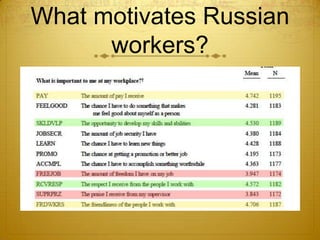
   In a research by Davidson and Linz found that:

        Organizational Commitment stronger among managers than workers
        Managers erroneously believe workers value their praises
        Low expectations on receiving a reward they desire
        Financial Compensation and Friendliness of Workers top ranked motivators
         by workers
        Younger people placed more importance on opportunity to develop skills and
         abilities, getting a promotion, and accomplishing something worthwhile. They
         placed less importance on pay, security on the job, and respect from co-
         workers.
        However, pay at the top for both
What motivates Russian
      workers?
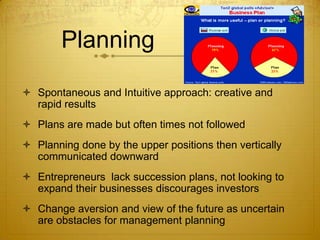
Planning

 Spontaneous and Intuitive approach: creative and
  rapid results
 Plans are made but often times not followed
 Planning done by the upper positions then vertically
  communicated downward
 Entrepreneurs lack succession plans, not looking to
  expand their businesses discourages investors
 Change aversion and view of the future as uncertain
  are obstacles for management planning
Four Common Organization Designs in
   Bureaucratic Organization
                              Russia
       Strict administrative hierarchy separating the identity and responsibilities of
        employees through where they sit in the hierarchy
       Upward mobility is difficult
       Information is not shared with employees
 Power Organization
       Manager or owner is the undoubted leader with final say
       Top managers are appointed to serve as link to employees
       Employees can take part in decision making though
 Person-oriented Organization
       Employees maintain high level of personal responsibility and independence
        (flexible schedules and access to information)
       Work is co-coordinated by supervisors (more egalitarian)
       Because of its independent and egalitarian culture, employees must
        compromise
 Problem-oriented Organization
       Employees are given specific task-oriented responsibilities and are strictly
        controlled through reporting
       Decisions are made collectively though, and information is shared

                           Controls
    During the Soviet Union, companies lacked transparency because of
    double ethical standards, murky procedures, and unclear goals

   Many companies still lack transparency because of a lack of
    information distribution between employees

   Accounting practices can lead to transparency issues as well
       Profit and loss accounts are not foreseen and are booked without details
   There have been improvements to Russian Business controls though
       Companies must file taxes every quarter, receive multiple signatures for
        documents, and careful accounting must be practiced because tax
        authorities are beginning to crackdown
       Between 2001 and 2004, entry regulation (registration and licensing) and
        regulations with existing businesses (inspections) were simplified, which
        has encouraged businesses to be legally regulated
       Businesses have began to implement the control method
           They set specific company goals
           They are more transparent
           Their employees are empowered, and therefore, feel more obliged to conduct
            proper business methods
Quality
 Russian Companies have began to implement western quality control
  methods such as TQM
 TQM has been difficult to implement though
      The concepts of customer focus, continuous improvement, process
       approach, quality management, employee involvement, and social
       responsibility are alien
      Key issues that have to be addressed are a change in philosophy, a
       lack of knowledge, a resistance to change, and a lack of senior
       management support
 Russian companies have also implemented BS EN ISO
  9001:2000, benchmarking, and self-assessment strategies
      1,710 Russian companies achieved BS EN ISO 9001:2000
       certification
      However, many did so for marketing purposes, not actual quality
       improvement purposes
 Yet, the future does look promising, as a true quality philosophy is
  beginning to embed itself in Russian culture and is supported by the
  state
Competition
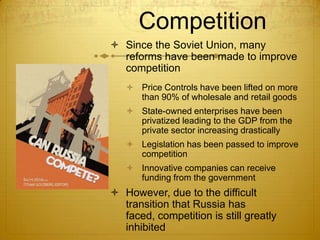
 Since the Soviet Union, many
  reforms have been made to improve
  competition
    Price Controls have been lifted on more
     than 90% of wholesale and retail goods
    State-owned enterprises have been
     privatized leading to the GDP from the
     private sector increasing drastically
    Legislation has been passed to improve
     competition
    Innovative companies can receive
     funding from the government
 However, due to the difficult
  transition that Russia has
  faced, competition is still greatly
  inhibited
Practices Inhibiting Competition according to the
                           IMF:
    Horizontal dominance in regional markets (high seller and buyer concentration)

        Four-firm concentration is equal to the United States at 60 %, but the average
         market share for them is greater than 95%
    Exclusive buyer-seller relationships

        Contracts are difficult to enforce, so trust through continued service is necessary

    Mergers and acquisitions occur not expansion of industry

    Interregional barriers to trade and investment

        Duties on the sale of alcohol, regional pricing differs, registration of workers from
         different oblasts is required, and taxes/credit preferences are given to local
         businesses
    High barriers to entry

        Lack of access to funding through long term, inexpensive loans
        Difficulty obtaining real estate due to inability to privatize land and pre-existing
         monopolies on commercial real estate
        Corrupt business licensing, registration, and inspections through overcharging
        Organized crime must receive a cut of the profits (often around 5 %)
Negative Effects of Lack of
    Competition and How to Increase It
 Negative Effects of Competition
       Consumers face high prices, reduced output, diminished product
        and service quality
       Diminished incentives for companies to incur transactions between
        regions
       Decreases the amount of foreign investment
       Lack of the great benefit of capitalism, which is innovation
       Most importantly, small to mid-sized firms have a lot of difficulty
        entering and succeeding in industries
 Unless competition improves, the desire to conduct business in
  Russia will remain minimal

 On a positive note, Russia is transitioning and identifying the
  necessary systematic reforms is fairly simple
Marketing Strategy
                                     Desire to see a
 Russian perception of brands        performance, something
    Local brand loyalty -            intriguing, spirited
      cheaper                            Ideally featuring elements of
        Healthy and habitual               acting while combining image and
    International brands -                 product qualities
      higher quality and more        Real differences between neighboring
      expensive                       regions in Russia may in fact be
 Rely on local suppliers             greater than differences between
    who have well-developed          neighboring European countries
      service networks, available        Not just one nation-wide plan, but
      spare parts, and shorter              several business plans or a
      delivery times                        multifaceted plan to reflect the
    Thus, they are able to                 unique aspects and demands of
      secure lower prices                   different regions
                                     Best marketing strategies are those
                                      that balance both media and trade
                                      promotions tactics
Marketing
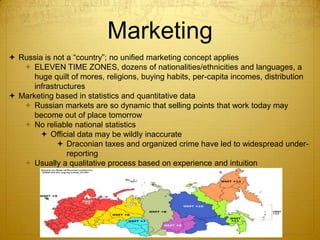
 Russia is not a “country”; no unified marketing concept applies
    ELEVEN TIME ZONES, dozens of nationalities/ethnicities and languages, a
      huge quilt of mores, religions, buying habits, per-capita incomes, distribution
      infrastructures
 Marketing based in statistics and quantitative data
    Russian markets are so dynamic that selling points that work today may
      become out of place tomorrow
    No reliable national statistics
         Official data may be wildly inaccurate
              Draconian taxes and organized crime have led to widespread under-
                reporting
    Usually a qualitative process based on experience and intuition
Marketing Strategy
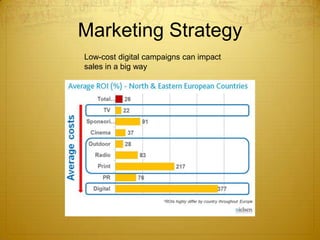
Low-cost digital campaigns can impact
sales in a big way
Corporate Culture
 Dangerous to ever generalize about Russia
 Good quality relationships should not be underestimated
    The state has always been seen as an organ of oppression
     and repression
        Laws and statutes are therefore seen as the 'enemy'
             The laws are being rewritten constantly –
               unenforceable
             Most agreements have to be made on a trust basis
             Networking and extended interpersonal allegiances
               are essential
 One strong central figure -with little or no consultation with anyone
    Too much consultation from a senior manager could be seen
     as a sign of weakness and a lack of decisiveness
 Companies tend to have a short-term view of business activities
 Open debate in meetings are not usual or welcome
 Russians tend to dress as well as their salaries will allow
Tips for Doing Business
           in Russia
Tip 1: Take time to build relationships
Tip 2: Contracts are only as valid as a combination
of your ability to enforce the law and the importance
placed upon the relationship
Tip 3: Middle managers cannot make decisions
Tip 4: Go straight to the top if possible
Tip 5: Managers manage- give precise and detailed
instructions
Continued…
Tip 6: Meetings disseminate information or give
direct            instruction
Tip 7: Smaller, more informal meetings often occur
behind closed doors
Tip 8: Keep the team together if possible
Tip 9: Russians like to think in silence before
answering a question
Tip 10: Dress smartly and try to look important
Tip 11: Do not underestimate the importance of
entertaining
Tip for women: Women play little part in business at
the senior levels
References
    Goreskaya, N. (2009). Changes to russian
     competition legislation. Baker &
     McKenzie, Retrieved from
     http://www.bakermckenzie.com/RROperatin
     gRussianCompetitionLaw09/
    Broadman, H. (2001, June). Competition
     and business entry in russia. Finance &
     development, 38(2), Retrieved from
     http://www.imf.org/external/pubs/ft/fandd/20
     01/06/broadman.htm
    Frost, R. (2011). Russia's premier vladimir
     putin underlines importance of iso
     international standards. ISO, Retrieved from
     http://www.iso.org/iso/home/news_index/ne
     ws_archive/news.htm?refid=Ref1439

Management russian presentation

  • 1.
  • 2.
    Russian Proverbs about Work  “Work tastes bitter, but bread tastes sweet.”  “To the person who gets up early, God shall give everything.”  “To live without work means to blacken the sky with smoke.”  Meaning: an idle life is a life wasted
  • 3.
    Motivation  Before: Companies not meeting payroll, lack of training, poor working conditions  In a research by Davidson and Linz found that:  Organizational Commitment stronger among managers than workers  Managers erroneously believe workers value their praises  Low expectations on receiving a reward they desire  Financial Compensation and Friendliness of Workers top ranked motivators by workers  Younger people placed more importance on opportunity to develop skills and abilities, getting a promotion, and accomplishing something worthwhile. They placed less importance on pay, security on the job, and respect from co- workers.  However, pay at the top for both
  • 4.
  • 5.
    Planning  Spontaneous andIntuitive approach: creative and rapid results  Plans are made but often times not followed  Planning done by the upper positions then vertically communicated downward  Entrepreneurs lack succession plans, not looking to expand their businesses discourages investors  Change aversion and view of the future as uncertain are obstacles for management planning
  • 6.
    Four Common OrganizationDesigns in  Bureaucratic Organization Russia  Strict administrative hierarchy separating the identity and responsibilities of employees through where they sit in the hierarchy  Upward mobility is difficult  Information is not shared with employees  Power Organization  Manager or owner is the undoubted leader with final say  Top managers are appointed to serve as link to employees  Employees can take part in decision making though  Person-oriented Organization  Employees maintain high level of personal responsibility and independence (flexible schedules and access to information)  Work is co-coordinated by supervisors (more egalitarian)  Because of its independent and egalitarian culture, employees must compromise  Problem-oriented Organization  Employees are given specific task-oriented responsibilities and are strictly controlled through reporting  Decisions are made collectively though, and information is shared
  • 7.
    Controls During the Soviet Union, companies lacked transparency because of double ethical standards, murky procedures, and unclear goals  Many companies still lack transparency because of a lack of information distribution between employees  Accounting practices can lead to transparency issues as well  Profit and loss accounts are not foreseen and are booked without details  There have been improvements to Russian Business controls though  Companies must file taxes every quarter, receive multiple signatures for documents, and careful accounting must be practiced because tax authorities are beginning to crackdown  Between 2001 and 2004, entry regulation (registration and licensing) and regulations with existing businesses (inspections) were simplified, which has encouraged businesses to be legally regulated  Businesses have began to implement the control method  They set specific company goals  They are more transparent  Their employees are empowered, and therefore, feel more obliged to conduct proper business methods
  • 8.
    Quality  Russian Companieshave began to implement western quality control methods such as TQM  TQM has been difficult to implement though  The concepts of customer focus, continuous improvement, process approach, quality management, employee involvement, and social responsibility are alien  Key issues that have to be addressed are a change in philosophy, a lack of knowledge, a resistance to change, and a lack of senior management support  Russian companies have also implemented BS EN ISO 9001:2000, benchmarking, and self-assessment strategies  1,710 Russian companies achieved BS EN ISO 9001:2000 certification  However, many did so for marketing purposes, not actual quality improvement purposes  Yet, the future does look promising, as a true quality philosophy is beginning to embed itself in Russian culture and is supported by the state
  • 9.
    Competition  Since theSoviet Union, many reforms have been made to improve competition  Price Controls have been lifted on more than 90% of wholesale and retail goods  State-owned enterprises have been privatized leading to the GDP from the private sector increasing drastically  Legislation has been passed to improve competition  Innovative companies can receive funding from the government  However, due to the difficult transition that Russia has faced, competition is still greatly inhibited
  • 10.
    Practices Inhibiting Competitionaccording to the IMF:  Horizontal dominance in regional markets (high seller and buyer concentration)  Four-firm concentration is equal to the United States at 60 %, but the average market share for them is greater than 95%  Exclusive buyer-seller relationships  Contracts are difficult to enforce, so trust through continued service is necessary  Mergers and acquisitions occur not expansion of industry  Interregional barriers to trade and investment  Duties on the sale of alcohol, regional pricing differs, registration of workers from different oblasts is required, and taxes/credit preferences are given to local businesses  High barriers to entry  Lack of access to funding through long term, inexpensive loans  Difficulty obtaining real estate due to inability to privatize land and pre-existing monopolies on commercial real estate  Corrupt business licensing, registration, and inspections through overcharging  Organized crime must receive a cut of the profits (often around 5 %)
  • 11.
    Negative Effects ofLack of Competition and How to Increase It  Negative Effects of Competition  Consumers face high prices, reduced output, diminished product and service quality  Diminished incentives for companies to incur transactions between regions  Decreases the amount of foreign investment  Lack of the great benefit of capitalism, which is innovation  Most importantly, small to mid-sized firms have a lot of difficulty entering and succeeding in industries  Unless competition improves, the desire to conduct business in Russia will remain minimal  On a positive note, Russia is transitioning and identifying the necessary systematic reforms is fairly simple
  • 12.
    Marketing Strategy  Desire to see a  Russian perception of brands performance, something  Local brand loyalty - intriguing, spirited cheaper  Ideally featuring elements of  Healthy and habitual acting while combining image and  International brands - product qualities higher quality and more  Real differences between neighboring expensive regions in Russia may in fact be  Rely on local suppliers greater than differences between  who have well-developed neighboring European countries service networks, available  Not just one nation-wide plan, but spare parts, and shorter several business plans or a delivery times multifaceted plan to reflect the  Thus, they are able to unique aspects and demands of secure lower prices different regions  Best marketing strategies are those that balance both media and trade promotions tactics
  • 14.
    Marketing  Russia isnot a “country”; no unified marketing concept applies  ELEVEN TIME ZONES, dozens of nationalities/ethnicities and languages, a huge quilt of mores, religions, buying habits, per-capita incomes, distribution infrastructures  Marketing based in statistics and quantitative data  Russian markets are so dynamic that selling points that work today may become out of place tomorrow  No reliable national statistics  Official data may be wildly inaccurate  Draconian taxes and organized crime have led to widespread under- reporting  Usually a qualitative process based on experience and intuition
  • 15.
    Marketing Strategy Low-cost digitalcampaigns can impact sales in a big way
  • 16.
    Corporate Culture  Dangerousto ever generalize about Russia  Good quality relationships should not be underestimated  The state has always been seen as an organ of oppression and repression  Laws and statutes are therefore seen as the 'enemy'  The laws are being rewritten constantly – unenforceable  Most agreements have to be made on a trust basis  Networking and extended interpersonal allegiances are essential  One strong central figure -with little or no consultation with anyone  Too much consultation from a senior manager could be seen as a sign of weakness and a lack of decisiveness  Companies tend to have a short-term view of business activities  Open debate in meetings are not usual or welcome  Russians tend to dress as well as their salaries will allow
  • 17.
    Tips for DoingBusiness in Russia Tip 1: Take time to build relationships Tip 2: Contracts are only as valid as a combination of your ability to enforce the law and the importance placed upon the relationship Tip 3: Middle managers cannot make decisions Tip 4: Go straight to the top if possible Tip 5: Managers manage- give precise and detailed instructions
  • 18.
    Continued… Tip 6: Meetingsdisseminate information or give direct instruction Tip 7: Smaller, more informal meetings often occur behind closed doors Tip 8: Keep the team together if possible Tip 9: Russians like to think in silence before answering a question Tip 10: Dress smartly and try to look important Tip 11: Do not underestimate the importance of entertaining Tip for women: Women play little part in business at the senior levels
  • 19.
    References  Goreskaya, N. (2009). Changes to russian competition legislation. Baker & McKenzie, Retrieved from http://www.bakermckenzie.com/RROperatin gRussianCompetitionLaw09/  Broadman, H. (2001, June). Competition and business entry in russia. Finance & development, 38(2), Retrieved from http://www.imf.org/external/pubs/ft/fandd/20 01/06/broadman.htm  Frost, R. (2011). Russia's premier vladimir putin underlines importance of iso international standards. ISO, Retrieved from http://www.iso.org/iso/home/news_index/ne ws_archive/news.htm?refid=Ref1439