PCV
PCV 1
1
Management and Organization
 The Meaning
The Meaning
PCV
PCV 2
2
What is management?
 Management is a distinct process
Management is a distinct process
consisting of activities of planning,
organizing, actuating, and controlling,
performed to determine and
accomplish stated objectives with the
use of human beings and other
resources.
resources.
PCV
PCV 3
3
The Meaning of
Management
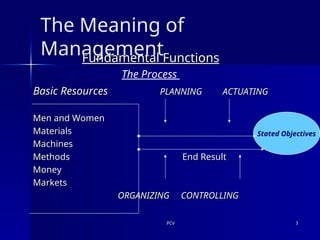
Fundamental Functions
The Process
Basic Resources
Basic Resources PLANNING ACTUATING
PLANNING ACTUATING
Men and Women
Men and Women
Materials
Materials
Machines
Machines
Methods End Result
Methods End Result
Money
Money
Markets
Markets
ORGANIZING CONTROLLING
Stated Objectives
PCV
PCV 4
4
Why Study Management?
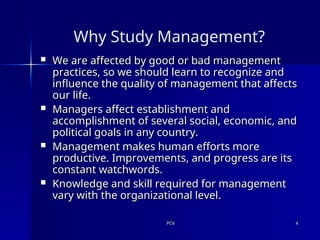
 We are affected by good or bad management
We are affected by good or bad management
practices, so we should learn to recognize and
influence the quality of management that affects
our life.
our life.
 Managers affect establishment and
Managers affect establishment and
accomplishment of several social, economic, and
political goals in any country.
 Management makes human efforts more
Management makes human efforts more
productive. Improvements, and progress are its
constant watchwords.
 Knowledge and skill required for management
Knowledge and skill required for management
vary with the organizational level.
PCV
PCV 5
5
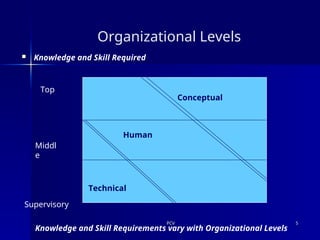
Organizational Levels
 Knowledge and Skill Required
Conceptual
Human
Technical
Knowledge and Skill Requirements vary with Organizational Levels
Top
Middl
e
Supervisory
PCV
PCV 6
6
Good Management Principles
 Good management principles should be:
Good management principles should be:
 Practical- i.e. applicable, practical, and appropriate.
Practical- i.e. applicable, practical, and appropriate.
 Relevant- to broad forms of organization structure.
Relevant- to broad forms of organization structure.
 Consistent-for similar sets of circumstances, similar
Consistent-for similar sets of circumstances, similar
results will occur.
results will occur.
 Flexible- their application should take into account
Flexible- their application should take into account
particular differences or changes in the conditions
that affect the organization.
Use of Management principles are intended to simplify management work.
PCV
PCV 7
7
Common Attributes of Well managed Companies
 A Mc Kinsey study of 37 companies that were cited as
A Mc Kinsey study of 37 companies that were cited as
well managed companies in the late 1990s showed eight
common attributes.
common attributes.
1.
1. A bias towards action.
A bias towards action.
2.
2. Simple form and lean staff.
Simple form and lean staff.
3.
3. Continued contact with customers.
Continued contact with customers.
4.
4. Productivity improvement via people.
Productivity improvement via people.
5.
5. Operational autonomy to encourage entrepreneurship.
Operational autonomy to encourage entrepreneurship.
6.
6. Stress on one key business value.
Stress on one key business value.
7.
7. Emphasis on doing what they know best.
Emphasis on doing what they know best.
8.
8. Simultaneous loose-tight controls.
Simultaneous loose-tight controls.
PCV
PCV 8
8
The Practices in organizations
 Today, the largest single group in labor force,
Today, the largest single group in labor force,
more than one third of the total are people
whom US bureau of Census calls ‘ managerial
and professional’ . Until quite recently, no one
knew how to put people with different skills and
knowledge together to achieve common goals.
 A modern business , not only the larger ones,
A modern business , not only the larger ones,
may employ up to ten thousand people who
represent upto sixty different areas--- all
working in a joint venture.
working in a joint venture. (Peter Drucker: New
(Peter Drucker: New
Realities)
Realities)
PCV
PCV 9
9
The Practices in organizations
 Modern management and modern enterprises could not exist
Modern management and modern enterprises could not exist
without knowledge base that developed societies have built. But,
equally, it is management and management alone, that makes
effective all this knowledge and the knowledge people.
 After world war II, it was realized that management is not business
After world war II, it was realized that management is not business
management , it pertains to every human effort that brings together
in one organization people of diverse knowledge and skills for
common purpose.
common purpose.
 One important advance in the discipline and practice of
One important advance in the discipline and practice of
management is that both, now, embrace entrepreneurship and
innovation.
innovation.
 So, management is about human beings. It is deeply embedded in
So, management is about human beings. It is deeply embedded in
culture. Management’s first job is to think through , set, and
exemplify the objectives, goals, and values to which it is committed.
 It must be built on communication and on individual responsibility.
It must be built on communication and on individual responsibility.
Quantity of output ,or, ‘bottom line’ is not the adequate measure of
performance of managements. Market standing, innovation,
productivity, development of people, quality, financial results– are
all crucial.
all crucial.
PCV
PCV 10
10
Managers and Entrepreneurs
 Entrepreneurs are individuals who conceive the idea for a new
Entrepreneurs are individuals who conceive the idea for a new
business venture; gather the necessary human, financial, and
physical resources to start the venture; start the operations of the
venture and grow it to the point where more people are added to
the organization; and usually bear the most personal and financial
risk in beginning the venture.
 The transitional point of growth is usually when professional
The transitional point of growth is usually when professional
managers are hired to perform basic management functions of
the ongoing and growing organizations. Therefore, the traditional
concepts of managers have been associated with medium to large
organizations, whereas entrepreneural concepts have been linked
with small organizations. Entrepreneurs, however, must
successfully perform all the basic management functions in the
startup and growth stages of the enterprise. Later, in the
organization’s growth, successful implementation of sound
management principles is important but not quite so critical or
intense as in the firm’s infancy.
PCV
PCV 11
11
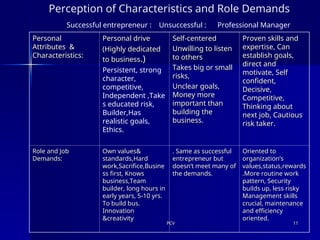
Perception of Characteristics and Role Demands
Personal
Personal
Attributes &
Attributes &
Characteristics:
Characteristics:
Personal drive
Personal drive
(Highly dedicated
(Highly dedicated
to business
to business.)
.)
Persistent, strong
character,
competitive,
Independent ,Take
s educated risk,
Builder,Has
realistic goals,
Ethics.
Self-centered
Self-centered
Unwilling to listen
Unwilling to listen
to others
to others
Takes big or small
Takes big or small
risks,
risks,
Unclear goals,
Unclear goals,
Money more
Money more
important than
important than
building the
building the
business.
business.
Proven skills and
Proven skills and
expertise, Can
expertise, Can
establish goals,
establish goals,
direct and
direct and
motivate, Self
motivate, Self
confident,
confident,
Decisive,
Decisive,
Competitive,
Competitive,
Thinking about
Thinking about
next job, Cautious
next job, Cautious
risk taker.
risk taker.
Role and Job
Role and Job
Demands:
Demands:
Own values&
Own values&
standards,Hard
standards,Hard
work,Sacrifice,Busine
ss first, Knows
ss first, Knows
business,Team
business,Team
builder, long hours in
early years, 5-10 yrs.
To build bus.
To build bus.
Innovation
Innovation
&creativity
&creativity
. Same as successful
entrepreneur but
entrepreneur but
doesn’t meet many of
the demands.
the demands.
Oriented to
Oriented to
organization’s
organization’s
values,status,rewards
.More routine work
.More routine work
pattern, Security
pattern, Security
builds up, less risky
Management skills
Management skills
crucial, maintenance
and efficiency
and efficiency
oriented.
oriented.
Successful entrepreneur : Unsuccessful : Professional Manager
PCV
PCV 12
12
Key Characteristics to Understanding
Management
Management
 Management is purposeful.
Management is purposeful.
 Management makes things happen.
Management makes things happen.
 Management is an activity, not a person or
Management is an activity, not a person or
group of persons Management is accomplished
by ,with, and through the efforts of others.
 Management is usually associated with the
Management is usually associated with the
efforts of a group.
efforts of a group.
 Management is intangible.
Management is intangible.
 Management is aides, not replaced by the
Management is aides, not replaced by the
computer.
computer.
 Management is an outstanding means for
Management is an outstanding means for
exerting real impact on human life.
PCV
PCV 13
13
The Business Organizations and
Processes
 Business is an enterprise created for the purpose of
trading for profits and other assets it generates.
 Essentially, it consists of people joining together for the
common purpose of achieving a reward in return for
contributing money and skill in the enterprise.
 The group of people are owners and employees. Trading
activity consists of three core functions: Buying, Making,
Selling.
 Subsidiary activities within the business include
Management, Control, including Planning, Scheduling,
Monitoring for results and reporting, Administration which
provides the functions and systems supporting the
organization and all communications between constituent
parts.
PCV
PCV 14
14
Organizational Patterns
 Issues that come into focus when establishing
an organization are , top management’s desire
to exercise close control, size of operations,
diversity of product range, quality of middle
management, and geographic speed.
 Common organizational patterns include
Centralized organizations, Decentralized
organizations, Functional organizations, matrix
organizations, Line and Staff organizations
PCV
PCV 15
15
Choosing a Structure
When considering an optimal structure for itself, the business will seek :
 Consistency of quality of service or products
Consistency of quality of service or products
 Adherence to agreed corporate directions and standards
Adherence to agreed corporate directions and standards
 Cost effective method of administering,
Cost effective method of administering,
In order to achieve these needs to avoid duplication or conflict of efforts;
exercise control to ensure that various parts of the organization stay
within agreed boundaries( budget, regions, product ranges etc.) or seek
approval before going outside them.
 Establish good information flow on customer satisfaction local
market conditions, and competitor activities. This question will
concern the division of power between head office & units/ branches
when it is asked how much control a fewer senior people should
have.
 Conscious or otherwise, all businesses consider the question of
Conscious or otherwise, all businesses consider the question of
centralization vs. decentralizations.
PCV
PCV 16
16
Traditional Management Theories
 Growth of professional business management was preceded by
Growth of professional business management was preceded by
political and charismatic leadership which tended to be organized
upon Logical Power Structures appointed by the leaders.

Therefore, the Leader depended upon: POWER
Therefore, the Leader depended upon: POWER ( IN CASE OF MILITARY
( IN CASE OF MILITARY
LEADERS),
LEADERS),CHARISMA
CHARISMA (IN CASE OF PERSONALITY BASED LEADERS) , and RESPECT (IN
CASE OF POSITIONALLY BASED LEADERS).
 Early methods of structuring and organizing management came
under three main theoretical approaches: Bureaucracy ( where
emphasis is in the structure and systems), Scientific (where emphasis is on the
measurement of the amount of work done) , Functional (where the study of
successful managers was used to develop principles that others could follow) .
PCV
PCV 17
17
Theoretical Approaches
 Max Weber (1864-1920)
Max Weber (1864-1920)
 He contributed the theory of structures that characterized
He contributed the theory of structures that characterized
organizations in terms of authority structures and relations within
them. Three types of organizations he outlined were, Charismatic,
Rational, Legal. Wber regarded bureaucracy being made rational by
the fact that he saw its control being exercised on the basis of
knowledge, experience, and technical expertise.
 Frederick Taylor(1856-1915) is called ‘Father of Scientific
Frederick Taylor(1856-1915) is called ‘Father of Scientific
Management’ movement.
His scientific approach is based on the assumption that a person will
be motivated to work if rewards and penalties are tied directly to
Performance. He maintained that management should be ‘well
recognized, clearly defined, and fixed principles instead of depending
on more or less hazy ideas. His objective was to maximize efficiency.
He suggested four principles of scientific management. D
PCV
PCV 18
18
Principles by Taylor and Fayol
 1. Development of a True Science of Work. Management should apply
techniques to the solution of problems and not rely just on experience.
 2. Scientific Selection. and,
 3. Progressive Development of Work: workmen should be carefully trained and
given jobs to which they are best suited.
 4.The Bringing together of Science and Scientifically selected and trained
men. These are the 4 tenets by Taylor.
 The Functional Approach: another way of looking at management is to break
the tasks down and group them by function, e.g. accountancy.
 An early practitioner of this theory was Henry Fayol who said, the Process of
Management consists of five functions:
 1.Planning, 2. Organizing ,3.Commanding, 4.Co-Ordinating, 5. Controlling.
 Fayol offered 14 principles of good management. Division of work, Authority &
Responsibility,Discipline,Unity of Command, Unity of Direction, Subordination
of Individual Intetrest,Remuneration of Personnel, Centralization, Scalar
Chain (flow of authority), Order, Equity, Stability or tenure of personnel,
Initiative, and, Espirit de Corps.
 There is no one correct method, but combinations ,in reality.

Management concepts-1.ppt Successful implementation of

  • 1.
    PCV PCV 1 1 Management andOrganization  The Meaning The Meaning
  • 2.
    PCV PCV 2 2 What ismanagement?  Management is a distinct process Management is a distinct process consisting of activities of planning, consisting of activities of planning, organizing, actuating, and controlling, organizing, actuating, and controlling, performed to determine and performed to determine and accomplish stated objectives with the accomplish stated objectives with the use of human beings and other use of human beings and other resources. resources.
  • 3.
    PCV PCV 3 3 The Meaningof Management Fundamental Functions Fundamental Functions The Process Basic Resources Basic Resources PLANNING ACTUATING PLANNING ACTUATING Men and Women Men and Women Materials Materials Machines Machines Methods End Result Methods End Result Money Money Markets Markets ORGANIZING CONTROLLING ORGANIZING CONTROLLING Stated Objectives
  • 4.
    PCV PCV 4 4 Why StudyManagement?  We are affected by good or bad management We are affected by good or bad management practices, so we should learn to recognize and practices, so we should learn to recognize and influence the quality of management that affects influence the quality of management that affects our life. our life.  Managers affect establishment and Managers affect establishment and accomplishment of several social, economic, and accomplishment of several social, economic, and political goals in any country. political goals in any country.  Management makes human efforts more Management makes human efforts more productive. Improvements, and progress are its productive. Improvements, and progress are its constant watchwords. constant watchwords.  Knowledge and skill required for management Knowledge and skill required for management vary with the organizational level. vary with the organizational level.
  • 5.
    PCV PCV 5 5 Organizational Levels Knowledge and Skill Required Conceptual Human Technical Knowledge and Skill Requirements vary with Organizational Levels Top Middl e Supervisory
  • 6.
    PCV PCV 6 6 Good ManagementPrinciples Good Management Principles  Good management principles should be: Good management principles should be:  Practical- i.e. applicable, practical, and appropriate. Practical- i.e. applicable, practical, and appropriate.  Relevant- to broad forms of organization structure. Relevant- to broad forms of organization structure.  Consistent-for similar sets of circumstances, similar Consistent-for similar sets of circumstances, similar results will occur. results will occur.  Flexible- their application should take into account Flexible- their application should take into account particular differences or changes in the conditions particular differences or changes in the conditions that affect the organization. that affect the organization. Use of Management principles are intended to simplify management work. Use of Management principles are intended to simplify management work.
  • 7.
    PCV PCV 7 7 Common Attributesof Well managed Companies  A Mc Kinsey study of 37 companies that were cited as A Mc Kinsey study of 37 companies that were cited as well managed companies in the late 1990s showed eight well managed companies in the late 1990s showed eight common attributes. common attributes. 1. 1. A bias towards action. A bias towards action. 2. 2. Simple form and lean staff. Simple form and lean staff. 3. 3. Continued contact with customers. Continued contact with customers. 4. 4. Productivity improvement via people. Productivity improvement via people. 5. 5. Operational autonomy to encourage entrepreneurship. Operational autonomy to encourage entrepreneurship. 6. 6. Stress on one key business value. Stress on one key business value. 7. 7. Emphasis on doing what they know best. Emphasis on doing what they know best. 8. 8. Simultaneous loose-tight controls. Simultaneous loose-tight controls.
  • 8.
    PCV PCV 8 8 The Practicesin organizations  Today, the largest single group in labor force, Today, the largest single group in labor force, more than one third of the total are people more than one third of the total are people whom US bureau of Census calls ‘ managerial whom US bureau of Census calls ‘ managerial and professional’ . Until quite recently, no one and professional’ . Until quite recently, no one knew how to put people with different skills and knew how to put people with different skills and knowledge together to achieve common goals. knowledge together to achieve common goals.  A modern business , not only the larger ones, A modern business , not only the larger ones, may employ up to ten thousand people who may employ up to ten thousand people who represent upto sixty different areas--- all represent upto sixty different areas--- all working in a joint venture. working in a joint venture. (Peter Drucker: New (Peter Drucker: New Realities) Realities)
  • 9.
    PCV PCV 9 9 The Practicesin organizations  Modern management and modern enterprises could not exist Modern management and modern enterprises could not exist without knowledge base that developed societies have built. But, without knowledge base that developed societies have built. But, equally, it is management and management alone, that makes equally, it is management and management alone, that makes effective all this knowledge and the knowledge people. effective all this knowledge and the knowledge people.  After world war II, it was realized that management is not business After world war II, it was realized that management is not business management , it pertains to every human effort that brings together management , it pertains to every human effort that brings together in one organization people of diverse knowledge and skills for in one organization people of diverse knowledge and skills for common purpose. common purpose.  One important advance in the discipline and practice of One important advance in the discipline and practice of management is that both, now, embrace entrepreneurship and management is that both, now, embrace entrepreneurship and innovation. innovation.  So, management is about human beings. It is deeply embedded in So, management is about human beings. It is deeply embedded in culture. Management’s first job is to think through , set, and culture. Management’s first job is to think through , set, and exemplify the objectives, goals, and values to which it is committed. exemplify the objectives, goals, and values to which it is committed.  It must be built on communication and on individual responsibility. It must be built on communication and on individual responsibility. Quantity of output ,or, ‘bottom line’ is not the adequate measure of Quantity of output ,or, ‘bottom line’ is not the adequate measure of performance of managements. Market standing, innovation, performance of managements. Market standing, innovation, productivity, development of people, quality, financial results– are productivity, development of people, quality, financial results– are all crucial. all crucial.
  • 10.
    PCV PCV 10 10 Managers andEntrepreneurs  Entrepreneurs are individuals who conceive the idea for a new Entrepreneurs are individuals who conceive the idea for a new business venture; gather the necessary human, financial, and business venture; gather the necessary human, financial, and physical resources to start the venture; start the operations of the physical resources to start the venture; start the operations of the venture and grow it to the point where more people are added to venture and grow it to the point where more people are added to the organization; and usually bear the most personal and financial the organization; and usually bear the most personal and financial risk in beginning the venture. risk in beginning the venture.  The transitional point of growth is usually when professional The transitional point of growth is usually when professional managers are hired to perform basic management functions of managers are hired to perform basic management functions of the ongoing and growing organizations. Therefore, the traditional the ongoing and growing organizations. Therefore, the traditional concepts of managers have been associated with medium to large concepts of managers have been associated with medium to large organizations, whereas entrepreneural concepts have been linked organizations, whereas entrepreneural concepts have been linked with small organizations. Entrepreneurs, however, must with small organizations. Entrepreneurs, however, must successfully perform all the basic management functions in the successfully perform all the basic management functions in the startup and growth stages of the enterprise. Later, in the startup and growth stages of the enterprise. Later, in the organization’s growth, successful implementation of sound organization’s growth, successful implementation of sound management principles is important but not quite so critical or management principles is important but not quite so critical or intense as in the firm’s infancy. intense as in the firm’s infancy.
  • 11.
    PCV PCV 11 11 Perception ofCharacteristics and Role Demands Personal Personal Attributes & Attributes & Characteristics: Characteristics: Personal drive Personal drive (Highly dedicated (Highly dedicated to business to business.) .) Persistent, strong character, competitive, Independent ,Take s educated risk, Builder,Has realistic goals, Ethics. Self-centered Self-centered Unwilling to listen Unwilling to listen to others to others Takes big or small Takes big or small risks, risks, Unclear goals, Unclear goals, Money more Money more important than important than building the building the business. business. Proven skills and Proven skills and expertise, Can expertise, Can establish goals, establish goals, direct and direct and motivate, Self motivate, Self confident, confident, Decisive, Decisive, Competitive, Competitive, Thinking about Thinking about next job, Cautious next job, Cautious risk taker. risk taker. Role and Job Role and Job Demands: Demands: Own values& Own values& standards,Hard standards,Hard work,Sacrifice,Busine work,Sacrifice,Busine ss first, Knows ss first, Knows business,Team business,Team builder, long hours in builder, long hours in early years, 5-10 yrs. early years, 5-10 yrs. To build bus. To build bus. Innovation Innovation &creativity &creativity . Same as successful . Same as successful entrepreneur but entrepreneur but doesn’t meet many of doesn’t meet many of the demands. the demands. Oriented to Oriented to organization’s organization’s values,status,rewards values,status,rewards .More routine work .More routine work pattern, Security pattern, Security builds up, less risky builds up, less risky Management skills Management skills crucial, maintenance crucial, maintenance and efficiency and efficiency oriented. oriented. Successful entrepreneur : Unsuccessful : Professional Manager
  • 12.
    PCV PCV 12 12 Key Characteristicsto Understanding Key Characteristics to Understanding Management Management  Management is purposeful. Management is purposeful.  Management makes things happen. Management makes things happen.  Management is an activity, not a person or Management is an activity, not a person or group of persons Management is accomplished group of persons Management is accomplished by ,with, and through the efforts of others. by ,with, and through the efforts of others.  Management is usually associated with the Management is usually associated with the efforts of a group. efforts of a group.  Management is intangible. Management is intangible.  Management is aides, not replaced by the Management is aides, not replaced by the computer. computer.  Management is an outstanding means for Management is an outstanding means for exerting real impact on human life. exerting real impact on human life.
  • 13.
    PCV PCV 13 13 The BusinessOrganizations and Processes  Business is an enterprise created for the purpose of trading for profits and other assets it generates.  Essentially, it consists of people joining together for the common purpose of achieving a reward in return for contributing money and skill in the enterprise.  The group of people are owners and employees. Trading activity consists of three core functions: Buying, Making, Selling.  Subsidiary activities within the business include Management, Control, including Planning, Scheduling, Monitoring for results and reporting, Administration which provides the functions and systems supporting the organization and all communications between constituent parts.
  • 14.
    PCV PCV 14 14 Organizational Patterns OrganizationalPatterns  Issues that come into focus when establishing an organization are , top management’s desire to exercise close control, size of operations, diversity of product range, quality of middle management, and geographic speed.  Common organizational patterns include Centralized organizations, Decentralized organizations, Functional organizations, matrix organizations, Line and Staff organizations
  • 15.
    PCV PCV 15 15 Choosing aStructure When considering an optimal structure for itself, the business will seek : When considering an optimal structure for itself, the business will seek :  Consistency of quality of service or products Consistency of quality of service or products  Adherence to agreed corporate directions and standards Adherence to agreed corporate directions and standards  Cost effective method of administering, Cost effective method of administering, In order to achieve these needs to avoid duplication or conflict of efforts; In order to achieve these needs to avoid duplication or conflict of efforts; exercise control to ensure that various parts of the organization stay exercise control to ensure that various parts of the organization stay within agreed boundaries( budget, regions, product ranges etc.) or seek within agreed boundaries( budget, regions, product ranges etc.) or seek approval before going outside them. approval before going outside them.  Establish good information flow on customer satisfaction local market conditions, and competitor activities. This question will concern the division of power between head office & units/ branches when it is asked how much control a fewer senior people should have.  Conscious or otherwise, all businesses consider the question of Conscious or otherwise, all businesses consider the question of centralization vs. decentralizations. centralization vs. decentralizations.
  • 16.
    PCV PCV 16 16 Traditional ManagementTheories  Growth of professional business management was preceded by Growth of professional business management was preceded by political and charismatic leadership which tended to be organized political and charismatic leadership which tended to be organized upon Logical Power Structures appointed by the leaders. upon Logical Power Structures appointed by the leaders.  Therefore, the Leader depended upon: POWER Therefore, the Leader depended upon: POWER ( IN CASE OF MILITARY ( IN CASE OF MILITARY LEADERS), LEADERS),CHARISMA CHARISMA (IN CASE OF PERSONALITY BASED LEADERS) , and RESPECT (IN CASE OF POSITIONALLY BASED LEADERS).  Early methods of structuring and organizing management came under three main theoretical approaches: Bureaucracy ( where emphasis is in the structure and systems), Scientific (where emphasis is on the measurement of the amount of work done) , Functional (where the study of successful managers was used to develop principles that others could follow) .
  • 17.
    PCV PCV 17 17 Theoretical Approaches Max Weber (1864-1920) Max Weber (1864-1920)  He contributed the theory of structures that characterized He contributed the theory of structures that characterized organizations in terms of authority structures and relations within organizations in terms of authority structures and relations within them. Three types of organizations he outlined were, Charismatic, them. Three types of organizations he outlined were, Charismatic, Rational, Legal. Wber regarded bureaucracy being made rational by Rational, Legal. Wber regarded bureaucracy being made rational by the fact that he saw its control being exercised on the basis of the fact that he saw its control being exercised on the basis of knowledge, experience, and technical expertise. knowledge, experience, and technical expertise.  Frederick Taylor(1856-1915) is called ‘Father of Scientific Frederick Taylor(1856-1915) is called ‘Father of Scientific Management’ movement. Management’ movement. His scientific approach is based on the assumption that a person will His scientific approach is based on the assumption that a person will be motivated to work if rewards and penalties are tied directly to be motivated to work if rewards and penalties are tied directly to Performance. He maintained that management should be ‘well Performance. He maintained that management should be ‘well recognized, clearly defined, and fixed principles instead of depending recognized, clearly defined, and fixed principles instead of depending on more or less hazy ideas. His objective was to maximize efficiency. on more or less hazy ideas. His objective was to maximize efficiency. He suggested four principles of scientific management. D He suggested four principles of scientific management. D
  • 18.
    PCV PCV 18 18 Principles byTaylor and Fayol  1. Development of a True Science of Work. Management should apply techniques to the solution of problems and not rely just on experience.  2. Scientific Selection. and,  3. Progressive Development of Work: workmen should be carefully trained and given jobs to which they are best suited.  4.The Bringing together of Science and Scientifically selected and trained men. These are the 4 tenets by Taylor.  The Functional Approach: another way of looking at management is to break the tasks down and group them by function, e.g. accountancy.  An early practitioner of this theory was Henry Fayol who said, the Process of Management consists of five functions:  1.Planning, 2. Organizing ,3.Commanding, 4.Co-Ordinating, 5. Controlling.  Fayol offered 14 principles of good management. Division of work, Authority & Responsibility,Discipline,Unity of Command, Unity of Direction, Subordination of Individual Intetrest,Remuneration of Personnel, Centralization, Scalar Chain (flow of authority), Order, Equity, Stability or tenure of personnel, Initiative, and, Espirit de Corps.  There is no one correct method, but combinations ,in reality.