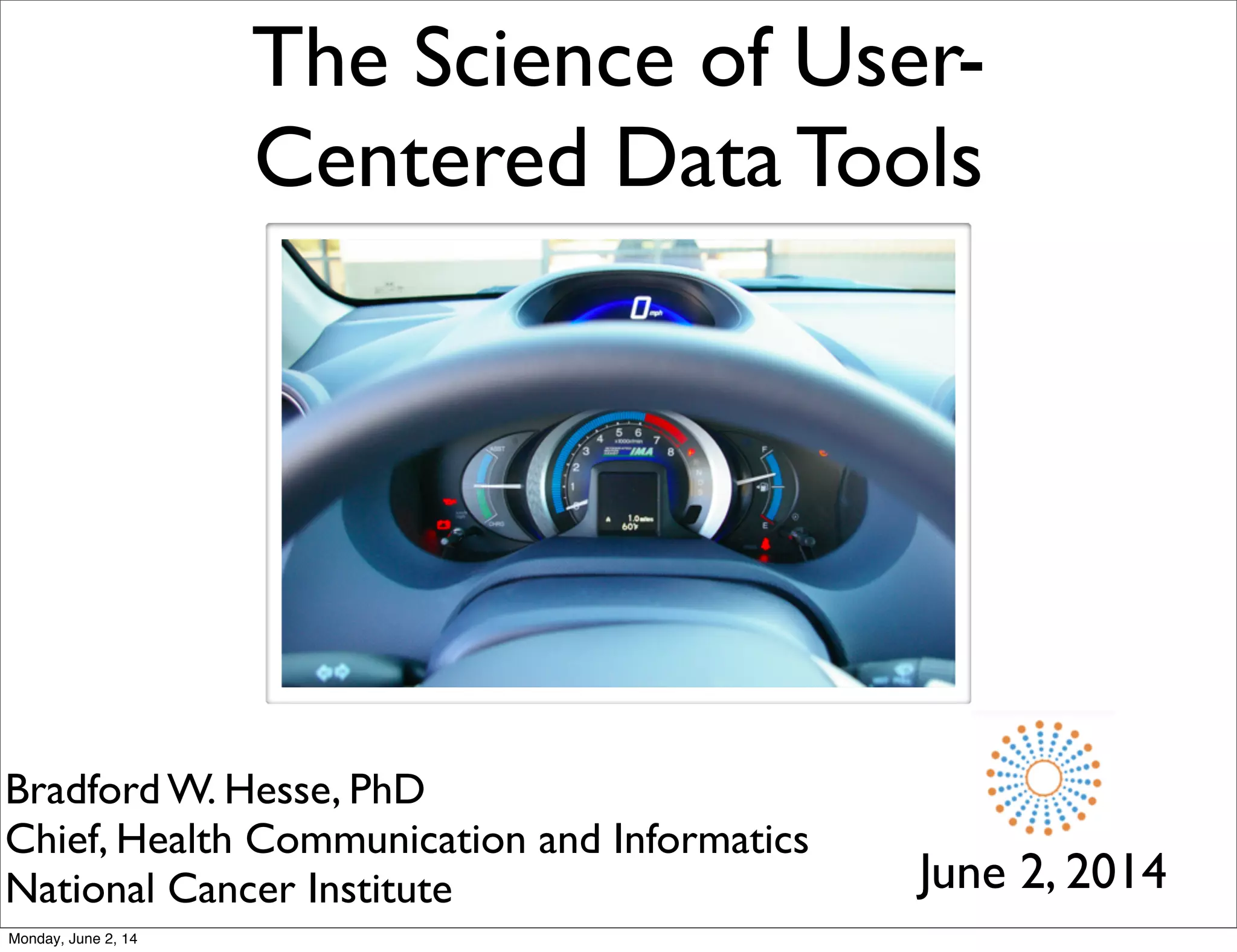
The Science of User-
Centered Data Tools
June 2, 2014
Bradford W. Hesse, PhD
Chief, Health Communication and Informatics
National Cancer Institute
Monday, June 2, 14
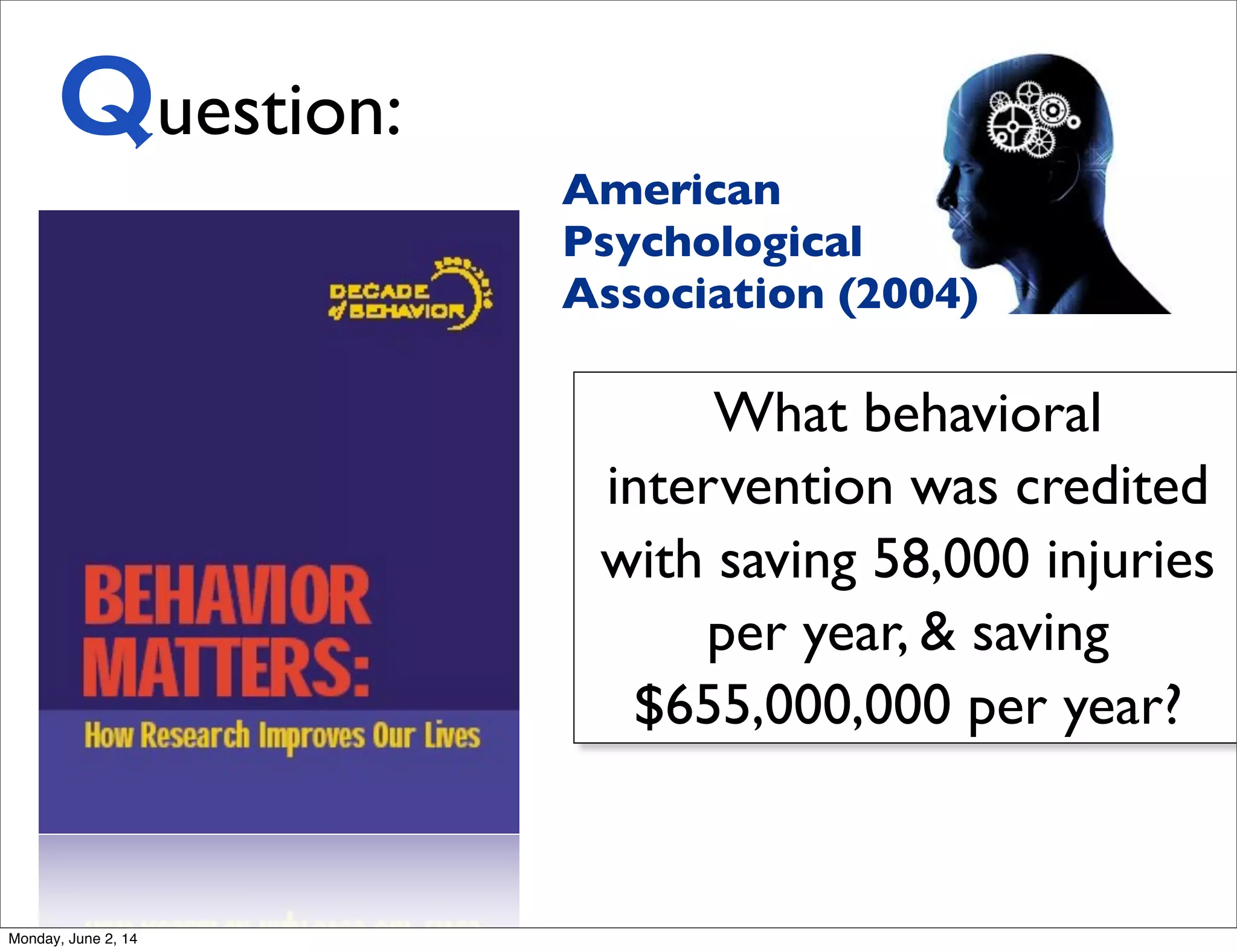
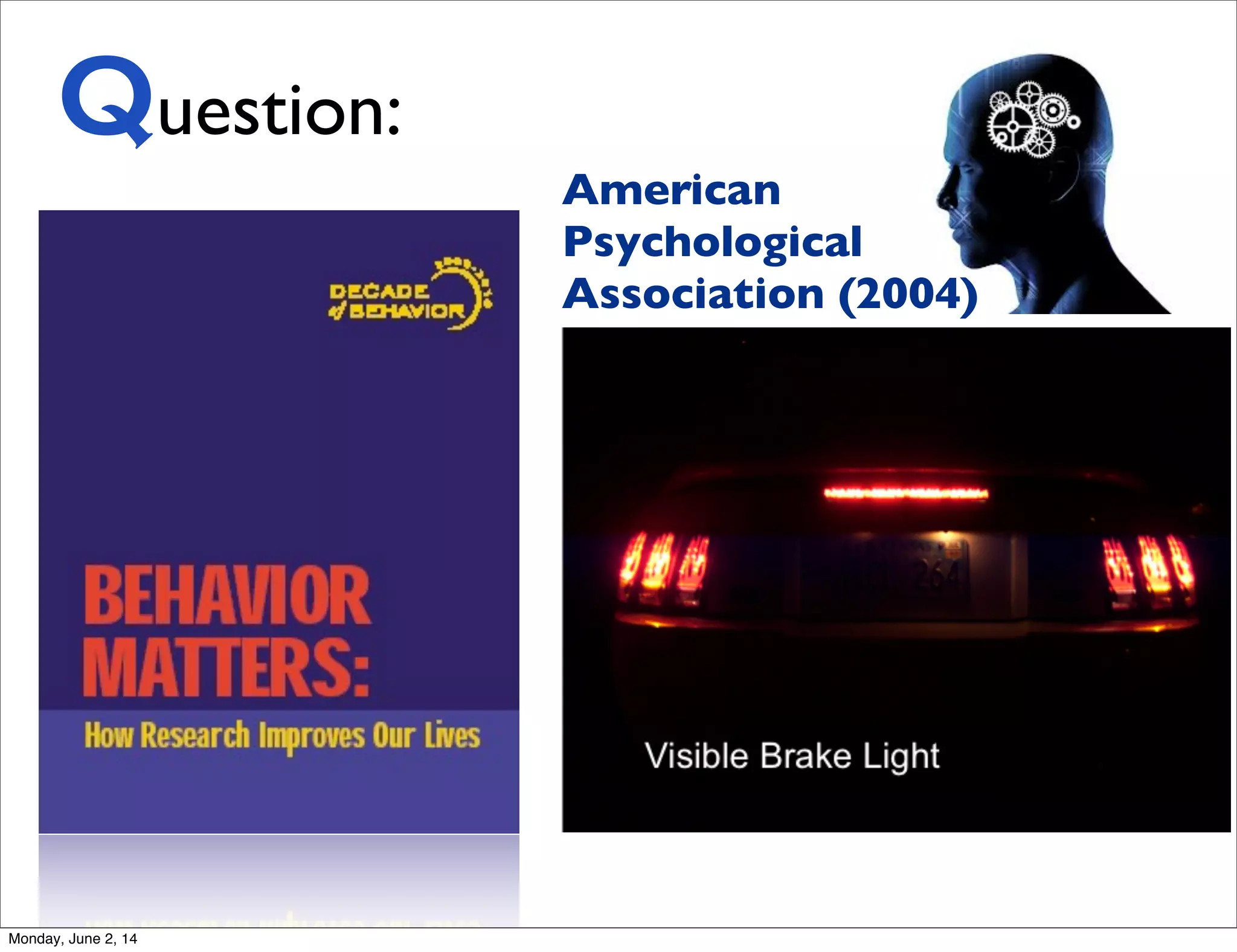
What behavioral
intervention was credited
with saving 58,000 injuries
per year, & saving
$655,000,000 per year?
Question:
American
Psychological
Association (2004)
Monday, June 2, 14
Question:
American
Psychological
Association (2004)
Monday, June 2, 14
Why?
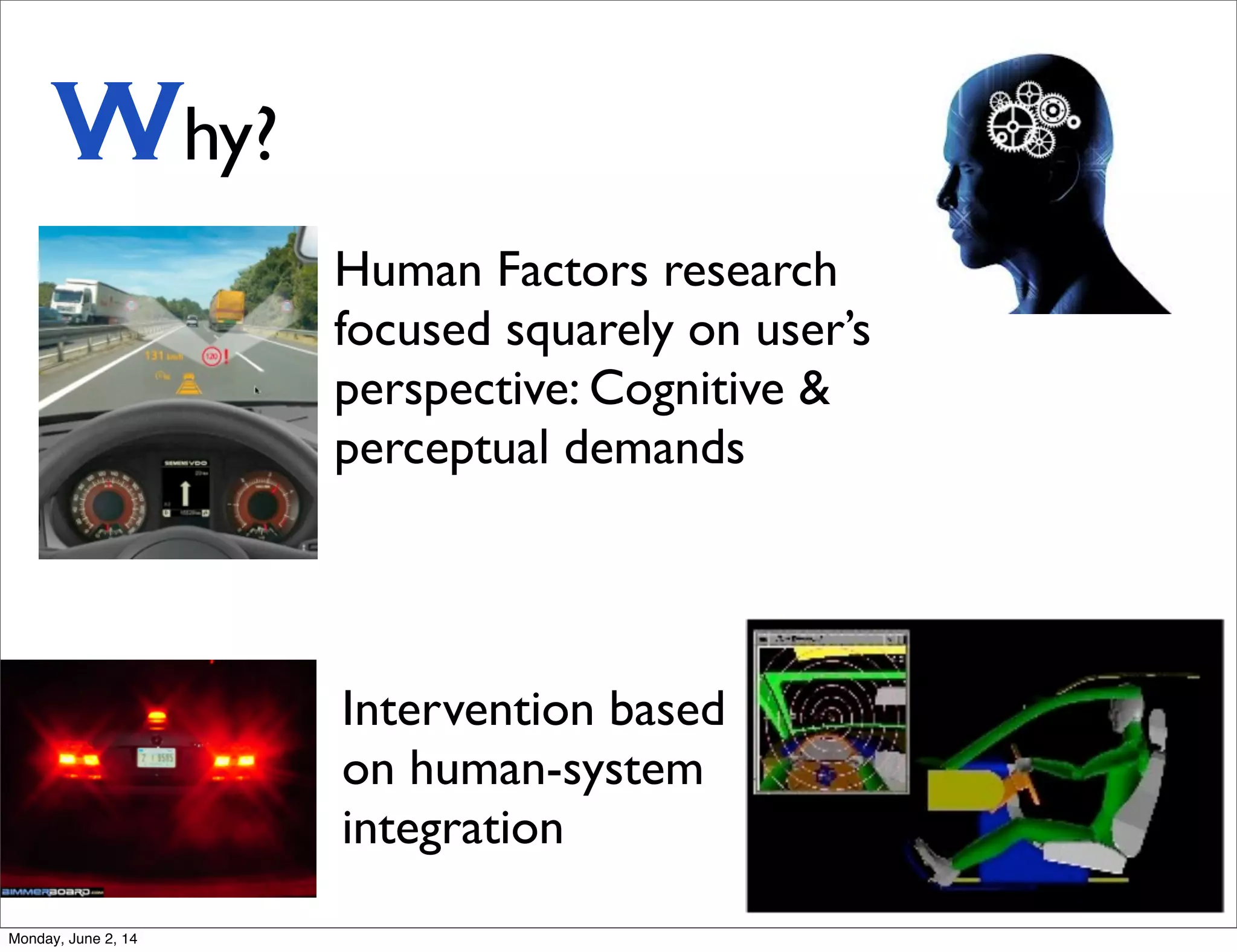
Human Factors research
focused squarely on user’s
perspective: Cognitive &
perceptual demands
Intervention based
on human-system
integration
Monday, June 2, 14
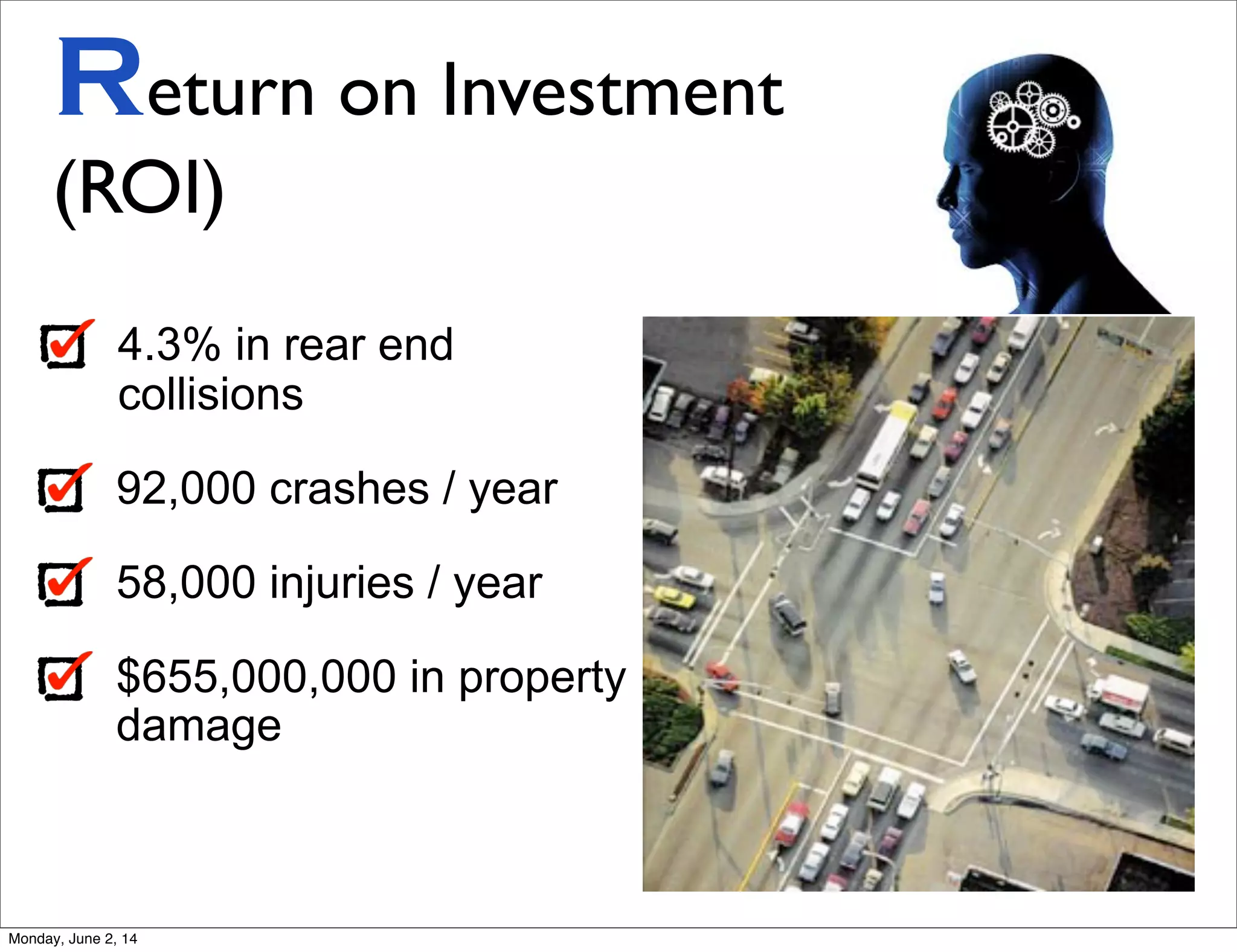
4.3% in rear end
collisions
92,000 crashes / year
58,000 injuries / year
$655,000,000 in property
damage
Return on Investment
(ROI)
Monday, June 2, 14
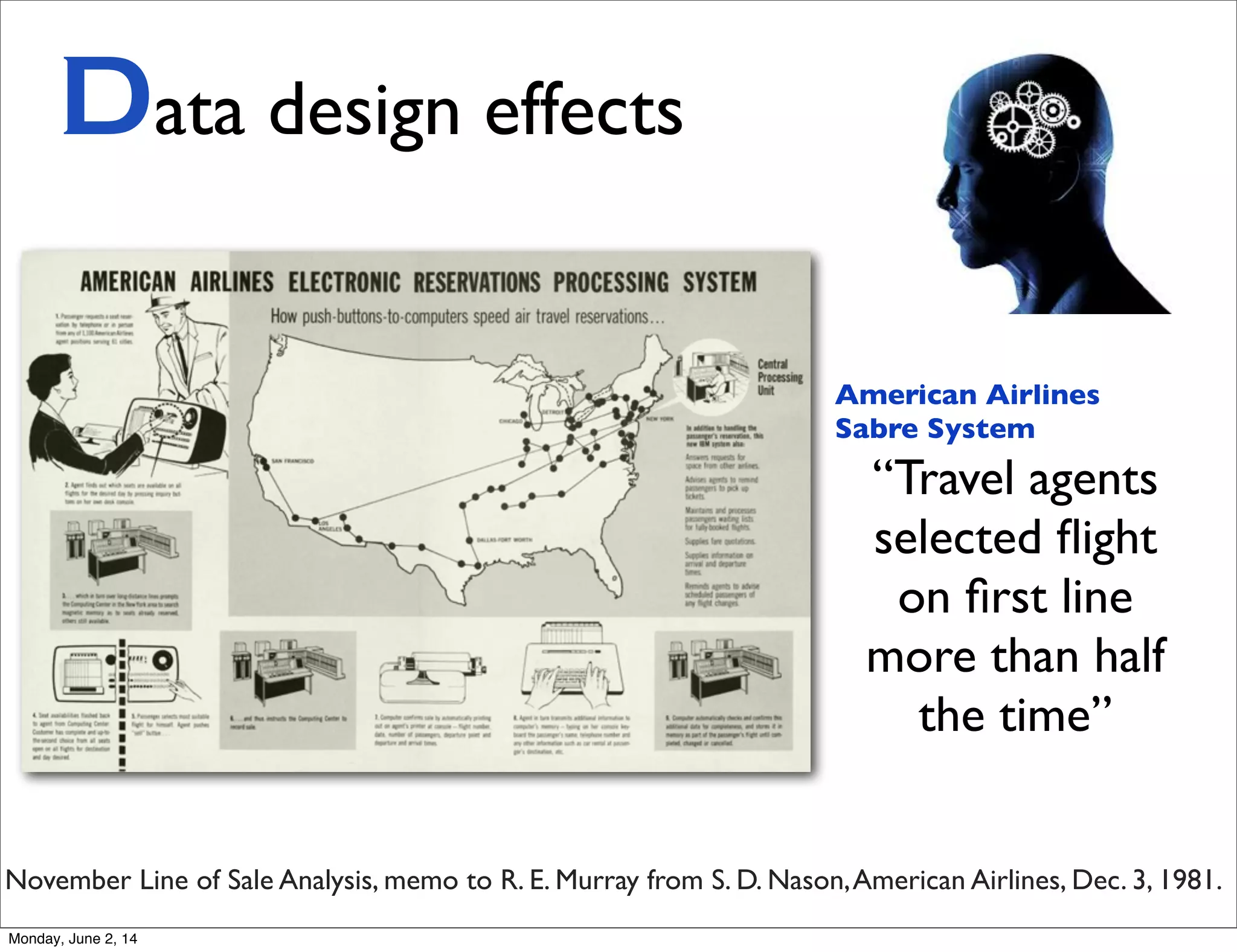
“Travel agents
selected flight
on first line
more than half
the time”
American Airlines
Sabre System
Data design effects
November Line of Sale Analysis, memo to R. E. Murray from S. D. Nason,American Airlines, Dec. 3, 1981.
Monday, June 2, 14
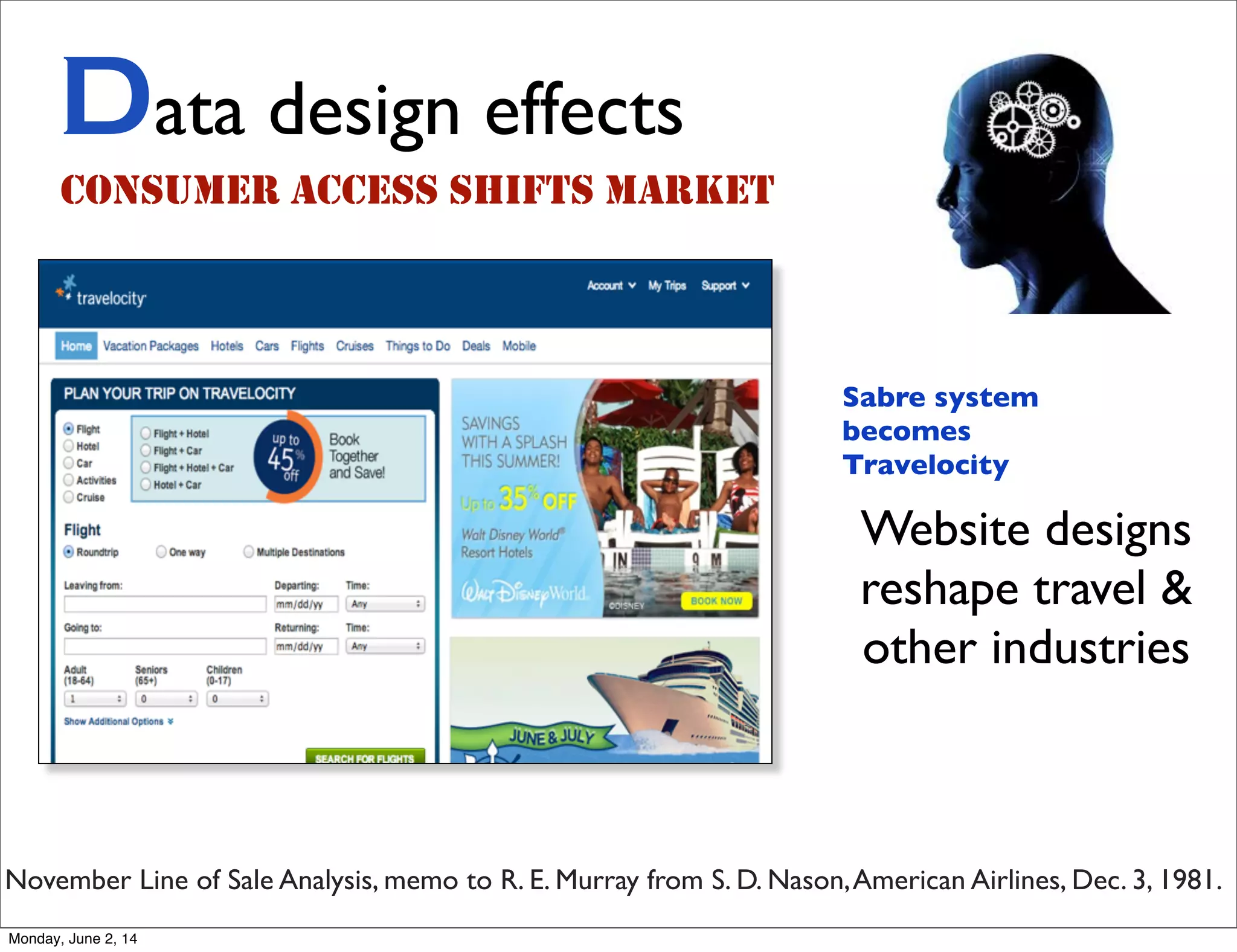
Website designs
reshape travel &
other industries
Sabre system
becomes
Travelocity
Data design effects
November Line of Sale Analysis, memo to R. E. Murray from S. D. Nason,American Airlines, Dec. 3, 1981.
CONSUMER ACCESS SHIFTS MARKET
Monday, June 2, 14
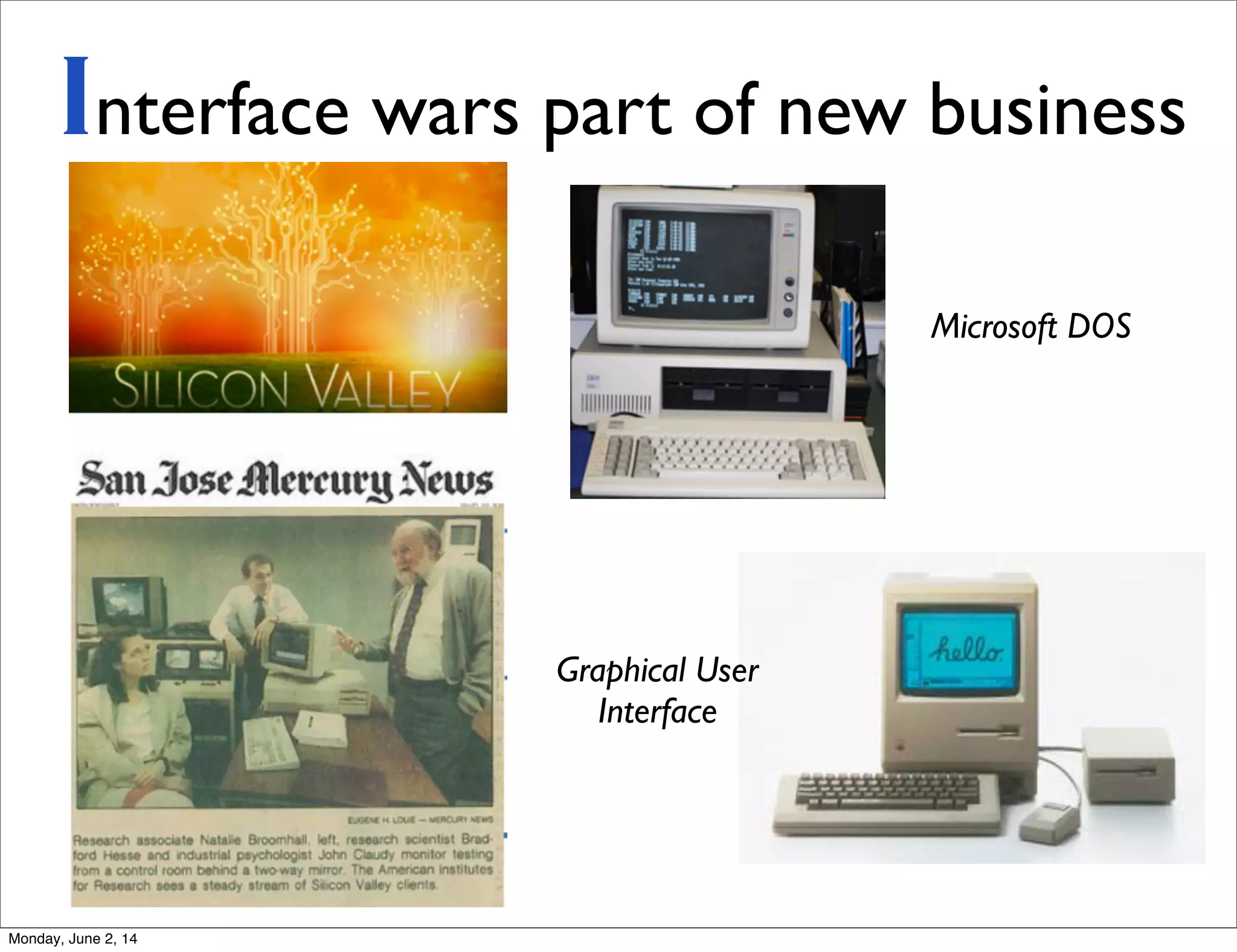
Interface wars part of new business
Microsoft DOS
Graphical User
Interface
Monday, June 2, 14
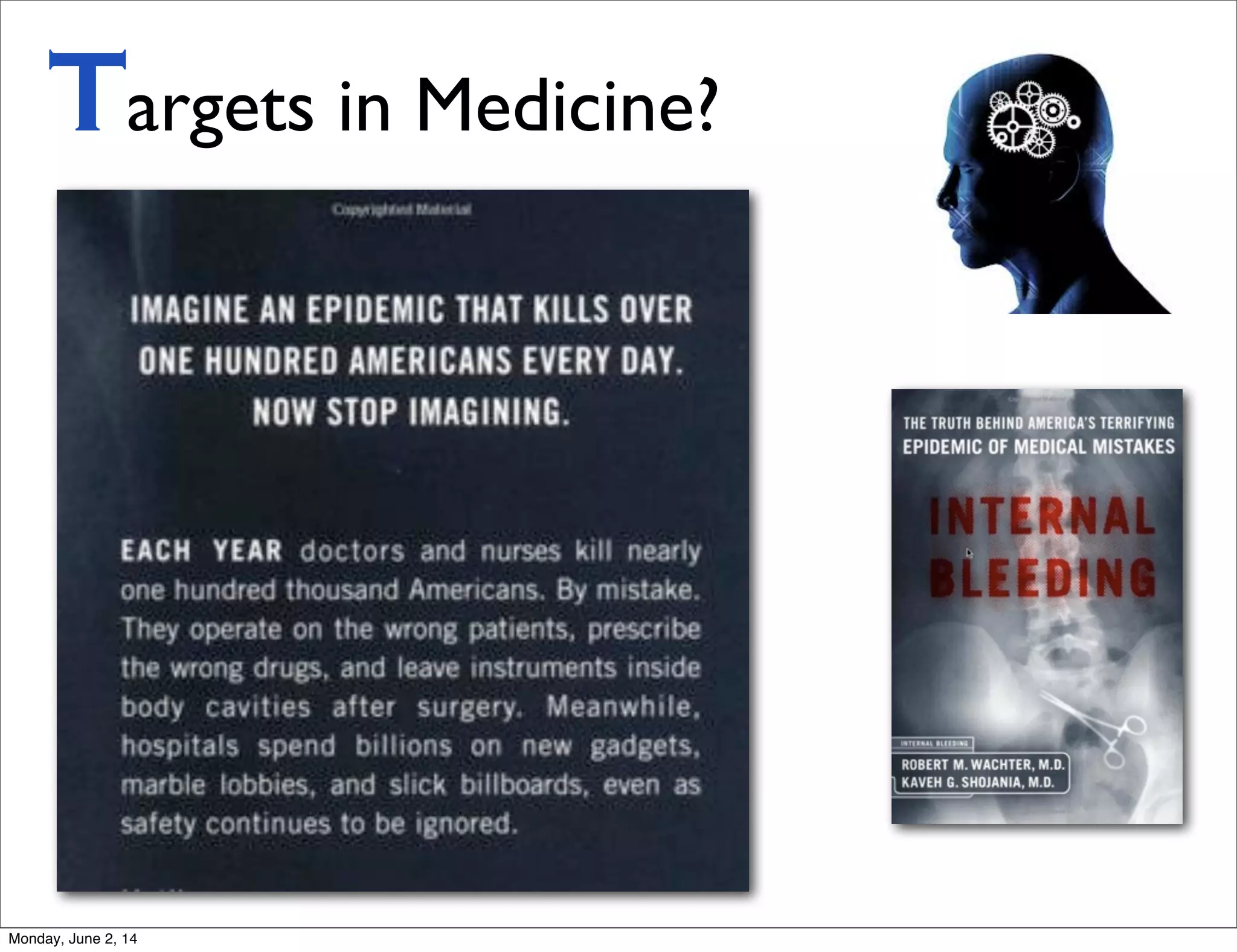
Targets in Medicine?
Monday, June 2, 14
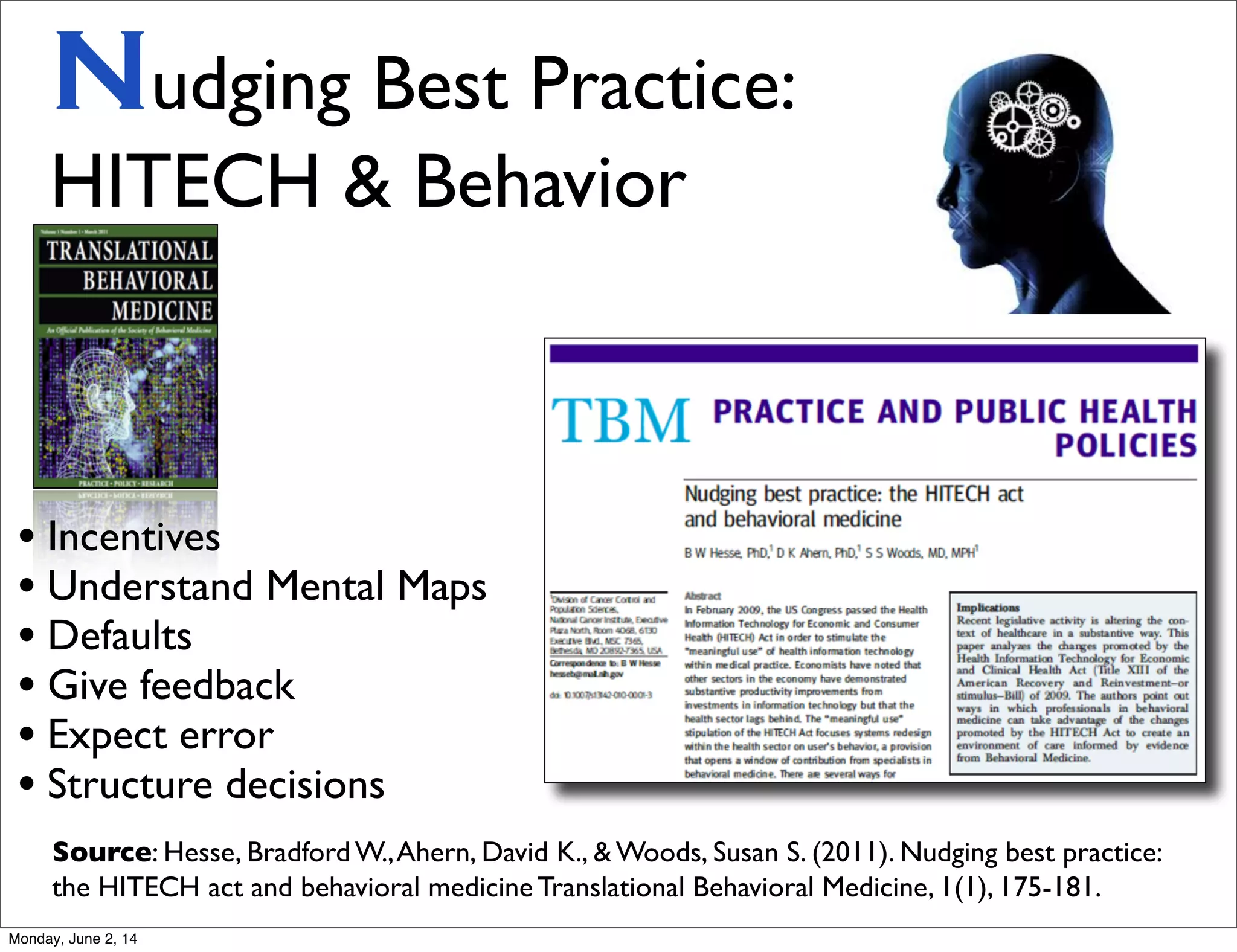
Nudging Best Practice:
HITECH & Behavior
Source: Hesse, Bradford W.,Ahern, David K., & Woods, Susan S. (2011). Nudging best practice:
the HITECH act and behavioral medicine Translational Behavioral Medicine, 1(1), 175-181.
• Incentives
• Understand Mental Maps
• Defaults
• Give feedback
• Expect error
• Structure decisions
Monday, June 2, 14
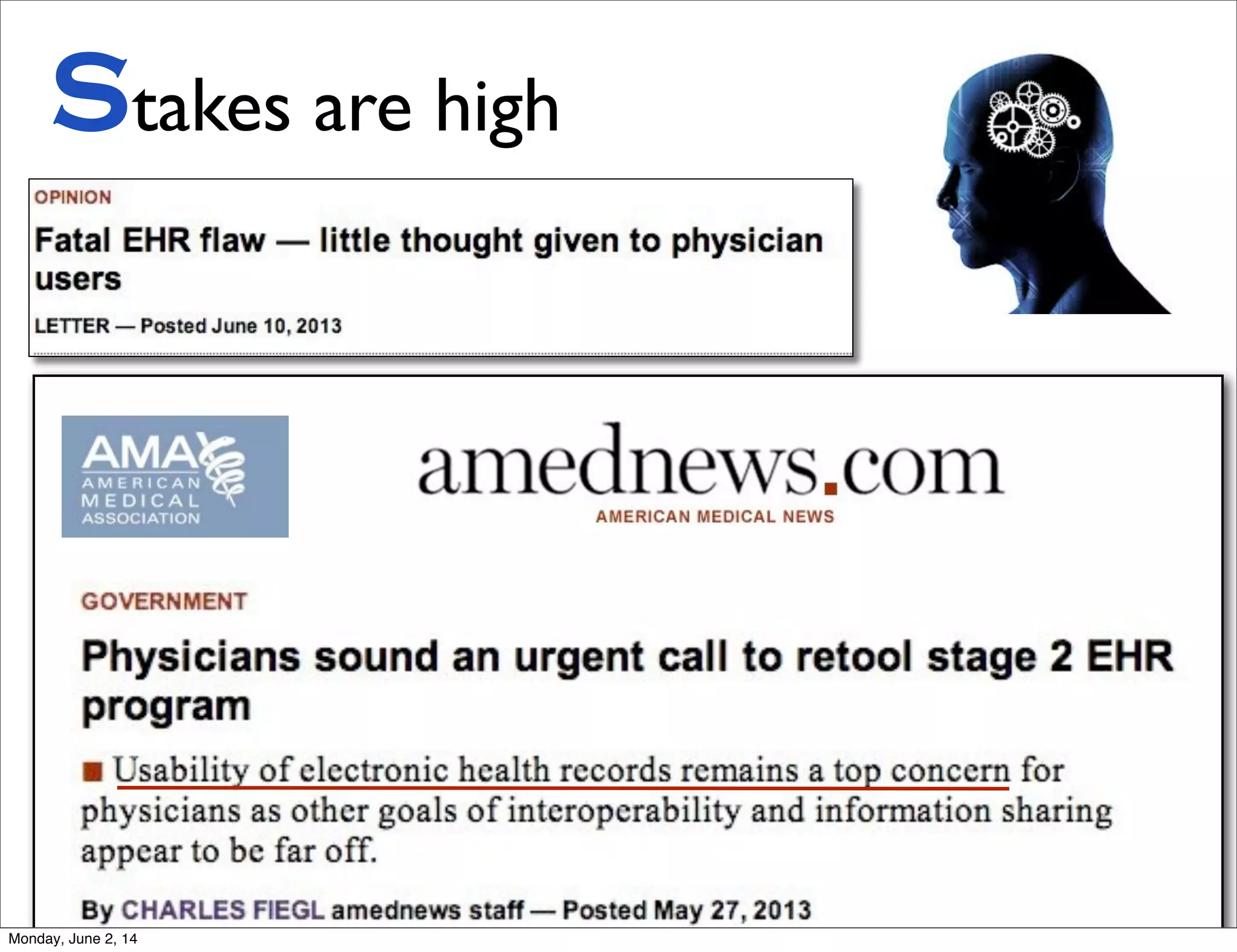
Stakes are high
Monday, June 2, 14
Stakes are high
Monday, June 2, 14
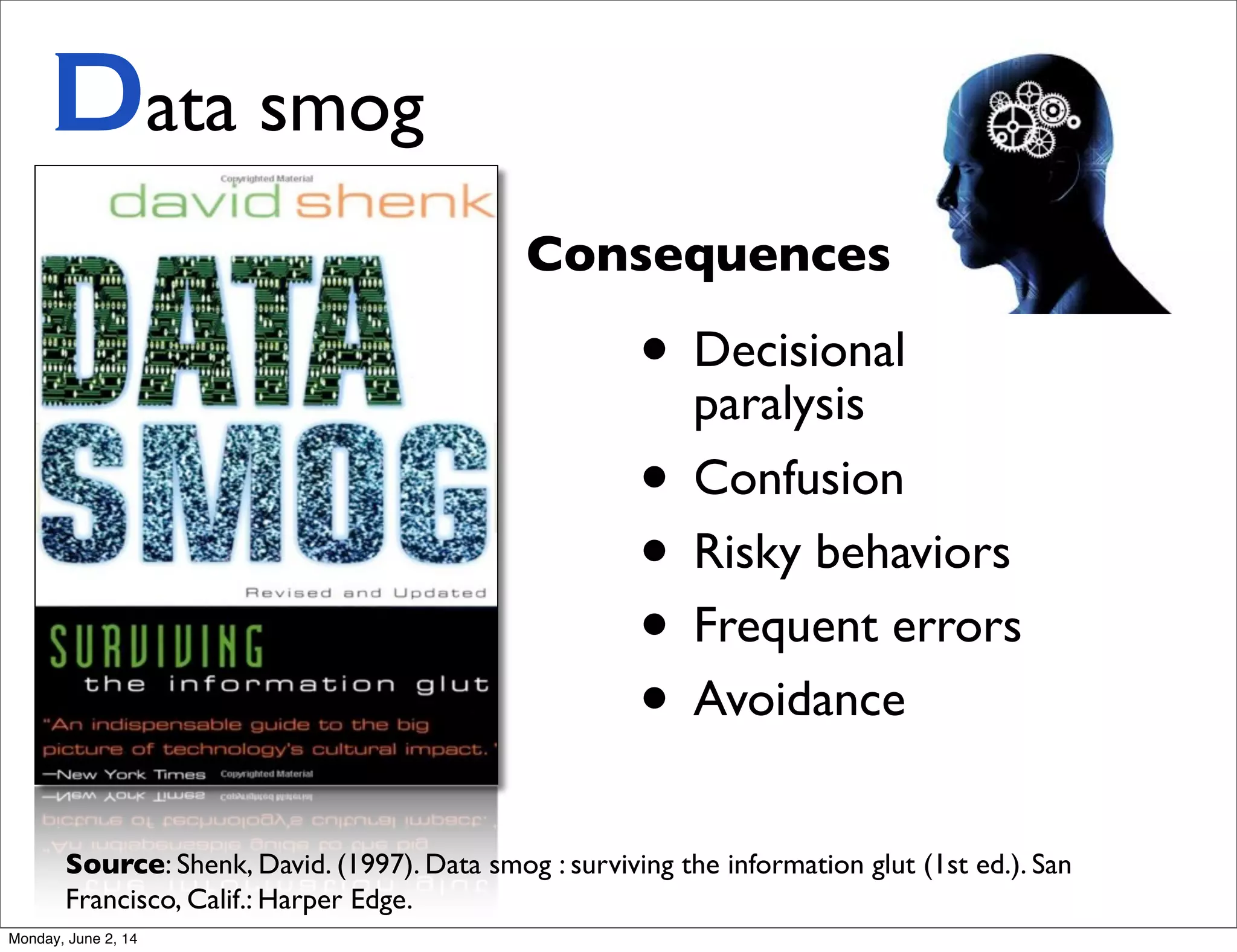
Data smog
• Decisional
paralysis
• Confusion
• Risky behaviors
• Frequent errors
• Avoidance
Source: Shenk, David. (1997). Data smog : surviving the information glut (1st ed.). San
Francisco, Calif.: Harper Edge.
Consequences
Monday, June 2, 14
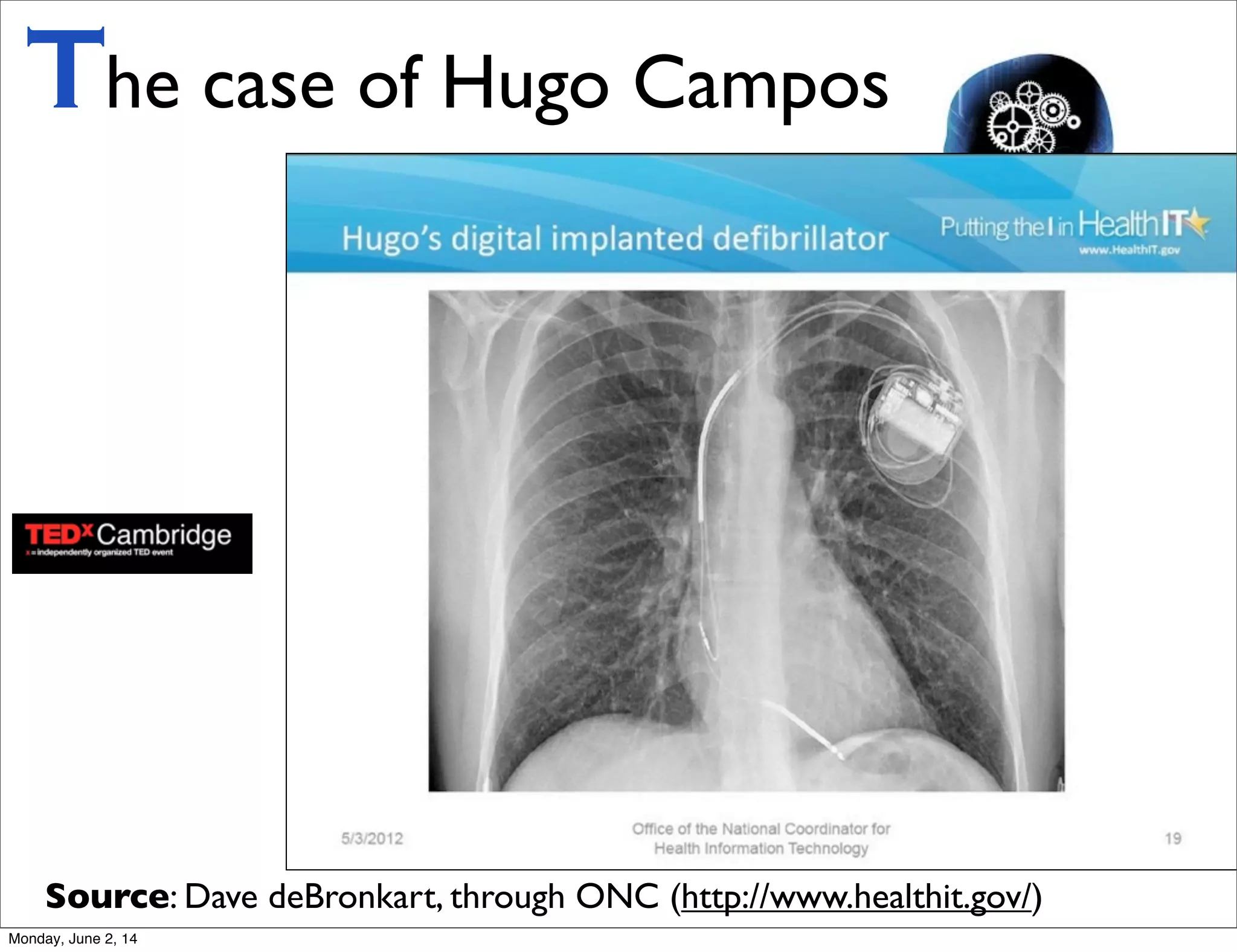
The case of Hugo Campos
Source: Dave deBronkart, through ONC (http://www.healthit.gov/)
Monday, June 2, 14
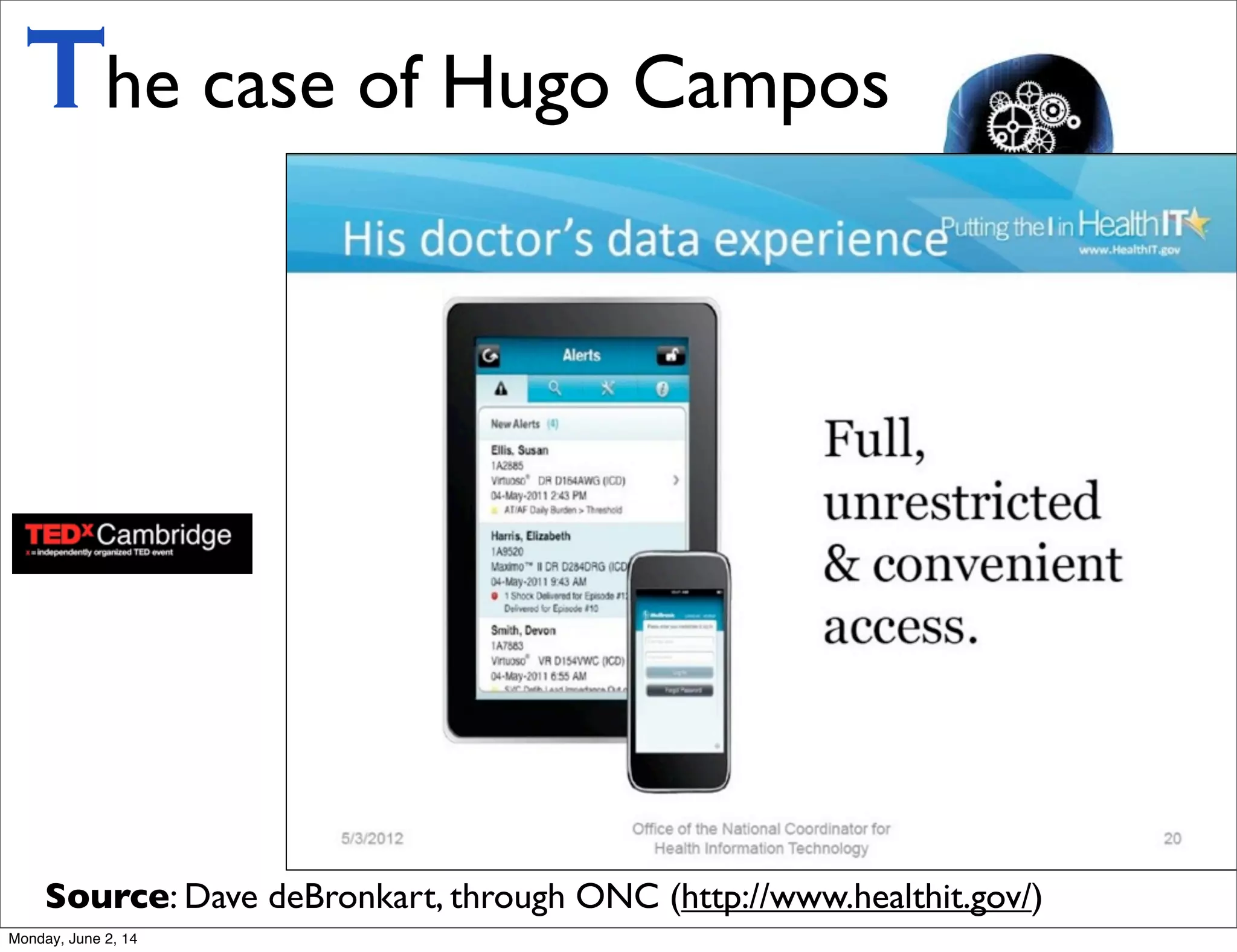
The case of Hugo Campos
Source: Dave deBronkart, through ONC (http://www.healthit.gov/)
Monday, June 2, 14
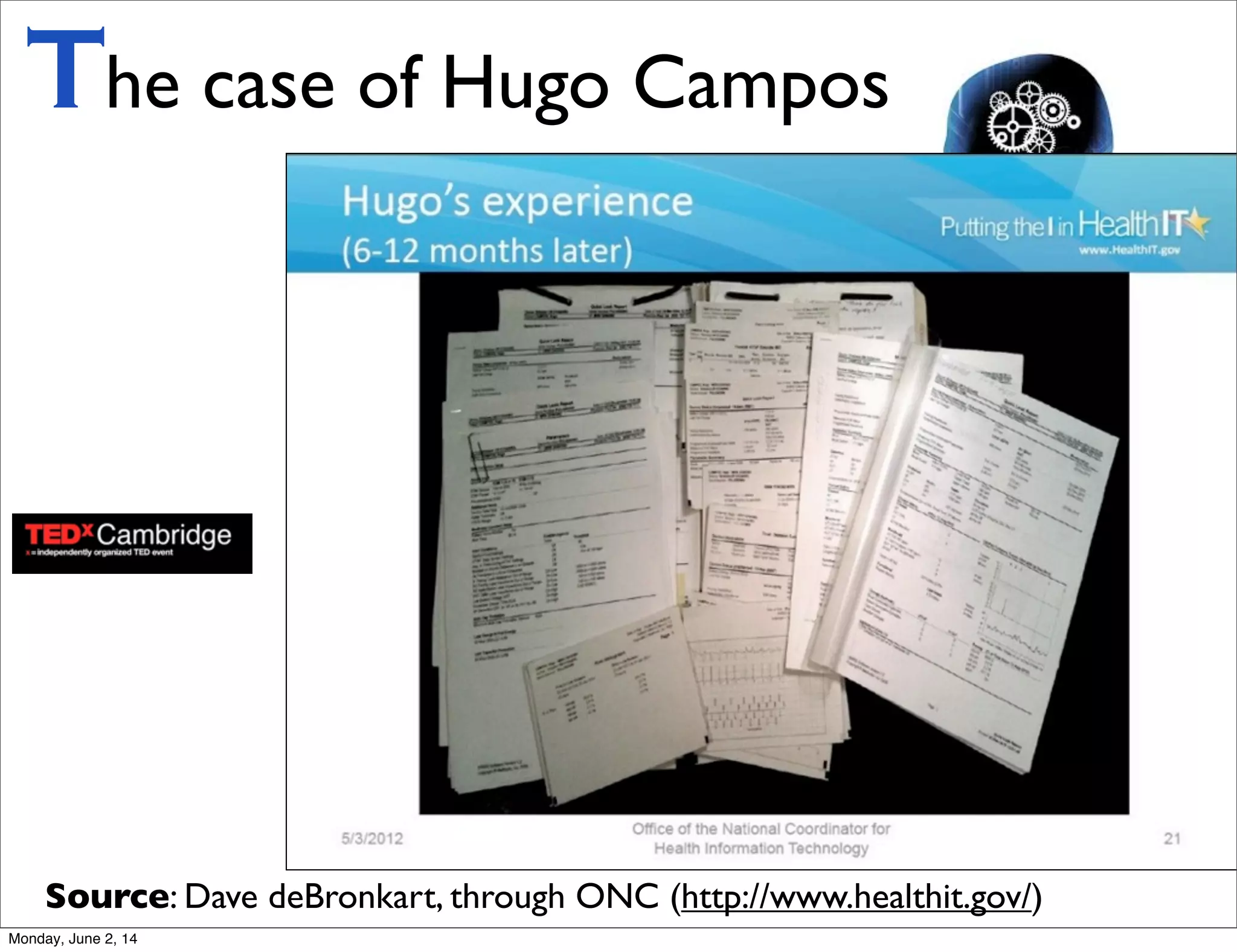
The case of Hugo Campos
Source: Dave deBronkart, through ONC (http://www.healthit.gov/)
Monday, June 2, 14
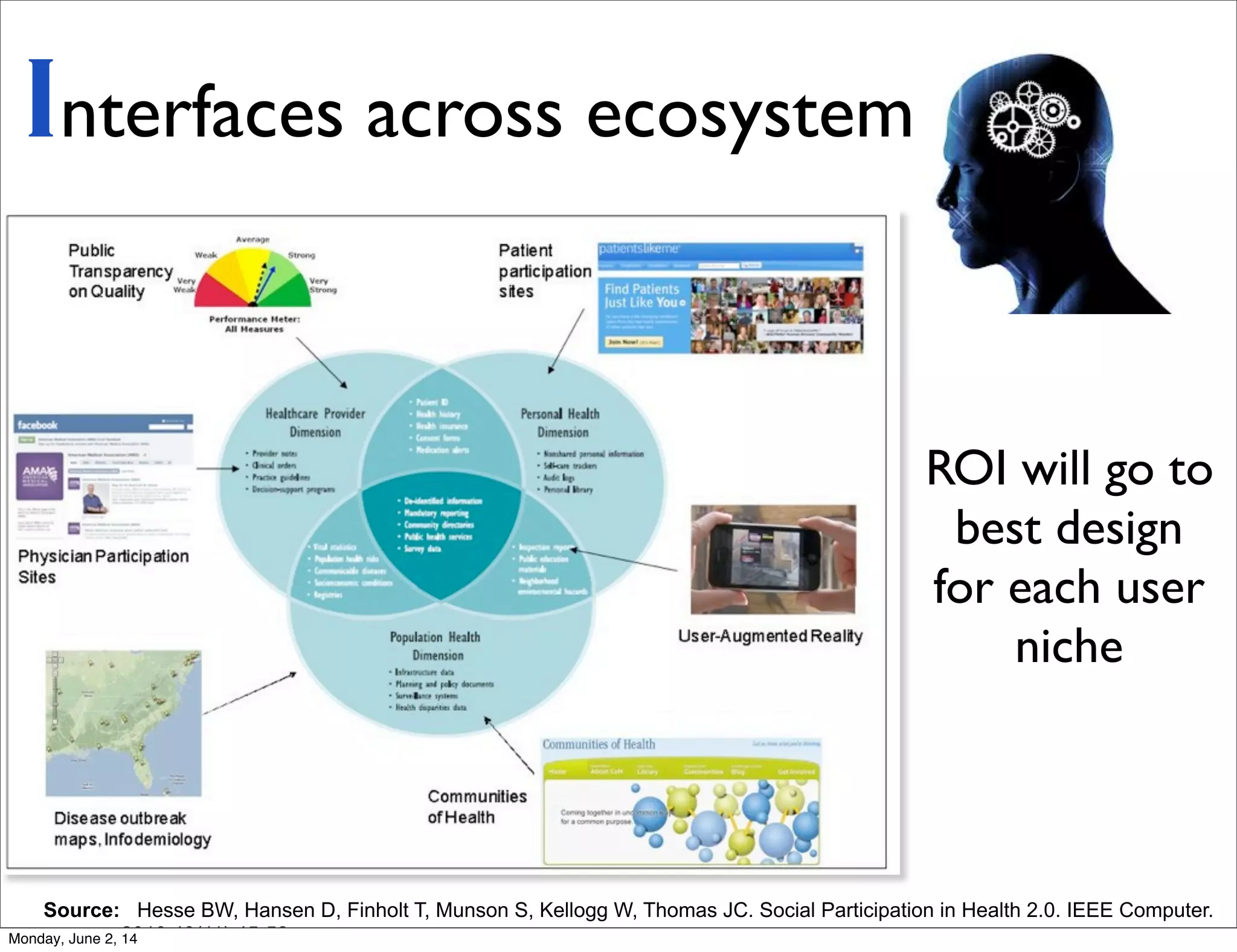
ROI will go to
best design
for each user
niche
Interfaces across ecosystem
Source: Hesse BW, Hansen D, Finholt T, Munson S, Kellogg W, Thomas JC. Social Participation in Health 2.0. IEEE Computer.
2010;43(11):45-52.Monday, June 2, 14
Human System Integration
Monday, June 2, 14
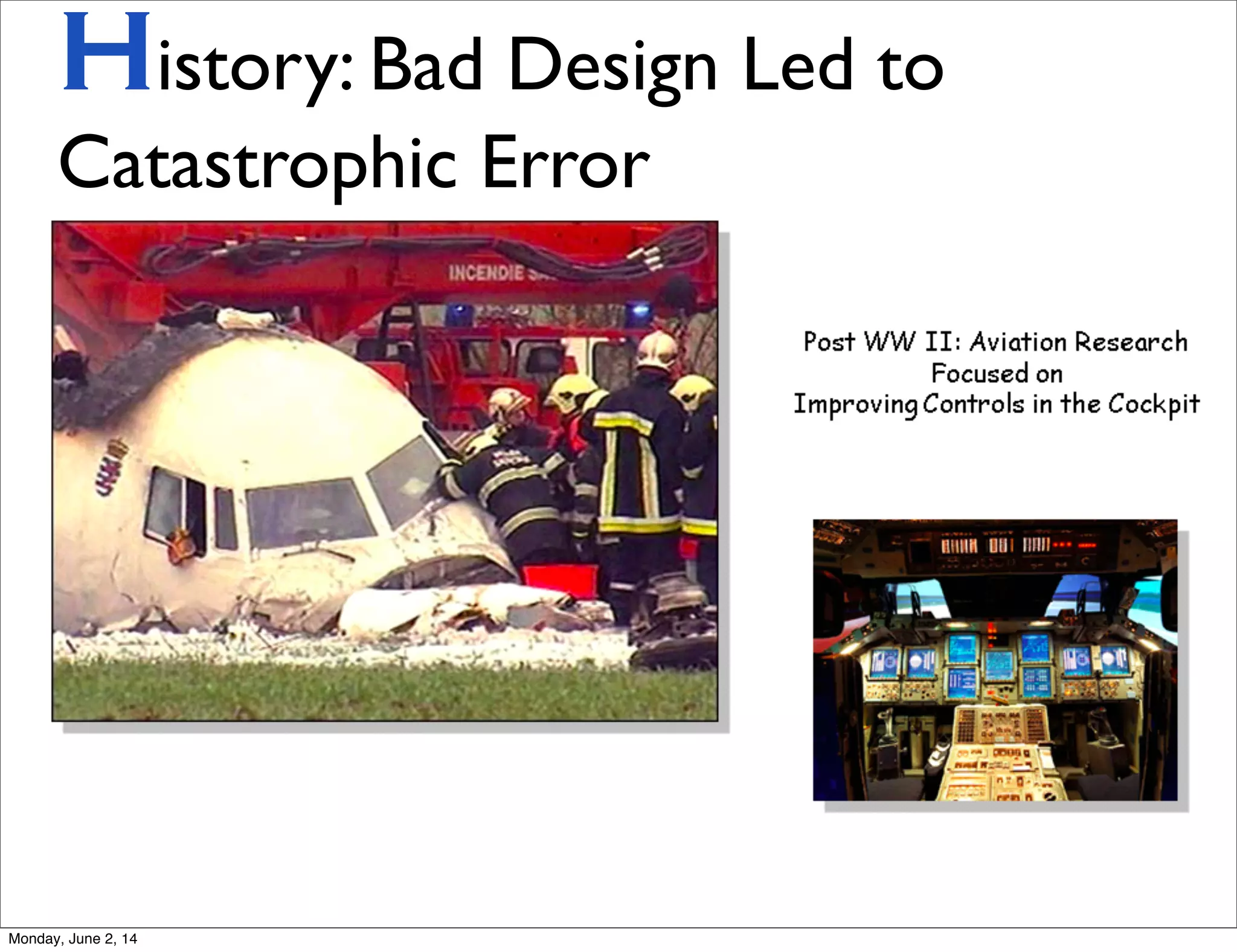
History: Bad Design Led to
Catastrophic Error
Monday, June 2, 14
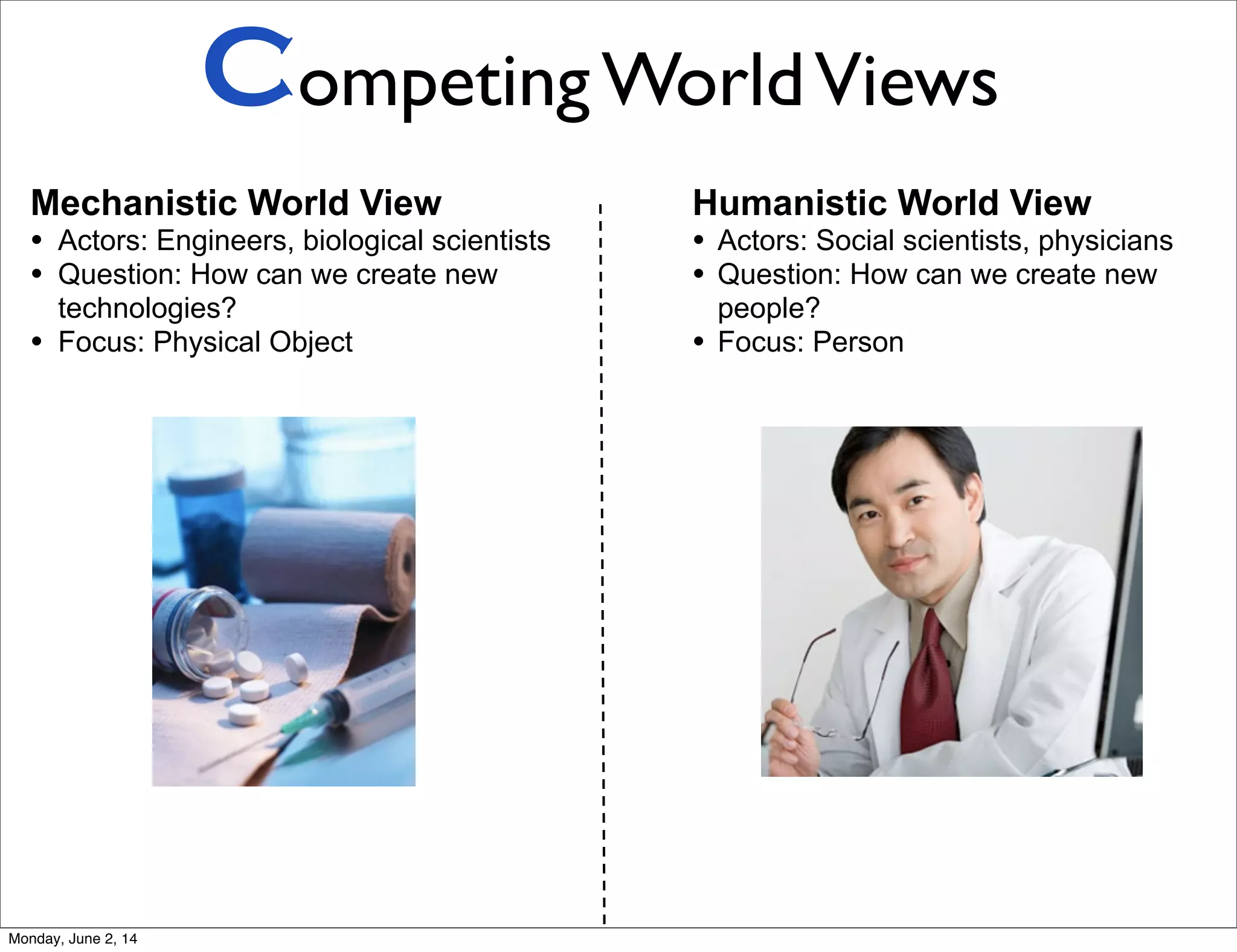
Mechanistic World View
• Actors: Engineers, biological scientists
• Question: How can we create new
technologies?
• Focus: Physical Object
Humanistic World View
• Actors: Social scientists, physicians
• Question: How can we create new
people?
• Focus: Person
Competing WorldViews
Monday, June 2, 14
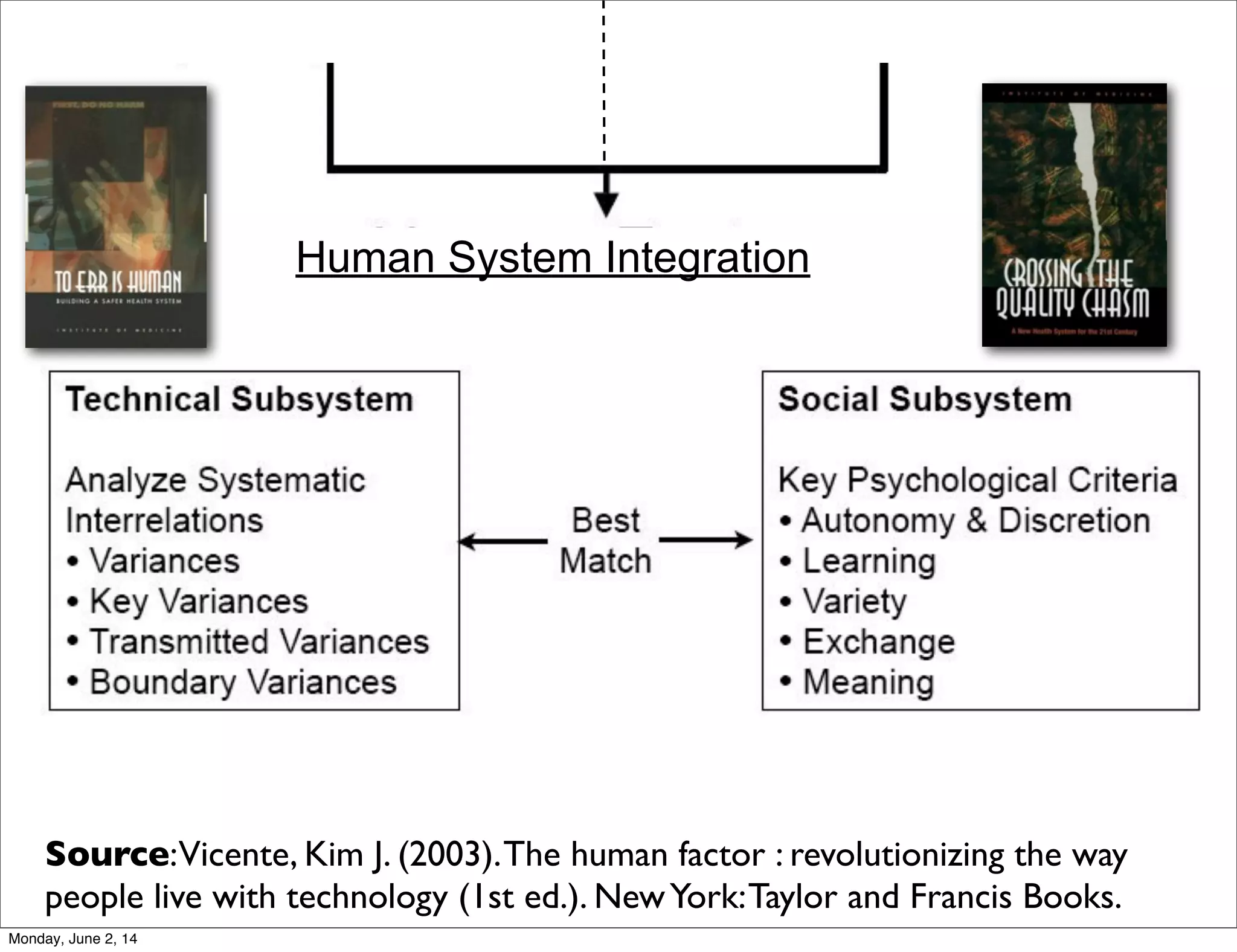
Source:Vicente, Kim J. (2003).The human factor : revolutionizing the way
people live with technology (1st ed.). NewYork:Taylor and Francis Books.
Human System Integration
Monday, June 2, 14
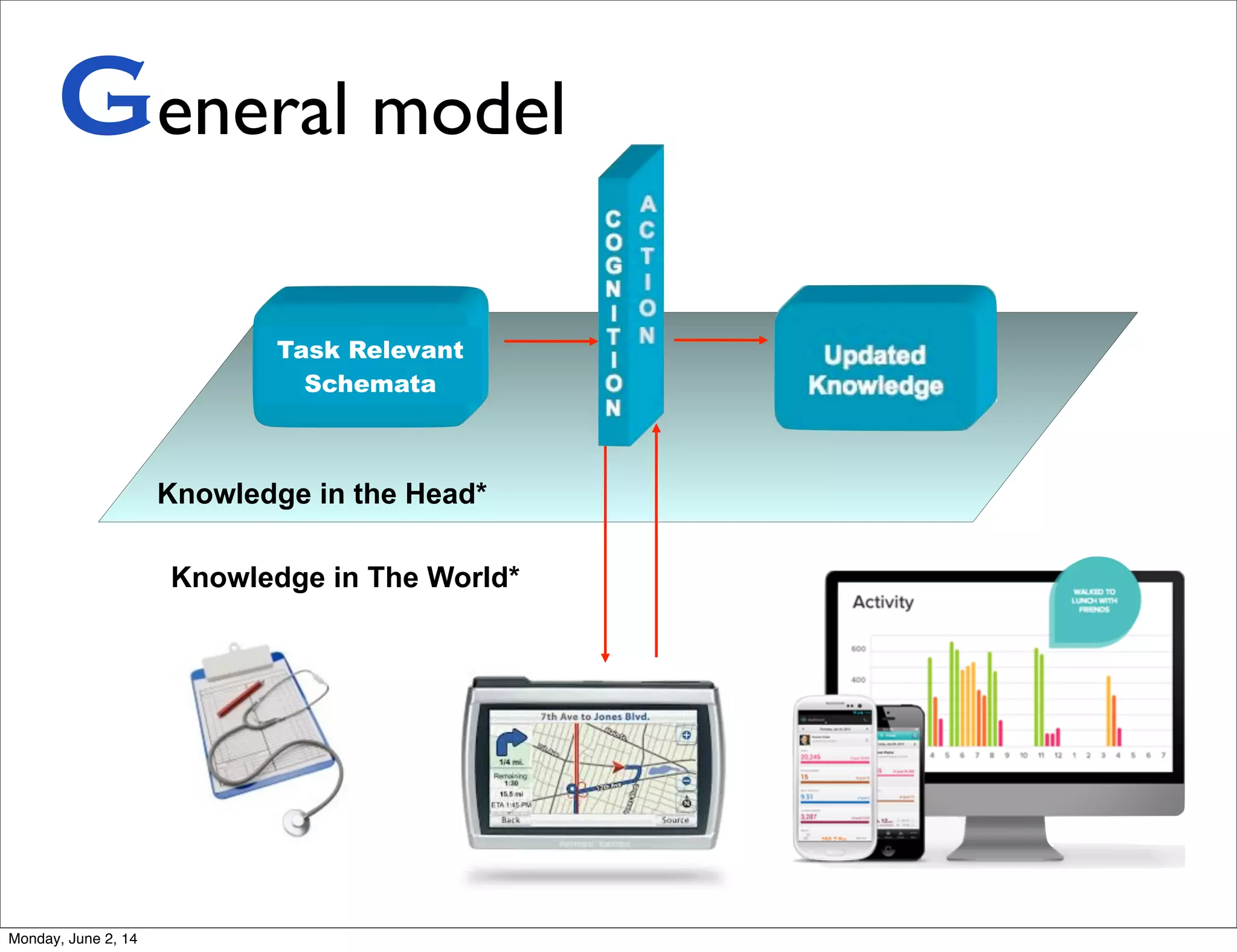
Knowledge in the Head*
Knowledge in The World*
Task Relevant
Schemata
General model
Monday, June 2, 14
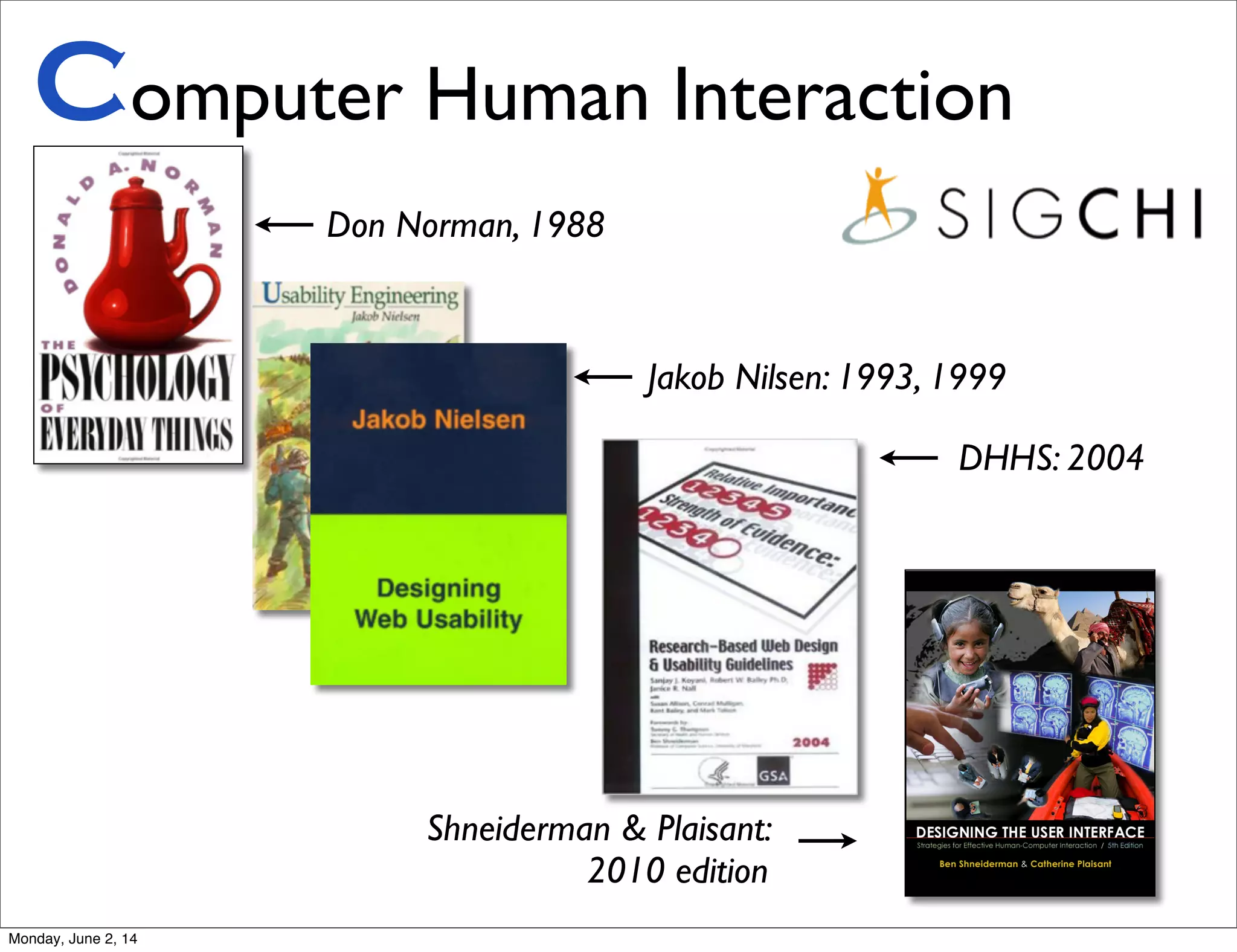
Computer Human Interaction
Don Norman, 1988
Jakob Nilsen: 1993, 1999
Shneiderman & Plaisant:
2010 edition
DHHS: 2004
Monday, June 2, 14
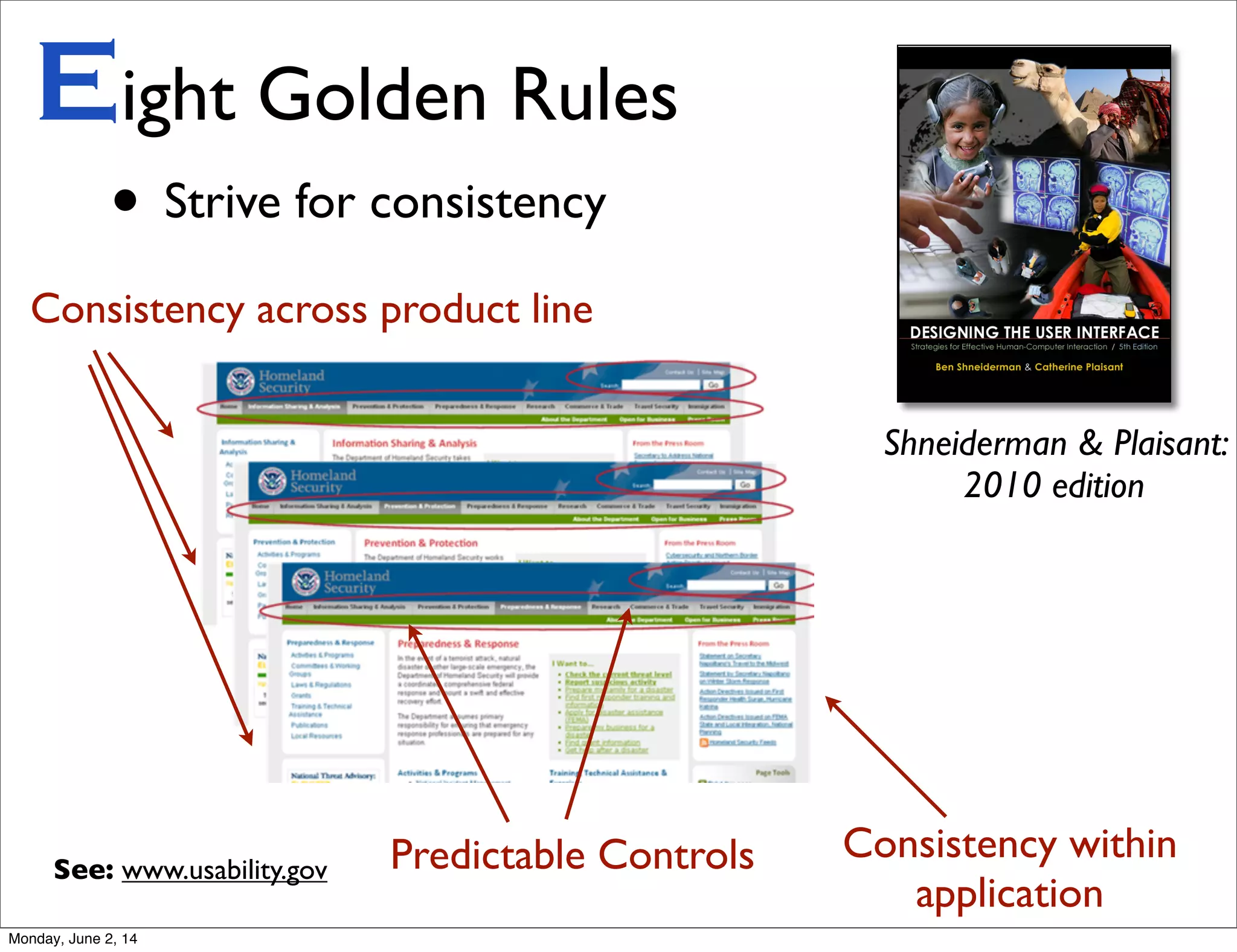
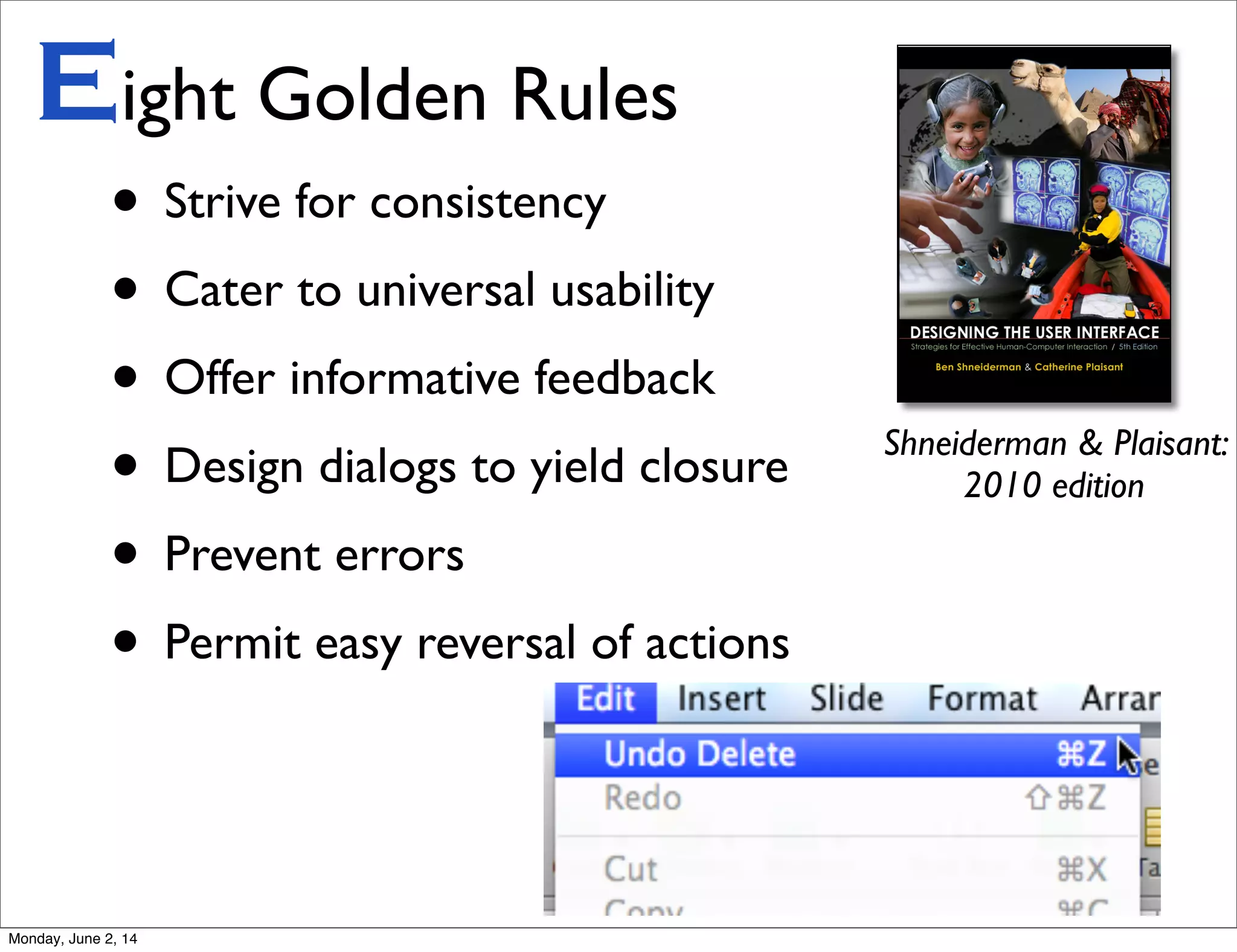
• Strive for consistency
Eight Golden Rules
Shneiderman & Plaisant:
2010 edition
See: www.usability.gov
Consistency within
application
Consistency across product line
Predictable Controls
Monday, June 2, 14
• Strive for consistency
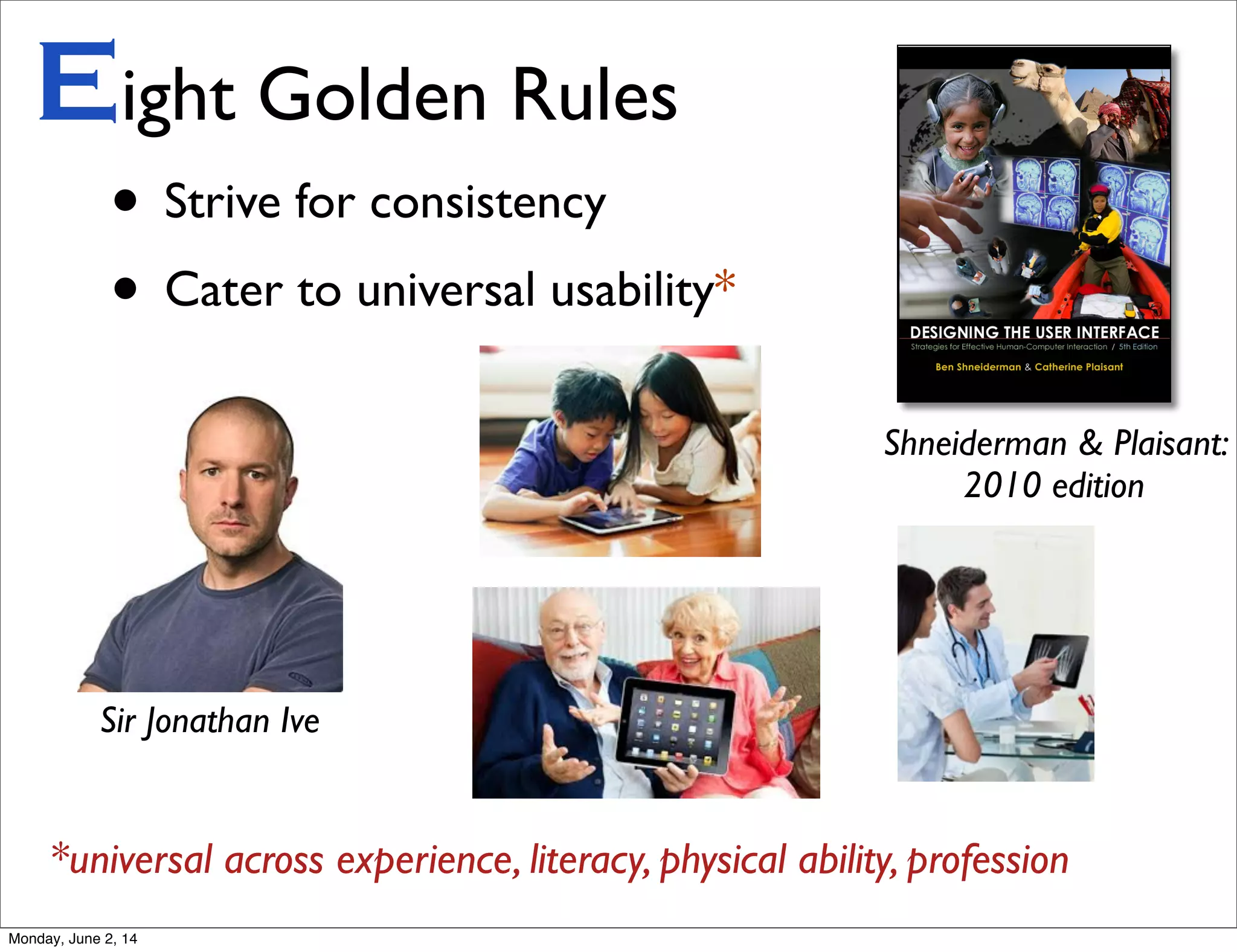
• Cater to universal usability*
Eight Golden Rules
Shneiderman & Plaisant:
2010 edition
Sir Jonathan Ive
*universal across experience, literacy, physical ability, profession
Monday, June 2, 14
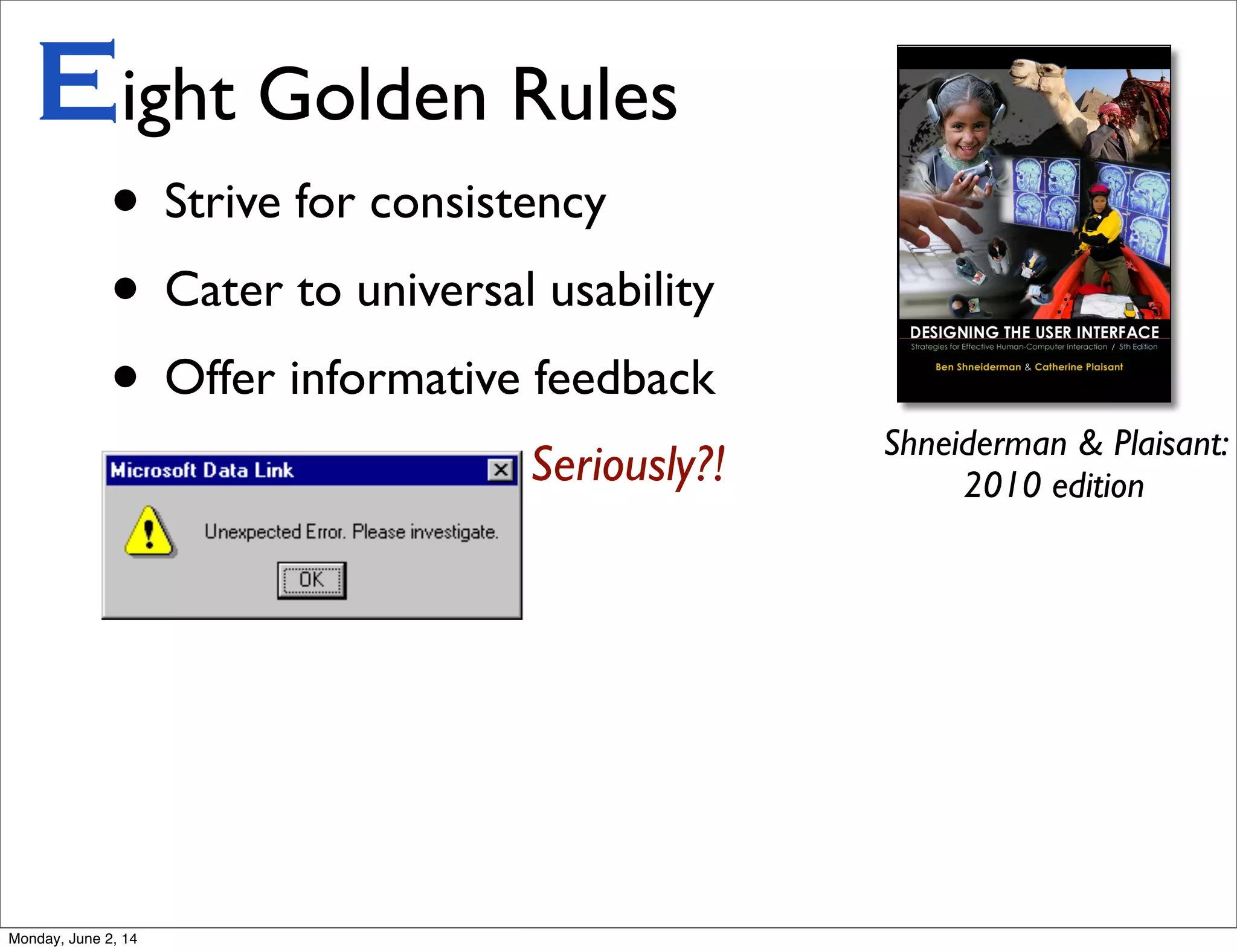
• Strive for consistency
• Cater to universal usability
• Offer informative feedback
Eight Golden Rules
Shneiderman & Plaisant:
2010 editionSeriously?!
Monday, June 2, 14
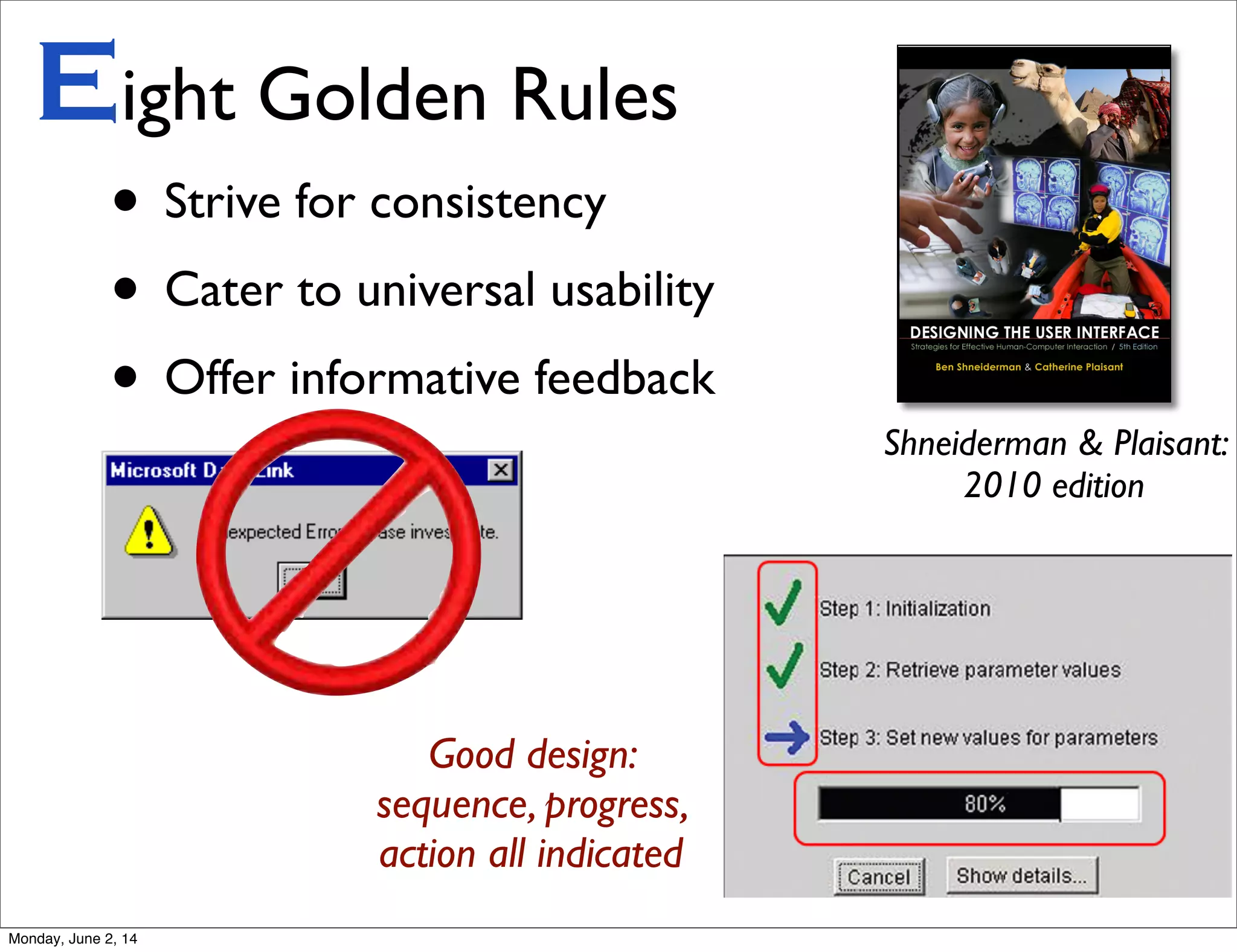
• Strive for consistency
• Cater to universal usability
• Offer informative feedback
Eight Golden Rules
Shneiderman & Plaisant:
2010 edition
Good design:
sequence, progress,
action all indicated
Monday, June 2, 14
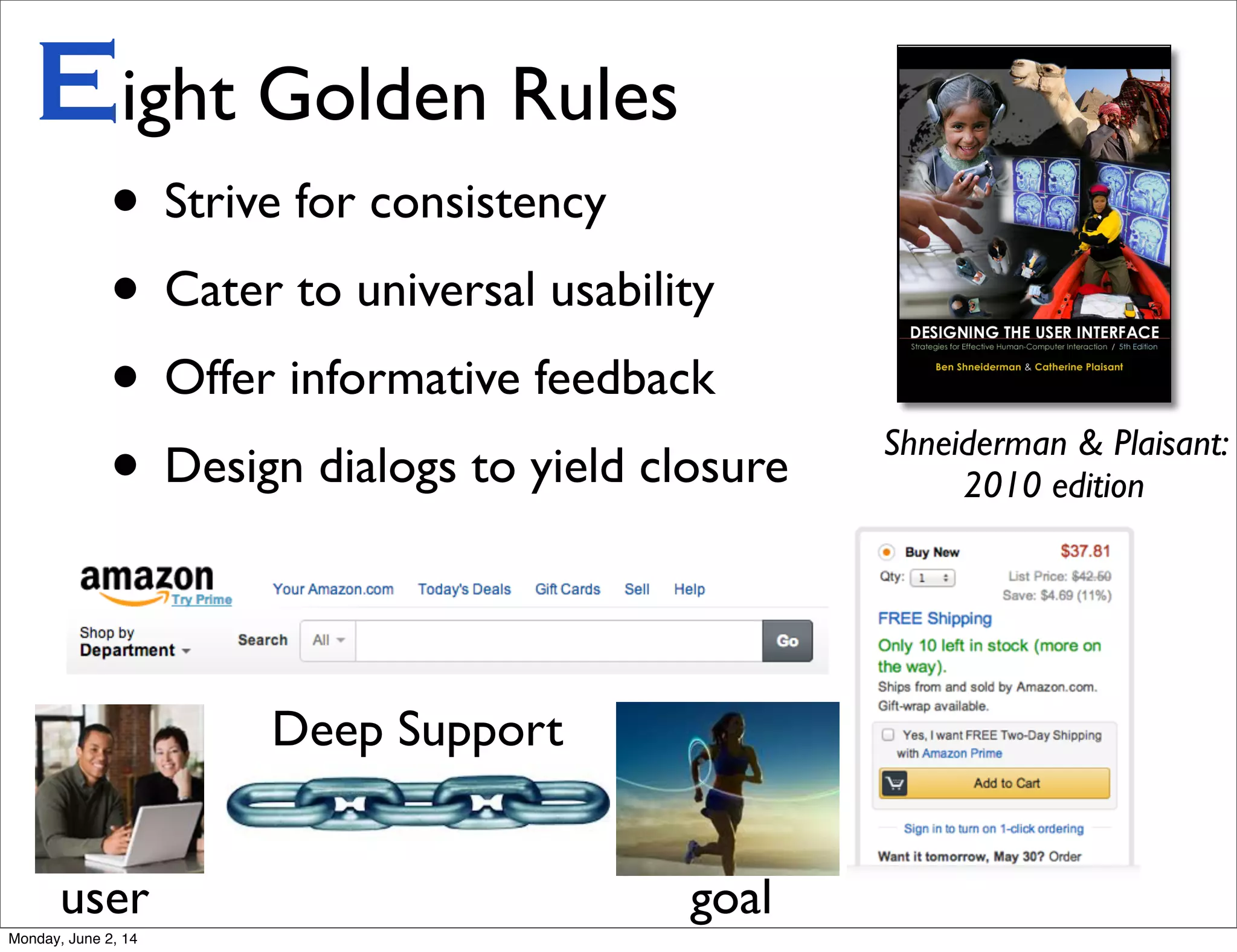
• Strive for consistency
• Cater to universal usability
• Offer informative feedback
• Design dialogs to yield closure
Eight Golden Rules
Shneiderman & Plaisant:
2010 edition
user goal
Deep Support
Monday, June 2, 14
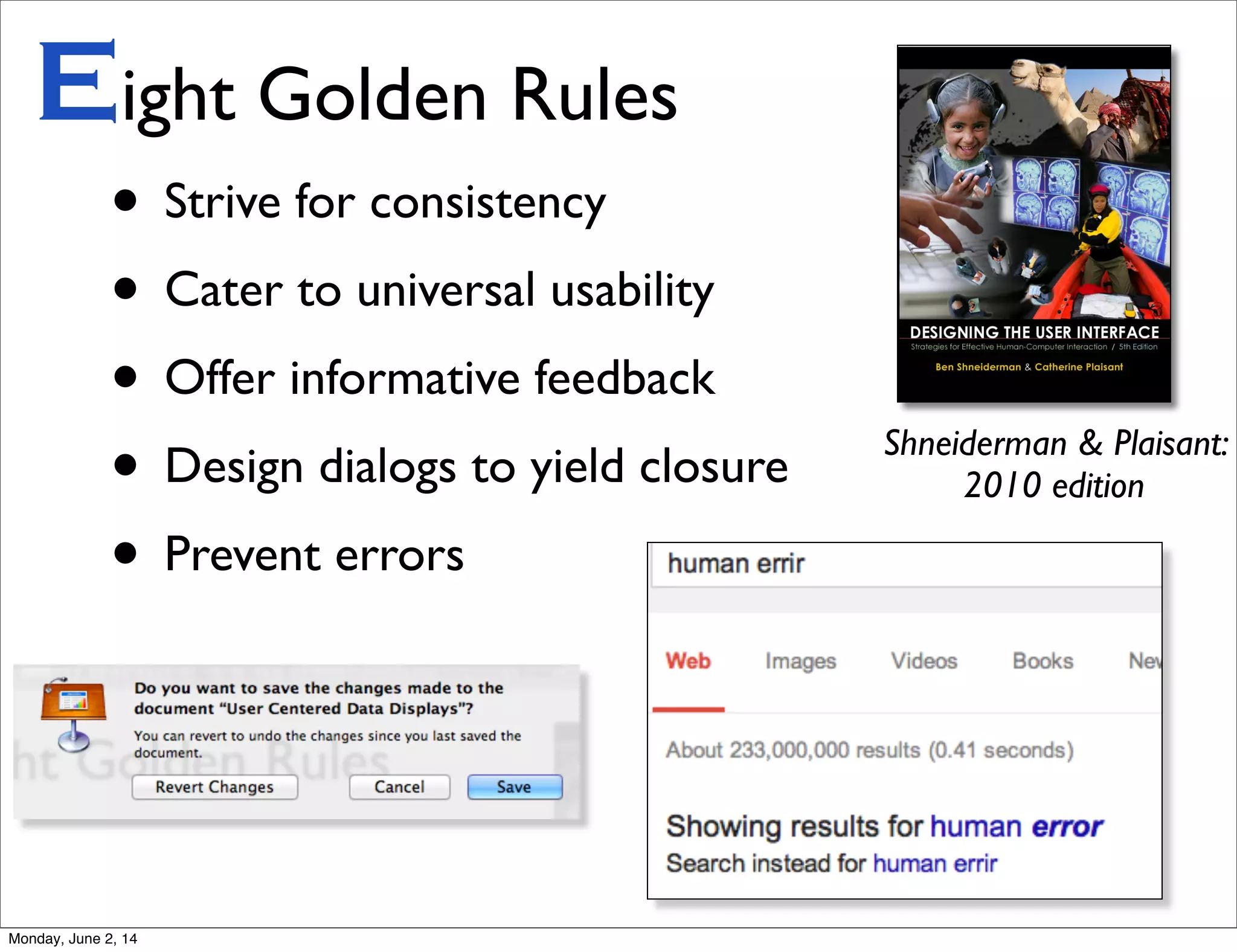
• Strive for consistency
• Cater to universal usability
• Offer informative feedback
• Design dialogs to yield closure
• Prevent errors
Eight Golden Rules
Shneiderman & Plaisant:
2010 edition
Monday, June 2, 14
• Strive for consistency
• Cater to universal usability
• Offer informative feedback
• Design dialogs to yield closure
• Prevent errors
• Permit easy reversal of actions
Eight Golden Rules
Shneiderman & Plaisant:
2010 edition
Monday, June 2, 14
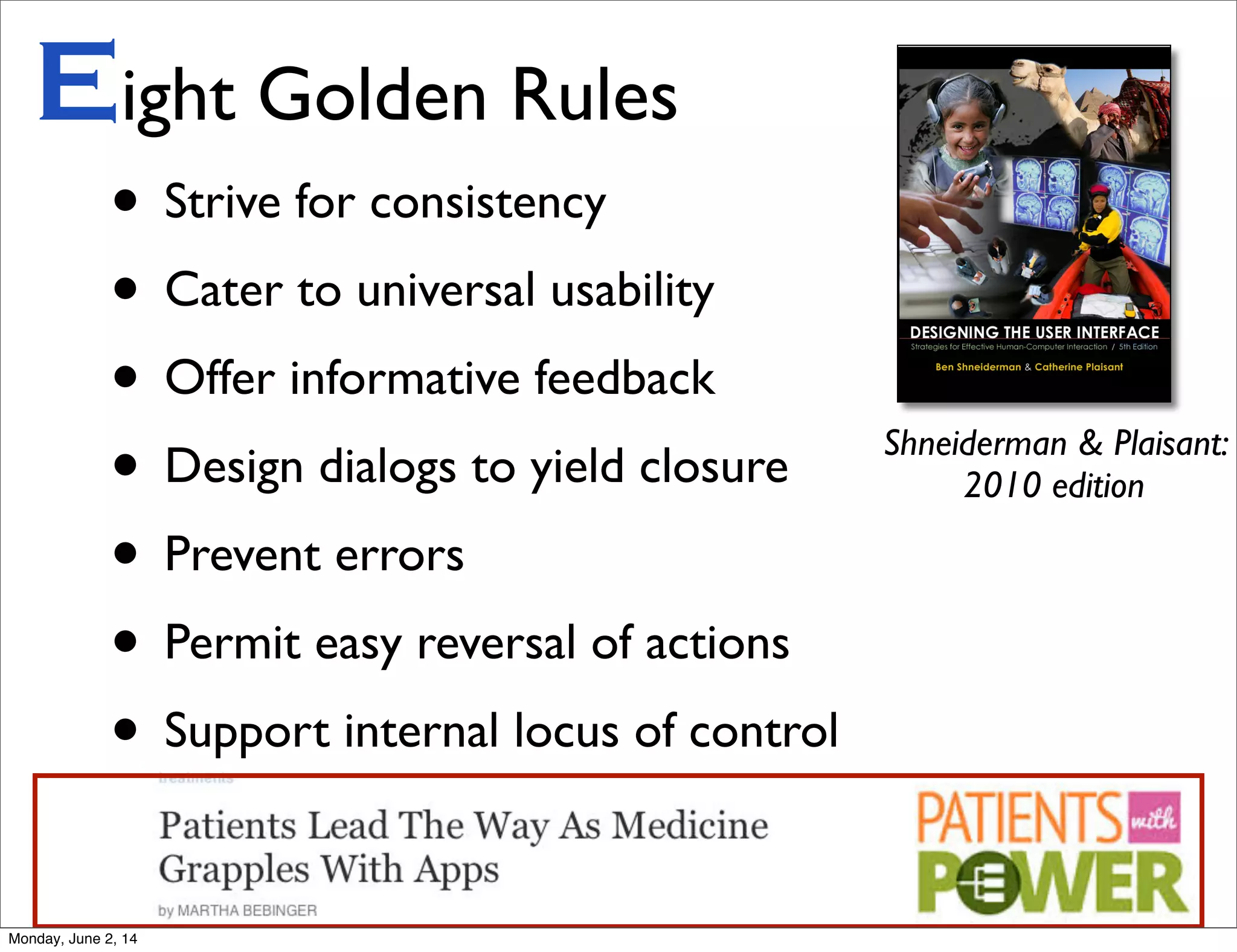
• Strive for consistency
• Cater to universal usability
• Offer informative feedback
• Design dialogs to yield closure
• Prevent errors
• Permit easy reversal of actions
• Support internal locus of control
Eight Golden Rules
Shneiderman & Plaisant:
2010 edition
Monday, June 2, 14
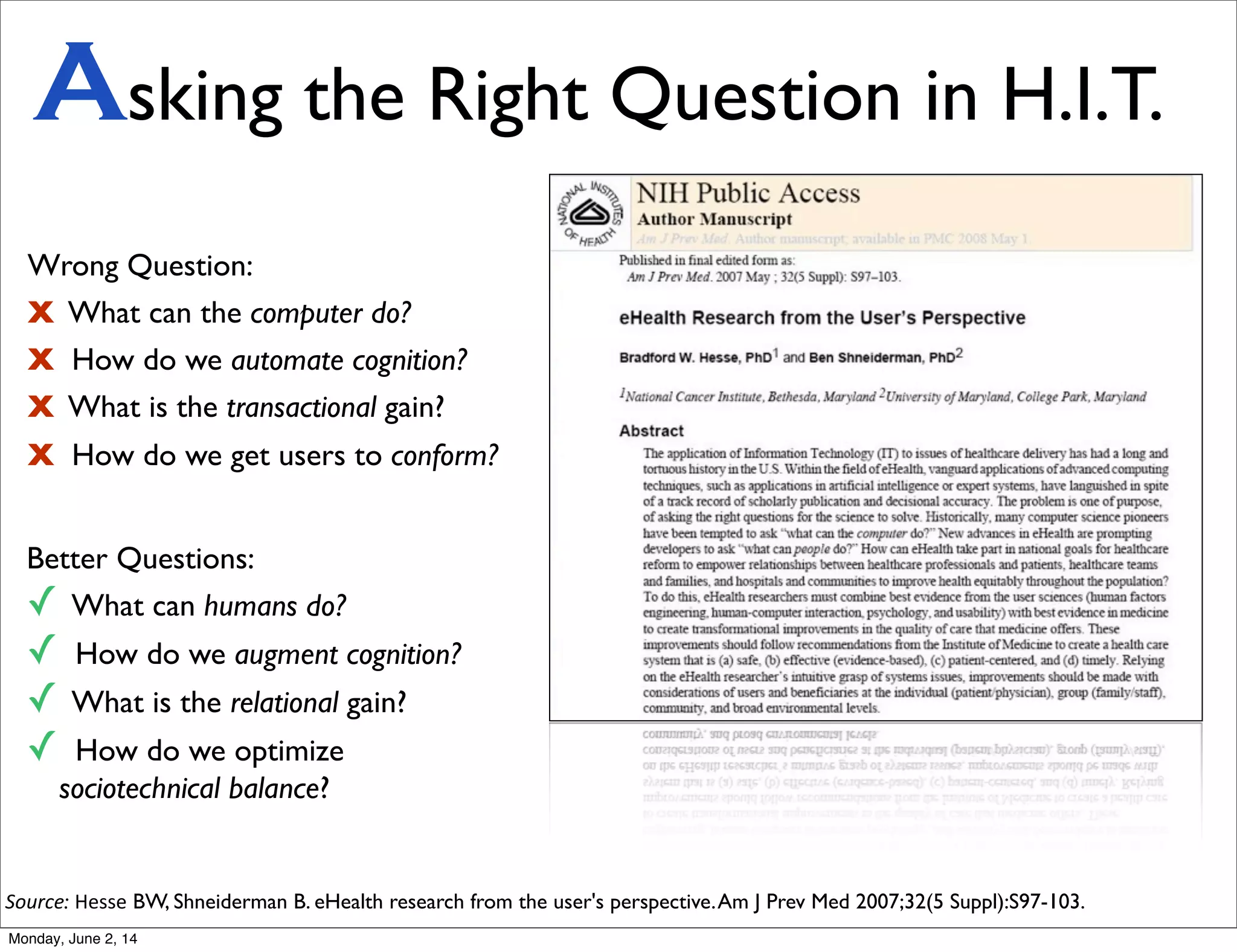
Wrong Question:
X What can the computer do?
X How do we automate cognition?
X What is the transactional gain?
X How do we get users to conform?
Better Questions:
✓ What can humans do?
✓ How do we augment cognition?
✓ What is the relational gain?
✓ How do we optimize
sociotechnical balance?
Source: Hesse BW, Shneiderman B. eHealth research from the user's perspective.Am J Prev Med 2007;32(5 Suppl):S97-103.
Asking the Right Question in H.I.T.
Monday, June 2, 14
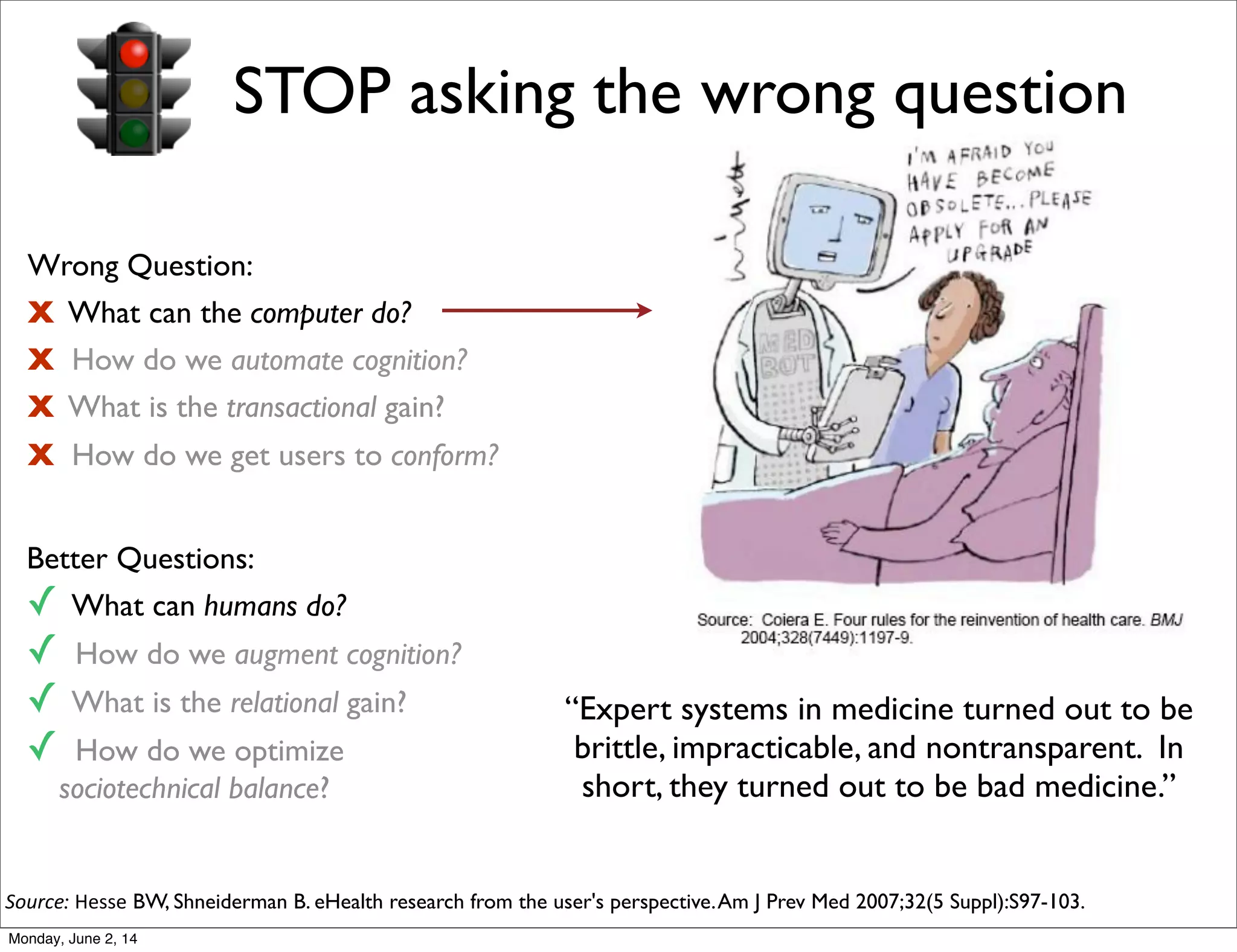
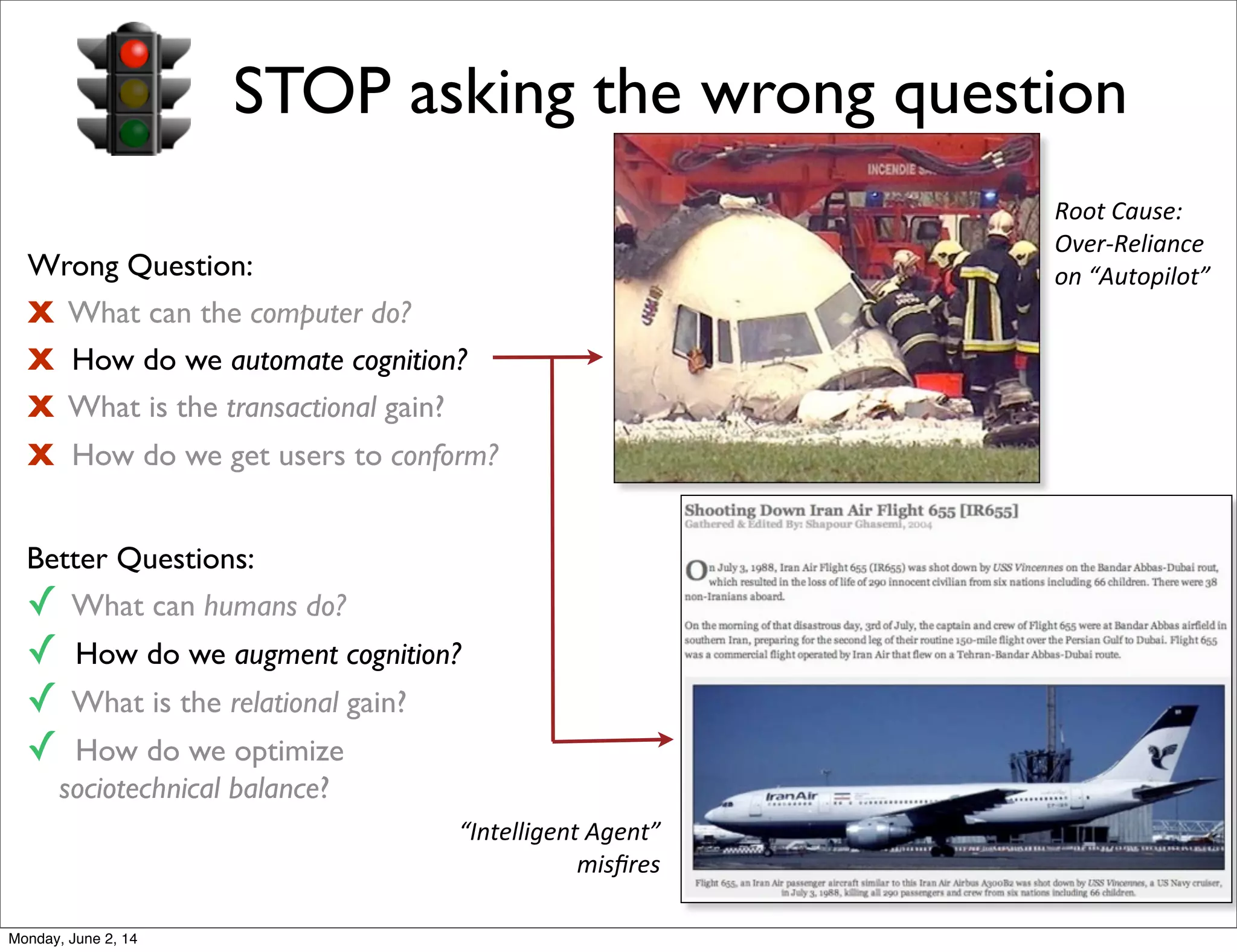
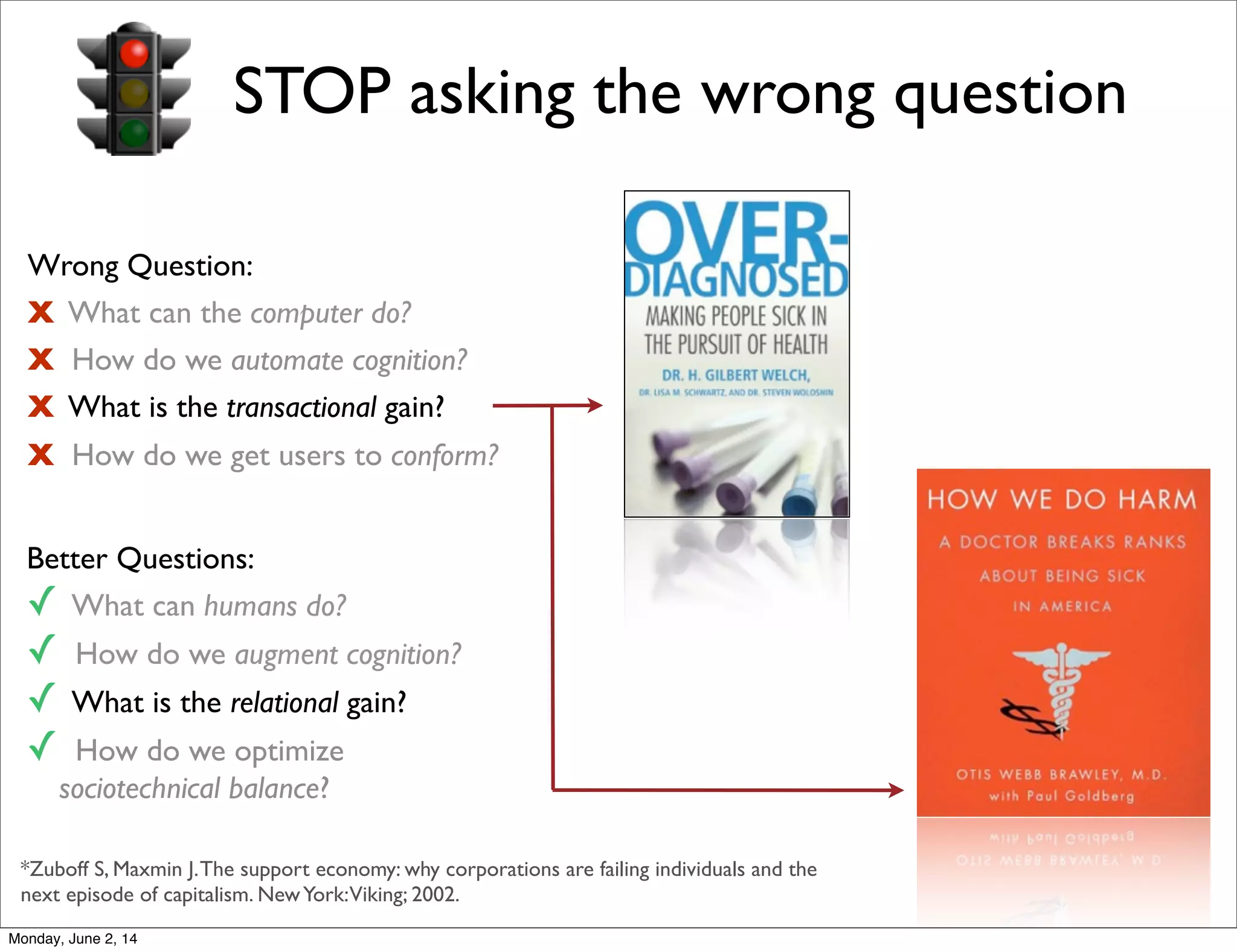
STOP asking the wrong question
Wrong Question:
X What can the computer do?
X How do we automate cognition?
X What is the transactional gain?
X How do we get users to conform?
Better Questions:
✓ What can humans do?
✓ How do we augment cognition?
✓ What is the relational gain?
✓ How do we optimize
sociotechnical balance?
“Expert systems in medicine turned out to be
brittle, impracticable, and nontransparent. In
short, they turned out to be bad medicine.”
Source: Hesse BW, Shneiderman B. eHealth research from the user's perspective.Am J Prev Med 2007;32(5 Suppl):S97-103.
Monday, June 2, 14
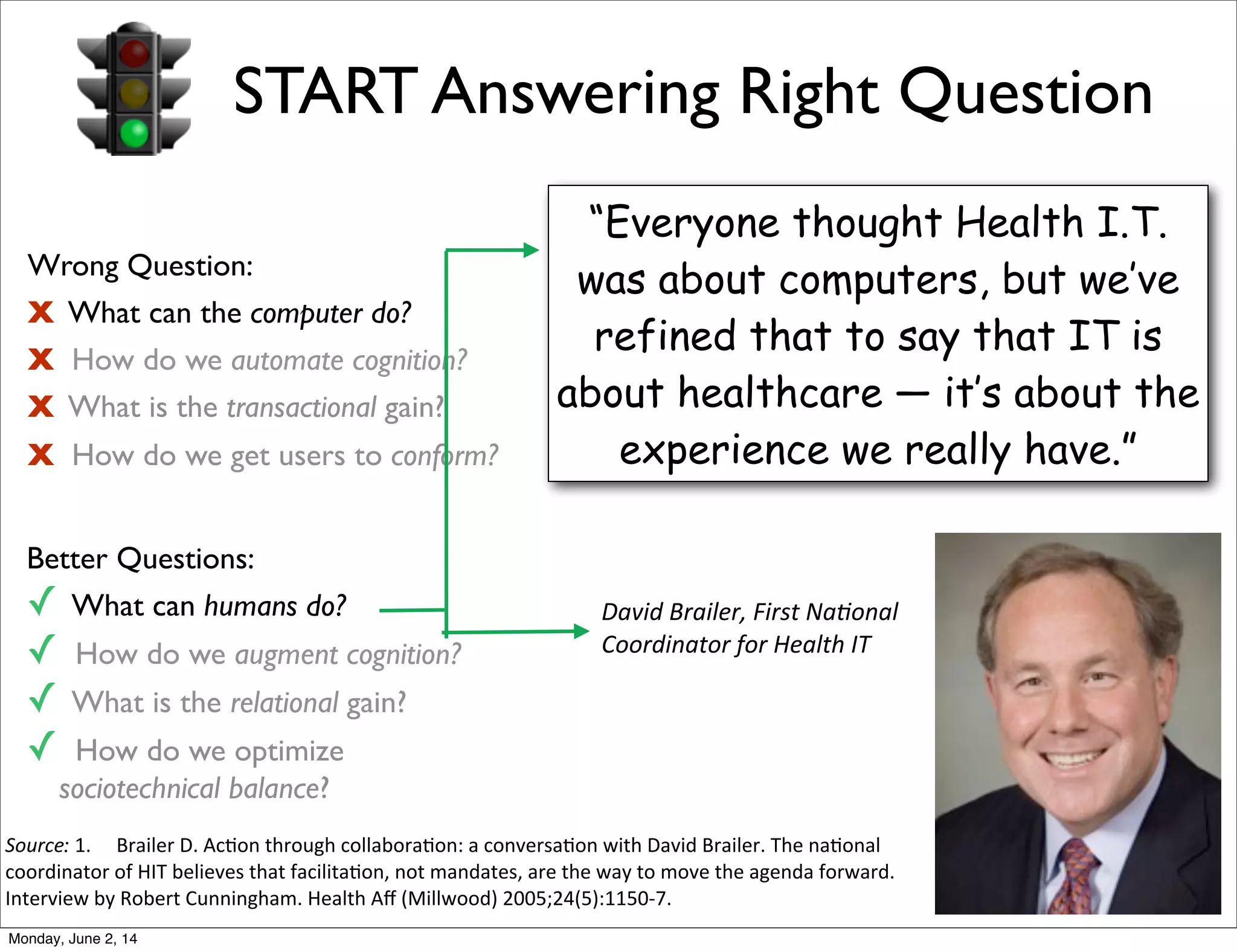
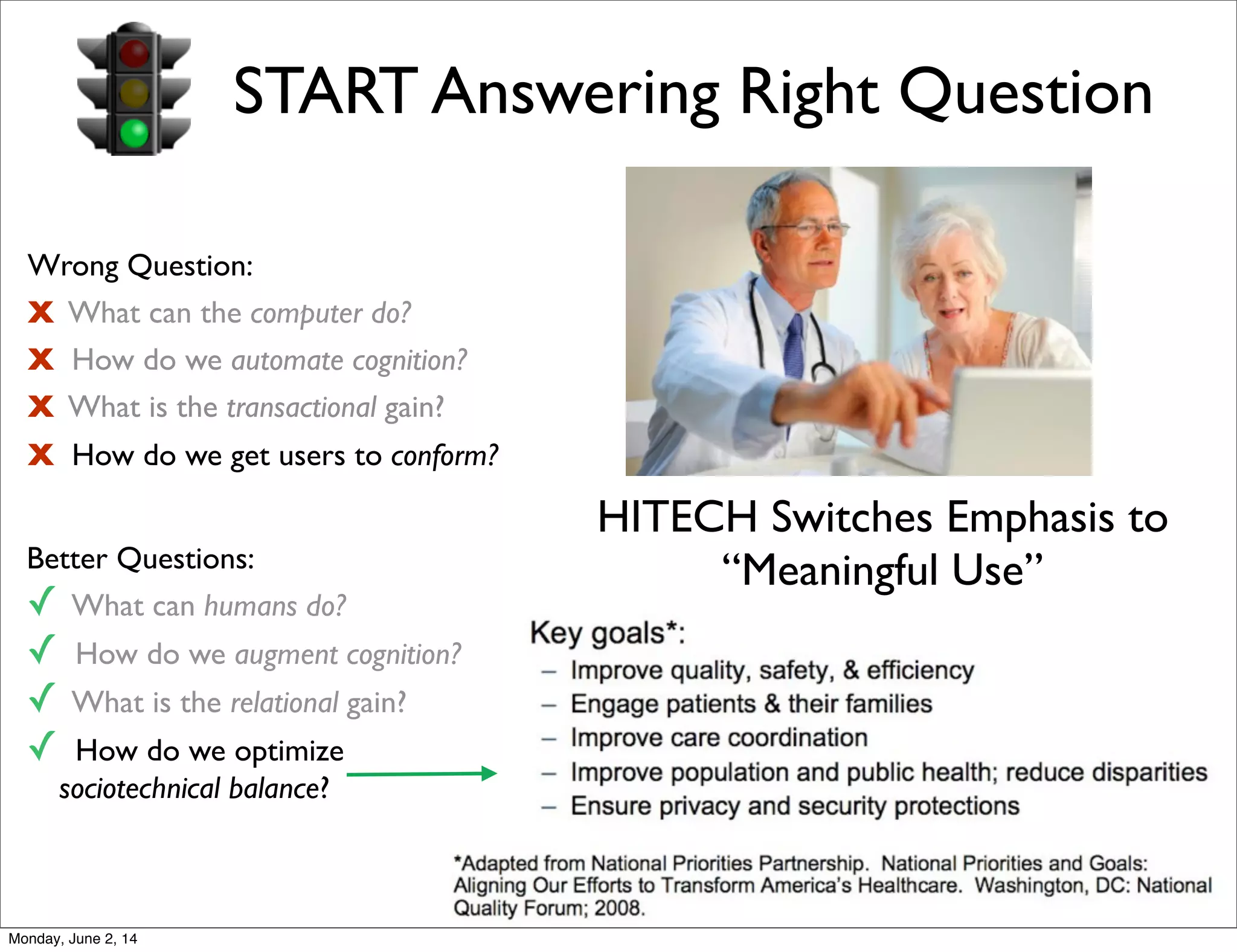
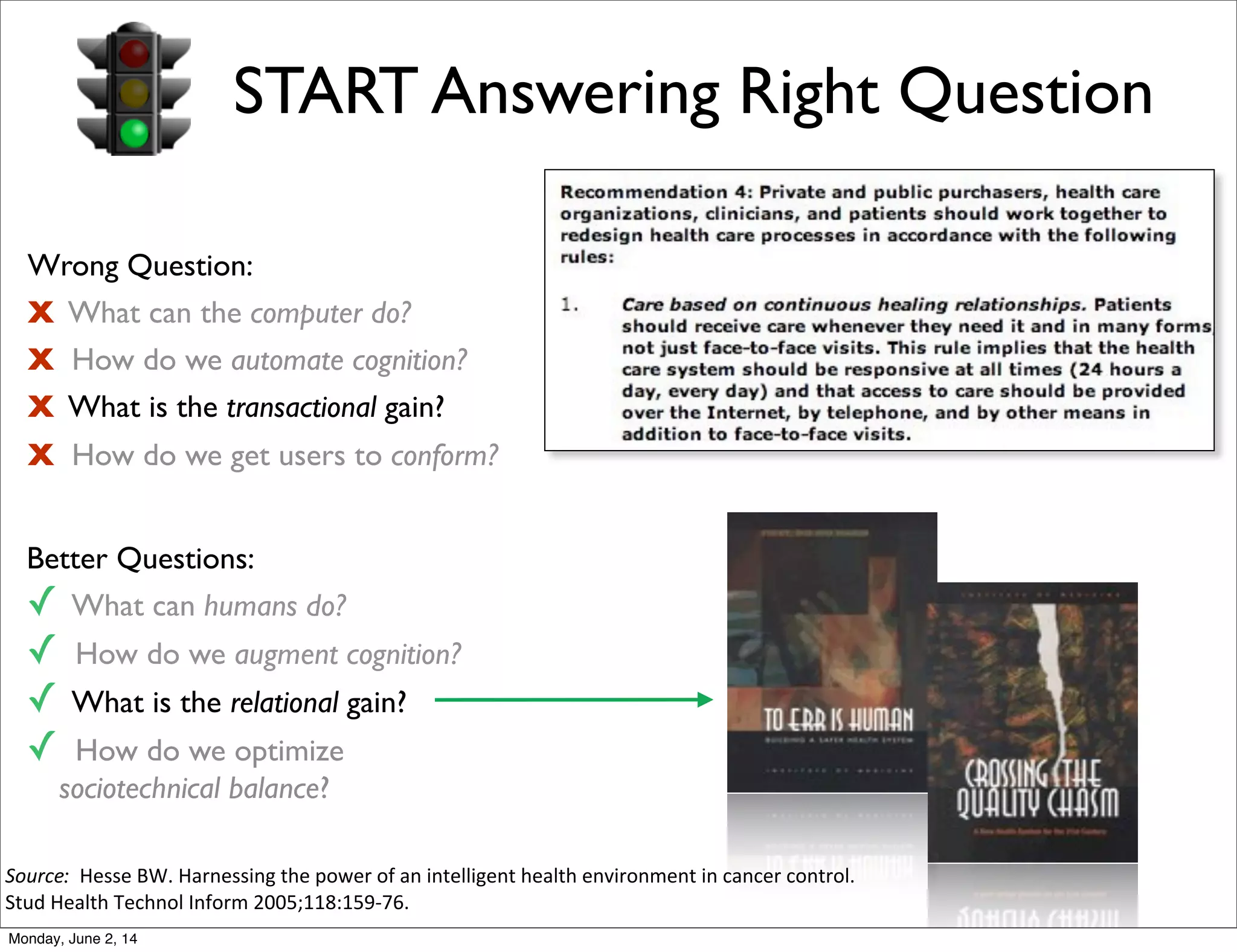
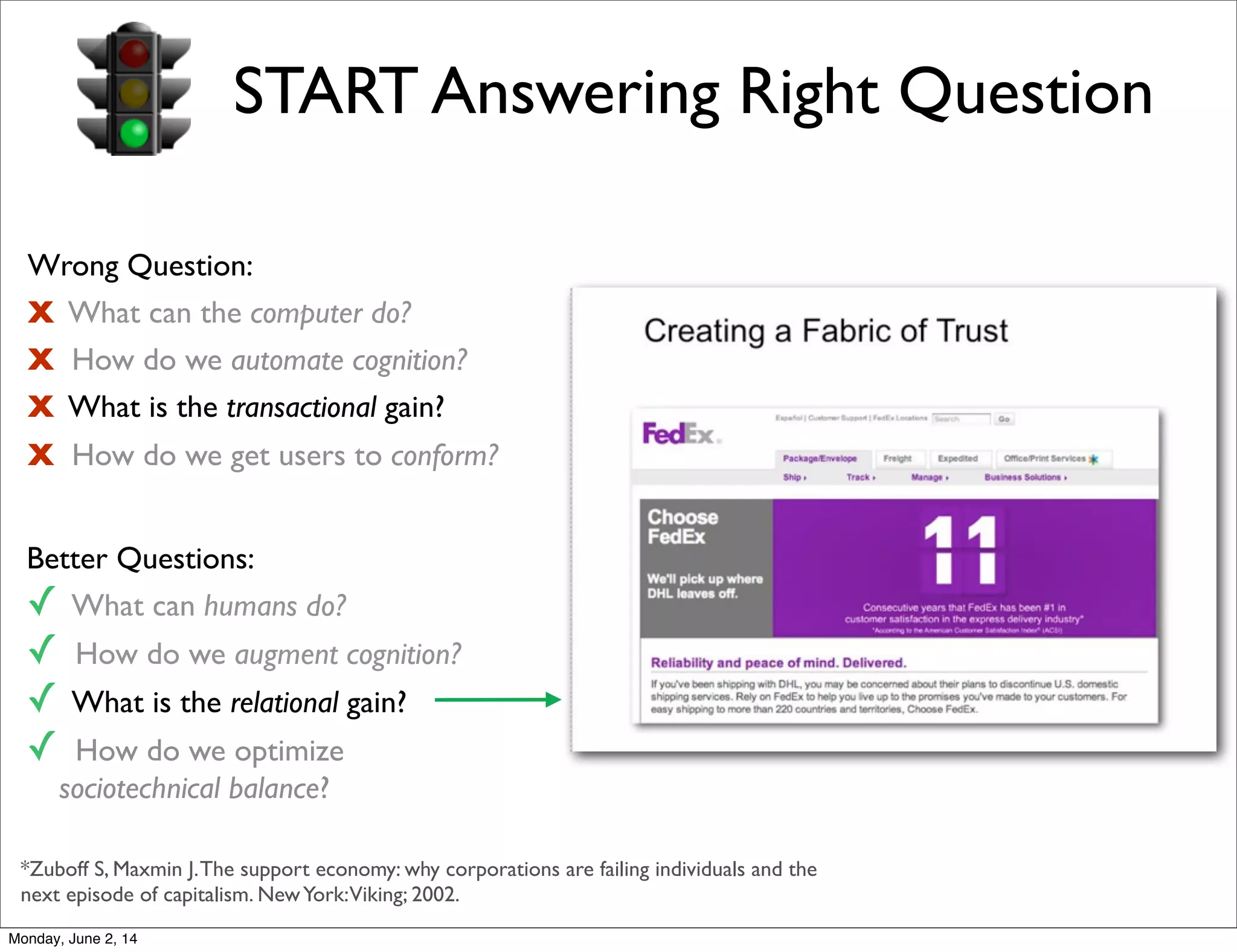
START Answering Right Question
Wrong Question:
X What can the computer do?
X How do we automate cognition?
X What is the transactional gain?
X How do we get users to conform?
Better Questions:
✓ What can humans do?
✓ How do we augment cognition?
✓ What is the relational gain?
✓ How do we optimize
sociotechnical balance?
David	
  Brailer,	
  First	
  Na4onal	
  
Coordinator	
  for	
  Health	
  IT	
  
“Everyone thought Health I.T.
was about computers, but we’ve
refined that to say that IT is
about healthcare — it’s about the
experience we really have.”
Source: 1.	
   Brailer	
  D.	
  Ac/on	
  through	
  collabora/on:	
  a	
  conversa/on	
  with	
  David	
  Brailer.	
  The	
  na/onal	
  
coordinator	
  of	
  HIT	
  believes	
  that	
  facilita/on,	
  not	
  mandates,	
  are	
  the	
  way	
  to	
  move	
  the	
  agenda	
  forward.	
  
Interview	
  by	
  Robert	
  Cunningham.	
  Health	
  Aff	
  (Millwood)	
  2005;24(5):1150-­‐7.
Monday, June 2, 14
STOP asking the wrong question
Wrong Question:
X What can the computer do?
X How do we automate cognition?
X What is the transactional gain?
X How do we get users to conform?
Better Questions:
✓ What can humans do?
✓ How do we augment cognition?
✓ What is the relational gain?
✓ How do we optimize
sociotechnical balance?
“Intelligent	
  Agent”	
  
misfires
Root	
  Cause:	
  
Over-­‐Reliance	
  
on	
  “Autopilot”	
  
Monday, June 2, 14
Wrong Question:
X What can the computer do?
X How do we automate cognition?
X What is the transactional gain?
X How do we get users to conform?
Better Questions:
✓ What can humans do?
✓ How do we augment cognition?
✓ What is the relational gain?
✓ How do we optimize
sociotechnical balance?
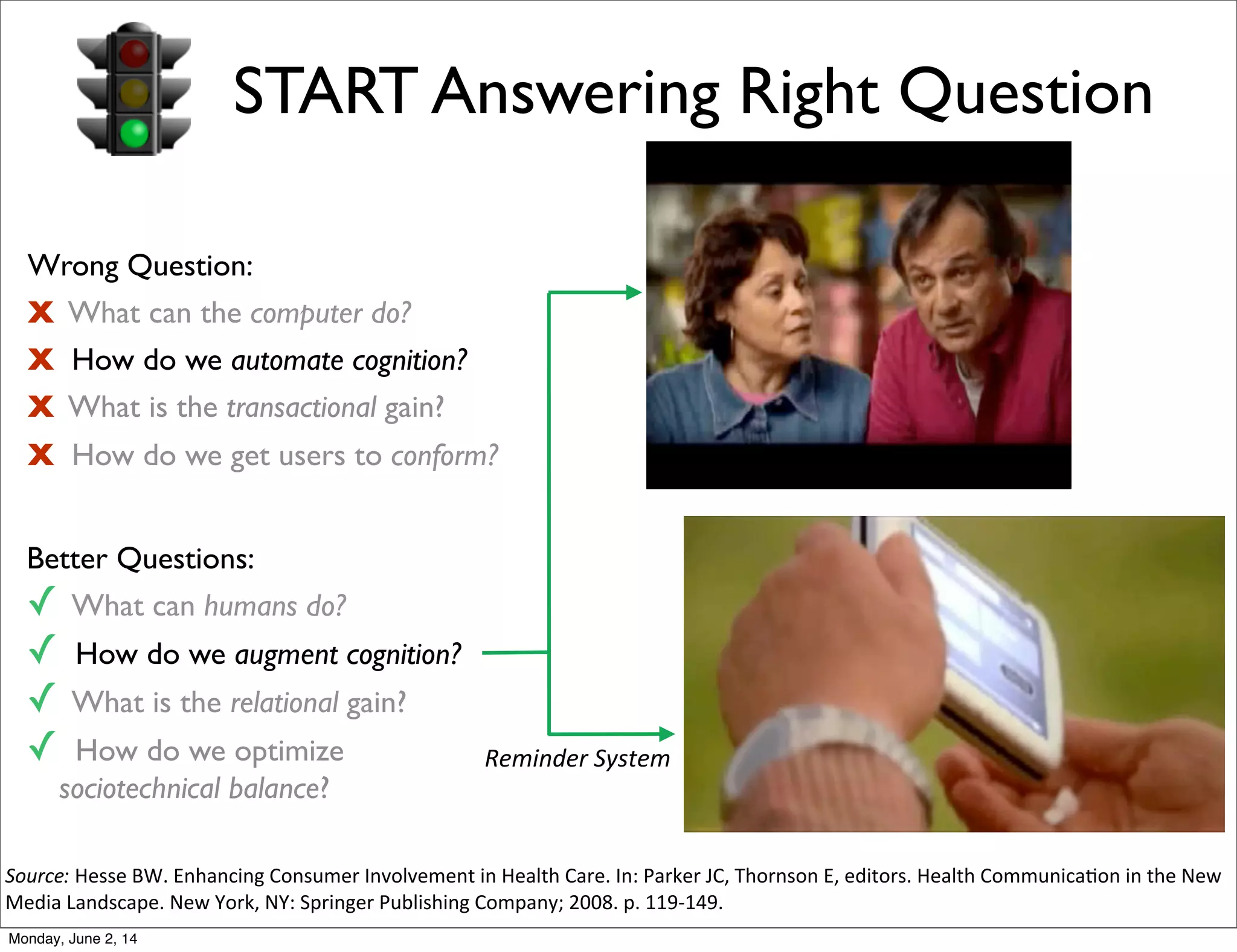
START Answering Right Question
Reminder	
  System
Source: Hesse	
  BW.	
  Enhancing	
  Consumer	
  Involvement	
  in	
  Health	
  Care.	
  In:	
  Parker	
  JC,	
  Thornson	
  E,	
  editors.	
  Health	
  Communica/on	
  in	
  the	
  New	
  
Media	
  Landscape.	
  New	
  York,	
  NY:	
  Springer	
  Publishing	
  Company;	
  2008.	
  p.	
  119-­‐149.
Monday, June 2, 14
STOP asking the wrong question
Wrong Question:
X What can the computer do?
X How do we automate cognition?
X What is the transactional gain?
X How do we get users to conform?
Better Questions:
✓ What can humans do?
✓ How do we augment cognition?
✓ What is the relational gain?
✓ How do we optimize
sociotechnical balance?
*Zuboff S, Maxmin J.The support economy: why corporations are failing individuals and the
next episode of capitalism. NewYork:Viking; 2002.
Monday, June 2, 14
Wrong Question:
X What can the computer do?
X How do we automate cognition?
X What is the transactional gain?
X How do we get users to conform?
Better Questions:
✓ What can humans do?
✓ How do we augment cognition?
✓ What is the relational gain?
✓ How do we optimize
sociotechnical balance?
START Answering Right Question
Source: 	
  Hesse	
  BW.	
  Harnessing	
  the	
  power	
  of	
  an	
  intelligent	
  health	
  environment	
  in	
  cancer	
  control.	
  
Stud	
  Health	
  Technol	
  Inform	
  2005;118:159-­‐76.
.Monday, June 2, 14
Wrong Question:
X What can the computer do?
X How do we automate cognition?
X What is the transactional gain?
X How do we get users to conform?
Better Questions:
✓ What can humans do?
✓ How do we augment cognition?
✓ What is the relational gain?
✓ How do we optimize
sociotechnical balance?
START Answering Right Question
*Zuboff S, Maxmin J.The support economy: why corporations are failing individuals and the
next episode of capitalism. NewYork:Viking; 2002.
Monday, June 2, 14
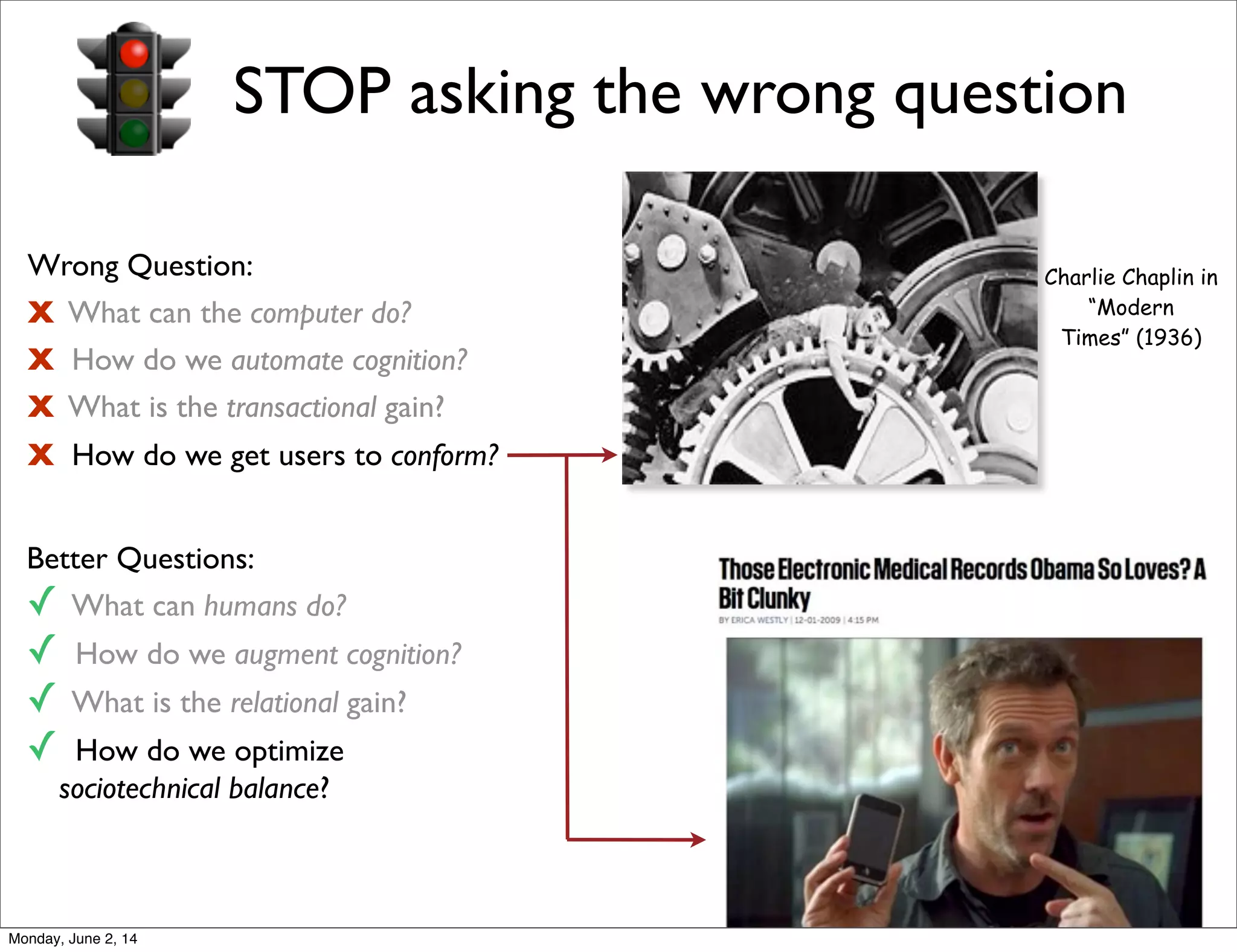
STOP asking the wrong question
Wrong Question:
X What can the computer do?
X How do we automate cognition?
X What is the transactional gain?
X How do we get users to conform?
Better Questions:
✓ What can humans do?
✓ How do we augment cognition?
✓ What is the relational gain?
✓ How do we optimize
sociotechnical balance?
Charlie Chaplin in
“Modern
Times” (1936)
Monday, June 2, 14
Wrong Question:
X What can the computer do?
X How do we automate cognition?
X What is the transactional gain?
X How do we get users to conform?
Better Questions:
✓ What can humans do?
✓ How do we augment cognition?
✓ What is the relational gain?
✓ How do we optimize
sociotechnical balance?
START Answering Right Question
HITECH Switches Emphasis to
“Meaningful Use”
Monday, June 2, 14
Wrong Question:
X What can the computer do?
X How do we automate cognition?
X What is the transactional gain?
X How do we get users to conform?
Better Questions:
✓ What can humans do?
✓ How do we augment cognition?
✓ What is the relational gain?
✓ How do we optimize
sociotechnical balance?
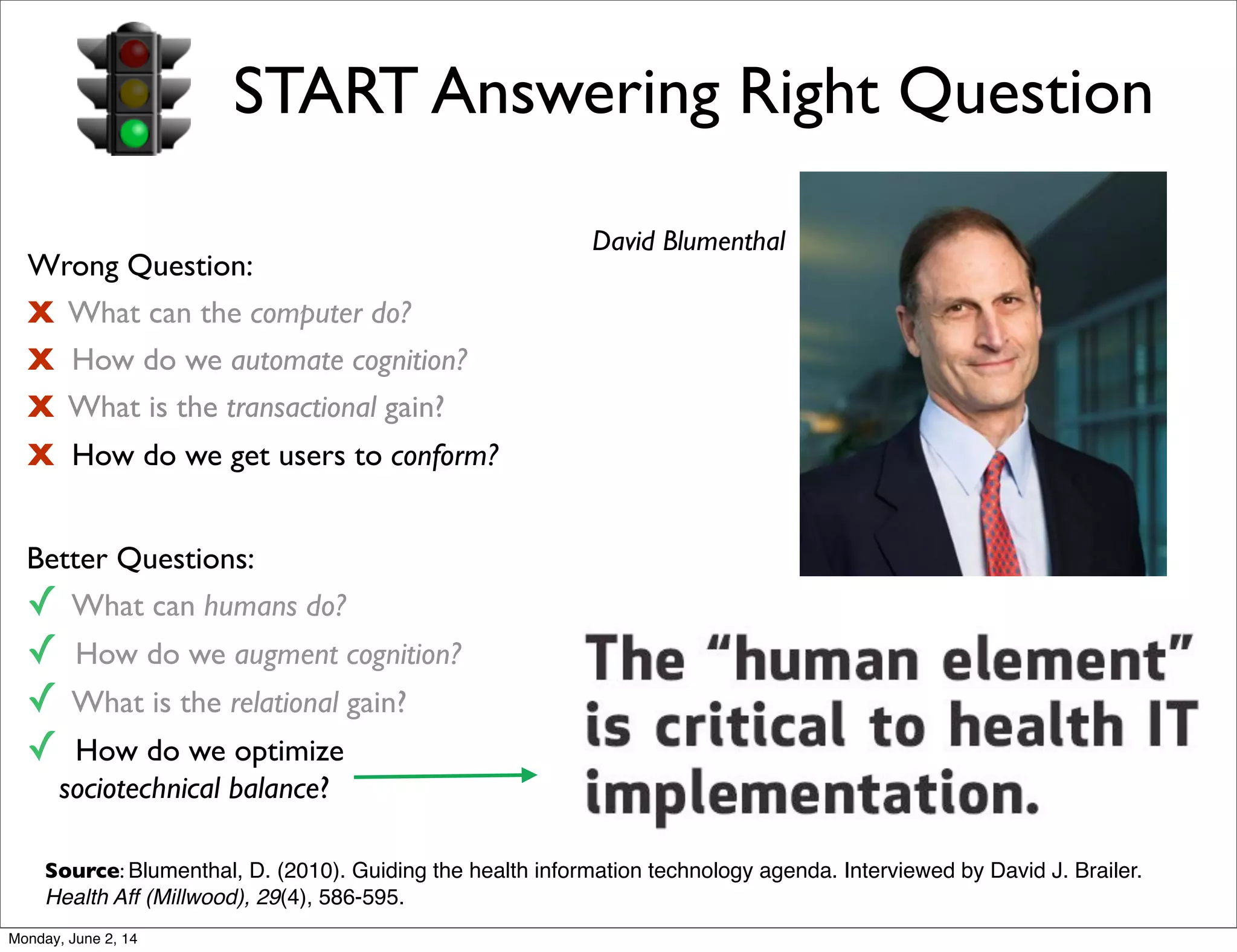
START Answering Right Question
Source: Blumenthal, D. (2010). Guiding the health information technology agenda. Interviewed by David J. Brailer.
Health Aff (Millwood), 29(4), 586-595.
David Blumenthal
Monday, June 2, 14
Research on
Communicating Data
Monday, June 2, 14
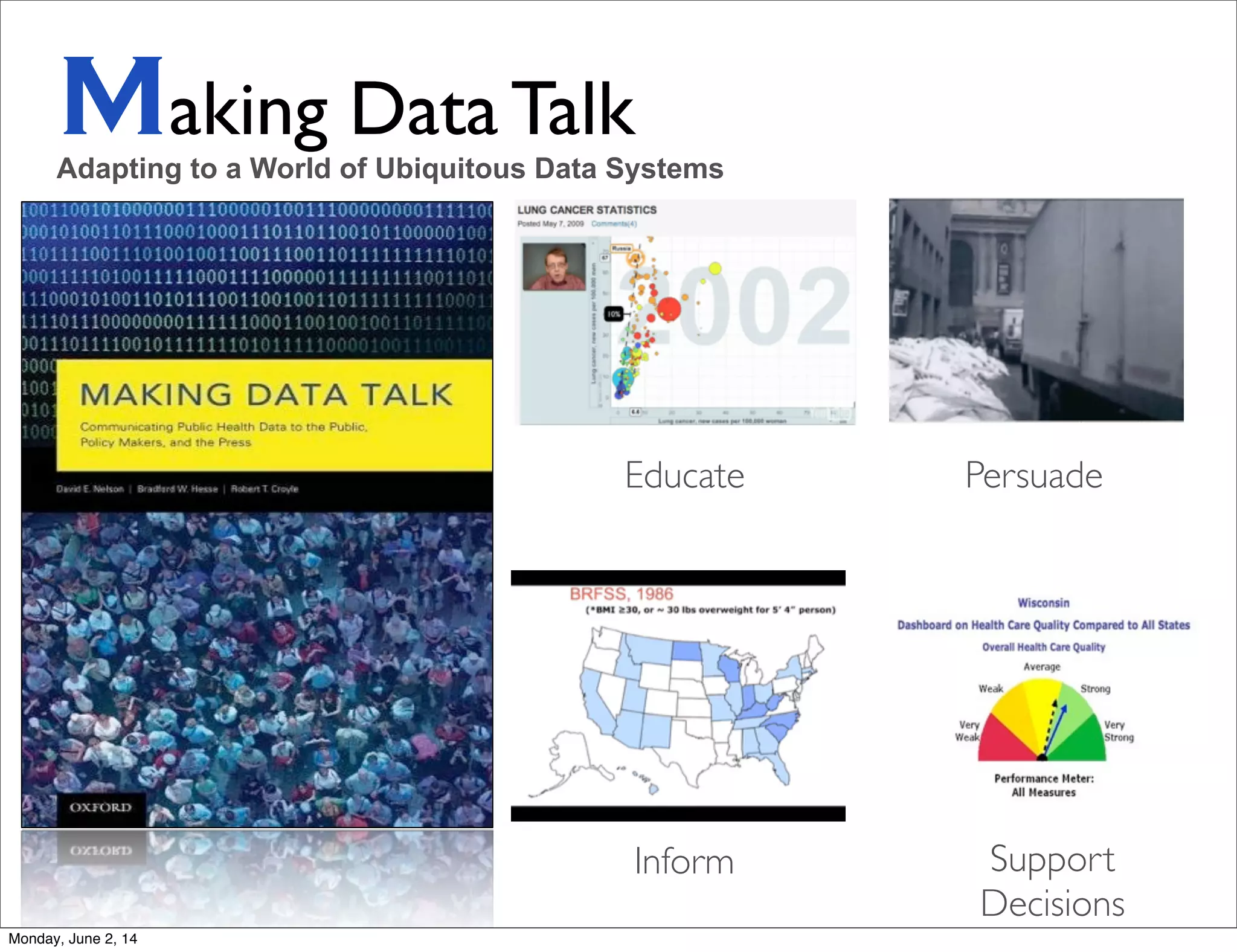
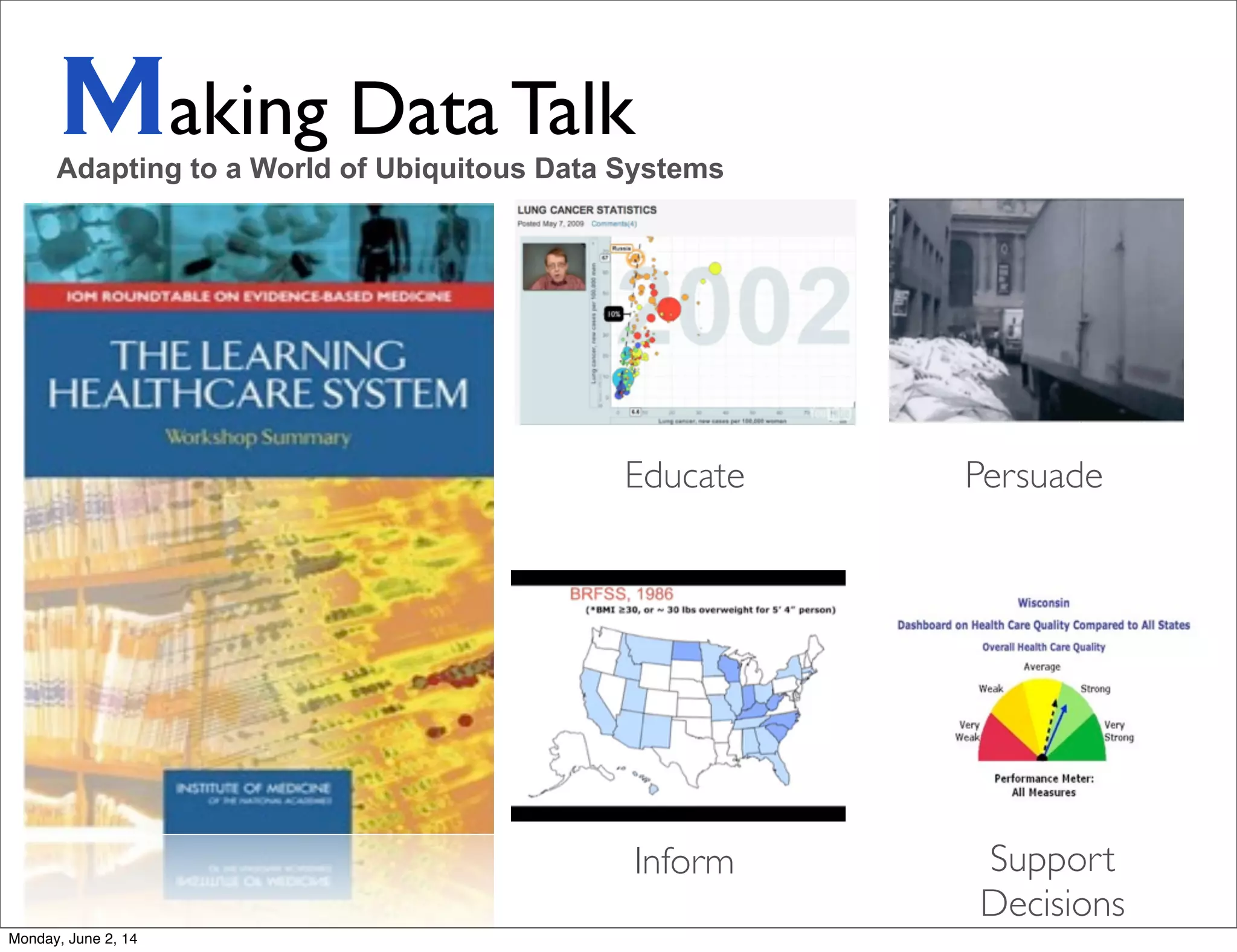
Making Data Talk
Inform Support
Decisions
Educate Persuade
Adapting to a World of Ubiquitous Data Systems
Monday, June 2, 14
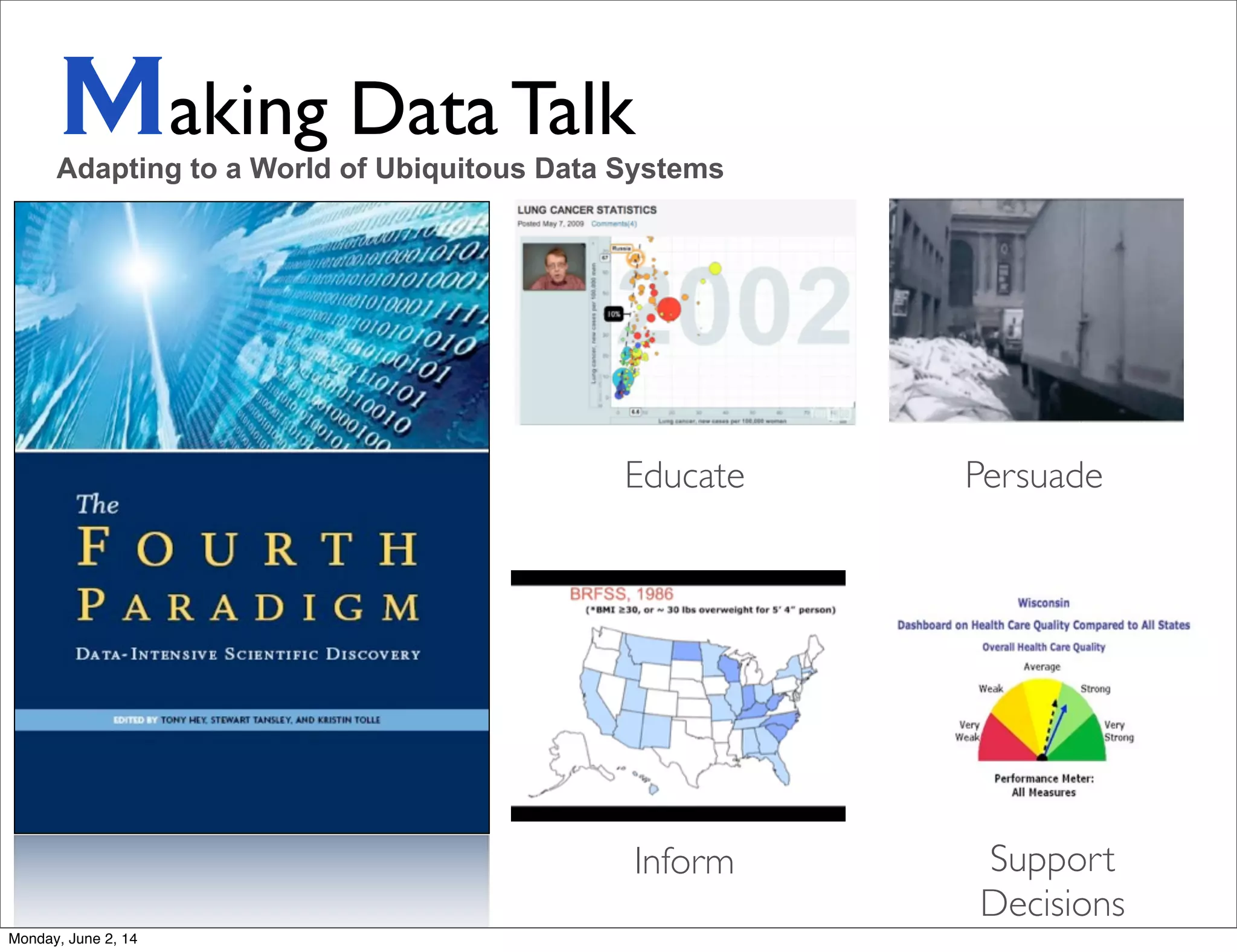
Making Data Talk
Inform Support
Decisions
Educate Persuade
Adapting to a World of Ubiquitous Data Systems
Monday, June 2, 14
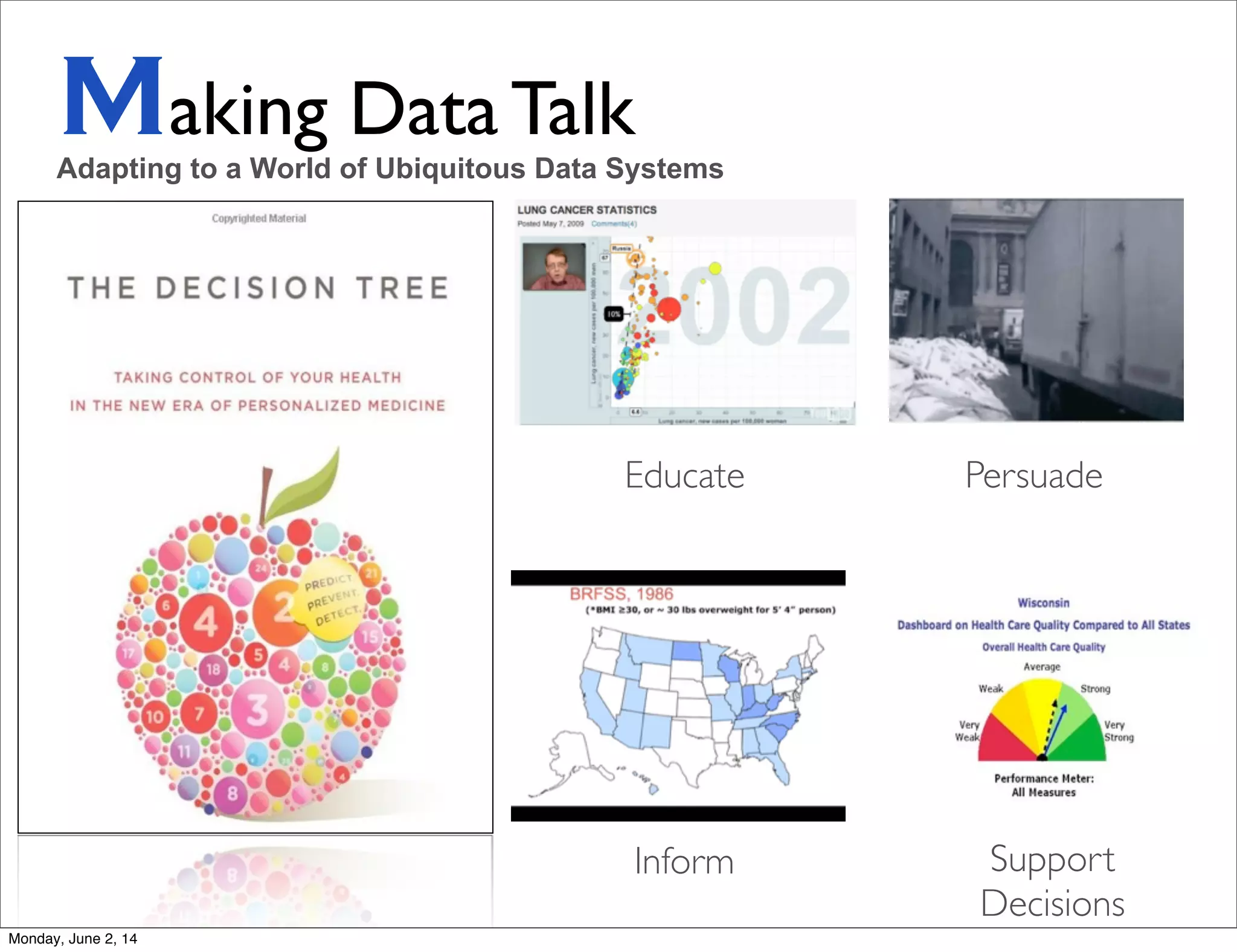
Making Data Talk
Inform Support
Decisions
Educate Persuade
Adapting to a World of Ubiquitous Data Systems
Monday, June 2, 14
Making Data Talk
Inform Support
Decisions
Educate Persuade
Adapting to a World of Ubiquitous Data Systems
Monday, June 2, 14
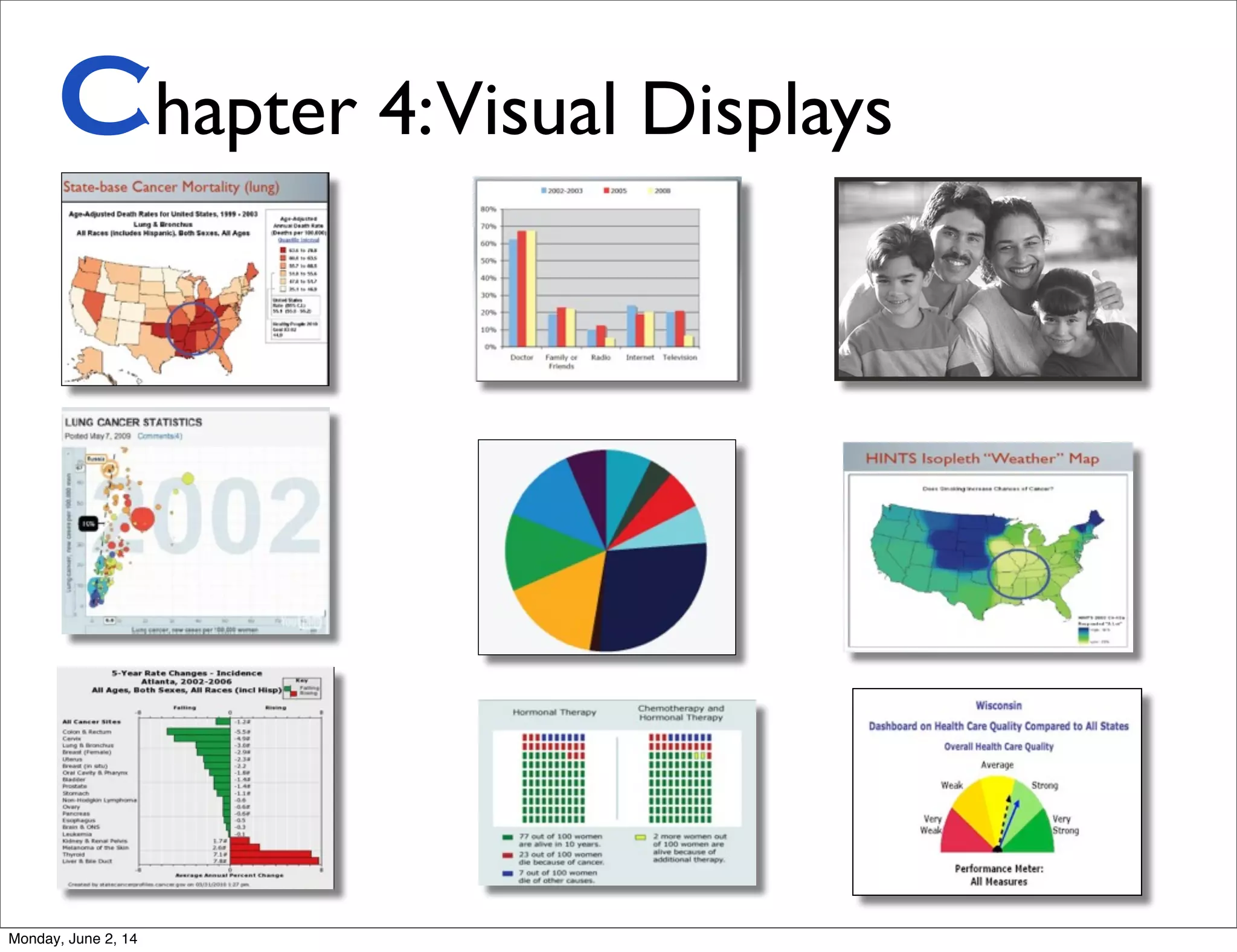
Chapter 4:Visual Displays
Monday, June 2, 14
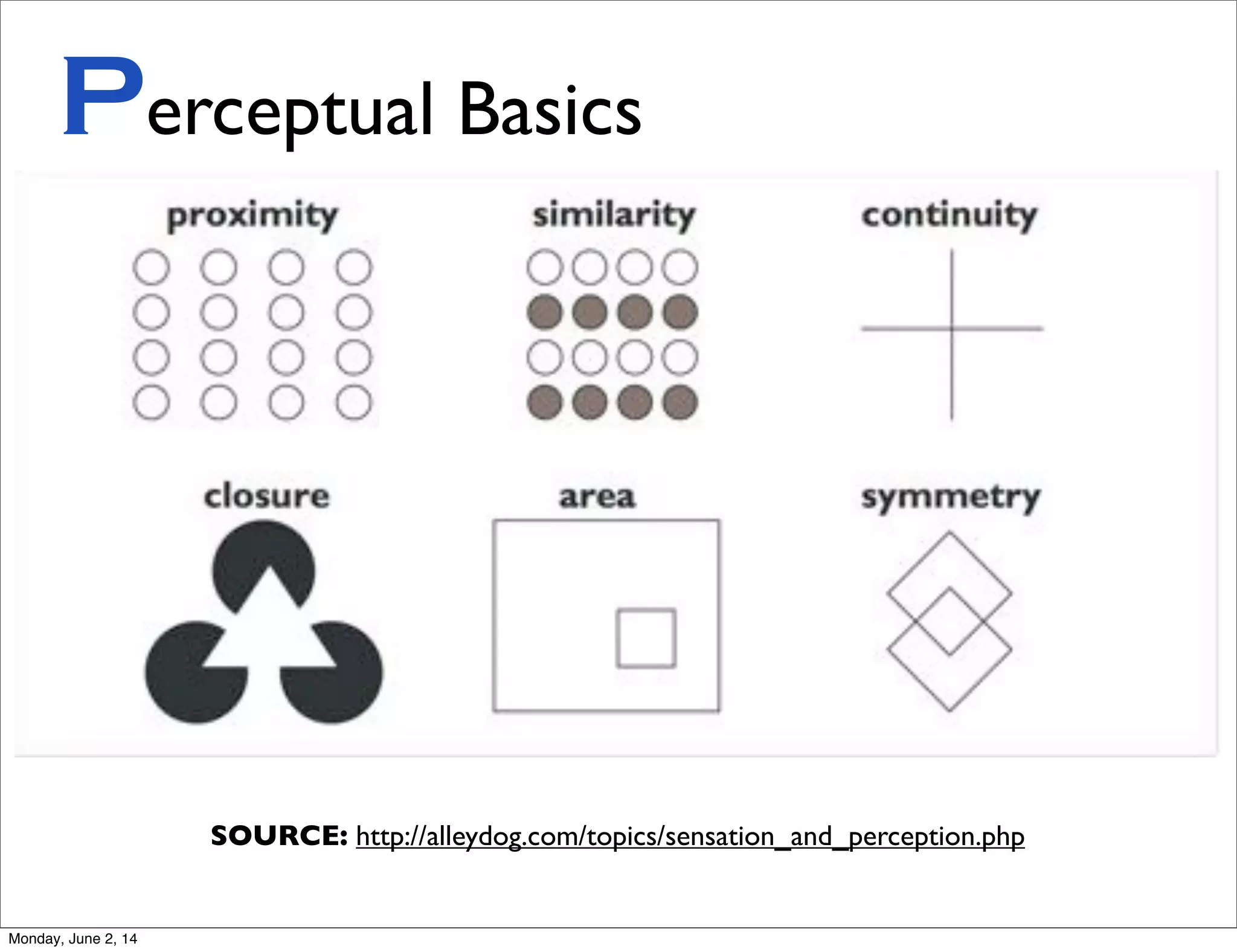
SOURCE: http://alleydog.com/topics/sensation_and_perception.php
Perceptual Basics
Monday, June 2, 14
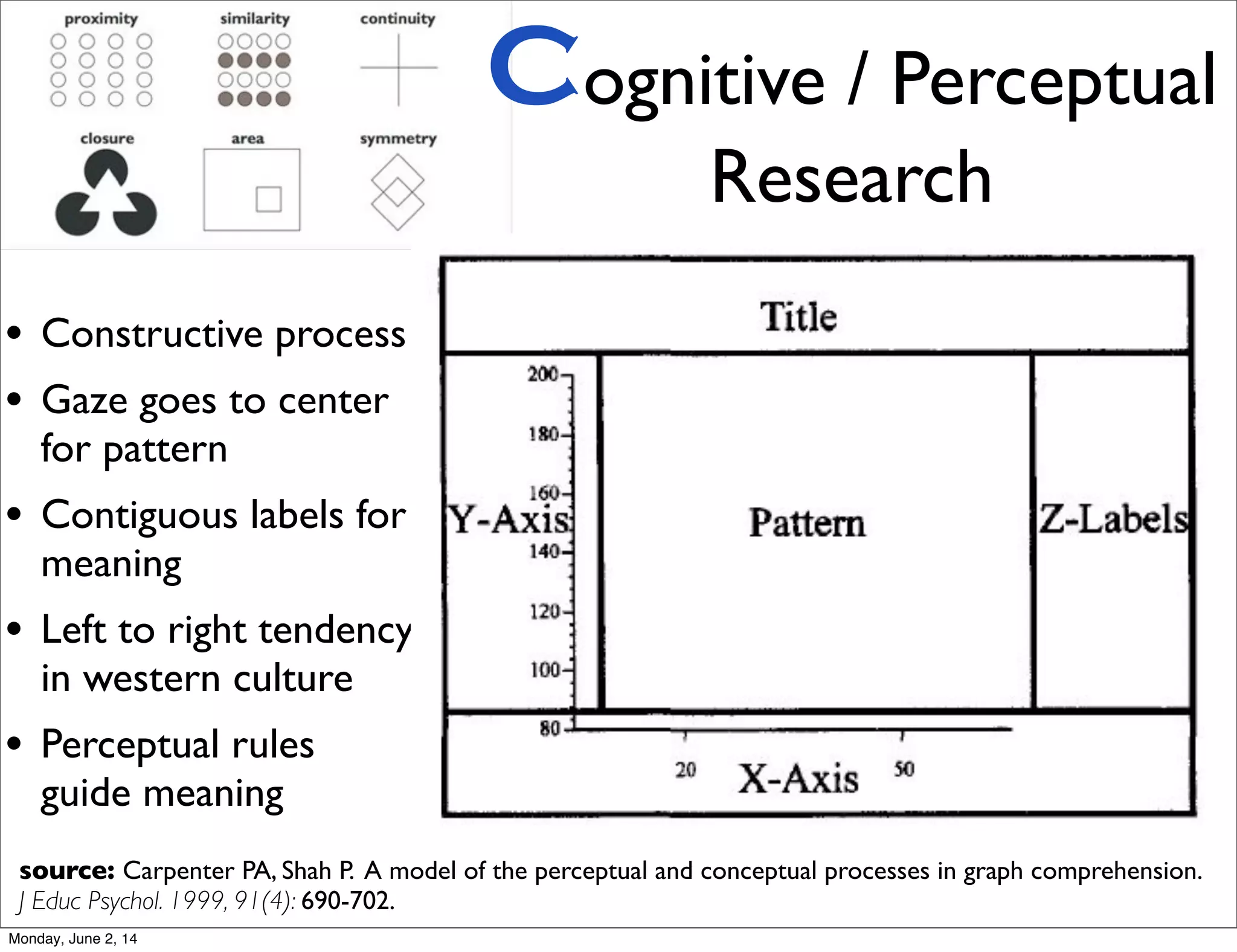
source: Carpenter PA, Shah P. A model of the perceptual and conceptual processes in graph comprehension.
J Educ Psychol. 1999, 91(4): 690-702.
• Constructive process
• Gaze goes to center
for pattern
• Contiguous labels for
meaning
• Left to right tendency
in western culture
• Perceptual rules
guide meaning
Cognitive / Perceptual
Research
Monday, June 2, 14
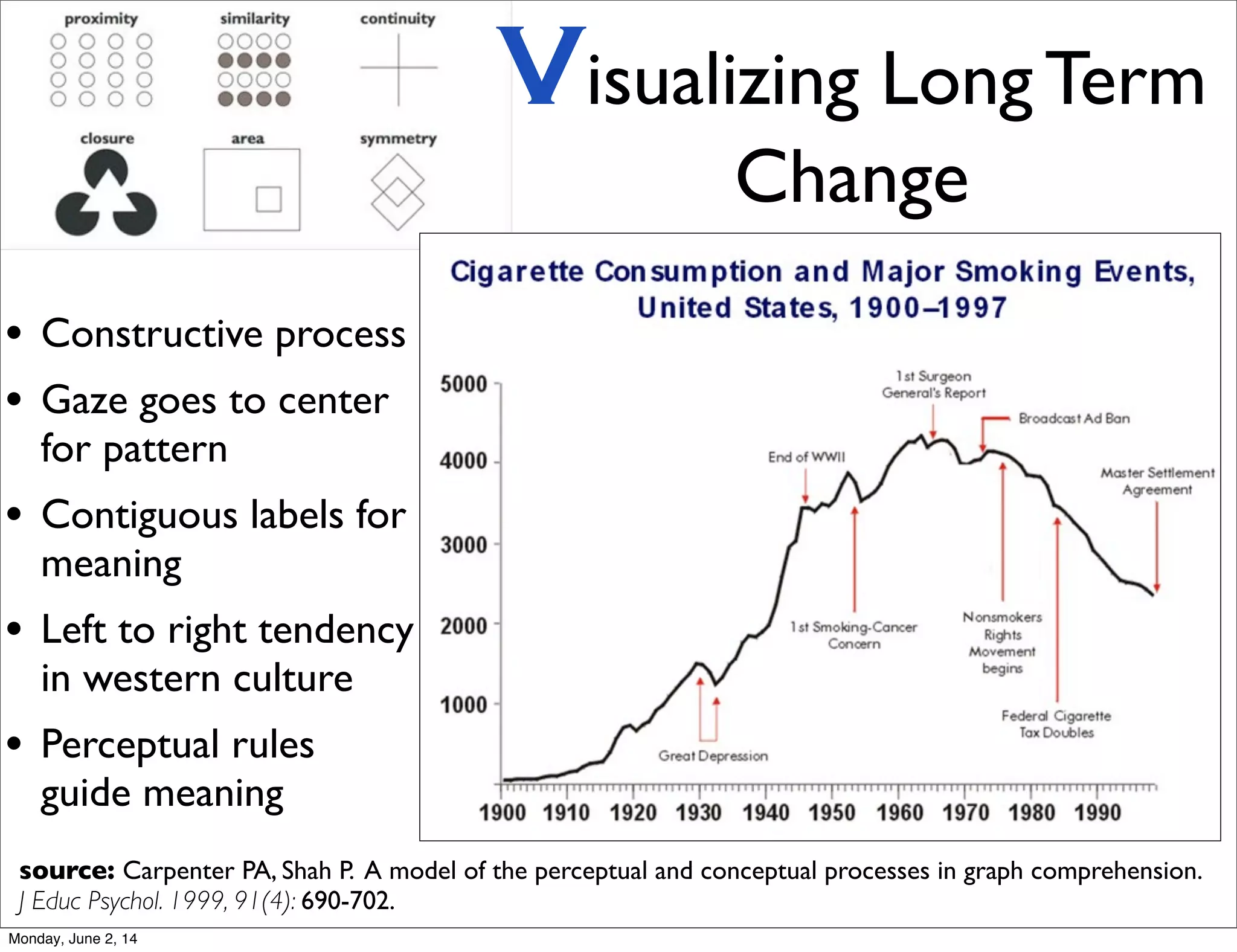
source: Carpenter PA, Shah P. A model of the perceptual and conceptual processes in graph comprehension.
J Educ Psychol. 1999, 91(4): 690-702.
• Constructive process
• Gaze goes to center
for pattern
• Contiguous labels for
meaning
• Left to right tendency
in western culture
• Perceptual rules
guide meaning
Visualizing Long Term
Change
Monday, June 2, 14
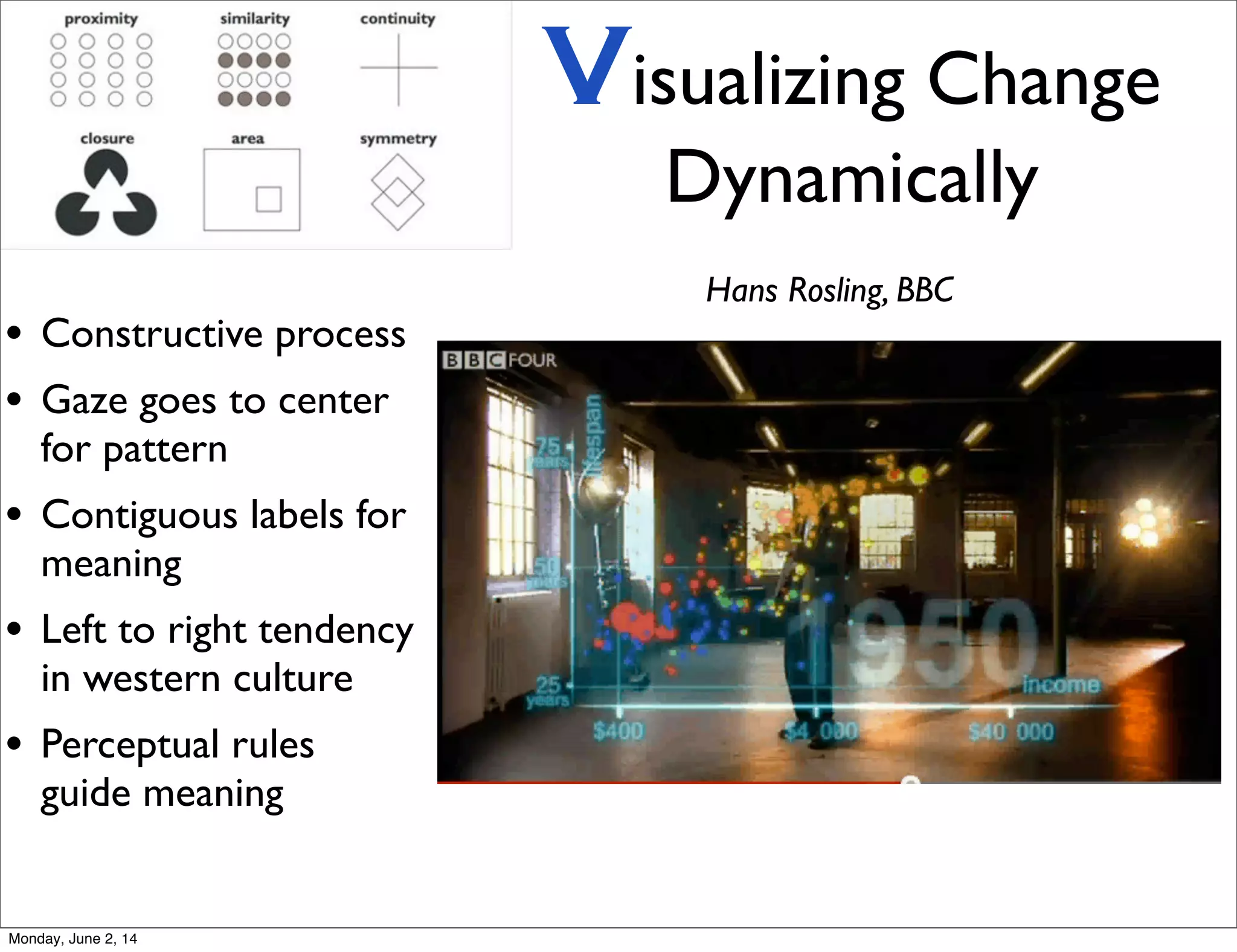
• Constructive process
• Gaze goes to center
for pattern
• Contiguous labels for
meaning
• Left to right tendency
in western culture
• Perceptual rules
guide meaning
Hans Rosling, BBC
Visualizing Change
Dynamically
Monday, June 2, 14
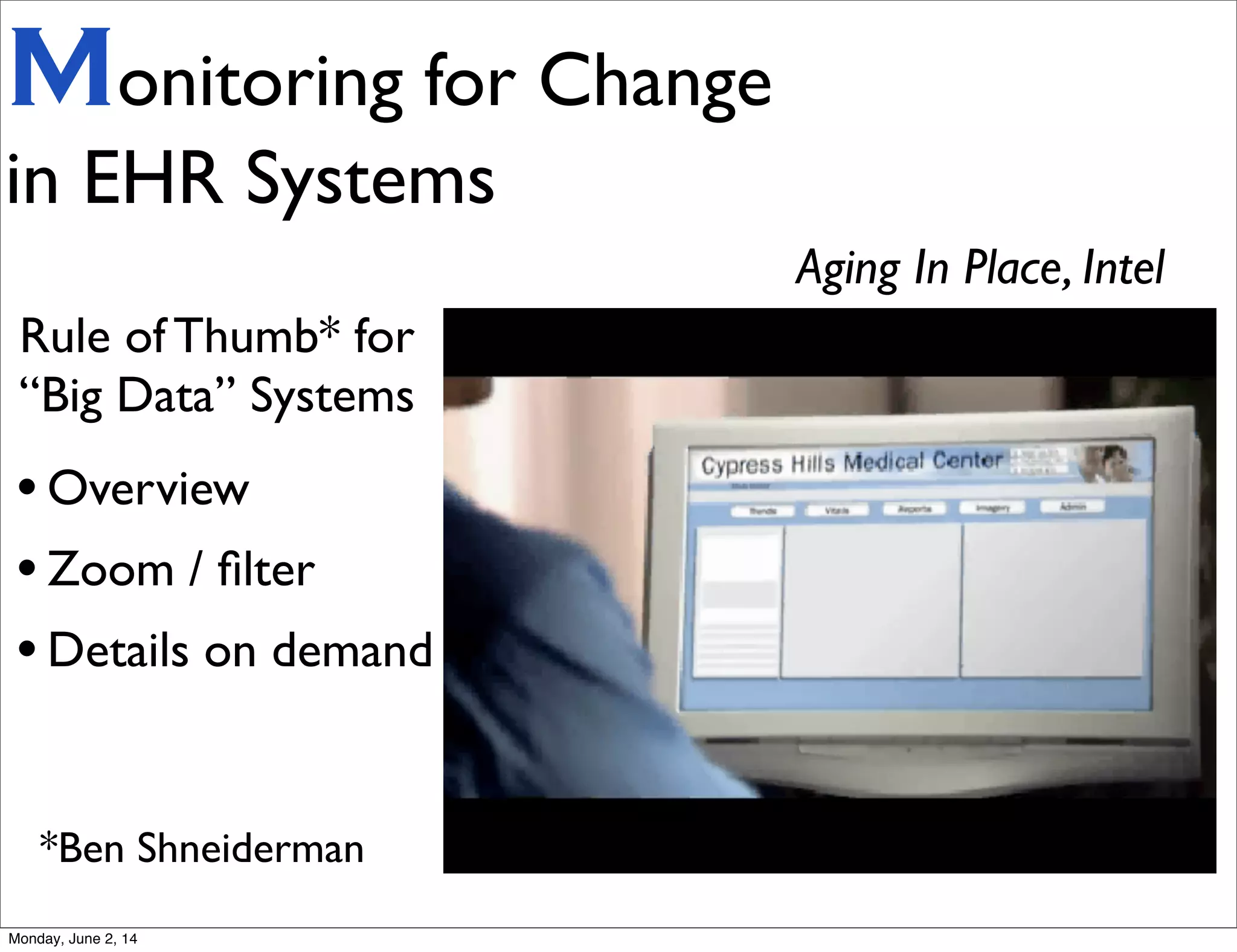
Monitoring for Change
in EHR Systems
Aging In Place, Intel
Rule of Thumb* for
“Big Data” Systems
•Overview
•Zoom / filter
•Details on demand
*Ben Shneiderman
Monday, June 2, 14
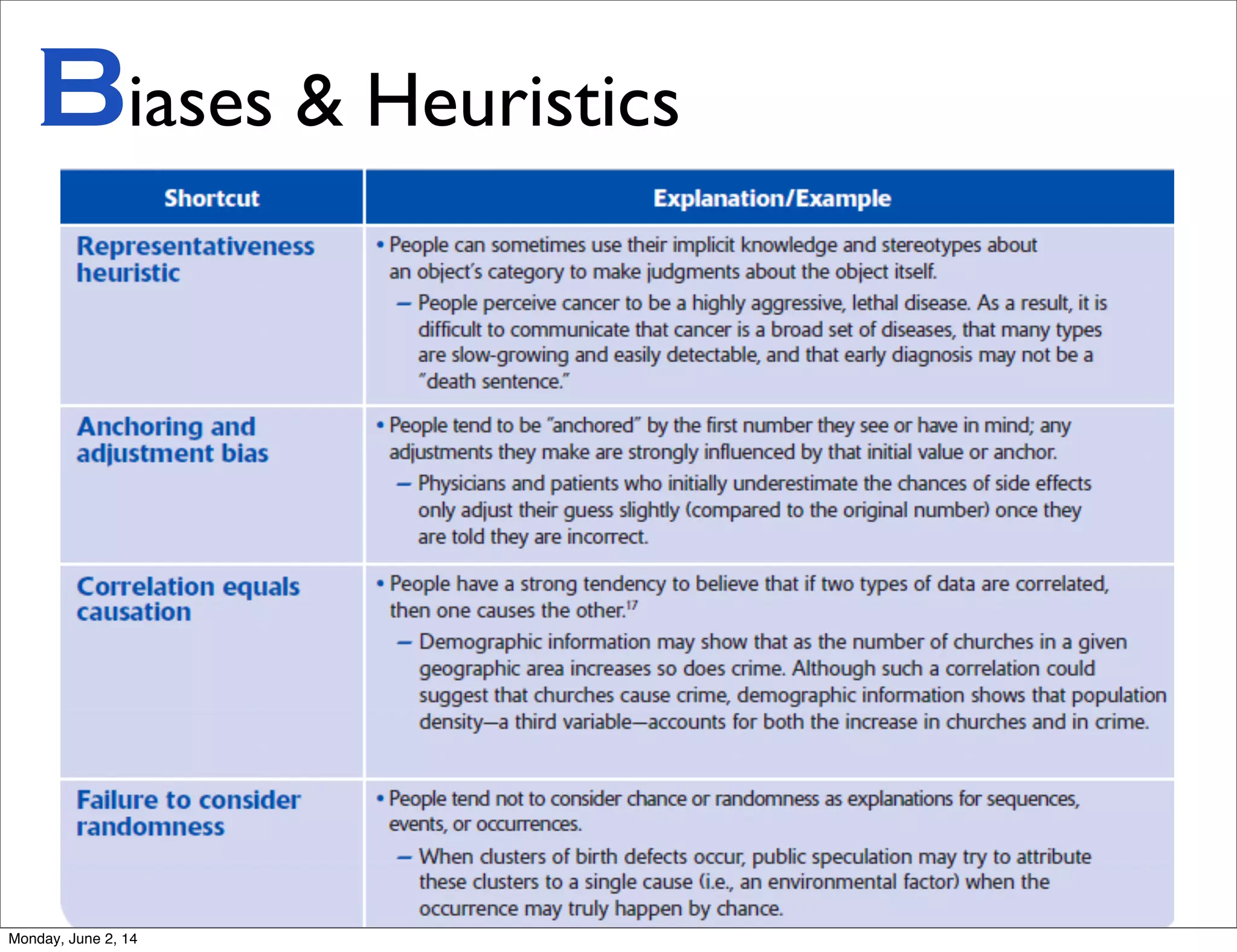
Biases & Heuristics
Monday, June 2, 14
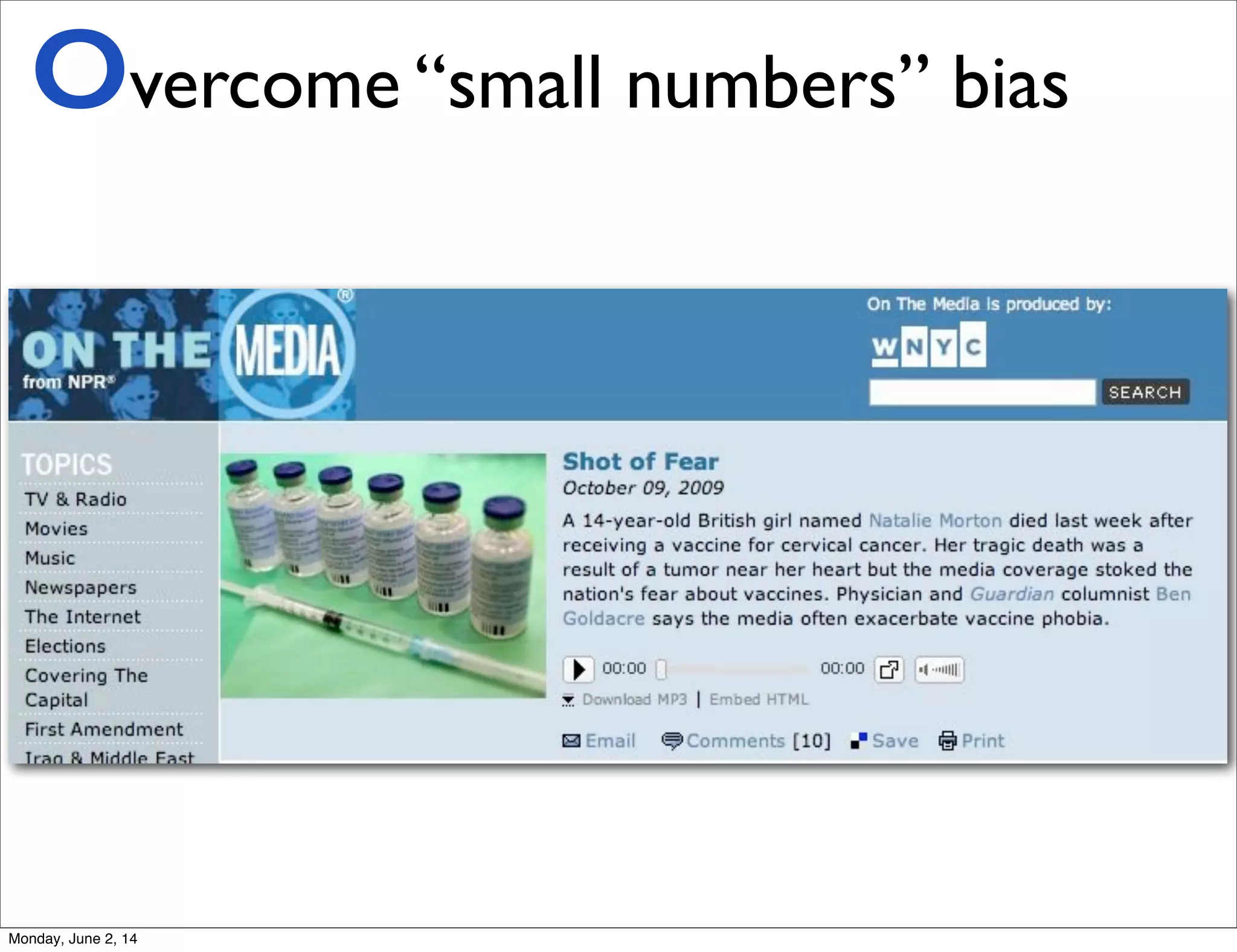
Overcome “small numbers” bias
Monday, June 2, 14
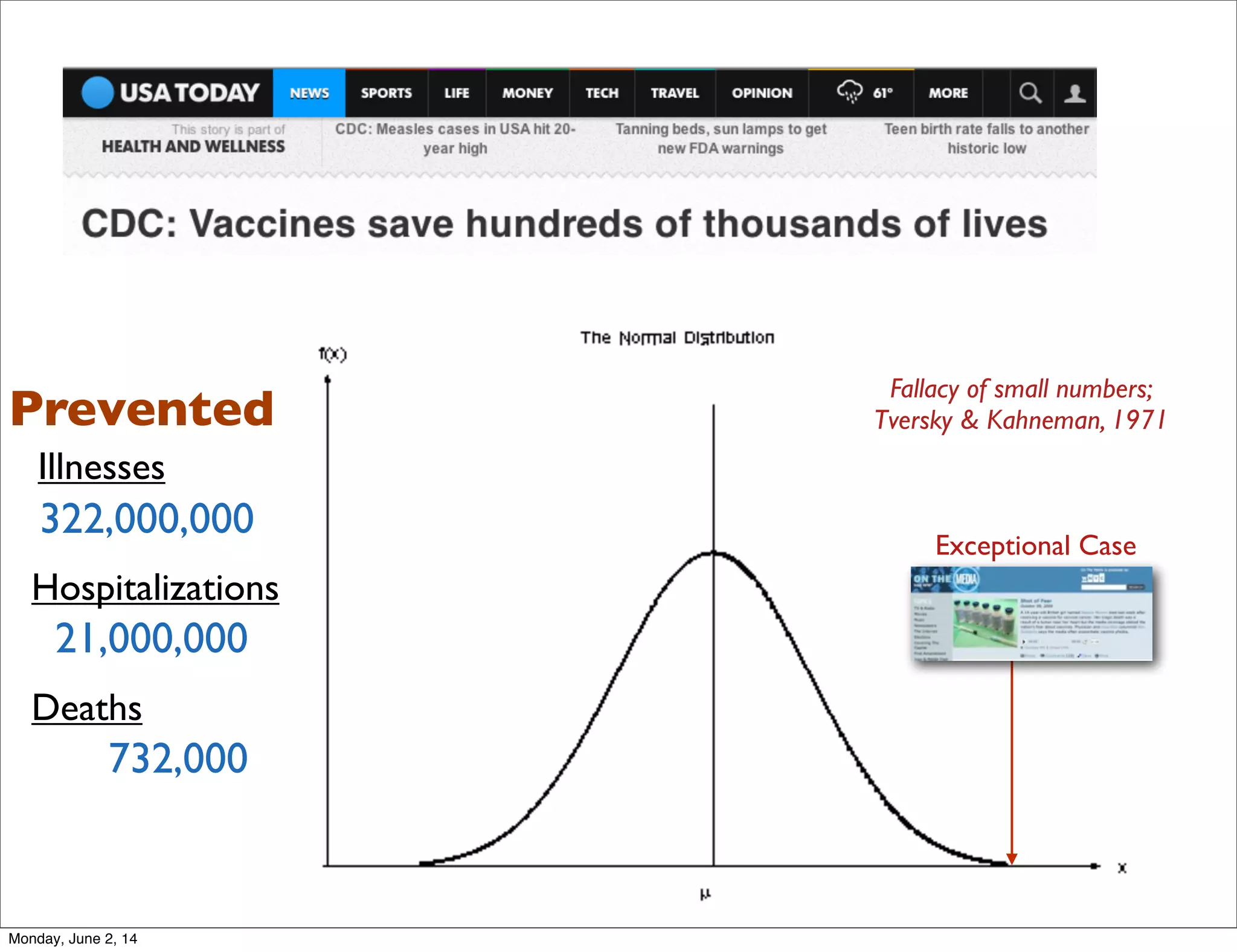
Exceptional Case
Fallacy of small numbers;
Tversky & Kahneman, 1971
Illnesses
322,000,000
Hospitalizations
21,000,000
Prevented
Deaths
732,000
Monday, June 2, 14
Improving Decision Making
Problem: Conditional (Bayesian) probabilities
are counter-intuitive, arcane for practice.
source: Gigerenzer, Gerd, & Hoffrage, Ulrich. (1995). How to improve Bayesian Reasoning without
Instruction: Frequency Formats. Psychological Review, 102(4), 684-704.
For example:
Monday, June 2, 14
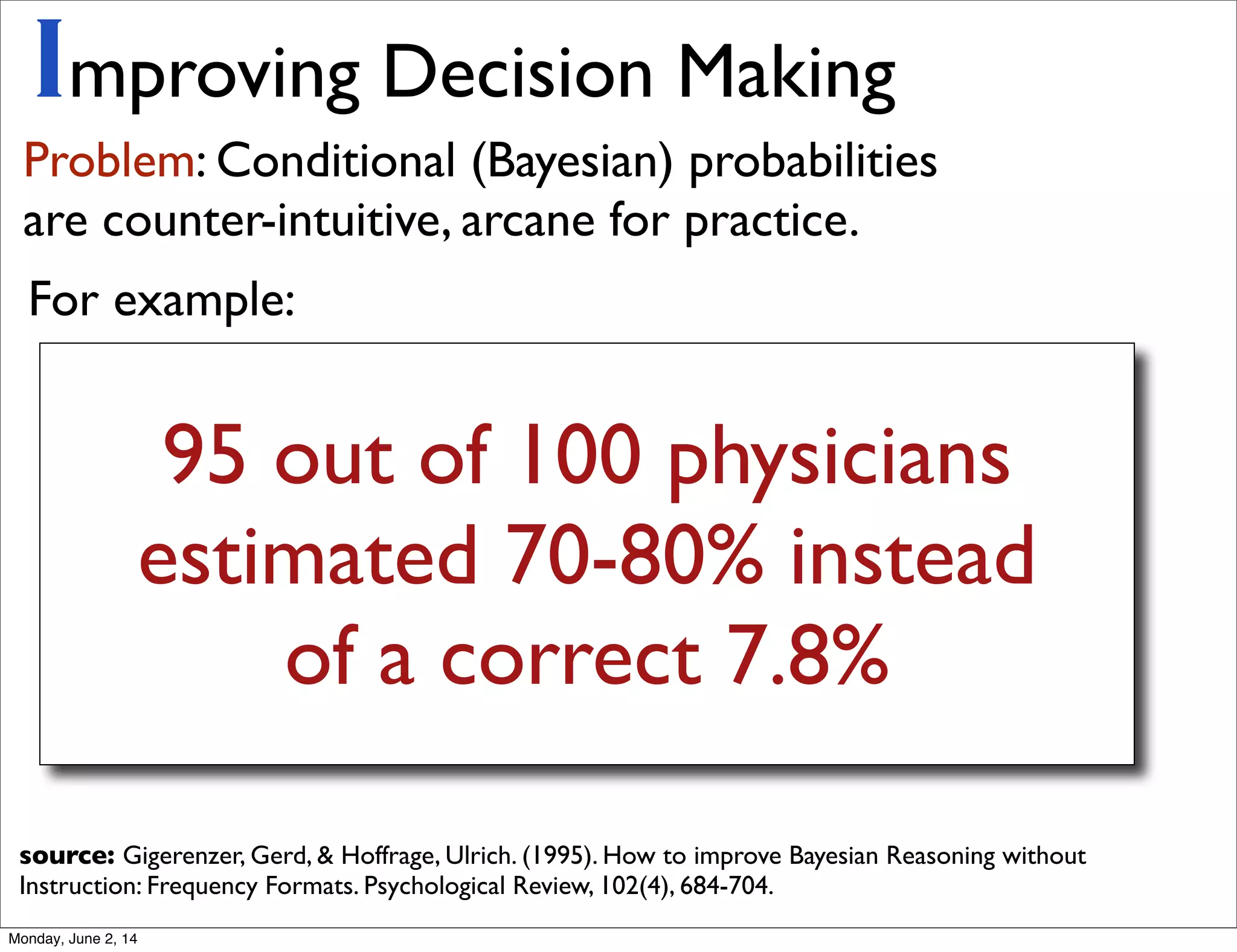
95 out of 100 physicians
estimated 70-80% instead
of a correct 7.8%
Improving Decision Making
Problem: Conditional (Bayesian) probabilities
are counter-intuitive, arcane for practice.
source: Gigerenzer, Gerd, & Hoffrage, Ulrich. (1995). How to improve Bayesian Reasoning without
Instruction: Frequency Formats. Psychological Review, 102(4), 684-704.
For example:
Monday, June 2, 14
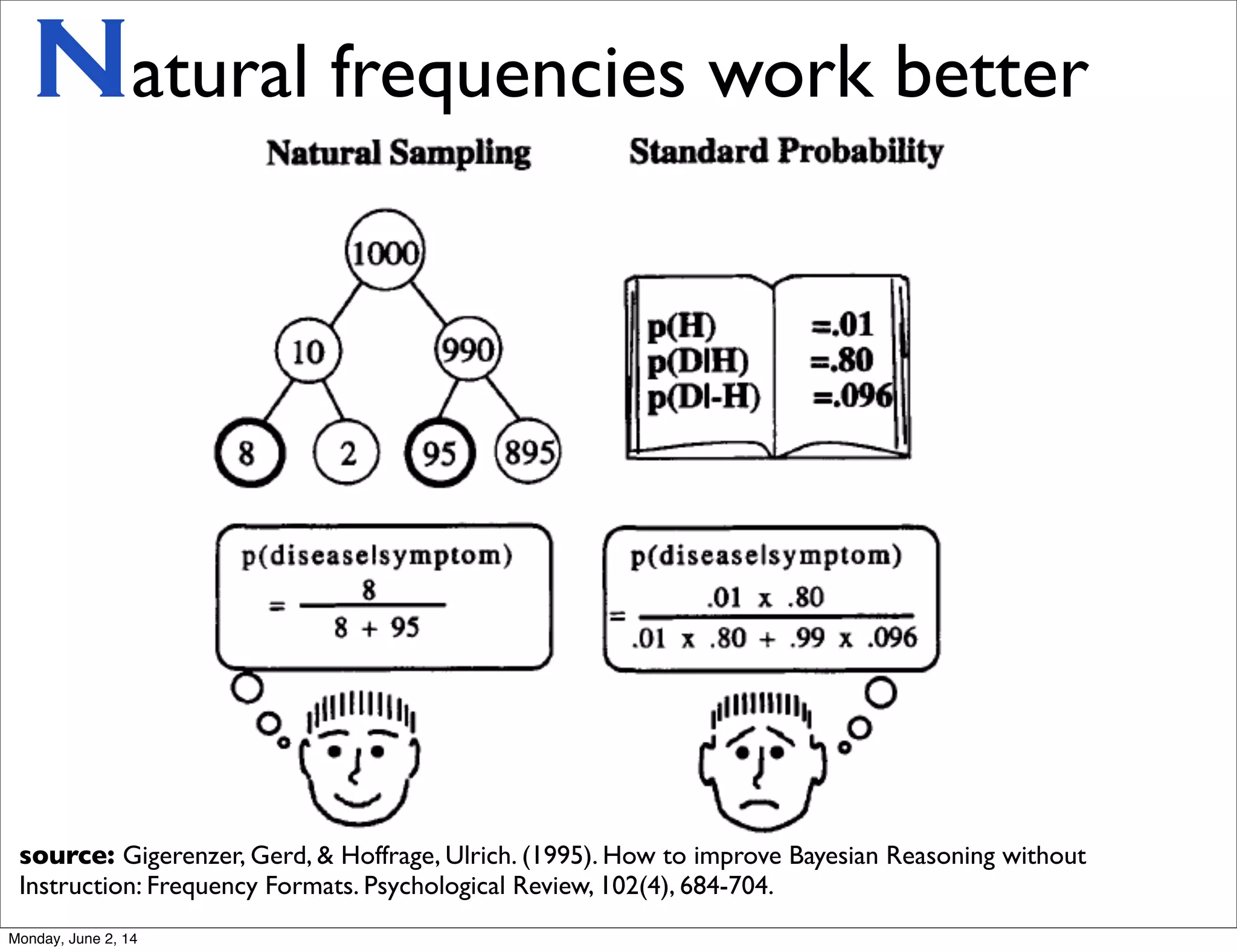
Natural frequencies work better
source: Gigerenzer, Gerd, & Hoffrage, Ulrich. (1995). How to improve Bayesian Reasoning without
Instruction: Frequency Formats. Psychological Review, 102(4), 684-704.
Monday, June 2, 14
See: Fagerlin,A., Ubel, P.A., Smith, D. M., & Zikmund-Fisher, B. J. (2007). Making numbers matter: present and future research in risk
communication.Am J Health Behav, 31 Suppl 1, S47-56.
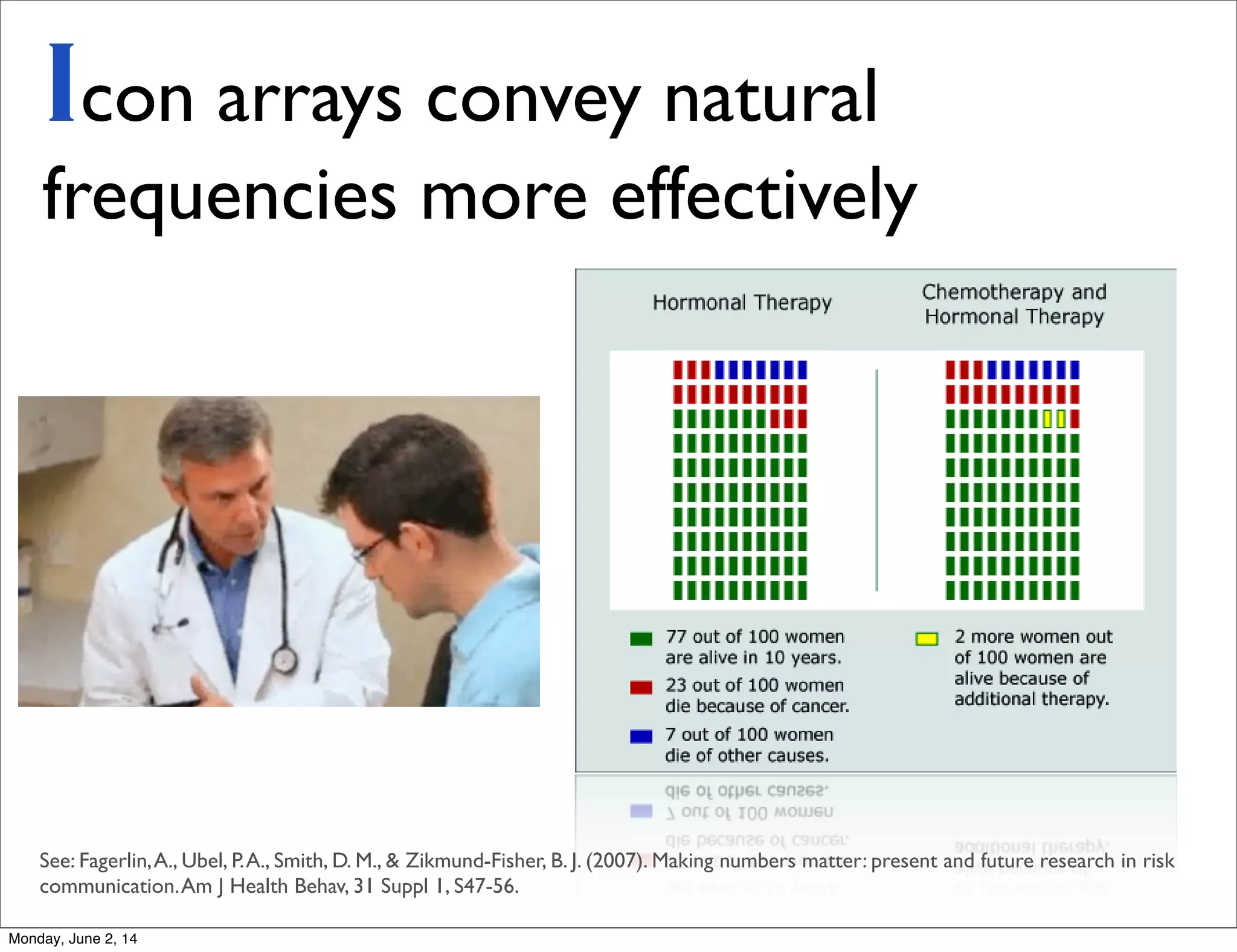
Icon arrays convey natural
frequencies more effectively
Monday, June 2, 14
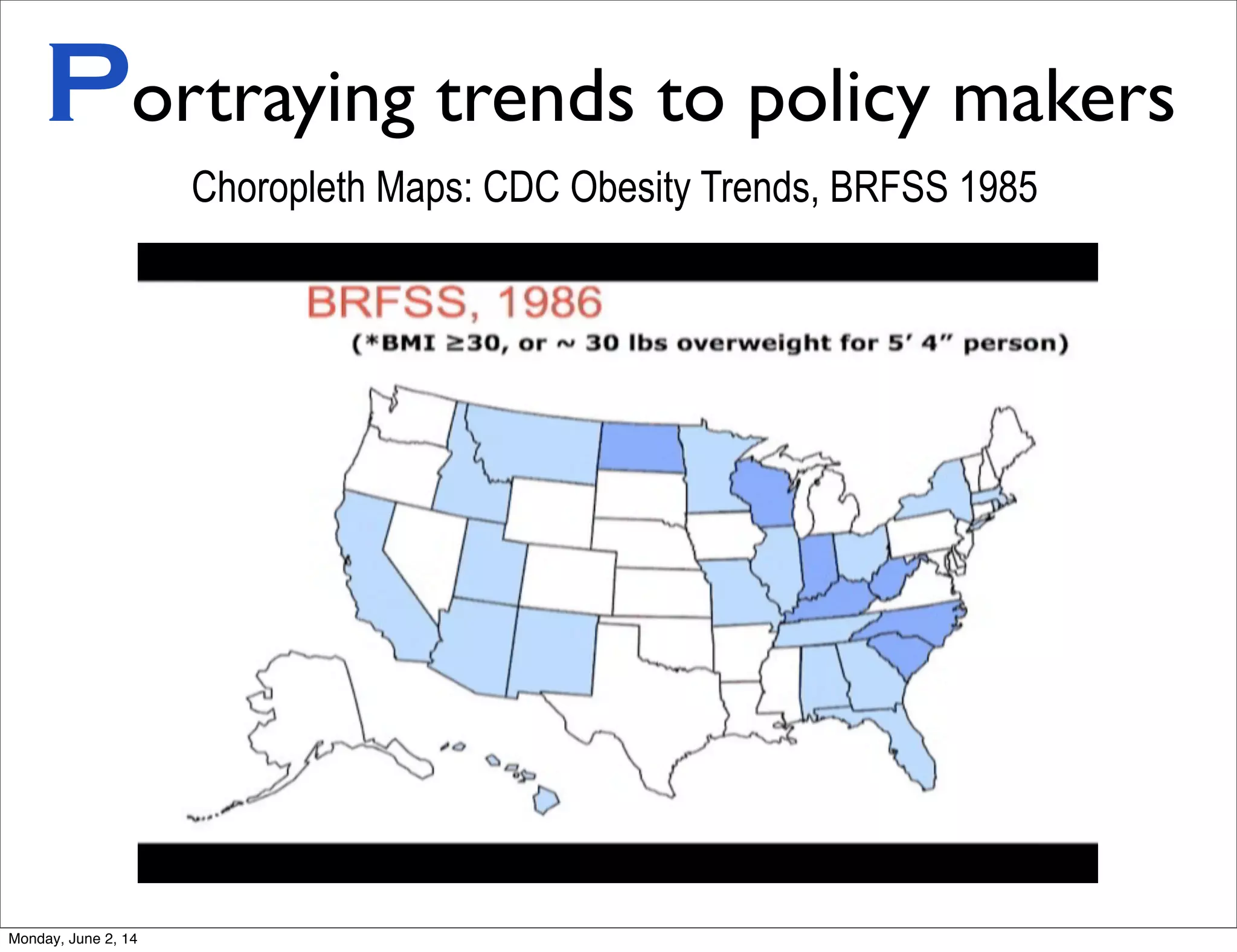
Portraying trends to policy makers
Choropleth Maps: CDC Obesity Trends, BRFSS 1985
Monday, June 2, 14
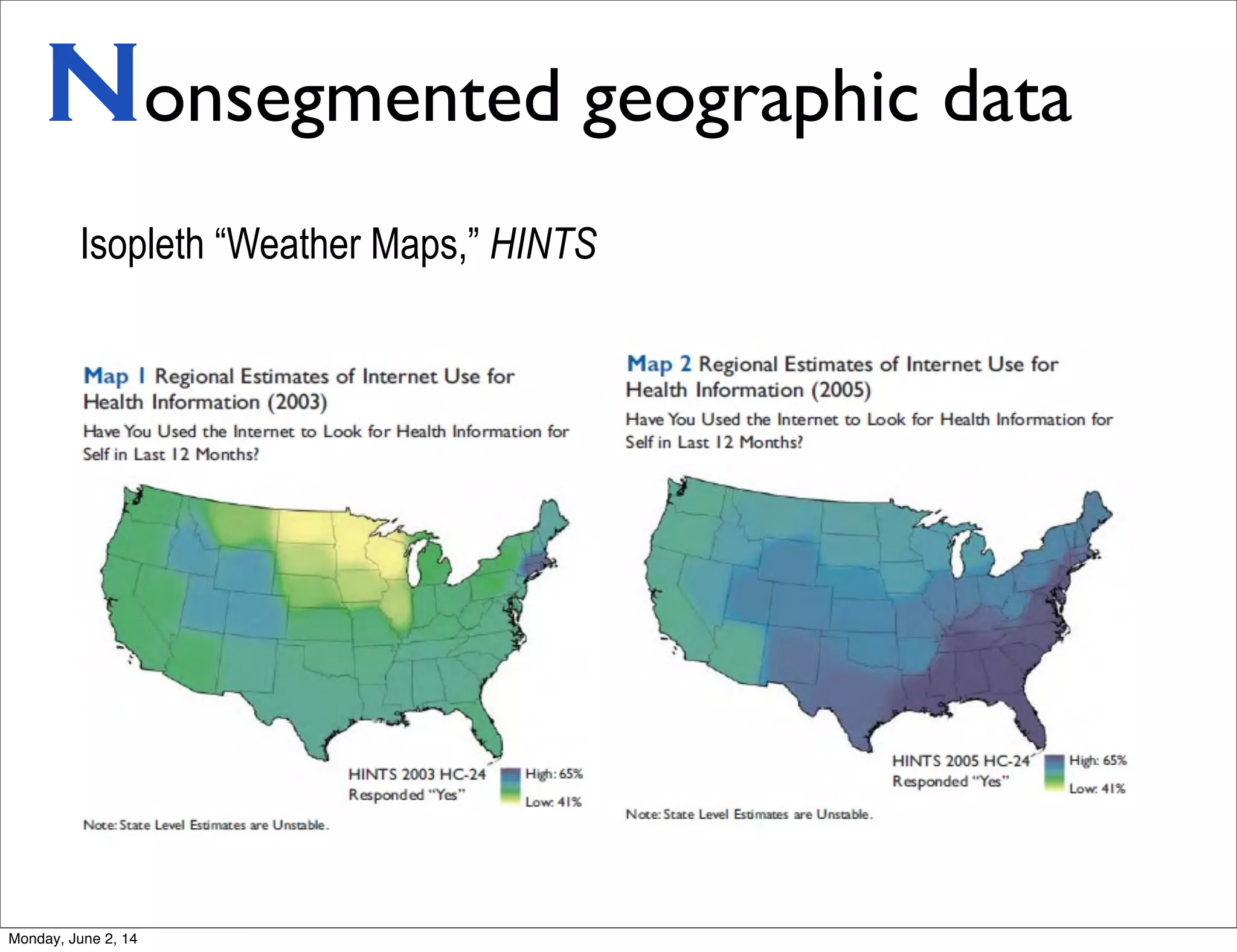
Nonsegmented geographic data
Isopleth “Weather Maps,” HINTS
Monday, June 2, 14
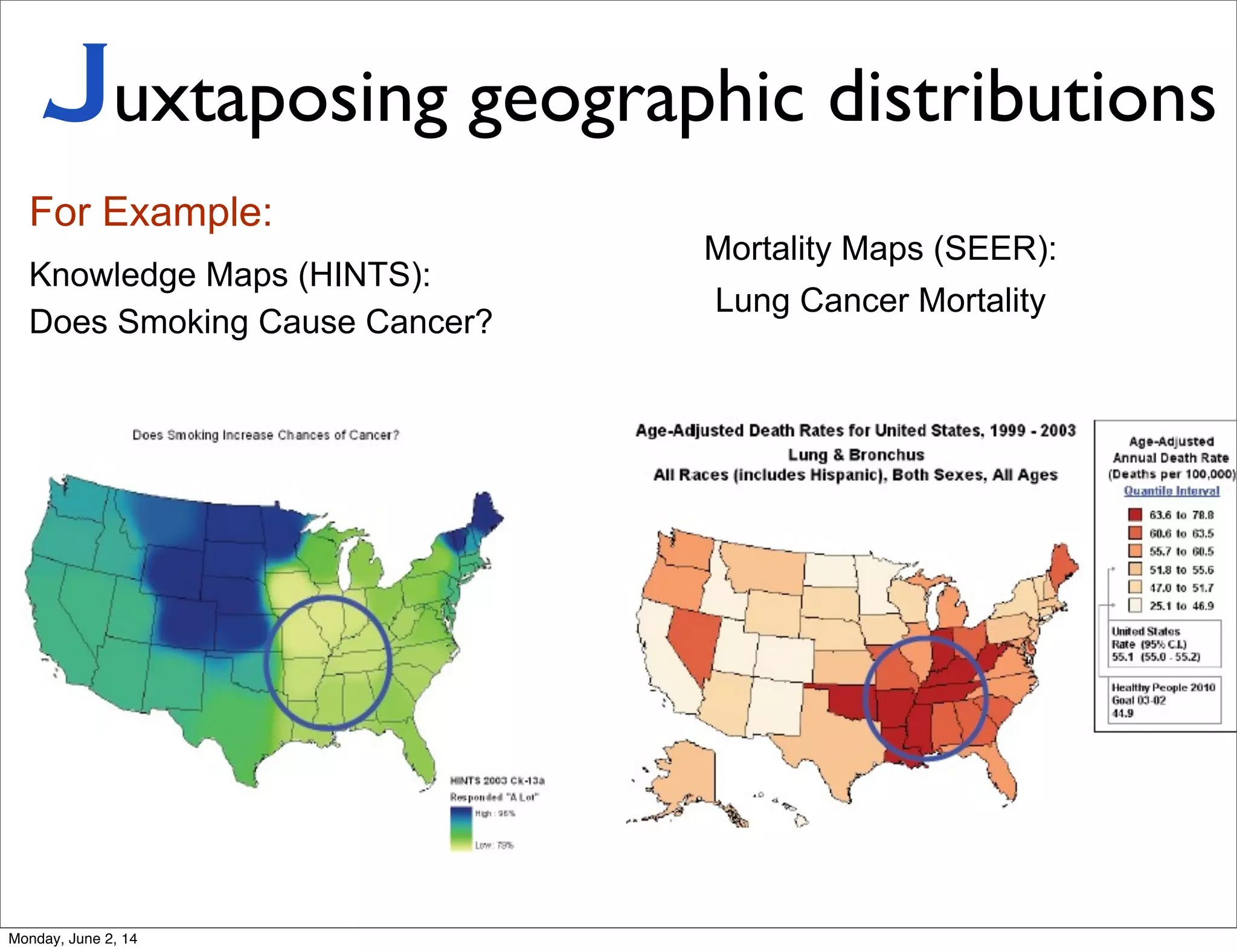
Juxtaposing geographic distributions
Mortality Maps (SEER):
Lung Cancer Mortality
For Example:
Knowledge Maps (HINTS):
Does Smoking Cause Cancer?
Monday, June 2, 14
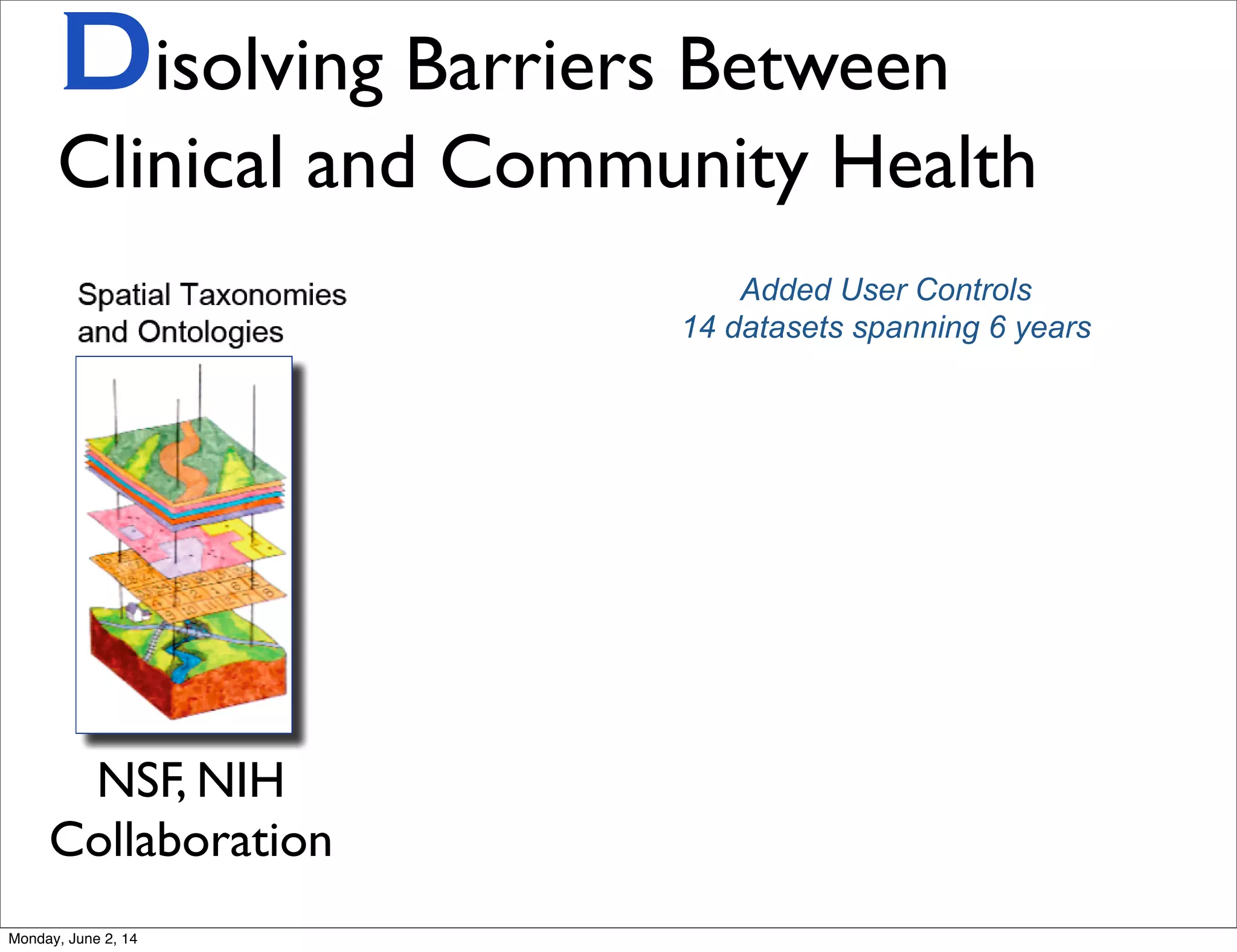
Added User Controls
14 datasets spanning 6 years
NSF, NIH
Collaboration
Disolving Barriers Between
Clinical and Community Health
Monday, June 2, 14
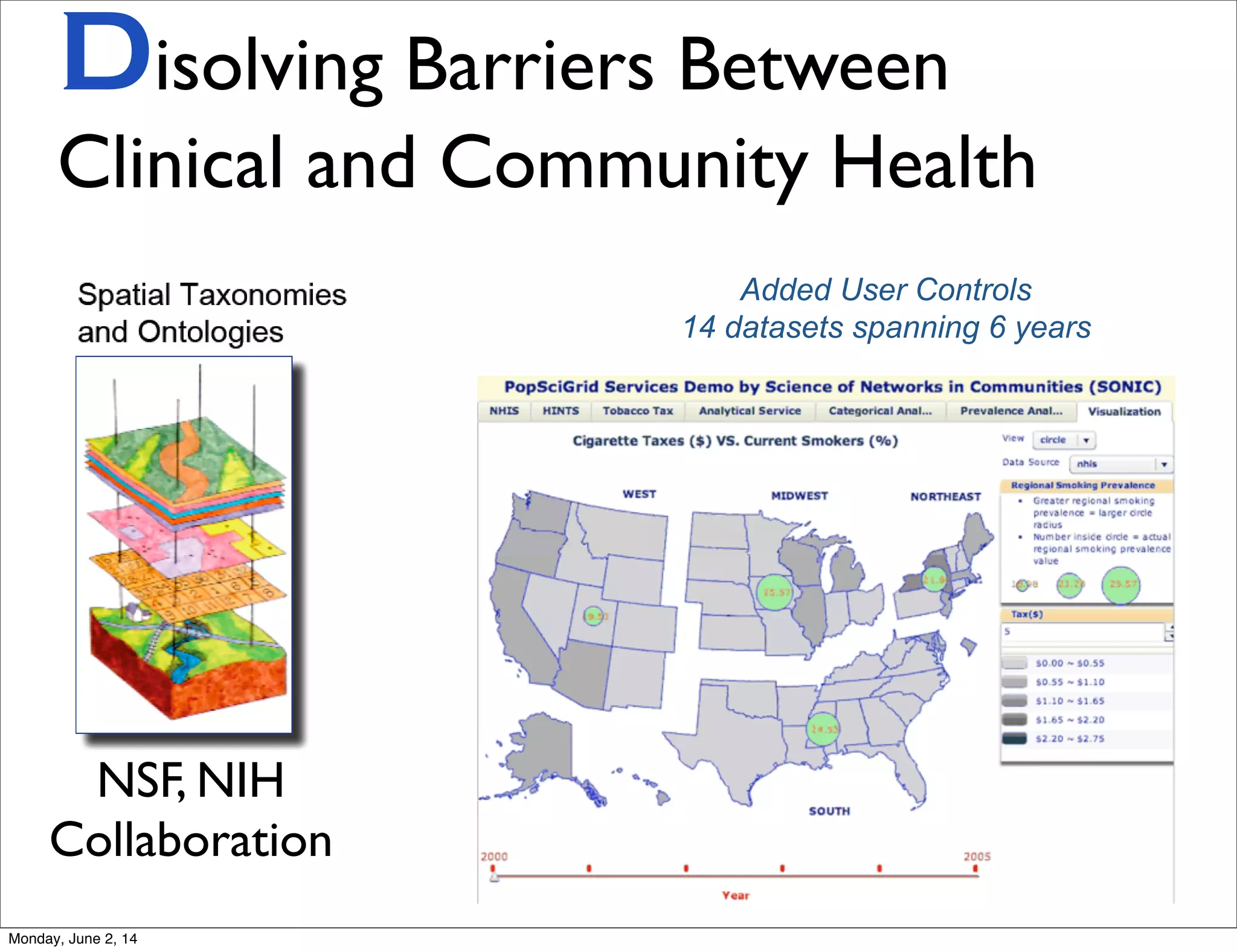
Added User Controls
14 datasets spanning 6 years
NSF, NIH
Collaboration
Disolving Barriers Between
Clinical and Community Health
Monday, June 2, 14
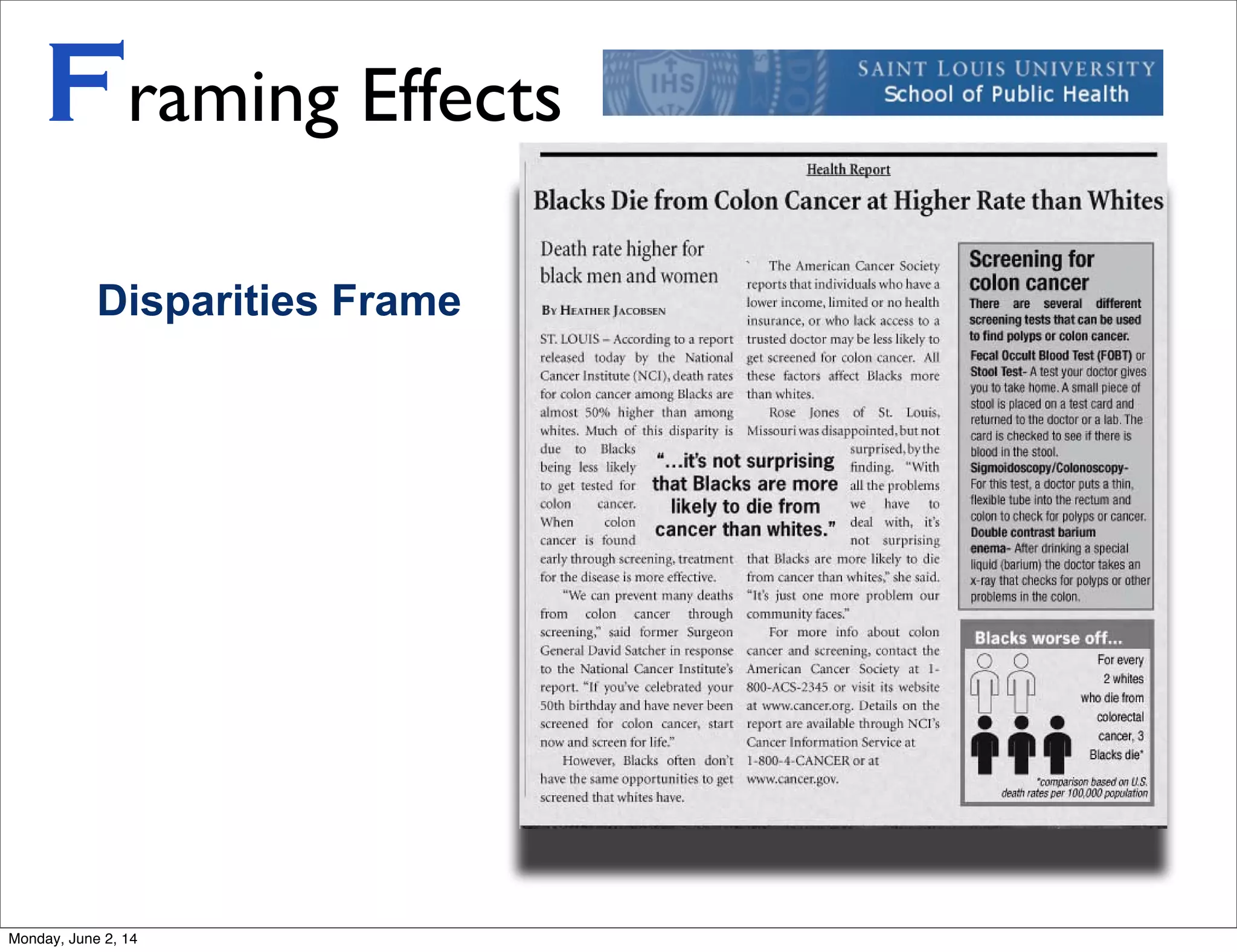
Disparities Frame
Framing Effects
Monday, June 2, 14
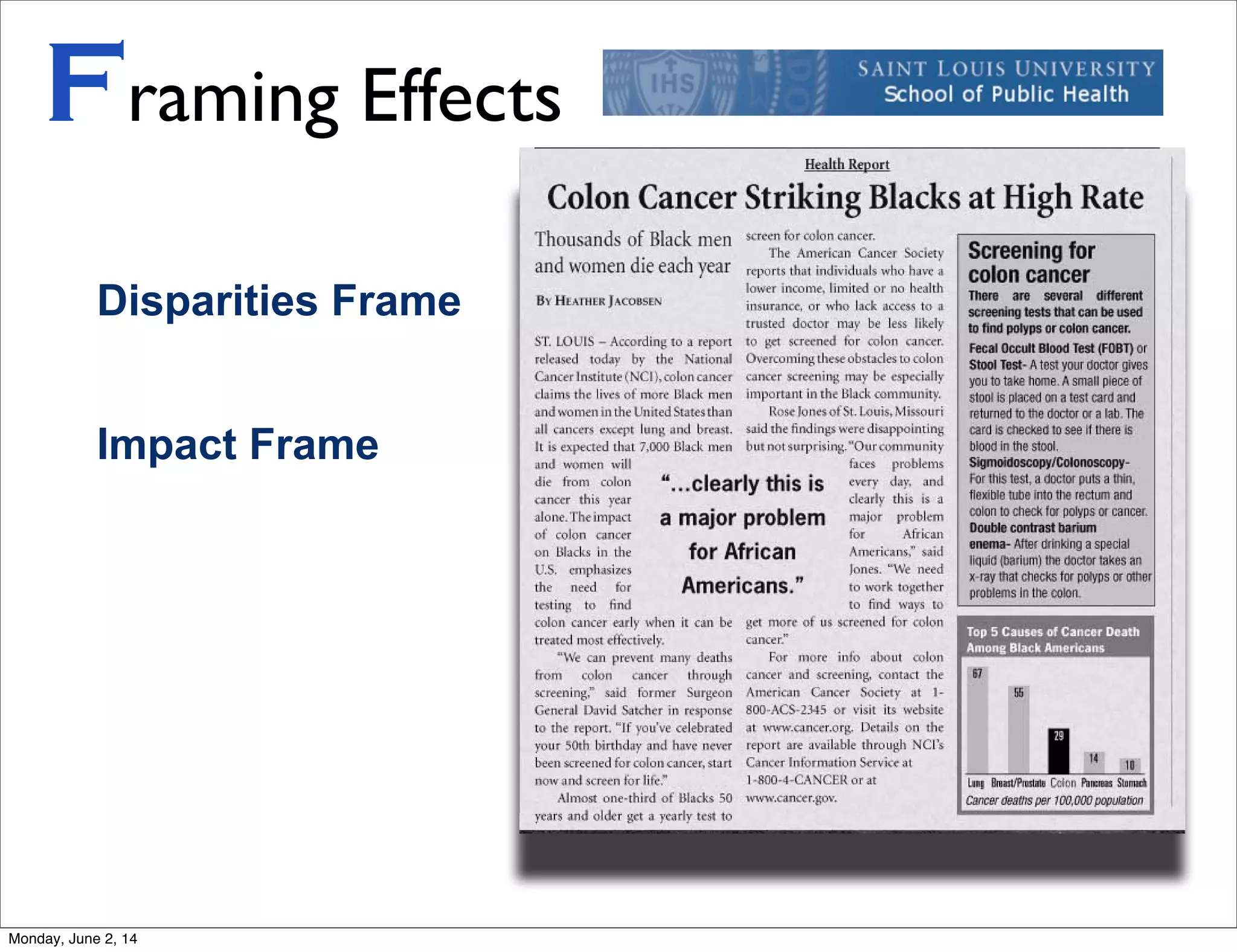
Disparities Frame
Impact Frame
Framing Effects
Monday, June 2, 14
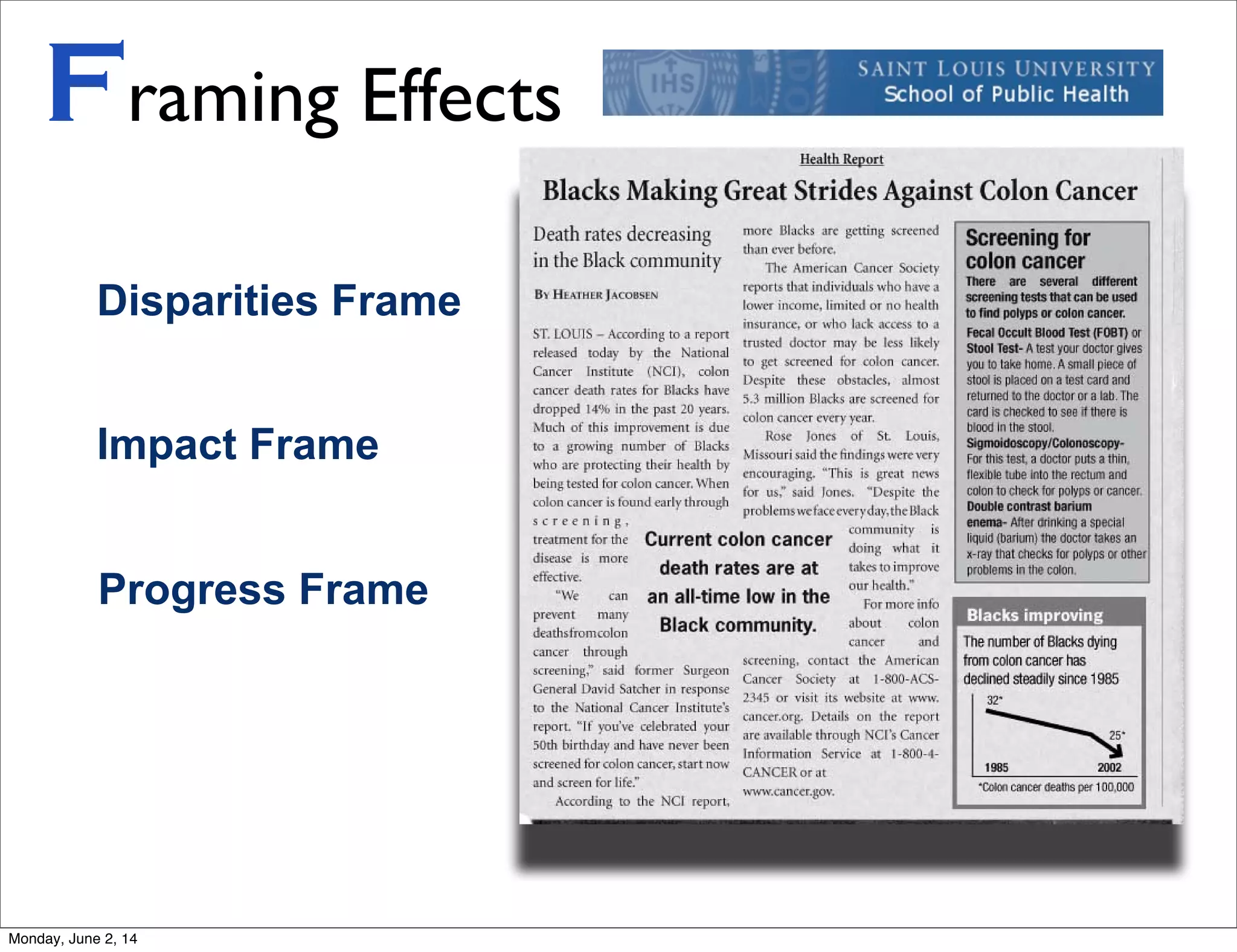
Disparities Frame
Impact Frame
Progress Frame
Framing Effects
Monday, June 2, 14
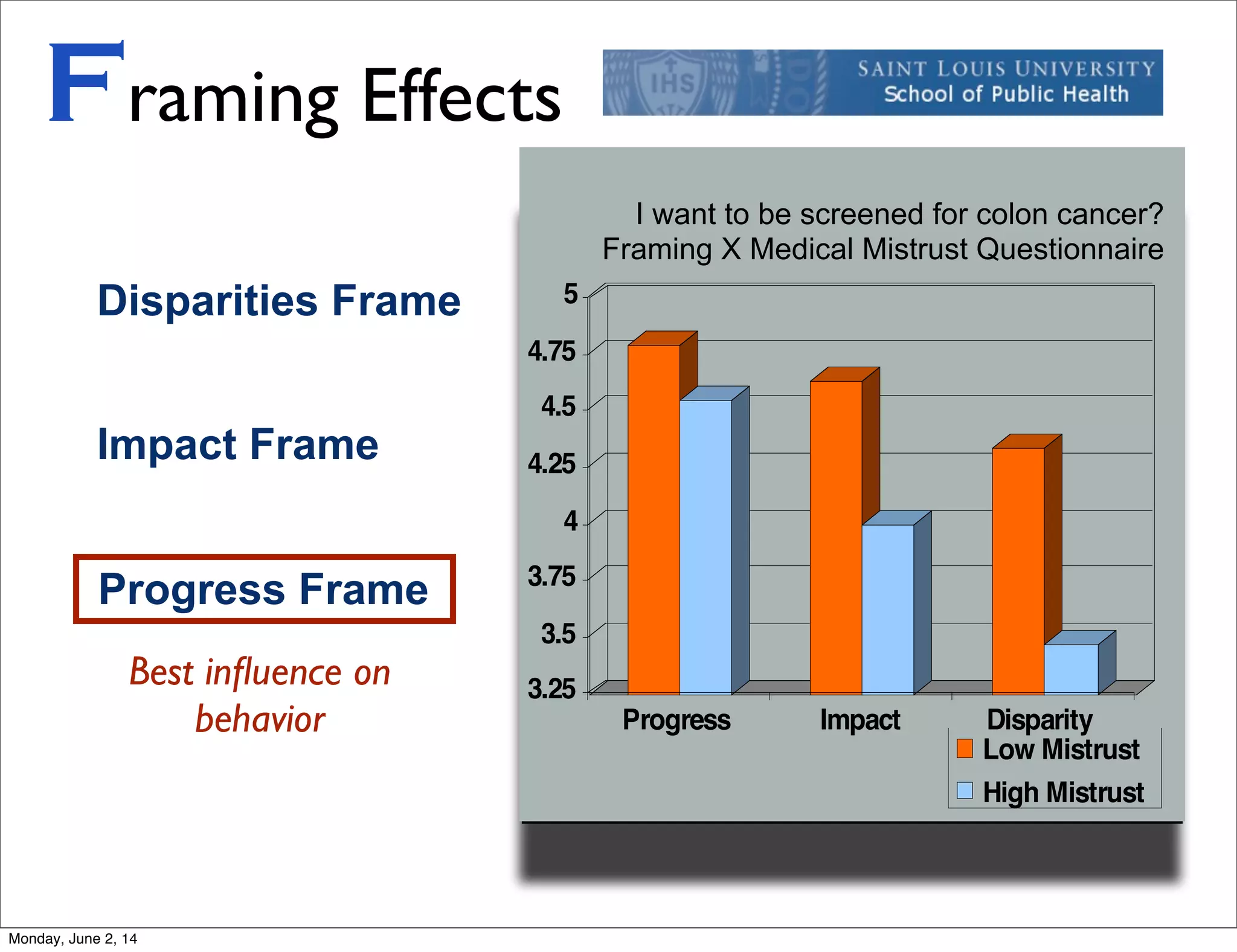
Disparities Frame
Impact Frame
Progress Frame
Framing Effects
3.25
3.5
3.75
4
4.25
4.5
4.75
5
Progress Impact Disparity
Lo
Hi
3.5
3.75
4
4.25
4.5
4.75
5
Low Mistrust
High Mistrust
I want to be screened for colon cancer?
Framing X Medical Mistrust Questionnaire
Best influence on
behavior
Monday, June 2, 14
Bottom Line
Monday, June 2, 14
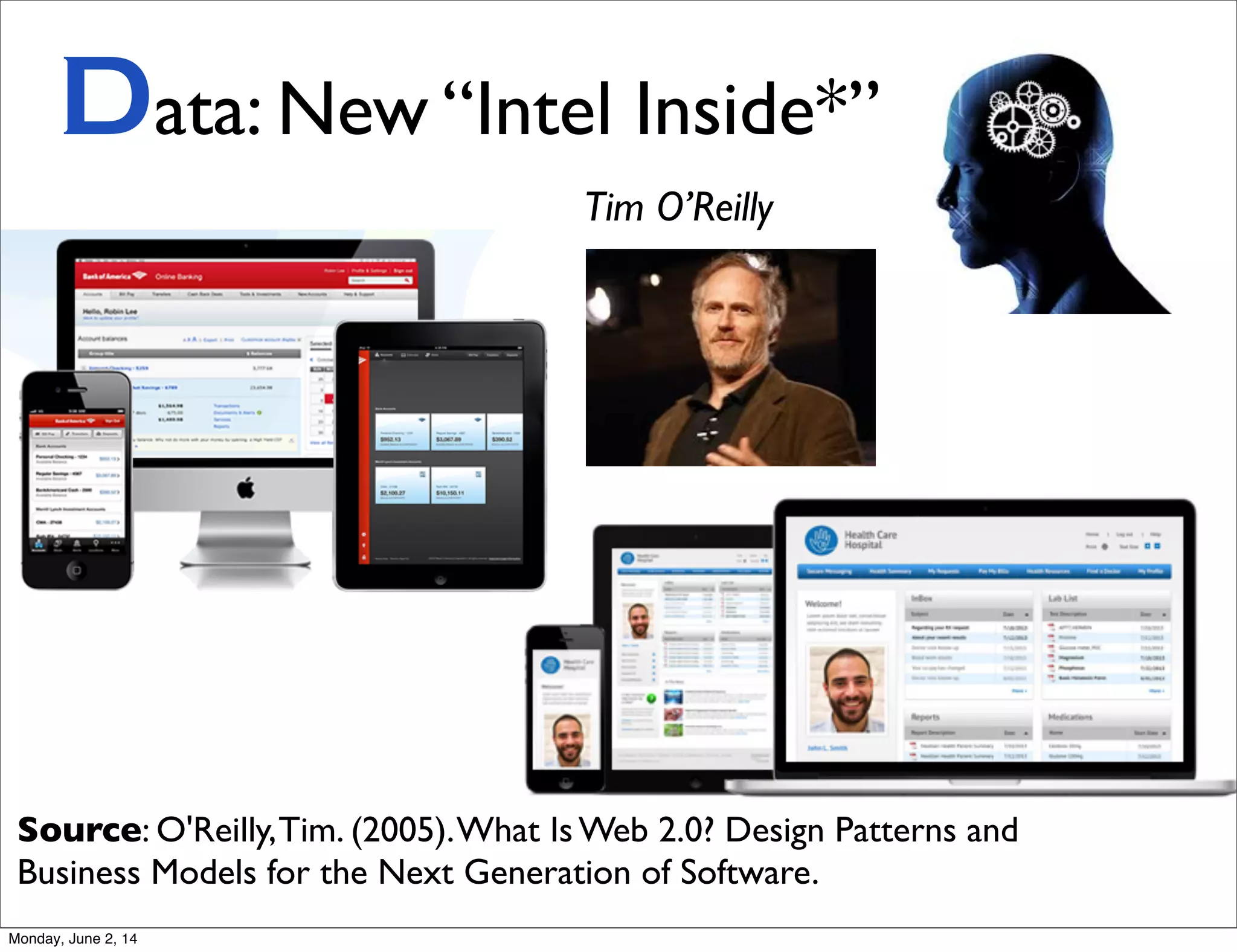
Data: New “Intel Inside*”
Source: O'Reilly,Tim. (2005).What Is Web 2.0? Design Patterns and
Business Models for the Next Generation of Software.
Tim O’Reilly
Monday, June 2, 14
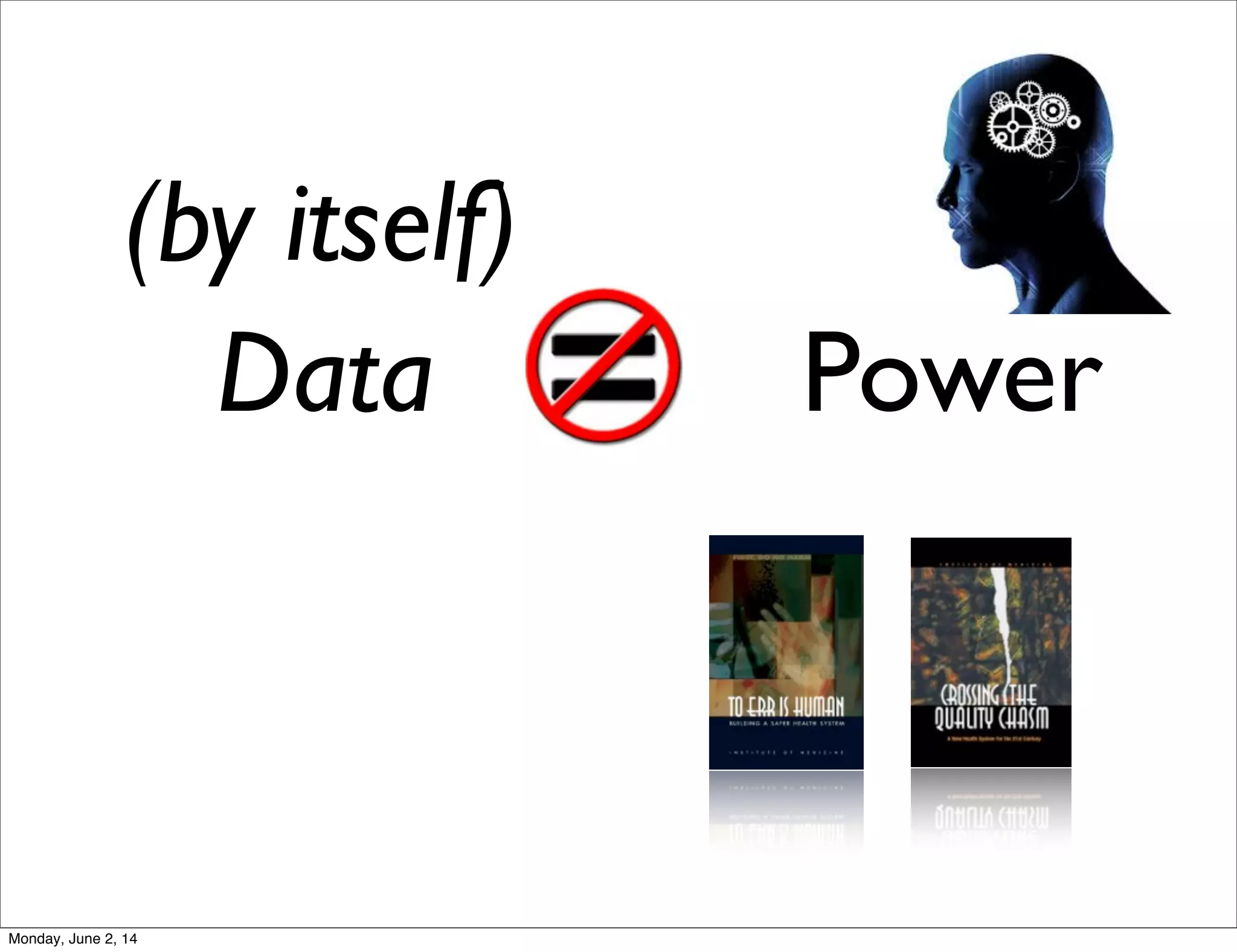
Data = Power
(by itself)
Monday, June 2, 14
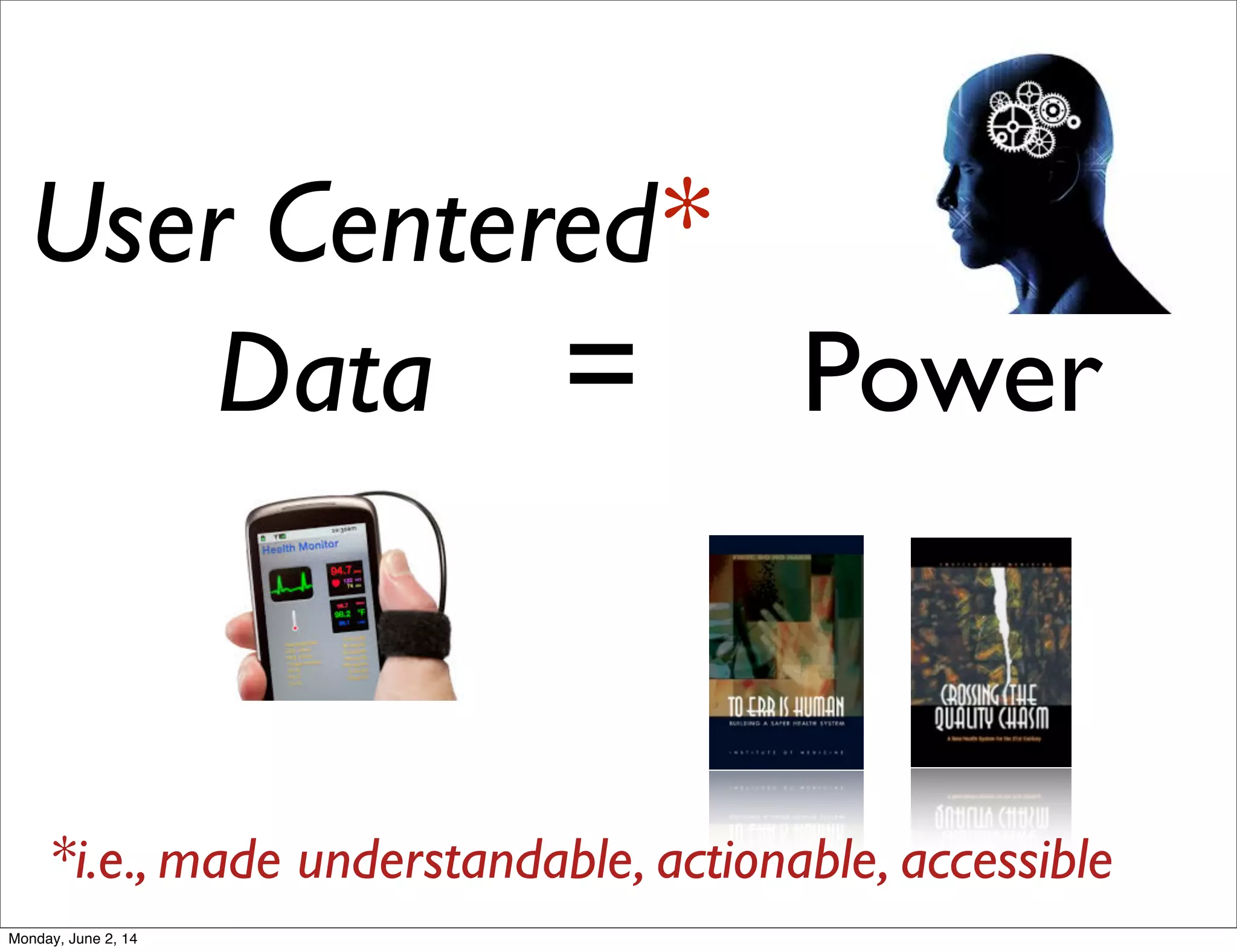
Data = Power
User Centered*
*i.e., made understandable, actionable, accessible
Monday, June 2, 14
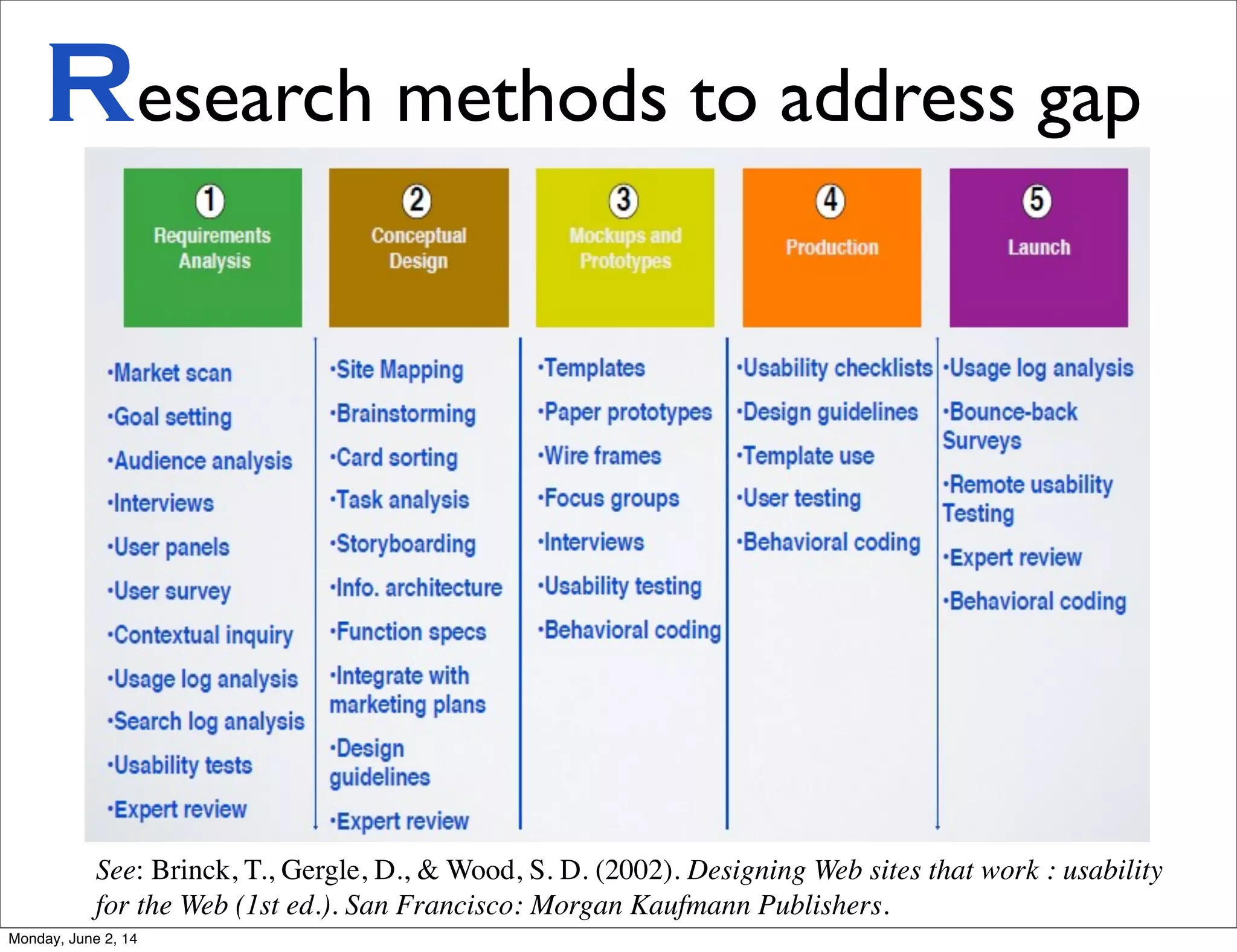
Research methods to address gap
See: Brinck, T., Gergle, D., & Wood, S. D. (2002). Designing Web sites that work : usability
for the Web (1st ed.). San Francisco: Morgan Kaufmann Publishers.
Monday, June 2, 14
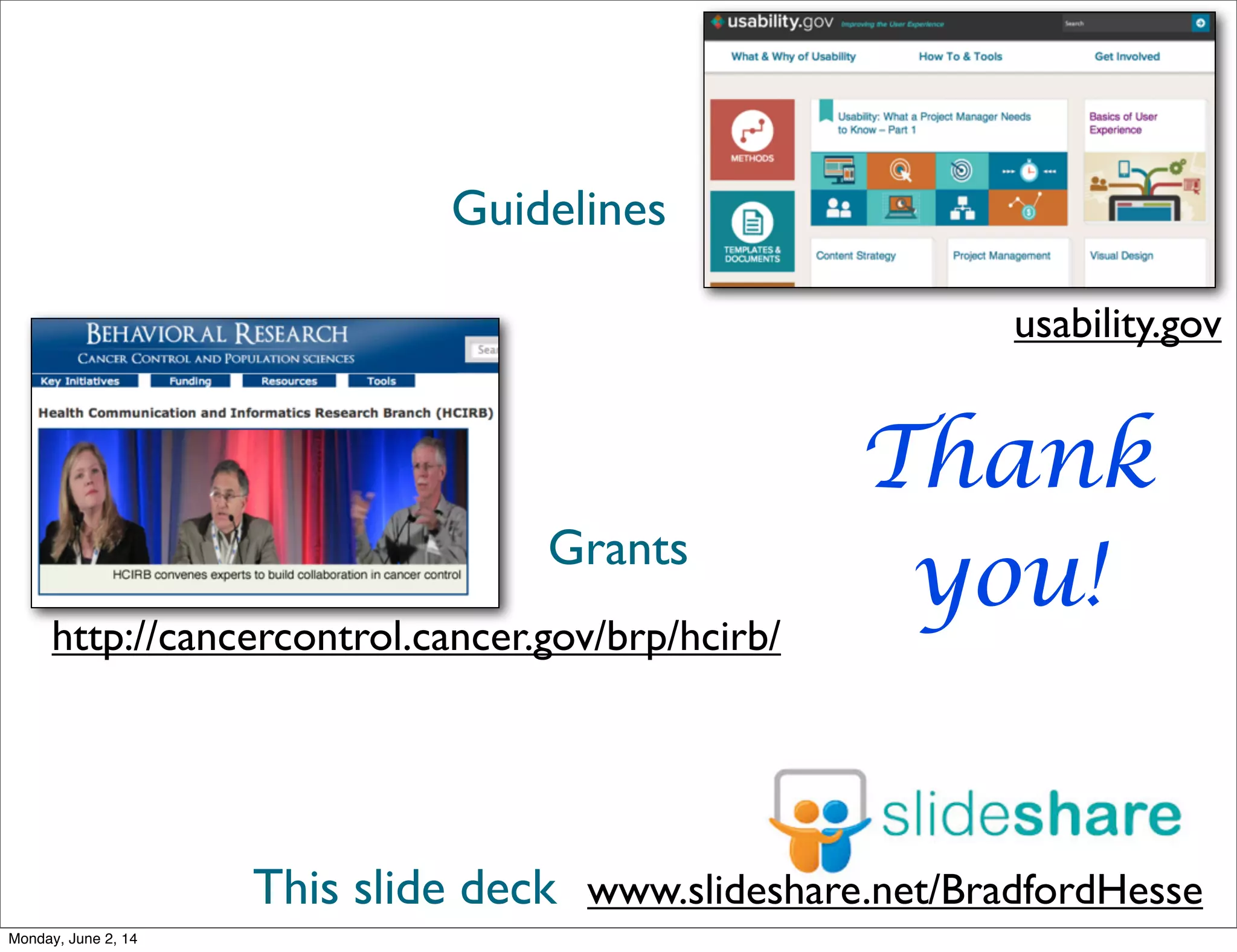
www.slideshare.net/BradfordHesse
http://cancercontrol.cancer.gov/brp/hcirb/
usability.gov
Guidelines
Grants
This slide deck
Thank
you!
Monday, June 2, 14

Making Data Usable: 2014 presentation at Datapalooza

  • 1.
    The Science ofUser- Centered Data Tools June 2, 2014 Bradford W. Hesse, PhD Chief, Health Communication and Informatics National Cancer Institute Monday, June 2, 14
  • 2.
    What behavioral intervention wascredited with saving 58,000 injuries per year, & saving $655,000,000 per year? Question: American Psychological Association (2004) Monday, June 2, 14
  • 3.
  • 4.
    Why? Human Factors research focusedsquarely on user’s perspective: Cognitive & perceptual demands Intervention based on human-system integration Monday, June 2, 14
  • 5.
    4.3% in rearend collisions 92,000 crashes / year 58,000 injuries / year $655,000,000 in property damage Return on Investment (ROI) Monday, June 2, 14
  • 6.
    “Travel agents selected flight onfirst line more than half the time” American Airlines Sabre System Data design effects November Line of Sale Analysis, memo to R. E. Murray from S. D. Nason,American Airlines, Dec. 3, 1981. Monday, June 2, 14
  • 7.
    Website designs reshape travel& other industries Sabre system becomes Travelocity Data design effects November Line of Sale Analysis, memo to R. E. Murray from S. D. Nason,American Airlines, Dec. 3, 1981. CONSUMER ACCESS SHIFTS MARKET Monday, June 2, 14
  • 8.
    Interface wars partof new business Microsoft DOS Graphical User Interface Monday, June 2, 14
  • 9.
  • 10.
    Nudging Best Practice: HITECH& Behavior Source: Hesse, Bradford W.,Ahern, David K., & Woods, Susan S. (2011). Nudging best practice: the HITECH act and behavioral medicine Translational Behavioral Medicine, 1(1), 175-181. • Incentives • Understand Mental Maps • Defaults • Give feedback • Expect error • Structure decisions Monday, June 2, 14
  • 11.
  • 12.
  • 13.
    Data smog • Decisional paralysis •Confusion • Risky behaviors • Frequent errors • Avoidance Source: Shenk, David. (1997). Data smog : surviving the information glut (1st ed.). San Francisco, Calif.: Harper Edge. Consequences Monday, June 2, 14
  • 14.
    The case ofHugo Campos Source: Dave deBronkart, through ONC (http://www.healthit.gov/) Monday, June 2, 14
  • 15.
    The case ofHugo Campos Source: Dave deBronkart, through ONC (http://www.healthit.gov/) Monday, June 2, 14
  • 16.
    The case ofHugo Campos Source: Dave deBronkart, through ONC (http://www.healthit.gov/) Monday, June 2, 14
  • 17.
    ROI will goto best design for each user niche Interfaces across ecosystem Source: Hesse BW, Hansen D, Finholt T, Munson S, Kellogg W, Thomas JC. Social Participation in Health 2.0. IEEE Computer. 2010;43(11):45-52.Monday, June 2, 14
  • 18.
  • 19.
    History: Bad DesignLed to Catastrophic Error Monday, June 2, 14
  • 20.
    Mechanistic World View •Actors: Engineers, biological scientists • Question: How can we create new technologies? • Focus: Physical Object Humanistic World View • Actors: Social scientists, physicians • Question: How can we create new people? • Focus: Person Competing WorldViews Monday, June 2, 14
  • 21.
    Source:Vicente, Kim J.(2003).The human factor : revolutionizing the way people live with technology (1st ed.). NewYork:Taylor and Francis Books. Human System Integration Monday, June 2, 14
  • 22.
    Knowledge in theHead* Knowledge in The World* Task Relevant Schemata General model Monday, June 2, 14
  • 23.
    Computer Human Interaction DonNorman, 1988 Jakob Nilsen: 1993, 1999 Shneiderman & Plaisant: 2010 edition DHHS: 2004 Monday, June 2, 14
  • 24.
    • Strive forconsistency Eight Golden Rules Shneiderman & Plaisant: 2010 edition See: www.usability.gov Consistency within application Consistency across product line Predictable Controls Monday, June 2, 14
  • 25.
    • Strive forconsistency • Cater to universal usability* Eight Golden Rules Shneiderman & Plaisant: 2010 edition Sir Jonathan Ive *universal across experience, literacy, physical ability, profession Monday, June 2, 14
  • 26.
    • Strive forconsistency • Cater to universal usability • Offer informative feedback Eight Golden Rules Shneiderman & Plaisant: 2010 editionSeriously?! Monday, June 2, 14
  • 27.
    • Strive forconsistency • Cater to universal usability • Offer informative feedback Eight Golden Rules Shneiderman & Plaisant: 2010 edition Good design: sequence, progress, action all indicated Monday, June 2, 14
  • 28.
    • Strive forconsistency • Cater to universal usability • Offer informative feedback • Design dialogs to yield closure Eight Golden Rules Shneiderman & Plaisant: 2010 edition user goal Deep Support Monday, June 2, 14
  • 29.
    • Strive forconsistency • Cater to universal usability • Offer informative feedback • Design dialogs to yield closure • Prevent errors Eight Golden Rules Shneiderman & Plaisant: 2010 edition Monday, June 2, 14
  • 30.
    • Strive forconsistency • Cater to universal usability • Offer informative feedback • Design dialogs to yield closure • Prevent errors • Permit easy reversal of actions Eight Golden Rules Shneiderman & Plaisant: 2010 edition Monday, June 2, 14
  • 31.
    • Strive forconsistency • Cater to universal usability • Offer informative feedback • Design dialogs to yield closure • Prevent errors • Permit easy reversal of actions • Support internal locus of control Eight Golden Rules Shneiderman & Plaisant: 2010 edition Monday, June 2, 14
  • 32.
    Wrong Question: X Whatcan the computer do? X How do we automate cognition? X What is the transactional gain? X How do we get users to conform? Better Questions: ✓ What can humans do? ✓ How do we augment cognition? ✓ What is the relational gain? ✓ How do we optimize sociotechnical balance? Source: Hesse BW, Shneiderman B. eHealth research from the user's perspective.Am J Prev Med 2007;32(5 Suppl):S97-103. Asking the Right Question in H.I.T. Monday, June 2, 14
  • 33.
    STOP asking thewrong question Wrong Question: X What can the computer do? X How do we automate cognition? X What is the transactional gain? X How do we get users to conform? Better Questions: ✓ What can humans do? ✓ How do we augment cognition? ✓ What is the relational gain? ✓ How do we optimize sociotechnical balance? “Expert systems in medicine turned out to be brittle, impracticable, and nontransparent. In short, they turned out to be bad medicine.” Source: Hesse BW, Shneiderman B. eHealth research from the user's perspective.Am J Prev Med 2007;32(5 Suppl):S97-103. Monday, June 2, 14
  • 34.
    START Answering RightQuestion Wrong Question: X What can the computer do? X How do we automate cognition? X What is the transactional gain? X How do we get users to conform? Better Questions: ✓ What can humans do? ✓ How do we augment cognition? ✓ What is the relational gain? ✓ How do we optimize sociotechnical balance? David  Brailer,  First  Na4onal   Coordinator  for  Health  IT   “Everyone thought Health I.T. was about computers, but we’ve refined that to say that IT is about healthcare — it’s about the experience we really have.” Source: 1.   Brailer  D.  Ac/on  through  collabora/on:  a  conversa/on  with  David  Brailer.  The  na/onal   coordinator  of  HIT  believes  that  facilita/on,  not  mandates,  are  the  way  to  move  the  agenda  forward.   Interview  by  Robert  Cunningham.  Health  Aff  (Millwood)  2005;24(5):1150-­‐7. Monday, June 2, 14
  • 35.
    STOP asking thewrong question Wrong Question: X What can the computer do? X How do we automate cognition? X What is the transactional gain? X How do we get users to conform? Better Questions: ✓ What can humans do? ✓ How do we augment cognition? ✓ What is the relational gain? ✓ How do we optimize sociotechnical balance? “Intelligent  Agent”   misfires Root  Cause:   Over-­‐Reliance   on  “Autopilot”   Monday, June 2, 14
  • 36.
    Wrong Question: X Whatcan the computer do? X How do we automate cognition? X What is the transactional gain? X How do we get users to conform? Better Questions: ✓ What can humans do? ✓ How do we augment cognition? ✓ What is the relational gain? ✓ How do we optimize sociotechnical balance? START Answering Right Question Reminder  System Source: Hesse  BW.  Enhancing  Consumer  Involvement  in  Health  Care.  In:  Parker  JC,  Thornson  E,  editors.  Health  Communica/on  in  the  New   Media  Landscape.  New  York,  NY:  Springer  Publishing  Company;  2008.  p.  119-­‐149. Monday, June 2, 14
  • 37.
    STOP asking thewrong question Wrong Question: X What can the computer do? X How do we automate cognition? X What is the transactional gain? X How do we get users to conform? Better Questions: ✓ What can humans do? ✓ How do we augment cognition? ✓ What is the relational gain? ✓ How do we optimize sociotechnical balance? *Zuboff S, Maxmin J.The support economy: why corporations are failing individuals and the next episode of capitalism. NewYork:Viking; 2002. Monday, June 2, 14
  • 38.
    Wrong Question: X Whatcan the computer do? X How do we automate cognition? X What is the transactional gain? X How do we get users to conform? Better Questions: ✓ What can humans do? ✓ How do we augment cognition? ✓ What is the relational gain? ✓ How do we optimize sociotechnical balance? START Answering Right Question Source:  Hesse  BW.  Harnessing  the  power  of  an  intelligent  health  environment  in  cancer  control.   Stud  Health  Technol  Inform  2005;118:159-­‐76. .Monday, June 2, 14
  • 39.
    Wrong Question: X Whatcan the computer do? X How do we automate cognition? X What is the transactional gain? X How do we get users to conform? Better Questions: ✓ What can humans do? ✓ How do we augment cognition? ✓ What is the relational gain? ✓ How do we optimize sociotechnical balance? START Answering Right Question *Zuboff S, Maxmin J.The support economy: why corporations are failing individuals and the next episode of capitalism. NewYork:Viking; 2002. Monday, June 2, 14
  • 40.
    STOP asking thewrong question Wrong Question: X What can the computer do? X How do we automate cognition? X What is the transactional gain? X How do we get users to conform? Better Questions: ✓ What can humans do? ✓ How do we augment cognition? ✓ What is the relational gain? ✓ How do we optimize sociotechnical balance? Charlie Chaplin in “Modern Times” (1936) Monday, June 2, 14
  • 41.
    Wrong Question: X Whatcan the computer do? X How do we automate cognition? X What is the transactional gain? X How do we get users to conform? Better Questions: ✓ What can humans do? ✓ How do we augment cognition? ✓ What is the relational gain? ✓ How do we optimize sociotechnical balance? START Answering Right Question HITECH Switches Emphasis to “Meaningful Use” Monday, June 2, 14
  • 42.
    Wrong Question: X Whatcan the computer do? X How do we automate cognition? X What is the transactional gain? X How do we get users to conform? Better Questions: ✓ What can humans do? ✓ How do we augment cognition? ✓ What is the relational gain? ✓ How do we optimize sociotechnical balance? START Answering Right Question Source: Blumenthal, D. (2010). Guiding the health information technology agenda. Interviewed by David J. Brailer. Health Aff (Millwood), 29(4), 586-595. David Blumenthal Monday, June 2, 14
  • 43.
  • 44.
    Making Data Talk InformSupport Decisions Educate Persuade Adapting to a World of Ubiquitous Data Systems Monday, June 2, 14
  • 45.
    Making Data Talk InformSupport Decisions Educate Persuade Adapting to a World of Ubiquitous Data Systems Monday, June 2, 14
  • 46.
    Making Data Talk InformSupport Decisions Educate Persuade Adapting to a World of Ubiquitous Data Systems Monday, June 2, 14
  • 47.
    Making Data Talk InformSupport Decisions Educate Persuade Adapting to a World of Ubiquitous Data Systems Monday, June 2, 14
  • 48.
  • 49.
  • 50.
    source: Carpenter PA,Shah P. A model of the perceptual and conceptual processes in graph comprehension. J Educ Psychol. 1999, 91(4): 690-702. • Constructive process • Gaze goes to center for pattern • Contiguous labels for meaning • Left to right tendency in western culture • Perceptual rules guide meaning Cognitive / Perceptual Research Monday, June 2, 14
  • 51.
    source: Carpenter PA,Shah P. A model of the perceptual and conceptual processes in graph comprehension. J Educ Psychol. 1999, 91(4): 690-702. • Constructive process • Gaze goes to center for pattern • Contiguous labels for meaning • Left to right tendency in western culture • Perceptual rules guide meaning Visualizing Long Term Change Monday, June 2, 14
  • 52.
    • Constructive process •Gaze goes to center for pattern • Contiguous labels for meaning • Left to right tendency in western culture • Perceptual rules guide meaning Hans Rosling, BBC Visualizing Change Dynamically Monday, June 2, 14
  • 53.
    Monitoring for Change inEHR Systems Aging In Place, Intel Rule of Thumb* for “Big Data” Systems •Overview •Zoom / filter •Details on demand *Ben Shneiderman Monday, June 2, 14
  • 54.
  • 55.
    Overcome “small numbers”bias Monday, June 2, 14
  • 56.
    Exceptional Case Fallacy ofsmall numbers; Tversky & Kahneman, 1971 Illnesses 322,000,000 Hospitalizations 21,000,000 Prevented Deaths 732,000 Monday, June 2, 14
  • 57.
    Improving Decision Making Problem:Conditional (Bayesian) probabilities are counter-intuitive, arcane for practice. source: Gigerenzer, Gerd, & Hoffrage, Ulrich. (1995). How to improve Bayesian Reasoning without Instruction: Frequency Formats. Psychological Review, 102(4), 684-704. For example: Monday, June 2, 14
  • 58.
    95 out of100 physicians estimated 70-80% instead of a correct 7.8% Improving Decision Making Problem: Conditional (Bayesian) probabilities are counter-intuitive, arcane for practice. source: Gigerenzer, Gerd, & Hoffrage, Ulrich. (1995). How to improve Bayesian Reasoning without Instruction: Frequency Formats. Psychological Review, 102(4), 684-704. For example: Monday, June 2, 14
  • 59.
    Natural frequencies workbetter source: Gigerenzer, Gerd, & Hoffrage, Ulrich. (1995). How to improve Bayesian Reasoning without Instruction: Frequency Formats. Psychological Review, 102(4), 684-704. Monday, June 2, 14
  • 60.
    See: Fagerlin,A., Ubel,P.A., Smith, D. M., & Zikmund-Fisher, B. J. (2007). Making numbers matter: present and future research in risk communication.Am J Health Behav, 31 Suppl 1, S47-56. Icon arrays convey natural frequencies more effectively Monday, June 2, 14
  • 61.
    Portraying trends topolicy makers Choropleth Maps: CDC Obesity Trends, BRFSS 1985 Monday, June 2, 14
  • 62.
    Nonsegmented geographic data Isopleth“Weather Maps,” HINTS Monday, June 2, 14
  • 63.
    Juxtaposing geographic distributions MortalityMaps (SEER): Lung Cancer Mortality For Example: Knowledge Maps (HINTS): Does Smoking Cause Cancer? Monday, June 2, 14
  • 64.
    Added User Controls 14datasets spanning 6 years NSF, NIH Collaboration Disolving Barriers Between Clinical and Community Health Monday, June 2, 14
  • 65.
    Added User Controls 14datasets spanning 6 years NSF, NIH Collaboration Disolving Barriers Between Clinical and Community Health Monday, June 2, 14
  • 66.
  • 67.
    Disparities Frame Impact Frame FramingEffects Monday, June 2, 14
  • 68.
    Disparities Frame Impact Frame ProgressFrame Framing Effects Monday, June 2, 14
  • 69.
    Disparities Frame Impact Frame ProgressFrame Framing Effects 3.25 3.5 3.75 4 4.25 4.5 4.75 5 Progress Impact Disparity Lo Hi 3.5 3.75 4 4.25 4.5 4.75 5 Low Mistrust High Mistrust I want to be screened for colon cancer? Framing X Medical Mistrust Questionnaire Best influence on behavior Monday, June 2, 14
  • 70.
  • 71.
    Data: New “IntelInside*” Source: O'Reilly,Tim. (2005).What Is Web 2.0? Design Patterns and Business Models for the Next Generation of Software. Tim O’Reilly Monday, June 2, 14
  • 72.
    Data = Power (byitself) Monday, June 2, 14
  • 73.
    Data = Power UserCentered* *i.e., made understandable, actionable, accessible Monday, June 2, 14
  • 74.
    Research methods toaddress gap See: Brinck, T., Gergle, D., & Wood, S. D. (2002). Designing Web sites that work : usability for the Web (1st ed.). San Francisco: Morgan Kaufmann Publishers. Monday, June 2, 14
  • 75.