Welcome to
English Class!!
Objective:
make connections
between texts to
particular issues, concerns,
and dispositions in life.
Today is Output
Making Day!
Make a text to world
connections about
the poem “A Poison
Tree.”
A Poison Tree
by William Blake
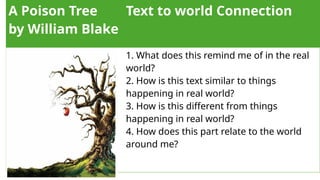
Text to world Connection
1. What does this remind me of in the real
world?
2. How is this text similar to things
happening in real world?
3. How is this different from things
happening in real world?
4. How does this part relate to the world
around me?
Lesson 1 Making Connections
•Your previous experiences,
knowledge, emotions, and
understanding affect what and how
you learn called the schema help
you make sense and meaning of the
material you are exposed to.
Keene and
Zimmerman (1997,
as cited in Kardash,
2004)
concluded that
students like you
comprehend
better when you
make different
kinds of
connections.
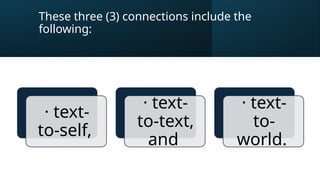
These three (3) connections include the
following:
· text-
to-self,
· text-
to-text,
and
· text-
to-
world.
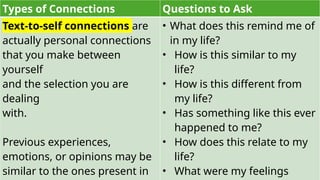
Types of Connections Questions to Ask
Text-to-self connections are
actually personal connections
that you make between
yourself
and the selection you are
dealing
with.
Previous experiences,
emotions, or opinions may be
similar to the ones present in
• What does this remind me of
in my life?
• How is this similar to my
life?
• How is this different from
my life?
• Has something like this ever
happened to me?
• How does this relate to my
life?
• What were my feelings
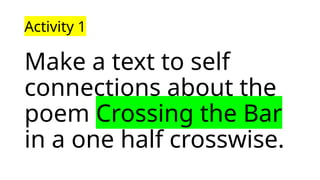
Activity 1
Make a text to self
connections about the
poem Crossing the Bar
in a one half crosswise.
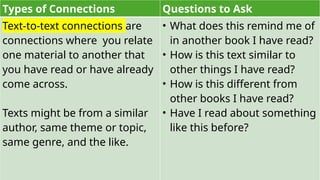
Types of Connections Questions to Ask
Text-to-text connections are
connections where you relate
one material to another that
you have read or have already
come across.
Texts might be from a similar
author, same theme or topic,
same genre, and the like.
• What does this remind me of
in another book I have read?
• How is this text similar to
other things I have read?
• How is this different from
other books I have read?
• Have I read about something
like this before?
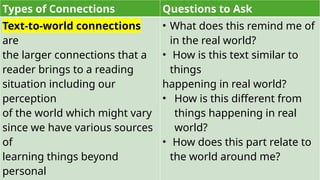
Types of Connections Questions to Ask
Text-to-world connections
are
the larger connections that a
reader brings to a reading
situation including our
perception
of the world which might vary
since we have various sources
of
learning things beyond
personal
• What does this remind me of
in the real world?
• How is this text similar to
things
happening in real world?
• How is this different from
things happening in real
world?
• How does this part relate to
the world around me?
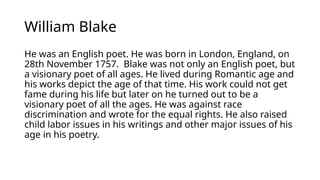
William Blake
He was an English poet. He was born in London, England, on
28th November 1757. Blake was not only an English poet, but
a visionary poet of all ages. He lived during Romantic age and
his works depict the age of that time. His work could not get
fame during his life but later on he turned out to be a
visionary poet of all the ages. He was against race
discrimination and wrote for the equal rights. He also raised
child labor issues in his writings and other major issues of his
age in his poetry.
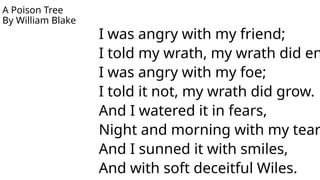
A Poison Tree
By William Blake
I was angry with my friend;
I told my wrath, my wrath did en
I was angry with my foe;
I told it not, my wrath did grow.
And I watered it in fears,
Night and morning with my tear
And I sunned it with smiles,
And with soft deceitful Wiles.
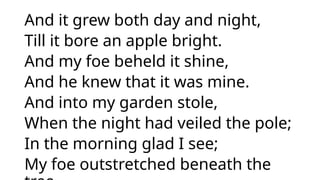
And it grew both day and night,
Till it bore an apple bright.
And my foe beheld it shine,
And he knew that it was mine.
And into my garden stole,
When the night had veiled the pole;
In the morning glad I see;
My foe outstretched beneath the
Analysis of the Poem…
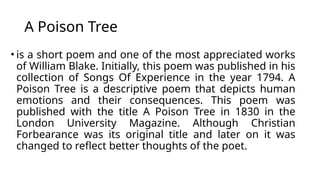
A Poison Tree
• is a short poem and one of the most appreciated works
of William Blake. Initially, this poem was published in his
collection of Songs Of Experience in the year 1794. A
Poison Tree is a descriptive poem that depicts human
emotions and their consequences. This poem was
published with the title A Poison Tree in 1830 in the
London University Magazine. Although Christian
Forbearance was its original title and later on it was
changed to reflect better thoughts of the poet.
"A Poison Tree" by William Blake
•It is a poem that uses an extended metaphor to
describe the speaker's anger as a growing tree
bearing poisonous apples.
•The central symbol, the poison tree, represents the
dangers of bottling up emotions and the cycle of
negativity that can result.
•The poem contrasts two types of anger: one resolved
through honest confrontation, and the other leading
to bitterness.
A Poison Tree is about the hatred and
corrupted effects of anger towards
others. In the poem, Blake shares his
experiences with us that once he was
angry with one of his friends and told
him about the matter of annoyance.
Consequently, the anger vanished
away and both became friends again.
In contrast, he tells that once he was
angry over his enemy but he never told
him about the matter, the anger kept
growing in his mind against enemy
and forced him to keep it hidden from
his enemy. He symbolizes anger by a
poison tree full of fruits which Blake’s
enemy happens to steal and
Stanza 1
The poet says in first stanza that once
he was angry with his one of the
friends due to any reason and he told
him clearly about it. By doing so, all
his anger against his friend vanished
away and again they became friends.
•In second half of first stanza,
poet narrates another experience
that once he got angry with his
one enemy and did not tell him
about it. This time anger stared
growing in poet’s mind.
•In the first stanza, we come to know that
how it is easy to reconcile with a friend if
we clear doubts and misunderstandings.
However, on the other hand, if we do not
talk to someone when we are angry with
him; anger and hate will keep growing in
our mind against enemy.
Stanza 2
•In second stanza, poet elaborates his experience
that he watered his anger every day and night in
fears of disclosing it to his enemy. He also shed
tears because of hate. Here poet wants to tell that
he failed to give up his anger that causes him fear
and tears. Wrath kept growing in poets mind by
day and night because he feared to reveal it to
enemy and in this way memory of ill-activity
remained alive in his mind.
In the last two lines of second stanza,
Blake says that he sunned his anger
with smiles and soft deceitful wiles.
Here poet symbolizes his anger as a
tree which is as growing in his mind as
tree grows in light of sun. In last line,
poet says that the deceitful tricks
(hiding anger) made the tree grow up
in poet’s mind.
Stanza 3
• In third stanza, poet explains that the tree kept growing day
and night and finally one day it became a full grown tree
with a bright apple.
• “Bright Apple” depicts here something which attracts his
enemy to eat it. However, deceitful tricks like deceit and hate
made this bright apple fully grown and it is harmful for the
enemy.
•Many critics compare this bright apple with the
apple of the Heaven that was forbidden for Adam
to eat as believed in Christian and Islamic
Theology. Adam and Eve were attracted by Satan
(Lucifer) to eat the forbidden apple but it caused
a disaster in their lives and they were expelled
from the Heaven. Here poet wants to tell that like
Lucifer, he kept hidden his intentions and kept
smile on his face that caused harm to his enemy.
•Some critics refer this bright
apple to some of written works
of Blake which were stolen by
one of his friends and caused
shame for his friend latter on.
Stanza 4
•In last stanza poets tells about the consequences
of that bright apple. Like Adam and Eve, the
poet’s enemy stole the bright apple from the
garden at night and ate it. Later on, in the
morning, the poet is happy when he looks at his
enemy lying dead under the tree. Here poet
compare himself with Satan as Satan was also
glad to see Adam and Eve being expelled from
Heaven.
•The message poet wants to convey is that
anger and hatred make one like Satan and
when he plans to take revenge for
something bad done to him, one forgets the
consequences.
•Morally, poet tells us that we should clear
our misunderstanding until they become like
a bright apple that can cause harm.
•The poem reveals the power of anger if not
controlled at initial stage. Anger is an aggressive
and dangerous emotion that we all possess as
human beings.
•In the poem, Blake has stated clearly at the start
that when we give up our anger, we can escape
from drastic consequences of grown up anger.
When poet forgives his friend, he saved himself as
well his friend from the harm of the hatred.
•When poet keep anger in his mind and it
keeps growing by different ways elaborated
in the poem cause deadly harm to the
enemy of the poet. Instead of clearing
doubts and grievances he remembered
every little thing that he has wrongly done
to put him down and harmed him
dreadfully.
• In this poem
• Tree symbolizes wrath and anger or loss of patience.
• Garden is the symbol of the heart where the hatred is
natured.
• Bright apple depicts vengeance.

Making Connections with the poem A Poison Tree

  • 1.
  • 2.
    Objective: make connections between textsto particular issues, concerns, and dispositions in life.
  • 3.
  • 4.
    Make a textto world connections about the poem “A Poison Tree.”
  • 5.
    A Poison Tree byWilliam Blake Text to world Connection 1. What does this remind me of in the real world? 2. How is this text similar to things happening in real world? 3. How is this different from things happening in real world? 4. How does this part relate to the world around me?
  • 6.
    Lesson 1 MakingConnections •Your previous experiences, knowledge, emotions, and understanding affect what and how you learn called the schema help you make sense and meaning of the material you are exposed to.
  • 7.
    Keene and Zimmerman (1997, ascited in Kardash, 2004) concluded that students like you comprehend better when you make different kinds of connections.
  • 8.
    These three (3)connections include the following: · text- to-self, · text- to-text, and · text- to- world.
  • 9.
    Types of ConnectionsQuestions to Ask Text-to-self connections are actually personal connections that you make between yourself and the selection you are dealing with. Previous experiences, emotions, or opinions may be similar to the ones present in • What does this remind me of in my life? • How is this similar to my life? • How is this different from my life? • Has something like this ever happened to me? • How does this relate to my life? • What were my feelings
  • 10.
    Activity 1 Make atext to self connections about the poem Crossing the Bar in a one half crosswise.
  • 11.
    Types of ConnectionsQuestions to Ask Text-to-text connections are connections where you relate one material to another that you have read or have already come across. Texts might be from a similar author, same theme or topic, same genre, and the like. • What does this remind me of in another book I have read? • How is this text similar to other things I have read? • How is this different from other books I have read? • Have I read about something like this before?
  • 12.
    Types of ConnectionsQuestions to Ask Text-to-world connections are the larger connections that a reader brings to a reading situation including our perception of the world which might vary since we have various sources of learning things beyond personal • What does this remind me of in the real world? • How is this text similar to things happening in real world? • How is this different from things happening in real world? • How does this part relate to the world around me?
  • 13.
    William Blake He wasan English poet. He was born in London, England, on 28th November 1757. Blake was not only an English poet, but a visionary poet of all ages. He lived during Romantic age and his works depict the age of that time. His work could not get fame during his life but later on he turned out to be a visionary poet of all the ages. He was against race discrimination and wrote for the equal rights. He also raised child labor issues in his writings and other major issues of his age in his poetry.
  • 14.
    A Poison Tree ByWilliam Blake I was angry with my friend; I told my wrath, my wrath did en I was angry with my foe; I told it not, my wrath did grow. And I watered it in fears, Night and morning with my tear And I sunned it with smiles, And with soft deceitful Wiles.
  • 15.
    And it grewboth day and night, Till it bore an apple bright. And my foe beheld it shine, And he knew that it was mine. And into my garden stole, When the night had veiled the pole; In the morning glad I see; My foe outstretched beneath the
  • 16.
  • 17.
    A Poison Tree •is a short poem and one of the most appreciated works of William Blake. Initially, this poem was published in his collection of Songs Of Experience in the year 1794. A Poison Tree is a descriptive poem that depicts human emotions and their consequences. This poem was published with the title A Poison Tree in 1830 in the London University Magazine. Although Christian Forbearance was its original title and later on it was changed to reflect better thoughts of the poet.
  • 18.
    "A Poison Tree"by William Blake •It is a poem that uses an extended metaphor to describe the speaker's anger as a growing tree bearing poisonous apples. •The central symbol, the poison tree, represents the dangers of bottling up emotions and the cycle of negativity that can result. •The poem contrasts two types of anger: one resolved through honest confrontation, and the other leading to bitterness.
  • 19.
    A Poison Treeis about the hatred and corrupted effects of anger towards others. In the poem, Blake shares his experiences with us that once he was angry with one of his friends and told him about the matter of annoyance.
  • 20.
    Consequently, the angervanished away and both became friends again. In contrast, he tells that once he was angry over his enemy but he never told him about the matter, the anger kept growing in his mind against enemy and forced him to keep it hidden from his enemy. He symbolizes anger by a poison tree full of fruits which Blake’s enemy happens to steal and
  • 21.
    Stanza 1 The poetsays in first stanza that once he was angry with his one of the friends due to any reason and he told him clearly about it. By doing so, all his anger against his friend vanished away and again they became friends.
  • 22.
    •In second halfof first stanza, poet narrates another experience that once he got angry with his one enemy and did not tell him about it. This time anger stared growing in poet’s mind.
  • 23.
    •In the firststanza, we come to know that how it is easy to reconcile with a friend if we clear doubts and misunderstandings. However, on the other hand, if we do not talk to someone when we are angry with him; anger and hate will keep growing in our mind against enemy.
  • 24.
    Stanza 2 •In secondstanza, poet elaborates his experience that he watered his anger every day and night in fears of disclosing it to his enemy. He also shed tears because of hate. Here poet wants to tell that he failed to give up his anger that causes him fear and tears. Wrath kept growing in poets mind by day and night because he feared to reveal it to enemy and in this way memory of ill-activity remained alive in his mind.
  • 25.
    In the lasttwo lines of second stanza, Blake says that he sunned his anger with smiles and soft deceitful wiles. Here poet symbolizes his anger as a tree which is as growing in his mind as tree grows in light of sun. In last line, poet says that the deceitful tricks (hiding anger) made the tree grow up in poet’s mind.
  • 26.
    Stanza 3 • Inthird stanza, poet explains that the tree kept growing day and night and finally one day it became a full grown tree with a bright apple. • “Bright Apple” depicts here something which attracts his enemy to eat it. However, deceitful tricks like deceit and hate made this bright apple fully grown and it is harmful for the enemy.
  • 27.
    •Many critics comparethis bright apple with the apple of the Heaven that was forbidden for Adam to eat as believed in Christian and Islamic Theology. Adam and Eve were attracted by Satan (Lucifer) to eat the forbidden apple but it caused a disaster in their lives and they were expelled from the Heaven. Here poet wants to tell that like Lucifer, he kept hidden his intentions and kept smile on his face that caused harm to his enemy.
  • 28.
    •Some critics referthis bright apple to some of written works of Blake which were stolen by one of his friends and caused shame for his friend latter on.
  • 29.
    Stanza 4 •In laststanza poets tells about the consequences of that bright apple. Like Adam and Eve, the poet’s enemy stole the bright apple from the garden at night and ate it. Later on, in the morning, the poet is happy when he looks at his enemy lying dead under the tree. Here poet compare himself with Satan as Satan was also glad to see Adam and Eve being expelled from Heaven.
  • 30.
    •The message poetwants to convey is that anger and hatred make one like Satan and when he plans to take revenge for something bad done to him, one forgets the consequences. •Morally, poet tells us that we should clear our misunderstanding until they become like a bright apple that can cause harm.
  • 31.
    •The poem revealsthe power of anger if not controlled at initial stage. Anger is an aggressive and dangerous emotion that we all possess as human beings. •In the poem, Blake has stated clearly at the start that when we give up our anger, we can escape from drastic consequences of grown up anger. When poet forgives his friend, he saved himself as well his friend from the harm of the hatred.
  • 32.
    •When poet keepanger in his mind and it keeps growing by different ways elaborated in the poem cause deadly harm to the enemy of the poet. Instead of clearing doubts and grievances he remembered every little thing that he has wrongly done to put him down and harmed him dreadfully.
  • 33.
    • In thispoem • Tree symbolizes wrath and anger or loss of patience. • Garden is the symbol of the heart where the hatred is natured. • Bright apple depicts vengeance.