Adapted from a Robert Rust sermon
http://www.sermoncentral.com/print_friendly.asp?SermonID=37724
ESV
ESV
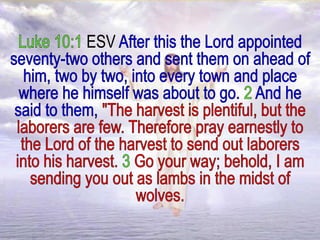
Luke opens this chapter by saying, “
.”
The “ ” provides a bridge back to Jesus
illustrating the cost of discipleship to three
“would-be disciples” who found the cost of
discipleship just a little too high. The theme of
discipleship continues this week as Jesus
commissions new missionaries.
ESV
The message this morning is really made up of
two parts, the commissioning of the seventy
and their joyous return.
Matthew and Mark also tell this story, but each
of them only talk about the commissioning of
the twelve disciples. Luke’s version is the only
one that tells of the sending forth of the

seventy.
It is also the only version that describes their
joyous return and their victory over evil.
Luke tells us that these seventy individuals are
sent out on a messianic mission.
They were to go to the cities and villages
where Jesus and his disciples would soon
venture themselves.
They are sent on ahead of Jesus to pave the
way for Jesus’ eventual visit.
We note that Jesus sends out the seventy in
groups of two.
Jesus sends them out two by two because it
not only provides companionship for the
journey, and the ability to hold each other up
when the going gets tough, but it also provides
a double dose of faith and wisdom to witness
to others.
Also, according to Mosaic law, two witnesses
were required for a testimony to be credible.
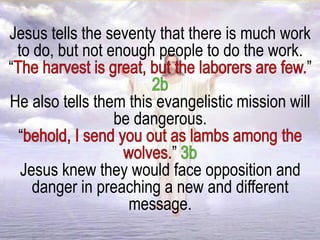
Jesus tells the seventy that there is much work
to do, but not enough people to do the work.
“ ”
He also tells them this evangelistic mission will
be dangerous.
“
”
Jesus knew they would face opposition and
danger in preaching a new and different
message.
There is also a sense of urgency in their
mission.
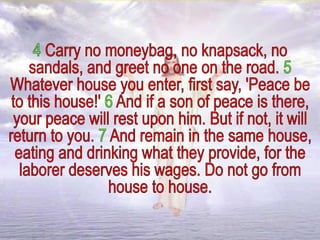
Jesus tells them to travel light.
“
”
He also tells them not to even take the time to
greet anyone they meet on the road.
The harvest is not only plentiful, it is also ripe.
There is no time to waste.
The seventy missionaries are told that they
may not be successful, or well received in
every town.
Not everyone will be open to their message.
You see, these seventy were going into towns
where people were worshipping many false
gods and they didn’t want to give up all their
gods for One God.
These missionaries were competing with all of
these false gods.
Here is a funny story about competing.
It seems there was a barber in a small town
who had been the only barber in town for
years.
Everyone went to this barber to get their hair
cut.
Then, one day a big hair salon franchise came
to town and opened up shop.
They advertised,
“All Haircuts for $3.00”
Slowly, the barber’s business began to
dwindle. He just couldn’t compete. In a last
ditch effort to save his business, he hired a
business consultant. The consultant spent a
day pouring over the barber’s books asking
many questions.
At the end of the day the barber asked the
consultant, “So what do you think? Should I
close up shop?”
The consultant said, “Not yet. I’ll be back
tomorrow.” The next day the consultant
showed up with a huge banner that he hung in
front of the barber shop that said, “We Fix
$3.00 Haircuts!”
The competition doesn’t always win, do they?
In the closing section of this story we are told
that the competing gods didn’t win either.
We hear of the great joy and success the
disciples had casting out demons, healing the
sick, preaching the Gospel and overcoming the
competition by fixing $3.00 false gods.
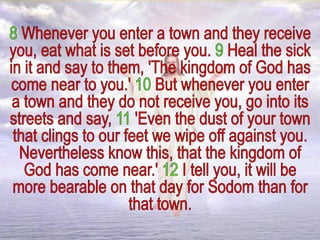
Jesus said, while you were out there
evangelizing, “
”
He then warns this army of evangelists not to
be so taken up with their accomplishments, but
rather to give thanks that their names were
written in heaven.
As we hear the story of Jesus sending out the
seventy, we can’t help but ask ourselves,
“What is missionary work and evangelism, and
why must we do it?”
Jesus gives us the framework for missionary
work and evangelism right here in his
instructions to these seventy newly
commissioned evangelists.
He first tells them to bring the gift of peace to
those they visit.
He then tells them to heal the sick.
And finally he tells them to preach the Good
News that the Kingdom of God is near them.
They were to teach, preach and heal, just like
Jesus did when he entered a village.
Jesus’ ministry included both physical and
spiritual healing because the concerns of the
ordinary people of Jesus’ day were demons
and sickness, and the two were very closely
related.
People believed in layers of powers that
existed between God and humanity.
It was believed that these powers interfered
with nature and human life.
If we stop and think about it for a minute,
things aren’t much different today, are they?
There are still powers of evil that exist between
God and humanity.
Demons are still present today.
They just have different names.
Today we have the demons of alcoholism and
drug abuse among us.
We have the demon of domestic violence and
abuse that we see paraded on TV.
We have the demon of addiction and
oppression.
Some of the demons have names and others
don’t.
We all have our own personal demons that we
struggle with.
Demons are among us today just as they were
in the time of Jesus, and we have just as
many, in fact more with the growing population,
people who are spiritually sick today as were
back then.
We are left with the question, what do we do
about it?
How do we overcome evil in the world?
Do you sit in the pews and listen to me talk
about it and walk out of here shaking your
heads saying, “How awful!” and then go on
with life as usual?
Or, do you try and do something about it to
make a difference.
As Christians, we are all called to do
something about the ills of society.
Positive changes in our society will not come
about until there are more people in this world
who know God, and are willing to share God
with those who don’t know God.
That was the job of these original seventy
missionaries, and that is our job as the church.
The seventy missionaries were God’s
underground network of faithful followers who
spread the Good News.
We need to keep that underground active
today spreading the Good News to those who
haven’t heard it yet.
I think there are two things in our society today
that immobilizes us from spreading the Good
News and overcoming evil in the world.
The first thing that immobilizes us is the notion
that there is just too much work to do in God’s
mission field and I am only one person.
There is no way my efforts can make a
difference. That notion is false!
There is a story of a boy and his grandfather
walking along the beach.
The beach was covered with starfish that had
been washed ashore.
Every so often the grandfather would stop, pick
up one of the starfish and toss it back into the
ocean.
After a while the little boy said to his
grandfather, “There are thousands of starfish
on the beach.
Throwing a few back into the ocean can’t
possibly make a difference.”
As the grandfather tossed another starfish into
the ocean, he said, “It will make a difference to
that one.”
A man was traveling through Chicago’s O’Hare
Airport.
The flight he was on arrived late and people on
the plane were scrambling to make their
connecting flights, including him.
He had five minutes to make it from one
terminal to the next to make his connection.
As he tried to make his way through the
crowds, he saw a young girl in front of him who
was weighed down with luggage and was just
about in tears.
He walked up to her and asked her if he could
help with her luggage.
He took the bags off her shoulder and she told
him which gate she was going to. It was right
next to his.
They moved through the crowds quickly and
got to her gate just as they were giving the last
boarding call. She thanked him and got on the
plane. He turned and looked at over at his
gate. His flight was delayed by 30 minutes. He
had plenty of time. He couldn’t help everyone
in the airport with their luggage that night, but
to the one he did help, it made a difference.
I think the second thing that immobilizes us
with evangelism is the thought that in order to
be a witness in God’s mission field we need to
stand on a soap box on a street corner passing
out Bible tracks, or walk down Main Street with
a sandwich board sign that says “Repent!” on
the front and, “For the end is near!” on the
back. Well that’s not always the case. Sidewalk
evangelism does have its place, and there are
some people who are cut out to do that type of
evangelizing. (I don’t happen to be one of
them.)
I think the most effective form of evangelism
we can offer is the way in which we live our
lives, and by the example we set as Christians.
I also believe some of the best forms of
evangelism come in very small ways with
random acts of kindness, like throwing a
starfish back into the ocean or helping a
distressed girl carry her luggage.
That, my friends, is how we can defeat the evil
in the world, one kind act at a time.
In the Scripture reading today, Jesus said to
the seventy upon their return, “
.”
Jesus was saying that the Seventy were
participating in the defeat of evil in the world.
We too can participate in the defeat of evil in
our world.
Jesus says to us, I see Satan fall like lightning
from Heaven when your church sends money
to ShowMe Christian Youth Home to care for
orphaned & troubled children.
I see Satan fall like lightning from Heaven
when you send youth to Bennett Spring
Christian Camp.
I see Satan falling from Heaven when you help
provide funds to purchase a tractor so an
Orphanage in Africa can raise much needed
food.
I see Satan fall like lightning when you help
your neighbor in need.
I see Satan fall like lightning when you
cheerfully welcome the new person who
comes to church.
I see Satan fall like lightning when you forgive
the one who has wronged you.
Let us not be tricked into thinking that we can’t
make a difference, because we can make a
difference one small act at a time.
May we get up from these pews today and go
out into the world knowing that there is a great
need out there.
There is a world full of hurt and people are just
looking for a ray of hope to get them through.
May that ray of hope be Christ shining through
us.
May we be the seventy that make a difference
in the life of just one. AMEN!

Making a Difference

  • 1.
    Adapted from aRobert Rust sermon http://www.sermoncentral.com/print_friendly.asp?SermonID=37724
  • 2.
  • 5.
  • 6.
    Luke opens thischapter by saying, “ .” The “ ” provides a bridge back to Jesus illustrating the cost of discipleship to three “would-be disciples” who found the cost of discipleship just a little too high. The theme of discipleship continues this week as Jesus commissions new missionaries.
  • 7.
  • 9.
    The message thismorning is really made up of two parts, the commissioning of the seventy and their joyous return. Matthew and Mark also tell this story, but each of them only talk about the commissioning of the twelve disciples. Luke’s version is the only one that tells of the sending forth of the seventy. It is also the only version that describes their joyous return and their victory over evil.
  • 10.
    Luke tells usthat these seventy individuals are sent out on a messianic mission. They were to go to the cities and villages where Jesus and his disciples would soon venture themselves. They are sent on ahead of Jesus to pave the way for Jesus’ eventual visit.
  • 11.
    We note thatJesus sends out the seventy in groups of two. Jesus sends them out two by two because it not only provides companionship for the journey, and the ability to hold each other up when the going gets tough, but it also provides a double dose of faith and wisdom to witness to others. Also, according to Mosaic law, two witnesses were required for a testimony to be credible.
  • 12.
    Jesus tells theseventy that there is much work to do, but not enough people to do the work. “ ” He also tells them this evangelistic mission will be dangerous. “ ” Jesus knew they would face opposition and danger in preaching a new and different message.
  • 13.
    There is alsoa sense of urgency in their mission. Jesus tells them to travel light. “ ” He also tells them not to even take the time to greet anyone they meet on the road. The harvest is not only plentiful, it is also ripe. There is no time to waste.
  • 14.
    The seventy missionariesare told that they may not be successful, or well received in every town. Not everyone will be open to their message. You see, these seventy were going into towns where people were worshipping many false gods and they didn’t want to give up all their gods for One God. These missionaries were competing with all of these false gods.
  • 15.
    Here is afunny story about competing. It seems there was a barber in a small town who had been the only barber in town for years. Everyone went to this barber to get their hair cut. Then, one day a big hair salon franchise came to town and opened up shop. They advertised, “All Haircuts for $3.00”
  • 16.
    Slowly, the barber’sbusiness began to dwindle. He just couldn’t compete. In a last ditch effort to save his business, he hired a business consultant. The consultant spent a day pouring over the barber’s books asking many questions. At the end of the day the barber asked the consultant, “So what do you think? Should I close up shop?”
  • 17.
    The consultant said,“Not yet. I’ll be back tomorrow.” The next day the consultant showed up with a huge banner that he hung in front of the barber shop that said, “We Fix $3.00 Haircuts!” The competition doesn’t always win, do they?
  • 18.
    In the closingsection of this story we are told that the competing gods didn’t win either. We hear of the great joy and success the disciples had casting out demons, healing the sick, preaching the Gospel and overcoming the competition by fixing $3.00 false gods.
  • 19.
    Jesus said, whileyou were out there evangelizing, “ ” He then warns this army of evangelists not to be so taken up with their accomplishments, but rather to give thanks that their names were written in heaven.
  • 20.
    As we hearthe story of Jesus sending out the seventy, we can’t help but ask ourselves, “What is missionary work and evangelism, and why must we do it?” Jesus gives us the framework for missionary work and evangelism right here in his instructions to these seventy newly commissioned evangelists.
  • 21.
    He first tellsthem to bring the gift of peace to those they visit. He then tells them to heal the sick. And finally he tells them to preach the Good News that the Kingdom of God is near them. They were to teach, preach and heal, just like Jesus did when he entered a village.
  • 22.
    Jesus’ ministry includedboth physical and spiritual healing because the concerns of the ordinary people of Jesus’ day were demons and sickness, and the two were very closely related. People believed in layers of powers that existed between God and humanity. It was believed that these powers interfered with nature and human life.
  • 23.
    If we stopand think about it for a minute, things aren’t much different today, are they? There are still powers of evil that exist between God and humanity. Demons are still present today. They just have different names.
  • 24.
    Today we havethe demons of alcoholism and drug abuse among us. We have the demon of domestic violence and abuse that we see paraded on TV. We have the demon of addiction and oppression.
  • 25.
    Some of thedemons have names and others don’t. We all have our own personal demons that we struggle with. Demons are among us today just as they were in the time of Jesus, and we have just as many, in fact more with the growing population, people who are spiritually sick today as were back then.
  • 26.
    We are leftwith the question, what do we do about it? How do we overcome evil in the world? Do you sit in the pews and listen to me talk about it and walk out of here shaking your heads saying, “How awful!” and then go on with life as usual?
  • 27.
    Or, do youtry and do something about it to make a difference. As Christians, we are all called to do something about the ills of society. Positive changes in our society will not come about until there are more people in this world who know God, and are willing to share God with those who don’t know God.
  • 28.
    That was thejob of these original seventy missionaries, and that is our job as the church. The seventy missionaries were God’s underground network of faithful followers who spread the Good News. We need to keep that underground active today spreading the Good News to those who haven’t heard it yet.
  • 29.
    I think thereare two things in our society today that immobilizes us from spreading the Good News and overcoming evil in the world. The first thing that immobilizes us is the notion that there is just too much work to do in God’s mission field and I am only one person. There is no way my efforts can make a difference. That notion is false!
  • 30.
    There is astory of a boy and his grandfather walking along the beach. The beach was covered with starfish that had been washed ashore. Every so often the grandfather would stop, pick up one of the starfish and toss it back into the ocean.
  • 31.
    After a whilethe little boy said to his grandfather, “There are thousands of starfish on the beach. Throwing a few back into the ocean can’t possibly make a difference.” As the grandfather tossed another starfish into the ocean, he said, “It will make a difference to that one.”
  • 32.
    A man wastraveling through Chicago’s O’Hare Airport. The flight he was on arrived late and people on the plane were scrambling to make their connecting flights, including him. He had five minutes to make it from one terminal to the next to make his connection.
  • 33.
    As he triedto make his way through the crowds, he saw a young girl in front of him who was weighed down with luggage and was just about in tears. He walked up to her and asked her if he could help with her luggage. He took the bags off her shoulder and she told him which gate she was going to. It was right next to his.
  • 34.
    They moved throughthe crowds quickly and got to her gate just as they were giving the last boarding call. She thanked him and got on the plane. He turned and looked at over at his gate. His flight was delayed by 30 minutes. He had plenty of time. He couldn’t help everyone in the airport with their luggage that night, but to the one he did help, it made a difference.
  • 35.
    I think thesecond thing that immobilizes us with evangelism is the thought that in order to be a witness in God’s mission field we need to stand on a soap box on a street corner passing out Bible tracks, or walk down Main Street with a sandwich board sign that says “Repent!” on the front and, “For the end is near!” on the back. Well that’s not always the case. Sidewalk evangelism does have its place, and there are some people who are cut out to do that type of evangelizing. (I don’t happen to be one of them.)
  • 36.
    I think themost effective form of evangelism we can offer is the way in which we live our lives, and by the example we set as Christians. I also believe some of the best forms of evangelism come in very small ways with random acts of kindness, like throwing a starfish back into the ocean or helping a distressed girl carry her luggage. That, my friends, is how we can defeat the evil in the world, one kind act at a time.
  • 37.
    In the Scripturereading today, Jesus said to the seventy upon their return, “ .” Jesus was saying that the Seventy were participating in the defeat of evil in the world. We too can participate in the defeat of evil in our world.
  • 38.
    Jesus says tous, I see Satan fall like lightning from Heaven when your church sends money to ShowMe Christian Youth Home to care for orphaned & troubled children. I see Satan fall like lightning from Heaven when you send youth to Bennett Spring Christian Camp.
  • 39.
    I see Satanfalling from Heaven when you help provide funds to purchase a tractor so an Orphanage in Africa can raise much needed food. I see Satan fall like lightning when you help your neighbor in need. I see Satan fall like lightning when you cheerfully welcome the new person who comes to church. I see Satan fall like lightning when you forgive the one who has wronged you.
  • 40.
    Let us notbe tricked into thinking that we can’t make a difference, because we can make a difference one small act at a time. May we get up from these pews today and go out into the world knowing that there is a great need out there.
  • 41.
    There is aworld full of hurt and people are just looking for a ray of hope to get them through. May that ray of hope be Christ shining through us. May we be the seventy that make a difference in the life of just one. AMEN!