Project: MainnetZ Chain
Website: https://mainnetz.io
Platform: MainnetZ Chain
Language: Solidity
Date: January 3rd, 2023
Table of contents
Introduction ……………………………………………………………………………………… 4
Project Background ………………………………………………………………………………4
Audit Scope ……………………………………………………………………………………… 5
Claimed Smart Contract Features …………………………………………………………….. 6
Audit Summary ……………....…………………………………………………………………. 8
Technical Quick Stats …..……………………………………………………………………… 9
Code Quality ……………………………………………………………………………………. 10
Documentation ………………………………………………………………………………….. 10
Use of Dependencies …………………………………………………………………………… 10
AS-IS overview ………………………………………………………………………………….. 11
Severity Definitions ……………………………………………………………………………... 15
Audit Findings …………………………………………………………………………………… 16
Conclusion ………………………………………………………………………………………. 21
Our Methodology ………………………………………………………………………………... 22
Disclaimers ………………………………………………………………………………………. 24
Appendix
● Code Flow Diagram ……………………………………………………………………... 25
● Slither Results Log ………………………………………………………………………. 30
● Solidity static analysis ….……………………………………………………………….. 34
● Solhint Linter …………………………………………………………………….……….. 39
THIS IS SECURITY AUDIT REPORT DOCUMENT AND WHICH MAY
CONTAIN INFORMATION WHICH IS CONFIDENTIAL. WHICH
INCLUDES ANY POTENTIAL VULNERABILITIES AND MALICIOUS
CODES WHICH CAN BE USED TO EXPLOIT THE SOFTWARE. THIS
MUST BE REFERRED INTERNALLY AND ONLY SHOULD BE MADE
AVAILABLE TO THE PUBLIC AFTER ISSUES ARE RESOLVED.
Introduction
EtherAuthority was contracted by MainnetZ Chain to perform the Security audit of the
MainnetZ Chain smart contracts code. The audit has been performed using manual
analysis as well as using automated software tools. This report presents all the findings
regarding the audit performed on January 3rd, 2023.
The purpose of this audit was to address the following:
- Ensure that all claimed functions exist and function correctly.
- Identify any security vulnerabilities that may be present in the smart contract.
Project Background
● MainnetZ empowers the use and creation of decentralized applications (Dapps) and
to not only be the leading edge communal blockchain, but to also focus on the
revelations of developers releasing innovative projects with high potential.
● MainnetZ strives to become the origin of innovative Dapp technology, promotion,
business, and manufacturing within the cryptocurrency sector.
● The audit scope consists of system smart contracts of the MainnetZ Chain. The
system smart contracts contribute heavily to the consensus mechanism.
● The system smart contracts performs actions such as Create/Update Validators,
Vote for Proposals, staking for validators, Bridge, etc.
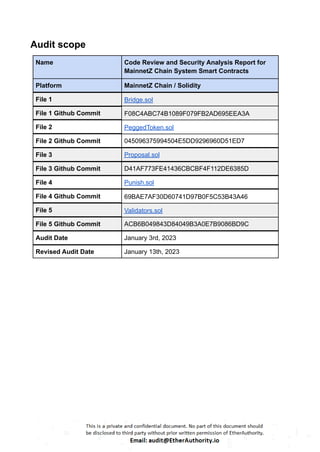
Audit scope
Name Code Review and Security Analysis Report for
MainnetZ Chain System Smart Contracts
Platform MainnetZ Chain / Solidity
File 1 Bridge.sol
File 1 Github Commit F08C4ABC74B1089F079FB2AD695EEA3A
File 2 PeggedToken.sol
File 2 Github Commit 045096375994504E5DD9296960D51ED7
File 3 Proposal.sol
File 3 Github Commit D41AF773FE41436CBCBF4F112DE6385D
File 4 Punish.sol
File 4 Github Commit 69BAE7AF30D60741D97B0F5C53B43A46
File 5 Validators.sol
File 5 Github Commit ACB6B049843D84049B3A0E7B9086BD9C
Audit Date January 3rd, 2023
Revised Audit Date January 13th, 2023
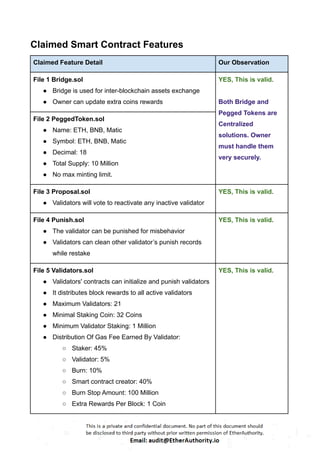
Claimed Smart Contract Features
Claimed Feature Detail Our Observation
File 1 Bridge.sol
● Bridge is used for inter-blockchain assets exchange
● Owner can update extra coins rewards
YES, This is valid.
Both Bridge and
Pegged Tokens are
Centralized
solutions. Owner
must handle them
very securely.
File 2 PeggedToken.sol
● Name: ETH, BNB, Matic
● Symbol: ETH, BNB, Matic
● Decimal: 18
● Total Supply: 10 Million
● No max minting limit.
File 3 Proposal.sol
● Validators will vote to reactivate any inactive validator
YES, This is valid.
File 4 Punish.sol
● The validator can be punished for misbehavior
● Validators can clean other validator’s punish records
while restake
YES, This is valid.
File 5 Validators.sol
● Validators' contracts can initialize and punish validators
● It distributes block rewards to all active validators
● Maximum Validators: 21
● Minimal Staking Coin: 32 Coins
● Minimum Validator Staking: 1 Million
● Distribution Of Gas Fee Earned By Validator:
○ Staker: 45%
○ Validator: 5%
○ Burn: 10%
○ Smart contract creator: 40%
○ Burn Stop Amount: 100 Million
○ Extra Rewards Per Block: 1 Coin
YES, This is valid.
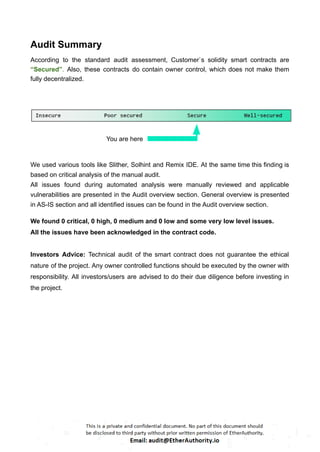
Audit Summary
According to the standard audit assessment, Customer`s solidity smart contracts are
“Secured”. Also, these contracts do contain owner control, which does not make them
fully decentralized.
You are here
We used various tools like Slither, Solhint and Remix IDE. At the same time this finding is
based on critical analysis of the manual audit.
All issues found during automated analysis were manually reviewed and applicable
vulnerabilities are presented in the Audit overview section. General overview is presented
in AS-IS section and all identified issues can be found in the Audit overview section.
We found 0 critical, 0 high, 0 medium and 0 low and some very low level issues.
All the issues have been acknowledged in the contract code.
Investors Advice: Technical audit of the smart contract does not guarantee the ethical
nature of the project. Any owner controlled functions should be executed by the owner with
responsibility. All investors/users are advised to do their due diligence before investing in
the project.
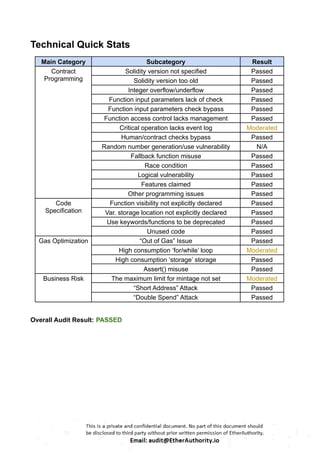
Technical Quick Stats
Main Category Subcategory Result
Contract
Programming
Solidity version not specified Passed
Solidity version too old Passed
Integer overflow/underflow Passed
Function input parameters lack of check Passed
Function input parameters check bypass Passed
Function access control lacks management Passed
Critical operation lacks event log Moderated
Human/contract checks bypass Passed
Random number generation/use vulnerability N/A
Fallback function misuse Passed
Race condition Passed
Logical vulnerability Passed
Features claimed Passed
Other programming issues Passed
Code
Specification
Function visibility not explicitly declared Passed
Var. storage location not explicitly declared Passed
Use keywords/functions to be deprecated Passed
Unused code Passed
Gas Optimization “Out of Gas” Issue Passed
High consumption ‘for/while’ loop Moderated
High consumption ‘storage’ storage Passed
Assert() misuse Passed
Business Risk The maximum limit for mintage not set Moderated
“Short Address” Attack Passed
“Double Spend” Attack Passed
Overall Audit Result: PASSED
Code Quality
This audit scope has 5 smart contract files. Smart contracts contain Libraries, Smart
contracts, inherits and Interfaces. This is a compact and well written smart contract.
The libraries in MainnetZ Chain Protocol are part of its logical algorithm. A library is a
different type of smart contract that contains reusable code. Once deployed on the
blockchain (only once), it is assigned a specific address and its properties / methods can
be reused many times by other contracts in the MainnetZ Chain Protocol.
The MainnetZ Chain team has not provided unit test scripts, which would not help to
determine the integrity of the code in an automated way.
All code parts are not well commented on smart contracts.
Documentation
We were given a MainnetZ Chain smart contract code in the form of a Github link. The
hash of that code is mentioned above in the table.
As mentioned above, code parts are not well commented. But the logic is straightforward.
So it is easy to quickly understand the programming flow as well as complex code logic.
Comments are very helpful in understanding the overall architecture of the protocol.
Another source of information was its website: https://mainnetz.io/ which provided rich
information about the project architecture.
Use of Dependencies
As per our observation, the libraries are used in this smart contracts infrastructure that are
based on well known industry standard open source projects.
Apart from libraries, its functions are used in external smart contract calls.
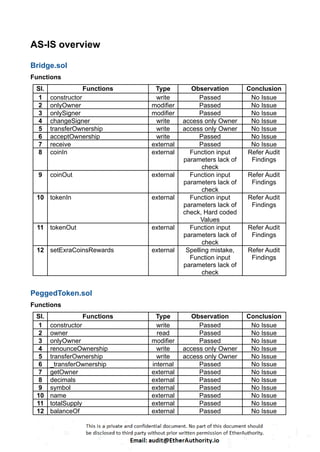
AS-IS overview
Bridge.sol
Functions
Sl. Functions Type Observation Conclusion
1 constructor write Passed No Issue
2 onlyOwner modifier Passed No Issue
3 onlySigner modifier Passed No Issue
4 changeSigner write access only Owner No Issue
5 transferOwnership write access only Owner No Issue
6 acceptOwnership write Passed No Issue
7 receive external Passed No Issue
8 coinIn external Function input
parameters lack of
check
Refer Audit
Findings
9 coinOut external Function input
parameters lack of
check
Refer Audit
Findings
10 tokenIn external Function input
parameters lack of
check, Hard coded
Values
Refer Audit
Findings
11 tokenOut external Function input
parameters lack of
check
Refer Audit
Findings
12 setExraCoinsRewards external Spelling mistake,
Function input
parameters lack of
check
Refer Audit
Findings
PeggedToken.sol
Functions
Sl. Functions Type Observation Conclusion
1 constructor write Passed No Issue
2 owner read Passed No Issue
3 onlyOwner modifier Passed No Issue
4 renounceOwnership write access only Owner No Issue
5 transferOwnership write access only Owner No Issue
6 _transferOwnership internal Passed No Issue
7 getOwner external Passed No Issue
8 decimals external Passed No Issue
9 symbol external Passed No Issue
10 name external Passed No Issue
11 totalSupply external Passed No Issue
12 balanceOf external Passed No Issue
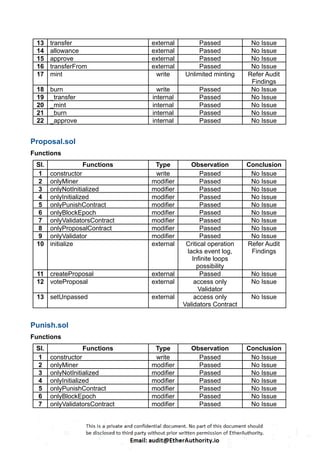
13 transfer external Passed No Issue
14 allowance external Passed No Issue
15 approve external Passed No Issue
16 transferFrom external Passed No Issue
17 mint write Unlimited minting Refer Audit
Findings
18 burn write Passed No Issue
19 _transfer internal Passed No Issue
20 _mint internal Passed No Issue
21 _burn internal Passed No Issue
22 _approve internal Passed No Issue
Proposal.sol
Functions
Sl. Functions Type Observation Conclusion
1 constructor write Passed No Issue
2 onlyMiner modifier Passed No Issue
3 onlyNotInitialized modifier Passed No Issue
4 onlyInitialized modifier Passed No Issue
5 onlyPunishContract modifier Passed No Issue
6 onlyBlockEpoch modifier Passed No Issue
7 onlyValidatorsContract modifier Passed No Issue
8 onlyProposalContract modifier Passed No Issue
9 onlyValidator modifier Passed No Issue
10 initialize external Critical operation
lacks event log,
Infinite loops
possibility
Refer Audit
Findings
11 createProposal external Passed No Issue
12 voteProposal external access only
Validator
No Issue
13 setUnpassed external access only
Validators Contract
No Issue
Punish.sol
Functions
Sl. Functions Type Observation Conclusion
1 constructor write Passed No Issue
2 onlyMiner modifier Passed No Issue
3 onlyNotInitialized modifier Passed No Issue
4 onlyInitialized modifier Passed No Issue
5 onlyPunishContract modifier Passed No Issue
6 onlyBlockEpoch modifier Passed No Issue
7 onlyValidatorsContract modifier Passed No Issue
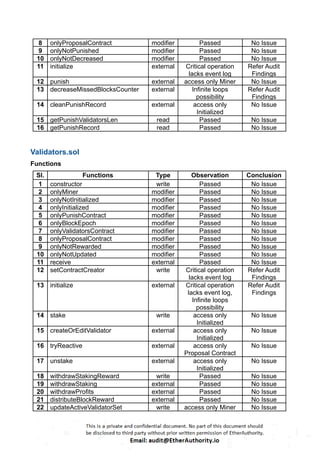
8 onlyProposalContract modifier Passed No Issue
9 onlyNotPunished modifier Passed No Issue
10 onlyNotDecreased modifier Passed No Issue
11 initialize external Critical operation
lacks event log
Refer Audit
Findings
12 punish external access only Miner No Issue
13 decreaseMissedBlocksCounter external Infinite loops
possibility
Refer Audit
Findings
14 cleanPunishRecord external access only
Initialized
No Issue
15 getPunishValidatorsLen read Passed No Issue
16 getPunishRecord read Passed No Issue
Validators.sol
Functions
Sl. Functions Type Observation Conclusion
1 constructor write Passed No Issue
2 onlyMiner modifier Passed No Issue
3 onlyNotInitialized modifier Passed No Issue
4 onlyInitialized modifier Passed No Issue
5 onlyPunishContract modifier Passed No Issue
6 onlyBlockEpoch modifier Passed No Issue
7 onlyValidatorsContract modifier Passed No Issue
8 onlyProposalContract modifier Passed No Issue
9 onlyNotRewarded modifier Passed No Issue
10 onlyNotUpdated modifier Passed No Issue
11 receive external Passed No Issue
12 setContractCreator write Critical operation
lacks event log
Refer Audit
Findings
13 initialize external Critical operation
lacks event log,
Infinite loops
possibility
Refer Audit
Findings
14 stake write access only
Initialized
No Issue
15 createOrEditValidator external access only
Initialized
No Issue
16 tryReactive external access only
Proposal Contract
No Issue
17 unstake external access only
Initialized
No Issue
18 withdrawStakingReward write Passed No Issue
19 withdrawStaking external Passed No Issue
20 withdrawProfits external Passed No Issue
21 distributeBlockReward external Passed No Issue
22 updateActiveValidatorSet write access only Miner No Issue
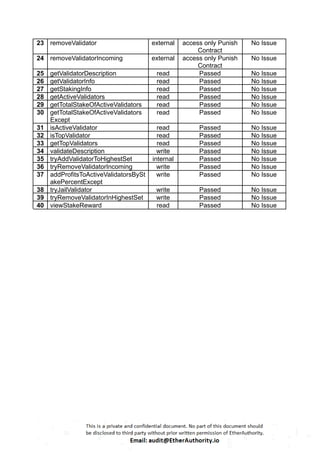
23 removeValidator external access only Punish
Contract
No Issue
24 removeValidatorIncoming external access only Punish
Contract
No Issue
25 getValidatorDescription read Passed No Issue
26 getValidatorInfo read Passed No Issue
27 getStakingInfo read Passed No Issue
28 getActiveValidators read Passed No Issue
29 getTotalStakeOfActiveValidators read Passed No Issue
30 getTotalStakeOfActiveValidators
Except
read Passed No Issue
31 isActiveValidator read Passed No Issue
32 isTopValidator read Passed No Issue
33 getTopValidators read Passed No Issue
34 validateDescription write Passed No Issue
35 tryAddValidatorToHighestSet internal Passed No Issue
36 tryRemoveValidatorIncoming write Passed No Issue
37 addProfitsToActiveValidatorsBySt
akePercentExcept
write Passed No Issue
38 tryJailValidator write Passed No Issue
39 tryRemoveValidatorInHighestSet write Passed No Issue
40 viewStakeReward read Passed No Issue
Severity Definitions
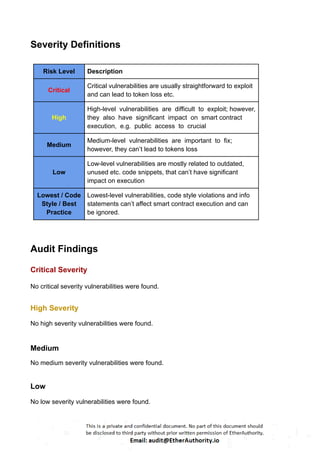
Risk Level Description
Critical
Critical vulnerabilities are usually straightforward to exploit
and can lead to token loss etc.
High
High-level vulnerabilities are difficult to exploit; however,
they also have significant impact on smart contract
execution, e.g. public access to crucial
Medium
Medium-level vulnerabilities are important to fix;
however, they can’t lead to tokens loss
Low
Low-level vulnerabilities are mostly related to outdated,
unused etc. code snippets, that can’t have significant
impact on execution
Lowest / Code
Style / Best
Practice
Lowest-level vulnerabilities, code style violations and info
statements can’t affect smart contract execution and can
be ignored.
Audit Findings
Critical Severity
No critical severity vulnerabilities were found.
High Severity
No high severity vulnerabilities were found.
Medium
No medium severity vulnerabilities were found.
Low
No low severity vulnerabilities were found.
Very Low / Informational / Best practices:
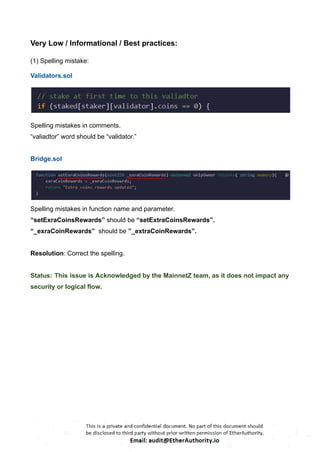
(1) Spelling mistake:
Validators.sol
Spelling mistakes in comments.
“valiadtor” word should be “validator.”
Bridge.sol
Spelling mistakes in function name and parameter.
“setExraCoinsRewards” should be “setExtraCoinsRewards”.
“_exraCoinRewards” should be ”_extraCoinRewards”.
Resolution: Correct the spelling.
Status: This issue is Acknowledged by the MainnetZ team, as it does not impact any
security or logical flow.
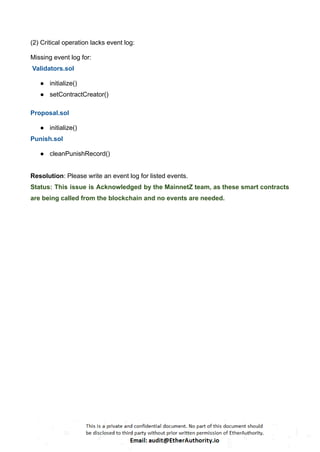
(2) Critical operation lacks event log:
Missing event log for:
Validators.sol
● initialize()
● setContractCreator()
Proposal.sol
● initialize()
Punish.sol
● cleanPunishRecord()
Resolution: Please write an event log for listed events.
Status: This issue is Acknowledged by the MainnetZ team, as these smart contracts
are being called from the blockchain and no events are needed.
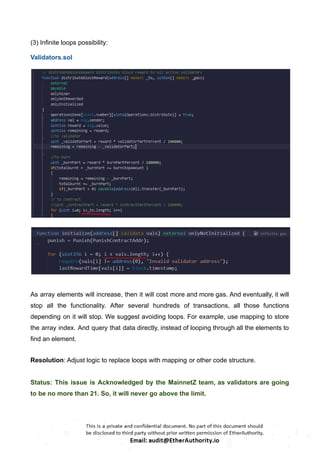
(3) Infinite loops possibility:
Validators.sol
As array elements will increase, then it will cost more and more gas. And eventually, it will
stop all the functionality. After several hundreds of transactions, all those functions
depending on it will stop. We suggest avoiding loops. For example, use mapping to store
the array index. And query that data directly, instead of looping through all the elements to
find an element.
Resolution: Adjust logic to replace loops with mapping or other code structure.
Status: This issue is Acknowledged by the MainnetZ team, as validators are going
to be no more than 21. So, it will never go above the limit.
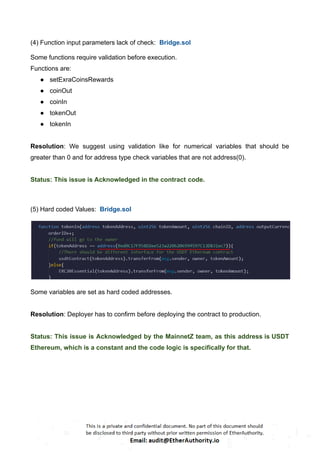
(4) Function input parameters lack of check: Bridge.sol
Some functions require validation before execution.
Functions are:
● setExraCoinsRewards
● coinOut
● coinIn
● tokenOut
● tokenIn
Resolution: We suggest using validation like for numerical variables that should be
greater than 0 and for address type check variables that are not address(0).
Status: This issue is Acknowledged in the contract code.
(5) Hard coded Values: Bridge.sol
Some variables are set as hard coded addresses.
Resolution: Deployer has to confirm before deploying the contract to production.
Status: This issue is Acknowledged by the MainnetZ team, as this address is USDT
Ethereum, which is a constant and the code logic is specifically for that.
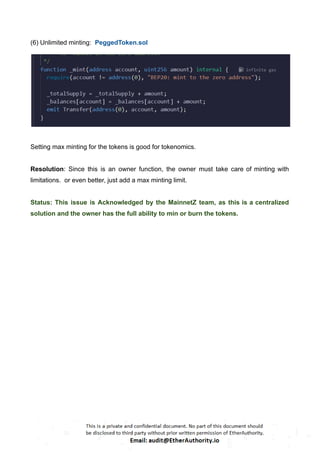
(6) Unlimited minting: PeggedToken.sol
Setting max minting for the tokens is good for tokenomics.
Resolution: Since this is an owner function, the owner must take care of minting with
limitations. or even better, just add a max minting limit.
Status: This issue is Acknowledged by the MainnetZ team, as this is a centralized
solution and the owner has the full ability to min or burn the tokens.
Centralization
This smart contract has some functions which can be executed by the Admin (Owner)
only. If the admin wallet private key would be compromised, then it would create trouble.
Following are Admin functions:
● coinOut function in the Bridge contract: the signers can transfer coins out.
● tokenOut function in the Bridge contract: the signers can token out.
● setExraCoinsRewards in the Bridge: the owner can update extra coins rewards.
● mint function in PeggedToken contact: the owner can create `amount` tokens and
assign them to `msg.sender`, increasing the total supply.
To make the smart contract 100% decentralized, we suggest renouncing ownership in the
smart contract once its function is completed.
Conclusion
We were given a contract code in the form of a github link. And we have used all possible
tests based on given objects as files. We have not observed any major issue in the smart
contracts. All the issues have been acknowledged in the contract code. So smart
contracts are good to go for the mainnet deployment.
Since possible test cases can be unlimited for such smart contracts protocol, we provide
no such guarantee of future outcomes. We have used all the latest static tools and manual
observations to cover maximum possible test cases to scan everything.
Smart contracts within the scope were manually reviewed and analyzed with static
analysis tools. Smart Contract’s high-level description of functionality was presented in the
As-is overview section of the report.
Audit report contains all found security vulnerabilities and other issues in the reviewed
code.
Security state of the reviewed contract, based on standard audit procedure scope, is
“Secure”.
Our Methodology
We like to work with a transparent process and make our reviews a collaborative effort.
The goals of our security audits are to improve the quality of systems we review and aim
for sufficient remediation to help protect users. The following is the methodology we use in
our security audit process.
Manual Code Review:
In manually reviewing all of the code, we look for any potential issues with code logic, error
handling, protocol and header parsing, cryptographic errors, and random number
generators. We also watch for areas where more defensive programming could reduce the
risk of future mistakes and speed up future audits. Although our primary focus is on the
in-scope code, we examine dependency code and behavior when it is relevant to a
particular line of investigation.
Vulnerability Analysis:
Our audit techniques included manual code analysis, user interface interaction, and
whitebox penetration testing. We look at the project's web site to get a high level
understanding of what functionality the software under review provides. We then meet with
the developers to gain an appreciation of their vision of the software. We install and use
the relevant software, exploring the user interactions and roles. While we do this, we
brainstorm threat models and attack surfaces. We read design documentation, review
other audit results, search for similar projects, examine source code dependencies, skim
open issue tickets, and generally investigate details other than the implementation.
Documenting Results:
We follow a conservative, transparent process for analyzing potential security
vulnerabilities and seeing them through successful remediation. Whenever a potential
issue is discovered, we immediately create an Issue entry for it in this document, even
though we have not yet verified the feasibility and impact of the issue. This process is
conservative because we document our suspicions early even if they are later shown to
not represent exploitable vulnerabilities. We generally follow a process of first documenting
the suspicion with unresolved questions, then confirming the issue through code analysis,
live experimentation, or automated tests. Code analysis is the most tentative, and we
strive to provide test code, log captures, or screenshots demonstrating our confirmation.
After this we analyze the feasibility of an attack in a live system.
Suggested Solutions:
We search for immediate mitigations that live deployments can take, and finally we
suggest the requirements for remediation engineering for future releases. The mitigation
and remediation recommendations should be scrutinized by the developers and
deployment engineers, and successful mitigation and remediation is an ongoing
collaborative process after we deliver our report, and before the details are made public.
Disclaimers
EtherAuthority.io Disclaimer
EtherAuthority team has analyzed this smart contract in accordance with the best industry
practices at the date of this report, in relation to: cybersecurity vulnerabilities and issues in
smart contract source code, the details of which are disclosed in this report, (Source
Code); the Source Code compilation, deployment and functionality (performing the
intended functions).
Due to the fact that the total number of test cases are unlimited, the audit makes no
statements or warranties on security of the code. It also cannot be considered as a
sufficient assessment regarding the utility and safety of the code, bugfree status or any
other statements of the contract. While we have done our best in conducting the analysis
and producing this report, it is important to note that you should not rely on this report only.
We also suggest conducting a bug bounty program to confirm the high level of security of
this smart contract.
Technical Disclaimer
Smart contracts are deployed and executed on the blockchain platform. The platform, its
programming language, and other software related to the smart contract can have their
own vulnerabilities that can lead to hacks. Thus, the audit can’t guarantee explicit security
of the audited smart contracts.
Appendix
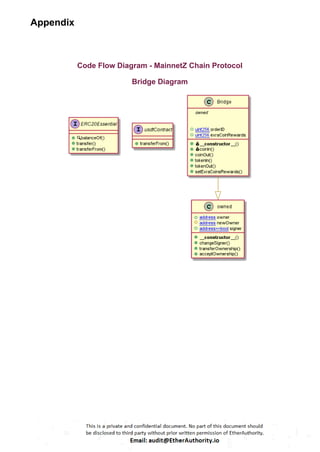
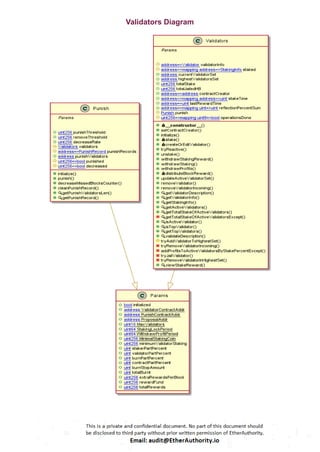
Code Flow Diagram - MainnetZ Chain Protocol
Bridge Diagram
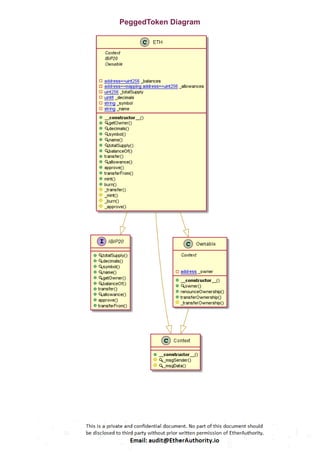
PeggedToken Diagram
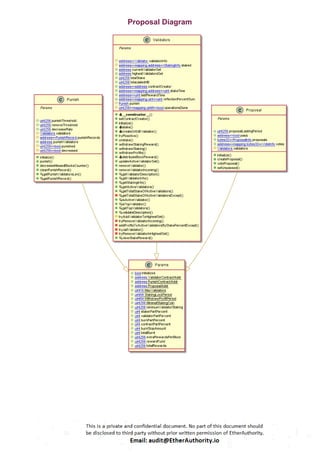
Proposal Diagram
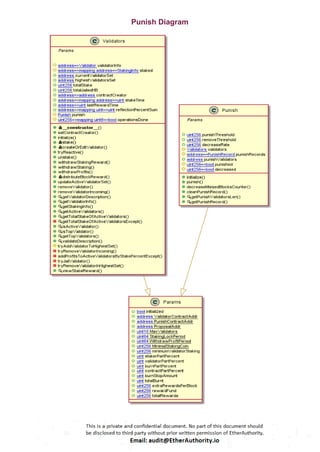
Punish Diagram
Validators Diagram
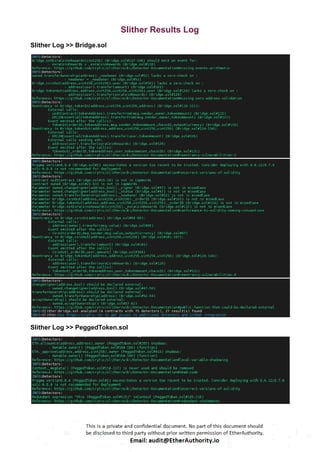
Slither Results Log
Slither Log >> Bridge.sol
Slither Log >> PeggedToken.sol
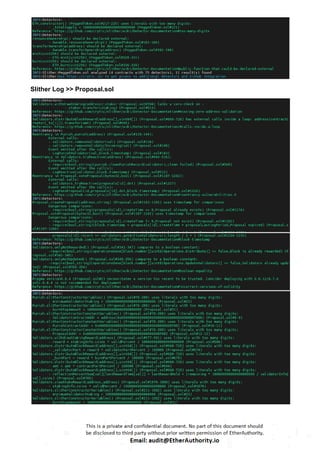
Slither Log >> Proposal.sol
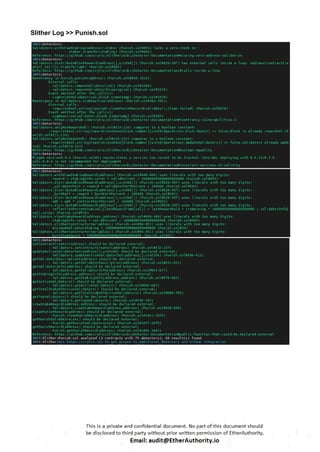
Slither Log >> Punish.sol
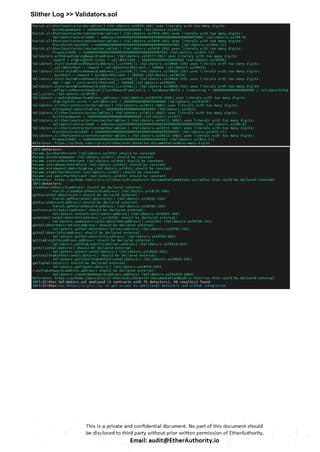
Slither Log >> Validators.sol
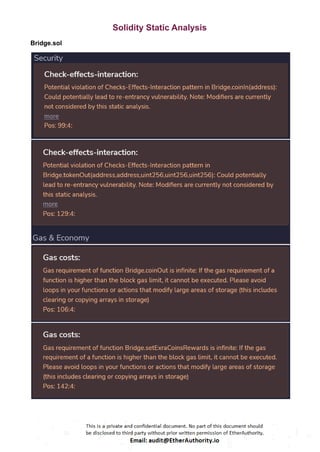
Solidity Static Analysis
Bridge.sol
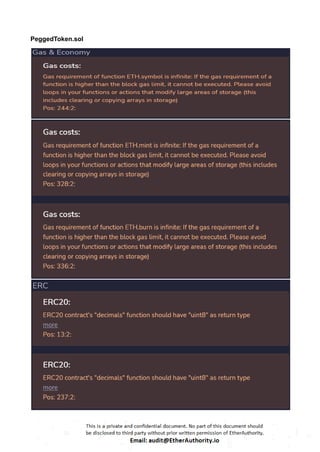
PeggedToken.sol
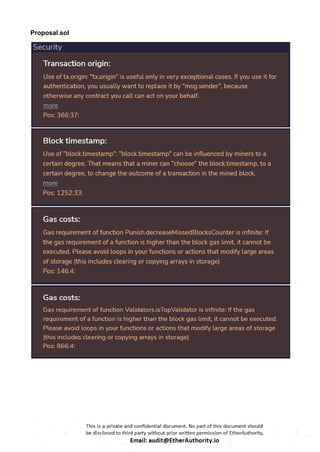
Proposal.sol
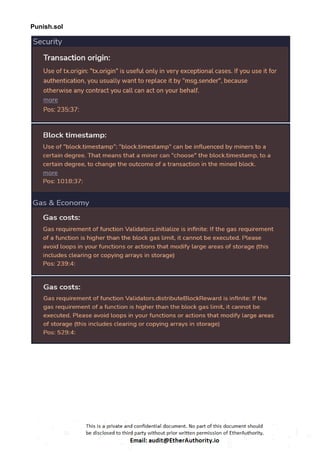
Punish.sol
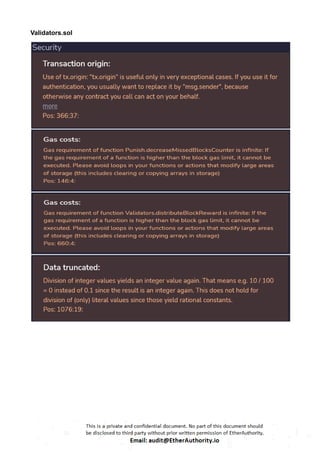
Validators.sol
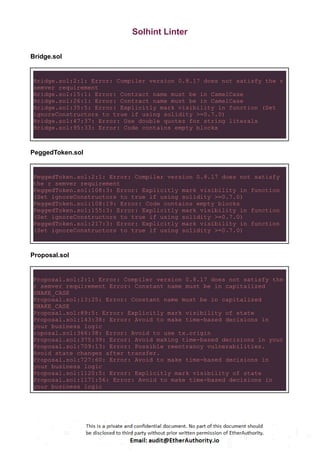
Solhint Linter
Bridge.sol
Bridge.sol:2:1: Error: Compiler version 0.8.17 does not satisfy the r
semver requirement
Bridge.sol:15:1: Error: Contract name must be in CamelCase
Bridge.sol:26:1: Error: Contract name must be in CamelCase
Bridge.sol:35:5: Error: Explicitly mark visibility in function (Set
ignoreConstructors to true if using solidity >=0.7.0)
Bridge.sol:47:37: Error: Use double quotes for string literals
Bridge.sol:95:33: Error: Code contains empty blocks
PeggedToken.sol
PeggedToken.sol:2:1: Error: Compiler version 0.8.17 does not satisfy
the r semver requirement
PeggedToken.sol:108:3: Error: Explicitly mark visibility in function
(Set ignoreConstructors to true if using solidity >=0.7.0)
PeggedToken.sol:108:19: Error: Code contains empty blocks
PeggedToken.sol:155:3: Error: Explicitly mark visibility in function
(Set ignoreConstructors to true if using solidity >=0.7.0)
PeggedToken.sol:217:3: Error: Explicitly mark visibility in function
(Set ignoreConstructors to true if using solidity >=0.7.0)
Proposal.sol
Proposal.sol:2:1: Error: Compiler version 0.8.17 does not satisfy the
r semver requirement Error: Constant name must be in capitalized
SNAKE_CASE
Proposal.sol:13:25: Error: Constant name must be in capitalized
SNAKE_CASE
Proposal.sol:89:5: Error: Explicitly mark visibility of state
Proposal.sol:143:38: Error: Avoid to make time-based decisions in
your business logic
roposal.sol:366:38: Error: Avoid to use tx.origin
Proposal.sol:375:39: Error: Avoid making time-based decisions in your
Proposal.sol:709:13: Error: Possible reentrancy vulnerabilities.
Avoid state changes after transfer.
Proposal.sol:727:60: Error: Avoid to make time-based decisions in
your business logic
Proposal.sol:1120:5: Error: Explicitly mark visibility of state
Proposal.sol:1171:56: Error: Avoid to make time-based decisions in
your business logic
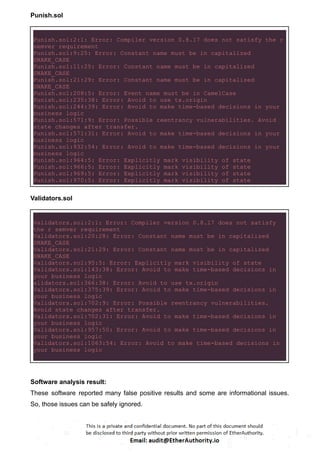
Punish.sol
Punish.sol:2:1: Error: Compiler version 0.8.17 does not satisfy the r
semver requirement
Punish.sol:9:25: Error: Constant name must be in capitalized
SNAKE_CASE
Punish.sol:11:25: Error: Constant name must be in capitalized
SNAKE_CASE
Punish.sol:21:29: Error: Constant name must be in capitalized
SNAKE_CASE
Punish.sol:208:5: Error: Event name must be in CamelCase
Punish.sol:235:38: Error: Avoid to use tx.origin
Punish.sol:244:39: Error: Avoid to make time-based decisions in your
business logic
Punish.sol:571:9: Error: Possible reentrancy vulnerabilities. Avoid
state changes after transfer.
Punish.sol:571:31: Error: Avoid to make time-based decisions in your
business logic
Punish.sol:932:54: Error: Avoid to make time-based decisions in your
business logic
Punish.sol:964:5: Error: Explicitly mark visibility of state
Punish.sol:966:5: Error: Explicitly mark visibility of state
Punish.sol:969:5: Error: Explicitly mark visibility of state
Punish.sol:970:5: Error: Explicitly mark visibility of state
Validators.sol
Validators.sol:2:1: Error: Compiler version 0.8.17 does not satisfy
the r semver requirement
Validators.sol:20:28: Error: Constant name must be in capitalized
SNAKE_CASE
Validators.sol:21:29: Error: Constant name must be in capitalized
SNAKE_CASE
Validators.sol:95:5: Error: Explicitly mark visibility of state
Validators.sol:143:38: Error: Avoid to make time-based decisions in
your business logic
alidators.sol:366:38: Error: Avoid to use tx.origin
Validators.sol:375:39: Error: Avoid to make time-based decisions in
your business logic
Validators.sol:702:9: Error: Possible reentrancy vulnerabilities.
Avoid state changes after transfer.
Validators.sol:702:31: Error: Avoid to make time-based decisions in
your business logic
Validators.sol:957:50: Error: Avoid to make time-based decisions in
your business logic
Validators.sol:1063:54: Error: Avoid to make time-based decisions in
your business logic
Software analysis result:
These software reported many false positive results and some are informational issues.
So, those issues can be safely ignored.
MainnetZ Chain – Smart Contract Security Audit Report by EtherAuthority

MainnetZ Chain – Smart Contract Security Audit Report by EtherAuthority

  • 1.
    Project: MainnetZ Chain Website:https://mainnetz.io Platform: MainnetZ Chain Language: Solidity Date: January 3rd, 2023
  • 2.
    Table of contents Introduction……………………………………………………………………………………… 4 Project Background ………………………………………………………………………………4 Audit Scope ……………………………………………………………………………………… 5 Claimed Smart Contract Features …………………………………………………………….. 6 Audit Summary ……………....…………………………………………………………………. 8 Technical Quick Stats …..……………………………………………………………………… 9 Code Quality ……………………………………………………………………………………. 10 Documentation ………………………………………………………………………………….. 10 Use of Dependencies …………………………………………………………………………… 10 AS-IS overview ………………………………………………………………………………….. 11 Severity Definitions ……………………………………………………………………………... 15 Audit Findings …………………………………………………………………………………… 16 Conclusion ………………………………………………………………………………………. 21 Our Methodology ………………………………………………………………………………... 22 Disclaimers ………………………………………………………………………………………. 24 Appendix ● Code Flow Diagram ……………………………………………………………………... 25 ● Slither Results Log ………………………………………………………………………. 30 ● Solidity static analysis ….……………………………………………………………….. 34 ● Solhint Linter …………………………………………………………………….……….. 39
  • 3.
    THIS IS SECURITYAUDIT REPORT DOCUMENT AND WHICH MAY CONTAIN INFORMATION WHICH IS CONFIDENTIAL. WHICH INCLUDES ANY POTENTIAL VULNERABILITIES AND MALICIOUS CODES WHICH CAN BE USED TO EXPLOIT THE SOFTWARE. THIS MUST BE REFERRED INTERNALLY AND ONLY SHOULD BE MADE AVAILABLE TO THE PUBLIC AFTER ISSUES ARE RESOLVED.
  • 4.
    Introduction EtherAuthority was contractedby MainnetZ Chain to perform the Security audit of the MainnetZ Chain smart contracts code. The audit has been performed using manual analysis as well as using automated software tools. This report presents all the findings regarding the audit performed on January 3rd, 2023. The purpose of this audit was to address the following: - Ensure that all claimed functions exist and function correctly. - Identify any security vulnerabilities that may be present in the smart contract. Project Background ● MainnetZ empowers the use and creation of decentralized applications (Dapps) and to not only be the leading edge communal blockchain, but to also focus on the revelations of developers releasing innovative projects with high potential. ● MainnetZ strives to become the origin of innovative Dapp technology, promotion, business, and manufacturing within the cryptocurrency sector. ● The audit scope consists of system smart contracts of the MainnetZ Chain. The system smart contracts contribute heavily to the consensus mechanism. ● The system smart contracts performs actions such as Create/Update Validators, Vote for Proposals, staking for validators, Bridge, etc.
  • 5.
    Audit scope Name CodeReview and Security Analysis Report for MainnetZ Chain System Smart Contracts Platform MainnetZ Chain / Solidity File 1 Bridge.sol File 1 Github Commit F08C4ABC74B1089F079FB2AD695EEA3A File 2 PeggedToken.sol File 2 Github Commit 045096375994504E5DD9296960D51ED7 File 3 Proposal.sol File 3 Github Commit D41AF773FE41436CBCBF4F112DE6385D File 4 Punish.sol File 4 Github Commit 69BAE7AF30D60741D97B0F5C53B43A46 File 5 Validators.sol File 5 Github Commit ACB6B049843D84049B3A0E7B9086BD9C Audit Date January 3rd, 2023 Revised Audit Date January 13th, 2023
  • 6.
    Claimed Smart ContractFeatures Claimed Feature Detail Our Observation File 1 Bridge.sol ● Bridge is used for inter-blockchain assets exchange ● Owner can update extra coins rewards YES, This is valid. Both Bridge and Pegged Tokens are Centralized solutions. Owner must handle them very securely. File 2 PeggedToken.sol ● Name: ETH, BNB, Matic ● Symbol: ETH, BNB, Matic ● Decimal: 18 ● Total Supply: 10 Million ● No max minting limit. File 3 Proposal.sol ● Validators will vote to reactivate any inactive validator YES, This is valid. File 4 Punish.sol ● The validator can be punished for misbehavior ● Validators can clean other validator’s punish records while restake YES, This is valid. File 5 Validators.sol ● Validators' contracts can initialize and punish validators ● It distributes block rewards to all active validators ● Maximum Validators: 21 ● Minimal Staking Coin: 32 Coins ● Minimum Validator Staking: 1 Million ● Distribution Of Gas Fee Earned By Validator: ○ Staker: 45% ○ Validator: 5% ○ Burn: 10% ○ Smart contract creator: 40% ○ Burn Stop Amount: 100 Million ○ Extra Rewards Per Block: 1 Coin YES, This is valid.
  • 7.
    Audit Summary According tothe standard audit assessment, Customer`s solidity smart contracts are “Secured”. Also, these contracts do contain owner control, which does not make them fully decentralized. You are here We used various tools like Slither, Solhint and Remix IDE. At the same time this finding is based on critical analysis of the manual audit. All issues found during automated analysis were manually reviewed and applicable vulnerabilities are presented in the Audit overview section. General overview is presented in AS-IS section and all identified issues can be found in the Audit overview section. We found 0 critical, 0 high, 0 medium and 0 low and some very low level issues. All the issues have been acknowledged in the contract code. Investors Advice: Technical audit of the smart contract does not guarantee the ethical nature of the project. Any owner controlled functions should be executed by the owner with responsibility. All investors/users are advised to do their due diligence before investing in the project.
  • 8.
    Technical Quick Stats MainCategory Subcategory Result Contract Programming Solidity version not specified Passed Solidity version too old Passed Integer overflow/underflow Passed Function input parameters lack of check Passed Function input parameters check bypass Passed Function access control lacks management Passed Critical operation lacks event log Moderated Human/contract checks bypass Passed Random number generation/use vulnerability N/A Fallback function misuse Passed Race condition Passed Logical vulnerability Passed Features claimed Passed Other programming issues Passed Code Specification Function visibility not explicitly declared Passed Var. storage location not explicitly declared Passed Use keywords/functions to be deprecated Passed Unused code Passed Gas Optimization “Out of Gas” Issue Passed High consumption ‘for/while’ loop Moderated High consumption ‘storage’ storage Passed Assert() misuse Passed Business Risk The maximum limit for mintage not set Moderated “Short Address” Attack Passed “Double Spend” Attack Passed Overall Audit Result: PASSED
  • 9.
    Code Quality This auditscope has 5 smart contract files. Smart contracts contain Libraries, Smart contracts, inherits and Interfaces. This is a compact and well written smart contract. The libraries in MainnetZ Chain Protocol are part of its logical algorithm. A library is a different type of smart contract that contains reusable code. Once deployed on the blockchain (only once), it is assigned a specific address and its properties / methods can be reused many times by other contracts in the MainnetZ Chain Protocol. The MainnetZ Chain team has not provided unit test scripts, which would not help to determine the integrity of the code in an automated way. All code parts are not well commented on smart contracts. Documentation We were given a MainnetZ Chain smart contract code in the form of a Github link. The hash of that code is mentioned above in the table. As mentioned above, code parts are not well commented. But the logic is straightforward. So it is easy to quickly understand the programming flow as well as complex code logic. Comments are very helpful in understanding the overall architecture of the protocol. Another source of information was its website: https://mainnetz.io/ which provided rich information about the project architecture. Use of Dependencies As per our observation, the libraries are used in this smart contracts infrastructure that are based on well known industry standard open source projects. Apart from libraries, its functions are used in external smart contract calls.
  • 10.
    AS-IS overview Bridge.sol Functions Sl. FunctionsType Observation Conclusion 1 constructor write Passed No Issue 2 onlyOwner modifier Passed No Issue 3 onlySigner modifier Passed No Issue 4 changeSigner write access only Owner No Issue 5 transferOwnership write access only Owner No Issue 6 acceptOwnership write Passed No Issue 7 receive external Passed No Issue 8 coinIn external Function input parameters lack of check Refer Audit Findings 9 coinOut external Function input parameters lack of check Refer Audit Findings 10 tokenIn external Function input parameters lack of check, Hard coded Values Refer Audit Findings 11 tokenOut external Function input parameters lack of check Refer Audit Findings 12 setExraCoinsRewards external Spelling mistake, Function input parameters lack of check Refer Audit Findings PeggedToken.sol Functions Sl. Functions Type Observation Conclusion 1 constructor write Passed No Issue 2 owner read Passed No Issue 3 onlyOwner modifier Passed No Issue 4 renounceOwnership write access only Owner No Issue 5 transferOwnership write access only Owner No Issue 6 _transferOwnership internal Passed No Issue 7 getOwner external Passed No Issue 8 decimals external Passed No Issue 9 symbol external Passed No Issue 10 name external Passed No Issue 11 totalSupply external Passed No Issue 12 balanceOf external Passed No Issue
  • 11.
    13 transfer externalPassed No Issue 14 allowance external Passed No Issue 15 approve external Passed No Issue 16 transferFrom external Passed No Issue 17 mint write Unlimited minting Refer Audit Findings 18 burn write Passed No Issue 19 _transfer internal Passed No Issue 20 _mint internal Passed No Issue 21 _burn internal Passed No Issue 22 _approve internal Passed No Issue Proposal.sol Functions Sl. Functions Type Observation Conclusion 1 constructor write Passed No Issue 2 onlyMiner modifier Passed No Issue 3 onlyNotInitialized modifier Passed No Issue 4 onlyInitialized modifier Passed No Issue 5 onlyPunishContract modifier Passed No Issue 6 onlyBlockEpoch modifier Passed No Issue 7 onlyValidatorsContract modifier Passed No Issue 8 onlyProposalContract modifier Passed No Issue 9 onlyValidator modifier Passed No Issue 10 initialize external Critical operation lacks event log, Infinite loops possibility Refer Audit Findings 11 createProposal external Passed No Issue 12 voteProposal external access only Validator No Issue 13 setUnpassed external access only Validators Contract No Issue Punish.sol Functions Sl. Functions Type Observation Conclusion 1 constructor write Passed No Issue 2 onlyMiner modifier Passed No Issue 3 onlyNotInitialized modifier Passed No Issue 4 onlyInitialized modifier Passed No Issue 5 onlyPunishContract modifier Passed No Issue 6 onlyBlockEpoch modifier Passed No Issue 7 onlyValidatorsContract modifier Passed No Issue
  • 12.
    8 onlyProposalContract modifierPassed No Issue 9 onlyNotPunished modifier Passed No Issue 10 onlyNotDecreased modifier Passed No Issue 11 initialize external Critical operation lacks event log Refer Audit Findings 12 punish external access only Miner No Issue 13 decreaseMissedBlocksCounter external Infinite loops possibility Refer Audit Findings 14 cleanPunishRecord external access only Initialized No Issue 15 getPunishValidatorsLen read Passed No Issue 16 getPunishRecord read Passed No Issue Validators.sol Functions Sl. Functions Type Observation Conclusion 1 constructor write Passed No Issue 2 onlyMiner modifier Passed No Issue 3 onlyNotInitialized modifier Passed No Issue 4 onlyInitialized modifier Passed No Issue 5 onlyPunishContract modifier Passed No Issue 6 onlyBlockEpoch modifier Passed No Issue 7 onlyValidatorsContract modifier Passed No Issue 8 onlyProposalContract modifier Passed No Issue 9 onlyNotRewarded modifier Passed No Issue 10 onlyNotUpdated modifier Passed No Issue 11 receive external Passed No Issue 12 setContractCreator write Critical operation lacks event log Refer Audit Findings 13 initialize external Critical operation lacks event log, Infinite loops possibility Refer Audit Findings 14 stake write access only Initialized No Issue 15 createOrEditValidator external access only Initialized No Issue 16 tryReactive external access only Proposal Contract No Issue 17 unstake external access only Initialized No Issue 18 withdrawStakingReward write Passed No Issue 19 withdrawStaking external Passed No Issue 20 withdrawProfits external Passed No Issue 21 distributeBlockReward external Passed No Issue 22 updateActiveValidatorSet write access only Miner No Issue
  • 13.
    23 removeValidator externalaccess only Punish Contract No Issue 24 removeValidatorIncoming external access only Punish Contract No Issue 25 getValidatorDescription read Passed No Issue 26 getValidatorInfo read Passed No Issue 27 getStakingInfo read Passed No Issue 28 getActiveValidators read Passed No Issue 29 getTotalStakeOfActiveValidators read Passed No Issue 30 getTotalStakeOfActiveValidators Except read Passed No Issue 31 isActiveValidator read Passed No Issue 32 isTopValidator read Passed No Issue 33 getTopValidators read Passed No Issue 34 validateDescription write Passed No Issue 35 tryAddValidatorToHighestSet internal Passed No Issue 36 tryRemoveValidatorIncoming write Passed No Issue 37 addProfitsToActiveValidatorsBySt akePercentExcept write Passed No Issue 38 tryJailValidator write Passed No Issue 39 tryRemoveValidatorInHighestSet write Passed No Issue 40 viewStakeReward read Passed No Issue
  • 14.
    Severity Definitions Risk LevelDescription Critical Critical vulnerabilities are usually straightforward to exploit and can lead to token loss etc. High High-level vulnerabilities are difficult to exploit; however, they also have significant impact on smart contract execution, e.g. public access to crucial Medium Medium-level vulnerabilities are important to fix; however, they can’t lead to tokens loss Low Low-level vulnerabilities are mostly related to outdated, unused etc. code snippets, that can’t have significant impact on execution Lowest / Code Style / Best Practice Lowest-level vulnerabilities, code style violations and info statements can’t affect smart contract execution and can be ignored. Audit Findings Critical Severity No critical severity vulnerabilities were found. High Severity No high severity vulnerabilities were found. Medium No medium severity vulnerabilities were found. Low No low severity vulnerabilities were found.
  • 15.
    Very Low /Informational / Best practices: (1) Spelling mistake: Validators.sol Spelling mistakes in comments. “valiadtor” word should be “validator.” Bridge.sol Spelling mistakes in function name and parameter. “setExraCoinsRewards” should be “setExtraCoinsRewards”. “_exraCoinRewards” should be ”_extraCoinRewards”. Resolution: Correct the spelling. Status: This issue is Acknowledged by the MainnetZ team, as it does not impact any security or logical flow.
  • 16.
    (2) Critical operationlacks event log: Missing event log for: Validators.sol ● initialize() ● setContractCreator() Proposal.sol ● initialize() Punish.sol ● cleanPunishRecord() Resolution: Please write an event log for listed events. Status: This issue is Acknowledged by the MainnetZ team, as these smart contracts are being called from the blockchain and no events are needed.
  • 17.
    (3) Infinite loopspossibility: Validators.sol As array elements will increase, then it will cost more and more gas. And eventually, it will stop all the functionality. After several hundreds of transactions, all those functions depending on it will stop. We suggest avoiding loops. For example, use mapping to store the array index. And query that data directly, instead of looping through all the elements to find an element. Resolution: Adjust logic to replace loops with mapping or other code structure. Status: This issue is Acknowledged by the MainnetZ team, as validators are going to be no more than 21. So, it will never go above the limit.
  • 18.
    (4) Function inputparameters lack of check: Bridge.sol Some functions require validation before execution. Functions are: ● setExraCoinsRewards ● coinOut ● coinIn ● tokenOut ● tokenIn Resolution: We suggest using validation like for numerical variables that should be greater than 0 and for address type check variables that are not address(0). Status: This issue is Acknowledged in the contract code. (5) Hard coded Values: Bridge.sol Some variables are set as hard coded addresses. Resolution: Deployer has to confirm before deploying the contract to production. Status: This issue is Acknowledged by the MainnetZ team, as this address is USDT Ethereum, which is a constant and the code logic is specifically for that.
  • 19.
    (6) Unlimited minting:PeggedToken.sol Setting max minting for the tokens is good for tokenomics. Resolution: Since this is an owner function, the owner must take care of minting with limitations. or even better, just add a max minting limit. Status: This issue is Acknowledged by the MainnetZ team, as this is a centralized solution and the owner has the full ability to min or burn the tokens.
  • 20.
    Centralization This smart contracthas some functions which can be executed by the Admin (Owner) only. If the admin wallet private key would be compromised, then it would create trouble. Following are Admin functions: ● coinOut function in the Bridge contract: the signers can transfer coins out. ● tokenOut function in the Bridge contract: the signers can token out. ● setExraCoinsRewards in the Bridge: the owner can update extra coins rewards. ● mint function in PeggedToken contact: the owner can create `amount` tokens and assign them to `msg.sender`, increasing the total supply. To make the smart contract 100% decentralized, we suggest renouncing ownership in the smart contract once its function is completed.
  • 21.
    Conclusion We were givena contract code in the form of a github link. And we have used all possible tests based on given objects as files. We have not observed any major issue in the smart contracts. All the issues have been acknowledged in the contract code. So smart contracts are good to go for the mainnet deployment. Since possible test cases can be unlimited for such smart contracts protocol, we provide no such guarantee of future outcomes. We have used all the latest static tools and manual observations to cover maximum possible test cases to scan everything. Smart contracts within the scope were manually reviewed and analyzed with static analysis tools. Smart Contract’s high-level description of functionality was presented in the As-is overview section of the report. Audit report contains all found security vulnerabilities and other issues in the reviewed code. Security state of the reviewed contract, based on standard audit procedure scope, is “Secure”.
  • 22.
    Our Methodology We liketo work with a transparent process and make our reviews a collaborative effort. The goals of our security audits are to improve the quality of systems we review and aim for sufficient remediation to help protect users. The following is the methodology we use in our security audit process. Manual Code Review: In manually reviewing all of the code, we look for any potential issues with code logic, error handling, protocol and header parsing, cryptographic errors, and random number generators. We also watch for areas where more defensive programming could reduce the risk of future mistakes and speed up future audits. Although our primary focus is on the in-scope code, we examine dependency code and behavior when it is relevant to a particular line of investigation. Vulnerability Analysis: Our audit techniques included manual code analysis, user interface interaction, and whitebox penetration testing. We look at the project's web site to get a high level understanding of what functionality the software under review provides. We then meet with the developers to gain an appreciation of their vision of the software. We install and use the relevant software, exploring the user interactions and roles. While we do this, we brainstorm threat models and attack surfaces. We read design documentation, review other audit results, search for similar projects, examine source code dependencies, skim open issue tickets, and generally investigate details other than the implementation.
  • 23.
    Documenting Results: We followa conservative, transparent process for analyzing potential security vulnerabilities and seeing them through successful remediation. Whenever a potential issue is discovered, we immediately create an Issue entry for it in this document, even though we have not yet verified the feasibility and impact of the issue. This process is conservative because we document our suspicions early even if they are later shown to not represent exploitable vulnerabilities. We generally follow a process of first documenting the suspicion with unresolved questions, then confirming the issue through code analysis, live experimentation, or automated tests. Code analysis is the most tentative, and we strive to provide test code, log captures, or screenshots demonstrating our confirmation. After this we analyze the feasibility of an attack in a live system. Suggested Solutions: We search for immediate mitigations that live deployments can take, and finally we suggest the requirements for remediation engineering for future releases. The mitigation and remediation recommendations should be scrutinized by the developers and deployment engineers, and successful mitigation and remediation is an ongoing collaborative process after we deliver our report, and before the details are made public.
  • 24.
    Disclaimers EtherAuthority.io Disclaimer EtherAuthority teamhas analyzed this smart contract in accordance with the best industry practices at the date of this report, in relation to: cybersecurity vulnerabilities and issues in smart contract source code, the details of which are disclosed in this report, (Source Code); the Source Code compilation, deployment and functionality (performing the intended functions). Due to the fact that the total number of test cases are unlimited, the audit makes no statements or warranties on security of the code. It also cannot be considered as a sufficient assessment regarding the utility and safety of the code, bugfree status or any other statements of the contract. While we have done our best in conducting the analysis and producing this report, it is important to note that you should not rely on this report only. We also suggest conducting a bug bounty program to confirm the high level of security of this smart contract. Technical Disclaimer Smart contracts are deployed and executed on the blockchain platform. The platform, its programming language, and other software related to the smart contract can have their own vulnerabilities that can lead to hacks. Thus, the audit can’t guarantee explicit security of the audited smart contracts.
  • 25.
    Appendix Code Flow Diagram- MainnetZ Chain Protocol Bridge Diagram
  • 26.
  • 27.
  • 28.
  • 29.
  • 30.
    Slither Results Log SlitherLog >> Bridge.sol Slither Log >> PeggedToken.sol
  • 31.
    Slither Log >>Proposal.sol
  • 32.
    Slither Log >>Punish.sol
  • 33.
    Slither Log >>Validators.sol
  • 34.
  • 35.
  • 36.
  • 37.
  • 38.
  • 39.
    Solhint Linter Bridge.sol Bridge.sol:2:1: Error:Compiler version 0.8.17 does not satisfy the r semver requirement Bridge.sol:15:1: Error: Contract name must be in CamelCase Bridge.sol:26:1: Error: Contract name must be in CamelCase Bridge.sol:35:5: Error: Explicitly mark visibility in function (Set ignoreConstructors to true if using solidity >=0.7.0) Bridge.sol:47:37: Error: Use double quotes for string literals Bridge.sol:95:33: Error: Code contains empty blocks PeggedToken.sol PeggedToken.sol:2:1: Error: Compiler version 0.8.17 does not satisfy the r semver requirement PeggedToken.sol:108:3: Error: Explicitly mark visibility in function (Set ignoreConstructors to true if using solidity >=0.7.0) PeggedToken.sol:108:19: Error: Code contains empty blocks PeggedToken.sol:155:3: Error: Explicitly mark visibility in function (Set ignoreConstructors to true if using solidity >=0.7.0) PeggedToken.sol:217:3: Error: Explicitly mark visibility in function (Set ignoreConstructors to true if using solidity >=0.7.0) Proposal.sol Proposal.sol:2:1: Error: Compiler version 0.8.17 does not satisfy the r semver requirement Error: Constant name must be in capitalized SNAKE_CASE Proposal.sol:13:25: Error: Constant name must be in capitalized SNAKE_CASE Proposal.sol:89:5: Error: Explicitly mark visibility of state Proposal.sol:143:38: Error: Avoid to make time-based decisions in your business logic roposal.sol:366:38: Error: Avoid to use tx.origin Proposal.sol:375:39: Error: Avoid making time-based decisions in your Proposal.sol:709:13: Error: Possible reentrancy vulnerabilities. Avoid state changes after transfer. Proposal.sol:727:60: Error: Avoid to make time-based decisions in your business logic Proposal.sol:1120:5: Error: Explicitly mark visibility of state Proposal.sol:1171:56: Error: Avoid to make time-based decisions in your business logic
  • 40.
    Punish.sol Punish.sol:2:1: Error: Compilerversion 0.8.17 does not satisfy the r semver requirement Punish.sol:9:25: Error: Constant name must be in capitalized SNAKE_CASE Punish.sol:11:25: Error: Constant name must be in capitalized SNAKE_CASE Punish.sol:21:29: Error: Constant name must be in capitalized SNAKE_CASE Punish.sol:208:5: Error: Event name must be in CamelCase Punish.sol:235:38: Error: Avoid to use tx.origin Punish.sol:244:39: Error: Avoid to make time-based decisions in your business logic Punish.sol:571:9: Error: Possible reentrancy vulnerabilities. Avoid state changes after transfer. Punish.sol:571:31: Error: Avoid to make time-based decisions in your business logic Punish.sol:932:54: Error: Avoid to make time-based decisions in your business logic Punish.sol:964:5: Error: Explicitly mark visibility of state Punish.sol:966:5: Error: Explicitly mark visibility of state Punish.sol:969:5: Error: Explicitly mark visibility of state Punish.sol:970:5: Error: Explicitly mark visibility of state Validators.sol Validators.sol:2:1: Error: Compiler version 0.8.17 does not satisfy the r semver requirement Validators.sol:20:28: Error: Constant name must be in capitalized SNAKE_CASE Validators.sol:21:29: Error: Constant name must be in capitalized SNAKE_CASE Validators.sol:95:5: Error: Explicitly mark visibility of state Validators.sol:143:38: Error: Avoid to make time-based decisions in your business logic alidators.sol:366:38: Error: Avoid to use tx.origin Validators.sol:375:39: Error: Avoid to make time-based decisions in your business logic Validators.sol:702:9: Error: Possible reentrancy vulnerabilities. Avoid state changes after transfer. Validators.sol:702:31: Error: Avoid to make time-based decisions in your business logic Validators.sol:957:50: Error: Avoid to make time-based decisions in your business logic Validators.sol:1063:54: Error: Avoid to make time-based decisions in your business logic Software analysis result: These software reported many false positive results and some are informational issues. So, those issues can be safely ignored.