Macrophages and Biomaterials
What are macrophages and what is their role?
• Crucial component of innate immunity
• Central role in inflammation and host defense
• Specialized in the phagocytosis and neutralization
of cellular debris and potentially hazardous agents,
including pathogens.
• Non migratory tissue specific macrophages monitor
local environment.
• Orchestrate inflammatory reactions through chemokines and
cytokines, which recruit and activate neutrophils,
monocytes, and lymphocytes.
• In response to an inflammatory stimulus, these cells also
produce large amounts of effector molecules, including
several growth factors, such as for example platelet-derived
growth factors and fibroblast growth factors.
• Surface receptors: scavenger receptors, pattern recognition
receptors [Toll-like receptors (TLRs), C-type lectin receptors,
RIG-I-like receptors, nod-like receptors], cytokine receptors,
and adhesion molecules
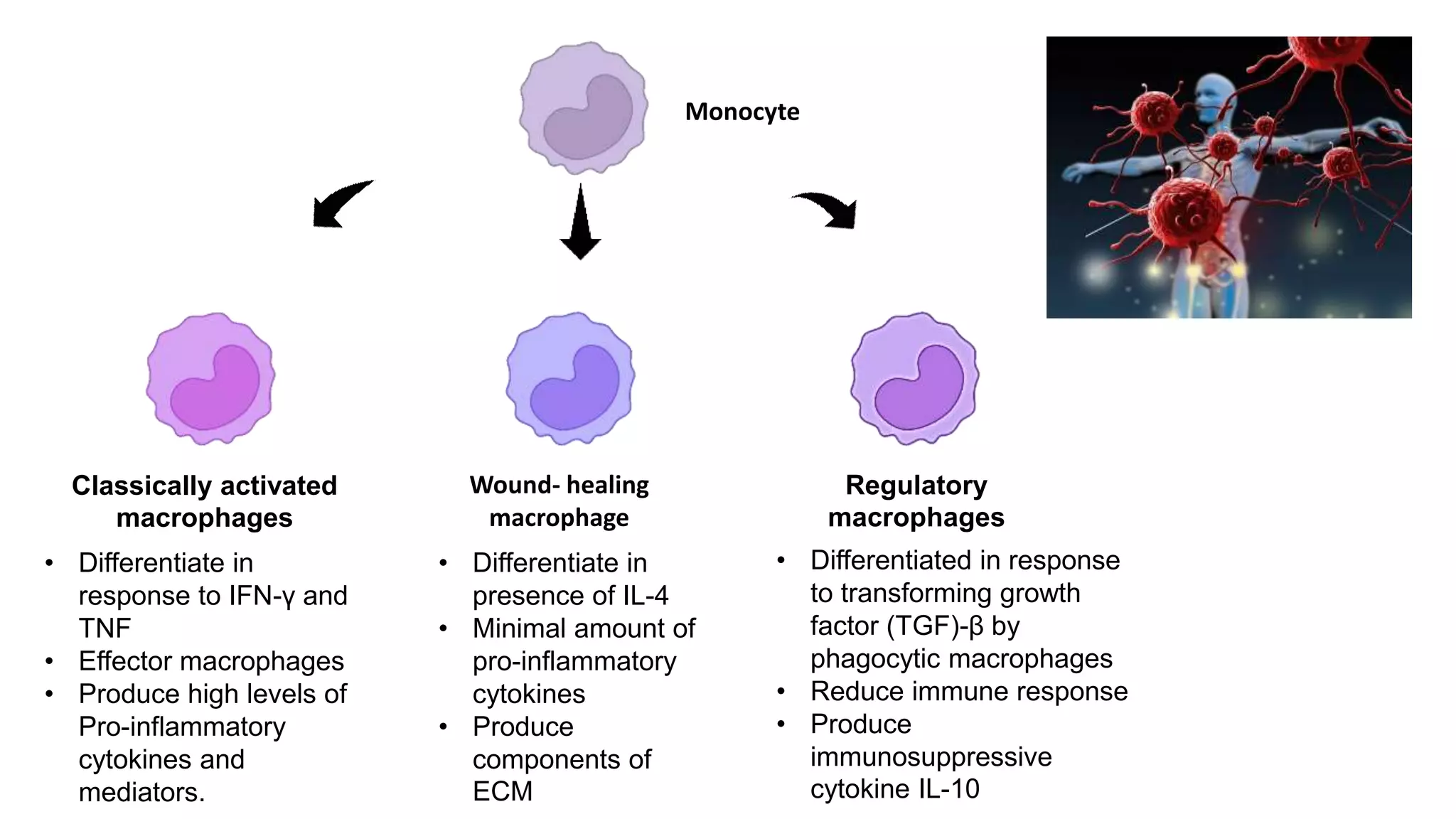
Classically activated
macrophages
Monocyte
Regulatory
macrophages
• Differentiate in
response to IFN-γ and
TNF
• Effector macrophages
• Produce high levels of
Pro-inflammatory
cytokines and
mediators.
• Differentiate in
presence of IL-4
• Minimal amount of
pro-inflammatory
cytokines
• Produce
components of
ECM
• Differentiated in response
to transforming growth
factor (TGF)-β by
phagocytic macrophages
• Reduce immune response
• Produce
immunosuppressive
cytokine IL-10
Wound- healing
macrophage
Monocyte
• The process of implantation of a biomaterial will lead to an
inflammatory response that is caused by the injury made
through the surgical procedure and also by the presence of the
implanted material.
• This response can be divided into different phases starting with
• Blood-material interactions
• Release of danger signals by injured cells
• Acute inflammation
• Chronic inflammation
• Foreign body reaction
How macrophages come into action?
• The macrophage is the major infiltrating cell in response to biomaterial implantation
• Important role in the different steps of the inflammatory response as well as in the
subsequent tissue repair/regeneration.
Almost immediately after biomaterial implantation, several different
proteins (such as coagulation, complement, and adhesion proteins) from
blood and interstitial fluids adsorb to the surface of the material.
Macrophages, sense some of the adsorbed proteins, such as
complement proteins and fibrinogen, and thus an inflammatory
response is triggered.
The implantation of a biomaterial causes injury to cells at the implant
site. These injured cells will release danger signals, generally
designated as “alarmins” that act as a potent activator of cells of the
innate immune system as macrophages causing their priming and
activation.
Alarmins are the endogenous equivalent of pathogen associated
molecular patterns including for example heat shock proteins, ATP, and
uric acid
The acute inflammatory phase is dominated by the presence of
polymorphonuclear leukocytes (PMNs). Activated PMNs will secrete several
chemokines such as monocyte chemotactic protein (MCP-1) and macrophage
inflammatory protein (MIP-1β) which are chemoattractants and activators of
monocytes and macrophages
Chronic inflammation may develop if the inflammatory stimuli persist; and the
macrophage is a fundamental cell type of this phase of the inflammatory
response. Macrophages release a great number of biological active
inflammatory mediators such as TNF-α, IL-8, IL-1β, MCP-1, and MIP-1β
among others that will recruit further inflammatory cells
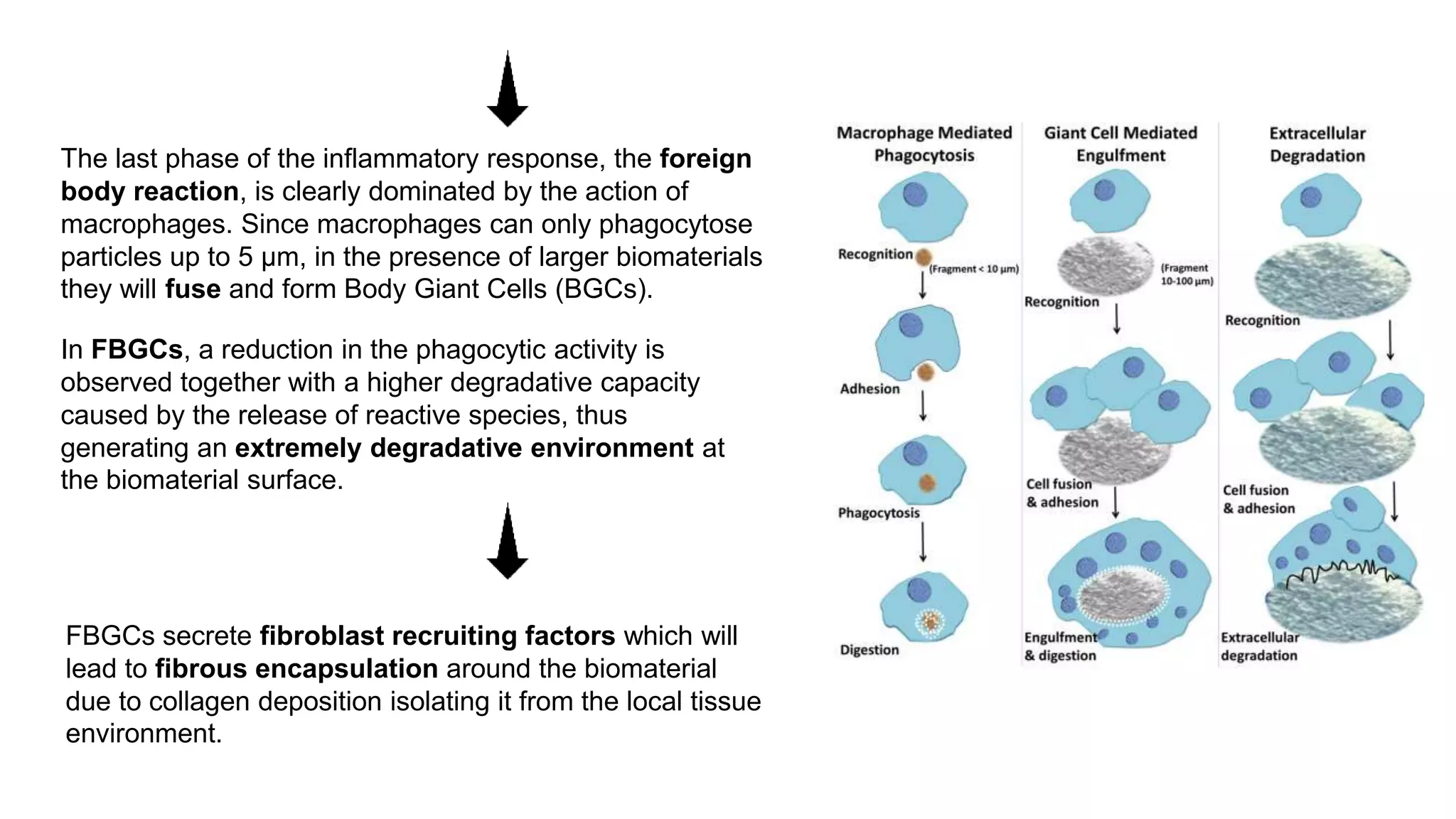
The last phase of the inflammatory response, the foreign
body reaction, is clearly dominated by the action of
macrophages. Since macrophages can only phagocytose
particles up to 5 μm, in the presence of larger biomaterials
they will fuse and form Body Giant Cells (BGCs).
In FBGCs, a reduction in the phagocytic activity is
observed together with a higher degradative capacity
caused by the release of reactive species, thus
generating an extremely degradative environment at
the biomaterial surface.
FBGCs secrete fibroblast recruiting factors which will
lead to fibrous encapsulation around the biomaterial
due to collagen deposition isolating it from the local tissue
environment.
Thank you

Macrophages and Biomaterials.pptx

  • 1.
  • 2.
    What are macrophagesand what is their role? • Crucial component of innate immunity • Central role in inflammation and host defense • Specialized in the phagocytosis and neutralization of cellular debris and potentially hazardous agents, including pathogens. • Non migratory tissue specific macrophages monitor local environment. • Orchestrate inflammatory reactions through chemokines and cytokines, which recruit and activate neutrophils, monocytes, and lymphocytes. • In response to an inflammatory stimulus, these cells also produce large amounts of effector molecules, including several growth factors, such as for example platelet-derived growth factors and fibroblast growth factors. • Surface receptors: scavenger receptors, pattern recognition receptors [Toll-like receptors (TLRs), C-type lectin receptors, RIG-I-like receptors, nod-like receptors], cytokine receptors, and adhesion molecules
  • 3.
    Classically activated macrophages Monocyte Regulatory macrophages • Differentiatein response to IFN-γ and TNF • Effector macrophages • Produce high levels of Pro-inflammatory cytokines and mediators. • Differentiate in presence of IL-4 • Minimal amount of pro-inflammatory cytokines • Produce components of ECM • Differentiated in response to transforming growth factor (TGF)-β by phagocytic macrophages • Reduce immune response • Produce immunosuppressive cytokine IL-10 Wound- healing macrophage Monocyte
  • 4.
    • The processof implantation of a biomaterial will lead to an inflammatory response that is caused by the injury made through the surgical procedure and also by the presence of the implanted material. • This response can be divided into different phases starting with • Blood-material interactions • Release of danger signals by injured cells • Acute inflammation • Chronic inflammation • Foreign body reaction How macrophages come into action?
  • 5.
    • The macrophageis the major infiltrating cell in response to biomaterial implantation • Important role in the different steps of the inflammatory response as well as in the subsequent tissue repair/regeneration. Almost immediately after biomaterial implantation, several different proteins (such as coagulation, complement, and adhesion proteins) from blood and interstitial fluids adsorb to the surface of the material. Macrophages, sense some of the adsorbed proteins, such as complement proteins and fibrinogen, and thus an inflammatory response is triggered. The implantation of a biomaterial causes injury to cells at the implant site. These injured cells will release danger signals, generally designated as “alarmins” that act as a potent activator of cells of the innate immune system as macrophages causing their priming and activation. Alarmins are the endogenous equivalent of pathogen associated molecular patterns including for example heat shock proteins, ATP, and uric acid
  • 6.
    The acute inflammatoryphase is dominated by the presence of polymorphonuclear leukocytes (PMNs). Activated PMNs will secrete several chemokines such as monocyte chemotactic protein (MCP-1) and macrophage inflammatory protein (MIP-1β) which are chemoattractants and activators of monocytes and macrophages Chronic inflammation may develop if the inflammatory stimuli persist; and the macrophage is a fundamental cell type of this phase of the inflammatory response. Macrophages release a great number of biological active inflammatory mediators such as TNF-α, IL-8, IL-1β, MCP-1, and MIP-1β among others that will recruit further inflammatory cells
  • 7.
    The last phaseof the inflammatory response, the foreign body reaction, is clearly dominated by the action of macrophages. Since macrophages can only phagocytose particles up to 5 μm, in the presence of larger biomaterials they will fuse and form Body Giant Cells (BGCs). In FBGCs, a reduction in the phagocytic activity is observed together with a higher degradative capacity caused by the release of reactive species, thus generating an extremely degradative environment at the biomaterial surface. FBGCs secrete fibroblast recruiting factors which will lead to fibrous encapsulation around the biomaterial due to collagen deposition isolating it from the local tissue environment.
  • 8.

Editor's Notes

  • #3 osteoclasts (bone), alveolar macrophages (lung), microglial cells (brain), histiocytes (connective tissue), Kupffer cells (liver), Langerhans cells (LC) (skin) M1 activation [stimulated by TLR ligands and interferon (IFN-γ)] or alternative M2 activation [stimulated by interleukin (IL)-4/IL-13]