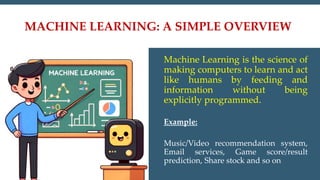
Machine Learning is the science of
making computers to learn and act
like humans by feeding and
information without being
explicitly programmed.
Example:
Music/Video recommendation system,
Email services, Game score/result
prediction, Share stock and so on
MACHINE LEARNING: A SIMPLE OVERVIEW
How it Works?
MACHINE LEARNING: A SIMPLE OVERVIEW
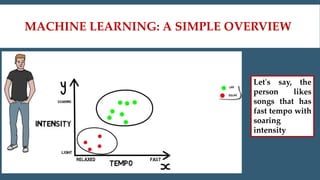
Let's say, the
person likes
songs that has
fast tempo with
soaring
intensity
Now how to
predict a new
song, whether
he will like it
or not?
MACHINE LEARNING: A SIMPLE OVERVIEW
General
Steps in ML

Machine Learning a Simple Overview.pptx

  • 1.
    Machine Learning isthe science of making computers to learn and act like humans by feeding and information without being explicitly programmed. Example: Music/Video recommendation system, Email services, Game score/result prediction, Share stock and so on MACHINE LEARNING: A SIMPLE OVERVIEW
  • 2.
    MACHINE LEARNING: ASIMPLE OVERVIEW How it Works?
  • 3.
    MACHINE LEARNING: ASIMPLE OVERVIEW Let's say, the person likes songs that has fast tempo with soaring intensity
  • 4.
    Now how to predicta new song, whether he will like it or not? MACHINE LEARNING: A SIMPLE OVERVIEW
  • 5.
    MACHINE LEARNING: ASIMPLE OVERVIEW
  • 6.
    MACHINE LEARNING: ASIMPLE OVERVIEW General Steps in ML

Editor's Notes

  • #2 Let us a have a simple overview on Machine Learning. We know humans learn from past experiences and machines follow instructions given by humans. The aim of machine learning is to train machines to learn from past experiences like humans do to act much faster. We can observe many example in our daily life now a days. Music/Video recommendation system, Email sorting services, Game score/result prediction, Share stock and so on.
  • #3 Let’s say, a person loves listening to songs. He likes some music and dislikes some others, based on Tempo, Genre, Intensity, and the Gender of the voice.
  • #4 For simplicity, lets just consider Tempo and Intensity for now. Let’s put ‘Tempo’ in the X axis, varying from ‘Relaxed’ to ‘Fast’. In Y axis, we put ‘Intensity’ ranging from ‘Light’ to ‘Soaring’. The person likes songs that has fast tempo with soaring intensity, marked in green and dislikes the relaxed songs with light intensity, marked in red. So, now we know his choices.
  • #5 Now, he listens to a new song, named Song-A which has a fast tempo and soaring intensity. So, it lies somewhere in the green dot zone. Therefore, it can be said that he likes the song. This is very easy to identify. Now, let’s choose another song that lies in between the green and red zone, that is song with medium ‘Tempo’ and medium ‘Intensity’. Now is it possible to guess whether he will like this song or not so easily? Song ‘A’ can be easily classified, but for no for song ‘B’. That’s where machine learning comes in!
  • #6 If a circle is drawing centering Song B, we will see that there are 4 green dots and 1 red dot. Therefore, the machine will predict that Song B will be liked with 80% confidence. In this case, the algorithm will check which types of data is more like the new data. The size of the circle is important, because it influences the accuracy of the model. In simple terms, this will be called tuning. There are many other algorithms available and algorithm that provides the highest confidence, shall be chosen for a given set of data. This is the very basic of machine learning.
  • #7 Define objective: Very important to know what you want to predict or the outcome. In my project, the objective is to predict energy efficient ship design particulars to reduce CO2 emission. Therefore, the model shall be able to predict ship design particulars, and these shall be able to reduce CO2 emission from the current stage. Collecting data: To predict something, there will be different types of variables that influence the required outcome. For our case, ship design parameters, engine power, for existing ships are required. Prepared data: The collected data needs to be prepared. For example, our target is to make a prediction model using ML that will effectively predict ship design particulars for a new ship, based on the existing ship data. Now, we have good efficient ship data, as well as bad inefficient ship data. Using inefficient ship data would not serve the objective. In addition, the collected data may have some inconsistent information, either by mistake or because of faulty design. Those inconsistent data need to be disregarded as well. These are called the ‘Outlilers’. Algorithm selection: Algorithms are basically a computer program at while we are going to implement. There are different types of algorithms out there and the most suitable algorithms shall be chosen to predict the outcome. In our case, we have used algorithms named ‘Random Forrest’ and ‘Neural Network’. Training the model: From the prepared data, a set of data, known as test data, will be used to the selected algorithms to check the prediction of by algorithms. If the predicted result is close to acceptable range of the real data, we can say that the model is trained. For vice versa, algorithms will be restructured. Test the model: Prepared model needs to be tested. A set of data other than the test data will be used by the model. If the predicted result is close to acceptable range of the real data, we can say that the model is trained. For vice versa, algorithms will be restructured. Predict: After the model is being tested, it is ready for prediction. For our case, the prepared model can predict energy efficient ship design particulars for given dead weight capacity and speed.