Machine Learning
A YEAR SPENT IN
ARTIFICIAL INTELLIGENCE
ENOUGH TO MAKE ONE BELIEVE IN GOD” – ALAN PERLIS
Agenda
 Introduction
 Basics
 Types of Machine Learning
 Machine Learning Technologies
 Application
 Vision in next few years
Quick Questionnaire
 How many people have heard about Machine Learning ?
 How many people know about Machine Learning ?
 How many people are using Machine Learning ?
What is Machine Learning ?
 Subfield of Artificial Intelligence.
 First Arthur Samuel gave the concept of Machine Learning, In 1959.
 "Field of study that gives computers the ability to learn without being explicitly programmed“.
 Computer program is said to be learn from Experience (E) with some class of tasks (T) and
performance measure (P) if its performance at tasks in T as measured by P improves with E.
What is Machine Learning ?
 Explores the study and construction of algorithms that can learn from and make
predictions on data.
 Algorithms operate by building a model from example inputs.
 Data driven predictions or decisions.
 Unlike strictly static program instructions as we do.
Artificial Intelligence
 Machine Learning is the branch of the Artificial Intelligence.
 Inserting the learning capabilities just like humans into machines.
 Even the fastest supercomputer is 32 times slower than Human Brain.
 Predictions says that in 2o6o , we are able to form the digital brain like humans.
 NLP (Natural Language Processing ) is also based on the Machine Learning , more the data the
machine has , more its prediction goes to perfect.
 Titanic Disaster could be saved through Machine Learning.
Use of Machine Learning
 Google Search, Google News ,Page Ranking decided by Machine Learning.
 Upload images , automatically detects the face of your friend.
 Spam filter which is used to filter our mails from tones of spam mails.
 Right product for the right customers.
More applications
 Speech and hand-writing recognition
 Autonomous robot control
 Data mining and bioinformatics: motifs, alignment, …
 Playing games
 Fault detection
 Clinical diagnosis
 Credit scoring, fraud detection
 Web mining: search engines
 Market basket analysis
Why Machine Learning
 Human expertise does not exist (navigating on Mars)-
 TARS in Interstellar.
 Humans are unable to explain their expertise (speech recognition).
 Solution changes in time (routing on a computer network).
 Solution needs to be adapted to particular cases (user biometrics).
Terminology / Basic Terms
 Features – The numbers of features and distinct traits that can be used to describe
each item in quantitative manner.
 Samples – Sample is an item to process. It can document, picture, sound, video or
any other file contains data.
 Feature Vector – n dimensional vector that represents some object.
 Training Set – Set of data to discover potentially predictive relationships.
Terminology with Example
Features
Color – Red
Type- Logo
Shape
Features
Color – Light Blue
Type – Logo
Shape
Here sample are –both apples, Feature Vector =[Color, Type, Shape] , Training Set- Taken all at time
Categories
Types of Problems and Tasks
 Depending on the nature of the learning "signal" or "feedback" available to a learning system.
Supervised Learning
Unsupervised Learning
Reinforcement Learning
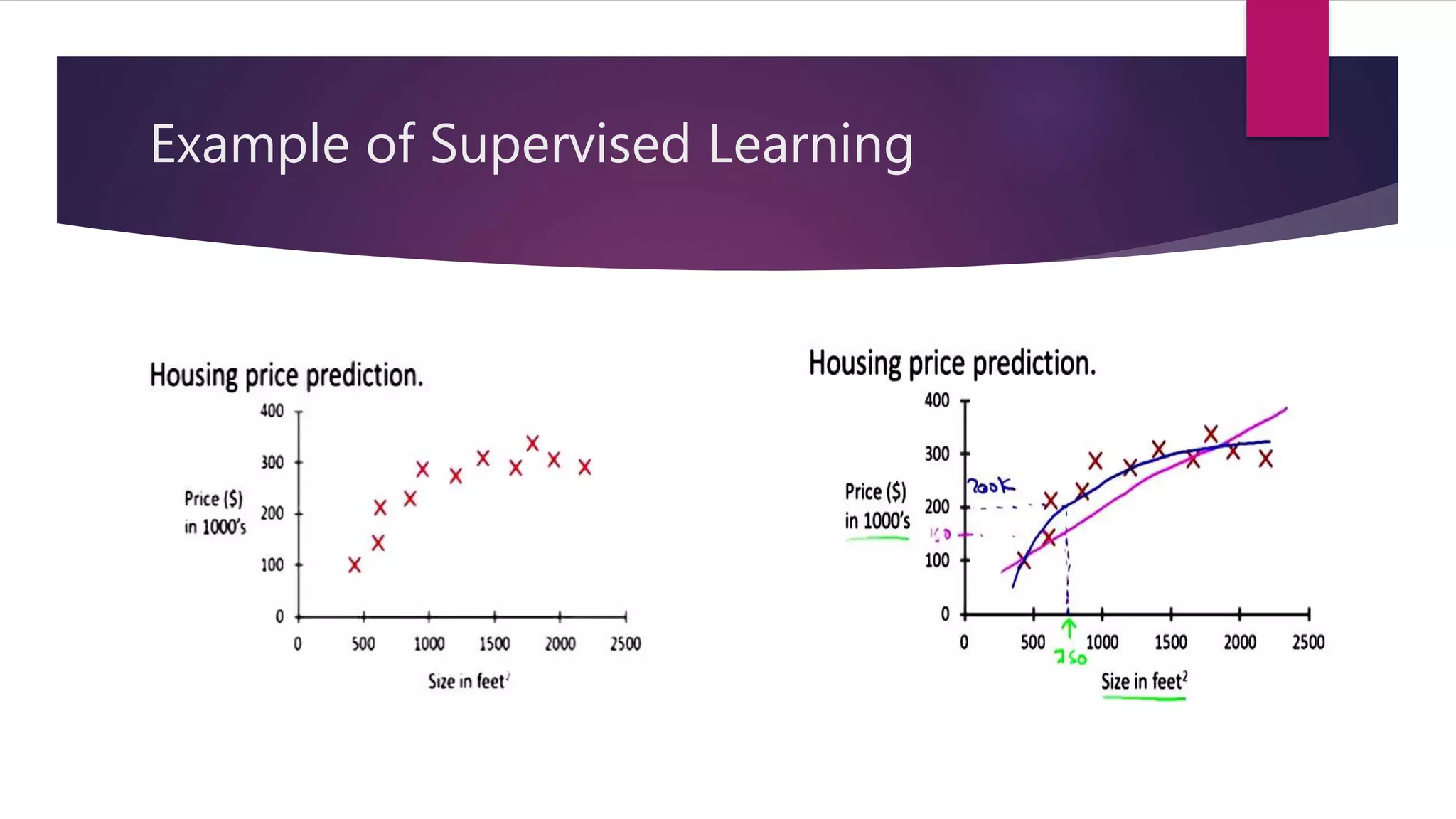
Example of Supervised Learning
Supervised Learning
 Learning from labelled data, and different set of training examples.
 Input and output is fixed.
 the goal is to learn a general rule that maps inputs to outputs.
 Or find the correlation to between input and output to find the algo which is
general to all the training examples.
 Input data called Vector & Output value called Supervisory signal.
 Presence of Expert or Teacher.
 E.g.- Neural Networks , Decision Trees , Bayesian Classification.
To solve Supervised Learning problem
 Determine the type of training examples.
 Decide what kind of data is to be used as a training set.
 Gather a training set.
 Set of input object and corresponding output is gathered.
 Determine the input feature representation of the learned function.
 The input object is transformed into a feature vector, which contains a number of features
that are descriptive of the object.
To solve Supervised Learning problem
 Determine the structure of the learned function and corresponding learning algorithm.
 Find out the function or algorithm which maps all the training sets.
 Just like bridge how input is connected with output.
 Complete the design.
 Addition of some control parameters & adjusted by optimizing performance.
 Evaluate the accuracy of the learned function.
 Check it is working properly or not, if not redesign again.
Supervised Learning Flow Chart
Raw Data AlgorithmSample Data Trained
Product
Verification Production
Application
 Bioinformatics
 Database marketing
 Handwriting recognition
 Spam detection
 Pattern Recognition
 Speech Recognition
Unsupervised Learning
 No labels are given to the learning algorithm.
 Find structure in its input with the help of Clustering.
 Discover hidden patterns in data and find the suitable algorithm.
 As input is unlabeled, there is no error or reward signal to evaluate a potential solution. This makes
it different form others.
 Self guided learning algorithm.
 Plays important role in data mining methods to preprocess the data.
 Approaches to Unsupervised Learning – K means, hierarchical clustering, mixture models.
Unsupervised Learning
K- means / Hierarchical
 K means is a method of vector quantization.
 Partition of n observation into k cluster, and it belongs to nearest mean
 Popular of clustering analysis in data mining.
 NP Hard Problem.
 Hierarchical clustering builds a hierarchy of clusters.
 Agglomerative (Bottom Up Approach)
 Divisive (Top down Approach)
Applications
Difference Supervised Vs Unsupervised
Reinforcement Learning
 Program interacts with a dynamic environment.
 No explicit instructions.
 Decide its own whether it is near to goal or not.
 “Approximate Dynamic Programming”
 Unlike supervised learning correct input/output pairs are never presented.
 No optimization step is there like supervised learning to tell we have reached up to our goal.
 There is a focus on on-line performance.
 Finds a balance between exploration (of uncharted territory) and exploitation (of current
knowledge)
Basic Reinforcement Learning Model
 Set of environment states S.
 Set of actions A.
 Rules of transitions between states.
 Rules that determine the scalar immediate reward of transition.
 Rules that describe what the agent observes.
Algorithms used for Reinforcement Learning
 Criterion of optimality
 the problem studied is episodic, an episode ending when some terminal state is reached.
 Brute force (2 Step Policies)
 For each possible policy, sample returns while following it.
 Choose the policy with the largest expected return.
 1.Value function estimation 2. Direct policy search
 Value function approaches
 It finds the policy which return maximize but maintaining sets.
 Based on MKP(Markov Decision Parameters)
Applications of Reinforcement Learning
 Game theory
 Control theory
 Operations research
 Information theory
 Simulation-based optimization
 Multi-agent systems
 Swarm intelligence
 Statistics
 Genetic algorithms
Semi-Supervised Learning
 Semi-supervised learning is a class of supervised learning tasks.
 But it uses large amount of unlabelled data with the labelled data.
 Actually it falls between supervised learning and supervised learning.
 Assumptions used in semi-supervised learning.
 Smoothness assumption - Points which are close to each other are more likely to share a label.
 Cluster assumption - The data tend to form discrete clusters, and points in the same cluster are more
likely to share a label
 Manifold assumption - The data lie approximately on a manifold of much lower dimension than the
input space.
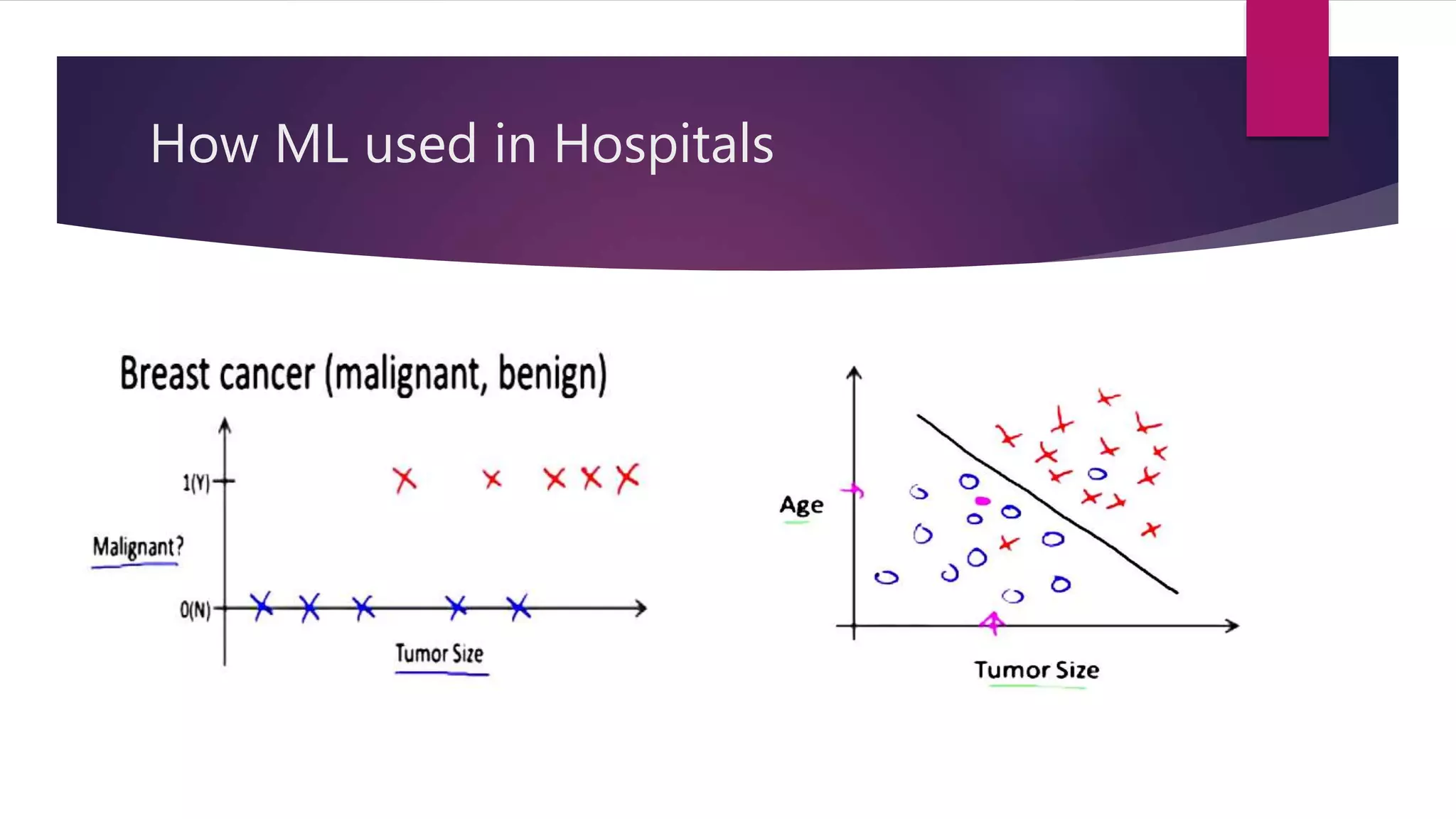
How ML used in Hospitals
Machine Learning Methods
based on
output of a machine-learned system
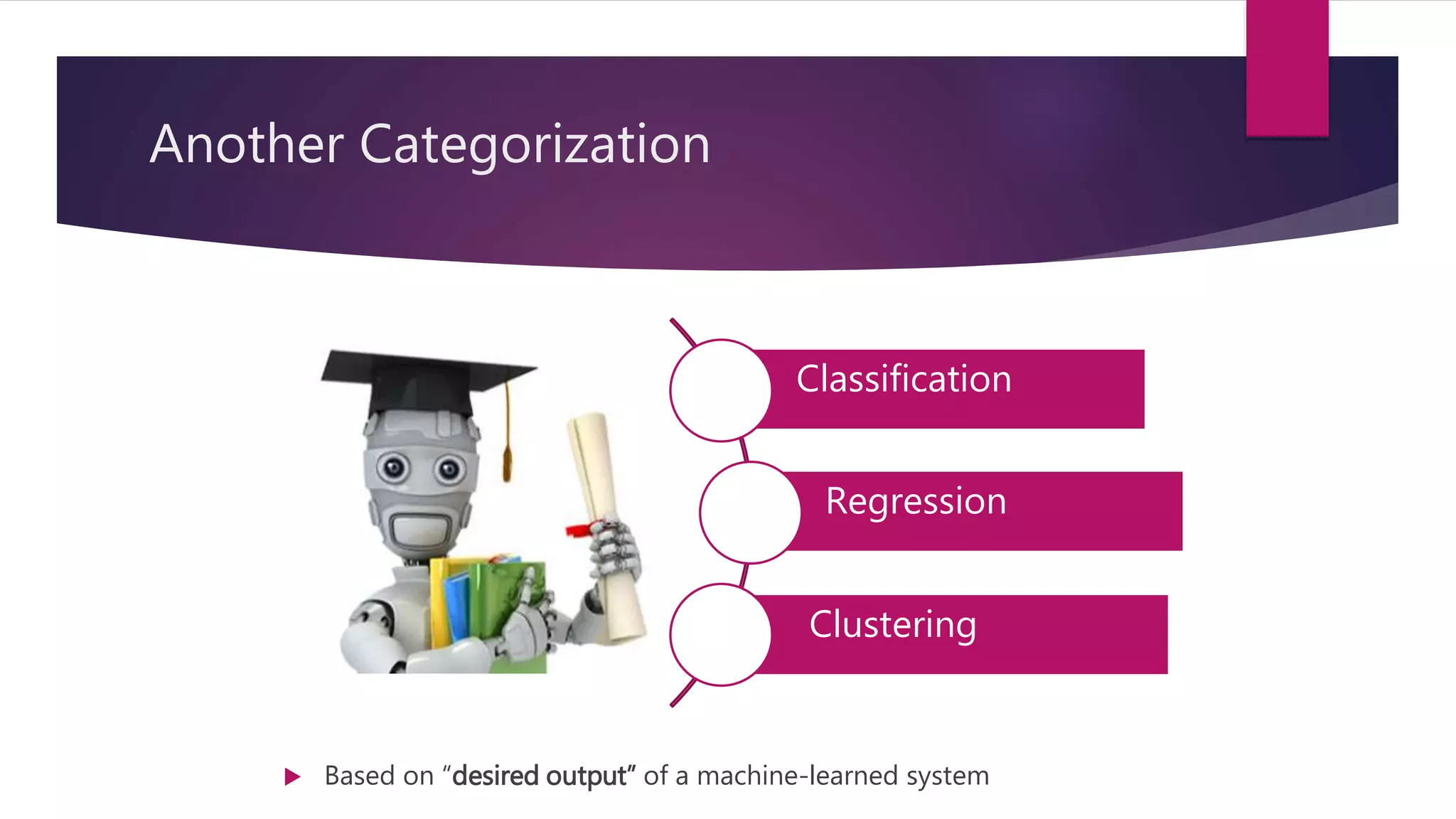
Another Categorization
 Based on “desired output” of a machine-learned system
Classification
Regression
Clustering
Classification
 Predict class from observations.
 Inputs are divided into two or more classes.
 Model assigns unseen inputs to one (or multi-label classification) or more of these classes.
 Spam filtering is an example of classification, where the inputs are email (or other) messages and
the classes are "spam" and "not spam"
Regression
 Relation between mean value of one variable and corresponding value of another
variable.
 Statistical method to find the relation between different variables.
 Predict the output with the training data and observations.
 Popular method – Logistic Regression or binary regression.
 The outputs are continuous rather than discrete.
Clustering
 Grouping a set of objects in such way that objects in the same group are similar to each other.
 Objects are not predefined.
 Grouping in meaningful group.
 Unlike in classification, the groups are not known beforehand, making this typically an
unsupervised task.
 Example – Man’s shoes , woman’s shoes , man’s t-shirt, woman’s t-shirts.
 So they are two category “man & woman” and “t-shirts & shoes”.
Popular Framework / Tools
 Weka
 Carrot2
 Gate
 OpenNLP
 LingPipe
 Mallet – Topic Modelling
 Gensim – Topic Modelling (Python)
 Apache Mahout
 Mlib – Apache Spark
 Scikit learn – Python
Difference
Classification
 Classification means to group the output
into class.
 Classification to predict the type of tumor
i.e. harmful or not using the training data
sets.
 If it is discrete / categorical variable , then
it is classification problem.
Regression
 Regression means to predict the output
value using training data.
 Regression to predict the price of the
house from training data sets.
 If it is real / continuous then it is
regressions problem.
Approaches
Decision Tree Learning
 Predictive model.
 Maps observations about an item to conclusions about the item's target value.
 Used in Statistics and data mining.
 Tree models where the target variable can take a finite set of values are called classification trees.
 Leaves represent class labels & branches represent conjunctions.
 When target variable can take continuous values - regression trees.
 In data mining, a decision tree describes data but not decisions.
 Example – Wikipedia
Artificial Neural Networks
 Inspired by Biological Neural Networks(Central Nervous System of animal).
 Used when there are large number of inputs and generally unknown.
 ANNs are generally presented as systems of interconnected "neurons" which exchange messages
between each other.
 Used to solve computer vision, speech recognition and handwriting recognition.
 Eg. In handwriting recognition
 1. Input neuron activated by the pixels of an input image.
 2. Weighted and transformed by a function, the activations of these neurons are then passed on to
other neurons.
 3. This process is repeated until finally, an output neuron is activated. This determines which character
was read.
Artificial Neural Networks Structure
Any Queries ?
for more information :-
machinecanthink.blogspot.in

Machine Can Think

  • 1.
    Machine Learning A YEARSPENT IN ARTIFICIAL INTELLIGENCE ENOUGH TO MAKE ONE BELIEVE IN GOD” – ALAN PERLIS
  • 2.
    Agenda  Introduction  Basics Types of Machine Learning  Machine Learning Technologies  Application  Vision in next few years
  • 3.
    Quick Questionnaire  Howmany people have heard about Machine Learning ?  How many people know about Machine Learning ?  How many people are using Machine Learning ?
  • 4.
    What is MachineLearning ?  Subfield of Artificial Intelligence.  First Arthur Samuel gave the concept of Machine Learning, In 1959.  "Field of study that gives computers the ability to learn without being explicitly programmed“.  Computer program is said to be learn from Experience (E) with some class of tasks (T) and performance measure (P) if its performance at tasks in T as measured by P improves with E.
  • 5.
    What is MachineLearning ?  Explores the study and construction of algorithms that can learn from and make predictions on data.  Algorithms operate by building a model from example inputs.  Data driven predictions or decisions.  Unlike strictly static program instructions as we do.
  • 7.
    Artificial Intelligence  MachineLearning is the branch of the Artificial Intelligence.  Inserting the learning capabilities just like humans into machines.  Even the fastest supercomputer is 32 times slower than Human Brain.  Predictions says that in 2o6o , we are able to form the digital brain like humans.  NLP (Natural Language Processing ) is also based on the Machine Learning , more the data the machine has , more its prediction goes to perfect.  Titanic Disaster could be saved through Machine Learning.
  • 8.
    Use of MachineLearning  Google Search, Google News ,Page Ranking decided by Machine Learning.  Upload images , automatically detects the face of your friend.  Spam filter which is used to filter our mails from tones of spam mails.  Right product for the right customers.
  • 9.
    More applications  Speechand hand-writing recognition  Autonomous robot control  Data mining and bioinformatics: motifs, alignment, …  Playing games  Fault detection  Clinical diagnosis  Credit scoring, fraud detection  Web mining: search engines  Market basket analysis
  • 10.
    Why Machine Learning Human expertise does not exist (navigating on Mars)-  TARS in Interstellar.  Humans are unable to explain their expertise (speech recognition).  Solution changes in time (routing on a computer network).  Solution needs to be adapted to particular cases (user biometrics).
  • 11.
    Terminology / BasicTerms  Features – The numbers of features and distinct traits that can be used to describe each item in quantitative manner.  Samples – Sample is an item to process. It can document, picture, sound, video or any other file contains data.  Feature Vector – n dimensional vector that represents some object.  Training Set – Set of data to discover potentially predictive relationships.
  • 12.
    Terminology with Example Features Color– Red Type- Logo Shape Features Color – Light Blue Type – Logo Shape Here sample are –both apples, Feature Vector =[Color, Type, Shape] , Training Set- Taken all at time
  • 13.
  • 14.
    Types of Problemsand Tasks  Depending on the nature of the learning "signal" or "feedback" available to a learning system. Supervised Learning Unsupervised Learning Reinforcement Learning
  • 15.
  • 16.
    Supervised Learning  Learningfrom labelled data, and different set of training examples.  Input and output is fixed.  the goal is to learn a general rule that maps inputs to outputs.  Or find the correlation to between input and output to find the algo which is general to all the training examples.  Input data called Vector & Output value called Supervisory signal.  Presence of Expert or Teacher.  E.g.- Neural Networks , Decision Trees , Bayesian Classification.
  • 17.
    To solve SupervisedLearning problem  Determine the type of training examples.  Decide what kind of data is to be used as a training set.  Gather a training set.  Set of input object and corresponding output is gathered.  Determine the input feature representation of the learned function.  The input object is transformed into a feature vector, which contains a number of features that are descriptive of the object.
  • 18.
    To solve SupervisedLearning problem  Determine the structure of the learned function and corresponding learning algorithm.  Find out the function or algorithm which maps all the training sets.  Just like bridge how input is connected with output.  Complete the design.  Addition of some control parameters & adjusted by optimizing performance.  Evaluate the accuracy of the learned function.  Check it is working properly or not, if not redesign again.
  • 19.
    Supervised Learning FlowChart Raw Data AlgorithmSample Data Trained Product Verification Production
  • 20.
    Application  Bioinformatics  Databasemarketing  Handwriting recognition  Spam detection  Pattern Recognition  Speech Recognition
  • 21.
    Unsupervised Learning  Nolabels are given to the learning algorithm.  Find structure in its input with the help of Clustering.  Discover hidden patterns in data and find the suitable algorithm.  As input is unlabeled, there is no error or reward signal to evaluate a potential solution. This makes it different form others.  Self guided learning algorithm.  Plays important role in data mining methods to preprocess the data.  Approaches to Unsupervised Learning – K means, hierarchical clustering, mixture models.
  • 22.
  • 23.
    K- means /Hierarchical  K means is a method of vector quantization.  Partition of n observation into k cluster, and it belongs to nearest mean  Popular of clustering analysis in data mining.  NP Hard Problem.  Hierarchical clustering builds a hierarchy of clusters.  Agglomerative (Bottom Up Approach)  Divisive (Top down Approach)
  • 24.
  • 25.
  • 26.
    Reinforcement Learning  Programinteracts with a dynamic environment.  No explicit instructions.  Decide its own whether it is near to goal or not.  “Approximate Dynamic Programming”  Unlike supervised learning correct input/output pairs are never presented.  No optimization step is there like supervised learning to tell we have reached up to our goal.  There is a focus on on-line performance.  Finds a balance between exploration (of uncharted territory) and exploitation (of current knowledge)
  • 27.
    Basic Reinforcement LearningModel  Set of environment states S.  Set of actions A.  Rules of transitions between states.  Rules that determine the scalar immediate reward of transition.  Rules that describe what the agent observes.
  • 28.
    Algorithms used forReinforcement Learning  Criterion of optimality  the problem studied is episodic, an episode ending when some terminal state is reached.  Brute force (2 Step Policies)  For each possible policy, sample returns while following it.  Choose the policy with the largest expected return.  1.Value function estimation 2. Direct policy search  Value function approaches  It finds the policy which return maximize but maintaining sets.  Based on MKP(Markov Decision Parameters)
  • 29.
    Applications of ReinforcementLearning  Game theory  Control theory  Operations research  Information theory  Simulation-based optimization  Multi-agent systems  Swarm intelligence  Statistics  Genetic algorithms
  • 30.
    Semi-Supervised Learning  Semi-supervisedlearning is a class of supervised learning tasks.  But it uses large amount of unlabelled data with the labelled data.  Actually it falls between supervised learning and supervised learning.  Assumptions used in semi-supervised learning.  Smoothness assumption - Points which are close to each other are more likely to share a label.  Cluster assumption - The data tend to form discrete clusters, and points in the same cluster are more likely to share a label  Manifold assumption - The data lie approximately on a manifold of much lower dimension than the input space.
  • 31.
    How ML usedin Hospitals
  • 32.
    Machine Learning Methods basedon output of a machine-learned system
  • 33.
    Another Categorization  Basedon “desired output” of a machine-learned system Classification Regression Clustering
  • 34.
    Classification  Predict classfrom observations.  Inputs are divided into two or more classes.  Model assigns unseen inputs to one (or multi-label classification) or more of these classes.  Spam filtering is an example of classification, where the inputs are email (or other) messages and the classes are "spam" and "not spam"
  • 35.
    Regression  Relation betweenmean value of one variable and corresponding value of another variable.  Statistical method to find the relation between different variables.  Predict the output with the training data and observations.  Popular method – Logistic Regression or binary regression.  The outputs are continuous rather than discrete.
  • 36.
    Clustering  Grouping aset of objects in such way that objects in the same group are similar to each other.  Objects are not predefined.  Grouping in meaningful group.  Unlike in classification, the groups are not known beforehand, making this typically an unsupervised task.  Example – Man’s shoes , woman’s shoes , man’s t-shirt, woman’s t-shirts.  So they are two category “man & woman” and “t-shirts & shoes”.
  • 37.
    Popular Framework /Tools  Weka  Carrot2  Gate  OpenNLP  LingPipe  Mallet – Topic Modelling  Gensim – Topic Modelling (Python)  Apache Mahout  Mlib – Apache Spark  Scikit learn – Python
  • 38.
    Difference Classification  Classification meansto group the output into class.  Classification to predict the type of tumor i.e. harmful or not using the training data sets.  If it is discrete / categorical variable , then it is classification problem. Regression  Regression means to predict the output value using training data.  Regression to predict the price of the house from training data sets.  If it is real / continuous then it is regressions problem.
  • 39.
  • 40.
    Decision Tree Learning Predictive model.  Maps observations about an item to conclusions about the item's target value.  Used in Statistics and data mining.  Tree models where the target variable can take a finite set of values are called classification trees.  Leaves represent class labels & branches represent conjunctions.  When target variable can take continuous values - regression trees.  In data mining, a decision tree describes data but not decisions.  Example – Wikipedia
  • 41.
    Artificial Neural Networks Inspired by Biological Neural Networks(Central Nervous System of animal).  Used when there are large number of inputs and generally unknown.  ANNs are generally presented as systems of interconnected "neurons" which exchange messages between each other.  Used to solve computer vision, speech recognition and handwriting recognition.  Eg. In handwriting recognition  1. Input neuron activated by the pixels of an input image.  2. Weighted and transformed by a function, the activations of these neurons are then passed on to other neurons.  3. This process is repeated until finally, an output neuron is activated. This determines which character was read.
  • 42.
  • 43.
    Any Queries ? formore information :- machinecanthink.blogspot.in