I’m Sujith Jayaprakash, Currently working as
the Director and Busienss Head of NewEdge
InfoTech Gh Ltd. I’m a business development
professional with a strong background in IT
Training and administration. I have more than
a decade of experience in the education
sectors in India, Africa and Latin America with
significant experience in Senior Management
roles and leading institutional academic
delivery improvement. I have completed
Doctor of Philosophy in Computer Science
and specialized in Education Data Mining.
Area of Expertise : Data Science, Web Mining,
Education Data Mining, and Social Media Marketing
HELLO!
This webinar is solely focused on introducing you to
machine learning concepts, Hence most of the topics
I deal here would be just an introduction to various ML
applications and steps involved.
So if you’re already have a fair bit of experience in ML
or Data Science then this webinar might not be of your
interest.
Cheers! Let’s Start
WHAT IS MACHINE LEARNING
Wikipedia
Machine learning (ML) is the study of
computer algorithms that improve
automatically through experience.
O’Reilly
ML is a subset of the larger field of artificial
intelligence (AI) that “focuses on teaching
computers how to learn without the need to
be programmed for specific tasks - Sujit
Pal and Antonio Gulli in Deep Learning with
Keras.
01
02
Some
common
definitions
from reliable
sources
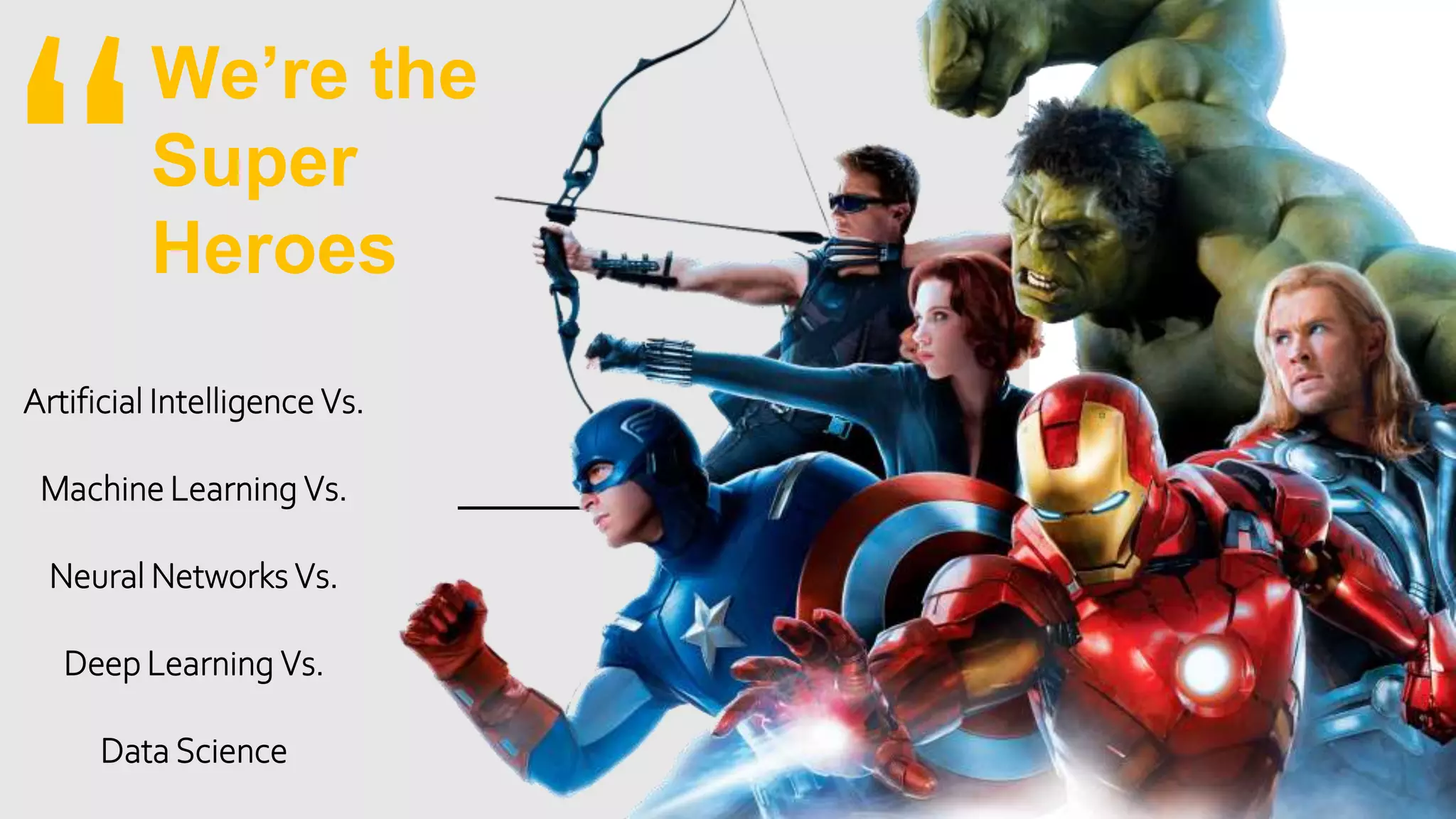
We’re the
Super
Heroes
Artificial Intelligence Vs.
Machine Learning Vs.
Neural Networks Vs.
Deep Learning Vs.
Data Science
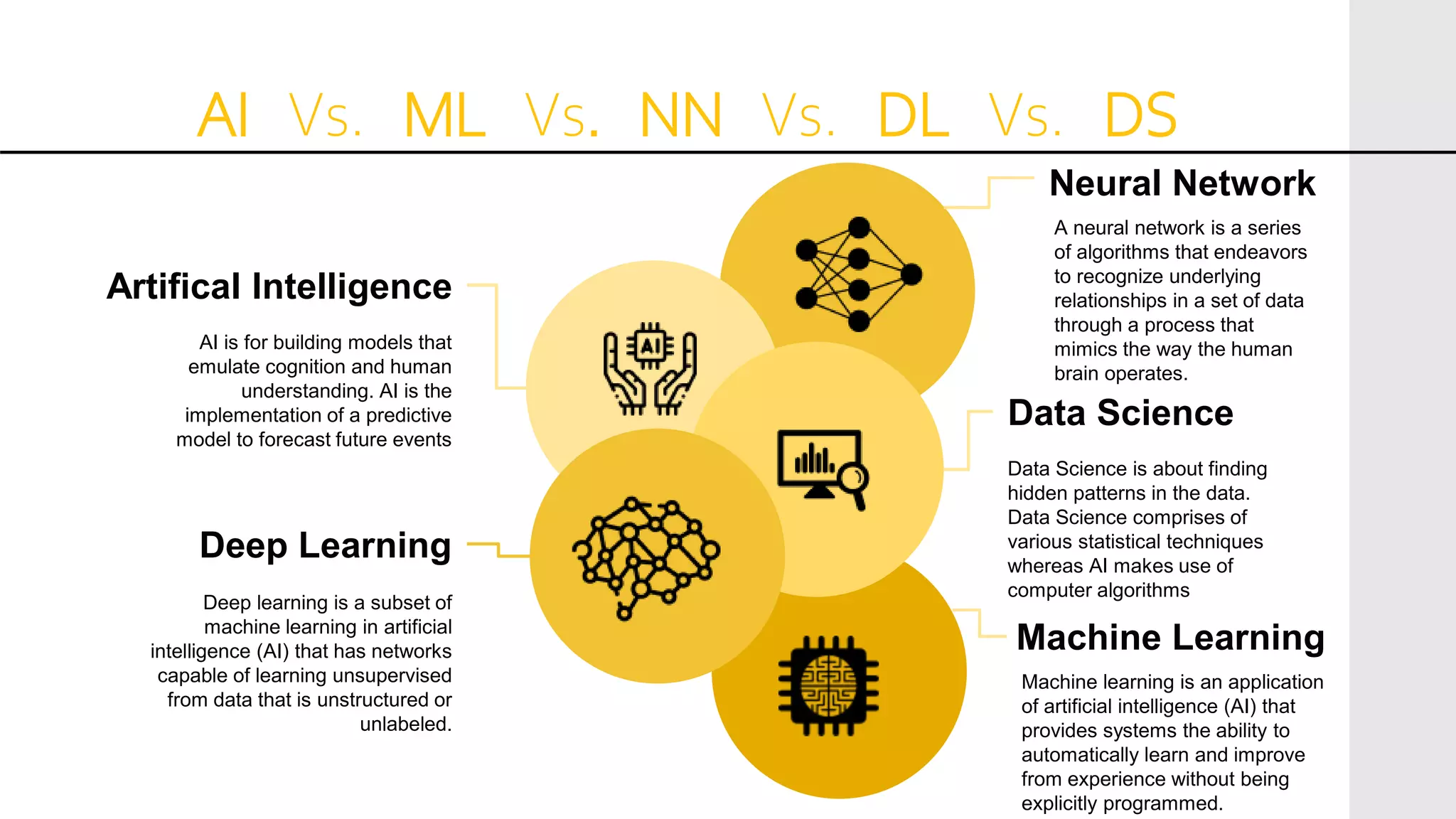
AI Vs. ML Vs. NN Vs. DL Vs. DS
AI is for building models that
emulate cognition and human
understanding. AI is the
implementation of a predictive
model to forecast future events
Data Science
Data Science is about finding
hidden patterns in the data.
Data Science comprises of
various statistical techniques
whereas AI makes use of
computer algorithms
Deep Learning
Deep learning is a subset of
machine learning in artificial
intelligence (AI) that has networks
capable of learning unsupervised
from data that is unstructured or
unlabeled.
Artifical Intelligence
Neural Network
A neural network is a series
of algorithms that endeavors
to recognize underlying
relationships in a set of data
through a process that
mimics the way the human
brain operates.
Machine Learning
Machine learning is an application
of artificial intelligence (AI) that
provides systems the ability to
automatically learn and improve
from experience without being
explicitly programmed.
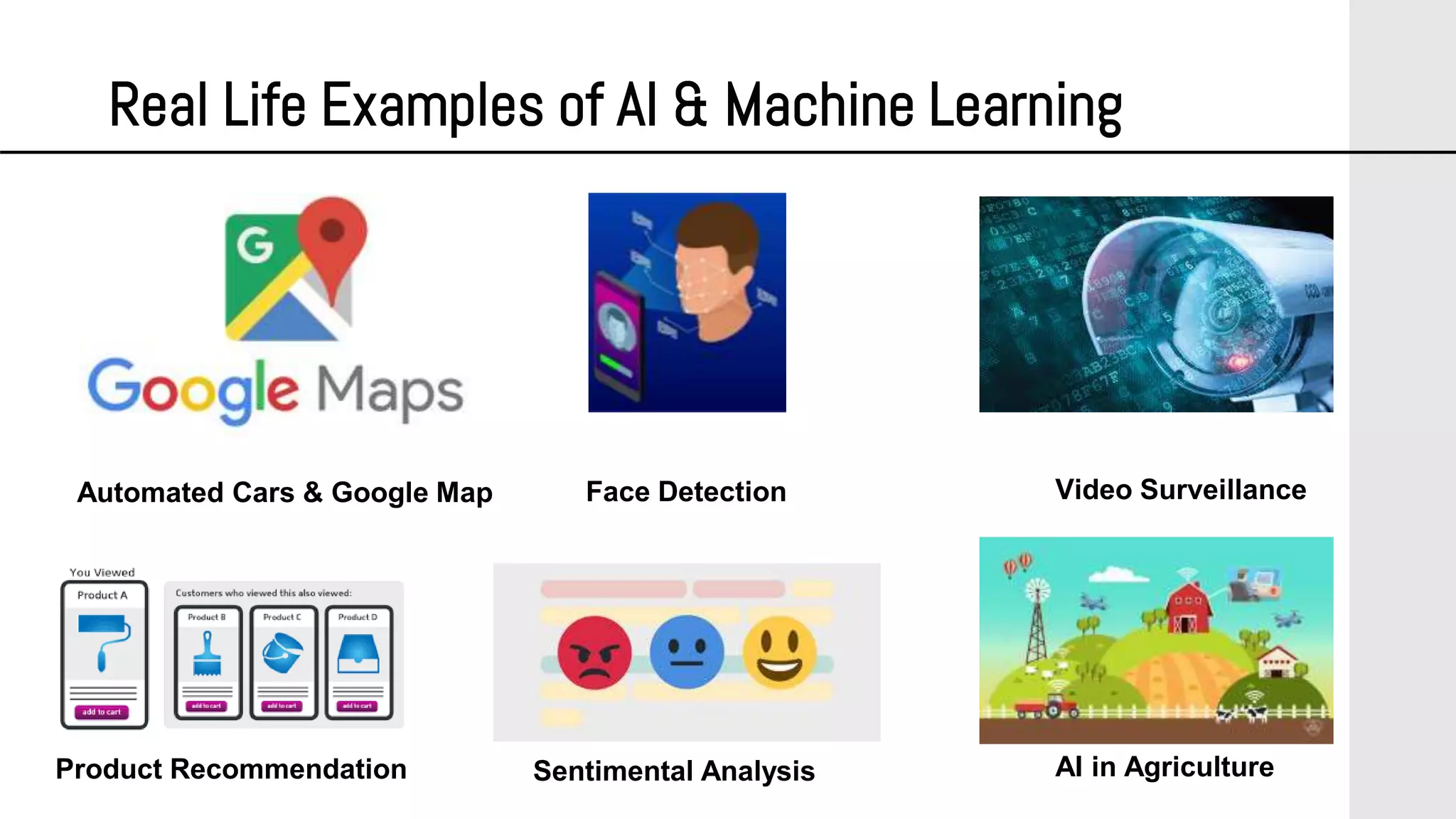
Real Life Examples of AI & Machine Learning
Automated Cars & Google Map Face Detection Video Surveillance
Product Recommendation Sentimental Analysis AI in Agriculture
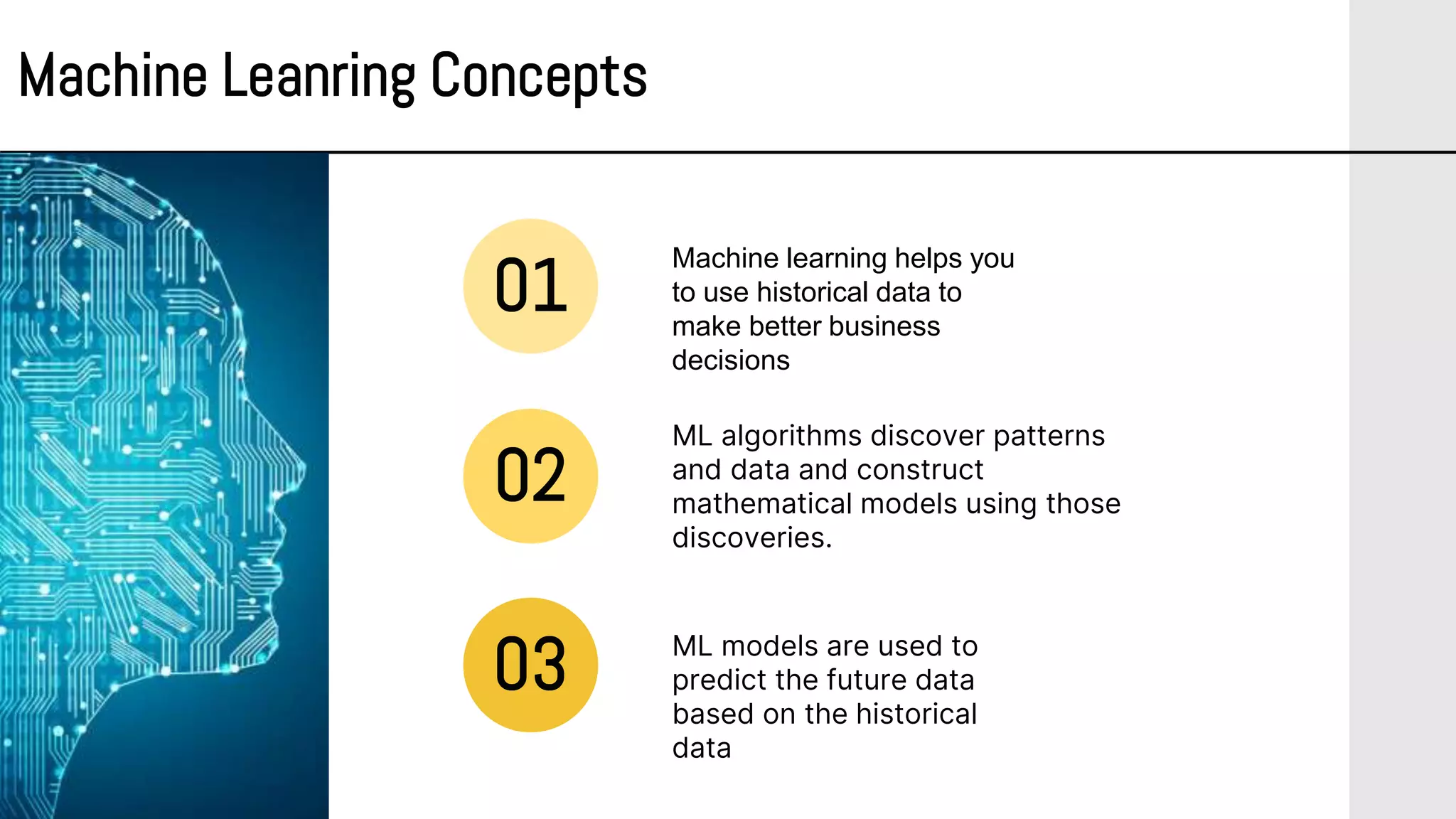
Machine Leanring Concepts
Machine learning helps you
to use historical data to
make better business
decisions
ML models are used to
predict the future data
based on the historical
data
ML algorithms discover patterns
and data and construct
mathematical models using those
discoveries.
02
03
01
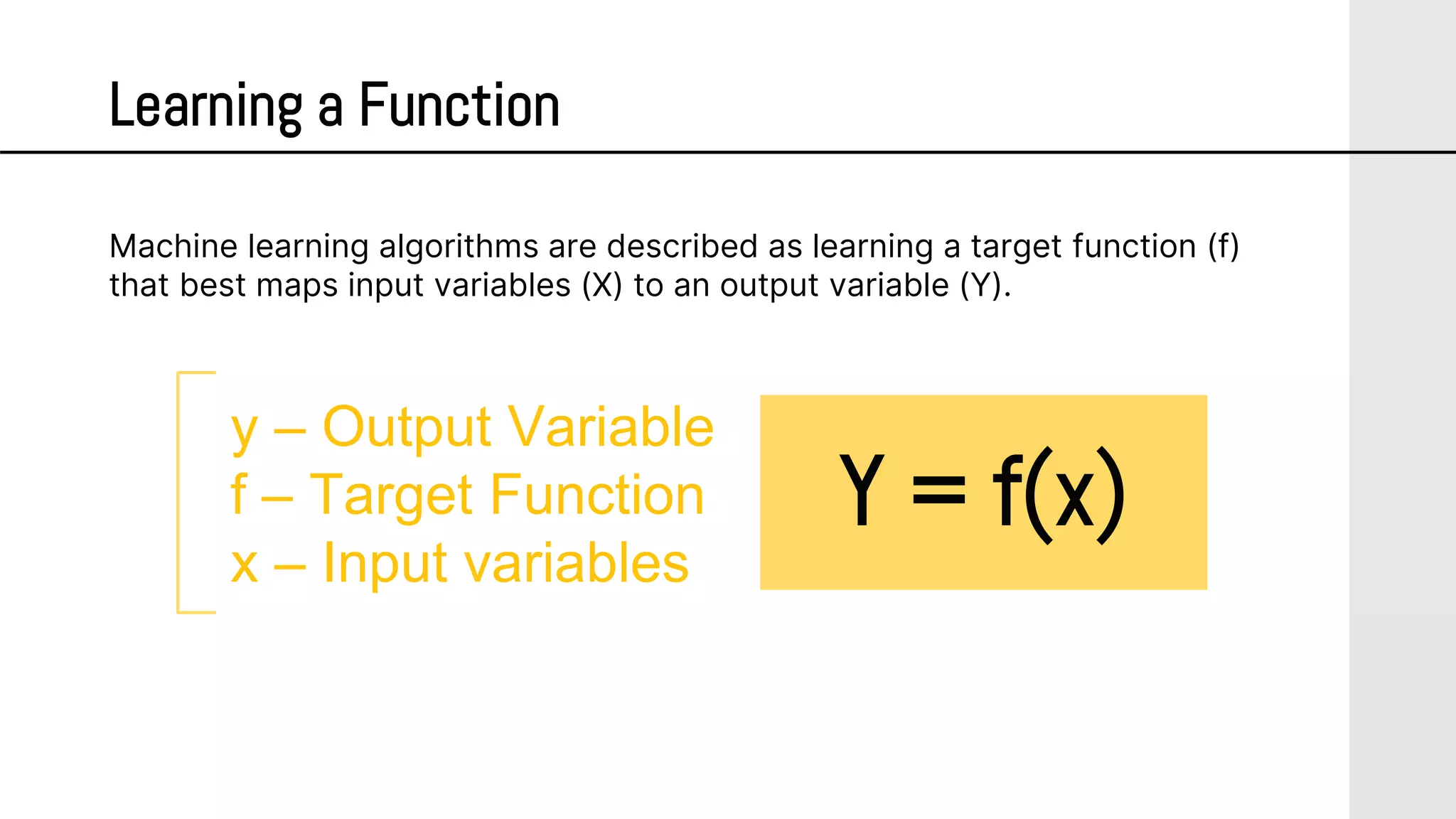
Learning a Function
y – Output Variable
f – Target Function
x – Input variables
Machine learning algorithms are described as learning a target function (f)
that best maps input variables (X) to an output variable (Y).
Y = f(x)
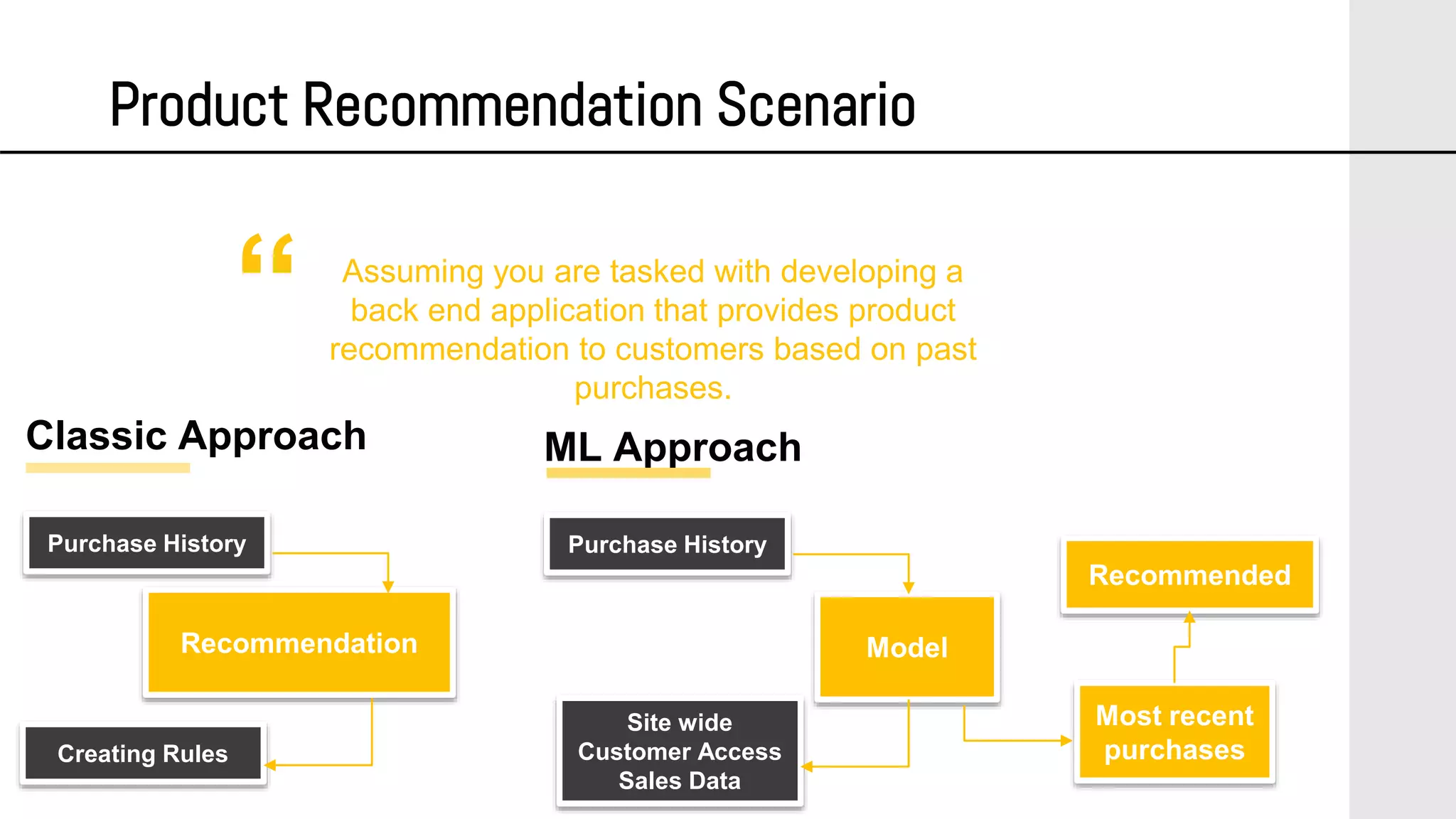
Product Recommendation Scenario
Classic Approach ML Approach
“ Assuming you are tasked with developing a
back end application that provides product
recommendation to customers based on past
purchases.
Recommendation
Purchase History
Creating Rules
Model
Purchase History
Site wide
Customer Access
Sales Data
Most recent
purchases
Recommended
Simple Algorithm
f(x) = a0x0 + a1x1 + a2x2 . . . . anxn
Feature: An Important Data Point
x0: Is the product a shirt?
Yes = 1
Weight: How much does the feature affect the
accuracy of the prediction?
a0: This customer has purchased 8 shirts in the
past
Weight = 0.8
x1: Is this item from a Brand [y]?
Yes = 1
Weight: How much does the feature affect the
accuracy of the prediction?
a1: 2/8 items this person bought in the past
were brand [y].
Weight = 0.25
If f(x) > 1, recommend the product
f(x) = 0.8 * 1 + 0.25 * 1
f(x) = 1.05
Two Key Components of the algorithm
Features : Are part of the dataset that are
identified as important to identify the
outcome
Weights : To determine how important the
associated feature is.
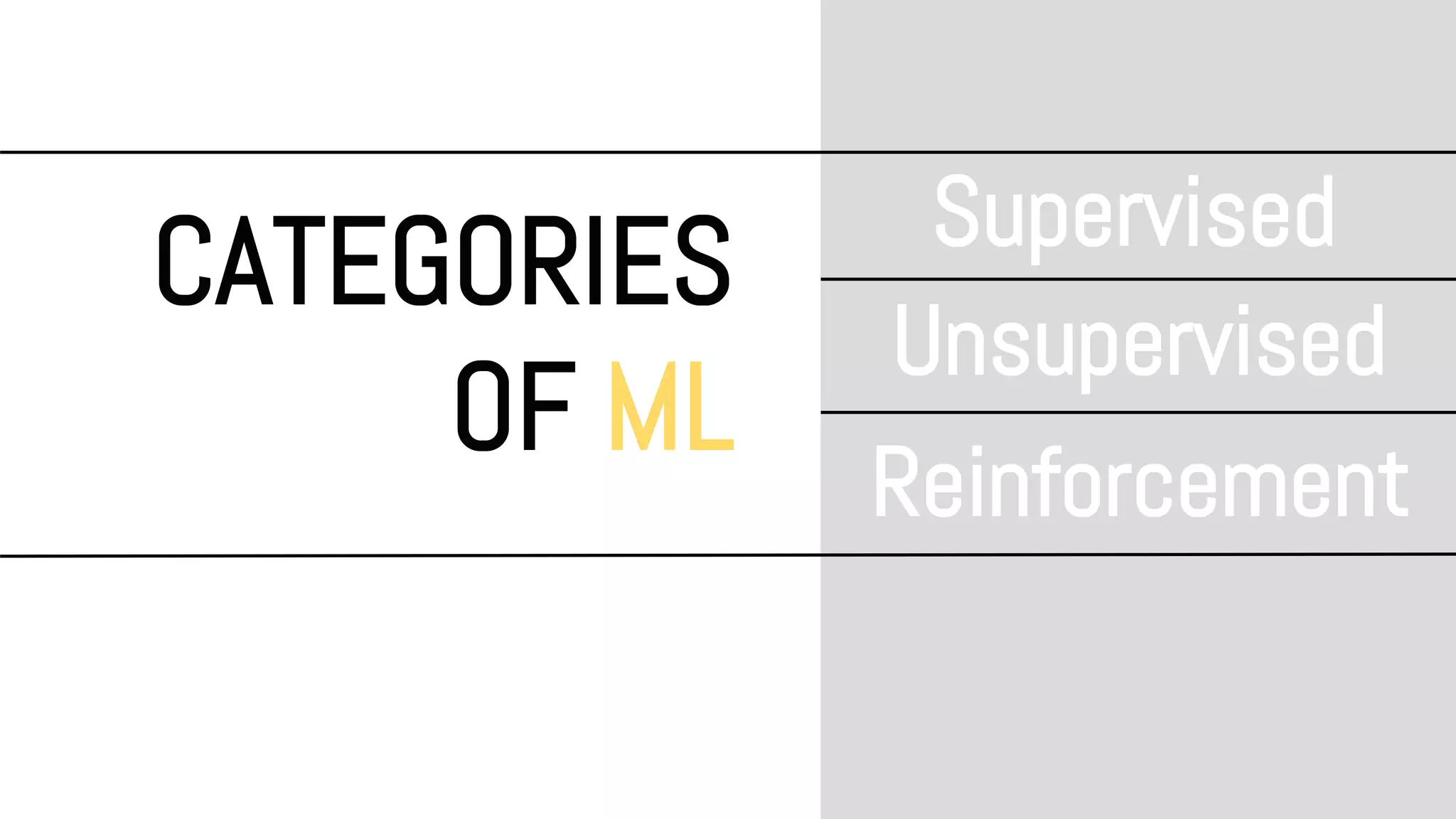
CATEGORIES
OF ML
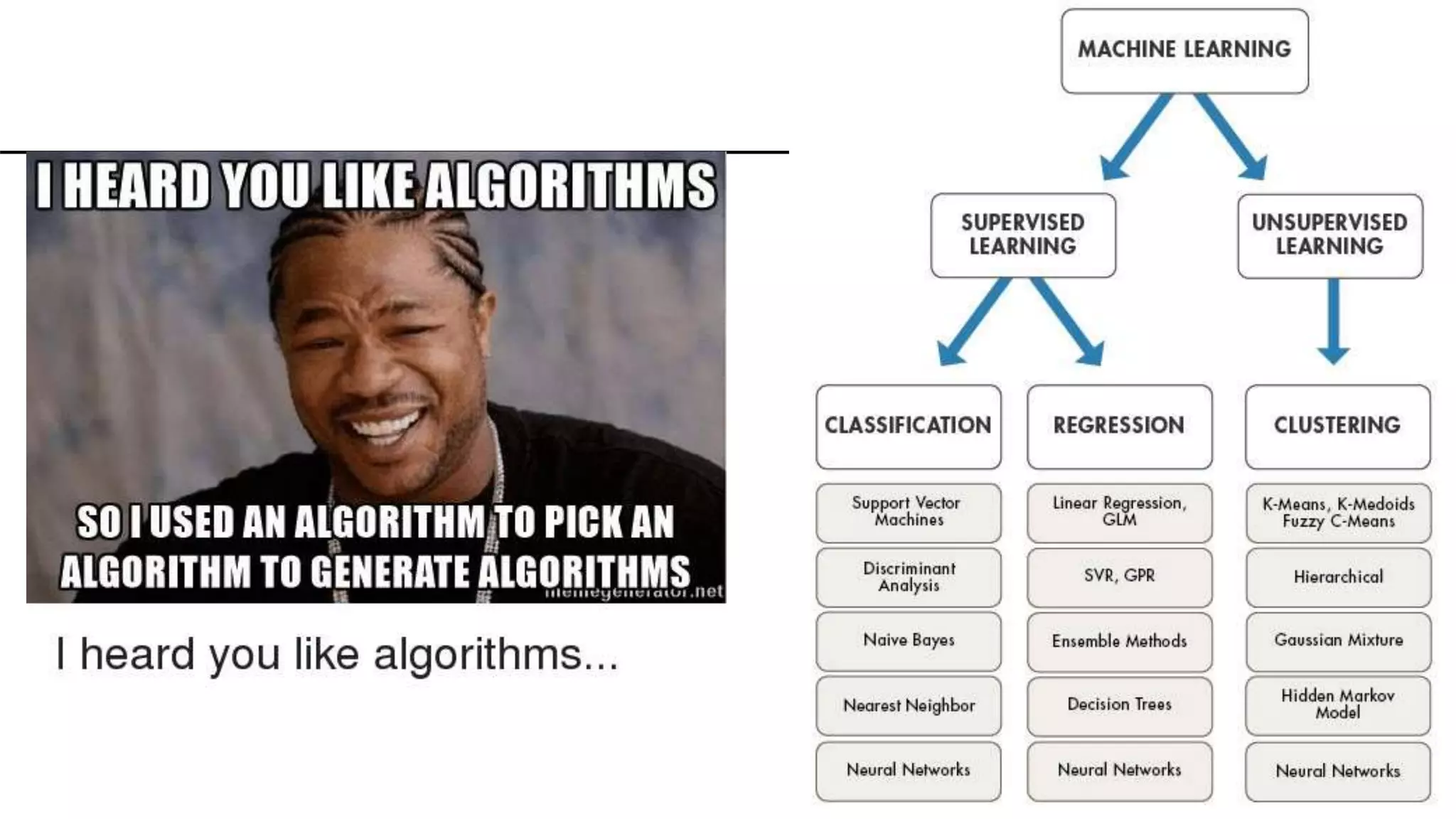
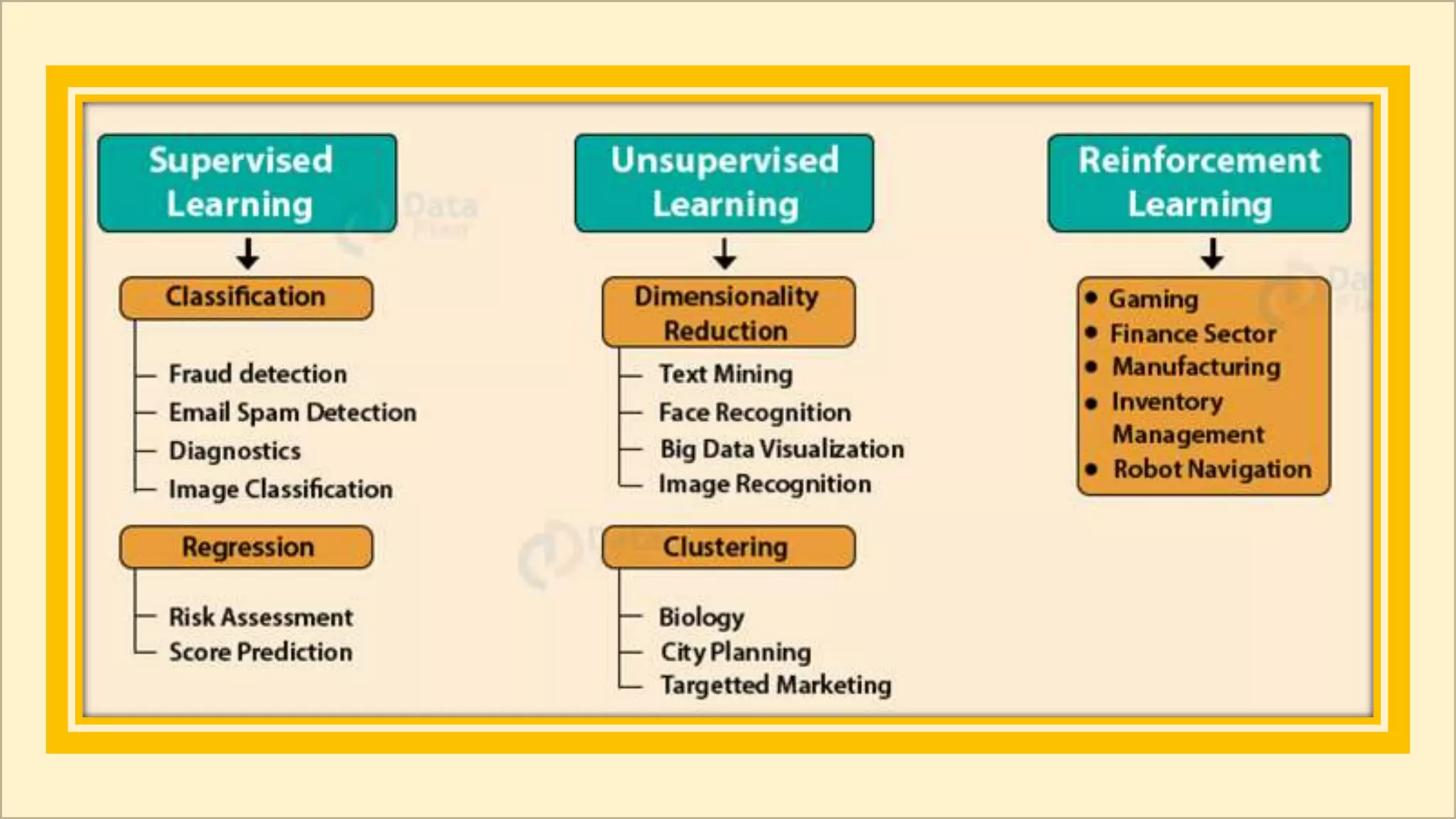
Supervised
Unsupervised
Reinforcement
1. Supervised learning is the machine learning task of learning a function that maps an input to an output based
on example input-output pairs. It infers a function from labeled training data consisting of a set of training
examples.
2. With supervised learning, you feed the output of your algorithm into the system. This means that in supervised
learning, the machine already knows the output of the algorithm before it starts working on it or learning it. A
basic example of this concept would be a student learning a course from an instructor. The student knows what
he/she is learning from the course.
3. With the output of the algorithm known, all that a system needs to do is to work out the steps or process
needed to reach from the input to the output. The algorithm is being taught through a training data set that
guides the machine. If the process goes haywire and the algorithms come up with results completely different
than what should be expected, then the training data does its part to guide the algorithm back towards the right
path.
4. Supervised Machine Learning currently makes up most of the ML that is being used by systems across the
world. The input variable (x) is used to connect with the output variable (y) through the use of an algorithm. All
of the input, the output, the algorithm, and the scenario are being provided by humans. We can understand
supervised learning in an even better way by looking at it through two types of problems.
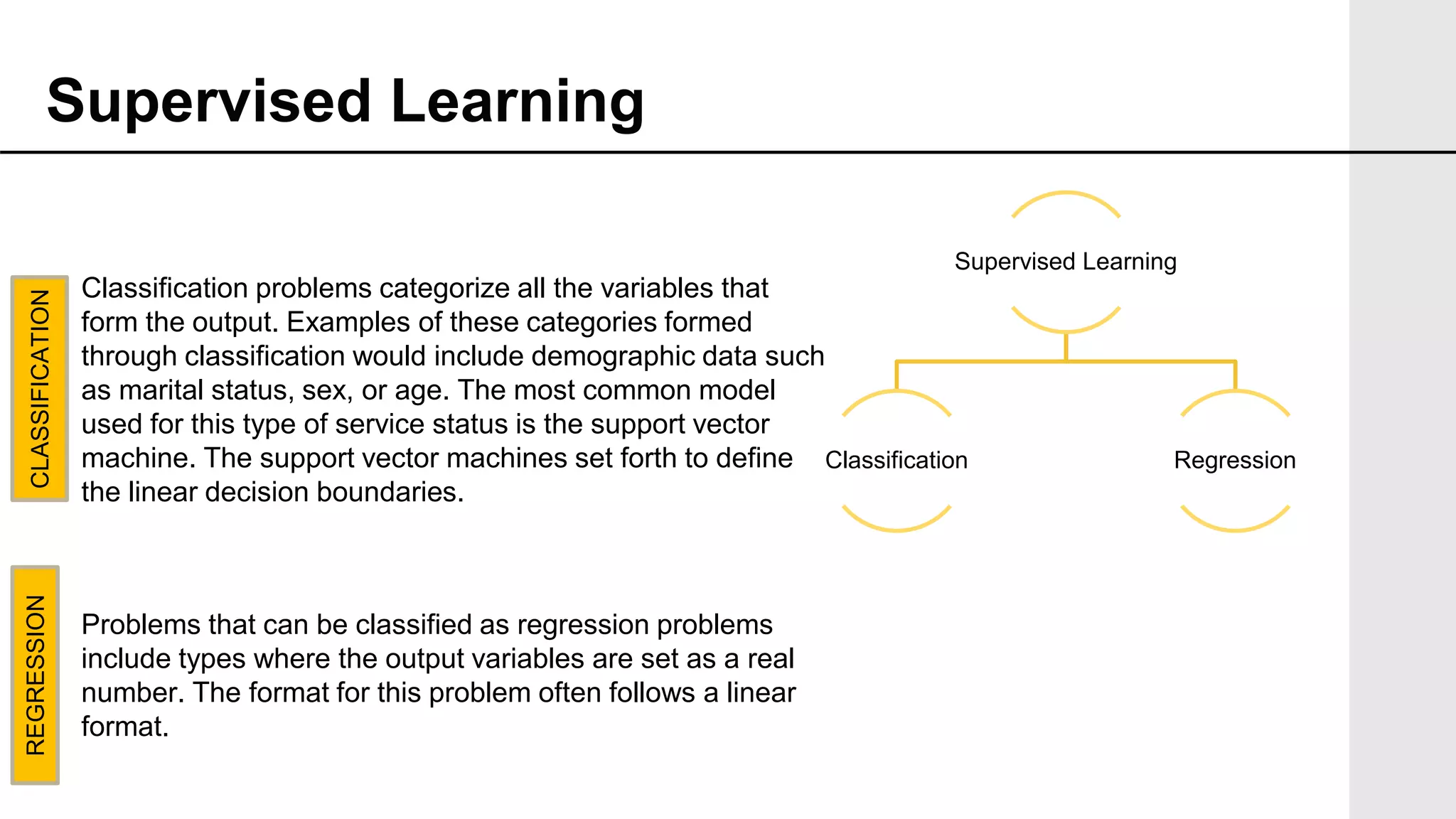
Supervised Learning
Supervised Learning
Supervised Learning
Classification Regression
Classification problems categorize all the variables that
form the output. Examples of these categories formed
through classification would include demographic data such
as marital status, sex, or age. The most common model
used for this type of service status is the support vector
machine. The support vector machines set forth to define
the linear decision boundaries.
Problems that can be classified as regression problems
include types where the output variables are set as a real
number. The format for this problem often follows a linear
format.
CLASSIFICATIONREGRESSION
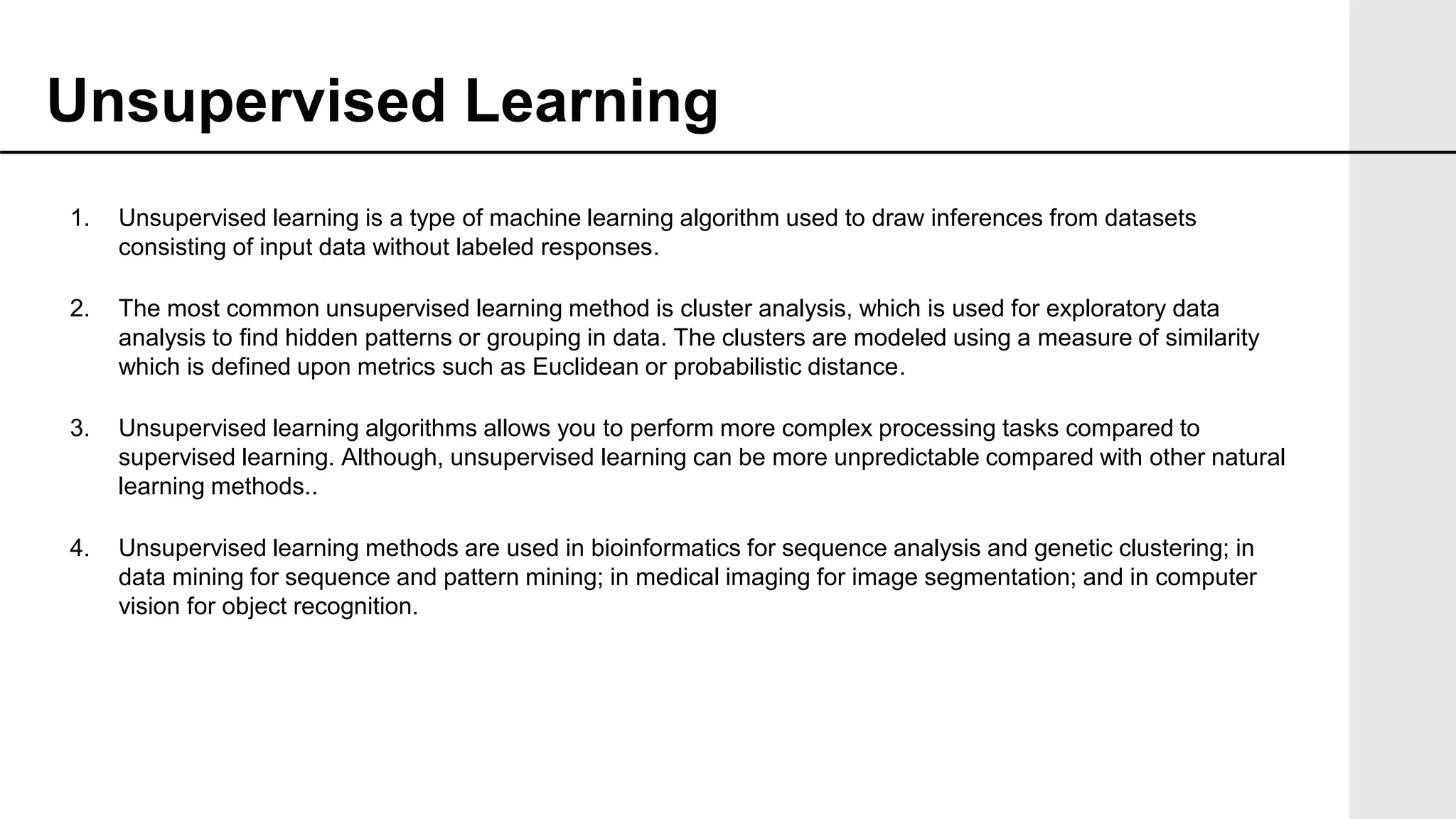
1. Unsupervised learning is a type of machine learning algorithm used to draw inferences from datasets
consisting of input data without labeled responses.
2. The most common unsupervised learning method is cluster analysis, which is used for exploratory data
analysis to find hidden patterns or grouping in data. The clusters are modeled using a measure of similarity
which is defined upon metrics such as Euclidean or probabilistic distance.
3. Unsupervised learning algorithms allows you to perform more complex processing tasks compared to
supervised learning. Although, unsupervised learning can be more unpredictable compared with other natural
learning methods..
4. Unsupervised learning methods are used in bioinformatics for sequence analysis and genetic clustering; in
data mining for sequence and pattern mining; in medical imaging for image segmentation; and in computer
vision for object recognition.
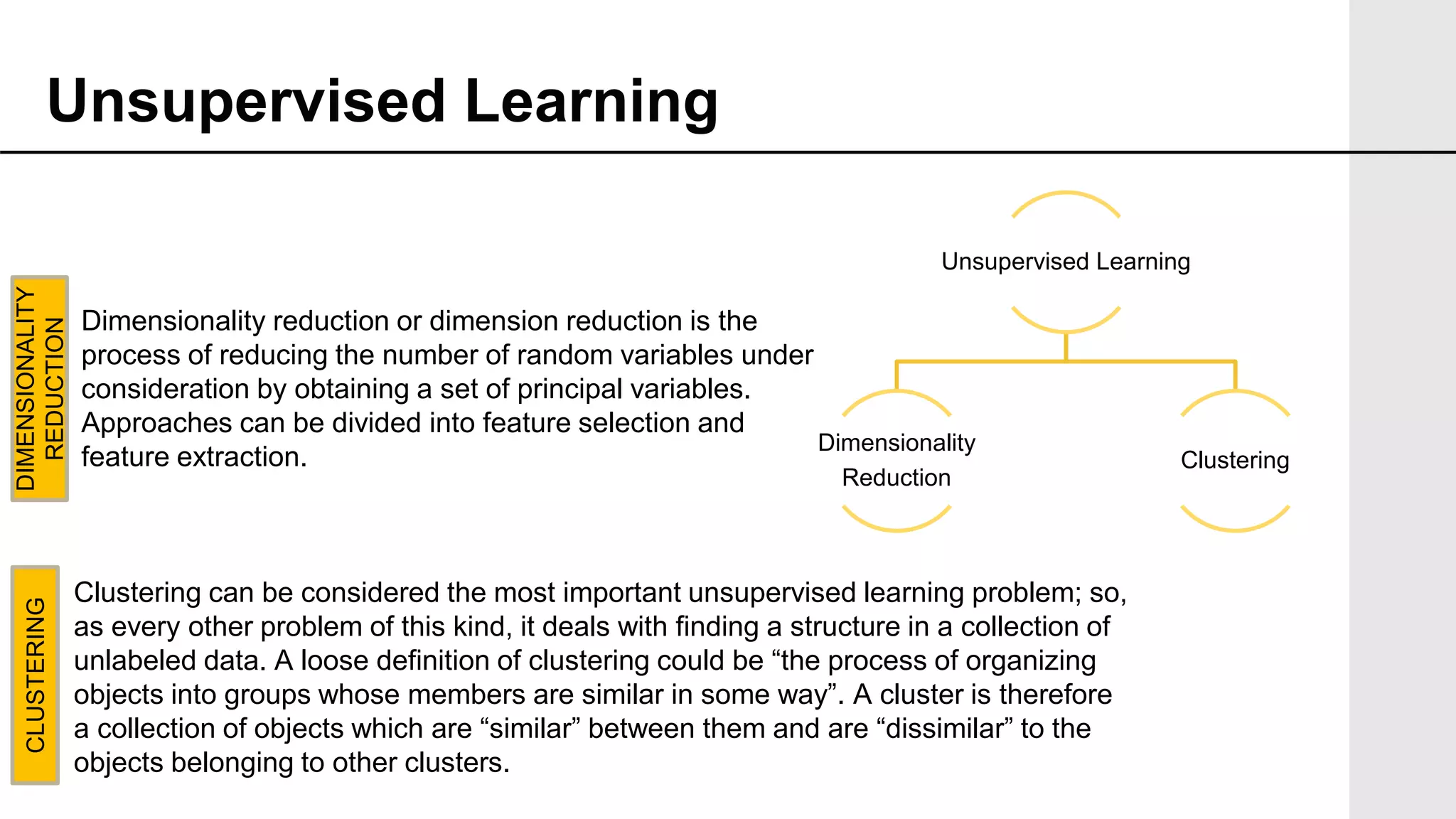
Unsupervised Learning
Dimensionality
Reduction
Clustering
Dimensionality reduction or dimension reduction is the
process of reducing the number of random variables under
consideration by obtaining a set of principal variables.
Approaches can be divided into feature selection and
feature extraction.
Clustering can be considered the most important unsupervised learning problem; so,
as every other problem of this kind, it deals with finding a structure in a collection of
unlabeled data. A loose definition of clustering could be “the process of organizing
objects into groups whose members are similar in some way”. A cluster is therefore
a collection of objects which are “similar” between them and are “dissimilar” to the
objects belonging to other clusters.
DIMENSIONALITY
REDUCTION
CLUSTERING
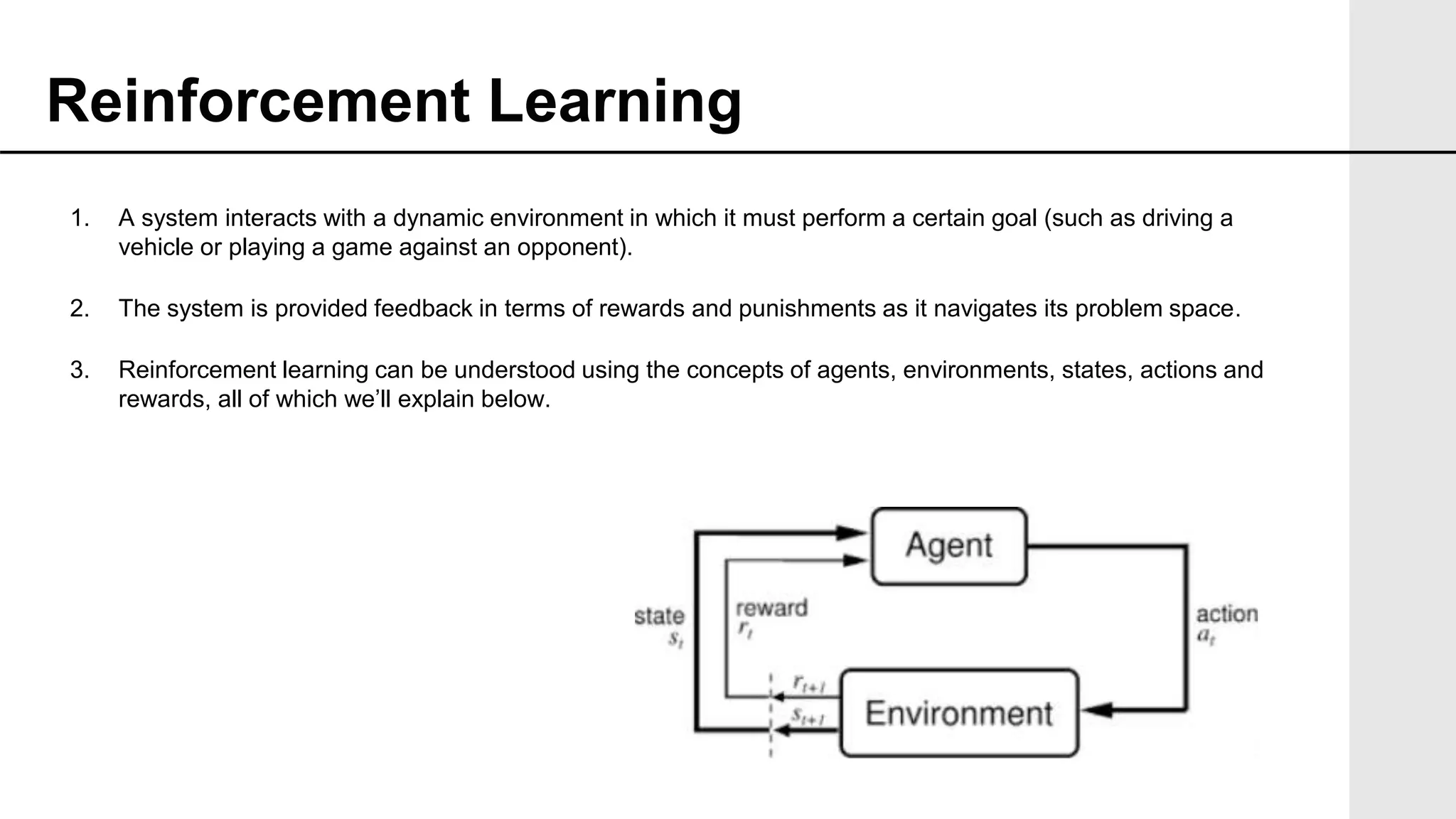
1. A system interacts with a dynamic environment in which it must perform a certain goal (such as driving a
vehicle or playing a game against an opponent).
2. The system is provided feedback in terms of rewards and punishments as it navigates its problem space.
3. Reinforcement learning can be understood using the concepts of agents, environments, states, actions and
rewards, all of which we’ll explain below.
Reinforcement Learning
1. For example, in usual circumstances we would require an autonomous vehicle to put safety first, minimize ride
time, reduce pollution, offer passengers comfort and obey the rules of law. With an autonomous race car, on
the other hand, we would emphasize speed much more than the driver’s comfort. The programmer cannot
predict everything that could happen on the road. Instead of building lengthy “if-then” instructions, the
programmer prepares the reinforcement learning agent to be capable of learning from the system of rewards
and penalties. The agent (another name for reinforcement learning algorithms performing the task) gets
rewards for reaching specific goals.
Reinforcement Learning Examples
2
6
Dr. K. Prem Nazeer, Principal
(Dr. S. N. S Rajalakshmi College of Arts and Science)
Dr. V. Kathiresan, Director
(Dr. S. N. S Rajalakshmi College of Arts and Science)
Dr. N. Shanmugapriya, HOD
(Dr. S. N. S Rajalakshmi College of Arts and Science)
Entire SNS Team
& You all

Introduction to Machine Learning

  • 3.
    I’m Sujith Jayaprakash,Currently working as the Director and Busienss Head of NewEdge InfoTech Gh Ltd. I’m a business development professional with a strong background in IT Training and administration. I have more than a decade of experience in the education sectors in India, Africa and Latin America with significant experience in Senior Management roles and leading institutional academic delivery improvement. I have completed Doctor of Philosophy in Computer Science and specialized in Education Data Mining. Area of Expertise : Data Science, Web Mining, Education Data Mining, and Social Media Marketing HELLO!
  • 4.
    This webinar issolely focused on introducing you to machine learning concepts, Hence most of the topics I deal here would be just an introduction to various ML applications and steps involved. So if you’re already have a fair bit of experience in ML or Data Science then this webinar might not be of your interest. Cheers! Let’s Start
  • 5.
    WHAT IS MACHINELEARNING Wikipedia Machine learning (ML) is the study of computer algorithms that improve automatically through experience. O’Reilly ML is a subset of the larger field of artificial intelligence (AI) that “focuses on teaching computers how to learn without the need to be programmed for specific tasks - Sujit Pal and Antonio Gulli in Deep Learning with Keras. 01 02 Some common definitions from reliable sources
  • 6.
    We’re the Super Heroes Artificial IntelligenceVs. Machine Learning Vs. Neural Networks Vs. Deep Learning Vs. Data Science
  • 7.
    AI Vs. MLVs. NN Vs. DL Vs. DS AI is for building models that emulate cognition and human understanding. AI is the implementation of a predictive model to forecast future events Data Science Data Science is about finding hidden patterns in the data. Data Science comprises of various statistical techniques whereas AI makes use of computer algorithms Deep Learning Deep learning is a subset of machine learning in artificial intelligence (AI) that has networks capable of learning unsupervised from data that is unstructured or unlabeled. Artifical Intelligence Neural Network A neural network is a series of algorithms that endeavors to recognize underlying relationships in a set of data through a process that mimics the way the human brain operates. Machine Learning Machine learning is an application of artificial intelligence (AI) that provides systems the ability to automatically learn and improve from experience without being explicitly programmed.
  • 8.
    Real Life Examplesof AI & Machine Learning Automated Cars & Google Map Face Detection Video Surveillance Product Recommendation Sentimental Analysis AI in Agriculture
  • 9.
    Machine Leanring Concepts Machinelearning helps you to use historical data to make better business decisions ML models are used to predict the future data based on the historical data ML algorithms discover patterns and data and construct mathematical models using those discoveries. 02 03 01
  • 10.
    Learning a Function y– Output Variable f – Target Function x – Input variables Machine learning algorithms are described as learning a target function (f) that best maps input variables (X) to an output variable (Y). Y = f(x)
  • 11.
    Product Recommendation Scenario ClassicApproach ML Approach “ Assuming you are tasked with developing a back end application that provides product recommendation to customers based on past purchases. Recommendation Purchase History Creating Rules Model Purchase History Site wide Customer Access Sales Data Most recent purchases Recommended
  • 12.
    Simple Algorithm f(x) =a0x0 + a1x1 + a2x2 . . . . anxn Feature: An Important Data Point x0: Is the product a shirt? Yes = 1 Weight: How much does the feature affect the accuracy of the prediction? a0: This customer has purchased 8 shirts in the past Weight = 0.8 x1: Is this item from a Brand [y]? Yes = 1 Weight: How much does the feature affect the accuracy of the prediction? a1: 2/8 items this person bought in the past were brand [y]. Weight = 0.25 If f(x) > 1, recommend the product f(x) = 0.8 * 1 + 0.25 * 1 f(x) = 1.05 Two Key Components of the algorithm Features : Are part of the dataset that are identified as important to identify the outcome Weights : To determine how important the associated feature is.
  • 13.
  • 14.
    1. Supervised learningis the machine learning task of learning a function that maps an input to an output based on example input-output pairs. It infers a function from labeled training data consisting of a set of training examples. 2. With supervised learning, you feed the output of your algorithm into the system. This means that in supervised learning, the machine already knows the output of the algorithm before it starts working on it or learning it. A basic example of this concept would be a student learning a course from an instructor. The student knows what he/she is learning from the course. 3. With the output of the algorithm known, all that a system needs to do is to work out the steps or process needed to reach from the input to the output. The algorithm is being taught through a training data set that guides the machine. If the process goes haywire and the algorithms come up with results completely different than what should be expected, then the training data does its part to guide the algorithm back towards the right path. 4. Supervised Machine Learning currently makes up most of the ML that is being used by systems across the world. The input variable (x) is used to connect with the output variable (y) through the use of an algorithm. All of the input, the output, the algorithm, and the scenario are being provided by humans. We can understand supervised learning in an even better way by looking at it through two types of problems. Supervised Learning
  • 15.
    Supervised Learning Supervised Learning ClassificationRegression Classification problems categorize all the variables that form the output. Examples of these categories formed through classification would include demographic data such as marital status, sex, or age. The most common model used for this type of service status is the support vector machine. The support vector machines set forth to define the linear decision boundaries. Problems that can be classified as regression problems include types where the output variables are set as a real number. The format for this problem often follows a linear format. CLASSIFICATIONREGRESSION
  • 16.
    1. Unsupervised learningis a type of machine learning algorithm used to draw inferences from datasets consisting of input data without labeled responses. 2. The most common unsupervised learning method is cluster analysis, which is used for exploratory data analysis to find hidden patterns or grouping in data. The clusters are modeled using a measure of similarity which is defined upon metrics such as Euclidean or probabilistic distance. 3. Unsupervised learning algorithms allows you to perform more complex processing tasks compared to supervised learning. Although, unsupervised learning can be more unpredictable compared with other natural learning methods.. 4. Unsupervised learning methods are used in bioinformatics for sequence analysis and genetic clustering; in data mining for sequence and pattern mining; in medical imaging for image segmentation; and in computer vision for object recognition. Unsupervised Learning
  • 17.
    Unsupervised Learning Unsupervised Learning Dimensionality Reduction Clustering Dimensionalityreduction or dimension reduction is the process of reducing the number of random variables under consideration by obtaining a set of principal variables. Approaches can be divided into feature selection and feature extraction. Clustering can be considered the most important unsupervised learning problem; so, as every other problem of this kind, it deals with finding a structure in a collection of unlabeled data. A loose definition of clustering could be “the process of organizing objects into groups whose members are similar in some way”. A cluster is therefore a collection of objects which are “similar” between them and are “dissimilar” to the objects belonging to other clusters. DIMENSIONALITY REDUCTION CLUSTERING
  • 19.
    1. A systeminteracts with a dynamic environment in which it must perform a certain goal (such as driving a vehicle or playing a game against an opponent). 2. The system is provided feedback in terms of rewards and punishments as it navigates its problem space. 3. Reinforcement learning can be understood using the concepts of agents, environments, states, actions and rewards, all of which we’ll explain below. Reinforcement Learning
  • 20.
    1. For example,in usual circumstances we would require an autonomous vehicle to put safety first, minimize ride time, reduce pollution, offer passengers comfort and obey the rules of law. With an autonomous race car, on the other hand, we would emphasize speed much more than the driver’s comfort. The programmer cannot predict everything that could happen on the road. Instead of building lengthy “if-then” instructions, the programmer prepares the reinforcement learning agent to be capable of learning from the system of rewards and penalties. The agent (another name for reinforcement learning algorithms performing the task) gets rewards for reaching specific goals. Reinforcement Learning Examples
  • 26.
    2 6 Dr. K. PremNazeer, Principal (Dr. S. N. S Rajalakshmi College of Arts and Science) Dr. V. Kathiresan, Director (Dr. S. N. S Rajalakshmi College of Arts and Science) Dr. N. Shanmugapriya, HOD (Dr. S. N. S Rajalakshmi College of Arts and Science) Entire SNS Team & You all