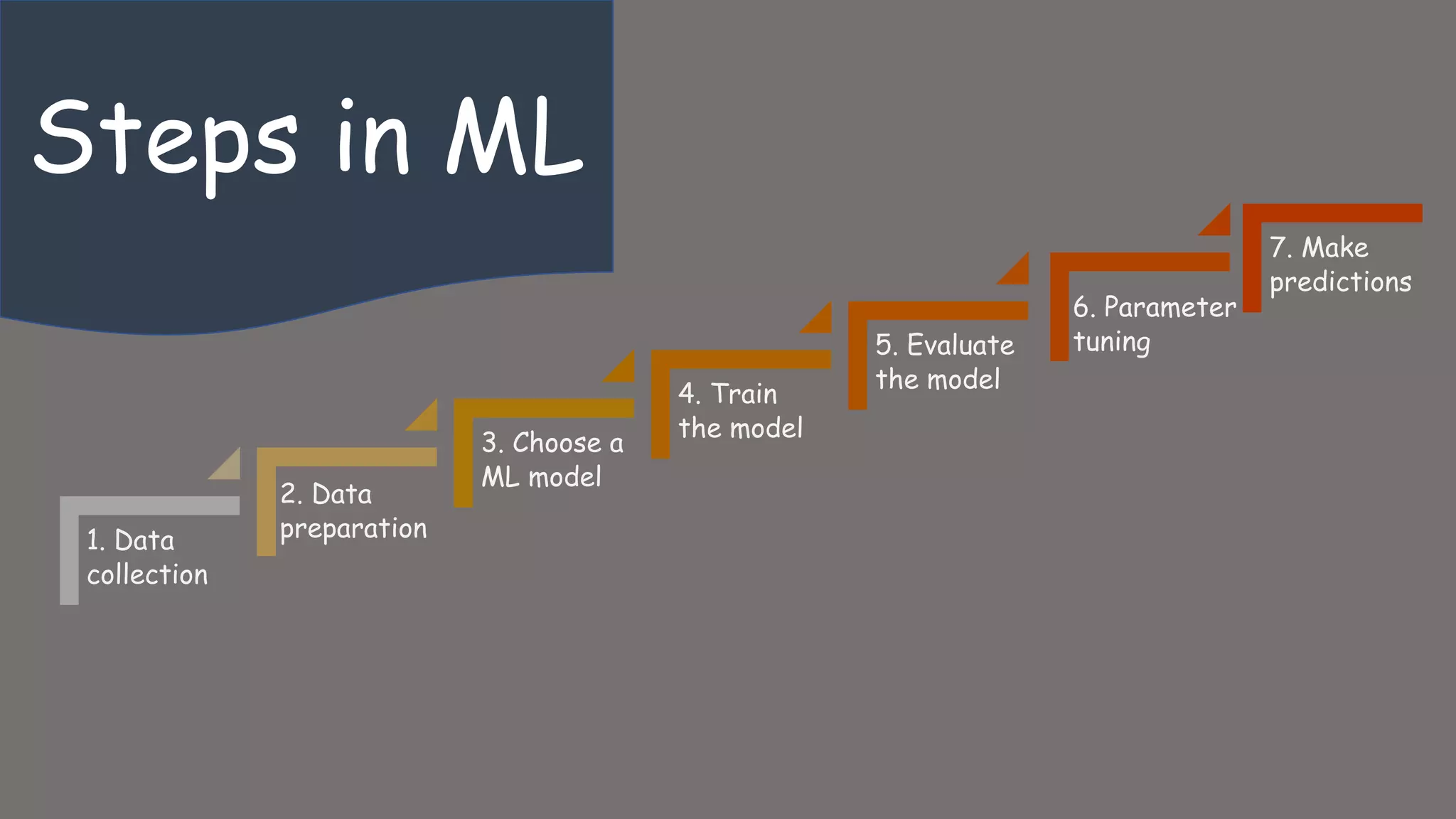
This document is a PowerPoint presentation on machine learning (ML), outlining its definitions, types (supervised, unsupervised, semi-supervised, and reinforcement learning), and key concepts like features and labels. It also details the steps involved in the ML process, including data collection, preparation, model selection, training, evaluation, parameter tuning, and making predictions. The applications of ML in various fields, such as spam detection and fraud detection, are highlighted along with its increasing importance in imitating human learning.
What is
Machine Learning(M.L.) ?
Machine learning is an application of artificial
intelligence (AI) which gives devices the ability to
learn from their experiences and improve their self
without doing any coding
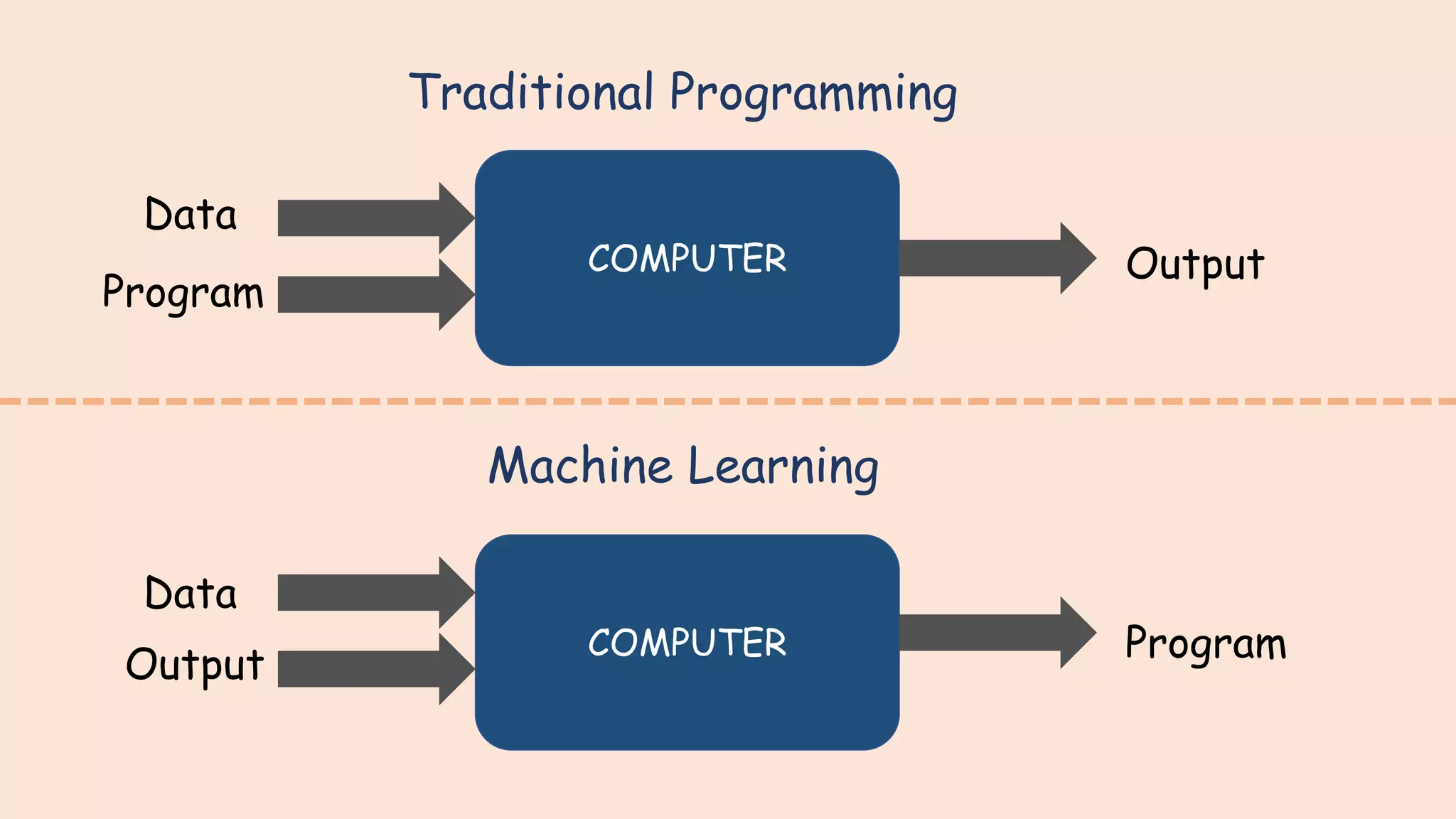
Machine learning refersto
a class of computer algorithms
that learn from examples
rather than being explicitly
programmed to perform a task.
6.
Machine learning isa field which
focuses on the use of data and
algorithms to imitate the way
that humans learn, gradually
improving its accuracy.
7.
Machine learning isa field of
study that looks at using
computational algorithms to
turn empirical data into
usable models.
8.
Want to detectspam?
Want to forecast stocks?
Want to find out user
preferences?
Want your computer to
recognize you in group photos?
All the answers can be obtained
by using the power of ML.
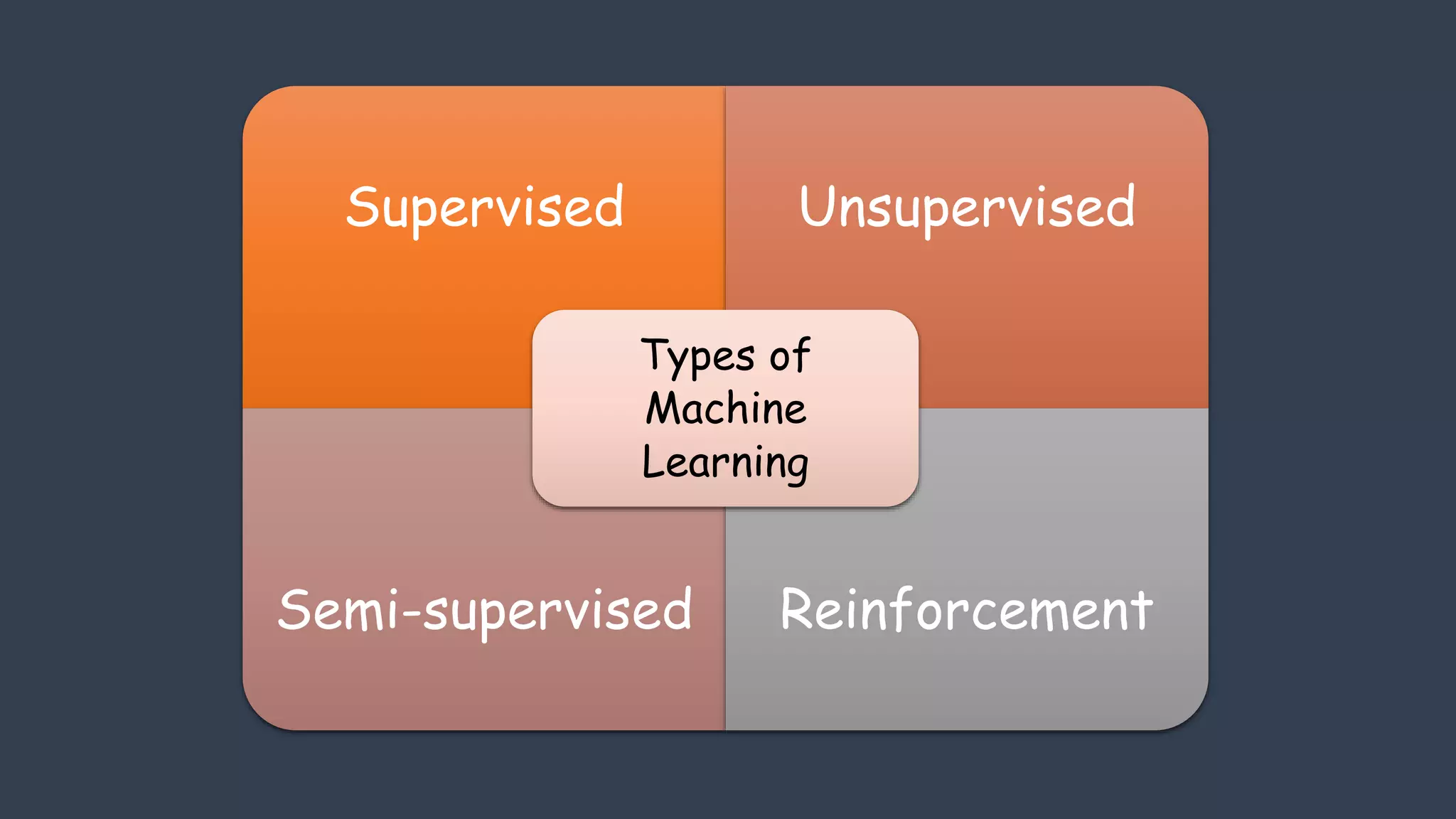
Supervised
• In Supervisedlearning, you train the machine using
data which is well "labeled."
• It means data is already tagged with the correct
answer.
• It can be compared to learning which takes place in
the presence of a supervisor or a teacher.
• A supervised learning algorithm learns from labeled
training data, helps you to predict outcomes for
unforeseen data.
• One disadvantage of this learning method is that the
dataset has to be hand-labeled either by a Machine
Learning Engineer or a Data Scientist. This is a
very costly process, especially when dealing with
large volumes of data.
11.
Unsupervised
• Unsupervised Learningis a machine
learning technique in which the users do
not need to supervise the model.
• Instead, it allows the model to work on its
own to discover patterns and information
that was previously undetected.
• It mainly deals with the unlabeled data.
• Unsupervised learning problems are
grouped into clustering and association
problems.
• The most basic disadvantage of
any Unsupervised Learning is that
it’s application spectrum is limited.
12.
Semi-supervised
• Semi-supervised learningis the type of
machine learning that uses a combination of a
small amount of labeled data and a large
amount of unlabeled data to train models.
Intuitively, one may imagine the three types of
learning algorithms as :
• Supervised learning where a student is under
the supervision of a teacher at both home
and school.
• Unsupervised learning where a student has to
figure out a concept himself.
• Semi-Supervised learning where a teacher
teaches a few concepts in class and gives
questions as homework which are based on
similar concepts.
13.
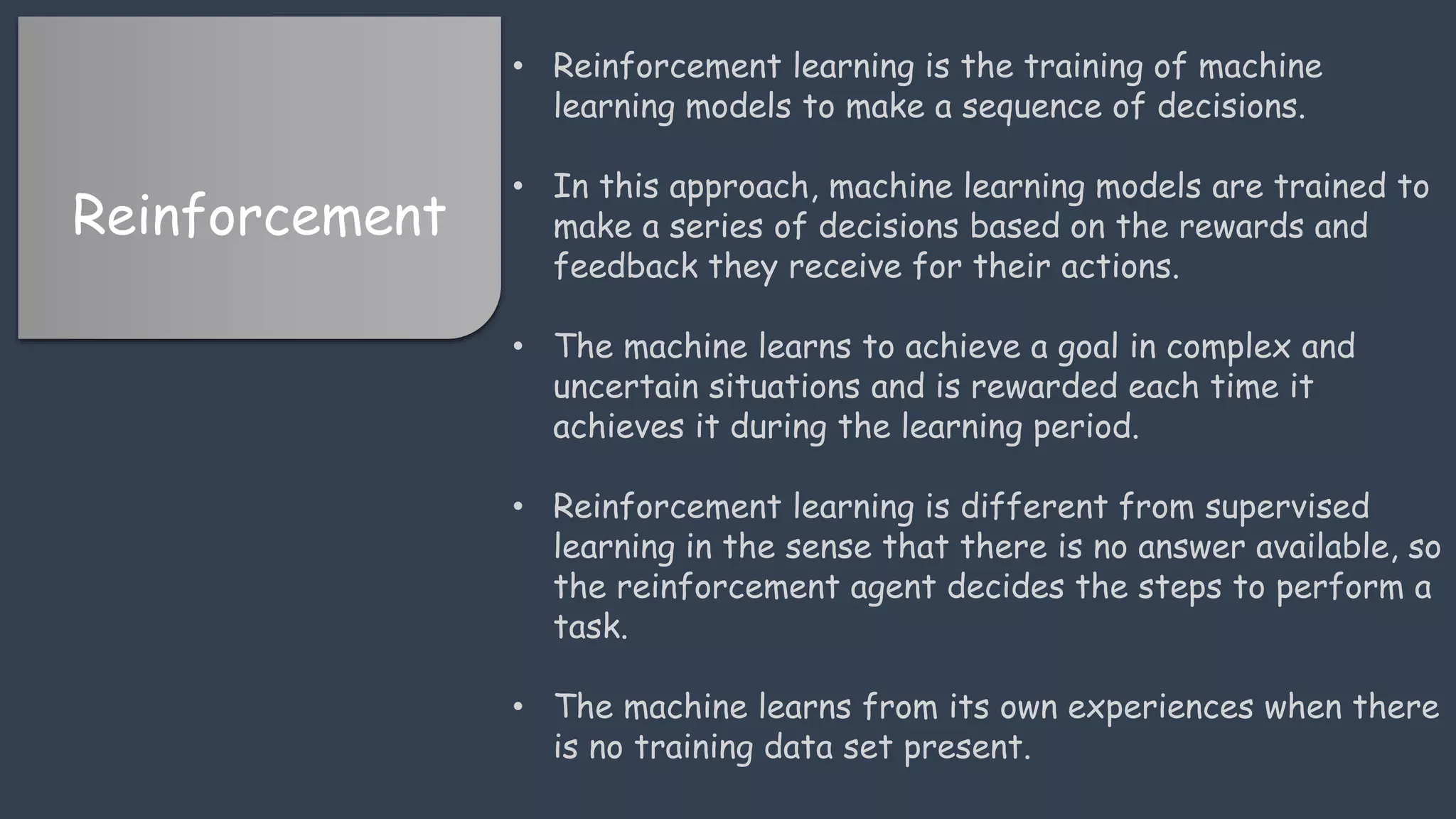
Reinforcement
• Reinforcement learningis the training of machine
learning models to make a sequence of decisions.
• In this approach, machine learning models are trained to
make a series of decisions based on the rewards and
feedback they receive for their actions.
• The machine learns to achieve a goal in complex and
uncertain situations and is rewarded each time it
achieves it during the learning period.
• Reinforcement learning is different from supervised
learning in the sense that there is no answer available, so
the reinforcement agent decides the steps to perform a
task.
• The machine learns from its own experiences when there
is no training data set present.
14.
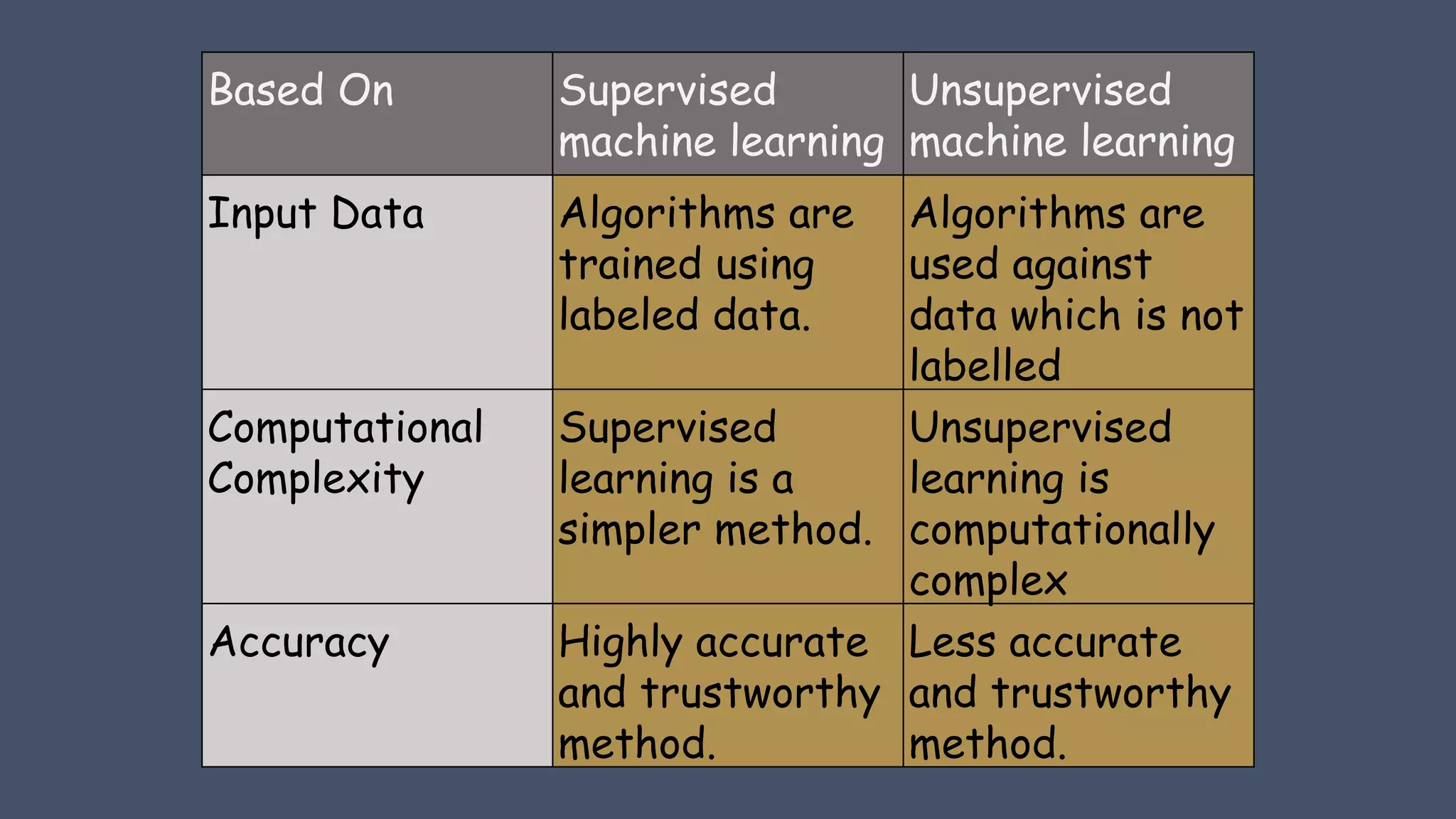
Based On Supervised
machinelearning
Unsupervised
machine learning
Input Data Algorithms are
trained using
labeled data.
Algorithms are
used against
data which is not
labelled
Computational
Complexity
Supervised
learning is a
simpler method.
Unsupervised
learning is
computationally
complex
Accuracy Highly accurate
and trustworthy
method.
Less accurate
and trustworthy
method.
15.
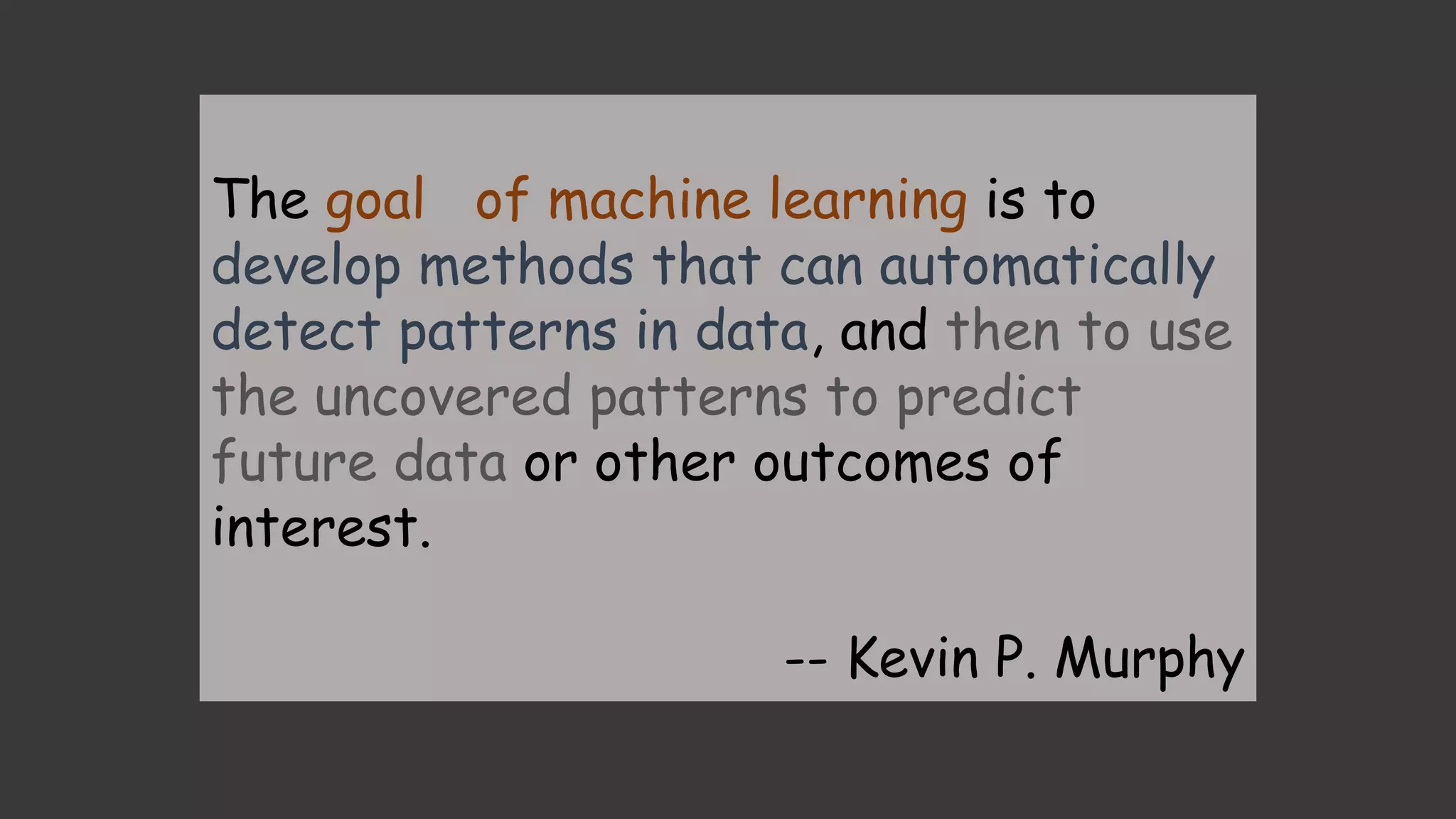
The goal ofmachine learning is to
develop methods that can automatically
detect patterns in data, and then to use
the uncovered patterns to predict
future data or other outcomes of
interest.
-- Kevin P. Murphy
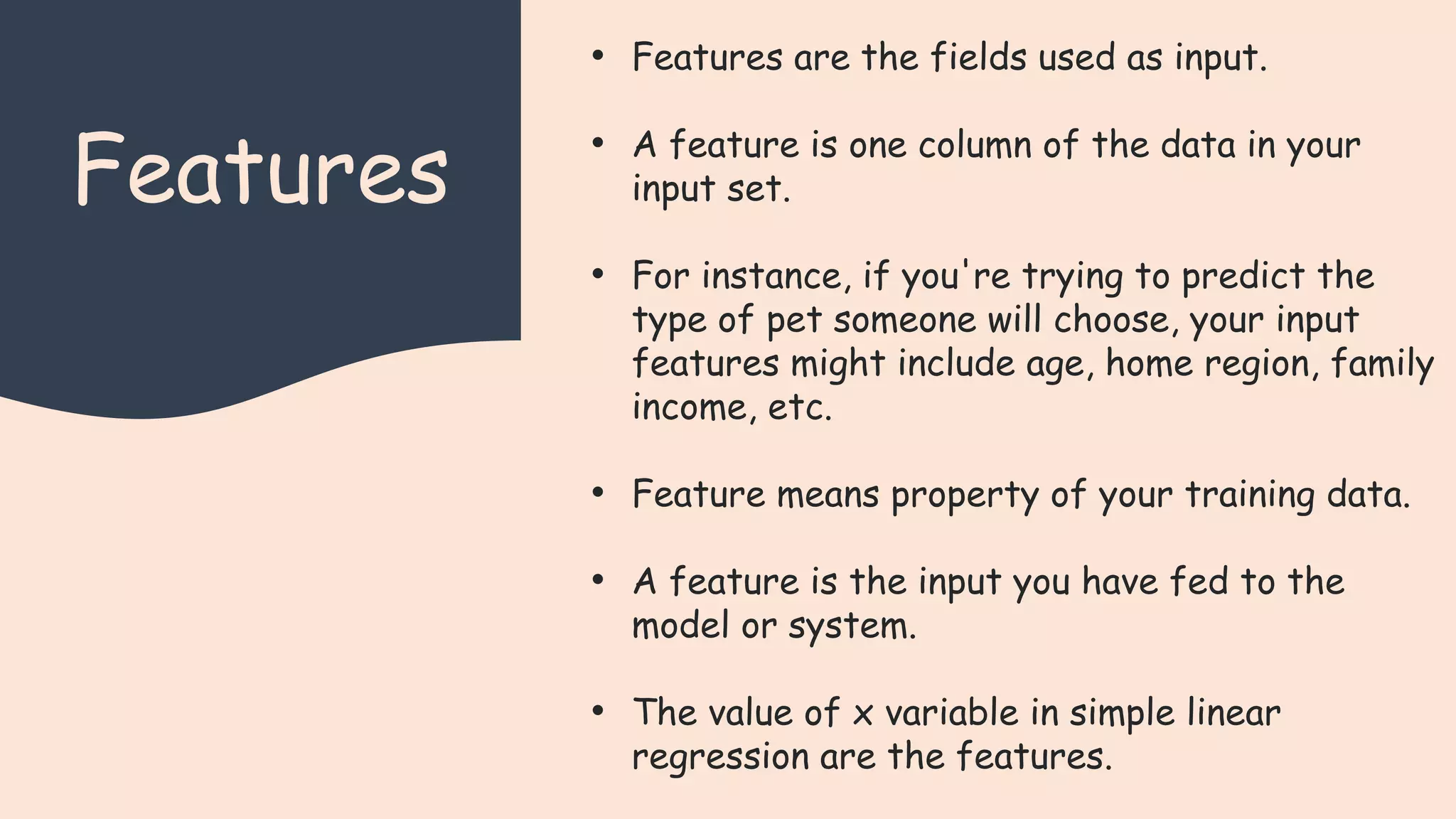
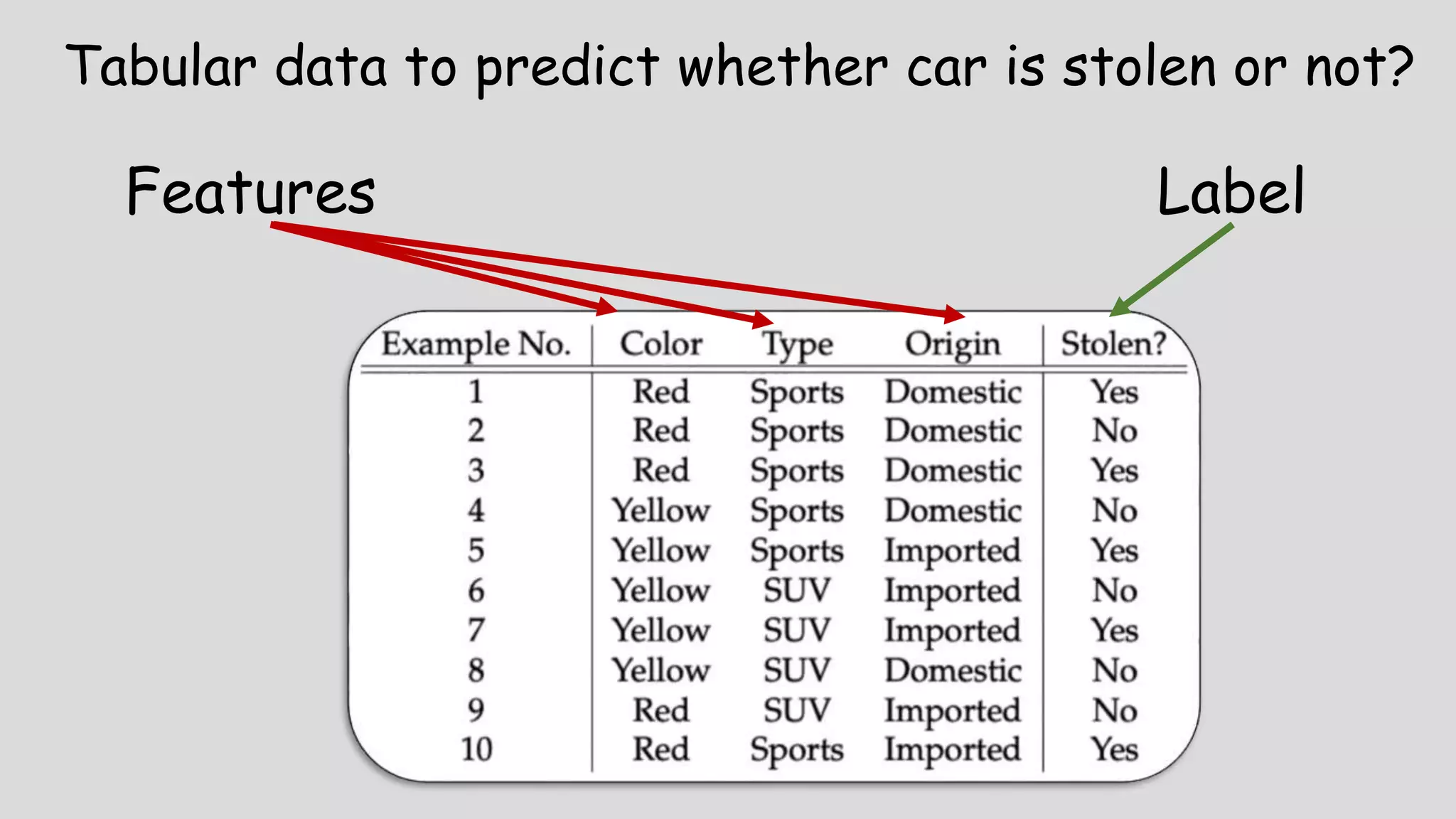
Features
• Features arethe fields used as input.
• A feature is one column of the data in your
input set.
• For instance, if you're trying to predict the
type of pet someone will choose, your input
features might include age, home region, family
income, etc.
• Feature means property of your training data.
• A feature is the input you have fed to the
model or system.
• The value of x variable in simple linear
regression are the features.
18.
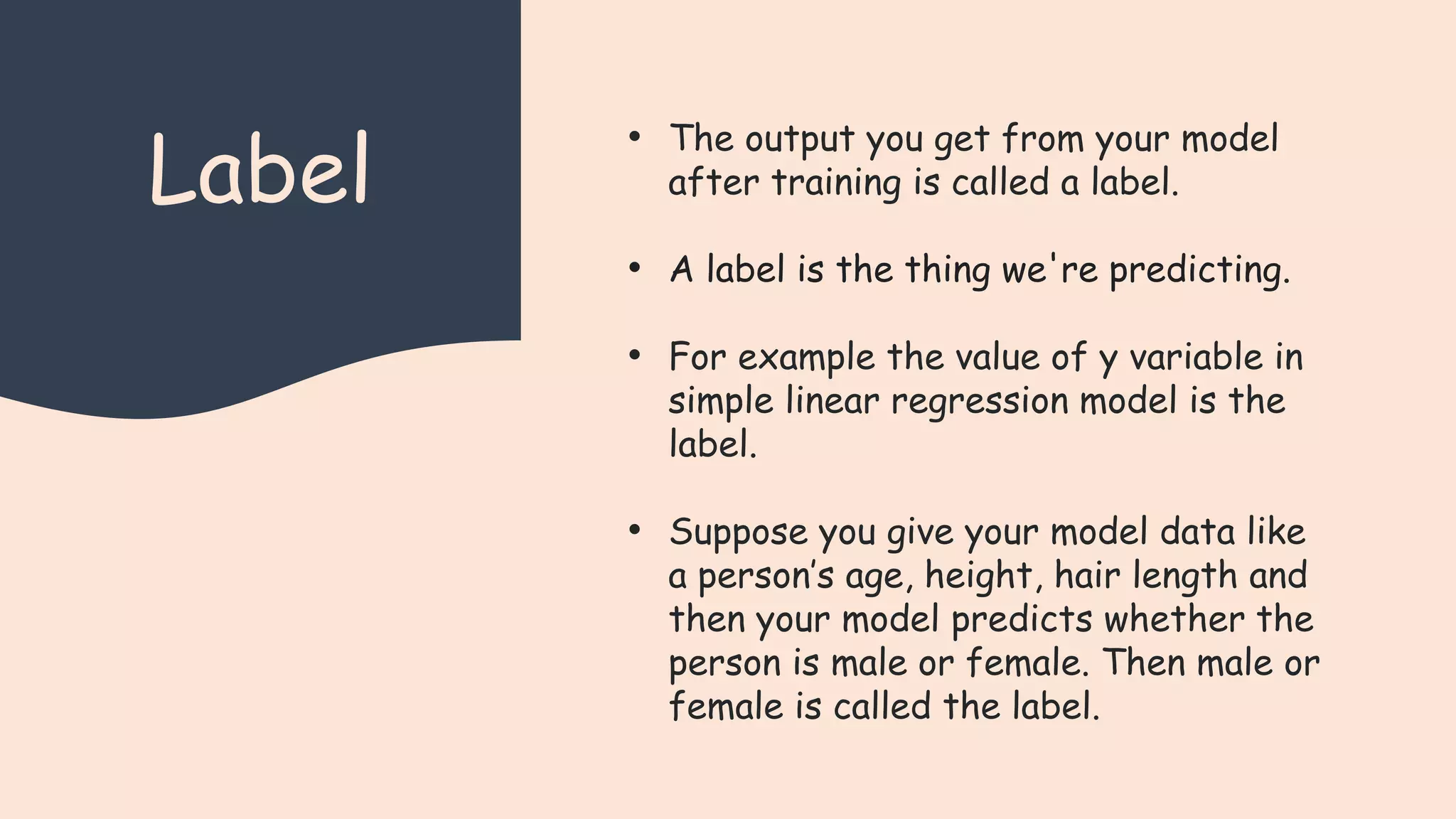
Label
• The outputyou get from your model
after training is called a label.
• A label is the thing we're predicting.
• For example the value of y variable in
simple linear regression model is the
label.
• Suppose you give your model data like
a person’s age, height, hair length and
then your model predicts whether the
person is male or female. Then male or
female is called the label.
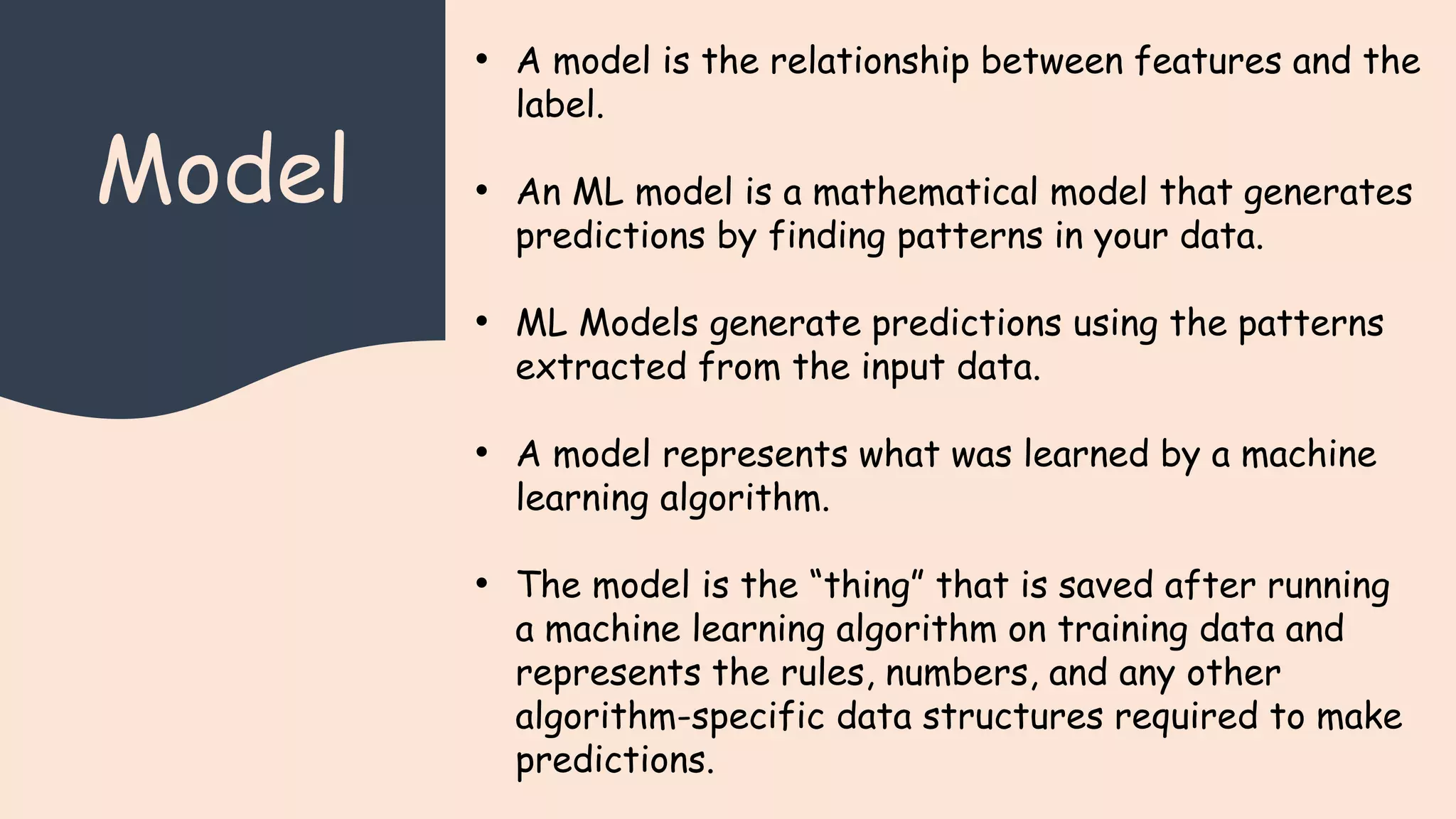
Model
• A modelis the relationship between features and the
label.
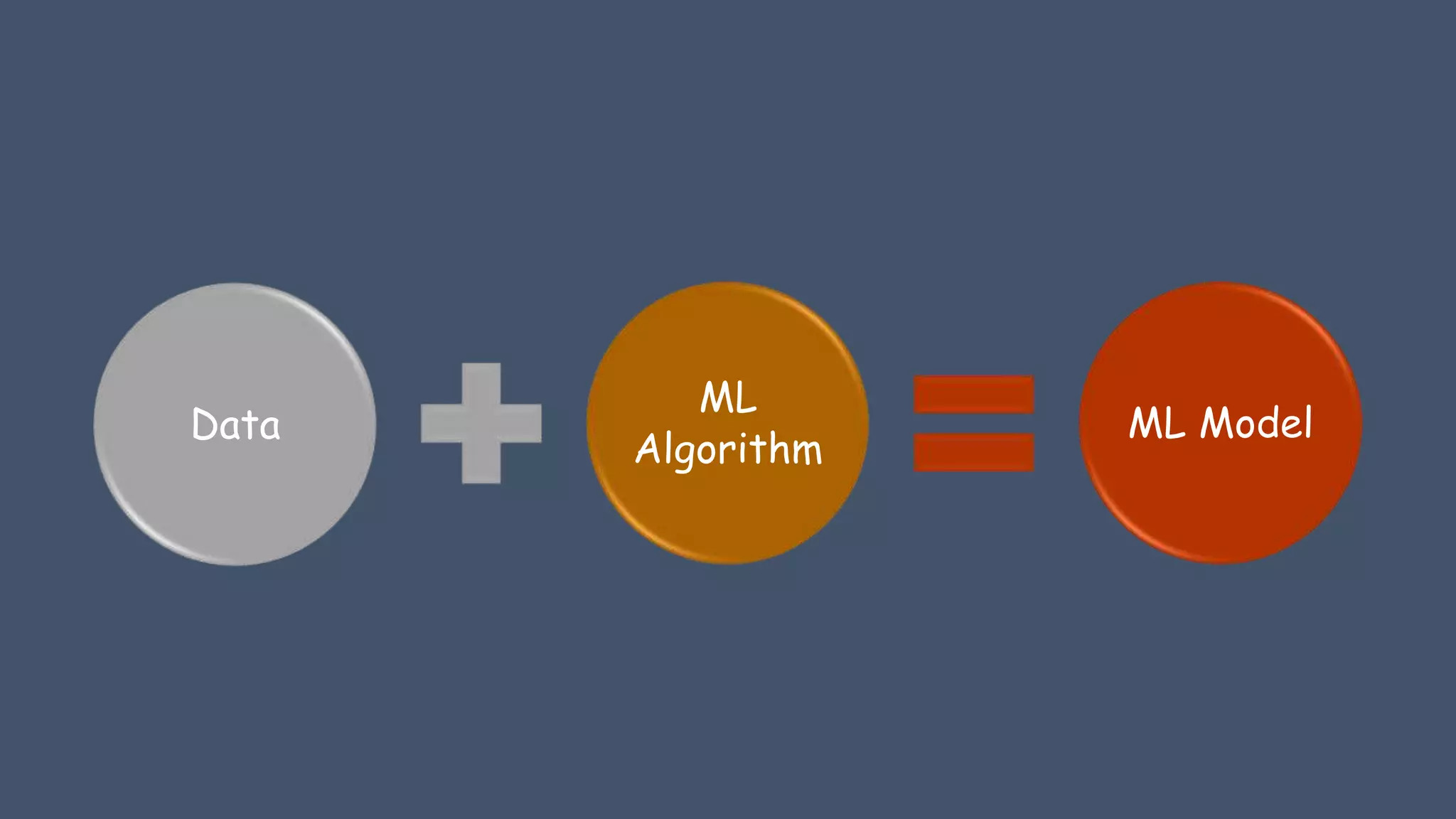
• An ML model is a mathematical model that generates
predictions by finding patterns in your data.
• ML Models generate predictions using the patterns
extracted from the input data.
• A model represents what was learned by a machine
learning algorithm.
• The model is the “thing” that is saved after running
a machine learning algorithm on training data and
represents the rules, numbers, and any other
algorithm-specific data structures required to make
predictions.
1. Data
collection
Data collectionis the process
of gathering and measuring information
from countless different sources.
This is a critical first step that involves
gathering data from various sources
such as databases, files, and external
repositories.
Before starting the data collection
process, it’s important to articulate the
problem you want to solve with an ML
model.
24.
2. Data
Preparation
Data preparation/pre-processingtechniques
generally refer to the addition, deletion, or
transformation of training set data.
Since the collected data may be in an undesired
format, unorganized, or extremely large, further
steps are needed to enhance its quality. The
three common steps for preprocessing data are
formatting, cleaning, and sampling.
Data preparation (also referred to as
“data preprocessing”) is the process of
transforming raw data so that data scientists and
analysts can run it through machine
learning algorithms to uncover insights or make
predictions.
25.
3. Choose a
MLmodel
For different purpose, different ML
models are available. So it depends on
the need that which ML model must be
selected.
The choice of ML model to be selected
depends on many factors like the
problem statement and the kind of
output you want, type and size of the
data, the available computational time,
number of features, and observations in
the data, etc.
26.
4. Train the
modelThe process of training an ML model involves providing an
ML algorithm (that is, the learning algorithm) with
training data to learn from.
Let's say that you want to train an ML model to predict if
an email is spam or not spam.
You would provide ML model with training data that
contains emails for which you know the target (that is, a
label that tells whether an email is spam or not spam).
Then the model should be trained by using this data,
resulting in a model that attempts to predict whether
new email will be spam or not spam.
27.
5. Evaluate
the model
Modelevaluation is a method of assessing the
correctness of models on test data. The test data
consists of data points that have not been seen by
the model before.
There are two methods of evaluating models in data
science, Hold-Out and Cross-Validation.
To avoid overfitting, both methods use a test set
(not seen by the model) to evaluate model
performance.
28.
6. Parameter
Tuning
Each modelhas its own sets of parameters that
need to be tuned to get optimal output.
For every model, our goal is to minimize the error
or say to have predictions as close as possible to
actual values. This is one of the cores or say the
major objective of hyperparameter tuning.
There are following three approaches to
Hyperparameter tuning:
•Manual Search
•Random Search
•Grid Search
29.
7. Make
predictions
“Prediction” refersto the output of
an algorithm after it has been trained on a
historical dataset.
Machine learning has two main goals:
prediction and inference.
After you have a model, you can use that model to
generate predictions which means to give your
model the inputs it has never seen before and
obtain the answer the model has predicted.
In addition to making predictions on new data, you
can use machine-learning models to better
understand the relationships between the input
features and the output target which is known as
inference.
30.
•Traffic Alerts
•Social Media
•Transportationand Commuting
•Products Recommendations
•Virtual Personal Assistants
•Self Driving Cars
•Dynamic Pricing
•Google Translate
•Online Video Streaming
•Fraud Detection
Applications
Of
ML
31.
Thank you forreading till end!
Hope the ppt was helpful.
PPT is made by Swati Tripathi
Follow me on SlideShare
for more PPT like this.