FRACTIONS
AND
DECIMALS
Mathematics 8
Learning objectives
 Recognize fractions that are equivalent to recurring decimals.
 Estimate and subtract mixed numbers, and write the answer as a mixed number in its simplest
form.
 Estimate and multiply an integer by a mixed number, and divide an integer by a proper fraction.
 Use knowledge of the laws of arithmetic and order of operations (including brackets) to simplify
calculations containing decimals or fractions
 Understand the relative size of quantities to compare and order decimals and fractions (positive
and negative), using the symbols =, , >, <,
Types of decimal numbers
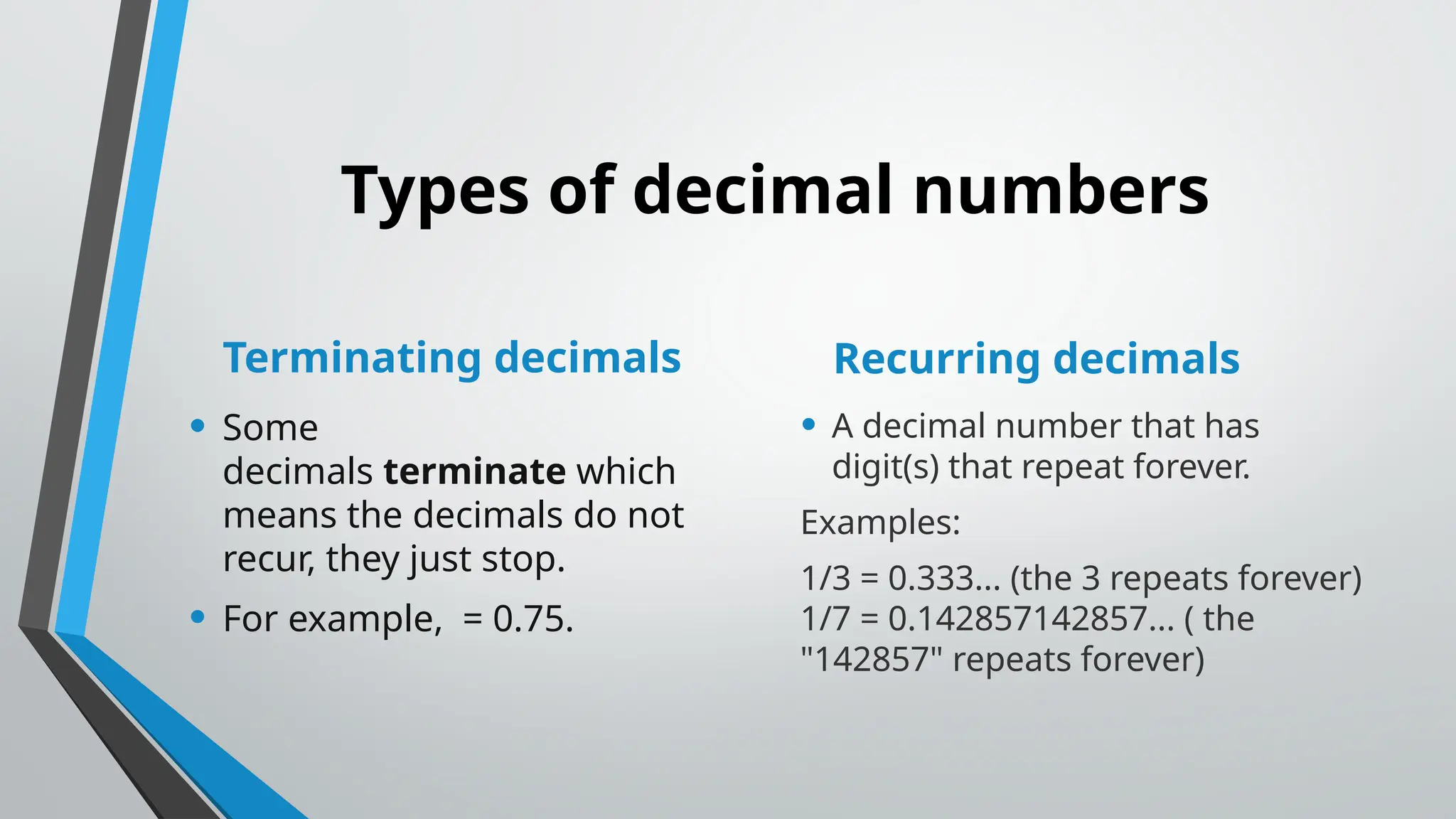
Terminating decimals
• Some
decimals terminate which
means the decimals do not
recur, they just stop.
• For example, = 0.75.
Recurring decimals
• A decimal number that has
digit(s) that repeat forever.
Examples:
1/3 = 0.333... (the 3 repeats forever)
1/7 = 0.142857142857... ( the
"142857" repeats forever)
Converting recurring decimals
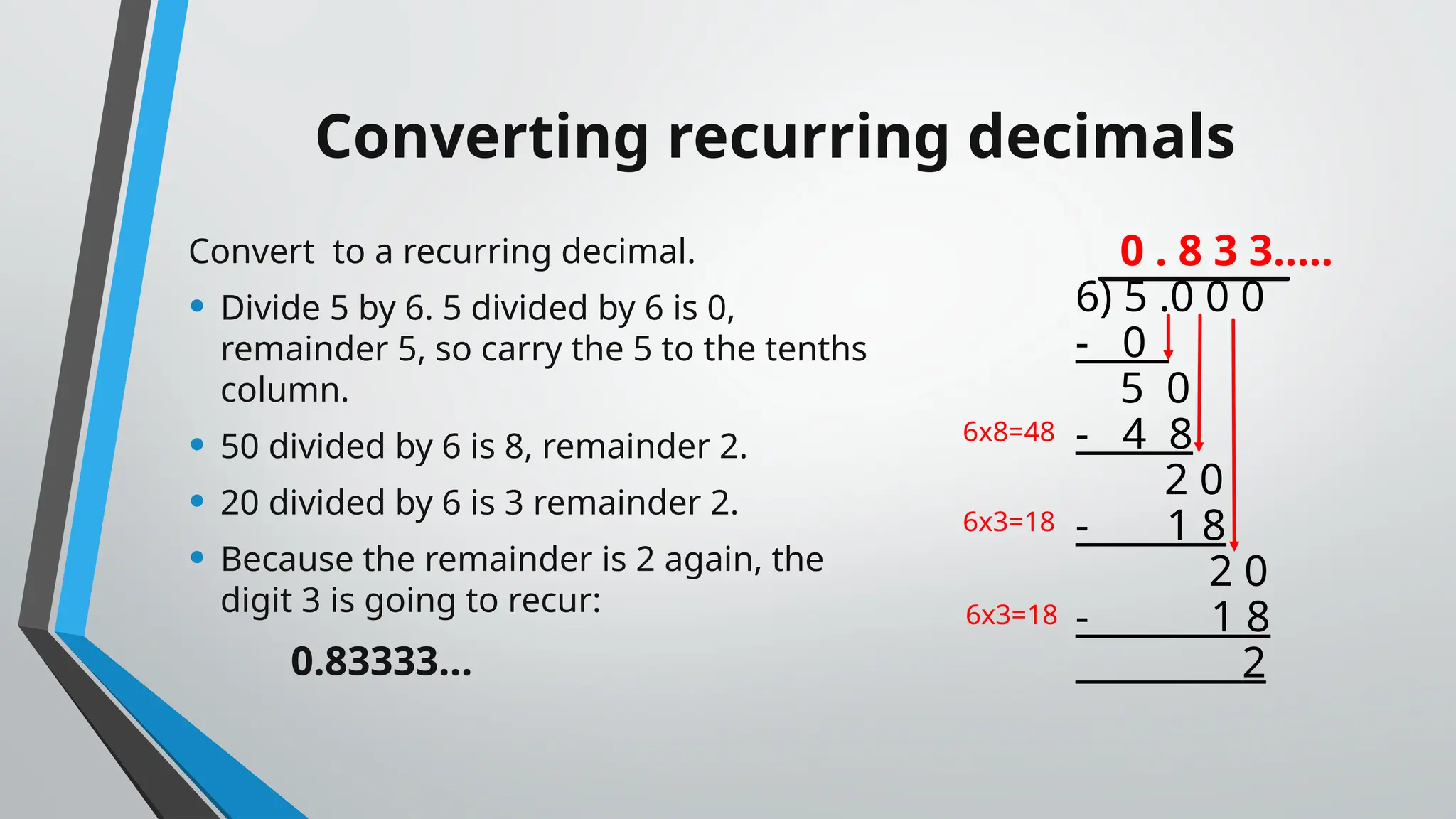
Convert to a recurring decimal.
• Divide 5 by 6. 5 divided by 6 is 0,
remainder 5, so carry the 5 to the tenths
column.
• 50 divided by 6 is 8, remainder 2.
• 20 divided by 6 is 3 remainder 2.
• Because the remainder is 2 again, the
digit 3 is going to recur:
0.83333…
0 . 8 3 3…..
6) 5 .0 0 0
- 0
5 0
- 4 8
2 0
- 1 8
2 0
- 1 8
2
6x8=48
6x3=18
6x3=18
Terminating and recurring decimals

M8 - FRACTIONS AND DECIMALS.pptx mathematics for grade 8

  • 1.
  • 2.
    Learning objectives  Recognizefractions that are equivalent to recurring decimals.  Estimate and subtract mixed numbers, and write the answer as a mixed number in its simplest form.  Estimate and multiply an integer by a mixed number, and divide an integer by a proper fraction.  Use knowledge of the laws of arithmetic and order of operations (including brackets) to simplify calculations containing decimals or fractions  Understand the relative size of quantities to compare and order decimals and fractions (positive and negative), using the symbols =, , >, <,
  • 3.
    Types of decimalnumbers Terminating decimals • Some decimals terminate which means the decimals do not recur, they just stop. • For example, = 0.75. Recurring decimals • A decimal number that has digit(s) that repeat forever. Examples: 1/3 = 0.333... (the 3 repeats forever) 1/7 = 0.142857142857... ( the "142857" repeats forever)
  • 4.
    Converting recurring decimals Convertto a recurring decimal. • Divide 5 by 6. 5 divided by 6 is 0, remainder 5, so carry the 5 to the tenths column. • 50 divided by 6 is 8, remainder 2. • 20 divided by 6 is 3 remainder 2. • Because the remainder is 2 again, the digit 3 is going to recur: 0.83333… 0 . 8 3 3….. 6) 5 .0 0 0 - 0 5 0 - 4 8 2 0 - 1 8 2 0 - 1 8 2 6x8=48 6x3=18 6x3=18
  • 5.