m4QI: SMS for Learning, Assessment
and Performance Support

James Bon Tempo, Jhpiego
Pamela Riley, Abt Associates
March 23, 2011


                               SHOPS is funded by the U.S. Agency for International Development.
                               Abt Associates leads the project in collaboration with
                               Banyan Global
                               Jhpiego
Abt Associates Inc.            Marie Stopes International
                               Monitor Group
                               O’Hanlon Health Consulting
Contents: m4QI


• m4QI Overview and Objectives
• m4QI Implementing Partners
• m4QI Background: Why was tool developed
• m4QI Implementation: What is being done
  •   Content development
  •   Platform development
  •   Delivery
  •   Evaluation
• m4QI Replication: How others can use
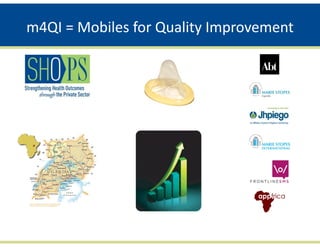
m4QI = Mobiles for Quality Improvement
m4QI Overview and Objectives

• Objectives are to design, deploy and evaluate a mobile
  phone-based learning platform for FP providers
  •   Increase adherence to clinical protocols
  •   Affect positive behavioral change in service delivery
  •   Identify competencies in need of strengthening
  •   Improve effectiveness of supportive supervision and follow-up.
• The application is intended to be scalable and replicable,
  targeting users of low-end phone and those without
  access to internet
• Core-funded through USAID’s Strengthening Health
  Outcomes through the Private Sector (SHOPS)
m4QI Implementing Partners


• Abt Associates: Project management
• Jhpiego: Design and implementation
• Marie Stopes Uganda: Deployment, monitoring
• Appfrica: Software developer
• FrontlineSMS: Technical support
m4QI Background

• Problem statement: need for a cost-effective means for
  reinforcing training of field staff, improve quality of FP
  service delivery
• Solution: mhealth application to send SMS tips and
  quizzes
  • Leverage ubiquitous access to mobile phones, low cost SMS
  • Text messages provide timely and targetted training content,
    works with low end phones, “no internet” settings
• Adapt FrontlineSMS platform to add functionality
  targetting identified groups of “learners”
  • FrontlineSMS platform is free, easy to use, widely available
  • Assessment feature allows supervisors to provide targeted
    remediation, follow-up training
m4QI Implementation: Content development


• Assess the gaps: m4QI team met with Marie
  Stopes clinical team, trainers, and M&E staff to
  identify indicators
  • Target behaviors with inconsistent adherence to
    clinical guidelines
  • Applicable to broad cross-section of staff (e.g. client
    care, infection prevention)
• Develop content: Utilize language from training
  manuals, in 160 characters
  • First step is identifying why behavior not routinely
    done, why important to provider and client
m4QI Platform: FrontlineSMS:Learn


• RFP process to identify local programmer
  • Local capacity building with support from FrontlineSMS
    global organization
• FrontlineSMS plug-in to add features:
  • Bank of messages to be delivered by topic
  • Quizzes (multiple choice, T/F) with automated
    responses
  • Reports on messages delivered, received, questions
    answered correctly
• Future functionality will include peer-to-peer
  platform
m4QI Delivery and Evaluation


• Six locations Marie Stopes Uganda
  • Total 30 pilot users including all staff functions from
    doctors to receptionists
  • Three Outreach Teams, three Health Centres
• Pilot will be conducted over 8 week period April –
  June, 2011
  • Pre-testing with users to address technical bugs, ease
    of use, content comprehension
• Qualitative research to be conducted for process
  evaluation
• Final report July 2011
Replicability


• Final report will detail process steps for
  implementation by other programs
• FrontlineSMS:Learn is open source, free
• SHOPS plans in future to apply in context of non-
  networker private sector providers
  • Address challenges of isolation, limited training,
    support for quality improvement
  • Will include quantitative impact evaluation
jbontempo@jhpiego.net
pamela_riley@abtassoc.com


www.shopsproject.org


                        SHOPS is funded by the U.S. Agency for International Development.
                        Abt Associates leads the project in collaboration with
                        Banyan Global
                        Jhpiego
Abt Associates Inc.     Marie Stopes International
                        Monitor Group
                        O’Hanlon Health Consulting

m4QI: SMS for Learning, Assessment and Performance Support

  • 1.
    m4QI: SMS forLearning, Assessment and Performance Support James Bon Tempo, Jhpiego Pamela Riley, Abt Associates March 23, 2011 SHOPS is funded by the U.S. Agency for International Development. Abt Associates leads the project in collaboration with Banyan Global Jhpiego Abt Associates Inc. Marie Stopes International Monitor Group O’Hanlon Health Consulting
  • 2.
    Contents: m4QI • m4QIOverview and Objectives • m4QI Implementing Partners • m4QI Background: Why was tool developed • m4QI Implementation: What is being done • Content development • Platform development • Delivery • Evaluation • m4QI Replication: How others can use
  • 3.
  • 4.
    m4QI Overview andObjectives • Objectives are to design, deploy and evaluate a mobile phone-based learning platform for FP providers • Increase adherence to clinical protocols • Affect positive behavioral change in service delivery • Identify competencies in need of strengthening • Improve effectiveness of supportive supervision and follow-up. • The application is intended to be scalable and replicable, targeting users of low-end phone and those without access to internet • Core-funded through USAID’s Strengthening Health Outcomes through the Private Sector (SHOPS)
  • 5.
    m4QI Implementing Partners •Abt Associates: Project management • Jhpiego: Design and implementation • Marie Stopes Uganda: Deployment, monitoring • Appfrica: Software developer • FrontlineSMS: Technical support
  • 7.
    m4QI Background • Problemstatement: need for a cost-effective means for reinforcing training of field staff, improve quality of FP service delivery • Solution: mhealth application to send SMS tips and quizzes • Leverage ubiquitous access to mobile phones, low cost SMS • Text messages provide timely and targetted training content, works with low end phones, “no internet” settings • Adapt FrontlineSMS platform to add functionality targetting identified groups of “learners” • FrontlineSMS platform is free, easy to use, widely available • Assessment feature allows supervisors to provide targeted remediation, follow-up training
  • 9.
    m4QI Implementation: Contentdevelopment • Assess the gaps: m4QI team met with Marie Stopes clinical team, trainers, and M&E staff to identify indicators • Target behaviors with inconsistent adherence to clinical guidelines • Applicable to broad cross-section of staff (e.g. client care, infection prevention) • Develop content: Utilize language from training manuals, in 160 characters • First step is identifying why behavior not routinely done, why important to provider and client
  • 10.
    m4QI Platform: FrontlineSMS:Learn •RFP process to identify local programmer • Local capacity building with support from FrontlineSMS global organization • FrontlineSMS plug-in to add features: • Bank of messages to be delivered by topic • Quizzes (multiple choice, T/F) with automated responses • Reports on messages delivered, received, questions answered correctly • Future functionality will include peer-to-peer platform
  • 11.
    m4QI Delivery andEvaluation • Six locations Marie Stopes Uganda • Total 30 pilot users including all staff functions from doctors to receptionists • Three Outreach Teams, three Health Centres • Pilot will be conducted over 8 week period April – June, 2011 • Pre-testing with users to address technical bugs, ease of use, content comprehension • Qualitative research to be conducted for process evaluation • Final report July 2011
  • 12.
    Replicability • Final reportwill detail process steps for implementation by other programs • FrontlineSMS:Learn is open source, free • SHOPS plans in future to apply in context of non- networker private sector providers • Address challenges of isolation, limited training, support for quality improvement • Will include quantitative impact evaluation
  • 13.
    jbontempo@jhpiego.net pamela_riley@abtassoc.com www.shopsproject.org SHOPS is funded by the U.S. Agency for International Development. Abt Associates leads the project in collaboration with Banyan Global Jhpiego Abt Associates Inc. Marie Stopes International Monitor Group O’Hanlon Health Consulting