Cyber Security 20MCA251
Module-1
Introduction to Cybercrime and Laws
Module Contents
●
Introduction, Cybercrime: Definition and Origins of
the word, Cybercrime and information Security, Who
are Cybercriminals? Classifications of Cybercrimes.
●
How Criminals Plan Them –Introduction, How
Criminals Plan the Attacks, Cybercafé and
Cybercrimes, Botnets, Attack Vector
●
The Indian IT ACT 2000 and amendments.
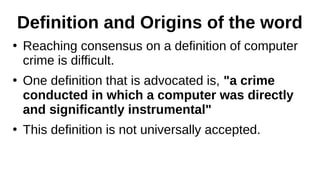
Definition and Origins of the word
●
Reaching consensus on a definition of computer
crime is difficult.
●
One definition that is advocated is, "a crime
conducted in which a computer was directly
and significantly instrumental"
●
This definition is not universally accepted.
●
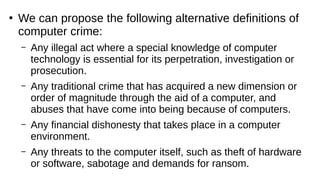
We can propose the following alternative definitions of
computer crime:
– Any illegal act where a special knowledge of computer
technology is essential for its perpetration, investigation or
prosecution.
– Any traditional crime that has acquired a new dimension or
order of magnitude through the aid of a computer, and
abuses that have come into being because of computers.
– Any financial dishonesty that takes place in a computer
environment.
– Any threats to the computer itself, such as theft of hardware
or software, sabotage and demands for ransom.
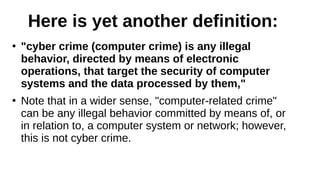
Here is yet another definition:
●
"cyber crime (computer crime) is any illegal
behavior, directed by means of electronic
operations, that target the security of computer
systems and the data processed by them,"
●
Note that in a wider sense, "computer-related crime"
can be any illegal behavior committed by means of, or
in relation to, a computer system or network; however,
this is not cyber crime.
●
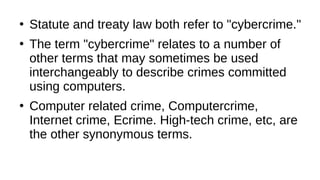
Statute and treaty law both refer to "cybercrime."
●
The term "cybercrime" relates to a number of
other terms that may sometimes be used
interchangeably to describe crimes committed
using computers.
●
Computer related crime, Computercrime,
Internet crime, Ecrime. High-tech crime, etc, are
the other synonymous terms.
●
Cybercrime specifically can be defined in a number
of ways a few definitions are:
– A crime committed using a computer and the Internet to
steal a person's identity (identity theft) or sell contraband
or stalk victims or disrupt operations with malevolent
programs.
– Crimes completed either on or with a computer.
– Any illegal activity done through the Internet or on the
computer.
– All criminal activities done using the medium of
computers, the Internet, cyberspace and the WWW.
●
However, while the legal systems around the world scramble
to introduce laws to combat cyber criminals,two types of attack
are prevalent:
– Techno-crime: A premeditated act against a system or systems, with
the intent to copy, steal, prevent access, corrupt or otherwise deface
or damage parts of or the complete computer system.
The 24×7connection to the Internet makes this type of cybercrime a
real possibility to engineer from anywhere in the world, leaving few, if
any, "finger prints."
– Techno-vandalism: These acts of "brainless" defacement of
websites and/or other activities, such as copying files and publicizing
their contents publicly, are usually opportunistic in nature.
Tight internal security, allied to strong technical safeguards, should
prevent the vast majority of such incidents.
Cybercrime and information
Security
●
Lack of information security gives rise to cyber
crimes.
●
Let us refer to the amended Indian Information
Technology Act (ITA) 2000 in the context of
cybercrime.
●
From an Indian perspective, the new version of the
Act (referred to as ITA 2008 ) provides a new focus
on "Information Security in India."
Cyber Security
●
"Cyber security" means protecting information,
equipment, devices, computer, computer resource,
communication device and information stored therein
from unauthorized access, use, disclosure,
disruption, modification or destruction.
●
The term incorporates both the physical security of
devices as well as the information stored therein.
●
It covers protection from unauthorized access, use,
disclosure, disruption, modification and destruction.
Who are Cybercriminals?
●
With the growth in the public domain in recent years
of the Internet, cyberlaw has emerged as a real
problem.
●
In a legal sense, cyberlaw encompasses cybercrime
(that is, crimes completed either on or with a
computer), electronic commerce theft, intellectual
property rights or copyright infringement, and privacy
rights infringement or identity theft
Who are Cybercriminals?
●
Cybercrime involves such activities as child
pornography; credit card fraud; cyberstalking;
defaming another online; gaining unauthorized access
to computer systems; ignoring copyright, software
licensing, and trademark protection; overriding
encryption to make illegal copies; software piracy; and
stealing another’s identity to perform criminal acts.
●
Cybercriminals are those who conduct such acts.
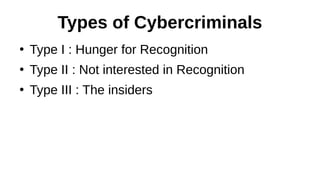
Types of Cybercriminals
●
Type I : Hunger for Recognition
●
Type II : Not interested in Recognition
●
Type III : The insiders
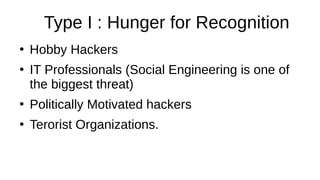
Type I : Hunger for Recognition
●
Hobby Hackers
●
IT Professionals (Social Engineering is one of
the biggest threat)
●
Politically Motivated hackers
●
Terorist Organizations.
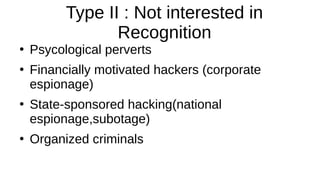
Type II : Not interested in
Recognition
●
Psycological perverts
●
Financially motivated hackers (corporate
espionage)
●
State-sponsored hacking(national
espionage,subotage)
●
Organized criminals
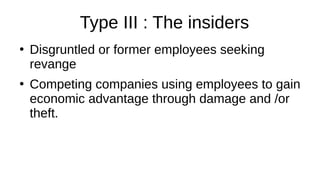
Type III : The insiders
●
Disgruntled or former employees seeking
revange
●
Competing companies using employees to gain
economic advantage through damage and /or
theft.
Classifications of Cybercrimes
●
Crime is defined as
– "an act or the commission of an act that
is forbidden, or the omission of a duty
that is commanded by a public law and
that makes the offender liable to
punishment by that law".
●
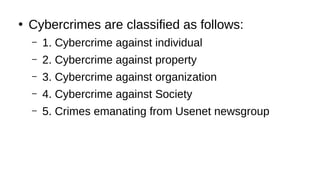
Cybercrimes are classified as follows:
– 1. Cybercrime against individual
– 2. Cybercrime against property
– 3. Cybercrime against organization
– 4. Cybercrime against Society
– 5. Crimes emanating from Usenet newsgroup
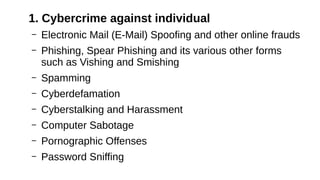
1. Cybercrime against individual
– Electronic Mail (E-Mail) Spoofing and other online frauds
– Phishing, Spear Phishing and its various other forms
such as Vishing and Smishing
– Spamming
– Cyberdefamation
– Cyberstalking and Harassment
– Computer Sabotage
– Pornographic Offenses
– Password Sniffing
2. Cybercrime against property
– Credit card frauds
– Intellectual property (IP) crimes
– Internet time theft
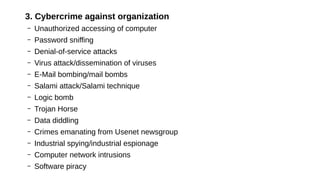
3. Cybercrime against organization
– Unauthorized accessing of computer
– Password sniffing
– Denial-of-service attacks
– Virus attack/dissemination of viruses
– E-Mail bombing/mail bombs
– Salami attack/Salami technique
– Logic bomb
– Trojan Horse
– Data diddling
– Crimes emanating from Usenet newsgroup
– Industrial spying/industrial espionage
– Computer network intrusions
– Software piracy
4. Cybercrime against Society
– Forgery
– Cyberterrorism
– Web Jacking
5. Crimes emanating from Usenet newsgroup
– By its very nature, Usenet groups may carry very
offensive, harmful, inaccurate or otherwise
inappropriate material, or in some cases, postings
that have been mislabeled or are deceptive in another
way.
– Therefore, it is expected that you will use caution and
common sense and exercise proper judgment when
using Usenet, as well as use the service at your own
risk.

M1-01-CybercrimeIntroduction.pdf

  • 1.
  • 2.
    Module Contents ● Introduction, Cybercrime:Definition and Origins of the word, Cybercrime and information Security, Who are Cybercriminals? Classifications of Cybercrimes. ● How Criminals Plan Them –Introduction, How Criminals Plan the Attacks, Cybercafé and Cybercrimes, Botnets, Attack Vector ● The Indian IT ACT 2000 and amendments.
  • 5.
    Definition and Originsof the word ● Reaching consensus on a definition of computer crime is difficult. ● One definition that is advocated is, "a crime conducted in which a computer was directly and significantly instrumental" ● This definition is not universally accepted.
  • 6.
    ● We can proposethe following alternative definitions of computer crime: – Any illegal act where a special knowledge of computer technology is essential for its perpetration, investigation or prosecution. – Any traditional crime that has acquired a new dimension or order of magnitude through the aid of a computer, and abuses that have come into being because of computers. – Any financial dishonesty that takes place in a computer environment. – Any threats to the computer itself, such as theft of hardware or software, sabotage and demands for ransom.
  • 7.
    Here is yetanother definition: ● "cyber crime (computer crime) is any illegal behavior, directed by means of electronic operations, that target the security of computer systems and the data processed by them," ● Note that in a wider sense, "computer-related crime" can be any illegal behavior committed by means of, or in relation to, a computer system or network; however, this is not cyber crime.
  • 8.
    ● Statute and treatylaw both refer to "cybercrime." ● The term "cybercrime" relates to a number of other terms that may sometimes be used interchangeably to describe crimes committed using computers. ● Computer related crime, Computercrime, Internet crime, Ecrime. High-tech crime, etc, are the other synonymous terms.
  • 9.
    ● Cybercrime specifically canbe defined in a number of ways a few definitions are: – A crime committed using a computer and the Internet to steal a person's identity (identity theft) or sell contraband or stalk victims or disrupt operations with malevolent programs. – Crimes completed either on or with a computer. – Any illegal activity done through the Internet or on the computer. – All criminal activities done using the medium of computers, the Internet, cyberspace and the WWW.
  • 10.
    ● However, while thelegal systems around the world scramble to introduce laws to combat cyber criminals,two types of attack are prevalent: – Techno-crime: A premeditated act against a system or systems, with the intent to copy, steal, prevent access, corrupt or otherwise deface or damage parts of or the complete computer system. The 24×7connection to the Internet makes this type of cybercrime a real possibility to engineer from anywhere in the world, leaving few, if any, "finger prints." – Techno-vandalism: These acts of "brainless" defacement of websites and/or other activities, such as copying files and publicizing their contents publicly, are usually opportunistic in nature. Tight internal security, allied to strong technical safeguards, should prevent the vast majority of such incidents.
  • 11.
    Cybercrime and information Security ● Lackof information security gives rise to cyber crimes. ● Let us refer to the amended Indian Information Technology Act (ITA) 2000 in the context of cybercrime. ● From an Indian perspective, the new version of the Act (referred to as ITA 2008 ) provides a new focus on "Information Security in India."
  • 12.
    Cyber Security ● "Cyber security"means protecting information, equipment, devices, computer, computer resource, communication device and information stored therein from unauthorized access, use, disclosure, disruption, modification or destruction. ● The term incorporates both the physical security of devices as well as the information stored therein. ● It covers protection from unauthorized access, use, disclosure, disruption, modification and destruction.
  • 14.
    Who are Cybercriminals? ● Withthe growth in the public domain in recent years of the Internet, cyberlaw has emerged as a real problem. ● In a legal sense, cyberlaw encompasses cybercrime (that is, crimes completed either on or with a computer), electronic commerce theft, intellectual property rights or copyright infringement, and privacy rights infringement or identity theft
  • 15.
    Who are Cybercriminals? ● Cybercrimeinvolves such activities as child pornography; credit card fraud; cyberstalking; defaming another online; gaining unauthorized access to computer systems; ignoring copyright, software licensing, and trademark protection; overriding encryption to make illegal copies; software piracy; and stealing another’s identity to perform criminal acts. ● Cybercriminals are those who conduct such acts.
  • 16.
    Types of Cybercriminals ● TypeI : Hunger for Recognition ● Type II : Not interested in Recognition ● Type III : The insiders
  • 17.
    Type I :Hunger for Recognition ● Hobby Hackers ● IT Professionals (Social Engineering is one of the biggest threat) ● Politically Motivated hackers ● Terorist Organizations.
  • 18.
    Type II :Not interested in Recognition ● Psycological perverts ● Financially motivated hackers (corporate espionage) ● State-sponsored hacking(national espionage,subotage) ● Organized criminals
  • 19.
    Type III :The insiders ● Disgruntled or former employees seeking revange ● Competing companies using employees to gain economic advantage through damage and /or theft.
  • 20.
    Classifications of Cybercrimes ● Crimeis defined as – "an act or the commission of an act that is forbidden, or the omission of a duty that is commanded by a public law and that makes the offender liable to punishment by that law".
  • 21.
    ● Cybercrimes are classifiedas follows: – 1. Cybercrime against individual – 2. Cybercrime against property – 3. Cybercrime against organization – 4. Cybercrime against Society – 5. Crimes emanating from Usenet newsgroup
  • 22.
    1. Cybercrime againstindividual – Electronic Mail (E-Mail) Spoofing and other online frauds – Phishing, Spear Phishing and its various other forms such as Vishing and Smishing – Spamming – Cyberdefamation – Cyberstalking and Harassment – Computer Sabotage – Pornographic Offenses – Password Sniffing
  • 23.
    2. Cybercrime againstproperty – Credit card frauds – Intellectual property (IP) crimes – Internet time theft
  • 24.
    3. Cybercrime againstorganization – Unauthorized accessing of computer – Password sniffing – Denial-of-service attacks – Virus attack/dissemination of viruses – E-Mail bombing/mail bombs – Salami attack/Salami technique – Logic bomb – Trojan Horse – Data diddling – Crimes emanating from Usenet newsgroup – Industrial spying/industrial espionage – Computer network intrusions – Software piracy
  • 25.
    4. Cybercrime againstSociety – Forgery – Cyberterrorism – Web Jacking
  • 26.
    5. Crimes emanatingfrom Usenet newsgroup – By its very nature, Usenet groups may carry very offensive, harmful, inaccurate or otherwise inappropriate material, or in some cases, postings that have been mislabeled or are deceptive in another way. – Therefore, it is expected that you will use caution and common sense and exercise proper judgment when using Usenet, as well as use the service at your own risk.