MATHEMATICS-I
CONTENTS
   Ordinary Differential Equations of First Order and First Degree
   Linear Differential Equations of Second and Higher Order
   Mean Value Theorems
   Functions of Several Variables
   Curvature, Evolutes and Envelopes
   Curve Tracing
   Applications of Integration
   Multiple Integrals
   Series and Sequences
   Vector Differentiation and Vector Operators
   Vector Integration
   Vector Integral Theorems
   Laplace transforms
TEXT BOOKS
   A text book of Engineering Mathematics, Vol-I
    T.K.V.Iyengar, B.Krishna Gandhi and Others,
    S.Chand & Company
   A text book of Engineering Mathematics,
    C.Sankaraiah, V.G.S.Book Links
   A text book of Engineering Mathematics, Shahnaz A
    Bathul, Right Publishers
   A text book of Engineering Mathematics,
    P.Nageshwara Rao, Y.Narasimhulu & N.Prabhakar
    Rao, Deepthi Publications
REFERENCES
 A text book of Engineering Mathematics,
  B.V.Raman, Tata Mc Graw Hill
 Advanced Engineering Mathematics, Irvin
  Kreyszig, Wiley India Pvt. Ltd.
 A text Book of Engineering Mathematics,
  Thamson Book collection
UNIT-V

  CHAPTER-I:APPLICATIONS OF
        INTEGRATION
CHAPTER-II:MULTIPLE INTEGRALS
UNIT HEADER
  Name of the Course: B.Tech
      Code No:07A1BS02
      Year/Branch: I Year
CSE,IT,ECE,EEE,ME,CIVIL,AERO
          Unit No: V
        No. of slides:17
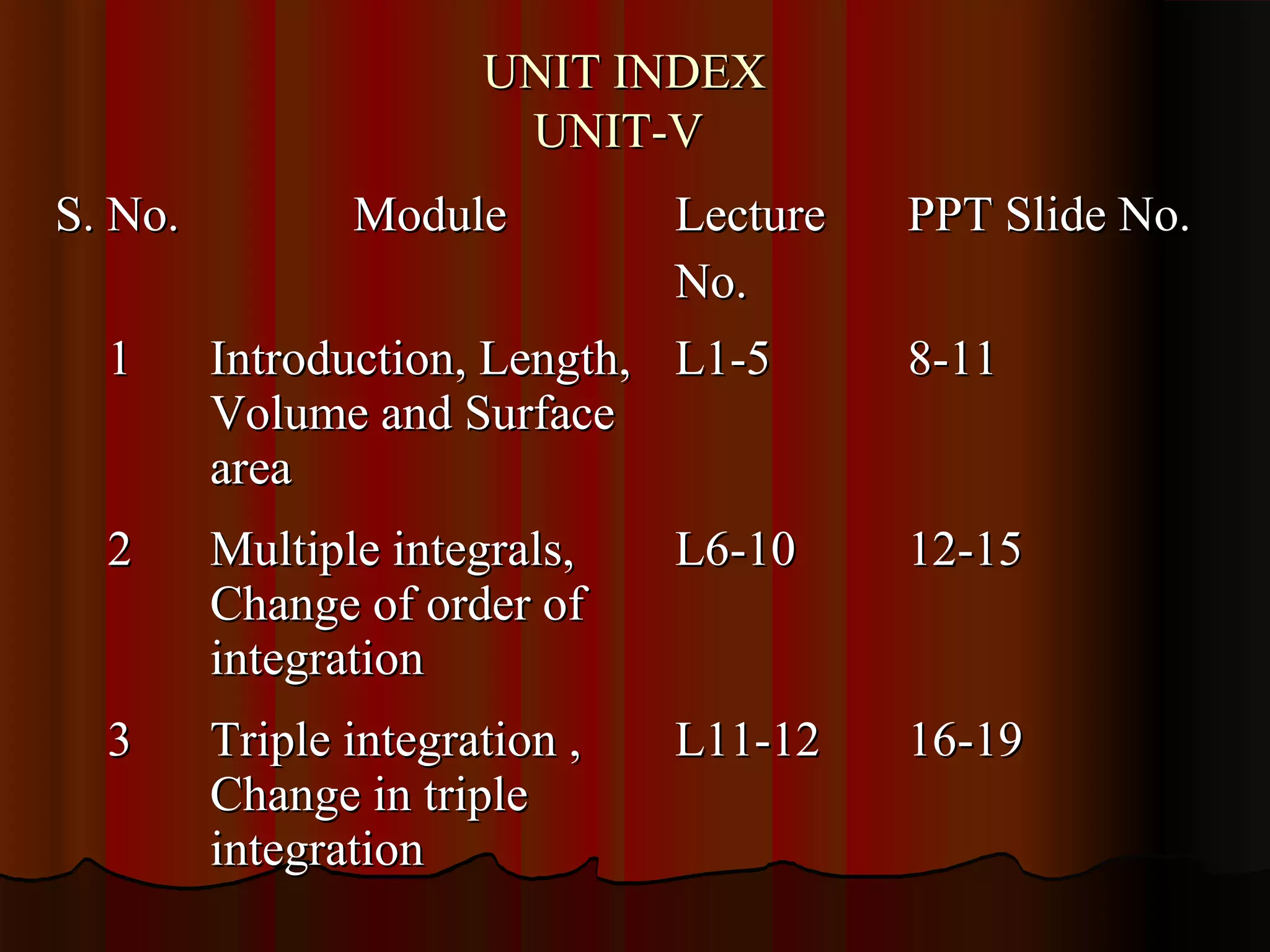
UNIT INDEX
                        UNIT-V
S. No.          Module          Lecture   PPT Slide No.
                                No.
  1      Introduction, Length, L1-5       8-11
         Volume and Surface
         area
  2      Multiple integrals,    L6-10     12-15
         Change of order of
         integration
  3      Triple integration ,   L11-12    16-19
         Change in triple
         integration
Lecture-1
 APPLICATIONS OF INTEGRATION
 Here we study some important applications of
  integration like Length of arc, Volume,
  Surface area etc.,
 RECTIFICATION: The process of finding the
  length of an arc of the curve is called
  rectification.
 Length of an arc S=∫[1+(dy/dx)2]1/2
Lecture-2
           LENGTH OF
       CURVE(RECTIFICATION)
 The process of finding the length of an arc of
  the curve is called rectification. We can find
  length of the curve in Cartesian form, Polar
  form and Parametric form.
 Length of curve in cartesian form: S= ∫[1+
  (dy/dx)2]1/2
 Length of curve in parametric form:

   S=∫√(dx/dθ)2+(dy/dθ)2 dθ
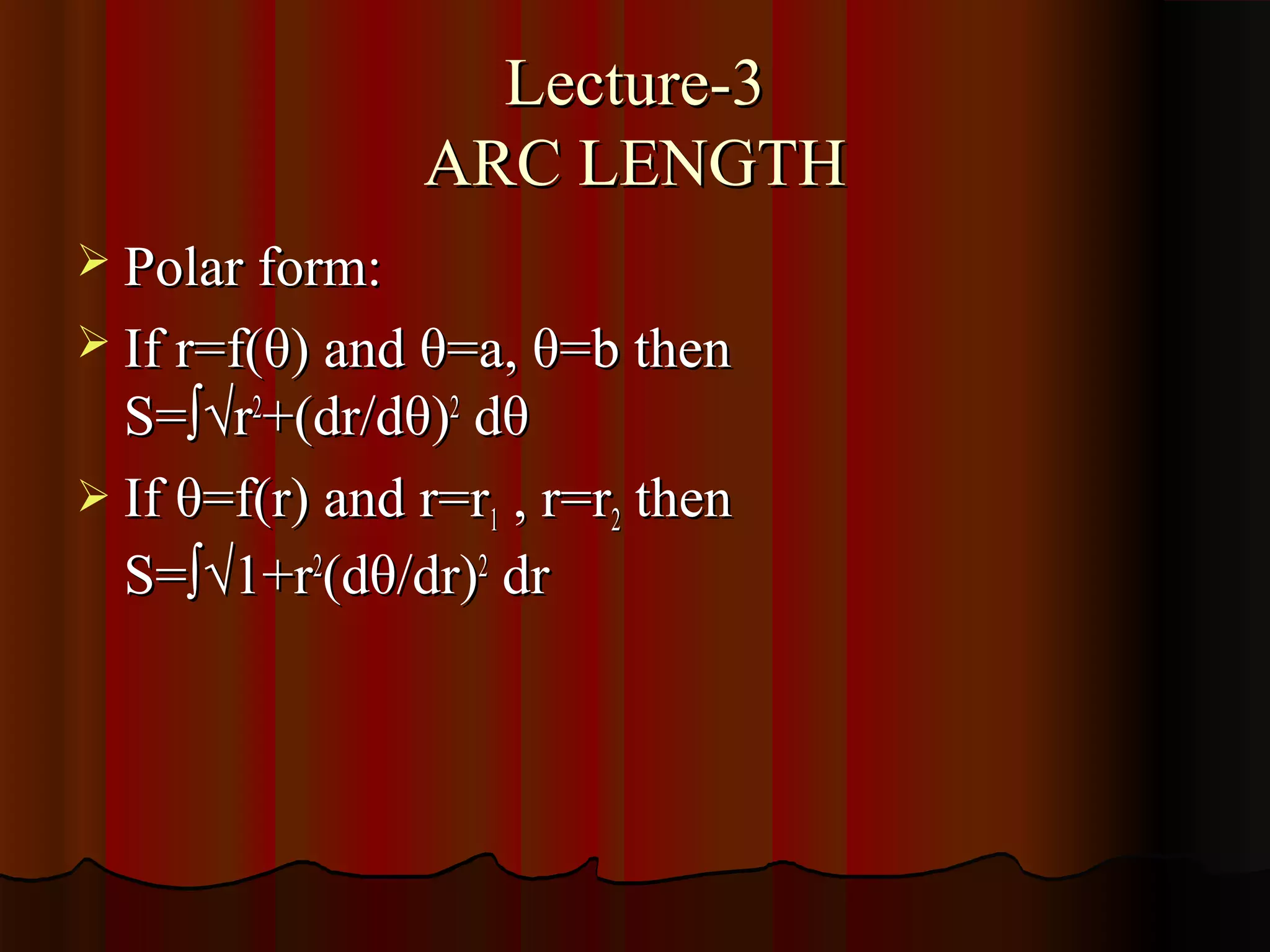
Lecture-3
                ARC LENGTH
 Polar form:
 If r=f(θ) and θ=a, θ=b then
  S=∫√r2+(dr/dθ)2 dθ
 If θ=f(r) and r=r1 , r=r2 then
  S=∫√1+r2(dθ/dr)2 dr
Lecture-4
                   VOLUME
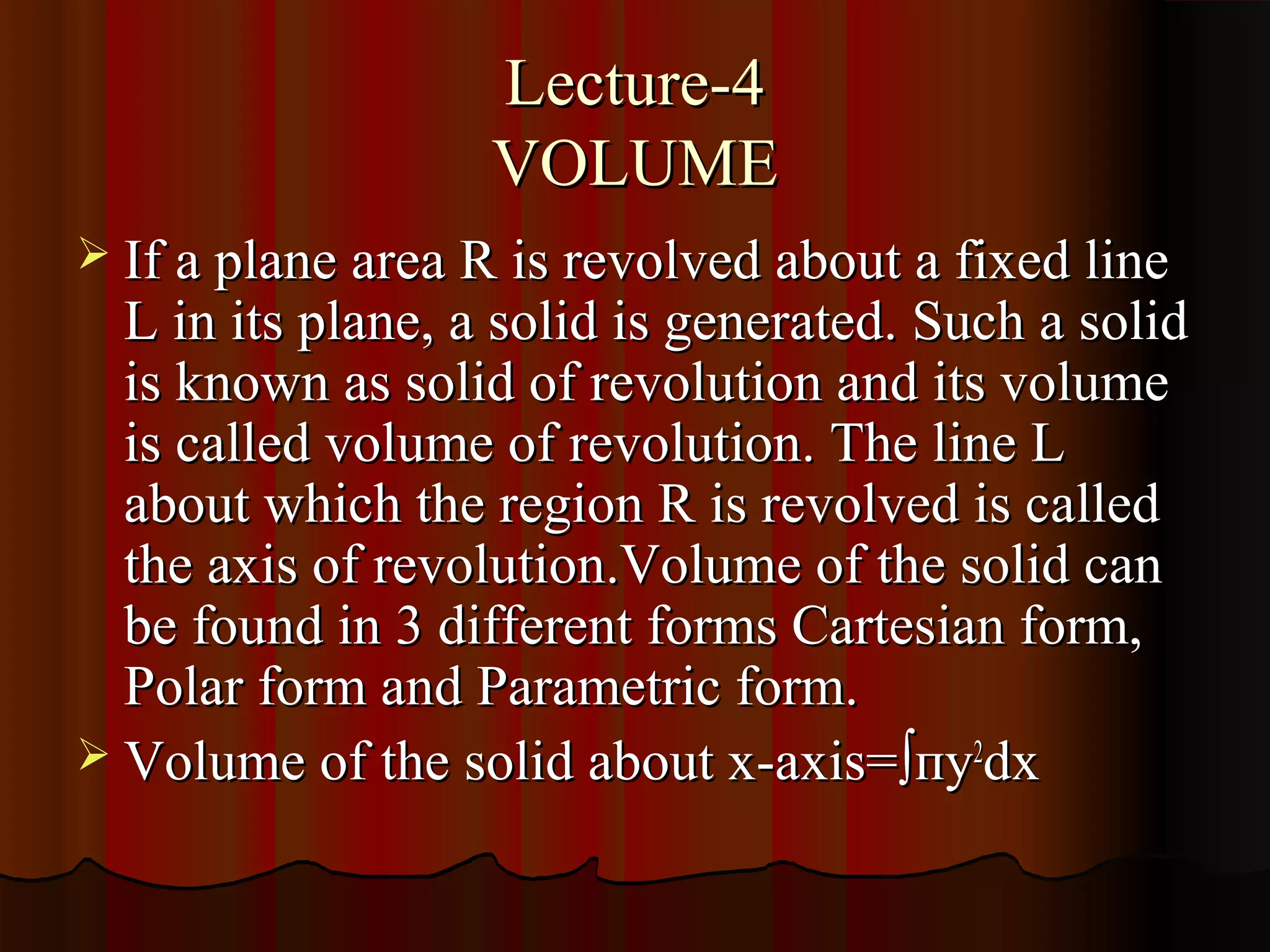
 If a plane area R is revolved about a fixed line
  L in its plane, a solid is generated. Such a solid
  is known as solid of revolution and its volume
  is called volume of revolution. The line L
  about which the region R is revolved is called
  the axis of revolution.Volume of the solid can
  be found in 3 different forms Cartesian form,
  Polar form and Parametric form.
 Volume of the solid about x-axis= ∫пy2dx
Lecture-5
       FORMULAE FOR VOLUME
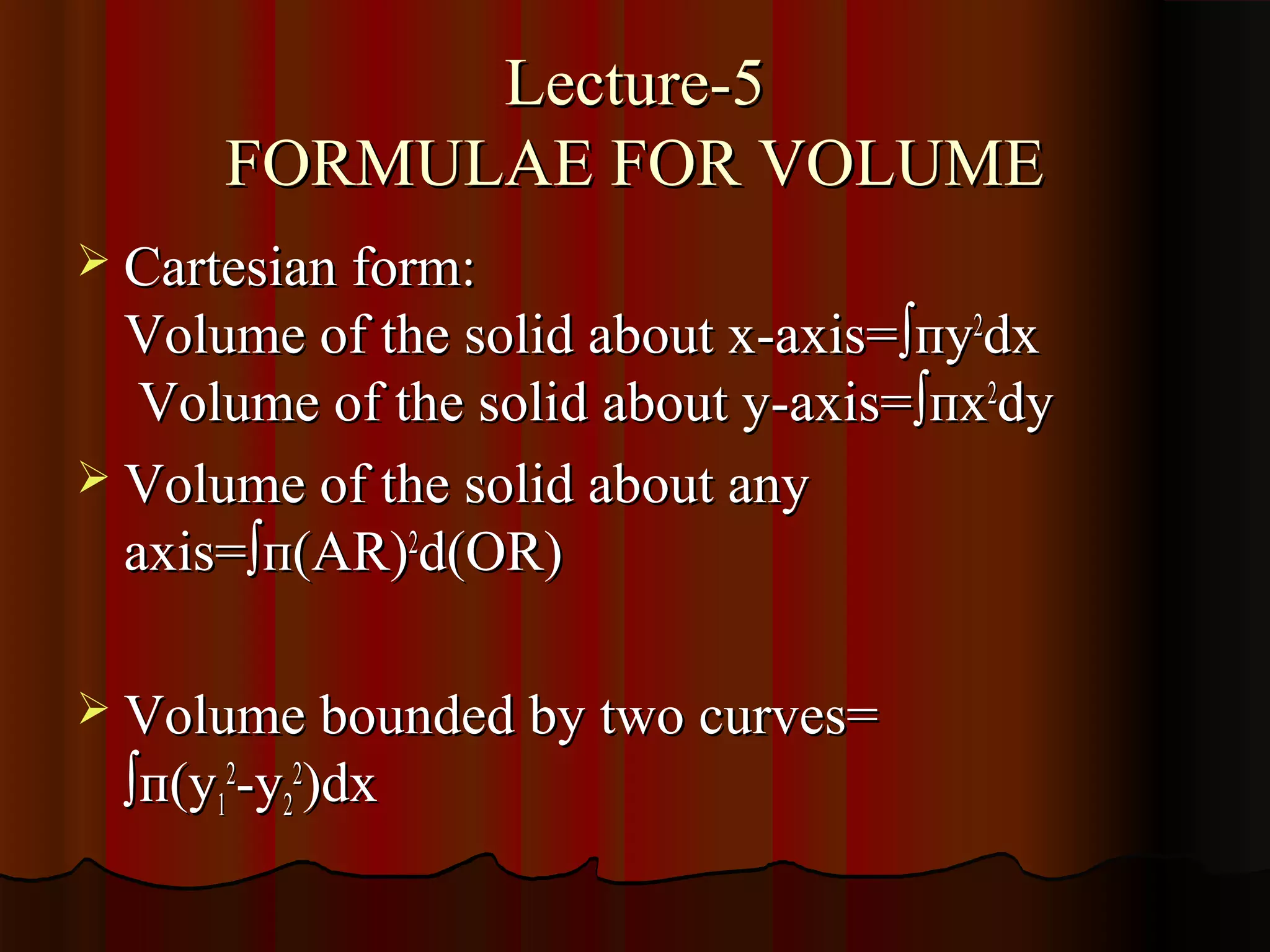
 Cartesian form:
  Volume of the solid about x-axis=∫пy2dx
   Volume of the solid about y-axis=∫пx2dy
 Volume of the solid about any
  axis=∫п(AR)2d(OR)

 Volume bounded by two curves=
  ∫п(y12-y22)dx
Lecture-6
              SURFACE AREA
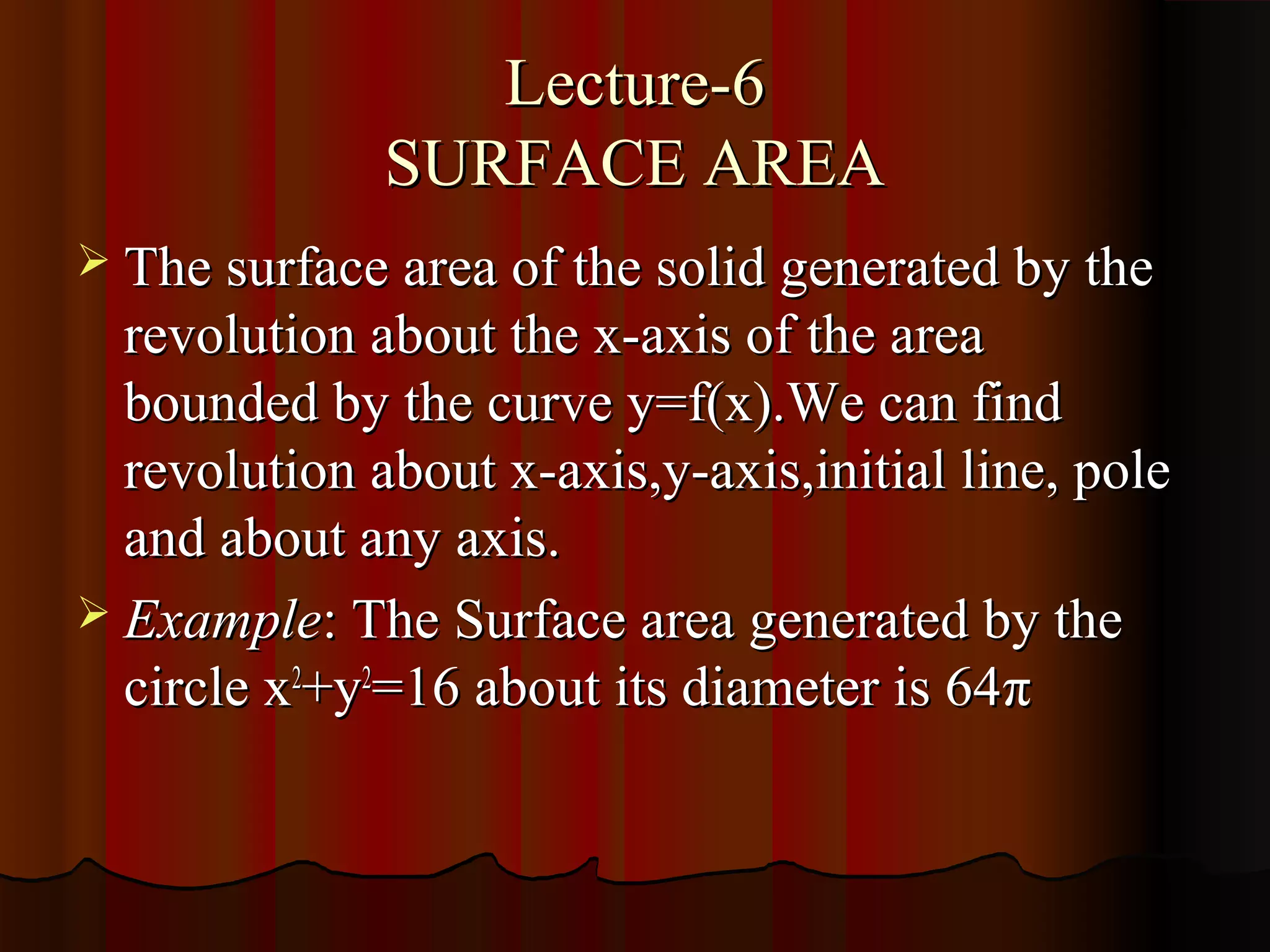
 The surface area of the solid generated by the
  revolution about the x-axis of the area
  bounded by the curve y=f(x).We can find
  revolution about x-axis,y-axis,initial line, pole
  and about any axis.
 Example: The Surface area generated by the
  circle x2+y2=16 about its diameter is 64π
Lecture-7
        MULTIPLE INTEGRALS
 Let y=f(x) be a function of   one variable
  defined and bounded on [a,b]. Let [a,b] be
  divided into n subintervals by points x 0,…,xn
  such that a=x0,……….xn=b. The generalization
  of this definition ;to two dimensions is called a
  double integral and to three dimensions is
  called a triple integral.
Lecture-8
         DOUBLE INTEGRALS
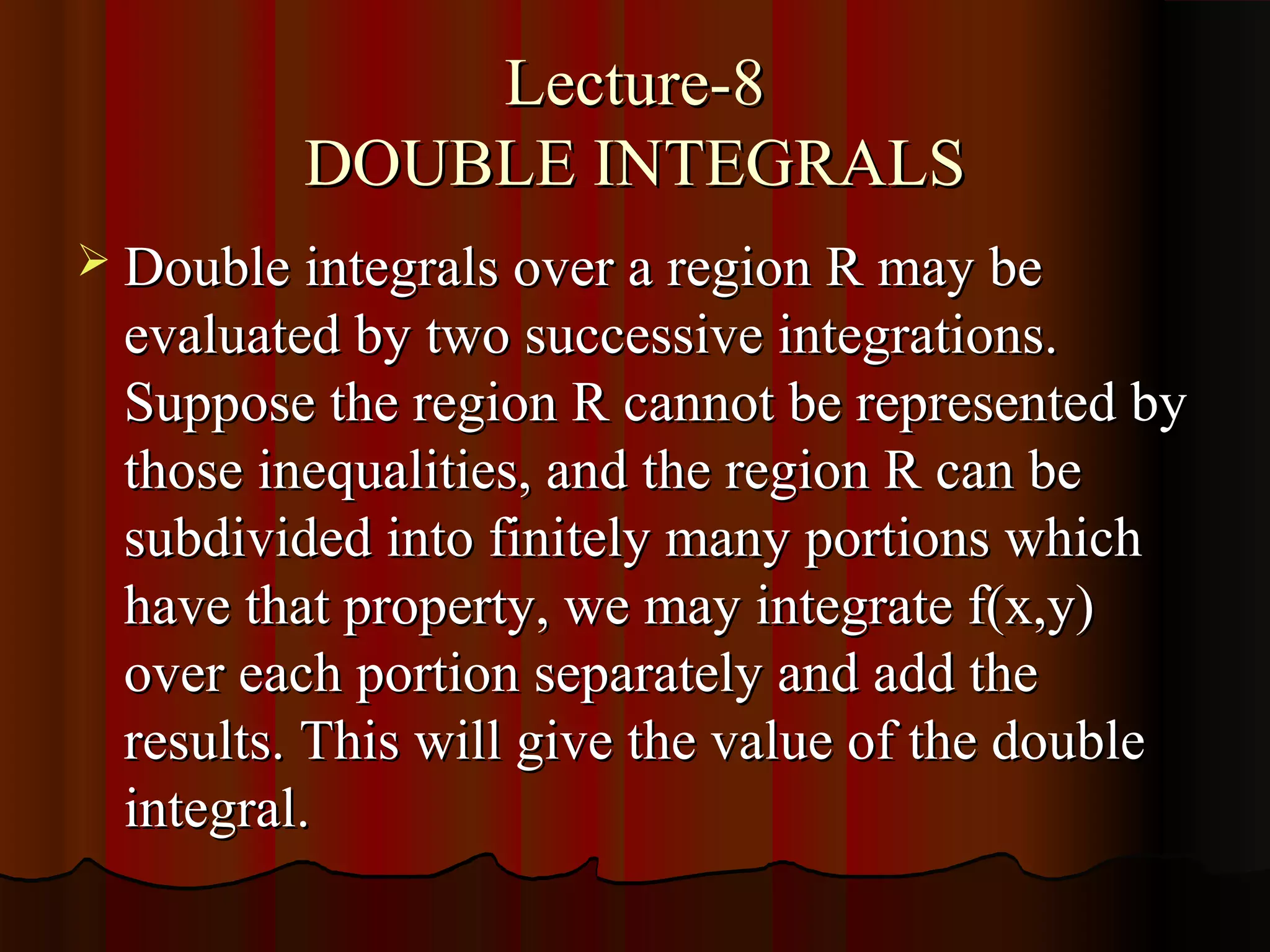
 Double integrals over a region R may be
  evaluated by two successive integrations.
  Suppose the region R cannot be represented by
  those inequalities, and the region R can be
  subdivided into finitely many portions which
  have that property, we may integrate f(x,y)
  over each portion separately and add the
  results. This will give the value of the double
  integral.
Lecture-9
     CHANGE OF VARIABLES IN
        DOUBLE INTEGRAL
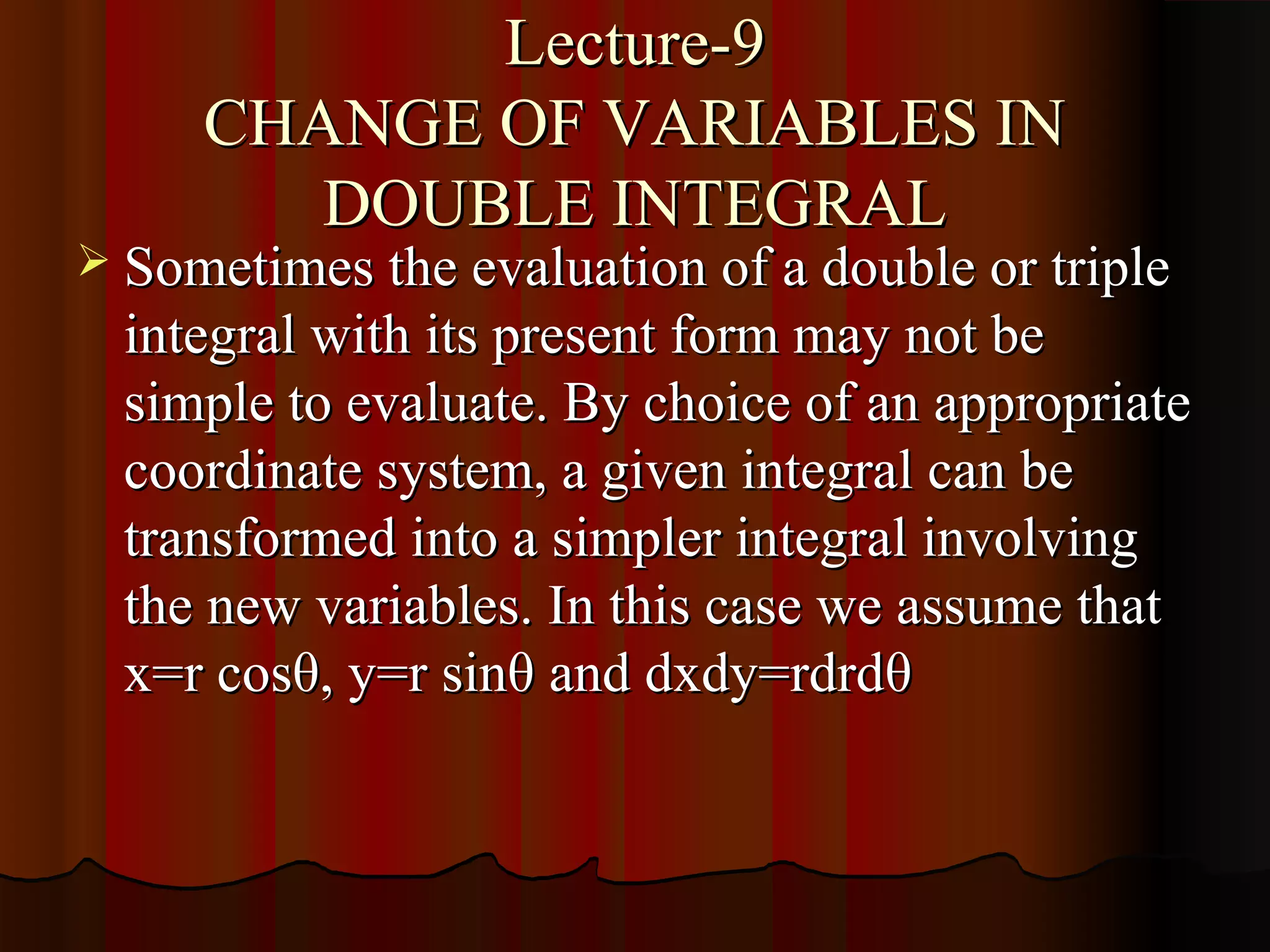
 Sometimes the evaluation of a double or triple
  integral with its present form may not be
  simple to evaluate. By choice of an appropriate
  coordinate system, a given integral can be
  transformed into a simpler integral involving
  the new variables. In this case we assume that
  x=r cosθ, y=r sinθ and dxdy=rdrdθ
Lecture-10
           CHANGE OF ORDER OF
              INTEGRATION
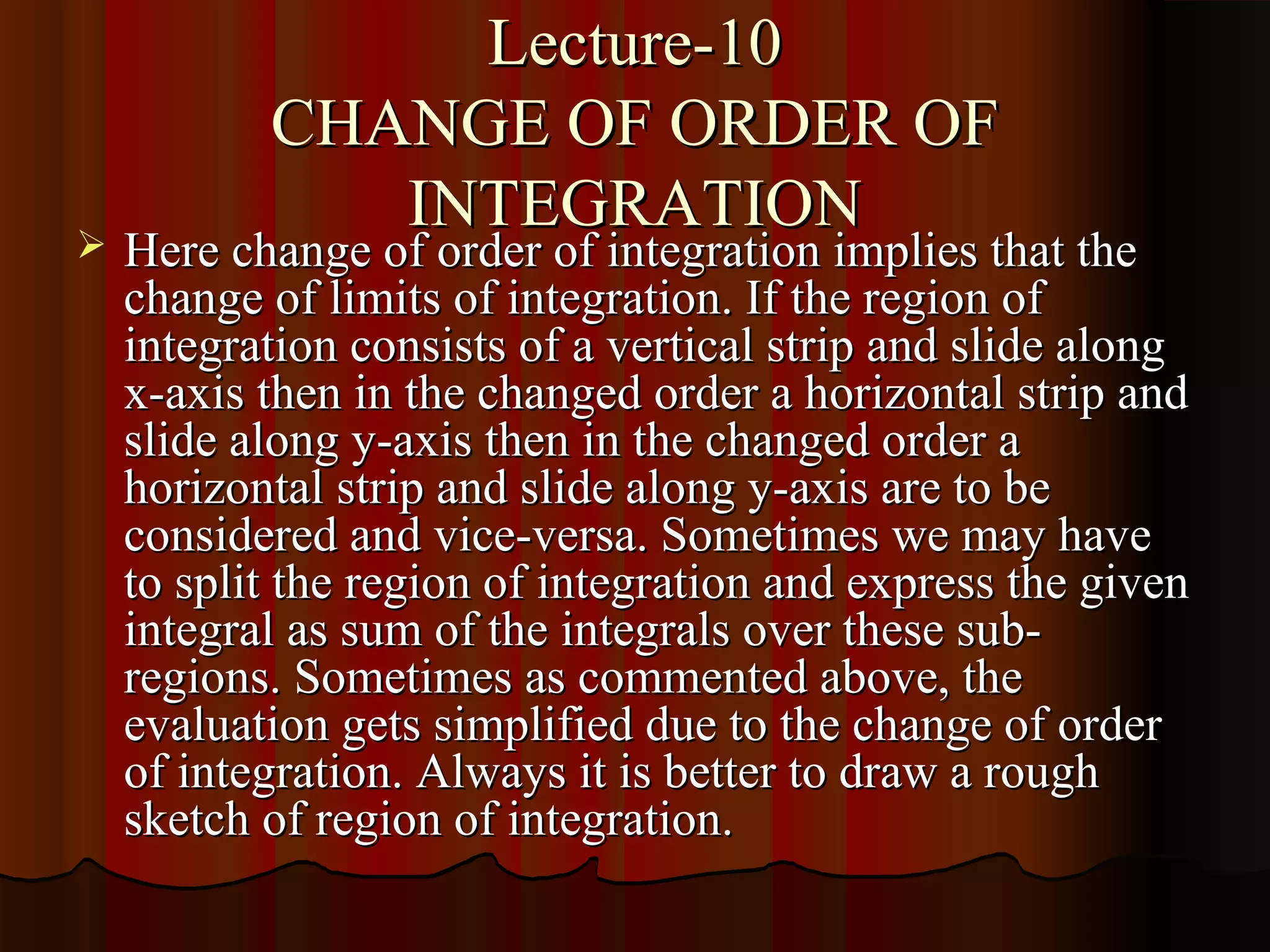
   Here change of order of integration implies that the
    change of limits of integration. If the region of
    integration consists of a vertical strip and slide along
    x-axis then in the changed order a horizontal strip and
    slide along y-axis then in the changed order a
    horizontal strip and slide along y-axis are to be
    considered and vice-versa. Sometimes we may have
    to split the region of integration and express the given
    integral as sum of the integrals over these sub-
    regions. Sometimes as commented above, the
    evaluation gets simplified due to the change of order
    of integration. Always it is better to draw a rough
    sketch of region of integration.
Lecture-11
           TRIPLE INTEGRALS
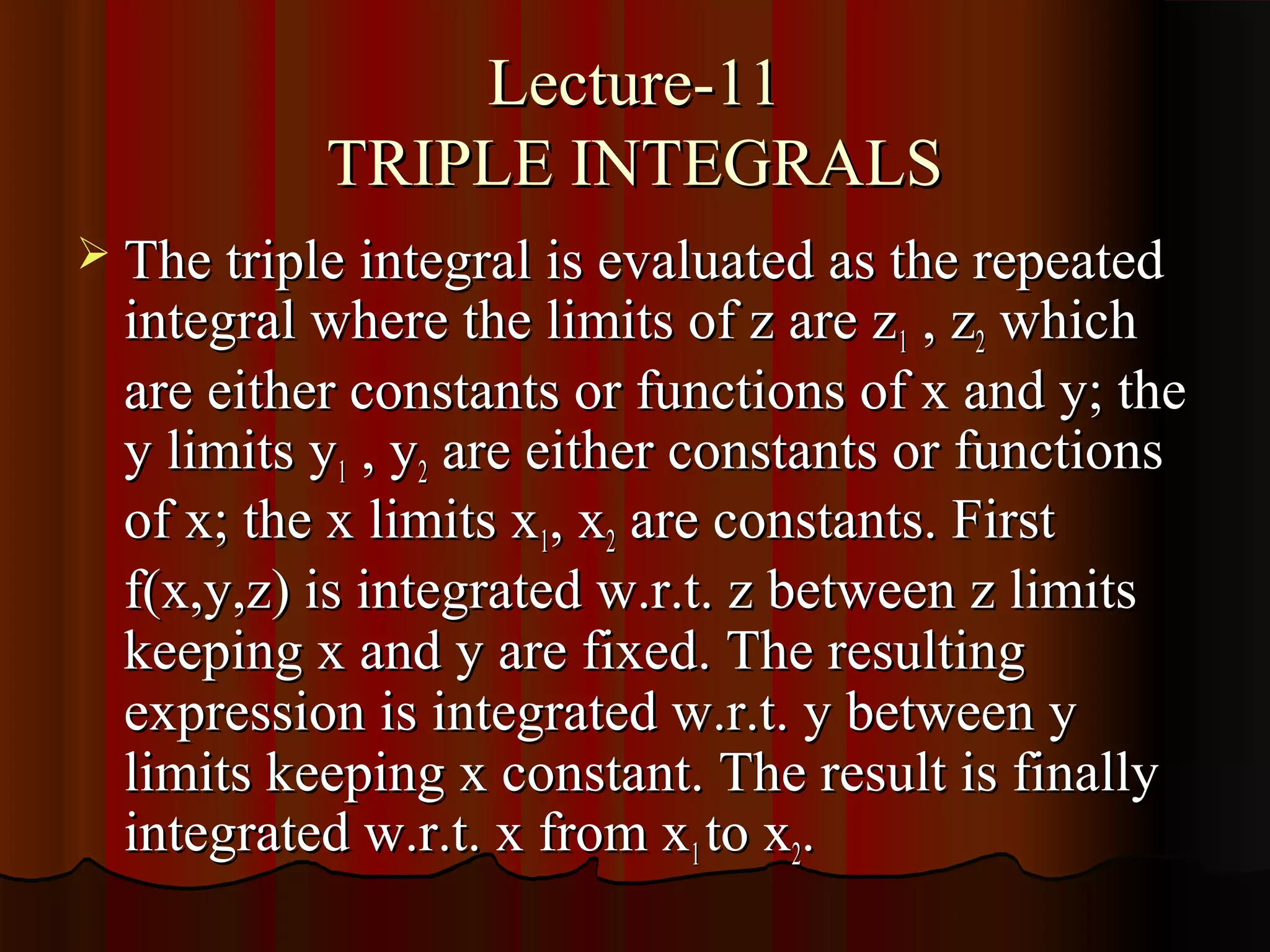
 The triple integral is evaluated as the repeated
  integral where the limits of z are z 1 , z2 which
  are either constants or functions of x and y; the
  y limits y1 , y2 are either constants or functions
  of x; the x limits x1, x2 are constants. First
  f(x,y,z) is integrated w.r.t. z between z limits
  keeping x and y are fixed. The resulting
  expression is integrated w.r.t. y between y
  limits keeping x constant. The result is finally
  integrated w.r.t. x from x1 to x2.
Lecture-12
CHANGE OF VARIABLES IN TRIPLE
         INTEGRAL
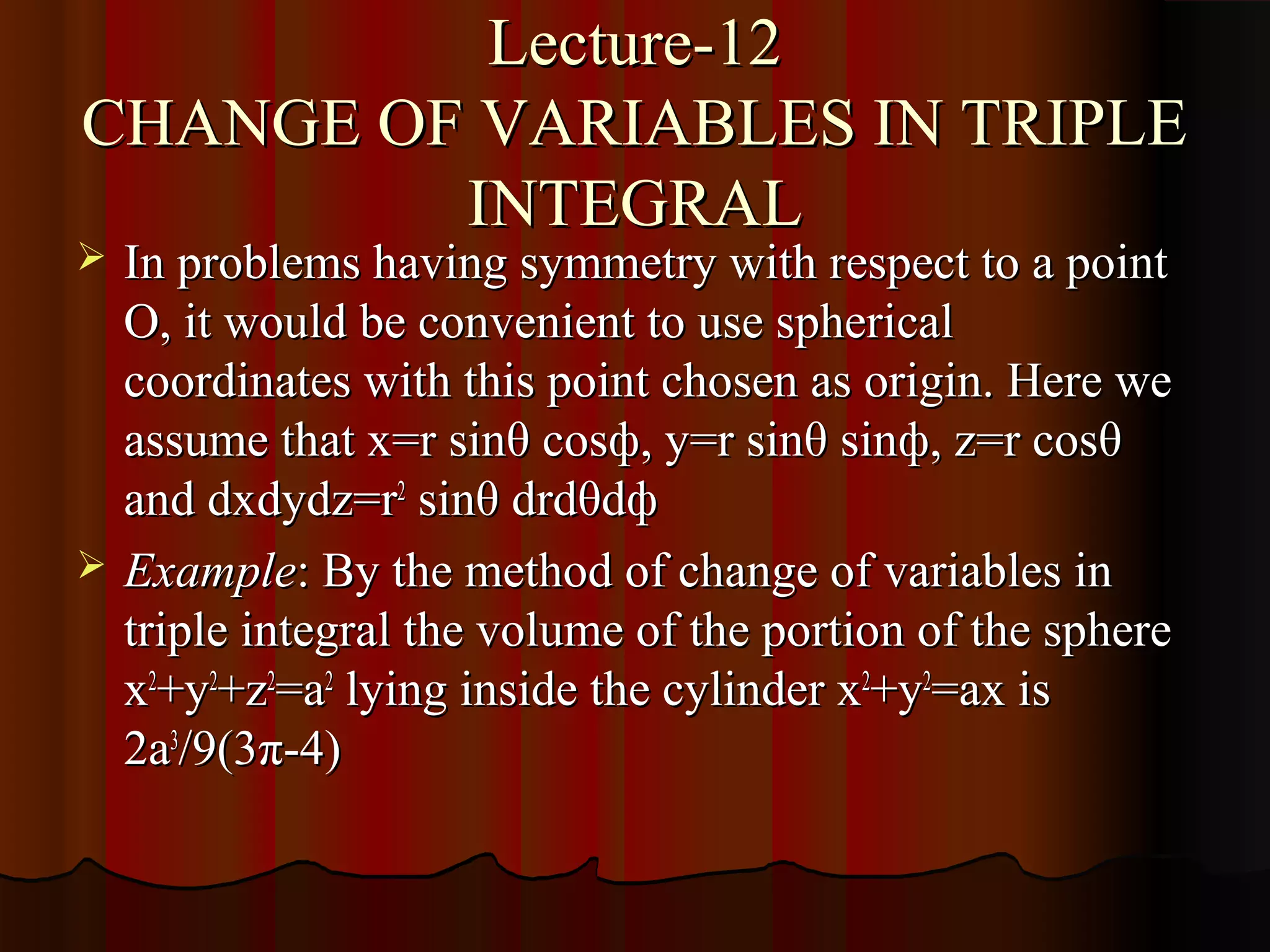
   In problems having symmetry with respect to a point
    O, it would be convenient to use spherical
    coordinates with this point chosen as origin. Here we
    assume that x=r sinθ cosф, y=r sinθ sinф, z=r cosθ
    and dxdydz=r2 sinθ drdθdф
   Example: By the method of change of variables in
    triple integral the volume of the portion of the sphere
    x2+y2+z2=a2 lying inside the cylinder x2+y2=ax is
    2a3/9(3π-4)

M1 unit v-jntuworld

  • 1.
  • 2.
    CONTENTS  Ordinary Differential Equations of First Order and First Degree  Linear Differential Equations of Second and Higher Order  Mean Value Theorems  Functions of Several Variables  Curvature, Evolutes and Envelopes  Curve Tracing  Applications of Integration  Multiple Integrals  Series and Sequences  Vector Differentiation and Vector Operators  Vector Integration  Vector Integral Theorems  Laplace transforms
  • 3.
    TEXT BOOKS  A text book of Engineering Mathematics, Vol-I T.K.V.Iyengar, B.Krishna Gandhi and Others, S.Chand & Company  A text book of Engineering Mathematics, C.Sankaraiah, V.G.S.Book Links  A text book of Engineering Mathematics, Shahnaz A Bathul, Right Publishers  A text book of Engineering Mathematics, P.Nageshwara Rao, Y.Narasimhulu & N.Prabhakar Rao, Deepthi Publications
  • 4.
    REFERENCES  A textbook of Engineering Mathematics, B.V.Raman, Tata Mc Graw Hill  Advanced Engineering Mathematics, Irvin Kreyszig, Wiley India Pvt. Ltd.  A text Book of Engineering Mathematics, Thamson Book collection
  • 5.
    UNIT-V CHAPTER-I:APPLICATIONSOF INTEGRATION CHAPTER-II:MULTIPLE INTEGRALS
  • 6.
    UNIT HEADER Name of the Course: B.Tech Code No:07A1BS02 Year/Branch: I Year CSE,IT,ECE,EEE,ME,CIVIL,AERO Unit No: V No. of slides:17
  • 7.
    UNIT INDEX UNIT-V S. No. Module Lecture PPT Slide No. No. 1 Introduction, Length, L1-5 8-11 Volume and Surface area 2 Multiple integrals, L6-10 12-15 Change of order of integration 3 Triple integration , L11-12 16-19 Change in triple integration
  • 8.
    Lecture-1 APPLICATIONS OFINTEGRATION  Here we study some important applications of integration like Length of arc, Volume, Surface area etc.,  RECTIFICATION: The process of finding the length of an arc of the curve is called rectification.  Length of an arc S=∫[1+(dy/dx)2]1/2
  • 9.
    Lecture-2 LENGTH OF CURVE(RECTIFICATION)  The process of finding the length of an arc of the curve is called rectification. We can find length of the curve in Cartesian form, Polar form and Parametric form.  Length of curve in cartesian form: S= ∫[1+ (dy/dx)2]1/2  Length of curve in parametric form: S=∫√(dx/dθ)2+(dy/dθ)2 dθ
  • 10.
    Lecture-3 ARC LENGTH  Polar form:  If r=f(θ) and θ=a, θ=b then S=∫√r2+(dr/dθ)2 dθ  If θ=f(r) and r=r1 , r=r2 then S=∫√1+r2(dθ/dr)2 dr
  • 11.
    Lecture-4 VOLUME  If a plane area R is revolved about a fixed line L in its plane, a solid is generated. Such a solid is known as solid of revolution and its volume is called volume of revolution. The line L about which the region R is revolved is called the axis of revolution.Volume of the solid can be found in 3 different forms Cartesian form, Polar form and Parametric form.  Volume of the solid about x-axis= ∫пy2dx
  • 12.
    Lecture-5 FORMULAE FOR VOLUME  Cartesian form: Volume of the solid about x-axis=∫пy2dx Volume of the solid about y-axis=∫пx2dy  Volume of the solid about any axis=∫п(AR)2d(OR)  Volume bounded by two curves= ∫п(y12-y22)dx
  • 13.
    Lecture-6 SURFACE AREA  The surface area of the solid generated by the revolution about the x-axis of the area bounded by the curve y=f(x).We can find revolution about x-axis,y-axis,initial line, pole and about any axis.  Example: The Surface area generated by the circle x2+y2=16 about its diameter is 64π
  • 14.
    Lecture-7 MULTIPLE INTEGRALS  Let y=f(x) be a function of one variable defined and bounded on [a,b]. Let [a,b] be divided into n subintervals by points x 0,…,xn such that a=x0,……….xn=b. The generalization of this definition ;to two dimensions is called a double integral and to three dimensions is called a triple integral.
  • 15.
    Lecture-8 DOUBLE INTEGRALS  Double integrals over a region R may be evaluated by two successive integrations. Suppose the region R cannot be represented by those inequalities, and the region R can be subdivided into finitely many portions which have that property, we may integrate f(x,y) over each portion separately and add the results. This will give the value of the double integral.
  • 16.
    Lecture-9 CHANGE OF VARIABLES IN DOUBLE INTEGRAL  Sometimes the evaluation of a double or triple integral with its present form may not be simple to evaluate. By choice of an appropriate coordinate system, a given integral can be transformed into a simpler integral involving the new variables. In this case we assume that x=r cosθ, y=r sinθ and dxdy=rdrdθ
  • 17.
    Lecture-10 CHANGE OF ORDER OF INTEGRATION  Here change of order of integration implies that the change of limits of integration. If the region of integration consists of a vertical strip and slide along x-axis then in the changed order a horizontal strip and slide along y-axis then in the changed order a horizontal strip and slide along y-axis are to be considered and vice-versa. Sometimes we may have to split the region of integration and express the given integral as sum of the integrals over these sub- regions. Sometimes as commented above, the evaluation gets simplified due to the change of order of integration. Always it is better to draw a rough sketch of region of integration.
  • 18.
    Lecture-11 TRIPLE INTEGRALS  The triple integral is evaluated as the repeated integral where the limits of z are z 1 , z2 which are either constants or functions of x and y; the y limits y1 , y2 are either constants or functions of x; the x limits x1, x2 are constants. First f(x,y,z) is integrated w.r.t. z between z limits keeping x and y are fixed. The resulting expression is integrated w.r.t. y between y limits keeping x constant. The result is finally integrated w.r.t. x from x1 to x2.
  • 19.
    Lecture-12 CHANGE OF VARIABLESIN TRIPLE INTEGRAL  In problems having symmetry with respect to a point O, it would be convenient to use spherical coordinates with this point chosen as origin. Here we assume that x=r sinθ cosф, y=r sinθ sinф, z=r cosθ and dxdydz=r2 sinθ drdθdф  Example: By the method of change of variables in triple integral the volume of the portion of the sphere x2+y2+z2=a2 lying inside the cylinder x2+y2=ax is 2a3/9(3π-4)