MATHEMATICS-I
CONTENTS
   Ordinary Differential Equations of First Order and First Degree
   Linear Differential Equations of Second and Higher Order
   Mean Value Theorems
   Functions of Several Variables
   Curvature, Evolutes and Envelopes
   Curve Tracing
   Applications of Integration
   Multiple Integrals
   Series and Sequences
   Vector Differentiation and Vector Operators
   Vector Integration
   Vector Integral Theorems
   Laplace transforms
TEXT BOOKS
   A text book of Engineering Mathematics, Vol-I
    T.K.V.Iyengar, B.Krishna Gandhi and Others,
    S.Chand & Company
   A text book of Engineering Mathematics,
    C.Sankaraiah, V.G.S.Book Links
   A text book of Engineering Mathematics, Shahnaz A
    Bathul, Right Publishers
   A text book of Engineering Mathematics,
    P.Nageshwara Rao, Y.Narasimhulu & N.Prabhakar
    Rao, Deepthi Publications
REFERENCES
 A text book of Engineering Mathematics,
  B.V.Raman, Tata Mc Graw Hill
 Advanced Engineering Mathematics, Irvin
  Kreyszig, Wiley India Pvt. Ltd.
 A text Book of Engineering Mathematics,
  Thamson Book collection
UNIT-VI

SERIES AND SEQUENCES
UNIT HEADER
  Name of the Course: B.Tech
      Code No:07A1BS02
      Year/Branch: I Year
CSE,IT,ECE,EEE,ME,CIVIL,AERO
         Unit No: VI
        No. of slides:21
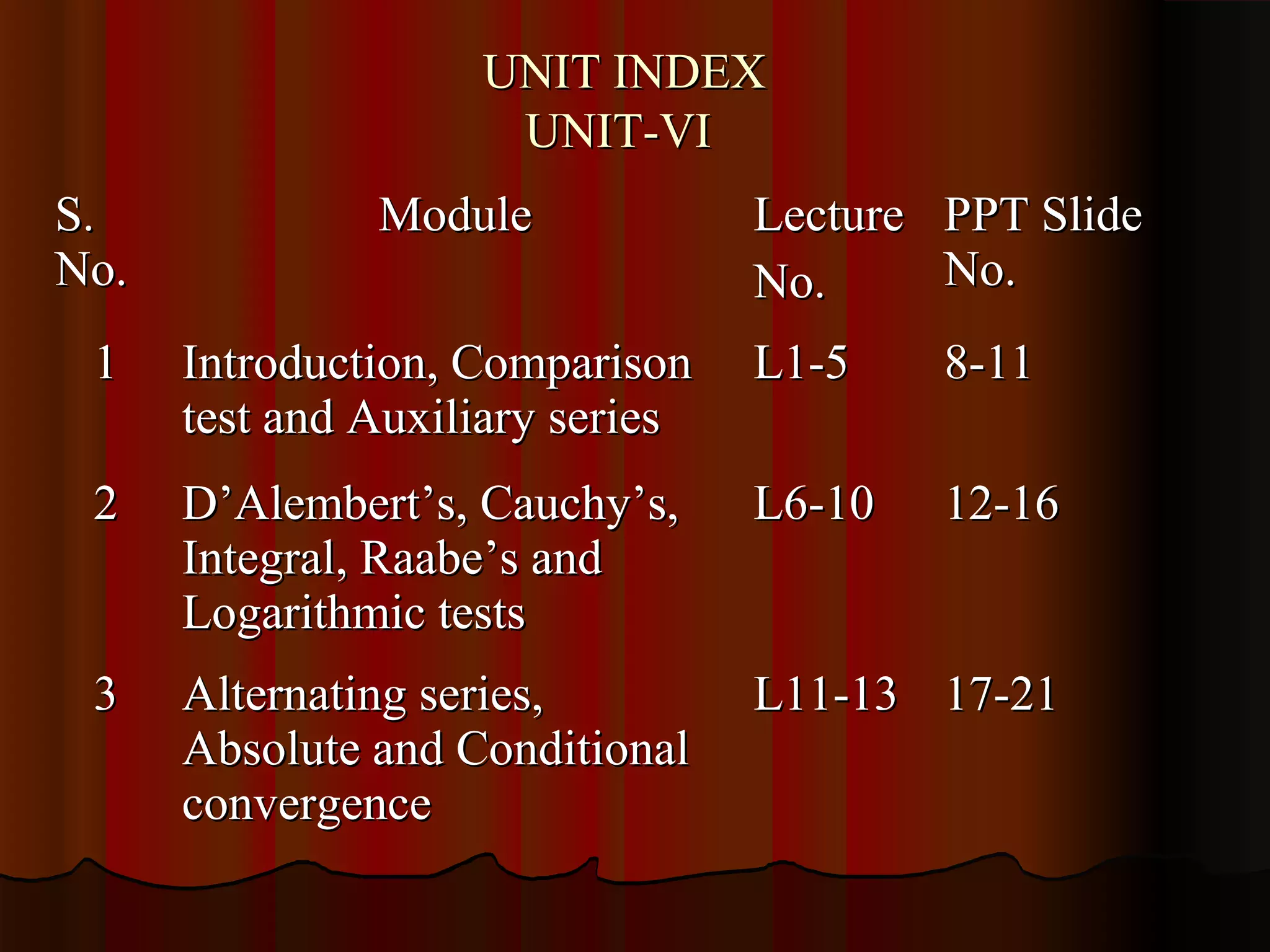
UNIT INDEX
                     UNIT-VI
S.             Module             Lecture PPT Slide
No.                               No.     No.
 1    Introduction, Comparison    L1-5    8-11
      test and Auxiliary series
 2    D’Alembert’s, Cauchy’s,     L6-10   12-16
      Integral, Raabe’s and
      Logarithmic tests
 3    Alternating series,         L11-13 17-21
      Absolute and Conditional
      convergence
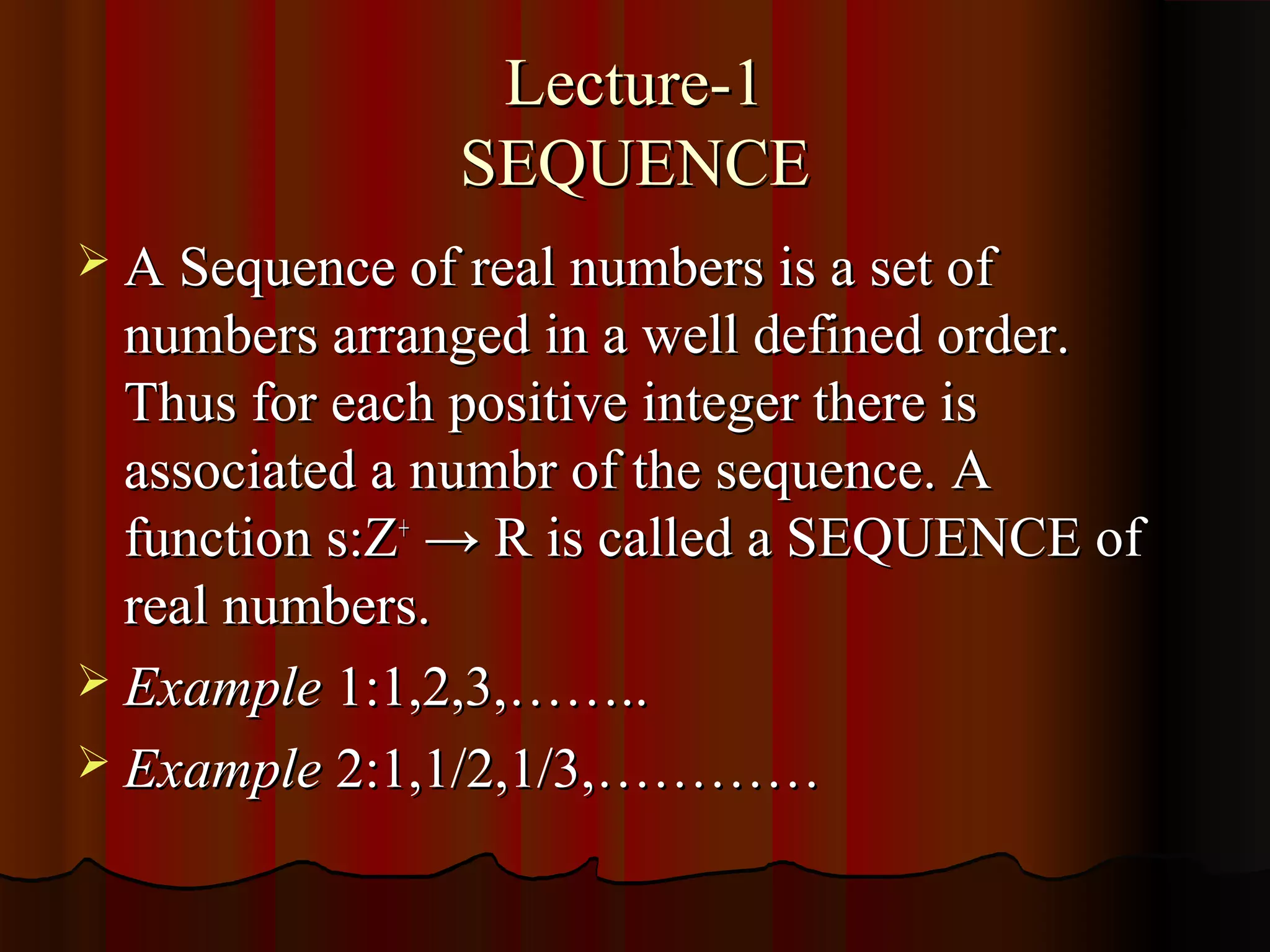
Lecture-1
                SEQUENCE
 A Sequence of real numbers is a set of
  numbers arranged in a well defined order.
  Thus for each positive integer there is
  associated a numbr of the sequence. A
  function s:Z+ → R is called a SEQUENCE of
  real numbers.
 Example 1:1,2,3,……..
 Example 2:1,1/2,1/3,…………
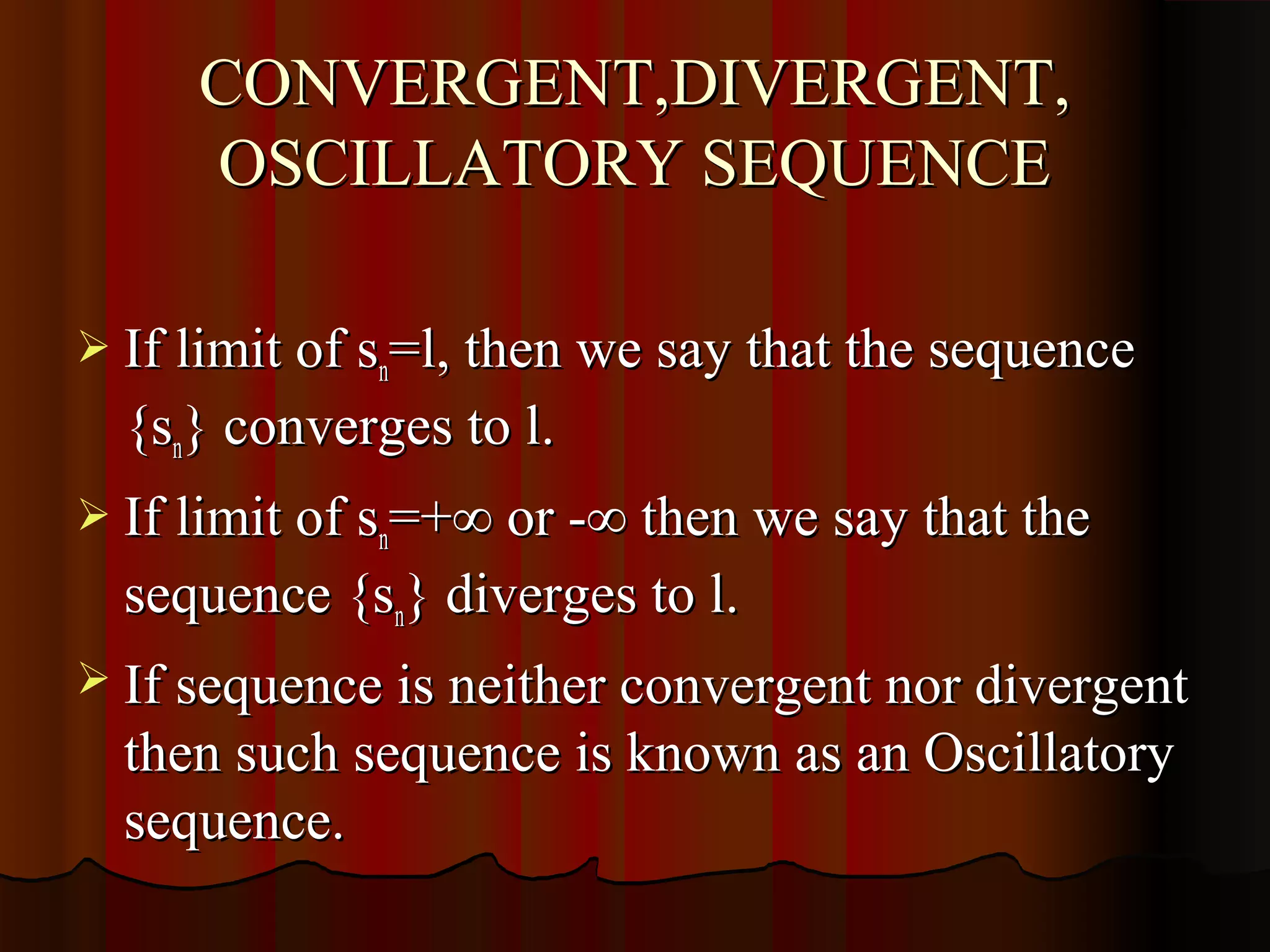
CONVERGENT,DIVERGENT,
     OSCILLATORY SEQUENCE

 If limit of sn=l, then we say that the sequence
  {sn} converges to l.
 If limit of sn=+∞ or -∞ then we say that the
  sequence {sn} diverges to l.
 If sequence is neither convergent nor divergent
  then such sequence is known as an Oscillatory
  sequence.
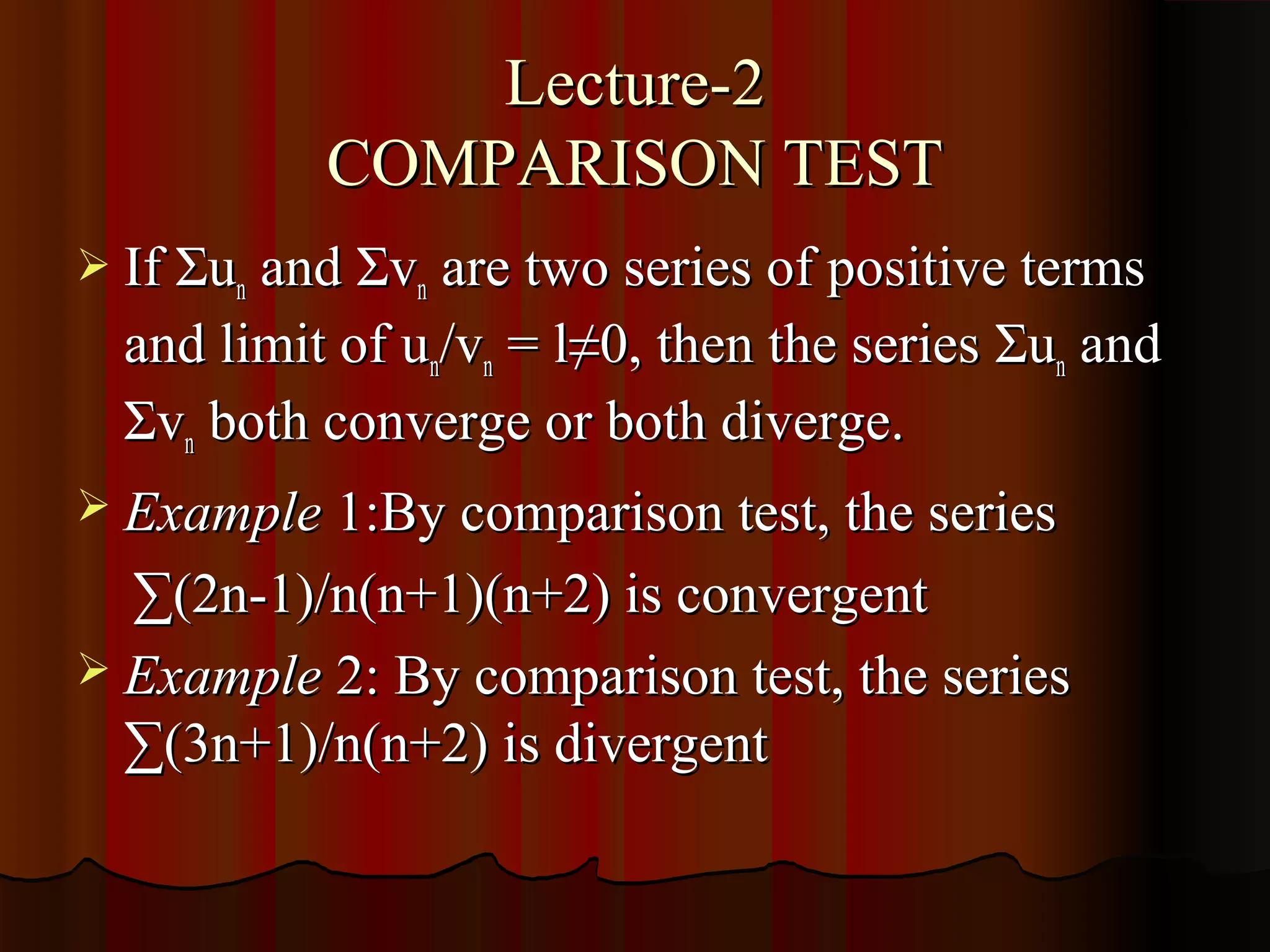
Lecture-2
           COMPARISON TEST
 If Σun and Σvn are two series of positive terms
  and limit of un/vn = l≠0, then the series Σun and
  Σvn both converge or both diverge.
 Example 1:By comparison test, the series

  ∑(2n-1)/n(n+1)(n+2) is convergent
 Example 2: By comparison test, the series
  ∑(3n+1)/n(n+2) is divergent
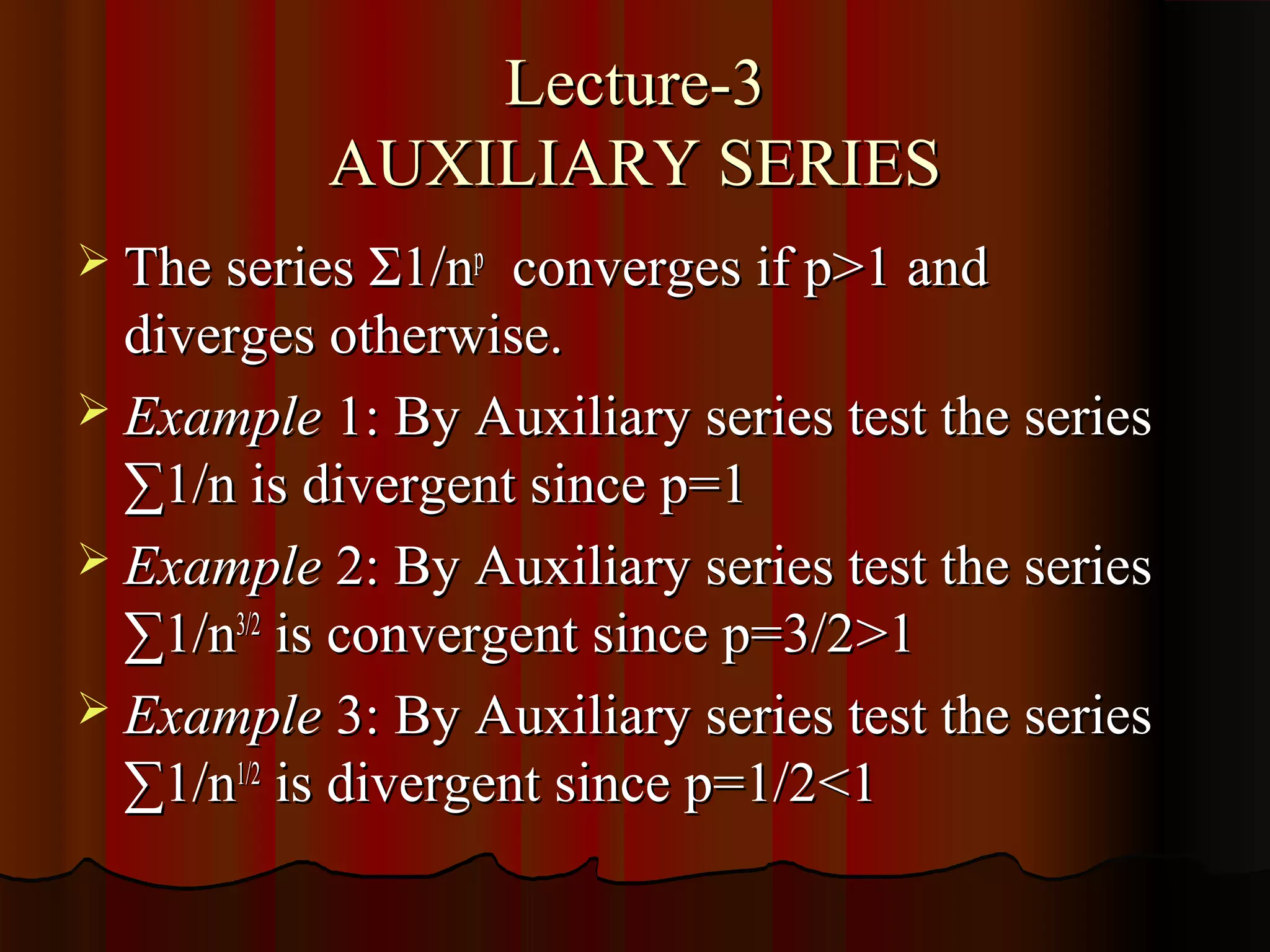
Lecture-3
           AUXILIARY SERIES
 The series Σ1/np   converges if p>1 and
  diverges otherwise.
 Example 1: By Auxiliary series test the series
  ∑1/n is divergent since p=1
 Example 2: By Auxiliary series test the series
  ∑1/n3/2 is convergent since p=3/2>1
 Example 3: By Auxiliary series test the series
  ∑1/n1/2 is divergent since p=1/2<1
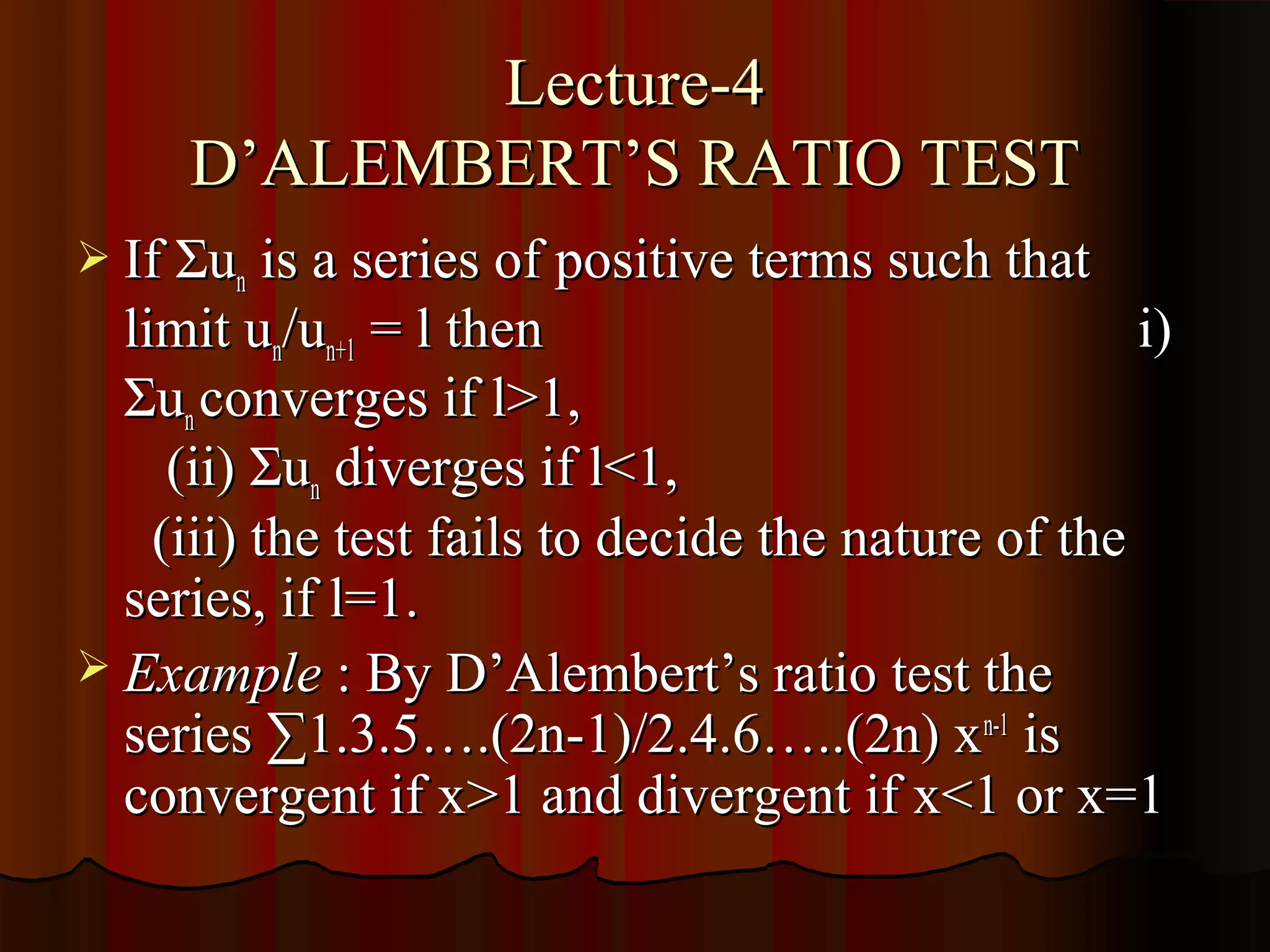
Lecture-4
     D’ALEMBERT’S RATIO TEST
 If Σun is a series of positive terms such that
  limit un/un+1 = l then                             i)
  Σun converges if l>1,
     (ii) Σun diverges if l<1,
    (iii) the test fails to decide the nature of the
  series, if l=1.
 Example : By D’Alembert’s ratio test the
  series ∑1.3.5….(2n-1)/2.4.6…..(2n) xn-1 is
  convergent if x>1 and divergent if x<1 or x=1
Lecture-5
         CAUCHY’S ROOT TEST
 If Σun is a series of positive terms such that
  limit un1/n =l then
               (a) Σun converges if l<1,
                    (b) Σun diverges if l>1 and
                      (c)the test fails to decide the
  nature if l=1.
 Example: By Cauchy’s root test the series
  ∑[(n+1)/(n+2) x]n is convergnt if x<1 and
  divergent if x>1 or x=1.
Lecture-6
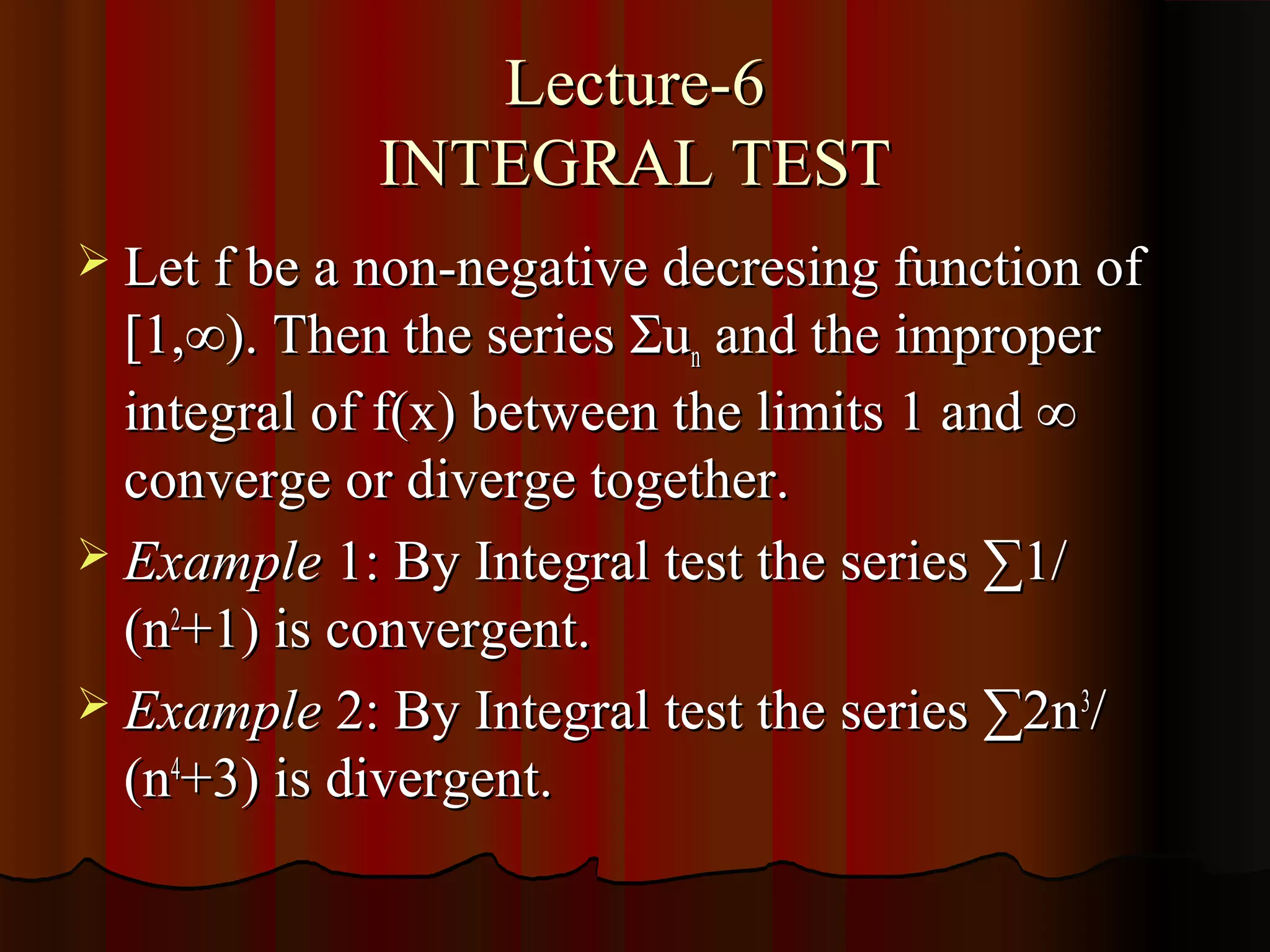
             INTEGRAL TEST
 Let f be a non-negative decresing function of
  [1,∞). Then the series Σun and the improper
  integral of f(x) between the limits 1 and ∞
  converge or diverge together.
 Example 1: By Integral test the series ∑1/
  (n2+1) is convergent.
 Example 2: By Integral test the series ∑2n 3/
  (n4+3) is divergent.
Lecture-7
               RAABE’S TEST
 Let Σun be a series of positive terms and let
  limit n[un/un+1 – 1]=l. Then
    (a) if l>1, Σun converges
          (b) if l<1, Σun diverges
                       (c) the test fails when l=1.
 Example: By Raabe’s test the series ∑4.7….
  (3n+1)/1.2…..n xn is convergent if x<1/3 and
  divergent if x>1/3 or x=1/3
Lecture-8
           LOGARITHMIC TEST
 If Σun is a series of positive terms such that
  limit n log[un/un+1]=l, then
      (a) Σun converges if l>1
               (b) Σun diverges if l<1
                      (c)the test fails when l=1.
 Example: By logarithmic test the series
  1+x/2+2!/32x2+….. is convergent if x<e and
  divergent if x>e or x=e
Lecture-9
 DEMORGAN’S AND BERTRAND’S
           TEST
 Let Σun be a series of positive terms and let
  limit[{n(un/un+1 – 1)-1}logn]=l then
  i)Σun converges for l>1 and
  ii) diverges for l<1.
 Example: By Demorgan’s and Bertrand’s test
  the series 1+22/32+22/32.42/52+…. is divergent
Lecture-10
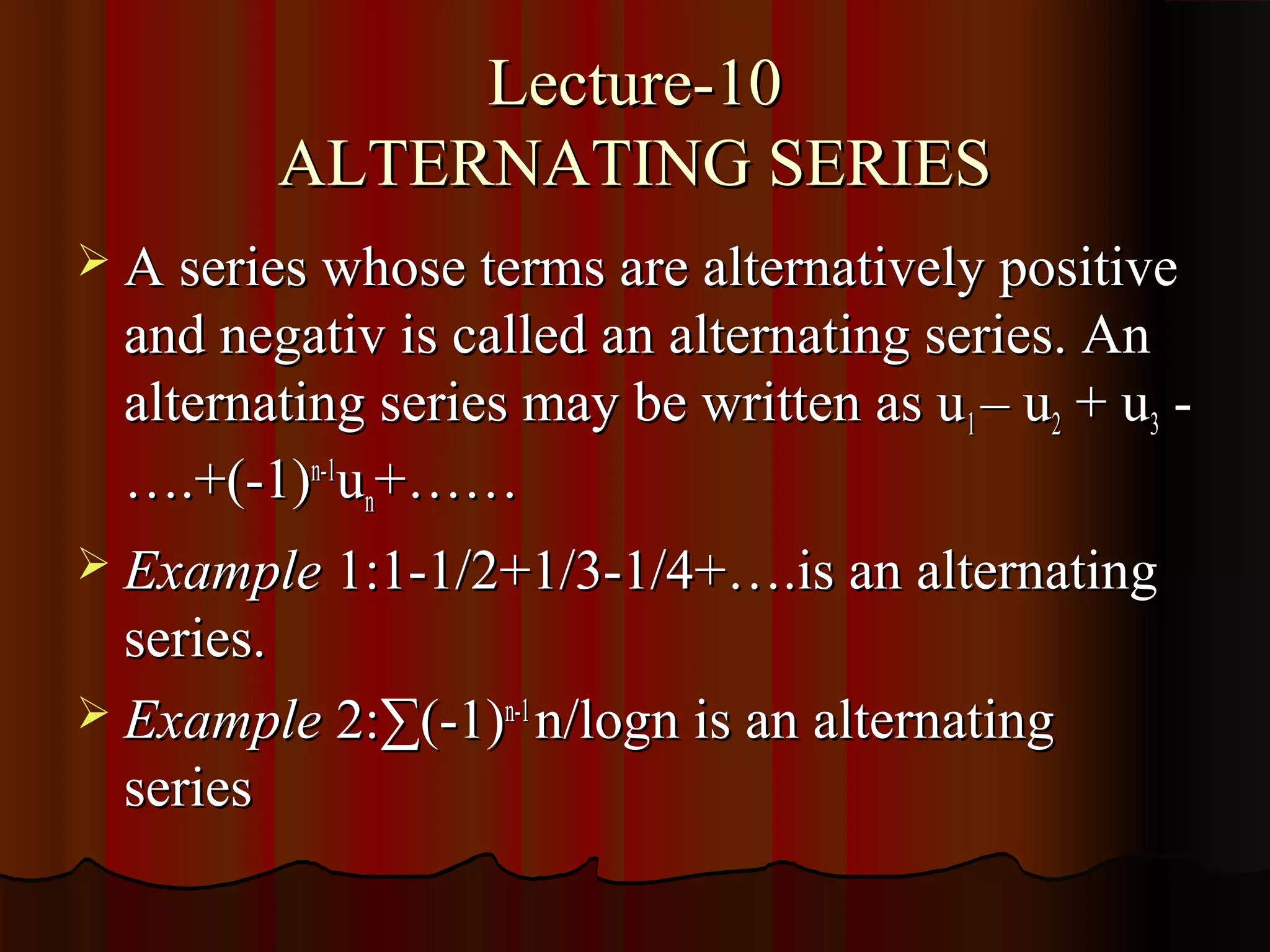
         ALTERNATING SERIES
 A series whose terms are alternatively positive
  and negativ is called an alternating series. An
  alternating series may be written as u1 – u2 + u3 -
  ….+(-1)n-1un+……
 Example 1:1-1/2+1/3-1/4+….is an alternating
  series.
 Example 2:∑(-1)n-1 n/logn is an alternating
  series
Lecture-11
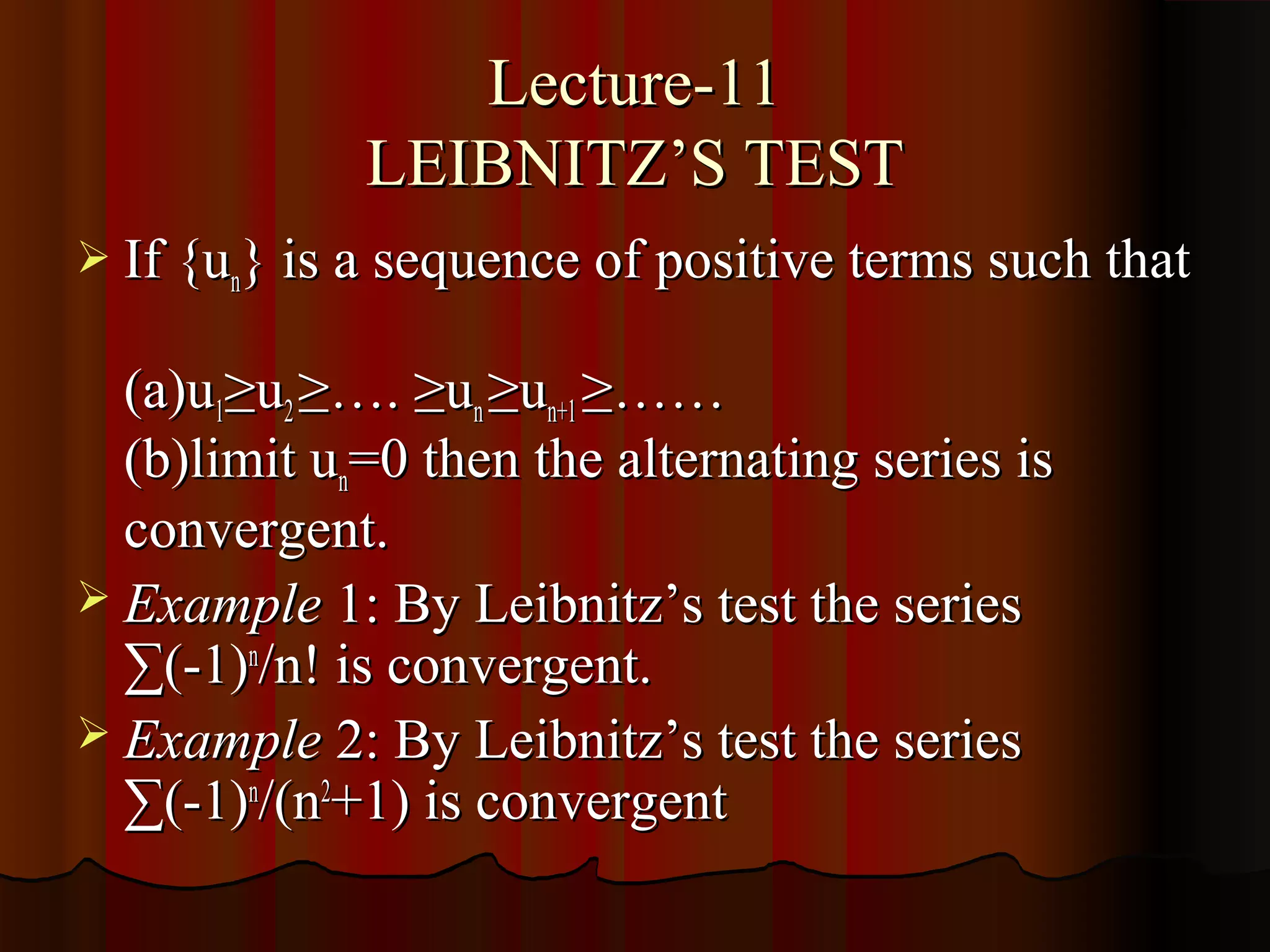
             LEIBNITZ’S TEST
 If {un} is a sequence of positive terms such that

  (a)u1≥u2 ≥…. ≥un ≥un+1 ≥……
  (b)limit un=0 then the alternating series is
  convergent.
 Example 1: By Leibnitz’s test the series
  ∑(-1)n/n! is convergent.
 Example 2: By Leibnitz’s test the series
  ∑(-1)n/(n2+1) is convergent
Lecture-12
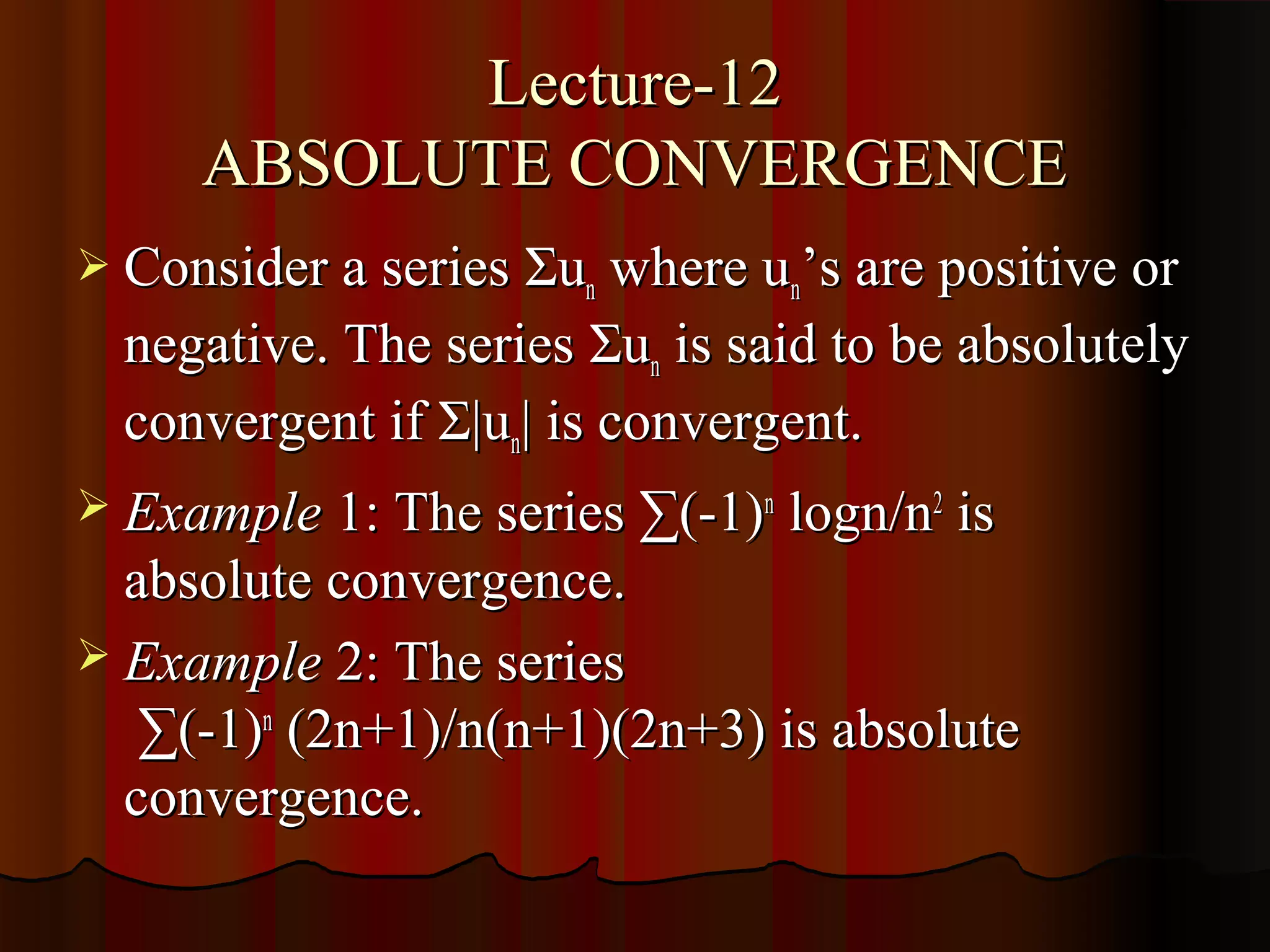
     ABSOLUTE CONVERGENCE
 Consider a series Σun where un’s are positive or
  negative. The series Σun is said to be absolutely
  convergent if Σ|un| is convergent.
 Example 1: The series ∑(-1)n logn/n2 is
  absolute convergence.
 Example 2: The series
   ∑(-1)n (2n+1)/n(n+1)(2n+3) is absolute
  convergence.
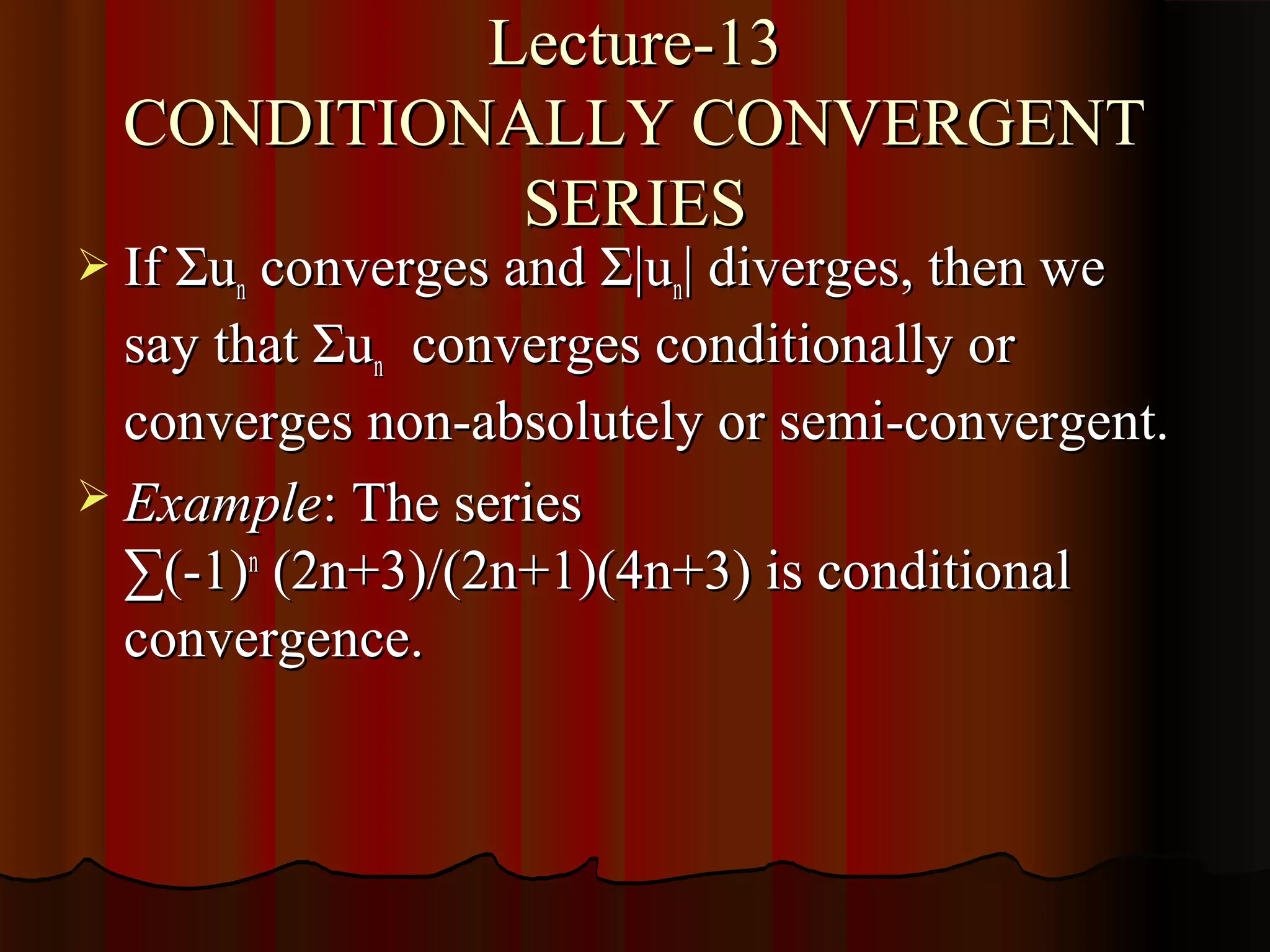
Lecture-13
  CONDITIONALLY CONVERGENT
            SERIES
 If Σun converges and Σ|un| diverges, then we
  say that Σun converges conditionally or
  converges non-absolutely or semi-convergent.
 Example: The series
  ∑(-1)n (2n+3)/(2n+1)(4n+3) is conditional
  convergence.

M1 unit vi-jntuworld

  • 1.
  • 2.
    CONTENTS  Ordinary Differential Equations of First Order and First Degree  Linear Differential Equations of Second and Higher Order  Mean Value Theorems  Functions of Several Variables  Curvature, Evolutes and Envelopes  Curve Tracing  Applications of Integration  Multiple Integrals  Series and Sequences  Vector Differentiation and Vector Operators  Vector Integration  Vector Integral Theorems  Laplace transforms
  • 3.
    TEXT BOOKS  A text book of Engineering Mathematics, Vol-I T.K.V.Iyengar, B.Krishna Gandhi and Others, S.Chand & Company  A text book of Engineering Mathematics, C.Sankaraiah, V.G.S.Book Links  A text book of Engineering Mathematics, Shahnaz A Bathul, Right Publishers  A text book of Engineering Mathematics, P.Nageshwara Rao, Y.Narasimhulu & N.Prabhakar Rao, Deepthi Publications
  • 4.
    REFERENCES  A textbook of Engineering Mathematics, B.V.Raman, Tata Mc Graw Hill  Advanced Engineering Mathematics, Irvin Kreyszig, Wiley India Pvt. Ltd.  A text Book of Engineering Mathematics, Thamson Book collection
  • 5.
  • 6.
    UNIT HEADER Name of the Course: B.Tech Code No:07A1BS02 Year/Branch: I Year CSE,IT,ECE,EEE,ME,CIVIL,AERO Unit No: VI No. of slides:21
  • 7.
    UNIT INDEX UNIT-VI S. Module Lecture PPT Slide No. No. No. 1 Introduction, Comparison L1-5 8-11 test and Auxiliary series 2 D’Alembert’s, Cauchy’s, L6-10 12-16 Integral, Raabe’s and Logarithmic tests 3 Alternating series, L11-13 17-21 Absolute and Conditional convergence
  • 8.
    Lecture-1 SEQUENCE  A Sequence of real numbers is a set of numbers arranged in a well defined order. Thus for each positive integer there is associated a numbr of the sequence. A function s:Z+ → R is called a SEQUENCE of real numbers.  Example 1:1,2,3,……..  Example 2:1,1/2,1/3,…………
  • 9.
    CONVERGENT,DIVERGENT, OSCILLATORY SEQUENCE  If limit of sn=l, then we say that the sequence {sn} converges to l.  If limit of sn=+∞ or -∞ then we say that the sequence {sn} diverges to l.  If sequence is neither convergent nor divergent then such sequence is known as an Oscillatory sequence.
  • 10.
    Lecture-2 COMPARISON TEST  If Σun and Σvn are two series of positive terms and limit of un/vn = l≠0, then the series Σun and Σvn both converge or both diverge.  Example 1:By comparison test, the series ∑(2n-1)/n(n+1)(n+2) is convergent  Example 2: By comparison test, the series ∑(3n+1)/n(n+2) is divergent
  • 11.
    Lecture-3 AUXILIARY SERIES  The series Σ1/np converges if p>1 and diverges otherwise.  Example 1: By Auxiliary series test the series ∑1/n is divergent since p=1  Example 2: By Auxiliary series test the series ∑1/n3/2 is convergent since p=3/2>1  Example 3: By Auxiliary series test the series ∑1/n1/2 is divergent since p=1/2<1
  • 12.
    Lecture-4 D’ALEMBERT’S RATIO TEST  If Σun is a series of positive terms such that limit un/un+1 = l then i) Σun converges if l>1, (ii) Σun diverges if l<1, (iii) the test fails to decide the nature of the series, if l=1.  Example : By D’Alembert’s ratio test the series ∑1.3.5….(2n-1)/2.4.6…..(2n) xn-1 is convergent if x>1 and divergent if x<1 or x=1
  • 13.
    Lecture-5 CAUCHY’S ROOT TEST  If Σun is a series of positive terms such that limit un1/n =l then (a) Σun converges if l<1, (b) Σun diverges if l>1 and (c)the test fails to decide the nature if l=1.  Example: By Cauchy’s root test the series ∑[(n+1)/(n+2) x]n is convergnt if x<1 and divergent if x>1 or x=1.
  • 14.
    Lecture-6 INTEGRAL TEST  Let f be a non-negative decresing function of [1,∞). Then the series Σun and the improper integral of f(x) between the limits 1 and ∞ converge or diverge together.  Example 1: By Integral test the series ∑1/ (n2+1) is convergent.  Example 2: By Integral test the series ∑2n 3/ (n4+3) is divergent.
  • 15.
    Lecture-7 RAABE’S TEST  Let Σun be a series of positive terms and let limit n[un/un+1 – 1]=l. Then (a) if l>1, Σun converges (b) if l<1, Σun diverges (c) the test fails when l=1.  Example: By Raabe’s test the series ∑4.7…. (3n+1)/1.2…..n xn is convergent if x<1/3 and divergent if x>1/3 or x=1/3
  • 16.
    Lecture-8 LOGARITHMIC TEST  If Σun is a series of positive terms such that limit n log[un/un+1]=l, then (a) Σun converges if l>1 (b) Σun diverges if l<1 (c)the test fails when l=1.  Example: By logarithmic test the series 1+x/2+2!/32x2+….. is convergent if x<e and divergent if x>e or x=e
  • 17.
    Lecture-9 DEMORGAN’S ANDBERTRAND’S TEST  Let Σun be a series of positive terms and let limit[{n(un/un+1 – 1)-1}logn]=l then i)Σun converges for l>1 and ii) diverges for l<1.  Example: By Demorgan’s and Bertrand’s test the series 1+22/32+22/32.42/52+…. is divergent
  • 18.
    Lecture-10 ALTERNATING SERIES  A series whose terms are alternatively positive and negativ is called an alternating series. An alternating series may be written as u1 – u2 + u3 - ….+(-1)n-1un+……  Example 1:1-1/2+1/3-1/4+….is an alternating series.  Example 2:∑(-1)n-1 n/logn is an alternating series
  • 19.
    Lecture-11 LEIBNITZ’S TEST  If {un} is a sequence of positive terms such that (a)u1≥u2 ≥…. ≥un ≥un+1 ≥…… (b)limit un=0 then the alternating series is convergent.  Example 1: By Leibnitz’s test the series ∑(-1)n/n! is convergent.  Example 2: By Leibnitz’s test the series ∑(-1)n/(n2+1) is convergent
  • 20.
    Lecture-12 ABSOLUTE CONVERGENCE  Consider a series Σun where un’s are positive or negative. The series Σun is said to be absolutely convergent if Σ|un| is convergent.  Example 1: The series ∑(-1)n logn/n2 is absolute convergence.  Example 2: The series ∑(-1)n (2n+1)/n(n+1)(2n+3) is absolute convergence.
  • 21.
    Lecture-13 CONDITIONALLYCONVERGENT SERIES  If Σun converges and Σ|un| diverges, then we say that Σun converges conditionally or converges non-absolutely or semi-convergent.  Example: The series ∑(-1)n (2n+3)/(2n+1)(4n+3) is conditional convergence.