Predicting Lung Cancer
Using Neural Network
Presented By:
Anik Deb Nath (1673)
Anurupa Barua (1681)
Submitted To:
Faisal Ahmed
Assistant Professor
Department of Computer Science & Engineering
Premier University, Chittagong
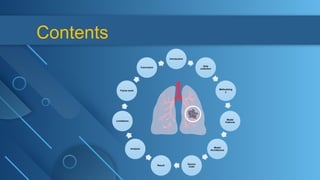
Contents
Introduction
Data
collection
Methodolog
y
Model
Features
Model
Architecture
Source
Code
Result
Analysis
Limitations
Future work
Conclusion
Introduction
Lung cancer is a significant public health issue. So Early detection and
diagnosis of lung cancer can significantly improve the survival rates of
patients.
In this presentation, we will discuss the development of a neural
network for the prediction of lung cancer.
Methodology
1. Data Collection
2. Software , Libraries and Tools selection.
3. Data Pre-processing
a) Data Cleaning
b) Label Encoding
4. Define models
5. Split the data into training and testing
6. Implementing algorithms and activation function
7. Evaluate Performance
The dataset of this project is taken from kaggle.
Data Collection
And after encode the label the dataset look like
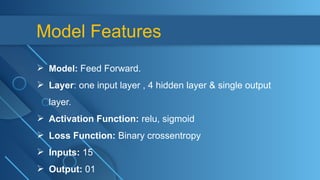
Model Features
 Model: Feed Forward.
 Layer: one input layer , 4 hidden layer & single output
layer.
 Activation Function: relu, sigmoid
 Loss Function: Binary crossentropy
 Inputs: 15
 Output: 01
Model Architecture
This architecture for 15 inputs and one output.
Model Source Code
from tensorflow.keras.models import Sequential
from tensorflow.keras.layers import Dense
model.add(Dense(20, input_dim=15, activation='relu'))
model.add(Dense(15, activation='relu'))
model.add(Dense(10, activation='relu'))
model.add(Dense(5, activation='relu'))
model.add(Dense(1, activation='sigmoid'))
model.compile(loss='binary_crossentropy', optimizer='adam',
metrics=['accuracy'])
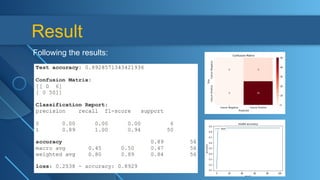
Result
Following the results:
Analysis
 The classification report shows that the model achieved an
overall accuracy of 89.29%, which is quite high for a binary
classification task.
 However, it is crucial to note that the precision for the
negative class (0) is zero, which suggests that the model fails
to identify any of the negative cases accurately.
Limitations
There are some limitations of our project such as:
 The model struggles with the negative class.
 The model architecture consists of several hidden layers, which may
increase the complexity.
 Other loss functions may be more suitable for certain datasets and
should be explored.
Future work
There is still room for improvement the accuracy of predict cancer.
Further studies could explore:
Alternative models that is unable to correctly identify any of the
negative cases, or methods for addressing class imbalance to improve
the performance of the model.
Conclusion
 This project shows the performance of classification algorithm in
successfully predicting Lung cancer based on neural network.
 However, it is important to note that neural network models require
careful design dataset, Preprocessing, and evaluation result to
ensure effectiveness and reliability in real-world applications.
THANK YOU
Smile, breathe, take it slow, and live a happy life
– John Landry

Lung-Cancer-Detection-Simple-Project-Using-Neural-Network.pdf

  • 1.
    Predicting Lung Cancer UsingNeural Network Presented By: Anik Deb Nath (1673) Anurupa Barua (1681) Submitted To: Faisal Ahmed Assistant Professor Department of Computer Science & Engineering Premier University, Chittagong
  • 2.
  • 3.
    Introduction Lung cancer isa significant public health issue. So Early detection and diagnosis of lung cancer can significantly improve the survival rates of patients. In this presentation, we will discuss the development of a neural network for the prediction of lung cancer.
  • 4.
    Methodology 1. Data Collection 2.Software , Libraries and Tools selection. 3. Data Pre-processing a) Data Cleaning b) Label Encoding 4. Define models 5. Split the data into training and testing 6. Implementing algorithms and activation function 7. Evaluate Performance
  • 5.
    The dataset ofthis project is taken from kaggle. Data Collection And after encode the label the dataset look like
  • 6.
    Model Features  Model:Feed Forward.  Layer: one input layer , 4 hidden layer & single output layer.  Activation Function: relu, sigmoid  Loss Function: Binary crossentropy  Inputs: 15  Output: 01
  • 7.
    Model Architecture This architecturefor 15 inputs and one output.
  • 8.
    Model Source Code fromtensorflow.keras.models import Sequential from tensorflow.keras.layers import Dense model.add(Dense(20, input_dim=15, activation='relu')) model.add(Dense(15, activation='relu')) model.add(Dense(10, activation='relu')) model.add(Dense(5, activation='relu')) model.add(Dense(1, activation='sigmoid')) model.compile(loss='binary_crossentropy', optimizer='adam', metrics=['accuracy'])
  • 9.
  • 10.
    Analysis  The classificationreport shows that the model achieved an overall accuracy of 89.29%, which is quite high for a binary classification task.  However, it is crucial to note that the precision for the negative class (0) is zero, which suggests that the model fails to identify any of the negative cases accurately.
  • 11.
    Limitations There are somelimitations of our project such as:  The model struggles with the negative class.  The model architecture consists of several hidden layers, which may increase the complexity.  Other loss functions may be more suitable for certain datasets and should be explored.
  • 12.
    Future work There isstill room for improvement the accuracy of predict cancer. Further studies could explore: Alternative models that is unable to correctly identify any of the negative cases, or methods for addressing class imbalance to improve the performance of the model.
  • 13.
    Conclusion  This projectshows the performance of classification algorithm in successfully predicting Lung cancer based on neural network.  However, it is important to note that neural network models require careful design dataset, Preprocessing, and evaluation result to ensure effectiveness and reliability in real-world applications.
  • 14.
    THANK YOU Smile, breathe,take it slow, and live a happy life – John Landry