The
Luncheon
By
William
Somerset
Maugham
About the author
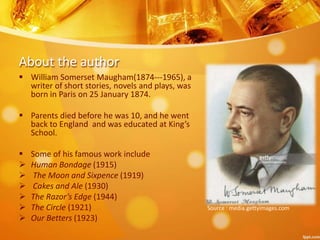
 William Somerset Maugham(1874---1965), a
writer of short stories, novels and plays, was
born in Paris on 25 January 1874.
 Parents died before he was 10, and he went
back to England and was educated at King’s
School.
 Some of his famous work include
 Human Bondage (1915)
 The Moon and Sixpence (1919)
 Cakes and Ale (1930)
 The Razor’s Edge (1944)
 The Circle (1921)
 Our Betters (1923)
Source : media.gettyimages.com
Summary
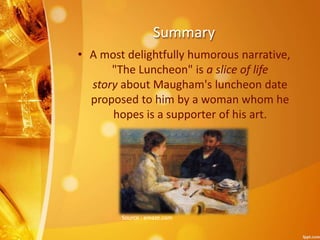
• A most delightfully humorous narrative,
"The Luncheon" is a slice of life
story about Maugham's luncheon date
proposed to him by a woman whom he
hopes is a supporter of his art.
Source : emaze.com
Point of view
The Book Writer’s
The story is told through first person
narration; the narrator being the writer.
“ I caught sight of her at the play."
3 Parts
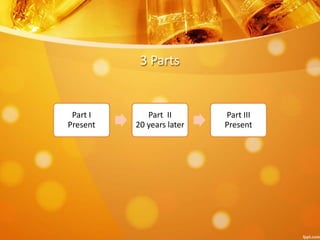
Part I
Present
Part II
20 years later
Part III
Present
Part I
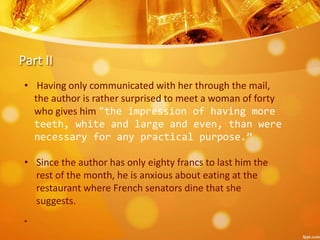
The book writer and the woman meet again after they last
saw each other 20 years before, and then he starts to
recall the luncheon at that day.
Source : clipartfox.com
Part II
• Having only communicated with her through the mail,
the author is rather surprised to meet a woman of forty
who gives him "the impression of having more
teeth, white and large and even, than were
necessary for any practical purpose.”
• Since the author has only eighty francs to last him the
rest of the month, he is anxious about eating at the
restaurant where French senators dine that she
suggests.
•
Part II
All the time that she is consuming such rich foods and
drink, she scolds Maugham for eating red meat, as he has
ordered mutton:
"You see, you've filled your stomach with a
lot of meat"—my one miserable little chop—
"and you can't eat any more. But I've just
had a snack and I shall enjoy a peach."
Part III
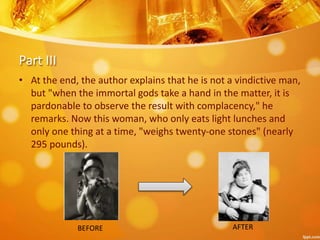
• At the end, the author explains that he is not a vindictive man,
but "when the immortal gods take a hand in the matter, it is
pardonable to observe the result with complacency," he
remarks. Now this woman, who only eats light lunches and
only one thing at a time, "weighs twenty-one stones" (nearly
295 pounds).
BEFORE AFTER
Theme
• It is necessary to say “no” when it is
necessary.
• People receive the impact of their own
behavior
• When one tries to covet small gains, one
may suffer a great loss.
Explore
In this story, the author does not name the
woman because he's not making a point
about a particular woman, but is referring
to people in general who manipulate
others, but who will eventually receive
their just reward.

Luncheon

  • 1.
  • 2.
    About the author William Somerset Maugham(1874---1965), a writer of short stories, novels and plays, was born in Paris on 25 January 1874.  Parents died before he was 10, and he went back to England and was educated at King’s School.  Some of his famous work include  Human Bondage (1915)  The Moon and Sixpence (1919)  Cakes and Ale (1930)  The Razor’s Edge (1944)  The Circle (1921)  Our Betters (1923) Source : media.gettyimages.com
  • 3.
    Summary • A mostdelightfully humorous narrative, "The Luncheon" is a slice of life story about Maugham's luncheon date proposed to him by a woman whom he hopes is a supporter of his art. Source : emaze.com
  • 4.
    Point of view TheBook Writer’s The story is told through first person narration; the narrator being the writer. “ I caught sight of her at the play."
  • 5.
    3 Parts Part I Present PartII 20 years later Part III Present
  • 6.
    Part I The bookwriter and the woman meet again after they last saw each other 20 years before, and then he starts to recall the luncheon at that day. Source : clipartfox.com
  • 7.
    Part II • Havingonly communicated with her through the mail, the author is rather surprised to meet a woman of forty who gives him "the impression of having more teeth, white and large and even, than were necessary for any practical purpose.” • Since the author has only eighty francs to last him the rest of the month, he is anxious about eating at the restaurant where French senators dine that she suggests. •
  • 8.
    Part II All thetime that she is consuming such rich foods and drink, she scolds Maugham for eating red meat, as he has ordered mutton: "You see, you've filled your stomach with a lot of meat"—my one miserable little chop— "and you can't eat any more. But I've just had a snack and I shall enjoy a peach."
  • 9.
    Part III • Atthe end, the author explains that he is not a vindictive man, but "when the immortal gods take a hand in the matter, it is pardonable to observe the result with complacency," he remarks. Now this woman, who only eats light lunches and only one thing at a time, "weighs twenty-one stones" (nearly 295 pounds). BEFORE AFTER
  • 10.
    Theme • It isnecessary to say “no” when it is necessary. • People receive the impact of their own behavior • When one tries to covet small gains, one may suffer a great loss.
  • 11.
    Explore In this story,the author does not name the woman because he's not making a point about a particular woman, but is referring to people in general who manipulate others, but who will eventually receive their just reward.