LuminAR U N I V E R S I T Y
References
Dick, B. (2000). A beginner's guide to action research. Retrieved 18
March 2015 from http://www.uq.net.au/action_research/arp/guide.html
De, S. (2012). Icon for C# file type. Retrieved 31 October 2015 from
http://www.sushovan.de/design/icons/csharp.ico
Ekran, G. (2013). Microsoft Visio 2013 Viewer Icon. Retrieved 31 October
2015 from http://png-4.findicons.com/files/icons/2796/
metro_uinvert_dock/256/visio_2013.png
Pierce, D. (2002). Extreme Programming. The Computer Bulletin,
44(3), 28-28.
Jason Gerbes Joshua Son Paul Lee Sean Young
1274664 1388288 1264218 1302108
Team Development
Challenges
• Scope Changes — Our project plan was changed
significantly three times before development
commenced. After a disappointing mid-project review,
we prepared a contract which prevented further
changes, allowing us to begin development immediately.
• Overdue Documentation — The mid-project review
highlighted the amount of documents that had not been
completed. Each team member committed themselves to
work three+ hours a day on the project to catch up on
the overdue documentation.

• Internal Conflict — Conflict arose within our team during
the development phase causing delays, decreased
productivity and personal resentment between members.
We overcame the conflict by having our supervisor
mediate our conflict resolution process.
• Time Management — Spikes in activity occurred in
semester one near each major deadline. We realised
(following our mid-project review) that we needed to be
more organised and planned steady work to be carried
out in a much smoother semester two.

Technical Difficulties
• New Development Platforms — Unity, iOS and Android
were development platforms foreign to most of our team
members. Well-executed and documented research
allowed us to quickly learn these environments, enabling
us to complete the project in a timely manner.
• Inaccurate Task Estimation — Planning Poker was
performed during a setup phase. Some estimations were
inaccurate due to a lack of understanding. Fortunately,
our revised project plan accounted for misestimation and
we were able to complete the work on time.
AUT BCIS Research & Development Project. S2, 2015.
Supervised by Dr. Roopak Sinha.
Client & Project Background
Luminary Promotions, an Auckland-based promotions
company that specialises in experimental advertising, are
exploring the possibilities of GPS technology integration.
Luminary are specialists in Augmented Reality advertising.
They hope to further their efforts with a location-based
‘wayfinding’ platform application.
Luminary have requested the assistance of the LuminAR
group to realise their vision.

Rationale
GPS integration and data deployment are two fields foreign
to Luminary. In order to build the ‘wayfinding’ platform
application, Luminary need an easier way to integrate
location technologies and remote data access.
LuminAR group were requested to create a user friendly
interface for these technologies. Doing so will enable
Luminary to produce the ‘wayfinding’ platform application
without the need to interface with the system API’s.

Objectives
• Learn Unity development practices, along with the
related iOS and Android API’s and protocols.
• Develop two Unity plugins — one for the integration of
GPS services, the storing and maintaining of GPS nodes;
and the other for the distribution of data from a remote
information server.
• Produce diagrams and documentation for use and
implementation of the two Unity plugins.
Project Introduction
Methodologies
Research Methodology
We decided to use Action Research methodology, as it
provided a structured and lightweight approach — ideal for
a project dependant on research (Dick, 2000). As our need
for research lessened with the revised project plan, it was
performed on an ‘as needed’ basis.
Action Research suited our team as research tasks varied
depending on the roles of each member. It allowed us to
efficiently perform, record and share our investigations.

Development Methodology
Our development strategy followed Extreme Programming
(XP) methodology. XP accommodates for projects with an
uncertain, changing scope (Pierce, 2002) — ideal for our
project as three significant scope changes occurred
before development commenced.
Following Extreme Programming methodology enabled the
group to efficiently plan and document our development.
The final product was delivered three days ahead of
schedule as a result of effective planning.

Quality Assurance
A consistent level of quality across all of our work was only
possible by the collaborative effort of our team. Some of
the quality assurance practices followed include:
• Quality assurance standards for documentation,
research and development were produced and followed.
• Templates for all documents were produced.
• Proofreading, acceptance testing, unit testing and peer
programming.
Deliverables
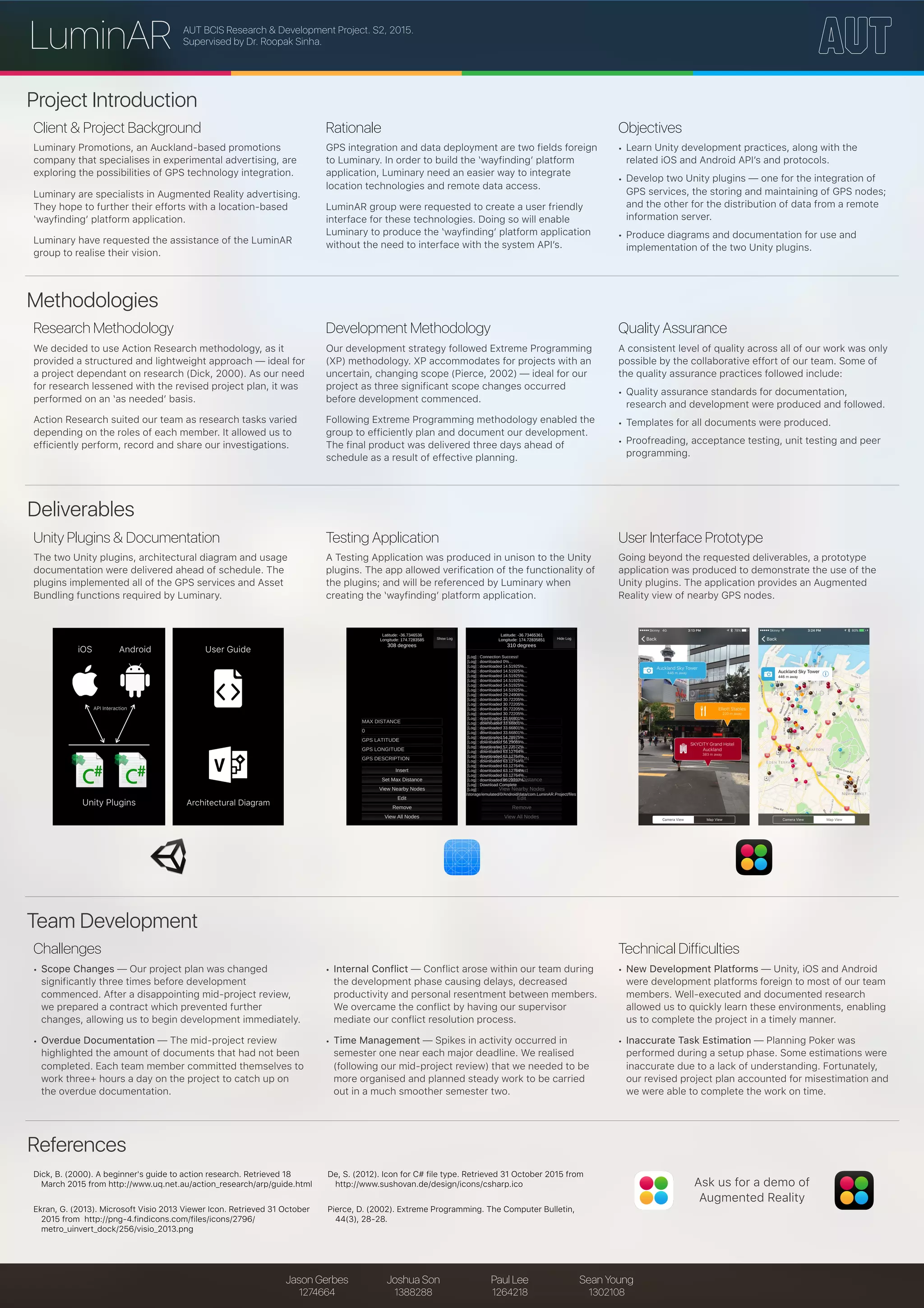
Unity Plugins & Documentation
The two Unity plugins, architectural diagram and usage
documentation were delivered ahead of schedule. The
plugins implemented all of the GPS services and Asset
Bundling functions required by Luminary.

Testing Application
A Testing Application was produced in unison to the Unity
plugins. The app allowed verification of the functionality of
the plugins; and will be referenced by Luminary when
creating the ‘wayfinding’ platform application. 

User Interface Prototype
Going beyond the requested deliverables, a prototype
application was produced to demonstrate the use of the
Unity plugins. The application provides an Augmented
Reality view of nearby GPS nodes.
Ask us for a demo of
Augmented Reality
iOS Android
Unity Plugins
API Interaction
User Guide
Architectural Diagram

LuminAR - Poster

  • 1.
    LuminAR U NI V E R S I T Y References Dick, B. (2000). A beginner's guide to action research. Retrieved 18 March 2015 from http://www.uq.net.au/action_research/arp/guide.html De, S. (2012). Icon for C# file type. Retrieved 31 October 2015 from http://www.sushovan.de/design/icons/csharp.ico Ekran, G. (2013). Microsoft Visio 2013 Viewer Icon. Retrieved 31 October 2015 from http://png-4.findicons.com/files/icons/2796/ metro_uinvert_dock/256/visio_2013.png Pierce, D. (2002). Extreme Programming. The Computer Bulletin, 44(3), 28-28. Jason Gerbes Joshua Son Paul Lee Sean Young 1274664 1388288 1264218 1302108 Team Development Challenges • Scope Changes — Our project plan was changed significantly three times before development commenced. After a disappointing mid-project review, we prepared a contract which prevented further changes, allowing us to begin development immediately. • Overdue Documentation — The mid-project review highlighted the amount of documents that had not been completed. Each team member committed themselves to work three+ hours a day on the project to catch up on the overdue documentation.
 • Internal Conflict — Conflict arose within our team during the development phase causing delays, decreased productivity and personal resentment between members. We overcame the conflict by having our supervisor mediate our conflict resolution process. • Time Management — Spikes in activity occurred in semester one near each major deadline. We realised (following our mid-project review) that we needed to be more organised and planned steady work to be carried out in a much smoother semester two.
 Technical Difficulties • New Development Platforms — Unity, iOS and Android were development platforms foreign to most of our team members. Well-executed and documented research allowed us to quickly learn these environments, enabling us to complete the project in a timely manner. • Inaccurate Task Estimation — Planning Poker was performed during a setup phase. Some estimations were inaccurate due to a lack of understanding. Fortunately, our revised project plan accounted for misestimation and we were able to complete the work on time. AUT BCIS Research & Development Project. S2, 2015. Supervised by Dr. Roopak Sinha. Client & Project Background Luminary Promotions, an Auckland-based promotions company that specialises in experimental advertising, are exploring the possibilities of GPS technology integration. Luminary are specialists in Augmented Reality advertising. They hope to further their efforts with a location-based ‘wayfinding’ platform application. Luminary have requested the assistance of the LuminAR group to realise their vision.
 Rationale GPS integration and data deployment are two fields foreign to Luminary. In order to build the ‘wayfinding’ platform application, Luminary need an easier way to integrate location technologies and remote data access. LuminAR group were requested to create a user friendly interface for these technologies. Doing so will enable Luminary to produce the ‘wayfinding’ platform application without the need to interface with the system API’s.
 Objectives • Learn Unity development practices, along with the related iOS and Android API’s and protocols. • Develop two Unity plugins — one for the integration of GPS services, the storing and maintaining of GPS nodes; and the other for the distribution of data from a remote information server. • Produce diagrams and documentation for use and implementation of the two Unity plugins. Project Introduction Methodologies Research Methodology We decided to use Action Research methodology, as it provided a structured and lightweight approach — ideal for a project dependant on research (Dick, 2000). As our need for research lessened with the revised project plan, it was performed on an ‘as needed’ basis. Action Research suited our team as research tasks varied depending on the roles of each member. It allowed us to efficiently perform, record and share our investigations.
 Development Methodology Our development strategy followed Extreme Programming (XP) methodology. XP accommodates for projects with an uncertain, changing scope (Pierce, 2002) — ideal for our project as three significant scope changes occurred before development commenced. Following Extreme Programming methodology enabled the group to efficiently plan and document our development. The final product was delivered three days ahead of schedule as a result of effective planning.
 Quality Assurance A consistent level of quality across all of our work was only possible by the collaborative effort of our team. Some of the quality assurance practices followed include: • Quality assurance standards for documentation, research and development were produced and followed. • Templates for all documents were produced. • Proofreading, acceptance testing, unit testing and peer programming. Deliverables Unity Plugins & Documentation The two Unity plugins, architectural diagram and usage documentation were delivered ahead of schedule. The plugins implemented all of the GPS services and Asset Bundling functions required by Luminary.
 Testing Application A Testing Application was produced in unison to the Unity plugins. The app allowed verification of the functionality of the plugins; and will be referenced by Luminary when creating the ‘wayfinding’ platform application. 
 User Interface Prototype Going beyond the requested deliverables, a prototype application was produced to demonstrate the use of the Unity plugins. The application provides an Augmented Reality view of nearby GPS nodes. Ask us for a demo of Augmented Reality iOS Android Unity Plugins API Interaction User Guide Architectural Diagram