LUCID: Project Context, Enabling Technologies and Fit to University Research Strategy Prof. Keith A. Osman Director of Research, Birmingham City University Consultant Academic, European Centre of Excellence for AIDC
CONTENT Aware Applications Technological Implications Content Implications User Implications Regional context Fit with university research Future developments
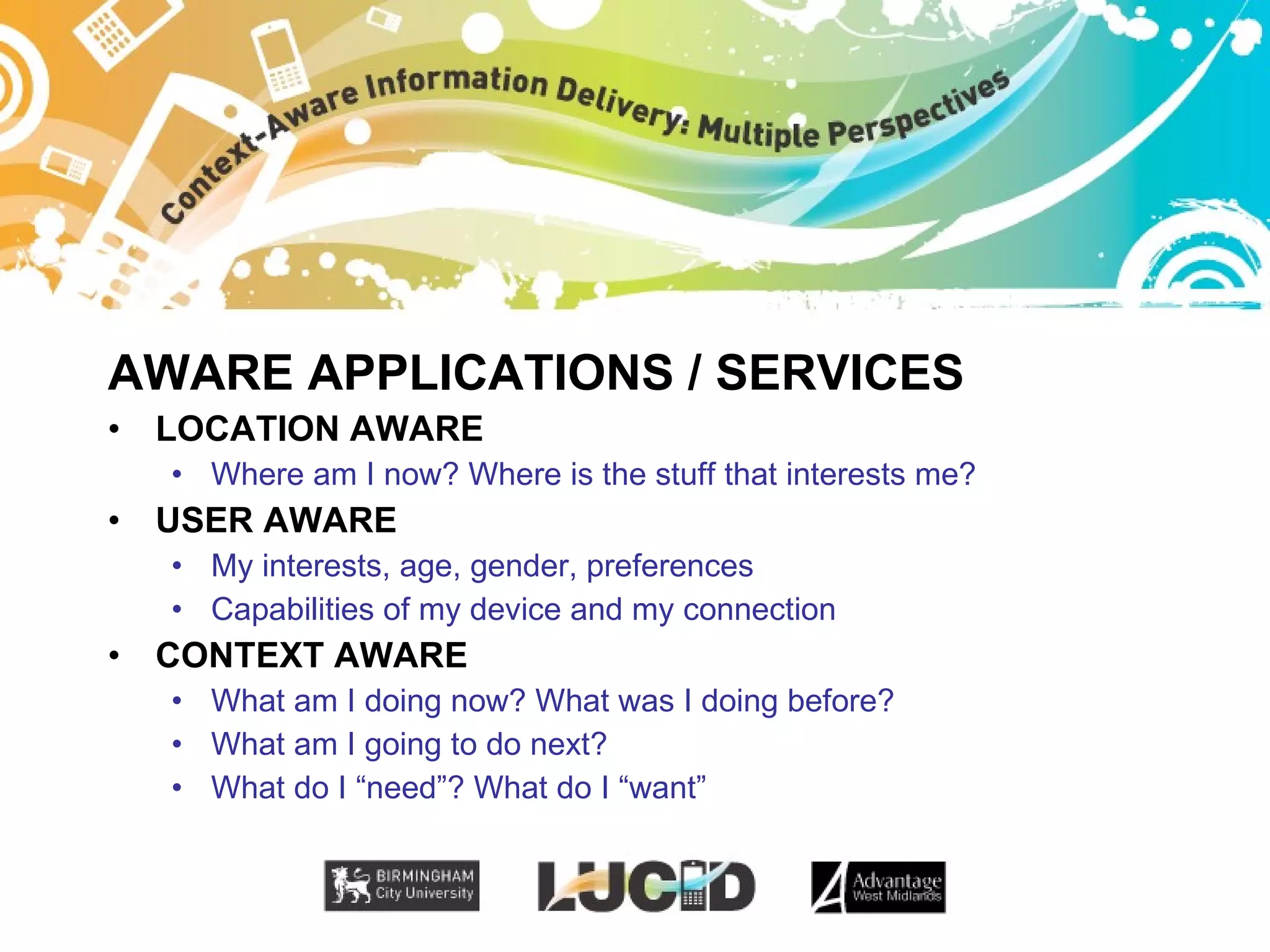
AWARE APPLICATIONS / SERVICES LOCATION AWARE Where am I now? Where is the stuff that interests me? USER AWARE My interests, age, gender, preferences Capabilities of my device and my connection CONTEXT AWARE What am I doing now? What was I doing before?  What am I going to do next? What do I “need”? What do I “want”
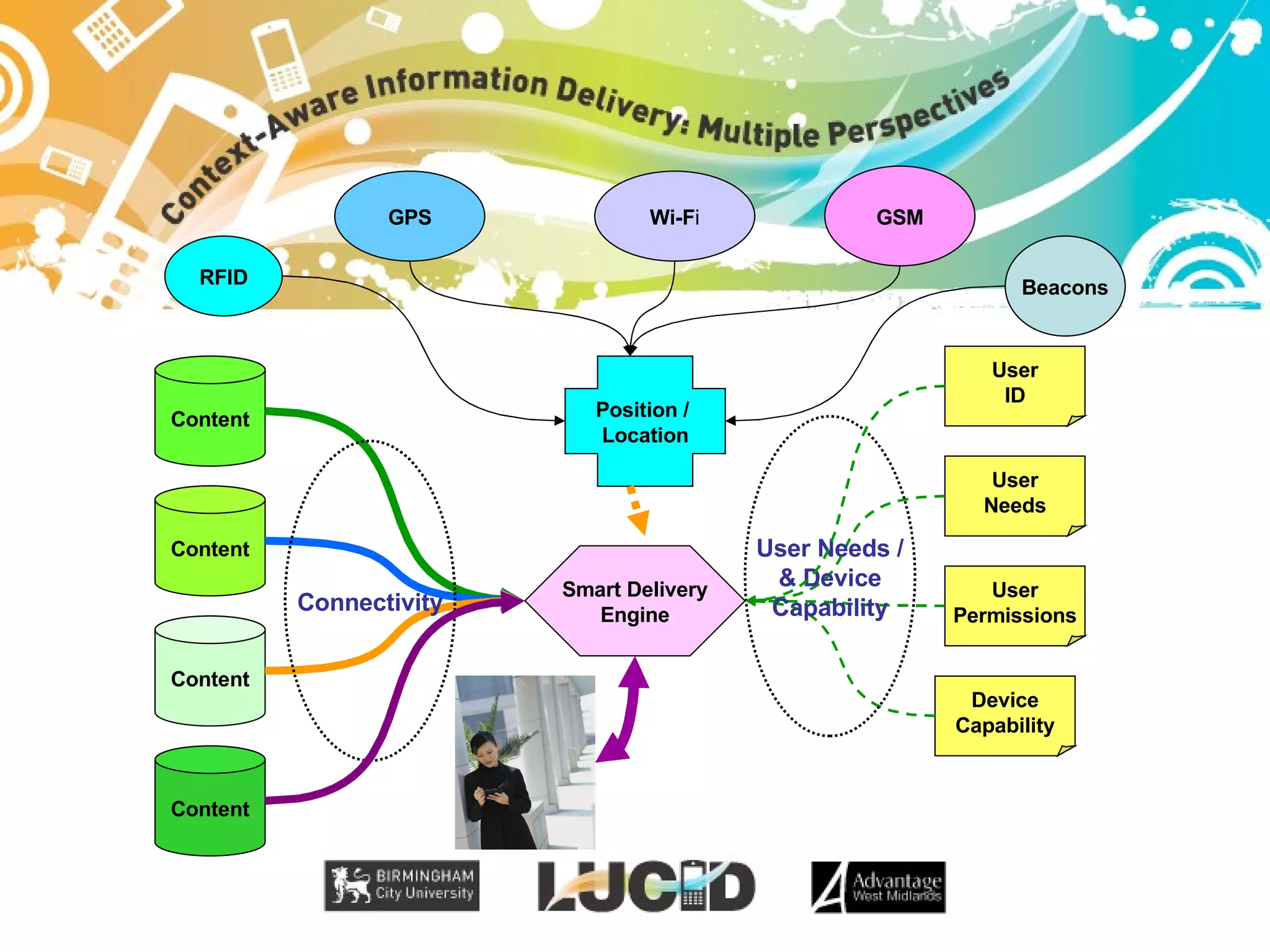
Smart Delivery Engine Position /  Location RFID GPS Beacons Wi-F i GSM Content Content Content Content Connectivity User Needs Device Capability User Permissions User ID User Needs / & Device Capability
TECHNOLOGICAL IMPLICATIONS LOCATION AWARENESS Position v. Location Absolute v. Symbolic Indoors v. Outdoors Infrastructure requirements Resolution v. accuracy v. repeatability Representation of “maps” Technology “handover” No single solution …
TECHNOLOGICAL IMPLICATIONS USER AWARENESS Representation of “my interests” Content mark-up methods Exploration engines for untagged content Remote device capabilities assessment “ on the fly” adaptive content repurposing
TECHNOLOGICAL IMPLICATIONS CONTEXT AWARENESS In the device or in the network? Behavioural modelling? “ 85% of people who did X then did Y …” Guiding v. Leading? Empowering v. controlling
REGIONAL CONTEXT Many cities developing large scale WLAN Many intuitive benefits - workers, visitors, citizens, etc Revenue generation mechanisms less obvious … Context Awareness offers new opportunities for personalised revenue generating services Content Providers and Applications Developers Business Users and Business Applications
AWM Science City A real force to use science and technology to improve the prosperity & quality of life in Birmingham, WM & the UK Overall vision: a world class research base, capacity to translate knowledge into real products and Services, the people, skills and infrastructure to do this, engagement with science in schools and across the population demonstrator  and flagship projects Five areas of scientific and technological strength highlighted: Digital Media   / Energy / Materials Medical Technology & Healthcare / Transport
LUCID Project Exploring potential applications of Location, User and Context Aware software applications and services Supporting a wide range of mobile devices and connectivity types and content delivery paradigms Leverage BCC investment in the Wireless Square Mile & Free Information Zone (FIZ) to increase uptake Developing of a number of “proof of concept solutions” for technical and user evaluation Primary focus of “what does it do for the users” not “look how clever this thing is” - embedded user feedback and evaluation
CONTENT QUESTIONS How can we “mark-up” rich-media content with the locations to which it is relevant? What about other “user preference” mark-up? How can we “tag” a location with multiple media artifacts for access by all applications? How can the public tag physical (and virtual) locations with their own media artifacts – “cyber-graffiti” ? By what mechanisms could we “deliver” tagged media to mobile users in a seamless way? Content delivered as real-time stream? cache and carry? pre-load? content oasis?
LOCATION QUESTIONS How could we integrate absolute position data from GPS with relative locations from other local “beacons”? How do we seamlessly move from GPS outdoors to indoor location systems whilst maintaining our position? How could we use passive or active RFID tags as external location identifiers? How could we “register” media tag locations so that GPS data would “know” that they were in the vicinity? How could we fuse other data, e.g. direction, acceleration, images, etc to assist with location / selection / identification / delivery of media contents?
CLOSED SYSTEM A museum has external and internal exhibit space and has a created an outside “knowledge trail” using GPS assisted PDAs.  Museum collections has been digitised and is accessible via the museum web-site How can the museum create a personalised  and interactive “tour” responsive to individual interests / needs that involves external and internal exhibits? ISSUES: identify current user location and tagged media content and retrieve from museum server Where is user? Which gallery? Near which exhibit? What do they want / need? Where have they been before?
OPEN SYSTEM A city has created a walking tour of the canal network with media tagged to key points of interest GPS equipped PDA with media pre-loaded on SD card.  In some 10 m radius zones there may be > 5 POI with tagged content ,  At the Visitors’ Centre there are three open WLAN access points giving access to web-based information An architecture trail has also been created which crosses the canal tour and has common POI inc. VC Potential visitors would like to see some of the POI before coming to the city – “virtual tour” How can the “tours” share media content? How can www / WLAN be integrated into the two tours?
ENABLING TECHNOLOGIES Identification & Data Carriers 1D barcodes and 2D codes Passive RFID Active RFID Smartcards Biometrics
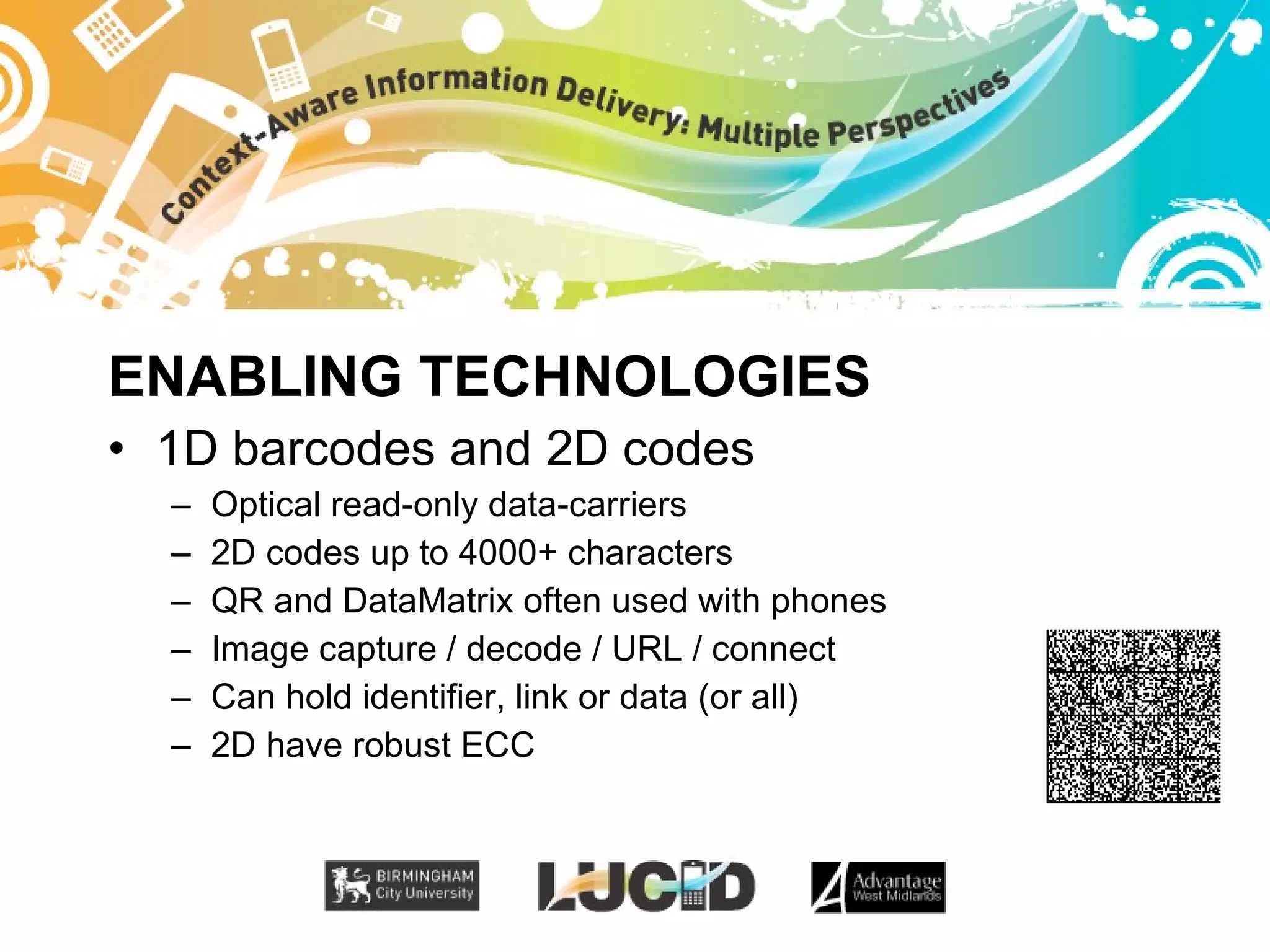
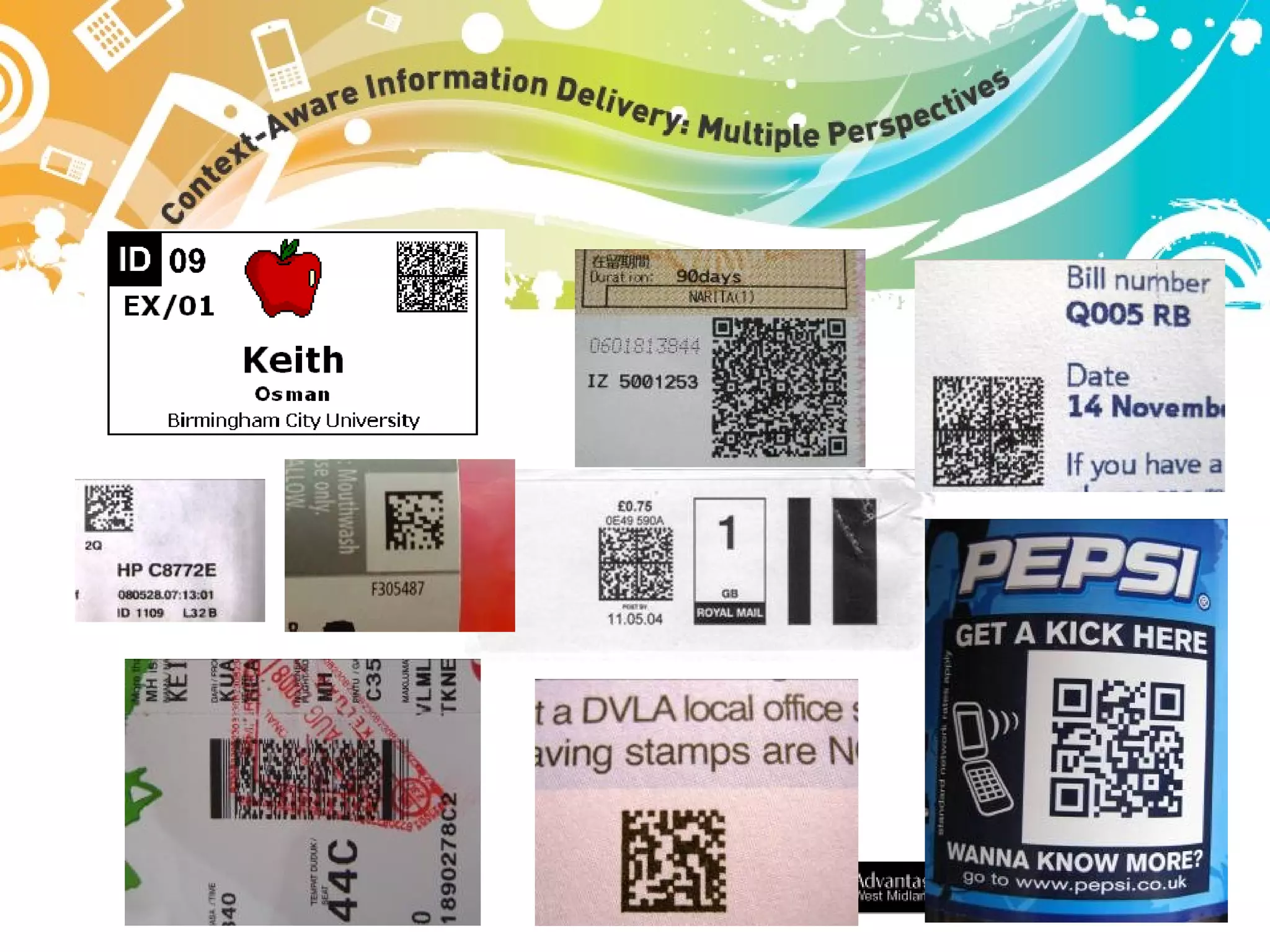
ENABLING TECHNOLOGIES 1D barcodes and 2D codes Optical read-only data-carriers 2D codes up to 4000+ characters QR and DataMatrix often used with phones Image capture / decode / URL / connect Can hold identifier, link or data (or all) 2D have robust ECC
 
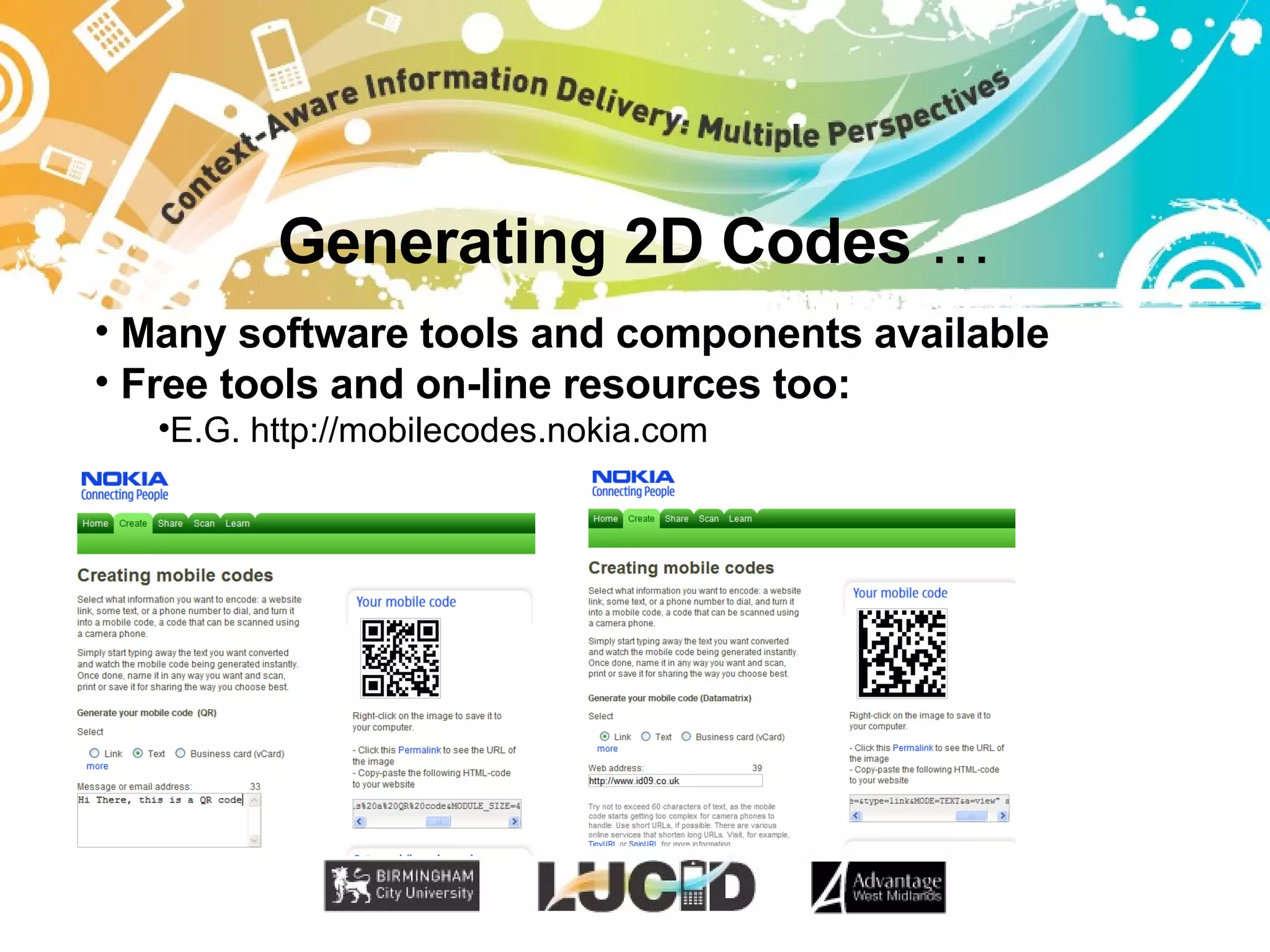
Generating 2D Codes  … Many software tools and components available Free tools and on-line resources too: E.G. http://mobilecodes.nokia.com
2D Code Reader Software Phones are starting to have this built-in Consumer applications developing fast URL in 2D code then redirect browser QR code & Datamatrix are supported Many free downloads of 2D code readers I-nigma reader: http://www.i-nigma.mobi NeoReader:  http://get.neoreader.com UpCode reader: http://www.upcode.fi Semacode reader: http://semacode.org/ota QuickMark reader:  www.quickmark.com.tw
Smartcards Data is stored electronically in a small semiconductor memory device, normally in the form of a card Contactless cards can be read / written by short-range radio (5-7 cm) e.g. Oyster card, Barclaycard “waterslide” 13.56 MHz air-interface ISO-14443 for smartcards ISO-15693 for High-Frequency RFID Card memory divided into different blocks with security / encryption and other functions e.g. purse Applications can read from, and if necessary write to the smartcard e.g. to decrement stored value, etc Some “very-smart” cards run Java applications
Convergence … Smartcards are typically carried by the user and hold key personal data, stored value, etc 2D codes can be placed in different physical locations to “mark-up” space or identify things and hold thicker data Barrier to consumer uses of smartcards and 2D codes has been the availability of readers / writers BUT: phones have a camera and Near-Field Communications is coming …
Near-Field Communications Short-range (10 cm) HF (wireless communication Data exchange between handset devices, smartcards, RFID tags, etc Extension of the ISO 14443 proximity-card standard and supports ISO-15693 HF RFID standards. Smartcard interface and a reader in a single device Compatible with existing contactless infrastructure Aimed primarily at mobile phones & embedded stuff
ENABLING TECHNOLOGIES RADIO-FREQUENCY IDENTIFICATION Data stored in a small semiconductor device Data is read from (and written to) the RFID device using various forms of RF communications Passive devices powered by the interrogator and have no internal battery, active have a battery Direct line-of-sight is not required to read /write data Can simultaneously interrogate a number of tags
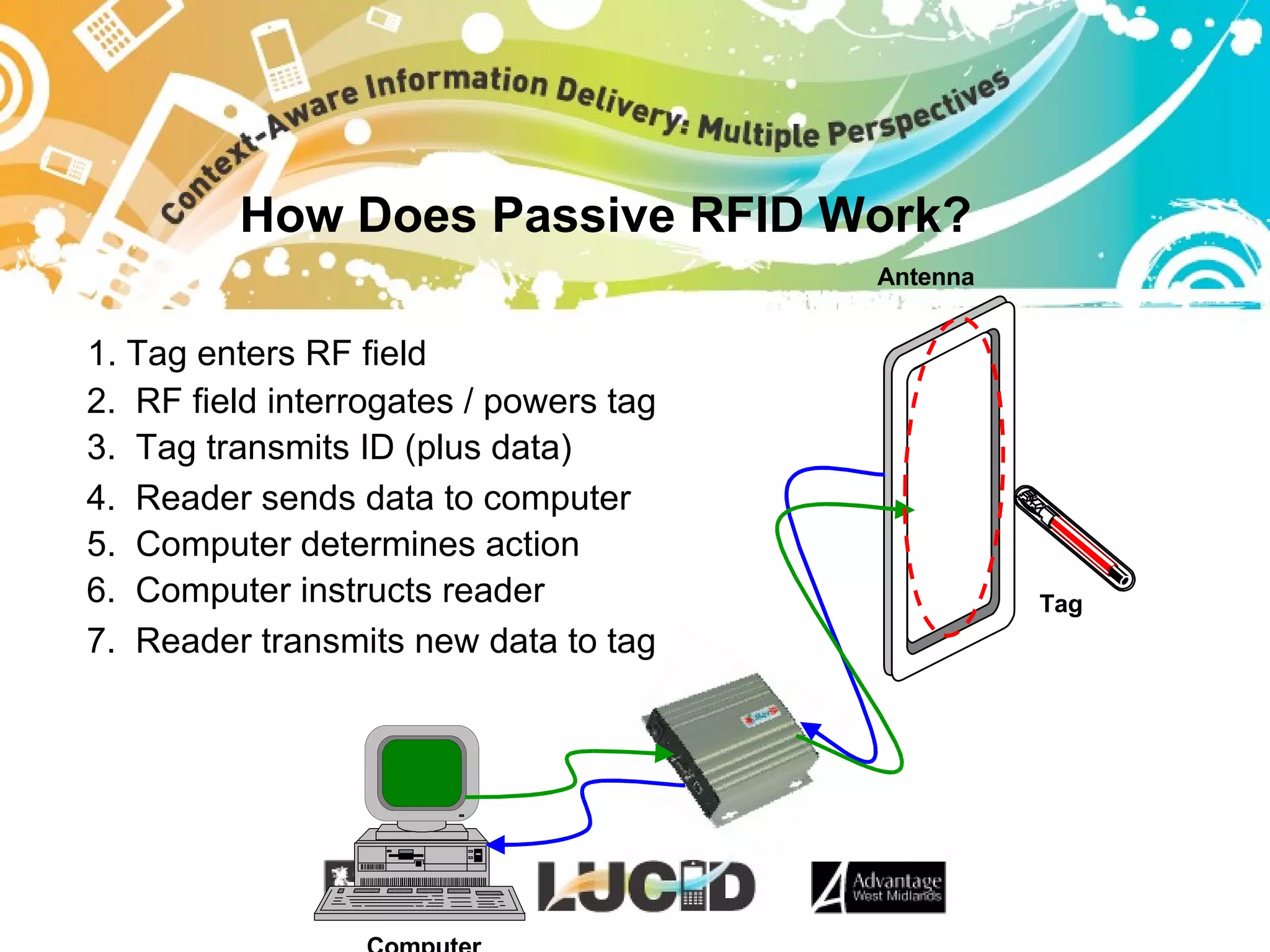
1. Tag enters RF field 2.  RF field interrogates / powers tag 3.  Tag transmits ID (plus data) 4.  Reader sends data to computer 5.  Computer determines action 6.  Computer instructs reader 7.  Reader transmits new data to tag How Does Passive RFID Work? Antenna Tag Computer
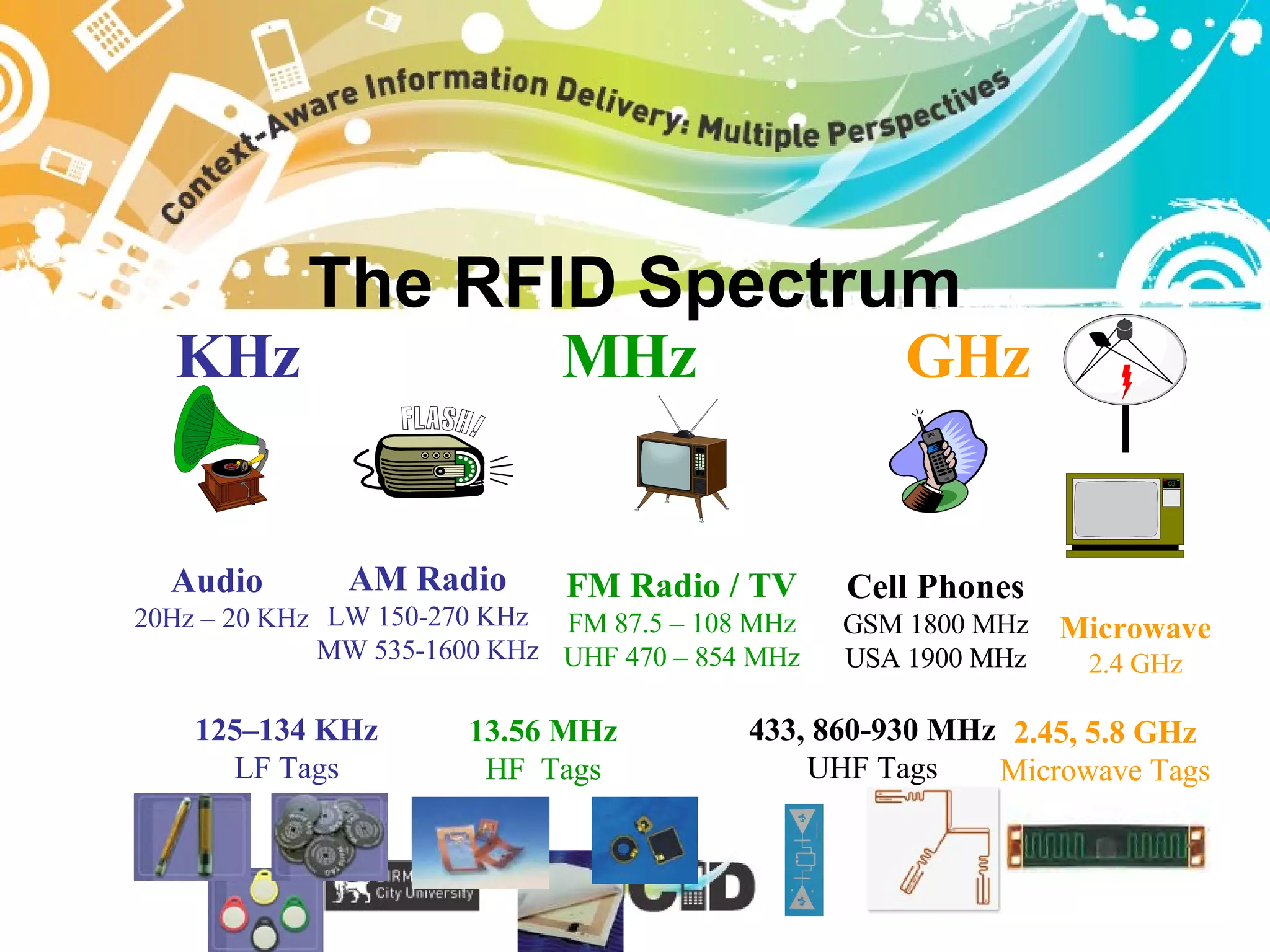
The RFID Spectrum KHz MHz GHz Audio  20Hz – 20 KHz AM Radio LW 150-270 KHz MW 535-1600 KHz FM Radio / TV FM 87.5 – 108 MHz UHF 470 – 854 MHz Cell Phones GSM 1800 MHz USA 1900 MHz Microwave 2.4 GHz 125–134 KHz LF Tags 13.56 MHz HF  Tags 433, 860-930 MHz UHF Tags 2.45, 5.8 GHz Microwave Tags
ENABLING TECHNOLOGIES Active RFID RFID tag is a small RF transmitter (433 MHz) Transmits a “pulse” (ID plus other data) Reader only has to receive transmission not power the tag – unlike passive tags Ranges up to 200 metres or more If battery dies, tag becomes invisible
A Data Perspective Key thinking point when building apps: Where is the data I need? How can I connect to the data? What happens if I can’t connect to it? Data-carriers carry data that is either: a reference allowing a (remote) look-up of item data : the data, or subset of operational data
Back to LUCID … Lots of technology building blocks Many exciting potential ideas for combining these for service delivery but: What are the “killer apps”? What are the user benefits? What are the technology barriers? What are the user acceptance barriers? Need to find out, hence the LUCID project!
RESEARCH AT BIRMINGHAM CITY UNI 6 FACULTIES Birmingham City Business School Birmingham Institute of Art & Design Faculty of Education, Law & Social Sciences Faculty of Health Faculty of Performance, Media and English Faculty of Technology, Innovation and Development
RESEARCH AT BIRMINGHAM CITY UNI MISSION : To be a powerful force for learning, creativity and enterprise, promoting economic, social and cultural well-being VISION : We will be recognised regionally, nationally and internationally as a university which fosters intellectual, critical and creative endeavour through continuous innovation.
RESEARCH AT BIRMINGHAM CITY UNI Special focus on the Creative Industries and Design Digital Content Creation Art and Design Media and Communications Visualisation / Haptics / Museum and Galleries Enabling ICT LUCID-type activity: relevant to many Faculties
RESEARCH AT BIRMINGHAM CITY UNI Applied research focus Strongly linked to Knowledge Exchange and Enterprise Engagement Excellent record of working with Regional SMEs Specialist regional projects and facilities: JIIC, Design Knowledge Network User Lab, Open Advantage
RAE-2008 PERFORMANCE RAE doesn’t drive what we do but RAE is important for recognition and esteem – “research-engaged” Research feeds our teaching and learning programmes and fuels our “knowledge engines” 7 subjects, 87 staff, 17% of research judged to be World Leading (most of any post-1992 university) 70% of the research submitted to RAE-2008 was judged to be Internationally significant (4*, 3*, 2*)
BACK TO LUCID Applied research, Knowledge Exchange and Business Support is what we do well LUCID allowED us to deploy our creativity for new product and service offerings and business support LUCID was an “espresso” project which will hopefully act as a springboard for a larger and longer-term project focusing on this important and exciting area
Thank You for Your Attention QUESTIONS? Contact Details: Email: [email_address] Tel:  0121 331 6858 GSM:  07971 189 710

LUCID project context - Professor Keith Osman

  • 1.
    LUCID: Project Context,Enabling Technologies and Fit to University Research Strategy Prof. Keith A. Osman Director of Research, Birmingham City University Consultant Academic, European Centre of Excellence for AIDC
  • 2.
    CONTENT Aware ApplicationsTechnological Implications Content Implications User Implications Regional context Fit with university research Future developments
  • 3.
    AWARE APPLICATIONS /SERVICES LOCATION AWARE Where am I now? Where is the stuff that interests me? USER AWARE My interests, age, gender, preferences Capabilities of my device and my connection CONTEXT AWARE What am I doing now? What was I doing before? What am I going to do next? What do I “need”? What do I “want”
  • 4.
    Smart Delivery EnginePosition / Location RFID GPS Beacons Wi-F i GSM Content Content Content Content Connectivity User Needs Device Capability User Permissions User ID User Needs / & Device Capability
  • 5.
    TECHNOLOGICAL IMPLICATIONS LOCATIONAWARENESS Position v. Location Absolute v. Symbolic Indoors v. Outdoors Infrastructure requirements Resolution v. accuracy v. repeatability Representation of “maps” Technology “handover” No single solution …
  • 6.
    TECHNOLOGICAL IMPLICATIONS USERAWARENESS Representation of “my interests” Content mark-up methods Exploration engines for untagged content Remote device capabilities assessment “ on the fly” adaptive content repurposing
  • 7.
    TECHNOLOGICAL IMPLICATIONS CONTEXTAWARENESS In the device or in the network? Behavioural modelling? “ 85% of people who did X then did Y …” Guiding v. Leading? Empowering v. controlling
  • 8.
    REGIONAL CONTEXT Manycities developing large scale WLAN Many intuitive benefits - workers, visitors, citizens, etc Revenue generation mechanisms less obvious … Context Awareness offers new opportunities for personalised revenue generating services Content Providers and Applications Developers Business Users and Business Applications
  • 9.
    AWM Science CityA real force to use science and technology to improve the prosperity & quality of life in Birmingham, WM & the UK Overall vision: a world class research base, capacity to translate knowledge into real products and Services, the people, skills and infrastructure to do this, engagement with science in schools and across the population demonstrator and flagship projects Five areas of scientific and technological strength highlighted: Digital Media / Energy / Materials Medical Technology & Healthcare / Transport
  • 10.
    LUCID Project Exploringpotential applications of Location, User and Context Aware software applications and services Supporting a wide range of mobile devices and connectivity types and content delivery paradigms Leverage BCC investment in the Wireless Square Mile & Free Information Zone (FIZ) to increase uptake Developing of a number of “proof of concept solutions” for technical and user evaluation Primary focus of “what does it do for the users” not “look how clever this thing is” - embedded user feedback and evaluation
  • 11.
    CONTENT QUESTIONS Howcan we “mark-up” rich-media content with the locations to which it is relevant? What about other “user preference” mark-up? How can we “tag” a location with multiple media artifacts for access by all applications? How can the public tag physical (and virtual) locations with their own media artifacts – “cyber-graffiti” ? By what mechanisms could we “deliver” tagged media to mobile users in a seamless way? Content delivered as real-time stream? cache and carry? pre-load? content oasis?
  • 12.
    LOCATION QUESTIONS Howcould we integrate absolute position data from GPS with relative locations from other local “beacons”? How do we seamlessly move from GPS outdoors to indoor location systems whilst maintaining our position? How could we use passive or active RFID tags as external location identifiers? How could we “register” media tag locations so that GPS data would “know” that they were in the vicinity? How could we fuse other data, e.g. direction, acceleration, images, etc to assist with location / selection / identification / delivery of media contents?
  • 13.
    CLOSED SYSTEM Amuseum has external and internal exhibit space and has a created an outside “knowledge trail” using GPS assisted PDAs. Museum collections has been digitised and is accessible via the museum web-site How can the museum create a personalised and interactive “tour” responsive to individual interests / needs that involves external and internal exhibits? ISSUES: identify current user location and tagged media content and retrieve from museum server Where is user? Which gallery? Near which exhibit? What do they want / need? Where have they been before?
  • 14.
    OPEN SYSTEM Acity has created a walking tour of the canal network with media tagged to key points of interest GPS equipped PDA with media pre-loaded on SD card. In some 10 m radius zones there may be > 5 POI with tagged content , At the Visitors’ Centre there are three open WLAN access points giving access to web-based information An architecture trail has also been created which crosses the canal tour and has common POI inc. VC Potential visitors would like to see some of the POI before coming to the city – “virtual tour” How can the “tours” share media content? How can www / WLAN be integrated into the two tours?
  • 15.
    ENABLING TECHNOLOGIES Identification& Data Carriers 1D barcodes and 2D codes Passive RFID Active RFID Smartcards Biometrics
  • 16.
    ENABLING TECHNOLOGIES 1Dbarcodes and 2D codes Optical read-only data-carriers 2D codes up to 4000+ characters QR and DataMatrix often used with phones Image capture / decode / URL / connect Can hold identifier, link or data (or all) 2D have robust ECC
  • 17.
  • 18.
    Generating 2D Codes … Many software tools and components available Free tools and on-line resources too: E.G. http://mobilecodes.nokia.com
  • 19.
    2D Code ReaderSoftware Phones are starting to have this built-in Consumer applications developing fast URL in 2D code then redirect browser QR code & Datamatrix are supported Many free downloads of 2D code readers I-nigma reader: http://www.i-nigma.mobi NeoReader: http://get.neoreader.com UpCode reader: http://www.upcode.fi Semacode reader: http://semacode.org/ota QuickMark reader: www.quickmark.com.tw
  • 20.
    Smartcards Data isstored electronically in a small semiconductor memory device, normally in the form of a card Contactless cards can be read / written by short-range radio (5-7 cm) e.g. Oyster card, Barclaycard “waterslide” 13.56 MHz air-interface ISO-14443 for smartcards ISO-15693 for High-Frequency RFID Card memory divided into different blocks with security / encryption and other functions e.g. purse Applications can read from, and if necessary write to the smartcard e.g. to decrement stored value, etc Some “very-smart” cards run Java applications
  • 21.
    Convergence … Smartcardsare typically carried by the user and hold key personal data, stored value, etc 2D codes can be placed in different physical locations to “mark-up” space or identify things and hold thicker data Barrier to consumer uses of smartcards and 2D codes has been the availability of readers / writers BUT: phones have a camera and Near-Field Communications is coming …
  • 22.
    Near-Field Communications Short-range(10 cm) HF (wireless communication Data exchange between handset devices, smartcards, RFID tags, etc Extension of the ISO 14443 proximity-card standard and supports ISO-15693 HF RFID standards. Smartcard interface and a reader in a single device Compatible with existing contactless infrastructure Aimed primarily at mobile phones & embedded stuff
  • 23.
    ENABLING TECHNOLOGIES RADIO-FREQUENCYIDENTIFICATION Data stored in a small semiconductor device Data is read from (and written to) the RFID device using various forms of RF communications Passive devices powered by the interrogator and have no internal battery, active have a battery Direct line-of-sight is not required to read /write data Can simultaneously interrogate a number of tags
  • 24.
    1. Tag entersRF field 2. RF field interrogates / powers tag 3. Tag transmits ID (plus data) 4. Reader sends data to computer 5. Computer determines action 6. Computer instructs reader 7. Reader transmits new data to tag How Does Passive RFID Work? Antenna Tag Computer
  • 25.
    The RFID SpectrumKHz MHz GHz Audio 20Hz – 20 KHz AM Radio LW 150-270 KHz MW 535-1600 KHz FM Radio / TV FM 87.5 – 108 MHz UHF 470 – 854 MHz Cell Phones GSM 1800 MHz USA 1900 MHz Microwave 2.4 GHz 125–134 KHz LF Tags 13.56 MHz HF Tags 433, 860-930 MHz UHF Tags 2.45, 5.8 GHz Microwave Tags
  • 26.
    ENABLING TECHNOLOGIES ActiveRFID RFID tag is a small RF transmitter (433 MHz) Transmits a “pulse” (ID plus other data) Reader only has to receive transmission not power the tag – unlike passive tags Ranges up to 200 metres or more If battery dies, tag becomes invisible
  • 27.
    A Data PerspectiveKey thinking point when building apps: Where is the data I need? How can I connect to the data? What happens if I can’t connect to it? Data-carriers carry data that is either: a reference allowing a (remote) look-up of item data : the data, or subset of operational data
  • 28.
    Back to LUCID… Lots of technology building blocks Many exciting potential ideas for combining these for service delivery but: What are the “killer apps”? What are the user benefits? What are the technology barriers? What are the user acceptance barriers? Need to find out, hence the LUCID project!
  • 29.
    RESEARCH AT BIRMINGHAMCITY UNI 6 FACULTIES Birmingham City Business School Birmingham Institute of Art & Design Faculty of Education, Law & Social Sciences Faculty of Health Faculty of Performance, Media and English Faculty of Technology, Innovation and Development
  • 30.
    RESEARCH AT BIRMINGHAMCITY UNI MISSION : To be a powerful force for learning, creativity and enterprise, promoting economic, social and cultural well-being VISION : We will be recognised regionally, nationally and internationally as a university which fosters intellectual, critical and creative endeavour through continuous innovation.
  • 31.
    RESEARCH AT BIRMINGHAMCITY UNI Special focus on the Creative Industries and Design Digital Content Creation Art and Design Media and Communications Visualisation / Haptics / Museum and Galleries Enabling ICT LUCID-type activity: relevant to many Faculties
  • 32.
    RESEARCH AT BIRMINGHAMCITY UNI Applied research focus Strongly linked to Knowledge Exchange and Enterprise Engagement Excellent record of working with Regional SMEs Specialist regional projects and facilities: JIIC, Design Knowledge Network User Lab, Open Advantage
  • 33.
    RAE-2008 PERFORMANCE RAEdoesn’t drive what we do but RAE is important for recognition and esteem – “research-engaged” Research feeds our teaching and learning programmes and fuels our “knowledge engines” 7 subjects, 87 staff, 17% of research judged to be World Leading (most of any post-1992 university) 70% of the research submitted to RAE-2008 was judged to be Internationally significant (4*, 3*, 2*)
  • 34.
    BACK TO LUCIDApplied research, Knowledge Exchange and Business Support is what we do well LUCID allowED us to deploy our creativity for new product and service offerings and business support LUCID was an “espresso” project which will hopefully act as a springboard for a larger and longer-term project focusing on this important and exciting area
  • 35.
    Thank You forYour Attention QUESTIONS? Contact Details: Email: [email_address] Tel: 0121 331 6858 GSM: 07971 189 710