






Current Issues in RFID
Mick Fortune
May 2015
Today’s Topics
• Quick reminder – what is RFID?
• New challenges/issues
– Privacy
– Communications/Interoperability
– Near Field Communication (NFC)
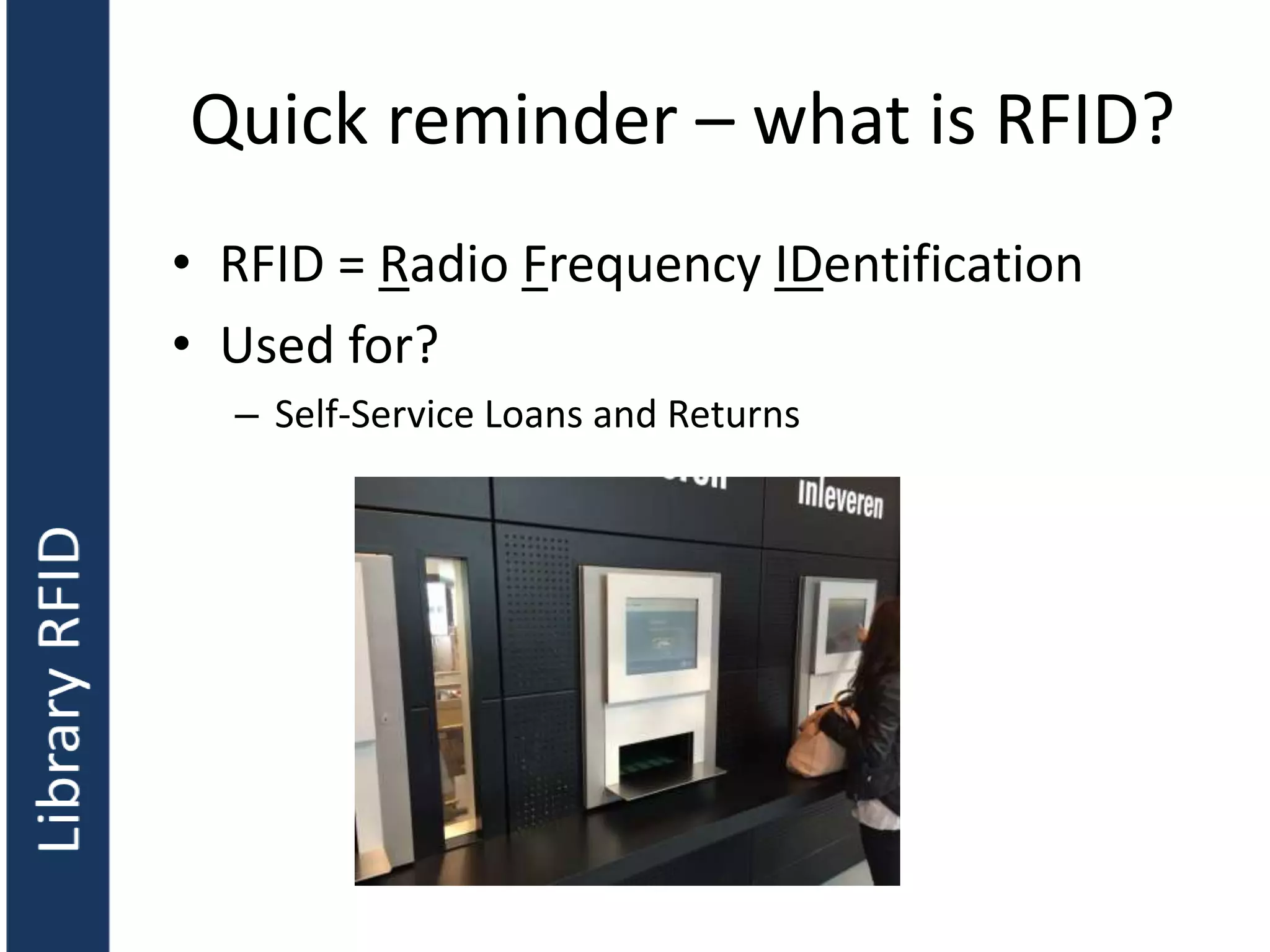
Quick reminder – what is RFID?
• RFID = Radio Frequency IDentification
• Used for?
– Self-Service Loans and Returns
But new functionality…
• Acquisition/Accession
• Borrower ID
• Collection Management
• Discovery
• E-book/physical stock integration
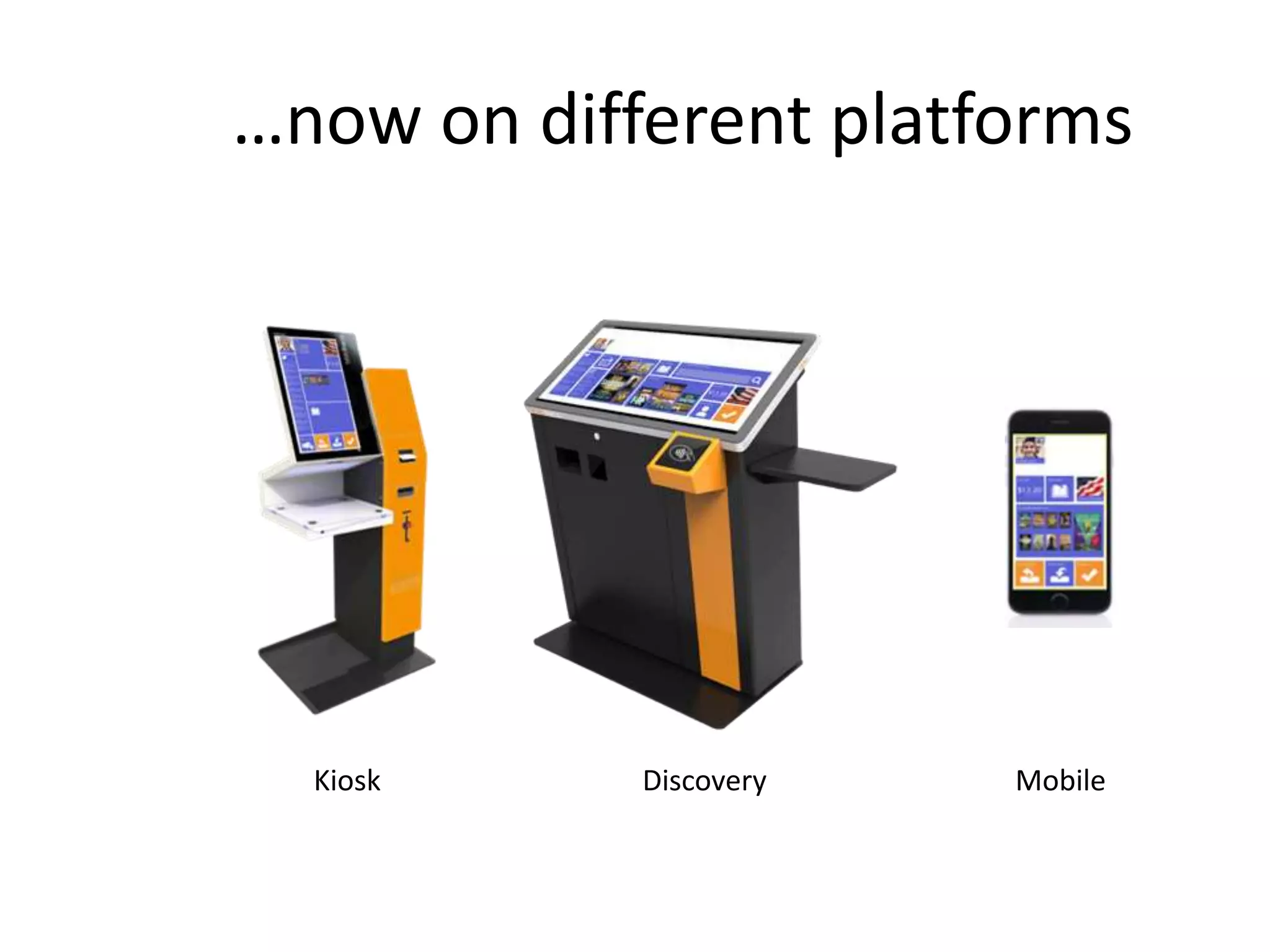
…now on different platforms
Kiosk Discovery Mobile
Current issues
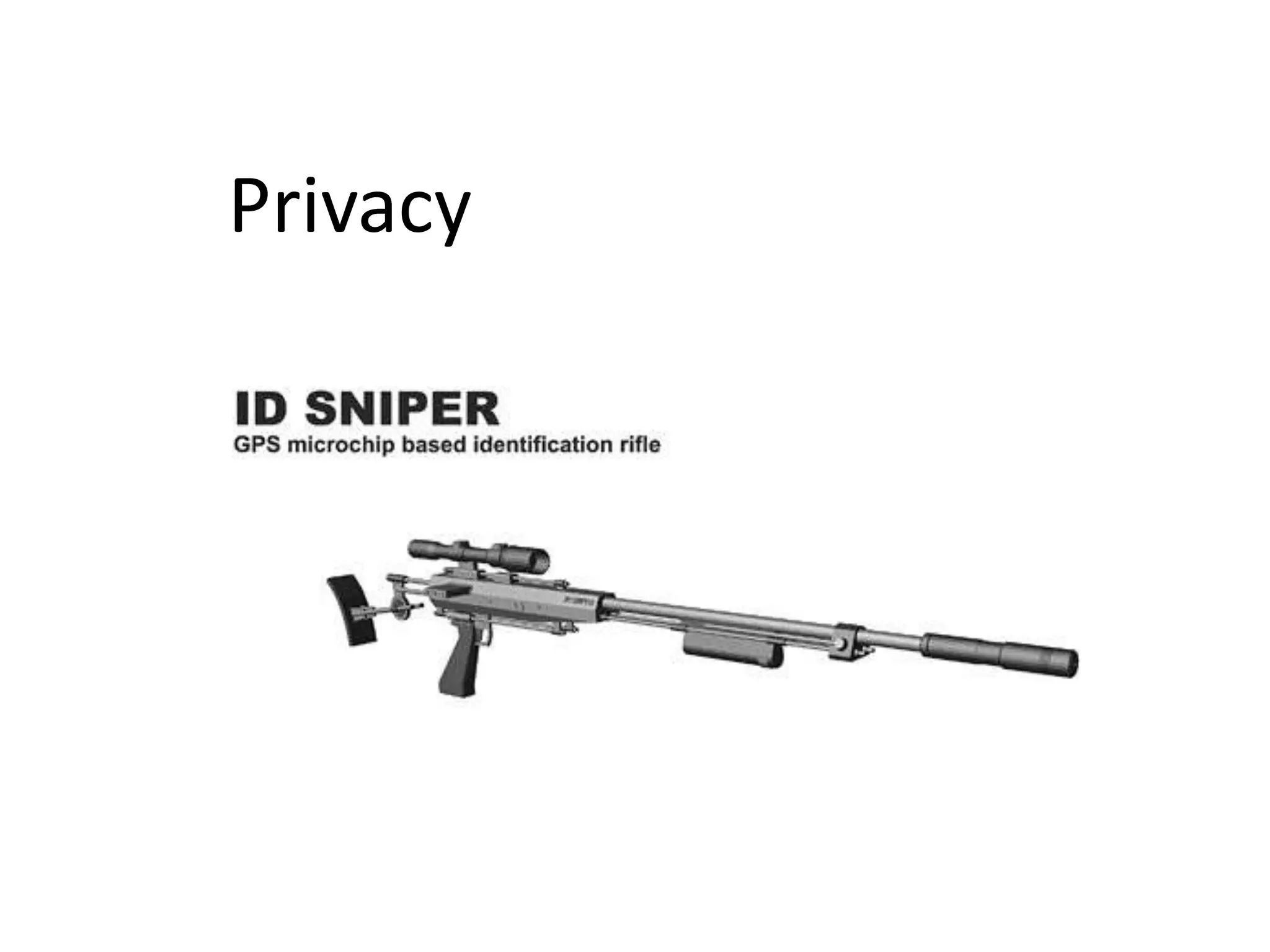
Privacy
EU Mandate M436
• Published 2008
• Made recommendations on:
– Signage
– Privacy Impact Assessments (PIA)
• Standards EN 16570 & EN16571
published in 2014 signal EU intentions for
M436.
EN 16570 & 16571
• EN 16570 – Defines type of signs to be
displayed, and privacy statement to
accompany them
• EN 16571 – Sets out criteria for carrying
out a Privacy Impact Assessment (PIA)
• Commercial companies are promoting PIA
software to librarians.
Time to panic??
RFID in the library – a case of
arrested development?
• RFID/LMS communication mostly uses a
3M protocol (called SIP) developed over
25 years ago.
• SIP is limited in scope (to loans and
returns) and is no longer being developed.
• So suppliers use APIs to develop new
services - but functionality may be lost
when systems change.
A Solution? - The BIC Library
Communication Framework (LCF)
• An industry initiative managed by BIC.
• Supported by all major UK RFID and many
LMS suppliers.
• Data “framework” of elements and values
used for communication ensures better
interoperability
• Open to everyone
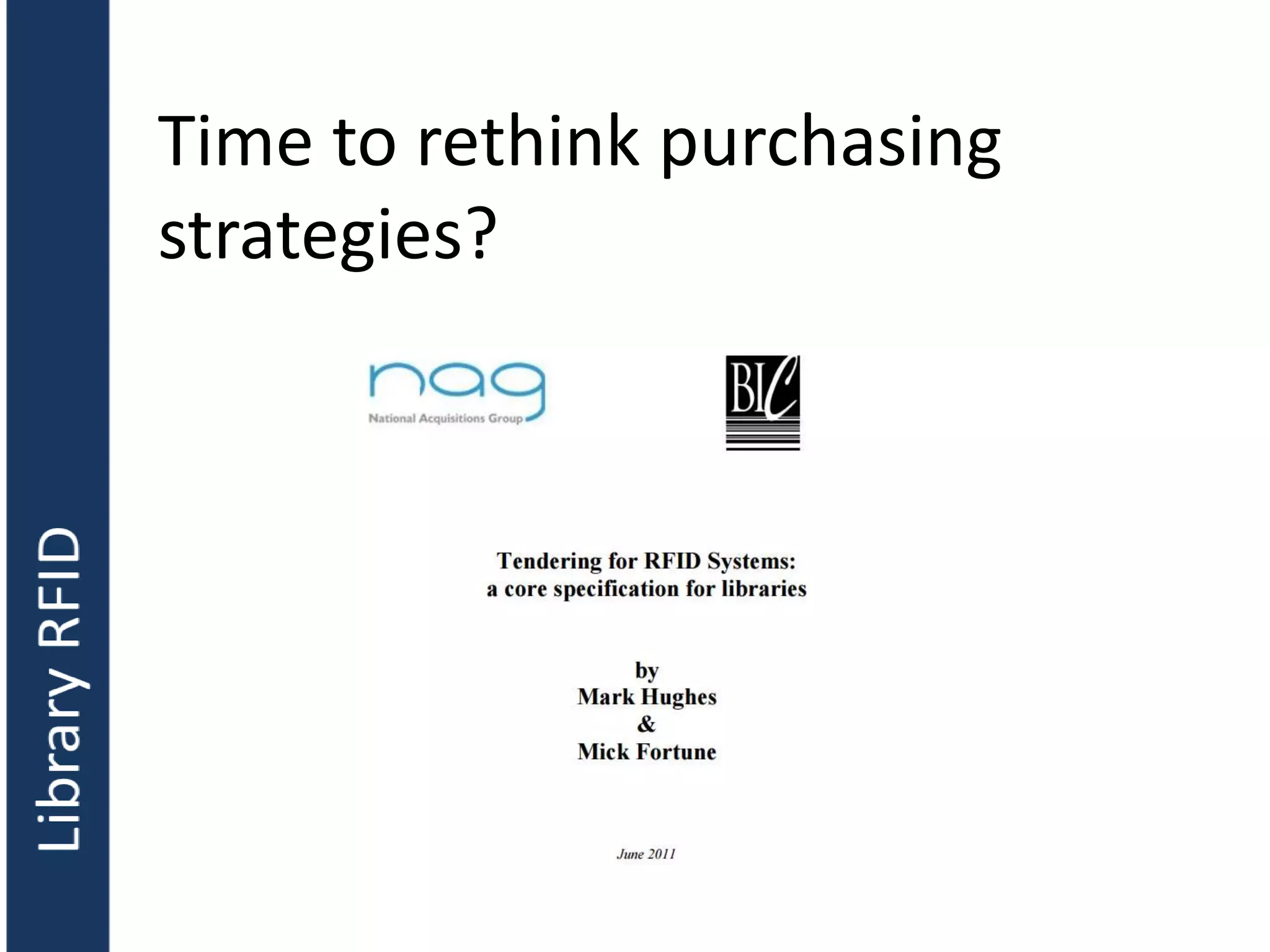
Time to rethink purchasing
strategies?
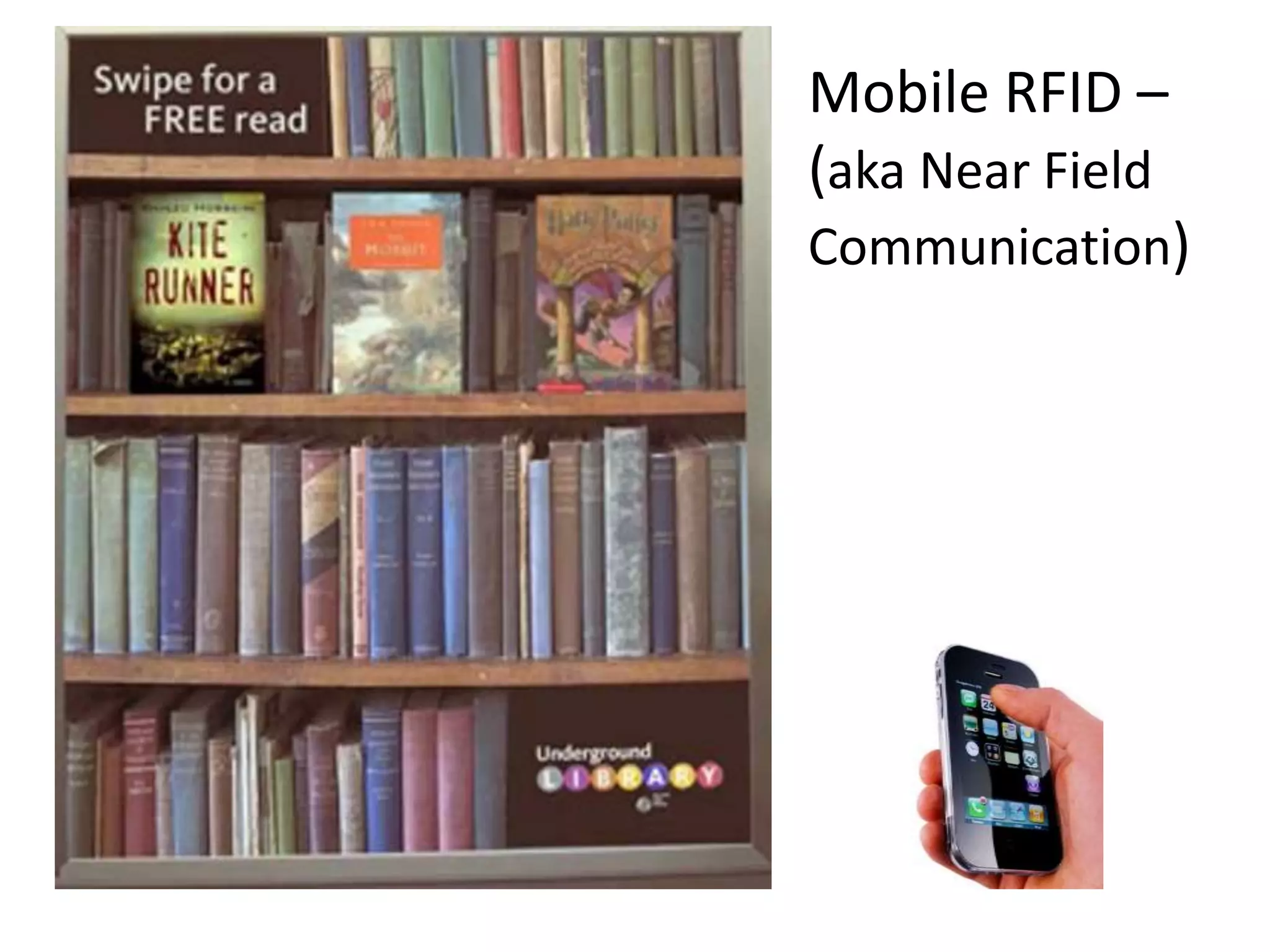
Mobile RFID –
(aka Near Field
Communication)
What can we do with NFC?
• Stock can already be linked to web
resources using RFID scanners.
• NFC enables smartphones and tablets to
do the same
• The good news – and the bad
– DIY solutions are now being developed using
freely available apps that can read and write
to library tags using phones and tablets.
Time for action?
Where to find out more
• BIC on the web - www.bic.org.uk
• Lists
– UK
(https://www.jiscmail.ac.uk/cgi-bin/webadmin?A0=LIB-RFID-
UK)
– USA
(http://listsmart.osl.state.or.us/mailman/listinfo/rfid_lib)
• Blogs – suppliers, consultants etc.
• Training workshops
Thank You!
e: mick@libraryrfid.co.uk
b: http://mickfortune.com/Wordpress
w: http://www.libraryrfid.co.uk
t: +44 7786 625544
@mickfortune
LibraryRFID

Current Issues in Library RFID

  • 1.
    Current Issues inRFID Mick Fortune May 2015
  • 2.
    Today’s Topics • Quickreminder – what is RFID? • New challenges/issues – Privacy – Communications/Interoperability – Near Field Communication (NFC)
  • 3.
    Quick reminder –what is RFID? • RFID = Radio Frequency IDentification • Used for? – Self-Service Loans and Returns
  • 4.
    But new functionality… •Acquisition/Accession • Borrower ID • Collection Management • Discovery • E-book/physical stock integration
  • 5.
    …now on differentplatforms Kiosk Discovery Mobile
  • 6.
  • 8.
  • 9.
    EU Mandate M436 •Published 2008 • Made recommendations on: – Signage – Privacy Impact Assessments (PIA) • Standards EN 16570 & EN16571 published in 2014 signal EU intentions for M436.
  • 10.
    EN 16570 &16571 • EN 16570 – Defines type of signs to be displayed, and privacy statement to accompany them • EN 16571 – Sets out criteria for carrying out a Privacy Impact Assessment (PIA) • Commercial companies are promoting PIA software to librarians.
  • 11.
  • 14.
    RFID in thelibrary – a case of arrested development? • RFID/LMS communication mostly uses a 3M protocol (called SIP) developed over 25 years ago. • SIP is limited in scope (to loans and returns) and is no longer being developed. • So suppliers use APIs to develop new services - but functionality may be lost when systems change.
  • 15.
    A Solution? -The BIC Library Communication Framework (LCF) • An industry initiative managed by BIC. • Supported by all major UK RFID and many LMS suppliers. • Data “framework” of elements and values used for communication ensures better interoperability • Open to everyone
  • 16.
    Time to rethinkpurchasing strategies?
  • 18.
    Mobile RFID – (akaNear Field Communication)
  • 19.
    What can wedo with NFC? • Stock can already be linked to web resources using RFID scanners. • NFC enables smartphones and tablets to do the same • The good news – and the bad – DIY solutions are now being developed using freely available apps that can read and write to library tags using phones and tablets.
  • 20.
  • 21.
    Where to findout more • BIC on the web - www.bic.org.uk • Lists – UK (https://www.jiscmail.ac.uk/cgi-bin/webadmin?A0=LIB-RFID- UK) – USA (http://listsmart.osl.state.or.us/mailman/listinfo/rfid_lib) • Blogs – suppliers, consultants etc. • Training workshops
  • 22.
    Thank You! e: mick@libraryrfid.co.uk b:http://mickfortune.com/Wordpress w: http://www.libraryrfid.co.uk t: +44 7786 625544 @mickfortune LibraryRFID

Editor's Notes

  • #2 Independent consultant on library systems and integration with over 30 years experience of working in or with libraries. Here today on behalf of BIC and with the support of the SCL to talk about one aspect – RFID.
  • #4 RFID has been in libraries since the 1990s and is well established as a self-service technology. RFID suppliers and librarians have been working to extend its reach since 2008 – and adopted a common data standard in 2011. Most libraries still use it for self-service loans and returns.
  • #5 But things have been steadily improving and now we use RFID for much more.
  • #6 …and across a range of platforms
  • #9 Not a new concern. US libraries were slow to adopt RFID because of privacy concerns. Many European countries established standards and best practice for RFID use – but UK libraries (and most of Europe) did not. The apparent lack of understanding of both the technology and its use in libraries – by those who were investing in it heavily - began to concern EU legislators in 2008 resulting in…
  • #10 The EU mandate was issued to European standards bodies in 2008 since then experts have been working on developing standards that will help users to meet the requirements of the mandate. EN 16570 and 16571 mark the next step in that process.
  • #11 Commercial companies are targeting libraries in the UK and elsewhere with products that will help them meet the requirements of EN16570 & 16571. These are the same companies that developed the “European Norms” in the first place.
  • #12 Not yet. The mandate is a recommendation – not a law, and was issued to standards agencies not end users. ICO has no plans for legislation at present. The mandate is a “wake-up” call to RFID users to establish best practice – and best practice will be likely to inform possible legislation. So whilst it may not be time to panic it IS time to better understand the issues. Maybe join BIC?
  • #14 It’s probably fair to say that it has long been recognised that communication between systems (LMS-LMS, LMS-RFID and RFID-RFID) is not as good as users would like. One consequence is the poor transfer of functionality when systems are changed, another is the limited development of 3rd party functionality. Librarians have been flirting with Open Source solutions and middleware to ameliorate the situation but these offer at best only a partial solution.
  • #15 Taking RFID as an example of the problem… SIP was developed for circulation and didn’t do well in meeting other challenges. Market response has been proprietary APIs and web services that only operate between two partners – i.e. bilaterally.
  • #16 BIC members have been working on a better mousetrap.
  • #17 YES! Please stop sending out the now outdated Tender guidelines written by Welsh Librarian of the Year Mark Hughes and I in 2011! All major UK RFID suppliers already support LCF. Support their efforts. Encourage your LMS supplier to make a similar commitment. Ask for LCF accreditation in system tenders.
  • #19 Near Field Communication (NFC) is another form of RFID Close range only, BUT uses same frequency as library RFID systems Already in many smartphones (including iPhone 6) Has potential for good…and bad.
  • #21 Yes! Mitigate the bad - Assess your level of risk. – Who’s accessing your stock – and why? Talk to your RFID suppliers. Join BIC? Take advantage of the good Watch for/develop new applications!
  • #22 BIC site is updated regularly. The lists provide a discussion forum for users. Blogs report new developments/issues. BIC/I run workshops on demand for librarians wanting to understand more about the technology, the opportunities it presents and the issues it raises.