Diane Bounds Learning Technologies Blogging
Goal and Objectives of Presentation a)    Define b)    Purpose? c)    Considerations d)    Practicality
Topic Definition a)    What is a blog? a)    Formal definition b)    Fun definition


Ltms510 learning technology

Editor's Notes

  • #2 My name is Diane Bounds and I will be presenting blogging as a learning technology to you today. 
  • #3 The Goal and Objective of this presentation is to define what a blog is and how it will be used to enhance student learning.  We will learn about the history of blogs,  how they became popular, how to make an effective blog, and the how to make your own blog. At the end of this presentation I hope you all have a better understanding of how and why blogs are used in today’s world.
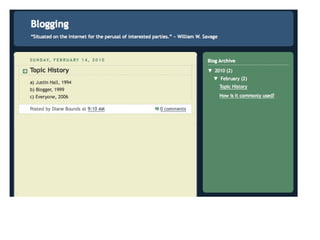
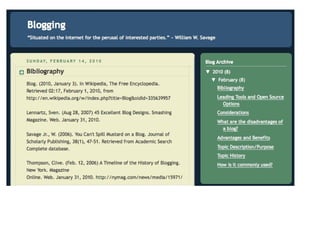
  • #4 How many of us have heard of a blog before? How many of us read blogs on a daily basis? How many of us currently have a blog we author? Blogs have been around for awhile and have become increasingly popular in today’s society.  But, not many people are familiar with the definition of what a blog is and how it came to be. There are many definitions for a blog out there, but the two I find most accurate are Wikipedia’s succinct description of “a type of website, usually maintained by an individual with regular entries of commentary, descriptions of events, or other materials such as graphics or video” and William W. Savage Jr.s  of “a contraction sans apostrophe of the words ‘Web’ and ‘log.’ The word refers to an electronic diary (some prefer to call it a journal) that one may keep, situated on the Internet for the perusal of interested parties.”
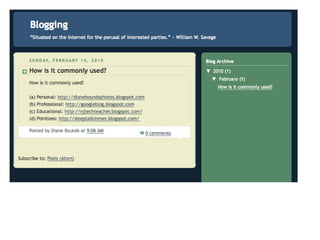
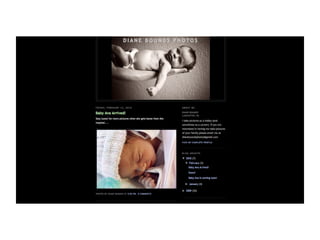
  • #5 There are many different ways to use a blog because there are many different types of “interested parties” out there. You can make a personal blog like me.  I have two personal blogs.  One for the pictures I take, and another one for the books I read.  The “interested parties”  are my friends, family and clients. Professional blogs can discuss professional opinions and information, or current events a company wants to share with you. Educational blogs can educate the reader by providing them with new information that will help them.  They can be educated on how to cut their grass, how to use a new technology, or just inspired in their profession. Finally, there are pointless blogs that some “interested party” finds meaningful.  Anyone can make a blog, so as long as there is someone out there willing to “journal,” there is probably someone out there willing to read. Does anyone have an example of a blog they read that fits any of these categories that they would like to share with the class?
  • #10 The first blog is commonly agreed to have appeared in 1994.  A student at Swathmore University created the first blog. Blogging did not, however, gain popularity for a few more years.  In 1999 Blogger developed the first popular blog-creation service that expanded the “blogging” form of journalism. Blogging gained momentum over the years because, as William W. Savage, Jr. says, “One may write about whatever one pleases, without fear of vetting, editing, or anything else destructive of one’s ego.” 
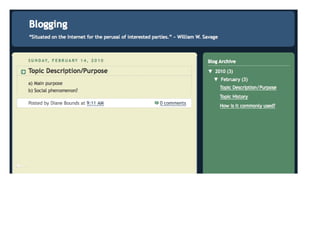
  • #11 The main purpose of a blog is to share information with other people.  This social phenomenon occurred because it is an easy way for individuals to interact, collaborate, and share information with a large group of people quickly and easily. Blogging is increasingly popular for the younger generation because they are more accustomed to sharing information online.  Today’s youth has been surrounded by technology and this type of journalism their entire life.  A child born in 1994, the year of the first blog, is now 15 years old and a freshman in high school.
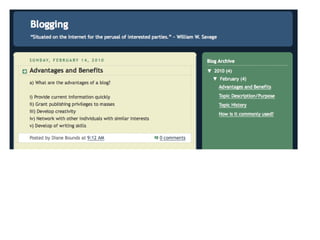
  • #12 Like all learning technologies, blogs have both advantages and disadvantages.  Their advantages are: Provide current information quickly Grant publishing privileges to the masses Develop creativity Network with other individuals Develop writing skills (you immediately see what you post and are embarrassed when you make an error)
  • #13 Disadvantages: Lacks reliable information (citations and fact checking) Grants publishing privileges to masses Development of slang terms in youth “Sharing” depends on Internet connectivity Responses and communication only occur of blogs are followed Does everyone agree with the advantages and disadvantages of blogging?  Is there anything you can add to the list?
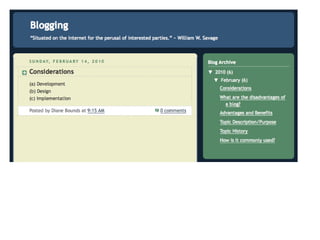
  • #14 Blogs should be designed with a specific plan.  They should have a topic and focus that is clearly stated and guides the blog. Blogs should also have a consistent and pleasing color scheme.  This scheme must fit the theme of the blog and standard principles of design apply. Blogs should be implemented by providing content that fits the development and design.  Consistency is key and design formatting is crucial.
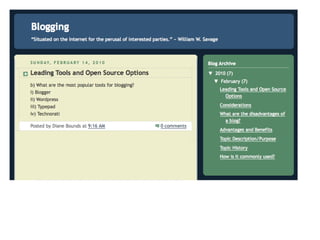
  • #15 There are quite a few tools for creating your own blog.  The three most popular are:  Blogger, Wordpress, and Typepad.  These blogs lead the competition in hosting.  They are all free and easily available to anyone online. If you would like to see a list of current blog services with examples, visit the mashable link. Technorati is a notable site affiliated with blogs.   Technorati is a blog search engine that only searches blog for specific content based on meta-tags.
  • #17 Thank you very much for your time.  I hope that this presentation was informative for the interested parties.