Groundwater sampling and
purge techniques
Acquiring a representative sample
Your Resources:
ISO Standards (5667)
GNS National Protocol
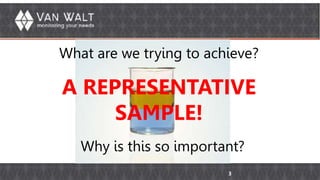
What are we trying to achieve?
3
Why is this so important?
A REPRESENTATIVE
SAMPLE!
Acquiring a representative
groundwater sample starts with?
4
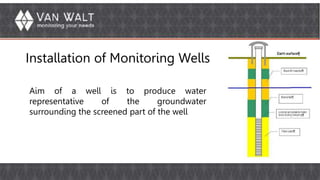
Installation of Monitoring Wells
Aim of a well is to produce water
representative of the groundwater
surrounding the screened part of the well
6
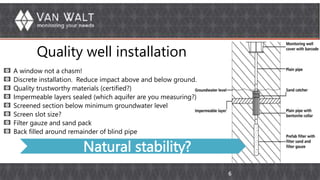
A window not a chasm!
Discrete installation. Reduce impact above and below ground.
Quality trustworthy materials (certified?)
Impermeable layers sealed (which aquifer are you measuring?)
Screened section below minimum groundwater level
Screen slot size?
Filter gauze and sand pack
Back filled around remainder of blind pipe
Natural stability?
Quality well installation
Purging Monitoring Wells Prior to Sampling
Why purge?
• To remove silty material and deposits from
the bottom of the well
• To remove stagnant oxidised water
• To attract groundwater from the aquifer!!
Three sampling methods currently in use
High flow purge
Low flow
No flow
8
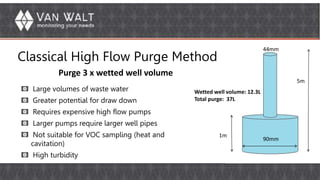
Classical High Flow Purge Method
Large volumes of waste water
Greater potential for draw down
Requires expensive high flow pumps
Larger pumps require larger well pipes
Not suitable for VOC sampling (heat and
cavitation)
High turbidity
1m
90mm
44mm
5m
Wetted well volume: 12.3L
Total purge: 37L
Purge 3 x wetted well volume
Why turbidity is so important?
If a water sample is filtered containing PAH, PCB, dioxins,
microorganisms (E. coli, Giardia) and a number of pesticides
none of these components will be found
Are we measuring soil or water?
If the sample is not filtered, above pollutions adsorb to
sediments and are finally analysed as being water pollution!
Adsorbed contaminants in suspended sediment can amplify
water analysis up to 1000 times! In soil: mg/L. In water: µg/L
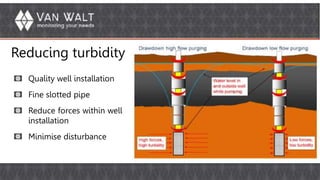
Reducing turbidity
Quality well installation
Fine slotted pipe
Reduce forces within well
installation
Minimise disturbance
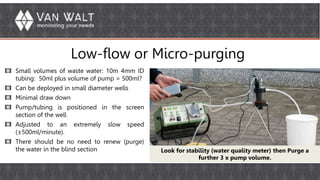
Low-flow or Micro-purging
Small volumes of waste water: 10m 4mm ID
tubing: 50ml plus volume of pump = 500ml?
Can be deployed in small diameter wells
Minimal draw down
Pump/tubing is positioned in the screen
section of the well
Adjusted to an extremely slow speed
(±500ml/minute).
There should be no need to renew (purge)
the water in the blind section Look for stability (water quality meter) then Purge a
further 3 x pump volume.
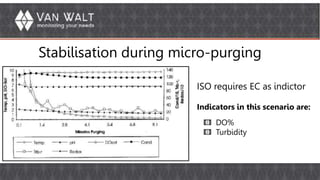
Stabilisation during micro-purging
ISO requires EC as indictor
Indicators in this scenario are:
DO%
Turbidity
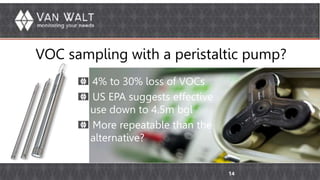
VOC sampling with a peristaltic pump?
4% to 30% loss of VOCs
US EPA suggests effective
use down to 4.5m bgl
More repeatable than the
alternative?
14
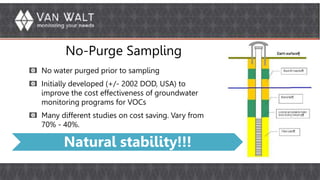
No-Purge Sampling
No water purged prior to sampling
Initially developed (+/- 2002 DOD, USA) to
improve the cost effectiveness of groundwater
monitoring programs for VOCs
Many different studies on cost saving. Vary from
70% - 40%.
Natural stability!!!
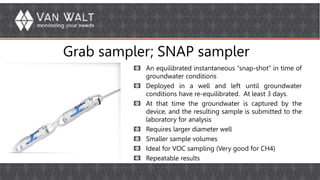
Grab sampler; SNAP sampler
An equilibrated instantaneous “snap-shot” in time of
groundwater conditions
Deployed in a well and left until groundwater
conditions have re-equilibrated. At least 3 days.
At that time the groundwater is captured by the
device, and the resulting sample is submitted to the
laboratory for analysis
Requires larger diameter well
Smaller sample volumes
Ideal for VOC sampling (Very good for CH4)
Repeatable results
Where are we heading?
More accurate results
Repeatable samples
Less time onsite
Less cost
Less disruption

low-flow-and-no-flow-sampling.pptx

  • 1.
    Groundwater sampling and purgetechniques Acquiring a representative sample
  • 2.
    Your Resources: ISO Standards(5667) GNS National Protocol
  • 3.
    What are wetrying to achieve? 3 Why is this so important? A REPRESENTATIVE SAMPLE!
  • 4.
  • 5.
    Installation of MonitoringWells Aim of a well is to produce water representative of the groundwater surrounding the screened part of the well
  • 6.
    6 A window nota chasm! Discrete installation. Reduce impact above and below ground. Quality trustworthy materials (certified?) Impermeable layers sealed (which aquifer are you measuring?) Screened section below minimum groundwater level Screen slot size? Filter gauze and sand pack Back filled around remainder of blind pipe Natural stability? Quality well installation
  • 7.
    Purging Monitoring WellsPrior to Sampling Why purge? • To remove silty material and deposits from the bottom of the well • To remove stagnant oxidised water • To attract groundwater from the aquifer!!
  • 8.
    Three sampling methodscurrently in use High flow purge Low flow No flow 8
  • 9.
    Classical High FlowPurge Method Large volumes of waste water Greater potential for draw down Requires expensive high flow pumps Larger pumps require larger well pipes Not suitable for VOC sampling (heat and cavitation) High turbidity 1m 90mm 44mm 5m Wetted well volume: 12.3L Total purge: 37L Purge 3 x wetted well volume
  • 10.
    Why turbidity isso important? If a water sample is filtered containing PAH, PCB, dioxins, microorganisms (E. coli, Giardia) and a number of pesticides none of these components will be found Are we measuring soil or water? If the sample is not filtered, above pollutions adsorb to sediments and are finally analysed as being water pollution! Adsorbed contaminants in suspended sediment can amplify water analysis up to 1000 times! In soil: mg/L. In water: µg/L
  • 11.
    Reducing turbidity Quality wellinstallation Fine slotted pipe Reduce forces within well installation Minimise disturbance
  • 12.
    Low-flow or Micro-purging Smallvolumes of waste water: 10m 4mm ID tubing: 50ml plus volume of pump = 500ml? Can be deployed in small diameter wells Minimal draw down Pump/tubing is positioned in the screen section of the well Adjusted to an extremely slow speed (±500ml/minute). There should be no need to renew (purge) the water in the blind section Look for stability (water quality meter) then Purge a further 3 x pump volume.
  • 13.
    Stabilisation during micro-purging ISOrequires EC as indictor Indicators in this scenario are: DO% Turbidity
  • 14.
    VOC sampling witha peristaltic pump? 4% to 30% loss of VOCs US EPA suggests effective use down to 4.5m bgl More repeatable than the alternative? 14
  • 15.
    No-Purge Sampling No waterpurged prior to sampling Initially developed (+/- 2002 DOD, USA) to improve the cost effectiveness of groundwater monitoring programs for VOCs Many different studies on cost saving. Vary from 70% - 40%. Natural stability!!!
  • 16.
    Grab sampler; SNAPsampler An equilibrated instantaneous “snap-shot” in time of groundwater conditions Deployed in a well and left until groundwater conditions have re-equilibrated. At least 3 days. At that time the groundwater is captured by the device, and the resulting sample is submitted to the laboratory for analysis Requires larger diameter well Smaller sample volumes Ideal for VOC sampling (Very good for CH4) Repeatable results
  • 17.
    Where are weheading? More accurate results Repeatable samples Less time onsite Less cost Less disruption