A
pi+1
oi+1
oi
pi
B
C

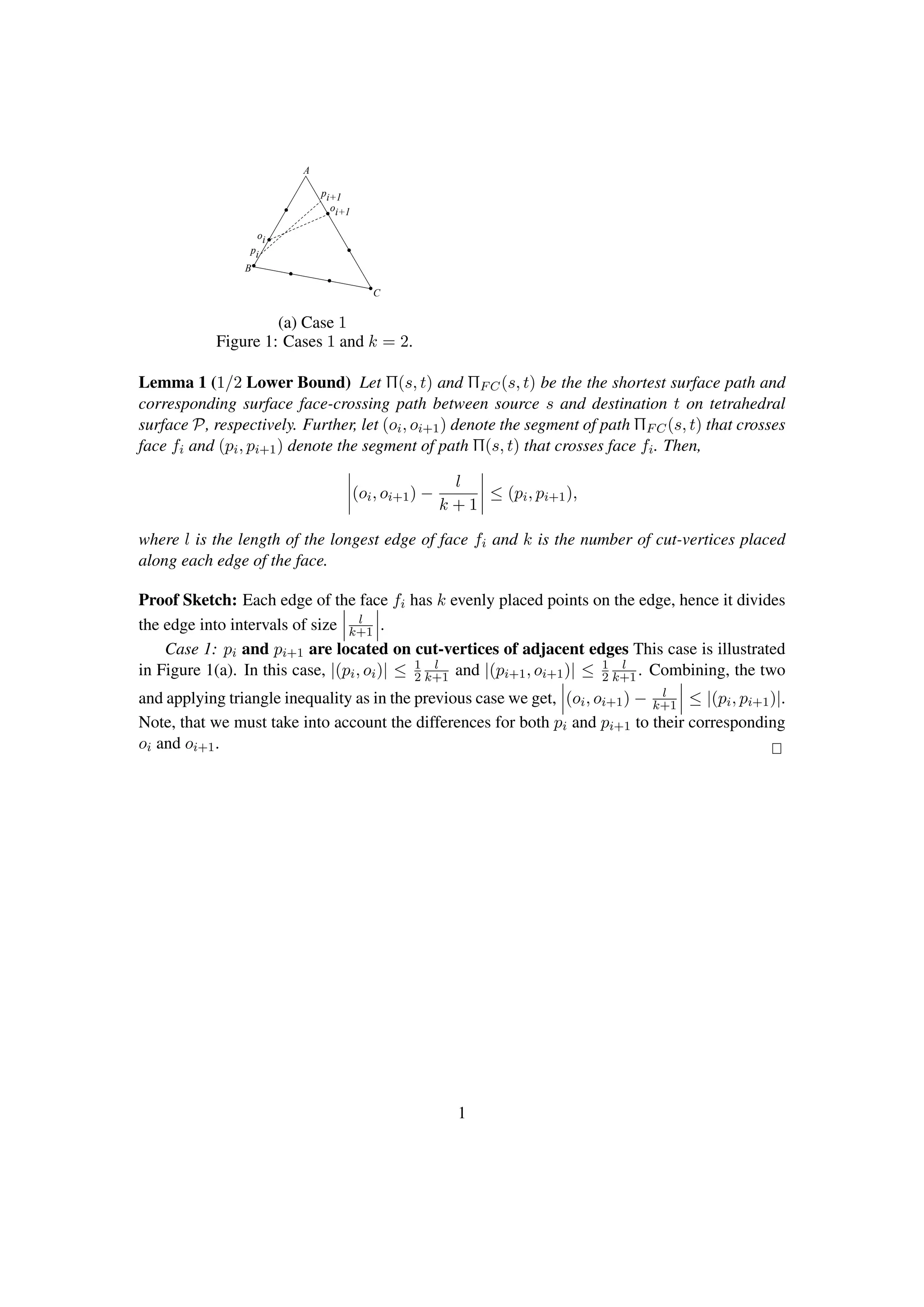
(a) Case 1
Figure 1: Cases 1 and k = 2.
Lemma 1 (1/2 Lower Bound) Let Π(s, t) and ΠF C (s, t) be the the shortest surface path and
corresponding surface face-crossing path between source s and destination t on tetrahedral
surface P, respectively. Further, let (oi , oi+1 ) denote the segment of path ΠF C (s, t) that crosses
face fi and (pi , pi+1 ) denote the segment of path Π(s, t) that crosses face fi . Then,
(oi , oi+1 ) −

l
≤ (pi , pi+1 ),
k+1

where l is the length of the longest edge of face fi and k is the number of cut-vertices placed
along each edge of the face.
Proof Sketch: Each edge of the face fi has k evenly placed points on the edge, hence it divides
l
the edge into intervals of size k+1 .
Case 1: pi and pi+1 are located on cut-vertices of adjacent edges This case is illustrated
l
l
in Figure 1(a). In this case, |(pi , oi )| ≤ 1 k+1 and |(pi+1 , oi+1 )| ≤ 1 k+1 . Combining, the two
2
2
l
and applying triangle inequality as in the previous case we get, (oi , oi+1 ) − k+1 ≤ |(pi , pi+1 )|.
Note, that we must take into account the differences for both pi and pi+1 to their corresponding
oi and oi+1 .

1

Lower Bound on Triangle

  • 1.
    A pi+1 oi+1 oi pi B C (a) Case 1 Figure1: Cases 1 and k = 2. Lemma 1 (1/2 Lower Bound) Let Π(s, t) and ΠF C (s, t) be the the shortest surface path and corresponding surface face-crossing path between source s and destination t on tetrahedral surface P, respectively. Further, let (oi , oi+1 ) denote the segment of path ΠF C (s, t) that crosses face fi and (pi , pi+1 ) denote the segment of path Π(s, t) that crosses face fi . Then, (oi , oi+1 ) − l ≤ (pi , pi+1 ), k+1 where l is the length of the longest edge of face fi and k is the number of cut-vertices placed along each edge of the face. Proof Sketch: Each edge of the face fi has k evenly placed points on the edge, hence it divides l the edge into intervals of size k+1 . Case 1: pi and pi+1 are located on cut-vertices of adjacent edges This case is illustrated l l in Figure 1(a). In this case, |(pi , oi )| ≤ 1 k+1 and |(pi+1 , oi+1 )| ≤ 1 k+1 . Combining, the two 2 2 l and applying triangle inequality as in the previous case we get, (oi , oi+1 ) − k+1 ≤ |(pi , pi+1 )|. Note, that we must take into account the differences for both pi and pi+1 to their corresponding oi and oi+1 . 1