LOOPS
Loops /
Iteration
Sometimes we need to repeat
certain things for a particular
number of times. For example, a
program has to display attendance
for every student of a class.
Here the program has to execute
the print statement for every
student. In programming, this kind
of repetition is called looping or
iteration
Loops
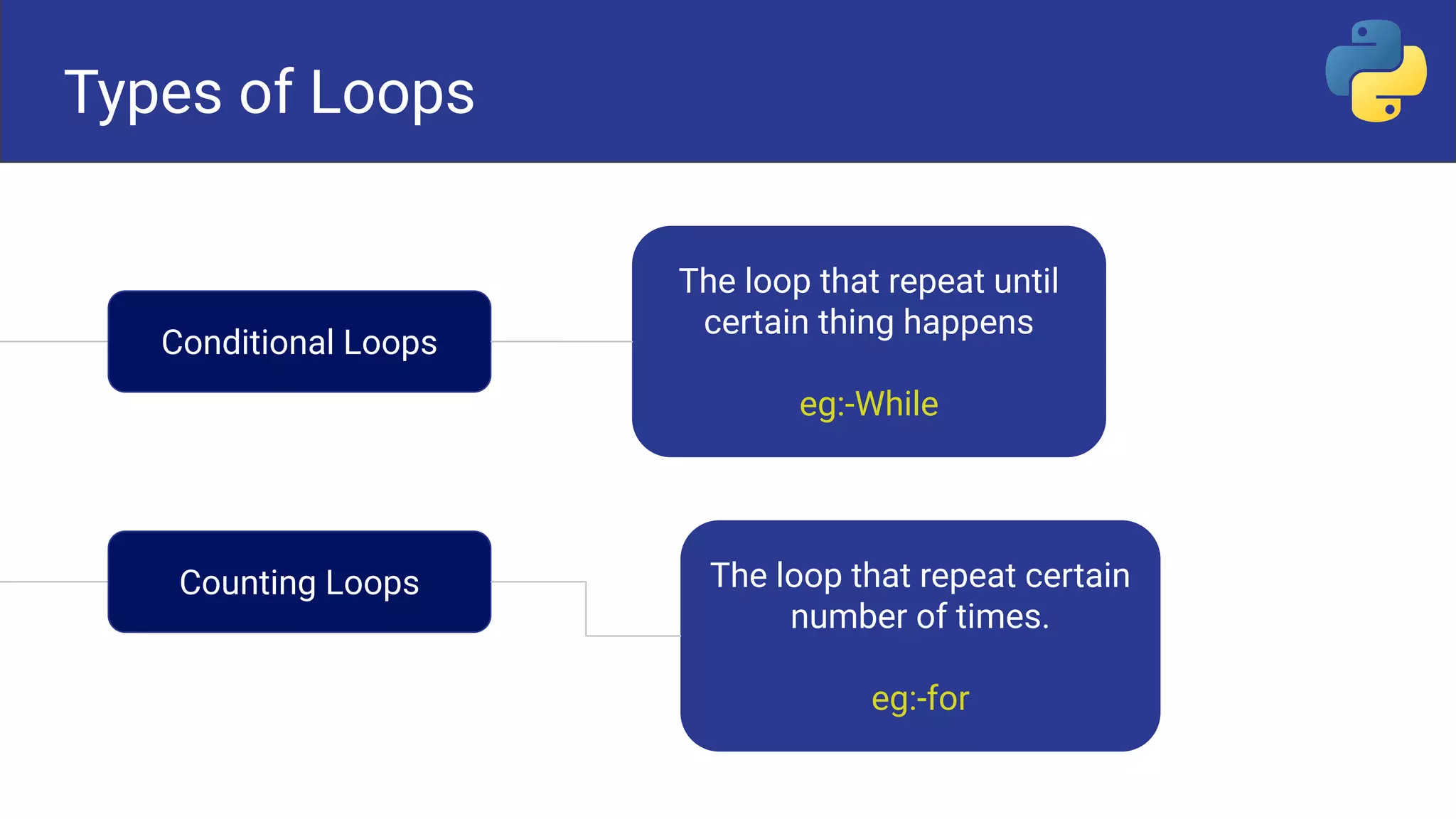
Conditional Loops
Counting Loops
The loop that repeat until
certain thing happens
eg:-While
The loop that repeat certain
number of times.
eg:-for
Types of Loops
for loop
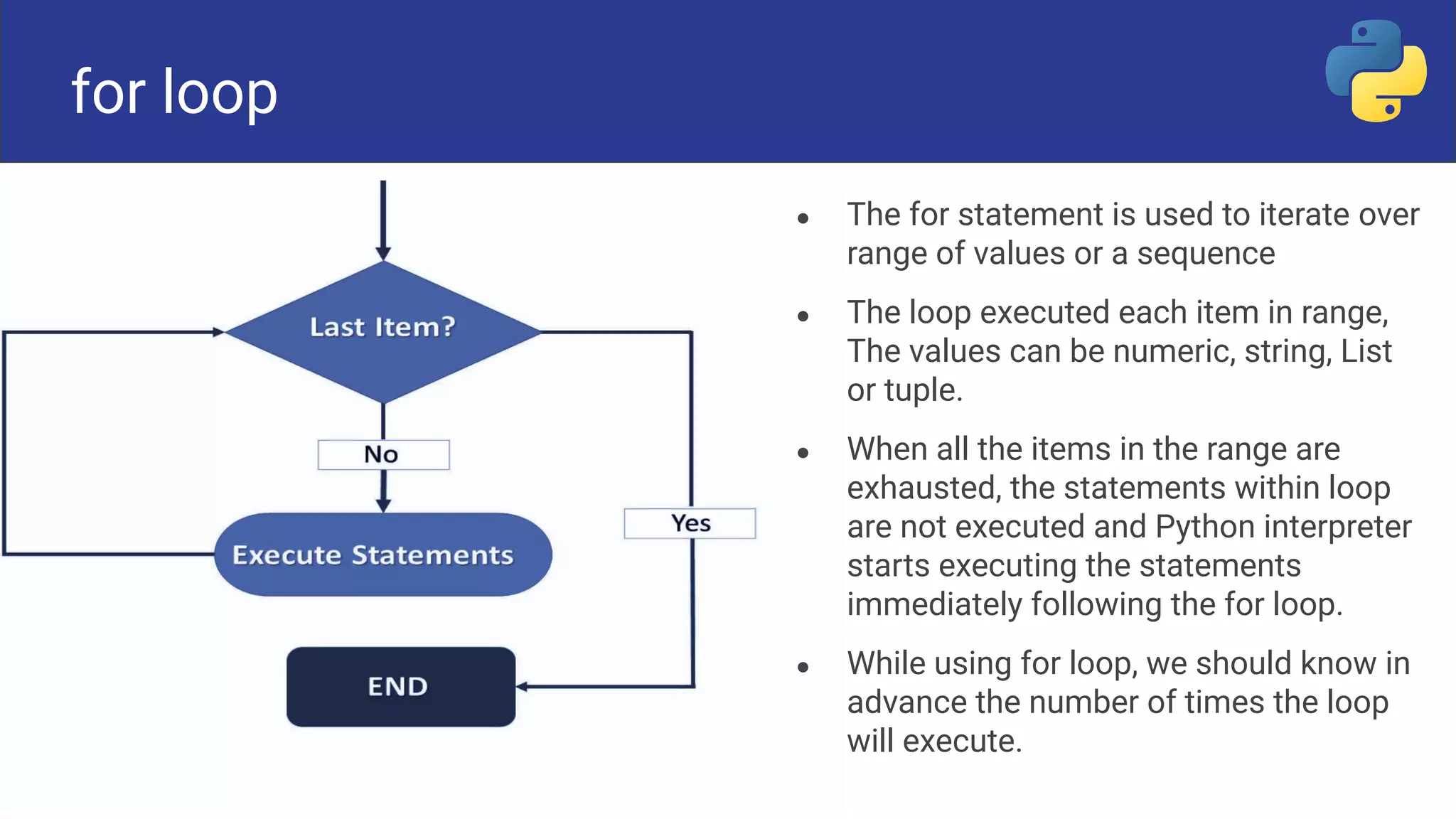
● The for statement is used to iterate over
range of values or a sequence
● The loop executed each item in range,
The values can be numeric, string, List
or tuple.
● When all the items in the range are
exhausted, the statements within loop
are not executed and Python interpreter
starts executing the statements
immediately following the for loop.
● While using for loop, we should know in
advance the number of times the loop
will execute.
for <control-variable> in <sequence/items in range>:
<statements inside body of the loop>
Eg:-
Program to print even numbers in a given sequence using for loop.
numbers = [1,2,3,4,5,6,7,8,9,10]
for num in numbers:
if (num % 2) == 0:
print(num,'is an even Number')
Output:
2 is an even Number
4 is an even Number
6 is an even Number
8 is an even Number
10 is an even Number
for loop
range()
It is used to create a list containing a
sequence of integers.
from the given start value upto stop
value(excluding stop value), with a
difference of the given step value.
If start value is not specified, by default
the list starts from 0.
If step is also not specified, by default the
value is incremented by 1 in each
iteration.
range([start], stop[, step])
Example
>>> list(range(10))
[0, 1, 2, 3, 4, 5, 6, 7, 8, 9]
#start value is given as 2
>>> list(range(2, 10))
[2, 3, 4, 5, 6, 7, 8, 9]
#step value is 5 and start value is 0
>>> list(range(0, 30, 5))
[0, 5, 10, 15, 20, 25]
#step value is -1. Hence, decreasing sequence is generated
>>> list(range(0, -9, -1))
[0, -1, -2, -3, -4, -5, -6, -7, -8]
Example
P
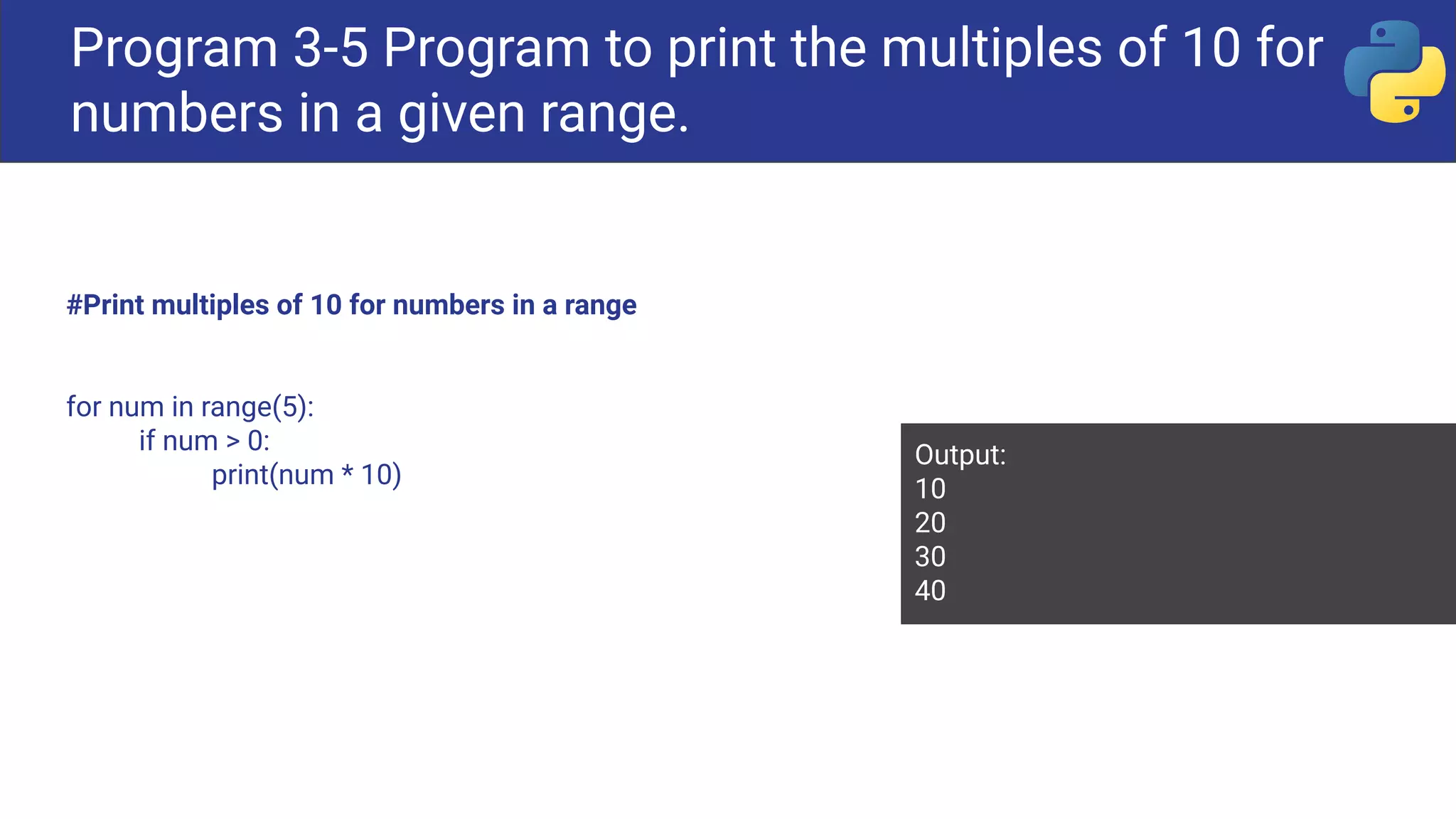
#Print multiples of 10 for numbers in a range
for num in range(5):
if num > 0:
print(num * 10)
Program 3-5 Program to print the multiples of 10 for
numbers in a given range.
Output:
10
20
30
40
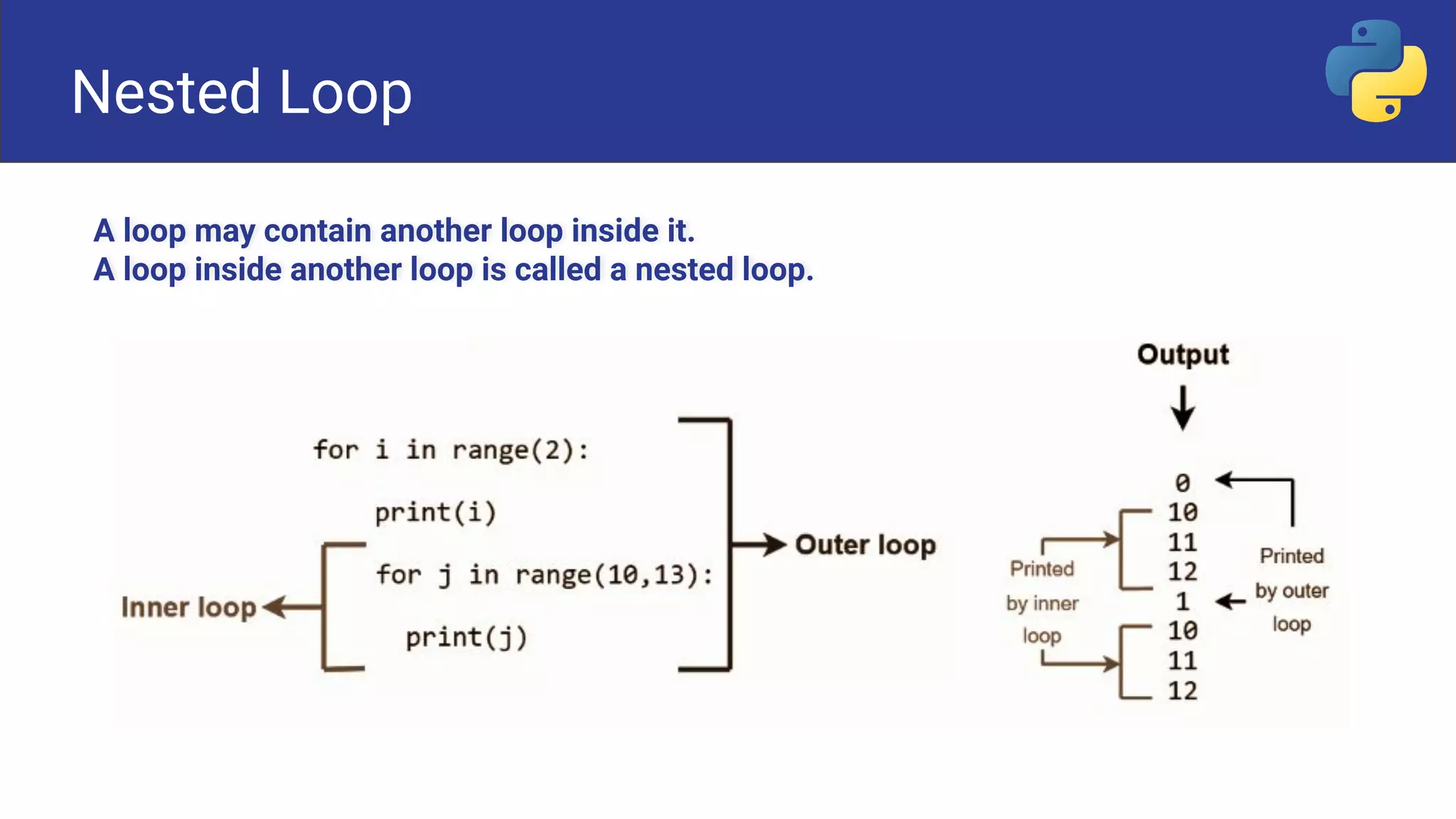
A loop may contain another loop inside it.
A loop inside another loop is called a nested loop.
Nested loop
Example
Nested Loop
Let us code..

loops python.pdf

  • 1.
  • 2.
    Loops / Iteration Sometimes weneed to repeat certain things for a particular number of times. For example, a program has to display attendance for every student of a class. Here the program has to execute the print statement for every student. In programming, this kind of repetition is called looping or iteration
  • 3.
  • 4.
    Conditional Loops Counting Loops Theloop that repeat until certain thing happens eg:-While The loop that repeat certain number of times. eg:-for Types of Loops
  • 5.
    for loop ● Thefor statement is used to iterate over range of values or a sequence ● The loop executed each item in range, The values can be numeric, string, List or tuple. ● When all the items in the range are exhausted, the statements within loop are not executed and Python interpreter starts executing the statements immediately following the for loop. ● While using for loop, we should know in advance the number of times the loop will execute.
  • 6.
    for <control-variable> in<sequence/items in range>: <statements inside body of the loop> Eg:- Program to print even numbers in a given sequence using for loop. numbers = [1,2,3,4,5,6,7,8,9,10] for num in numbers: if (num % 2) == 0: print(num,'is an even Number') Output: 2 is an even Number 4 is an even Number 6 is an even Number 8 is an even Number 10 is an even Number for loop
  • 7.
    range() It is usedto create a list containing a sequence of integers. from the given start value upto stop value(excluding stop value), with a difference of the given step value. If start value is not specified, by default the list starts from 0. If step is also not specified, by default the value is incremented by 1 in each iteration. range([start], stop[, step])
  • 8.
    Example >>> list(range(10)) [0, 1,2, 3, 4, 5, 6, 7, 8, 9] #start value is given as 2 >>> list(range(2, 10)) [2, 3, 4, 5, 6, 7, 8, 9] #step value is 5 and start value is 0 >>> list(range(0, 30, 5)) [0, 5, 10, 15, 20, 25] #step value is -1. Hence, decreasing sequence is generated >>> list(range(0, -9, -1)) [0, -1, -2, -3, -4, -5, -6, -7, -8] Example
  • 9.
    P #Print multiples of10 for numbers in a range for num in range(5): if num > 0: print(num * 10) Program 3-5 Program to print the multiples of 10 for numbers in a given range. Output: 10 20 30 40
  • 10.
    A loop maycontain another loop inside it. A loop inside another loop is called a nested loop. Nested loop Example Nested Loop
  • 11.