Future Shock?
LoopED Conference Keynote
Wellington, 2 June 2017
derek.wenmoth@core-ed.org
@dwenmoth @LoopEd_Wgt #LoopEd17
http://www.wenmoth.net
Our changing world
Our world is changing and changing rapidly.
What must we do to prepare students for living and working in the 21st
century?
How must our schools and teachers change to meet these opportunities and
challenges?
Future Shock
•“Future shock is the shattering
stress and disorientation that
we induce in individuals by
subjecting them to too much
change in too short a time.”
•Alvin Toffler
The Future…
• Food supply
• Water
• Cryogenics
• Nano-technology
• Superdiversity
• Human rights
• Poverty
• Religious intolerance
Sensors $350K
six years ago
Less than
$1000 today
http://medicalfuturist.com/googles-amazing-digital-contact-lens-can-transform-diabetes-care/
http://tellspec.com/
$325,000 per
kilo in 2013
$12 per kilo
in 2017
http://www.futurefood.org/in-vitro-meat/index_en.php
http://www.businessinsider.com/openai-vr-headset-to-teach-a-robot-how-to-stack-blocks-2017-5
Neural Lace
•“…an ultra-thin mesh that
can be implanted in the skull,
forming a collection of
electrodes capable of
monitoring brain function. It
creates an interface between
the brain and the machine”
http://www.techworld.com/big-data/what-is-neural-lace-3657074/
https://hbr.org/2015/06/beyond-automation
• In 2015 Darrell West of the
Brookings Institute wrote about
the impact of emerging
technologies on employment and
public policy in which he cites
computerized algorithms and
artificial intelligence as key
influencers of this change.
https://www.brookings.edu/wp-content/uploads/2016/06/robotwork.pdf
• “Economists may be
underestimating how fast the
robots are coming.
• Robots and intelligent machines
threaten to replace workers in
industries from finance to retail to
haulage, with more than 15 million
British jobs and 80 million in the
U.S. lost to automation.”
• BOE Chief Economist Andrew Haldane
https://www.bloomberg.com/news/articles/2017-03-01/economists-may-be-underestimating-
how-fast-the-robots-are-coming
• While automation will eliminate very few
occupations entirely in the next decade,
it will affect portions of almost all jobs to
a greater or lesser degree, depending
on the type of work they entail.
• Automation, now going beyond routine
manufacturing activities, has the
potential, as least with regard to its
technical feasibility, to transform sectors
such as healthcare and finance, which
involve a substantial share of
knowledge work.
• McKinsey Quarterly, July 2016
http://www.mckinsey.com/business-functions/digital-mckinsey/our-insights/where-machines-
could-replace-humans-and-where-they-cant-yet
• “The artificial intelligence
revolution and its impact on the
US workforce is not even on our
radar screen…
• …technology is still 50 to 100
years from displacing human
jobs.”
• US Treasury Secretary Steven Mnuchin
http://m.nzherald.co.nz/technology/news/article.cfm?c_id=5&objectid=11825496
Future Shock
•“Our technological powers
increase, but the side effects
and potential hazards also
escalate.”
•Alvin Toffler
• What would schools look like?
• How would they operate?
• What would be the focus of the curriculum?
• How would we organise the school day?
• What would teachers do?
• How would we assess learning?
• What would be the role of digital
technologies?
• What would we do differently???
But what if all of this really is true?
Change in demand for skills
35
40
45
50
55
60
65
70
1960 1970 1980 1990 2000 2006 2009
Routine manual
Nonroutine manual
Routine cognitive
Nonroutine analytic
Nonroutine interpersonal
Mean task input in percentiles of 1960 task distribution
1960 1970 1980 1990 2000 2010 2020
Source: Autor, David H. and Brendan M. Price. 2013. "The Changing Task Composition of the US Labor Market:
An Update of Autor, Levy, and Murnane (2003)." MIT Mimeograph, June.
Top ten skills
Source: Future of Jobs Report, 2016, World Economic Forum
Enterprise
Skills
Career
Management
Skills
Technical
Skills
Foundational
Skills
http://www.fya.org.au/report/the-new-work-mindset-report/
The current pace of technology
change is not expected to slow, with
increasing data use, high speed
internet access and mobility being
enhanced by new developments in
artificial intelligence, robotics,
genomics and synthetic products.
These new advances will require
rapid responses…
https://itp.nz/files/2017%20Tech%20Manifesto.pdf
https://www.wired.com/2016/01/udacity-coding-courses-guarantee-a-job-or-your-money-back/
https://ideas-ted-com.cdn.ampproject.org/c/ideas.ted.com/the-rise-of-the-useless-class/amp/
http://www.compareyourcountry.org/pisa/country/nzl
“We’re still working within the same
twentieth-century framework.
The thinking hasn’t changed. It’s just
couching what we’ve already done in
much fancier production values. It
looks cooler and more digitised, but the
underlying educational objectives have
not changed.”
Dr. Jane Gilbert
http://idealog.co.nz/etc/2015/03/educating-future-we-cant-imagine
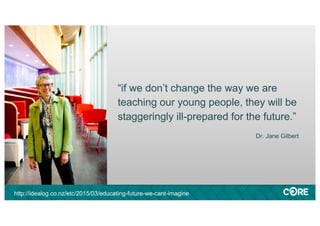
“if we don’t change the way we are
teaching our young people, they will be
staggeringly ill-prepared for the future.”
Dr. Jane Gilbert
http://idealog.co.nz/etc/2015/03/educating-future-we-cant-imagine
“If today’s problems are to be solved,
including developing an approach to
education which prepares our 21st
century students for today’s and
tomorrow’s challenges - global
uncertainty, accelerating change and
unprecedented complexity - then we
need to fundamentally change our ways
of thinking.”
Dr. Lesley Murrihy
https://www.linkedin.com/pulse/transforming-our-schools-argument-evolving-ability-think-murrihy
Toffler’s vision for schools
• Open 24 hours a day
• Customized educational experience
• Kids arrive at different times
• Students begin their formalized schooling at different ages
• Curriculum is integrated across disciplines
• Non-teachers work with teachers
• Teachers alternate working in schools and in business world
• Local businesses have offices in the schools
• Increased number of charter schools
http://www.eduleadership.org/alvin-toffler-on-the-future-of-education/
Changing paradigms
History
7000 BC 3000 AD
David Ronfeldt TIMN (Tribal, Institutional, Market, Network)
Changing nature of education provision
In the networked age, our education institutions
must shift from the existing paradigm of operating
in relative isolation (even competition) to being
more collaborative and working as a node on an
education network. Virtual learning services are
expanding internationally, with the development
of virtual schools in many countries.
The Loop has managed to survive
by redefining itself post-N4L as a
collaborative professional learning
community; previously it was
more a provider of connectivity
and technical solutions.
Thinking like a network
• What do the nodes represent? (schools,
students etc.)
• What are the links that connect the
nodes? (structural, relational etc.)
• What is activity occurring across the
network? (research, resource sharing,
teaching, learning, community connections
etc.)
Activity (or comms)
Trust is key
Source: jarche.com
Imagine… a learning city?
derek.wenmoth@core-ed.org
@dwenmoth
http://www.wenmoth.net

Loop Ed keynote

  • 1.
    Future Shock? LoopED ConferenceKeynote Wellington, 2 June 2017 derek.wenmoth@core-ed.org @dwenmoth @LoopEd_Wgt #LoopEd17 http://www.wenmoth.net
  • 2.
    Our changing world Ourworld is changing and changing rapidly. What must we do to prepare students for living and working in the 21st century? How must our schools and teachers change to meet these opportunities and challenges?
  • 3.
    Future Shock •“Future shockis the shattering stress and disorientation that we induce in individuals by subjecting them to too much change in too short a time.” •Alvin Toffler
  • 4.
    The Future… • Foodsupply • Water • Cryogenics • Nano-technology • Superdiversity • Human rights • Poverty • Religious intolerance
  • 5.
    Sensors $350K six yearsago Less than $1000 today
  • 6.
  • 7.
  • 8.
    $325,000 per kilo in2013 $12 per kilo in 2017 http://www.futurefood.org/in-vitro-meat/index_en.php
  • 9.
  • 10.
    Neural Lace •“…an ultra-thinmesh that can be implanted in the skull, forming a collection of electrodes capable of monitoring brain function. It creates an interface between the brain and the machine” http://www.techworld.com/big-data/what-is-neural-lace-3657074/
  • 11.
  • 12.
  • 13.
    • In 2015Darrell West of the Brookings Institute wrote about the impact of emerging technologies on employment and public policy in which he cites computerized algorithms and artificial intelligence as key influencers of this change. https://www.brookings.edu/wp-content/uploads/2016/06/robotwork.pdf
  • 14.
    • “Economists maybe underestimating how fast the robots are coming. • Robots and intelligent machines threaten to replace workers in industries from finance to retail to haulage, with more than 15 million British jobs and 80 million in the U.S. lost to automation.” • BOE Chief Economist Andrew Haldane https://www.bloomberg.com/news/articles/2017-03-01/economists-may-be-underestimating- how-fast-the-robots-are-coming
  • 15.
    • While automationwill eliminate very few occupations entirely in the next decade, it will affect portions of almost all jobs to a greater or lesser degree, depending on the type of work they entail. • Automation, now going beyond routine manufacturing activities, has the potential, as least with regard to its technical feasibility, to transform sectors such as healthcare and finance, which involve a substantial share of knowledge work. • McKinsey Quarterly, July 2016 http://www.mckinsey.com/business-functions/digital-mckinsey/our-insights/where-machines- could-replace-humans-and-where-they-cant-yet
  • 16.
    • “The artificialintelligence revolution and its impact on the US workforce is not even on our radar screen… • …technology is still 50 to 100 years from displacing human jobs.” • US Treasury Secretary Steven Mnuchin http://m.nzherald.co.nz/technology/news/article.cfm?c_id=5&objectid=11825496
  • 17.
    Future Shock •“Our technologicalpowers increase, but the side effects and potential hazards also escalate.” •Alvin Toffler
  • 18.
    • What wouldschools look like? • How would they operate? • What would be the focus of the curriculum? • How would we organise the school day? • What would teachers do? • How would we assess learning? • What would be the role of digital technologies? • What would we do differently??? But what if all of this really is true?
  • 19.
    Change in demandfor skills 35 40 45 50 55 60 65 70 1960 1970 1980 1990 2000 2006 2009 Routine manual Nonroutine manual Routine cognitive Nonroutine analytic Nonroutine interpersonal Mean task input in percentiles of 1960 task distribution 1960 1970 1980 1990 2000 2010 2020 Source: Autor, David H. and Brendan M. Price. 2013. "The Changing Task Composition of the US Labor Market: An Update of Autor, Levy, and Murnane (2003)." MIT Mimeograph, June.
  • 20.
    Top ten skills Source:Future of Jobs Report, 2016, World Economic Forum
  • 21.
  • 22.
    The current paceof technology change is not expected to slow, with increasing data use, high speed internet access and mobility being enhanced by new developments in artificial intelligence, robotics, genomics and synthetic products. These new advances will require rapid responses… https://itp.nz/files/2017%20Tech%20Manifesto.pdf
  • 23.
  • 24.
  • 25.
  • 26.
  • 27.
    “We’re still workingwithin the same twentieth-century framework. The thinking hasn’t changed. It’s just couching what we’ve already done in much fancier production values. It looks cooler and more digitised, but the underlying educational objectives have not changed.” Dr. Jane Gilbert http://idealog.co.nz/etc/2015/03/educating-future-we-cant-imagine
  • 28.
    “if we don’tchange the way we are teaching our young people, they will be staggeringly ill-prepared for the future.” Dr. Jane Gilbert http://idealog.co.nz/etc/2015/03/educating-future-we-cant-imagine
  • 29.
    “If today’s problemsare to be solved, including developing an approach to education which prepares our 21st century students for today’s and tomorrow’s challenges - global uncertainty, accelerating change and unprecedented complexity - then we need to fundamentally change our ways of thinking.” Dr. Lesley Murrihy https://www.linkedin.com/pulse/transforming-our-schools-argument-evolving-ability-think-murrihy
  • 30.
    Toffler’s vision forschools • Open 24 hours a day • Customized educational experience • Kids arrive at different times • Students begin their formalized schooling at different ages • Curriculum is integrated across disciplines • Non-teachers work with teachers • Teachers alternate working in schools and in business world • Local businesses have offices in the schools • Increased number of charter schools http://www.eduleadership.org/alvin-toffler-on-the-future-of-education/
  • 31.
    Changing paradigms History 7000 BC3000 AD David Ronfeldt TIMN (Tribal, Institutional, Market, Network)
  • 32.
    Changing nature ofeducation provision In the networked age, our education institutions must shift from the existing paradigm of operating in relative isolation (even competition) to being more collaborative and working as a node on an education network. Virtual learning services are expanding internationally, with the development of virtual schools in many countries.
  • 33.
    The Loop hasmanaged to survive by redefining itself post-N4L as a collaborative professional learning community; previously it was more a provider of connectivity and technical solutions.
  • 34.
    Thinking like anetwork • What do the nodes represent? (schools, students etc.) • What are the links that connect the nodes? (structural, relational etc.) • What is activity occurring across the network? (research, resource sharing, teaching, learning, community connections etc.) Activity (or comms)
  • 35.
  • 36.
  • 38.