The Intelligent Classroom Learning
Ecosystem in 2150: How AI & Big Data
Are Going to Change Everything
Ronald J. Kantor, Ph.D. - PMP – CSM
ronald.j.kantor@gmail.com
Creative Central
Laurel, Mississippi
June 18, 2019
Organization
• Purpose of this session
• Background
• Personal
• NASA’s Electronic Classroom
of the 21st Century
• Things are Moving Fast: Some
Reflections
• Big Data & Why its Relevant
• What is AI? Some key
definitions
• What is AI really good at?
• What AI cannot
manifest…yet?
• Workforce development
Looking at future skills in an
AI world
• Framework of Design
Principles:
• Connectedness
• Datacentric
• Personalized
• Authenticity
• Construction (curation &
accretion)
• What’s next
• Chinese contribution
• American education re-asserts
itself
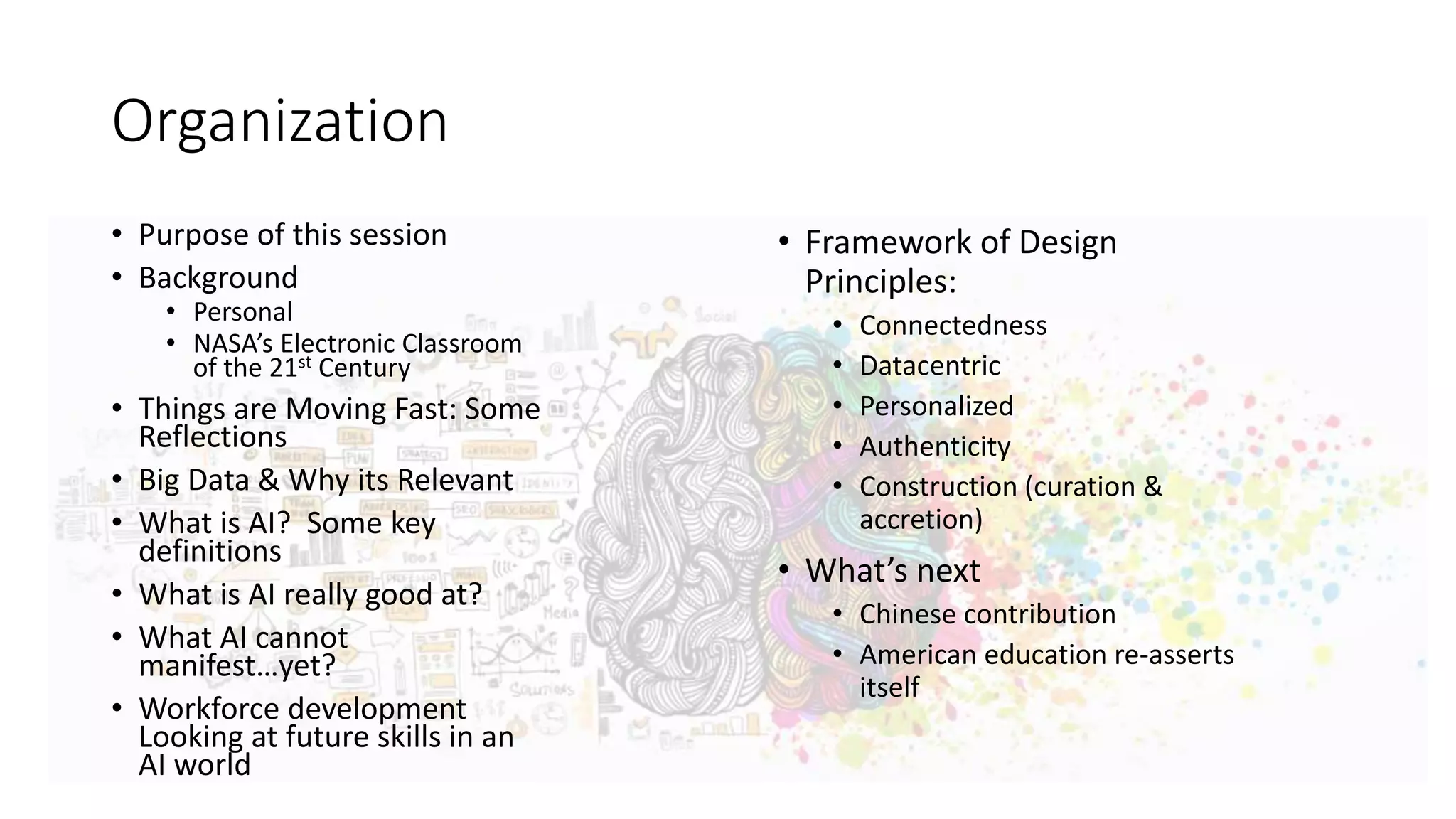
Background
Brooklyn Bred
Bard – SAIC – Vanderbilt U
HS English – Drama – TV Teacher
Member of Cognition & Tech Group
NASA Faculty Fellow – Instructional Tech
Professor at U of Houston
Accenture – Senior Learning Architect
BoA – Sr VP - Manager of D & D
OUSDI – DoD – Strategic Management
Consultant
N2N Services – Director of Learning Innovation
Independent L&D Consultant working with Ed
Tech Start Ups…over 30 companies
Faculty & Continuous Improvement Lead for
IQ$ & Cybersecurity Workforce Alliance’s
Virtual Mentoring Program
Volunteer Work
Member of NCVA Executive Board
Match Judge for World Finals of FTC
Robotics’ Competition
Some Recent Publications….
China’s Promising Ed Tech Market: Understanding Its Growth and Innovative Orientation
Chinese Ed Tech Companies Take Off: A Perfect Storm of Opportunity & Growth
China’s Burgeoning EdTech Industry: Will It Disrupt Corporate HR?
HR Column for The Bangkok Post (2017-2018
Five articles focusing on use of AI,
VR & AR for Corporate Human Resources.
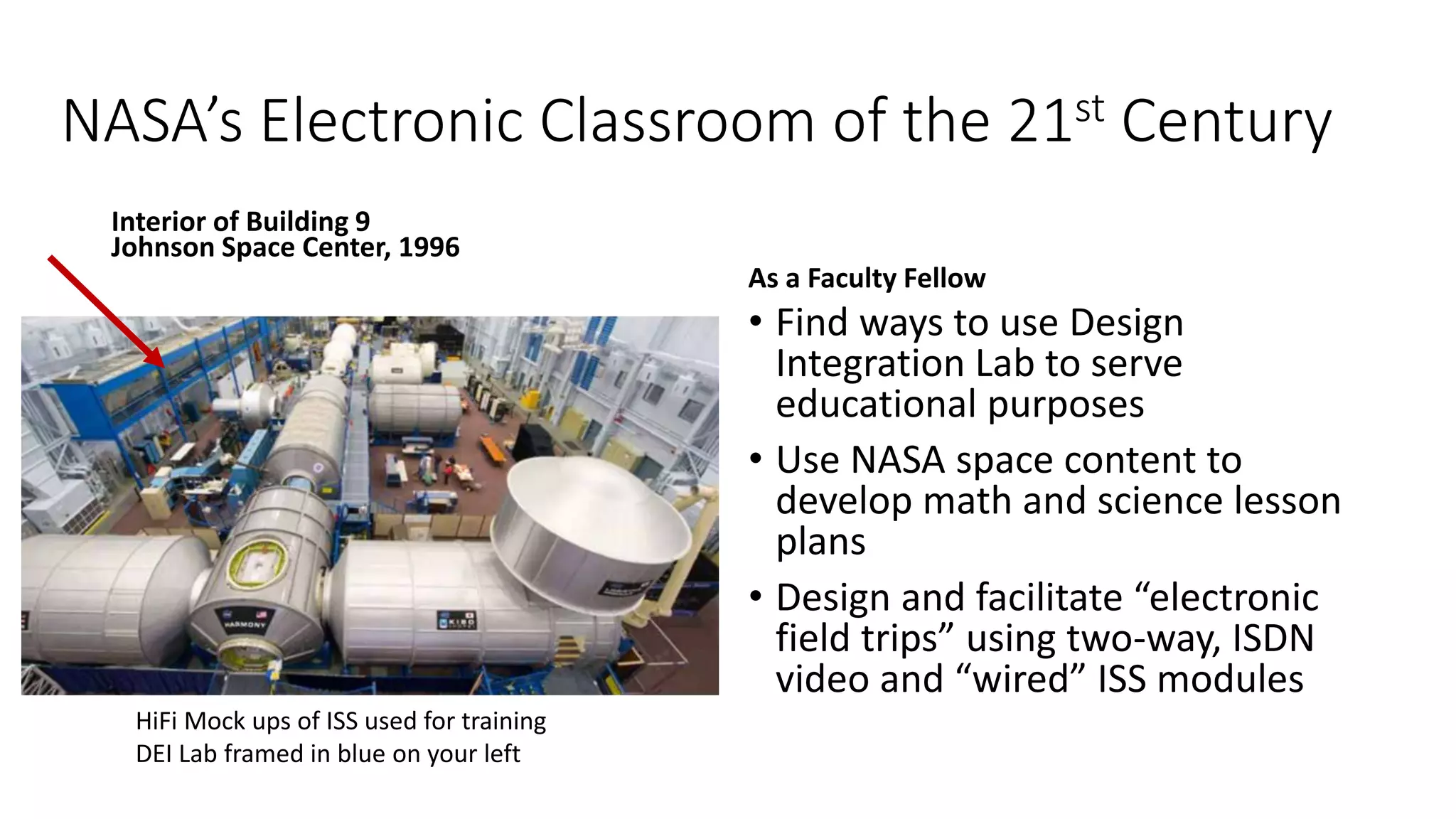
NASA’s Electronic Classroom of the 21st Century
Interior of Building 9
Johnson Space Center, 1996
As a Faculty Fellow
• Find ways to use Design
Integration Lab to serve
educational purposes
• Use NASA space content to
develop math and science lesson
plans
• Design and facilitate “electronic
field trips” using two-way, ISDN
video and “wired” ISS modules
HiFi Mock ups of ISS used for training
DEI Lab framed in blue on your left
NASA’s Electronic Classroom of the Future
• Some features and functions
• Interactive television (ISDN) &
audio conferencing
• Use astronauts as instructors
broadcasting from within the hi
fidelity mock ups
• Shared problem solving &
collaboration
• Access to expert networks using
chat, listservs and discussion
groups
• Access to NASA instructional
videos (one way)
• Key Innovative Concept:
• Why separate distance learning
technology & delivery types from
traditional classroom settings?
• Key Policy Intention:
• Use distance learning technology
to provide access to those who are
removed from quality
instructional resources, but
enhance traditional classroom by
deploying distance learning
technologies.
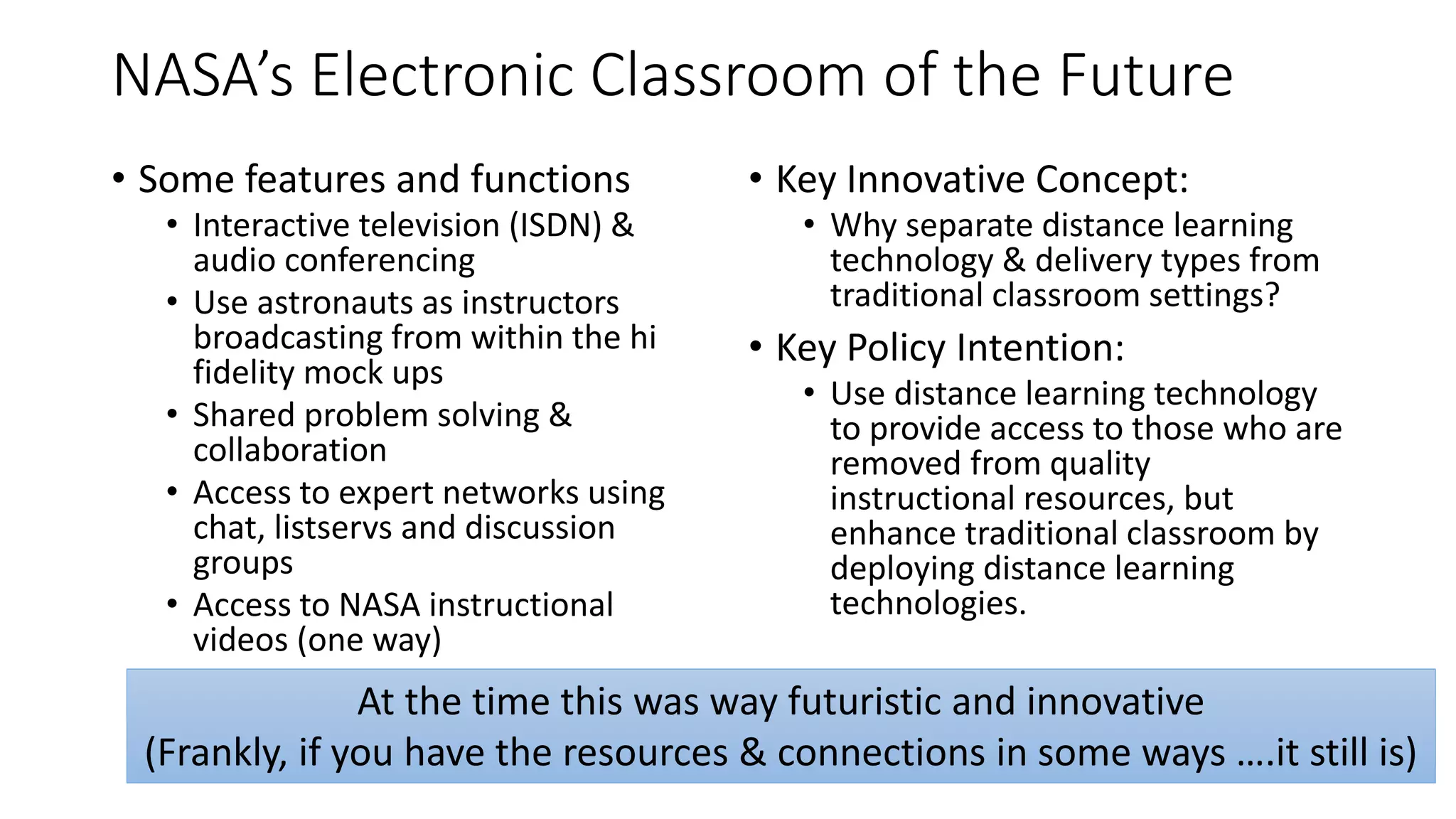
At the time this was way futuristic and innovative
(Frankly, if you have the resources & connections in some ways ….it still is)
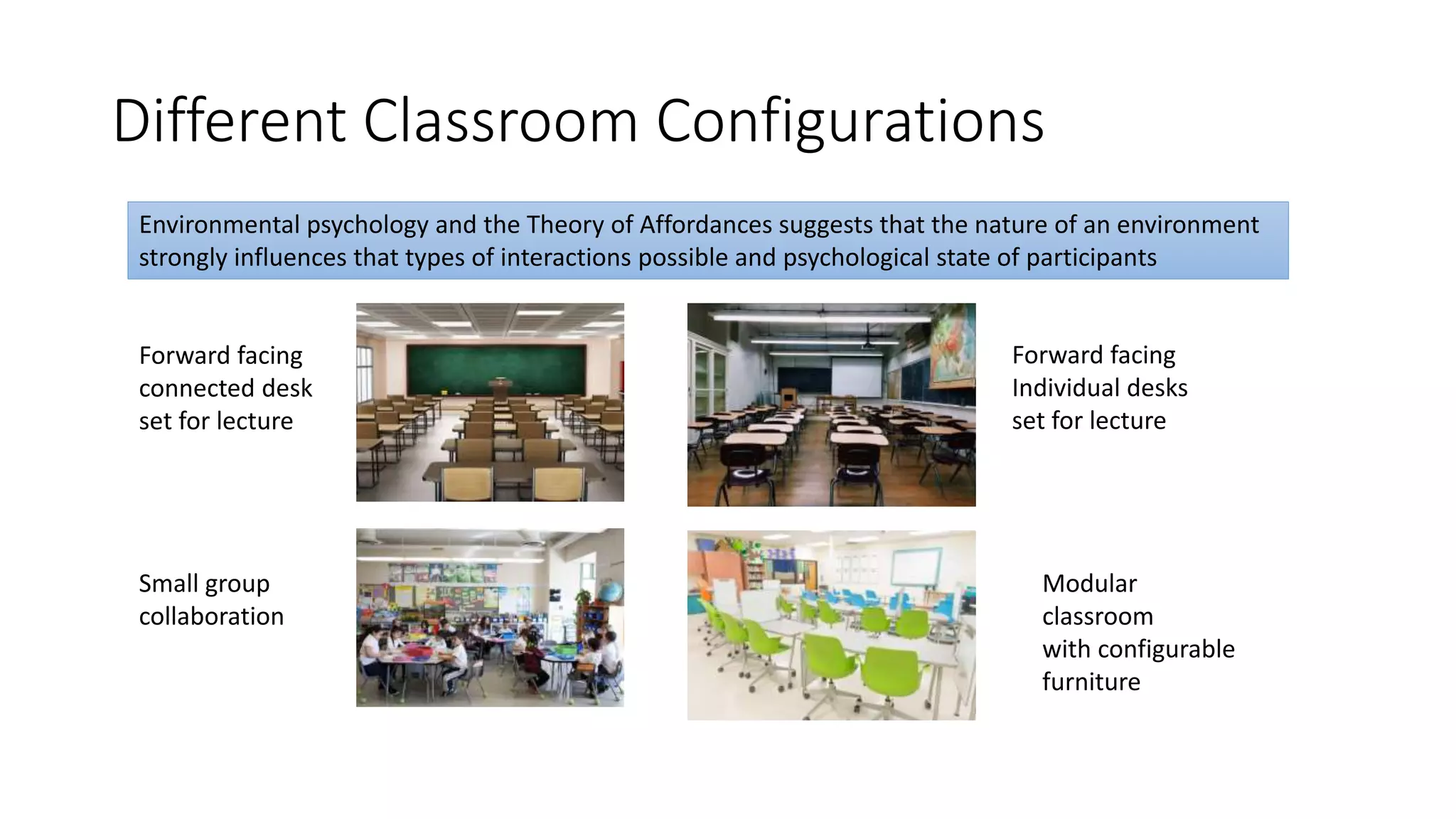
Different Classroom Configurations
Forward facing
connected desk
set for lecture
Forward facing
Individual desks
set for lecture
Small group
collaboration
Modular
classroom
with configurable
furniture
Environmental psychology and the Theory of Affordances suggests that the nature of an environment
strongly influences that types of interactions possible and psychological state of participants
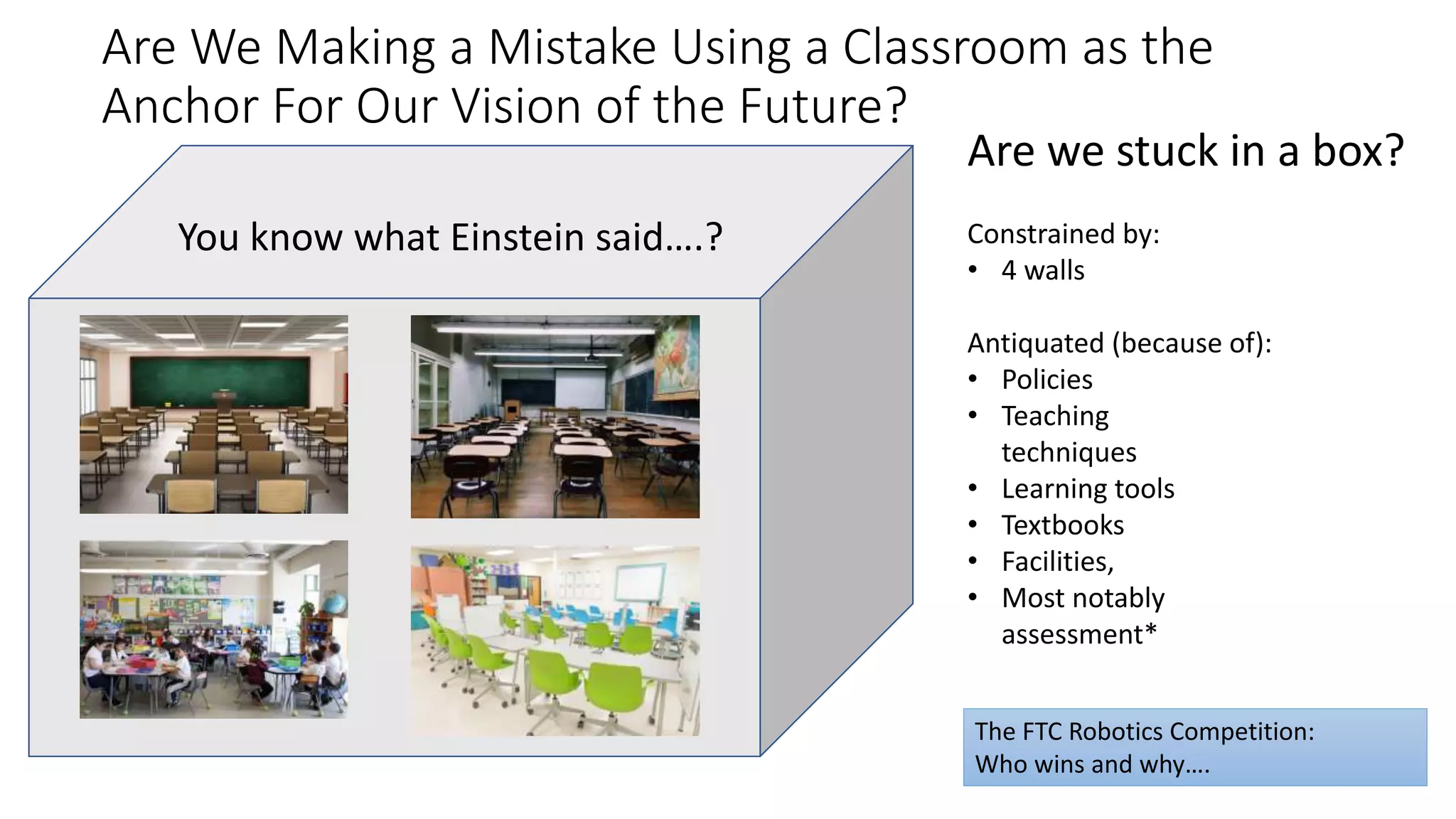
Are We Making a Mistake Using a Classroom as the
Anchor For Our Vision of the Future?
Why or why not?You know what Einstein said….?
Are we stuck in a box?
Constrained by:
• 4 walls
Antiquated (because of):
• Policies
• Teaching
techniques
• Learning tools
• Textbooks
• Facilities,
• Most notably
assessment*
The FTC Robotics Competition:
Who wins and why….
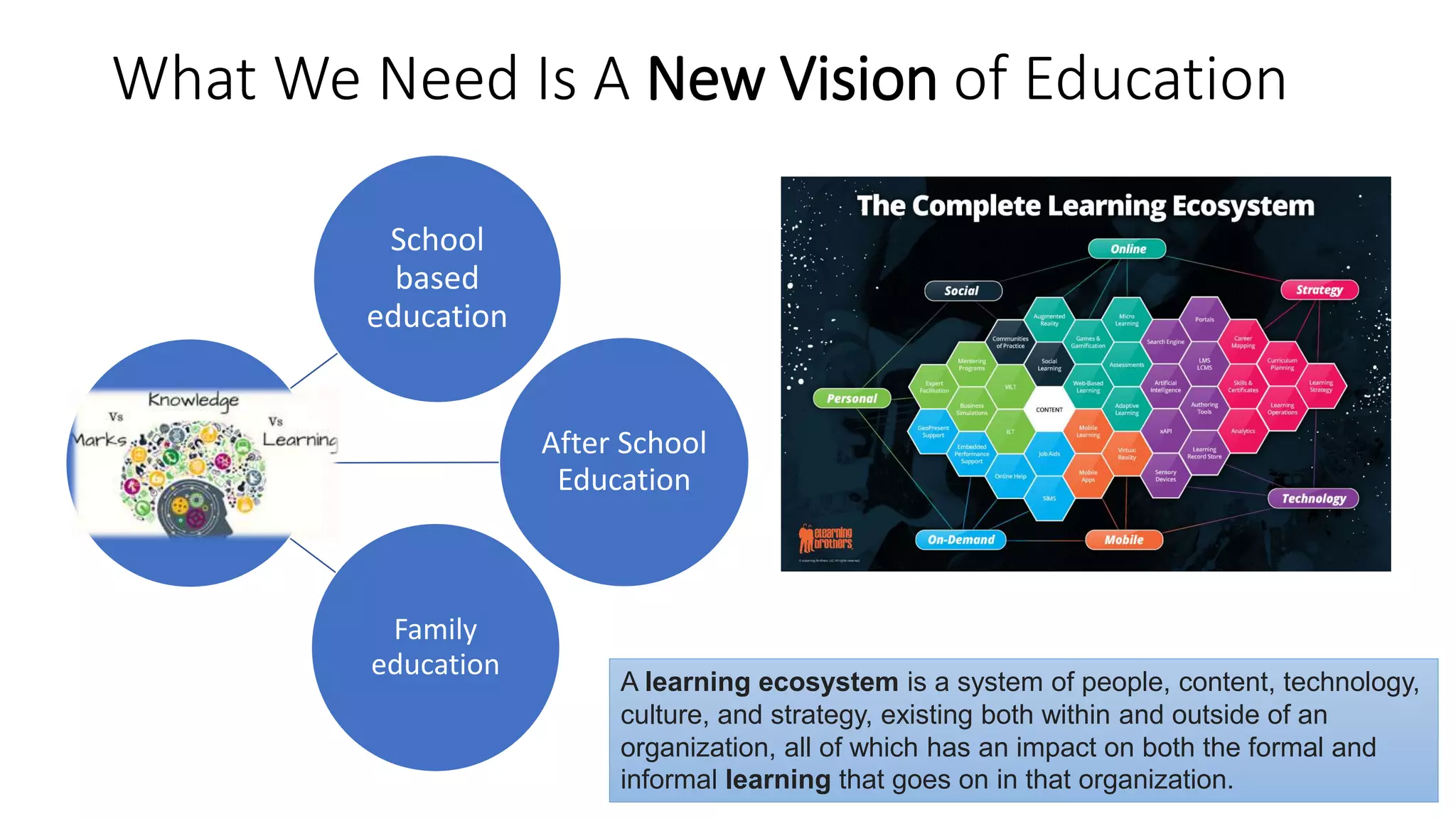
What We Need Is A New Vision of Education
School
based
education
After School
Education
Family
education
A learning ecosystem is a system of people, content, technology,
culture, and strategy, existing both within and outside of an
organization, all of which has an impact on both the formal and
informal learning that goes on in that organization.
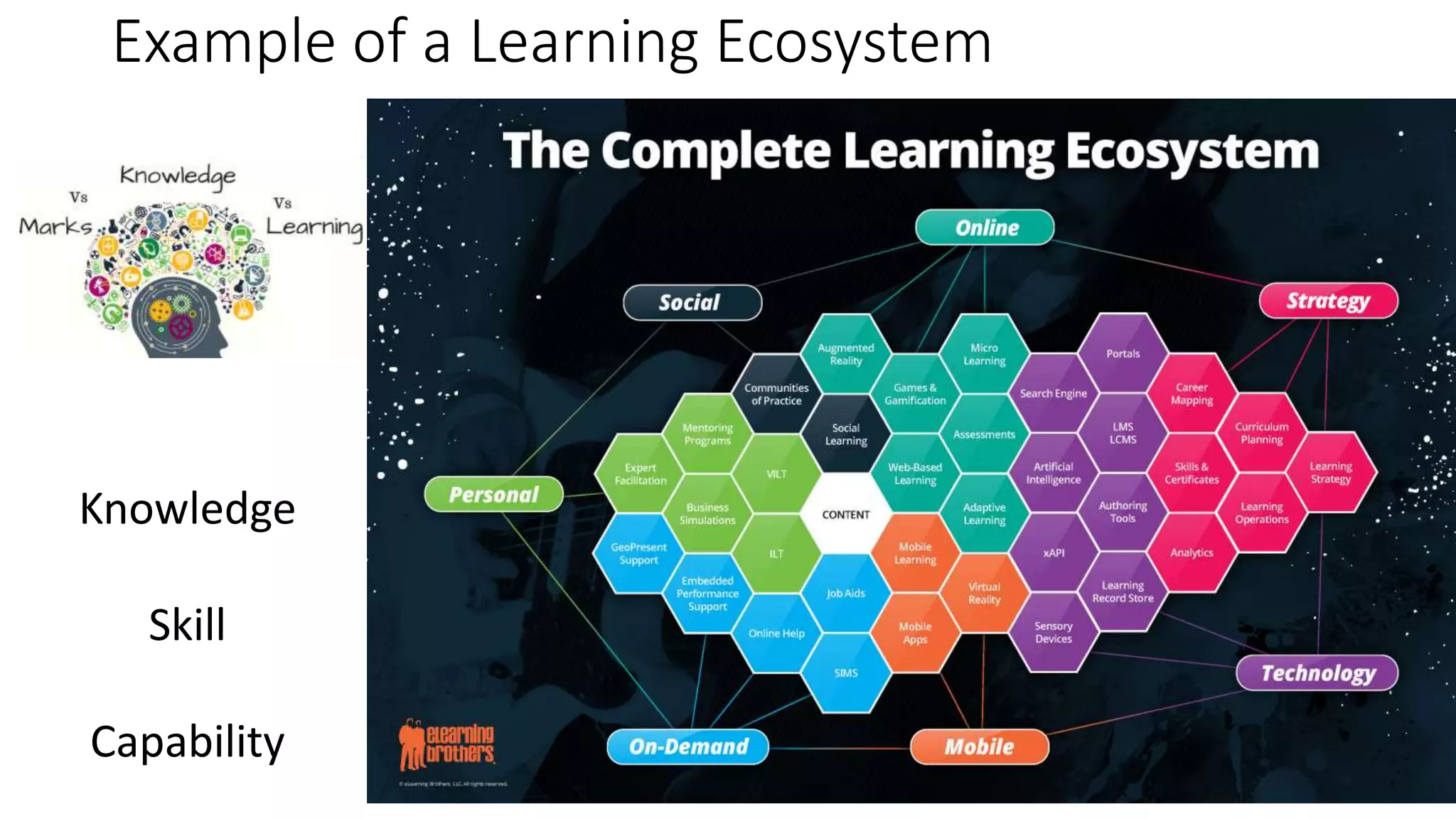
Example of a Learning Ecosystem
Knowledge
Skill
Capability
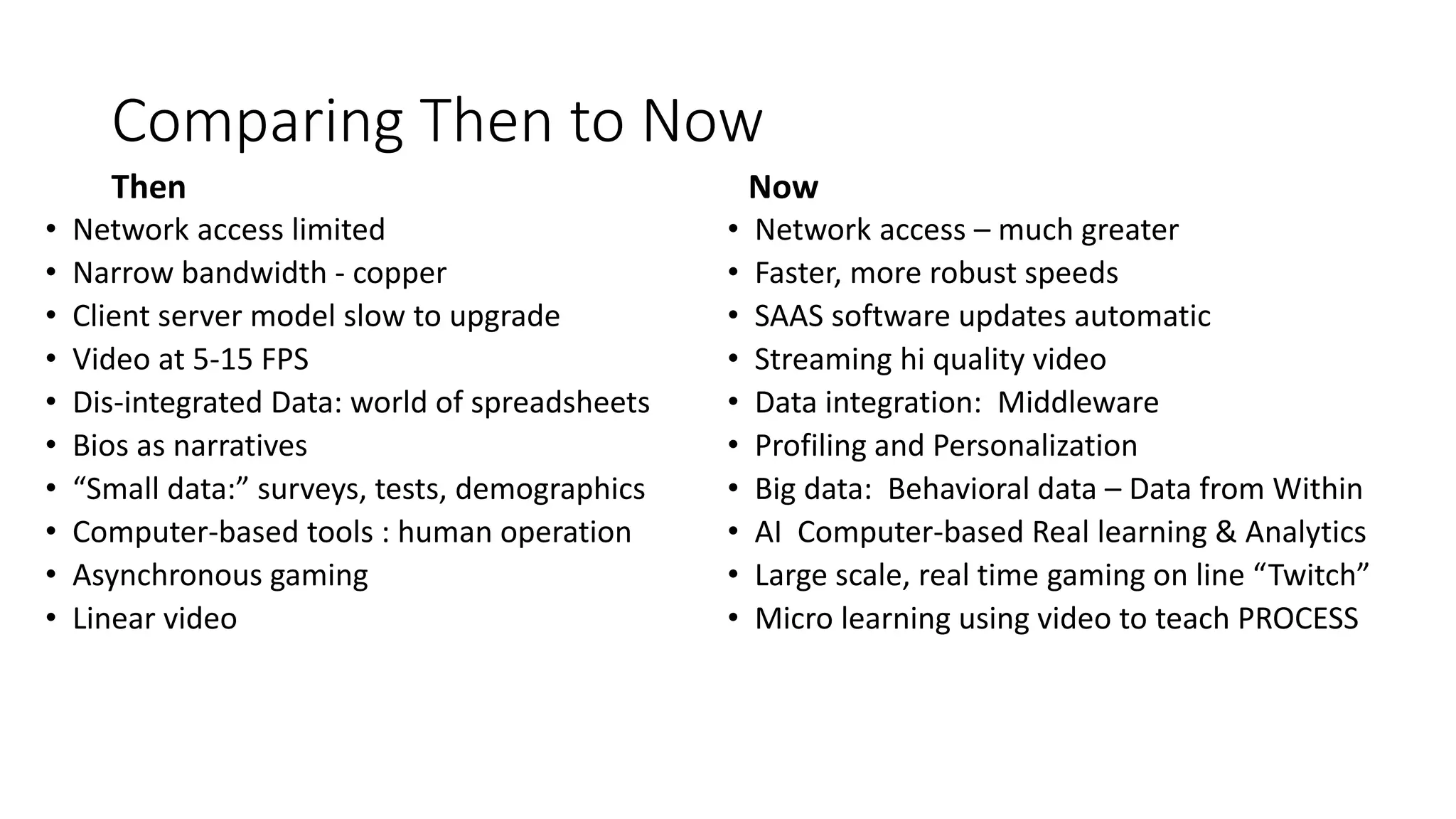
Comparing Then to Now
Then
• Network access limited
• Narrow bandwidth - copper
• Client server model slow to upgrade
• Video at 5-15 FPS
• Dis-integrated Data: world of spreadsheets
• Bios as narratives
• “Small data:” surveys, tests, demographics
• Computer-based tools : human operation
• Asynchronous gaming
• Linear video
Now
• Network access – much greater
• Faster, more robust speeds
• SAAS software updates automatic
• Streaming hi quality video
• Data integration: Middleware
• Profiling and Personalization
• Big data: Behavioral data – Data from Within
• AI Computer-based Real learning & Analytics
• Large scale, real time gaming on line “Twitch”
• Micro learning using video to teach PROCESS
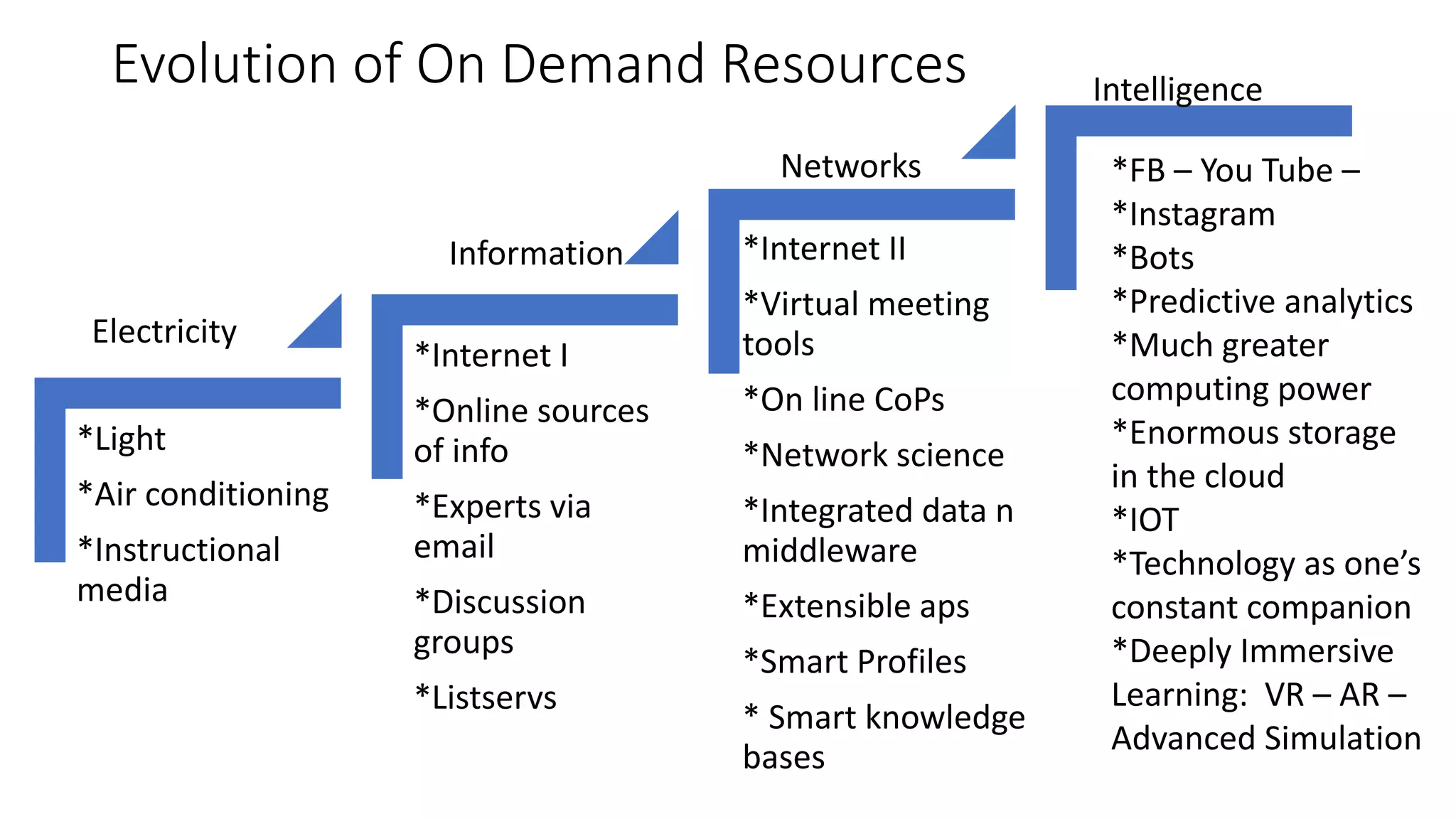
Evolution of On Demand Resources
*Light
*Air conditioning
*Instructional
media
*Internet I
*Online sources
of info
*Experts via
email
*Discussion
groups
*Listservs
*Internet II
*Virtual meeting
tools
*On line CoPs
*Network science
*Integrated data n
middleware
*Extensible aps
*Smart Profiles
* Smart knowledge
bases
Intelligence
Networks
Information
Electricity
*FB – You Tube –
*Instagram
*Bots
*Predictive analytics
*Much greater
computing power
*Enormous storage
in the cloud
*IOT
*Technology as one’s
constant companion
*Deeply Immersive
Learning: VR – AR –
Advanced Simulation
Intelligence “On
Demand”?
• Computer power
• Storage
• Reduced cost for more power,
functionality and storage
• Technology as a constant
companion
• Mysterious nature of data exchange
• You give me your personal data and I’ll
give you functionality for free or less
cost
Things Are Moving Fast: Some Reflections
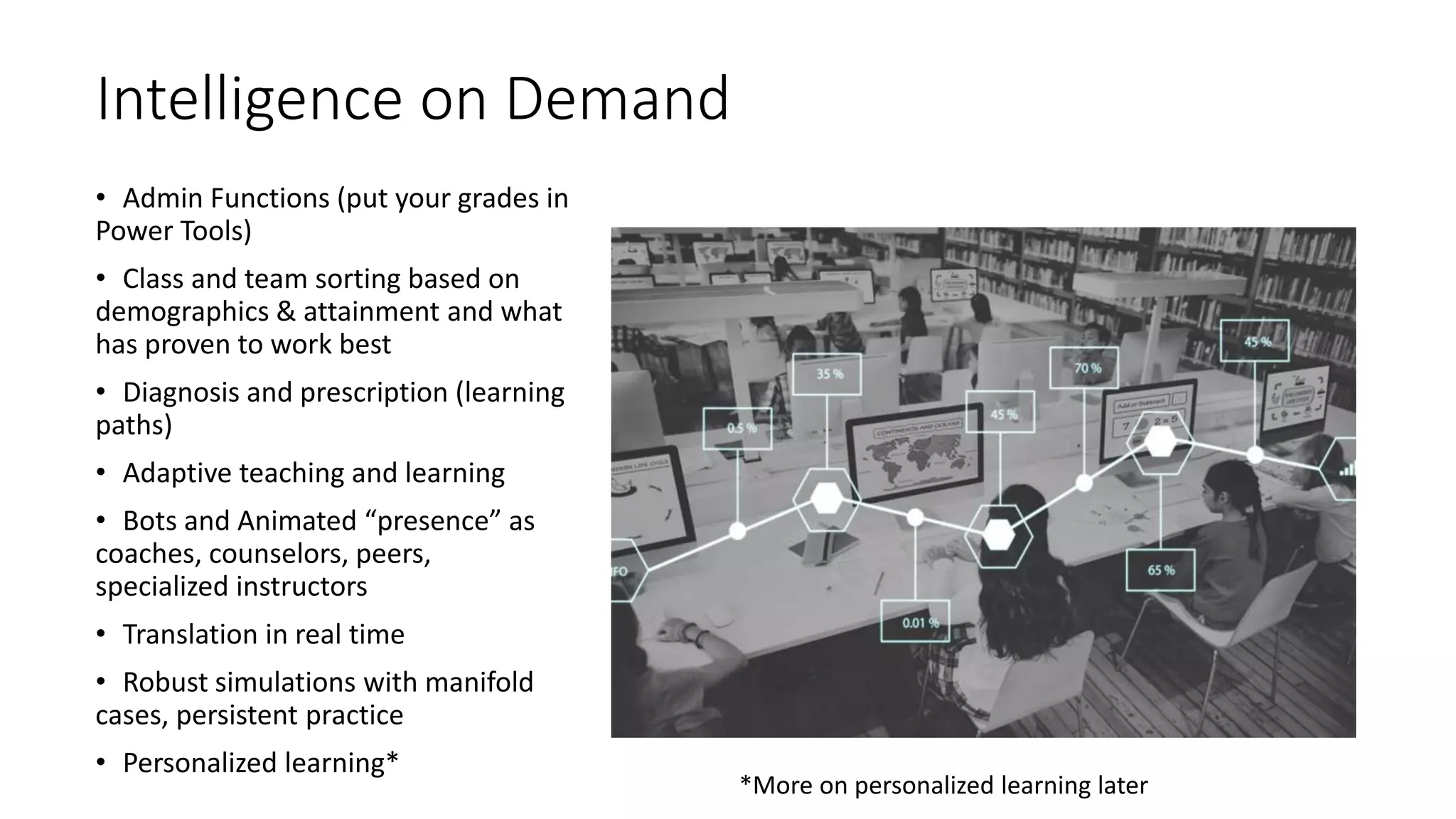
Intelligence on Demand
• Admin Functions (put your grades in
Power Tools)
• Class and team sorting based on
demographics & attainment and what
has proven to work best
• Diagnosis and prescription (learning
paths)
• Adaptive teaching and learning
• Bots and Animated “presence” as
coaches, counselors, peers,
specialized instructors
• Translation in real time
• Robust simulations with manifold
cases, persistent practice
• Personalized learning*
*More on personalized learning later
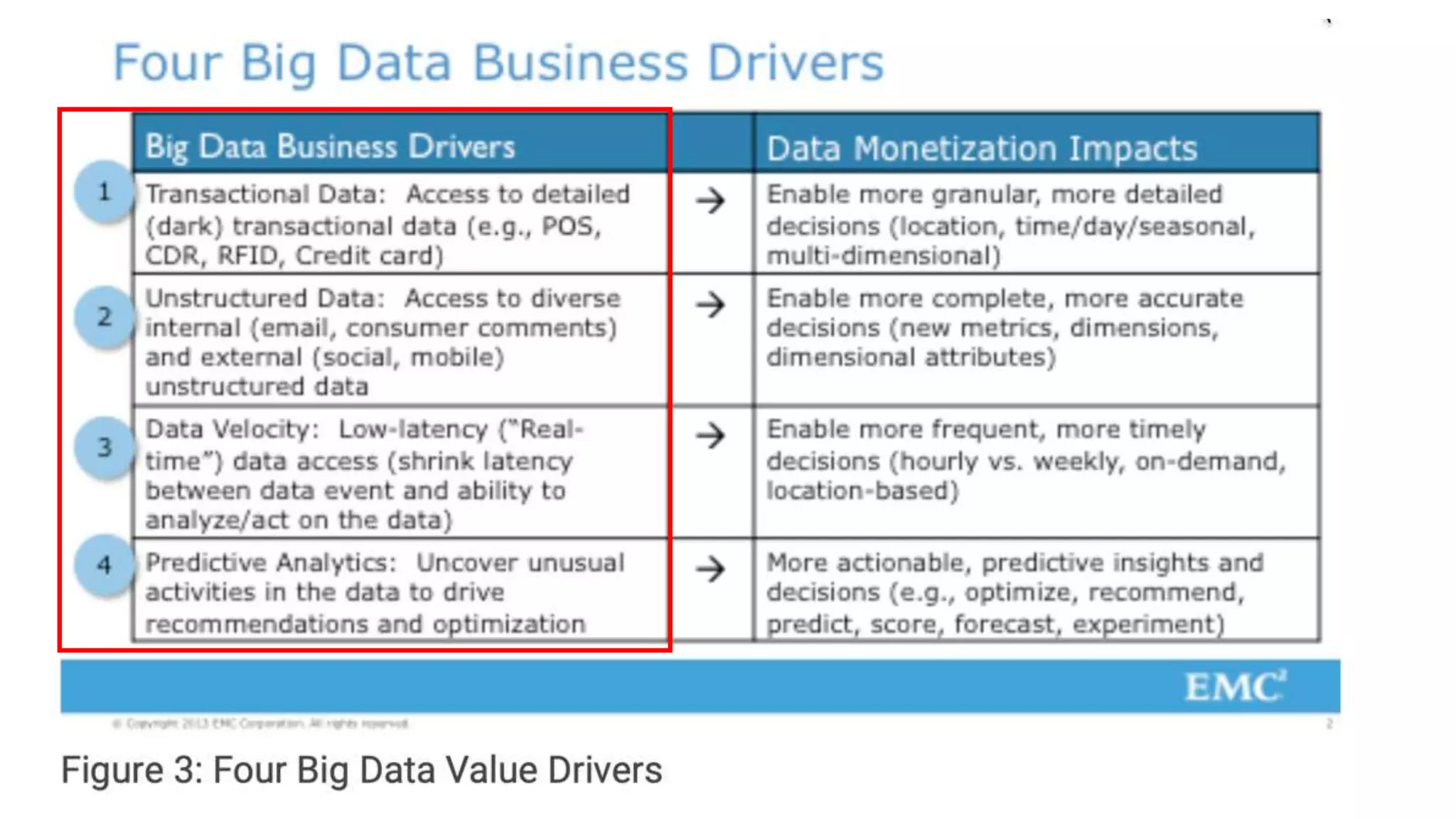
Two Key Technology Drivers
Big Data
• Vast amounts of data collected
from all your computer-based
interactions
Artificial Intelligence
• Analysis of that data based on
frameworks that intend to
simulate human COGNITION
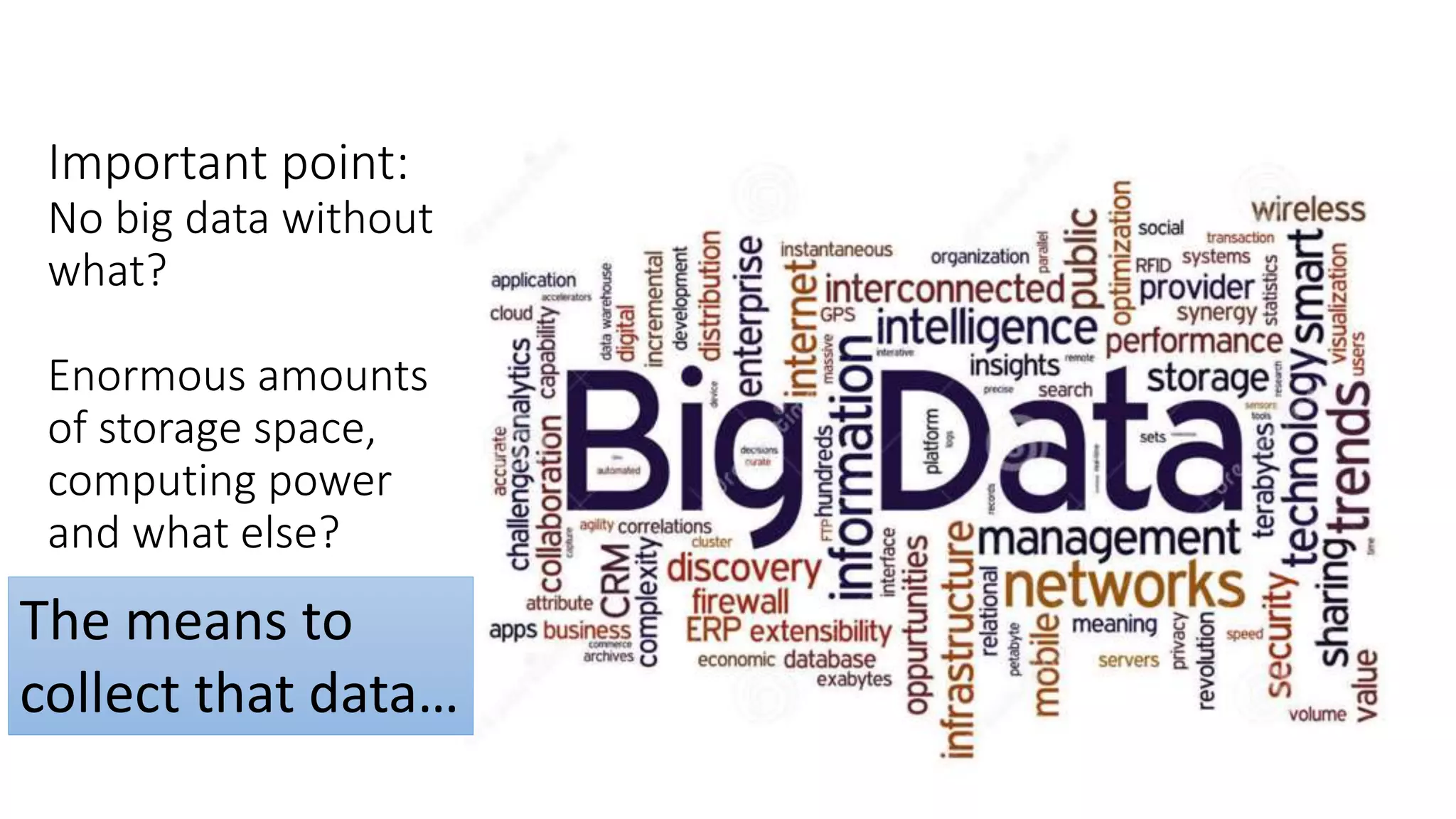
Important point:
No big data without
what?
Enormous amounts
of storage space,
computing power
and what else?
The means to
collect that data…
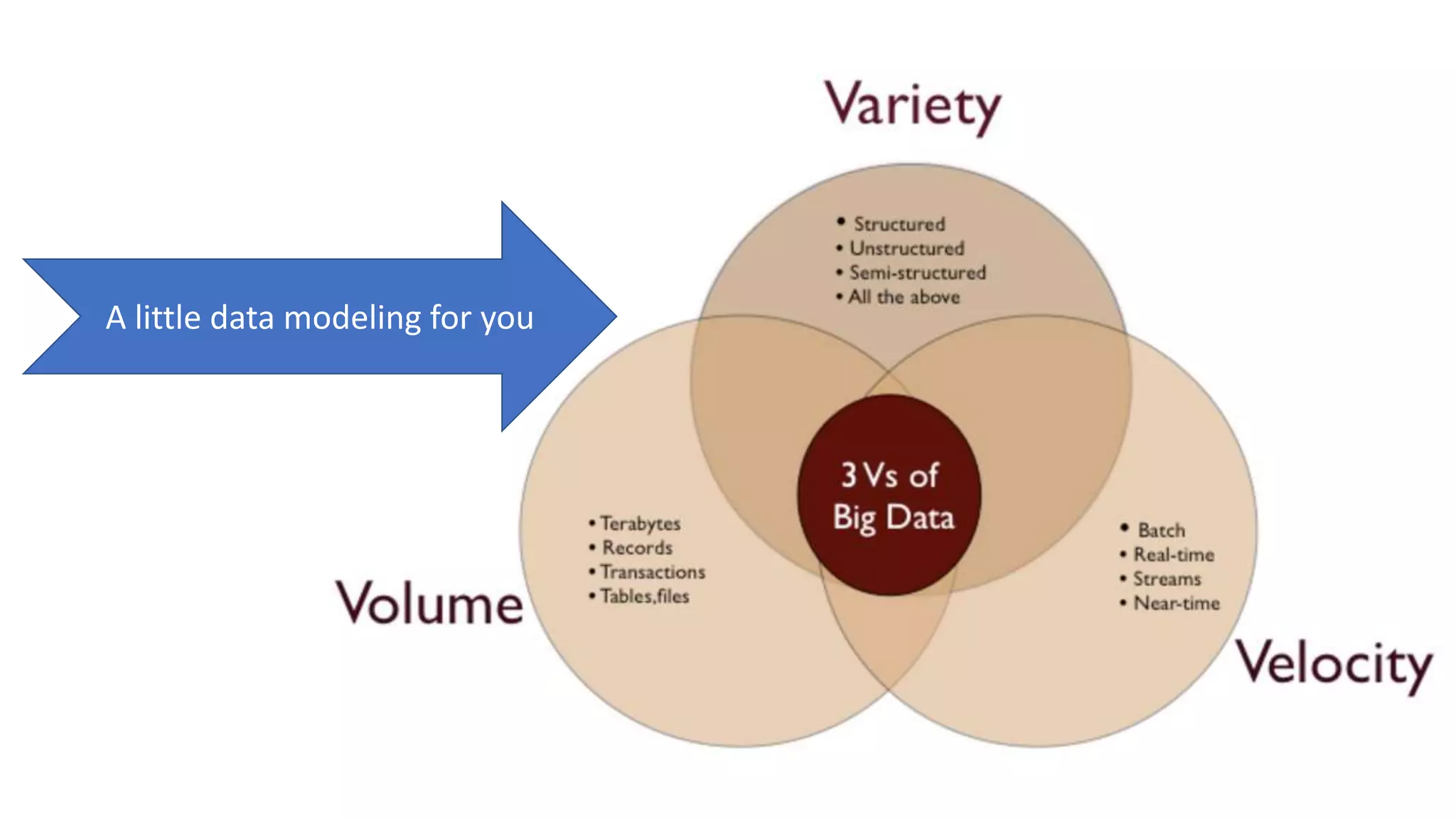
A little data modeling for you
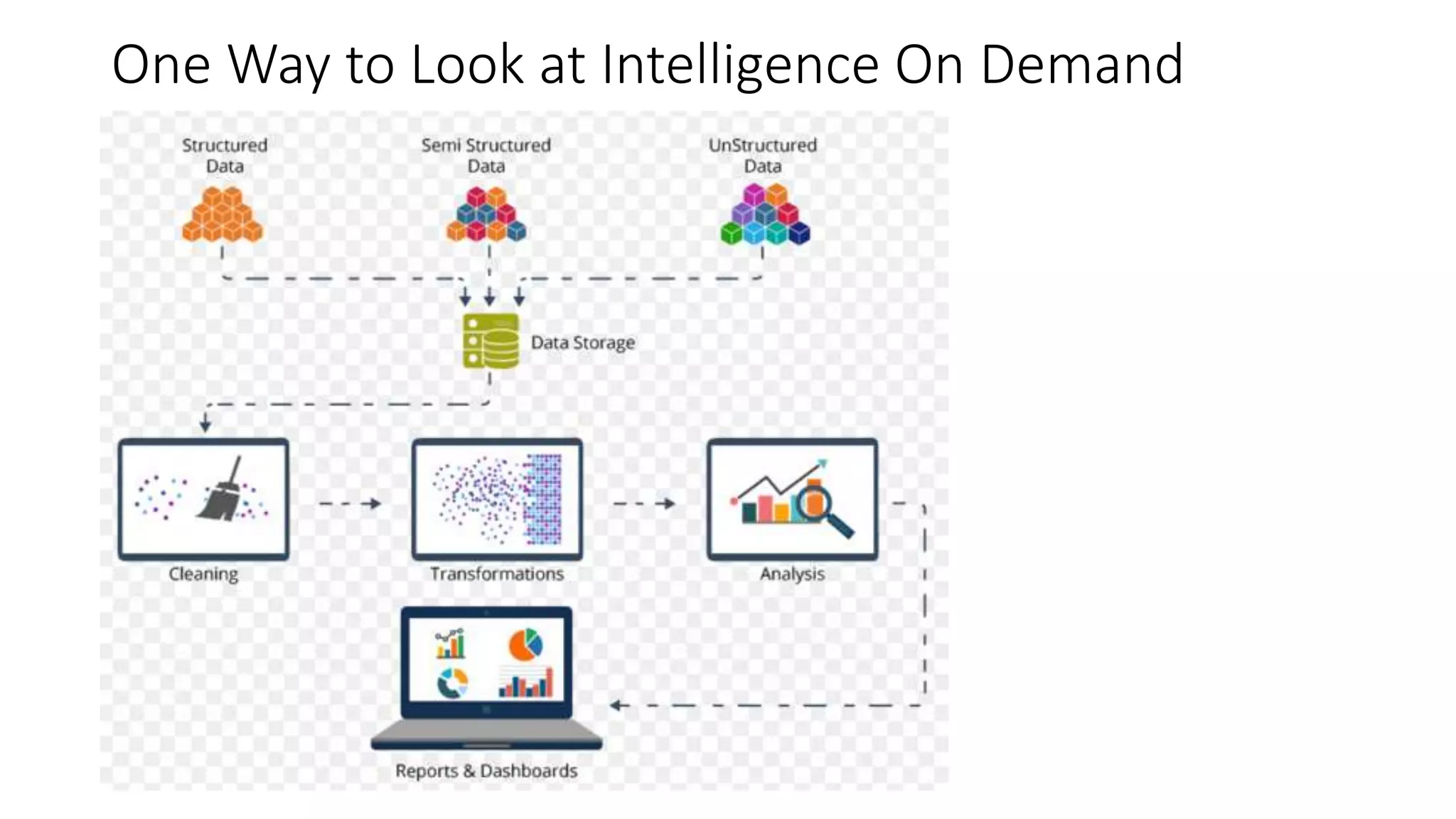
One Way to Look at Intelligence On Demand
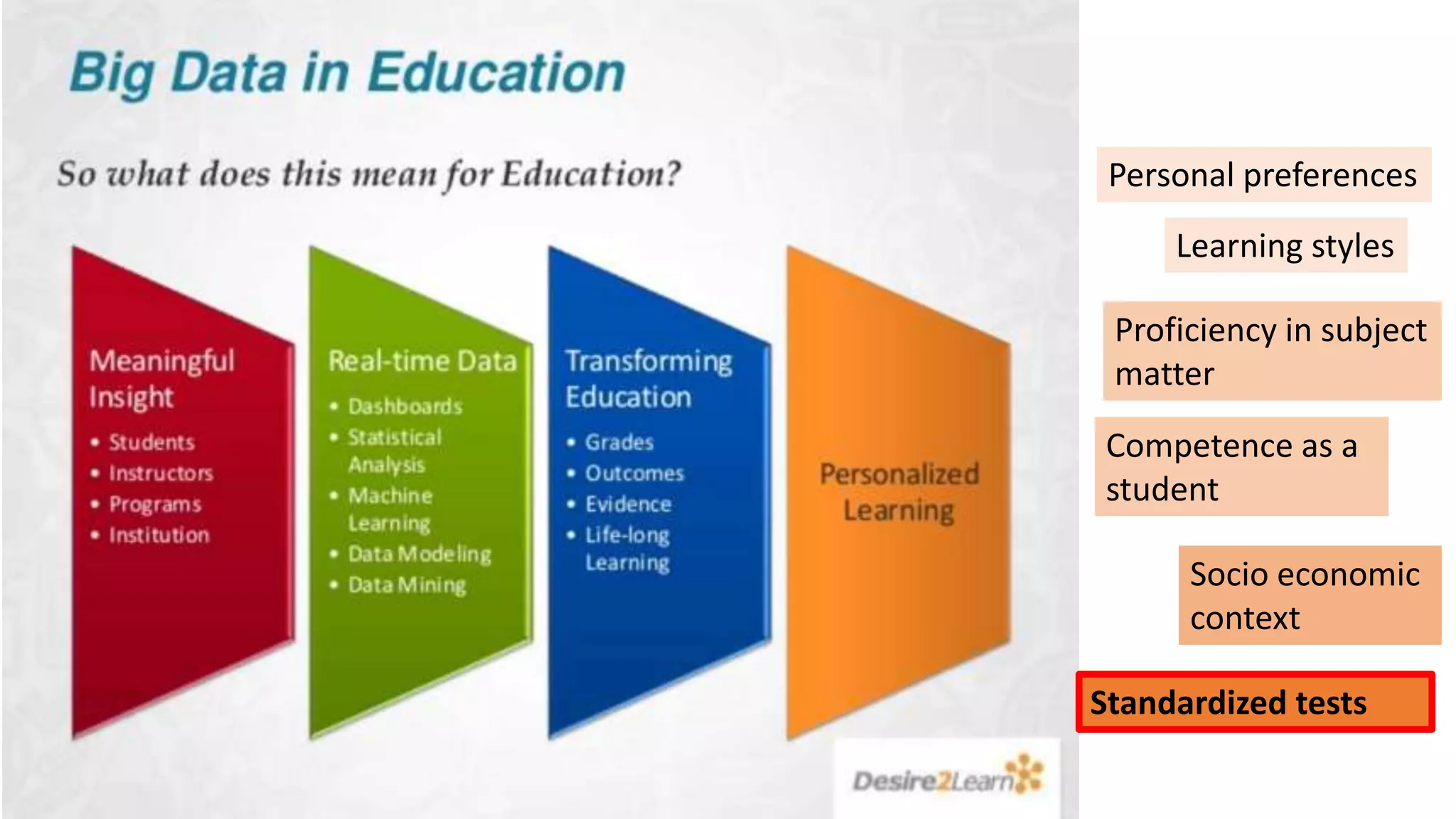
Socio economic
context
Learning styles
Personal preferences
Competence as a
student
Proficiency in subject
matter
Standardized tests
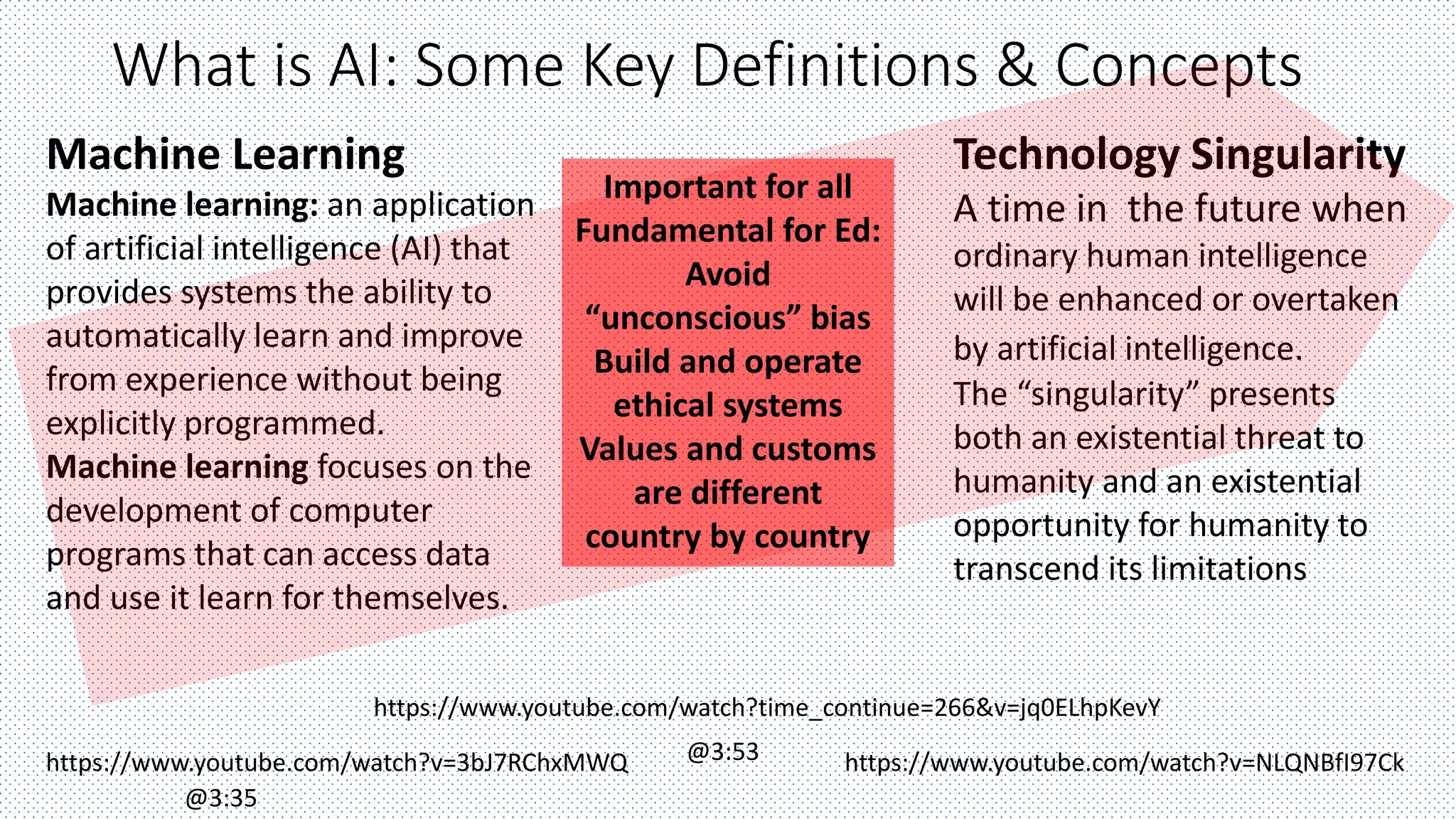
What is AI: Some Key Definitions & Concepts
Machine Learning
Machine learning: an application
of artificial intelligence (AI) that
provides systems the ability to
automatically learn and improve
from experience without being
explicitly programmed.
Machine learning focuses on the
development of computer
programs that can access data
and use it learn for themselves.
Technology Singularity
A time in the future when
ordinary human intelligence
will be enhanced or overtaken
by artificial intelligence.
The “singularity” presents
both an existential threat to
humanity and an existential
opportunity for humanity to
transcend its limitations
https://www.youtube.com/watch?v=NLQNBfI97Ckhttps://www.youtube.com/watch?v=3bJ7RChxMWQ
https://www.youtube.com/watch?time_continue=266&v=jq0ELhpKevY
@3:35
@3:53
Important for all
Fundamental for Ed:
Avoid
“unconscious” bias
Build and operate
ethical systems
Values and customs
are different
country by country
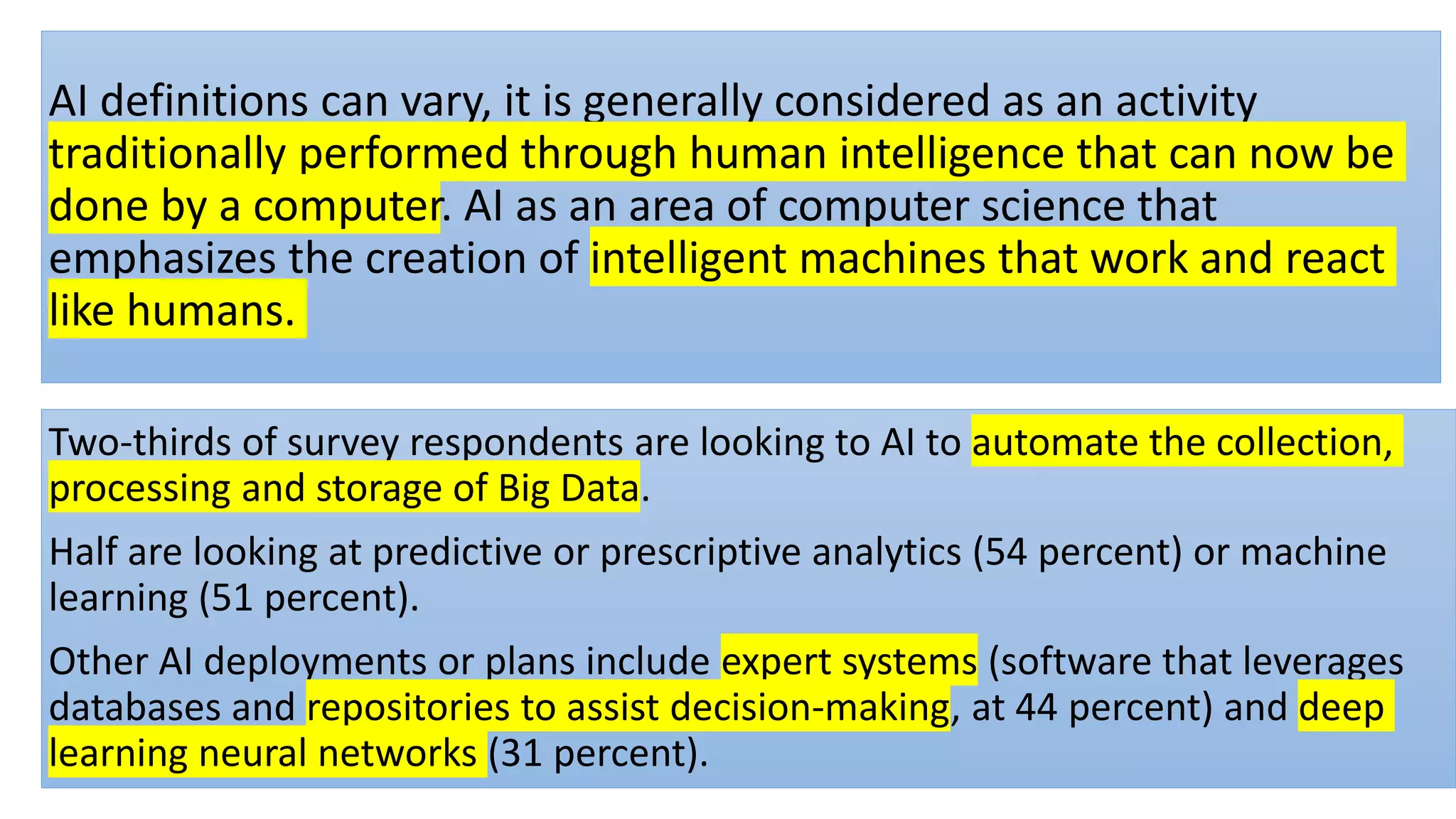
AI definitions can vary, it is generally considered as an activity
traditionally performed through human intelligence that can now be
done by a computer. AI as an area of computer science that
emphasizes the creation of intelligent machines that work and react
like humans.
Two-thirds of survey respondents are looking to AI to automate the collection,
processing and storage of Big Data.
Half are looking at predictive or prescriptive analytics (54 percent) or machine
learning (51 percent).
Other AI deployments or plans include expert systems (software that leverages
databases and repositories to assist decision-making, at 44 percent) and deep
learning neural networks (31 percent).
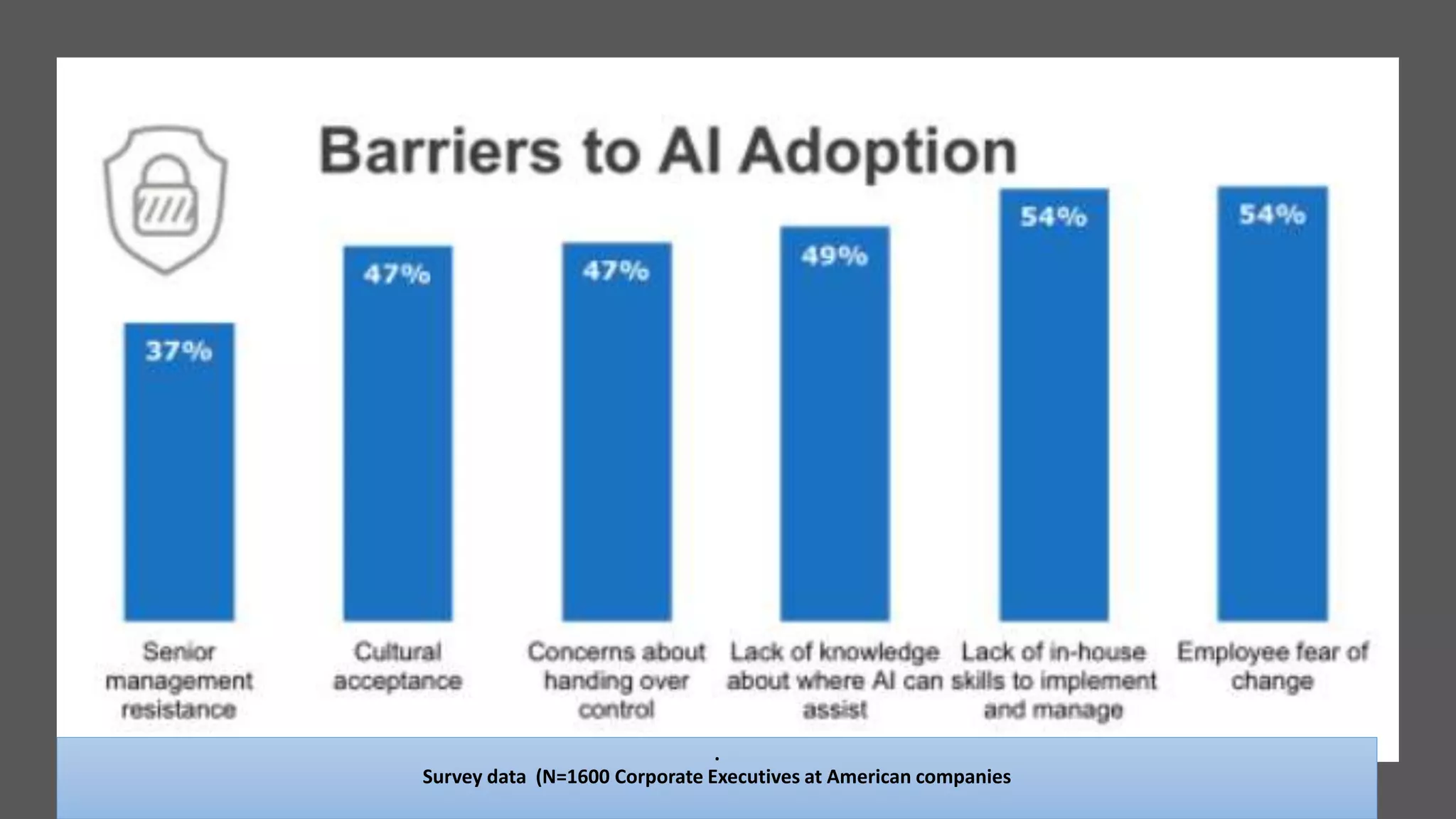
.
Survey data (N=1600 Corporate Executives at American companies
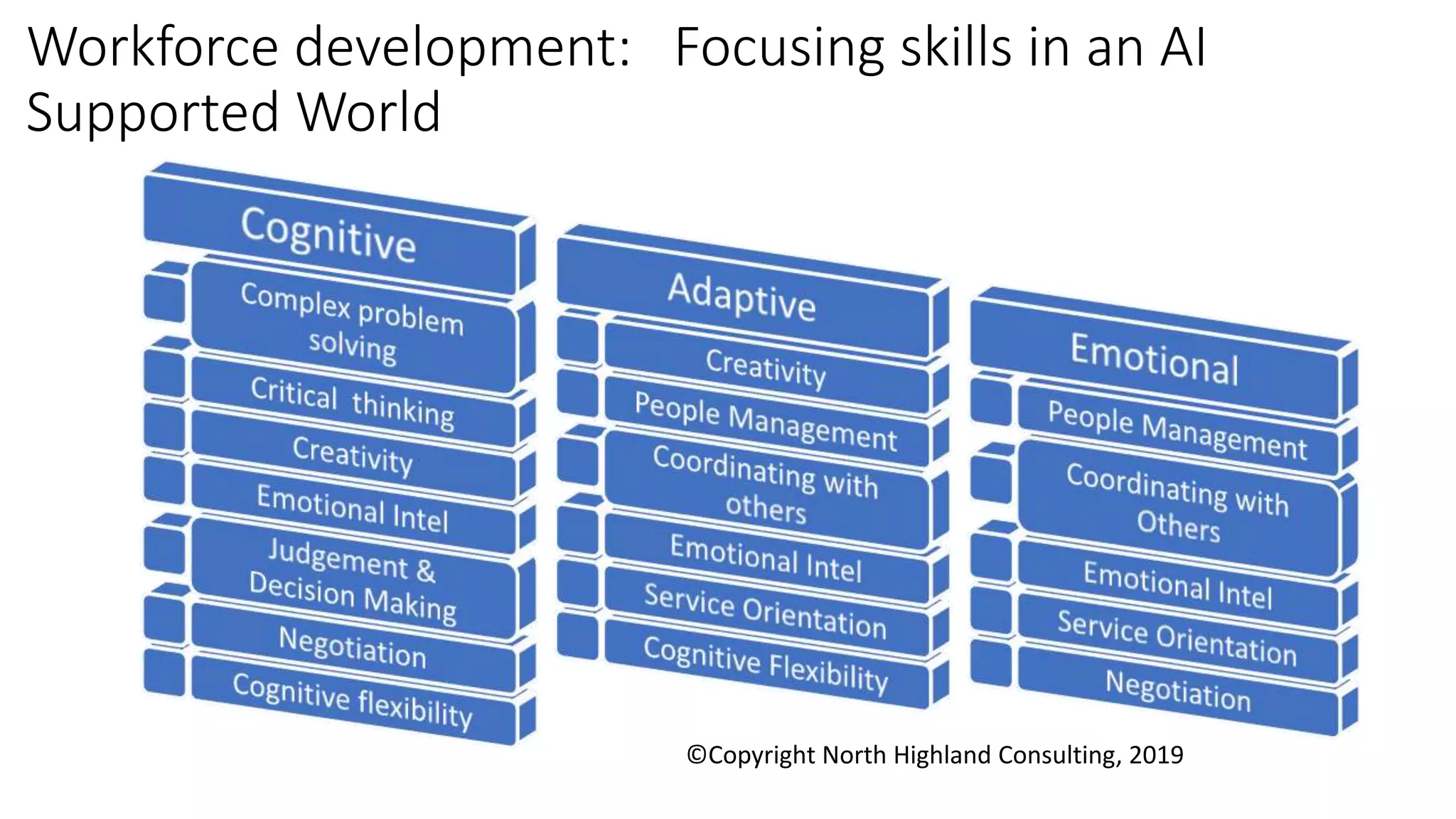
Workforce development: Focusing skills in an AI
Supported World
©Copyright North Highland Consulting, 2019
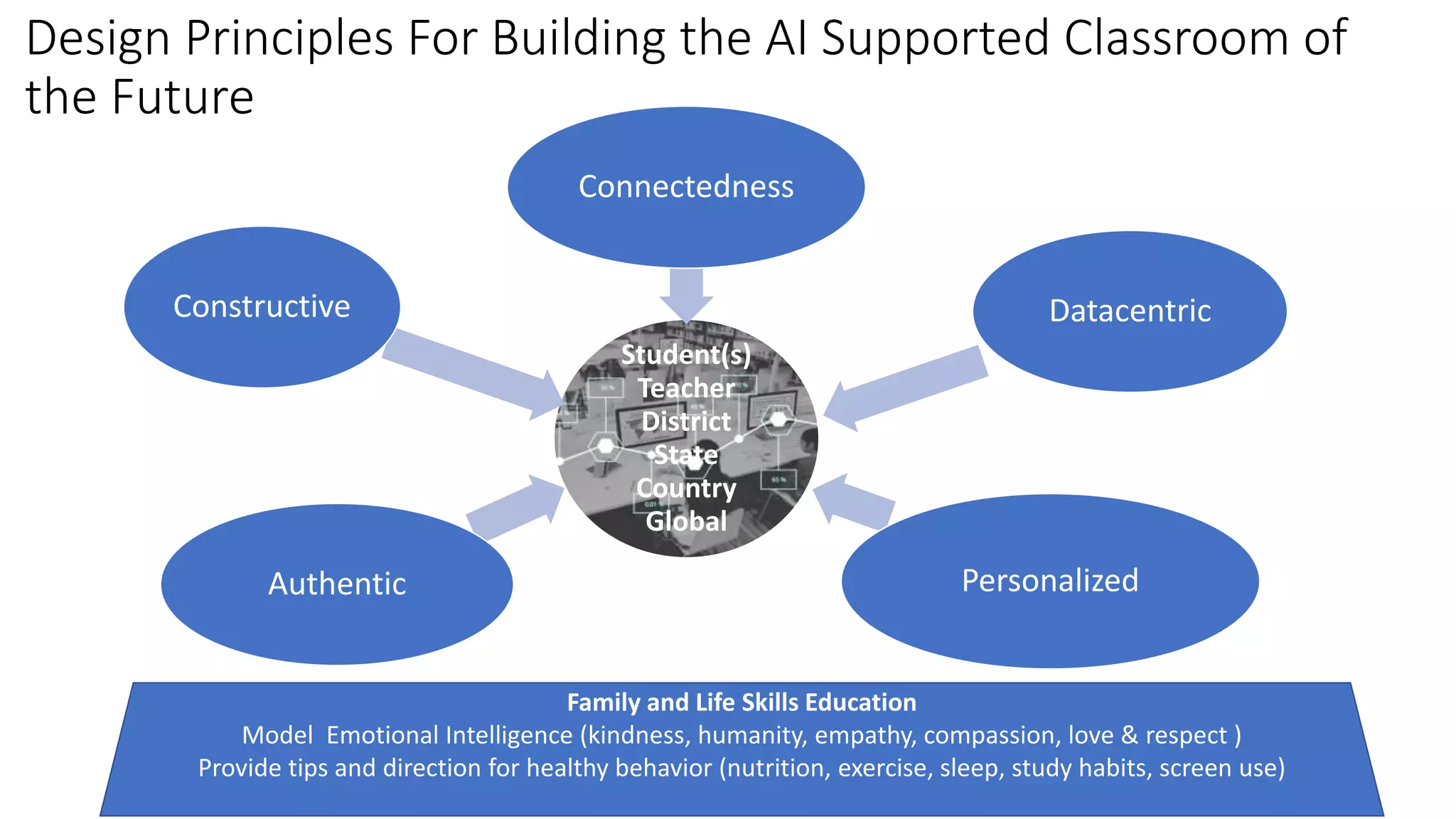
Design Principles For Building the AI Supported Classroom of
the Future
Student(s)
Teacher
District
State
Country
Global
Connectedness
Datacentric
PersonalizedAuthentic
Constructive
Family and Life Skills Education
Model Emotional Intelligence (kindness, humanity, empathy, compassion, love & respect )
Provide tips and direction for healthy behavior (nutrition, exercise, sleep, study habits, screen use)
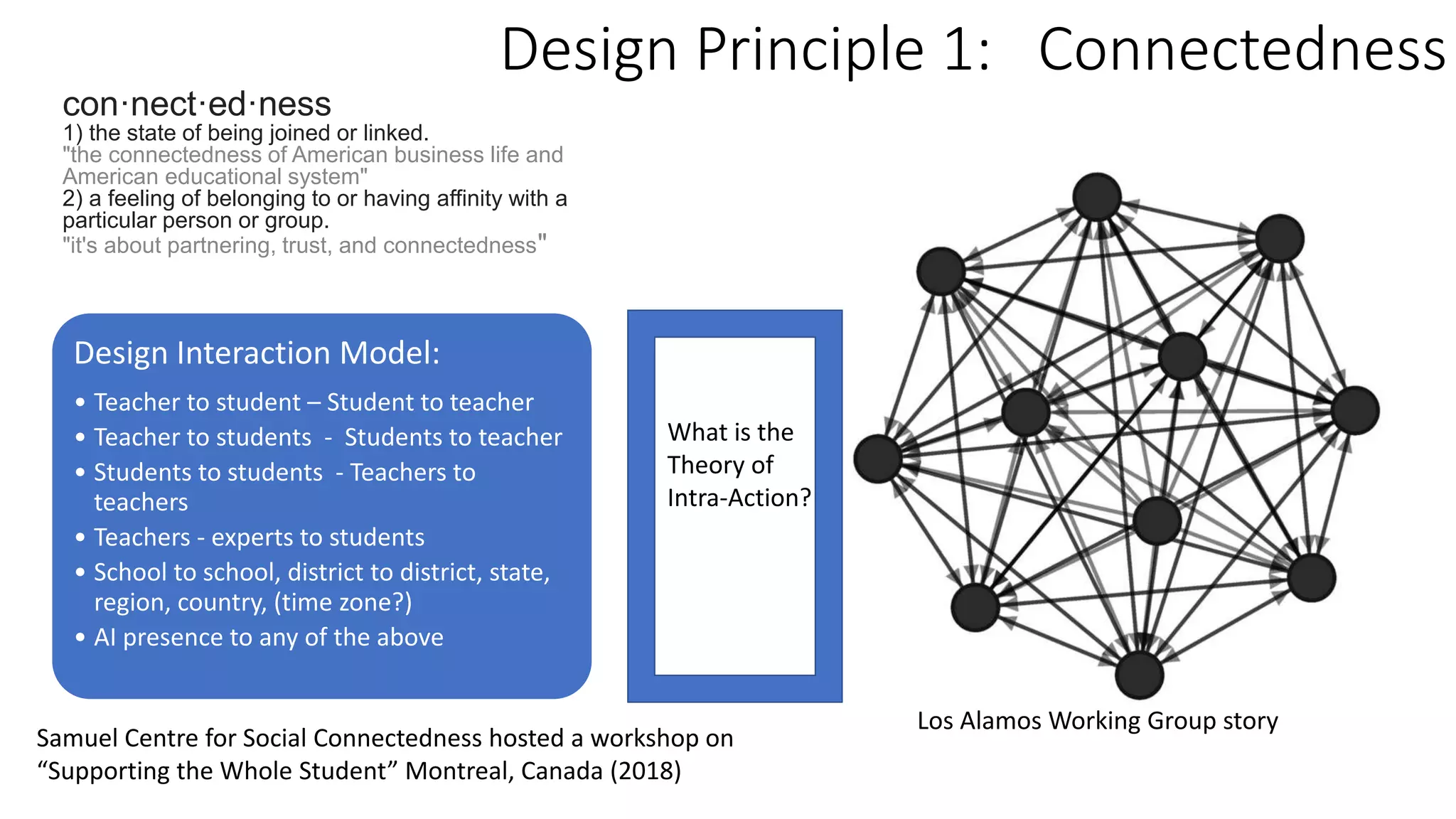
Design Principle 1: Connectedness
con·nect·ed·ness
1) the state of being joined or linked.
"the connectedness of American business life and
American educational system"
2) a feeling of belonging to or having affinity with a
particular person or group.
"it's about partnering, trust, and connectedness"
Samuel Centre for Social Connectedness hosted a workshop on
“Supporting the Whole Student” Montreal, Canada (2018)
Los Alamos Working Group story
Design Interaction Model:
• Teacher to student – Student to teacher
• Teacher to students - Students to teacher
• Students to students - Teachers to
teachers
• Teachers - experts to students
• School to school, district to district, state,
region, country, (time zone?)
• AI presence to any of the above
What is the
Theory of
Intra-Action?
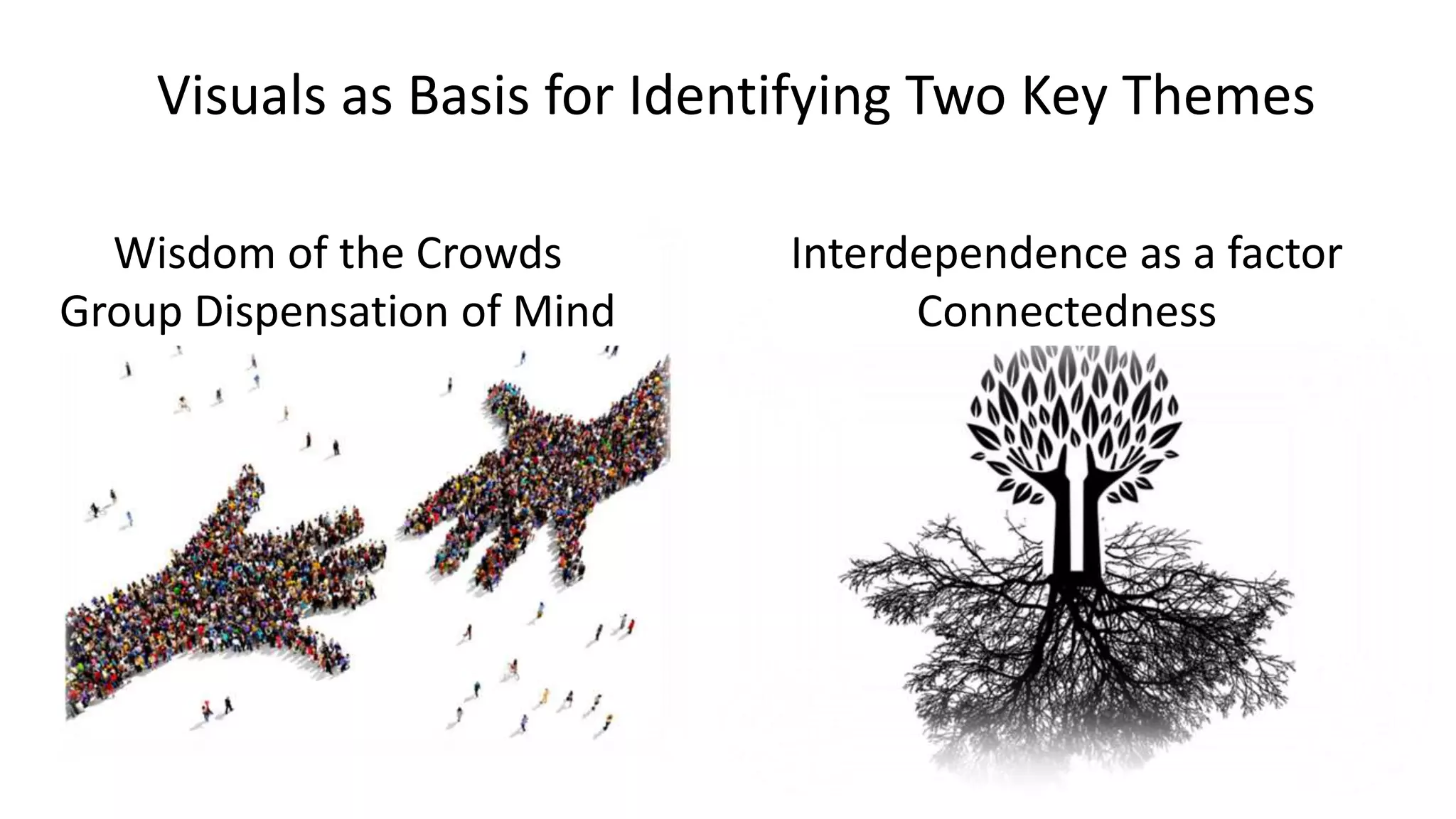
Collaboration & InterdependenceVisuals as Basis for Identifying Two Key Themes
Wisdom of the Crowds
Group Dispensation of Mind
Interdependence as a factor
Connectedness
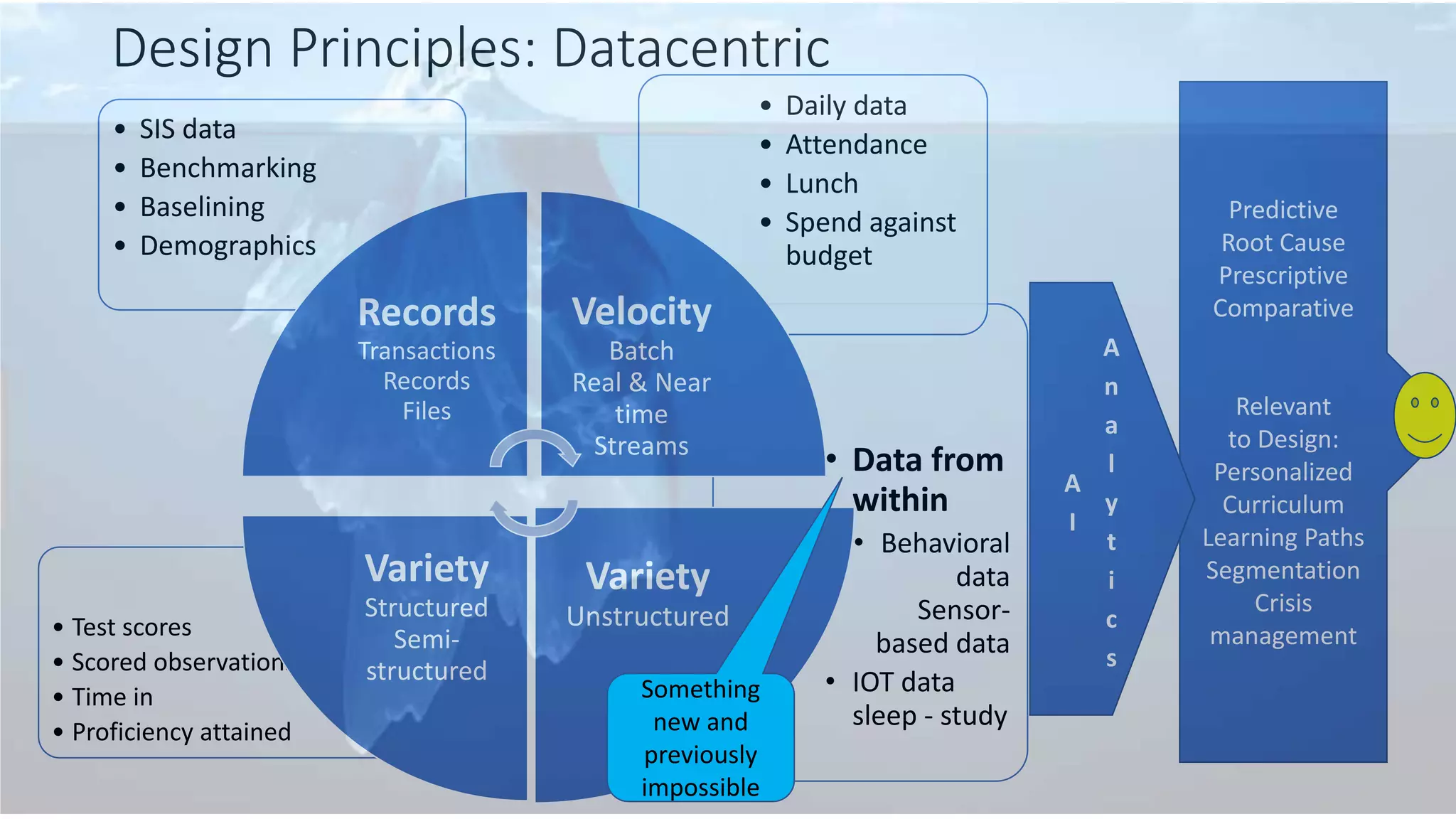
Design Principles: Datacentric
• Data from
within
• Behavioral
data
Sensor-
based data
• IOT data
sleep - study
• Test scores
• Scored observations
• Time in
• Proficiency attained
• Daily data
• Attendance
• Lunch
• Spend against
budget
• SIS data
• Benchmarking
• Baselining
• Demographics
Records
Transactions
Records
Files
Velocity
Batch
Real & Near
time
Streams
Variety
Unstructured
Variety
Structured
Semi-
structured
Predictive
Root Cause
Prescriptive
Comparative
Relevant
to Design:
Personalized
Curriculum
Learning Paths
Segmentation
Crisis
management
A
I
A
n
a
l
y
t
i
c
s
Something
new and
previously
impossible
Design Principles: Datacentric
Predictive
Root Cause
Prescriptive
Comparative
Relevant
to Design:
Personalized
Curriculum
Learning Paths
Segmentation
Crisis
management
A
I
A
n
a
l
y
t
i
c
s
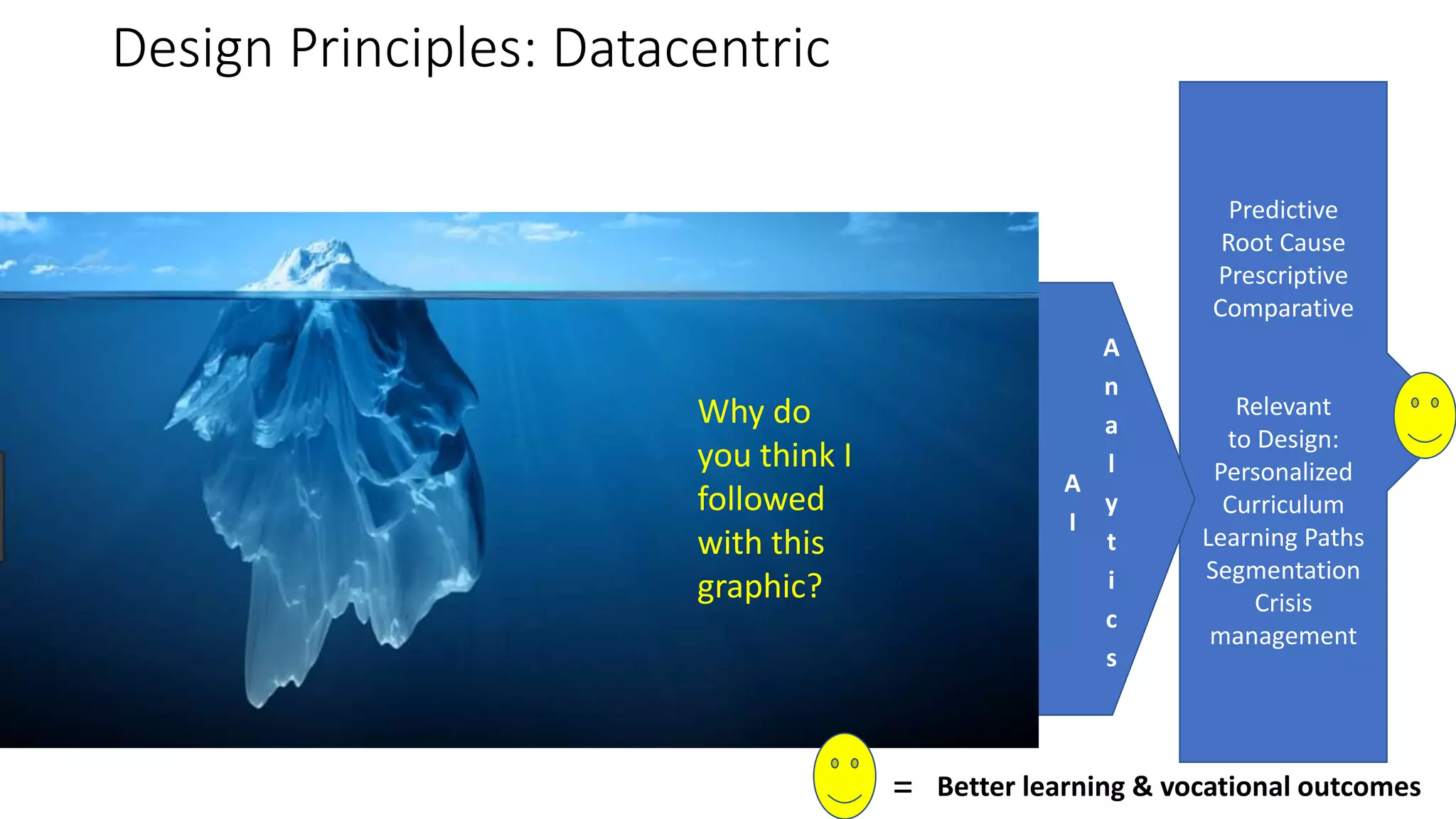
Better learning & vocational outcomes=
Why do
you think I
followed
with this
graphic?
Personalized (Rhye: Still working this slide)
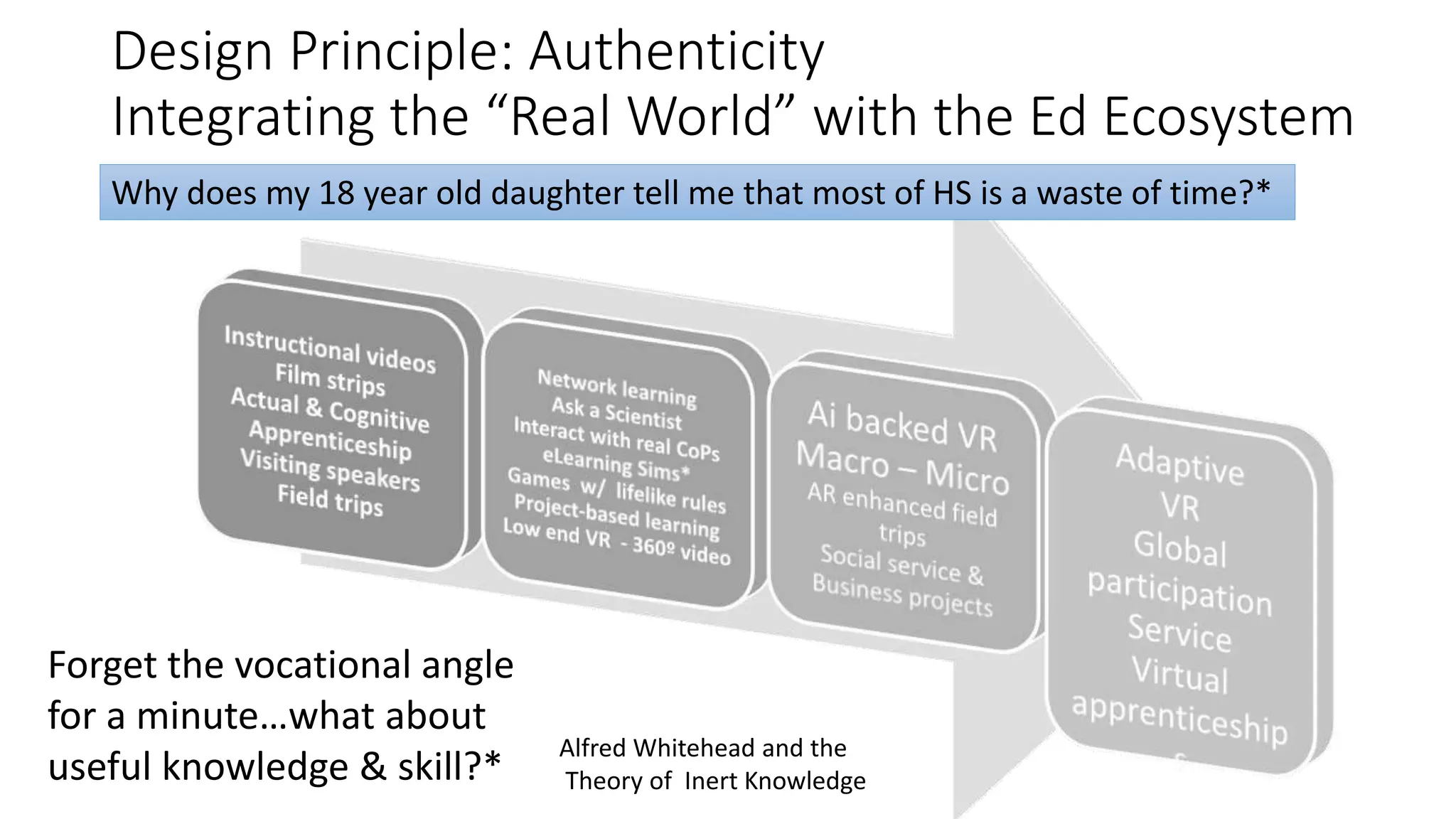
Design Principle: Authenticity
Integrating the “Real World” with the Ed Ecosystem
Why does my 18 year old daughter tell me that most of HS is a waste of time?*
Forget the vocational angle
for a minute…what about
useful knowledge & skill?*
Alfred Whitehead and the
Theory of Inert Knowledge
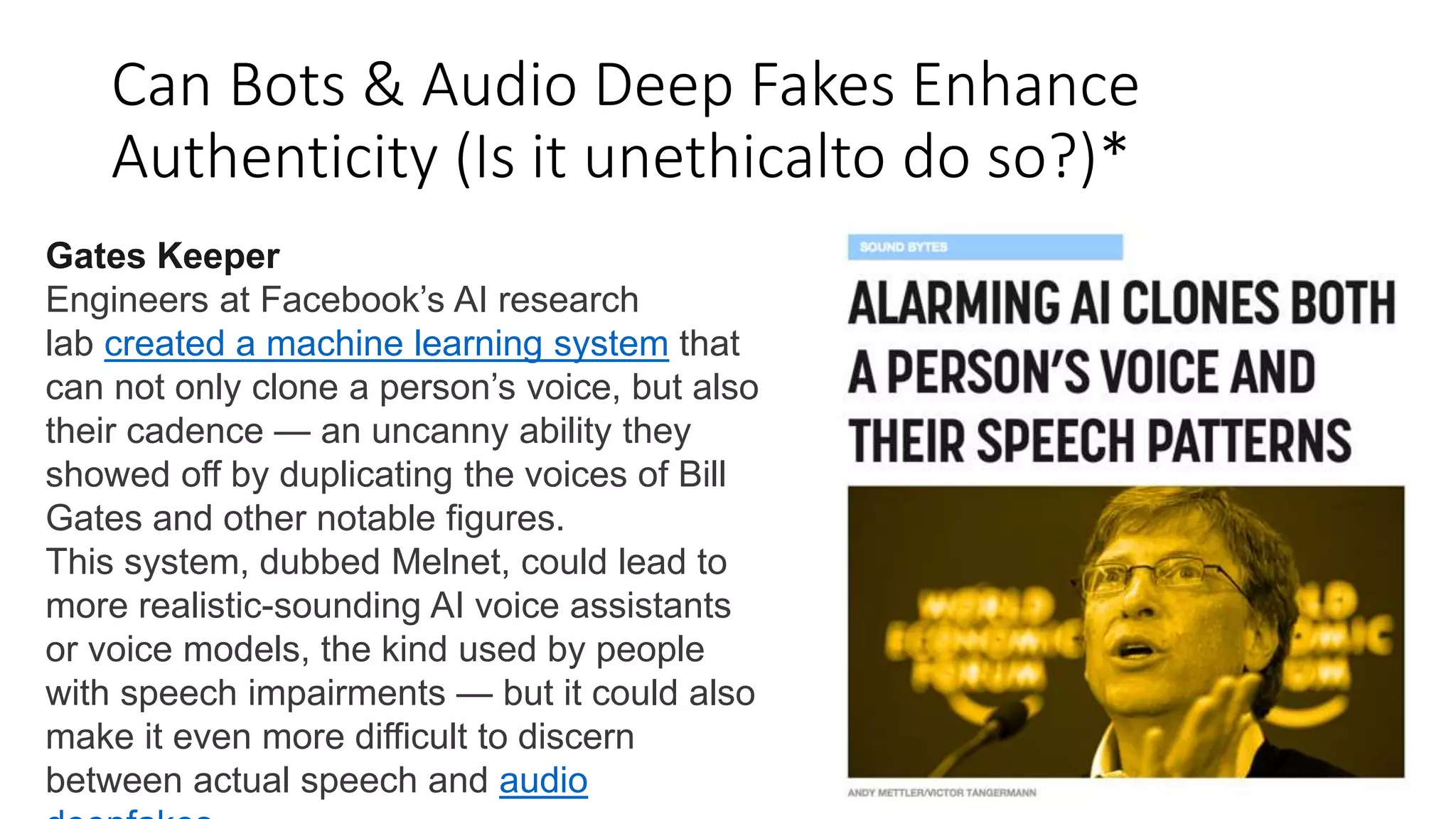
Can Bots & Audio Deep Fakes Enhance
Authenticity (Is it unethicalto do so?)*
Gates Keeper
Engineers at Facebook’s AI research
lab created a machine learning system that
can not only clone a person’s voice, but also
their cadence — an uncanny ability they
showed off by duplicating the voices of Bill
Gates and other notable figures.
This system, dubbed Melnet, could lead to
more realistic-sounding AI voice assistants
or voice models, the kind used by people
with speech impairments — but it could also
make it even more difficult to discern
between actual speech and audio
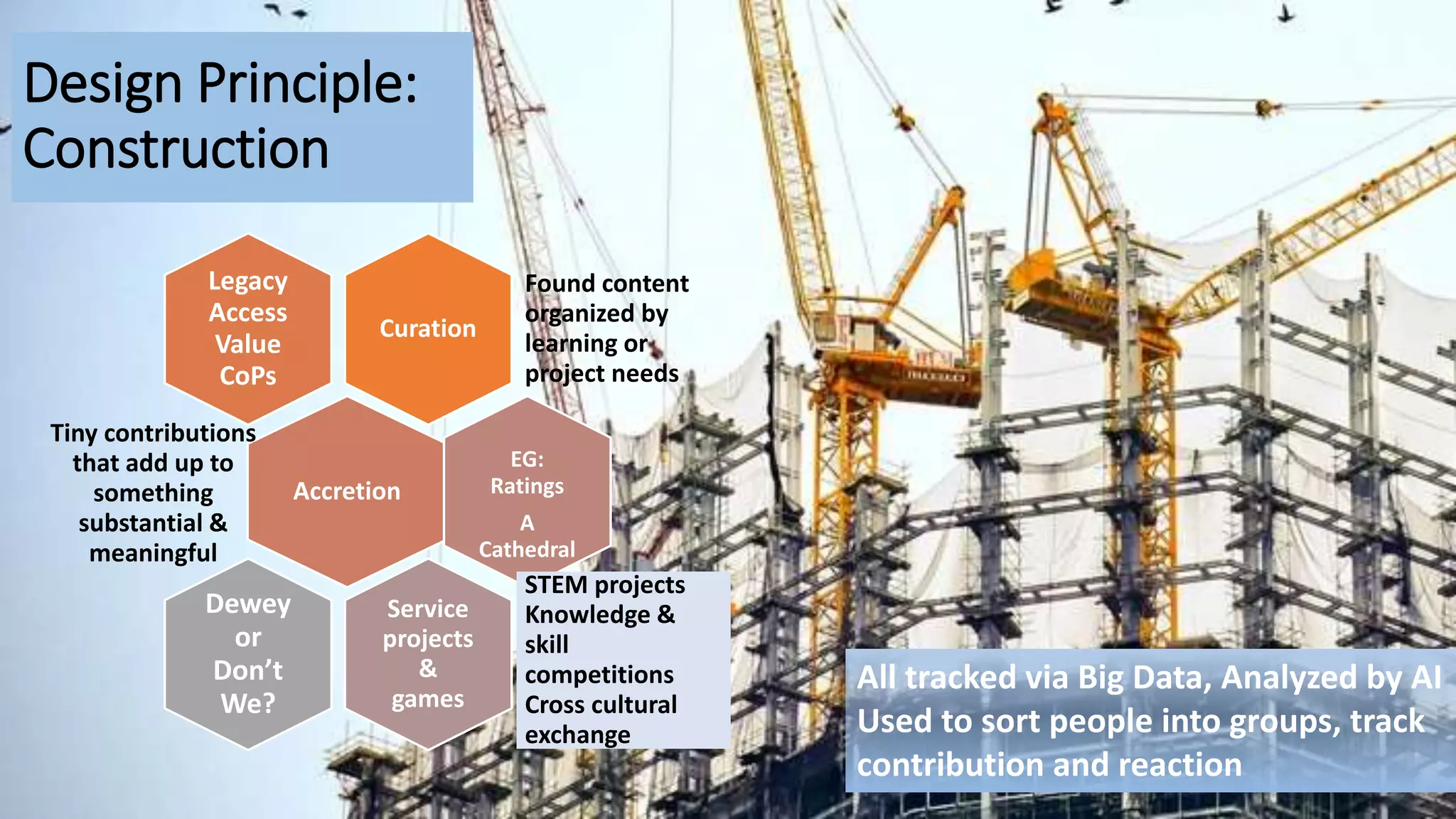
Design Principle:
Construction
Curation
Found content
organized by
learning or
project needs
Legacy
Access
Value
CoPs
Accretion
Tiny contributions
that add up to
something
substantial &
meaningful
EG:
Ratings
A
Cathedral
Service
projects
&
games
STEM projects
Knowledge &
skill
competitions
Cross cultural
exchange
Dewey
or
Don’t
We?
All tracked via Big Data, Analyzed by AI
Used to sort people into groups, track
contribution and reaction
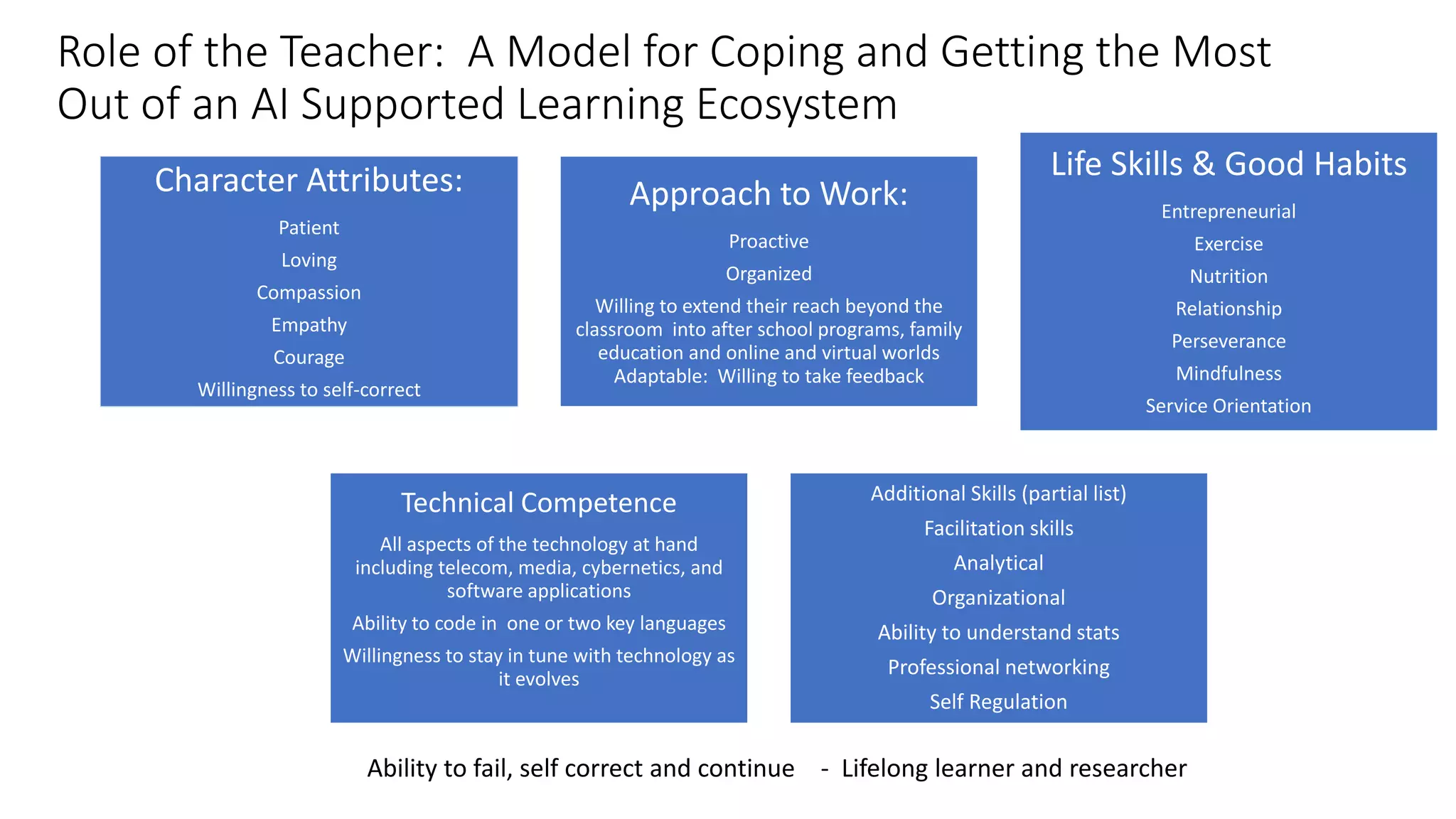
Role of the Teacher: A Model for Coping and Getting the Most
Out of an AI Supported Learning Ecosystem
Character Attributes:
Patient
Loving
Compassion
Empathy
Courage
Willingness to self-correct
Approach to Work:
Proactive
Organized
Willing to extend their reach beyond the
classroom into after school programs, family
education and online and virtual worlds
Adaptable: Willing to take feedback
Life Skills & Good Habits
Entrepreneurial
Exercise
Nutrition
Relationship
Perseverance
Mindfulness
Service Orientation
Technical Competence
All aspects of the technology at hand
including telecom, media, cybernetics, and
software applications
Ability to code in one or two key languages
Willingness to stay in tune with technology as
it evolves
Additional Skills (partial list)
Facilitation skills
Analytical
Organizational
Ability to understand stats
Professional networking
Self Regulation
Ability to fail, self correct and continue - Lifelong learner and researcher
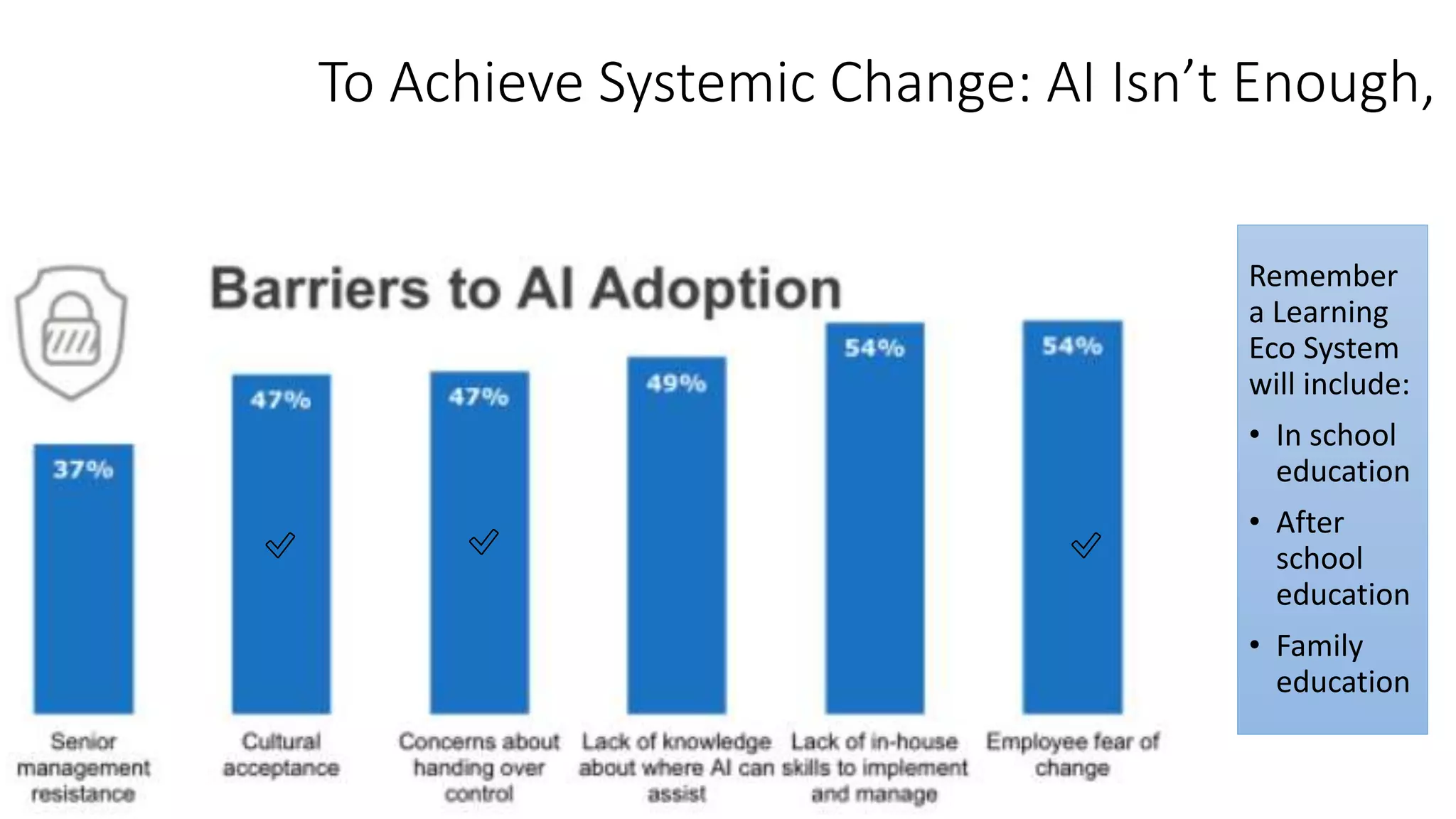
To Achieve Systemic Change: AI Isn’t Enough,
Remember
a Learning
Eco System
will include:
• In school
education
• After
school
education
• Family
education
✅ ✅ ✅
What’s next
• Emotion Driven AI (McKinsey)
• Deeply immersive learning environments (adaptive)
• Intelligent Virtual Classrooms driven by “sensors” video, facial
recognition and scale
• Augmented Reality (Google Glass just released next gen of industrial version)
Key VR Principles: Autonomy – Interactivity – Authenticity
(Kantor & Lofton, 1996
Rhye: Still working on this slide
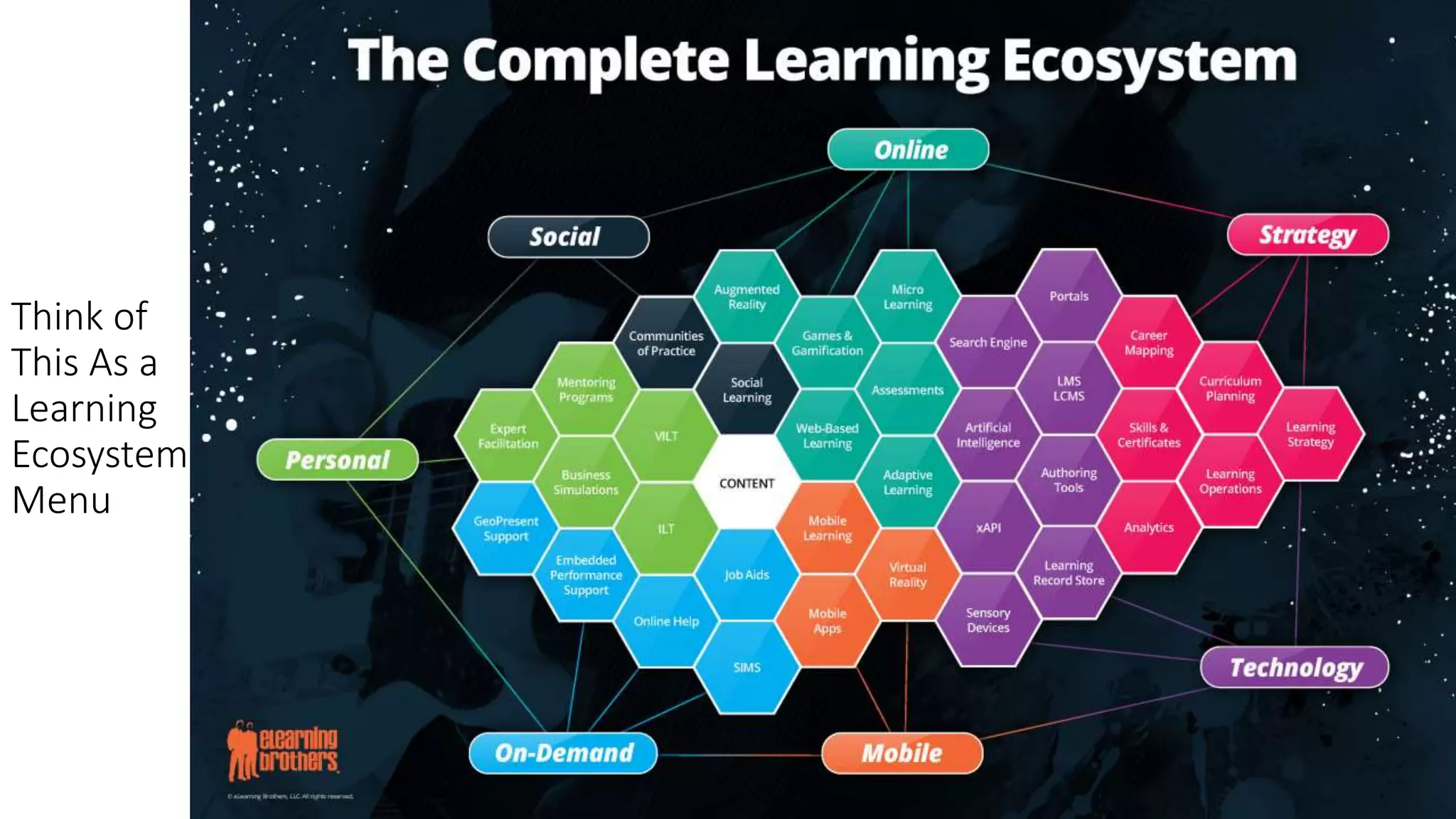
Think of
This As a
Learning
Ecosystem
Menu
What’s Next: Chinese contribution (if allowed)

Classroom of the futurev3

  • 1.
    The Intelligent ClassroomLearning Ecosystem in 2150: How AI & Big Data Are Going to Change Everything Ronald J. Kantor, Ph.D. - PMP – CSM ronald.j.kantor@gmail.com Creative Central Laurel, Mississippi June 18, 2019
  • 2.
    Organization • Purpose ofthis session • Background • Personal • NASA’s Electronic Classroom of the 21st Century • Things are Moving Fast: Some Reflections • Big Data & Why its Relevant • What is AI? Some key definitions • What is AI really good at? • What AI cannot manifest…yet? • Workforce development Looking at future skills in an AI world • Framework of Design Principles: • Connectedness • Datacentric • Personalized • Authenticity • Construction (curation & accretion) • What’s next • Chinese contribution • American education re-asserts itself
  • 3.
    Background Brooklyn Bred Bard –SAIC – Vanderbilt U HS English – Drama – TV Teacher Member of Cognition & Tech Group NASA Faculty Fellow – Instructional Tech Professor at U of Houston Accenture – Senior Learning Architect BoA – Sr VP - Manager of D & D OUSDI – DoD – Strategic Management Consultant N2N Services – Director of Learning Innovation Independent L&D Consultant working with Ed Tech Start Ups…over 30 companies Faculty & Continuous Improvement Lead for IQ$ & Cybersecurity Workforce Alliance’s Virtual Mentoring Program Volunteer Work Member of NCVA Executive Board Match Judge for World Finals of FTC Robotics’ Competition
  • 4.
    Some Recent Publications…. China’sPromising Ed Tech Market: Understanding Its Growth and Innovative Orientation Chinese Ed Tech Companies Take Off: A Perfect Storm of Opportunity & Growth China’s Burgeoning EdTech Industry: Will It Disrupt Corporate HR? HR Column for The Bangkok Post (2017-2018 Five articles focusing on use of AI, VR & AR for Corporate Human Resources.
  • 5.
    NASA’s Electronic Classroomof the 21st Century Interior of Building 9 Johnson Space Center, 1996 As a Faculty Fellow • Find ways to use Design Integration Lab to serve educational purposes • Use NASA space content to develop math and science lesson plans • Design and facilitate “electronic field trips” using two-way, ISDN video and “wired” ISS modules HiFi Mock ups of ISS used for training DEI Lab framed in blue on your left
  • 6.
    NASA’s Electronic Classroomof the Future • Some features and functions • Interactive television (ISDN) & audio conferencing • Use astronauts as instructors broadcasting from within the hi fidelity mock ups • Shared problem solving & collaboration • Access to expert networks using chat, listservs and discussion groups • Access to NASA instructional videos (one way) • Key Innovative Concept: • Why separate distance learning technology & delivery types from traditional classroom settings? • Key Policy Intention: • Use distance learning technology to provide access to those who are removed from quality instructional resources, but enhance traditional classroom by deploying distance learning technologies. At the time this was way futuristic and innovative (Frankly, if you have the resources & connections in some ways ….it still is)
  • 7.
    Different Classroom Configurations Forwardfacing connected desk set for lecture Forward facing Individual desks set for lecture Small group collaboration Modular classroom with configurable furniture Environmental psychology and the Theory of Affordances suggests that the nature of an environment strongly influences that types of interactions possible and psychological state of participants
  • 8.
    Are We Makinga Mistake Using a Classroom as the Anchor For Our Vision of the Future? Why or why not?You know what Einstein said….? Are we stuck in a box? Constrained by: • 4 walls Antiquated (because of): • Policies • Teaching techniques • Learning tools • Textbooks • Facilities, • Most notably assessment* The FTC Robotics Competition: Who wins and why….
  • 9.
    What We NeedIs A New Vision of Education School based education After School Education Family education A learning ecosystem is a system of people, content, technology, culture, and strategy, existing both within and outside of an organization, all of which has an impact on both the formal and informal learning that goes on in that organization.
  • 10.
    Example of aLearning Ecosystem Knowledge Skill Capability
  • 11.
    Comparing Then toNow Then • Network access limited • Narrow bandwidth - copper • Client server model slow to upgrade • Video at 5-15 FPS • Dis-integrated Data: world of spreadsheets • Bios as narratives • “Small data:” surveys, tests, demographics • Computer-based tools : human operation • Asynchronous gaming • Linear video Now • Network access – much greater • Faster, more robust speeds • SAAS software updates automatic • Streaming hi quality video • Data integration: Middleware • Profiling and Personalization • Big data: Behavioral data – Data from Within • AI Computer-based Real learning & Analytics • Large scale, real time gaming on line “Twitch” • Micro learning using video to teach PROCESS
  • 12.
    Evolution of OnDemand Resources *Light *Air conditioning *Instructional media *Internet I *Online sources of info *Experts via email *Discussion groups *Listservs *Internet II *Virtual meeting tools *On line CoPs *Network science *Integrated data n middleware *Extensible aps *Smart Profiles * Smart knowledge bases Intelligence Networks Information Electricity *FB – You Tube – *Instagram *Bots *Predictive analytics *Much greater computing power *Enormous storage in the cloud *IOT *Technology as one’s constant companion *Deeply Immersive Learning: VR – AR – Advanced Simulation
  • 13.
    Intelligence “On Demand”? • Computerpower • Storage • Reduced cost for more power, functionality and storage • Technology as a constant companion • Mysterious nature of data exchange • You give me your personal data and I’ll give you functionality for free or less cost Things Are Moving Fast: Some Reflections
  • 14.
    Intelligence on Demand •Admin Functions (put your grades in Power Tools) • Class and team sorting based on demographics & attainment and what has proven to work best • Diagnosis and prescription (learning paths) • Adaptive teaching and learning • Bots and Animated “presence” as coaches, counselors, peers, specialized instructors • Translation in real time • Robust simulations with manifold cases, persistent practice • Personalized learning* *More on personalized learning later
  • 15.
    Two Key TechnologyDrivers Big Data • Vast amounts of data collected from all your computer-based interactions Artificial Intelligence • Analysis of that data based on frameworks that intend to simulate human COGNITION
  • 16.
    Important point: No bigdata without what? Enormous amounts of storage space, computing power and what else? The means to collect that data…
  • 17.
    A little datamodeling for you
  • 19.
    One Way toLook at Intelligence On Demand
  • 20.
    Socio economic context Learning styles Personalpreferences Competence as a student Proficiency in subject matter Standardized tests
  • 21.
    What is AI:Some Key Definitions & Concepts Machine Learning Machine learning: an application of artificial intelligence (AI) that provides systems the ability to automatically learn and improve from experience without being explicitly programmed. Machine learning focuses on the development of computer programs that can access data and use it learn for themselves. Technology Singularity A time in the future when ordinary human intelligence will be enhanced or overtaken by artificial intelligence. The “singularity” presents both an existential threat to humanity and an existential opportunity for humanity to transcend its limitations https://www.youtube.com/watch?v=NLQNBfI97Ckhttps://www.youtube.com/watch?v=3bJ7RChxMWQ https://www.youtube.com/watch?time_continue=266&v=jq0ELhpKevY @3:35 @3:53 Important for all Fundamental for Ed: Avoid “unconscious” bias Build and operate ethical systems Values and customs are different country by country
  • 22.
    AI definitions canvary, it is generally considered as an activity traditionally performed through human intelligence that can now be done by a computer. AI as an area of computer science that emphasizes the creation of intelligent machines that work and react like humans. Two-thirds of survey respondents are looking to AI to automate the collection, processing and storage of Big Data. Half are looking at predictive or prescriptive analytics (54 percent) or machine learning (51 percent). Other AI deployments or plans include expert systems (software that leverages databases and repositories to assist decision-making, at 44 percent) and deep learning neural networks (31 percent).
  • 24.
    . Survey data (N=1600Corporate Executives at American companies
  • 26.
    Workforce development: Focusingskills in an AI Supported World ©Copyright North Highland Consulting, 2019
  • 27.
    Design Principles ForBuilding the AI Supported Classroom of the Future Student(s) Teacher District State Country Global Connectedness Datacentric PersonalizedAuthentic Constructive Family and Life Skills Education Model Emotional Intelligence (kindness, humanity, empathy, compassion, love & respect ) Provide tips and direction for healthy behavior (nutrition, exercise, sleep, study habits, screen use)
  • 28.
    Design Principle 1:Connectedness con·nect·ed·ness 1) the state of being joined or linked. "the connectedness of American business life and American educational system" 2) a feeling of belonging to or having affinity with a particular person or group. "it's about partnering, trust, and connectedness" Samuel Centre for Social Connectedness hosted a workshop on “Supporting the Whole Student” Montreal, Canada (2018) Los Alamos Working Group story Design Interaction Model: • Teacher to student – Student to teacher • Teacher to students - Students to teacher • Students to students - Teachers to teachers • Teachers - experts to students • School to school, district to district, state, region, country, (time zone?) • AI presence to any of the above What is the Theory of Intra-Action?
  • 29.
    Collaboration & InterdependenceVisualsas Basis for Identifying Two Key Themes Wisdom of the Crowds Group Dispensation of Mind Interdependence as a factor Connectedness
  • 30.
    Design Principles: Datacentric •Data from within • Behavioral data Sensor- based data • IOT data sleep - study • Test scores • Scored observations • Time in • Proficiency attained • Daily data • Attendance • Lunch • Spend against budget • SIS data • Benchmarking • Baselining • Demographics Records Transactions Records Files Velocity Batch Real & Near time Streams Variety Unstructured Variety Structured Semi- structured Predictive Root Cause Prescriptive Comparative Relevant to Design: Personalized Curriculum Learning Paths Segmentation Crisis management A I A n a l y t i c s Something new and previously impossible
  • 31.
    Design Principles: Datacentric Predictive RootCause Prescriptive Comparative Relevant to Design: Personalized Curriculum Learning Paths Segmentation Crisis management A I A n a l y t i c s Better learning & vocational outcomes= Why do you think I followed with this graphic?
  • 32.
    Personalized (Rhye: Stillworking this slide)
  • 33.
    Design Principle: Authenticity Integratingthe “Real World” with the Ed Ecosystem Why does my 18 year old daughter tell me that most of HS is a waste of time?* Forget the vocational angle for a minute…what about useful knowledge & skill?* Alfred Whitehead and the Theory of Inert Knowledge
  • 34.
    Can Bots &Audio Deep Fakes Enhance Authenticity (Is it unethicalto do so?)* Gates Keeper Engineers at Facebook’s AI research lab created a machine learning system that can not only clone a person’s voice, but also their cadence — an uncanny ability they showed off by duplicating the voices of Bill Gates and other notable figures. This system, dubbed Melnet, could lead to more realistic-sounding AI voice assistants or voice models, the kind used by people with speech impairments — but it could also make it even more difficult to discern between actual speech and audio
  • 35.
    Design Principle: Construction Curation Found content organizedby learning or project needs Legacy Access Value CoPs Accretion Tiny contributions that add up to something substantial & meaningful EG: Ratings A Cathedral Service projects & games STEM projects Knowledge & skill competitions Cross cultural exchange Dewey or Don’t We? All tracked via Big Data, Analyzed by AI Used to sort people into groups, track contribution and reaction
  • 36.
    Role of theTeacher: A Model for Coping and Getting the Most Out of an AI Supported Learning Ecosystem Character Attributes: Patient Loving Compassion Empathy Courage Willingness to self-correct Approach to Work: Proactive Organized Willing to extend their reach beyond the classroom into after school programs, family education and online and virtual worlds Adaptable: Willing to take feedback Life Skills & Good Habits Entrepreneurial Exercise Nutrition Relationship Perseverance Mindfulness Service Orientation Technical Competence All aspects of the technology at hand including telecom, media, cybernetics, and software applications Ability to code in one or two key languages Willingness to stay in tune with technology as it evolves Additional Skills (partial list) Facilitation skills Analytical Organizational Ability to understand stats Professional networking Self Regulation Ability to fail, self correct and continue - Lifelong learner and researcher
  • 37.
    To Achieve SystemicChange: AI Isn’t Enough, Remember a Learning Eco System will include: • In school education • After school education • Family education ✅ ✅ ✅
  • 40.
    What’s next • EmotionDriven AI (McKinsey) • Deeply immersive learning environments (adaptive) • Intelligent Virtual Classrooms driven by “sensors” video, facial recognition and scale • Augmented Reality (Google Glass just released next gen of industrial version) Key VR Principles: Autonomy – Interactivity – Authenticity (Kantor & Lofton, 1996 Rhye: Still working on this slide
  • 41.
    Think of This Asa Learning Ecosystem Menu
  • 42.
    What’s Next: Chinesecontribution (if allowed)

Editor's Notes

  • #34 Cosmic
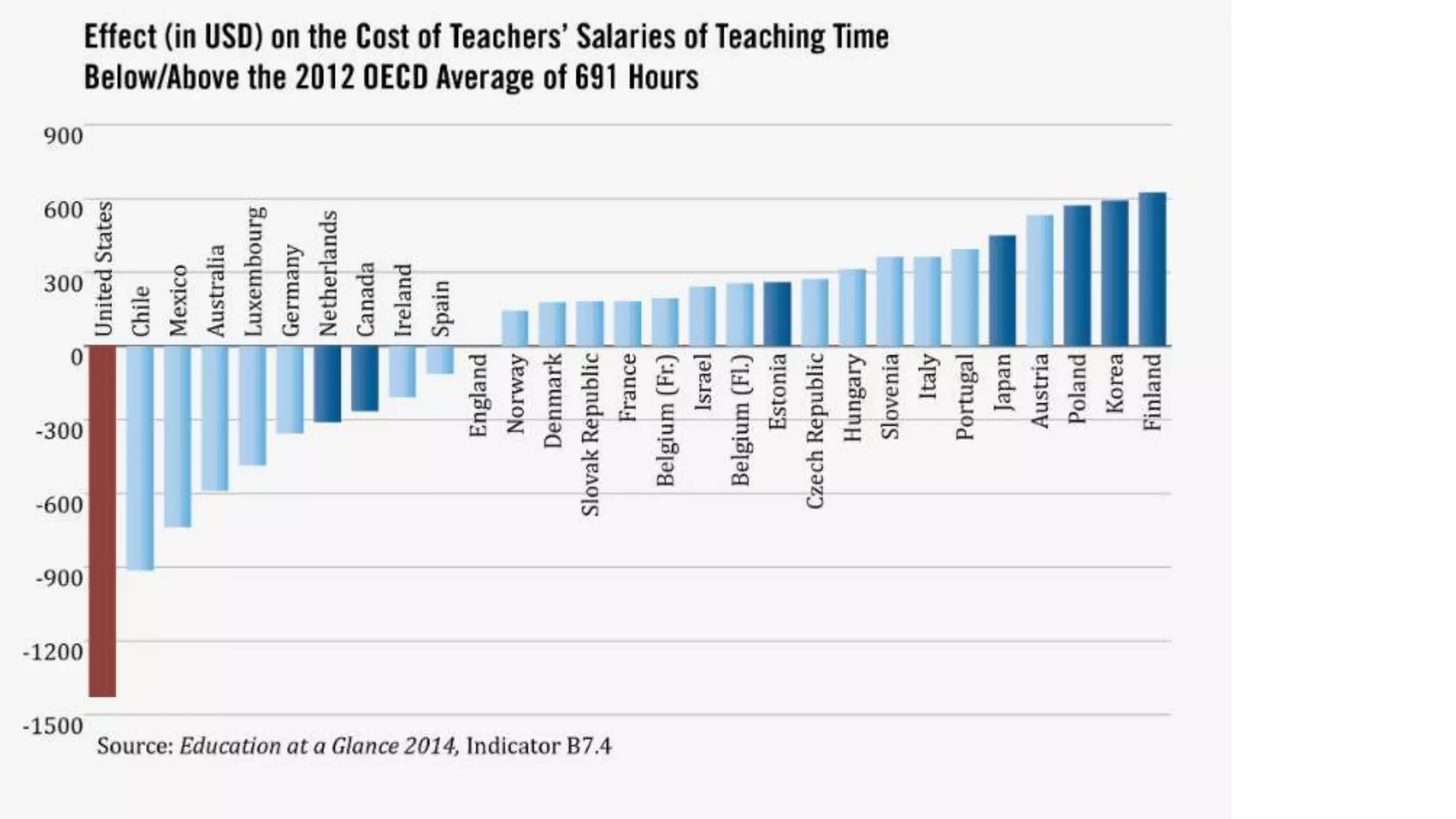
  • #35 remember Placebo effect
  • #40 The number of hours teachers spend directly teaching students rather than preparing lessons, meeting with parents, observing or meeting with other teachers, also plays into this equation. Some countries require teachers to teach many more hours than others, and this impacts the number of teachers that need to be hired. The next chart explores the impact of required teaching time on the cost of teachers’ salaries per student.