Supply Chain Management
and Logistics
Leslie Gardner, University of Indianapolis
Susan Brocksmith, Vincennes University
Carletta Sullivan, McKenzie Career Center
INDIANA
Accomplishments
• Articulation Agreements
• Curriculum (includes programs of study)
• Professional Development for Teachers
• Partnerships
Articulation Agreements
• Secondary to Postsecondary
– Project Lead the Way with Ivy Tech statewide (23
campuses throughout the state and classes are
offered in more than 75 communities)
– Ben Davis University High School with Vincennes
University
• 2+2 Associate Degree to Bachelor’s Degree
– Vincennes University to University of Indianapolis
– Ivy Tech (statewide) to University of Indianapolis
Curriculum
• Programs of Study
• Curriculum Alignment with Professional
Certifications
• Instructional Modules (secondary)
– Mathematics
– Business
• Enrichment Activities (middle and high school)
• Project-Based Learning
Programs of Study
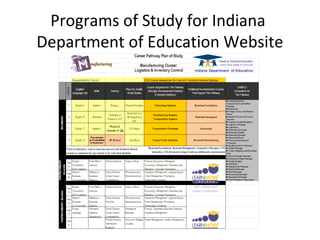
Drafts of postsecondary components of programs of study
submitted to Indiana Department of Education for
• Business, Management & Administration Cluster: Business
Analysis
• Manufacturing Cluster: Logistics & Inventory Control
• Marketing, Sales & Service Cluster: Distribution & Logistics
• Transportation, Distribution & Logistics Cluster: Logistics
Planning & Management Services
• Transportation, Distribution & Logistics Career Cluster:
Transportation Operations
• Transportation, Distribution & Logistics Cluster:
Warehousing and Distribution Center Operations
Programs of Study
• The associate degree levels of these plans are
based on courses common to the Ivy Tech and
Vincennes University programs.
• The bachelor’s degree levels of these plans
are based on course common to the
University of Indianapolis, Indiana University,
Purdue University, Ball State University, and
Indiana State University programs.
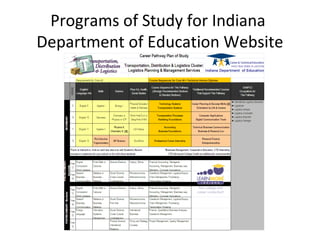
Programs of Study for Indiana
Department of Education Website
Programs of Study for Indiana
Department of Education Website
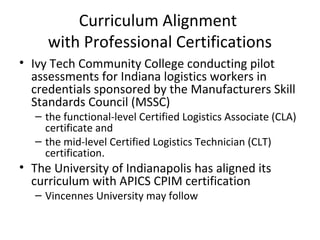
Curriculum Alignment
with Professional Certifications
• Ivy Tech Community College conducting pilot
assessments for Indiana logistics workers in
credentials sponsored by the Manufacturers Skill
Standards Council (MSSC)
– the functional-level Certified Logistics Associate (CLA)
certificate and
– the mid-level Certified Logistics Technician (CLT)
certification.
• The University of Indianapolis has aligned its
curriculum with APICS CPIM certification
– Vincennes University may follow
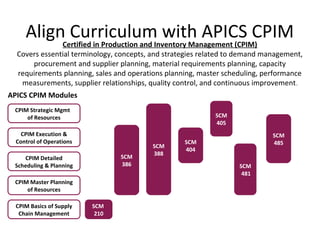
Align Curriculum with APICS CPIM
SCM
485
SCM
481
SCM
210
CPIM Basics of Supply
Chain Management
CPIM Master Planning
of Resources
Certified in Production and Inventory Management (CPIM)
Covers essential terminology, concepts, and strategies related to demand management,
procurement and supplier planning, material requirements planning, capacity
requirements planning, sales and operations planning, master scheduling, performance
measurements, supplier relationships, quality control, and continuous improvement.
CPIM Detailed
Scheduling & Planning
CPIM Execution &
Control of Operations
CPIM Strategic Mgmt
of Resources
SCM
386
SCM
388
SCM
404
SCM
405
APICS CPIM Modules
Supply Chain Instructional Modules
for High and Middle School
• Business and Mathematics
• Align with Indiana Standards
• Career initiative through an academic discipline
• Mathematics is the unifying discipline behind
career clusters that relate to supply chain
management and logistics
– Engineering
– Business
– Advanced manufacturing
Supply Chain Instructional Modules
for High and Middle School Math
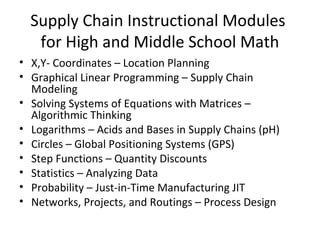
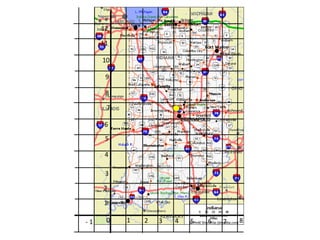
• X,Y- Coordinates – Location Planning
• Graphical Linear Programming – Supply Chain
Modeling
• Solving Systems of Equations with Matrices –
Algorithmic Thinking
• Logarithms – Acids and Bases in Supply Chains (pH)
• Circles – Global Positioning Systems (GPS)
• Step Functions – Quantity Discounts
• Statistics – Analyzing Data
• Probability – Just-in-Time Manufacturing JIT
• Networks, Projects, and Routings – Process Design
1410
1
2
2
3
3
4 5 6 7 8- 1
7
6
5
4
12
11
10
9
8
City Loads X Y
Indianapolis 50
Gary 40
Fort Wayne 45
Evansville 25
Louisville 30
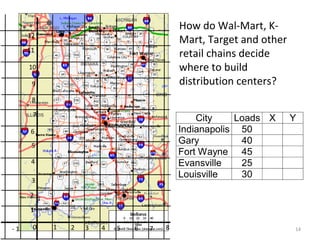
How do Wal-Mart, K-
Mart, Target and other
retail chains decide
where to build
distribution centers?
15
10
1
2
2
3
3
4 5 6 7 8- 1
7
6
5
4
12
11
10
9
8
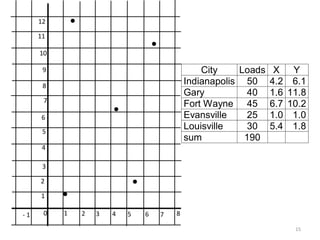
City Loads X Y
Indianapolis 50 4.2 6.1
Gary 40 1.6 11.8
Fort Wayne 45 6.7 10.2
Evansville 25 1.0 1.0
Louisville 30 5.4 1.8
sum 190
16
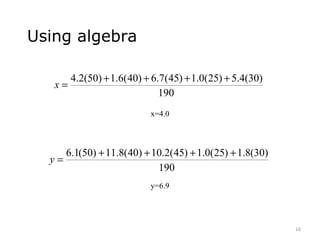
190
)30(4.5)25(0.1)45(7.6)40(6.1)50(2.4 ++++
=x
190
)30(8.1)25(0.1)45(2.10)40(8.11)50(1.6 ++++
=y
x=4.0
y=6.9
Using algebra
10
1
2
2
3
3
4 5 6 7 8- 1
7
6
5
4
12
11
10
9
8
18
Supply Chain Instructional Modules
for High and Middle School Business
• Manufacture Snacks Products
• Distribution Game
• Purchase Planning Data Collection and
Analysis Activity
• Just-In-Time Manufacturing Simulation
• Careers in Supply-Chain Research Activity
Enrichment Activities
• Young Executive Camp
– Monday – Manufacturing
– Tuesday – Packaging
– Wednesday – Distribution
– Thursday – Retail
– Friday – Apprentice Competition
Project-Based Learning (PBL)
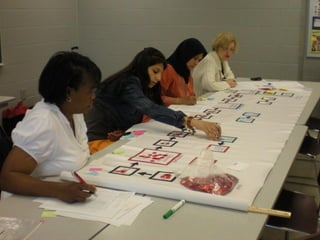
• Woodrow Wilson Fellows developing PBL supply
chain modules for math
– Master of Arts in Teaching Program
– Engineers
– Commit to teach in high-need schools
• PBL examples
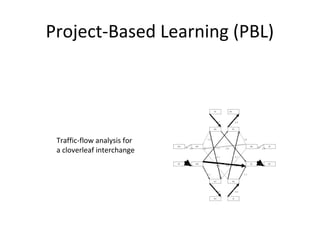
– Traffic flow analysis (graph algorithms)
– Who wants to be a millionaire (compound interest)
– Credit card debt (compound interest)
– JIT inventory (compound interest)
Project-Based Learning (PBL)
Traffic-flow analysis for
a cloverleaf interchange
High School Teacher Workshop
• 2 weeks, 7 hours per day (June 8-19, 2009)
• 21 middle school, high school, and college
math teacher
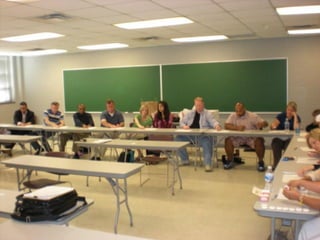
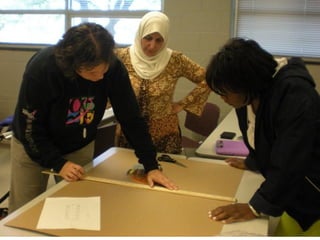
• Field trips, labs, guest speakers, lesson
planning
• 3 hours of graduate credit in education
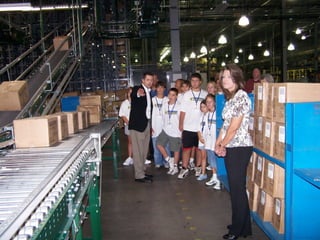
Field Trips
• Nucor Steel
• Garrity Tool
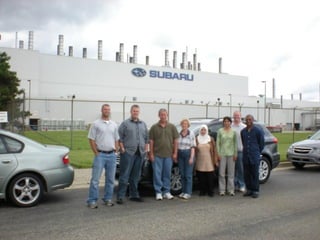
• Subaru
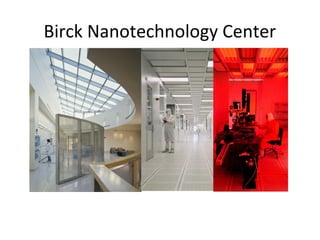
• Birck Nanotechnology Center (Purdue)
• FedEx
• Redcats
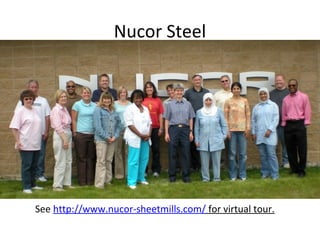
Nucor Steel
See http://www.nucor-sheetmills.com/ for virtual tour.
Birck Nanotechnology Center
Labs
• Just-In-Time poker chips and dice
demonstration
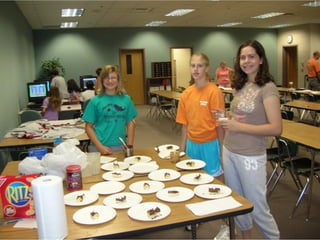
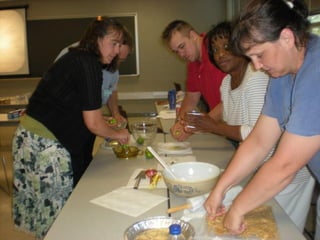
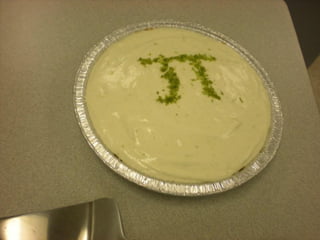
• Process design lab – make a Key Lime Pie
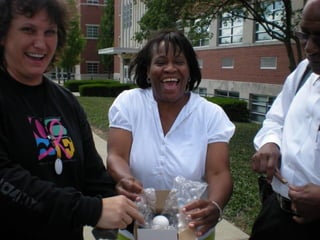
• Packaging
• Distribution game
Speakers
• Information Systems –
Enterprise Resource
Planning
• Indiana Conexus
• Transportation
• Entrepreneurship
• Life Science Industries
• Global Supply Chains
• RFID
• Public Policy/Workforce
Development
• Purchasing and
strategic sourcing
• Indiana Standards for
Math
• I-STEM Network
Partnerships
• Higher Education – Ivy Tech Community College, University
of Indianapolis, Vincennes University
• Secondary Education – McKenzie Career Center, Speedway
High School, Arsenal Technical High School, Ben Davis
University High School
• Indiana Conexus – Dream-It-Do-It
• Companies – FedEx, Nucor, Subaru, Dow AgroSciences,
IMMI, Garrity Tool, Redcats, Magnum Logistics, Langham
• Professional Societies - APICS, ASQ, NAPM, IoPP, PMI,
AST&L, CSCMP, ASQ Midwest Biomedical discussion group
• Woodrow Wilson Foundation
• I-STEM network
Challenges
• Downsizing of state government causing changes
in how career pathways are approved
• Finding all of the parties working on Supply Chain
Management and Logistics Education and
building relationships and partnerships
• Recruiting students in to programs of study
– Dispelling myths of low paying, boring jobs
– Dispelling myths of these jobs being for students who
can’t do anything else
– Supply chain management and logistics is the hidden
world
Successes
• Articulation agreements
• Teacher workshop
• Development of curriculum modules and
supply chain enrichment activities for high
school and middle school
• Partnerships
• Foundation laid for reorganization of career
pathways
Work in Progress
• Curriculum
– Secondary Plans of Study
– Postsecondary Professional Certifications
– Dual Credit
– Scholarships
• Articulation
• Professional Development for Teachers
• Dissemination
Secondary Curriculum – Indiana Area CTE
Districts (IACTED) Model Curriculum Project
• To develop Indiana CTE Career Pathways (programs of study) based on
High Wage, High Skill and High Demand Indiana occupations.
• To develop model curriculum for new and revised courses needed for the
Career Pathways that includes a course description, course content topics,
standards, competencies/objectives, assessment measures, teacher
requirements, recommended EOP assessments and sample syllabus for
each course.
• To identify post-secondary courses that are aligned with the secondary
course/program if appropriate.
• To work with post-secondary institutions to develop statewide dual credit
agreements.
• To include core academics aligned to Indiana Standards in each
curriculum.
IACTED Model Curriculum Project
Supply Chain and Logistics
• Reduce number of career pathways and
reorganize cluster to reflect common
components
• Create logistics pathway
• Add logistics component to other clusters
– Engineering
– Business
– Biomedical
• Recognize STEM components
• Add postsecondary components
Postsecondary Curriculum
• Integrated professional certifications
– APICS CPIM (undergrad)
– Six Sigma Green Belt (undergrad)
– APICS CSCP (MBA)
• Expand partnerships to include more 4-year
institutions
Dual Credit
• Vincennes University
– Logistics at Ben Davis University High School
– Large network of math dual credit, plan to integrate
supply chain modules
• Ivy Tech
– Dual credit logistics at Twin Lakes
• University of Indianapolis
– Coordinated Finite Math and Supply Chain
– Above average academic credentials for entering
freshmen
STEM Supply Chain Scholarships
NSF S-STEM Scholarship grant submitted ($588,000)
• Four cohorts of 6-10 juniors and seniors over 5 years
• Partnership of Vincennes University, Ivy Tech,
University of Indianapolis
• Major in a science or math
• Minor or concentration in supply chain management
• Mentoring by scientists and supply chain professionals
• Supply Chain Bootcamp
• Paying summer internships
Articulation Agreements
• Vincennes University
– Supply Chain Logistics – UIndy SCM (signed)
– Business Administration – UIndy SCM (submitted)
– Business Management – UIndy SCM (submitted)
– Business Administration – UIndy Mgt/Admin. (submitted)
• Ivy Tech
– Transportation, Distribution and Logistics – UIndy SCM
(signed)
– Business Administration – UIndy SCM (draft)
• Other 4-year institutions
• STEM disciplines
Professional Development for
Teachers
• Target - CTE, STEM, Business, and Economics
teachers
• Purpose
– Introduce teachers to supply chain management,
logistics and manufacturing
– Teach teachers to use math modules in STEM courses
– Train teachers in Vincennes University’s network of
dual credit courses
– Create network of secondary supply chain enrichment
programs
Professional Development for
Teachers
• Format - Workshops for stipends or graduate credit
– Basic – 2 week summer workshop piloted last summer
– Advanced (math modeling, advanced manufacturing, RFID,
chemistry of steel and other materials, life science
companies, energy supply chains, etc.)
• Partners
– Academic – Vincennes University, University of
Indianapolis, Indiana University
– Corporate – Nucor, Garrity Tool, Subaru, IMMI, Redcats,
FedEx, Magnum Logistics, Langham, Parish Manufacturing,
Caepac, Roche, Dow AgroSciences, etc.
– Professional Societies – APICS, ASQ, NAPM, IoPP, PMI,
CSCMP, AST&L, ASQ Midwest Biomedical Discussion Group
Dissemination -
Presentations Scheduled
• Indiana Council of Teachers of Mathematics
• Indiana State Counselors Association
• Decision Sciences Institute Annual Meeting
• National Council of Teachers of Mathematics
Supply Chain Management
and Logistics
Spans Levels of Education
• High School
• Associate
• Bachelor
• Graduate
• Professional
Development
Must be integrated into
• Information Technology
• Business /Management
• Engineering
• Science/Math
• Biomedical
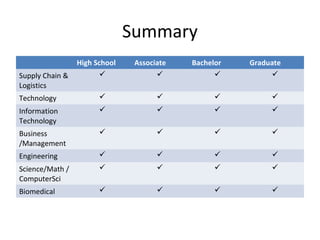
Summary
High School Associate Bachelor Graduate
Supply Chain &
Logistics
   
Technology    
Information
Technology
   
Business
/Management
   
Engineering    
Science/Math /
ComputerSci
   
Biomedical    
Log and supply chain mgt

Log and supply chain mgt

  • 2.
    Supply Chain Management andLogistics Leslie Gardner, University of Indianapolis Susan Brocksmith, Vincennes University Carletta Sullivan, McKenzie Career Center INDIANA
  • 3.
    Accomplishments • Articulation Agreements •Curriculum (includes programs of study) • Professional Development for Teachers • Partnerships
  • 4.
    Articulation Agreements • Secondaryto Postsecondary – Project Lead the Way with Ivy Tech statewide (23 campuses throughout the state and classes are offered in more than 75 communities) – Ben Davis University High School with Vincennes University • 2+2 Associate Degree to Bachelor’s Degree – Vincennes University to University of Indianapolis – Ivy Tech (statewide) to University of Indianapolis
  • 5.
    Curriculum • Programs ofStudy • Curriculum Alignment with Professional Certifications • Instructional Modules (secondary) – Mathematics – Business • Enrichment Activities (middle and high school) • Project-Based Learning
  • 6.
    Programs of Study Draftsof postsecondary components of programs of study submitted to Indiana Department of Education for • Business, Management & Administration Cluster: Business Analysis • Manufacturing Cluster: Logistics & Inventory Control • Marketing, Sales & Service Cluster: Distribution & Logistics • Transportation, Distribution & Logistics Cluster: Logistics Planning & Management Services • Transportation, Distribution & Logistics Career Cluster: Transportation Operations • Transportation, Distribution & Logistics Cluster: Warehousing and Distribution Center Operations
  • 7.
    Programs of Study •The associate degree levels of these plans are based on courses common to the Ivy Tech and Vincennes University programs. • The bachelor’s degree levels of these plans are based on course common to the University of Indianapolis, Indiana University, Purdue University, Ball State University, and Indiana State University programs.
  • 8.
    Programs of Studyfor Indiana Department of Education Website
  • 9.
    Programs of Studyfor Indiana Department of Education Website
  • 10.
    Curriculum Alignment with ProfessionalCertifications • Ivy Tech Community College conducting pilot assessments for Indiana logistics workers in credentials sponsored by the Manufacturers Skill Standards Council (MSSC) – the functional-level Certified Logistics Associate (CLA) certificate and – the mid-level Certified Logistics Technician (CLT) certification. • The University of Indianapolis has aligned its curriculum with APICS CPIM certification – Vincennes University may follow
  • 11.
    Align Curriculum withAPICS CPIM SCM 485 SCM 481 SCM 210 CPIM Basics of Supply Chain Management CPIM Master Planning of Resources Certified in Production and Inventory Management (CPIM) Covers essential terminology, concepts, and strategies related to demand management, procurement and supplier planning, material requirements planning, capacity requirements planning, sales and operations planning, master scheduling, performance measurements, supplier relationships, quality control, and continuous improvement. CPIM Detailed Scheduling & Planning CPIM Execution & Control of Operations CPIM Strategic Mgmt of Resources SCM 386 SCM 388 SCM 404 SCM 405 APICS CPIM Modules
  • 12.
    Supply Chain InstructionalModules for High and Middle School • Business and Mathematics • Align with Indiana Standards • Career initiative through an academic discipline • Mathematics is the unifying discipline behind career clusters that relate to supply chain management and logistics – Engineering – Business – Advanced manufacturing
  • 13.
    Supply Chain InstructionalModules for High and Middle School Math • X,Y- Coordinates – Location Planning • Graphical Linear Programming – Supply Chain Modeling • Solving Systems of Equations with Matrices – Algorithmic Thinking • Logarithms – Acids and Bases in Supply Chains (pH) • Circles – Global Positioning Systems (GPS) • Step Functions – Quantity Discounts • Statistics – Analyzing Data • Probability – Just-in-Time Manufacturing JIT • Networks, Projects, and Routings – Process Design
  • 14.
    1410 1 2 2 3 3 4 5 67 8- 1 7 6 5 4 12 11 10 9 8 City Loads X Y Indianapolis 50 Gary 40 Fort Wayne 45 Evansville 25 Louisville 30 How do Wal-Mart, K- Mart, Target and other retail chains decide where to build distribution centers?
  • 15.
    15 10 1 2 2 3 3 4 5 67 8- 1 7 6 5 4 12 11 10 9 8 City Loads X Y Indianapolis 50 4.2 6.1 Gary 40 1.6 11.8 Fort Wayne 45 6.7 10.2 Evansville 25 1.0 1.0 Louisville 30 5.4 1.8 sum 190
  • 16.
  • 17.
    10 1 2 2 3 3 4 5 67 8- 1 7 6 5 4 12 11 10 9 8
  • 18.
  • 19.
    Supply Chain InstructionalModules for High and Middle School Business • Manufacture Snacks Products • Distribution Game • Purchase Planning Data Collection and Analysis Activity • Just-In-Time Manufacturing Simulation • Careers in Supply-Chain Research Activity
  • 20.
    Enrichment Activities • YoungExecutive Camp – Monday – Manufacturing – Tuesday – Packaging – Wednesday – Distribution – Thursday – Retail – Friday – Apprentice Competition
  • 24.
    Project-Based Learning (PBL) •Woodrow Wilson Fellows developing PBL supply chain modules for math – Master of Arts in Teaching Program – Engineers – Commit to teach in high-need schools • PBL examples – Traffic flow analysis (graph algorithms) – Who wants to be a millionaire (compound interest) – Credit card debt (compound interest) – JIT inventory (compound interest)
  • 25.
    Project-Based Learning (PBL) Traffic-flowanalysis for a cloverleaf interchange
  • 26.
    High School TeacherWorkshop • 2 weeks, 7 hours per day (June 8-19, 2009) • 21 middle school, high school, and college math teacher • Field trips, labs, guest speakers, lesson planning • 3 hours of graduate credit in education
  • 27.
    Field Trips • NucorSteel • Garrity Tool • Subaru • Birck Nanotechnology Center (Purdue) • FedEx • Redcats
  • 28.
  • 32.
  • 33.
    Labs • Just-In-Time pokerchips and dice demonstration • Process design lab – make a Key Lime Pie • Packaging • Distribution game
  • 41.
    Speakers • Information Systems– Enterprise Resource Planning • Indiana Conexus • Transportation • Entrepreneurship • Life Science Industries • Global Supply Chains • RFID • Public Policy/Workforce Development • Purchasing and strategic sourcing • Indiana Standards for Math • I-STEM Network
  • 42.
    Partnerships • Higher Education– Ivy Tech Community College, University of Indianapolis, Vincennes University • Secondary Education – McKenzie Career Center, Speedway High School, Arsenal Technical High School, Ben Davis University High School • Indiana Conexus – Dream-It-Do-It • Companies – FedEx, Nucor, Subaru, Dow AgroSciences, IMMI, Garrity Tool, Redcats, Magnum Logistics, Langham • Professional Societies - APICS, ASQ, NAPM, IoPP, PMI, AST&L, CSCMP, ASQ Midwest Biomedical discussion group • Woodrow Wilson Foundation • I-STEM network
  • 43.
    Challenges • Downsizing ofstate government causing changes in how career pathways are approved • Finding all of the parties working on Supply Chain Management and Logistics Education and building relationships and partnerships • Recruiting students in to programs of study – Dispelling myths of low paying, boring jobs – Dispelling myths of these jobs being for students who can’t do anything else – Supply chain management and logistics is the hidden world
  • 44.
    Successes • Articulation agreements •Teacher workshop • Development of curriculum modules and supply chain enrichment activities for high school and middle school • Partnerships • Foundation laid for reorganization of career pathways
  • 45.
    Work in Progress •Curriculum – Secondary Plans of Study – Postsecondary Professional Certifications – Dual Credit – Scholarships • Articulation • Professional Development for Teachers • Dissemination
  • 46.
    Secondary Curriculum –Indiana Area CTE Districts (IACTED) Model Curriculum Project • To develop Indiana CTE Career Pathways (programs of study) based on High Wage, High Skill and High Demand Indiana occupations. • To develop model curriculum for new and revised courses needed for the Career Pathways that includes a course description, course content topics, standards, competencies/objectives, assessment measures, teacher requirements, recommended EOP assessments and sample syllabus for each course. • To identify post-secondary courses that are aligned with the secondary course/program if appropriate. • To work with post-secondary institutions to develop statewide dual credit agreements. • To include core academics aligned to Indiana Standards in each curriculum.
  • 47.
    IACTED Model CurriculumProject Supply Chain and Logistics • Reduce number of career pathways and reorganize cluster to reflect common components • Create logistics pathway • Add logistics component to other clusters – Engineering – Business – Biomedical • Recognize STEM components • Add postsecondary components
  • 48.
    Postsecondary Curriculum • Integratedprofessional certifications – APICS CPIM (undergrad) – Six Sigma Green Belt (undergrad) – APICS CSCP (MBA) • Expand partnerships to include more 4-year institutions
  • 49.
    Dual Credit • VincennesUniversity – Logistics at Ben Davis University High School – Large network of math dual credit, plan to integrate supply chain modules • Ivy Tech – Dual credit logistics at Twin Lakes • University of Indianapolis – Coordinated Finite Math and Supply Chain – Above average academic credentials for entering freshmen
  • 50.
    STEM Supply ChainScholarships NSF S-STEM Scholarship grant submitted ($588,000) • Four cohorts of 6-10 juniors and seniors over 5 years • Partnership of Vincennes University, Ivy Tech, University of Indianapolis • Major in a science or math • Minor or concentration in supply chain management • Mentoring by scientists and supply chain professionals • Supply Chain Bootcamp • Paying summer internships
  • 51.
    Articulation Agreements • VincennesUniversity – Supply Chain Logistics – UIndy SCM (signed) – Business Administration – UIndy SCM (submitted) – Business Management – UIndy SCM (submitted) – Business Administration – UIndy Mgt/Admin. (submitted) • Ivy Tech – Transportation, Distribution and Logistics – UIndy SCM (signed) – Business Administration – UIndy SCM (draft) • Other 4-year institutions • STEM disciplines
  • 52.
    Professional Development for Teachers •Target - CTE, STEM, Business, and Economics teachers • Purpose – Introduce teachers to supply chain management, logistics and manufacturing – Teach teachers to use math modules in STEM courses – Train teachers in Vincennes University’s network of dual credit courses – Create network of secondary supply chain enrichment programs
  • 53.
    Professional Development for Teachers •Format - Workshops for stipends or graduate credit – Basic – 2 week summer workshop piloted last summer – Advanced (math modeling, advanced manufacturing, RFID, chemistry of steel and other materials, life science companies, energy supply chains, etc.) • Partners – Academic – Vincennes University, University of Indianapolis, Indiana University – Corporate – Nucor, Garrity Tool, Subaru, IMMI, Redcats, FedEx, Magnum Logistics, Langham, Parish Manufacturing, Caepac, Roche, Dow AgroSciences, etc. – Professional Societies – APICS, ASQ, NAPM, IoPP, PMI, CSCMP, AST&L, ASQ Midwest Biomedical Discussion Group
  • 54.
    Dissemination - Presentations Scheduled •Indiana Council of Teachers of Mathematics • Indiana State Counselors Association • Decision Sciences Institute Annual Meeting • National Council of Teachers of Mathematics
  • 55.
    Supply Chain Management andLogistics Spans Levels of Education • High School • Associate • Bachelor • Graduate • Professional Development Must be integrated into • Information Technology • Business /Management • Engineering • Science/Math • Biomedical
  • 56.
    Summary High School AssociateBachelor Graduate Supply Chain & Logistics     Technology     Information Technology     Business /Management     Engineering     Science/Math / ComputerSci     Biomedical    

Editor's Notes

  • #4 Our accomplishments in the last year fall into 4 categories.
  • #5 We have created articulation agreements on two levels: secondary to postsecondary and Associate to Bachelor. Indiana is unique in that it has two community college systems: Vincennes University and Ivy Tech. Ivy Tech is primarily focused on vocational technical programs with some academic transfer programs whereas Vincennes University has its roots in academic transfer programs but has developed vocational technical programs in the last 30-40 years.
  • #6 The bulk of the work supported by this grant falls under curriculum development. This includes programs of study, alignment with professional certifications, development of instructional modules at the secondary level, enrichment activities for middle and high schools, and project-based learning.
  • #7 Indiana has the secondary components of plans of study on its website so I submitted drafts of the postsecondary components of these programs of study to the Indiana Department of Education for these programs of study.
  • #8 The first challenge in writing up the postsecondary components was deciding which community colleges and universities to use because they had a variety of approaches to supply chain and logistics.
  • #9 The second challenge was that 4 year degree programs in this area tend to be much more quantitative than 2 year degree programs and the same course titles may not really be equivalent. For this reason, I broke the post-secondary components into associate and bachelor levels. The articulation agreements reflect this in that they are written so that students planning to transfer must substitute higher level math classes. The third challenge was that the classifications did not fit the postsecondary education well. Several of these essentially had the same postsecondary components but for other programs of study broke into two or more components. Indiana really needs to rethink the career cluster categories. The final challenge is that if you get on the Indiana Department of Education website, you will not find the postsecondary components. The reason for this is that the state of Indiana drastically downsized state government as a result of the recession and laid off lots of people from the department of education. Those who are left have not had time to get this sorted out and up on the website.
  • #10 The second challenge was that 4 year degree programs in this area tend to be much more quantitative than 2 year degree programs and the same course titles may not really be equivalent. For this reason, I broke the post-secondary components into associate and bachelor levels. The articulation agreements reflect this in that they are written so that students planning to transfer must substitute higher level math classes. The third challenge was that the classifications did not fit the postsecondary education well. Several of these essentially had the same postsecondary components but for other programs of study broke into two or more components. Indiana really needs to rethink the career cluster categories. The final challenge is that if you get on the Indiana Department of Education website, you will not find the postsecondary components. The reason for this is that the state of Indiana drastically downsized state government as a result of the recession and laid off lots of people from the department of education. Those who are left have not had time to get this sorted out and up on the website.
  • #11 See http://www.ivytech.edu/transportation-distrib-logisitics-institute/CLT.pdf
  • #47 Because of downsizing of state government, the process has changed and the program of study part has been folded into the IACTED Model Curriculum Project. Supply Chain and Logistics will be among the first pathway to go through this process.
  • #48 Because of this grant, we are farther along with supply chain and logistics than most of the other pathways and it will probably become the model for the new process.
  • #50 Note that this is a 3-tiered approach with Ivy Tech dual credit focused on students who go directly into workforce with high school diploma, VU focused on first line supervisors, and UIndy focused on upwardly mobile executives.