LNG
101
A Guide to British Columbia’s
Liquefied Natural Gas Sector
“our province is building a
new industry…
B R I T I S H C O L U M B I A’ S
…which will put us
among the global leaders”
LNG 101

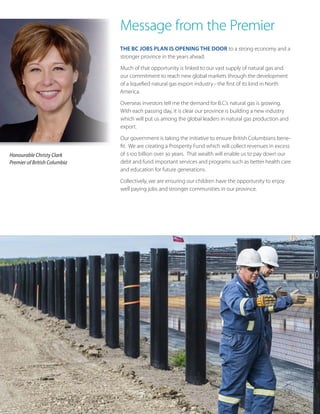
Honourable Christy Clark
Premier of British Columbia

1
Message from the Premier
THE BC JOBS PLAN IS OPENING THE DOOR to a strong economy and a
stronger province in the years ahead.
Much of that opportunity is linked to our vast supply of natural gas and
our commitment to reach new global markets through the development
of a liquefied natural gas export industry – the first of its kind in North
America.
Overseas investors tell me the demand for B.C.’s natural gas is growing.
With each passing day, it is clear our province is building a new industry
which will put us among the global leaders in natural gas production and
export.

Honourable Christy Clark
Premier of British Columbia

Our government is taking the initiative to ensure British Columbians benefit. We are creating a Prosperity Fund which will collect revenues in excess
of $100 billion over 30 years. That wealth will enable us to pay down our
debt and fund important services and programs such as better health care
and education for future generations.
Collectively, we are ensuring our children have the opportunity to enjoy
well paying jobs and stronger communities in our province.

2

B R I T I S H C O L U M B I A’ S
Message from the Minister
THIS IS AN EXCITING TIME FOR BRITISH COLUMBIA. A new industry
with the ability to add unprecedented economic growth and well-paying
jobs is on our doorstep.
Our province is in a position of strength. We have a close proximity to
growing Asian markets and an abundant supply of clean energy that is in
high demand. We also have a stable government and a world-class regulatory environment which business will rely on as it makes final investment
decisions.
Over the last year, a number of companies with global LNG experience
have come forward with major project proposals for B.C.
This is tremendous news, yet we know much more work lies ahead. We
recognize we need to broaden engagement with local communities in the
North including First Nations. And, we must expand skills training opportunities so people have the tools they need to fill thousands of new jobs.

Honourable Rich Coleman
Minister of Natural Gas Development

We must also remain steadfast in our commitment to environmental
leadership by taking action to ensure environmental protection keeps
pace with the forecasted growth in our natural gas sector.
It is a formidable challenge, and we relish the opportunity to create a new
economic strength that will ensure our local communities and our people
benefit for generations to come.

LNG 101

3
What is LNG?
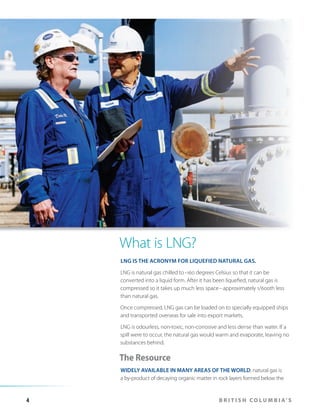
LNG IS THE ACRONYM FOR LIQUEFIED NATURAL GAS.
LNG is natural gas chilled to -160 degrees Celsius so that it can be
converted into a liquid form. After it has been liquefied, natural gas is
compressed so it takes up much less space – approximately 1/600th less
than natural gas.
Once compressed, LNG gas can be loaded on to specially equipped ships
and transported overseas for sale into export markets.
LNG is odourless, non-toxic, non-corrosive and less dense than water. If a
spill were to occur, the natural gas would warm and evaporate, leaving no
substances behind.

The Resource
WIDELY AVAILABLE IN MANY AREAS OF THE WORLD, natural gas is
a by-product of decaying organic matter in rock layers formed below the

4

B R I T I S H C O L U M B I A’ S
earth’s surface millions of years ago. As the matter decayed, the gas was
trapped or isolated in the rock formations which prevented it from surfacing.
Natural gas is primarily composed of methane gas. It can also contain
small amounts of ethane, propane butane and pentanes.
Today, natural gas is recognized as the world’s cleanest burning fossil fuel.
It has a low carbon dioxide content and is often used as a fuel to produce
other forms of energy.
Once processed for commercial use, natural gas can be safely used for a
variety of purposes such as heating homes and businesses, generating
electricity or fueling vehicles. It can also be paired with renewable power
sources such as wind and solar to make these forms of intermittent energy
more reliable and available.
Because natural gas is clean, safe and plentiful, it will remain an important
part of the world’s future energy needs.

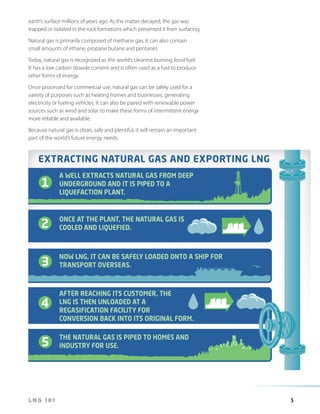
EXTRACTING NATURAL GAS AND EXPORTING LNG
A WELL EXTRACTS NATURAL GAS FROM DEEP
UNDERGROUND AND IT IS PIPED TO A
LIQUEFACTION PLANT.

ONCE AT THE PLANT, THE NATURAL GAS IS
COOLED AND LIQUEFIED.

NOW LNG, IT CAN BE SAFELY LOADED ONTO A SHIP FOR
TRANSPORT OVERSEAS.

AFTER REACHING ITS CUSTOMER, THE
LNG IS THEN UNLOADED AT A
REGASIFICATION FACILITY FOR
CONVERSION BACK INTO ITS ORIGINAL FORM.
THE NATURAL GAS IS PIPED TO HOMES AND
INDUSTRY FOR USE.

LNG 101

5
British Columbia’s natural gas supply
FOR MORE THAN 50 YEARS PEOPLE HAVE been extracting natural
gas in British Columbia. To ensure industry uses safe drilling techniques,
the Province has a world-class regulatory framework in place to govern
extraction of natural gas from the soil.
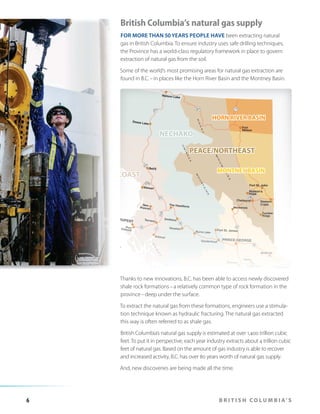
Some of the world’s most promising areas for natural gas extraction are
found in B.C. – in places like the Horn River Basin and the Montney Basin.

HORN RIVER BASIN

NECHAKO
PEACE/NORTHEAST
NORTH COAST

MONTNEY BASIN

CARIBOO/CENTRAL

Thanks to new innovations, B.C. has been able to access newly discovered
shale rock formations – a relatively common type of rock formation in the
province – deep under the surface.
To extract the natural gas from these formations, engineers use a stimulation technique known as hydraulic fracturing. The natural gas extracted
this way is often referred to as shale gas.
British Columbia’s natural gas supply is estimated at over 1,400 trillion cubic
feet. To put it in perspective, each year industry extracts about 4 trillion cubic
feet of natural gas. Based on the amount of gas industry is able to recover
and increased activity, B.C. has over 80 years worth of natural gas supply.
And, new discoveries are being made all the time.

6

B R I T I S H C O L U M B I A’ S
British Columbia’s LNG story
B.C. CURRENTLY SELLS ITS NATURAL GAS INTO TWO MARKETS:
CANADA AND THE UNITED STATES.
Demand from these customers is declining because natural gas discoveries are being made all over North America, leading to an abundance of
domestic supply. The United States, for example, is expected to be energy
self-sufficient from natural gas by 2030.
Because North American demand is shrinking at the same time supply is
increasing, B.C. is looking further afield to new markets for our natural gas.
Emerging economies in China, India and other areas of Asia have significantly increased demand for natural gas further globally, and created an
opportunity for British Columbia to grow a brand new LNG industry in
Canada.
According to most energy analysts, the Asia Pacific region is projected to
increase the demand for natural gas by two-and-a-half times by the year
2030, and it could continue to rise for years afterwards.
In reaction to growing energy needs worldwide, a number of countries are
looking to compete for a share of Asia’s LNG market. Countries interested
in moving forward with new or larger LNG export operations include
Australia, Russia and the United States.
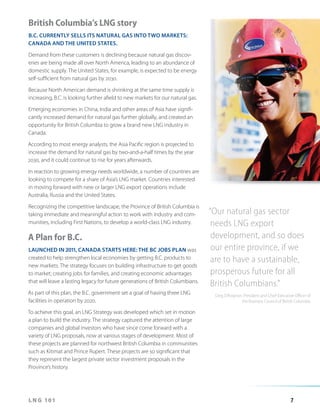
Recognizing the competitive landscape, the Province of British Columbia is
taking immediate and meaningful action to work with industry and communities, including First Nations, to develop a world-class LNG industry.

A Plan for B.C.
LAUNCHED IN 2011, CANADA STARTS HERE: THE BC JOBS PLAN was
created to help strengthen local economies by getting B.C. products to
new markets. The strategy focuses on building infrastructure to get goods
to market; creating jobs for families, and creating economic advantages
that will leave a lasting legacy for future generations of British Columbians.
As part of this plan, the B.C. government set a goal of having three LNG
facilities in operation by 2020.

“Our natural gas sector
needs LNG export
development, and so does
our entire province, if we
are to have a sustainable,
prosperous future for all
British Columbians.”
Greg D’Avignon, President and Chief Executive Officer of
the Business Council of British Columbia

To achieve this goal, an LNG Strategy was developed which set in motion
a plan to build the industry. The strategy captured the attention of large
companies and global investors who have since come forward with a
variety of LNG proposals, now at various stages of development. Most of
these projects are planned for northwest British Columbia in communities
such as Kitimat and Prince Rupert. These projects are so significant that
they represent the largest private sector investment proposals in the
Province’s history.

LNG 101

7
List of announced LNG proposals as of Summer 2013:
LNG PROJECT

PROPONENT

LOCATION

Discovery LNG
discoverylng.com

Quicksilver Resources Canada

Campbell River

Douglas Channel Energy project
douglaschannelenergy.com

Douglas Channel Energy
Partnership/Haisla Nation/Golar
LNG

Kitimat

Kitimat LNG
kitimatlngfacility.com

Apache Corp. and Chevron
Canada

Kitimat

LNG Canada
lngcanada.ca

Shell Canada and their co-venture
partners–KOGAS, Mitsubishi, and
PetroChina

Kitimat

Pacific Northwest LNG
pacificnorthwestlng.com

PETRONAS/Progress Energy/Japex Prince Rupert

Prince Rupert LNG
www.princerupertlng.ca

BG Group

Prince Rupert

Woodfibre LNG Project
www.woodfibrelngproject.ca

Woodfibre Natural Gas Limited

Squamish

Multiple proposals
lnginbc.ca

Various

Crown Land near
Prince Rupert

Environmental Leadership
B.C. IS A WORLD LEADER IN ENVIRONMENTAL REGULATION for
natural gas development. In fact, B.C. is considered to have the strictest
regulations. Exploration and extraction practices are tightly monitored to
protect wildlife. The latest pipeline technology is used to safeguard water
from harm.
The B.C. government is taking action to maintain a safe natural gas sector
while also building the cleanest LNG industry in the world. In negotiations
with proponents, the Province continues to focus on the use of clean
energy sources to power LNG facilities. New measures to manage greenhouse gas emissions are also being evaluated.
Of course, the fight against climate change is a global issue. As a future
supplier of the cleanest burning fossil fuel, B.C. will help other markets
transition to cleaner natural gas and away from dirtier energy sources like
coal. For years, China and other areas of Asia have relied heavily on coal
for energy needs. Soon, with access to B.C.’s natural gas, coal-fired power
generation should decrease and cleaner energy production will fill the gap.

8

B R I T I S H C O L U M B I A’ S
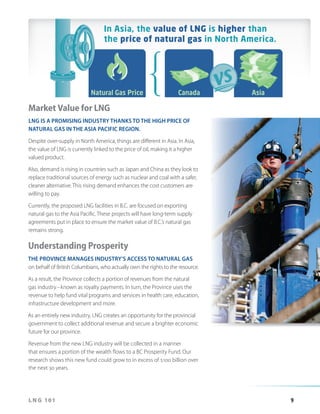
In Asia, the value of LNG is higher than
the price of natural gas in North America.

Natural Gas Price

Canada

Asia

Market Value for LNG
LNG IS A PROMISING INDUSTRY THANKS TO THE HIGH PRICE OF
NATURAL GAS IN THE ASIA PACIFIC REGION.
Despite over-supply in North America, things are different in Asia. In Asia,
the value of LNG is currently linked to the price of oil, making it a higher
valued product.
Also, demand is rising in countries such as Japan and China as they look to
replace traditional sources of energy such as nuclear and coal with a safer,
cleaner alternative. This rising demand enhances the cost customers are
willing to pay.
Currently, the proposed LNG facilities in B.C. are focused on exporting
natural gas to the Asia Pacific. These projects will have long-term supply
agreements put in place to ensure the market value of B.C.’s natural gas
remains strong.

Understanding Prosperity
THE PROVINCE MANAGES INDUSTRY’S ACCESS TO NATURAL GAS
on behalf of British Columbians, who actually own the rights to the resource.
As a result, the Province collects a portion of revenues from the natural
gas industry – known as royalty payments. In turn, the Province uses the
revenue to help fund vital programs and services in health care, education,
infrastructure development and more.
As an entirely new industry, LNG creates an opportunity for the provincial
government to collect additional revenue and secure a brighter economic
future for our province.
Revenue from the new LNG industry will be collected in a manner
that ensures a portion of the wealth flows to a BC Prosperity Fund. Our
research shows this new fund could grow to in excess of $100 billion over
the next 30 years.

LNG 101

9
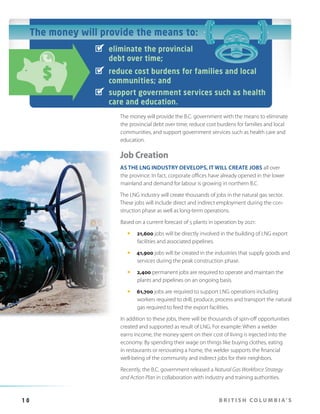
The money will provide the means to:
eliminate the provincial
debt over time;
reduce cost burdens for families and local
communities; and
support government services such as health
care and education.
The money will provide the B.C. government with the means to eliminate
the provincial debt over time; reduce cost burdens for families and local
communities, and support government services such as health care and
education.

Job Creation
AS THE LNG INDUSTRY DEVELOPS, IT WILL CREATE JOBS all over
the province. In fact, corporate offices have already opened in the lower
mainland and demand for labour is growing in northern B.C.
The LNG industry will create thousands of jobs in the natural gas sector.
These jobs will include direct and indirect employment during the construction phase as well as long-term operations.
Based on a current forecast of 5 plants in operation by 2021:
—

21,600 jobs will be directly involved in the building of LNG export
facilities and associated pipelines.

—

41,900 jobs will be created in the industries that supply goods and
services during the peak construction phase.

—

2,400 permanent jobs are required to operate and maintain the
plants and pipelines on an ongoing basis.

—

61,700 jobs are required to support LNG operations including
workers required to drill, produce, process and transport the natural
gas required to feed the export facilities.

In addition to these jobs, there will be thousands of spin-off opportunities
created and supported as result of LNG. For example: When a welder
earns income, the money spent on their cost of living is injected into the
economy. By spending their wage on things like buying clothes, eating
in restaurants or renovating a home, the welder supports the financial
well-being of the community and indirect jobs for their neighbors.
Recently, the B.C. government released a Natural Gas Workforce Strategy
and Action Plan in collaboration with industry and training authorities.

10

B R I T I S H C O L U M B I A’ S
Our action plan outlines the employment demands expected from LNG as
well as details on how government will prepare people for new jobs.
Skills and core industrial certification requirements, as well as new postsecondary programs, will be created to ensure British Columbians are
trained for new, high paying jobs in the resource sector.

Community and First Nation Engagement
LNG IS AN ONCE-IN-A-LIFETIME OPPORTUNITY FOR B.C.
Diversification of our natural gas sector will bring major benefits to communities in the Northwest and right across the province. It will also create
new demands on local resources.
Over the next year, the provincial government will be helping communities prepare for the emerging opportunities and demands of growing
natural gas sector and a new LNG industry.
Part of this process will include asking communities about their needs
as new workers increasingly move in and take residence. The provincial
government anticipates rapid economic development and population
growth, especially for municipal services that support health, education
and public safety.
And, we are prepared to work with impacted communities to help them
plan towards that opportunity. Measures to sustain infrastructure in growing communities will be taken seriously, including the needs associated
with sewers, water quality, health care, education and recreation services.
Over the coming years, the Province will work in partnership with our
communities and to support economic and social opportunities for
families.
Together, we will lay the groundwork to ensure our communities remain
healthy and are equipped to deal with growth.
Most recently, the provincial government signed an Economic Partnership
Agreement with 15 First Nations along the planned pipeline route for
Kitimat LNG – a proposal by Apache Corp. and Chevron Canada.
Similar agreements are being negotiated now to secure long-term economic opportunities for First Nations all over northern B.C.
As part of the provincial government’s commitment to create jobs for
British Columbians, skills training and apprentice programs are also being
expanded to increase First Nations participation.
First Nations have an important and direct role in the development of our
natural gas export potential.
We look forward to working with First Nations, our communities and
industry to advance plans in LNG impacted communities and along
proposed pipeline corridors.
LNG 101

11
Moving Forward
WE ARE SERIOUS ABOUT CREATING A STRONG LNG INDUSTRY, and
have established a Ministry of Natural Gas Development (MNGD) to ensure
that is exactly what happens.
By working with our communities, our First Nations, our industry and their
vested interest groups, we are confident we will secure final investments
from industry in 2014, which will set the stage for construction to begin in
earnest.
At this point, we will be firmly affixed on a new path to new prosperity and
jobs – a path that leads to a debt-free British Columbia.
We are well on our way to establishing a globally competitive LNG export
industry in British Columbia.
The provincial government is demonstrating the leadership required
to create a stronger economy, and a more secure tomorrow for future
generations of British Columbians.

12

B R I T I S H C O L U M B I A’ S
LNG 101
Lng101

Lng101

  • 1.
    LNG 101 A Guide toBritish Columbia’s Liquefied Natural Gas Sector
  • 2.
    “our province isbuilding a new industry… B R I T I S H C O L U M B I A’ S
  • 3.
    …which will putus among the global leaders” LNG 101 Honourable Christy Clark Premier of British Columbia 1
  • 4.
    Message from thePremier THE BC JOBS PLAN IS OPENING THE DOOR to a strong economy and a stronger province in the years ahead. Much of that opportunity is linked to our vast supply of natural gas and our commitment to reach new global markets through the development of a liquefied natural gas export industry – the first of its kind in North America. Overseas investors tell me the demand for B.C.’s natural gas is growing. With each passing day, it is clear our province is building a new industry which will put us among the global leaders in natural gas production and export. Honourable Christy Clark Premier of British Columbia Our government is taking the initiative to ensure British Columbians benefit. We are creating a Prosperity Fund which will collect revenues in excess of $100 billion over 30 years. That wealth will enable us to pay down our debt and fund important services and programs such as better health care and education for future generations. Collectively, we are ensuring our children have the opportunity to enjoy well paying jobs and stronger communities in our province. 2 B R I T I S H C O L U M B I A’ S
  • 5.
    Message from theMinister THIS IS AN EXCITING TIME FOR BRITISH COLUMBIA. A new industry with the ability to add unprecedented economic growth and well-paying jobs is on our doorstep. Our province is in a position of strength. We have a close proximity to growing Asian markets and an abundant supply of clean energy that is in high demand. We also have a stable government and a world-class regulatory environment which business will rely on as it makes final investment decisions. Over the last year, a number of companies with global LNG experience have come forward with major project proposals for B.C. This is tremendous news, yet we know much more work lies ahead. We recognize we need to broaden engagement with local communities in the North including First Nations. And, we must expand skills training opportunities so people have the tools they need to fill thousands of new jobs. Honourable Rich Coleman Minister of Natural Gas Development We must also remain steadfast in our commitment to environmental leadership by taking action to ensure environmental protection keeps pace with the forecasted growth in our natural gas sector. It is a formidable challenge, and we relish the opportunity to create a new economic strength that will ensure our local communities and our people benefit for generations to come. LNG 101 3
  • 6.
    What is LNG? LNGIS THE ACRONYM FOR LIQUEFIED NATURAL GAS. LNG is natural gas chilled to -160 degrees Celsius so that it can be converted into a liquid form. After it has been liquefied, natural gas is compressed so it takes up much less space – approximately 1/600th less than natural gas. Once compressed, LNG gas can be loaded on to specially equipped ships and transported overseas for sale into export markets. LNG is odourless, non-toxic, non-corrosive and less dense than water. If a spill were to occur, the natural gas would warm and evaporate, leaving no substances behind. The Resource WIDELY AVAILABLE IN MANY AREAS OF THE WORLD, natural gas is a by-product of decaying organic matter in rock layers formed below the 4 B R I T I S H C O L U M B I A’ S
  • 7.
    earth’s surface millionsof years ago. As the matter decayed, the gas was trapped or isolated in the rock formations which prevented it from surfacing. Natural gas is primarily composed of methane gas. It can also contain small amounts of ethane, propane butane and pentanes. Today, natural gas is recognized as the world’s cleanest burning fossil fuel. It has a low carbon dioxide content and is often used as a fuel to produce other forms of energy. Once processed for commercial use, natural gas can be safely used for a variety of purposes such as heating homes and businesses, generating electricity or fueling vehicles. It can also be paired with renewable power sources such as wind and solar to make these forms of intermittent energy more reliable and available. Because natural gas is clean, safe and plentiful, it will remain an important part of the world’s future energy needs. EXTRACTING NATURAL GAS AND EXPORTING LNG A WELL EXTRACTS NATURAL GAS FROM DEEP UNDERGROUND AND IT IS PIPED TO A LIQUEFACTION PLANT. ONCE AT THE PLANT, THE NATURAL GAS IS COOLED AND LIQUEFIED. NOW LNG, IT CAN BE SAFELY LOADED ONTO A SHIP FOR TRANSPORT OVERSEAS. AFTER REACHING ITS CUSTOMER, THE LNG IS THEN UNLOADED AT A REGASIFICATION FACILITY FOR CONVERSION BACK INTO ITS ORIGINAL FORM. THE NATURAL GAS IS PIPED TO HOMES AND INDUSTRY FOR USE. LNG 101 5
  • 8.
    British Columbia’s naturalgas supply FOR MORE THAN 50 YEARS PEOPLE HAVE been extracting natural gas in British Columbia. To ensure industry uses safe drilling techniques, the Province has a world-class regulatory framework in place to govern extraction of natural gas from the soil. Some of the world’s most promising areas for natural gas extraction are found in B.C. – in places like the Horn River Basin and the Montney Basin. HORN RIVER BASIN NECHAKO PEACE/NORTHEAST NORTH COAST MONTNEY BASIN CARIBOO/CENTRAL Thanks to new innovations, B.C. has been able to access newly discovered shale rock formations – a relatively common type of rock formation in the province – deep under the surface. To extract the natural gas from these formations, engineers use a stimulation technique known as hydraulic fracturing. The natural gas extracted this way is often referred to as shale gas. British Columbia’s natural gas supply is estimated at over 1,400 trillion cubic feet. To put it in perspective, each year industry extracts about 4 trillion cubic feet of natural gas. Based on the amount of gas industry is able to recover and increased activity, B.C. has over 80 years worth of natural gas supply. And, new discoveries are being made all the time. 6 B R I T I S H C O L U M B I A’ S
  • 9.
    British Columbia’s LNGstory B.C. CURRENTLY SELLS ITS NATURAL GAS INTO TWO MARKETS: CANADA AND THE UNITED STATES. Demand from these customers is declining because natural gas discoveries are being made all over North America, leading to an abundance of domestic supply. The United States, for example, is expected to be energy self-sufficient from natural gas by 2030. Because North American demand is shrinking at the same time supply is increasing, B.C. is looking further afield to new markets for our natural gas. Emerging economies in China, India and other areas of Asia have significantly increased demand for natural gas further globally, and created an opportunity for British Columbia to grow a brand new LNG industry in Canada. According to most energy analysts, the Asia Pacific region is projected to increase the demand for natural gas by two-and-a-half times by the year 2030, and it could continue to rise for years afterwards. In reaction to growing energy needs worldwide, a number of countries are looking to compete for a share of Asia’s LNG market. Countries interested in moving forward with new or larger LNG export operations include Australia, Russia and the United States. Recognizing the competitive landscape, the Province of British Columbia is taking immediate and meaningful action to work with industry and communities, including First Nations, to develop a world-class LNG industry. A Plan for B.C. LAUNCHED IN 2011, CANADA STARTS HERE: THE BC JOBS PLAN was created to help strengthen local economies by getting B.C. products to new markets. The strategy focuses on building infrastructure to get goods to market; creating jobs for families, and creating economic advantages that will leave a lasting legacy for future generations of British Columbians. As part of this plan, the B.C. government set a goal of having three LNG facilities in operation by 2020. “Our natural gas sector needs LNG export development, and so does our entire province, if we are to have a sustainable, prosperous future for all British Columbians.” Greg D’Avignon, President and Chief Executive Officer of the Business Council of British Columbia To achieve this goal, an LNG Strategy was developed which set in motion a plan to build the industry. The strategy captured the attention of large companies and global investors who have since come forward with a variety of LNG proposals, now at various stages of development. Most of these projects are planned for northwest British Columbia in communities such as Kitimat and Prince Rupert. These projects are so significant that they represent the largest private sector investment proposals in the Province’s history. LNG 101 7
  • 10.
    List of announcedLNG proposals as of Summer 2013: LNG PROJECT PROPONENT LOCATION Discovery LNG discoverylng.com Quicksilver Resources Canada Campbell River Douglas Channel Energy project douglaschannelenergy.com Douglas Channel Energy Partnership/Haisla Nation/Golar LNG Kitimat Kitimat LNG kitimatlngfacility.com Apache Corp. and Chevron Canada Kitimat LNG Canada lngcanada.ca Shell Canada and their co-venture partners–KOGAS, Mitsubishi, and PetroChina Kitimat Pacific Northwest LNG pacificnorthwestlng.com PETRONAS/Progress Energy/Japex Prince Rupert Prince Rupert LNG www.princerupertlng.ca BG Group Prince Rupert Woodfibre LNG Project www.woodfibrelngproject.ca Woodfibre Natural Gas Limited Squamish Multiple proposals lnginbc.ca Various Crown Land near Prince Rupert Environmental Leadership B.C. IS A WORLD LEADER IN ENVIRONMENTAL REGULATION for natural gas development. In fact, B.C. is considered to have the strictest regulations. Exploration and extraction practices are tightly monitored to protect wildlife. The latest pipeline technology is used to safeguard water from harm. The B.C. government is taking action to maintain a safe natural gas sector while also building the cleanest LNG industry in the world. In negotiations with proponents, the Province continues to focus on the use of clean energy sources to power LNG facilities. New measures to manage greenhouse gas emissions are also being evaluated. Of course, the fight against climate change is a global issue. As a future supplier of the cleanest burning fossil fuel, B.C. will help other markets transition to cleaner natural gas and away from dirtier energy sources like coal. For years, China and other areas of Asia have relied heavily on coal for energy needs. Soon, with access to B.C.’s natural gas, coal-fired power generation should decrease and cleaner energy production will fill the gap. 8 B R I T I S H C O L U M B I A’ S
  • 11.
    In Asia, thevalue of LNG is higher than the price of natural gas in North America. Natural Gas Price Canada Asia Market Value for LNG LNG IS A PROMISING INDUSTRY THANKS TO THE HIGH PRICE OF NATURAL GAS IN THE ASIA PACIFIC REGION. Despite over-supply in North America, things are different in Asia. In Asia, the value of LNG is currently linked to the price of oil, making it a higher valued product. Also, demand is rising in countries such as Japan and China as they look to replace traditional sources of energy such as nuclear and coal with a safer, cleaner alternative. This rising demand enhances the cost customers are willing to pay. Currently, the proposed LNG facilities in B.C. are focused on exporting natural gas to the Asia Pacific. These projects will have long-term supply agreements put in place to ensure the market value of B.C.’s natural gas remains strong. Understanding Prosperity THE PROVINCE MANAGES INDUSTRY’S ACCESS TO NATURAL GAS on behalf of British Columbians, who actually own the rights to the resource. As a result, the Province collects a portion of revenues from the natural gas industry – known as royalty payments. In turn, the Province uses the revenue to help fund vital programs and services in health care, education, infrastructure development and more. As an entirely new industry, LNG creates an opportunity for the provincial government to collect additional revenue and secure a brighter economic future for our province. Revenue from the new LNG industry will be collected in a manner that ensures a portion of the wealth flows to a BC Prosperity Fund. Our research shows this new fund could grow to in excess of $100 billion over the next 30 years. LNG 101 9
  • 12.
    The money willprovide the means to: eliminate the provincial debt over time; reduce cost burdens for families and local communities; and support government services such as health care and education. The money will provide the B.C. government with the means to eliminate the provincial debt over time; reduce cost burdens for families and local communities, and support government services such as health care and education. Job Creation AS THE LNG INDUSTRY DEVELOPS, IT WILL CREATE JOBS all over the province. In fact, corporate offices have already opened in the lower mainland and demand for labour is growing in northern B.C. The LNG industry will create thousands of jobs in the natural gas sector. These jobs will include direct and indirect employment during the construction phase as well as long-term operations. Based on a current forecast of 5 plants in operation by 2021: — 21,600 jobs will be directly involved in the building of LNG export facilities and associated pipelines. — 41,900 jobs will be created in the industries that supply goods and services during the peak construction phase. — 2,400 permanent jobs are required to operate and maintain the plants and pipelines on an ongoing basis. — 61,700 jobs are required to support LNG operations including workers required to drill, produce, process and transport the natural gas required to feed the export facilities. In addition to these jobs, there will be thousands of spin-off opportunities created and supported as result of LNG. For example: When a welder earns income, the money spent on their cost of living is injected into the economy. By spending their wage on things like buying clothes, eating in restaurants or renovating a home, the welder supports the financial well-being of the community and indirect jobs for their neighbors. Recently, the B.C. government released a Natural Gas Workforce Strategy and Action Plan in collaboration with industry and training authorities. 10 B R I T I S H C O L U M B I A’ S
  • 13.
    Our action planoutlines the employment demands expected from LNG as well as details on how government will prepare people for new jobs. Skills and core industrial certification requirements, as well as new postsecondary programs, will be created to ensure British Columbians are trained for new, high paying jobs in the resource sector. Community and First Nation Engagement LNG IS AN ONCE-IN-A-LIFETIME OPPORTUNITY FOR B.C. Diversification of our natural gas sector will bring major benefits to communities in the Northwest and right across the province. It will also create new demands on local resources. Over the next year, the provincial government will be helping communities prepare for the emerging opportunities and demands of growing natural gas sector and a new LNG industry. Part of this process will include asking communities about their needs as new workers increasingly move in and take residence. The provincial government anticipates rapid economic development and population growth, especially for municipal services that support health, education and public safety. And, we are prepared to work with impacted communities to help them plan towards that opportunity. Measures to sustain infrastructure in growing communities will be taken seriously, including the needs associated with sewers, water quality, health care, education and recreation services. Over the coming years, the Province will work in partnership with our communities and to support economic and social opportunities for families. Together, we will lay the groundwork to ensure our communities remain healthy and are equipped to deal with growth. Most recently, the provincial government signed an Economic Partnership Agreement with 15 First Nations along the planned pipeline route for Kitimat LNG – a proposal by Apache Corp. and Chevron Canada. Similar agreements are being negotiated now to secure long-term economic opportunities for First Nations all over northern B.C. As part of the provincial government’s commitment to create jobs for British Columbians, skills training and apprentice programs are also being expanded to increase First Nations participation. First Nations have an important and direct role in the development of our natural gas export potential. We look forward to working with First Nations, our communities and industry to advance plans in LNG impacted communities and along proposed pipeline corridors. LNG 101 11
  • 14.
    Moving Forward WE ARESERIOUS ABOUT CREATING A STRONG LNG INDUSTRY, and have established a Ministry of Natural Gas Development (MNGD) to ensure that is exactly what happens. By working with our communities, our First Nations, our industry and their vested interest groups, we are confident we will secure final investments from industry in 2014, which will set the stage for construction to begin in earnest. At this point, we will be firmly affixed on a new path to new prosperity and jobs – a path that leads to a debt-free British Columbia. We are well on our way to establishing a globally competitive LNG export industry in British Columbia. The provincial government is demonstrating the leadership required to create a stronger economy, and a more secure tomorrow for future generations of British Columbians. 12 B R I T I S H C O L U M B I A’ S
  • 15.