P R E P A R E D B Y : J A C O B B L A C K L O C K
F O R E I G N L E G A L C O U N S E L
L E H M A N , L E E & X U
B E I J I N G , C H I N A
Start-Up Basics For China Business
Hong Kong Special Purpose Vehicle
Hong Kong Special Purpose Vehicle (HKSPV)
A company founded in Hong Kong, normally conducting no business
of its own.
Typically holds all IP rights for the mainland China company.
No restriction on value of initial capital.
Between one and fifty shareholders; individuals or corporate entities.
Liability of each shareholder is limited to the capital they have
invested.
At least one Director which may be individual or corporate entity.
Hong Kong Special Purpose Vehicle
Hong Kong Special Purpose Vehicle (HKSPV)
At list one Company Secretary is required and must be a Hong
Kong resident or corporation.
Must have a registered office address in Hong Kong.
Required to renew business registration annually, file annual tax
return.
Required to appoint auditors and prepare audited accounts every
year.
Hong Kong Special Purpose Vehicle
Hong Kong Special Purpose Vehicle (HKSPV)
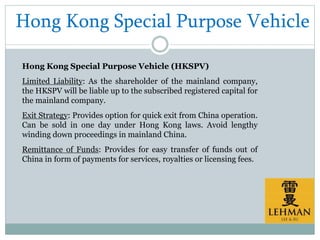
Limited Liability: As the shareholder of the mainland company,
the HKSPV will be liable up to the subscribed registered capital for
the mainland company.
Exit Strategy: Provides option for quick exit from China operation.
Can be sold in one day under Hong Kong laws. Avoid lengthy
winding down proceedings in mainland China.
Remittance of Funds: Provides for easy transfer of funds out of
China in form of payments for services, royalties or licensing fees.
Hong Kong Special Purpose Vehicle
Hong Kong Special Purpose Vehicle (HKSPV)
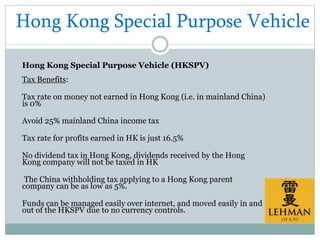
Tax Benefits:
Tax rate on money not earned in Hong Kong (i.e. in mainland China)
is 0%
Avoid 25% mainland China income tax
Tax rate for profits earned in HK is just 16.5%
No dividend tax in Hong Kong, dividends received by the Hong
Kong company will not be taxed in HK
The China withholding tax applying to a Hong Kong parent
company can be as low as 5%.
Funds can be managed easily over internet, and moved easily in and
out of the HKSPV due to no currency controls.
Your China Company
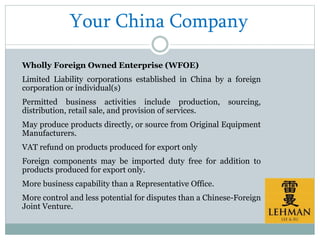
Wholly Foreign Owned Enterprise (WFOE)
Limited Liability corporations established in China by a foreign
corporation or individual(s)
Permitted business activities include production, sourcing,
distribution, retail sale, and provision of services.
May produce products directly, or source from Original Equipment
Manufacturers.
VAT refund on products produced for export only
Foreign components may be imported duty free for addition to
products produced for export only.
More business capability than a Representative Office.
More control and less potential for disputes than a Chinese-Foreign
Joint Venture.
Changes to China’s Company Law
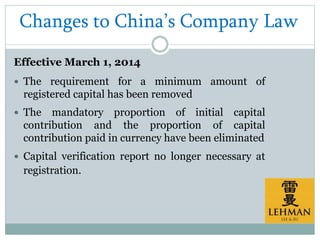
Effective March 1, 2014
 The requirement for a minimum amount of
registered capital has been removed
 The mandatory proportion of initial capital
contribution and the proportion of capital
contribution paid in currency have been eliminated
 Capital verification report no longer necessary at
registration.
Changes to China’s Company Law
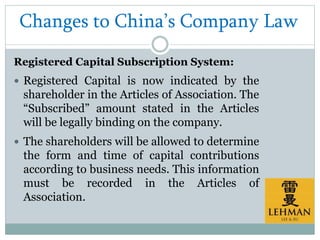
Registered Capital Subscription System:
 Registered Capital is now indicated by the
shareholder in the Articles of Association. The
“Subscribed” amount stated in the Articles
will be legally binding on the company.
 The shareholders will be allowed to determine
the form and time of capital contributions
according to business needs. This information
must be recorded in the Articles of
Association.
Changes to China’s Company Law
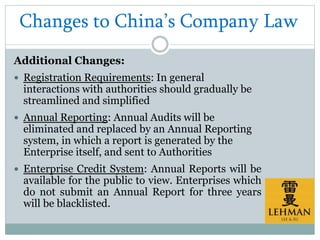
Additional Changes:
 Registration Requirements: In general
interactions with authorities should gradually be
streamlined and simplified
 Annual Reporting: Annual Audits will be
eliminated and replaced by an Annual Reporting
system, in which a report is generated by the
Enterprise itself, and sent to Authorities
 Enterprise Credit System: Annual Reports will be
available for the public to view. Enterprises which
do not submit an Annual Report for three years
will be blacklisted.
Changes to China’s Company Law
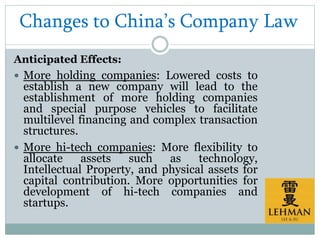
Anticipated Effects:
 More holding companies: Lowered costs to
establish a new company will lead to the
establishment of more holding companies
and special purpose vehicles to facilitate
multilevel financing and complex transaction
structures.
 More hi-tech companies: More flexibility to
allocate assets such as technology,
Intellectual Property, and physical assets for
capital contribution. More opportunities for
development of hi-tech companies and
startups.
Changes to China’s Company Law
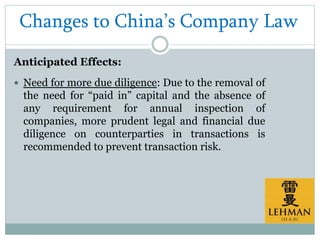
Anticipated Effects:
 Need for more due diligence: Due to the removal of
the need for “paid in” capital and the absence of
any requirement for annual inspection of
companies, more prudent legal and financial due
diligence on counterparties in transactions is
recommended to prevent transaction risk.
Employment Systems
Type of Labor Contract:
 Fixed Term
 Non-Fixed Term
 Contract for completion of specific task
Termination of an Employment Contract:
Every Employee is Required by Law to have an Employment Contract
Proper causes for Termination with 30
days notice
 Unable to resume work after
treatment period for work related injury
 Employee is incompetent and
remains so after training
 Employment is impossible to
perform due to material change in
conditions
Proper causes for Immediate Termination
 Employee fails to meet employment
requirements during probation
 Employee materially breaches
Employers regulations
 Employee’s Serious dereliction of duty
causing substantial loss (including fraud)
 Employee begins another job
Employment Systems
Company Handbook: Responsibilities of Employees to Company.
Employment Trainee Agreement: Requiring the employee to pay back
trainee costs if the employee leaves employment within a certain time
period.
Non-Disclosure Agreement: A standalone agreement.
Non-Competition Agreement: A standalone agreement.
Intellectual Property Work for Hire Agreement: A standalone
agreement, indicating that all intellectual property created by the
employee during employment is the property of the company.
China Anti-Bribery/Foreign Corrupt Practices Act Agreement: A
standalone agreement.
China Expense Reimbursement Agreement: A standalone agreement.
Intellectual Property Protection
Types of Intellectual Property
Trademarks: Protection for the words or logo used to identify goods
or services.
Copyrights: Protection for an original work of art or writing (including
software)
Patents: Protection for a new invention, an incremental improvement,
or a new use of existing technology
Design Patents: Protection on the unique appearance of the design of
a product.
Domain Names: Register your name, and variations on your name,
under multiple domains (.com, .com.cn, .cn, .中国)
Intellectual Property Protection
Intellectual Property Registration
First-to-File System: The first to file for protection of a Intellectual
Property (IP) will be the owner, prior use is not a consideration.
Benefits of Registration
 Legal ownership of the IP
 Ensures rights to use the protected IP in China
 Reduces potential for infringement
 Grants right to initiate legal action against infringement
and unauthorized use.
 After filing with customs authority, may prevent import
and export of infringing goods
 Important as an aid to transfer money out of China legally
Intellectual Property Licensing
Transferring funds out of China using Licensing
Agreements
IP Licensing Agreements signed between the China company and
the foreign IP holder (Usually a HKSPV).
Income of the China company transferred to the HKSPV as
licensing payments.
Avoid 25% income tax on China company profits.
Licensing Fee will be subject to 6% VAT on transfer
Typically the IP and the Licensing Agreement, must both be
registered with Chinese authorities. However, registering the
Licensing Agreement is not necessary if license is held by a Hong
Kong company.
For More Information
LehmanLaw.com
Mail@Lehmanlaw.com
China Business You can Trust
ChinaBetterBusinessBureau.org
Copyright 2014 - Lehman, Lee & Xu

LLX Presentation

  • 1.
    P R EP A R E D B Y : J A C O B B L A C K L O C K F O R E I G N L E G A L C O U N S E L L E H M A N , L E E & X U B E I J I N G , C H I N A Start-Up Basics For China Business
  • 2.
    Hong Kong SpecialPurpose Vehicle Hong Kong Special Purpose Vehicle (HKSPV) A company founded in Hong Kong, normally conducting no business of its own. Typically holds all IP rights for the mainland China company. No restriction on value of initial capital. Between one and fifty shareholders; individuals or corporate entities. Liability of each shareholder is limited to the capital they have invested. At least one Director which may be individual or corporate entity.
  • 3.
    Hong Kong SpecialPurpose Vehicle Hong Kong Special Purpose Vehicle (HKSPV) At list one Company Secretary is required and must be a Hong Kong resident or corporation. Must have a registered office address in Hong Kong. Required to renew business registration annually, file annual tax return. Required to appoint auditors and prepare audited accounts every year.
  • 4.
    Hong Kong SpecialPurpose Vehicle Hong Kong Special Purpose Vehicle (HKSPV) Limited Liability: As the shareholder of the mainland company, the HKSPV will be liable up to the subscribed registered capital for the mainland company. Exit Strategy: Provides option for quick exit from China operation. Can be sold in one day under Hong Kong laws. Avoid lengthy winding down proceedings in mainland China. Remittance of Funds: Provides for easy transfer of funds out of China in form of payments for services, royalties or licensing fees.
  • 5.
    Hong Kong SpecialPurpose Vehicle Hong Kong Special Purpose Vehicle (HKSPV) Tax Benefits: Tax rate on money not earned in Hong Kong (i.e. in mainland China) is 0% Avoid 25% mainland China income tax Tax rate for profits earned in HK is just 16.5% No dividend tax in Hong Kong, dividends received by the Hong Kong company will not be taxed in HK The China withholding tax applying to a Hong Kong parent company can be as low as 5%. Funds can be managed easily over internet, and moved easily in and out of the HKSPV due to no currency controls.
  • 6.
    Your China Company WhollyForeign Owned Enterprise (WFOE) Limited Liability corporations established in China by a foreign corporation or individual(s) Permitted business activities include production, sourcing, distribution, retail sale, and provision of services. May produce products directly, or source from Original Equipment Manufacturers. VAT refund on products produced for export only Foreign components may be imported duty free for addition to products produced for export only. More business capability than a Representative Office. More control and less potential for disputes than a Chinese-Foreign Joint Venture.
  • 7.
    Changes to China’sCompany Law Effective March 1, 2014  The requirement for a minimum amount of registered capital has been removed  The mandatory proportion of initial capital contribution and the proportion of capital contribution paid in currency have been eliminated  Capital verification report no longer necessary at registration.
  • 8.
    Changes to China’sCompany Law Registered Capital Subscription System:  Registered Capital is now indicated by the shareholder in the Articles of Association. The “Subscribed” amount stated in the Articles will be legally binding on the company.  The shareholders will be allowed to determine the form and time of capital contributions according to business needs. This information must be recorded in the Articles of Association.
  • 9.
    Changes to China’sCompany Law Additional Changes:  Registration Requirements: In general interactions with authorities should gradually be streamlined and simplified  Annual Reporting: Annual Audits will be eliminated and replaced by an Annual Reporting system, in which a report is generated by the Enterprise itself, and sent to Authorities  Enterprise Credit System: Annual Reports will be available for the public to view. Enterprises which do not submit an Annual Report for three years will be blacklisted.
  • 10.
    Changes to China’sCompany Law Anticipated Effects:  More holding companies: Lowered costs to establish a new company will lead to the establishment of more holding companies and special purpose vehicles to facilitate multilevel financing and complex transaction structures.  More hi-tech companies: More flexibility to allocate assets such as technology, Intellectual Property, and physical assets for capital contribution. More opportunities for development of hi-tech companies and startups.
  • 11.
    Changes to China’sCompany Law Anticipated Effects:  Need for more due diligence: Due to the removal of the need for “paid in” capital and the absence of any requirement for annual inspection of companies, more prudent legal and financial due diligence on counterparties in transactions is recommended to prevent transaction risk.
  • 12.
    Employment Systems Type ofLabor Contract:  Fixed Term  Non-Fixed Term  Contract for completion of specific task Termination of an Employment Contract: Every Employee is Required by Law to have an Employment Contract Proper causes for Termination with 30 days notice  Unable to resume work after treatment period for work related injury  Employee is incompetent and remains so after training  Employment is impossible to perform due to material change in conditions Proper causes for Immediate Termination  Employee fails to meet employment requirements during probation  Employee materially breaches Employers regulations  Employee’s Serious dereliction of duty causing substantial loss (including fraud)  Employee begins another job
  • 13.
    Employment Systems Company Handbook:Responsibilities of Employees to Company. Employment Trainee Agreement: Requiring the employee to pay back trainee costs if the employee leaves employment within a certain time period. Non-Disclosure Agreement: A standalone agreement. Non-Competition Agreement: A standalone agreement. Intellectual Property Work for Hire Agreement: A standalone agreement, indicating that all intellectual property created by the employee during employment is the property of the company. China Anti-Bribery/Foreign Corrupt Practices Act Agreement: A standalone agreement. China Expense Reimbursement Agreement: A standalone agreement.
  • 14.
    Intellectual Property Protection Typesof Intellectual Property Trademarks: Protection for the words or logo used to identify goods or services. Copyrights: Protection for an original work of art or writing (including software) Patents: Protection for a new invention, an incremental improvement, or a new use of existing technology Design Patents: Protection on the unique appearance of the design of a product. Domain Names: Register your name, and variations on your name, under multiple domains (.com, .com.cn, .cn, .中国)
  • 15.
    Intellectual Property Protection IntellectualProperty Registration First-to-File System: The first to file for protection of a Intellectual Property (IP) will be the owner, prior use is not a consideration. Benefits of Registration  Legal ownership of the IP  Ensures rights to use the protected IP in China  Reduces potential for infringement  Grants right to initiate legal action against infringement and unauthorized use.  After filing with customs authority, may prevent import and export of infringing goods  Important as an aid to transfer money out of China legally
  • 16.
    Intellectual Property Licensing Transferringfunds out of China using Licensing Agreements IP Licensing Agreements signed between the China company and the foreign IP holder (Usually a HKSPV). Income of the China company transferred to the HKSPV as licensing payments. Avoid 25% income tax on China company profits. Licensing Fee will be subject to 6% VAT on transfer Typically the IP and the Licensing Agreement, must both be registered with Chinese authorities. However, registering the Licensing Agreement is not necessary if license is held by a Hong Kong company.
  • 17.
    For More Information LehmanLaw.com Mail@Lehmanlaw.com ChinaBusiness You can Trust ChinaBetterBusinessBureau.org Copyright 2014 - Lehman, Lee & Xu