Objectives:
• Identify thefirst three kings of Israel Saul, David, and Solomonand
their roles in salvation history.
• Explain the successes and failures of each king in relation to God’s
commandments.
• Recognize the moral and spiritual lessons that can be learned from
their lives.
• Apply values of humility, obedience, wisdom, and repentance in their
own lives.
3.
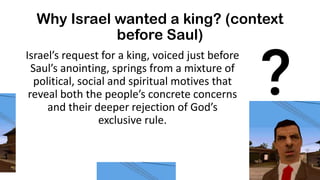
Why Israel wanteda king? (context
before Saul)
Israel’s request for a king, voiced just before
Saul’s anointing, springs from a mixture of
political, social and spiritual motives that
reveal both the people’s concrete concerns
and their deeper rejection of God’s
exclusive rule.
4.
Historical background
After theExodus from Egypt and the conquest of Canaan, the
Israelites did not yet have a human king. Instead, Yahweh
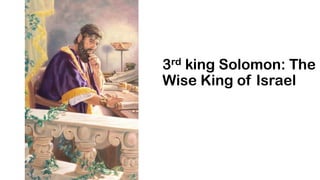
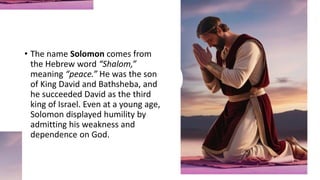
Himself was regarded as their true King, ruling directly over His
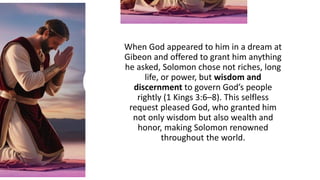
people. To guide them in times of crisis, God raised up
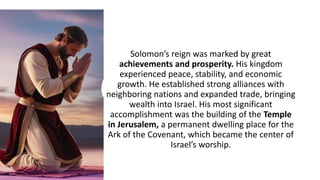
charismatic leaders called judges. These judges were not kings
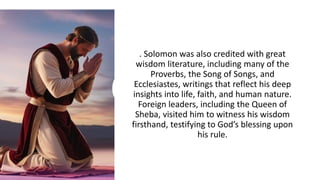
but temporary leaders chosen by God to deliver Israel from its
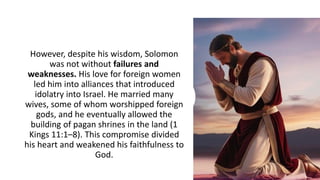
enemies, settle disputes, and call the people back to
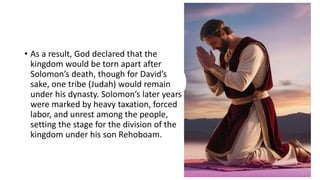
faithfulness.
5.
This period, describedin the Book of
Judges, was often a cycle:
1. The Israelites fell into sin and idolatry.
2. God allowed them to be oppressed by foreign nations.
3. They cried out for help.
4. God raised up a judge to rescue them.
5. Peace returned, but the cycle repeated.
6.
• Among thesejudges were notable figures such as Deborah, Gideon,
Jephthah, and Samson. The last and greatest of them was Samuel,
who served not only as a judge but also as a prophet and priest.
• For a time, the people experienced peace what Scripture calls a
“cessation of all war.” However, when Samuel grew old, his sons Joel
and Abijah became corrupt and abused their authority (1 Sam 8:1–
4). This corruption led the people to lose confidence in the system of
judges and to demand a human king, saying: “Now appoint for us a
king to judge us like all the nations” (1 Sam 8:5).
7.
Thus, the historicalbackground of the monarchy in Israel is rooted in
both the failures of human leaders and the people’s desire to be like
surrounding nations, which eventually led to the rise of Saul as Israel’s
first king.
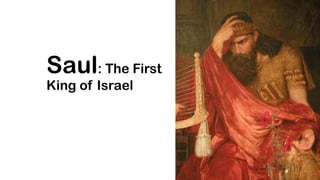
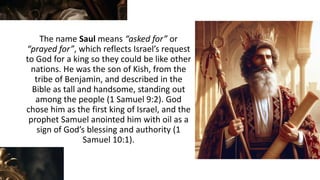
The name Saulmeans “asked for” or
“prayed for”, which reflects Israel’s request
to God for a king so they could be like other
nations. He was the son of Kish, from the
tribe of Benjamin, and described in the
Bible as tall and handsome, standing out
among the people (1 Samuel 9:2). God
chose him as the first king of Israel, and the
prophet Samuel anointed him with oil as a
sign of God’s blessing and authority (1
Samuel 10:1).
10.
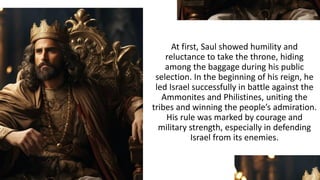
At first, Saulshowed humility and
reluctance to take the throne, hiding
among the baggage during his public
selection. In the beginning of his reign, he
led Israel successfully in battle against the
Ammonites and Philistines, uniting the
tribes and winning the people’s admiration.
His rule was marked by courage and
military strength, especially in defending
Israel from its enemies.
11.
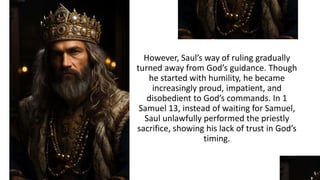
However, Saul’s wayof ruling gradually
turned away from God’s guidance. Though
he started with humility, he became
increasingly proud, impatient, and
disobedient to God’s commands. In 1
Samuel 13, instead of waiting for Samuel,
Saul unlawfully performed the priestly
sacrifice, showing his lack of trust in God’s
timing.
12.
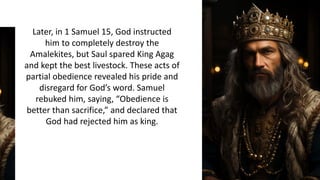
Later, in 1Samuel 15, God instructed
him to completely destroy the
Amalekites, but Saul spared King Agag
and kept the best livestock. These acts of
partial obedience revealed his pride and
disregard for God’s word. Samuel
rebuked him, saying, “Obedience is
better than sacrifice,” and declared that
God had rejected him as king.
13.
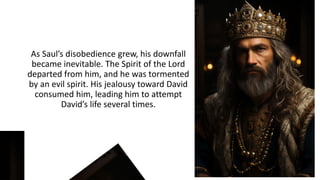
As Saul’s disobediencegrew, his downfall
became inevitable. The Spirit of the Lord
departed from him, and he was tormented
by an evil spirit. His jealousy toward David
consumed him, leading him to attempt
David’s life several times.
14.
In his desperationbefore a crucial
battle with the Philistines, Saul
sought help from the witch of
Endor, asking her to summon
Samuel’s spirit a forbidden act that
revealed how far he had turned
away from God. Samuel’s spirit
foretold Saul’s defeat and death.
The next day, in despair and defeat,
Saul fell on his own sword, and his
sons died beside him in battle (1
Samuel 31).
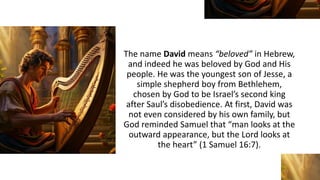
The name Davidmeans “beloved” in Hebrew,
and indeed he was beloved by God and His
people. He was the youngest son of Jesse, a
simple shepherd boy from Bethlehem,
chosen by God to be Israel’s second king
after Saul’s disobedience. At first, David was
not even considered by his own family, but
God reminded Samuel that “man looks at the
outward appearance, but the Lord looks at
the heart” (1 Samuel 16:7).
17.
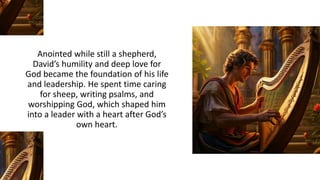
Anointed while stilla shepherd,
David’s humility and deep love for
God became the foundation of his life
and leadership. He spent time caring
for sheep, writing psalms, and
worshipping God, which shaped him
into a leader with a heart after God’s
own heart.
18.
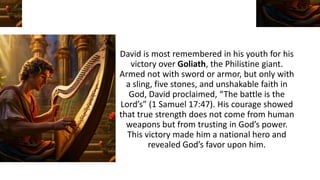
David is mostremembered in his youth for his
victory over Goliath, the Philistine giant.
Armed not with sword or armor, but only with
a sling, five stones, and unshakable faith in
God, David proclaimed, “The battle is the
Lord’s” (1 Samuel 17:47). His courage showed
that true strength does not come from human
weapons but from trusting in God’s power.
This victory made him a national hero and
revealed God’s favor upon him.
19.
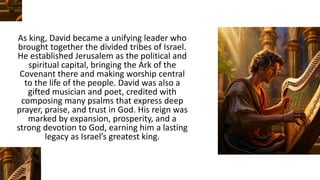
As king, Davidbecame a unifying leader who
brought together the divided tribes of Israel.
He established Jerusalem as the political and
spiritual capital, bringing the Ark of the
Covenant there and making worship central
to the life of the people. David was also a
gifted musician and poet, credited with
composing many psalms that express deep
prayer, praise, and trust in God. His reign was
marked by expansion, prosperity, and a
strong devotion to God, earning him a lasting
legacy as Israel’s greatest king.
20.
Yet, David wasnot without weaknesses. He
committed grave sins, including adultery with
Bathsheba and arranging the death of her
husband, Uriah (2 Samuel 11). These acts of pride
and lust brought suffering upon his household.
However, what distinguished David from Saul was
his response to sin. When confronted by the
prophet Nathan, David repented sincerely,
confessing his guilt in prayer (Psalm 51). His
humility and contrite heart restored his
relationship with God, though he still faced
consequences.
• The nameSolomon comes from
the Hebrew word “Shalom,”
meaning “peace.” He was the son
of King David and Bathsheba, and
he succeeded David as the third
king of Israel. Even at a young age,
Solomon displayed humility by
admitting his weakness and
dependence on God.
23.
When God appearedto him in a dream at
Gibeon and offered to grant him anything
he asked, Solomon chose not riches, long
life, or power, but wisdom and
discernment to govern God’s people
rightly (1 Kings 3:6–8). This selfless
request pleased God, who granted him
not only wisdom but also wealth and
honor, making Solomon renowned
throughout the world.
24.
Solomon’s reign wasmarked by great
achievements and prosperity. His kingdom
experienced peace, stability, and economic
growth. He established strong alliances with
neighboring nations and expanded trade, bringing
wealth into Israel. His most significant
accomplishment was the building of the Temple
in Jerusalem, a permanent dwelling place for the
Ark of the Covenant, which became the center of
Israel’s worship.
25.
. Solomon wasalso credited with great
wisdom literature, including many of the
Proverbs, the Song of Songs, and
Ecclesiastes, writings that reflect his deep
insights into life, faith, and human nature.
Foreign leaders, including the Queen of
Sheba, visited him to witness his wisdom
firsthand, testifying to God’s blessing upon
his rule.
26.
However, despite hiswisdom, Solomon
was not without failures and
weaknesses. His love for foreign women
led him into alliances that introduced
idolatry into Israel. He married many
wives, some of whom worshipped foreign
gods, and he eventually allowed the
building of pagan shrines in the land (1
Kings 11:1–8). This compromise divided
his heart and weakened his faithfulness to
God.
27.
• As aresult, God declared that the
kingdom would be torn apart after
Solomon’s death, though for David’s
sake, one tribe (Judah) would remain
under his dynasty. Solomon’s later years
were marked by heavy taxation, forced
labor, and unrest among the people,
setting the stage for the division of the
kingdom under his son Rehoboam.
28.
The Church Teaches
TheChurch reminds us that all true leadership comes
from God. Just as God anointed Saul, David, and Solomon
through His prophets, the Church teaches that God
continues to anoint leaders today, especially through the
guidance of the Holy Spirit. Bishops, priests, and even lay
leaders are called to serve not for personal glory but for
the good of God’s people. Leadership is not merely about
authority; it is a vocation of service and responsibility,
guided by God’s Spirit.
29.
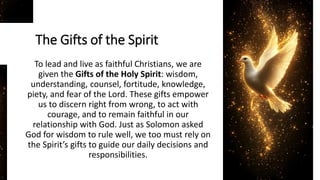
The Gifts ofthe Spirit
To lead and live as faithful Christians, we are
given the Gifts of the Holy Spirit: wisdom,
understanding, counsel, fortitude, knowledge,
piety, and fear of the Lord. These gifts empower
us to discern right from wrong, to act with
courage, and to remain faithful in our
relationship with God. Just as Solomon asked
God for wisdom to rule well, we too must rely on
the Spirit’s gifts to guide our daily decisions and
responsibilities.
30.
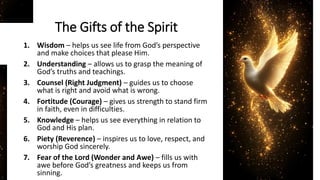
The Gifts ofthe Spirit
1. Wisdom – helps us see life from God’s perspective
and make choices that please Him.
2. Understanding – allows us to grasp the meaning of
God’s truths and teachings.
3. Counsel (Right Judgment) – guides us to choose
what is right and avoid what is wrong.
4. Fortitude (Courage) – gives us strength to stand firm
in faith, even in difficulties.
5. Knowledge – helps us see everything in relation to
God and His plan.
6. Piety (Reverence) – inspires us to love, respect, and
worship God sincerely.
7. Fear of the Lord (Wonder and Awe) – fills us with
awe before God’s greatness and keeps us from
sinning.
31.
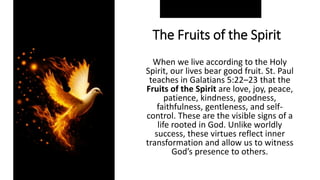
The Fruits ofthe Spirit
When we live according to the Holy
Spirit, our lives bear good fruit. St. Paul
teaches in Galatians 5:22–23 that the
Fruits of the Spirit are love, joy, peace,
patience, kindness, goodness,
faithfulness, gentleness, and self-
control. These are the visible signs of a
life rooted in God. Unlike worldly
success, these virtues reflect inner
transformation and allow us to witness
God’s presence to others.
32.
Fruits of theHoly Spirit (Galatians 5:22–23)
1. Love – Caring for others sincerely, without expecting anything in return.
2. Joy – Inner happiness that comes from trusting God, not just from good
situations.
3. Peace – Calmness and harmony in our hearts, even during problems.
4. Patience – The ability to wait calmly without complaining or giving up.
5. Kindness – Treating others with gentleness, respect, and compassion.
6. Goodness – Choosing to do what is right and pleasing to God.
7. Faithfulness – Being loyal and trustworthy in our relationship with God
and people.
8. Gentleness – Acting with humility and care, not with harshness or pride.
9. Self-control – The strength to control our emotions, desires, and actions.
33.
From the storiesof Saul, David, and Solomon, we learn
important moral lessons for our own lives. Saul shows
us the danger of pride and disobedience; David teaches
us humility, faith, and the importance of repentance;
and Solomon reminds us that wisdom and blessings are
wasted if our hearts turn away from God. The Church
calls us to live with obedience, humility, faith, and
repentance, for these virtues keep us close to God and
allow His Spirit to work in us. True greatness comes not
from power, wealth, or status, but from a heart that
follows God with love and trust.







![KingsandProphets [Autosaved] [Autosaved].pptx](https://cdn.slidesharecdn.com/ss_thumbnails/kingsandprophetsautosavedautosaved-230327011255-41d30d2e-thumbnail.jpg?width=640&height=640&fit=bounds)


![770908401-PPT-W2Q1-Rational-Functions-1 pptx. [Autosaved].pptx](https://cdn.slidesharecdn.com/ss_thumbnails/770908401-ppt-w2q1-rational-functions-1pptx-251106135035-b499d3b0-thumbnail.jpg?width=640&height=640&fit=bounds)


![谷歌霸屏推广[ 𝙩𝙤𝙥 𝟮𝟯𝟯. 𝙘 𝙤𝙢 ]](https://cdn.slidesharecdn.com/ss_thumbnails/top233-260130171247-43791db0-thumbnail.jpg?width=640&height=640&fit=bounds)


